A collection of data structures implementing what's presented in the book "Algorithms and Data Structures in Action".
From the base folder:
nvm install stable

npm installFrom the base folder:
npm t test/$FOLDER/$TESTFor instance
npm t test/geometric/test_point.jsA heap is conceptually a tree, but it’s implemented using an array for the sake of efficiency. While regular heaps are binary balanced trees, d-ary heaps use d-ary trees, reducing the tree's height. Depending on what operations are performed more frequently on the heap, a larger branching factor can provide a significant speed-up.

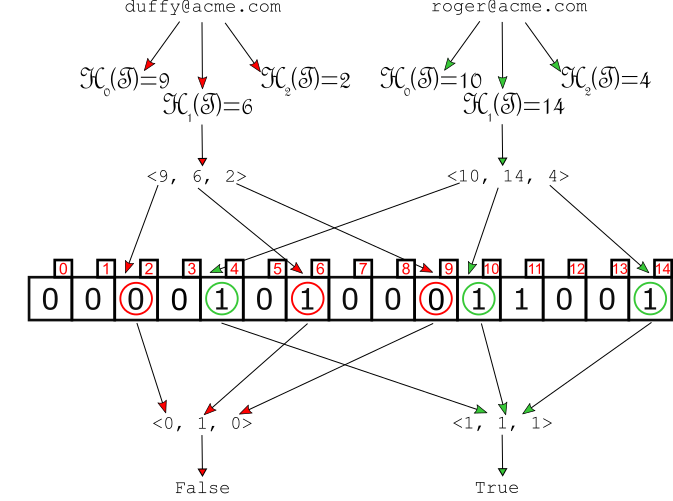
Bloom filters work like sets, storing entries and allowing fast lookup. In exchange of a (tunable) ratio of false positives, they allow to store large sets using only a constant number of bits per key (while hash-tables, for instance, would require space proportional to the size of the keys).
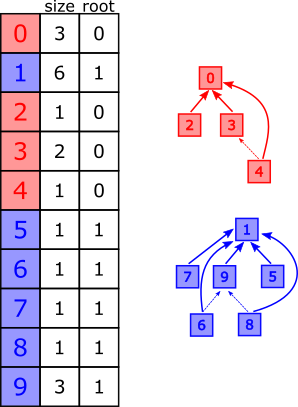
We use a disjoint-set every time that, starting with a set of objects, we would like to account for the partitioning of this set into disjoint groups (i.e. sub-sets without any element in common between them).
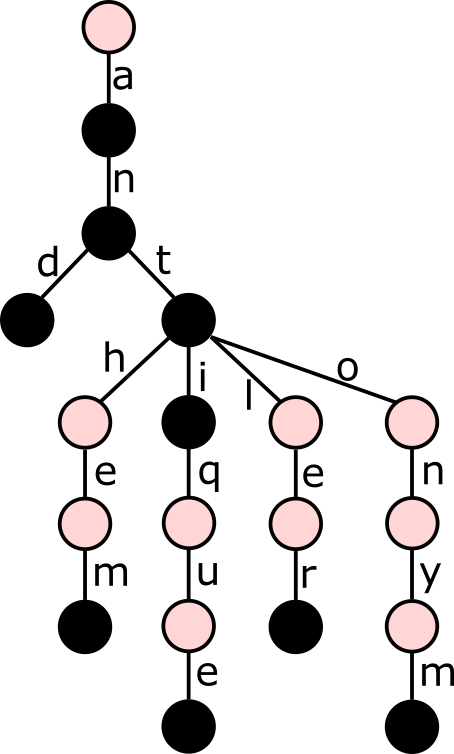
This data structure allows to more efficiently store and query large sets of strings, assuming many of them share some common prefixes. Many applications manipulating strings can benefit from using trie, from spell-checkers to bioinformatics.
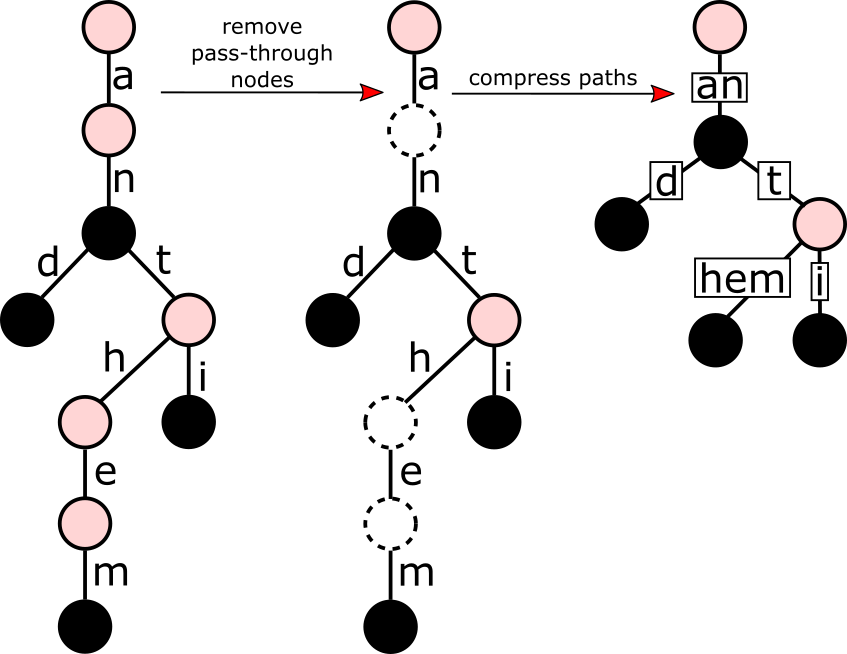
Storing tries can be cheaper than holding these values in binary search trees or hash tables, but it can require a lot of memory. Radix tries compress paths, whenever possible, to provide a more compact representation of these tries, without having to compromise interms of complexity or performance.
K-d trees are an advanced data structure that helps performing spatial queries (nearest neighbor search and intersections with spherical or rectangular regions) more efficiently. K-d trees are great with low-and medium-dimensional spaces, but suffer sparsity of high-dimensional spaces; they also work better on static datasets, because we can build balanced trees on construction, but insert and remove are not self-balancing operations.
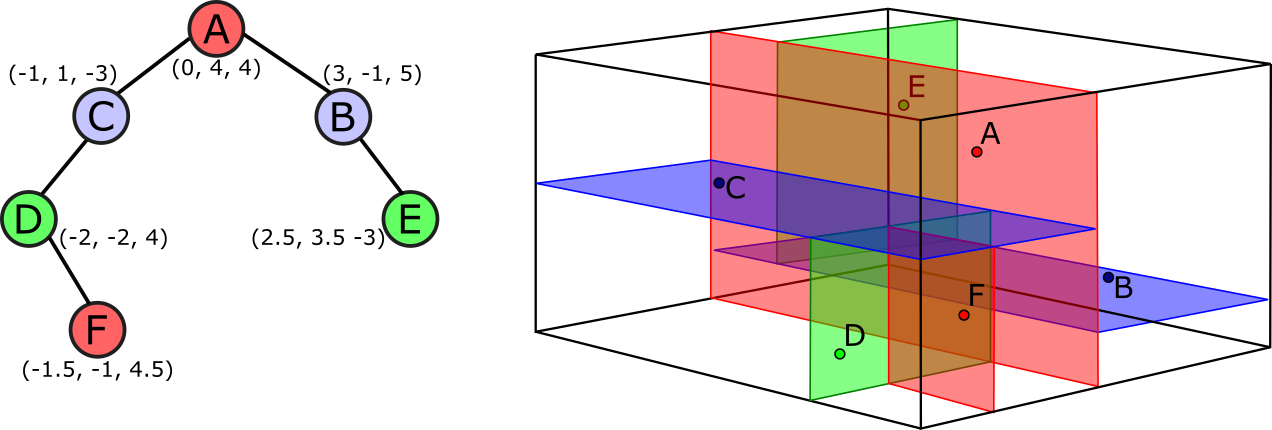
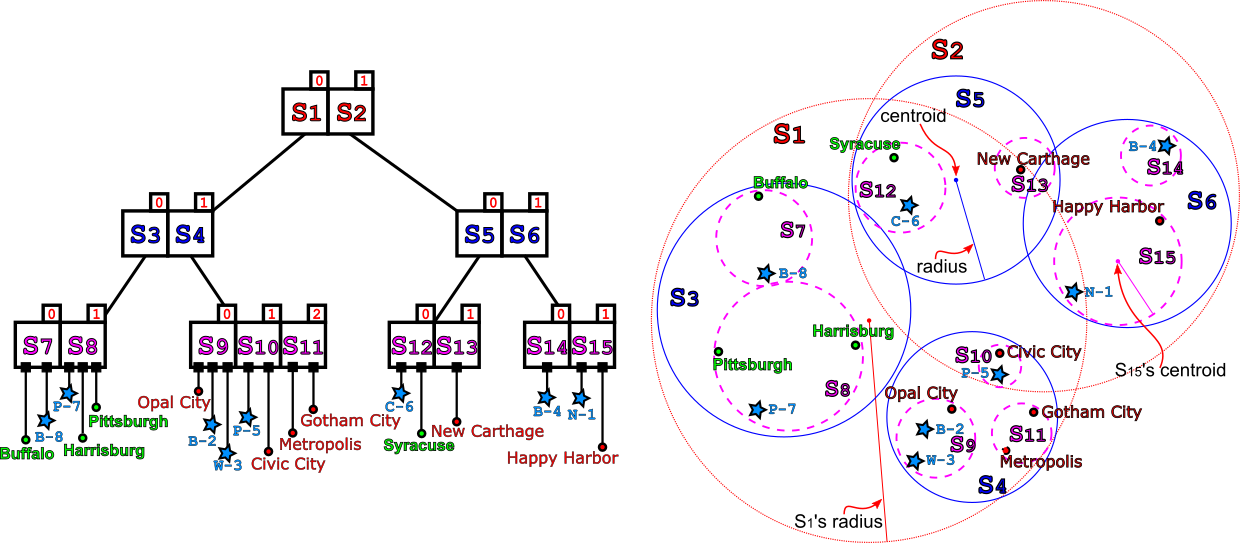
To overcome the issues with k-d trees, alternative data structures like R-trees and Ss-trees have been introduced.
Ss+-trees cluster data in overalpping hyperspheres, using a few heuristics to maintain the tree as balanced as possible.
Although none of these structures can offer any guarantee on the worst-case running time, in practice they perform better than k-d trees in many situations, and especially for higher-dimensional data.
The Needleman–Wunsch algorithm is an algorithm used in bioinformatics to align protein or nucleotide sequences.