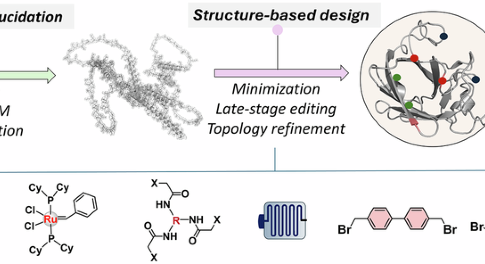



Illustration of an electrochemical activation process in flow

Electrochemical Ferrier rearrangement of glycals in flow

  • Pallav Suman
  • Mihhail Fokin
  • Maksim Ošeka
Article

Announcements

  • Molecular-level illustration of a carbon nanotube on a dark background

    We are currently welcoming submissions to a number of open Collections, including:

    * Biosynthesis

    * Synthetic approaches to carbon nanomaterials

    * Self-healing chemical systems

    * Soft materials for drug delivery

  • Multicoloured image of head silhouettes

    Interested in joining our editorial board and helping to shape our journal and the manuscripts that we publish in your areas of research? Please fill in our application form (link above) to indicate your interest. We are particularly interested in hearing from women and those with other underrepresented identities.

  • Vania Zuin Zeidler's headshot

    In April, we thank Vania Zuin Zeidler for her invaluable contributions to peer review. Her group researches topics involving bio-based materials and related products, their flows and processes, aiming at understanding and incorporating the latest advances from other fields as well.

Advertisement

  • Impact-shear-induced melting in dense suspensions of silica particles typically initiates within milliseconds and is complete within a few seconds, rendering the melting transition difficult to observe. Here, to overcome this challenge, the authors develop a rheometric technique that combines fast time-resolved small-angle X-ray scattering with millisecond time resolution, showing that anisotropic disordering induced by impact shear is indicative of momentary particle clustering due to rapid interlayer sliding within the close-packed colloidal structure.

    • Keishi Akada
    • Tatsuya Yamada
    • Jun-ichi Fujita
    ArticleOpen Access
  • Acute sinusitis, exacerbated by environmental pollutants and poor medication adherence, poses significant health challenges due to increased drug resistance. Here, the authors develop a QACS/SA@Py@Ta4C3 injectable hydrogel, integrating phillyrin from traditional chinese medicine with Ta4C3 quantum dots and natural polymers (quaternary chitosan and sodium alginate), demonstrating potent antibacterial, anti-inflammatory, and antioxidant effects against sinusitis.

    • Yuan Yuan
    • Yongze Liu
    • Xia Gao
    ArticleOpen Access
  • Mixed trimers of pyrrole (Py) and benzene (Bz) provide an ideal benchmark to probe the interplay between strong directional forces and diffuse dispersion contacts that governs structural preferences in molecular assemblies. Here, the authors characterize Py-(Bz)2 and (Py)2-Bz trimers and the (Py)2-(Bz)2 tetramer using chirped-pulse Fourier transform microwave spectroscopy combined with dispersion-corrected DFT calculations and intensity-based cross-correlation analysis, showing that the overall geometries are dictated by space-filling principles that maximize dispersion contacts.

    • Simon Lobsiger
    • Zbigniew Kisiel
    • Cristóbal Pérez
    ArticleOpen Access
  • Accurate prediction of molecular properties is crucial for drug discovery, yet existing models often fail to integrate local and global molecular contexts effectively. Here, the authors present a unified multi-scale graph-fingerprint network (UMSGFNet) that enhances predictive performance and robustness by combining atom-level and substructure-level information.

    • Chang Cai
    • Mugang Lin
    • Dongyuan Huang
    ArticleOpen Access
  • The dehydrogenation of methanol using homogeneous or heterogeneous catalysts and photocatalysts has attracted considerable attention, as hydrogen production from alcohols represents a pivotal reaction for achieving carbon neutrality. Here, the authors report a photocatalytic system in which a ligand-free iron ion functions as the sole catalyst, promoting hydrogen evolution under UV light irradiation without the need for supporting ligands or noble metals, with similar turnover frequency compared to previously reported homogeneous catalysts.

    • Masaya Sakurai
    • Yudai Kawasaki
    • Takahiro Matsumoto
    ArticleOpen Access
  • Functionalized γ-lactones and cyclopropanes with amide substituents are crucial in chemical and pharmacological processes, yet their synthesis poses significant challenges. Here, the authors introduce a high-throughput protocol using amide–sulfoxonium ylides for efficient annulation reactions, offering a versatile method with broad substrate scope and potential for complex molecule diversification, enhanced by machine learning predictions.

    • Yougen Xu
    • Haiting Wu
    • Lebin Su
    ArticleOpen Access
    • Selective protein functionalization remains difficult to achieve through conventional molecular biology approaches. Here, the authors summarize recent advances in chemical approaches to protein engineering and highlight their emerging applications in catalysis, functional studies, and therapeutic development.

      • Raj V. Nithun
      • Manjeet Singh
      • Muhammad Jbara
      Review ArticleOpen Access
    • Redox reactions played an important role in shaping the conditions that enabled the emergence of life on the early Earth, but how these relate to specific environmental conditions and whether they led to heterotroph or autotroph organisms remains a matter of debate. In this Review, the authors summarize and discuss evidence reconciling dominant theories — from the redox nature of the Hadean atmosphere and the presence of conditions that could have supported both heterotrophs and chemoautotrophs, to the transport of organic compounds that could have led to the emergence of life in multiple local environments.

      • Nurbubu T. Moldogazieva
      • Alexander A. Terentiev
      • Dmitry V. Astakhov
      Review ArticleOpen Access
    • There has been growing interest in the application of machine learning (ML) to the design of heterogeneous catalysts, including nanoparticle catalysts (NC) and single-atom catalysts (SACs). In this Review, the authors summarize recent advances in the ML-guided design of NCs and SACs for energy applications, focusing on the selection of features and descriptors for ML models from atom-scale structural information and identifying challenges and opportunities for the development of next-generation SACs through reliable datasets and advanced ML models.

      • Zhongbao Hu
      • Zhoukun Wang
      • Jian-Feng Li
      Review ArticleOpen Access
    • The A₂Ir₂O₇ iridium pyrochlores series exibit an interplay between a 5d Ir sublattice and, in many members, a magnetic 4f A-site sublattice, which gives rise to a hierarchy of coupled structural, magnetic, and transport phenomena that may support magnetic monopole-like excitations that can enable novel magnetoelectric responses. In this Review, the authors discuss a unified framework linking lattice geometry, f-d exchange, and spin–orbit-driven anisotropies, summarising key experimental advances and outlining future research directions aimed at detecting and controlling magnetic monopole-like excitations through magnetic fields, electric fields, and lattice perturbations.

      • Milan Klicpera
      Review ArticleOpen Access
    • The origin of pseudocapacitance remains a topic of ongoing debate. In this Perspective, the authors offer a new understanding, proposing that metallic conduction, negligible energy barriers for ionic charge transport, and a unique interaction between the electrode and ionic charges are all indispensable contributors to the pseudocapacitive response.

      • Wenxin Yan
      • Taowen Dong
      • Weitao Zheng
      PerspectiveOpen Access
  • Professor Nicola Gaston is the Director of the MacDiarmid Institute for Advanced Materials and Nanotechnology, a New Zealand Centre of Research Excellence, and a Professor in Physics at the University of Auckland, where her research group conducts quantum-mechanical simulations of the electronic and thermodynamic behaviour of nanoscale materials.

    Q&AOpen Access
  • Mechanoradicals are known to be sources of damage during polymer processing, and it remains challenging to stabilize, repair or utilize them. Recently, mechanoradicals formed during chain scission were intercepted directly by bis(butyl trithiocarbonate) in the solid state, redirecting the degradation pathways to repolymerization (repair) and complete depolymerization (recovery).

    • Huijuan Guo
    Research HighlightOpen Access
  • We are pleased to present our Editors’ Highlights Collection, featuring some of our favourite content published in Communications Chemistry in 2025. Here, we highlight why each paper was selected by our Editors and Editorial Board Members.

    EditorialOpen Access
  • Mental health should be a priority for all and especially for underrepresented groups, including the women in chemistry. Here, the authors discuss and propose supportive mechanisms within academia for the mental health of undergraduate women in chemistry.

    • Isobel Grint
    • Loukia Taxitari
    • Rafaela Vasiliadou
    CommentOpen Access
  • Dr Laura Cattaneo is a group leader at the Max Planck Institute for Nuclear Physics in Heidelberg, Germany. She has an interdisciplinary research background in chemical physics, connecting materials science, liquid crystals, and ultrafast processes in matter.

    Q&AOpen Access
  • Electrocatalytic nitrate reduction is widely studied, but under a range of conditions, with implications on catalyst performance. Here, the authors highlight potential pitfalls in comparing across (and within) existing literature and suggest approaches to assess electrocatalysts under common conditions.

    • Devesh K. Pathak
    • Rajkumar Jana
    • Kelsey A. Stoerzinger
    CommentOpen Access
miRNA-mRNA interaction

Nucleic acid chemistry

This Collection aims to offer insight and inspiration for nucleic acid chemistry, focusing on the structure, function, generation, modification, characterization, as well as application of nucleic acids.
Collection

Advertisement

Nature Careers

Science jobs

Advertisement