 DUBAI, United Arab Emirates – February 11, 2026 – Agility Beyond Space (ABS), a global satellite operator, today announces the renewal and expansion of its long-standing partnership with HorizonSat – a leading satellite communications provider, renowned for delivering innovative, reliable, and customised connectivity solutions across the EMEA region since 2006.
The partnership will provide enhanced capacity and integrated ground services through Horizon Teleports (HorizonSat’s state-of-the art Germany-based subsidiary) and will immediately extend ABS’s high-performance coverage across the EMEA region to set the stage for more new strategic partnerships in the Middle East and Africa in 2026 and beyond.
Located in Moosburg, near Munich, Germany, Horizon Teleports already play a key role in supporting ABS’s regional growth strategy with world class, fully redundant infrastructure and deep technical expertise. Moving forward, by combining ABS’s satellite coverage with Horizon Teleports’ infrastructure and technical expertise, the companies will provide a unified suite of satellite connectivity solutions, including IP trunking, carrier monitoring, broadband connectivity, GSM backhauling, and mobility solutions for offshore and maritime sectors.
“This partnership is a crucial milestone in ABS’s commitment to deliver reliable, high-performance connectivity solutions,” said Mark Rigolle, CEO of ABS. “Integrating our satellite network with Horizon Teleports’ ground capabilities enhances service resilience and enables us to bring to life more solutions in more places for our partners with more flexibility and depth – all with the agility that defines us at ABS”.
Mostafa El Farouk, CEO of HorizonSat also commented: “We are pleased to deepen our collaboration with ABS. Our teleport facility and engineering capabilities are perfectly suited to complement ABS’s network, enabling us to jointly deliver seamless, end-to-end communication services across diverse industries.”
This strategic agreement highlights ABS’s continued focus on expanding connectivity and supporting digital transformation across emerging and established markets in the region.
The post ABS Strengthens Ku-Band Capacity and Expands Regional Reach Through Strategic Partnership with Horizon Teleports first appeared on ABS - Agility Beyond Space.
]]>ABS results for the 12 months to 30th September 2025
SUMMARY OF KEY RESULTS
ABS Group1 reports solid performance for the twelve months ended 30 September 2025.
Financial Highlights
- Revenues of $62 million, down 6% YoY with more intense market conditions, and economic headwinds.
- Adjusted EBITDA2 of $31.7 million at 51% margin
- Free cashflow3 at $17.1m, enabling further investment
- Net debt of $29.6m, equating to a net debt leverage ratio of 0.9x
Operating highlights during the financial year
- ABS redomiciliation to the Dubai Development Authority completed, creating new international headquarters in a strategically crucial area.
- Secured major contract wins with British Forces Broadcasting Service, Intelsat, and SES Government, plus expanded managed services partnerships.
- Significant orders from government, broadcast, oil & gas, and cellular backhaul sectors positon ABS well against LEO industry disruption.
Mark Rigolle, CEO, said: “Despite the year-over-year revenue decline, we delivered robust adjusted EBITDA and margins, highlighting our operational efficiency and strict cost discipline, with cost of goods sold and services also trending downward. The results also demonstrate our ability to navigate a competitive landscape while laying strong foundations for the future.
We generated free cash flow at a strong 28% margin, giving us the capital capability to develop high-return strategic projects across our partner ecosystem, and launch new managed services. With debt and operating costs remaining low, we retain the strategic flexibility to deliver our strategy with the agility that defines us here at ABS.
Building on this, our broader results demonstrate real discipline in capital allocation, allowing us to make selected investments, while preserving a healthy balance sheet. This positions the business well for further targeted investments that will create value for both partners and shareholders in the year ahead.
The completion of our redomiciliation to the Dubai Development Authority establishes a new ABS as a proudly Emirati business. This isn’t just a new HQ office: it marks a major strategic milestone in our journey, aligning the company with the UAE’s leading ecosystem of innovation, where global enterprises and talent meet world-class infrastructure to enable both growth and innovation.
Alongside this, several high quality management hires have been made in Dubai to consolidate our presence here. Our commercial organisation has been reorganised with accomplished industry veterans added to the team to bring us even closer to our customers and their needs. ”
Summary Statement of Comprehensive Income (US$m)
| Year Ended 30 September 2025 | ||
| 2025 | 2024 | |
| Revenue | 62 | 66.3 |
| Cost of Goods and Services | (35.1) | (35.9) |
| Administrative Expenses | (19.2) | (17.9) |
| Add back: Depreciation & Amortisation | 22.9 | 22.7 |
| Other Items & Adjustments | 1.1 | 0.7 |
| Adjusted EBITDA | 31.7 | 35.9 |
Summary Statement of Financial Position (US$m)
| As at 30 September 2025 | ||
| 2025 | 2024 | |
| Property, Plant & Equipment | 206.2 | 226.2 |
| Other Non-Current Assets | 11.5 | 14.4 |
| Total Non-Current Assets: | 217.7 | 240.6 |
| Non-Cash Current Assets | 26.7 | 17.6 |
| Cash and Cash Equivalents | 13.5 | 11.5 |
| Total Current Assets | 40.2 | 29.1 |
| Less: Current Liabilities | (32.2) | (26.1) |
| Net Current Assets | 8.0 | 3.0 |
| Long Term Loans | (43.1) | (43.1) |
| Other Non-Current Liabilities | (36.9) | (47.4) |
| Net Assets | 145.7 | 153.1 |
Summary Statement of Cash Flows (US$m)
| Year Ended 30 September 2025 | ||
| 2025 | 2024 | |
| Net Cash Generated from Operating Activities | 17.8 | 20.5 |
| Net Cash Used in Investing Activities | (0.7) | (1.4) |
| Dividends Paid | (10.0) | (19.9) |
| Other Financing Cash Flows | (5.0) | (4.6) |
| Net (Increase) / Decrease in Cash & Cash Equivalents | (2.1) | (5.4) |
| Cash and Cash Equivalents at beginning of the year | 11.5 | 17.0 |
| Effect of Foreign Exchange Rate Changes | (0.1) | (0.1) |
| Cash and Cash Equivalents at end of the year | 13.5 | 11.5 |
Footnotes
- The results reported herein are the consolidated financials for ABS Midco Limited, the principal holding company for the ABS Group
- Excludes one-off non-recurring items and foreign exchange gains and losses
- Net cash generated from operating activities less net cash used in investing activities
The post FY2025 Full Year Results first appeared on ABS - Agility Beyond Space.
]]> Dubai, UAE – October 16, 2025 – ABS proudly announces the successful completion of its redomiciliation to the Dubai Development Authority (DDA), marking a pivotal milestone in its transformation journey.
This move aligns with ABS’s strategy under private ownership and a new management team, reinforcing a fresh, strategic and entrepreneurial focus on innovation, speed, and value creation.
Recognised as a global benchmark for business excellence, the DDA attracts top talent and fosters a climate where bold ideas thrive. ABS’s relocation shows confidence in the region’s potential and its commitment to building a future-ready organization rooted in agility and collaboration.
By establishing its base in Dubai, ABS is positioning itself to accelerate operational agility, scale faster and co-create solutions with partners across the GCC and beyond. The move reinforces ABS’s ambition to build a vibrant ecosystem of regional and global innovators, where entrepreneurship is not just encouraged, it’s embedded in the company’s DNA.
“Our presence in Dubai is a strategic leap forward. It brings us closer to our partners, aligns us with a world-class business environment, and empowers us to grow through a vibrant ecosystem of innovation and collaboration,” said Mark Rigolle, Chief Executive Officer of ABS.
ABS looks forward to deepening its impact in the region and continuing to deliver exceptional value through entrepreneurial thinking, strategic partnerships, and relentless execution.
The post ABS Completes Redomiciliation to Dubai Development Authority as Part of Strategic Transformation first appeared on ABS - Agility Beyond Space.
]]>As digital transformation surges across Southeast Asia, the need for agile, cost-effective and reliable satellite connectivity is greater than ever. At Asia Tech x Singapore (ATxSG) 2025, ABS is proud to return with a sharpened focus on powering Southeast Asia’s digital future, especially in Malaysia, the Philippines, Indonesia, and Vietnam.
These nations are experiencing massive growth in digital applications: from smart cities and e-commerce to remote healthcare and maritime mobility. Yet, fragmented geography and uneven terrestrial infrastructure continue to limit access in many regions.
ABS: Bridging the Digital Divide

ABS stands apart in its ability to deliver global reach with local agility, enabling seamless, scalable satellite connectivity across Southeast Asia and beyond. With 93% global beam coverage and regionally embedded expertise, we work hand-in-hand with partners to enable transformation across core verticals:
- Enterprise VSAT – for secure connectivity across corporate sites, remote facilities, and offshore operations
- Cellular Backhaul & Trunking – expanding mobile coverage in areas where terrestrial networks fall short
- Government & Military-Grade Links – supporting public sector, defense, and disaster recovery initiatives
- Broadcast & DTH Services – delivering content across borders with speed and resilience
Four Markets, One Goal – Stronger Connectivity

Philippines
ABS supports rural and underserved areas through IP trunking and managed VSAT services. Our high-availability satellite capacity extends the digital grid to remote islands—vital for telemedicine, distance learning and emergency response.
Indonesia
With over 17,000 islands and more than 270 million people, Indonesia’s telecom landscape is as complex as it is promising. ABS collaborates with telcos and government agencies to deliver:
- Cellular backhaul for rural mobile expansion
- Managed services for sectors like agriculture, logistics, and healthcare
- Maritime and offshore connectivity for oil & gas and defense operations
Malaysia
Malaysia’s push for digital inclusion and 5G adoption is opening new opportunities. ABS supports this momentum through satellite backhaul and hybrid connectivity solutions, especially for rural areas and industries like finance and energy.
Vietnam
As a fast-growing digital economy, Vietnam depends on reliable connectivity for industrial growth. ABS delivers tailored capacity to support oil & gas, banking, remote education and transportation infrastructure, especially in areas underserved by fiber.
ABS – More Than Just Regional
What truly sets ABS apart is our ability to link Southeast Asia with MENA and Africa, enabling enterprises to operate seamlessly across multiple continents. Whether it’s a Vietnamese energy firm expanding into the Middle East, or an Indonesian telecom provider extending regional services, ABS provides a unified platform for cross-regional coverage.
Let’s Connect at Asia Tech x Singapore 2025
Join ABS at Asia Tech x Singapore 2025 to discover how we’re helping to reshape Southeast Asia’s connectivity landscape, with the agility, reach, and commitment that the future demands.
Visit our booth 4D2-1, Hall 4 at the Singapore Expo and build your next digital solution with ABS. Together, let’s power the future of connectivity.
The post Enabling Southeast Asia’s Digital Leap: ABS at Asia Tech x Singapore 2025 first appeared on ABS - Agility Beyond Space.
]]>The Middle East and North Africa (MENA) region is witnessing a dynamic shift in satellite connectivity, driven by increasing demand across enterprise, mobility, defense, video and consumer broadband services. As digital transformation accelerates and terrestrial infrastructure remains limited in remote areas, satellite operators are stepping up to meet regional demands. With the presence of HTS and LEO satellites, the MENA market is well positioned for sustained growth amid ongoing industry changes.
ABS’s Competitive Advantage in the MENA Market
ABS’s wide-beam coverage across continents gives it a competitive edge in the region. Its footprint aligns well with MENA’s diverse geographic and regulatory environments, making it an ideal partner for enterprises, governments, and mobility clients.
ABS also leases capacity to other operators to help fill coverage gaps, unlocking additional revenue streams. While performance optimizations continue to evolve, ABS remains a relevant and dependable choice for clients needing reliable, wide-area satellite access.
1. Enterprise and Government Connectivity
Government and enterprise clients in MENA rely on satellite networks to support mission-critical operations in sectors such as energy, defense, and mining. IP trunking and VSAT services play a vital role in enabling data transmission for essential infrastructure, such as oil & gas and mining operations.
Onshore sites often present a more stable market, but regulatory requirements for satellite operators—particularly LEO providers—vary significantly across MENA. While some countries are actively enabling LEO services, many others still have pending regulatory approvals or restrictive licensing processes in place.
– EICON Report on Regulatory Approvals for Starlink Services in MENA Countries
ABS’s experience working with governments in Africa demonstrates our ability to deliver secure, reliable connectivity even in highly remote or regulated environments for our partners in the MENA region.
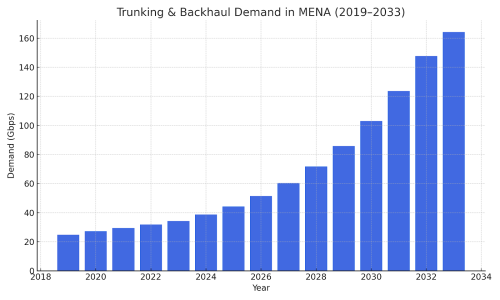
Satellite trunking and backhaul demand in MENA is projected to grow from 17.77 Gbps in 2023 to 161.69 Gbps by 2033, across both GEO and NGSO systems.
Source: Novaspace, “Satellite Connectivity and Video Markets, 2024 Edition,” Chapter 3.6: MENA Region
2. Mobility – Especially Maritime
Mobility remains one of the most demanding and fast-growing areas of satellite connectivity in MENA, particularly in the maritime sector. The region’s vast geography and critical offshore operations mean connectivity at sea is more important than ever. ABS stands out with its unique beam coverage across continents, enabling us to meet mobility requirements in ways that even major providers may not.
With three out of five GEO satellites covering MENA, ABS delivers consistent and cross-regional coverage that is highly valued by partners requiring uninterrupted service across vast distances. ABS’s coverage advantage ensures dependable connectivity where it matters most.
Land mobility is also significant, especially with the rise of connected emergency vehicles, smart fleets, IoT, and satellite-5G integration. ABS supports IP trunking and VSAT applications over C- and Ku-bands. With our teleport presence in Cyprus, we are well-positioned to provide coverage across the entire MENA region.
HTS NGSO trunking/backhaul demand in MENA is projected to grow from 0.82 Gbps in 2023 to 139.02 Gbps by 2033.
Source: Novaspace, “Satellite Connectivity and Video Markets, 2024 Edition,” Chapter 3.6: MENA Region
The Rise of GEO and NGSO HTS Capacity
MENA is becoming a hotspot for HTS investment, with both GEO and NGSO satellites playing complementary roles. NGSO satellites, especially LEO, are favored for low-latency, real-time applications like mobility and cloud access, while GEO satellites continue to serve as the backbone for long-term, high-capacity needs in government, corporate and broadcast use cases.
Multi-orbit strategies are gaining popularity, enabling operators like ABS to combine GEO and NGSO assets for improved efficiency and flexibility.
GEO HTS trunking/backhaul demand is expected to rise from 16.95 Gbps in 2023 to 22.67 Gbps by 2033.
Source: Novaspace, “Satellite Connectivity and Video Markets, 2024 Edition,” Chapter 3.6: MENA Region
The post The Future of Satellite Connectivity in MENA: Trends and Growth Areas first appeared on ABS - Agility Beyond Space.
]]>
Dubai, May 13, 2025 – ABS “Agility Beyond Space,” a global satellite operator, and SpaceBridge, a leading provider of satellite network equipment solutions, have announced an intent to enter into a strategic collaboration to enhance managed data services across Europe, the Middle East, and Africa (EMEA).
This partnership aims to leverage both companies’ expertise to expand the availability of satellite-enabled services, including broadband and internet trunking, serving enterprises, government agencies, Mobile Network Operators (MNOs) and other essential sectors.
“This initiative reflects our continued drive to expand ABS’s managed service capabilities through reliable and scalable technologies,” said Mark Rigolle, CEO of ABS. “By combining efforts with SpaceBridge, we aim to deliver greater value and responsiveness for partners across the region.”
With decades of experience in VSAT platforms, network optimization and satellite system integration, SpaceBridge brings deep technical expertise to the partnership engagement. The companies are jointly reviewing innovative service models that could improve flexibility, performance, and coverage across a range of markets.
“At SpaceBridge, we’ve built our reputation on advanced technologies that deliver real, practical solutions,” said David Gelerman, President & CEO of SpaceBridge. “Our cooperation with ABS reflects a shared interest in expanding connectivity in high-growth regions where demand for scalable networks continues to increase. Together, we aim to improve access for businesses, governments, and communities.”
ABS and SpaceBridge will continue working closely to further identify opportunities and shape the future direction of their collaboration.
***
About ABS:
ABS (Agility Beyond Space) is a global satellite operator delivering reliable communication solutions for government, enterprise, telecommunications, broadcast, and maritime sectors. Its fleet covers 93% of the world’s population, ensuring global connectivity.
Committed to agility and customer focus, ABS provides tailored solutions to industry challenges, enabling seamless communication. As a trusted partner, it helps partners achieve their operational goals efficiently. The company has offices in the UAE, Asia, and the United States.
Visit: www.absatellite.com
About SpaceBridge
SpaceBridge Inc. is a global leader in satellite networking solutions, specializing in advanced VSAT platforms, satellite modems, and network optimization technologies. Headquartered in Montreal, Canada, with R&D and support centers worldwide, SpaceBridge has over 30 years of experience delivering secure, high-performance connectivity for enterprise, government, and defense applications. Its innovative technologies, including the ASAT™ WaveSwitch™ and ESTELLA platforms, optimize satellite bandwidth usage and enhance network efficiency, ensuring scalable and reliable communications across the globe.
Visit: www.spacebridge.com
The post ABS and SpaceBridge to Join Forces to Strengthen Managed Services Across Europe, Middle East & Africa first appeared on ABS - Agility Beyond Space.
]]>
Tell us a little bit about your experience at ABS since you joined in May 2024. Are there major highlights that you’d like to share?
It’s been a rewarding and transformative period since joining ABS. What stood out immediately was the team’s deep commitment to our partners and the agility embedded in the way we operate. Over the past year, we’ve sharpened our commercial focus, renewed our emphasis on flexibility and partner-specific solutions, and brought more structure to how we support growth markets—particularly in emerging regions.
A key highlight has been building stronger alignment across regions while laying the groundwork for our future Ka-band strategy. We’ve also explored new business models and strengthened partnerships that position us well for long-term growth. Internally, there’s been a clear push to simplify, focus, and execute with precision. There’s strong momentum across the business, and I’m proud of the progress the team continues to make.
What are some of the key markets and industries where ABS sees the most growth opportunities?
We see significant growth opportunities in the government and defense sector, particularly in the U.S., where demand for reliable, secure communications remains strong. Our GEO capabilities are well suited to this. We’re also seeing continued momentum in cellular backhaul for MNOs, especially in Africa and the Middle East, as well as in Southeast Asia through USO-driven programs. On the mobility front, maritime connectivity is a growing segment, especially with cruise lines upgrading their networks. Broadcast also remains a core market for us, particularly with the ABS-2A Northern beam serving video customers across Asia and beyond.
How is ABS adapting to the increasing demand for flexible and high-capacity satellite connectivity?
Partner expectations have changed—they want more control, scalability, and reliability. ABS is responding by offering more adaptable service models. From guaranteed SLAs to bandwidth-on-demand and portability across beams, we’ve made flexibility a priority. For applications requiring higher throughput or specific latency profiles, we’ve established partnerships that allow us to combine GEO strengths with NGSO capabilities. It’s not just about capacity; it’s about delivering the right solution for the partner’s needs.
The satellite industry is evolving with new technologies like software-defined satellites, HTS, LEO/MEO constellations, and 5G integration. How is ABS positioning itself in this rapidly changing landscape?
We’re keeping a focused but open mindset. At ABS, we’re prioritizing Ka-band HTS development and evaluating software-defined payloads to future-proof our capacity. We’re also looking at innovative deployment models like hosted payloads or condo-sats to expand capabilities cost-effectively. On the ground, we’re ensuring our infrastructure can integrate with 5G and interoperate within multi-orbit networks. Our view is that not every technology is the right fit for every operator, but selective adoption—aligned with market demand—is key to staying competitive.
With the rise of private space ventures, how do you see the traditional satellite business adapting?
Private ventures and LEO constellations have introduced more competition and added complexity to the market, but they’ve also helped expand opportunities. For ABS, it’s about staying focused on what we do well—delivering tailored, high-reliability services through strong relationships and the right partnerships. We view LEO and GEO as complementary, not mutually exclusive. The future is hybrid, and traditional operators like ABS are adapting by being more agile, more efficient and more collaborative. It’s less about the orbit—and more about the outcomes we deliver together.
How has the demand for satellite broadband and enterprise connectivity evolved post-pandemic?
The pandemic reshaped how businesses and governments think about connectivity. Satellite moved from being a backup option to a primary enabler in many cases. We saw rapid adoption in rural broadband, telehealth and enterprise networking. Those trends haven’t slowed. Today, satellite is an essential layer in many organizations’ connectivity strategy. At ABS, we’ve responded by scaling capacity and expanding our service models to ensure we meet that demand reliably and efficiently.
What’s your outlook on the future of the satellite communications industry in the next 5–10 years?
The next decade will be defined by convergence—between orbits, networks and technologies. Partner expectations will keep rising, driven by cloud, IoT and mobile use cases. There will likely be an oversupply of capacity, especially in certain regions, which will drive prices down and encourage more innovation. That’s good for end users. ABS will continue to evolve by investing in relevant technologies, expanding our partnerships and focusing on delivering scalable, flexible solutions that address real partner needs. We’re optimistic about where the industry is headed—and confident in ABS’s role within it.
The post Teletimes interviews ABS CEO, Mark Rigolle first appeared on ABS - Agility Beyond Space.
]]> Dubai – 24 Mar 2025 – ABS (Agility Beyond Space), a leading global satellite operator, is pleased to announce the appointment of Matthieu Boutrolle as its new Chief Technology Officer (CTO). With an extensive background in satellite design, procurement, and operations, Matthieu brings 20 years of expertise in leading large-scale space programs from concept to execution. His appointment further strengthens ABS’s commitment to growth, innovation, technical excellence, and delivering high-quality satellite solutions to its global customers.
Previously, Matthieu served as Director Spacecraft Programmes at SES, overseeing satellite procurement and managing various satellite projects since 2017. His expertise in contract negotiations, manufacturing oversight, and program management ensured successful project execution. He also held other key roles at SES, where he contributed to mission operations, in-orbit testing, and satellite decommissioning. Previously, he worked on satellite design at EADS Astrium (now Airbus Defence & Space) in France.
Commenting on the appointment, Mark Rigolle, CEO of ABS, stated: “We are delighted to welcome Matthieu to ABS as our Chief Technology Officer. His extensive experience in satellite procurement, operations, and program management will be instrumental in driving our vision forward. As ABS continues to expand and enhance its global satellite services, Matthieu’s leadership will ensure we maintain our commitment to delivering secure, reliable, and agile solutions to our customers.”
“I am excited to join the executive team at ABS during this pivotal moment. I look forward to working alongside such a talented team to drive innovation and efficiency while contributing to the company’s continued success. My sincere thanks to Mark and the team for this incredible opportunity,” said Matthieu Boutrolle, Chief Technology Officer.
This appointment enhances ABS’s leadership to better serve its customers. In recent months, ABS has built a strong foundation for collaboration and partnership, ensuring the delivery of reliable satellite solutions tailored to evolving industry needs.
##
About ABS
ABS is a global satellite operator delivering secure, reliable, and tailored communication solutions to enterprises, governments, maritime, broadcasters, and service providers worldwide. Our satellite fleet provides extensive global coverage, connecting 93% of the world’s population across the Americas, Africa, Asia-Pacific, Europe, the Middle East, and the CIS.
With regional offices in the United Arab Emirates, the United States and Asia, ABS prioritizes agility, flexibility and strong customer partnerships to ensure seamless connectivity.
For more information, visit: www.absatellite.com.
The post ABS further Strengthens Leadership Team with Appointment of Matthieu Boutrolle as Chief Technology Officer first appeared on ABS - Agility Beyond Space.
]]> Washington, D.C., 12 March 2025 – Telespazio and ABS (Agility Beyond Space) are expanding their partnership to introduce new managed C-band service solutions for the Brazilian corporate market. This latest initiative leverages Telespazio’s ground infrastructure and ABS’s satellite capacity to deliver high-performance, customized connectivity solutions tailored to enterprise needs.
In 2024, the partnership had secured several strategic projects, including the air traffic control connectivity project, and the launch of the teleport in Maricá, Brazil. It is now expanding its capabilities to serve businesses that require scalable and application-specific satellite solutions.
C-band connectivity projects often demand tailored services rather than standardized solutions. This new offering ensures reliable, adaptable connectivity designed to meet enterprise and mission-critical requirements across diverse industries.
“This next phase of our partnership with ABS allows us to offer businesses in Brazil greater control over their satellite connectivity,” said Marzio Laurenti, CEO of Telespazio. “With ABS’s capacity and our ground infrastructure, we are delivering solutions that meet the evolving needs of corporate customers.”
“ABS and Telespazio continue to evolve our partnership to provide high-quality, adaptable satellite services that businesses can rely on,” said Ramsey Khanfour, Chief Commercial Officer of ABS. “This collaboration ensures that companies operating in Brazil have access to connectivity solutions that can be customized to their needs, whether for enterprise applications, mission-critical operations, or network expansion.”
This latest development reinforces our commitment to innovation and customer-focused satellite solutions, supporting the continued expansion of Brazil’s corporate connectivity ecosystem.
##
About ABS
ABS (Agility Beyond Space) is a global satellite operator delivering reliable communication solutions for government, enterprise, telecommunications, broadcast, and maritime sectors. Its fleet covers 93% of the world’s population, ensuring global connectivity.
Committed to agility and customer focus, ABS provides tailored solutions to industry challenges, enabling seamless communication. As a trusted partner, it helps clients achieve their operational goals efficiently. The company has offices in the UAE, Asia, and the United States.
About Telespazio Brasil
Telespazio Brasil is a subsidiary of Telespazio, a global leader in satellite services. Operating in Brazil since 1997 and headquartered in Rio de Janeiro, Telespazio Brasil is now one of the country’s leading providers of Satellite Telecommunications and Geoinformation applications. The company offers a wide range of cutting-edge solutions in the fields of satellite telecommunications, multimedia services, satellite ground systems, Earth observation services, and applications for corporate, government, and institutional clients. In the field of Earth observation, Telespazio Brasil markets satellite data generated by the Italian COSMO-SkyMed radar constellation on behalf of e-GEOS (80% Telespazio; 20% ASI).
For more information, please visit: www.telespazio.com/pt/latam or www.absatellite.com.
Contact with the press:
Maria Moraes
Tel.: +55 21 21413196
[email protected]
The post Telespazio and ABS Expand Partnership to Deliver Tailored C-Band Connectivity Solutions for the Brazilian Market first appeared on ABS - Agility Beyond Space.
]]> Having held leadership roles at SES, O3b Networks, Leosat, and others, how have these experiences shaped your approach to leading ABS?
One of the problems in the FSS sector is that there are too many people who only know the traditional GEO segment. They think the transition from GEO wide beam to HTS is a revolution. My background in terrestrial telecom, FSS, and NGSO has given me a wider vision. I can see which applications best fit each type of capacity and how the various providers, terrestrial fixed & mobile, GEO and NGSO can work together and produce more stable and robust solutions for real customer problems.
How has the quasi-government origin hindered the ability of the traditional GEO operators to respond to the sudden incursion of LEOs?
You can notice GEO operator’s government heritage. A typical GEO satellite is built for a fifteen-year lifespan and is costly to manufacture and launch. It’s a slow-moving culture burdened by the pursuit of perfection and ultimate reliability. That is understandable for the satellite-related part of those companies because if something goes wrong in space, you can’t send someone to fix it. The problem is that the same mindset pervades the whole organization of FSS operators which makes them very slow moving organisations. This is unlike the commercially oriented LEO industry, which builds thousands of satellites with life spans of five to seven years. So, it is easy to understand the obstacles GEO operators face as they struggle to compete with fast-moving, entrepreneurial companies like Starlink. It just isn’t in their DNA to be agile.
ABS recently faced significant financial challenges, including bankruptcy nearly three years ago. What specific steps are you taking to stabilize operations and rebuild market confidence?
The financial restructuring was nothing out of the ordinary. For instance it also happened to Intelsat. It was the private equity owners who when debt was abundant and cheap leveraged the companies with unsustainable debt which forced them into bankruptcy. Now, our former bond and debt holders are our equity owners. We have a pristine balance sheet with only a 1 X EBITDA debt load. I don’t think any satellite operator is in better financial shape than we are.
As of February 2025, ABS operates a fleet of five satellites, including ABS-2, ABS-2A, ABS-3A, ABS-4 and ABS-6. They provide coverage across various regions, including Asia, Africa, the Middle East, Russia, and the Americas, offering services such as broadcasting, broadband internet, and data connectivity. Given the emerging competition from LEO satellites, what is your long-term vision for ABS, and how do you plan to position the company in the competitive satellite communications market?
We have escaped most of the damaging headwinds experienced by major satellite operators. Our exposure to video is limited, and we don’t do any consumer broadband. ABS has always focused on enterprise broadband and mobile backhaul, areas where NGSOs have, so far, played only a limited role.
A good example is the cruise industry. While passenger broadband is increasingly relying on LEO, the enterprise data paths of the traffic remain on GEO. While LEO is “best efforts” and good enough for passenger and crew welfare and allows the cruise line to minimize costs. However, SLA-backed GEO is the only medium which can reliably support critical ERP cloud-resident applications and ensure the arrival of every data packet. Connectivity needs to be guaranteed, it can’t be “best efforts.” This is the type of traffic where GEO operators have a defensible position until LEOs can offer similar SLA-backed connectivity without degrading their consumer services. That’s a significant challenge for any LEO system.
Do you plan to partner with LEO operators or integrators as part of a multi-orbit solution for mobility markets?
We are developing the ability to bundle GEO capacity with NGSO, to have it available in product catalogue, but for us, selling to mobility is no different than selling to any other enterprise network. We are a bandwidth wholesaler with C and Ku-band wide beam capacity and do not sell directly to the end customer. For example, in cruise and maritime and energy sectors, we sell to integrators like Speedcast, Marlink and Viasat Energy Services, who will integrate our GEO capacity with NGSO solutions like Starlink, OneWeb, Kuiper, Telesat or others.
We also resell through telcos, where we may support various applications, including satellite connectivity to banks lacking good terrestrial infrastructure or mobile operators for backhaul applications.
Lastly, we may sell capacity to GEO operators who need alternate capacity, as in Intelsat’s case, which recently lost two of its Epic HTS satellites.
What are ABS’s principal competitive advantages as you compete against other satellite operators?
Agility is one of our principal advantages. We can be much more responsive to customer needs than large satellite operators. We’re also a small and fast-moving company, much like an entrepreneurial start-up. So, if we receive a special request, we can quickly act on it. All the decision-makers are here in our Dubai office. If a salesperson comes into my office with a special request, we can discuss it and decide.
The “beyond space” part of our name is more aspirational. It expresses the realization that we are only part of a solution, and we understand how we fit into the ecosystem. This advantage is rooted in my team’s broad-based experience, which extends across the satellite and telco industries and is typically not present in GEO satellite culture.
How do you see multi-orbit constellations shaping the future of satellite communications, and what role will ABS’s new Ka-band satellites play in this evolution?
We look at the market with amazement as we see GEO operators defending their market positions by reselling LEO capacity. They are reselling LEO to protect their existing customer relationships, ensure “always on” connectivity, and reduce costs, which makes sense, and I understand why GEO operators do it. However, it’s aiding the transition from GEO to LEO. It gives LEO operators an additional sales channel, and, more importantly, it allows them to overcome their inability to boost capacity in high-demand areas.
It’s economically impractical for a LEO operator to add capacity to serve demand hotspots. They would need to add an entire new orbital “shell” in which the satellites would be idle over most of the Earth. The business case deteriorates every time they build a new shell to augment coverage in another area. Sooner or later the LEO operators will “hit that wall” and conclude that GEO satellites are critical to closing their business case.
So, I believe that ultimately, there must be some marriage of convenience in which the LEO operators either resell GEO capacity or acquire GEO operators, a scenario that becomes increasingly practical as the valuation of GEO operators deteriorates.
We have military and commercial Ka-band slots over the Middle East and Southeast Asia, which is valuable real estate, and we are now looking for the best way to develop it with our two orbital slots. We’re positioning ourselves as a potential strategic partner to co-develop new satellites or ,why not, even as an acquisition candidate by targeting these high-demand areas with new Ka-band capacity.
Demand for GEO capacity is shrinking in video and mobility markets. In response, GEO operators are buying LEO capacity. You suggested LEO operators could be acquiring GEO operators. Given the shrinking demand for GEO capacity, would it be less expensive for LEO operators to launch their small GEO satellites?
The key to the answer is filings. While buying large GEO operators may not be economical, it might make sense to make a few targeted acquisitions of smaller operators and fold them into a LEO offering. You get the existing filings, many of which cover high-demand hot spots, satellites already in place, and regulatory priorities, ensuring a rapid and seamless entry into FSS.
Besides launching a small satellite to compete with one already generating business doesn’t make economic sense. While using a smaller satellite reduces CAPEX and risk, no one has yet convincingly demonstrated that it reduces the cost per bit, which is why companies like Viasat are continuing to build ever-larger satellites like Viasat-1, Viasat 2- and Viasat-3. However, to gain the economic advantage of the large satellite, you must fill it to near capacity. So, it depends on the individual business case. In cases where demand for FSS is falling, a small satellite could have an economic advantage. However, in a condosat model where several operators share a GEO, the utilization rate could be high enough to favor the larger satellite. Accurately forecasting fill rates is key, but it has also become increasingly challenging, both for small or large GEOs. That’s why there are so few satellite orders compared to ten years ago.
Can you elaborate on ABS’s use of the condosat model? How does this approach align with your broader business goals?
When I mentioned we are working with partners to develop our two orbital slots, that is the approach we are pursuing. It could take the form of co-investment or take-or-pay commitments. We already have beams on our satellites that were pre-sold for the satellite’s life. That model worked twenty years ago and can still work today.
Soon, OneWeb, Kuiper, Telesat, and the Chinese Thousand Sails constellation will compete against each other in the LEO mobility market. Is the market large enough to support so many competitors, and if not, what is your expectation for LEO pricing?
While Starlink looks attractive now, it faces global competition from the Chinese and Kuiper. The Chinese LEO goals are nationalistic and driven by the desire to counter Starlink. Amazon developed Kuiper for the strategic advantage of owning a constellation to serve and attract AWS customers – users who represent eighty percent of Amazon’s income. Alternatively, Starlink must survive on paid subscriptions, which ultimately places it at a disadvantage.
Given the emergence of multiple deep-pocketed competitors and the excess capacity created by the addition of multiple LEO shells, a decline in LEO capacity pricing is likely, the severity of which will depend on the markets targeted and the slope of the LEO demand curve.
As a veteran in the satellite sector, what key trends do you believe will define the industry over the next five years?
It is the way GEO and LEO interplay and whether my view will come to pass, which depends on how nimbly the LEO and GEO operators react to competitive threats, especially the GEO operators who rely on the old school satellite builder pricing. GEO satellite build costs need to fall to ensure the survival of the commercial FSS business.
The post Satellite Mobility World interviews ABS CEO, Mark Rigolle first appeared on ABS - Agility Beyond Space.
]]>