The post AI4EO Symposium 2024 first appeared on TU Munich.
Der Beitrag AI4EO Symposium 2024 erschien zuerst auf TU Munich.
]]>
The AI4EO Symposium 2024 took place on 15th and 16th July 2024 at the TUM campus Ottobrunn. Key facts include 2 keynotes by Prof. Dr. Niklas Boers (TUM) and Prof. Dr. Eyke Hüllermeier (LMU), 17 talks, 32 posters and a total of ca. 100 participants.
We are thankful to the following invited speakers for their excellent input:
Prof. Dr. Christian Geiß (DLR/Universität Bonn)
Prof. Dr. Peter Roth (Vetmeduni Vienna)
Prof. Dr. Katharina Anders (TUM)
Prof. Dr. Dário Augusto Borges Oliveira (Getulio Vargas Foundation)
Dr. Konstantin Klemmer (Microsoft)
Prof. Dr. Silvia Liberata Ullo (University of Sannio)
Prof. Dr. Katharina Waha (Universität Augsburg)
Prof. Dr. Anna Kruspe (HS München)
Moreover, our lab could present the research supported by the International FutureLab AI4EO over the project’s runtime to the scientific community and the interested public.
It was a huge success by means of providing a vibrant networking platform, expertise exchange and the presentation of excellent research on Artificial Intelligence in Earth Observation and related topics to the interested public.
The post AI4EO Symposium 2024 first appeared on TU Munich.
Der Beitrag AI4EO Symposium 2024 erschien zuerst auf TU Munich.
]]>The post Travel to the AI4EO Symposium 2024 & accommodation options first appeared on TU Munich.
Der Beitrag Travel to the AI4EO Symposium 2024 & accommodation options erschien zuerst auf TU Munich.
]]>AI4EO Symposium 2024
Technical University of Munich
School of Engineering and Design
Lise-Meitner-Straße 9
85521 Ottobrunn
https://goo.gl/maps/F4dCHH6JhuowLRWF9
Greater Munich area:

Travel by CAR:
You can use your favorite navigation system to approach us at the address above or using Google maps here: https://goo.gl/maps/F4dCHH6JhuowLRWF9
We have plenty of free parking slots available.
Travel by TRAIN:
If you travel by train, you first need to go to Munich’s main train station, “München Hauptbahnhof,” e.g., via Deutsche Bahn.
From the main station, you best use public transport service via S-Bahn to Munich East (München Ostbahnhof) and express bus X200, see also below “Approaching our campus“.
Travel by AIRPLANE:
You can approach Munich via the airport “Franz Josef Strauß” (MUC; https://www.munich-airport.de/).
One option to approach us the airport is via public transportation service S-Bahn heading to Munich East (München Ostbahnhof) and express bus X200, see also below “Approaching our campus”.
Please note that travel from or to the airport MUC requires a ticket for Zone 5.
Approaching our campus:
Regarding local public transportation, you need tickets from MVV/MVG (https://www.mvv-muenchen.de/en/journey-planer/index.html).
Please note that travel from or to the airport MUC requires a ticket for Zone 5. For the Ottobrunn and Munich downtown areas, a ticket for Zone M is enough.
While depending on your plans, the most economical way should be daily tickets for respective zones.
You can find an overview/plan of the local subway and S-Bahn net here: https://www.mvv-muenchen.de/fileadmin/mediapool/03-Plaene_Bahnhoefe/Netzplaene/Downloads_2024/2024_layout_SUR_M_5_SCR.pdf
You can also buy tickets online or via an app as digital only ticket: https://www.mvv-muenchen.de/en/tickets-and-fares/online-und-handyticket/index.html
We are located at the Campus Ottobrunn (https://goo.gl/maps/F4dCHH6JhuowLRWF9), which might seem remote, but actually, it is quite accessible: We have an express bus line X200 running there every 5 minutes (In the morning and early evening). X200 leaves from Munich East station (subway line U5 or all suburban trains) from the bus roundel (https://www.mvg.de/aushangfahrplan/P7_H_OB_0.pdf) or from Karl-Preis-Platz (subway line U2, take exit D, https://www.mvg.de/aushangfahrplan/P8_H_KP_0.pdf of bus station). Get off the bus at the terminus “Lilienthalstraße, Taufkirchen (marked blue)” (still in the metro zone “M”, located at the little H in the lower part of the map attached in the Lise-Meitner-Str. ) and proceed to walk to us (marked black) 2-3 minutes to the north or find a connection to leave public transport at station “Marie-Curie-Str.” (marked red) to find our building as illustrated on the following picture:
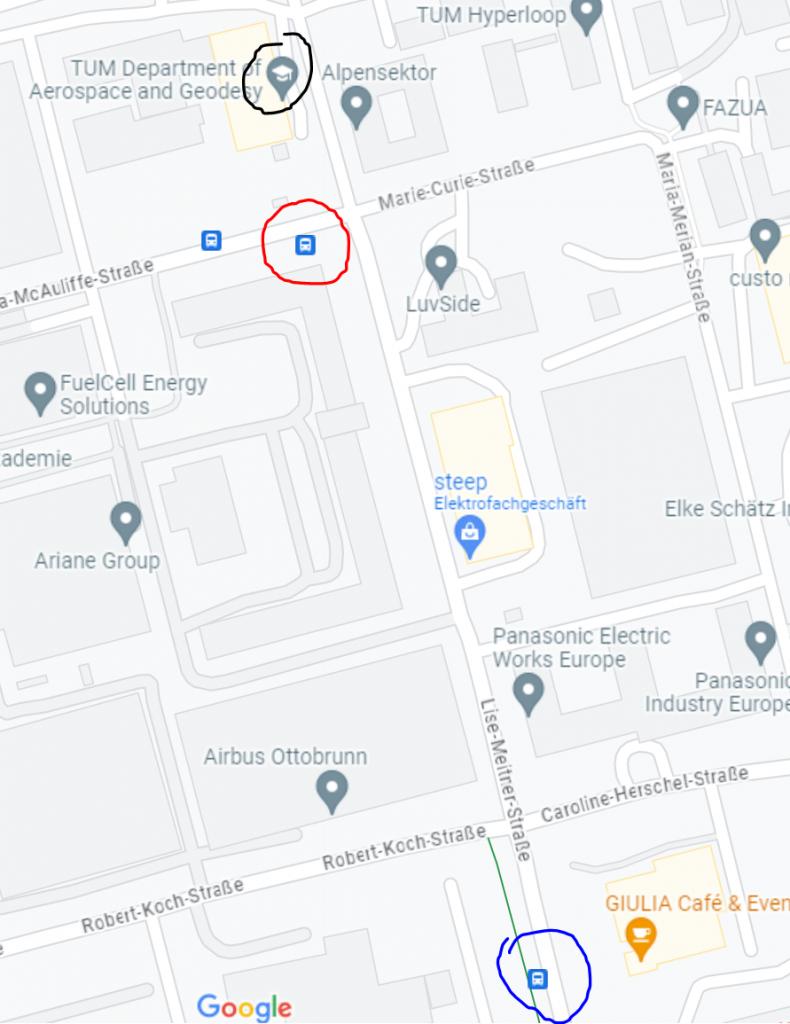
You can also look up our BUILDING here: https://nav.tum.de/room/9377.EG.012 .
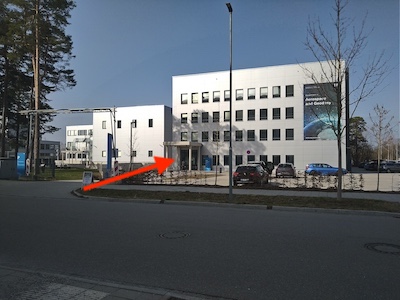
Take the main entrance.
Regarding the ACCOMMODATION, you can try Stay2Munich (reachable via bus in 20 minutes) or Comfort Hotel Atlantic (reachable via a 20-minute walk), both in Ottobrunn or you can try it more “downtowns” somewhere near the public transport station Munich East.
Regarding WLAN you can either use EDUROAM or BayernWLAN for free.
The post Travel to the AI4EO Symposium 2024 & accommodation options first appeared on TU Munich.
Der Beitrag Travel to the AI4EO Symposium 2024 & accommodation options erschien zuerst auf TU Munich.
]]>The post Registration to AI4EO Symposium 2024 is open first appeared on TU Munich.
Der Beitrag Registration to AI4EO Symposium 2024 is open erschien zuerst auf TU Munich.
]]>Registration to the International Future Lab AI4EO Symposium 2024 is open:
ai4eo.de/symposium2024
You are invited share this link within your network.
You can find there information about the symposium and also a button to click to open up the registration dialogue (via ConfTool). There is also the option to upload a title and abstract if you would like to contribute to the symposium (please feel invited to do so!)
The upload for title and abstract is open until 23 June 2024 (extended). Our scientific committee will decide over oral and poster presentations until end of June.
The post Registration to AI4EO Symposium 2024 is open first appeared on TU Munich.
Der Beitrag Registration to AI4EO Symposium 2024 is open erschien zuerst auf TU Munich.
]]>The post Registration to AI4EO Symposium 2023 is open first appeared on TU Munich.
Der Beitrag Registration to AI4EO Symposium 2023 is open erschien zuerst auf TU Munich.
]]>Registration to the International Future Lab AI4EO Symposium 2023 is open:
ai4eo.de/symposium-2023
You are invited share this link within your network.
You can find there information about the symposium and also a button to click to open up the registration dialogue (via Converia). There is also the option to upload a title and abstract if you would like to contribute to the symposium (please feel invited to do so!)
The upload for title and abstract is open until September 15th. Our scientific committee will decide over oral and poster presentations until end of September.
The post Registration to AI4EO Symposium 2023 is open first appeared on TU Munich.
Der Beitrag Registration to AI4EO Symposium 2023 is open erschien zuerst auf TU Munich.
]]>The post The Earth under the Microscope in Deutsches Museum first appeared on TU Munich.
Der Beitrag The Earth under the Microscope in Deutsches Museum erschien zuerst auf TU Munich.
]]>
The Earth under the microscope in Deutsches Museum
“The Earth under the Microscope” is a science communication experiment compiled by scientists engaged in research with Earth Observation/Remote Sensing, Artificial Intelligence, Sustainable Agriculture, Ethics, and state-of-the-art Science Communication. The core team of scientists is from the German Aerospace Center, the Technical University of Munich and Helmholz AI. Two members from the core team of scientists, namely, Stella Ofori-Ampofo (PhD Studentin, Artificial Intelligence in Earth Observation) and Mrinalini Kochupillai (Professor for Ethics in AI4EO) are from the AI4EO Future Lab and the Chair of Data Science in Earth Observation, TUM and they provide us the below report of this exciting project.
The “Earth under the Microscope” project is funded by the Munich Science Communication Lab and brought to the public (experts and non-experts) in the form of an exhibition in the Deutsches Museum that will continue throughout January (possibly extendable to February 2023).
“Earth under the Microscope” provides a bird’s eye perspective of agriculture on Earth and associated challenges such as food security and sustainability. The audience is invited to look at Earth from a distance, and from space (especially satellite images) to help them get an overview of current global challenges and how, in their own way, they can make a difference to the world around them.
Although the “microscope” is an element in the exhibition that is introduced only in the last week, the audience can already immerse themselves in the data and get a feeling of holding the Earth in their palms with the help of online resources accessible at the exhibition via a QR code. Once the physical “microscope” (VR glasses) is made available to the visitors, they can also experience how Earth and its problems “shrink” into their hands. The microscope and the exhibition provide an immersive experience that helps visitors think about important questions such as “how can I support food security and sustainable agriculture?” or “how do scientists obtain an overview of what is growing where on the planet and what the immediate challenges are?”
The “microscope” (installed since 23.01.23) will also allow visitors to explore three data stories (linked to satellite data). The “wheels” of the microscope allow the user to move forward in the data story, which is viewed with the help of VR goggles. In the words of Tobias Beuchert, the exhibition lead, “The exhibition is designed to offer statistics and information in the beginning, then see how EO data can be used to derive these information and eventually pathways of action are discussed. The idea is that when being able to “hold the Earths in their hands” or to take on the birds eye perspective by looking at EO data, it is easier to adopt the feeling that one can actually contribute to change.”
http://www.sternwarte.uni-erlangen.de/~beuchert/references-world-under-the-microscope.html
The post The Earth under the Microscope in Deutsches Museum first appeared on TU Munich.
Der Beitrag The Earth under the Microscope in Deutsches Museum erschien zuerst auf TU Munich.
]]>The post The First AI4EO Symposium of the Future Lab first appeared on TU Munich.
Der Beitrag The First AI4EO Symposium of the Future Lab erschien zuerst auf TU Munich.
]]>The 1st AI4EO Symposium of the Future Lab was succsessfully held at the TUM Campus, Lise – Meitner – Str. 9, 85521 Ottobrunn, on October 13-14, 2022.
The event has been opened by Prof. Xiaoxiang Zhu – the director of the international Future Lab AI4EO. TUM Vice President Prof Gerhard Kramer welcomed all guests, keynote speakers and the whole AI4EO community and emphsized the stratigical importance of the research topic AI4EO at TUM. Distinguished keynote speakers include Dr. Rune Floberghagen from the European Space Agency (ESA), where he is the Head of the Earth Observation Science, Applications and Climate Department; Prof. Lorenzo Bruzzone, University of Trento, Professor and Head of Remote Sensing Laboratory, who is also a member of the scientific advisory board of our future lab; as well as TUM colleague Prof. Christoph Lütge, Director of the TUM Institute for Ethics in Artificial Intelligence, who is a partner of the AI4EO future lab. The future lab has reported their work on the topics of uncertainty, reasoning and ethics. Scientific sessions and poster sessions cover a wide range of topics on AI4EO and its applications on urbanization, environmental sciences, climate and many more. A particular highlight is that Prof. Xiaoxiang Zhu anounced the release of EarthNets – A sophisticted platform empowering AI4EO for the whole community.
Posters are evaluated by the Jury chaired by Prof. Richard Bamler. Finally poster awards are presented to Christoph Koller (best poster), Isabelle Tingzon (Runner-up) and Konrad Heidler (Honorable Mention).
The post The First AI4EO Symposium of the Future Lab first appeared on TU Munich.
Der Beitrag The First AI4EO Symposium of the Future Lab erschien zuerst auf TU Munich.
]]>The post Registration to AI4EO Symposium 2022 is open first appeared on TU Munich.
Der Beitrag Registration to AI4EO Symposium 2022 is open erschien zuerst auf TU Munich.
]]>Registration to the International Future Lab AI4EO Symposium 2022 is open:
ai4eo.de/symposium
You are invited share this link within your network.
You can find there information about the symposium and also a button to click to open up the registration dialogue (on eventbrite webpage). There is also the option to upload a title and abstract if you would like to contribute to the symposium (please feel invited to do so!)
The upload for title and abstract is open until September 15th. Our scientific committee will decide over oral and poster presentations until September 21st.
The post Registration to AI4EO Symposium 2022 is open first appeared on TU Munich.
Der Beitrag Registration to AI4EO Symposium 2022 is open erschien zuerst auf TU Munich.
]]>The post upcoming: next AI4EO Lab Talk 23 September 2022 first appeared on TU Munich.
Der Beitrag upcoming: next AI4EO Lab Talk 23 September 2022 erschien zuerst auf TU Munich.
]]>Prof. Dr. Annette Menzel & M.Sc. Johanna Kauffert, TUM School of Life Sciences
Understanding the interactions between the atmosphere and the biosphere at the ecosystem level is the motivation that drives scientists at the Chair of Ecoclimatology of TUM. In particular, fingerprints of climate change in nature, i.e. impacts on flora, fauna and humans at different scales, are the focus of our interest.
The first part of the talk will therefore briefly review research on altered plant phenological responses due to global warming, allergenic pollen in the air, human morbidity and mortality due to heat stress and other weather-related factors, drought detection in agriculture, insect diversity and biomass, as well as abundance and breeding phenology of herbivorous animals. To address these interdisciplinary topics, we exploit a wide range of methods, such as Earth observation data from UAVs to satellites, and combine them with data from time-lapse cameras, visual ground observation, or data from citizen scientists. Citizen science is invaluable in expanding ground truth data while engaging with citizens to raise awareness of the impacts of global warming in their backyards.
The second part of the talk by Johanna Kauffert will present an interdisciplinary project together with wildlife biologists to save roe deer fawns in spring that ties all these data sources together. In April/May, roe deer fawns often fall victim to mowing machinery on grasslands and other crops, which are suitable habitats for their bedsides offering cover and protein-rich food. Together with citizen scientists and based on GPS collard roe deer females and fawns as well as different remote sensing data products, we seek to understand and model the timing of fawn birth and occurrences of fawns in open grassland habitats in order to help farmers circumvent killing of roe deer fawns.
Prof. Annette Menzel (b. 1966) has been associate professor of ecoclimatology at TUM since 2007. The focus of her research lies on the interactions between the atmosphere and the biosphere. Her work covers several areas, including the collection and complex description of relevant parameters in various land use systems – for example, BVOCs, radiation and surface temperature. She also aims to detect and pinpoint the impact of climate change on terrestrial (alpine) ecosystems and human health and analyze the risks associated with extreme events.
After studying forestry sciences, she went on to do practical training at the Bavarian State Forestry Commission. In 1992, she became Forestry Officer at the Chair of Bioclimatology and Air Pollution Research at Munich Ludwig Maximilian University. She completed her doctorate there in 1997 and her lecturer qualification in 2002. Her research work has taken her to Chile and Canada. Prof. Menzel was one of the authors of the fourth assessment report of the Intergovernmental Panel on Climate Change (IPCC), which received the Nobel Peace Prize in 2007. She is listed as #304 on the Reuters list of the 1000 most influential climate scientists.
Johanna Kauffert is a PhD student at the Chair of Ecoclimatology at TUM. In 2020 she finished her Master of Science Earth Observation and Geoinformation Management at the University of Edinburgh. For her Master thesis: “Deep Learning: Population Estimation with Satellite Data” using Sentinel 1&2 data she won the “Best Dissertation in MSc Earth Observation” award at GeoscienceEd.
You can visit our talk at Campus Ottobrunn, Lise-Meitner-Str. 9, 85521 Ottobrunn in Seminar Room 012
Subscribe to our mailing list [email protected] to receive invitations to our Lab Talks with zoom links.
The post upcoming: next AI4EO Lab Talk 23 September 2022 first appeared on TU Munich.
Der Beitrag upcoming: next AI4EO Lab Talk 23 September 2022 erschien zuerst auf TU Munich.
]]>The post Melting Glaciers in times of Global Climate Change first appeared on TU Munich.
Der Beitrag Melting Glaciers in times of Global Climate Change erschien zuerst auf TU Munich.
]]>Without doubt, climate change is a grand and global challenge, if not the challenge that humanity has to face today and in the future. The Intergovernmental Panel on Climate Change (IPCC) reached a clear consensus on the severity of the Climate Crisis. Today, we are experiencing a climate with record mean temperatures that have been unprecedented for the past 100.000 years.
There is something even more alarming hidden in the details. A special feedback mechanism makes arctic temperatures increase a few times faster compared to the global average. This is reason enough for glaciologists to have a closer look at the data.
Our close colleague and AI4EO guest-professor Jonathan Bamber is professor for Earth Observation and glaciology at the University of Bristol as well as director of the Bristol Glaciology Center. In a recent paper, published in the journal Geophysical Research Letters and lead by Shfaqat A. Khan, the authors including Prof. Jonathan Bamber focused on the so-called peripheral glaciers of Greenland.
These rather small glaciers only make up 4% of the total ice-cover of Greenland. And yet the increased local temperatures indicated in the figure, made their ice loss increase by a factor of four over about the last decade. This conclusion is based on data gathered by the Ice, Cloud, and land Elevation Satellite (ICESat) and ICESat-2. The authors state that these peripheral glaciers contribute to roughly 11% of all of Greenland’s ice loss today. This means an immediate and significant contribution to global sea level rise.
Even in our close vicinity, the Alps, glaciers are losing mass and become increasingly unstable. A tragic example is the very recent collapse of part of a glacier in the Dolomites. Prof. Jonathan Bamber was quoted by The Guardian and BBC News: “The Dolomites in Italy, where this tragic accident occurred, experienced a drought throughout the winter with very little snowfall. Combined with the unusually high temperatures across the region over the summer, glaciers are melting fast. The section that broke off was part of a hanging glacier with seracs or ice cliffs that become particularly unstable during in warm conditions such as those in the Dolomites right now.” On radio FM4, Prof. Bamber explains in more detail, how a blanket of snow could have acted as insulator to at least decelerate the melting process of the glacier underneath – a melting process that is inevitable at the current rates of greenhouse-gas emissions.
The post Melting Glaciers in times of Global Climate Change first appeared on TU Munich.
Der Beitrag Melting Glaciers in times of Global Climate Change erschien zuerst auf TU Munich.
]]>The post AI4FoodSecurity challenge awards ceremony first appeared on TU Munich.
Der Beitrag AI4FoodSecurity challenge awards ceremony erschien zuerst auf TU Munich.
]]>Our Artificial Intelligence for Earth Observation, AI4EO, Food Security Challenge has come to a fruitful end with our partners Planet, DLR, ESA, TUM & Radiant Earth! We are excited to showcase the top 4 solutions alongside our keynote speaker from NASA HARVEST, Hannah Kerner, Machine Learning Lead and U.S. Domestic Co-Lead, on April 6th!
Register on the link
The post AI4FoodSecurity challenge awards ceremony first appeared on TU Munich.
Der Beitrag AI4FoodSecurity challenge awards ceremony erschien zuerst auf TU Munich.
]]>