
The post How Aktiv Chemistry Reduces AI Reliance & Builds Student Confidence appeared first on Aktiv Learning.
]]>


The post How Aktiv Chemistry Reduces AI Reliance & Builds Student Confidence appeared first on Aktiv Learning.
]]>The post Empowered to Learn: an Active Learning Resource appeared first on Aktiv Learning.
]]>

Jill Ellenbarger
Associate Professor of Chemistry
John Brown University

Sharon Hamilton
Professor of Organic Chemistry
Ouachita Baptist University

Theodore Alivio
Associate Professor of Chemistry
Nicholls State University
The post Empowered to Learn: an Active Learning Resource appeared first on Aktiv Learning.
]]>The post A Mole Lot of Fun: The Best Mole Day Ideas to Celebrate Chemistry’s Favorite Holiday appeared first on Aktiv Learning.
]]>


The post A Mole Lot of Fun: The Best Mole Day Ideas to Celebrate Chemistry’s Favorite Holiday appeared first on Aktiv Learning.
]]>The post What’s New in Aktiv: Smarter Tools for Better Chemistry Learning appeared first on Aktiv Learning.
]]>


The post What’s New in Aktiv: Smarter Tools for Better Chemistry Learning appeared first on Aktiv Learning.
]]>The post Top Hat ‘Ace’ joins Aktiv Chemistry, Introducing AI-Powered Problem Solving and Feedback for Student Success appeared first on Aktiv Learning.
]]>The post Top Hat ‘Ace’ joins Aktiv Chemistry, Introducing AI-Powered Problem Solving and Feedback for Student Success appeared first on Aktiv Learning.
]]>The post The Numbers Are In: What Students Love About Aktiv Chemistry appeared first on Aktiv Learning.
]]>


The post The Numbers Are In: What Students Love About Aktiv Chemistry appeared first on Aktiv Learning.
]]>The post Infographic: How Aktiv Helped 6,400+ Students Reach Their Academic Goals appeared first on Aktiv Learning.
]]>Myth or fact: STEM programs are designed to ‘weed out’ students after their first year. Many faculty and students alike would argue that it’s an unfortunate reality.
Too often, STEM students struggle to see the broader application of course material, have few opportunities to regularly demonstrate their knowledge and subsequently, aren’t given timely feedback on their progress. Enter Aktiv Chemistry: our intuitive platform designed to reimagine any General Chemistry, Introductory Chemistry, GOB and Organic Chemistry course.
Our survey of more than 6,400 students who used Aktiv Chemistry in Spring 2024 illustrates the value of interactive formative assessment on the overall student experience. Plus, students reflect on the impact Aktiv Chemistry has made on their academic performance.
Interactive learning is the gateway to deeper engagement
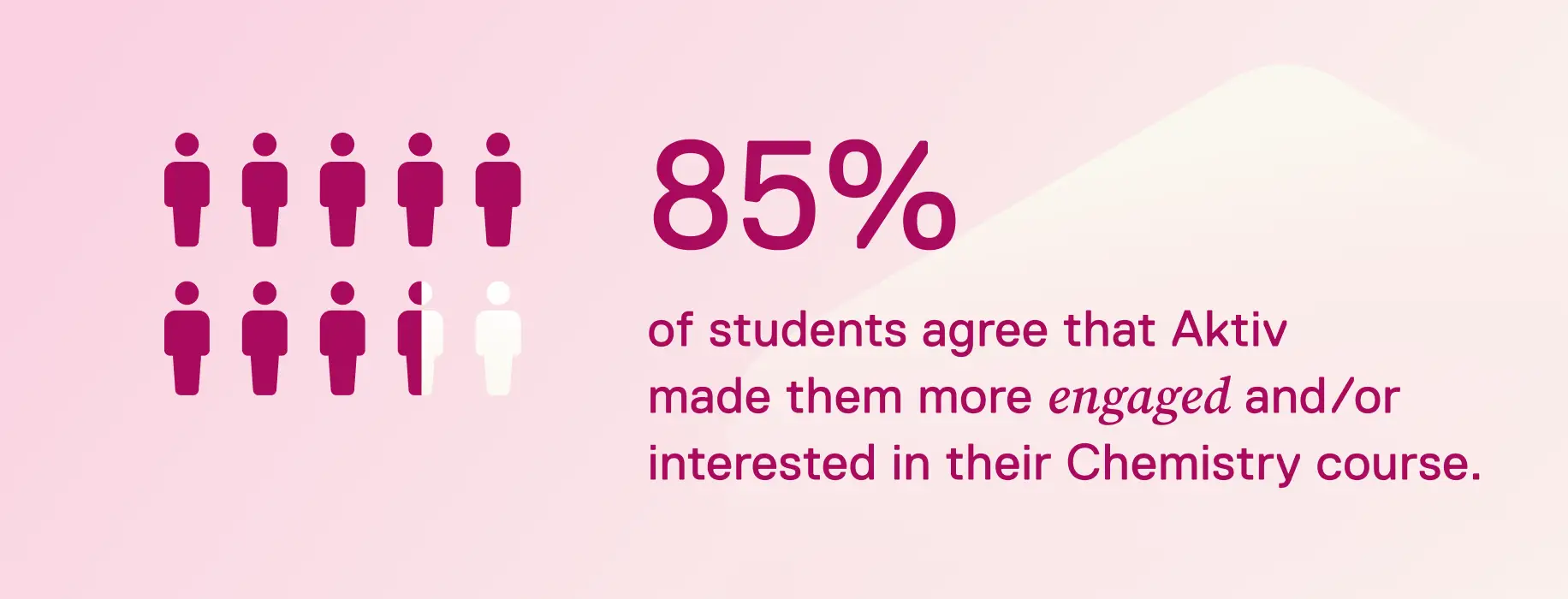
The value of low-stakes formative assessment can’t be underestimated in STEM. Research shows that students who applied their knowledge and had opportunities to ask questions while working on STEM assignments achieved metacognitive development compared to those who didn’t participate in interactive discussions. Aktiv Chemistry’s intuitive learning platform was designed to reframe mistakes as learning moments. Interactive questions accessible from any laptop or mobile device invite students to practice applying formulas or compounds to new scenarios.
Offering the ability to assess students beyond multiple choice questions can make a huge impact on their level of engagement. Survey respondents say their success was bolstered by Aktiv Chemistry’s Lewis Structure drawing questions (84 percent), chemical equation questions (82 percent) and nomenclature drawing questions (81 percent).
One student shared the benefit of ditching paper and pencil for Aktiv’s intuitive molecule drawing tool. “I especially liked the ease of constructing the Lewis Structures in my assignments as it was easy to choose the type of atom used, number and types of bonds and it even showed valence and formal charges,” wrote the University of Maryland Baltimore County respondent.
Improving reading completion with integrated Top Hat and OpenStax eTexts
Promoting engagement in lecture or lab is one challenge. Keeping students alert and accountable for their learning outside of class time is another hurdle. Aktiv Chemistry’s integration with four Top Hat Interactive eTexts (available for General and Organic Chemistry courses) ensure students stay on their toes with embedded reading questions, problem solving videos and simulations. As one respondent shares, using a Top Hat Interactive eText has sparked a renewed interest in reading assigned chapters. “Its interactive simulations and virtual experiments can bring chemistry concepts to life in a way that traditional textbooks or lectures cannot,” wrote the Boise State University student. Aktiv Chemistry is also a proud partner of OpenStax, granting students access to free, open resource textbooks across General and Organic Chemistry courses. Explore the 10th edition of John McMurry’s industry-leading Organic Chemistry, packed with practice problems and scaffolded questions.
Aktiv can also be used alongside any publisher text. Textbook content helps instructors scaffold learning even further. By familiarizing themselves with core concepts such as stoichiometry or atomic bonds during readings, students are more likely to feel well-prepared when completing quizzes and homework. “Problems involving drawing out structures were the most helpful when applying my knowledge from in the classroom to the homework,” shares a student from Newport University.
Actionable feedback is key to academic growth
Students want more than a letter grade to refer to when receiving feedback from their instructors. Many look for personalized and actionable feedback that indicates how to close their knowledge gaps for future tests. Targeted feedback like Aktiv Chemistry’s question summaries can help students structure their next study session accordingly. Survey respondents expressed clear value in Aktiv Chemistry’s tailored hints and step-by-step solutions that appear after submitting polls or drawing diagrams. “Knowing immediately whether I got something wrong or right helped me focus on problems and subjects I needed more work on,” a student from Peninsula College says.
Case studies: See how faculty have improved student outcomes by using Aktiv.
The post Infographic: How Aktiv Helped 6,400+ Students Reach Their Academic Goals appeared first on Aktiv Learning.
]]>The post How to Advance Engagement and Equity in STEM appeared first on Aktiv Learning.
]]>Science, technology, engineering and math programs have gained new importance in today’s economy
STEM programs are recognized for the technical skills they offer college students. Such courses have since evolved—and gained new importance in preparing tomorrow’s engineers and healthcare professionals for their careers.
Attending biology labs, drawing parabolas and examining various life forms under a microscope were once common activities in science, technology, engineering and mathematics (STEM) classes at colleges and universities. In the 2020s, professors teaching STEM courses were forced to reinvigorate their curriculum with the adoption of virtual learning and e-texts. While STEM-based learning experiences look different, the value that a STEM degree holds today has only gained importance. Below, we highlight the value of STEM degrees in the global economy and how you might reinvent your teaching practices in an increasingly digital-first world. Plus, we share how innovative faculty use Aktiv Learning to support access and equity in education.
Index
- What is STEM?
- The importance of STEM education
- 7 techniques to maintain STEM engagement in any modality
- STEM careers
- How Aktiv Learning can help STEM educators
What is STEM?
STEM is an acronym in education that refers to science, technology, engineering and mathematics courses. Classes place emphasis on real-world applications and equip students with the hands-on skills required to successfully navigate the STEM workforce. At the end of their program, students should be able to apply a wide array of transferable skills—including entrepreneurship and problem solving—to their professional roles.1
A breakdown of each focus area
Science
Science-based education focuses on studies of the natural and physical world via experimentation and observation. The work of scientists typically involves writing academic papers and proposals, performing research and delivering findings. On the other hand, scientific technicians often conduct experiments, collect samples and otherwise assist scientists. Science disciplines are categorized by their particular aspect of study, such as:
- Chemistry
- Earth science
- Life science
- Space science
- Physics
Technology
Technology-based programs combine work in science and engineering to create computer and information systems. Technical education facilitates communication and typically involves designing, testing, improving and maintaining hardware, software, networks and systems. Technology-heavy disciplines include artificial intelligence, operating systems, robotics, computer science, cryptography and programming.
Engineering
Engineers tackle real-world problems by combining technology, math and science to develop solutions. Engineering work typically involves developing materials, products, structures and systems. Engineering disciplines tend to be categorized by the industry in which they’re applied, like petroleum, textiles or aerospace and include:
- Civil engineering
- Mechanical engineering
- Industrial engineering
- Electrical engineering
- Materials engineering
Math
Programs in the faculty of mathematics employ logical, spatial and numerical relationships to examine and solve problems. Math work provides the technical foundation for the other three STEM domains and typically involves identifying patterns in abstract logic or data. Students can use these patterns to draw conclusions, test relationships and model problems. Common math disciplines include:
- Algebra
- Calculus
- Game theory
- Geometry
- Statistics
How STEM works
Developing transferable, 21st-century skills is the main outcome of STEM subjects and curriculum. When in middle school and high school, students have the chance to strengthen their soft skills such as collaboration and communication. In post-secondary education, these skills continue to be refined and put into practice through large-scale projects and assessments. College degrees also stress the importance of preparing students for the real-world STEM workforce and help students sharpen their professional development in this domain.
STEM learning embraces the four Cs that are seen as pillars of a 21st-century education: creativity, collaboration, critical thinking and communication. These four areas are essential for solving complex challenges that employees in STEM-related fields will inevitably face.2 Students learn how to use critical thinking and creative skills to approach problem-solving from a variety of angles. Contrastingly, they learn how to identify errors, collect pertinent data and correctly interpret and apply it to various systems. STEM also teaches students how to develop and source economical solutions, including in unconventional or previously unconsidered ways.
Aktiv Chemistry makes it easy for students to visualize VSEPR models and complex chemical structures. Elaine Bernal, Lecturer in the Chemistry and Biochemistry Department at California State University, Long Beach, uses the platform to help students see the broader importance of what they’re learning about. “In being able to engage students visually, the platform opens them up to learning more about chemistry. Issues like climate change, global warming, the chemistry of water, real environmental issues. They’re more attuned to that when they see how it works,” she says.
Communication takes place in both oral and written forms in STEM subjects. This includes technical writing, interpersonal communication, public speaking and even teaching, in order to ensure that ideas are effectively translated into action.
STEM programs often incorporate or provide opportunities for internships, research and volunteering to enhance professional development. Internships also help students put their acquired skills and knowledge into practice in their desired field. Here are some reasons why college students may benefit from completing a STEM internship today.
- Students develop highly marketable skills and expand their resume
- Students get to sample what a full-time career in their area of interest might be like
- Students get to network and gain new mentors and connections for future careers
The importance of STEM education
Those in STEM fields play an important role in the growth and stability of the U.S. economy. In our present moment, STEM has gained new importance in order to solve complex problems and challenges that are a byproduct of the COVID-19 pandemic. STEM education, however, is made up of a predominantly white male demographic. Below, we share a more eye-opening look at the numbers behind student enrollment and demographic statistics. In addition, we offer some techniques to promote STEM equity.
What is equity in education?
Equity in education refers to providing the tailored resources and opportunities that specific students need to reach their full potential. The ultimate goal is to identify, remove and mitigate barriers that prevent students from feeling a sense of belonging or academically excelling. Equity in education involves offering equal opportunity to all students—no matter their race, gender, learning ability or economic status—in order to help them accomplish their academic goals. Regardless of discipline, faculty looking to support equity in education build their lessons with fairness and inclusion in mind.
How to drive engagement and equity in STEM
Maintaining gender diversity, equity and inclusion in STEM involves the collective effort of all college administrators and faculty. Here are some ways institutions must adapt their college outreach to promote equity in STEM:3
- Give women the skills and confidence to succeed in math and science
- Improve STEM education and support for girls starting in K-12 education to ensure eligibility in college programs
- Work to attract, recruit and retain women in STEM majors
- Improve job hiring, retention and promotion pathways and intentionally inclusive cultures
Professors can also take small steps to ensure equity in the classroom. Here are some tactics worth exploring:
- Source affordable learning platforms and evaluate the price versus value of assigned course materials
- Embrace a flipped classroom to allow for more discussion and peer-to-peer support during class time
- Form diverse teams when assigning group work to ensure no one gets left behind
- Set flexible due dates or use assignment grace periods to accommodate learners without penalty
- Incorporate diverse scholars and STEM innovators on your reading list to help students from underrepresented groups feel seen
Affordability is a key way to support access and equity in education. It’s why Brian Woodrum and Brad Bates, chemistry professors at Chandler Gilbert Community College, turned to Aktiv Chemistry. By using Aktiv Chemistry’s integration with OpenStax’s chemistry textbook, the pair have saved Chandler Gilbert’s general chemistry students upwards of $60,000 per year. Better yet, students still get access to a rigorous learning experience directly from the devices they already use. “Aktiv Chemistry is an extremely high-quality product for an extremely great price. It’s fun, easy and the students pick it up really quickly,” shares Bates.
Underrepresentation of women and minority students in STEM
The gender gap is easily seen in STEM majors in higher education. For example, 21 percent of engineering majors are women and only 19 percent of computer science majors are female.4 What’s worse, among Computer Network Architects, women earn more than men—but only represent 8 percent of those within this occupation.5 The underrepresentation of women in STEM-related fields is believed to be a key factor in the prevailing gender pay gap.
The number of male employees who enter STEM fields consistently outweighs their non-white, female counterparts. Their salaries are nearly $15,000 higher per year than women. Contrastingly, Black women in STEM earn around $33,000 less than white males in the same industry.6
Enrollment numbers at postsecondary institutions are overwhelmingly centered around white male students. The Smithsonian Education Center cited that only 3.3 percent of Alaska Natives and Native Americans, 2.7 percent of Blacks and 2.2 percent of individuals who identify as Latinx have a university degree in STEM. Even more concerning, in 2016, the National Academy of Sciences, Engineering and Medicine reported that historically Black colleges and Latinx-serving institutions experienced lower completion rates in STEM-related majors than in other postsecondary institutions.
But why is equity in STEM so hard to achieve? For starters, it’s because many faculty still view introductory classes as an opportunity to ‘weed out’ poor performing students. Daniel Collins, Instructional Associate Professor in the Department of Chemistry at Texas A&M University, advocates for a widespread shift in mindset. “My biggest worry is using the term ‘weed out class.’ That’s not what we’re here to do. When I look at my students, I don’t want them to come to general chemistry and that be the class that says they can’t be an engineer,” Collins says. Aktiv Chemistry has made a noticeable difference on retention rates in Collins’ chemistry courses. Since using the app to serve up problems in class and offer guided, instant feedback, Collins now sees five to seven students dropping his course, compared to 15–25 students before introducing Aktiv.
The government’s commitment to STEM education
STEM is also being prioritized on the governmental level. Former U.S. Secretary of Education Betsy DeVos developed a comprehensive STEM priority, which was brought to life through numerous grant programs. The programs work to promote student success for global competitiveness “by fostering educational excellence and ensuring equal access.”7
The U.S. government continues to invest in STEM education. In November 2020, the U.S. Department of Education supplied over $578M in research grants to support STEM subjects such as computer science. This is part of the department’s five-year strategy to better prepare students for high-paying, in-demand careers of the 21st-century STEM workforce.7
STEM programs in higher education
Numerous schools and faculties offer noteworthy STEM-related programs that help students earn reputable careers. Here are three institutions in the United States that offer renowned STEM education programs.
Massachusetts Institute of Technology (MIT), Cambridge, MA
MIT is seen as one of the world’s most reputable research universities. The school has produced almost 100 Nobel laureates. Its 30 departments are divided amongst five schools, three of which focus on STEM-related subjects including architecture and planning, engineering and science.
California Institute of Technology, Pasadena, CA
The California Institute of Technology (or Caltech) is especially known for its science and engineering programs. Five out of six of Caltech’s academic divisions are STEM-focused, including the Division of Biology and Biological Engineering and the Division of Physics, Mathematics and Astronomy.8
Graduates have won Nobel Prizes, developed the silicon chip design, discovered gravitational waves and created the pH meter, among other accomplishments.
Rose-Hulman Institute of Technology, Terre Haute, IN
Rose-Hulman Institute of Technology has been committed exclusively to STEM-related education since 1874. This private college earned the top spot in the U.S. News and World Report’s ranking of undergraduate education in engineering for two decades and counting. Its notable experimentation facilities include the multidisciplinary Branam Innovation Center, the MiNDS Lab for nanotech and the Oakley Observatory for researching comets, supernovae and star photometry. Rose-Hulman Ventures also highlights some of the many innovations that students produce ranging from respiratory to orthopaedic technology.9
7 techniques to maintain STEM engagement in any modality
In 2020, the COVID-19 pandemic disrupted classes and extracurriculars across the world. As found in many industries, the pandemic only underscored the need for equity in science. Educators and administrators were left with no choice but to find innovative ways to teach complex material online, all while conferring the same skill competency and experience. The move to online and blended STEM courses has come with a new set of challenges—and opportunities—for faculty to face head on.
STEM and in-person learning
When students and instructors are able to meet in person, the opportunities for STEM-related education are virtually unlimited. Immersive learning opportunities, robotics and gamifying the classroom are all parts of in-person STEM learning. A recent survey of college chemistry students who take primarily in-person courses rate in-person lectures (70 percent) and in-class problem solving (68 percent) as two of the most helpful learning activities in their STEM education.
Collaborative learning spaces
Collaborative learning spaces have always been a staple of in-person STEM courses. These interactive classroom spaces help foster greater participation, engagement and creativity among students. In such settings, educators may encourage experimentation and ask questions that are more open-ended than closed-ended. These collaborative spaces designed for open communication align with evidence-based teaching practices found to be more effective in STEM-related education.10
Coding with robots
Robotics is an effective medium for teaching students about coding best practices in STEM education. Robots lend themselves to more engaging and hands-on learning, helping students better absorb, retain and apply information. Robotics extracurricular activities or curriculum allow students to learn:
- The fundamentals of engineering
- A basic understanding of technology
- The science behind mechanical systems and materials
- Programming concepts and logical applied math
- Soft skills such as teamwork and problem solving11
Games and competitions
While games and competitions can certainly translate to online settings, there is much to be gained from the visceral experience of engaging in competition with other people in one’s immediate presence. The sheer immediacy and shared energy of the group dynamic that can be hard to replicate in online settings can be employed within in-person settings to help students more fully explore, comprehend and apply complex material.
STEM and online learning
When STEM education moved fully online in 2020, educators and students alike faced a new set of challenges. Relying on technology has lent itself to distractions, while digital learning has made it difficult to interact with professors and peers. Lab-based classes, a staple of many STEM courses, pose significant challenges when it comes to engagement. Some colleges have expanded Wi-Fi hotspot access and laptop lending programs. Teachers have also adopted creative teaching methods and activities to accommodate the remote learning experience.
Mailed lab kits
For labs involving non-hazardous materials and activities, educators can send lab kits to students for them to experiment with at home. Students can demonstrate their understanding of a concept via webcam or can follow along with the professor over a live video feed. This tactic is yet another way to embrace access and equity in education. By mailing materials to students directly, learners can still enjoy hands-on exploration without being required to physically travel to campus.
Research and data analysis
While many activities may not be conducive to distance learning, research and data analysis tasks are ideal for online learning. Provide your students with a dataset and have them analyze it according to a set of rules or logic. You could additionally follow up with a reflection paper to have students hone their writing skills.
Guest lectures
One of the advantages of online teaching is that guests from around the world can join your class session. Scheduling and budgeting also become easier for you or your teaching assistants. Similarly, live webinars can be an effective way to make STEM learning more interactive and engaging. Consider assigning one or two bonus points for each student who attends a webinar.
STEM and blended learning
Made clear in recent years, the most effective learning takes place both in person and online. A blended classroom, where learning is split equally between in person and online spaces, has become the norm as technology continues to adapt and evolve. Professors need to develop methods of teaching effectively in both scenarios to keep learning fresh and engaging, no matter where lessons take place.
One effective way to do this is to incorporate elements of digital learning, such as a research task, in your in-person classes and hands-on experiments. Encouraging experimentation helps push students to explore new and innovative ways to approach problems. Collaborative tasks such as reading a lab manual in pairs and answering pre-lab questions help bridge the gap between in-person and online learning.
Another effective way to embrace blended learning is to flip the classroom. Stephanie Dillon, chemistry professor and Director of Freshman Chemistry Labs at Florida State University, has combined Aktiv Chemistry with Top Hat—the dynamic courseware platform that helps faculty deliver personalized, meaningful and equitable learning—and she’s seen a remarkable decrease in drop rates. Here’s how she uses both platforms in her general chemistry courses.
- Before class: Students watch pre-recorded lectures in Top Hat. They’re also quizzed on the material covered in video lectures, giving learners an idea of where their own learning gaps are.
- During class: Students complete homework assignments using Aktiv Chemistry and engage in peer discussion. Support from Dillon, paired with Aktiv’s guided feedback, helps students shore up their knowledge gaps.
- After class: Students review all homework sets again within Aktiv, allowing for further practice.
Since combining Aktiv Chemistry with Top Hat, Dillon has reduced her General Chemistry I attrition rate to 9.35 percent. Forty-five percent of her students also received an ‘A’ grade in Fall 2022 compared to 22 percent in Fall 2017. “Students know that you get out of this class what you put in. Half of the class receives an ‘A’ because they truly learned,” she says. Hear from Dillon on the impact both platforms have had on student success.
STEM careers
College students with a degree in a STEM-related major have a plethora of career choices to explore. The following list shows a sample of STEM careers in various occupational groups.
- Management: Architectural manager, engineering manager, computer and information systems manager and natural sciences manager
- Computers and math: Actuary, computer network architect, computer systems analyst, database administrator, operations research analyst, statistician, and software or web developer
- Engineering and architecture: Aerospace engineer, agricultural engineer, biomedical engineer, environmental technician, mechanical drafter, surveying and mapping technician
- Social, physical and life sciences: Food technician, biochemist, biophysicist, conservation scientist, epidemiologist, forensic technician, forester, hydrologist and nuclear technician
- Training, education and library: Postsecondary teachers in agriculture, architecture, biology, computers, the environment, math and physics
- Sales: Sales engineers, sales representatives of manufacturing and wholesale scientific or technical products
Demand for STEM-related jobs today
In today’s global world, STEM careers are more important than ever. The STEM Education Coalition, a nonprofit organization, shows that occupations in STEM fields grew faster than those in non-STEM fields over the last decade by a wide margin. STEM careers grew by 24.4 percent versus four percent for non-STEM jobs.12 The U.S. Department of Commerce also projects an 8.9 percent annual growth rate for STEM careers between 2014 and 2024, versus a 6.4 percent growth rate for non-STEM jobs.
How Aktiv Learning can help STEM educators
Aktiv Learning is an active learning platform that helps students tackle common pain points such as drawing chemical structures, dimensional analysis, nomenclature, equilibrium and more. Here’s how Aktiv’s intuitive interface makes learning more meaningful and supports equity in STEM.
- Visualize complex topics: Aktiv’s groundbreaking drawing tool lets students build Lewis structures and view VSEPR with its intuitive interface.
- Provide targeted student feedback: Aktiv’s platform presents step-by-step, detailed solutions that students can view after multiple incorrect responses.
- Promote learning from any device: Students and instructors can access the Aktiv Learning app from their own mobile devices, improving access and equity in education.
- Integrate with OpenStax: Aktiv integrates with any free OpenStax General Chemistry title in addition to Top Hat’s dynamic chemistry textbooks. Deepen learning all while supporting equity in science.
- Grant financial grace periods with ease: Every student in an Aktiv Chemistry or Mathematics course receives a 14-day grace period from the start of the class, ensuring no student falls behind due to financial barriers.
Familiarize yourself with Aktiv’s next-generation platform proven to increase student engagement and outcomes in STEM. Tour the platform today.
References
- Hom, E. (2014, Feb. 11). What is STEM Education? Live Science. https://www.livescience.com/43296-what-is-stem-education.html
- Brewer, S. (n.d.). STEM and STEAM Education. STEAM Powered Family. https://www.steampoweredfamily.com/education/what-is-stem/
- The STEM Gap: Women and Girls in Science, Technology, Engineering and Math. (n.d.). American Association of University Women. https://www.aauw.org/resources/research/the-stem-gap/
- Chapter 2: Higher Education in Science and Engineering. (2018). National Science Board Science & Engineering Indicators 2018. https://nsf.gov/statistics/2018/nsb20181/report/sections/higher-education-in-science-and-engineering/undergraduate-education-enrollment-and-degrees-in-the-united-states
- STEM Identity Resources for Women and Girls. (n.d.). College Educated. https://collegeeducated.com/resources/stem-resources-for-women-girls/
- There are racial earnings gaps in the STEM workforce for both men and women. (2018). Pew Research Center. https://www.pewsocialtrends.org/2018/01/09/women-and-men-in-stem-often-at-odds-over-workplace-equity/ps_2018-01-09_stem_a-09/
- Science, Technology, Engineering and Math, including Computer Science. (n.d.). U.S. Department of Education. https://www.ed.gov/stem/
- Majors & Minors. (n.d.). Caltech. http://www.admissions.caltech.edu/explore/academics/majors-minors
- Rose-Hulman Ventures. (n.d.). https://www.rhventures.org/
- STEM shifts in higher ed. (n.d.). University Business. https://universitybusiness.com/stem-shifts-in-higher-ed/
- Robotics for STEM Education. (n.d.). Intelitek. https://intelitek.com/stem-education-2/robotics-for-stem-education/
- The Case for STEM Education as a National Priority: Good Jobs and American Competitiveness. (n.d.). STEM Education Coalition. http://www.stemedcoalition.org/wp-content/uploads/2019/10/Sept-2019-Fact-Sheet-PDF-STEM-Education-Good-Jobs-and-American-Competitiveness.pdf
The post How to Advance Engagement and Equity in STEM appeared first on Aktiv Learning.
]]>The post 5 Reasons Students Love Aktiv Chemistry appeared first on Aktiv Learning.
]]>


The post 5 Reasons Students Love Aktiv Chemistry appeared first on Aktiv Learning.
]]>The post Aktiv Learning + Top Hat: Transform STEM Education at Scale appeared first on Aktiv Learning.
]]>The post Aktiv Learning + Top Hat: Transform STEM Education at Scale appeared first on Aktiv Learning.
]]>