Selected projects:
UAV Deployment Project
Goal
The goal of this project was to develop a UAV system that supports firefighting operations by relaying sensory data to ground crew before the first-in personnel enter the scene.
Although an off-the-shelf UAV and autopilot was used, the systems around sensory data collection, transmission, and display were developed.
My Contributions
My contribution was in developing the obstacle avoidance subsystem, to allow the UAV to navigate near buildings and through smoke. This involved:
- Sensor integration on Arduino: multiple sensors were used to allow for through-smoke obstacle detection (LiDAR, ultrasonic, IR)


- Data preprocessing: sensor fusion was done to achieve the detection, as well as provide an indicator of smoke density

- Data relay to MAVROS autopilot on Raspberry Pi

Challenges and Solutions
A major challenge in the development of this subsystem was the sensor selection and data preprocessing. Although time-of-flight radar was considered for the obstacle detection, this did not work well in practice on non-metallic objects such as building concrete. For this reason, a fused sensor solution was developed with one long-range, smoke-inhibited sensor (LiDAR) and one short-range, through-smoke sensor (ultrasonic).
Aside from other issues, a system challenge faced was in not receiving a flying permit for testing the UAV near buildings. For this reason, the obstacle detection integrated into the autopilot could only be simulated in Gazebo.
Results
Because testing of the UAV could not be performed due to the permit issues, the system remains a prototype rather than a proof of concept. A paper on the proposed system was submitted to the IEEE IHTC Conference 2017, and received 1st place in the student paper competition.
CanSat international robotics competition
Goal
 The goal of this project was to simulate a satellite mission at low altitudes (~200m). Although it did not involve the development of the rocket, its scope included all phases from the deployment of the can-sized satellite (CanSat) to its safe landing and retrieval. The primary requirement of the project was to safely return a payload, while the secondary requirements changed each year.
2014: separating payload and container segments of the CanSat. Payload must return and be “environmentally” powered – i.e. by solar panels.
2015: passive autogyro descent of both segments. Use 3-axis accelerometer and PID motor to stabilize and take picture.
2016: same, but also rotate camera and telemeter photos to ground. Fixed-wing descent instead of autogyro.
More details can be found on the website: CanSat
My contributions
2014:
I developed regulation electronics for the payload. This involved:
- Creating a power budget, including duty times

- Implementing solar panels for maximum power point

- Designing the regulation circuitry around a buck voltage regulator, as well as payload electronics

- Developing a burn separation mechanism, based on heating up nichrome wire
2015:
I developed drivers for multiple peripheral in embedded C on an ARM Cortex M0+ micro controller (uC). This involved:
- Selecting the peripherals (sensors, flash memory, etc.)
- Implementing the I2C and UART drivers
- Using the drivers and peripheral characteristics to read from/write to the peripherals
See GitHub for details.
2016:
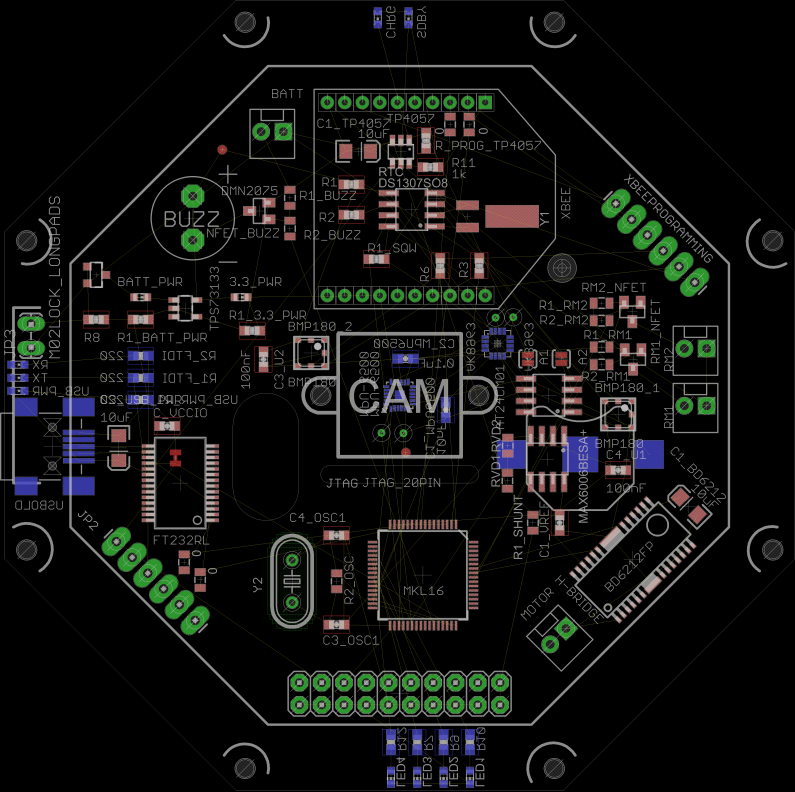
I developed a new 900MHz radio link for the CanSat and redesigned the PCBs for the new form factor of the glider. I also helped contribute to some some flight software development.

Challenges and solutions
2014:
The major challenge faced was ensuring a steady power supply for the electronics in the presence of transients. These occurred when the uC turned on, radios started transmitting, or release wire was heated, all leading to voltage dips that resulted in data loss or complete failure. Capacitors around the regulating power converter needed to be sized accordingly. Zener diodes were also added for protection in the brief periods of over-voltage.


2015:
Many issues were faced in the interfacing of peripherals, which led to the project being delayed by 2 weeks. To compensate, I prioritized the data collection and processing from the sensors over other functionality (e.g. saving to the EEPROMS), since telemetering sensor data was a mission requirement, while others were not.
2016:
Due to winds affecting the glider descent, the radio link was tested more than in previous years. Even after developing a custom patch antenna on a swivel mount and switching to a longer wavelength link, packet loss occurred at >1.5km. I implemented a mesh network with repeater radios to extend the range.


Results
2014:
The solar panels allowed for sufficient power delivery in all pre-launch tests except one. The video below shows testing done with an RC plane:
However, during the competition, the two segments of the CanSat failed to separate even after release, leading to no power for the payload.
2015:
All elements worked appropriately except for the EEPROM save failing. However, a robust radio link led to being able to collect all the required data during the mission without the need for back-up saving. The team achieved 3rd place.


2016:
There were technical difficulties with the rocket launch itself, leading to CanSat damage. The team achieved 2nd place.
Thesis
Goal
The goal of this project was to develop and test an optimal battery management system (BMS) for battery electric vehicles (EVs). This involved two parts:
- Development of the software controller. Full details on this can be found in the thesis.
- Implementation and testing of the controller:
- Implementation: data to develop the hardware-in-loop test was collected from the CAN bus of a manufacturer’s model EV (proprietary).
- Testing: the controller was tested on a a mock test bench using a Cyclone IV FPGA. It was first tested with a programmable load (course project), then with the battery storage system.

Results
The following power electronic interface was developed and implemented for the battery storage system.


Final results showed that the EV travel was increased by ~15min, and the battery charge was maintained in an 80% interval for no degradation. See thesis for details.
This work received a Best Student Paper award at the CIGRE 2019 conference.
 Alok Deshpande