See below for the full article written by Haley Penn.

IN AN ERA WHEN MANY California wineries are facing operational and sales challenges, Hope Family Wines is doing what few can claim: growing-and growing-quickly. Over the past five years, the family-owned operation in Paso Robles, Calif. has more than doubled its case sales, opened a second tasting room and built a 140,000-square-foot, vertically-integrated warehouse and bottling facility designed to serve as a distribution hub. Additionally, in August 2025 the company acquired a new estate vineyard, Tufera Farms, in the Creston District AVA of Paso Robles. The property, which has been a longtime source for the Austin Hope Cabernet Sauvignon, will also provide organic truffles.
Paso Robles, too, has been outperforming expectations. Established producers, like DAOU Vineyards, Justin Vineyards and Hope Family Wines, have experienced significant growth despite broader trends of inventory recalibration and declining consumption in many markets.
Family Roots, Brand Evolution
Austin Hope grew up farming alongside his parents, Chuck and Marlyn Hope, who moved to Paso Robles in 1978 and began growing apples and grapes. By the mid-1980s, they had transitioned to grape growing full-time, selling fruit to Napa producers, including Chuck Wagner of Caymus Vineyards. In the mid-1990s, the Hope family acquired the Liberty School label from the Wagners and began producing it in Paso Robles.
That same year, they launched the Treana brand, and would later introduce Candor, Troublemaker and the eponymous Austin Hope wines. Austin’s longtime creative partnership with director of winemaking, Jason “JC” Diefenderfer, began in 1996. JC’s background in engineering and design has been a driving force behind Hope’s operational infrastructure.
From Napa to Paso: Vertical Integration
For years, Hope Family Wines trucked all its finished wine north to a shared bottling facility operated by the Wagner family. To keep a close eye on operations, Diefenderfer even earned his pilot’s license in 2007-flying out of the Paso Robles airport right next to the winery to check on the wines. Fourteen years later, the Napa-based facility reached capacity, and the Hope team had just six months to find a new path forward.
The answer? Bring it all home to Paso.
What followed was a major leap: the creation of a state-of-the-art, fully integrated production site that allows Hope Family Wines to control every step of the process-from winemaking to bottling, storage and distribution- without leaving the property.
“We’ve always shipped out of Napa because it’s the central hub,” JC said. “But now one of our biggest pushes is to consolidate here in Paso. It’s not about competing; it’s about lifting up this region.”
The 140,000-square-foot facility now handles production, bottling, warehousing and global distribution under one roof. It’s also helping establish Paso Robles as a viable logistics center for other producers in the region.

Built to Scale
The one-million-case-capacity facility was made completely from steel with insulated walls and night air cooling and refrigeration for energy efficiency. The 54-foot ceilings can accommodate rack-and-crane systems for automated pallet storage when needed, and the floor was poured with a 14-inch-thick double mat to support that weight.
“All the air, water, power-it’s already in place underground,” explained Diefenderfer. “So, when we add new machines in the future, they’re ready to go. I’ve already designed the bolt patterns and utilities for equipment we don’t even have yet.”
Everything was built to accommodate and work around the bottling line-a high-tech system designed by JC and assembled in partnership with six manufacturers, including Italy’s MBF SpA and APS Packaging. It processes up to 200 bottles per minute and integrates nearly 300,000 components.
The high-tech line’s multiple motor controls ensure smooth transitions as bottles move along the conveyor. “Most bottling lines are loud. You’ve got to wear earplugs,” Diefenderfer noted. “Ours runs under 80 decibels. You could carry on a conversation while it’s running.”
Beyond comfort, that quiet hum signals efficiency and precision. A central automated control panel monitors every variable in real time-tank levels, pump speeds, cork or screw cap positioning and bottles per minute. High-speed optical systems inspect each bottle for cork integrity, fill level, glass quality and label placement. “The biggest advances in bottling lines are in quality control systems,” Diefenderfer observed. “We went all in.”
If something’s off, the system knows. “If the fill is off or if the cork isn’t right, it kicks the bottle out before it’s labeled,” he said. “Everything gets checked.” And all of it is run by a team of just five people.
Perhaps most impressive is the line’s efficient water system. Traditional European bottling lines can use up to 10,000 gallons of water per day; Hope Family Wines’ setup runs on just 200. The closed-loop hot water sanitation system filters, heats, cools and recycles water several times a day, using 0.2-micron sterilizing membranes. It meets sanitation standards while dramatically reducing consumption, something Diefenderfer prioritized from the start.

He says other California wineries have attempted similar systems and abandoned them due to water usage concerns. This customization proves it’s possible. “It’s economically intelligent for us to save water and use less because we have to buy every gallon,” he remarked. “Plus, it’s good for the environment.”
Water & Energy Efficiency
“We’re building a full water reuse and treatment plant,” noted Diefenderfer. “It’s not just about being ‘green’-it’s economically intelligent. We’re on city water here. We have to pay for every gallon we use. So why not find a way to use less of it and reuse what we can?”
The system will be engineered to clean and recycle water used throughout the winemaking process, starting with filtration and moving into advanced oxidation treatment.
“Organic matter in water bonds to the water molecule. You can’t just filter it out,” Diefenderfer explained. “But if you oxidize it, you can break it down and separate it.” The solids can then be returned to the soil while the treated water can be reused for everything, from irrigation to equipment cleaning.
The numbers tell the story. “Most wineries use nine gallons of water to make one gallon of wine,” said Diefenderfer. “We’re down to four-and we want to go further.”
When completed, the new facility will allow for near-total water reuse on-site, cutting consumption and reducing the winery’s environmental footprint at scale.

“Look, I’m not doing this to say we’re saving the world,” he added. “I’m doing it because I want my kids to be able to live and work here. If we all keep pulling from the same source, eventually, it’s gone. So why not build smarter now?”
The system is in development with local company EnviroTech, whose founder Diefenderfer described as “super enthusiastic-like, this guy loves wastewater.” He laughed. “But honestly, it’s a billion-dollar space. Cities, ag, everyone’s going to need to figure this out.”

Direct-to-Consumer: A New Era of Hospitality
In the early years, the Hopes ran a modest tasting room and a small bed and breakfast, which they sold. But the estate experience, located on Live Oak Road in Paso Robles and originally built in 2008, has transformed over the years into something much more expansive. What began as a small, trade-focused room grew into multiple structures, including a middle barn that recently added a second-story deck for additional lounge seating.
Today, the estate tasting room welcomes approximately 50,000 visitors annually, a growth driven in large part by Jo Armstrong, who joined as director of hospitality and direct-to-consumer in 2018. At the time, Armstrong recalled, “Our dream was to be as known for hospitality as for Austin Hope Cabernet. Those are big shoes to fill.”
Central to that vision is the staff, affectionately known as “dreamweavers,” a title that signals the winery’s commitment to hospitality. Drawing inspiration from Will Guidara’s Unreasonable Hospitality, Armstrong introduced the idea of “radical guest-centricity” as a North Star. The team even joined Guidara’s beta book club when the book launched, turning its ideas into an internal “hospitality bible” that guides every staff training.
Since the pandemic, they’ve reopened to a mix of walk-ins and bookings, and the tasting room has been reimagined. Upon arrival, guests are warmly greeted and either guided to their reserved tasting or welcomed to an open-air patio bar for a more casual, no-reservation experience.
Modular planter walls on the patio can be moved or reconfigured to accommodate larger groups that are traveling together-a post-pandemic trend Armstrong and her team were quick to notice. “We didn’t want to divide parties,” she said. “That’s not what wine does-wine brings people together.”
The tasting room also hosts regular events that have proven popular, such as Thursday evening twilight tastings. For club members, monthly vineyard walks led by the director of vineyards, Stasi Seay, offer an educational look at regenerative farming practices, including bee boxes, honey production and soil health, alongside tastings of wines produced from those same vineyards. Armstrong laughed, “I’ve never been this interested in dirt and rocks, but Stasi makes it fascinating.”
Hope on Park: Meeting a New Generation
In 2023, Hope Family Wines expanded into downtown Paso Robles with a satellite tasting room, Hope on Park.
A reclaimed wood bar created by Deadwood Revival Design greets you right off Park Street, inviting walk-ins. At the bar, guests can order everything, from a $16 bottle of Liberty School Cabernet to a $150 Austin Hope Cabernet Reserve, plus seasonal wine cocktails. Paso’s open container laws mean you can take your glass across the street to the park, which is great in the summer when they have live music.
Inside, the tasting room splinters into themed spaces, each leaning into its own carefully orchestrated sense of kitsch. The Creative Space channels a late ’60s, camper-van psychedelic vibe. The Club Room next door swaps psychedelic color for darker woods and plush leather booths-an atmosphere that gestures at the old-school private club but undercuts it with playful touches. “Austin and Celeste worked closely on the space,” Armstrong said. “You’ll see personal touches-feathers, waterfowl, driftwood. There’s soul in every inch.”
In the tasting room guests can choose from rare library selections or take part in guided sensory sessions built around their own preferences. Offerings change with the season: during harvest, guests analyze Cabernet grapes with beakers and Brix readings; in winter, wine is paired with high tea. “It’s community-driven,” Armstrong observed. “If people want to geek out, they can. If they want something casual and fun, that’s here too.”
It’s tempting to say Hope on Park is built for the young-the neon, the trivia nights and details that practically beg to be Instagrammed-but that misses the point. While Hope Family Wines naturally appeals to younger visitors, Armstrong resists the idea that the tasting room experiences are tailored specifically to Millennials or Gen Z. “It’s about curiosity, storytelling and shared experiences. And that resonates whether you’re 21 or 80.”
Yet, Austin Hope continues to draw a younger crowd. This could be, in part, because Armstrong isn’t afraid to experiment with formats that make learning about wine more approachable. She credits some of that spirit to being a parent. “My son’s a gamer,” she explained. “I think about him a lot when we’re designing new experiences. That generation is used to exploring, unlocking, playing. So, we’ve kind of gamified it. Let’s do some trivia. Let’s do something in a black glass where you’re guessing. It’s fun-and it sparks connection.”
Lessons for the Industry
For others in the wine trade, Hope Family Wines offers a blueprint for thoughtful growth: invest in infrastructure that works for the long haul, experiment with hospitality formats that meet people where they are and build teams empowered to think differently.
“The environment is beautiful, and the service is technically on point,” Armstrong said. “But the personality of the service is approachable and casual.”
]]>We noticed the need for real-world skills and industry knowledge in the classroom, so we kick-started the “APS Packaging Experiential Learning Fund.” This fund is a game-changer for students as it provides students with invaluable opportunities, including field trips, guest speaker presentations, and hands-on education focused on bottling and its significance.
A huge thank you to David Davenport and Jessica Tuteur from Infinity Bottling, Mimi Storts and Andy Strasser from Hess Persson Estates, and Sergio Ciocchetta from MBF North America for taking the time to talk to us about the importance of automation. Automating a bottling line boosts efficiency, consistency, and cost-effectiveness, making it a vital investment for any operation aiming to stay competitive.
If you wish to support our future winemakers, distillers, and brewers, consider making a donation to the “APS Packaging Experiential Learning Fund.” All proceeds go to enhancing students’ industry knowledge through real-world experiences. Donations can be made through this link: tinyurl.com/apslearningfund.
]]>A Smarter Approach to Winery Automation
The Jollypack Monoblock streamlines multiple functions into a single, fully automated system, including case erecting, case packing, partition inserting, and case sealing. Its small footprint allows wineries to automate production without the need for a large bottling line—providing a practical and affordable entry point into automation. Now available in a stainless steel design, the Jollypack ensures durability and longevity during production.
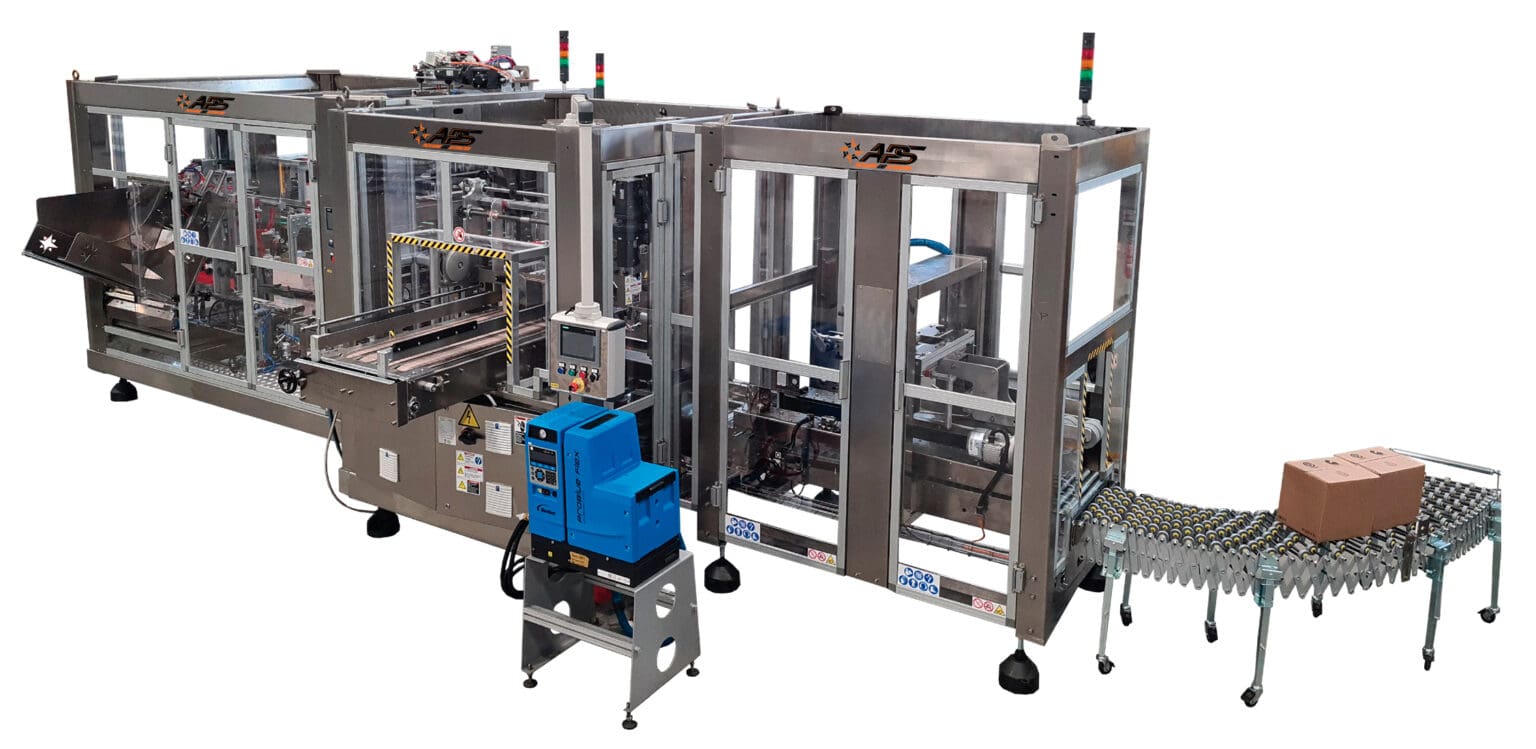
“With today’s market shifts, wineries aren’t operating the way they used to, and many can’t justify the investment in large-scale bottling lines,” says APS Packaging’s CEO Alberto Migliardi. “The Jollypack Monoblock is a perfect solution for wineries looking to increase efficiency without overspending. It’s designed to fit into smaller production spaces while offering the functionality of a much larger system.”
Scalable Growth for Expanding Wineries
A key advantage of the Jollypack Monoblock is its modular design, allowing wineries to start small and expand over time. Wineries can begin with a basic setup, such as a case erector and packer, and add features like the partition inserter and case sealer later on. APS also offers automatic depalletizers and palletizers with an integrated wrapper to fully automate the bottling process.

“This equipment grows with you,” explains Alberto. “Instead of making a massive upfront investment, wineries can start with an affordable component, automate key processes, and expand their capabilities as their business scales. It’s a smart way to increase efficiency and reduce labor costs without overcommitting financially.”
Comprehensive Technical Support & Local Service
For wineries hesitant about investing in automation due to concerns over setup and maintenance, APS Packaging provides 24/7 customer service and local technician support. Whether by phone or in-person, APS ensures that its customers receive the assistance they need to keep operations running smoothly.
Visit APS Packaging at Unified Symposium

APS Packaging will be showcasing the Jollypack Monoblock at the Unified Wine & Grape Symposium at Booth #2040. This is the perfect opportunity for wineries to see the system in action, ask questions, and explore how this compact automation solution can fit into their production line.
More Than Equipment: Investing in the Wine Industry Community
Beyond providing cutting-edge equipment solutions, APS Packaging is deeply invested in fostering community connections in the wine industry. Each year, APS hosts Bubble Bash during the Unified Symposium, offering an informal setting for industry professionals to network, relax, and celebrate. Additionally, APS organizes the Par Then Bar Open® Golf Tournament, creating another opportunity for wineries, suppliers, and service providers to connect outside of work in a fun and engaging way.
More Than Equipment: Investing in the Wine Industry Community
Beyond providing cutting-edge equipment solutions, APS Packaging is deeply invested in fostering community connections in the wine industry. Each year, APS hosts Bubble Bash during the Unified Symposium, offering an informal setting for industry professionals to network, relax, and celebrate. Additionally, APS organizes the Par Then Bar Open® Golf Tournament, creating another opportunity for wineries, suppliers, and service providers to connect outside of work in a fun and engaging way.

“At APS, we recognize that no matter what challenges the industry faces, there’s always value in community,” says Alberto. “We’re committed to providing solutions that wineries need now, while also creating spaces where industry professionals can come together.”
For more information about the Jollypack Monoblock and APS Packaging’s full range of automation solutions, visit aps-pack.com.
To learn more about 5th Annual Par Then Bar Open visit parthenbaropen.com or contact Gisselle Aguilera at [email protected]
]]>There is a sense of wonder in the way wine bottles wind their way through the bottling line for rinsing, filling, corking, labeling and packaging. The wine industry has come to rely on the smooth operation of these machines to save them time, labor costs and back pain. Changing consumer demand, TTB regulations and packaging innovation have dramatically expanded bottling options beyond traditional paper-labeled and corked bottles. Wineries now have a multitude of new packaging options ― screw caps, lighter weight glass, single-serve containers, aluminum cans and bottles, full bottle sleeves and bulk glass — and there is more evolution to come. These options combined challenge existing lines, eventually reaching the point where they need to be updated or replaced.


That’s where APS Packaging and Automation comes in. APS has been supplying the wine industry with bottling and packaging solutions from its Sonoma County headquarters for seven years. Its client base includes, among others, Hess Collection, Chandon, Rodney Strong Vineyards, Rack & Riddle Custom Wine Services & Bottling, Infinity Bottling, and Frank Family Vineyards.
CEO Alberto Migliardi recently doubled the facility and hired a Chief Technical Officer (CTO) to meet the increasing consumer demand. APS set aside over 2000 square feet exclusively for the APS Technical Support Department, including implementing a well-stocked warehouse for efficient parts management. CTO Pierluigi Maruccia implemented an inventory management system to track every item in the expa
nded warehouse and monitor all machine service activities, including remote technical service. His responsibilities also include managing the technical service team, as well as supervising the technical operation of projects all the way up to installation and start-up.
APS’s latest innovation for enhancing service to the wine industry is the Navigator SCADA system, a smart solution for monitoring energy and production performance. Navigator was inspired by APS’s winery clients’ growing need to maximize production efficiency and minimize energy costs. The new system uses sensors to collect data from new and existing lines and sends it to the cloud to compute OEE-approved measures of energy and equipment performance effectiveness. The clients’ production team has continuous access to the status of their plant. This includes energy performance and long-term optimization analysis via PC or mobile app. With mobile access, production teams can quickly and easily check bottling line performances, detect bottlenecks, track production rates, and monitor energy consumption.
APS will be showcasing a demo of their innovative Navigator SCADA system at WIN Expo. Visit the APS booth #325 to learn about this more efficient and always accessible way to monitor your production lines.
]]>Estaremos en el booth #J-2140 del 10 al 12 de Junio. Usa nuestro código de descuento #13897 para visitarnos en la feria.
¡Ven a aprender todo sobre embotellado, envasado, y automatización!
]]> 
Mimi Storts, Senior Director of Planning and Operations at Hess Persson Estates, recently upgraded the Hess Collection bottling line. She explains, “At Hess Collection, we had only one bottling line, and it was nearing its end of life. Quality is number one, so we wanted the new bottling line to maintain that quality and retain our internal quality oversight.”

Storts also needed two capabilities the old line didn’t have: to handle the screw cap finish for one of their largest SKUs, Select Chardonnay, and run both case and bulk glass. She sent out RFPs, considered several machinery suppliers, and decided to work with a partnership of MBF North America and APS Packaging, formerly Maspack USA, for a turnkey line. APS delivered a depalletizer that could do both glass formats, an uncaser, the conveyor equipment, a case erector to form cases, a case packer, a partition inserter, a resealer, and a unitizer ― all from the Italian equipment manufacturer MasPack, APS strategic partner.
“The unitizer (also called a palletizer) is different from others in the industry,” Storts says. “It has a robot arm that lets you create pallet patterns unique to the wine we’re running at the touch of a button. The line moved us from a manual mechanical system to a more computer-based automated one. We’ve had lots of visitors checking out their magnificent work. They’re interested in making purchases themselves because it really is a pioneering piece of equipment.”
Growing to meet equipment needs
That interest signals future growth for the wine industry and the companies that support it. APS CEO Alberto Migliardi agrees, “After seven years in business, sales and projects we are working on have grown significantly. With this rapid growth, we are expanding to ensure top-notch service for our clients’ machinery.”
APS Packaging more than doubled its facility space, adding more than 2000 square feet exclusively for its Technical Support Department, including implementing a well-stocked warehouse for efficient parts management. Founder and CEO Alberto Migliardi also hired Pierluigi Maruccia as Chief Technical Officer (CTO) to lead the increased demand for equipment services. Maruccia spent more than a decade at MasPack. “I started as an electrician at MasPack when I was 20 years old and had the opportunity to travel around the world, including living three years in Chile handling technical service for South America and Mexico. I took care of all the technical aspects of service, including electrical, mechanical, electronic and software-related issues.”

Migliardi highlighted Maruccia’s critical role in APS’s future growth and success, “Pier’s highly-technical background and ability to manage the technical side of the company independently makes him a crucial asset for APS, allowing us to drive forward in the post-COVID winery landscape to meet the evolving needs of our customers and the market.”
His responsibilities include implementing an inventory management system to track every item in the expanded warehouse and monitoring all machine service activities, including client service requests. He will also oversee the company’s software-based preventive maintenance program and remote technical service.
“One reason we went with MBF and APS was their commitment to service,” Storts adds. “Alberto and his team were here every time new equipment arrived to unpack and install it themselves because it was during Covid. It was challenging because the equipment sat unloaded in a San Francisco port for months, but we never felt left out in the wind. Alberto and his team were wonderful. It was like family.”
APS also installed packaging lines for Rodney Strong Vineyards, Rack & Riddle Custom Wine Services & Bottling, Frank Family Vineyards and Infinity Bottling. The fact that Infinity is next door to Hess Collection was a bonus for Storts, who says, “Infinity was so gracious throughout the installation, and they are also big champions of APS and the MasPack brand, which added to the family atmosphere.”
“Our focus has been on wine and spirits since we brought in the first machines in 2016,” shares Migliardi. “That’s why we chose to base ourselves here in Sonoma County, where we’ve grown deep connections to the local community. The rolling hills and vineyards remind me of my vineyards in Castel Boglione (Italy), where I learned the art of working in the vineyards and winery.”
Par Then Bar Open: 3rd Annual Golf Tournament
APS and MBF’s partnership moves beyond packaging lines to hosting its annual Par Then Bar Open Golf Tournament for customers. This year’s is on Friday, June 9th, at Eagle Vines Golf Course in American Canyon. This edition is dedicated in memory of John Vicini, founder of Trecini Winery recently passed away.

Thank you to all the sponsors of this event: Rack & Riddle Custom Wine Services, Morrison Container Handling Solutions, Frank-lin Distillers Products, DB Group International Freight Forwarding Company, Wine Industry Network, Maverick Enterprise, Garvey Corporation, Lawson Drayage and Intercap USA.
]]>Located in Santa Rosa, California, APS Packaging’s CEO/CFO, Alberto Migliardi, announces, “We are very excited to be the sponsor for Sonoma Academy’s robotics program.” Specializing in robotics solutions, APS Packaging found pairing with Sonoma Academy a natural fit for working together, the partnership acting as a springboard into the workforce.
Bryce Hanson, who has just graduated from Sonoma Academy and will be heading to Vanderbilt University in the Fall, was the Business Lead for the robotics team. He approached Mr. Migliardi for a sponsorship to help support the students who are in the program and are interested in going into the robotics industry. The APS Packaging patronage helps provide Sonoma Academy with funds for the team to compete in robotics competitions. “Every year our student team must raise about $40,000, as we have to build a robot. The money goes toward the robot development, machining costs, team marketing budget, travel, and competition fees,” said Hanson.
Migliardi feels honored to be involved with this school and the robotics team.
This was the first year of a robotics competition for high school students, to be held in Los Angeles. “We are a sponsor of their team, this first year. They started the competition in January but had to suspend it until next year.” At the time of the COVID epidemic, Sonoma Academy had arrived at the semi-finals.
“In addition to the cancellation of the competition, Hanson notes that, “Covid-19 cancelled some of our direct-facility partnership time.” Unfortunately, APS Packaging’s plans to offer internships to students in Italy during the summer of 2020 were also cancelled due to the pandemic but plans to offer it again next year.
APS Packaging offers manufacturing of depalletizers, case erectors, case packers and case sealers, partition inserters, palletizers and other packaging components specializing in integration and robotic solutions along with automation.
]]>Alberto Migliardi, CEO of APS Packaging, notes that, “The case packer is ideal for wineries and co-packers offering high productivity and ROI while saving labor costs via automation. Automation within the industry will be growing over the next few years.” Alberto predicts, “This machine is just one example of how automation can help our customers maintain their competitive edge and reduce time-to-market. We are very focused on wine and spirits, and we aim to always deliver the best machinery for our customer’s needs and provide excellence in technical service.”
Production Automation benefits include:
- MANAGE COSTS: Making a product available in a cost-effective way sets successful businesses apart from the
competition. - REDUCE WORKPLACE INJURY: If robots perform the risky function of palletizing and preparing items for shipping, you remove potential risk of injury to employees.
- INCREASE PRODUCTIVITY: Allows companies to leverage ingenuity and efficiency while maintaining quality. Handling products, picking and placing items, packing cases, and palletizing become routine and save on time and labor.
- MAXIMIZE STAFF: Automation can take the human being out of the process while increasing productivity. This does not eliminate the need for good staff. Instead, it provides an opportunity to remove the repetitive, unskilled tasks that many humans find boring and unfulfilling yet are critical to meeting production needs. Automation is the key to a shorter workweek.
- MORE FLEXIBILITY: By incorporating robotics and automation, a line operator or machinist can change the bottle type, cap or product delivery (case or pallet) far quicker than a manual process.
- HIGHER ACCURACY: Pick-and-place robots are outfitted with slim arms and wide reach. They are built with sturdy repeatability and precise tooling making them extremely accurate.
- INCREASE QUALITY & CONSISTENCY: Modern robotic packaging machines are capable of improving the product quality as well as cycle time. As their movements are standardized quality of packaging improves and operations become seamless.


APS Packaging specializes in bottling, packaging and robotic equipment for the wine, spirits and beverage industries. They provide consulting, planning, engineering, integration, automation, installation, and commissioning of equipment. More than that, they provide world-class solutions that maximize efficiency and flexibility while ensuring accuracy and consistency.
APS Packaging has shown its commitment to their US clients by creating a separate manufacturing unit in their 150,000 sf plant in Italy. This dedicated facility ensures that all equipment is produced in house and complies with all US codes and standards. In addition, APS Technical Support based in Santa Rosa, has been created solely to provide technical support to its customers.
“We provide all of the support our customers need in design and delivery, but more than that, they need to know we have boots on the ground. If they have a problem or question, they speak directly to experienced technicians – no third-party maintenance guys or waiting to hear back from someone in Europe – just fast and efficient service from superb technicians,” says Alberto.
For more information on APS Packaging, visit us at aps-pack.com!
]]>Rack & Riddle still owns their 50,000-square-foot facility in Alexander Valley, purchased in January 2014. This is where the first stages of all winemaking operations take place; where grapes are hauled after harvest, crushed and barreled; and where red wines will stay to ferment and age. But all sparkling wine production—and all bottling—takes place in Healdsburg, where Rack & Riddle now owns two 6,700-square-foot warehouse facilities. The properties were previously owned by Clos du Bois, which sold off the spaces when they decided to “pare down their barrel program,” according to Rack & Riddle general manager, Mark Garaventa.
Rack & Riddle bought the northern-most warehouse in 2014. Originally, everything from tirage to disgorging, final bottling and shipping all took place in the one building. “In terms of spacing, we just couldn’t be under one roof anymore,” Bruce Lundquist said. “The footprint for the automation is so huge, we wouldn’t be able to operate.”
So in 2018, when the southern-most building became available, “We jumped on it,” Lundquist said. “Now, we have tirage bottling and transfer in the southern building, and riddling, disgorging and bottling in the northern building.

Garaventa described the two buildings as “just shells” when Rack & Riddle took over ownership, so they built the entire infrastructure from the inside out, including offices, the CO2 exhaust system and the cellar. He estimates the cellar, located in a second wing of the northern-most building, holds about 85 tanks of various sizes, produced by both Santa Rosa Stainless Steel and Quality Stainless. That cellar space also includes an Oenodia cold stabilizer that works with electrodialysis. “We can do 800 gallons per hour of stability whereas if you cold-stabilized in tanks, it could take you a couple of weeks,” Garaventa said.
Outside the cellar, Rack & Riddle installed what staff jokingly refer to as their “baby tanks”—12 25,000-gallon tanks and six 50,000-gallon tanks. (They had to lay down 24-inch thick concrete flooring to support the weight.) Garaventa said these tanks are generally filled with white wine for large sparkling wine programs but sometimes hold large batches of red wine blends.
“Outside the tanks we have jackets—they cost just as much as the tanks themselves,” Garaventa said, pointing to the PolarClad tank insulation wrapped around the huge tanks and stressing the importance of temperature control on externally located tanks. “These chill the tanks down to 30° F. And once it turns off, they [the tanks] will stay between 30° F to 35° F.”
But the bells and whistles really come with how Rack & Riddle handles secondary fermentation, tirage and dosage—all the processes that mean they are truly producing sparkling wine in the methode traditionnelle. Though the method may be traditional, the tools they use are 100 percent modern.
Installing Automation
“We moved forward with automation because of labor and the challenges we’re having teaching and keeping people on the line,” said Garaventa, who noted that stacking the riddling boxes had always been the hardest job to staff. “And labor costs, not just hourly wages but benefits, are constantly increasing,” he added.
Garaventa said it was during a trip to Europe that he saw just how far automation could go in a sparkling wine-focused facility and realized how much Rack & Riddle needed to implement this technology to continue to turn out the volume of high-quality wines they’ve built their reputation on.
Tirage Bottling and Bin-Aging
Wine from the fermentation tanks in the northern-most building is pumped through a pipe bridge into tanks in the southern-most building to begin the tirage bottling process. The tirage line, which is comprised of a Bertolaso filler and Arol biduler/crowner, moves filled and capped bottles down a conveyor belt to be nestled into bins for aging. MasPack produced both the conveyor system and the robotics for bottle transfer.
Lundquist estimates that previous to installing the new robotic system, his team was able to bottle about 3,000 cases of sparkling wine a day; now they’re able to get up to 6,000 cases.
The robotic system efficiently packs the filled bottles into the aging bins. According to Lundquist, Rack & Riddle uses three different-sized aging bins; the robots are pre-programmed to understand the size and shapes of each of those bins. “We punch in a different program every time we run a different bin size; then we run that size all day long. The robot knows what to do based on that program,” he said.
Rack & Riddle has two of these robots running at all times, increasing efficiency and decreasing manual labor significantly. But, Lundquist said, when it comes to the efficiency of the robots, “the integrity of the bin is everything. If the bin starts to bow a bit or becomes misshapen, the robot will lose its position in terms of where the bottle is nestled,” he said. Though Lundquist estimates the wooden bins last anywhere between eight and 10 years, if a bin starts to show any kind of wear, it will be thrown out.
Once bottled and binned, wine is then stored inside the Rack & Riddle southern building (which is kept at a cool 50° F to 55° F) for as long as the client winery requires.
“We have some clients who will age wine as long as five years,” said business development manager Cynthia Faust, adding that Rack & Riddle charges for storage space. “Some clients choose to age wines in their own winery and bring it back here for the final stages.”
Once the wines have been aged per the client’s specifications and are ready to move on to riddling, another MasPack robot grabs the bottles out of the aging bins and passes them to a second robot via a conveyor belt. This second robot then grabs those bottles and lays them into the riddling cages, which are then transferred via forklift to the northern building.
This, too, all used to be completed by hand. Lundquist estimated one employee “on a really good day” can transfer about one bin per hour. “But you get tired,” said Lundquist from experience. “This thing, because it keeps running, we can do double that number now. And honestly, we kind of have to because production has gotten to the point that doing it by hand is virtually impossible.”

Ready to Riddle
Once transferred to the northern building, riddling cages are then placed onto one of the riddling machines. Currently, the building is home to two different types of riddling machines: four that can riddle eight cages at a time and are appropriately named VMLs for “Very Large Machines.” (The U.S.-based producer is no longer in business, according to Garaventa.) The rest are produced by Oenoconcept; these riddle four cages at a time. In total, with the current systems in place, Rack & Riddle can riddle 90 cages at a time, which is about 400,000 cases per year. The team plans to invest in another 36 Oenoconcept riddling machines, increasing production to 650,000 cases per year.
“With sparkling wine, what determines your capacity is riddling,” Garaventa said, adding that the process can take anywhere between three-and-a-half to seven days. “If it’s a seven-day cycle, divide that by 365 and that’s how many turns I can get out of one riddler. Multiply that by the number of riddlers and that’s your capacity for the year,” he said.
Garaventa pointed out that riddlers can’t “pull a double shift,” as they run 24/7. “And you don’t want a warehouse full of riddlers,” he said. So to increase production, he and the Rack & Riddle team are looking into programs that reduce the riddling cycle to as short as three days. “We ran our first trial with a Rosè, which typically takes at least a day and a half longer than other wine types…it came out awesome,” Garaventa said. He said they’ll run the trial again, and do so with several different varieties. “We’re at an advantage in that we have a lot of products we can test,” he said.
Once the riddling process is complete, sparkling wine then moves on to the ice bath to freeze all the sediment settled into the neck of the bottle. Bottles are then placed on a conveyor belt and go down the line for disgorgement and dosage (machine by Perrier), corking (machine by Bertolaso), wiring (machine by Robino & Galandrino) and final mixing (no custom supplier).
Before foiling and labeling, the bottles continue along the conveyor belt through an FTSystem control and inspection unit that utilizes a light sensor to look for correct fill height, glass imperfections and proper cork and wire fit. If any imperfections are detected, the machine rejects the bottle, pushing it toward an exit conveyor. Those that make the cut go on through the foil applicator and crimper (machine by Robino & Galandrino) and labeling. “The foil pleat design is programmed to line up with the label,” Lundquist said.
Currently, Rack & Riddle is able to bottle about 1,400 cases of sparkling wine in a day. However, in November, the facility will receive a new Champagel neck freezer that, according to Lundquist, will be able to grab bottles from the riddler one whole layer at a time (as opposed to the current Sabat machine that can only grab one row at a time). This, he said, will increase production by about 1,000 cases.
“With sparkling, freezing and chilling of that neck are the linchpins—every-thing else on the line depends on how fast you can do that because it is a really slow process,” Garaventa explained, adding that the upgrade was a $850,000 investment. Lundquist also noted that because the current neck freezer is so slow, all the other machines—the disgorger/doser, corker, wirer, shaker, even the inspector and labeler—aren’t on “full blast.” He added, “The guy running the neck freezer can’t get the glass in there fast enough. The new robot will be much faster, so we can pump up the speed of the rest of the line.”
Packaging Process
Labeled bottles gather at the end of the conveyor belt where a MasPack automatic case packer packs two 12-pack cases of wine at a time. A separate extension of the machine actually prepares the packing, builds the boxes, inserts the dividers and pushes completed cases toward the end of the line.
The cases move toward the automatic palletizer, but before being stacked, the conveyor belt provides one more weight check to ensure each case is complete and rejects any underweight packages. Boxes are tagged with ID labels, then palletized based on a pre-programmed pallet configuration, stacked and wrapped, utilizing an automatic wrapping machine—which Garaventa estimated saves 75 percent more shrink wrap simply because of how tightly the machine can wrap the pallets.
Catering to Clientele
It makes sense that the company would want to invest in a sparkling-specific location and boost the level of efficient technology. According to Faust, when the custom crush facility first opened, they catered to more still-wine clients than sparkling. Today, with an annual case production reaching 1,700,000, nearly 70 percent of Rack & Riddle’s business is in sparkling wine, estimated Faust.
Though she can’t pinpoint an exact number, Faust said the custom crush facility maintains a couple hundred regular clients. And the client base is an eclectic mix, with a few wineries hailing as far east as New York, and petite producers creating just 100 cases of wine annually. “We love that, though, because we know a lot of times they’ll grow into a ‘bigger fish,’” Faust said. “And Rack & Riddle was really born from small producers.”
In addition to assisting wine-makers establish or maintain an existing sparkling wine program, Rack & Riddle provides what they call a “Private Label Program.” “We lay down between 50,000 and 70,000 cases of sparkling wine made from vineyards we contract with, and clients can come in and personalize an already-made sparkling wine,” Faust said, calling it an ideal solution for those interested in introducing bubbles into their winery’s portfolio. The pre-made wines span the spectrum: bruts, blanc de blancs and Rosès, made with grapes from as broad a range as California designate to as specific as Napa or Sonoma County sub-AVAs.
“We’ll do dose trials to come up with different levels of residual sugar to cater to customers’ profiles. If they have a still wine they want to use for the dosage, our winemaking team can incorporate that, making the sparkling wine more personalized,” Faust explained.
Rack & Riddle maintains an open door philosophy when it comes to winemaking involvement. Though there are those that take a hands-off approach, Faust said most are winemakers who want to be a part of, and learn about, the production process. For those who want to stay in the loop, Rack & Riddle utilizes VinTrace, a cloud-based system that allows clients to track their wines through the various stages of production.
VIA WBM
]]>Healdsburg, Calif. (May 23, 2019) — Northern California Wine Country’s largest custom crush and sparkling wine producer, Rack & Riddle, this month unveiled another major facilities expansion at its Healdsburg location.
The recent expansion comprises both acquiring a neighboring 67,000-square-foot facility and the installation of a now fully automated, leading-edge sparkling wine production line. This recent upgrade wrapsup a major production line overhaul that began in 2017 with the installation of a fully automated still wine bottling line.
New Sparkling Production Capabilities The new sparkling production line, designed by APS Packaging, is set to accelerate Rack & Riddle’s production capabilities to better serve its client base of wineries, retailers and distributors, nationwide. They are the only Sonoma County-based custom crush winery specializing in Méthode Champenoise sparkling wines, which gives clients a fast way to enter the premium sparkling wine sector without the overhead or costly expense of developing their own sparkling production.
Before the upgrades, Rack & Riddle utilized a partially automated sparkling production line that produced 1,400 cases in a single production run and 350,000 cases annually. With the recent automation roll-out, production has now increased to 2,700 bottles per run, and they project to increase their annual production to 550,000 cases within the next 12 months.
General Manager, Mark Garaventa, says, “With a now fully-automated Sparkling production line, we are set to produce over 750,000 cases of sparkling wine annually — a 114% increase in production! The increase eliminates the need for extended or double worker shifts, as capacity enables us to run single shifts daily — a win for us, our clients, and our workers.”
Automated Sparkling Production — How It Works Once the wine goes through the first stage of fermentation in stainless steel tanks until dry, it is then pumped from the tanks and bottled on the high-output automated sparkling production line. Sugar and yeast are added by robotics, then bottles are capped and placed into storage bins for the second fermentation which occurs in the bottle. Second fermentation is what creates the fine, tiny bubbles premium Méthode Champenoise sparkling wines — and Rack and Riddle — is known for. The wine ages on the lees in bins for at least six months to a few years, depending on client protocol. Once aged to protocol, the bottles are transferred to riddling bins where they are riddled robotically to fully riddle the lees into the bottle neck, which takes approximately 3-4 weeks. Once riddled, the bottles are transferred back onto the production line, neck down, where the lees are frozen in place at the neck of the bottle and popped out — this is the disgorging process. Once disgorged, robotics then adds custom dosage (if desired by client). Then, at a rhythmic and mesmerizing pace, the bottles run through the remaining automation process of being corked, caged, foiled, labeled, packed and palletized for shipment.
Rack & Riddle also features a fully automated still wine bottling line, also designed by APS Packaging, for both grape-to-bottle and base-to-bottle still wine production services.
New Website Roll-Out To coincide with the expansion and production upgrades, Rack & Riddle has just launched a totally redesigned website to better serve clients looking for custom crush sparkling and still wine services, private-label sparkling wine (shiners), automated bottling production, and more. The website was designed and developed by SoCo Creative Agency based out of Santa Rosa, California.
For a media or industry facility tour, or to request an interview with the Winemaking Team, journalists are asked to contact Business Development Manager, Cynthia Faust, at (707) 433-8400 x201 or [email protected].
About Rack & Riddle With three locations in Sonoma County, California, Rack & Riddle is an innovative leader in the custom crush, custom wine services marketplace. Committed to providing pristine facilities where both internal and client winemakers are able to craft award-winning still and sparkling wines, the facilities are bustling year-round.
Rack & Riddle offers complete grape-to-bottle and base-to-bottle production for still and sparkling wines, and private-label sparkling wine services. The installation of state-of-the-art, high-capacity still and sparkling wine production and bottling lines provides the ability for clients to keep up with demand. The facilities house nearly two million gallons of stainless-steel storage and fermentation vessels. An exceptional winemaking team produces 1.7 million cases of wine annually.
To learn more, visit Rack & Riddle online at rackandriddle.com!
For information about facilities and operations, journalists are asked to contact Mark Garaventa, General Manager, [email protected], (707) 433-8400 x125.
For information about APS Packaging, call 707-757-7725 or visit us at aps-pack.com!
New Tirage Robots from APS Packaging at Rack & Riddle!
