At BlastPoint, we’re continuing to expand the depth, transparency, and analytical power of the platform. This latest round of updates introduces powerful historical insight tools, enhanced mapping capabilities, smarter search, and the beginnings of a centralized AI experience.
Here’s what’s new:
1. Audience & Segment History: Unlock the Past to Power the Future
For customers who have opted in to data retention, you now have access to Audience and Segment History tabs directly in the Platform.

You can:
- Download past Audience Snapshots
- Apply your current Segment Rules retroactively to historical data — even for time periods before the Segment was created
- Analyze performance and behavior changes over time
We’ve backfilled monthly snapshots:
- For longstanding customers — back to January 2025
- For customers who joined in 2025 — back to Day 1
Going forward, new snapshots are created automatically during each data refresh.
This marks the beginning of a broader suite of tools focused on marketing attribution, cohort analysis, and longitudinal insight — giving you the ability to understand not just who your audience is, but how it evolves.
2. Map Datasets: Bring More Context to Your Geography
Maps continue to grow in power and flexibility.
Customers can now request the addition of custom geospatial datasets to their maps — including:
- Points
- Lines
- Polygons
We’ve already seen customers use this feature to highlight key locations, operational territories, and important regional context directly within their geographic analysis.

3. AI Modules: A Centralized Hub for AI Analysis
Your AI Modules now live in a centralized location within the Platform.
This update lays the groundwork for a unified home for BlastPoint AI-powered analysis — making it easier to access, manage, and build on your AI insights in one consistent experience.
This is just the beginning of a broader vision: a central hub where your AI-driven discoveries, models, and recommendations come together seamlessly.

4. Smarter Attribute Searching: Find What You Need, Faster
Searching for Attributes just got significantly better.
Our improved search algorithm now surfaces the most relevant results at the very top, helping you locate the right Attribute quickly — even in large datasets.
Pro tip:
All three-word Attribute names can now also be found using their three-letter acronym. Try searching the acronym of your most-used Attributes and see the difference.
It’s a small improvement with a big impact on everyday efficiency.
Built for Deeper Insight
From historical audience snapshots and enhanced mapping capabilities to smarter search and a growing AI hub, these updates are designed to give you greater control, clearer visibility, and more powerful analysis tools.
We’re not just adding features — we’re building the foundation for deeper attribution, richer geographic context, and more intelligent decision-making across the platform.
Ready to explore what’s new?
Our team is here to help you put these enhancements to work. Schedule a demo today!
Utility leaders are under pressure to improve customer satisfaction, increase program adoption, and demonstrate measurable impact without expanding teams or budgets.
Yet most outreach strategies still rely on static demographic segmentation and campaign calendars. The result is predictable: generic messaging, outreach fatigue, and limited visibility into what actually drives behavior change.
The issue isn’t data scarcity. Utilities have more data than ever. The challenge is turning that data into clear, actionable signals that guide outreach decisions at scale.
Why Traditional Segmentation Falls Short
Demographics explain who a customer is. They rarely explain what that customer needs right now.
Two households in the same ZIP code with similar income levels may have entirely different experiences:
- One may be researching electrification options.
- The other may be frustrated by repeated outages.
Sending both the same message erodes relevance and over time, trust.
As volume increases, effectiveness declines. And when communication feels reactive rather than proactive, CSAT suffers.
The Shift: From Campaign-Driven to Signal-Driven
High-performing utilities are moving toward signal-driven engagement.
Instead of building broad campaigns first and then finding audiences, they start with outcomes:
- Improve CSAT
- Increase program adoption
- Reduce reliability-related complaints
- Mitigate arrears risk
Then they identify early signals that indicate which customers are most impacted, most ready, or most at risk.
Signals can include:
- Outage history
- Usage pattern shifts
- Engagement trends
- Call center interactions
- Program participation history
This approach narrows focus to high-impact micro-segments, allowing utilities to reduce outreach volume while increasing relevance.
How BlastPoint Enables Hyper-Personalized Outreach
In regulated environments, the combination of improved customer experience and operational efficiency is especially powerful. Utilities must deliver measurable results while maintaining transparency, defensibility, and trust.
BlastPoint enables utilities to operationalize hyper-personalized outreach by transforming fragmented customer data into unified intelligence and explainable AI-driven action.
From Raw Data to Actionable Signals
BlastPoint doesn’t just layer data—it operationalizes it.
We securely ingest and consolidate utility data across billing, usage, program participation, and engagement systems. That data is then enriched with third-party and public sources, standardized, and aggregated to create a unified household-level view
On top of this foundation, BlastPoint builds bespoke machine learning models, such as propensity and predictive CSAT models that score an entire audience based on likelihood to adopt, churn, enroll, or shift sentiment
This gives utilities more than segments. It gives prioritized clarity.
Layered Segmentation for Precision
BlastPoint models assign scores across the full audience. From there, utilities can layer:
- Program-specific enrollment status
- Channel and communication preferences
- Geographic and infrastructure proximity
- Behavioral and engagement signals
This layered segmentation approach makes each model more powerful and ensures that outreach aligns with both intent and context
Instead of broad campaigns, utilities create high-impact micro-segments tied directly to business goals.
Insight to Action — In One Platform

BlastPoint enables business users to:
- Build and export prioritized segments
- Visualize geographic concentration through mapping tools
- Trigger automated outreach based on dynamic rules
- Track campaign performance directly against KPIs and CSAT goals
Everything lives in one intelligence layer—models, segments, campaigns, and measurement.
Case in Point: 12.7% CSAT Increase Before Construction Was Complete
An electric service company used predictive CSAT modeling and targeted segmentation to proactively communicate a substation upgrade to customers most impacted by reliability issues.
By engaging this micro-segment before and during construction, the utility achieved a 12.7% increase in CSAT in less than two months—representing 30% progress toward its 1-point improvement goal—before the project was even completed.
Download the full case study to see how the strategy was implemented.
What This Means for Utility Leaders
The takeaway isn’t that utilities need more campaigns. It’s that they need sharper focus.
When outreach is guided by clear outcomes and meaningful signals, teams stop spreading effort across broad audiences and start prioritizing customers where engagement will have measurable impact.
That shift delivers tangible results:
- Higher program adoption
- Improved CSAT
- Fewer reliability-related complaints
- Reduced operational strain
- Greater regulatory confidence
Most importantly, it allows utilities to drive performance improvements without increasing headcount or communication volume.
The Bottom Line
Utilities don’t lack data. They lack prioritization clarity.
Hyper-personalized, signal-driven outreach transforms existing data into actionable intelligence, helping leaders move from reactive communication to proactive engagement.
The result is measurable impact: stronger adoption, improved satisfaction, and deeper customer trust.
In today’s regulatory and economic environment, that’s not simply a communications upgrade, it’s a strategic advantage.
If you’re ready to see how signal-driven segmentation and predictive CSAT modeling can work within your utility, schedule a demo with BlastPoint to explore how you can drive measurable impact without adding headcount.
Fintechs didn’t just introduce new products. They changed expectations:
- proactive guidance instead of reactive service
- personalized engagement instead of mass campaigns
- faster, simpler interactions across channels
For banks, the opportunity isn’t to out-innovate fintechs. It’s to combine what banks already win on trust, compliance, relationships, and scale with modern customer intelligence that makes engagement feel as intuitive and timely as the best digital experiences anywhere.
Customers Don’t Compare Banks to Banks Anymore
Customers now compare their bank to the best experiences they have across industries, such as personalized recommendations, frictionless self-service, and fast resolution without calling support.
When outreach feels generic or disconnected, customers may keep accounts but won’t deepen relationships. They’ll split wallet share, rate-shop, and move when a better offer appears.
What Fintech Disruption Really Means
Fintech disruption is often framed as better UX or faster innovation. The more meaningful shift is how effectively organizations act on signals.
Signals such as life-stage changes, engagement behavior, product readiness, and early signs of churn increasingly determine who wins customer attention. Banks already have many of these signals but they’re often scattered across core systems, CRM, martech, and channel data. The advantage lies in turning those signals into consistent, timely action.
A Practical 2026 Framework: From Data → Prediction → Outreach → ROI
This is a simple framework banks can use to modernize engagement without turning every initiative into a multi-year transformation project.
1) Build 360° Customer and Prospect Profiles
Hyper-personalization doesn’t start with content. It starts with context.
A strong profile combines:
- Internal data: core, CRM, digital banking, martech
- External public data: economic, geographic, demographic, market context
- Third-party data: firmographics, credit/risk attributes (where appropriate)
- Engagement data: channel preference, response history, product usage
If it takes a week to assemble a target list, you don’t have a targeting problem. You have an operational data problem.
2) Raising the Bar on How Predictive Insight Is Used
Most banks already generate predictive insight. The differentiator in 2026 is how selectively and consistently that insight is applied.
Leading institutions are no longer asking whether a customer could take a particular action. They are focused on:
- which opportunities deserve attention now
- which relationships are worth deepening first
- where effort will produce measurable impact
This shift is less about building new models and more about prioritization and focus, reducing noise so teams spend time on the opportunities that actually move outcomes.
When predictive insight is used to guide what not to pursue as much as what to pursue, banks improve efficiency, reduce wasted outreach, and create a more disciplined approach to growth.
3) Operationalize Outreach with a Disciplined Execution Model
Most institutions don’t fail because of strategy. They stall because execution lacks speed, consistency, and focus.
High-performing teams rely on a repeatable outreach model that translates insight into action without friction. At its core, this model ensures that the right opportunities surface at the right time, and teams act on them consistently.
A scalable execution framework includes:
1. Identify the signal
Early indicators that matter to growth or retention.
- Retail: CD-only relationships, low digital engagement, rate sensitivity
- Commercial: payroll complexity, multi-location operations, headcount growth
2. Define the audience precisely
Focused groups built on behavior and operating reality, not broad demographic labels.
3. Prioritize opportunities
Rank customers or prospects so effort is concentrated where impact is most likely.
4. Align channel to context
- Relationship manager outreach for high-value commercial opportunities
- Email or SMS for timely nudges
- Direct mail for regulated or broad-reach communications
- Digital prompts for self-service and adoption
5. Deliver relevance, not volume
Personalization is about why now and why this—not message tokens.
A disciplined execution model removes guesswork, reduces wasted effort, and allows teams to operate with consistency even as scale increases.
4) Track Goals and Prove ROI
Personalization only becomes strategic when impact is measurable.
A practical measurement layer includes:
- conversion rate and cost per acquisition
- product adoption (checking, digital banking, bill pay, treasury services)
- retention and churn reduction
- cost-to-serve reduction (self-service vs call volume)
- pipeline influenced (for commercial growth)
If you can’t translate outcomes into dollars saved or earned, you’ll lose momentum—even if the work is good.
Where Customer Intelligence Enables This at Scale
This is where customer intelligence platforms come into play.
Platforms like BlastPoint help banks operationalize this framework by unifying internal data with external context and explainable predictive models. This enables institutions to:
- anticipate customer and business behavior
- identify next-best products for retail and commercial relationships
- prioritize outreach based on likelihood to engage and expected value
- make insight accessible to frontline teams while maintaining regulatory transparency
In practice, banks apply this to use cases such as identifying SMBs with complex treasury needs, preventing CD churn by deepening retail relationships, and driving digital adoption to reduce cost-to-serve.
The result isn’t more analytics. It’s repeatable, ROI-driven execution.
Looking Ahead
Fintech disruption isn’t about replacing banks. It’s about redefining expectations. In 2026, the institutions that lead will be those that anticipate needs, act with precision, and engage responsibly at scale.
Customer intelligence doesn’t replace trust or relationships. It strengthens them by ensuring every interaction is intentional, timely, and relevant.
If you’d like to explore how this approach can work in your organization, connect with our team to learn how banks are using customer intelligence to prioritize the right opportunities, reduce waste, and drive measurable outcomes.
]]>The U.S. credit union sector continues to demonstrate resilience and strategic growth through the third quarter of 2025, according to the latest national data from the CU Scorecard. Even as broader economic pressures persist, key performance indicators point to strengthening fundamentals and shifting portfolio priorities across thousands of institutions.

1. Continued Financial Strength and Margin Expansion
Credit unions nationally posted an accelerated asset growth rate of 2.54% in Q3 2025 compared with the previous quarter — building on steady momentum from earlier in the year. Net interest margins also expanded to 3.72%, suggesting institutions are successfully managing yield in the post-rate environment.
Profitability, reflected in the return on assets (ROA) rising to 0.78%, also edged up both quarter-over-quarter and year-over-year, signaling improved operational efficiency and financial performance across the sector.
2. Member Growth and Engagement Remains Mixed
While financial metrics are strengthening, member growth continues to present headwinds. Year-over-year retail membership contracted modestly (–0.61%) in Q3, though this decline is an improvement compared with earlier quarterly trends. Despite challenges in attracting new memberships, some stabilization suggests member engagement strategies may be starting to bear fruit for institutions that are innovating digitally.
3. Strategic Portfolio Shifts
Data show a noticeable shift in portfolio composition: share certificates and first mortgages gained relative share, while indirect auto lending declined. For example:
- Share Certificate Concentration rose to ~19.6%, indicating a focus on deposit-driven stability.
- First Mortgage Concentration increased modestly, reaffirming a longer-term, higher-yield asset focus.
- Indirect Auto lending slipped, reflecting tighter underwriting or changing member demand.
This shift toward margin-enhancing products aligns with broader industry trends — where credit unions prioritize portfolio quality and balance-sheet resilience amid evolving asset-pricing conditions.
4. Risk Metrics Remain Controlled
Risk indicators across the industry remain favorable. Delinquency rates held near 0.85%, while net worth ratios continued their upward trajectory, pointing to strong capital positions and the ability of credit unions to absorb economic fluctuations.
See the full National Credit Union Industry Analysis.
 The CU Scorecard national dashboard provides interactive charts, deeper trend breakdowns, and additional metrics that bring these insights to life, allowing credit union leaders to explore performance across lending, deposits, margins, and risk in more detail.
 View the full National Credit Union Industry Analysis on CU Scorecard →
Key Takeaways for Credit Unions & Stakeholders
- Profitability and margins are strengthening, driven by careful balance-sheet management.
- Membership growth, while challenging, appears to be stabilizing, suggesting engagement strategies may be gaining traction.
- Portfolio shifts toward higher-yield assets reflect proactive risk and return positioning across the industry.
- Risk remains well controlled, demonstrating robust capital positions and disciplined underwriting.
These findings show a credit union industry that is adapting to current economic conditions while maintaining activity on growth, risk, and operational fronts.
About CU Scorecard
CU Scorecard is a free, interactive benchmarking tool developed by BlastPoint to help credit unions understand how they compare across national and state-level industry trends. Every insight is backed by official NCUA data from more than 4,800 federally insured credit unions, combined with continuously updated industry signals. CU Scorecard highlights patterns in financial performance, digital presence, and brand reputation, giving credit union leaders actionable context.
Access the full CU Scorecard national and state-level analyses here:
https://cuscorecard.blastpoint.com
 Download the Utilities Benchmark Report
Download the Credit Union Benchmark Report


The result? Traditional marketing campaigns and branch-level strategies no longer deliver the same returns. Banks need to know who will grow their deposits, when they’re most likely to do it, and how to reach them effectively.
That’s where predictive intelligence is reshaping the game.
The Deposit Growth Challenge
According to the FDIC, total domestic deposits rose just 0.4% between June 2023 and June 2024 — the slowest rate in over a decade. Recent benchmarks show that retail consumer banks now spend around $561 to acquire a new customer, with acquisition costs continuing to rise across channels according to Swaystack and Focus Digital.
But even with bigger marketing budgets, deposit churn remains stubbornly high. Deloitte found that 20–28% of Gen Z and millennial customers say they are likely to switch their primary bank within two years often due to poor personalization and perceived lack of value.
Bank growth teams are realizing that the solution isn’t simply spending more to acquire customers. It’s about knowing who to focus on next. Predictive intelligence provides that clarity.
Action in real world
BlastPoint’s Customer Intelligence Platform enabled a regional bank to secure an estimated $230K in new deposits from a single AI-driven automated campaign and drive engagement 80% higher than competing banks.
What Is Predictive Intelligence and Why It Matters
Predictive intelligence applies machine learning and behavioral analytics to forecast which customers are most likely to grow their deposits, shift funds, or open new accounts.
Instead of looking backward (“How did our last campaign perform?”), predictive models look ahead (“Which households will likely increase deposits next quarter?”).
This shift transforms how banks plan growth:
| Traditional Analytics | Predictive Intelligence |
| Reports on what happened | Anticipates what will happen |
| Static segmentation | Dynamic, behavior-based microsegments |
| Blanket offers | Personalized, timely engagement |
| Lagging indicators | Real-time opportunity signals |
For example, banks use BlastPoint’s platform to combine transaction, demographic, and local economic data to forecast which customers are most likely to increase savings balances in the near term.
Armed with those insights, the marketing team can craft tailored outreach before those customers even start shopping around.
Building Smarter Deposit Campaigns
Predictive intelligence doesn’t replace deposit campaigns — it makes them smarter.
Here’s how banks are using it:
- Targeting the Right Segments
Instead of mailing every customer a “$200 to open a new account” offer, predictive models identify which existing customers are likely to add funds or open a new savings product.
- One mid-sized financial institution achieved 54% deposit growth within months by partnering with BlastPoint to focus outreach on high-intent deposit customers.
- One mid-sized financial institution achieved 54% deposit growth within months by partnering with BlastPoint to focus outreach on high-intent deposit customers.
- Timing Offers for Maximum Impact
Predictive systems detect when life events or financial behaviors signal readiness, such as tax refund season, new job starts, or loan payoffs, enabling perfectly timed engagement. - Personalizing Messaging at Scale
With dynamic segmentation, the same campaign can look different for every customer cohort: young professionals receive investment starter offers, while retirees see CD laddering opportunities.
The result? Higher engagement, lower acquisition costs, and a meaningful lift in deposits without adding pressure on frontline staff.
The Power of Data Enrichment
Most banks already have the raw materials, such as checking balances, loan data, CRM interactions. The missing piece is context.
Data enrichment layers internal records with external signals like:
- Demographics: household income, life stage, education
- Geospatial trends: community growth, local deposit competition
- Behavioral indicators: spending patterns, credit utilization, digital engagement
With these inputs, predictive models can surface insights that static dashboards can’t, for example, identifying households at risk of attrition or emerging neighborhoods likely to deposit more over the next quarter.
BlastPoint’s platform enriches customer data automatically, making these insights usable by marketers, branch managers, and data teams alike, not just data scientists.
From Insight to Action
Predictive intelligence creates a continuous feedback loop for growth teams:

- Enrich: Aggregate enriched customer data.
- Model: Predict deposit intent and churn risk.
- Target: Segment customers based on opportunity scores.
- Engage: Deploy personalized marketing or outreach.
- Measure: Track deposit changes and retrain models for accuracy.
Banks using this flywheel see results compound over time. In one case study, a financial institution reduced its deposit attrition rate by 7% within a single quarter, simply by targeting proactive retention campaigns to high-risk households.
Banks using predictive analytics often uncover previously overlooked high-value segments — groups that can account for a significant share of new deposits without increasing marketing budgets.
Why Banking Leaders Are Paying Attention
Bank executives increasingly see predictive intelligence not just as a marketing tool, but as a strategic growth capability.
McKinsey projects that data-driven personalization can drive up to 15% revenue lift in banking. Meanwhile, institutions that use AI for deposit and lending strategies report 20–30% lower acquisition costs and 2× higher retention rates.
The Future of Deposit Growth is Predictive
The next generation of banks won’t just react to customer behavior. They’ll anticipate it.
Predictive intelligence empowers financial institutions to understand their customers’ financial journeys, respond in real time, and invest marketing dollars where they’ll have the most impact.
If your institution is ready to uncover the next wave of deposit growth, explore how BlastPoint’s Customer Intelligence Platform can help.
Learn more about Predictive Intelligence for Banking Growth
Contact us to see how BlastPoint can help your team grow deposits with data-driven precision.
]]>The funding comes as demand for AI-powered customer engagement tools continues to surge. BlastPoint operates in a $13 billion market across 13 verticals, including $2 billion opportunities in the financial services and utilities sectors, where organizations face increasing pressure to serve customers more efficiently, equitably, and at scale.
BlastPoint will use the funding to further develop and deploy its next-generation prediction technology, which is auditable for equity, avoids hallucination, and only uses permission-granted data. The company is also focused on expanding solutions that help people struggling to pay bills get matched to assistance programs such as income-capped payments and balance forgiveness.
With more than 2X year-over-year growth, 100% customer retention, and technology that now touches the lives of almost one-quarter of U.S. households, BlastPoint has become a trusted partner for leading utilities and financial institutions seeking AI solutions that combine performance with responsibility.
“We are really excited to have MissionOG support our next growth phase. The funding will enable us to build our next generation of AI predictive analytics without sacrificing our ethical standards,” said Alison Alvarez, CEO and Co-Founder of BlastPoint. “This investment will accelerate our ability to deliver equitable insights to organizations and directly improve the lives of millions of people navigating financial and energy challenges.”
“BlastPoint is tackling some of the most critical challenges facing utilities and financial services providers today, specifically delivering predictive insights that drive engagement, equity, and efficiency,” said George Krautzel, Managing Partner at MissionOG. “We believe their responsible approach to AI positions them to lead a rapidly expanding market, and we are excited to support their journey.”
About BlastPoint
BlastPoint is an AI-driven customer intelligence platform that helps businesses better understand, reach, and serve their customers. By providing predictive insights and actionable data, BlastPoint empowers companies to increase engagement, improve operational efficiency, and drive equitable customer experiences. BlastPoint works with industry leaders in energy and finance to build a more customer-centric future. For more information, visit www.blastpoint.com.
About MissionOG
MissionOG partners with high-growth businesses that have proven models in segments where we have had success as operators and investors, including financial services and payments, data platforms, and software. To help accelerate their partner companies, the firm invests financial capital and leverages a broad network of industry experts. Headquartered in Philadelphia, MissionOG is led by a team that has effectively built and scaled companies through their various stages of growth to successful acquisitions.
Media Contact:
]]>Here’s what’s new:
1. Introducing the BlastPoint Knowledge Base: Learn, Explore, Master
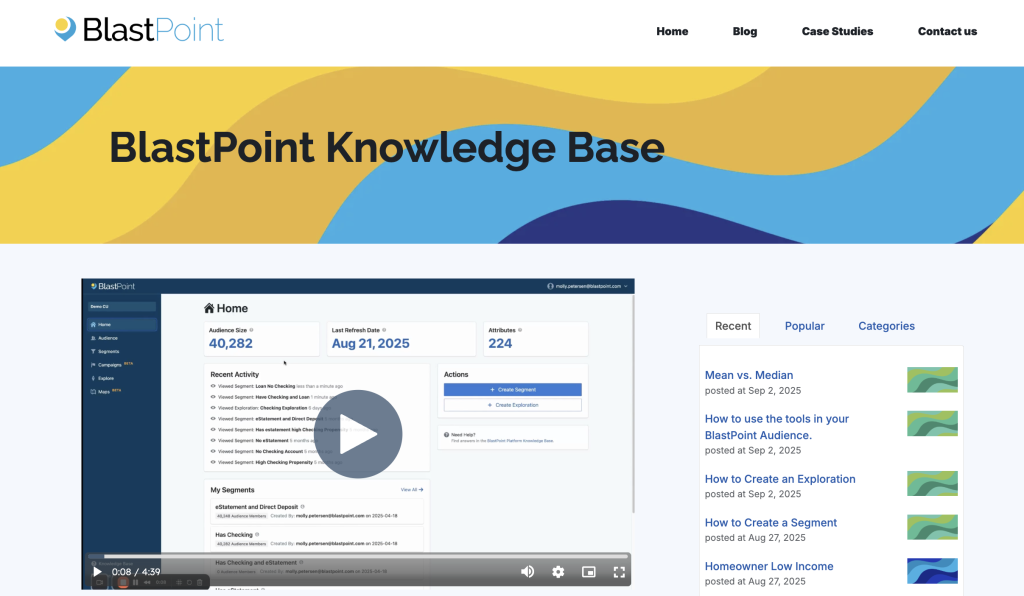
Our brand new Knowledge Base is your go-to resource for learning the ins and outs of BlastPoint. Whether you’re getting started or diving deep into advanced features, it’s packed with step-by-step guides, video walkthroughs, and best-practice recipes to help you achieve better results faster.
From tips on optimizing your Segments to deep dives into Automations and Maps, you’ll find everything you need to get the most out of the platform — all in one place.
2. New Admin Interface: Manage Teams with Confidence
Empower your organization like never before. The Admin Interface gives customers with elevated permissions full control over their team’s access and organization within the platform.
Admins can now:
- Add and remove users,
- Adjust permission levels, and
- Reassign Segments, Explorations, and Maps when employees transition.
It’s all about giving you the flexibility to manage your users and data securely, without needing to reach out to support.

3. Attribute Sources: Transparency, Simplified
Ever wonder where a particular Attribute comes from? With Attribute Sources, you now have complete visibility into the origins of your data. Instantly see which data source or upload introduced each Attribute — adding a new layer of transparency and confidence to your analysis.

4. Maps Graduates from Beta — and Gets Even Better
Maps is officially out of beta! You’ll notice it’s faster, more responsive, and packed with improvements designed to make geographic analysis a breeze.
Here’s what’s new:
- Blazing-fast performance for smoother exploration.
- Choropleth Table View: view and export choropleths as tables, making it easier than ever to share insights or feed results into other systems.
This release marks a huge milestone — Maps is now a core part of the BlastPoint experience, built for power and precision.
5. Fix Broken Segments with Ease
As your platform evolves and Attributes change, sometimes Segments that rely on outdated Attributes can break. Now, you can edit and repair broken Segments directly, restoring functionality without needing to start from scratch.

It’s a small change that makes a big difference in maintaining smooth, consistent workflows.
6. Performance Upgrades: 5x Faster Audience Exports
Speed matters — and we’re serious about it. Audience Member Exports are now roughly five times faster, dramatically cutting down on wait times.
And this is just the beginning. We’re continuing to invest in performance improvements across the platform, and early results from our next wave of optimizations are already exciting. Stay tuned!
Build Smarter, Move Faster
These updates reflect our ongoing commitment to empowering you with the most efficient, transparent, and flexible tools possible. From admin autonomy and faster exports to a knowledge base built for continuous learning, every enhancement is designed to make your workflow smoother and your insights sharper.
Ready to explore what’s new?
Our team is here to help you make the most of every update.