On March 5th, I had the honor of representing the Maryland Blockchain Association on Capitol Hill for the U.S. House Capital Markets Subcommittee hearing: “The Role of Self-Regulatory Organizations in U.S. Markets.” Chaired by Rep. Ann Wagner, the session was a deep dive into the “Restoring Accountability in Market Supervision Act,” which considers transferring FINRA’s ... Read more
The post The Role of Self-Regulatory Organizations In U.S. Markets first appeared on BLI.Tools.
]]>On March 5th, I had the honor of representing the Maryland Blockchain Association on Capitol Hill for the U.S. House Capital Markets Subcommittee hearing: “The Role of Self-Regulatory Organizations in U.S. Markets.”
Chaired by Rep. Ann Wagner, the session was a deep dive into the “Restoring Accountability in Market Supervision Act,” which considers transferring FINRA’s rulemaking and enforcement authority directly to the SEC. The discussion centered on several critical pillars of regulatory reform:

- Accountability & Transparency: Legislators questioned why SROs like FINRA, which exercise government-level power to levy fines and end careers, are not subject to the same transparency laws (like FOIA) as federal agencies.
- Due Process: Witness Valerie Mirko highlighted the “irreversible harm” caused when FINRA bars individuals from the industry immediately, often before the SEC has a chance to review the case.
- Operational Efficiency: Mike Lawler and other members noted that the SRO framework created in 1934 is outdated for today’s high-speed, automated markets and may be creating unnecessary duplication and costs for smaller firms.
- Investor Protection: Jennifer Shaw (PIABA) raised concerns about the fairness of the industry-run arbitration system, emphasizing that reform must prioritize “Main Street” investors.
A highlight of the day was connecting with Rep. Ann Wagner and Rep. Mike Lawler to discuss how regulatory clarity—or the lack thereof—impacts innovation and the long-term health of our capital markets. As we navigate this “Regulatory Renaissance,” ensuring that our oversight bodies are fit for the digital age remains a top priority for the MDBA.
#FINRA #MSRB #SEC #CapitalMarkets #RegulatoryReform #MDBA #DigitalAssets
Watch the full House Subcommittee Hearing on SRO Reform
This video provides the full recording of the March 5th hearing, allowing you to hear the specific testimonies from the legal experts and the direct questioning from the Subcommittee members regarding FINRA and MSRB reform.
Dr. Sylvester, CCIA, CCI, CCIE, CIPM ll, FIIM., Co-Chair African Modernization Task Force – Digital Asset Regulatory Authority (www.dara.foundation), a grassroots SRO initiative.

The post The Role of Self-Regulatory Organizations In U.S. Markets first appeared on BLI.Tools.
]]>The Blockchain Legal Institute (BLI) will be on the ground in Denver this month to engage with policymakers, developers, and institutional leaders at ETHDenver 2026. As the world’s largest Web3 innovation festival returns to the Stockyards Event Center from February 17–21, the focus has shifted significantly from pure speculation to the integration of regulatory frameworks ... Read more
The post ETHDenver 2026: BLI Explores the Future of Digital Asset Policy first appeared on BLI.Tools.
]]>The post ETHDenver 2026: BLI Explores the Future of Digital Asset Policy first appeared on BLI.Tools.
]]>Members of the global Ethereum and Web3 community will gather for four days of conversation, cooperation, and invention at the Ethereum Community Conference (EthCC) 2026, which will take place in Cannes, France, from March 30 to April 2, 2026. EthCC, the biggest annual Ethereum-focused conference in Europe, remains a focal point for blockchain developers, entrepreneurs, ... Read more
The post Ethereum Community Conference (EthCC) 2026 – Cannes, France first appeared on BLI.Tools.
]]>The post Ethereum Community Conference (EthCC) 2026 – Cannes, France first appeared on BLI.Tools.
]]>Jacqueline Cooper, CEO, Blockchain Legal Institute & Director of the Digital Asset Regulatory Authority, will be moderating a panel to discuss stablecoins, SROs and digital asset trends across the globe. Anthony Howell, Director & Overseas Director for Bermuda, will be one of the featured speakers. The Digital Assets Forum returns to London on February 5–6, ... Read more
The post Digital Assets Forum 2026: BLI Moderates Panel first appeared on BLI.Tools.
]]>Jacqueline Cooper, CEO, Blockchain Legal Institute & Director of the Digital Asset Regulatory Authority, will be moderating a panel to discuss stablecoins, SROs and digital asset trends across the globe. Anthony Howell, Director & Overseas Director for Bermuda, will be one of the featured speakers. The Digital Assets Forum returns to London on February 5–6, 2026, marking a pivotal moment for institutional adoption of digital assets in Europe and beyond.
A Strategic Location
The third edition of DAF will convene at Convene, 133 Houndsditch, positioned in the heart of London’s financial district. The venue choice reflects the conference’s core mission: facilitating substantive dialogue between traditional financial institutions and digital asset innovators. Senior executives from BlackRock, Deutsche Bank, J.P. Morgan, Barclays, and BNP Paribas will join blockchain leaders including Aave founder Stani Kulechov, creating a forum where both worlds can engage directly.
Regulatory Engagement at the Forefront
With MiCAR implementation reshaping Europe’s regulatory landscape and the UK developing its independent crypto framework, DAF has emerged as a critical venue for examining these evolving structures. Christian Moor, Principal Policy Officer at the European Banking Authority, is among the confirmed speakers—underscoring the growing participation of regulatory bodies in industry dialogue.
Organizations such as the Blockchain Legal Institute have played an important role in fostering these connections, convening panels that bring government officials and policymakers into direct conversation with industry practitioners. This collaborative approach to policy development is increasingly central to the conference’s programming.
An Expanded Format
Following two sold-out single-day editions, the organizers have expanded to a two-day format with enhanced facilities, including private roundtables and dedicated meeting spaces. Attendees collectively represent over €3 trillion in assets under management, reflecting significant institutional interest.
The agenda addresses the operational realities of institutional digital asset adoption: custody infrastructure, stablecoin settlement mechanisms, tokenization frameworks, and compliance readiness.
Looking Ahead
Industry analysts project substantial growth in tokenized assets over the coming years. The institutions gathering in London this February are actively positioning themselves within this evolving landscape. For professionals tracking the convergence of traditional finance and digital assets, the Digital Assets Forum offers valuable insight into how this integration is taking shape.
Digital Assets Forum 2026
February 5–6 | Convene, 133 Houndsditch, London EC3A 7DB
eblockchainconvention.com/digital-assets-forum

The post Digital Assets Forum 2026: BLI Moderates Panel first appeared on BLI.Tools.
]]>The Blockchain Legal Institute (BLI) spotlighted a major milestone for education finance on-chain, featuring an exclusive interview with Mohamed Ezeldin, president of Open Campus, conducted by Jacqueline Cooper, founder of the Blockchain Legal Institute and partner at Cogent Law Group. The conversation explored the recently announced strategic partnership among Open Campus, Animoca Brands, and Rich ... Read more
The post BLI Highlights Landmark Open Campus–Animoca–ANPA EduFi first appeared on BLI.Tools.
]]>The Blockchain Legal Institute (BLI) spotlighted a major milestone for education finance on-chain, featuring an exclusive interview with Mohamed Ezeldin, president of Open Campus, conducted by Jacqueline Cooper, founder of the Blockchain Legal Institute and partner at Cogent Law Group.
The conversation explored the recently announced strategic partnership among Open Campus, Animoca Brands, and Rich Sparkle Holdings Limited (NASDAQ: ANPA), under which ANPA will purchase up to US$50 million in EDU tokens over 24 months via open‑market and OTC transactions. As part of the collaboration, Animoca Brands will contribute US$3 million in EDU tokens, marking one of the most significant institutional moves into the emerging Education Finance (EduFi) sector.
Bridging TradFi, EduFi, and Web3
In the interview, Ezeldin and Cooper discussed how ANPA’s entry into EduFi—leveraging its corporate client network of more than 190 publicly listed companies across Hong Kong and the United States—creates a new bridge between traditional capital markets and tokenized education finance. The EDU token serves as both the governance token for the Open Campus DAO and the native gas token for EDU Chain, a Layer 3 chain built on Arbitrum Orbit specifically for on‑chain education use cases.
Ezeldin emphasized that the partnership is a “defining moment” for bringing education into the same orbit of innovation that has transformed other sectors, aligning incentives between learners, educators, and institutions via a blockchain‑powered financial layer for education. Cooper highlighted how the deal illustrates the legal and regulatory questions that BLI helps stakeholders navigate—ranging from token governance and staking to securities, ESG, and cross‑border compliance.
Institutional conviction in blockchain for education
Under the agreement, ANPA’s EDU token purchases will be used primarily for staking, governance, and its EduFi market‑entry strategy, signaling growing institutional conviction that blockchain can make education finance more accessible, transparent, and impact‑driven. As a provider of ESG reporting and compliance services, ANPA will also work with Open Campus to design sustainable financing frameworks in emerging markets, directing capital toward education, inclusion, and socially beneficial initiatives.
During the interview, Cooper and Ezeldin explored how:
- EduFi can offer alternative models to traditional student lending and funding, particularly in markets facing high tuition and heavy debt burdens.
- Tokenization infrastructure can support scholarship pools, revenue‑sharing arrangements, and outcome‑based financing, governed transparently on‑chain.
- SRO‑style standards and best practices—such as those promoted by DARA and BLI’s ecosystem partners—can help protect learners and institutions while enabling responsible innovation.
Elevating education as a Web3 priority
“Education has sat in the shadows of innovation for too long,” Ezeldin noted, underscoring that EDU Chain and the partnership with ANPA and Animoca Brands are designed to move education to the forefront of Web3 impact. Cooper connected this theme to BLI’s mission of building a decentralized legal and educational library that equips lawyers, policymakers, and builders to understand and implement compliant digital‑asset solutions in domains like education, consumer protection, and real‑world assets.
The interview forms part of the Blockchain Legal Institute’s ongoing Global Summit and education series, which brings together regulators, builders, and institutions to examine how blockchain, stablecoins, and tokenization can serve public‑interest outcomes, including educational access and financial literacy.
About Blockchain Legal Institute
The Blockchain Legal Institute (BLI) is a global education and research initiative dedicated to building an informed, ethical professional community around blockchain, digital assets, and Web3 law. BLI curates a decentralized library of resources, hosts global summits and hackathons, and collaborates with regulators, industry, and academia to promote legal clarity, consumer protection, and responsible innovation in the digital‑asset ecosystem.
About Open Campus
Open Campus is a community‑led DAO building the blockchain‑powered financial layer for education, with core contributors including Animoca Brands, TinyTap, NewCampus, RiseIn, and HackQuest. It launched EDU Chain, a Layer 3 chain on Arbitrum Orbit for on‑chain EduFi, powered by the EDU token.
About Animoca Brands
Animoca Brands is a global digital‑assets leader focused on blockchain and tokenized assets, known for building platforms such as the Moca Network, Open Campus, and The Sandbox, and for investing in over 600 Web3 companies and altcoin projects. More information is available at
The post BLI Highlights Landmark Open Campus–Animoca–ANPA EduFi first appeared on BLI.Tools.
]]>Washington, DC – (December 15, 2025) The Digital Chamber (TDC)’s State Network is pleased to announce its latest partner and the first microgrant recipient. The Maryland Blockchain Association (MDBA) has agreed to partner with TDC’s State Network to expand the reach of their work across Maryland to educate and advocate for fair, inclusive blockchain policies and laws. ... Read more
The post The Digital Chamber’s State Network Announces its Newest Partner first appeared on BLI.Tools.
]]>Washington, DC – (December 15, 2025) The Digital Chamber (TDC)’s State Network is pleased to announce its latest partner and the first microgrant recipient. The Maryland Blockchain Association (MDBA) has agreed to partner with TDC’s State Network to expand the reach of their work across Maryland to educate and advocate for fair, inclusive blockchain policies and laws.
“Maryland has set a high bar for state innovation, which is critical to bridging knowledge gaps to advance emerging industries like digital assets and blockchain. The Maryland Blockchain Association has created a welcoming space for blockchain innovators to flourish,” said Cody Carbone, CEO of the Digital Chamber. “We are pleased to support their work, which will serve as a model for how TDC can plug into and strengthen the existing efforts of blockchain advocates, elevating the industry at the state level.”
“The Maryland Blockchain Association is proud to join the Digital Chamber in support of advancing technology and digital asset compliance applications. As part of a growing statewide coalition, the Maryland Blockchain Association is proud to support Maryland’s education ecosystem by expanding access to blockchain and emerging technology learning opportunities for students, educators, and lifelong learners. Together with our partners, we are building future-ready pathways that prepare Marylanders for high-demand careers in the digital economy.” Jacqueline Cooper, CEO, Maryland Blockchain Association.
TDC’s State Network microgrant to MDBA is the first in a pilot program designed to help groups involved in state and local blockchain education efforts to formally support their ongoing work. The program awards grants to state blockchain associations, university blockchain clubs, and community innovation groups to build a foundation for success across all 50 states.
Specifically, small-dollar grants will be awarded to blockchain associations, university blockchain clubs, and community innovation groups in 2026. Formal application will open in January with more grants to be announced in March 2026 at the Digital Chamber’s annual Blockchain Summit.
“The Microgrant Program means these critical grassroots groups that are often volunteer-led can gain access to funding needed to mobilize education and advocacy efforts in their home state that are key to the formation of principled, digital asset policy development,” said Anastasia Dellaccio, Executive Director of TDC’s State Network.
TDC’s State Network, launched in 2025, extends support to states and local groups with similarly aligned goals.
ABOUT TDC and TDC’s State Network
The Digital Chamber is a non-profit organization committed to promoting global blockchain adoption. We envision a fair and inclusive digital and financial ecosystem where everyone has the opportunity to participate. Access to digital assets is not merely a technological advancement but a fundamental human right, crucial for economic and social empowerment. Through targeted education, advocacy, and strategic collaborations with government and industry stakeholders, we drive innovation and shape policies that create a favorable environment for the blockchain technology ecosystem.
Major partners and affiliates of The Digital Chamber include: CryptoUK and Digital Power Network.
ABOUT MDBA
The Maryland Blockchain Association is a nonprofit coalition advancing Bitcoin, blockchain, and Web3 innovation, policy, and education across Maryland. Its mission is to connect industry, government, and academia to foster responsible adoption, economic growth, and a skilled blockchain workforce in the state
###
For media inquiries, contact [email protected]
Follow The Digital Chamber I LinkedIn I Twitter I Instagram
The post The Digital Chamber’s State Network Announces its Newest Partner first appeared on BLI.Tools.
]]>By James R. Holbein, Of Counsel, Braumiller Law Group PLLC and Justin Holbein, Web3 Consulting LLC Introduction When Tim Berners-Lee and his team at CERN formalized the Hypertext Transfer Protocol in the early1990s, they reserved HTTP status code 402 with the designation “Payment Required.” The 1996HTTP/1.0 specification (RFC 1945) explicitly noted the code’s purpose for ... Read more
The post USA & Beyond: Activating HTTP 402: The x402 Protocol first appeared on BLI.Tools.
]]>
By James R. Holbein, Of Counsel, Braumiller Law Group PLLC and Justin Holbein, Web3 Consulting LLC
Introduction
When Tim Berners-Lee and his team at CERN formalized the Hypertext Transfer Protocol in the early
1990s, they reserved HTTP status code 402 with the designation “Payment Required.” The 1996
HTTP/1.0 specification (RFC 1945) explicitly noted the code’s purpose for “some form of digital cash or
micropayment scheme,” yet candidly acknowledged “that has not happened, and this code is not usually
used.” For three decades, HTTP 402 remained dormant, a placeholder waiting for payment technology
that could finally enable the internet’s native commerce vision.
That technological moment has arrived. The convergence of payment stablecoins, blockchain settlement
infrastructure, and the regulatory clarity provided by the GENIUS Act of 2025 has created conditions for
HTTP 402’s activation. The x402 protocol, developed by Coinbase in collaboration with Cloudflare and
others through the x402 Foundation, operationalizes this long-reserved status code to enable instant,
automated payments: particularly for autonomous AI agents conducting machine-to-machine
commerce.
As we examined in our analysis of the GENIUS Act (GENIUS Act Establishes Legal Framework for
Stablecoins), payment stablecoins have matured into critical financial infrastructure with approximately
$210 billion in circulation and roughly $800 billion in monthly transaction volume. Stablecoins solve the
fundamental problems that prevented earlier digital payment schemes: they maintain stable value
through reserve backing (unlike volatile cryptocurrencies), enable instant settlement without
chargebacks (unlike credit cards), and operate with near-zero transaction costs (making micropayments
economically viable). The GENIUS Act provides the first comprehensive federal regulatory framework for
these assets, establishing clear definitions, reserve requirements, and supervisory pathways while
clarifying that payment stablecoins are neither securities nor commodities.
This regulatory foundation enables x402’s emergence as a practical payment protocol rather than a
regulatory workaround. However, significant legal questions remain about how existing regulatory
frameworks apply to HTTP-native, blockchain-settled, AI-agent-initiated payments. This article examines
x402’s technical operation, analyzes its interaction with money transmission, consumer protection,
sanctions compliance, and tax regulations, and identifies legislative provisions needed to support
compliant implementation.
Technical Description and Analysis of x402
The x402 protocol is described in Coinbase’s open-source materials and the x402 Foundation’s white
paper as a chain-agnostic payment standard layered on HTTP. It “activates” the dormant HTTP 402
Payment Required status code so that a web server that wants to charge for a resource responds to a
client request with “402 Payment Required” and structured metadata describing the required crypto
payment. A smart wallet or facilitator then pays with a payment stablecoin like USDC and re-requests the
resource, which is delivered upon on-chain settlement.
The protocol operates through a straightforward sequence: A client sends a standard HTTP request to
access a resource. If payment is required, the server responds with HTTP 402 and structured metadata
specifying the price (typically in USDC), blockchain network, destination wallet address, and payment
window. The client’s wallet constructs a signed blockchain transaction and retries the request with
payment proof in an X-PAYMENT header. A facilitator service verifies the payment on-chain (including
KYT and OFAC screening), and upon confirmation, the server delivers the resource with transaction
details in an X-PAYMENT-RESPONSE header. This flow typically completes in approximately two seconds
with cryptographic finality, charging no protocol fees beyond nominal blockchain gas costs (typically
under $0.0001).
While current implementations primarily use Base (Coinbase’s Ethereum Layer 2 network) for USDC
settlements, the protocol specification is deliberately chain-agnostic, accommodating any blockchain and
any compliant token. As payment stablecoins proliferate under the GENIUS Act framework, including
state-issued stablecoins like Wyoming’s Frontier token, x402 can support ecosystem competition while
maintaining interoperability.
Commercial Positioning
Coinbase markets x402 as “the internet-native payment protocol” and an “onchain gateway for AI and
APIs,” emphasizing instant USDC settlement, no chargebacks, and built-in compliance & security (KYT
and OFAC screening) when using its hosted facilitator. Cloudflare and others have launched a neutral
x402 Foundation to steward the open specification. The protocol itself is open source; there is already a
small ecosystem of third-party wallets, exchanges and white-label platforms advertising “x402-
compliant” services.
Perhaps x402’s most transformative capability is enabling autonomous AI agents to conduct commerce
without human intervention. Traditional payment systems assume human participation: account
creation, authentication, explicit transaction approval. x402 treats AI agents as first-class economic
participants. An agent with a blockchain wallet can discover paid services through HTTP, parse payment
requirements from 402 responses, construct and sign payment transactions, and complete resource
access autonomously. This enables machine-to-machine commerce at velocities and scales impossible
through traditional rails. The PING token phenomenon, where an experimental x402-enabled minting
process generated over $80 million in peak market capitalization, demonstrated both technical viability
and explosive scaling potential.
Money Transmission and MSB Status
From a U.S. regulatory standpoint, the central question is not whether x402 is “legal” as a protocol, but
who is doing what with customer value. At the federal level, FinCEN treats persons “accepting and
transmitting” virtual currency, or “buying and selling” it as a business, as money transmitters subject to
registration as money services businesses and BSA/AML obligations, unless a specific exemption applies.
This has long been the posture for exchanges and custodial wallets, and it has been applied to various
payment and mixing services.
x402 itself is agnostic on custody. The GitHub specification envisions a “facilitator” that can be a CDPhosted facilitator operated by Coinbase, which is marketed as “production-ready” with “best-in-class
KYT/OFAC checks” and runs on Base/Solana. A community facilitator for dev/test or a self-hosted
facilitator that can theoretically support any EVM/Solana network and any compliant token. Legally, the
hosted Coinbase facilitator looks very much like an existing regulated crypto payment processor.
Coinbase already maintains extensive BSA/AML, OFAC screening, and licensing infrastructure, and
markets x402 as inheriting those compliance controls. A U.S. merchant that simply receives USDC
through that facilitator is in a position analogous to a merchant using Stripe or PayPal; not an MSB,
absent unusual facts.
By contrast, a self-hosted facilitator that holds customer assets in omnibus wallets, converts between fiat
and crypto, or routes third-party payments as a business would, under conservative reading of current
FinCEN guidance and state law, almost certainly be treated as engaging in money transmission and thus
require MSB registration and state money-transmitter licenses, unless it can fit safely within a “software
only/non-custodial” category. FinCEN can be instructed in new legislation to address these definitional
issues.
In practice, use of the Coinbase-hosted x402 facilitator (as currently marketed) is wrapped inside
Coinbase’s existing compliance stack: KYT, OFAC screening, and state/federal authorizations as a
regulated crypto intermediary. A U.S. business that merely integrates to that infrastructure is likely to be
seen more as a merchant using a payment processor than as a money transmitter itself. By contrast, a
self-hosted facilitator that takes custody of customer assets or performs fiat/crypto conversions will,
under conservative FinCEN and state interpretations, very likely fall into money-services-business
territory and need appropriate licensing and BSA compliance.
Autonomous Agents and Authority
Under current U.S. law, there is no separate category of AI agent with legal personality. A payment
initiated by an AI wallet should, in most doctrinal analysis, be treated as a payment initiated by the
human or organization that configured the agent, subject to ordinary principles of actual or apparent
authority and error / fraud allocation. But the more autonomous these agents become, as enabled by
the increasing integration of smart contracts into commercial use, the more scope there is for disputes
about mandate, consent and liability: especially if micro-charges accumulate unnoticed. Regulators and
courts have not yet clarified where fault will lie when an AI mistakenly pays using x402.
The scope of an agent’s authority presents challenges. Traditional payment authorizations are explicit
and bounded. An AI agent with wallet access may receive broad mandates: “purchase necessary API
services to complete this research project” or “optimize data acquisition costs across available sources.”
Such open-ended grants create ambiguity about authorized spending. If an agent accumulates significant
charges through thousands of micro-transactions, at what point did it exceed its authority? Traditional
error allocation frameworks, designed for human-initiated transactions with direct control, translate
poorly to autonomous agents making probabilistic decisions based on trained models.
Contract Formation and Paywalls
x402 effectively transforms HTTP 402 responses into offers to contract: “pay X in token Y to address Z in
the next N minutes and you will receive resource R.” That fits comfortably within standard contract-law notions of offer, acceptance (by payment), and consideration. But implementers must still ensure legally
sufficient terms of use including governing law, limitation of liability, IP licenses and dispute-resolution
provisions accompany or are incorporated into the x402 interaction in a way that would satisfy U.S.
courts considering browse-wrap/click-wrap enforceability.
Given the unsettled and fast-moving regulatory landscape around crypto, any serious B2B deployment of
x402 should pay particular attention to risk allocation, change-in-law, sanctions, export-control, and
force-majeure clauses in the surrounding commercial documentation, as well as clearly allocating tax,
foreign exchange, and on-chain risk between merchant, facilitator and end-user.
After the GENIUS Act, New Legislation and Regulations Needed
The passage of the Guiding and Establishing National Innovation for U.S. Stablecoins of 2025 or ”GENIUS
Act of 2025′” (the Act) on July 18, 2025, established guidelines for regulatory agencies to establish a
regulatory framework to permit a variety of bank and non-bank entities to issue payment stablecoins
that will be used for payments and reserves for a variety of purposes.
So the integration of payment stablecoins into the financial system is coming within the next year.
Congress is working on market structuring legislation, with the Clarity Act passed by the House and
waiting for action in the Senate. One element of that legislation must be to enable regulations to
regulate protocols for payment stablecoin use. This is clear because x402 implementations today are
heavily oriented around USDC and similar stablecoins as the settlement unit.
The GENIUS Act primarily targets issuers, not end-users or protocol designers. However, large-scale x402
usage exposes participants to concerns that some x402 facilitators or wallets might fall within the
GENIUS Act’s definitions if they issue redeemable on-platform tokens or interest-bearing balances.
Another strength of using x402 protocols is to enable AI agents to perform micro-cost transactions
without intervention. The new legislation should address whether an AI agent using x402 to hold or
transfer stablecoins for a user will be treated as merely a software agent (with the human user as the
“customer”), or whether some intermediary in that chain is deemed a custodial wallet provider requiring
licensing.
Another definitional problem to be addressed is whether any non-stablecoin tokens used over x402 rails
risk classification as securities or commodity derivatives, implicating SEC/CFTC jurisdiction. At present
there is no public indication that the SEC or CFTC have taken an enforcement position specific to x402.
Since the GENIUS Act takes payment stablecoins out of the security and commodity classification system,
the market structuring legislation should recognize that reality as it applies to any token types permitted
to be used within the payments protocols addressed by x402.
As of November 29, 2025, x402 itself is best understood as a technical, open payment standard, not a
legally recognized payment system or regulated product in its own right. It is an HTTP-native protocol
pattern, developed and pushed primarily by Coinbase (with Cloudflare and others) that uses the longreserved internet HTTP 402 “Payment Required” status code to embed on-chain payments directly into
web requests.
No U.S. statute, regulation, or formal agency guidance currently singles out “x402” as a distinct category.
Regulators and the Federal Reserve have begun describing x402 as a potentially important mechanism
for machine-to-machine micropayments, but only in the sense of an emerging technology that will have
to be made consistent with existing regimes around security, consumer protection and compliance.
Accordingly, the legal status of x402 in the United States is derivative. It depends on (i) what assets are
moved (typically stablecoins such as USDC), (ii) who operates the “facilitator” or wallet infrastructure
(e.g. Coinbase’s hosted facilitator versus a self-hosted node), and (iii) the use-case (consumer payments
versus purely B2B or machine-to-machine flows). Those functions will be evaluated under these existing
frameworks:
- Federal and state money transmission/MSB and money-transmitter-licensing rules;
- The GENIUS Act and related prudential oversight of issuers;
- Existing AML/BSA, KYC and OFAC obligations;
- Securities versus commodities law to the extent the protocol is used with tokens that are (or
later become) regulated instruments; - Consumer-protection and payments law, including the CFPB’s authority, state unfair-practice
rules, and (to a lesser degree) Reg E/EFTA analogies; and - Tax rules treating crypto transactions as taxable events.
AML, Sanctions, and Compliance
From a BSA/AML and sanctions perspective, x402 is a new front-end for the same underlying risks.
Coinbase’s hosted facilitator explicitly advertises KYT screening and OFAC checks as part of its x402
offering. Legislation should address whether facilitators handling payments may need moneytransmission licenses and robust AML controls, so that it is clear to everyone what compliance requires.
Because AI agents will transact automatically over x402, regulators will need to address security, trust,
and compliance, including controls against micro-charges that get caught in unintended loops creating large expenses and adjustments to the blockchain to claw back inappropriate payments and ensuring user visibility into charges.
The key questions the new legislation must also address include the definition of “financial institution”
for BSA purposes for automated payments and whether there are adequate KYC and sanctions-screening measures at that chokepoint. Also, should autonomous AI agents making payments require special consent by transaction or blanket approval for the smart contracts to operate with automaticity, as designed. Regulations must address disclosure frameworks to avoid unfair-practice findings.
The U.S. Treasury Department’s 2022 designation of Tornado Cash, asserting that blockchain protocols themselves can be sanctionable if they systematically facilitate sanctions evasion, signals Treasury’s willingness to pursue novel enforcement approaches. While x402 differs significantly (transactions are transparent, traceable, not designed for anonymity), the precedent raises questions about where compliance obligations attach in permissionless protocols
Consumer Protection and Payments Law
Because current x402 deployments focus on developer and B2B use-cases (API calls, AI inference, data
access), U.S. consumer payments law has not yet been deeply tested against the protocol. The Consumer
Financial Protection Bureau (CFPB) and state attorneys general can and do apply general unfair,
deceptive or abusive acts or practices (UDAAP) standards to crypto products. A pay-per-use system that
initiates automated micro-payments via smart wallets raises obvious issues around disclosure, consent,
and charge visibility that the new legislation should address to provide guidance for the development of
appropriate rules for the regulated companies and consumer protection.
The Electronic Fund Transfer Act and Regulation E may partially apply where crypto rails are merely a
layer under a consumer’s fiat interface (for example, if a bank or fintech uses x402 “under the hood” to
route USDC but presents the transaction as a dollar debit). The precise scope is currently unsettled in
U.S. law; regulators have not yet said that x402-mediated stablecoin transfers are “electronic fund
transfers,” but the more tightly integrated such systems become with bank accounts and cards, the more
plausible Reg E analogies look.
State money-transmitter and stored-value laws, as well as emerging state-level digital-asset and privacy
statutes such as those in California and Wyoming, can impose additional obligations on wallet providers,
processors and merchants, especially around error resolution, refunds, and data handling. U.S. agencies
are waiting for Congressional guidance to better enable safe and secure use of x402-style
micropayments while still protecting users, businesses, consumers and financial institutions.
The protocol’s automation implicates consumer protection principles. Traditional systems involve explicit
authorization for each transaction or clearly bounded recurring payments. x402 enables scenarios where
AI agents initiate payments based on programmatic logic. Disclosure and consent frameworks designed
for human-readable payment flows translate imperfectly to autonomous agent activity
Tax Considerations
From a U.S. tax perspective, the IRS continues to treat digital assets as property, and new guidance and
reporting rules make clear that every crypto disposal or exchange is potentially a taxable event. Clarity
on this issue in the new law will be welcome. Expanded use of the x402 protocol will collide with new
Form 1099-DA reporting obligations and the IRS’s digital-asset enforcement push. One possible approach
will be for Congress to authorize the Treasury Department to create de minimis exemptions for very
small crypto transactions. However, absent action by Congress, the prudent assumption is that x402
transactions carry the same tax frictions as any other crypto payment.
The practical challenges are significant. Each x402 payment’s tax consequence depends on the payer’s
specific basis in the digital asset used, requiring transaction-level tracking across potentially millions of
micropayments. Congress could address this through targeted relief similar to the foreign currency
exception for personal transactions under $200. The pending market structure legislation presents an
opportunity to include such provisions, recognizing that subjecting every micropayment to full capital
gains treatment creates compliance burdens disproportionate to policy goals.
Conclusion and Practical Takeaways
Nothing in current U.S. law makes x402-style internet payments per se unlawful. The protocol fits, at
least conceptually, into existing frameworks for digital-asset payments, money services, and online
commerce. The real risk lies in treating x402 as if it were outside those frameworks. A careful
implementer in the United States should therefore treat x402 as a novel interface to highly regulated
activity, not as a regulatory escape hatch.
x402 emerges at a unique inflection point where technological capability, regulatory framework, and
market demand simultaneously mature. Payment stablecoins have demonstrated viability at scale. The
GENIUS Act provides foundational regulatory clarity. Layer 2 blockchain networks offer throughput and
cost structures that earlier infrastructure could not support. AI agent capabilities have advanced to
where autonomous commerce becomes practical rather than theoretical.
The new market structuring legislation must ensure that regulators are given guidance for the
development of definitions and steps to integrate this payment form into digital-asset payments in
alignment with existing compliance and use standards. Key points are:
- x402 is a technical standard, not a regulated entity. There is no U.S. law “about” x402 as such. It
is simply a way of binding payments to HTTP 402 responses. - Implementation Guidance. The new law should clarify that if a U.S. business never takes custody
of customer assets, it should generally be viewed as a merchant using a regulated payment
processor, subject mainly to ordinary commercial and consumer-protection obligations. - Clarity about MSBs is needed. Congress can define a clear non-custodial exemption to apply to
any U.S. operator that holds users’ crypto, converts crypto or payment stablecoins to and from
fiat, or intermediates third-party payments over x402 rails so that FinCEN MSB registration and
state money-transmitter licensing are not required. - Stablecoin and tax rules still bite. The GENIUS Act and IRS digital-asset reporting regime apply by
reference to the assets and transactions, not the protocol. x402 micropayments do not, by
themselves, change the classification of USDC or other tokens, nor do they eliminate the need
for tax and accounting controls. Revised regulations to ensure clear compliance requirements
would help. - Regulators are watching the AI angle. The Federal Reserve and policy commentators explicitly
connect x402 with agentic AI and foresee the need for robust safeguards and oversight as
machine-to-machine payments scale. That suggests that, over time, there may be x402-specific
supervisory expectations, especially around consumer consent, fraud controls and systemic-risk
monitoring, even if the formal rules remain technology-neutral.
x402 operationalizes a vision embedded in the web’s architecture since the 1990s, finally made viable
through stablecoins’ emergence as legitimate financial infrastructure. The protocol’s success will depend on regulatory frameworks that recognize its novel characteristics while addressing legitimate oversight concerns. The next two years, as GENIUS Act regulations develop and market structure legislation potentially advances, will determine whether x402 becomes ubiquitous internet infrastructure or remains constrained by regulatory uncertainty
The post USA & Beyond: Activating HTTP 402: The x402 Protocol first appeared on BLI.Tools.
]]>Judging at LegalHack 2025. By Ibrahim Shittu I spend my days building AI-powered tools for the legal industry. WhenI learned about the Blockchain Legal Institute’s Legal Tech Hackathonand the opportunity to judge, I was immediately interested.Hackathons have always fascinated me—the energy, the creativity,the pressure of building something meaningful in a short time.I’ve judged hackathons before. ... Read more
The post When Blockchain Meets Legal Technology: A Perspective first appeared on BLI.Tools.
]]>Judging at LegalHack 2025. By Ibrahim Shittu
I spend my days building AI-powered tools for the legal industry. When
I learned about the Blockchain Legal Institute’s Legal Tech Hackathon
and the opportunity to judge, I was immediately interested.
Hackathons have always fascinated me—the energy, the creativity,
the pressure of building something meaningful in a short time.
I’ve judged hackathons before. I am familiar with the process:
quick-fire presentations, ambitious projects, and the exhilarating
energy of individuals creating something innovative under pressure.
But judging a legal tech hackathon? That was different. This wasn’t just
about evaluating code quality or system architecture. It was about
assessing solutions to real legal compliance challenges through the
lens of blockchain technology.
The World’s First Legal Tech Blockchain Hackathon
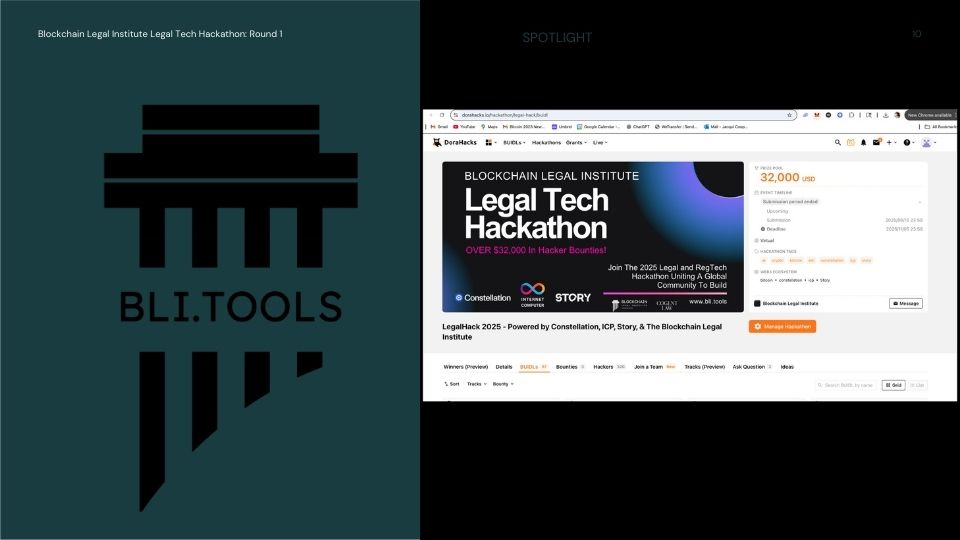
LegalHack 2025, hosted by the Blockchain Legal Institute (BLI) in
partnership with Constellation Network, Internet Computer Protocol
(ICP), and Story Protocol, billed itself as the world’s first legal
technology hackathon focused on blockchain applications. The
numbers alone were impressive: 320 hackers from around the globe,
91 projects submitted, and over $32,000 in bounties up for grabs.
The challenge was clear but ambitious: build solutions that address
legal compliance challenges using blockchain technology. Participants
had to demonstrate technical expertise across AI, blockchain
integration, smart contracts, and decentralized applications—all while
showing how their ideas could solve real-world problems.
For me, this meant evaluating projects not just as a software engineer,
but as someone who works in the legal tech space daily. I had to
assess both the technical implementation and whether the solutions
actually addressed real legal challenges.
A Truly Global Effort
One of the most striking aspects of LegalHack 2025 was its global
reach. Hackers joined from South America, North America, Africa,
Europe, and Asia. The virtual format made this possible, bringing
together perspectives I wouldn’t have encountered at a traditional
in-person event.
This diversity wasn’t just geographic; it was jurisdictional. Legal
compliance looks different depending on where you are in the world. A
solution designed for European data protection regulations might
approach the problem differently than one built for American
corporate law or Latin American financial regulations. Seeing teams
tackle these challenges in their context made the hackathon richer.
The BLI team facilitated this global collaboration through Discord,
where we hosted twice-weekly help sessions during the hackathon.
These sessions became more than just Q&A—they were spaces where
hackers shared ideas, asked questions, and received feedback from
judges like me. I’d pop in to offer suggestions or point someone
toward a better approach for their smart contract implementation.
Watching these interactions unfold across time zones reminded me
that innovation thrives when people from different backgrounds work
on challenging problems together.
The Judging Experience
Virtual pitch day arrived on November 15th. My task: evaluate 57
projects built on Constellation Network, ICP, and Story Protocol,
focusing on 13 project pitches where teams presented their work.
Judging a legal tech hackathon felt different from other hackathons
I’ve evaluated. With most hackathons, I can focus heavily on the
technical implementation—is the product scalable? Are they using the
right tools? But here, I also had to ask: Does this team actually
understand the legal problem they’re solving?
Some projects demonstrated impressive technical implementations,
yet their legal applicability fell short. Others had a profound
understanding of legal challenges but struggled with the technical
execution. The best projects, the ones that really stood out, nailed
both.
What I Learned
Building interdisciplinary solutions is challenging. You need to speak
two languages—in this case, legal and technical. You need to
understand the constraints of both worlds.
Global collaboration also left an impression on me. The Discord
community, the help sessions, the time-zone-spanning
conversations—all of it reminded me that the best ideas don’t come
from isolated genius. They come from people with different
perspectives working together, learning from each other, and pushing
each other forward.
A Note of Thanks
Events like LegalHack 2025 don’t just happen. They require vision,
coordination, and a lot of behind-the-scenes work. I want to thank
Jacqueline Cooper and the entire Blockchain Legal Institute team for
putting such a hackathon together. Creating the world’s first legal tech
blockchain hackathon is no small feat—bringing together 320 hackers
globally, coordinating with major blockchain protocols, and fostering a
community where legal and technical minds could collaborate.
Thanks also to Constellation Network, Internet Computer Protocol, and
Story Protocol for supporting this initiative and providing the
infrastructure that made these innovations possible.
Looking Forward
LegalHack 2025 was a snapshot of where legal tech and blockchain
are heading. The projects I evaluated weren’t just experiments—they
were glimpses of a future where legal work is faster, more transparent,
and more accessible.
But more than that, the hackathon reinforced something I’ve been
thinking about a lot lately: traditional industries need innovators.
People who care about solving real problems in industries that have
been underserved by technology.
Stay Curious
Judging LegalHack taught me that the best innovation happens at
intersections—where different fields, perspectives, and technologies
meet.
The best ideas don’t come from staying comfortable. They come from
staying curious. So here’s my question for you: What traditional
industry could benefit from the tech skills you already have?
Think about it. Then go build something.
About Ibrahim Shittu
Ibrahim Shittu is a senior software engineer who builds AI tools that
make legal work faster and easier. He creates systems that help
lawyers draft, review, and manage complex documents with far less
manual effort.
Ibrahim has also built large-scale digital platforms used by universities
and financial services teams, serving millions of users. His experience
spans full-stack software development, AI systems, and secure cloud
architecture.
He is passionate about how AI and emerging technologies can improve
access to legal services and transform the way legal professionals
work.
The post When Blockchain Meets Legal Technology: A Perspective first appeared on BLI.Tools.
]]>The Blockchain Legal Institute is celebrating a major milestone today with the BLI Legal Tech Hackathon Award Ceremony at Capitol Technology University in Maryland. This event honors the builders, lawyers, students, and innovators who spent months creating real-world solutions at the intersection of law, blockchain, and emerging technology. Event overview Today’s hybrid ceremony at Capitol ... Read more
The post BLI Global Hackathon Award Ceremony first appeared on BLI.Tools.
]]>The Blockchain Legal Institute is celebrating a major milestone today with the BLI Legal Tech Hackathon Award Ceremony at Capitol Technology University in Maryland. This event honors the builders, lawyers, students, and innovators who spent months creating real-world solutions at the intersection of law, blockchain, and emerging technology.
Event overview
Today’s hybrid ceremony at Capitol Technology University will spotlight the top projects from a global cohort of more than 300 participants who submitted dozens of legal tech and regtech solutions. The program includes finalist showcases, panel remarks from partners, and recognition of teams that are pushing the boundaries of compliance, IP, and access-to-justice tools for the Web3 era.
Partners and prizes
This year’s hackathon was powered by a strong ecosystem of bounty partners, including Constellation Network, ICP, and Story, who provided protocol support, mentorship, and prize funding. Their involvement helped teams experiment with cutting-edge infrastructure for everything from on-chain evidence and licensing to compliant digital asset workflows.
Why this ceremony matters
The award ceremony is more than a prize announcement; it is a launchpad for teams whose tools can evolve into startups, research collaborations, or production pilots with institutions and law firms. By hosting the celebration at Capitol Technology University, Blockchain Legal Institute and the Maryland Blockchain Association are reinforcing Maryland’s role as a hub for blockchain education, workforce development, and legal innovation.
Call to action
Community members, students, and professionals who could not attend in person are encouraged to follow updates on BLI’s channels and explore how to join future hackathons, mentorship programs, and ecosystem projects. With additional hackathons already planned for 2026, including youth-focused initiatives, today’s ceremony marks the beginning of an expanding pipeline for legal tech talent and solutions. Join us in July for the first Maryland Blockchain Conference hosted by the Maryland Blockchain Association from July 13th to July 17th.
Register to exhibit, speak and attend. https://lnkd.in/eWfy27en
The post BLI Global Hackathon Award Ceremony first appeared on BLI.Tools.
]]>Join the Blockchain Legal Institute & Digital Asset Regulatory Authority at the Digital Assets Forum in London! DAF Now Expands to Two Days in London, Uniting Traditional Finance and the Digital Assets Industry Join Jacqueline Cooper (CEO of www.bli.tools and Co-Founder of www.dara.foundation) as she moderates one of the panels at DAFin London! The third ... Read more
The post Digital Assets Forum: BLI Moderates Compliance Panel in London first appeared on BLI.Tools.
]]>Join the Blockchain Legal Institute & Digital Asset Regulatory Authority at the Digital Assets Forum in London!
DAF Now Expands to Two Days in London, Uniting Traditional Finance and the Digital Assets Industry
Join Jacqueline Cooper (CEO of www.bli.tools and Co-Founder of www.dara.foundation) as she moderates one of the panels at DAFin London!
The third edition of the Digital Assets Forum (DAF), organized by the European Blockchain Convention (EBC), will take place at Convene, 133 Houndsditch, in the heart of London’s financial district. After two sold-out, one-day editions, the forum now expands to two full days, reflecting accelerating institutional adoption and London’s strategic position as Europe’s capital markets hub for digital assets.
DAF3 will gather leading figures from asset management, family offices, banks, hedge funds, and digital-asset firms – representing €3 trillion in AuM – creating a powerful platform for high-level networking, deal-making, and insight exchange. The expansion includes a dedicated 1:1 meetings program, AI-powered networking app, and private meeting zones designed to maximize meaningful connections between investors and innovators.
“After two fully sold-out editions, it was clear the market needed more space, both literally and figuratively,” says Victoria Gago, Co-Founder of EBC. “This year’s two-day format gives institutions and crypto leaders the time and structure to forge real partnerships and tackle the most important developments shaping the future of finance.”
“We’re moving into an era where every asset, from funds to real estate to carbon credits, can exist on-chain,” adds Daniel Salmerón, Co-Founder of EBC. “DAF3 is where traditional and digital finance meet to define how this transformation will happen: securely, transparently, and at scale.”
The event arrives as tokenization becomes one of finance’s fastest-moving frontiers. Analysts forecast over $16 trillion in tokenized assets by 2030, while leading firms launch products spanning treasuries, credit, and real estate. Digital Assets Forum 3’s agenda goes beyond tokenization and DeFi, covering market structure, custody, AI’s role in finance, stablecoins, compliance, and banking innovation. With regulatory frameworks maturing across Europe and the UK, London serves as the ideal venue for strategic dialogue between policymakers, allocators, and digital-native pioneers.
DAF3 Speakers include Christopher Perkins, President – CoinFund, Emma Lovett, Executive Director – J.P. Morgan, Stani Kulechov, Founder & CEO – Aave Labs, Bilal Jafar, Digital Assets Lead – Dow Jones, Alexandre Laizet, Managing Partner – Capital B, Santiago R. Santos, Partner – Inversion
As a thank you for being part of our community, for a 15% discount, use BLI15 or DARA15 code to obtain discounts on your tickets:
https://lnkd.in/eHXRrysY

The post Digital Assets Forum: BLI Moderates Compliance Panel in London first appeared on BLI.Tools.
]]>