Yes, the Internet Archive has an onion address. The Internet Archive can be accessed via the Tor network at its onion address: archivep75mbjunhxc6x4j5mwjmomyxb573v42baldlqu56ruil2oiad.onion
What is an onion address?
Tor (The Onion Router) is a privacy-focused network that helps protect users’ identities and browsing activity by routing traffic through encrypted layers. Visiting the Internet Archive through Tor allows users to explore the Wayback Machine, books, audio, video, and other collections with an added layer of anonymity, which is an important option for researchers, journalists, and anyone seeking greater privacy or access in regions where the open web may be restricted.
The 2026 Public Song Project is here — and for the first time, WNYC’s Public Song Project is partnering with the Internet Archive!
Here’s what you need to know:
Anyone can participate. You don’t need to be a professional musician. Voice memos welcome. Bedroom producers, shower singers, full bands — the public domain is for everyone.
What’s the public domain? It’s the vast commons of creative works not protected by copyright — meaning you’re free to enjoy, remix, adapt, and build on them. In the U.S., that includes creative works published in 1930 or earlier, sound recordings from 1925 or earlier, plus U.S. federal government works from any year.
What’s new this year? This year’s playlist will live not only with WNYC, but also on the Internet Archive, where millions can stream and share it.
Fun fact: The submission deadline (May 10) falls on the Internet Archive’s 30th birthday!
Internet Archive’s latest Artist in Residence, Cindy Rehm, has created The Seers, a project comprised of one hundred college drawings using images largely sourced from historic books at the Internet Archive. The Seers is inspired by the work of Hélène Cixous and Carolee Schneemann around their interest in the creative process, and mysticism often centered in the figure of the cat. Rehm searched historic books related to women and their feline companions including books on the history of cats in mysticism and witchcraft. For her collages, she gleaned images for their aesthetic and symbolic resonance, focusing on books related to histories of women including books on textiles and handiwork, art history, nature, cats, and other creatures.
For the format of the series, Rehm researched Internet Archive’s collection of antique scrapbooks. The scrapbook is a vernacular form often associated with women and their private lives, and also shares a process relationship with collage, where small fragments are cut and pasted. Historic scrapbooks were often made using repurposed books like catalogs, ledgers, and music books. Rehm borrowed this gesture of layering fragments over a main image, as image cut outs were repeated and remixed across the series to develop a symbolic language and esoteric taxonomy.
As part of her project, Rehm created a limited-edition poster that she distributed during her participation in Public Domain Day on site at Internet Archive. Rehm gave a talk about her project and process, view the livestream recording here.
In February, Rehm will take The Seers to Automata in Los Angeles for a residency focused on extending the project to include an installation and performance. Please visit Rehm’s website to view The Seers full series.
About the artist
Cindy Rehm (https://www.cindyrehm.com/) is a Los Angeles-based artist and an educator. She serves as co-facilitator of the Cixous Reading Group, and is co-founder of the feminist-centered projects Craftswoman House and Feminist Love Letters. She is the founder and former director of spare room, a DIY installation space in Baltimore, MD. In 2021, she launched HEXENTEXTE, a collaborative project at the intersection of image, text and the body.
Rehm has held residencies at Performing Arts Forum in Saint Ermes, France and at Casa Lü, Mexico City. A book of her collage drawings, Transference, was released by Curious Publishing in 2022.
As reported by Nieman Lablast month, some major media organizations—including The New York Times, The Guardian, and Reddit—have started blocking the Wayback Machine from archiving their sites over unfounded concerns about AI scraping.
Last week, tech writer Mike Masnick (Techdirt) explained why this is “a mistake we’re going to regret for generations.”
Today, Mark Graham, director of the Wayback Machine, has published a response to the Nieman Lab reporting, pushing back on the media organizations’ concerns about the Wayback Machine being a backdoor to AI scraping. Graham writes:
“These concerns are understandable, but unfounded… like others on the web today, we expend significant time and effort working to prevent such abuse.”
Read the post to learn how Graham is working to protect the integrity of the Wayback Machine, and why limiting web archiving threatens our shared digital history.
Image credit: Annie Rauwerda, photographed by Ian Shiff, smiling in February 2023
Annie Rauwerda can’t remember a world without Wikipedia. Born in 1999, just two years before the platform launched, she says it has been omnipresent in her life and a source of endless fascination.
In the early days of the COVID-19 pandemic when she was a neuroscience student at the University of Michigan, Rauwerda said she spent a lot of time on Wikipedia and started posting quirky stories she found.
“As I clicked around, there were so many things with goofy titles,” said the now 26-year-old. “I thought to myself: ‘This could be big.’”
Making as many as five videos a day, Rauwerda indeed gained an audience with her off-beat discoveries — from stolen and missing moon rocks to the back story of people demonstrating “high fives.” She created Depths of Wikipedia, a group of social media accounts and has more than 1.5 million followers on Instagram, 200,000 on TikTok, and 130,000 on BlueSky.
In October, Rauwerda was invited to present at the Internet Archive event in San Francisco celebrating the milestone of 1 trillion webpages saved. She brought a burst of energy and humor to the stage as she shared screenshots of some of her favorite Wikipedia articles.
Watch Annie at Internet Archive’s 1 Trillion Web Page Celebration:
Rauwerda calls herself an Internet Archive “super fan” and acknowledges its value in providing links to original sources.
“If Wikipedia is worth anything at all, it’s because of the citations, and those citations are increasingly hard to access,” she said, noting that more than half of the community articles contain a dead link. “That’s not a concern, though, for us, because we have partnerships with the Internet Archive to make sure that those links are archived and can be clicked by anyone.”
Professionally and personally, Rauwerda said she uses the Archive constantly as she looks for material, seeks out old blogs or edits Wikipedia pages.
“It’s really hard for me to think of an organization that I’m more enthusiastic about,” Rauwerda said of the Internet Archive. “I just love everything about it.”
What will matter most to future generations is hard to predict, Rauwerda said, so it’s crucial to save as much of the digital landscape as possible. “I’m thankful the Internet Archive exists,” she said, “especially given how fragile everything is online.”
Rauwerda said she’s had a “simultaneous love affair with the Internet Archive and Wikipedia” — often toggling back and forth as she dives into topics. She said she embraces the spirit of the open web and the community of people who support this work.
Beyond her social media presence, Rauwerda is writing a book about Wikipedia for Little Brown. The series of light-hearted essays about the off-beat people behind Wikipedia is slated for publication in the fall of 2026.
Rauwerda also turned her discoveries into a comedy show, which she first performed at small clubs in New York. After landing an agent, she went on a multi-city tour of the U.S., customizing the material for each region. She has another round of shows booked for 2026.
“It’s been so fun,” she said. “I’m gonna ride this while it lasts.”
Link rot. There’s nothing quite as frustrating as clicking on a link that leads to nowhere.
WordPress, which powers more than 40% of websites online, recently partnered with the Internet Archive to address this problem. Engineers from the Internet Archive and Automattic worked together to create a plugin that can be added to a WordPress website to improve the user experience and check the Wayback Machine for an archived version of any webpage that has been moved, changed or taken down.
The free Internet Archive Wayback Machine Link Fixer, publicly launched last fall, combats link rot by seamlessly redirecting the user to a reliable backup page when it encounters a missing page. When the plugin is added to a website, it will do a scan, see what pages exist, and then automatically save those pages to a queue to be archived. If it doesn’t exist, then it will be sent for capture.
Once the software is installed on a WordPress website, the plugin will auto redirect users to the Wayback Machine version of a missing page.
Broken links are one of the web’s most relentless problems. Pew Research found that 38% of the web has disappeared over the past decade and for web admins, “It’s a never-ending game of whack-a-mole to keep links working,” said Matt Blumberg, Product Manager with the Wayback Machine. “This new tool prevents those inevitable 404s by automatically updating links to a preserved copy and it proactively archives pages in the Wayback Machine, where they’re kept accessible for free, long-term, so your site stays usable without manual fixes.”
“It’s very important that websites have a memory and that the web overall as has a memory. We are increasingly using [the web] as our only source of truth. When links go dead, in effect, the truth goes dead. This has become even more important in the world of AI.”
Alexander Rose, Director of Long-term Futures for Automattic Inc.
Many WordPress websites are homespun and are most susceptible to having links go dead. Remedying this problem is not only valuable to individuals, but also to the overall culture, said Alexander Rose, Director of Long-term Futures for Automattic Inc., the technology company behind WordPress.com.
“We need to have an accurate memory of the things that get said, posted, and the ways that we have communicated over time,” Rose said. “Otherwise we’re either doomed to repeat errors or we’re going to make choices that are uninformed by the past.”
The link fixer is expanding the “heroic effort” made by the Internet Archive over the years to preserve everything from small websites to NASA.gov and WhiteHouse.gov, he said.
“It’s very important that websites have a memory and that the web overall as has a memory,” Rose said. “We are increasingly using [the web] as our only source of truth. When links go dead, in effect, the truth goes dead. This has become even more important in the world of AI.”
As the plugin rolls out, Rose and Blumberg said they are open to feedback. The goal is to make the software as easy as possible to use. Next, they will fine tune the features and promote its broad use.
“As it becomes a solid piece of software that people know and like, then I think it has a path to being integrated much more deeply,” Rose said. “It’s early days, but every person I’ve talked to about it is excited to see the potential end of the dreaded 404 error.”
Digital journalists increasingly turn to web archives like the Wayback Machine to follow how things on the Internet break, change or disappear – from deleted posts to quietly edited pages.
The web has become not only a source of information but also the subject of media investigations, prompting journalists, researchers and activists to use digital archives to reconstruct timelines, verify claims, uncover hidden connections and hold powerful actors to account.
As online materials grow more fragile and prone to disappearance, the Internet Archive’s Wayback Machine has been critical in making “lost” web pages available – recently celebrating archiving over a trillion pages.
We are also interested in how others use web archives across fields, and what we can learn from each other.
In this piece we draw on the Internet Archive’s News Stories collection to surface practices and use cultures of the Wayback Machine amongst journalists and media organisations. We analysed a dataset of about 8,600 news articles, assembled by the IA via daily Google News keyword searches since 2018.
Drawing on a combination of digital methods, machine learning and lots of reading – we surfaced nine ways that journalists use the Wayback Machine in their reporting.
***
1. following what is deleted
Shifting political alliances are a common driver of online footprint erasure. Deleted tweets have revealed past critics in current allies (here and here), and current career aspirations were juxtaposed with earlier conflicting stances in personal blogs and websites (here, here, here and here).
Unannounced takedowns of collections or site sections on government websites often prompt investigations using archival snapshots. Examples include removed editions of presidential newsletters and deleted staff contact lists for services supporting vulnerable groups, signaling access-to-information breaches.
The removal of official publications also enticed further contextualisation, revealing cases in which information was deleted due to being incomplete, inaccurate or inconveniently timed.
Beyond politics, erasing on corporate websites highlights commercial and reputational pressures, such as deleted statements on forced labour, product safety and climate deception.
2. following what has been altered
Subtle alterations on webpages can also reveal a plain-to-see effort to reshape narratives.
In other cases, small additions to online content have proved just as revealing. A before and after snapshot of a blog post showed how a supposed early warning about a virus threat was added only after the pandemic began. Similarly, changes to a social media platform’s API rules appeared shortly after third-party apps were banned, subtly reframing the policy to align with new restrictions.
3. following what is banned
Sometimes removals are deliberate, often at the request of companies seeking to enforce copyright, control branding, or limit liability.
Archived snapshots are also often the only way to reconstruct what preceded a link break, when it happened, and what information was effectively cut off.
For example, an investigation into a set of broken URLs on a government website revealed that the pages themselves had not been removed, but the links pointed to outdated servers, creating a false impression of secrecy that sparked a conspiracy theory.
In another case, a major technical glitch took multiple Nigerian government websites offline, cutting off access to official information and showing how even unintentional failures can undermine transparency.
5. following what is hacked
Compromised versions of hacked websites and social media accounts present another form of using archived snapshots as traceable historical record.
For example, past screenshots of Twitter’s bio page revealed inconsistencies in claims about an alleged takeover of the US president’s social media account. In other cases, such snapshots helped surface a forensic trail and distinguish unauthorised activity carried out by activists (here and here) from the ones linked to cybercriminal groups (here).
6. following what is connected
Archived web data often uncovers unexpected linkages between domains’ ownership that appear unrelated on the surface.
For example, journalists used analytics codes of copies of sites maintained by the Wayback Machine to uncover disinformation networks. In another investigation, archived records verified that a website redirect to Joe Biden’s presidential campaign was unrelated to him, debunking conspiracy theories about the domain’s ownership.
Snapshots of a fake Black Lives Matter Facebook page and its associated websites allowed reporters to trace the individuals behind the operation. Similarly, archived versions of Amazon storefronts exposed networks of accounts generating affiliate revenue from coordinated product listings.
7. following what is reported
Archived web pages have proven vital for tracing how stories are presented across media outlets and platforms.
In another case, snapshots of the Google homepage captured during the 2018 State of the Union speech disproved a viral claim that Google ignored Donald Trump’s address in favour of Barack Obama.
8. following what is unchanged
In other investigations, the most revealing detail is what did not change.
For example, during a bushfire crisis in Australia, archived pages showed that a key policy statement by the Greens party was left untouched, despite a disinformation campaign claiming to the contrary.
Similarly, a social media account circulated as having been reactivated under a new wave of laissez-faire moderation was, in fact, never suspended.
9. following what is saved
When forums, platforms and websites vanish, it’s the work of crowdsourced archivists that capture their traces before they vanish for good.
These are some of the ways we’ve noticed journalists using web archives – and there are many more! If you know of other interesting examples, we’d love to hear from you.
We hope that these nine ways may help to inspire critical and creative uses of web archives to “follow the changes” – exploring what they can tell us about digital culture and society, and the times we live in.
Thais Lobo is research associate at the Department of Digital Humanities, King’s College London, with a previous career in journalism.
Jonathan W. Y. Gray is Co-director of the Centre for Digital Culture and Reader in Critical Infrastructure Studies at the Department of Digital Humanities, King’s College London. He is also co-founder of the Public Data Lab; research associate at the Digital Methods Initiative (University of Amsterdam) and the médialab (Sciences Po, Paris). More about his work at jonathangray.org.
Liliana Bounegru is Senior Lecturer (Associate Professor) in Digital Media, Culture and Society at the Department of Digital Humanities, King’s College London. She is also co-founder of the Public Data Lab, member of the Digital Methods Initiative at the University of Amsterdam and associate of the Sciences Po Paris médialab. More about her work can be found at lilianabounegru.org.
When songs enter the public domain, they don’t just get older, they get new lives. For this year’s virtual Public Domain Day celebration, musician Stephanie Woodford gave three newly public-domain classics a fresh voice by writing new lyrics, reimagined for today.
Partygoers were treated to live performances of Georgia on My Mind and Dream a Little Dream of Me, while a third reinterpretation, On the Sunny Side of the Street, lives on as a special recording. Together, these performances show what the public domain makes possible: creativity that’s playful, personal, and very much alive.
Dream a Little Dream of Me
Music composed by Fabian Andre and Wilbur Schwandt, with lyrics by Gus Kahn. (1930)
Georgia on My Mind
Music composed by Hoagy Carmichael, with lyrics by Stuart Gorrell. (1930)
On the Sunny Side of the Street
Music composed by Jimmy McHugh, with lyrics by Dorothy Fields. (1930)
Stephanie Woodford is a pop, soul, and RnB singer/songwriter and performer. She is a graduate of both the San Francisco Conservatory of Music Preparatory Division and also St. Ignatius College Preparatory High School. She has a degree in music from City College of San Francisco.
This week, Internet Archive celebrated Public Domain Day with a lively mix of ideas, art, and community. Session recordings are now available to revisit or discover the highlights.
In our daytime virtual session, we invited audiences to step into The Case of the Disappearing Copyright, a playful, thought-provoking celebration of the works newly freed into the public domain. Watch the recording.
Our in-person party turned Public Domain Day into a lively celebration of art, film, and the public domain. Artist in residence Cindy Rehm shared The Seers, her public-domain–inspired work, followed by a screening of the winning films and honorable mentions from the Public Domain Film Remix Contest. Watch the livestream.
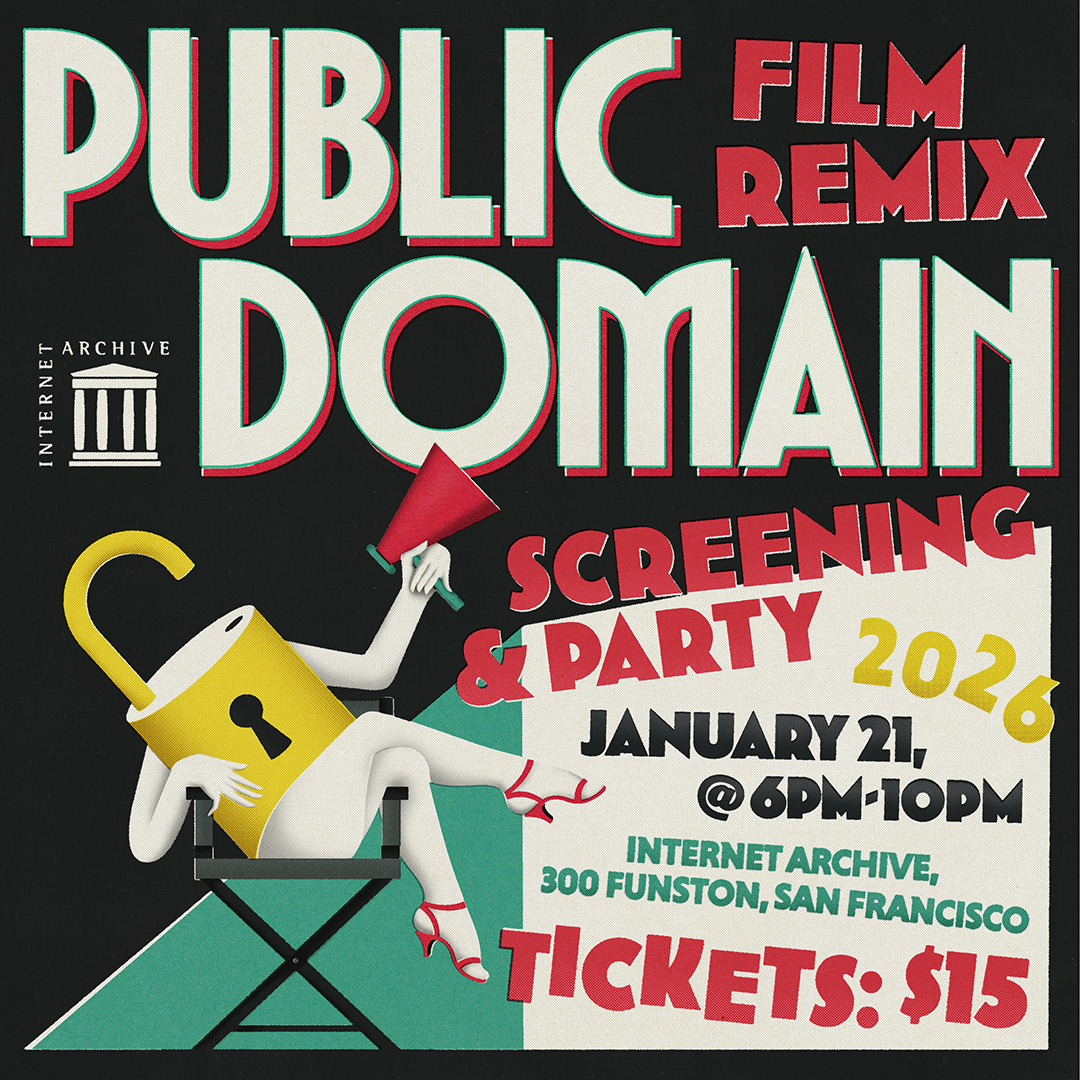
Join us THIS WEDNESDAY, JANUARY 21 for three different ways to celebrate the creative works from 1930 and the sounds recordings from 1925 that have entered the public domain in the US:



.jpg)