What is an onion address?
Tor (The Onion Router) is a privacy-focused network that helps protect users’ identities and browsing activity by routing traffic through encrypted layers. Visiting the Internet Archive through Tor allows users to explore the Wayback Machine, books, audio, video, and other collections with an added layer of anonymity, which is an important option for researchers, journalists, and anyone seeking greater privacy or access in regions where the open web may be restricted.
]]>
The 2026 Public Song Project is here — and for the first time, WNYC’s Public Song Project is partnering with the Internet Archive!
Here’s what you need to know:
Anyone can participate. You don’t need to be a professional musician. Voice memos welcome. Bedroom producers, shower singers, full bands — the public domain is for everyone.
What’s the public domain? It’s the vast commons of creative works not protected by copyright — meaning you’re free to enjoy, remix, adapt, and build on them. In the U.S., that includes creative works published in 1930 or earlier, sound recordings from 1925 or earlier, plus U.S. federal government works from any year.
What’s new this year? This year’s playlist will live not only with WNYC, but also on the Internet Archive, where millions can stream and share it.
Fun fact: The submission deadline (May 10) falls on the Internet Archive’s 30th birthday!
Learn more: Check out the rules and guidelines at https://www.wnyc.org/story/2026-public-song-project/
Optional 2026 Bonus Prompt
This year marks:
- 250 years since America declared independence
- 50 years since the Copyright Act of 1976
Some ideas:
- Rewrite a public domain poem in your own language
- Highlight a historically marginalized artist
- Remix a government work (they’re all public domain!)
- Reimagine the national anthem
- Tell your family’s story through inherited songs
There’s no right or wrong way to do this. The public domain belongs to you. It’s a tool to celebrate, question, remix, critique, and create.
- Submit your song by May 10.
- Submission form, contest rules & more info available from WNYC.
- Questions? Email [email protected]

On January 13, 1930, Mickey Mouse began starring in daily comic strips. This new endeavor “functioned as many fans’ most readily available source of Mickey Mouse entertainment.”1 Despite being a print medium, these works heavily featured musical motifs of popular songs—a staple of his contemporary cartoons. Unlike the concurrent animated shorts, which could incorporate synchronized sound, the comic strip relied on musical shorthand: fragments of lyrics, song titles, and musical notes that invited readers to “hear” the music. These musical moments are not incidental but intentional—Mickey participates within a popular cultural soundscape.
Early strips utilize the cultural cache of these already popular songs to reinforce Mickey’s own cultural relevance. Through subsequent references Mickey becomes associated with music that audiences recognize and consider culturally valuable. Ultimately, the Disney company utilizes this association—Mickey and music as culturally significant—to lend legitimacy to their own musical works. Through this technique the 1930 comics move from borrowing musical culture to manufacturing it.
The first instance of Mickey Mouse referencing a song is “Singin’ in the Bathtub”, a hit song from Warner Brothers’ The Show of Shows (1929).
March 10, 1930

A single panel—essentially a brief throwaway—the reference establishes the musical borrowing technique that the strip would employ throughout 1930. The song he borrows is a parody of The Hollywood Revue’s “Singin’ in the Rain”, thus itself working within a cultural borrowing technique.
The borrowing strategy is repeated when Mickey and Minnie “sing” the parody’s inspiration, “Singin’ in the Rain” while camping out during a rainstorm.
May 20, 1930

The song’s optimistic tone mirrors the scene’s mood, and its inclusion requires no explanation for contemporary readers. The inclusion feels natural and of the moment: another instance of deft cultural association. Viewers of the time might have been reminded of the dazzling two-strip Technicolor sequence of the song in The Hollywood Revue.
Going further back than just the prior year, Disney pulls reference to the popular 1926 song “(Looking At The World Thru) Rose Colored Glasses”
July 10, 1930

First published in 1926, “Rose Colored Glasses” is the oldest song referenced. This distance from initial publication emphasizes durability rather than novelty suggesting cultural staying power. Mickey is aligned not merely with recent hits but with songs that have proven lasting appeal. Mickey Mouse plus familiar music equals cultural relevance. At this point, Disney has established a framework that can be leveraged.
Throughout all of these references, Disney leans on the popularity and legitimacy of other musical works to establish the “sound” of their comic strip. Each song that Mickey references circulated as sheet music, 78rpm records, or in popular films of the time like The Hollywood Revue. These avenues established each song’s cultural value. By repeatedly placing Mickey alongside them, the strip transfers that value onto the character himself. Thus, it is significant when the appearance of Disney’s own original song, “Minnie’s Yoo Hoo,” appears in the strip.
October 28, 1930

First introduced in 1929’s Mickey’s Follies, “Minnie’s Yoo Hoo” utilized the new synchronized sound technology that contributed to Mickey Mouse’s popularity. In March 1930, Variety noted the song’s presence as such remarking that the “Mickey Mouse cartoons have come to the front with a theme song.” This song quickly became a marketing anthem for Mickey.

(source: Library of Congress)
While the other musical numbers referenced by Mickey in the comic were also commercial properties Mickey’s presentation of them is not an attempt to sell those works. Rather, Disney and Mickey seek to benefit from their cultural value. By including “Minnie’s Yoo Hoo” in the strip it moves from a commercial song to a cultural work—referenced casually and without promotional framing. Its appearance signals that it belongs among the other recognizable tunes. As with the borrowed songs before it, sheet music and recordings were available for purchase, reinforcing its circulation beyond the page.
Today it is easy to assume that Disney songs have always held cultural significance. Yet, the 1930 comic strips exhibit the work required to achieve the earliest efforts of this. Through casual references to culturally popular musical works of the time, the Disney company established their own songs as culturally significant. Mickey’s work as the referential intermediary gave the in-house songs credibility that has grown since. The comics remind us that cultural dominance is rarely instantaneous; it is built, quietly and cumulatively. If you want to see how this happened go and read the 1930 comics in our collections.
- David Gerstein and J. B. Kaufman, Walt Disney’s Mickey Mouse: The Ultimate History, 40th Anniversary ed. (Koln: Taschen, 2020), 121.
 ︎
︎

Internet Archive’s latest Artist in Residence, Cindy Rehm, has created The Seers, a project comprised of one hundred college drawings using images largely sourced from historic books at the Internet Archive. The Seers is inspired by the work of Hélène Cixous and Carolee Schneemann around their interest in the creative process, and mysticism often centered in the figure of the cat. Rehm searched historic books related to women and their feline companions including books on the history of cats in mysticism and witchcraft. For her collages, she gleaned images for their aesthetic and symbolic resonance, focusing on books related to histories of women including books on textiles and handiwork, art history, nature, cats, and other creatures.

For the format of the series, Rehm researched Internet Archive’s collection of antique scrapbooks. The scrapbook is a vernacular form often associated with women and their private lives, and also shares a process relationship with collage, where small fragments are cut and pasted. Historic scrapbooks were often made using repurposed books like catalogs, ledgers, and music books. Rehm borrowed this gesture of layering fragments over a main image, as image cut outs were repeated and remixed across the series to develop a symbolic language and esoteric taxonomy.
Sample scrapbooks:
Helen Louise Bailey scrapbook, 1920
https://archive.org/details/helenlouisebaileyscrapbook/page/n3/mode/2up
Edwina Devendorf Scrapbook, 1915/1936
https://archive.org/details/ccarm_008888
Charlotte Roese, “Album of a Family” 1895/1945
https://archive.org/details/cmlpl_000893
As part of her project, Rehm created a limited-edition poster that she distributed during her participation in Public Domain Day on site at Internet Archive. Rehm gave a talk about her project and process, view the livestream recording here.
In February, Rehm will take The Seers to Automata in Los Angeles for a residency focused on extending the project to include an installation and performance. Please visit Rehm’s website to view The Seers full series.
About the artist
Cindy Rehm (https://www.cindyrehm.com/) is a Los Angeles-based artist and an educator. She serves as co-facilitator of the Cixous Reading Group, and is co-founder of the feminist-centered projects Craftswoman House and Feminist Love Letters. She is the founder and former director of spare room, a DIY installation space in Baltimore, MD. In 2021, she launched HEXENTEXTE, a collaborative project at the intersection of image, text and the body.
Rehm has held residencies at Performing Arts Forum in Saint Ermes, France and at Casa Lü, Mexico City. A book of her collage drawings, Transference, was released by Curious Publishing in 2022.
]]>
As reported by Nieman Lab last month, some major media organizations—including The New York Times, The Guardian, and Reddit—have started blocking the Wayback Machine from archiving their sites over unfounded concerns about AI scraping.
Last week, tech writer Mike Masnick (Techdirt) explained why this is “a mistake we’re going to regret for generations.”
Today, Mark Graham, director of the Wayback Machine, has published a response to the Nieman Lab reporting, pushing back on the media organizations’ concerns about the Wayback Machine being a backdoor to AI scraping. Graham writes:
“These concerns are understandable, but unfounded… like others on the web today, we expend significant time and effort working to prevent such abuse.”
Read the post to learn how Graham is working to protect the integrity of the Wayback Machine, and why limiting web archiving threatens our shared digital history.
]]>“Radio stations have thousands of hours of archives, often underutilized because they are difficult to index, browse or restore. AI can transform this dormant memory into an active resource, harnessing transcription, keyword searching, automatic summary and thematic upgrading. When direct reporting is impossible, coverage can be enhanced by historical archives.” – UNESCO
The Internet Archive’s Digital Library of Amateur Radio and Communications (DLARC) serves as this type of active resource, allowing visitors to dig into radio history. In recognition of World Radio Day and the second anniversary of the launch of the college radio sub-collection within DLARC, here are some recent additions and highlights from the DLARC college radio and community radio collections.

Radio Station Playlists
For much of college radio’s existence, the record of what was played was logged on paper playlists. Handwritten DJ playlists don’t always get saved, with station summaries of airplay or featured music more commonly found. These tops lists, radio surveys, adds lists, and airplay reports are compiled by radio stations and sent to record labels, musicians, trade publications, local newspapers, and zines. Results of the combined reports can be found in charts and lists published in CMJ New Music Report, Gavin Report, Rockpool, and similar publications.
DLARC College Radio recently received a large collection of digitized paper radio station playlists from the band Get Smart! Band members meticulously saved communication from college, community, high school and public radio stations that played their records in the 1980s. Representing stations from all over the United States and Canada, the playlists in this collection are mainly monthly summaries of the albums and artists that a radio station was playing. Sometimes they include commentary from station music directors or handwritten notes to the band. One thing that I love about these lists is that they are often printed on colorful paper, from a very 1985-feeling hot pink WHRB list from Harvard to an autumnal orange list from high school station KRVM-FM.

Additionally, a representative of the now-defunct Cleveland College Radio Coalition donated a collection of digitized copies of playlists, program guides and more. The group was formed in 1982 in order to help increase awareness for the college radio stations in Cleveland, Ohio and also produced a joint program guide.
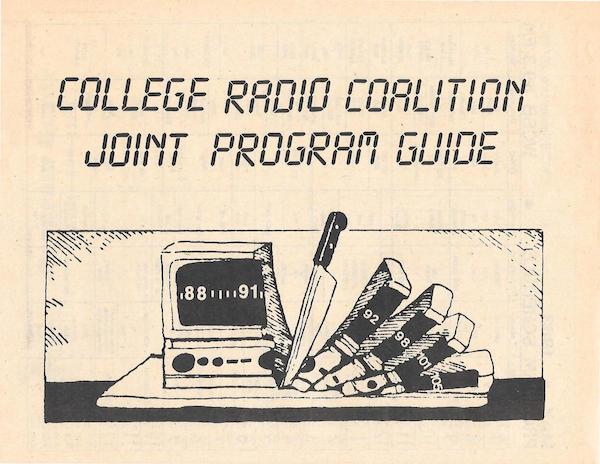
Other newly added playlists include a batch from Bowling Green State University’s college radio station WBGU-FM in Bowling Green, Ohio. They form the bulk of a new WBGU-FM collection, which currently features flyers, program guides, correspondence, and training materials from 1995-1997.
You can peruse the entire collection of college radio playlists in DLARC College Radio.
Radio Station Stickers
Other new additions to DLARC College Radio include promotional stickers produced by college radio stations.

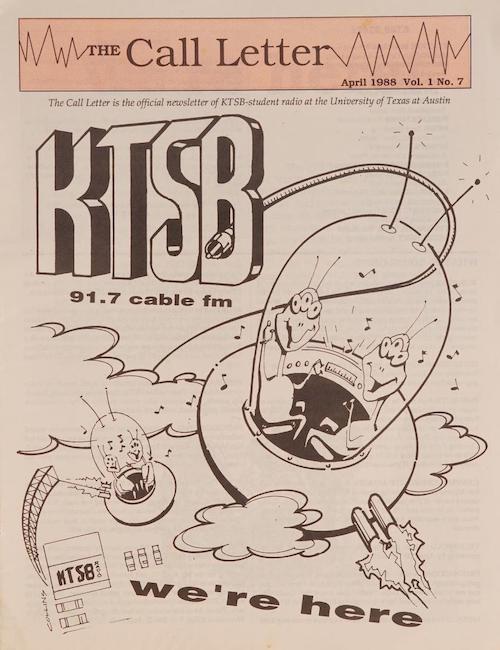
KVRX-FM collection from UT Austin
One of DLARC College Radio’s newest collections is from KVRX-FM, the student-run college radio station at University of Texas, Austin. The Internet Archive digitized a wide variety of KVRX materials, including ‘zines, DJ notebooks, record reviews, organization documents, posters, and newsletters, spanning the years 1986 to 2025.
Audio Transcriptions
Finally, in keeping with this year’s World Radio Day theme related to AI, the college radio collection has been enhanced by an AI-generated transcription tool within the media player of select audio items. This means that not only can one listen to recordings from college radio stations, but one can also read transcripts from radio shows, interviews, oral histories, and more. Audio with AI-generated transcripts in the DLARC College Radio collection includes:
- 1981 WUSB Ramones interview from 1981 (SUNY Stonybrook)
- 1955 WHRC interview with William F. Buckley, Jr. (Haverford College)
- WKDU oral histories (Drexel University)
- CKUT oral history Interviews (McGill University)
The Digital Library of Amateur Radio & Communications is funded by a grant from Amateur Radio Digital Communications (ARDC) to create a free digital library for the radio community, researchers, educators, and students. DLARC invites radio clubs, radio stations, archives and individuals to submit material in any format. To contribute or ask questions about the project, contact: Kay Savetz at [email protected]. Questions about the college radio sub-collection can be directed to Jennifer Waits at [email protected].
]]>
Internet Archive, Poynter Institute, and Investigative Reporters and Editors (IRE) are pleased to announce the first cohort of newsrooms to join the Today’s News for Tomorrow program. With support from Press Forward, Today’s News for Tomorrow will bring together news organizations and memory institutions to address the urgent challenge of local news preservation and perpetual access. The project will create a national framework for digital preservation that serves newsrooms’ “immediate internal needs and communities’ future information needs,” according to Press Forward.
“Journalism is the first draft of history, and we’re at risk of losing that history due to changes in a newsroom’s technology, ownership, and even outside pressure to erase it,” said Kristen Hare, program instructor and Poynter’s director for craft and local news. “Today’s News for Tomorrow will help local journalists and newsrooms learn what we’re up against and make sure the first draft of news is still around for future generations.”
Participating newsrooms will receive access to Internet Archive’s services, tools, and infrastructure, share public local news resources through a unified local news access portal, and participate in knowledge-sharing opportunities centered around local news archiving.
The first cohort will be made up of digital local news publications. Future cohorts in 2026 will be tailored to meet the preservation needs of print newspapers, public media organizations, and independent journalists. Members of the initial cohort were selected through a competitive application process and include:
The Berkeley Scanner (Berkeley, CA)
The Jefferson County Beacon (Port Townsend, WA)
Cityside (Berkeley, CA)
Athens County Independent (Athens, OH)
Hoy en Delaware (Wilmington, DE)
Bucks County Beacon (Warminster, PA)
Golden Today (Golden, CO)
The 51st (Washington, DC)
15 West (Chicago, IL)
The Rapidian (Grand Rapids, MI)
My Tarboro Today (Tarboro, NC)
Outlier Media (Detroit, MI)
Hmong Daily News (Sacramento, CA)
Front Range Focus (Denver, CO)
Lake County News (Lucerne, CA)
The Providence Eye (Providence, RI)
Grandview Independent (Richmond, CA)
The Well News (Washington, DC)
Prism Reports (Oakland, CA)
El Paso Matters (El Paso, TX)
The Oaklandside (Oakland, CA)
The Current GA (Savannah, GA)
Germantown Info Hub (Philadelphia, PA)
Evanston Now (Evanston, IL)
Conecta Arizona (Phoenix, AZ)
Charlottesville Tomorrow (Charlottesville, VA)
Wisconsin Watch (Madison, WI)
BK Reader (Brooklyn, NY)
Black Girl Nerds (Virginia Beach, VA)
Lede New Orleans (New Orleans, LA)
U.S. Press Freedom Tracker (Brooklyn, NY)
Wired (New York City, NY)
El Central Hispanic News (Detroit, MI)
Newsrooms are encouraged to apply to join future cohorts. Newsrooms publishing print newspapers should apply to join the next cohort by April 1. All other organizations may apply at any time to join additional cohorts. Questions about the program can be directed to the program team at [email protected].
]]>
.jpg)
Annie Rauwerda can’t remember a world without Wikipedia. Born in 1999, just two years before the platform launched, she says it has been omnipresent in her life and a source of endless fascination.
In the early days of the COVID-19 pandemic when she was a neuroscience student at the University of Michigan, Rauwerda said she spent a lot of time on Wikipedia and started posting quirky stories she found.
“As I clicked around, there were so many things with goofy titles,” said the now 26-year-old. “I thought to myself: ‘This could be big.’”
Making as many as five videos a day, Rauwerda indeed gained an audience with her off-beat discoveries — from stolen and missing moon rocks to the back story of people demonstrating “high fives.” She created Depths of Wikipedia, a group of social media accounts and has more than 1.5 million followers on Instagram, 200,000 on TikTok, and 130,000 on BlueSky.
In 2022, Rauwerda was named the Media Contributor of the Year by the Wikimedia Foundation, the nonprofit that hosts Wikipedia.
In October, Rauwerda was invited to present at the Internet Archive event in San Francisco celebrating the milestone of 1 trillion webpages saved. She brought a burst of energy and humor to the stage as she shared screenshots of some of her favorite Wikipedia articles.
Watch Annie at Internet Archive’s 1 Trillion Web Page Celebration:
Rauwerda calls herself an Internet Archive “super fan” and acknowledges its value in providing links to original sources.
“If Wikipedia is worth anything at all, it’s because of the citations, and those citations are increasingly hard to access,” she said, noting that more than half of the community articles contain a dead link. “That’s not a concern, though, for us, because we have partnerships with the Internet Archive to make sure that those links are archived and can be clicked by anyone.”
Professionally and personally, Rauwerda said she uses the Archive constantly as she looks for material, seeks out old blogs or edits Wikipedia pages.
“It’s really hard for me to think of an organization that I’m more enthusiastic about,” Rauwerda said of the Internet Archive. “I just love everything about it.”
What will matter most to future generations is hard to predict, Rauwerda said, so it’s crucial to save as much of the digital landscape as possible. “I’m thankful the Internet Archive exists,” she said, “especially given how fragile everything is online.”
Rauwerda said she’s had a “simultaneous love affair with the Internet Archive and Wikipedia” — often toggling back and forth as she dives into topics. She said she embraces the spirit of the open web and the community of people who support this work.
Beyond her social media presence, Rauwerda is writing a book about Wikipedia for Little Brown. The series of light-hearted essays about the off-beat people behind Wikipedia is slated for publication in the fall of 2026.
Rauwerda also turned her discoveries into a comedy show, which she first performed at small clubs in New York. After landing an agent, she went on a multi-city tour of the U.S., customizing the material for each region. She has another round of shows booked for 2026.
“It’s been so fun,” she said. “I’m gonna ride this while it lasts.”
]]>
Link rot. There’s nothing quite as frustrating as clicking on a link that leads to nowhere.
WordPress, which powers more than 40% of websites online, recently partnered with the Internet Archive to address this problem. Engineers from the Internet Archive and Automattic worked together to create a plugin that can be added to a WordPress website to improve the user experience and check the Wayback Machine for an archived version of any webpage that has been moved, changed or taken down.
The free Internet Archive Wayback Machine Link Fixer, publicly launched last fall, combats link rot by seamlessly redirecting the user to a reliable backup page when it encounters a missing page. When the plugin is added to a website, it will do a scan, see what pages exist, and then automatically save those pages to a queue to be archived. If it doesn’t exist, then it will be sent for capture.
Once the software is installed on a WordPress website, the plugin will auto redirect users to the Wayback Machine version of a missing page.
Broken links are one of the web’s most relentless problems. Pew Research found that 38% of the web has disappeared over the past decade and for web admins, “It’s a never-ending game of whack-a-mole to keep links working,” said Matt Blumberg, Product Manager with the Wayback Machine. “This new tool prevents those inevitable 404s by automatically updating links to a preserved copy and it proactively archives pages in the Wayback Machine, where they’re kept accessible for free, long-term, so your site stays usable without manual fixes.”
“It’s very important that websites have a memory and that the web overall as has a memory. We are increasingly using [the web] as our only source of truth. When links go dead, in effect, the truth goes dead. This has become even more important in the world of AI.”
Alexander Rose, Director of Long-term Futures for Automattic Inc.
Many WordPress websites are homespun and are most susceptible to having links go dead. Remedying this problem is not only valuable to individuals, but also to the overall culture, said Alexander Rose, Director of Long-term Futures for Automattic Inc., the technology company behind WordPress.com.
“We need to have an accurate memory of the things that get said, posted, and the ways that we have communicated over time,” Rose said. “Otherwise we’re either doomed to repeat errors or we’re going to make choices that are uninformed by the past.”
The link fixer is expanding the “heroic effort” made by the Internet Archive over the years to preserve everything from small websites to NASA.gov and WhiteHouse.gov, he said.
“It’s very important that websites have a memory and that the web overall as has a memory,” Rose said. “We are increasingly using [the web] as our only source of truth. When links go dead, in effect, the truth goes dead. This has become even more important in the world of AI.”
As the plugin rolls out, Rose and Blumberg said they are open to feedback. The goal is to make the software as easy as possible to use. Next, they will fine tune the features and promote its broad use.
“As it becomes a solid piece of software that people know and like, then I think it has a path to being integrated much more deeply,” Rose said. “It’s early days, but every person I’ve talked to about it is excited to see the potential end of the dreaded 404 error.”
]]>Watch the session recording:
The webinar opened with a stark reality check: For generations, libraries, archives, museums, and other memory institutions have relied on social and legal norms that allow them to collect, preserve, and lend materials. But nowadays, digital content is increasingly being controlled by restrictive licenses on gated, paywalled platforms. This new distribution stream prohibits memory institutions from doing what they’ve historically been able to do in the physical world, curtailing their essential functions of preserving and providing long-term access to knowledge.
Webinar attendees heard from recent signatories Charlie Barlow, Executive Director of the Boston Library Consortium, and John Chrastka, Executive Director of the EveryLibrary Institute. Their participation highlighted the crisis facing memory institutions—and the demands necessary to overcome it.
“When we have publishers or vendors coming in and saying that we can’t do something that we perceive as foundational and essential,” said Barlow, “we’re in real trouble.”
Chrastka added, “We’ve got gases, solids, liquids, plasma, and ebooks! Seriously, when you think about it, I can’t own it unless the IP owner wants to distribute that right to us. It’s a violation, in some ways, of a natural order.”
To combat this dire situation, Our Future Memory is building consensus around the Statement on Digital Rights for Protecting Memory Institutions Online. Originating from discussions at the Library Leaders Forum and first endorsed by the National Library of Aruba in 2024, the Statement proposes the simple solution of letting memory institutions do what they were always able to do before the digital age. Specifically, they need the legal rights and practical ability to:
- Collect digital materials
- Preserve digital collections
- Provide controlled digital access
- Cooperate across institutions
The Statement’s focus on foundational norms is what compelled the Boston Library Consortium to join the coalition, and Barlow emphasized its value as a tool for asserting that traditional library functions must not be treated as negotiable.
“We chose to sign this one because for us, it really established a clear, public baseline that we can point to when long-standing library rights are being treated as optional or the exception,” he explained. “It really is about making those foundational rights visible and shared and harder to dismiss.”
For Chrastka and the EveryLibrary Institute, endorsing the Statement was a necessary step toward building the political momentum required to change the status quo.
“We haven’t been necessarily talking as a sector out loud together as frequently and as vociferously as we need to about what this should all look like,” Chrastka said. “We want to lean into this conversation.”
How can organizations participate?
It is because memory institutions speak louder when they stand together that Our Future Memory is actively accepting signatures from institutions, organizations, and government entities. If you are ready to stand with a global community committed to protecting the past to power the future, here is how you can join:
- Download the Statement from ourfuturememory.org (or email [email protected] for a copy).
- Sign the document (either by hand or using an electronic signature tool).
- Send the signed document back to [email protected].
Once received, your organization will be added to the list of signatories.
Want to learn more? If you missed the live event, you can watch the full recording or visit the Our Future Memory website for resources to help you advocate for these rights in your own community.
]]>