As the days have been getting colder, the holidays passed, fireworks went up in the air, and now we're all merrily getting back to our desks to do what needs doing. And you know what that means: time for a new update from your favourite keyboard people at splitkb.com 😎
In this post:
- ✨ Two new keyboards: the Halcyon Corne MX and the Halcyon Lily58 Choc
- 🛜 More Halcyon Wireless development
Halcyon Corne MX

If the low profile switches weren't your cup of tea, then you won't be missing out anymore with the new Halcyon Corne MX! Using hot swap sockets, you can easily swap in your favourite MX-compatible switch, while getting the same benefits as any other Halcyon keyboard: easy no-solder assembly, various modules and top-of-the-line longevity through ESD-protection on all controller inputs and outputs.
Like the other Corne variants, this Corne is based on the original design by Foostan. It's a popular option for beginners, as while it does lack the number row, it does have enough thumb keys and an outer column to allow for a lot of flexibility in your layout. Next to that, it just looks good!
Halcyon Lily58 Choc

Rounding out our selection for the Lily58 is the Halcyon Lily58 Choc, allowing you to finally get your Lily58 low, low, low to your desk by using Kailh Choc Low Profile switches, shaving off about 12mm depending on which keycaps you use.
With the current selection of both nice tactile Sunset switches, the virtually silent Ambient switches as well a full selection of well-rounded original Kailh switches, the chances of your dream switch being available are pretty good! And there's a decent selection of keycaps available as well, as there are both blank and legended keycaps in various colours.
Halcyon Wireless development
One of our design goals for the Halcyon Series was to make a long-lasting, expandable platform to use as the basis for any new kits we're making. Part of that is to allow swapping the controller: it's easy to repair if need be (and so far that's almost never been necessary), easy to swap with another controller (like the upcoming wireless controller), and easy to reuse (more on that later). Mission success, so far!
We've been hard at work on the wireless controller. The last blog post had quite a lot of sneak peeks, so do check that out! The past few months were spent on testing more prototypes, measuring power draw, testing more prototypes, optimising power draw a little more... you get the idea. Small changes can have big effects, especially when you're working on a scale where many parts already draw so little power.
Pro Micro Adapter
We've been working on it and we now have a working prototype that we're satisfied with: a Pro Micro Adapter! It consists of two parts: a base board that mounts to the keyboard PCB, and an adapter board.

The base board has castellated holes, making it easy to solder it directly to your keyboard's PCB. It can also be soldered to hot-swap pins, so if you have a keyboard that's currently using a Pro Micro-compatible controller such as a Liatris or nice!nano, you can still switch to a Halcyon controller by getting a new set of socket pins.
The adapter board is unique to each half, similar to the design found on Halcyon keyboards. Utilising mezzanine connectors, it is easy to remove the adapter board, which is convenient: this way you can easily swap Halcyon modules.
We've added some protection circuitry to the adapter board, which protects the host device from power spikes if you accidentally unplug the TRS or TRRS cable while the keyboard is powered on. The controllers themselves already have circuitry on board which protects them from these spikes: when using the Halcyon Pro Micro Adapter, unplugging the TRS or TRRS cable won't do any damage to the keyboard, the controllers or the host device. Nonetheless, we still recommend you unplug the keyboard from its power source first, but an accidental unplugging now shouldn't cause any harm, whereas it could have meant a controller replacement with other controllers.

The total height of the stack comes to 9.5mm, which includes the metal standoff, and 6.7mm without the standoff. We'll make a fancy comparison graphic with pictures later, but for now here's how it stacks up (heyyy), all measurements from the top of the keyboard PCB:
- Liatris with controller sockets and Mill Max pins: 5.1mm
- Liatris with controller sockets and Samtec socket headers: 7.0mm
- nice!nano with controller sockets, Samtec socket headers and a 301230 110mAh LiPo battery: 7.0mm
- Halcyon Pro Micro adapter with controller: 9.5mm
- Halcyon Pro Micro adapter with controller, with 301230 110mAh LiPo battery stacked on top: 9.6mm
- Liatris with an SSD1306 OLED display, using the 4-pin display socket: 11.7mm
- Halcyon Pro Micro adapter with TFT LCD RGB Display Module: 12.3mm

The height of the Pro Micro adapter is taller than regular stack-ups, but often it won't be very noticeable. It'll still be lower than any MX-compatible switches with keycaps, and it'll sit about as tall as Kailh Choc Low Profile switches (which together with MBK keycaps sit roughly 11mm above the keyboard PCB).
With all this said, why upgrade? Well:
- The Halcyon controllers, both wired and future wireless, have all their inputs and outputs protected against ESD damage, giving them far greater longevity than current Pro Micro-compatible controllers.
- The Halcyon controllers can survive accidental live unplugging of the TRS or TRRS interconnect cable, and the Halcyon Pro Micro adapter prevents the current rush from reaching your host device, too.
- You're able to use Halcyon Modules such as a colour display, rotary encoder and Cirque trackpad. For wireless controllers there'll also be a low-power e-paper display.
- The Halcyon controllers are CE-tested and certified, meaning they won't interfere with your devices' wireless connectivity.
The Pro Micro adapter will release alongside the wireless Halcyon controller, later this year.
Wireless USB Dongle
It's tiny, it's cute, and gives your keyboard far greater battery life: a wireless USB dongle!

Power draw
Usually, a wireless keyboard's peripheral half connects to the main half, and that main half connects to the host, like your computer or tablet. This means that the main half needs to keep up with two Bluetooth connections at the same time, which keeps the radio awake far more than the peripheral half, which only needs a single connection. The radio is relatively power hungry, and this eats away the battery's charge quickly.
Enter the dongle: instead of connecting to two devices, both the peripheral and the main half now connect to a single dongle instead, which can be powered by the host device. With one less connection to keep up, this means the main half now gets the same long battery life as the peripheral half. Using the ZMK Power Profiler's default values, this means that with a dongle you can get around 3 months of battery, instead of the default 2 weeks. A sixfold increase!
When pairing the dongle with a keyboard using coin cell batteries for their power source, we estimate a battery life between 6 and 9 months. Coin cell batteries aren't plagued by the same strict regulations as LiPo batteries are, so we're able to ship these together with the keyboards. You'll see the same battery life increases on LiPo batteries as well though, so it means less charging or replacing all around!
Current options
There are some options that people currently use for dongles, such as the XIAO nRF52840, which is relatively affordable and relatively small. However, it comes with a female USB C port, meaning you'll still need a cable. Several dongles in the form of a USB stick are currently available, but they're either using USB A or cannot be flashed easily, which you do need to be able to in order to flash new firmware to it. Even when using ZMK Studio, it's still something you need to do at least once, and that process should be easy.
Our dongle
We wanted a dongle using USB C, which is starting to become the new standard. That way, you can plug it into a modern laptop, tablet or phone without the need for an adapter, and when using a PC you can still use a USB C-to-A adapter and hide it away at the back of the PC.
We also wanted it to be easy to flash, so it comes with a button to put it in bootloader mode, after which it shows up to your computer as a disk drive as is common with wireless controllers.
We also wanted it to be as small as possible. Using USB C means we can't perform some tricks to hide components underneath the connector like you could with USB A, so it's a bit bigger than the Logitech dongles you're likely familiar with, but it's still plenty small enough to leave put in your laptop and forget about it being there.
We still need to give it a case, which we hope to injection mould, though a first version might get a 3D-printed case at first. Development on this is still ongoing, but I wanted to spread the word ahead of time: it's coming this year alongside the wireless Halcyon controller!
Closing words
We're still hard at work, as all the individual parts need developing, testing, certification, documentation... and some revisions along the way. The release of the wireless controller along with its (many!) supporting parts and accessories will still take a good few months, though it'll definitely be this year: likely by the end of Q2 with a little luck and a lot of proverbial elbow grease. I'm looking forward to it!
If you ever have any questions, please feel free to ask them on our Discord server, or send an email to [email protected]. We're always happy to help!
Thank you for reading all this, and see you at the next update! ❤️
]]>We've been busy, it's been five months since the last blog post! Let's get you up to date on what we've been busy with:
- ✨ New keyboard: The Halcyon Elora Choc
- 🛜 Preview: Halcyon Wireless
- 📈 What's next: Roadmap
Halcyon Elora Choc

The Elora is one of our most popular keyboards, and for those who like low profile switches, a new version is now available: the Halcyon Elora Choc!
It sports the same layout as the MX version, but it supports Kailh Choc Low Profile switches instead, using hot swap sockets. Like all other Halcyon Series keyboards, this does not require any soldering and boasts the same feature set. Neat!
What's new is that we now put some additional logos on the PCBs: a CE logo and a WEEE logo.

Papers, please!
The logos themselves don't do much, but the keyboards passing CE certification does: using our keyboards won't cause excess electromagnetic interference which could impact device connectivity, such as Bluetooth, Wi-Fi or even your phone signal. Next to that, it's tested to be able to withstand electrostatic discharge events (ESD), meaning those little zaps you may feel when touching electronics won't damage your keyboard.
We already tried to adhere to best practices and the certification is one more step to proof that what we designed actually holds up in practise. We're pretty proud of that, though you as a customer won't notice it – which is precisely the point. Nice!
Preview: Halcyon Wireless

We've been talking about it in previous updates, and we've been making progress still: a wireless Halcyon controller. I'm happy to announce that, much like we aimed to do, the new wireless controller will actually be a drop-in replacement! This means that your current as well as any future Halcyon keyboards will be able to be made wireless, just by swapping the wired controller out. Let's get in with some quick questions and answers:
- Q: Will the controllers be sold separately?
A: Yes. You won't have to buy a new keyboard in order to make it wireless. - Q: When can I buy these new controllers?
A: We're aiming for a release by March 2026. It might be earlier, it might be later: we'll know for sure after all boards have passed certification and once production has finished. Like earlier products, we intend to launch straight from stock. We may offer the ability to preorder, but only once we have a firm ETA on the delivery of all products to our shop. - Q: How does the keyboard get power?
A: You can choose between a LiPo power board, or a coin cell power board. - Q: How do I choose between LiPo or coin cell?
A: A LiPo is rechargeable, but due to the charging circuitry involved, their battery life is comparatively short. We're also unable to stock these batteries, so they'll need to be purchased separately elsewhere. Coin cell batteries are non-rechargeable, but have an estimated battery life of 6-9 months, depending on usage. In both cases, we recommend the use of a bluetooth "dongle" to connect to the computer to greatly increase battery life. - Q: Can I use all Halcyon modules?
A: Yes, though power usage will vary between modules. We'll measure and publish the power usage of all modules so you'll be able to make your own choices.
With that out of the way, let's move on with a preview of what we've been working on!
Halcyon Wireless Controller
We already had a first iteration of a prototype that worked, but there were a few small things we still wanted to improve upon. We improved the power usage by opting for a better battery charging IC, and we changed the cable by which the power board connects to a flexible flat cable in order to reduce costs and improve flexibility in the placement and variety of power options.
Some Halcyon features draw additional power, such as the ESD protection diodes that protect all GPIO pins. Due to several optimisations, including the improved battery charging IC, we managed to reduce the power draw to even below that of the nice!nano, despite it offering more functionality. We could've opted to leave out the additional protections, but in our experience, the added resilience is very welcome, as it means that dead rows or columns caused by an accidental zap become a thing of the past.
The controllers come without a bootloader, which is required for you to be able to flash firmware to it. We've been working on a jig which allows us to run our semi-automated testing suite and flash the bootloader in one go, making the process fool-proof, efficient and traceable, which should result in you getting a working controller out of the box, every time. Nice!
Power Boards

We made a dedicated set of boards to fit on top of the controller and below the module. There will be two kinds at the release: a LiPo Battery Power Board, and a Coin Cell Battery Power Board.
The power boards add some height to the top side of the keyboard. We thought it would be a worthwhile tradeoff as other places to put the battery came with various cons, such as adding height to the entire keyboard or requiring a solution to mount it to an edge of the keyboard. You're still able to do that by using a longer flexible flat cable, but by default it'll be mounted on top of the controller.
You're still able to use modules even when using a power board: it can be mounted on top! Especially with a display module, the additional height won't be an eyesore, but other modules are definitely usable as well. We'll publish additional product pictures once we have more examples, so you know what your keyboard could look like when using various modules.
Each power board has an on-board power switch which allows for easy access to turn the keyboard on and off, as well as a hardware reset button as the one on the controller would be obscured by the power board. Convenient!
Since the power board will be in full view when not using any module, we made sure to pay attention to its aesthetics. The copper pattern provides some nice eye candy, and the symbols printed next to the buttons were custom designed to be legible yet unobtrusive. There shall be no logos in your face, as usual.
Coin Cell Battery Power Board
The coin cell power board will come with a battery preinstalled, which gives an estimated battery life of roughly six to nine months when used with a bluetooth dongle. There are left- and a right-sided versions of the board so that you can easily replace the battery once it has been depleted.
LiPo Battery Power Board
The LiPo battery power board will not come with a battery, due to strict shipping regulations. However, it'll be easy to connect a battery to the board by using its JST jack: we'll provide the required parts to crimp a fresh JST connector to your battery with this set of power boards.
For added convenience, a strip of double-sided tape has been pre-applied to the power board, making it easy to stick your battery on top. A cable cutout allows for cable management.
E-paper Display Module
The TFT LCD module will work with ZMK as well, but as usual, fancy things do come at a price: a TFT LCD display uses rather a lot of power! And so, we set out to find a low power display that was still fancy enough, but also left you with plenty of battery life to use. One of the solutions we came up with was the use of an e-paper display.
We haven't received the Halcyon prototype of this display yet (so... no pictures! 🥲), but our preliminary testing of the e-paper display is promising: it's likely more than good enough for use in computer keyboards, yet it is also less costly to produce than some other display types, so we think it'll be a popular option!
A memory-in-pixel LCD display such as that used by the nice!view is also in development. Factory lead times for this type of display are rather long and can be unpredictable, so it will not be ready in time for launch along with the rest of the lineup. You might just find that the e-paper module will meet your needs, so we're not too worried – it'll be nice to have more options nonetheless.
Pro Micro Adapter
We're not done yet! Even though the Halcyon Series don't require any soldering, there's still a large collection of keyboard kits that do, many of which require a Pro Micro-compatible controller.
It's still in active development, but we're looking to add a few nice features: you'll be able to use not just the controller, but also our Halcyon modules along with the adapter. Next to that, we're looking into adding circuitry to prevent unplugging the TRRS cable on Pro Micro-based kits from causing any damage to the controllers, where it used to be a pretty surefire way of inadvertently killing your controller.
Next to that, the adapter makes it easy to cold-swap your controller, and of course you get the original Halcyon features on top: most importantly the ESD protection on each pin, making dead rows or columns from an accidental zap a problem of the past.
Due to the large variety in kits, getting the kinks worked out may take a while longer, so it's possible this adapter won't be part of the initial release. However, we're very hyped about the possibilities, as it'll make it easy for anyone to use our Halcyon controllers and modules with their own keyboards 🥳
Roadmap
So, we're working on many things, but when is all that actually becoming available? Here is the rough planning:
- We're aiming to release the wireless controller along with its supporting parts and modules by the end of the first quarter of 2026, somewhere around March. It's a rough estimate, but I do hope we can make that - we'll share more details as we make progress.
- We will likely have two new keyboards available before Christmas: the Halcyon Corne MX and the Halcyon Lily58 Choc. We're slowly completing our lineup!
- We will work on a Halcyon version of the Sofle V2, as well as a Halcyon Ferris MX. We do not have an estimated release date on these, though - they'll likely become available only after the release of the wireless controller.
- A Halcyon version of the Helix isn't planned yet. If you'd like one, please do let us know - it doesn't seem to be a very popular board. Be there or be square - maybe everyone's not around because of the orthogonal layout 😉
Closing words
If you ever have any questions, please feel free to ask them on our Discord server, or send an email to [email protected]. We're always happy to help!
Thank you for reading all this, and see you at the next update! ❤️
]]>Trees are starting to blossom, the birds are chirping, and we just released a few new keyboards: it's time for our Spring 2025 update - let's dive right in! 😄
New keyboards
We've been keeping busy, and while the planets last aligned in February this year, it's on April 14th that four new Halcyon keyboard releases align. Among them, three have support for Kailh Choc low profile switches, which is a first for the series.
You can use our helpful new Composer to be guided through all of the choices for your new keyboard. It'll ensure you get a compatible kit, every time.
It's worth repeating since the series is new:
The Halcyon Series is a series of keyboards that combine what we've learned about split keyboards since 2019 into a unified preassembled premium range. That means that you can depend on great quality, complete documentation and shared features such as hot-swappable switches, per-key RGB and RGB underglow, USB C interconnect, and much more.
Unique to the Halcyon Series are its modules, which enable you to add functionality to your keyboard without having to solder. You can choose from a color LCD TFT display, rotary encoder or even a Cirque trackpad! All keyboards in the series use the same standard, so modules can be reused across them, and more modules will be released as we expand the series, which will be backwards compatible.
The Halcyon keyboards come with wired controllers based on the RP2040 chip, which support QMK and Vial firmware. They are cold-swappable so they can be reused, replaced or upgraded in the future. You can read all the specifications further down this page.
You'll only need a screwdriver to assemble these keyboards! Okay, sure, a switch puller can be helpful too, but no soldering skills are needed. What's more, if you use the precompiled Vial firmware, there's no need to do any compilation and you can just flash a file we've compiled for you, after which you can use the Vial application to remap your keys - no programming or compiling needed, either. Easy!
Ah, and before you mash that buy button: if you bought an Elora rev1 in the past and have been eyeing a Halcyon keyboard, use the discount code ELORAREV1 in your cart for €60 off any Halcyon kit. I'd like to thank you for your early support, as it has made it possible to develop the Halcyon Series. Like we said in the Winter 2024 update, we learned a lot from the Elora rev1, and managed to apply every lesson to the Halcyon Series, making it that much better. Thank you!
Halcyon Lily58 MX
The Halcyon Lily58 is now available and is compatible with MX switches. It's the Lily58 layout you're used to, but as you might've guessed, it now comes with Halcyon features!

Like the Aurora Lily58, it is compatible with open-source cases, but with the addition of the USB C jack for the interconnect cable, you will want to check whether your case allows for a USB C cable on the side of it.
If you do like to solder and would like to use an encoder instead of a switch, you can: a few predetermined switch locations can be swapped out with an encoder. You can use up to one encoder per half this way, which doesn't include the rotary encoder module, making for up to two encoders total per half.
Halcyon Kyria Choc
The Halcyon Kyria was already available for MX switches, but is now also available for Kailh Low Profile Choc switches!
Because our selection of both Choc switches and keycaps is rather large, you're now able to choose from a pretty big variety in both look and feel. Nice!

Halcyon Corne Choc
It might be new to the Halcyon Series, but it was among the first split keyboard layouts to become popular: the Halcyon Corne!
Being able to use your Corne with a sweet high-resolution colour display or a Cirque trackpad is now as easy as plugging in a cable and flashing new firmware to it - which itself is just a matter of dragging and dropping a file. Convenient for sure, and I can only be hyped about that, because now even someone like myself (who is quick to start projects, but, well, you can guess the rest...) can get the build over and done with in an evening, and then enjoy my new keyboard - fancy modules included. Phew!

Like the Lily58, the Corne also has a few predetermined locations which allow you to solder an encoder instead of using a switch.
Halcyon Ferris Choc
Last but certainly not least, the Halcyon Ferris is the smallest entry in the Halcyon Series so far. If you like your layout efficient and small, this is the keyboard for you.
But wait... Ferris? It looks an awful lot like the Aurora Sweep 🤔 Time for some keyboard lore: when Pierre Chevalier made the layout, it was called the Ferris, and it came preassembled with an on-board microcontroller. It was pretty popular, but a bit hard to get by, and so David Barr forked his project and made the Sweep: a version of the Ferris that could be assembled with a Pro Micro-compatible controller (like our Liatris!) instead of requiring an on-board controller.
Since the Aurora Sweep used a Pro Micro-compatible controller, we called it the Sweep. And, to finally honour the original project properly, since the Halcyon Ferris comes preassembled, it's now again called the Ferris! The more you know 😉

New products
Next to these four new keyboards, we also managed to get a few new products in, all of which are keycaps or related to them. More choice, more better!
MBK Legend 40s Blue on Black
The MBK Legend 40s set is a neat starter kit for Choc low profile switches that has just about all the keycaps you'll ever need for most split keyboards. It was already available in grey and white, but now also in a rather dashing blue on black!

MBK Glow Dots
If you're a blank keycap enjoyer, but are also a per-key RGB backlight enjoyer, then rejoice: the MBK Glow Dots are sure to tickle your fancy! These ABS keycaps suited for Choc low profile switches are black, and have a little translucent dot that allows your RGB backlight to shine through. No more will your precious light be kept to the gaps between your keys, but now just a bit more of their power will be unleashed through... the dot! 🧑🔬

SLK PBT Ergo Blanks
Made from nice hefty PBT material, are these new SLK PBT Ergo Blank keycaps, which fit onto MX-compatible switches. A most welcome addition, considering we don't offer many MX-compatible keycaps just yet. One keycap set at a time!
These keycaps are white, and have a unique round profile to them. They look absolutely stunning, and make your keyboard into a piece of art, while also being comfortable to use (not unimportant, I'll admit).

Choc keycap spacers
And for the last product to introduce to you in this blog post, I didn't know I needed this, but now I do: Choc keycap spacers. Now that I know, though, I kind of feel like I shouldn't need them, so let's explain that by quoting the product page:
Kailh Choc switches have been around for a while, and lately, innovation has been taking place. The introduction of silent switches in the form of Ambients, such as the Nocturnal and Twilight switches, brought forth some noises that weren't discernable in Choc switches before: apparently, some keycap profiles bumped into the switch housing when fully pressed, causing a slight but noticeable bump and sound.
While improvements to keycap moulds are being worked on, there is a solution in the meantime. These keycaps stickers were designed by FKcaps to add 0.5mm in height, and they can be applied to either the keycap or the switch stem. The added height prevents the bump, eliminating its sound as well as its impact on the feel of the switch.
Alright, so it's not ideal, but a fix is in the works. In the meantime though, these stickers do solve the noise and the feel, which make me happy to have them with the Ambient switches in my new Kyria which I've been happily using since we had the Halcyon Kyria Choc prototypes in our office 😉

The future
The future, what does it hold? 🔮 I can't be for sure, but we're working on some projects, so I can at least guess!
Wireless Halcyon
This is a big one! It's still in development, and it's a complicated one to tackle. From power supply to regulations, from backwards compatibility to future-proofing... there is a lot to it. And then people might still want to use modules, but those modules may also require a lot of power, so...
For now I can say that we're working on it, but I can't make any functional promises just yet. We're considering as much as we can, and we're of course trying to think of a solution that will make everyone as happy as possible. If it can be a drop-in replacement for the current wired controllers that would of course be amazing! But until it's officially released, I'll ask that you please consider the current Halcyon keyboards to be wired only, just to avoid potential disappointment.
More Halcyon keyboards
Designing a Halcyon keyboard takes effort! Alright, we've standardised the development process, so it's not as much effort as it used to take, but it does still take effort. We don't have new releases in the pipeline right this moment, but once we're done with the wireless controller, we'll be sure to get right back to making more keyboards for the series.
More Halcyon modules
Also on the list: more modules! The encoder, display and Cirque trackpad are nice for sure. There are a great number of other modules that are on my wishlist, from inputs like simply an extra button or two, to outputs like a seven-segment display or a speaker. My list is a lot longer than that, but we have to start somewhere 😉
Modules we'll release in the future will be backwards-compatible with all Halcyon keyboards, and any module available today will be compatible with any Halcyon keyboard released in the future. We now have six different Halcyon keyboards to prove that it works! I'm very happy with the series so far, seeing it all come together working just like we've envisioned... it's truly a great feeling! 🥳
Closing words
If you ever have any questions, please feel free to ask them on our Discord server, or send an email to [email protected]. We're always happy to help!
Thank you for reading all this, and see you at the next update! ❤️
]]>I hinted at the release of a new product in the last blog post, and while the release took a few more weeks than I anticipated, it's finally here: the Halcyon Series. Let's dive right into what's new since the last update!
This post has gotten big enough that it warrants a table of contents, brace yourself for some keyboard lore:
- Halcyon Series
- USB cables and adapters
- New documentation site
- New Composer
- New Firmware Finder
- Closing words
Want to receive your items in time for Christmas? Be sure to order by Thursday, December 19th with DHL Express or FedEx Priority. You'll be able to see the expected transit times during checkout. We'll keep shipping items until Tuesday, December 24th. We do not have an order backlog, so we don't expect delays in packaging orders, though shipping carriers may be busier than expected during these days.
We'll be unavailable over the holidays between December 25th and January 5th. If you place an order within this time, your items will ship once we resume shipping on January 6th.
I'll still try to keep up with the support tickets in the meantime. Thank you for your patience and understanding!
Halcyon Series
Let's quote this piece from the Halcyon Kyria product page, before I dive into more detail:
The Halcyon Series is a series of keyboards that combine what we've learned about split keyboards since 2019 into a unified premium range. That means that you can depend on great quality, complete documentation and shared features such as hot-swappable switches, per-key RGB and RGB underglow, USB C interconnect, and much more.
Unique to the Halcyon Series are its modules, which enable you to add functionality to your keyboard without having to solder. You can choose from a color LCD TFT display, rotary encoder or even a Cirque trackpad! All keyboards in the series use the same standard, so modules can be reused across them, and more modules will be released as we expand the series, which will be backwards compatible.
The Halcyon keyboards come with wired controllers based on the RP2040 chip, which support QMK and Vial firmware. They are cold-swappable so they can be reused, replaced or upgraded in the future. You can read all the specifications further down this page.
Let's break that down. What is the series, actually? What did we learn about split keyboards, and why is this our next step? And what will the series ultimately be?
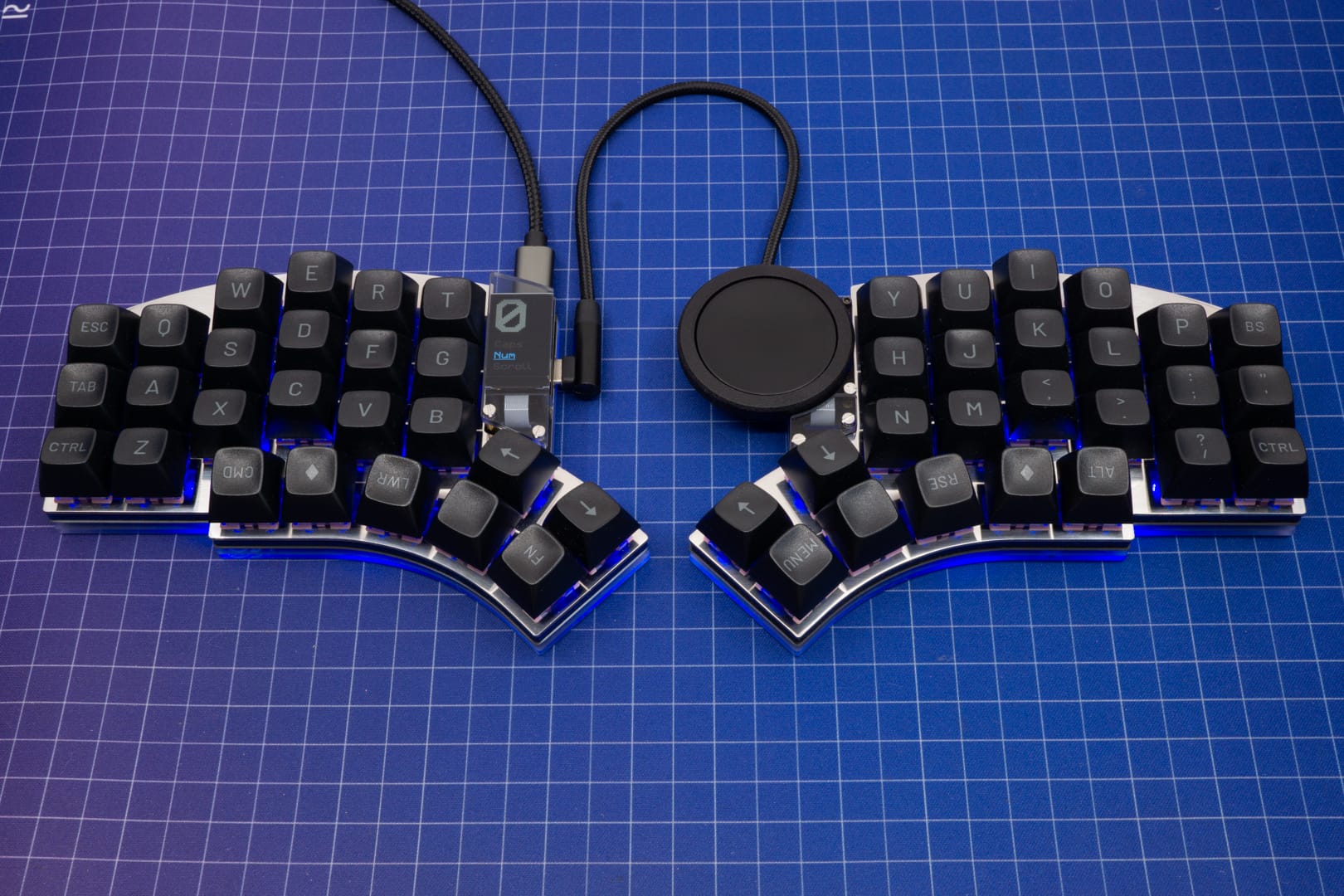
What is the Halcyon Series?
The Halcyon Series consists of three parts which together form a whole:
- It's a series of keyboard circuit boards which form the basis of a Halcyon keyboard.
- It's a cold-swappable controller which is used across all Halcyon keyboards.
- And it's a series of modules, which can be used across all Halcyon keyboards.
At the moment, there's one controller available, based on the RP2040 chip. This means that all Halcyon keyboards can only be used wired, using USB C to C cables.
Designing a wireless controller might be possible. We designed the circuitry in a way as to (theoretically) support a wireless controller. Development on a wireless controller starts in 2025. However, I cannot guarantee that Halcyon keyboards that are available before the eventual release of the wireless controller will be backwards-compatible with it. I also cannot guarantee that a wireless controller becomes available at all. For now, let's assume the Halcyon Series keyboards will be wired only–if that happens to change in the future, that would be a nice bonus!

What we learned
I started splitkb.com in 2019. Together with my coworkers, we've designed, sold and supported a number of products, including DIY kits, preassembled kits and even a few group buys. There are many lessons that we've applied to the new Halcyon Series. Here are the most important ones:
- Many people want keyboards, but they can't or don't want to solder. To meet that demand, we released the Elora last year, and ultimately manufactured two production runs. Because the release of Halcyon was drawing closer, we held off on restocking it, because the next version will be the Halcyon Elora.
- Modules are neat, but they need to stay simple. The Elora introduced the Myriad system with it, which enabled you to swap out a module without having to solder. However, the Myriad modules required their own on-board memory, delicate and sophisticated firmware support, and drastic hardware changes to the keyboard. Adding Myriad support to a new keyboard would take multiple months, and as a very small company, we have neither the time nor money to invest in such projects.
- Standardisation is key. We released the Aurora Series in 2022, which provided DIY kits with a common feature set, a common set of parts, and a common process to assemble and use them. Being able to consolidate our efforts proved to be very important in being able to keep up with orders, support efforts and inventory management. It made the kits easier to understand for people, and easier to manage for us.
- First time right saves a lot of time. The Elora release was a bit rushed. It released without complete documentation, and the initial firmware contained some bugs that we really should have caught in testing. A lot of time had to be spent to support our customers and ensure that everyone had a working product, which could all have been avoided had we invested more time up-front.
- ESD damage is rare, but real. Electrostatic discharge is something that happens without you knowing it. Sometimes you do feel a zap, but it happens even if you don't feel it. Zapping your keyboard can cause it to stop working as expected, leading to a key, row or column not working overnight. I'm glad that it doesn't happen frequently, but I wanted to take this chance to see if we could eliminate the problem once and for all.
- Audio jacks cause pain. The Elora used TRRS jacks and required the use of TRRS cables, while the Aurora Series only require TRS cables to connect both halves of the split keyboard together. Both cables suffer from the same design flaw, which is that they cause electrical shorts when you unplug them while you have the keyboard plugged in. Back in the olden days of using AVR-based controllers for keyboards, that was only a small issue, as they were designed to take a beating. The new ARM-based controllers such as the RP2040 are more fragile however, and frequently died when "hot" unplugging a keyboard. Despite warnings in the manual and build guides, the mistake is easily made and happens to the best of us.

How we applied what we learned
Of course, just learning isn't very useful: we need to apply what we learned so you (and ourselves) can experience the benefits.
We ruthlessly filtered the requirements of the project. I asked myself for each aspect of the keyboard: is it necessary, and is it the simplest way to do it? Is it elegant? The simplest solutions only seem simple in hindsight, and we really did have to go through the release of the Aurora Series as well as the Elora to be able to arrive at the end result that is now the Halcyon Series.
We greatly simplified the specifications of the modules. They now no longer come with on-board memory, which was used by the firmware to detect which module was used. Instead, you'll need to flash a module-specific firmware file to each half. To make it easy for you to find those files, I programmed a new Firmware Finder tool which helps you find the right file in just a few clicks. Removing the on-board memory saves costs, but more importantly it saves a lot of complexity in both the production process (as a unique file had to be flashed to each module) as well as the firmware (which now only needs to support a single module at a time, instead of all of them).
We designed the modules with all Aurora Series keyboards in mind. Where Myriad required an M.2 form-factor card, and thus required a lot of space, the Halcyon Modules are small: exactly the size of a Pro Micro, which is what most DIY kits were based on. This means that the new modules can be applied to any keyboard that uses a Pro Micro now.
The modules use an existing standard: VIK. Sadek Baroudi designed a standard for modules so that they can be shared across keyboards. It's very powerful: the standard itself is easy to implement, doesn't take much space on a keyboard or module, and doesn't add costly parts either. While the standard is by far not as powerful as Myriad is, it's more than capable enough to provide useful, cool and unique modules. In other words, Myriad was overengineered for what it needed to do, and the price was having to abandon it earlier than I hoped to.
We documented the development process. Instead of making a keyboard that supports modules and figuring out the rest later, we ensured that we are able to apply the Halcyon process to more keyboards over time. As such, we thoroughly documented all the steps we have to take to make a Halcyon Series keyboard, from its initial design all the way to firmware support. We already have working prototypes for the Elora with MX switches, and prototypes for some other keyboards are currently in production, proving that this new process works!
We kept the complexity to the controller. Similar to how DIY kits rely on the controller for most of the complexity, we did the same for this series of preassembled keyboards. It's essentially a simplified version of a Raspberry Compute Module. This allows us to design new keyboards more quickly, but it also allows us to cope with changes in the future: instead of having to redesign all keyboards, we can now update only the controller, and still have it work across all keyboards.
The controller is now ESD resistant. Electrostatic discharge is a complicated thing, especially for what is ultimately still a keyboard kit. The zaps travel through conductive parts and even a short distance through the air. To fully prevent zapping the sensitive bits, we'd have to fully enclose the keyboard with a case and enough air between the case and the circuitry. We weren't able to do that yet, but we did do the next best thing: we applied specific circuitry to negate the effects of ESD damage on each input and output pin, including the switch matrix as well as both USB ports. We also added a component that grounds the top plate to the circuit board, giving zaps an easier path to pass through which we can protect better.
We now use USB C to connect both keyboard halves together. Made possible by preassembling the keyboard as well as a rigorous semi-automatic testing process, we now use USB C connectors both to connect each half together as well as to connect the keyboard to the host device. The cables can be plugged in and out at will, preventing the shorting issues that affect TRS and TRRS cables. We made sure that it's safe to plug in the cable wherever, too: if you connect the interconnect cable to the computer instead, it'll simply not work, instead of causing damage.
Phew, that's a lot! And it wasn't even everything, but I don't want to write a book here. Let's keep it at that 😉

The future of Halcyon
I've broken the news on this new series on our Discord server a few weeks ago. Someone had a valid point of feedback: the Elora was released only a year ago with its own module system, and now it's essentially dropped in favour of the Halcyon Series. What gives?
And to that I say, you're right! It's rather painful to put in the effort of creating a new keyboard and a set of modules, ensuring they're all supported, only to then drop it a year after. The development of the Elora along with the Myriad system took a little over three years, after all. What a waste!
The core issue was rooted in development costs. Taking multiple months to port a module system to a new keyboard might be okay for a flagship product, but we sell many different keyboards, and those have various versions at that. It's not doable to spend months on all but the most popular keyboards.
By standardising the process and making sure that we're able to port the module system over to a wide range of keyboards, we greatly lowered the investment needed to add more keyboards to the Halcyon Series. In turn, this sharply decreased the barrier to start adding more keyboards to the series, which is exactly what we're busy with at the moment.

The future of Halcyon is bright. I can see us supporting many more keyboards in the series, with the Halcyon Elora (MX) releasing in early 2025, and more keyboards will follow after (like the Halcyon Kyria Choc, and the Halcyon Corne).
As we're busy adding more keyboards to the series, we'll want to add more modules, too. We have a big wish list of possible modules, from simple ones like a nav-hat (a 4, 5, 8 or even 9-way button) to more complicated ones such as gesture sensors, and I'm sure we'll be able to realise more of them over time. The best thing about the modules is that they can be used with any Halcyon keyboard, so the more keyboards we add to the series, the more likely it is that developing a new module is worth it.
Next to adding more modules, I'd like to provide better firmware support for existing modules in the future. In particular, the TFT LCD display has a lot of possibilities that we haven't explored yet. Where it currently displays the status or an animation, it could do much more. I'm excited to see which customisations the community will work on, and I'm excited to see what we'll be able to do ourselves in the coming years!

USB cables and adapters
The Halcyon Series use a USB C to C cable to connect the halves together. USB C interconnect has been a much requested feature, and has been on our own wish list for a long time, too. We're glad to have it! However, we used to only stock TRRS cables, so where do we get new USB C cables from?
It turns out that USB C to C cables that are fit to use with split keyboards are hard to find. They're often too long, don't have angled connectors, or are simply too expensive - it's not hard to find a USB cable that costs upwards of €15.
I decided to have our own USB cables made. After a few trial runs with different manufacturers, we were able to settle on a manufacturer that provides consistent quality cables, all with a consistent and matching finish, bundled with a velcro cable tie and packaged in a way that's easy for us to handle. All of this resulted in nice nylon braided cables, with almost no packaging and handling waste. I'm pleased with the results!
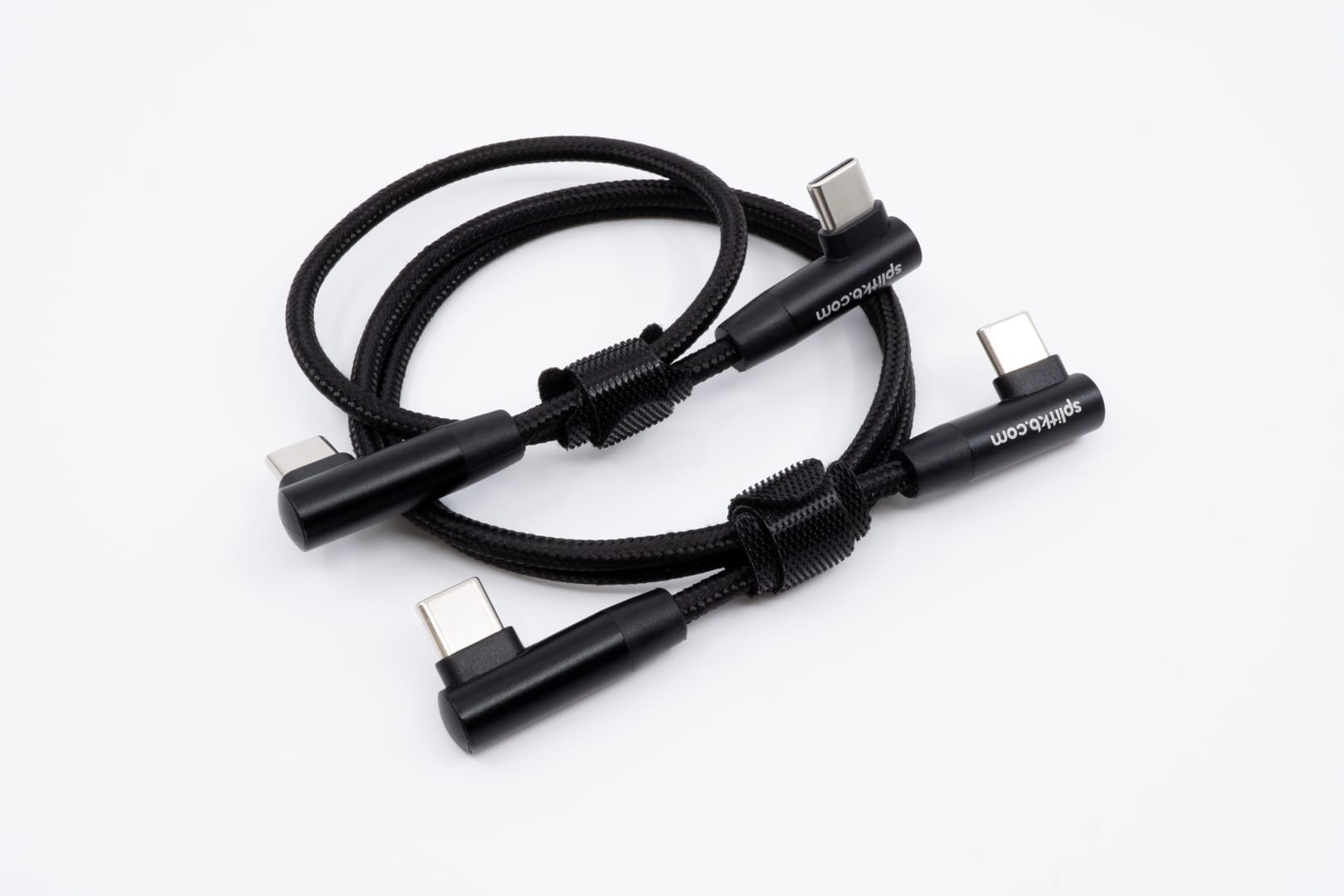
We now stock a small selection of cables, all in black (black is the new black, after all):
- USB C to C cables with elbow connectors, meant to connect the two halves. It's available in 25cm for a nice and short cable, and in 50cm for when you require more flexibility.
- A USB C to C cable with straight connectors, mean to connect the keyboard with your host device of choice. It's 1 meter in length. It can of course be used to connect both keyboard halves too, though it's a little long for that.
- A USB C to A adapter, for when your host device of choice doesn't have a USB C port, but does have a USB A port. Simple and effective.

New documentation site
Hinted at in the last blog post, the new documentation site has been live for the past few weeks and has seen some slight updates in the meantime. It's easy to use, and overal I'm very happy with how it turned out.

As part of the migration, I've updated all of the documentation pages with extra information, made my recommendations more accurate, and made many pages easier to find. Like just about all the announcements in this post, arranging all of it was rather a lot of work, but I find the end result to have been very much worth the effort!
The new documentation site features many quality of life improvements. Most noticeable are the new search feature, a table of contents on every page, being able to link to headings by clicking on them, zooming in on images. A big one for us: we're now able to nest folders multiple levels deep, so now the build guide, schematics, changelogs and other relevant documentation is all kept together with the product it belongs to. Finally!
New Composer
A new composer! At the time of writing, it only supports the Halcyon Kyria, but I'm very close to finishing support for the existing Aurora Series keyboards as well.
The new Composer is built dynamically, meaning that it grabs all product information directly from the shop (from Shopify, through their GraphQL API), including their relationships, capabilities and requirements. This means that I'll no longer have to manually update the code whenever a product gets added, changed or removed. What you see in the Composer is the full range that's also available through the shop itself, so you won't be missing out anymore!

Aside from the technical aspects, the new Composer offers printable layout testers for all supported keyboards, provides frequently asked questions and answers for each step, and has many quality of life improvements such as dark mode and full keyboard navigation. I'm hyped to see the new version replace the current one within the next few weeks!
The new Composer can be used at its current temporary location. Within the next few weeks, it'll replace the current version, and become available at composer.splitkb.com as you're used to.
New Firmware Finder
The new Composer also has a new Firmware Finder within it, which helps you... find the firmware file you need. It's that simple! The current site did the job, but with the new Halcyon Series requiring a separate file per half depending on the keyboard as well as the installed module, I figured it was time for an upgrade.
By answering a few questions, you can find and download the appropriate file. It skips any questions that wouldn't impact the number of results so you can find the file in just a few clicks. Quick and easy!

Closing words
This Winter update was action-packed for sure! We've been working on the Halcyon Series since September 2023, so it's been a little over a year in the making. I'm so happy to finally be able to show you what our efforts have resulted in!
I'd like to take this opportunity to thank the people who have worked with me, both on this project and within splitkb.com itself:
- Leah spent her last few months at our company to lay the groundwork for the wired Halcyon controller. It took a while, but it's here! 🎉
- Harvey spearheaded the efforts to create the first Halcyon keyboards, documenting the development process in the... process 😎 He also developed the firmware support on top of QMK and Vial, and wrote most of the documentation for the Halcyon Series available on our documentation site.
- Nicole is invaluable in our day to day work by answering most of your questions and handling administrative work. She also made the pictures for all the Halcyon product pages!
- Monique is the driving force, as she makes, kits, picks and packs just about all of your orders with equal love and care.
- The contributors to QMK, Vial and ZMK for providing the basis on top of which we can support our keyboards. It wouldn't be possible without your continued efforts!
Last but not least, I of course need to thank you! Ultimately, you're the one we're doing all this work for, so I hope you'll enjoy our new keyboard series for many years to come.
If you ever have any questions, please feel free to ask them on our Discord server, or send an email to [email protected]. We're always happy to help!
Thank you for reading all this, and see you at the next update! ❤️
]]>Hi everyone, long time no see! Our last blog post was in October 2022, and whew, that's... quite a while ago. We haven't sat still in the meantime, though, and I figured another update is long overdue. Let's get to it!
The Elora
Arguably the biggest thing we've worked on since 2022 is the Elora. It's our first mostly-preassembled keyboard, requiring no soldering at all. You'll only need a screwdriver to assemble the case!

The Elora uses so-called Myriad modules, which are M.2 form-factor cards that you can slot into a connector. They allow you to add functionality to your keyboard without having to solder, too. Various modules are available, such as a joystick, rotary encoder and a tiny macropad.

While we've tested the waters with preassembled keyboards in the past (with the credit-card-sized macropad Zima, which is no longer available), we never really went as far as making a full-fledged product.
It's why the release went rather silently: I wanted to experience the production and reception of the product without putting much pressure on myself and our team. We've learned a lot about (semi-)automated hardware testing and quality assurance, as well as what's required to properly make a product ready for release. We'll apply those learnings to provide for smoother launches in the future, though this launch was still pretty okay overall 🙂 Due to the low volume, we were able to properly care for all customers and resolve most issues that popped up.
The one remaining issue is that USB C connections don't work with a fancy USB C 3.0 cable, though it does work with a less-fancy USB C 2.0 cable. We narrowed the issue down to an ESD protection chip on the CC lines causing an unexpected voltage drop, which causes negotiation to fail when using a more capable USB C cable. USB C to A cables don't seem to be affected at all. Unfortunately this isn't fixable in the firmware, so we'll fix this issue in a new revision, likely ready by the end of 2024.
Trustpilot
Man, the last year or two have been super hectic for the community. Many vendors have gotten either themselves or others in trouble, especially with group buys not being fulfilled and orders not being shipped.
In an effort to prove to the community that we're genuine and try our very best to keep people happy, I set up a page at Trustpilot where you can read reviews people wrote about us, and where you can of course write a review of your own to share with others. Our score (which sits at 4.9 out of 5 at the moment, out of 144 reviews) proves that we usually succeed in making others happy. I'm glad!

Of course, we sometimes do miss – I'm still working to improve response times to tickets, especially the technical ones. That is mostly a problem to do with me personally, as I want too many things and my workload is probably too high as a result. But I'm definitely trying my best, and as the score shows, I try to do right with everyone and do succeed at that frequently 😌
If you're one of the few still waiting for an answer, please rest assured that you'll receive a satisfactory answer before long. Thank you very much for your continued confidence in us!
Upgrades, people!
We pride ourselves on our documentation and helpful tools. While they were pretty good when we started out with them, a few years have passed since then and I felt like it could all use a little more love.
As such, I've been (and still am) hard at work upgrading our current websites! As usual I vastly underestimated the work involved, and as usual it'll be very pretty once it's all done 😌
I plan on releasing these new versions along with a new product release later this year, on which I'll give a little sneak peak later in this article. For now, I'll share some screenshots and background information on the various upgrades.
Our documentation site
Our current documentation site runs on Zendesk Guide. It's pretty expensive for what it does, and the one main benefit is that it integrates nicely with Zendesk for customer service, but that's really about it.
I felt like it could do a lot more! It is a static website based on Nuxt.js and a NuxtUI documentation template. Even though it's a template, a very considerable amount of work still went into tweaking various features and adding new ones. If I were to start over, I'd probably build it from scratch instead, but here we are 😉

The homepage is pretty similar to the current one. Most notable is the availability of a dark theme, which is set based on your system preference and can be toggled manually, too. There's also a new search function, which is more prominently available and will be more intuitive than the old search. I'm planning to integrate Algolia DocSearch in the future, so that it'll support fuzzy search too - it can be rather strict at the moment.
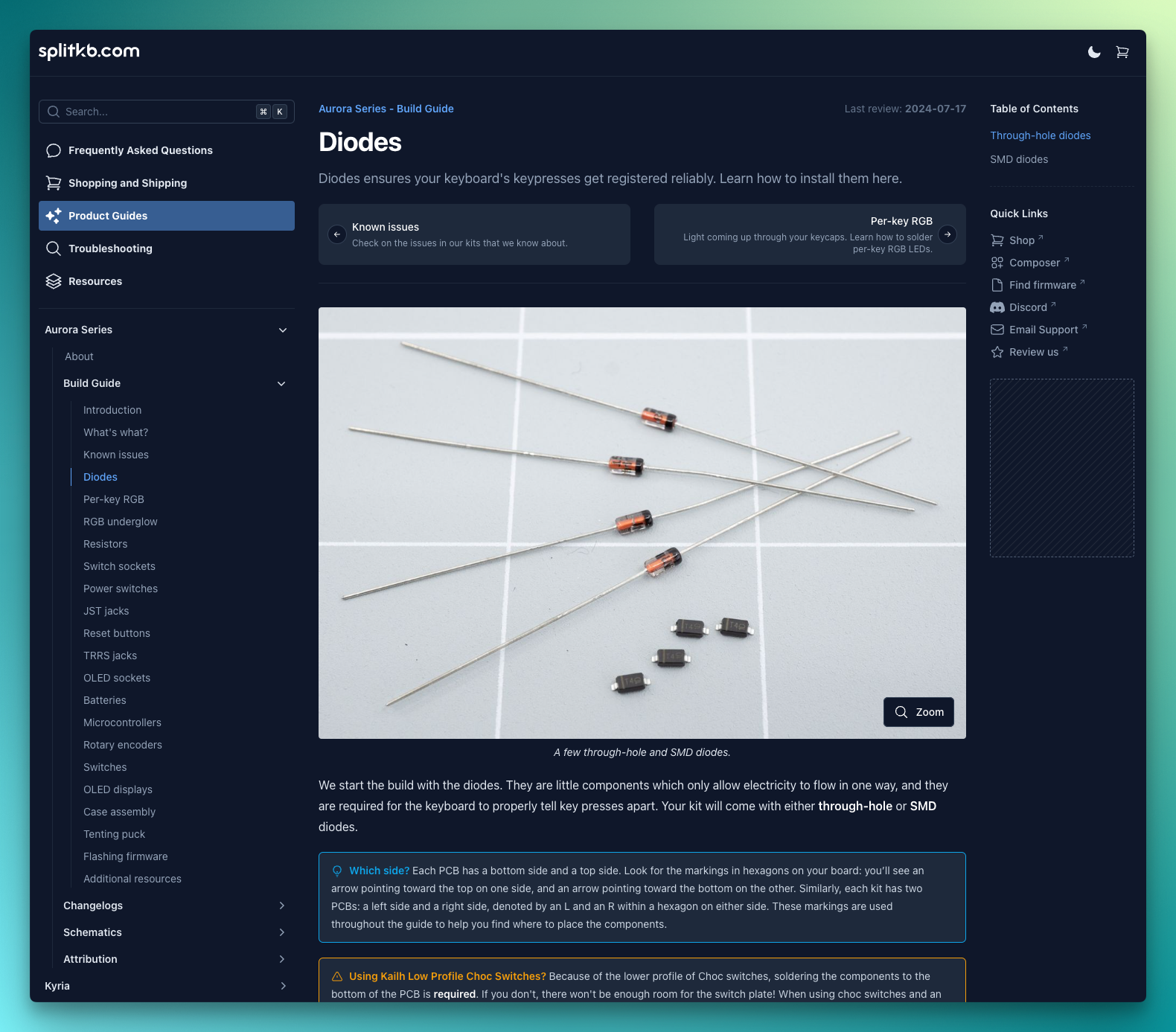
The biggest changes are on the pages themselves. A quick list:
- The main navigation in the top left allows you to quickly get to the right section, and keeps the detailed list cleaner as it'll filter the list to show only pages in the current section. The search bar is also available here.
- The page tree on the bottom left allows you to see all articles in the current folder, and also allows folders to be nested. On our current site, you had to visit another page to see the full folder's contents, and it was harder to gauge your progress while working with a guide.
- The main layout sees quite a few changes:
- You can now link to individual headings by clicking on them. At last we can finally point people to the exact section they need, even on long pages.
- It now has cleaner navigation buttons at the top and bottom of the article, allowing you to easily move between pages. In our current site, we had to add links manually.
- Pages have review dates, and we have a nice overview in which we can see pages that are due for a new review. We'll be better able to keep documentation up-to-date this way.
- You can now zoom in on images, and images are optimised for size when not zoomed in so that pages load far faster and consume vastly less data.
- Images now all have captions, providing more clarity on what's being shown and why.
- The sidebar on the right has a table of contents, allowing you to quickly skip to a section. That's especially helpful on long pages! It also has a few quick links, and there's a spot where we can put a banner of sorts. Gotta hustle 😎
There are also some changes that aren't shown. Steps in a guide that are optional are marked as such clearly below the page's title, explaining when you should follow the step and whether you can postpone it until later. Pages that haven't been reviewed lately show a notice that they may contain outdated information and where to ask for help if you need it. And if you share a link on social media such as Discord or Reddit, our links now feature social previews where the image displays the title and subtitle. Especially for frequently asked questions, we try to put the summary in the description already, so reading just the preview might already be enough.
Next to all the functional changes, we're also tidying up the docs: pages are moved to sections where it makes more sense, like bundling the schematics in the same folder as the actual product. I'm also reviewing all the documentation and reworking it with additional descriptions, image captions, updating any dead links, fixing inaccuracies and adding helpful content where I can think of it. That's proving to be quite a crazy amount of work, but it's something we can be very proud of once more when it'll be available 😁
The Composer
The current version of the Composer launched around January 2023, as mostly a proof-of-concept version. Since then, it's seen quite a bit of use, and people seem to really like it overall.
The Composer however wasn't really finished. I wanted to add more context to the various steps, as a way to actually guide newcomers through the steps instead of mostly showing them the options and how they compared.
Next to that, I wanted products to load dynamically instead of being partially hardcoded. Stock information as well as pricing did update live, but I want it to display new options without having to update the code, too.

The composer will have a dark theme, just like the documentation site, though a white theme won't be available at release. All steps will all have a more elaborate description, as well as a frequently asked questions section which provide more context on the current step. Step progress is shown more clearly, so you'll know roughly how much longer you'll have to go before you get presented with the final list of parts. And you'll be able to zoom in on images, which can provide quite a bit more detail than the small previews we have now.
The main page will provide downloadable layout testers for all of our keyboards, and will have a little questionnaire you can use to narrow down the list to those that match your preferences.
Lastly, you'll be able to use the keyboard to navigate through the entire Composer. I thought that would be a pretty neat addition! 😁
The Firmware Finder
Last but not least, we have a Firmware Finder tool which also released in early 2023. Much like the current Composer, it's functional, but leaves a bit to be desired.
The new Firmware Finder is lifting on many of the improvements made to the Composer, featuring a very similar layout. Next to a big ol' list of files, you can now narrow down that list to just the files that apply to your keyboard and preferences using a few quick questions. Easy!

There are some niceties, like the questionnaire skipping questions if they don't affect the selection of resulting files.
On the back-end side of things, we're making it so that changes to the firmware's code on our side will automatically trigger a new build and push that file to the firmware site. To update a file at the moment, we'd need to rebuild the site, which in turn rebuilds all firmware files at the same time. As we continue to get more variations, those builds will take ever longer, so I figured it'll be a worthwhile improvement.
The Halcyon Project
Drumroll!
The release of the Elora was highly anticipated, with over a thousand people on the mailing list. However, life happened, and its release was delayed by around two years. With my dislike for the group buy model, I held off on opening up preorders even though people expressed their enthusiasm. However, the long delay still made some people unhappy, as their patience was being tested.
To prevent that disappointment from happening again, I've resolved myself to not share much detail on new development until it's just about ready to go. Thankfully, we're quite far along in the development of a new project: Halcyon. It's almost ready for production!
Harvey is currently hard at work documenting the assembly process (which doesn't involve any soldering!), as well as how to customise the firmware. I'm hard at work updating the websites outlined above, as well as working on the kitting setup, ordering process and packaging material.
The firmware is already fully tested and functional, both in QMK and Vial, and you'll be able to personalise your keyboard with the QMK Userspace feature, for which we're providing a template as well as documention so you can set it up without any hassle.
So... what actually is it? While I won't reveal the keyboard itself, I will reveal some technical details 😉
First off, the controller breakout board. It's based on the RP2040, which also powers the Liatris controller. It features similar specifications as the Liatris, with a few notable additions: it boasts ESD protection on all GPIO pins, which should provide adequate protection against the occasional zap. No controller which is currently used for keyboards has that. While most people don't experience ESD issues, it can be a pretty awkward problem to encounter, so this will be our attempt at solving that.
Next to that, the controller is hot-swappable using special mezzanine connectors. This allows you to install the controller without having to solder or desolder, so you can upgrade it in the future without having to swap out your full keyboard.
We've taken great care in designing the pinout of the controller, as to make it possible to create a wireless version in the future. As designing a wireless board is outside of my capabilities, I'm planning to outsource its development to a dedicated engineering firm. We haven't started on that yet (it's quite costly 😉), it's definitely on my wish list!

The dimensions of the controller are similar to that of a common Pro Micro, making the form-factor compatible to be ported over to our Aurora Series keyboards in the future, too. Nice 😎
Next up, we thought up a new kind of module to be compatible with the small form factor controller. With the release of the Elora, we thought up the Myriad system. It's quite great, and very capable! But it also requires very drastic changes to apply to a new keyboard, like a custom matrix implementation along with many extra hardware components.
This new set of Halcyon Modules are an implementation of Sadek Baroudi's VIK system. It exposes pins to enable SPI, I2C, digital and analog read, as well as supplying 3v3 and 5V power, all through a small, 12-pin flat cable. While we don't conform to the current module footprint, we will open source a template module and will document the specifications, so it'll be easy for others to also make modules that will fit on the new keyboard.
A quick colour demo of the Halcyon RGB TFT LCD display. That's a lot of acronyms!
Among the modules available at release are a 135x240 pixel colour display, a cute rotary encoder module and... a Cirque trackpad, with a nice housing to make it look super-sleek! Trackpads and other pointing devices are slowly but surely becoming more available, and with this new trackpad module, you'll be able to add it to your keyboard without any soldering.

Of course, firmware support will be available out of the box using Vial, where you can select a matching set of firmware files using our new Firmware Finder. And if you'd like to compile your own firmware, we'll provide detailed instructions on how to set up your very own Userspace so you can adjust only the things you need.
Summer holiday
As the two wise men MC Miker G & DJ Sven once rapped:
We are going on a summer holiday
If you want to go, yo, Sven
We're going to London and New York City
And we take a little piece of Amsterdam (right)
Ah, the summer holiday! A lovely time of year where the kids get time off school, and people go somewhere else for a while to take a well-deserved break from their busy work and education.
During this time, our availability will be less than what you might be used to. Our team is already pretty small, so people going away for a holiday will impact our work somewhat.
Next week, from the 5th to 11th of August, orders and answers to customer service tickets may see slight delays. Then, for the remainder of August, we should be keeping up pretty well, but will still have less availability than usual. We're back at our full staffing by September once again.
As for myself, I'll be going on a holiday next week as well, from the 5th to the 9th of August. I probably should take an actually decently long holiday next year, as the last time I was off for two consecutive weeks was... probably over five years ago, before I started splitkb.com. I'll do my very best to answer all remaining questions before I leave, and I'll likely be around Discord regardless 😉 With a bit of luck, I'll have arranged things better next year to take a longer holiday at last. Whew!
Closing words
All in all, despite well over a year without a blog post, we definitely haven't been sitting still! Be sure to subscribe to the mailing list to get an update once our new project is available for sale. Also be sure to join our community on Discord to chat with other keyboard enthusiasts.
Thank you very much for reading all this, and thank you very much for all the enthusiasm and cool build pictures you keep sharing. It's what makes my work fun to do, and I couldn't do it without all of your involvement. Let's keep up the good work, and see you next time! 😁
]]>
The Aurora Series is a collection of keyboards that all have a common philosophy applied to each of them. We’ve thought long and hard about what makes a good keyboard kit actually good, and have tried to bring that in practice by redesigning and building a large number of keyboards.
Every keyboard offers a similar set of features, a similar build experience, and a similar experience when using the keyboard:
-
Every kit comes in three flavors, which you choose
depending on which switches you’d like to use:
- Choc hotswap, which comes with Kailh Choc hotswap sockets for use with Kailh Choc low profile switches;
- MX hotswap, which comes with Kailh MX hotswap sockets for use with any MX-style switch (which is most of them, including those made by Gazzew, Outemu, Cherry, Gateron and many other manufacturers);
- Hand solder, for use with both Kailh Choc and MX-style switches. They do support hot swap with Mill Max sockets if you’d like to try both styles with the same kit, but most often you’ll use it to just solder the switches to your keyboard.
- Every kit is powered by either QMK or ZMK firmware, and we’ll work on adding support for VIA and Vial in the future.
- Every kit supports per-key RGB backlighting and underglow.
- Every kit supports OLED displays, like the common SSD1306.
- Every kit supports the use of one or more rotary encoders per half.
- Every kit has support for wireless controllers, providing a power switch and a JST jack or connection points for a battery to connect to.
- Every kit supports our tenting puck so you can use most camera tripods to tent and tilt both keyboard halves however you like.
- Last but not least, every kit adheres to the original design, and so they’re usually case compatible. Some slight exceptions may apply, so compatibility is listed on each kit’s product page.
Next to the kit features, we also offer various case options: for each kit in the series, you can pick any combination of parts you like, and choose from aluminium, FR4 or acrylic plates.

The Aurora Sweep, the first addition to the Aurora Series.
Why did we make the Aurora Series?
The Aurora Series are all based on open source boards, and we’ve essentially redesigned the core of them. Why?
Many kits in the community are open source. They’re designed by someone, or by many people, and many of these projects in turn build on top of other projects. Many of these projects permit commercial use, and so many of these projects get manufactured and sold by many vendors. We’ve had a go at that in the past at splitkb.com, with the Corne Cherry, and had a small test run with the “Lily58 KB”, which was a mini-Aurora version of the Lily, well over a year ago. What I experienced was that I wanted to give these projects a lot more love: I wanted to provide better support, wanted to have more features, and had a need to keep it all manageable logistically as well.
I thought to myself: If we are going to offer open source kits, we as a vendor, as a member of the community, need to provide good value. Just producing the existing open source designs and leaving it at that wasn’t good enough to me. And as I went along that path, I figured that it’d be best to start over: take the existing kits and provide our own framework around it. This allows us to provide the feature set we want, while also keeping it manageable for us.
With this new series, we’re also going to try something new. We rely on effort by the community for our keyboards to work: keyboard firmware continues to be developed and maintained. This effort often goes unrewarded, and as a vendor I’d like to do our part in making sure these projects keep improving. And so with each kit purchase, we’ll be contributing €1 across the firmware projects we use: QMK and ZMK. I hope that in doing so, we can help enable these projects to accomplish even bigger things, giving them the budget to pay for hosting, commission artwork and marketing, help develop online configurators, or anything else the project owners deem necessary. I hope we can start a movement and get more vendors on board, so we can spur on more innovation, together.

Every kit has numerous case options, with plates in various materials like the FR4 plates for the Aurora Sweep shown here.
Where are we now?
We’ve just released the Aurora Sweep and the Aurora Corne, and the Aurora Lily will follow in a few weeks. We’ve released a draft of the build guide, which we’ll work on completing over the next week.
Where are we going?
We hope that the more kits we add to the Aurora Series, the more we can supply you with the endgame versions of the keyboard kits you’re looking for. Because all of these keyboards share the same build guide, I’d like to spend effort into providing even better documentation over time. Video guides, blog posts, but also a kit configurator are part of the plans for the coming year.
We currently have the Aurora Helix and the Aurora Sofle V2 still in development, and we have more kits planned for next year. Eventually, I hope to cover all popular kits, and also add some more niche or less known kits, that I think would be very cool to have available.
We’ll also have more kits of our own in the making. For example, the upcoming Circe is a small 20-key macropad and chording keyboard based on the Aurora standards, for example. It’ll serve as an excellent practice kit as well, but is also a perfectly viable board for artsey.io, asetniop, Taipo and midi4text, among other systems.
Closing words
The Aurora Series is only the beginning. Thank you for reading this introduction, and be sure to join our Discord server to chat with others, get help with your kit build, share photos and stay up to date on future splitkb.com products. See you soon!
]]>A long overdue update! We’ve been quite busy the past year, and have neglected to update the blog for a good while. What changed? Almost too much for a blog post, so fasten your seat belts, here we go!
New products

Aurora Sweep
The first entry in our new Aurora Series: the Aurora Sweep! In this revamp of the popular Sweep, we added new features and unified the build experience.

Gazzew Boba U4 Black
The ever-popular Boba U4 switches are now available in black! This time not as a limited edition, too. The new color is a little more stealthy and will fit in with more keyboards, while retaining the top-notch quality, feel and sound profile you’ve come to expect.

Elite Pi
There’s been some rumbling going on in the controller scene, with new entrants based on the Raspberry RP2040 slowly appearing and becoming supported by various firmwares. From the designer of the Elite-C, here’s the Elite-Pi!
Of course, we haven’t sat still either: read on below for more on the development of the Liatris, our take on an RP2040 controller board 😉

0xC.pad and Hex keycaps
The designer s-ol came up with something quite unique: hexagonal keycaps! They’re ideal for macropads, and s-ol is working on a keyboard fit for MIDI, as the hexagonal shape makes for an excellent scale display as well.

nice!view MIP display
Nice Technologies is at it again with their newest design: with the nice!view, you can get all the niceties of a display with none of the significant power consumption that usually comes with it. At 30Hz it’s enough for smooth animations, but with a consumption comparable to an e-paper display. Wow!

Parts, parts and parts
During the past year, we’ve added a lot of loose bits and bobs. Like these SK6812MINI-E RGB LEDs, which are the new default for per-key RGB in our Aurora Series of keyboards, or these Outemu MX Hotswap Sockets. Chances are, if you need it for your split keyboard kit, we’ll have the right part!
Group buys
We’ve held a few group buys during the past months. Here’s their status:
- The Corne-ish Zen is almost complete. The builds are being made at the time of writing. They’re likely to arrive at our shop either this month or during November, after which we can get started shipping them.
- LDSA Keycaps were an addon to the Corne-ish Zen. Most orders that had bought these separately have shipped.
- Sunset Switches were also a group buy, and are now in stock as a normal item.
- MDA Future Suzuri is being manufactured at the moment, but I haven’t received a new ETA on these.
Work in progress
Liatris
The RP2040 is slowly but surely ramping up to become the new standard in controllers. As we saw the development of new boards based on this controller, we couldn’t help but think we could do it better. And so… we did!
Most controllers were lacking in a few aspects. Most of them had to do with their orientation: for manufacturing, it’s convenient to put all the components on a single side. However, in split keyboards, they’re often mounted with the component side down, which makes a few features inaccessible. We took a different approach. We applied some circuitry that allows you to both reset and enter boot mode on the controller with only a single button, making them compatible with our kits without having to reach for the second button. We’ve mounted the power and RGB status LED on the rear as well and placed them near the USB port, making them visible in most builds. Of course, they’re fully programmable, and can easily be turned on and off.
Next to that, the Liatris has a whopping 16MB (128Mbit) of flash storage. You’ll have all the space for text snippets, animations and more, so you can finally program the Tamagotchi™-like pet your keyboard always needed, or to make the next incarnation of Clippy to provide you some snide remarks while learning your new keyboard layout.
The second revision prototypes are currently in production and are due to arrive by the end of October. After testing, they’ll become available for preorder. You can learn all the tech specs on the Liatris product page.

Liatris Controller
It’s low profile, dual-sided, fast, affordable and it has plenty of features for even the most advanced users: the Liatris is our ideal controller that leaves nothing to be desired.
Elora
Once upon a time, someone dreamed of a Kyria with an additional row to put their numbers on. I figured people who like numbers on their split keyboard likely also want their keyboard to come preassembled. Easy enough, I thought, let’s have at it!
Having too many ideas turned this doable project into quite the ambitious endeavor, however. We went from a keyboard based on the ATmega32u4 all the way to the current revision based on the RP2040 controller. We planned for a module system with which to add additional functionality, which went through several revisions as well. After well over a year and a half of planning, drafting, revisions, rework and more elbow grease, we finally arrived at what we hope to be the final revision of the Elora along with the Myriad module system.
We’re currently testing the final revision, and testing the modules we’ve made so far: an encoder surrounded by RGB backlight, a joystick, a tiny 4-key macropad with RGB LEDs and two breakout boards. Once it has the all-clear, we’ll go reveal more and open up preorders!
Aurora Series
I’ve been a vendor for quite a while now: three years! During that time, we’ve mostly sold the Kyria. Other popular boards existed, including open source ones, and I’ve received requests to stock these as well. After a long time of contemplating, we made a plan: we’ll redesign popular keyboards, and rework them to comply with a set of standards we’ve come up with. By having all keyboards look and function the same, we’ll be able to stock all parts for it efficiently and will be able to offer much better and consistent technical support, all while having an often better feature set as well.
Designing the standards and reworking the keyboards proved to be quite a job, one that we’ve worked on for over a year with multiple people. I’m glad to say that we’re nearing the final stages of the project.
Every kit comes in three flavours: Choc hotswap (MX-spaced), MX hotswap, and hand-solderable with support for both MX and Choc low profile switches. Every kit has the same feature set, and supports per-key RGB, RGB underglow, one or more rotary encoders, OLED displays, a power switch and JST jack (on most kits) and tenting puck support. Quite the list!
For each board, we’ll donate €1 across firmware projects we support, which at the moment are QMK and ZMK. Our donations can be viewed on OpenCollective. This way, we’re contributing back to the community in a transparent way, and everyone can benefit — even people who aren’t using our kits.
We’ve just released the first board in the series: the Aurora Sweep. This is only the start: since we’ve been working on it for so long, many other boards are also nearly completed. The Aurora Corne is already in production and should arrive by the end of the month. The full lineup by the end of the year should be:
- Aurora Sweep
- Aurora Corne
- Aurora Lily58
- Aurora Sofle v2
- Aurora Helix

Aurora Sweep
The first entry in the Aurora Series, the Aurora Sweep is also the smallest keyboard we’ve stocked so far, with only 34 keys. With per-key RGB, underglow, tenting puck and nice!nano support, it might just be the fullest-featured Sweep you’ve seen so far. Check it out!
Circe
I like to read about super-niche, small layouts, it’s cool to see the stuff the community comes up with. Typing one-handed on the go, seeing how far you can take as few keys at possible: it’s inspiring and cool to do as well! At the same time, I wanted an affordable macropad, and splitkb.com could really use a practice kit for novice solderers. Enter the Circe, a full-featured ortholinear 20-key split keyboard!
You can use it with a number of cool chord-based layouts, such as ASETNIOP, artsey.io, Taipo and Midi4text. It’s also quite usable as a macropad, with support for up to two rotary encoders and a side-facing USB and TRRS jack, you can conveniently place it angled next to your keyboard, drawing tablet or mouse. And having the same feature set as an Aurora hand-solder kit, it’s an excellent add-on if you’d like a kit to learn how to solder on as well!
The first prototype is currently in production, and if testing goes well it’ll be available for order by the end of November.

Origin of the Circe
Circe is an enchantress and a minor goddess in ancient Greek mythology. The flower on the front of the OLED cover is a Circanea Canadensis, which was named after Circe. On the back plate, there’s a nice collection of Moly flowers: the “Holy” Moly, used as a cure by Odysseus against Circe’s poison and magic.
Both the back plate and cover can be swapped between halves to show a simple black background, for a more minimalist look.
Behind the scenes
With two part-time order pickers, one full-time engineer and two part-time engineers along with myself, the shop is a little bit bigger than it was a year ago. Still, it’s a small team, and I notice I have to run quite hard to keep up. I’m hoping with the development in the past year, we’ll be able to hire an assistant to aid with purchasing, customer support and operations management to start with. Here’s to see what the next year will bring!
During the past year, we’ve started to rebuild our internal application with which we manage production tasks and order picking. This has resulted in a first version of Akpa, a warehouse management system which we also offer as Software as a Service. Next to us, there’s one other company who are trialing the system. It’s very busy at the shop right now, so I’ll keep this short - we’ll elaborate on this in the future :)
Wrapping up
That was a lot! Since the last post a little over a year ago, we’ve grown from 3500 members on Discord to almost 6000. Thank you all for staying with us and reading along. I hope you’re liking what we’ve worked on so far, and I hope you’ll stick around to see what’s in store for the coming months and years as well.
Have a great day and see you next time!
]]>There hasn’t been an update for quite a while, but it’s not for naught — there’s a lot of good news in this update! There’s virtually no delay anymore on orders and support tickets, development on new products has started once again, the shipping situation to the UK got resolved a while ago now, and more. Read all about it in this jam-packed update:
- New products including new low profile prototype switches by Gazzew, switch lubricants and new TRRS cable and switch opener options;
- Restocks for some popular items are in progress, like various Gazzew and Kailh Choc switches;
- Group buys and orders are coming along;
- Shipping to the United Kingdom is still as hassle-free as it used to be for most orders;
- Work in progress: The Elora, Aysu and Lyn have started moving again;
- Behind the scenes with new hires and system upgrades.
New products

Gazzew Low Profile Switch Prototypes
There have been some attempts at creating a lower profile than the common MX switch. Chocs are quite a popular choice, but what if your keyboard doesn’t support those, or what if you’d rather use your current keycaps? Gazzew has designed a new switch that’s fully compatible with MX-based keyboards, of which I’ve received a handful of prototypes. Give them a try!

Switch Lubricant
You can take switch modding as far as you want it! While some people enjoy switches as they come, others want to take them apart and make them the best they can be. To that end, I’ve started stocking some more advanced parts, starting with 205g0 and 3204 lubricants. Check them out!

TRRS Cables
New colours, new kinds: we now stock hot pink and beige braided cables, along with a new black coiled cable with angled connectors. They’re affordable, and they look nice to boot, what’s not to love?

MX Switch Opener
Now available in a fresh colour: voodoo blue!
And a final “new” product: I made available a select number of spare parts for the Kyria since I received requests for them. You’ll now be able to find separate OLED windows for your 3D printed case, and spacers and screws that might be hard to source for plates you’ve cut yourself. You won’t need it if you get a full kit from splitkb.com, but if you’re keen to DIY, you might appreciate these options.
Restocks
I’ve been getting some questions on when products will be restocked. So, with no further ado:
- Kailh switches will see a restock soon, both the Kailh Choc Low Profile Switches and the MX Kailh Pro Switches. Along with that, we’ll see the addition of new choc switches to our selection, both linear: Kailh Choc Silver (40gf) and Kailh Choc Red Crystal (35gf). I’ll also start stocking Kailh hotswap sockets, which will be used in kits I’ll start stocking over the next few months.
- Gazzew switches will continue to be restocked. They may run out at times, but I’m buying them as they get made at the factory.
Group buys and order progress
- Most orders now ship within a business day, sometimes even during the same day! 🎉
- The MBK Legends group buy has been delayed. Several rounds of samples didn’t meet the designer’s specifications. The last round will finish production any moment and it is expected that that will be the last round. Production and then shipping to vendors will likely take a “couple months”, and so I hope to be able to ship them to you by October. Because the estimate varies quite a lot from the original, I’ll try to gather more information before a group buy starts in an attempt to provide a safer estimate next time.
- The Cornelius group buy is moving along rather well, with production and quality control having completed at the factory. Efforts are now focusing onto getting the packaging done and doing quality control at Yusha Kobo in Japan. The units will then be shipped out to vendors, who will in turn ship them to you. It’s looking like the target to ship them to vendors in July will be tight, but the delays, if any, are likely to be quite bearable. For more detailed updates, also check out the Pastry Keyboard Discord server.
- The Corne LP group buy is now, at last, about to be wrapped up. Resolutions to outstanding issues have been found and proposed to current customers. I will need to do some additional work to offer the extras up for sale, as to prevent the sale of these to take longer than necessary - you may subscribe on the product page for updates on extras.
- The custom Kyrias are also about to be wrapped up, with the last two of them shipping this week. A build service will likely not be offered in the future. Instead, I am working on a mass produced version of the Kyria and future keyboards. This will allow me to keep shipping keyboards within a work day, greatly reducing the risk of delays.
Shipping to the United Kingdom
Over the past few weeks, there has been some confusion on exactly what to expect when shipping to the United Kingdom. Between the Brexit which is past us now, and the new import regulations in Europe, things can get confusing. So, to clear it up:
If your order has a value below 135GBP, we will charge VAT automatically and you will not face handling fees during import. If your order has a value above 135GBP, we will not charge you any VAT, and you will have to pay them to the shipping carrier prior to import.
This is explained in more detail, with examples, over at What’s the impact of Brexit on my order? Long story short: buying from splitkb.com is as hassle free as it used to be for most orders!
Work in progress
While most orders already ship within a day, this week we should manage to clear the entire backlog of orders that I can currently ship. The remainder is tied up in group buys which will become available once I receive the goods. That means that I’ll have time left over, and as such, development on new keyboards has started once more!
I currently have three projects in progress. The Elora, which will be a version of the Kyria with an additional number row, and the Aysu, a smaller version of the Kyria with fewer keys. They’ll come presoldered and will only need a screwdriver to fully assemble, and they will be highly moddable so you can add functionality easily. I’ll share more news as development progresses, as some aspects aren’t tied down still.
Then there’s the Lyn, a 10-key rhythm game controller. It needs some minor rework and another revision of prototypes, and then it’ll need firmware and proper documentation before it’s ready for a public release. I’ll try to find some time in between to get that done, and with that too, I’ll share the news when it’s ready.
Exciting things for sure, in time!
Behind the scenes
It’s been quite some time since the last update, and I haven’t been picking my (proverbial) nose for sure - a lot has happened!
- Bianca and Harvey joined the team! Bianca is taking care of most customer support questions, keeps the administration tidy and is helping us keep up with kitting the kits and prepacking items to boot. Harvey’s an electrical engineering student, who’s helping out with various tasks around the shop and is now helping with preparations for the Aysu and Elora.
- We’ve migrated to an order fulfillment system. Before, I rolled a system I had developed myself. It worked, though mistakes did happen at times and some tasks like creating shipping labels took a lot of time. Inventory management was a chore and sometimes products ran out before I had a chance to restock them. Not so with the new system: it’s always clear what needs to be packed, where to pick it from, and generating shipping labels takes about ten seconds now, a far cry from the minutes it could take before. This change took about two months to implement, and has about doubled our daily capacity, meaning that we have less stress, end every day with a clean backlog, and will be able to ship big batches like group buys much more quickly.
- I’ve semi-automated counting switches. We count bags of switches every day, and we’re happy to as well, now that it’s all integrated! Every bin of switches now has its own code that’s scanned automatically, which in turn sets the scale to the right settings and will print the right product label. The only thing that’s left to us is to put the switches on the scale and then place them into the bag. This will save about thirty seconds for each order, which does add up over time!
- Laser cutting is now easier. It used to be barely documented, but with the new system I’ve also parameterized the process, making everyone capable of seeing what needs to be done to laser cut cases. I used to be the only one that was able to cut new cases, but now that everyone can do it, it’s saving me quite some time.
- Removed the ability to merge orders. While this isn’t really a positive change on its own, the new systems I’ve put in place don’t support order merging anymore. Instead when you want to modify your order, we’ll cancel and refund your order, after which you can place a new one. Chances are we’ll have shipped it before then already, though, as we’re starting to ship orders the same day more and more often!
- Put in place a new system for handling returns. We barely get any returns, but the ones we do get take up quite a lot of time. With the new system, we have a way to track what’s coming back so we can appropriately handle them, keep you updated and maintain proper inventory counts.
The changes that I’ve made have been quite impactful: most of the processes that happen at splitkb.com have been touched one way or another, and have been completely overhauled in some cases. Where we used to print work lists once a day, the supply of work is now updated dynamically, causing us to be able to ship orders as they come in instead of having to wait for the next batch to be printed. It’s now also always perfectly clear which products need to be reordered, which cases need to be cut and which other tasks need to be done to maintain that list of open orders at zero.
Hiring two more employees has helped tremendously in cutting back the delays we used to have. Support tickets are now frequently handled within a day, and administrative work is now pretty much up to date.
All of this had two goals: to be able to ship orders to you in time, and to decrease the dependency of daily operations on me, so that I’ll have more freed up time and fewer risks when I happen to be unavailable due to illness for example. While I’m not entirely there yet on the second goal, the first goal has definitely been met!
Wrapping up
Over the past months, the splitkb.com Discord server has grown quite a bit! We now have over 3500 members. It’s the best place to talk about the products that we sell with other people who are enjoying their split keyboards every day. I’m happy to see you all there!
Also check out the Instagram page for some pretty pictures. I’ll go post more pictures there in the nearby future :) See you next time!
]]>We’re moving along quickly into the new year, it turns out it’s March already! Having skipped the February update, we’re long overdue for this new post, where I’ve collected the news for the last and the current month both.
First up: there’s unfortunately no news yet about the Brexit. I have applied for a VAT number and EORI registration in the first week of the year, and was supposed to get this finalized by early February. However, it’s now early March, and the UK government hasn’t approved my request yet. I’ve requested an update, which should get answered within the next two weeks. I’m holding my breath, as the thirty work days estimate hasn’t been met yet either. More information will follow as soon as I have it. Of course, if you’d prefer not to wait, you are free to send a mail to support.
Second: I’m starting to run behind on answering the support questions ever more, as it’s getting rather overwhelming to answer everything by myself. I’m now making arrangements to hire someone, and will put up a job listing early this month. It’ll take some time to arrange everything and train the future employee, but it’ll allow me to push the time it takes to get an answer down significantly. In the meantime, please know that I am not ignoring you and will definitely help you with your question, whether that’s about changes to an order, a cancellation, or anything else. For questions about building a keyboard or finding the right parts, you can get answers more quickly on Discord. For questions about your order specifically, please send it to the support mail address, using the same email account as you’ve used to place the order. This way, your question pops up when we pack your order, so we won’t miss things like address changes.
And now, without further ado, the monthly update! In this update:
- New products: switches, the tenting puck, various accessories and breakout boards;
- The new Cornelius group buy, with a high end CNC machined gasket mount case;
- Status updates on past group buys;
- Some lessons learned so far about group buys and my processes;
- Progress on new projects, including the Lyn, Aysu and Elora.
New products
Gazzew Boba U4 Thocks! They’re not available just yet… but they’re currently shipping to me, so you can expect these to become available later this month! The U4 Thocky switches are similar to the U4, still wonderfully tactile and still made with the high quality and tight tolerances you’ve come to expect, but not silent. They’re not a clicky switch, but they do give you more audible feedback when compared to its very silent U4 counterpart.
Kailh Choc switches are coming back! They’ve been out of stock for a while, but they should be restocked by the end of the month. Included will be Light Blue, Red, White and Brown switches, transparant keycaps, and… Robin switches! The Robin switches are a new entry for me. Made from premium materials, they’re clicky and at 65gf are slightly heavier than the white switches. I’ve been told they make for a tangible difference, so I’d love to hear what you think of them, later this month.
And now, new products which were added in the last month and are for sale now! If an item is sold out, new items will be underway already. You can use the back in stock notifications to be the first to know when they get back in.

Gazzew Bobagum
They were already available with a colour-matched top, and now they’re also available with the clear top. With no difference in feel, they allow your keyboard to shine!

Tenting Puck
In development and testing for many months now, the tenting puck is now finally for sale. Use any tripod, or the Manfrotto Tripod that I’ve tested as the best small option, and tent your keyboard reliably, in style.
The puck will get a proper introducory blog post later. For the time being, you will be able to see setups of other people on Discord once they receive their pucks!

Manfrotto Pocket Tripod
There are many tripods available, but there aren’t many tripods that are as portable as a split keyboard. Enter the Manfrotto Pocket tripod: it folds down into a small package, yet provides a fair tenting angle. Ideal for both on the go and permanent use, this is the tripod I’ve tested for half a year now and can heartily recommend.

Replacement Puck Plates for Kyria
Since revision 1.3, the Kyria has shipped with puck-compatible top plates. This means that your current Kyria may already work with the puck. No need to desolder anything: you’ll only need to swap the bottom plates. Available in clear, frosted and matte black, for both the plate case and high profile case.

Keycap and Switch Puller
Changing your keycaps for another set just became a lot easier with this keycap and switch puller. It allows you to easily swap out keycaps, and on a keyboard with hot swap it makes changing your switches a lot easier as well!

Switch Puller
While it’s less flexible than the keycap and switch puller above, this tool is cheaper and according to some, easier to use if all you want to do is swap switches.

Switch Opener
If you’d like to mod switches, whether that’s swapping the springs, lubing the sliders or even combining multiple switch parts together, it all starts by opening the switch housing. With this 3D printed opener, that’s an easy task: press the switch in, and off pops the housing.

Pimoroni Trackball Breakout
Modders, unite! If you’re looking for a challenge and like your keyboard to be truly unique, adding a module is the weekend project for you. With this trackball, you can add mouse pointing and scrolling to your keyboard. Not for the faint of heart, but definitely cool!

Pimoroni Linear Haptic Motor Breakout
Another challenging addition. With this module, you can add haptic feedback to your keyboard. Want to feel a slight buzz with every keypress? Want some tactile feedback for certain macros? It’s possible with a bit of firmware adjustment and some wires.
Cornelius
The Cornelius is a new keyboard design by Foostan, who is most known for his Corne keyboard design. It has proven very popular in its interest check, and with good reason: it’s a premium CNC-milled aluminium case, with a gasket-mounted plate, an E-black brass weight, PORON sound-dampening foam, USB-C, hotswap or soldering PCB, and configurable through VIA and QMK. It’ll be available in various colors and in various plate materials. The group buy will launch in a mere few days, on the 7th of March, and will be sold through a raffle with a limited number of slots of up to 100 cases. The raffle will be open for 48 hours, after which the raffle winners will receive their invoices.
Go to the Cornelius group buy page

Group buy and order progress
In-stock items generally ship within three work days, though it’s been very busy lately, so they might face some slight delays. We’re working hard to get everything out in time!
The MBK Legends group buy has concluded last month, and the production order has been placed. It’ll likely be until May before they start shipping. Thank you very much for entering the group buy, and I’ll keep you updated!
MBK Blanks have arrived in early March. I still have to make some preparations, and these blanks will start shipping by mid-March. Quicker than first anticipated! Orders containing only MBK Blanks will ship ahead of orders containing both Legends and Blanks. There are many extras, and the blanks will become an in-stock item.
The Corne LP group buy has been facing some issues. You will receive an email from me with your options soon:
While a fair number of them have shipped already, a significant number of customers have complained about issues with shorting between the PCB and the case, which in some cases resulted in severe and irrepairable damage to the microcontroller. I have secured mylar sheets. Made from very thin non-conductive, poke-resistant plastic, this should prevent any shorts between the case and the PCB. I’ll get to cutting these to size next week, and you can put these between the PCB and the case during assembly.
Shortly after the group buy finished, Kailh ceased production of the advertised keycaps. I’ll extend an offer to upgrade the keycaps to blank MBK keycaps free of charge for all group buy participants for whom the keyboard hasn’t shipped yet. Alternatively, you may get a refund for the keycaps. An email will follow with the options you can choose.
Due to the Brexit, having my trusted builder Tom build the keyboards has proven difficult between the various fees and customs processes involved. I will offer to send the keyboard as a kit, or have the order be fully refunded instead.
The Zima preorder still has some tickets I need to resolve for it to be completed fully. New orders are shipping as usual, but with the large influx of questions I’ve been overwhelmed trying to resolve them all. My apologies for the delay!
The custom Kyrias that were ordered by customers in the United States will have their keyboard kits shipped to a US builder this week, who will build them and ship them to you. Those who ordered in Europe will have their keyboards shipped to a French builder next week, who will build them and ship them to you. My sincere apologies for it taking this long - organizing a manual build service turns out to have been much more complex and time-intensive than I dared to estimate, and this service shall not be offered in the same capacity again.
The clean slate
In the January blog post, one of the main goals was to get a clean slate, and I aimed to get that as soon as possible. That turned out to be a lot more work than I expected still, especially with other necessary tasks weaved in between (like taking care of accounting and reordering things that went out of stock). It’s safe to say that I can’t work any more hours during the days and nights until it starts cutting into my sleep, while the work doesn’t really seem to be getting less.
As such, it’s quite necessary for me to get more help. Monique already helps me part-time with packing orders and sorting kits, and while that helps tremendously, I find that the time she put in really is needed once again, instead of alleviating me from most of those tasks. Of course I do pack boxes and kit kits myself, but there are many more things that need doing as well.
And so, I’ve asked for help. Two regulars in the Discord server, Kitchen and Louckousse, will be helping me finish the last handful of custom Kyrias that were still offered for sale as much as a year ago now. Someone who goes by the name Ebastler will help me design some technical bits, which if successful will form a core part of the next generation of my keyboards. And lastly and perhaps most importantly, I’ll be writing a job listing for someone to help me answer your support questions, help pick up where Monique and I need more help, and perhaps even do other tasks like writing documentation, making photos and updating social media pages, depending on their skillset.
At any rate, it’ll take a lot more than just good old effort to get things done, and it’s time to take the next step. Training the future employee will take more time in the short term, but I hope that it’ll start paying off soon. First things first, of course: to walk through the steps to hire someone in the first place!
Future projects
While I’ve been very busy with mopping up various aspects of the backlog, I’ve also squeezed in some design time — I can’t do the same thing all day long, so spending some time on designing breaks up the monotony a bit. And so…
Meet: the Lyn
I’ve been playing osu!mania for a while, and I’ve been wanting a custom controller for it. Of course the Kyria is perfectly capable of being a rhythm game controller, but what if it could be… smaller?
Meet the Lyn: a 10-key split rhythm game controller. It runs on QMK using the ATmega32u4, and should be capable of a 1000Hz polling rate. Next to its ten hot-swappable keys, it sports four shoulder buttons along the top edge which can be used for in-game menu actions like restarting the current song and pausing, and keyboard-specific actions like changing the keymap or RGB underglow colour.
The halves connect over TRS, which means you can use any TRRS cable, but also makes it possible to buy a more common TRS cable in most electronics stores. Both halves are also equipped with their own microprocessor, making you able to use a single half as a macropad. The keyboard can be connected to your computer or phone with a USB-C cable. And as a more niche feature: you can replace the outer key with a rotary encoder, which enables you to play games like BeatMania IIDX and Sound Voltex.
The Lyn will come preflashed with common layouts for osu!mania and a handful of other popular rhythm games, and the onboard firmware will allow you to change between these layouts. It’ll also be possible to define your custom layout using the QMK configurator, and of course it’s always possible to write and compile your own custom QMK firmware as well.
It’ll be available for sale by Q2 2021, and the prototype is currently in production. Pricing and case options are to be determined.

A render of the Lyn PCB. It’s shown here with the halves attached to each other due to the manufacturing, but will ship in two separate halves.
The Aysu and Elora
The Lyn was aimed to be a side project, but actually incorporates some of the technical bits that’ll also be present on the Aysu and Elora. The commission that I’ve requested will further delve into the ARM side of things, and that together with the Lyn will form the basis for the Aysu and Elora. This means that the release of these two keyboards is still some ways out, as some core features have not been finished yet, and there’ll need to be prototypes and further testing before a production run becomes possible.
I’ve put out an announcement for a beta program some months ago, where you could purchase an early access version of these two keyboards. That might still happen, though I haven’t had time to set up the program yet. I’m still thinking of ways to make you able to see more of the development process while supporting the development itself, and also still getting a functional keyboard by the end of it. As a fallback, it’s of course always possible for me to just have prototypes made as usual and then starting a group buy.
At any rate, my current estimate is for the development to be done around June this year, with a release following hopefully as soon as August. This does depend on multiple factors, including an ARM chip shortage that I have no control over, so fingers crossed!
Wrapping up
It’s been a rather long post, also to make up for missing the last update: there was a lot to share! Thank you very much for reading, and I hope it gives some insight as to why some things are taking long, and what I am doing in order to both fix the delays and do better in the future. It’s definitely a learning process, as I’m hitting many firsts while going about this job. It’s what makes it fun and exciting, but also scary and stressful at times - it’s all part of the deal!
You can join the Discord server to chat with over 2600 other people, and check out the Instagram page for some pretty pictures. See you next time!
]]>A new year, a new update! This update will be aimed at looking forward: what’ll be in store for 2021, and what are we working on at the moment?
In this update:
- New products: Gazzew Silent Linear switches, Gazzew Boba U4 RGB switches;
- Some news about MBK keycaps;
- A note for British customers on Brexit;
- The state of pending orders;
- The plans for 2021.
New Products

Gazzew Pink Silent Linear Switches
You’ve been able to get Gazzew’s tactile Boba switches at splitkb.com for a while now, and now I have the honor to present you a new switch developed by Gazzew in cooperation with Outemu: the Pink Silent Linear! Available in three weights of 52g, 62g and 68g, you’re sure to find a switch you like.

Gazzew Boba U4 Silent Tactile RGB Switches
Available for a hot few moments across the pond, and now in stock at splitkb.com too: Boba U4 switches with a clear top! The clear tops allow for more light to pass through when your keyboard has bottom-mounted RGB LEDs. Of course, they’ll also work without RGB.

Tenting Puck
While it hasn’t seen a proper introduction yet, the first batch is now in production and will be available by February. You can sign up for updates on the product page to be the first to know when they’re in stock!
With the tenting puck, you’ll be able to tent select splitkb.com keyboards, starting with the Kyria rev1.3.
MBK Keycaps

The new MBK keycaps with legends are now available in a group buy that runs until February 15th!
Now available, legended MBK keycaps! And additionally, blank MBK keycaps are also available for preorder. There’s a lot to love, so be sure to check out the options while they’re available!
A note on the Brexit
The 1st of January has passed, and that means that the breakup between Great Britain and the European Union has become a fact. What does this mean for you?
- I have registered myself with the government of the United Kingdom and will pay VAT to the UK. This means that you will pay any VAT owed on items you import directly to me, instead of to your local customs authority.
- I have registered myself with the Dutch and British customs authorities. This means that items you import will pass through customs more quickly.
- I am holding British orders until my registration has been finalised by the customs authorities and the government. According to estimates I was given, these should be completed by February 2021. By holding your orders until my registration has been finalized, your packages should not incur additional fees when passing through customs.
My goal is to remain open to British customers, and to allow you to purchase items at splitkb.com worry-free like you were used to in 2020. This also means that I strive to prevent any additional fees being imposed on British orders, and with the steps outlined above I should accomplish that.
Order progress
- As usual these days, orders for in-stock items are shipping within three work days, thanks to the hard work of Monique!
- A handful of Zima group buy orders still need some attention before they can ship out. I’ll be contacting those with affected orders soon. If you have an order and wonder what the status is, don’t hesitate to reach out too.
- I am finding myself unable to source the proper keycaps for the Corne LP group buy. While the first run did come with the keycaps shown, by the time the second run was up, Kailh had stopped production on the keycaps. I have chosen to upgrade the keycaps to MBK keycaps instead, and will be contacting customers with affected orders this week. It turns out that selling group buys with many components has some risk to it, and I’ll take that with me when running future group buys so those will run more smoothly.
- Corne LP assembled builds are facing some delays due to the Brexit. I used the services of Tom, a builder in this community, to have the Cornes assembled. I am currently looking for fitting alternatives and will send an update to those affected once I have an appropriate solution.
- Custom Kyrias, which was a service I used to offer in 2020, are coming to a close. My top priority for this month and the next is to finalize all pending orders, so that I have a clean slate to work from soon.
The state of 2021
2020 has come to an end, and now we’re already two weeks into January. It marks the end of the first full year of splitkb.com, and has seen the start of a small company grow into… still a small company!
First things first, I need a clean slate to work from. I had hoped to achieve this by the end of last year, but found myself having to spend a lot of time on making arrangements for Monique, my helper, to be able to help me. I also spent a lot of time on learning about and preparing for the Brexit, which I wanted to make seamless for current and future British customers.
Once I’ve wrapped up pending orders, that’ll give me the time and peace of mind to work on several projects. First, I have worked with the designer of the Torn keyboard to get it available on splitkb.com, and that will be one of the things I’m hoping to make available in the first quarter of 2021.
Two more projects, the Elora and the Aysu, will see vastly accelerated development once I have a clear schedule. I will likely make early preview versions available for those who are technically inclined and want to support early development, and am hoping to make the final versions available by the second quarter of 2021.
I’ll want to stock more keycaps and switches as the year progresses, to give a wider selection to choose from. I have no news on this aspect at the moment, but I’ll be sure to post on all the channels once I do. The same goes for projects after the Elora and the Aysu - I have many ideas, and not enough time, so you’ll have to wait on that ;)
Wrapping up
And that’s a wrap. I’ll have much more news to share over the rest of 2021, and I hope you’ll be there to join me in this adventure!
As always, thank you very much for reading these blog posts. You can join the Discord server to chat with over 1800 other people, and check out the Instagram page for some pretty pictures. See you next time!
]]>Could it be true, the last month of 2020? Indeed! We haven’t been sitting still, and for perhaps the first time, the use of “we” actually matches the size of the company, with Monique having officially started this month to help me kit and package your orders. She’s learning the ropes and has been catching on quickly while I work hard to flatten out any issues during packing and shipping.
In this month’s update:
- The Lily58 KB kit is now for sale;
- The Corne LP group buy is facing delays;
- An interview with Thomas;
- MBK Choc keycaps will come back in stock by early 2021;
- The Kyria case files now support the tenting puck accessory;
- Brexit may affect orders to Great Britain
New products

Lily58 KB
The Lily58 is one of the most popular open source split keyboard kits. Earlier in 2020, I set out to make some adaptations to this kit based on my experience with the Kyria. This is the result: the Lily58 KB! It’s based on the Lily with through hole mounted switches, with added RGB underglow, three rotary encoder positions to choose from and an angled reset button. Check it out!

Lily58 Plate Case
PCBs are nice, but they look better and stay in the desired two pieces for longer with a case. And so, I now also stock cases which are compatible with both the original Lily58 and its variants and the Lily58 KB. Available in clear and frosted acrylic, and for a limited time also in red, green, violet and matte black.
Order progress
- Normal orders for in-stock items are still shipping within three work days;
- Zima preorders are shipping out now;
- Due to a manual error on my part in counting the various components for the Corne LP group buy, I am short a significant number of keycap sets. I am currently working to resolve this situation. At the moment, these keycaps are out of production and I am looking for a solution. You can expect more news on this soon, my apologies for the inconvenience.
- The first batch of Corne LP group buy builds has been completed and shipped.
- The second batch of Corne LP group buy builds will be started soon. This too will be affected by the delay on the main Corne LP group buy.
MBK choc keycaps
Good news! The MBK keycaps will become in stock again in early 2021, and should remain in stock for far longer this time. You can sign up for in stock notifications to be the first to know when they’ll get in, and there should be enough keycaps for everyone.
Kyria case files
I have updated the Kyria case files slightly in order to support the upcoming Tenting Puck accessory. As a result, all files have been updated over at Github. More information about the Tenting Puck will become available soon, once I make the time to write a proper blog post about it! :)
Brexit
If this affects you, you’re probably already tired of all the news surrounding it. Great Britain is leaving the European Union, and with it come a whole slew of ramifications and paperwork. As the Brexit affects shipping too, I’m working to figure out how exactly it’ll affect your orders and my business. What does this mean?
- If you have placed a (pre)order in 2020 which hasn’t yet shipped, your order might get delayed due to Brexit. It might get held by either my local or your local customs authority, and you might get charged import fees and VAT. To prevent mixups, I will be holding orders starting January 1st until I get the situation sorted out properly so you won’t be facing unexpected costs.
- Placing orders from January 1st may become temporarily unavailable until the situation is clear and the required registrations have been made.
- Shipping fees for DHL Express will increase by around €5. Other shipping fees may rise as well, to account for the extra overhead needed for cross border transport. These fees are set in place by my shipping carriers and are unfortunately out of my control. Existing orders will not be charged this fee increase retroactively, so current orders won’t be affected by these increases.
At the moment, many aspects of the Brexit are still being negotiated. It’s looking like significant work is required from me to be able to continue selling to residents of Great Britain. I’d like to continue doing so, but due to me having to handle all aspects of business, orders to Great Britain may face delays. Thank you for understanding and I wish the transition will go smoothly for everyone.
In the news
Last month, I was featured in an interview of a local newspaper, sponsored by our local municipality. I think it’s a fun read, so I’ve translated it for you below.
Starting entrepeneur Thomas Baart achieves success with splitkb.com

Thomas at his office which he moved into half a year ago.
Whether entrepeneurship is something for him, is no longer a question for 28-year old Thomas Baart. In September 2019, he started his company and he hasn’t sat still since. From the first day, people already knew where to find his online shop with split mechanical keyboards.
He’s been at it for only fourteen months, but the number of orders has already increased tenfold. Only a single percent of the orders remains in his home country of the Netherlands, the remainder travels longer distances. Some of the packages contain only parts, others contain kits for entire keyboards. It’s clear that the building blocks that Thomas creates and gathers are popular among enthusiasts.
The ideal keyboard
After having studied Information Sciences, Thomas started in the consultancy as a software engineer. After a few years, he discovered that wasn’t the right place to be for him. “While I was good at software engineering from a technical perspective, it’s not where my passion lies.” In his spare time, he designed keyboards and keyboard cases, while looking for a solution for his RSI symptoms. “I couldn’t find a keyboard that matched what I needed. I pursued the perfect keyboard for myself, and found it in the Kyria, which looking back was also the start of splitkb.com.”
Thomas started blogging about his pursuit and with it, built the knowledge necessary to make his own keyboard. Blogging became an essential part of the job. His posts garnered interest from the community and with it, he slowly built a brand for himself. “I shared my knowledge and my process in the form of guides and tutorials. With it, people came to me with questions about ergonomic keyboards. I write a lot, so I can help more people with what I do,” says Thomas, who aims to not just sell parts and keyboards, but wants to help his customers from beginning to end.
Work with impact

Thomas at his desk, where he displays several of the keyboards he has made. The keyboard with the glow is his daily driver: the Kyria, with a prototype of the tenting puck which allows him to position his keyboard halves at the angle he wants.
Forming his own company was thrilling, but Thomas is happy he took the leap forward. “My work is very diverse and contrary to my previous occupation, I can directly experience the impact that my work has now.”
To aid in his developments, Thomas gets the help of a coach. “I followed a few sessions to help me lay the groundwork, and we still have contact regularly. It’s helpful to be able to talk about challenges with a neutral party who has your best interests at heart. Having a coach gives me more confidence in making decisions. While a coach doesn’t give you the answers, they do push you to think about aspects I might otherwise not have thought about.”
The starting entrepeneur has faced some tough decisions many times already. This year, he took the step to move from a room back at home to a dedicated workshop.
The next challenge is ahead already. “With over two hundred orders a month, my time is mostly spent on logistics. I don’t have as much time as I used to to write, design and help people. That’s why I took the step to hire someone to help me pack orders and kit the various keyboards I sell”, he said with slight pride. “If there’s one thing about having a business, is that it’s all about making choices.”
From building blocks to a consumer-friendly keyboard
Aiming to put his focus back on development and writing, he continues to work on his dream. “The coming years I’d like to make the process of building a keyboard easier on people. My dream is to make a keyboard that people can just start using without having to learn about tools that might be difficult for them. The step from kits to readymade products is a rather big one, but it’ll be a dream come true to have my products in nice packaging, ready to use.”
Other news
As you might’ve noticed, the beta program for development on the Aysu and Elora keyboards has not gone live yet. I want to launch it at the moment I’m also able to devote time to development, to minimize the wait and maximize the action you’ll get to see and participate in. And so, the program will launch when I have brought the order and support ticket queues down to a manageable level including the group buy orders. I believe this is the responsible thing to do, so more news will follow, it’ll just take some more time.
Wrapping up
Wrapping up, rather literally this time! Before I continue further development, I want to have things wrapped up, so a clean state to start from in 2021. Please know that if you’re waiting on something from me, be it a reply to a question or an order, I’m working to ship it to you as soon as possible. Don’t hesitate to get in touch if you have any questions.
As always, thank you very much for reading these blog posts. You can join the Discord server to chat with over 1800 other people, and check out the Instagram page for some pretty pictures. See you next time!
]]>November, already! First things first: as of the last week of October, there are no more shipping delays on in-stock orders! This means that the lead time for in-stock items is currently up to three work days, though often faster. This means that as far as normal orders go, I’m back on track. There are exceptions, most notably the group buys that cannot be shipped yet, of which I’ll tell you more in this post.
In this update: new products, progress on current orders, looking back on last month’s process improvement, a new team member, a refreshed site theme, a new Kyria kit configurator and last but not least, a beta program for the new keyboards Elora and Aysu.
New products

Splitkb.com Matte Knobs
After a long, long wait, the moment is finally there: the custom matte knobs are back in stock! Manufactured in the United States, these knobs are top notch quality. And when I say matte, these really are matte - they’ll add a touch of subtlety and elegance to your keyboard. They’re available in matte black and matte silver - check them out!

Angled TRRS Adapters
I’ve received the question often: where can I get an angled TRRS cable? Can I solder an angled jack to my cable? While you can get angled TRRS connectors, they aren’t very common. And so, with these affordable adapters, you can apply a 90° angle to any 3.5mm TRRS cable. These are sold as a set and go for €4.45 including VAT, or €3.68 without, and are compatible with both plate and high profile cases sold at splitkb.com.

Boba U4 Switch Tester
Boba U4 switches are one of the best tactile switches that I’ve had the pleasure to type on so far. Still, with two versions available, it can be hard to tell what suits you: the lighter and more subtle 62g, or the more pronounced and equally satisfying 68g? With the new affordable switch tester, you can try them both without having to commit to a big bundle of switches right away. Try it out!

Tenting Pucks
Prototypes have finished production over a month ago, and I’ve had them mounted to my own Kyria for testing since then. I’m happy to say that these will be the model I’ll be moving forward with. The Kyria rev1.3 and cases sold along with it are already compatible, and more information about the puck alongside availability will be announced soon. You can subscribe to in-stock notifications on the product page!
Order progress
Orders for in-stock items are not facing any delays, with orders usually shipping within two work days.
The first batch of Corne LP group buy builds has been completed and is currently undergoing verification and are shipping out. Part of the second batch has also been built. Please sit tight while I manually verify every build to ensure you get shipping a working keyboard!
The second batch of Corne LP is awaiting some parts that have been delayed by a mishap with processing an order for the PCB plates. They should be shipping to me now, after which they can ship to you.
The Zima macropads are still in production, though I’m still expecting them to arrive this month. It’s taking longer than I was expecting and I’m awaiting a response as to what’s causing the delays.
Built to order Kyrias are becoming done and being shipped out, slowly but surely. There is still a handful of builds whose builds will start this month.
Looking back
Last month, I made note of some steps I was taking to lower the load of customer support. Allowing you to add items to your order was a huge success: October saw a noticeable reduction in tickets requesting order modifications, in part due to you being able to add items and me shipping out orders often within a day or two.
The experiment with automated responses to questions didn’t prove as succesful, with only two tickets solved because of it. I’ve decided to remove the automated responses, as it would just get in the way what with its low solve rate, and it’d cost a pretty penny every month as well.
With the updated shipping options, I’m having far less orders that need to have the shipping adjusted during packing, which saves a lot of time!
Looking forward
There’s a lot to look forward to! Here’s what I set in progress last month, and what you can anticipate in the coming months:
Two make a team
Starting in early December, Monique will be joining the splitkb.com as a part-time order picker and helper! While I’ve done most of the work on my own so far, I just can’t get the things done that I want to get done by myself, and so it’s finally time to enlist some structural help.
Monique will be helping me for a few days a week, and we’ll start by focusing on packing packages and packaging and kitting the various items I sell at splitkb.com.
Site update
You might have noticed it, the splitkb.com shop has an updated theme! I haven’t updated the theme in over a year because it’s quite a chore with my custom code additions. There were some bugs in the original theme and it was a bit on the slow side overall. There’re still improvements that can be made, but overall it’s a big step towards a better shop!

Kyria configurator

Earlier this year, there used to be a configurator for the Kyria. It worked awkwardly and I didn’t have enough control over what went where, and how options got validated. Now, as a proof of concept, I put together a new Kyria Configurator that will walk you through the various options, and will then put all the options you selected into your cart for easy checkout. Easy!
Beta program
I’ve been spending some time over the past months developing the Elora and the Aysu, two new keyboards that will be available once they’re done. While I estimated to have prototypes ready by now, it’s been taking a while longer with everything else going on. With a helper starting soon, I should get more time to finish the prototypes properly, and with that came requests from the community to support me in this development.
So, later this month, I’ll be putting up a beta program. Participating in this program is fully optional, and aimed at people who first and foremost want to support the development and want to have a peek behind the screens. With this beta program, you’ll get the first prototypes and some limited edition swag, and your feedback will play a role in the development.
Of course, both the Elora and Aysu keyboards will be available in an unlimited group buy after the beta program has been finished, and for sale regularly afterwards. Participating in the group buy, too, will get you some limited edition swag that I have yet to announce, but I’ll make sure it’ll make up for the wait that a group buy causes.
Interested in participating? Voice your preferences in the form here:
Voice your interest for the beta program
Again, participation in the beta program is optional and the Elora and Aysu keyboards are very much unlimited in their availability later on. Thank you for your support!
Wrapping up
I’m hyped for the keyboards I’m working on, and am very happy that the matte knobs came out as nicely as they did. I’m also very glad to now be up to date with orders, and am working hard to get the current group buys and the handful of other orders done and shipped. It’ll be nice to have a clean slate to work with soon!
As always, thank you very much for reading these blog posts. You can join the Discord server to chat with over 1800 other people, and check out the Instagram page for some pretty pictures. See you next time!
]]>Another month, another update! Both fortunately and unfortunately, I’m still running behind on shipping orders. Fortunately because I can keep the lights on, and unfortunately because you’ll have to wait on your much-anticipated box for a little while longer.
In this update, you’ll read about new products, order progress, steps I’m taking to make the process go a little quicker and some behind the scenes work, including development on not one, but two new keyboards!
New Products

Kailh Choc Light Blue
The light blue switch is one of the newer ones in Kailh’s collection. With a weight of 20gf, these ones are as light as you can go without modding the switches manually. Give them a try!

Kailh Choc Pro Red
For when you want to go lighter than a usual Red, but a little heavier than the Light Blue switch still, there’s the Pro Red: a linear choc switch coming in at 35gf. Check it out!
I’ll be stocking various other items later this year, among which various switch lubes and an acrylic lube station.

Custom Wrist Rests
A community member who runs the store Digital Carpentry is offering custom made-to-order wrist rests in a diverse selection of wood, finishes and even shapes, with both a large and a slim version of a wrist rest available to order. Check them out here!
Disclaimer: This item is not offered by splitkb.com. This message is to spread the word about cool work done by other vendors!
Quick runners
I have some items in stock that are moving quickly! Since you’re reading the blog, I thought it’d be nice to call these to your attention so you can grab a few if you’ve been sitting on the fence about them. While I try to keep items in stock, it may be a while before I get more of these items in. You can click on the image to go to the product page.


Order progress
Overall, there’s rougly a three week lead time at the moment. There have been some bumps in the road, especially some days with a number of orders that take several days to work through on my end. I’m taking some steps to help speed things up, which you can read more about below. In the meantime, please sit tight - your order will be shipped!
All orders without a build service in the first batch of the Corne LP group buy have now shipped. Orders that did use the build service have been shipped to the builder this week. This delay came due to me making a mistake in kitting the kits, which has now been fixed. The second batch of cases is slated to arrive this month. Not all items for the second batch have arrived yet, though, so please sit tight for a little longer - the November update will see more details to the progress of the second batch.
It looks like the saga will finally be coming to an end, with the custom matte encoder knobs now having finished milling and entering the bead blasting and anodizing stage. I may get these knobs in by the end of the month, allowing me to both fulfill some of the earlier preorders, and offer the remainder for sale. This batch will be limited, with a second batch coming early 2021.
The queue of built to order Kyrias is also becoming smaller. The final ten units will be shipped off to the builder shortly, with a handful requiring a small amount of rework. One thing’s for sure: the wait has been way too long, and I won’t be offering prebuilt keyboards in the same way in the future. Please look forward to development of a better alternative later this year.
Some orders have been facing delays, most notably those to Australia, New Zealand and Chile. These countries allow very limited shipping due to COVID19, and the remaining orders to these countries are not accepted there at the moment. An email with more details will be coming to affected orders shortly, and incompatible shipping methods have been disabled for now.
Two steps forward
At the moment, splitkb.com is still a one-man operation. I’ve tried hiring someone about a month ago, which didn’t quite turn into the success I hoped it would. For the time being, I’m looking at ways to scale my own work better, while for future group buys I’m considering hiring someone temporarily to help deal with the additional workload so that I can get the orders out to you faster.
Reworked shipping options
Untracked shipping is a double edged sword. On one hand it’s very affordable, but on the other hand it’s also “lost” somewhere in the middle until it arrives at your shipping address. I’ve found that Route Shipping Protection and PayPal both don’t take very kindly to resolving issues when it comes to untracked packages, and they sometimes can get stuck in customs as well, with no way to look into the progress.
Next to that, it’s come to my attention that not all shipping options were supported to every location. Especially to some of the countries in South America and Africa didn’t have the basic tracked shipping options, while you were still able to select these options in the shop.
Next to that, there’s been a surcharge to many shipping options due to COVID, and I hadn’t taken payment provider fees into account when setting up the shipping options. So, all in all, plenty of reason to have a good look at the options. I’ve made the following adjustments:
- You can now only select shipping options that are actually available to you. This means that there won’t be surprises anymore with untracked orders shipping tracked, or tracked orders shipping untracked depending on the location.
- Only tracked shipping options are available. Offering only tracked shipping options gives you the security of being able to track down your package in case it gets lost, damaged or otherwise. This will also allow you to always place a claim with Route Shipping Protection, freeing you from the hassle of dealing with post carriers.
- Shipping costs are now accurately reflected in the price. This means the rates went up slightly, and it also means that with the introduction of new products, I won’t have to resort to working the shipping fee into the product price, so you won’t have to unnecessarily pay more when you order more items.
Working on customer support
My customer support response times aren’t always that great. While it’s easy to respond quickly to Discord messages, the queue of my support mail address can sometimes grow a bit longer. To combat unneccesary tickets, I’m testing out an automated bot that gives you some popular answers when you ask a question. The documentation not only contains build help, but also help with placing orders among other popular questions, so I hope this will be a good way to get you a meaningful answer to the tickets which I do have to answer myself.
Next to this, I’ve also added a way to add items to your order without the need for a custom invoice. I hope it will help you avoid some shipping costs if you think of something else to add to your order while it hasn’t shipped yet.
Organizing work
There’s a lot going on at splitkb.com, from group buys to new product development, to writing new blog posts and help articles and customer support, to ordering and reordering products. Up until now, I’ve mostly managed by keeping it all in my head, but it’s become a little too much to all keep track of. And so, I’m trying out a familiar way of working: a Kanban board, to ensure I don’t take too much on my plate and actually finish what I start with, because work that gets only partly done is often wasted.
Introducing: new keyboards!
I’m working on the development of new keyboards. I’ve already been working on the Kyria Plus, and now there’ll also be one more keyboard to launch alongside. Without further ado:
- The Elora. A keyboard with 62 keys, it’s the design I’ve been talking about for a while now: the Kyria Plus, with a new name! Having a unique name will allow to keep the layouts distinct from each other easier, and should cause less confusion in the long run. The Elora will feature a layout that’s exactly the same as the Kyria, but with an added row on top.
- The Kyria, a keyboard with up to 50 keys that you already know and love. It’ll be between the Elora and the next keyboard, making a comfortable tradeoff between finger movement and the number of keys you’ll have available to you.
- The Aysu, a keyboard with 36 keys, focusing on minimising finger movement to be one unit away from home at most. It’ll feature a layout that’s in many ways similar to the Kyria, but with fewer thumb keys and it’ll be missing the Kyria’s outer column.
While the prototypes haven’t been finished just yet, I’m planning on having them ready and working within this year. The group buys for these keyboards will then start in December, with shipping aimed to happen in early 2021.
The Kyria will remain the same, and there will only be a new revision once the Elora and Aysu have concluded. If you’ve been eyeing the Kyria, now is as good a time to get one as any, since it’ll be quite a while before a new revision will be started.
As for the Elora and Aysu, I’m looking forward to offering an onboard microcontroller, USB C, hot swap for MX switches, Choc switch support, easy access to the pins for modding purposes, and of course support for (at least) up to two rotary encoders, RGB underglow, and dual 128×64 pixel OLED displays which the Kyria already offers. More details will be available once I have working prototypes to show you.
Wrapping up
It’s quite busy, and there’s a lot going on. I’m working to get orders shipped and questions answered in overdrive! If you think I’ve missed something, be sure to send an email to [email protected]. If you have any questions or would just like to chat, you’re welcome to join our Discord server. And if you’re looking for pictures only, check out our Instagram!
As always, thank you very much for reading these blog posts. See you next time!
]]>In last month’s update, I was running behind on shipping orders. The delay was quite long, and I’ve since reduced it to about a two week delay between you placing an order and me shipping it out. I’m working long hours to get this back to within the three days I usually aim for, though I’m not there just yet.
So, with this update: New products and group buy and order updates. I’ll be keeping this one short and sweet, you’re always welcome to come chat on our Discord server if you have questions!
The information in the Frequently Asked Questions of last month’s update still holds true. Thank you for your patience while I work to ship your order!
New products

Gazzew Boba U4 Switches
Silent and very tactile, these new switches by the switch designer Gazzew are a breath of fresh air. All bump and no pretravel, they require no lubing to be at their best. You can purchase them now at splitkb.com!

Zima Macropad Group Buy
With a little less than two weeks to go before the group buy ends, now is your chance to preorder one of these macropads. With room for twelve keys, it’s the size of a creditcard: ideal for some common shortcuts or macros that you need to access without a layer.

Nice!Nano
The Nice!Nano is a new entry in the list of microcontrollers. It replaces a Pro Micro or Elite C to make your keyboard wireless. Not for the faint of heart, this does require some technical skill to use, but once you do you can get rid of the cables on your keyboard!
Group buy and order updates

Corne LP Group Buy
I’ve kitted the Corne LP kits, and will be shipping them over the course of the first week of this month. There are some extras, and along with boardsource, we’ve ordered some more extras because many of you have asked for them. You can preorder one of these extras now:

Custom Encoder Knobs
They’re coming back! A new manufacturer is now working to let these become a reality once again. It’ll be roughly two more months before they get done, so you can expect a limited number to be back in stock before year’s end. And something more… they’ll be available in both silver and matte black!

Built to Order Kyrias
At some point I offered custom Kyrias, which I hand-assembled. The demand proved to be quite overwhelming, so last month I started cooperating with a British keyboard builder to speed up assembly proper. The first of three batches has now been finished, and I’ll be shipping them out shortly, with the second batch being worked on shortly as well.
The build service for the Kyria is currently not being offered. It will be again at some point in the future, once I have a way to not keep you waiting for them.
A Kyria Update
It’s been a bit of a silent release: revision 1.3 of the Kyria. This version introduces support for an upcoming accessory, called the Tenting Puck. With this accessory, you can easily mount any camera tripod to your keyboard, allowing you to tent and tilt it precisely the way you want it. Along with the accessory, I’ve selected a small number of tripods that I recommend to use with it, ranging from very small tripods that fit into your pocket, to larger tripods that allow for extreme tenting angles.
All Kyrias that are purchased from this moment on, and all Kyrias that have been ordered but not shipped will be revision 1.3. Most Kyrias that have been shipped in the past week will be revision 1.3 as well.
Cases that ship with the 1.3 revision will have four extra holes in the switch plate. This allows you to easily retrofit the tenting puck without having to desolder anything. If you’re not using the puck, these holes will not impact usage of the keyboard. I’m looking forward to sharing more news with you in a future update!
Wrapping up
And that concludes yet another update. If you have any questions or would just like to chat, you’re welcome to join our Discord server. And if you’re looking for pictures only, check out our Instagram!
As always, thank you very much for reading these blog posts. See you next time!
]]>The past month has been my busiest month yet: I’ve moved between offices, the MBK group buy got delivered, the missing screws landed on their feet, and the month before (June) saw more than twice as many orders as I’m used to. On top of that, I’ve been feeling ill during the past few days, but have thankfully been tested negative for COVID19. Let’s start with a summary:
At this time of writing, roughly 250 orders are waiting for me to be packed and shipped. There are roughly 90 tickets in the support queue. This means that my response time will be greater than you’re used to from me.
On average, I ship between 10 and 30 orders each day, depending on the complexity and the other things I have to do to support my business, which includes customer support, purchasing items and packing material, accounting, among other things. Splitkb.com is a one-person shop, so I have to do all these things myself. Along with new orders coming in, this means that it’ll take me roughly two to three weeks to get up to speed again. So:
If you’ve placed an order, I am working on it. I expect to be caught up again within this month. If you’ve requested a status update, know that your order will ship within three weeks, and in many cases, within the next week.
Furthermore, I’d like to state that it’s perfectly logical to ask for a status update, as this is the first post to give a full overview of the order statuses, and you’ve come to expect a quicker turnaround from me than you’ve seen in the past few weeks. I hope this post gives you the confidence, trust and patience to tide you over until I ship you your package. You’re of course still free to ask for updates, just know that it’ll take me longer to get to them at the moment, and they do take me time to answer that could’ve been spent elsewhere.
In this post, you’ll read:
- The answers to frequently asked questions about the delays;
- A background on why moving was necessary and what I did to make it happen this month;
- Introducing the Zima, and;
- Development on new products.
From now on, I’ve changed the naming of these monthly updates to have the name of the current month. While the contents mostly are about the month past, it used to look like you were looking at old information. Since I update the blog every month, it should be less confusing to have the name reflect the current month instead. Thank you for reading!

Frequently asked questions
I receive many support requests because of the delay, which of course makes sense as I haven’t been transparant enough outside of Discord. Here are answers to the most common questions I receive:
- Are my items still in stock? Yes. Once you order, your items will be reserved for you. Any preorderable items will also be reserved for you, so once you’ve placed an order, there is no need to worry about item availability.
- I have a support ticket for my order, what about that? The support queue is quite long at the moment. In order to reduce the number of questions I get, I try to ship as many orders as quickly as possible. This means that I’ll handle questions by searching for your order number.
- What’s the status on my order? The information in this post applies to just about all orders. Asking for a status update is of course expected—I’m taking longer, and I haven’t communicated this fact to you before this post yet—but rest assured that your order, too, will ship this month.
- Will you ship my order? Yes, all orders will, of course, be shipped. I haven’t made the Kyria to be able to sit on a pile of kits, so the faster I can get them to you, the better!
- Can I add items to my order? Yes, you can, but it will take me a while to get to your request. The best way to request order modifications is by sending an email to [email protected].
- Where does this delay come from? It’s a combination of factors: I moved to a new office, items for a group buy came in which also has to be fulfilled, some delayed items came in and the month of June saw a great number of extra orders which took (and sometimes still takes) a lot of time during July to handle.
- What are you doing to combat the delays? Moving to a new space allows me to both have the space to work more effectively, and to hire people to help me, and so I did. It’s not exactly going great, with the helper calling in sick after only a day. So far, going about getting a helper cost me more time than I gained, but the good news is hiring someone will now take about an hour instead of a day.
- What about custom Kyria orders? I’ve enlisted the help of a British keyboard builder to speed the building process along. With everything going on, I haven’t been able to commit the focus and time necessary to build keyboards, so by outsourcing this I’m sure that we’ll be making steady progress, so that you’ll finally see your custom Kyria appear in the mail. I’ll still be verifying and testing the builds, as I remain responsible for the proper working of your Kyria, so you’re sure to still be able to expect the quality you’re used to from me.
- What about orders with custom matte knobs? I’ve found a new manufacturer who will begin production soon, who should deliver within the three months. I haven’t had time to address all the replies to my status update yet. I thank you for your patience while I sort the queues out, and I’m sure that whichever option you went with, it’s sure to be satisfactory.
- I see you working on new products in the blog post and on Discord. Why aren’t you packing orders during that time instead? I work roughly 12 hours a day, six to seven days a week. If I’d only pack orders during that time, I’d go crazy, so I take a few hours each week to write new help articles and move development along on new products. New products also help keep the lights on and the rent paid for, which I do need to be able to keep fulfilling orders. There’s a balance, but due to the nature of social media, the new products (cool and interesting!) get highlighted more than the boxes that DHL picks up at my place daily (not so cool and interesting to see every day).
One step back, two steps forward
Preparing for the move, getting everything over, arranging for more furniture like shelving and desks, arranging for a helper to be able to start working here, making sure the finances are in order… it all took time. In hindsight, more time than I estimated it’d take. However, it was necessary.
I used to work in what used to be a bedroom of about 8 square meters (or about 86 square feet). I made it work, but it wasn’t easy. By the end I didn’t even have enough space to unpack shipments from suppliers, or to comfortably sort out keyboard kits. I also reached a ceiling in what I was able to do myself: with my two hands having to take care of everything, and with me already working 12 hours a day on average, I wasn’t able to wring more productivity out of myself. So, it was time to kick things into gear and move on to the next step: moving out and expanding splitkb.com.
Moving took much valuable time, which could’ve otherwise gone to packing and shipping orders, and yet I chose to move. Not moving would pose a far bigger problem in the future, where operations would grind to a halt completely. Moving now also hurts now, but will be crucial to ensure stability in the future.
The cause to the delays is that many different issues converged, from a shortage in screws at one point, to a more than double increase in orders back in June, to the MBK keycap for its group buy being shipped to me ready for kitting, the actually getting settled and being back to full productivity taking time, the hiring a worker and him being sick the day after… there are many factors, some of which could’ve been avoided, some of which are just bad luck, but they all contributed to the delays. The only thing to do now is to learn from them and prevent them in the future, and to actively work and communicate to combat these delays, which is what I’m doing daily and with this blog post.
Introducing the Zima
The Zima is a credit-card sized macropad I developed late last year, but finally got around to making production ready in early July. With the early preorders for the alpha version shipped out, I’m now ready to reveal this feature-packed pad: the Zima!
There’s more background information in the blog post Introducing: The Zima, and the most important part: you can preorder the Zima now in a group buy, slated to end by the 13th of September.
You can click on an image below to view it in more detail.


Product development
The past month, I haven’t had time to properly focus on the Kyria Plus. My goal was to launch a group buy and wrap it up before the end of the year, however, with it already being August, everything may move over one month. My priority is in shipping orders, and while I do want to spend some time developing, I can’t justify spending entire days on development yet while orders are waiting. So, more news will follow later!
In the last blog post, I had a questionnaire on tenting, which saw almost one hundred and fifty responses, many more than I anticipated. I’ve learned a lot about how you think about tenting, and which methods you’d consider, along with feedback on the tenting puck design. I’ve taken it into account in the design of the second revision. It’s not ready to show to you yet, so it’ll have to wait until next month - but I’m sure you’ll like what I have come up with. The tenting puck will see a proper debut alongside the Kyria Plus, so you can expect a better tenting solution by then.
Responses to the question "Which tenting options would you consider?" from last month's update
I thought it was interesting to present some of the thoughts of people who are currently tenting their keyboard, or are interested in doing so. There’s a roughly equal preference between using bolts on the side of the keyboard versus a wedge underneath, with a smaller section considering tripods. The feedback greatly helps me to determine which things I still need to address before releasing the tenting puck, so I thank you once again for reading and participating in the questionnaire!
Wrapping up
I hope this post has given clarity in the current situation. It’s a lot to work through, but it’s also manageable with a clear line of sight. If you have any questions or would just like to chat, you’re welcome to join our Discord server. And if you’re looking for pictures only, check out our Instagram.
As always, thank you very much for reading these blog posts. See you next time!
]]>