Best AI Agent Platforms in 2026 Read More »
The post Best AI Agent Platforms in 2026 appeared first on Botsify.
]]>The AI agent ecosystem is evolving quickly, with new platforms emerging almost every month. To keep this guide useful, we update this article regularly to include new and noteworthy AI agent platforms.
If you’re building an AI agent platform and believe it should be included in this list, feel free to reach out to us at [email protected] with details about your product.
AI agents are quickly moving from experimental technology to real operational tools used by businesses around the world. Instead of simple chatbots that only answer questions, modern agents can analyze data, connect to software tools, and complete multi-step workflows automatically.
Companies now use AI agents to automate customer support, qualify leads, assist internal teams, and manage repetitive tasks. The technology behind these systems is often delivered through an AI agent platform, which provides the infrastructure for building, deploying, and managing intelligent agents across business environments.
But choosing the right platform can be difficult. Some tools focus on enterprise-scale customer service automation, while others emphasize workflow automation, multi-agent collaboration, or no-code deployment.
In this guide, we’ll explore the best AI agent platforms in 2026, looking at their capabilities, integrations, and ideal use cases so you can decide which platform best fits your organization.
What Are AI Agents?
An AI agent is a software system designed to complete tasks autonomously by analyzing information, making decisions, and interacting with external tools or data sources.
Unlike traditional automation scripts, AI agents can adapt to changing inputs and context. They typically rely on large language models (LLMs), data integrations, and tool connections to carry out complex workflows.
Businesses now use agents to:
- Automate support conversations
- Conduct research and generate reports
- Route leads to sales teams
- Manage scheduling and internal workflows
- Analyze customer data and insights
As Agentic AI continues evolving, these systems increasingly act as digital teammates that can collaborate with other agents and software tools to complete work more efficiently.
What Is an AI Agent Platform?
An AI agent platform is the software environment used to build, deploy, and manage AI agents across different channels and workflows.
Instead of writing custom code for each automation, these platforms provide tools such as:
- AI agent builders
- integrations with APIs and business software
- workflow automation systems
- analytics and monitoring tools
- multi-channel deployment options
The goal is to help organizations create custom AI agents that can operate across multiple systems without requiring extensive engineering resources.
These platforms are now widely used by startups, enterprises, and agencies looking to automate operations while maintaining flexibility and scalability.
7 Best AI Agent Platforms in 2026
The AI agent ecosystem is evolving quickly. Below are the seven best AI agent platforms that are widely used to build and deploy AI agents across different industries.
1. Botsify
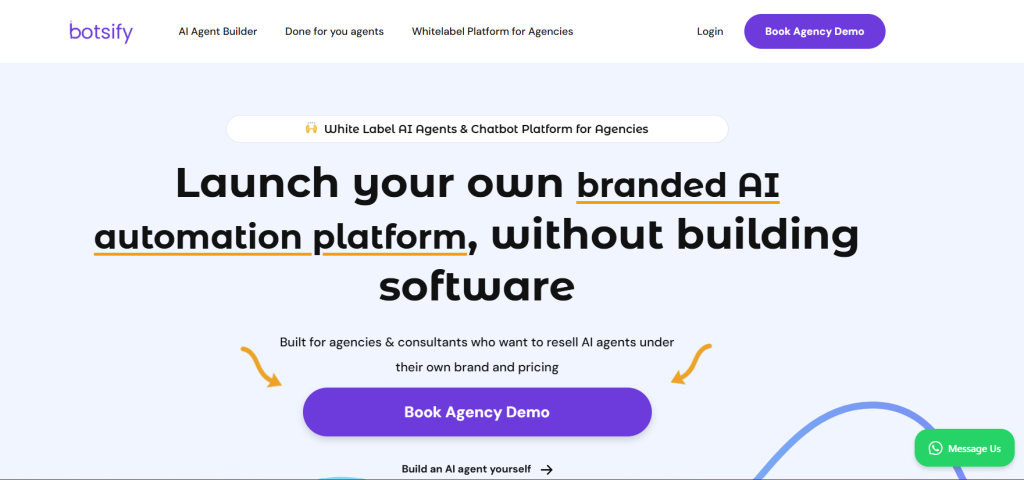
Best for: Businesses and agencies deploying AI agents across multiple channels
Botsify has evolved from a chatbot platform into a full AI agent platform designed to help companies automate conversations, workflows, and internal processes.
The platform allows businesses to build AI agents that operate across websites, messaging channels, and collaboration tools. Botsify focuses heavily on accessibility, offering a no-code environment where teams can create agents without deep technical knowledge.
Organizations often use Botsify to deploy agents for customer engagement, sales automation, onboarding assistance, and internal knowledge management.
Botsify’s recent upgrades introduced an LLM-powered conversational interface that lets users create agents simply by describing their goals in natural language, replacing older flow-based builders.
Key Features
- No-code AI agent builder
- Knowledge-base training for agents
- Human handoff to live support teams
- Multi-channel deployment
- Workflow automation and integrations
Integrations
Botsify agents can connect with a wide range of tools and messaging platforms. The system supports integrations across websites, messaging apps, and collaboration tools including Slack and Telegram, enabling automation across customer and internal workflows.
Agents can also connect to external systems through APIs and connectors, allowing integration with CRM systems, helpdesk platforms, and business databases.
Use Cases
Common Botsify deployments include:
- customer support automation
- lead generation and qualification
- onboarding assistance for new customers
- internal knowledge assistants
- sales automation workflows
The platform is also widely used by agencies that build automation solutions for clients, often reselling AI deployments under their own branding.
Pricing
Botsify offers tiered pricing with enterprise options, allowing organizations to scale agent usage and integrations based on business requirements.
2. Botpress
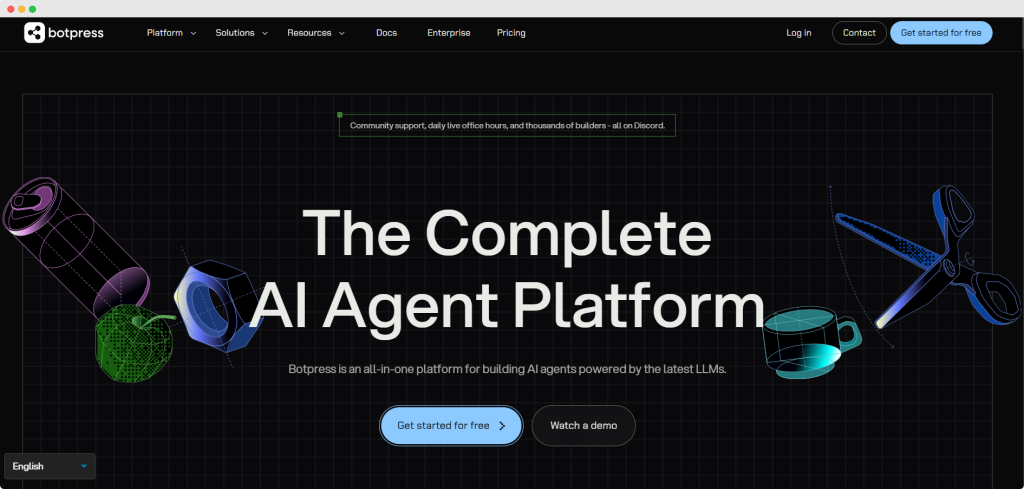
Best for: Developers building advanced conversational AI agents
Botpress is a popular platform for building conversational AI systems using modern language models.
Unlike many no-code tools, Botpress offers deeper customization capabilities for development teams that want more control over agent behavior and workflows.
The platform provides a visual builder along with the ability to inject custom code and monitor agent behavior in production environments.
Botpress uses an isolated runtime architecture, meaning each deployed agent runs in its own environment while maintaining full observability over actions and execution.
Key Features
- Visual conversation builder
- Customizable agent workflows
- support for modern LLMs
- analytics and observability tools
- API-driven integrations
Integrations
Botpress agents can integrate with various external tools including messaging platforms, databases, and APIs.
The platform also supports multi-channel deployment, allowing agents to interact with customers across web interfaces, messaging apps, and support systems.
Use Cases
Organizations often deploy Botpress for:
- conversational AI assistants
- internal knowledge bots
- customer support automation
- AI-powered helpdesk assistants
Pricing
Botpress offers a free tier along with usage-based and enterprise plans depending on deployment scale and infrastructure requirements.
3. Yellow.ai
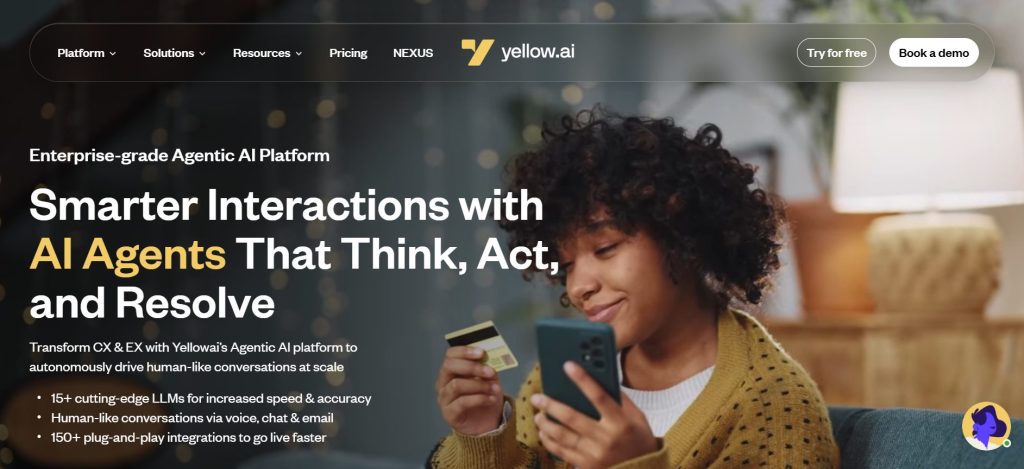
Best for: Enterprise conversational automation
Yellow.ai is a conversational AI company focused on automating customer service experiences at scale, and it’s a Botpress alternative.
Founded in 2016, the company provides AI platforms designed to automate interactions across chat and voice channels for large enterprises.
One of the platform’s key strengths is multilingual support. Yellow.ai can operate in more than 135 languages and across dozens of communication channels, making it suitable for global businesses.
Key Features
- AI-driven conversational automation
- Chat and voice AI agents
- enterprise-grade analytics
- multilingual support
- workflow automation for support operations
Integrations
Yellow.ai integrates with enterprise systems including:
- CRM platforms
- customer support software
- messaging platforms
- voice infrastructure
These integrations allow AI agents to retrieve data, automate support workflows, and assist human support teams.
Use Cases
Organizations typically deploy Yellow.ai for:
- large-scale customer support automation
- contact center AI assistants
- conversational commerce
- enterprise helpdesk automation
Pricing
Yellow.ai pricing typically depends on enterprise deployment size and usage, with custom plans for large organizations.
4. WotNot

Best for: No-code AI agents for marketing and support
WotNot provides a no-code environment for building AI chatbots and conversational agents focused on customer engagement and marketing automation.
The platform is designed for businesses that want to automate interactions without requiring technical expertise. Using its visual builder, teams can design workflows that capture leads, respond to customer queries, and route requests to human teams when necessary.
Key Features
- drag-and-drop chatbot builder
- lead capture workflows
- marketing automation triggers
- conversational AI templates
- analytics dashboard
Integrations
WotNot integrates with several popular business tools including:
- HubSpot
- Zapier
- email marketing platforms
- CRM systems
These integrations allow agents to capture leads and automatically update marketing or sales systems.
Use Cases
Common WotNot deployments include:
- lead qualification bots
- marketing automation
- website chat assistants
- customer service automation
Pricing
WotNot offers subscription plans with enterprise options depending on deployment size and features.
5. Relevance AI
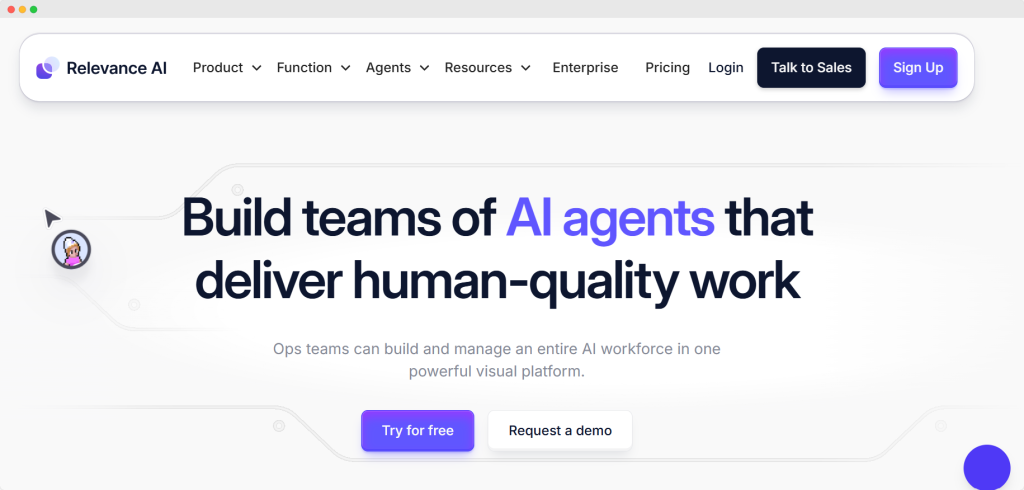
Best for: Multi-agent workflows and automation
Relevance AI focuses on building systems where multiple AI agents collaborate to complete complex workflows.
The platform allows organizations to create agents that perform different roles in a workflow, for example research agents, analysis agents, and reporting agents that work together on the same task.
Relevance AI also supports analytics and monitoring tools that track how agents perform across tasks.
Key Features
- custom AI agent creation
- visual workflow automation
- multi-agent collaboration
- built-in analytics and monitoring
- knowledge base integration
Integrations
Relevance AI agents can connect with APIs, data platforms, and internal business tools.
These integrations allow agents to retrieve data, automate reports, and trigger actions across different systems.
Use Cases
Typical deployments include:
- research automation
- marketing data analysis
- content generation pipelines
- sales prospecting workflows
6. Lindy AI
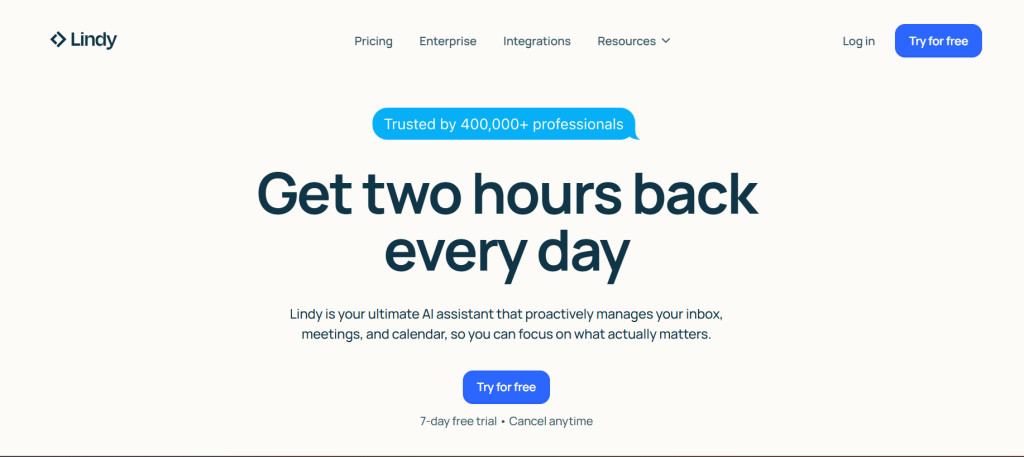
Best for: AI employees and business automation
Lindy AI positions itself as a platform for building “AI employees” capable of handling routine business tasks.
Instead of focusing solely on conversations, Lindy agents are designed to automate workflows across software tools used by business teams.
These agents can perform tasks such as scheduling meetings, updating CRM records, and managing communications.
According to industry comparisons, Lindy integrates with thousands of business tools and is particularly strong in workflow automation for operations teams.
Key Features
- AI workflow automation
- natural language agent creation
- integration with business tools
- task management automation
Integrations
Lindy integrates with tools commonly used by business teams such as:
- Gmail
- Slack
- Notion
- Salesforce
Use Cases
Typical Lindy deployments include:
- scheduling assistants
- CRM automation
- support workflow automation
- internal business task management
7. CrewAI

Best for: Developers building multi-agent systems
CrewAI is designed for building collaborative groups of AI agents that work together on complex tasks.
Instead of relying on a single AI model, the platform allows organizations to create multiple agents that take on specialized roles within a workflow.
For example, one agent may gather data while another analyzes results and a third generates reports.
CrewAI supports both developer-focused workflows and no-code environments, allowing different teams to build automation pipelines depending on their technical expertise.
The platform enables multiple agents to collaborate on tasks and automate complex workflows across organizations.
Key Features
- multi-agent orchestration
- role-based agent collaboration
- flexible deployment options
- support for automation pipelines
Integrations
CrewAI agents can connect to APIs, databases, and cloud services, enabling them to retrieve data and trigger actions in external systems.
Use Cases
Common use cases include:
- research pipelines
- complex data analysis workflows
- enterprise automation systems
- collaborative AI agent teams
Bonus Mentions
While the platforms above represent some of the most widely used AI agent platforms today, several other tools are also gaining traction in the ecosystem. Depending on your use case and technical requirements, these platforms may also be worth exploring.
Activepieces
Activepieces is an open-source automation platform that allows users to build AI-powered workflows and agents using a visual interface. It integrates with hundreds of applications and is particularly useful for automating operational tasks across business tools.
Google Vertex AI Agent Builder
Google Vertex AI provides infrastructure for building AI-powered agents and applications using Google Cloud. It is designed for enterprises that want to integrate AI automation with large-scale data systems and cloud infrastructure.
Microsoft Copilot Studio
Copilot Studio enables organizations to create AI assistants integrated with Microsoft 365 tools such as Teams, SharePoint, and Outlook. It is particularly useful for enterprises already operating within the Microsoft ecosystem.
StackAI
StackAI is a visual platform for building AI agents that connect language models, APIs, and internal data sources. The platform focuses on enabling teams to prototype and deploy AI workflows quickly without building custom infrastructure.
Make (formerly Integromat)
Make is a workflow automation platform that can be used to orchestrate AI agents across thousands of applications. While not strictly an AI agent platform, it provides powerful automation capabilities for integrating AI-driven workflows
How to Choose the Right AI Agent Platform
Selecting the best AI agent platforms depends on your organization’s goals and technical resources.
Here are a few factors to consider.
Ease of Use
Some platforms prioritize no-code development, while others require engineering expertise.
Businesses with non-technical teams often benefit from platforms with visual builders and prebuilt templates.
Integration Ecosystem
AI agents are only useful if they can interact with existing business tools.
Look for platforms that integrate with CRM systems, messaging apps, and internal databases.
Customization
The best platforms allow organizations to design flexible workflows rather than forcing them into rigid templates.
Scalability
As companies deploy more AI agents for small businesses or enterprise environments, the platform must support scaling across multiple workflows and teams.
Final Thoughts
AI agents are transforming how organizations automate operations and deliver services.
From conversational customer support to complex multi-agent workflows, these systems are becoming a core layer of modern software infrastructure.
The best AI agent platforms combine flexibility, integrations, and scalability so businesses can deploy intelligent automation without maintaining complex systems.
Whether your goal is customer engagement, workflow automation, or building advanced agent systems, choosing the right platform will determine how effectively your organization can adopt this new generation of AI technology.
AI Agentic Platform For Building Portable AI Agents
Say Hello To Agentic AI That Connects With Your CRM And Even Other Agents
The post Best AI Agent Platforms in 2026 appeared first on Botsify.
]]>Why Legal Awareness Matters More in a Rapidly Evolving Society Read More »
The post Why Legal Awareness Matters More in a Rapidly Evolving Society appeared first on Botsify.
]]>Yet amid constant change, legal awareness remains a vital but overlooked pillar of stability. No longer confined to courtrooms, it is a core life skill for modern citizenship. In an evolving society, understanding legal rights transforms vulnerability into protection, participation, and progress.
In this article, we’ll explore why understanding the law means claiming a voice in a society rewritten in real time.
How Rapid Social and Technological Change Affects Legal Rights
Rapid social and technological change continually reshapes legal rights, often faster than laws can adapt. Artificial intelligence tools, AI agent platforms, remote work systems, digital payments, and social media create new challenges around privacy, data ownership, and workplace protections. Meanwhile, evolving social norms influence equality, family law, and consumer expectations, increasing risks for those lacking legal awareness.
Growing legal awareness is evident in how people respond to digital privacy challenges. Statista reported that internet users are becoming more conscious of their online rights and security. In 2024, 36% of users worldwide exercised Data Subject Access Requests, up from 24% in 2022. It reflects rising engagement with data protection laws.
Medical Advances and the Importance of Knowing Patient Rights
Modern healthcare offers innovative, life-improving treatments. However, these solutions often carry hidden legal implications that patients may not recognize. New procedures frequently involve evolving safety data and risks not fully understood during treatment.
Informed consent is critical for patient rights. You deserve clear information regarding risks, benefits, and long-term consequences before any procedure. Incomplete disclosures often lead to unexpected complications where patients remain unaware of their legal options.
A well-known example is the transvaginal mesh lawsuits involving uninformed women facing unforeseen surgical risks for treating their pelvic prolapse issues. These patients suffered severe consequences, including chronic pain, organ damage, and the need for repeat surgeries.
According to TorHoerman Law, injuries linked to transvaginal mesh devices have led many patients to take legal action against manufacturers. These claims have resulted in substantial settlements, and while many cases are resolved, new filings continue across different jurisdictions.
Transvaginal mesh settlement amounts often fall between $150,000 and over $400,000. The final compensation depends on the specific details, injuries, and circumstances of each individual case.
Real-World Legal Cases That Changed Public Awareness
High-profile legal cases strongly shape public understanding of rights and responsibilities. Lawsuits involving consumer safety, discrimination, environmental harm, and medical negligence expose systemic failures and prompt reform. By humanizing complex legal issues, these cases educate the public and highlight law as a practical tool for accountability and protection.
Real-world legal cases continue to shape public awareness and expectations of accountability. The International Comparative Legal Guides reported that public awareness has reached its highest level since 2020, particularly around ESG-related litigation. A 2025 study found 27% of UK adults report high awareness of class actions. It reflects growing recognition of collective legal action.
Legal Awareness as a Modern Life Skill
Legal awareness is now a core life skill, comparable to financial or digital literacy, especially as organizations adopt automation tools and evaluate the best AI agents to support operations. Everyday actions, from contracts to online data sharing, carry legal consequences. Understanding rights helps prevent disputes and unfair treatment. As law increasingly intersects with technology, automation tools, and platforms such as an AI agent builder, legal awareness empowers confident, informed decision-making.
Legal awareness is increasingly shaped by how professionals adopt new tools. LexisNexis reported that UK lawyers using generative AI rose from 11% in 2023 to 41% in 2024. Also, 82% now use or plan to use AI, reflecting how legal knowledge and technology are becoming inseparable life skills.
The Role of Information Access in Legal Empowerment
Access to clear legal information is central to legal empowerment in a changing society. When laws and rights are understandable, people make informed decisions and challenge unfair practices. Although digital resources have expanded access, gaps remain. Improving transparency turns the law into a practical tool for protection and participation. Many organizations now use a chatbot for website support to guide users through policies, privacy rights, and frequently asked legal questions.
Access to legal information directly influences how people exercise their rights. JD Supra reported that by late 2025, over 8,000 complaints were filed with regulators. Notably, 51% involved requests to delete personal information, while 39% focused on limiting the use of sensitive data, highlighting growing legal engagement.
Preparing for the Future Through Legal Literacy
Legal literacy helps individuals and organizations anticipate change instead of reacting to it. Emerging technologies, including automation tools and custom AI agents, along with new labor models and shifting healthcare and privacy laws make legal understanding essential. By recognizing risks and obligations early, people can comply with regulations and protect their rights as laws continue to evolve.
For individuals and entrepreneurs, early legal awareness strengthens decision-making in contracts, digital interactions, and when adopting technologies such as AI agents for small businesses. It helps people anticipate risks, understand obligations, and protect their rights. Investing in legal literacy builds long-term resilience. It also reduces future disputes and fosters confidence in navigating evolving legal challenges.
Frequently Asked Questions
How can people stay informed about changing laws without legal training?
People can stay informed by following trusted legal news, government websites, and public awareness portals. Community workshops, verified legal platforms, and professional consultations also provide guidance. Clear guides, newsletters, and updates from reliable organizations simplify changing laws without formal legal training.
What role does the media play in shaping public legal awareness?
The media plays a vital role by simplifying complex legal issues for the public. News coverage and digital platforms highlight rights, risks, and landmark cases. By increasing visibility and discussion, the media helps people understand how laws affect everyday life.
What legal mistakes do people commonly make in modern life?
Common legal mistakes include signing contracts without reading the terms and oversharing personal data online. Many also ignore employment rights or misunderstand consent and insurance coverage. This lack of awareness often results in preventable disputes, financial loss, and missed protection opportunities.
Staying Informed to Stay Protected
In a society shaped by constant technological, social, and regulatory change, legal awareness is no longer optional; it is essential. Knowing one’s rights and responsibilities enables people to make informed, responsible decisions. It also helps individuals avoid preventable risks and misunderstandings.
Legal awareness allows people to respond confidently when challenges arise. As laws evolve with modern life, this knowledge empowers active participation and a more secure future.
AI Agentic Platform For Building Portable AI Agents
Say Hello To Agentic AI That Connects With Your CRM And Even Other Agents
The post Why Legal Awareness Matters More in a Rapidly Evolving Society appeared first on Botsify.
]]>Botpress Alternatives: 7 Best Botpress Competitors for AI Agents Read More »
The post Botpress Alternatives: 7 Best Botpress Competitors for AI Agents appeared first on Botsify.
]]>However, Botpress isn’t always the right fit for every organization. Many teams start exploring Botpress alternatives when they realize the platform can be difficult for non-technical users, requires ongoing maintenance, or takes longer than expected to deploy production-ready agents.
As businesses move toward Agentic AI, they need platforms that allow AI systems to perform actions, connect to business tools, and operate across multiple channels. That’s why companies are evaluating platforms that simplify the creation and management of intelligent agents.
In this guide, we’ll break down the 7 best Botpress competitors in 2026. The best Botpress alternatives in 2026 include Botsify, Yellow.ai, Lindy, Kore.ai, Voiceflow, Chatfuel, and Relevance AI. These platforms offer different strengths ranging from enterprise conversational AI to marketing automation and workflow-driven AI agents.
By the end, you’ll know which platform best fits your use case and whether switching from Botpress makes sense for your team.
What Botpress Is and Who It’s Best For
Botpress is a conversational AI development platform used to build chatbots and automated support agents. It offers a visual interface for building conversational flows and allows developers to extend functionality through APIs and custom code.
Many organizations use Botpress to deploy support bots, internal assistants, or conversational automation systems. Its flexibility makes it appealing for teams that want to create highly customized solutions.
Botpress works best for companies that:
- Have developers who can manage integrations and logic
- Need detailed control over conversational workflows
- Want to build highly customized conversational experiences
But when businesses need to deploy scalable AI agents across multiple channels quickly, the development overhead can become a challenge.
Why People Search for Botpress Alternatives
Botpress is powerful, but several factors lead businesses to look for alternatives.
1. Steep Learning Curve
Botpress is designed with developers in mind. For marketing teams or support teams without engineering resources, configuring flows, integrations, and deployment pipelines can take significant time.
2. Time to Deployment
Launching a production-ready chatbot or assistant often requires configuration and testing. Organizations looking for faster deployment may prefer platforms that simplify the setup process.
3. Scaling Complexity
As conversational systems grow, they require monitoring, analytics, and governance tools. Many companies prefer platforms that provide these capabilities without heavy technical management.
4. Pricing at Scale
Usage-based pricing for AI actions, integrations, and team collaboration features can increase costs as deployment expands.
5. Agency and Reseller Needs
Agencies offering conversational automation services often need multi-client dashboards and branding capabilities, which are not the core focus of Botpress.
How We Evaluated Botpress Competitors
To identify the strongest alternatives to Botpress, we evaluated platforms using the following criteria.
Ease of Use
Can non-technical teams launch conversational automation quickly, or is developer support required?
AI Intelligence
How well does the platform support knowledge bases, retrieval-augmented generation, and contextual understanding?
Automation Capabilities
Do agents perform real tasks like checking order status, retrieving data, or triggering workflows?
Multi-Channel Deployment
Does the platform allow agents to operate across web chat, messaging apps, and collaboration tools?
Human Handoff
When AI cannot resolve an issue, can the conversation seamlessly transfer to human teams?
Integrations
Can the system connect to CRM systems, help desks, and databases?
Some platforms focus on AI Agent frameworks that developers extend programmatically, while others prioritize ready-to-deploy automation systems for businesses.
Quick Comparison of the Best Botpress Alternatives
| Platform | Choose this if… | Strengths | Watch-outs |
| Botsify | You want to launch AI agents fast across channels, with agency-ready resale options and flexible build paths. | No-code AI agent builder, multi-channel deployment, white-label/reseller support, prebuilt + custom agent workflows, integrations, team handoff and management features. | If you want a pure code-first framework experience, you may prefer developer frameworks. |
| Yellow.ai | You need enterprise-grade conversational automation at large scale. | Strong enterprise CX tooling, automation, analytics, global support posture. | Typically heavier implementation and budget. |
| Lindy | Your focus is internal productivity agents that automate tasks. | Workflow/task agents for ops, sales, admin automation. | Less “customer-support chatbot platform” oriented depending on setup. |
| Kore.ai | You’re an enterprise with governance, security, and complex workflows. | Enterprise assistant platform, governance/compliance posture, deep enterprise integration ecosystem. | Often longer rollout cycles and higher complexity. |
| Voiceflow | You want top-tier conversation design, prototyping, and collaboration. | Strong visual conversation design, testing, multi-LLM flexibility, good for web + voice experiences. | Production ops, inbox/handoff, and deployment management can require extra tooling. |
| Chatfuel | You want marketing automation primarily on Meta channels. | Social-first automations, lead gen flows, comment-to-DM journeys. | Not built for complex agent orchestration or deep knowledge workflows. |
| Relevance AI | You want AI-driven workflows and internal automation with structured task execution. | Operational AI workflows and automations for business processes. | Not a chatbot-first product for customer support in many setups. |
The 7 Best Botpress Alternatives in 2026
1. Botsify
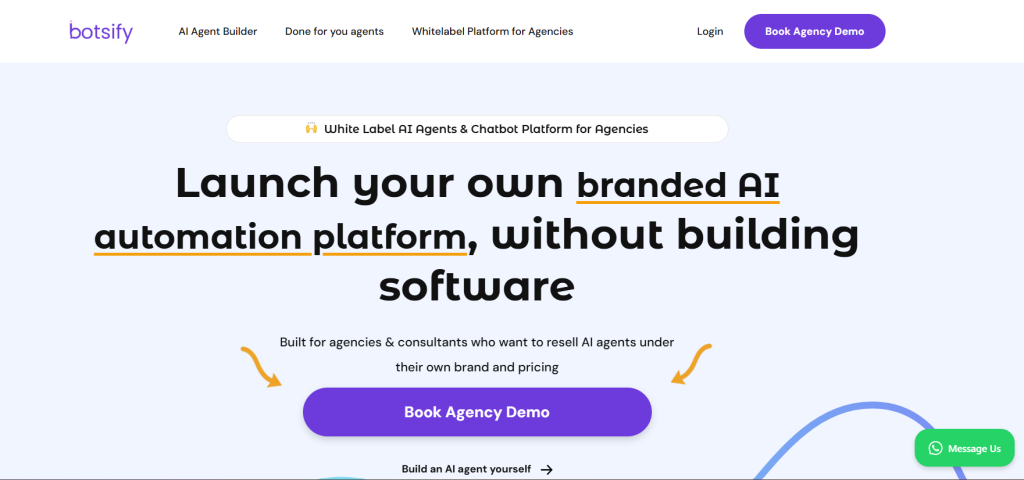
Best for: Agencies and businesses deploying customer-facing AI agents.
Botsify is one of the strongest Botpress competitors because it focuses on launching practical AI solutions quickly. Instead of requiring extensive development work, the platform allows organizations to deploy AI agents across websites, messaging platforms, and customer support channels.
Botsify functions as a full AI Agent Platform designed for businesses that want to automate customer conversations without maintaining complex infrastructure.
Key strengths include:
- Multi-channel deployment across websites and messaging apps
- Knowledge base training for accurate responses
- Automation workflows connected to external tools
- Seamless handoff to human support teams
- Agency-friendly dashboard for managing multiple clients
For companies building conversational automation as a service, Botsify also supports White label AI deployments, allowing agencies to offer AI-powered chat systems under their own brand.
2. Yellow.ai

Best for: Enterprises needing large-scale conversational automation.
Yellow.ai is designed for large organizations that need enterprise-grade conversational platforms. It supports advanced automation, analytics, and multilingual deployments across customer engagement channels.
Major features include:
- Enterprise conversational AI orchestration
- Automated workflows for customer service
- Multi-language support
- Enterprise integrations and compliance features
Large enterprises often rely on specialized Chatbot development services in the USA or global implementation partners to deploy Yellow.ai solutions effectively.
While the platform offers powerful enterprise features, smaller businesses may find the implementation process more complex.
3. Lindy

Best for: Workflow automation and productivity agents.
Lindy takes a slightly different approach compared to traditional chatbot builders. Instead of focusing purely on conversations, it emphasizes task automation through AI agents.
Businesses can build Custom AI agents that handle internal workflows such as:
- Lead qualification
- Email follow-ups
- Scheduling tasks
- Data retrieval
The platform works well for operations teams that want AI assistants performing administrative work.
However, Lindy is not primarily designed for customer-facing conversational support systems, which may limit some use cases.
4. Kore.ai
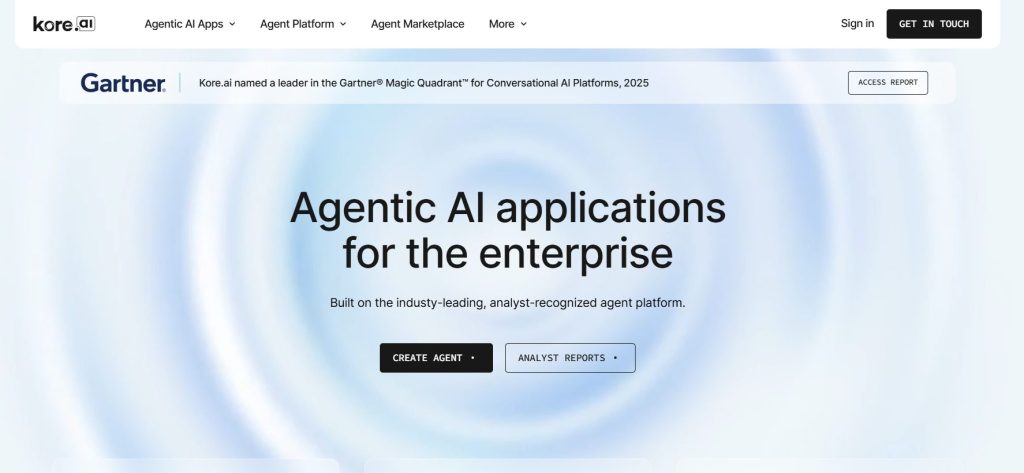
Best for: Enterprise conversational platforms with strict governance requirements.
Kore.ai is widely used by large enterprises in industries such as finance, telecom, and healthcare. The platform focuses on secure deployments and enterprise-level automation.
Features include:
- Advanced conversational orchestration
- Integration with enterprise software ecosystems
- Role-based access control
- Compliance and security frameworks
Organizations deploying large customer support automation systems often evaluate Kore.ai alongside the Best AI agents in the enterprise conversational market.
Because of its complexity and pricing structure, Kore.ai is typically best suited for large organizations rather than small businesses.
5. Voiceflow
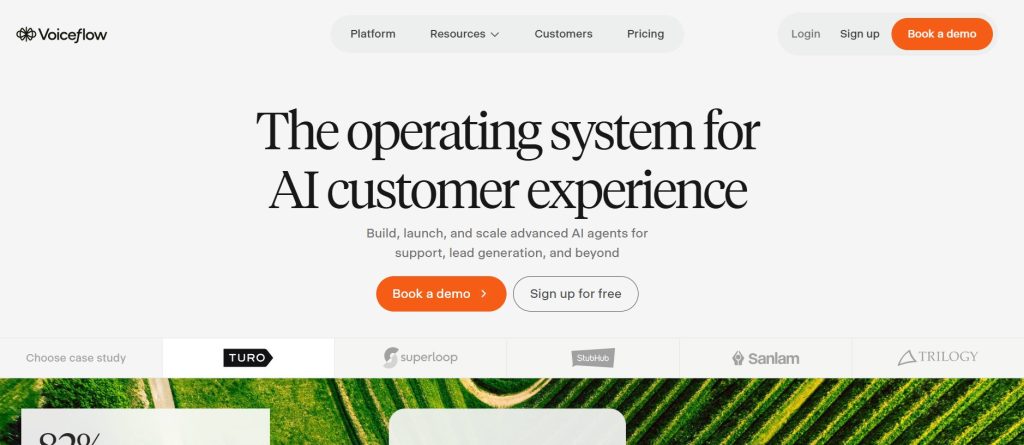
Best for: Designing complex conversational experiences.
Voiceflow is known for its visual interface that allows teams to design conversational flows collaboratively. Designers, developers, and product teams can build and test interactions before deploying them.
Voiceflow supports:
- Visual conversation design
- Prototyping of conversational experiences
- AI integrations with multiple language models
- Voice and chat applications
Many teams use Voiceflow as an AI agent builder to prototype interactions before connecting them to production systems.
However, organizations may still need additional infrastructure for full deployment and operational management.
6. Chatfuel

Best for: Social media automation.
Chatfuel is widely used by marketers to automate conversations on messaging platforms like Facebook Messenger and Instagram.
Key capabilities include:
- Automated responses to social media messages
- Marketing campaign automation
- Lead generation flows
- Customer engagement sequences
Businesses running marketing campaigns on Meta platforms frequently use Chatfuel to build automated engagement funnels.
For companies prioritizing messaging channels, Chatfuel can complement a Whatsapp AI chatbot strategy used for customer communication.
However, Chatfuel is primarily focused on marketing automation rather than advanced AI conversational logic.
7. Relevance AI
Best for: AI-powered workflows and operational automation.
Relevance AI is designed for teams building operational AI workflows rather than traditional chatbots. The platform enables businesses to automate processes using AI-driven task systems.
Capabilities include:
- AI-driven workflow orchestration
- Data automation pipelines
- Integration with productivity tools
- AI-powered task execution
Organizations also use Relevance AI to build internal assistants such as a Slack AI agent that helps teams retrieve information and automate repetitive tasks.
Because of its workflow orientation, Relevance AI may be less focused on customer support conversations compared to traditional chatbot platforms.
Which Botpress Alternative Should You Choose?
Choosing the right platform depends on your specific use case.
Choose Botsify if you want
- AI agents deployed across multiple communication channels
- Fast deployment without heavy development
- Automation for customer support and lead engagement
Many companies use Botsify to deploy AI agents for small businesses that handle customer queries, automate responses, and assist sales teams.
Choose Yellow.ai or Kore.ai if you need
- Enterprise-grade security and compliance
- Large-scale conversational deployments
- Advanced analytics and orchestration
Choose Chatfuel if you mainly need
- Marketing automation on Facebook and Instagram
- Automated campaign messaging
Choose Voiceflow if you need
- Advanced conversation design tools
- Prototyping before production deployment
Choose Lindy or Relevance AI if you need
- Workflow automation agents
- Internal productivity assistants
Migration Notes From Botpress
If you are considering switching platforms, a structured migration approach can help ensure a smooth transition.
1. Audit your current system
Review existing flows, integrations, and knowledge base content.
2. Identify automation workflows
Determine which interactions require structured logic versus AI responses.
3. Rebuild your knowledge base
Import FAQs, documentation, and support content into the new platform.
4. Reconnect integrations
Ensure agents can access CRM systems, support tools, and databases.
5. Configure team collaboration
If your organization offers automation services through an AI Agent agency, ensure the platform supports multiple clients and operational dashboards.
6. Run pilot deployments
Launch limited tests before rolling out automation to all channels.
FAQs
Is Botpress only for developers?
Botpress can technically be used by non-developers, but many organizations find it easier when developers manage integrations and customization.
What is the easiest Botpress alternative?
Platforms like Botsify and Chatfuel tend to offer easier setup for non-technical users compared to developer-focused tools.
Which Botpress competitor is best for agencies?
Platforms that support branding and multi-client management tend to work best. Businesses looking for a White label AI agent platform often choose tools designed for agencies and resellers.
What should businesses consider before choosing a platform?
Important factors include integration capabilities, automation workflows, analytics, and scalability as usage grows.
Final Thoughts
Botpress remains a powerful platform for building customizable conversational systems. But depending on your goals, there may be better options.
Businesses that want faster deployment, simpler management, and practical AI automation often explore other tools.
Among the botpress competitors listed above, each platform serves different needs, from enterprise automation to marketing-focused messaging bots.
For organizations that want to launch customer-facing AI agents quickly across multiple channels, Botsify stands out as one of the most practical and scalable alternatives available today.
If your goal is to automate conversations, improve support responsiveness, and deploy AI agents without complex infrastructure, exploring the right platform can significantly accelerate your automation strategy.
AI Agentic Platform For Building Portable AI Agents
Say Hello To Agentic AI That Connects With Your CRM And Even Other Agents
The post Botpress Alternatives: 7 Best Botpress Competitors for AI Agents appeared first on Botsify.
]]>AI Automation For Small Businesses: Smarter Workflows Using Chatbots Read More »
The post AI Automation For Small Businesses: Smarter Workflows Using Chatbots appeared first on Botsify.
]]>Being able to do enough with fewer resources is admirable. Having to manage operations, marketing, and customers at the same time can put a lot of strain on the entrepreneur and their few(if any) staff. This is why AI automation can be a huge help for small businesses.
While there were some automation tools and platforms available before, they were generally expensive and limited in their capacity. Thanks to AI, now there are a lot more things these tools can do for small businesses.
What Makes AI Automation Crucial For Small Businesses?
AI is an automated process where machine learning and natural language processing(NLP) can create a system that “thinks” based on patterns.
Many platform is fueled by these systems to take care of a variety of tasks, such as Automated Data Entry, marketing strategies, and even smart customer service.
Small businesses run with small teams and tight budgets, yet compete with large brands that work with big teams. They are fighting for customers who expect fast replies and smooth services.
This you must deliver, no matter what, and gaining your share of customers would be impossible for SMBs without AI. It can handle repetitive tasks like answering common questions, sending order confirmations, and updating customers about deliveries.
This saves time and allows business owners to focus on planning, partnerships, and improving products or services.
Automation also improves accuracy. Customers receive clear and consistent information. Even content tasks can be supported by AI tools, although businesses should review the results carefully, sometimes using an AI writing detector to check for originality and quality.
Core of Smart Automation: AI Chatbots
One particular AI tool that has become necessary for small businesses is AI chatbots, which can handle multiple tasks that generally need various teams of employees.Today, many companies are also adopting AI agents for small businesses to automate customer conversations, support tasks, and routine workflows.
Writing Content with AI Chatbots
AI chatbots can also support small businesses with content creation. Many owners struggle to keep up with blog posts, product descriptions, email campaigns, and social media updates. Writing takes time, and consistency is often difficult to maintain when you are managing other responsibilities.
Chatbot can help generate ideas, create first drafts, suggest headlines, and improve clarity. Many tools now include a chatbot builder that allows businesses to create and customize chatbot workflows without technical expertise. It can turn rough notes into structured content and help repurpose one piece of content into multiple formats. For example, a blog post can become email copy or short social captions.
These writing assistants can speed up the process while keeping quality in your control. However, AI should not replace your brand voice. It works best as a starting point, not the final version. Business owners should review, edit, and personalize the output to reflect their values and tone.
AI also hallucinates, so any piece of automated writing should be run through an AI detector to ensure the information is accurate. This can also help understand which parts sound more AI, so that your humanization is also on point.

24/7 Customer Support
Customers trust brands that respond instantly. One of the biggest benefits of AI chatbots is that they are always available. They do not need breaks, shifts, or holidays. They can answer questions about store hours, return policies, prices, and product details at any time.
This is especially helpful for customers in different time zones or those shopping late at night. Instead of waiting for an email response, they get answers immediately.
Chatbots also reduce pressure on customer service staff. Employees can focus on more complex problems while the chatbot handles simple, repetitive questions. This makes the support process smoother and more efficient.
Lead Generation and Sales
Chatbots can help increase sales. When someone visits your website, the chatbot can start a conversation, offer help, or suggest products.
It can collect email addresses, answer questions before purchase, and guide customers who are unsure. Some businesses also use a whatsapp chatbot to engage visitors directly on mobile and continue conversations where customers are already active. For example, it can explain shipping options, product sizes, or service benefits. This reduces confusion and makes it easier for customers to decide.
Chatbots also track interactions. Businesses can see what customers ask about most often and adjust their marketing messages. Over time, the chatbot becomes an important part of the sales process.
Booking and Scheduling
Many service businesses spend a lot of time managing appointments. Calls, emails, and calendar updates can take hours each week.
AI chatbots can connect to booking systems and show available time slots. Many service businesses deploy chatbot solutions to automate appointment booking and reduce manual scheduling work. Customers can choose a time and confirm their appointment instantly. The chatbot can also send reminders to reduce missed appointments.
This is helpful for businesses such as salons, consultants, tutors, and healthcare providers. It saves time and prevents scheduling mistakes.

Order Tracking
After buying something, customers usually want updates about their order. They want to know where it is and when it will arrive.
Chatbots can connect to shipping systems and provide instant tracking information. Adding a chatbot for website support system also allows customers to quickly check order status without contacting support. Customers simply ask the chatbot instead of searching through emails.
This reduces the number of support messages and builds trust. When customers feel informed, they feel more confident about buying again.
Internal HR and IT Support
Chatbots are useful inside the company too. Agencies and SaaS providers often rely on a White label Chatbot platform to create branded chatbots for internal teams or clients. As businesses grow, new employees often ask similar questions about policies, software, and procedures.
An internal chatbot can answer common questions about payroll, leave policies, or basic technical issues. Employees get quick answers without waiting for a manager.
This makes onboarding easier and keeps information organized. It also reduces interruptions for leadership.
Feedback Collection
Customer feedback helps businesses improve, but collecting it can be difficult. Many people ignore long email surveys.
Chatbots can ask short questions right after a purchase or service. Because the conversation feels natural, customers are more likely to respond.
The feedback can show what customers like and what needs improvement. Instead of guessing, business owners receive clear information to guide decisions.
Marketing Automation Beyond Basic Lead Capture
Getting a lead is only the first step. The real goal is to build a relationship.
Chatbots can send follow-up messages based on customer behavior. For example, they can remind someone about items left in a shopping cart or recommend products based on past purchases.
This ongoing communication increases the chances of repeat sales. Over time, steady engagement leads to more predictable growth instead of relying only on occasional promotions.

Multilingual Customer Experience
If a business serves customers from different language backgrounds, communication can be challenging. Hiring multilingual staff can be expensive.
AI chatbots can respond in multiple languages automatically. Customers can communicate in the language they are most comfortable with.
This helps businesses reach new markets without increasing costs. It also makes customers feel valued and understood.
Personalized Product Recommendations
Chatbots can suggest products based on browsing history or past purchases.
This works like a helpful store assistant who remembers your preferences. The difference is that a chatbot can do this for many customers at once.
Personalized recommendations can increase the average amount customers spend and help them discover products they might not have found on their own.
Data Collection and Customer Insights
Every conversation with a chatbot creates useful data. Businesses can see common questions and identify patterns.
If many customers ask about shipping times, it may mean the website does not clearly explain delivery details. If pricing questions appear often, it may signal a need to adjust messaging.
These insights help businesses improve their marketing, product descriptions, and overall strategy based on real customer behavior.
Crisis or Announcement Communication
Sometimes businesses need to share urgent updates. This could include shipping delays, changes in opening hours, or new product launches.
A chatbot can display important announcements immediately to every visitor. Customers receive accurate information without confusion.
Clear communication during unexpected situations builds trust and reduces misunderstandings.
Education and Guided Selling
Some services are complex. Customers may need help choosing the right option.
Chatbots can ask structured questions to understand a customer’s needs and suggest the most suitable package. This works like a short consultation before the official meeting.
By guiding customers early, businesses save time during sales calls and improve conversion rates.
Final Thoughts
AI automation is no longer just for large companies. Small businesses can use it to save time, improve service, and grow more efficiently. Among all automation tools, AI chatbots are especially powerful because they support customer service, marketing, sales, and even internal operations.
From answering basic questions to guiding customers through detailed decisions, chatbots make daily work easier. They reduce repetitive tasks, collect useful data, and improve communication without adding more staff.
For small business owners who want to grow while managing limited resources, AI chatbots offer a practical and affordable solution. Instead of handling every task manually, businesses can rely on smart tools that support long-term success.
AI Agentic Platform For Building Portable AI Agents
Say Hello To Agentic AI That Connects With Your CRM And Even Other Agents
The post AI Automation For Small Businesses: Smarter Workflows Using Chatbots appeared first on Botsify.
]]>How AI Agents Transform Content Marketing? Everything You Need to Know Read More »
The post How AI Agents Transform Content Marketing? Everything You Need to Know appeared first on Botsify.
]]>That’s why if you have a brand, you’ve likely heard that you have to be everywhere. But even the sound of it drives any marketer crazy. Because “being everywhere” requires tons of research, tools, ideas, content, time, and effort.
However, you don’t have to do it all by yourself. At least not now, in the age where you can do content marketing with AI agents.
Yes, artificial intelligence isn’t just a chatbot with random ideas anymore. It’s a real tool that can optimize and automate your content marketing. It’s an assistant that you can actually delegate your daily content tasks to.
How can you make it all work? Let’s figure it out in this guide.
Why Do You Need AI Agents in Marketing?
If you haven’t heard that much about AI agent platforms yet, that’s okay. The adoption of this technology is still a work in progress.
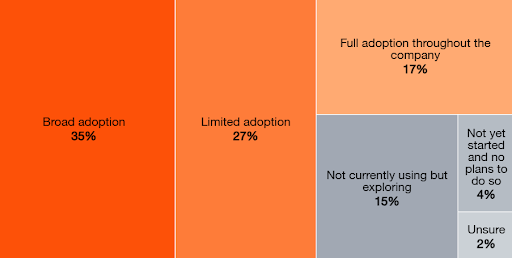
Still, according to PwC:
- 35% of companies already report broad adoption of AI agents,
- Another 27% say they started using this new technology to a certain extent,
- And 17% report full adoption across the company.
That means that almost 80% of organizations are at least trying AI agents.
While there are around 6% of businesses that are unsure about the use of AI agents or don’t plan to integrate them, this technology is here to stay.
Source: PwC
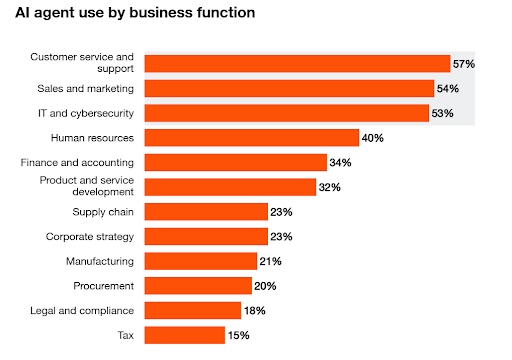
What are those 80% of companies that already use these tools doing with them, though?
If we look at their use by business function, we’ll see that marketing (along with sales) is the second most popular use case.
Source: PwC
Why marketing?
Because it is operationally hard and complex. It requires data, creativity, distribution, and management. Not to mention performance measurement. And to handle all that, you need to do a lot of repetitive things over and over again.
So whether you’re an enterprise or a small business, you can transform your marketing workflows with AI agents, making your team more efficient.
This isn’t just a “conceptual” benefit. There are several studies that prove it.
For example, this research on collaborative AI teams suggests that human-AI collaboration can actually improve productivity in creative workflows and outperform human-only teams.
What Are AI Agents Used for in Content Marketing?
AI agents are really transformational because they aren’t another chatbot that merely answers prompts. It’s a system designed to pursue a certain goal.
While most AI bots or generative models just wait for your command, an agent can work within a defined objective. It completes multiple steps necessary to achieve your goal, even if you don’t give it the exact commands.
That’s why you can use this “autonomous system” to:
- Gather information from several data sources and tools,
- Act on tasks over time,
- Adjust itself based on new data, etc.
Thanks to these diverse capabilities, AI agents in marketing can cover the whole loop of tasks needed for a full circle of content creation. So, if in the past you followed a linear structure, now your agents can do things in clear, repeatable cycles.
Let’s see what they’re capable of, task by task.
Brainstorming and Topics Ideas
Before you write anything, you need to know at least three things:
- What different segments of your audience are searching for,
- What your competitors are doing,
- What gaps exist in your niche that you could cover.
You can do it the old-school way: use a bunch of tools, hoping they are actually precise, and spend days (if not weeks) on manual research and analytics.
Alternatively, you can use some of the best AI agents to analyze large datasets (from search results, SEO software, your own traffic, etc.) and let them organize all that information into a clear report that gives you hundreds of topic ideas and insights.
Content Drafts
Creating a good draft is a time-consuming process because, in order to perform well, it has to be better than what’s already out there. AI agents can transform this part and save you lots of time.
They can generate:
- SEO-optimized drafts,
- Email sequences,
- Script outlines,
- Social media threads,
- Different subject lines, headlines, CTAs, etc.
Besides, you can ask your agents to include any details you might require.
For example, they can analyze what your competition is posting, your previous top performers, overall trends, your tone of voice, and so on. As a result, you don’t simply get an outline. You get a clear writing plan with relevant URLs, examples, notes, and references.
Of course, you’ll likely still need to edit it and shape the tone, but the agent will still give you a really effective draft.
This automation can help you reduce content production time incredibly, which gives your team capacity for more testing and creative tweaks.
SEO and AI Optimization
Depending on what content you’re actually creating, you might not need any optimization. But we can all agree that SEO is crucial for content marketing and your long-term revenue growth.
Until now, it was another manual process that took hours. Yet, AI agents can speed everything up, as they can “oversee”:
- Keyword research,
- On-page optimization,
- Internal linking,
- Readability,
- Elements that help with AI visibility, etc.
AI agents can even go beyond your own website and optimize your link building. They can help you find quality guest posting pages, get external mentions that LLMs value, create better pitches, personalize your outreach, find contacts of your target website editors, etc.
All in all, you can delegate most of the repetitive tasks you face when doing search engine optimization. And let’s be honest, most of the things in this department are highly repetitive.
Personalization
Personalization is a hugely important topic in marketing.
Modern audiences only react to relevant content because there is way too much noise.
And for businesses, personalization helps to be more selective and precise in targeting. The first-time visitor doesn’t need the same framing as a returning reader. And a founder doesn’t consume content the same way a junior employee does.
So, instead of targeting everyone, you focus on relevant audiences, making them trust your brand.
AI agents can deliver everything you need for AI content personalization. They can:
- Segment your audience properly (based on funnel stage, behavior, etc.),
- Find pain points, objections, desired outcomes, and triggers each segment reacts best to,
- Adjust your messaging based on the information they find,
- Give you tone-of-voice ideas, find relevant examples, notice gaps you had in your previous campaigns, etc.
Before, this level of personalization would require a huge team and weeks of work. But now, it’s literally easier than ever.
Multi-platform distribution
Simply posting your content, contrary to popular opinion, is not distribution.
Effective distribution means effectively communicating your idea across different channels in an appropriate format.
There is a lot said about content repurposing. But content marketing with AI agents has its own twist here, as they can:
- Find and analyze what’s working best for each platform,
- Create different content according to your own pipelines,
- Suggest optimal timing based on engagement data,
- Identify new channels that can work well for you, etc.
Frankly, there are dozens of possible scenarios you can implement. So, it’ll depend on your internal workflows.
Analytics and Testing
As you know, all things AI work really well for analytics because they can process huge amounts of data and find patterns that humans often don’t notice.
AI agents, for example, can:
- Monitor performance signals (CTR, bounce rates, engagement depth, etc.),
- And suggest how to improve them.
These won’t be some generic responses ChatGPT gives you because your agent will operate based on factual, real-life data.
Besides, you can give it a clear goal you want to achieve. For example, “We want to increase organic traffic by XX% in a XX time,” and ask to analyze what your current content marketing strategy lacks.
At this point, the loop closes.
You get a clear workflow powered by analytics. And that’s what can sustain your growth over time, no matter what.
As a result, this simple “assistance” can free up an immeasurable amount of time for your team to do other things, and do them well. On top of it, you don’t have to double your team if you decide to scale.
What AI Agents Can’t Do
Throughout this whole guide, we’ve been singing the praises of how versatile and effective AI agents in marketing are. They are. But, like anything, they have their limitations.
No matter how powerful AI agents are, remember that they aren’t:
- Strategic leaders: You can’t rely on your agent to choose a direction for your business (or even just your marketing). Sure, it can help you make an informed decision. But it can’t define positioning, set long-term vision, or decide when to pivot messaging because the market mood changed.
- Creativity sources: It’s a rhetorical question of whether AI can be creative, and what creativity is as such. But you can’t expect your AI agent to spit out some unique ideas as if there is no tomorrow. It can help you find references and inspiration. But it isn’t really meant to create original, relatable narratives.
- Legal and ethical experts: When you deal with any sensitive data or heavily regulated industries like finance, crypto, pharmaceuticals, etc., you can’t just leave it all to AI. Here, human oversight isn’t just required, it’s a must. The same goes for the ethical review because we all know that cancel culture is real.
So, long story short: goal setting, creative direction, ethical decisions, and strategic vision still belong to humans. AI agents should operate inside the system you design.
The future of marketing is not about automation replacing people. It is all about humans delegating as much as possible to AI, leaving space and time to create something unique, iconic, and truly impressive.
Conclusion
The main goal of using an AI agent is efficiency. Don’t look at it as a tool that can do it all, but rather a solution that can become your 24/7 assistant that can:
- Handle all the repetitive workload,
- Find almost any information you need,
- Locate unexpected gaps in your data,
- Give you inspiration,
- And free up precious time that you can use for higher-value tasks.
When you start doing content marketing with AI agents, it can turn into a much smarter operating model where your team performs at its peak.
AI Agentic Platform For Building Portable AI Agents
Say Hello To Agentic AI That Connects With Your CRM And Even Other Agents
The post How AI Agents Transform Content Marketing? Everything You Need to Know appeared first on Botsify.
]]>What Is an AI Agent Platform and How It Works? Read More »
The post What Is an AI Agent Platform and How It Works? appeared first on Botsify.
]]>That system is an AI agent platform.
In this guide, we’ll break down what an AI agent platform actually is, how it works behind the scenes, how it differs from builders and frameworks, and how companies use it to deploy scalable AI solutions. We’ll also look at how platforms like Botsify help businesses move from experimental AI projects to production-ready deployments.
What Is an AI Agent Platform?
An AI agent platform is a centralized environment that allows organizations to design, deploy, manage, monitor, and scale intelligent AI agents across different channels and workflows.
Unlike a standalone AI assistant or chatbot, a platform provides the infrastructure layer. It handles orchestration, integrations, memory management, user permissions, analytics, and multi-agent coordination.
To understand this clearly, it helps to separate three concepts:
- AI agents: Individual intelligent systems that perceive inputs, make decisions, and take actions.
- Agentic AI systems: Broader ecosystems where agents operate autonomously and coordinate with tools and other agents.
- AI agent platforms: The environment where those agents are built, deployed, and maintained.
If you’re new to the concept of intelligent agents themselves, it’s useful to first understand how modern AI agents operate, they are not scripted bots but dynamic systems capable of reasoning and action. An AI agent platform provides the operational backbone that allows those agents to function reliably at scale.
Portable AI Agents In Seconds, Use Everywhere
Prompt, Test, and Deploy AI Agents Across Social Platforms and LLMs. Automate Everything.
How AI Agent Platforms Work Behind the Scenes
An AI agent platform is made up of several interconnected layers. Each plays a specific role in transforming an idea into a working AI system.
1. Agent Creation Layer
This is where businesses design and configure their agents.

In practical terms, this includes:
- Defining the agent’s role and objectives
- Setting instructions and behavioral boundaries
- Connecting tools (CRM, APIs, databases)
- Designing workflows and triggers
- Testing conversational logic
Modern platforms typically provide a visual or structured interface for building agents. This is often referred to as an AI agent builder, but the builder is only one component of the larger platform.
On Botsify, for example, businesses can create structured agents without writing code. The interface allows teams to define agent goals, integrate external tools, and deploy across multiple channels from one dashboard.
This layer turns strategy into executable logic.
2. Memory and Context Management
True AI agents require context to operate effectively.
A robust AI agent platform manages:
- Session-based short-term memory
- Persistent user history
- Context retrieval from knowledge bases
- Structured data storage
For example, if a customer interacts with an agent on Monday and returns on Thursday, the platform should allow the agent to reference prior interactions. Without centralized memory management, agents become repetitive and ineffective.
Memory architecture is a defining factor between simple bots and modern agentic AI systems. Platforms that support deeper contextual handling enable more personalized and intelligent experiences.
3. Tool and Integration Layer
AI agents are most powerful when connected to tools.
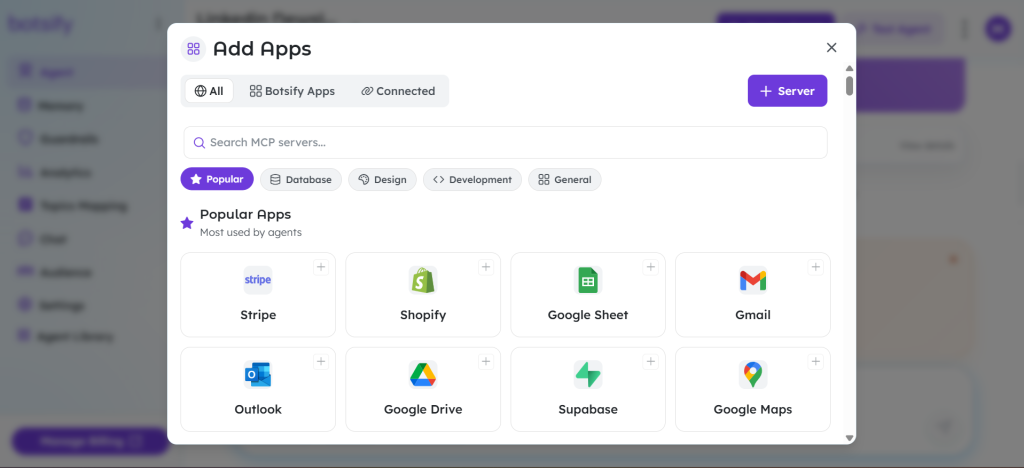
An agent may need to:
- Pull customer records from a CRM
- Update tickets in a helpdesk system
- Send emails
- Retrieve documents
- Trigger workflows
- Access internal dashboards
The platform provides the integration layer that connects agents to these systems securely.
In technical environments, developers might build integrations manually using AI agent frameworks, but platforms abstract this complexity. Instead of managing infrastructure, API authentication, and error handling from scratch, businesses configure integrations through managed connectors.
For example, a Slack AI agent deployed through a platform can respond to team queries, pull information from internal databases, and trigger actions, all without custom backend engineering.
This integration layer transforms an agent from a conversational interface into an operational assistant.
4. Deployment Across Channels
An AI agent platform is multi-channel by design.
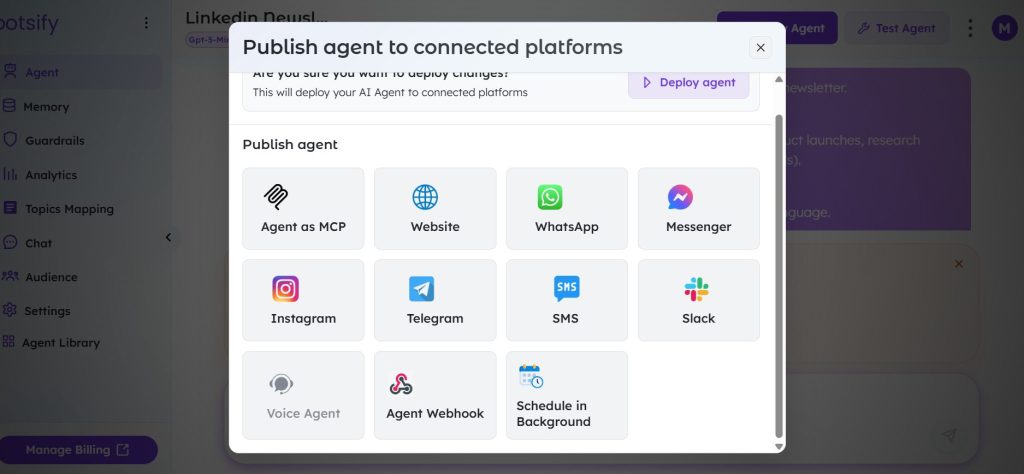
Agents can be deployed to:
- Websites
- Customer support portals
- Slack
- WhatsApp
- Internal dashboards
- Mobile applications
The ability to deploy across multiple environments from a single system is what separates a platform from a standalone bot solution.
For businesses, this means consistency. One agent logic can operate across multiple touchpoints without duplicating configuration.
Botsify, for instance, supports multi-channel deployment, allowing companies to manage customer-facing and internal agents from a unified dashboard.
5. Monitoring, Optimization, and Governance
Deployment is only the beginning.
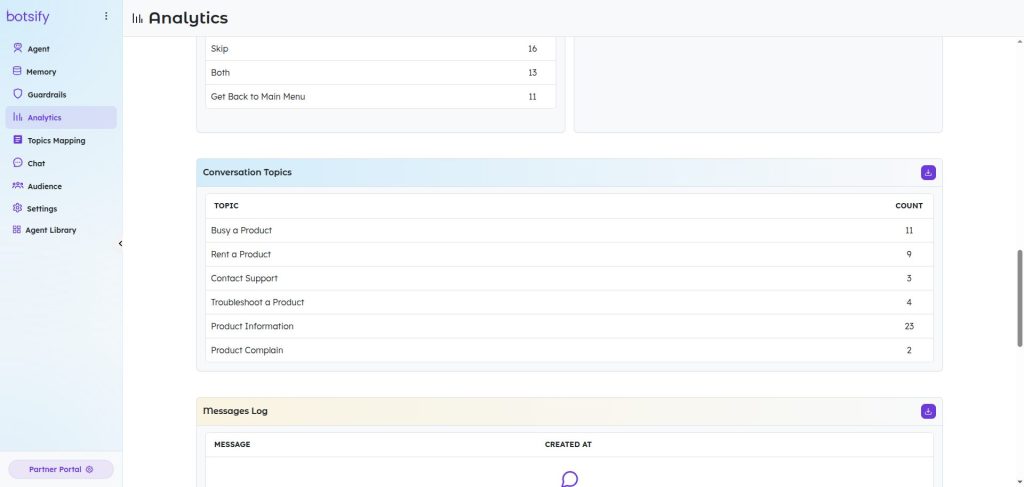
A mature AI agent platform includes:
- Performance analytics
- Conversation logs
- Escalation controls
- Human handoff workflows
- Usage monitoring
- Access controls
This governance layer ensures compliance, quality control, and continuous improvement.
Without centralized monitoring, AI deployments become fragmented and difficult to manage. Platforms provide accountability and visibility, which is especially important for enterprises and agencies managing multiple clients.
AI Agent Platform vs AI Agent Builder
These terms are often used interchangeably, but they are not the same.
An AI agent builder is the creation interface, the tool that allows users to design and configure agents.
An AI agent platform includes:
- The builder
- Deployment tools
- Integration systems
- Analytics
- Multi-user management
- Infrastructure hosting
- Security and compliance layers
In other words, the builder is a component. The platform is the ecosystem.
If your goal is simply to experiment with building an agent, a builder might suffice. But if your goal is to operate AI agents across departments, serve customers, and manage workflows, a platform is required.
Botsify provides both creation tools and full lifecycle management, which is why it functions as a comprehensive platform rather than just a builder interface.
AI Agent Platform vs AI Agent Frameworks
For technical teams, another important distinction is between platforms and frameworks.
AI agent frameworks such as LangChain or AutoGen provide libraries for building agents programmatically. They are powerful, flexible, and suitable for developers building highly customized solutions.
However, frameworks require:
- Backend engineering
- Infrastructure setup
- Hosting management
- Security implementation
- Ongoing maintenance
An AI agent platform abstracts those complexities. It provides:
- Managed hosting
- Pre-built integrations
- User management
- Visual configuration
- Operational dashboards
For organizations without dedicated AI engineering teams, platforms dramatically reduce time-to-deployment.
Botsify’s approach focuses on lowering the technical barrier while maintaining enterprise-level capabilities. This allows both technical and non-technical teams to launch and manage agents without building infrastructure from scratch.
Types of Businesses That Need an AI Agent Platform
Small and Growing Businesses
Smaller companies often operate with limited teams and tight budgets. Automation can create leverage, but managing custom-built systems is unrealistic.
An AI agent platform allows small businesses to:
- Automate support queries
- Qualify leads
- Schedule appointments
- Provide 24/7 responses
Many organizations exploring AI agents for small businesses find that platforms offer predictable costs and manageable complexity compared to hiring engineering teams.
Botsify enables smaller teams to deploy scalable AI without increasing headcount.
Agencies and Consultants
Agencies represent one of the fastest-growing segments for AI deployment.
An AI agent agency may build automation systems for multiple clients across industries. For these firms, scalability and branding matter.
A white label AI agent platform allows agencies to:
- Rebrand the software
- Manage multiple client accounts
- Set custom pricing
- Maintain centralized control

Botsify supports this model by enabling fully branded AI agent platforms under an agency’s identity. Agencies can operate as AI solution providers without building proprietary infrastructure.
Enterprises with Complex Workflows
Larger organizations often require:
- Multi-agent coordination
- Department-specific permissions
- Integration with internal systems
- Compliance and security controls
In these environments, custom AI agents may operate across customer support, operations, HR, and internal knowledge management.
Platforms enable enterprises to orchestrate agents across departments while maintaining oversight and governance.
What Makes a Good AI Agent Platform?
Choosing the right platform requires evaluating more than surface features.
Multi-Agent Support
Modern businesses rarely need just one agent. They need specialized agents that collaborate.
A good platform supports multiple agents operating under structured workflows, rather than isolated assistants.
Deep Integration Capabilities
The platform should connect seamlessly to CRM systems, databases, communication tools, and third-party APIs.
Without integration, agents remain conversational shells.
Scalability and Infrastructure Stability
Look for:
- Cloud-based hosting
- Role-based access controls
- Usage tracking
- High uptime reliability
A scalable system ensures that agents remain responsive even as usage increases.
White-Label and Branding Options
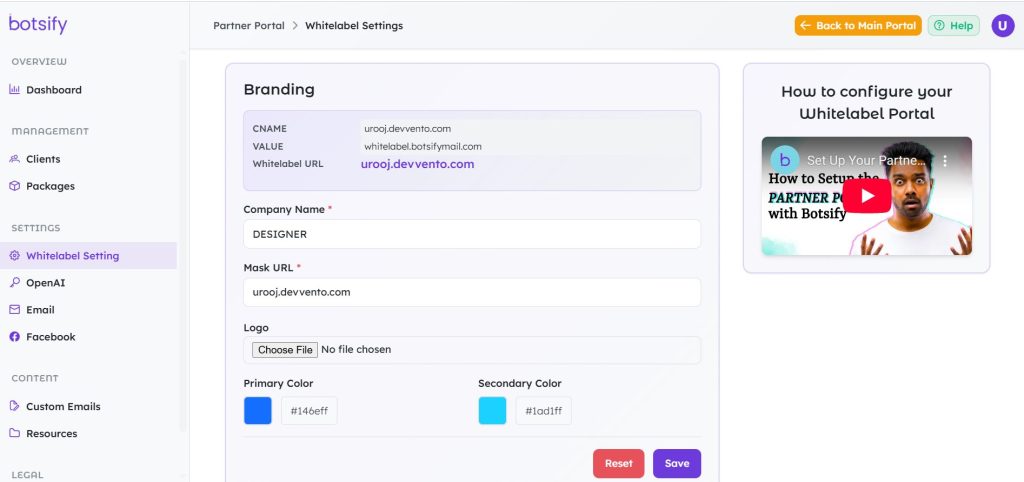
For agencies and SaaS entrepreneurs, branding control is critical.
Platforms offering white label AI capabilities allow users to operate under their own domain, logo, and pricing structure.
This enables businesses to build revenue streams using branded AI agent platforms without revealing the underlying provider.
Botsify’s white-label functionality is one of its strongest differentiators, enabling agencies to deploy AI solutions as proprietary offerings.
Customization and Flexibility
No two businesses are identical.
The ability to create custom AI agents tailored to industry-specific workflows, internal processes, and customer journeys is essential.
Rigid, template-only systems limit long-term value. Flexible platforms allow structured customization without sacrificing usability.
Real-World Applications of AI Agent Platforms
Understanding how an AI agent platform works conceptually is important. But its real value becomes clear when you see how businesses apply it in daily operations. Across industries, AI agents are no longer experimental tools, they are becoming operational layers that support customer interactions, internal workflows, and revenue generation.
Customer Support Automation
One of the most common use cases is customer support.
AI agents can answer frequently asked questions, check order statuses, process return requests, update customer records, and escalate complex issues to human representatives when needed. Because the agents operate within a centralized AI agent platform, support teams maintain visibility into performance, conversation logs, and resolution rates.
For ecommerce businesses, this becomes even more powerful when deploying a Shopify AI agent that integrates directly with store inventory, order data, and shipping systems. Instead of sending customers to static help pages, the agent can retrieve live order details and provide contextual assistance in real time.
This reduces ticket volume while improving response speed and customer satisfaction.
Internal Knowledge Assistants
AI agent platforms are equally valuable inside organizations.
Companies deploy intelligent assistants within communication tools to help employees retrieve documentation, check internal policies, and automate repetitive queries. A properly configured Slack AI agent integrated with knowledge bases and shared drives eliminates the need for manual document searches.
Beyond Slack, teams often deploy agents inside messaging environments such as a Telegram AI agent to support distributed teams or remote operations. These agents can provide structured information, notify departments of updates, and even trigger backend workflows, all managed centrally through the platform.
This internal layer improves operational efficiency without adding headcount.
Lead Qualification and Sales Routing
AI agent platforms are increasingly used to transform website traffic into structured sales pipelines.
Agents engage visitors, ask qualification questions, gather relevant details, and route leads to appropriate sales representatives automatically. Instead of static contact forms, businesses deploy conversational flows that adapt based on user responses.
Because the logic runs through a centralized system, marketing and sales teams can monitor performance metrics, optimize scripts, and refine routing rules without rebuilding infrastructure.
For companies operating in ecommerce or brick-and-mortar sectors, deploying an AI agent for retail can further enhance sales operations by recommending products, checking availability, and scheduling in-store visits, all while capturing actionable customer insights.
Marketing and Customer Engagement
Marketing teams use AI agents to personalize outreach, manage follow-ups, and guide customers through decision-making journeys.
Some organizations begin by evaluating the best AI agents available in the market. However, many eventually realize that pre-built solutions often lack the flexibility required for custom workflows. An AI agent platform allows marketing teams to design agents aligned with their own funnel structure, campaign objectives, and brand voice.
For example, ecommerce businesses can deploy agents that recommend products based on browsing behavior, notify customers of restocked inventory, or handle promotional campaigns across channels. Because everything operates within the same platform, data remains centralized and measurable.
This approach turns conversational AI into a structured revenue tool rather than a novelty feature.
Is an AI Agent Platform Right for Your Business?
An AI agent platform makes sense if:
- You need multi-step automation rather than static chat responses.
- You operate across multiple channels.
- You want visibility and analytics across deployments.
- You plan to scale usage over time.
- You want branding control or resale capability.
If you are only experimenting with AI for one isolated use case, a standalone tool might suffice temporarily. However, businesses aiming for long-term automation strategy benefit from centralized platforms.
Botsify is designed specifically for organizations that want both flexibility and scalability, whether they are small businesses, agencies, or enterprises.
Final Thoughts
An AI agent platform is not simply a chatbot system or a developer library. It is infrastructure.
It enables organizations to create intelligent agents, integrate them into workflows, deploy them across channels, and manage them responsibly.
As businesses increasingly adopt agent-driven automation, the difference between fragmented tools and centralized platforms becomes significant. Platforms provide structure, governance, scalability, and operational clarity.
Botsify’s approach reflects this shift. By combining agent creation tools, multi-channel deployment, white-label capabilities, and lifecycle management, it allows organizations to transition from experimental AI use to structured, production-ready deployments.
For businesses serious about automation, the question is no longer whether to use AI agents. It is how to deploy them sustainably.
An AI agent platform provides that foundation.
AI Agentic Platform For Building Portable AI Agents
Say Hello To Agentic AI That Connects With Your CRM And Even Other Agents
The post What Is an AI Agent Platform and How It Works? appeared first on Botsify.
]]>AI support isn’t magic. It’s backlog control. Read More »
The post AI support isn’t magic. It’s backlog control. appeared first on Botsify.
]]>Not glamorous. But effective.
Why support backlogs happen
Most queues swell for boring reasons:
- Volume grows faster than headcount.
- Repetitive questions clog the line: “Where’s my order?”, “How much is X?”, “How do I reset my password?”, the kind of predictable queries that even the best AI Agents are designed to handle efficiently.
- Manual triage eats time. A human reads, tags, asks for missing details, routes it, then waits.
- Customers follow up because they are stuck, and every follow-up is another ticket your team has to touch.
That last point is the silent killer. A customer who cannot find the right step will try three channels, send a screenshot, and copy in a colleague “just in case”. If you do not give them a clear next move fast, they generate more work for you.
What “AI for support” actually means
AI for support is not “replace the team”. It is three practical building blocks that reduce how often humans have to do the same first-line work, often powered by modern Agentic AI.
Understanding: AI reads a message and works out what it is about, like billing, delivery, returns, access, or troubleshooting. That matters because correct intent is what makes the next step fast. For example, “I can’t log in” should trigger account checks, not a generic FAQ link.
Answering: AI responds using approved content you give it, like help articles, policies, and product docs. Teams often configure this using an AI agent builder that connects knowledge sources in a controlled way. The key part is that it can ask a simple follow-up question when the message is vague, instead of guessing.
Routing: AI hands off the tricky or sensitive cases to a human, with context, so an agent does not start from scratch. This is where trust comes from, because escalation is not a failure. It is the design.
Actually, the biggest win is often triage, not the answer. Because when the request lands on the right person with the right details, resolution speed jumps even if the human still does the final step.
Here is a short, slightly awkward moment most ops teams recognise:
We launched a “new returns policy” page, then forgot to update two older articles.
Support copied the old snippet into replies, Marketing shared the new link, and customers quoted both back at us.
Then someone forwards it ‘for context’ and now there are three versions.
We fixed it by choosing one source page, redirecting the old links, and updating the agent macro to point to the same place.
The next day, the repeat tickets dropped because everyone was singing from one sheet, something that becomes even more important when working with structured AI agent frameworks that rely on consistent knowledge sources.
Where AI reduces backlog the fastest
If your goal is backlog relief, start where human effort is most wasted:
- Deflection before a ticket exists: Put instant answers on your site so customers do not email in the first place.
- Triage that collects missing details: Get the order number, account email, device type, or error code up front.
- Self-serve guidance: Point customers to the exact step, not a generic help centre. A good bot feels like “next step” guidance, not a search bar.
- 24/7 coverage: Night-time spikes and weekend questions stop becoming Monday morning piles.
One rule of thumb: if a question is common, stable, and answerable from a policy page, AI should handle it first. If it touches money disputes, identity, or edge-case judgement, route it to humans quickly and cleanly.
A simple way to implement it, plus two paths you can choose
You do not need a big programme. You need a small system that improves every week.
- Pick the top repetitive questions (start with 10 to 25). Pull them from tags, saved replies, or “what we answered five times yesterday”. This works because frequency is the fastest path to impact.
- Decide boundaries in plain language. Write down what the bot can do, and what must go to a person. For example, it can explain your returns process, but disputes still go to an agent.
- Create one clean source of truth. If your policies are spread across docs, old blog posts, and internal notes, the bot will mirror that mess. Clean up the core pages first.
- Launch in one place. A website widget is usually the simplest start, because it catches questions before they become tickets.
- Add a human handoff that feels smooth. The bot should pass the full conversation and the key facts to your team so customers do not repeat themselves.
- Run the operating loop weekly. Review what the bot could not answer, update the content, and expand coverage slowly.
To make this operational, you only need a few decisions that keep things tidy and safe. Here are three that work in real teams: keep chat transcripts deleted after 30 days while summaries are kept for 12 months; set a clear ownership pattern where Ops owns retention, Support owns approved answers, and Security approves exceptions; and run a monthly access review that checks who can view transcripts, who can edit bot content, and which channels are enabled. These stop “quick wins” turning into long-term mess.
Products such as Botsify and Mando help reduce support backlog by removing the “same questions, every day” work from your team’s queue and handling it at the point customers actually need help. They sit in front of your inbox and deal with the first-line requests that slow everything down: order status, pricing, basic how-to steps, returns rules, booking changes, and account access guidance. Instead of an agent reading, tagging, asking for missing details, and then replying, the assistant can recognise what the customer is trying to do, answer from your approved help content, and ask a simple follow-up when the message is unclear. That alone cuts down on back-and-forth, which is where a lot of hidden ticket volume comes from.
They also help with triage, which is often the quickest win. A good assistant can sort requests into the right bucket, collect key details up front (like an order number, email address, plan type, or screenshot), and then route anything complex to a human with a clean summary of what happened so far. That means agents start with context, not a blank page, and customers do not have to repeat themselves. The result is not “support without people”. It is support that moves faster, because the simple stuff is handled instantly and the important stuff reaches the right person sooner.
AI Agentic Platform For Building Portable AI Agents
Say Hello To Agentic AI That Connects With Your CRM And Even Other Agents
The post AI support isn’t magic. It’s backlog control. appeared first on Botsify.
]]>AI-Powered Amazon Advertising: How Machine Learning Is Reshaping PPC Strategy Read More »
The post AI-Powered Amazon Advertising: How Machine Learning Is Reshaping PPC Strategy appeared first on Botsify.
]]>Machine learning and emerging agentic AI systems are no longer a future promise in Amazon PPC. It is an operational reality that is reshaping how campaigns are structured, how bids are managed, and how budgets are allocated. Sellers and agencies that have integrated ML-driven tools into their advertising workflows are seeing measurable improvements in efficiency. Those still relying on manual optimization and rule-based automation are falling behind, especially at scale. The divide is no longer between sellers who advertise and those who do not. It is between those who optimize algorithmically and those still adjusting bids in spreadsheets. On the agency side, the same split exists: an Amazon advertising agency built around ML infrastructure operates fundamentally differently from one that relies on manual account management.
Where exactly is machine learning making the biggest impact?
Bid Optimization: From Rules to Predictions
The first generation of Amazon PPC tools worked on simple rules. If ACoS exceeds 25%, lower the bid by 10%. If a keyword has zero sales after 20 clicks, pause it. These rules are better than no optimization at all, but they are blunt instruments. They react to past performance without considering the variables that influence future outcomes.
A machine learning–powered AI agent for bid optimization works differently. Instead of applying static rules, ML models analyze historical data across multiple dimensions: time of day, day of week, device type, placement position, seasonality patterns, and competitive density. Based on these inputs, the model predicts the conversion probability for each keyword at each potential bid level and adjusts accordingly.
The practical difference is significant. A rule-based system treats every Monday the same. An ML model recognizes that conversions for a specific keyword spike on Monday evenings and adjusts bids to capture that window. A rule-based system lowers bids uniformly when ACoS rises. An ML model identifies that ACoS increased because a competitor launched an aggressive campaign last week and predicts that CPCs will normalize within days, avoiding unnecessary bid reductions that sacrifice visibility.
At scale, these granular adjustments compound. A seller managing 3,000 keywords cannot evaluate each one multiple times per day. An algorithm can, and the aggregate efficiency gains across thousands of micro-decisions add up to meaningful budget savings.
Campaign Structure: Algorithmic Segmentation
Machine learning is also changing how campaigns are structured in the first place. Traditional campaign setup follows best practices that experienced PPC managers have developed over time: separate branded from generic keywords, segment by match type, isolate top performers in their own campaigns. These principles remain valid, but ML tools can now take segmentation further.
Clustering algorithms analyze keyword performance data and group terms based on behavioral similarity rather than semantic similarity. Two keywords that look unrelated in terms of language may share nearly identical conversion patterns, audience overlap, and seasonal curves. Grouping them in the same campaign allows for more efficient budget allocation and cleaner performance analysis.
This approach is particularly valuable for sellers with large catalogs. A brand with 200 ASINs across multiple categories cannot afford to build and manage campaign structures manually for each product. ML-driven tools can generate and maintain optimized structures at a scale that would require a team of PPC specialists to replicate. Many advanced platforms now use an AI agent builder to customize campaign structuring logic based on product category, competitive landscape, and margin thresholds.
Budget Allocation: Portfolio-Level Intelligence
One of the most impactful applications of machine learning in Amazon advertising is dynamic budget allocation across campaigns and formats. Most sellers set daily budgets per campaign and adjust them periodically based on performance. This approach leaves money on the table because it cannot respond to intra-day fluctuations in demand and competition.
ML-powered portfolio management treats the entire advertising budget as a pool that gets allocated in real time to wherever the highest marginal return is available. Some agencies operate on a white label AI agent platform that enables this kind of real-time budget orchestration across multiple client accounts simultaneously. If Sponsored Products campaigns for a specific product are experiencing unusually high conversion rates on a given afternoon, the system shifts budget from lower-performing campaigns to capture the opportunity. If a Sponsored Brands campaign is exhausting its budget by noon without proportional returns, the system reallocates.
This portfolio approach also works across advertising formats. The optimal split between Sponsored Products, Sponsored Brands, Sponsored Display, and DSP is not static. It shifts based on product lifecycle, competitive dynamics, and seasonal patterns. ML models that observe these shifts continuously can rebalance budgets faster than any manual review cycle.
Predictive Analytics: Anticipating Rather Than Reacting
Beyond optimizing current campaigns, machine learning enables predictive capabilities that change how sellers plan their advertising strategy. Demand forecasting models analyze historical sales data, search volume trends, and external signals to predict when demand for specific products will increase or decrease.
For seasonal products, this means campaigns can be scaled up before demand peaks rather than after. For product launches, predictive models can estimate the advertising investment needed to reach a target organic ranking based on the competitive density of relevant keywords. For inventory-constrained products, demand predictions help sellers avoid the costly mistake of driving advertising traffic to products that will go out of stock.
These predictions are not perfect. No model can account for every variable. But even directionally accurate forecasts give sellers a planning advantage over competitors who operate purely reactively.
The Human Layer: Strategy Still Matters
Machine learning excels at optimization within defined parameters. It does not excel at defining those parameters. Which products to prioritize, what margin thresholds to accept, when to invest aggressively in market share versus when to optimize for profitability: these are strategic decisions that require business context an algorithm does not have.
The most effective Amazon advertising operations, especially within an AI agent agency model, combine algorithmic execution with human strategy. ML handles the high-frequency, data-intensive work: bid adjustments, budget reallocation, keyword harvesting, and performance monitoring. Humans handle the decisions that require judgment: campaign architecture, format selection, competitive positioning, and alignment with broader business goals.
Sellers who hand everything to an algorithm without strategic oversight end up optimizing for metrics that may not align with their actual objectives. Sellers who ignore algorithms and manage everything manually cannot compete at the speed and scale the marketplace demands. The winning combination is both.
Conclusion
Machine learning has moved from experimental to essential in Amazon advertising. The sellers and agencies that have adopted ML-driven optimization are operating at a level of precision and speed that manual management cannot replicate. For sellers still relying on weekly bid reviews and rule-based automations, the gap will only widen. The technology is not a replacement for strategic thinking, but it is the infrastructure that makes strategic thinking scalable.
AI Agentic Platform For Building Portable AI Agents
Say Hello To Agentic AI That Connects With Your CRM And Even Other Agents
The post AI-Powered Amazon Advertising: How Machine Learning Is Reshaping PPC Strategy appeared first on Botsify.
]]>Human vs AI content in guest blogging: What actually earns authoritative backlinks? Read More »
The post Human vs AI content in guest blogging: What actually earns authoritative backlinks? appeared first on Botsify.
]]>What was once a slow, manual process is now heavily influenced by AI. Content can be generated in minutes, outlines can be built instantly, and entire guest posts can be drafted without a single human keystroke. This shift has created a new debate across SEO and publishing circles.
If everyone can create content at scale, what actually earns authoritative backlinks anymore?
Many brands that rely on guest posting services are now facing this exact question. The volume of guest content has exploded, but authoritative backlinks have become harder to secure. Editors are becoming more selective, and not all content is treated equally.
So the real question is no longer human versus AI. It is understanding what kind of content actually earns trust in guest blogging today.
Key takeaways
- AI has increased guest blogging volume, but not necessarily authority.
- Editors prioritize originality over content scale.
- Human insights still drive most authoritative backlinks.
- AI works best as an assistant, not a replacement.
- GEO differences influence how AI content is perceived.
- Hybrid workflows are emerging as the most effective model.
The rise of AI in guest blogging
AI and emerging agentic AI systems have significantly lowered the barrier to entry for guest blogging.
Today, anyone can generate structured, readable articles quickly. From ideation to drafting, AI tools have compressed what used to take days into hours. For brands trying to scale visibility, this is extremely appealing and operationally efficient.
This shift has led to a surge in guest submissions across industries. Publications that once received occasional pitches are now flooded with content proposals, and in some niches, the volume of guest blogging has multiplied rapidly.
However, more content does not automatically translate into more authority. As supply increases, editorial filters become stricter, and that is where the divide between human and AI content begins to surface.
Why are authoritative backlinks getting harder to earn?
Authoritative backlinks have always been scarce, but AI has made them even more competitive.
When content becomes abundant, attention becomes selective. Editors are no longer impressed by well-structured articles alone. Instead, they look for contributions that genuinely add value and strengthen their publication’s credibility.
Several shifts are driving this change.
- Content saturation: AI has dramatically increased content supply, making it harder for average articles to stand out.
- Higher editorial standards: Publications are becoming more selective to protect their authority and reader trust.
- Originality expectations: Editors increasingly prioritize unique insights over well-packaged summaries.
- Credibility filtering: Backlinks now function as trust signals, which makes editors more cautious about what they reference.
- Quality over volume mindset: Even brands that buy guest posts are becoming more selective, prioritizing credibility over scale.
As a result, many guest posts that appear polished still fail to earn meaningful backlinks. The difference is rarely formatting or grammar. More often, it comes down to depth and originality.
How do editors evaluate guest content today?
To understand what earns backlinks, it helps to understand how editors actually think.
Most editors are not simply evaluating writing quality. They are evaluating credibility. Every outbound link reflects on their publication’s authority, which makes them highly selective about what they publish and reference.
In practice, editorial evaluation tends to follow a few key signals.
- Clear point of view: Distinct perspectives help publications offer value beyond generic information.
- Evidence of experience: Real-world insight signals authenticity and strengthens perceived expertise.
- Fresh angles: New interpretations of familiar topics make content more reference-worthy.
- Audience alignment: Content that matches reader expectations is more likely to earn placement and links.
- Editorial originality: This shift is also reshaping how guest blogging services approach content, with stronger emphasis on unique positioning.
If a piece feels templated or overly familiar, it is far less likely to earn strong placements or authoritative citations.
Where does AI content perform well in guest blogging?
It is important to acknowledge that AI is not inherently negative for guest blogging.
In fact, an AI agent can perform exceptionally well in several areas of the guest blogging workflow. AI excels at organizing information, generating outlines, and accelerating drafting cycles. It enables teams to scale content production and maintain consistency across multiple contributions.
AI is particularly useful for research summarization, structuring long-form content, generating topic variations, and producing first drafts efficiently.
However, efficiency alone does not guarantee authority. That distinction becomes more visible as editorial standards rise.
Where does AI content struggle to earn authority links?
Despite its advantages, AI content often struggles in areas that influence authoritative backlinks.
One of the most common challenges is familiarity. To address this, many teams now use an AI humanizer to refine tone, improve natural phrasing, and reduce the robotic patterns that editors often recognize in automated drafts. AI tends to generate recognizable patterns, and even when the content is technically accurate, it can lack distinctiveness.
Many teams that buy guest blogs are now re-evaluating quality, especially as editors become more sensitive to templated content.
Another limitation is the depth of perspective. AI can explain concepts clearly, but without strong human direction, it rarely introduces genuinely new thinking.
This creates a subtle gap where content looks polished yet feels replaceable.
Why does the human perspective still win authoritative backlinks?
Human-written content continues to perform well because it introduces individuality and lived insight.
Real experiences, informed opinions, and contrarian viewpoints are difficult to replicate at scale. These elements make content memorable and provide editors with something worth referencing.
Human perspective also signals ownership. When an article reflects lived expertise or first-hand interpretation, it carries credibility that is difficult to synthesize artificially.
Even brands that buy guest posts are realizing that authority comes from insight, not just placement.
This is why authoritative backlinks tend to cluster around content that feels grounded in authentic insight.
GEO differences: How markets perceive AI vs human content?
Perception of AI-generated content varies across regions.
In the United States, the volume of AI-generated content is extremely high, which has increased editorial scrutiny. Many editors place greater emphasis on originality and unique perspective when awarding authoritative backlinks.
The United Kingdom tends to value narrative voice and thought leadership more strongly. Readers often respond well to perspective-driven content, which gives human-authored guest posts an advantage in credibility-focused niches.
Australia presents a more balanced environment. While AI adoption is growing, editorial ecosystems are smaller and more relationship-driven, meaning credibility often depends on familiarity and context.
These nuances matter for global brands and also influence how guest blogging services tailor strategies across regions.
Hybrid content: Where human and AI work best together
Instead of treating human and AI content as opposing forces, many teams are adopting hybrid workflows.
In these models, AI handles structure and speed, while humans provide insight and positioning, often using an AI agent builder to customize workflows around specific editorial goals. This combination allows brands to scale content without losing authenticity. Some agencies now rely on a white label AI agent platform to manage guest content production while maintaining their own branding and editorial standards.
A typical hybrid workflow may involve AI-assisted outlining, human editing for voice and clarity, expert input for depth, and final polishing for originality.
As a result, even teams that buy guest blogs are combining AI drafting with human editing to preserve originality.
This layered approach balances efficiency with authority.
What actually earns authoritative backlinks in 2026?
If there is one clear takeaway from the human versus AI discussion, it is that backlinks follow authority rather than content volume alone.
In 2026, authoritative backlinks are most consistently earned by content that signals credibility in ways editors and readers immediately recognize. Several qualities tend to stand out.
- Original thinking: Unique perspectives give publications something worth referencing instead of repeating what already exists.
- Clear expertise: Demonstrated subject-matter depth signals that the content is grounded in real knowledge rather than surface-level synthesis.
- Narrative clarity: Well-structured ideas make insights easier to understand, quote, and cite across different formats.
- Audience relevance: Content that aligns closely with a publication’s readership naturally attracts stronger editorial support.
- Visible authorship: A clear human voice or perspective signals ownership, making the content feel more trustworthy and intentional.
These qualities can exist in AI-assisted content, even when using a specialized SEO blog writer AI agent, but they almost always require meaningful human involvement. The more competitive the publication, the more these factors influence whether backlinks are earned.
The future of authority in guest blogging
As AI continues to evolve, content production will only become easier. That means the real differentiator will not be who publishes more, but who earns more trust.
Authority is becoming more valuable as content supply increases, and both editors and readers are relying more heavily on credibility signals when deciding what to cite and share.
Guest blogging is not disappearing, but its dynamics are shifting. Instead of rewarding scale alone, it is increasingly rewarding distinctiveness.
For brands working with guest blogging services or an AI agent agency, the message is clear: authority is now driven by perspective rather than production speed
AI can scale content, but authority still feels human.
AI Agentic Platform For Building Portable AI Agents
Say Hello To Agentic AI That Connects With Your CRM And Even Other Agents
The post Human vs AI content in guest blogging: What actually earns authoritative backlinks? appeared first on Botsify.
]]>Hidden Costs of Fintech App Development Most Teams Miss Read More »
The post Hidden Costs of Fintech App Development Most Teams Miss appeared first on Botsify.
]]>Yet most teams focus their budgets almost entirely on the build phase, overlooking expenses that can account for 40% to 60% of the project’s true cost. Compliance requirements, security infrastructure, and post-launch operations create financial demands that often surface only after development is underway.
This article breaks down the hidden pre-launch, post-launch, and operational costs that catch fintech teams off guard and offers strategies for building a budget that reflects reality.
Pre-Launch Costs That Go Beyond Development
Building a fintech application involves far more than design and coding. Before launch day, teams encounter regulatory, security, and integration expenses that standard project budgets rarely account for.
Compliance and Regulatory Licensing
Financial applications must meet strict regulatory standards, including PCI DSS, GDPR, KYC, and AML requirements. Each regulation demands specific technical implementations, legal consultations, and documentation processes that add significant hours to the project timeline.
Licensing fees compound the problem. Payment processing, data handling, and advisory features may each require separate approvals depending on the markets you serve. These fees can reach six figures annually, and many teams only discover them after development begins.
Understanding how to develop a fintech app with compliance built into the foundation helps teams anticipate these requirements before writing a single line of code.
Security Architecture from Day One
Financial applications handle sensitive data that attracts sophisticated cyberattacks. Standard security measures fall short. You need multi-layered encryption, tokenization, intrusion detection, and regular penetration testing.
Building security into your architecture from the start is critical. Retrofitting it after initial development typically costs three to five times more than planning for it upfront. Budget for ongoing security audits and compliance certifications as recurring annual expenses.

Third-Party Integrations and API Fees
Fintech apps connect to banking APIs, payment gateways, credit bureaus, and identity verification services. Each integration carries its own fee structure, and costs add up quickly.
Many providers charge per transaction, which means expenses scale directly with user growth. A feature costing $200 per month during testing can climb to $20,000 per month at production scale. Map every integration dependency and its pricing model before finalizing your budget.
Post-Launch Expenses That Quietly Drain Budgets
The build phase represents only a fraction of the total investment. Post-launch costs often surprise teams that concentrated all their planning on getting to launch day.
Ongoing Maintenance and Regulatory Updates
Annual maintenance costs typically run 15% to 20% of the original development investment. For a $150,000 build, that translates to roughly $22,500 to $30,000 each year just to keep the application current and functional.
Financial regulations also change frequently, and your application must adapt within strict deadlines. This requires either a dedicated in-house team or a reliable technology partner. Working with an experienced firm like Space-O Technologies ensures your application stays compliant without scrambling for resources during critical update windows.
Infrastructure Scaling Under Real-World Load
Cloud infrastructure costs for fintech applications grow faster than most teams anticipate. Financial transactions demand low latency and high availability, which requires premium hosting configurations.
During peak periods like paydays, tax seasons, and market volatility events, auto-scaling can multiply infrastructure expenses several times over. As the financial services application market continues expanding, the infrastructure demands on fintech platforms, especially those integrating the best AI agents for automation, fraud detection, and customer engagement, grow alongside it. Plan for at least three times your average load capacity.
Fraud Monitoring and Specialized Support
Financial applications require customer support teams trained specifically for sensitive financial inquiries. Many fintech companies now deploy AI chatbots to handle first-level queries, but these systems also require ongoing monitoring, training, and compliance oversight. Generic support structures are not sufficient when users face payment disputes or account security concerns.
Fraud detection tools, chargeback management, and dispute resolution systems carry ongoing costs that most initial budgets overlook completely. For many fintech companies, these operational expenses become one of the largest recurring line items in their annual technology budget.
Building a Realistic Fintech App Development Budget
Accurate budgeting requires a shift from project-phase thinking to lifecycle thinking. The goal is to plan for every cost your application will generate, not just the initial build.
Map the Full Cost Lifecycle Before Writing Code
Create a comprehensive cost map covering development, compliance, security, integrations, infrastructure, maintenance, operations, and any third-party tools such as a White label AI agent Platform used to accelerate deployment. Assign realistic estimates to each category and include a contingency buffer of 20% to 30% for unforeseen expenses.
Review this cost map with stakeholders who have direct experience building regulated financial applications. Their perspective will reveal blind spots that internal teams consistently miss.

Choose a Development Partner with Fintech Experience
Generic development teams frequently lack awareness of fintech-specific requirements. This knowledge gap leads to costly rework when compliance gaps or security vulnerabilities surface late in the project.
Select partners who demonstrate proven experience in the financial services sector. Ask for case studies, compliance certifications, and references from similar projects. The right partner prevents expensive mid-project corrections that derail timelines and budgets alike.
Conclusion
Building a financial services application costs significantly more than the development phase alone suggests. Compliance licensing, security architecture, third-party integrations, ongoing maintenance, and operational support create layers of expense that standard budgets rarely capture.
The difference between fintech projects that succeed and those that stall comes down to planning. Teams that map the full cost lifecycle upfront, build contingency into their budgets, and partner with experienced firms consistently deliver stronger applications without the budget overruns that derail so many projects in this space.
AI Agentic Platform For Building Portable AI Agents
Say Hello To Agentic AI That Connects With Your CRM And Even Other Agents
The post Hidden Costs of Fintech App Development Most Teams Miss appeared first on Botsify.
]]>