“Yes, the technology is complex,” Kyle says. “But the people are deeply engaged, curious, and proud of what they’re building. Conversations go far beyond transactions, they’re about missions, tradeoffs, and long-term goals.”
Coming from sales roles in prop tech, real estate, and healthcare, the difference was clear. The people in space care deeply about their missions and take pride in what they are doing. Space is their life. “The watercooler conversations look completely different at a place like Dcubed,” Kyle says. “Instead of talking about last week’s football game, they’re talking about who’s launching when and what.”
That culture shapes not only how products are built, but also how business gets done.
Speaking Space, Not Just Selling It
Like anyone entering a highly specialized industry, Kyle’s first weeks required rapid immersion. Space conversations move quickly: acronyms, mission architectures, test campaigns, performance data, all part of everyday dialogue.
He approached the learning curve deliberately: targeted coursework, focused self-study, and constant exposure through customer conversations. While his foundation is in sales and business development, Kyle understood early on that succeeding in space would require leaning into his engineering background as well.
It’s that blend, commercial instinct paired with technical fluency, that allows him to operate effectively at Dcubed.
“The goal was always to understand enough to ask the right questions, follow the logic, and engage meaningfully.”
That balance quickly became second nature, enabling more substantive discussions about where Dcubed’s products fit and why they matter.
Engineers Do Not “Buy” The Hype
It became clear quickly that space rewards a different kind of sales approach, one grounded in credibility and thoughtful dialogue.
For Kyle, that wasn’t a shift. His style has always centered on curiosity, education, and building relationships that extend beyond a single transaction. In space, that mindset isn’t just appreciated, it’s expected.
Dcubed’s sales approach reflects that reality. Engineers lead buying decisions. Trust is earned through curiosity, consistency, and respect for the technical process.
“If there’s a strong fit, things move forward naturally. If not, relationships still matter because there’s always another project.” That long term mindset aligns naturally with Dcubed’s culture and product philosophy.
Fast Is Good. Reliable Is Better
One of Kyle’s early highlights underscored what differentiates Dcubed operationally. When Intuitive Machines approached the team with an urgent request and evolving specifications, Dcubed responded with speed and flexibility. The team delivered a full proposal over a single weekend, and within weeks a partnership was in place.
“That moment reinforced another thing customers value about us,” Kyle says. “Responsiveness, clarity, and execution.”
Like the broader space sector, the year also brought external challenges. Events such as the US government shutdown slowed decision making across the market. A reminder that even strong momentum can be affected by factors beyond any single company’s control.
“What matters is how you navigate that reality,” Kyle notes. “Staying close to customers and continuing to build trust in the midst of uncertainty.”
Competing as a NewSpace Company
Dcubed operates in a market with deeply entrenched incumbents, many with decades of flight heritage. That heritage matters, but it isn’t the whole story. “What customers increasingly care about is execution,” Kyle explains. “Speed, adaptability, and collaboration.”
Dcubed’s NewSpace positioning appeals to teams that value momentum and partnership over rigid legacy processes. With growing flight heritage now firmly established, conversations have shifted further toward the value that Dcubed has to offer its customers.
Breaking into locked in designs remains challenging across the industry, which is why relationship building starts early and continues over time.
Looking Ahead
Today, Kyle’s focus is clear: build relationships that outlast individual contracts and contribute to Dcubed’s long term presence in the market.
Success, in his view, isn’t measured only in closed deals, but in becoming a trusted partner within a tightly connected industry.
“In a small community like space, reputation travels,” he says. “When people know you’re thoughtful, reliable, and collaborative, everything else follows.”
At Dcubed, that philosophy isn’t a strategy layered onto sales. It reflects how the company approaches engineering, partnerships, and growth, steadily, deliberately, and with an eye on the long term.
Book a call with Kyle to talk more about Release Actuators and Solar Arrays here.
]]>Dcubed GmbH has entered into a strategic partnership with EnduroSat, satellite infrastructure builder to support the serial production of company’s next-generation ESPA-class satellite platform, FRAME. Under the agreement, Dcubed will supply its flight-proven HDRMs for critical deployment functions on board the spacecraft.
As part of the partnership, Dcubed’s Micro Release Nuts (uD3RN) will be used to deploy the satellite’s solar array power subsystems in orbit—one of the most mission-critical phases of any spacecraft operation. The selection of Dcubed reflects its strong technical heritage, proven in-flight performance, and ability to meet demanding program constraints.
A key factor in reaching the agreement was Dcubed’s ability to commit to an aggressive delivery schedule within a highly constrained budget. This was made possible by the company’s serial production approach and robust, well-established supply chain. In addition to its technical credibility, Dcubed’s highly responsive and collaborative team played a decisive role in enabling the partnership to move forward quickly.
Viktor Danchev, CTO at Endurosat commented: “Dcubed’s flight-proven HDRMs are helping us bring down the cost of any space data and accelerate time to orbit with a secure supply chain.”
Markus Geiss, Chief Commercial Officer at Dcubed, added: “Dcubed is excited to work as a strategic partner with leading New Space companies like EnduroSat across the US and Europe. By leveraging our existing release mechanism and power subsystem technologies, we are helping enable the space infrastructure of the future.”
Looking ahead, Dcubed continues to innovate in the development of larger and more powerful release actuators, including the Milli Release Nut, which may be perfectly suitable for ESPA-class satellite platforms such as FRAME. In parallel, the company’s pioneering work on large, high-power ISM solar arrays—designed to be manufactured and deployed in orbit—further strengthens its position as a technology leader supporting the growing in-space economy.
About EnduroSat
EnduroSat is a satellite manufacturer and space services provider, streamlining space missions in low Earth orbit (LEO) and beyond. The company manages every step – from mission design to launch and operations – serving over 400 customers globally and employing more than 300 space professionals across 7 locations worldwide.
About Dcubed
Dcubed enables the future of space missions with high-performance, flight-proven release mechanisms and solar arrays. From cutting-edge Release Actuators to scalable Deployable Solar Arrays, our technologies are designed for user friendliness, availability, and reliability — whether for smallsats in LEO or large missions to Moon, Mars and beyond.
Headquartered in Munich, Germany, with a manufacturing presence in Denver, Colorado, Dcubed serves a global space industry with off-the-shelf and customizable hardware that accelerates mission timelines and reduces cost and risk.
With a proven track record of over 150 products in space, we are at the forefront of In-Space Manufacturing and are proud to push the boundaries of what’s possible with lightweight, compact, and efficient deployable systems. We work closely with satellite integrators, subsystem builders, space agencies, primes, and emerging players across the globe — building the enabling technologies that will power the next generation of commercial and exploration missions.
]]>Munich, Germany — 11th of December — Dcubed is delighted to announce that it has been selected by Sidus Space to supply Nano Pin Pullers for the next generation of LizzieSat satellites. The release mechanisms will be used to deploy eight rigid solar arrays per spacecraft once in orbit, supporting Sidus’s continued innovation in compact satellite design.
For earlier missions, Sidus utilized internally developed burn wire release systems. As the LizzieSat platform evolved, Sidus sought a more streamlined and scalable deployment solution. After evaluating multiple options, Sidus selected Dcubed’s nano pin pullers.
Dcubed’s mechanisms were chosen for their resettable and scalable design, offering a significant improvement over single use burn wire systems. Their proven flight heritage and rapid delivery capability also played a key role in the decision, helping Sidus accelerate testing and de-risk satellite assembly ahead of launch.
Engineering models have already been delivered, and the testing campaign is underway through Q4 2025. Flight unit delivery is scheduled for December 2025, keeping the LizzieSat micro-constellation firmly on track.
“Integrating Dcubed’s Nano Pin Pullers into our LizzieSat platform enhances our deployment architecture,” said Carol Craig, Founder and CEO of Sidus Space. “Their resettable Hold-Down and Release Mechanisms (HDRMs) technology replaces single-use systems, enabling rapid test cycles and reducing integration risk. These capabilities are critical as we scale our constellation and maintain precision and reliability under aggressive timelines.”
“We’re proud that Sidus Space has placed its trust in our release mechanisms,” said Dr. Thomas Sinn, CEO, Dcubed. “Our nano pin pullers have a strong record of performance and reusability, and we’re confident they’ll contribute to the success of the LizzieSat micro-constellation. This partnership is an exciting step that we believe will lead to deeper collaboration in the future.”
As demand grows for faster, more flexible spacecraft production, Dcubed continues to build its reputation as one of the world’s most capable providers of responsive manufacturing solutions for dynamic space missions.
About Dcubed
Dcubed enables the future of space missions with high-performance, flight-proven release mechanisms and solar arrays. From cutting-edge Release Actuators to scalable Deployable Solar Arrays, our technologies are designed for user friendliness, availability, and reliability — whether for smallsats in LEO or large missions to Moon, Mars and beyond.
Headquartered in Munich, Germany, with a manufacturing presence in Denver, Colorado, Dcubed serves a global space industry with off-the-shelf and customizable hardware that accelerates mission timelines and reduces cost and risk.
With a proven track record of over 150 products in space, we are at the forefront of In-Space Manufacturing and are proud to push the boundaries of what’s possible with lightweight, compact, and efficient deployable systems. We work closely with satellite integrators, subsystem builders, space agencies, primes, and emerging players across the globe — building the enabling technologies that will power the next generation of commercial and exploration missions.
For more information, visit: www.dcubed-space.com
About Sidus Space
Sidus Space® (NASDAQ: SIDU) is an innovative space and defense technology provider offering flexible, cost-effective solutions, including satellite manufacturing and technology integration, AI-driven space-based data solutions, mission planning and management operations, AI/ML products and services, and space and defense hardware manufacturing. With its mission of Space Access Reimagined®, Sidus Space is committed to rapid innovation, adaptable and cost-effective solutions, and the optimization of space system and data collection performance. With demonstrated space heritage, including manufacturing and operating its own satellite and sensor system, LizzieSat®, Sidus Space serves government, defense, intelligence, and commercial companies around the globe. Strategically headquartered on Florida’s Space Coast, Sidus Space operates a 35,000-square-foot space manufacturing, assembly, integration, and testing facility and provides easy access to nearby launch facilities.
For more information, visit: www.sidusspace.com
]]>Bremen, Germany — 18th of November 2025 — Dcubed GmbH, a leader in release actuators, deployable space structures and In-Space Manufacturing (ISM) technologies, today announced its expansion into space-based energy systems with the introduction of ARAQYS — the power solution for space. With ARAQYS, Dcubed is positioning itself as the category leader in delivering affordable, scalable, and unlimited energy in orbit.
After SpaceX, Rocket Lab, and others transformed access to space through lower launch costs and increased capacity, a new generation of in-orbit applications—from data centers, high delta-v transportation and direct-to-device communications to defense constellations—has emerged. Each shares a common challenge: a massive demand for affordable, scalable power.
ARAQYS addresses this by providing a full spectrum of space power solutions—from traditional deployable solar arrays to their proprietary in-space-manufactured kW solar array subsystems, and ultimately to Space Power Plants capable of beaming energy wherever it’s needed. This technology aims to dramatically reduce the cost per kilowatt, laying the groundwork for space infrastructure and directed-energy platforms of the future.
“Dcubed is fully committed to leading the next frontier: power generation in orbit,” said Dr. Thomas Sinn, CEO of Dcubed. “My involvement in a NASA NIAC study on space-based solar power more than 15 years ago set this journey in motion. Since then, we’ve been steadily developing the technologies required to make in-space energy a practical reality. With ARAQYS, we’re now combining those years of innovation into affordable large-scale power solutions designed to meet the demands of the rapidly growing space economy.”
The ARAQYS-D3 Mission: Building the Future of Space Power
As the next step toward this vision, Dcubed announced the ARAQYS-D3 mission, which is manifested for launch in Q1 2027 aboard a SpaceX Rideshare mission. This mission will demonstrate a 2kW in-space-manufactured solar array with combined application cases in power-beaming and directed energy, as well as demonstrating electric-propulsion-enabled high delta-v capabilities.
The ARAQYS-D3 satellite will be built by Astro Digital, a heritage spacecraft bus provider located just a few miles from Dcubed USA’s headquarters in Berthoud, Colorado. This close proximity enables tight collaboration between European and American teams, symbolizing transatlantic cooperation in advancing the next era of space systems.
The launch of ARAQYS-D3 is brokered by Maverick Space Systems, who will also provide launch management and integration services for the satellite. Maverick’s support will help Dcubed streamline the launch process, reduce risk, and allow us to focus on the ARAQYS-D3 mission.
“We’re excited to partner with Dcubed on this groundbreaking mission,” said Chris Biddy, CEO of Astro Digital. “The ARAQYS-D3 satellite will demonstrate how in-space manufacturing and large-scale economic power generation can unlock a new class of small satellites—capable of generating, storing, and transmitting the energy required for the next generation of orbital missions.”
“We’re grateful to be supporting the launch of the ARAQYS-D3 mission,” said Roland Coelho, CEO of Maverick Space. “We see this as just the beginning of a close collaboration with Dcubed on future projects and developments.”
Dr. Sinn added: “It’s an honor to partner with Astro Digital and Maverick. This collaboration brings Europe and the United States closer together, uniting two space ecosystems to shape the future of satellite design and space power delivery.”
The production of the ARAQYS-D3 spacecraft and the ISM solar array will be conducted across Dcubed’s facilities in Munich, Germany, and Berthoud, Colorado, USA, demonstrating the company’s bi-continental production capability and readiness for megawatt-scale manufacturing. The launch integration will be carried out by Maverick Space Systems from San Luis Obispo, California.
Paving the Way: ARAQYS-D1 and ARAQYS-D2
ARAQYS-D3 builds on two precursor missions that are already integrated and ready for launch on two separate SpaceX rideshare missions in Q1 2026:
- Dcubed-1 (internally known as ARAQYS-D1) “BOOM! THERE IT IS”, a 3U satellite that will manufacture a 60 cm ISM boom directly in free space.
- ARAQYS-D2 “WATTS NEW IN SPACE”, which will print and deploy a 1 m-long ISM solar array aboard Exotrail’s next SpaceVan mission.
These demonstrations will validate the building blocks of in-space power generation, paving the way for ARAQYS-D3’s multi-kilowatt-class system.
Scaling the Business
After seven years of building capabilities and delivering over 1,500 flight-proven products to more than 120 customers across four continents, Dcubed is leveraging its deep heritage in deployable mechanisms to power the next phase of orbital industrialization. Dcubed’s Actuators+ business unit continues to serve as a cornerstone, providing flight-proven reliability and financial flexibility as Dcubed expands into in-space energy systems through ARAQYS.
About the Companies
About Astro Digital
From concept to constellation, Astro Digital provides customers with complete space-based systems and mission support services for applications such as Earth observation, satellite communications, ISAM, science, and technology demonstrations.
About Maverick Space Systems
Maverick Space Systems provides cost-effective and responsive end-to-end launch integration solutions. Maverick’s key competencies include mission management, launch deployment hardware, and launch integration services for satellites. The team at Maverick combines industry experience with agility and efficiency to provide their customers with a turnkey service in getting their payloads to orbit.
About Dcubed
Dcubed GmbH is building the foundation for tomorrow’s space industry. From release mechanisms to the deployable and ISM ARAQYS solar arrays, Dcubed’s technologies enable spacecraft to construct, assemble, and power themselves and others directly in orbit. Operating from Munich, Germany, and Berthoud, Colorado, USA, Dcubed’s vision is to deliver affordable, scalable infrastructure that powers space utilization across LEO, the Moon, and beyond.
Media Contact
Thomas Sinn
[email protected]
www.dcubed.space / www.araqys.com
Dcubed will deliver the solar array power subsystem for the first of five Intuitive Machines satellites. The system includes two rigid deployable solar wings with a 2 kW end-of-life total power output. Leveraging Dcubed’s agile development capabilities and robust supply chain, Dcubed has committed to a rapid delivery schedule. Moreover, the construction of the array will leverage Dcubed’s state of the art robotic assembly line that is key to Dcubed’s industrialization strategy.
“The data network we’re building lays the foundation for sustainable lunar operations by providing data, transmission, and navigation services essential for exploration and infrastructure so customers can access, coordinate, and act on space data with minimal latency,” said Gary Spexarth, Lander Production Manager for Intuitive Machines. “Dcubed’s responsiveness and reliable solar array technology support the pace and precision required to deploy the Lunar Data Network as part of our broader Space Data Network.”
The Lunar Data Network is the first segment of an SDN that Intuitive Machines is building, enabling:
- High-capacity data transmission, like 4K video and precision PNT services to support landing site selection, resource prospecting, and autonomous mobility.
- Autonomous operations, delivering infrastructure, logistics, and mapping capabilities to support sustained lunar exploration.
- Scalable support for lunar cargo and infrastructure delivery, strengthening long-duration operations and expanding access to lunar surface assets.
Dcubed’s proposal was submitted within 72 hours of the initial discussion and quickly resulted in an agreement, thanks to the company’s technical credibility, responsive team, and commitment to accelerated delivery.
“Partnering with Intuitive Machines for such a pivotal mission is a proud moment for our team,” said Erik Pranckh, US Managing Director, Dcubed. “This project demonstrates the agility and reliability of our solar array technology today, while aligning with our longer-term vision to pioneer in-space manufactured (ISM) solar arrays that will power the space infrastructure of the future.”
About Dcubed
Dcubed enables the future of space missions with high-performance, flight-proven release mechanisms and deployable structures. From cutting-edge Release Actuators to scalable Deployable Solar Arrays and innovative Deployable Antennas, our technologies are designed for user friendliness, availability, and reliability — whether for smallsats in LEO or large missions to Moon, Mars and beyond.
Headquartered in Munich, Germany, with a manufacturing presence in Denver, Colorado, Dcubed serves a global space industry with off-the-shelf and customizable hardware that accelerates mission timelines and reduces cost and risk.
With a proven track record across multiple space missions, we are at the forefront of In-Space Manufacturing and are proud to push the boundaries of what’s possible with lightweight, compact, and efficient deployable systems. We work closely with satellite integrators, subsystem builders, space agencies, primes, and emerging players across the globe — building the enabling technologies that will power the next generation of commercial and exploration missions.
Find out more about this partnership here: Dcubed Solar Arrays Selected to Power Intuitive Machines’ First Space Data Network Satellite
Contacts
For investor inquiries:
[email protected]
For media inquiries:
About Intuitive Machines
Intuitive Machines is a diversified space technology, infrastructure, and services company focused on fundamentally disrupting lunar access economics. In 2024, Intuitive Machines successfully soft-landed the Company’s Nova-C class lunar lander, on the Moon, returning the United States to the lunar surface for the first time since 1972. In 2025, Intuitive Machines returned to the lunar south pole with a second lander. The Company’s products and services are focused through three pillars of space commercialization: Delivery Services, Data Transmission Services, and Infrastructure as a Service.
Contacts
For investor inquiries:
[email protected]
For media inquiries:
[email protected]
Image Credit:
Intuitive Machines conceptual 3D render of data-relay satellite.
]]>The agreement establishes a strategic partnership to explore future opportunities in space power and deployable technologies. By aligning their complementary expertise, Flexell Space and Dcubed aim to strengthen innovation and expand cooperation across the global space sector.
Taehun Ahn, CEO of Flexell Space, said “This collaboration demonstrates the global recognition of our solar cell technology. Flexell Space’s innovative solar cells are characterized by 90% weight reduction, 60% cost savings, and enhanced durability against radiation and extreme temperatures compared to conventional space solar cells. By combining our expertise in lightweight solar cells with Dcubed’s proven deployable solar array systems, we can deliver a new class of reliable, scalable, and sustainable power solutions for satellites.”
Antonio Pedivellano, Director of Deployables at Dcubed, added: “Collaborating with Flexell Space is an important step toward fostering new opportunities in space technology. Together, we will explore solutions that meet the evolving needs of the satellite industry worldwide.”
Beyond technology, the partnership also highlights closer ties between Europe and South Korea, reinforcing international collaboration and opening pathways for future cooperation in global markets.
]]>In an environment where precision and reliability are paramount, even the smallest mechanical components aboard a spacecraft can make or break mission success. That’s why the results of an independent test campaign by Quartus Engineering are welcome news—not just for the space engineers designing sensitive payloads, but also for Dcubed, the German-American company behind the micro release nut actuator at the heart of the study.
This thorough test campaign, presented at the 34th Aerospace Testing Seminar (ATS) in Los Angeles, CA, USA, evaluated the shock environment produced by the activation of Dcubed’s ultra-compact uD3RN HDRM—a resettable, shape memory alloy-based actuator designed for spacecraft hold-down and release applications. The goal: to validate the actuator’s induced shock performance under conditions closely replicating its actual use in flight.
The verdict? When done right, the uD3RN reliably separates under full preload while maintaining emitted shock levels well below critical thresholds—even under stringent measurement protocols. The findings confirm what Dcubed had long maintained: their micro actuator is among the lowest-shock HDRMs available for spacecraft applications.
Why It Matters
Modern space missions increasingly rely on delicate optical instruments and payloads that are highly sensitive to shock. Hold-down and release mechanisms (HDRMs) ensure that these components survive launch loads, only unlocking once safely in orbit. But release events themselves can generate shock levels capable of compromising system integrity. The challenge, therefore, is to ensure robust mechanical locking during launch—without inducing damaging shock loads upon separation.
Non-explosive actuators (NEAs) like Dcubed’s uD3RN offer a safer, more predictable alternative to traditional pyrotechnic mechanisms. But being compact and relatively new to market, data on their shock performance in realistic configurations had been limited—until now.
The Setup: Realistic Testing for Real Flight Conditions
Quartus Engineering designed the test campaign to mirror a flight-like configuration as closely as possible. Using “free-free” boundary conditions and flight-representative hardware interfaces—including a bimetallic Cup-Cone interface with captive feature, and a preload of 2 kN—the study captured the full mechanical picture, from release to impact.
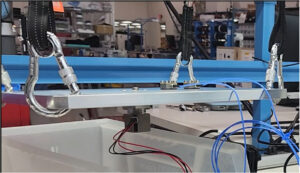
Figure 1. Typical test set-up.
A single resettable uD3RN device was subjected to multiple tests at different preload levels, with high-amplitude shock accelerometers measuring the highly-transient responses at over 100,000 samples per second. Special care was taken to identify shock sources, including a soft-catch scenario to separate the effects of the release from the impact of the released nut.
The initial findings were clear: while the release shock itself was ultra-low (SRS levels below 42g, not even getting above the noise level below 200Hz), a secondary impact event—caused by the nut striking the Cone—contributed the majority of the measured shock – see Figure 6 in the paper. This distinction proved crucial in refining the actuator’s configuration.
Engineering Insights: From Good to Outstanding
To improve performance, the team explored two avenues: reducing the secondary impact shock and enhancing separation reliability at lower preloads.
Replacing the standard polyacetal spacer with an elastomeric O-ring drastically reduced the impact shock—bringing SRS levels within striking distance of the ideal “soft catch” case. Simultaneously, adding a Belleville washer to assist with nut ejection greatly increased separation success, even at reduced preload levels.
The final “optimized configuration”—which combined both the Belleville spring and the O-ring—achieved the best of both worlds: Repeatable separations and significantly reduced shock levels. Peak accelerations remained below 100g, and SRS values stayed under 330g across the critical 10 Hz to 10 kHz frequency range (see figures 15 & 16 in the paper).
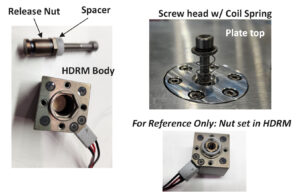
Figure 2. Optimized configuration.
Implications for Flight Hardware Designers
The study doesn’t just validate Dcubed’s product—it also provides an analytical framework and experimental benchmarks that spacecraft designers can use to assess HDRM risks more accurately. With a derived model linking preload to nut release velocity, engineers can now predict separation dynamics based on design parameters. This makes the uD3RN not just a component, but a predictable element within the spacecraft mechanical system.
One of the added values of working with a partner like Quartus Engineering is the ability to rapidly refine implementation methods with high confidence for future missions. Their development approach—grounded in over 25 years of simulation-driven engineering—enables fast iteration and precision optimization that aligns well with the pace and risk posture of today’s evolving space economy.
According to Alexander Cheff Halterman, Director of Technical Program Development, Quartus’ approach is anchored in high-end mechanical simulation in a collaborative engagement model.
“The exchange of information between Dcubed and Quartus enabled valuable physical insights critical to the success of this test campaign and the programs it supported. We look forward to building upon this successful work for future critical missions. Future collaborations between Dcubed, Quartus Engineering, and other mission stakeholders can build on this foundation—bringing the benefits of low-shock HDRM performance to new configurations with reduced schedule risk and enhanced design predictability.”
Dr. Markus Geiss, Commercial Director at Dcubed, agrees, emphasizing the value of third-party validation in a market where reliability is everything:
“We’re thrilled with the outcome of Quartus Engineering’s independent testing. It’s one thing for us to promote the ultra-low shock properties of our actuators, but having these claims confirmed by such a rigorous and flight-representative study is immensely valuable. It gives our customers hard data they can rely on and supports our mission to deliver reliable, compact, and resettable solutions for the space industry.”
Final Thoughts
In an industry where hardware is often separated by the finest margins of reliability and performance, Dcubed’s uD3RN Micro Release Nut has just taken a leap forward. Backed by independent data, its combination of ultra-low shock, repeatable separation, and compact design makes it a strong candidate for use in increasingly miniaturized and delicate space missions.
For spacecraft engineers looking to derisk mechanical deployment without trading off performance, these results are worth a close look.
Want to understand how Dcubed actuators can power the success of your next mission? Contact us at [email protected]!
]]>
Here are our top 5 takeaways
- Repeatability and Rapid Reset Are Game-Changers
Dcubed’s release actuators (like the pin puller and release nut) are designed for easy, tool-free resets, enabling hundreds of test cycles without refurbishment. This drastically reduces both cost and turnaround time, making “test as you fly, fly as you test” a practical reality.
- Testing-Friendly Hardware Unlocks Agile Development
The ability to integrate and test quickly with minimal overhead allows companies to adopt a more iterative, agile approach—testing during every design step rather than waiting for a final configuration.
- Poor Design for Vibe/Shock Can Destroy Hardware
Rapid test cycles are great—but cutting corners on vibration or shock analysis can lead to catastrophic damage. Dcubed engineer Guillem Quintana Buil cited test failures caused by rattling components and preload miscalculations that resulted in mechanisms welding themselves together during vibe.
- Record All Test Data—Even “Boring” Runs
Whether it’s a weekend thermal vacuum soak or repeated vibe runs, failing to record full housekeeping and sensor data is a major risk. Without it, post-failure troubleshooting becomes guesswork.
- Lead Time, Cost, and Support Still Matter
Even in space-grade hardware, buyers prioritize short lead times, transparent pricing, and responsive customer support. Dcubed’s off-the-shelf approach, lack of export controls, and easy online ordering were strong factors in customer decisions.
Interest piqued?
Why not watch the whole webinar including a product demo: we’ve got you covered!
Watch the full Webinar here now!
Then, contact us to discuss how Dcubed actuators can make your next testing campaign a breeze: [email protected]
]]>A New Chapter for Space Communications
Satellite operators are facing soaring demand for high-gain, direct-to-device services and agile Earth Observation capabilities. But the current generation of deployable antennas often relies on bulky, complex mechanisms—great for prototypes, not so great for scaling up.
That’s where LARA comes in. Leveraging Dcubed’s proven rollable and origami-inspired designs, LARA will offer a lighter, simpler, and far more scalable alternative to traditional antenna systems. The design draws on heritage from Dcubed’s Origami Solar Arrays, Reflect Array and ISM Solar Array projects, but transitions the focus from solar energy to radio frequency (RF) communication, while continuing the shift from rigid to rollable surfaces.
Small in the Rocket, Big in Space
The planned antenna will feature an aperture of at least five square meters and operate in the L- or S-band—potentially even higher frequencies, depending on mission needs. It will be built around a passive mechanical deployment system using rollable elements.
Just as importantly, LARA includes development of a complete manufacturing and assembly process optimized for serial production. This is not just a one-off demonstrator—it’s the foundation for scalable product lines that can be built and deployed quickly, reliably, and at lower cost.
A Fully Integrated Approach
As the project’s prime and sole contractor, Dcubed will leverage its in-house mechanical engineering, RF design, and deployment systems expertise, enabling faster progress from concept to test article to flight hardware. This approach also streamlines iteration and testing, which is crucial for deployables that need to perform perfectly—once and only once—in orbit.
This contract is a milestone not just for Dcubed, but for European space autonomy. As NewSpace accelerates, scalable infrastructure will be essential. Dcubed’s in-space manufacturing expertise—and deep collaboration with DLR Raumfahrtmanagement and ESA—are critical pieces of that puzzle.
Curious About Deployables?
Whether you’re planning a constellation or exploring new antenna concepts, Dcubed’s team is ready to help.
Contact us at [email protected] to learn more.
]]>
Unfortunately however, for space companies without the resources and bravado of the world’s richest man powering them, full vertical integration is often too slow, complex and expensive to be commercially viable.
That’s why at Dcubed, we believe it’s time for the industry to shift towards a more pragmatic model: Vertical Integration 2.0. In this scenario, space firms work with component and subsystem vendors as true ”internal external” partners, rather than just suppliers. This approach allows them to retain the integration benefits of verticalization while dramatically reducing costs, risks, and time-to-launch. In essence, the idea is to integrate your partner, rather than the process or the production.
We believe that NewSpace companies embracing this model will move faster, iterate more efficiently, and stay ahead of competitors stuck in outmoded integration strategies.
Why Traditional Vertical Integration Fails
Vertical integration has been seen as the “holy grail” of space success when faced with slow, risky and expensive dependence on external suppliers. However, it comes with significant challenges of its own, including:
- Massive Capital Costs – Building in-house capabilities for a diverse range of subsystems demands enormous up-front investment.
- Slow Development Timelines – Relying on external suppliers meeting their timelines without them being properly integrated slows down development.
- Technical and Programmatic Risk – Working with unfamiliar technology without sufficient support from suppliers significantly increases the chances of failure.
- Reinventing the Wheel – Many companies end up duplicating existing, reliable solutions instead of leveraging industry expertise.
For these reasons, while some level of vertical control is always necessary, full vertical integration is simply impractical for most space companies. The smarter approach is to focus internal resources on core differentiators while leveraging external expertise for everything else. However, the key word here is “expertise” – choosing vendors that don’t just deliver the right reliable and cost-effective technology, but whose experts can also work intensively alongside in-house engineering teams to simplify and accelerate integration.
The “Internal External” Model: A Smarter Way Forward
The integration of vendors into engineering and production as long-term strategic partners delivers a range of significant benefits, including:
- Lower Costs – Avoiding the burden of in-house development experts and accessing the vendor’s economies of scale.
- Faster Development – Leveraging off-the-shelf or co-developed solutions to cut months or years off production and launch timelines.
- Reduced Risk – Using proven, flight-tested components rather than developing new ones from scratch.
- Stronger Innovation – Tapping into the expertise of vendors who specialize in their field, rather than stretching internal resources too thin.
This is how space companies that operate as smart systems integrators rather than trying to do everything themselves can outperform those clinging to outdated vertical integration models.
Making Vertical Integration 2.0 Work
Transitioning to an Internal External model requires a strategic shift in how space companies select and work with their partners. Best practices include:
- Identify Core vs. Non-Core Capabilities – Focus in-house efforts on mission-critical differentiators and source subsystems that don’t need to be proprietary.
- Select the Right Partners – Choose vendors with innovative solutions, proven expertise, strong reliability, and a commitment to collaboration.
- Move Beyond Simple Transactions – Establish long-term relationships where vendors are deeply involved in development and integration.
- Foster Knowledge Sharing – Maintain close engineering collaboration, treating external teams as an extension of your own.
- Integrate and Test Early – Bring partner components into the development cycle early to ensure smooth integration and avoid late-stage surprises.
What a Partnership Cooperation Looks Like
At Dcubed, we follow a simple 5-step procedure for partnering with our customers:
- Ensure mutual understanding of how mission critical “small but mighty” components and subsystems are.
- Get involved during the design phase, to ensure that we are fixing something that isn’t broken yet, rather than engaging in failure work.
- Deliver comprehensive product and integration materials to prove our expertise and support in-house engineering and production teams.
- Provide access to our product experts through calls, onsite or remote training, workshops, design reviews, and troubleshooting.
- Build trusted personal relationships that facilitate the collaboration and ensure confidentiality.
The Future of NewSpace Belongs to Agile Integrators
And let’s be clear: Vertical Integration 2.0 is not really about cost cutting on the client side, or revenue generation on the vendor side. It’s about building competitive advantage by enabling faster launches, rapid iteration, effective scaling and reliable mission success.
The message is clear: In space, partnership is power.
Additional resources:
February 2025
https://spacenews.com/dont-compete-with-or-emulate-spacex-investors-urge/
https://spacenews.com/the-evolving-case-for-vertical-integration-as-satellites-go-modular/
]]>