The post DDEX Publishes ERN 4.3 Update and Catalogue Transfer Standard 1.0 appeared first on DDEX.
]]>As part of this update, DDEX has also updated the ERN Choreography for Cloud Based Storage standard which defines how record companies or distributors can securely transmit information to DSPs and caters for non-repudiation requirements to be met, and the ERN Choreography for Web Services standard which defines how record companies or distributors can securely transmit information to DSPs using an Atom-based web service architecture. All these updates can be viewed in full on the DDEX Knowledge Base at https://kb.ddex.net/.
The ERN 4.3 update includes various additional business benefits over earlier versions. These additional benefits include:
- Full support for the first time for the communication of data about immersive audio including data about different sound engineers and mixers who helped to create the immersive editions;
- Enabling a record company or distributor to provide data about sound recording and video clips that are authorised for a user-generated content DSP, allowing its users to create and upload short clips which embody the identified sound recording or video clips in the user’s creation;
- Support for data about more granular album visibility dates for streaming DSPs including when DSPs are permitted to show both the cover art and track listings for a new release;
- A “hook” mechanism to enable a record company or distributor to direct the DSP from the ERN message to Media Enrichment and Description (MEAD) and/or Party Identification and Enrichment (PIE) messages. These messages communicate rich metadata about the sound recordings, musical works, and parties involved, and has been shown to boost usage (see here) and;
- Significantly enhanced handling of classical music requiring less human intervention by clarifying the rules as to how to communicate title data for individual movements, hierarchical title data for bigger classical works (concerto, symphony, oratorio, etc.), and data about soloists, orchestras, composers and conductors.
A number of DDEX members are committed to implementing ERN 4.3 because of the improved functionality it offers. These include Universal Music Group, Beggars Group and Spotify.
“UMG continues to operate at the forefront of DDEX standards. Implementing ERN 4.3 will enable us to send expanded artist product information to our partners, to enable the creation of richer, more engaging, fan experiences” said, Kim Beauchamp, SVP Process Innovation & Advanced Operations, Universal Music Group and DDEX Chair.
“ERN 4.3 opens so many doors for important upcoming features,” said Sung-Kyu Choi, Global Head of Content Operations, Spotify. “Spotify will adopt ERN 4.3, and we hope that more will soon follow.”
In addition to the updates to the various part of the ERN standards, DDEX has released the Catalogue Transfer Standard 1.0, which includes a mechanism for removing inefficiencies, improves the catalogue transfer process, and significantly reduces the manual intervention required to carry out a catalogue transfer of sound recordings. The mechanism contained in the standard is for a specific type of catalogue transfer where there are only three parties involved: a relinquishing record company, an acquiring record company, and a DSP. This process is sometimes known as “lift and shift”. The standard in its current iteration does not support catalogue transfers involving distributors.
To read more about ERN 4.3 and why to upgrade to it, visit the DDEX knowledge base here.
To read more about the changes between ERN 4.2 and 4.3, visit the DDEX knowledge base here.
To read more about the Catalogue Transfer Standard 1.0, visit the DDEX knowledge base here.
Formed in 2006, DDEX’s 100+ members include leading media companies, music licensing organisations, digital service providers, and technical intermediaries – any organisation of any size with a business interest in digital media content. DDEX now has eleven families of standards that support the entire arc of digital music operations, from initial recording through distribution and reporting as well as other types of business transactions in particular sectors of the industry. A company does not need to become a member to implement any of the DDEX standards; but normally participation in the working groups around the development and refinement of current and new standards is limited to members, as are the biannual plenary events. Information about upcoming meetings and webinars, as well as recordings of previous events, can be found at https://ddex.net/events/.
Follow us on:
Twitter: @DDEXNet
Facebook: @DDEXstandards
LinkedIn Group: DDEX
Sign up for the DDEX newsletter to receive regular updates from the Secretariat at www.DDEX.net.
###
About DDEX
Formed in 2006, DDEX is an international standards-setting organisation made up of leading media companies, music licensing organisations, digital service providers, and technical intermediaries that is dedicated to improving the exchange of data and information across the music industry. To support the automated exchange of information along the digital value chain, DDEX has standardised the format in which information is represented in messages and the method by which the messages are exchanged between business partners. These standards help rights holders, retailers, and technical intermediaries to more effectively communicate information along the digital value chain. This leads to efficient business transactions, reduced costs, and increased revenues for all sectors involved. DDEX standards are developed and made available for industry-wide implementation. For more information, visit www.ddex.net.
DDEX Media Contacts @ Jaybird Communications
Laurie Jakobsen, 646-484-6746, [email protected]
Zach Gulino, 562-472-7993, [email protected]
The post DDEX Publishes ERN 4.3 Update and Catalogue Transfer Standard 1.0 appeared first on DDEX.
]]>The post DDEX, the International Standards Organisation for the Music Industry, Releases “Music in Podcasts,” Outlining the Data and Reporting Flows for this Growing Industry appeared first on DDEX.
]]>

Data Flow for Licensing Music in Podcasts
This whitepaper is the result of over a year of work by DDEX, which included events at the 2021 Podcast Movement conference, the 2022 London Podcast Show, and open meetings starting in September 2021 to invite feedback from podcast creators, producers, and distributors on how proposed processes and data requirements as documented by DDEX regarding the usage and reporting of music in podcasts would be able to be integrated in their processes and work flows.
“Consumer demand for podcasts has never been higher, and music has been integral to these programs from the beginning,” said Niels Rump, DDEX Secretariat. “However, not having proper standards around music usage is a barrier for licensing, and of course, ultimately the proper compensation. This whitepaper is the next step in our collaborative process to work across the music and podcasting industries towards creating standards for the exchanging of rights information in podcasts, and we invite all to review these findings and join us in the continued conversation.”
To read the full Whitepaper, visit DDEX’s website by clicking ddex.net/podcast-wp.
DDEX is eager to discuss the white paper, its findings, and recommendations with interested parties. A poll to find suitable dates is available at ddex.net/podcast-wp-workshops.
Formed in 2006, DDEX’s 100+ members include leading media companies, music licensing organisations, digital service providers, and technical intermediaries – any organisation of any size with a business interest in digital media content. DDEX now has eleven families of standards that support the entire arc of digital music operations, from initial recording through distribution and reporting as well as other types of business transactions in particular sectors of the industry. A company does not need to become a member to implement any of the DDEX standards; but normally participation in the working groups around the development and refinement of current and new standards is limited to members, as are the biannual plenary events. Information about upcoming meetings and webinars, as well as recordings of previous events, can be found at https://ddex.net/events/.
Follow us on:
Twitter: @DDEXNet
Facebook: @DDEXstandards
LinkedIn Group: DDEX
Sign up for the DDEX newsletter to receive regular updates from the Secretariat ddex.net.
###
About DDEX
Formed in 2006, DDEX is an international standards-setting organisation made up of leading media companies, music licensing organisations, digital service providers, and technical intermediaries that is dedicated to improving the exchange of data and information across the music industry. To support the automated exchange of information along the digital value chain, DDEX has standardized the format in which information is represented in messages and the method by which the messages are exchanged between business partners. These standards help rights holders, retailers, and technical intermediaries to more effectively communicate information along the digital value chain. This leads to efficient business transactions, reduced costs, and increased revenues for all sectors involved. DDEX standards are developed and made available for industry-wide implementation. For more information, visit ddex.net.
DDEX Media Contacts @ Jaybird Communications
Laurie Jakobsen, +1 646-484-6746, [email protected]
The post DDEX, the International Standards Organisation for the Music Industry, Releases “Music in Podcasts,” Outlining the Data and Reporting Flows for this Growing Industry appeared first on DDEX.
]]>The post DDEX’s THE BIG Summit 2022 Conference and Plenary Meeting to Focus on Rolling Out MEAD Data Implementation<br><br>Early Test of MEAD at Amazon Music and Universal Music Group Leads to an Increase in Active and Passive Streaming Behavior appeared first on DDEX.
]]>DDEX’s 39th Plenary Meeting will follow The Summit, where DDEX members will discuss the continued adoption of DDEX’s Media Enrichment and Description standard (MEAD) and some of the first results member companies are beginning to achieve.
With MEAD, companies are able to communicate information in addition to core data to help DSPs market products to consumers. This communication, at the moment, is generally from music companies to DSPs in association with the record label’s Electronic Release Notification (ERN) message feed that provides core information about the product for DSPs.
MEAD messages are able to communicate nearly 40 different data points about individual sound recordings, as well as a similar number of data points for musical works, including the release that the sound recording appears on. Examples of the information they can communicate include:
● Categorized genres, moods, and themes
● Vocal register, instrumentation
● Time signatures, tempo and BPM
● Harmonic structure, root chords, absolute pitch
● Awards and historic charting data
The Party Identification and Enrichment standard (PIE), a sister standard of MEAD, enables the communication of nearly 20 data points for the contributors to musical works and sound recordings.
So how does this additional data play lead to increase streams?
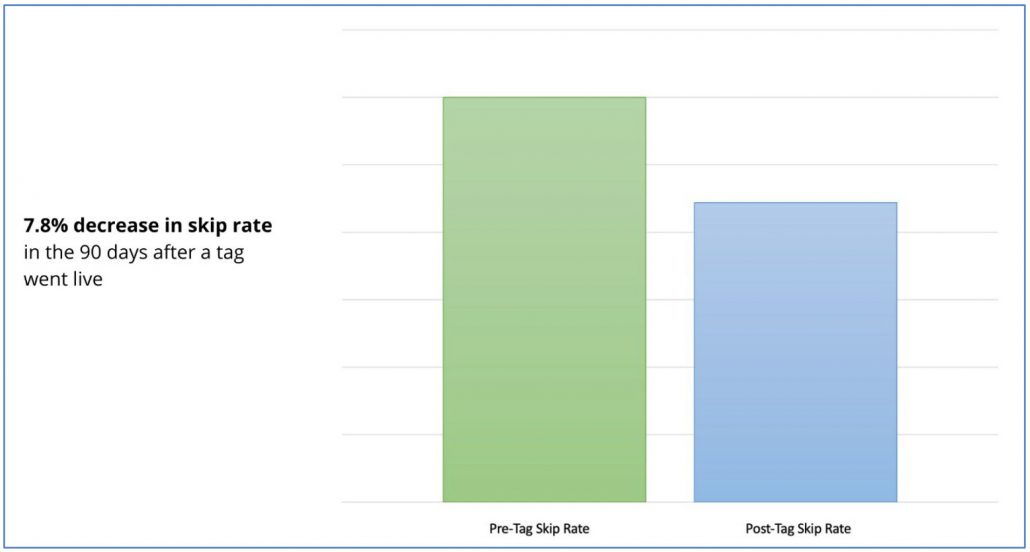
During a recent presentation at the Music Biz conference in Nashville, representatives of Amazon Music and Universal Music Group (UMG), the world leader in music-based entertainment, shared details about implementing the MEAD standard. The presentations noted that the two companies had carried out “before” and “after” tests, which showed that the addition of high-quality genre and mood data to the DSPs increased streams and decreased skip rates in the 90 days after a track was tagged with the additional information. Results from the tests showed:
• A 4.6% increase in streams:

• An 11.9% increase in streams on Algorithmic Stations and Playlists:

• A 7.8% decrease in skip rate:
In the future, Metadata Providers as well as record companies will begin to proactively send MEAD messages to DSPs, separate from ERN message feeds, a development that DDEX expects to result in an increase in streams across the board.
To participate in THE BIG Summit 2022, please register here.
###
About DDEX
Formed in 2006, DDEX is an international standards-setting organization made up of leading media companies, music licensing organizations, digital service providers, and technical intermediaries that is dedicated to improving the exchange of data and information across the music industry. To support the automated exchange of information along the digital value chain, DDEX has standardized the format in which information is represented in messages and the method by which the messages are exchanged between business partners. These standards help rights holders, retailers, and technical intermediaries to more effectively communicate information along the digital value chain. This leads to efficient business transactions, reduced costs, and increased revenues for all sectors involved. DDEX standards are developed and made available for industry-wide implementation. For more information, visit www.ddex.net.
Follow us on:
Twitter: @DDEXNet
Facebook: @DDEXstandards
LinkedIn Company page: DDEX
LinkedIn Group: DDEX
Sign up for the DDEX newsletter to receive regular updates from the Secretariat at www.DDEX.net.
DDEX Media Contacts @ Jaybird Communications
Laurie Jakobsen, 646-484-6746, [email protected]
Zach Gulino, (562) 472-7993, [email protected]
The post DDEX’s THE BIG Summit 2022 Conference and Plenary Meeting to Focus on Rolling Out MEAD Data Implementation<br><br>Early Test of MEAD at Amazon Music and Universal Music Group Leads to an Increase in Active and Passive Streaming Behavior appeared first on DDEX.
]]>The post DDEX & ISNI Announce Signing of Liaison Agreement appeared first on DDEX.
]]>“We’re excited to be partnering with an organization that is as passionate about standards and identifiers as us,” said Mark Isherwood, DDEX Secretariat. “They received a warm welcome and great interest at our most recent Plenary and look forward to what we can accomplish together.”
Partnering with DDEX was an essential part of ISNI’s goals,” said Tim Devenport at ISNI. “DDEX members are steadily incorporating the use of ISNIs in their supply chains and many are already members of the ISNI Music Sector Consultation Group which provides direction and guidance, and thus drives our progress, in the music sector. We look forward to continuing to work with DDEX’s members on the continued development of our respective standards.”
ISNI is the ISO-certified, global standard number for identifying the millions of contributors to creative works and those active in their distribution, including researchers, inventors, writers, artists, visual creators, performers, producers, publishers, aggregators, and more. As ISO 27729, it is part of a family of international standard identifiers that includes identifiers of works, recordings, products, and right holders in all repertoires, e.g. DOI, ISAN, ISBN, ISRC, ISSN, and ISWC.
The ISNI Music Sector Consultation Group is comprised of representatives belonging to or feeding into the music industry including music producers, record labels, distributors, streaming platforms, and more. For more information on how to join an ISNI Consultation Group, email [email protected]. For information about joining the ISNI International Agency to become an ISNI Member or Registration Agency, please visit ISNI’s dedicated webpage: Joining ISNI.
###
About DDEX
Formed in 2006, DDEX is an international standards-setting organization made up of leading media companies, music licensing organizations, digital service providers, and technical intermediaries that is dedicated to improving the exchange of data and information across the music industry. To support the automated exchange of information along the digital value chain, DDEX has standardized the format in which information is represented in messages and the method by which the messages are exchanged between business partners. These standards help rights holders, retailers, and technical intermediaries to more effectively communicate information along the digital value chain. This leads to efficient business transactions, reduced costs, and increased revenues for all sectors involved. DDEX standards are developed and made available for industry-wide implementation. For more information, visit www.ddex.net.
Follow us on:
Twitter: @DDEXNet
Facebook: @DDEXstandards
LinkedIn Company page: DDEX
LinkedIn Group: DDEX
Sign up for the DDEX newsletter to receive regular updates from the Secretariat at www.DDEX.net.
About the ISNI International Agency
The ISNI International Agency is the Registration Authority for the ISNI standard, charged by ISO with governing, promulgating and maintaining the use of ISNI worldwide. Its mission is to assign to the public name(s) of creators (including artists, bands, musicians, music producers, record labels, distributors, streaming platforms, and more within the music industry and beyond) a persistent, unique identifying number in order to resolve the problem of name ambiguity in search and discovery; and diffuse each assigned ISNI across all repertoires in the global supply chain so that every published work can be unambiguously attributed to its creator wherever that work is described.
By achieving these goals, the ISNI will act as a bridge identifier across multiple domains and become a critical component in Linked Data and Semantic Web applications.
Currently, ISNIs are actively used within the library, music, research and publishing sectors. For more information, visit: isni.org or follow us on social media.
DDEX Media Contacts @ Jaybird Communications
Laurie Jakobsen, 646-484-6746, [email protected]
Zach Gulino, (562) 472-7993, [email protected]
The post DDEX & ISNI Announce Signing of Liaison Agreement appeared first on DDEX.
]]>The post Universal Music Group’s Kim Beauchamp Named Chair of the Board of DDEX appeared first on DDEX.
]]>“The work of DDEX is absolutely critical in continuing to move the entire music industry forward in the digital age. I look forward to continuing to work with our member companies representing the entire music value chain, as well as our colleagues in adjacent industries such as film and podcasting, to continue to build a solid infrastructure that supports all uses of music, anywhere in the world,” said Beauchamp.

Based in Los Angeles, Beauchamp oversees the Process Innovation, Advanced Operations, and Metadata Modeling and Standards areas for Universal Music Group, focusing on transforming the existing business models and creating new business processes in support of them. In addition to designing operational workflows to integrate new business models and complex edge cases within the traditional business models, she also oversees Metadata Modeling & Standards, where she investigates the root causes for bad or incomplete data throughout the value chain and oversees the creation of the company’s global metadata standards.
Kim has worked for UMG since 1998, beginning her career within their IT department. She has helped design and develop numerous systems that are critical to the company’s operations, including the digital scheduling system, the asset management and content delivery system, and the company’s global label copy system. She continues to actively work to reimagine the company’s internal tool set and processes to support the ever-changing business.
The remainder of the DDEX Board is made up of executives from the 20 other Charter members of the organization, which in addition to Beauchamp include:
- Amazon – Jill Chapman
- Apple Inc. – Nick Williamson (Chair Emeritus)
- ASCAP – Nick Lehman
- Broadcast Music, Inc. (BMI) – Ed Oshanani
- Downtown Music Holdings – Scott Williams
- Facebook – Dan Simpson
- GEMA – Till Evert
- Google – Greg Quillard (Executive Board)
- Kobalt Music – Bob Bruderman
- Pandora Media Inc. – Noel Morrison
- PPL – Mark Douglas
- PRS for Music – Keith Hill
- SCPP – Laurent Fradin
- SACEM – Paul Cohen Scali (Executive Board)
- Sony Music Entertainment – Kirit Joshi (Executive Board)
- SOCAN – Alan Triger
- SoundExchange Inc. – Luis Bonilla
- Spotify AB – Sung Kyu Choi
- Tencent Music Entertainment Group – Roberta Fong
- Warner Music Group – Brigette Boyle
Membership of DDEX is open to any organization with a business interest in digital media content; there are currently over 100 members from around the world. While a company does not need to become a member to implement any of the DDEX standards, being a member of DDEX provides the opportunity to participate in and influence the development of international standards in the digital value chain. DDEX now has eight families of standards that support the entire arc of digital music operations from initial recording through distribution and reporting as well as other types of business transactions in particular sectors of the industry. The standards are being used by all the major players in the digital music industry as well as most smaller organizations and startups. DDEX members participate in regular working group meetings to refine current standards and develop new ones.
Follow us on:
Twitter: @DDEXNet
Facebook: @DDEXstandards
LinkedIn Group: DDEX
Sign up for the DDEX newsletter to receive regular updates from the Secretariat at www.DDEX.net.
###
About DDEX
Formed in 2006, DDEX is an international standards-setting organization made up of leading media companies, music licensing organizations, digital service providers, and technical intermediaries that is dedicated to improving the exchange of data and information across the music industry. To support the automated exchange of information along the digital value chain, DDEX has standardized the format in which information is represented in messages and the method by which the messages are exchanged between business partners. These standards help rights holders, retailers, and technical intermediaries to more effectively communicate information along the digital value chain. This leads to efficient business transactions, reduced costs, and increased revenues for all sectors involved. DDEX standards are developed and made available for industry-wide implementation. For more information, visit www.ddex.net.
The DDEX Standards
There are eight families of DDEX standards: Release Delivery, Media Enrichment and Description, Sales and Usage Reporting, Claim Detail Message Suite, Works Notification and Licensing, Recording Data and Rights, Collection of Studio Metadata and Linking Works and Recordings. The use of standard message formatting speeds up the exchange of information and increases the accuracy of data, improving efficiency along the digital value chain and streamlining content availability through digital service providers to consumers. All the major digital players — including digital retailers, digital distributors and aggregators, record companies, music licensing companies, music publishers, musical work rights societies, and various technical service providers — use DDEX standards with over 5,000 implementation licenses issued and growing daily. While anyone can implement a standard, only DDEX members can be part of the standard development process – more information on membership online here.
DDEX Media Contacts @ Jaybird Communications
Laurie Jakobsen, 646-484-6746, [email protected]
The post Universal Music Group’s Kim Beauchamp Named Chair of the Board of DDEX appeared first on DDEX.
]]>The post Facebook Joins DDEX As Charter Member appeared first on DDEX.
]]>“Facebook values the work of DDEX in creating metadata standards for the music industry, and I’m pleased to join their Board in support of this effort,” says Simpson. “With more people than ever turning to online entertainment, it’s so important that everyone in the ecosystem, starting from music creation through to the person that enjoys that work, is using the most up-to-date versions of DDEX standards to communicate information about the songs and their usage.”
Jeff King Chair of the Board DDEX/COO SOCAN added, “DDEX is creating standards for the entire digital music value chain, and so we’re very pleased to add Facebook, one of the largest global platforms to reach music fans, as a Charter Member, and Dan to our Board. We have a great balance of content companies, rights organizations, and digital distributors in our ranks, ensuring that our work serves the needs of the entire industry.”
Membership to DDEX is open to any organization with a business interest in digital media content; there are currently over 120 members worldwide. While a company does not need to become a member to implement any of the DDEX standards, being a member of DDEX provides the opportunity to participate in and influence the development of international standards in the digital value chain. DDEX now has eight families of standards that support the entire arc of digital music operations from initial recording through distribution and reporting as well as other types of business transactions in particular sectors of the industry. The standards are being used by all the major players in the digital music industry, as well as most smaller organizations and startups. DDEX members participate in regular working group meetings to refine current standards and develop new ones.
Charter membership to DDEX allows an organization to:
- Provide a director to the DDEX Board.
- Provide comments on a Committee Draft Standard as set out in the standards development process.
- Send one or more individuals to each Plenary Meeting and have access to all documentation and communications relating to those meetings.
- Send one or more individuals to any of the technical Working Groups and have access to all documentation and communications relating to those meetings.
The remainder of the DDEX Board is made up of executives from the 20 other Charter members of the organization:
Amazon – Jill Chapman
Apple Inc. – Nick Williamson (Chair Emeritus)
ASCAP – Nick Lehman
Broadcast Music, Inc. (BMI) – Ed Oshanani
Downtown Music Holdings – Scott Williams
GEMA – Till Evert
Google – Greg Quillard (Executive Board)
Kobalt Music – Bob Bruderman
Pandora Media Inc. – Noel Morrison
PPL – Mark Douglas
PRS for Music – Keith Hill
SCPP – Laurent Fradin
SACEM – Paul Cohen Scali (Executive Board)
Sony Music Entertainment – Kirit Joshi (Executive Board)
SOCAN – Jeff King, (Chair of the Board)
SoundExchange Inc. – Luis Bonilla
Spotify AB – Sung Kyu Choi
Tencent Music Entertainment Group – Roberta Fong
Universal Music Group – Kim Beauchamp (Executive Board)
Warner Music Group – Brigette Boyle
Follow us on:
Twitter: @DDEXNet
Facebook: @DDEXstandards
LinkedIn Group: DDEX
Sign up for the DDEX newsletter to receive regular updates from the Secretariat at www.DDEX.net.
###
About DDEX
Formed in 2006, DDEX is an international standards-setting organization made up of leading media companies, music licensing organizations, digital service providers, and technical intermediaries that is dedicated to improving the exchange of data and information across the music industry. To support the automated exchange of information along the digital value chain, DDEX has standardized the format in which information is represented in messages and the method by which the messages are exchanged between business partners. These standards help rights holders, retailers, and technical intermediaries to more effectively communicate information along the digital value chain. This leads to efficient business transactions, reduced costs, and increased revenues for all sectors involved. DDEX standards are developed and made available for industry-wide implementation. For more information, visit www.ddex.net.
About Facebook
Founded in 2004, Facebook is a global technology company that owns social media and gaming platforms that aim to give people the power to build community and bring the world closer together. With offices and services all over the globe, Facebook is the world’s leading social media platform providing services to more than two billion people worldwide. Through their portfolio of platforms – Facebook, Instagram, Messenger, WhatsApp, and Oculus VR – people use Facebook’s apps and technologies to connect with friends and family, find communities and grow businesses.
The DDEX Standards
There are eight families of DDEX standards: Release Delivery, Media Enrichment and Description, Sales and Usage Reporting, Claim Detail Message Suite, Works Notification and Licensing, Recording Data and Rights, Collection of Studio Metadata and Linking Works and Recordings. The use of standard message formatting speeds up the exchange of information and increases the accuracy of data, improving efficiency along the digital value chain and streamlining content availability through digital service providers to consumers. All the major digital players — including digital retailers, digital distributors and aggregators, record companies, music licensing companies, music publishers, musical work rights societies, and various technical service providers — use DDEX standards with over 5,000 implementation licenses issued and growing daily. While anyone can implement a standard, only DDEX members can be part of the standard development process – more information on membership online here.
DDEX Media Contacts @ Jaybird Communications
Laurie Jakobsen, 646-484-6746, [email protected]
The post Facebook Joins DDEX As Charter Member appeared first on DDEX.
]]>The post Downtown Music Holdings Joins DDEX As Charter Member of DDEX appeared first on DDEX.
]]>6 August 2020 – DDEX, the international standards-setting organization dedicated to improving the exchange of data and information across the music industry, announced today that Downtown Music Holdings (Downtown) has joined as a Charter member of the organization. Downtown, which owns and operates a broad portfolio of global music publishing, distribution, artist and label services brands, has appointed Scott Williams, Chief Technology Officer of its subsidiary CD Baby, to the board of directors.
“Downtown is excited to join DDEX as a Charter member supporting the development, implementation, and governance of the DDEX standards,” said Andrew Bergman, Downtown’s Chief Operating Officer. “Core to Downtown’s mission is a commitment to creating a more innovative and equitable music ecosystem that supports not just the millions of creators and rights holders we represent through our portfolio of brands, but the industry overall. We share in DDEX’s passion to codify the formats of communication and metadata standards necessary to ensure a thriving, modern music industry.”
Jeff King Chair of the Board DDEX/ COO SOCAN commented, “The voice of Downtown Music Holdings and their respective companies will be a great addition to our Charter members and to DDEX as a whole. We welcome their seasoned voices in the ongoing nuanced and ever-changing issues facing the digital music industry today.”
Membership to DDEX is open to any organization with a business interest in digital media content; there are currently over 120 members worldwide. While a company does not need to become a member to implement any of the DDEX standards, being a member of DDEX provides the opportunity to participate in and influence the development of international standards in the digital value chain. DDEX now has eight families of standards that support the entire arc of digital music operations from initial recording through distribution and reporting as well as other types of business transactions in particular sectors of the industry. The standards are being used by all the major players in the digital music industry, as well as most smaller organizations and startups. DDEX members participate in regular working group meetings to refine current standards and develop new ones.
Charter membership to DDEX allows an organization to:
- Provide a director to the DDEX board.
- Provide comments on a Committee Draft Standard as set out in the standards development process.
- Send one or more individuals to each Plenary Meeting and have access to all documentation and communications relating to those meetings.
- Send one or more individuals to any of the technical Working Groups and have access to all documentation and communications relating to those meetings.
The remainder of the DDEX Board is made up of executives from the 19 other Charter members of the organization:
Amazon – Jill Chapman
Apple Inc. – Nick Williamson (Chair Emeritus)
ASCAP – Nick Lehman
Broadcast Music, Inc. (BMI) – Ed Oshanani
GEMA – Till Evert
Google – Greg Quillard (Executive Board)
Kobalt Music – Bob Bruderman
Pandora Media Inc. – Noel Morrison
PPL – Matt Phipps-Taylor
PRS for Music – Keith Hill
SCPP – Laurent Fradin
SACEM – Paul Cohen Scali (Executive Board)
Sony Music Entertainment – Kirit Joshi (Executive Board)
SOCAN – Jeff King, (Chair of the Board)
SoundExchange Inc. – Luis Bonilla
Spotify AB – Sung Kyu Choi
Tencent Music Entertainment Group – Roberta Fong
Universal Music Group – Kim Beauchamp (Executive Board)
Warner Music Group – Brigette Boyle
Follow us on:
Twitter: @DDEXNet
Facebook: @DDEXstandards
LinkedIn Group: DDEX
Sign up for the DDEX newsletter to receive regular updates from the Secretariat at www.DDEX.net.
###
About DDEX
Formed in 2006, DDEX is an international standards-setting organization made up of leading media companies, music licensing organizations, digital service providers, and technical intermediaries that is dedicated to improving the exchange of data and information across the music industry. To support the automated exchange of information along the digital value chain, DDEX has standardized the format in which information is represented in messages and the method by which the messages are exchanged between business partners. These standards help rights holders, retailers, and technical intermediaries to more effectively communicate information along the digital value chain. This leads to efficient business transactions, reduced costs, and increased revenues for all sectors involved. DDEX standards are developed and made available for industry-wide implementation. For more information, visit www.ddex.net.
About Downtown Music Holdings
Downtown Music Holdings is a global company that owns, manages, and develops businesses with a vision for a more equitable and innovative music ecosystem. With operations across North America, Europe, Asia, Australia, Africa, and Latin America, we are the world’s leading provider of end-to-end services to artists, songwriters, labels, music publishers, and other rights holders. Through our portfolio of companies — Downtown Music Publishing®, Songtrust®, CD Baby®, Soundrop®, DashGo℠, AdRev®, FUGA®, Sheer Publishing Africa, Downtown Neighbouring Rights℠, and Downtown Music Studios℠ — we manage millions of music copyrights, with a catalog that spans nearly 100 years of popular music, including music for film and television, and the single largest independent sound recording catalog in the industry. Our integrated platforms help democratize global music rights management and simplify the distribution, monetization, and promotion of creative works.
The DDEX Standards
There are eight families of DDEX standards: Release Delivery, Media Enrichment and Description, Sales and Usage Reporting, Claim Detail Message Suite, Works Notification and Licensing, Recording Data and Rights, Collection of Studio Metadata and Linking Works and Recordings. The use of standard message formatting speeds up the exchange of information and increases the accuracy of data, improving efficiency along the digital value chain and streamlining content availability through digital service providers to consumers. All the major digital players — including digital retailers, digital distributors and aggregators, record companies, music licensing companies, music publishers, musical work rights societies, and various technical service providers — use DDEX standards with over 5,000 implementation licenses issued and growing daily. While anyone can implement a standard, only DDEX members can be part of the standard development process – more information on membership online here.
DDEX Media Contacts @ Jaybird Communications
Laurie Jakobsen, 646-484-6746, [email protected]
Tracy Zamot, 917-579-6704, [email protected]
The post Downtown Music Holdings Joins DDEX As Charter Member of DDEX appeared first on DDEX.
]]>The post SOCAN’s Jeff King Named Chair of the Board of DDEX appeared first on DDEX.
]]>“I’m honoured to have been elected to the role of Chair at such a pivotal time in the music industry, when the mandate to standardize metadata has become even more critical to identify and deliver global digital royalties back to music creators,” said King. “On behalf of myself and the DDEX Board, many thanks to Paul Dilorito for his work with us over the years and his leadership in so many areas of the organization.”
Named COO of SOCAN in 2011, King is responsible for strategy, licensing, distribution, international, information technology and corporate planning. As Canada’s largest rights management organization, SOCAN connects more than four million creators worldwide and more than a quarter-million businesses and individuals. Additionally, King led acquisitions expanding SOCAN’s capabilities with subsidiaries in Seattle and New York that provide back office and content fulfilment services to the music ecosystem. Since first joining SOCAN in 2001 as Director of Distribution, Jeff rose through the organization, leading initiatives that significantly heightened member and licensee satisfaction. As Vice President of Licensing, Jeff developed a robust strategic plan to expand SOCAN’s customer base and increase efficiency. As Vice President of Membership, Jeff led the development of a number of industry-leading e-commerce tools and the creation of SOCAN’s Information Centre. Jeff holds an BA Honours from Wilfrid Laurier University and has been keynote speaker at several internationl conferences on innovation and free-trade.
The DDEX Board is made up of executives from the 19 charter members of the organization, which in addition to King include:
- Amazon – Jill Chapman
- Apple Inc. – Nick Williamson (Chair Emeritus)
- ASCAP – Dena Fletcher
- Broadcast Music, Inc. (BMI) – Ed Oshanani
- GEMA – Till Evert
- Google – Greg Quillard (Executive Board)
- Kobalt Music – Bob Bruderman
- Pandora Media Inc. – Noel Morrison
- PPL – Matt Phipps-Taylor
- PRS for Music – Keith Hill
- SCPP – Laurent Fradin
- SACEM – Paul Cohen Scali (Executive Board)
- Sony Music Entertainment – Kirit Joshi (Executive Board)
- SoundExchange Inc. – Luis Bonilla
- Spotify AB – Sung Kyu Choi
- Tencent Music Entertainment Group – Roberta Fong
- Universal Music Group – Kim Beauchamp (Executive Board)
- Warner Music Group – Brigette Boyle
Membership of DDEX is open to any organization with a business interest in digital media content; there are currently over 100 members from around the world. While a company does not need to become a member to implement any of the DDEX standards, being a member of DDEX provides the opportunity to participate in and influence the development of international standards in the digital value chain. DDEX now has eight families of standards that support the entire arc of digital music operations from initial recording through distribution and reporting as well as other types of business transactions in particular sectors of the industry. The standards are being used by all the major players in the digital music industry as well as most smaller organizations and startups. DDEX members participate in regular working group meetings to refine current standards and develop new ones.
Follow us on:
Twitter: @DDEXNet
Facebook: @DDEXstandards
LinkedIn Group: DDEX
Sign up for the DDEX newsletter to receive regular updates from the Secretariat at www.DDEX.net.
###
About DDEX
Formed in 2006, DDEX is an international standards-setting organization made up of leading media companies, music licensing organizations, digital service providers, and technical intermediaries that is dedicated to improving the exchange of data and information across the music industry. To support the automated exchange of information along the digital value chain, DDEX has standardized the format in which information is represented in messages and the method by which the messages are exchanged between business partners. These standards help rights holders, retailers, and technical intermediaries to more effectively communicate information along the digital value chain. This leads to efficient business transactions, reduced costs, and increased revenues for all sectors involved. DDEX standards are developed and made available for industry-wide implementation. For more information, visit www.ddex.net.
The DDEX Standards
There are eight families of DDEX standards: Release Delivery, Media Enrichment and Description, Sales and Usage Reporting, Claim Detail Message Suite, Works Notification and Licensing, Recording Data and Rights, Collection of Studio Metadata and Linking Works and Recordings. The use of standard message formatting speeds up the exchange of information and increases the accuracy of data, improving efficiency along the digital value chain and streamlining content availability through digital service providers to consumers. All the major digital players — including digital retailers, digital distributors and aggregators, record companies, music licensing companies, music publishers, musical work rights societies, and various technical service providers — use DDEX standards with over 5,000 implementation licenses issued and growing daily. While anyone can implement a standard, only DDEX members can be part of the standard development process – more information on membership online here.
DDEX Media Contacts @ Jaybird Communications
Laurie Jakobsen, 646-484-6746, [email protected]
Tracy Zamot, 917-579-6704, [email protected]
The post SOCAN’s Jeff King Named Chair of the Board of DDEX appeared first on DDEX.
]]>The post DDEX Releases New Claims Detail Message Standard, Final Piece of Digital Music Supply Chain between Distributors and Rightsholders appeared first on DDEX.
]]>New York, NY – 10 March 2020 – DDEX, the international standards-setting organisation for the music industry, has formally published its Claim Detail Message (CDM) standard, which can now be implemented by any organisation that already has or which takes out a free DDEX Implementation Licence. CDM was finalised by the Digital Sales Reporting Working Group at the last DDEX plenary in November 2019, and was ratified by the DDEX Board in early February.
CDM is a sister standard to the Digital Sales Report Standard (DSR), in that it communicates information between companies in the digital music economy about claims and invoices for the use of musical works in sound recordings and music videos, usually in response to a Digital Sales Report. Senders of CDM messages will therefore be music publishers and musical work rights societies and receivers will be distributors and digital music services, and any other entities involved in the use of compositions. A number of companies have already indicated that they are planning to implement aspects of the CDM standard including Apple, BMAT, ICE Services, SACEM, Spotify, SUISA and YouTube.
“This is the first time a global standard for exchanging information about claims in compositions has been created. We looked at what was best in the various regional and proprietary message formats already being used and then aimed to keep the design very simple, so it will be as straightforward as possible to implement,” Laurent Lemasson, Head of International Technical Projects at SACEM and co-chair of the DSR Working Group. “At the same time, we consolidated what had previously been sent in multiple files from a DSP into a single standardized format: multiple sales types with different royalty calculations – downloads, ad-supported streams, subscription streams, student offers, and more – across different territories, thus reducing the volume of processing considerably, which accelerates reconciliation and ultimately payments.”
“Adding CDM is the essential, final piece to support the full supply chain between digital service providers (DSPs) and the licensing community to report and pay royalties on the billions of songs people listen to every day all around the world,” said Mark Isherwood, who leads the DDEX Secretariat. “The information contained in the CDM always ties back to a single sales transaction ID, originally created by the DSP, for each and every one of those uses which allows the workflow between the parties to be more fluid and transparent.”
There are six other families of DDEX standards: They cover Release Deliveries, Media Enrichment and Description, Works Notification and Licensing, Music Licensing Companies’ Communication, Linking Works and Recordings, and Collection of Studio Metadata. The use of standard messages speeds up the exchange of information and increases the accuracy of data, improving efficiency along the digital value chain and streamlining content available through digital service providers to consumers. All the major digital players — including digital retailers, digital distributors and aggregators, record companies, music licensing companies, music publishers, musical work rights societies, and various technical service providers — use DDEX standards with over 5,500 implementation licences issued and growing daily. While anyone can implement a standard, only DDEX members can be part of the standard development process – more information on membership online here.
DDEX is hosting a series of open Standard Implementation Webinars throughout 2020; the next one is a 26th March webinar on Media Enrichment and Description Standard (MEAD). These webinars are free to attend; for more information and to register go to https://ddex.net/events/. Videos of previous webinars on the Electronic Notification Release Standard (ERN) are also online at https://ddex.net/resources/.
Follow us on:
Twitter: @DDEXNet
Facebook: @DDEXstandards
LinkedIn Group: DDEX
Sign up for the DDEX newsletter to receive regular updates from the Secretariat at www.DDEX.net.
###
About DDEX
Formed in 2006, DDEX is an international standards-setting organization made up of leading media companies, music licensing organizations, digital service providers, and technical intermediaries that is dedicated to improving the exchange of data and information across the music industry. To support the automated exchange of information along the digital value chain, DDEX has standardized the format in which information is represented in messages and the method by which the messages are exchanged between business partners. These standards help rights holders, retailers, and technical intermediaries to more effectively communicate information along the digital supply chain. This leads to efficient business transactions, reduced costs, and increased revenues for all sectors involved. DDEX standards are developed and made available for industry-wide implementation. For more information, visit www.ddex.net.
DDEX Media Contacts @ Jaybird Communications
Laurie Jakobsen, 646-484-6746, [email protected]
Tracy Zamot, 917-579-6704, [email protected]
The post DDEX Releases New Claims Detail Message Standard, Final Piece of Digital Music Supply Chain between Distributors and Rightsholders appeared first on DDEX.
]]>The post DDEX Finalizes New Claims Standard, Adds New Working Groups at November Meeting appeared first on DDEX.
]]>New York, NY – December 5, 2019 – At its biannual plenary meeting last month in Stockholm, DDEX, the international standards-setting organization for the music industry, announced it had finalized a new standard for the communication of information related to claims and invoices for the use of musical works in sound recordings and music videos. This new standard, the Claim Detail Message (CDM), has been specifically designed to work seamlessly with the widely deployed DDEX Digital Sales Reporting (DSR) standard, replacing earlier formats to better meet the industry’s current needs. The next step is for the CDM standard to receive its final review by all its members and subsequently get signed off by the DDEX Board. It is expected to be published for general implementation in early 2020.
“Our November meetings in Stockholm were a great example of how DDEX both encompasses the breadth of the music industry value chain while also executing quickly to respond to the marketplace: we announced our second new standard in less than a year and put new working groups in place to address specific needs, then stepped up our outreach to both the creative and development communities with the inaugural Creator Credit Summit and Implementation Workshop,” said Paul Dilorito, DDEX Chair and Director of Innovation and Partnerships at PRS for Music. “Our event host, Spotify, really outdid themselves with great locations for all of the week’s events – they’ve raised the bar for our 2020 plenaries in the U.S.!”
The three new working groups cover the following topics: the first, detailing the description, identification, and communication of interested parties in the music value chain, such as artists, composers and engineers, and, most importantly, the links between them; the second, on description and identification of locations such as music venues and studios, potentially down to the level of “Studio B, Abbey Road Studios”; and the third, an ad-hoc group focused on requirements to support aspects of the infrastructure that will be needed for the new U.S. Mechanical Licensing Collective established under the Music Modernization Act. All three are now open for sign-up by DDEX members to receive updates and participate in the meetings.
The first Creator Credit Summit was an all-day event at the Vasateatern (Vasa Theater) that highlighted how its standards are used to gather metadata about all the contributors to the creation of musical works and sound recordings through its Recording Information Notification Standard (RIN). Keynote speaker Björn Ulvaeus, the acclaimed songwriter, producer, member of the Swedish super-group ABBA, and entrepreneur, set the tone for the day, striking notes of both humor and seriousness with the wry observation that “music creators come out of their bubble twice a year to look at their royalty statements” – while also stressing how vital it is for music creators to be credited, especially in the digital age: “the recognition may not always lead to money, but can lead to your next gig.” Ulvaeus was followed by discussions of how credits metadata moves through the music industry value chain, from creation to consumers and then back to the creator. Further, Sound Credit, Jammber, VEVA Sound, Creative Passport, Streemliner, and Session presented how their tools are being used to assist in capturing all information about their projects throughout the entire creative process.
The week in Stockholm was capped with a hands-on implementation workshop for the DDEX Music Licensing Company (MLC) Message Suite and Choreography Standard. Over 60 attendees from more than 30 companies packed the room to not only dig into implementation at a detailed level in small groups, but to hear first-hand about the International Performers Database from SCAPR and SAMI as well as the just-announced RDx Project from IFPI/WIN/PPL UK, which will rely on the MLC standard as the mechanism for communication of data.
DDEX plans take Implementation Workshops relating to other standards “on tour” in 2020, with dates and venues to be announced. Mark Isherwood will be speaking at events at NAMM in Los Angeles, CA January 15-18. The next DDEX plenary meetings will be April 20-22 in Cupertino, CA, and November 9-11 on the east coast of the U.S. Other outreach events will also be announced for those weeks early in 2020. Plenary sessions are for DDEX members only, as only members can participate in the creation of a standard; once released, the standards are available for anyone to use.
Follow us on:
Twitter: @DDEXNet
Facebook: @DDEXstandards
LinkedIn Group: DDEX
Sign up for the DDEX newsletter to receive regular updates from the Secretariat at www.DDEX.net.
###
About DDEX
Formed in 2006, DDEX is an international standards-setting organization made up of leading media companies, music licensing organizations, digital service providers, and technical intermediaries that is dedicated to improving the exchange of data and information across the music industry. To support the automated exchange of information along the digital value chain, DDEX has standardized the format in which information is represented in messages and the method by which the messages are exchanged between business partners. These standards help rights holders, retailers, and technical intermediaries to more effectively communicate information along the digital supply chain. This leads to efficient business transactions, reduced costs, and increased revenues for all sectors involved. DDEX standards are developed and made available for industry-wide implementation. For more information, visit www.ddex.net.
The DDEX Standards
There are six families of DDEX standards: Release Delivery, Sales and Usage Reporting, Works Notification and Licensing, Music Licensing Companies’ Communication, Linking Works and Recordings, and Collection of Studio Metadata. The use of standard message formatting speeds up the exchange of information and increases the accuracy of data, improving efficiency along the digital value chain and streamlining content available through digital service providers to consumers. All the major digital players — including digital retailers, digital distributors and aggregators, record companies, music licensing companies, music publishers, musical work rights societies, and various technical service providers — use DDEX standards with over 5,000 implementation licenses issued and growing daily. While anyone can implement a standard, only DDEX members can be part of the standard development process – more information on membership online here.
DDEX Media Contacts @ Jaybird Communications
Laurie Jakobsen, 646-484-6746, [email protected]
Tracy Zamot, 917-579-6704, [email protected]
The post DDEX Finalizes New Claims Standard, Adds New Working Groups at November Meeting appeared first on DDEX.
]]>