
Everyone has a piece of advice that has stuck with them throughout their careers and mine is to always negotiate. If you don’t ask you don’t get, as the saying goes. For me, this has been useful in situations as varied as signing up for a new gym membership to securing financial support for professional qualifications.
The importance of negotiation is often overlooked, even though we see plenty of advice for interview tactics, discussion about the importance of networking, and how-to guides for improving our LinkedIn profiles
Assessing your goals
Instead of viewing negotiation as “asking for more” it helps to frame it as a process to assess if you’re really getting the best outcome for a situation:
- What are you trying to achieve?
- What are your priorities?
- Consider your alternatives.
- Do the same for your counterpart.
Deal breakers and distractions
Take the example of weighing up two similar job descriptions that outline package, benefits and perks. You could take a black and white view that the one with the most salary, highest benefits and longest list of perks is therefore better than the other, but putting this through the steps bulleted above might draw you to a different conclusion.
The advice I was given was to break down any offer into must-haves, nice-to-haves and not-relevant. Must haves should be non-negotiable deal breakers, the nice to haves should be where you have opportunity to discuss and trade off and the not relevant items should be considered distractions that won’t sway your evaluation of the offer.
How much is a difference in salary worth after tax? Can you put an equivalent monetary value on a longer commute? Is the oft touted “well-stocked snack cupboard” a perk you’ll really use, or are you more likely to duck out for an afternoon run to Pret?
Taking the time to question the true value of each aspect individually will help you separate your priorities and get a clearer picture of what’s on the table.
Negotiating starting salary
Negotiating your starting salary is important as there is a knock-on effect for pension contributions, bonus calculations, annual merit reviews and salary expectations for future roles.
Before disclosing your salary expectations to a recruiter, consider your total package value including bonus, benefits, equity, upcoming pay rises and near-term promotion opportunities to get a ballpark figure.
Do your research on websites such as Glassdoor and LinkedIn to figure out if the salary is low, medium or high for that level and title, and consider the percentage difference between the advertised salary and your expected package.
Remember, the recruiter has a budget they can work with but there may be someone more senior who can sign off on a better package if you’ve secured a strong offer and know you’re the preferred candidate for a role.
If you’ve made it as far as a job offer, you know the company is excited to have you on board – keep that in mind when you set your salary expectations. If you’re not comfortable with saying “I want” try positioning it as “I could accept your offer today if the package was X”. It shows your interest without giving away any bargaining power!
Negotiating a pay rise
The first step to securing a pay increase is to do research to back up your ask. Check if your company has an internal pay grade scale so you are clear on whether there is room to earn more within your current position.
Achieving a few percentage point’s increase may be possible in annual pay reviews, but a larger percentage increase may require justifying your readiness for promotion. Preparing comparable job descriptions and gathering examples of where your work is reflective of a higher pay grade will support your ask.
While negotiating a pay increase immediately might not always be possible, this opens the door for an open discussion about timelines, deliverables and routes to ensure you’re in the best possible position to secure a pay increase in the near term.

Photo by Gustavo Fring on Pexels.com
Negotiating leaving your job
There’s more to leaving your current company than simply figuring out your notice period. The first step should be to checking contract and understanding your obligations and appropriate timelines.
An additional point to consider is the number of outstanding holiday days, and whether you can use these during your notice period to bring forward your last day of work at your employer’s discretion.
For those exiting during a redundancy situation or settlement agreement, there is more to consider. As well as financial considerations, you may be able to secure paid external CV support, professional memberships or access to educational resources (perhaps a course on negotiation?!) to help you to find your next role. It may also be worth reviewing the terms of your contract to check if there are competitive clauses preventing you from seeking work with key customers or direct competitors which your employer might be willing to waive as part of the negotiation.
No matter the terms of you leaving your current role, asking the question “is this negotiable?” will only give you more information.
Want to learn more about the best ways to brush up your negotiation skills? Check out works by Linda Babcock, Sara Laschever and Deobrah M. Kolb for more.

Louise is a London based Product Marketing Manager and Sales Enablement professional with experience in B2C SaaS in eCommerce and Social Media Management. While content development, collaboration with key stakeholders and creative problem solving keep her busy during her work day, in her free time she works on her kayaking technique, improving her conversational Spanish and blogs about London’s wine scene as Wine Tasting Louise.
]]>
Our guest blogger, Louise Dunne, shares her experience of being a ‘career chameleon’ in these unprecedented times, which many of us can relate to.
In terms of career expectations and priorities, the biggest generational shift between our parents and our peer group has been the rapid decline of employees idealising the job for life.
Way back when, university career advisors warned that job-hopping and gaps on a CV suggest a lack of reliability. So, the best jobs for those fresh to the jobs market were highly coveted graduate scheme’s seen as a foot in the door to a long and prosperous committed career.
This is starkly at odds with 2020’s workers who are prioritising work from home flexibility over salary. Stability is no longer a given against the backdrop of evolving company needs, economic fluctuations and, without wanting to mention the C word, unprecedented global events!
Career development is now more important than company loyalty, with almost half of our working millennials envisaging that they will be at a new company within 2 years, so we can expect the average number of roles, titles and companies listed on our CV to increase dramatically in the years to come.
What’s in a name?
While there is great freedom and flexibility in moving to new opportunities throughout our careers, navigating titles and job descriptions can be a minefield. Company expectations can vary greatly between years’ experience for a given role, salaries can differ by as much as 20% for similar titles, and on-the-job tasks called out in job descriptions can sound like a career 180 rather than a lateral move.
Transferrable skills across technical, strategic and client facing roles in the technology space have led to career mobility of a new kind – the rise of the career chameleon. Rather than jumping around from job to job, each position, project and tweaked job title is a stepping-stone to the next opportunity and another string to your bow.
How did we get here?
Back in 2013 I moved from Perth, Western Australia, where I held a social media and communications role and took a job with the Digital team at PR agency Edelman in London.
I was assigned a free desk. The last person to sit there was Emma Gannon, who went on to be a columnist in national newspapers and magazines, guest lecturer, podcast host and author of the Multi-Hyphen Method, a book that celebrates those pursuing side hustles, entrepreneurial spirit and taking steps to define your own career. We’ve never met, but her creative career path has been impossible to miss.
Safe to say my career path since Edelman couldn’t be more different to Emma’s, but it’s been evolutionary and ‘multi-hyphen’ none the less!
What’s next?
After two years in a Solutions Consultant role, one in Sales Enablement and two more in Product Marketing I now find myself with a new career opportunity – figuring out what’s next. I’m job hunting in summer 2020 amidst lockdown, hiring freezes and, sadly, team restructuring and layoffs.
Will my complementary experience across various departments in a SaaS business be seen as a help or a hinderance in the hiring process? I see Product Marketing Manager roles that couldn’t be less of a fit and other newly created roles that match nothing on my CV where I tick a lot of the boxes.
I am keeping faith that there’s a company out there who can benefit from a candidate who has a rounded experience and brings fresh perspective from a road less travelled.
Job interviews are about showing what you can bring to the role, and in each of my past positions, I have learned about the company, customers and the industry, picking up best practice from my peers, leaders and professional bodies.
I’m proud to be a career chameleon and have a great story to tell about the exciting steps along the way that took me from an intern at a Dublin PR agency to London-based technology roles. Here’s to the next chapter, even if I don’t know what the next update to my LinkedIn profile might say.
You never know what a hiring manager is looking for that will make you stand out from the crowd and as companies grow and evolve their requirements will too, so that early career job you edited out from your CV might be more relevant than you think. Far from seeing an eclectic career path from PR to SaaS, a recruiter I spoke to said I had a diverse mix of highly marketable skills and encouraged me to highlight my older experience in content, creative and agency.
You might not think that first job you put on LinkedIn is relevant for a mid-level job application but every task, project and result has cumulated to put you where you are today. It’s your experience, your professional development – be proud of it!
Louise is a London based Product Marketing Manager and Sales Enablement professional with experience in B2C SaaS in eCommerce and Social Media Management. While content development, collaboration with key stakeholders and creative problem solving keep her busy during her work day, in her free time she works on her kayaking technique, improving her conversational Spanish and blogs about London’s wine scene as Wine Tasting Louise.


“How can Parliament and the tech community work together to increase social and economic prosperity across the UK?”. This was the not so little question we were at the House of Commons for this week.
It was an honour for the DevelopHer Board, Associates and Guests to be invited to the Houses of Parliament for the PICTFOR Parliamentary Welcome Reception and Briefing Note. Technology leaders, MPs and Lords from across Parliament were present to hear from key speakers and discuss how tech can make a difference.
There were three key messages from the speakers:
- The UK is seeing a boom in the use of online learning – from the workforce to those past retirement – and it is having a profound positive impact on mental health
- With only 1 in 5 employees completing online learning at the recommendation of their employers, it is time for employers to recognise and reward this behaviour
- The UK Government is invested in building the UK’s position as the biggest digital economy in the G7.
We know that continuous personal development is key for our community to build and progress their careers, and Chief Executive Polly MacKenzie from Demos shared results from their new report “The Learning Curve” which created some amazing talking points to bolster the DevelopHer view and drive home the message that more investment in the development of women in the workplace will create a positive impact across the board.
With DevelopHer representing the needs of women working in technology, digital and entrepreneurship, we grasped the opportunity to talk about the not only the difficulties women face in the tech industry, but the opportunities that greater representation and inclusion could bring.
We look forward to continuing these discussions, and finding more ways to elevate not only our community but the broader group of women in technology in the UK.
Big thanks to
- Sponsors
- Google –
- The Internet Association
- Speakers
- Matt Warnham MP, Minister for Digital Infrastructure
- Daniel Dyball, UK Executive Director, The Internet Association
- Ronan Harris, Vice President & MD, Google UK
- Polly Mackenzie, Chief Executive, Demos
- Hosting
- Darren Jones MP
And a huge thanks to Izzi Combes for the pictures and for Casey Calista and Jo Dalton at Lodestone Communications for managing the Pictfor event and supporting DevelopHer.
]]>However, whether you are a leader or not, it’s common to face the fear of feeling like you have no idea what you’re doing or how to do it. That’s why we wanted to discuss openly on what it takes to be a fearless leader – and how to take control and get unstuck in partnership with Depop on January 22, 2020.


We brought together different types of leaders from managers, team leads and founders, to give their own tips, advice and experiences on the challenges and successes they faced when leading teams or organisations. Below are the key takeaways of the event as summarised by our guest writer, Esther Osarfo-Mensah:
1. Embrace being wrong. Create an environment where people can speak their mind to you and not just agree with everything you say because you are leading the team.
2. Fail like a scientist. Successes are built on failures. You’ll come away from experiences knowing more than you do now having done an experiment.
3. Be your authentic self when you are leading. If you’re having a bad day it’s okay to show some vulnerability. You can communicate with your team and be an effective leader without changing your personality.
4. Give people a personal user manual when they first start in your team. Ask them to share their working, communication and feedback preferences, as well as more fun things like their favourite movies/music/books!
5. Take time to write down all of your successes. Not only will they highlight your value to others and wider society, but also to yourself. Keep it up throughout the year. As women we are expected to be constantly humble. F**k that.
6. Ask friends and colleagues to send you 3 things they would big up about you to someone else. It’s nice reading, and again highlights to you your strengths.
7. Nominate yourself for an award! It’s a good exercise in promoting and valuing yourself.
8. ASK FOR A PAY RISE. Presenting a business case about pay rises is emotional but shows that you value your job and yourself. Explain how the company benefits from you. Practise with someone close to you. BUT you need the self-awareness to note that you may not deserve it.


Thank you to our lovely panel:
- Maria Raga, CEO of Depop
- Emily Atkinson, Managing Director of DevelopHer & Tech Lead at Conde Nast
- Anne-Laure Le Cunff, Founder of Ness Labs
- Devika Wood, Head of Healthtech and London Accelerator at Wayra
And our moderator for the evening:
- Rachelle Denton, Founder of Storm Collective
About our guest author: Esther Osarfo-Mensah is committed to inspiring the next generation of scientists and innovators. Having completed a Masters in Chemistry, she now works in Science Outreach at the Francis Crick Institute to develop and present science workshops for primary schools. Esther is particularly passionate about advocating for fellow Black people in Science, Technology, Engineering and Maths (STEM) and is Deputy Chair of the Crick’s Race Equity staff network, called PRISM, where she works to promote and support under-represented groups who work and study in STEM. Follow her on Twitter: @EstherMensah16
Thanks for your contribution this month, Esther!
Eniko Tarkany-Szucs
DevelopHer Co-founder
]]>That was the topic of our event at the Onfido office this month. The panel with speakers from Onfido, Worldpay, Spill and Sanctus discussed how to bring up mental health where you work and introduce life-changing initiatives no matter your budget.

The event focussed on some key takeaways and actions that you could introduce no matter where you work. If you were unable to attend the event, here are some top tips from the panel:
- Make the most of your network. You may not have the budget to pay a third party but tap into your connections. Do you have a colleague or friend who could teach yoga? Any free courses you could introduce? Friends who are trained coaches? Starting small gives people a flavour of the impact you can have.
- Use a hook. There are often national weeks in the UK that can be used as an excuse to trigger a change. A well-known one is Mental Health week, but partnering with a mental health charity or introducing short meditation classes are small ways to kick things off
- Ask “how are you?” twice. We often hear the response “I’m fine” but sometimes, especially if you know someone well, it is worth taking the time to check if the person really is fine, as they may need a bit more time to open up.
- Accept you may not have the answer. Managers may not always know what to say when someone opens up about mental health, and i’s best to say so. Emphasise that you may not be able to help but you are here for them and are willing to help find them the right support
- Setting personal boundaries that work for you. Take the time to consider your own mental health. Vic from Sanctus blocks out a night a week in her diary to relax at home and Ruth from Onfido gets to bed for 9.30pm. Whether it is journaling or travelling alone, find what works for you to recharge.
Like we said, DevelopHer is on a mission. We would like to see 2,000 members make courageous career decisions by 2025. However, what this evening highlighted is no matter what you are striving for, ensure you consider your mental health to make it the right career for you.
Big thank you to:
- Ruth Penfold and the Onfido team – for providing a beautiful space and the awesome insights from Ruth based on her previous experience
- Sareeka from Spill – your personal tips were great on how you have taken the time to care for your own mental health provided great tips
- Vic from Sanctus – your funny insights on the biggest challenges you have experienced with getting businesses onboard with introducing mental health initiatives
- Bente from Worldpay – the useful and structured way you explained how you started the conversation around mental health in your workplace
Written by Sophie, Co-Founder of DevelopHer
]]>





What is mentoring?
Mentoring is a support system where one person shares their knowledge, skills and experience to assist others to progress in their own lives and careers. The power of mentoring is more than ‘giving advice’, it’s about motivating and empowering the other person to identify their own issues and goals and help them to find ways of resolving or reaching them. As part mentoring, it includes respecting the different ways of working.
Mentoring tends to include 3 key elements:
- Career development
- Sharing knowledge
- Helping to improve performance.
What is Speed Mentoring?
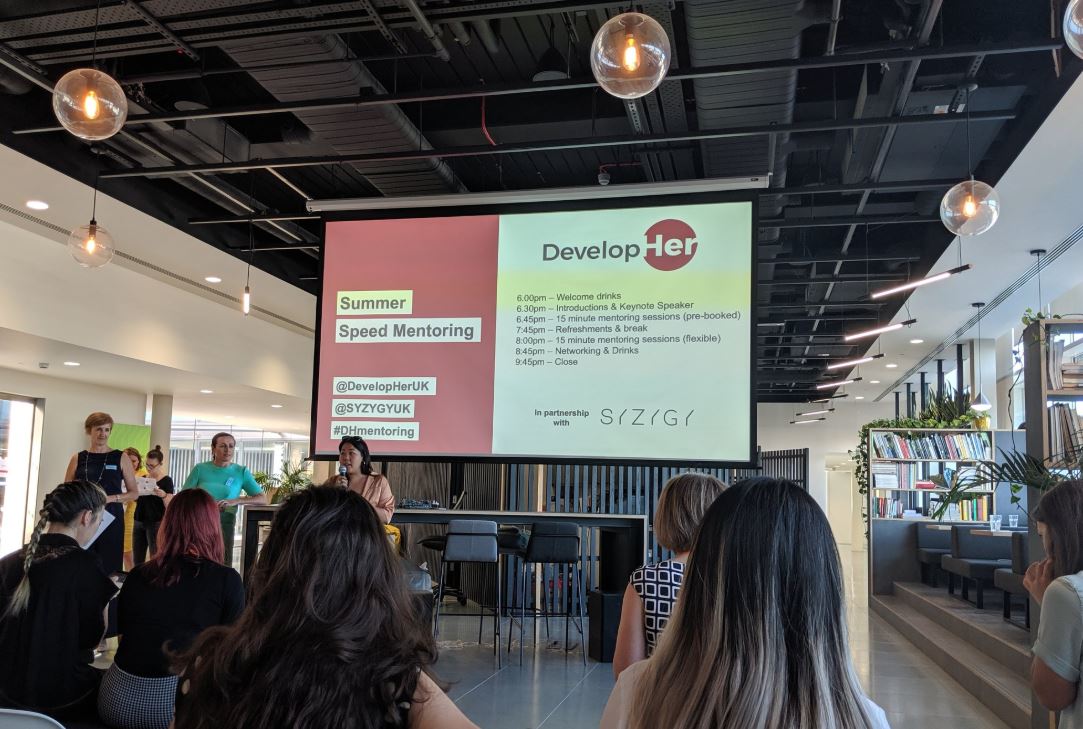
Speed mentoring is a series of short, focused conversations about specific questions. You will meet with a limited number of mentors in 15‐minute time slots each. At the start and end of each Speed Mentoring round, a bell will ring. Mentees will then move on to the next mentor, and will be giving two minutes to switch and prepare for the next round.
Challenging Your Limiting Beliefs:
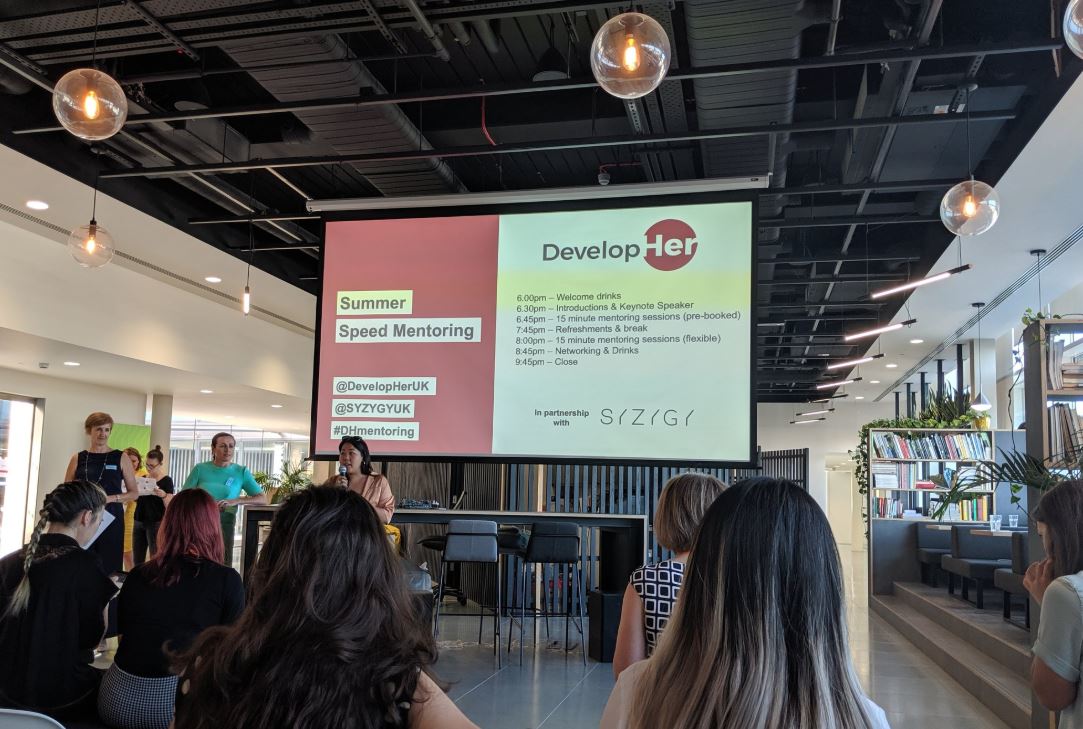
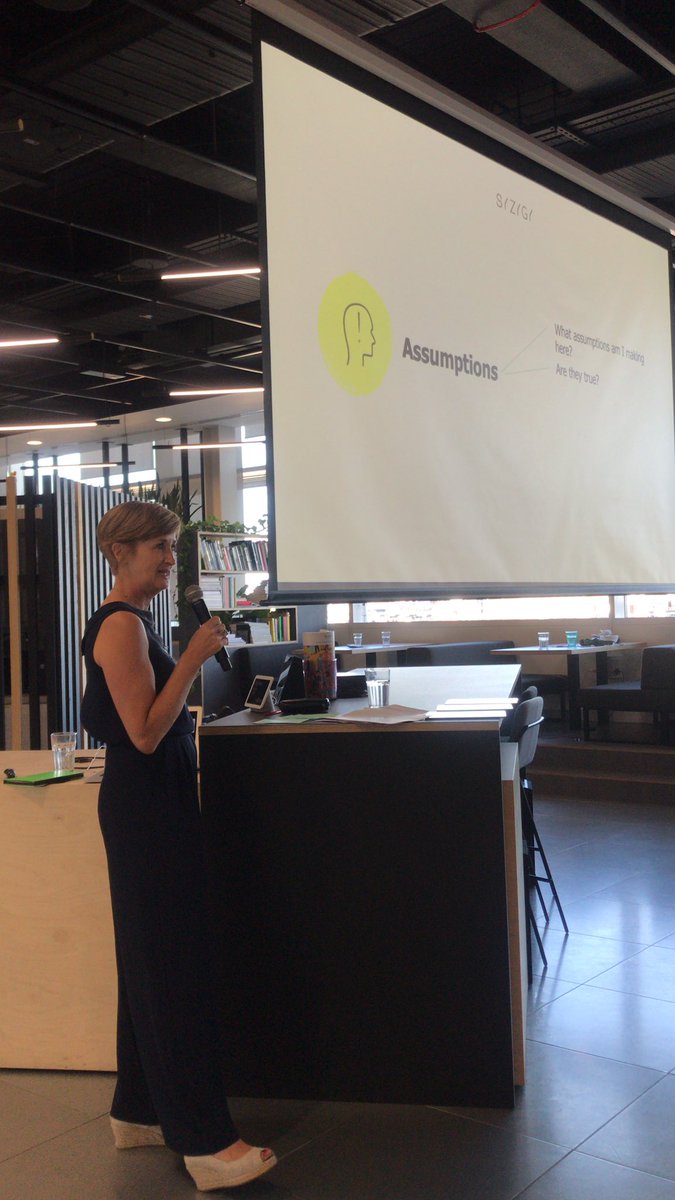
Our event kicked off with a keynote from the CEO of SYZYGY, Ita Murphy sharing her insights on applying neuroscience principles to business and career coaching.
Ita emphasised on how we can challenge the assumptions your brain makes. She focused on how we can all have a little voice in our head, our limiting beliefs that say nasty things to ourselves that can pull us down. Ita nicely quoted “Your thoughts become your reality…so be careful what you think, because your brain is listening”. During this keynote, we learnt the importance on how to manage our thoughts, choices and emotions.

The Power of Lifting Each Other Up
During the event, each mentee had the opportunity to have up to 4-6 speed mentoring sessions with our 2019 DevelopHer Mentors. During the sessions, we asked our mentees to come prepared so they can get the most out of their 15 minute mentoring session.
Following the event, we asked our community what they thought:
- 83% of our mentees were very satisfied with the speed mentoring event
- 75% of our mentees felt more confident with progressing their next career step or personal goal
- 75% of our mentees are likely to recommend mentoring as a means to improve their career as person in tech/digital
- 66% of our mentees found the event very useful
- 66% of our mentees believe the event helped identified how to further progress their career goals
- 83% of our mentees were likely to recommend DevelopHer as an organisation that helps develop careers





Our mentees also shared their feedback of the night:
“It was a really helpful experience, I’ve never attended one like it before. The staff were lovely and I felt really welcomed by everyone. I look forward to more of your events. If you are considering, then just do it. To be in a room filled with people who have amazing stories and are willing to share them with you, to be your sound board and to meet new people also going through similar experiences then take the opportunity by both hands!”
“Absolutely go. It’s not every day that you get an opportunity to be in a room filled with 24 amazingly inspiration & bad-ass women who are all willing to give you tips & advice on your career. I learnt something unique from every single woman I talked to, and left feeling motivated, confident & with actionable tips about where I want to go with my career. “
“An amazing opportunity to meet a wide variety of mentors, gain immediate advice, and start to build longer-term relationships for the future”
“DevelopHer’s speed mentoring sessions are really not to missed (if you are lucky enough to get through) because mingling and being mentored by the high calibre of mentors that attend the event will, without a doubt, give you lots of takeaways and inspiration for reaching or re-evaluating your career goals or challenges. It was absolutely invaluable to meet such highly accomplished individuals in roles I aspire to have in the future and have their undivided attention, even for just a brief time, because they all really took time to listen, share advice and be honest about their own experiences. The venue and keynote speaker was also terrific, providing the perfect setting to get into the mentoring spirit and everyone, from the organisers, to the hosts, mentors and mentees, were all so approachable and friendly which made it all the more enjoyable. I would 100% recommend these events to anyone looking for mentorship.”
A Big Thank You
We just want to say a huge thanks to the following support for letting our community get together:
- Thank you to SYZYGY and all the organising team, for always being a fantastic partner and hosting the most wonderful venue (the rooftop was a dream!).
- Thank you Ita Murphy, CEO of SYZYGY for providing the key note speaker session
- Thank you to all of our 2019 mentors for giving up your time and giving something back to our community
- Thank you to all of our mentees for taking the time to apply as well as opening up and letting yourself be seen in these sessions
- Thank you to our DevelopHer team & associates for helping to get this event together.
If you’re interested in taking part or applying for future mentoring opportunities please sign up to our newsletter.
If you’d like to be a speaker or mentor, you can sign up to our DevelopHer speaker list here.
Written by Laura Chung, DevelopHer Co-Founder
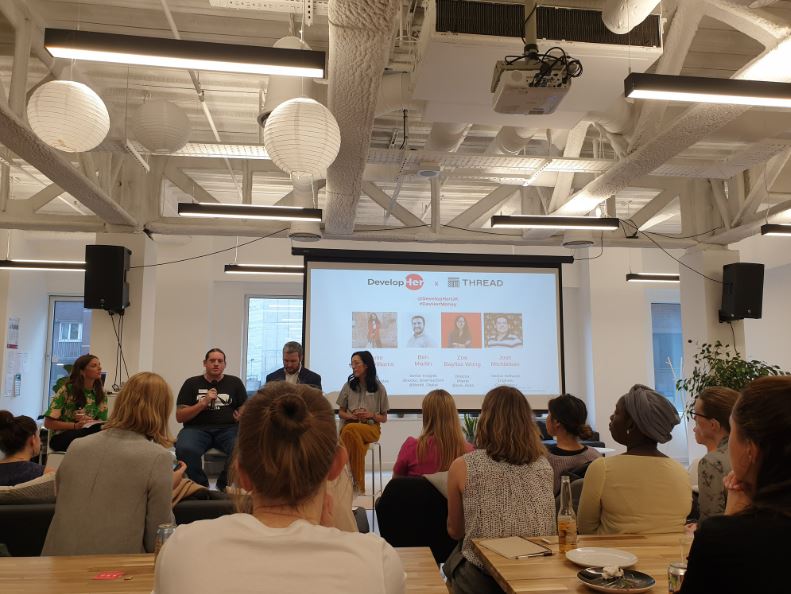
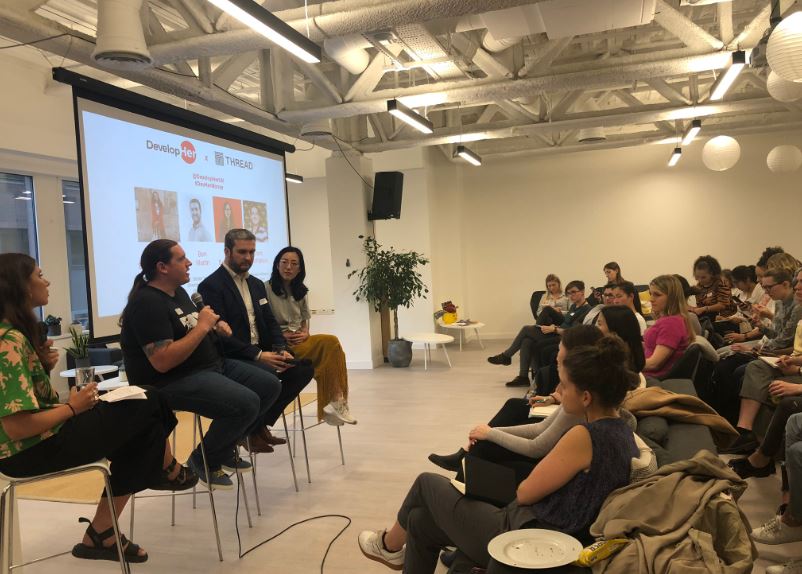
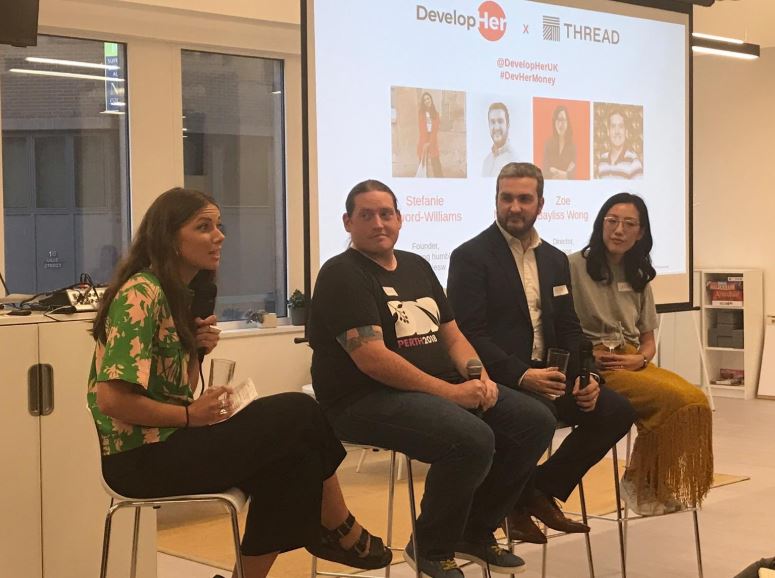
At DevelopHer we decided to break this taboo and hosted an event on the 19th June to encourage people to say “Let’s talk about money!”. We were pleased to be joined with Stefanie Sword-Williams, Founder of F*ck being humble who moderated a fantastic panel with Zoe Bayliss Wong, Director at Depop, Ben Martin, Senior Insights Director at One Four Zero and Josh Michielsen, Senior Software Engineer at Conde Nast International.
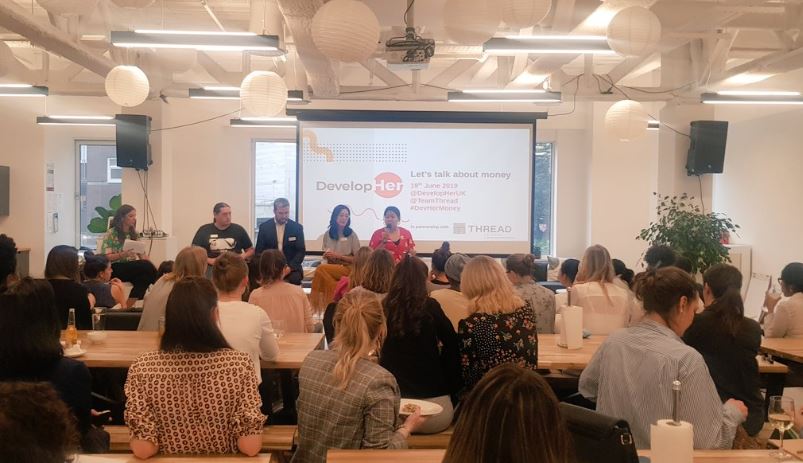
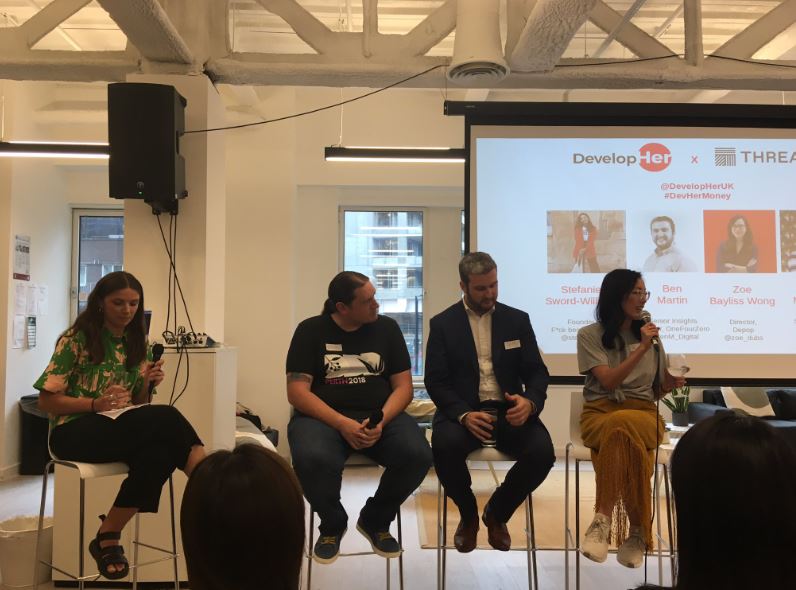
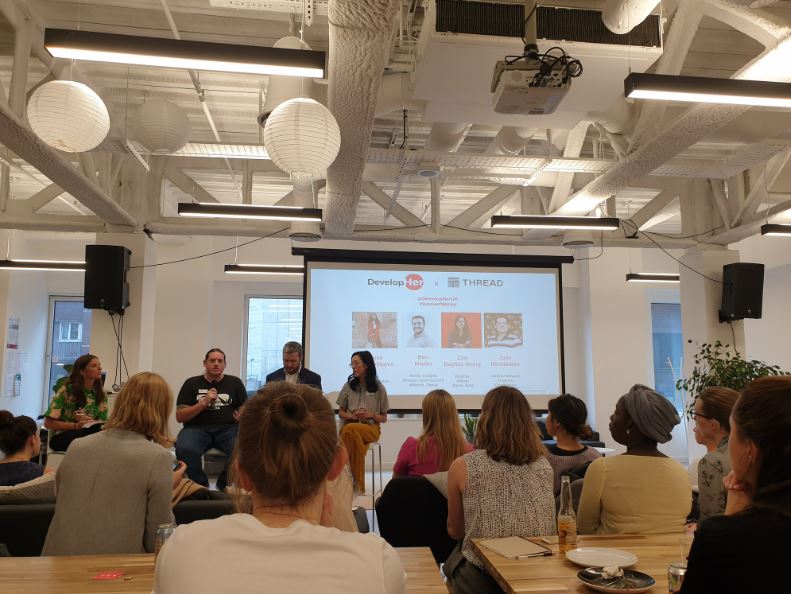
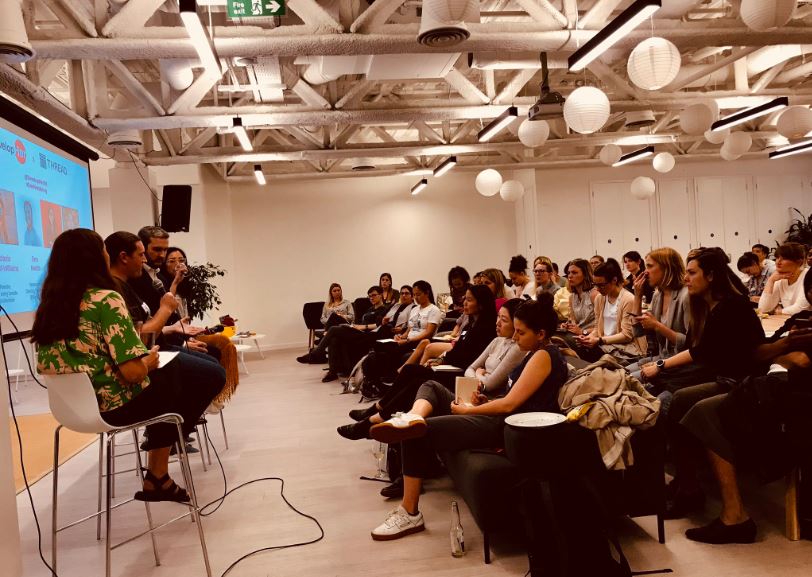
We were overwhelmed by the turnout and note taking during the event, with our members expressing their uneasiness about this topic. “I just don’t know how to ask for a pay rise”; “It would feel like begging if I ask for more money”; “I am worried how I would come across”.
The bottom line is that if we don’t ask for what we deserve, we would end up feeling under-valued, demotivated and unappreciated. But what would be the best way of doing it, and when would be the best time to request it in order to get the outcome that we are looking for? The evening at the “Let’s talk about money” event was packed with tips from our panellists, and here are some of the top ones:
- Prepare for the conversation – Always keep a record of your achievements, the value you have added and the impact you have made in the organisation. Remembering every achievement can be difficult, so keep a record once a week on your successes to help you remind you later. Zoe suggested creating an anonymous 360 feedback on Google forms and sending it your colleagues for feedback on ‘What are my strengths?’, ‘What should I be doing differently’ & ‘Where can I improve?’. The positive feedback on your strengths can help support your case on what you’ve succeeded and the value you bring to the company. Make sure that you have your achievements all prepared before the meeting, so you can present them to your boss with confidence.
- Pick the right moment – It has to be the right moment for you and your boss too. You need to feel good about having that conversation so make sure you practice beforehand. Ben mentioned the importance of knowing when your company is doing well, as asking for more money at difficult times for the business will only result in receiving a disappointing response. Likewise, asking your boss during a stressful time for them may result in them not giving you the attention you want for this conversation. Don’t have this conversation as part of your weekly catch up, set a calendar invite to specifically talk about your performance so your boss is also prepared for the meeting.
- Do your research – It is essential that you know how much you are asking for. When you set a target against how much you are asking for, it becomes easier to have a conversation about it. Josh mentioned websites such as Glassdoor and LinkedIn are great sources for checking salaries for your skillset. He also mentioned to think about the whole employment package, not just the salary e.g. are you willing to take a small salary cut to save a 1 hour commute with a new job? Quantifying these things can help make job offers more comparable.
- Be Objective – Bringing emotions into a conversation that you already find difficult would make it even more uncomfortable. So prepare and practice to not get emotional. Zoe mentioned focusing your conversation on “what I think is fair” as opposed to “what I deserve!”. Keep your language fact driven, graceful and objective. Identify the moments where you’ve increased X metric or saved the company this amount of money or time. Have your job description ready and show how you have gone beyond, show the facts.
- Give yourself time – Don’t react there and then if the conversation doesn’t go as you had in mind. Give yourself time to reflect, get over the emotions and decide what response would serve you best. It would be OK to go back and discuss it with your boss further to show that you are unhappy about the outcome however, when doing so make sure that you are in a good state of mind. Stefanie also reminded us that it’s very easy to read a ‘F*ck you’ expression or body language – be careful of your facial expressions when you hear something you don’t want.
- Have a plan B – Think about what you would do if your request for more money gets rejected. Ben suggests asking your manager what you need to do to get to the next level, and make notes so you have it written down so you don’t forget once you’ve had the conversation. Josh also mentioned to get in the habit of using ‘CYA – cover your arse’ and make sure you get everything in writing, so your conversations don’t end up being unpromised words.
If you find your existing role doesn’t give you the desired skill sets you want to get promoted, Stef suggested creating a solution for yourself first e.g. build a team outside your role to show strong leadership skills. Otherwise start looking at your exit plan and ask yourself questions: why stay with the organisation if you are not getting what you deserve? Why not find another job and leave? Maybe you are currently gaining a good set of skills and experience that would benefit you in your next job, which are worth staying for. Or you just decide to stay because it’s personally not the right time to move. Knowing the “whys” would help you identify your reasons and plan accordingly.
Thank you to our speaker panelists on the night for all your insights. We also want to say a huge thank you to Thread for being a fantastic partner and hosting us for the evening.
If you’d like to attend more events like this in the future, sign up to our DevelopHer mailing list where you get first access to our next events.


Written by Marjan Parto Hamed, DevelopHer.
Being a mentor can mean a lot of different things to people.
Ultimately you are being a trusted adviser, which involves making yourself available to support and advise someone when they need it, and delivering that support in a way that makes sense to them. A mentor is always trying to keep the persons’ best interests in mind.
Mentoring opportunities can vary, from one-on-one relationships that can last years to providing short-term on the spot mentoring (during a coffee catch up or a speed mentoring session).
You might already have your own personal mentoring style and readiness, but here are our top 10 tips to help make a positive impact on others.

- Agree on the expectation of the relationship
Be very clear if you’re there to mentor for a one time only offering or if you’re open to being approached afterwards. If you’re only available for one session, try to be actionable with the advice you’re giving, so the mentee can feel like they got value from a short session. If you’re open to continuing the mentorship session then set realistic expectations on how much time you can give or how often you can meet. - If a mentee is shy, initiate the conversation
Not all mentees will be comfortable opening up to new mentors who they don’t know very well. Help make the mentees feel at ease, and if you see that their are insecure or struggling to ask their questions – initiate a conversation starter on identifying what their goal is:- Ask them about their aspirations, short-term or long-term career goals.
- Ask them about their existing challenges, they’d like to overcome?
- Find out what they want and expect from you – get a good understanding if they want support, guidance, insight or personal stories.
- Don’t assume anything about your mentee – ask.
Every person you mentor is different. We all have distinctive learning styles and career ambitions. Try and approach each mentorship differently. It’s easy to fall into stereotypes or not see a situation from another person’s perspective. Try not to expect everyone to progress at the same rate you did or immediately project expectations on your mentee based on your own desires or opinions.
Instead it’s important to ask questions on the reality of where they are now. So you can help identify options for them. - Be present and know when to wait before giving advice
Becoming an active listener, shows you’ve made a conscious effort to really, truly pay attention to what your mentee is saying, rather than what you think you’re going to say next. You don’t always need to come up with something helpful right away, in fact, you may give more appropriate advice to the scenario if you listen closely, ask open questions to dig deeper and act as a sounding board. - Offer constructive criticism
Providing feedback constructively but effectively is important to ensuring mentees improve or progress. Help the mentee to identify what different options are open to them. This might include challenging how they currently do or think about something. Say what you think you mentee needs to hear from you, not what you think he or she might want to hear.
There are also ways to deliver criticism without breaking their spirits, so try and be diplomatic and tactful when addressing concerns. Rather then only noting the mentees shortcomings or mistakes, point out their positive and offer guidance to improve. You can also draw from your own experiences on how you had a time you had a slip up and how you re-directed your attention to progress. - Share your stories
There’s no must-do guide for mentors. However the power of sharing your personal journey and stories can help give greater context to your mentees. Stories are a great way of teaching and keeping others engaged – especially when sharing times you’ve felt vulnerable or even failed. This can help create empathy because a story you have from your archives might relate to the battle they’re currently facing.
Remember to keep the stories short and to the point, as the mentoring sessions are about your mentees not about yourself! - Help them agree to set tasks or accountable actions
Try and help stretch your mentee by giving them examples of actionable tasks or experiments they could try and test. This doesn’t mean your responsible for always providing concrete answers to their questions or scenarios. It may be as simple as providing suggestions, or agreeing on setting small goals together. However, by framing the conversation in a way that allows them to take steps going forward, can be hugely valuable for a mentees to feel they have gone away from the session with practical actions to implement straight away. - Try letting them come up with the conclusion themselves
Recognise that it’s the mentee’s responsibility to oversee their own career path. As a result, you can try the ‘socratic method’ to mentoring. So carrying out a dialogue in which the goal is to get someone to arrive at the conclusion that you want themselves by simply asking them questions. If a person arrives at the conclusion on their own behalf then they’re much more likely to take the conclusion seriously. It’s an interesting way to stop people from feeling though they’ve being talked down to, but you’re still guiding them in the general direction. You might be surprised at how much difference it says “do you think that’s a good idea?” instead of saying “that’s not a good idea”.
This is a great technique if you don’t know an answer to a question. Instead of making up a response to a question you’re not sure about, turn it back to your mentee. Ask them ‘so how would you do it’ – listen to their response and find ways to build on it with further questions or clarifications. - Connect or intro them to others
It can be common practice to hold your contacts close to your chest. However as a mentor, you’re there to spot how you can add value, and it might be through introducing them to people you know. Or sharing the resources you’ve found invaluable in your own career, and give them some inspiration or practical resources you think they can utilise.
The right connections at the right time can instantly open new doors. Sometimes when you share what you have with others, you can get ten times the return back. - Give the confidence they need
A lot of mentees need a mentor because they don’t always believe in themselves. They might be stuck in a ‘rut’ or had faced a setback and need the motivation of others to go out and do it. Sometimes, it’s as straightforward as inspiring your mentee to move beyond their limited beliefs. Even when they face difficulties, try not to act like your mentee will never comprehend your guidance. Have a optimistic outlook, respond positively and be an energy donor.
Written by Laura Chung, DevelopHer Co-founder.
]]>To help our mentees attending on the night and any community members looking to make the most of the mentoring experience they embark on, we’ve put together some of DevelopHer’s top tips for a great mentoring session.

1. Be prepared and come asking the right questions
Actively shape the conversations to your potential mentor on the outcomes you want to achieve.
Too often, mentees know they want a mentorship but don’t know what they want out of it. During a speed mentoring, you’re limited on time – so you need to figure out what to focus on before the event or session. You’ll also build a more gratifying relationship with the mentor, when you’re thoughtfully prepared for advice.
Before you come to your mentoring session, do some prep work and come up with 5 guiding questions, based on what you want to accomplish to ask your mentor.
In order to focus on what types of questions consider the following before the session:
- Consider what your short-term & long-term goals are to discuss with your mentor
- Figure out what successful outcomes of mentoring will look like for you
- Figure out the top 2-3 things you want to be able to address during the session
- What are the challenges you are facing in your role? What stops you from doing this?
- Are you considering a career transition – what do you think are the pros and cons?
- What are the options/choices have you been thinking of?
One you know the outcomes you want to achieve from your session, figure out how you want to frame the questions based on what you want to achieve.
Below are example areas of how you could frame your conversation:
- Stories – Consider if you want to ask your mentor a story from his or her career that will help you with your career.
E.g. How did you land a role?
Can you tell me when you have a difficult boss, how did you handle it?
What’s the most important leadership lessons you’ve learnt & how is it valuable? - Situational – Identify a challenging situation and share it with your mentor. Ask your mentor to act as a sounding board
E.g. What advice can you offer on how I approach entering a leadership role? What should I consider if i’ve never had experience on leading a team?
When trying to gain buy-in to implement a new program, what tactics have worked for you? - Skill-building – identify a skill you currently want to develop, and ask your mentor for advice or resources.
E.g. How do you approach risk-taking?
How can i become a more assertive negotiator?
2. Be curious and open to who you’re being mentored by.
The best mentors are the ones who can fill gaps in your skillset. You don’t have to seek a mentor who’s your clone.
During the Speed Mentoring, you’ll have access to approach directly to different types of mentors from different backgrounds / industries. And whilst mentors are a great way to help make your strengths even stronger, it’s also valuable to have someone who can give advice in areas where you’re struggling.
Consider speaking and approaching mentors that may also have different roles or background to you. These mentors can give valuable insight into a skill or situation that you may not have considered, plus may have also gone through similar experiences but in a different context. Each mentor may provide a different perspective – that can give you new ways of thinking.
3. You don’t always have to follow a mentor’s advice – but listen to it and evaluate it.
The role of a mentor is there to help you reflect, not to give you the answers.
Mentors can provide advice, perspective and make you think differently – but they will not make decisions for you. In this speed mentoring, carefully listen and considered the perspective, personal experiences or tips your mentors give you, then make sure you take the time to evaluate how you approach the situation yourself and if you think it’s appropriate to apply the advice. Constructive criticism may not always be easy to take in – know that you are learning, try to respect your mentor’s opinions and consider everything they say carefully.
Remember to bring a pen and notepad to take notes down. As speed mentoring sessions are short, write the advice down and come back to it later when you have the time to consider or evaluate the advice given to you.
4. Be grateful and keep in touch
Mentors are taking the time to help you under the goodness of their hearts.
Mentors don’t owe you anything, but they are taking the time, energy and investment to help others. It’s important to be grateful for the advice they give, and especially after you’ve found success.
Whilst DevelopHer can help provide you the opportunity for connections, you as a mentee are ultimately responsible for ensuring you keep the relationship going if you want to. Not all mentors during a speed mentoring session will have the time to mentor you going forward, but some may certainly be open to it.
If you feel you found an authentic connection with a mentor you meet, ensure you follow up:
- Bring your business cards
- Ask for their business cards
- Add them on LinkedIn
- Follow up with a thank you email or note – sharing the key learnings & summarise the key actions you’re going to take
- If they’re available and willing, try and ask for a follow up session
- Or if the tips/advice they shared with you, worked for you. Don’t be afraid to send a follow up email thanking them and how you’ve found success.
See the list of our 2019 Speed Mentoring Mentors here.
Written by Laura Chung, DevelopHer Co-Founder
]]>As part of our DevelopHer’s values, we want to provide our community accessibility to the tools they need to progress their careers, so we are excited to provide an opportunity for our community members to find and speak to mentors in their industry, create relationships with these mentors and gain on the spot advice and tips.

OVERVIEW:
The speed mentoring will welcome 60 people from the DevelopHer network. This will include 30-40 members (of all ages) of the community who want on-the-spot mentoring. On the night there will be 20-30 DevelopHer mentors to speak too (including senior figures in UK tech & women leaders).
The whole event will take 2-3 hours, with the opportunity to network and meet up to 5-7 different mentors on the night. Please see the agenda of the event below.
We have a limited number of spaces available and a short application window so please apply for a spot by 6pm BST 12th June 2019.
To apply for the speed mentoring opportunity pleasefill out the application form here.
The mentoring session will cost £10. Once you’re application has been successful and confirmed – we will share an eventbrite link for you to purchase your ticket. Without the ticket purchase you will not be allowed in the event.
Agenda:
- 6.00pm – Welcome drinks
- 6.30pm – Introductions & Keynote Speaker
- 6.45 – 7.45pm – Up to Four 15 minute mentoring sessions
- 7:45 – 8.00pm – Refreshments & break
- 8:00 – 8:45pm – Up to Three 15 minute mentoring sessions
- 8:45pm – 9:30pm – Networking & Drinks
Venue: Syzygy HQ Rooftop, Holborn
Please note, not all mentors will meet with all mentees in this time frame. Based on the agenda every mentee will have a 10 minute break whilst we ensure there is a rotation of mentors during the session. Mentees will also have the opportunity to network with each other and enjoy the refreshments.
What is mentoring?
Mentoring is a support system where one person shares their knowledge, skills and experience to assist others to progress in their own lives and careers. The power of mentoring is more than ‘giving advice’, it’s about motivating and empowering the other person to identify their own issues and goals and help them to find ways of resolving or reaching them. As part mentoring, it includes respecting the different ways of working.
British Mentoring tends to include 3 key elements: career development, sharing knowledge and helping to improve performance.
What is Speed Mentoring?
Speed mentoring is a series of short, focused conversations about specific questions. You will meet with a limited number of mentors in 15‐minute time slots each. At the start and end of each Speed Mentoring round, a bell will ring. Mentees will then move on to the next mentor, and will be giving two minutes to switch and prepare for the next round. Not all mentors will meet with all mentees.
How do I apply?:
Please submit your application via the application form here.
You will need to include the following details below:
- Full Name
- Age (Over 18)
- Profession or Current Role
- 100 words (max) on why you would like to join us for the day and what you hope to gain from being mentored.
- 1 example area you need help mentoring on (e.g. confidence, example of work situation, example of personal situation)
- Email address (for DevelopHer to contact if your place is confirmed)
The application process is needed, as places are strictly limited and while we hope to be able to run future opportunities we are unable to accommodate the entire community in this instance.
The event will cost £10 for the evening. Once you place has been confirmed, you’ll need to purchase your ticket on the eventbrite page via the email.
Have questions? Read our FAQs here or contact us at [email protected]
Written by Laura Chung – Co-Founder of DevelopHer
]]>