-
-

Digi Verse- Beyond Version
-

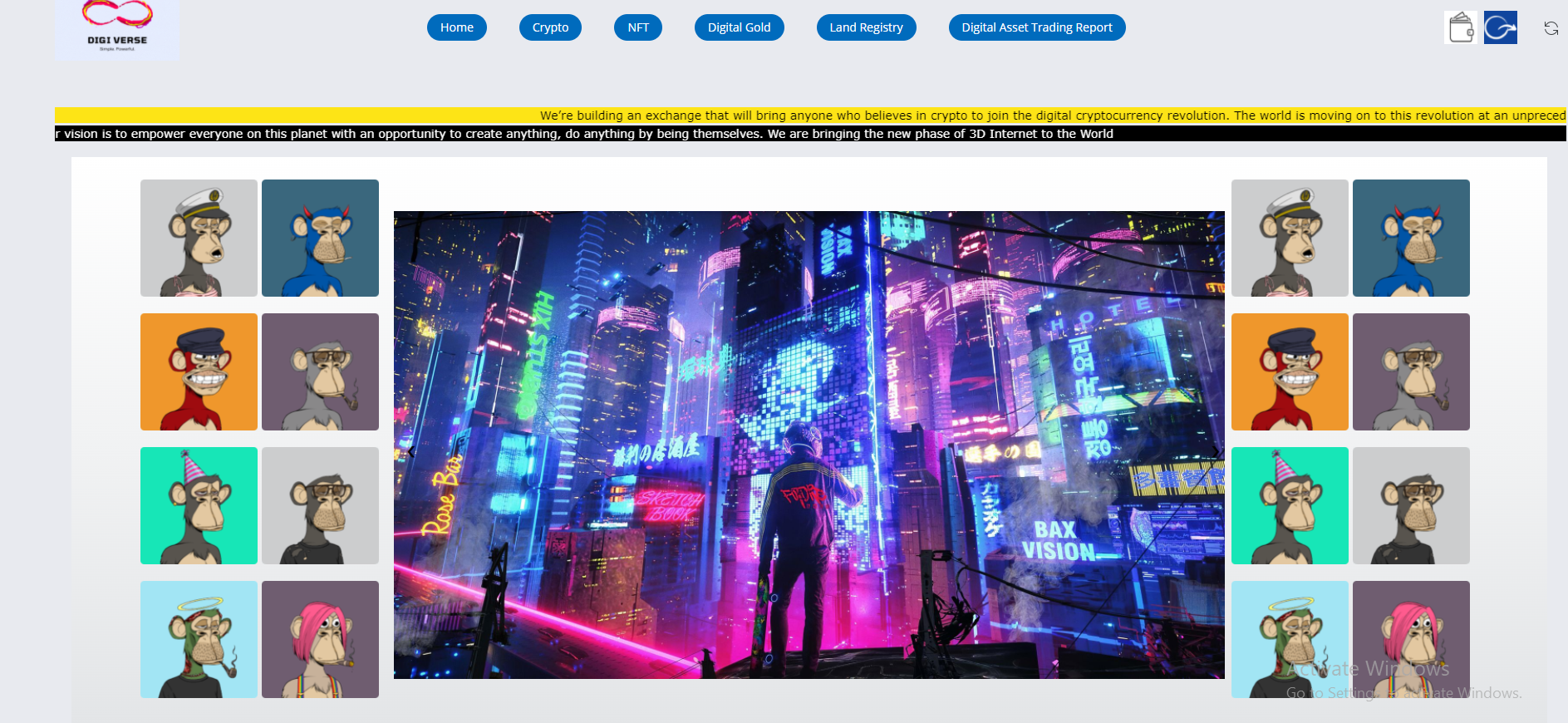
Home Page
-

DigiGold portal
-

NFT Portal
-

LandRegistry Portal
-

Cryptocurrency Portal
-

Digital Assets Trading Report
-

DigiVerse-Android Application


Content Overview
• Inspiration
• Problem Statement
• What it does
• How we built it
• Challenges we ran into
• Accomplishments that We are proud of
• What we learned
• What's next for DIGIVERSE
• PEGA Express
• Getting in
• Research
• Acknowledgement
Inspiration
Right now, we are on the cusp of the next internet, The Metaverse and the Web 3.0 is going to be the future of the digital world. Metaverse a combination of multiple elements of technology, including virtual reality, augmented reality, and video where users "live" within a digital universe. Supporters of the Metaverse envision its users working, playing, and staying connected with friends through everything from concerts and conferences to virtual trips around to the world. The Tech giants like MAGMA (Meta, Apple, Google, Microsoft and Amazon) have been already invested in billions in Meta World. The First Step in enlisting PEGA into the Meta world, Team CBA has built a whole environment which has been fully built in PEGA which enhance the people and customer to the Meta world experience and team coined the naming as DIGIVERSE the First Meta World built inside PEGA, and BLOCK-CHAIN based Pega portals and our Application has been live on Google Play Store and holds the record of first Android App for finance fully built in Pega to be launched in Google Play.
Problem Statement
Cryptocurrency has always caught people’s interest. India is planning to adopt a middle ground for crypto instead of banning it outright. Today, more than 1,500 virtual currencies, such as Bitcoin, Ethereum, Litecoin, Digecoin, Ripple, Matic, etc., are traded in the digital currency world. The investment and trading volume of cryptocurrencies has increased multi-fold since the nationwide lockdown. The crypto investments have grown despite any precise regulation from the Indian Government or Reserve Bank of India. In Budget 2022, the Government of India has declared the new category of assets as Virtual Digital Asset (VDA). These VDA’s will be taxed at 30% without any benefit of deduction apart from cost of acquisition. And 1% TDS (tax-deductible at source) will be applicable to all the transactions involving crypto.
The new taxations rules for virtual digital assets would be applicable for transaction done in FY 2022-23. Since, we will be paying taxes in fiat currency, it is important for all the crypto investors to keep a track of their crypto gains and losses of every virtual digital asset. With the taxation on crypto, government gets a good income source in the form of tax and indicates more long-term investment in crypto. Along with the crypto taxation rules, most of the crypto investors and traders are also new and may face difficulty while reporting crypto income for taxation.
A taxpayer needs to consider below listed details related to taxation of crypto gain/loss as per Budget 2022:
- First, we should calculate all your gains made via crypto holdings, staking, farming and ICOs and specify them in our business income
- Gain from crypto needs to be reported as special Income under the head “Income from other sources”. There will be a separate column in the ITR Form for this.
- Flat 30% tax rate will be applicable on the gains made, without deducting any expenses except the cost of acquiring that currency.
- Loss from cryptocurrency cannot be set off against any other income and, cannot be carried forwarded. For example, if we suffer a loss of 10,000 Rupees in the previous year and we have gained 20,000 Rupees in the current year, then we have to pay 30% tax on 20,000 Rupees i.e., 6000 Rupees.
- These newly inserted provisions will be applicable from the Assessment Year 2023-24 i.e., FY 2022-23.
- We would be liable to pay taxes on the net profit made in the financial year. Net profit = Total Profit in the current financial year – Total loss faced in the current financial year.
- And need to claim the TDS (Tax Deducted at Source) which had been deducted while trading securities on the exchanges.
What it Does
To address the problem statement, we have come up with a solution to provide unified platform for all the digital assets trading and provide the gains or losses made during crypto transaction for the financial year. This solution uses Pega’s robust and strong capabilities like Case Management, Integration Services, PegaComponentForEthereum and Reporting Solutions to effectively address the issue. Our proposed solution:
DigiVerse is designed to be the easiest platform to Buy, Sell and manage our investments. Instantly deposit, withdraw and trade over 100 assets with ease. It authenticates the legitimacy of the customer and offers an in-built unified trading features like- Cryptocurrency, NFT, Digital Gold and Land Registry. And provides an option to generate consolidated TDS statement and the gains/loss on the digital asset transactions for the current financial year.
CRYPTOCURRENCY: Cryptocurrencies are digital or virtual currencies underpinned by cryptographic systems. It is a decentralised money based on blockchain technology. They enable secure online payments without the use of third-party intermediaries. Most of the claims that blockchain makes, like privacy and immutability, are enabled through cryptography. In DigiVerse once the user is authenticated, he can buy, sell, transfer and store cryptocurrencies using Crypto option. This option acts as a secure platform for cryptocurrency exchange.
Non-Fungible Token (NFT): NFT is a digital asset that represents internet collectibles like art, music, and games with an authentic certificate created by blockchain technology that underlies Cryptocurrency. It cannot be forged or otherwise manipulated. NFT exchanges take place in cryptocurrencies such as Bitcoin, Ethereum. Whenever user uploads the digital image, a unique token will be generated and establishes ownership of the user. He can also buy NFTs listed in the portal.
Digital Gold: Digital gold currency (or DGC) is a form of electronic money (or digital currency) based on mass units of gold. Digital gold is a new age investment instrument that allows us to invest in 24 Karat gold. DigiGold option of our portal provides an option to user to buy gold which will be stored in a secured vaults under user’s ownership. He can also sell or redeem the gold. Use of blockchain distributed ledger provides data accuracy, real-time tracking and transparent auditability.
Land Registry: So far, blockchain technology has been used to create tradeable tokens and cryptocurrencies. Blockchain technology is a peer-to-peer protocol that can be leveraged to keep track of transactions over the internet. The technology provides transparency and traceability that can be used in the management of land rights. Blockchain technology can be used to digitalize land rights by authenticating owners and other users of land, and providing a fixed ledger of land use rights transactions. LandRegistry option facilitates the option for trading land by providing option to register land for sale and transfer of ownership.
How We Built It
The proposed solution is built on Pega 8.6 version, and we have utilised the latest features available for building the workflow components. PegaComponentForEthereum component has been used to integrate Pega application into blockchain environment.
High Level Design: The proposed solution is built using the below reference architecture.
- The frontend web application: Built using Pega Cosmos UI provides the digital asset trading user interface.
- REST API: uses web3js JavaScript library to connect the Pega application to the underlying smart contract on the Ethereum Blockchain. a. It should have contract address deployed to Ethereum network b. Application Binary interface of the smart contract deployed.
- DigitalAssetContract : The implementation of the smart contract, which is mined and compiled into the Ethereum blockchain using Remix web-based tool to run the core functionality of the application
- PegaBlockchainEther: This component provides a Blockchain Landing Page a. To map Pega Operator IDs to the Ethereum accounts. b. It facilitates Pega application to connect with Ethereum smart contracts using contract’s Ethereum address and its ABI (Application Binary Interface), c. The PegaBlockchainEther Component connects to the smart contract on an Ethereum node and automatically generates Pega activities that can call each smart contract function. d. These generated activities perform the necessary data transformations between the Pega data types and the Ethereum data types

User Registration: User is authenticated using Google authenticator.
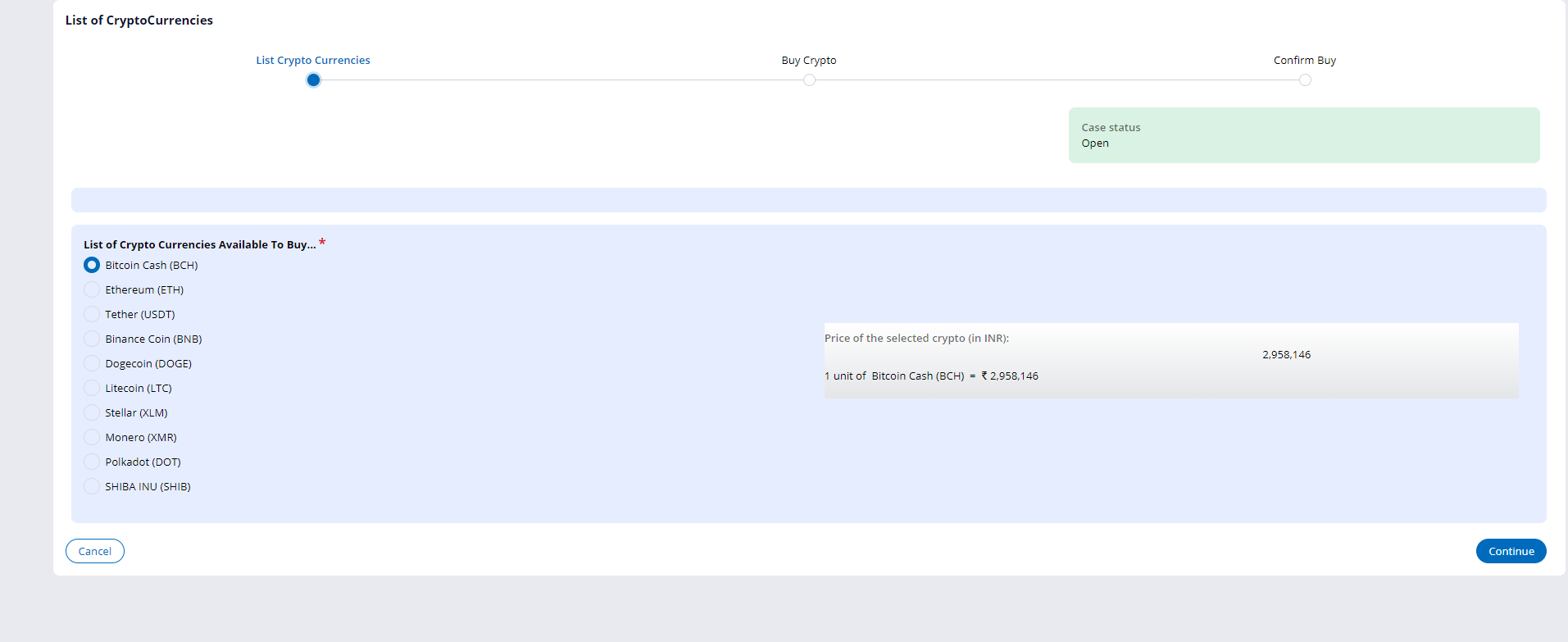
Cryptocurrency: Once user is successfully authenticated, using Crypto option he can buy cryptocurrencies.
- We built a portal, in which we used APIs to display latest and live prices of the Crypto-Currencies. The user can choose the crypto he wants to buy by clicking the “Buy Crypto” button
- A case for the buy is created; It displays a list of available cryptos to buy, and the UI displays the price of each coin (as user selects)
- After the user selects the coin to buy, it moves to next step where user has to select the quantity of the crypto that he wants to buy and the total cost of the buy is calculated and displayed
- The order details are then displayed and the user is asked to confirm the order.
- Once the order is confirmed by the user, the order is then placed and the case is resolved. And on clicking the “Complete Order” button the user is re-directed to Home screen. API We have Incorporated Blockchain along with API to get the accurate results of value of changing Crypto time to time

Non-Fungible Token (NFT): NFT Portal provides an option to buy and sell NFT using PEGA platform. User can click on “NFT” button which is present in the main portal header and he/she will be redirected to “NFT Main” Portal. In NFT Main portal user will have two option • Upload NFT (Uploading any new NFT to our application) • Buy NFT (To buy any available NFT present in the system)
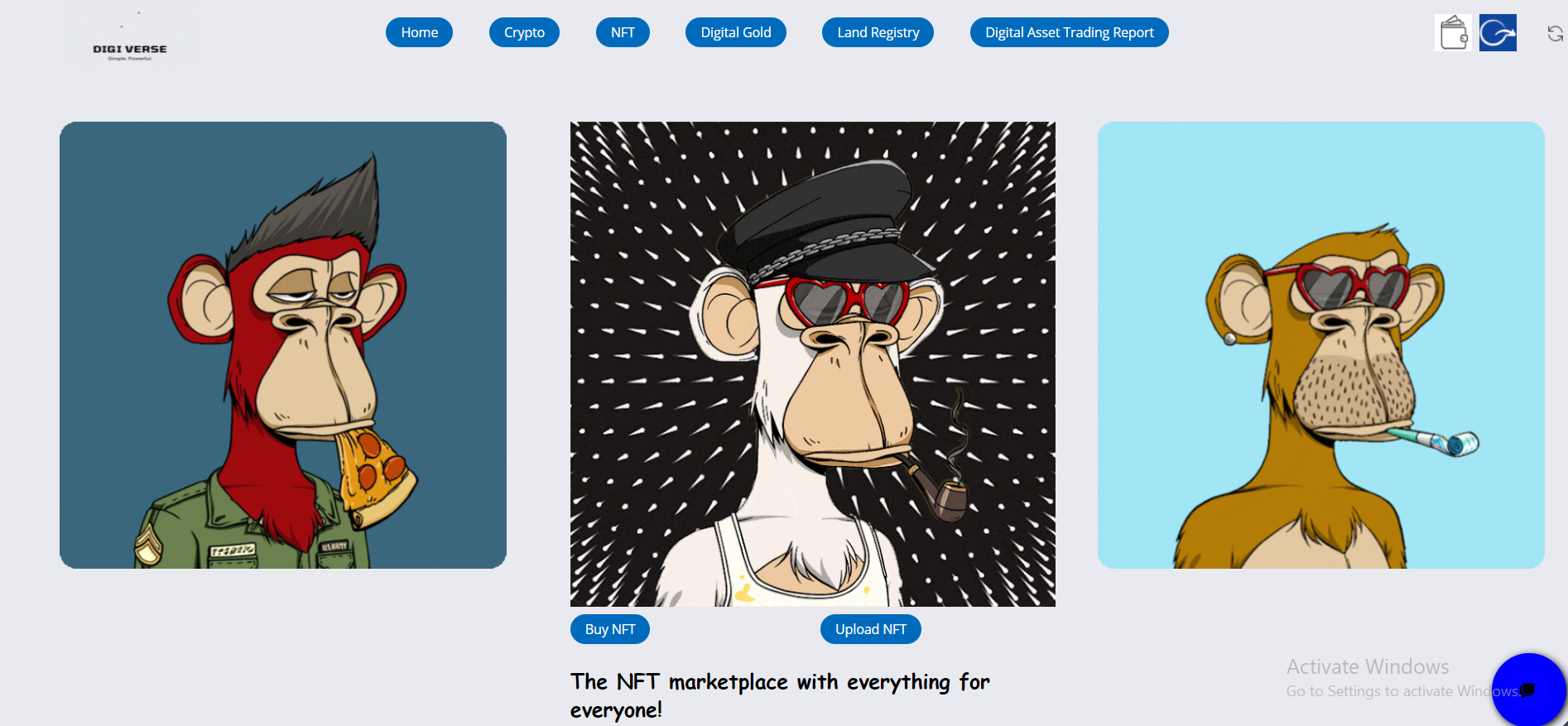
Upload NFT: • When user clicks on ” Upload NFT” button, a NFT- case will be created and user will be redirect to stage 1: “Upload NFT”
• User will be uploading his NFT and she/he has to fill all the details along with NFT price which he/she wants to sell.
• Once user clicks on “upload this NFT” he will be redirect to confirmation screen of “Upload NFT” stage.
• On confirmation screen if user clicks on “Return to NFT main page” button user can go back to NFT main Portal.
• Local Data Table is used to store the NFT images metadata.
• For every NFT image a unique token will be generated.


Buy NFT:
• In NFT main portal if a user clicks on the buy NFT option he will be redirect to buy NFT landing page where user will be seeing all NFT cases available in the system.
• In all list he can select any NFT which user wants to purchase by clicking “Buy” button.
• Once user clicks on “Buy” button. Assignment for the NFT will be opened and he will be seeing the order placement screen.
• User has to enter number of NFT he/she wants to purchase if amount exceeds more than his/her wallet balance then one message along with “Buy crypto” will be displayed once he/she clicks on link “”Buy Crypto” he/she will be redirected to Crypto portal.
• If user has enough balance he/she can purchase the NFT and money has been deducted from his/her wallet.
• User will get confirmation screen.
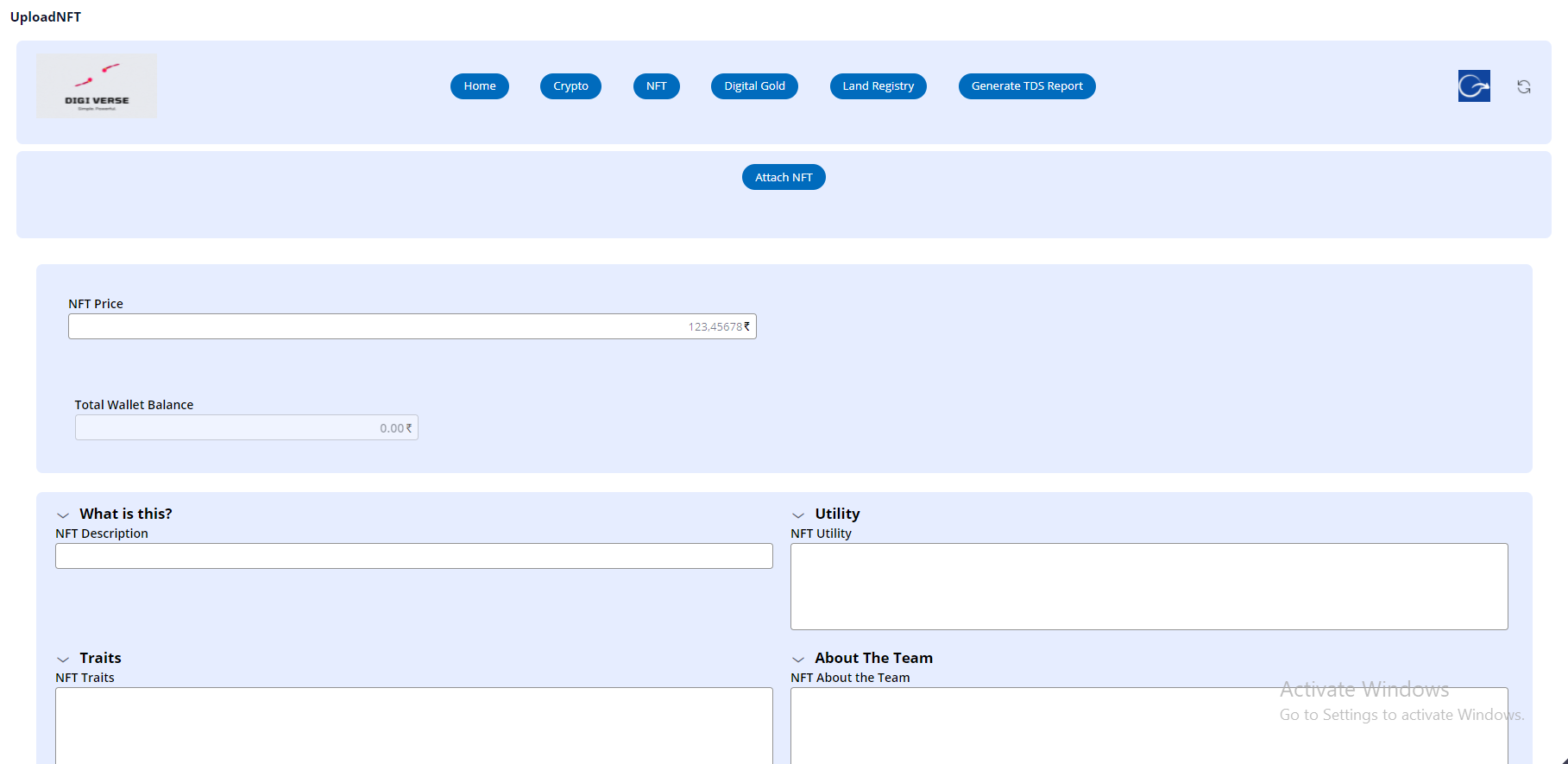
Launching our Own NFT Our Team is extremely honoured to Launch First NFT in PEGA PLATFORM
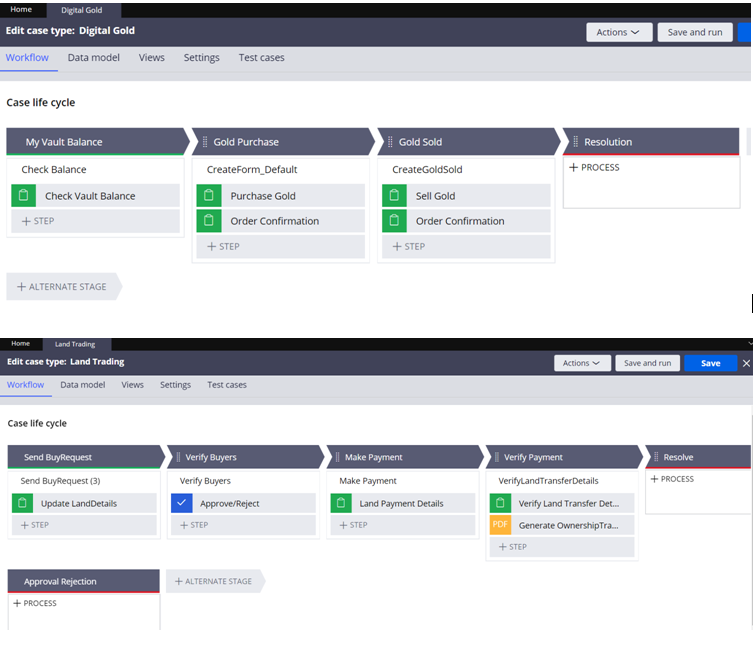
DIGITAL GOLD: We have used Pega’s case management capabilities to effectively use Digital Gold solution.
Collect the User requirement: We require User requirement for purchasing gold digitally. The user would input the gold to be purchased or sold in Amount (INR) which in turn calculates the weight of gold purchased on sold in grams based on the live gold rate on daily basis. The User can either Buy the gold or sell the gold which was purchased earlier.
Verify the input details: User would re-verify the details entered in the previous screen to verify the amount or the weight in grams before proceeding to the Payment details.
Process the Payment: Once the details are verified, the payment is processed and the Gold purchased amount and the Gold in grams is added to the customer wallet. The Gold sold will be deducted and the customer wallet is recalculated as well.

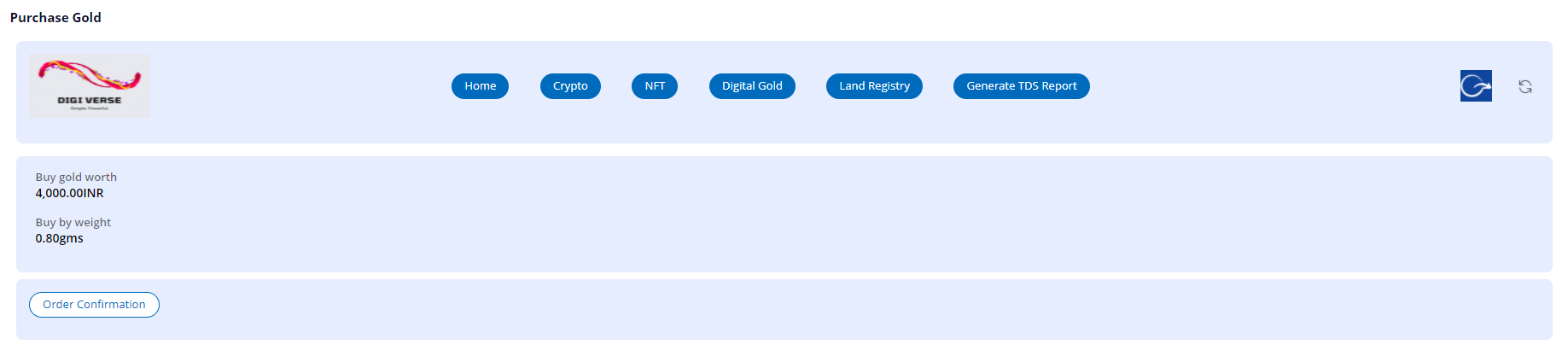
LAND REGISTRY: This option provides blockchain based decentralised land trading where user can register their land for buy and sale.
- Collect Land Details for sale: Land Owner has to register the land owned by him. These details will be verified by Sub-registrar. And once Sub-registrar approves, the land will be available for Sale.
- Buying and Selling of Land: The interested party sends the request to land owner to purchase the land. Once the land owner provides consent, interested party will make the payment. This transaction will be recorded in the blockchain.
- Generate Transfer of Ownership document: Sub-registrar will verify the land details, buyer, seller and witness details and generates Transfer of ownership document. How we built it The following are the Pega components configured to enable the proposed solution.

Case Types:
- Land Registration: This is the case type which will allow user to register their land for sale and routes the case to sub-registrar for verification.
- Land Trading: This case type facilitates buying and selling of land. Interested party can send the request to buy the land and make payment. Sub registrar verifies the transaction and transfer of ownership document will be generated. Data Types:
- LandDetailsForSale: To store the land details registered for Sale.
Portals:
LandRegistry User: This portal allows user to register land for selling and buying.

LandInspector: This portal allows authorised official to verify the transaction and approve transfer of ownership.
 PORTALS
Each and every portals has been built up with the DX-API compliant feature and the code can be reused as component in other applications. The Application has been built using COSMOS_REACT UI.
Digiverse Chatbot
Digiverse ChatBot enables the customer(s) to initiate the conversation with it. When customers come in with a Query about the Digiverse App, this chatbot offers them with the solutions, including proactive chat, and knowledge articles. It is developed using legacy Webchat in Pega.
- The user has to initiate the conversation by sending – “Need Help”
- The user is given with the options of Queries to choose from.
- And according to the user’s choice, he is redirected to the solutions or further stages, where he can be given more choices leading to solutions.
- This Chatbot is embedded in all the portals, for the easy access to the user The Below pictures show a snapshots of how the conversation can be processed:

Android Application
DigiVerse has been officially launched in Google Play and which shows it's been compatible to make an impact in the FinTech and has been launched using Channels & interfaces Options in Pega . The Application has been built into an Android App Bundle (aab) and has been interconnected with Google Firebase for cloud messaging and being the medium to host and make our application live in the google market. DigiVerse holds the record that it's been the First Android Application for fin-tech has been deployed in the Google Play.
PEGA Express
We used Pega’s design-focused methodology (Pega Express) to build our application PEGAVERSE. Pega Express includes the following phases
• Discover Phase
• Prepare Phase
• Adopt Phase
• Build Phase
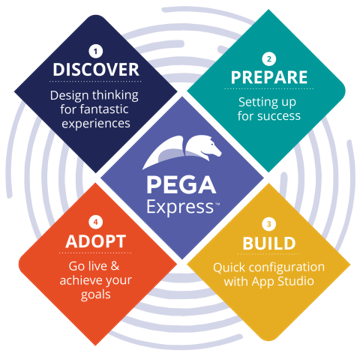
Discover Phase: During Discover Phase, we focus on understanding our desired business outcomes, prioritizing which Microjourneys, We think the Discover phase is important because it helps us focus on our desired business outcomes. Pega Express promotes speed to value. Rather than delivering a software solution in one high-risk release, and we decided to deliver one or two micro journeys in each deployment. That iterative approach provides the best mix of business outcomes faster. It also eases our first implementation. During the Discover phase, we designed the three pillars-Microjourneys, Personas/channels, Data and integrations and we harnessed the power of Pega low-code platforms such as App Studio. We used the design thinking approach to successfully generate ideas and creatively solve problems throughout the project lifecycle.
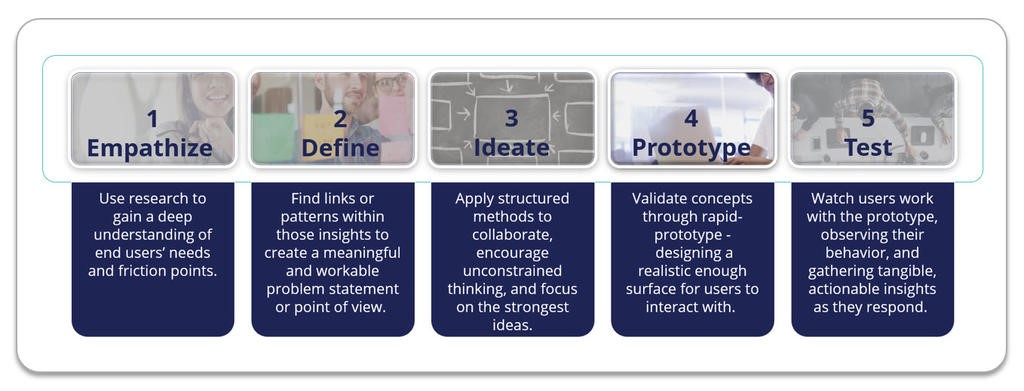
Working Methodology: We divided our project into time-boxed development cycles called sprints. We had 2 Sprints in our project. (1 Sprint = 2 weeks) We decided to use scrum method to develop our project which defines specific roles, responsibilities, events, artefacts, and processes. We maintained our backlog in the form of user stories and we designed which the flow needs to be get executed. Everyone in the team used PEGA Cloud (8.6) provided by the PEGA team and we used Agile Workbench to capture these user stories. Everyone in the team can access and review as it is available on the Pega.
Agree on Outcomes We started to design a solution with the end customer in mind, ensuring we clearly understand the outcomes, then rapidly configure a low-code application. We start with framing the opportunity; we work with you to understand your digital transformation opportunities and make recommendations. Then we decided to focus on the opportunity. If a problem is ill defined and/or complex, we decided to go with the best practice that is to run a Design Sprint or for smaller problem spaces, run shorter Ideation workshops to innovate solutions to the opportunity/problem during the Discover Phase.
Defining our Minimum Lovable Product Microjourney A micro journey is a part of the overall customer journey that achieves all or a subset of the required business outcomes. The First Business outcome which we needed to do all Medical aspects in a Single application, The various micro journey which we achieved are •Creating Portals for Crypto, NFT, DigiGold and LandRegistry
•Integrating Real-Time Crypto Wallet in PEGA
•Integrating Ethereum based block chain methodologies in PEGA
•Real time Payment Gateway.
•Elite UI/UX Experience
•First Land Registry Portal built on Block chain in PEGA.
At the very first step after the micro journey, we released an interim release in Our Website and tested it Project Readiness We have conducted team meeting in regular interval of time and discovered the ideas and implemented in regular interval of time. With a small group of users. MLP sizing After capturing the three pillars-Microjourneys, Personas/channels, Data and integrations we thought of estimating and sizing our MLP so that we can plan and act accordingly for that we used the Estimator function in App studio to estimate the sizing of MLP.
Prepare Phase: The Project took after the design phase where we got a clear idea to design and implement the project which would we ready to the server to the end-user, Where we understood the vision of our project, desired outcomes and plan, run shorter ideation sessions to innovate new experiences for end-user. We began to understand the Microjourney from the initial MLP. We used the Directly Capture Objectives (DCO) discipline to capture outcomes and user stories directly into Pega. During the Prepare phase, we have defined the enterprise architecture and create our Stages and Steps model for each case type, within Pega. We have used what we have learned about the solution in preparation for DCO sessions. The objective during Prepare DCO sessions is to draft our MLP1 case types, personas and draft data objects.
Designing the User Experience (UX) is also a critical activity to help achieve outcomes and adoption. The Pega Cosmos design system provides a Design System that leverages Pega out of the box experiences, promoting consistency and reuse. We have used that too in our application.
Design Phase: A Design Sprint is a five-day design thinking process for answering critical business questions through design, prototyping and testing ideas with customers. Design Thinking techniques helps us to: -Quickly frame a problem space and identify opportunities -Ideate and innovate solution approaches -Select the best approach to pursue -Prototype and test a solution.

Build Approach: Each sprint will start with Sprint Planning on day 1 of your sprint. This requires some preparation to ensure that you have a list of user stories in your Product Backlog During Sprint Planning the team we have reviewed the already sized stories and understand the dependencies for build activities. We have decided that the sizing needs to be adjusted; each story should be small enough to be delivered in one sprint. If a story is too large, it should be split into smaller user stories if possible. During this phase, we leveraged the low code approach which helped us to develop the application quick and in a simple manner, Low code approach also improved our productivity as the low-code development tools create the code for us. We tested early and often which ensures the discovery of small issues before these issues snowball into larger, more costly defects that are harder to fix and retest later on. For the UX management, we used the Cosmos design system which provided us with a seamless user experience with reusable UI components that enrich the look and feel of the application.
Adoption Phase: During the Adopt phase, we ensured that we get the most out of your solution deployment as we implement. We used the Pega platform provided tools to help and determine the health of the application, the Application Quality Dashboard, which provides a snapshot of the guardrail score and automated test coverage. During the lead up to go-live, we constantly reviewed progress against the Day 1 Live Plan to ensure that the business will be ready to adopt the application and we performed a release retrospective so that learning’s we gained can be taken into the next releases.
Challenges we ran into
•The First Live project about Web 3.0 in PEGA was a huge task and we had to make detailed analysis about web 3.0 and blockchain technology.
•Understanding how to find and integrate with Payment API’s available for processing the Payment.
•Fetching the Live Details for Crypto Currencies on daily basis with Public API’s was a difficult task.
•Unable to extract data from the API and list the details to provide more buy options for the user.
•Extensive research was needed to understand the working of Blockchain, Ethereum Wallets, and Smart Contracts.
•Limited knowledge base on integration of Pega applications into Ethereum Blockchain environment.
•PegaComponenetForEthereum component is compatible only with Pega 7 versions. We were unable to include this component in Pega 8.6 version. We have tried and utilized this component in Pega personal edition 7.3 and gained understanding on Pega-Ethereum integration.
•The solution or the problem statement is too vast to be covered as part of this project and can spawn out to be a multi-million project looking at the magnitude of the issues we are trying to address.
•Understanding how to find and integrate with Payment API’s available for processing the Payment when customer selects Buy/ Sell Gold digitally.
•Fetching the Live gold rate on daily basis with Public API’s was a difficult task.
Accomplishments that we're proud of:
• We have been extremely happy to make the way for the Next World and the First META Project in PEGA
• Blockchain driven land administration system: Digitalized land administration system assist in the legitimization of land owners, and enables trust in the rental system by protecting both landowners and land-users rights in an incorruptible manner. The information collected using blockchain driven land administration system can be used for timely, secure, and cost-effective verification and recordation.
• Integration of Pega applications into private Ethereum blockchain environment: Using PegaComponenetForEthereum we were able to gain understanding on working mechanism of Ethereum blockchain, Geth- command line interface to set up private Ethereum blockchain and Smart contracts.
• Gained understanding on Smart contracts: Smart contracts allow participants in a distributed application to agree upon the functional interface to the contract and an implementation. Smart contracts are written using Solidity language and this code needs to be compiled and mined into the blockchain so that it can be used. Remix web-based tool is used to generate the compiled code and the Geth command line is used to create the transaction that is mined to get the contract onto the chain.
What we learned
•Real Time Payment Gateway
•Elite UI/UX Design in PEGA
•PegaComponenetForEthereum
•Crypto API
•NFT in PEGA
What's next for DIGIVERSE
The Next big thing in these Project is to deliver
•Integration with Amazon S3 Bucket to store NFT Metadata.
•Real Time integration with Revenue department for crypto taxation
•Extending Land registry option to enable the option of tracking land use rights which would provide financial security to land tenants and land owners without any discrepancy of ownership.
•An ultimate universe built upon in PEGA with the help of DX-API and other React and Angular features. We are building and setting up the First META EVENT MANAGEMENT Product in PEGA and yes get ready to travel with us.
RESEARCH & ACKNOWLEGMENT
https://www.preethikasireddy.com/post/the-architecture-of-a-web-3-0-application https://www.linkedin.com/pulse/blockchain-based-land-registries-how-technology-can-mutabazi/ https://www.sciencedirect.com/science/article/pii/S1877050920311649 https://opensea.io/ https://lakshmi.zionverse.com/


Log in or sign up for Devpost to join the conversation.