The post The Journey to Connected Services BC first appeared on Digital Government.
]]>Read described transcript
Describer: A full audience sits in a warmly lit presentation room. There is a stage with chairs, a lectern and a projection screen. A facilitator stands at the lectern.
Facilitator: I’d like to introduce Shannon Salter, Deputy Minister to the Premier, Cabinet Secretary and Head of the BC Public Service, Government of British Columbia. Shannon is going to speak to you From IMIT Reform to Citizen-Centric Government, The Journey to Connected Services BC.
Describer: The facilitator shakes hands with Shannon Salter and leaves the stage. Shannon takes the lectern.
Shannon Salter: Thank you so much for the introduction and good morning everybody. It’s wonderful to be here together with you today on the territories of the Lekwungen people, the Songhees and Esquimalt First Nations.
It’s also wonderful to see so many of you. I understand a record crowd, particularly about a keynote on government technology before 10 am. Thank you so much for being here. I really appreciate it.
I’d like to start with a vision. And it’s a vision that we’ve been working on for some time. It’s a vision of what government in British Columbia will feel like by 2030.
A government that works as one team. A government that feels simple, intuitive, and human to interact with. A government that designs around real lives rather than its own internal organization.
I believe this vision is achievable because I’ve seen it happen before. As some of you will know, I helped with an incredible team to found the Civil Resolution Tribunal, which was Canada’s first online tribunal when it opened in 2014. At the time, people told us government would never resolve legal disputes online. They told us it was too risky, too complex, and just plain impossible. I think some people even used the word crazy, sometimes about me specifically, which was hurtful.
And yet today, the CRT has resolved 10s of thousands of disputes entirely online. People get outcomes faster, at a fraction of the cost, with higher satisfaction, and with a process designed around their needs rather than institutional ones.
The CRT taught us something fundamental. Technology alone will not transform government. But when you combine technology with clarity of purpose and a genuine collaboration with the people you serve, you can change the way people experience something as old and complex as the justice system. And it’s that same energy that is driving our vision for 2030.
By 2030, every British Columbian will experience government as a connected, supportive, and predictable partner. Not 10 systems, not 10 ministries, one experience. This is not science fiction. This is the direction we’re building toward. And for the vendors in the room, this is an open invitation to partner with us to make it real.
Connected services use technology and data to redesign how people experience government throughout their lives. People across this province do not think in terms of ministries or programs. They think in terms of life events, having a baby, finding housing, facing a crisis, starting a business, caring for a family member, and sometimes trying to rebuild.
Connected services create unified experiences throughout all of these events. And for people, that means fewer forms, less duplication, a single story told once, and services that meet them where they are rather than requiring them to navigate a maze of systems.
Behind the scenes, connected services require something deceptively simple. Our systems must actually talk to each other. They must share meaning. They must follow common standards. They must speak the same language rather than relying on digital improvisation. This is how we turn fragmented processes into a single, coherent experience.
Connected services transform a government that looks complicated from the outside into a government that feels coordinated from the inside. And that is the experience British Columbians deserve.
To understand why we’re transforming our digital model, let me introduce you to Amina.
Amina is living with an acquired brain injury. She is trying to manage her health, secure stable housing, access disability supports, find legal help, and keep her life on track while healing.
She is experiencing one life event, but our system treats it like 10.
Amina and her caseworker must knock on door after door, health authorities, housing programs, income assistance, mental health, Indigenous supports, legal aid, each with a different form, timeline, and requirements. And every time, she has to retell her story, sometimes deeply personal, sometimes traumatic, again and again and again.
And when you’re already overwhelmed, this is not just an inconvenience. It is a harm. This is the experience far too many people in British Columbia face today.
And it’s not because our public servants lack compassion. They are some of the most committed and compassionate people I’ve ever encountered in my life. And it’s not because our programs are flawed, although sometimes they can be a little bit flawed. But mainly it’s not because our programs are flawed. It’s because our systems were built at different times for different purposes with no expectation that they would ever need to work together.
Amina should experience one government that understands her context and responds with coordination and care. She should not have to be the project manager of her own crisis. And that is why we’re changing the model.
We are shifting from a structure that makes people do the hard work of navigating to government to a structure where government does the work of navigating itself. And to bring this vision to life, we launched Connected Services BC on October 1st. It brings together the people, resources and platforms needed to deliver government as one coherent experience.
This is not a rebranding exercise. This is not a restructuring for the sake of it. It is a fundamental shift in the way that government works and the relationship between the citizen and its government.
Connected Services BC is built on four foundational pieces.
The first is governance and structure. We need shared accountability and clear leadership so ministries move in the same direction, not 12 different ones.
Legislation and policy. We are building modern frameworks that support digital identity, privacy, and secure data sharing in ways that are responsible, transparent, and trusted.
Third, shared meaning and common standards. Our systems must use the same definitions, the same formats, and the same rules. Connected services require shared language, not, again, digital improvisation.
And lastly, technology. We need modern, scalable, secure technology that is consistent across government. Stable, reliable platforms that support a unified digital experience.
And these are not abstract concepts. They unlock real benefits that people feel. And we’re already making measurable progress to build on. The BC Services Card app now has more than 2.7 million users. We retired personal BCEID as a step towards a single unified identity system. We’re modernizing systems so people can use Indigenous names and languages in all official government records.
Interoperability is essential. It’s what allows data to move responsibly across systems, for services to align, and for the experience to feel coherent. That is the foundation that Connected Services BC is now building.
Our vision for Connected Services BC is ambitious. But it is completely achievable. By 2030, people in British Columbia will experience government as one coordinated system. Not a collection of programs, not a maze of ministries, one experience.
Services will be predictive. Government will understand what people need at the right moment. Not in a way that feels intrusive, but in a way that feels supportive.
Services will be inclusive. They will reflect the full diversity and languages of British Columbia. The experience will be respectful, consistent, and accessible.
Services will be seamless. Behind the scenes, there may be 5 ministries involved in a program, but from the person’s perspective, there will be one coherent process.
And we will know when we have succeeded when updating your address once actually means once. When applying for help does not require retelling your story. When a small business owner feels supported rather than exhausted. When someone in crisis does not have to be their own navigator.
People around the world already look to the CRT and other BC success stories as proof that digital justice in all its forms is possible. I believe they will look to British Columbia as proof that whole-of-government transformation is possible. We have done it before, and we will do it again, this time at a scale that truly reshapes how people experience their government.
And so thank you for being part of this conversation at this moment. Today is not really about technology. It’s about people. It’s about making life simpler, fairer, and more supportive for millions in British Columbia.
When we build a connected government, we remove friction. We remove unnecessary complexity. We remove the feeling that people must navigate everything alone. Technology is the enabler, innovation is the engine, but it is people, partnerships, and shared commitment that make the transformation real.
And in a few moments, you’ll hear from Hayden Lansdell and Alex Ritchie, who will share more about how Connected Services BC is structured and how real use cases like our disability benefits work are proving the power of collaboration and co-design across ministries.
And I’ll just take a moment to thank Hayden and Shauna Brower, and the whole team at OCIO and Citizen Services, along with Deb Godfrey at PSA and Doug Scott at the Ministry of Finance, and many, many others who have seen this vision come to life in record time, admittedly at my insistence.
Hayden won’t tell you this, but he initially brought me an 18-month plan, and I requested a shorter plan. Then he brought me a 12-month plan, and I requested a shorter plan. And then he brought me a six-month plan, and I requested a shorter plan.
I know that would be hive-inducing to many of you in the room, but Hayden and his team and Shauna and everybody else moved mountains to make it happen.
We have so much work yet to do, but we are doing it urgently because this requires urgency.
So thank you so much.
Before we close, I also want to thank the Public Sector Network, our partners, our sponsors, and everyone who contributes to building a simpler, more inclusive, more connected future for British Columbia.
We are not imagining a better future. We are actually building it now.
Thank you so much, and I’m happy to answer any questions you have. I believe I have 8 minutes and 56 seconds. Helpful timer. Thank you so much.
Describer: The audience applauds.
Shannon Salter: Okay. Any questions or comments or thoughts? Thoughts about how this has been done again and again, and you’ve seen it before in your lifetime. The dialectics of government transformation. Okay, sorry, I’m sorry, it’s a bit bright. Please, go ahead.
Audience member 1: Hi. [Indistinct] have a technology company that holds a lot of data together. My question for you on the challenges of people having to self-advocate throughout the system. It obviously exists in the medical system as well. You gave some examples. But do you foresee that this system will address some of the challenges that we have for those that are on the street, in safe housing, long-term housing, short-term housing? Because I know at the moment that’s not tracked. And obviously, we are falling short on being able to fully support people if we’re not able to track that. Will that be addressed?
Shannon Salter: Yeah, thank you for the question. And Anna, I’ll just repeat it for those who weren’t able to hear it. Anna had a very good question about how it is that we meet the needs of people who are even outside of core government, people who are unhoused, people in the health care system, people who have access to, who have significant barriers, many of which we don’t track or adequately record.
I think there’s a few parts to your question.
One of the hopes of this, one of the objectives is to treat data as a corporate thing and not a thing that belongs to each ministry where we have difficult tracking the trajectory of people’s lives and therefore their needs throughout their lives from cradle to grave.
And so with consent in a careful privacy oriented way, this change will allow us to be able to better understand and integrate our data. And part of that is understanding, of most interest to me, understanding the needs and the circumstances of people who face the most barriers to accessing government services.
So that’s the first part. We have huge data gaps, and we need to fix those. And we are quickly, stay tuned.
The second piece of it is that technology is not the right answer for everybody in every circumstance. What is always the right answer, if you can say anything is always the right answer, is to prioritize the lived experience of people who know what their own lives are like.
And that means going out and talking to people. And when you can’t talk directly to people, talk to their advocates. Talk to the people who work directly with them. Talk to their family and friends. Ideally, you talk to them too.
And often what that will lead you to is a solution that is bespoke, that is outside of your own worldview or your own kind of framework. That has been the experience that I’ve had in my life. I know that Hayden shares that worldview, as do many of the folks at Connected Services BC.
But that means sometimes you have human services. It means always you go to where people are. And it always means, it almost always means something, more than one communication channel, one way of doing things, one language, one modality.
It requires flexibility. And creativity. And I think it’s that spirit that we need to bring not only to core government, but the public sector more broadly.
My purview right now is core government and getting our house in order, but I very much hope and anticipate that the same approach will be brought to bear across our systems in the wider public sector.
And I know that I should just say, this is not novel and it’s not my aspiration. This is something we all share.
And I firmly need to recognize that it’s government and government structures that have made your work, in many cases, more challenging because of the way that we do things in government. And so I own that as head of the public service.
And for those of you who were in the room 2 years ago, you heard me talk about the genesis of some of this work. But we’re doing it and we’re doing it as quickly as we can.
Facilitator: Shannon, I think you might have some questions on the comfort monitor as well, just to your left over here.
Shannon Salter: Now, where was that?
Facilitator: To your left.
Shannon Salter: There we go. OK, perfect. I’ll maybe alternate. OK, the first one was about a future vision of connected government and Crown corporations. I’ve sort of answered that, so maybe I’ll just, in the interest of the four minutes and 31 seconds I have, I’ll skip to the next thing.
“What are the first three things that public servants can do to help make this vision a reality? Put simply, how do we help you?”
I think that’s a really great question, and a lot of these things are things I see already happening.
One is embracing the fact that the way that we have done things so far is not working for people. Digital confidence in our digital services as a BC government has declined despite radically increased spending in the area. That is not news to any of you in the room.
And so while this is, while this represents quite a lot of change and it can certainly be disconcerting, I think having an open minded solution oriented approach to this work is critical. We don’t have all the answers. I don’t have all the answers. Hayden doesn’t, Shauna doesn’t, none of us do.
We’re going to rely on the collective brilliance, experience, skills, and creativity of our own public servants, informed by all of you and our vendor community, to figure out how to make this work. And we will make mistakes. And so my job as head of the public service is to create a climate where that’s okay, where we can take risks.
And I can see that already starting in Connected Services BC, where when you have a collective of folks who have the opportunity to build that kind of a culture, I think really exciting things will happen.
That’s only one. So whoever asked that question, I’ll give some thought to the other two, but I’m worried about getting to more questions. So come back to that in the room. Gentleman over there. Thank you.
Audience member 2: Thanks. So I work in Citizens’ Services as a trainer. And so in my admittedly only like four years experience in government, I’ve seen where when we get a new technology solution, we often have to make it worse in order for it to fit into our existing environment. And we often don’t get the full functionality.
Shannon Salter: Yes.
Audience member 2: I’m not a comedian, I promise. So how would you change the approach of government to stop doing that, to be able to use our technology solutions as effectively as they can be used?
Shannon Salter: I know Hayden’s talking to you later, and there’s a technical answer to that I won’t hazard to delve into, except to agree with the premise. We can get in our own way. We turn off all functionality and then slowly turn it back on as we are confident that it’s not going to blow things up, compromise our privacy laws, et cetera.
And sometimes that’s valid, right? We deal with the most sensitive data in a human being’s life. And we have to be careful to safeguard that sacred trust. But also, culturally, we do that just because that’s what we do.
And sometimes we go so far on one end that we ignore the risks, actually, of not adapting or adopting features as quickly as we could. There are huge risks to delay. And this is something in government we have a huge heuristic about. We are biased towards the risks of, against the risks of doing something in favour of the risks of not doing something.
But we never quantify the risks of not doing things. And those risks are real to people who are on waitlist endlessly, who do not get the benefit of our… our careful risk taking, our creativity, our agency.
And so we need to rebalance that and frankly, just be data-driven and take a step back and say, what really is the harm we’re trying to avoid here? How do we mitigate that risk? And is it worse or better than not doing anything?
So complicated answer to your question, a big part of it is cultural. And that’s the part that I think Connected Services BC can help lead, because this will be the brain trust of the entire organization.
It won’t be pockets across ministries trying to do the right thing, trying to change a culture in ministries, it will be leadership and it’ll be hopefully a virtuous cycle of learning, engagement, creativity, and careful but thoughtful risk-taking. OK.
“What is the plan to engage leaders and decision-makers in core government who are not brought into this level of innovation?”
Part of my job was to ensure that decision makers, so cabinet, my boss, the Premier, and others were on board for this. They are very much on board for this.
And the way that they became on board was actually pretty simple. There’s certainly efficiencies to be gained by taking this approach. And it’s like a condition precedent for a lot of things that we want to do, like greater adoption of AI.
But the reason that they are so on board is because of people like Amina, because they can very much understand what it means to go into their communities, into their constituency offices, and have a better answer to the story that they hear all the time.
In their constituency offices, at neighborhood barbecues, at events, they hear story after story about the person who’s trying to access the service benefit program that they are entitled to, but cannot, because of how complicated it is, because of the barriers that are there.
And so being able to tell them that by 2030, there will be one front door for every individual, that whether they’re trying to get a kid’s report card or register a birth or start a business or get access to income assistance benefits or anything else they want to do, it will be all right there for them, either on their phone or in person, but through a means, language and channel that they can understand and access.
That was the easiest thing I’ve ever had to sell cabinet on. Or persuade my boss to adopt. In fact, I didn’t. He’s a huge driver of this.
So in that sense, you know, it’s now a matter of fulfilling that promise.
Inside government, this is what folks inside government often want to do as well. I mean, Hayden, I think, will tell you that there’s huge support in government for this.
There’s certainly questions. There’s absolutely anxiety. There’s folks who have seen it before. And so I was only half joking earlier.
There is a kind of dialectic in government where things consolidate and then they decentralize. And they consolidate and they decentralize. And it would be arrogant to think that without doing more, this would be any different.
And that’s why it keeps Hayden and I up at night. We’ve had a lot of conversations about this. Hayden is an ardent student of BC government history and has internalized a lot of lessons about why this has not worked in the past.
You probably have a lot of lessons for why this hasn’t worked in the past, and I’d like to hear them, so please tell us.
But from what we can tell, we’ve tried to structure this in a way that is going to have its best chance of success. Because we have to do something. The status quo just isn’t working. It’s not working for anybody. So the best way to make this work is to make it actually work.
And by that I mean do the thing we’re trying to do. Make sure that people inside government have access to the platforms, programs, services that they need to do their job, and then make sure that people outside of government have access to the services, programs, and benefits that they are entitled to easily, carefully, thoughtfully, sure, but accessibly.
And I’ll just also end on that one point. Oh, gosh, the clock is going in the wrong direction. I thought it was ticking down. It’s going up. I’m wrapping up. I got the message.
The key here, too, that I didn’t say, and I’ll just end on this note, is that we don’t have a lot of research on why there’s declining trust in public institutions, but it is declining precipitously.
And it scares me because in that vacuum creates the circumstances where other anti-democratic bad things can happen.
And what little research we have on what the antidote to this is, actually pretty simple. If you make government work for people, it builds their trust.
If they can do the thing that they think is fair in an accessible way, if they can get what they need in an accessible, fair, understandable way, if they feel that they’re getting a fair shake from government, it builds trust. And that’s our opportunity here.
So I’m not exaggerating when I say that this is a chance to reorient the relationship between government and the people of this province. And that’s exactly what we want to do with your help. So thank you so much again. Appreciate it.
Shannon Salter, Deputy Minister to the Premier, Cabinet Secretary and Head of the BC Public Service, was the keynote speaker at the 2025 Government Innovation Showcase hosted by the Public Sector Network. Her talk, From IM/IT Reform to Citizen-Centric Government: The Journey to Connected Services BC, clearly articulates the vision for connected services and the positive impact it will have for everyone in the province.
Connected Services BC was formed October 1, 2025. Learn more about the new organization.
The post The Journey to Connected Services BC first appeared on Digital Government.
]]>The post Using AI to save energy at home with the BC Home Energy Planner first appeared on Digital Government.
]]>
Connected Services BC is bringing together people, resources and technology to improve collaboration, reduce duplication and support innovation across government. We’re partnering across government to pilot using artificial intelligence (AI) to improve both service delivery and the employee work experience.
We are currently focused on evaluating workflow patterns where AI technology can be most impactful, including intelligent automation, application modernization, information search and retrieval and information analysis and synthesis.
The work of the Ministry of Energy and Climate Solutions is a great example of using AI for information analysis and synthesis. Read on to learn how they integrated this powerful technology into an intuitive user experience for homeowners.
Energy efficiency is about reducing costs and increasing climate resilience while keeping your home comfortable. However, making a home more efficient is complex, and can be difficult to put into practice.
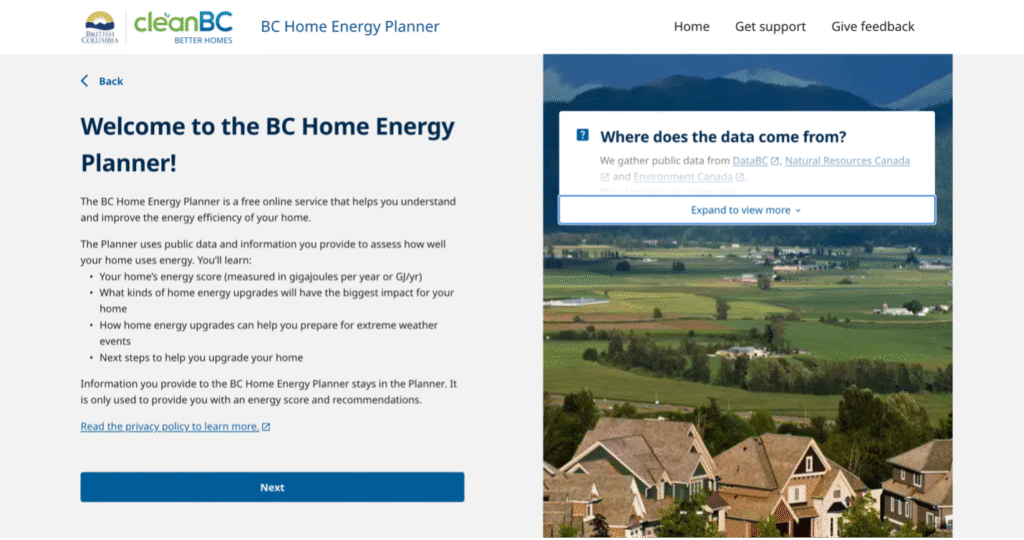
The BC Home Energy Planner (the Planner) was designed to guide homeowners through every step of improving energy efficiency.
Developed by the Ministry of Energy and Climate Solutions, this free online tool helps homeowners better understand their energy use and provides personalized advice on how to use it most efficiently. Using publicly available data, the Planner estimates a home’s energy score (measured in gigajoules used per year) and suggests upgrades to space and water heating, cooling, insulation and windows to improve efficiency and reduce costs.
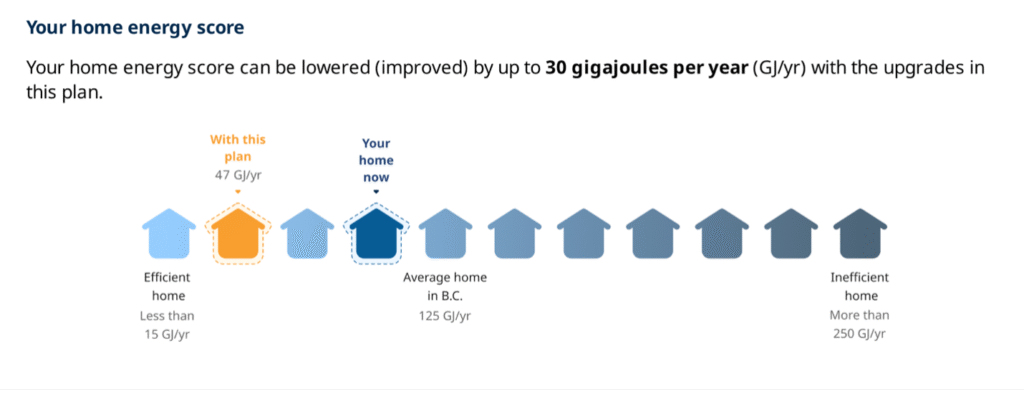
“When applied in a critical and thoughtful way, AI and machine learning, digital service design and user testing can help create tools that reduce the burden on homeowners,” says Service Transformation Director Kevin Ehman. This combined approach enables more impactful results than any single element could provide on its own.
How the Planner works
In a traditional on-site home assessment, about 400 attributes of the property would need to be measured and captured with pen and paper.
The BC Home Energy Planner simply asks homeowners 11 questions about the structure and features of the home. (The system already has a good guess for the details based on the home’s address and background data like building codes, but the homeowner’s answers provide valuable confirmation.) Then machine learning is used to run simulations based on that data. The resulting model is used to estimate the same 400 attributes that would be tracked in a traditional assessment.
Data inputs come from sources like:
- DataBC
- Natural Resources Canada
- Environment Canada
And include details like:
- The year the home was built
- The size of the home
- The region of the home
This data is used to help provide an energy score for the home, supporting smart and informed decisions to improve comfort and energy efficiency. In the background, the model runs thousands of times to determine the home’s most likely configuration, much faster than a human or even a team of humans could do. That’s the power of AI.
AI for better homes
Homeowners expect tools like this to be accurate and make their lives easier. AI technology works in the background of the Planner to make this possible, so seamlessly that users may not even realize it’s involved.
In the past, the main challenges of calculating a highly-detailed home energy rating were computational and data needs. The process required a physics-based simulation that considered factors like the home’s location and climate. Using conventional methods, assessing over a million homes in B.C. this way would have required significant hardware resources. In recent years, AI and data science advancements have shown a new path for solving this bottleneck.
The Planner is built for maximum accuracy and transparency. To achieve this, it uses safeguarded AI only for the most complex, computationally intensive calculations — replacing traditional physics-based methods where it makes sense. The rest of the process is designed to be clear and explainable, so homeowners can trust and understand the output.
The end result? A complex utilization of AI coupled with an intuitive user experience, representing the best of what the technology can do for people in B.C.
Built for homeowners
When designing the Planner, the team took a user-centred approach to ensure it would be effective, easy and adaptable.
Exploratory questions guided their direction and scope, and user feedback shaped everything – from banner design to whether “BC” should be included in the name. Yes/No user testing helped the team assess the Planner’s flow, make adjustments aligned with user needs and refine the product’s scope.
Reflecting real communities
Throughout this testing, the project team worked closely with public and private sector partners and took an outside-in, user-led approach to testing and feedback. They prioritized diversity among participants, making sure to include homeowners in rural or remote communities where traditional assessments may be harder to access.
“Early in our research, we tried word-of-mouth and snowball recruiting, where we asked people we know for leads on research participants,” said Ehman. “We found willing participants, but they all reflected a similar demographic… and we knew we needed to avoid confirmation bias.” To make the Planner accessible across the province, we hired a recruitment company and asked for geographic diversity, and participants with a range of incomes and education levels. This was especially important because one of our connected services – the Better Homes Energy Savings Program – supports households below a certain income threshold.”
This shift led to broader representation in the Planner, including feedback on visuals. Participants emphasized the importance of relatable imagery – such as homes that reflect a range of price points and everyday living situations. In response, the team diversified the people, homes, and landscapes shown in the Planner, including remote and rural settings, to better reflect the diversity of communities across B.C.
Planning for the future
The Planner is part of the broader CleanBC service portfolio and is evolving to align with other provincial and municipal energy efficiency programs. As the team explores ways to connect it seamlessly with other services and transition to ongoing operations, the goal is to ensure the Planner remains responsive, sustainable and integrated into regular government operations, supporting homeowners in B.C. for years to come.
If you have questions, contact Brett Auger, Product Manager.
Try the BC Home Energy Planner or read more AI case studies highlighting the key results achieved when AI and human intelligence work together.
The post Using AI to save energy at home with the BC Home Energy Planner first appeared on Digital Government.
]]>The post How AI is helping to automate coastal and inland infrastructure mapping first appeared on Digital Government.
]]>
Connected Services BC is bringing together people, resources and technology to improve collaboration, reduce duplication and support innovation across government. We’re partnering across government to pilot using artificial intelligence (AI) to improve both service delivery and the employee work experience.
We are currently focused on evaluating workflow patterns where AI technology can be most impactful, including intelligent automation, application modernization, information search and retrieval and information analysis and synthesis.
The work of the Ministry of Water, Land and Resource Stewardship is a great example of using AI for information analysis and synthesis.
B.C.’s coastlines and inland waterways are dotted with thousands of marine docks. Docks are critical infrastructure for local communities, recreational boat owners and B.C. industry. Gathering a full inventory of these docks would benefit a wide range of interested parties.
Traditionally, identifying and cataloguing docks requires a painstaking manual review of aerial imagery and field surveys. The Sustainable Dock Detection project, developed by GeoBC’s Applied Geomatics Science Team, aims to use new tech to make the process smooth sailing.
By combining free Light Detection and Ranging (lidar) data from the Provincial Lidar Program with machine and deep learning models, the team is building AI tools that can automate dock detection at scale.
Pulling structures from the noise
Lidar uses lasers to measure distances and create precise data models of the earth’s surface. The dock detection process begins with enhancing the lidar data using a normalization method developed in-house. This ensures consistent signal quality across datasets, improving the visibility of dock structures against complex water backgrounds.
A small set of representative docks are manually digitized to provide training data for the system. These shape files serve as the foundation for supervised machine learning.
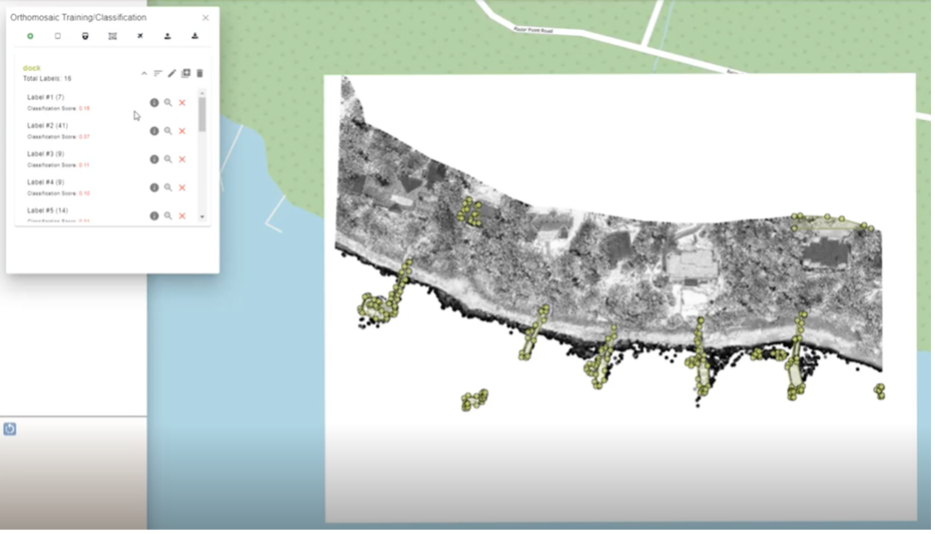
The team also developed a method to boost vertical information along the outlines of docks while still operating within a 2D framework. This creates enhanced dock-specific intensity signatures and produces shapefiles directly from lidar intensity data.
Optimized for efficiency
Having permit conditions available in digital form and using AI to identify reporting requirements offers three key benefits:
- It eliminates the need for inspectors to manually track due dates for permit obligations, reducing administrative burden
- It helps improve how permit conditions are written by flagging unclear or missing reporting triggers
- It makes it easier for mining operations to clearly understand what reports they need to submit and when
This new AI-powered process has freed up time to focus on higher-value work like building strong relationships with partners in permitting, reviewing mining applications and following up on cases of non-compliance.
Neural network training
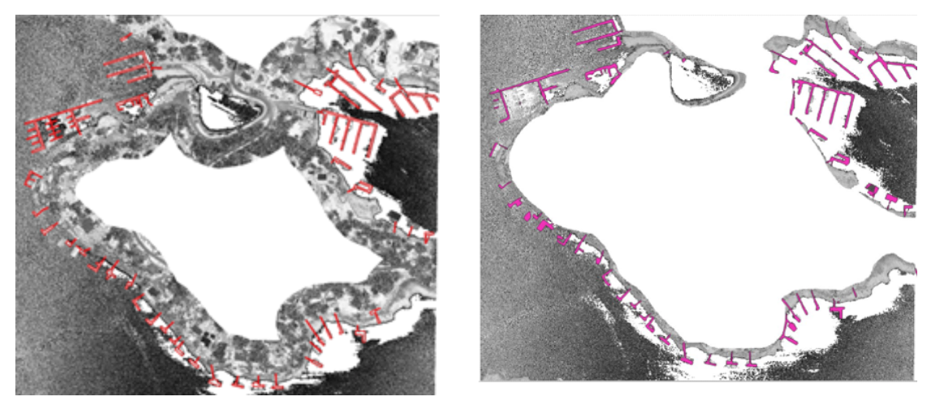
This project uses Detectron2, a state-of-the-art convolutional neural network (CNN) library, to train an AI model for detecting docks.
Individual “neurons” respond to dock-related features such as:
- Surface normals
- Elevation differences
- Wavelet coefficients & gradients
- Enhanced dock outlines from gradient boosting
Instead of following a fixed algorithm, the CNN “learns” correlations between these features, identifying the patterns that indicate docks.
Building on success
The Sustainable Dock Detection project demonstrates how open provincial lidar data, in-house geospatial innovation, and AI can be combined to tackle the important unmet challenge of identifying and managing marine docks.
There are still more docks to be identified. But the development of these tools lays the groundwork for a future where large-scale inventories are automated, scalable and fully integrated with parcel information systems:
High automation
The system reduces the need for manual digitization, offering the potential to leave repetitive work to the system while staff can focus on higher value efforts while maintaining human oversight.
Parcel integration
Docks are not currently linked to existing parcel information. This methodology provides a way to link parcel ownership and land information directly to dock structures, supporting stronger land-water planning, stewardship, and the protection of ecosystems and species.
Innovation in lidar use
Applying in-house normalized lidar intensity data and dock-specific 2D gradient enhancement is a novel approach, positioning lidar as a tool for infrastructure detection beyond its traditional terrain and vegetation uses.
Scalability
Once fully deployed, the system can be applied across the entire B.C. coastline and inland waterways (or adapted for other jurisdictions) to support sustainable marine and freshwater infrastructure management. This work represents our experimentation and learning with this type of AI technology with imagery. Technology and learnings that could eventually support the efforts of other teams and program areas with similar challenges and needs – ultimately to improve outcomes for people, communities and ecosystems in B.C.
For resources and more information on the AI dock detection model and the Provincial Lidar Program, visit the ministry’s intranet site (B.C. government employees only).
Read more case studies highlighting the key results achieved when AI and human intelligence work together.
The post How AI is helping to automate coastal and inland infrastructure mapping first appeared on Digital Government.
]]>The post How BC Parks set a trail for better visitor experiences first appeared on Digital Government.
]]>
Organizations across the BC Public Service have embraced blogging as a way to share success stories and highlight the great work happening in their ministries. BC Parks is a standout example, with a blog that covers everything from inclusive camping and updates to the park reservation system, to the science of squirrels.
We’re excited to share a recent post from the Parks and Recreation design research team. Learn more about how they’re working with Recreation Sites and Trails B.C. (RSTBC) to improve the sites and trails website.
The lay of the land
Over the past year RSTBC has been listening closely to its users, interviewing campers, hikers and outdoor enthusiasts who have recently accessed recreation trails and sites. The goal was to gain a more comprehensive understanding of their visitors, ultimately helping staff make better decisions and enhance the visitor experience.
The interviews touched on topics like trip planning and decision-making, experiences during trips and the value and impact of RSTBC. Their research uncovered that people have a lot to love about B.C.’s sites and trails, but they may have difficulty using the website – especially on a mobile device.
Building a beta
With findings in hand, the teams built a new version of the RSTBC website and opened it to the public to gather feedback, find mistakes and make improvements. The beta site will remain live until the full site is replaced later this year.
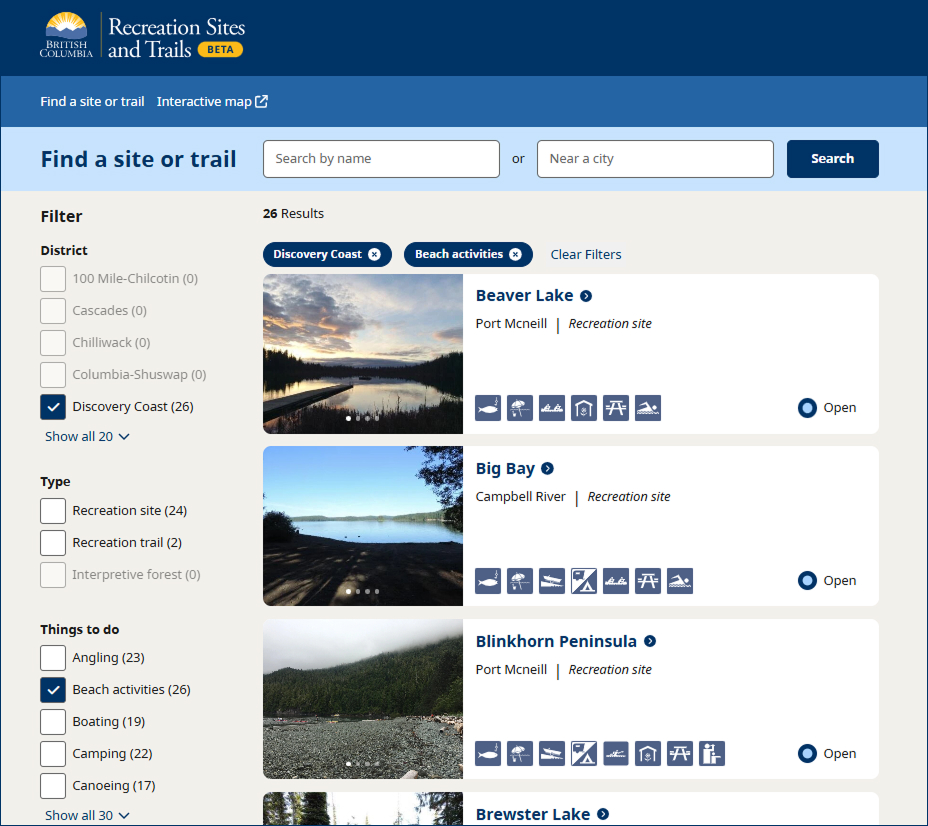
The teams made improvements to:
- The mobile device experience
- Searching for sites and trails
- Filtering for activities, facilities, districts and access
- Navigation, plain language and accessibility
They continue to work iteratively, making continuous improvements based on feedback.
Walk the trail
The full blog post covers a lot more on this ongoing work, including a wide array of insights from user interviews and ways that you can support the process. Check it out if you want to learn more about trails in B.C., the people who use them and how government is improving the site to serve visitors better.
The post How BC Parks set a trail for better visitor experiences first appeared on Digital Government.
]]>The post Building connected services in B.C. first appeared on Digital Government.
]]>
Lab Services is a small team inside Connected Services BC (CSBC). You may have heard of our team’s work operating the Exchange Lab, where since 2018 we supported programs to build excellent digital services with Agile delivery teams.
With all that we have learned, we are now reorienting ourselves and focusing on one thing: helping organizations design and deliver connected services to improve service outcomes. It’s a whole-government approach and we’re excited about this new way of working.
What connected services are and why they matter
A connected service is designed to feel seamless, even when parts of the service are managed by different programs, companies or ministries. They are built around how people actually experience systems, not around how the provider is organized internally.
Connected services can help reduce frustration, improve outcomes and save time for both the public and government employees.
Outside of government, you might have seen this principle in action when you’ve used an Apple or Android ID to sign up for apps, or used a single Meta account to log into Facebook, Instagram and Threads.
In a government context, there is a wide range of scenarios that could be improved by connected services. For example, someone moving to a new address might need to update their details with health programs, housing supports and other services. In a disconnected system that would mean repeating the same update for each individual service. In a system of connected services, that information updates across ministries, securely in the background.
When connected data and systems power service journeys that have been designed with real insight into people’s lived experiences, we can meet the needs of people in B.C. with less effort, cost and delay.

Why we need this work
Right now, many service delivery programs operate siloed from each other. This can cause delays and barriers. People in difficult situations can’t wait to access support or manage something complicated like their health or housing information.
We also hear from government staff who deal with duplicated systems, manual workarounds and unclear handoffs between teams. These gaps can slow things down, which adds up over time and makes it harder to focus on supporting people and businesses.
Coordinating our efforts around a service outcome is one way to address these issues. With the right approach and investment, we can build better foundations, improve efficiency across government, and learn how to work together toward shared outcomes.
What we’re learning and doing
Our team has always generated new capabilities for the public service through experimentation and partnership with ministries. We learn a lot from our partners!
Our first set of initiatives enabled Agile practices integrated with human centred design to apply modern service delivery approaches and use technologies not previously available to public servants.
Now, building on this foundation, we aim to work directly with multiple organizations at once to design and test solutions that make services more connected.
We’re currently partnering with the Ministries of Social Development and Poverty Reduction, Health, Citizens’ Services and Finance to scope a service outcome we can feasibly deliver with this new approach. The first service journeys we’re looking at will likely take a shared approach to service wayfinding, digital identity, notifications and eligibility.
We expect to:
- Look for the common patterns across programs and build tools that can be reused
- Help teams design services that can exchange data securely and respectfully, with people’s consent and privacy embedded
- Work alongside service owners, policy teams, designers and developers to prototype ideas and solve real problems, while applying the Digital Code of Practice
Our work is practical and collaborative. This includes sharing what we learn. We’re also working with organizations that have already made progress and demonstrated value others across government can leverage.
What we’ve completed to date
So far, our team has:
- Examined how other governments are approaching connected services from the perspectives of service design and interoperability infrastructure
- Worked with the social sector to start to understand the policy, technology and delivery landscape (including existing service design research) that informs building connected services
- Reshaped our organization to focus on this key priority, including how we engage with information and teams that will need to collaborate across Citizens’ Services
What’s next
This work is part of the government’s broader digital initiatives, but our focus is on mandate-related priorities. We are not trying to fix everything, but we know from experience that the work we do can have far reaching effects.
There is increasing excitement about this work we will continue seeking ways to optimize how we engage and share what we learn.
Look forward to hearing more from us in future blogs!
Join the Digital Government Teams channel to ask questions, read weeknotes and stay up to date on everything digital. Open to employees with an IDIR.
The post Building connected services in B.C. first appeared on Digital Government.
]]>The post Streamlining Mines Act permit tracking with AI first appeared on Digital Government.
]]>
At the Ministry of Mining and Critical Minerals, internal users must find and track unique permit conditions often buried in static PDF files. Doing this quickly and easily was a long-standing challenge.
Mines Digital Services set out to improve this process by setting a new goal: the development of a searchable permit library that would save time and improve oversight for the complete lifespan of a permit.
Digging up info
The complexity of managing mining permits had long been a barrier to efficient compliance tracking and permit drafting. The permits can span decades and were stored in PDFs which can be poorly structured and difficult to search. Deep institutional knowledge was often required to find and correctly interpret the right information.
During a recent hackathon, the team experimented with AI prompts to extract key reporting information from these PDFs—with great success. Prior to the hackathon, the team hadn’t considered the use of AI at all, but that breakthrough sparked a bigger idea: What if AI could help solve multiple pain points in the permitting process?
By leveraging AI for both extracting and analyzing permit conditions, Mines Digital Services has transformed this challenge into an opportunity.
Arriving at AI
This project wasn’t originally envisioned as a use case for AI. Our original focus was simply to solve a real business problem identified by our users, and that stayed the same as we began to work with AI.
With that goal clear from the start, we spent a lot of effort (and received a lot of help) on understanding the risks and privacy considerations of accessing and analysing only the information we want to expose to AI, and how we could fit these processes into our current digital workflows before proceeding. We knew that we had both private and public data in our system and wanted to ensure we’d only expose safe data to AI while protecting the information we didn’t want it to access.
By default, we built processes that would help solve the business problem whether or not AI was part of the solution. In the end, we used AI because it was clear that it would add a lot of efficiency.
Permit conditions are now extracted from PDFs, saved as data, and scanned for any reporting requirements. Ministry users verify the output, which is then made available for mining companies to submit reports against directly, helping with compliance tracking after a permit is issued.


Our secure process uses publicly available data and cuts out a lot of manual work for users. It’s a practical solution that just happens to be powered by AI.
Optimized for efficiency
Having permit conditions available in digital form and using AI to identify reporting requirements offers three key benefits:
- It eliminates the need for inspectors to manually track due dates for permit obligations, reducing administrative burden
- It helps improve how permit conditions are written by flagging unclear or missing reporting triggers
- It makes it easier for mining operations to clearly understand what reports they need to submit and when
This new AI-powered process has freed up time to focus on higher-value work like building strong relationships with partners in permitting, reviewing mining applications and following up on cases of non-compliance.
More to be mined
This project didn’t just solve one problem — it opens the door to future improvements. Now that we’ve built a secure, AI-powered process for extracting and tracking permit conditions, we’re exploring how to apply the same approach to other locked-down data. It’s helping us track more key aspects of permit compliance and think bigger about how to reuse proven processes and security patterns across the board.
Not only are permit conditions now searchable and actionable, but the new dynamic condition library supports permit inspectors in both compliance monitoring efforts and decision-making. It’s a step toward smarter, more responsive permitting in the mining sector.
If you’re curious about the mines permit library or want to connect, feel free to reach out to us at [email protected].
The post Streamlining Mines Act permit tracking with AI first appeared on Digital Government.
]]>The post Writing better prompts to make work easier first appeared on Digital Government.
]]>
A few years ago, a friend sent me a couple of AI-powered writing tools. I was curious but skeptical. As a learning designer I’m used to experimenting with new technology, but this seemed a bit far-fetched… until I tried it. Within a few days, I realized AI could do more than help with writing; it could assist with everything from brainstorming to designing entire learning experiences.
I was hooked. But I wasn’t very good at getting these AI tools to do what I wanted them to.
One of the early “wow” moments on the way to getting what I needed out of AI came when I joined a bootcamp led by Dr. Phillipa Hardman. I had already taken several courses on prompt engineering, but I was amazed to see her prompts. They were sometimes pages long, guiding AI through highly complex tasks.
That’s when I truly understood that prompt writing is a skill. And like any skill, getting better takes dedicated practice and clear intention.
A prompt is the text you enter into an AI tool to tell it what you want to do. For more on how prompts work and how to write ones that get better results, visit our prompting guidance.
The challenges of prompting AI
As I took more courses on prompt engineering and started using generative AI more regularly, the reality that prompt quality matters was continually reinforced. I began to see my interactions with AI as a new form of communication and I needed to learn to speak the language. It’s not magic, it’s a conversation… just with an extremely fast (and very literal) assistant.
I also came to realize how much AI was able to gather from the internet – an incredible range of information, although not all of it current. For example, I had several back-and-forths with AI about “learning styles,” which are still widely mentioned online despite being debunked. It’s a good reminder that while AI can be a helpful partner, it’s important to double-check the output – especially when it comes to evolving topics or educational theories.
With a tool like Copilot Chat, you need to be clear about your task, your goals and any supporting information. “Garbage in, garbage out” applies here more than anywhere. Without a well-structured prompt and a human eye on the output, you risk wasting time by generating content that’s inaccurate or misleading.
I always remind myself that in government work, poor prompting skills can affect outcomes, trust and quality of service. Getting good at prompting isn’t optional, it’s essential. And don’t forget part of “getting good” is always double-checking the output.
Prompting for what you want
The first step in writing better prompts is knowing what you want (the goal), or at least what you’re trying to do (the task). Copilot Chat can help you carry out tasks, explore ideas or clarify your thinking. But to do that well, it needs clarity from you.
One trick I use is assigning Copilot Chat a role. If I’m writing, I might ask it to respond as a plain language expert. If I’m drafting a strategy, I’ll prompt it to answer as a senior leader with an MBA and a background in government. This framing makes the response more relevant and actionable. It focuses the AI on a smaller and more specific section of the whole of human knowledge.
Some simple rules of thumb:
- Be clear about your goal
- Provide good background information (or tell Copilot Chat where to look)
- Ask Copilot Chat to ask you questions to ensure it understands the task
Prompting well is directly aligned with the digital government practices we value: plain language, iteration and user-centred design.
Getting started, getting structured
For anyone starting out, my advice is simple: play with it… safely. Follow BC Public Service policy governing the use of AI tools. Practice. Practice some more. Ask Copilot Chat to help you improve your prompts. And take advantage of the resources and training available on this site.
Here’s a practical example of how a vague prompt can be transformed using a structured prompt format:
Original prompt
Can you help me write a summary for this document?
Structured prompt
Task: Summarize this document into a short overview for internal staff
Format: Three paragraphs, plain language
Context: The document is a new policy update on digital accessibility requirements
Constraints: No jargon, plain language only, no personal opinions
Voice and tone: Professional and supportive
Examples or input: [Insert pasted section or summary points from the policy document]
Role: Copilot Chat should act as a B.C. government plain language communications specialist
Using this structure helps Copilot Chat deliver content that is clearer, more useful and appropriate for the audience. The difference isn’t magic. It’s about structure, specificity and context.
Case study: Team impact
On our learning experience design team, we’ve seen AI transform every stage of our work. From analyzing needs to writing complex branching scenarios, AI has become a powerful tool for handling repetitive or mundane tasks so we can focus on the creative parts.
For example, we’ve used it to provide feedback on our own meetings. We experimented with recording and transcribing our Team’s meetings and then used Copilot Chat to analyze our discussions based on Kantor’s 4-Player Model. This provided us with ideas on how we could communicate and function better as a team.

A learning process
Learning to use AI through more effective prompts is a reminder of how valuable curiosity is – one of our BC Public Service values. More than anything, I use AI to learn. Because I learn well through conversation (not a style, a preference!), Copilot Chat provides a way to “talk through” problems and ideas at any time.
I’m excited that generative AI is already shifting how we approach learning and development, and I believe that shift is toward something more responsive and in-the-moment. In the learning design world, we call that heutagogy: self-directed, autonomous learning. That’s exactly the kind of learning AI supports.
If you’re ready to try Copilot Chat, start with a thorough review of our policy on the use of generative AI and the resources available on this site. Then go have a conversation with Copilot Chat, with curiosity and intention, and see where it takes you.
Jamie Billingham is a Senior Learning Designer for Connected Services BC’s Technology Design, Architecture and Cybersecurity division in the AI Adoption branch.
The post Writing better prompts to make work easier first appeared on Digital Government.
]]>The post From frustration to flow: How Power Automate simplified my workday first appeared on Digital Government.
]]>
Have you ever run into a software issue and thought, “If it could just do this one thing, my life would be so much easier”?
I’ve discovered that Power Automate can create workflows to solve exactly those kinds of problems. And with tools like Copilot Chat, building custom flows is much easier than you might think.
Here’s one recent example of a flow I built to solve something I always wished my apps could do.
Eyes on the audience
I manage several MS Teams channels and wanted to know how many members come from different ministries. Doing this manually meant checking each member one by one, which is time-consuming and tedious.
Power Automate saved me countless hours and spared my eyes a lot of strain. I built a simple flow that, with just a few clicks, generates an Excel sheet in seconds. I can easily sort the data and create visual aids for my progress reports.

It only took an afternoon to build and test the flow. I’m not a programmer or a Power Automate expert, but with a little help from Copilot Chat, I made it work.
Tools in tandem
Before I dive deeper, here’s a quick intro to Power Automate.
According to Copilot Chat:
Power Automate is a cloud-based tool from Microsoft that helps you get things done faster by doing tasks automatically. It works by creating something called “flows,” which are step-by-step instructions that tell apps and services what to do when something happens—like sending a message when you get an email or saving files to the right folder. You can use it to connect tools like Outlook, Excel, and SharePoint without needing to write any code. It’s easy to use and helps you spend less time on repetitive work.
In other words: it’s an app that helps you build apps.
Power Automate is included in our Microsoft licence so there’s no extra cost to use it, and it’s easily accessible in any web browser at powerautomate.com. That said, getting started can feel a bit overwhelming.
That’s where Copilot Chat comes in. I was able to ask it specific questions about errors in my flow, and it gave me step-by-step instructions to fix them. It also helped me understand the logic behind flows, which made it easier to improve others I’d already built.

The first flow I created took a while, and I needed help from the Digital Workplace and Collaboration Services (DWCS) team to get it working. It was an ambitious idea that also required Copilot Chat’s help to write some JSON script.
But the effort paid off. The final product exceeded my expectations and has the potential to scale across government to improve services. Here’s what it does.
Calendar cooperation
We host events open to everyone. While I have a distribution list to send invites, there are always people outside that list who might want to attend.
For years, I used tools like Eventbrite to manage registrations. But that meant manually adding registrants to the meeting invite—often missing last-minute sign-ups.
Now, I use a flow that combines Power Automate, MS Forms, and Outlook. If someone wants to attend, they can simply fill out a form and their info will be automatically added to the event. Plus, they instantly receive an email invite for their own calendar.

Simple, right?
Now they’re part of the official guest list, so if there are updates or cancellations, they’ll be notified automatically.

While I originally built this for Town Hall registrations, it can be used for any meeting as long as the calendar has the necessary info. And as a big bonus, it doesn’t send unnecessary update emails to everyone already invited.
Automation on and on
These are just two examples of how Power Automate has made my workflow smoother and more efficient. And in the spirit of continuous improvement I’ve got more updates in the pipeline, like an unsubscribe button that removes people from recurring meetings they no longer want to attend.
If you’re curious about Power Automate but unsure where to start, there are plenty of resources to help:
- The Power Platform Community of Practice is an active channel where people share their projects and offer guidance
- Digital Workplace and Collaboration Services offers online training for all the Power Platform apps
- If you prefer to explore on your own, Copilot Chat is a fantastic resource when you get stuck
- And if you have questions about Copilot Chat or other AI tools, you can ask them in the Digital Government AI channel
James MacKenzie is a Senior Engagement Specialist in the Technology Design, Architecture and Cybersecurity Division of Connected Services BC. BC Government employees can catch up with him and get the latest updates in the Digital Government Teams channel.
The post From frustration to flow: How Power Automate simplified my workday first appeared on Digital Government.
]]>The post Implementing the Digital Code of Practice with collaborative tools first appeared on Digital Government.
]]>
In 2023 the B.C. government launched the Digital Code of Practice, a practical guide to creating ethical and inclusive digital services that truly make life easier for people living in British Columbia.
It all starts with a set of 10 practices, high-level values for digital delivery that are part of core policy. The Code gives practical guidance to put these principles into action. Because all teams are unique and what they find valuable will vary, it’s up to each team to decide how the Code fits the context of their work.
Therefore, the next step for the team that developed the Code was to create additional support resources, helping people connect the lessons to the decisions they make in their daily work. Like a teacher with a textbook, they set out to help the written documentation connect with its audience.
Building foundations: Facilitation kits
Our first goal was to get people talking about the Code with their colleagues and exploring how they can implement its practices as a team. This led to the Digital Code of Practice facilitation kits, which are available to B.C. government employees by request. So far over 100 kits have been distributed to teams across government.
Facilitation kits are not available for request at this time.
The kits provide everything needed to host a Digital Code of Practice workshop, including a virtual whiteboard template and a detailed facilitation guide. The workshop includes an overview of the Code and discussion activities that help the group put the Code in context by considering which practices are most important to their work.

The workshop also asks the team which practices they want to learn more about. The idea here is to identify areas where there might be room for learning and improvement. But how is a team supposed to know how to improve?
Planning for improvement: Alignment guides
This is where another supporting resource comes in: the Digital Code of Practice alignment guides. You can find these on the webpage for each practice.
These guides describe five states of alignment for each practice in the Code.
- Initial: Struggling to make progress
- Developing: Building the knowledge and resources needed to succeed
- Delivering: Self-sufficient and reliably meeting expectations
- Optimizing: Practicing data-driven continuous improvement
- Innovating: Driving continuous improvement across government

These guides are intended to help delivery teams understand where they are – and where they want to be – on a spectrum of alignment with the Code. They provide a framework for understanding the strengths and weaknesses of your team and creating a plan to improve.
To use the guide:
Find your current state
First, the team chooses a level that fits where they are now. For example, a team that’s ticking all their boxes and has all the resources they need might decide they are Delivering.
Set your goal state
Second, they choose where they want to get to. That same team might decide they want to start gathering more data about their work and using it to identify how they can do better. They might decide that sounds like Optimizing.
Create an action plan
Finally, they create an action plan by deciding what Optimizing would look like in their context and creating a list of practical steps they can take to realize that vision.
Keeping perspective
Despite the challenges facing the public service today, it’s critical that we keep our focus on what’s most important: providing services that make life better for people living in British Columbia. A big part of doing that is building internal capacity for digital delivery. Internal is important!
We need to make sure teams in the BC Public Service know what good digital services look like and understand what’s required to build them. That’s why we created the Code of Practice facilitation kits and alignment guides, and we hope they continue enabling teams to make services work better for everyone in B.C.
Visit the Digital Code of Practice page for more information.
The post Implementing the Digital Code of Practice with collaborative tools first appeared on Digital Government.
]]>The post Unlocking forest planning with the Forest Operations Map portal first appeared on Digital Government.
]]>
The Forest Operations Map (FOM) portal makes it easy to get up-to-date information on proposed forestry activities in British Columbia.
Launched in Spring 2024, the FOM portal allows the public to comment on proposed cutblocks and forestry roads across the province. Before the portal launched, the public had to learn about proposals through local newspapers or district forestry offices and comment on them by email or through Canada Post. Now it’s easy to find detailed visualizations of proposed forest activities and leave comments online, all in one place.
Voices for the environment
The portal helps make forestry in B.C. more transparent by sharing proposed activities with the public, First Nations and interested parties. It gives people a chance to voice their opinions and be part of the conversation.
Beyond transparency, the portal supports sustainable forest practices by making it easier to spot environmental impacts early. Companies can use this information to adjust their plans and protect important resource values.
FOM reviews are meant to encourage public engagement, but they don’t replace the Province’s ongoing duty to consult with First Nations groups.

How it works
A Forest Stewardship Plan (FSP) is a guide for responsible forestry, ensuring activities align with government’s sustainability goals. Before logging or roadbuilding starts, FSP holders must share a FOM for public feedback for 30 days, announcing it online and in newspapers.

In the past, there was no easy way to do this online. The new FOM portal provides an easy, reliable method to do so.
FSP holders only need to:
- Fill out a request form for portal access
- Provide their Forest Client number
- Give the BCeIDs of their company’s users, and
- Upload their plans and maps once they’re in
In the portal, each FOM shows:
- Who’s responsible for it
- Where proposed roads and logging areas will be
- The expected start date of each part of the work
- The three-year activity timeframe
Some activities, like managing hazards or collecting tree seeds, don’t need a FOM. But when permits are required, the FOM ensures transparency in forestry planning.

Commenting and reporting
The portal also makes it easy for people to share thoughts on a FOM. Pins showing details for each FOM can be found on the map, or searched for using the FOM number or the holder’s name.
Once users have found the right FOM, it’s one click to ‘Submit a Comment’ and begin providing feedback. Comments are sent directly to the plan holder and Ministry of Forests staff, and not freely visible to the public. It’s a simple and impactful way for people in B.C. to have a say on forest planning.
Resources and more
Watch the instructional videos at: Introducing the new Forest Operations Map (FOM) Online Portal, or visit the FOM Website.
If you have questions about the FOM portal, email Team Heartwood of Forestry Digital Services (FDS).
To learn more about FDS, visit the FDS website or watch the FDS introductory video. To see what FDS achieved in 2024, watch our year in review.
The post Unlocking forest planning with the Forest Operations Map portal first appeared on Digital Government.
]]>