
Last updated on November 28, 2025

Forbidden Alchemy | Illustration by David Rapoza
Grading is the process of evaluating the condition of your trading cards. It freezes your card in time, so to speak, with experts examining the different elements of a card, grading each one on a 10-point scale, and sealing your card to preserve its condition.
Most players don’t encounter grading until the first time they come into ownership of a collectible worth preserving. Let’s walk through the process of grading a card, examine the most trusted names in TCG grading, and figure out what in your collection, if anything, needs to be graded.
How Are MTG Cards Graded?

Implement of Examination | Illustration by Darek Zabrocki
Grading services use a 10-point scale to determine the condition of your cards. The grading scale varies slightly between grading companies, but there’s a common through-line that a 10 is a near-perfect card. A 10, or Gem-Mint 10 as some companies call it, is pristine: no scratches, perfectly centered, exactly how it came off the press. Each blemish or mark against the integrity of the card knocks it further down the scale.
Note that this is a little different than the Near-Mint/Slightly-Played/Heavily-Played paradigm used by retailers selling Magic cards; grading companies have a different set of criteria used to label the individual features of a card. These companies assign subgrades to different elements of a card, which average out to the total grade. Most companies don’t actually display the subgrades on the finished product, instead opting to showcase a single overall grade.
Centering
Centering refers to the way a trading card image lines up with the sides of the card. A perfectly centered card usually means the card exists as intended without any blatant printing errors. Centering is one of the factors that a cardholder has no real control over; if a card comes out of a booster pack off-center, there’s not much you can do to fix that.
It’s worth noting that if a card is horribly off-center to the point where pieces of art are missing or the borders are exaggerated, you’re probably looking at a misprint. That’s a collector’s item all its own, but there’s an entire separate community interested in misprints, even for cards that otherwise wouldn’t be of any value if graded.
Corners
Vertices, those little pointy parts in the upper and bottom left and right of the cards. Look, I’m not going to spell out what a corner is, just know that it’s a key element that graders look at when evaluating cards. Corners on trading cards can wear down over time, but a highly-graded card has crisp, pointed corners across the board. Most Magic cards are rounded around the corners, and it’s easy to tell if corners are frayed or damaged.
Edges
Left, right, top, and bottom. Same as corners, graders examine the entire perimeter of a card to see what condition it’s in.
Surface
Card surfaces are the most important element of a card; a highly-graded card is void of scuffing, creasing, scratches, and any sort of blemishes immediately apparent on the front or back of the card. Foil cards are more likely to be dinged on surface grading since the foiling on cards can scratch or dull easily.
A word on signatures: Having a Magic card signed actually dumps that card in the “damaged” category, and usually decreases the value of a card. Unless that signature’s from a big-time Magic name or artist, it’s unlikely that getting your cards signed will have a positive effect on the grading or value of that card.
Where to Get MTG Cards Graded
There are tons of options when it comes to the best card grading services. This is by no means an exhaustive list and organized in alphabetical order. These are simply some of the more notable companies that provide card grading; you may also want to check other places where you may get your cards graded, like your LGS, conventions, or in-person grading services.
Ace Grading
Ace Grading is centered in the United Kingdom, and certainly one of the best, fastest options in the region. Subgrades are included and the process is clean. A slick service is the option for different designs on the label. You can buy up from a standard, to a color-matching, or Ace's unique in-house art work. The cost for grading with Ace is quite competitive, and a great way to add value.
Beckett Grading Services (BGS)
BGS refers to themselves as the “Gold Standard of grading services,” which is definitely a bold claim, but it shows in their work. One standout difference with BGS is that you can pay a small premium to have subgrades displayed on your encapsuled cards. Those subgrades are the features that every company evaluates (centering/corners/edges/surface), but having those individual grades displayed on a graded card is a nice touch some collectors/buyers might actually look for. Otherwise, Beckett’s pretty standard fair in terms of pricing and turnover rate.
Certified Guaranty Company (CGC Cards)
You might be familiar with CGC Cards from their record-breaking sale of a $3 million, pristine condition Black Lotus in April 2024. That’s the most expensive Magic: The Gathering card ever sold, and it definitely gives the company some notoriety.
CGC has central offices of operation in Florida, as well as the United Kingdom, Germany, and Hong Kong. Their website is pretty straightforward to use and spells out the grading resources and prices in an easy-to-understand way.
Professional Sports Authenticator (PSA)
PSA is one of the leading names in trading card grading. They specialize in sports cards but handle collectibles of all kinds. They evaluate cards in a three-step process that consists of authentication, grading, and encapsulation, and their site lists the exact parameters for each number on the grading scale. You can follow these guidelines and have a good indication of what grade you can expect before you even ship your cards to them.
Sportscard Guarantee Corporation (SGC)
Chances are if you’ve heard of PSA, you’re also aware of SGC, one of the other leading brands in trading card grading. From what I can tell, this is often considered the secondary option to PSA, since PSA-graded cards tend to sell for more than SGC cards on average.
SCG promises some of the fastest turnaround times if you’re looking to get cards graded quickly, and they’ve got a handy SCG Grading app to assist with your needs. They also seem to have fairly competitive prices compared to similar services from other companies.
What Cards Should You Get Graded?
High-value cards and rare collectibles are the two main categories of cards that you should consider for grading, and there’s often overlap between the two. If you suspect you’re in possession of an exceptionally valuable Magic card—we’re talking literal hundreds, even thousands of dollars—and you have no intentions of playing it, grading’s a great way to preserve that card should you decide to sell it down the road. The sooner you grade it, the better.
Same goes for highly collectible cards that you don’t intend to sell. Perhaps you have a card of immense sentimental value, or a collector’s item that you just want to display but don’t plan on selling. Either way, grading those cards is a much more desirable method of preserving that card than letting it sit around in a binder somewhere.
Aside from one of the 77 gold chocobos from Final Fantasy like the 1/1 The One Ring from Lord of the Rings, there aren’t too many cards that you can open in modern-day Magic packs that demand you rush out and get them graded. The closest things to that in the average Magic set are serialized cards, or perhaps rare tournament prize cards like the Eternal Weekend promos awarded to champions throughout the latter half of 2022.
Other examples of cards that usually warrant grading include: Power Nine cards, generally valuable Reserved List cards, and low-print collectibles like the red neon ink Hidetsugu, Devouring Chaos from Kamigawa: Neon Dynasty or serialized cards from many recent sets. Don’t waste your time grading Standard-legal cards that hit a high price point because they’ll generally decrease in value as soon as they rotate from Standard.
How Long Does It Take to Get Cards Graded?
The standard turnaround time to get a card graded seems to be roughly 45 days, with most companies claiming that this is subject to change at any time.
Most grading companies have premium plans or membership perks that can reduce this turnaround time, though often at a higher price point. SGC has a clear advantage here, with a standard turnaround time of 5-10 days compared to the average 45 offered by most sites.
Some companies allow you to make an appointment to drop off cards for in-person grading. These rarely come with a same-day return, so some planning is in order if you intend to drop off cards in person. KSA Certification is a Canadian-based grading service that offers same-day turnarounds, though at the cost of $100 per card.
How Much Does It Cost to Get an MTG Card Graded?
Pricing for card grading depends on the number of cards you intend to get graded and the declared value of those cards. More expensive cards and higher quantities of cards sometimes demand higher prices. Below I’ve captured the pricing model for the companies mentioned above.
Ace Grading Pricing

BGS Pricing

CGC Pricing
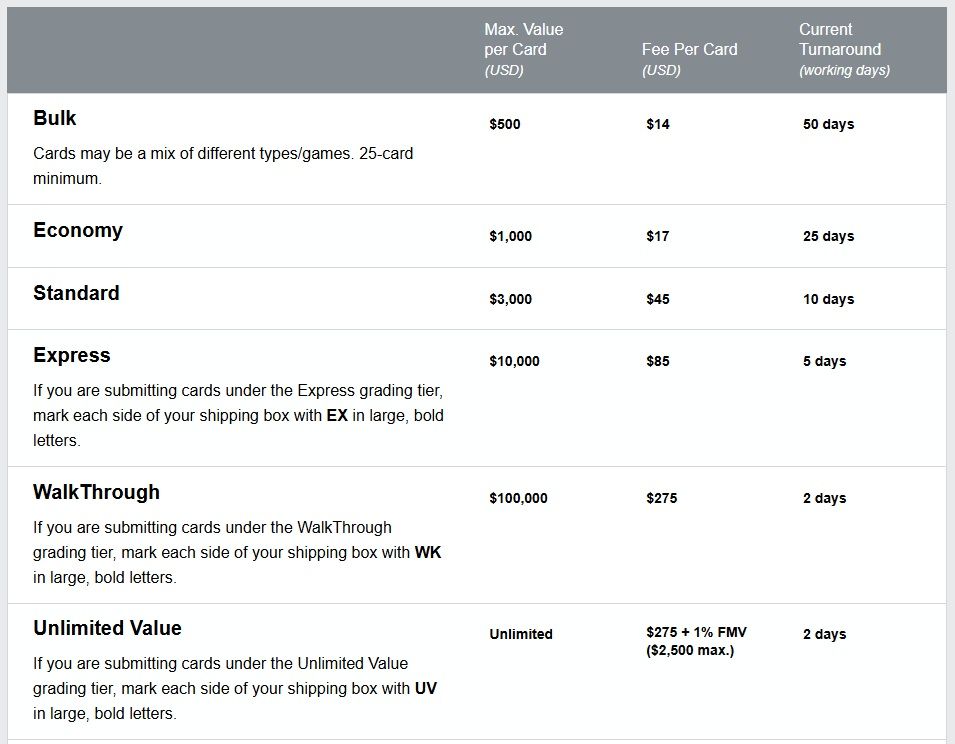
PSA Pricing

SGC Pricing

How Much Do Graded Cards Increase in Value?
There’s absolutely no guarantee that grading a card increases its value. It’s usually a safe bet when it comes to extremely rare cards, but taking any old card and grading it doesn’t suddenly make it a valuable item. Even rare or one-of-a-kind collectibles are worth only as much as the highest bidder is willing to pay for them.
Of course, the rarer or more obscure the cards, the more likely a graded version will skyrocket in value. Just look at the 1/1 The One Ring and the Black Lotus sold in April 2024, which each sold for multiple millions of dollars. Cards like that are the exception to the rule, though.
Poking around a bit, I found quite a few graded cards posted on eBay, and while sellers were asking higher-than-average prices for those cards, one thing seemed pretty obvious: The newer a Magic card is, the less likely grading it will have a significant effect on its value. Unless you’re in possession of an obviously rare and desirable card, the amount of money you spend shipping a card and having it graded is rarely going to be worth the amount you’ll sell that card for on the secondary market.
Is It Better to Sell Cards Graded or Ungraded?
This entirely depends on what you’re selling. If you’re selling a card under the guise of it being a collectible or rare item, grading it can be a huge boon. For example, you’ve got an original Gaea's Cradle still in good condition, or you opened a serialized 420/500 card from a Collector booster – those types of cards might get a boost from being graded before being sold.
However, most cards that are sought after for Constructed or casual play aren’t worth the effort. For one, most people buying cards for tournament Constructed or casual Commander games are looking to play those cards, so having them encased in a sonically sealed plastic cover might pose an issue. Second, there’s no reason the buyer would want to spend more on your graded card when they can get a normal-valued copy through just about any online marketplace. Unless you’re talking about something truly rare or hard to obtain, there’s not much incentive to try and grade your cards before selling them.
Which Grading Services Are Most Desired?
While plenty of companies offer top-notch grading services for Magic cards, PSA and SGC are usually in the conversation as the most trusted and recognizable brands in the business. They’re direct competitors, and there’s plenty of research on the internet comparing the two, but the fact remains that they’re the top dogs in the industry.
While SGC boasts the fastest turnaround time of almost any grading services, all evidence points to PSA cards being valued higher by buyers and collectors. If you don’t intend to sell, there’s not a stark difference between any of these companies. But if you have your hands on something truly special that you do intend to sell, there’s no denying that PSA’s stamp of approval is worth quite a bit more than the competition.
Wrap Up

Sorcerous Spyglass | Illustration by Tyler Walpole
I almost forgot to sleeve the card, and I’ve barely scratched the surface of all the different options out there. Wait, did someone say scratched surfaces? Oh man, there goes our Gem Mint rating.
Perhaps it’s your time to grade us on the information we’ve laid out here. Do you have a trusted grading service you prefer, and do you personally own any graded MTG cards? Let me know in the comments below or over in the Draftsim Discord or on Twitter/X.
Thank you for making Draftsim your #1 stop for all things Magic!
Follow Draftsim for awesome articles and set updates:


2 Comments
Not a fan of this article. I feel as though this invites scalpers to try to slab more and more magic cards.
Our goal is to guide people who are already interested in doing this towards the right resources, partially so they don’t get ripped off in the process. We’re not necessarily persuading people to slab more/less.
Add Comment