

Stone of Erech | Illustration by Jonas De Ro
Replacement effects are Magic’s built-in “instead” buttons—rules that modify or tweak game events before they happen. They can impact everything from death triggers to token creation to dealing damage, and they can quietly override triggers or change activated abilities. They can even modify or completely nullify other replacement effects!
They can also get quite messy, though, to the point of replacing “Having a fun time” with “Having a massive rules-comprehending headache,” or with “Having a bit of a bitter argument with other players….”
But fear not! Let's replace confusion with clarity, and break down the ins and outs of how replacement effects work in MTG!
What Are Replacement Effects in MTG?

Doubling Season | Illustration by Richard Wright
A replacement effect is an effect that modifies how other specific events occur. They replace Event A, which would have normally happened, with Event B, which is what happens instead.
Doubling Season has a textbook example of a replacement effect:

The key word here is “instead”: Doubling Season overrides the normal effect that would have happened (create X tokens, put Y counters) and replaces it with a different effect (create 2X tokens, put 2Y counters).
Some usual wordings for replacement effects are:
- “Instead,” like we just saw for Doubling Season, or effects like Laboratory Maniac that literally wins you the game instead of losing it.
- “Skip,” to indicate an event, step, phase, or whole turn will be replaced with nothing, like how Necropotence skips your draw step, or Trouble in Pairs skips extra turns.
- Effects that read “[This permanent] enters with…,” “As [this permanent] enters…,” or “[This permanent] enters as…”
- Continuous effects that read “[This permanent] enters…” or “[Objects] enter [the battlefield]…”
- Sometimes they’re hidden inside keywords: Regenerate, dredge, and flashback all contain replacement effects, for example.
How Do Replacement Effects Work?

Rest in Peace | Illustration by Terese Nielsen
Replacement effects monitor the game for specific events and modify them as they occur. Whenever Event A would take place, a replacement effect makes Event B happen instead. And, crucially, for all practical purposes Event A never happened.
You can think of it as Event B overriding or rewriting Event A. If you promise not to take this silly example too far… replacement effects work like having a Magic Sharpie that allows the card to yell “Scratch that!” and rewrite some ability, rule, or event.


For example, say you have The Great Henge and Doubling Season on the battlefield, and you play a Delighted Halfling. And since this is a silly example, let's have the cards talk, like in a movie.
Delighted Halfling (giggling): Hi, y'all! I've just entered the battlefield!
The Great Henge: Welcome! Since you are a nontoken creature, let me trigger my triggered ability. It will put one +1/+1 counter on you, and let us draw a card.
Doubling Season (taking out sharpie): SCRATCH THAT, Henge! Your triggered ability now reads, “… put one TWO +1/+1 counters…”
A replacement effect basically swaps Event A, that would normally happen, for Event B, which is the effect that actually happens. We'll examine some corner cases in a bit, but the rules of thumb to keep in mind are:
First and foremost, the replacement effect has to be in play before the event it replaces. Replacement effects can't go “back in time.”
Second, a replaced event (Event A, what would have happened) never actually takes place. Which in turn means that:
- If there's a third effect, Event C, that happens whenever Event A happens,
- And Event A gets replaced by Event B,
- Then Event C won't happen either (because Event A never happened),
Third, replacement effects only modify an event once. If you have three token doublers in play, and you would create one token, then each token doubler can only replace the effect once in this instance.
Fourth but not least… replacement effects can be a huge headache when several happen at the same time, since ordering them isn’t trivial. We'll get to it, I promise, but let's first see more general cases.
Examples of Replacement Effects
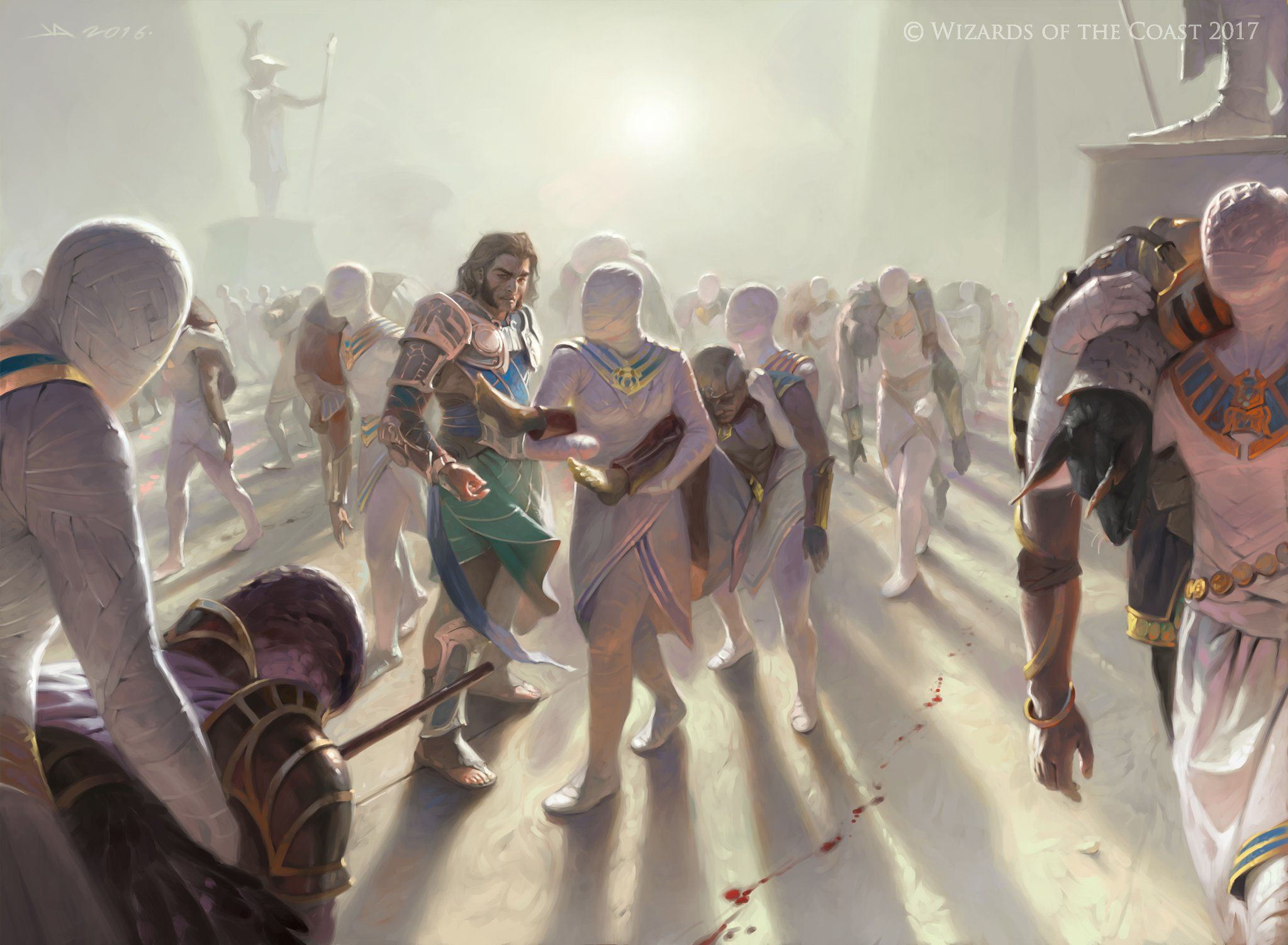
Anointed Procession | Illustration by Victor Adame Minguez
There are tons of replacement effects in Magic, some more straightforward than others. This is far from an exhaustive list:
This Permanent Enters Tapped
Probably the most common and straightforward replacement effect, to the point that I'm pretty sure you've seen this one a ton and may not even have noticed it's a replacement effect:


If you allow me another silly dialog:
Myriad Landscape (enters): Wee!! I'm a land, entering play!
Game Rule #110.5b: Indeed you are! And therefore, you enter untapped.
Myriad Landscape: Wait… Why?
Game Rule #110.5b: Because I happen to say so! I'm rule 110.5b, and I state that: “Permanents enter the battlefield untapped, unflipped, face up, and phased in unless a spell or ability says otherwise.”
Myriad Landscape (takes out sharpie): SCRATCH THAT! Now you say: “… but if you are Myriad Landscape, you enter tapped.”
Token Doublers
Token doublers (and also counter doublers) are another very common example of replacement effects. These are usually easy to spot thanks to the “instead” word.
They also tend to be a common example of what happens when you have several replacement effects in place. We’ll talk in depth about ordering replacement triggers in a sec, but for now let's suppose you have Bitterblossom in play and apply Doubling Season, then Anointed Procession, then Mondrak, Glory Dominus:


The silly dialog would be something like this:
Bitterblossom: During your upkeep, I spawn one token.
Doubling Season: Scratch that, Bitter: You spawn one TWO tokens!
Anointed Procession: Scratch that, Doubly! Bitter spawns one TWO FOUR tokens!
Mondrak, Glory Dominus: Actually, scratch all that! Bitter now spawns one TWO FOUR EIGHT tokens!
Notice that the replacement chain (and, thankfully, this silly dialog!) stops right here. A replacement effect happens just once per instance of the original Event A. That's to say, you can't have Doubling Season pulling the sharpie trick again and doubling the tokens to 16 (and Procession then doubling to 32, and Mondrak to 64, and Doubling Season to 128… in an infinite loop).
Zone Replacements
A lot of replacement effects are about sending a card to one game zone (exile is the most common) rather than where they would normally have ended (usually the graveyard). They often come with the “instead” giveaway.
Flashback cards have a clause that, if you cast them for their flashback costs, sends them to exile when they resolve rather than anywhere else: That's a replacement effect.


Obliterating Bolt exiles creatures that it would have killed. Kess, Dissident Mage exiles spells cast using their ability. And cards like Liesa, Forgotten Archangel or Stone of Erech send to exile (rather than the graveyard) all your opponents' creatures when they die.
A crucial detail here is: Anything else that would have triggered had the object gone to the original zone will not trigger if the object instead goes to the replacement zone. The original event never actually happens, and therefore doesn't trigger anything.
Damage Amplifiers


Damage multipliers that double or triple the damage dealt (like City on Fire or Solphim, Mayhem Dominus do), and damage increasers that add extra damage (such as Torbran, Thane of Red Fell and Mechanized Warfare) can also be recognized as replacement effects thanks to their “instead” wording.
We'll revisit them in a bit, since they are a prime example of the importance of ordering replacement effects.
Skip a Step, Phase, or Turn
In this case, “Skip [something]” is the same as “Instead of doing [something], do nothing.”


Necropotence replaces your draw step with exactly nothing: You go directly from upkeep to the first main phase. And anything else that would have happened during your draw step (like Sylvan Library triggering) won't happen.
What Are Self-Replacement Effects?

Akroma's Will | Illustration by Antonio José Manzanedo
Some replacement effects are nested or embedded inside a larger ability. That is to say, they are part of a resolving spell or ability, and they replace part or all of that same spell or ability's own effect(s).

As we saw above, Scute Swarm is a good example of a self-replacement effect; the “instead” clause modifies its own triggered ability.
Notice that a self-replacement effect needs to address the very same ability it's part of, not just the card it's written on. You may look at Myriad Landscape and think, “Well, this ability is about the card itself; that sounds pretty self-referential, so I guess this is a self-replacement effect…”
… and you'd be wrong: Myriad Landscape's effect is not a self-replacement effect because what it replaces is not something in the ability it's a part of. So let's see two other replacement effects that are indeed self-replacement effects, to drive the point home.


The first abilities on Jeska's Will or Akroma's Will are self-replacement effects that modify their very own abilities. You normally choose just one mode while casting these spells, but under certain conditions you can instead choose both modes.

The same happens with the bottom half of Force of Negation, which self-replaces part of the normal effect of countering a spell: Instead of going to the graveyard, in this case the countered spell goes to exile.
Do Replacement Effects Use the Stack?
No, replacement effects do not use the stack. They apply immediately when the specified event would occur, and automatically replace them with something else. Since they don't use the stack, players cannot respond to replacement effects directly.
Are Replacement Effects Triggered?
No, replacement effects themselves are not triggered abilities. Triggered abilities begin with words like “when,” “whenever,” or “at,” and they use the stack, allowing players to respond to them. Replacement effects, on the other hand, modify events as they happen and do not use the stack.
You can have a triggered ability that contains a replacement effect, like in Scute Swarm‘s case.
There are two things going on here. First, the landfall ability: That's a triggered ability that goes to the stack, and that fires off whenever one of your lands enters the battlefield.
But the trigger has a replacement clause attached to it; if the trigger resolves, then:
- If you have less than six lands, then the first part of the trigger happens and you get a 1/1 green insect,
- But if you have six or more lands, out comes the sharpie and Scute Swarm‘s trigger now reads: “… create a
1/1 green Insect creature tokentoken that’s a copy of this creature.”
Scute Swarm is also a great example of a self-replacement effect. Oh, and it's also a card that Magic's Head Designer Mark Rosewater has called “a mistake” in his personal blog, so if the next part gets complicated, maybe that's why!
Can You Stifle a Replacement Effect?

No, you cannot use Stifle or similar effects to counter replacement effects. Stifle effects only counter activated or triggered abilities, which use the stack. Replacement effects don’t use the stack, making them uncounterable by such means.
In the Scute Swarm example, you could Stifle the landfall trigger; but the replacement effect isn't something that can be targeted.
Do Graveyard Replacement Effects Stop Death Triggers?
Yes, they do! And more precisely: They stop them from ever triggering in the first place.
The key to remember is: If Event A gets replaced with Event B, then Event A never happens. So if something triggers when A happens, it won't trigger in this case.
If you have Stone of Erech in play, and you kill one of my creatures, you actually don't kill them – you exile them; it’s not that my creature goes to the graveyard, and then gets exiled. Rather, it never goes to the graveyard; it goes from battlefield straight to exile (which, in Magic, doesn't count as death).

As long as you have Stone of Erech in play, my creatures won't trigger my Blood Artist, as they never die.
When Do Replacement Effects Occur?
If a replacement effect replaces Event A for Event B, then it happens exactly whenever Event A would have happened, modifying or replacing it immediately.
If you play Myriad Landscape, it enters tapped instead of entering untapped. It's not that it enters untapped and then it taps itself – it was never untapped to begin with.
As we saw above with Scute Swarm, a triggered ability can contain a self-replacement effect. Your opponents can mess with the trigger (and for example Stifle it), or with the conditions it checks upon resolution (they could nuke some of your lands before the ability resolves). But as long as it's valid, the self-replacement effect happens automatically and immediately when the trigger resolves.
In other words, there's no window of opportunity for anybody to react to a replacement effect once it goes live.
What Happens with Two Replacement Effects in MTG?

Rage Reflection | Illustration by Chris Seaman
When multiple replacement effects could modify the same event at the same time, then the affected player (if the event affects a player directly), the controller of the affected object, or the owner of the affected card if said card has no controller, chooses the order in which to apply the replacement effects. After applying one replacement effect, the event is modified; the player checks again for any other applicable replacement effects, chooses one, applies them, and continues until there's no applicable replacement effect left.
In short: whoever is on the receiving end chooses how to order the replacement effects.
But there's a catch! You can't choose freely from among all of the applicable effects; some replacement effects have higher priority than others.
- Self-replacement effects come first – If any of the replacement effects are self-replacement effects, you must choose one of them first.
- Effects that change who controls an object come second.
- Effects that change one object into another as it enters the battlefield (like for example Essence of the Wild) come third.
- Effects that would cause a card to enter the battlefield with its back face up come fourth.
- Any other replacement effect comes after all of the above.
When multiple replacement effects have the same priority level you can freely choose from among them, but you can never choose a lower-priority effect if there's a higher-priority effect available.
After you choose one replacement effect, it takes place immediately. Then you get to choose the next replacement effect – but only if they still apply to the modified event. Sometimes your modified event makes it impossible to apply other replacement effects, and in this case, you can ignore them.
Let's see two examples!

Remember your Stone of Erech, that sends my dying creatures to exile instead? If I happen to have Nissa's Chosen in play and it dies, then there are two relevant replacement effects: Stone of Erech‘s (that would exile it instead of letting it go to the graveyard), and Nissa's Chosen’s own replacement effect (that would tuck it back into my library).
I'm on the receiving end here. I control the affected object, so I get to choose how to order both replacement effects. Since they are both at the bottom of the priority list, I can pick which to apply first.
I choose “bottom of my library,” and apply that effect to Nissa's Chosen. And after I apply it, it nullifies Stone of Erech's replacement effect because now Nissa's Chosen never actually died – it went from battlefield to bottom of library, so Stone of Erech's replacement effect now has nothing to replace.

If you counter my Nexus of Fate with Force of Negation, I'm again on the receiving end (I'm the Nexus's controller), but in this scenario I don't get a choice. I have to apply Force of Negation‘s self-replacing effect first, since it has the highest priority, and exile my spell. And that means my Nexus never gets to the graveyard, so its own replacement effect (that would shuffle it into my library instead) never comes up.
How Are Replacement Effects “Ordered”?
Replacement effects “resolve” one by one, in the order chosen, but only as long as they are still applicable.
As we just saw above with the example of Stone of Erech and Nissa's Chosen, if the Chosen dies, I can choose which replacement effect happens first. But, in this example, the other replacement effect will never take place.
Who Chooses the Order of Replacement Effects?
As we saw above, whoever owns or controls the modified object/event gets to order the replacement effects. If it's an object you control, or a card you own if it has no controller, or you are the affected player, then you get to order the replacement effects.
That's true even if my cards replace effects on your cards – if you control the affected object, you order the replacement effects.


For example, if two or more effects attempt to modify how many counters would be put onto a permanent you control, you choose the order to apply those effects, no matter who controls the sources of those effects. If I have Vorinclex, Monstrous Raider in play, you have Winding Constrictor in play, and your The Great Henge places a +1/+1 counter on a creature you just played, then you get to choose how to apply Voriclex's and the Constrictor's effects.
Who Chooses the Order of Damage Replacement Effects?
As with all replacement effects, whoever is on the receiving end – tha tis to say, either the player who's getting damaged directly, or the controller of the object receiving the damage – chooses the order in which to apply the damage replacement effects.
Say I shoot you with a Lightning Bolt while I have Dictate of the Twin Gods and Torbran, Thane of Red Fell in play. All three cards are mine, but since it's your face that burns, you get to order the effects.
And ordering here is not trivial. The Bolt does 3 damage, and you can:
- Increase it from 3 to 5 with Torbran, and then double it to 10 with the Gods, or
- Double it from 3 to 6 with the Gods, and then add +2 with Torbran for 8 damage.
You probably want to go for the second option!
By the way: If a source would deal 0 damage, it actually doesn’t deal damage at all. Which means that replacement effects like Torbran's that apply if you deal damage, have no event to replace (because no damage was dealt), so they have no effect.
Are Panharmonicon “Ability Doubling” Effects Replacement Effects?

No, they are not. Panharmonicon causes the ability to trigger twice; it doesn’t modify the trigger itself. Panharmonicon-style effects are something extra that happens on top of the original effect; they don't replace said original effect.
Wrap Up

Necropotence | Illustration by Dave Kendall
Replacement effects are effects that watch for a specific game event and, if it would occur, change how that event happens instead of letting it proceed normally. They never go on the stack (and therefore can't be Stifled); whoever is on the receiving end gets to order the replacement effects; and the replaced effect never happens.
They can sometimes be a bit messy and unintuitive to parse, but if you follow them step by step they are pretty straightforward.
I hope you've enjoyed this mechanical deep dive, and if you have comments or questions please drop a comment below, or stop by the Draftsim Discord for a chat.
And good luck out there!
Follow Draftsim for awesome articles and set updates:




Add Comment