The post Is AI Indexing Actually a Financial Win? appeared first on EditShare.
]]>The more useful question isn’t “What can AI do?” but rather: Does it change the economics or throughput of your specific operation?
The Tipping Point: From “Annoying” to “Expensive”
We’ve all heard the complaint: “We produce more than we can find.” For a small team, that’s a minor annoyance. For a high-volume production house, it’s a business failure.
The “tipping point” occurs when search friction manifests as a tangible loss. We’ve seen it happen in three specific ways:
- The Duplicate Shoot: A team flies a crew out to capture “generic city b-roll” because no one can find the high-quality drives from six months ago.
- The Missed Deadline: An editor spends six hours “scrubbing” through raw footage to find a specific interview soundbite, pushing the delivery past the broadcast window.
- The Lost Opportunity: A brand wants to do a “throwback” campaign, but the archive is such a “black hole” of unindexed data that the creative idea is killed because the labor cost to find the clips exceeds the project budget.
When AI Indexing Doesn’t Make Sense
If your team produces one-off projects that are delivered and rarely revisited, the long-term value of indexing every frame is limited. An archive that is rarely accessed does not suddenly become valuable just because it has more metadata. Searchability enables reuse, but it does not create reuse on its own.
When the Math Changes
Where AI indexing begins to make financial sense is in environments where volume and reuse are structurally important.
- The Scalability Gap: At a modest scale, manual logging is manageable. At a large scale, it’s either ignored or becomes a massive labor expense. AI converts unstructured video into searchable metadata (faces, objects, speech) at a fraction of the cost of human labor.
- The Inventory Mindset: An indexed archive behaves like inventory. An unindexed archive behaves like storage. If you regularly repurpose content, localize material, or monetize archives, searchability directly affects your margins.
- Creative Throughput: Editors are your most valuable (and expensive) assets. When a skilled editor spends 45 minutes looking for a clip instead of cutting, that is an opportunity cost. AI doesn’t replace their judgment; it simply narrows the search space so they can get back to storytelling.
The Reality Check
AI is a lever, not a magic wand. It is brilliant at pattern recognition, like finding a logo, a specific face, or a spoken word. It still struggles to interpret emotional nuance or “vibe.”
Furthermore, the technology only works if the workflow changes. Media must be centralized, and metadata must be visible exactly where the editors work. Without adoption, indexing is just background noise.
The post Is AI Indexing Actually a Financial Win? appeared first on EditShare.
]]>The post TVC Soho Selects EditShare High-Performance NVMe Storage to Support Resolve Finishing Workflows appeared first on EditShare.
]]>Boston, MA, 17 March 2026: EditShare®, a leader in collaborative media workflow solutions, today announced that TVC Soho, a London-based post-production facility, has selected EditShare shared storage as the foundation for a new high-performance finishing environment.
Based in the heart of London’s media district, TVC Soho provides premier editorial, grading, and audio services for global broadcasters and film studios. To support its growing DaVinci Resolve finishing tier, the facility will implement a 128TB Ultimate EFS NVMe system alongside an Ultimate EFS-310 providing 192TB of scalable storage. This high-bandwidth architecture is designed to ensure seamless 4K/8K performance while maintaining full compatibility with TVC’s existing Avid offline workflows.
“For our finishing workflows, we needed storage that could deliver the throughput required for high-resolution media without compromise,” said Marc Collins, Managing Director of TVC Soho. “EditShare provides the performance we need for Resolve today, together with the scalability to grow and the reassurance of working with a trusted supplier with local support and spares here in the UK.”
The solution is being delivered in collaboration with Jigsaw24 Media, a specialist media systems integrator supporting creative and production environments across the UK.
Once live, the new environment will provide TVC Soho with a unified platform to keep media accessible across collaborative teams. The architecture also establishes a foundation for future growth, including potential expansion of offline editorial capacity.
“Post-production facilities today are balancing the need for extreme finishing performance with the reality of increasingly distributed teams,” said Brad Turner, CEO of EditShare. “By combining NVMe speed with our EFS file system, we’re providing TVC Soho with a high-bandwidth foundation that doesn’t just power their Resolve suites, but also enables the seamless remote workflows and collaborative flexibility required in a modern media hub.”
The system is scheduled for installation in the coming weeks.
For more information on EditShare solutions, please click here to get in touch.
About EditShare
EditShare is an Emmy Award-winning technology leader, supporting storytellers through collaborative media workflows across on-premise, cloud and hybrid architectures. It offers scalable storage and collaboration for media businesses and at every stage of the video production process from storyboarding to screening.
The software is inherently open, encouraging workflow collaboration, third-party integrations and content sharing across the entire production chain. Where required, the software is backed by high performance, high availability designed specifically for the demands of media storage, management and delivery. The comprehensive offering covers multi-level content storage for production and post, along with innovative asset and workflow management software, plus specialized and highly valued tools for content review and distribution, the creation of customized and branded pitch reels, and secure preview of high-value pre-release content.
About Jigsaw24 Media
Jigsaw24 Media is a specialist division of Jigsaw24 and provides technology solutions and services to media and entertainment professionals, educators, and marketing and content teams. The company’s industry-recognised experts design, deliver, integrate and support end-to-end solutions for some of the nation’s biggest broadcasters and facilities, and it’s the only UK-based business of its kind that has in-house system integration capabilities. Jigsaw24 Media’s vendor community features over 120 technology companies and the business partners with 30 of the biggest industry suppliers including Adobe, Apple, Avid, EditShare and Nutanix. Headquartered in the heart of London’s media community, with dedicated representatives in the regions and a nationwide support team, Jigsaw24 Media provides local services on a national scale. For more information visit https://media.jigsaw24.com/
©2026 EditShare LLC. All rights reserved. EditShare® is a registered trademark of EditShare.
Press Contact
Katharine Guy
[email protected]
The post TVC Soho Selects EditShare High-Performance NVMe Storage to Support Resolve Finishing Workflows appeared first on EditShare.
]]>The post EditShare Advances Analytical AI and NVMe Performance for Modern Broadcast and Post at NAB 2026 appeared first on EditShare.
]]>Boston, MA –11 March 2026 – EditShare®, a leader in collaborative media workflow solutions, will demonstrate its latest advancements in AI-powered media operations and high-performance NVMe storage at the 2026 NAB Show (Booth N1251). The showcase will focus on how broadcasters, post facilities, and production teams can manage growing content volumes without increasing operational complexity.
EditShare’s approach centers on Analytical AI, technology that analyzes media to identify and structure information such as speech, faces, text, and scenes. Unlike generative AI systems that create new content, Analytical AI focuses on understanding existing media, automatically enriching files with metadata that makes video searchable and easier to find. Integrated across the EditShare platform and accelerated by high-bandwidth shared storage, these capabilities allow teams to quickly find the clips they need across their media libraries.

“At NAB 2026, we’re showing how analytical AI has moved from an interesting tool to a foundational part of the EditShare platform,” said Brad Turner, CEO of EditShare. “The real opportunity is the ability to analyze video at scale and make that intelligence usable across the entire workflow. Whether media lives on-premise with our FLOW asset manager or in the cloud with MediaSilo, teams can instantly search their libraries and find the moments they need.”
AI and Intelligent Workflows Across the Platform
- EditShare One: The latest version of EditShare’s unified interface will be showcased at NAB, providing a streamlined operational view across storage, asset management, and AI-powered workflows..
- FLOW AI: Within the FLOW platform, AI-generated metadata enables automation and management workflows to operate without manual tagging. FLOW AI transforms media libraries and archives into dynamic, discoverable assets. Instead of spending hundreds of man-hours on manual data entry, creative teams can reclaim their time for high-value production, confident that every frame is indexed and searchable the moment it enters the system.
- MediaSilo AI: At NAB 2026, EditShare will also introduce new AI capabilities within MediaSilo, extending intelligence directly into review and collaboration workflows. MediaSilo AI helps teams locate moments of interest, navigate content faster, and streamline feedback cycles by making media immediately searchable and context-aware for stakeholders across the production process.
MediaSilo: Intelligent Review and Approval for Modern Production Teams
Alongside the new AI capabilities being introduced within MediaSilo, EditShare will also unveil new MediaSilo bundles: Teams, Pro, and Enterprise – providing scalable options for organizations of any size. These bundles bring together core collaboration capabilities including forensic watermarking, single sign-on (SSO), and unlimited AI, giving production teams access to advanced functionality without the pricing barriers traditionally associated with high-end review platforms.
MediaSilo also enables teams to collaborate with unlimited external stakeholders, making it easy to involve clients, partners, and reviewers throughout the production process.
Visitors to the booth will see how MediaSilo integrates with the FLOW asset management platform, allowing teams to move directly from ingest and media management into secure review and approval workflows.
Infrastructure Built for Intelligent Workflows
The continued evolution of the Ultimate EFS lineup will be on display, engineered to support demanding media workflows across leading creative applications including Avid Media Composer, Adobe Premiere Pro, DaVinci Resolve, Final Cut Pro, Autodesk Flame, and Baselight:
- Ultimate EFS NVMe Lite: A compact 8-drive NVMe storage node delivering up to 14 GB/s throughput per node with up to 122 TB raw NVMe capacity. NVMe Lite provides cost-efficient, ultra-low-latency performance for boutique post, finishing, and VFX environments, with the ability to scale across multiple nodes for increased bandwidth.
- Ultimate EFS Hybrid: A unique,flexible and cost effective storage node combining an ultra-fast NVMe tier and a high-capacity HDD tier in a single system. The NVMe tier delivers up to 9 GB/s throughput with up to 122 TB NVMe capacity, complemented by up to 192 TB of HDD storage for compressed media and longer-term project storage.
EditShare will again partner with Lasergraphics to showcase high-resolution film scanning captured directly into an Ultimate EFS NVMe storage node. Attendees can watch 4K and 8K DPX image sequences ingest in real time and move immediately into playback and grading in DaVinci Resolve, illustrating the huge sustained shared read and write bandwidth required for film restoration and archive workflows.
Commitment to Enterprise-Grade Security and Compliance
As content security becomes increasingly critical for high-stakes productions, EditShare continues to invest in rigorous protection for its users’ intellectual property. MediaSilo has officially joined the TPN+ (Trusted Partner Network) community, signaling a commitment to the industry’s highest standards for content security. The company is also undergoing the assessment process for the TPN+ Shield certification, with completion expected in the coming months. This initiative ensures that MediaSilo users can collaborate with confidence, knowing their workflows adhere to the most stringent security best practices defined by the Motion Picture Association (MPA).
From Capture to Collaboration
EditShare is also pleased to welcome farmerswife to the booth, showcasing how its resource scheduling and management tools complement the EditShare ecosystem. “At NAB, we’re showcasing how farmerswife and Cirkus bring greater structure and visibility to production planning and project execution,” said Jodi Clifford, CEO, farmerswife. “By leveraging EditShare’s Open API, organizations can connect operational data with their media workflows, helping teams stay aligned from acquisition through delivery.”
Attendees are invited to visit Booth N1251 to see these workflows in action. To schedule a meeting with the EditShare team, visit: https://editshare.com/event/nab-2026/
©2026 EditShare LLC. All rights reserved. EditShare® is a registered trademark of EditShare.
Press Contact
Katharine Guy
[email protected]
The post EditShare Advances Analytical AI and NVMe Performance for Modern Broadcast and Post at NAB 2026 appeared first on EditShare.
]]>The post Revolutionizing Remote Collaboration appeared first on EditShare.
]]>SwiftLink and the End of VPN Headaches
The “office” is no longer a single building when it comes to media production. It’s a global network of edit suites, home offices, and field locations. But for years, the barrier to seamless collaboration has been the dreaded VPN (Virtual Private Network).
Traditional VPNs are often the “bottleneck” of creativity. They are notoriously difficult for IT departments to manage, confusing for freelance editors to set up, and, most importantly, frequently underperform when handling high-resolution media.
That’s why we created SwiftLink, powered by our partnership with ZeroTier. Here is how we solve the remote access puzzle for good.
The Problem: The “VPN Wall”
Remote production usually hits one of two walls:
- The Enterprise Wall: Corporate IT departments are often reluctant to grant external freelancers access to the main corporate VPN due to security risks or complexity.
- The Capability Wall: Smaller production houses may not have the technical “wherewithal” to build or maintain a high-performance VPN that can handle the rigors of real-time video editing.
When connectivity fails, editors resort to shipping hard drives or struggling with “SMB over WAN,” which simply doesn’t work for professional workflows.
The Solution: SwiftLink + ZeroTier
SwiftLink integrates ZeroTier directly into the EditShare ecosystem to create a “Private Cloud” that is secure, affordable, and incredibly fast.
1. Instant Access for Freelancers
Instead of a complex manual setup, an admin simply generates a 16-digit network ID.
- Ease of Use: The freelancer installs the ZeroTier stack, enters the ID, and is “off to the races.”
- Security: Access is “fine-grained.” Even with the ID, an admin must manually authorize the freelancer’s machine in the dashboard before any media is visible.
- Affordability: This isn’t an enterprise-cost solution. At roughly $2 per month per user/node, it’s a professional-grade tool at a fractional price point.
2. “Peer-to-Peer” Performance
Unlike traditional VPNs that route all traffic through a slow central server, ZeroTier acts as a “cloud broker.” Once the connection is made, it gets out of the way.
- The Result: A direct, peer-to-peer connection between the editor’s laptop and the EFS server.
- Workload: You can browse media spaces performantly. If your local bandwidth is low, you can seamlessly switch to proxy workflows in Adobe Premiere Pro, then relink to high-res—all through the same secure tunnel.
3. Connecting the Global Studio (Site-to-Site)
SwiftLink isn’t just for individuals; it’s for entire facilities. You can link up to nine distinct sites (e.g., LA, London, and a field unit) into a single ecosystem.
- Disaster Recovery: Automatically synchronize media between a master site and a DR site.
- Follow-the-Sun Editing: Pass media effortlessly between global offices so production never stops.
The Bottom Line
SwiftLink removes the “IT middleman” and the “physics bottleneck.” Whether you are a solo freelancer needing to mount a media space as if you were in the room, or a global studio syncing terabytes of data, SwiftLink makes the connection invisible so you can focus on the story.
“We can’t violate the laws of physics… but we’re going to make the most efficient use of that pipe.”
The post Revolutionizing Remote Collaboration appeared first on EditShare.
]]>The post Zero-Trust Production appeared first on EditShare.
]]>A “secure perimeter” is no longer enough in today’s media production. As workflows become increasingly distributed, the industry is shifting toward a Zero-Trust model: Never trust, always verify.
In our latest episode of Cut to the Chase, Chris Zeid (Manager of Technical Support & Services) and Simon Lamprell (VP of SaaS Product & Engineering) discuss how MediaSilo doesn’t just store content, it secures the entire production process.
1. Project Access. How MediaSilo goes beyond the password.
The traditional username-and-password model is one of the weakest links in security. MediaSilo replaces this legacy approach with identity-bound access methods designed for the modern studio.
Key Technical Takeaways:
- Magic Link System: Users are invited via unique, time-sensitive links, ensuring that only the intended recipient can access the workspace.
- SSO & MFA: For enterprise environments, MediaSilo supports Single Sign-On (SSO) and Multi-Factor Authentication (MFA), adding a critical secondary layer of verification.
- No Shared Credentials: By eliminating static passwords, you eliminate the risk of credential stuffing and unauthorized account sharing.
2. Granular Permissions: Production-Minded Access
Security shouldn’t be “all or nothing.” A freelancer needs different permissions than an executive producer. MediaSilo was built with the production process in mind, offering granular control over who sees what, and what they can do with it.
Key Technical Takeaways:
- Limited Visibility: Grant access to a specific set of assets while keeping the rest of the workspace invisible to the user.
- Functional Restrictions: Define exactly what a user can do. You can allow a contractor to upload deliverables without giving them access to the rest of the account or the ability to review other assets.
- Freelancer Integration: Securely onboard external talent without compromising the integrity of your corporate firewall.
3. Forensic Protection & Behavioral Intelligence
What happens when content leaves the platform for review? This is the point of maximum vulnerability. MediaSilo utilizes a multi-layered defense strategy to deter leakers and provide 100% accountability.
Key Technical Takeaways:
- Visual & Dynamic Watermarking: Overlay name-and-email-specific watermarks to act as a powerful deterrent.
- Forensic Layer: Embed an invisible ID unique to the user and the specific viewing session. Even if someone records the screen with a smartphone, the leak can be traced back to the source using as little as 20 seconds of footage.
- Behavioral Analytics: Track who watched, from where, and for how long. Detailed insights allow you to monitor for irregular activity and identify the source of compromises before they escalate.
Security That Enables Creativity
At EditShare, we believe that when you don’t have to worry about the safety of your assets, you have more room to be creative. MediaSilo gives you the peace of mind that your “work-in-progress” projects are protected by the most advanced security features in the SaaS space.
Ready to see these features in action?
The post Zero-Trust Production appeared first on EditShare.
]]>The post Beyond the Prompt: Crossing the AI Chasm in Professional Video appeared first on EditShare.
]]>The distinction matters. For media organizations, lumping these together creates a “Chasm of Trust.” One category is creatively exciting but operationally risky; the other is the engine of the modern media supply chain.
To build a sustainable 2026 roadmap, we have to stop talking about AI as a monolith and start looking at the four distinct categories of the video AI landscape.
1. Generative AI: The High-Hype Creative Frontier
Intent: Create video from scratch.
The Job to be Done: “Make something that didn’t exist before.”
This is the AI of Runway, Pika, and OpenAI’s Sora. It’s text-to-video, requiring no real-world actors or original footage. While it’s arguably the most “flashy” category, it remains the most operationally risky for professional workflows. Issues regarding copyright, IP safety, and “hallucinations” mean that for now, adoption is high for ideation and pre-viz, but low for high-stakes production.
2. Editing-Assist AI: The Creative’s Power Tool
Intent: Enhance existing footage during the edit.
The Job to be Done: “Help me finish faster or fix a technical problem.”
This category lives inside the NLE (Adobe Premiere, DaVinci Resolve). It’s the “Generative Fill,” the background removal, and the audio cleanup tools that editors have rapidly adopted. Why? Because it lives inside familiar tools and doesn’t threaten the creative process—it simply removes the “drudgery” of manual fixes.
3. Selection & Rough-Cut AI: Finding the Story
Intent: Move from raw footage to an editable sequence.
The Job to be Done: “Help me find the best takes faster.”
This is a burgeoning category focused on automated selects and string-outs. For unscripted, social, and high-volume content, selection AI is a massive time-saver. However, editors remain cautious here; trust in “automated storytelling” is still being earned, and control remains the top priority.
4. Analytical & Operational AI: The Engine of ROI
Intent: Search, review, and manage content at scale.
The Job to be Done: “Operate my content business more efficiently.”
This is where EditShare lives. This isn’t about creating pixels; it’s about understanding them. It’s the layer of AI that sits within your Production Asset Management (PAM) and review systems to provide:
- Automated transcription and facial/logo detection.
- Media-specific accuracy tuned for high-security environments.
- The ability to search a 100TB archive for a specific face and find it in under 10 seconds.
Analytical AI is where real adoption is happening because it offers a clear ROI. It removes friction from high-analysis jobs where AI actually makes business sense.
Crossing the Chasm
Crossing the AI chasm in media isn’t about replacing the editor; it’s about removing the “Search Tax” and the “Chaos Tax” that plague high-output teams. When AI is embedded directly into your storage, your PAM, and your review workflows, it ceases to be a “feature” and becomes an operational standard.
At EditShare, we are focused on the “Grown-Up” side of AI. The side that prioritizes security, predictability, and business value over flashy prompts.
See the Future of Operational AI at NAB 2026
We are heading to Las Vegas this April to showcase how we’ve embedded these analytical and operational AI layers directly into FLOW and MediaSilo. If you are ready to move past the hype and into a high-efficiency AI roadmap, we’d love to show you what we’ve built.
Book a 1-on-1 strategy meeting with our team at NAB 2026.
The post Beyond the Prompt: Crossing the AI Chasm in Professional Video appeared first on EditShare.
]]>The post Cut to the Chase: The “Swiss Army Knife” of Productivity with Lucy Seaborne appeared first on EditShare.
]]>In this installment of our Cut to the Chase series, EditShare’s Shanna is joined by FLOW product expert Lucy Seaborne to dive into three features that turn FLOW into the ultimate “Swiss Army Knife” for post-production efficiency.
1. EditShare One: Ending the “App Juggling” Era
For years, media professionals have been forced to bounce between different applications to search, log, and ingest media. This “context switching” is a silent productivity killer. EditShare One solves this by providing a unified, browser-based experience that serves as a single point of entry for the entire team.
Rather than managing a fragmented toolkit, users access tailored modules designed for their specific roles. Whether it’s a producer checking a simplified dashboard or a media manager scheduling complex ingest feeds, the interface remains consistent and accessible from any browser. By centralizing these tasks, teams can eliminate the friction of software silos and focus entirely on the creative output.
2. Speed Over Friction: The Seamless Proxy Workflow
Remote work is no longer a luxury; it’s the standard. However, the biggest hurdle for remote editors has traditionally been the “relinking drama” between low-res proxies and high-res masters. Lucy highlights how FLOW removes this bottleneck by automatically generating high-quality proxies the moment media hits the system.
This allows editors to begin cutting on a standard Wi-Fi connection immediately—even for 8K projects—without waiting for massive file transfers. The real magic happens during the finish: with a single toggle in the FLOW panel, the NLE switches back to the high-res media for final color and export. This creates a friction-free bridge between the rough cut and the final delivery, regardless of where the editor is located.
3. FLOW Automation: The Assistant Who Never Sleeps
Manual “grunt work”—like transcoding, moving files to the correct folders, and sending “media is ready” notifications—can consume up to 20% of a creative team’s day. FLOW Automation functions as a background assistant that handles these repetitive tasks without human intervention.
By building customizable, “set it and forget it” workflows, administrators can ensure that every file is QC’d, renamed, and delivered to the right department automatically. With hundreds of possible configurations, this engine doesn’t just save time; it virtually eliminates the risk of human error in file management, keeping the creative team focused on the story rather than the folder structure.
Reclaim Your Creative Time
The goal of FLOW isn’t just to manage assets—it’s to return hours to your production schedule. From a unified interface to an automation engine that handles the heavy lifting, these features are designed to help your team work smarter, not harder.
Watch the full episode below to see these features in action and learn how to get your creative time back.
Want the full conversation?
The post Cut to the Chase: The “Swiss Army Knife” of Productivity with Lucy Seaborne appeared first on EditShare.
]]>The post Scaling Production with FLOW Automation appeared first on EditShare.
]]>
In high-output post-production, the most expensive asset isn’t the storage or the licenses, it’s the editor’s time. Yet, in many facilities, senior creatives still spend hours on “janitorial” tasks: renaming files, manually triggering transcodes, moving assets to review folders, and checking boxes in a spreadsheet.
As production volumes scale in 2026, manual workflows aren’t just slow; they are a liability. We designed FLOW Automation to eliminate this operational friction, turning your Production Asset Management (PAM) from a passive library into an active member of the production team.
Here is how technical teams are using FLOW to recapture billable hours and ensure architectural consistency.
1. Eliminating the “Ingest Bottleneck”
The start of any project is usually the most chaotic. Multiple camera cards, varying codecs, and inconsistent naming conventions can derail a project before the first cut.
The FLOW Solution: Instead of manually sifting or sorting footage, FLOW uses Watch Folders and metadata triggers. As soon as media hits the “Ingest” volume, FLOW can automatically:
- Normalize codecs to a preferred house mezzanine format.
- Generate low-bitrate proxies for remote editing.
- Rename files based on project-specific metadata (Date, Camera ID, Scene).
- Notify the lead editor via email that the footage is ready for the timeline.

2. Streamlining the Review and Approval Cycle
One of the biggest time-sinks in post is the “Review Gap,” or the time between an editor finishing a sequence and a producer actually seeing it. Manual uploads to third-party review sites often lead to versioning errors and “Link Hell.”
The FLOW Solution: By integrating FLOW with MediaSilo, the entire delivery chain is automated. When an editor moves a file to a “To Review” folder, FLOW picks up the asset, transcodes it for web playback, and pushes it to a specific MediaSilo project.
- The Result: The producer receives a link automatically. No manual uploads, no password mishaps, and no “v2_FINAL_FINAL” confusion. Updates your spotlight/ make it available to the cloud for review.
3. Intelligent Tiering: The End of “Storage Anxiety”
High-performance NVMe storage is too valuable to be cluttered with raw footage from a project that wrapped three months ago. However, manually moving terabytes of data to the cloud or LTO is a recipe for data loss.
The FLOW Solution: FLOW allows you to build Metadata-Driven Archiving. You can create a rule that says: “If a project status is marked ‘Complete,’ move it to AWS S3 Glacier and leave a proxy behind in the MAM.”
- The Result: Your high-speed storage stays lean and performant, while your “Master” assets are safely and cheaply stored in the cloud, all without the editor lifting a finger.
4. Precision at Scale: The Visual Automation Designer
The most powerful aspect of FLOW Automation is that it doesn’t require a computer science degree to configure. The Workflow Designer uses a node-based interface (as seen in our technical demonstrations on FLOW Automation) to map out the “Life of a Clip.”
Technical leads can drag and drop logic blocks. Here’s just one example workflow:
- Trigger: New file detected.
- Filter: Is it a .R3D file?
- Action: Transcode to ProRes 422.
- Action: Update Metadata “Status” to “Online.”
- Output: Move to “Edit_Share” volume.
There are hundreds of options to configure the automation that works for your specific workflow.
The Bottom Line: ROI Through Accuracy
Automation isn’t just about speed; it’s about predictability. When you automate your workflow with FLOW, you eliminate human error. Codes are always correct, metadata is always consistent, and files never go missing in a “Temp” folder.
For facilities looking to increase their output without ballooning their headcount, FLOW Automation isn’t an optional upgrade; it’s the engine of a sustainable business model. FLOW Automation is available in small, medium and enterprise bundles, keeping cost to entry affordable.
Ready to see these workflows in action? Explore our automation resources or watch a deep dive on streamlining media management.
The post Scaling Production with FLOW Automation appeared first on EditShare.
]]>The post A Smarter Cloud Future for Production & Post appeared first on EditShare.
]]>If you’re creating media today, you’re juggling more pressure than ever: tight deadlines, dispersed teams, unpredictable workloads, media scattered across locations, and the need to pivot quickly without burning through budget.
We hear these challenges every single day, and we built FLEX to solve them.

What Is FLEX?
FLEX is EditShare’s suite of powerful cloud-based media production solutions built on AWS. It gives creative teams everything needed for cloud editing, collaboration, storage, media management, and archiving, all without re-building your workflow from scratch.
For over a decade, EditShare has helped media professionals create outstanding content with collaborative storage and asset management. FLEX extends that expertise to cloud workflows, letting you scale, adapt, and collaborate from anywhere.
Why FLEX Exists
Teams aren’t moving to the cloud because it’s trendy. They’re moving because they need:
- Remote collaboration without delays
- On-demand scalability that aligns with production schedules
- An OPEX-based business model instead of big upfront infrastructure spend
- Reliable, secure access to media from any location
- Freedom to use their preferred editing tools
The problem? Building cloud workflows on your own is complicated.
Fragmented tools, disconnected services, and unpredictable performance quickly become time-consuming and expensive.
FLEX removes that complexity, giving you turn-key, cloud-native workflows that are powerful, flexible, and simple to operate.
FLEX at a Glance
Remote Collaboration, Anywhere
Work with editors, producers, colorists, and VFX teams no matter where they live. FLEX supports both full-resolution and proxy workflows, synchronized through AWS and accessible securely via VPN.
Scale to Match Your Production Calendar
Whether you’re a one-team boutique or an enterprise running multiple concurrent projects, FLEX lets you increase or reduce compute, storage, and workstations as needed, without stranded costs.
Work With the Tools You Already Love
No vendor lock-in. FLEX supports all leading NLEs, Avid Media Composer, Adobe Premiere Pro, and DaVinci Resolve, both on cloud and on-premises.
OPEX Instead of CAPEX
No more multi-year infrastructure purchases. FLEX lets you align spend with usage.
FLEX Is More Than Cloud Storage. It’s a Complete Production Environment
FLEX + AWS = Best-of-Breed Architecture
By running FLEX inside your own secure AWS account, you get:
- Full operational visibility and budget control
- The ability to leverage existing AWS discounts
- Security posture that meets internal IT/infosec requirements
- Zero SaaS multi-tenant risk
This isn’t “shared cloud.” It’s your cloud, your security, your control.
FLOW: The PAM Engine Behind FLEX
At the heart of FLEX is FLOW, EditShare’s powerful PAM built specifically for production workflows.
FLOW gives you:
- Ingest, manage, organize, automate, and share assets
- Tight NLE integrations
- Instant productivity, no special training required
- Open APIs for custom integration when needed
- Intelligent, controlled collaboration environments
Your team can start editing on day one.
Smart, Software-Defined Layering on AWS
FLEX includes EditShare’s software-defined storage, which intelligently uses AWS tiers for performance and cost efficiency.
Benefits:
- Collaborative shared storage optimized for video workloads
- Dynamic balancing between performance and cost tiers
- Simple deployment as a single node or a clustered setup
- Optional N+1 resiliency for higher availability
Whether you’re five creators or 500, FLEX delivers what your team needs.
Built for Your Journey to the Cloud
FLEX deployment options
FLEX Cloud Edit
A complete post-production environment in AWS with virtual workstations optimized for NLEs. Ideal for scaling capacity or connecting distributed teams.
FLEX Cloud Edit+
A turnkey, pre-integrated solution that adds:
- Accelerated file upload from local sites to your AWS environment
- Seamless management of virtual workstations
- Visibility into cloud usage and spend
This reduces setup effort while giving teams powerful oversight and cost control.
A Better Answer to Archive
If you’re not ready to do full cloud production, FLEX Cloud Sync still delivers immediate ROI.
It gives you:
- Easy backup to AWS S3
- Rapid retrieval into on-prem workflows
- Increased resiliency without LTO tape headaches
- Lower long-term storage costs
Tape workflows are slow and operationally heavy. Cloud Sync replaces that burden with a fast, economical, reliable archive.
Remote Workflows Built-In, Not Bolted-On
FLEX supports remote access to full-res or proxy media whether content is stored:
- Entirely in AWS
- On-premises
- Or a hybrid of both
Teams can truly collaborate, not just pass files around.
Why Customers Choose FLEX
- They want cloud workflows — without cloud headaches.
- They want flexibility — without rebuilding everything.
- They want security — without giving up control.
- And most of all, they want to create great content — without being burdened by infrastructure.
FLEX delivers all of that.
Ready to See FLEX in Action?
Whether you’re exploring cloud editing, migrating archives, scaling teams, or just tired of “make it work” workflows, FLEX gives you a reliable, best-of-breed path forward.
We’d love to walk you through options that match your workflow today and where you want to go next.
The post A Smarter Cloud Future for Production & Post appeared first on EditShare.
]]>The post 5 Ways MediaSilo Works to Secure Remote Post-Production Workflows appeared first on EditShare.
]]>To keep projects moving without exposing sensitive assets, secure digital platforms have become essential, not optional.
This is exactly where MediaSilo excels: enabling teams to collaborate easily while offering enterprise-grade protection for works-in-progress, pre-release cuts, and promotional materials.
The rise of distributed post pipelines, AI-assisted editing tools, and global delivery schedules means visibility control, watermarking, and access management are no longer “best practices,” they’re survival requirements.
Whether you’re new to MediaSilo or looking to get more from your current workspace, here are five key platform capabilities to keep your post-production workflow protected.
1. Customize user access with workspace and project permissions
Today’s productions rely on flexible teams filled with freelancers, agencies, remote VFX studios, finishing houses, marketing teams, and internal stakeholders.
MediaSilo’s multi-level user access controls let you manage them all confidently.
- Assign specific User Types to define workspace-wide visibility
- Apply custom Roles to define who can view, upload, download, or share
- Asset Permissions: View, Delete, Download, Edit, Upload
- Commenting Permissions: View, Create, Edit or none
- Sharing Permissions: internal or external
- Set rules at the project level to ensure collaborators only see what’s relevant
- Limit unwanted resharing by disabling download or forwarding permissions
These granular permissions are especially valuable when teams share assets early with AI-assisted editing or captioning partners, where strict access limitations are required.
2. Gate externally shared content with secure link controls
When files must leave your workspace, whether for review, approval, or distribution, MediaSilo provides multiple controlled sharing options.
Private Links require identity authentication before any access is granted, ensuring the recipient truly is who they say they are.
You can also:
- Create Public Links with optional download control
- Use passwords on public shares
- Set automatic link expiration
- Track engagement and revoke access at any time
Automatic expiration has become a key compliance practice as more studios adopt SOC2 and TPN standards.
3. Protect against theft and leaks with SafeStream watermarking
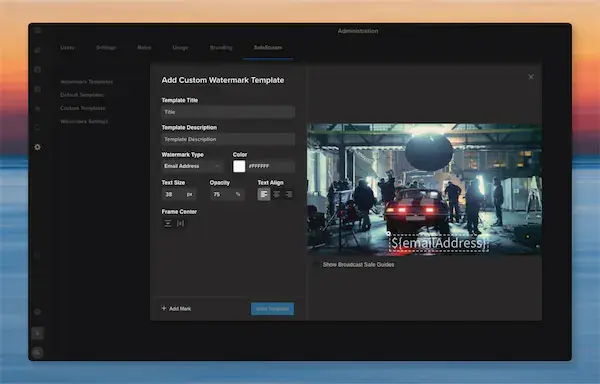
MediaSilo’s SafeStream technology remains one of the strongest safeguards against unwanted leaks, either visual or forensic.
SafeStream offers two complementary options:
Visible watermarking
- Unique per viewer
- Can display name, email, timestamp, image or logo.
- Discourages screenshots and unauthorized sharing
Invisible (forensic) watermarking
- Embedded metadata that can trace any distributed copy
- Does not hinder the viewing experience
SafeStream can be applied at the project, org admin, or template level.
Studios increasingly enforce forensic watermarking for AI dubbing and localization workflows, where multiple vendors receive pre-release assets.
4. Log in securely with Multi-Factor Authentication (MFA)
Strong authentication remains one of the most effective defenses against unauthorized access.
MediaSilo’s MFA feature adds an extra verification step beyond username and password.
- Users can self-enable MFA in their profile
- Admins can require organization-wide MFA
- MFA is simple to deploy and manage
For media teams without SSO (Single Sign-On) infrastructure, MFA provides robust security without additional IT overhead.
5. Track and control content activity in real time
Security isn’t just about restricting access; it’s about visibility.
MediaSilo’s Insights dashboard gives you real-time oversight across your entire workspace:
- See all links created by anyone on your team
- Track views, downloads, and device information
- Adjust expiration or revoke access instantly
- View geographic access data
- Trace suspicious behavior down to the IP level
These insights make compliance reviews faster and help you pinpoint misuse before it becomes a crisis.
MediaSilo’s expanded audit trails have become critical for distributed editorial teams working on tightly embargoed content.

Future-Proof Your Post-Production Workflow
Hybrid work. Distributed creatives. AI-assisted editing. Secure sharing across borders. The workflows of today (and tomorrow) require thoughtful security.
MediaSilo helps you:
- Protect pre-release content
- Collaborate across teams anywhere
- Maintain compliance with security standards
- Keep editors and producers focused on creative tasks, not IT risk
If you’re ready to strengthen your post-production pipeline, we’re here to help.
Start a hands-on trial and see how MediaSilo enhances security without slowing down creativity.
The post 5 Ways MediaSilo Works to Secure Remote Post-Production Workflows appeared first on EditShare.
]]>