The post Python is free appeared first on Eigenvector.
]]>But you don’t have to be a dedicated data scientist to use PLS_Toolbox (or its stand-alone equivalent Solo). Many of its users are, but the real expertise of most users is in something else such as analytical instrumentation (typically spectroscopy) or the specific problem they are working on (e.g. chemical process control, disease detection, art provenance etc.). We made PLS_Toolbox because we believe that the best data analysts are the people that generated the data and have the physics, chemistry or engineering background to understand it.
PLS_Toolbox includes a very wide array of tools for pattern recognition, data visualization, sample classification and regression plus many data preprocessing tools. Tools for problems specific to spectroscopy like calibration transfer, curve resolution and variable selection. Plus particle analysis, batch modeling tools and tools for reading all sorts of data files from various analytical instruments. It is pretty much one stop shopping for most people that work with analytical chemistry and related data.

Unlike Python, when you use PLS_Toolbox you don’t have to decide first which of the 40 most popular libraries you need. It doesn’t require a nine page cheat sheet. You can use it from the command line if you want, and script it too, but the vast majority of analyses can be done using the highly refined point-and-click interfaces. And when you are comparing model results from different methods, you can be sure that they are evaluated in precisely the same way, apples to apples.
And if you can’t figure out how to use a tool or think you’ve found a bug? There’s one email address to write to: [email protected]. We have five full time equivalents working on it, and one of them will get right back to you with help that’s actually helpful. We’ve been supporting it for more than 30 years (and we have no intention of stopping). Plus we have other data scientists on staff who can help you with your application when you really get in over your head.
Yeah, Python is free. We like that about it too. That’s why we search through Python libraries to find the tools that PLS_Toolbox users will find useful. We then incorporate them with our wrappers and interfaces around them so they behave the way our users have come to expect. It’s why we say “we learned Python so you don’t have to.”
So what’s your time worth? If you are someone who proudly displays Dr. in front of your name or Ph.D. after it, you are worth at least a couple hundred bucks an hour. Those hours of command line bullshittery add up pretty fast. Not to mention the opportunity cost of not being focused on the problem you’re actually trying to solve.
So yes, PLS_Toolbox is not free. But for many if not most analytical scientists it is a better value proposition than Python alone.
BMW
The post Python is free appeared first on Eigenvector.
]]>The post Under Same (Old) Management appeared first on Eigenvector.
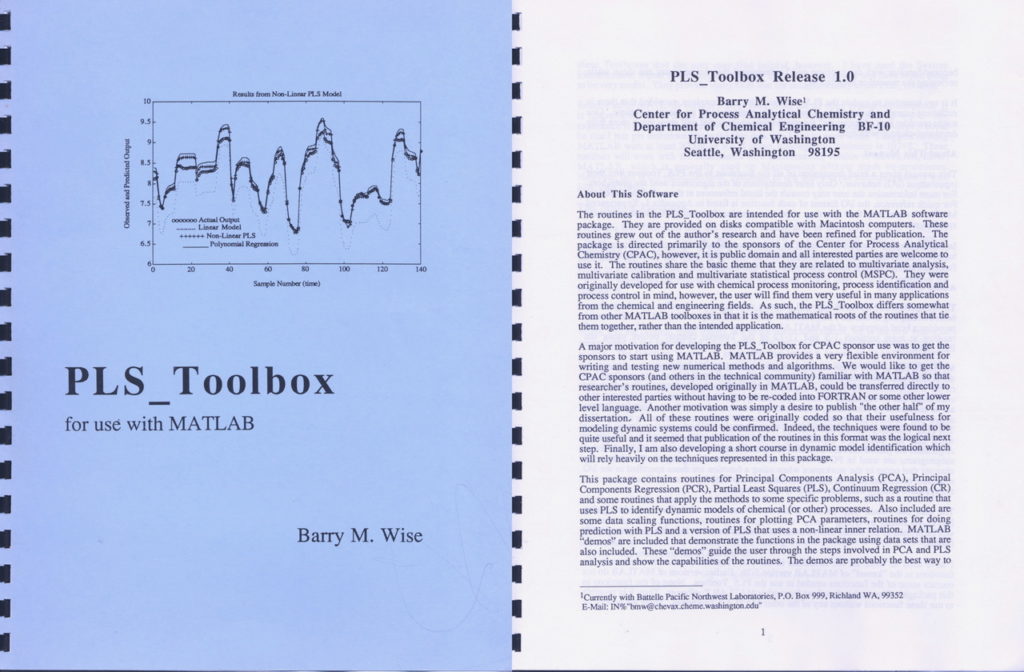
]]>In 1990 Partial Least Squares (PLS) regression was still fairly novel. PLS_Toolbox 1.0 included it, of course, along with a non-linear version of PLS and a number of tools for Multivariate Statistical Process Control (MSPC) including Principal Components Analysis (PCA). The goal then, as it is now, was to bring new multivariate modeling methods to users in a timely fashion and in a consistent and easy to use package.
Neal B. Gallagher joined me in 1995 to form Eigenvector Research, Inc. He has been contributing to PLS_Toolbox development for almost 27 years now, along with consulting and teaching chemometrics, (i.e. chemical data science). Our senior software developers R. Scott Koch, Bob Roginski and Donal O’Sullivan have been with us for a combined 45 years (18, 15 and 12 respectively). That continuity is one reason why our helpdesk is actually so helpful. When you contact helpdesk with a question or problem we can generally get you in touch with the staff involved in writing the original code.
To assure that continuity going forward we’ve brought some younger developers on board including Lyle Lawrence and Sean Roginski. (Lyle was still sleeping in a crib and Sean wasn’t born yet when PLS_Toolbox first came out-ha!) Both have taken deep dives into our code and have been instrumental in the recent evolution of our software. Primarily on the consulting side of EVRI, Manny Palacios brings his youthful energy and extensive experience to our clients’ data science challenges.
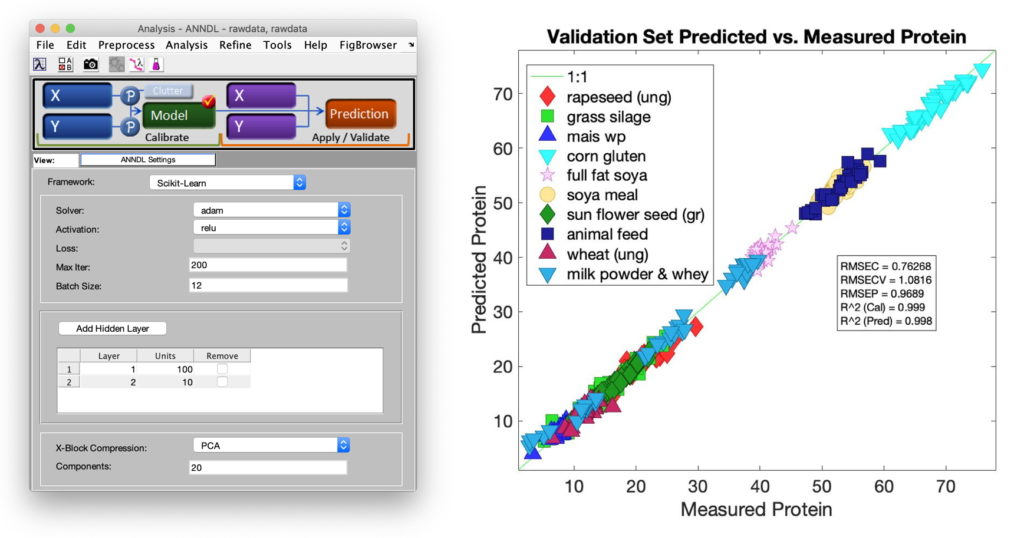
Over the years we have developed and refined PLS_Toolbox along with our standalone software Solo, adding many, many new routines while advancing usability. Currently we are completing the process of integrating new methods from the Python libraries scikit-learn and TensorFlow into the soon to be released PLS_Toolbox/Solo 9.0. So when we bring you new methods, like Deep Learning Artificial Neural Networks (ANNDL, shown above) or Uniform Manifold Approximation and Projection (UMAP, below) you can be sure that they are implemented, tested, supported and presented in the way that you’ve come to expect in our software. They have the same preprocessing, true cross-validation, graphical data editing, plotting features, etc. as our other methods.

Now, 25+ years in, we’re moving forward with the same vision we’ve had from the beginning: bring new modeling methods to the people that own the data in a consistent straightforward package. This same old management is working to assure that far into the future!
BMW
The post Under Same (Old) Management appeared first on Eigenvector.
]]>