Ending Violence BC https://endingviolence.org/ Working together to end gender-based violence, harassment and hate. Fri, 20 Mar 2026 18:56:44 +0000 en-CA hourly 1 https://endingviolence.org/wp-content/uploads/2022/06/EVA-BC-icon-150x150.png Ending Violence BC https://endingviolence.org/ 32 32 Gender-based violence training for BC’s Environmental Assessment Office (EAO) https://endingviolence.org/gbvtraining-eao/ https://endingviolence.org/gbvtraining-eao/#respond Thu, 19 Mar 2026 19:11:12 +0000 https://endingviolence.org/?p=38793 From late 2025 until earlier this year, EVA BC’s Workplace Culture Change team, Ashley Humphrys and Sarah Kenyon, worked together to develop and deliver a four-week (15 sessions) Gender-Based Violence (GBV) Awareness Training program to the operations and compliance and enforcement staff at BC’s Environmental Assessment Office (EAO).  The EAO oversees a process set out in the Environmental Assessment Act to “promote sustainability by […]

The post Gender-based violence training for BC’s Environmental Assessment Office (EAO) appeared first on Ending Violence BC.

]]>

From late 2025 until earlier this year, EVA BC’s Workplace Culture Change team, Ashley Humphrys and Sarah Kenyon, worked together to develop and deliver a four-week (15 sessions) Gender-Based Violence (GBV) Awareness Training program to the operations and compliance and enforcement staff at BC’s Environmental Assessment Office (EAO). 

The EAO oversees a process set out in the Environmental Assessment Act to “promote sustainability by protecting the environment and fostering a sound economy and the well-being of British Columbians and their communities” and to “support reconciliation with Indigenous peoples in British Columbia” in the context of development projects across BC.

As part of Safe and Supported: British Columbia’s Gender-Based Violence Action Plan, the EAO committed to providing GBV awareness training for all its staff. This training, developed by EVA BC, builds skills to assess and monitor GBV risks linked to temporary accommodations, work camps, and other project-related activities, and to integrate effective prevention and mitigation measures into Environmental Assessment Certificates (EACs) where needed. 

This commitment reflects the growing recognition — underscored by the findings of the National Inquiry into Missing and Murdered Indigenous Women and Girls — that proactive action is critical to reducing GBV risks in communities near temporary work camps and large industrial projects.  

“It was really exciting to have the opportunity to develop this training for this sector,” said Ashley Humphrys, Manager of Social Enterprise at EVA BC. “This is the first training to address the issue of gender-based violence in the environmental assessment work in BC.”  

The participants explored how GBV risk intersects with power, colonialism, and systemic inequality, and how to translate identified risks into effective, enforceable mitigation measures. 

The training aimed to help EAO staff with content across four modules:
  

  1. Describe the root causes of and contributing factors to gender-based violence (GBV), including a foundational understanding of colonialism and its ongoing impacts within resource development and environmental assessment contexts. 

  2. Apply trauma-informed and culturally aware practices to GBV-related work, including community engagement and compliance activities.

  3. Identify and understand GBV risks across different projects and environments in the resource sector.

  4. Recognize effective strategies to prevent and mitigate GBV risks and learn how to incorporate them into enforceable conditions. 

The post Gender-based violence training for BC’s Environmental Assessment Office (EAO) appeared first on Ending Violence BC.

]]>
https://endingviolence.org/gbvtraining-eao/feed/ 0
Community coordination committee brings better services to survivors of sexual assault in the Sea-to-Sky Corridor  https://endingviolence.org/coordination-sea-to-sky/ https://endingviolence.org/coordination-sea-to-sky/#respond Fri, 27 Feb 2026 19:30:50 +0000 https://endingviolence.org/?p=38700 For Shannon Cooley, Sexual Assault Response and Prevention Coordinator at PearlSpace and facilitator of the Sea-to-Sky Sexual Assault Response Coordination Committee, the work to support sexual assault response in her community has been an almost 30-year journey in the gender-based violence sector.  “I was born and raised here. And I’ve always had an interest in anti-violence work, advancing feminist […]

The post Community coordination committee brings better services to survivors of sexual assault in the Sea-to-Sky Corridor  appeared first on Ending Violence BC.

]]>

For Shannon Cooley, Sexual Assault Response and Prevention Coordinator at PearlSpace and facilitator of the Sea-to-Sky Sexual Assault Response Coordination Committee, the work to support sexual assault response in her community has been an almost 30-year journey in the gender-based violence sector. 

“I was born and raised here. And I’ve always had an interest in anti-violence work, advancing feminist ideals and embracing intersectionality, and reconciliation as well.” 

She can trace the seeds of coordination in her community to 2006 when the executive director of the Howe Sound Women’s Centre, Melany Crowston, co-founded the Sea-to-Sky Women’s Safety Network with Sheila Sherkat, the manager of the victim services program for the Whistler RCMP Detachment. 

In 2008, Shannon joined the Howe Sound Women’s Centre (now PearlSpace) and the Sea-to-Sky Women’s Safety NetworkShe recalls that, of all the issues they considered, developing a local sexual assault response was the first and most important one to tackle. Because of the lack of stable core government funding for specialized anti-violence programs at the time, survivors had no easy access to forensic services or comprehensive victim support without a police file. A survivor of a sexual assault who wanted a forensic exam, whether they were in Squamish or Indigenous communities in the northern part of the region, had to travel down to Vancouver to access the program at Vancouver General Hospital 

“And sometimes, if they didn’t have transportation, that trip would be in the back of a police car,” she said. “Collectively, we felt this was not right.”  

Sexual assault is more prevalent in rural and remote communities because of geographic and social isolation, limited access to transportation and cell phone coverage, and a lack of services for survivors

For Whistler in particular, the seasonal influx of visitors to the area in the ski season and summer can also increase risk.  

February 2026 SARC hybrid meeting, from L to R: Eliza McCullough, Community Program Manager (Whistler, Pemberton and Northern Communities); Emma Cox, Coordinator, Victim Services Unit, Sea to Sky Regional Police Services (Squamish); Leah Zille, Executive Director, Treehouse Child and Youth Advocacy Centre
February 2026 SARC hybrid meeting, from L to R: Leah Zille; Kelani Shuster, Sexual Assault Support and Youth Education Facilitator; Bree Smith, Sexual Assault Support and Youth Education Facilitator

The lead up to the 2010 Winter Olympics really galvanized their coordination efforts. “We knew sexual violence could increase significantly over the Olympics,” Shannon said. 

At the time, PearlSpace, together with other anti-violence organizations up and down the Sea-to-Sky Corridor, including Indigenous communities and in partnership with anti-violence organizations in Vancouver, worked together to coordinate a sexual assault response to the coming Olympic games.   

“We started developing relationships across sectors to advocate to the Province and Vancouver Coastal Health for a more fulsome victim service response,” said Shannon.   

A collaborative response to sexual assault is one that focuses on coordinating immediate interventions in response to disclosures of sexual assault to support survivors and improve their overall experience and outcomes within the medical and legal systems.  

The journey to bring sexual assault forensic services to the Sea-to-Sky Corridor 

Sexual assault forensic services are delivered by specially trained medical professionals, often forensic nurses, who provide sexual assault examination, emotional support, medical care and collection of forensic samples for survivors. This is distinct from community-based sexual assault support provided by frontline organizations like PearlSpace 

n 2011, the Woman Abuse Response Program and the Sexual Assault Services (SAS) at BC Women’s Hospital & Health Centre held a National Health Conference called For Her Own Good, with a stated goal to explore how social and health care systems and services that are designed for a woman’s “own good” may actually further harm or marginalize women when they try to access support. 

Shannon co-presented with Sheila Sherkat of RCMP Victim Services in Whistler and Chair of the Sea-to-Sky Women’s Safety Network. Their presentation “Virtually without service: Systemic perils for survivors of sexual assault in the Sea-to-Sky Corridor” highlighted the lack of forensic services and other supports for survivors in the Corridor.

Their presentation was well-received, and when it ended, a representative from the Vancouver Coastal Health Authority (VCHA) stood up and announced that forensic services were coming to the Sea-to-Sky Corridor.  

“You hardly ever get these tangible wins,” said Shannon. “We were super excited about that. But then nothing happened [for a few years].” 

In 2015, Shannon was hired as the PearlSpace Sexual Assault Response and Prevention (SARP) Program Coordinator and Advocate and was able to focus fully on building comprehensive services for survivors of sexualized violence.  

During the 2015 federal election, Canadian Press reporter Laura Kane’s story featuring an interview with Shannon about the lack of forensic services for women in the Sea-to-Sky Corridor made national headlines.   

Within 48 hours of the story’s publication, the Province of BC announced that VCHA would be offering forensic nursing services to the Sea-to-Sky Corridor. 

“Basically, it was Christmas Eve in 2015 when forensic [services] finally arrived in the corridor,” Shannon said. 

“It actually took the CBC circling back in 2017 to tell the story of the limited services and then forensic [services] were moved all the way up the corridor,” said Shannon. “First to Whistler, and then eventually to Pemberton.” 

The role of the Sea-to-Sky Sexual Assault Response Committee 

By 2016, the Sea-to-Sky Sexual Assault Response Committee (SARC) was formed to address sexual violence in the region. The goal of the SARC is to support a collaborative community sexual assault response through education, prevention initiatives, trauma-informed, victim-centred and inclusive practices and reducing service gap barriers.  

Shannon explains that the Committee thinks about “How do we bridge our working practices and language so we can actually create some positive change? We’ve recently heard from the Public Health Office that we have one of the best relationships in health and community social services collaborating for sexual assault response.”

The Committee is made up of members from across sectors — 71 community partners who have contact with sexual assault survivors like police, healthcare, and justice services, but they also invite guests to join their meetings, including survivors. Between 20 to 45 people attend every quarterly SARC meeting.

Shannon’s role of advocate and coordinator became permanently funded through the provincial government Sexual Assault Service (SAS) Program as of 2023, rather than through grants and funds from PearlSpace’s thrift store, Pearl’s Value and Vintage. The stable SAS Program funding now supports her role as the SARC facilitator.  

Positive outcomes from PearlSpace’s advocacy and the SARC’s coordination efforts: 
  • There are now eight government-funded team members in the PearlSpace SAS Program based in Pemberton, Whistler and Squamish.   
  • Since 2015, representatives from the Swxwú7mesh Nation, N’Quat’qua Nation and the First Nations Health Authority participate regularly in the Sea-to-Sky SARC, with the Lil’wat Nation sometimes being involved. PearlSpace’s SAS Program outreach worker works with First Nations north of Pemberton and is growing their role in a way that’s responsive to Indigenous communities.  
  • Survivors can now get access to forensic services from nine forensic nurses across the Sea-to-Sky Corridor 24/7.   
  • Consent and gender-based violence prevention education is offered to schools and the hospitality sector.   
  • Training on trauma-informed practice from Dr. Lori Haskell, a nationally recognized expert in trauma and abuse, was delivered to service providers in the Corridor. “Dr. Haskell really helped the police forces here have light bulb moments about how to change policing practices.”  
  • In March 2020, the SARC held a multi-sector training forum called CrossHatch at the Squamish-Lil’wat Cultural Centre for community partners from across the Corridor. Experts in various areas of sexual assault response best practices delivered two days of training that included guidance on navigating the justice system and “pathways to healing”.  
  • Special Victims Units in Squamish and Whistler have dedicated RCMP officers who work with survivors of intimate partner violence, gender-based violence or sexual assault. 
  • The local Sea-to-Sky RCMP have established a set of guidelines, reviewed by Crown Counsel, for how Sexual Assault Support workers can provide emotional support during RCMP interviews with survivors. “We had to do a little bit of advocacy around that, but it has come to fruition because we are recognized as professional victim service workers who can be trusted not to influence survivors in the interview room,” said Shannon. “We understand our role and can maintain and meet professional expectations.”  

Get more information about Sexual Assault Coordination, training and EVA BC’S Coordination Communities of Practice (CoPs).

The post Community coordination committee brings better services to survivors of sexual assault in the Sea-to-Sky Corridor  appeared first on Ending Violence BC.

]]>
https://endingviolence.org/coordination-sea-to-sky/feed/ 0
EVA BC and BC Lions bring Be More Than a Bystander to high schools across BC  https://endingviolence.org/bystander-high-schools-2026/ https://endingviolence.org/bystander-high-schools-2026/#respond Mon, 23 Feb 2026 22:09:41 +0000 https://endingviolence.org/?p=38590 When talking about gender-based violence with young people, what we often hear and see is silence, discomfort and stigma. Breaking through that wall can be tough. “My job is to break down the walls when it comes to this topic – it can be hard,” said Kieran Poissant, BC Lions Football Club wide receiver.   That’s exactly the […]

The post EVA BC and BC Lions bring Be More Than a Bystander to high schools across BC  appeared first on Ending Violence BC.

]]>

When talking about gender-based violence with young people, what we often hear and see is silence, discomfort and stigma. Breaking through that wall can be tough. “My job is to break down the walls when it comes to this topic – it can be hard,” said Kieran Poissant, BC Lions Football Club wide receiver.  

That’s exactly the barrier Ending Violence Association of BC’s Be More Than a Bystander high school program is designed to address.  

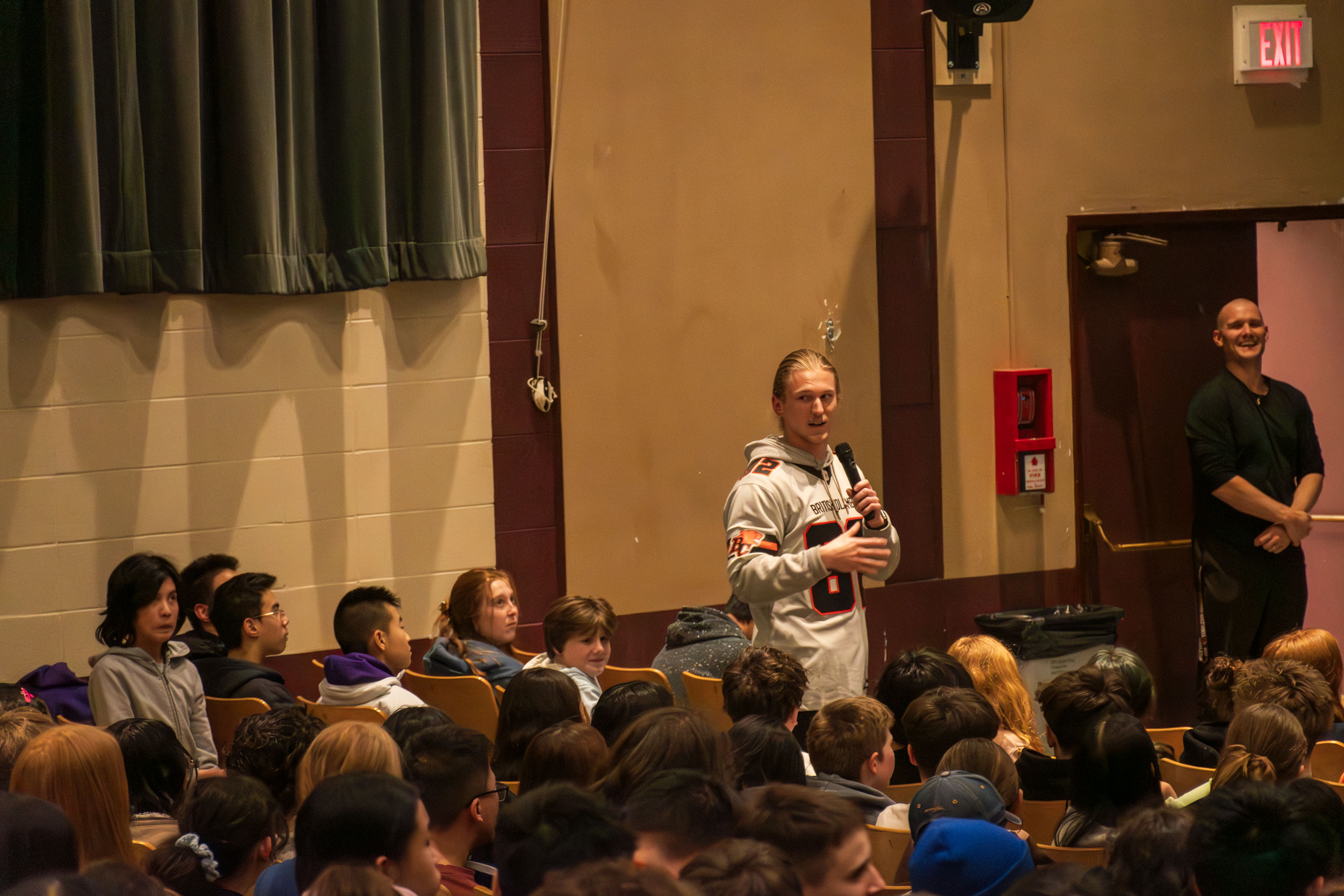
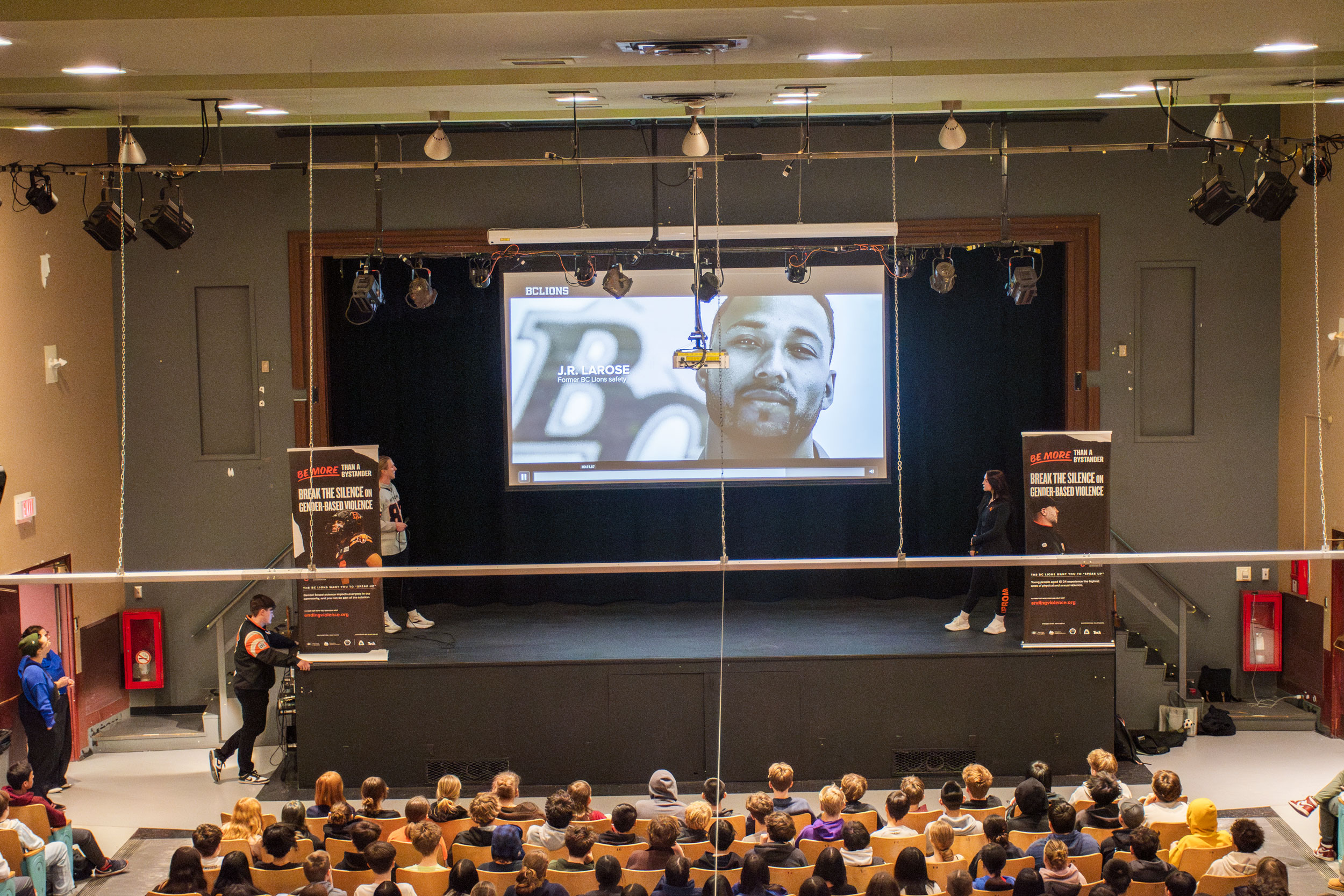
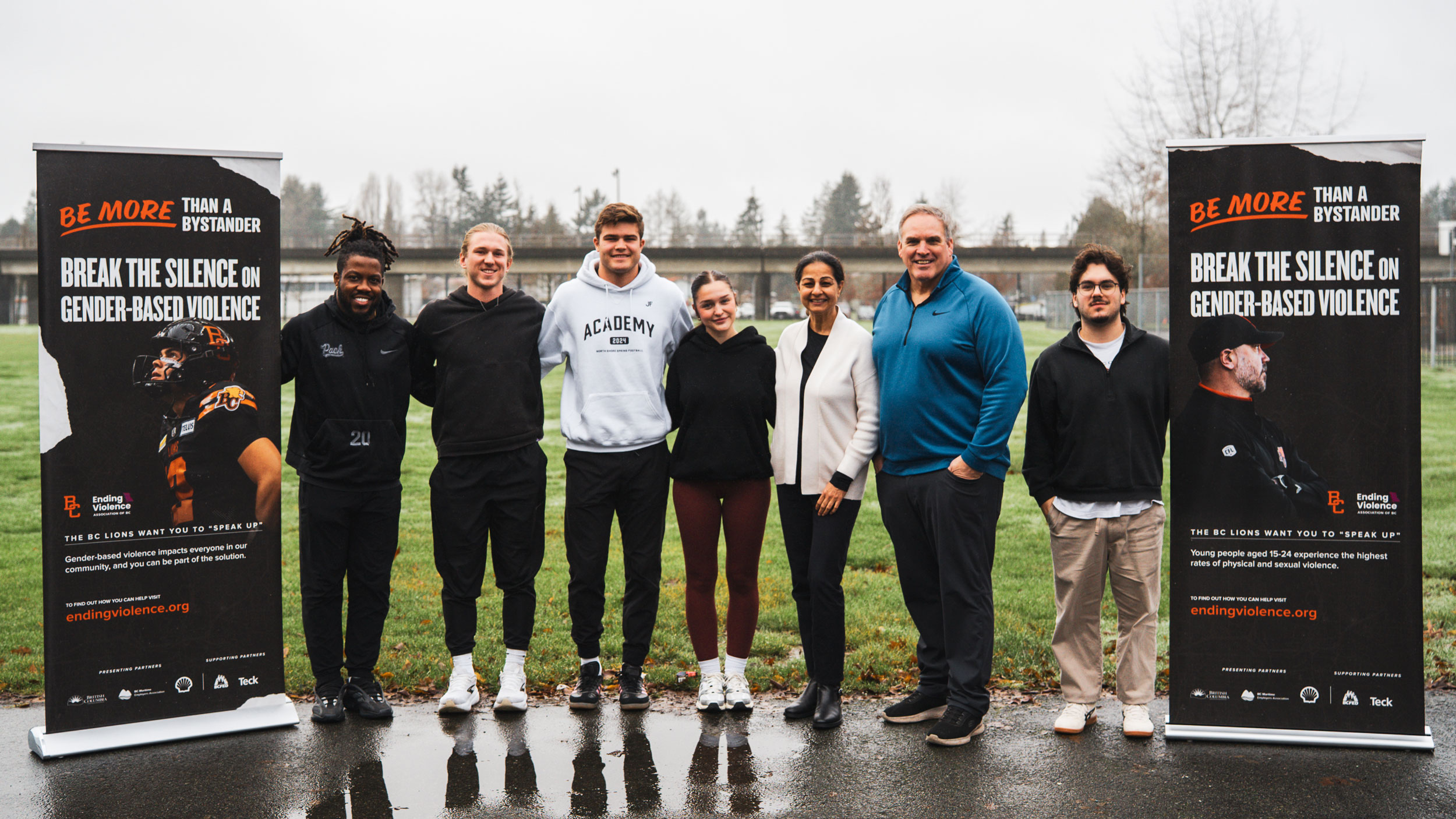
EVA BC’s Bystander high school program, delivered in partnership with the BC Lions Football Club, directly addresses this challenge. The program started its annual visits to secondary schools this January, with BC Lions players — and for the first time, a member of the BC Lions Dance Team — giving presentations to students on how to recognize and respond to gender-based violence. 

The program runs from January to April with the Lions visiting 25 high schools across the province, reaching thousands of students.  

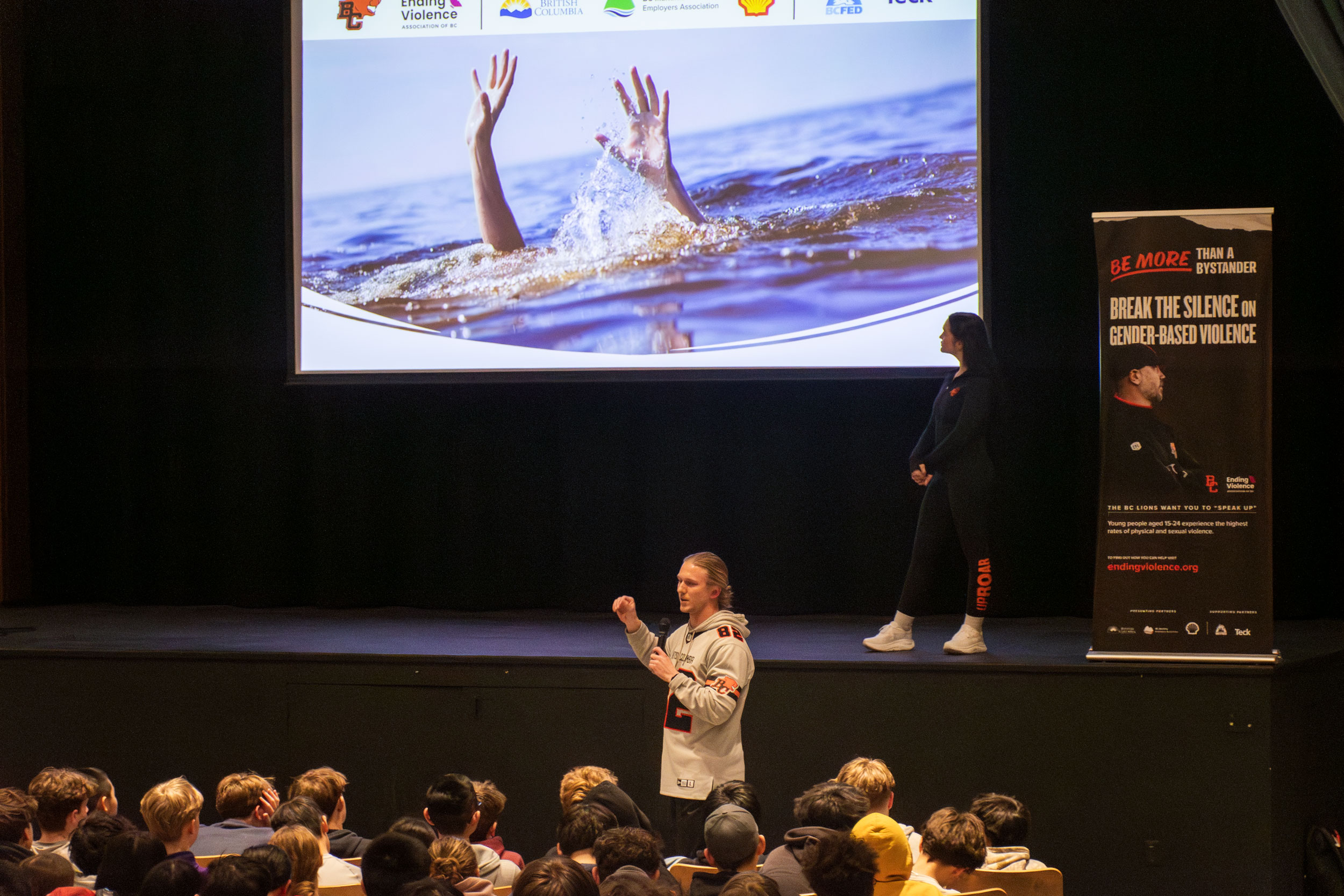
During the presentation, students learn about the many forms of gender-based violence: from stalking and harassment to physical violence — and how they show up in person and online. One key moment asks students how they would respond to someone drowning. The answer is immediate: you wouldn’t stand by. The presenters then make that parallel to gender-based violence — that a bystander response needs to be just as urgent, and the solutions can be just as simple. 

At each visit, local frontline anti-violence workers are on hand to support any students who have questions or concerns about gender-based violence.  

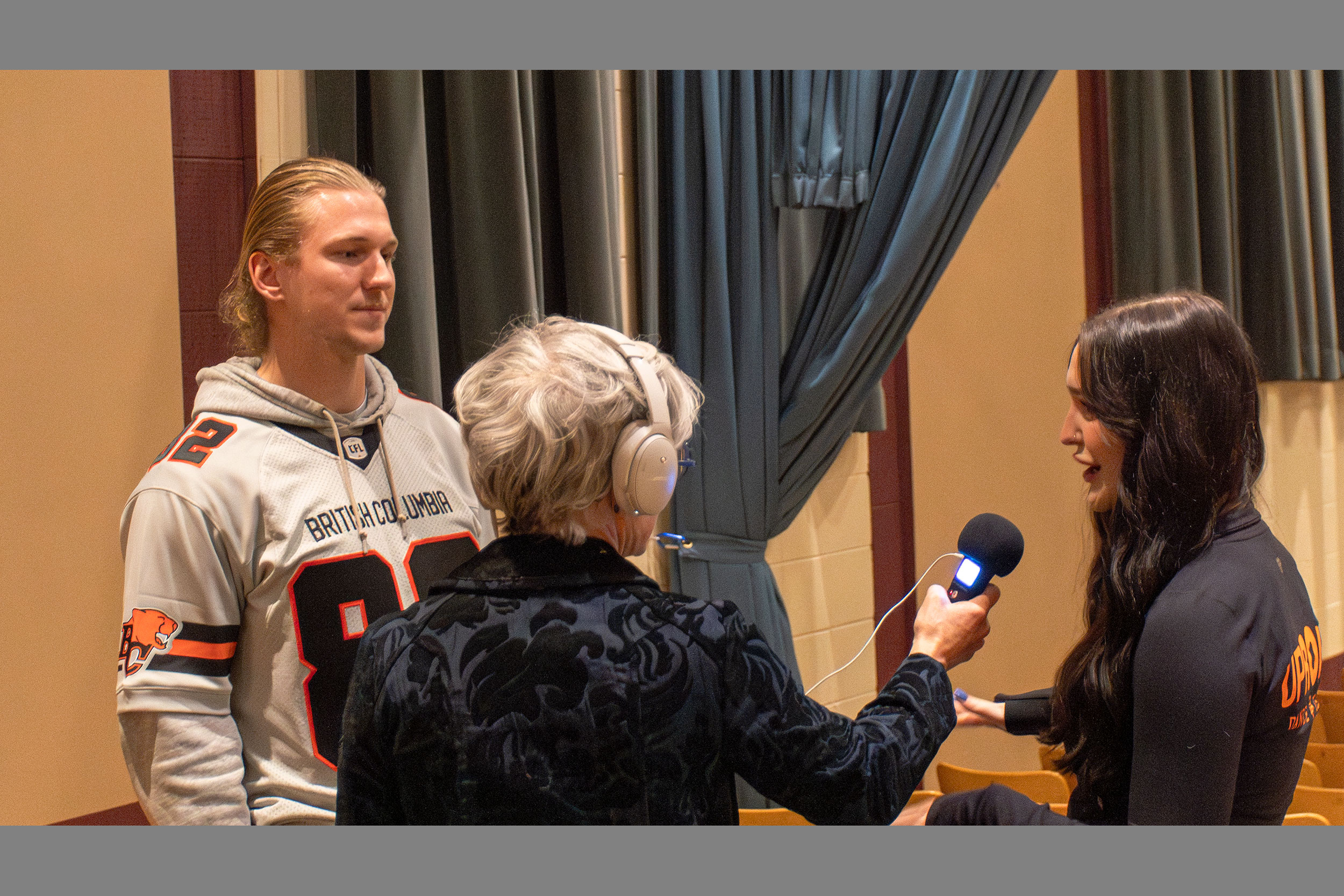
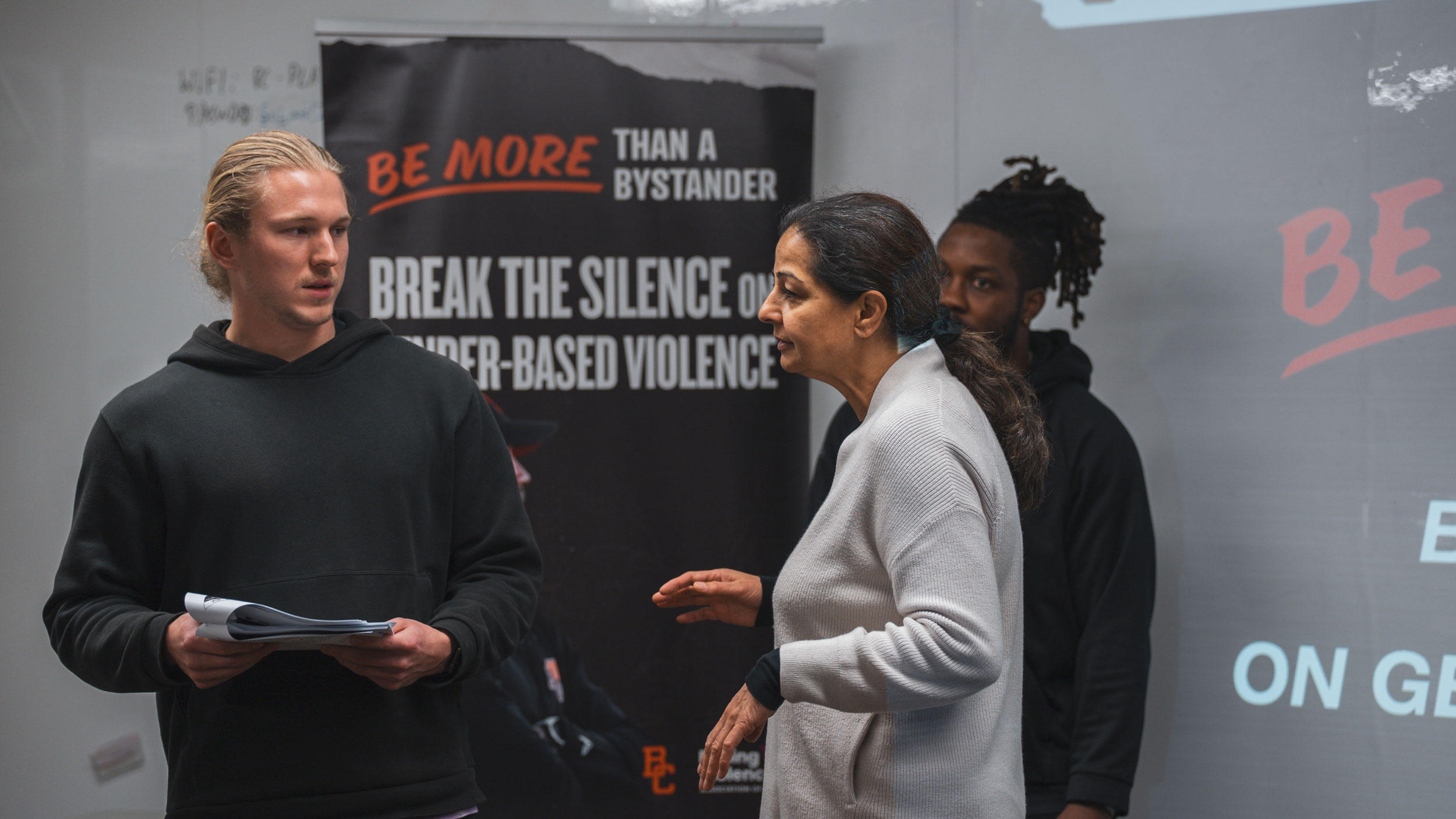
On January 29, BC Lions presenters Kieran Poissant and Casey Beattie, BC Lions Dance Team member, spoke with grade 8 and 9 students at Templeton Secondary School in East Vancouver. It was their second presentation of the day and for Casey her first day with the program.  

Kieran explained, “This morning, we went to Seycove Secondary in North Vancouver. The students were very engaged. It was a lot of fun.” 

He also gave presentations earlier in the week in Delta and Surrey.  

“Every group that I’ve been a part of so far is different just in terms of personality and how willing they are,” said Kieran. “By the end of the day when we get through to these kids and we say, ‘hey this is something to talk about; it’s okay to raise your hand,’ most of the crowds I’ve had are willing to break down that wall.” 

Casey reflected on her first presentation in North Vancouver. 

“You could tell they were listening. Which is very nice, as a speaker, to see the students taking in the information. It’s going to be different with every group. The first couple of times we asked a question it was crickets, but we were like, ‘you guys got it — we want to hear from you’ and then they got comfortable and by the end we got a fair share of hands and people talking to us, which was great.” 

At Templeton Secondary, both Kieran and Casey shared stories about witnessing gender-based violence — moments that made the issue real and relatable for students. 

Before the BC Lions go to the schools, they take part in a two-day training session on the Bystander program with EVA BC. Kieran and Casey reflected on that experience. 

“We spent a lot of time really diving deep into this topic and educating ourselves,” said Kieran. “It was outstanding. I’ve learned so much about it that I never knew before and that was great.” 

Casey reflected on how it helped her to have EVA BC’s executive director, Ninu Kang, as one of the trainers. “It was great, personally, to have her there, as another female, because going into it I was like ‘oh is it just going to be me and all the boys?’ When it’s a lot of talking about gender-based violence against women and being in the room as a woman, having the boys’ support and having Ninu there as well just made it ten times better.” 

As the students at Templeton shouted out, “be more than a bystander!” the message is clear: conversations like these matter. 

Learn more about the Be More Than a Bystander high school program and EVA BC’s partnership with the BC Lions Football Club and watch Be More Than a Bystander videos on EVA BC’s YouTube channel. 

The post EVA BC and BC Lions bring Be More Than a Bystander to high schools across BC  appeared first on Ending Violence BC.

]]>
https://endingviolence.org/bystander-high-schools-2026/feed/ 0
Crisis in BC: Women continue to be killed — We need to see real action https://endingviolence.org/crisis-in-bc-2026/ Wed, 21 Jan 2026 23:13:20 +0000 https://endingviolence.org/?p=37865 In recent weeks, women killed by their current or former intimate partner in BC include Pamela Jarvis, a mother of six, who was murdered by her husband in Merritt in December. Early into the new year, Laura Gover-Basar, a mother of two, was killed by her ex-husband in Saanich. These are two recent intimate partner […]

The post Crisis in BC: Women continue to be killed — We need to see real action appeared first on Ending Violence BC.

]]>

In recent weeks, women killed by their current or former intimate partner in BC include Pamela Jarvis, a mother of six, who was murdered by her husband in Merritt in December. Early into the new year, Laura Gover-Basar, a mother of two, was killed by her ex-husband in Saanich. These are two recent intimate partner violence related deaths, but we know there are more. 

In the summer there were several women killed by a current or former intimate partner in BC which included the very public murder in Kelowna of Bailey McCourt by her ex-husband. EVA BC wrote to the government then to make the point that these deaths are not one-off, isolated incidents, but part of an ongoing crisis of intimate partner violence (IPV) and violence towards women. 

When a woman is killed, the trauma of her death reaches far into the community. The frontline community-based service providers who live and work in her community often end up supporting not just the survivors from the incident, but the larger community that is affected by what happens and is impacted; they also see an increase in demand for their service by survivors who may feel increased fear for their safety.

After a woman was murdered in their community, a local anti-violence agency reached out to EVA BC to share that their team was overwhelmed with requests for support from women who were being abused. This highlights again that IPV is not an isolated incident but an experience that so many women have across BC — the daily terror, fear, and stress that women have of serious injury or death happening to them, their children and/or their friends and family. 

Femicides result in sharp and unexpected increases in demand for services that are difficult to manage — especially while anti-violence workers may be managing their own responses to incidents as members of the communities they serve. In some cases, they may know the victim personally or have been providing services to the victim before they were killed and be navigating a range of complex emotions. 

EVA BC meets regularly with the Ministry of the Attorney General, Ministry of Public Safety and Solicitor General (MPSSG), Gender Equity Office (GEO), Ministry of Children and Family Development (MCFD) and Office of the Representative for Children and Youth (RCY) to share issues that we hear from our members from the frontlines to improve a coordinated response to gender-based violence in BC. Key calls to action include the following: 

  • Create a standing (continuing) provincial gender-based violence death review committee. 
  • Strengthen cross-sector collaboration – including providing funding and support for the important coordination work already done by groups such as Interagency Case Assessment Teams (ICATS) and Violence Against Women in Relationships (VAWIR) coordination tables. 
  • Provide stable, core funding to hire, retain and appropriately train community-based anti-violence support workers. 

The above calls to action have been echoed by the 2025 report by legal expert Dr. Kim Stanton, The British Columbia Legal System’s Treatment of Intimate Partner Violence and Sexual Violence, commissioned by the Attorney General in 2024. Stanton’s report highlighted the long history of concerns about gaps in the legal system for cases of intimate partner violence and sexual violence, made a detailed examination of the current system and outlined clear and specific recommendations for what needs to change to increase safety for survivors and communities, and hold perpetrators accountable for their actions. 

The report’s recommendations to government align with EVA BC’s advocacy priorities. Dr. Stanton notes that there is a broad consensus of the need for a “standing gender-based violence death review committee” that could play a pivotal role in closing the “critical gap in how the legal system and social services analyze, respond to, and prevent gender-based fatalities” (pg 87). Her recommendations also highlight the importance of funding ICATs in BC. EVA BC members coordinate ICATS, made up of Community-Based Victim Services (CBVS) workers, police, Ministry of Children and Family Development (MCFD), probation/corrections, and others who connect and support survivors of intimate partner violence. Since 2008, ICATs have worked together to respond to “highest risk cases of intimate partner violence” where there is a likely risk of “serious bodily harm or death,” and provide coordinated risk management for those cases with a priority of enhancing survivor safety. There are over 50 ICATs across BC, but there is no direct funding for this work. 

Other groups that directly respond to “high-risk domestic violence” include Domestic Violence Units (DVUs) across BC. DVUs have a Community-Based Victim Services (CBVS) worker who works closely with a police officer in the local police station on high-risk cases of domestic violence. The RDVU in Victoria is one of the largest DVUs and depends on daily collaboration and information sharing with “integrated partnerships” between community partners including police departments, transition house societies, and the Ministry of Children and Family Development (MCFD) to support survivors and ensure “safety, accountability, and meaningful change.” They report that they still often feel challenged and frustrated by a lengthy and inconsistent legal process that they note lacks an understanding about the realities of survivors’ experiences. 

The provincial government has responded to Stanton’s report and expressed commitment to working with partners to address the IPV crisis and deaths. In December, Attorney General Niki Sharma announced a “comprehensive provincial framework” to guide all those within the justice system to help better respond to intimate partner violence. This announcement coincided with the federal Minister of Justice’s Bill C-16, The Protecting Victims Act that, if passed, would classify femicide as first degree murder, criminalize coercive control — a dangerous facet of intimate partner violence — and amend the definition of criminal harassment to improve the chances that a survivor who fears for their safety will be taken seriously by the justice system. 

While there is a sense of movement with these new pieces of legislation, government announcements, and the ongoing dedicated work of ICATs and DVUs, the level and impact of this crisis isn’t always well understood. 

It is vital that our governments give priority to action and implement the recommendations in the Stanton report, learn about the gaps in services and systems that contribute to femicides, better understand the impacts of every femicide — on the victim’s family, on anti-violence services, workers, and communities — and prevent future incidents of intimate partner homicide and femicide.  

EVA BC shares heartfelt condolences to the families, loved ones, anti-violence workers and communities who supported the victims and did everything they could to keep them safe. We call on the government to act in this time of crisis of intimate partner violence in our province. 

The post Crisis in BC: Women continue to be killed — We need to see real action appeared first on Ending Violence BC.

]]>
Bill-C16 Protecting Victims Act – strengthening protections for survivors  https://endingviolence.org/bill-c16/ https://endingviolence.org/bill-c16/#respond Fri, 12 Dec 2025 00:04:17 +0000 https://endingviolence.org/?p=37152 On December 9, the Minister of Justice and Attorney General of Canada announced the introduction of Bill C-16, the Protecting Victims Act that proposes reforms to the Criminal Code to “protect victims and survivors of sexual violence, gender-based violence, and intimate partner violence, and to keep our kids safe from predators.”  The Act includes recommendations […]

The post Bill-C16 Protecting Victims Act – strengthening protections for survivors  appeared first on Ending Violence BC.

]]>

On December 9, the Minister of Justice and Attorney General of Canada announced the introduction of Bill C-16, the Protecting Victims Act that proposes reforms to the Criminal Code to “protect victims and survivors of sexual violence, gender-based violence, and intimate partner violence, and to keep our kids safe from predators.” 

The Act includes recommendations to consider femicide as a first-degree crime, criminalize coercive control, increase penalties for sexual assault and ensure better protections for sexual deepfakes. It also outlines clear guidelines on stays of proceedings and new measures to improve survivors’ access to information and testimonial aids.  

EVA BC’s executive director, Ninu Kang, said, “We are encouraged by what is proposed in this new legislation to recognize the severity of these crimes that impact survivors of gender-based violence, and the suggested improvements to the processes to better support those who experience them.” 

BC’s Attorney General (AG), Nikki Sharma, responded to the announcement, saying that the legislation includes “key priorities British Columbia has been strongly advocating for to keep people safe from intimate-partner and gender-based violence, better protect children and address delays in the criminal justice system.” 

The Ministry of Attorney General’s office also shared the Stanton Report Fall Update 2025, outlining the work being done in response to the recommendations made in Dr. Kim Stanton’s independent systemic review of BC’s legal system’s treatment of intimate partner violence (IPV) and sexual violence (SV), published in June. The update identifies the government’s three key priority actions: a new policy framework, timely risk assessments, and creation of an internal government mechanism to address IPV and SV. 

These announcements and reports this month follow the November release of the Federal Ombudsperson for Victims of Crime’s Rethinking Justice for Survivors of Sexual Violence: A Systemic Investigation that identified systemic issues across the criminal justice system that impact survivors of sexual violence and made 10 “big recommendations” to improve the system to better support survivors. 

Kang said, “All the recommendations echo EVA BC’s advocacy. We continue to work closely with government partners to ensure we don’t take our eyes off the need for changes to support survivors.” 

The post Bill-C16 Protecting Victims Act – strengthening protections for survivors  appeared first on Ending Violence BC.

]]>
https://endingviolence.org/bill-c16/feed/ 0
It’s Everyone’s Business: Conversations that move to action on gender violence https://endingviolence.org/its-everyones-business/ https://endingviolence.org/its-everyones-business/#respond Tue, 02 Dec 2025 21:25:56 +0000 https://endingviolence.org/?p=36932 November 19, 2025 Listen in to our inaugural recording of It’s Everyone’s Business to hear EVA BC’s executive director, Ninu Kang, in a conversation on gender-based violence and the 16 Days of Activism Against Gender-Based Violence, originally aired on Vancouver Co-op Radio 100.5 FM.

The post It’s Everyone’s Business: Conversations that move to action on gender violence appeared first on Ending Violence BC.

]]>

November 19, 2025

Listen in to our inaugural recording of It’s Everyone’s Business to hear EVA BC’s executive director, Ninu Kang, in a conversation on gender-based violence and the 16 Days of Activism Against Gender-Based Violence, originally aired on Vancouver Co-op Radio 100.5 FM.

The post It’s Everyone’s Business: Conversations that move to action on gender violence appeared first on Ending Violence BC.

]]>
https://endingviolence.org/its-everyones-business/feed/ 0
16 Days of Activism Against Gender-Based Violence: Spotlight on sexual violence  https://endingviolence.org/16-days-of-activism-2025/ https://endingviolence.org/16-days-of-activism-2025/#respond Tue, 25 Nov 2025 15:35:00 +0000 https://endingviolence.org/?p=36738 16 Days of Activism Against Gender-Based Violence is an annual international campaign that begins on November 25, the International Day to End Violence Against Women, includes December 6, the National Day of Remembrance and Action on Violence Against Women in Canada where we honour the 14 women engineering students killed in Montreal in 1989, and […]

The post 16 Days of Activism Against Gender-Based Violence: Spotlight on sexual violence  appeared first on Ending Violence BC.

]]>

16 Days of Activism Against Gender-Based Violence is an annual international campaign that begins on November 25, the International Day to End Violence Against Women, includes December 6, the National Day of Remembrance and Action on Violence Against Women in Canada where we honour the 14 women engineering students killed in Montreal in 1989, and runs until Human Rights Day on December 10 

This year the international campaign is focused on digital violence and safety with the slogan: “There is #NoExcuse for online abuse.”

We encourage you to check out and follow the international campaign, but this year EVA BC puts the spotlight on sexual violence and highlights key issues that impact survivors of sexual violence and those who cause harm, along with some of the recent, promising developments that focus on ways we can improve response and prevention. Follow us on social media for the next 16 days to learn more and help raise awareness of the state of our systems for survivors of sexual violence: #RememberMe #EndSexualViolence. 

Facebook: EndViolenceBC 
X: EndViolenceBC
Instagram: endingviolencebc 
LinkedIn: ending-violence-association-of-bc/ 

Conversations on gender violence and 16 Days

You can also listen to a conversation with our executive director, Ninu Kang, on It’s Everyone’s Business: Conversations that move to action on gender violence and also airing on Vancouver Co-op Radio 100.5 FM at these dates and times:

  • Friday, Nov 28 at noon
  • Saturday, Nov 29 at 9 am
  • Tuesday, Dec 2 at 1:30 pm
  • Thursday, Dec 4 at 7 am
  • Sunday, Dec 7 at 10 am
  • Monday, Dec 8 at 4 pm

Reports and actions on improving sexual violence response 

This month, the Federal Ombudsperson for Victims of Crime released their report, Rethinking Justice for Survivors of Sexual Violence: A systemic investigation — the result of their 18-month investigation of the Canadian justice system with ten detailed recommendations to improve the justice system response to survivors of sexual violence. 

In 2024, BC’s Attorney General asked legal expert, Dr. Kim Stanton, to begin a systemic review of BC’s legal system’s treatment of intimate partner violence and sexual violence. And in June of this year, Dr. Stanton released her final report: Independent Systemic Review: The British Columbia Legal System’s Treatment of Intimate Partner Violence and Sexual Violence. This report includes recommendations for improvements to systemic responses in BC for survivors, with increased accountability and a focus on coordination. 

At EVA BC we were pleased to see that Stanton’s report underlined our advocacy priority calling for the province to establish a provincial sexual violence policy that will unite all the ongoing efforts to improve responses to sexual violence in BC. Not having a unifying policy can lead to inequitable access to services and inconsistent responses to survivors. EVA BC has also been advocating for an update to the Violence Against Women in Relationship (VAWIR) policy first developed in 1993, that has been essential to integrating the work of those who respond to intimate partner violence across sectors. We need a similar provincial policy to streamline responses to sexual violence. We continue to work with partners in the provincial government to support action on Stanton’s recommendations for change. 

Other local promising initiatives

Data on sexual violence 

Rates of sexual assault in British Columbia and Canada have drastically increased. Between 2013 and 2023, our province saw yearly reported incidents of sexual assault jump from 2,707 to 4,458. The overall rate of sexual assault (level 1) in Canada increased by 51%, with sexual assault that included use of a weapon or bodily harm (level 2) increasing by 77% over the same period. In our country, 1 in 3 women experience sexual assault and roughly 4.7 million women have been sexually assaulted since age 15.  

We know that only six percent of survivors of sexual assault (15 years of age or older) report the assault to the police. There can be many reasons for a survivor choosing not to report this crime: stigma, not being believed, being blamed, shame and lack of confidence in the policing and justice systems. In fact, of cases that are reported, very few lead to a guilty finding. 

Accessing support 

Across BC, survivors of sexual assault can access supports through programs in the community, but not everyone knows how and where to find them.  

For anyone looking for support, there are programs in communities across BC, and you can find one closest to you in our service directory. You can also find confidential support across BC and Yukon and help with safety planning and services in your community in over 150+ languages, 24 hours a day, 7 days a week at VictimLinkBC by phone or text at 1-800-563-0808, or by email to 2[email protected]. 

Free legal advice 

The Community Legal Assistance Society (CLAS)’s Stand Informed program offers three hours of free and confidential legal advice to anyone in British Columbia who has been sexually assaulted. 

The post 16 Days of Activism Against Gender-Based Violence: Spotlight on sexual violence  appeared first on Ending Violence BC.

]]>
https://endingviolence.org/16-days-of-activism-2025/feed/ 0
EVA BC supports new Sexual Assault Services with regional training https://endingviolence.org/sas-supports-2025/ Tue, 18 Nov 2025 16:59:54 +0000 https://endingviolence.org/?p=36562 Early this year, EVA BC staff travelled across the province to deliver regional training as part of the launch of the new Sexual Assault Services (SAS) programs. These two-day in-person sessions offered an opportunity for SAS workers to gather, network and learn within their regions. A total of 54 participants attended the four regional trainings, representing nearly three-quarters of […]

The post EVA BC supports new Sexual Assault Services with regional training appeared first on Ending Violence BC.

]]>

Early this year, EVA BC staff travelled across the province to deliver regional training as part of the launch of the new Sexual Assault Services (SAS) programs. These two-day in-person sessions offered an opportunity for SAS workers to gather, network and learn within their regions. A total of 54 participants attended the four regional trainings, representing nearly three-quarters of the organizations that hold SAS programs. 

“It was such an incredible opportunity to get to know workers from across the province, and to support them in building relationships with each other,” shared facilitator Sarah Wright, Manager of Training and Projects. “The participants showed up with such generosity for one another, sharing knowledge and tools throughout the two days to better meet the needs of the survivors in their regions.”

As part of the training, EVA BC is excited to announce the release of the Supporting Survivors of Sexual Violence handbook, now available online. This handbook replaces the previous Sexual Assault Support Worker Handbook, last updated in 2016, and reflects current trauma-informed and survivor-centred approaches, and best practices in supporting survivors across systems. EVA BC is grateful for the input that has informed this handbook including from SAS workers, the Ministry of Public Safety and Solicitor General (MPSSG), Ministry of the Attorney General, and Legal Aid BC. We gratefully acknowledge support from MPSSG to update the handbook and to develop and deliver new training for frontline anti-violence workers who support survivors. 

The post EVA BC supports new Sexual Assault Services with regional training appeared first on Ending Violence BC.

]]>
Regional Domestic Violence Unit highlights the power of collaboration and partnership https://endingviolence.org/rdvu_collaboration2025/ Tue, 18 Nov 2025 00:17:00 +0000 https://endingviolence.org/?p=36469 In early October, EVA BC met virtually with Sergeant Jon Cawsey, a Saanich Police officer with over 21 years of experience, who currently leads the Regional Domestic Violence Unit (RDVU), and Sue Robinson, a Community-Based Victim Services (CBVS) worker who has been with the unit since its inception in 2012. Based within the Saanich Police […]

The post Regional Domestic Violence Unit highlights the power of collaboration and partnership appeared first on Ending Violence BC.

]]>

In early October, EVA BC met virtually with Sergeant Jon Cawsey, a Saanich Police officer with over 21 years of experience, who currently leads the Regional Domestic Violence Unit (RDVU), and Sue Robinson, a Community-Based Victim Services (CBVS) worker who has been with the unit since its inception in 2012. Based within the Saanich Police Department near Victoria, the RDVU was established to increase victim safety and offender accountability by providing a coordinated, cross-jurisdictional response that ensures consistency in domestic violence investigations across the Capital Regional District.

Under Sergeant Cawsey’s leadership, the unit operates through a co-location model that brings together a multidisciplinary team composed of a Saanich police officer, a Victoria police officer, and an RCMP member, along with two victim support workers from the Victoria Women’s Transition House, a social worker from the Ministry of Children and Family Development (MCFD), a probation officer from Corrections, and dedicated administrative support staff. Together, this integrated team delivers a comprehensive, evidence-based, and trauma-informed approach to addressing high-risk intimate partner violence.

What is the RDVU’s process?

The RDVU receives referrals from a wide network of community partners, including police agencies, Crown Counsel, Victim Services, counselling services, and the Ministry of Children and Family Development (MCFD). Once a referral is received, the RDVU undertakes an internal triage process to determine whether the case meets the criteria for highest-risk intimate partner violence and potential future lethality. This process involves a collaborative review where each member of the multidisciplinary team — law enforcement, victim services, social work, probation, and corrections — contributes relevant information and professional insights. Through this collective information sharing, the RDVU develops a comprehensive picture of the circumstances surrounding both the survivor and the offender, allowing the team to coordinate a robust, individualized safety plan. These plans often include proactive strategies to enhance survivor and family safety, offender management and monitoring, and strengthened communication channels between all community partners involved.

Information sharing among partners is guided by established protocols and confidentiality agreements, ensuring that sensitive details are shared only as necessary to protect those at risk and to support offender accountability. This coordinated approach ensures that every professional working with the family — whether in policing, child welfare, or community support — has a clear understanding of the risks, interventions, and safety measures in place.

The RDVU continues to evaluate and refine its processes to enhance efficiency, accessibility, and collaboration. The team is committed to identifying innovative ways to streamline workflows, strengthen information-sharing systems, and expand its partnerships across the region. By fostering stronger connections with community organizations and service providers, the RDVU aims to improve accessibility for those seeking support, ensure more timely interventions, and increase its overall capacity to address high-risk intimate partner violence. Through these ongoing efforts, the unit continues to build a more connected, responsive, and effective network of safety and accountability for survivors, families, and the broader community.

How does RDVU approach offender management?

A distinctive aspect of the RDVU model is its proactive involvement in offender management. This includes maintaining contact with offenders, offering stability supports, and addressing practical needs.

“If RDVU members are supporting the offender around employment, substance treatment, housing, appointments — those are all stabilizing factors,” Jon said. “When he’s stable and doing well, he’s far less likely to reoffend or seek out the survivor. All roads lead back to victim safety.”

How central is collaboration to the RDVU’s success?

“Collaboration and information sharing are absolutely paramount,” emphasized Sergeant Jon Cawsey. “They’re the foundation of everything we do. Without open communication and trust between partners, this model simply couldn’t function. Every agency brings a unique lens and set of resources that, when combined, allow us to create the safest possible outcomes for survivors and their families.”

The RDVU’s work relies on daily collaboration across agencies and is supported by formal Memorandums of Understanding (MOUs) between community partners — including police departments, the Victoria Women’s Transition Society, and the Ministry of Children and Family Development (MCFD). Strong regional leadership has been essential to sustaining these integrated partnerships and ensuring the long-term success of the model.

“It’s the people and the partnerships that make this work possible,” added Sergeant Cawsey.“ Dealing with high-risk domestic violence can be incredibly challenging and emotionally heavy but being surrounded by a dedicated team — professionals who share the same passion for safety, accountability, and meaningful change — that’s what keeps you grounded and committed to the work.”

What are the RDVU’s biggest challenges?

Both Jon and Sue identified significant barriers within the criminal justice system as one of their greatest challenges. “Many communities have a dedicated domestic violence Crown, but we don’t have that here,” Jon explained. “We work with multiple Crown Counsel across two courthouses, and while many are fantastic partners, a dedicated Crown for domestic violence would make a huge difference.”

Sue echoed this frustration, pointing to the lengthy and inconsistent legal process and the lack of understanding about survivors’ realities.

Jon added, “In some cases, a survivor may need to testify against the same offender multiple times in a month — all while facing victim-blaming and scrutiny. For someone already coping with trauma, mental health issues, or poverty, that’s an impossible system to navigate.”

What success stories stand out?

Despite these challenges, the team focuses on empowering survivors to define success on their own terms “We help women find victories outside the courtroom,” Sue said. “It’s not always about a legal win — it’s about feeling heard, supported, and safe.”

Jon concluded, “Even if a court outcome isn’t ideal, maintaining separation, stability, and safety for 18 months or two years — that can be a success story.”

Have you seen change or improvement over time?

Sue reflected on notable progress in awareness and response:

“Ten years ago, we weren’t even talking about strangulation. The fact that we’re openly discussing it now is a major improvement. Unfortunately, the numbers are staggering — more women are reporting strangulation, but we’re also creating safer spaces for disclosure and accountability. That’s a significant change for survivors’ safety and long-term recovery.”

What are your hopes for the future?

Building on the success of their model, the RDVU hopes to see similar collaborative domestic violence units established throughout British Columbia and across Canada — units that take a holistic approach to safety, accountability, and prevention for women, children, and families. “We know that in some regions, there’s just one officer trying to manage everything related to high-risk domestic violence,” explained Sergeant Jon Cawsey. “That’s not sustainable, and it’s not fair to survivors or to the people doing the work. It takes a coordinated team — police, victim services, social workers, probation officers, and community partners — all working together to make real, lasting change.”

Recently, the RDVU collaborated with the RCMP in Nova Scotia to help establish a similar unit modelled on their integrated approach. “They’re adopting our framework,” said Sergeant Cawsey. “It’ll start small, but with the right partnerships and continued investment, it will grow — just like we did. The more we can replicate this collaborative model across jurisdictions, the more we can build a consistent, province- and nation-wide network focused on the safety and wellbeing of women, families, and communities.”

The post Regional Domestic Violence Unit highlights the power of collaboration and partnership appeared first on Ending Violence BC.

]]>
Safekeepers Program finds homes for survivors’ pets and seeks to expand https://endingviolence.org/safekeepers-program/ Mon, 17 Nov 2025 20:56:51 +0000 https://endingviolence.org/?p=36449 With a grant from the Vancouver Foundation, the BC SPCA launched the Safekeepers Program in 2021 as a pilot project to explore how the organization could support people fleeing domestic violence by offering them longer-term, specialized support for their pets, including dogs, cats, rabbits and small animals.   Lidia Kemeny, Senior Director and Diane Waters, Outreach […]

The post Safekeepers Program finds homes for survivors’ pets and seeks to expand appeared first on Ending Violence BC.

]]>

With a grant from the Vancouver Foundation, the BC SPCA launched the Safekeepers Program in 2021 as a pilot project to explore how the organization could support people fleeing domestic violence by offering them longer-term, specialized support for their pets, including dogs, cats, rabbits and small animals.  

Lidia Kemeny, Senior Director and Diane Waters, Outreach Specialist, of the BC SPCA spoke with EVA BC in October: “The pilot allowed us to ask questions: do we as an organization have the capacity and commitment to be in this work? What skills do staff need to lead this work?” 

Safekeepers began its pilot in West Vancouver and it then expanded to include all of Metro Vancouver. This summer the BC SPCA launched another Safekeepers’ pilot in Vernon.   

In September, the BC SPCA released its new five-year plan with a focus on supporting the province’s most vulnerable people and their pets. This aligns with the goal of Safekeepers and gives the green light to continue the program beyond the pilot. 

Lidia explains, “We will continue to focus on providing this service to residents of Metro Vancouver and Vernon and will spend the next year exploring the possibilities for regional pilots for this work.” 

Lidia is also pleased they were able to position Diane to lead the program going forward. “Diane has been doing incredible work in many areas including leading programs like Charlie’s Pet Food Bank in the Downtown Eastside of Vancouver.” 

The Safekeepers Program was created to support survivors fleeing domestic violence. Survivors will often stay in abusive situations because they don’t want to leave pets behind; abusers may threaten to harm pets if a survivor leaves. Safekeepers offers foster care for several months to give survivors time to settle in a new home or community.  

Safekeepers also provides training to fosters — this specialized training helps fosters be prepared to care for animals that may have been traumatized. 

A strong need for Safekeepers  

Since the pilot started, the Safekeepers Program was able to find homes for close to 50 pets and provide 1332 nights of foster care, with most stays requiring long term support. Initially, clients had to be referred through a case worker in the police department and in the first year Safekeepers only had one request where they were able to place a dog for 16 nights. In 2022, the program took 15 requests. In 2023 and 2024, the program saw a boom of requests with 133 in 2023, when they were able to assist 37 clients with 49 animals. Over the whole pilot, they received 200 requests. Successful foster placement may be limited arising from pets’ behavioural and medical concerns, and challenges finding fosters for larger dogs.  

Feedback from survivors on the positive impact of the Safekeepers pilot has been powerful. Lidia shared Madison’s experience: “Madison had been in a violent situation for three years but was afraid to leave because of her beloved dog, Shadow. She heard about our program from her local vet who noticed signs of abuse in Madison and her dog. She brought Shadow to the Safekeepers Program where he stayed for five months, which is how long it took Madison to find pet-friendly housing. When she came back, it was such an emotional reunion because she never thought that the day would come when she would feel safe and would be able to resume life with Shadow. Madison shared that if she did not have this resource, she would have suffered serious mental health challenges.” 

Lessons learned 

The pilot identified a number of challenges and has been exploring solutions to support survivors and their pets including managing communications with clients in transition and transporting pets to and from care. In some cases, they provide taxi vouchers for clients, but they also support clients to be self-directed and identify local resources and supports. Another challenge they faced came up when trying to reunite an owner with their pet. Depending on circumstances for the survivors, like not being able to find pet-friendly housing, it wasn’t always possible for them to reunite. 

“It’s hard for our team who obviously all strive to reunite pets with their humans,” said Lidia. 

Diane explained the approach their staff use when having difficult conversations about a person’s pet. “We try to be open, flexible and kind and use trauma-informed, people-first language.”  

The SPCA is now exploring how they can expand the Safekeepers Program. “We have an interest in trying to provide this service to more people and animals in BC,” Lidia said. 

Their expansion into the Okanagan showed them how to adapt the program to rural communities. In Vernon, not only are there fewer animal community care centres than in the Lower Mainland, but they are farther apart and public transportation is less reliable. There is a city-run pound in Vernon, but the closest SPCA is in Kelowna or the Shuswap. Safekeepers responded to this challenge by asking some local vet offices to act as drop-off zones and to perform physical exams for pets.  

The Vernon pilot is giving the BC SPCA a chance to test how to run the program in areas where there is no local animal care center, but they still wonder how Safekeepers will work in other regions. “What about where we have no presence, no staff?” Lidia said. “What would it look like to operate the program there?” 

The Safekeepers Program is still looking for people to foster petsthe BC SPCA will provide everything they need to be fosters, including respite care. If you or someone you know would like to access the service, email [email protected] or call 1-855-622-7722 and ask about the Safekeepers Program. 

The post Safekeepers Program finds homes for survivors’ pets and seeks to expand appeared first on Ending Violence BC.

]]>