

Resources
Explore our resources and deliverables

Title
Author
Date of publication
Explore our resources and deliverables
Title
Author
Date of publication

Masami Takeuchi is a Food Safety Officer at the Food and Agriculture Organization of the United Nations (FAO), with a main responsibility to provide food safety scientific advice to countries and to the Codex Alimentarius Commission, an international food standard setting body. Her recent work is around risk assessment of food derived from emerging technologies, such as biotechnology, cell-based food production, gene editing, precision fermentation and modern indoor farming. She also works on emerging and cross-cutting food safety issues including artificial intelligence (AI) for food safety and the use of whole genome sequencing (WGS) for food safety management. She has a field experience working at the regional office for Asia and the Pacific in Bangkok, Thailand for 4 years, thus while she takes up various normative global initiatives on food safety, she also assists countries and regions for their food safety capacity development. She also leads the capacity development initiative to apply a capacity assessment tool for monitoring and analysis of residues of veterinary drugs in foods (FAO RVDF Tool).
Related publications:
FAO. 2025. Precision fermentation – Beyond the buzzword – Food safety Q&A. https://openknowledge.fao.org/handle/20.500.14283/cd5598en
FAO & WHO. 2023. Food safety aspects of cell-based food.
Rome. https://doi.org/10.4060/cc4855en
FAO & WHO. 2023. Nine things to know about food safety aspects of cell-based food.
Rome. https://openknowledge.fao.org/handle/20.500.14283/cc6419en
FAO. 2023. Cell-based food: its safety and its future role. – Stakeholder round table meeting report, Tel Aviv, Israel, 7 September 2022. Rome. https://doi.org/10.4060/cc6967en
FAO. 2024. Cell-based food and precision fermentation – Products, safety and the future role. Stakeholder round table meeting report, Shanghai, China, 6 November 2023.
https://doi.org/10.4060/cd0311en
FAO. 2025. Precision fermentation – With a focus on food safety. Rome. https://doi.org/10.4060/cd4448en

Full-time faculty member at the University of the Basque Country (UPV/EHU) with a Law degree (University of Deusto, 1996), a PhD in Law (UPV/EHU, 2004), and a PhD in Biological Sciences (University of Alicante, 2015), with additional studies in Psychology and Editorial Management.
She has taught in seven faculties and eleven degree programs, coordinated courses in Law and Ethics in Biosciences, and leads an EU funded Jean Monnet Module (2023–2026). Her pre- and postdoctoral work was carried out at the Chair in Law and the Human Genome. She has held research stays at leading institutions such as the Max Planck Institutes, the Institute of Federalism (Switzerland), IALS (London), and EURAC (Bolzano).
Awarded for both research and outreach, including the Applied Ethics Research Award from the International Society of Bioethics, she has advised bodies such as the Spanish Senate, COSCE, and FECYT. Currently Vice-Dean for Educational Innovation, she combines strong interdisciplinary expertise in Law, Biology, and Psychology with a collaborative, socially committed academic profile.
Website:
https://euframes.com/

Dr Hope Johnson is an Associate Professor with the School of Law at Queensland University of Technology, Brisbane, Australia. Hope is a leading researcher in food and agricultural law and policy with a particular focus on alternative proteins (including cultivated meat)
regulation. She uses a mix of qualitative and doctrinal methods to investigate the politics and regulation of food and technology. Hope is currently an Australian Research Council Discovery Research Fellow (ARC DECRA) and her project is entitled ‘Regulating the Future of Protein’. She is also a Chief Investigator with QUT’s Centre for Justice and a member of the Centre for Agriculture and the Bioeconomy.
Website:
https://www.qut.edu.au/about/our-people/academic-profiles/hopejohnson
From questioning to shared understanding through dialogue – the Concentric Ethical Matrix makes ethics a method for responsible transition.
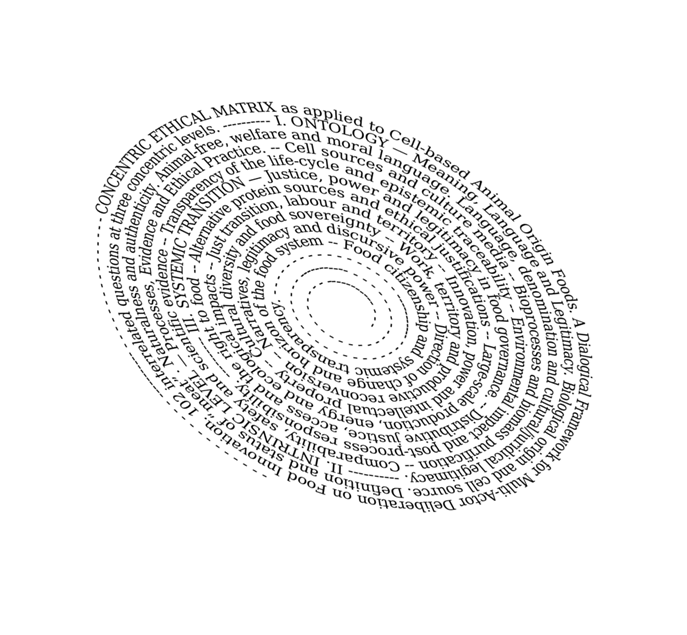
The CEM-CEBAOF is not a moral checklist but a way of reasoning collectively – it transforms ethical reflection into a transparent and plural process, connecting meaning, evidence and governance across three analytical levels:
Each question is designed to illuminate rather than conclude, turning disagreement into a resource for understanding.
Together, these 102 questions form a living instrument —a map of reasoning— that links cultural meaning, scientific evidence and institutional responsibility.
This practical session will generate contributions for FEASTS in three main areas:
By testing and refining the CEM-CEBAOF, the Workshop aims to build a shared, verifiable space for ethical reasoning, where disciplinary and cultural diversity becomes a driver of responsible transition in food systems.

JACA helps solve challenges of food security and sustainability by conducting research, and establishing and executing strategies which prepare Japan for the advent of cellular agriculture. JACA also contributes to international debate on these topics.

NaTurtle is a technology based alternative protein company helping food companies’ meat success at scale. With its solutions NaTurtle brings just (and) nutritious products on the menu.

The National Centre for Food Technology and Safety is a private non-profit association contributing towards improving the competitiveness and quality of the food sector through knowledge capture and the transfer of technology.

Rugenwalder Muhle is a family-owned producer of sausages made from both traditional and plant-based meat. It brings tasty innovations to the market with new products and packaging ideas and continues to grow in the area of meat alternatives.

Shakeup Factory is a food and ag-tech accelerator and open innovation platform accelerating the development of the future of food champions. The creator of a unique ecosystem of 350+ startups, corporates, investors and organizations providing support to international startups and forward-thinking corporations.

EIT Food is the world’s largest and most dynamic food innovation community, investing in projects, organisations and individuals that share the goals for a healthy and sustainable food system.

The Institut Proteus is a French NGO assisting in the transition to a more sustainable food model by developing alternative proteins in order to mitigate the environmental impact of the current food system, reduce the risk of zoonotic diseases, and feed more people with fewer resources.

CellAg Deutschland is the contact point on the topic of cellular agriculture for consumers, science, politics, business and NGOs in German-speaking Europe. It is working for the full potential of cellular agriculture to be exploited for the benefit of people, the environment and animals.

CellAgri Portugal is a multidisciplinary team from academia and industry promoting cellular agriculture and creating collaborative networks with the aim of diversifying food production to improve the health of people, animals, and the environment.

Cellular Agriculture Greece is a nonprofit organization focused on expanding cellular agriculture research and education opportunities in Greece and around the world, advancing alternative protein research and innovation across multiple disciplines.

Agricultura Cellulare Italia accelerates progress in the cell-cultured sector by promoting dialogue, interaction and synergy among stakeholders in order to secure a prominent place on the international stage for Italy and Europe.

SAFE is the only Brussels-based NGO specializing in the protection and representation of consumers in the food sector, playing a vital role in monitoring EU food legislation, collaborating with stakeholders to draft robust regulations, and advocating for safer food standards.

Innovethic is a consultancy exploring how scientific results can be translated into trustworthy innovations, acting as research partners for Responsible Innovation and Trustworthy AI.

The UPV/EHU is a public research university rooted in Basque society, open to the world, with intellectual leadership and ethical and social commitment, producing theoretical knowledge with a view to improve people´s lives.

The Center for Environmental and Climate Science at Lunds University conducts research into society’s impact on the natural environment and into societal challenges, seeking solutions concerning the environment, climate and sustainable development.

The Department of Agricultural and Food Science at Università di Bologna promotes innovation in answer to current societal challenges in the framework of SDGs, focusing on multiple research areas including agricultural and food processing and biotechnologies.

The Collaborating Centre on Sustainable Consumption and Production (CSCP) is a Think and Do tank that works with businesses, policy makers, partner organisations, and civil society towards a good life.

The Department of Food Science at Aarhus University conducts research across the entire food system with focus on sustainability and health-promoting properties of foods and food ingredients.

RESPECTfarms is the world’s first cultivated meat farm, helping farmers and ranchers diversify their businesses to include cultivated meat. It works to bridge the gap between scientists and farmers that raise the top-quality animals which need to be sampled to make cultivated meat.

Ecoinnovazione srl is a research spin-off of ENEA. It uses its engineering, environmental science, economics and management competencies to tackle the complexity of sustainability and environmental assessments in agriculture, industry, and services.

EurA is an international consulting company specialised in innovation and technology, supporting companies, research institutions and public clients in generating ideas for innovations, developing new products and services, and launching them internationally.

GOURMEY is France’s pioneering cultivated meat company. Its flagship cultivated foie gras honours French culinary traditions and heritage while looking to the future and protecting the planet.

Cultimate creates cultivated fat technology to provide alternative meats with authentic taste and texture. It’s currently working on the ingredient, which will elevate the taste and flavour of plant-based meats to rival their traditional counterparts.

VITAL MEAT is a cultured meat start-up with the mission to reduce human environmental impact by providing healthy, delicious, ethical and sustainable meat. Thanks to scalable technology and a cost-effective process, VITAL MEAT is gearing up to commercialize its first chicken product.

acib GMBH is an international research centre in the field of industrial biotechnology developing sustainable, economically and technologically advanced processes for biotech, pharmaceutical and chemical industries.

The Institute of Biomedical Sciences at the University of Maribor actively brings together clinical and preclinical expertise from the fields of (bio)medicine, cell and molecular biology, (patho)physiology, pharmaceutics, as well as materials science and additive technologies to develop new therapeutic, diagnostic and other technologies and push the boundaries of research.

Cellular Agriculture at the TUM School of Life Sciences focuses on developing biotechnological processes and concepts for the alternative production of agricultural products, addressing challenges related to environmental impact, animal welfare and sustainability of conventional livestock farming for meat production.

S2AQUAcoLAB is a Portuguese non-governmental, non-profit collaborative laboratory dedicated to fostering innovation in aquaculture and bridging the gap between industry and academia.

The Faculty of Biosciences and Aquaculture of Nord University works on expanding knowledge and forming the basis for a sustainable aquaculture and agricultural industry, and better management of the marine environment.

Agrotechnology and Food Science Group at Wageningen University & Research works on solutions to make the circular, biobased economy a reality.

The Fraunhofer Institute for Molecular Biology and Applied Ecology conducts applied life sciences research with the goal of development and application of new technologies for the diagnosis and therapy of human and animal diseases as well as for the protection of crops and food.

Bruno Cell is the first Italian start up focused entirely on cultured meat, financing and managing research projects to acquire know-how and patent optimized proliferation processes.

International Iberian Nanotechnology Laboratory is an international intergovernmental research organisation performing cutting-edge research and development in nanotechnology, and an innovation integrator in multiple application domains.

New Harvest is a nonprofit research institute supporting open, public research into cultured meat and precision fermentation. Founded in 2004, it is the world’s longest-running organization dedicated to advancing the field of cellular agriculture.

Associação do Instituto Superior Técnico para a Investigação e Desenvolvimento is a private not-for-profit institution, active in the fields of science and technology, fostering knowledge transfer and promoting cooperation among national and foreign researchers in RD&I projects.
