
If you’re a longtime reader of Tedium, you might be aware of my ongoing fascination with first-run syndication—TV shows that skip the network and instead get sold to local channels to air whenever.
In the days before we found a fourth network, this model was an essential part of what made independent stations work. Some of the most popular television shows of all time—Star Trek: The Next Generation, Baywatch, The Muppet Show—relied on syndication to spread. It also was key to keeping shows alive in the culture long after their original runs. Charles In Charge, for example, likely would be forgotten today had it not successfully made the leap.
It also made for a more attractive business model for show creators, who were at the mercy of the network to ask for more product. As explained in a 1986 piece from the Knight Ridder wires:
What happened? It’s simple economics.
National advertisers learned their dollars went further buying spots in syndicated cartoon shows, where the commercials reach kids five times a week, rather than in network shows, which are on Saturdays only. They began to flock to syndicated shows.
At the same time, the cartoon-makers smelled a much better deal for themselves, Networks usually order only 13 episodes of a new cartoon show, then may order only six more new ones for the following season. It takes about 65 episodes for a show to be profitably syndicated.
Good deal for the production company, great deal for advertisers. Easy enough to figure out.
But a lot has changed in 40 years, and a big decision on the part of NBCUniversal explains why. This week, the company announced it would be shutting down its first-run syndication business, killing Access Hollywood, The Steve Wilkos Show, and other programs. (The still-on-the-air Kelly Clarkson Show, also distributed by NBCUniversal, already announced its plans to end its run this year.)
“NBCUniversal is making changes to our first-run syndication division to better align with the programming preferences of local stations,” the company said in a statement to Variety. (It emphasized it was “very proud of the teams” that made the show.)
While other shows are likely to continue—Live With Kelly and Mark, Drew Barrymore, and Jennifer Hudson are mainstays—there haven’t been any new shows announced to replace the departing series. The model is in real risk of shrinking away, as audiences and advertisers head online.
We used to syndicate the best stuff.
If it were to happen, it wouldn’t be the first time first-run syndication evolved away from a format. In the ’70s, it helped keep network-shunted variety shows like Hee Haw alive. In the ’80s, it gave us weekday cartoons like DuckTales and G.I. Joe. And in the ’90s, it became the home base of heady sci-fi like Babylon 5. These formats, one by one, have moved elsewhere.
The Variety piece suggests first-run syndication is a dying medium. But that’s only really for some types of programs. For some program types, particularly game shows, first-run syndication is secretly doing better than prime time, at least if you narrow the scope to what actually gets broadcast on television. In the most recent week on Nielsen, Wheel of Fortune got better linear television ratings than any show in prime time, and Jeopardy! was right behind it. (The only show that tops them is their common lead-in, ABC World News Tonight.) And the newness of the program doesn’t determine its success, either: Judge Judy drove 5.1 million viewers last week, all the more impressive given its last new episode came out five years ago. (Repeats spring eternal, after all.)
Just one of NBCUniversal’s own shows, a syndicated repackaging of Dateline, appeared in the top 10. And two shows similar to Access Hollywood, Entertainment Tonight and Inside Edition, outpace it. Put another way, the medium might be in decline in general, but NBCUniversal was likely feeling it more than anyone else. Its most popular show is reheated leftovers.
Trash TV like TMZ and reality court shows are likely not going away in the near future—they’re cheap to produce and, for the right kind of person, addictive. But they may not be with us forever.

Sponsored By … Well, Us
Ever wanted to read Tedium without having those annoying ads all over the site? We have just the plan for you. Sign up for a $3 monthly membership on our Ko-Fi, and we promise we can get rid of them. We have the technology. And it beats an ad blocker. (Web-only for now, email coming soon!)
Byron Allen is one of the few people who has figured out how to consistently make syndication profitable in 2026.
Maybe this model just doesn’t work for giant companies like NBCUniversal
Eight years ago, in a piece titled “TV’s Hidden Math,” I described first-run syndication as an innovative model that favored creators. In the piece, I drew on a 1986 quote from Edwin T. Vane, a syndicator with Westinghouse’s Group W Productions that I think explains why this model stuck:
“The producer can’t make any money on the first network run,” Vane explained. “He may be on the network four years and still not have enough episodes to syndicate, That’s not a very attractive business.”
It may not be attractive for a large network, but if you aim lower, it can still be plenty successful as a business.
Some, such as Byron Allen, have tried to keep it alive. His Comics Unleashed, whose original run dates back to 2006, is likely to be the replacement for The Late Show With Stephen Colbert. (It already replaced After Midnight, and Allen, a media mogul who just bought a huge chunk of Starz, has a lot of episodes of the long-running program in his archives.) His model, which essentially involves giving the network the program for free, along with some of the ad revenue, is likely why CBS went for it. “It’s not cheaper,” Allen told the Los Angeles Times last year. “It’s zero.”
As media moguls go, Barry Diller is one of my faves. I can take or leave Eisner.
And then there’s In Depth with Graham Bensinger, a long-form interview show that has managed to outlast many programs of its kind. It’s a rare beast in 2026: A syndicated TV show distributed independently by its creator, one that oddly got its start on regional sports networks.
Bensinger knows his television history. In recent weeks, he released interviews with both Barry Diller and Michael Eisner, who once tried to parlay ’70s-era syndication success with Star Trek into a dedicated Paramount network. (Diller, for what it’s worth, has soured on the modern-day Paramount.) The ploy didn’t work, but it nonetheless proved the latent power of the model Bensinger has spent the past 15 years exploiting.
It is absolutely fitting that he talked to both of them, as Bensinger may be the last man standing on first-run syndication. He’s already outlasted NBCUniversal’s entire syndication business.
First-Run Links
Get well soon, Jello Biafra. We still need you.
You don’t know Pork Johnson yet, but you will. The pig-in-puppet-form, a small-scale project led by Dustin Grissom, just released a banger of a trailer for something called GIMP: The Movie, which imagines Pork Johnson as the creator of the open-source image editor. It’s funny as hell and has less than 20,000 views. (Also worth watching is this hilarious scene from the film, where Johnson’s girlfriend cheats on GIMP with Photoshop.) Pork Johnson should be famous.
Speaking of Photoshop: Adobe is settling its lawsuit with the federal government for $75 million in free services to affected customers. The government should mandate, as part of the settlement, that they have to port Creative Cloud to Linux.
--
Find this one an interesting read? Share it with a pal! Ask me sometime about why the perfect number of TV episodes is 65.
And thanks to our pals at la machine, who make reruns seem so novel.
(photo via DepositPhotos.com)
 ]]>
]]>
One of the reasons why companies like Substack have such a strong hold on creators is pretty simple: It’s hard to build a paywall.
You have to deal with a lot of really hard stuff, like logins and payment methods. And you’re dealing with vendors left and right. Your readers’ passwords get spread around the internet like wildfire, and honestly, do you want to contribute to that?
And worst part: If you use things like magic links, your readers might find themselves having to log in a dozen times.
Recently, I talked to Nieman Lab about the magic link issue, and between that and my recent Substack rant, I’ve come up with a couple of thoughts. I’m sort of at a point where I think the best way to solve the platform problem is to make it as easy as possible to put a paywall in front of anything. Even a static website.
And it needs to be a kit that anyone can follow, with as many open source parts as possible.
But there are a couple of problems: First, while payment technologies like Stripe are widespread, they are probably just above the knowledge range of the average person. Second, readers are unlikely to trust a website they’re not familiar with or have never used before. Finally, you don’t want to be managing more personally identifying information than you have to.
I have a solution to this, and it’s Ko-Fi, the creator economy tipping platform.
Sponsored By … Well, Us
Ever wanted to read Tedium without having those annoying ads all over the site? We have just the plan for you. Sign up for a $3 monthly membership on our Ko-Fi, and we promise we can get rid of them. We have the technology. And it beats an ad blocker. (Web-only for now, email coming soon!)
/uploads/Ko-Fi.png)
Ko-Fi: Sorta like a platform, but not really
Why Ko-Fi, you might ask? Well, a couple of things: First, it has avoided the trap that Patreon has run into with the App Store, which has forced that company to reset its model repeatedly. Second, its model is flexible and easy to parse—you can put as little or as much work into it as you want, a sharp difference from the pressure that comes with running a Patreon or a Kickstarter.
Finally, its pricing model is extremely fair and strongly favors the creator. If you’re making a lot of money, you can pay $12 a month for its Gold plan and that’s the service’s full cut. As platforms go, it is one of the best of its kind. You can do everything on the Ko-Fi platform, or you can do nothing. That is the right level of respect for creatives that a crowdfunding platform needs. (The similar Buy Me a Coffee could also work for this, but it doesn’t have the Gold plan, which means Ko-Fi is significantly cheaper if you grow really big.)
Plus it has something really easy to work with from a development standpoint: Webhook support. A webhook, for the uninitiated, is basically a way to tell a web application to do something by visiting a URL. It’s sort of foundational to how modern web applications work.
(I will note that Patreon supports them as well, but with references to wanting to focus on its core experience, which effectively means support may be hard to come by.)
/uploads/ActivePieces_2026-03-08-132830_krjm.png)
One webhook, an open-source ecosystem
While you can bury webhooks in code, they are also plenty useful in automation platforms like Zapier. As you may be aware, Zapier and I had a falling-out a few years ago, but the good news is that there’s a quite-good open-source alternative called Activepieces. It can be hosted anywhere, even on an old laptop, and the self-hosting platform PikaPods also supports them.
On top of this, you don’t need to be tethered to an email platform to send out emails. Thanks to email sending tools like Listmonk and Keila, it is possible to send emails out to thousands of people using self-hosted software. (PikaPods also supports Listmonk, but sadly not Keila.)
Alas, platforms like Gmail tend to be finicky about the senders they’re comfortable with, so you’re probably stuck with something like Amazon SES or Mailgun. SES, it should be noted, costs a grand total of 10¢ for a thousand emails, meaning you can send out messages to thousands of people a few times a month for less than $10.
So we know that we’re probably stuck with Ko-Fi for payments and a large bulk sender for email, but you can basically run the rest of this stack using open-source tooling. Our flow looks like this:
- A person subscribes to a Ko-Fi membership that costs them maybe three bucks per month.
- After the transaction, Ko-Fi hits a webhook managed by Activepieces, which triggers a JavaScript package that interacts with Listmonk.
- With Activepieces’ prodding, Listmonk adds the user to a paid list, then sends an email to the subscriber with a tokenized link to a webpage on your site.
- That webpage, after you enter a passcode, adds a first-party cookie that allows you to disable advertising on the website, or opens up new parts of the site, or what have you.
- When you send emails, you tailor your emails for that paid list.
No complicated content management system—in fact you can run this playbook on any page that uses JavaScript and CSS. Got a static site and want to gate your content? There are your marching orders. If you want, you can even set up an RSS feed to go through Listmonk, so once you get the templates set, you can forget it.
Plus, it’s cheap, while limiting platform exposure to the things you have no business doing. Just a webpage, a single platform, a bulk email service, and a couple of open-source apps that you can host just about anywhere. Sounds crazy, right? Well, this is what I spent the last day or so building. And … it works.
/uploads/ad-free-tier.png)
The art of loose magic
You might be wondering, how do you secure this? Easy: Magic links, but with a twist. Basically, one of the frustrating things about magic links is that you have to load a new one every time you want to log in somewhere. Instead, I decided to build a low-key two-factor system. As an end user, you’re asked to click a specific link, and then enter a code that’s in the email. Don’t have the code? Email doesn’t match the hash? You’re not getting in.
(For the nerds, it’s using HMAC tokenization to keep things client-side as best as possible.)
But this approach does have some flexibility that standard magic codes don’t. The code only works in a certain time frame—about a month, with a grace period during the month after, but it does not expire the second you click. That makes it so that you can share it with other devices more easily, or with a coworker who you think would love Tedium if not for the modest amount of ads.
As for the decision to use passcodes: It’s important to have a secure posture, but let’s be honest, if you’re hosting articles about exploding pop bottles, people shouldn’t be sharing their passwords with you. But this approach means that you can share a login over a limited amount of time.
My goal is to eventually share this as a “kit” of sorts on GitHub, that anyone can follow. I will probably put something behind a paywall for it (probably some starter email templates designed by yours truly), just to prove it works, but also to support the project.
Anyway, Tedium does not have a paywall, really. Instead, it’s more of a way to turn off ads. If you would like to try it, sign up for a $3 monthly membership on Ko-Fi.
(By the way: I plan to expand to existing paid supporters soon, whether on Patreon or Ko-Fi. I talked about this about a year ago, but it has taken time to finally get it across the finish line. But this weekend, the pieces fell together.)
This was a fun project, and it took me about a day, start to finish, to get something working. If you’re a Substacker looking at the abyss, let me be clear: You can do it too.
Paywall-Free Links
I don’t know why Obsidian now has a CLI, but sure, okay.
/uploads/Hermithire-Email.png)
I’m not sure what’s going on here, but I’m going to stop everything and become a hermit until I figure it out.
I think the MacBook Neo is pretty cool, and I’m glad Apple is building something like it, even with the compromises that it comes with. (That said, be a smart shopper! M1 MacBook Airs are still around—and still pretty good!)
--
Find this one an interesting read? Share it with a pal! Oh yeah, check out our ad-free tier! We built it ourselves!
And a quick thank you to Walt Hickey of Numlock News, whose pushback on my last post inspired this idea.
And thanks to our sponsor la machine, a machine at the peak of simplicity.
 ]]>
]]>
So, this is not a normal issue of Tedium. I have been messing around with some email design stuff recently, and I decided to try out an experimental new layout. This was built using MJML, an email scripting tool, and converted after the fact to CSS grid. And it’s about my favorite topic: How much I dislike Substack. You may find this over the top, or annoying, or weird. But it got my brain going, and that to me is the important part. Anyway, let’s get to it.

Sponsored By … Nobody?
If you find weird or unusual topics like this super-fascinating, the best way to tell us is to give us a nod on Ko-Fi. It helps ensure that we can keep this machine moving, support outside writers, and bring on the tools to support our writing. (Also it’s heartening when someone chips in.)
We accept advertising, too! Check out this page to learn more.
:format(png):quality(100)/uploads/t-logo_v3.svg)
This is a highly experimental issue meant for modern email clients. It may break. (If you're still reading your email in Outlook 2016, what are you doing?)
Hi, Ernie here. I decided to build a weird thing today and make it the next Tedium issue. (Hover or tap to read more!)
Yeah, your average Substack can't do this. Might as well rub it in their faces.
What's on my mind? Well, recently, Substack decided to partner with Polymarket.
It added a bunch of attractive design elements to its newsletters, things it could have added at any other time in its history. Chose not to.
This partnership has received scrutiny from writers.
“Unsurprisingly, I hate it. This is noxious for society and particularly toxic for writers,” writes Dave Karpf, who's leaving.
“Substack's partnership with Polymarket is the last straw for me.”
Ana Marie Cox, explaining her decision to unsubscribe from her paid Substack newsletters.
Despite this, the company appears all-in.
It’s not the first time Substack has been in hot water, by the way. It punted on Nazis.
You know who’s really excited about the partnership? Polymarket.
“Journalism is better when it's backed by live markets,” the company recently wrote on X. Journalists loved that.
:quality(80)/uploads/Depositphotos_774256214_S.jpg)
Polymarket recently let people bet on when the U.S. government was going to attack Iran. Some people won big.
$1.1B in funding
Substack’s current valuation, after a fresh round last summer led by Andreessen Horowitz, a major existing investor.
In a sense, I get it. Substack needs to make money and keep its funders happy.
Honestly, though, there are so many other options. Just an endless number. You don’t need to put yourself through this!
But given who it’s serving—journalists, many of whom have been laid off—it feels greasy.
I mean, think about it—in a time when people are getting laid off and using this as the backup, it sucks when the so-called savior is selling you out.
The result is that people who invested in the platform have to answer for it—even if they don't use it.
This was also true of the whole situation in 2023, which gained momentum from an open letter. Are we gonna do open letters every time they screw up?
For readers, my advice: Press Substackers to offer alternatives.
Substack may feel like the only game in town sometimes, but it does not have to be. You can push publishers to add things to Patreon and Ko-Fi, or move elsewhere. Many of these people don't move because they're afraid they might lose subscribers. Give them a second market. It might convince them to support more platforms.
So hey, weird email, right? I want to explain why I did it this way. See, back in 2017 I turned Substack down largely because they were asking me to take this highly visual thing I built to their platform. In the years since, they've done very little to expand the platform's visual design capabilities.
As I was thinking about the Polymarket thing, where the company went out of its way to add visual widgets for a company most of their readers don't even use, I thought it might be good to explain this point in a design-heavy format, just to be snarky. (Plus, I'll be honest, I just like shaking things up sometimes.)
It may break in some email clients, but email is a format that deserves more love than it gets. Might as well try something, I say. Anyway, see ya in a couple of days—with a normal email.
--
Find this one an interesting read? Share it with a pal!
Want to actually learn how to code with minimal vibes? Check out our sponsor Scrimba, which mixes video lessons with interactive code windows—and makes it feel downright approachable. Sign up here for a 20% discount.
(Image via DepositPhotos.com)
 ]]>
]]>
I have a problem: Unlike most people, I actually read my spam folder on a regular basis. (Often, they’re some of the most interesting emails I get.) I find spam to be intriguing, interesting, and often highlighting some modern trends.
And sometimes, it surfaces something I actually care about that missed my other folders, like an upcoming interview I’m excited to share with all of you.
But one thing about spam that has been true across the board is that it’s ugly. Really, really ugly. Often, what will happen with spam is that they’ll get your email address through questionable means, say a leak of your information in an exploit, and flood your inbox with some of the worst crap you’ve ever seen.
But recently, some of these clearly trash emails have gotten a design upgrade:
/uploads/spam-screenshot.png)
That is a relatively attractive spam email, trying to sell me on a scam. It is obviously the work of one Claude A. Fakeguy.
It has that swing. Other, less attractive spam emails also have this swing, such as this one:
/uploads/UglySpam.png)
But what I think the real tell is that these emails hang together when you have images off, which they did not in the past. This is a problem, because in your spam folder, images are automatically turned off.
Hence why this email warning me that my antivirus plus renewal failed now looks like this:
/uploads/Warning.png)
This is a funny, if troubling element in the history of spam—and probably a spot of bad news for people who use vibe coding to actually make real things.
Sponsored By … Nobody?
If you find weird or unusual topics like this super-fascinating, the best way to tell us is to give us a nod on Ko-Fi. It helps ensure that we can keep this machine moving, support outside writers, and bring on the tools to support our writing. (Also it’s heartening when someone chips in.)
We accept advertising, too! Check out this page to learn more.
/uploads/freespins.png)
The slop looks more competent than ever
Put simply: Now that the baseline of what makes something well-designed, albeit spartan, has increased, many of the signs we once used to detect a spam message are getting thrown out the window.
Which means that we’re more likely to get hit by spam that tricks us into clicking. And that’s bad news as we attempt to protect ourselves from the crap hiding in our inbox. We’re likely to trust less and accidentally give away more. And untrustworthy figures who don’t know how to code are more likely to throw more crap our way.
This is a point Anthropic itself pointed out in one of its own reports from last summer, about “no-code” ransomware that can be built by people incapable of actually building ransomware without the help of an LLM.
Despite this, these people can create commercial malware programs that they can sell for up to $1,200 a pop.
The security platform Guard.io makes clear that platforms like Lovable are going to enable a new class of criminal:
Just like with “Vibe-coding”, creating scamming schemes these days requires almost no prior technical skills. All a junior scammer needs is an idea and access to a free AI agent. Want to steal credit card details? No problem. Target a company’s employees and steal their Office365 credentials? Easy. A few prompts, and you’re off. The bar has never been lower, and the potential impact has never been more significant. That’s what we call VibeScamming.
And, for people who vibe code, the real problem is that, long-term, their stuff is going to look very untrustworthy because of the specific mix of chrome, color, and emojis that vibe-coded applications specialize in.
The thing that ultimately makes something look human is the addition of actual design and human flair. I encourage you to actually put a little humanness into what you build if you’re going to do it and share it with the world.
How to spot a vibe-coded faker
But for many, it is going to be harder than ever to tell what’s real and what’s fake. Which means you should probably go out of your way to use techniques like email obfuscation and email aliases to protect yourself. (It makes it easier to tell which bread-baking forum violated your trust, for one thing.)
On the plus side, there are still tells. A key one is if they refer to you by not your name, but the name of your email address. Another is the from address, which is often some highly obfuscated bit of junk designed to evade detection.
The one that made me laugh recently was when I got really crappy spam emails on an address that has never gotten them for the first time, promoting traditional spam topics with a Claudecore flair. They seemed random, but were extremely easy to get rid of, because they were all emailed from a bare Firebase domain, meaning that I could remove them with the help of a single filter.
Just because spam emails are more attractive now doesn’t mean the people making them aren’t still extremely stupid.
Spam-Free Links
A quick shout-out to the only tool that makes my inbox bearable in 2026, Simplify Gmail.
Oh good, there’s a new web browser for PowerPC Macs in 2026, and per my pal Action Retro, it’s quite good!
Speaking of inboxes, this story of an AI safety exec letting an AI tool delete her inbox is so darkly funny that I’m surprised it’s real.
--
Find this one an interesting read? Share it with a pal!
Want to actually learn how to code with minimal vibes? Check out our sponsor Scrimba, which mixes video lessons with interactive code windows—and makes it feel downright approachable. Sign up here for a 20% discount.
 ]]>
]]>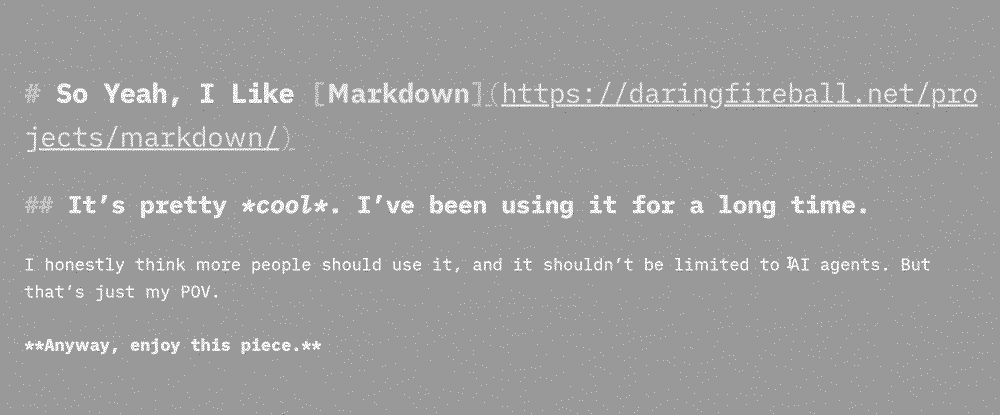
So, here’s something that I didn’t expect to be saying in 2026: There seems to be a nonzero chance that Markdown might become the new RSS.
“Whoa, crazy talk! It’s not even a protocol!” I hear you saying. But the evidence has seemed to pick up of late in a couple of different directions.
The first is the budding interest in publishing on the AT Protocol, which is working to solve the network-effect challenges that have forced many of us to send newsletters rather than post blogs on RSS feeds.
That’s exciting, if incredibly niche. But simultaneously, massive developer platforms are starting to offer something called “Markdown for Agents”—something Cloudflare announced late last week, and which Laravel Cloud quickly followed up on a few days later. And Vercel jumped on it a couple of weeks ago.
(The news wasn’t all good for Markdown, but most of it was.)
Some SEO old hands, like my friend Jon Henshaw, have reacted to this news with skepticism, having had bad old memories of Google AMP and its sibling technologies Signed Exchanges and Core Web Vitals:
It’s 2026, and now I’m reading everywhere that all our pages must have Markdown versions, and it feels like AMP (and SXG and CWV) all over again. Except this time, the promise is that AI agents will better understand and interact with your site if you have them. The rationale is that HTML is too complex and consumes too many tokens to parse and analyze content. Whereas Markdown pages, with their simplicity, are ideal.
(Side note: Core Web Vitals make me want to pull my hair out.)
Jon is a smart guy and follows this stuff closer than me (Coywolf News is a great site), but I will casually defend this push towards Markdown as a lingua franca of the Web. (Not the agentic Web. Just the Web. More on that later.) I actually think it’s really a great move for publishers that comes with way fewer inherent issues than Google AMP ever did.
For one thing, this is all standards-based, not something that was just invented that you need to manage. It’s literally using existing content negotiation headers that web servers already support, not forcing folks to learn something new. Plus it’s hard to argue with a point like this from Vercel:
A typical blog post weighs 500KB with all the HTML, CSS, and JavaScript. However, the same content as Markdown is only 2KB. That’s a 99.6% reduction in payload size.
That’s good for budget-minded AI agents, but it’s also good for people who run websites.
Additionally, Markdown has been in increasingly wide use for 20 years, and it keeps growing in popularity—and unlike the weird carousels and oddly specific rules of Google AMP, lots of people know how to use it. And the use of headers to deliver Markdown pages is already baked into Web standards, just waiting for folks to use it.
Sponsored By … Nobody?
If you find weird or unusual topics like this super-fascinating, the best way to tell us is to give us a nod on Ko-Fi. It helps ensure that we can keep this machine moving, support outside writers, and bring on the tools to support our writing. (Also it’s heartening when someone chips in.)
We accept advertising, too! Check out this page to learn more.
/uploads/Depositphotos_26272647_S.jpg)
This is really a tactic to help site owners avoid an AI-generated hug of death
Plus, there’s the rendering—Markdown is an antidote to the internet we currently run, which is highly dependent on programming languages and visual tricks that AI agents and honestly most people don’t even need. To me, when I see, “Cloudflare wants to give every webpage a Markdown version,” my thought is essentially, “Oh, they want to make AI agents stop DDoSing these poor PHP servers that still dominate the internet.”
When I see publishers talking about how their sites are getting flooded with viewers and getting slammed with unwanted hosting bills, it is clear that what we are doing is not tenable. Having Cloudflare put up a static Markdown file that takes up less space and has 0% of the JavaScript of the main page sounds like a win to me.
And if you’re building your pages semantically, as many publishers are likely already doing because they want to rank on Google, converting all that content to Markdown is going to be a cinch. Frequent Tedium skepticism target Matt Mullenweg is pushing for its addition to the WordPress.org website.
Just imagine, if you’re running an open-source project, and you didn’t have to force your users to see a loading page with anime characters just to keep the site online. Instead, you could tell Claude and Gemini and Perplexity to grab the data in a format they already use, and serve that in a static form, saving your poor forum from being drowned in dynamic requests.
There are lots of ethical qualms with AI, and you may want to just block them entirely, as is your right as a site owner. But I think diminishing a new-every-load HTML page to an unchanging Markdown file could save a lot of processing cycles for legacy server owners who have been trying to keep an extremely popular wiki online for 20 years.
I think there are websites and forums out there that have been absolutely wrecked by the rise of AI. Cloudflare, while still facing periodic reputational issues, has offered itself up as a line of defense for publishers. That’s noble—and while I get not everyone likes them, I think this particular offering is a good-for-the-internet move long-term.
/uploads/library-books.jpg)
But hear me out: What if we just offered our pages in Markdown because it made the internet more accessible?
Yes, the reason for all of this is AI, because everything is about AI right now, but honestly, it would be a really awesome thing to offer for regular users, too.
Recently, I’ve been trying to take on a project with the Tedium website—it’s not quite done yet, but I’m trying to get the whole thing onto the AT Protocol, mimicking my upload of my Twitter archive to Bluesky. (I’ve gotten the upload to work, it’s just the details that need to be tweaked. Here’s a sample post that came out okay.) I’m using a tool called Sequoia, which makes it possible to plug a static site into the same protocol Bluesky uses. It parses the roughly 1,300 pages and then uploads them to a server on the ATmosphere.
/uploads/StandardSite.png)
At the center of this is something called Standard.site, which aims to make a space for long-form content on the AT protocol. It’s not prescriptive to Markdown, though you could use it to share posts in Markdown if you wanted. It sounds promising—and like the budding efforts in the fediverse, it aims to make content easier to discover. Which is the problem RSS hoped to solve a quarter-century ago, admittedly—but this is doing it with more glue.
To me, I see a connection between the push to make Markdown an undercurrent of the agentic Web and this weird experiment on the fringes of emerging social tech. And honestly I would not be surprised if web browsers plugged into these AI-targeted Markdown feeds to give users a lightweight experience. (You know what else could use this?!? Email.)
It’s so fascinating, seeing this thing I’ve come to really appreciate as a writer turn into this ad-hoc building block of the modern internet. Even if I find it uncomfortable that AI is the vessel it rode in on.
When I found it, it was my superpower—the tool I used to plow through five articles a day at a new job. It was the cruft-buster, the starting point, the README file. And now it’s become something else entirely—something that could get us back to basics without the extra cruft of AMP or the stress of Core Web Vitals. (And even better, that didn’t come from Google.)
Honestly, I’m kind of here for it.
Update 02/18/2026
Looks like I’m not the only one thinking in this direction. Shout-out to Brett Terpstra, a guy who knows a thing or two about Markdown.
Markdown-Free Links
We’ve been losing a lot of good music folks of late, most recently Billy Steinberg, the dude who wrote “Like A Virgin” and “I Touch Myself.” Fortunately, friend of Tedium Chris Dalla Riva got to chat with him in 2023.
I know a fellow traveler when I see one, and with that in mind I want to give a shout to Rabbit Hole, a new-ish YouTube channel that recently asked why office chairs have five legs. A promising start.
Also, we have to mention Jesse Jackson, a civil rights icon and easily the most well-known “shadow senator” in U.S. history.
--
Find this one an interesting read? Share it with a pal!
And a quick shout to our sponsor la machine, which doesn’t support Markdown, but has a good reason for not doing so.
 ]]>
]]>
“[W]hen several stations are connected by the same wire, the attention of the particular station for which the message is destined must be secured. This is done by signalling, not the full name of the station, which would occupy time, but an abbreviated name, consisting of two or three letters, assigned to that particular station and known as its code name. Thus, LV is Liverpool, EH Edinburgh, and so on.”
— A passage from a 1888 issue of The English Illustrated Magazine, a turn-of-the-century periodical, discussing how the British Post Office used code names to help make sense of the complexities of the telegraph system. (This appears to be one of the first uses of the term “code name.”) Eventually code names would expand to businesses in general, with New York City setting up a central bureau for registered addresses in 1919, with the goal of avoiding mix-ups on the telegraph line. (Think of them as the domain names of the 1920s.)
/uploads/dish-detergent.jpg)
The code name has become an essential part of how the tech industry operates
When you’re building a project, and you don’t quite know where it is and what it’s going to turn into yet, a code name can be quite an asset. It’s a tool that can help a project coalesce around a set of ideas, and it doesn’t necessarily need to be something that the public ever sees.
In fact, it may actually be better if the public never knows about them. Often, you don’t want to reveal something while it’s incubating. As the Tumblr site Ask a Gamedev put it in 2022:
It’s important to note that the reason for secrecy is primarily for marketing purposes. We want to keep a big project quiet until we’re ready to show it and get players excited for it. If our product is tied in with another product or IP with a big planned push at some point in the future, tipping our hand too early can lead to a cascading set of reveals we or our business partners were unready to make. For example, revealing a new mainline Pokémon game too early would spill the beans on an entire new Pokémon generation, which would affect merchandise, animated series, and so on. As a result, we usually put in safeguards to prevent such leaks from happening, both punitive and practical.
Code names, also known as code words, have a long history that often criss-crosses through the two World Wars, and perhaps through some of the world’s largest intelligence agencies. That they bled into business is not wholly surprising, as large companies deal in trade secrets all the time—even fast-food chicken restaurants.
But what’s unusual is that, particularly in the technology industry, these code names often have a long shelf life, one that can stick around for years after the fact. The word Mozilla, the name of the company that produces Firefox, started as the code name of Netscape Navigator, the web browser upon which Firefox is based.
/uploads/mozilla-employees.jpg)
It wasn’t like the Netscape team hid it—back in the ’90s, employees of the company actually decked out Mozilla gear in photos for the San Francisco Chronicle.
“Every great project starts out with a T-shirt, and to make a good T-shirt you need a good code name, something like ‘Terminator’ or ‘T-Rex,’” Gene Wang, a software development manager at Symantec, told the Chronicle in 1996. (Apparently he was not aware Mozilla already had the dinosaur metaphor covered.)
The technology industry has long been shaped by code names, to the point where those code names break out of their holding cage and end up defining the product. Apple in particular is infamous for this, with the animal and landmark names that define MacOS starting as code names but eventually becoming product names.
/uploads/microsoft-chicago.jpg)
Operating systems are a natural reason to have a code name, by the way. In a Bluesky thread from 2024, Microsoft old hand Larry Osterman, who has been at the company for more than 40 years, explained how these code names, such as “Chicago,” the nickname for Windows 1995, would bleed into the public discourse. They existed because these were lengthy projects that existed before the marketing team had weighed in on a name. However, the dynamic that necessitated these monikers has faded somewhat.
“Code names leak. Both to the public and into other artifacts (files with code names in them, config settings, etc.),” he wrote, explaining why references to Chicago appear in the operating system. “And in a world where you release every 3-6 months, you really don’t need code names, because the release is so small.”
(Someone tell that to the Ubuntu team, which famously gives its twice-yearly iterations alliterative animal-themed code names, most recently “Questing Quokka.” I imagine that must get hard to plan for on Q releases.)
And while software release schedules have gotten faster, internal projects still need code names, and sometimes there are so many code names that you need a system to manage them. In a 2007 blog post, Stack Exchange co-founder Jeff Atwood said his team went through so many that they had to develop a system to generate new ones.
“The names are chosen alphabetically from a set of items; every new project gets a name from the set,” he wrote. “We start with A, and when we finally arrive at Z, we pick a new set of items for project name inspiration.”
Microsoft has so many code names that it has a quite-long Wikipedia page dedicated to them. So does Apple.
But as far as I can tell, they have yet to give their layoffs a code name.
“I don’t want to spell out the idea on the insecure email channel. Even if you say the phrase ‘Video H or N’ in public, people will know what you mean, so let’s just call it Video. Don’t say it in combination with the H or N site :)”
— Jawed Karim, one of the co-founders of YouTube, discussing (according to Internal Tech Emails) how the trio of co-founders, still at PayPal, should talk about their formative idea that would end up taking over the world. (What’s “H or N”? Easy: The platform was originally intended to be a HotOrNot for video. That was too specific—but it ended up inspiring the actual idea.)
/uploads/layoffs-stock-photo.jpg)
But enough about startups and operating systems. Do companies really give their layoffs code names?
When a company is attempting to do something sensitive, like poach a CEO, it’s likely they may not want to spell out exactly what is going on before they pull the trigger.
Case in point: In the months before Yahoo! brought on Marissa Mayer as their CEO, Mayer had to frequently talk about the shift in secret. She was still working at Google, and there was also the risk the news would leak to the media. So what did she and Yahoo! do? They gave the initiative a code name, “Project Cardinal.” This allowed her to set up her exit plan in secret, while avoiding, say, tipping off her limo driver.
Mayer got hired rather than fired in that situation, but one presumes that a similar motivation might lead a company to bury an initiative behind a code name.
/uploads/JackInTheBox.jpg)
It can also provide organizational cover when doing something that negatively harms employees. To offer an example: Red Robin recently announced the closure of a number of restaurants as part of a broader “North Star” initiative aimed at improving service while fighting against a wave of shutdowns. (They’re not alone: Last spring, the fast food chain Jack in the Box announced its “Jack on Track” plan, which includes a “restaurant closure program.”)
Eventually, things can get more serious than these situations, which require more intense strategizing. There’s a term for what these companies are doing: “Turnaround management,” which refers to the optimization of businesses to stay solvent. Turnarounds can happen at any time in a business’ history, though the concept is most associated with businesses nearing bankruptcy.
These plans can really hurt, as in the case of Ford’s “Way Forward,” first undertaken in 2006. That plan involved more than 25,000 job cuts, which was dramatic and painful—but it helped Ford avoid the brutal bailouts General Motors and Chrysler required. In 2009, while those companies were barely holding on, Ford actually posted a profit.
Which is to say that, while turnaround plans can seem callous and unfair to affected workers or even customers affected by decreased service, they can absolutely save companies. It’s a bloodletting tool.
But that’s not to say every turnaround code name is a good one, and the worst ones can signal a sense of panic, as noted in a 2015 on the topic in Bloomberg (archive link).
“There are different degrees of distress,” turnaround consultant Margaret Bogenrief told the outlet. “Generally, the more grandiose the name, the more severe the distress.”
/uploads/general-mills-compass.jpg)
Of course, there can be a degree of silliness that comes with anything complex and corporate. Around 2015, General Mills announced not one, not two, but three separate corporate restructuring projects: Project Compass, Project Century, and Project Catalyst. These three projects each touched on different parts of the company, with Project Compass focused on its international markets, Project Century its North American manufacturing, and Project Catalyst its organizational effectiveness. These projects cost hundreds of millions of dollars collectively and came with more than 1,500 layoffs. And to the layperson, it just sounds hopelessly complex.
Kellogg’s, meanwhile, had been down this road multiple times itself. In 2009, the company announced K-LEAN, an initiative to increase optimization (and which led to layoffs in its factories). Then, in 2013, they followed it up with Project K, which aimed to reorganize the various company segments … and which also led to layoffs.
Ultimately, Kellogg’s decided to split off its legacy cereal business into its own company, WK Kellogg Co., and rename the larger snack food business as Kellanova. Both companies ended up getting sold to large candy companies recently—WJ Kellogg to Ferrero, Kellanova to Mars.
With this framing, turnaround projects can be seen as corporate salvaging missions first, layoff plans second. But honestly, that struggles to explain Amazon, a company that made $21.2 billion in net income in the prior quarter alone. Sometimes a job cut is just a job cut, no turnaround necessary.
/uploads/256181932_a216f50bbd_o.jpg)
Five typical naming schemes for corporate projects
- Leaning into the puns and metaphors. It’s not just Jack in the Box leaning into the punny turnaround project names. Companies do this all the time— A 1991 Reuters wire story, for example, describes how Bank of America named an attempted acquisition of Security Pacific “Project Sunshine,” while another attempted merger was named after the companies’ local NHL teams. More recently, Panera announced its “Panera RISE” strategy, which plays off its most popular product.
- Proposing an upgrade. I’ve traditionally been sort of snarky about Dell, a company that in my mind screams “enterprise” and “lack of creativity.” So I guess when I hear Dell once named a reorganization effort “Dell 2.0,” the thought that runs through my head is, “checks out.” More recently, Intel has also gone down this road with its IDM 2.0 project for expanding its manufacturing—though Pat Gelsinger got booted before fully seeing it through.
- Dropping a strong hint. After hiring a new CEO good enough to make Howard Schultz go away, Starbucks leaned into a turnaround plan called “Back to Starbucks,” which is what it wants customers to do. (Similarly, JCPenney’s endeavor is called “Yes, JCPenney.”) This also works when the goal is laying people off—as shown by Kellogg’s K-LEAN, mentioned above.
- Setting a deadline. Turnaround strategies are often built around significant goals. Sometimes, those goals include dates—and sometimes those dates are way out, as seen from German automaker Opel, which set a “DRIVE!2022” campaign way back in 2013. (They really wanted to get ahead of that date.) Some other examples include Air France-KLM’s “Perform 2020,” and the Trump administration’s “Project 2025.” Yes, even political parties do it.
- New-agey abstraction. But most notably, so many turnaround project names fall into vague, shapeless territory, not necessarily setting a goal as much as a subtle hint as to where they want to go. General Mills’ “Project Catalyst” is a great example of this, as is Red Robin’s “Operation North Star” and Amazon’s aforementioned Project Dawn. Another example is “Project Phoenix,” set into place by Newell Brands, the owner of the Coleman, Rubbermaid, and Yankee Candle brands. Perhaps it’s because “Project Mass Layoff” doesn’t roll off the tongue quite so easily.
“Simplification often feels risky because it appears to be a contraction. But in a turnaround, complexity is a liability.”
— Daniel Schmeltz, a corporate transformation expert, writing in Fortune about why most corporate turnaround endeavors fail. In the piece, he argues that slow-going turnaround plans are typically the most unsuccessful. “Hesitation and complexity are liabilities; clarity and rapid execution are non-negotiable,” he writes. “In a time when so many companies are attempting a turnaround, by acting decisively, businesses can cut through inertia, rebuild momentum, and secure sustainable results.” If you’re going to chop off a limb or two, get it over with—perhaps with a little less creativity in the code name.
I think code names naturally engender discomfort for people, in part because of what they represent. They are often used to hide something from view, and that thing can be nefarious, even troubling.
Recently, Cleveland Guardians pitcher Emmanuel Clase has faced allegations that he was receiving money from “microbets” made on his own pitches. In other words, he was manipulating pitches to secure winning bets on himself, then gamblers were sending some of that money his way.
When talking about this with one of the betters, they reportedly hid what they were doing by using coded language, like “rooster” and “chicken.” Clase has attempted to claim that they were discussing cockfighting rather than pitching, an activity Clase also gambled on. (Interesting defense strategy—I wasn’t gambling on games, I was gambling on animal abuse.)
Clase was (at least based on allegations in court records that he has denied) trying to get away with something nefarious. Broken down, the reason for the cloak-and-dagger stuff was not all that dissimilar to why Marissa Mayer did it.
/uploads/Depositphotos_81616892_S.jpg)
One might argue that many of the above listed companies were trying to shroud their not-so-friendly plans in friendly language. You can’t quite say, “we need to lay thousands of people off,” and you definitely can’t say “we want to lay thousands of people off.” But to cloak it in “Phoenix,” “Dawn,” or “North Star,” it makes the bad news digestible. It makes room for a little compassion for the HR team as they’re delivering the bad news.
Well, unless you’re an executive for Amazon and you casually drop a doublespeak-style code name in everybody’s inbox.
--
Well, I guess I was feeling salty today! Find this one an interesting read? Share it with a pal.
And thanks to our sponsor la machine, a machine that doesn’t need a code name—because its purpose is transparent as can be.
 ]]>
]]>
To me, the hard part about being creative is that you’re always trying to look for a new path.
Sure, you’ve done things a certain way for a long time, and it’s worked for you. But it’s hard not to want to dabble in new directions just to see where it takes you, and hope that it shakes out a new idea or two.
Which is perhaps the reason I’ve started to fixate on a weird idea—that design tools might sometimes work better without an attached graphical interface. Rather than graphics in, graphics out, maybe sometimes it should be text in, graphics out.
The myth about design is that it’s a function of the creativity-driven right side of the brain. But I think that’s only half the story. See, with design, there’s a lot of hidden math involved. Ask your favorite newspaper or magazine designer about pica rulers and column lengths, and you’ll get what I’m saying.
Put another way: Designers need to be creative problem solvers, painting the perfect canvas, but they also need to be pragmatic, considering the realities of “yes, it’s long, but we have to fit this text.”
Tools like InDesign and Final Cut Pro have traditionally combined the canvas and the broader frameworks that make a good design, mixing tools with differing cognitive loads into one interface. But what if design needs to be a bit more deconstructed, where pieces are more separated out, perhaps not even graphical? What if you designed with code? Would that lead to better results? I wanted to find out.
/uploads/cropped_termux.jpg)
The spark that caused my weird design-with-code obsession
I stumbled upon the idea accidentally, but this weird interest grew out of some genuine frustration.
I wanted to try a couple of experiments with vertical video, seeing if I liked it and how comfortable I felt with the idea. The problem is, I wanted it to match my general style, which is strongly built around a heavily filtered grayscale imagery.
Every app I tried kind of sucked. CapCut, the ByteDance-produced app for creating TikTok videos, seemed unstable. A lot of other stuff came with spammy upsells. Plus I couldn’t quite get the design I wanted—a faded black and white look that’s a little pixelated, with a slightly choppy frame count.
The only thing I actually liked that could edit mobile videos was Canva. However, it could only get me so far. So, to fill the gap, I did something weird: I started testing whether I could filter videos with ffmpeg to my liking in Termux, the Linux terminal program for Android. Then, in a second step, I’d move the videos to Canva, to finish the edit (including adding the text in my desired font/design). And I’ll be damned, it worked:
https://www.youtube.com/shorts/Cuyd8H2fvd4
I became curious about pushing this idea further, to social objects, and started working on tools to build quick graphics from Markdown files all on my phone—something you can make happen with HTML and CSS, basically. Cool idea, worked pretty simply:
I became curious about pushing this idea further, to social objects, and started working on tools to build quick graphics from Markdown files all on my phone—something you can make happen with HTML and CSS, basically. Cool idea, worked pretty simply:
/uploads/forgotten_tech_2_quote_square.png)
I thought that was enough, and I didn’t need to take this unusual thought any further, until I saw something that blew my mind: a full YouTube video—complete with animation, graphics, and so on, made in a terminal.
Sponsored By … Nobody?
If you find weird or unusual topics like this super-fascinating, the best way to tell us is to give us a nod on Ko-Fi. It helps ensure that we can keep this machine moving, support outside writers, and bring on the tools to support our writing. (Also it’s heartening when someone chips in.)
We accept advertising, too! Check out this page to learn more.
/uploads/Vimjoyer.jpg)
The guy who edits videos with Vim
Even with my rendering experiment, there’s no way I would have said yes before a month ago, but then I saw something that really threw me for a loop: A dude who edits his YouTube videos in Vim.
Look at this crazy-ass video. He made this in Vim!
For the uninitiated, this is basically saying that you use scissors to cut a watermelon.
I will admit it was by a guy named “Vimjoyer” whose gimmick is basically doing everything with the popular text editor. (I personally use nano like a lamer.) But fortunately, the how behind it doesn’t need vim to be useful.
Essentially, he is using a tool called Motion Canvas to push his content around so that he can create animations on the fly, shifting them around as desired. This is not totally dissimilar to what Flash could do with ActionScript back in the day, but it’s deconstructed so it’s code-first, GUI interface second.
I was curious, so I started messing around with it using the same on-my-phone format as the earlier ffmpeg experiment. Alas, Motion Canvas didn’t work all that well for such a constrained setting, as it required use of a browser. However, I spotted a similar tool, Remotion, that worked entirely within the command line.
But one change precludes another—it needed Playwright, a headless browser tool. As it’s made, that doesn’t work in Termux at all, as Playwright doesn’t have any builds compatible with Qualcomm chips. But I found someone who had solved this exact problem, and that let me do this:
I can write the copy for these social objects in Markdown—even chain them together—and have it make a bunch of social objects for me, all meticulously set up in my style.
Sound like a lot of work to avoid working in a graphical interface? You bet your ass it is. On the plus side, you only really have to do a complex, repeatable task once (perhaps with some maintenance down the line).
But the thing is, you can use tools like Claude Code to make these sorts of weird connections work—and maybe tell them, after the agent insists you can’t run Playwright on your phone, that it’s actually possible. Then, if you want to dive in further, that’s when you take the time to learn it yourself and build upon the idea you’ve been conjuring.
(The trick I’ve been using lately: Tapping into the super-cheap DeepSeek Chat model via Claude Code Router, an implementation of Claude Code that lets you use models not made by Anthropic. That gives me additional room to screw around with oddball experiments like these, while being relatively minimal resource-wise. I put in $10 a month ago and have yet to run out, while still getting fairly decent results.)
/uploads/typst_example.png)
A new script for page layout
This is a very cool idea, and it’s more than just a novelty. I honestly believe this basic text-driven ideal could be taken to some amazing new frontiers. Lately, I’ve been fascinated by Typst, a scripting technology that is seen as a competitor to LaTeX.
(Let me take a pause here to admit that LaTeX users have been designing with code for a long time. And there are probably some people who build stuff using PostScript they coded by hand. I bow before you, as a guy who started out as designer.)
It’s a tool that is designed for laying out technical documents, with an emphasis on things like math equations. But it could also be used to make all sorts of documents, like zines or even wall calendars. This is actually the perfect format to build a wall calendar, because it’s a highly templated format that can get very complex to manage in something like Affinity or InDesign. Here’s an example I built as a test:
/uploads/typst-calendar.jpg)
But it goes further than that. To me, I think there’s an opportunity to separate concerns inventively. For example: Let’s say you go into Affinity or Inkscape to build an SVG with the basic shape of your layout, or even a basic background, but then you import that graphic into Typst format. That moves you from texture to copy-layout. This is what I mean about separating concerns. Too often, design software tries to awkwardly mesh together these processes in a way that makes nobody happy.
Typst won’t get you all the way there, I will admit. It does not currently support blend modes, for example, meaning that you have to import raster graphics or SVGs to handle all of that. Same with clipping paths and masks. But I think there’s a world where Typst could have all of these things, making it an effective publishing tool without forcing you in canvas mode when you’d be better served by a framework.
We have a pretty good text-based web design framework in the form of HTML, JavaScript, and CSS. With a few additions or some extensions, Typst could become that for print.
/uploads/mou.jpg)
Graphic designers are secretly left-brained people
One thing that I think people don’t realize about graphic design, particularly the print form, is that it’s creativity, but there’s also math going on. It’s not that far removed from architecture, if you think about it.
Any newspaper designer will tell you about pica rulers and column inches until the cows come home. The secret about news design if that it’s a bunch of right-brained people who can think left-brained when the moment shows itself.
If you had asked me about this 15 years ago, I might have considered editorial design all right-brain thinking. But I think the left side of the brain was always there.
I think the thing that ultimately made this all click was probably Markdown, particularly an editor that presented the split in a way I couldn’t ignore. Fairly forgotten at this point, but deeply influential at the time, the 2010s-era MacOS Markdown editor Mou basically let you lay out Markdown and see the visual output in real time. The story of Mou ended in tears—the designer basically ghosted a bunch of people after a crowdfunding campaign—but it still inspired me, personally. (The popular open-source editor MacDown, recently revived as MacDown 3000, is something of a spiritual successor to the defunct Mou.)
I’ve been trying to figure out a way to convey all of this, probably, ever since I started ShortFormBlog in 2009. That site began with the provocative idea that you could design individual posts at a micro level rather than making absolutely everything look the same—as long as you were willing to give everything the right framework to work within.
We can translate that idea to all sorts of objects. We just need to think beyond the parameters in front of us. I’m not quite at the level of Vim video editor guy just yet, but it’s something to aspire to.
Non-Designy Links
I’ve been on the lookout for interesting tools that support Linux, and one I caught was Neep, a paid tool that removes noise from voice calls. Krisp has this killer feature, too, but it doesn’t support Linux.
We’ve lost some great musicians of late, particularly Greg Brown, the original guitarist of Cake, who wrote “The Distance,” easily one of the best songs of the ’90s. Still hods up. (Also, RIP to Brad Arnold of 3 Doors Down, who made an appearance in our “Songs About Superman” piece.)
The AI-generated viral video of Brad Pitt and Tom Cruise fighting feels like a strong enough turning point for tech that Hollywood just lost its minds over it on Friday. Perhaps not a strong enough response.
--
Alright, that’s all I’ve got. Find this one an interesting read? Share it with a pal!
And speaking of deconstructing things, you can’t get more back-to-basics than the simple brilliance of la machine.
 ]]>
]]>
Over the last week or so, I’ve been dealing with a bit of a nightmare. Our upstairs heat pump system got frozen over because of the recent weather issues—and the temp did not tip above freezing for days. So we were stuck away from our house for an extended period, having to check on it periodically to make sure things didn’t get too bad.
But then, after things finally started to thaw, we ran into another problem entirely—the breaker that ran the unit tripped and wouldn’t turn back on, knocking out our other heat pump. Two heat pumps, both completely offline, and we were struggling to find someone who could help. It took us over a day to get back to normal.
It strikes me that, as a guy who writes about obscure things, I don’t know nearly enough about electric breakers—which I’m going to inevitably have to fix with a future issue. But what I will say about my situation is that while it was frustrating, while there was risk, we ultimately got things back to relative normalcy.
My small personal crisis, which has kept me away from writing this week, doesn’t compare to what happens when you dismantle a newspaper. When you lay a few people off, the machine gets harder to manage, and relationships fall by the wayside, but it ultimately still works … if barely.
The Washington Post, not the first newspaper to suffer significant cuts, chose something more dramatic, effectively closing entire sections. Like sports—the week before the Super Bowl, days before the Winter Olympics, and the day of a major trade in which the Washington Wizards acquired Anthony Davis, a veteran (if frequently injured) superstar player. They essentially shuttered the sports section at a national news outlet during one of the busiest periods of the year for sports.
Sports is traditionally a major driver of interest in newspapers—but Post owner Jeff Bezos, based on this action, seems not to care about them. (Recently departed Washington Post publisher and CEO Will Lewis does, based on his appearance at an NFL event this week, but um … not enough to save the section.)
The Post, a local newspaper with national reach, has always somewhat struggled to keep a focus on the local part of its mission given its distance to the halls of power. But it still had a strong team of nearly two dozen reporters on its Metro desk—now it has a lot less, forcing local TV stations and budding digital outlets like The 51st to pick up the slack.
These cuts seem to reflect the actual interests of Bezos, rather than a desire to play steward for a culturally important newspaper. I’m with Parker Molloy on this—this feels like a “curation” of sorts on the part of Bezos, who decided that he didn’t want his plaything to be everything to everyone anymore. It’s an ironic position for the guy who created “The Everything Store.”
The cuts, even by the traditional math of journalism chopping, don’t begin to make sense. Even big cuts at newspapers are somewhat surgical, leaving departments alive even if a shell of their former selves. The Post has chosen to make cuts that essentially make it a larger version of Politico with a lot of legacy baggage, or less charitably, a really big Substack. It’s an embarrassing retreat for the paper that gave us Woodward, Bernstein, and the Pentagon Papers—and a shameful minimization of what is still a local newspaper.
It’s enough to make one wish that Kara Swisher’s quixotic plan to buy the Post from Bezos had actually gotten off the ground.
Sponsored By … Nobody?
If you find weird or unusual topics like this super-fascinating, the best way to tell us is to give us a nod on Ko-Fi. It helps ensure that we can keep this machine moving, support outside writers, and bring on the tools to support our writing. (Also it’s heartening when someone chips in.)
We accept advertising, too! Check out this page to learn more.
/uploads/newspapers_2026-02-08-050955_bfyw.jpg)
(claudiodivizia/DepositPhotos.com)
What a journalist going through a major layoff is probably feeling right now
Like many journalists, I can speak to this moment—the pain folks are feeling, the emotions being carried—because I have been through a mass layoff at a newspaper. It happened at the end of 2008, in which my entire paper, a free daily publication run by The Virginian-Pilot, was shut down. It was hugely disruptive and quickly scattered a tight-knit group, which no longer had a daily paper to keep us together.
In that moment, the Post played savior, at least for my own career. A year earlier, an editor had attempted to recruit me to work as a page designer for the Post, but I ultimately withdrew, because I liked my job and didn’t want to leave Hampton Roads. (I also felt my more loosey-goosey style could get lost at a more traditional paper. At the time, the Pilot was known for being visually adventurous.) I didn’t regret the extra year I spent in the area—but now, I needed another job.
Soon after the news emerged, I applied for another job at the Post, this time at its sister paper Express, and got offered an in-person interview right away. It was the closest thing to what I was already doing within shouting distance—so I applied for it.
I was still deeply uneasy with the idea of moving, but eventually I was offered the job—the only one I had applied for, shockingly. I remember at the same time, I was working with a team that was developing a print product, mostly journalists I had befriended an alt-weekly that was shuttered at the same time. My nerves, caused by the lack of stability, were hitting hard, and my friends had asked whether I was okay—they could tell something was up.
Something was, because I had just realized in my head that I was going to be moving, after months of telling myself I didn’t want to move. I called the editor back, and accepted the job. Three weeks later, I was in a new city.
It turned out for the best. I loved D.C., I loved Express, and I met my wife there.
I had the best-case scenario—I found another job right away and was able to use my severance to move—but it was still deeply chaotic and life-changing.
The life disruption, as much as it sucked, also created an opportunity for me. During that period over the 2008 holidays when I didn’t know what my next job would look like, I holed up in a coffee shop with my laptop. My challenge: Build something that I owned and operated, and see it through to the end, no matter where it took me. I had a tendency to start projects and never finish them. I wanted to finish this one.
I worked on a site that I thought would keep the memory of my old paper alive. That became ShortFormBlog, and that proved to be an essential building block to where I am now.
But even that came with chaos. My FrankenMac was on its last legs, and I made the very risky decision to buy a new laptop with my severance money. It worked out. But it was not an easy decision.
The good news is that I get to wear my wrinkles in the work I do now.
/uploads/localhost-mlda6z05.jpg)
It’s not just me, or the folks at the Post. Lots of journalists have a layoff story
Look, I’m not saying that any of this is good or even that there’s silver lining here. Or that my calculus was different from anyone else’s. Despite being talented, I have to assume that luck and timing played in my favor during the layoff I went through.
My story of getting laid off is not unique. It’s so not unique that in early 2009, right around the time of my layoff, news design legend Charles Apple wrote an excellent guide for surviving a layoff. It was packed with advice from numerous people who had a just been laid off.
Layoffs are so embedded in the culture of journalism that you probably know someone who has been through one—or, unfortunately, more. But there’s a next step, and odds are, it might be on the frontier, like ShortFormBlog was for me.
The thing is, there were always a couple papers that felt at least somewhat immune to the winds of the industry, that would always offer safe harbor to talented journalists. That seemed immune from the worst elements of private equity or the ugliness of union-busting CEOs. The Post was one of them.
Now it isn’t anymore—and it’s seemingly because of the whims of a disinterested owner. And that’s the part that scares me more than anything else.
Non-Newspapery Links
I’m not sure quite how to feel about an app that promotes itself as “TikTok, but for vibe-coded mini-apps,” but Gizmo seems like a clever spin on the idea, at least.
I don’t know about you, but I need some levity after my HVAC nightmare this week. Too Funny To Fail, the documentary about The Dana Carvey Show, offered just that. I could watch Stephen Colbert cry-laughing forever.
It is so weird how even a platform as big as Neocities can’t even get good support from Microsoft when their woes are written about in Ars Technica.
Joseph Gordon-Levitt, what are you doing, man?
--
Find this one an interesting read? Share it with a pal—and keep the folks formerly at the Post (and other newspapers, like the Pittsburgh Post-Gazette, which got some good news this week) in your thoughts. It would sure be great if another billionaire hired all of those laid-off employees and started a new newspaper.
And thanks to our sponsor la machine, which doesn’t make electrical breakers, but should.
 ]]>
]]>
Hey all, Ernie here with a piece from an old friend—Andrew Egan. This is his first piece since 2023, and we’re happy to have him back on here once again. I’ll be back at the bottom of the piece with some interesting links. Anyway, over to Andrew:
A favorite pastime of tourists visiting New York City is learning the names and locations of various, usually famous, neighborhoods. They often get them wrong, but when in Rome it helps to speak some Latin. Some neighborhoods are pretty well-defined, like TriBeca and SoHo. Many others are not.
Take the area just north of the United Nations Headquarters, as an example. This area, north of 43rd Street and south of 53rd, and bordered by the East River and Lexington Avenue to the west, is understandably home to many diplomats and support staff for the United Nations. Permanent missions and consuls dot the area. Most commonly known as Turtle Bay, the name does change with slight boundary variations. And, of course, areas change over time.
This part of Manhattan saw its first European settlement in the 1600s as a Dutch farm. During the American Revolution, British General William Howe established his headquarters in the area. It was here that Nathan Hale, spy and hero of the Independence movement, said his famous,
possibly apocryphal, last words, “I regret that I have but one life to lose for my country.” Last words are not the only aspect of Hale’s life in dispute, as the exact location of his death is not known either, but it is immortalized on First Avenue between 49th and 50th.
/uploads/plaque1.jpg)
After the war and into the 19th and 20th centuries, Turtle Bay would develop heavy industries, such as power generation and animal processing, alongside tenements and brownstones. Before the neighborhood became the capital of international diplomacy, it was home to elite entertainers, specifically Broadway composers.
Where the neighborhood’s past and present collide is at the end of East 50th Street, currently home of the Consul and Permanent Mission to the United Nations of Luxembourg. But from 1947 to 1989, it was the home of famed songwriter Irving Berlin. This is where he wrote such staples of the American songbook as “White Christmas”, “Puttin’ on the Ritz”, “Anything You Can Do (I Can Do Better)”.
/uploads/plaque2.jpg)
Noted Broadway luminaries such as Cole Porter and Stephen Sondheim lived in the area during their most productive periods. Porter had rather lux accommodations living in the Waldorf Towers on East 50th Street for nearly 30 years until he died in 1964. Sondheim purchased a rowhouse at 246 East 49th Street with the proceeds of his first hit musical, later referring to it as “the house that Gypsy built”.
Why this area became home to so many Broadway composers makes sense in hindsight. The neighborhood was relatively suburban compared with downtown Manhattan. Commercial real estate in Midtown did not gain momentum in earnest until after World War II, with significant growth occurring in the 1950s and 1960s. However, iconic buildings like the Chrysler and Empire State buildings were already erected in the 1930s. Commutes were also short as Turtle Bay is within walking distance to Times Square, home to many of Broadways most prominent venues.
The proximity to peers and colleagues also allowed members of the Broadway community to socialize and host members of New York’s broader arts community. It was in this context that a largely forgotten, but successful at the time, composer would make their most lasting contribution to American art.
Sponsored By … Nobody?
If you find weird or unusual topics like this super-fascinating, the best way to tell us is to give us a nod on Ko-Fi. It helps ensure that we can keep this machine moving, support outside writers, and bring on the tools to support our writing. (Also it’s heartening when someone chips in.)
We accept advertising, too! Check out this page to learn more.
/uploads/plaque3.jpg)
The mostly forgotten performer who gifted an iconic author the gift of time
Michael Brown was born in Marfa, Texas in 1920. After attending the University of Texas at Austin and receiving a master’s in English literature from the University of Virginia, Brown enlisted in the Army in 1944. When not fulfilling his military duties, he wrote and performed songs. He moved to New York in 1946 after his discharge, where he became known as a cabaret performer, composer, and lyricist.
The post-war era of American live theater was experimenting with form and medium. Some of Brown’s earliest Broadway work appeared on stage and was filmed for nationwide theatrical release. This period overlapped with America’s post-war economic boom (for nearly a decade following the war, the US accounted for approximately 50 percent of global GDP) while NYC cemented its status as a financial and corporate hub. With outsized profits, these bankers and corporations decided to spend quite a bit of money on the local Broadway scene.
In Brown’s 2014 New York Times obituary, they note, “At midcentury, many American corporations put on Broadway-style musical extravaganzas for their employees. Typically staged for just a performance or two at sales conferences and managerial meetings and occasionally recorded for posterity, the shows were meant to rally the troops…”
These weren’t the employee-organized skits at modern corporate retreats. Not only did these productions feature professional casts, like Florence Henderson later of “The Brady Bunch” fame, but also much larger budgets than traditional Broadway musicals. A typical production might cost $500,000 at this time, but “industrial musicals”, as they would become known, might have budgets as high as $3 million.
The Times obituary would note Brown’s sincere effort when crafting his industrial musicals. A particularly delightful passage from “Love Song to an Electrolux” goes:
This is the perfect matchment
All sweet and serene.
I’ve formed an attachment
I’m in love with a lovely machine.
Michael Brown’s magnum opus would come with “Wonderful World of Chemistry”, a musical written for the Du Pont pavilion at the 1964 World’s Fair. The 24-minute musical was performed some 40 times a day and was seen by an estimated five million people for nearly 17,000 performances. The longest-running traditional Broadway musical, “The Phantom of the Opera”, closed in 2023 with a little more than 13,000 performances.
By the mid-1950s, Brown and his wife, Joy, had become established members of the NYC Broadway set. They hosted and attended gatherings across Turtle Bay and Manhattan. Their townhouse is just down 50th Street, within eyesight of Irving Berlin’s famed residence. It would not be Brown’s considerable musical talent that would be his lasting contribution to American arts. Oddly enough, it would be his and wife Joy’s graciousness that would be remembered.
In 1954, Brown contributed lyrics to a Broadway musical called “House of Flowers” with music by Harold Arlen and a book by a young writer named Truman Capote.
Capote would become famous globally and infamous in Manhattan for his socializing and gossip. But in the mid-1950s, he had yet to find his big break and still spent a fair amount of time with a childhood friend from his native Alabama.
She moved to New York in 1956 to become a writer. The reality was she had bills to pay, so she got a job as an airline reservations clerk. She hung out with Truman and his growing circle of artist friends when she could, occasionally working on a novel when she had time. Sometime in 1956, she met Michael and Joy Brown.
The couple took a liking to the aspiring writer, inviting her over for dinner regularly, leading to a Christmas invitation in 1956. The Browns had had a decent year financially. In the fall, Michael had produced a musical fashion show for Esquire magazine. With the profits, the Browns decided to give her a gift.
In a 1961 essay, she remembers seeing an envelope with her name on it in the branches of the Brown’s Christmas tree, “I opened it and read; ‘You have one year off from your job to write whatever you please. Merry Christmas.’”
The rough draft for what would eventually be titled “To Kill a Mockingbird”, was finished by the spring of 1957 but would undergo significant rewrites until its publication in 1960. Harper Lee won the Pulitzer Prize for Fiction in 1961 and would not publish another book until shortly before she died in 2016.
The exact details of the Brown’s supporting role in Harper Lee’s career were largely kept secret for nearly 50 years. A 2006 biography revealed that Lee insisted the gift be a loan, which Michael Brown said had been repaid long ago.
Lee admits to thinking it was a “fantastic gamble” but that Michael Brown reassured her by saying, “No honey. It’s not a risk. It’s a sure thing.”
Ms. Brown recalled to the Times the couple’s astonishment when they heard Lee’s publisher was ordering 5,000 copies for the novel’s first run. She remembers thinking, “Who in the world is going to buy 5,000 copies?”
HarperCollins, the book’s current publisher, says “To Kill a Mockingbird” has sold 30 million copies in 40 languages worldwide.
If this is where you expect a picture of the plaque commemorating Michael Brown or Harper Lee at the house on East 50th Street, well, there isn’t one. In a neighborhood that celebrates vague historical locations and recent pop culture, it is sort of odd that the Brown’s contributions to the arts aren’t more publicly celebrated.
New York is riddled with such stories. Some have inspired developers to create arbitrary neighborhood names to boost marketing appeal and raise rents.
In 2017, developers attempted to rebrand the area between 110th and 125th Streets, which is Harlem, as SoHa, or South Harlem. Residents were understandably furious and roundly rejected the move.
“How dare someone try to rob our culture, and try to act as if we were not here, and create a new name, a new reality as if the clock started when other people showed up?” one state legislator representing the area said at the time.
Bypassing the rather large and contentious topic of gentrification, the move to rename one of the most famous neighborhoods in the world was just stupid. Especially considering how ill-defined many NYC neighborhoods are in reality. Maybe the easiest way to define any area is by what happened there.
Beyond Michael Brown’s success and Harper Lee’s nascent talent, another element was vital in bringing them together: Turtle Bay. It was here that artists built their lives atop the history of Dutch farmers, British generals, and butchers. While his musical achievements have become a footnote from the golden era of Broadway, Michael and Joy Brown’s dedication to art followed that success. Without Du Pont or Electrolux or Esquire, and the eternal corporate desire to motivate employees with anything other than increased pay, the Brown’s would not have been able to be modest patrons. Without that support, perhaps “To Kill a Mockingbird” would be published a few years later, or not at all.
Artists created a neighborhood while delighting audiences from around the world just a few blocks away. They invited up-and-coming talent into their homes for dinner, drinks, and good conversation. And every once in a while, they funded new work that would change the world.
Gifted Links (From Ernie)
So the Washington Post, a company that formerly employed me before Jeff Bezos entered the picture, got gutted this week. I have been dealing with some real-life chaos on my end so I haven’t had the chance to write about it yet. (I plan to soon, but this Slate piece matches where my head is at.) But let me say this: If you care about journalism and what it represents, consider supporting The Washington Post Guild’s “Save the Post” letter-writing campaign and their GoFundMe.
The recent Muppet Show revival, which is apparently quite successful based on the overwhelmingly positive critical reviews, put me on a Muppet kick, which led me to watch this collection of old Sam & Friends episodes. I am convinced that Jim Henson was essentially a YouTuber 60 years too early.
When I was a high schooler, the College Board tests banned TI-92 graphing calculators from tests because they had a QWERTY keyboard. That’s almost quaint compared to what the College Board just banned.
--
Thanks again to Andrew for sharing the great piece. (And welcome back to the fold—you were missed, man!)
Find this one an interesting read? Share it with a pal.
And a quick shout-out to our sponsor la machine, which is quietly hiding some noteworthy history of its own.
 ]]>
]]>
I was a pretty early adopter of perhaps the best GNOME extension, PaperWM, which displays your windows as sliding frames that move fluidly with the press of a keystroke.
When everyone was going nuts over tiling windows, I was quietly calling this scrolling style the real innovation in windowed computing. (For the uninitiated: Think of it kind of like swiping between virtual desktops on Windows or MacOS, except you can do it on every single window, slideshow-style.) It was the best of both worlds—easy to navigate, while remaining mousable.
Eventually more people figured out that this was the ticket, and now PaperWM has grown from quiet experiment to robust extension. As a way to prove an idea, it was basically flawless, to the point where someone made a MacOS version.
/uploads/PaperWM.jpg)
But it had a problem: It was attached to GNOME, with all the extra cruft that implies. GNOME’s interface has a lot of fans (me included), but it’s mature, complex, and prescriptive. It’s controversial in the Linux world because it makes UX decisions for users that sometimes get in the way of user choice. I tend to defend it, but if you were to put “heavy FOSS graphical interface” in the dictionary, GNOME would most assuredly show up.
Retrofitting a new user interface paradigm on top of that dynamic comes with compromises.
/uploads/niri-star.jpg)
Which is why I’ve been keeping an eye on niri, an emerging window manager that is doing for sliding windows what Hyprland did for tiling. It is less than three years old (Hyprland is about four), but has quickly grown in popularity, doubling its GitHub star count in the past six months.
Built around the Wayland compositor, the project basically is set up like a kit, one where you need to supply parts in the form of config files. If you like customizing, it may be the project for you. But if you just want to get stuff done, it might not feel like a welcoming experience.
Omarchy, which we (controversially) covered a few months ago, exists because of this gap. People want the lightweight customizability of a window manager, but not the work of having to set it up.
To be clear, this is not far from where graphical interfaces for Linux and Unix variants started 40 years ago, but it’s arguably making a comeback because of a combination of sophisticated users and sophisticated tools. But not everyone has time to build their own config files from scratch.
/uploads/Niri-DankMaterialShell.jpg)
That’s where the project Dank Linux comes in. Pitched as a “modern desktop for Wayland,” it’s a set of “batteries included” tools to get you going in Niri or other window managers based on Wayland. Key to the project is DankMaterialShell, which combines a number of tools into one interface, along with the Material design approach. If Hyprland, Sway, niri and their ilk are attempts to deconstruct the desktop environment, Dank Linux tries putting it back together again.
Rather than relying on loose tools like waybar or rofi and bringing them together with a best-in-breed approach, DankMaterialShell comes with all the necessary tools already baked in. Plus, it’s highly extensible, and can be edited through a bunch of config files, just like all the really complicated tools. But unlike Omarchy, it’s not prescriptive—you’re not just having to work around one guy’s opinion of what your UX should look like for the rest of time. (Case in point: I don’t like borders or gaps around my windows, a typical trait of scrolling window managers. So … I just removed them.)
That’s because it’s built around Quickshell, a toolkit that has become very popular as a modding tool in the Linux community.
But some of us are normies who just want something that works. Hence why DankMaterialShell is making such a splash.
/uploads/dankmaterialshell_setup.png)
The feature set for this software is surprisingly robust, and seems to be growing quickly. DMS 1.2, for example, has literally dozens of new features. And despite the fact that this tool is only about six months old, it already has a screenshot tool, numerous plugins, and a robust theming system. The momentum is clearly there. (It’s not alone, either—also covering the same territory is Noctalia, which promises a more relaxed aesthetic.)
The Dank Linux team offers a couple of optional utilities—the system overview tool DGOP and the MacOS Spotlight-like file tool dsearch—that can make the experience surprisingly polished.
The one downside of this is that Dank Linux isn’t really supported on Bazzite, the very popular distro I use. But after I mentioned I was interested in that, and I did some off-label testing on my end, one of the creators of Zirconium, a Dank Linux distro for Fedora, reached out. Turns out, they were already working on a “quick and dirty” image that got Bazzite working with Zirconium. (As reflected by the name, Bazzirco.) They even created a Bazzite DX version for me, so I could easily access my Docker containers from the thing.
(Universal Blue, the framework upon which Bazzite is based, allows you to make your own custom builds pretty easily. You can even roll back to other versions so you can switch between different builds at will. Think it’s gonna be a GNOME day? Switch to that image.)
There were some glitches here and there—for example, I found that turning variable refresh rate on for my laptop screen caused my external monitors to drag. Plus, running a “quick and dirty” build naturally means you’re going to run into some quick-and-dirty bugs. (I ran into some audio issues while running Balatro on the experimental distro. Not the end of the world. I signed up for this!)
Sure, you can retrofit this—albeit with common engine-swapping issues like broken keyrings—but I think the real magic might be starting fresh with it. Load it up on a new machine, set up your config to your liking, and get sliding.
But overall, this feels like a big step forward for desktop Linux—highly flexible, highly customizable, bleeding edge, yet somewhat approachable to normal people. I would go so far as to call it dank.
Sliding Links
The Muppet Show is coming back next week as a “backdoor pilot” for a potential series. Great—let’s hope it sticks this time! Over at The Conversation, there’s a great piece talking about the troupe’s lasting popularity.
YouTuber John Hancock has one of the largest game collections known to man, having built complete game sets for numerous consoles, including the biggies. But he didn’t want it to live in a closet forever. He’s been trying to donate it or give it to a museum for years, and this week he announced that he did just that, splitting the collection up between two sources, a video game archive and a podcast.
It’s actually kind of a good thing that Google’s forthcoming Aluminum OS, a combination of Android and Chrome OS, is kind of boring, based on some early leaked interface video. It means it’s going to be usable.
--
Find this one an interesting read? Share it with a pal!
Wanna see a shining example of a user interface? Check out la machine! It only does one thing, but it does it really, really well.
 ]]>
]]>