The post <strong>Firefly Aerospace Selected for the 2025 Robert J. Collier Trophy</strong> appeared first on Firefly Aerospace.
]]>WASHINGTON, D.C., March 18, 2026 – The National Aeronautic Association announced today that Firefly Aerospace’s Blue Ghost Mission 1 Team is the recipient of the 2025 Robert J. Collier Trophy. This award honors the team’s achievement in completing the first fully successful commercial lunar landing and operating several NASA payloads, marking a significant advancement in the economics and accessibility of space between Earth and the Moon.
“In a year defined by transformative leaps in autonomy, Blue Ghost Mission 1 stood out,” said Jim Albaugh, NAA Board Chair. “By successfully delivering and operating critical science on the lunar surface, they have proven that the commercial sector is ready to lead the way in our return to the Moon. This achievement is a bedrock for the future of human and robotic presence in deep space.”
As part of NASA’s Commercial Lunar Payload Services initiative, Firefly Aerospace successfully landed Blue Ghost Mission 1 in the Moon’s Mare Crisium, a large basin several hundred miles from the “Sea of Tranquility” in which the Apollo 11 lander touched down. The mission provided essential data on the Moon’s surface materials, heat flow, and magnetic field, demonstrating that commercial partners can achieve high-value scientific results with safety and technical discipline previously associated with government programs.
“Earning the Robert J. Collier Trophy is a true honor and a pivotal milestone for Firefly,” said Jason Kim, Firefly Aerospace CEO. “Our Blue Ghost Mission 1 team not only completed a successful Moon landing and operations, they inspired the next generation of space innovators and ignited a renewed interest in the Moon across the globe. Standing on the shoulders of giants, the Firefly team further proved that commercial space can achieve what was once only accomplished by nation-states. We are incredibly proud to join the NAA’s elite lineage of innovators who have moved the needle for American aerospace.”
Past recipients of the Collier Trophy include Orville Wright (1913), the Apollo 11 Crew (1969), the Cessna Citation (1985), the Gulfstream G650 (2014), and the James Webb Space Telescope Team (2022).
“At the NAA, our role is to foster and validate the breakthroughs that move the entire aerospace ecosystem forward,” said Amy Spowart, NAA President and CEO. “Firefly Aerospace didn’t just land on the Moon; they demonstrated a repeatable model for lunar logistics. This mission establishes the safety and performance benchmarks required for the next century of space exploration, which is a massive milestone accomplishment.”
Read the full press release from the National Aeronautic Association here: https://naa.aero/firefly-aerospace-selected-for-the-2025-robert-j-collier-trophy/
The post <strong>Firefly Aerospace Selected for the 2025 Robert J. Collier Trophy</strong> appeared first on Firefly Aerospace.
]]>The post <strong>Firefly Lights the Way to Lunar Data Services</strong> appeared first on Firefly Aerospace.
]]>A year ago today, Firefly’s Blue Ghost lunar lander made history after completing more than 14 days of operations on the Moon. This achievement not only solidified Firefly as the first commercial company to successfully land and operate on the lunar surface, it ignited a renewed focus on the Moon among industry stakeholders, nations, and other entities.
Blue Ghost Mission 1 exceeded expectations, sending nearly 120 gigabytes of data back to Earth after operating 10 NASA CLPS payloads for 45 days on the way to the Moon and two weeks on the Moon. This data included robust lunar imagery that was captured beyond our mission requirements thanks to our team’s decision to add several additional cameras and sensors to our Blue Ghost lander. The imagery included:
- High-resolution imagery of the Moon’s surface while performing the final lunar orbits prior to landing.
- 360-degree imagery and video from all vantage points of the lander during descent, showing how quickly lunar regolith settles upon landing.
- The first high-resolution imagery of a solar eclipse captured from the surface of the Moon.
- High-resolution imagery of the lunar sunset with data on how regolith reacts to solar influences and creates a lunar horizon glow.

The additional imagery, video, and data collected by Firefly led to a $10 million NASA contract addendum, marking one of the first commercial lunar data sales and laying the groundwork for future data services. This extra data allows scientists to increase our nation’s understanding of the Moon for critical programs like Artemis, while supporting the growing lunar infrastructure. The data can also provide valuable intelligence to other commercial lunar service providers and enhance future landing capabilities.
Now looking ahead to Blue Ghost Mission 2, Firefly plans to unlock even more lunar data.
Leveraging the knowledge gained from Blue Ghost Mission 1, Firefly has invested in developing Ocula — set to be the first commercial lunar imaging and mapping service available on the market. Starting no earlier than late 2026, the Ocula service will be offered through Firefly’s fleet of Elytra orbital vehicles deployed to lunar orbit as part of Firefly’s next three missions to the Moon.
Each Elytra will first serve as a transfer vehicle and communications relay for Blue Ghost and then remain operational in lunar orbit for five years, capturing continuous imagery of the Moon with high-resolution telescopes onboard. As we deploy more Elytra vehicles to lunar orbit, we’ll collect both spatial data and temporal data and improve our lunar revisit times. Our AI-powered software and data processing capabilities through SciTec could also enable on-orbit processing of high volumes of data to enable real-time insights back to Earth.
This data will be critical for national security, science, and commercial applications as missions to the Moon ramp up. It allows customers to:
- Map landing sites for future human and robotic missions with high-resolution imagery and fine-grained surface details;
- Detect unique lunar mineral compositions, such as ilmenite that indicates the presence of helium-3, through ultraviolet and visible spectrum imaging;
- Gain situational awareness of infrastructure, vehicles, and operations occurring on the lunar surface; and
- Track maneuvering objects and gain situational awareness of space operations occurring in the cislunar domain.

Ocula is designed to enable high-resolution imaging and mapping of the lunar surface at a time when other government-owned satellites, such as the Lunar Reconnaissance Orbiter, are nearing end of life. Rather than fund another dedicated mission, governments and other entities can get low-cost access to critical lunar imagery and mapping data through the Ocula service.
This commercial data model, unlocked through Firefly’s existing Blue Ghost missions that are already funded, ensures resources are used efficiently and gives broader access to lunar data for both commercial and government entities. It also leads to faster advancements in innovation, driven by competition among private companies.
The commercial industry has already proven its ability to develop and deploy space capabilities at a lower cost and on a faster timeline, ultimately saving taxpayers billions of dollars. This strategic shift not only enhances NASA’s capabilities but also fosters a thriving commercial space economy.
As part of the NASA CLPS initiative, Blue Ghost Mission 1 is a prime example of this, completed for approximately $100 million in four years. Blue Ghost revolutionized commercial space exploration, establishing a robust lunar economy through its successful landing, operations, and data sales. As we continue to deploy annual missions to the Moon and introduce the Ocula service, Firefly is filling critical gaps in lunar imaging and mapping while lighting the way for a bold space ecosystem that expands humanity’s future.
The post <strong>Firefly Lights the Way to Lunar Data Services</strong> appeared first on Firefly Aerospace.
]]>The post <strong>Firefly Aerospace Successfully Launches Alpha Flight 7</strong> appeared first on Firefly Aerospace.
]]>VANDENBERG SPACE FORCE BASE, Calif, March 11, 2026 – Firefly Aerospace (Nasdaq: FLY), a market leading space and defense technology company, today announced the successful launch of its Alpha Flight 7 Stairway to Seven mission. Alpha lifted off from Firefly’s Space Launch Complex 2 at the Vandenberg Space Force Base at 5:50 pm PDT on March 11 before completing an orbital insertion and delivering a demonstrator payload for Lockheed Martin.
Firefly’s Alpha rocket also performed a stage two engine relight and validated key Alpha Block II upgrades, including a new in-house avionics suite and enhanced thermal protection system, ahead of the full Block II configuration upgrade planned for Flight 8.
“Alpha Flight 7 was flawlessly executed with all mission requirements completed, further proving the resiliency, innovation, and passion of the Firefly team,” said Jason Kim, CEO of Firefly Aerospace. “Over the last several months, we took a hard look at our processes across engineering, production, test, integration, and operations and invested the time required to make a series of improvements to ensure a higher level of quality and reliability in every Alpha we deliver and launch as we move to our Block II upgrade.”
The Firefly team is now working to complete the final milestones for Alpha Flight 8 that is set to launch the full Block II configuration upgrade designed to enhance reliability and manufacturability across the vehicle. The upgrades include a 7-foot increase to Alpha’s length, consolidated batteries and avionics built in house, improved thermal protection system, and stronger carbon composite structures built with automated machinery.
“Flight 7 served as a critical opportunity to validate Alpha’s performance ahead of our Block II upgrade, and this team knocked it out of the park,” said Adam Oakes, Vice President of Launch at Firefly Aerospace. “I’m incredibly proud of the Firefly team for continuing to define perseverance. We have full confidence in our Alpha rocket, and we’re committed to continuous improvement as we roll out Block II. We want to thank Space Launch Delta 30 and our customers for their ongoing collaboration and support.”
About Firefly Aerospace
Firefly Aerospace is a space and defense technology company that enables government and commercial customers to launch, land, and operate in space – anywhere, anytime. As the partner of choice for responsive space missions, Firefly is the only commercial company to launch a satellite to orbit with approximately 24-hour notice. Firefly is also the only company to achieve a fully successful landing on the Moon. Established in 2017, Firefly’s engineering, manufacturing, and test facilities are co-located in central Texas to enable rapid innovation. The company’s small- to medium-lift launch vehicles, lunar landers, and orbital vehicles are built with common flight-proven technologies to enable speed, reliability, and cost efficiencies for each mission from low Earth orbit to the Moon and beyond. For more information, visit www.fireflyspace.com.
Forward-Looking Statement
This press release contains “forward-looking statements” including, but not limited to, statements regarding the expectations regarding Alpha Flight 8, the benefits and expectations of the Alpha Block II upgrade and other statements regarding Firefly’s future expectations, beliefs, plans, objectives, financial conditions, assumptions, future events, or performance that are not historical facts. In some cases, you can identify forward-looking statements because they contain words such as “set,” “prepare,” “may,” “will,” “expects,” “plans,” “anticipates,” “could,” “would,” “intends,” and “believes.” There may also be negative words or other similar terms or expressions that concern our expectations, strategy, plans, or intentions. Not all forward-looking statements contain such identifying words. The inclusion of forward-looking statements should not be regarded as a representation that such plans, estimates, or expectations will be achieved. Readers are cautioned not to place undue reliance on the forward-looking statements contained herein, which speak only as of the date hereof. These statements are based on management’s current expectations, assumptions, and beliefs concerning future developments, which are inherently subject to uncertainties, risks, and changes in circumstances that are difficult to predict. We cannot assure you that the events reflected in the forward-looking statements will occur; actual events could differ materially from those described in the forward-looking statements. In addition to the risks and uncertainties of our ordinary business operations and conditions in the general economy and markets in which we compete, the forward-looking statements in this press release are subject to the risks, uncertainties, and other factors disclosed in our filings with the U.S. Securities and Exchange Commission, including our Form 10-Q for the quarterly period ended September 30, 2025, which risks, uncertainties, and other factors could cause actual events to differ materially from those described in the forward-looking statements. Any forward-looking statement speaks only as of the date as of which such statement is made, and except as required by law, we undertake no obligation to update or revise publicly any forward-looking statements whether because of new information, future events; etc.
Media Contact
Video/Image Gallery
Flickr | Alpha Flight 7 Stairway to Seven
The post <strong>Firefly Aerospace Successfully Launches Alpha Flight 7</strong> appeared first on Firefly Aerospace.
]]>The post <strong>Firefly Aerospace Announces Alpha Block II Configuration Upgrade for Flight 8</strong> appeared first on Firefly Aerospace.
]]>Cedar Park, Texas, January 13, 2026 – Firefly Aerospace (Nasdaq: FLY), a market leading space and defense technology company, announced a Block II configuration upgrade for its Alpha rocket with a focus on enhancing reliability, streamlining producibility, and improving launch operations to further support commercial, civil, and national security mission demand.
Firefly’s upcoming Alpha Flight 7, targeted to launch in the coming weeks, will be the last flown in the current configuration and will serve as a test flight with multiple Block II subsystems in shadow mode to gain flight heritage and validate lessons learned ahead of the full Block II upgrade on Alpha Flight 8.
“The Block II upgrade has been part of Firefly’s strategic growth plan to meet the evolving needs of the growing global launch market and further supports Firefly’s culture of continuous improvement with a focus on enhanced safety, quality, and reliability,” said Jason Kim, CEO of Firefly Aerospace. “Firefly worked closely with customers and incorporated data and lessons learned from our first six Alpha launches and hundreds of hardware tests to make upgrades that increase reliability and manufacturability with consolidated parts, key configuration updates, and stronger structures built with automated machinery.”
In addition to improving reliability and production rate, Block II is designed to expand Alpha’s deployable launch capabilities for critical responsive space missions, such as hypersonic testing, national security missions including Golden Dome, and commercial satellite launches for domestic and international customers.

The planned Block II upgrades set to launch on Alpha Flight 8 include the following:
- Increased length and structural strength: Increasing Alpha’s length from approximately 97 feet to 104 feet with optimizations for rapid manufacturing on Firefly’s Automated Fiber Placement machine and increased strength of all carbon composite structures.
- Consolidated in-house batteries and avionics: Replacing off-the-shelf batteries and avionics with a consolidated system built in-house and used across Firefly’s spacecraft and rockets for increased schedule, reliability, and production efficiencies.
- Optimized propellant tanks: Improving thermal protection system for added reliability and optimizing the liquid oxygen and RP-1 tank configurations to increase stage burn time.
Some of these upgrades, including the in-house avionics and thermal improvements, will be tested on Alpha Flight 7. The first stage of the vehicle was recently delivered to Firefly’s launch site at the Vandenberg Space Force Base, and the Firefly team is now conducting final integration with the second stage and payload faring ahead of the static fire and launch.
“In addition to supporting customer objectives, Firefly is utilizing Flight 7 as an opportunity to test key systems ahead of the full Block II upgrade on Flight 8,” said Adam Oakes, Vice President of Launch at Firefly Aerospace. “This approach allows us to accelerate our planned Block II timeline and validate the improvements designed to enable more mass savings, optimize production, and increase reliability across the entire Alpha vehicle. Our flight-proven Reaver and Lightning engines and carbon composite structures continue to be the backbone of this rocket, so that core technology doesn’t change.”
About Firefly Aerospace
Firefly Aerospace is a space and defense technology company that enables government and commercial customers to launch, land, and operate in space – anywhere, anytime. As the partner of choice for responsive space missions, Firefly is the only commercial company to launch a satellite to orbit with an approximate 24-hour notice. Firefly is also the only company to achieve a fully successful landing on the Moon. Established in 2017, Firefly’s engineering, manufacturing, and test facilities are co-located in central Texas to enable rapid innovation. The company’s small- to medium-lift launch vehicles, lunar landers, and orbital vehicles are built with common flight-proven technologies to enable speed, reliability, and cost efficiencies for each mission from low Earth orbit to the Moon and beyond. For more information, visit www.fireflyspace.com.
Forward-Looking Statements
This press release contains “forward-looking statements” including, but not limited to, statements regarding the expected timetable for Alpha Flight 7 and the benefits of the Alpha Block II upgrade and other statements regarding Firefly’s future expectations, beliefs, plans, objectives, financial conditions, assumptions, future events, or performance that are not historical facts. In some cases, you can identify forward-looking statements because they contain words such as “may,” “will,” “expects,” “plans,” “anticipates,” “could,” “would,” “intends,” “believes.” There may also be negative words or other similar terms or expressions that concern our expectations, strategy, plans, or intentions. Not all forward-looking statements contain such identifying words. The inclusion of forward-looking statements should not be regarded as a representation that such plans, estimates, or expectations will be achieved. Readers are cautioned not to place undue reliance on the forward-looking statements contained herein, which speak only as of the date hereof. These statements are based on management’s current expectations, assumptions, and beliefs concerning future developments, which are inherently subject to uncertainties, risks, and changes in circumstances that are difficult to predict. We cannot assure you that the events reflected in the forward-looking statements will occur; actual events could differ materially from those described in the forward-looking statements. In addition to the risks and uncertainties of our ordinary business operations and conditions in the general economy and markets in which we compete, the forward-looking statements in this press release are subject to the risks, uncertainties, and other factors disclosed in our filings with the U.S. Securities and Exchange Commission, including our Form S-1 Registration Statement as amended and our Form 10-Q for the quarterly period ended September 30, 2025, which risks, uncertainties, and other factors could cause actual events to differ materially from those described in the forward-looking statements. Any forward-looking statement speaks only as of the date as of which such statement is made, and except as required by law, we undertake no obligation to update or revise publicly any forward-looking statements whether because of new information, future events; etc.
Media Contact
The post <strong>Firefly Aerospace Announces Alpha Block II Configuration Upgrade for Flight 8</strong> appeared first on Firefly Aerospace.
]]>The post <strong>Ramon Sanchez Joins Firefly Aerospace as Chief Operating Officer</strong> appeared first on Firefly Aerospace.
]]>Cedar Park, Texas, December 11, 2025 – Firefly Aerospace (Nasdaq: FLY), a market leading space and defense technology company, announced it has named Ramon Sanchez as its Chief Operating Officer to drive Firefly’s production scaling and operational execution beginning December 22. In this position, Sanchez will be responsible for the company’s day-to-day operations and ensuring Firefly continues to enhance safety, quality, and reliability in production of launch vehicles, lunar landers, and spacecraft product lines to meet customers’ growing demands. Sanchez’s appointment reinforces Firefly’s commitment to operational excellence.
“Ramon has a proven track record of improving and upscaling complicated space production lines in heavy rockets, advanced missiles, and high-performance spacecraft constellations,” said Jason Kim, CEO of Firefly Aerospace. “His operational experience in building cross-functional teams for diverse production systems, people leadership skills, and expertise in quality, engineering, manufacturing, and supply chain supporting end-to-end spaceflight is a valuable asset for Firefly.”
Sanchez has more than two decades of experience in production operations for commercial, civil, and national security programs during his tenure at Boeing and is also an Army veteran. His extensive experience spans commercial, classified, and human spaceflight missions. Programs he stood up and enhanced production rate include heavy launch vehicles, space planes, small to large satellite constellations, advanced integrated space payloads, and precision guided missiles.
“It is an honor to be joining this team of Fireflies, as we partner for success where safety and quality of our teammates and products are at the forefront of everything we do,” said Ramon Sanchez, incoming COO at Firefly Aerospace. “I look forward to building on the expertise of the team to drive factory stability, production harden systems, and execute on the commitments we’ve made to our shareholders and customers.”
Known for his ability to establish and enhance advanced space production lines, Sanchez will lead and ensure greater collaboration across key engineering, manufacturing, and reliability teams to innovate at scale across Firefly’s products and service offerings.
About Firefly Aerospace
Firefly Aerospace is a space and defense technology company that enables government and commercial customers to launch, land, and operate in space – anywhere, anytime. As the partner of choice for responsive space missions, Firefly is the only commercial company to launch a satellite to orbit with approximately 24-hour notice. Firefly is also the only company to achieve a fully successful landing on the Moon. Established in 2017, Firefly’s engineering, manufacturing, and test facilities are co-located in central Texas to enable rapid innovation. The company’s small- to medium-lift launch vehicles, lunar landers, and orbital vehicles are built with common flight-proven technologies to enable speed, reliability, and cost efficiencies for each mission from low Earth orbit to the Moon and beyond. For more information, visit www.fireflyspace.com.
Forward-Looking Statements
This press release contains forward-looking statements (including within the meaning of Section 21E of the United States Securities Exchange Act of 1934, as amended, and Section 27A of the United States Securities Act of 1933, as amended). Statements included in this press release that are not statements of historical fact, including statements about our expectations, beliefs, plans, strategies, objectives, prospects, assumptions or future events or performance, are forward-looking statements. Forward-looking statements are inherently subject to risks and uncertainties, some of which cannot be predicted or quantified. In some cases, you can identify forward-looking statements by terminology such as “anticipate,” “believe,” “continue,” “could,” “estimate,” “expect,” “intend,” “may,” “might,” “objective,” “ongoing,” “plan,” “predict,” “project,” “potential,” “should,” “will,” “would,” or the negative of these terms or other comparable terminology.
Various risks that could cause actual results to differ from those expressed by the forward-looking statements included in this press release include, but are not limited to: our failure to manage our growth effectively and our ability to achieve and maintain profitability; the potential for delayed or failed launches, and any failure of our launch vehicles and spacecraft to operate as intended; our inability to manufacture our launch vehicles, landers, or orbital vehicles at a quantity and quality that our customers demand; the hazards and operational risks that our products and service offerings are exposed to, including the wide and unique range of risks due to the unpredictability of space; the market for commercial launch services for small- and medium-sized payloads not achieving the growth potential we expect; adverse impacts from current or future disruptions in U.S. government operations, including as a result of delays or reduction in appropriations or regulatory approvals from our programs, or changes in U.S. government funding and budgetary priorities and spending levels; our dependence on contracts entered into in the ordinary course of business and our dependence on major customers and vendors; a loss of, or default by, one or more of our major customers, or a material adverse change in any such customer’s business or financial condition, could materially reduce our revenues and backlog; uncertain global macro-economic and political conditions, including the implementation of tariffs; the failure of our information technology systems, physical or electronic security protections; the inability to operate Alpha at our anticipated launch rate (including due to potential regulatory delays) or finalize the development and delivery of Eclipse; our failure to establish and maintain important relationships with government agencies and prime contractors; the inability to realize our backlog; evolving government laws and regulations; our ability to remediate the material weakness with respect to our internal control over financial reporting and disclosure controls and procedures; our ability to implement and maintain effective internal control over financial reporting in the future; and other factors set forth in our filings with the Securities and Exchange Commission. You should not place undue reliance on these forward-looking statements, which speak only as of the date stated, or if no date is stated, as of the date of this press release. Actual results may vary from the estimates provided. We undertake no intent or obligation to publicly update or revise any of the estimates and other forward-looking statements made in this announcement, whether as a result of new information, future events or otherwise, except as required by law.
Media Contacts
The post <strong>Ramon Sanchez Joins Firefly Aerospace as Chief Operating Officer</strong> appeared first on Firefly Aerospace.
]]>The post <strong>Firefly Aerospace Adds Volta’s Wireless Power Receiver to Blue Ghost Mission on Far Side of the Moon</strong> appeared first on Firefly Aerospace.
]]>Cedar Park, Texas, December 10, 2025 – Firefly Aerospace (Nasdaq: FLY), a market leading space and defense technology company, today announced a new commercial payload agreement with Volta Space Technologies to host a wireless power receiver on Firefly’s Blue Ghost Mission 2 lander on the far side of the Moon. The payload will serve as a technology demonstration for Volta’s planned lunar power network, called LightGrid.
“Firefly is proud to welcome Volta to our second Blue Ghost mission and serve as a core partner in the ongoing development of lunar power utilities,” said Jason Kim, CEO of Firefly Aerospace. “Our international mission will enable critical technology demonstrations that lay the groundwork for lasting operations on the Moon. Longer term, our Blue Ghost landers and Elytra orbiters are well equipped to support Volta’s larger vision for a lunar power network, and we look forward to seeing the evolution of our collaboration in the years ahead.”
Volta’s planned LightGrid consists of a network of satellites in lunar orbit that collect solar energy and transmit it via laser to receivers known as LightPorts that are integrated on customer landers, rovers, and infrastructure on the Moon’s surface. The Volta payload hosted on Blue Ghost Mission 2 will be used to test and validate the first LightPort, demonstrating how surface users can tap into Volta’s power grid. The mission will further demonstrate how Volta’s dedicated laser-receiver system can be integrated into centralized surface power generation architectures to enable local surface-to-surface power distribution and provide redundant power capabilities as the lunar ecosystem develops.
“Partnering with Firefly on Blue Ghost Mission 2 is an important step forward for Volta and the future of lunar infrastructure,” said Justin Zipkin, CEO of Volta. “This collaboration allows us to prove our LightPort receiver in a real lunar environment and move one step closer to delivering a fully integrated power grid for the Moon.”
With the addition of Volta based in Montreal, Canada, Blue Ghost Mission 2 will now carry six payloads from five different countries. Other payloads flying on Firefly’s mission include NASA’s LuSEE-Night radio telescope and User Terminal and the European Space Agency’s Lunar Pathfinder satellite as part of Firefly’s NASA Commercial Lunar Payload Services task order. Firefly also onboarded additional government and commercial payloads, including the United Arab Emirates Mohammed Bin Rashid Space Centre Rashid Rover 2 and Fleet Space Technologies’ SPIDER payload. These payloads aim to provide insights into the geological properties and minerals on the Moon, enhance lunar surface mobility, improve lunar communications, and uncover new insights about the origins of the universe.
Blue Ghost Mission 2 will also initiate Firefly’s Ocula lunar imaging service through Firefly’s Elytra Dark vehicle that is equipped with high-resolution telescopes. Elytra will first serve as a Blue Ghost transfer vehicle and communications relay for the mission and then remain operational in lunar orbit for more than five years to provide ultraviolet and visible spectrum imaging – a key capability to identify mineral deposits on the Moon’s surface, map future landing sites with higher fidelity, and enable cislunar situational awareness.
Qualification testing for the fully stacked Blue Ghost and Elytra spacecraft structure is well underway for Blue Ghost Mission 2. The team has also begun assembling flight hardware and has accepted and tested a majority of the payloads at Firefly’s spacecraft facility. For more details on the mission, visit https://fireflyspace.com/missions/blue-ghost-mission-2/.

*Rendering of Volta’s LightPort payload integrated on the top deck of Firefly’s Blue Ghost lunar lander
About Firefly Aerospace
Firefly Aerospace is a space and defense technology company that enables government and commercial customers to launch, land, and operate in space – anywhere, anytime. As the partner of choice for responsive space missions, Firefly is the only commercial company to launch a satellite to orbit with approximately 24-hour notice. Firefly is also the only company to achieve a fully successful landing on the Moon. Established in 2017, Firefly’s engineering, manufacturing, and test facilities are co-located in central Texas to enable rapid innovation. The company’s small- to medium-lift launch vehicles, lunar landers, and orbital vehicles are built with common flight-proven technologies to enable speed, reliability, and cost efficiencies for each mission from low Earth orbit to the Moon and beyond. For more information, visit www.fireflyspace.com.
About Volta Space Technologies
Volta is building the energy grid for sustainable lunar operations, enabling endless and affordable power to lunar surface missions. Volta’s Optical Wireless Power Transmission (OWPT) stack has been funded in part by CSA, NASA, ESA, and the U.S. Department of War, Operational Energy-Innovation Office, and Naval Research Lab Volta will begin orbital power missions in 2028 and will subsequently extend the reach of future lunar-based power systems like nuclear fission. Volta’s long-term vision includes adding communication and positioning, navigation, and timing (PNT) services to become the dominant lunar utility provider. https://www.voltaspace.co/
Forward-Looking Statements
This press release contains “forward-looking statements” including, but not limited to, statements regarding the expected capabilities and success of the Firefly spacecraft and services and other statements regarding Firefly’s future expectations, beliefs, plans, objectives, financial conditions, assumptions or future events or performance that are not historical facts. In some cases, you can identify forward-looking statements because they contain words such as “may,” “will,” “expects,” “plans,” “anticipates,” “could,” “would,” “intends,” “believes,” or the negative of these words or other similar terms or expressions that concern our expectations, strategy, plans, or intentions. The inclusion of forward-looking statements should not be regarded as a representation that such plans, estimates or expectations will be achieved. Readers are cautioned not to place undue reliance on the forward-looking statements contained herein, which speak only as of the date hereof. These statements are based on management’s current expectations, assumptions, and beliefs concerning future developments, which are inherently subject to uncertainties, risks, and changes in circumstances that are difficult to predict. These uncertainties and risks include, but are not limited to, the risks and uncertainties set forth in our filings with the Securities and Exchange Commission. We cannot assure you that the events reflected in the forward-looking statements will occur, and actual events could differ materially from those described in the forward-looking statements. Any forward-looking statement speaks only as of the date as of which such statement is made, and except as required by law, we undertake no obligation to update or revise publicly any forward-looking statements, whether because of new information, future events, or otherwise.
Media Contacts
[email protected]
[email protected]
Media Gallery
The post <strong>Firefly Aerospace Adds Volta’s Wireless Power Receiver to Blue Ghost Mission on Far Side of the Moon</strong> appeared first on Firefly Aerospace.
]]>The post <strong>Firefly Aerospace Joins Kratos MACH-TB 2.0 Team for Hypersonic Testing</strong> appeared first on Firefly Aerospace.
]]>Led by Kratos and supported by a diverse group of government, industry, and academic collaborators, MACH-TB 2.0 is enabling rapid innovation, integration, and deployment of the hypersonic capabilities our national defense demands.
“Firefly is proud to serve as a launch partner for Kratos in support of another critical national security program,” said Adam Oakes, Vice President of Launch at Firefly Aerospace. “In today’s rapidly evolving geopolitical climate, advancing hypersonic technologies is essential to keeping our nation at the forefront of emerging defense technologies. Our Alpha launch vehicle is a natural fit for hypersonic testing, offering responsive launch solutions and custom payload accommodations that enable our customers to enhance current U.S. interceptor capabilities.”
The post <strong>Firefly Aerospace Joins Kratos MACH-TB 2.0 Team for Hypersonic Testing</strong> appeared first on Firefly Aerospace.
]]>The post <strong>Firefly Aerospace Closes Acquisition of SciTec National Security Technology Company</strong> appeared first on Firefly Aerospace.
]]>CEDAR PARK, Texas, November 5, 2025 – Firefly Aerospace (Nasdaq: FLY), a market leading space and defense technology company, today announced the successful completion of its acquisition of SciTec, Inc., a leader in advanced national security technologies. The purchase price consisted of a combination of cash and Firefly common stock paid to SciTec owners for the acquisition, which was first announced on October 5.
“Today marks the next era of Firefly with full-service hardware and software for our space and defense customers,” said Jason Kim, CEO of Firefly Aerospace. “SciTec brings more than four decades of experience supporting high-stakes national security missions with industry-leading software applications and big data processing capabilities that are highly complementary of Firefly’s launch, lunar, and in-space vehicles. Together, Firefly and SciTec bring the talent and tech to support the most critical national security programs and deliver the future of edge processing for dynamic space operations.”
The acquisition’s key strategic benefits include the following.
- Critical Defense Software: Bolsters Firefly’s hardware with AI-enabled defense software proven in operations for missile warning and defense; intelligence, surveillance and reconnaissance; space domain awareness; remote sensing and analysis; and autonomous command and control.
- Big Data Processing: Adds cloud-based, on-premise, and edge processing of high-volume data at rate from satellites across all orbits to enable rapid decision making for warfighters, support critical national security applications, and unlock new service categories for commercial and Moon to Mars missions.
- National Security Programs: Advances Firefly’s defense capabilities for critical national security programs, including Golden Dome, with a full suite of hardware and software for space-based interceptor missions, hypersonic test missions, space domain awareness missions, and more.
- Data and Software Experts: Adds more than 475 employees with multi-phenomenology systems proficiency, software developer expertise, and technical expertise to deliver on a range of high-stakes classified missions.
- State-of-the Art Facilities: Adds data centers, modeling and simulation labs, mission operations centers, and classified infrastructure with six locations strategically positioned near key space and defense customers.
- Robust Contracts: Brings robust contracts with growing revenue in support of the intelligence community, defense and national security agencies, and commercial customers.
“We’re proud to officially join the Firefly team and look forward to combining our software and hardware capabilities to bolster our existing services and create new industry-leading categories for space and defense customers,” said Jim Lisowski, CEO SciTec. “Both companies have become known for executing incredibly difficult missions from delivering a modernized missile warning system to successfully landing on the Moon. Together we’ll be unstoppable.”
SciTec will operate as a Firefly subsidiary under its current business model led by Jim Lisowski, current CEO of SciTec, who reports to Firefly’s CEO Jason Kim.
About Firefly Aerospace
Firefly Aerospace is a space and defense technology company that enables government and commercial customers to launch, land, and operate in space – anywhere, anytime. As the partner of choice for responsive space missions, Firefly is the only commercial company to launch a satellite to orbit with approximately 24-hour notice. Firefly is also the only company to achieve a fully successful landing on the Moon. Established in 2017, Firefly’s engineering, manufacturing, and test facilities are co-located in central Texas to enable rapid innovation. The company’s small- to medium-lift launch vehicles, lunar landers, and orbital vehicles are built with common flight-proven technologies to enable speed, reliability, and cost efficiencies for each mission from low Earth orbit to the Moon and beyond. For more information, visit www.fireflyspace.com.
Forward-Looking Statements
This press release contains “forward-looking statements” including, but not limited to, statements regarding the acquisition of SciTec, the expected benefits of the acquisition and other statements regarding Firefly’s future expectations, beliefs, plans, objectives, financial conditions, assumptions or future events or performance that are not historical facts. In some cases, you can identify forward-looking statements because they contain words such as “may,” “will,” “expects,” “plans,” “anticipates,” “could,” “would,” “intends,” “believes,” or the negative of these words or other similar terms or expressions that concern our expectations, strategy, plans, or intentions. The inclusion of forward-looking statements should not be regarded as a representation that such plans, estimates or expectations will be achieved. Readers are cautioned not to place undue reliance on the forward-looking statements contained herein, which speak only as of the date hereof. These statements are based on management’s current expectations, assumptions, and beliefs concerning future developments, which are inherently subject to uncertainties, risks, and changes in circumstances that are difficult to predict. These uncertainties and risks include, but are not limited to: potential litigation relating to, or other unexpected costs resulting from, the acquisition; the diversion of management’s time on transaction-related issues; our ability to effectively realize the expected benefits of the SciTec acquisition; failure to manage our growth effectively and our ability to achieve and maintain profitability; the market for commercial launch services for small- and medium-sized payloads not achieving the growth potential we expect; the failure of our information technology systems, physical or electronic security protections; and the other risks and uncertainties set forth in our filings with the Securities and Exchange Commission. We cannot assure you that the events reflected in the forward-looking statements will occur, and actual events could differ materially from those described in the forward-looking statements. Any forward-looking statement speaks only as of the date as of which such statement is made, and except as required by law, we undertake no obligation to update or revise publicly any forward-looking statements, whether because of new information, future events, or otherwise.
Media Contact
The post <strong>Firefly Aerospace Closes Acquisition of SciTec National Security Technology Company</strong> appeared first on Firefly Aerospace.
]]>The post <strong>Firefly Aerospace Announces Strategic Acquisition of SciTec to Advance National Security Capabilities</strong> appeared first on Firefly Aerospace.
]]>CEDAR PARK, Texas, October 5, 2025 – Firefly Aerospace (Nasdaq: FLY), a market leading space and defense technology company, has entered into a definitive agreement to acquire SciTec, Inc., a leader in advanced national security technologies, for approximately $855 million through a combination of $300 million in cash and $555 million in Firefly shares issued to SciTec owners at a price of $50 per share.
“The acquisition of SciTec enhances our ability to support a growing number of defense missions and provides us with a significant operational advantage,” said Jason Kim, CEO of Firefly Aerospace. “SciTec’s mission-proven software and big data processing capabilities provide warfighters with rapid, accurate information to enable informed decisions that protect our homeland from emerging threats. These capabilities significantly enhance our ability to deliver integrated, software-defined solutions for critical national security imperatives, particularly Golden Dome. We are excited to welcome the SciTec team to the Firefly family and look forward to working together to continue to deliver leading edge solutions to advance our country’s strategic advantage in space.”
The acquisition will advance Firefly’s comprehensive space services by adding mission-proven defense software analytics, remote sensing, and multi-phenomenology data expertise. SciTec’s core capabilities – which include missile warning, tracking and defense, intelligence, surveillance and reconnaissance, space domain awareness, and autonomous command and control – will supplement Firefly’s launch, lunar, and in-space services. SciTec further adds ground and onboard data processing as well as AI-enabled systems designed for low latency operations to support advanced threat tracking and response across multiple domains.
SciTec generated revenues of approximately $164 million for the twelve-month period ending June 30, 2025, driven by robust contracts supporting the intelligence community, defense and national security agencies, and commercial customers. Earlier this year, SciTec was awarded a $259 million contract by the U.S. Space Force to further enhance the Future Operational Resilient Ground Evolution (FORGE) framework. SciTec is delivering a scalable, cyber-secure ground processing capability to strengthen the Space Force’s missile warning and tracking mission and accelerate threat-responsive solutions for warfighters.
“We believe Firefly is the best home for our business and people,” said Jim Lisowski, CEO SciTec. “In addition to the strong strategic fit, our cultures are similar. Both teams are empowered, rapid innovators who are passionate about our critical missions and willing to take on near impossible tasks to ensure we protect our country from future threats. We share a unique focus on providing differentiated, leading-edge solutions to our customers.”
SciTec is headquartered in Princeton, N.J., and maintains five additional facilities strategically positioned near key space and defense customers.
The acquisition is expected to close by year end 2025, subject to regulatory approvals and customary conditions. Once finalized, SciTec will be operated as a Firefly subsidiary under its current business model led by Jim Lisowski, current CEO of SciTec, who will report to Firefly’s CEO Jason Kim.
Goldman Sachs & Co. LLC is serving as exclusive financial advisor and Kirkland & Ellis LLP is serving as legal advisor to Firefly. Baird is serving as exclusive financial advisor and Cooley LLP is serving as legal advisor to SciTec.
Conference Call
Firefly will hold a conference call on October 5 at 4:00 p.m. CT / 5:00 p.m. ET to discuss the transaction. A live webcast of the call and a replay will be available in the Investors section of the Firefly’s website at https://investors.fireflyspace.com.
About Firefly Aerospace
Firefly Aerospace is a space and defense technology company that enables government and commercial customers to launch, land, and operate in space – anywhere, anytime. As the partner of choice for responsive space missions, Firefly is the only commercial company to launch a satellite to orbit with approximately 24-hour notice. Firefly is also the only company to achieve a fully successful landing on the Moon. Established in 2017, Firefly’s engineering, manufacturing, and test facilities are co-located in central Texas to enable rapid innovation. The company’s small- to medium-lift launch vehicles, lunar landers, and orbital vehicles are built with common flight-proven technologies to enable speed, reliability, and cost efficiencies for each mission from low Earth orbit to the Moon and beyond. For more information, visit www.fireflyspace.com.
Forward-Looking Statements
This press release contains “forward-looking statements” including, but not limited to, statements regarding the proposed acquisition of SciTec, the expected timetable for and benefits of completing the proposed acquisition and other statements regarding Firefly’s future expectations, beliefs, plans, objectives, financial conditions, assumptions or future events or performance that are not historical facts. In some cases, you can identify forward-looking statements because they contain words such as “may,” “will,” “expects,” “plans,” “anticipates,” “could,” “would,” “intends,” “believes,” or the negative of these words or other similar terms or expressions that concern our expectations, strategy, plans, or intentions. The inclusion of forward-looking statements should not be regarded as a representation that such plans, estimates or expectations will be achieved. Readers are cautioned not to place undue reliance on the forward-looking statements contained herein, which speak only as of the date hereof. These statements are based on management’s current expectations, assumptions, and beliefs concerning future developments, which are inherently subject to uncertainties, risks, and changes in circumstances that are difficult to predict. These uncertainties and risks include, but are not limited to: the timing to consummate the acquisition of SciTec and the risk that the acquisition may not be completed at all or the occurrence of any event, change, or other circumstances that could give rise to the termination of the definitive agreement governing the proposed transaction; the risk that the conditions to closing of the acquisition may not be satisfied or waived; the risk that an approval or clearance by a government authority that may be required for the acquisition is not obtained or is obtained subject to conditions that are not anticipated; potential litigation relating to, or other unexpected costs resulting from, the acquisition; the diversion of management’s time on transaction-related issues; failure to manage our growth effectively and our ability to achieve and maintain profitability; the market for commercial launch services for small- and medium-sized payloads not achieving the growth potential we expect; the failure of our information technology systems, physical or electronic security protections; and the other risks and uncertainties set forth in our filings with the Securities and Exchange Commission. We cannot assure you that the events reflected in the forward-looking statements will occur, and actual events could differ materially from those described in the forward-looking statements. Any forward-looking statement speaks only as of the date as of which such statement is made, and except as required by law, we undertake no obligation to update or revise publicly any forward-looking statements, whether because of new information, future events, or otherwise.
Media Contact
The post <strong>Firefly Aerospace Announces Strategic Acquisition of SciTec to Advance National Security Capabilities</strong> appeared first on Firefly Aerospace.
]]>The post <strong>Firefly Aerospace Announces Second Quarter 2025 Financial Results After Historic IPO</strong> appeared first on Firefly Aerospace.
]]>The post <strong>Firefly Aerospace Announces Second Quarter 2025 Financial Results After Historic IPO</strong> appeared first on Firefly Aerospace.
]]>The post <strong>Firefly Aerospace Receives $10 Million NASA Contract Addendum for Blue Ghost Mission 1 Lunar Data</strong> appeared first on Firefly Aerospace.
]]>Cedar Park, Texas, September 22, 2025 – Firefly Aerospace (Nasdaq: FLY), a market leading space and defense technology company, today announced a $10 million contract addendum under NASA’s Commercial Lunar Payload Services (CLPS) initiative for acquisition of additional science and operational data collected beyond the initial contractual requirements for Blue Ghost Mission 1 – the first commercial mission to successfully land on the Moon. In total, Firefly collected nearly 120 gigabytes of data during transit, landing, and operations on the lunar surface.
“Firefly’s Blue Ghost mission operated on the Moon longer than any commercial mission, which allowed us to capture first-of-its-kind data during multiple phenomena on the Moon’s surface, including everything from sunrise to sunset and even a solar eclipse,” said Will Coogan, Blue Ghost Chief Engineer at Firefly Aerospace. “We look forward to sharing this wealth of data with NASA and the larger scientific community to better inform future robotic and human missions that enable NASA’s Artemis campaign.”
The scope of this data buy encompasses images captured by Firefly’s Blue Ghost lunar lander during its 45-day transit to the Moon and more than 14 days of surface operations. This includes the first high-definition images of a solar eclipse and sunset captured from the Moon’s surface, that could provide insight into outstanding questions regarding lunar dust levitation and the horizon glow phenomenon.
The data buy also includes communications data and transmit speeds from Blue Ghost’s S-band and X-band antennas, propulsion data from Firefly’s Spectre thrusters during critical burns and the final lunar descent, and other lander performance data. Firefly will also provide NASA with additional payload science data as well as lander and payload temperature data captured during a 500°F temperature delta on the Moon.
During Blue Ghost operations within the Moon’s Mare Crisium, temperatures peaked at 230°F during lunar noon, the hottest part of the lunar day, and quickly dropped to -275°F during a five-hour solar eclipse, which included two hours of totality when the Earth blocked the sun and cast a shadow on the lunar surface.
“Blue Ghost survived extreme temperature variations on the Moon that pushed us past our thermal models due to newly observed surface effects,” said Coogan. “The Firefly team demonstrated its ingenuity in operating through these extremes, developing creative solutions such as ‘operation parasol’ where we gimbaled our antenna to use it as a sunshade until temperatures dropped.”
These innovative solutions allowed the Firefly team to complete all mission objectives and gather critical data about the effects of lunar terrain along the way, including how sunlight reflections from nearby craters alter a lander’s thermal state and how lunar dust buildup affects component performance.
“This data is critical as our nation works towards building a sustainable human presence on the Moon,” said Coogan. “It can significantly improve thermal models and better prepare infrastructure, habitats, and humans for the challenging lunar environment.”
About Firefly Aerospace
Firefly Aerospace is a space and defense technology company that enables government and commercial customers to launch, land, and operate in space – anywhere, anytime. As the partner of choice for responsive space missions, Firefly is the only commercial company to launch a satellite to orbit with approximately 24-hour notice. Firefly is also the only company to achieve a fully successful landing on the Moon. Established in 2017, Firefly’s engineering, manufacturing, and test facilities are co-located in central Texas to enable rapid innovation. The company’s small- to medium-lift launch vehicles, lunar landers, and orbital vehicles are built with common flight-proven technologies to enable speed, reliability, and cost efficiencies for each mission from low Earth orbit to the Moon and beyond. For more information, visit www.fireflyspace.com.
Media Contact
The post <strong>Firefly Aerospace Receives $10 Million NASA Contract Addendum for Blue Ghost Mission 1 Lunar Data</strong> appeared first on Firefly Aerospace.
]]>The post <strong>Firefly Aerospace Announces Pricing of Upsized Initial Public Offering</strong> appeared first on Firefly Aerospace.
]]>The shares are expected to begin trading on Nasdaq Global Market on August 7, 2025 under the ticker symbol “FLY,” and the offering is expected to close on August 8, 2025, subject to customary closing conditions.
Firefly intends to use its net proceeds from this offering to repay outstanding borrowings under its credit agreement, pay any accrued and unpaid dividends on certain series of its preferred stock, and for general corporate purposes.
Goldman Sachs & Co. LLC, J.P. Morgan, Jefferies, and Wells Fargo Securities are acting as lead bookrunning managers for the offering. Morgan Stanley, Deutsche Bank Securities, and Cantor are acting as joint bookrunners. Roth Capital Partners and Academy Securities are acting as co-managers.
The offering is being made only by means of a prospectus. When available, a copy of the final prospectus related to this offering may be obtained from: Goldman Sachs & Co. LLC, Attention: Prospectus Department, 200 West Street, New York, New York 10282, by telephone at 1-866-471-2526, by facsimile at 212-902-9316 or by email at [email protected]; J.P. Morgan Securities LLC, c/o Broadridge Financial Solutions, 1155 Long Island Avenue, Edgewood, New York 11717, by email at [email protected] and [email protected]; Jefferies LLC, Attn: Equity Syndicate Prospectus Department, 520 Madison Avenue, New York, New York 10022, by telephone at (877) 821-7388 or by email at [email protected] or Wells Fargo Securities, 90 South 7th Street, 5th Floor, Minneapolis, MN 55402, by telephone at 800-645-3751 (option #5) or by email at [email protected].
A registration statement relating to these securities has been filed with, and declared effective by, the U.S. Securities and Exchange Commission. This press release shall not constitute an offer to sell or the solicitation of an offer to buy these securities, nor shall there be any sale of these securities in any state or jurisdiction in which such an offer, solicitation, or sale would be unlawful prior to registration or qualification under the securities laws of any such state or jurisdiction. Any offers, solicitations or offers to buy, or any sales of securities will be made in accordance with the registration requirements of the Securities Act of 1933, as amended.
Forward-Looking Statements
This press release contains “forward-looking statements,” including statements regarding Firefly’s initial public offering. In some cases, you can identify forward-looking statements because they contain words such as “may,” “will,” “expects,” “plans,” “anticipates,” “could,” “would,” “intends,” “believes,” or the negative of these words or other similar terms or expressions that concern our expectations, strategy, plans, or intentions. These statements are based on management’s current expectations, assumptions, and beliefs concerning future developments, which are inherently subject to uncertainties, risks, and changes in circumstances that are difficult to predict. Therefore, we cannot assure you that the events reflected in the forward-looking statements will occur, and actual events could differ materially from those described in the forward-looking statements. Any forward-looking statement speaks only as of the date as of which such statement is made, and except as required by law, we undertake no obligation to update or revise publicly any forward-looking statements, whether because of new information, future events, or otherwise.
About Firefly Aerospace
Firefly Aerospace is a space and defense technology company that enables government and commercial customers to launch, land, and operate in space – anywhere, anytime. As the partner of choice for responsive space missions, Firefly is the only commercial company to launch a satellite to orbit with approximately 24-hour notice. Firefly is also the only company to achieve a fully successful landing on the Moon. Established in 2017, Firefly’s engineering, manufacturing, and test facilities are co-located in central Texas to enable rapid innovation. The company’s small- to medium-lift launch vehicles, lunar landers, and orbital vehicles are built with common flight-proven technologies to enable speed, reliability, and cost efficiencies for each mission from low Earth orbit to the Moon and beyond.
Contacts
Media Relations
[email protected]
Investor Relations
[email protected]
The post <strong>Firefly Aerospace Announces Pricing of Upsized Initial Public Offering</strong> appeared first on Firefly Aerospace.
]]>The post <strong>Firefly Awarded $177 Million NASA Contract for Mission to the Moon’s South Pole</strong> appeared first on Firefly Aerospace.
]]>Cedar Park, Texas, July 29, 2025 – Firefly Aerospace, a market leading space and defense technology company, was awarded a $176.7 million NASA Commercial Lunar Payload Services (CLPS) contract to deliver five NASA-sponsored payloads to the Moon’s south pole in 2029. The mission will utilize Firefly’s Elytra orbital vehicle and Blue Ghost lunar lander to enable payload operations that include evaluating the Moon’s south pole resources, such as hydrogen, water, and other minerals, and studying the radiation and thermal environment that could affect future astronauts and lunar infrastructure.
“Firefly is honored to support another NASA CLPS task order as a proven, reliable partner for robotic missions to the Moon,” said Jason Kim, CEO of Firefly Aerospace. “Following our first Blue Ghost mission that made history just a few months ago, this bold Firefly team proved we have the right mix of grit, innovation, and dedication to not only stick the landing, but also complete all scientific objectives for our payload partners. We’ve set the bar high, and we aim to continue setting new records in our missions to come with our active production line of Blue Ghost landers.”
During Blue Ghost Mission 4 operations, Firefly’s Elytra Dark transfer vehicle will first deploy the Blue Ghost lander into lunar orbit and remain on orbit to provide a long-haul communications relay for the mission. Blue Ghost will then land in the Moon’s south pole region, deploy the rovers, and enable payloads operations with data, power, and communications services for more than 12 days on the lunar surface.
The NASA-sponsored payloads onboard Blue Ghost include two rovers – the MoonRanger rover and a Canadian Space Agency rover – as well as a Laser Ablation Ionization Mass Spectrometer (LIMS), a Laser Retroreflector Array (LRA), and the Stereo Cameras for Lunar Plume Surface Studies (SCALPSS), which also flew on Blue Ghost Mission 1. These payloads will help uncover the composition and resources available at the Moon’s south pole, advance lunar navigation, evaluate the chemical composition of lunar regolith, and further study the effects of a lander’s plume on the Moon’s surface during landings.
Following Blue Ghost Mission 4 operations, Elytra Dark will remain operational in lunar orbit for more than five years in support of Firefly’s Ocula lunar imaging service. The mission enables a third Elytra Dark in Firefly’s growing constellation to provide customers with faster revisit times for lunar mapping, mission planning, situational awareness, and mineral detection services. The first two Elytra Dark vehicles will launch as part of Blue Ghost Mission 2 to the far side of the Moon in 2026 and Blue Ghost Mission 3 to the Gruithuisen Domes in 2028.
“Firefly’s Elytra Dark spacecraft are great companions for Blue Ghost – they’re highly maneuverable vehicles built with the same flight-proven components and propulsion system that successfully landed Blue Ghost on the Moon,” said Chris Clark, Vice President of Spacecraft. “As our Elytra constellation continues to grow in lunar orbit, Firefly is in a unique position to provide lunar imaging services and a communications relay for missions anywhere on the Moon’s surface. And with extra payload capacity on both Elytra and Blue Ghost, we invite additional government and commercial customers to join our fourth mission that’s built upon the same reliable architecture and led by the same trusted team.”
Customers interested in joining Blue Ghost Mission 4 can find more information at https://fireflyspace.com/missions/blue-ghost-mission-4/ and those interested in Firefly’s Ocula lunar imaging services can find more details at https://fireflyspace.com/ocula/.
About Firefly Aerospace
Firefly Aerospace is a space and defense technology company that enables government and commercial customers to launch, land, and operate in space – anywhere, anytime. As the partner of choice for responsive space missions, Firefly is the only commercial company to launch a satellite to orbit with approximately 24-hour notice. Firefly is also the only company to achieve a fully successful landing on the Moon. Established in 2017, Firefly’s engineering, manufacturing, and test facilities are co-located in central Texas to enable rapid innovation. The company’s small- to medium-lift launch vehicles, lunar landers, and orbital vehicles are built with common flight-proven technologies to enable speed, reliability, and cost efficiencies for each mission from low Earth orbit to the Moon and beyond. For more information, visit www.fireflyspace.com.
Media Contact

The post <strong>Firefly Awarded $177 Million NASA Contract for Mission to the Moon’s South Pole</strong> appeared first on Firefly Aerospace.
]]>The post <strong>Firefly Aerospace Announces Launch of Initial Public Offering</strong> appeared first on Firefly Aerospace.
]]>Firefly intends to use its net proceeds from this offering to repay outstanding borrowings under its credit agreement, pay any accrued and unpaid dividends on certain series of its preferred stock, and for general corporate purposes.
Firefly has applied to list its common stock on the Nasdaq Global Market under the ticker symbol “FLY.”
Goldman Sachs & Co. LLC, J.P. Morgan, Jefferies, and Wells Fargo Securities are acting as lead bookrunning managers for the proposed offering. Morgan Stanley, Deutsche Bank Securities, and Cantor are acting as joint bookrunners. Roth Capital Partners and Academy Securities will serve as co-managers.
The proposed offering is being made only by means of a prospectus. When available, a copy of the preliminary prospectus related to this proposed offering may be obtained from: Goldman Sachs & Co. LLC, Attention: Prospectus Department, 200 West Street, New York, New York 10282, by telephone at 1-866-471-2526, by facsimile at 212-902-9316 or by email at [email protected]; J.P. Morgan Securities LLC, c/o Broadridge Financial Solutions, 1155 Long Island Avenue, Edgewood, New York 11717, by email at [email protected] and [email protected]; Jefferies LLC, Attn: Equity Syndicate Prospectus Department, 520 Madison Avenue, New York, New York 10022, by telephone at (877) 821-7388 or by email at [email protected] or Wells Fargo Securities, 90 South 7th Street, 5th Floor, Minneapolis, MN 55402, by telephone at 800-645-3751 (option #5) or by email at [email protected].
A registration statement relating to these securities has been filed with the U.S. Securities and Exchange Commission but has not yet become effective. These securities may not be sold nor may offers to buy be accepted prior to the time the registration statement becomes effective. This press release shall not constitute an offer to sell or the solicitation of an offer to buy these securities, nor shall there be any sale of these securities in any state or jurisdiction in which such an offer, solicitation, or sale would be unlawful prior to registration or qualification under the securities laws of any such state or jurisdiction. Any offers, solicitations or offers to buy, or any sales of securities will be made in accordance with the registration requirements of the Securities Act of 1933, as amended.
About Firefly Aerospace
Firefly Aerospace is a space and defense technology company that enables government and commercial customers to launch, land, and operate in space – anywhere, anytime. As the partner of choice for responsive space missions, Firefly is the only commercial company to launch a satellite to orbit with approximately 24-hour notice. Firefly is also the only company to achieve a fully successful landing on the Moon. Established in 2017, Firefly’s engineering, manufacturing, and test facilities are co-located in central Texas to enable rapid innovation. The company’s small- to medium-lift launch vehicles, lunar landers, and orbital vehicles are built with common flight-proven technologies to enable speed, reliability, and cost efficiencies for each mission from low Earth orbit to the Moon and beyond.
Contacts
Media Relations
[email protected]
Investor Relations
[email protected]
The post <strong>Firefly Aerospace Announces Launch of Initial Public Offering</strong> appeared first on Firefly Aerospace.
]]>The post <strong>Firefly Aerospace Files Registration Statement for Proposed Initial Public Offering</strong> appeared first on Firefly Aerospace.
]]>Firefly intends to list its common stock on the Nasdaq Global Market under the ticker symbol “FLY.”
Goldman Sachs & Co. LLC, J.P. Morgan, Jefferies, and Wells Fargo Securities are acting as lead bookrunning managers for the proposed offering. Morgan Stanley, Deutsche Bank Securities, and Cantor are acting as joint bookrunners. Roth Capital Partners and Academy Securities will serve as co-managers.
The proposed offering will be made only by means of a prospectus. When available, a copy of the preliminary prospectus related to the proposed offering may be obtained from: Goldman Sachs & Co. LLC, Attention: Prospectus Department, 200 West Street, New York, New York 10282, by telephone at 1-866-471-2526, by facsimile at 212-902-9316 or by email at [email protected]; J.P. Morgan Securities LLC, c/o Broadridge Financial Solutions, 1155 Long Island Avenue, Edgewood, New York 11717, by email at [email protected] and [email protected]; Jefferies LLC, Attn: Equity Syndicate Prospectus Department, 520 Madison Avenue, New York, New York 10022, by telephone at (877) 821-7388 or by email at [email protected] or Wells Fargo Securities, 90 South 7th Street, 5th Floor, Minneapolis, MN 55402, by telephone at 800-645-3751 (option #5) or by email at [email protected].
A registration statement relating to these securities has been filed with the U.S. Securities and Exchange Commission but has not yet become effective. These securities may not be sold nor may offers to buy be accepted prior to the time the registration statement becomes effective. This press release shall not constitute an offer to sell or the solicitation of an offer to buy these securities, nor shall there be any sale of these securities in any state or jurisdiction in which such an offer, solicitation, or sale would be unlawful prior to registration or qualification under the securities laws of any such state or jurisdiction.
About Firefly Aerospace
Firefly Aerospace is a space and defense technology company that enables government and commercial customers to launch, land, and operate in space – anywhere, anytime. As the partner of choice for responsive space missions, Firefly is the only commercial company to launch a satellite to orbit with approximately 24-hour notice. Firefly is also the only company to achieve a fully successful landing on the Moon. Established in 2017, Firefly’s engineering, manufacturing, and test facilities are co-located in central Texas to enable rapid innovation. The company’s small- to medium-lift launch vehicles, lunar landers, and orbital vehicles are built with common flight-proven technologies to enable speed, reliability, and cost efficiencies for each mission from low Earth orbit to the Moon and beyond.
Contacts
Media Relations
[email protected]
Investor Relations
[email protected]
The post <strong>Firefly Aerospace Files Registration Statement for Proposed Initial Public Offering</strong> appeared first on Firefly Aerospace.
]]>The post <strong>SSC and Firefly Progress Towards Orbital Launch from Esrange Following TSA Signing Between Sweden and the U.S.</strong> appeared first on Firefly Aerospace.
]]>The bilateral agreement, signed at the Embassy of Sweden in Washington D.C., provides the legal and technical framework for U.S. commercial launches from Swedish spaceports while ensuring proper handling of sensitive technology. This agreement – only the sixth TSA signed by the United States with another country – allows SSC and Firefly Aerospace to continue building a comprehensive satellite launch service at Esrange Space Center and meet the increasing demand for orbital launch capabilities from mainland Europe.
“I could not be more excited that the U.S. and Sweden have now finalized the TSA,” said Ulrika Unell, President Orbital Launch & Rocket Test division at SSC. “This agreement enables us to move forward into the next important phase of the infrastructure establishment at the spaceport of our Esrange Space Center – allowing for this comprehensive launch service to soon enter the market.”
Infrastructure development at SSC’s Esrange Space Center is progressing for Launch Complex 3C where Firefly’s Alpha rocket will launch. The tracking and control systems, security and depot facilities, and the Launch Control Center have already been stood up.
“Finalization of the TSA gets us one step closer to launching our Alpha rocket from Sweden and filling a void for the European satellite market,” said Adam Oakes, Vice President of Launch at Firefly Aerospace. “In collaboration with SSC, we’re building on the existing infrastructure at Esrange to move quickly and meet the responsive space needs of our NATO partners and commercial customers. This TSA agreement removes the regulatory barriers and provides customers with additional assurance that the U.S. and Sweden are committed to an orbital launch capability from Esrange.”
“Adding this capability in mainland Europe will strengthen Sweden’s and Europe’s capabilities and competitiveness in the space arena, as well as our relations with the U.S. and NATO,” concludes Charlotta Sund, CEO at SSC.
About Firefly Aerospace: Firefly Aerospace is an end-to-end responsive space company with launch, lunar, and on-orbit services. Headquartered in central Texas, Firefly is a portfolio company of AE Industrial Partners (“AEI”) focused on delivering rapid, reliable, and affordable space access for government and commercial customers. Firefly’s small- to medium-lift launch vehicles, lunar landers, and orbital vehicles provide the space industry with a single source for missions from low Earth orbit to the surface of the Moon and beyond. For more information, visit www.fireflyspace.com.
About SSC: Swedish Space Corporation (SSC) is a leading global provider of advanced space services, with more than 50 years of experience. We help space organizations, research institutes, commercial and institutional actors from all over the world to get access to space. With local presence on all continents and about 700 committed employees, we offer specialist expertise in satellite communications and satellite control services, spacecraft operations, rocket and balloon systems, launch services and flight test services, as well as engineering, operations and consultancy services for space missions. We enable successful space projects within Earth observation, telecommunications, security, meteorology, navigation and positioning, scientific research and other applications. Among our strongest assets are Esrange Space Center in northern Sweden, set out to be a leading provider of satellite launch services from mainland Europe, as well as one of the world’s largest commercial ground station networks for satellite communications. For more information, visit www.sscspace.com.
Media Contacts:
Firefly Aerospace
[email protected]
Swedish Space Corporation
[email protected]
The post <strong>SSC and Firefly Progress Towards Orbital Launch from Esrange Following TSA Signing Between Sweden and the U.S.</strong> appeared first on Firefly Aerospace.
]]>The post <strong>Firefly Aerospace Announces New Lunar Imaging Service on its Elytra Spacecraft</strong> appeared first on Firefly Aerospace.
]]>Cedar Park, Texas, June 18, 2025 – Firefly Aerospace, the leader in end-to-end responsive space services, today announced a new lunar imaging service, named Ocula, offered through Firefly’s Elytra orbital vehicles as early as 2026. Ocula is enabled by high-resolution telescopes from the Lawrence Livermore National Laboratory (LLNL) that operate onboard Elytra in lunar orbit and provide ultraviolet and visible spectrum imaging – a key capability to identify mineral deposits on the Moon’s surface, map future landing sites with higher fidelity, and enable cislunar situational awareness.
“Firefly is known for defining new categories in the space industry, and Ocula is no exception,” said Jason Kim, CEO at Firefly Aerospace. “Ocula will be one of the first, if not the first, commercial lunar imaging service on the market. Powered by a constellation of Elytra vehicles in lunar orbit, and eventually Mars orbit, Ocula will provide critical data that informs future human and robotic missions and supports national security with intelligence, surveillance, and reconnaissance. This service will fill a void for our nation with advanced lunar imaging capabilities and a sustainable commercial business model.”
Firefly’s Ocula service will be activated onboard Elytra Dark that is first serving as a transfer vehicle for Blue Ghost Mission 2, set to launch in 2026. Elytra will then provide a long-haul communications relay and radio frequency calibration services for Blue Ghost and its payloads after the lander touches down on the far side of the Moon. Following completion of the Blue Ghost mission, Elytra will remain operational in lunar orbit for more than five years, capturing continuous imagery and autonomously transmitting the data back to Earth.
The telescope system onboard Elytra is capable of capturing up to 0.2-meter resolution of the lunar surface at an altitude of 50 kilometers, further advancing the capabilities of current U.S. orbiters. With ultraviolet and visible spectrum capabilities, the telescopes are designed to support situational awareness of other objects in cislunar space, enable fine-grained lunar surface details, and identify concentrations of ilmenite, which indicates the presence of helium-3.
“LLNL is contributing our optical telescopes to help enable this new commercial imaging service for lunar mapping and domain awareness,” said Ben Bahney, program leader for space at LLNL. “There is no shortage of exploration and science this system can support, including more accurate observations of asteroid 2024 YR4 as it approaches the Moon in 2032. LLNL has a long history of supporting NASA and the DoD, including sending another optical system to lunar orbit on the Clementine mission in 1994. We are thrilled to go back to the Moon with Firefly, leveraging our proven capabilities in support of sustainable operations and national security on and around the Moon.”
Firefly will license the data to government and commercial customers at a low cost by initially unlocking the Ocula service onboard Firefly’s existing missions that are already funded, including Blue Ghost Mission 2 and Blue Ghost Mission 3. Set to launch in 2028, Blue Ghost Mission 3 includes another Elytra Dark that will remain operational in lunar orbit for more than five years and capture additional imagery with LLNL telescopes.
As the company continues to grow its spacecraft production capabilities, Firefly will expand its constellation of Elytra vehicles in lunar orbit to further enhance the Ocula service and enable faster revisit times for situational awareness, resource detection, and mission planning. Longer term, the service can also be extended to Mars and other planetary bodies.
For more information on Ocula, visit https://fireflyspace.com/ocula.
About Firefly Aerospace
Firefly Aerospace is an end-to-end responsive space company with launch, lunar, and on-orbit services. Headquartered in central Texas, Firefly is a portfolio company of AE Industrial Partners (“AEI”) focused on delivering rapid, reliable, and affordable space access for government and commercial customers. Firefly’s small- to medium-lift launch vehicles, lunar landers, and orbital vehicles provide the space industry with a single source for missions from low Earth orbit to the surface of the Moon and beyond. For more information, visit www.fireflyspace.com.
Media Contact
[email protected]
The post <strong>Firefly Aerospace Announces New Lunar Imaging Service on its Elytra Spacecraft</strong> appeared first on Firefly Aerospace.
]]>The post <strong>Northrop Grumman Invests $50 Million in Firefly Aerospace to Advance Medium Launch Vehicle Named Eclipse™</strong> appeared first on Firefly Aerospace.
]]>Cedar Park, Texas, May 29, 2025 – Northrop Grumman Corporation (NYSE: NOC) has invested $50 million into Firefly Aerospace to further advance production of their co-developed medium launch vehicle, now known as Eclipse . The companies continue to make progress in the development of Eclipse flight hardware with qualification testing underway and more than 60 Miranda engine hot fire tests performed to date.
“Firefly is incredibly grateful for Northrop Grumman’s investment that further solidifies our first-of-its-kind partnership to build the first stage of Antares 330 and jointly develop Eclipse,” said Jason Kim, CEO of Firefly Aerospace. “Eclipse represents two powerful forces coming together to transform the launch market with decades of flight heritage, a rapid, iterative approach, and bold innovation. With a 16 metric ton to orbit capability, Eclipse is a sweet spot for programs like NSSL Lane 1 and a natural fit to launch proliferated constellations in LEO, MEO, GEO, and TLI.”
Built upon Northrop Grumman’s Antares and Firefly’s Alpha rocket, Eclipse offers a significant leap in power, performance, production cadence, and payload capacity. The launch vehicle retains the flight-proven avionics from the Antares program with additional upgrades, including a larger 5.4 meter payload fairing. Eclipse also utilizes the same first stage Firefly is developing for Antares 330 and retains scaled-up versions of Alpha’s propulsion systems and carbon composite structures, allowing the team to rapidly build and test Eclipse with significant production efficiencies and economies of scale.
Firefly utilized the same patented tap-off cycle architecture from Alpha’s Reaver and Lightning engines for Eclipse’s Miranda and Vira engines, and completed mission duty cycle with a 206 second Miranda hot fire, matching the longest time the engine will burn during a flight. Following several development test campaigns, flight hardware has been manufactured for the common dome propellant tanks, engine bay and interstage.
“Eclipse gives customers the right balance between payload capacity and affordability,” said Wendy Williams, vice president and general manager, launch and missile defense systems, Northrop Grumman. “Our partnership with Firefly builds on our capacity to provide crucial spaced-based communication, observation, and exploration for civil and national security customers.”
Filling a void in an underserved market, Eclipse is equipped to deliver 16,300 kg of cargo to low Earth orbit or 3,200 kg of cargo to geosynchronous transfer orbit. Eclipse will first launch from Wallops Island, Virginia, as early as 2026 and is able to support space station resupply, commercial spacecraft, critical national security missions and scientific payloads for the domestic and international markets.
About Firefly Aerospace
Firefly Aerospace is an end-to-end responsive space company with launch, lunar, and on-orbit services. Headquartered in central Texas, Firefly is a portfolio company of AE Industrial Partners (“AEI”) focused on delivering rapid, reliable, and affordable space access for government and commercial customers. Firefly’s small- to medium-lift launch vehicles, lunar landers, and orbital vehicles provide the space industry with a single source for missions from low Earth orbit to the surface of the Moon and beyond. For more information, visit www.fireflyspace.com.
About Northrop Grumman
Northrop Grumman is a leading global aerospace and defense technology company. Our pioneering solutions equip our customers with the capabilities they need to connect and protect the world, and push the boundaries of human exploration across the universe. Driven by a shared purpose to solve our customers’ toughest problems, our employees define possible every day.
Media Contacts
Firefly Aerospace
[email protected]
Northrop Grumman
[email protected]
Image Gallery
Eclipse | Flickr
The post <strong>Northrop Grumman Invests $50 Million in Firefly Aerospace to Advance Medium Launch Vehicle Named Eclipse™</strong> appeared first on Firefly Aerospace.
]]>The post <strong>Firefly Aerospace Adds UAE’s Rashid 2 Rover to Blue Ghost Mission to the Far Side of the Moon</strong> appeared first on Firefly Aerospace.
]]>Cedar Park, Texas, May 22, 2025 – Firefly Aerospace, the leader in end-to-end responsive space services, today announced a new agreement with the United Arab Emirates’ Mohammed Bin Rashid Space Centre (MBRSC) to deliver the Emirates Lunar Mission’s Rashid 2 Rover to the far side of the Moon on Firefly’s Blue Ghost lander. The Rashid 2 Rover will join Firefly’s second lunar mission in 2026 in addition to payloads from Australia, the European Space Agency, and NASA as part of the Commercial Lunar Payload Services (CLPS) initiative.
“On the heels of Firefly’s flawless Moon landing and operations, our team is looking forward to collaborating with the UAE and further expanding our representation of Artemis Accords nations on this groundbreaking mission to the far side of the Moon,” said Jason Kim, CEO of Firefly Aerospace. “We’re honored to support the international space community with our versatile Blue Ghost lander and Elytra spacecraft that can stack together to provide unique access to both lunar orbit and the lunar surface.”
The Rashid 2 Rover will demonstrate lunar surface mobility on the far side of the Moon and utilize various materials on its wheels to evaluate their durability when exposed to lunar dust. The data collected will help guide the development of future lunar technologies, such as spacesuits, habitats, and other critical infrastructure. Utilizing multiple cameras and probes, the rover will also study the Moon’s plasma, geology, and thermal conditions in support of future in-situ resource utilization.
“The strategic agreement signed with Firefly Aerospace marks a significant advancement in the UAE’s growing role in shaping the future of lunar exploration,” said H.E. Salem Humaid AlMarri, Director General of MBRSC. “Through the Emirates Lunar Mission’s Rashid 2 Rover, the UAE will become one of the few nations to explore the far side of the Moon. The mission will deliver valuable scientific data on the lunar surface, plasma environment, and dust behavior —contributing to global knowledge and supporting future lunar infrastructure development. As we prepare for this historic milestone, we remain dedicated to expanding the UAE’s contributions to humanity’s long-term presence in space.”
During Blue Ghost Mission 2 operations, Firefly’s Elytra vehicle will first deploy the Blue Ghost lander and the European Space Agency’s Lunar Pathfinder satellite in lunar orbit. Blue Ghost will then touch down on the far side of the Moon to deliver the UAE’s Rashid 2 Rover, Australia’s Fleet Space SPIDER payload, and NASA’s LuSEE-Night radio telescope and User Terminal. Elytra will remain in lunar orbit to provide long-haul communications and enable radio frequency calibration services for LuSEE-Night.
The payloads flying on this international mission will advance the growing lunar ecosystem by searching for lunar resources, enhancing surface mobility on the Moon, improving lunar communications, and uncovering new insights about the origins of the universe.
Firefly has already begun qualifying and assembling flight hardware for Blue Ghost Mission 2, which will follow Firefly’s first lunar mission that completed the first fully successful commercial Moon landing on March 2 and completed 14 days of surface operations on March 16, marking the longer commercial operations on the Moon to date.
About Firefly Aerospace
Firefly Aerospace is an end-to-end responsive space company with launch, lunar, and on-orbit services. Headquartered in central Texas, Firefly is a portfolio company of AE Industrial Partners (“AEI”) focused on delivering rapid, reliable, and affordable space access for government and commercial customers. Firefly’s small- to medium-lift launch vehicles, lunar landers, and orbital vehicles provide the space industry with a single source for missions from low Earth orbit to the surface of the Moon and beyond. For more information, visit www.fireflyspace.com.
Media Contacts
The post <strong>Firefly Aerospace Adds UAE’s Rashid 2 Rover to Blue Ghost Mission to the Far Side of the Moon</strong> appeared first on Firefly Aerospace.
]]>The post <strong>Firefly Aerospace Awarded AFRL Contract to Develop Ceramic Matrix Composite Rocket Engine Nozzle Extension</strong> appeared first on Firefly Aerospace.
]]>Cedar Park, Texas, April 23, 2025 – Firefly Aerospace, the leader in end-to-end responsive space services, today announced the company was awarded a contract from the Air Force Research Laboratory (AFRL) at the Edwards Air Force Base in California to develop a ceramic matrix composite (CMC) nozzle extension for applications in liquid rocket engines. This advanced, lightweight material improves rocket performance by increasing launch vehicle payload capability while lowering production costs compared to industry standard metal-based nozzle extensions.
“Firefly’s expertise in both carbon composites and rocket propulsion puts us in a unique position to develop a composite-based nozzle extension that allow us to reduce mass on our launch vehicles and ultimately increase payload capacity for customers,” said Jason Kim, CEO of Firefly Aerospace. “As we’ve seen with Firefly’s carbon composite barrels, domes, and tanks, composites provide a cost-efficient, lightweight solution that improves performance.”
Second stage nozzle extensions have historically been produced with metals that are often heavy, expensive to manufacture, and reliant on non-domestic sources of raw material. As an alternative, CMCs offer significant cost and mass savings with higher strength at relevant temperature ranges. In fact, Firefly’s composite material solution is expected to reduce the mass of nozzle extensions by more than 50 percent, unlocking additional performance and payload capability. Composites also offer significant lead time reduction from months to weeks with domestically available materials and a rapid spin form production process.
Firefly will utilize its expertise in composite manufacturing and liquid rocket engines to rapidly design, build, and test a composite-based nozzle extension to validate the material. Once developed and validated, the composite nozzle extensions will enable future responsive space applications that support U.S. national security and the larger commercial space industry. Firefly also plans to utilize the composite nozzle extension fabrication methods for its second stage engines, Lightning and Vira, that power Firefly’s Alpha rocket and Medium Launch Vehicle, respectively.
About Firefly Aerospace
Firefly Aerospace is an end-to-end responsive space company with launch, lunar, and on-orbit services. Headquartered in central Texas, Firefly is a portfolio company of AE Industrial Partners (“AEI”) focused on delivering rapid, reliable, and affordable space access for government and commercial customers. Firefly’s small- to medium-lift launch vehicles, lunar landers, and orbital vehicles provide the space industry with a single source for missions from low Earth orbit to the surface of the Moon and beyond. For more information, visit www.fireflyspace.com.
Media Contact
The post <strong>Firefly Aerospace Awarded AFRL Contract to Develop Ceramic Matrix Composite Rocket Engine Nozzle Extension</strong> appeared first on Firefly Aerospace.
]]>The post <strong>Firefly Aerospace Awarded DoD Contract for Responsive On-Orbit Mission with Elytra Spacecraft</strong> appeared first on Firefly Aerospace.
]]>Cedar Park, Texas, April 7, 2025 – Firefly Aerospace, the leader in end-to-end responsive space services, today announced it was awarded a contract to perform a responsive on-orbit mission with its Elytra spacecraft in support of the U.S. Department of Defense’s (DoD) Defense Innovation Unit (DIU) Sinequone Project. During the DoD mission, Elytra will serve as a space maneuver vehicle to perform a series of responsive on-orbit tasks, including space domain awareness operations in low Earth orbit (LEO). The mission is set to launch as early as 2027.
“Firefly has proven our ability to rapidly and reliably launch, land, and operate in space as we continue to execute bold missions from LEO to lunar orbit and beyond,” said Jason Kim, CEO of Firefly Aerospace. “This national security mission will further demonstrate our ability to perform responsive on-orbit tasks when and where our customers need them with our highly maneuverable Elytra orbital vehicle. To achieve this, we equipped Elytra with many of the same flight-proven systems Firefly utilized to successfully land on the Moon after traveling 2.8 million miles across cislunar space.”
As part of the mission, Elytra will host a suite of government payloads, including optical visible and infrared cameras, a responsive navigation unit, and a universal electrical bus with a payload interface module. Firefly’s Elytra Dawn configuration will utilize common components from the company’s launch vehicles and lunar landers, including the avionics, composite structures, and propulsion systems, to enable on-demand mobility, plane changes, and maneuvers with high delta-V capabilities and reliability. Elytra’s main engine, called Spectre, was recently flight-proven on Firefly’s Blue Ghost lunar lander as the reaction control system thrusters that successfully performed Firefly’s final descent on the Moon on March 2.
The DoD contract supports the DIU’s Sinequone project that aims to deliver cost-effective, responsive access beyond Geosynchronous orbits, referred to as xGEO. This mission in LEO is the first step to enable future access and operations in xGEO on a responsive timeline. The award follows Firefly’s initial trade studies that were completed for the DIU in 2024.
As demand for responsive on-orbit services continues to grow, Firefly is expanding its spacecraft production capabilities and was recently awarded an $8.2 million grant from the Texas Space Commission to add additional spacecraft clean room space, test facilities, and infrastructure. This will allow Firefly to mass produce Elytra in higher quantities at a lower cost in support of long-haul communications relays, on-orbit payload hosting, maneuverability, and other responsive services across cislunar space.
About Firefly Aerospace
Firefly Aerospace is an end-to-end responsive space company with launch, lunar, and on-orbit services. Headquartered in central Texas, Firefly is a portfolio company of AE Industrial Partners (“AEI”) focused on delivering rapid, reliable, and affordable space access for government and commercial customers. Firefly’s small- to medium-lift launch vehicles, lunar landers, and orbital vehicles provide the space industry with a single source for missions from low Earth orbit to the surface of the Moon and beyond. For more information, visit www.fireflyspace.com.
Media Contact
[email protected]
The post <strong>Firefly Aerospace Awarded DoD Contract for Responsive On-Orbit Mission with Elytra Spacecraft</strong> appeared first on Firefly Aerospace.
]]>The post <strong>Firefly Aerospace Selects Blue Origin’s Honeybee Robotics to Provide Rover for Lunar Mission to Gruithuisen Domes</strong> appeared first on Firefly Aerospace.
]]>Cedar Park, Texas, March 24, 2025 – Firefly Aerospace and Honeybee Robotics, a Blue Origin company, today announced Honeybee was contracted by Firefly to provide the lunar rover for the company’s recently awarded NASA task order to explore the Gruithuisen Domes on the Moon’s near side in 2028. Once deployed on the Moon by Firefly’s Blue Ghost lander, Honeybee’s rover will carry NASA instruments to investigate the unique composition of the Gruithuisen Domes – a part of the Moon that has never been explored.
“We’re excited to support Firefly’s mission to the Gruithuisen Domes by providing surface mobility, a key capability for lunar permanence,” said Paul Ebertz, senior vice president of In-Space Systems, Blue Origin. “With this rover, Honeybee Robotics builds on its legacy of advanced robotics and hardware designed for exploration throughout our Solar System.”
During mission operations, Firefly’s Elytra Dark transfer vehicle will first deploy the Blue Ghost lander into lunar orbit and then remain on orbit to provide long-haul communications. Blue Ghost will then land in the Gruithuisen Domes, deploy the Honeybee Robotics rover, and support payload operations for approximately 14 days on the lunar surface.
“Firefly is proud to partner with Honeybee Robotics to help us explore the challenging Gruithuisen Domes terrain on our third mission to the Moon,” said Shea Ferring, Chief Technology Officer at Firefly Aerospace. “The Firefly team has worked closely with Honeybee on two payloads – the Lunar PlanetVac and LISTER subsurface drill – that were successfully operated on our first Blue Ghost mission to the Moon. Their stellar team, robust rover solution, and flight proven technologies made Honeybee the obvious choice!”
As part of Firefly’s third mission to the Moon, Honeybee’s rover will help investigate the subsurface composition of the Gruithuisen Gamma Dome carrying elements of NASA’s Lunar Vulkan Imaging and Spectroscopy Explorer (Lunar-VISE) suite. Lunar-VISE has multiple instruments, including two cameras attached to Firefly’s Blue Ghost lander that will characterize the landing site and rover traverse as well as an infrared multi-spectral camera system and a spectrometer attached to Honeybee’s rover that will measure gamma ray and neutron emissions.
The rover will travel along the southern edge of the Gruithuisen Gamma Dome and through a boulder field to reach the rim of a recent impact crater. The rover will then traverse back to the lander just before sunset to enable repeat observations of boulder targets at different solar illumination angles.
In total, there are six NASA-sponsored payloads onboard Firefly’s Blue Ghost Mission 3 that aim to uncover the composition and fundamental volcanic processes that formed the domes, in addition to other science investigations and technology demonstrations. This mission will follow Firefly’s first mission to the Moon that successfully landed in Mare Crisium and completed 14 days of surface operations in March 2025. Firefly’s second lunar mission is set to launch in 2026 with operations in lunar orbit and on the far side of the Moon.
About Firefly Aerospace
Firefly Aerospace is an end-to-end responsive space company with launch, lunar, and on-orbit services. Headquartered in central Texas, Firefly is a portfolio company of AE Industrial Partners (“AEI”) focused on delivering rapid, reliable, and affordable space access for government and commercial customers. Firefly’s small- to medium-lift launch vehicles, lunar landers, and orbital vehicles provide the space industry with a single source for missions from low Earth orbit to the surface of the Moon and beyond. For more information, visit www.fireflyspace.com.
About Honeybee Robotics
Honeybee Robotics, part of Blue Origin’s In-Space Systems business unit, is a vertically integrated aerospace and robotics company focused on developing components, subsystems, and systems for almost all bodies in the Solar System. Honeybee Robotics has launched over 3000 components and systems to space, including several to the surface of Mars. Current missions with Honeybee Robotics systems include Dragonfly to Titan, Martian Moons eXploration (MMX) to Phobos, and several to the Moon, including Blue Ghost from Firefly and Athena from Intuitive Machines.
Media Contacts
Firefly Aerospace
[email protected]
Blue Origin, Honeybee Robotics
[email protected]
The post <strong>Firefly Aerospace Selects Blue Origin’s Honeybee Robotics to Provide Rover for Lunar Mission to Gruithuisen Domes</strong> appeared first on Firefly Aerospace.
]]>The post <strong>Blue Ghost Mission 1: Live Updates</strong> appeared first on Firefly Aerospace.
]]>SURFACE OPERATIONS
March 18, 2025: Lunar Sunset Imagery
Firefly’s Blue Ghost lander captured the first HD imagery of a lunar sunset from the Moon on March 16. These images, captured by different camera angles and stitched together in a video, show a horizon glow that comes to life just above the Moon’s surface as the sun goes down. Earth and Venus (further in the distance) are also shown above the Moon. Additional sunset imagery can be found in Firefly’s Flickr album. The NASA science team is excited to analyze these images further and share more on the findings soon.
March 17, 2025: Successful Mission Complete
Firefly met 100% of our mission objectives for Blue Ghost Mission 1 after performing the first fully successful commercial Moon landing on March 2, completing more than 14 days of surface operations (346 hours of daylight), and operating just over 5 hours into the lunar night with the final data received around 6:15 pm CDT on March 16. This achievement marks the longest commercial operations on the Moon to date. Read more in Firefly’s press release here: Firefly Aerospace Successfully Completes 14 Days of Surface Operations on the Moon.


March 16, 2025: Lunar Sunset Operations
The sun is setting on Blue Ghost’s historic mission on the Moon. After two weeks of operations during the lunar day, the Firefly team is preparing for final operations during sunset and into the lunar night. Before we say goodnight, we hope to capture the sunset glow and dust levitation seen by the Apollo 17 astronauts as they were leaving the Moon. More to come soon!
March 14, 2025: Blue Ghost Captures Red Lunar Surface During Eclipse
Blue Ghost turns red! Our lander downlinked more imagery from the Moon captured around 2:30 am CDT during the totality of the solar eclipse. These images – rapidly captured by our top deck camera with different exposure settings – were stitched together in a quick clip. The red hue is the result of sunlight refracting through the Earth’s atmosphere as the sun is blocked by our planet, casting a shadow on the lunar surface. The glowing ring of the eclipse is again seen on Blue Ghost’s solar panel. You can also spot Mercury (left) and Venus (right) just above the eclipse!
March 14, 2025: Total Solar Eclipse Diamond Ring Effect
Blue Ghost got her first diamond ring! Captured at our landing site in the Moon’s Mare Crisium around 3:30 am CDT, the photo shows the sun about to emerge from totality behind Earth. This marks the first time in history a commercial company was actively operating on the Moon and able to observe a total solar eclipse where the Earth blocks the sun and casts a shadow on the lunar surface. This phenomenon occurred simultaneously as the lunar eclipse we witnessed on Earth. We hope to have more shots to share soon!

March 14, 2025: First Solar Eclipse Image
Blue Ghost caught her first look at the solar eclipse from the Moon around 12:30 am CDT. Notice the glowing ring of light emerge in the reflection of our solar panel as Earth began to block the sun. This photo taken from the lander’s top deck also shows our X-band antenna (left), the Lunar Environment heliospheric X-ray Imager (center), and the Lunar Magnetotelluric Sounder mast (right). During the eclipse, the surface temperatures dropped from 40°C to -170° C. We hope to downlink more imagery soon once our X-band antenna warms up from the cold temperatures faced in the darkness of totality. Stay tuned!

March 13, 2025: Operation Solar Eclipse on the Moon
On March 14, Blue Ghost will witness a rare eclipse from the Moon! This marks the first time in history a commercial company will be actively operating on the Moon and able to observe a total solar eclipse where the Earth blocks the sun and casts a shadow on the lunar surface.
The eclipse will last nearly 5 hours starting at 12 am CST through 4:52 am CST at Firefly’s landing site in Mare Crisium and will include approximately 2 hours and 16 minutes of totality, starting at 1:18 am CST. Although not a mission requirement, Firefly hopes to image the eclipse and potentially operate NASA instruments to measure changes in the lunar environment from our unique vantage point on the Moon.
Back on Earth, we’ll all witness a different phenomenon that happens simultaneously – a lunar eclipse, also known as a Blood Moon, where Earth moves between the sun and the Moon, causing the Moon to be completely shadowed by Earth and appear red.
In contrast, Blue Ghost will witness a glowing ring of sunlight when the Earth blocks the sun above the Moon’s horizon. This ring may also appear red as the sunlight refracts through the Earth’s atmosphere. Firefly aims to capture this with a wide-lens camera on Blue Ghost’s top deck, so the glowing ring will likely appear fairly small in the distance, similar to the size of Earth captured below by Blue Ghost upon landing on the Moon.
Capturing this footage requires Blue Ghost to rely on its batteries for power rather than its solar panels, so it will be a challenge to image during the darkness of the eclipse, but we hope to capture this incredible phenomenon and share it with the world. Stay tuned!

March 13, 2025: SCALPSS Landing Footage
A team at NASA’s Langley Research Center captured first-of-its-kind imagery with the Stereo Cameras for Lunar-Plume Surface Studies (SCALPSS) 1.1 instrument integrated on Firefly’s Blue Ghost lunar lander. The cameras took the images during Blue Ghost’s final descent, showing our engine plumes interacting with the Moon’s surface. This data will help inform future robotic and crewed Moon landings. Learn more about the footage on NASA’s blog here.
March 12, 2025: Ongoing Power Cycling
Blue Ghost remains operational as we continue to wait out the remaining lunar noontime heat with power cycles. We’ve kept our uplink carrier on during this time. With temperatures on the decline, Blue Ghost is staying on longer with each cycle and we expect to start humming with full power again soon! The lander and payloads remain healthy in the meantime.
March 10, 2025: LISTER Drilling Operations
Blue Ghost has performed ongoing LISTER operations over the past week. Mounted below Blue Ghost’s lower deck, NASA’s Lunar Instrumentation for Subsurface Thermal Exploration with Rapidity (LISTER) payload is a pneumatic, gas-powered drill developed by Texas Tech University and Honeybee Robotics that measures the temperature and flow of heat from the Moon’s interior. Video below shows the first LISTER operation on March 3.
March 8, 2025: Planned Power Cycling for Lunar Noon
Day 7 and the Moon is heating up as we approach lunar noon – the hottest part of the lunar day that can get up 250°F (121°C). In preparation, Blue Ghost has begun planned power cycling to keep the lander as cool as possible. With eight payloads’ objectives already complete, we aim to continue operating our two remaining payloads throughout these power cycles. We’ll gradually get back to full power once the surface temperatures start to cool down again. Stay tuned for more!
March 7, 2025: Lunar Magnetotelluric Sounder Deployment Footage
Shortly after landing, Blue Ghost deployed four tethered Lunar Magnetotelluric Sounder (LMS) electrodes to the surface and a more than 6-foot mast above our top deck. Look closely in the video below! These instruments will allow NASA and the Southwest Research Institute to study the deep interior of the Moon – up to two-thirds the distance to the Moon’s center – to learn more about the structure and composition of the Moon’s mantle.
March 6, 2025: Eight Payload Objectives Complete
Just over four days on the Moon’s surface and Blue Ghost is checking off several science milestones! Eight out of 10 NASA payloads, including LPV, EDS, NGLR, RAC, RadPC, LuGRE, LISTER, and SCALPSS, have already met their mission objectives with more to come. Lunar PlanetVac for example successfully collected, transferred, and sorted lunar soil from the Moon using pressurized nitrogen gas.
Video below shows Lunar PlanetVac operations after the payload was deployed on Blue Ghost’s surface access arm. Congrats to the Honeybee Robotics and NASA team on this incredible achievement!
March 4, 2025: Moon Landing Footage Released
Watch Firefly land on the Moon! After identifying surface hazards and selecting a safe landing site, Blue Ghost landed directly over the target in Mare Crisium. The Firefly team has since downlinked our landing footage for the world to see — a historic moment on March 2 we’ll never forget.
March 4, 2025: Ongoing Surface Operations
Just in the last two days, Firefly’s downlinked data increased from 27 GB to 57 GB as Blue Ghost continues NASA payload operations on the lunar surface. Operations include deploying Lunar PlanetVac and sampling lunar regolith, deploying the Electrodynamic Dust Shield and demonstrating dust mitigation, capturing images of lunar regolith from SCALPSS during descent, utilizing LuGRE to track Global Navigation Satellite System (GNSS) signals on the Moon’s surface for the first time ever, and continuing operations for the other payloads. Get more details on the operations on NASA’s blog here.

March 2, 2025: X-Band Antenna Deployed
Blue Ghost’s X-band antenna has deployed! This will allow us to more rapidly downlink high-definition imagery and videos and transmit payload science data back to Earth. Stay tuned for more!

DESCENT OPERATIONS
March 2, 2025, 5:15 am CST: Moon Images with Earth on Horizon
Blue Ghost captured even more incredible images after softly touching down on the Moon’s surface.


March 2, 2025, 3:08 am CST: First Image on the Moon
Blue Ghost just captured its first Moon image after successfully landing! The image shows the Moon’s surface and a top-down view of the lander’s RCS thrusters (center) with a sun glare on the right side. Credit: Firefly Aerospace

March 2, 2025, 2:34 am CST: Successful Touchdown Confirmed
We have confirmation Blue Ghost stuck the landing! Firefly just became the first commercial company in history to achieve a fully successful Moon landing. This small step on the Moon represents a giant leap in commercial exploration. Congratulations to the entire Firefly team, our mission partners, and our NASA customers for this incredible feat that paves the way for future missions to the Moon and Mars. Standby for the first image, expected in the next 30 minutes!
March 2, 2025, 2:32 am CST: Powered Descent Initiation Complete
Blue Ghost main engine has shut off after a successful Powered Descent Initiation. Now less than 2 minutes from touchdown, our Spectre RCS thrusters will perform the final descent, pulsing as needed to reduce orbital velocity to 1 meter per second before touchdown. Blue Ghost’s vision navigation system is concurrently tracking craters, slopes, and rocks to select a hazard free parking spot within our landing zone.
March 2, 2025, 2:22 am CST: Powered Descent Initiation Begins
Powered Descent Initiation has begun! During this 9-minute braking burn with all engines, Blue Ghost is fully autonomous, using D’Souza Guidance – a model similar to the guidance used during the Apollo Moon missions – to position itself above the target landing site and pitch over from a horizontal to a vertical orientation.
March 2, 2025, 2:19 am CST: GO for Powered Descent Initiation
Firefly is GO for Powered Descent Initiation in just under 5 minutes! This critical 9-minute braking burn with all engines will reduce Blue Ghost’s orbital velocity from about 1,700 to 40 meters per second. At this point forward, Blue Ghost will take the wheel until we land – we trust the lander to do what it’s designed to do!
March 2, 2025, 1:49 am CST: Descent Orbit Insertion Confirmation
Blue Ghost is officially on a descent trajectory towards the Moon’s Mare Crisium! Our Descent Orbit Insertion was successful, and Blue Ghost will now coast with all engines off for the next ~30 minutes until we descend to about 20 km above the surface and begin our Powered Descent Initiation with a braking burn. We’ll use the vision-based terrain navigation system along the way to determine Blue Ghost’s position. Follow along with our livestream: Firefly’s Blue Ghost Mission 1 Lunar Landing.
LUNAR ORBIT OPERATIONS
March 1, 2025: Descent Orbit Insertion Command Sent
Firefly’s flight controllers just sent the command for Descent Orbit Insertion (DOI) 9 hours ahead of time since this burn is performed on the far side of the Moon during a planned comms blackout. We expect to regain signal about 20 minutes after the burn to ensure Blue Ghost is on the right course. If not, the team can opt to orbit the Moon again and attempt another DOI.
February 27, 2025: Week 6 Mission Operations Update
Blue Ghost is less than three days from landing on the Moon and has already traveled millions of miles and downlinked more than 27 GB of data. As we get closer to our final destination, hear from the Firefly team on how we’re preparing for descent and what’s next after we land.
February 26, 2025: Moon Footage in Low Lunar Orbit
Firefly’s Blue Ghost lander captured more incredible footage of the Moon during its third lunar orbit maneuver on February 24 that inserted the spacecraft in a near-circular low lunar orbit. The video below, sped up by 10X, was taken about 100 km above the lunar surface, showing the far side of the Moon and a top-down view of Blue Ghost’s RCS thrusters (center) and radiator panels on each side. The radiator panels are moving nominally to protect Blue Ghost’s subsystems from extreme temperatures.
February 24, 2025: Third Lunar Orbit Maneuver Complete
Blue Ghost’s third and final lunar orbit maneuver is complete! Early this morning, the Firefly team performed a 16-second burn with our RCS thrusters to enter a near-circular low lunar orbit. Up next, we’ll perform a 19-second Descent Orbit Insertion at our 100-km perilune to begin our descent to Blue Ghost’s final destination, Mare Crisium, on March 2.
Footage above showing the Earth rising and setting behind the Moon was captured by Firefly’s Blue Ghost lunar lander shortly after our second lunar orbit maneuver on February 18. Blue Ghost’s solar panel, X-band antenna (left), and LEXI payload (right) on the top deck is also shown. Credit: Firefly Aerospace
February 21, 2025: LuGRE and LEXI Payload Science Operations
All 10 NASA payloads remain healthy as Blue Ghost approaches its final destination and continues to support science operations along the way. The LuGRE payload for example – developed in partnership by the Italian Space Agency and NASA Goddard Space Flight Center, acquired and tracked Global Navigation Satellite System signals for the first time in lunar orbit – a new record! The LEXI telescope, developed NASA, Boston University, and Johns Hopkins University, has also operated for several hours every day, conducting checkouts and initial commissioning in preparation for collecting images from the lunar surface. Learn more on NASA’s Artemis blog.
February 21, 2025: Preparation for Final Lunar Orbit Maneuver
The beauty of taking the scenic route is we have time to adjust our maneuvers based on real flight data along the way! For our third and final lunar orbit maneuver scheduled early Monday morning, Firefly will perform a 16-second burn that inserts Blue Ghost into a near-circular low lunar orbit with a 100-km perilune (the closest point to the Moon’s surface). This will put us in prime position to perform a Descent Orbit Insertion as planned on March 2. Stay tuned for more.
February 20, 2025: Week 5 Mission Operations Update
10 days left in Firefly’s lunar roadtrip and Blue Ghost has traveled 2.2 million miles so far and downlinked 18.7 GB of data! The Firefly team has already accomplished so many milestones, but there are still more to come. Catch our week 5 update on what’s next as we prepare to land on the Moon on March 2.
February 18, 2025: Second Lunar Orbit Maneuver Complete
The Firefly team completed another lunar orbit maneuver with a 3 minute, 18 second burn at 3:09 am this morning. This maneuver moved the lander from a high elliptical orbit to a much lower elliptical orbit around the Moon. Shortly after the burn, Blue Ghost captured incredible footage of the Moon’s far side, about 120 km above the surface.
In this orbit, the team will experience planned rolling comms blackouts as Blue Ghost goes around the far side of the Moon. When on the near side, the team will continue to downlink data and finalize the plan for our next maneuver that will get Blue Ghost even closer to the lunar surface and keep us right on track for landing on March 2.
February 14, 2025: First Moon Images in Lunar Orbit
During its Lunar Orbit Insertion burn, Blue Ghost captured our first close-up shots of the Moon. Blue Ghost will now spend 16 days in lunar orbit and perform additional maneuvers to take the lander from an elliptical orbit to a circular orbit around the Moon.
The images taken during Blue Ghost’s Lunar Orbit Insertion were stitched together in a timelapse video. Credit: Firefly Aerospace


February 13, 2025: Lunar Orbit Insertion
The Firefly team nailed our most challenging burn to date! Starting at 7:51 p.m. CST on February 13, the team completed a 4 minute, 15 second Lunar Orbit Insertion burn with Blue Ghost’s RCS thrusters and main engine to enter an elliptical orbit around the Moon. Over the next 16 days, we’ll conduct additional maneuvers to circularize our orbit and get closer to the lunar surface.
LUNAR TRANSIT OPERATIONS
February 13, 2025: Week 4 Mission Operations Update
Four weeks into Firefly’s mission, the team walks through our latest burns that propelled us beyond Earth’s orbit toward the Moon. Get a behind-the-scenes look at Blue Ghost mission ops during a burn and discover the unique relationship between Flight Directors and Flight Controllers.
February 12, 2025: New Earth + Moon Images
Goodbye Earth, hello Moon. Following Trans Lunar Injection, Blue Ghost captured two new incredible shots – one of Earth with the Moon in the distance and one of Earth reflecting off our solar panel with the Moon on the horizon. Now four weeks into the mission, Blue Ghost has downlinked more than 15 GB of data, including NASA science data, from record-breaking GNSS signals to magnetic field measurements, that is already unlocking insights for the future of space exploration.


February 11, 2025: Trajectory Correction Maneuver 2 Update
The Firefly team confirmed Blue Ghost’s first trajectory correction maneuver was performed with such accuracy we are skipping the next one. With Earth in the rearview mirror, we’re on cruise control until we reach the Moon’s orbit and perform a Lunar Orbit Insertion in just a couple days.
February 10, 2025: RadPC, LMS, and LPV Payload Operations
Blue Ghost has already downlinked nearly 13 GB of data during our journey to the Moon, including some incredible payload science for NASA. The latest payload successes include radiation tolerant computing through the Van Allen Belts with Montana State University’s RadPC, measuring changes in the magnetic field with the Southwest Research Institute’s Lunar Magnetotelluric Sounder (LMS), and ongoing health checks for Honeybee Robotics’ Lunar PlanetVac (LPV).
Since launching on January 15, Blue Ghost has performed dozens of health tests, and all 10 NASA payloads onboard remain healthy and ready for surface operations on the Moon. Learn more on the NASA Artemis blog.
February 9, 2025: Trajectory Correction Maneuver Complete
Following Trans Lunar Injection, Blue Ghost successfully performed a Trajectory Correction Maneuver to help keep us on course during our transit to the Moon.
February 8, 2025: Trans Lunar Injection Complete
Blue Ghost successfully performed a Trans Lunar Injection burn to escape Earth’s gravitational pull and begin a 4-day transit to the Moon’s orbit. We’ll then spend approximately 16 days in lunar orbit before we begin Blue Ghost’s descent. This gives Firefly plenty of time to calibrate our navigation system and continue payload science operations for NASA.
EARTH ORBIT OPERATIONS
February 7, 2025: Blue Ghost Captures Australia
Blue Ghost captures another Earth image – this time showing Australia – during our final days in Earth orbit.

February 6, 2025: Week 3 Mission Operations Update
Three weeks into Firefly’s mission, and Blue Ghost has already downlinked more than 11 GB of data. In our week three recap, the Firefly team gives an overview of our upcoming Trans Lunar Injection burn and shares how we strive to encourage the next generation to dream big!
February 3, 2025: Blue Ghost Captures Earth Selfie
T-5 days until Blue Ghost says goodbye to Earth! With the accuracy Firefly achieved on our first two engine burns, we were able to skip the third Earth orbit maneuver. Blue Ghost is already in a good position to perform our trans-lunar injection in just under a week. The Firefly team continues to capture some incredible shots of our home planet along the way.

January 31, 2025: Blue Ghost Captures Earth Eclipsing the Moon
Blue Ghost captured an amazing view of Earth eclipsing the Moon as the lander continues to travel on orbit.

January 30, 2025: SCALPSS Payload Operations
The Firefly team completed test runs of the SCALPSS payload onboard Blue Ghost. Developed by the NASA Langley Research Center, SCALPSS will observe the effects of engine plumes on lunar regolith when Blue Ghost touches down on the Moon. The test images captured during transit demonstrate the hardware is functioning well and is capable of collecting images of plume-surface interactions upon lunar touchdown. Learn more on the NASA Artemis blog.
January 30, 2025: Week 2 Mission Operations Update
Two weeks into Firefly’s mission, and Blue Ghost has already clocked 715,000 miles and downlinked more than 7 GB of data. In our week two recap, the Firefly mission operations team provides an overview of our orbital mechanics and thermal dynamics and explains why Blue Ghost is taking a scenic route to the Moon.
January 28, 2025: LEXI Payload Calibration
The Firefly team began calibrating the LEXI X-ray imager to maximize its performance levels and prepare for operations on the lunar surface. Developed by Boston University, NASA, and John Hopkins, LEXI will be calibrated daily until we land on the Moon. The payload will then capture a series of X-ray images to study the interaction of solar wind and the Earth’s magnetic field that drives geomagnetic disturbances and storms on our home planet.
January 27, 2025: First Moon Image
While in Earth orbit, Firefly’s Blue Ghost lunar lander captured our first images of the Moon.


January 24, 2025: Second Engine Burn
Firefly captured the beauty of our home planet during another Earth orbit burn. This second engine burn (and first critical burn) adjusted Blue Ghost’s apogee (the furthest point from Earth) using our Spectre RCS thrusters. With just over two weeks left in Earth orbit before our Trans Lunar Injection, the Firefly team will continue operating our NASA payloads onboard and capturing science data along the way.

January 23, 2025: Week 1 Mission Operations Update
Firefly’s Blue Ghost lander is one week into our road trip to the Moon! Hear directly from the Firefly team on the milestones we’ve achieved this past week.
January 21, 2025: New LuGRE Payload Milestone
Jointly developed by NASA and the Italian Space Agency, the Lunar GNSS Receiver Experiment (LuGRE) payload acquired signal from the Earth-based Global Navigation Satellite System (GNSS) at a record-breaking distance of 205,674 miles. This step towards establishing a navigation solution to the Moon marks another successful milestone for Firefly’s payload partners traveling aboard Blue Ghost. Learn more about the achievement on NASA’s Artemis blog.
January 21, 2025: Earth Eclipse Captured
Blue Ghost captured Earth eclipsing the Sun from Blue Ghost’s top deck. This timelapse is another incredible postcard moment on our trip to the Moon.
January 20, 2025: Ongoing Data Downlinks
Firefly is five days into the Ghost Riders in the Sky mission, and Blue Ghost has traveled 22,000 miles while downlinking 1.4 GB of data thus far. While there’s still a long road ahead, the team has already accomplished several critical milestones on the way to the Moon.
January 18, 2025: First Engine Burn
Big win for the Ghost Riders! The Firefly team successfully completed Blue Ghost’s first burn with our RCS thrusters and main engine, hitting within 2 mm/s of our target delta V on the first try. This burn increased the lander’s perigee (the closest point to Earth) and gets us ready for our next critical maneuver. Take a look at these engines firing with invisible plumes in the vacuum of space.

January 17, 2025: Bi-Propellant Priming Complete
Blue Ghost’s fluid and propulsion systems are now primed up. This bi-propellant priming process distributes our fuel and oxidizer to the engines, getting them ready for our first burn in a couple days. Although not vital to the mission, this first burn will help calibrate Blue Ghost’s propulsion system ahead of a critical burn next week that will raise our Earth orbit apogee and get us closer to the Moon.
January 16, 2025: LuGRE Payload Science Operations
All NASA payloads remain healthy. Six NASA payloads onboard Blue Ghost, including RadPC, SCALPSS, LPV, LISTER, LuGRE, and EDS are already sending initial data back to Earth. LuGRE science operations have also begun. Developed by the Italian Space Agency, LuGRE is tracking signals from GPS and Galileo satellites during our Earth to Moon transit to test signal acquisition and usage along the way.
January 15, 2025: First On-Orbit Image
Firefly’s Blue Ghost captured its first image from space! The top deck of the lander is visible with the X-band antenna and NASA’s LEXI payload.

January 15, 2025: On-Orbit Payload Science Begins
The Firefly team completed initial NASA payload checkouts and powered on Montana State University’s RadPC to begin measuring the radiation and fault tolerant computing system. This is the first of many payload data sets Blue Ghost will capture on Firefly’s journey to the Moon.
ON-ORBIT COMMISSIONING
January 15, 2025: On-Orbit Spacecraft Commissioning Complete
On-orbit spacecraft commissioning was completed by 5:30 a.m. EST, which included verifying attitude determination and control capabilities, increasing the data transfer rate, establishing a power-positive attitude, and completing initial lander health checks. Read the press release for more details.
January 15, 2025: Blue Ghost Signal Acquistion
Firefly’s Mission Operations Center in Cedar Park, Texas, acquired signal from the Blue Ghost lunar lander at 2:26 a.m. EST. The team will now begin initial Blue Ghost health checks as part of on-orbit commissioning.
LAUNCH OPERATIONS
January 15, 2025: Launch Vehicle Separation
Blue Ghost was deployed in a highly elliptical Earth orbit at 2:17 a.m. EST. The Firefly team expects to acquire signal to the lander within the next 30 minutes.

January 15, 2025: Liftoff
SpaceX’s Falcon 9 rocket lifted off from the Kennedy Space Center launch complex 39A at 1:11 am EST, and Blue Ghost is on its way to orbit!

PRE-LAUNCH OPERATIONS
January 14, 2025: Rocket Mating & Rollout
The encapsulated fairing has been mated to SpaceX’s Falcon 9 rocket and transported to the launch pad ahead of liftoff scheduled for 1:11 am EST on January 15.
January 10, 2025: Fairing Encapsulation
Blue Ghost was safely encapsulated in the Falcon 9 fairing.

January 9, 2025: Falcon 9 Integration
All Remove Before Flight tags are off Blue Ghost, and the lander is now securely integrated on the SpaceX Falcon 9 payload attach fitting.

January 8, 2025: Blue Ghost Fueling Complete
Firefly’s Blue Ghost lunar lander was loaded up with an MMH hypergolic propellant and MON-3 oxidizer to power the thrusters and main engine during transit from Earth to Moon.
December 23, 2024: Blue Ghost Battery Charging Complete
All four batteries on Blue Ghost are now fully charged. Firefly will utilize these batteries as needed throughout the mission when sunlight is limited, such as in the lunar morning and lunar night.
December 16, 2024: Blue Ghost Arrives at KSC
Firefly’s Blue Ghost lunar lander arrived at the Kennedy Space Center (KSC) in Florida on December 16. The Firefly team is now working through the pre-launch operations, including final inspections, functional checkouts, battery charging, propellant loading, and integration on the SpaceX Falcon 9 rocket.
The post <strong>Blue Ghost Mission 1: Live Updates</strong> appeared first on Firefly Aerospace.
]]>The post <strong>Firefly Aerospace Successfully Completes 14 Days of Surface Operations on the Moon</strong> appeared first on Firefly Aerospace.
]]>Cedar Park, Texas, March 17, 2025 – Firefly Aerospace, the leader in end-to-end responsive space services, today announced it met 100 percent of its mission objectives for Blue Ghost Mission 1 after performing the first fully successful commercial Moon landing on March 2, completing more than 14 days of surface operations (346 hours of daylight), and operating just over 5 hours into the lunar night with the final data received around 6:15 pm CDT on March 16. This achievement marks the longest commercial operations on the Moon to date.
“After a flawless Moon landing, the Firefly team immediately moved into surface operations to ensure all 10 NASA payloads could capture as much science as possible during the lunar day,” said Jason Kim, CEO of Firefly Aerospace. “We’re incredibly proud of the demonstrations Blue Ghost enabled from tracking GPS signals on the Moon for the first time to robotically drilling and collecting science deeper into the lunar surface than ever before. We want to extend a huge thank you to the NASA CLPS initiative and the White House administration for serving as the bedrock for this Firefly mission. It has been an honor to enable science and technology experiments that support future missions to the Moons, Mars, and beyond.”
Throughout the mission, Blue Ghost transmitted more than 119 GB of data back to Earth, including 51 GB of science and technology data, significantly surpassing Firefly’s mission requirements. Key payload milestones completed on the surface include the following:
- LuGRE: Integrated on Blue Ghost’s antenna gimbal on the top deck, LuGRE successfully acquired and tracked Global Navigation Satellite System (GNSS) signals, from satellite networks such as GPS and Galileo, on the way to and on the Moon’s surface for the first time. This achievement suggests GPS-like signals could be used to navigate future missions to the Moon and beyond.
- NGLR: Also mounted on Blue Ghost’s antenna gimbal, the Next Generation Lunar Retroreflector (NGLR) successfully reflected laser pulses from Earth-based Lunar Laser Ranging Observatories (LLROs), allowing scientists to precisely measure the Moon’s shape and distance from Earth, expanding our understanding of the Moon’s inner structure.
- LEXI: Mounted on Blue Ghost’s top deck on another Firefly-developed gimbal, the Lunar Environment heliospheric X-ray Imager (LEXI) captured a series of X-ray images to study the interaction of solar wind and the Earth’s magnetic field, providing insights into how space weather and other cosmic forces surrounding Earth affect the planet.
- LMS: Blue Ghost also deployed four tethered Lunar Magnetotelluric Sounder (LMS) electrodes on the surface, reaching a distance up to 60 feet from the lander, and deployed a six-foot mast above its top deck to enable the payload team to measure electric and magnetic fields and learn more about the Moon’s composition up to 700 miles, or two-thirds the distance to the Moon’s center.
- RadPC: Integrated below Blue Ghost’s top deck, RadPC demonstrated a computer that can withstand space radiation while in transit to the Moon, including through the Earth’s Van Allen Belts, and on the Moon’s surface.
- RAC: Mounted above Blue Ghost’s lower deck, the Regolith Adherence Characterization (RAC) instrument examined how lunar regolith sticks to a range of materials exposed to the Moon’s environment, allowing the industry to better test, improve, and protect spacecraft, spacesuits, and habitats from abrasive regolith.
- SCALPSS: Mounted below Blue Ghost’s lower deck, the Stereo Cameras for Lunar Plume-Surface Studies (SCALPSS) instrument captured images during the spacecraft’s lunar descent and touchdown on the Moon, providing insights into the effects engine plumes have on the surface for future robotics and crewed Moon landings.
- LISTER: Also mounted below Blue Ghost’s lower deck, the Lunar Instrumentation for Subsurface Thermal Exploration with Rapidity (LISTER) payload drilled about three feet into the surface to measure the temperature and flow of heat from the Moon’s interior. This pneumatic, gas-powered drill is now the deepest-reaching robotic planetary subsurface probe.
- Lunar PlanetVac: Deployed on Blue Ghost’s surface access arm, the Lunar PlanetVac successfully collected, transferred, and sorted lunar regolith from the Moon using pressurized nitrogen gas, proving to be a low cost, low mass solution for future robotic sample collection.
- EDS: Also deployed on Blue Ghost’s surface access arm, the Electrodynamic Dust Shield (EDS) successfully lifted and removed lunar regolith using electrodynamic forces on the glass and thermal radiator surfaces. These results confirm EDS as a promising solution for dust mitigation on future lunar and interplanetary surface operations.
During surface operations, Firefly’s Blue Ghost lander captured high-definition imagery of a total solar eclipse on March 14. This marks the first time in history a commercial company was actively operating on the Moon and able to observe a solar eclipse where the Earth blocks the sun and casts a shadow on the lunar surface. Blue Ghost operated the LMS, RAC, and SCALPSS payloads during this unique phenomenon to measure changes in the lunar dust and radiation environment.
“This team continues to make near-impossible achievements look easy, but there is no such thing as an easy Moon landing, especially on your first attempt,” said Will Coogan, Blue Ghost Chief Engineer at Firefly Aerospace. “We battle tested every system on the lander and simulated every mission scenario we could think of to get to this point. But what really sets this team apart is the passion and commitment to each other. Our team may look younger and less experienced than those of many nations and companies that attempted Moon landings before us, but the support we have for one another is what fuels the hard work and dedication to finding every solution that made this mission a success.”
Firefly also captured imagery of the lunar sunset on March 16, providing NASA with data on whether lunar dust levitates due to solar influences and creates a lunar horizon glow that was hypothesized and observed by Eugene Cernan on Apollo 17. Following the sunset, Blue Ghost operated for 5 hours into the lunar night and continued to capture imagery that measures how dust behavior changes after sunset.
Firefly and NASA will host a news conference at 1 p.m. CDT on March 18 from NASA’s Johnson Space Center in Houston to discuss the mission operations and science collected on the Moon’s surface. The lunar sunset imagery and findings will also be shared at this time.
Looking ahead, Firefly is ramping up for annual missions to the Moon. The team has begun qualifying and assembling flight hardware for Blue Ghost Mission 2, which will utilize Firefly’s Blue Ghost lander stacked on an Elytra Dark orbital vehicle for operations in lunar orbit and on the far side of the Moon.
About Firefly Aerospace
Firefly Aerospace is an end-to-end responsive space company with launch, lunar, and on-orbit services. Headquartered in central Texas, Firefly is a portfolio company of AE Industrial Partners (“AEI”) focused on delivering rapid, reliable, and affordable space access for government and commercial customers. Firefly’s small- to medium-lift launch vehicles, lunar landers, and orbital vehicles provide the space industry with a single source for missions from low Earth orbit to the surface of the Moon and beyond. For more information, visit www.fireflyspace.com.
Media Contact
[email protected]
The post <strong>Firefly Aerospace Successfully Completes 14 Days of Surface Operations on the Moon</strong> appeared first on Firefly Aerospace.
]]>The post <strong>Firefly Aerospace Ready to Launch Alpha FLTA006 for Lockheed Martin’s LM 400 Spacecraft No Earlier Than March 15</strong> appeared first on Firefly Aerospace.
]]>VANDENBERG SPACE FORCE BASE, Calif., March 5, 2025 – Following a successful rocket static fire test, Firefly Aerospace, Inc., the leader in end-to-end responsive space services, today announced its Alpha Flight 6 (FLTA006) mission, called Message in a Booster, is scheduled to launch Lockheed Martin’s LM 400 spacecraft no earlier than March 15. The 52-minute launch window will open at 6:25 am PDT.
“The Firefly team is proud to launch another Lockheed Martin mission as we continue to push the limits in achieving a more responsive and resilient future in space,” said Jason Kim, CEO of Firefly Aerospace. “Our Alpha rocket provides the optimal performance and rapid operations to deliver small and mid-size satellites, like LM 400, when and where our customers need them to immediately begin their on-orbit mission.”
Alpha FLTA006 is the second mission Firefly is launching for Lockheed Martin and the first of Firefly’s multi-launch agreement with the company that includes up to 25 missions over the next five years. Capable of lifting more than 1,000 kg to low Earth orbit, Firefly’s Alpha rocket will launch Lockheed Martin’s LM 400 spacecraft from Firefly’s Space Launch Complex 2 at the Vandenberg Space Force Base.
Once deployed, Lockheed Martin’s self-funded LM 400 technology demonstration will prove out the company’s risk-reduction and pathfinding efforts. As a platform, LM 400 is Lockheed Martin’s most flexible satellite bus, capable of serving military, commercial, or civil customers. It can be customized to host a variety of missions – including remote sensing, communications, imaging and radar – and operate in low, medium and geosynchronous Earth orbit.
For more details on the Alpha FLTA006 Message in a Booster mission and livestream, visit https://fireflyspace.com/missions/alpha-flta006/.
About Firefly Aerospace
Firefly Aerospace is an end-to-end responsive space company with launch, lunar, and on-orbit services. Headquartered in central Texas, Firefly is a portfolio company of AE Industrial Partners (“AEI”) focused on delivering rapid, reliable, and affordable space access for government and commercial customers. Firefly’s small- to medium-lift launch vehicles, lunar landers, and orbital vehicles provide the space industry with a single source for missions from low Earth orbit to the surface of the Moon and beyond. For more information, visit www.fireflyspace.com.
Media Contact
The post <strong>Firefly Aerospace Ready to Launch Alpha FLTA006 for Lockheed Martin’s LM 400 Spacecraft No Earlier Than March 15</strong> appeared first on Firefly Aerospace.
]]>The post <strong>Firefly Aerospace Awarded NASA Contract to Launch INCUS Mission from Wallops</strong> appeared first on Firefly Aerospace.
]]>Cedar Park, Texas, March 3, 2025 – Firefly Aerospace, the leader in end-to-end responsive space services, today announced the company was awarded a fixed-price NASA’s Venture-Class Acquisition of Dedicated and Rideshare (VADR) contract for a dedicated Alpha launch of the agency’s Investigation of Convective Updrafts (INCUS) mission from NASA’s Wallops Flight Facility in Virginia. As part of NASA’s Earth System Science Pathfinder program, INCUS is a NASA Earth Venture-Mission with three satellites that will study why, when, and where tropical storms form to help advance climate change models.
“Firefly offers our customers responsive operations and mission flexibility with launch sites on the East and West Coast of the United States and internationally,” said Jason Kim, CEO of Firefly aerospace. “We strategically built our one metric ton Alpha rocket to support dedicated missions like INCUS. This allows our customers to place their satellites in the exact orbit they need and use their mission-critical resources to immediately begin conducting research and making advancements in science.”
Once deployed, three INCUS satellites will fly in tight coordination to study the behavior of tropical storms and thunderstorms, including how storm systems form, evolve, and dissipate. According to NASA, each satellite will have a high frequency precipitation radar that observes rapid changes in convective cloud depth and intensities. One of the three satellites also will carry a microwave radiometer to provide the spatial content of the larger scale weather observed by the radars. By flying so closely together, the satellites will use the slight differences in when they make observations to apply a novel time-differencing approach to estimate the vertical transport of convective mass.
The INCUS mission will launch from the Mid-Atlantic Regional Spaceport Pad 0A at NASA’s Wallops Flight Facility that supports both Alpha and Firefly’s Medium Launch Vehicle. INCUS will be Firefly’s third Alpha launch for NASA – the first launched successfully last summer and the second is scheduled from Vandenberg Space Force Base for NASA QuickSounder in 2026.
Firefly’s Alpha rocket is the only commercially operational launch vehicle dedicated to serving the one-metric ton satellite market. The flight-proven vehicle provides responsive, reliable, and cost-competitive launch services directly to customers’ preferred orbits.
About Firefly Aerospace
Firefly Aerospace is an end-to-end space transportation company with launch, lunar, and on-orbit services. Headquartered in central Texas, Firefly is a portfolio company of AE Industrial Partners (“AEI”) focused on delivering responsive, reliable, and affordable space access for government and commercial customers. Firefly’s small- to medium-lift launch vehicles, lunar landers, and orbital vehicles provide the space industry with a single source for missions from low Earth orbit to the surface of the Moon and beyond. For more information, visit www.fireflyspace.com.
Media Contact
The post <strong>Firefly Aerospace Awarded NASA Contract to Launch INCUS Mission from Wallops</strong> appeared first on Firefly Aerospace.
]]>The post <strong>Firefly Aerospace Becomes First Commercial Company to Successfully Land on the Moon</strong> appeared first on Firefly Aerospace.
]]>Cedar Park, Texas, March 2, 2025 – Firefly Aerospace, the leader in end-to-end responsive space services, today announced its Blue Ghost lunar lander softly touched down on the Moon’s surface in an upright, stable configuration on the company’s first attempt. As part of NASA’s Commercial Lunar Payload Services (CLPS) initiative, Firefly’s Blue Ghost Mission 1, named Ghost Riders in the Sky, sets the tone for the future of exploration across cislunar space as the first commercial company in history to achieve a fully successful soft-landing on the Moon.
“Firefly is literally and figuratively over the Moon,” said Jason Kim, CEO of Firefly Aerospace. “Our Blue Ghost lunar lander now has a permanent home on the lunar surface with 10 NASA payloads and a plaque with every Firefly employee’s name. This bold, unstoppable team has proven we’re well equipped to deliver reliable, affordable access to the Moon, and we won’t stop there. With annual lunar missions, Firefly is paving the way for a lasting lunar presence that will help unlock access to the rest of the solar system for our nation, our partners, and the world.”
Carrying 10 NASA instruments, Blue Ghost completed a precision landing in Mare Crisium at 2:34 a.m. CST on March 2 and touched down within its 100-meter landing target next to a volcanic feature called Mons Latreille. Blue Ghost’s shock absorbing legs stabilized the lander as it touched down and inertial readings confirmed the lander is upright in a stable configuration. Following touchdown, Firefly is successfully commanding and communicating with the lander from its Mission Operations Center in Cedar Park, Texas.
Blue Ghost will now begin its surface operations and support several NASA science and technology demonstrations over the next 14 days – equivalent to a full lunar day. The surface operations include lunar subsurface drilling, sample collection, X-ray imaging, and dust mitigation experiments. On March 14, Firefly expects to capture high-definition imagery of a total eclipse when the Earth blocks the sun above the Moon’s horizon. On March 16, Blue Ghost will then capture the lunar sunset, providing data on how lunar dust levitates due to solar influences and creates a lunar horizon glow first documented by Eugene Cernan on Apollo 17. Following the sunset, Blue Ghost will operate several hours into the lunar night and continue to capture imagery that observes how levitating dust behavior changes after the sunset.
“With the hardest part behind us, Firefly looks forward to completing more than 14 days of surface operations, again raising the bar for commercial cislunar capabilities,” said Shea Ferring, Chief Technology Officer at Firefly Aerospace. “Just through transit to the Moon, Firefly’s mission has already delivered the most science data to date for the NASA CLPS initiative. CLPS has played a key role in Firefly’s evolution from a rocket company to a provider of launch, lunar, and on-orbit services from LEO to cislunar and beyond. We want to thank NASA for entrusting in the Firefly team, and we look forward to delivering even more science data that supports future human missions to the Moon and Mars.”
Throughout its 45-day journey to the Moon, Blue Ghost traveled more than 2.8 million miles, downlinked more than 27 GB of data, and supported several payload science operations. This included signal tracking from the Global Navigation Satellite System at a record-breaking distance with the LuGRE payload, radiation tolerant computing through the Van Allen Belts with the RadPC payload, and measurements of magnetic field changes with the LMS payload.
Firefly will continue to provide regular updates on the Blue Ghost Mission 1 webpage through the completion of the mission. NASA’s Artemis blog will share additional details on payload operations.
About Firefly Aerospace
Firefly Aerospace is an end-to-end responsive space company with launch, lunar, and on-orbit services. Headquartered in central Texas, Firefly is a portfolio company of AE Industrial Partners (“AEI”) focused on delivering rapid, reliable, and affordable space access for government and commercial customers. Firefly’s small- to medium-lift launch vehicles, lunar landers, and orbital vehicles provide the space industry with a single source for missions from low Earth orbit to the surface of the Moon and beyond. For more information, visit www.fireflyspace.com.
Media Contact
[email protected]
The post <strong>Firefly Aerospace Becomes First Commercial Company to Successfully Land on the Moon</strong> appeared first on Firefly Aerospace.
]]>The post <strong>Firefly Aerospace Awarded Launch Agreement for the U.S. Space Force VICTUS SOL Tactically Responsive Space Mission</strong> appeared first on Firefly Aerospace.
]]>Cedar Park, Texas – February 14, 2025 – Firefly Aerospace, Inc., the leader in responsive space launch services, today announced the company was awarded a $21.81 million contract to launch the U.S. Space Force (USSF) Space Systems Command’s (SSC) VICTUS SOL Tactically Responsive Space (TacRS) mission. VICTUS SOL is an early operational capability to enable the United States to rapidly respond to on-orbit needs and provide flexibility to Combatant Commanders.
The VICTUS SOL launch service contract was competed on the Orbital Services Program (OSP)-4 Indefinite Delivery Indefinite Quantity (IDIQ) contract managed by the Rocket Systems Launch Program (RSLP) within SSC’s Assured Access to Space Program Executive Office (PEO). The Space Safari Office, within SSC’s PEO for Space Domain Awareness and Combat Power, is the lead organization for the USSF’s TacRS initiatives and is the end-to-end mission lead for VICTUS SOL.
“With VICTUS SOL, Firefly is humbled and proud to continue serving the Space Force on tactically responsive space with two follow-on missions after VICTUS NOX,” said Jason Kim, CEO of Firefly Aerospace. “As our country’s deterrence and responsive space needs grow exponentially, Firefly has ramped up our Alpha production line to meet that demand and provide flexibility to support the Space Force’s urgent needs that keep us ahead of the game.”
VICTUS SOL builds on the lessons learned from the VICTUS NOX and VICTUS HAZE missions. Firefly will continue to launch other government and commercial missions while maintaining an Alpha rocket on standby for the Space Force. Then at an unknown time, the Space Force will give Firefly a notice to launch for space vehicle deployment.
“The VICTUS SOL launch will provide the operational capability to have a launch vehicle and space vehicle on standby while we continue to launch other commercial and government missions until we’re called up by the Space Force,” said Kim. “We’re further improving our readiness to provide a rapid response capability.”
VICTUS SOL is the third U.S. Space Force mission Firefly will support with its responsive Alpha launch service. In September 2023, Firefly successfully launched the U.S. Space Force’s VICTUS NOX mission following a 24-hour notice, becoming the first and only company to achieve this milestone. Later this year, Firefly will also support the U.S. Space Force VICTUS HAZE mission as part of a contract with True Anomaly to be ready to launch their space vehicle for a TacRS launch.
Firefly’s on-demand launch and on-orbit capabilities are enabled by the company’s co-located manufacturing and test facilities, vertical integration of its four vehicle lines, and streamlined launch operations. As the only operational one metric ton rocket, Alpha’s high mass-to-orbit performance further allows Firefly to meet customer demand for rapid, affordable launch solutions when and where customers need their spacecraft deployed.
About Firefly Aerospace
Firefly Aerospace is an end-to-end responsive space company with launch, lunar, and on-orbit services. Headquartered in central Texas, Firefly is a portfolio company of AE Industrial Partners (“AEI”) focused on delivering rapid, reliable, and affordable space access for government and commercial customers. Firefly’s small- to medium-lift launch vehicles, lunar landers, and orbital vehicles provide the space industry with a single source for missions from low Earth orbit to the surface of the Moon and beyond. For more information, visit www.fireflyspace.com.
Media Contact
The post <strong>Firefly Aerospace Awarded Launch Agreement for the U.S. Space Force VICTUS SOL Tactically Responsive Space Mission</strong> appeared first on Firefly Aerospace.
]]>The post <strong>Firefly Aerospace Awarded $8.2 Million Texas Space Commission Grant to Expand Spacecraft Facility</strong> appeared first on Firefly Aerospace.
]]>Cedar Park, Texas, February 11, 2025 – Firefly Aerospace, the leader in end-to-end responsive space services, today announced that it has been awarded an $8.2 million grant from the Texas Space Commission (TSC) to expand its spacecraft manufacturing capabilities in Central Texas. The funding, approved during a public meeting of the TSC board of directors, will support critical infrastructure improvements, workforce training, and STEM outreach programs.
“With the support of the Texas Space Commission, Firefly is expanding our spacecraft production capabilities, creating more high-skilled jobs, and strengthening our collaboration with universities to equip the next generation of aerospace innovators,” said Jason Kim, CEO of Firefly Aerospace. “We’re proud to continue growing here in Texas, helping to shape the future of space exploration while fostering the next generation of industry leaders.”
The grant comes from the Space Exploration and Aeronautics Research Fund (SEARF), which supports the development of emerging spaceflight technologies, workforce training, and infrastructure crucial to Texas’ growing aerospace sector. Firefly’s funding will advance its spacecraft manufacturing capabilities and support its growing production of Blue Ghost lunar landers and Elytra orbital vehicles that provide full mission services from low Earth orbit to the Moon and beyond. Key investments from the funding will include the following:
- An additional 5,600 sq. ft. of ISO-8 cleanroom space at Firefly’s spacecraft facility in Cedar Park, Texas
- Added ground support and test equipment
- Spacecraft pressure proof test facility at Firefly’s Rocket Ranch in Briggs, Texas
- Upgraded IT infrastructure for mission operations and labs
By increasing its manufacturing capacity, Firefly plans to add 50 new jobs in engineering, quality assurance, manufacturing, and spacecraft operations. Additionally, Firefly will expand its STEM outreach and internship programs, working closely with University of Texas System schools to provide students hands-on experience in spacecraft development.
The facility expansion is expected to be completed by Q4 2025, with all funding spent in Central Texas, primarily in Cedar Park and Briggs.
About Firefly Aerospace
Firefly Aerospace is an end-to-end responsive space company with launch, lunar, and on-orbit services. Headquartered in central Texas, Firefly is a portfolio company of AE Industrial Partners (“AEI”) focused on delivering rapid, reliable, and affordable space access for government and commercial customers. Firefly’s small- to medium-lift launch vehicles, lunar landers, and orbital vehicles provide the space industry with a single source for missions from low Earth orbit to the surface of the Moon and beyond. For more information, visit www.fireflyspace.com.
Media Contact
The post <strong>Firefly Aerospace Awarded $8.2 Million Texas Space Commission Grant to Expand Spacecraft Facility</strong> appeared first on Firefly Aerospace.
]]>The post <strong>Firefly Aerospace’s Blue Ghost Mission 1 Successfully Launches and Begins 45-Day Transit to the Moon</strong> appeared first on Firefly Aerospace.
]]>Cedar Park, Texas, January 15, 2025 – Firefly Aerospace, the leader in end-to-end responsive space services, today announced Firefly’s Blue Ghost lunar lander launched on a SpaceX Falcon 9 rocket, successfully acquired signal, and completed on-orbit commissioning. With a target landing date of March 2, 2025, Firefly’s 60-day mission is now underway, including approximately 45 days on-orbit and 14 days of lunar surface operations with 10 instruments as part of NASA’s Commercial Lunar Payload Services (CLPS) initiative.
Blue Ghost Mission 1, named Ghost Riders in the Sky, launched from Launch Complex 39A at NASA’s Kennedy Space Center in Florida, at 1:11 a.m. EST on January 15, 2025. Blue Ghost separated from the SpaceX Falcon 9 rocket in a highly elliptical Earth orbit at 2:17 a.m. EST and established communications with Firefly’s Mission Operations Center in Cedar Park, Texas, at 2:26 a.m. EST. On-orbit spacecraft commissioning was then completed by 5:30 a.m. EST, which included verifying attitude determination and control capabilities, increasing the data transfer rate, establishing a power-positive attitude, and completing initial lander health checks.
“On behalf of Firefly, we want to thank SpaceX for a spot-on deployment in our target orbit,” said Jason Kim, CEO of Firefly Aerospace. “The mission is now in the hands of the unstoppable Firefly team. After all the testing conducted and mission simulations completed, we’re now fully focused on execution as we look to complete our on-orbit operations, softly touch down on the lunar surface, and pave the way for humanity’s return to the Moon.”
Firefly’s Blue Ghost will spend approximately 25 days in Earth orbit, four days in lunar transit, and 16 days in lunar orbit, enabling the team to conduct robust health checks on each subsystem, calibrate the propulsion system in preparation for critical maneuvers, and begin payload science operations. The NASA payloads operating during the Earth-to-Moon transit include LuGRE, which will monitor GPS signals to help extend Global Navigation Satellite System capabilities to the lunar surface, and RadPC, which will begin demonstrating the computer’s ability to withstand space radiation while on-orbit.
Upon landing in Mare Crisium, Blue Ghost will operate 10 NASA payloads for a complete lunar day (about 14 Earth days) and support several science and technology demonstrations, including lunar subsurface drilling, sample collection, X-ray imaging, and dust mitigation. Just before lunar night, Blue Ghost will capture high-definition imagery of a total eclipse from the Moon where the Earth blocks the sun. Blue Ghost will then capture the lunar sunset, providing data on how lunar regolith reacts to solar influences during lunar dusk conditions, before operating several hours into the lunar night.
“Towards the end of Blue Ghost Mission 1, we expect to capture a phenomenon documented by Eugene Cernan on Apollo 17 where he observed a horizon glow as the lunar dust levitated on the surface,” said Kim. “As a tribute to the last Apollo Astronaut to walk on the Moon, we’re honored to have the opportunity to watch this incredible sight in high definition.”
The Ghost Riders in the Sky mission is one of four task orders Firefly has been awarded by NASA CLPS as part of NASA’s Artemis campaign that is working to establish a long-term presence on the Moon and prepare for Mars exploration. Firefly will provide regular mission updates on X and on the Blue Ghost Mission 1 webpage.
About Firefly Aerospace
Firefly Aerospace is an end-to-end responsive space company with launch, lunar, and on-orbit services. Headquartered in central Texas, Firefly is a portfolio company of AE Industrial Partners (“AEI”) focused on delivering rapid, reliable, and affordable space access for government and commercial customers. Firefly’s small- to medium-lift launch vehicles, lunar landers, and orbital vehicles provide the space industry with a single source for missions from low Earth orbit to the surface of the Moon and beyond. For more information, visit www.fireflyspace.com.
Media Contact
[email protected]
The post <strong>Firefly Aerospace’s Blue Ghost Mission 1 Successfully Launches and Begins 45-Day Transit to the Moon</strong> appeared first on Firefly Aerospace.
]]>The post <strong>Firefly Awarded $179 Million NASA Contract for Moon Delivery to Gruithuisen Domes</strong> appeared first on Firefly Aerospace.
]]>Cedar Park, Texas, December 18, 2024 – Firefly Aerospace, Inc., the leader in end-to-end responsive space services, was awarded an approximately $179.6 million NASA contract to deliver and operate six NASA instruments in the Gruithuisen Domes on the Moon’s near side in 2028. As part of NASA’s Commercial Lunar Payload (CLPS) initiative, the mission will utilize Firefly’s Blue Ghost lunar lander, Elytra Dark orbital vehicle, and a rover from an industry provider to investigate the unique composition of the Gruithuisen Domes – a part of the Moon that has never been explored.
“Firefly is proud to land our fourth NASA CLPS award for another complex mission, which is what our team does best,” said Jason Kim, CEO of Firefly Aerospace. “This incredible team gained a hard-earned reputation for smooth payload integrations, well-rehearsed operations, and robust testing and transparency throughout Blue Ghost Mission 1 preparations. As Firefly works towards becoming the go-to commercial company to provide autonomous systems on the Moon and beyond, our robust line of vehicles stand ready to deliver a historic mission to the Gruithuisen Domes.”
During mission operations, Firefly’s Elytra Dark transfer vehicle will first deploy the Blue Ghost lander into lunar orbit and then remain on orbit to provide long-haul communications. Blue Ghost will then land in the Gruithuisen Domes, deploy the rover, and support payload operations for more than 14 days on the lunar surface. The NASA payloads onboard Blue Ghost include the Radio-wave Observations at the Lunar Surface of the photoElectron Sheath (ROLSES) telescope, the Sample Acquisition, Morphology Filtering, and Probing of Lunar Regolith (SAMPLR) robotic arm, the Neutron Measurements at the Lunar Surface (NMLS) instrument, the Photovoltaic Investigation on the Lunar Surface (PILS) instrument, and the Heimdall camera system.
The mission will also carry NASA’s Lunar Vulkan Imaging and Spectroscopy Explorer (Lunar-VISE) payload with multiple instruments attached to both the lander and rover to determine the composition of the Gruithuisen Gamma Dome. Considered a geologic mystery, the Gruithuisen Domes appear to be composed of silica-rich volcanic minerals, which could indicate the presence of lunar water and hydrogen. The NASA payloads onboard Blue Ghost Mission 3 will investigate the formation and physical properties of the domes, including the potential detection of water and hydrogen molecules, in addition to other science investigations.
“Firefly is dedicated to flying annual missions to the Moon for both government and commercial customers as we continue to pave the way for a lasting lunar presence,” said Brett Alexander, Chief Revenue Officer at Firefly Aerospace. “We’re seeing growing interest from organizations looking to unlock the Moon’s resources and build a robust lunar ecosystem, and we welcome additional partners to join us.”
Along with the NASA payloads, Firefly’s mission has capacity for additional customers, offering orbital transfer and long-haul communications in cislunar space on Elytra as well as lunar surface delivery and operations on Blue Ghost. Customers interested in joining Blue Ghost Mission 3 can find more information at https://fireflyspace.com/missions/blue-ghost-mission-3/.
Firefly’s first mission to the Moon, Ghost Riders in the Sky, is on track for launch in mid-January 2025 with 10 NASA payloads onboard Blue Ghost. Firefly’s second lunar mission is scheduled to launch in 2026, utilizing a similar two-stage spacecraft configuration as Blue Ghost Mission 3, with the Blue Ghost lander stacked on Elytra Dark to support payload operations on the far side of the Moon and in lunar orbit.
About Firefly Aerospace
Firefly Aerospace is an end-to-end responsive space company with launch, lunar, and on-orbit services. Headquartered in central Texas, Firefly is a portfolio company of AE Industrial Partners (“AEI”) focused on delivering rapid, reliable, and affordable space access for government and commercial customers. Firefly’s small- to medium-lift launch vehicles, lunar landers, and orbital vehicles provide the space industry with a single source for missions from low Earth orbit to the surface of the Moon and beyond. For more information, visit www.fireflyspace.com.
Media Contact
[email protected]
Media Gallery
Blue Ghost Mission 3 | Flickr
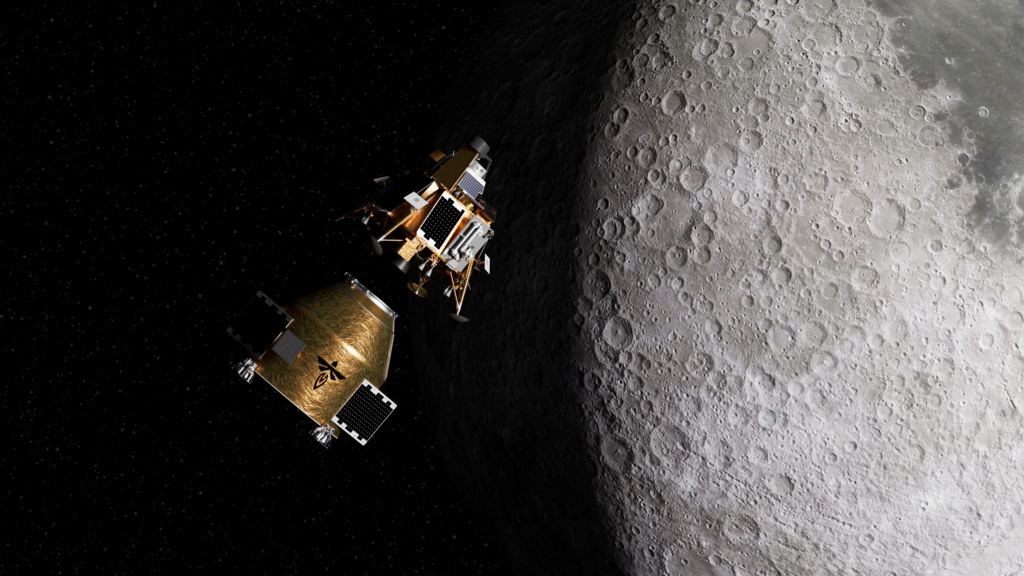
The post <strong>Firefly Awarded $179 Million NASA Contract for Moon Delivery to Gruithuisen Domes</strong> appeared first on Firefly Aerospace.
]]>The post <strong>Firefly Aerospace Blue Ghost Mission 1 to the Moon Readies for Launch</strong> appeared first on Firefly Aerospace.
]]>Cedar Park, Texas, November 25, 2024 – Firefly Aerospace, the leader in end-to-end responsive space services, today announced it successfully completed environmental testing on Firefly’s Blue Ghost lunar lander ahead of its first mission to the Moon supporting NASA’s Commercial Lunar Payload Services (CLPS) initiative. Firefly is now preparing to ship the lander to Cape Canaveral, Florida, in mid-December for launch on a SpaceX Falcon 9 rocket during a six-day window that opens no earlier than mid-January 2025.
“Blue Ghost aced environmental testing and proved the lander is performing 100% as expected, which is a testament to the incredible Firefly team,” said Jason Kim, CEO at Firefly Aerospace. “This team has gone above and beyond with innovative testing approaches to ensure Blue Ghost is flight ready. While we know there will be more challenges ahead, I’m confident this team has what it takes to softly touch down on the lunar surface and nail this mission.”
Blue Ghost environmental testing was recently completed at NASA’s Jet Propulsion Laboratory (JPL) in mid-October. During testing, the most extreme temperatures the lander will see during transit and on the Moon’s surface were replicated in a thermal vacuum chamber. Equipped with a solar simulator, JPL’s chamber enabled comprehensive functional and behavioral testing in a flight-like environment. The testing also included vibration, acoustic, electromagnetic interference and compatibility tests to further verify the integrated lander can withstand each flight environment during launch, transit, and landing on the Moon.
“With additional time in our schedule, we shipped Blue Ghost back to Firefly’s spacecraft facility in north Austin, Texas, where it has remained until we received the go to ship to the Cape,” said Jana Spruce, Vice President of Spacecraft at Firefly Aerospace. “In the meantime, the Firefly team has utilized this extra time to further conduct mission simulations and prep the team as we get ready to begin our first of many road trips to the Moon.”
Following launch and vehicle separation, Blue Ghost will begin its approximately 45-day transit to the Moon, allowing ample time to conduct robust health checks and begin payload operations on orbit. Blue Ghost will then land in Mare Crisium and operate payloads for a full lunar day (14 Earth days). As part of NASA’s CLPS initiative, the 10 payloads will perform numerous science and technology demonstrations, including lunar subsurface drilling, sample collection, and dust mitigation to advance research for future human missions on the Moon. Additional demonstrations, including X-ray imaging of Earth’s magnetic field, will also benefit humans on Earth, providing insights into how space weather impacts the planet.
Once payload operations are complete, Blue Ghost will capture the lunar sunset and provide critical data on how lunar regolith reacts to solar influences during lunar dusk conditions. Blue Ghost will then operate for several hours into the lunar night.
Blue Ghost Mission 1, named Ghost Riders in the Sky, is the first of three Firefly task orders supporting the NASA CLPS initiative as part of NASA’s Artemis campaign that serves to unlock the commercial lunar economy and enable a lasting lunar presence. The approximately 60-day mission will be operated from Firefly’s Mission Operations Center in Cedar Park, Texas. For more details on Ghost Riders in the Sky, visit https://fireflyspace.com/missions/blue-ghost-mission-1/.
About Firefly Aerospace
Firefly Aerospace is an end-to-end responsive space company with launch, lunar, and on-orbit services. Headquartered in central Texas, Firefly is a portfolio company of AE Industrial Partners (“AEI”) focused on delivering rapid, reliable, and affordable space access for government and commercial customers. Firefly’s small- to medium-lift launch vehicles, lunar landers, and orbital vehicles provide the space industry with a single source for missions from low Earth orbit to the surface of the Moon and beyond. For more information, visit www.fireflyspace.com.
Media Contact
Video/Image Gallery
The post <strong>Firefly Aerospace Blue Ghost Mission 1 to the Moon Readies for Launch</strong> appeared first on Firefly Aerospace.
]]>The post <strong>Firefly Aerospace Closes Oversubscribed $175 Million Series D Capital Raise with New Lead Investor</strong> appeared first on Firefly Aerospace.
]]>Cedar Park, Texas, November 12, 2024 – Firefly Aerospace, the leader in end-to-end responsive space services, today announced it closed an oversubscribed $175 million Series D round at a valuation of more than $2 billion. The Series D round was led by new investor, RPM Ventures, a venture capital firm that has been investing in revolutionary, category-defining companies for more than two decades. In addition to RPM Ventures, the round included existing investors as well as multiple new investors, including GiantLeap Capital and Human Element.
“Few companies can say they’ve defined a new category in their industry – Firefly is one of those,” said Marc Weiser from RPM Ventures. “They have captured their niche in the market as a full service provider for responsive space missions and have become the pinnacle of what a modern space and defense technology company looks like.”
Firefly’s core business focuses on providing customers with best-in-class responsive space services across its launch, lunar, and on-orbit programs. This capability was proven during the VICTUS NOX mission where the Firefly team met the U.S. Space Force’s requirement of encapsuling and launching a payload following a 24-hour notice. Firefly set an industry record, defined a new industry category, and continues to improve that timeline with each Alpha mission.
“Firefly is extremely grateful for our existing and new investors whose support demonstrates a huge vote of confidence in our capabilities and future” said Jason Kim, CEO of Firefly Aerospace. “Prior to joining the company, I had a unique opportunity to see behind the scenes and witness the bold mission Firefly executed flawlessly! I believe this is what has defined us in the market and continues to drive the investor demand that allowed us to move from term sheet to close in just two months – and the best is yet to come.”
“This successful financing round solidifies Firefly as the undisputed leader in responsive space,” said Kirk Konert, Chairman of the Board at Firefly Aerospace. “With relentless drive, cutting-edge innovation, and unstoppable passion, this team is rewriting the rules of what’s possible. As we set our sights on 2025, we’re gearing up for a year that will redefine the industry and make history.”
In addition to its responsive launch operations, Firefly stands ready to begin its inaugural Blue Ghost mission to the Moon as part of NASA’s Commercial Lunar Payload Service initiative. The team is concurrently preparing for multiple Alpha launches as part of its contracted missions with Lockheed Martin, L3Harris, True Anomaly, NASA and NOAA while co-developing a Medium Launch Vehicle with Northrop Grumman. In parallel, the company is completing final preparations for its first Elytra mission, a configurable spacecraft that provides on-orbit services and a deep space communication network.
Known for its highly efficient use of capital, Firefly plans to allocate the new capital to expand market reach with its Elytra spacecraft, move to full rate production of its Alpha launch vehicle, and accelerate hardware qualification for new vehicles in development.
About Firefly Aerospace
Firefly Aerospace is an end-to-end space transportation company with launch, lunar, and on-orbit services. Headquartered in central Texas, Firefly is a portfolio company of AE Industrial Partners (“AEI”) focused on delivering responsive, reliable, and affordable space access for government and commercial customers. Firefly’s small- to medium-lift launch vehicles, lunar landers, and orbital vehicles provide the space industry with a single source for missions from low Earth orbit to the surface of the Moon and beyond. For more information, visit www.fireflyspace.com.
Media Contact
The post <strong>Firefly Aerospace Closes Oversubscribed $175 Million Series D Capital Raise with New Lead Investor</strong> appeared first on Firefly Aerospace.
]]>The post <strong>Firefly Aerospace Onboarded as Vendor for Space Development Agency HALO Program</strong> appeared first on Firefly Aerospace.
]]>Cedar Park, Texas, October 23, 2024 – Firefly Aerospace, an end-to-end space transportation company, today announced it was selected as a vendor for the U.S. Department of Defense’s Space Development Agency (SDA) Hybrid Acquisition for Proliferated LEO (HALO) program. Firefly is now eligible to support rapid, end-to-end demonstration missions for SDA’s military satellites utilizing Firefly’s Elytra orbital vehicles.
“Firefly is honored to support the Space Development Agency’s growing military satellite constellation,” said Jason Kim, CEO at Firefly Aerospace. “We’re seeing an increasing demand for advanced in-space capabilities, including both prototype and feasibility demonstrations that support critical joint warfighter terrestrial missions with rapid and affordable commercial services. Firefly is ready to meet that demand with our robust space vehicles that utilize common components across our product lines to provide technical and schedule confidence for a diverse set of customers.”
SDA’s HALO program was established to enable a fast and flexible contracting mechanism to award Tranche 2 Demonstration and Experimentation System (T2DES) missions and other demonstrations that support SDA’s military satellite constellation in low-Earth orbit. The missions include launch, on-orbit transport, and tracking services delivered within 18 months of each award to advance SDA’s national security objectives.
“SDA is proud to welcome 19 vendors into the first-ever HALO pool,” said SDA Director Derek Tournear. “This creative award solution enables SDA to quickly compete, build, and fly demonstration missions to burn down risk for the future of the Proliferated Warfighter Space Architecture. We also hope, through the HALO pool, to build a broader base of vendors that can compete for work on operational layers of future tranches.”
Now eligible to support SDA HALO missions, Firefly’s Elytra orbital vehicle can be launched aboard the company’s small-lift Alpha rocket, new Medium Launch Vehicle, or as part of a rideshare with a third-party launch vehicle. Firefly’s line of Elytra vehicles offers responsive on-orbit services and dynamic space operations, including last-mile satellite delivery, advanced payload hosting, edge computing, optical communications terminals, and de-orbiting services to meet customers’ urgent mission needs.
Firefly’s first Elytra mission is scheduled to launch aboard Alpha in the coming months, further validating the company’s capabilities to rapidly launch, maneuver, and deploy satellites at a time and place of customers’ choosing.
About Firefly Aerospace
Firefly Aerospace is an end-to-end space transportation company with launch, lunar, and on-orbit services. Headquartered in central Texas, Firefly is a portfolio company of AE Industrial Partners (“AEI”) focused on delivering responsive, reliable, and affordable space access for government and commercial customers. Firefly’s small- to medium-lift launch vehicles, lunar landers, and orbital vehicles provide the space industry with a single source for missions from low Earth orbit to the surface of the Moon and beyond. For more information, visit www.fireflyspace.com.
Media Contact
The post <strong>Firefly Aerospace Onboarded as Vendor for Space Development Agency HALO Program</strong> appeared first on Firefly Aerospace.
]]>The post <strong>True Anomaly Taps Firefly Aerospace to Launch Jackal Autonomous Orbital Vehicle for U.S. Space Force VICTUS HAZE Tactically Responsive Space Mission</strong> appeared first on Firefly Aerospace.
]]>Cedar Park, Texas, October 17, 2024 – Firefly Aerospace, Inc., an end-to-end space transportation company, and space defense technology company True Anomaly, Inc., today announced a multi-launch agreement for three responsive launch missions aboard Firefly’s Alpha rocket. The first mission will deploy the True Anomaly Jackal Autonomous Orbital Vehicle (AOV) for the U.S. Space Force Space Systems Command’s VICTUS HAZE Tactically Responsive Space (TacRS) mission targeted for 2025. The two additional missions are available for execution between 2025 and 2027.
“VICTUS HAZE is an exemplar for how strong partnerships between the U.S. government and an exceptional industry team can create asymmetric capabilities at record speeds,” said Even Rogers, CEO of True Anomaly. “Firefly Aerospace has consistently demonstrated innovation and agility in the rapidly evolving landscape of responsive space launch logistics and space vehicle deployment. We are confident that they will build on their track record from VICTUS NOX, enabling True Anomaly to deploy the Jackal Autonomous Orbital Vehicle for VITCUS HAZE. The procurement of additional rapid, responsive launch capacity from Firefly beyond VICTUS HAZE, paired with True Anomaly’s rapid manufacturing capability will enable standing capacity for the U.S. National Security Space enterprise to rapidly respond to mission requirements in Low Earth Orbit and Medium Earth Orbit.”
True Anomaly first announced it was selected for the VICTUS HAZE mission in April 2024. Now with support from Firefly, the company will execute four main phases: build, hot standby, launch, and on-orbit operations. During the build phase, True Anomaly will complete development and testing of its Jackal Autonomous Orbital Vehicle at its factory GravityWorks in Denver, Colorado, and transport it to Firefly’s SLC-2 payload processing facility at Vandenberg Space Force Base, California for fueling, integration, and encapsulation in Alpha’s fairing. The True Anomaly and Firefly joint mission team will then enter the hot standby phase while the encapsulated payload remains stored in Firefly’s environmentally controlled processing facility.
True Anomaly and Firefly will remain on call until the U.S. Space Force provides the notice to launch. The Firefly team will then have 24 hours to transport the payload fairing to the pad, mate the fairing to Alpha, fuel the rocket, and launch within the first available window. Once True Anomaly’s Jackal spacecraft is deployed, True Anomaly will begin its on-orbit operations to include operating near a second VICTUS HAZE performer, Rocket Lab National Security.
“After launching VICTUS NOX last year, the Firefly team is ready to hit the ground running to support another rapid launch for tactically responsive space,” said Jason Kim, CEO at Firefly Aerospace. “We are honored by the vote of confidence from True Anomaly and the U.S. Space Force in Firefly’s ability to unlock repeatable, on-demand launch capabilities that enable our nation to respond to urgent on-orbit needs.”
VICTUS HAZE will be the second U.S. Space Force mission Firefly has supported with its rapid launch capabilities. In September 2023, Firefly successfully launched the U.S. Space Force’s VICTUS NOX mission following a 24-hour notice, demonstrating a critical capability for the United States to rapidly respond to on-orbit needs during a conflict or in response to a national security threat. The Firefly team has since operated every Alpha launch as a responsive space demonstration, enabling the team to continue practicing and streamlining its rapid launch capabilities for both government and commercial customers.
About Firefly Aerospace
Firefly Aerospace is an end-to-end space transportation company with launch, lunar, and on-orbit services. Headquartered in central Texas, Firefly is a portfolio company of AE Industrial Partners (“AEI”) focused on delivering responsive, reliable, and affordable space access for government and commercial customers. Firefly’s small- to medium-lift launch vehicles, lunar landers, and orbital vehicles provide the space industry with a single source for missions from low Earth orbit to the surface of the Moon and beyond. For more information, visit www.fireflyspace.com.
About True Anomaly
True Anomaly builds defense technologies to deliver solutions for space security, sustainability, and protection. The company’s solutions enable the U.S. government, its allies, and partners as well as the commercial space industry to lead safe, resilient operations on orbit to secure life on Earth. For more information, visit trueanomaly.space.
Media Contacts
Firefly Aerospace
[email protected]
True Anomaly
[email protected]
The post <strong>True Anomaly Taps Firefly Aerospace to Launch Jackal Autonomous Orbital Vehicle for U.S. Space Force VICTUS HAZE Tactically Responsive Space Mission</strong> appeared first on Firefly Aerospace.
]]>The post <strong>Firefly Aerospace Awarded NASA Contract to Launch NOAA’s QuickSounder Spacecraft</strong> appeared first on Firefly Aerospace.
]]>Cedar Park, Texas, September 25, 2024 – Firefly Aerospace, an end-to-end space transportation company, today announced the company was awarded a NASA Venture-Class Acquisition of Dedicated and Rideshare (VADR) mission to launch the QuickSounder environmental satellite on behalf of the National Oceanic and Atmospheric Administration (NOAA). Scheduled to launch on Firefly’s Alpha rocket in 2026, the collaborative mission between NASA and NOAA is the first project supporting NOAA’s new Near Earth Orbit Network (NEON) program.
“The Firefly team is honored to support this critical pathfinder mission for the NEON program that will transform our nation’s weather forecasting and climate models,” said Jason Kim, CEO of Firefly aerospace. “Our flight proven Alpha rocket that’s dedicated to serving the one-metric ton launch market is well suited to meet the needs of the NEON program, which requires fast, flexible, and direct launch services.”
NEON is the next generation environmental satellite system that will supplement and eventually replace NOAA’s Joint Polar Satellite System. The NEON program aims to launch small to medium-sized satellites with Earth-observing instruments more frequently to create a resilient constellation of low Earth orbit satellites that can be deployed quickly to enhance the nation’s weather forecasting, disaster management, and climate change monitoring.
Developed by the Southwest Research Institute, QuickSounder is the first environmental satellite to launch as part of NEON. QuickSounder will carry NOAA’s Advanced Technology Microwave Sounder (ATMS) instrument that provides critical information about Earth’s atmosphere, such as temperature and moisture, within just 30 minutes of data collection to significantly improve NOAA’s weather prediction models for fires, floods, droughts, and more.
Launching from Firefly’s SLC-2 launch site at the Vandenberg Space Force Base, the QuickSounder mission will be Firefly’s second Alpha launch for NASA. Firefly’s Alpha rocket is the only commercially operational launch vehicle dedicated to serving the one-metric ton satellite market. The flight proven vehicle provides responsive, reliable, and cost-competitive launch services directly to customers’ preferred orbits.
About Firefly Aerospace
Firefly Aerospace is an end-to-end space transportation company with launch, lunar, and on-orbit services. Headquartered in central Texas, Firefly is a portfolio company of AE Industrial Partners (“AEI”) focused on delivering responsive, reliable, and affordable space access for government and commercial customers. Firefly’s small- to medium-lift launch vehicles, lunar landers, and orbital vehicles provide the space industry with a single source for missions from low Earth orbit to the surface of the Moon and beyond. For more information, visit www.fireflyspace.com.
Media Contact
The post <strong>Firefly Aerospace Awarded NASA Contract to Launch NOAA’s QuickSounder Spacecraft</strong> appeared first on Firefly Aerospace.
]]>The post <strong>Firefly Aerospace Names Jason Kim as New Chief Executive Officer</strong> appeared first on Firefly Aerospace.
]]>Cedar Park, Texas, August 29, 2024 – Firefly Aerospace, an end-to-end space transportation company, today announced the appointment of Jason Kim as its Chief Executive Officer, effective October 1, 2024. With more than two decades of experience in the aerospace and defense sectors, Kim brings both executive leadership and a highly technical background to Firefly, positioning the company for accelerated growth and innovation.
Prior to joining Firefly, Kim served as CEO of Millennium Space Systems, where he led the company through a period of significant expansion and technology advancements. His extensive career also includes leadership roles at Raytheon Intelligence & Space, Northrop Grumman Aerospace Systems, and the U.S. Air Force. Kim’s experience spans executive leadership, program management, and business development roles across a wide range of aerospace and defense systems, including small to large satellites, unmanned aerial vehicles, rocket launch, vertical integration, manufacturing, assembly, and on-orbit mission operations.
“Jason Kim’s deep industry expertise, coupled with his proven ability to lead high-performing teams and execute on strategic growth initiatives, makes him the ideal leader for Firefly Aerospace,” said Kirk Konert, Chairman of the Board at Firefly Aerospace. “We are confident that under his leadership, Firefly will continue to achieve major milestones across our launch, lunar, and on-orbit programs.”
In this new role, Kim will lead Firefly’s team of more than 700 employees as they continue to launch their Alpha rocket, land Blue Ghost on the Moon, and orbit their Elytra vehicle this year. Armed with a robust background in aerospace innovation, product development, and production, Kim will also oversee the continued development of Firefly’s Medium Launch Vehicle and further scale production of Firefly’s rockets and spacecraft.
“I have long admired Firefly’s relentless drive and innovative spirit, particularly during our collaboration on the VICTUS NOX mission for the U.S. Space Force,” said Jason Kim, incoming CEO of Firefly Aerospace. “I am honored to join this unstoppable team and look forward to building on Firefly’s success and leading the company into a new era of category-defining achievements in the industry.”
Kim serves as a member of the Board of Directors for the Air Force Academy Foundation and a member of the Executive Committee for Space Workforce 2030. He is a graduate of the U.S. Air Force Academy with a Bachelor of Science in Electrical Engineering. He also received a Master of Science in Electrical Engineering from the Air Force Institute of Technology and a Master of Business Administration from the University of California at Los Angeles Anderson School of Management. Kim is excited to return to his home state of Texas as he joins Firefly’s headquarters in north Austin.
About Firefly Aerospace
Firefly Aerospace is an end-to-end space transportation company with launch, lunar, and on-orbit services. Headquartered in central Texas, Firefly is a portfolio company of AE Industrial Partners (“AEI”) focused on delivering responsive, reliable, and affordable space access for government and commercial customers. Firefly’s small- to medium-lift launch vehicles, lunar landers, and orbital vehicles provide the space industry with a single source for missions from low Earth orbit to the surface of the Moon and beyond. For more information, visit www.fireflyspace.com.
Media Contact
The post <strong>Firefly Aerospace Names Jason Kim as New Chief Executive Officer</strong> appeared first on Firefly Aerospace.
]]>The post <strong>Firefly Aerospace Shipped Blue Ghost for Environmental Testing Ahead of Mission to the Moon</strong> appeared first on Firefly Aerospace.
]]>Cedar Park, Texas, August 26, 2024 – Firefly Aerospace, an end-to-end space transportation company, today announced Firefly’s Blue Ghost lunar lander has arrived at NASA’s Jet Propulsion Laboratory (JPL) for environmental testing before the lander ships to Cape Canaveral for a Q4 2024 launch. As part of NASA’s Commercial Lunar Payload Services (CLPS) initiative, Firefly’s Blue Ghost Mission 1 lander is integrated with 10 scientific instruments and technology demonstrations that will help pave the way for humanity’s return to the Moon.
“Firefly is proud to follow in the footsteps of the Surveyor landers that were tested in the same JPL facilities,” said Peter Schumacher, Interim CEO at Firefly Aerospace. “The extensive environmental testing we’ll complete at JPL combined with the robust testing we’ve already completed in house will further reduce our risk posture and set us up for a successful, soft landing.”
The environmental testing at JPL includes vibration, acoustic, thermal vacuum, and electromagnetic interference and compatibility testing to ensure the integrated lander can withstand various flight environments during launch, transit, and landing on the Moon. This testing follows Firefly’s robust testing campaign, including extensive qualification testing on the assembled Blue Ghost structure and each component.
Firefly also completed nearly 100 lander leg drop tests on multiple surfaces, including sand, lunar simulant, and concrete, to ensure Blue Ghost’s shock-absorbing footpads can withstand the unpredictable nature of the lunar surface. The team further built a one-acre moonscape at its Rocket Ranch to test the hazard avoidance and terrain-relative navigation system on a heavy-lift drone, ensuring the system can identify the safest landing site in the final moments of descent.
“This incredible Firefly team implemented innovative testing approaches that are setting a new standard in the industry,” said Jana Spruce, Vice President of Spacecraft at Firefly Aerospace. “After all the hard work, it’s bittersweet to see Blue Ghost leave our Texas-based facility, but we’re more than ready for this final test. We’ll have a dedicated team of Fireflies with the lander every step of the way as Blue Ghost travels from Texas to California to Florida ahead of this historic journey to the Moon.”
Following final testing, Firefly’s Blue Ghost will ship to Cape Canaveral, Florida, ahead of its launch on a SpaceX Falcon 9 rocket scheduled for Q4 2024. Blue Ghost will then begin its transit to the Moon, including approximately a month in Earth orbit and two weeks in lunar orbit. This approach provides ample time to conduct robust health checks on each subsystem and begin payload operations during transit.
Blue Ghost will then land in Mare Crisium, a basin in the northeast quadrant on the Moon’s near side, before deploying and operating 10 instruments for a lunar day (14 Earth days) and more than 5 hours into the lunar night. For more details on Blue Ghost Mission 1 named Ghost Riders in the Sky, visit https://fireflyspace.com/missions/blue-ghost-mission-1/.
About Firefly Aerospace
Firefly Aerospace is an end-to-end space transportation company with launch, lunar, and on-orbit services. Headquartered in central Texas, Firefly is a portfolio company of AE Industrial Partners (“AEI”) focused on delivering responsive, reliable, and affordable space access for government and commercial customers. Firefly’s small- to medium-lift launch vehicles, lunar landers, and orbital vehicles provide the space industry with a single source for missions from low Earth orbit to the surface of the Moon and beyond. For more information, visit www.fireflyspace.com.
Media Contact
Video/Image Gallery

Blue Ghost lunar lander shipping out from Firefly’s spacecraft facility in Cedar Park, Texas, to NASA JPL in California

Firefly team outside Firefly’s spacecraft facility in Cedar Park, Texas
The post <strong>Firefly Aerospace Shipped Blue Ghost for Environmental Testing Ahead of Mission to the Moon</strong> appeared first on Firefly Aerospace.
]]>The post <strong>Firefly Aerospace Announces Second Multi-Launch Agreement with L3Harris for up to 20 Alpha Launches</strong> appeared first on Firefly Aerospace.
]]>Cedar Park, Texas, August 7, 2024 – Firefly Aerospace, Inc., an end-to-end space transportation company, today announced it signed a multi-launch agreement with L3Harris Technologies (NYSE:LHX) for up to 20 launches on Firefly’s Alpha rocket, including two to four missions per year from 2027 to 2031 depending on customer needs. The new agreement is in addition to Firefly’s existing multi-launch agreement with L3Harris for three Alpha missions in 2026.
“The Firefly team is proud to build on our existing relationship with L3Harris and serve as a long-term launch provider for their robust satellite systems,” said Peter Schumacher, Interim CEO at Firefly Aerospace. “Firefly continues to see growing demand for Alpha’s responsive small-lift services, and we’re committed to providing a dedicated launch option that takes our customers directly to their preferred orbits.”
Under the agreement, Firefly’s Alpha rocket will launch L3Harris spacecraft into low-Earth orbit from Firefly’s SLC-2 launch site at the Vandenberg Space Force Base. Alpha supports the responsive space needs of both government and commercial customers with the ability to provide direct, on-demand deliveries for satellites up to 1,030 kg.
Following the most recent Alpha launch for NASA, Firefly continues to accelerate vehicle production. The company’s latest facility expansion in Briggs, Texas, including a new automated fiber placement machine, allows the team to rapidly build and test Alpha’s carbon composite structures in a matter of days versus weeks.
About Firefly Aerospace
Firefly Aerospace is an end-to-end space transportation company with launch, lunar, and on-orbit services. Headquartered in central Texas, Firefly is a portfolio company of AE Industrial Partners (“AEI”) focused on delivering responsive, reliable, and affordable space access for government and commercial customers. Firefly’s small- to medium-lift launch vehicles, lunar landers, and orbital vehicles provide the space industry with a single source for missions from low Earth orbit to the surface of the Moon and beyond. For more information, visit www.fireflyspace.com.
Media Contact
The post <strong>Firefly Aerospace Announces Second Multi-Launch Agreement with L3Harris for up to 20 Alpha Launches</strong> appeared first on Firefly Aerospace.
]]>The post <strong>Leadership Change at Firefly</strong> appeared first on Firefly Aerospace.
]]>The post <strong>Leadership Change at Firefly</strong> appeared first on Firefly Aerospace.
]]>The post <strong>Firefly Aerospace Successfully Launches Alpha FLTA005 Noise of Summer Mission for NASA</strong> appeared first on Firefly Aerospace.
]]>VANDENBERG SPACE FORCE BASE, Calif., – July 4, 2024 – Firefly Aerospace, an end-to-end space transportation company, today announced it successfully launched its Alpha Flight 5 (FLTA005) rocket and completed the payload deployment sequence as part of the company’s Venture-Class Launch Services Demonstration 2 (VCLS Demo 2) contract with NASA.
The mission, called Noise of Summer, lifted off from Firefly’s SLC-2 launch site at the Vandenberg Space Force Base at 9:04 p.m. PDT on July 3, 2024. Following payload deployment, Firefly successfully performed a second stage relight and plane change maneuver to further test and validate Alpha’s on-orbit capabilities.
“The Firefly team knocked it out of the park,” said Bill Weber, CEO of Firefly Aerospace. “As a NASA vendor for both launch and lunar services, we look forward to continuing this partnership and supporting the agency’s larger space exploration goals from Earth to the Moon and beyond.”
As a NASA VCLS Demo 2 task order, the successful mission further validates Alpha’s capabilities to provide small satellite launches for NASA on a recurring basis. The mission’s CubeSats were selected through NASA’s CubeSat Launch Initiative (CSLI) that provides U.S. educational institutions and nonprofits with low-cost access to space.
“The launch of Firefly Aerospace’s demonstration mission marks one more way NASA is innovating for the benefit of humanity,” said Hamilton Fernandez, mission manager for NASA’s Launch Services Program. “NASA is using CubeSat missions to demonstrate the capability of small rockets and build relationships with this new part of the U.S. launch vehicle industry.”
At the time of this release, ongoing activities are underway by NASA and the CubeSat teams as they work to acquire signals for all satellites. Additional updates will be posted to the mission webpage.
Looking ahead, Firefly is in the final testing phase for its next Alpha launch, FLTA006, in support of a dedicated commercial mission for Lockheed Martin. The Firefly team is concurrently ramping up for a responsive on-orbit Elytra mission that will launch on Alpha FLTA007 later this year while also working to complete the final readiness milestones for its first Blue Ghost mission to the Moon launching in Q4 2024.

About Firefly Aerospace
Firefly Aerospace is an end-to-end space transportation company with launch, lunar, and on-orbit services. Headquartered in central Texas, Firefly is a portfolio company of AE Industrial Partners (“AEI”) focused on delivering responsive, reliable, and affordable space access for government and commercial customers. Firefly’s small- to medium-lift launch vehicles, lunar landers, and orbital vehicles provide the space industry with a single source for missions from low Earth orbit to the surface of the Moon and beyond. For more information, visit www.fireflyspace.com.
Media Contact
The post <strong>Firefly Aerospace Successfully Launches Alpha FLTA005 Noise of Summer Mission for NASA</strong> appeared first on Firefly Aerospace.
]]>The post <strong>Swedish Space Corporation and Firefly Aerospace to Launch Satellites from Esrange in Sweden</strong> appeared first on Firefly Aerospace.
]]>Cedar Park, Texas, June 27, 2024 – Swedish Space Corporation (SSC) and U.S. space transportation company Firefly Aerospace have signed a collaborative agreement to jointly launch satellites with Firefly’s Alpha rocket from the newly inaugurated spaceport at Esrange Space Center in Sweden, starting in 2026. Together, Firefly and SSC are establishing an orbital launch service in Europe with a flight-proven launch vehicle, supporting commercial, civil, and defense customers.
“We’re pleased to announce this historic collaboration that will have a huge impact on the global launch market, not least in Europe and the U.S.,” said Charlotta Sund, CEO at SSC. “Reducing the current gap of orbital launch sites in Europe, this collaboration strengthens the transatlantic link between Sweden and the U.S. whilst offering unique space capabilities for the Swedish NATO membership. We’re looking forward to releasing this competitive and well-proven launch service at Esrange in northern Europe.”
Owned and operated by SSC, Esrange has been operational since 1966, primarily supporting sounding rocket launches for microgravity and atmospheric research. Newly expanded infrastructure at Esrange now supports satellite launches, making it a significant contribution to filling the demands for orbital launch capabilities in Europe.
As part of the agreement with SSC, Firefly’s Alpha rocket will launch from Esrange Launch Complex 3C where pad modifications are already underway. With the inaugural Alpha launch scheduled for 2026, the new complex will support commercial customers in the broader European market and enable tactically responsive space missions to further advance national security for NATO countries.
“The future of spaceflight requires more orbital launch sites across the globe as we continue to see growing demand among domestic and international launch customers,” said Bill Weber, CEO at Firefly Aerospace. “Firefly is incredibly humbled to partner with SSC and become the first U.S. company to launch from continental Europe. Together, we’re unlocking a long-awaited capability for the European satellite market, and we invite those waiting to fly with us on our flight-proven Alpha vehicle.”
The new launch service at Esrange will build on the success of Firefly’s orbital Alpha missions from the Vandenberg Space Force Base in California and supplement Firefly’s new launch capability at the Mid-Atlantic Regional Spaceport on Wallops Island, Virginia. Capable of carrying 1,030 kg to low-Earth orbit, Alpha recently launched a responsive space mission for the U.S. Space Force following a 24-hour notice and continues to serve as a responsive launch vehicle for government and commercial customers.
About Firefly Aerospace
Firefly Aerospace is an end-to-end space transportation company with launch, lunar, and on-orbit services. Headquartered in central Texas, Firefly is a portfolio company of AE Industrial Partners (“AEI”) focused on delivering responsive, reliable, and affordable space access for government and commercial customers. Firefly’s small- to medium-lift launch vehicles, lunar landers, and orbital vehicles provide the space industry with a single source for missions from low Earth orbit to the surface of the Moon and beyond. www.fireflyspace.com.
About Swedish Space Corporation
Swedish Space Corporation (SSC) helps Earth benefit from Space. Since the 70’s, SSC has helped space organizations, companies, other commercial actors and research institutes to get access to space. Through our local presence on all continents and close to 700 committed employees, we offer specialist expertise in satellite ground station connectivity, spacecraft operations, rocket and balloon systems, launch services, flight test services and data analytics. Among our strongest assets are Esrange Space Center in northern Sweden, set to begin launching satellites from Sweden in 2025, as well as our global ground station network for satellite communications: SSC Connect. www.sscspace.com
Media Contacts
Firefly Aerospace: [email protected]
SSC: Philip Ohlsson, Head of Communications, +46 70 721 70 26, [email protected]
Multimedia
Firefly Aerospace: FLTA004 & FLTA003 | SSC: Esrange
The post <strong>Swedish Space Corporation and Firefly Aerospace to Launch Satellites from Esrange in Sweden</strong> appeared first on Firefly Aerospace.
]]>The post <strong>Firefly Aerospace Adds Alpha Launch Capability on Wallops Island, Virginia</strong> appeared first on Firefly Aerospace.
]]>Cedar Park, Texas, June 24, 2024 – Firefly Aerospace, Inc., an end-to-end space transportation company, today announced it is adding an Alpha launch capability at the Mid-Atlantic Regional Spaceport (MARS) on Wallops Island, Virginia. In support of Firefly’s responsive space missions, Pad-0A will be configured to launch Alpha as early as 2025 in addition to Antares 330 and the Medium Launch Vehicle (MLV) Firefly is co-developing with Northrop Grumman.
“Firefly is committed to establishing a regular on-demand launch service and serving our customers’ growing responsive space needs, and that requires operating a diverse set of launch sites,” said Bill Weber, CEO of Firefly Aerospace. “Virginia Spaceport Authority further sets us up for success by enabling a streamlined approach to launching both Alpha and MLV from one location at MARS with minimal congestion from the broader launch market.”
The new launch capability on Wallops Island will supplement Firefly’s existing Alpha launch facilities and further enable Firefly to support rapid, on-demand missions for government and commercial customers. In addition to the launch pad, Firefly plans to operate a launch control center, horizontal integration facility, and administrative office space on Virginia’s Eastern Shore. Firefly will also utilize existing infrastructure in the area, such as vehicle and payload processing facilities, to eliminate bottlenecks and retain Firefly’s rapid launch capabilities, recently demonstrated for the VICTUS NOX mission that was executed with a 24-hour launch notice.
“As growth at Virginia’s Mid-Atlantic Regional Spaceport accelerates, we are delighted to welcome Firefly Aerospace to Virginia,” said Governor Glenn Youngkin. “The Commonwealth plays a critical role in supporting national security as the need to maintain our nation’s leadership in space becomes increasingly evident. I look forward to Firefly’s success in Virginia as we work together to bolster our nation’s aerospace industry.”
Capable of lifting more than 1,000 kg to low-Earth orbit, Firefly’s flight-proven Alpha rocket utilizes patented propulsion technology and carbon composite structures built with automated machinery to provide a reliable, low cost, responsive solution for the domestic and international launch market. With East and West Coast launch capabilities, Firefly will further increase Alpha’s launch cadence to a monthly basis by 2026 after launching up to four times in 2024 and six times in 2025.
About Firefly Aerospace
Firefly is an end-to-end space transportation company with launch, lunar, and in-space services. As an all-American company headquartered in central Texas, Firefly is focused on delivering responsive, reliable, and affordable space access for government and commercial customers. Firefly’s small- to medium-lift launch vehicles, lunar landers, and orbital vehicles provide the space industry with a single source for missions from low Earth orbit to the surface of the Moon and beyond. For more information, visit www.fireflyspace.com.
Contact
The post <strong>Firefly Aerospace Adds Alpha Launch Capability on Wallops Island, Virginia</strong> appeared first on Firefly Aerospace.
]]>The post <strong>Firefly Aerospace Ready to Launch Alpha FLTA005 for NASA No Earlier Than June 26</strong> appeared first on Firefly Aerospace.
]]>VANDENBERG SPACE FORCE BASE, Calif., June 21, 2024 – Firefly Aerospace, Inc., an end-to-end space transportation company, today announced its Alpha Flight 5 (FLTA005) mission, called Noise of Summer, is scheduled to launch no earlier than June 26. The 30-minute launch window will open at 9 p.m. PDT.
“The Firefly team has rapidly matured our Alpha rocket and our responsive launch operations to deliver the dependable one-metric-ton rocket the market is demanding,” said Bill Weber, CEO of Firefly Aerospace. “We’re proud to support this NASA mission that will not only prove out the capabilities of Alpha as a repeatable, reliable launch vehicle, but also advance our mission of making space for everyone by supporting some incredible student-led CubeSat initiatives.”
Launching from Firefly’s SLC-2 complex at the Vandenberg Space Force Base, Alpha FLTA005 supports Firefly’s Venture-Class Launch Services Demo 2 contract with NASA that serves to validate the capabilities of launch vehicles that support a new launch class and provide more access to space for small satellites and spacecraft. The mission will deploy the following eight payloads selected through NASA’s CubeSat Launch Initiative, providing U.S. educational institutions and nonprofits with low-cost access to space.
- CatSat – University of Arizona: CatSat is a technology demonstration of an inflatable antenna for high-speed communications. After reaching low Earth orbit, CatSat’s antenna will deploy and inflate to a diameter of just over one-and-a-half feet to transmit high-definition Earth photos to X-band ground stations at approximately 50 megabits per second, more than 5 times faster than typical home internet speeds.
- KUbeSat-1 - University of Kansas: KUbeSat-1 will demonstrate a new method to measure the energy and species of primary cosmic rays hitting Earth utilizing a Cosmic Ray Detector. The payload will also utilize High-Altitude Calibration technology to research very high frequency signals generated by cosmic ray interactions with the atmosphere.
- MESAT1 – University of Maine: MESAT1 is a climate focused payload that will identify urban heat islands, determine concentration of phytoplankton in water bodies, and help predict harmful algal blooms. Four multispectral cameras on board will relay the data down to University of Maine’s ground station for further processing.
- R5-S4 and R5-S2-2.0 – NASA’s Johnson Space Center: R5-S4 and R5-S2 will be the first in a line of R5 spacecrafts launched to orbit, featuring Rendezvous and Proximity Operations Fiducial AprilTags to solve the problem of relative navigation between spacecraft. R5-S4 will also demonstrate a “spacecraft license plate” with a small blinking light that continuously flashes a unique number that can be read with a small telescope on the ground to identify and better track satellites among tens of thousands of objects currently in orbit.
- Serenity 3 – Teachers in Space: Licensed as an amateur radio broadcaster, Serenity 3 includes a suite of data sensors and a camera that will send data back to Earth and communicate with radios on the ground, allowing anyone with a ham radio to “talk” to Serenity. For details on communicating with and requesting photos from Serenity, visit www.TIS.org/Serenity-satellite.
- SOC-i – University of Washington: Satellite for Optimal Control and Imaging (SOC-i) will test an algorithm aimed at supporting autonomous operations with constrained attitude guidance maneuvers computed in real-time aboard the spacecraft. The payload utilizes uses optimization-based attitude guidance methods to compute trajectories in real-time that meet a set of five constraints throughout the maneuvers.
- TechEdSat-11 (TES-11) – NASA Ames Research Center: TES-11 will conduct several technology demonstrations, including an exo-brake with a deployable parachute-like device aimed at reducing CubeSat de-orbit times, and BrainStack-3, a graphics processing unit and neuromorphic processors that allow for artificial intelligence experiments in low Earth orbit. TES-11 is part of a series of collaborative missions called TechEdSat that pair university students with NASA researchers to evaluate new technologies for use in small satellites while providing student mentorship opportunities with engineers at NASA’s Ames Research Center.
“Through innovative technology partnerships, NASA provides these CubeSat developers a low-cost pathway to conduct scientific investigations and technology demonstrations in space,” said Hamilton Fernandez, mission manager with NASA’s Launch Services Program. “NASA benefits by having a mechanism for low-cost technology development and scientific research to help bridge strategic knowledge gaps and accelerate flight-qualified technology. The students benefit through hands on experience, which develops the future workforce of the U.S. space industry.”
Alpha FLTA005 and Firefly’s future Alpha launches will continue to be performed as responsive space operations that are observed by members of the U.S. Space Force Tactically Responsive Space team to further define the training, infrastructure, and operational requirements for repeatable, on-demand launch capabilities. During the final launch operations, Firefly will transport the payload fairing to the launch pad and mate it to Firefly’s Alpha rocket within hours of the scheduled liftoff, compared to weeks in a typical operation.
For more details on the Alpha FLTA005 Noise of Summer mission and livestream, visit fireflyspace.com/missions/noise-of-summer/.
About Firefly Aerospace
Firefly Aerospace is an end-to-end space transportation company with launch, lunar, and on-orbit services. Headquartered in central Texas, Firefly is a portfolio company of AE Industrial Partners (“AEI”) focused on delivering responsive, reliable, and affordable space access for government and commercial customers. Firefly’s small- to medium-lift launch vehicles, lunar landers, and orbital vehicles provide the space industry with a single source for missions from low Earth orbit to the surface of the Moon and beyond. For more information, visit www.fireflyspace.com.
Contact
The post <strong>Firefly Aerospace Ready to Launch Alpha FLTA005 for NASA No Earlier Than June 26</strong> appeared first on Firefly Aerospace.
]]>The post <strong>Firefly Aerospace Announces Multi-Launch Agreement with Lockheed Martin for 25 Alpha Launches</strong> appeared first on Firefly Aerospace.
]]>Cedar Park, Texas, June 5, 2024 – Firefly Aerospace, Inc., an end-to-end space transportation company, today announced it signed a multi-launch agreement with Lockheed Martin for 25 launches on Firefly’s Alpha rocket through 2029. This agreement commits Lockheed Martin to 15 launch reservations and 10 optional launches.
“Firefly is honored to continue this partnership with Lockheed Martin and appreciates their confidence in our rapid launch services to support their critical missions for years to come,” said Bill Weber, CEO of Firefly Aerospace. “The Firefly team has scaled up Alpha production and testing and significantly streamlined our launch operations to fly Alpha more frequently and responsively. This allows us to continue delivering the one metric ton rocket the industry is demanding.”
Under the agreement, Alpha will launch Lockheed Martin spacecraft into low-Earth orbit from Firefly’s facilities on the west and east coast. The first mission will launch on Alpha flight 6 (FLTA006) from Firefly’s SLC-2 launch site at the Vandenberg Space Force Base later this year. The mission will be conducted as another responsive space operation that includes transporting the payload fairing to the launch pad, mating it to Firefly’s Alpha rocket, and completing final launch operations within hours of the scheduled liftoff.
“Our customers have told us they need rapid advancement of new mission capabilities,” said Bob Behnken, Director, Ignite Technology Acceleration at Lockheed Martin Space. “This agreement with Firefly further diversifies our access to space, allowing us to continue quickly flight demonstrating the cutting-edge technology we are developing for them, as well as enabling our continued exploration of tactical and responsive space solutions.”
Built with lightweight carbon composites and patented propulsion technologies, Firefly’s Alpha rocket provides low-cost launch services for satellites up to 1,030 kg and supports the growing demand for responsive space missions when and where customers need to fly.
About Firefly Aerospace
Firefly Aerospace is an end-to-end space transportation company with launch, lunar, and on-orbit services. Headquartered in central Texas, Firefly is a portfolio company of AE Industrial Partners (“AEI”) focused on delivering responsive, reliable, and affordable space access for government and commercial customers. Firefly’s small- to medium-lift launch vehicles, lunar landers, and orbital vehicles provide the space industry with a single source for missions from low Earth orbit to the surface of the Moon and beyond. For more information, visit www.fireflyspace.com.
Media Contact
The post <strong>Firefly Aerospace Announces Multi-Launch Agreement with Lockheed Martin for 25 Alpha Launches</strong> appeared first on Firefly Aerospace.
]]>The post <strong>Firefly Aerospace Announces Agreement with Klepsydra Technologies to Demonstrate Edge Computing in Space</strong> appeared first on Firefly Aerospace.
]]>Cedar Park, Texas, April 9, 2024 – Firefly Aerospace, Inc., an end-to-end space transportation company, today announced a new agreement to host the Klepsydra Artificial Intelligence (AI) application on Firefly’s Elytra vehicle that will launch aboard Alpha later this year. By serving as an edge computing platform in space, Elytra is equipped to support a variety of hosted software applications with real-time data processing on orbit.
“Edge computing in space is the key to overcome critical bandwidth challenges that come with downlinking massive volumes of data from spacecraft to ground stations on Earth,” said Jana Spruce, Vice President of Spacecraft. “Rather than relaying all this data to the ground, Elytra’s edge compute platform enables onboard data processing to support real-time decision making and a wide range of autonomous applications, such as space domain awareness, anomaly detection, and vision navigation.”
Designed and built in-house at Firefly, Elytra’s edge compute platform interfaces directly with the vehicle’s core avionics with the ability to receive payload, sensor, and camera telemetry data. The platform runs software applications as a service, enabling rapid data processing on orbit before downlinking the post-processed data of interest to customers.
As part of Elytra Mission 1, Klepsydra Technologies will utilize Elytra’s edge compute platform to further test and validate its AI navigation application. Klepsydra’s AI models will process sensor data onboard and relay the processed data back to Earth, providing real-time attitude determination, guidance, navigation, and control (GNC). Klepsydra will also deploy a second algorithm for cloud detection that will demonstrate the ability to dynamically switch AI applications onboard, paving the way for Klepsydra’s AI-as-a-service solution.
“We are deeply honored by the trust Firefly has placed in us as we demonstrate our ground-breaking AI software for space processors,” said Pablo Ghiglino, CEO of Klepsydra Technologies.
Elytra will serve as an edge computing platform for hosted software customers for up to one year on orbit during Elytra Mission 1. Following separation from Firefly’s Alpha rocket, Elytra will first deploy commercial payloads and support a responsive space demonstration for the NRO, which includes performing an on-orbit maneuver and deploying additional U.S. government payloads on-demand.
About Firefly Aerospace
Firefly Aerospace is an end-to-end space transportation company with launch, lunar, and on-orbit services. Headquartered in central Texas, Firefly is a portfolio company of AE Industrial Partners (“AEI”) focused on delivering responsive, reliable, and affordable space access for government and commercial customers. Firefly’s small- to medium-lift launch vehicles, lunar landers, and orbital vehicles provide the space industry with a single source for missions from low Earth orbit to the surface of the Moon and beyond. For more information, visit www.fireflyspace.com.
About Klepsydra Technologies
Klepsydra Technologies is a leading provider of AI software solutions that empower organizations to harness the full potential of artificial intelligence. With a commitment to innovation and excellence, Klepsydra’s team of experts develop cutting-edge AI software for various industries, including space exploration, robotics, automotive, and more. For more information, visit www.klepsydra.com.
Contact
The post <strong>Firefly Aerospace Announces Agreement with Klepsydra Technologies to Demonstrate Edge Computing in Space</strong> appeared first on Firefly Aerospace.
]]>The post <strong>Firefly Aerospace Selected to Demonstrate Launch and On-Orbit Services for U.S. Defense Innovation Unit</strong> appeared first on Firefly Aerospace.
]]>Cedar Park, Texas, March 21, 2024 – Firefly Aerospace, Inc., an end-to-end space transportation company, today announced it signed an agreement with the U.S. Department of Defense’s (DoD) Defense Innovation Unit (DIU) to conduct a trade study on its capabilities to rapidly launch Firefly’s Elytra vehicles and support missions beyond Geosynchronous Orbit, referred to as xGEO. Once complete, the trade study will provide the groundwork for up to two Firefly demonstration missions that will advance the DoD’s responsive access to xGEO.
“Firefly’s robust vehicle lines and proven responsive space capabilities put us in a unique position to rapidly service the vast region of space from GEO to the Moon and beyond,” said Bill Weber, CEO of Firefly Aerospace. “As international and commercial initiatives ramp up in this region, the Firefly team is prepared to execute missions that support the growing infrastructure, provide space domain awareness, and help protect our nation’s critical assets on and around the Moon.”
The contract supports the DIU’s Sinequone project that aims to deliver cost-effective, responsive access to xGEO through both launch and orbital transfer services. Following completion of the study, Firefly will conduct up to two demonstrations to deliver multiple payloads to xGEO aboard its Elytra Dark spacecraft with the first mission completed within 18 months of receiving the approval to proceed. The missions will perform technology demonstrations to advance future operations in the xGEO environment.
“Firefly is accelerating commercial growth beyond GEO with our launch, lunar, and orbital vehicles,” said Jana Spruce, Vice President of Spacecraft. “Paired together, these vehicles allow us to provide regular, responsive access to this underserved region that’s critical to building a sustainable presence on the Moon.”
In addition to this latest agreement, Firefly is ramping up for multiple upcoming responsive space missions, including a responsive on-orbit Elytra mission for the NRO that will launch aboard Alpha later this year and a study for DARPA on responsive on-orbit spacecraft hubs. These operations follow Firefly’s recent responsive launch for the U.S. Space Force’s VICTUS NOX mission that was successfully completed after a 24-hour notice.
About Firefly Aerospace
Firefly Aerospace is an end-to-end space transportation company with launch, lunar, and on-orbit services. Headquartered in central Texas, Firefly is a portfolio company of AE Industrial Partners (“AEI”) focused on delivering responsive, reliable, and affordable space access for government and commercial customers. Firefly’s small- to medium-lift launch vehicles, lunar landers, and orbital vehicles provide the space industry with a single source for missions from low Earth orbit to the surface of the Moon and beyond. For more information, visit www.fireflyspace.com.
Media Contact
The post <strong>Firefly Aerospace Selected to Demonstrate Launch and On-Orbit Services for U.S. Defense Innovation Unit</strong> appeared first on Firefly Aerospace.
]]>The post <strong>Firefly Aerospace Announces Second Round of DREAM Payload Awardees</strong> appeared first on Firefly Aerospace.
]]>Cedar Park, Texas, March 6, 2024 – Firefly Aerospace, Inc., an end-to-end space transportation company, today announced it selected three educational payloads to launch aboard Firefly’s Alpha rocket as early as 2025. As part of Firefly’s DREAM (Dedicated Research Education Accelerator Mission) program, Firefly is donating excess capacity on its Alpha launch vehicle to fly CubeSats from the University of Illinois, Auburn University, and the Aerospace and Innovation Academy in Florida.
“Firefly is dedicated to making space attainable for everyone, including our future workforce,” said Shea Ferring, Chief Technology Officer at Firefly Aerospace. “By providing a free ride on Alpha, we help kickstart satellite programs and robotics clubs that have a monumental impact on students’ career trajectories and our industry at large. Ultimately, our goal is to inspire students, allow them to gain hands-on experience, and help them realize that becoming a ‘rocket scientist’ is achievable with the right mix of grit, creativity, and technical fundamentals.”
In line with Firefly’s mission to make space for everyone, the DREAM program was established in 2019 to encourage students to develop an interest in science, technology, engineering, and math (STEM). DREAM eliminates the cost of entry for launch, allowing educational institutions to focus on developing and operating a small satellite program and training the next generation of aerospace engineers. The first round of DREAM payloads flew on Firefly’s Alpha FLTA001 rocket in 2021.
The second round of DREAM payloads selected to fly on Alpha rockets as early as 2025 include the following three CubeSats. A fourth DREAM payload will be announced at the 4S Symposium in May 2024.
- University of Illinois’ DarkNESS CubeSat will look for a dark matter decay signature in the form of 3.5 keV X-rays emanating from the black hole at the center of the Milky Way. Using cryogenically cooled Skipper Charged-Coupled Devices developed by Fermilab, a student-led team within the university’s Laboratory for Advanced Space Systems at Illinois (LASSI) is working to complete a critical design review for the satellite this summer. According to LASSI’s Director, Dr. Michael Lembeck, “the satellite will be the first to search for the source of dark matter using this novel technology for X-ray astronomy observations in low earth orbit.”
- Aerospace and Innovation Academy’s WolfSat-1 CubeSat will test the viability of the Ideonella sakaiensis bacteria on orbit and assess its ability to degrade polyethylene terephthalate, a major component of single-use plastics. This demonstration aims to enable an efficient waste recycling system for prolonged crewed missions and minimize the risk of plastic pollution on future lunar and Martian colonies. Overseen by the Aerospace and Innovation Academy, the Wolfpack CubeSat Development Team is a nonprofit organization that prepares 11- to 18-year-old students to design, build, test, and fly CubeSats before graduating high school. The students will develop the WolfSat-1 payload, integrated on a NearSpace satellite bus, with assistance from Florida Institute of Technology and students at the University of Florida.
- Auburn University’s ASTRA-ETHERA CubeSat will demonstrate a compact, low-cost electrodynamic tether to enable satellite deorbiting within five years of mission completion. The deployable device utilizes the plasma surrounding Earth in addition to the Earth’s magnetic field to induce a force on the tether, reducing the lifetime of spacecraft in orbit from decades to a few years. This approach will allow satellites to operate in higher orbital altitudes and meet deorbiting compliance regulations. Dozens of students ranging from freshmen to graduate students within the university’s Small Satellite Program will support payload development, testing, and mission operations.
“Firefly’s DREAM program offers a unique real-world educational experience for smallsat development, surpassing simulated missions,” said Michael Fogle Jr., Professor of Physics at Auburn University. “With tangible deadlines and the excitement of contributing to orbit-bound projects, students gain vital project management and engineering skills essential for the expanding space industry.”
Firefly’s request for proposals for 2026 DREAM payloads will open in 2025. For more information, visit fireflyspace.com/dream.
About Firefly Aerospace
Firefly Aerospace is an end-to-end space transportation company with launch, lunar, and on-orbit services. Headquartered in central Texas, Firefly is a portfolio company of AE Industrial Partners (“AEI”) focused on delivering responsive, reliable, and affordable space access for government and commercial customers. Firefly’s small- to medium-lift launch vehicles, lunar landers, and orbital vehicles provide the space industry with a single source for missions from low Earth orbit to the surface of the Moon and beyond. For more information, visit www.fireflyspace.com.
Media Contact


The post <strong>Firefly Aerospace Announces Second Round of DREAM Payload Awardees</strong> appeared first on Firefly Aerospace.
]]>The post <strong>Firefly Aerospace Doubles Facilities in Briggs, Texas to Support Medium Launch Vehicle</strong> appeared first on Firefly Aerospace.
]]>Briggs, Texas, February 28, 2024 – Firefly Aerospace, Inc., an end-to-end space transportation company, today held an official ribbon cutting in celebration of the company’s Rocket Ranch expansion in Briggs, Texas. Firefly more than doubled the size of its manufacturing facilities, added two new test stands, and installed state-of-the-art machinery to support the production of Northrop Grumman’s Antares 330 and the Medium Launch Vehicle (MLV) the companies are co-developing together.
Firefly’s expanded manufacturing space from 92,000 to 207,000 square feet includes two new large-scale buildings for rocket production, assembly, and integration. The company also built a new higher thrust engine stand to test Firefly’s Miranda and Vira engines with up to 230,000 pounds of thrust and five times the load capacity as Firefly’s current Reaver and Lightning engine stand. Designed to accommodate three engine bays as production cadence increases, the new stand provides redundant, high accuracy thrust and mass flow rate data to further improve mission assurance.
The expansion also includes a new 100-foot structural test stand to conduct pressurized axial loading to mimic flight loads. In total, Firefly now has six test stands at its Briggs location to support the robust testing performed across all vehicle lines.
“After Firefly signed the MLV agreement with Northrop Grumman, we went immediately to work on our Briggs expansion, which has been completed in less than a year’s time,” said Bill Weber, CEO of Firefly Aerospace. “Along with the expansion, we’re taking advantage of automated machinery to further advance our rapid production schedule while improving efficiencies and lowering costs.”
Firefly is utilizing a new automated fiber placement (AFP) machine, sourced from Ingersoll Machine Tools Inc., a brand of Camozzi Group’s Machine Tool Division, to rapidly fabricate the carbon composite structures, including barrels, domes, and other composite structures for the first stage of Antares 330 and both stages of MLV. Now operational, the AFP machine was recently used to build Firefly’s first carbon composite barrel for MLV development testing.
“Firefly’s new AFP machinery, which is already widely used and proven in the aircraft industry, is a significantly more efficient and cost-effective approach to rocket production and can be utilized for composite parts across our vehicle lines,” said Dan Fermon, COO of Firefly Aerospace. “These high-speed robotic machines can lay up more than 200 pounds of carbon fiber per hour, allowing us to produce all the large carbon composite structures for Alpha in just seven days and MLV in just 30 days. This is about nine times faster and seven times cheaper than our former process using high-touch laser placement systems.”
In addition to the AFP machine, Firefly is also installing a new 7-axis robotic powermill to drill and trim carbon composite structures with high speed and accuracy. This multi-axis machine, also procured from Ingersoll Machine Tools Inc., can rotate rocket barrels up to 5.5 meters (18 feet) in diameter with a built-in dust collection system.
Other recent facility expansions include two new mission operations centers at Firefly’s spacecraft facility in Cedar Park, Texas, to support a growing number of launch, lunar, and on-orbit missions. Firefly also expanded its Cedar Park headquarters with a mezzanine to accommodate nearly twice as many employees.
About Firefly Aerospace
Firefly is an end-to-end space transportation company with launch, lunar, and in-space services. As an all-American company headquartered in central Texas, Firefly is focused on delivering responsive, reliable, and affordable space access for government and commercial customers. Firefly’s small- to medium-lift launch vehicles, lunar landers, and orbital vehicles provide the space industry with a single source for missions from low Earth orbit to the surface of the Moon and beyond. For more information, visit www.fireflyspace.com.
Media Contact


The post <strong>Firefly Aerospace Doubles Facilities in Briggs, Texas to Support Medium Launch Vehicle</strong> appeared first on Firefly Aerospace.
]]>The post <strong>Firefly Aerospace Onboarded as Launch Provider for the NRO with Alpha Rocket</strong> appeared first on Firefly Aerospace.
]]>Cedar Park, Texas, January 25, 2024 – Firefly Aerospace, Inc., an end-to-end space transportation company, today announced it was selected by the National Reconnaissance Office (NRO) to serve as a launch provider with Firefly’s Alpha rocket. As part of the NRO’s Streamlined Launch Indefinite Delivery/Indefinite Quantity Contract (SLIC), the agreement has a 10-year ordering period with a ceiling value of $700 million across all firm fixed-price task orders.
“Firefly is ready to support the NRO’s responsive space needs as we continue to advance our rapid launch operations capability,” said Bill Weber, CEO of Firefly Aerospace. “In order to support the increased demand for Alpha launches, we’ve doubled the size of our facilities, implemented automated carbon composite technologies, and fine-tuned our operations to rapidly produce, test, and launch in response to our customers’ urgent mission needs.”
The SLIC program was established by the NRO’s Office of Space Launch to leverage commercial best practices for responsive space missions and encourage competition among emerging launch providers. SLIC is open to U.S. launch vehicles with a proven orbital record and allows providers to bid dedicated, rideshare, or multi-manifest launch services.
As a SLIC provider, Firefly is able to compete for NRO launches with its Alpha rocket, capable of lifting more than 1,000 kg to low Earth orbit from the Vandenberg Space Force Base and the Cape Canaveral Space Force Station. Firefly minimizes launch costs and increases reliability and responsiveness by utilizing robust in-house manufacturing capabilities, sharing components across its vehicles, and leveraging innovative technologies, such as carbon composite sandwich structures and patented tap-off cycle propulsion systems.
Firefly’s next Alpha launch for NASA is on track for early 2024. The company will also support a responsive on-orbit mission for the NRO onboard Firefly’s Elytra vehicle in 2024.
About Firefly Aerospace
Firefly Aerospace is an end-to-end space transportation company with launch, lunar, and on-orbit services. Headquartered in central Texas, Firefly is a portfolio company of AE Industrial Partners (“AEI”) focused on delivering responsive, reliable, and affordable space access for government and commercial customers. Firefly’s small- to medium-lift launch vehicles, lunar landers, and orbital vehicles provide the space industry with a single source for missions from low Earth orbit to the surface of the Moon and beyond. For more information, visit www.fireflyspace.com.
Media Contact
The post <strong>Firefly Aerospace Onboarded as Launch Provider for the NRO with Alpha Rocket</strong> appeared first on Firefly Aerospace.
]]>The post <strong>Firefly Aerospace Ready to Launch Alpha FLTA004 for Lockheed Martin No Earlier Than December 20</strong> appeared first on Firefly Aerospace.
]]>VANDENBERG SPACE FORCE BASE, Calif, – December 18, 2023 – Firefly Aerospace, an end-to-end space transportation company, today announced its Alpha FLTA004 Fly the Lightning mission is prepared to launch no earlier than December 20 with backup dates through December 22, depending on local weather. The daily 20-minute launch window will open at 9:18 am PST.
The Fly the Lightning mission will deploy an Electronically Steered Antenna (ESA) payload developed by Lockheed Martin to demonstrate rapid delivery of on-orbit capabilities for U.S. warfighters. As a secondary objective, the mission team will further demonstrate responsive space capabilities by tracking and improving the total working hours required from payload receival to launch readiness compared to Alpha FLTA003, the record-breaking VICTUS NOX mission.
“On the heels of our successful Alpha launch for the U.S Space Force, the Firefly team will continue to push the limits and set new standards in the industry, operating at a rapid pace for Alpha FLTA004 and future missions in response to the needs of our customers,” said Bill Weber, CEO of Firefly Aerospace. “This team is utilizing lessons from our VICTUS NOX mission to fundamentally change how quickly both government and commercial customers can process their payloads and launch assets to space.”
During the final launch operations, the team will transport the payload faring to the launch pad and mate it to Firefly’s Alpha rocket using similar responsive operations to VICTUS NOX. The launch is being observed by members of the U.S. Space Force Tactically Responsive Space team to inform future missions and the requirements for repeatable on-demand launch capabilities.
“Through the VICTUS NOX demonstration, the Space Force proved the United States can rapidly respond to national security threats in space on an unprecedented timeline,” said Lt. Col. Justin Beltz, Materiel Leader and Chief of the Small Launch and Targets Division of the U.S. Space Force. “We’re now focused on transforming Tactically Responsive Space from a groundbreaking achievement into a repeatable capability. By partnering with Firefly to observe Alpha FLT004, we can continue to build synergy with commercial industry and further define the training, infrastructure, and operational requirements for long-term repeatability.”
Fly the Lightning will launch from Firefly’s SLC-2 complex at the Vandenberg Space Force Base in California. Firefly’s new payload processing facility at its launch site allows the team to rapidly fuel and integrate payloads in a clean room environment. The company’s flight-proven Alpha rocket, lifting more than 1,000 kg to low Earth orbit, further enables direct, on-demand deliveries when and where customers need to fly.
“What we’re most excited about is that this mission features several firsts – a new payload, built rapidly in a new way, with Firefly as a new launch partner,” said Bob Behnken, director of Technology Acceleration for Lockheed Martin’s Ignite organization. “This also marks the first of our self-funded technology demonstrations through Lockheed Martin’s Ignite organization, created to accelerate development projects like this, push limits and expand capabilities for customers.”
Lockheed Martin’s ESA demonstrator payload, integrated on a Terran Orbital Nebula small satellite bus. The payload was developed by Lockheed Martin’s Ignite organization stood up to focus on exploratory research and development, accelerating the pace of technology development, and introducing new product innovations.
For more details on the Alpha FLTA004 Fly the Lightning mission and livestream, visit https://fireflyspace.com/missions/fly-the-lightning/.
About Firefly Aerospace
Firefly Aerospace is an end-to-end space transportation company with launch, lunar, and on-orbit services. Headquartered in central Texas, Firefly is a portfolio company of AE Industrial Partners (“AEI”) focused on delivering responsive, reliable, and affordable space access for government and commercial customers. Firefly’s small- to medium-lift launch vehicles, lunar landers, and orbital vehicles provide the space industry with a single source for missions from low Earth orbit to the surface of the Moon and beyond. For more information, visit www.fireflyspace.com.
Contact
The post <strong>Firefly Aerospace Ready to Launch Alpha FLTA004 for Lockheed Martin No Earlier Than December 20</strong> appeared first on Firefly Aerospace.
]]>The post <strong>Firefly Aerospace Selected to Support DARPA LunA-10 with Framework for On-Orbit Spacecraft Hubs</strong> appeared first on Firefly Aerospace.
]]>Cedar Park, Texas, December 5, 2023 – Firefly Aerospace, Inc., an end-to-end space transportation company, today announced it was selected to develop an analytical framework for aggregated on-orbit spacecraft hubs in support of DARPA’s 10-Year Lunar Architecture (LunA-10) capability study. Based on the capabilities of Firefly’s Elytra orbital vehicles, the spacecraft hubs would provide responsive tasking for a wide range of cislunar services, such as refueling, delivery, and transport.
“Firefly is best known for finding innovative solutions to some of the most complex challenges in the industry,” said Bill Weber, CEO of Firefly Aerospace. “We’ve identified a path to drastically improve on-orbit mission response times from years to days with scalable spacecraft hubs that can host and service spacecraft across cislunar space. This team is ready to hit the ground running in support of this critical DARPA initiative and the responsive space needs of the larger cislunar ecosystem.”
DARPA’s LunA-10 initiative aims to rapidly develop frameworks in seven months to guide development of integrated commercial lunar infrastructure for the next decade. It seeks to include solutions for shareable, scalable systems that can be commercially available on and around the Moon by 2035.
Firefly’s contribution will include a framework for an aggregated hub of on-orbit spacecraft that dock together and offer on-demand services to both visiting spacecraft and dispersed spacecraft across cislunar space. The core services offered to visiting spacecraft would include propellant transfers, payload transfers, and sharing of power, computation, and thermal resources. Firefly’s Elytra vehicles based at these hubs would also offer responsive mission services for payload delivery, orbital transfers, repositioning, and de-orbiting.
“With launch, lunar, and on-orbit vehicles, Firefly is in a unique position to support DARPA’s LunA-10 program,” said Jana Spruce, Vice President of Spacecraft at Firefly Aerospace. “Our versatile Elytra vehicles can be rapidly deployed aboard our launch vehicles and docked together to provide more robust on-orbit services for both government and commercial customers.”
The framework will further define the robotic interfaces, operational protocols, and distributed controls necessary to allow any supplier’s spacecraft to aggregate on the hub, resupply on resources, and then be redeployed on-demand. Initial hubs would aggregate at the Earth-Moon Lagrange points to provide rapid, cost-effective mission services for any spacecraft on a lunar- or Earth-bound trajectory.
About Firefly Aerospace
Firefly Aerospace is an end-to-end space transportation company with launch, lunar, and on-orbit services. Headquartered in central Texas, Firefly is a portfolio company of AE Industrial Partners (“AEI”) focused on delivering responsive, reliable, and affordable space access for government and commercial customers. Firefly’s small- to medium-lift launch vehicles, lunar landers, and orbital vehicles provide the space industry with a single source for missions from low Earth orbit to the surface of the Moon and beyond. For more information, visit www.fireflyspace.com.
Media Contacts
Firefly Aerospace
The post <strong>Firefly Aerospace Selected to Support DARPA LunA-10 with Framework for On-Orbit Spacecraft Hubs</strong> appeared first on Firefly Aerospace.
]]>The post <strong>Firefly Aerospace Completes First Miranda Engine Hot Fire Test</strong> appeared first on Firefly Aerospace.
]]>Cedar Park, Texas, November 28, 2023 – Firefly Aerospace, Inc., an end-to-end space transportation company, completed the first hot fire test for its Miranda engine that will power the first stage of Northrop Grumman’s Antares 330 and the Medium Launch Vehicle (MLV) the companies are co-developing together. The critical milestone was completed just over a year after signing the initial contract.
The turbopump-fed engine test further validates the design of Miranda’s startup sequence, transient conditions, and tap-off engine architecture at a larger scale. As a next step, the Firefly team will build up to a full-duration, 206-second Miranda hot fire. Once qualified, seven Miranda engines (each capable of producing 230,000 lbf or 1.6 million lbf in total) will power the first stage of Antares 330 and MLV. One Miranda vacuum engine will also power MLV’s second stage with 200,000 lbf.
“The incredible progress on our Miranda engines – designed, built, and tested in house in just over a year – is another example of Firefly setting a new standard in the industry,” said Bill Weber, CEO of Firefly Aerospace. “Building on the legacy of Firefly’s rapidly developed Reaver and Lightning engines, Miranda is the fastest propulsion system we’ve built and tested to date. This achievement reflects our rapid, iterative culture and our vertically integrated approach that allows us to quickly scale up the flight-proven engine architecture from our small launch vehicle, Alpha, to our Medium Launch Vehicle.”
In addition to the Miranda engines, Firefly is designing, manufacturing, and testing the first stage structures for Antares 330 as well as the structures and fluids systems for both MLV stages. To support vehicle production, Firefly is doubling the size of its facilities at its rocket test and production site in Briggs, Texas, and utilizing new automated manufacturing equipment. Now operational, Firefly’s Automated Fiber Placement machine will allow Firefly to produce the carbon composite barrels in a matter of days versus weeks.
“Together, we have developed a solution that will help change the trajectory of space launch, from commercial to national security and civil space,” said Scott Lehr, vice president and general manager, launch and missile defense systems, Northrop Grumman. “Upgrading the first stage of Antares in parallel with developing the Medium Launch Vehicle enables our two companies to bring a new launch vehicle to market more rapidly while also reducing risk in the design process.”
Antares 330 will be able to launch more than 10,000 kg to the International Space Station with the first flight scheduled for mid-2025. As the evolutionary successor to the Antares launch vehicle, MLV will first launch in late 2025 and can carry more than 16,000 kg to low Earth orbit with a 5-meter class payload fairing that can be customized based on customer needs.
About Firefly Aerospace
Firefly is an end-to-end space transportation company with launch, lunar, and in-space services. As an all-American company headquartered in central Texas, Firefly is focused on delivering responsive, reliable, and affordable space access for government and commercial customers. Firefly’s small- to medium-lift launch vehicles, lunar landers, and orbital vehicles provide the space industry with a single source for missions from low Earth orbit to the surface of the Moon and beyond. For more information, visit www.fireflyspace.com.
Contact
The post <strong>Firefly Aerospace Completes First Miranda Engine Hot Fire Test</strong> appeared first on Firefly Aerospace.
]]>The post <strong>Firefly Aerospace Closes Third Tranche of Series C Round, Reaching Approximately $300 Million of Financing to Date</strong> appeared first on Firefly Aerospace.
]]>CEDAR PARK, Texas, Nov. 10, 2023 — Firefly Aerospace, Inc., an end-to-end space transportation company, today announced the closing of another tranche of financing, valuing the company at $1.5 billion pre-money. The round is being led by existing investors including AE Industrial Partners, LP, as well as new investors including Mitsui & Co., Ltd. Firefly has raised approximately $300 million in funding since February 2023.
“We have been successful at raising funds at an increased valuation in this challenging capital markets environment due to our focus on production and mission execution,” said Bill Weber, CEO Firefly Aerospace. “Following our most recent success with the groundbreaking launch of the VICTUS NOX mission by the U.S. Space Force, we have seen heightened interest from new investors.”
Along with Firefly’s recent responsive launch success, the company has been awarded contracts for multiple Alpha missions, including a NASA mission, concluded a launch agreement with Lockheed Martin, and signed a multi-launch agreement with L3Harris. Under their Blue Ghost Lunar Lander product line, the company also won multiple U.S. government and commercial contracts, including three NASA Commercial Lunar Payload Services (CLPS) task orders.
In addition, Firefly’s on-orbit vehicle, Elytra, is on contract for its first mission for the National Reconnaissance Office, scheduled to fly on Firefly’s Alpha Rocket next year, while The Medium Launch Vehicle being co-developed with Northrop Grumman has major milestones scheduled before the end of the year.
“Firefly has clinched key contracts and cemented itself as the leader in tactically responsive launch,” said Kirk Konert Partner at AE Industrial and Chairman of Firefly. “Their differentiated technology and astute leadership have propelled them to several successes over the past year. We are proud to back Firefly as they emerge as a leader in space and defense technology while fortifying our national security.”
The Company expects to announce a close of its current financing round in the near future.
About Firefly Aerospace
Firefly Aerospace is an end-to-end space transportation company with launch, lunar, and on-orbit services. Headquartered in central Texas, Firefly is a portfolio company of AE Industrial Partners (“AEI”) focused on delivering responsive, reliable, and affordable space access for government and commercial customers. Firefly’s small- to medium-lift launch vehicles, lunar landers, and orbital vehicles provide the space industry with a single source for missions from low Earth orbit to the surface of the Moon and beyond. For more information, visit www.fireflyspace.com.
About AE Industrial Partners
AE Industrial Partners is a private equity firm specializing in aerospace, defense & government services, space, power & utility services, and specialty industrial markets. AE Industrial Partners invests in market-leading companies that can benefit from our deep industry knowledge, operating experience, and relationships throughout our target markets. AE Industrial Partners is a signatory to the United Nations Principles for Responsible Investment and the ILPA Diversity in Action initiative. Learn more at www.aeroequity.com.
Media Contacts
Firefly Aerospace
[email protected]
AE Industrial
Stanton – Public Relations & Marketing
(212) 366-5300
[email protected]
The post <strong>Firefly Aerospace Closes Third Tranche of Series C Round, Reaching Approximately $300 Million of Financing to Date</strong> appeared first on Firefly Aerospace.
]]>The post <strong>Firefly Aerospace Announces Agreement with Fleet Space to Deliver Seismic Payload to Far Side of the Moon</strong> appeared first on Firefly Aerospace.
]]>Cedar Park, Texas, November 8, 2023 – Firefly Aerospace, Inc., an end-to-end space transportation company, today announced a new agreement with Fleet Space Technologies, an Australian space exploration firm, to deliver and operate Fleet’s Seismic Payload for Interplanetary Discovery, Exploration, and Research (SPIDER) on the far side of the Moon. In addition to payloads from NASA and the European Space Agency, the Australian-backed SPIDER payload will fly on Firefly’s Blue Ghost lander as part of Firefly’s second lunar mission in 2026.
“The Firefly team welcomes Fleet Space on our far side lunar mission that will serve as a critical building block for future human and robotic missions to come,” said Bill Weber, CEO of Firefly Aerospace. “Firefly proudly supports the growing lunar economy across the United States, Europe, and now Australia, and we invite additional Artemis Accords nations to join us as we collectively build a sustainable presence on the Moon.”
Fleet Space’s SPIDER payload is part of the Australian Space Agency’s Moon to Mars initiative that’s aligned with NASA’s Artemis program to support future habitation on the Moon. Upon deployment of the payload, Firefly’s Blue Ghost lunar lander will provide ongoing power and communications, enabling SPIDER to capture seismic data from the lunar surface for up to 14 days. This data will offer insights into the geological properties of the lunar subsurface and its mineral profile, such as water ice, that can support lunar infrastructure and further regolith exploration.
“Fleet is thrilled to contribute our passive seismic SPIDER technology to Firefly’s lunar mission to advance fundamental research into the Moon’s regolith,” said Matt Pearson, Co-Founder and Chief Exploration Officer at Fleet Space Technologies. “Any infrastructure built on other worlds will depend on a deep understanding of the in-situ subsurface composition – and we’re honored to collaborate with the international community to help unlock critical insights for sustaining human life beyond Earth.”
In addition to SPIDER, Firefly’s second lunar mission will deliver the European Space Agency’s Lunar Pathfinder satellite to lunar orbit and NASA’s LuSEE-Night radio telescope to the lunar surface as part of the NASA Commercial Lunar Payload Services (CLPS) initiative. The mission’s two-stage spacecraft design, utilizing Firefly’s Blue Ghost lunar lander stacked on Firefly’s Elytra orbital vehicle, provides robust versatility for both surface and orbital deliveries in support of growing international lunar infrastructure.
Firefly has already completed the preliminary design review for Blue Ghost Mission 2 less than six months after its NASA CLPS award. Firefly is concurrently wrapping up the final milestones for its first mission to the Moon in 2024, and most recently completed the development and assembly of Blue Ghost’s structure and fluid systems.
About Firefly Aerospace
Firefly Aerospace is an end-to-end space transportation company with launch, lunar, and on-orbit services. Headquartered in central Texas, Firefly is a portfolio company of AE Industrial Partners (“AEI”) focused on delivering responsive, reliable, and affordable space access for government and commercial customers. Firefly’s small- to medium-lift launch vehicles, lunar landers, and orbital vehicles provide the space industry with a single source for missions from low Earth orbit to the surface of the Moon and beyond. For more information, visit www.fireflyspace.com.
About Fleet Space Technologies
Fleet Space Technologies, a leading Australian space company, is revolutionizing humanity’s search for critical minerals, space exploration, and defense with its satellite-enabled solutions and seismic array technology (EXOSPHERE BY FLEET®). Headquartered at the national center of Australia’s space industry in Adelaide, Fleet has expanded its global footprint to the US, Canada, Chile, and Luxembourg with over 100+ employees worldwide. Learn more at fleetspace.com.
Media Contacts
Firefly Aerospace
Fleet Space Technologies
The post <strong>Firefly Aerospace Announces Agreement with Fleet Space to Deliver Seismic Payload to Far Side of the Moon</strong> appeared first on Firefly Aerospace.
]]>The post <strong>Firefly Aerospace Completes Blue Ghost Lunar Lander Structure Ahead of Moon Landing for NASA</strong> appeared first on Firefly Aerospace.
]]>Cedar Park, Texas, October 4, 2023 – Firefly Aerospace, an end-to-end space transportation company, today announced it completed the development and assembly of its Blue Ghost lander structure and fluid systems, a critical milestone for Firefly’s first lunar mission slated to land on the Moon in 2024 as part of NASA’s Commercial Lunar Payload Services (CLPS) initiative. This mission is one of three task orders Firefly has won under NASA CLPS, accounting for more than $230 million in awards.
“The Firefly team is extremely passionate and dedicated to overcoming any challenge knowing the important role these missions will have in paving the way for the future of space exploration and our nation’s growing lunar economy,” said Bill Weber, CEO of Firefly Aerospace. “It’s an exciting accomplishment to see our Blue Ghost lander assembled in Firefly’s Texas spacecraft facility as we get ready to land on the Moon next year.”
Firefly’s ability to rapidly design, build, and test its Blue Ghost lunar lander can be credited to its in-house manufacturing and test facilities. The lander’s core components, including the panels, struts, legs, harnesses, avionics, batteries, and thrusters, were designed and built in-house using many of the same flight-proven technologies common to all of Firefly’s launch and orbital vehicles. The team conducted extensive qualification testing on the assembled Blue Ghost structure and each component to ensure the lander will withstand all launch, transit, and landing load cases.
“Firefly is able to have more control over our mission schedules and less dependency on the supply chain thanks to our in-house manufacturing capabilities and facilities that accommodate the development of multiple landers,” said Jana Spruce, Vice President of Spacecraft at Firefly Aerospace. “Our vertically integrated approach with shared components across our vehicles further enables scaled efficiencies, lower costs, and quality assurance that we pass on to our customers.”
Blue Ghost Mission 1 will carry commercial and government payloads, including 10 NASA-sponsored instruments, to Mare Crisium on the Moon’s near side. The payloads support NASA’s goal to build a sustainable lunar presence by conducting several first-of-its-kind demonstrations, including testing regolith sample collection, Global Navigation Satellite System abilities, radiation tolerant computing, and lunar dust mitigation. Nearly all of the payloads have been processed at Firefly’s facility and successfully passed fit checks and functional checkouts on the lander.
The next major milestones for Blue Ghost Mission 1 include payload integration followed by environmental testing before the mission launches in 2024. Concurrently, Firefly is ramping up for its second lunar mission, Blue Ghost Mission 2, that will first deploy a satellite to lunar orbit and then deliver multiple payloads to the far side of the Moon in 2026. Mission 2 has remaining capacity to offer payload delivery and orbital services for commercial customers.
About Firefly Aerospace
Firefly Aerospace is an end-to-end space transportation company with launch, lunar, and on-orbit services. Headquartered in central Texas, Firefly is a portfolio company of AE Industrial Partners (“AEI”) focused on delivering responsive, reliable, and affordable space access for government and commercial customers. Firefly’s small- to medium-lift launch vehicles, lunar landers, and orbital vehicles provide the space industry with a single source for missions from low Earth orbit to the surface of the Moon and beyond. For more information, visit www.fireflyspace.com.
Contact
The post <strong>Firefly Aerospace Completes Blue Ghost Lunar Lander Structure Ahead of Moon Landing for NASA</strong> appeared first on Firefly Aerospace.
]]>The post <strong>Firefly Aerospace Successfully Launches U.S. Space Force VICTUS NOX Responsive Space Mission with 24-Hour Notice</strong> appeared first on Firefly Aerospace.
]]>VANDENBERG SPACE FORCE BASE, Calif, – September 14, 2023 – Firefly Aerospace, an end-to-end space transportation company, today announced the company successfully launched its Alpha rocket and deployed the VICTUS NOX spacecraft following a 24-hour notice to complete final payload operations and mission preparations. Led by U.S. Space Force Space Systems Command’s (SSC) Space Safari Program Office and in close partnership with the Rocket Systems Launch Program, the mission advances the nation’s capability to rapidly respond to on-orbit needs during a conflict or in response to a national security threat.
“Today was an incredible success for the Space Force, the Firefly team, and our nation after nailing this complex responsive space mission,” said Bill Weber, CEO of Firefly Aerospace. “Our combined commercial and government team executed the mission with record speed, agility, and flexibility, adding a critical capability to address national security needs.”
Upon receiving the notice to launch and orbit requirements from the U.S. Space Force, Firefly completed all final launch preparations, including trajectory software updates, payload encapsulation, transport to the launch pad, mating to Alpha, and fueling, within 24 hours. Alpha then launched at the first available window, 27 hours after receipt of launch orders.
The flight began with a nominal countdown and liftoff at 7:28 p.m. PDT on September 14 and progressed seamlessly through each stage of flight, including stage one main engine cutoff (MECO), stage separation, and stage two ignition. Alpha then deployed the Millennium Space Systems satellite at the target destination in low Earth orbit. Firefly also successfully tested an Alpha stage two relight and targeted re-entry.
“I’m incredibly proud of this team for completing these critical mission milestones and successfully launching in a matter of hours rather than weeks or months in a typical operation,” said Adam Oakes, VP of Launch Vehicles at Firefly Aerospace. “As our third flight, this mission further validates Firefly’s technology rigor, passion, and dedication that’s required to prevail as the leading responsive launch provider for both government and commercial customers.”
“The success of the VICTUS NOX mission not only proves a key aspect of the United States’ TacRS capability but provides true utility to the warfighter,” said Col. Bryon McClain, Program Executive Officer for the Space Domain Awareness and Combat Power directorate, which oversees SSC’s Space Safari program office. “Working closely with our Assured Access to Space team and industry partners, the Space Safari team continues to demonstrate how TacRS enables us to quickly respond to urgent on-orbit needs.”
Building on today’s success, Firefly is ramping up Alpha production and testing for multiple upcoming launches, including missions in support of Lockheed Martin, NASA, the NRO, and more.
About Firefly Aerospace
Firefly Aerospace is an end-to-end space transportation company with launch, lunar, and on-orbit services. Headquartered in central Texas, Firefly is a portfolio company of AE Industrial Partners (“AEI”) focused on delivering responsive, reliable, and affordable space access for government and commercial customers. Firefly’s small- to medium-lift launch vehicles, lunar landers, and orbital vehicles provide the space industry with a single source for missions from low Earth orbit to the surface of the Moon and beyond. For more information, visit www.fireflyspace.com.
Media Contact

Firefly Alpha FLTA003 VICTUS NOX Payload Deployment
The post <strong>Firefly Aerospace Successfully Launches U.S. Space Force VICTUS NOX Responsive Space Mission with 24-Hour Notice</strong> appeared first on Firefly Aerospace.
]]>The post <strong>Firefly Awarded $18 Million NASA Contract to Provide Radio Frequency Calibration Services from Lunar Orbit</strong> appeared first on Firefly Aerospace.
]]>Cedar Park, Texas, September 12, 2023 – Firefly Aerospace, Inc., an end-to-end space transportation company, was awarded an $18 million NASA Commercial Lunar Payload Services (CLPS) contract to provide radio frequency calibration services from lunar orbit as part of Blue Ghost Mission 2, Firefly’s second mission to the Moon in 2026. This contract marks Firefly’s third NASA CLPS task order, totaling nearly $230 million to date for lunar payload services.
“Firefly is honored to support the growing lunar infrastructure that’s enabling the next generation of space exploration and unlocking new insights about the dark ages of our universe,” said Bill Weber, CEO of Firefly Aerospace. “As Firefly’s third NASA CLPS award, this mission is another example of how our robust vehicle lines and mission services support the needs of our customers.”
Blue Ghost Mission 2 uses a two-stage vehicle configuration, including Firefly’s Blue Ghost lunar lander stacked on an Elytra Dark orbital vehicle. Serving as the Blue Ghost transfer vehicle, Elytra will first deploy the Blue Ghost lander and the European Space Agency’s Lunar Pathfinder satellite in lunar orbit. Blue Ghost will then touch down on the far side of the Moon with NASA’s LuSEE-Night radio telescope.
Elytra will remain in lunar orbit to provide radio frequency calibration services for LuSEE-Night with a deployable antenna designed and built in collaboration with MMA Design, Inc. and Vulcan Wireless. These services provided from lunar orbit will prep LuSEE-Night for its mission to uncover new insights about the origins of the universe. Elytra will also serve as the communications relay for the Blue Ghost lander throughout its surface mission.
“Paired together, Firefly’s Blue Ghost lunar lander and Elytra orbital vehicle greatly expand our mission capabilities and provide robust payload services from Earth to the Moon and beyond,” said Jana Spruce, Vice President of Spacecraft at Firefly Aerospace. “Utilizing common components across all our product lines, our spacecraft are designed to be highly mobile, scalable, and customizable, serving the needs of NASA, international government agencies, and the broader commercial industry.”
Firefly utilizes common core avionics, power systems, propulsion components, and carbon composite structures across its launch vehicles, lunar landers, and orbital vehicles to reduce costs and scale efficiencies.
The company is in the final assembly phase of its Blue Ghost lunar lander for its first mission to the Moon in 2024 as it concurrently ramps up for its second mission, which offers additional payload capacity for surface delivery and orbital services for commercial customers. Firefly is also preparing for multiple Alpha launches in the coming months and its first Elytra mission in 2024.
About Firefly Aerospace
Firefly Aerospace is an end-to-end space transportation company with launch, lunar, and on-orbit services. Headquartered in central Texas, Firefly is a portfolio company of AE Industrial Partners (“AEI”) focused on delivering responsive, reliable, and affordable space access for government and commercial customers. Firefly’s small- to medium-lift launch vehicles, lunar landers, and orbital vehicles provide the space industry with a single source for missions from low Earth orbit to the surface of the Moon and beyond. For more information, visit www.fireflyspace.com.
Media Contact
The post <strong>Firefly Awarded $18 Million NASA Contract to Provide Radio Frequency Calibration Services from Lunar Orbit</strong> appeared first on Firefly Aerospace.
]]>The post <strong>Firefly Aerospace Awarded Multi-Launch Agreement with L3Harris</strong> appeared first on Firefly Aerospace.
]]>Cedar Park, Texas, September 5, 2023 – Firefly Aerospace, Inc., an end-to-end space transportation company, today announced it signed a multi-launch agreement with L3Harris Technologies [NYSE:LHX] for three dedicated launches on Firefly’s Alpha vehicle in 2026. The agreement further positions Firefly as the leader in small-lift launch services as the company ramps up production of its Alpha vehicle to support the growing needs of both government and commercial customers.
“Firefly is honored to support the ongoing mission needs of L3Harris as they continue to deliver satellite systems that advance our national security,” said Bill Weber, CEO of Firefly Aerospace. “Firefly’s team, facilities, and manufacturing capabilities are positioned to rapidly respond to industry demand for our small- and medium-lift launch services, ensuring mission success for each customer.”
Firefly will provide rapid launch capabilities for L3Harris to achieve direct access to low Earth orbit at a lower cost and support the responsive space needs of the U.S. government. The three missions will launch from Firefly’s SLC-2 launch site at the Vandenberg Space Force Base.
With the capability to launch more than 1,000 kg to low Earth orbit, Firefly’s Alpha vehicle provides affordable, responsive, and reliable launch services for small satellites and spacecraft. Firefly is ramping up Alpha production at its rocket manufacturing and test site in Briggs, Texas, to support multiple government and commercial launches, while also doubling the size of its facilities to support the ongoing development of its medium launch vehicle that will first launch in 2025.
About Firefly Aerospace
Firefly is an end-to-end space transportation company with launch, lunar, and on-orbit services. As an all-American company headquartered in central Texas, Firefly is focused on delivering responsive, reliable, and affordable space access for government and commercial customers. Firefly’s small- to medium-lift launch vehicles, lunar landers, and orbital vehicles provide the space industry with a single source for missions from low Earth orbit to the surface of the Moon and beyond. For more information, visit www.fireflyspace.com.
Media Contact
The post <strong>Firefly Aerospace Awarded Multi-Launch Agreement with L3Harris</strong> appeared first on Firefly Aerospace.
]]>The post <strong>Firefly Aerospace and Millennium Space Systems Stand Ready for Responsive U.S. Space Force Mission</strong> appeared first on Firefly Aerospace.
]]>VANDENBERG SPACE FORCE BASE, Calif, August 30, 2023 – Firefly Aerospace, Inc., an end-to-end space transportation company, and Millennium Space Systems, a Boeing Company (NYSE: BA) small satellite constellation prime, have entered the hot standby phase for VICTUS NOX, a Tactically Responsive Space mission led by Space Systems Command’s (SSC) Space Safari Program Office. The team stands ready for the 24-hour callup and orbit requirements to complete final operations and launch at the first available window.
“Challenging missions like this is where Firefly excels, and we are extremely humbled and proud to provide the U.S. Space Force and the nation with the critical capability to launch on-demand in support of national security,” said Bill Weber, CEO of Firefly Aerospace. “Together with our mission partners, we’ll be setting a new standard, proving nominal launch operations can be completed in a matter of hours rather than weeks to months.”
Millennium and Firefly have entered a six-month hot standby phase and will wait for activation at an intentionally unknown time. During this phase, the U.S. Space Force will give the mission team an alert notification, kicking off a 60-hour window to transport the payload to Vandenberg Space Force Base, conduct fueling operations, and integrate it with Firefly’s Alpha payload adaptor.
Space Force officials will then issue Firefly a launch notice with the final orbit requirements. The Firefly team will have 24 hours to update the trajectory and guidance software, encapsulate the payload, transport it to the pad, mate to Alpha, and stand ready to launch at the first available window. Once the payload is deployed in low Earth orbit, Millennium will attempt to fully initialize the space vehicle in less than 48 hours and then begin operations for its Space Domain Awareness (SDA) mission.
“What we’re doing with VICTUS NOX has never been done before, and I attribute our success to the dedication and teamwork of our collective team – Millennium, Firefly, and SSC’s Space Safari and Rocket Systems Launch Program (RSLP) offices,” said Jason Kim, CEO of Millennium Space Systems. “You need to have the willingness to know that there will be changes – whether requirements or processes. That’s where the teamwork and close partnerships really came into play. It’s about what help is needed to address a challenge – on all sides – and everyone pitching in to support that.”
In preparation for the mission, Firefly manufactured and acceptance tested each critical component, engine, and vehicle stage for its Alpha rocket in addition to conducting a static fire to verify all systems operate within flight parameters. Firefly and Millennium also completed multiple rehearsals in preparation for launch, which included packing and delivering a satellite mockup to Firefly’s integration facility at Vandenberg Space Force Base to practice all launch operations within the prescribed 24 hours.
“The U.S.’s ability to rapidly respond to on-orbit needs is critical to our national defense, particularly in today’s evolving space environment,” said Lt. Col. MacKenzie Birchenough, Materiel Leader for Space Safari. “The accelerated build time the team demonstrated for VICTUS NOX, combined with the demanding launch and on-orbit goals, exemplifies our strong commitment to preserving our nation’s dominance and ability to freely operate in the space domain.”
About Firefly Aerospace
Firefly is an end-to-end space transportation company with launch, lunar, and on-orbit services. As an all-American company headquartered in central Texas, Firefly is focused on delivering responsive, reliable, and affordable space access for government and commercial customers. Firefly’s small- to medium-lift launch vehicles, lunar landers, and orbital vehicles provide the space industry with a single source for missions from low Earth orbit to the surface of the Moon and beyond. For more information, visit www.fireflyspace.com.
About Millennium Space Systems
Millennium Space Systems, a Boeing Company, is a small satellite prime, delivering high-performance constellation solutions for National Security Space. Founded in 2001, the company’s active production lines and 80% vertical integration enable the rapid delivery of small satellites across missions and orbits – LEO, MEO and GEO. For more information, visit www.millennium-space.com.
About Space Systems Command
Space Systems Command (SSC) is the U.S. Space Force’s field command responsible for acquiring and delivering resilient war fighting capabilities to protect our nation’s strategic advantage in and from space. SSC manages a $15 billion space acquisition budget for the Department of Defense and works in partnership with joint forces, industry, government agencies, academic and allied organizations to accelerate innovation and outpace emerging threats. Our actions today are making the world a better space for tomorrow. For more information, visit www.ssc.spaceforce.mil.
Media Contact
###
The post <strong>Firefly Aerospace and Millennium Space Systems Stand Ready for Responsive U.S. Space Force Mission</strong> appeared first on Firefly Aerospace.
]]>The post <strong>Firefly Aerospace and Xtenti Collaborate to Conduct Responsive Space Demonstration in Support of the NRO</strong> appeared first on Firefly Aerospace.
]]>Cedar Park, Texas, August 8, 2023 – Firefly Aerospace, Inc., an end-to-end space transportation company, today announced a new agreement with Xtenti, LLC, an innovative space logistics company, to conduct a responsive space mission with Firefly’s orbital vehicle, Elytra, and Xtenti’s small satellite dispenser, FANTM-RiDE.
Scheduled to launch in 2024, the mission supports Xtenti’s follow-on study contract with the National Reconnaissance Office (NRO) to demonstrate FANTM-RiDE’s rapid payload reconfiguration capabilities prior to launching on Firefly’s Alpha vehicle and performing multiple responsive on-orbit deployments on Elytra.
“Firefly is honored to support this critical mission that will further advance our nation’s responsive space capabilities and debut Firefly’s Elytra vehicle that’s filling a void in the on-orbit servicing market,” said Bill Weber, CEO of Firefly Aerospace. “As the first of many missions utilizing multiple Firefly vehicles, this operation will lay the groundwork for Firefly’s end-to-end mission services, proving our capabilities to rapidly launch, maneuver, and deploy satellites at a time and place of our customers’ choosing.”
Upon launching on Alpha, Firefly’s Elytra vehicle will utilize the FANTM-RiDE dispenser to first deploy commercial rideshare payloads in Sun-Synchronous Orbit, and then perform an on-orbit maneuver and stand ready to deploy U.S. government payloads on-demand. Formerly known as Firefly’s Space Utility Vehicle, Elytra offers a more robust vehicle line to provide rapid on-orbit mobility, hosting, and services when and where customers need them.
“Responsive delivery of space capabilities to orbit needs a paradigm shift, and Xtenti is excited to demonstrate two of FANTM-RiDE’s game-changing capabilities that enable responsive space,” said dan Lim, President and CEO of Xtenti. “FANTM-RiDE not only enables rapid launch with its Rapid Rideshare Reconfiguration (R3) capability that eliminates slow and costly analytical barriers to fast payload hot-swaps, but it also enables on-orbit pre-positioning of payloads already stored on orbit for quick deployment on demand.”
Xtenti’s Flight Agnostic Non-interfering, Tunable Mass Rideshare Dispenser Equipment (FANTM-RiDE) enables customers to add, replace, or remove payloads from a manifest within hours before launching without invalidating existing mission loads analyses. With a predetermined common interface, FANTM-RiDE also enables entire loaded dispensers to be quickly interchanged between launch vehicles. FANTM-RiDE further protects multiple payloads on-orbit within a container that can open and close on-demand.
As Firefly’s second responsive space operation, the mission offers additional rideshare opportunities for commercial customers. Firefly is currently working to complete the final readiness milestones for its first responsive space mission for the U.S. Space Force before entering the stand-by phase and waiting for the 24-hour launch notice.
About Firefly Aerospace
Firefly is an end-to-end space transportation company with launch, lunar, and in-space services. As an all-American company headquartered in central Texas, Firefly is focused on delivering responsive, reliable, and affordable space access for government and commercial customers. Firefly’s small- to medium-lift launch vehicles, lunar landers, and orbital vehicles provide the space industry with a single source for missions from low Earth orbit to the surface of the Moon and beyond. For more information, visit www.fireflyspace.com.
About Xtenti
Xtenti is a big-thinking provider of paradigm-shifting hardware and services to enable streamlined and affordable space access solutions, empowering customers to innovate beyond the realm of current possibilities. Xtenti seeks to lead successive paradigm shifts in space logistics to make space substantially more accessible, bringing solutions that stabilize the spacelift market thru schedule assurance, and foster new ways to fuse space capabilities with terrestrial industries to improve life on earth and enable humanity to spread to the heavens. Reach us at www.xtenti.com.
Media Contacts
Firefly Aerospace
Xtenti
The post <strong>Firefly Aerospace and Xtenti Collaborate to Conduct Responsive Space Demonstration in Support of the NRO</strong> appeared first on Firefly Aerospace.
]]>The post <strong>Firefly Aerospace Debuts Elytra Orbital Vehicles with Enhanced On-Orbit Mobility and Services</strong> appeared first on Firefly Aerospace.
]]>Cedar Park, Texas, August 8, 2023 – Firefly Aerospace, Inc., an end-to-end space transportation company, announced the expansion of its on-orbit services with a line of highly mobile and scalable orbital vehicles named Elytra. As the wings of a firefly, Elytra (pronounced ella-truh) offers on-orbit mobility, hosting, delivery, and servicing across cislunar space and beyond. When launched on Firefly’s small- and medium-lift launch vehicles, Elytra can service the entire lifecycle of government and commercial missions.
“Elytra further expands Firefly’s on-orbit services by opening access to more orbits, extending the life of each mission, and providing deorbiting services to help minimize space debris,” said Bill Weber, CEO of Firefly Aerospace. “Our robust vehicle line gives us a unique advantage to quickly launch, deploy, and service satellites on-orbit in response to dynamic changes in space.”
Formerly known as Firefly’s Space Utility Vehicle, Elytra offers three vehicle models – Elytra Dawn, Elytra Dusk, and Elytra Dark – that travel further into space to support larger, more advanced on-orbit missions. Optimized for low Earth orbit (LEO), Elytra Dawn can be rapidly launched to support responsive hosting, rideshare, and delivery missions. Elytra Dusk offers enhanced maneuverability, power, and autonomy to provide responsive on-orbit tasking, such as relocation, space domain awareness, and deorbiting services, from LEO to geosynchronous orbit (GEO). Elytra Dark is ruggedized to serve as persistent orbital infrastructure and support transfers from LEO to lunar orbit and beyond.
“Firefly’s Elytra vehicles are scalable and customizable to support each customer’s unique on-orbit needs,” said Jana Spruce, Vice President of Spacecraft at Firefly Aerospace. “Utilizing many of the same flight-proven components from Firefly’s launch vehicles and landers, Elytra supports rapid mission schedules while providing affordable access across cislunar space and beyond.”
Designed, manufactured, and tested in-house, Elytra utilizes flight-proven hardware flown on Firefly’s Alpha vehicle and qualified systems common to Firefly’s Blue Ghost lunar lander, including the carbon composite structures, core avionics, and propulsion systems. Elytra also utilizes the on-orbit heritage and learnings from Spaceflight’s Sherpa vehicle following Firefly’s recent acquisition of the company.
Firefly’s first Elytra mission is scheduled to launch in 2024 aboard Firefly’s Alpha vehicle. For more information about the Elytra vehicle, visit www.fireflyspace.com/elytra.
About Firefly Aerospace
Firefly is an end-to-end space transportation company with launch, lunar, and in-space services. As an all-American company headquartered in central Texas, Firefly is focused on delivering responsive, reliable, and affordable space access for government and commercial customers. Firefly’s small- to medium-lift launch vehicles, lunar landers, and orbital vehicles provide the space industry with a single source for missions from low Earth orbit to the surface of the Moon and beyond. For more information, visit www.fireflyspace.com.
Media Contacts
Firefly Aerospace
The post <strong>Firefly Aerospace Debuts Elytra Orbital Vehicles with Enhanced On-Orbit Mobility and Services</strong> appeared first on Firefly Aerospace.
]]>The post <strong>Firefly Aerospace Names Former Blue Origin Executive and NASA Advisor Bretton Alexander as Chief Revenue Officer</strong> appeared first on Firefly Aerospace.
]]>Cedar Park, Texas, August 4, 2023 – Firefly Aerospace, Inc., an end-to-end space transportation company, today announced it named Bretton “Brett” Alexander as its Chief Revenue Officer to accelerate growth and foster new and existing customers across Firefly’s launch, lunar, and on-orbit services. Alexander has more than 30 years of civil, national security, and commercial experience in the aerospace industry, most recently serving as Blue Origin’s Vice President of Government Sales.
“We’re incredibly fortunate to have Brett join the Firefly leadership team,” said Bill Weber, CEO of Firefly Aerospace. “Brett’s global reputation, network, and experience in the space transportation market will be invaluable as we continue to ramp up production of Firefly’s launch, lunar, and on-orbit vehicles and manifest a growing number of government and commercial missions.”
Based out of Washington D.C., Alexander will oversee all sales and customer relationships for Firefly in support of the company’s business strategy. In this position, he will lead business development planning and execution to drive significant revenue growth and achieve Firefly’s long-term market share, revenue, and profit objectives.
“Firefly’s rapid innovation is setting a new standard in the aerospace industry, and I’m proud to join this passionate, hardworking team,” said Brett Alexander. “Firefly’s accomplishments, including their orbital Alpha flight, facility expansion, and development progress on their landers and orbital vehicles, are very real and just the beginning. I’m thrilled to have the opportunity to build on Firefly’s momentum and help accelerate the company’s growth.”
Prior to joining Firefly, Alexander led Blue Origin’s government sales across civil and national security space sectors for more than 10 years. Previously, Alexander served in leadership roles at the White House Office of Science and Technology Policy and the Commercial Spaceflight Federation, as well as senior advisor roles on the NASA Advisory Council and the Federal Aviation Administration’s Commercial Space Transportation Advisory Committee. Alexander’s former experience also includes senior policy analyst roles at the Federal Aviation Administration’s Office of Commercial Space Transportation, the Aerospace Corporation, and ANSER Corporation.
About Firefly Aerospace
Firefly is an end-to-end space transportation company with launch, lunar, and in-space services. As an all-American company headquartered in central Texas, Firefly is focused on delivering responsive, reliable, and affordable space access for government and commercial customers. Firefly’s small- to medium-lift launch vehicles, lunar landers, and orbital vehicles provide the space industry with a single source for missions from low Earth orbit to the surface of the Moon and beyond. For more information, visit www.fireflyspace.com.
Media Contact
Firefly Aerospace
The post <strong>Firefly Aerospace Names Former Blue Origin Executive and NASA Advisor Bretton Alexander as Chief Revenue Officer</strong> appeared first on Firefly Aerospace.
]]>The post <strong>Firefly Aerospace Signs Agreement with Lockheed Martin for Alpha Launch Services</strong> appeared first on Firefly Aerospace.
]]>“Firefly’s flight-proven hardware and rapid launch capabilities are well-aligned with Lockheed Martin’s mission needs, and we’re proud to serve as one of their launch providers,” said Bill Weber, CEO of Firefly Aerospace. “We have the infrastructure, technologies, systems, and a dedicated team in place to provide on-demand launch services for both government and commercial customers.”
Firefly’s Alpha rocket provides affordable and responsive launch services with the capability to lift more than 1,000 kg to low Earth orbit. The vehicle utilizes Firefly’s patented tap-off cycle propulsion technology and carbon composite sandwich structures to reduce mass and costs and improve strength and reliability. As a launch provider, Firefly provides an important capability to Lockheed Martin in supporting access to space for its key spacecraft technologies.
“We are working with Firefly because of their innovative performance in offering access to space for small payloads on Firefly Alpha,” said Dan Tenney, vice president, strategy and business development, Lockheed Martin Space. “We look forward to collaborating with them, as we focus on creating a resilient launch environment for our upcoming technology demonstration.”
About Firefly Aerospace
Firefly is an end-to-end space transportation company with launch, lunar, and in-space services. As an all-American company headquartered in central Texas, Firefly is focused on delivering responsive, reliable, and affordable space access for government and commercial customers. Firefly’s small- to medium-lift launch vehicles, Space Utility Vehicles, and Blue Ghost lunar landers provide the space industry with a single source for missions from LEO to the surface of the Moon and beyond. For more information, visit www.fireflyspace.com.
Firefly Media Contact
The post <strong>Firefly Aerospace Signs Agreement with Lockheed Martin for Alpha Launch Services</strong> appeared first on Firefly Aerospace.
]]>The post <strong>Firefly Aerospace Announces Strategic Acquisition of Spaceflight Inc. to Bolster On-Orbit Services</strong> appeared first on Firefly Aerospace.
]]>CEDAR PARK, Texas, June 8, 2023 – Firefly Aerospace (“Firefly” or the “Company”) today announced the acquisition of Spaceflight Inc. to strengthen Firefly’s on-orbit solutions and service the entire lifecycle of customers’ satellites and spacecraft. The acquisition further supports Firefly’s robust portfolio of low-cost space transportation services, including responsive launch and in-space mobility, on-orbit hosting and servicing, and lunar delivery operations. Terms of the transaction were not disclosed.
“This acquisition is the result of Firefly’s business plan to strengthen the company through organic growth in addition to accelerating its capabilities with strategic acquisitions,” said Bill Weber, CEO of Firefly Aerospace. “The combination of Spaceflight’s on-orbit experience with Firefly’s launch vehicles, Blue Ghost landers, and Space Utility Vehicles is an overnight game changer for our customers and investors.”
Spaceflight’s flight-proven orbital vehicles provide payload deliveries, hosting, and transfer services. With extensive expertise in mission management and selling and filling manifests, the company has also supported the deployment of more than 460 payloads into space. Spaceflight operates manufacturing and payload processing facilities in Bellevue, Washington, including state-of-the-art clean rooms, environmental testing capabilities, and large high bays for concurrent spacecraft production.
“With a high market demand for our on-orbit services and rapid response missions, this acquisition uniquely positions Firefly to respond immediately to our customers’ needs,” said Weber. “We look forward to welcoming this team into our incredible Firefly family!”
The addition of Spaceflight brings added capabilities that complement Firefly’s vertically integrated product line, including launch, lunar, and in-space vehicles. Firefly’s Alpha launch vehicle is manifested through 2023 with the U.S. Space Force, NASA, and other commercial customers, as the Company concurrently builds a new medium launch vehicle in collaboration with Northrop Grumman. Firefly’s Blue Ghost lunar lander is scheduled to complete the first of two missions to the Moon next year with NASA as the anchor customer, and Firefly’s Space Utility Vehicle has a mission scheduled early next year to demonstrate the vehicle’s on-orbit capabilities.
Firefly is a portfolio company of AE Industrial Partners (“AEI”), a U.S.-based private equity firm specializing in aerospace, defense and government services, space, power and utility services, and specialty industrial markets.
About Firefly Aerospace
Firefly is an end-to-end space transportation company with launch, lunar, and in-space services. As an all-American company headquartered in central Texas, Firefly is focused on delivering responsive, reliable, and affordable space access for government and commercial customers. Firefly’s small- to medium-lift launch vehicles, Space Utility Vehicles, and Blue Ghost lunar landers provide the space industry with a single source for missions from LEO to the surface of the Moon and beyond. For more information, visit www.fireflyspace.com.
About AE Industrial Partners
AE Industrial Partners is a private equity firm specializing in aerospace, defense & government services, space, power & utility services, and specialty industrial markets. AE Industrial Partners invests in market-leading companies that can benefit from its deep industry knowledge, operating experience, and relationships throughout its target markets. AE Industrial Partners is a signatory to the United Nations Principles for Responsible Investment and the ILPA Diversity in Action initiative. Learn more at www.aeroequity.com.
Contact
The post <strong>Firefly Aerospace Announces Strategic Acquisition of Spaceflight Inc. to Bolster On-Orbit Services</strong> appeared first on Firefly Aerospace.
]]>The post <strong>Firefly Aerospace Completes Risk Reduction Testing for Critical Miranda Engine Components</strong> appeared first on Firefly Aerospace.
]]>Cedar Park, Texas, March 22, 2023 – Firefly Aerospace, Inc., an end-to-end space transportation company, recently completed risk reduction testing for critical Miranda engine components ahead of the first hot fire scheduled this summer. As a larger, scaled-up version of the company’s Reaver engines, Miranda will power the Medium Launch Vehicle (MLV) Firefly is co-developing with Northrop Grumman.
“We are making significant progress in the development of our Miranda engines that started less than a year ago,” said Bill Weber, CEO of Firefly Aerospace. “By leveraging our flight-proven engine architecture and our team’s propulsion expertise, we are conducting a hot fire test in just a few months.”
The risk reduction testing was successfully completed for Miranda’s main fuel valve and the throttle valve hot seal design. The hot seal was tested several times during routine Reaver engine hot fires. Due to the commonalty of Firefly’s engine designs, the team can conduct robust flight-like testing and validate performance for both Alpha and MLV.
“We built prototypes and successfully tested Miranda’s most complicated components first, and now we’re in the final stages of building the first development engines,” said Brigette Oakes, Ph.D., Director of Propulsion at Firefly. “Our engines are designed to allow for the natural evolution to considerably higher thrust.”
With 230,000 pounds of thrust (lbf), Miranda is building on the success of Lightning (15,759 lbf) and Reaver (45,000 lbf) with proven engine scalability. Miranda uses the same engine architecture, injector design, and patented tap-off cycle as the Reaver and Lightning engines that power Firefly’s orbital Alpha vehicle. Miranda also incorporates a scaled-up version of Reaver’s turbopump, fluid systems, and valve technology. The company used extensive data from more than 500 Reaver and Lightning engine tests, accounting for more than two hours of run-time, to scale the Miranda engines and improve reliability.
Following Miranda’s first hot fire test this summer, Firefly will start engine qualification this fall. The company’s culture of rapid design, iteration, and agility further enables Firefly to meet MLV’s schedule with a cost-effective, high-performing solution.
About Firefly Aerospace
Firefly Aerospace is an end-to-end space transportation company developing a family of launch vehicles, in-space vehicles, and services to provide industry-leading affordability, convenience, and reliability to government and commercial customers. Firefly’s small- to medium-lift launch vehicles, combined with its spacecraft, such as the Space Utility Vehicle (SUV) and Blue Ghost lunar lander, provide the space industry with a single source for missions from LEO to the surface of the Moon and beyond. For more information, visit www.firefly1stg.wpengine.com.
###
Firefly Media Contact
[email protected]


The post <strong>Firefly Aerospace Completes Risk Reduction Testing for Critical Miranda Engine Components</strong> appeared first on Firefly Aerospace.
]]>The post <strong>Firefly Awarded $112 Million NASA Contract for Payload Delivery to Lunar Orbit and the Far Side of the Moon</strong> appeared first on Firefly Aerospace.
]]>Cedar Park, Texas, March 14, 2023 – Firefly Aerospace, Inc., an end-to-end space transportation company, was awarded a $112 million NASA contract to deliver multiple lunar payloads in 2026. As Firefly’s second task order won under NASA’s Commercial Lunar Payload Services (CLPS) initiative, the company will use its Blue Ghost spacecraft in a two-stage configuration to first place a satellite into lunar orbit and then deliver two research payloads on the far side of the Moon.
“Our second lunar mission is something we’re celebrating as a Firefly team, as a NASA commercial provider, and most importantly, as an all-American company committed to making space exploration an achievable dream for everyone,” said Bill Weber, CEO of Firefly Aerospace. “This mission will debut Firefly’s unique two-stage Blue Ghost spacecraft, offering NASA and other customers multiple deployment options as we collectively build the infrastructure for ongoing lunar operations and planetary exploration.”
The NASA-provided payloads Firefly is delivering will advance lunar research and infrastructure in conjunction with NASA’s Moon-to-Mars roadmap. Before landing on the Moon, the company’s Blue Ghost transfer vehicle will deploy the European Space Agency’s Lunar Pathfinder satellite into lunar orbit to provide communications for future spacecraft, robots, and human explorers. After touching down on the far side of the Moon, the Blue Ghost lunar lander will deliver and operate NASA’s S-Band User Terminal, ensuring uninterrupted communications for lunar exploration, and a research-focused payload that measures radio emissions to provide insight into the origins of the universe.
Along with the NASA payloads, Firefly’s mission is offering payload delivery and orbital services for additional government and commercial customers. The robust and versatile design of the company’s Blue Ghost transfer vehicle and its propellant reserve will enable a variety of mission opportunities, including lunar sample return to Earth, further exploration to nearby planets like Mars and Venus, and long-duration orbital services, such as communications and surveying.
“Firefly’s ability to provide additional capabilities to multiple customers on the same mission lowers costs, further expands space exploration, and provides a win-win for everyone involved,” said Jana Spruce, Vice President of Spacecraft at Firefly Aerospace. “We welcome additional partners to join us on this historic mission as our society embarks on a new era of commercial development in cislunar space and beyond.”
Firefly’s first mission, Blue Ghost Mission 1, is on track for launch in 2024 and will deliver 10 NASA-sponsored payloads and two commercial payloads to Mare Crisium, a low-lying basin on the Moon’s near side.
Customers interested in payload delivery and orbital services available on Blue Ghost can find more information at https://fireflyspace.com/blue-ghost-mission-2/.
About Firefly Aerospace
Firefly Aerospace is an end-to-end space transportation company developing a family of launch vehicles, in-space vehicles, and services to provide industry-leading affordability, convenience, and reliability to government and commercial customers. Firefly’s small- to medium-lift launch vehicles, combined with its spacecraft, such as the Space Utility Vehicle (SUV) and Blue Ghost lunar lander, provide the space industry with a single source for missions from LEO to the surface of the Moon and beyond.
Firefly Media Contact
[email protected]
The post <strong>Firefly Awarded $112 Million NASA Contract for Payload Delivery to Lunar Orbit and the Far Side of the Moon</strong> appeared first on Firefly Aerospace.
]]>The post <strong>Firefly Aerospace Names Former GE Senior Executive Dan Fermon as Chief Operating Officer</strong> appeared first on Firefly Aerospace.
]]>CEDAR PARK, Texas – November 2, 2022 –Firefly Aerospace (“Firefly” or “the Company”), a new space leader in launch, spacecraft, and in-space services, today announced that it has appointed Dan Fermon, a veteran operating leader with decades of experience leading teams in highly technical industries and primarily aerospace, to Chief Operating Officer (COO). Mr. Fermon, who has served in this role in an interim capacity since May, will be based in the Company’s corporate headquarters in Cedar Park, Texas.
“Firefly is at an extremely exciting moment in our history,” said Bill Weber, Firefly CEO. “We are supporting the great leaders who got us to this point in time with seasoned professionals who can build dependable, reliable, and scalable production around our technologies and care greatly about the culture of the organizations they lead. Dan is exactly that kind of senior leader. He has decades of operational experience, he has the trust of the company, and we immediately become a better team because he has joined us as our Chief Operating Officer. I could not be more excited to work with him.”
Prior to joining Firefly, Mr. Fermon was a Vice President at AE Industrial Partners, (“AEI”), a U.S.-based private equity firm specializing in aerospace, defense & government services, space, power & utility services, and specialty industrial markets. At AEI, he was a member of the firm’s Portfolio Strategy and Optimization Group, focused on improving the operational performance of its portfolio companies through cross-portfolio projects, best practice sharing, and synergies execution. Previously, Mr. Fermon served as the P&L and Operations Leader for GE Aerospace’s fast-paced Global Component Repair team, doubling revenue in just three years to over $3B with strong margins by utilizing technology, lean improvements, and powerful team engagement.
“I’m excited to become a permanent member of the Firefly leadership team,” said Mr. Fermon, “Having spent the last five months with the team, I have been impressed with their passion, commitment to continual learning, and drive to excellence. I’m looking forward to helping scale these efforts to support the team’s transition into full-rate production on all our vehicles, facilities, and capabilities in the years ahead.”
As COO, Mr. Fermon will be focused on scaling production and operations, including:
- Ramping up production of the Alpha programs to successfully achieve six launches in 2023 and 12 in 2024
- Executing the A330 stage 1 supply agreement and MLV partnership with Northrup Grumman
- Expanding the Firefly Spacecraft programs and facilities
- Building out a Structures Center of Excellence for Composites production using the latest technologies, including AFP (Automated Fiber Placement)
- Building out a Propulsion Engines Center of Excellence, including significant investment in our Machine Shop capabilities to provide the critical turbomachinery components for both Alpha and MLV
- Continuing work on expanding facilities in Texas and California and completing the development of our Florida launch and manufacturing facilities currently underway.
In addition to Mr. Fermon, Firefly announced it has added Justin Siebert as the Vice President of Operations and Production. Mr. Siebert joins Firefly from BAE Systems, where he served as the Vice President of Operations, overseeing a product portfolio of six aerospace and defense business units across the globe covering 16 manufacturing facilities and over 5,000 employees. Firefly has also strengthened its executive leadership team with the recent announcements of former NASA Administrator Jim Bridenstine named to its Advisory Board, and longtime aerospace industry leader and former Airbus executive Chris Emerson added to its Board of Directors.
These additions to the team follow several key milestones, announcements, and appointments for the company over the last month, including the company’s successful orbital launch of its Alpha launch vehicle, its selection by the US Space Force’s Space Systems Command (SSC) to provide launch services for SSC’s VICTUS NOX mission, and being chosen by NASA to provide launch services through its Venture Class Acquisition of Dedicated and Rideshare (VADR) missions. Firefly also recently announced a joint partnership with Northrop Grumman Corporation to provide an American-built first-stage upgrade for the Antares rocket and a new medium launch vehicle (MLV) to serve commercial, civil, and national security space launch markets.
About Firefly Aerospace
Firefly Aerospace is an emerging end-to-end space transportation company focused on developing a family of launch vehicles, in-space vehicles, and services to provide industry-leading affordability, convenience, and reliability to its government and commercial customers. Firefly’s launch vehicles, combined with their in-space vehicles, such as the Space Utility Vehicle (SUV) and Blue Ghost Lunar Lander, provide the space industry with a single source for missions from LEO to the surface of the Moon and beyond.
About AE Industrial Partners
AE Industrial Partners is a private equity firm specializing in aerospace, defense & government services, space, power & utility services, and specialty industrial markets. AE Industrial Partners invests in market-leading companies that can benefit from its deep industry knowledge, operating experience, and relationships throughout its target markets. AE Industrial Partners is a signatory to the United Nations Principles for Responsible Investment and the ILPA Diversity in Action initiative. Learn more at www.aeroequity.com.
###
Firefly Media Contact
[email protected]
The post <strong>Firefly Aerospace Names Former GE Senior Executive Dan Fermon as Chief Operating Officer</strong> appeared first on Firefly Aerospace.
]]>The post <strong>Firefly Aerospace Adds Former NASA Administrator James Bridenstine to its Advisory Board</strong> appeared first on Firefly Aerospace.
]]>“We’re honored to welcome Jim, a visionary leader in aeronautics and space exploration, to the Firefly Advisory Board,” said Bill Weber, Firefly CEO. “Throughout his leadership of NASA and his career, Jim has demonstrated a clear vision that the future of space exploration in the U.S. lies in effective and efficient collaboration between private enterprise and government. With the recent success of our Alpha FLTA002 mission, and our rapidly approaching mission to the moon with the Blue Ghost Lunar Lander, our team will be fortunate to have the benefit of Jim’s expertise and guidance as Firefly moves to its next stage of growth and innovation.”
During Mr. Bridenstine’s tenure as NASA Administrator from 2018 to 2021, NASA launched its Artemis program and established the Commercial Lunar Payload Services Program to partner with private enterprise in landing rovers on the lunar surface. Among his accomplishments at NASA, he managed the continued commercial resupply of the International Space Station and led agency efforts to partner with U.S. businesses on the Commercial Crew Program, which seeks to launch U.S. rockets from U.S. launch sites. Also during his tenure, NASA’s science portfolio grew to include the Mars Perseverance Rover, an enhanced fleet of Earth-observing satellites, and the finalization of the James Webb Space Telescope.
Prior to his time at NASA, Mr. Bridenstine served in the U.S. House of Representatives, where he was a member of the Armed Services Committee and the Science, Space and Technology Committee. Before being elected to Congress, he served as a pilot in the U.S. Navy. He holds a BA with a triple major from Rice University and an MBA from Cornell University.
“Firefly has an exceptional team that is building an impressive track record of success, and I’m excited to have the opportunity to help guide Firefly during this dynamic phase of its growth and development,” said Mr. Bridenstine, “I look forward to advising Firefly on how they can better position the Company to take advantage of the tremendous opportunities available in today’s fast-evolving space economy.”
This appointment comes on the heels of the Company’s successful orbital launch of its Alpha rocket earlier this month, as well as a series of recent announcements. This includes Firefly’s selection by the U.S. Space Force’s Space Systems Command (SSC) to provide launch services for SSC’s VICTUS NOX mission, and being chosen by NASA to provide launch services through its Venture Class Acquisition of Dedicated and Rideshare (VADR) missions. Firefly also recently announced a joint partnership with Northrop Grumman Corporation to provide an American-built first-stage upgrade for the Antares rocket and a new medium launch vehicle to serve commercial, civil and national security space launch markets.
Firefly is a portfolio company of AE Industrial Partners (“AEI”), a U.S.-based private equity firm specializing in aerospace, defense & government services, space, power & utility services, and specialty industrial markets.
About Firefly Aerospace
Firefly Aerospace is an emerging end-to-end space transportation company focused on developing a family of launch vehicles, in-space vehicles, and services to provide industry-leading affordability, convenience, and reliability to its government and commercial customers. Firefly’s launch vehicles, combined with their in-space vehicles, such as the Space Utility Vehicle (SUV) and Blue Ghost Lunar Lander, provide the space industry with a single source for missions from LEO to the surface of the Moon and beyond.
About AE Industrial Partners
AE Industrial Partners is a private equity firm specializing in aerospace, defense & government services, space, power & utility services, and specialty industrial markets. AE Industrial Partners invests in market-leading companies that can benefit from its deep industry knowledge, operating experience, and relationships throughout its target markets. AE Industrial Partners is a signatory to the United Nations Principles for Responsible Investment and the ILPA Diversity in Action initiative. Learn more at www.aeroequity.com.
###
Firefly Media Contact
[email protected]
The post <strong>Firefly Aerospace Adds Former NASA Administrator James Bridenstine to its Advisory Board</strong> appeared first on Firefly Aerospace.
]]>The post <strong>Firefly Aerospace Adds Chris Emerson, Longtime Aerospace Industry Leader and Former Airbus Executive, to its Board of Directors</strong> appeared first on Firefly Aerospace.
]]>“Chris is a respected leader with an extensive background in aerospace and defense, including his many years at Airbus, and we’re thrilled to welcome him to Firefly’s Board,” said Bill Weber, Firefly CEO. “His track record of driving innovation in business as well as in technology will be a tremendous asset as Firefly works with our commercial customers to help them address their growing space transportation needs.”
Mr. Emerson brings over 25 years of aerospace experience in space, commercial aviation, U.S. defense, and rotorcraft. He is the former Chairman & CEO of Airbus U.S. Space & Defense, Inc., where he developed and executed a strategy to grow Airbus’ U.S. space business. Earlier this month, Mr. Emerson joined AE Industrial Partners, LP (“AEI”) as an Operating Partner, and currently serves on the Board of Directors of AEI portfolio companies’ Belcan and The Atlas Group. Previously, he served as President of Airbus Helicopters, Inc., and Senior Vice President and Chief Financial Officer of Airbus. Mr. Emerson started his career with the Daimler – Mercedes Benz team, which later formed Airbus. He holds a BS degree from the University of Alabama.
“I’m excited to offer my counsel as Firefly looks to build off its successful launch earlier this month,” said Mr. Emerson. “Firefly is one of a handful of companies with the proven technology and expertise to offer customers affordable space transportation solutions, and I look forward to collaborating with Firefly’s team during this new stage of the Company’s evolution.”
With the recent successful launch of Firefly’s Alpha FLTA002 mission, Firefly became the first company to launch and reach orbit from U.S. soil in only its second attempt. Firefly is also the first and only U.S. commercial space company with a rocket ready to take customers to space in the highly desired 1400kg payload lift class.
Firefly was also recently selected by the U.S. Space Force’s Space Systems Command (SSC) to provide launch services for SSC’s VICTUS NOX mission, and the company’s Space Transport Services was recently selected by NASA to provide launch services for some of the agency’s Venture-Class Acquisition of Dedicated and Rideshare (VADR) missions. Firefly and Northrop Grumman Corporation also recently announced they had joined forces to provide an American-built first-stage upgrade for the Antares rocket and a new medium launch vehicle to serve commercial, civil and national security space launch markets.
Firefly is a portfolio company of AE Industrial Partners (“AEI”), a U.S.-based private equity firm specializing in aerospace, defense & government services, space, power & utility services, and specialty industrial markets.
About Firefly Aerospace
Firefly Aerospace is an emerging end-to-end space transportation company focused on developing a family of launch vehicles, in-space vehicles, and services to provide industry-leading affordability, convenience, and reliability to its government and commercial customers. Firefly’s launch vehicles, combined with their in-space vehicles, such as the Space Utility Vehicle (SUV) and Blue Ghost Lunar Lander, provide the space industry with a single source for missions from LEO to the surface of the Moon and beyond.
About AE Industrial Partners
AE Industrial Partners is a private equity firm specializing in aerospace, defense & government services, space, power & utility services, and specialty industrial markets. AE Industrial Partners invests in market-leading companies that can benefit from its deep industry knowledge, operating experience, and relationships throughout its target markets. AE Industrial Partners is a signatory to the United Nations Principles for Responsible Investment and the ILPA Diversity in Action initiative. Learn more at www.aeroequity.com.
###
Firefly Media Contact
[email protected]
The post <strong>Firefly Aerospace Adds Chris Emerson, Longtime Aerospace Industry Leader and Former Airbus Executive, to its Board of Directors</strong> appeared first on Firefly Aerospace.
]]>The post <strong>U.S. Space Force Selects Firefly Aerospace for ‘Rapid Space’ VICTUS NOX Mission</strong> appeared first on Firefly Aerospace.
]]>CEDAR PARK, Texas – October 3, 2022 – Firefly Aerospace, Inc, announced today that the company has been selected by The U.S. Space Force’s (USSF) Space Systems Command (SSC) to provide launch services for SSC’s VICTUS NOX mission. The effort was awarded as the Tactically Responsive Space (TacRS-3) Launch Service Task Order under the Orbital Services Program 4 (OSP-4) Contract.
The VICTUS NOX mission will demonstrate an end-to-end Tactically Responsive Space capability, including the launch segment, space segment, ground segment, and on-orbit operations. VICTUS NOX will perform a Space Domain Awareness (SDA) mission from Low-Earth Orbit (LEO).
“We are honored to be chosen by Space Force for this important national security mission,” said Bill Weber, CEO of Firefly Aerospace. “Now more than ever, our country needs the ability for quick response capabilities to combat threats in space. Our Alpha launch vehicle is designed to drive affordable, rapid access to space. We look forward to working with Lt. Col. Justin Beltz and Lt. Col. MacKenzie Birchenough along with their experienced team at Space Force to help bring this innovation to the national security community.”
“This end-to-end mission will demonstrate the United States’ ability to rapidly place an asset on-orbit when and where we need it, ensuring we can augment our space capabilities with very little notice,” said Lt. Col. MacKenzie Birchenough, Materiel Leader at SSC’s Space Safari.
The goal of the program is to bolster the United States “responsive space” capabilities allowing for the fast deployment of satellites during a conflict.
“Space Systems Command is committed to addressing threats in the space domain and VICTUS NOX will provide space capabilities on an unprecedented timeline,” stated Lt. Col. Justin Beltz, SSC’s Small Launch and Targets Division, chief. “The United States’ launch industry is the envy of the world, innovating to bring more speed and more capability at a lower price.”
This award comes on the heels of Firefly’s first successful orbital flight. Alpha Flight 2 mission successfully launched from Vandenberg Space Force Base on October 1st. The company is also preparing for their upcoming Alpha Flight 3 mission currently being integrated to carry the NASA VCLS Demo 2 payload.
About Firefly Aerospace
Firefly is developing a family of launch and in-space vehicles and services that provide industry-leading affordability, convenience, and reliability. Firefly’s launch vehicles utilize common technologies, manufacturing infrastructure and launch capabilities, providing LEO launch solutions for up to ten metric tons of payload at the lowest cost per kg in the small-launch class. Combined with Firefly’s in-space vehicles, such as the Space Utility Vehicle and Blue Ghost Lunar Lander, Firefly provides the space industry with a single source for missions from LEO to the surface of the Moon or beyond. Firefly is headquartered in Cedar Park, TX. For more information please see: www.firefly1stg.wpengine.com.
###
Firefly Media Contact
[email protected]
The post <strong>U.S. Space Force Selects Firefly Aerospace for ‘Rapid Space’ VICTUS NOX Mission</strong> appeared first on Firefly Aerospace.
]]>The post <strong>Firefly Aerospace Successfully Reaches Orbit and Deploys Customer Payloads with its Alpha Rocket</strong> appeared first on Firefly Aerospace.
]]>CEDAR PARK, Texas – October 3, 2022 – Firefly Aerospace, a new space leader in launch, spacecraft, and in-space services, announced that its Alpha FLTA002 mission successfully reached orbit and deployed customer payloads, lifting off on October 1 at 12:01am PST from Vandenberg Space Force Base in California.
With the success of this mission, Firefly is now the first company to launch and reach orbit from US soil in only its second attempt. Firefly also becomes the first and only US commercial space company with a rocket ready to take customers to space in the highly desired 1300kg payload lift class.
“With the success of this flight, Firefly has announced to the world there is a new orbital launch vehicle, available today, with a capacity that is pivotal to our commercial and government customers,” said Bill Weber, Firefly CEO. “Proving our flight and deployment capabilities on only our second attempt is a testament to the maturity of our technology and the expertise of our team. This is an exciting day at Firefly, and we have many, many more ahead. I could not be more excited for the Firefly team.”
Alpha is an all-composite rocket that uses patented tap-off engine cycle technology, which reduces cost and improves efficiency while maintaining the strength and reliability of the rocket. During the mission, Alpha successfully completed all major technical milestones, including a two-burn maneuver, relighting the second stage during its first orbital flight.
“I am so proud of everyone in the company, both past and present, who have shared my dream of starting a launch company that would further revolutionize the space economy,” said Tom Markusic, Firefly Founder and Chief Technology Advisor. “The Firefly team set out to develop the best small launch vehicle in the world. Mission accomplished!”
Building on today’s success, Firefly is completing the Acceptance Testing Protocol (ATP) for its Alpha 3 vehicle in preparation for its upcoming NASA VCLS Demo 2-FB ELaNa 43 launch. In addition, Firefly continues the production of multiple rockets at its Texas manufacturing facilities using all the lessons learned from existing flights and testing. Firefly is scheduled for six Alpha launches to take customer payloads to space in 2023, and 12 more in 2024.
Alpha FLTA002 Mission Details
The flight began with a nominal countdown and lift-off at 12:01 AM PDT and progressed flawlessly through each stage of flight, then inserting into an elliptical transfer orbit, coasting to apogee, and performing a circularization burn with confirmation of final payload deployment at approximately T+1 hour, which is one of the most technically challenging aspects of the mission.
FLTA002 deployed a total of three payloads, including demonstration satellites from NASA TechEdSat-15 in conjunction with San Jose State University (SJSU), Teachers in Space, and Libre Space Foundation. These payloads will perform several in-space experiments, including an “exo-brake” to help in the deorbiting of satellites and test the world’s first fully-free and open-source telecommunications constellation.
Firefly sends special thanks to SLD-30 for their continued support and partnership and the customers on FLTA002 for their dedication and unwavering confidence in Firefly’s technology.
Firefly is a portfolio company of AE Industrial Partners, LP (“AEI”), a private equity firm specializing in aerospace, defense & government services, space, power & utility services, and specialty industrial markets.
About Firefly Aerospace
Firefly Aerospace is an emerging end-to-end space transportation company focused on developing a family of launch vehicles, in-space vehicles, and services to provide industry-leading affordability, convenience, and reliability to its government and commercial customers. Firefly’s launch vehicles, combined with their in-space vehicles, such as the Space Utility Vehicle (SUV) and Blue Ghost Lunar Lander, provide the space industry with a single source for missions from LEO to the surface of the Moon and beyond.
About AE Industrial Partners
AE Industrial Partners is a private equity firm specializing in aerospace, defense & government services, space, power & utility services, and specialty industrial markets. AE Industrial Partners invests in market-leading companies that can benefit from its deep industry knowledge, operating experience, and relationships throughout its target markets. AE Industrial Partners is a signatory to the United Nations Principles for Responsible Investment and the ILPA Diversity in Action initiative. Learn more at www.aeroequity.com.
###
Firefly Media Contact
[email protected]
The post <strong>Firefly Aerospace Successfully Reaches Orbit and Deploys Customer Payloads with its Alpha Rocket</strong> appeared first on Firefly Aerospace.
]]>The post <strong>NASA Selects Firefly as a Launch Provider for Venture-Class Acquisition of Dedicated and Rideshare (VADR) Missions</strong> appeared first on Firefly Aerospace.
]]>CEDAR PARK, Texas – September 14, 2022 – Firefly Space Transport Services (STS), a wholly-owned subsidiary of Firefly Aerospace, Inc, announced today that the company has been selected by the National Aeronautics and Space Administration (NASA) to provide launch services for the agency’s Venture-Class Acquisition of Dedicated and Rideshare (VADR) missions in the 500-1000 kg grouping utilizing its Alpha rocket. The fixed-price indefinite-delivery/indefinite-quantity contract has a five-year ordering period with a maximum total value of $300 million across all contracts.
“This award is a pivotal step for Firefly to continue to work with NASA and build upon our existing VCLS and CLPS contracts and our partnership with Northrop Grumman to send cargo to the ISS,” said Firefly Aerospace’s CEO, Bill Weber.
Launch vehicle capabilities for the VADR contract are divided into three categories: below 500 kg, 500-1000 kg, and above 1000 kg, with a specification that there be multiple providers for each category. NASA/KSC (Kennedy Space Center) determined that there was only one provider for the 500-1000kg category currently on the VADR contract and posted an intent to enter sole source negotiation with Firefly to fulfill the multiple provider need. Further, NASA noted that Firefly is the only launch vehicle provider in this grouping that has completed development and conducted its first test launch.
“Firefly has had a long-standing relationship with NASA and is committed to providing NASA and other U.S. government entities with responsive, repeatable, reliable space transportation services,” stated Jason Mello, President, Firefly STS, LLC. “We are honored to be included in this award and to be one of two vehicles in this class to meet the NASA’s Launch Services Program demand for assured access to space.”
The VADR contract will provide a broad range of Federal Aviation Administration-licensed commercial launch services capable of delivering payloads ranging from CubeSats to Class D missions to a variety of orbits. These small satellites and Class D payloads tolerate relatively high risk and serve as an ideal platform for technical and architecture innovation, contributing to NASA’s science research and technology development.
Firefly’s Alpha Flight 2 mission is currently scheduled to launch from Vandenberg Space Force Base on September 19th. Firefly’s VADR award builds on their previous $9.8M award of the VCLS Demo 2, which is currently being prepared for integration and will be flown on their upcoming Alpha Flight 3 mission planned for later this year.
About Firefly Aerospace
Firefly Aerospace is an emerging end-to-end space transportation company focused on developing a family of launch vehicles, in-space vehicles, and services to provide industry-leading affordability, convenience, and reliability to its government and commercial customers. Firefly’s launch vehicles, combined with their in-space vehicles, such as the Space Utility Vehicle (SUV) and Blue Ghost Lunar Lander, provide the space industry with a single source for missions from LEO to the surface of the Moon and beyond.
About AE Industrial Partners
AE Industrial Partners is a private equity firm specializing in aerospace, defense & government services, space, power & utility services, and specialty industrial markets. AE Industrial Partners invests in market-leading companies that can benefit from its deep industry knowledge, operating experience, and relationships throughout its target markets. AE Industrial Partners is a signatory to the United Nations Principles for Responsible Investment and the ILPA Diversity in Action initiative. Learn more at www.aeroequity.com.
###
Firefly Media Contact
[email protected]
The post <strong>NASA Selects Firefly as a Launch Provider for Venture-Class Acquisition of Dedicated and Rideshare (VADR) Missions</strong> appeared first on Firefly Aerospace.
]]>The post <strong>Firefly Aerospace Names Bill Weber as CEO</strong> appeared first on Firefly Aerospace.
]]>Cedar Park, TX, September 1, 2022 – Firefly Aerospace (“Firefly” or “Company”), an emerging leader in economical launch vehicles, spacecraft, and in-space services, announced today that long-time aerospace and defense executive, Bill Weber, has been named the Company’s CEO, effective immediately. Firefly is a portfolio company of AE Industrial Partners (“AEI”), a U.S.-based private equity firm specializing in aerospace, defense & government services, space, power & utility services, and specialty industrial markets.
Mr. Weber previously served as President, CEO, and Director of KeyW Corporation (NASDAQ: KEYW), a leading provider of agile cyber operations and warfare, data analytics, and geospatial satellite payloads and sensors for U.S. government intelligence and defense customers, as well as the commercial sector. During his tenure, he led the Company through a multi-year transformation focusing on driving consistent growth, operational discipline, and divestitures and acquisitions, culminating in the sale of KeyW to Jacobs Engineering Group (NYSE: J).
“Bill is a proven leader with an impressive record of helping companies successfully navigate change, making him the clear choice to lead Firefly during this transitional growth period,” said Peter Schumacher, Partner at AE Industrial Partners, who served as interim CEO of the Company. “His deep experience and strong relationships across many areas of the A&D landscape will be invaluable as Firefly transitions to full-rate production across its portfolio of products. On behalf of the Firefly and AEI teams, I welcome him to the Company.”
Mr. Weber most recently founded First Light Acquisition Group as Chief Executive Officer and Chairman, a company focused on investing in technology-enabled solutions with mission-critical applications. Prior to KeyW, Mr. Weber served as President and Chief Operating Officer of XLA, a privately-held national security and diplomacy technology firm. He previously was President of Kaseman, a technology services firm providing foreign policy assistance to the U.S. government, and has spent the balance of his career in leadership positions in the technology sector serving the A&D community. A veteran U.S. Army Officer and an Airborne Ranger, Mr. Weber was awarded the Bronze Star for actions during Operation Desert Storm. He holds a Bachelor of Science degree from Washington University and is a graduate of The Executive Program at the University of Virginia Darden School of Business. He currently serves on the boards of Modus eDiscovery, Buchanan Edwards, and America’s Warrior Partnership.
“This is a once in a lifetime opportunity to lead a company on the forefront of critical, leading-edge space transportation solutions, and I am honored to join the talented Firefly team,” said Mr. Weber. “I respect and admire Firefly’s innovative corporate culture, which has led to its success, and I know that Firefly is poised to achieve great things. I look forward to collaborating with the Firefly and AEI teams at this critical juncture in the Company’s development.”
“We’re confident that Firefly will transform the space industry with its game-changing technologies, and Bill’s successful track record delivering new technologies for space and defense companies will help to accelerate the Company’s vision and market leadership,” said Kirk Konert, Chairman of Firefly and Partner at AEI. “As a former public company CEO at KeyW, Bill is the perfect mix of space and defense technologist and is an accomplished executive respected by some of the world’s largest financial institutions. I am excited to work closely with him and the management team during the Company’s next stage of growth.”
Firefly has scheduled the second launch of its Alpha rocket from the Vandenberg Space Force Base for September 11th. It was also announced last month that Firefly has partnered with Northrop Grumman Corporation (NYSE: NOC) to develop an American-built first-stage upgrade for the Antares rocket and a new medium-lift launch vehicle to serve commercial, civil and national security space launch markets. This unique collaboration will provide American-built engines to replace the Russian-made RD-181 engines.
About Firefly Aerospace
Headquartered in Cedar Park, TX, Firefly Aerospace is an emerging end-to-end space transportation company focused on developing a family of launch vehicles, in-space vehicles, and services to provide industry-leading affordability, convenience, and reliability to its government and commercial customers. Firefly’s launch vehicles, combined with their in-space vehicles, such as the Space Utility Vehicle (SUV) and Blue Ghost Lunar Lander, provide the space industry with a single source for missions from LEO to the surface of the Moon and beyond. For more information, please see www.firefly.com.
About AE Industrial Partners
AE Industrial Partners is a private equity firm specializing in aerospace, defense & government services, space, power & utility services, and specialty industrial markets. AE Industrial Partners invests in market-leading companies that can benefit from its deep industry knowledge, operating experience, and relationships throughout its target markets. AE Industrial Partners is a signatory to the United Nations Principles for Responsible Investment and the ILPA Diversity in Action initiative. Learn more at www.aeroequity.com.
###
Firefly Media Contact
Risa Schnautz
[email protected]
The post <strong>Firefly Aerospace Names Bill Weber as CEO</strong> appeared first on Firefly Aerospace.
]]>The post <strong>Northrop Grumman Teams with Firefly Aerospace to Develop Antares Rocket Upgrade and New Medium Launch Vehicle</strong> appeared first on Firefly Aerospace.
]]>“Through our collaboration, we will first develop a fully domestic version of our Antares rocket, the Antares 330, for Cygnus space station commercial resupply services, followed by an entirely new medium class launch vehicle,” said Scott Lehr, vice president and general manager, launch and missile defense systems, Northrop Grumman. “Northrop Grumman and Firefly have been working on a combined strategy and technical development plan to meet current and future launch requirements.”
Firefly’s propulsion technology utilizes the same propellants as the current Antares rocket, which minimizes launch site upgrades. The Antares 330 will utilize seven of Firefly’s Miranda engines and leverage its composites technology for the first stage structures and tanks, while Northrop Grumman provides its proven avionics and software, upper-stage structures and Castor 30XL motor, as well as proven vehicle integration and launch pad operations. This new stage will also significantly increase Antares mass to orbit capability.
“Firefly prides itself on being a disrupter in the new space industry and collaborating with a proven space pioneer like Northrop Grumman will help us continue that disruption,” said Peter Schumacher, interim CEO, Firefly.
The Antares 330 performance upgrade will enable Northrop Grumman to continue to support the company’s current contracts while planning for future mission capabilities.
Firefly Aerospace is an emerging end-to-end space transportation company focused on developing a family of launch vehicles, in-space vehicles, and services to provide industry-leading affordability, convenience, and reliability to its government and commercial customers. Firefly’s launch vehicles, combined with their in-space vehicles, such as the Space Utility Vehicle (SUV) and Blue Ghost Lunar Lander, provide the space industry with a single source for missions from LEO to the surface of the Moon and beyond.
Northrop Grumman is a technology company, focused on global security and human discovery. Our pioneering solutions equip our customers with capabilities they need to connect, advance and protect the U.S. and its allies. Driven by a shared purpose to solve our customers’ toughest problems, our 90,000 employees define possible every day.
###
Firefly Media Contact
[email protected]
The post <strong>Northrop Grumman Teams with Firefly Aerospace to Develop Antares Rocket Upgrade and New Medium Launch Vehicle</strong> appeared first on Firefly Aerospace.
]]>The post <strong>Firefly Completes Integration Readiness Review of its Blue Ghost Lunar Lander</strong> appeared first on Firefly Aerospace.
]]>April 26, 2022 – Firefly has completed the Integration Readiness Review (IRR) of Blue Ghost M1, showcasing our ability to drive program readiness under an aggressive schedule. During the review, held recently at our headquarters in Cedar Park, TX, the team marked key progress milestones across multiple areas, including: Structures, Fluids, Propulsion, Core Avionics, Battery Production, Harness Production, FlatSat progress, MGSE, EGSE, and Facilities readiness to support lander integration.
“Passing IRR indicates we have the necessary team, hardware, equipment, and documentation to support lander integration,” said Ray Allensworth, Blue Ghost Program Manager, who led the review process, “This team continues to overcome obstacles and perform at the highest levels, helping us pave our path to landing on the Moon in 2024,” she continued.
The completion of IRR comes less than six months after completing the Critical Design Review (CDR). “The short turnaround between our CDR in October and IRR is a testament to the soundness of the baseline lander design, forward planning by program, and the creativity of our engineers in overcoming supply chain and other challenges as they arise,” said Will Coogan, Blue Ghost Chief Engineer.
Special thanks to NASA for participating, our teammates at ASI by Rocketlab, and all the Firefly employees who made IRR a success.
Our next milestone will be the Lander Test Readiness Review which verifies readiness for primary system functional testing. In the coming months, we will be showcasing the payloads and the people making all of this come together. Stay tuned.


The post <strong>Firefly Completes Integration Readiness Review of its Blue Ghost Lunar Lander</strong> appeared first on Firefly Aerospace.
]]>The post <strong>AE Industrial Partners Leads $75 Million Series B Growth Equity Investment in Firefly Aerospace, a Leading Provider of Launch and In-Space Vehicles</strong> appeared first on Firefly Aerospace.
]]>BOCA RATON, FL, March 22, 2022 – AE Industrial Partners, LP (“AEI”), a U.S-based private equity firm specializing in aerospace, defense and government services, space, power and utility services, and specialty industrial markets, announced today that it led a $75 million Series B financing round in Firefly Aerospace (“Firefly” or the “Company”), an emerging leader in economical launch vehicles, spacecraft, and in-space services. The Series B investment will support Firefly’s next stage of growth by providing capital for future Alpha flights, the Blue Ghost Lunar Lander Program, and the development of additional launch and in-space solutions. Concurrently, AEI completed its previously reported acquisition of Noosphere Venture Partners LP’s (“Noosphere Ventures”) stake in the Company. The transaction values Firefly above its May 2021 Series A valuation of more than $1 billion.
“With the closing of our previously announced acquisition, plus the additional Series B funding, Firefly now has the resources to deliver new innovations in space launch vehicles,” said Kirk Konert, Partner at AEI. “Having recently notched some significant milestones, the Company is at an inflection point, and our investments will allow Firefly to take advantage of the significant opportunities ahead. We look forward to partnering with the Firefly team at such an exciting time for space transportation.”
Headquartered in Cedar Park, TX, Firefly is committed to providing economical and convenient access to space for small-to-medium payloads through the design, manufacturing, and operation of reliable spacecraft and launch vehicles. The Company’s vertical integration business model also leverages U.S. commercial off-the-shelf components. This approach allows Firefly to minimize development time and be first to market with new low cost capabilities to the space-based transportation industry. Firefly is committed to strengthening U.S. leadership in the small-to-medium launch market, while establishing international strategic partnerships to effectively serve the global market.
“AE Industrial’s ownership marks a new, exciting chapter for Firefly,” said Tom Markusic, Firefly’s CEO. “These investments allow Firefly to build on the momentum from last year’s financing, and better position us for future growth. We’re eager to work with the AEI team and benefit from their industry and financial markets experience.”
The Company performed its first launch of Alpha, its flagship launch vehicle, in September 2021. With the closing of the transaction, Firefly looks forward to resuming its government relationships and expects to have a second launch of Alpha in the second quarter of 2022. Its second vehicle recently completed acceptance testing of both stages and will be ready for launch in the next few months. Firefly also recently completed the “Critical Design Review” (CDR) phase for its Blue Ghost lunar lander, and is currently working towards final pre-fabrication “Integration Readiness Review” (IRR) that will be presented in April.
AEI’s portfolio companies have a history of serving as strategic partners to the top national security agencies, including the Department of Defense. AEI believes that leveraging this experience will be a critical advantage as Firefly looks to secure additional U.S. federal government contracts.
“Firefly is a great addition to AE Industrial’s portfolio of space assets,” said Tyler Letarte, Vice President at AEI. “We see significant tailwinds and opportunity for Firefly in the small and mid-sized launch landscape and look forward to accelerating the Company’s path to successful payload delivery.”
“The AE Industrial transaction provides a clear path for Firefly to achieve lasting success,” said Noosphere Ventures founder Max Polyakov, who co-founded Firefly Aerospace in 2017. “Firefly has enormous potential to capture a significant share of the space market. While Noosphere’s financing of the Company has been a tremendous success story returning a multiple of our original investment, we remain excited about the long-term success of this unicorn.”
Covington & Burling LLP served as legal advisor and Ernst & Young served as financial advisor to AEI. Crowell & Moring LLP and Hogan Lovells LLP served as legal advisors to Firefly. DLA Piper LLP (US) and Kirkland & Ellis LLP served as legal advisors, and Jefferies LLC served as the exclusive financial advisor, to Noosphere Ventures.
About About Firefly Aerospace
Firefly is developing a family of launch and in-space vehicles and services that provide industry-leading affordability, convenience, and reliability. Firefly’s launch vehicles utilize common technologies, manufacturing infrastructure and launch capabilities, providing LEO launch solutions for up to ten metric tons of payload at the lowest cost per kg in the small-launch class. Combined with Firefly’s in-space vehicles, such as the Space Utility Vehicle and Blue Ghost Lunar Lander, Firefly provides the space industry with a single source for missions from LEO to the surface of the Moon or beyond. Firefly is headquartered in Cedar Park, TX. For more information please see: www.firefly.com.
About AE Industrial Partners
AE Industrial Partners is a private equity firm specializing in aerospace, defense & government services, space, power & utility services, and specialty industrial markets. AE Industrial Partners invests in market-leading companies that can benefit from our deep industry knowledge, operating experience, and relationships throughout our target markets. AE Industrial Partners is a signatory to the United Nations Principles for Responsible Investment and the ILPA Diversity in Action initiative. Learn more at www.aeroequity.com.
About Noosphere Venture Partners LP
Noosphere Venture Partners LP, founded by Dr. Max Polyakov, is an international asset management firm with the strategic vision to transform high-potential companies into definitive market leaders. The company’s mission is to change the landscape of the digital economy and Noosphere invests in projects around the world that primarily are focused on space, consumer internet, advertising and marketing technologies. About Noosphere Venture Partners: www.noosphereventures.com.
###
AE Industrial Media Contacts
Lambert & Co.
Jennifer Hurson
(845) 507-0571
[email protected]
Or
Caroline Luz
203-656-2829
[email protected]
###
Firefly Media Contact
Risa Schnautz
[email protected]
The post <strong>AE Industrial Partners Leads $75 Million Series B Growth Equity Investment in Firefly Aerospace, a Leading Provider of Launch and In-Space Vehicles</strong> appeared first on Firefly Aerospace.
]]>The post <strong>Firefly Aerospace is One Step Closer to Landing on the Moon</strong> appeared first on Firefly Aerospace.
]]>Cedar Park, Texas, October 25, 2021 – Firefly Aerospace, Inc., a leader in economical launch vehicles, spacecraft, and in-space services, today announced it reached a major milestone with the successful completion of the Critical Design Review (CDR) of their Blue Ghost lunar lander. This CDR paves the way for construction of the Blue Ghost lander, which is scheduled to touch down in the Mare Crisium lunar basin in September of 2023 carrying ten NASA payloads as part of the $93.3-million Commercial Lunar Payload Services (CLPS) contract secured by Firefly earlier this year. The lander will also take several commercial payloads to the lunar surface. The 2023 Blue Ghost mission will be the first of what are expected to be yearly lunar surface missions for Firefly.
“This milestone marks another step in an aggressive schedule and meeting it continues to showcase our spacecraft team’s ability to consistently deliver incredible work,” stated Dr. Tom Markusic, Firefly’s CEO. “This mission is a forerunner of what we see as a growing cadence of recurring data and payload service missions in cis-lunar space that will kickstart a lunar economy, and we’re honored to be demonstrating our ability to deliver these services for NASA and for our commercial customers.”
Blue Ghost will operate a variety of payloads through lunar transit and orbit, as well as while on the lunar surface. These payloads will explore the region’s regolith properties, geophysical characteristics, and interaction of the solar wind and the Earth’s magnetic field. There are also several key technology demonstrations related to navigation and sample collection.
“The Firefly team is greatly humbled by the confidence external reviewers have shown in our lander and mission plan, in addition to the sign-off on this milestone completion by NASA. Our team has steadfastly driven to remain on schedule while producing the best product and plan in the face of both a global pandemic and the associated supply chain challenges,” said Dr. William Coogan, Blue Ghost Chief Engineer. “Every day I have the pleasure of working with some of the most creative people in the industry, who believe in the importance of this mission and who work together to make it a reality.”
Mare Crisium has been the subject of previous lunar missions including the Soviet landers Luna 15, Luna 23, and Luna 24. In 2012, the NASA GRAIL mission confirmed and mapped a mass-concentration at the center of the basin.
ABOUT FIREFLY AEROSPACE
Firefly is developing a family of launch and in-space vehicles and services that provide industry-leading affordability, convenience, and reliability. Firefly’s launch vehicles utilize common technologies, manufacturing infrastructure and launch capabilities, providing LEO launch solutions for up to ten metric tons of payload at the lowest cost per kg in the small-launch class. Combined with Firefly’s in-space vehicles, such as the Space Utility Vehicle and Blue Ghost Lunar Lander, Firefly provides the space industry with a single source for missions from LEO to the surface of the Moon or beyond. Firefly is headquartered in Cedar Park, TX.
For more information please see: www.firefly.com
The post <strong>Firefly Aerospace is One Step Closer to Landing on the Moon</strong> appeared first on Firefly Aerospace.
]]>The post <strong>Firefly Aerospace Conducts First Test Launch of Alpha Launch Vehicle</strong> appeared first on Firefly Aerospace.
]]>“Firefly has conducted the first test flight of our Alpha vehicle. The day marked a major advancement for the Firefly team, as we demonstrated that we ‘arrived’ as a company capable of building and launching rockets,” said Tom Markusic, CEO of Firefly Aerospace. “Although the vehicle did not reach orbit, we acquired a wealth of flight data that will greatly enhance the likelihood of Alpha achieving orbit during its second flight. In short, we had a very successful first flight.”
The test began with a nominal countdown and lift off at 6:59 PM PDT and achieved a successful first stage ignition, liftoff from the pad, and progression to supersonic speed. During the flight, the launch vehicle experienced an anomaly that resulted in a safe termination of flight by the Range using the Flight Termination System (FTS). Initial review of flight data indicates that an electrical issue caused the shutdown of one of the four first stage Reaver engines. Firefly is conducting a thorough anomaly investigation and will report root cause of the anomaly at the end of this investigation.
As stated on September 2nd by Space Launch Delta 30 the Alpha rocket was terminated “over the Pacific Ocean at 7:01 p.m. Pacific Time after a successful liftoff at 6:59 p.m. …. There were no injuries associated with the anomaly.”
During the two minutes and twenty-five seconds of flight, Firefly obtained a substantial amount of flight data that will be utilized to improve the design of future Alpha launch vehicles, including the second flight vehicle, which is currently being integrated for flight at their Briggs, Texas manufacturing and test facility.
Markusic also stated, “Firefly has been incredibly fortunate to have partners that share our vision and passion. The most difficult and perilous days of Firefly Aerospace were funded by Noosphere Ventures, founded by Max Polyakov. Early on, Max and I created the technological and business development roadmap – the first launch of Alpha being a hard-fought landmark achievement for the entire team.” He continued, “The Alpha launch vehicle was developed by a world-class group of talented and dedicated technical directors. Firefly’s Flight and Test Operations Department, led by Anne Chinnery, Brad Obrocto, and Sean Reilly, built Firefly’s launch facility and successfully conducted the first launch.”
Dr. Max Polyakov, Firefly’s Co-Founder said, “Alpha’s first launch was a historic day for Firefly. I salute and thank the team that has worked so hard to make the vision of Firefly a reality. In just four years, Firefly has developed and flown an orbital class launch vehicle and is building our Blue Ghost lunar lander to go to the Moon in 2023 — incredible accomplishments for such a short time!”
Firefly also thanks their partners at DADA Holdings, Astera Institute, Canon Ball LLC, Reuben Brothers Limited, SMS Capital Investment LLC, Raven One Ventures, XBTO Ventures, Republic Capital, and other investors for their support.
Firefly acknowledges the outstanding support provided by the United States Space Force through Space Launch Delta 30 at Vandenberg Space Force Base and by the FAA. Alpha Flight 1 was a great example of private-public partnership.
ABOUT FIREFLY AEROSPACE
Firefly is developing a family of launch and in-space vehicles and services that provide industry-leading affordability, convenience, and reliability. Firefly’s launch vehicles utilize common technologies, manufacturing infrastructure and launch capabilities, providing LEO launch solutions for up to ten metric tons of payload at the lowest cost per kg in the small-launch class. Combined with Firefly’s in-space vehicles, such as the Space Utility Vehicle and Blue Ghost Lunar Lander, Firefly provides the space industry with a single source for missions from LEO to the surface of the Moon or beyond. Firefly is headquartered in Cedar Park, TX.
For more information please see: www.firefly.com
The post <strong>Firefly Aerospace Conducts First Test Launch of Alpha Launch Vehicle</strong> appeared first on Firefly Aerospace.
]]>The post <strong>Firefly’s First Test Flight Lasts More Than Two Minutes, With Successful Liftoff and Progression to Supersonic Speed</strong> appeared first on Firefly Aerospace.
]]>September 2, 2021 – Today we conducted the first-ever test flight of our Alpha rocket. Prior to the anomaly, we had a nominal countdown and lift off at 6:59 PM local time. While we did not meet all of our mission objectives, we did achieve a number of them: successful first stage ignition, liftoff of the pad, progression to supersonic speed, and we obtained a substantial amount of flight data.
More than two minutes into the flight, Alpha experienced an anomaly resulting in an early end of the mission. At Firefly, our goal is to always look out for the safety of our employees, partners, and community. We are happy to report that there were no injuries associated with the anomaly.
While it’s too early to draw conclusions as to the root cause, we will be diligent in our investigation, in partnership with the FAA and Vandenberg Space Force Base. We will utilize the data we obtained from the test flight and apply it to future missions. Our engineers are currently combing through thousands of lines of ground and flight system telemetry in order to better understand what occurred.
We want to thank the teams at Vandenberg Space Force Base and Space Launch Delta 30 for their partnership in this launch and the FAA for their continued support. We will be providing further updates as more information becomes available.
ABOUT FIREFLY AEROSPACE
Firefly is developing a family of launch and in-space vehicles and services that provide industry-leading affordability, convenience, and reliability. Firefly’s launch vehicles utilize common technologies, manufacturing infrastructure and launch capabilities, providing LEO launch solutions for up to ten metric tons of payload at the lowest cost per kg in the small-launch class. Combined with Firefly’s in-space vehicles, such as the Space Utility Vehicle and Blue Ghost Lunar Lander, Firefly provides the space industry with a single source for missions from LEO to the surface of the Moon or beyond. Firefly is headquartered in Cedar Park, TX.
For more information please see: www.firefly.com
Filed Under: Uncategorized.
The post <strong>Firefly’s First Test Flight Lasts More Than Two Minutes, With Successful Liftoff and Progression to Supersonic Speed</strong> appeared first on Firefly Aerospace.
]]>The post <strong>Firefly Aerospace Awards Contract to SpaceX to Launch Blue Ghost Mission to Moon in 2023</strong> appeared first on Firefly Aerospace.
]]>
Shea Ferring, Firefly Senior Vice President of Spacecraft, said, “Firefly is excited to fly our Blue Ghost spacecraft on the highly reliable Falcon 9, which will deliver NASA instruments and technology demonstration payloads that support NASA science goals and NASA’s Artemis program. The high performance of SpaceX’s Falcon 9 launch vehicle permits a lunar transit using minimal Blue Ghost propulsion resources, thereby allowing the lander to deliver more than 150 kg of payload to the lunar surface.”
Firefly was awarded the CLPS 19D task order by NASA in February 2021 and has since made rapid progress on the Blue Ghost program. The team has key long lead items on order, production underway, and is conducting regular vision navigation test flights at Firefly’s one-acre Briggs, Texas lunar landscape site.
“The Blue Ghost mission will include delivery of NASA payloads that will support scientific lunar research and will contribute to developing a sustainable presence on the Moon as part of the Artemis program,” said SpaceX Vice President of Commercial Sales Tom Ochinero. “We’re honored Firefly selected Falcon 9 for launch.”
Tom Markusic, Firefly CEO, said “Firefly is excited to leverage the performance and reliability of Falcon 9 to propel Blue Ghost on the first phase of its journey to the Moon.”
Blue Ghost (named after the rare Phausis reticulata firefly) will land at Mare Crisium in the Moon’s Crisium basin and operate on-board payloads through lunar transit, during lunar orbit, and on the lunar surface for a complete lunar day (about 14 Earth days) and well into the freezing dark of lunar night.
Opportunities are open for early-career and seasoned professionals alike to work on Firefly’s lunar lander, launch vehicles, and various space-related projects.
ABOUT FIREFLY AEROSPACE
Firefly is developing a family of launch and in-space vehicles and services that provide industry-leading affordability, convenience, and reliability. Firefly’s launch vehicles utilize common technologies, manufacturing infrastructure and launch capabilities, providing LEO launch solutions for up to ten metric tons of payload at the lowest cost per kg in the small-launch class. Combined with Firefly’s in-space vehicles, such as the Space Utility Vehicle and Blue Ghost Lunar Lander, Firefly provides the space industry with a single source for missions from LEO to the surface of the Moon or beyond. Firefly is headquartered in Cedar Park, TX.
For more information please see: www.firefly.com
Filed Under: Uncategorized.
The post <strong>Firefly Aerospace Awards Contract to SpaceX to Launch Blue Ghost Mission to Moon in 2023</strong> appeared first on Firefly Aerospace.
]]>The post <strong>Firefly Completes Oversubscribed $75M Series A and $100M Secondary Transaction</strong> appeared first on Firefly Aerospace.
]]>Interest in the Series A round far exceeded the $75 million equity being offered. In an effort to satisfy the overwhelming demand in the Series A round, Firefly’s seed investor, Noosphere Ventures, sold approximately $100 million of its holdings of Firefly equity to certain Series A participants and other investors through secondary transactions. Following the forthcoming launch of its flagship Alpha small launch vehicle, Firefly intends to raise an additional $300 million later in 2021 to fund its ambitious growth plans through 2025.
Firefly’s CEO Dr. Tom Markusic stated, “It is gratifying to see such strong investor interest that far exceeded our near-term funding goal of $75M. Firefly is excited to welcome our new partners, prior to our inaugural launch of Alpha. Post launch we will embark on a second, larger round, that will enable Firefly to execute fully its business plan of new spacecraft and launch vehicle development. With our recent major contract wins and the arrival of new, strong financial partners, 2021 is proving to be a breakout year for Firefly.”
Firefly has previously announced multiple commercial and civil Alpha launch contracts with customers including NASA and General Atomics. Firefly was recently awarded a $93.3 million NASA Commercial Lunar Payload Services (CLPS) contract to deliver 10 science payloads to the surface of the Moon in 2023 using its Blue Ghost lunar lander. Firefly is completing preparations for the inaugural launch of its Alpha launch vehicle from Vandenberg Space Force Base (VSFB) Space Launch Complex 2 (SLC-2).
Dr. Max Polyakov, founder of Noosphere Ventures, the largest investor in Firefly, said, “Noosphere is proud to have supported the early development of Firefly Aerospace and the Alpha launch vehicle. As Firefly transitions into commercial service and embarks on additional ambitious programs such as lunar payload delivery, the time is right to expand the Firefly investor base. We are delighted that Firefly has succeeded in attracting new investors that share Firefly’s long-term vision of ‘Making Space for Everyone’.”
Ryan Boland, CIO DADA Holdings & CEO D’Addario Family Office, said, “We are thrilled to be partnering with such an exciting and pioneering organization in Firefly. The first-class management team, best in class technology, and business model providing end-to-end support of the space industry led us to the conclusion that this investment was the appropriate way to capture the long-term trends supporting the space economy.”
Jed McCaleb, Founder of Astera Institute, said, “Space exploration is essential to ensuring our survival beyond our fragile planet. Firefly is engineering the next-generation infrastructure needed for a variety of unprecedented space activities. Its focus on cost and practical considerations ensures these developments will become reality sooner rather than later. Firefly’s boldness, ingenuity, and impatience for the future are the qualities The Astera Institute was created to support.”
ABOUT FIREFLY AEROSPACE
Firefly is developing a family of launch and in-space vehicles and services that provide industry-leading affordability, convenience, and reliability. Firefly’s launch vehicles utilize common technologies, manufacturing infrastructure and launch capabilities, providing LEO launch solutions for up to ten metric tons of payload at the lowest cost per kg in the small-launch class. Combined with Firefly’s in-space vehicles, such as the Space Utility Vehicle and Blue Ghost Lunar Lander, Firefly provides the space industry with a single source for missions from LEO to the surface of the Moon or beyond. Firefly is headquartered in Cedar Park, TX.
For more information please see: www.firefly.com
Filed Under: Uncategorized.
The post <strong>Firefly Completes Oversubscribed $75M Series A and $100M Secondary Transaction</strong> appeared first on Firefly Aerospace.
]]>The post <strong>Firefly Aerospace and Exolaunch Announce Launch Services Agreement</strong> appeared first on Firefly Aerospace.
]]>Just weeks away from the maiden launch of its Alpha rocket, Firefly plans to swiftly accelerate the frequency of Alpha flights through collaborative partnerships, including this strategic partnership with Exolaunch, a German small-satellite integrator known for its substantial flight heritage, flight-proven deployment technologies and high reliability.
Exolaunch has previously launched 140 small satellites for its customers and continues to see increasing demand for its launch and integration services across the global launch and small satellite market.
Firefly will leverage Exolaunch’s payload integration expertise and flight-proven launch hardware: CarboNIX shock-free microsatellite separation systems and EXOpod CubeSat deployers, along with EXObox sequencers and EXOport multi-satellite adapters, to help ensure successful joint missions as part of the Alpha launch manifest through 2022 and beyond.
“This agreement between Firefly and Exolaunch brings together two complementary partners focused on providing affordable space access to a growing number of government, commercial, scientific and academic missions,” said Dr. Tom Markusic, Firefly Aerospace CEO. “Exolaunch is one of the leading payload aggregators and integration providers and will work closely with our Firefly team in filling capacity aboard Alpha launch vehicles and meeting the unprecedented demand for space missions over the years ahead.”
Firefly has completed acceptance testing of its Flight 1 Alpha vehicle, which has been delivered to Firefly’s Vandenberg Air Force Base Space Launch Complex 2 (SLC-2) launch site for integration. Following an upcoming static fire, Firefly will prepare for Alpha’s maiden launch.
“Exolaunch and Firefly Aerospace share a common goal of opening space to exciting new levels of exploration and economic opportunities, and we look forward to contributing to the success of the Alpha launch vehicle in its quest to affordably deliver spacecraft into orbit,” said Jeanne Medvedeva, VP of Launch Services, Exolaunch. “Discussions with a broad range of government and commercial missions are already well underway, as Exolaunch brings both dedicated and rideshare missions to upcoming launches aboard the Alpha rocket.”
Firefly’s Director of International Business Development, Alona Kolisnyk added, “This partnership between Exolaunch and Firefly Aerospace will drive a steady cadence of missions on Alpha, providing unique launch opportunities for Exolaunch and its clients. We look forward to many successful missions together.”
ABOUT EXOLAUNCH
Exolaunch provides launch and deployment services for NewSpace actors. Its flight heritage includes the successful deployment of 140 small satellites into orbit through its global network of launch vehicle providers. Exolaunch enables the visions of New Space leaders, the world’s most innovative startups, research institutions, government organizations, and space agencies. The company also manufactures flight-proven separation systems to deliver the best-in-class integration services and deployment for small satellites. For more information, visit: www.exolaunch.com.
ABOUT FIREFLY AEROSPACE
Firefly is developing a family of launch and in-space vehicles and services that provide industry-leading affordability, convenience, and reliability. Firefly’s launch vehicles utilize common technologies, manufacturing infrastructure and launch capabilities, providing LEO launch solutions for up to ten metric tons of payload at the lowest cost per kg in the small-launch class. Combined with Firefly’s in-space vehicles, such as the Space Utility Vehicle and Blue Ghost Lunar Lander, Firefly provides the space industry with a single source for missions from LEO to the surface of the Moon or beyond. Firefly is headquartered in Cedar Park, TX.
For more information please see: www.firefly.com
Filed Under: Uncategorized.
The post <strong>Firefly Aerospace and Exolaunch Announce Launch Services Agreement</strong> appeared first on Firefly Aerospace.
]]>The post <strong>Firefly Aerospace Announces New Board of Directors and Corporate Expansion Plans</strong> appeared first on Firefly Aerospace.
]]>Deborah Lee James has a three-decade track record in national security, including 20 years of U.S. government service, with time on Capitol Hill as a professional staff member in the U.S. House of Representatives and two tours in the Pentagon, first as an Assistant Secretary of Defense and later as the Secretary of the Air Force. As Secretary, Ms. James also was the Principal Defense Space Advisor. She has led large industry teams in support of the military, most notably as President of the Technical and Engineering Sector of SAIC, responsible for $2 billion in Defense contract revenue and 8,700 employees. Ms. James is the author of the leadership book “Aim High: Chart Your Course and Find Success”; and serves on the boards of various organizations including Textron, Unisys, Noblis, the Penfed Foundation and LeanIn.Org.
Robert Cardillo is president of The Cardillo Group, LLC, delivering strategic and operational expertise to create an enhanced awareness of planet Earth to enable improved decision-making. Before forming TCG in May 2019, Mr. Cardillo was the sixth Director of the National Geospatial-Intelligence Agency from 2014 until 2019. He led transformation of the Agency’s future value proposition through innovative partnerships with the growing commercial geospatial marketplace. During his 35+ years of public service, Robert served in leadership positions within the organization of the Chairman of the Joint Chiefs of Staff, the Defense Intelligence Agency, and the Office of the Director of National Intelligence.
“We are thrilled to have Debbie and Robert join the Firefly Board of Directors,” said Dr. Markusic. “Their guidance will be critical as Firefly transitions from a rapid product development company to an integrated provider of launch, in-space, and lunar mission services for commercial, civil, and national security space customers. Their experience in the private sector and as leaders of critical U.S. government organizations will enable Firefly to fully realize our corporate objective of becoming the preeminent end-to-end space transportation company in the nation’s small space industrial base.”
Concurrently, with the addition of the new board of directors, Firefly intends to implement an internal restructuring of the company. “These corporate changes will reflect the strategic objectives of Firefly and assure focus and resources are properly allocated to effectively develop our core spacecraft and launch vehicle product lines,’’ added Dr. Markusic. “In particular, we intend to segregate launchers and spacecraft as dedicated business units and greatly expand our business development and government relations team in Washington, D.C.”
He continued, “The number of employees at Firefly has nearly doubled over the last year, and we continue to aggressively recruit top technical talent to develop our next-generation spacecraft and rockets. We will also be conducting a nationwide executive talent search over the coming months to provide strong leadership for the new business units. Space is expected to be the fastest growing industry of the twenty-first century, and Firefly is determined to be perfectly positioned to lead the way in this new emerging space economy.”
ABOUT FIREFLY AEROSPACE
Firefly is developing a family of launch and in-space vehicles and services that provide industry-leading affordability, convenience, and reliability. Firefly’s launch vehicles utilize common technologies, manufacturing infrastructure and launch capabilities, providing LEO launch solutions for up to ten metric tons of payload at the lowest cost per kg in the small-launch class. Combined with Firefly’s in-space vehicles, such as the Space Utility Vehicle and Blue Ghost Lunar Lander, Firefly provides the space industry with a single source for missions from LEO to the surface of the Moon or beyond. Firefly is headquartered in Cedar Park, TX.
For more information please see: www.firefly.com
Filed Under: Uncategorized.
The post <strong>Firefly Aerospace Announces New Board of Directors and Corporate Expansion Plans</strong> appeared first on Firefly Aerospace.
]]>The post <strong>NASA Awards Firefly Aerospace $93.3M to Deliver Suite of Payloads to the Moon in 2023</strong> appeared first on Firefly Aerospace.
]]>“Firefly and its teammates are honored to be selected by NASA to deliver these important payloads to the lunar surface, paving the way for human and robotic exploration missions to follow. The CLPS 19D mission represents the third pillar in Firefly’s plan to become America’s premier end-to-end space transportation company. With our Alpha launch vehicle providing launch services, and our Space Utility Vehicle (SUV) providing in-space mobility, Firefly is poised to ensure U.S. preeminence in the commercialization of cislunar space,” said Firefly founder and CEO Dr. Tom Markusic. “The Firefly team of 330 aerospace professionals leverages over $100M in specialized engineering, production, and test facilities to establish itself as a leader in the nation’s space industrial base.”
“This award is further validation of Firefly, its team and its mission to become a versatile provider of a broad range of space-related services,’’ said Dr. Max Polyakov, founder of Noosphere Ventures, the largest investor in Firefly. “It’s extremely gratifying to know that NASA recognizes the tremendous talent we’ve assembled at Firefly. Our recently appointed board members bring the highest level of U.S. Government expertise and provide strategic guidance to further strengthen the company as we move into this next phase of accelerated growth. It’s an exciting time.’’
Blue Ghost (named after the rare Phausis reticulata firefly) will operate on-board payloads through lunar transit, during lunar orbit, and on the lunar surface for a complete lunar day (about 14 Earth days) and well into the freezing dark of lunar night. In addition to the NASA-sponsored payloads, the lander will carry more than 50 kg of commercial payloads. Some of this commercial capacity remains available.
“Our team’s collective experience resulted in a creative technical solution to meet the needs of all these payloads, with a strong emphasis on both lunar science return and customer service through each mission phase,” said Dr. Will Coogan, Lander Chief Engineer. “Firefly’s expertise in rapidly developing and operating efficient space systems combined with expertise from Redwire in development and operations of deep space systems, Advanced Solutions (ASI) in GN&C and spacecraft software, and SpaceWorks Inc. in spacecraft systems engineering makes for an extremely capable lander team.”
Mare Crisium has been the subject of previous lunar missions including the Soviet landers Luna 15, Luna 23, and Luna 24. In 2012, the NASA GRAIL mission confirmed and mapped a mass-concentration at the center of the basin. This lunar surface mission will explore this region’s regolith properties, geophysical characteristics, and the interaction between solar wind and Earth’s magnetic field.
Firefly is developing, qualifying, and manufacturing Blue Ghost at its spacecraft integration facilities in Cedar Park, TX, about 30 minutes north of Austin. Lander Program Manager Shea Ferring stated, “We are utilizing our Austin-based AS9100-certified engineering, test, and production facilities to build and operate world-class spacecraft. NASA’s support for our lunar program allows us to increase our capabilities for in-space services to the benefit of both U.S. government and commercial customers.”
Opportunities are open for early-career and seasoned professionals alike to work on the lunar lander, launch vehicles, and various space-related projects.
ABOUT FIREFLY AEROSPACE
Firefly is developing a family of launch and in-space vehicles and services that provide industry-leading affordability, convenience, and reliability. Firefly’s launch vehicles utilize common technologies, manufacturing infrastructure and launch capabilities, providing LEO launch solutions for up to ten metric tons of payload at the lowest cost per kg in the small-launch class. Combined with Firefly’s in-space vehicles, such as the Space Utility Vehicle and Blue Ghost Lunar Lander, Firefly provides the space industry with a single source for missions from LEO to the surface of the Moon or beyond. Firefly is headquartered in Cedar Park, TX.
For more information please see: www.firefly.com
Filed Under: Uncategorized.
The post <strong>NASA Awards Firefly Aerospace $93.3M to Deliver Suite of Payloads to the Moon in 2023</strong> appeared first on Firefly Aerospace.
]]>The post <strong>Firefly Awarded NASA Venture Class Launch Services Demonstration 2 Contract</strong> appeared first on Firefly Aerospace.
]]>Firefly Aerospace, Inc., is pleased to announce its selection by the National Aeronautics and Space Administration (NASA) for the launch of Mission Two of the Venture Class Launch Service Demonstration 2 (VCLS Demo 2) contract. Mission Two involves launch of two CubeSat constellations to a 550 km Sun-Synchronous Orbit, separated by a minimum of 10 degrees in plane change.
“Firefly is pleased to have been selected by NASA for this operationally challenging mission. We applaud NASA’s commitment to the nation’s emerging small launch industrial base and look forward to supporting America’s civil space launch needs for many years,” said Leslie Kovacs, company President. “The all-private development of our Alpha launch vehicle, and the impending completion of our Space Launch Complex 2 conversion at Vandenberg AFB, are on schedule to support the maiden Firefly Alpha launch in the first quarter of 2021. The men and women of Firefly and our supply chain partners are excited by this partnership with NASA.”
Firefly will bridge demand between pure small launch capability and that provided by the National Security Space Launch program by providing a family of small-to-medium launchers and in-space transportation services.
ABOUT FIREFLY AEROSPACE
Firefly is developing a family of launch and in-space vehicles and services that provide industry-leading affordability, convenience, and reliability. Firefly’s launch vehicles utilize common technologies, manufacturing infrastructure, and launch capabilities, providing LEO launch solutions for up to ten metric tons of payload at the lowest cost per kg in the small-launch class. Combined with Firefly’s in-space vehicles, such as the Space Utility Vehicle and Blue Ghost Lunar Lander, Firefly provides the space industry with a single source for missions from LEO to the surface of the Moon or beyond. Firefly is headquartered in Cedar Park, TX.
For more information, please see: www.firefly.com
Filed Under: Uncategorized.
The post <strong>Firefly Awarded NASA Venture Class Launch Services Demonstration 2 Contract</strong> appeared first on Firefly Aerospace.
]]>The post <strong>Firefly Aerospace to Automate Composite Rocket Production with Ingersoll Machine Tools</strong> appeared first on Firefly Aerospace.
]]>“From the outset Firefly chose to utilize 21st century materials and manufacturing processes in our spacecraft and rocket designs. Metallics were the most prevalent aerospace material of the last century; composites, which are stronger and lighter than metallics, are the choice for modern aircraft. Firefly’s Alpha is the world’s largest all-carbon-fiber liquid fueled rocket,” said Firefly CEO Dr. Tom Markusic. “High speed, robotic, large-scale automated fiber placement (AFP) machines, like those produced by Ingersoll Machine Tools, are now widely utilized in the aircraft industry. These machines essentially allow you to 3D print composite structures of very large dimensions (e.g., commercial aircraft), something that is significantly more challenging with metallic 3D printing. Given that we can simply purchase machines which have been developed and proven by the aircraft industry and immediately achieve major cost, weight, and production time savings, it’s obvious to us that AFP is the most efficient and cost-effective approach to future rocket production. Firefly intends to pass those savings on to our customers.”
Firefly will install the first of two planned AFP systems in May 2021 at its manufacturing and test facility in Briggs, Texas, where Alpha will be requalified using AFP manufacturing processes. Firefly’s new Florida Space Coast factory and launch site at Cape Canaveral will house the second automated assembly line beginning 2022 and will ultimately be capable of producing an estimated 24 Alpha rockets per year, with the Briggs plant switching to automated developmental builds of the larger Beta launch vehicle.
Firefly will leverage the same AFP that leading aerospace companies are increasingly using to more efficiently manufacture the latest composite airframes for commercial airliners and government aircraft and fighter jets, ranging from the Boeing 787 and Airbus A350 to F-35s. Once up and running at capacity, Firefly’s AFP system will fabricate all carbon-fiber structures of an Alpha rocket, including barrels, fairings, domes, and payload components, in as little as fourteen days.
Firefly’s Mongoose Hybrid will be the first equipped with Ingersoll’s new Hawk fiber delivery module, designed and tested for high productivity and high-reliability layup of mild curvature surfaces. Mongoose Hybrid also features Ingersoll’s automatic exchange of multiple composite manufacturing modules operating in adjacent workzones, allowing automated layup on multiple tools without human intervention.
Firefly’s new automated rocket factories will produce a broad range of benefits, including a 30-50% reduction in composite materials waste, increased repeatability, reduced touch labor and build times, and a tailored and optimized structure that further reduces weight and overall costs.
“Ingersoll is thrilled to bring our vast experience in automated composite manufacturing and robotics across the aerospace industry into the world of space rocketry and exploration with Firefly,” said Chip Storie, CEO of Ingersoll Machine Tools. “Ingersoll has played an important role in enabling breakthrough airframe production for major aircraft designs around the world, including the 787 and A350, and we look forward to supporting Firefly and its innovative approach to the efficient and cost-effective production and further development of its Alpha, Beta, and future spacecraft.”
“As Firefly approaches our first Alpha launch, our focus is transitioning to scaling our operational capabilities to meet the fast-growing commercial, government, and scientific mission demand for space access with the lightest, strongest, fastest built precision-made rocket in the industry,” added Dr. Markusic. “The integration of Ingersoll’s factory automation technology into our production lines in Texas and Florida represents a major investment in our future as a company and in the future of the cis-lunar space economy.”
ABOUT INGERSOLL MACHINE TOOLS
Ingersoll Machine Tools Inc is a leader in advanced manufacturing processes and a global supplier of additive and subtractive machine tools for the aerospace, defense, energy and all heavy industrial sectors. The Ingersoll product lineup includes MasterMill, PowerMill and SuperProfiler for accurate, reliable, high-speed milling and trimming of large, complex-geometry parts made of aluminum, titanium and hard metals; Mongoose and Mongoose Hybrid, for the composite manufacturing of aircrafts’, rockets’ and vessels’ structures; MasterPrint, the largest existing thermoplastic 3D printer, capable to produce extra-large, hollow, parts in a single piece for the aerospace and the marine sectors. Ingersoll runs these very same machines at its Development Center to manufacture key-components for many aerospace and defense programs. Together with Innse-Berardi (Lombardy, Italy), Ingersoll is part of the Camozzi Machine Tools division of the Camozzi Group. With 40 subsidiaries in 75 countries, 2950 employees, 5 operating divisions and 23 production sites, the Camozzi Group is a global leader in the supply of components and systems for industrial automation and operates in other strategic sectors: Automation, Manufacturing, Digitalization and Textile Machinery.
Ingersoll Contact
Piergiorgio Assandri
815 298 5985
ABOUT FIREFLY AEROSPACE
Firefly is developing a family of launch and in-space vehicles and services that provide industry-leading affordability, convenience, and reliability. Firefly’s launch vehicles utilize common technologies, manufacturing infrastructure and launch capabilities, providing LEO launch solutions for up to ten metric tons of payload at the lowest cost per kg in the small-launch class. Combined with Firefly’s in-space vehicles, such as the Space Utility Vehicle and Blue Ghost Lunar Lander, Firefly provides the space industry with a single source for missions from LEO to the surface of the Moon or beyond. Firefly is headquartered in Cedar Park, TX.
For more information please see: www.firefly.com
Filed Under: Uncategorized.
The post <strong>Firefly Aerospace to Automate Composite Rocket Production with Ingersoll Machine Tools</strong> appeared first on Firefly Aerospace.
]]>The post <strong>Firefly Aerospace Announces New Customer Agreements, Completes Stage 1 Acceptance Testing Ahead of First Alpha Launch</strong> appeared first on Firefly Aerospace.
]]>Firefly has signed a Launch Services Agreement (LSA) with Spire Global (Spire) for the launch of Lemur spacecraft on the Alpha launch vehicle. The LSA will provide for the launch of Spire spacecraft on multiple Alpha missions over the contract period. Firefly has also executed an LSA with Geometric Space Corporation for the full payload capacity of an Alpha launch vehicle.
Robert Sproles, Senior Director, Constellation Planning and Operations at Spire said, “The addition of Firefly Alpha to the Spire launch program further diversifies options to populate and replenish our world leading nanosatellite constellation. We are looking forward to flying many successful missions with Firefly.”
Samuel Reid, CEO of Geometric Space Corporation said, “With a 1,000 kg payload capacity to low Earth orbit, Firefly Alpha provides a unique capability in the small launch vehicle market. Geometric Space looks forward to working in conjunction with Firefly and our customers to provide an integrated launch experience on Alpha.”
In addition to the customer agreements, Firefly also provided information on recently achieved Alpha milestones. The Alpha Flight 1 Stage 1 performed a 35 second static fire, including a full suite of thrust vector control maneuvers. Subsequently, a 15 second final trim test was performed, and the stage will now ship to Firefly’s launch complex at Vandenberg Air Force Base (VAFB).
Concurrently, the Alpha Flight 1 payload fairing successfully completed a separation test. The payload fairing separation system was designed and manufactured by Firefly. The system is operationally recyclable, allowing for multiple tests of the flight unit.
Firefly is also nearing completion of its Launch Control Center, Integration Hangar, and launch pad, including assembly of the Transporter Erector Launcher (TEL) at historic Space Launch Complex 2 West (SLC-2W) at VAFB. Firefly’s TEL, built by Firefly’s design and fabrication teams in Texas and California, is being integrated and will soon commence ground system activation.
“The successful first stage acceptance testing is the latest in a series of hardware, facilities and test milestones occurring weekly as we approach the inaugural Alpha launch later this year,” said Dr. Tom Markusic, Firefly Aerospace CEO. “Our continued technical successes correspond to increasing confidence and demand from our customers. We welcome Spire and Geometric Space to the Firefly customer family and look forward to delivering their payloads on Alpha, the most capable and economical small launch vehicle on the market.”
The Alpha launch vehicle, which stands 95 feet tall with the capability to deliver 1 metric ton to Low Earth Orbit (LEO) and 630 kilograms to Sun Synchronous Orbit (SSO), is designed to fulfill the needs of the burgeoning small satellite market. Combining the highest payload performance with the lowest cost per kilogram to orbit in its class, Alpha provides launch options for both full vehicle and rideshare missions.
“Our Alpha launch vehicle fills a major market gap with its ability to deliver four times the current maximum payload of other small satellite launch vehicles. This successful stage 1 test, combined with previous successful stage 2 testing, fully validates the design and manufacture of the Alpha launch vehicle and positions Firefly as the future leader in the one metric ton small launcher class.” Markusic added. “I had the good fortune to participate in the development of SpaceX Falcon 1 and Falcon 9, over a decade ago. The current version of Alpha, along with our planned block upgrade to 1,300 kg to LEO, returns long-needed Falcon 1 class mission options to the smallsat market.”
ABOUT GEOMETRIC SPACE CORPORATION
Geometric Space Corporation (GSC), a subsidiary of Geometric Energy Corporation, provides space mission design and launch integration logistics services for payloads launching to low earth orbit and the Moon. GSC is a Canada-based space company which offers launch service capacity and integration services for companies and payloads that either cannot technically handle or cannot afford the minimum entry requirements of working directly with launch service providers. GSC is focused on expanding business in launch brokering services, integration of launch interface equipment, management of flight certification testing, and space insurance services.
Geometric Contact
Timothy Bjorndahl
Geometric Space Corporation
[email protected]
+1 (403) 818-4830
ABOUT FIREFLY AEROSPACE
Firefly is developing a family of launch and in-space vehicles and services that provide industry-leading affordability, convenience, and reliability. Firefly’s launch vehicles utilize common technologies, manufacturing infrastructure and launch capabilities, providing LEO launch solutions for up to ten metric tons of payload at the lowest cost per kg in the small-launch class. Combined with Firefly’s in-space vehicles, such as the Space Utility Vehicle and Blue Ghost Lunar Lander, Firefly provides the space industry with a single source for missions from LEO to the surface of the Moon or beyond. Firefly is headquartered in Cedar Park, TX.
For more information please see: www.firefly.com
Filed Under: Uncategorized.
The post <strong>Firefly Aerospace Announces New Customer Agreements, Completes Stage 1 Acceptance Testing Ahead of First Alpha Launch</strong> appeared first on Firefly Aerospace.
]]>The post <strong>Firefly Aerospace Achieves AS9100 Quality Certification</strong> appeared first on Firefly Aerospace.
]]>CEDAR PARK, TX – May 6, 2020 – Firefly Aerospace, Inc., a leading provider of economical and dependable launch vehicles, spacecraft, and in-space services, today announced it has secured AS9100 quality certification as it advances from developmental to production phase ahead of the inaugural flight of its Alpha launch vehicle later this year.
Firefly has passed all quality audit requirements and received its AS9100 certification, the widely adopted and standardized benchmark designed to ensure quality management practices across the aerospace industry. Additionally, Firefly requires all suppliers to be AS9100 certified, which has bolstered its quality assurance program as qualification tests this spring lead to full production capabilities.
“Our AS9100 certification marks a key milestone in the maturation of Firefly as we move from development into the production phase of the Alpha launch vehicle. We are well positioned to take on new contracts and development opportunities,” said Dr. Tom Markusic, Firefly CEO. “At Firefly, we blend heritage-space principles used to achieve high reliability with NewSpace nimbleness and flexibility, allowing us to rapidly develop economical and high-quality products.”
Firefly will leverage its AS9100-certified quality assurance program in support of a broad range of spacecraft, including its Alpha launch vehicle, Beta launch vehicle, Genesis lunar lander, and Orbital Transfer Vehicle.
The Alpha launch vehicle will meet the demands of the burgeoning small-satellite market by combining the highest payload performance, 1 metric ton to Low Earth Orbit (LEO) and 630 kilograms to 500 kilometers Sun Synchronous Orbit (SSO), with the lowest cost per kilogram to orbit in its vehicle class. Alpha will provide launch options for both full vehicle and rideshare missions.
“This important AS9100 certification formalizes the strict focus on quality that Firefly has always demanded of itself and its suppliers and partners,” noted Paul Garland, Firefly’s Director of Quality Assurance, who has nearly 35 years of experience driving quality operations for leading aerospace companies. “Firefly’s certified quality processes provide further assurance to our commercial and government customers that we will successfully execute their critical space missions.”
ABOUT FIREFLY AEROSPACE
Firefly is developing a family of launch and in-space vehicles and services that provide industry-leading affordability, convenience and reliability. Firefly’s launch vehicles utilize common technologies, manufacturing infrastructure and launch capabilities, providing LEO launch solutions for up to four metric tons of payload at the lowest cost/kg in the small-lift class. Combined with Firefly’s in-space vehicles, such as the Orbital Transfer Vehicle and Genesis Lander, Firefly provides the space industry with a one-stop shop for missions to the surface of the Moon or beyond. Headquartered in Cedar Park TX, Firefly has additional presence in Washington, D.C. and Dnipro, Ukraine. Firefly is financed by Noosphere Ventures of Menlo Park, CA.
ABOUT FIREFLY AEROSPACE
Firefly is developing a family of launch and in-space vehicles and services that provide industry-leading affordability, convenience, and reliability. Firefly’s launch vehicles utilize common technologies, manufacturing infrastructure and launch capabilities, providing LEO launch solutions for up to ten metric tons of payload at the lowest cost per kg in the small-launch class. Combined with Firefly’s in-space vehicles, such as the Space Utility Vehicle and Blue Ghost Lunar Lander, Firefly provides the space industry with a single source for missions from LEO to the surface of the Moon or beyond. Firefly is headquartered in Cedar Park, TX.
For more information please see: www.firefly.com
Filed Under: Uncategorized.
The post <strong>Firefly Aerospace Achieves AS9100 Quality Certification</strong> appeared first on Firefly Aerospace.
]]>The post <strong>Firefly Aerospace and Spaceflight Inc. sign Launch Services Agreement</strong> appeared first on Firefly Aerospace.
]]>
CEDAR PARK, Texas/SEATTLE– April 22, 2020 – Firefly Aerospace, Inc., a leading provider of economical and dependable launch vehicles, spacecraft, and in-space services, and Spaceflight Inc., the leading launch services and mission management provider, today announced they have signed a Launch Services Agreement (LSA). The agreement confirms that Spaceflight will secure the majority of the payload mass aboard a Firefly Alpha launch, scheduled for lift off from Vandenberg Air Force Base in 2021.
In addition to being the anchor customer, Spaceflight will sign, manage, integrate, and deploy multiple payloads on the flight, enabling Firefly to maximize its full 630 kilogram launch capacity on the commercial Alpha mission to Sun Synchronous Orbit (SSO). Also, according to the LSA, Spaceflight will help maximize payload capacity aboard future Firefly Alpha launches.
“Spaceflight has long been committed to providing reliable, cost-effective access to space and we are eager to partner with Firefly, as both companies share this exciting vision,” said Curt Blake, CEO and president of Spaceflight. “In fact, we have many customers in mind, including some specifically in APAC, which we believe will benefit from this additional capacity and flexibility. Spaceflight is honored to secure the primary payload aboard an Alpha flight in 2021, and we very much look forward to working closely with the Firefly team to accelerate more small satellite rideshare launches for the industry.”
”Alpha launches in 2021 will play a key role in establishing our manifest and production capability, and having Spaceflight’s deep payload integration expertise in our corner is an important part of our overall launch strategy,” said Dr. Tom Markusic, Firefly CEO. “Our Alpha launch vehicle will quickly fill a major market gap with the capability to deliver 1 metric ton to Low Earth Orbit (LEO) and 630 kilograms to the highly desirable 500 kilogram SSO, about four times the current payload capability of other small satellite launch vehicles.”
The Alpha launch vehicle is designed to address the needs and demands of the burgeoning small-satellite market, combining the highest payload performance with the lowest cost per kilogram to orbit in its vehicle class. Alpha will provide launch options for both full vehicle and rideshare missions.
Spaceflight has launched a record-setting 271 satellites via 29 rideshare missions, establishing itself as the leading rideshare service provider, offering comprehensive launch and integration services across a global portfolio of vehicles. Spaceflight successfully executed nine missions in 2019, the most rideshare launches the company has performed in one year. The company also completed the first-ever rideshare mission to Geosynchronous Transfer Orbit (GTO) in 2019, launching the first privately funded lunar lander.
Leading up to the maiden flight of the Alpha launch vehicle later this year, final acceptance of the first and second stage will take place over the next several months at Firefly’s test facilities in Briggs, Texas, with hardware deployments to Vandenberg planned for early summer. Firefly teams are also integrating new composite technologies into its overall manufacturing capabilities, with the goal of significantly boosting production of its launch vehicles to align with demand growth over the next few years.
ABOUT SPACEFLIGHT INC.
Spaceflight is revolutionizing the business of spaceflight by delivering a new model for accessing space. A comprehensive launch services and mission management provider, the company provides a straightforward and cost-effective suite of products and services, including state-of-the-art satellite infrastructure and rideshare launch offerings that enable commercial and government entities to achieve their mission goals on time and on budget. Based in Seattle, Spaceflight provides its services through a global network of partners and launch vehicle providers. For more information, visit https://www.spaceflight.com.
ABOUT FIREFLY AEROSPACE
Firefly is developing a family of launch and in-space vehicles and services that provide industry-leading affordability, convenience, and reliability. Firefly’s launch vehicles utilize common technologies, manufacturing infrastructure and launch capabilities, providing LEO launch solutions for up to ten metric tons of payload at the lowest cost per kg in the small-launch class. Combined with Firefly’s in-space vehicles, such as the Space Utility Vehicle and Blue Ghost Lunar Lander, Firefly provides the space industry with a single source for missions from LEO to the surface of the Moon or beyond. Firefly is headquartered in Cedar Park, TX.
For more information please see: www.firefly.com
Filed Under: Uncategorized.
The post <strong>Firefly Aerospace and Spaceflight Inc. sign Launch Services Agreement</strong> appeared first on Firefly Aerospace.
]]>The post <strong>SATLANTIS enters into Launch Services Agreement with Firefly Aerospace</strong> appeared first on Firefly Aerospace.
]]>“SATLANTIS is constantly developing cutting-edge technologies to support the growing need for high-accuracy and high-revisit Earth observation,” said Firefly CEO Dr. Tom Markusic. “The Firefly Alpha was specifically designed to support the new wave of low Earth orbit observation constellations and we are pleased to be selected by SATLANTIS to provide launch services for their constellation.”
“SATLANTIS efforts are aimed at providing governments, national space agencies, and industries seeking space capabilities with unparalleled access to high-quality Earth observation data, without the need to develop costly programs of their own. Our partnership with Firefly complements SATLANTIS strategy to deliver these products – by providing cost-efficient, on-demand launch services to meet the stringent orbit and revisit requirements of our constellation,” said SATLANTIS CEO Juan Hernani.
Alona Kolisnyk, Firefly Director of International Business Development, added that, “We have worked closely with SATLANTIS to ensure that we will be able to structure the multiple missions required to deliver their spacecraft to the inclinations of their choosing, on the schedule they require in order to achieve their business goals. We look forward to many successful missions together.”
ABOUT SATLANTIS
SATLANTIS is one of the largest specialists in high-resolution Earth observation optical payloads for small satellites worldwide, through a combination of knowledge and heritage in astrophysics, space, engineering, and business. SATLANTIS baseline technology is iSIM (integrated Standard Imager for Microsatellites), a high-resolution optical & SWIR payload for EO SmallSats that provides sub-meter resolution in four bands. The imager is especially suited for the monitoring of linear structures (coastlines, pipelines, borders). The iSIM family includes different classes of payload for microsatellites (less than 100kg) and for cubesats (12U). In addition, thanks to its eco-system of partners, SATLANTIS is able to offer complete solutions such as EO satellites and constellation services.
SATLANTIS Contact
Marta Massimiani
+34 944 344 780
[email protected]
ABOUT FIREFLY AEROSPACE
Firefly is developing a family of launch and in-space vehicles and services that provide industry-leading affordability, convenience, and reliability. Firefly’s launch vehicles utilize common technologies, manufacturing infrastructure and launch capabilities, providing LEO launch solutions for up to ten metric tons of payload at the lowest cost per kg in the small-launch class. Combined with Firefly’s in-space vehicles, such as the Space Utility Vehicle and Blue Ghost Lunar Lander, Firefly provides the space industry with a single source for missions from LEO to the surface of the Moon or beyond. Firefly is headquartered in Cedar Park, TX.
For more information please see: www.firefly.com
Filed Under: Uncategorized.
The post <strong>SATLANTIS enters into Launch Services Agreement with Firefly Aerospace</strong> appeared first on Firefly Aerospace.
]]>The post <strong>ISILAUNCH enters into Launch Services Agreement with Firefly Aerospace</strong> appeared first on Firefly Aerospace.
]]>“We are very pleased to have ISILAUNCH as a customer for our Alpha launch vehicle,” said Firefly CEO Dr. Tom Markusic. “With our anticipated flight rate and the growth of the demand for launch services, Firefly will leverage the experience and market presence of ISILAUNCH to provide their customers with economical, convenient and reliable flight opportunities.”
“We are very keen to work with Firefly and their Alpha launch vehicle,” said ISILAUNCH Director Abe Bonnema. “Based on our extensive experience with cluster launches, having launched hundreds of small satellites that way over the past ten years, we believe the Alpha launch vehicle has a very interesting capacity to cost ratio, enabling the launch configuration flexibility we need to serve our broad customer base, while Alpha is also interesting for our ambitions to bring swarms of small satellites to lunar orbit. Moreover, we are pleased to conclude that our business philosophy and market approach align very well with those of Firefly.”
Alona Kolisnyk, Firefly Director of International Business Development, added that, “At Firefly, our team is preparing to quickly ramp flight cadence following the maiden launch of our Alpha vehicle. This will allow us to deliver customer payloads to their preferred orbits in a responsive and affordable way. The rideshare missions Firefly will execute with ISILAUNCH will further enable the global small satellite industry and provide flight heritage to disruptive cislunar technologies being developed by commercial space startups.”
ABOUT ISILAUNCH
Innovative Space Logistics (ISILAUNCH) is the focal point of all launch services activities at ISIS – Innovative Solutions in Space (ISISPACE), a Netherlands-based vertically integrated small satellite company, which offers satellites-as-a-service and innovative turn-key solutions for the global small satellite industry including satellite development, launch services, and satellite operations. ISILAUNCH is focused on the provision of regular launches for CubeSats and microsatellites and provides launch brokering services, launch interface equipment, flight certification testing and launch insurance services to a broad range of customers. ISILAUNCH is also able to support launch integration services utilizing its large family of launch deployers, separation systems, sequencers and related interface hardware.
ISILAUNCH Contact
Abe Bonnema
+31641206289
[email protected]
ABOUT FIREFLY AEROSPACE
Firefly is developing a family of launch and in-space vehicles and services that provide industry-leading affordability, convenience, and reliability. Firefly’s launch vehicles utilize common technologies, manufacturing infrastructure and launch capabilities, providing LEO launch solutions for up to ten metric tons of payload at the lowest cost per kg in the small-launch class. Combined with Firefly’s in-space vehicles, such as the Space Utility Vehicle and Blue Ghost Lunar Lander, Firefly provides the space industry with a single source for missions from LEO to the surface of the Moon or beyond. Firefly is headquartered in Cedar Park, TX.
For more information please see: www.firefly.com
Filed Under: Uncategorized.
The post <strong>ISILAUNCH enters into Launch Services Agreement with Firefly Aerospace</strong> appeared first on Firefly Aerospace.
]]>The post <strong>Firefly Aerospace Announces DREAM Payload Participants</strong> appeared first on Firefly Aerospace.
]]>The payloads are broken down into two categories, nontechnical and technical. Nontechnical payloads include children’s artwork, messages from children in pediatric hospitals and photographs of previous space missions. Technical payloads range from 3U to 27U satellites supplied by prominent universities and nonprofits from around the globe.
Nontechnical DREAM Payload Participants:
- Anderson High School Robotics Program
- Animal Packers
- AstroGrams
- Audrey’s Space Dream
- Bob Hope Elementary at Southwest ISD
- Boys and Girls Club of Truckee Meadows
- Brady Nilsson
- Brian Lunos
- CD-SEAS Mission Microgravity
- Embry-Riddle Aeronautical University’s Spaceflight Sciences Policy and Operation Club
- Izumiya-Hotaru Photographs for Education and Environments
- Liam Fjellstedt
- LifeShip
- Madison West Rocket Club
- Morija Girls Rocket Program
- NAET ArtFlight
- Noosphere Art Challenge
- St. Paul Elementary School
- Think Beyond
Technical DREAM Payload Organizations:
- Fossa Systems (Non-profit Juvenile Association)
- Hawaii Science and Technology Museum – 501c3
- Purdue University
- Teachers in Space, Inc. – 501c3
- United States Marine Corps Warfighting Lab/The Naval Postgraduate School along with Team members: Houston Mechatronics Inc., Aerovironment Inc., AT&T
- University of Cambridge
- University of Southern California, Space Engineering Research Center (USC SERC)
DREAM payloads will be co-manifested with commercial payloads on the first Alpha launch. Firefly plans to share its DREAM payload stories on its social media starting in late November.
“We are honored to have received so many outstanding submissions that promote STEM globally,” said Firefly CEO Dr. Tom Markusic. “From an all girl’s STEM rocket program in Lesotho to leading edge technology demos from distinguished universities, the DREAM payloads embody Firefly’s ethos of ‘Making Space for Everyone.’”
“In 1993 I was on the ASUSat-1 team and we were given the opportunity to launch our first satellite on a donated rideshare slot to LEO,” said Firefly VP of Mission Assurance Shea Ferring. “That program propelled so many of us into the aerospace industry and it is now great to give back with a similar opportunity to multiple university programs. We look forward to providing similar opportunities on future missions to support and encourage STEM students that their dreams do come true.”
ABOUT FIREFLY AEROSPACE
Firefly is developing a family of launch and in-space vehicles and services that provide industry-leading affordability, convenience, and reliability. Firefly’s launch vehicles utilize common technologies, manufacturing infrastructure and launch capabilities, providing LEO launch solutions for up to ten metric tons of payload at the lowest cost per kg in the small-launch class. Combined with Firefly’s in-space vehicles, such as the Space Utility Vehicle and Blue Ghost Lunar Lander, Firefly provides the space industry with a single source for missions from LEO to the surface of the Moon or beyond. Firefly is headquartered in Cedar Park, TX.
For more information please see: www.firefly.com
Filed Under: Uncategorized.
The post <strong>Firefly Aerospace Announces DREAM Payload Participants</strong> appeared first on Firefly Aerospace.
]]>The post <strong>Aerojet Rocketdyne and Firefly Aerospace to Provide Flexible Access to Space</strong> appeared first on Firefly Aerospace.
]]>Aerojet Rocketdyne and Firefly will serve the growing government and commercial market by providing dedicated small and medium launch capabilities to low Earth orbit (LEO), geosynchronous orbit (GEO) and the Moon. This collaboration will leverage Firefly’s new family of launch vehicles and in-space services with Aerojet Rocketdyne’s experience in propulsion development, additive manufacturing and mission assurance for commercial, national security and exploration missions.
“Our strategic alignment with Firefly will offer very competitive solutions to address emerging launch market demands. We will take advantage of Firefly’s mature launch vehicle designs, Aerojet Rocketdyne’s advanced propulsion systems and the world-class technological capabilities of both companies,” said Aerojet Rocketdyne CEO and President Eileen Drake. “In particular, Firefly and Aerojet Rocketdyne will provide services to meet emerging national security space requirements.”
The first flight of Firefly’s small-satellite rocket, Alpha, is scheduled for launch in the first quarter of 2020 from Vandenberg AFB. At a dedicated mission price of $15 million, Alpha is currently capable of delivering one metric ton to LEO and 630 kg to sun-synchronous orbit (SSO). Aerojet Rocketdyne is contributing to the first flight of Alpha by providing additive manufacturing expertise for key Reaver first stage engine components. They will have increased influence on Alpha block two upgrades, on both the first and second stage engines, which will work toward an increased Alpha SSO payload performance to greater than 800 kg. These contributions will include expanded implementation of additively manufactured elements to reduce cost and increase reliability, as well as technical input to increase engine performance.
“We’re excited to work with Aerojet Rocketdyne under this new collaborative agreement because of their extensive experience and the unique mission solutions they offer. Combined with our already mature Alpha design, our cooperation with Aerojet Rocketdyne is a significant differentiator in the small to medium launch vehicle market and will enable rapid performance increases of the Alpha vehicle,” said Firefly CEO Tom Markusic.
Aerojet Rocketdyne’s unique additive manufacturing, chemical and electric in-space propulsion technologies also have direct applicability to Firefly’s Orbital Transfer Vehicle (OTV), which transfers small payloads between orbits. The OTV provides mission flexibility by deploying payloads into unique orbits and reaching altitudes and inclinations that are out of reach for many small launch vehicles.
Dr. Markusic added, “Firefly is committed to flying Beta, our medium class launch vehicle. Aerojet Rocketdyne’s AR1 engine, which incorporates the latest advances in propulsion technology, materials science and manufacturing techniques, is incredibly well suited to power Beta given its cost-effective, high performance capabilities. By cooperating on this development, we are accelerating our time to market and providing our customers with high confidence in Beta’s schedule, performance and reliability.”
Citing threats to U.S. space capabilities, senior defense officials have emphasized the need to shift toward space architectures that use smaller spacecraft that can be developed and launched quickly. Offerings from Firefly supported by Aerojet Rocketdyne are ideal to meet these evolving national security requirements.
About Aerojet Rocketdyne: Aerojet Rocketdyne, a subsidiary of Aerojet Rocketdyne Holdings, Inc. (NYSE:AJRD), is a world-recognized aerospace and defense leader that provides propulsion systems and energetics to the space, missile defense and strategic systems, and tactical systems areas, in support of domestic and international customers. For more information, visit www.Rocket.com and www.AerojetRocketdyne.com. Follow Aerojet Rocketdyne and CEO Eileen Drake on Twitter at @AerojetRdyne and @DrakeEileen.
ABOUT FIREFLY AEROSPACE
Firefly is developing a family of launch and in-space vehicles and services that provide industry-leading affordability, convenience, and reliability. Firefly’s launch vehicles utilize common technologies, manufacturing infrastructure and launch capabilities, providing LEO launch solutions for up to ten metric tons of payload at the lowest cost per kg in the small-launch class. Combined with Firefly’s in-space vehicles, such as the Space Utility Vehicle and Blue Ghost Lunar Lander, Firefly provides the space industry with a single source for missions from LEO to the surface of the Moon or beyond. Firefly is headquartered in Cedar Park, TX.
For more information please see: www.firefly.com
Filed Under: Uncategorized.
The post <strong>Aerojet Rocketdyne and Firefly Aerospace to Provide Flexible Access to Space</strong> appeared first on Firefly Aerospace.
]]>The post <strong>Firefly Aerospace Welcomes New Advisory Board Members</strong> appeared first on Firefly Aerospace.
]]>Terry Boardman brings 35 years of expertise from Alliant Techsystems where he served as Chief Engineer for the Space Shuttle solid rocket motor program and later as Director of Space Launch Propulsion. In this capacity he was responsible for engineering effort on all NASA space launch propulsion programs at ATK, including the Shuttle flight program, Ares Stage 1 development, Ares l-X flight demonstration, five segment booster development, Booster Separation Motor program, and Launch Abort Motor program. Terry holds BS and MS degrees from Caltech and is a recipient of the Rotary National Stellar Award for Space Achievement.
General James Cartwright retired from active duty on September 1, 2011, after 40 years of service in the United States Marine Corps. General Cartwright served as Commander, U.S. Strategic Command, before being nominated and appointed as the 8th Vice Chairman of the Joint Chiefs of Staff, the nation’s second highest military officer. General Cartwright served his four-year tenure as Vice Chairman across two Presidential administrations and constant military operations against diverse and evolving enemies. He became widely recognized for his technical acumen, vision of future national security concepts, and keen ability to integrate systems, organizations and people in ways that encouraged creativity and sparked innovation in the areas of strategic deterrence, nuclear proliferation, missile defense, cyber security, and adaptive acquisition processes.
Further, Firefly announces that Robert Lightfoothas left its Advisory Board for a position as Vice President of Strategy and Business Development at Lockheed Martin.
Firefly CEO Dr. Tom Markusic said, “We thank Robert for the valuable insights he provided Firefly and wish him the best in his new role at Lockheed. Robert has been a great friend and advisor for Firefly, and we look forward to maintaining a relationship with him in his new role. We are excited to have Terry and James join our Firefly advisory board. Their experience and acumen will help guide Firefly’s efforts to fulfill our mission of providing the reliable, convenient, and frequent access to space that our customers critically require. The future of the space economy is being created now, and the wide breadth and depth of experience of the full Firefly advisory board will further enable Firefly to create a cis-lunar space company that fully executes on the expansive opportunities before us as a company and as an industry.”
512-277-6959
ABOUT FIREFLY AEROSPACE
Firefly is developing a family of launch and in-space vehicles and services that provide industry-leading affordability, convenience, and reliability. Firefly’s launch vehicles utilize common technologies, manufacturing infrastructure and launch capabilities, providing LEO launch solutions for up to ten metric tons of payload at the lowest cost per kg in the small-launch class. Combined with Firefly’s in-space vehicles, such as the Space Utility Vehicle and Blue Ghost Lunar Lander, Firefly provides the space industry with a single source for missions from LEO to the surface of the Moon or beyond. Firefly is headquartered in Cedar Park, TX.
For more information please see: www.firefly.com
Filed Under: Uncategorized.
The post <strong>Firefly Aerospace Welcomes New Advisory Board Members</strong> appeared first on Firefly Aerospace.
]]>The post <strong>Firefly Chooses RUAG Space as Preferred Supplier for Payload Adapter Systems</strong> appeared first on Firefly Aerospace.
]]>This new contract creates a supplier agreement for Firefly launch vehicles. This long-term contract is for multiple launches using a RUAG Space separation system (payload adapter) from RUAG Space in Linköping, Sweden. In addition, both parties recognize future business prospects based on Firefly’s Alpha launch vehicle.
“RUAG is the acknowledged leader in flight heritage separation system,” said Dr. Tom Markusic, CEO of Firefly Aerospace. “Our agreement with RUAG provides our customers the highest level of assurance that their spacecraft missions will be successful.”
“RUAG Space has been expanding its business in the small launcher market in recent years and this new partnership with Firefly seeks to extend that impact in this market,” said Peter Guggenbach, CEO of RUAG Space. “This market segment is on the rise, and with our proven payload adapter systems and flexible product range, we have a lot to offer our customers.”
RUAG Space is the world leader for payload adapters and separation systems used on commercial launch vehicles. RUAG separation systems ensure that the satellite and rocket remain securely attached to one another during the tough journey into space, and then deliver the valuable payloads into orbit with precision. Over 600 separations have been carried out in orbit using RUAG systems, with a 100 percent success rate.
ABOUT RUAG SPACE
RUAG Space is the leading supplier to the space industry in Europe, with a growing presence in the United States. With more than 1,300 staff across six countries, it develops and manufactures products for satellites and launch vehicles – playing a key role both in the institutional and commercial space market. RUAG Space is a division of the international technology Group RUAG. RUAG develops and markets internationally sought-after technology applications in the fields of aerospace and defense for use on land, in the air and in space. RUAG generates sales of approximately CHF 1.96 billion and has over 9,200 employees – 400 of whom are trainees. Visit www.ruag.com/space.
ABOUT FIREFLY AEROSPACE
Firefly is developing a family of launch and in-space vehicles and services that provide industry-leading affordability, convenience, and reliability. Firefly’s launch vehicles utilize common technologies, manufacturing infrastructure and launch capabilities, providing LEO launch solutions for up to ten metric tons of payload at the lowest cost per kg in the small-launch class. Combined with Firefly’s in-space vehicles, such as the Space Utility Vehicle and Blue Ghost Lunar Lander, Firefly provides the space industry with a single source for missions from LEO to the surface of the Moon or beyond. Firefly is headquartered in Cedar Park, TX.
For more information please see: www.firefly.com
The post <strong>Firefly Chooses RUAG Space as Preferred Supplier for Payload Adapter Systems</strong> appeared first on Firefly Aerospace.
]]>The post <strong>Firefly Aerospace and Israel Aerospace Industries Enter Exclusive Agreement for U.S. Commercialization of Lunar Lander Technology</strong> appeared first on Firefly Aerospace.
]]>“Firefly is excited to partner with IAI in architecting a complete lunar science mission for NASA’s CLPS initiative. IAI’s culture of engineering innovation and bold vision make our partnership a perfect solution for America as the nation realizes its return to the moon,” said Firefly CEO Dr. Tom Markusic. “This agreement with IAI will allow Firefly to build on our momentum and expand our lunar capabilities by creating a U.S.-built version of IAI’s historic lunar lander. Having access to flight proven lunar lander technology and the expertise of IAI engineers makes Firefly well placed to gain a foothold in the cislunar market.”
“The experience gained in the Beresheet Moon mission co-developed with SpaceIL puts IAI at the forefront of lunar lander technology and enables us to undertake additional lunar missions with proven technology and significant engineering experience and knowhow,” said Boaz Levi, Executive Vice President and General Manager of Systems, Missiles & Space Group. “We are proud to partner with Firefly Aerospace and offer NASA our experience in rapid and affordable lunar missions, including all lessons learned from the Beresheet endeavor. We see in Firefly a similar mix of courage and technological knowledge that fits the IAI spirit and will drive us to the Moon quickly and robustly. This is an additional badge of honor to the Israeli space industry, which IAI, Israel Space House, leads.”
Shea Ferring, Firefly Vice President of Mission Assurance, added that, “Firefly Aerospace is excited to partner with Israel Aerospace Industries to provide the only NASA CLPS program flight-proven lander design. NASA and the U.S. will greatly benefit from IAI’s next generation lander design, leveraging extensive Beresheet lander design and flight operations experience. ‘Genesis’, a predominately U.S.-built version of the lander, delivers a low-cost integrated solution for reliable lunar surface missions.”
ABOUT ISRAEL AEROSPACE INDUSTRIES
IAI Ltd. is Israel’s largest aerospace and defense company and a globally recognized technology and innovation leader, specializing in developing and manufacturing advanced, state-of-the-art systems for air, space, sea, land, cyber and homeland security. Since 1953, the company has provided advanced technology solutions to government and commercial customers worldwide including: satellites, missiles, weapon systems and munitions, unmanned and robotic systems, radars, C4ISR and more. IAI also designs and manufactures business jets and aerostructures, performs overhaul and maintenance on commercial aircraft and converts passenger aircraft to refueling and cargo configurations.
IAI Contact
Estie Rosen
972-52-4677010
[email protected]
ABOUT FIREFLY AEROSPACE
Firefly is developing a family of launch and in-space vehicles and services that provide industry-leading affordability, convenience, and reliability. Firefly’s launch vehicles utilize common technologies, manufacturing infrastructure and launch capabilities, providing LEO launch solutions for up to ten metric tons of payload at the lowest cost per kg in the small-launch class. Combined with Firefly’s in-space vehicles, such as the Space Utility Vehicle and Blue Ghost Lunar Lander, Firefly provides the space industry with a single source for missions from LEO to the surface of the Moon or beyond. Firefly is headquartered in Cedar Park, TX.
For more information please see: www.firefly.com
Filed Under: Uncategorized.
The post <strong>Firefly Aerospace and Israel Aerospace Industries Enter Exclusive Agreement for U.S. Commercialization of Lunar Lander Technology</strong> appeared first on Firefly Aerospace.
]]>The post <strong>Firefly Aerospace Provides a DREAM Payload Opportunity</strong> appeared first on Firefly Aerospace.
]]>“If America fails to grow more STEM talent over the next few years, our country risks being left behind technologically. That’s why Firefly’s challenge is so important. Inspiring young people and making science cool is the name of the game,” stated Deborah James, former Secretary of the U.S. Air Force and current Firefly Advisory Board member.
Firefly is making a philanthropic commitment to STEM, by committing a portion of the payload capacity on Alpha’s maiden flight to support and stimulate STEM on a global basis. Firefly also aims to enable other newspace enterprises and increase economic activity in low earth orbit. The Dedicated Research and Education Accelerator Mission (DREAM) payload also provides newspace entrepreneurs a unique opportunity to gain access to space and gain flight heritage for concepts. DREAM payloads will be co-manifested with a commercial payload.
“‘Making Space for Everyone’ has been an essential part of Firefly’s vision and dream since the day we began,” said Firefly CEO Dr. Tom Markusic. “I’m proud to announce today that we’re following through on that commitment by opening a competition, to literally everyone, for the use of the excess capacity of our first Alpha launch.”
Dr. Markusic added, “All ideas are welcome – from a child’s drawing, to a university science experiment, to a startup company cube sat – so we encourage everyone to propose their idea for a DREAM payload to Firefly for consideration.”
Details and specifications for DREAM payloads can be found on the Firefly website at https://www.firefly.com/DREAM. Applications should be submitted for consideration by June 30th, 2019.
ABOUT FIREFLY AEROSPACE
Firefly is developing a family of launch and in-space vehicles and services that provide industry-leading affordability, convenience, and reliability. Firefly’s launch vehicles utilize common technologies, manufacturing infrastructure and launch capabilities, providing LEO launch solutions for up to ten metric tons of payload at the lowest cost per kg in the small-launch class. Combined with Firefly’s in-space vehicles, such as the Space Utility Vehicle and Blue Ghost Lunar Lander, Firefly provides the space industry with a single source for missions from LEO to the surface of the Moon or beyond. Firefly is headquartered in Cedar Park, TX.
For more information please see: www.firefly.com
Filed Under: Uncategorized.
The post <strong>Firefly Aerospace Provides a DREAM Payload Opportunity</strong> appeared first on Firefly Aerospace.
]]>The post <strong>Airbus Defence and Space Enters Memorandum of Understanding with Firefly Aerospace Airbus and Firefly to Partner on Launch Solutions for Constellations</strong> appeared first on Firefly Aerospace.
]]>“Firefly is pleased to enter into an MOU with Airbus to formulate an integrated market offering that will provide Airbus customers rapid deployment of Airbus manufactured satellites,” said Firefly CEO Dr. Tom Markusic. “We are very impressed by the versatility and low cost of the Airbus ARROW platform and Airbus’s investment in leading edge satellite mass production capabilities. We look forward to working closely with Airbus to bring economical launch solutions to their customers. This initial MOU covering several launches is the first step of a long-term relationship which will provide Airbus customers the highest level of flexibility for their small satellite launches.”
Frederic Sotenberg, Head of constellations Launch Solutions at Airbus Space Systems, said, “Our partnership with Firefly will provide launch options with direct access to specific orbits, flexibility, and short notice. The Alpha vehicle addresses an unmet need in small satellite launch and will provide a further option for our customers in addition to legacy medium and large launchers in Europe.”
Les Kovacs, Firefly Vice President of Business Development, added that, “This flexibility will enable rapid deployment of and replenishment of Airbus customer constellations. We look forward to working closely with Airbus to develop integrated solutions that accelerate the global small satellite revolution and the commercialization of cis-lunar space.”
ABOUT AIRBUS Airbus is a global leader in aeronautics, space and related services. In 2018 it generated revenues of € 64 billion and employed a workforce of around 134,000. Airbus offers the most comprehensive range of passenger airliners. Airbus is also a European leader providing tanker, combat, transport and mission aircraft, as well as one of the world’s leading space companies. In helicopters, Airbus provides the most efficient civil and military rotorcraft solutions worldwide.
ABOUT FIREFLY AEROSPACE
Firefly is developing a family of launch and in-space vehicles and services that provide industry-leading affordability, convenience, and reliability. Firefly’s launch vehicles utilize common technologies, manufacturing infrastructure and launch capabilities, providing LEO launch solutions for up to ten metric tons of payload at the lowest cost per kg in the small-launch class. Combined with Firefly’s in-space vehicles, such as the Space Utility Vehicle and Blue Ghost Lunar Lander, Firefly provides the space industry with a single source for missions from LEO to the surface of the Moon or beyond. Firefly is headquartered in Cedar Park, TX.
For more information please see: www.firefly.com
The post <strong>Airbus Defence and Space Enters Memorandum of Understanding with Firefly Aerospace Airbus and Firefly to Partner on Launch Solutions for Constellations</strong> appeared first on Firefly Aerospace.
]]>The post <strong>D-Orbit Signs Framework Agreement with Firefly to Acquire Launch Capacity</strong> appeared first on Firefly Aerospace.
]]>The agreement grants D-Orbit the status of a preferred launch aggregation partner for the European market, allowing D-Orbit to purchase, market, and resell launch vehicle capacity, and to provide logistics support and integration activities at its operational premises in Italy.
“We are proud of this partnership with Firefly, one of the most innovative small payload launch operators,” said Pietro Guerrieri, D-Orbit Chief Strategic Officer. “Capitalizing on the capabilities of ION CubeSat Carrier, our free-flying CubeSat deployer, we are expanding our launch services portfolio and taking an additional step in our roadmap to offer the New Space market an innovative launch transportation solution.”
“Firefly Alpha was specifically designed with the needs of our rideshare partners in mind,” said Firefly CEO Dr. Tom Markusic. “Alpha’s 630 kg to 500 km SSO capacity allows D-Orbit significant flexibility in manifesting missions. Our agreement with D-Orbit for up to fifteen launches over 5 years will allow their customers frequent, reliable access to space, on the schedule of their choosing and to the orbit that best matches their business needs.
Alpha is the first of a series of launchers being developed by Firefly for the needs of the small satellite market. The first Alpha launch is scheduled for the end of 2019, with frequent launches in 2020 and beyond. Firefly will have launch sites at Vandenberg Air Force Base and Cape Canaveral Air Force Station, enabling missions to polar, SSO and lower inclination orbits.
ABOUT D-ORBIT
D-Orbit is a service provider for the traditional and new space sectors, with capabilities in satellite manufacturing, launch, deployment, satellite operations, end-of-life strategies and solutions, space propulsion and related critical software. Its products and services cover the entire lifecycle of a space mission, including mission analysis and design, engineering, manufacturing, integration, testing, launch, and end-of-life decommissioning.
Founded in 2011, the Company is based in Como, Italy, in Washington DC, United States, and Lisbon, Portugal.
For more information, don’t hesitate to get in touch with:
Elena Sanfilippo Ceraso – Media Manager
[email protected]
+39 340 5323 870
Caterina Cazzola – Head of Communications
[email protected]
+39 340 2840 792
ABOUT FIREFLY AEROSPACE
Firefly is developing a family of launch and in-space vehicles and services that provide industry-leading affordability, convenience, and reliability. Firefly’s launch vehicles utilize common technologies, manufacturing infrastructure and launch capabilities, providing LEO launch solutions for up to ten metric tons of payload at the lowest cost per kg in the small-launch class. Combined with Firefly’s in-space vehicles, such as the Space Utility Vehicle and Blue Ghost Lunar Lander, Firefly provides the space industry with a single source for missions from LEO to the surface of the Moon or beyond. Firefly is headquartered in Cedar Park, TX.
For more information please see: www.firefly.com
Filed Under: Launch.
The post <strong>D-Orbit Signs Framework Agreement with Firefly to Acquire Launch Capacity</strong> appeared first on Firefly Aerospace.
]]>The post <strong>Firefly Aerospace Announces Mass Production Facility and Cape Canaveral Launch Site</strong> appeared first on Firefly Aerospace.
]]>As Florida’s spaceport development authority, Space Florida will enable the company’s Florida operations by matching the company’s infrastructure investments up to $18.9M via the Florida Department of Transportation Spaceport Improvement Program. Firefly will invest $52 million and will bring more than 200 high paying jobs to Florida.
“Firefly Aerospace is proud to be the newest member of the Florida Space Coast family,” said Firefly CEO Dr. Tom Markusic. “Our mass production manufacturing facility in Exploration Park will enable Firefly to produce 24 Alpha vehicles a year, enabling a launch cadence that will support a rapidly expanding global small satellite revolution and the commercialization of cislunar space.”
“Space Florida is pleased to welcome Firefly Aerospace to the Cape Canaveral Spaceport,” said Frank DiBello, Space Florida President and CEO. “Firefly’s presence in the State of Florida further solidifies that Florida’s Spaceport System is poised to lead the world in this next space era. We look forward to the new launch and manufacturing capabilities that Firefly brings to SLC-20 and Exploration Park, respectively.”
“The 45th Space Wing welcomes new launch providers who wish to assist in furthering America’s assured access to space. The Statement of Capability represents an important first step for Firefly Aerospace to obtain certification for launch operations on the Eastern Range,” according to John Way, 45th Space Wing spokesperson.
“SLC-20 will allow Firefly access to lower inclination orbital trajectories for its customers and enable access to lunar trajectories for its lander program as part of our Commercial Lunar Payload Services contract with NASA.” stated Brad Obrocto, Firefly Director of Launch Operations.
“The space industry is expected to be fastest growing segment of the worldwide economy in the coming decades, with analysts predicting a global market of over a $1 trillion a year by 2040,” said Firefly CEO Dr. Tom Markusic. “Firefly Aerospace is uniquely positioned to be successful in this new economy. With launch sites on both coasts and a mass production facility to support future growth, our global team of over 300 highly accomplished engineers and technicians will provide space solutions from LEO to the surface of the Moon and beyond.”
ABOUT SPACE FLORIDA
Space Florida was created to strengthen Florida’s position as the global leader in aerospace research, investment, exploration and commerce. As Florida’s aerospace and spaceport development authority, we are committed to attracting and expanding the next generation of space industry businesses. With its highly trained workforce, proven infrastructure and unparalleled record of achievement, Florida is the ideal location for aerospace businesses to thrive – and Space Florida is the perfect partner to help them succeed. www.spaceflorida.gov
Contact
Sara Shell
321-277-6959
ABOUT FIREFLY AEROSPACE
Firefly is developing a family of launch and in-space vehicles and services that provide industry-leading affordability, convenience, and reliability. Firefly’s launch vehicles utilize common technologies, manufacturing infrastructure and launch capabilities, providing LEO launch solutions for up to ten metric tons of payload at the lowest cost per kg in the small-launch class. Combined with Firefly’s in-space vehicles, such as the Space Utility Vehicle and Blue Ghost Lunar Lander, Firefly provides the space industry with a single source for missions from LEO to the surface of the Moon or beyond. Firefly is headquartered in Cedar Park, TX.
For more information please see: www.firefly.com
Filed Under: Uncategorized.
The post <strong>Firefly Aerospace Announces Mass Production Facility and Cape Canaveral Launch Site</strong> appeared first on Firefly Aerospace.
]]>The post <strong>Firefly Aerospace Enters Launch Brokerage Agreement with Spaceflight</strong> appeared first on Firefly Aerospace.
]]>
“Spaceflight has a proven expertise in payload aggregation and mission management,” said Firefly CEO Dr. Tom Markusic. “Its recent SSO-A dedicated rideshare mission set a new standard for complex small satellite aggregation and deployment. It was a significant step forward for the entire NewSpace industry.”
Curt Blake, Spaceflight CEO, added, “With the expanding small satellite market comes the need for more dedicated rideshare missions. The Firefly Alpha 630kg-to-SSO payload capacity is an ideal size for frequent and affordable rideshare opportunities, and we’re looking forward to adding this capacity to our offering to help more organizations get to space.”
Les Kovacs, Firefly Vice President of Business Development, added that, “It’s an exciting time for the space industry. The advanced capabilities offered by the next generation of small satellites will allow novel applications of space-based capabilities. Our partnership with Spaceflight will ensure that heritage aerospace companies and NewSpace entrepreneurs have access to the shared resource of low earth orbit and the launch capability required to successfully execute their business plans.”
Contact
Eric Salwan
512-277-6959
[email protected]
ABOUT SPACEFLIGHT
Spaceflight is revolutionizing the business of spaceflight by delivering a new model for accessing space. A comprehensive launch services and mission management provider, the company provides a straightforward and cost-effective suite of products and services including state-of-the-art satellite infrastructure and rideshare launch offerings that enable commercial and government entities to achieve their mission goals on time and on budget. A service offering of Spaceflight Industries in Seattle, Wash., Spaceflight provides its services through a global network of partners, ground stations and launch vehicle providers. For more information, visit https://www.spaceflight.com.
ABOUT FIREFLY AEROSPACE
Firefly is developing a family of launch and in-space vehicles and services that provide industry-leading affordability, convenience, and reliability. Firefly’s launch vehicles utilize common technologies, manufacturing infrastructure and launch capabilities, providing LEO launch solutions for up to ten metric tons of payload at the lowest cost per kg in the small-launch class. Combined with Firefly’s in-space vehicles, such as the Space Utility Vehicle and Blue Ghost Lunar Lander, Firefly provides the space industry with a single source for missions from LEO to the surface of the Moon or beyond. Firefly is headquartered in Cedar Park, TX.
For more information please see: www.firefly.com
Filed Under: Uncategorized.
The post <strong>Firefly Aerospace Enters Launch Brokerage Agreement with Spaceflight</strong> appeared first on Firefly Aerospace.
]]>The post <strong>Firefly Aerospace Selected by NASA for Commercial Lunar Payload Services Contract</strong> appeared first on Firefly Aerospace.
]]>
With this initial CLPS competitive procurement, NASA has made multiple awards of Firm-Fixed Price (FFP) Indefinite Delivery Indefinite Quantity (IDIQ) contracts with the ability to issue Firm-Fixed Price (FFP) task orders. The contracts will have an effective ordering period of 10 years from the contract’s effective date of January 2, 2019 or sooner. The maximum cumulative value of all CLPS task order awards is $2.6 billion over the life of the contract. The multiple CLPS contract award winners are now eligible to compete for specific task order awards including the first commercially provided NASA science payload delivery mission to the Moon. The start of the competition for the first CLPS full lunar mission task order award is expected to be announced by NASA in the near future.
“This contract award recognizes Firefly’s viable technical approach to deliver NASA science payloads and other commercial cargo to the lunar surface, along with the viability of its business plan and financial resources to develop Firefly’s CLPS system,” said Firefly CEO Dr. Tom Markusic. “In conjunction with our Beta launch vehicle and our partnership with Intuitive Machines, Firefly will provide an integrated lunar services offering, from the launch pad to the surface of the Moon. We are honored to partner with NASA in an extraordinary effort that will broaden humanity’s knowledge of the cosmos and inspire a new generation of space entrepreneurs.”
Contact
Eric Salwan
512-277-6959
[email protected]
ABOUT FIREFLY AEROSPACE
Firefly is developing a family of launch and in-space vehicles and services that provide industry-leading affordability, convenience, and reliability. Firefly’s launch vehicles utilize common technologies, manufacturing infrastructure and launch capabilities, providing LEO launch solutions for up to ten metric tons of payload at the lowest cost per kg in the small-launch class. Combined with Firefly’s in-space vehicles, such as the Space Utility Vehicle and Blue Ghost Lunar Lander, Firefly provides the space industry with a single source for missions from LEO to the surface of the Moon or beyond. Firefly is headquartered in Cedar Park, TX.
For more information please see: www.firefly.com
Filed Under: Uncategorized.
The post <strong>Firefly Aerospace Selected by NASA for Commercial Lunar Payload Services Contract</strong> appeared first on Firefly Aerospace.
]]>The post <strong>Firefly Aerospace Announces Addition of Deborah James to Advisory Board</strong> appeared first on Firefly Aerospace.
]]>Deborah Lee James brings 30 years of knowledge and national security experience from both the federal government and private sectors. James served as Secretary of the Air Force from 2013-2017. Prior to that she was President of the Technical and Engineering Sector for Science Applications International Corporation (SAIC) and Assistant Secretary of Defense for Reserve Affairs. James has also held Director/Advisor roles in many prominent organizations such as Bain & Co, LeanIn.Org, Unisys, Textron, and MIT Lincoln Laboratory.

Ms. James joins current Advisory Board members Jeff Bingham, Robert M. Lightfoot, Jr., George Nield, and William F. Readdy. Upon joining the board, she said “I am excited to have the opportunity to serve on such a distinguished board alongside individuals who have dedicated their careers to ensuring American leadership in space. I look forward to helping Firefly revolutionize small launch as we enter a historic era of space commercialization.”
Firefly CEO Dr. Tom Markusic said, “We are honored to have Deborah join the Firefly Advisory Board. She provides a wealth of national security experience that will help us better serve our future defense customers. Deborah’s recent tenure as the Secretary of the Air Force provides her with a unique insight into the needs of the United States military and her guidance will further enable Firefly to provide our defense community with the space-based capabilities required to ensure the security of our country.”
ABOUT FIREFLY AEROSPACE
Firefly is developing a family of launch and in-space vehicles and services that provide industry-leading affordability, convenience, and reliability. Firefly’s launch vehicles utilize common technologies, manufacturing infrastructure and launch capabilities, providing LEO launch solutions for up to ten metric tons of payload at the lowest cost per kg in the small-launch class. Combined with Firefly’s in-space vehicles, such as the Space Utility Vehicle and Blue Ghost Lunar Lander, Firefly provides the space industry with a single source for missions from LEO to the surface of the Moon or beyond. Firefly is headquartered in Cedar Park, TX.
For more information please see: www.firefly.com
Filed Under: Advisory Board.
The post <strong>Firefly Aerospace Announces Addition of Deborah James to Advisory Board</strong> appeared first on Firefly Aerospace.
]]>The post <strong>York Space Systems Enters Memorandum of Understanding with Firefly Aerospace</strong> appeared first on Firefly Aerospace.
]]>“Firefly is pleased to enter into an MOU with York to formulate an integrated market offering that includes spacecraft, launch, and downlink provider, which will provide customers with a single point of entry to build space-based businesses,” said Firefly CEO Dr. Tom Markusic. “We are excited to work closely with York to continue lowering the economic and schedule barriers to orbital access.”
Dirk Wallinger, York CEO, said, “The York S-CLASS spacecraft enables a broad range of configurable options for a multitude of space entrepreneurs and government customers for streamlined operations. Our commercial and government customers emphasize the need for integrated solutions that facilitate rapid deployment of spacecraft. This partnership with Firefly will give our customers another fantastic launch service option for rapid access to space.”
Les Kovacs, Firefly Vice President of Business Development, added that, “The performance of the Firefly Alpha allows for deployment of up to four York S-CLASS satellites in a single launch. Alpha’s industry leading small satellite launch vehicle performance will enable Firefly to provide York’s expanding customer base pre-configured launch solutions to greatly reduce historically long launch campaign timelines. We look forward to executing many successful missions together.”
ABOUT YORK SPACE SYSTEMS
York Space Systems was founded to radically improve spacecraft affordability and reliability, transforming and enabling next generation space mission operations worldwide. Today, it is one of the most innovative aerospace companies, specializing in both end-to-end customer solutions and the manufacture of spacecraft platforms in Denver. York’s S-CLASS industrial-grade platform is a standardized 3-axis stabilized spacecraft capable of supporting 85kg payloads with up to 100W of Orbit Average Power (OAP) and 3,000W peak (Enhanced power system), while reducing the cost of manufacture by an order of magnitude. The S-CLASS spacecraft is fully compatible with all launch vehicles, including ground and air-launched, and ground segment providers. When optioned with York’s cloud-based mission tasking and operations center, an ultra-low-cost solution is available on demand for next generation data collection and analytics companies. For more information, visit https://www.YorkSpaceSystems.com
ABOUT FIREFLY AEROSPACE
Firefly is developing a family of launch and in-space vehicles and services that provide industry-leading affordability, convenience, and reliability. Firefly’s launch vehicles utilize common technologies, manufacturing infrastructure and launch capabilities, providing LEO launch solutions for up to ten metric tons of payload at the lowest cost per kg in the small-launch class. Combined with Firefly’s in-space vehicles, such as the Space Utility Vehicle and Blue Ghost Lunar Lander, Firefly provides the space industry with a single source for missions from LEO to the surface of the Moon or beyond. Firefly is headquartered in Cedar Park, TX.
For more information please see: www.firefly.com
Filed Under: Launch, MOU, York.
The post <strong>York Space Systems Enters Memorandum of Understanding with Firefly Aerospace</strong> appeared first on Firefly Aerospace.
]]>The post <strong>Firefly Aerospace Welcomes Shea Ferring as Vice President of Mission Assurance</strong> appeared first on Firefly Aerospace.
]]>
“Shea brings a wealth of hands on mission assurance experience to Firefly,” said Firefly CEO Dr. Tom Markusic. “As Firefly’s technology matures, we continue to augment our senior leadership with individuals that have a proven track record of driving complex aerospace development projects to successful completion. This signals to our customers that we are serious about maintaining both quality and schedule. Shea’s knowledge and in-depth experience with numerous orbital launch vehicles will be a tremendous asset for the Firefly team.”
Ferring is an expert in launch vehicle design, qualification, integration, test and flight and holds a Master of Science in Aerospace Engineering from Arizona State University. Ferring’s leadership, multi-discipline engineering expertise and passion allow him to deliver impactful strategic guidance and mentoring to the Firefly team.
“Firefly’s culture is being developed to integrate the best blend of key heritage Mission Success principles while also capitalizing on NewSpace innovation that is driven by vision, passion, and employee empowerment,” said Shea Ferring. “This perfect blend will set Firefly apart from the competition with a highly reliable system that both government and commercial customers can rely on for their most mission critical needs. I am excited to help mentor and lead the Firefly team in developing this culture to dominate the small and medium launch markets.”
ABOUT FIREFLY AEROSPACE
Firefly is developing a family of launch and in-space vehicles and services that provide industry-leading affordability, convenience, and reliability. Firefly’s launch vehicles utilize common technologies, manufacturing infrastructure and launch capabilities, providing LEO launch solutions for up to ten metric tons of payload at the lowest cost per kg in the small-launch class. Combined with Firefly’s in-space vehicles, such as the Space Utility Vehicle and Blue Ghost Lunar Lander, Firefly provides the space industry with a single source for missions from LEO to the surface of the Moon or beyond. Firefly is headquartered in Cedar Park, TX.
For more information please see: www.firefly.com
Filed Under: Uncategorized.
The post <strong>Firefly Aerospace Welcomes Shea Ferring as Vice President of Mission Assurance</strong> appeared first on Firefly Aerospace.
]]>The post <strong>Firefly Aerospace Saves Space Foundation International Student Art Contest</strong> appeared first on Firefly Aerospace.
]]>“Imagination combined with hard work brings new things into reality. By encouraging students to envision destinations for their spaceships, and providing them the platform to share their creations, we hope to instill excitement in the next generation of space enthusiasts and entrepreneurs,” said Firefly CEO Dr. Tom Markusic. “Firefly is honored to partner with the Space Foundation to provide students around our world with the opportunity to artistically contemplate new worlds and promote expanding the limits of their imagination.”
Dr. Max Polyakov, Firefly’s Co-Founder and Managing Partner at Silicon Valley-based Noosphere Ventures added, “I strongly support Space Foundation’s International Student Art Contest and believe it should be promoted widely. I asked my team to contribute to spreading the word about the contest. In the next year, I hope we, together with the Space Foundation, will initiate more projects aimed at youth.”
Student artists ages 3 to 18 years old are invited to enter the 2019 contest by submitting their original artwork. Children may draw, paint or create a digital mixed media image for the 2019 contest theme “Where Will Your Spaceship Take You?”
There is no cost to participate in the contest. The deadline to submit entries is noon universal time (12:00 UTC), Nov. 19, 2018, and artwork must be submitted online by the student’s teacher, parent or legal guardian, 18 years or older. Homeschool students are also invited to participate.
Prizes will be awarded by age category and the winners notified in February 2019.
Awards and Categories
The Space Foundation will award a total of 25 winners — first, second and third place for each age category and a Space Foundation Achievement Award.
There is no cost to participate in the contest. The deadline to submit entries is noon universal time (12:00 UTC), Nov. 19, 2018, and artwork must be submitted online by the student’s teacher, parent or legal guardian, 18 years or older. Homeschool students are also invited to participate.
Prizes will be awarded by age category and the winners notified in February 2019.
Awards and Categories
The Space Foundation will award a total of 25 winners — first, second and third place for each age category and a Space Foundation Achievement Award.
Acceptable Artwork Media/Format
- Drawing
- Painting
- Mixed media
- Digital art
Eight Age Categories
- 3 – 4 years
- 5 – 6 years
- 7 – 8 years
- 9 – 10 years
- 11 – 12 years
- 13 – 14 years
- 15 – 16 years
- 17 – 18 years
Prizes and Exposure
- Winning entries will be displayed on the Space Foundation website and on the contest website, social media and at the 35th Space Symposium in Colorado Springs, Colo., USA, where space professionals from around the world will see the exhibit. View past contest winning artwork at: Art.SpaceFoundation.org
- Winning artwork will also be displayed at the Space Foundation headquarters and Discovery Center in Colorado Springs.
- All winners receive international exposure — digital images of past winners’ artwork have been sent to the International Space Station and displayed throughout China in 2018 as part of a national art exhibition by the Chinese Society of Astronautics (CSA).
How to Enter
All artwork must be submitted electronically at Art.SpaceFoundation.org by a teacher, parent or legal guardian, 18 years or older. For general contest questions, contact the Space Foundation at [email protected].
Due to the high volume of entries, we are unable to contact each participant regarding contest status. Please watch Art.SpaceFoundation.org for details and announcements.
About the Space Foundation
Founded in 1983, the Space Foundation is a 501(c)(3) and the world’s premier organization to inspire, educate, connect, and advocate on behalf of the global space community. It is a nonprofit leader in space awareness activities, educational programs, and major industry events, including the annual Space Symposium. Space Foundation headquarters is in Colorado Springs, Colo., USA, and has a public Discovery Center, including El Pomar Space Gallery, Northrop Grumman Science Center featuring Science On a Sphere® and the Lockheed Martin Space Education Center. The Space Foundation has a Washington, D.C., office and field representatives in Houston and the Florida Space Coast. It publishes The Space Report: The Authoritative Guide to Global Space Activity, and through its Space CertificationTM and Space Technology Hall of Fame® programs, recognizes space-based innovations that have been adapted to improve life on Earth. Visit both of our websites – www.SpaceFoundation.org and DiscoverSpace.org – and follow us on Facebook, Twitter, Instagram, LinkedIn and YouTube.
ABOUT FIREFLY AEROSPACE
Firefly is developing a family of launch and in-space vehicles and services that provide industry-leading affordability, convenience, and reliability. Firefly’s launch vehicles utilize common technologies, manufacturing infrastructure and launch capabilities, providing LEO launch solutions for up to ten metric tons of payload at the lowest cost per kg in the small-launch class. Combined with Firefly’s in-space vehicles, such as the Space Utility Vehicle and Blue Ghost Lunar Lander, Firefly provides the space industry with a single source for missions from LEO to the surface of the Moon or beyond. Firefly is headquartered in Cedar Park, TX.
For more information please see: www.firefly.com
Filed Under: Space Symposium, Student Art Contest.
The post <strong>Firefly Aerospace Saves Space Foundation International Student Art Contest</strong> appeared first on Firefly Aerospace.
]]>The post <strong>Firefly Aerospace Announces Formation of Advisory Board</strong> appeared first on Firefly Aerospace.
]]>Jeff Bingham brings nearly 40 years of governmental experience to Firefly. Instrumental in shaping space station policy, he served most recently as the senior advisor on space for the U.S. Senate Committee on Commerce, Science, and Transportation. He was previously the associate administrator for NASA’s Office of Legislative Affairs. Jeff played a key role in ensuring continued congressional support for the ISS as the legislative coordinator for the International Space Station program.
Robert M. Lightfoot, Jr. had a long and distinguished NASA career. Currently the President of LSINC in Huntsville, AL, Robert served as the Associate Administrator and Chief Operating Officer of NASA, the Agency’s highest ranking civil servant, from 2012 until his retirement in 2018. During that time, he also served as the longest running Acting Administrator in NASA history from January 2017 until April 2018. Prior to his appointment, Robert held other prominent positions, including Director of the NASA Marshall Space Flight Center and Manager of the NASA Space Shuttle Propulsion Office.
George Nield has played a critical role in opening space to private industry. As head of the Federal Aviation Administration’s Office of Commercial Space Transportation, he was responsible for ensuring public safety during all commercial launches and reentries. Previously, George served as manager of the Space Shuttle program flight integration office at NASA Johnson Space Center and as Senior Scientist at the Orbital Sciences Corporation. He holds a Ph.D. in Aeronautics and Astronautics and is a Flight Test Engineering graduate of the United States Air Force Test Pilot School.
William F. Readdy is a veteran astronaut who flew on Space Shuttle missions STS-42, STS-51 and STS-79. He served as NASA Associate Administrator for Space Flight Operations, which had oversight for the Johnson, Kennedy, Marshall and Stennis Space Centers as well as program oversight for International Space Station, Space Shuttle, Space Communications and Space Launch Vehicles. Following retirement from NASA in 2005, Readdy has served on the boards of several publicly traded, non-profits and aerospace and technology startups, and served as a chairman of the Mid-Atlantic Regional Spaceport at Wallops Island, Virginia until 2016.
Firefly CEO Dr. Tom Markusic said, “We are thrilled to have Jeff, Robert, George, and William join our Firefly team. In addition to their depth and breadth of experience, advisory board members were selected for their desire to become deeply involved in all aspects of the Firefly development program. We expect them to challenge our assumptions and help Firefly avoid the many pitfalls on the path to space. These changemakers have had a huge impact on our industry. Their experience will bring Firefly to a new level and help us to fulfill our mission of providing the reliable, convenient, and frequent access to space that our customers critically require.”
ABOUT FIREFLY AEROSPACE
Firefly is developing a family of launch and in-space vehicles and services that provide industry-leading affordability, convenience, and reliability. Firefly’s launch vehicles utilize common technologies, manufacturing infrastructure and launch capabilities, providing LEO launch solutions for up to ten metric tons of payload at the lowest cost per kg in the small-launch class. Combined with Firefly’s in-space vehicles, such as the Space Utility Vehicle and Blue Ghost Lunar Lander, Firefly provides the space industry with a single source for missions from LEO to the surface of the Moon or beyond. Firefly is headquartered in Cedar Park, TX.
For more information please see: www.firefly.com
Filed Under: Advisory Board.
The post <strong>Firefly Aerospace Announces Formation of Advisory Board</strong> appeared first on Firefly Aerospace.
]]>The post <strong>Surrey Satellite Technology Limited Awards Launch Services Agreement to Firefly Aerospace</strong> appeared first on Firefly Aerospace.
]]>“Firefly is pleased to enter into an LSA with SSTL to provide up to six Alpha launches from 2020 through 2022,” said Firefly CEO Dr. Tom Markusic. “The Alpha launch vehicle allows for deployment of SSTL satellites as a primary payload to their preferred orbit, rather than flying as a secondary payload on a larger launch vehicle.”
Sarah Parker, SSTL Managing Director, said, “SSTL is delighted to be the first Firefly Aerospace customer to sign an LSA. Our new partnership with Firefly assures SSTL customers convenient, dependable access to space, with certainty of launch opportunities. Starting with CARBONITE-4 in early 2020, we look forward to launching many successful missions together.”
Dr. Max Polyakov, Firefly Co-founder, added that, “The Firefly Alpha program is on schedule for our first launch in the third quarter of 2019. Our mass production processes will enable eight Alpha flights in 2020 and eighteen flights in 2021. This launch cadence will allow Firefly to support missions from SSTL and the many other customers that have expressed interest in the Alpha launch vehicle. Firefly is excited to join with SSTL in opening space to a new generation of entrepreneurs.”
ABOUT SSTL
Surrey Satellite Technology Limited (SSTL) is the world’s leading small satellite company, delivering operational space missions for a range of applications including Earth observation, science, communications, navigation, in-orbit servicing and beyond Earth infrastructure. SSTL designs, manufactures and operates high performance satellites and ground systems for a fraction of the price normally associated with space missions, and employs 500 staff working on turnkey satellite platforms, space-proven satellite avionics, optical instruments and new mission concepts.
Since 1981, SSTL has built and launched more than 50 satellites for 20 international customers, as well as providing training and development programmes, consultancy services, and mission studies for ESA, NASA, international governments and commercial customers. Our innovative approach is changing the economics of space.
Headquartered in Guildford, UK, SSTL is part of Airbus.
ABOUT FIREFLY AEROSPACE
Firefly is developing a family of launch and in-space vehicles and services that provide industry-leading affordability, convenience, and reliability. Firefly’s launch vehicles utilize common technologies, manufacturing infrastructure and launch capabilities, providing LEO launch solutions for up to ten metric tons of payload at the lowest cost per kg in the small-launch class. Combined with Firefly’s in-space vehicles, such as the Space Utility Vehicle and Blue Ghost Lunar Lander, Firefly provides the space industry with a single source for missions from LEO to the surface of the Moon or beyond. Firefly is headquartered in Cedar Park, TX.
For more information please see: www.firefly.com
Filed Under: Alpha, Launch, Lsa, SSTL.
The post <strong>Surrey Satellite Technology Limited Awards Launch Services Agreement to Firefly Aerospace</strong> appeared first on Firefly Aerospace.
]]>The post <strong>Firefly Aerospace Receives Statement of Support from the United States Air Force for Use of Vandenberg Air Force Base Space Launch Complex 2 West</strong> appeared first on Firefly Aerospace.
]]>CEDAR PARK, Texas, May 1, 2018 /PRNewswire/ — Firefly Aerospace, Inc. (Firefly), a developer of orbital launch vehicles for the small to medium satellite market, announced today that the United States Air Force (USAF) has issued a “Statement of Support for the Firefly Aerospace Program, Alpha and Beta Launch Vehicles” to utilize Vandenberg Air Force Base (VAFB) Space Launch Complex 2 West (SLC-2W) for future launches of the Firefly Alpha and Beta launch vehicles.
“Firefly Aerospace is greatly appreciative that NASA and the USAF support the transition of SLC-2W to a commercial launch site dedicated to the launch of Firefly vehicles,” said Firefly CEO Dr. Tom Markusic. “SLC-2W has been an incredible asset for US space missions for over 50 years. We are humbled and honored that Firefly Alpha and Beta launch vehicles will be adding many successful missions to the already storied history of SLC-2W.”
30th Space Wing Commander, Colonel Michael S. Hough, stated: “We are excited to be currently working with a new launch provider, Firefly, at Vandenberg Air Force Base. This is a new commercial space lift provider seeking to launch commercial satellites from SLC-2W.”
Firefly’s Director of Launch, Brad Obrocto, added: “Converting an active government launch site to commercial operation is substantially less complex and costly than the greenfield development of a new launch site, saving Firefly years of facility development and substantial capex dollars. This enables Firefly to stay on track for Alpha’s first flight by the third quarter of 2019 and ramp up to monthly launches by the end of 2020. The accommodation of Firefly launch by the USAF significantly enhances Firefly’s ability to service the full spectrum of government and commercial customers from one location and advances Firefly’s vision of ‘Making Space for Everyone.’”
Contact Eric Salwan: 512-277-6959
ABOUT FIREFLY AEROSPACE
Firefly is developing a family of launch and in-space vehicles and services that provide industry-leading affordability, convenience, and reliability. Firefly’s launch vehicles utilize common technologies, manufacturing infrastructure and launch capabilities, providing LEO launch solutions for up to ten metric tons of payload at the lowest cost per kg in the small-launch class. Combined with Firefly’s in-space vehicles, such as the Space Utility Vehicle and Blue Ghost Lunar Lander, Firefly provides the space industry with a single source for missions from LEO to the surface of the Moon or beyond. Firefly is headquartered in Cedar Park, TX.
For more information please see: www.firefly.com
Filed Under: Launch, VAFB.
The post <strong>Firefly Aerospace Receives Statement of Support from the United States Air Force for Use of Vandenberg Air Force Base Space Launch Complex 2 West</strong> appeared first on Firefly Aerospace.
]]>