
 March 30, 2026
 11:15 AM -12:15 PM
Description: This session provides an overview of the mental health, peer support, and wellness resources available through FST5 for first responders and their families. It focuses on how to access services, what to expect, and how departments can connect members to support.
Continuing Education (CE) Credits: This event is approved for 1 Preparatory EMS CE credit through the MDHHS BETP. CE credits are NOT currently approved for Fire, Law Enforcement, Corrections, or 911 Dispatch. FST5 is actively working to expand CE approval to all frontline disciplines for future events.

March 30, 2026 12:30 PM to 2:00 PM
Description: This webinar explores a topic familiar to most first responders but seldom discussed: how the job gradually affects them over time. Instead of focusing on a single incident, it looks at cumulative exposure and why certain experiences linger with responders long after their shifts. The session covers why many reactions are normal, how moral conflicts and repeated exposure can impact sleep, mood, and outlook, and why many individuals feel fine until problems emerge at home or work. Through real-world examples and guided discussion, participants will learn to spot early warning signs in themselves and colleagues, understand what resilience truly entails in this profession, and discover practical methods to process difficult calls without bearing the burden alone.
Presenters: Ashley Freeman, LLMSW, EMT–B and Rebecca Klisz-Hulbert, MD.
CE Credits: EMS 1.5 Preparatory (All EMS License Levels: MFR, EMT, AEMT, and Paramedic).
Total CE Credits: 1.5

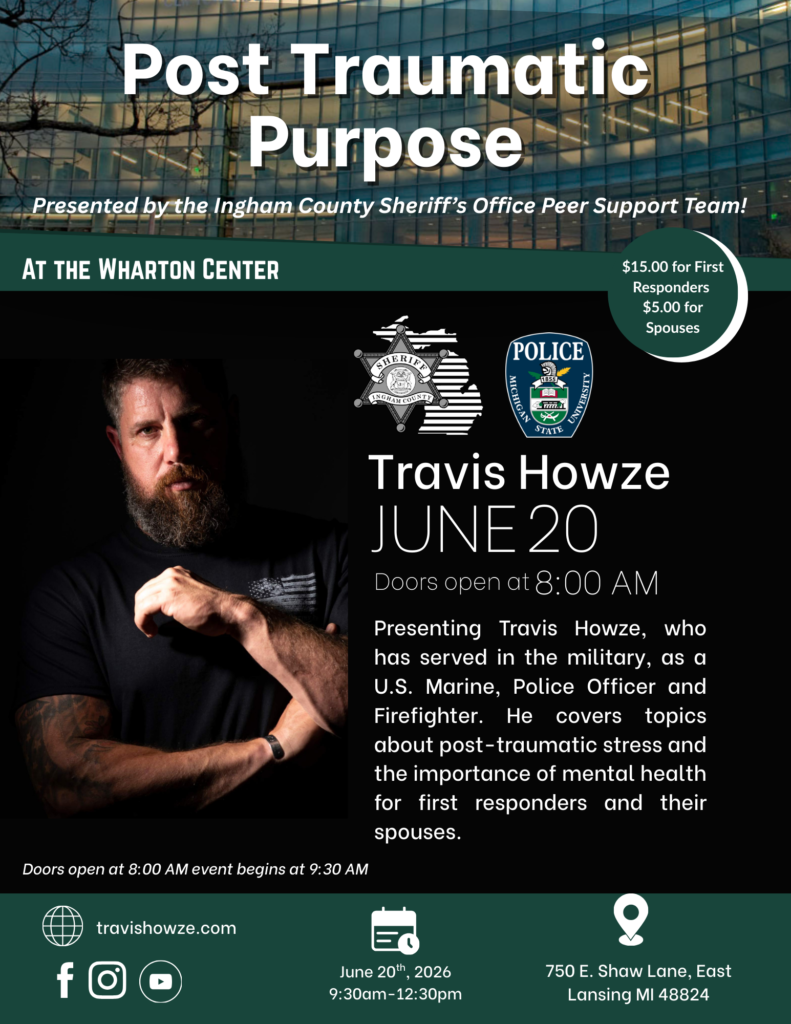
Link to register: https://whartoncenter.evenue.net/promotions/THOWZE26
]]>
 Format: Virtual
  Duration: 3 days Dates:
➥ May 1st, 8th & 15th
➥ Aug. 5th, 6th & 7th
Course Description:
This 3-day course combines ALL of the content of ICISF’s Assisting Individuals in Crisis &
Group Crisis Intervention courses. Crisis Intervention is NOT psychotherapy; rather, it is a specialized acute emergency mental health intervention which requires specialized training. As physical first aid is to surgery, crisis intervention is to psychotherapy. Thus, crisis intervention is sometimes called “emotional first aid”. Designed to present the core elements of a comprehensive, systematic and multi-component crisis intervention curriculum, this course will prepare participants to understand a wide range of crisis intervention services for both the individual and for groups. Fundamentals of Critical Incident Stress Management (CISM) will be outlined, and participants will leave with the knowledge and tools to provide several group crisis interventions, specifically demobilizations, defusing and the Critical Incident Stress Debriefing (CISD). The need for appropriate follow-up services and referrals, when necessary, will also be discussed.
Details:
| Who: | Michigan First Responders in the fields of Police, Fire, EMS, 911 Dispatch, Corrections as well as Mental Health Professionals. |
| Format: | Virtual — click the registration button below for details. |
| Cost: | Free |
| How to Join: | Click the Register button below |
Program Highlights:
- Psychological crisis and psychological crisis intervention
- Resistance, resiliency, recovery continuum
- Critical incident stress management
- Evidence-based practice
- Basic crisis communication techniques
- Common psychological and behavioral crisis reactions
- Putative and empirically derived mechanisms
- SAFER-Revised model
- Suicide intervention
- Relevant research findings
- Large group crisis interventions
- Small group crisis interventions
- Adverse outcome associated with crisis intervention
- Critical Incident Stress Debriefing (CISD)
Objectives:
- Understand the natures & definitions of a psychological crisis and psychological crisis intervention.
- Understand key issues and findings of evidence-based, and evidence-informed practice as it relates to psychological crisis intervention.
- Understand the resistance, resiliency, recovery continuum.
- Understand the nature and definition of critical incident stress management and its role as a continuum of care.
- Practice basic crisis communication techniques.
- Be familiar with common psychological and behavioral crisis reactions, including empirically derived predictors of posttraumatic stress disorder. Assisting Individuals in Crisis and Group Crisis Intervention Training
- Understand the putative and empirically derived mechanisms of action in psychological crisis intervention.
- Understand and discuss the risks of iatrogenic “harm” associated with psychological crisis intervention and will further discuss how to reduce those risks.
- Understand how the SAFER-Revised model may be altered for suicide intervention.
- Understand and discuss the risks of iatrogenic “harm” associated with psychological crisis intervention and will further discuss how to reduce those risks.
- Understand and discuss the ethical implications, risks and obligations of providing group and individual crisis response services
- Define key crisis terms such as “critical incident,” “crisis,” and “crisis intervention.”
- Define key stress management terms such as “stress,” traumatic stress,” and “Critical Incident Stress Management (CISM).”
- Explain role of the comprehensive, integrated, systematic, and multi-component crisis intervention system, known as “Critical Incident Stress Management (CISM).
- Understand the nature of “resistance,” “resiliency,” and “recovery” in the field of CISM.
- List components of a CISM program to conduct group crisis intervention sessions.
- Briefly describe the five elements of CISM’s strategic planning formula.
- Explain the differences between informational and interactive group crisis intervention procedures.
- Practice by participation in role-play scenarios, the Informational Group Crisis Interventions such as:
- Rest, Information, and Transition Services (RITS)
- Crisis Management Briefing (CMB).
- Practice by participation in role-play scenarios, the Interactive Group Crisis Intervention such as:
- Debriefing
- Critical Incident Stress Debriefing (CISD).
Format: Video lecture / discussionDuration: 60 minutes
Course Description:
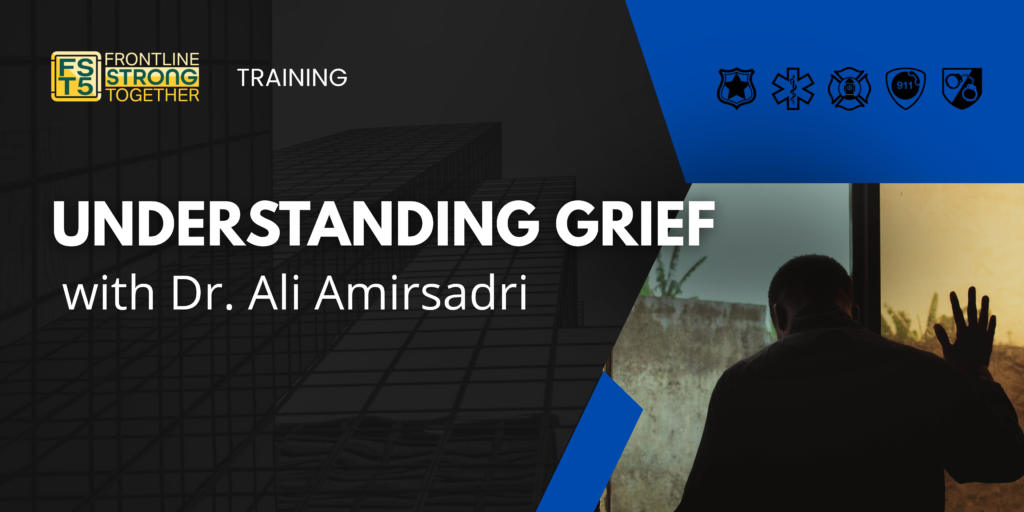
This course explores how grief impacts first responders after traumatic loss, including suicide. Dr. Ali Amirsadri, Chief Medical Officer at Wayne State University’s Department of Psychiatry, joins FST5 peers to discuss emotional and physiological reactions to grief, how to identify complicated grief, and how to support peers, children, and families through loss.
Key Takeaways:
‣ Recognize signs of complicated grief
‣ Support peers and families coping with trauma
‣ Understand how suicide impacts individuals and departments
‣ Build empathy and resilience in high-stress environments
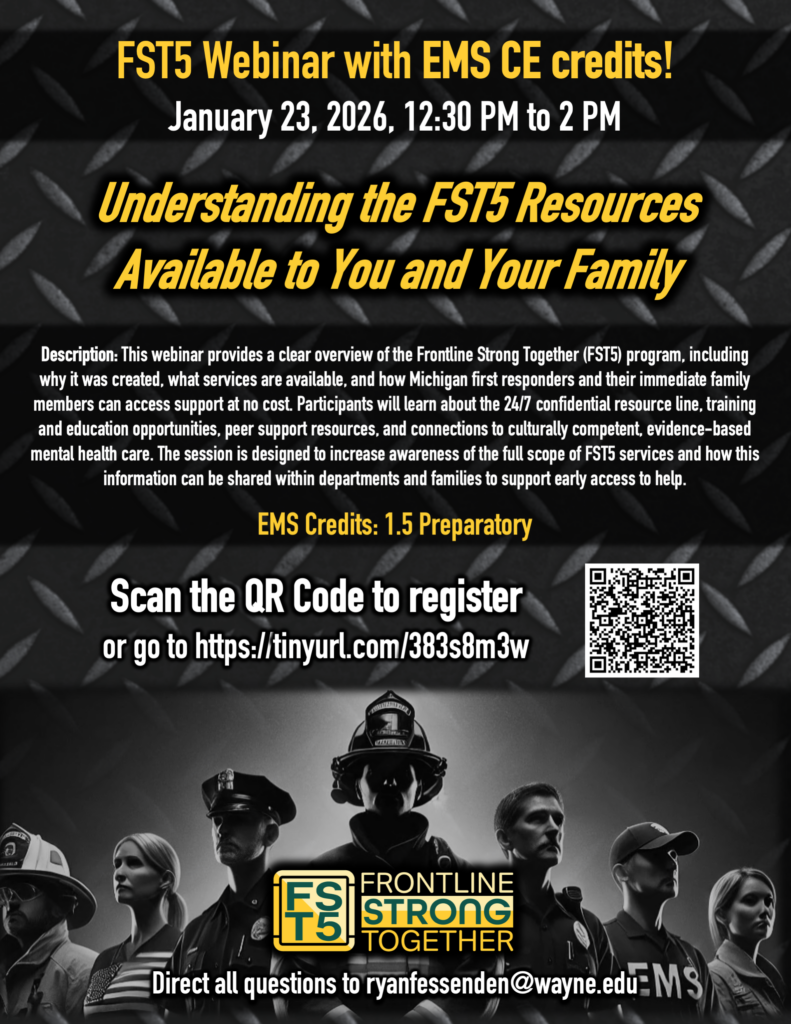
January 23, 2026 12:30 p.m. – 2:00 p.m. Eastern
Description: This webinar provides a clear and practical overview of the Frontline Strong Together 5 (FST5) program. Participants will learn why the program was created, what services are available, and how Michigan first responders and their immediate family members can access support at no cost. The session is designed to help EMS providers and other first responders understand how to share and integrate FST5 resources within their departments and families to support early access to help.
 EMS CE credits available: 1.5 EMS Preparatory credits
 Course contact: [email protected]

(Coming Soon)
Course Description:
Developed by experienced first responders and trauma-informed clinicians, this interactive course provides practical strategies for early intervention, peer connection, and handling acute stress reactions in the field. Participants learn to identify crisis warning signs, de-escalate emotional distress, and connect peers to professional support.
Key Takeaways:
‣ Identify and respond to signs of acute stress
‣ Apply practical peer support and listening skills
‣ Promote early intervention and psychological safety
A powerful and honest roundtable discussion focused on one of the most critical topics facing first responders today — suicide. These events bring together retired and active first responders to share real experiences, real perspectives, and real solutions in understanding and preventing this devastating tragedy — suicide, a painful reality in the lives of first responders. No filters. No judgment. Just an open, raw, and necessary conversation about the challenges we face and the paths toward healing and hope.
]]>A powerful and honest roundtable discussion focused on one of the most critical topics facing first responders today — suicide. These events bring together retired and active first responders to share real experiences, real perspectives, and real solutions in understanding and preventing this devastating tragedy — suicide, a painful reality in the lives of first responders. No filters. No judgment. Just an open, raw, and necessary conversation about the challenges we face and the paths toward healing and hope.
]]>