The post Join Upcoming Healthcare Stakeholder Activities Across Europe appeared first on Future Needs.
]]>Why join the community?
- Access EU research insights and emerging results early
- Shape solutions through validation rounds, testing and stakeholder workshops
- Share your expertise in webinars, roundtables and European events
- Explore EU funding opportunities and future collaborations
- Engage in targeted training and capacity building
Upcoming Opportunities 2026-2027
Future Needs is currently collecting expressions of interest for several upcoming activities.
Train the Trainers Workshop on Health Literacy – Autumn 2026 (Online)
- Free training for professionals in education, healthcare, youth workers, and NGOs
- Speaking opportunities available
- Contact [email protected]
Strengthening Youth Health & Digital Literacy – Spring 2027 (Cyprus)
- Innovative approaches to strengthening youth resilience and digital readiness
- Open to the public
- Speaking opportunities available
- Contact [email protected]
Stakeholder Workshop on EU Funding & AI in Healthcare – Spring 2027 (Athens, Greece)
- EU funding opportunities, AI in healthcare adoption and policy uptake
- Open registration for all stakeholder groups
- More information: https://www.ai4lungs.eu/awareness-workshops
- Contact [email protected]
AI-Driven Innovation in Respiratory Disease Diagnosis & Treatment – Spring 2027 (Athens, Greece)
- Validated AI tools and computational models improving patient stratification for ILDs, infectious diseases and cancer
- Invitation-only stakeholder event
- Speaking opportunities available
- Contact [email protected]
The post Join Upcoming Healthcare Stakeholder Activities Across Europe appeared first on Future Needs.
]]>The post Horizon Europe 2026–2027: Why deadlines are the wrong place to start appeared first on Future Needs.
]]>On paper, this creates a reassuring picture. Deadlines are visible, spread across the year, and seemingly manageable. Many teams respond accordingly by counting backwards from the submission date and planning their writing effort around it.
In practice, this is where many Horizon Europe proposals begin to lose ground. Deadlines are not the moment when proposal quality is shaped. They are the moment when earlier decisions about ambition, partnerships, scope, and internal alignment become visible. By the time a deadline feels “close,” the factors that determine competitiveness are often already fixed, for better or worse.
For experienced applicants, this is not new. Competitive proposals are rarely written under deadline pressure alone. They are built through a longer process that starts months earlier, well before writing begins.
The real proposal timeline: what happens before writing starts
Across clusters and instruments, the preparation of a Horizon Europe proposal follows a recurring pattern. While details vary by topic and consortium, the underlying journey remains remarkably consistent, particularly for collaborative projects with September deadlines.
What follows is not an idealised process, but a realistic one, reflecting how most consortia actually move from a published Work Programme to a submitted proposal.
Phase 1: Early signals and positioning
(around 8–6 months before the deadline or earlier)
This phase begins quietly.
The Work Programme is published, or pre-published drafts begin circulating. Calls are not yet open, and writing feels premature. Many teams describe this period as “too early to start,” even though important groundwork is already taking place.
Typical activities in this phase include:
- Monitoring the Work Programme and related updates
- Scanning topics for relevance and strategic fit
- Initial internal discussions about whether a call is worth pursuing
- Core partnership is formed
At this stage, uncertainty dominates. Topic texts are read cautiously. Teams are curious, but non-committal. Decisions are provisional, and few partners are ready to invest serious time.
Yet this is where positioning begins. Early interpretation of the topic, even if incomplete, influences which ideas are explored and which are discarded. Waiting passively during this phase often means inheriting decisions later — shaped by others who moved sooner.
Phase 2: Info days and interpretation
(around 6 months before the deadline)
As infodays take place — online and in person — the picture starts to sharpen.
Infodays rarely provide definitive answers, but they do offer valuable signals: clarifications of scope, emphasis points, and implicit expectations behind the topic text. For attentive teams, this phase is less about “finding the answer” and more about refining interpretation.
Typical activities include:
- Attending infodays and information sessions
- Comparing interpretations across partners
- Testing early ideas against Work Programme priorities
This is when first concept writing occurs. It is a thinking phase. The goal is to reduce ambiguity enough to decide whether a concept is viable and worth committing to.
Teams that skip this step often move directly into drafting later, only to discover misalignment between their idea and the evaluator’s expectations.
Phase 3: Consortium formation and commitment
(around 6–5 months before the deadline)
This is where preparation becomes real.
Around late spring — April, for many September calls — discussions shift from exploration to commitment. Consortia begin to take shape. Partners outside the core team are approached, roles are negotiated, and responsibilities are tentatively assigned.
Typical focus areas include:
- Identifying complementary expertise
- Securing partners with credible roles, not just names
- Aligning expectations on contribution and workload
- Adding partners to the proposal in the funding and tenders portal
This phase is decisive. The composition and internal logic of the consortium will shape the proposal’s ambition, feasibility, and coherence long before a single paragraph is written.
Once partnerships are finalised, flexibility decreases. Late changes are costly, and unresolved uncertainties tend to resurface later, often during budgeting or final drafting, when there is little time to correct course.
At this point in the process, many teams still feel they have “not started yet.” In reality, the foundations of the proposal are already being laid.
Phase 4: From ideas to structure
(around 5 months before the deadline)
Once a consortium is largely in place, the focus shifts from whether to apply to what exactly will be proposed.
This is the phase where high-level ideas are tested against the realities of the Work Programme. Broad ambitions need to be translated into a coherent extended concept that fits the scope, expected outcomes, and constraints of the call.
Typical activities in this phase include:
- Turning early ideas into a structured project concept and preliminary Work Package structure
- Mapping objectives and expected outcomes against the topic text
- Identifying the core logic of the proposal: why this consortium, why now, why this approach
This work often happens through an extended concept note, slide decks, or internal summaries rather than formal proposal text. The aim is not polish, but alignment.
Decisions taken here quietly shape the rest of the process. An overly ambitious concept may survive initial discussions, only to collapse later under budget or feasibility pressure. A vague concept may move forward, but struggles to convince evaluators once details are required.
Teams that invest time in this phase gain clarity early. Those who rush it often carry unresolved questions forward, where they become harder to address.
Phase 5: Draft logic and task structure emerge
(around 3–2 months before the deadline)
As the deadline approaches, abstract ideas begin to solidify into something recognisable as a proposal.
By this stage, many consortia aim to have:
- A short ambition or motivation document outlining the project’s core narrative
- A more mature Work Package and task structure
- A first draft of the Impact section
- Initial thoughts on who does what and budget — even if imperfect
This is often a messy phase. Task descriptions overlap. Responsibilities are uneven. Gaps appear between ambition and implementation. It is not unusual for this material to feel fragmented or inconsistent.
What matters is not that everything is perfect, but that the underlying logic is visible and can be tested.
This phase acts as a stress test. Weaknesses that were abstract earlier now become concrete:
- Is the workload realistic?
- Are partner roles credible and balanced?
- Does the structure actually deliver the promised outcomes?
If these questions are addressed here, the proposal gains stability. If they are postponed, they tend to resurface later — when time and flexibility are limited.
Phase 6: Budget pressure and the “valley of death”
(around 1 month before submission)
For many consortia, this is the most difficult phase of the entire process.
As budgets are drafted and aligned with tasks, unresolved issues come to the surface. Contributions that seemed reasonable in theory may no longer fit. Partners reassess their level of engagement. Motivation can dip, particularly for proposals targeting September deadlines after a long preparation period.
This stage is often described as a turning point:
- Engagement becomes uneven
- Momentum slows
- Some teams quietly step back (especially during summer)
It is here that a significant number of proposals lose viability, not because the idea is weak, but because the process has exhausted the consortium’s capacity to push forward.
Experience shows that consortia with: a) clearly defined authorship, and b) structured support through this phase are far more likely to continue. Others struggle to recover, even with substantial effort in the final weeks.
By the time this phase is reached, the deadline is close, but the room for strategic correction is already narrow.
What follows is the most visible part of the process: the final rush to submission. But by then, leverage is limited, and most outcomes are already determined.
Phase 7: The final stretch
(last 15 days before the deadline)
The final weeks before submission are intense, visible, and familiar to anyone who has worked on a Horizon Europe proposal.
At this point, most structural decisions have already been made. The focus shifts to execution:
- Finalising text across all sections
- Completing Gantt charts, tables, and forms
- Consolidating partner inputs
- Addressing ethics, open science, and formal requirements
- Collecting declarations and letters of support
Activity levels peak, but strategic flexibility is minimal. Changes made at this stage are often reactive, fixing inconsistencies, filling gaps, or reconciling last-minute partner feedback. While effort is high, leverage is low. The quality of the proposal in these final days largely reflects the groundwork laid months earlier. Strong structures tend to hold. Weak ones require disproportionate energy from the proposal coordination team to stabilise.
For many teams, this phase is less about improvement and more about endurance.
Phase 8: Submission
(deadline day)
Submission marks the end of a long process.
Proposals are uploaded, sometimes well ahead of time, sometimes just before the system closes. Relief follows exhaustion. For a brief moment, attention shifts away from what could still be changed to what has already been delivered.
Not all proposals reach this point. Despite months of preparation, some consortia fail to submit any version at all. Others submit proposals they know could have been stronger, had key decisions been taken earlier.
In both cases, the outcome rarely hinges on the final days alone.
Reframing the question: when does Horizon Europe preparation really start?
The publication of the Horizon Europe Work Programme 2026–2027 provides clarity on topics, budgets, and timelines. It also triggers a familiar reaction: a renewed focus on deadlines.
Deadlines matter. But they are signals, not starting points.
Competitive Horizon Europe proposals are shaped long before writing begins, during months of interpretation, alignment, and decision-making that remain largely invisible in the submission calendar. Early preparation creates space to think, not just to act. It allows consortia to test ideas, build credible partnerships, and resolve tensions before they become risks.
Experienced teams recognise this. They treat proposal development as a process, not an event, and engage support when it can still influence structure, not only when pressure is highest.
For the 2026–2027 calls, the most important question is not when the deadline is. It is when should preparation begin?
That answer almost always comes earlier than expected.
What this means for your 2026–2027 proposal planning
For Horizon Europe 2026–2027, the Work Programme is already published, and the submission calendar is visible. What remains less visible — but far more decisive — is the preparation window that comes before drafting begins. This early phase is where topic interpretation is tested, consortia are shaped, and proposal logic is built. Once deadlines feel close, the opportunity to influence these elements has largely passed.
Future Needs supports consortia during this upstream phase — before writing pressure sets in — helping teams structure ideas, align partners, and build proposals that are coherent, credible, and ready for evaluation.
If you are considering a 2026 or 2027 Horizon Europe call, the most effective moment to start the conversation is not when the deadline approaches, but when the preparation window opens. Let’s talk – email us at [email protected].
The post Horizon Europe 2026–2027: Why deadlines are the wrong place to start appeared first on Future Needs.
]]>The post Erasmus+ KA2 Proposal Writing: Practical Handbook for Applicants appeared first on Future Needs.
]]>This handbook answers the most common and critical questions applicants face when preparing KA2 – Partnerships for Cooperation proposals under the lump-sum funding model, introduced for KA2 projects in 2021. It is designed to support the proposal-writing phase by clarifying key requirements, limits, and evaluation expectations. It does not replace the Erasmus+ Programme Guide, but highlights aspects that are frequently misunderstood or underestimated.
The article focuses on the aspects applicants most often misunderstand when drafting KA2 lump-sum proposals:
(A) how the lump-sum funding model works in practice,
(B) how budget logic is expressed through work packages,
(C) how subcontracting is allowed, limited, and assessed, and
(D) how objectives, results, indicators, impact, and dissemination are evaluated under lump sums.
A. Lump-sum funding model
1. What does the lump-sum funding model mean for KA2 Cooperation Partnerships?
Under the lump-sum model, the grant is awarded as a fixed amount linked to the approved project design. Funding is not based on reimbursement of actual costs. Applicants commit to implementing the work packages, activities, and results described in the proposal for the agreed lump sum. During reporting, the focus is on whether the planned work has been delivered, not on how much was spent.
2. How is the lump-sum amount determined at proposal stage?
Applicants select one of the predefined lump-sum amounts available for KA2 Cooperation Partnerships. The selected amount must be consistent with the project’s scope, duration, objectives, and work packages. Evaluators assess whether the proposed activities and results are realistic and proportionate for that amount. The lump sum is fixed at grant award and is not recalculated later.
3. What lump-sum amounts are available for KA2 Cooperation Partnerships?
KA2 Cooperation Partnerships offer a limited set of predefined lump-sum amounts of €120,000, €250,000, or €400,000, depending on project scale and duration. Applicants must choose one single amount when submitting the proposal. This amount represents the maximum EU contribution for the entire project and cannot be increased during implementation.
4. Does the lump sum cover all project costs?
Yes. The lump sum is intended to cover all eligible project activities and costs, including coordination, meetings, travel, development work, dissemination, and subcontracting where applicable. No additional funding can be requested beyond the approved amount. Applicants are expected to design projects that can realistically be implemented within the selected lump sum.
5. Can applicants report or justify actual costs under a lump-sum project?
No. Under the lump-sum model, applicants do not report actual expenditure or submit financial documents such as invoices or timesheets. Reporting focuses on implementation and achievement of the approved work packages and results. For this reason, cost realism must be demonstrated through a coherent project design at proposal stage.
B. Budget logic and work packages
6. Do applicants need to submit a detailed budget breakdown with a KA2 lump-sum proposal?
Applicants do not submit a traditional detailed budget with detailed cost categories. However, they must indicate the total amount allocated per task, and explain how these allocations were determined.
For each work package, applicants are asked to justify the allocated amount and explain how it is cost-effective, including how amounts relate to the planned tasks. Evaluators assess budget credibility through these explanations, even though no financial cost reporting is required later.
Applicants should also fill in the summary budget table that indicates the budget per partner per workpackage.
7. How detailed does cost planning need to be in the application?
Cost planning is carried out internally by the partnership and is not submitted as a financial breakdown. However, the proposal must show that the planned activities are feasible within the chosen lump sum. Projects that appear over-ambitious or under-specified may raise concerns during evaluation.
8. How are work packages linked to the lump-sum amount?
Work packages are the main element used to justify the lump sum. Each work package should clearly describe its objectives, activities, responsibilities, and expected results. Evaluators assess whether the overall combination of work packages can reasonably deliver the project objectives for the selected amount.
9. What is the role of work packages in the evaluation of a lump-sum proposal?
Work packages allow evaluators to assess feasibility, coherence, and value for money without reviewing detailed costs. Well-structured work packages support the assessment of quality and implementation capacity. Weak or unclear work packages are a frequent source of lower quality scores under the lump-sum model.
10. Does payment depend on completion of activities in the work packages?
Yes. Under the lump-sum model, payment depends on whether the approved work packages and activities have been implemented as described in the proposal. At final reporting stage, assessors verify achievement of planned results against the approved work plan. If work packages are only partially implemented, the grant may be reduced proportionally.
C. Subcontracting under KA2 lump sums
10. Is subcontracting allowed in KA2 lump-sum projects?
Yes, subcontracting is allowed. However, it must be clearly justified and limited to tasks that partners cannot reasonably carry out themselves. Subcontracting cannot replace the core responsibilities of the partnership.
11. Which types of activities can be subcontracted under KA2?
Subcontracting is typically acceptable for specialised or technical tasks, such as external evaluation, translation, graphic design, or IT development. These tasks must directly support the project objectives. Subcontracted activities should be clearly described and proportionate to the project scope.
12. Which activities cannot be subcontracted?
Activities related to project coordination, management, decision-making, and core content development cannot be subcontracted. These tasks must be performed by the partner organisations themselves. Subcontracting core activities may raise concerns regarding eligibility and project quality.
13. How should subcontracting be justified in the proposal?
Applicants should explain why subcontracting is necessary, which activities will be subcontracted, and how these tasks contribute to the project objectives. The justification should demonstrate that subcontracting complements partner expertise rather than replacing it. Generic or unexplained subcontracting is viewed critically during evaluation.
14. Is there a maximum share of the lump sum that can be subcontracted?
The Programme Guide does not set a fixed percentage limit for subcontracting. However, subcontracting must remain proportionate to the project design and partnership roles. Excessive subcontracting may lead evaluators to question the relevance, capacity, and balance of the consortium.
15. How does subcontracting affect the evaluation of partner roles?
Evaluators assess whether partners retain meaningful and clearly defined responsibilities. If key tasks are subcontracted, partner roles may appear reduced or unclear. This can negatively affect the assessment of quality and feasibility.
16. What are the main risks related to subcontracting in lump-sum projects?
The main risks include over-reliance on subcontractors, unclear task allocation, and insufficient justification. These issues can affect evaluation scores and may lead to difficulties at final reporting if expected results are not fully achieved. Transparency and proportionality are essential.
D. Objectives, results, and indicators
17. How should project objectives be formulated in a KA2 lump-sum proposal?
Objectives should be clear, realistic, and aligned with the selected KA2 action. They must be achievable within the proposed duration and lump-sum amount. Well-defined objectives support the assessment of relevance and internal coherence.
18. What results are expected from a KA2 Cooperation Partnership?
KA2 projects are expected to deliver tangible results that respond to the needs of the identified target groups. Results may include tools, methodologies, training materials, or cooperation frameworks. Where relevant, results should be usable beyond the project lifetime.
19. What is the difference between results, deliverables, and indicators?
Results refer to the change or benefit generated by the project. Deliverables are concrete outputs produced during implementation. Indicators are used to measure progress and achievement of results. Clear distinction between these elements supports evaluation clarity.
20. How detailed do indicators need to be in a lump-sum proposal?
Indicators should be sufficiently specific to show how progress and achievement will be assessed. Both qualitative and quantitative indicators may be used. Evaluators look for indicators that are consistent with objectives and work packages, rather than excessive technical detail.
E. Impact and dissemination
21. How is impact assessed in KA2 lump-sum proposals?
Impact is assessed based on the plausibility of benefits for target groups and participating organisations. Evaluators consider whether results are likely to be used and sustained. Clear links between activities, results, and users strengthen the impact assessment.
22. How should dissemination activities be described under the lump-sum model?
Dissemination activities should be concrete and proportionate to the project scale. Applicants should specify what will be disseminated, to whom, and through which channels. Broad or generic statements about visibility are usually scored conservatively.
23. Do dissemination activities need to be linked to specific partners?
Yes. Dissemination responsibilities should be assigned to partners with access to the relevant target groups. Clear role allocation supports feasibility and coherence. Unassigned dissemination activities may raise implementation concerns.
24. Can dissemination activities be subcontracted?
Dissemination may be subcontracted only for specific technical tasks, such as graphic design, branding, website development. Strategic dissemination planning and engagement with target groups must remain with the partners. Subcontracting dissemination without partner involvement may weaken impact assessment.
F. Final checks and risk awareness
25. What are the most common mistakes to avoid in KA2 lump-sum proposals?
Common mistakes include misunderstanding the lump-sum logic, weak work-package structure, unjustified subcontracting, and unclear partner roles. Over-ambitious objectives without corresponding activities also reduce feasibility. Strong alignment between objectives, work packages, and results is essential.
Closing Note
This handbook summarises key aspects of KA2 lump-sum projects that applicants should consider when preparing proposals. For full eligibility conditions and action-specific rules, applicants should always consult the official Erasmus+ Programme Guide and call documents.
Need Support?
For personalised guidance on your KA2 proposal, contact our consulting team at [email protected].
Sources
- European Commission — Erasmus+ Programme Guide 2026, Part B: Key Action 2 – Cooperation Partnerships
https://erasmus-plus.ec.europa.eu/programme-guide/part-b/key-action-2/cooperation-partnerships - European Commission — Handbook on the lump-sum funding model for KA2 – Partnerships for Cooperation
https://drive.google.com/file/d/1iHq9ZHqLgaF3Z64SbuLrhaxhLvRzPWfO/view?usp=drive_link - Ankara University — Erasmus+ KA2 related documents and FAQs
https://www.erasmus.ankara.edu.tr/en/erasmus-ka2-related-documents/ - European Commission — Erasmus+ Teacher Academy: KA2 budget, objectives and impact
https://www.teacheracademy.eu/erasmus-plus/ka2/#budget-objectives-and-impact - Publications Office of the European Union — Official Call for Proposals 2026 (EU Official Journal) https://eur-lex.europa.eu/eli/C/2025/6080/oj
About the authors

Anna Palaiologk, the founder of Future Needs, is a Research & Innovation Consultant with 18 years of experience in proposal writing and project management. She has worked as a project Coordinator and Work Package leader in 30+ EU projects and has authored 50+ successful proposals. Her research background is in economics, business development and policy-making. Email Anna at [email protected].
 Lina Giannivasili is Head of the EU Project Implementation Team and an exploitation expert, with extensive experience in proposal writing and project management across Erasmus+ and Horizon Europe’s Cluster 1: Health; Cluster 4: Digital, Industry & Space; Cluster 5: Climate, Energy & Mobility; and Research Infrastructures. With a background in economics and gender equality, she focuses on integrating these perspectives to maximize the societal and commercial impact of EU-funded projects. Email Lina at lina@futureneeds.eu.
The post Erasmus+ KA2 Proposal Writing: Practical Handbook for Applicants appeared first on Future Needs.
]]>The post New template for Horizon Europe proposals 2026-2027: what changes appeared first on Future Needs.
]]>This article provides a short, authoritative reference for coordinators and proposal teams on what has changed, why it matters, and where to find the official documents.
Which proposals are affected?
The revised Standard Application Form v5.0 applies to:
- Research and Innovation Actions (RIA)
- Innovation Actions (IA)
- Coordination and Support Actions (CSA)
Important: It applies only to call topics published under the Horizon Europe 2026–2027 Work Programme.
Practical reminder: Always use the template linked directly to your specific topic in the Funding & Tenders Portal. Do not reuse earlier versions.
What has changed: The key updates at a glance
The revised templates introduce four major changes:
✓ Lighter Impact section (Section 2.1)
✓ Simplified Work Plan and Resources section (Section 3.1)
✓ Fewer narrative cost tables
✓ Reduced page limits across all action types
These changes aim to reduce administrative load and allow applicants to focus on concept quality, credible implementation, and more flexible impact logic.
Section 2.1 simplified: Project’s pathways towards impact
In Section 2.1, several guidance elements have been removed. Most importantly, applicants are no longer asked to describe the “scale and significance” of their expected contributions. According to the Commission, this requirement proved difficult to quantify in practice and added complexity without improving proposal quality.
What this means in practice
The focus remains on how project results lead to outcomes and longer-term impacts. You should clearly articulate:
- Who benefits from your project
- How they benefit
- Why your approach creates impact
Quantitative estimations of scale or magnitude are no longer explicitly required. This change is aligned with updated evaluator guidance for the 2026–2027 calls.

Revised Section 2.1 “Project’s pathways towards impact” in the Standard Application Form v5.0, showing streamlined guidance and removal of scale and significance prompts.
Source: European Commission – Standard Application Form (RIA & IA), Version 5.0
Section 3.1 simplified: Work plan and resources
In Section 3.1, the following tables have been removed:
- Other cost categories
- In-kind contributions
The purchase costs table has also been simplified and now focuses only on major equipment.
Commission rationale
For proposal evaluation, the Commission notes that:
- Evaluators mainly need high-level information on work planning and major resources
- Additional financial detail can be placed as a comment in the budget table (if the funding model is lump sum) or requested after evaluation, for proposals retained for funding
Practical implications for applicants
✓ Less narrative detail on minor cost items
✓ More emphasis on a coherent work plan, clear task structure, and realistic resource allocation
✓ Budget credibility remains important, but with fewer narrative justifications in Part B

Revised Section 3.1 “Work plan and resources” in Version 5.0, showing the reduced number of cost tables and simplified purchase costs section.
Source: European Commission – Standard Application Form (RIA & IA), Version 5.0
New page limits for proposals
The revised templates introduce shorter, system-enforced page limits.
Warning: Any content exceeding these limits will not be visible to evaluators.
Page limits for 2026–2027 calls
| Action type | Standard topics | Lump sum topics |
| RIA and IA | 40 pages | 45 pages |
| CSA | 25 pages | 28 pages |
When do these changes apply?
- The revised Standard Application Form v5.0 applies to Horizon Europe 2026–2027 call topics only
- It does not apply retroactively to earlier Work Programmes
- The authoritative version is always the one linked in the Funding & Tenders Portal
What this means for proposal teams
Overall, the revised templates reflect a clear shift toward:
- Simplified implementation plan
- Greater flexibility in explaining impact
- Tighter space to demonstrate excellence, impact logic, and implementation quality
Proposal teams preparing for the 2026–2027 calls should adjust early to the revised structure and page limits.
Official templates and EU sources
Revised Standard Application Form (Version 5.0)
- RIA & IA – Part B template: Download from European Commission
- CSA – Part B template:Download from European Commission
Final checklist for applicants
Before you start drafting:
- Use the template linked to your specific call topic
- Do not rely on templates from previous Work Programmes
- Check page limits before drafting begins, not at submission stage
- Review the simplified Section 2.1 and Section 3.1 requirements
- Adjust your work plan to focus on major resources only
How Future Needs can help
Future Needs supports Horizon Europe consortia with:
- Full-package proposal writing under revised templates and page limits
- Impact pathway design aligned with evaluator expectations
- Dissemination, communication, and exploitation (DCE) strategies
Preparing a proposal for the 2026–2027 calls? If you need support on impact, stakeholder engagement, or full proposal development, we’re here to help your team succeed. Contact our team for expert guidance.
Anna Palaiologk, the founder of Future Needs, is a Research & Innovation Consultant with 18 years of experience in proposal writing and project management. She has worked as a project Coordinator and Work Package leader in 30+ EU projects and has authored 50+ successful proposals. Her research background is in economics, business development and policy-making. Email Anna at [email protected].

Chariton Palaiologk, the Head of the EU Project Management Team, is currently leading the project management of 10+ EU-funded projects. He has a background in data analysis and resource optimisation, having worked at the Greek Foundation for Research and Technology. Email Chariton at chariton@futureneeds.eu.

Thanos Arvanitidis is a Researcher & Innovation Project Manager, with a background in physics and biomedical engineering. He manages EU-funded research projects from initial conception through to implementation, working across key Horizon Europe clusters, including Cluster 1: Health; Cluster 4: Digital, Industry & Space. His expertise spans AI, healthcare, cybersecurity, and digital education. Email Thanos at thanos@futureneeds.eu.
The post New template for Horizon Europe proposals 2026-2027: what changes appeared first on Future Needs.
]]>The post Grant Agreement Preparation for Horizon Europe projects: 6 common mistakes and how to overcome them appeared first on Future Needs.
]]>The proposal has passed evaluation, the invitation has arrived, and the project feels secure. This is also the point where projects begin to lose time and room to manoeuvre. GAP compresses legal, financial, and technical decisions into a short window. During this phase, the evaluated proposal is converted into a legally binding Grant Agreement (GA). Once signed, its articles and annexes govern reporting, payments, amendments, and audits for the entire project duration. Assumptions that remain unclear at this stage are rarely neutral. They become obligations.
The patterns below come directly from EC Horizon Europe implementation trainings and agency guidance. They reflect recurring points where consortia run into avoidable friction during GAP, often without realising the long-term impact until implementation has started.
Why GAP changes the balance of control
Before signature, the project exists only in theory. During GAP, that theory turns into a contract.
Annex 1 (Description of Action) and Annex 2 (Estimated Budget) are not administrative attachments. They define what the consortium commits to deliver, how resources are allocated, and how performance will be assessed. Once signed, correcting inconsistencies or unclear commitments requires formal amendments. From the side of the EC, GAP is used to confirm that the project can be implemented as written. From the consortium side, it is often treated as structured data entry. That difference in perspective explains many of the issues that surface later. Below we detail 6 common risks consortia face during GA preparation.
Risk 1: Treating GAP as administration rather than contract finalisation
GAP work is frequently concentrated with a single coordinator or project manager. Partners send inputs independently, assuming that technical and operational questions were settled during proposal writing. During GAP, the focus shifts. Decisions no longer affect evaluation outcomes; they define contractual precision. If deliverables, responsibilities, or effort allocations are accepted without full internal alignment, they become binding commitments. These issues rarely disappear. They tend to reappear months later as reporting clarifications, amendment requests, or audit findings.
A simple check helps here. If no one has reviewed the full Grant Agreement package end to end, including annexes, GAP is being handled as a clerical task rather than a contractual one.
Risk 2: Inconsistencies between Part A and Part B of Annex 1
EC project implementation trainings repeatedly warn against duplicated or misaligned information between Part A, entered in the IT system, and Part B, submitted as the narrative Description of Action. Part A is designed to be updated during the project lifecycle. Part B often is not. When the same information appears in both places and later diverges, the Grant Agreement may contain conflicting obligations. This is common with partner lists, work packages, deliverables, milestones, and effort distribution.
These inconsistencies usually remain unnoticed until an amendment, review, or audit forces a close reading of the contract. At that point, correcting them becomes procedurally heavy.
If information appears in both Part A and Part B and alignment is postponed, the exposure already exists.
Risk 3: Ethics, security, and eligibility checks during GAP
Ethics assessments, security scrutiny, and eligibility checks continue during GAP. They do not stop at evaluation. When issues are identified at this stage, requirements may need to be fulfilled before signature, delaying the Grant Agreement. Other requirements may be added directly to the contract, sometimes generating additional work packages or deliverables through the system. Eligibility conditions, including Gender Equality Plan requirements where applicable, must be met by the time of signature. Proceeding without them is not possible.
When these obligations are introduced during GAP, they shape implementation from day one. They often resurface later as reporting requirements or mandatory deliverables, with limited scope for reinterpretation.
Risk 4: Legal and financial validation for newcomers and coordinators
Legal entity validation, ownership control checks, and financial capacity assessments are often triggered late in GAP. This usually happens because thresholds or preparation steps were underestimated. Agency guidance is clear on the consequences. Financial validation is mandatory above defined grant thresholds. Beneficiaries that are not validated cannot accede to the Grant Agreement. In some cases, the Grant Agreement may be signed without a partner, with accession handled later through an amendment if permitted.
These situations delay pre-financing and complicate early project coordination. When a partner’s validation status remains unresolved close to GAP submission deadlines, signature timing is already under pressure.
Risk 5: Assumptions about deliverables and resource flexibility
Requests for additional deliverables during GAP often come as a surprise. So does the clarification that certain cost eligibility options cannot be changed. Some deliverables, such as data management plans or dissemination and exploitation plans, are standard Horizon Europe obligations. Ethics or security reviews may add further deliverables or even additional Work Packages. Cost options are defined in call conditions and selected at proposal stage; they generally cannot be altered during GAP.
Misunderstandings at this point tend to surface later as amendment requests rather than discussions. By then, flexibility is limited.
Risk 6: Coordination and responsiveness during GAP
Delays that can be prevented by the consortium, frequently stem from missed Declarations of Honour, late accession forms, unclear division of responsibilities, or slow responses to Project Officer requests. GAP tasks run in parallel across beneficiaries. One missing action can block the entire consortium and delay signature. Official guidance frames GAP as a cooperative process that relies on timely, coordinated input across partners.
How experienced consortia approach GAP
Consortia with repeated Horizon Europe experience approach Grant Agreement Preparation with a clear sense of prioritisation.
Some issues determine whether the Grant Agreement can be signed at all: unresolved validations, missing eligibility requirements, or inconsistencies that prevent contractual alignment. Other issues do not block signature but tend to surface later, during reporting periods, amendments, or audits, when correcting them becomes slower and more resource-intensive.
Experienced coordinators account for both.
They begin GAP with a consolidated internal review of Annex 1 and the budget, focusing first on elements that affect signature readiness. Clear and frequent communication with partners is a must. Ownership for technical, legal, and financial inputs is assigned explicitly. Questions are raised early with the Project Officer to confirm constraints while there is still room to clarify them. Decisions taken during GAP are treated as long-term commitments, not short-term formalities.
The difference is rarely knowledge of the rules. It is timing.
Before signature, alignment mainly costs time and coordination. After signature, the same issues often require amendments, delayed payments, or corrective action across the consortium. GAP is the last phase where clarity can be established with relatively low administrative cost.
This is why many consortia choose to involve dedicated project management support during Grant Agreement Preparation, particularly when coordinating multiple beneficiaries or entering Horizon Europe for the first time. Further details on how Future Needs supports coordinators during GAP and early implementation can be found here.
About the authors
Anna Palaiologk, the founder of Future Needs, is a Research & Innovation Consultant with 18 years of experience in proposal writing and project management. She has worked as a project Coordinator and Work Package leader in 30+ EU projects and has authored 50+ successful proposals. Her research background is in economics, business development and policy-making. Email Anna at [email protected].
Chariton Palaiologk, the Head of the EU Project Management Team, is currently leading the project management of 10+ EU-funded projects. He has a background in data analysis and resource optimisation, having worked at the Greek Foundation for Research and Technology. Email Chariton at chariton@futureneeds.eu.
Thanos Arvanitidis is a Researcher & Innovation Project Manager, with a background in physics and biomedical engineering. He manages EU-funded research projects from initial conception through to implementation, working across key Horizon Europe clusters, including Cluster 1: Health; Cluster 4: Digital, Industry & Space. His expertise spans AI, healthcare, cybersecurity, and digital education. Email Thanos at thanos@futureneeds.eu.
The post Grant Agreement Preparation for Horizon Europe projects: 6 common mistakes and how to overcome them appeared first on Future Needs.
]]>The post Horizon Europe Info Days 2026 appeared first on Future Needs.
]]>Find below the schedule of the upcoming 2026 Horizon Europe Info Day sessions:
Cluster 1: Health
 Date: 10 February 2026
 Time: 10:00 (GMT+02:00)
 Location: Online
 Add to Calendar
 More Info & live streaming: Event Details
Cluster 2: Culture, creativity and inclusive society
Date: 26 March 2026
Time: 10:30 (GMT+02:00)
Location: Online
Cal link: Add to Calendar
More Info & live streaming: Event Details
Cluster 4: Digital, Industry and Space
Date: 29 January 2026 – 30 January 2026
Time: 10:00 (GMT+02:00)
Location: Online
Day 1: Add to Calendar, Day 2: Add to Calendar
More Info & live streaming: Event Details
Cluster 5: Climate, Energy and Mobility
Date: 15 January 2026
Time: 10:00 (GMT+02:00)
Location: Online
Add to Calendar
More Info & live streaming: Event Details
Cluster 6: Food, Bioeconomy, Natural Resources, Agriculture and Environment
Date: 22 January 2026 – 23 January 2026
Time: 10:00 (GMT+02:00)
Location: Online
Day 1: Add to Calendar Day 2: Add to Calendar
More Info & live streaming: Event Details
EU Missions
Date: 20 January 2026 – 21 January 2026
Time: 10:00 (GMT+02:00)
Location: Online
Day 1: Add to Calendar Day 2: Add to Calendar
More Info & live streaming: Event Details
WIDERA Work Programme Widening calls
Date: 22 January 2026
Time: 10:30 (GMT+02:00)
Location: Online
Add to Calendar
More Info & live streaming: Event Details
Horizon Europe Research Infrastructures info day
Date: 18 March 2026
Time: 11:30 (GMT+02:00)
Location: Online
Add to Calendar
More Info & live streaming: Event Details
The post Horizon Europe Info Days 2026 appeared first on Future Needs.
]]>The post U-Space Wiki: A Public Glossary Bringing Clarity to Europe’s Future Airspace appeared first on Future Needs.
]]>
When the future flies through our cities, the words describing it should not fly over our heads.
A new public glossary designed to help Europe navigate the fast-evolving world of Urban Air Mobility (UAM), Innovative Air Mobility (IAM), and drone operations is now live.
U-Space Wiki provides accessible, non-technical yet clear explanations of terms used in discussions about drones, U-space services, and related emerging aviation systems, aiming to bridge the gap between the technical jargon used by researchers and drone industry experts and colloquial communication typically targeted towards policymakers, city authorities, and citizens.
A common language for the future of our skies
As Europe moves closer to integrating drones and electric air vehicles into everyday life, one challenge has become increasingly clear: there is still no common language to describe this emerging field. Terminology is often highly technical, fragmented across disciplines, and unfamiliar to those not deeply involved in the aviation industry.
Even within the community, definitions of concepts such as UTM, SWIM, U-space services or geo-awareness can vary, creating gaps in understanding between regulators, researchers, cities, industry, and the public.
“Understanding should never be a barrier to innovation. We want to ensure that everyone: citizens, municipalities, policy makers, and engineers, can follow the progress with clarity and confidence. This glossary is not just a tool. It is an invitation to take part in the conversation about the future of our skies.” – Anna Palaiologk, Founder & Head of Research, Future Needs
Making complex concepts accessible to everyone
Recognising that people absorb information in different ways, the wiki presents each term through a combination of concise text, colour-coded visuals, and light storytelling. Illustrated cards and intuitive icons help concepts feel immediately familiar, while short narrative scenes show how these terms appear in real urban settings. This visual layer not only supports visual learners but also makes complex ideas easier to recognise, recall, and connect.
A living collaborative tool that builds on Europe’s aviation knowledge
U-Space Wiki builds on the extensive work already carried out by Europe’s aviation community, including SESAR, EUSPA and EASA. Rather than duplicating existing glossaries, the platform complements them by focusing specifically on U-space and urban drone operations and addressing a distinct target group.
The wiki is designed from the ground up to be collaborative and transparent. Each term includes references to its original source, allowing users to trace definitions back to the organisations that first introduced them. Furthermore, each term includes a visible history showing how the definition has evolved.
At the same time, the wiki is continuously updated through community participation. Visitors can both submit new terms for inclusion and act as experts by reviewing or refining terminology descriptions to ensure the language remains simple and accessible, while still reflecting the state of the art.
This open contribution model allows U-Space Wiki to grow alongside Europe’s air mobility ecosystem, ensuring that the language used to describe U-space remains accurate, accessible, and shaped by both working directly in the field and being affected by its progress.

A visual term card from U-Space Wiki
Supporting a society ready for Urban Air Mobility
Beyond offering clarity, U-Space Wiki also contributes to Europe’s broader societal readiness for emerging air mobility. As drones and air taxis move closer to everyday use, society needs tools that help people understand, question, and actively shape how these technologies are introduced.
By making terminology transparent and accessible, the wiki empowers citizens, authorities, researchers, and industry to participate confidently in conversations about the future of our skies. In this way, U-Space Wiki is more than a glossary. It is a practical resource supporting responsible, inclusive innovation across Europe.
First contributors
The first set of terms in U-Space Wiki has been hand-picked and referenced by Future Needs and then reviewed by project partners from the Horizon Europe projects RefMap and ImAFUSA, ensuring accuracy, neutrality, and alignment with current European research and regulation.
“Shared terminology is the foundation of effective collaboration. When researchers, cities, and industry align their language, we enable safer, smarter, and more socially accepted drone operations.” – Prof. Antonio J. Torija Martinez, University of Salford.
U-Space Wiki is now publicly available and ready to grow with Europe’s air mobility community. We invite researchers, city representatives, industry experts, students, and curious citizens to explore the glossary, suggest new terms, and help refine existing definitions. Visit www.uspacewiki.eu to learn the language shaping Europe’s airspace future, and contribute to building a shared understanding of tomorrow’s skies.
The post U-Space Wiki: A Public Glossary Bringing Clarity to Europe’s Future Airspace appeared first on Future Needs.
]]>The post Future Needs kicks off Erasmus+ project SME-RISE to support drone entrepreneurs across Europe appeared first on Future Needs.
]]>SME-RISE responds to a fast-growing need in the European drone services sector: while innovation and technical expertise are advancing rapidly, many SMEs, start-ups, and young entrepreneurs lack the business modelling skills, market knowledge, and regulatory understanding needed to build sustainable and scalable drone-based services.
Operating across Portugal, Greece, and Cyprus, the project supports the EU’s digital and green transitions while addressing concrete labour-market needs in vocational education and training (VET).
Future Needs’ role in SME-RISE
Within the project Future Needs plays a central role in both digital implementation and long-term impact.
Our team:
- Designs and develops the online business development platform, including e-learning modules, interactive features, and a resource library
- Leads platform testing, piloting, and optimisation based on real user feedback
- Contributes to business-focused learning content, covering areas such as costing, regulation, and social acceptance of drone services
- Leads the project’s communication, dissemination, and sustainability strategy, ensuring that results remain accessible and impactful beyond the project’s lifetime
- Supports stakeholder engagement and the exploitation of project outcomes
First initiative: tell us what drone businesses really need
As its first activity, SME-RISE has launched a Comprehensive Needs Analysis Survey, aimed at mapping real-world challenges, skills gaps, and opportunities in the European drone services ecosystem.
The survey will directly inform the development of:
- A specialised European training curriculum
- A Drone Business Readiness Tool
- A Regulation Navigator tailored to the drone sector
Who should take part?
This survey is intended for professionals and entrepreneurs based in Portugal, Greece, and Cyprus, including:
- Drone service providers offering drone-based services to clients
- Businesses using drones internally in sectors such as construction, agriculture, security, or infrastructure
Duration: approximately 5–7 minutes
Data protection: responses are anonymous, with contact details requested only on a voluntary basis for follow-up interviews or case studies
Stakeholder input at this early stage is essential to ensure that SME-RISE delivers tools and training that are relevant, practical, and aligned with real market needs.
Future Needs is excited to collaborate with partners across Europe, including Iscte – Instituto Universitário de Lisboa, European Progress, Instituto Pedro Nunes, and Spotin (Spotlight on Innovation), to strengthen entrepreneurship and innovation in the drone services sector.
The post Future Needs kicks off Erasmus+ project SME-RISE to support drone entrepreneurs across Europe appeared first on Future Needs.
]]>The post How to prepare for a financial audit in Horizon Europe projects appeared first on Future Needs.
]]>A successful audit, however, starts long before the audit itself. From supporting projects with their financial management, we’ve learned that the everyday habits – how costs are recorded, how documentation is organised, how consistently teams keep track of their work – make the biggest difference. When this foundation is strong, the audit becomes a much smoother process and far less challenging, simply because everything you need is already in place.
This guide breaks down what to do at each stage of a financial audit:
- Steps to take when you receive the audit letter
- How to handle the verification visit
- What the draft audit report means and how to respond
- What documentation gaps typically lead to rejected costs
The steps below follow European Commission guidance and agency procedures, combined with our first-hand experience in project coordination and financial management support.
What financial audits cover under Horizon Europe?
The Commission, the Research Executive Agency (REA), or external contractors may audit a Horizon Europe beneficiary at any point during the project or for several years after the final payment.
These financial audits verify whether the declared costs are:
- Eligible under Article 6 of the Grant Agreement
- Allocated correctly across reporting periods and work packages
- Linked to project objectives and supported by documentation
An audit can cover a specific reporting period, a cost category, or a risk-based sample of costs. If auditors detect a pattern of errors, the findings may be extended to other projects managed by the same organisation, particularly when internal accounting or cost allocation methods are shared across grants.
What to do when you receive an audit letter?
The audit starts with a Letter of Announcement (LoA), typically emailed to your legal signatory. This letter sets the scope of the audit and proposes a timeline for documentation submission and the verification visit. It also includes an annex with a checklist of required documents.
When you receive the LoA/audit letter:
- Log into Funding & Tenders Portal → Formal Notifications.
- Open the notification and acknowledge (sign with EU-Login) within 15 days.
- Select communication means (electronic vs paper) if prompted.
Next:
- Review the annex(es) with the requested documents ( Annex I: Supporting documents before and during the audit, Annex II: Internal Control Questionnaire, Annex III: Detailed Cost Breakdown (Excel format)).
- Note all listed evidence categories and deadlines.
- Form internal audit-preparation team (finance, project lead, HR, legal/compliance).
- Confirm that Portal roles (LEAR / AUCO / PLSIGN / Account Admin) are current.
Planning:
- Set internal deadlines that leave time for quality checks before the auditor visit.
- Assign responsibilities for each evidence category (who gathers, who checks).
The required documents include:
- Breakdown of actual costs by budget category
- Contracts and procurement records
- Time declarations and monthly timesheets
- Internal control procedures for project accounting
- Payment evidence: bank statements, invoices, receipts
Create a central archive, ideally using cloud-based storage accessible by your audit team. Use a standard file naming structure, such as “WP4_travel_receipt_FRANKFURT_OCT2022.pdf”. Keep copies of scanned originals, and ensure paper copies are available if requested.
A Certificate on the Financial Statements (CFS) is required for any beneficiary (or affiliated entity) whose total EU contribution reaches €430,000 or more, calculated across the entire project including indirect costs. The CFS, issued by a qualified auditor, is submitted only with the final financial report, even if interim certificates are prepared. Its cost is eligible under “other goods, works or services” (category C.3) and should be budgeted at the proposal stage. Download the official CFS template here.
Note: This €430,000 threshold applies only to Horizon Europe. Other programmes (including Horizon 2020, AMIF, ISF, etc.) use different, often lower thresholds, so always check the rules of the specific funding scheme.
Preparing for the verification visit
The verification visit may take place remotely or onsite. Auditors will contact you beforehand to request initial documents, and during the visit, they review your supporting evidence, interview key staff, and clarify open points. A visit can last several days, depending on the complexity of the claim. After the visit, auditors often follow up with additional questions or requests for further documentation.
Preparation tips:
- Confirm staff availability: make sure those who managed cost reporting and document filing are present and briefed
- Share documents in advance: this saves time and lets auditors prepare detailed questions
- Use the same document structure as the audit annex: this shows you’re aligned and reduces friction
- Prepare to explain grey areas: for example, justify subcontracting decisions or unusual staff allocations
- Keep a log of all auditor questions and your responses, especially if multiple people are involved
By the end of the visit, auditors will outline preliminary findings and inform you of the next steps. You won’t get the final word at this stage, but you will know what issues are emerging.
Responding to the draft audit report
The draft audit report outlines the auditor’s findings, preliminary conclusions, and any cost categories flagged as ineligible. This is your opportunity to correct misunderstandings, explain costs more clearly, or submit overlooked documentation.
In this phase:
- Review the report line by line and group responses by finding
- Match each comment with supporting evidence: contracts, screenshots, and clarifications from internal policy
- Use concise, factual language and avoid unnecessary commentary
- Ask questions early if findings seem inconsistent or vague
- Prepare and submit the Letter of Representation, signed by your legal representative, stating that the response is accurate and complete
Delays in this stage can result in automatic acceptance of the original findings, even if they’re based on missing context or documents you can still provide. It’s also worth having one person coordinate the response; this reduces the risk of contradictory replies from different departments.
What happens after your response
Once your observations are reviewed, the EC or agency sends a final audit report and a Letter of Conclusions. These documents confirm:
- Which costs were accepted or rejected
- Whether systemic errors were identified
- Whether a recovery order will be issued
Rejected costs may be subtracted from future payments, offset against other grants, or requested as direct reimbursement. If systemic errors are identified, the EC can extend the audit results to other projects from your organisation. This may lead to broader audits or suspensions of payments until corrections are made.
In rare cases, unresolved audit disputes can be referred to the Court of Auditors or OLAF if fraud or abuse is suspected. However, in most cases, detailed record-keeping and timely responses typically resolve audit concerns without escalation.
What gets flagged most often
According to the EC’s own error analysis from Horizon 2020, the most frequent audit findings include:
- Personnel costs declared without reliable time tracking
- Subcontracting costs unsupported by formal contracts or competitive selection
- Incorrect hourly rate calculations, especially when applying actual vs unit cost models
- Travel reimbursements with missing invoices or travel justifications
- Declared costs falling outside the eligibility period stated in the Grant Agreement
Even when the work was completed and the money was spent, auditors will reject costs if the documentation doesn’t support them.
With the right financial management throughout the project, an audit doesn’t have to be scary. If you’d like us to help you keep your project’s finances organised and audit-ready, our team at Future Needs can support you every step of the way through our Project Management services, so you’re fully prepared when the time comes.
Sources
- EU Funding & Tenders Portal – Checks, audits, reviews & investigations
- Indicative Audit Programme (IAP), European Commission
- SPA Procedure, European Commission, 2025
- Best Practices for Record Keeping – REA MSCA
- EC – How to Avoid Errors When Claiming Costs (2019)
- Formal Notifications for audits – IT How To – Funding Tenders Opportunities
About the authors
Anna Palaiologk, the founder of Future Needs, is a Research & Innovation Consultant with 18 years of experience in proposal writing and project management. She has worked as a project Coordinator and Work Package leader in 30+ EU projects and has authored 50+ successful proposals. Her research background is in economics, business development and policy-making. Email Anna at [email protected].
Lina Giannivasili is Head of the EU Project Implementation Team and an exploitation expert, with extensive experience in proposal writing and project management across Horizon Europe’s Cluster 1: Health; Cluster 4: Digital, Industry & Space; Cluster 5: Climate, Energy & Mobility; and Research Infrastructures. With a background in economics and gender equality, she focuses on integrating these perspectives to maximize the societal and commercial impact of EU-funded projects. Email Lina at lina@futureneeds.eu.
The post How to prepare for a financial audit in Horizon Europe projects appeared first on Future Needs.
]]>The post How to organise a successful clustering event for EU projects appeared first on Future Needs.
]]>After organising several clustering events across different industries – from sustainable construction to digital aviation, and High-Performance Computing (HPC), Future Needs has developed a set of internal procedures for making these events successful and impactful.
We’re sharing some of the lessons and practices we’ve found most valuable, hoping they’ll serve anyone preparing to organise their own clustering event.
1. Start with the value, not the venue
The first step in any successful event is understanding why participants should attend. Before booking a venue or drafting an agenda, you should define the unique value proposition for attendees.
This could mean offering:
- Opportunities to speak or join panel discussions
- Certificates of attendance, especially for trainees or early-career researchers
- Joint workshops that address shared objectives between projects
- Showcase sessions where consortia present their latest results or technologies
For example, during the Aviation Twin Transition (ATT) Clustering Event, hosted by the RefMAP project and organised by Future Needs, the value created for participants was the opportunity to present their research to a like-minded audience, engage in discussions with peers facing similar challenges, and identify how their project results could complement others to achieve a stronger collective impact in the field of sustainable aviation and urban air mobility.
A value-first approach ensures that your event serves its audience, and, by extension, the goals of every participating project.


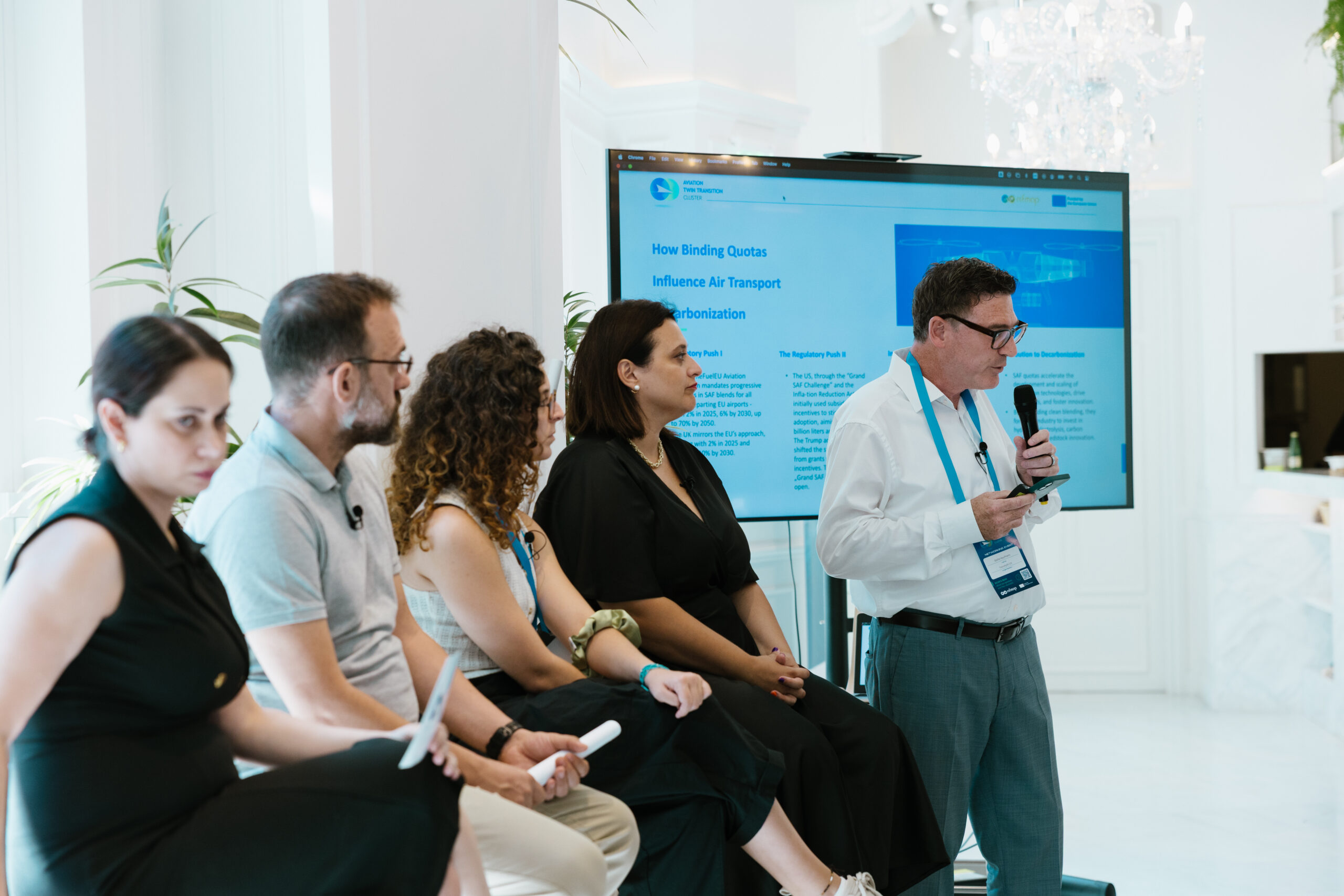
The Aviation Twin Transition (ATT) Cluster Event, hosted by the RefMAP project and organised by Future Needs in Athens.
2. Build on existing networks
In the EU research landscape, no project exists in isolation. Before reaching out broadly, it’s worth exploring which related projects, experts, and initiatives could add value to your agenda. Many of them may already be within your extended consortium or professional network!
3. Plan early
For EU projects, timing is everything. Larger clustering events often require 12 months of lead time, while smaller workshops need at least 6. Promotion should begin well before all details are finalised.
A clear planning timeline includes:
- Early “Save the Date” announcements (even if details are pending)
- A preliminary high-level agenda – a few key themes are enough to start engagement
- Consistent updates as speakers, workshops, and sessions are confirmed
Transparency builds anticipation and helps partners align internal calendars, especially when travel or coordination across countries is involved.
4. Create opportunities for collaboration
A well-designed clustering event goes beyond presentations; it actively facilitates collaboration. Consider integrating:
- Joint dissemination sessions, where projects explore common outreach channels
- Panel discussions that mix technical and societal dimensions
- Interactive workshops focused on policy recommendations or exploitation strategies
For example, during the Circular Construction Clustering Event under the RECONMATIC project, participating projects co-developed ideas for future research proposals and shared upcoming dissemination opportunities, turning a single-day event into a launchpad for ongoing collaboration.


Clustering Event: “Promoting Circularity in Construction” organised by Future Needs and hosted on the BUILD UP platform, where participating projects co-developed ideas for future research proposals and shared upcoming dissemination opportunities.
5. Prioritise inclusivity and a balanced Agenda
An engaging agenda is at the heart of every successful event. It should combine technical depth, policy relevance, and room for interaction. Publishing even a preliminary version early encourages participation and helps speakers commit in advance.
Equally important is ensuring gender inclusivity and balanced representation. In some industries, where panels can easily become male-dominated, the organising project partner should make a conscious effort to achieve fair representation and highlight diverse voices.
For example, during the HPC Clustering Event organised by Future Needs, a panel titled “Digital Twins for Sustainable Cities: From Buildings to Urban Air” was designed with gender equality in mind, featuring close to equal representation between male and female speakers. This approach not only showcased a wide range of expertise but also set an example for how technical fields can integrate inclusivity into event design.
Attention to balance and representation strengthens an event’s credibility and aligns with Horizon Europe’s broader commitment to equality and diversity, principles that should never go unnoticed in research and innovation.


Panel Discussion: “Digital Twins for Sustainable Cities: From Buildings to Urban Air” during the HiDALGO2 Clustering Event – HPC and Big Data Technologies Addressing Global Challenges, organised by Future Needs in Stuttgart.
6. Communicate consistently: before, during, and after
A clustering event’s success depends on visibility, not only within the consortium but across the wider community. A well-thought-out communication plan should begin months in advance and continue well after the event.
Key actions to include:
- Regular social media posts in the months leading up to the event
- Cross-promotion with other EU-funded projects that share similar audiences or themes
- Emailing your network, inviting project partners, sister projects, and relevant stakeholders to attend or share the announcement
- Sharing the news with EU-level media platforms, local media outlets, and thematic portals for wider coverage
- Well-branded event materials and a dedicated webpage with clear information and registration links
- Speaker-focused content such as bios, visuals, and quotes to boost engagement
- Live coverage during the event (social media posts, photos, and short clips)
- A post-event highlights article and thank-you campaign to maintain momentum
By treating the event as a complete communication journey, from early promotion to post-event storytelling, you can maximise participation, visibility, and long-term impact.
Typically, this process is led by the project’s communication and dissemination partner, who ensures consistent messaging and a professional presentation across all channels.
7. Capture and build on momentum
After the event, the work continues. Sending follow-up emails, publishing recordings and presentations, collecting feedback, and documenting lessons learned are all part of the process. These activities contribute not only to project KPIs but also to sustained collaboration among participants.
For example, following the Aviation Twin Transition Clustering Event, Future Needs published speaker videos across YouTube, the project website, and social media, extending the event’s visibility and value long after it concluded. This kind of media follow-up turns a one-day gathering into an ongoing communication asset.
A successful clustering event does more than tick a deliverable box, it strengthens Europe’s research ecosystem. When thoughtfully designed, such gatherings amplify results, build new partnerships, and communicate the collective achievements of the EU’s innovation community.
If you need expert guidance to organise an event for your EU project, reach out to Future Needs at [email protected], we’ll be glad to help you make your next event truly impactful.
About the authors

Georgia Nikolakopoulouk is Head of Dissemination at Future Needs, leading dissemination activities across 7 active EU-funded projects. With a strong background in UI/UX design and communication, she ensures effective outreach and engagement through high-quality materials and strategic planning. Georgia has contributed to more than 10 H2020 and FP7 projects in sectors including Education, Health, and Artificial Intelligence. Email Georgia at georgia@futureneeds.eu.

Egle Joneliunaite is a Communication and Dissemination Manager at Future Needs, leading social media and marketing activities for both projects and the company. She brings nearly 10 years of experience in communication and digital marketing. Passionate about sustainability, Egle also currently leads communication and dissemination efforts for the RECONMATIC project. Email Egle at egle@futureneeds.eu.
The post How to organise a successful clustering event for EU projects appeared first on Future Needs.
]]>