The post Optimizing Chiller Operations and Unlocking Energy Savings with the Cortex Platform appeared first on Cortex Building Intelligence.
]]>Cortex offers a solution. By leveraging advanced AI and machine learning, building managers can unlock substantial energy savings, benefiting both the environment and property owners.
Optimization and Sustainability with Cortex
Cortex’s machine-learning-powered platform revolutionizes chiller operations through predictive analytics. The software forecasts cooling demand with precision, considering real-time data such as occupancy levels, weather conditions, lease obligation hours, and historical usage patterns. This proactive approach empowers building managers to optimize chiller performance and eliminate unnecessary energy use.
Efficient start-up and shutdown processes are essential for minimizing energy waste. Cortex fine-tunes these processes to align with actual cooling demand, ensuring chillers operate only when needed. For example, the system prevents early or late starts during periods of low demand, avoiding energy-intensive operation when it’s unnecessary. These smarter protocols deliver substantial energy savings without compromising occupant comfort.
Cortex also provides comprehensive real-time monitoring to detect and address inefficiencies immediately. This ensures peak performance, extends equipment lifespan, and reduces maintenance costs.
Beyond operational efficiency, Cortex helps organizations meet corporate sustainability goals by lowering energy consumption and reducing carbon footprints. These improvements support certifications like LEED and higher ENERGY STAR ratings, enhancing compliance, reputation, and commitment to environmental stewardship.
The Cortex Advantage
In an era where sustainability and cost efficiency are vital, The Cortex Platform provides a clear competitive edge. With advanced chiller optimization strategies, commercial buildings can:
- Cut energy costs
- Achieve sustainability milestones
- Enhance market standing
- Maintain a comfortable indoor climate for occupants
Cortex enables the future of energy-efficient building management today.
The post Optimizing Chiller Operations and Unlocking Energy Savings with the Cortex Platform appeared first on Cortex Building Intelligence.
]]>The post 757 Third Avenue Wins Earth Building of the Year at the 2024 New York City BOMA Pinnacle Awards appeared first on Cortex Building Intelligence.
]]>The Earth Award is presented to a New York City building demonstrating excellent management and reduction of environmental risks, along with programs dedicated to recycling/recovery/reduction/reuse, general water and energy conservation practices, indoor air quality practices, green purchasing policies and tenant relations.
“The 757 Third Ave management team utilizes emerging technologies to operate our building as energy efficiently as possible, including the Cortex Building Intelligence platform. Their collaborative engineering support and technology-backed insights are transforming our operations, giving our engineers confidence to test and implement new strategies while enhancing our best practices to drive ongoing efficiency and tenant comfort.” Chris Gildea, Director of Property Management, JLL.
“Cortex is honored to support the 757 Third Ave team’s continued innovation in sustainability and asset performance management. This award recognizes their market leadership delivering a more sustainable, comfortable experience for tenants while they make demonstrable progress towards reducing carbon and cost at their building.” Phil Schrieber, Sr. Director of Enterprise Clients, Cortex.
More information about BGO’s approach to sustainability can be found here.
The post 757 Third Avenue Wins Earth Building of the Year at the 2024 New York City BOMA Pinnacle Awards appeared first on Cortex Building Intelligence.
]]>The post Class A office drives energy efficiency with Cortex appeared first on Cortex Building Intelligence.
]]>New York City
1,200,000 Square Feet
Operational Excellence
A leading asset management group partnered with Cortex to enhance energy efficiency and operational performance at their Midtown Manhattan Class A office building.
The challenge
Before using Cortex, building owners had set ambitious sustainability goals to cut costs and reduce energy waste. They faced challenges translating these goals into actionable steps due to a lack of real-time energy monitoring tools, and low confidence to implement operational changes resulting in high costs, energy consumption, and tenant dissatisfaction.
The solution
Cortex integrated its platform into building infrastructure to provide engineers with energy insights, leading to operational strategy changes. They collaborated to beta-test and validate energy management protocols.
Start Up Recommendation
Adjusted HVAC system start-up times using AI/ML to reduce electric consumption while still meeting lease obligations temperatures.
Airside Turndown
Scheduled earlier fan turndown times on Fridays when building occupancy was lower, reducing energy use without impacting tenant comfort.
Overnight Shutoff
Leveraged automated shutoff alerting to identify and mitigate ghost energy consumption during unoccupied hours.
Chiller Coasting
Implemented chiller coasting times between 7:15pm and 7:45pm to improve cooling system efficiency.

$307,000 improved electric efficiency reflected in reduced utility bills
2.2M kWh saved over 9 months of leveraging Cortex recommendations
15% decrease in tenant hot and cold calls
Cortex Data, 2024
The impact
Improved Energy Efficiency
Weather and occupancy normalized building electric efficiency improved 13% YoY.
Delivered Cost Savings
Enhanced operational efficiency and saved $307,000 in electricity expenses.
Increased Alignment and Visibility
Engineers adhered to the ongoing start up and turn down recommendations 80% of the time: proof of their confidence in the platform.
Boosted Tenant Satisfaction
Since the platform launch, the engineering team has experienced a 15% reduction in hot and cold calls from tenants.
Improve your buildings’ efficiency and sustainability with Cortex today
Take control of your energy outcomes, minimize risk, and protect asset value with Cortex’s energy insight platform. Contact us at [email protected] to learn more about how Cortex can help your team improve your building’s efficiency and sustainability.
The post Class A office drives energy efficiency with Cortex appeared first on Cortex Building Intelligence.
]]>The post Decarbonizing CRE: Cortex’s Lisa Rockefeller shares key energy management insights with the Tangent Proptech Podcast appeared first on Cortex Building Intelligence.
]]>In a recent episode of the Tangent Proptech Podcast, Lisa Rockefeller, Cortex’s Chief Revenue Officer, spoke with host Edward Cohen about the challenge of decarbonizing commercial real estate. Lisa and Edward’s discussion traversed a range of topics, from aligning stakeholder incentives to driving building efficiency in real-time.
While we recommend listening to the full episode, here are some of Lisa’s key insights:
1. CRE’s carbon problem is complex but addressable
Office decarbonization is exceptionally complex due to the wide array of stakeholders involved in managing each property. As Lisa Rockefeller notes, a typical administrative org chart for an office is likely to feature “four or five different corporate stakeholders – none of whom work for the same [company].” With so many logos contracted to perform different roles in the same building, you can see why it might be challenging for each team to access the information they need from other departments to consistently make informed, sustainable choices that interplay with one another. “We’re bridging the gap with individuals who have no shared lexicon,” she explains.
Despite these issues, Rockefeller remains optimistic, urging the industry to continue striving to enhance alignment, collaboration, and data-driven decision-making. “Tech is an enablement tool, but people decarbonize buildings,” she insists, emphasizing the critical role of stakeholder commitment in achieving sustainability goals. We just need to work to foster better “governance and alignment” between the people, processes, and technologies tying organizations together to make it easier.
2. Operational excellence starts with real-time data insights
Achieving operational excellence and reducing carbon emissions requires more than static ESG reports. According to Rockefeller, “Our goal isn’t just to understand the consumption footprint of those assets; it’s really to change it.” By collecting and analyzing data from building management systems (BMS), occupancy sensors, and utility meters in real time, digital tools like Cortex can equip operators with precise recommendations to reduce energy waste and optimize their equipment schedules. They can also inform “how your costs are accruing… and how time of use, procurement, [and] energy intensity is translating… into emissions.” Real estate professionals at every level of an organization can use Cortex to coordinate action and track their progress toward sustainability goals, improving internal visibility across teams so that they can work together to stay on track. As a client once remarked about Cortex to Rockefeller, “It’s like Waze for my building.”
3. Strategies like Green Leasing can help foster alignment
Green Leases, rental agreements designed to incentivize tenants to participate in energy conservation, can help foster collaboration between tenants and owners to minimize energy waste. “Tenants are on the hook for energy costs, and they don’t want to be billed for poor energy decisions,” Rockefeller emphasizes. By convincing tenants to agree to reduce heating and cooling during non-peak hours, both parties can progress toward their sustainability objectives. This approach bridges the gap between tenants and owners and gives engineers more leeway to pursue cutting-edge energy management strategies without fear of tenant reprisal.
The bottom line
The insights Lisa Rockefeller shared with the Tangent Proptech Podcast offer a roadmap for commercial real estate stakeholders to follow to achieve their ambitious sustainability targets. By working to improve internal alignment, embracing data-driven decision-making, and fostering tenant-owner collaboration through green leasing and other creative strategies, the commercial real estate sector can supercharge its ongoing sustainability efforts.
Tune in to the full Tangent Proptech Podcast episode to listen to the full conversation.
Ready to take the next step?
Discover how Cortex can unlock your sustainability efforts by helping you to seamlessly implement best-in-class energy management strategies in real time!
The post Decarbonizing CRE: Cortex’s Lisa Rockefeller shares key energy management insights with the Tangent Proptech Podcast appeared first on Cortex Building Intelligence.
]]>The post Bridging the gap | Part 1: Empowering building engineers to enhance energy management appeared first on Cortex Building Intelligence.
]]>Today, we’re kicking off a blog series informed by their perspectives on the importance of bridging the gaps between CRE teams within organizations to facilitate better internal alignment and informed decision-making. We’ll start the series by covering the challenges faced by building engineers as they work to enhance their properties’ energy performance.
Subsequent posts will cover:
- Property managers – the issues preventing property managers from effectively implementing energy efficiency initiatives.
- Sustainability teams – the missing data sustainability leads need to make purposeful decisions.
Let’s dive in!
Challenges for building engineers
The stack of jobs for building engineers is extensive. From security to occupant engagement and vendor management, managing energy efficiency is just one of many daily tasks. While the engineers we’ve spoken with are supremely dedicated to optimizing their buildings’ energy performance, their best efforts are often stifled by three structural problems:
1) A fragmented approach to energy efficiency
Though most organizations set big energy goals – whether it’s reduced energy consumption or lower emissions – these goals rarely cascade down through the organization. Often, specific objectives aren’t included in job descriptions, causing confusion within teams about their responsibilities. As we met with different operators, we heard time and time again about the lack of energy goals at the building level: “No, I don’t have specific energy goals. It’s just about making sure we’re running efficiently to save money.”
2) A lack of communication across teams and buildings
Engineers are brimming with innovative ideas; each possesses a deep understanding of how to enhance operational efficiencies. Unfortunately, most firms lack the formal procedures and open lines of communication required to record and implement their ideas to improve energy performance throughout their organizations. This gap means that smart, energy-saving strategies developed at one location rarely benefit other properties in the portfolio. As one engineer noted, “I just take orders, that’s all I am. It feels like upper management doesn’t want to talk to me.” This absence of open communication across building levels not only stifles innovation but can also leave engineers feeling undervalued, especially when their proactive efforts go unrecognized. Another shared, “if you avoid a peak, does anyone say good job? No. But then we hear from [upper management]… if we’re doing something wrong.”
3) Difficulty acting on an overwhelming amount of data
While building engineers have access to extensive data from systems like the BMS, they often find the process of interpreting it to be challenging and incompatible with their routines. As one engineer put it, “The BMS is like having your nose up against a wall of data.” Though the information is there, it’s not structured in a way that supports quick, informed decision-making. And because access to this data is typically confined to a specific location like a basement computer, engineers often struggle to find the time to sort through it for meaningful insights, given their many other responsibilities and the mobile nature of their work.
Impacts of these challenges
The challenges faced by building engineers don’t just impact their daily tasks; they resonate throughout entire real estate organizations, leading to broader operational inefficiencies and missed strategic opportunities. When engineers struggle with unclear goals, limited communication, and inaccessible data, it creates a bottleneck in the flow of information and innovation across the company. Internal disconnection can lead to higher operational costs, slower response times to problems, and a failure to meet energy efficiency targets.
Firms affected by these issues frequently struggle to retain and attract tenants, satisfy investors’ climate risk concerns, and comply with municipal Building Performance Standards to avoid fines. Additionally, they risk losing talented engineers due to internal frustrations and a lack of recognition, further exacerbating these problems and degrading tenant satisfaction. Addressing engineers’ pain points is essential to both improving day-to-day operations and achieving long-term sustainability goals for the benefit of the whole firm.
Potential solutions
In the context of these challenges, how do you bridge information gaps to improve organizational alignment? Software alone doesn’t decarbonize buildings. As a result, any approach needs to consider the people, processes, and technologies that support a cohesive energy management program. Based on our conversations, these are the approaches that leading CRE companies are piloting to make more rapid progress toward their energy and sustainability goals:
People
Establishing regular, structured forums such as town hall meetings and roundtable discussions with property managers, chief engineers, and sustainability teams could foster better communication and idea sharing across properties.
Process
Developing standardized training programs and incorporating energy management goals into job descriptions and performance evaluations could help align individual responsibilities with organizational energy targets. Implementing a standard process for sharing best practices and innovations across the portfolio would ensure that successful strategies are widely adopted.
Technology
Advanced platforms like Cortex can transform how engineers interact with data. By providing actionable insights and real-time guidance, Cortex can serve as a ‘GPS’ for building operations, helping engineers navigate the complexities of energy management with greater ease and precision.
The bottom line
As we continue to explore the critical role of building engineers in achieving corporate sustainability goals, it’s clear that bridging the gap between high-level directives and day-to-day operations is essential. By fostering a culture of open communication, ensuring alignment of goals at all levels, and enhancing access to actionable data, organizations can significantly enhance their energy management practices. Implementing solutions like Cortex that address these gaps not only boosts operational efficiency but also empowers engineers, reinforcing their vital role in the organization’s success.
Learn more about Cortex to discover how your engineering team can leverage our real-time, actionable insights to make daily progress toward your company’s climate objectives.
The post Bridging the gap | Part 1: Empowering building engineers to enhance energy management appeared first on Cortex Building Intelligence.
]]>The post Core Texts: SEC pauses climate rules, office digitalization appeared first on Cortex Building Intelligence.
]]>💡 What you need to know: The U.S. Court of Appeals for the Fifth Circuit temporarily suspended the Securities and Exchange Commission’s (SEC) newly adopted climate disclosure rules following legal challenges from two fracking companies and ten conservative states. As we’ve previously discussed, the deferred rules – which are designed to support investor decision-making – require large firms to report their direct (Scope 1) and indirect (Scope 2) emissions totals, and reveal their financial exposure to climate-related risks. Even before this legal intervention, a corporate pressure campaign leading up to the rules’ adoption coerced the SEC into excluding value chain emissions (Scope 3) from its proposed reporting requirements. Since 88% of investors favor companies that jointly publicize their financial and ESG activities, the Fifth Circuit’s latest decision seems to pose an unpopular roadblock to corporate accountability.
⚡ Why it’s important: The rules’ temporary suspension introduces uncertainty to an already complex regulatory landscape. Companies active in regions with stringent climate reporting requirements, such as California and the European Union, will likely continue to prepare to submit detailed disclosures, regardless of the delay. Other domestic firms, though, need to decide whether to continue with compliance preparations or pivot to address other needs. Since an overwhelming majority of investors prefer to work with companies that disclose sustainability metrics, there’s good reason to voluntarily maintain or even enhance your climate disclosure practices during this time. No matter what the federal government eventually mandates, a proactive stance not only prepares firms to meet future regulatory requirements but could also enhance their marketability and resilience against the backdrop of increasing environmental pressures and oversight.
2. Office digitalization propels CRE sustainability 🔋
💡 What you need to know: In a recent article published by ‘Buildings,’ Lisa Rockefeller dove into the pivotal role that digital solutions must continue to play in helping the commercial real estate sector meet its sustainability targets. Building operations are responsible for 28% of global carbon emissions, a figure surpassing even that of the auto industry. Given that the US government has set decarbonization targets that include a 65% reduction in GHG emissions by 2035 and 90% by 2050, and that most buildings projected to be in use in 2050 already exist, the future of sustainable real estate rests on improving current structures environmental performance. Implementing digital strategies facilitates real-time collaboration among diverse CRE departments, breaking down operational silos and enabling significant reductions in costs, carbon, and energy use. By integrating digital workflows, CRE firms can align their asset management, sustainability, property management, and engineering teams towards unified sustainability objectives, streamlining operations and ensuring consistent application of sustainability practices across portfolios.
⚡ Why it’s important: ️The adoption of digital tools in CRE is vital for overcoming traditional barriers such as split incentives and disjointed operational practices, which often impede sustainability progress. Office digitalization not only improves communication and decision-making across all levels of an organization but also provides essential data for managing and adapting building operations to meet stringent regulatory requirements and tenant demands for green spaces. This strategic approach not only aids in compliance with building performance standards like New York City’s LL97 but also enhances the marketability of properties to tenants prioritizing environmental responsibility, potentially leading to higher rental rates and occupancy. Additionally, as the workforce transitions and new team members step in, digital tools are crucial for maintaining continuity and operational excellence, further supporting CRE firms in meeting aggressive decarbonization goals set by governments and stakeholders.
To gain deeper insights into how digitalization can enhance your office operations, read Lisa Rockefeller’s full analysis here.
3. More news & notes 📌
🚧 SL Green believes 40M SF of NYC offices could be converted to residential space with new legislation.
📗 Cortex published a new comprehensive energy management guide for CRE professionals.
👀 SBTi, a key sustainability watchdog, removed 200+ major firms from its ledger.
🍃 Bisnow, in a new report, argued that CRE lenders should do more to force borrowers to cut carbon.
Cut through the noise ✂️
Subscribe to Core Texts, our weekly newsletter, and get a round up of today’s CRE, Tech and sustainability news delivered to straight to your inbox.
The post Core Texts: SEC pauses climate rules, office digitalization appeared first on Cortex Building Intelligence.
]]>The post Unlocking energy savings: A comprehensive energy management guide for commercial real estate professionals appeared first on Cortex Building Intelligence.
]]>In a year marked by limited capital, a flight to quality by tenants, surging regulations, and unprecedented climate events, energy efficiency should be front and center for any commercial real estate professional. By making energy management a priority, you can enhance operational efficiency, cut energy use, and drive sustainability progress.
Energy management programs have traditionally centered on data reporting. As investors, tenants, and regulators push for more tangible and demonstrable progress, you must move from reporting on data to acting on it. A meaningful and effective energy strategy brings together data, processes, and people in a system of truth that drives action.
A framework to build your energy management program around is the Pacific Northwest National Laboratory’s Building Re-tuningTM. Re-tuning is a systemic process aimed at optimizing the energy performance of existing buildings at no-cost or low-cost.
In this guide, you’ll learn what energy management is, discover how to use Re-tuning to optimize operational energy use, and understand if your building is a good candidate for Re-tuning.
Whether you’re just starting to create a strategy or you’ve taken some swings at energy management in the past, it’s worth sticking around. “But why?” I hear you ask.
Well, aside from sharing our knowledge based on partnering with Class A & B office buildings across the country, we’ve also broken down Re-tuning best practices, which can decrease energy usage by 5% to 25%.
Keep on reading to understand energy management or jump ahead to the section that interests you most.
What’s the importance of optimizing energy consumption?
Four core components of a strong energy optimization strategy
Is your building ready for an energy tune-up?
The basics
What’s energy management?
Energy management is the process of tracking and reducing your energy usage.
According to Energy Star, it involves "Measuring and tracking energy use, identifying opportunities for improvement, taking action to save energy, and verifying savings."
When asked to explain what energy management is, we often choose to call it a strategy to monitor, control, and conserve your daily energy use.
In this article, we focus on reducing operational energy use rather than on capex-heavy strategies that rely on structural changes like improving insulation or replacing large equipment or lighting systems.
Before diving deeper into energy management, let’s establish a shared understanding and language around terms you need to know to operate your buildings efficiently and cost-effectively.
Energy loads
Energy loads are how much energy your building needs for a given timeframe. Various energy commodities can meet these demands. The most common ones used in commercial office buildings are: electricity, natural gas, district steam, district chilled water, and fuel oil.
Your base load is the electrical demand that occurs when the property is unoccupied, generally at night. This is energy that factors like HVAC systems, which continue running even when the building isn’t occupied, are consuming around the clock.
You’ll likely hear more about your peak load. The peak load represents the maximum energy demand your building draws from the grid. Many electric utilities charge customers for the peak load in addition to their consumption. Peak load management is critical to avoid unexpectedly high bills.
Load profiles
Your load profile is a graph that shows your energy usage over daily, seasonal, or yearly periods. By analyzing this graph, you can observe fluctuations in electricity consumption, recognize recurring trends, pinpoint opportunities for optimization, and assess the impact of operations on energy costs in the context of peak demand and time-of-use (TOU) charges.
Building re-tuning
Building re-tuning is a process that helps minimize building energy consumption by identifying and correcting operational problems that affect buildings, typically at no or low cost. These cost-effective enhancements ultimately boost energy efficiency, reduce operating expenses, lower greenhouse gas emissions, and improve tenant comfort.
What’s the importance of optimizing energy consumption?
Energy efficiency not only cuts down on energy costs, usage, and emissions but also positions your organization to make real strides towards achieving your ESG goals.
According to the 2023 GRESB Real Estate Assessment results, many office portfolios are struggling to translate net zero policies into actionable commitments.
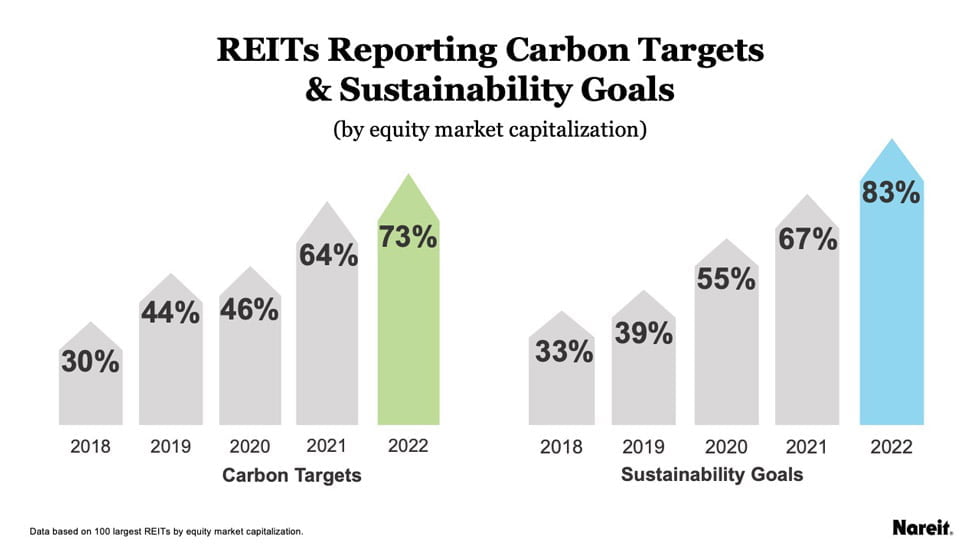
Meanwhile, the demand for reporting on carbon targets from investors is on the rise. 73% of REITs reported on carbon targets in 2022 and 83% reported on sustainability goals.
And JLL found that there was a growing demand for sustainable buildings and they realized a green premium of 7.1% in North America.
While firms often rely on their building engineers’ inquisitiveness, innate drive, and deep commitment to achieving better results to drive operational efficiency, it’s not enough.
According to the Carbon Risk Real Estate Monitor (CRREM) and the Global Real Estate Sustainability Benchmark (GRESB), only 15% of global assets currently align with the Paris Agreement’s 1.5°C target. We need to empower these teams–who have their hands on the steering wheel–with the tools and strategies to drive consistent, data-driven efforts across your portfolio.
The difference between building management systems (BMS) and energy management systems (EMS)
Up to 20% of the energy consumption used in commercial buildings is wasted because of improper operations. According to the Wall Street Journal, “Wastefulness is often caused by crude building operating systems that set the heating or cooling facilities to come on and off at a specific time each day, regardless of the outside air temperature or how many people are using the building.”
Although the capabilities of BMSs have increased in recent years, there’s tremendous room to amplify the impact of the BMS by adding a layer of intelligence with an EMS.
What’s the difference between the two types of platforms?
| BMS | EMS |
| Manages a wide range of building systems and equipment. | Ingests the data from the BMS and other systems to provide deep insights into the building’s current energy consumption patterns. |
| Can often configure startup and shutdown sequences. These sequences don’t typically reflect real-time data and can be difficult to adjust without coding knowledge. | Analyzes real-time data to provide operating engineers with specific, actionable recommendations. |
| Data can be unwieldy and is often contained to a computer in the basement. | Data is intuitive and available on the device the user has on hand – phone, tablet, or computer. |
Using an EMS like Cortex together with the BMS allows you to move from basic energy monitoring to an energy optimization strategy that helps you run your buildings better.
“Cortex is probably the cheap, easy, actionable first step that every building owner should use to reduce their carbon footprint,” says Nick Bienstock, CEO and Co-Founder of Savanna Fund. Read Savanna’s full story here.
Four core components of strong energy optimization strategy
To actively manage energy in your buildings, your engineering teams need to identify and correct operational problems that lead to energy waste. An energy management system can help you realize 5% – 25% energy savings offered by Building Re-tuning. These are the four principles to the strategy:

Turn It Off
Turning it off is an obvious starting point, but it’s an area where many organizations can still make significant savings. Identifying energy systems that are operating when they aren’t required can drive up to 30% of the total savings available without impacting tenant comfort.
Specific measures that can be deployed include:
Conserve energy by reducing use in unoccupied or under-occupied parts of the building. Consider, for example, a building that supports a hybrid workforce. There may be high occupancy, based on badge swipes or blob tracking, on Tuesday, Wednesday, and Thursday but limited occupancy on Fridays. Or, lease obligations may ask for the building to be conditioned until 1:00pm on Saturdays, but there’s only been a handful of days in the last year that someone has been in the office.
Understanding your energy trends, load profiles, and occupancy, along with alerts for equipment that’s left running overnight, can help you understand when energy is needed and when you can turn systems off.
Scheduling your HVAC system so it’s only on when needed can account for up to a 1.5% decrease in annual energy usage and costs.
How do you decide when to start your building each morning? Between lease obligations, outside air temperatures, peak hours, your building’s heating capacity, and more, identifying the optimal start time can be complex. Whether start time is defined by the BMS or by your engineering team’s deep experience and knowledge of the building, it’s likely they’re taking a conservative approach. Teams are more likely to bring buildings to temperature hours before lease obligations than risk tenant complaints.
AI and machine learning that takes into account all the variables for startup in real time as they relate to your specific building, allow more aggressive start times that can result in significant energy savings.
“Cortex makes my job easier by providing start times, which saves money for ownership,” says Mark Trio, Chief Building Engineer at 5 Bryant Park, “and it gives us the information and the tools needed to make educated decisions on a daily basis.” Read Savanna’s full case study here.
We worked with another team that was able to delay their start time, on average, by 2.5 hours per day with Cortex’s recommendations. It’s no wonder this strategy accounts for 1.1% of potential savings.
Turn It Down
If you don’t need it at full capacity, turn it down. Adjusting systems to meet current needs can account for up to 28% of energy savings available under Re-tuning.
Concrete actions that can be taken include:
Static pressure reset orchestrates the airflow within a building’s air system to seamlessly adapt to varying demands. By strategically adjusting the static pressure setpoint during typical operating conditions, without compromising airflow to individual VAV boxes, substantial energy savings of two to three times the reduction in fan speed can be achieved.
Insight into how your VAVs are performing and exception reporting, allows your engineering team to proactively bring VAVs back into ideal operating range. And when they combine this with Duct Static Pressure (DSP) recommendations for seasonal setpoints or DSP reset programming, they can run the building according to what’s needed at any given time.
This meticulous management of airflow can add up to big energy savings–1.5% per year–while making sure occupant comfort remains paramount.
Night setback is an energy savings strategy that allows temperature or humidity settings (or both) to drift during times that the building is unoccupied. While there isn’t a magic setback number–a floor temperature heat map can help track and verify changing temperatures, while an overnight shutoff report provides insight into whether equipment is running at unexpected times.
Adjusting temperatures during unoccupied periods means your HVAC system doesn’t need to work so hard when there’s no one there, saving 0.9% in energy and costs without sacrificing comfort.
Mitigate Simultaneous Heating and Cooling
Avoiding simultaneous heating and cooling prevents the HVAC system from overcooling a zone and then heating back to the correct temperature. This can account for as much as 32% of savings under the Re-tuning strategy.
Actions that can be taken include:
Supply air temperature reset or discharge air temperature reset is when the supply or discharge air temperature is reset to be higher at times when zone reheating is significant. When reheating isn’t significant, this reset allows for the same amount of cooling energy with less airflow. That means less fan power and more energy savings. This can account for 1.6% of energy savings.
Reducing the minimum airflow setpoints keeps the system from forcing too much cool air into the zones. This keeps the VAV from overcooling and reheating and saves on cooling and reheating costs. This accounts for 1.3% of overall energy savings.
Reduce Infiltration and Outdoor Air
Reducing infiltration of outdoor air can prevent the outdoor temperature from increasing or decreasing the indoor temperature and reduce heating and cooling needs. However, outdoor air can be intentionally used to cool the building without the use of mechanical cooling in what is commonly called ‘airside economization’ or ‘free cooling’. Through proper control of outdoor air rates, this can happen automatically when the conditions for ‘free cooling’ are right.”
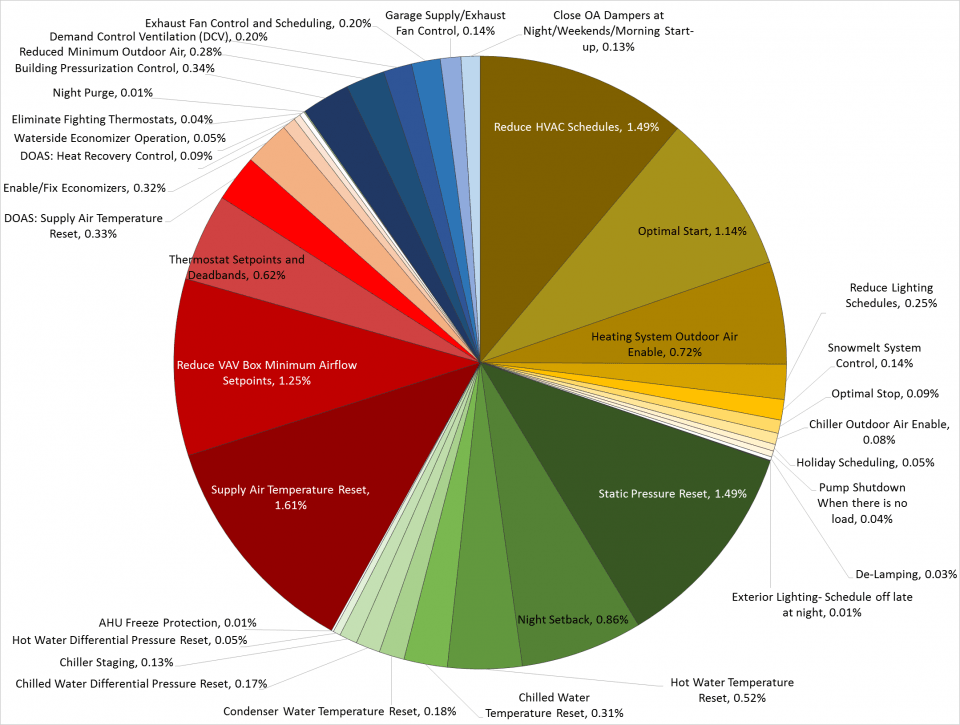
This requires many small adjustments, which you can see the individual list and impact of here in. This accounts for only 10% of energy savings.
The strategies outlined are just the starting point to energy management through Re-tuning. This graph outlines the many possible strategies you can follow.
If you or someone on your team wants to take a deeper dive, here are some resources that get you started:
- Pacific Northwest National Laboratory – Overview of Re-Tuning Buildings
- Pacific Northwest National Laboratory – Guide to Re-Tuning Measures
Is your building ready for an energy tune-up?
Not every building reaps the same rewards from an energy tune-up. Use this short checklist to determine if your building is primed for an efficiency boost.
Top candidates for re-tuning are:
- Buildings larger than 50,000 SQFT
- Buildings with an Energy Star score of less than 75
Best-suited buildings have:
- Variable air volume systems
- Heat recovery systems
- Central heating and/or cooling plants
- BMS installed after the year 2000
For optimal results, you should have access to:
- The current sequence of operations
- Interval-metered data
- BMS trend data
- Monthly utility bills
Want to look into it further? Review the complete building checklist here.
The bottom line
Operational excellence is a powerful strategy for CRE owners and managers to tackle their ESG targets. By using AI-driven EMS solutions to effectively implement Re-tuning strategies, buildings can meaningfully cut energy use a low- or no-cost. With federal decarbonization goals in place, such as aiming for a 65 percent reduction in GHG emissions by 2035 and a 90 percent reduction by 2050, now is the time for CRE teams rethink their operations.
For more information on how to move forward with your energy management program and deliver on your sustainability strategy, contact our experts to learn more about our energy insights platform.
The post Unlocking energy savings: A comprehensive energy management guide for commercial real estate professionals appeared first on Cortex Building Intelligence.
]]>The post Core Texts: A new climate plan for buildings, UBS flags CRE appeared first on Cortex Building Intelligence.
]]>1. US Green Building Council’s climate action plan 🍃
💡 What you need to know: The US Green Building Council recently unveiled a new report presenting a plan aimed at reducing the carbon footprint of the built environment to expedite building decarbonization. This move is part of a broader American effort to cut global carbon emissions in half by 2030 to cap global warming at 1.5°C: a critical threshold for the planet and a legal stipulation of the US-signed Paris Agreement. Given that buildings account for about one-third of global energy-based emissions, the report calls for a multi-faceted approach to decarbonization, emphasizing:
- A whole-life carbon approach: We must limit both operational emissions from energy use and embodied emissions from the lifecycle of building materials.
- Retrofitting existing buildings: It’s critical that we update existing structures and adopt new construction methods to reduce buildings’ carbon footprints.
- Operational and embodied carbon: The report identifies these as key focuses for decarbonization, advocating for the rapid adoption of proven practices.
- Building resilience: The report highlights the need for buildings to adapt to adverse events and new information to decarbonize as efficiently as possible.
⚡ Why it’s important: Besides providing a roadmap to save our planet? 🌎
Publication of the USGBC’s new plan follows the organization’s October release of LEED v5 for public comment. The USGBC’s LEED rating system serves as a global benchmark for buildings’ environmental viability and weighs heavily into investor and tenant decisions. The latest iteration of LEED introduced more stringent requirements for existing buildings to boost climate resilience, assess social impact, and cut emissions from embodied carbon, refrigerants, and transportation in order to receive coveted, premium LEED ratings. The report reinforces and expands upon these themes by offering a detailed roadmap towards achieving ultra-low greenhouse gas emissions at scale and setting new standards for sustainability across the building industry.
2. UBS flags its commercial real estate exposure 🏦
💡 What you need to know: In a detailed analysis of the commercial real estate sector, Swiss banking giant UBS identified CRE loan exposure as one of the “top and emerging risks” it faces going forward. UBS’s CRE exposure escalated from $47.1 billion in 2022 to $55.09 billion in 2023 following its acquisition of Credit Suisse. The bank did not identify the commercial real estate sector as one of its top concerns in its previous annual report. In this year’s assessment, UBS unsurprisingly attributed the recent downturn to higher borrowing costs and reduced demand for office space post-Covid.
The bank’s newfound worry comes amid broader concerns over the impact of high-interest rates and structural demand shifts on property valuations, issues which carry the potential to ripple across the banking sector due to its substantial investments in commercial real estate. The report underscores that non-performing CRE loans represent a threat – not just to the US banking system – but to the global economy writ large. The International Monetary Fund recently flagged Swiss real estate exposure as a significant issue, further validating this concern.
⚡ Why it’s important: ️The situation in commercial real estate is indicative of broader economic and financial system vulnerabilities. Higher borrowing costs, a structural decline in demand for certain types of commercial spaces, and increasing climate-related transition risks – exacerbated by regulatory changes like Switzerland’s Climate and Innovation Act – are challenging the sector. UBS’s significant risk exposure underscores the potential for these issues to impact not only individual institutions but also the broader financial ecosystem.
This analysis is further complicated by the ongoing strategy of “extend-and-pretend” in the banking sector, where loans nearing maturity are extended in anticipation of lower interest rates, contributing to an environment of heightened uncertainty. The reluctance to address these accumulating challenges head-on could lead to a more severe correction down the line, with significant implications for financial stability and the wider economy. The lesson from history is clear: delaying necessary adjustments and interventions often results in more profound and widespread problems, underscoring the importance of proactive measures to mitigate risks in the commercial real estate sector and beyond.
3. More news & notes 📌
🔏 VTS reported that +80% of office owners saw upticks in March renewals.
📉 Savills revealed that Manhattan office leasing declined 23% in Q1 of 2024.
📈 Moody’s noted that the payoff rate for maturing office loans has improved.
🏢 Avison Young found that net vacant US office space now totals over 1 billion square feet.
Cut Through The Noise ✂️
Subscribe to Core Texts, our weekly newsletter, and get a round up of today’s CRE, Tech and sustainability news delivered to straight to your inbox.
The post Core Texts: A new climate plan for buildings, UBS flags CRE appeared first on Cortex Building Intelligence.
]]>The post 5 Bryant Park: A model of unified efficiency and sustainability appeared first on Cortex Building Intelligence.
]]>5 Bryant Park, NYC
680,000 Square Feet
Operational Excellence
Leading vertically integrated real estate manager – Savanna Fund – drives operational excellence by connecting teams in a single source of truth for energy and emissions, driving building efficiency and sustainability at properties like 5 Bryant Park.
The challenge
Savanna, a top-tier real estate manager in New York, faced the dual challenge of improving energy efficiency and environmental sustainability while bridging the communication gap between different management levels, from executives to property managers and engineers.
The solution
Cortex’s energy insights platform provides real-time data and insights to teams throughout Savanna’s organization. As a reliable source of truth, it allows teams from the boardroom to the basement to align their efforts in conserving energy, decreasing emissions, and delivering a superior tenant experience.
13% in annual energy savings
600 metric tons CO2 emissions avoided in 2023
Cortex Data, 2023
The impact
Goals cascade down through the organization to drive alignment of effort.
“At Savanna, we are committed to reducing our carbon footprint and promoting efficient use of energy. Cortex has been a critical tool for us in moving toward carbon reduction and expense reduction across our entire portfolio.”
Nick Bienstock, CEO and Co-founder, Savanna Fund
“Cortex’s presence has primarily resulted in cost savings, particularly in terms of electric and steam energy expenses, which are significant components of a building’s operating budget. By reducing these costs, the building’s net operating income improves, leading to increased income for the owner and their partnerships.”
Susan Curtis, Senior Real Estate Manager, CBRE, 5 Bryant Park
“It makes my job easier by providing start times, which saves money for ownership, and giving us the information and the tools needed to make educated decisions on a daily basis.”
Mark Trio, Chief Building Engineer, 5 Bryant Park
Improve your buildings’ efficiency and sustainability with Cortex today
Take control of your energy outcomes, minimize risk, and protect asset value with Cortex’s energy insight platform. Contact us at [email protected] to learn more about how Cortex can help your team improve your building’s efficiency and sustainability.
The post 5 Bryant Park: A model of unified efficiency and sustainability appeared first on Cortex Building Intelligence.
]]>The post Savanna Fund partners with Cortex to improve building performance appeared first on Cortex Building Intelligence.
]]>4 Properties
2,300,000 Square Feet
Carbon & Expense Reduction
Savanna uses real-time building-level insights to elevate operational efficiency, drive team alignment, and reduce the carbon footprint of its assets, improving building performance.
The challenge
Savanna Fund, a leading vertically integrated real estate manager, needed a platform to support their proactive stance on sustainability – especially in the area of energy management. Facing investor, tenant, and regulatory pressure, it was imperative they connect their teams, demonstrate operational efficiency, reduce carbon emissions, and continue to align with industry-leading benchmarks like GRESB.
The solution
In its search for best-in-class software to meet their energy and emissions goals, Savanna discovered Cortex’s energy insights platform. Connecting teams across the company, Cortex allows Savanna to identify and act on real-time energy efficiencies, optimize runtimes, participate in demand response, and demonstrate progress toward their ESG goals.
The impact
Actionable data: Specific operating recommendations make it easier for building engineers to do their job well and cut energy waste.
Cross-functional visibility: By regularly tracking and monitoring energy usage in a unified platform, teams from asset management to building operations work better together to further reduce energy and emissions and improve building performance.
Persistent improvement: Maintaining their GRESB rating is critical for Savanna. Continuous commissioning through Cortex contributes to their achievement of GRESB 5 STAR rating for three consecutive years.
“Cortex is probably the cheap, easy, actionable first step that every building owner should use to reduce their carbon footprint.”
Nick Bienstock, CEO and Co-founder, Savanna Fund
Improve your buildings’ performance with Cortex today
Take control of your energy outcomes, minimize risk, and protect asset value with Cortex’s energy insight platform. Contact us at [email protected] to learn more about how Cortex can help your team improve building performance.
- Cortex Data, 2023 ↩︎
- Cortex Data, 2023 ↩︎
- 2022 Savanna ESG Report ↩︎
The post Savanna Fund partners with Cortex to improve building performance appeared first on Cortex Building Intelligence.
]]>