12 March 2026
MEDIA CONTACTS: Roxanna Smith, [email protected] / Carina Daniels, [email protected]
CALSTART CONTACT: Sita Holtslag, [email protected]
—
BRUSSELS—As the European Parliament, Council, and Commission discuss the targeted amendment to the CO₂ standards for Heavy-Duty Vehicles (HDVs), we encourage policymakers to keep Europe’s climate and industrial roadmap clear and stable.
We welcome that the long-term CO₂ targets remain unchanged: a 45% reduction by 2030 and 90% by 2040. Keeping these targets must remain the top priority for Europe’s clean transport transition.
The proposed amendment will make short-term targets easier to meet and is likely to slow the rollout of zero-emission trucks (ZETs). Analysis suggests it could lead to a 7–17 percentage point lower share of zero-emission truck sales by 2034 compared with the current rules.
Significant progress has been made in the deployment of ZETs and the associated infrastructure. While there is some concern that short term market conditions may not support the phase-in over the next 4 years, we think this must be balanced against losing momentum and sending the wrong signal to fleets and OEMs. If short term changes in the regulation are needed to meet market conditions, we believe it is vital that no further amendments are made to avoid eroding investment security. Market momentum is growing rapidly in the EU. ZET sales increased more than 40% in the first half of 2025, from 9% to 19% in Q1–Q2 2025 compared with the same period in 2024. And, the latest AFIF funding round includes €220 million for charging infrastructure. Policies such as the Eurovignette Directive and Weights and Dimensions Directive are also improving the business case for zero-emission trucks.
Maintain the 2027 Review Timeline
Regulatory stability is essential for manufacturers, fleets, and investors. We therefore encourage policymakers to keep the planned review of the regulation in 2027.
The 2027 review will allow policymakers to assess progress based on real market data and make adjustments if needed.
We call on policymakers to:
- Maintain the long-term CO₂ targets — a 45% reduction by 2030 and 90% by 2040
- Keep the planned review in 2027 and avoid bringing it forward
A stable policy framework will provide a clear market signal, help Europe stay competitive, and accelerate the transition to clean heavy-duty transport.
CALSTART’s Drive to Zero is working to accelerate the decarbonization of commercial vehicles through global partnerships, innovative tools, groundbreaking research, and education.
]]>
In recent weeks, Drive to Zero has engaged closely with partners and government agencies in Mumbai and Delhi—including NITI Aayog, the Ministry of Power, the Ministry of Heavy Industries, the Ministry of Road Transport & Highways, and Global MOU endorser Transvolt. These conversations underscored both the scale of India’s opportunity and the momentum building across its ecosystem.

Stephanie Kodish (Drive to Zero) and Archana Mittal (NITI Aayog)

Stephanie Kodish (Drive to Zero) and Dr. Hanish Qureshi (Ministry of Heavy Industries)
A few examples of India’s market driving actions:
- Policy: The government has proposed fuel efficiency standards for heavy-duty vehicles, working on BS-VII emission norms, and established an ambitious goal of achieving 30% EV penetration by 2030. These actions align with Prime Minister Modi’s ‘Viksit Bharat 2047,’ an overall vision for advancing energy security and energy independence through exponentially reducing reliance on oil imports by 2047. They also align with the goals of the Global MOU.
-
Infrastructure: India is also advancing national bus and freight electrification through ‘Faster Adoption & Manufacturing of Electric Vehicles (FAME)’, ‘PM Electric Drive Revolution in Innovative Vehicle Enhancement (PM E-DRIVE)’, ‘PM-eBus Sewa’, and ‘PM e-Bus Sewa-Payment Security Mechanism (PSM)’, schemes. They are designed to incentivize adoption of electric and zero-emission vehicles through demand incentives, infrastructure development, and technology support.

Stephanie Kodish (Drive to Zero) and Mahmood Ahmed (Ministry of Road Transport and Highways)
- Finance: India has allocated more than $5 billion (USD equivalent) in direct and indirect public incentives to grow its ZE-MHDVs ecosystem. The Indian market has also developed demand aggregation models, gross cost contracts, Public Private Partnership (PPP) models, payment security mechanisms, green bonds, and other financial mechanisms to support the deployment of ZE-MHDVs.
From policy engagement to business leadership, the Global MOU community is a major player in the advancement of India’s ZE-MHDV market.
-
Policy Engagement: Following the Bureau of Energy Efficiency’s draft HDV regulation, Drive to Zero mobilized an industry coalition of 11 endorsers calling for efficient, low-carbon freight standards.
-
Business Leadership: Global MOU endorser Transvolt has issued Sustainable Green Bond to Alternates, AXIS AIF (part of Axis AMC with AUM over USD 40 billion). The Green Bond will be used to deploy more than 300 heavy commercial EVs for public and freight transportation. Transvolt’s innovative business model also includes supplying companies with ZE-MHDVs as a service. It supplies the vehicles, infrastructure, and drivers, who receive equitable wages.
- Derisking: Drive to Zero is working with Small Industries Development Bank of India (SIDBI) in setting up DRISHTI—De-risking SMEs in Sustainable Trucking & Infrastructure for India. The risk-sharing facility is aimed to strengthen domestic NBFCs (Non-Banking Financial Companies) and financial institutions to expand access to loans to small owner operators to purchase electric trucks.
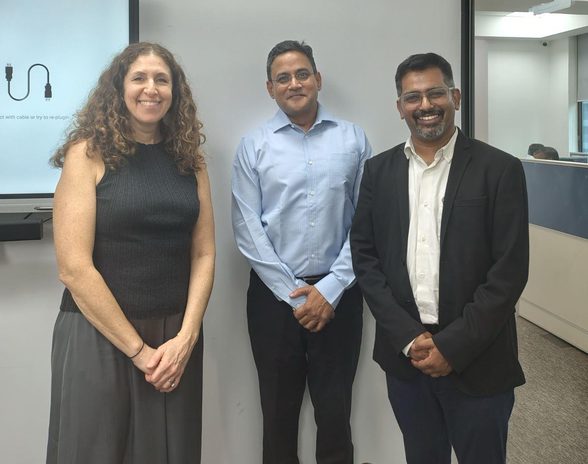
Stephanie Kodish (Drive to Zero), Debasis Mohanty (Transvolt Mobility), and Joseph Teja (Drive to Zero)
India’s freight ecosystem is at an inflection point. Trucks constitute only ~3% of the vehicle stock but consume 55% of diesel, generate 53% of PM emissions, and contribute 35% of transport-sector carbon emissions. Road freight accounted for roughly ~$125 billion of the nation’s annual logistics bill in 2023— and fuel accounted for 42%, roughly $52 billion for fuel alone!
During our recent engagements with the government and private sector, I saw firsthand India’s strategic opportunity and the leadership it is taking to reshape its MHDV sector. It is doing so in a way that aligns with the country’s overall ‘Viksit Bharat 2047’ goals of strengthening energy security, industrial competitiveness, and clean transport leadership. When it comes to the ZE-MHDV market, India is a country to watch. I hope you find these insights helpful as you monitor the global landscape around the ZE-MHDV transition and India’s innovative leadership.
— Stephanie Kodish, Senior Global Director, CALSTART/Drive to Zero
Special Features
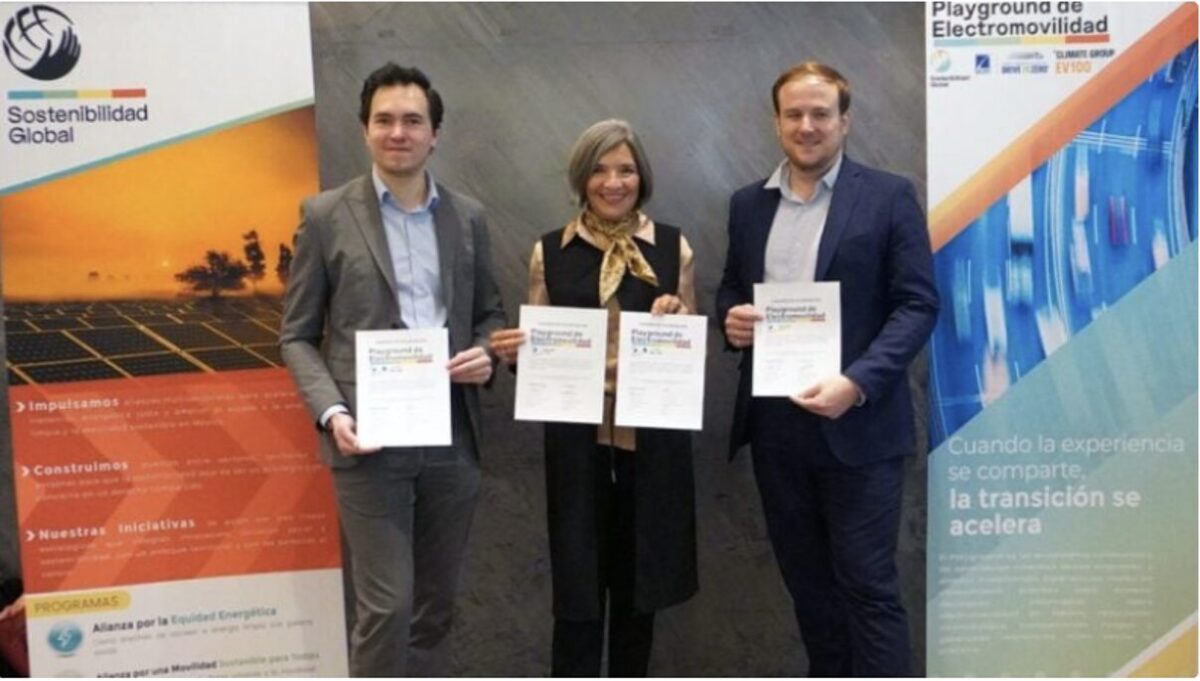
Electromobility Playground launch at Club 51 in Torre Mayor, Mexico City. Photo credit: Revista Transportes Y Turismo.
Mexico’s New Electromobility Playground
Drive to Zero, Sostenibilidad Global, and Climate Group have launched the Electromobility Playground in Mexico, an exciting initiative enabling companies to overcome common obstacles by leveraging learnings and experiences from each other; focusing industry know-how on practical solutions that have already worked within the country. The Playground will help grow zero-emission freight in Mexico, along with the economic, jobs, energy security, clean air, and climate solutions they deliver.
Learn more about the Electromobility Playground in Revista Transportes Y Turismo.
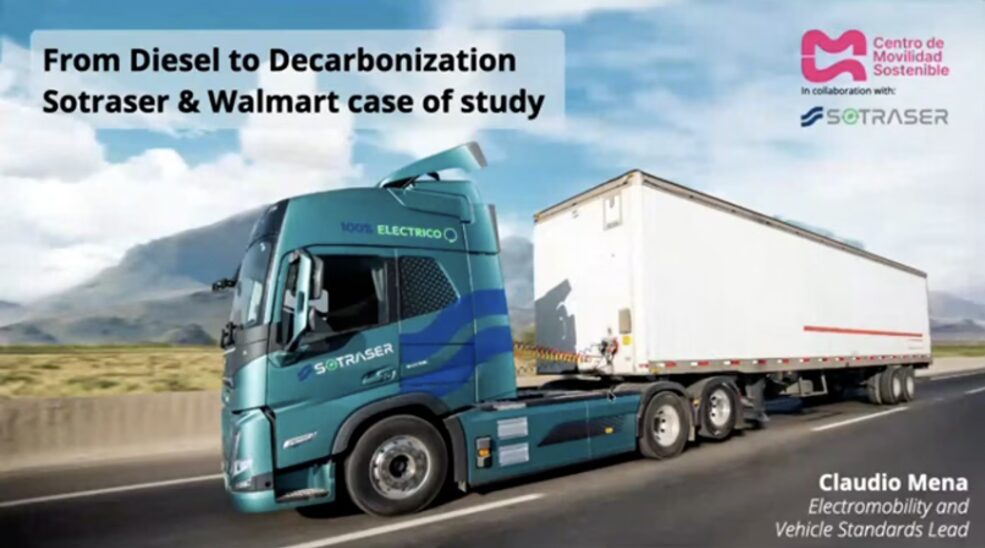
Global MOU Community Spotlight: Sotraser Charges Up Change with Walmart
Together, Walmart and Sotraser, a major Chilean logistics company, are charging up change in Chile—and quickly. Within less than a year, they’ve partnered to deploy fifty electric trucks, twenty charging stations, and 1,200 kW installed renewable power. The trucks, which travel an average of 200+ kilometers per day, service Walmart’s more than 400 retail supermarkets across the country. Electric trucks that charge on renewable energy and serve one of the largest retailers in the world—that’s what changing transportation for good looks like. For more information, watch this presentation by Centro de Movilidad Sostenible’s Electromobility and Vehicle Standards Lead, Claudio Mena.
Welcome our amazing new Global MOU Endorsers!
|
|
|
 |


Upcoming Events
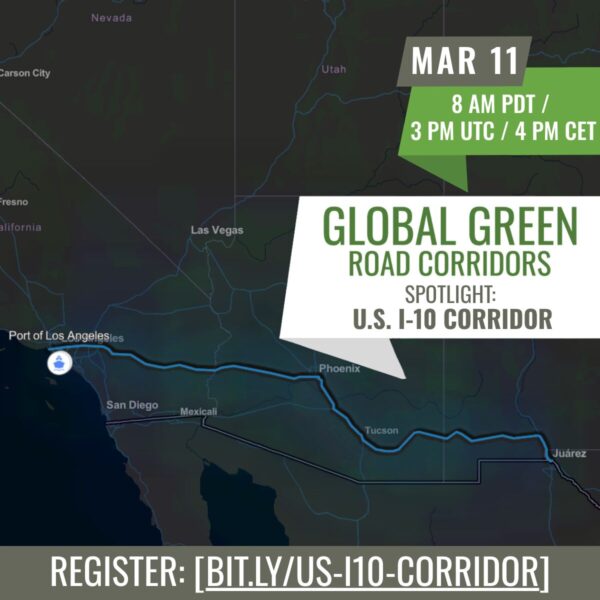
Virtual Event: Greening the U.S. 1-10 Corridor
Through a series of virtual events, the Global Green Road Corridors Initiativespotlights the development of green freight corridors around the world. Next up: On March 11th, we’ll spotlight a major initiative, led by Smart Freight Centre and Terawatt Infrastructure to green the Interstate 10 (I-10) corridor. This corridor—which runs from Los Angeles, California to El Paso, Texas— is one of the busiest and most strategically important trade routes in the United States. SFC and Terrawatt are working with major companies such as PepsiCo and Microsoft to launch the new corridor by 2027.

Mobility Portal Media Opportunities—Inquire Today!
Drive to Zero is proud to partner with Mobility Portal to provide key insights on the global transition to zero-emission trucks and buses. Interested in contributing your expertise or sharing your story as part of this collaboration? Contact Ricardo Garcia at [email protected] to learn more.
Top Headlines

Market
Fleet Deployments
- Major electric bus boost announced for Exeter in £29.3m Devon investment
- Dachser deploys BYD electric trucks in Spain
- Battery-electric transport in Chile: First Mercedes-Benz eActros 600 delivered to customer
- Île-de-France launches Tzen 4 BRT with 24m Hess e-buses and Alstom ground charging
- We have the largest fleet of electric trucks in the Austrian waste management industry
- New Flyer to supply further 100 Xcelsior hybrid and BEV buses to Washington Metro
- 68 electric Yutong buses deployed in Milan and Cortina for Winter Olympics
- MZA Warsaw extends its order with 79 additional Solaris electric buses
Manufacturers and Models: Trucks and Buses
- DLL enters into partnership with BYD Europe to accelerate eMobility adoption across Europe
- AxTrax 2 LF: ZF Secures major India city bus order
- Tesla reveals major info about the Semi as it heads toward ‘mass production’
- KIA PV5 pickup launched in South Korea, van spied testing in US
Financial Incentives
Fuels and Infrastructure
- Pilot Travel Centers to deploy heavy-duty EV charging stations for Tesla Semis
- Electric trucks demonstrate megawatt charging in sub-zero temperatures
- Daimler Buses to install its own public charging stations at Munich Central Bus Station
- WattEV expands San Bernardino depot with Megawatt chargers
- Orion announces $4M project to install 105 EV charging stations for Boston public schools
Batteries and Technology
]]>We are in the midst of completely reshaping our global transportation systems for the better. To accelerate the transition to zero-emission medium- and heavy-duty vehicles (ZE-MHDV) we need accurate, comprehensive data to understand the current market, where it can go, and how quickly it can be transformed. This is a foundational priority for Drive to Zero.
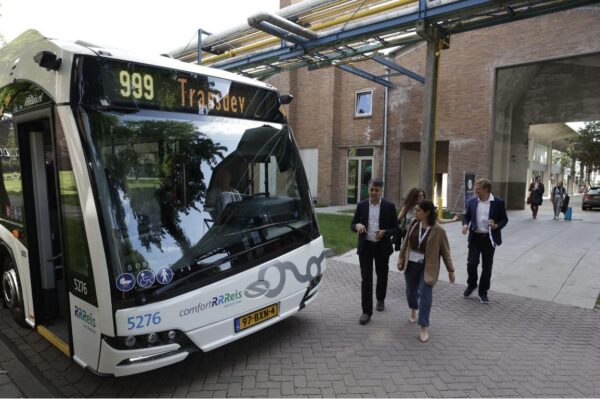
Global MoU Summit 2025 participants take a zero-emission bus.
We have created a number of innovative tools to track, analyze, report on, and mobilize our industry. By truly understanding the developments and trends of this fast-moving market, we can help ensure that countries and industry align in actions to reach the Global MOU goal of 100% new zero-emission bus and truck sales by 2040. In that vein, I couldn’t be more proud of the Drive to Zero team for developing and continuing to expand upon and modernize the Zero Emission Technology Inventory (ZETI).
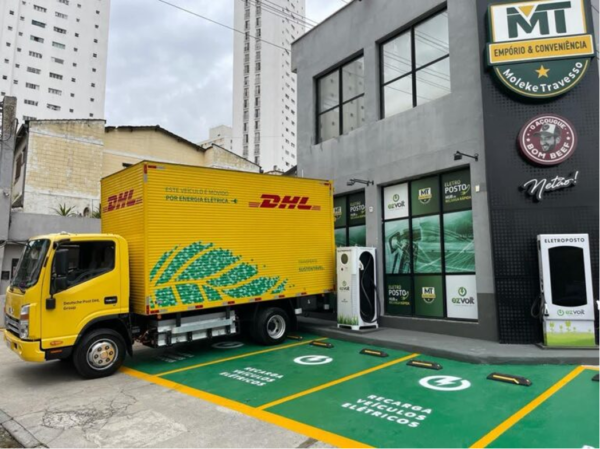
Zero-emission DHL truck charges in São Paulo. Photo courtesy of EZVolt.
In its first iteration in 2020, ZETI was a simple online tool that provided U.S. audiences with a snapshot of the ZE-MHDVs that were on the market and their capabilities. Since then, ZETI has grown. It’s interactive, available in six languages, and serves as the “go-to” resource for governments, fleet operators, and other stakeholders across the globe needing reliable information about the global ZE-MHDV market.
Among other key metrics, ZETI shows the ZE-MHDVs that are available in 12 countries and 6 continents (only Antarctica isn’t included). It also tracks how model availability has evolved since the tool was developed.
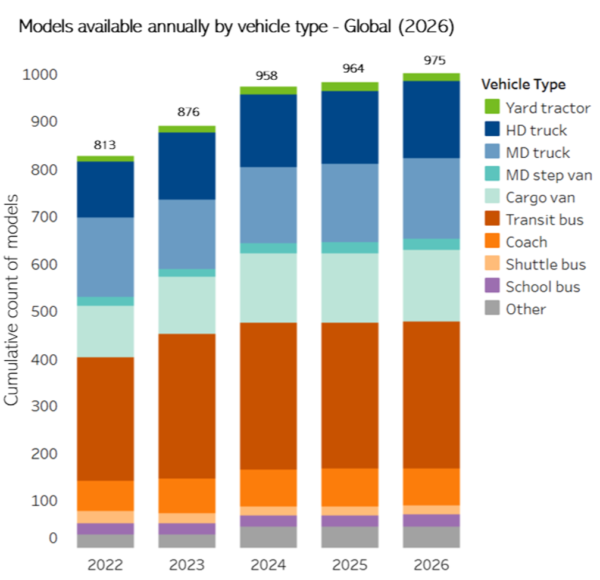
A sneak preview from our new ZETI analysis: From 2022 to 2025, the number of ZE-MHDV models on the market globally increased nearly 18.6% from 813 to 964. In 2026, the number is projected to tick up to 975, indicating the market has progressed from early growth into a more mature stage.
Regularly cited by the IEA, the World Economic Forum, The Electrification Coalition, and key industry trade publications, ZETI is vital to keeping our finger on the pulse on:
- How strong the market is for ZE-MDHVs
- Who the key players are in the market
- How ZE-MHDV performance is changing over time, including range specifications, battery size, payload and charging speed
- Which ZE-MHDV models are highest performing
- How well policies and regulations are providing OEMs with the market certainty they need to invest in ZE-MHDVs
At Drive to Zero, we say that ZE-MHDVs are affordable, available, adopted, and advanced. I invite you to dig into our new ZETI analysis to learn more about two of these pillars: available and advanced. It’s encouraging to start the new year knowing that OEMs are putting the pedal to the metal on supporting a clean transportation future.
— Stephanie Kodish, Senior Global Director, CALSTART/Drive to Zero
Special Features
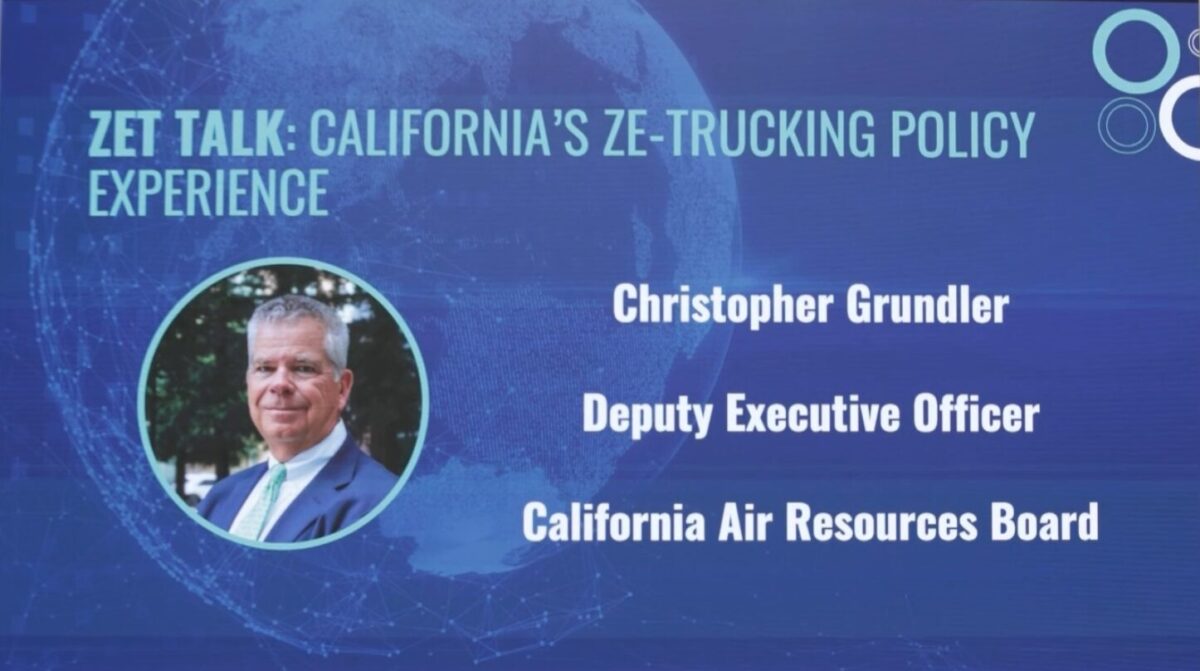
ZET Talk: California Policy Spurs Strong ZE-MHDV Market
By: Christopher Grundler, Deputy Executive Director at California Air Resources Board
By pairing supply-side with demand-side regulation, California has created a strong market for zero-emission medium- and heavy-duty vehicles. In 2023, one-in-six trucks sold in California were zero-emission—doubling from the year before and exceeding sales requirements years ahead of schedule. Based on preliminary results, 2024’s sales were likely just as strong. To learn more about California’s policy strategy, watch CARB Deputy Executive Director Christopher Grundler’s ZET Talk from the 2025 Global MOU Summit.
Upcoming Events
In the Spotlight: U.S. I-10 Corridor
Through our virtual action accelerator event series, the Global Green Road Corridors Initiative highlights the progress and development of green freight corridors around the world. Join us on Wednesday, March 11 at 8 am PDT/ 3 pm UTC / 4 pm CET as we turn our focus to the United States with an in-depth look at the U.S. I-10 Corridor, which connects Los Angeles, California, to El Paso, Texas—one of the busiest and most strategically important trade routes in the United States.
Learn how project leads Smart Freight Centre and Terawatt Infrastructure are advancing this corridor toward launch by 2027, working with major shippers such as PepsiCo and Microsoft to scale electric freight volumes and accelerate the transition to a zero-emission future.
8 am PDT/ 3 pm UTC / 4 pm CET on Wednesday, March 11

2026 Global MOU Forum—Register Now!
From Sept. 8-10, Global MOU signatories and endorsers will gather for the 2026 Global MOU Forum in Santiago, Chile. It is our community’s most important event of the year for advancing key ZE-MHDV policy, finance, and infrastructure solutions, collaboration, and learning. We will present invaluable resources, strengthen partnerships, and receive key insights from top government officials and industry innovators from around the globe. Key focus areas will include supply-side regulations, financing models, infrastructure scaling, and smart-grid integration. Learn more and sign up here. Not yet an endorser? Become an endorser and then:

Mobility Portal Media Opportunities—Inquire Today!
Drive to Zero is proud to partner with Mobility Portal to provide key insights on the global transition to zero-emission trucks and buses. Interested in contributing your expertise or sharing your story as part of this collaboration? Contact Ricardo Garcia at [email protected] to learn more.
Top Headlines
Market
Fleet Deployments
- Prague deploys the first SOR ENS 12 electric buses into regular service
- MPK Lublin places an order for 20 Solaris trolleybuses
- Maui deploys first four GILLIG battery electric buses
- Leicester set to meet electric bus target across whole network
- 14 new electric buses successfully put into operation
- Škoda Group wins two tenders to supply a total of 75 trolleybuses to Sofia
- Transports Vallée in France is investing in the future: First Mercedes-Benz eActros 600 and 62 Actros L with ProCabin
Manufacturers and Models: Trucks and Buses
- Fuso appoints Emil Frey as European distributor
- Workhorse Group and Motiv Electric Trucks complete merger, creating a leading North American medium-duty electric truck OEM
- BYD plans new Brazil bus factory as output scales from 2,000 to up to 7,000 units annually
- Windrose shares US zero-emissions trucking roadmap, eyes charging collaborations
- Renault Trucks electrifies its Blainville – Bourg-en-Bresse – Lyon logistics corridor with Malherbe
- Investor Palladio Partners joins Hyaline
Financial Incentives
- DEP awards nearly $32 million in grants for purchases of electric school buses and public charging infrastructure
- Boost for British business as government slashes cost of electric lorries by up to £120,000
Fuels and Infrastructure
Batteries and Technology
]]>As we enter 2026, we take a fresh look at the Zero-Emission Technology Inventory (ZETI), the leading global resource tracking zero-emission commercial vehicle availability and specifications. Since 2020, our team has continuously expanded ZETI’s capabilities by adding new features, broadening regional coverage, offering the platform in multiple languages, and keeping pace with a rapidly evolving market.
That evolution is being driven by a global push to decarbonize commercial transport. Even as governments debate efficiency standards and deploy incentive programs, manufacturers worldwide are racing to lower costs, extend range, improve reliability, and deliver vehicles capable of meeting demanding commercial operations. Reflecting this shift, ZETI has grown well beyond its early focus on the United States and Europe. Today, it tracks zero-emission commercial vehicles across more than 12 countries, spanning every continent except Antarctica, for now…

Models available annually by vehicle type – global (2026)
ZETI data shows steady growth in model availability across all vehicle segments over the past several years, underscoring the need for OEMs to innovate and diversify their offerings in response to rapid advances in vehicle electrification worldwide. In 2022, approximately 813 ZE-MHDV models were available globally, produced by 156 OEMs. By 2025, that number had increased to 964 models from 170 OEMs. The figure on the right illustrates this growth and the distribution across vehicle types.
Zero-emission buses continue to dominate the market. In 2025, full-sized transit buses accounted for 310 available models, compared with 164 medium-duty trucks, 154 heavy-duty trucks, and 145 cargo vans. While overall availability has increased, the pace of growth has shifted over time. The sharpest expansion occurred through 2021, followed by a noticeable leveling off beginning in 2022.
This pattern reflects broader market dynamics. As advanced regulatory frameworks took hold in regions such as Europe and the United States, targeting improved vehicle efficiency and reduced CO₂ emissions, OEMs were compelled to move beyond internal combustion platforms. That pressure drove a rapid increase in zero-emission model introductions during the market’s early growth phase.
More recently, the slowing rate of new model introductions suggests the market is entering a more mature phase. Rather than launching entirely new platforms, OEMs are increasingly refining and upgrading vehicles with established demand. This shift is visible across the industry, from iterative improvements to models such as the Freightliner eCascadia and DAF CF to continued development of proven platforms like BYD’s 8T.
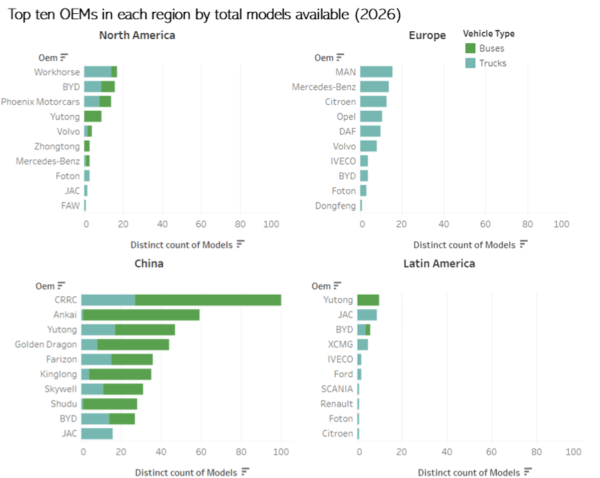
Top ten OEMs in each region by total models available (2026)
As the market matures, it is also consolidating. Many start-ups and smaller pure zero-emission entrants have struggled amid challenging market conditions and rising barriers to entry, particularly when competing with long-established manufacturers offering proven reliability and customer trust. Several high-profile companies, including Lion Electric, Volta, Nikola, and Lightning eMotors, have faced bankruptcy or restructuring, often resulting in asset acquisitions by more established players.
At the same time, regional policy environments continue to shape where new products succeed. In the United States, the number of OEMs offering zero-emission heavy-duty trucks has declined by approximately 11 percent from 2022 to 2026. In contrast, China has experienced nearly a 47 percent increase over the same time period. As federal incentives in the U.S. have been scaled back and state-level policy momentum has weakened, other regions have continued to advance through stronger regulatory signals and sustained market support.
Despite these regional differences, the long-term outlook remains positive. Competition among remaining OEMs is intensifying, driving cost down and motivating advances in range, charging speed, durability, and towing capability. Range data in particular reveals a critical insight: technology is no longer the limiting factor for many commercial applications.
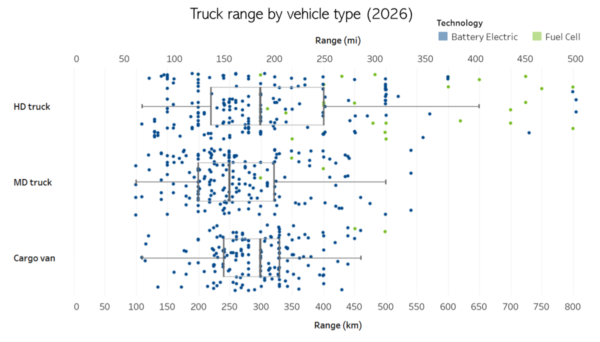
Truck range by vehicle type
The figure below illustrates manufacturer-reported range capabilities for zero-emission truck models across heavy-duty trucks, medium-duty trucks, and cargo vans. The median range for zero-emission heavy-duty trucks is approximately 186 miles (300 kilometers), with top-end models approaching 500 miles (800 kilometers). These capabilities comfortably support most local and regional haul duty cycles. For example, trucks operating in port drayage often travel roughly 140 miles per day, well within the performance envelope of today’s zero-emission heavy-duty platforms. Zero-emission cargo vans show similar average range performance, while medium-duty trucks typically offer slightly lower range but operate on shorter routes. Across all three segments, the majority of daily commercial operations fall squarely within existing vehicle capabilities.
Taken together, these trends point to a market that is transitioning from early expansion to durable scale. The technical foundation for widespread adoption of zero-emission commercial vehicles is firmly in place. The challenges ahead are increasingly practical and systemic, centered on affordability, infrastructure, and policy alignment. Addressing these factors will determine how quickly today’s technological readiness translates into broad, real-world deployment.
As 42 countries representing roughly one-in-four trucks globally move toward an ambitious goal of 100% new zero-emission truck and bus sales by 2040, strong investments in infrastructure like green corridors, financial tools, and ambitious policies will help ensure ZE-MHDV market growth and maturation.
]]>Dear Drive to Zero community,
As 2025 comes to an end, I invite you to join me in reflecting on the amazing work we’ve done this year to advance the worldwide transition to zero-emission trucks, buses, and infrastructure. Despite political headwinds and challenges associated with reimagining our MHDV transportation system, we charge ahead collectively and enthusiastically—because the stakes are too high to settle for the status quo. We’re building a future where carbon-free vehicle technology is the baseline, and where good jobs and stronger economies thrive on sustainability—not pollution.
Together, our Global MOU community has advanced policies, deployed ZE trucks and buses, developed plans for major green ports and freight corridors, and invested capital putting the MHDV transition into high gear. Here, I summarize some of our community’s biggest achievements of the year.
Happy reading, happy holidays, & see you next year!
— Stephanie Kodish, Global Director, CALSTART/Drive to Zero

At COP30, Mexico becomes the 41st country to sign the Global MOU.
Special Features
New Global MOU Community Signatories & Endorsers
- Mexico, Peru, and Montenegro sign the Global MOU, which means our Global MOU signatories now represent 21% of trucks and buses globally & account for nearly 42% of the world’s GDP.
- Nearly 125 new companies, sub-national governments (including our first in Australia, the Australian Capital Territory), private sector innovators, and non-governmental organizations (NGOs) endorse the Global MOU.

ZE-MHDV Policy Wins
- Ethiopia expands its ban on gasoline and diesel vehicle imports to include trucks—building on its 2024 restriction on private ICE vehicles—to cut $7 billion in annual fuel imports and accelerate the shift to zero-emission medium- and heavy-duty vehicles as part of its carbon-neutral 2030 strategy.
- Uruguay’s new policy (Resolution No. 21/2025) increases allowable gross vehicle weights for ZE HDVs. This regulatory adjustment removes a key operational barrier, enabling manufacturers and fleets to deploy ZE trucks and buses without sacrificing payload capacity, thereby accelerating the transition to zero-emission freight and passenger transport.
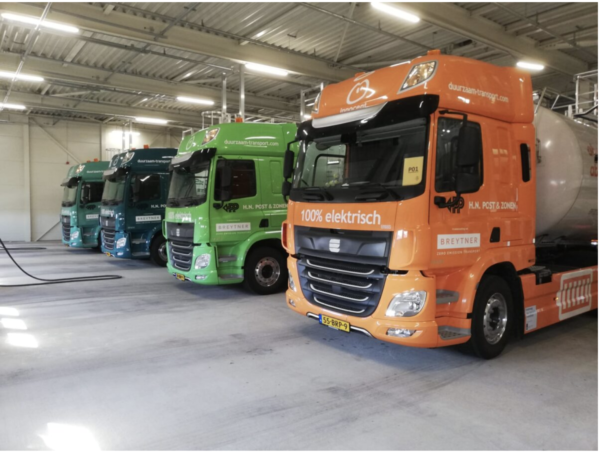
innocent drinks’ Breytner electric trucks (Netherlands)
Strong ZE-MHDV Sales
- Nearly 1 in 4 new trucks, buses, and vans in Global MoU endorser California are zero-emission.
- In the Netherlands during the first half of 2025, 78% of new vans and 76% of new medium trucks were battery electric.
- In Europe, more than 16,000 new zero-emission trucks and buses were registered in the first three quarters of 2025—a 60% increase compared to the same time period last year, and reaching market shares of 4.2% for trucks and 23.1% for buses.
- Additionally, the market share of zero-emission medium trucks and vans (3.5–12 tonnes) more than doubled from 9.5% to 20.6% in Q1–Q3 2025 compared with the same period in 2024.
- In January, Global MOU signatory Peru purchased 50 electric and hybrid buses, representing 11% of the country’s bus sales for that month; also plans to add another 150 electric and hybrid buses by early 2026.
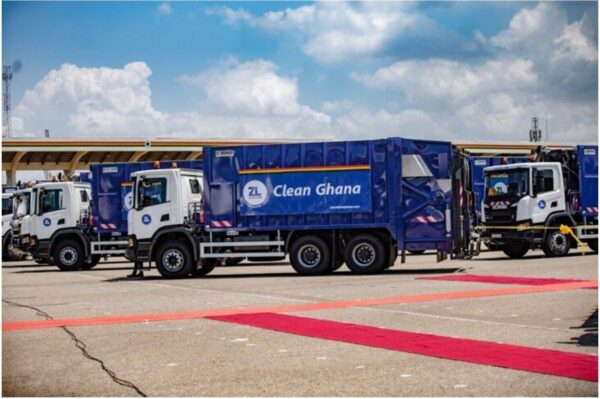
Traditional refuse trucks in Ghana that are now zero-emission.
Deployment in Action
- Endorser Zeronox and the Jospong Group are transforming 1,000 internal combustion engine refuse trucks in Global MOU signatory Ghana into zero-emission vehicles using the Zeronox Electric Powertrain Platform.
- As part of the UK’s £200 million Zero-Emission HGV & Infrastructure Demonstrator ZEHID Programme, DFDS is purchasing and deploying eight Volvo FM Battery Electric trucks and seven new charging stations throughout its delivery territory.
- Already home to the largest electric bus fleet outside of China, Santiago is working with ZEBRA to reach more than 4,400 buses deployed by March 2026.
- Milence—a joint venture formed by Traton Group, Volvo Group, and Daimler Truck AG—was selected for €111 million in EU funding to deploy hundreds of charging points in 71 locations across 10 EU member states as a part of the MILES (Mobility Infrastructure for Logistics – Electric & Sustainable) project.
- The Port of Long Beach (CA) unveiled the world’s largest e-truck charging station on port property—at 9.5 MW, it can charge up to 40 drayage trucks at a time.

Announcing the new Brazil e-Dutra Coalition Corridor at COP30.
New Global Green Road Corridors Announced
- In Brazil, the public-private e-Dutra coalition is transforming the Rio de Janeiro–São Paulo freight transportation corridor into the country’s first zero-emission highway.
- Australia is getting its first electric truck corridor: Sydney–Melbourne Powered by Renewables Corridor.
- The Mediterranean Corridor, led by Iberdrola, joins the Global Green Road Corridors initiative.
Finance Solutions Developed
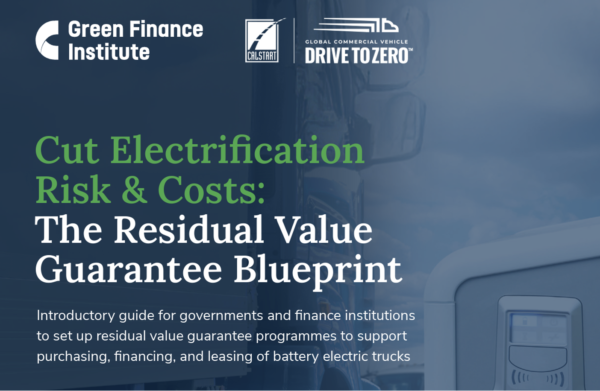
Read the Blueprint here.
- Drive to Zero and the Green Finance Institute, with support from the Climate Group and the European Clean Trucking Alliance, unveiled Cut Electrification Risk & Costs: The Residual Value Guarantee Blueprint, a critical tool to significantly cut residual value risk.
- In addition to Residual Value Guarantees, Green Finance Institute is spearheading two other financial products that can serve as alternatives to subsidies: 1) Green Transition Fund (GTF), and 2) Battery Investment Facility (BIF).
- Transvolt Mobility announced a Sustainable Green Bond that will be used to deploy more than 300+ zero-emission heavy commercial EVs for public and freight transportation.
Welcome our amazing new Global MOU Endorsers!
|
|
|
 |


Upcoming Events

Planning Ahead: Global MOU Forum 2026
As 2025 comes to an end, some of you may already be planning your priorities for next year. Global MOU signatories, endorsers, and partners are invited to attend the Global MOU Forum 2026, which will take place from Sept 8-10 in Santiago, Chile (home to the world’s largest electric bus fleet outside of China!). The event will focus on four main themes: Impact, Regulation, Investment, Infrastructure.
For more information and to register:
On behalf of the Drive to Zero team, we wish you a happy, healthy and restorative holiday season!
Top Headlines
Fleet Deployments
- Harbinger lands $160M Series C, inks initial FedEx deal for 53 electric trucks – FreightWaves
- BVG inaugurates €120m electric bus depot for 220 vehicles in Berlin (operational in 2027)
- De Lijn expands fleet with orders for 350 electric buses from BYD and Daimler
- RTC adds 65 new electric buses to its city fleet | Hyderabad News – The Times of India
- Kuala Lumpur and Penang to receive more than 1,000 electric buses with Prasarana aiming to full zero emission operations by 2037 – Sustainable Bus
- New 8-ton Volvo electric trucks to the fleet | DSV
- DHL Supply Chain Accelerates Sustainability With First Tesla Semi Delivery
Manufacturers and Models: Trucks and Buses
- Hyundai Motor wins 224-unit hydrogen bus supply deal from Guangzhou
- Kenworth Expands Zero-Emission Lineup with New Medium Duty Battery-Electric Trucks
- EV charging, SuperPanther to partner with ELMI Power in Europe
- Kenworth Expands Zero-Emission Lineup with New Medium Duty Battery-Electric Trucks
- Peterbilt Expands Electric Vehicle Portfolio with All-New Medium Duty Models 536EV, 537EV and 548EV
- Electric portfolio grows: Mercedes-Benz Trucks starts production of new eActros 400 generation at Wörth plant
- TRATON and EIB conclude EUR 500 million loan agreement to accelerate the transformation of transport
- Zero-emission vehicle retrofit – Solaris expands service offering
- GATE enhances its pay-per-use model with new vehicles
Manufacturers and Models: Port Equipment and Off-Road
- Scania and LKAB level up electric trucks in mining operations
- Zero-emission vehicle retrofit – Solaris expands service offering
Government Policies
- Germany proposes nationwide truck toll from 2030
- Chile To Go All Electric: What Are The Lessons For Other Countries?
- Sweden opens cities to night deliveries by electric trucks
Fuels and Infrastructure
]]>At COP30, Drive to Zero and our Global MOU signatories, endorsers and partners demonstrated a deep commitment to the global effort to drive down carbon emissions in transport and safeguard our planet for future generations. Indeed, our community’s momentum is growing. Mexico—the largest exporter of tractor trailers and 13th largest economy in the world—has signed the Global MOU. This year alone, the Global MOU has welcomed 60 new signatories and endorsers encompassing national governments, sub-national governments, private sector innovators, and non-governmental organizations (NGOs).
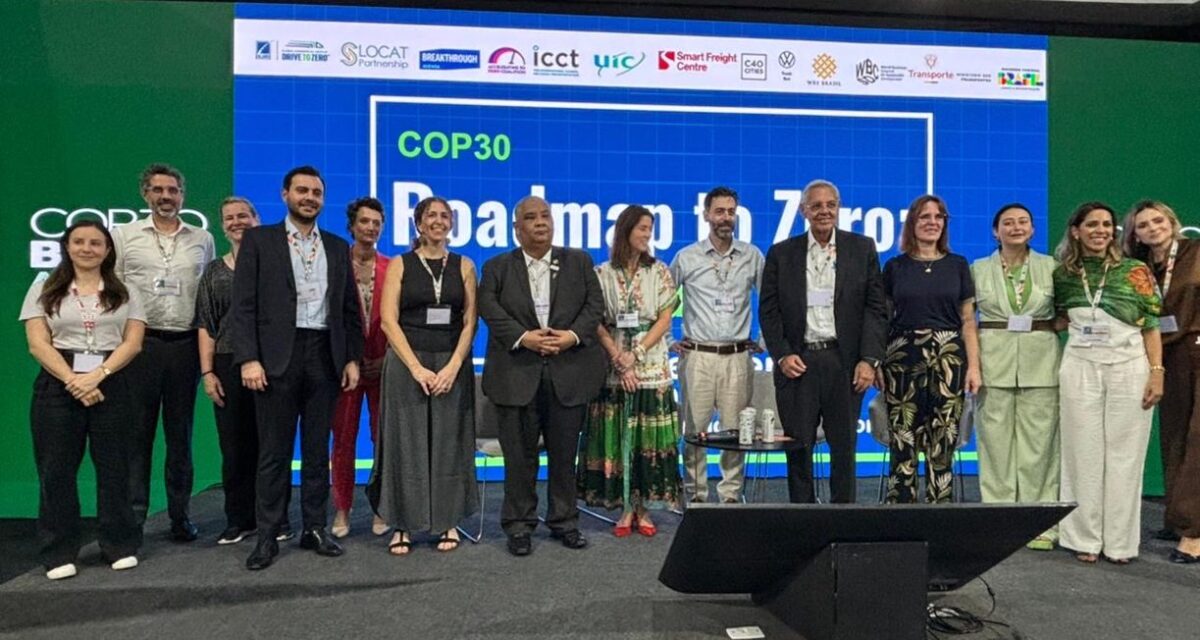
On November 11, Drive to Zero co-hosted “Roadmap to Zero: Accelerate. Adopt. Deploy.” at COP30.
At the start of the year, Global MOU signatory countries stood at 38 total. Today, Global MOU countries represent 21% of trucks and buses globally and —with the additions of Mexico, Peru, and Montenegro—now account for nearly 42% of the world’s GDP.
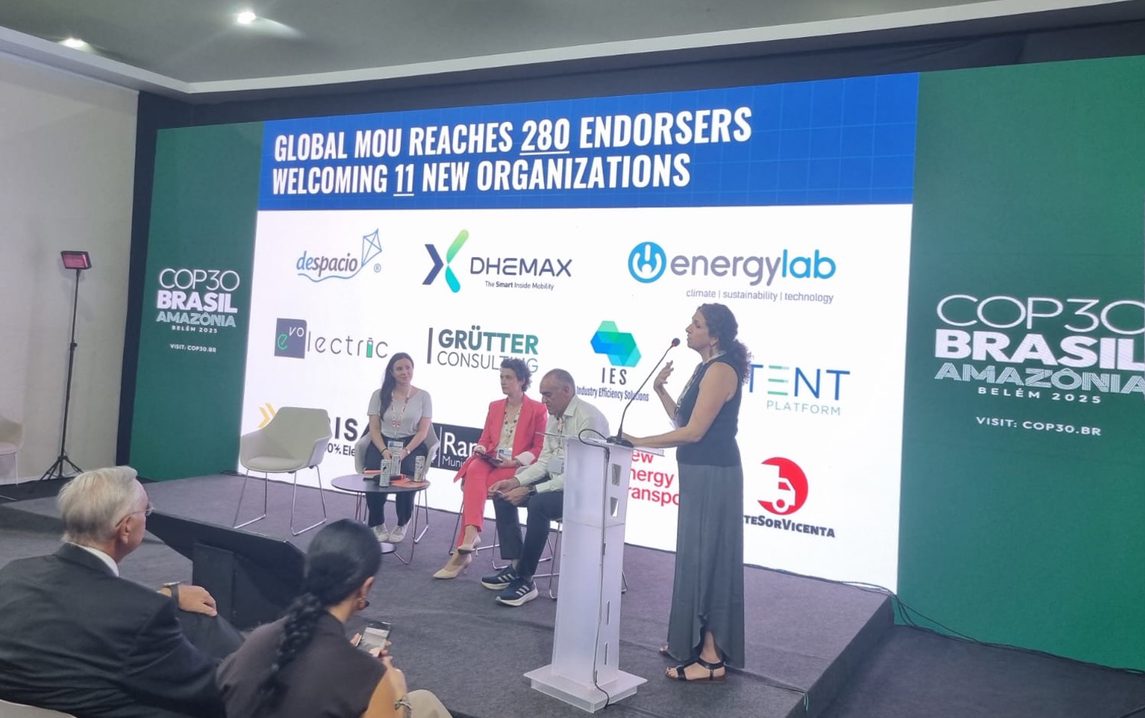
Stephanie Kodish highlights the Global MOU community’s rapid growth.
Beyond these signatory commitments, the Global MOU community is taking intentional and ambitious action to achieve the Global MOU goals. The drive to achieve 30% new zero-emission truck and bus sales by 2030, and 100% by 2040 is within reach. In every corner of the world, we’re seeing key steps being taken across the three areas critical to fuel this transition: policy, finance, and infrastructure.
- Ethiopia’s ban on internal combustion engine imports is delivering at scale, with their total EV fleet growing from 20,000 in 2023 to 115,000 by mid 2025.
- The Small Industries Development Bank of India (SIDBI) is setting up DRISHTI, a risk-sharing facility that will expand access to loans to small owner operators to purchase electric trucks.
- In Brazil, the public-private e-Dutra coalition is transforming the Rio de Janeiro–São Paulo freight transportation corridor into the country’s first zero-emission highway.
- Australia is getting its first electric truck corridor, which will be the first GGRC fully powered by renewables. At COP, Drive to Zero and NewVolt jointly announced the Sydney–Melbourne Powered by Renewables Corridor, which will span 880 km along the Hume Highway and cut 200,000 tonnes of CO₂ annually by 2030.
At COP30, Mexico becomes the 41st country to sign the Global MOU.
For Drive to Zero, this year’s COP represented a full circle moment. We launched the Global MOU in 2021, at COP26 in Glasgow. In just four short years, our community has become a model for effective international cooperation on transport decarbonization. The world is not only watching but depending on our success—let’s continue to show what’s possible.
Drive to Zero is thankful for all of you and your commitment to creating a cleaner, more resilient, just, and more modern transportation system that will benefit all people.
— Stephanie Kodish, Global Director, CALSTART/Drive to Zero
Special Features
GGRC at COP30: Brazil Announces Latin America’s First Global Green Road Corridor
At COP30, Drive to Zero and partners announced the e-Dutra Coalition, a public–private partnership dedicated to transforming freight transport along Brazil’s Rio de Janeiro–São Paulo corridor into the country’s first zero-emission highway. Bringing together leading companies, infrastructure providers, and government partners, the coalition aims to deploy 1,000 electric trucks and a network of high-capacity chargers by 2030. As part of the Laneshift Initiative and the Global Green Road Corridors program, e-Dutra advances Brazil’s leadership in sustainable mobility, improving air quality, reducing carbon emissions, and creating new opportunities for green economic growth.
Read more about that announcement here.

Announcing the new Brazil e-Dutra Coalition Corridor at COP30.
GGRC: Announcing Australia’s Electric Truck Corridor Powered by Renewables
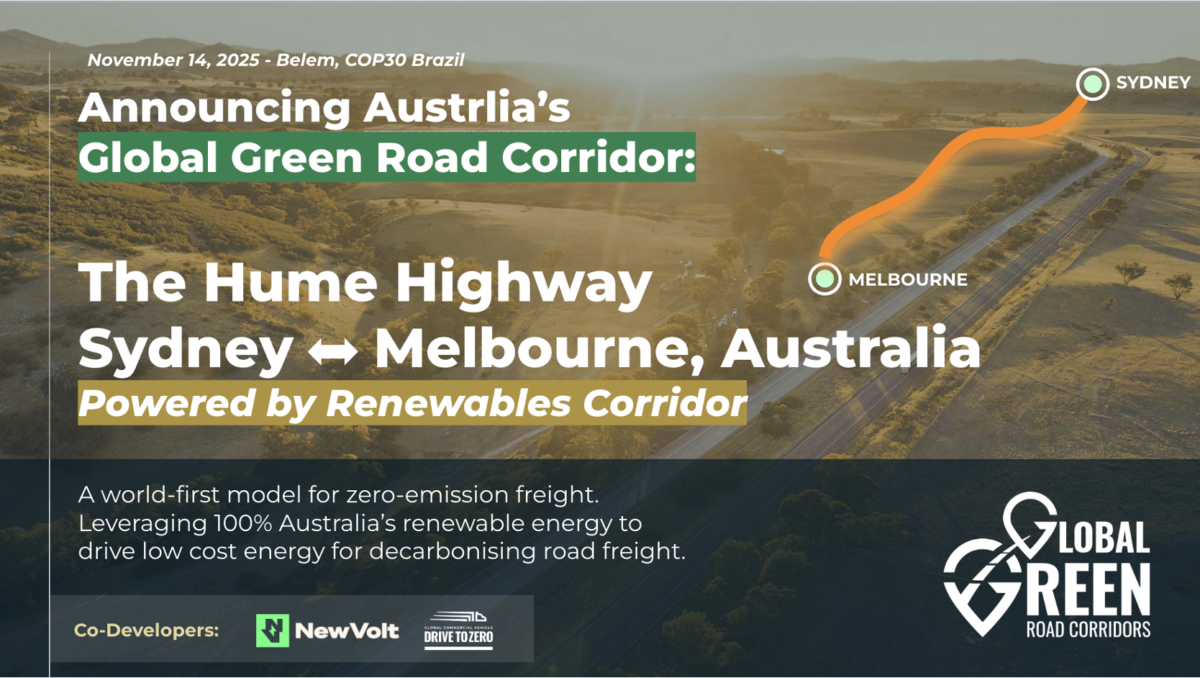
Also announced at COP30: Australia’s plans for a Global Green Road Corridor powered by renewable energy.
Together with our partner NewVolt, Drive to Zero is spotlighting the Sydney–Melbourne Powered by Renewables Corridor, Australia’s first electric truck corridor under the Global Green Road Corridors (GGRC) initiative.
Spanning 880 km along the Hume Highway, this flagship project will demonstrate the operational and financial viability of zero-emission trucking along Australia’s busiest freight route with the ambition of reducing 200,000 tonnes of CO₂ annually by 2030 and showcasing renewable-powered logistics at scale.
 The Coalition will launch at COP31 (2026) and will position Australia as a regional leader in clean, electrified freight.
In the Spotlight: Celebrating Global MOU Co-Lead Colombia
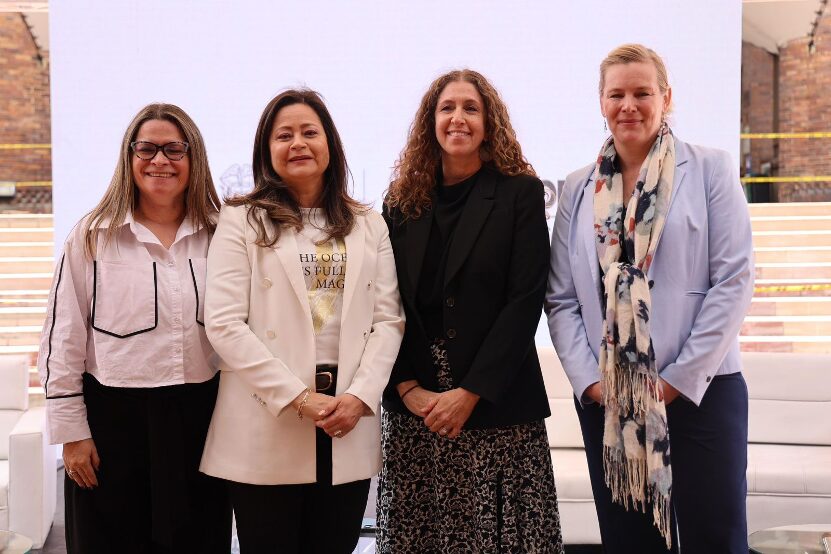
Photo from Transport Toward COP30: Sustainability in Motion in Bogota, Colombia. From Left to Right: Colombia Transport Minister Advisor Gina Paola Castro Jessen, Colombia Transport Minister María Fernanda Rojas Mantilla, Senior Global Director of CALSTART/Drive to Zero Stephanie Kodish, Europe Director of CALSTART/Drive to Zero Sita Holstag.
In October, Colombia hosted a high-level event in Bogota for Latin American transportation ministers called “Transport Toward COP30: Sustainability in Motion.” Drive to Zero’s Global Senior Director Stephanie Kodish took this unique opportunity to highlight Colombia’s longstanding commitment to the Global MOU community, and her excitement to be working with the country’s new Transportation Minister María Fernanda Rojas Mantilla, who took office in January. Colombia signed the Global MOU at COP28 in Dubai and became co-lead at ITF in Germany last Spring. Colombia’s transition to ZE-MHDVs is expected to deliver $32M in economic benefits by 2050, along with strengthened energy security, plentiful new jobs, cleaner air, and a more sustainable climate that benefits us all.
Welcome our amazing new Global MOU Endorsers!
|
|
|
 |


|
|
|
|
|


Resources
New Resource: Our Global MOU Roadmap to 2040

As we approach the end of the year, Drive to Zero has launched a comprehensive digital experience, “Powering Forward: The Global Zero-Emission Transition,” that assesses the state of the global transition to 100% new zero-emission truck and bus sales by 2040. Designed to serve as an invaluable resource for Global MOU signatories and endorsers, partners, funders, and policymakers, Powering Forward documents how the Global MOU community is driving progress, presents the latest ZE-MHDV data, and identifies how to overcome key policy, financial, and infrastructure challenges. Powering Forward is your one-stop-shop for how we achieve the Global MOU goals—our roadmap to powering a zero-emission transportation future.
COP30: Drive to Zero Partner Utilities for Net Zero Alliance Announces Major Energy Transition Investment
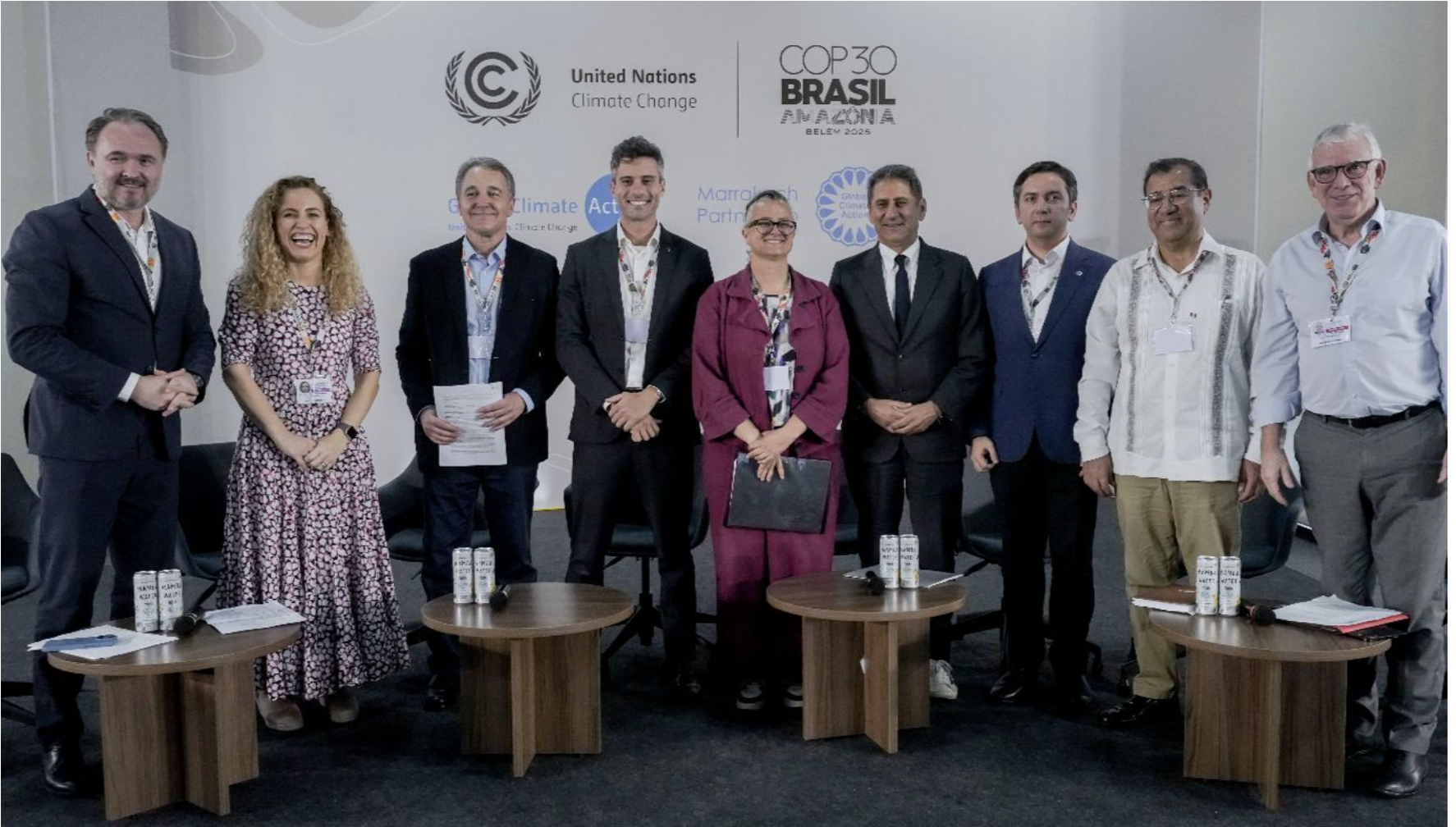
UNEZA announces major energy transition investment at COP30. Photo credit: UNEZA.
At COP30, Utilities for Net Zero Alliance (UNEZA)—a key partner of CALSTART and Drive to Zero – announced its members’ collective commitment to invest $148 billion (USD) per year in renewables, grids, and storage. This commitment will bring their total contribution to the energy transition to around $1 trillion by 2030 and support their stated goal to triple renewable capacity, strengthen grids, and advance energy storage. These advancements are essential for the transport sector, which depends on reliable, flexible and clean power systems to enable a broad shift toward zero-emission transport.
Drive to Zero celebrates this increased ambition, recognizing it as an important contribution to the conditions that will enable zero-emission transport to grow.
Top Headlines
Market
- New commercial vehicle registrations: vans -8.2%, trucks -9.8%, buses +3.6% in Q1-Q3 2025
- Truckmakers ask EU for looser emissions targets, letter shows
Fleet Deployments
- Rohrdorfer Zement introduces three electric trucks for Gmunden plant
- Tesco orders 750 Maxus eDeliver 9
- Toll announces next phase of its $67 million electric vehicles program with Coca-Cola Europacific Partners
- Meet the electric vehicles delivering Amazon packages in the UK
- HIVED announces expansion to eight new cities
- IVECO BUS wins Acamir tender: 87 eDAILY minibuses to modernise school transport in Campania, Italy
- 100 electric buses for South Africa! MAN Truck & Bus receives largest eBus order outside Europe
- Harbinger lands $160M Series C, inks initial FedEx deal for 53 electric trucks
Manufacturers and Models: Trucks and Buses
- Daimler Truck, HHLA and Kawasaki Heavy Industries launch strategic partnership to establish liquid hydrogen supply chain for Europe
- Thomas Built Buses introduces Wattson, the company’s first electric Type D school bus
Financial Incentives
- 80 million euros e-bus fund launched in Brazil, aiming to introduce more than 1,700 vehicles by 2030
- TRATON GROUP launches Green Finance Framework to finance and refinance battery-electric commercial vehicles
Fuels and Infrastructure
]]>“Today, we celebrate a significant milestone in our commitment to sustainability and decarbonization of the transportation sector, by signing the Global Memorandum of Understanding with CALSTART. This collaboration not only reaffirms our political will, but also opens the doors to new opportunities for investment, production and innovation in zero-emission vehicles.
We are determined to move towards a more sustainable future, promoting economic development that respects and preserves our natural resources. This is just the beginning of a path towards sustainable development and a circular economy that benefits all Mexicans,” said Dr. José Luis Samaniego Leyva. Undersecretary of Sustainable Development and Circular Economy at SEMARNAT.
“Mexico is demonstrating powerful zero-emission transportation leadership through its strong policy commitment to zero-emission trucks, buses, and infrastructure. By sending a clear signal that Mexico is open for business, the country is poised to attract global fleet operators, infrastructure providers, and a host of other zero-emission transport innovators ready for that business,” said John Boesel, CEO of clean transportation accelerator CALSTART.
The new Global MoU signatory was welcomed at the “Roadmap to Zero: Accelerate. Adopt. Deploy” event at COP30. Private sector innovators, who formally endorse the Global MoU as well as the economic, jobs, clean air, and climate benefits of zero-emission transport, applaud the move.
“Electrification of logistics and public transportation fleets is inevitable and the reasons are clear: Compared with diesel-powered vehicles, electric vehicles deliver approximately 80% lower operating costs, 80% to over 100% higher energy efficiency, greater comfort for passengers and drivers, and the elimination of particulate matter, polluting gases, and CO2. It’s as logical a choice as the shift from horse-drawn transport to motor vehicles about two centuries ago,” said Gustavo Tannure, CEO of EZVolt.
“The momentum Mexico brings to the global shift to zero-emission transport is remarkable,” Stephanie Kodish, Senior Global Director of CALSTART’s Drive to Zero. “Latin America is a hotspot for clean technology and zero-emission commercial vehicles. And, the people—the local communities—will enjoy the economic, operational, clean air, and climate benefits clean trucks and buses deliver.”
The current 41 Global MoU countries represent nearly one-in-four trucks globally (see the full list of countries here). Endorsing companies, organizations, and subnational governments represent more than $1.3 trillion in annual revenues and national governments represent 40 percent of the world’s GDP.
New Global MoU endorsers announced today include Despacio, Dhemax, EnergyLab, Evolectric, Grutter Consulting, Kabisa, Industry Efficiency Solutions SpA, INTENT Platform, New Energy Transport, Municipalidad de Rancagua, and Transportes Patricio Gutiérrez VEIRL. The Global MoU is co-led by the Government of Colombia and CALSTART’s Drive to Zero. It was first introduced at COP26 in Glasgow.
Partners at today’s event also announced the e-Dutra Coalition, a public–private partnership dedicated to transforming freight transport along Brazil’s Rio de Janeiro–São Paulo corridor into the country’s first zero-emission highway. Bringing together leading companies, infrastructure providers, and government partners, the coalition aims to deploy 1,000 electric trucks and a network of high-capacity chargers by 2030. As part of the Laneshift Initiative and the Global Green Road Corridors program, e-Dutra advances Brazil’s leadership in sustainable mobility, improving air quality, reducing carbon emissions, and creating new opportunities for green economic growth. Read more about that announcement here.
Today’s announcements were made by CALSTART’s Drive to Zero, SLOCAT Partnership, Road Transport Breakthrough (Breakthrough Agenda), Accelerating to Zero Coalition, ICCT, UIC, Smart Freight Center (SFC), C40, Volkswagen Truck & Bus, WRI Brazil, WBCSD, and the Ministries of Transport of Colombia and Brazil.
About CALSTART’s Drive to Zero
To align government and industry actions and ambition, CALSTART’s Drive to Zero aims to enable and accelerate the growth of global zero-emission commercial vehicles, and enjoys the support of top manufacturers, fleets, governments, and infrastructure providers. Learn more about the real people and companies that are transforming global transport in Drive to Zero’s “Charging Up Change” series.
]]>11 November, 2025 at 14:00 – 15:00 (GMT-3)
EMBARGO LIFTS 11 NOVEMBER, 2025 AT 900 GMT-3
Contact: Roxanna Smith
[email protected]
+1.510.326.0390
COP30—Major Transport Announcements:
New countries to sign “Global MoU” to accelerate zero-emission trucks, buses, infrastructure with goal of 100% new sales being zero-emissions by 2040
BELÉM, Brazil — New countries — with significant economic and cultural impact—will announce they will join a landmark agreement to decarbonize global freight and transport with the goal of reaching 100% new zero-emission truck and bus sales by 2040. Currently, 40 national governments are signatories to the Global Memorandum of Understanding on Zero-Emission Medium- and Heavy-Duty Vehicles (Global MoU), which aims for 100% new zero-emission medium- and heavy-duty vehicle (ZE-MHDV) sales by 2040 at the latest, with an interim goal of 30% new sales by 2030. The new countries will be unveiled at COP30 at the “Roadmap to Zero: Accelerate. Adopt. Deploy.” event at the Thematic Hub (Blue Zone) on 11 November 2025 at 1400–1500. The Global MoU is co-led by the Government of Colombia and CALSTART/Drive to Zero.
*This session will also feature a transformative announcement about a new zero-emission truck deployment, green corridor, and coalition to accelerate Brazil’s zero-emission freight and transport future.
WHAT:
- New countries will join an ambitious global effort to decarbonize commercial vehicles at “Roadmap to Zero: Accelerate. Adopt. Deploy.” event at COP30
FEATURED EXPERTS:
- Alicia Bácena, Secretary of Environment and Natural Resources, Mexico
- Leonardo Burgos, CEO, VOLTTA
- Roberto Cortes, President and CEO, Volkswagen Truck & Bus/TRATON GROUP
- María Fernanda Rojas Mantilla, Minister of Transport, Colombia
- Renan Filho, Minister of Transport of the Federative Republic of Brazil
- Kara H. Hurst, Chief Sustainability Officer, Amazon
- Stephanie Kodish, Senior Global Director, CALSTART/Drive to Zero
- Andressa Lemos, Marketing & Comms, LOTS Group
- Ana Patrizia Lira Executive Director, ANP Trilhos (Brazilian National Rail Association)
- Rachel Kyte, Special Representative for Climate, United Kingdom
- Sophie Punte, Supervisory Board member, Smart Freight Centre
- Stefanie Sohm, Advisor Transport and Climate, Kuhne Climate Centre
WHERE:
- COP30 in Belém at the Thematic Hub (Blue Zone)
WHEN:
- Event: 11 November 2025 at 14:00–15:00 GMT-3
- Embargo lifts 11 November 2025 at 900 GMT-3
ORGANIZERS:
- CALSTART’s Drive to Zero, SLOCAT Partnership, Road Transport Breakthrough (Breakthrough Agenda), Accelerating to Zero Coalition, ICCT, UIC, Smart Freight Center (SFC), C40, Volkswagen Truck & Bus, WRI Brazil, WBCSD, and the Ministries of Transport of Colombia and Brazil
WHY:
Although they are a relatively small portion of vehicles, diesel trucks and buses represent a disproportionate source of global pollution, including climate pollution. Drive to Zero is working to accelerate the decarbonization of commercial vehicles through global partnerships, innovative tools, groundbreaking research, and education.
]]>11 de novembro de 2025, das 14h às 15h (GMT-3)
EMBARGO SUSPENSO EM 11 DE NOVEMBRO DE 2025 ÀS 9h GMT-3
Contato: Roxanna Smith
[email protected]
+1.510.326.0390
BELÉM, Brasil — Novos países com impacto econômico e cultural significativo anunciarão sua adesão a um acordo histórico para descarbonizar o transporte e o frete global, com a meta de atingir 100% das vendas de caminhões e ônibus novos com emissão zero até 2040. Atualmente, 40 governos nacionais são signatários do Memorando de Entendimento Global sobre Veículos Médios e Pesados com Emissão Zero (Global MoU), que visa atingir 100% das vendas de veículos médios e pesados com emissão zero (ZE-MHDV) até 2040, com uma meta intermediária de 30% das vendas até 2030. Os novos países serão revelados na COP30, no evento “Roteiro para o Zero: Acelerar. Adotar. Implementar.”, no Centro Temático (Zona Azul), em 11 de novembro de 2025, das 14h às 15h. O Global MoU é coliderado pelo Governo da Colômbia e pela CALSTART/Drive to Zero.
*Esta sessão também contará com um anúncio transformador sobre um novo projeto de caminhões com emissão zero, um corredor verde e uma coalizão para acelerar o futuro do transporte e do frete com emissão zero no Brasil.
O QUE É:
- Novos países se unirão a um ambicioso esforço global para descarbonizar veículos comerciais no evento “Roteiro para o Zero: Acelerar. Adotar. Implementar.” na COP30
ESPECIALISTAS EM DESTAQUE:
- Alicia Bácena, Secretária de Meio Ambiente e Recursos Naturais, México
- Leonardo Burgos, CEO, VOLTTA
- Roberto Cortes, Presidente e CEO, Volkswagen Truck & Bus/TRATON GROUP
- María Fernanda Rojas Mantilla, Ministra dos Transportes, Colômbia
- Renan Filho, Ministro dos Transportes da República Federativa do Brasil
- Kara H. Hurst, Diretora de Sustentabilidade, Amazon
- Stephanie Kodish, Diretora Global Sênior, CALSTART/Drive to Zero
- Andressa Lemos, Marketing e Comunicação, LOTS Group
- Ana Patrizia Lira, Diretora Executiva, ANP Trilhos (Associação Nacional de Ferrovias do Brasil)
- Rachel Kyte, Representante Especial para o Clima, Reino Unido
- Sophie Punte, Membro do Conselho Fiscal, Smart Freight Centre
- Stefanie Sohm, Assessora de Transportes e Clima, Kuhne Climate Centre
ONDE:
- COP30 em Belém, no Centro Temático (Zona Azul)
QUANDO:
- Evento: 11 de novembro de 2025, das 14h às 15h GMT-3
- O embargo será suspenso em 11 de novembro de 2025, às 9h GMT-3
ORGANIZADORES:
- CALSTART’s Drive to Zero, SLOCAT Partnership, Road Transport Breakthrough (Breakthrough Agenda), Accelerating to Zero Coalition, ICCT, UIC, Smart Freight Center (SFC), C40, Volkswagen Truck & Bus, WRI Brasil, WBCSD e os Ministérios dos Transportes da Colômbia e do Brasil
POR QUE:
Embora representem uma parcela relativamente pequena dos veículos, os caminhões e ônibus a diesel representam uma fonte desproporcional de poluição global, incluindo a poluição climática. O Drive to Zero está trabalhando para acelerar a descarbonização dos veículos comerciais por meio de parcerias globais, ferramentas inovadoras, pesquisas pioneiras e educação.
]]>11 de noviembre de 2025, de 14:00 a 15:00 (GMT-3)
Contacto de Drive to Zero: Roxanna Smith
[email protected]
+1.510.326.0390
COP30: Anuncios importantes sobre transporte:
Nuevos países firmarán el «Global MOU» para acelerar la adopción de camiones, autobuses e infraestructura de cero emisiones, con el objetivo de que el 100% de nuevas ventas sean de cero emisiones para 2040
BELÉM, Brasil — Nuevos países, con un importante impacto económico y cultural a nivel mundial, anunciarán su adhesión a un acuerdo histórico para descarbonizar el transporte de carga a nivel mundial, con el objetivo de que el 100% de nuevas ventas de camiones y autobuses sean cero emisiones para 2040. Actualmente, 40 gobiernos nacionales son signatarios del Memorándum de Entendimiento Global sobre Vehículos Medianos y Pesados de Emisiones Cero (Global MOU), cuyo objetivo es que el 100% de nuevas ventas de vehículos medianos y pesados sean de cero emisiones para 2040, con un objetivo intermedio del 30% para 2030. Los nuevos países se darán a conocer en la COP30, en el evento «Hoja de ruta hacia cero: acelerar, adoptar, implementar», que se celebrará en la COP30, en el Hub Temático (Zona Azul), el 11 de noviembre de 2025, de 14:00 a 15:00. El Global MOU es coliderado por el Gobierno de Colombia y CALSTART/Drive to Zero.
QUÉ:
Nuevos países se unirán a un ambicioso esfuerzo global para descarbonizar vehículos comerciales en el evento «Hoja de ruta hacia cero: acelerar. Adoptar» en la COP30.
EXPERTOS DESTACADOS:
- Alicia Bácena, Secretaria de Medio Ambiente y Recursos Naturales, México.
- Leonardo Burgos, Director ejecutivo, VOLTTA
- Roberto Cortés, Presidente y CEO, Volkswagen Truck & Bus/TRATON GROUP
- María Fernanda Rojas Mantilla, Ministra de Transporte, Colombia
- Renan Filho, Ministro de Transporte de la República Federativa de Brasil
- Kara H. Hurst, Directora de Sostenibilidad, Amazon
- Stephanie Kodish, Directora global sénior, CALSTART/Drive to Zero
- Andressa Lemos, Marketing y Comunicaciones, LOTS Group
- Ana Patrizia Lira, Directora ejecutiva, ANP Trilhos (Asociación Nacional de Ferrocarriles de Brasil)
- Rachel Kyte, Representante Especial para el Clima, Reino Unido
- Stefanie Sohm, Asesora de Transporte y Clima, Kuhne Climate Centre
- Christoph Wolf, CEO,Smart Freight Centre
DÓNDE:
COP30 en Belém, en el Hub Temático (Zona Azul)
CUÁNDO:
Evento: 11 de noviembre de 2025, de 14:00 a 15:00 GMT-3
ORGANIZADORES:
CALSTART/Drive to Zero, SLOCAT Partnership, Road Transport Breakthrough (Breakthrough Agenda), Accelerating to Zero Coalition, ICCT, UIC, Smart Freight Center (SFC), C40, Volkswagen Truck & Bus, WRI Brasil, WBCSD y los Ministerios de Transporte de Colombia y Brasil
POR QUÉ:
Aunque representan una parte relativamente pequeña del parque automovilístico, los camiones y autobuses de diésel son una fuente desproporcionada de contaminación global, incluida la contaminación climática. Drive to Zero trabaja para acelerar la descarbonización de los vehículos comerciales mediante alianzas globales, herramientas innovadoras, investigaciones pioneras y educación.
]]>