
What is graph visualisation?
Graph visualisation is a visual representation of your data as a graph, with a graph being a structure of connected objects.
So graph visualisation is the visualisation of entities (nodes), and the relationships between them.
Visualised data is more digestible, understandable, and gets the point across faster. Graph visualisation has these and many more benefits. But before we dive into the benefits and importance of graph visualisation, let’s take a step back and talk about graphs and graph databases.
What are graphs and graph databases?
In mathematics (graph theory), a graph is a structure of connected objects. The structure is composed of nodes (entities) and relationships (connections between the entities).
Even the picture below is a graph – it shows two entities connected by a relationship. For more details, read the blog post graphs, graph theory, and knowledge graphs.

Graph databases store data as nodes and relationships, rather than in rows and columns.
When working with highly connected data, this structure offers several key advantages:
Intuitive structure
Some data fits naturally into rows and tables, especially when it has few connections. For example, storing people and their addresses works well in a tabular model because each address is linked only to the people living there.
However, most modern data is complex and highly connected. Graphs handle this complexity naturally. Their simple and flexible schema allows them to store interconnected information and represent real-world relationships more accurately.
More efficient storage
The more connected your data is, the less suitable relational databases become. Representing relationships in SQL often requires additional tables and joins, which increases storage complexity and makes the data harder to interpret.
Fast and efficient access
In a graph, any node can be the starting point for traversal. This allows queries to follow relationships directly, enabling faster insights, better performance, and real-time results.
Flexible structure
Graphs have a simple but powerful structure: nodes and edges—entities connected by relationships. This flexibility means almost anything can be modelled as a graph.
In many ways, graph structures mirror the real world, where everything is interconnected—from social networks to life events to natural systems.
Graph visualisation
Now that you understand the power of graph databases and when to use them, we can return to graph visualisation.
For some use cases, storing data in a graph without visualising it may be enough. However, visualisation is almost always beneficial. It helps you understand your data quickly, communicate insights to others, and explore the data further.
Visualisation also enables basic analysis. By looking at a graph, you can identify patterns, understand connections, and spot outliers.
The example below from our wine graph illustrates this. You can see that different wines share the same flavours. While this is a simple example, it clearly shows how connected the data is and how easily those relationships can be understood when visualised.

More sophisticated analysis can be performed with queries and graph data science algorithms. There are many types of algorithms you might find useful to run on your data. And the results of these algorithms are much more digestible when visualised.
For example, we can visualise identified clusters, their size, contents, and relationships to other clusters.
In the image below, I have grouped housing properties by their type. You can see that in my database, only 3 listings relate to entire townhouses, and many more listings for other property types such as “entire rental units.”

Visualise the most important (central) entities in your network, sparking further risk analysis.
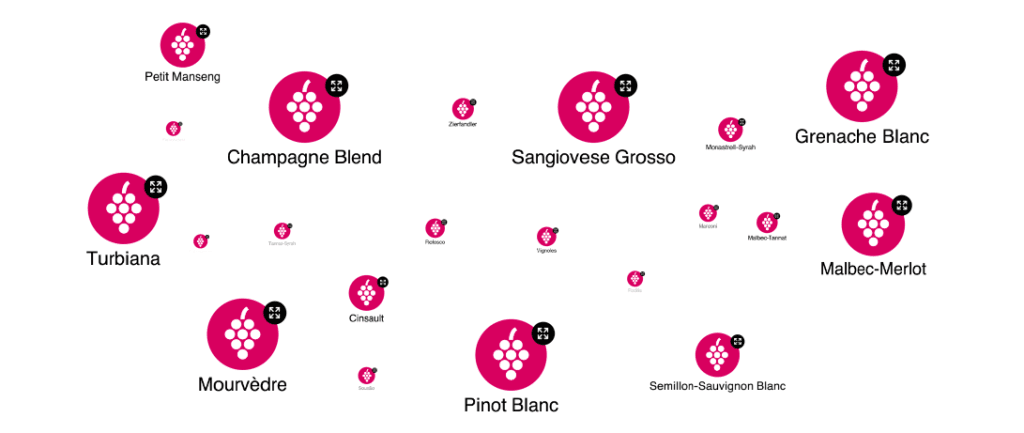
Again, you can see this in the picture below. The size of the nodes is based on their centrality to the entire database. The more wines are connected to a specific grape, the bigger – more central – the node is. Thus, you can easily see that there are few Champagne Blend, Turbiana, or Grenache Blanc wines in my database, while many fewer of some other varieties.
You can also find shortest paths e.g. for logistics operations and visualise them on a map.

Finally, interacting with your visualisation allows you to understand the data more easily, explore it, and decide on the next steps for your analysis.
Graph databases are an excellent fit for interconnected data. The benefits of using graph databases can be heightened by visualising the data. Graph visualisations can help you:
- Communicate, explain, and back the results of your analysis.
- Perform graph analysis. Visualising your data allows you to quickly recognise patterns, gaps, and outliers in your data. Algorithmic analysis and its results can also be visualised, making the results easier to understand.
- Interact with the data and gain a deeper understanding of it.
What are the advantages of graph visualisation?
Graph visualisation offers several important advantages:
Understanding complex data
Graph visualisation makes complex datasets easier to understand by highlighting relationships, structures, and connections between entities. Visual representations often reveal patterns and trends that are difficult to identify in raw numbers or text.
Interactive data exploration
Interactive visualisations allow users to explore data dynamically. Features such as zooming, panning, and drilling down into nodes or relationships make it easier to investigate specific parts of the graph and explore hypotheses.
Identifying relationships and dependencies
Graphs are particularly effective at illustrating relationships such as dependencies, hierarchies, and associations. This is especially valuable in areas like social network analysis, supply chain management, and fraud detection, where understanding connections is critical.
Supporting decision-making and communication
Visual representations help stakeholders quickly understand complex information. Graph visualisation makes insights easier to communicate, enabling teams to make faster, more informed decisions.
Faster analysis and pattern recognition
By presenting data visually, graphs make it easier to detect patterns, clusters, and anomalies. This can significantly accelerate analysis and help identify key insights more quickly.
Data-driven storytelling
Graph visualisation can also support storytelling by helping users build clear narratives around their data. This is particularly useful in presentations, reports, and educational contexts.
Encouraging collaboration
A shared visual representation of data helps teams collaborate more effectively. It creates a common reference point that supports knowledge sharing and collaborative problem-solving.
What are the challenges of graph visualisation?
Visualising knowledge graphs involves representing complex networks of nodes and relationships in a way that is clear and useful. This can be challenging, particularly when working with large and diverse datasets.
Below are some of the key challenges in graph visualisation, based on a lightning talk by Jan Zak from GraphAware.
Large numbers of nodes and node types
Knowledge graphs often contain many nodes with different types and varying levels of importance. When too many elements are displayed at once, visualisations can become cluttered, making it difficult for users to identify the most relevant information.
Colour management
Using colours to distinguish node types can quickly become challenging as the number of categories grows. A common best practice is to limit the palette to around five to seven distinct colours. Using too many colours can make the visualisation confusing and harder to interpret.
Filtering and simplification
To keep visualisations understandable, it is often necessary to filter the graph and display only the most relevant nodes and relationships. The challenge lies in balancing providing enough context while keeping the visualisation clear and readable.
Technical limitations
Large graphs can create performance issues during rendering and interaction. Effective visualisation therefore often requires optimisation techniques or specialised tools that can handle large datasets efficiently.
Node positioning and layout
Unlike maps with fixed geographic coordinates, graph layouts must be calculated dynamically. This makes it challenging to arrange nodes in a way that avoids overlap and remains easy to interpret. The problem becomes even more complex with “supernodes”—nodes that connect to many others—which can dominate the visualisation.
User interaction patterns
Clear interaction design is essential when exploring graph data. A widely used principle is the information-seeking mantra: overview first, then zoom and filter, followed by details on demand.
This approach allows users to explore complex graphs gradually without becoming overwhelmed.
Overall, effective graph visualisation requires thoughtful design, user-centred interaction patterns, and specialised tools or algorithms to manage complexity and present data clearly.
You can explore this topic further in our YouTube video. below.