Our great friend Justin Schofield of VideoGameDocs recently sat down with Bill Litshauer, CEO of Implicit Conversions, a company doing something truly special in the preservation space: they're systematically bringing retro games from the 80s, 90s, and early 2000s back to modern platforms like Switch, PlayStation 4 and 5, Xbox, and PC storefronts like Steam and GOG.
However, this isn't just about emulation. It's about building a technology that makes classic game preservation scalable, accessible, and economically viable for developers who want to bring their old titles back to life.
See our interview with Bill here:
The Technology Stack: Syrup, Pancake, and Waffle
Implicit Conversions has developed what might be the most deliciously-named technology stack in game preservation. Their framework, called Syrup, serves as a wrapper for all their emulation efforts. Within that framework lives Pancake, their PlayStation 1 emulator that's already brought titles like Fear Effect, Mortal Kombat Trilogy, and the recently released Fighting Force collection to modern consoles.

"We saw a lot of demand for PS1 games, particularly to go on Switch," Bill explains. "So we made it our mission to really focus our efforts on that."
The results speak for themselves. Implicit has about 16 games currently in production for various clients, including work with Digital Eclipse on the Mortal Kombat collection, where they handled the PS1 versions of Mortal Kombat Trilogy, Sub-Zero Mythologies, and Special Forces.
But they're not stopping at PS1. Currently in development is Waffle, their PlayStation 2 emulator. While Bill is cautious about timelines, the goal is clear: be first to market with PS2 emulation on Switch 2.
"That's really what we want to see, the first to market doing that," he says.
Three Paths to Preservation
What makes Implicit Conversions really interesting from a preservation standpoint is their business model. They've essentially created three different pathways for getting classic games back into circulation on modern systems.
The first is traditional work-for-hire, where publishers approach them for help porting specific titles. This currently represents about 80-90% of their business, largely because PlayStation emulation technology for profit remains somewhat rare.
The second is revenue sharing agreements. In these cases, Implicit takes on the development risk by doing the porting work upfront, while the publisher handles marketing and distribution. They might negotiate a 60-40 split until costs are recouped, then adjust to 70-30. It's a model that lets them advocate for games they believe in without requiring huge upfront investment from publishers.
The third pathway is still in alpha: an SDK aimed at homebrew developers. After launching Micro Mages, Implicit started getting requests from homebrew developers asking for help porting their games to Switch and PlayStation. The economics didn't work for traditional work-for-hire arrangements when games might only sell 500 units.
"So we thought, why don't we create an SDK for them?" Bill explains. "And then we can empower them, truly empower them, we'll give them Syrup, they will have a license to use it, and they can port their own games with it."
The alpha program already has developers on board, with a waitlist of others wanting to join. Developers can add features like widescreen mode and publish directly to Nintendo or PlayStation stores themselves. It's an approach that could hopefully make preservation accessible to developers whose games might not otherwise make economic sense to port.
The Art of Choosing Games
Implicit has developed a thoughtful framework for evaluating potential projects.
Games that never left Japan, like Milano no Arubaitu (Milano's Odd Job Collection), which Implicit is bringing to North America and Europe for the first time in collaboration with XSEED Marvelous and Hilltop Works, represent preservation opportunities that go beyond just technical porting.

"It's a really beautiful game with beautiful pixel art and it really stands the test of time," Bill says. The localization effort includes translating not just text and graphics but even the intro and credit songs.
Genre trends matter too. Bill points to horror games as consistently popular, while noting that entire genres like real-time strategy and first-person dungeon crawlers have largely disappeared from modern gaming. He notes that turn-based games like Disciples 2: Dark Prophecy represent a piece of gaming history that deserves preservation.
"It's always sad when a genre of game kind of disappears," he reflects.
Community demand also plays a crucial role in what types of games they will focus on. Implicit runs an active Discord where community members can vote on which games they'd like to see preserved. If you're interested in being a part of this make sure to join their Discord!
The Silent Film Problem
During our conversation, Bill raised a comparison that resonates deeply with anyone involved in preservation work: the lost silent film era.
"Like with the silent film era and a majority of those early, early films that might have established a standard in how films were created, how films were produced, are lost to time," he notes. "It is great to have games like Mario Brothers because it is a foundational game, but it is also important to have the other games that maybe a majority of people didn't play, but maybe it was the game that did influence another game that did become very big."
It's all part of one giant puzzle. Every preserved game, whether blockbuster or obscure, contributes to our understanding of gaming history. We lose context and influence chains when we only preserve the hits.
The Technical Challenges
Emulation is never simple, and certain platforms present unique headaches. Bill is refreshingly candid about the challenges.
Nintendo 64 is "notoriously difficult to do," and they don't currently have an N64 emulator. Wii games have generated interest, but without massive demand, it doesn't make business sense to invest years building an emulator from scratch.
PC games present different problems. While emulating PC is possible, every machine configuration is different, creating countless variables. Mapping 23 keyboard keys to a controller can feel clumsy and unfun. It's solvable, but requires creative thinking about control schemes and interface design.
Then there's the legal maze. Game rights are often tangled nightmares of licensing, with different entities owning code, music, character likenesses, and distribution rights.
Why It Matters
Companies like Implicit Conversions are an important part of game preservation. Thanks to their sustainable businesses that can navigate legal complexities, they can develop reliable technology, which leads to actually getting classic games back into players' hands.
Their own technology means they're not dependent on any single publisher or platform holder. Their multiple business models mean they can work with everyone from major publishers to indie developers with cult classics. Their SDK development means they're actively working to democratize preservation tools. This is great for everyone.
As preservationists, we get really excited hearing from Bill during this interview, where we can see all the pieces coming together: technical expertise, business acumen, community engagement, and genuine passion for gaming history.
Learn More and Get Involved
You can explore Implicit Conversions at implicitconversions.com, where you'll find information about their current projects and technology.
Join their Discord community to vote on which games you think should be preserved next and engage with other community members.
If you're a developer or publisher with classic games gathering dust, reach out to the Implicit Conversions team to get your game in new gamers' hands!
And if you're just a fan who wants to support game preservation, keep an eye out for Implicit Conversions' releases. Every purchase of a preserved classic game sends a signal that this work matters, that gaming history has value, and that players care about the medium's past.
Special thanks to Justin Schofield from Video Game Docs for conducting this interview on our behalf. Full interview available on the Hit Save! YouTube channel. If you're working on game preservation projects or have a preservation-worthy story, reach out to us at [email protected]!
]]>In our ongoing mission to preserve video game history through developer interviews, we recently sat down with Clyde Shaffer, creator of the GameTank, a brand new 8-bit game console built entirely from scratch. Yes, you read that right: in 2025, someone is creating a completely new retro console with physical cartridges, analog video output, and all the charm of classic gaming systems.
Clyde joined us at PAX East earlier this year, where we showcased the GameTank to hundreds of attendees. Watching people's faces light up as they played games on this homebrew console, complete with buttery-smooth animations and surprisingly gorgeous graphics, was incredibly fun. Now we're thrilled to share Clyde's incredible journey from software developer to hardware designer to console creator.
See our interview with Clyde here:
Not Your Average Fantasy Console
If you're familiar with fantasy consoles like PICO-8 or TIC-80, the GameTank might sound similar at first. But there's a crucial difference: the GameTank is real hardware. It's not an emulator with arbitrary software limitations, it's an actual physical console with genuine hardware constraints.
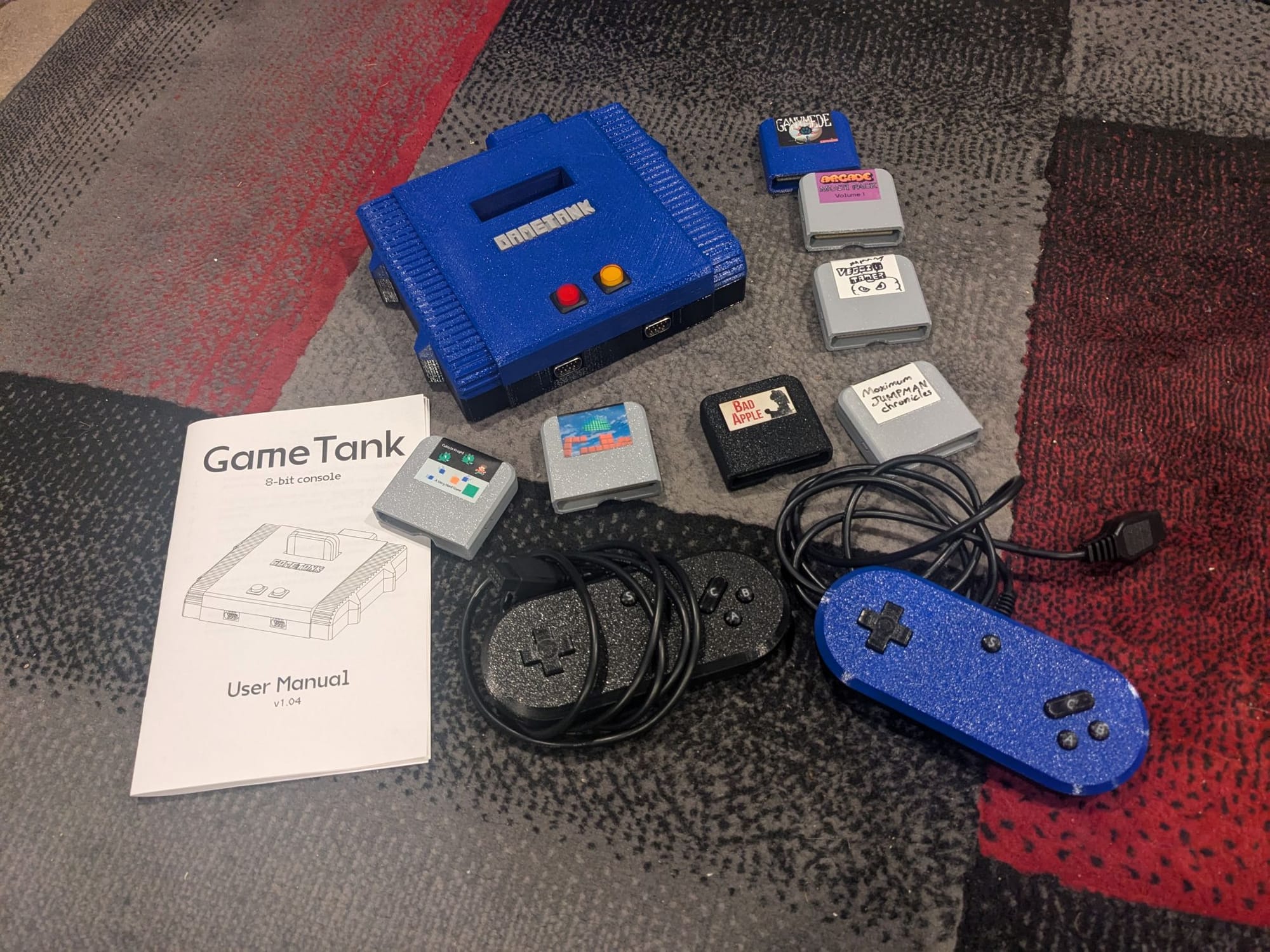
This includes 9-pin cartridge ports, analog video output that looks best on a CRT TV, and yes, actual physical cartridges. Everything about the GameTank is designed to be tinker-friendly and completely open source.
From LucasArts Layoff to Full-Time Console Maker
Clyde's path to creating the GameTank started decades ago. Raised by parents in the computer industry during the personal computer boom of the 1990s, he had constant access to computers and reading materials. As a kid, he realized early on that tinkering with computers didn't always require money, just time, which he had in abundance.
"I was all set to go work at a studio." Clyde recalls. Then LucasArts was bought by Disney, everything in the pipeline was canceled, and he found himself laid off before even graduating college.
After working at a few tech startups in New York City and even working at a little company called Facebook, Clyde eventually found himself with the time and resources to pursue a consuming passion project. That project became the GameTank.
The Perfect Storm: PCBs, 3D Printing, and a 6502
Around 2017-2018, Clyde got interested in hardware after playing games by Zachtronics, those wonderfully complex puzzle games that teach you how computers work. But instead of just playing them, he started implementing their concepts in real life.
"I played a couple of games by Zachtronics... and for me I just kind of ran out of Zachtronics games and started playing them in real life."
This coincided with three major developments: PCB manufacturers making it easier than ever for hobbyists to order custom boards, the explosion of accessible 3D printing, and Clyde's discovery of the 6502 processor datasheet. The 6502, the same chip that powered the Atari 2600, Nintendo Entertainment System, and Commodore 64, just clicked for him.
"Something about it clicked, it just seemed really friendly," he says. "I knew I wanted to play with this thing and at the same time I remembered a lot of unanswered questions that I've had in my head since childhood."
One of those questions? How composite video actually works. That single yellow RCA cable had been "some kind of black magic" since his childhood. Years later, as an adult, he could finally take another swing at understanding it.
When Your 3D Printer Becomes Gaming History
Here's a story that perfectly captures how this project came together: Clyde had an early 3D printer sitting on a piano bench. One night, friends were over playing video games when someone backed into the bench laughing and knocked the printer over, completely destroying it.
"I quickly sort of collect it into a bag and set it aside for a while," Clyde remembers. His plan was to buy a cheap new printer to print replacement parts for the old one. But the new generation of printers "cost half as much and were 10 times better."
That accident kicked off a spiral of creativity. Suddenly, instead of one or two prints a month, Clyde was doing ten prints a week. The improved workflow made it feasible to design custom cases and prototype hardware at a pace that wouldn't have been possible before.
128x100 Pixels Never Looked So Good
The GameTank's specifications sound modest on paper: 128x100 pixel resolution with 200 unique colors. Yet when you actually see games running on it, they look remarkably polished, almost 16-bit in quality.
The secret? Temporal resolution trading for spatial resolution. Because the screen is relatively small, the hardware can redraw it incredibly quickly, up to three times per frame while maintaining 60 FPS. The sprite memory is 32 times larger than the screen itself, allowing for extensive animation frames.
"What it doesn't have in horizontal space resolution it sort of trades for temporal resolution," Clyde explains. "The fact that it can do animations with a lot of frames... you can have a whole eight to ten frame run cycle where you can just have a lot of little details showing up."
This creates animations reminiscent of rotoscoped classics like Prince of Persia and Flashback, games where fluid character movement made relatively low-resolution graphics come alive.
Open Source by Design
Everything about the GameTank is open source: the PCB designs, schematics, 3D print files, development tools, and emulator. This wasn't just an afterthought, it was a core design principle.

The community has responded with enthusiasm. At a recent hacker conference, someone immediately proposed creating a "32X-style" add-on, a 16-bit expansion that would slot into the GameTank and use it as a graphics card. Other developers have created 3D renderers, racing games, shoot-em-ups, and puzzle games. One developer in Japan has been systematically porting their collection of 20 games to every 8-bit system they can find, including the GameTank.

Clyde has hosted four game jams so far, with a fifth on the way. The results have been impressive: full 3D polygon renderers running at multiple frames per second, Gradius-style aquatic shoot-em-ups, and various creative experiments pushing the hardware in unexpected directions.
The Cartridge Conundrum
Creating a modern retro console means dealing with very real hardware challenges. One of Clyde's biggest ongoing issues is sourcing the dual-ported video RAM chip that makes the GameTank's graphics possible. This specialized component allows both the CPU and video circuit to access memory simultaneously without conflicts.
The chip went from $40 to $70 with several-month lead times. However, Clyde discovered that buying chips on eBay or AliExpress for around $10 each results in about a 90% success rate, making it economically viable even if one in ten doesn't work.
"I've actually found that like 90% of the eBay ones they just work," he notes. It's the kind of practical problem-solving that defines homebrew hardware development.
From Sleepless Weekends to Assembly Line
The evolution of GameTank hardware tells its own story. Version 1 was a vertical motherboard with separate cards, decorated with memes because why not? Version 2 went flat for easier debugging. Version 3, "unit zero," was the first console-shaped model with through-hole components that took an entire sleepless weekend to assemble.
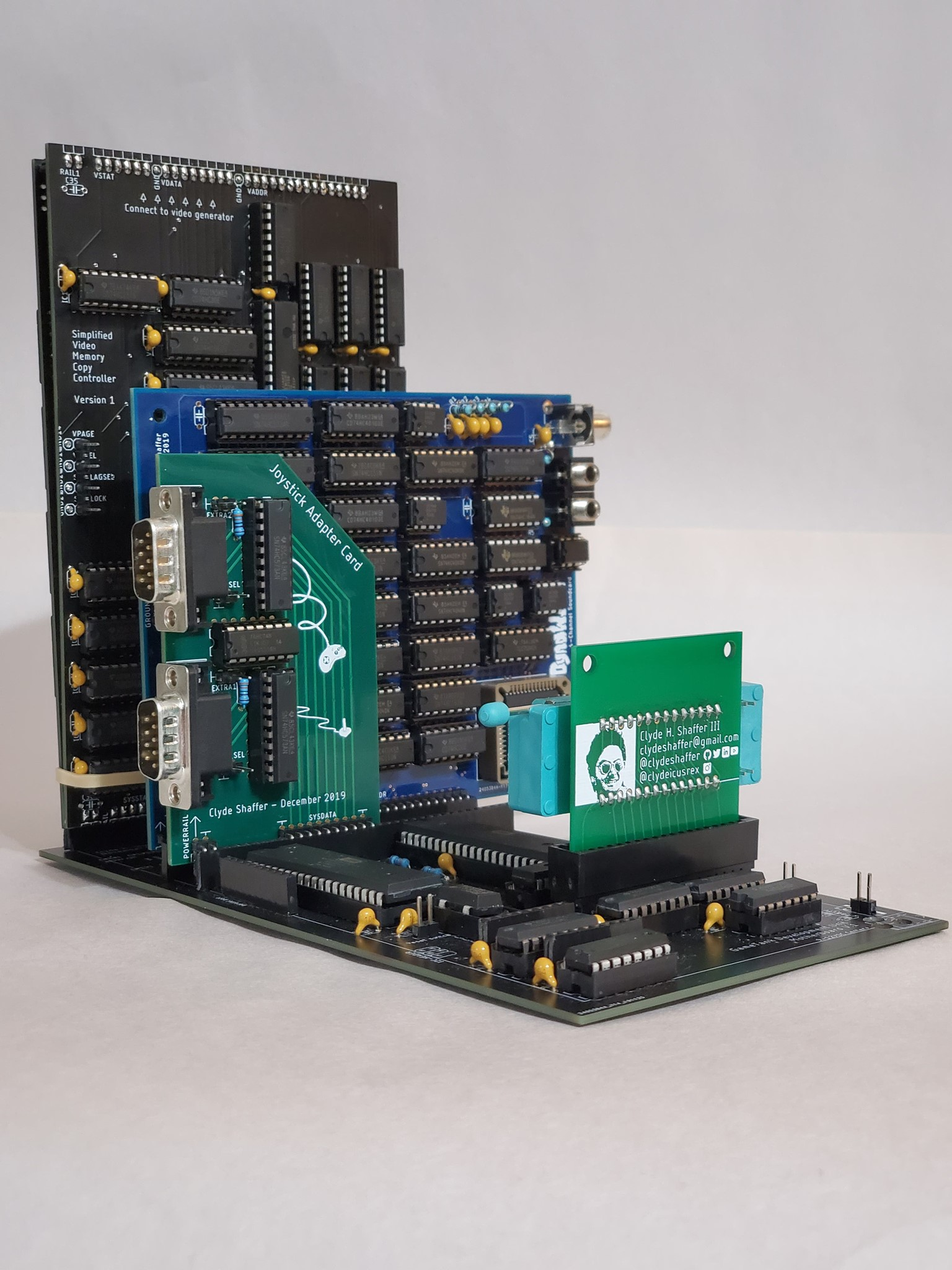
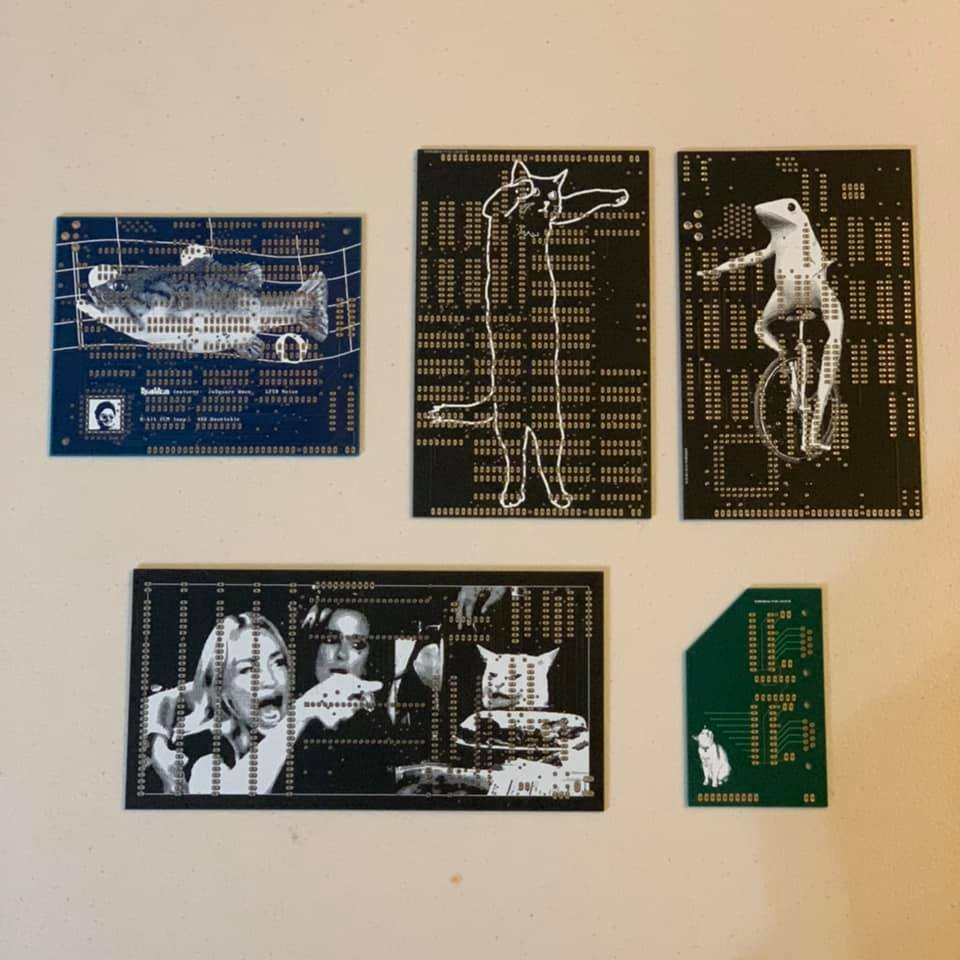


The current iteration uses PCBs from PCBWay with surface-mount components. Now Clyde can reliably assemble 10 units in a week, though he admits his testing starts to suffer if he pushes that pace, sometimes leading to support emails about issues in rushed builds.
Breaking the Cycle: More Consoles, More Games
Clyde recently launched a pre-campaign on Crowd Supply to manufacture GameTanks at larger scale. The goal is to break a classic chicken-and-egg problem in platform development.
"The GameTank would get more people to get it if it had more games, and it would get people making more games for it if there were more GameTanks out there," he explains.
Crowd Supply, as a subsidiary of major electronics distributor Mouser, can negotiate better component pricing and connect Clyde with contract manufacturers. His current manufacturing partner is in Croatia, a strategic choice given recent tariff situations affecting imports from China.
Beyond just manufacturing, Clyde envisions creating a distribution platform for homebrew games, something like a dedicated GameTank version of itch.io, complete with drop-ship cartridge fulfillment. Developers could upload their games, design custom label art, and offer physical cartridges for sale without needing to handle inventory themselves.
The Advice: Pick Your Components Carefully
Looking back on five years of development, Clyde has clear advice for anyone wanting to create their own hardware project: be very careful about component selection.
"If you design around a component and that component is super critical to your application, try to pick things that maybe have more than one source," he cautions.
He learned this lesson the hard way when a critical component on the original sound card went extinct, forcing a complete redesign. The solution? Adding a second 6502 processor whose sole job is generating sound.
It's not just about technical specs, it's about supply chain reality. In the hardware world, you can design the perfect system only to have a single discontinued chip make it unbuildable.
Why It Matters
In an era of increasingly powerful and complex gaming hardware, there's something refreshing about a project like the GameTank. It's a reminder that constraints breed creativity, that understanding how things work at a fundamental level is valuable, and that the magic of playing a game on actual physical hardware is incredibly fun.
The GameTank isn't trying to compete with modern consoles. It's not trying to replicate old ones either. It's carving out its own space, a tinkerer-friendly, open-source platform where developers can experiment with hardware-level game development using modern tools and availability.
As game preservationists, we're thrilled to see projects like this. The GameTank isn't just preserving the spirit of retro gaming, it's actively extending it, creating new history that future preservationists might study.
Learn More and Get Involved
You can explore everything GameTank at gametank.zone, including:
- Developer documentation at wiki.gametank.zone
- The YouTube channel at youtube.gametank.zone
- The Crowd Supply pre-campaign at gametank.zone/crowdsupply
- The community Discord at discord.gametank.zone
If you're interested in homebrew game development, hardware tinkering, or just love retro gaming with a modern twist, the GameTank is definitely worth checking out.
Full interview available on the Hit Save! podcast. If you're an indie developer or hardware creator with a preservation-worthy story, reach out to us at [email protected]!
]]>Ben Jelter never expected to finish his first video game in a single day. But on a December evening in 2019,
]]>How a comic book artist discovered GB Studio and created games that challenge the "just world fallacy" while embracing the Game Boy's limitations as strengths.
Ben Jelter never expected to finish his first video game in a single day. But on a December evening in 2019, rushing to show friends at a drawing workshop, he discovered GB Studio, a tool that would transform him from a frustrated would-be game developer into one of the most thoughtful indie creators working with Game Boy hardware today.
"I made that game in a day in GB Studio," Ben recalls. "It was just messing around to see if I could use the program. The program was so approachable that I was able to quickly make something because that evening I was going to a drawing workshop with some friends, and I wanted to actually be able to show them something I made on a Game Boy."
That spontaneous mini game jam marked the end of a decade-long struggle. Since 2009, Ben had started numerous game projects but never managed to complete one. As a comic book artist and art instructor without programming skills, the complexity of traditional game development tools had proved overwhelming. GB Studio changed everything.
Watch the full interview on YouTube
The Comic Book Foundation
Ben's path to game development began in the world of sequential art. As a comic book artist who had spent years crafting long-form narratives, he brought a unique perspective to game design: one focused on handcrafted experiences rather than algorithmic content generation.
"Making comic books, especially very long comic books, involves planning a very large scale project and then working on it for a year or two," he explains. "I think that lends itself very well to working on video games. You know how to handle a long-term project."
But games presented new challenges. Unlike the linear progression of comics, where Ben worked "like a robot," scripting everything before drawing page by page, games required identifying core systems and ensuring they functioned before moving forward. This shift from linear storytelling to systemic design would prove crucial in shaping his game development philosophy.
Why Game Boy? The Power of Constraints
When asked why he chose Game Boy development over more versatile engines like Unity, Ben's answer cuts to the heart of his design philosophy: workflow and limitations breed creativity.
"The brutal truth is Unity is way more complicated," he admits. "I'm a big workflow person. I don't use Photoshop; I use Clip Studio Paint because I can rearrange all my palettes and shortcuts and even make my own tools that I can access with keyboard shortcuts I made up."
But there's a deeper reason tied to his childhood. While friends had Super Nintendo and Sega Genesis systems, Ben's parents bought him a Game Boy, partly due to the single TV limitation, partly from anti-consumerist concerns, and partly to keep him active outdoors. This early relationship with the portable system created a special connection that would influence his creative choices decades later.
"Game Boy is to me the most special system," he reflects. The constraints weren't just nostalgic. They were strategic.
The Machine: Challenging the Just-World Fallacy
Ben's breakthrough game, "The Machine," exemplifies his approach to meaningful game design. Rather than creating another power fantasy, he built a dystopian experience that deliberately subverts player expectations.
"The Machine is fundamentally a game about life," Ben explains. "In life, you can make decisions that ruin your life, and you can make decisions that set your life on a completely different course. But The Machine is a dystopia, so the theme of the game is you can make whatever decisions you want, and you can do better or worse, but none of the decisions you make are going to change the way that the machine works."
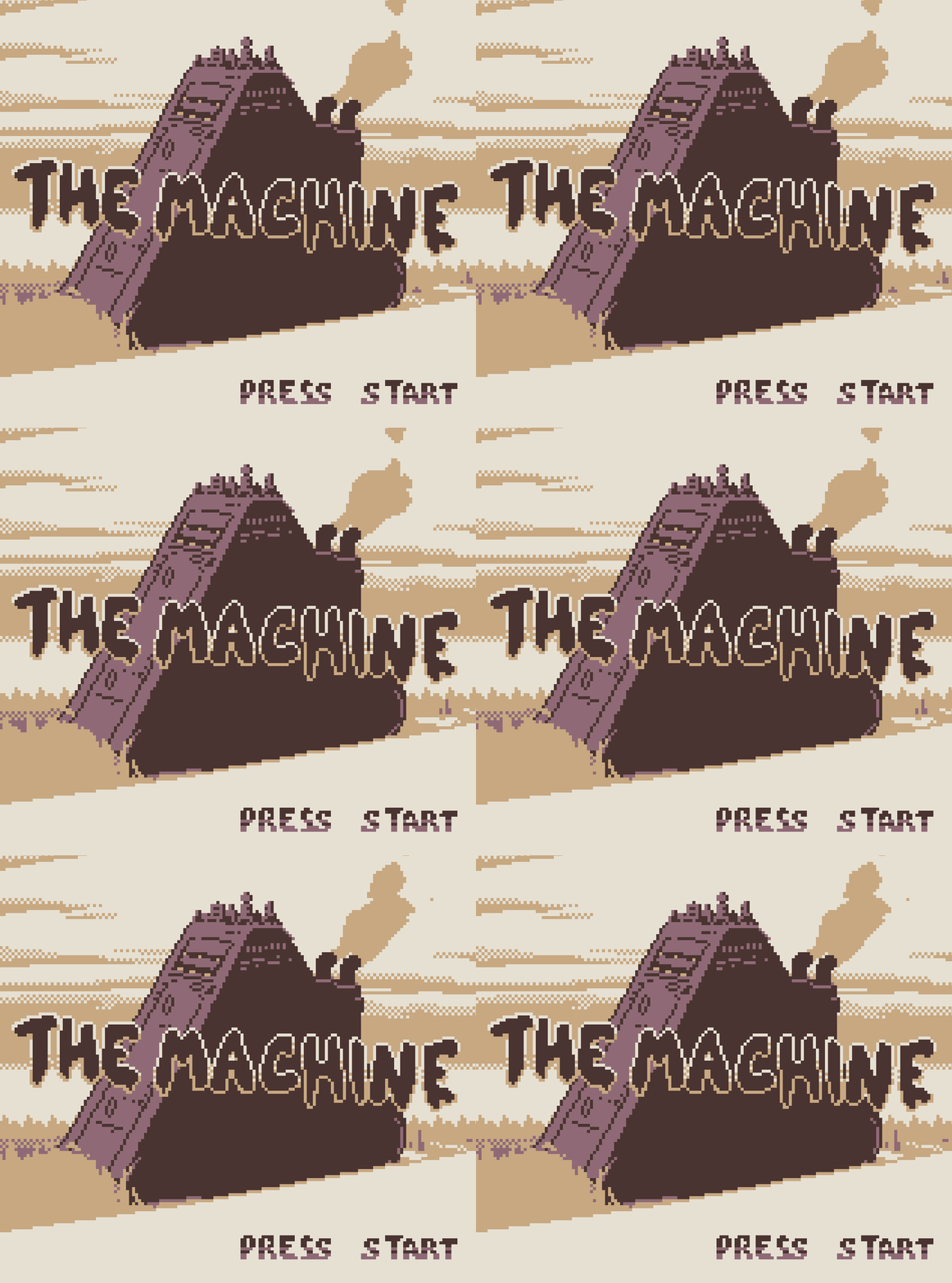
The game's central mechanic reflects Ben's critique of the "just-world fallacy": the cognitive bias that leads people to believe the world is inherently fair and people get what they deserve. In The Machine, good actions often lead to bad outcomes, while selfish choices frequently result in personal success.
"If you are bad, good things happen to you, and if you're good, bad things happen to you. That's the core rule of The Machine," Ben states. "I feel like that reflects life more accurately than most fiction."
This inversion of typical game morality systems serves a larger purpose: forcing players to confront uncomfortable truths about power structures and social mobility.
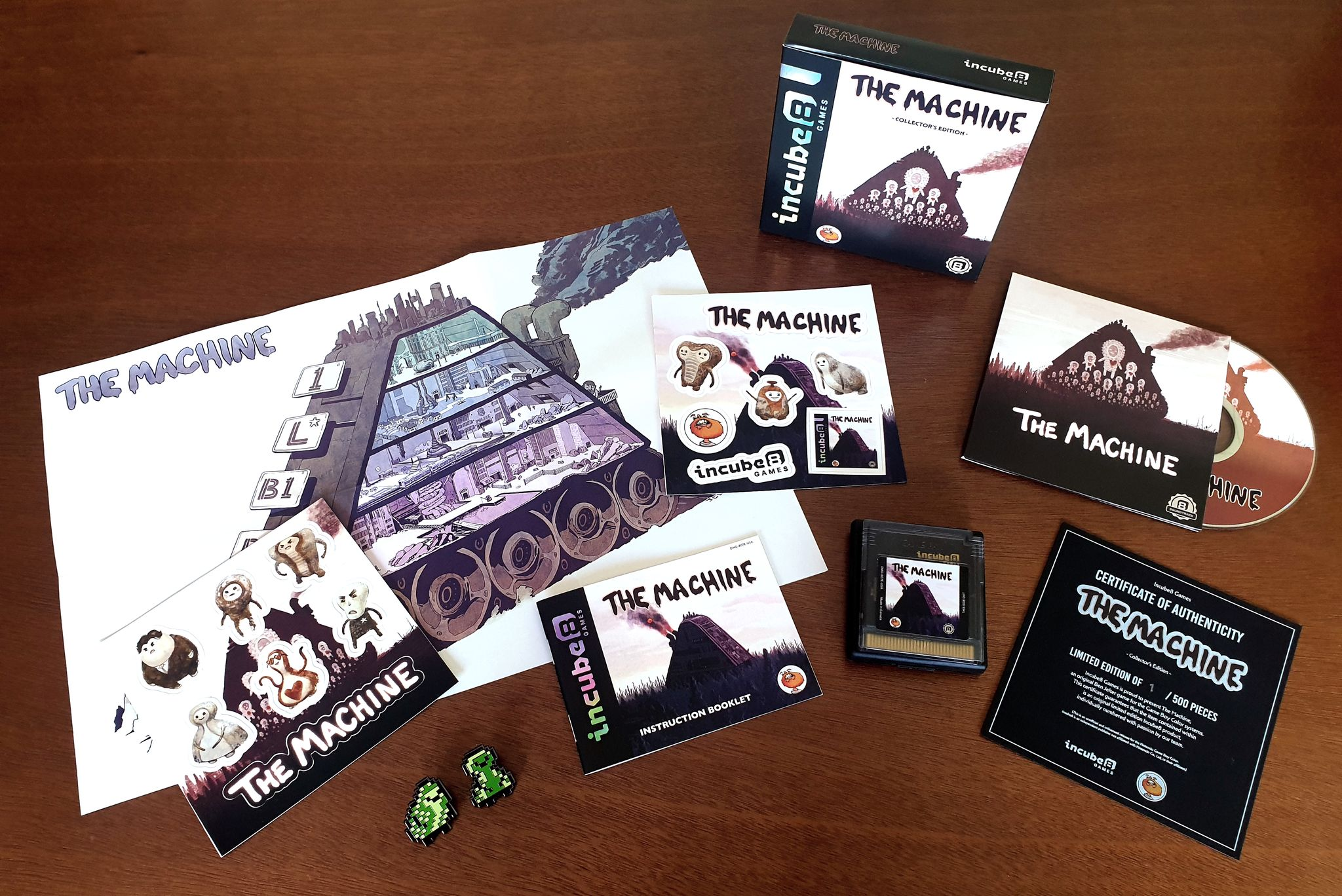
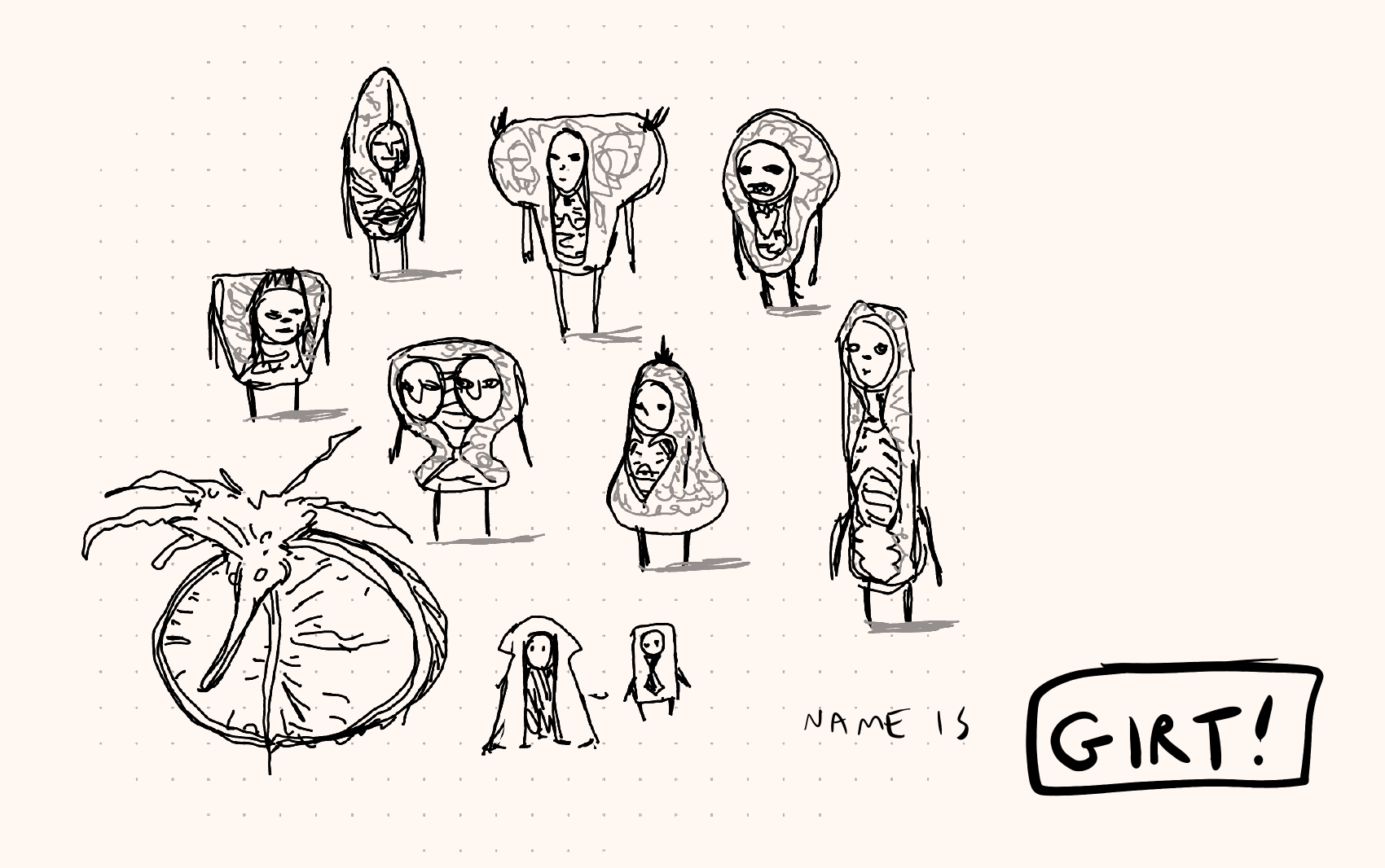


From top-left: The Machine physical copy with all extras, development sketches of characters, characters for printed manual, environmental sketches
The Evolution of GB Studio
Ben's relationship with GB Studio has evolved alongside the tool itself. He started with version 1.1, when the program was remarkably simple—drop a PNG file with specific dimensions, and the program would automatically create animated sprites. But this simplicity was also its strength.
"Everything is a two-frame animation. You just draw two pictures of the actor facing down, two pictures facing up, and two pictures facing right, and then it will automatically populate. Then you can immediately run a build and walk around as that character. It's really fun."
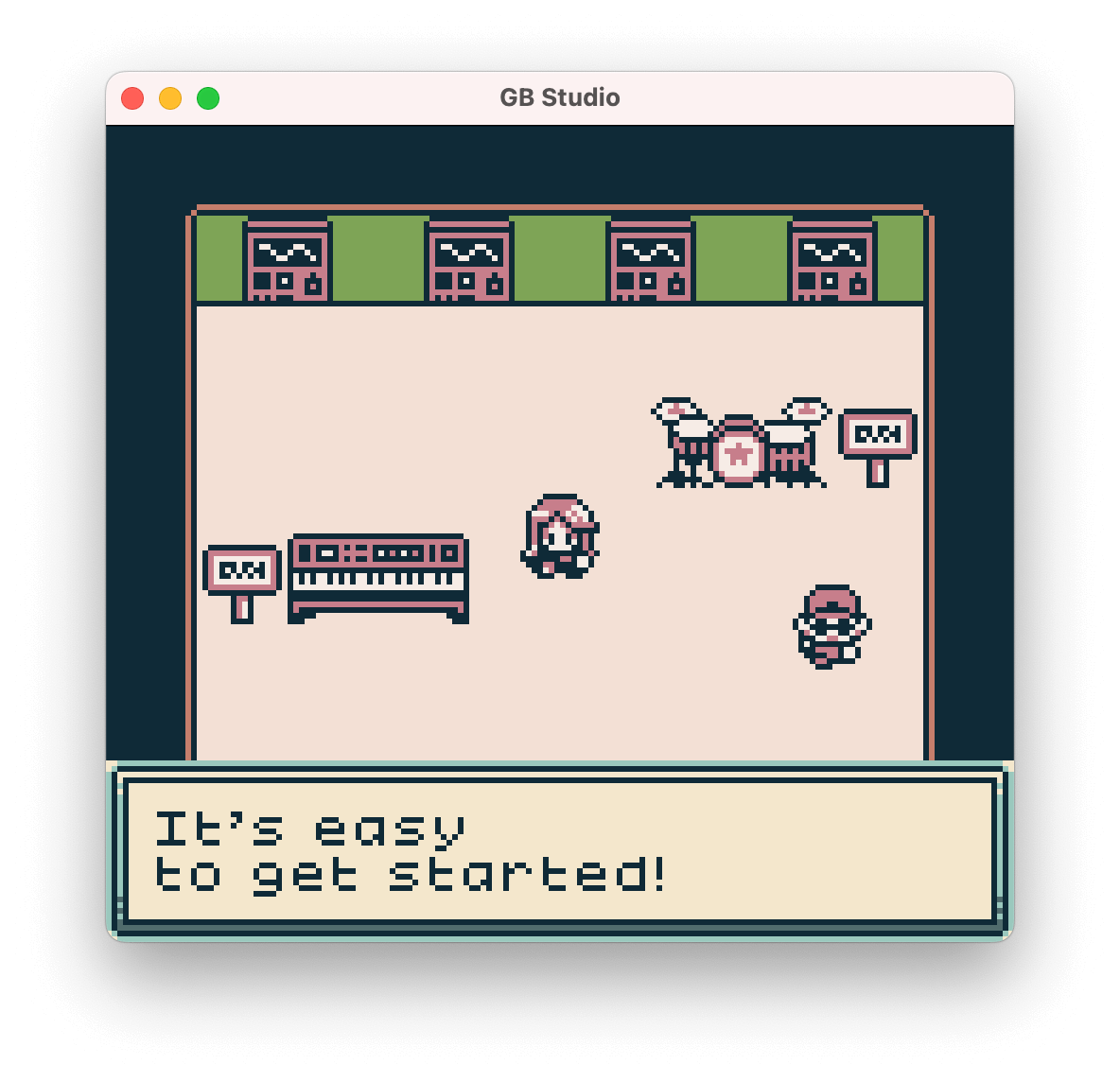
As GB Studio has grown more powerful through versions 2, 3, and now 4, Ben has watched it transform from a constrained creative tool into something approaching a full game development suite. While he appreciates the added capabilities, he maintains that newer developers should start with earlier versions to understand the fundamentals.
"If you're young or really a beginner when it comes to game development, I do recommend checking out GB Studio 1.2 because it is a lot simpler and forces you to make a lot less decisions or build a lot less groundwork for your game before you can just make it."
Handcrafted vs. Hamster Wheels
Ben's games stand out in an industry increasingly focused on player retention metrics and time-padding mechanics. His philosophy centers on respecting player time through carefully crafted experiences.
"The main thing that I don't like in video games is the way that they're so repetitive and predictable because the people that made them don't value your time," he says. "You do something and nothing happens, and then they tell you to do it another 20 times."
Instead, Ben advocates for games that feel handcrafted, where each element serves a narrative or mechanical purpose. This approach requires more development time but creates more meaningful experiences.
"I tried to make the game handcrafted in a way where each thing the player sees is something that I made, instead of just hamster wheels. If it feels to me like a hamster wheel, I don't want to make the player do it."
The Discipline of Single-Threading
Ben's work ethic reflects his commitment to focus and craftsmanship. Before his son was born, he would work over 12 hours a day using a strict timer system: 52-minute focused work sessions followed by 8-minute breaks.
"I get distracted easily, so I would have timers that I would set for work sessions where I could do nothing but work on the game," he explains. "A lot of people think they are [good at multitasking] but are just also bad at multitasking. I don't ever try to multitask—I guess on Game Boy it would be called single-threaded."
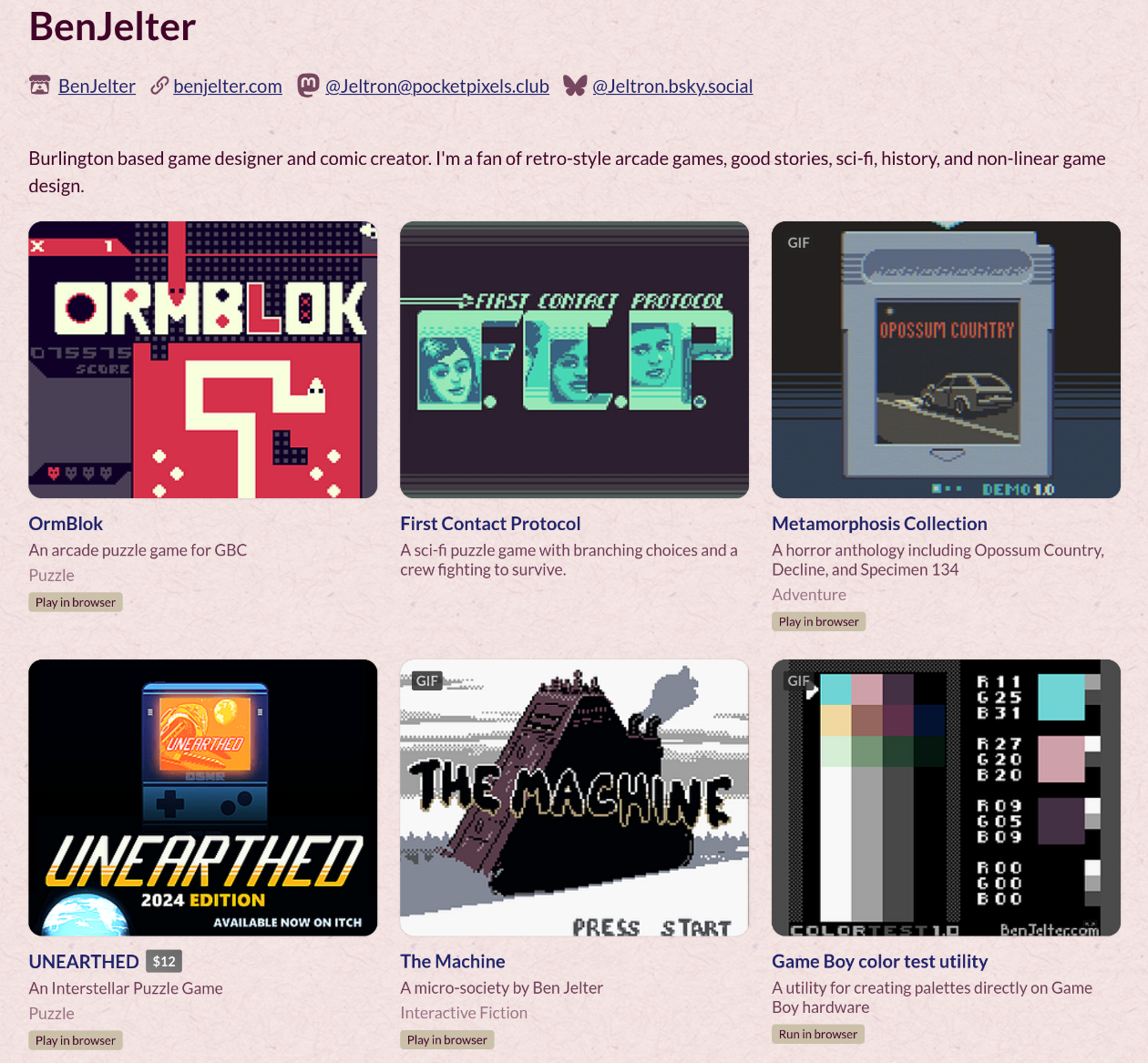
This approach has enabled him to release multiple games at an impressive pace:
- The Machine (2022), with music by lunchz
- Metamorphosis Collection (2024), with music by lunchz
- Unearthed (2024), with co-creator Gumpy Function, music by lunchz
- First Contact Protocol (2025), with music by Jonnie Baker
- Ormblok (2025), with co-creator Technofantasy, music by Robotmeadows
Each explores different themes while maintaining his commitment to meaningful interactivity.
First Contact Protocol: Exploring Human Dynamics
Ben's latest game, First Contact Protocol, shifts focus from societal critique to interpersonal dynamics. Players control a small alien creature infiltrating a generation ship, influencing relationships between six crew members with competing motivations.


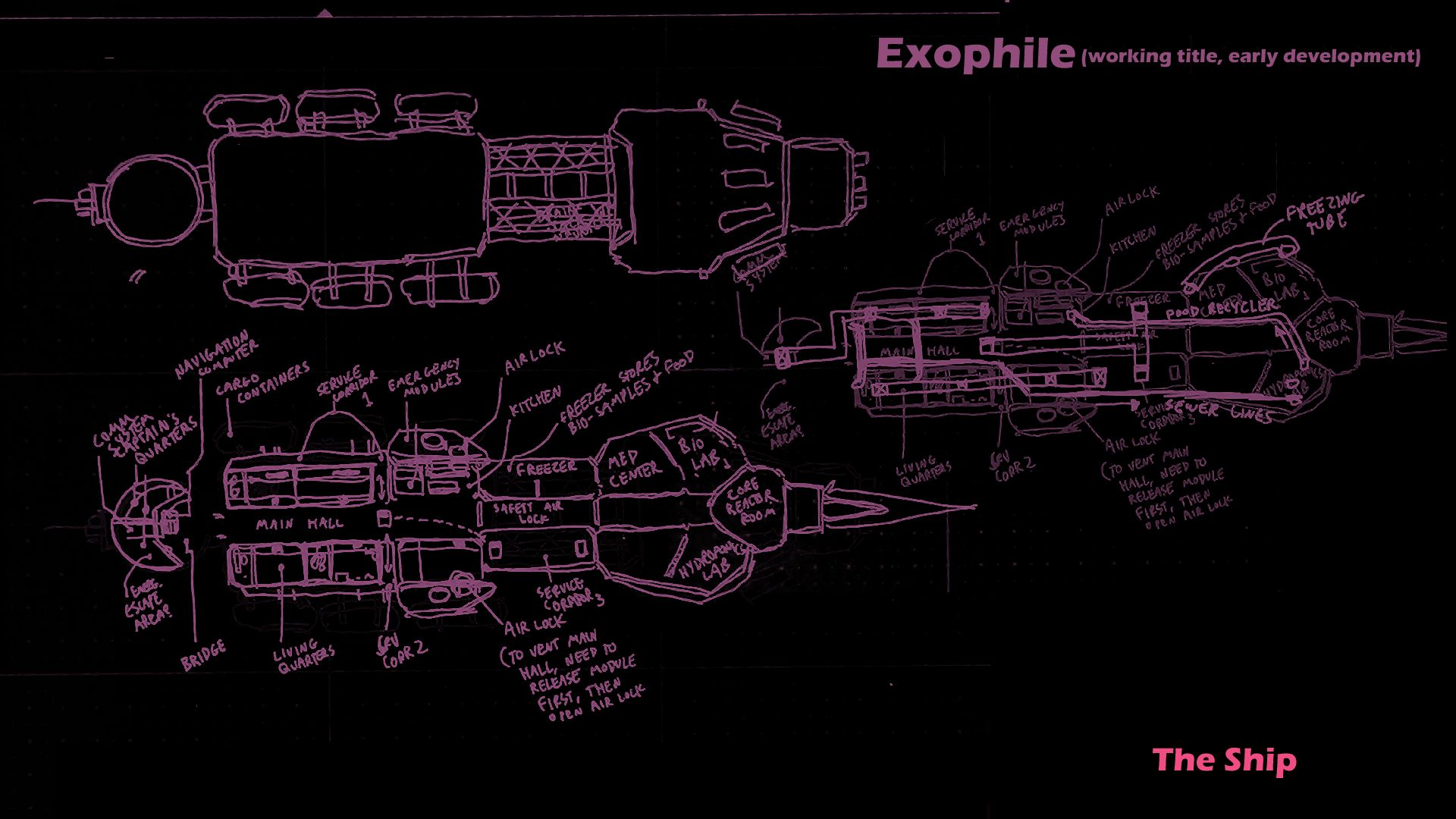
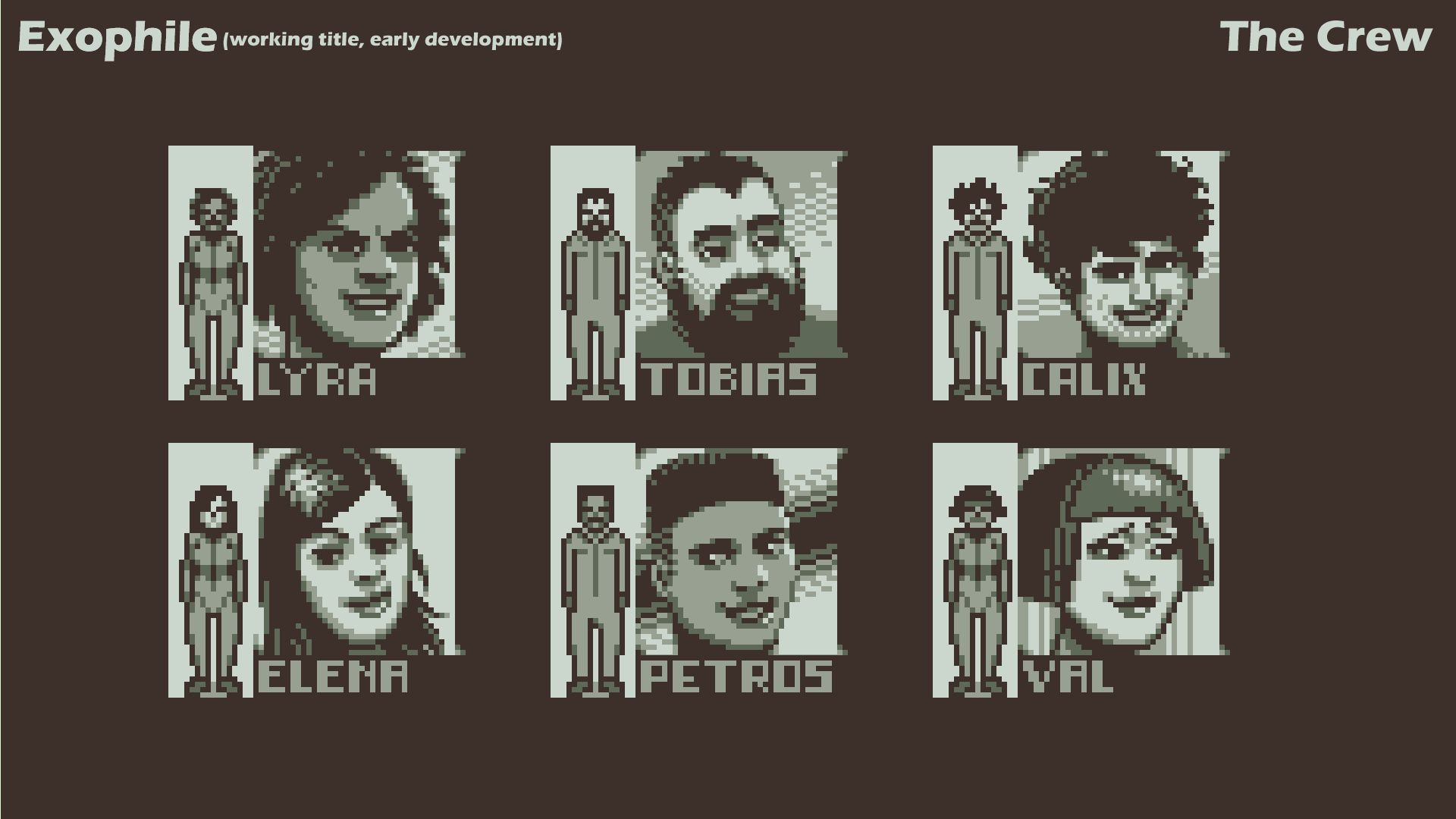
Early proposal sketches, while the working title was still "Exophile"
"I thought, what if there's a game about the complex, interconnected nature of relationships between human beings, but on a smaller scale?" he explains. "Some people's goal is in direct opposition to another person, so those people are less likely to like each other, and you can sort of influence the outcome by things that you do."
The game explores the butterfly effect, how small actions early in the experience can have dramatic consequences by the end, especially when humanity's future hangs in the balance.
The Future of Constrained Creativity
As GB Studio continues to evolve and the homebrew Game Boy scene grows, Ben represents a particular approach to game development that embraces limitations as creative catalysts rather than obstacles to overcome.
"Limited options are like an accelerant for game development," he says. "It helps you get to the part where you're making the game instead of endlessly spinning your wheels."
In an industry often focused on technical advancement and feature expansion, Ben Jelter's work serves as a reminder that meaningful games can emerge from the most constrained platforms, if developers approach those constraints with creativity, discipline, and respect for their players' time.
For aspiring Game Boy developers, his advice is simple: start with GB Studio 1.2, make something small, then graduate to the latest version. But most importantly, focus on crafting experiences that justify their existence in the world.
"I don't think that we should just make things for the purpose of having made them and just to turn around and make money off of them. I feel like we should try to advance human culture."
You can find Ben Jelter's games at benjelter.itch.io and learn more about GB Studio at gbstudio.dev. His games The Machine, Metamorphosis Collection, and First Contact Protocol are available digitally and in physical cartridge form through various publishers.
]]>XLink Kai is what's known as a tunneling program - essentially a VPN
]]>Earlier this summer we sat down with CrunchBite, the third-generation developer and current project lead behind XLink Kai, the remarkable tunneling service that has been connecting console gamers across the internet for over two decades.
XLink Kai is what's known as a tunneling program - essentially a VPN that tricks game consoles across the globe into thinking they're on the same local network. This simple concept has enabled millions of players to experience LAN-enabled games with their online friends, from the original Xbox's Halo matches to modern Switch titles, all completely free of charge.
Our interview with CrunchBite reveals the story behind one of gaming's most enduring community-driven projects. What started as two friends in the UK wanting to play Halo before Xbox Live existed has evolved into a preservation effort supporting 15 different console generations and over 1,300 games.
From Xbox Connect Refugee to Project Lead
CrunchBite's journey with XLink Kai began as many great stories do - out of necessity and frustration. As a student whose parents refused to pay for Xbox Live, he discovered the world of tunneling services.
"I originally ended up on Xbox Connect and XLink because my parents said no Xbox Live is too expensive," CrunchBite explains. After finding Xbox Connect's community "a little bit toxic," he migrated to XLink Kai and spent his high school years playing Halo 2 with the welcoming community there.
What began as casual gaming gradually evolved into deeper involvement. CrunchBite's curiosity about how the service actually worked led him to dig deeper into the technical side, eventually becoming a moderator, then a developer, and finally taking over as project lead in mid-2019 when the second generation of developers stepped down.
Professionally, CrunchBite is a network engineer - a career path directly inspired by his work with XLink. "XLink is actually what drove that interest all the way through university and into my career," he reflects.
The Technical Challenge of Console Tunneling
The technology behind XLink Kai sounds deceptively simple, but the reality involves significant technical complexity. Each console generation presents unique networking challenges that the team must overcome.
"The whole XLink and tunneling of game consoles thing is not something the console wants to do or something the game developers most of the time ever accounted for," CrunchBite explains. "So it does involve a degree of trickery and getting the console to think that the others are local."
The original Xbox presents particularly interesting challenges. Unlike modern systems that use IP addresses, it operates at a lower networking level using MAC addresses - a system that typically doesn't work well over WiFi. This means players often need wired connections between their Xbox and their computer running XLink Kai.
The Xbox 360 brought active resistance from Microsoft, with a built-in 30-millisecond ping limit for System Link games. Players with unmodified consoles must either be geographically close or have one player host the match while others join with modified systems.
"Microsoft was actively trying to fight against us and the other tunneling applications," CrunchBite notes, though workarounds does exist for determined players.
A Eureka Moment in the Shower
One of CrunchBite's proudest technical achievements came from an unexpected moment of inspiration. Three years ago he had a breakthrough that would solve compatibility issues for non-Xbox consoles on WiFi networks.
"I had this idea in the shower of how I could finally fix being able to play all of the other consoles that aren't Xbox while on Wi-Fi. It was like a eureka moment, jump out of the shower, grab my phone, write that down before I forget it kind of thing."
This innovation represents the kind of iterative problem-solving that has kept XLink Kai running smoothly for over two decades, with minimal maintenance costs that the team covers themselves.
Supporting Fifteen Console Generations
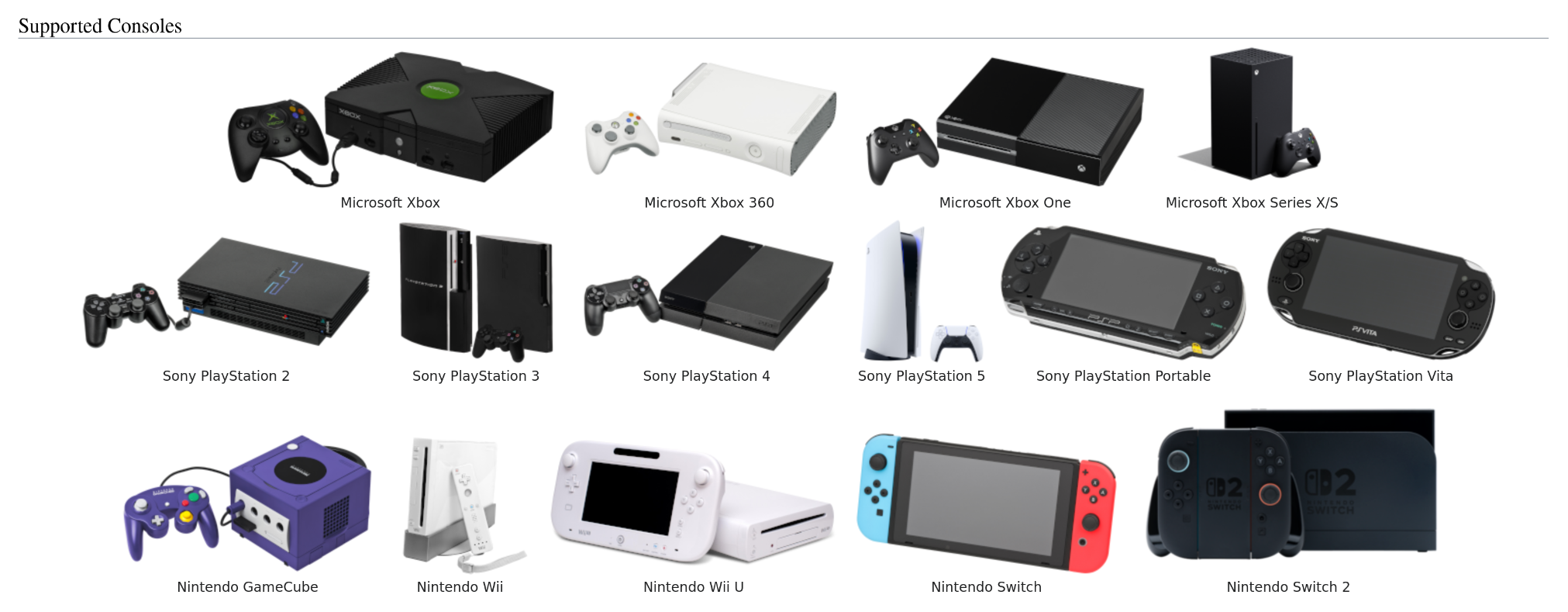
Today, XLink Kai supports an impressive array of systems: Xbox, Xbox 360, Xbox One, Xbox Series S/X, PlayStation 2, PlayStation 3, PlayStation 4, PlayStation 5, PlayStation Portable, PlayStation Vita, GameCube, Wii, Wii U, Switch, and even the Switch 2. The service also works seamlessly with nine different emulators, allowing players to mix physical consoles with emulated systems.
"You can play against Xbox and Xbox 360 players" on a modern Xbox Series X running backwards compatible games, CrunchBite explains, highlighting the cross-generational compatibility that makes the service unique.
The modding requirements vary significantly by console. While the original Xbox, PlayStation 2, and most other systems work without modification, some consoles like the Wii require homebrew modifications, and Switch local wireless games need custom system modules.
The Community That Built It
XLink Kai's community management takes a unique approach, combining human moderation with automated systems. Moderators who love specific games hang out in relevant arenas to handle troublemakers, while server-side processes monitor chat for problematic behavior.
The service includes a "quarantine" system where players who accumulate too many points for using slurs or abusive language get thrown into a special arena with disabled game routing. "You get to hang out with the other jerks or you can go and touch grass I guess," CrunchBite explains.
But the most rewarding moments come from positive community interactions. "The bits that really get me are when someone joins the discord and it's like oh my god you're all still here, it's been 15 years. There's master gamer, there's llnk, oh my god is that crunch? It's like hey dude, good to see you again."
The Free Philosophy
Perhaps most remarkably in today's monetized gaming landscape, XLink Kai remains completely free. The service accepts no donations or monetary compensation whatsoever.
"One of the things I really enjoy about it is that, do you remember when things online were just free? No one was trying to sell you anything. No one wanted to show you ads. No one wanted anything from you. It was a great time. That's what we're still doing. We want you to go have fun."
This philosophy extends beyond nostalgia - it serves the preservation mission that drives the project. XLink Kai preserves something intangible but vital: the ability to have online multiplayer experiences on consoles whose original services have shut down.
Game Preservation Through Connection
While competitors have come and gone over the years, XLink Kai continues operating because it fills a unique preservation role. The service currently hosts data showing game popularity going back five years, though CrunchBite admits the 60-gigabyte database table has become "a bit scary" to manage.
Halo 2 remains the service's most consistent draw, though daily player counts have dropped from around 100 to about 40 in recent years. "For the last 22 years there has been Halo 2 played pretty much 24-7," CrunchBite notes, though even this stalwart community shows signs of aging hardware taking its toll.
The team has also developed specialized tools like Xcat (Xbox Content Archival Tool), which helps preserve lost DLC, title updates, and homebrew content by scanning users' console hard drives for unique files.

Technical Innovation Continues
Despite its age, XLink Kai continues evolving technically. The service now includes a relay mode that seamlessly handles carrier-grade NAT (CGNAT) situations, making it work reliably on cellular internet connections.
"You can be that crazy guy with his Switch and his laptop and his cell phone playing on the bus," CrunchBite explains. The relay system transparently provides the best possible connection for each player pair, using peer-to-peer when possible and server relay only when necessary.
Future plans include IPv6 support to handle modern networking requirements, though CrunchBite emphasizes "no timelines" given the complexity involved.
A Living Piece of Internet History
XLink Kai represents something increasingly rare in modern gaming: a community-driven service that prioritizes function over profit. While newer games increasingly lack LAN support, making the service more niche over time, it continues serving dedicated communities around classic titles.
The project stands as a testament to what's possible when passionate developers commit to preserving gaming experiences for future generations. As the console makers shut down online services, services like XLink Kai become even more crucial for maintaining access to multiplayer gaming history.
"It's always fun seeing new people discover the service and realize that they will get to do this for free," CrunchBite reflects. "Here's a place for you to play your games and we're at an incredibly large number of games supported at this point. We're currently at 1,300 games supported across 15 consoles. That is a massive number."
As gaming continues to evolve toward always-online service models, XLink Kai serves as both a practical preservation tool and a reminder of internet culture's more altruistic past. For anyone with a library of classic console games and friends scattered across the globe, it remains one of gaming's best-kept secrets - hiding in plain sight for over two decades.
Getting Started with XLink Kai
Ready to reconnect with classic console gaming? Visit teamxlink.co.uk to download the client and check the wiki for setup guides specific to your console and PC.
Check out our full interview with CrunchBite on our podcast to hear more about the technical challenges and community stories behind this remarkable preservation project.
]]>We are excited to share updates about recent initiatives at Hit Save! to create community resources for dumping data from Japanese feature phones.
New guides on dumping.guide
If you visit dumping.guide, you'll find a new set of links in the menu for "Phones
]]>Hello everyone!
We are excited to share updates about recent initiatives at Hit Save! to create community resources for dumping data from Japanese feature phones.
New guides on dumping.guide
If you visit dumping.guide, you'll find a new set of links in the menu for "Phones." These are guides for dumping data from pre-Android/iOS phones. Currently, these guides only cover dumping methods for some Japanese feature phones. Hopefully, the guide can grow in the future to include phones from other regions of the world.
While the Phones section is a work in progress, our section for dumping data from Docomo feature phones is nearly complete. It can already be used to properly dump data from most Docomo phones.
The Phone section of dumping.guide may not be 100% complete for a while because there are some phones we do not know how to dump yet. However, we are making updates to these guides regularly as new information is discovered.

New preservation community equipment
If you look at the Preservation Community Equipment Request form, you will now see an option for a FOMA debug adapter, used to dump data from Docomo and Softbank feature phones. These debug adapters are already in our possession, and they are ready to be lent out. If you would like to borrow a FOMA debug adapter, please fill out the form, and we will contact you as soon as we can.

Progress on SquirrelJME and DoJa emulation
If you missed it, our Hit Save! Update Q1 2025 includes a project update for SquirrelJME. Xer Shadow Tail is continuing to work on SquirrelJME compatibility with DoJa, and it is already able to load some DoJa games!

So to Speak drops players into a 2D simulation of Japan where they must decipher the meaning of Japanese words through context clues and visual connections. Players drag Japanese text
]]>Earlier this year we sat down with Erik Andersen, developer of the innovative Japanese learning puzzle game So to Speak.
So to Speak drops players into a 2D simulation of Japan where they must decipher the meaning of Japanese words through context clues and visual connections. Players drag Japanese text onto corresponding objects or English descriptions, learning naturally through discovery rather than memorization. Unlike conventional language apps that rely on flashcards, the game presents practical vocabulary that travelers would actually encounter: entrance and exit signs, bathroom markers, and everyday conversation snippets.
Our interview with Erik reveals the story behind this innovative educational game. What started as a personal mission became a six-year solo development journey that transformed an academic researcher into an indie game developer.

From Academic Research to Indie Development
Erik's path to game development was anything but conventional. While pursuing a PhD in graphics research, he got his first taste of educational game development working on "Refraction," a Flash-based puzzle game for learning fractions that gained popularity on Kongregate.
After his doctorate, Erik taught video game design at Cornell University while researching educational games. But academia's emphasis on grant proposals didn't align with his creative ambitions. "I didn't really like academia in general. I like teaching but I didn't like writing grant proposals," Erik explains.
The catalyst for So to Speak came from his personal life. Married to a Japanese woman and raising a bilingual daughter, Erik experienced firsthand the frustration of traditional language learning methods. "I'm convinced that there's really no other skill that you can invest so much time into and still be so bad at," he reflects on the challenges of language acquisition.


The game's central mechanic emerged from Erik's real-world experiences in Japan. "I've been in train stations in Japan seeing signs like exit or bathroom and sometimes I try to figure out what is this talking about. I realize that this is not so bad - I kind of like it."
This observation became the foundation for So to Speak's approach to learning. Unlike conventional language apps that provide immediate translations, the game requires players to puzzle out meanings through contextual clues - much like deciphering unfamiliar signs while traveling.
The game presents practical vocabulary that travelers would actually encounter: entrance and exit signs, bathroom markers, and everyday conversation snippets. This focus on making sure that you learn something useful immediately sets it apart from textbook approaches that often start with abstract grammar concepts.

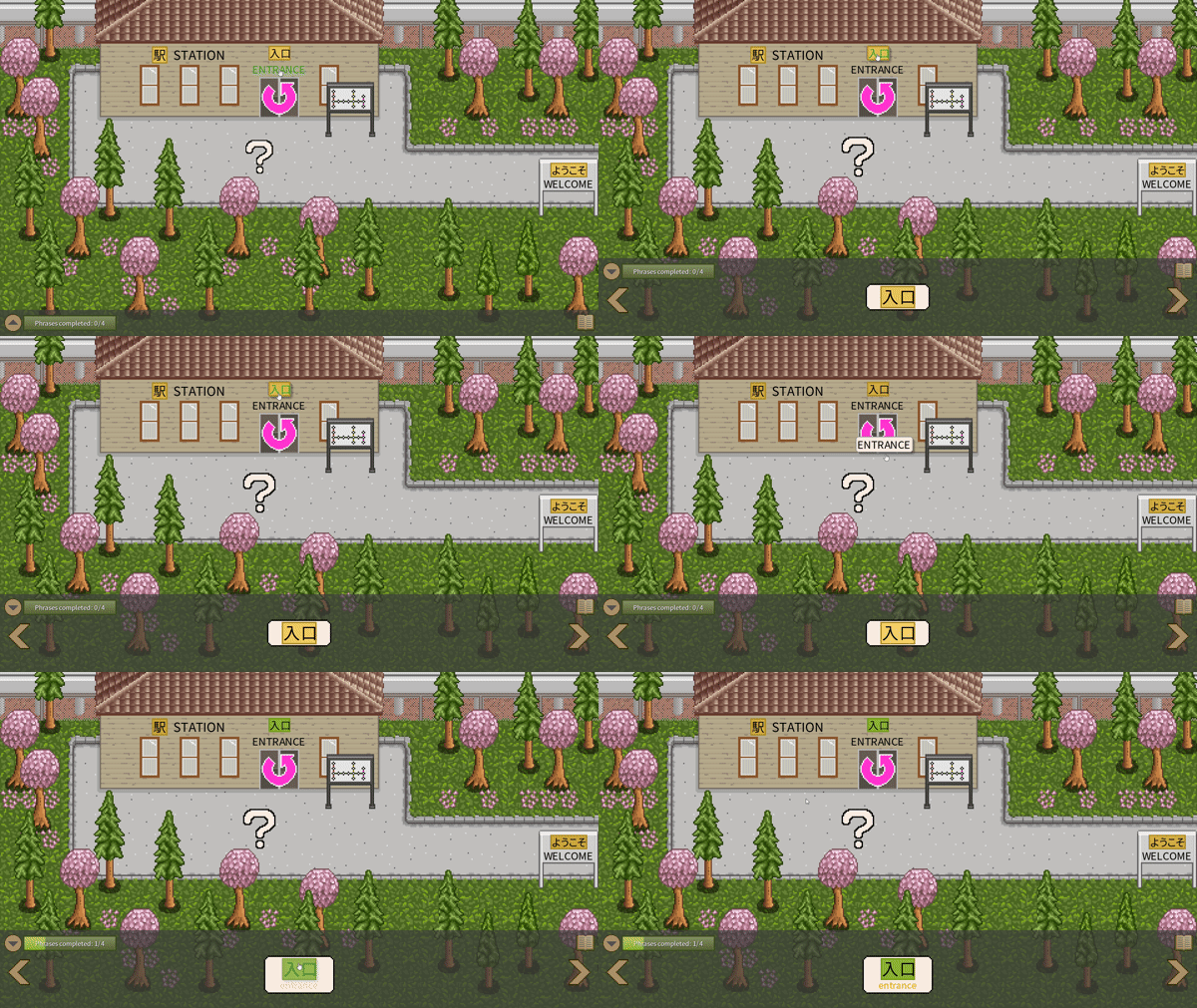
So to Speak started as a two-year project but ultimately required nearly six years of development. The extended timeline reflected both the scope of Erik's ambitions and the learning curve of solo development.
Two years into development, Erik hit a major roadblock. He had initially started in Python using Pygame for rapid prototyping, but eventually hit distribution limitations and made the difficult decision to completely rewrite the entire game in C# using MonoGame. "I had to rewrite the whole game," Erik recalls, though he used the opportunity to fix fundamental design issues as well.
Perhaps most remarkably, Erik taught himself pixel art from scratch through YouTube tutorials and persistent practice. Drawing inspiration from Stardew Valley, he developed his own art style over the six-year period. One innovation was making building interiors visible through windows, helping players understand context - like identifying a café by seeing people drinking coffee inside.
The Importance of User Testing
Throughout development, Erik conducted regular playtesting sessions that proved crucial to the game's design. One early revelation challenged his initial assumptions about language learning games.
Originally inspired by games like Heaven's Vault (where players decipher a fictional language), Erik implemented delayed confirmation for player guesses. But testers absolutely hated this approach. "Players really want to know right away if their guess is correct," Erik discovered.
This feedback highlighted a key difference between fictional and real language learning. With invented languages, delayed confirmation can build suspense. But when learning an actual language for practical use, immediate feedback becomes essential for building confidence and accuracy.
The game's interface also underwent major revisions based on user feedback. The original design featured intrusive popup menus that blocked the game world. Erik's friends suggested the elegant bottom workspace that appears in the final version, keeping interaction elements accessible without obscuring the scene.
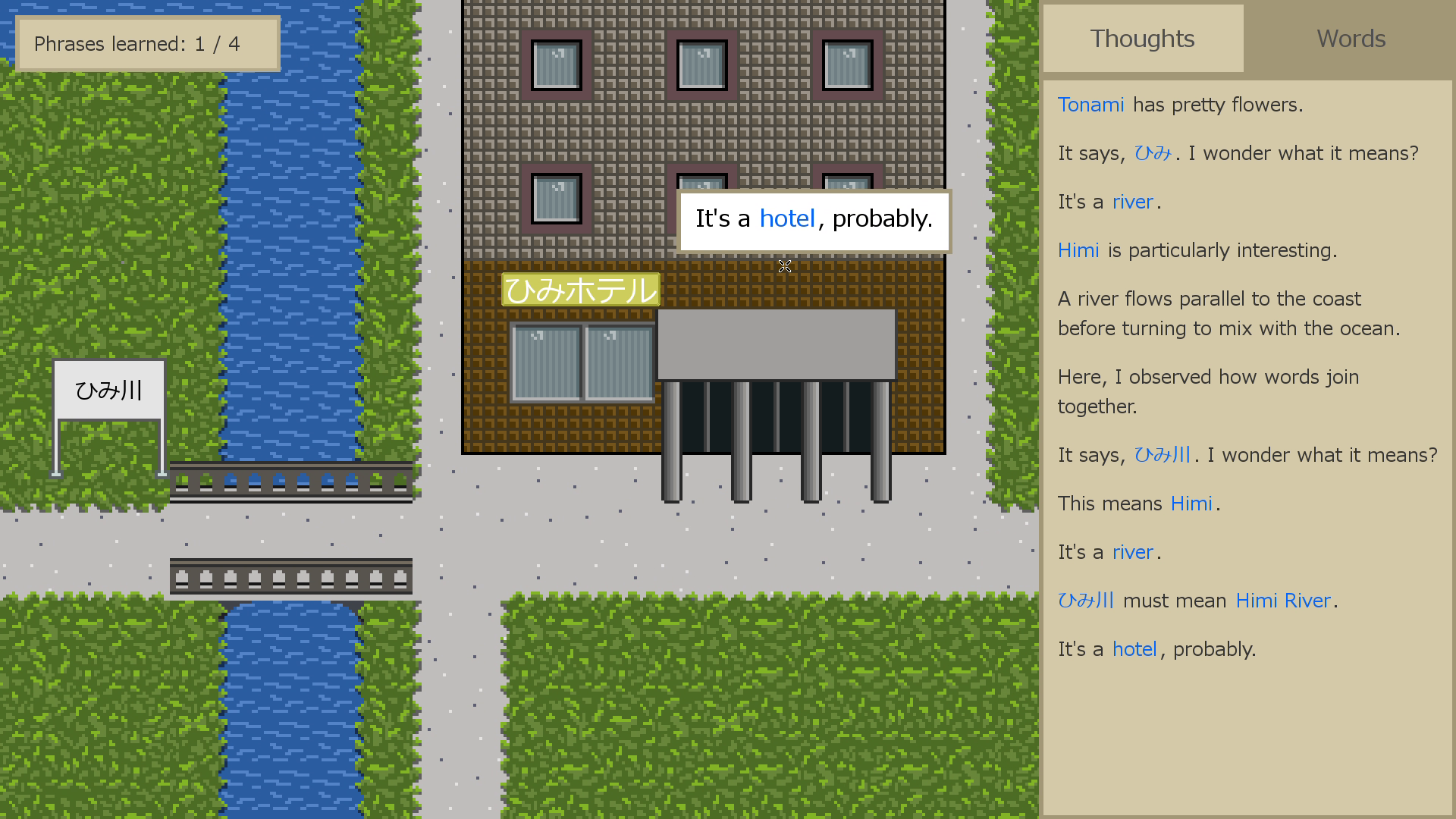
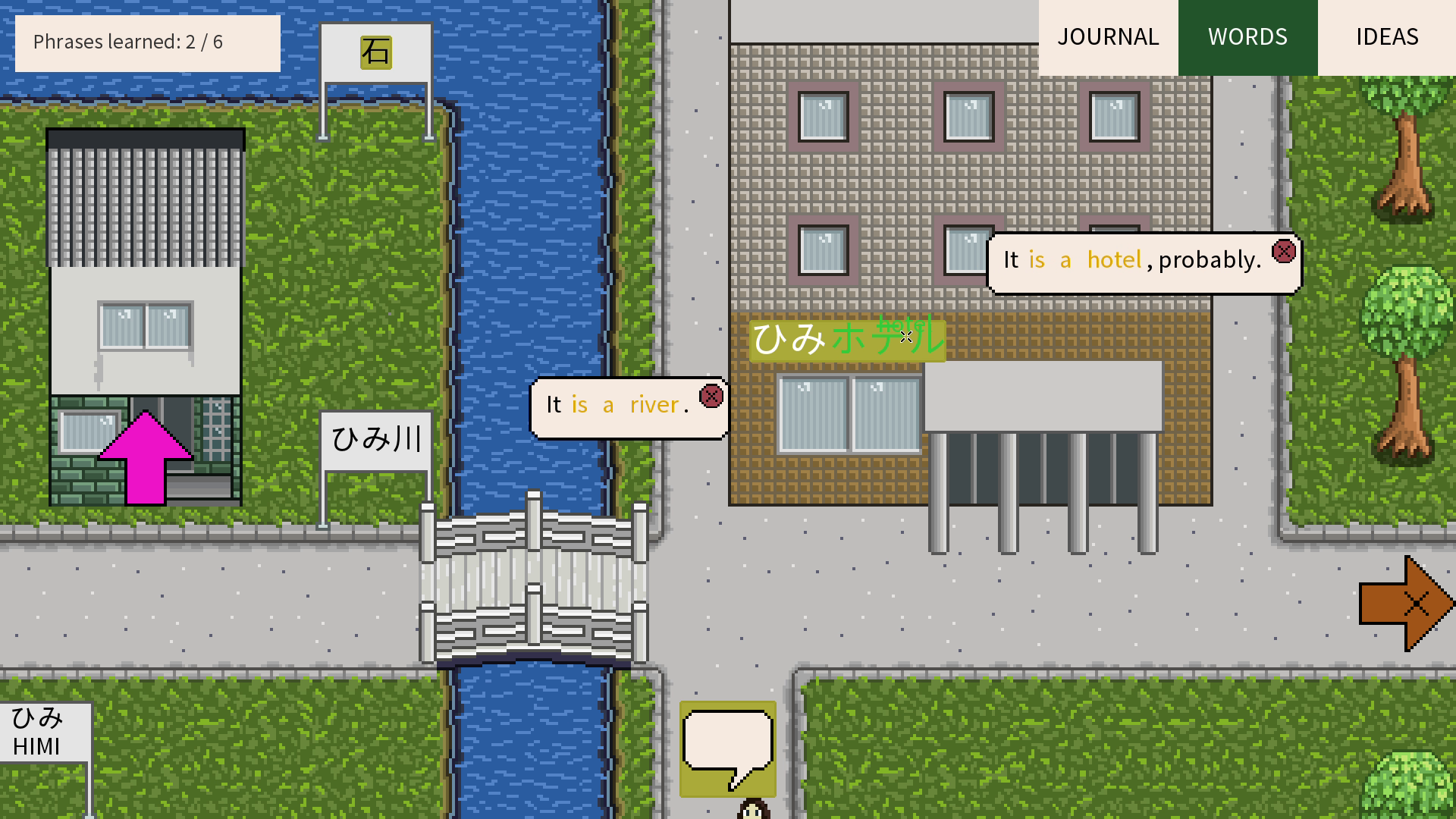

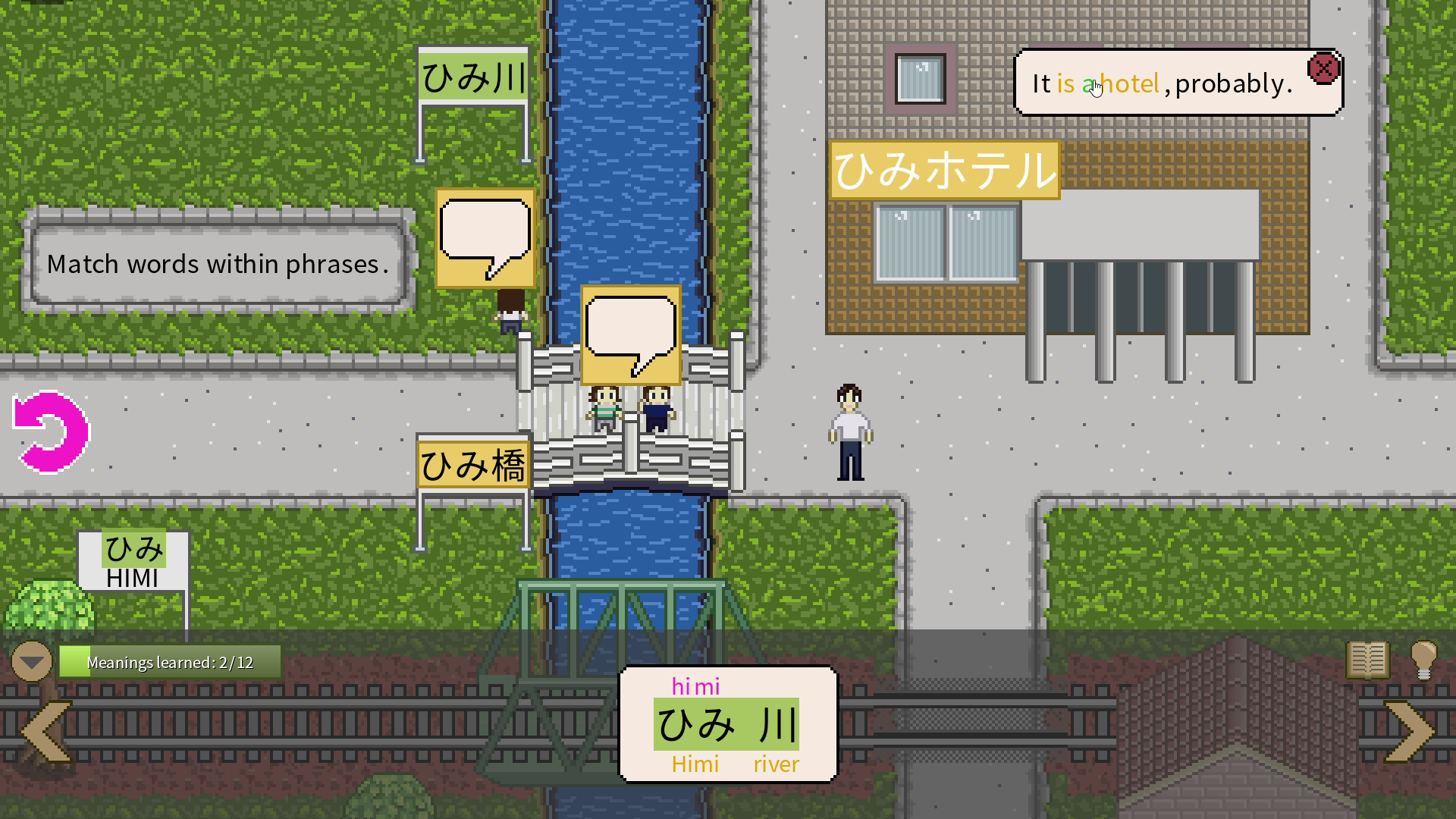
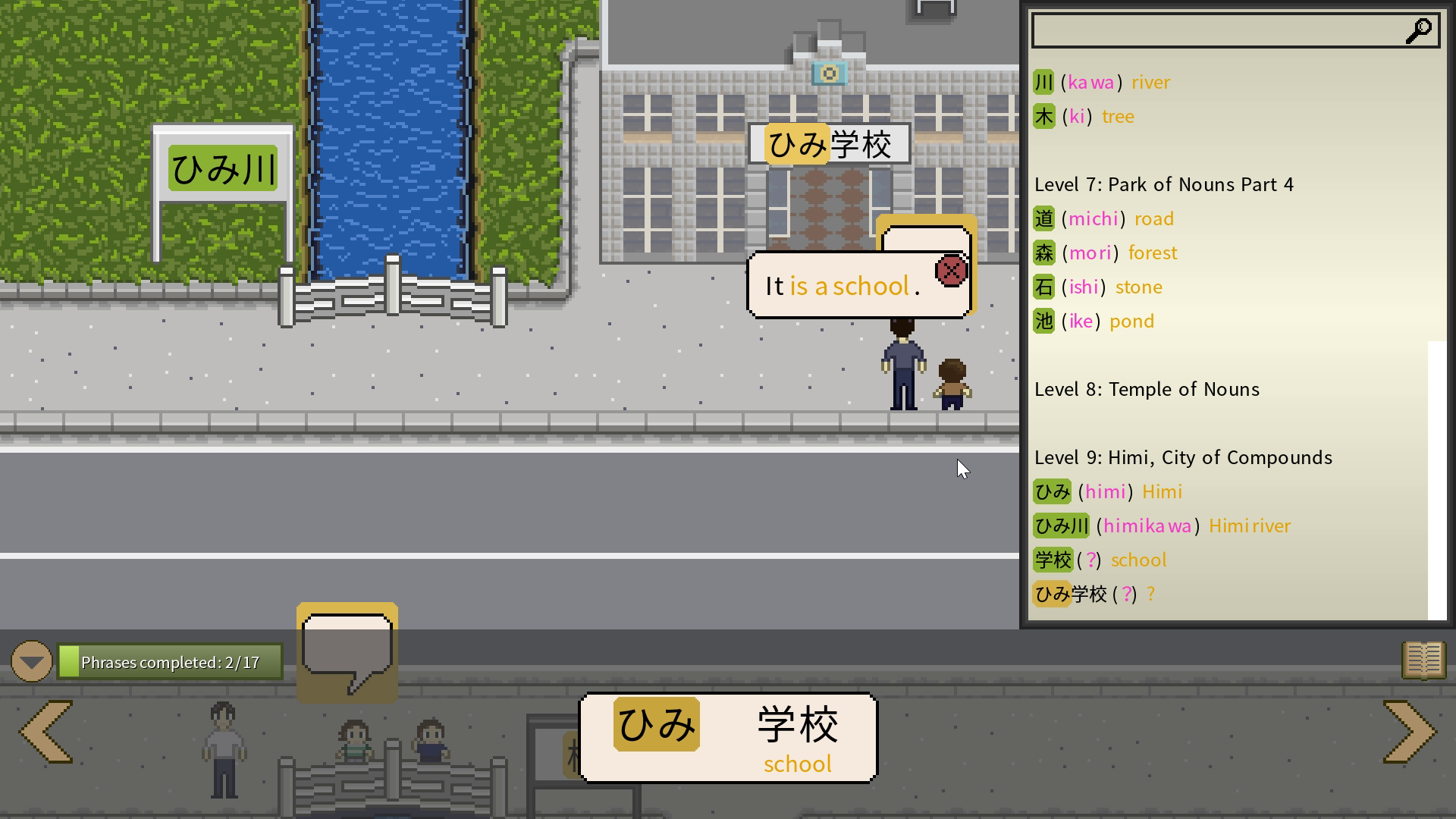
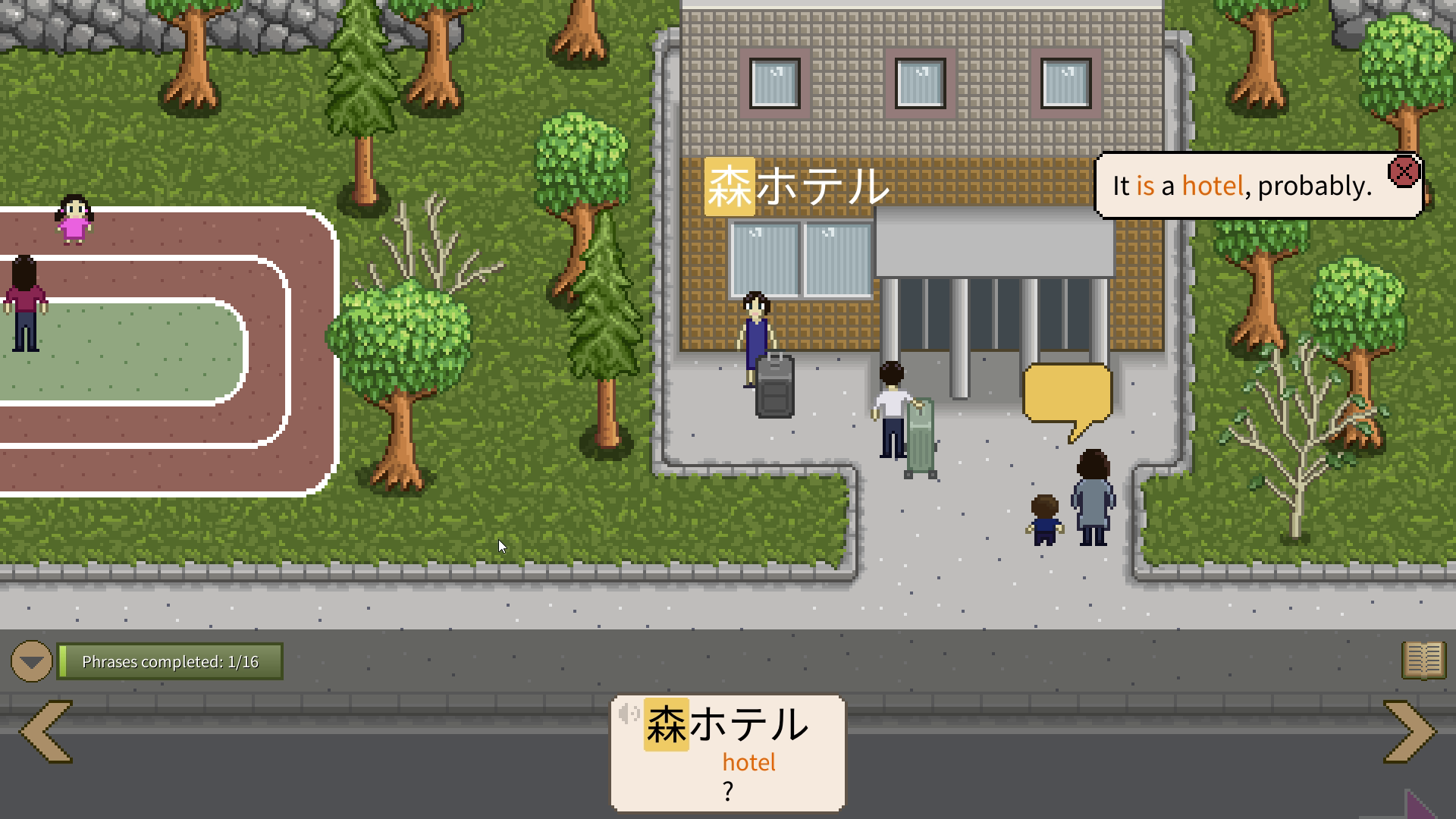
Art progression from 2019 to 2025
Building a Comprehensive Learning Experience
The final game includes over 650 Japanese words covering practical topics like telling time, counting, location descriptions, and family relationships. Erik deliberately mixed all three Japanese writing systems (hiragana, katakana, and kanji) from the beginning, reflecting real-world usage rather than the graduated approach of most textbooks.
The game features eight different voice actors - friends and family members who contributed to authentic pronunciation. Erik's brother Greg composed the lo-fi background music that perfectly complements the relaxed puzzle-solving atmosphere.

Real-World Validation
Released on March 31, 2025, So to Speak has received positive reviews and active streaming on Twitch. Most importantly for Erik, players report recognizing words from the game during actual trips to Japan - validating his core hypothesis about contextual learning.
"I have some friends who went to Japan after they played a version of it and they actually recognized a word on a sign there," Erik shares. The game represents a successful experiment in contextual learning - one that other educational developers might learn from.
As Erik puts it, "People naturally have that ability and that mechanism" for learning through context, drawing parallels to how we all naturally acquired language as children. So to Speak proves that educational games can be both pedagogically sound and genuinely engaging by respecting players' intelligence and natural pattern-recognition abilities.
Check out our full interview with Erik on YouTube:
Or listen on our podcast:
So to Speak is available now on Steam for PC, Mac, and Linux.
]]>We had an absolute BLAST at PAX East this year, with close to a thousand people stopping by our booth, talking to us about video game preservation and history, parents reliving and sharing memories by playing Duck Hunt with their kids, making new memories with games from our amazing partners Super Rare Games and VGNYsoft, and watching interesting videos from our 24/7 livestream.
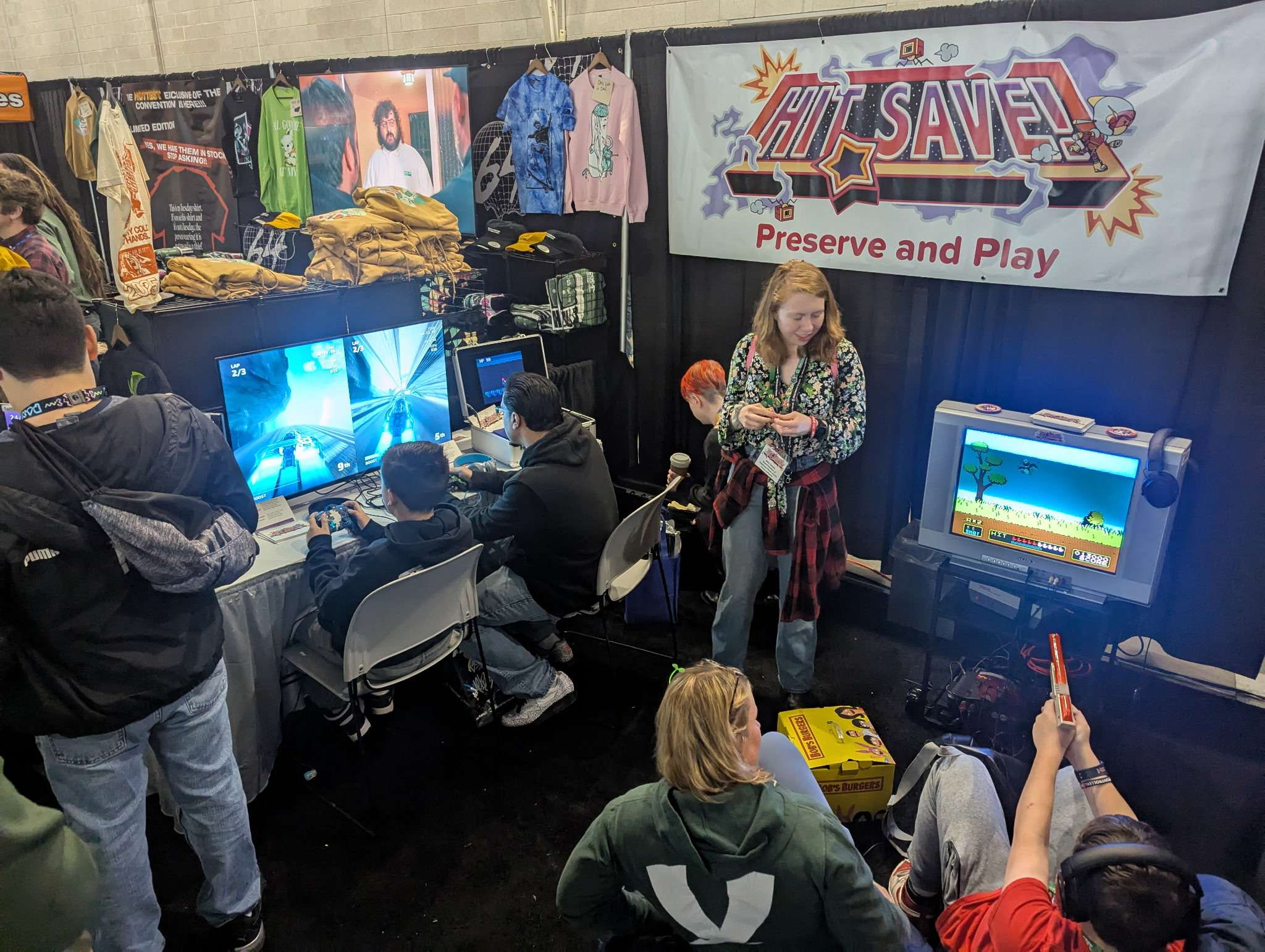


An enormous THANK YOU to everyone who stopped by our booth, we are so grateful for your support.
We walked the floor and spoke with many publishers who are interested in supporting us in various ways, so we hope to get news about that out to you all as soon as it happens.
We met with a ton of great indie game developers and explained what we're trying to do to preserve both their games, and the history of the people behind their games. All in all it was a huge success, and now we will start all the work in the background to make preservation happen. We also met some familiar faces that we've talked to over the years, and we were excited to see that they're coming out with even more games.
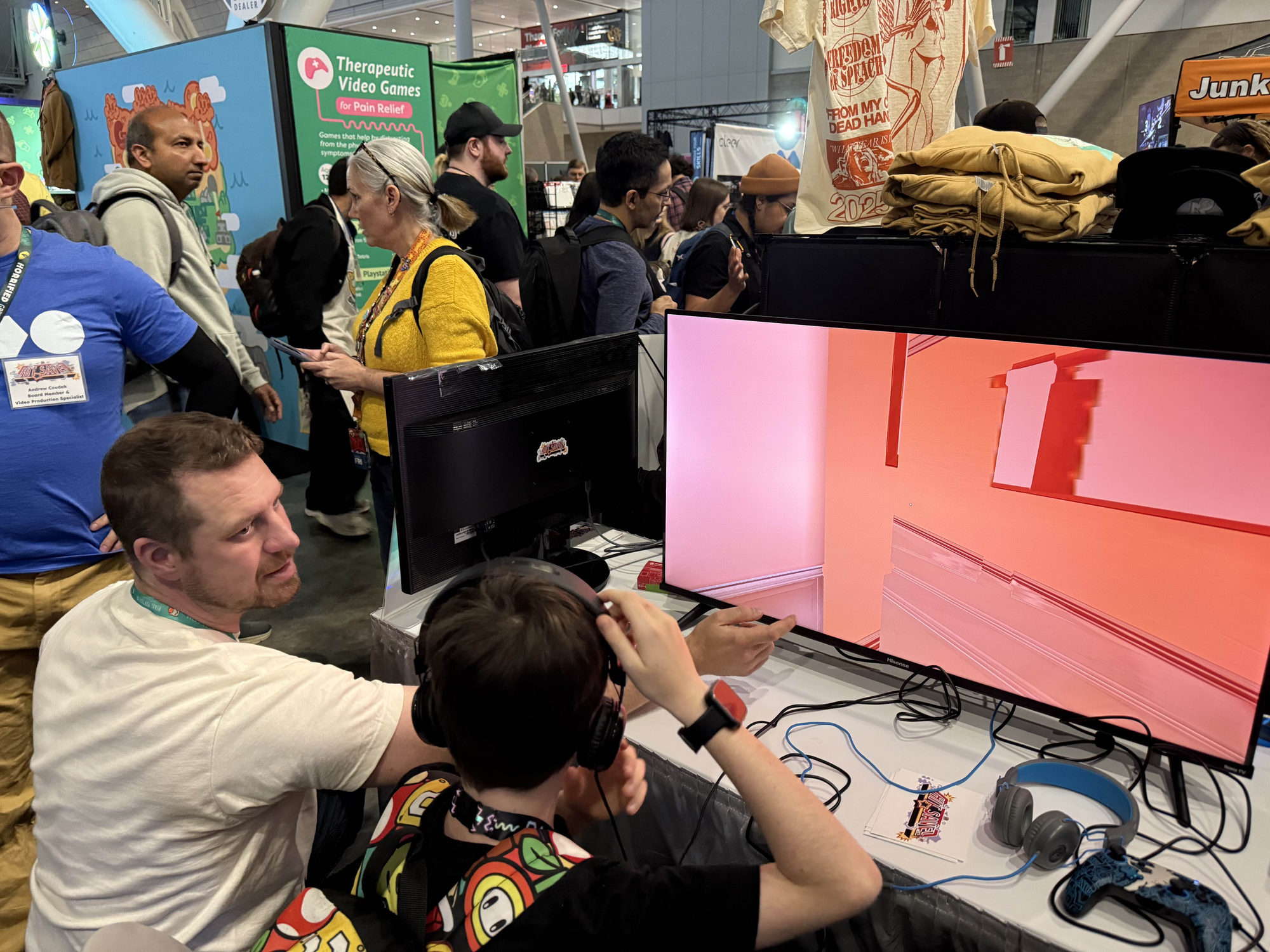
Additionally, we met with several content creators who wanted to be a part of our journey which is just fantastic to hear 😄. You'll see more of that as it happens, and we'll make sure to keep all our Patreon supporters in the loop.
Speaking of Patreon, if you missed us at the show and you are a supporter, look for a post from me next week where we'll ask if you want us to send you a small gift as a thank you for being such a great person.
A really fun addition to our booth this year was the GameTank, an open source indie console created by Clyde Shaffer. A lot of people were really interested in hearing from Clyde how it was created, how to program for it, and also to play a variety of cool games on physical carts!


Another really interesting meeting that happened in our booth was a visit by two people who were on the Trinitron CRT design team! One of them, Alex Arie, also signed our TV which truly makes it one of a kind 😄
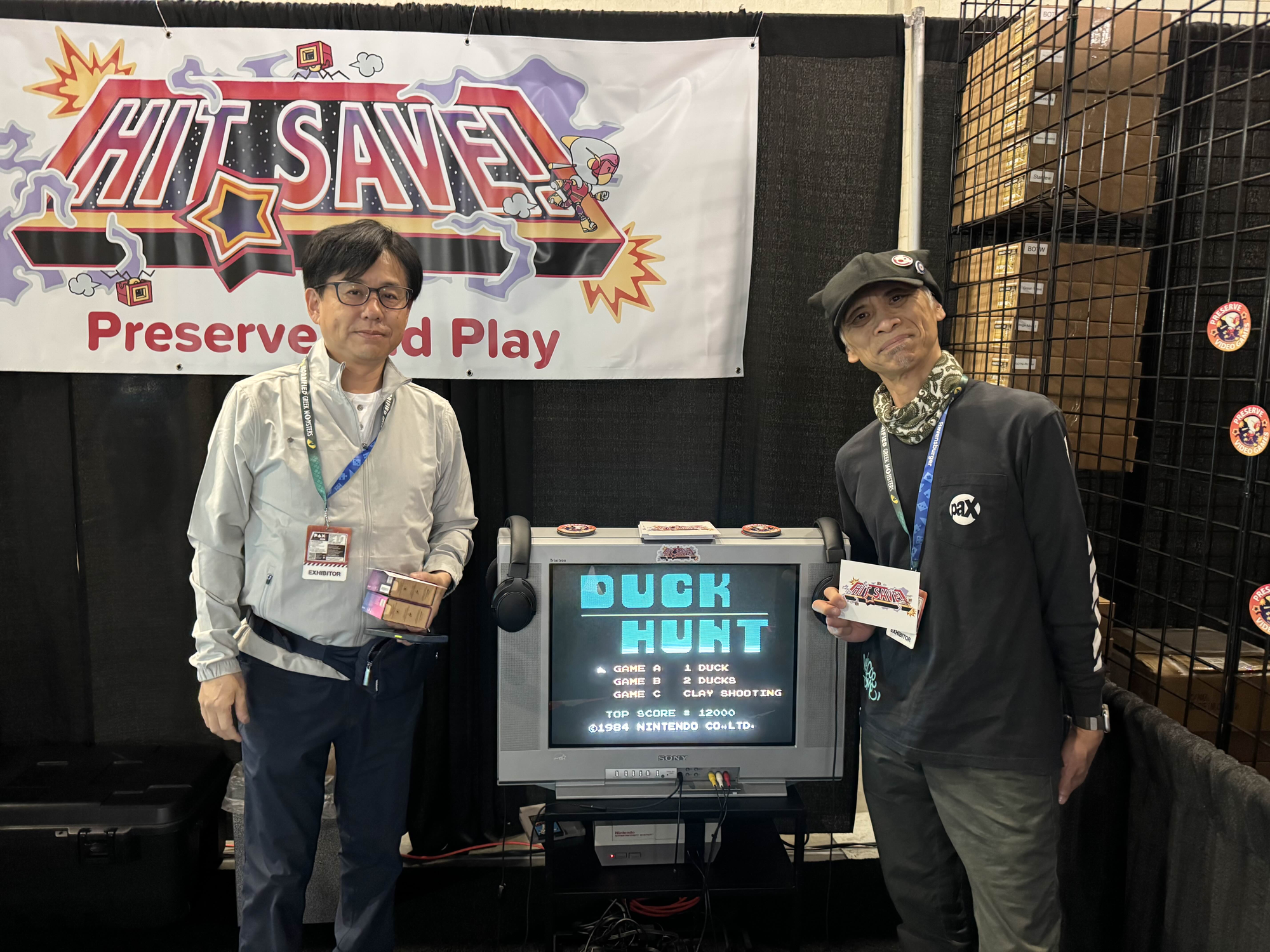

Our next event will happen on July 15th at the Tewksbury Library, if you're local to the area please stop by and say hi!
]]>We're excited to be once again be a part of PAX East 2025, and if you like what we do and want to chat with us, swing by Booth 10028 (same as last year). We'll have a bunch of fun things in store for everyone who's visiting our booth, you can find us here:

Retro corner
A section of our booth will be dedicated to retro games, with a rotating roster of systems ranging from NES, N64, and PS2. Want to try one of the strangest controllers known to man with Super Mario 64, burn some rubber with Burnout, or finally play Duck Hunt with a Zapper again? We got you!
Indie games
We'll have a station where you get to play fantastic indie titles from our partners Super Rare Games and VGNYsoft. Are your favorite games cute and funny, or perhaps action filled or horror? Or maybe a mix of everything? Come try them out and then go visit the publishers as well 😄
Patreon drive
We are aiming to get 50 patreon subscribers at this event, and if you swing by and donate/become a member we've got a really nice big magnet with our mascot in store for you! That includes our current Patreon subscribers as well, so if you can't join us for PAX East we still want to send your our appreciation 😄

Keep an eye out for our banner (see above), hope to see you all there!
]]>Hello all you wonderful volunteers, supporters, and community members! We want to give you an update on what we've been doing in public, and also what we're working on behind the scenes. From now on, you should expect an update such
]]>
Hello all you wonderful volunteers, supporters, and community members! We want to give you an update on what we've been doing in public, and also what we're working on behind the scenes. From now on, you should expect an update such as this at the end of every quarter.
Patreon and donations update
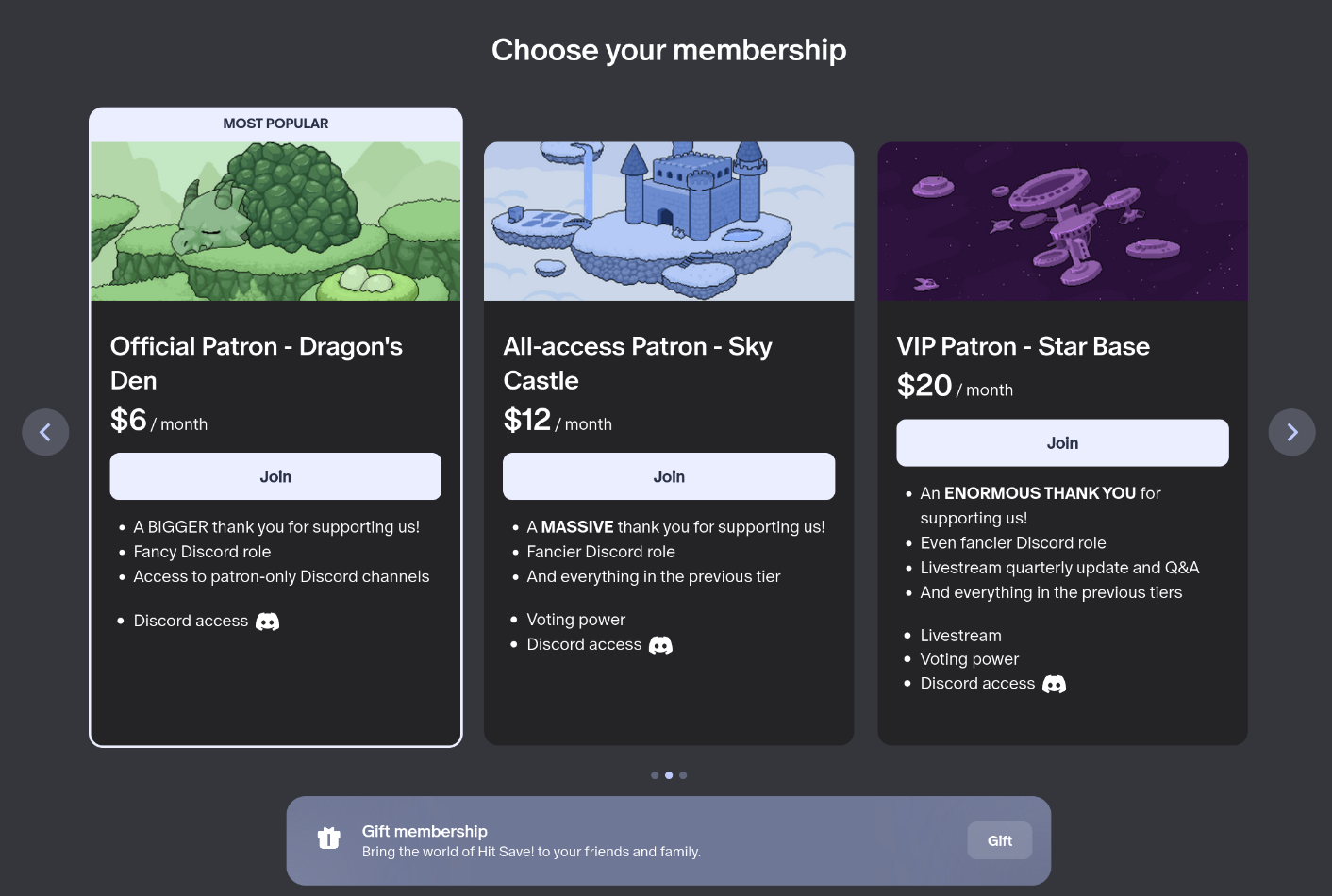
We are incredible grateful for all your support since we started this journey in 2020, we couldn't do this without you! As we are a non-profit we rely on donations, both large and small, and there are two ways you can support us financially. To support us on a monthly basis, Patreon gives you multiple options. We have made some updates to the tiers to accommodate for everyone's financial situation so please check them out!
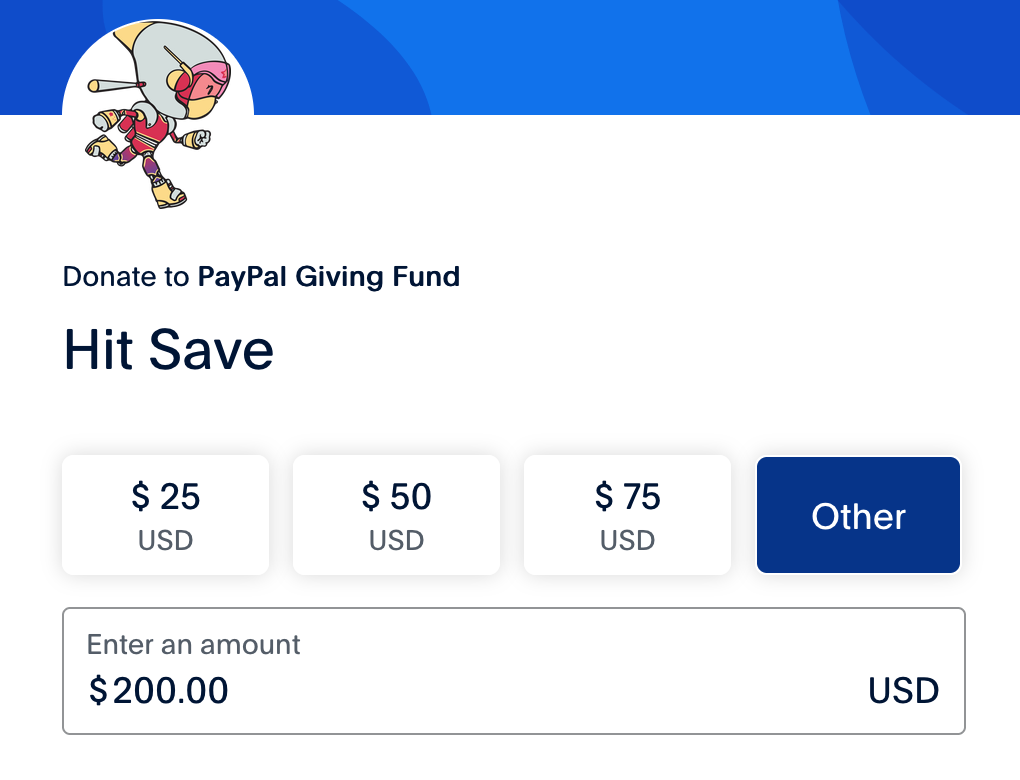
If you want to send us larger one-time donations we recommend using PayPal Giving Fund, where PayPal will cover all fees.
At the same time we are also retiring our Ghost memberships, so if you have been a paid Ghost member come join us over on Patreon 🤗
Finally, corporate sponsorships are a great way for organizations to meet their own socioeconomic or ESG goals, and a relatively modest contribution can make a huge difference to the long-term plans of an organization like Hit Save! If you think there's scope for your company to work with us and support the work that we do, we'd love to chat so please reach out on [email protected].
Hit Save! Hits the Road
Tewksbury Public Library
One of the most vital parts of our mission is not only to preserve the physical and digital items that make up video gaming's history, but to make these items available for what is, ultimately, the purpose of gaming - play!
We love to get out and about in the community to allow gamers old and new to relive the magic (or enjoy for the very first time) that video games can bring to our lives.
We were delighted recently to have the opportunity to work with the Tewksbury Public Library to do just that, with Jonas and Rachael from our Board helping more than 75 patrons enjoy playing games on consoles ranging from the Atari 2600 to the Nintendo Switch.
As well as some classic fan favourites, we were also able to highlight a bunch of donated indie games thanks to our partnerships with Super Rare Games and VGNYSoft.


The library team were super helpful and welcoming and we're currently scheduling a second event with them in July - keep an eye on our social media channels and their calendar to find out more.
PAX East
After a fantastic experience at last year's PAX East, the Hit Save! team will be there again for this year's event, running from May 8th to 11th at the Boston Convention and Exhibition Center

We'd love for you all to come along and join us at the event, so if you are attending then please stop by to meet the team and learn more about our preservation efforts!
The 2025 schedule isn't live yet, but we're also hoping to do a Community Meetup, showcasing some live demos of how we preserve games, so keep an eye on the PAX East website and our social media channels for more news soon!
Doing more in the community
We'd love to work with more libraries, community groups or other public spaces to bring the magic of video gaming to everyone, with a goal this year to do one per quarter.
It's thanks to your vital and continued support that we are able to cover the cost of delivering these kinds of events. We're a small team of volunteers, and every dollar received helps us do more to meet our mission and work with communities to advocate for and promote the importance of video games and their preservation.
If you know of any archives, museums, libraries or any other public or community spaces that would like to work with us to deliver a gaming-focused event, then please let us know on [email protected].
Highlight from the Archive
39 years ago, Nintendo released The Hyrule Fantasy: Zelda no Densetsu for the Famicom Disk System in Japan. In doing so, they kicked off one of the most popular and influential game series the medium has ever seen.
To celebrate, Hit Save added the Legend of Zelda: Collector's Edition to our archive!

This Nintendo GameCube release was never sold in stores, and was only available in promotions like console bundles, registration bonuses, and Nintendo Power subscriptions.
In our archive, we have made available high-resolution scans of the cover art, disc, and inserts, as well as video content extracted directly from the game files and converted for maximum compatibility. The discs were also dumped to Redump standards and the physical item itself remains securely stored in our archive, ensuring that this vital piece of video game history is preserved for the ages!
Upcoming Stream Content
We've made a huge effort over this past year to purchase and preserve items containing vital pieces of video game history - "making of" documentaries, behind-the-scenes footage, early trailers or adverts, and much more! All of this content will not only be preserved in our archive, but also made available on our 24/7 live stream thanks to the efforts of Andrew Czudak, Board Member and Video Production Specialist.
We've got loads of really exciting content planned over the coming year to coincide with a range of important dates and anniversaries in video game history. We're particularly excited to premiere some rare items that we have preserved for the very first time.
Coming very soon, in honor of Ubisoft recently turning 39, we have a very special YouTube premiere planned that features Ubisoft behind the scenes developer footage that we can't find anywhere else online! Games featured include: Assassin's Creed 1, TMNT, Brothers in Arms, Rainbow Six Vegas, Haze, Splinter Cell Conviction, Naruto Rise of a Ninja, and more!
Keep an eye on our Twitch and YouTube channels and our socials for more news!
Other Stream Dates
As well as our special premiere events, we also do a bunch of regular stream updates and special events to tie in with gaming anniversaries. Here are a few previous and future dates for your diary and, as always, keep an eye on our social media platforms for more!
- 5/4 - Star Wars Day
- 5/11 - SEGA Saturn Anniversary
- 5/12 - Tony Hawk Birthday
- 5/13 - Super Mario RPG Anniversary
- 6/1 - Madden Anniversary
- 6/3 - SEGA Anniversary
- 6/9 - Midway Anniversary
- 6/23 - Sonic Anniversary
- 6/29 - Banjo Kazooie Anniversary
Regular Stream Events
As well as our own 24/7 stream, a couple of our Board Members do their own regular streams. Be sure to check out the below Twitch channels for your regular dose of gaming goodness!

kazoodac - chill out with some cartridge cleaning, disc dumping and laid back beats!

NerdLovesGeek - highlighting indie games every week, including some from our very own archive!
Supported Project Update - SquirrelJME
As part of our efforts of supporting the Keitai community's Japanese feature phone preservation efforts, we were incredibly happy to announce back in September 2024 that we were supporting Xer Shadow Tail and their amazing SquirrelJME project through our open source funding initiative!
Since then, Xer has made some amazing progress including:
- Progress on NanoCoat, a native C application/library, which as of this writing is at the very start of executing Java byte code. This relates to the RetroArch core, of which if everything continues to go well should see a release this year.
- Reworked the graphics system to be fully synchronized to ensure that all drawing operations are stable regardless of the host system, this fixes a large number of freezes and graphical glitches due to changes in how modern CPUs and graphical systems operate.
- Improvements to MIDP and DoJa application compatibility, including bug fixes.
You can see a few great examples of feature phone games running in SquirrelJME below, and the latest build can always be found in the downloads section of the SquirrelJME website. Simply look under "0.3.0: Development Build" and select the standalone build for your operating system.

Hit Save Needs You!
We hope you've enjoyed the first of what will be our regular updates to our Patreon supporters! As we've mentioned throughout this piece, all of the work that we do is enabled by your continued support. So, first and foremost, a heartfelt thanks to all of you for continuing to support us here on Patreon.
As an organization, we remain in a strong and stable financial position for the foreseeable future, but we also have to look ahead and ensure that we seek out sustainable funding sources to allow us to continue in our vital mission.
To do this, we'd like to ask for your help. Firstly, please help us spread the word! You can find us on the following social media platforms, and every follow, like and share helps get our message out to a wider audience.
Secondly, if you work in the games industry or in a related field, we're always looking to make connections with industry partners to help support and forward our mission. Our very own Amanda Farough has put together a fantastic "Video Game Preservation 101" resource which can be downloaded below and that we'd love for you to share within your own organisation.

Thank you all so much, we hope you have a fantastic spring!
]]>On February 20th at the Tewksbury Public Library (MA), we are inviting the public to come play games from our archive on consoles ranging from Atari 2600 all the way up to the Nintendo Switch. We are of course including some fan favorites such as Duck Hunt, Sonic the Hedgehog, Mario Kart 64, and also a bunch of indie games donated from Super Rare Games and VGNYsoft.
This event is open to everyone and for all ages, and we are hosting it during the school winter break to give families something really fun to look forward to 😄
If you live nearby and are interested in coming over, check out the registration page. Registration isn't required, but it gives us good insight of how many people we are expecting.
Hope to see you there!
]]>After a relaxing summer break, the Hit Save! team is back to work digitizing and preserving video content for your viewing pleasure! We've got a lot of really cool stuff in the pipeline, and we can't wait to get it all out there for the world to see. From here on we'll be adding new content to the stream twice a month or so, with special releases coinciding with game history anniversaries, launches, birthdays, and the like.
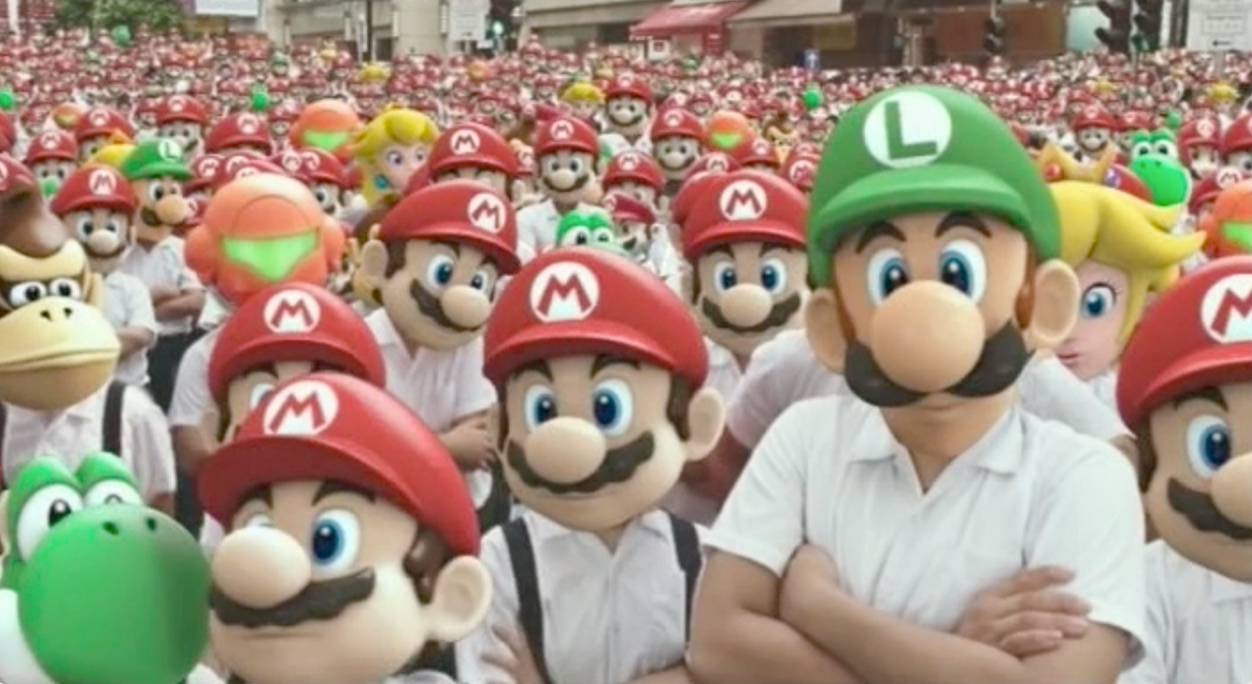
We're kicking things off on a delightfully campy note: a Nintendo of America DVD called Who Are You? 9-25-03. That's right, this disc is old enough to drink! As best we can tell, Nintendo employees received a disc containing an explanation of Nintendo's legendary Who Are You? ad campaign 21 years ago today. This disc is a burned DVD-R, which leads us to believe it was only distributed internally in small quantities, and was likely never meant to be subjected to the prying eyes of the public.
These effects were too powerful to be seen by the public in 2003. We weren't ready.
As interesting as this presentation is to watch, the DVD comes with another major bonus: the full 60 second School's Out commercial, produced by Leo Burnett USA. Getting to see this live action ad in high quality is a sight to behold, and we're thrilled to be able to add it to our archives.
Be sure to keep an eye out for this segment on our livestream, which is running 24/7 on both Twitch and YouTube. It's in the rotation as of today! And don't worry, we still plan on getting this and all of our livestream content into our archive for you to browse and enjoy á la carte. Keep an eye out on this blog, social media, and our Discord server to stay up to date on our progress!

Next, we're delighted to announce that we're going to be uploading our internet premiere watch party segments from the livestream to our YouTube channel! While the content is of course going to remain in the stream rotation, we decided that Andrew's video segments providing some history and context were worth repeat viewings, and so they will be joining the ranks of Jonas's interviews on the channel! Our first segment, Nintendo Händlervideo IFA '95, is live today, and we'll be uploading our Star Wars Day segment in the next few weeks. We've got more of these watch party premieres in the works as well, so keep an eye out! Check below for a sneak preview of what's to come!


A sneak preview of what's to come!
As always, we couldn't do any of this without your continued support! Thank you for helping us preserve video game history for everyone to enjoy!
]]>With the addition of the 4 new team members, we want to extend an incredibly heartfelt THANK YOU to our dear friends Dustin
]]>In May we sent out a call for community members to become involved with Hit Save! in an official way, with roles as board members and CTO.
With the addition of the 4 new team members, we want to extend an incredibly heartfelt THANK YOU to our dear friends Dustin Hubbard and Natalia Portillo, who have helped us grow over these past 4 years, and are now becoming emeritus team members. Dustin was a founding board member and president of the board, and will now continue his focus on the amazing site and community that exists around Gaming Alexandria. Natalia was our CTO, with a heavy focus on data preservation through project Aaru. Again, from the bottom of our hearts, thank you both.
We also want to thank everyone who submitted their applications, we're so incredibly lucky to have such an amazing community. Without further ado, here are our new team members!
Ellen Cooper - Board Member
Ellen is a freelance preservationist who aims to rescue and catalog video games by any means possible. In pursuit of this goal, she has dived into a variety of subjects with no prior experience such as wiki management, reverse engineering of mobile phones, and archival research with the Wayback Machine. She is currently focusing on Japanese feature phone preservation.
Rachael Dillon - Board Member
Rachael is a passionate advocate for gaming history preservation and accessibility, leveraging a background as an avid gamer and Masters in both Criminal Justice and Library & Information Services. When not archiving or squirreled away in her home library with her two cats and a cup of tea, she can often be found streaming indie games on Twitch, where she promotes passion projects and community-driven initiatives.
David Swanson - Board Member
David has been gaming since an early age, and has been involved in video game preservation communities in one form or another since his late teens. He believes firmly in the cultural and social importance of the medium and that it is vital that gaming history is preserved for future generations to understand and enjoy. As Hit Save's first UK-based Board member, he has a particular personal interest in and focus on materials relating to British video game history and culture - from preserving software for machines like the Acorn BBC Micro and Archimedes, to documenting the uniquely British gaming magazine culture of the 90s and 00s.
Kevin Stallone - Chief Technology Officer
Kevin is an avid Pokémon game collector and is dedicated to the preservation of video games. Currently an Information and Data Science graduate student at UC Berkeley, he combines his technical expertise with his passion for gaming to ensure that the history and culture of video games are documented and preserved for future generations. His commitment to game preservation reflects his belief in the importance of maintaining access to classic games and their stories.
Give them all a heartfelt welcome!
]]>Hit Save! is a community-built non-profit, and as such we are looking for a passionate individual to join our board of directors. We invite all of our community members to apply, we would love to get to know you better. As a board member, you'll play a vital role in shaping the future of our organization and ensuring we can continue our important work.
Board member responsibilities are varied and we try to focus on each person's strengths, including:
Financial Planning and Oversight
- Review and approve annual budgets, financial statements, and fiscal policies
- Ensure proper management and allocation of financial resources
- Identify opportunities for fundraising initiatives
Event Planning and Execution
- Assist in organizing fundraising events, exhibits, and community gatherings
- Help promote Hit Save! events to engage new audiences
- Provide on-site support to ensure seamless event operations
Preservation Efforts
- Advise on strategies to acquire, catalog, and preserve video game hardware, software, and memorabilia
- Explore partnerships with developers, publishers, industry leaders, museums, and archives
- Advocate for the importance of video game preservation
Ambassador and Spokesperson
- Represent Hit Save! at events, meetings, and speaking engagements
- Effectively communicate the organization's mission and initiatives
- Build relationships with sponsors, donors, and community partners
Ideal candidates should have a passion for video games and their role in culture and history. Prior non-profit board experience is preferred, but not required. We welcome applicants from diverse personal and professional backgrounds.
Chief Technology Officer Role Available
In addition to seeking a new board member, Hit Save! is also looking to bring on a new Chief Technology Officer (CTO) to oversee and maintain our various online services and technical infrastructure. This key leadership role will be responsible for:
- Managing our digital archives and preservation systems, including our Omeka collections database and storage solutions
- Administering our services, mostly built on Docker
- Implementing security best practices and data protection measures
- Planning and executing technology upgrades and migrations as needed
- Potentially exploring new digital preservation tools and technologies
The ideal CTO candidate will have a strong background in IT, system administration, and web services management. Experience with open source/nonprofit technology is a major plus. Outstanding problem-solving abilities and project management skills are essential.
By ensuring Hit Save!'s online and digital capabilities run smoothly, you'll play an integral role in our mission of preserving video game history for future generations.
To apply, please submit your application with your name, prior experience and knowledge, and current interest in video game preservation to [email protected] by June 5, 2024. Please bear in mind these are unpaid volunteer positions. Join us in keeping video game history alive for future generations!
]]>We just got back from burying our supply of Pitfall! 8K Limited Collector’s Editions in the local landfill, but despite that project’s untimely end, we do have some good news that isn't a prank: We’re thrilled to announce a huge expansion to our livestream content! We've been hard at work digging through the archives for more behind the scenes content, event coverage, interviews, trailers, VHS tapes, and other cool historical content so that we can broadcast it live to you on Twitch and YouTube. The thumbnails below are just a taste; we’ve more than DOUBLED the amount of content in the playlist, and are now sitting at over 37 hours of content, and counting! To celebrate, we’ll be exclusively playing the new content for the next few days to reward our loyal viewers who may have gotten tired of some of the old stuff.


Additionally, we’re excited to announce that we’ll be holding live watch parties to highlight the addition of particularly interesting or rare content, as well as to celebrate game history milestones and anniversaries. Our first livestream watch party event will be at 8:00 PM EST on April 9th, two days from today! We recently acquired several very interesting European VHS tapes; promotional Nintendo tapes from Europe that, as far as we can tell, don’t exist anywhere online yet! This Tuesday we’ll be debuting Nintendo Händlervideo IFA 95, a German Nintendo VHS tape that contains 34 minutes of advertisements, game footage, sales data, and previews. As best we can tell, it was put together for the 1995 Internationale Funkausstellung Berlin (IFA Berlin) Electronics Exhibition. Some highlights include German TV ads for Nintendo games and hardware, as well as early Ultra 64 demo footage like the SGI shark demo. Once we’ve finished our premiere, the video will be added to the loop and normal 24/7 playback will resume. We'll have a little introductory video in advance of the screening, and team members will be in the chat, so come hang out and feel free to ask questions about our process!

We can't wait to show you all of the cool stuff we've collected, and from here on in we’ll be more active in announcing what kinds of new content we’re adding to the stream, so keep your eye out for updates on social media and in the Discord server.
Stay tuned!
]]>We are wicked excited to announce an ambitious new project to breathe new life into the iconic Atari 2600 game Pitfall! with a full modern remaster. "Pitfall! Remastered" will update the 1982 classic with cutting-edge 8K photorealistic graphics, redesigned levels, an
]]>
We are wicked excited to announce an ambitious new project to breathe new life into the iconic Atari 2600 game Pitfall! with a full modern remaster. "Pitfall! Remastered" will update the 1982 classic with cutting-edge 8K photorealistic graphics, redesigned levels, an all-new orchestral soundtrack, and brand-new gameplay modes.
"We felt it was time to reimagine this seminal treasure hunting adventure for a new generation of gamers," stated Hit Save! Executive Director Jonas Rosland. "The 8K visuals will be so lifelike you'll feel like you're really trapped in those jungle vine mazes. Pitfall Harry has never looked so realistic!"

Key features of Pitfall! Remastered include:
- Photorealistic 8K graphics at 120fps with real-time ray tracing (and guns)
- All 28 original levels rebuilt from the ground up with modern designs
- Pitfall Harry now voiced by AI celebrity talent (artisanally handcrafted by ChatGPT6)
- Remixed orchestral soundtrack recorded by a 70-piece ensemble
- Brand new Battle Royale multiplayer mode supporting up to 100 players
- Compatible with all next-gen accessories and peripherals
- Extremely limited "Cartridge Edition" releasing for authentic Atari 2600 hardware
"This isn't just a remaster, it's a total re-envisioning that will innovate the classic Pitfall! gameplay for the modern era," added Hit Save! Director of Communications Amanda Farough. "The Pitfall! franchise deserves this incredible care and attention."
Development and release date
Pitfall! Remastered is currently in development using the most developer-friendly game engine, Unity. It is scheduled for multi-platform release across consoles, PC, mobile, and Amazon Luna in Q4 2024. The authentic 2600 "Cartridge Edition" will be limited to 5,000 units at $499 each.
]]>