The post D49 JBAA Guidance and Talking Points appeared first on Inside Out Youth Services.
]]>UPDATE: The new board president has decided to reconsider this policy, which was passed by the former board majority last year. It will be voted on for a final time on January 27th. If this guide looks familiar, that’s why! It has been updated with the most recent information.
You do not have to read this entire page word-for-word. Please scroll to the sections that are relevant to your needs/interests/curiosities.
Hello! Thank you for taking time to make a stand for LBGTQIA2+ students, educators, and families in Falcon District 49 (D49). Policy JBAA – which bans trans students, staff, and guests from using the restroom that aligns with their gender identity – was passed by the D49 Board of Education in 2025, but the new board president is suggesting a full repeal, which means getting rid of this harmful policy. On January 16th, three out of five members of the D49 board voted to suspend policy JBAA (a necessary step toward repeal) but we’re not out of the woods yet!
There is a very good chance that this policy will be fully repealed, but we need to come together to show that a repeal is exactly what the community wants, and what D49 students need! The next D49 board meeting will be January 27th, when JBAA will be an action item, which means its repeal will be put to a vote. Mark the date on your calendar, plan to join us wearing purple to show visual support for trans students, and stay tuned to our activist network for more information!
Even if you do not live in D49, your voice is important! BUT it is most impactful if you can make a personal connection with the district, such as mentioning your friends, co-workers, family, or others who live in the district.
Neighbors for Education has created a petition to show the board how many people oppose this policy. Sign it here!
Logistics
Meeting Logistics:
The meeting will be held Tuesday, January 27th at 6 p.m. at the Creekside Success Center – D49 (3850 Pony Tracks Dr, Colorado Springs, CO 80922). Please pack the room and wear purple to show support for Neighbors for Education!
A large showing of community members, even just being in the room, will be very valuable!
SEE BELOW FOR PUBLIC COMMENT DETAILS.
If you would like to give public comment on Jan. 27, please feel free to scroll down for talking points, and reach out to [email protected] . We would be happy to help you prepare your public comment!
Sign up for public comment online at 3 p.m. on Jan. 26 at this link. This form will be open until 3 p.m. the day of the meeting, but sign up early! There is a lot of opposition.
During the meeting
At the meeting, there will be appropriate times for clapping and showing support and times where remaining quiet in the audience is important. Specifically, clap, cheer, stand, and support those giving public comment who are bravely speaking out against this policy!
However, while school board members are speaking, it is best to remain quiet. Clapping for supportive board members limits their chances to speak because they are timed. It also sets the precedent that clapping during board member discussion is okay, which could lead opponents to cheer for hate in the room.
The votes to suspend Policy JBAA came from President La Vere-Wright, Director Heil and Director Withers. Making sure these three supportive members have the chance to speak uninterrupted is critical for our ability to influence this policy at the meeting.
Email logistics:
The emails for all 5 board members are listed here. We recommend emailing [email protected] to reach all of them at once. You can reach out to [email protected] if you want someone to help you write or review your email.
Public Comment Template:
Public Comment is 2 minutes in D49, which is fast. Please practice your comment while timing yourself to make sure you can give your full comment. If you have more to say, sending an email in addition to your comment is more than okay.
Hi,
My name is ______, and I am a ____ (parent, teacher, student, community member etc.) I urge you to repeal Policy JBAA.
Opening Statement: (State a clear and concise statement of your position and why it matters.)
Example: The policy not only relies on falsehoods around sex and gender, it is also hateful and goes against state anti-discrimination law.
Personal Story (if applicable):
Share a brief, relevant story to show how this policy directly impacts the board’s community and constituents, or how similar rules have impacted your life.
Supporting Points: (1-3 Key Arguments and Stories) Any of the talking points below can be used here, personal stories are the most impactful inclusions you can make if you have them.
- Share why policies like this are unacceptable in our community. You can speak to its conflicts with state law, community values like compassion or a dedication to accurate information, or how it conflicts with the district’s proclaimed values of “care, respect, trust, and responsibility.”
- Provide facts, statistics, or personal experience that show why the claims made in this policy are untrue, harmful, dangerous, or all of the above. Scroll down to talking points for some resources you can use.
- Expand on a previous point or offer another reason why this issue is important. This could include best practices seen in other districts, legal considerations, or why this resolution upsets or frustrates you. Emotions can be powerful!
Call to Action:
(In your own words, specifically state what action you want the board to take.)
Ex. I urge the board to repeal this policy, and thank you for the opportunity to do so.
Closing (if you want):
“Thank you for your time.”
Email Template:
While there is no limit to how long your email can be, the shorter it is the more likely the Board will read it all. Try to keep your email concise and utilize underlines and bolding to call attention to your most important points.
Subject (Please Personalize!): Community Concerns on Policy JBA
Dear Members of the District 49 School Board,
My name is ______, and I am writing to you as a ____ (parent, teacher, student, community member etc.) I urge you to repeal Policy JBAA.
Share why this matters to you: (State a clear and concise statement of your position and why it is important.) Example: “Recognizing the reality of transgender students, educators, families, and visitors and their rights in your district is essential for their wellbeing. Sending this message to our community is (deeply upsetting, hateful, harmful, discriminatory, etc.)
Key Points – Any of the talking points below can be used, but personal stories are always powerful additions.
Points can be made in any order, sharing what speaks to you is the most important thing to do.
- Share why policies like this are unacceptable in our community. You can speak to its conflicts with state law, community values like compassion or a dedication to accurate information, or how it conflicts with the district’s proclaimed values of “care, respect, trust, and responsibility.”
- Provide facts, statistics, or personal experience that show why the claims made in this policy are untrue, harmful, dangerous, or all of the above.
- Expand on a previous point or offer another reason why this issue is important. This could include best practices seen in other districts, legal considerations, or why this resolution upsets or frustrates you. Emotions can be powerful!
A personal story, if applicable: Sharing a brief, relevant personal story can be the most compelling thing people hear and has the most potential to stop them from passing this policy.
Call to Action (Specifically state what action you want the Board to take): ex: I urge the board to repeal this policy.
Closing Statement: Thank them for reconsidering this harmful policy.
Sincerely, (Your Name)
Contact Information (if you would like them to reach out)
Talking Points
We encourage you to write about what matters to you, especially personal experiences.
Talking Points on Policy JBAA
1. Separate but Equal is Illegal
- There is no room for compromise with this policy, because the so-called compromise has already been deemed discriminatory by the Supreme Court of the United States, lower court legal interpretations, and state law.
- The Supreme Court Case Brown v. Board of Education stated that segregating children in public schools on the basis of race was unconstitutional. This policy attempts to segregate students by gender identity, which is also a protected class under anti-discrimination law. Therefore it would enforce illegal systemic discrimination, as Jim Crow-era laws and policies enforced on the Black community.
- Separate but equal policies usually result in separate and unequal accommodations. Only being able to access one all-gender facility in each building (which doesn’t even address the district buildings that don’t have any all-gender facilities) will create major problems for students, staff, and visitors alike.
- Problems with limited facilities:
- Oftentimes, the single-user gender neutral restroom will be out of the way from a student’s classes. If students need to use the restroom, they may be late to class or miss long portions of lessons.
- Locker rooms and changing rooms can be required for gym class. If the gender-neutral changing space is not connected to the gym, students may have to walk elsewhere in the school to change, which calls undue attention to them and can be very uncomfortable.
- If there is only one restroom available to all of the transgender and nonbinary students in a school, and also to any other student who requests additional privacy, the school runs the risk of lines for the bathroom which could cause major disruptions to the school day.
- Single-user facilities are often locked after school, on the weekends, and for visitors. In any of these common situations, people will not have a choice but to disobey this policy or risk health complications from not using the restroom.
- Problems with limited facilities:
- Forcing anyone to use single-user restrooms creates other problems for those forced to use them.
- Even if the facilities are adequate for all of the students forced to use them, some students will still avoid the restroom due to the target that comes with it. They may be singled out.
- Students who are looking to bully or harass students because of their gender identity would easily be able to identify those students by which restroom they use.
- In cases where the restroom isn’t monitored by school staff, spaces outside these restrooms can become a hotspot for bullying in the school.
2. This policy IS a safety issue, but NOT for cisgender students. We should address the real problems students face, which include bathroom discrimination.
- Students, when speaking to the board about this policy, have themselves stated they are not concerned with where their trans peers use the restroom but are concerned the use of vapes and drugs in bathrooms, fights that occur, or students misusing restrooms to meet up.
- If there are adults inappropriately entering youth restrooms, that is a problem for everyone, regardless of their gender identity. All of the other rhetoric about protecting students implies that trans students are a threat to cisgender students, which is not the case. In fact, due to bullying and harassment, the opposite is often true.
- The safety and wellbeing of transgender students is already a concern due to their increased risk of negative mental and physical health outcomes. Bathroom bills and policies are correlated with an increase in that risk. Not only are trans students’ rights on the line, but so are their lives.
- Please see Trevor Project for more information https://www.thetrevorproject.org/survey-2023/#suicide-by-gender
- Negative impacts for those who want privacy:
- If the goal of this policy is that boys will not be in girls’ restrooms, it fails even to accomplish that.
- Trans men are men who were assigned female at birth. Many trans men undergo puberty blockers, hormone therapies, and express themselves as men. This policy would force people with facial hair or otherwise masculine presentation into women’s restrooms, which may cause discomfort for everyone, or even danger for that trans student.
- A trans man could even be accused of being a cisgender man inappropriately entering a segregated facility for women, creating a confusing and hostile environment.
3. IF there are students who are uncomfortable sharing spaces, which D49 has not shared evidence of, their discomfort does not justify trampling on other students’ rights. The use of an alternative space could equally be offered to the few-if-any cisgender students who express discomfort, instead of targeting all transgender students.
- Some justifications for this policy use the discomfort of cisgender students as a valid reason to target trans students. This ignores the fact that transgender students will also be uncomfortable, and physically unsafe, being singled out and forced out of gendered bathrooms.
- This causes a problem. If people are uncomfortable in bathrooms, the answer is not for either group to be forced into other/worse/fewer accommodations.
- If the board of education is worried about students being uncomfortable, they must consider the trans girl, indistinguishable from a cisgender girl, who will be forced to use the boys’ restroom — risking physical, verbal, or even sexual assault. Not only is that “uncomfortable” it is unquestionably dangerous.
4. Board members in support of this policy cite Title IX as justification for the policy with a disingenuous interpretation that claims to protect student’s right to sex-segregated private spaces. Even if one agrees with their interpretation, Title IX only applies to students. To apply it to the adults in the building and guests to the district is an extreme overreach that will result in a lawsuit.
- Students denied access to spaces in alignment with their gender identity already have grounds for a civil rights lawsuit, but the district is opening itself up to lawsuits from teachers, parents, and all visiting community members.
- This is an incredibly reckless decision for the district, who are now potentially entering into multiple lawsuits over anti-trans policies. This takes time, money, and attention away from what matters: the students and teachers in our schools.
5. Without clear guidelines on how this process works and who enforces it, the result will be a hostile environment for cisgender and transgender people alike, district-wide.
- Bathroom bans empower anyone to police the gender of people in bathrooms around them. Anyone who doesn’t look masculine or feminine enough for the restroom becomes a target for harassment, regardless of whether or not they are transgender.
- This can have serious consequences, such as the assault and consequent death of Nex Benedict in Oklahoma, a state with a statewide bathroom ban.
- Questions to interrogate the lack of clear enforcement mechanism:
- The policy states that the gender marker on one’s birth certificate determines what restroom they use, but how will people know what that marker is? Will students need to carry around their birth certificate when they want to use a restroom?
- If a trans person has updated their birth certificate gender-marker, which happens frequently, who gets to decide what restroom they use?
- The policy states “medical documentation” may be requested. How could those documents be requested, viewed, and then communicated with the school without HIPPA violations?
- Who would have access to these medical records?
- What documentation will be asked for?
- What criteria are being examined in said documentation that would answer the question at all?
- If the district or school isn’t satisfied with someone “proving” who they are, will they resort to genital inspections? This would obviously cross every line and boundary meant to protect students’ privacy.
The post D49 JBAA Guidance and Talking Points appeared first on Inside Out Youth Services.
]]>The post D11 Advocacy Guidelines appeared first on Inside Out Youth Services.
]]>
NOTE: You do not have to read this whole document word-for-word. Please scroll to the sections relevant to your needs/interest!
Hello advocates. Thank you for supporting students in Colorado Springs School District 11 (D11). The majority of the D11 Board of Education is supporting a new instructional materials and library resource reconsideration process. While there can be value in streamlining and updating processes, the proposed changes establish language that will be used to target books with LGBTQIA2+, BIPOC, and other historically marginalized representation in curriculum, resources, and media. Furthermore, this policy takes power away from students, educators, administrators, and parents by concentrating the power to review media in the sole hands of the Board of Education.
Our Asks
While we are not against an update to this policy, edits must be made to protect free speech, representation, and inclusion in schools.
Definitions
- Return the language “reflect an embodiment of diverse perspectives, including historically underrepresented and marginalized voices” to the policy.
- Revise the policy to focus on the types of literature that make up a diverse collection to support student growth and critical thinking, rather than simply preparing to challenge books.
Reconsideration Process
- Revise the policy to ensure there is a review process that includes students, educators, and parents.
- If there are multiple challenges, a committee ensures each piece of media is thoroughly and accurately reviewed by a variety of perspectives.
- Ensure that any book challenged in public session has at least one speaker in defense of each piece of media to ensure a diversity of perspectives when content is challenged.
Other
- Add a section of policy for the approval of content that includes students, educators, and parents.
- Issue an apology to the D11 community for the waste of taxpayer money and illegal destruction of community-approved text books.
Logistics
D11 has fast-tracked this policy by convening a special session to move this policy from Non-Action to Action without public input. Historically, the process would allow for public comment at two meetings before a vote. Removing this opportunity for community input is but one example of the Board of Education trying to silence parents and students in their schools.
Due to this accelerated timeline, there will only be one opportunity for community input before there is a vote on this policy. Please join us in person and send your emails before Wednesday November 5th at 5:30 p.m.
The Colorado Springs Education Association (CSEA) will be hosting a silent vigil at 5 p.m., with a program at 5:30, to uplift the many communities silenced by this policy. Please feel free to join the vigil before the meeting.
Meeting details
Wednesday, November 5th, 5:30 p.m.
Address: 1115 N El Paso St, Colorado Springs, CO 80903
To give public comment, you must sign up between 9 a.m. and 1 p.m. the day of the meeting (November 5th) The link will go live then, and it will be on this page. Keep in mind you will have 3 minutes to deliver your public comment, so keep it concise.
Email details
Emails have no word limit, but brevity and clarity are key. If you are a student, parent, educator, or taxpayer in D11, lead with that so they know they’re hearing from a stakeholder in their community. Send your email to the entire board, addresses below.
Emails for D11
Board President Parth Melpakam – [email protected]
Vice President Jill Haffley – [email protected]
Director Amanda Huber – [email protected]
Secretary Jason Jorgenson – [email protected]
Director Sandra Banks – [email protected]
Director Thomas Carrey – [email protected]
Director Julie Ott – [email protected]
Public Comment Template:
Public Comment is limited to 3 minutes per person. Please practice your comment while timing yourself to make sure you can give your full comment. If you have more to say, sending an email in addition to your comment is more than okay.
Hi,
My name is ______, and I am a ____ (parent, teacher, student, community member etc.) I appreciate the opportunity to speak on policy IJ.
Opening Statement: (State a clear and concise statement of your position and why it matters.)
Example: All students deserve to see themselves represented in their libraries and classrooms, and policies like this are often abused to take those stories away from them.
Personal Story (if applicable):
Share a brief, relevant story to show how this policy directly impacts the board’s community and constituents, or how similar rules have impacted your life.
Supporting Points: (1-3 Key Arguments and Stories) Any of the talking points below can be used here, personal stories are the most impactful inclusions you can make if you have them.
- Share that policies like this allow for the public to enforce their own definitions of what constitutes obscene or pornographic material, while removing parents and experts from the conversation. Remind the board that they are not curriculum experts and should not be the final decider on challenged books.
- Provide facts, statistics, or personal experience that show why this policy is harmful. Scroll down to talking points for some talking points you can use.
- Expand on a previous point or offer another reason why this issue is important. This could include best practices seen in other districts, legal considerations, or why this policy upsets or frustrates you. Emotions can be powerful!
Call to Action:
(In your own words, specifically state what action you want the board to take.)
Ex. I urge the board to make substantial edits to this policy before allowing it to go to a vote.
Closing (if you want):
“Thank you for your time.”
Email Template:
While there is no limit to how long your email can be, the shorter it is the more likely the Board will read it all. Try to keep your email concise and utilize underlines and bolding to call attention to your most important points.
Subject (Please Personalize!): Community Concerns on Policy IJ
Dear Members of the District 11 Board of Edcuation,
My name is____, and I am writing to you as a _____ (your role, e.g., concerned community member, parent of a student, educator, etc.). I appreciate the opportunity to share my concerns/frustrations regarding your proposed Policy IJ.
Share why this matters to you: (State a clear and concise statement of your position and why it is important.) Example: “All students deserve to see themselves represented in their libraries and classrooms, and policies like this are often abused to take those stories away from them.
A personal story, if applicable: Sharing a brief, relevant personal story can be the most compelling thing people hear and has the most potential to stop them from passing this policy.
Key Points – Any of the talking points below can be used, but personal stories are always powerful additions.
Points can be made in any order, sharing what speaks to you is the most important thing to do.
- Share that policies like this allow for the public to make their own definitions of what constitutes obscene or pornographic material, while removing parents and experts from the conversation. Remind the board that they are not curriculum experts and should not be the final decider on challenged books.
- Provide facts, statistics, or personal experience that show why this policy is harmful. Scroll down to talking points for some resources you can use.
- Expand on a previous point or offer another reason why this issue is important. This could include best practices seen in other districts, legal considerations, or why this policy upsets or frustrates you. Emotions can be powerful!
Call to Action (Specifically state what action you want the Board to take): I urge the board to make substantial edits to this policy before allowing it to go to a vote.
Closing Statement: Remind them of the importance of your request and that you are paying attention to the decisions they are making that hurt LGBTQIA2+ students.
Sincerely, (Your Name)
Contact Information (if you would like them to reach out)
Problems with the Policy Changes
This policy replaces the policies that currently cover instructional resources, library media, and library tech programs (IJJ, IJL, and IJNC). Replacing these will result in the loss of inclusive language and practices while consolidating the power of review solely within the Board of Education. Policy IJ is written to purge books currently in D11 schools on the basis on “obscene” or “pornographic” content. The policies that are being replaced not only make sure content is appropriate, but establish meaningful requirements for diverse, inclusive, and representative content in D11. Those requirements are notably missing in policy IJ. More problems with the policy below:
- Lack of Transparency
- School Board members are elected officials, who work for the students and families in the district. Limiting the opportunities for the public to speak makes it seem as if they don’t have to listen to us, which is not true. The voices that matter most are YOURS — the parents, students, and community in D11.
- The Board rushing this policy through in this manner, when it was not a time-sensitive issue (or an issue at all), shows poor leadership, planning, and professionalism. A school board who is doing nothing wrong should have nothing to hide, and it should want to hear what its constituents have to say.
- State Protections Against Censorship
- In 2024, SB25-063 (AKA the Freedom to Read Act) became Colorado Law. It mandates schools and school districts have policies on reconsidering books that are already in their libraries or classrooms. These protections need to be in place because of unofficial book removal happening in the state, in districts like D11.
- Recently, it came to light that the District ordered pages about sexuality cut out of community-approved health curriculum. Under-the-table censorship is no longer allowed in Colorado, and changes to content must be made publicly. However, in public or in private, this board has a track record of vilifying LGBTQIA2+ students and parents, and we anticipate they will continue to purge content they don’t like with this policy.
- Removing Diversity from the Policy
- Currently Policy IJL states that library professionals need to offer “wide range of materials with diversity of appeal and different points of view” with specific guidance to “reflect an embodiment of diverse perspectives, including historically underrepresented and marginalized voices.”
- Policy IJ does not mention underrepresented and marginalized voices as important additions to a library collection that has a “balanced collection with a diversity of perspectives.”
- Preparing to Purge books
- Additions to the previous policies focus on preparing to remove content that is “obscene” or “pornographic”. Of course, D11’s current policies require content to be catered to students needs at all levels. The only reason to add specific sections for obscenity and pornographic content is to move the goal posts on content that is already in schools by labelling some content as inappropriate.
- This policy anticipates a large volume of reported books already in libraries being subject to community challenges.
- When book bans are implemented, important representation of identities, experiences, and ideas are cut out of student’s lives. Check out PEN America to see what books are often targeted.
- Additions to the previous policies focus on preparing to remove content that is “obscene” or “pornographic”. Of course, D11’s current policies require content to be catered to students needs at all levels. The only reason to add specific sections for obscenity and pornographic content is to move the goal posts on content that is already in schools by labelling some content as inappropriate.
- Reconsideration Process
- Board of Education Power Grab
- The proposed reconsideration process eliminates student, parent, and educator voice and is at odds with Policy AKB, wich states the district’s commitment to Parent Partnership.
- School Board members are elected officials, not experts in child development, literary analysis, or curriculum standards. Media in schools deserve thorough discussion and review not only with the educators who chose them, but with the students who read them and the parents who trust D11 to give their students a comprehensive and inclusive education.
- This Board, through policies such as ACA, JBA, JBAA, IMD, and the repeal of its equity policy, has shown a hostile attitude toward LGBTQIA2+ students and families. If they are the only stakeholders who have a say, they may unilaterally deem LGBTQIA2+ representation as “obscene” or “pornographic” in bad faith.
- If Policy IJ is approved, public challenges to books and media in schools will be scheduled every six months.
- The District will now give more time and attention to media challenges on a regular basis. At any given meeting, it is unknown how many challenges could be allowed, meaning that dozens of books may be up for review each time. Each piece of media requires detailed review that may not be possible with the rate of challenges brought, potentially leading to rushed and uninformed decisions.
- Each book runs the risk of a fight between those who value intellectual freedom and critical thinking and those who are trying force their beliefs on the entire D11 community.
- Who is going to defend the books? – Policy IJ states that “the Board will hear arguments in public session, with opportunity for both sides to be presented.”
- No matter which parent or community member challenges any given book, the Board of education is seemingly relying on public comment to influence their decision. So someone may stand in defense of books which are being put on trial, but there is no guarantee of a defense. Any person, with any political ideology or goal, could challenge any media in front of the Board. Without public defenders for books, there are no safeguards for a thorough, legitimate, or unbiased review of any D11 curriculum. The district, in effect, is putting the entire educational landscape of the district up for debate to the public twice a year.
- Board of Education Power Grab
Talking Points for emails and Public Comments
- Censorship Undermines Education – Banning books limits students’ exposure to diverse ideas, perspectives, and critical thinking opportunities. Education should empower students to explore complex topics and form their own informed opinions, not shield them from reality.
- It Silences Marginalized Voices – Many banned books feature stories from marginalized communities, including LGBTQIA2+ individuals, people of color, and those with different cultural or religious backgrounds. Removing these books erases important narratives and reinforces systemic inequality.
- It Violates Intellectual Freedom – The freedom to read is a cornerstone of democracy. Book bans infringe on students’ and educators’ rights to access information and make choices about what they read and learn.
- It Creates a Chilling Effect for Teachers and Librarians – Educators may feel pressured to self-censor or avoid teaching important topics out of fear of backlash. This undermines their professional integrity and limits the richness of classroom discussions.
- It Disconnects Schools from the Real World – Students live in a diverse and complex society. Shielding them from books that reflect real-world issues—like racism, gender identity, or mental health—doesn’t protect them; it leaves them unprepared to engage thoughtfully and empathetically with others
- Demonstrate the value of literature in your education or life. – Many of us have important memories about the books we read, including those from school. I would not be the same person as I am without books that expanded my perspective and world view beyond my life, country, and time. If you have similar connections to works you’ve read, telling that story can be compelling case for keeping a diverse library of literature and curriculum.
The post D11 Advocacy Guidelines appeared first on Inside Out Youth Services.
]]>The post D49 Resolution Talking Points appeared first on Inside Out Youth Services.
]]>
NOTE: You do not have to read this entire page word-for-word. Please scroll to the sections that are relevant to your needs/interests/curiosities.
Hello! Thank you for advocating for LGBTQIA2+ students, educators, and families in Falcon School District 49 (D49). Some members of the D49 Board of Education have proposed a policy that would ban trans participation in sports, which includes damaging language and blatant falsehoods. We are mobilizing to oppose this policy! Read below for more information on how to get involved.
Even if you do not live in D49, please tell them not to pass this policy! It is most impactful if you can make a personal connection with the district, such as mentioning your friends, co-workers, or employees who live in the district, but any expertise is welcome!
Click here to see the draft policy
Problems with the policy: (See Talking Points for explanations and counter arguments)
- It perpetuates harmful myths and blatant falsehoods around trans, gender-expansive, and intersex people, claiming that their participation in sports constitutes an unfair advantage.
- We all want to uphold the safety and integrity of girls’ sports, for all girls. This policy fails to do that by increasing the risk of harassment for both cisgender and transgender female athletes.
- It violates Colorado State anti-discrimination law, as well as the Constitution, and preemptively complies with government overreach into our community.
- It is written with a lengthy and harmful preamble, in a way that is inconsistent with other district policy and will certainly bring legal challenges.
- It takes a “one-size-fits-all” approach that ignores the complexity of transition, gender, sex, and body type. A case-by-case basis is the only way to determine the safest and fairest way for students to compete.
- The name of this policy claims to be for the purpose of “preserving fairness and safety,” while actively doing the opposite by increasing harm.
- Participating in school sports is an important part of a young person’s life, and exclusion from sports can have negative impacts on mental health and wellbeing.
Our Demand/Ask for Board members
Our position is that this policy should not pass. However, if it does pass it should be with some revisions that will reduce harm.
- Do not pass the policy
- If this Board chooses to pass the policy, it must…
- allow for a case –by-case basis decision-making process.
- Remove the preamble of the policy to put it in line with other policies in the district.
Logistics
Meeting Logistics:
This policy will be introduced as an action item on Thursday, May 8th, at 6:30pm. The meeting will be held at the Creekside Success Center – D49 (3850 Pony Tracks Dr, Colorado Springs, CO 80922). Please pack the room and wear purple to show support for Neighbors for Educaiton, and opposition to this policy!
A large showing of community members, even just being in the room, will be very valuable!
If you would like to give public comment, please feel free to scroll down for talking points, and reach out to [email protected] . We would be happy to help you prepare your public comment!
The district has just implemented an online public comment sign-up, which you can find at 3 p.m. the day before each meeting at this link (scroll down to where it says “announcement,” as that is where the link to sign up will be posted.)
Sign up early, as we’re anticipating a lot of support for this policy from anti-trans groups, who will also be trying to pack public comment.
During the meeting
At the meeting, there will be appropriate times for clapping and showing support and times where remaining quiet in the audience is important. Specifically, clap, cheer, stand, and support those giving public comment who are bravely speaking out against this policy!
However, while school board members are speaking, it is best to remain quiet. Clapping for supportive board members limits their chances to speak because they are timed. It also sets the precedent that clapping during board member discussion is okay, which could lead opponents to cheer for hate in the room.
We anticipate this policy will pass unchanged. We are expecting the three votes in favor to come from President Thompson, Vice President D’Avola, and Director Schmidt. The votes in opposition we expect to come from Director Heil and Director La Vere-Wright. Making sure these two supportive members have the chance to speak uninterrupted is critical for our ability to influence this policy at the meeting.
Email logistics:
The emails for all 5 board members are listed here. We recommend emailing each person on the board together on the same email. You can reach out to [email protected] if you want someone to help you write or review your email.
Jamilynn D’avola: [email protected]
Deb Schmidt: [email protected]
Marie Lavere-Wright: [email protected]
Lori Thompson: [email protected]
Mike Heil: [email protected]
Public Comment Template:
Public Comment is 2 minutes in D49, which is fast. Please practice your comment while timing yourself to make sure you can give your full comment. If you have more to say, sending an email in addition to your comment is more than okay.
Hi,
My name is ______, and I am a ____ (parent, teacher, student, community member etc.) I appreciate the opportunity to speak on your proposed policy JBA.
Opening Statement: (State a clear and concise statement of your position and why it matters.)
Example: The proposed policy is not only factually untrue, it is hateful and goes against state anti-discrimination law.
Personal Story (if applicable):
Share a brief, relevant story to show how this policy directly impacts the board’s community and constituents, or how similar rules have impacted your life.
Supporting Points: (1-3 Key Arguments and Stories) Any of the talking points below can be used here, personal stories are the most impactful inclusions you can make if you have them.
- Share why policies like this are unacceptable in our community. You can speak to its conflicts with state law, community values like compassion or a dedication to accurate information, or how it conflicts with the district’s proclaimed values of “care, respect, trust, and responsibility.”
- Provide facts, statistics, or personal experience that show why the claims made in this policy are untrue, harmful, dangerous, or all of the above.
- Expand on a previous point or offer another reason why this issue is important. This could include best practices seen in other districts, legal considerations, or why this resolution upsets or frustrates you. Emotions can be powerful!
Call to Action:
(In your own words, specifically state what action you want the board to take.)
Ex. I am asking you not to pass this policy and consider how rhetoric like this harms the students and families you were elected to support.
Closing (if you want):
“Thank you for your time.”
Email Template:
While there is no limit to how long your email can be, the shorter it is the more likely the Board will read it all. Try to keep your email concise and utilize underlines and bolding to call attention to your most important points.
Subject (Please Personalize!): Community Concerns on Policy JBA
Dear Members of the District 49 School Board,
My name is____, and I am writing to you as a _____ (your role, e.g., concerned community member, parent of a student, educator, etc.). I appreciate the opportunity to share my concerns/frustrations regarding your proposed Policy JBA.
Share why this matters to you: (State a clear and concise statement of your position and why it is important.) Example: “Recognizing the reality of transgender students and their rights in your district is essential for their wellbeing and academic success. Sending this message to our community is (deeply upsetting, hateful, harmful, discriminatory, etc.)
Key Points – Any of the talking points below can be used, but personal stories are always powerful additions.
Points can be made in any order, sharing what speaks to you is the most important thing to do.
- Share why policies like this are unacceptable in our community. You can speak to its conflicts with state law, community values like compassion or a dedication to accurate information, or how it conflicts with the district’s proclaimed values of “care, respect, trust, and responsibility.”
- Provide facts, statistics, or personal experience that show why the claims made in this policy are untrue, harmful, dangerous, or all of the above.
- Expand on a previous point or offer another reason why this issue is important. This could include best practices seen in other districts, legal considerations, or why this resolution upsets or frustrates you. Emotions can be powerful!
A personal story, if applicable: Sharing a brief, relevant personal story can be the most compelling thing people hear and has the most potential to stop them from passing this policy.
Call to Action (Specifically state what action you want the Board to take): I urge the board to not pass this policy and to consider how rhetoric like this harms the students and families they were elected to support.
Closing Statement: Remind them of the importance of your request and that you are paying attention to the decisions they are making that hurt LGBTQIA2+ students.
Sincerely, (Your Name)
Contact Information (if you would like them to reach out)
Talking Points
These are ordered based on ongoing conversations about what messaging might be most effective to reduce the policy’s potential harm. We encourage folx to write about what matters to them, especially personal experiences.
Express your emotions
- This is an upsetting policy for them to try to pass. Professional obligations mean some people can’t share how angry, upset, hurt, or sad they feel about this policy. Students, parents, and community members may not have those same restrictions, and we urge folx to express their frustrations with Policy JBA in a way that is respectful but shows the harm this causes and the energy it generates in our community.
- You can also thank them for abandoning their resolution that would have recognized only two sexes, if you are so inclined. (Note: If you do this, please also share that the language they have added to Policy JBA is too close to the original resolution, and presents the same issues and challenges.)
- Parents – Tell the School Board that you want your parental rights respected as the parent of a trans child.
This policy will harm cisgender girls, too
- We all want to uphold the safety and integrity of girls’ sports, for all girls. This policy fails to do that by increasing the risk of harassment for both cisgender and transgender female athletes and failing to address other pressing concerns.
- This policy sets a standard that it is okay to police someone’s participation in activities because of their physical characteristics.
- If a cisgender female athlete has broad shoulders, is taller than her peers, or even just has a “masculine” face structure, that girl may face bullying or exclusion from other girls on her team, parents, coaches, referees, and other school staff. We already know that body image is a big issue for developing youth, and exposing girls to even more scrutiny about their bodies will only increase their risk of verbal, physical, and psychological abuse.
- This policy will force trans boys to play on girls’ teams, even in cases where they are taking testosterone. Conversations around competitive advantage are complex, and this policy seeks to create a “one-size-fits-all” approach that is insufficient to adequately determine what team a student should play on.
This policy is based on multiple false assumptions
- It perpetuates harmful myths and blatant falsehoods around trans, gender-expansive, and intersex people, claiming that their participation in sports constitutes an unfair advantage.
- Letting these biased and uninformed assumptions go unchallenged in guiding this policy and the narrative around it lets people attack strawman arguments instead of engaging with evidence and best practices about safety and privacy for students.
- It assumes that students who transition are doing so for the express purpose of winning at sports.
- Transgender people undergo years of social redefinition, the loss of friends and loved ones, and discrimination to be their true selves. Student athletes who want to be more competitive join competitive programs, transfer schools or programs, or make healthier lifestyle choices around exercise and eating. No one is transitioning to win more games.
- It ignores the changes to the body that can come from hormone replacement therapy.
- Trans boys on testosterone will likely increase muscle growth, which undermines one of the reasons that has been given for this policy to exist. Conversely, trans girls will lose muscle mass over extended treatments.
- Each student has unique needs; any district policy should be aware of that fact and prepared to accommodate case-by-case evaluations.
- This policy is also based on the assumption that any boy could beat any girl at any sport at any time.
- Much of the rhetoric around this policy makes the unfair and untrue assumption that men are so biologically superior to women that any competition between them is impossible. How unfair to female athletes! This ignores the hours athletes put in to training and practicing with their team, and the dedication they put into studying and practicing the game.
- It violates Colorado State anti-discrimination law, the Constitution, and preemptively complies with government overreach into our community. It is also written in a way that is inconsistent with other district policy to be hateful and potentially set the stage for legal challenges. District 49 taxpayers should not have to pay for years of legal battles in the district; that funding should go to schools.
- Pre-emptive Compliance
- This policy cites Executive Order 14201 and the Trump Administration’s threat to cut funding to schools who allow trans athletes to compete. Executive orders are not law. The only laws this policy will violate are real Colorado Anti-Discrimination laws.
- Colorado Springs is a community that prioritizes local control. To fold to weak and unenforceable executive orders from Washington is antithetical to the values this community claims to hold.
- The Constitution
- This policy violates the First Amendment right to free speech, the 14th Amendment right to equal protections under the law, and the 10th amendment right to local control.
- Pre-emptive Compliance
District lawsuits
- This policy seems to be written in preparation for a legal challenge (hence the out-of-place preamble to the policy, which reads like a legal brief). It is not the job of D49 taxpayers, students, teachers, or community members to fund a legal challenge to large-scale culture wars that the school board has no right to interfere with. It is a massive waste of time, budget, and attention that benefits no one.
The post D49 Resolution Talking Points appeared first on Inside Out Youth Services.
]]>The post Chosen Name Policy Advocacy Guidelines appeared first on Inside Out Youth Services.
]]> Hello! Thank you for your interest in advocating for District 11 (D11) youth to have their identity affirmed in schools with no strings attached. The D11 Board of Education is trying to pass a policy that makes it difficult for students to access rights they already have. Worse, if implemented, this policy will expose youth to potentially dangerous situations at home, may limit schools’ safety for students, and make it harder for school staff to become trusted adults in LGBTQIA2+ students’ lives. By sending an email, attending or speaking at the D11 board meeting, and rallying your community, you can help us protect LGBTQIA2+ youth in a meaningful way. There are templates for creating public comments and writing emails below, which you can reference when writing your communication.
If you have questions, want someone to review your email or public comment, or want to sit next to someone at the school board meeting, reach out to [email protected]. He can connect you to resources now and in the future! Consider joining IOYS’s Advocate Network for more opportunities to get involved.
Link to the most recent policy: https://go.boarddocs.com/co/d11/Board.nsf/files/DD8M7B59D3E9/$file/ACA-Name%20Changes.pdf
Problems with the ACA Policy Draft
- It requires parental consent (with no information on how that is obtained), which is not in line with the language of the law.
- Parental consent attempts to bar some students from their rights established in the Non-Legal Name Change law HB24-1039
Logistics
Email Logistics
Each of the emails of the seven members are listed here. We recommend emailing each person on the board together.
Board President Parth Melpakam – [email protected]
Vice President Jill Haffley – [email protected]
Treasurer Lauren Nelson – [email protected]
Secretary Jason Jorgenson – [email protected]
Director Sandra Banks – [email protected]
Director Thomas Carrey – [email protected]
Director Julie Ott – [email protected]
Meeting Logistics
The School Board Meeting will be at 5:30 on March 5th, 2025. It will be held at the District 11 Main Administration Building at 1115 N. El Paso St. You do not have to sign up to attend, but you DO need to sign up in advance to give public comments.
To give public comment, you must sign up from 9am through 1pm the day of the meeting (March 5th) The link will go live then, but it will be on this page https://www.d11.org/boe/meetings . When drafting your public comment, keep in mind you will have 3 minutes, so keep your comments concise. If you want support or a review, email [email protected]
During public comment, the Board has strict rules around clapping, cheering, or otherwise showing support for the person speaking. If you attend the meeting but are not speaking (or when you are not speaking), you may stand to support the person who is giving comment to show you agree. If someone is speaking in support of the current draft of the policy, you can stand and turn your back to show you disagree.
Email Template:
An email is not subject to the same word limitation as a public comment, but make sure your email is neither too long nor too short.
Subject: Community Concerns on Policy ACA Draft
Dear Members of the District 11 School Board,
My name is ____, and I am writing to you as a _____ (your role, e.g., concerned community member, parent of a student, educator, etc.). I appreciate the opportunity to share my concerns regarding your drafted Policy ACA.
Why This Matters: (State a clear and concise statement of your position and why it is important.) Example: “Ensuring that all students, including LGBTQ youth, feel safe and supported in our schools is not just the right thing to do—it is essential for their well-being and academic success.”
Key Points: Any of our talking points above can be used, and personal stories are always a powerful addition
- [First Point] – Provide a fact, statistic, or personal experience that supports your position.
- [Second Point] – Expand on another reason why this issue is important. This could include research, best practices from other districts, or legal considerations.
- [Third Point] – Address potential concerns and offer constructive solutions.
Personal Story (if applicable): (Sharing a brief, relevant personal story can make your comment more compelling.)
Call to Action: (Specifically state what action you want the board to take.) Example: “I urge the board to adopt clear policies that protect LGBTQ students from discrimination and bullying, including mandatory training for teachers and staff.”
Closing Statement: (Thank the board for their time and reiterate the importance of your request.) Example: “Thank you for your time and for your commitment to ensuring that all students have a safe and supportive learning environment. I hope you will take action to make our schools more inclusive for every child.”
Sincerely, (Your Name)
(Your Contact Information)
(Your Affiliation, if applicable)
Public Comment Testimony Outline:
Hi,
My name is ______, and I am a ____ (parent, teacher, student, community member etc.) I appreciate the opportunity to speak on your Policy ACA draft.
Opening Statement:
(State a clear and concise statement of your position and why it matters.)
Example: “Ensuring that all students, including LGBTQ youth, feel safe and supported in our schools is not just the right thing to do—it is essential for their well-being and academic success.”
Supporting Points (1-3 key arguments): Any of the talking points can be used here, and personal stories are very impactful additions
- [First Point] – Provide a fact, statistic, or personal experience that supports your position.
- [Second Point] – Expand on another reason why this issue is important. This could include research, best practices from other districts, or legal considerations.
- [Third Point] (if applicable) – Address potential concerns and offer constructive solutions.
Personal Story (if applicable):
(Sharing a brief, relevant personal story can make your comment more compelling.)
Call to Action:
(In your own words, specifically state what action you want the board to take.)
Ex. I/We are asking you to remove the requirement for parental consent for students to use their correct, chosen name. If you must require contact with parents, please update the policy to notify the parents after a student comes forward, explicitly requiring that the student be informed before contacting parents or guardians.
Closing Statement:
(Thank the board for their time and reiterate the importance of your request.)
Example: “Thank you for your time and for your commitment to ensuring that all students have a safe and supportive learning environment. I hope you will take action to make our schools more inclusive for every student.”
End with:
“Thank you for your time.”
Talking Points for Public Comment or Email Campaign
You do not have to read this entire document word-for-word. Please use the talking points that resonate with you, while including personal anecdotes you think would be powerful to share. Given the attitude of the Board, we think the talking points listed first will be the most effective, but a wide variety of responses from the community would show diverse reasoning behind our ask.
If you are interested in looking for other statistics to include in your communications, check out the Trevor Project or the Healthy Kids Colorado Survey.
- Trevor Project: https://www.thetrevorproject.org/survey-2024/
- Healthy Kids Colorado: https://cdphe.colorado.gov/hkcs
Our Ask
- I/We are asking you to remove the requirement for parental consent for students to use their correct, chosen name. If you must require contact with parents, please update the policy to notify the parents after a student comes forward, explicitly requiring that the student be informed before contacting parents or guardians.
Privacy & Student Rights
- HB-1039 is law in Colorado. It says that schools must use a student’s chosen name, which is not conditional on parental consent. This policy is putting barriers in place for students to access rights they are already guaranteed.
- This policy could bring legal problems for the district that may take time and attention away from other district priorities, of which there are many. It sends a clear message that trans students are not respected for who they are by board members supporting this policy.
- Students have the right to share their identity with who they want when they want. Inserting the school or Board into those private conversations between families is not only unnecessary, but an overreach of schools into the home.
- “Students do not shed their constitutional rights to freedom of speech or expression at the schoolhouse gate.”
-
- Tinker v. Des Moines Independent Community School District, 393 U.S. 503 (1969), was a landmark decision by the United States Supreme Court that recognized the First Amendment rights of students in U.S. public schools. The Tinker test, also known as the “substantial disruption” test, is still used by courts today to determine whether a school’s interest to prevent disruption infringes upon students’ First Amendment rights. The Court famously opined, “It can hardly be argued that either students or teachers shed their constitutional rights to freedom of speech or expression at the schoolhouse gate.”[1][2]
- Self-representation is a form of free speech. Representing one’s gender identity and the name that aligns with it should be protected as that student’s free speech. In fact, this is the opposite of a “substantial disruption.” It allows students to focus on school while knowing they are supported by the school staff around them.
Logistical Burden for Nicknames
- If this policy goes into effect, students will have to get consent from their parents any time they want to use a name other than their “legal name.” Depending on what steps teachers, administrators, students, and parents must go through, there may be hours of wasted time documenting and filing all of the nicknames, abbreviations, and shortened names (i.e. Mike for Micheal, Chrissy for Christina).
- If only transgender or gender non-conforming students are required to go through this process, they are being targeted due to their gender identity, which is an explicitly protected class in Colorado anti-discrimination law.
- If this implementation is intentional, it requires school personnel to determine themselves which names or nicknames are too different from their legal name to constitute a change. This process would be arbitrary and potentially discriminatory.
- Ultimately, HB24-1039 requires students’ chosen names be used in schools. That is not contingent on paperwork filed or parental consent. If a student requests a different name and it is not used, D11 will be in violation of Colorado law. If students don’t fill out any paperwork, the district must still use their chosen name.
Accessibility
- LGBTQIA2+ students sometimes struggle in school due to a lack of feeling safe or respected. If a student has to worry about being bullied or harassed in the hallway, is dealing with vandalism of their personal belongings, or is forced to be in a classroom with teachers and peers who degrade them, they cannot focus on what they are there for, school.
- Using chosen names is an accommodation that creates an environment where students know they are protected from discrimination and allows them to succeed in school instead of being afraid to participate or show up at all.
Benefits of Affirming Environments
- 54% of transgender and nonbinary young people found their school to be gender-affirming, and those who did reported lower rates of attempting suicide.
- Schools with GSAs see students with better mental health and educational outcomes (whether they participate in the GSA, are LGBTQIA2+, or not) than schools without GSAs. Graduation rate, grades, and test scores can improve for all students when the expectation is that everyone is respected and protected.
- This speaks to the impact of inclusion on the well-being of everyone.
- LGBTQIA2+ students have reported significant stress and anxiety due to rhetoric like this from the national level down to their communities. Students pay attention to these conversations and know when they are not being respected by the adults making decisions about their lives.
- LGBTQ+ young people who reported living in very accepting communities attempted suicide at less than half the rate of those who reported living in very unaccepting communities.
Risks associated with outing students
- Only 40% of LGBTQIA2+ feel like they can be open in their identity at home. That is less than half. Over 1 in 2 situations where home is contacted based on this policy could potentially expose a student to an unsafe situation.
- If a student is unaware that home has been contacted, they may be unable to take steps to prepare or protect themselves if needed.
- LGBTQIA2+ youth are at higher risk of homelessness due to unaccepting families. If students feel safe to explore their identity at school but not at home but are not given the agency to talk to their parents or guardians on their own timeline, this issue could potentially be exacerbated.
Benefits of having trusted adults in youth lives
- The benefits of having ONE trusted adult in an LGBTQIA2+ student’s life include
-
- At least a 40% decrease in the likelihood they will attempt suicide
- Only 63% of LGBTQIA2+ students in CO have an adult they can go to for help with a serious problem.
- Only 35% of LGBTQIA2+ students in CO feel their stress level is manageable most days.
- Teachers are often trusted adults for students experiencing hardship at home, this policy might make it harder, if not impossible, for them to express that support.
- If school personnel are barred from respecting a student due to an administrative barrier, they are effectively being barred from becoming trusted adults.
- If a student disclosing their identity to school personnel becomes a potential source of danger in school or at home, they may not reach out in the first place.
Negative Mental and Physical health outcomes that will be exacerbated by this policy.
- Transgender and gender non-conforming youth are at increased risk for many negative mental and physical health outcomes, including…
-
- Use substances as a coping mechanism, and develop an unhealthy relationship with substances
-
- Suffer sexual assault or harassment
-
- Experience bullying
-
- Experience homelessness or shelter insecurity
-
- Each of these are compounded by other systemic pressures, including racism and ableism.
The post Chosen Name Policy Advocacy Guidelines appeared first on Inside Out Youth Services.
]]>The post 2023 FAQ appeared first on Inside Out Youth Services.
]]>
Why did Inside Out temporarily close its in-person community center?
When the Club Q shooting occurred, Inside Out was on a week-long fall break, so our center was already closed. Our community expressed concerns about gathering together, and we recognized a growing threat of mass gun violence. We asked ourselves: How can we continue to gather in-person safely and effectively?
During the week we were closed, we participated in immediate response to the tragedy (see more below) and then began to address safety and security at our center. While we have had robust safety measures in place before (see more below), the reality of mass gun violence and extremism has evolved. We immediately initiated a safety audit and began revising safety practices, endeavoring to be responsive and connected to our young people and staff, and their concerns.
Are you closed for good?
Inside Out was founded in 1990, during a time of nationwide anti-LGBTQIA2+ hate. We’re certainly not going to let hate stop us now. Which is all to say: HECK NO! We are planning a phased reopening starting in March, and we are excited to return to our beloved community center.
Were you not prepared for security risk?
We’ve always had security plans and procedures in place to safeguard the center and the youth inside it. However, like our sibling LGBTQIA2+ organizations across the nation, we’re all faced with a new form of anti-LGBTQ extremism, specific targeting from organized white supremacist hate groups, and the reality of mass gun violence. Our practices and procedures must prevent these tragedies. We have been working with experts, trained to protect against white supremacist violence, to ensure we are prepared for any security risk posed by these particular hate groups.
What has IOYS done while it’s physical space has been closed?
Beginning immediately after the shooting and continuing today, we have organized in-person community outings for youth to come together in undisclosed spaced. We facilitated and coordinated national governmental efforts to get resources and connections to this community. We have continued to advocate for youth in schools, train our community on LGBTQIA2+ identities and support, and have even grown our staff to include three new positions. All this, while each of us personally deals with grief and trauma.
By the numbers:

Are you involved in the Colorado Healing Fund, and in what capacity?
We have a single seat on an advisory committee to the CHF. We are among multiple individuals on that committee recommending that outside foundations pick up all costs associated with CHF’s labor, so 100 percent of the CHF money will go to survivors and families. At this point, they have committed to those recommendations. Because we serve only in an advisory capacity, we have no formal power over the decisions made by the Healing Fund.
Is Inside Out collecting or distributing funds to survivors?
We don’t have the capacity or expertise to do that, and we have been referring any survivor-oriented donations to the appropriate fundraisers and channels. Immediately after the shooting, we changed our online donation page to link to survivor-supporting fundraisers, so no one would even assume that money that came to us would go to survivors. Like LGBTQIA2+ organizations across the state, IOYS did receive national support after the attack, but anyone who supported us knew that they were donating to the long-term work of empowering LGBTQIA2+ young people in our community. And we are so grateful for that support, because we are able to put some of those funds immediately toward security efforts.
What have you done for survivors?
In the immediate aftermath of the shooting, we coordinated with GLAAD, a national LGBTQ media organization, who sent folks to Colorado Springs to help with media requests, provide expertise, and use their network to get national organizations to help our community. We hosted four total vigils (three the day after the tragedy), to offer space to grieve. We hosted meetings with federal governmental entities like Assistant Secretary of Health Admiral Levine to form connections with our national government and our community.
We are continuing to engage in such meetings, but thankfully connections have been built, and now the organizations and entities we helped introduce are working with each other. We are so grateful other community members and organizations have since stepped into the role of survivor and community support. There is a coordinated and well-resourced group currently identifying what the next steps are. We participated in that effort, and we’re not sure what our role will be moving forward. But because the work is in great hands, we can focus on our mission. As always, our focus is on LGBTQIA2+ youth and the adults who support them.
What’s next for Inside Out?
Our legacy in this community is rooted in supporting young LGBTQIA2+ people – providing them with space, connection, and resources. Our staff is growing, increasing our capacity to respond to advocacy needs and serve young people at our center. As stated above, we are planning a phased reopening in March as we continue to implement new safety and security measures in coordination with experts, and IOYS participants, staff, and volunteers.
My question wasn’t answered here.
Feel free to email us, DM us on socials, or give us a ring, or send us an email with any additional questions you might have.
The post 2023 FAQ appeared first on Inside Out Youth Services.
]]>The post Learn more appeared first on Inside Out Youth Services.
]]>Suicide prevention best practices for schools
Poster for family acceptance practices
LGBTQ Resources from PFLAG
Printable one-page resources (right click+save image):
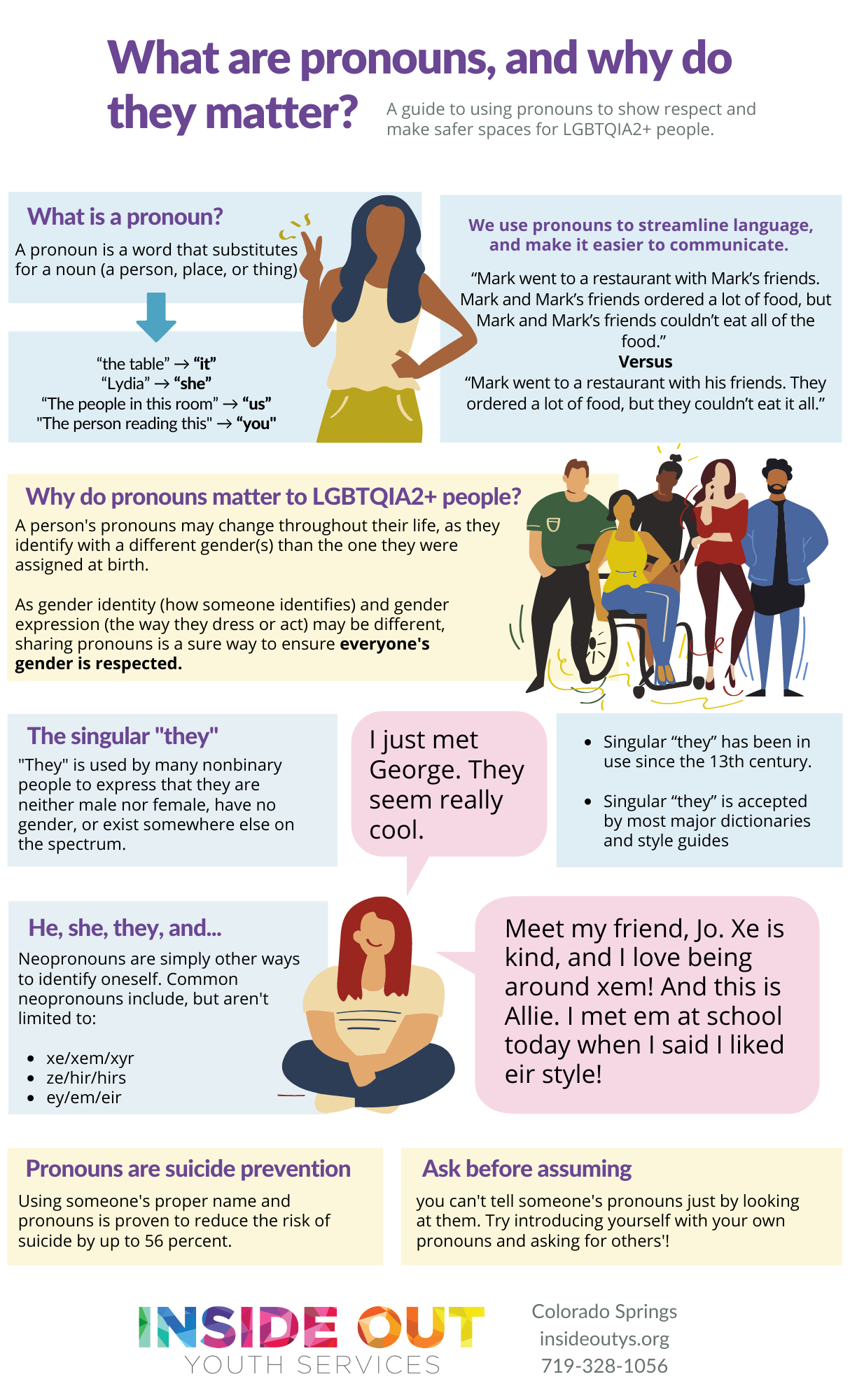

The post Learn more appeared first on Inside Out Youth Services.
]]>The post LGBTQIA2+ Youth Suicide Prevention Toolkit appeared first on Inside Out Youth Services.
]]>The post LGBTQIA2+ Youth Suicide Prevention Toolkit appeared first on Inside Out Youth Services.
]]>The post Trans Bill of Rights appeared first on Inside Out Youth Services.
]]>The post Trans Bill of Rights appeared first on Inside Out Youth Services.
]]>The post Donation Form PDF appeared first on Inside Out Youth Services.
]]>In Kind Donation Form_Fillable
The post Donation Form PDF appeared first on Inside Out Youth Services.
]]>The post 2021-22 Sponsorship Levels appeared first on Inside Out Youth Services.
]]>The post 2021-22 Sponsorship Levels appeared first on Inside Out Youth Services.
]]>