The post Discovering the Kano Model and Customer Satisfaction appeared first on Kano Model.
]]>
A product or service will only be successful if it effectively solves one or more important customer problems. Every customer problem can be represented as a need. The Kano Model is an insightful representation of 3 main categories of needs any product or service must address in order to survive in a competitive market.
I was introduced to the Kano Model back in 1988 while working early in my career at Ford Motor Company. Twice I had the pleasure of meeting the creator of the model, Dr. Noriaki Kano, once in 1991 at one of his lectures at Ford, and the second in 2006 in a Kano Masters workshop he led in San Diego. Even though Dr. Kano originally created his model back in 1984, I truly believe it is more relevant today, than ever before, primarily because of the increasingly global and competitive marketplace coupled with the customer having more choices and being more demanding than ever before.
Dr. Kano created this model while studying the contributing factors to customer satisfaction and customer loyalty. He wanted to demonstrate and explain how different “classifications/categories” of customer requirements and features have the ability to influence customer satisfaction in different ways. In any business, knowing how your customer requirements impact satisfaction is very important when prioritizing development efforts and managing product development resources. Having said this, the Kano Model goes far beyond the simple ability to see how requirements and features influence satisfaction.
In the following article I will attempt to clearly introduce and explain the Top 5 “Kano Model Take-Away’s” that I believe everyone developing products and services should understand.
1. There are five categories of customer requirements that have different effects on customer satisfaction!
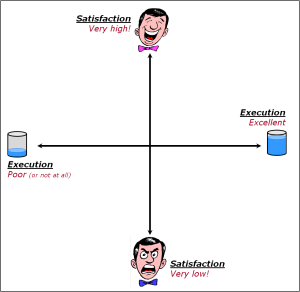
Figure 1 – Satisfaction Execution Axis
Not all customer requirements have the same ability to deliver high satisfaction when done well. Now this sounds rather obvious, but there is a distinction Kano discovered that is worth noting. You could have two customer needs that are equally important and one will cause high satisfaction when done well and the other will leave the customer neutral when done well.
To further illustrate, one customer requirement could be far more important than another requirement, but if they are both executed very well the less important one may be able to increase satisfaction far more than the more important requirement. This is because the two requirements fall into two different categories, each which has a different influence on delivering increased customer satisfaction. For example, take the brakes and fuel efficiency of your car.
If they are both done very well, and assuming it is more important to stop the car well at a traffic light than it is to get great fuel economy, it is only the less important need, fuel economy, that has the ability to greatly increase satisfaction. Having a car that breaks very well at a traffic light will only leave the typical driver neutral because braking well at a stop light is a given, it is assumed. This does not mean that we don’t have to worry about braking, it means that improving braking will likely have little effect on increasing satisfaction.
The point here is that you must couple the importance of a particular need with the Kano category it falls into to help prioritize your improvement efforts and determine your future development goals. Dr. Kano discovered and classified 5 categories of requirements. 3 of the categories are very common and should be included in your offering and two are relatively rare and should be excluded from your offering. Kano explains and illustrates these 5 classifications on the axis shown in Figure 1. The horizontal (x) axis is the degree of fulfillment or execution. On the right extreme is fully executed, on the left extreme is not done at all or very poorly. The vertical (y) axis is the satisfaction level for a particular requirement, on the top, very satisfied and on the bottom, very dissatisfied. Dr. Kano used this set of axis to graphically show the 5 categories of customer needs.
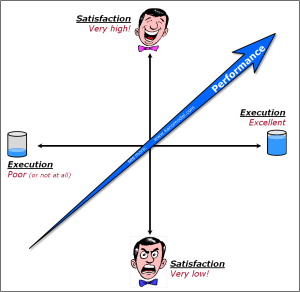
Figure 2 – Performance Requirements
Performance Requirements
These are the requirements the customers are able to articulate and are at the top of their minds when making choices and evaluating options. They are the most visible of the Kano requirements and likely the easiest to acquire because customers freely talk about these type of requirements. Performance Requirements are typically understood through classic research methods like interviews, surveys, and focus groups. As shown in Figure 2, the better they are performed (x-axis), the more satisfaction they bring (y-axis), conversely, the worse they are performed, the more dissatisfaction they bring. These are often “more the better” requirements but can also be “less the better” like price, noise, etc. Kano originally called these “One-Dimensional” because they are somewhat linear in nature, the better you execute these, the more satisfaction from the customer you get.
Examples of this type of quality are the battery life on a cell phone or the time it takes to get an oil change at your dealership or the resolution in your new flat screen TV. The better these requirements are executed, the more satisfaction the customer will receive. These are often “more the better” requirements but can also be “less the better” on occasion for things like price, noise, emissions, etc.
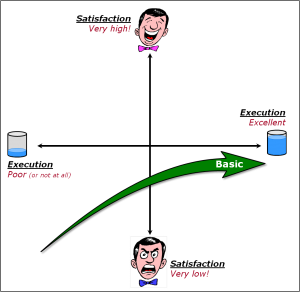
Figure 3 – Basic Requirements
Basic Requirements
As shown in Figure 3, these are the requirements that the customers expect to get and are very often taken for granted. Consider these requirements as obvious expectations your customers have. When execution is poor, satisfaction is low and when execution is done well, satisfaction is neutral. It is very likely that every one of your competitors provides these requirements as well. The interesting thing about these Basic Requirements is that when we do these well, customers are just neutral, but when done poorly, customers are very dissatisfied. Kano originally called these “Must-be’s” because they are the requirements that must be included and are the price of entry into a market. Typical sources to discover these needs are industry standards, government regulations, customer complaints, corporate experience and tribal knowledge.
Examples of this type of quality is the strength of the handle on your favorite coffee cup, windshield wipers on a car, the cleanliness of the carpet in a hotel room or the reliability of a lock on the door of the new car you are considering to purchase. If these are done extremely well, it does very little to enhance your satisfaction, the customer will typically remain neutral.

Figure 4 – Excitement Requirements
Excitement Requirements
As arguably one of the most important of the categories, these are the requirements that are unexpected pleasant surprises or delights. These are the innovations you bring into your offering. Some companies call them USP’s (Unique Selling Propositions) As shown in Figure 4, they delight the customer when there, but do not cause any dissatisfaction when missing because the customer never expected them in the first place. Kano originally called these “Attractive or Delighters” because that’s exactly what they are and do.
Examples of this type of quality is Zappos with their free shipping both ways and Nest’s thermostat that programs itself. Nest also came out with a smoke detector that can be silenced with a simple wave of the hand instead of finding a ladder and pushing a button that doesn’t work or having to find and disconnect the battery that often ends up with a broken smoke detector, not sure about you, but I’ve done this. Excitement Quality doesn’t have to be expensive. Have you ever pulled into a gas station only to realize the fuel filler door is on the other side of the car? Back in the late 80’s Ford put a little arrow next to the fuel icon on the dashboard to remind people what side of the car the fuel door is. Cost, about 1/100 penny per car. If that. It was a very inexpensive solution to a customer pain and such a good idea that all cars do it now. On the other hand, if it is a big innovation, customers will be very willing to pay more for big innovations. To discover several tools, skills, and strategies to come up with “Excitement Quality” check out our sister site www.InnovationTutorials.com. That site is devoted to Innovation and Inventive Thinking.

Figure 5 – Zone of Indifference
Indifferent Requirements
As seen in Figure 5, these are the requirements that most customers simply don’t care about whether they are present or absent, their satisfaction remains neutral under either circumstance. Examples of this type of quality are some of the advanced features on a cell phone that only one in every hundred people would ever use. If the vast majority of customers don’t care about these functions or features and they are expensive to include you may want to consider eliminating them in your offering because they provide so little value.
Reverse Requirements
Figure 6 shows likely the rarest of the five categories, and items you want to consistently exclude from your offering. These are the requirements that cause dissatisfaction when present and satisfaction when absent. They are the features or attributes that cause customers to say “I hate when they do that”. Although these are very rare, they do sometimes find themselves in a product or service typically due to a lack of product testing or customer research.
A small examples of this type of quality was Microsoft’s little “paperclip helper”. Most people didn’t like it and it was even more annoying because it was difficult to turn off unless you knew the secret to disabling it.
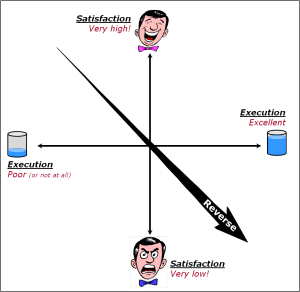
Figure 6 – Reverse Requirements
Important note: There are certainly several shades of grey between categories. It’s important to keep in mind that there are very few absolutes with the Kano Model. What one describes as an Excitement Quality will be described as a Performance Quality by others and maybe even a Basic by a third customer. Don’t be over analytic with the model, the masses don’t always think alike. What is expected (Basic) by one person may be perceived as an innovation (Excitement) to another person. These differences are often attributed to customer segmentation issues and the simple fact that all customers are a little different and each of them have different priorities. You will see in conducting a Kano Survey that once you aggregate the data you look for tendencies and dominant responses to draw conclusions about the masses and customer segmentation issues. One of the main benefits of understanding the Kano Model is to realize there are three categories of requirements that need to be designed into your product or service and missing the right needs in all three categories may endanger the success of your offering.
2. Time has a big influence on Excitement Quality

Figure 7 – Influence of Time on Excitement Quality
I often tell people, “What’s exciting today will be asked for tomorrow and expected the next day.”
Excitement Quality only lasts a short time so the pump has to be continually primed with new innovations. There are a thousand of examples of this phenomenon including heat in a car, wireless internet in a hotel, cameras in cell phones, and remote controls for your TV. Imagine any of those missing. Innovations only last so long until the customers start requesting these features or the competition copies them and eventually they becomes the standard. Again, to discover several tools, skills, and strategies to come up with “Excitement Quality” check out our sister site www.InnovationTutorials.com. That site is devoted to Innovation and Inventive Thinking.
3. A special survey can be designed and administered to determine which Kano category your requirements (or features) fall into
 Imagine being able to predict which of the 5 categories each of your customers requirements falls into. There is a process called the Kano Survey, or Kano Analysis, that uses two questions for each requirement/feature to determine what category it falls into. It can be designed and used to categorize all the requirements. In this survey, you formulate two carefully worded questions, a functional and dysfunctional representation of the requirement or feature.
Depending on how the respondents answer the question, the results will be aggregated and compiled into a graph which clearly shows you which category the requirement/feature falls into. Using this information along with some other voice of customer data, the development team can prioritize the requirements, find gaps in their offering and potential holes in their customer research. Understanding how the list of requirements fits into the Kano Model can also help a development team determine which of the requirements or features to include, which need enhancement, which need cost reduction, which should be excluded, and which to simply leave alone. For a short webinar on how to conduct a Kano Survey, see our Products and Services page.
4. A few well executed Innovations (Excitement Qualities) can make up for weaknesses in the other Kano categories.
Have you ever heard the phrase, “For every argument, there is an equal and opposite argument that makes the same amount of sense?” I could easily argue that Kano’s Basic Needs are the most important category because they are they represent the “Must-Be’s” or threshold requirements that need to be in your offering for anyone even to consider it. Here is an opposite argument that makes sense as well; Excitement Needs are the most important category because they differentiate your offering from your competitors and give customers a reason to select your offering when they have so many choices. Since no one wants to compete on price, when done well, Excitement Needs often solve this problem by allowing much higher margins because the customers are willing to pay for new features or functions that add value.
The truth of the matter is that all 3 Kano categories (Basic, Performance, and Excitement) are critical to the success and profits of your offering. Some of the most profitable products and services have either created a perfect balance of the requirements or strategically included one or more Excitement Qualities that sometimes trump or forgive a weakness in some Performance or even a Basic need. Example: Google Drive documents not being able to save instantaneously when not connected to the cloud. Fast saving is a Basic for most, but tolerated with Google Drive documents because of all the other great benefits, especially having only one shared. Careful detail must be paid attention to make sure you uncover and execute on the right set of needs from all three Kano categories. Missing important requirements from any of the categories any may greatly endanger the success of your offering.
5. Knowing Kano’s categories is only half the battle
Kano did an excellent job describing the 5 classifications of customer needs and how they influence satisfaction but one thing that Dr. Kano did not talk about much is exactly how to get the requirements in each of the 3 main categories; Performance, Basic, and Excitement. Knowing WHAT the categories are is the easy part and only half the battle, knowing HOW to gather them is the other half. Fortunately, there are many very well documented methods to get at the Basic and Performance Requirements as shown below:
Basic Needs (sources): Your experience, customer complaints, competitive similarities, industry standards, government regulations, function analysis, and FMEA (Failure Modes and Effects Analysis).
Performance Needs (sources): Classic VOC methods including customer Interviews, observational research (ethnography), conversations, surveys, focus groups, contextual inquiry, etc.
Excitement Quality, however, is a little more illusive and challenging for most organizations since you can rarely count on your customers to tell you where or how to innovate. So if this is true, how can you come up with the great ideas for the Excitement Quality? We have devoted the last 15+ years researching and developing practical approaches for Innovation and Inventive Thinking, the HOW behind Kano’s Excitement Quality.
There are several compelling and practical methods being used to help teams and organization come up with Innovations (Excitement Qualities). Email us at the email link below with “Systematic Innovation Inquiry” in the Subject Line and we will email back some great information on how to get at Kano’s Excitement Quality. We use a framework that integrates several “Inventive Thinking” Best Practices to develop new value and innovations for your customers. You will see that the Kano Model is used in Step 1, (Voice of the Customer) and in step 4, (Concept Generation) we introduce over 36 methods to get at these new Innovations, Kano’s Excitement Quality.
Questions can be forwarded to [email protected]
Link to this article: https://kanomodel.com/discovering-the-kano-model/
Please consider leaving a comment or question below …
The post Discovering the Kano Model and Customer Satisfaction appeared first on Kano Model.
]]>The post The CAGE MODEL and the “Innovation Sweet Spot” appeared first on Kano Model.
]]>
Innovation has two main beneficiaries; the internal and external customers for the product, service, or software being developed. When you dig deep, you find these customers have many needs you must satisfy to earn their business. Some of the needs are obvious and some hidden (blatant and latent). To compound the issue, in every case we have seen, there are multiple customers with these needs.
As an example, consider the development of a new medical instrument used for the treatment of cancer or heart disease. Who are the customers?
The external customers: The surgeon, technician, lab assistant, nurse, purchaser, insurance carriers, and the patient are all examples of external customers. Each of them has a set of requirements; some of them overlap and some are unique to that customer segment.
The internal customers: The manufacturing group that is looking for ease of manufacture and assembly, the logistics planners who are concerned with shipping and distribution issues, the purchasing group who want the lowest costs for maximum profits, the intellectual property department that is concerned with licensing potential and competitive advantages, the development team of a higher level assembly is concerned with interface issues and functional performance, etc. Each of these internal customers has a set of their own requirements; some of them overlap and some of them are unique to that customer segment.
Without external customers, internal customers are irrelevant because external customers put money into the value chain. On the other hand, if we only focus only on external customers and violate internal requirements we will also fail. It is important to have a comprehensive understanding of both the external and internal customer requirements to win in our increasingly competitive market.
To accomplish this deep understanding, it is first important to understand why many new products and services fail. Three specific reasons (root causes) most new products and services fail are listed below:
1. Missing value added features or qualities that differentiate your offering from the competition, i.e., Innovation)
2. Lack of understanding of your customer needs (i.e. Their top priorities)
3. Being “too” customer driven, i.e., believing and incorporating everything your customers tell you)
The CAGE Model shown in Figure 1 below illustrates critical elements that must be included and excluded for success in the marketplace. The graphic may look a little confusing at first glance, but is actually quite illuminating of the reality found with most development teams. In the below explanation, we will take you through a clear description of what the three main regions represent as well as a specific description on each of the “A-G” sub-regions that need to be understood for success.
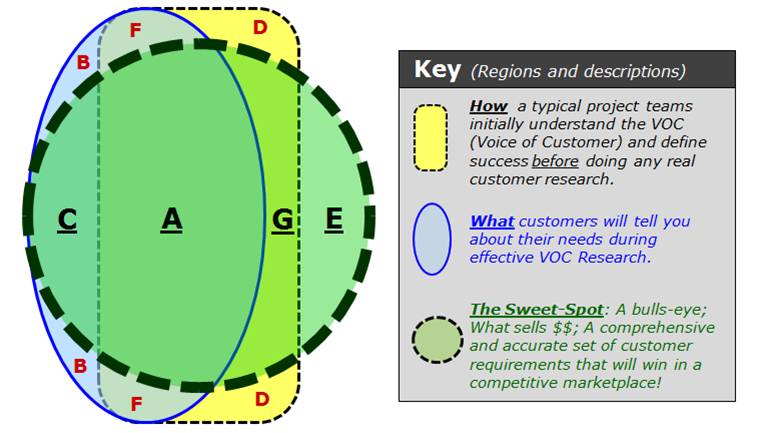
Figure 1 – The CAGE Model Key
The CAGE Model shows three distinct “knowledge universes” that typically occur in the beginning stages of new product, service, or software development. Below the three universes, or regions, are explained in detail:
Region #1 (Yellow: Thin dashed rectangular line) represents how project teams initially understand the customer’s requirements and define success before doing any real customer or market research.
Note: Believe it or not, many product development teams stop here. They never formally talk to their customers to better understand their needs.
Region #2 (Blue: Solid thin oval line) represents what customers will tell you about their needs during typical VOC Research. Note: Customers are generally not very effective at articulating all their needs.
Region #3 (Green: Bold dashed circle) represents the team’s ultimate requirements goal. It’s the bulls-eye, the Innovation sweet-spot, a comprehensive and accurate set of requirements that will win in a competitive marketplace! Note: What we are suggesting here is that even classic VOC research techniques (Region #2) are not enough to hit the bulls-eye, the Innovation sweet-spot.
This model shows why many project teams fail to hit the Innovation sweet-spot. Note there are several distinct and unique areas labeled in (and outside) the sweet-spot bulls eye. Since our goal is Region #3, the bulls-eye, we must understand and document the four elements (C, A, G, and E) and make sure we minimize or eliminate the elements (B, F, and D) outside it. An explanation for each of these regions is described below, starting with the elements outside the bulls-eye, the items you don’t want.
Area D is straight forward. It represents what the project team simply got wrong! Customers don’t want these. Too much of one thing, not enough of the other, wrong feature or feature set, an engineer’s pet project, and so on. We all know this happens and there are many things that cause it, most of them are preventable.
Area B might be a bit surprising to some, but it represents what the customers get wrong! Sometimes they ask for more than they are willing to pay for or they ask for solutions that don’t really address their “real needs.” We must recognize and eliminate these in advance.
Area F represents requirements the project team and customer got wrong! Yes, this is rare, but sometimes they both get it wrong!
Since areas D, B, and F are regions we don’t want in our offerings, let’s focus on the elements we do want. (i.e. The C, A, G, and E elements).
Area C represents important Customer Insights the project team will discover during effective VOC research. Through questioning and observational techniques a few golden nuggets often surface.
Area A (in the center) represents requirements that All agree upon! The development team was aware of them before customer research, the customer verified them during the research, and they are the things customers will consciously look for when evaluating options and purchasing.
Area G represents the Givens, – These are needs or requirements customers won’t tell you about because they “go without saying,” they are expected, assumed, or obvious – For example, when buying a computer, they don’t ask for a power plug. When making reservations at a hotel, no-one will ask for a window in the room or a reliable lock on the door, but if either are missing, customers will likely be quite upset and never come back to that hotel.
And finally, Area E represents the “Excitement” Quality, these are the gold nuggets, the Innovations, the “WOWs” customers won’t tell you about these because they don’t know about them, yet!! These Innovations will differentiate your offering, give you a competitive edge, increasing your market share, and allow for higher profit margins. To get Area E, we leverage the over three dozen idea generation and problem solving tools utilized in step 4 of the 8-Step Systematic Innovation Process. To discover several tools, skills, and strategies to come up with “Excitement Quality” check out our sister site www.InnovationTutorials.com. That site is devoted to Innovation and Inventive Thinking.
The main point of the CAGE Model is to clearly illustrate the risk in a weak set of requirements and the importance of going beyond the VOC for truly innovative offerings. Many project teams assume they already know their customers’ needs, far better than assuming, is effective VOC research to capture missing insights, and even better than that, especially in a competitive landscape, is combining modern VOC efforts with modern “Systematic Innovation” tools to get as close as possible to the “CAGE bulls-eye” shown in this model.
The post The CAGE MODEL and the “Innovation Sweet Spot” appeared first on Kano Model.
]]>The post About the Kano Model appeared first on Kano Model.
]]> The Kano Model is a product or service development theory that helps you to determine which features you may want to include in a product or service to improve customer satisfaction.
It continues to be a critical element found in the front end of Product and Service Development. The Kano Model may also be referred to as the Kano Model Analysis or Kano Model Survey; people have called it multiple different names. This website was created by Dave Verduyn, and Kano model enthusiast who wanted to create a quick and simple way to explain the Kano Model to his clients. After some success a decision was made to make the information, products and services open to the public at a minimal cost.
Kano Model’s Creator
Professor Noriaki Kano created the Kano Model in 1984 while studying the contributing factors to customer satisfaction and customer loyalty. The professor classified 5 unique categories of customer requirements, 3 of which you want to end up in your offering, and the other 2 should be taken out.
The Kano Model’s main objective is to help teams understand, classify, and integrate these 3 main categories of requirements into the products or services they are developing. The 5 categories of customer requirements are classified depending on their ability to create customer satisfaction or cause dissatisfaction. Knowing what category customer requirements fall into and the importance of each requirement can help prioritize development activities and determine what to include in your offering and where to spend resources improving these requirements.
Kano Model’s 5 Categories
The model describes these 5 categories on a set of axis. The y-axis is degree of satisfaction of the requirement; the x-axis is the level of fulfillment or execution of the requirement by the company. All 5 categories of requirements can be mapped on the axis:
Performance
Simply stated, these are the requirements the customers are able to articulate and are at the top of their minds when evaluating options. They are the most visible of the model’s requirements and the better they are performed, the more satisfaction they bring, conversely, the worse they are performed, the more dissatisfaction they bring. The Professor originally called these “One-Dimensional” because the better you execute these the more satisfaction from the customer you get.
Basic
Simply stated, these are the requirements that the customers expect and are taken for granted. When done well, customers are just neutral, but when done poorly, customers are very dissatisfied. Kano originally called these “Must-be’s” because they are the requirements that must be included and are the price of entry into a market.
Excitement
Simply stated, these are the requirements that are unexpected and pleasant surprises or delights. These are the innovations you bring into your offering. They delight the customer when there, but do not cause any dissatisfaction when missing because the customer never expected them in the first place. Kano originally called these “Attractive or Delighters” because that’s exactly what they do.
Indifferent
Simply stated, these are the requirements that the customers simply don’t care if they are present or absent, their satisfaction remains neutral under either circumstance.
Reverse
Simply stated, these are the requirements that cause dissatisfaction when present and satisfaction when absent. These are very rare but do happen occasionally.
Kano Model Survey
Kano also designed a special survey now known today as the Kano Model Survey. It can be designed and used to categorize all the requirements. In this survey, you formulate two strategic questions, a functional and dysfunctional representation of the requirement. Depending on how the respondents answer the question, the results will be aggregated and compiled into a graph, which clearly shows you which category the requirement/feature falls into.
Using this information along with some other voice of customer data, the development team can find gaps in their offering and potential holes in their customer research. Understanding how the list of requirements fits into the Model can also help a development team determine which of the requirements or features to include, which need enhancement, which need cost reduction, which should be excluded, and which to simply leave alone.
Want to Learn More?
Sometimes a brief explanation just isn’t enough. You can dive in just a little bit deeper and read about the Kano Model in detail.

The post About the Kano Model appeared first on Kano Model.
]]>