The post The Bayview Black History Month Bike Ride – A Community & Business Success, Plus All the Fun! appeared first on Livable City.
]]>
On Saturday, February 28, Livable City partnered with San Francisco Bike Coalition, Spokes and Folks, and the City’s Office of Economic and Workforce Development to organize the first ever Bayview Black History Bike Ride – a two-wheeled, five-mile ride through San Francisco that commemorated Black Americans’ achievements, contributions and fight for equality throughout U.S. history.
Over a hundred people pedaled through history on this in-person community ride celebrating Black heritage and culture in San Francisco. The ride ws all about good vibes, powerful stories, and connecting with community while exploring important Bayview landmarks. Riders of all levels joined this family-friendly ride and enjoyed Trivia Prize Zines created by author and artist Fred Noland.
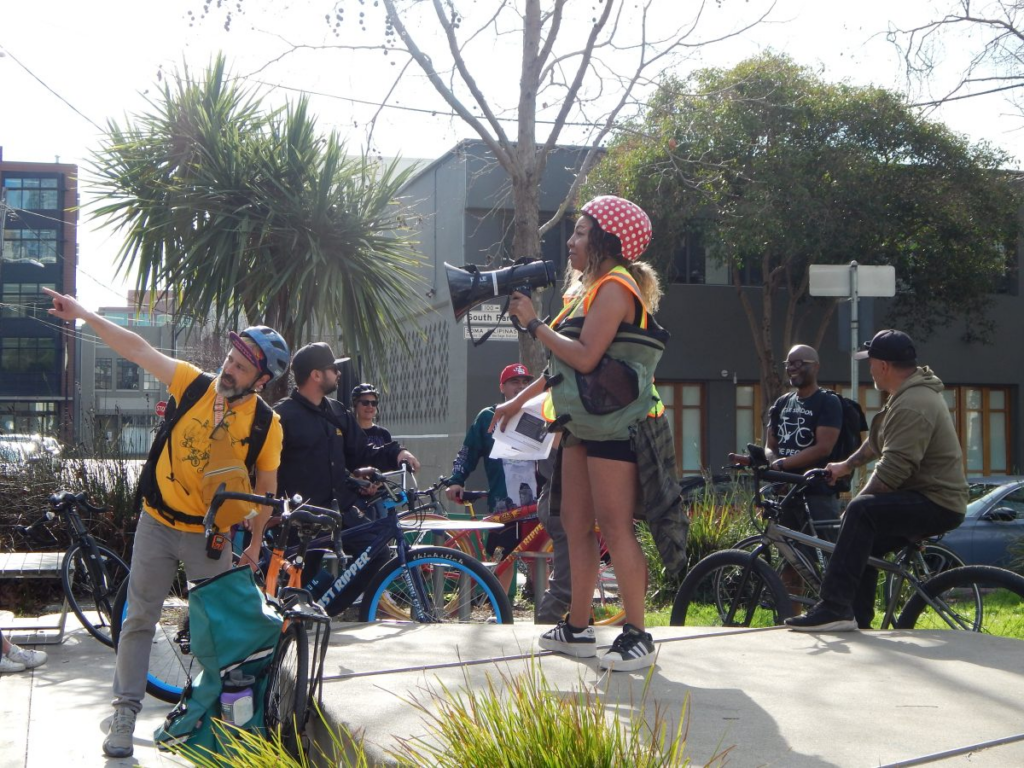
Food and snacks were top notch! The ride started with breakfast by Peaches Patties, a Jamaican catering company, serving up buttery pastries filled with delicious fillings – beef, spinach, cheese, and more. The ride landed at Smoke Soul Kitchen, with Southern cuisine staples like biscuits and grits, and small business activations at U3Fit gym and Tato’s Mexican restaurant.
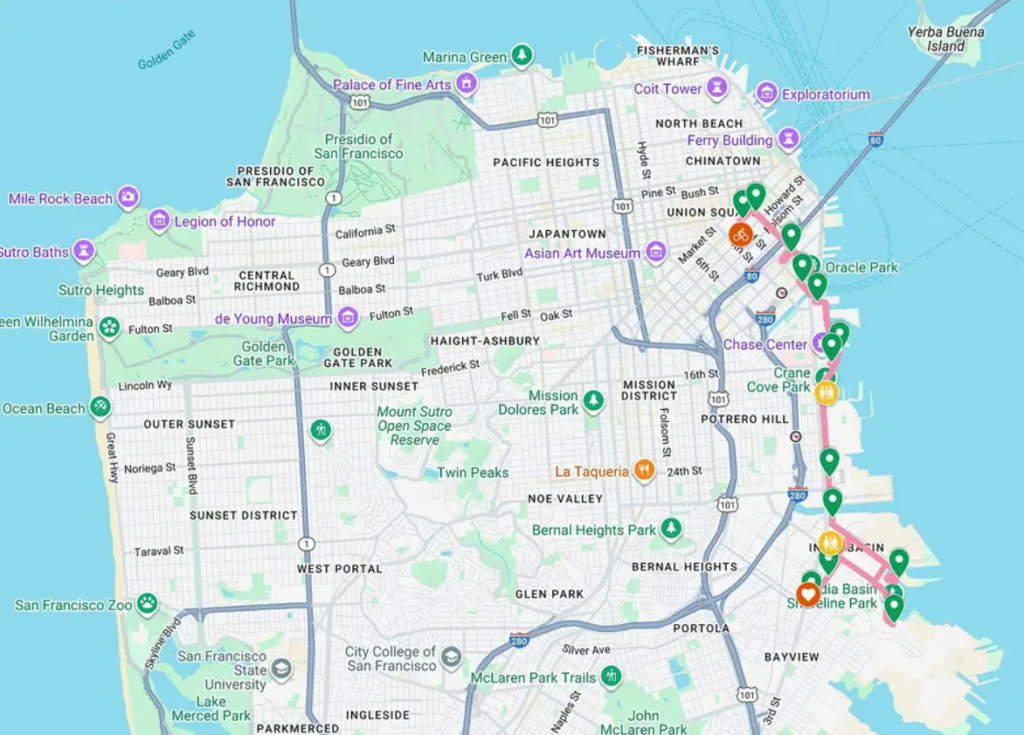
The map below shows the route of the ride, from the MLK Memorial Foundation in Yerba Buena down the eastern waterfront to the South East Community Center, stopping at iconic highlights like the Oracle Park’s bronze Willie Mays statue and the Toni Stone Crossing.
The post The Bayview Black History Month Bike Ride – A Community & Business Success, Plus All the Fun! appeared first on Livable City.
]]>The post San Francisco Department of Public Health Proposed Budget Cuts Threaten the Future of Legacy San Francisco Open Streets Event appeared first on Livable City.
]]>
To help save Sunday Streets, take action with our advocacy toolkit at bit.ly/SaveSundayStreets
FOR IMMEDIATE RELEASE
January 27, 2026
CONTACT
Patricia Barraza, [email protected]
(415) 424-9790
***PRESS RELEASE***
San Francisco Department of Public Health Proposed Budget Cuts Threaten the Future of Legacy San Francisco Open Streets Event
San Francisco, CA — After 17 years of partnership, the San Francisco Department of Public Health has proposed the complete defunding of Sunday Streets beginning in 2026, cuts which would spell the end of a legacy San Francisco tradition. The proposal reallocates funding that was originally advocated for and appropriated by the Board of Supervisors for Sunday Streets towards department deficits. The Sunday Streets team is moving quickly into advocacy to stabilize the program and ensure the city doesn’t lose something that residents deeply value.
Sunday Streets is San Francisco’s open streets program with an annual season of events that reclaim streets for people: healthy active living, thriving local businesses, artistic and cultural traditions, and more. Since 2008, the program has reached equity priority communities in Tenderloin, Mission, Bayview, Western Addition, South of Market, and Excelsior that have limited access to open space and neighborhood events. These neighborhoods face disparities that affect community health and are home to significant populations of Black, Indigenous, and people of color.
The sole direct funding that the program receives from the City comes from the SFDPH Community Health Equity & Promotion, representing $215,758 per year. SFDPH has included the entirety of Sunday Streets within their proposal to cut $17 million in funding to community based organizations. The Sunday Streets program has exceeded metrics for increased physical activity and community wellness year over year. Sunday Streets offers a platform for over 120 city and nonprofit groups to provide direct services, educational resources, and outreach about their work. DPH has indicated that these community-wide benefits do not fit within the goals of their department.
In DPH’s budget proposal, Sunday Streets represents 1.3% of DPH’s necessary cuts, but the potential losses for San Francisco are so much more. DPH is unilaterally proposing the end of a 17-year interdepartmental collaboration between San Francisco Municipal Transportation Agency, the Department of Public Works, and the Recreation and Parks Department. Hundreds of public/private partnerships and investments from community partners will be nullified, with countless resources wasted in the process. Sunday Streets is also the only nonprofit program targeted for a 100% funding reduction with no support from SFDPH for shifting funding streams or connecting to new revenue opportunities.
Concerned San Franciscans should express their opposition to the proposed budget cuts to Mayor Daniel Lurie, the San Francisco Department of Public Health, San Francisco Health Commission, and the Board of Supervisors by February 4th.
Share what Sunday Streets has meant to you and share your opposition to these cuts, which will cause irreversible damage to this beloved San Francisco legacy event. The finalized list of allocated cuts will be released March 6, 2026.
For more information, examples, and template letters, visit:
Sunday Streets 2026 – How You Can Help
###
About Sunday Streets
Sunday Streets is San Francisco’s open streets program with an annual season of events that reclaim car-congested streets for community health, transforming them into car-free spaces for all to enjoy. Sunday Streets is a program of the nonprofit Livable City, presented in partnership with the San Francisco Municipal Transportation Agency, the San Francisco Department of Public Health, and the Shape Up SF Coalition.
About Livable City
Livable City works to empower and inspire San Franciscans to co-create an equitable, healthy, and joyful future. Our vision is one where environmentally-friendly forms of transportation like walking and biking are accessible, people have affordable housing and meaningful work in neighborhoods that are economically and culturally vital, and public spaces are healthy, green, and biodiverse. For more information on Livable City, visit LivableCity.org.
###
The post San Francisco Department of Public Health Proposed Budget Cuts Threaten the Future of Legacy San Francisco Open Streets Event appeared first on Livable City.
]]>The post SF4ALL Campaign appeared first on Livable City.
]]>What is gentle density?
Gentle density, Missing middle housing, incremental development are related terms which describe a range of housing types as well as a philosophy and set of practices for how cities grow and change.
Missing middle housing is the rich set of housing types which are denser than single-family houses but smaller than large apartment buildings. It includes in-law apartments, townhouses, stacked walk-up flats, cottages and cottage courts, and small apartment buildings, and the storefront commercial and live-work spaces which make neighborhoods convenient and walkable.

Incremental development draws on the missing middle types, but add the dimensions of of care, character, and adaptability. The Incremental Development Alliance envisions “neighborhoods regenerated by small developers who care deeply about the places where they live”. Incremental development is about what gets built, but also who builds it – empowering people who live in communities to build the housing their community needs. People building in the communities where they and their loved ones live will build with more care and accountability.
Gentle density won’t address all our housing needs. Gentle density complements large-scale developments – larger buildings on larger sites. We also need to build more permanently affordable and social housing, both large- and small-scale. For decades San Francisco’s housing strategy has favored large developments and paid less attention to gentle density, due in large part of political resistance to incremental development in neighborhoods.
Over the past decade San Francisco has amended its zoning laws, and the state has passed laws superseding local zoning, to permit gentle density. Livable City has helped author and advocate for dozens of ordinances to legalize gentle density. We have legalized new units (called accessory dwelling units) in existing buildings, created a path to legalization for tens of thousands of existing unpermitted units, allowed multi-unit buildings throughout the City, removed off-street parking requirements that make incremental development expensive or infeasible, and permitted neighborhood-serving storefront businesses. The new laws protect existing tenants, and require buildings to meet the street well and enhance streets and sidewalks as public spaces.
The SF4ALL Campaign
3,423 accessory units have been permitted or legalized in San Francisco since 2015. We think the potential is much greater. Thanks to state law changes, accessory dwelling units account for a growing percentage of new California housing. Portland permitted 2,200 missing middle units between 2021 and 2024, roughly six times more than San Francisco. Our SF4ALL Campaign aims to permit 1000 new missing-middle units by 2030. To make this happen we will advocate for code changes and programs in four areas:
- Additional planning code reforms to facilitate missing middle housing.
- Expand design, technical, and financial assistance to homeowner-builders.
- Building code reforms which ease construction of missing middle housing, including single stair reform.
- Build the bench for incremental development. Expand skills training, peer support, and access to finance for neighborhood developers, small contractors, and the construction and design workforce.
A legacy of reform
- In 2014 Livable City worked with Supervisor David Chiu to provide a path to legalization for thousands of unpermitted units, most of which are rent-stabilized.
- In 2015 we worked with Supervisors Wiener and Christensen to legalize accessory dwelling units in Districts 8 and 3, and then citywide.
- In 2018 Livable City worked with supervisor Jane Kim to remove minimum parking requirements from San Francisco’s planning code, a milestone of Livable City’s successful multi-year parking reform campaign.
- The Fourplex ordinance was approved at the end of 2019, allowing buildings of up to four-units, and up to six units on corner lots, on every lot in the City’s RH districts. This ordinance effectively ended exclusive single-family zoning in San Francisco.
- In 2020 Livable City and the AIA’s PPAC developed 25 recommendations to improve the permitting of incremental housing in San Francisco. Several had been enacted. Livable City drafted the remaining recommendations as planning code changes, which Mayor Breed incorporated into her 2023 constraints reduction ordinance.
The post SF4ALL Campaign appeared first on Livable City.
]]>The post SF Transit Summit 2025 Recap appeared first on Livable City.
]]>
On Wednesday August 20, dozens of transit supporters gathered at the Main Library to discuss the future of transit in San Francisco.
The summit was convened by the San Francisco Transit Riders, our City’s leading grassroots voice for public transit. SFTR also convenes the Transit Justice Coalition and Muni Now, Muni Forever campaign. Livable City was a sponsoring organization for the summit, and is an engaged participant in the coalition and the campaign.
The Transit Summit was open to anyone, and participants were invited to identify what’s essential to preserve about our current transit system, and the ways it can improve. Breakout groups discussed which transit services and programs were most essential and what should be improved as resources permit, how to improve the experience of transit as a shared public space, and to improve governance and accountability and empower the riders’ voice.
The collective intelligence raised at the Transit Summit will inform transit advocates’ near-term advocacy, including 2026 campaigns for essential transit funding, as well as outline a strategy for transforming San Francisco into the truly world-class transit-first City we officially aspire to be.
Few things are as crucial for healthy, equitable, and sustainable cities as high-quality transit. Transit is freedom to meet the needs of daily life, get to work, and stay connected to family, friends, culture, and nature. Without transit we won’t achieve our climate or environmental justice goals, satisfy our housing needs, or revitalize downtown and our neighborhood commercial corridors.
Transit is facing compounded threats, collectively the worst in decades. The imminent loss of federal transit funding, declining tax revenues, reduced office commuting, worsening traffic conflicts, and safety fears threaten what we have collectively built. Unless voters approve one or more new funding sources in 2026, users of Muni, BART, Caltrain, and AC transit will face extreme cuts to service. The threats are dire, but fortunately we have all the elements of a transit renaissance if we can put them together. San Francisco is a wealthy city in a wealthy region of a wealthy state. San Francisco and Bay Area voters understand the importance of public transit and a healthy environment, and have repeatedly voted to fund them. We have some strong transit champions among our elected officials – although others, including Mayor Lurie and Governor Newsom, ought to step up. SF Transit Riders, the Transit Justice Coalition, and the Muni Now, Muni Forever campaign is working hard to keep public transit and the threats it faces at the center of civic conversation, and grow support among the public and policymakers to solve transit’s near-term funding challenges and to keep making transit better and better.
You can sign up here to get involved in the Muni Now, Muni Forever campaign.
The post SF Transit Summit 2025 Recap appeared first on Livable City.
]]>The post Call the governor today to save Bay Area Transit appeared first on Livable City.
]]>
Bay Area transit faces a fiscal cliff in 2026 when federal operating support ends. Voters will get a chance to fully-fund transit on the November 2026 ballot. The state budget approved by the California legislature and signed by Governor Newsom included a $750 million loan to Bay Area transit agencies to prevent draconian service cuts until the new revenues show up in 2027. But on Friday the governor announced he was reneging on the promised $750 million state loan to transit. Without this emergency loan, Muni, BART, AC Transit, and Caltrain will drastically cut services in 2026.
Bay Area transit and environmental advocates organized an Emergency Rally to Save Bay Area Transit on Monday September 8 at Civic Center Plaza, which was joined by Bay Area elected officials and union leaders. At the rally Senator Scott Wiener, who has been leading the legislative effort to place a regional transit funding measure on the 2026 ballot, said we have a chance to change the governor’s mind and save Bay Area Transit if we keep up the pressure.
So call Governor Newsom today at (916) 445-2841 and let him know that the $750 million loan is crucial to keep the Bay Area moving and keep the region healthy, equitable, and livable. Our friends at SF Transit Riders provided this useful script and contact form.
Update: Thanks to the advocacy of our public transit supporters, on Weds September 10, Governor Newsom announced continued state financial support for Bay Area transit. However, the duration and terms of the loan are still up in the air – keep the pressure on and let the governor’s office know just how much public transit means to you.
The post Call the governor today to save Bay Area Transit appeared first on Livable City.
]]>The post Stewarding San Francisco’s commons appeared first on Livable City.
]]>
Community stewardship makes our shared public places better and our neighborhoods more livable. Caring for places together makes us happier, healthier, more empowered, and better connected. Community stewardship has created and sustained some of San Francisco’s most unique and beloved public spaces, including parks, sidewalk gardens, community gardens, and public stairs. Community stewardship helps conserve San Francisco’s rich biodiversity – the many species of plants, animals, and other living things with which we share this peninsula. City departments work hard to care for streets, parks, and natural areas, but our city would be diminished without the work of volunteers.
The recent demise of San Francisco Parks Alliance (SFPA) was a big setback for community stewardship of San Francisco’s commons. It followed other city government scandals and recent city budget cuts, both of which have reduced the public resources available for care of the commons.
What was SFPA, and what happened to it?
SF Parks Alliance was a nonprofit organization formed from the merger of the Neighborhood Parks Council and Parks Conservancy. The organization did several things. It advocated for parks and open spaces, including initiatives like the Blue Greenway. It ran programs which activated public places. It was a conduit for individuals, companies, and foundations to donate to park and open space projects. And it was the fiscal sponsor for 80 separate community initiatives, providing them with a place to hold funds, a tax-deductible donation platform, insurance, and grant compliance.
SFPA’s management spent millions of dollars in restricted funds – funds which were committed to specific projects, and funds which belonged to community organizations – on general expenses. The misuse of funds became public in April, and both community groups and the City soon discovered that money owed to them was gone.
In early June SFPA’s board of directors voted to lay off all of SFPA’s employees and dissolve the nonprofit, turning the dissolution process over to a consulting firm. It will go through a process called assignment of benefits to creditors, which is similar to bankruptcy proceedings. Any person or organizations owed money by SFPA will have six months to submit a claim, and any remaining SFPA assets will be distributed to claimants. Claimants will likely receive a fraction, if anything, of what they are owed.
SF Parks Alliance misuse of funds and its quick dissolution left the 80 community organizations in a crisis. They lost the funds housed in SFPA, as well as insurance, legal and grant support. Many groups have put their volunteer work days on hold since they lost insurance, and others can’t complete projects without funding or a means to receive grants.
What the City should do
SFPA’s misuse of funds and its abrupt dissolution has been a huge blow to community stewardship across the City. The City should do all it can to clean up the mess left behind by the SFPA fiasco, and become a better partner to communities in caring for the commons.
- Recovery of funds. City government wants to recover funds owed to them for park projects. The City should also use its powers to make the community orgs whole as well.
- Rebuild capacity to support community stewardship. City requirements have made nonprofit corporation status essential for receiving grants, and dealing with increasingly complicated grant compliance. To support community stewardship, especially in less-resourced communities, it’s essential to rebuild the capacity – financial, technical, and so on – to support dozens of community initiatives. SFPA’s fiscally-sponsored projects have formed the Community Partner Network coalition, and want to restore the nonprofit capacity to support their projects and future ones. The City should help them do that.
- Become a better partner. The city’s support for community stewardship and events varies from department to department, and comes and goes within departments. There have been some recent efforts to reduce impediments to individual and community care for the commons, like the Shared Spaces and Love Our Neighborhoods permit reforms, but in other areas the City has raised barriers. The City should be more consistent and strategic in supporting community stewardship and community use of streets.
San Francisco can and should evolve into an exemplary partner city, which sustains and promotes the creation of value by community. The rights and responsibilities of city and communities can be made clear. Every City department tasked with care of the civic commons should develop the capacity necessary to support community stewardship, and every department should reduce unnecessary rigamarole. This is not about replacing City workers with volunteers; the city workers who care for the commons are invaluable and deserve more support as well. Community stewards benefit enormously from the guidance and expertise of City staff. We should robustly support both City workers and community stewards so our commons can thrive.
What Livable City is doing
Streets and public spaces are core to Livable City’s mission of empowering and inspiring San Franciscans to co-create an equitable, healthy, and joyful future. We are doing what we can to reduce the harm caused by SFPA’s implosion, and support community stewardship of the commons.
In July, Livable City became the fiscal sponsor of Sutro Stewards. Sutro Stewards builds community, connects people with nature, and protects and enhances Mount Sutro, one of the city’s wildest and most beautiful green spaces. They work with volunteers to develop and maintain multi-use trails and conserve habitat for locally native plants and wildlife. Since 2006, Sutro Stewards’ creation of multi-use trails and connections between open spaces has allowed the public to explore this exceptional place and expand opportunities to enjoy and recreate in nature. Their habitat conservation, ecological restoration, and native plant propagation are conserving this important refuge for San Francisco’s native plants and animals. Sutro Stewards has one of the largest organized independent volunteer pool in San Francisco, engaging over 1,000 volunteers each year and hosting six or more events a month.
We are working with other community organizations who need fiscal sponsorship support. While we don’t have the capacity to take on all of the SFPA partners, if you are interested in working with LC as the fiscal sponsor for your stewardship project, please contact us.
Finally, we are strengthening our advocacy for community stewardship of the commons. In the past year we have worked to reduce permit hassles for public space improvements, and helped community partners access City funding for planning and capital improvements to public places. We want to grow our capacity to create greener and people-oriented streets and plazas, conserve and restore natural areas, expand parks, plazas, and community gardens in under-served areas, and use nature-based solutions to address climate resiliency and sea level rise challenges. If you want to support our capacity building you can donate or volunteer with us.
The post Stewarding San Francisco’s commons appeared first on Livable City.
]]>The post THIS WEEKEND: Sunday Streets Tenderloin Fun in the Sun appeared first on Livable City.
]]>
FOR IMMEDIATE RELEASE
June 12, 2025
CONTACT
Sally Chen, [email protected]
(510) 815-9514
PRESS RELEASE
Sunday Streets Tenderloin Brings Safe Streets and Shared Joy to the Neighborhood
San Francisco, CA — For the second year in a row, the Sunday Streets Tenderloin block party will launch San Francisco’s beloved community-powered open streets program on Sunday, June 15, 2025. In partnership with St. Anthony Foundation, the block party route will be on the Golden Gate Greenway, on Golden Gate Ave between Jones and Hyde St from 12 PM to 4 PM. For the 17th season of Sunday Streets, each open streets event and block party will center one key theme: Safe Streets, Shared Joy.
The Tenderloin has the highest density of children of any neighborhood in San Francisco, but limited green and open space for them to grow, play, and learn. With more neighborhood partners than ever before, Sunday Streets Tenderloin represents a community’s response to this challenge. In the midst of political division and economic uncertainty, Sunday Streets provides the blueprint for everyday people to build community, steward their public spaces, and foster collective safety and well-being for all neighbors.
“Sunday Streets brings joy to our City, and promotes health by allowing people to gather outside to be active and connect with friends and neighbors,” said Dr. Susan Philip, Director of the Population Health Division at the San Francisco Department of Public Health. “Physical activity and social connection provide so many health benefits, and SFDPH is proud to work with our community partners to help make this event possible.”
“This block party is more than a celebration—it’s a reflection of what makes the Tenderloin such a vibrant, resilient community,” said Larry Kwan, MD, CEO of St. Anthony Foundation. “On June 15th, more than 2,000 neighbors—including hundreds of children—will gather for music, games, art, and performances made possible by deep partnerships with local nonprofits, artists, and volunteers. In a neighborhood where safe, open space is limited, we’re grateful to help create a joyful, welcoming environment where families can connect, kids can play freely, and community spirit can thrive.
Sunday Streets Tenderloin will bring together a diversity of neighbors to reclaim the streets in 2025. Celebrate the neighborhood with a host of activities:
- Live stage performances for APICC’s 28th annual United States of Asian America Festival: Critical Refuge! This fun event showcases the amazing art and cultural gems of San Francisco’s Asian American and Pacific Islander communities
- St. Anthony Foundation’s Golden Gate Greenway Pop-up – featuring a dunk tank, plant potting station, and a special visit from the San Francisco Fire Department’s fire truck for kids and families to explore.
- Circus games from Circus Center, including a wire-walking balance challenge, a poetry photo op and readings at the Faithful Fools Poetry Box, Mama G’s food giveaway, the CounterPulse drumming circle, and more!
The 2025 Sunday Streets season features four community block parties, two signature mile-plus routes, and the Fifth Annual Citywide Phoenix Day, including Tenderloin on June 15, Mission on July 20, Bayview on August 24, Western Addition on September 21, SOMA on October 5, Excelsior on October 19, and the Phoenix Day Block Parties on October 19.
Sunday Streets Tenderloin is made possible by the support of the following event sponsors: St Anthony’s Foundation, Dolby Laboratories, Golden Gate Greenway, I Heart Tenderloin Week, Glide Memorial Church, Asian Pacific Islander Cultural Center, Tenderloin Community Benefit District, Boys & Girls Clubs of San Francisco.
The Sunday Streets SF 2025 season is made possible by the support of the following season sponsors and partners: SF Department of Public Health Community Health & Equity Promotion (CHEP), San Francisco Municipal Transportation Agency, Bay Area Air District (BAAD), and Spare the Air, Xfinity, SF Public Works, SF Recreation and Parks, Lyft and Bay Wheels, Community Living Campaign, University of California San Francisco, Anthem Blue Cross, Kaiser Permanente, iHeartMedia, and Into the Streets.
Calendar Editors, please note:
WHAT: Experience safe streets and shared joy with Sunday Streets’ season kick-off at the Tenderloin Golden Gate Greenway, featuring fun, family-friendly activities, live music, food, and giveaways.
WHERE: Golden Gate Ave between Jones and Hyde St
WHEN: Sunday, June 15, 2025, from 12 PM to 4 PM, welcoming remarks at 12:30pm
WHO: Bilal Mahmood, D5 Supervisor
Laura Flannigan, COO St. Anthony’s
Darin Ow-Wing, ED Livable City
Dr. Gina Fromer, CEO GLIDE
ADMISSION: Free and open to the public
INFO: For additional information on Sunday Streets SF, please visit SundayStreetsSF.com.
PLEASE NOTE:
There will be limited parking throughout the neighborhood’s vicinity during Sunday Streets. Public transportation, biking, and walking are encouraged. Sunday Streets is a smoke-free event.
#
About Sunday Streets
Sunday Streets is San Francisco’s open streets program with an annual season of events that reclaim car-congested streets for community health, transforming them into car-free spaces for all to enjoy. Sunday Streets is a program of the nonprofit Livable City, presented in partnership with the San Francisco Municipal Transportation Agency, the San Francisco Department of Public Health, and the Shape Up SF Coalition.
About Livable City
Livable City works to empower and inspire San Franciscans to co-create an equitable, healthy, and joyful future. Our vision is one where environmentally-friendly forms of transportation like walking and biking are accessible, people have affordable housing and meaningful work in neighborhoods that are economically and culturally vital, and public spaces are healthy, green, and biodiverse. For more information on Livable City, visit LivableCity.org.
#
The post THIS WEEKEND: Sunday Streets Tenderloin Fun in the Sun appeared first on Livable City.
]]>The post PRESS RELEASE: Pathways of Freedom: 3rd Annual San Francisco Juneteenth Parade Honors Resilience and Achievements of African Americans appeared first on Livable City.
]]>
FOR IMMEDIATE RELEASE
Pathways of Freedom: 3rd Annual San Francisco Juneteenth Parade Honors Resilience and Achievements of African Americans
San Francisco, CA – May 14, 2025 – The highly anticipated 3rd Annual San Francisco Juneteenth Parade is set to take place on Sunday, June 22, 2025, bringing a vibrant celebration of freedom, unity, and community resilience, commemorating the historical significance of Juneteenth.
The Juneteenth Parade, sponsored by the Human Rights Commission and the City of San Francisco, will kick off at Market Street, featuring captivating floats representing various community organizations, schools, and corporate partners. Led by esteemed dignitaries and community leaders, the parade will traverse through the heart of San Francisco, symbolizing the journey toward equity and justice for all.
Building on decades of neighborhood-based planning and open streets activation, the nonprofit Livable City and Burges LLC will be leading event production with Fillmore- and Bayview-based organizers to bring the procession to the city streets. The event is supported and made possible through the support of sponsors including the San Francisco International Airport and GLIDE Memorial Church.
“San Francisco thrives when our city comes together for events that bring vibrancy and joy into our communities,” said Mayor Daniel Lurie. “The Juneteenth Parade is an opportunity to celebrate freedom, unity, and the history and resilience of the African American community, and I look forward to this year’s celebration.”
“Commemorating Juneteenth in San Francisco means welcoming all and including all. I am thrilled that this month we are making our third annual parade down Market Street to mark the holiday for the entire city to enjoy,” said Mawuli Tugbenyoh, Acting Executive Director of the San Francisco Human Rights Commission. “The strength of the San Francisco community is most visible when we come together in solidarity and with purpose. That we as a city are marking the struggle borne by our ancestors, acknowledging the work to achieve freedom and equality, and celebrating our collective successes and achievements, makes me proud. We are all better for it. I am grateful to our many community partners, City staff, volunteers, and all those who have worked so hard to make our Juneteenth celebrations possible.”
Bishop Ishmael Burch, coordinator of the first Juneteenth parade in San Francisco in 1995, expressed his vision of the legacy and future of the celebration, stating, “Juneteenth is not just a celebration of freedom; it is a powerful reminder of our ongoing journey toward diversity, equity, and inclusion for all. As we honor the resilience of those who fought for their rights, let us commit to building a future where every voice is heard and every person is valued.”
The parade will begin at 11 a.m. on Market & Spear, proceeding west along Market to 8th Street. Vehicles and parade floats will disperse south via 8th Street. Those walking in the parade contingent will disperse onto westbound Grove and northbound Hyde streets. In addition to the parade, attendees can look forward to a jubilant festival featuring live performances, watch parties each block will be hosted with themes, look on our website for more info on the watch parties along the route hosted by many community partners, and activities.
The Juneteenth Parade in San Francisco invites individuals of all backgrounds to join in the festivities and embrace the spirit of freedom and unity. For more information and updates, visit https://livablecity.org/citywide-juneteenth/ and follow us on social media using #SFJuneteenthParade2025.
Parade Information & Know Before you Go
What are the expectations along the parade route? Can lawn chairs or other seating be set up along Market Street?
Lawn chairs and/or folding chairs can be setup along the parade route.
Should parade attendees proceed to specific areas to watch the parade? Or are they welcome to watch from any spot along Market, from Market and Spear to Market and 8th?
Attendees are welcome to watch from any spot along Market, but specific locations can be reserved for community groups as well. If you are interested, please reach out to [email protected]
Are there any items parade attendees should not bring? Will there be bag checks or other safety checks along the parade route, as seen at other large scale events?
As with other large-scale events, there will be both private security and police presence along the route. While we cannot prohibit items on public streets, it is strongly encouraged to leave large bags and wheeled devices at home (scooters, one-wheels, skateboards, etc).
Contact:
Tamara Walker
Livable City

The post PRESS RELEASE: Pathways of Freedom: 3rd Annual San Francisco Juneteenth Parade Honors Resilience and Achievements of African Americans appeared first on Livable City.
]]>The post Let’s green San Francisco for people and nature appeared first on Livable City.
]]>
May 22nd is International Day for Biodiversity, commemorating the United Nations’ adoption of the Convention on Biological Diversity in 1992. Humankind is beginning to understand the importance of conserving biodiversity for human and planetary health, and more people are awakening to understanding that the living beings we share the planet with, and the land and waters, are intrinsically valuable rather than simply of use to humankind.
We often think of biodiversity as concentrated in places like the Amazon or the Serengeti. But we San Franciscans also live in a biodiversity hotspot. The Bay Area is part of the California Floristic Province, one of the planet’s 36 most biologically diverse yet threatened areas. UNESCO recognized the coastal lands and waters of Sonoma, Marin, San Francisco, and San Mateo Counties as the Golden Gate Biosphere Reserve for its outstanding marine, terrestrial, and freshwater biodiversity.
Living in a green city with access to nature also improves human health and happiness. The IUCN devised the 3-30-300 rule for cities to provide more equitable access to nature and improve human well-being. Every city dweller should have 3 trees visible from their home, a 30% tree canopy cover on their street, and be within 300 meters (approximately 1000 feet) of a park or green space.
Greening the city also offers solutions to some of San Francisco’s pressing infrastructure and climate adaptation challenges. As the climate crisis worsens, cities will be exposed more often to heat waves and floods. Street and garden trees cool buildings and neighborhoods and improve air quality. Replacing impervious asphalt, concrete, and rooftops with parks, sidewalk gardens, tree basins, and green roofs reduces runoff and flood risk. San Francisco’s combined sewer system routinely floods some low-lying neighborhoods and releases untreated sewage into the Bay and the Ocean during large rainstorms. Greener streets, more parks and gardens, and specially designed floodable parks can reduce water pollution and protect homes and businesses from flooding. The San Francisco Waterfront Flood Study by the Port of San Francisco and Army Corps of Engineers is evaluating nature-based solutions, including “horizontal levees’’ and oyster beds, along sections of San Francisco’s eastern waterfront to protect against sea level rise and storm surges. Green infrastructure can be more cost-effective than conventional engineering, while providing additional benefits such as green space, habitat and biodiversity, and improved watershed health.

Greening the City would go a long way towards advancing environmental justice and reducing health disparities between communities. The Planning Department created an environmental justice burden map in 2020, which looks at the cumulative impact of environmental factors like pollution, noise, unsafe streets, and exposure to extreme heat and flooding. The map shows big disparities between San Francisco neighborhoods, with neighborhoods like SoMa, the Tenderloin, North Mission, and Bayview suffering from decades of under-investment in parks, greener streets, and pollution cleanup, and over-prioritizing commuter auto traffic rather than safe and sustainable mobility options for residents and community use of streets.
San Francisco has some strong policies. We have a Better Streets and Complete Streets ordinances, a biodiversity program and policy, and a Natural Areas Plan. However City practices and priorities are often not aligned with our forward-looking policies. For decades the City invested too little, and too sporadically, in street trees and sidewalk gardens, parks and community gardens in underserved neighborhoods, and habitat restoration and stewardship.
Despite the City’s looming budget deficit and the Trump Administration’s hostility to most things green, we can progress towards becoming a greener, healthier, more biodiverse, and more environmentally just city. Some of the initiatives we’re working on include:
- Expand public open space in high-need and biodiverse areas. San Francisco is the first city in the US where every resident lives within 10 minutes walk of a park. San Franciscans can be rightly proud of our park system and building on our achievements by expanding park space in neighborhoods where parks are too small, or which lack key open space types like community gardens, playgrounds, or places for quiet connection with nature. Our City Charter dedicates a small percentage of the City’s property tax revenue to the Park, Recreation, and Open Space Fund which is used to acquire land for new parks or expand existing ones. $2.2 million will go into the fund in the current fiscal year. That’s not a lot of money for a city of San Francisco’s size and real estate prices. However we have a one-time opportunity to expand open space with Proposition 4, the California climate bond which passed in November and contains $1.2 billion to protect biodiversity and habitat and $700 million for greening, urban parks, and access to nature. And this year Livable City convinced the City to designate our most flood-prone equity neighborhoods as Priority Conservation Areas, which makes them eligible for regional grants to acquire and green public spaces.
- Implement the 3-30-300 rule in City planning. With better planning neighborhoods can grow greener and healthier even as they grow denser. New developments can green on-site open spaces, and improve adjacent streetscapes with street trees and sidewalk gardens, and living alleys. Livable City successfully championed stronger streetscape and greening and permeability standards for required yards and setbacks in the planning code. We are advocating for the 3-30-300 rule in current rezoning proposals and neighborhood plans, and for permit reform which makes it easier to green public rights-of-way.
- Support community greening initiatives. Greening and stewarding public spaces together builds community cohesion and resiliency, and is a potent antidote for loneliness and doomscrolling. City government does support cleanup days and provide grants for community projects. But getting projects approved can be inscrutable and drawn-out, and grant programs can be complicated to access and administer, and assistance with design, implementation, and maintenance is sporadic. Permit reforms like Shared Spaces and Love Our Neighborhoods have removed some red tape, but more needs to be done. We’re advocating for further permit reform, accessible grant programs, and greater City support for greening initiatives, including design and technical assistance, clearer guidelines, and providing plants and mulch. We also want the City to make it easy for neighbors to reclaim daylighted intersections for greening, seating, bike parking, and other amenities.
- Use clean water funding to green the city. The SFPUC’s Green Infrastructure Program will spend $100 million on green infrastructure projects over the next decade. Green infrastructure can be integrated with street safety and traffic calming to create more people-friendly streets, as with the wiggle project. Realizing complete streets requires better engagement with communities to plan their streets, and better coordination between SFPUC, SFMTA, Public Works, and other city agencies. We’re working with neighbors on pilot projects which integrate green infrastructure with other community priorities, like safer streets, green spaces, and community use of streets, and advocating for better interdepartmental coordination, community planning, and user-friendly grant programs.
- Conserve and connect City-owned open space and biodiverse lands. Many of San Francisco’s open spaces and natural areas, including Twin Peaks, Bernal Hill, Bayview Hill, and the eastern waterfront, have fragmented governance and lands held by departments which lack the focus and capacity to manage them well. Our draft Twin Peaks Plan recommends transferring several City properties, including the popular Christmas Tree Point overlook, to the Recreation and Parks Department. Transferring other open space lands can improve stewardship and accountability.
The post Let’s green San Francisco for people and nature appeared first on Livable City.
]]>The post PRESS RELEASE: SUNDAY STREETS 2025 SEASON KICKOFF appeared first on Livable City.
]]>
FOR IMMEDIATE RELEASE
April 1, 2025
CONTACT
Sally Chen, [email protected]
(510) 815-9514
***PRESS RELEASE***
SUNDAY STREETS 2025 SEASON KICKOFF
Centering unity with a full summer season of events bringing safe streets and shared joy across San Francisco
San Francisco, CA — Livable City is excited to announce the 2025 season of Sunday Streets with six events across San Francisco and the fifth annual Phoenix Day citywide block party program. From June to October, the season will launch with one key theme: Safe Streets, Shared Joy. In the midst of political division and economic uncertainty,
Sunday Streets provides the blueprint for everyday people to build community, steward their public spaces, and foster collective safety and well-being for all neighbors.
Sunday Streets take place in diverse neighborhoods across the City, including the Tenderloin, Mission, Excelsior, Bayview, Western Addition, and South of Market. Each event features fun free active play games, cultural performances, health resources, live music and more with the goal of connecting San Franciscans on car-free open streets. Sunday Streets invites local residents, neighborhood groups, faith-based organizations, businesses and more to join the community planning meetings that shape the day.
Launched after the COVID-19 pandemic, Phoenix Day unites residents on a block to build relationships, knowledge, and concrete plans to help each other when things go wrong. With free event technical assistance and block party permit sponsorship, neighbors in every district can take action in creating safer streets and resilient communities.
“Sunday Streets is the perfect way to kick off summer, as city blocks are transformed into lively community spaces that encourage exploration and connection,” said Julie Kirschbaum, SFMTA Director of Transportation. “We’re excited to support this event series, which not only brings our streets to life with energy and joy but also helps showcase small businesses and offers residents the opportunity to discover and enjoy new neighborhoods.”
“Sunday Streets reminds us that all are welcome here,” said Sunday Streets Program Director Jessica Tovar. “We must counteract the toxic individualism that fuels isolation and fear. Uniting in our shared streets, we create an accessible and welcoming community atmosphere that breaks down division.”
Sunday Streets 2025 Season Schedule
June 15th – Tenderloin Community Block Party, 12pm-4pm
July 20th – Mission Mile Long Event, 11am-4pm
August 24 – Bayview Community Block Party, 12pm-4pm
September 21st – Western Addition Community Block Party, 12pm-4pm
October 5 – South of Market Community Block Party, 12pm-4pm
October 19 – Excelsior Mile Long Event, 11am-4pm
October 19 – Phoenix Day
The Sunday Streets 2025 season is made possible by the following season sponsors and partners: Bay Area Air District (BAAD), Xfinity/Comcast, Anthem Blue Cross, Lyft, iHeartMedia, Into the Streets, and Burge LLC.
###
About Sunday Streets
Sunday Streets is a program of the nonprofit Livable City, presented in partnership with the San Francisco Municipal Transportation Agency, the San Francisco Department of Public Health, and the Shape Up SF Coalition. Additional City support comes from San Francisco Public Works, the Department of Recreation & Parks, the Police Department, San Francisco Mayor Daniel Lurie and his offices, and the San Francisco Board of Supervisors.
About Livable City
Livable City works to empower and inspire San Franciscans to co-create an equitable, healthy, and joyful future. Our vision is one where environmentally-friendly forms of transportation like walking and biking are accessible, people have affordable housing and meaningful work in neighborhoods that are economically and culturally vital, and public spaces are healthy, green, and biodiverse. For more information on Livable City, visit LivableCity.org.
###
The post PRESS RELEASE: SUNDAY STREETS 2025 SEASON KICKOFF appeared first on Livable City.
]]>