The post How Fleet Tracking Contributes to Sustainability Goals appeared first on Complexus.
]]>Sustainability is becoming an increasingly important priority for organisations across every sector. Businesses are under growing pressure to reduce emissions, operate more efficiently, and demonstrate environmental responsibility. For companies operating vehicle fleets, this challenge can be significant.
Fleet tracking technology offers a practical and measurable way to support sustainability initiatives while also improving operational performance.
Fuel consumption is one of the largest environmental impacts of fleet operations. Telematics-enabled fleet tracking systems allow businesses to monitor vehicle usage and driver behaviour in real time.
With accurate data, organisations can identify issues such as:
Excessive idling
Inefficient routes
Harsh acceleration or braking
Unauthorised vehicle usage
By addressing these factors, businesses can significantly reduce fuel usage. Less fuel consumption not only lowers operational costs but also reduces the fleet’s carbon footprint.
Vehicle idling wastes fuel and contributes directly to unnecessary emissions. Fleet tracking systems can detect when vehicles are idling for extended periods and provide reports highlighting patterns of inefficient behaviour.
Fleet managers can then implement policies or training to reduce unnecessary idling, helping vehicles operate more efficiently while lowering environmental impact.
Modern fleet tracking systems allow businesses to optimise routes and improve journey planning. By analysing vehicle movement data, companies can identify the most efficient routes and reduce unnecessary mileage.
Benefits include:
Lower fuel consumption
Reduced vehicle wear and maintenance
Decreased emissions
Even small improvements in route planning across an entire fleet can result in significant environmental savings.
As organisations transition towards electric or hybrid vehicles, fleet tracking systems provide valuable insights that support the shift. Telematics data can help businesses understand vehicle usage patterns, driving ranges, and charging requirements.
This information allows companies to make informed decisions when introducing low-emission vehicles into their fleet.
Many organisations now need to report on sustainability targets and carbon reduction initiatives. Fleet tracking systems provide accurate data that can support environmental reporting and compliance.
Detailed telematics reports enable businesses to demonstrate measurable improvements in fuel efficiency and emissions reduction.
Sustainability does not need to come at the expense of operational efficiency. In fact, many of the actions that improve environmental performance also reduce operational costs.
By using advanced fleet tracking solutions, businesses can reduce fuel usage, improve driving behaviour, and operate more efficiently while contributing to wider sustainability goals.
At Complexus UK, our fleet tracking solutions provide real-time visibility and detailed telematics reporting to help organisations operate smarter, safer, and more sustainably.
Check out our range of Complexus Trackers here.
For more information visit:
Sustainability is becoming an increasingly important priority for organisations across every sector. Businesses are under growing pressure to reduce emissions, operate more efficiently, and demonstrate environmental responsibility. For companies operating vehicle fleets, this challenge can be significant.
Fleet tracking technology offers a practical and measurable way to support sustainability initiatives while also improving operational performance.
Fuel consumption is one of the largest environmental impacts of fleet operations. Telematics-enabled fleet tracking systems allow businesses to monitor vehicle usage and driver behaviour in real time.
With accurate data, organisations can identify issues such as:
Excessive idling
Inefficient routes
Harsh acceleration or braking
Unauthorised vehicle usage
By addressing these factors, businesses can significantly reduce fuel usage. Less fuel consumption not only lowers operational costs but also reduces the fleet’s carbon footprint.
Vehicle idling wastes fuel and contributes directly to unnecessary emissions. Fleet tracking systems can detect when vehicles are idling for extended periods and provide reports highlighting patterns of inefficient behaviour.
Fleet managers can then implement policies or training to reduce unnecessary idling, helping vehicles operate more efficiently while lowering environmental impact.
Modern fleet tracking systems allow businesses to optimise routes and improve journey planning. By analysing vehicle movement data, companies can identify the most efficient routes and reduce unnecessary mileage.
Benefits include:
Lower fuel consumption
Reduced vehicle wear and maintenance
Decreased emissions
Even small improvements in route planning across an entire fleet can result in significant environmental savings.
As organisations transition towards electric or hybrid vehicles, fleet tracking systems provide valuable insights that support the shift. Telematics data can help businesses understand vehicle usage patterns, driving ranges, and charging requirements.
This information allows companies to make informed decisions when introducing low-emission vehicles into their fleet.
Many organisations now need to report on sustainability targets and carbon reduction initiatives. Fleet tracking systems provide accurate data that can support environmental reporting and compliance.
Detailed telematics reports enable businesses to demonstrate measurable improvements in fuel efficiency and emissions reduction.
Sustainability does not need to come at the expense of operational efficiency. In fact, many of the actions that improve environmental performance also reduce operational costs.
By using advanced fleet tracking solutions, businesses can reduce fuel usage, improve driving behaviour, and operate more efficiently while contributing to wider sustainability goals.
At Complexus UK, our fleet tracking solutions provide real-time visibility and detailed telematics reporting to help organisations operate smarter, safer, and more sustainably.
Check out our range of Complexus Trackers here.
For more information visit:
The post How Fleet Tracking Contributes to Sustainability Goals appeared first on Complexus.
]]>The post 5 Telematics Insights That Improve Driver Safety appeared first on Complexus.
]]>
Driver safety is influenced by behaviour, environment and operational pressure. Telematics provides objective, data-driven insight that helps organisations understand how vehicles are being driven — and where safety improvements can be made.
Below are five telematics insights that directly contribute to safer driving.
Frequent harsh braking often indicates poor anticipation, close following distances or inappropriate speed for conditions.
Vehicle trackers such as the FMB003 Professional Vehicle Tracker and FMB920 Quad-Band GPS Vehicle Tracker automatically record harsh braking events, helping identify patterns that can be addressed through targeted coaching rather than assumption.
Speeding remains one of the most common contributors to road incidents. Telematics data highlights:
Repeated speed limit breaches
High-risk locations
Route-specific patterns
Using data from devices like the FMB001 Basic GPS Vehicle Tracker, organisations can support safer route planning and more realistic scheduling.
While often associated with fuel efficiency, excessive idling can also indicate fatigue, congestion issues or unsafe stopping behaviour.
Telematics-enabled trackers help identify where idling occurs most frequently, allowing operational adjustments that improve both safety and efficiency.
Visibility into driving duration and rest periods is essential for managing fatigue-related risk.
Compact devices such as the FMB910 GPS Vehicle Tracker provide accurate journey and usage data, supporting duty-of-care responsibilities and safer shift planning — particularly during night work or winter operations.
When incidents occur, telematics provides context rather than speculation. Location history, speed data and event alerts show what happened before and after an incident.
Advanced trackers like the FMP100 GPS Tracker support this level of insight, enabling fair investigation, better training and continuous safety improvement.
Telematics is not about surveillance — it’s about using insight responsibly to improve safety outcomes. By focusing on meaningful data such as braking, speed, fatigue and incident context, organisations can reduce risk and support safer driving across their operations.
Check out our range of Complexus Trackers here.
For more information visit:
Driver safety is influenced by behaviour, environment and operational pressure. Telematics provides objective, data-driven insight that helps organisations understand how vehicles are being driven — and where safety improvements can be made.
Below are five telematics insights that directly contribute to safer driving.
Frequent harsh braking often indicates poor anticipation, close following distances or inappropriate speed for conditions.
Vehicle trackers such as the FMB003 Professional Vehicle Tracker and FMB920 Quad-Band GPS Vehicle Tracker automatically record harsh braking events, helping identify patterns that can be addressed through targeted coaching rather than assumption.
Speeding remains one of the most common contributors to road incidents. Telematics data highlights:
Repeated speed limit breaches
High-risk locations
Route-specific patterns
Using data from devices like the FMB001 Basic GPS Vehicle Tracker, organisations can support safer route planning and more realistic scheduling.
While often associated with fuel efficiency, excessive idling can also indicate fatigue, congestion issues or unsafe stopping behaviour.
Telematics-enabled trackers help identify where idling occurs most frequently, allowing operational adjustments that improve both safety and efficiency.
Visibility into driving duration and rest periods is essential for managing fatigue-related risk.
Compact devices such as the FMB910 GPS Vehicle Tracker provide accurate journey and usage data, supporting duty-of-care responsibilities and safer shift planning — particularly during night work or winter operations.
When incidents occur, telematics provides context rather than speculation. Location history, speed data and event alerts show what happened before and after an incident.
Advanced trackers like the FMP100 GPS Tracker support this level of insight, enabling fair investigation, better training and continuous safety improvement.
Telematics is not about surveillance — it’s about using insight responsibly to improve safety outcomes. By focusing on meaningful data such as braking, speed, fatigue and incident context, organisations can reduce risk and support safer driving across their operations.
Check out our range of Complexus Trackers here.
For more information visit:
The post 5 Telematics Insights That Improve Driver Safety appeared first on Complexus.
]]>The post How GPS Tracking Helps Prevent Vehicle & Asset Loss appeared first on Complexus.
]]>Vehicle and asset loss remains a significant operational risk across sectors such as transport, construction, utilities and field services. Theft, unauthorised use and delayed response can result in financial loss, operational disruption and reputational damage.
GPS tracking plays a key role in reducing these risks — not just by showing where assets are, but by enabling earlier detection, faster response and stronger preventative controls.
One of the most effective deterrents to theft is visibility. GPS tracking systems provide continuous, real-time location data for vehicles and assets, making it far harder for unauthorised activity to go unnoticed.
Hard-wired vehicle trackers such as the FMB920 Quad-Band GPS Vehicle Tracker are commonly installed discreetly within vehicles to provide constant oversight without impacting daily operations. For non-powered equipment, compact devices like the TFT100 Asset Tracker allow high-value assets to remain visible even when off-site.
Modern GPS tracking systems can be configured with movement, ignition and out-of-hours alerts, notifying teams the moment something unexpected occurs.
For example:
A vehicle fitted with an FMB003 Professional Vehicle Tracker moving overnight
Plant equipment with a TFT100 Asset Tracker leaving a site boundary
A vehicle ignition event outside approved hours
These alerts allow immediate investigation, reducing the likelihood of loss escalating before action can be taken.
Geofencing allows virtual boundaries to be set around depots, worksites or operational zones. If a vehicle or asset exits these areas unexpectedly, alerts are triggered automatically.
Geofencing is particularly effective when paired with:
Vehicle trackers such as the FMB910 Compact GPS Tracker for multi-site fleets
Asset trackers monitoring plant, trailers or tools
Temporary or remote operational locations
This transforms location data into proactive security intelligence rather than passive reporting.
When theft does happen, speed is critical. Live tracking enables accurate, real-time location updates, supporting faster coordination between teams and responders.
Trackers such as the FMP100 Advanced GPS Tracker provide reliable live location data during incidents, helping organisations locate stolen vehicles or assets within hours rather than days.
GPS tracking becomes even more effective when combined with vehicle immobilisation and driver authentication. Many vehicle trackers support integration with immobiliser relays, allowing vehicles to be disabled remotely if unauthorised movement is detected.
This layered approach reduces reliance on recovery alone and strengthens overall security posture.
Preventing vehicle and asset loss is not about reacting after the event — it’s about visibility, early detection and control. GPS tracking systems, supported by alerts, geofencing and immobilisation, give organisations the insight needed to reduce risk and protect critical assets.
Check out our range of Complexus Trackers here.
For more information visit:
Vehicle and asset loss remains a significant operational risk across sectors such as transport, construction, utilities and field services. Theft, unauthorised use and delayed response can result in financial loss, operational disruption and reputational damage.
GPS tracking plays a key role in reducing these risks — not just by showing where assets are, but by enabling earlier detection, faster response and stronger preventative controls.
One of the most effective deterrents to theft is visibility. GPS tracking systems provide continuous, real-time location data for vehicles and assets, making it far harder for unauthorised activity to go unnoticed.
Hard-wired vehicle trackers such as the FMB920 Quad-Band GPS Vehicle Tracker are commonly installed discreetly within vehicles to provide constant oversight without impacting daily operations. For non-powered equipment, compact devices like the TFT100 Asset Tracker allow high-value assets to remain visible even when off-site.
Modern GPS tracking systems can be configured with movement, ignition and out-of-hours alerts, notifying teams the moment something unexpected occurs.
For example:
A vehicle fitted with an FMB003 Professional Vehicle Tracker moving overnight
Plant equipment with a TFT100 Asset Tracker leaving a site boundary
A vehicle ignition event outside approved hours
These alerts allow immediate investigation, reducing the likelihood of loss escalating before action can be taken.
Geofencing allows virtual boundaries to be set around depots, worksites or operational zones. If a vehicle or asset exits these areas unexpectedly, alerts are triggered automatically.
Geofencing is particularly effective when paired with:
Vehicle trackers such as the FMB910 Compact GPS Tracker for multi-site fleets
Asset trackers monitoring plant, trailers or tools
Temporary or remote operational locations
This transforms location data into proactive security intelligence rather than passive reporting.
When theft does happen, speed is critical. Live tracking enables accurate, real-time location updates, supporting faster coordination between teams and responders.
Trackers such as the FMP100 Advanced GPS Tracker provide reliable live location data during incidents, helping organisations locate stolen vehicles or assets within hours rather than days.
GPS tracking becomes even more effective when combined with vehicle immobilisation and driver authentication. Many vehicle trackers support integration with immobiliser relays, allowing vehicles to be disabled remotely if unauthorised movement is detected.
This layered approach reduces reliance on recovery alone and strengthens overall security posture.
Preventing vehicle and asset loss is not about reacting after the event — it’s about visibility, early detection and control. GPS tracking systems, supported by alerts, geofencing and immobilisation, give organisations the insight needed to reduce risk and protect critical assets.
Check out our range of Complexus Trackers here.
For more information visit:
The post How GPS Tracking Helps Prevent Vehicle & Asset Loss appeared first on Complexus.
]]>The post Telematics Trends to Watch in 2026 appeared first on Complexus.
]]>
Telematics Trends to Watch in 2026
Telematics is no longer just about knowing where a vehicle is. As we move into 2026, the role of telematics is expanding into operational intelligence, supporting better planning, improved safety, and more informed decision-making.
For organisations using vehicles, assets or mobile teams, understanding these trends helps ensure telematics data is used proactively — not just reviewed after the fact.
Below are the key telematics trends shaping 2026 and what they mean for you.
Basic location visibility is now expected. The real value of telematics in 2026 comes from context and insight.
Modern systems are increasingly used to:
Understand how vehicles and assets are actually being used
Identify inefficiencies and abnormal patterns
Turn day-to-day movement into actionable information
Rather than asking “Where is it?”, organisations are asking “What is happening — and why?”. Telematics is becoming a tool for decision support, not just monitoring.
Access to vehicle health data is becoming a standard requirement.
Telematics platforms are increasingly expected to provide:
Diagnostic trouble codes (DTCs)
Mileage and engine-hour data
Early indicators of mechanical issues
This trend supports preventative maintenance, helping reduce breakdowns, extend vehicle lifespan and minimise unplanned downtime. In 2026, maintenance decisions are increasingly driven by data rather than fixed schedules.
Alert fatigue is a common issue with older tracking systems. In 2026, telematics alerts are becoming more intelligent and context-aware.
Instead of notifying you about every event, systems are designed to:
Highlight unusual or high-risk behaviour
Trigger alerts only when action is genuinely required
Reduce noise while improving response times
Smarter alerts help ensure attention is focused where it matters most, improving safety and operational control.
Driver behaviour monitoring continues to evolve beyond simple speeding alerts.
Telematics data is increasingly used to:
Identify risky driving patterns such as harsh braking or rapid acceleration
Support coaching and training initiatives
Reduce accidents and improve duty-of-care outcomes
In 2026, driver behaviour insight is closely linked to safety performance, insurance considerations and organisational reputation.
Telematics is no longer expected to operate in isolation.
There is growing demand for integration with:
Fleet and asset management platforms
Maintenance and compliance systems
Security and communications tools
Integration reduces data silos and allows telematics insight to support wider workflows, ensuring information is shared across teams rather than confined to a single dashboard.
One of the most significant shifts in 2026 is how telematics data is used.
Rather than reviewing data reactively, organisations are using it to:
Identify trends before issues escalate
Improve route planning and resource allocation
Support risk reduction and compliance planning
This proactive approach turns telematics into a strategic capability rather than a reporting tool.
As telematics platforms become more powerful, usability is becoming critical.
Clear dashboards, meaningful reports and accessible insights ensure data can be understood and acted upon by both operational teams and decision-makers — without requiring specialist technical knowledge.
In 2026, the most effective systems are those that balance capability with clarity.
Telematics in 2026 is about clarity, relevance and control. Organisations that embrace these trends are better positioned to improve efficiency, strengthen safety and make confident, data-led decisions.
The question is no longer whether telematics should be used — but how effectively it supports your operational objectives.
Check out our range of Complexus Trackers here.
For more information visit:
Telematics Trends to Watch in 2026
Telematics is no longer just about knowing where a vehicle is. As we move into 2026, the role of telematics is expanding into operational intelligence, supporting better planning, improved safety, and more informed decision-making.
For organisations using vehicles, assets or mobile teams, understanding these trends helps ensure telematics data is used proactively — not just reviewed after the fact.
Below are the key telematics trends shaping 2026 and what they mean for you.
Basic location visibility is now expected. The real value of telematics in 2026 comes from context and insight.
Modern systems are increasingly used to:
Understand how vehicles and assets are actually being used
Identify inefficiencies and abnormal patterns
Turn day-to-day movement into actionable information
Rather than asking “Where is it?”, organisations are asking “What is happening — and why?”. Telematics is becoming a tool for decision support, not just monitoring.
Access to vehicle health data is becoming a standard requirement.
Telematics platforms are increasingly expected to provide:
Diagnostic trouble codes (DTCs)
Mileage and engine-hour data
Early indicators of mechanical issues
This trend supports preventative maintenance, helping reduce breakdowns, extend vehicle lifespan and minimise unplanned downtime. In 2026, maintenance decisions are increasingly driven by data rather than fixed schedules.
Alert fatigue is a common issue with older tracking systems. In 2026, telematics alerts are becoming more intelligent and context-aware.
Instead of notifying you about every event, systems are designed to:
Highlight unusual or high-risk behaviour
Trigger alerts only when action is genuinely required
Reduce noise while improving response times
Smarter alerts help ensure attention is focused where it matters most, improving safety and operational control.
Driver behaviour monitoring continues to evolve beyond simple speeding alerts.
Telematics data is increasingly used to:
Identify risky driving patterns such as harsh braking or rapid acceleration
Support coaching and training initiatives
Reduce accidents and improve duty-of-care outcomes
In 2026, driver behaviour insight is closely linked to safety performance, insurance considerations and organisational reputation.
Telematics is no longer expected to operate in isolation.
There is growing demand for integration with:
Fleet and asset management platforms
Maintenance and compliance systems
Security and communications tools
Integration reduces data silos and allows telematics insight to support wider workflows, ensuring information is shared across teams rather than confined to a single dashboard.
One of the most significant shifts in 2026 is how telematics data is used.
Rather than reviewing data reactively, organisations are using it to:
Identify trends before issues escalate
Improve route planning and resource allocation
Support risk reduction and compliance planning
This proactive approach turns telematics into a strategic capability rather than a reporting tool.
As telematics platforms become more powerful, usability is becoming critical.
Clear dashboards, meaningful reports and accessible insights ensure data can be understood and acted upon by both operational teams and decision-makers — without requiring specialist technical knowledge.
In 2026, the most effective systems are those that balance capability with clarity.
Telematics in 2026 is about clarity, relevance and control. Organisations that embrace these trends are better positioned to improve efficiency, strengthen safety and make confident, data-led decisions.
The question is no longer whether telematics should be used — but how effectively it supports your operational objectives.
Check out our range of Complexus Trackers here.
For more information visit:
The post Telematics Trends to Watch in 2026 appeared first on Complexus.
]]>The post How to Choose the Right GPS Tracker for Your Vehicle or Fleet appeared first on Complexus.
]]>How to Choose the Right GPS Tracker for Your Vehicle or Fleet
Choosing a GPS tracker isn’t just about selecting a device — it’s about choosing a solution that supports how you use your vehicle or fleet day to day. The right tracker gives you visibility, security and insight. The wrong one can limit what you see and how quickly you can act.
By understanding the differences between personal vehicle tracking and fleet tracking, you can make a decision that fits your priorities, whether those are security, safety, efficiency or cost control.
Before looking at specific trackers, it’s important to be clear about what you need the system to do.
Ask yourself:
Personal vehicle tracking and fleet tracking are designed to solve different problems, even though some devices can support both.
Personal vehicle tracking is primarily about protecting your vehicle and the people who use it, with solutions designed to combine real-time visibility, alerts and immobilisation.
For example, trackers such as the FMB920 and FMC125 are commonly used for personal vehicles where enhanced security is required. These devices support real-time location tracking, crash detection and can be paired with immobilisation accessories to prevent unauthorised use.
Typical personal vehicle tracking use cases include:
For drivers and families, personal tracking also provides reassurance. Knowing a vehicle’s exact location can be critical when someone is travelling late at night or in unfamiliar areas.
Plug-and-play options such as the FMB003 are well suited where quick installation is required. These trackers connect via the OBD port and can provide journey history, fault code diagnostics and crash detection without permanent installation.
In emergency situations such as accidents or breakdowns, trackers like the FMC125 can provide precise vehicle location to emergency services. Advanced features such as automatic crash detection or SOS alerts help ensure assistance is dispatched quickly.
Personal vehicle tracking can also support:
Monitoring teen drivers, using telemetry data from devices such as the FMB130 to review speed, location and driving patterns
Insurance benefits, as insurers often recognise the added protection provided by trackers and immobilisers such as the GHOST Immobiliser
Travel history and reporting, logging routes, distances and driving time for record keeping, expense claims or planning
Fleet tracking is designed to give you oversight across multiple vehicles, helping you understand how your fleet operates day to day and where improvements can be made.
Fleet trackers such as the FMB003 and FMB001 are often used where plug-and-play deployment and access to diagnostic fault codes are required. These devices provide real-time and historical location data, mileage tracking and vehicle health insight via the OBD port.
More advanced fleet environments may use hard-wired trackers such as the FMB920 or FMC125, which support richer telemetry, driver behaviour monitoring and optional immobilisation when paired with the appropriate accessories.
Key fleet tracking capabilities include:
Fleet tracking also plays a major role in cost savings. Devices such as the FMP100 are commonly used for straightforward commercial vehicle tracking where rapid deployment and basic telemetry are required.
Maintenance monitoring is another key benefit. Trackers that connect via the OBD port, such as the FMB003 and FMB001, allow fleet managers to read fault codes and receive service alerts based on mileage or engine hours, helping reduce breakdowns and extend vehicle lifespan.
Many tracking devices can be used for both personal and fleet applications, but how they are installed and configured matters.
Consider:
Plug-and-play trackers can be ideal for rapid deployment, while hard-wired installations may support more advanced features and continuous data reporting.
Tracking systems can report data at different intervals, from frequent real-time updates to periodic location reports.
The right choice depends on:
Equally important are alerts and notifications. Movement alerts, out-of-hours notifications and geofence-based warnings help ensure you are informed when something changes — not after the fact.
Your tracking requirements may change over time. What starts as a single personal vehicle may later expand into additional vehicles, or from basic location tracking into deeper operational insight.
Choosing a solution that can scale — in terms of devices, features and data — helps protect your investment and ensures the system continues to support you as needs evolve.
The right GPS tracker is one that aligns with how you use your vehicles and what you need to know about them. Whether your priority is personal vehicle security or fleet-wide operational control, understanding the differences between these solutions helps ensure you choose technology that works for you, not against you.
Check out our range of Complexus Trackers here.
For more information visit:
How to Choose the Right GPS Tracker for Your Vehicle or Fleet
Choosing a GPS tracker isn’t just about selecting a device — it’s about choosing a solution that supports how you use your vehicle or fleet day to day. The right tracker gives you visibility, security and insight. The wrong one can limit what you see and how quickly you can act.
By understanding the differences between personal vehicle tracking and fleet tracking, you can make a decision that fits your priorities, whether those are security, safety, efficiency or cost control.
Before looking at specific trackers, it’s important to be clear about what you need the system to do.
Ask yourself:
Personal vehicle tracking and fleet tracking are designed to solve different problems, even though some devices can support both.
Personal vehicle tracking is primarily about protecting your vehicle and the people who use it, with solutions designed to combine real-time visibility, alerts and immobilisation.
For example, trackers such as the FMB920 and FMC125 are commonly used for personal vehicles where enhanced security is required. These devices support real-time location tracking, crash detection and can be paired with immobilisation accessories to prevent unauthorised use.
Typical personal vehicle tracking use cases include:
For drivers and families, personal tracking also provides reassurance. Knowing a vehicle’s exact location can be critical when someone is travelling late at night or in unfamiliar areas.
Plug-and-play options such as the FMB003 are well suited where quick installation is required. These trackers connect via the OBD port and can provide journey history, fault code diagnostics and crash detection without permanent installation.
In emergency situations such as accidents or breakdowns, trackers like the FMC125 can provide precise vehicle location to emergency services. Advanced features such as automatic crash detection or SOS alerts help ensure assistance is dispatched quickly.
Personal vehicle tracking can also support:
Monitoring teen drivers, using telemetry data from devices such as the FMB130 to review speed, location and driving patterns
Insurance benefits, as insurers often recognise the added protection provided by trackers and immobilisers such as the GHOST Immobiliser
Travel history and reporting, logging routes, distances and driving time for record keeping, expense claims or planning
Fleet tracking is designed to give you oversight across multiple vehicles, helping you understand how your fleet operates day to day and where improvements can be made.
Fleet trackers such as the FMB003 and FMB001 are often used where plug-and-play deployment and access to diagnostic fault codes are required. These devices provide real-time and historical location data, mileage tracking and vehicle health insight via the OBD port.
More advanced fleet environments may use hard-wired trackers such as the FMB920 or FMC125, which support richer telemetry, driver behaviour monitoring and optional immobilisation when paired with the appropriate accessories.
Key fleet tracking capabilities include:
Fleet tracking also plays a major role in cost savings. Devices such as the FMP100 are commonly used for straightforward commercial vehicle tracking where rapid deployment and basic telemetry are required.
Maintenance monitoring is another key benefit. Trackers that connect via the OBD port, such as the FMB003 and FMB001, allow fleet managers to read fault codes and receive service alerts based on mileage or engine hours, helping reduce breakdowns and extend vehicle lifespan.
Many tracking devices can be used for both personal and fleet applications, but how they are installed and configured matters.
Consider:
Plug-and-play trackers can be ideal for rapid deployment, while hard-wired installations may support more advanced features and continuous data reporting.
Tracking systems can report data at different intervals, from frequent real-time updates to periodic location reports.
The right choice depends on:
Equally important are alerts and notifications. Movement alerts, out-of-hours notifications and geofence-based warnings help ensure you are informed when something changes — not after the fact.
Your tracking requirements may change over time. What starts as a single personal vehicle may later expand into additional vehicles, or from basic location tracking into deeper operational insight.
Choosing a solution that can scale — in terms of devices, features and data — helps protect your investment and ensures the system continues to support you as needs evolve.
The right GPS tracker is one that aligns with how you use your vehicles and what you need to know about them. Whether your priority is personal vehicle security or fleet-wide operational control, understanding the differences between these solutions helps ensure you choose technology that works for you, not against you.
Check out our range of Complexus Trackers here.
For more information visit:
The post How to Choose the Right GPS Tracker for Your Vehicle or Fleet appeared first on Complexus.
]]>The post The Role of GPS Tracking in Holiday Travel Security appeared first on Complexus.
]]>December is one of the busiest travel periods of the year. Whether people are visiting family, taking part in festive activities, or leaving their vehicles parked while they’re away, the risks associated with theft, unauthorised use and winter breakdowns tend to increase. Ensuring vehicle and asset security during this time is essential for both individuals and organisations.
GPS tracking technology plays an important role in strengthening holiday travel security. By improving visibility, communication and response capability, it helps drivers, families and businesses maintain control and reassurance throughout the festive season.
Shorter daylight hours, busier roads and longer periods of unattended vehicles can all create additional exposure to risk. For businesses operating fleets or essential services, reduced staffing over Christmas can make remote monitoring even more valuable.
A GPS tracking system provides a consistent layer of oversight, helping identify unusual movement or unexpected activity at the earliest opportunity.
Improving Safety Whilst Travelling
For those travelling long distances, especially in winter conditions, real-time location monitoring offers several advantages:
These benefits support private drivers, lone travellers and organisations responsible for staff on the road.
Protecting Parked or Unattended Vehicles
Many vehicle thefts occur during periods when cars, vans or equipment are left unused — something that is particularly common during late December.
GPS tracking supports vehicle and asset protection by enabling:
Greater visibility over asset activity offers reassurance during a time when many people are away from home.
Supporting Organisations Over the Festive Period
Businesses in logistics, construction, utilities and emergency services often operate with reduced teams over Christmas. Maintaining oversight without being physically present is essential.
GPS tracking helps by:
This ensures continuity across essential services, even during seasonal downtime.
Enhancing Safety for Lone Workers and Outdoor Travellers
December often brings an increase in outdoor activities, remote travel and extended shifts in essential sectors. Personal GPS trackers support safety by offering:
These features support both employer duty-of-care obligations and personal welfare.
A Practical Approach to Festive Security
GPS tracking provides an effective, modern approach to improving safety and reducing risk during one of the busiest times of the year. Whether used by families travelling across the country or organisations responsible for critical operations, the technology supports visibility, protection and peace of mind.
Check out our range of Complexus Trackers here.
For more information visit:
December is one of the busiest travel periods of the year. Whether people are visiting family, taking part in festive activities, or leaving their vehicles parked while they’re away, the risks associated with theft, unauthorised use and winter breakdowns tend to increase. Ensuring vehicle and asset security during this time is essential for both individuals and organisations.
GPS tracking technology plays an important role in strengthening holiday travel security. By improving visibility, communication and response capability, it helps drivers, families and businesses maintain control and reassurance throughout the festive season.
Seasonal Security Risks
Shorter daylight hours, busier roads and longer periods of unattended vehicles can all create additional exposure to risk. For businesses operating fleets or essential services, reduced staffing over Christmas can make remote monitoring even more valuable.
A GPS tracking system provides a consistent layer of oversight, helping identify unusual movement or unexpected activity at the earliest opportunity.
Improving Safety Whilst Travelling
For those travelling long distances, especially in winter conditions, real-time location monitoring offers several advantages:
These benefits support private drivers, lone travellers and organisations responsible for staff on the road.
Protecting Parked or Unattended Vehicles
Many vehicle thefts occur during periods when cars, vans or equipment are left unused — something that is particularly common during late December.
GPS tracking supports vehicle and asset protection by enabling:
Greater visibility over asset activity offers reassurance during a time when many people are away from home.
Supporting Organisations Over the Festive Period
Businesses in logistics, construction, utilities and emergency services often operate with reduced teams over Christmas. Maintaining oversight without being physically present is essential.
GPS tracking helps by:
This ensures continuity across essential services, even during seasonal downtime.
Enhancing Safety for Lone Workers and Outdoor Travellers
December often brings an increase in outdoor activities, remote travel and extended shifts in essential sectors. Personal GPS trackers support safety by offering:
These features support both employer duty-of-care obligations and personal welfare.
A Practical Approach to Festive Security
GPS tracking provides an effective, modern approach to improving safety and reducing risk during one of the busiest times of the year. Whether used by families travelling across the country or organisations responsible for critical operations, the technology supports visibility, protection and peace of mind.
Check out our range of Complexus Trackers here.
For more information visit:
The post The Role of GPS Tracking in Holiday Travel Security appeared first on Complexus.
]]>The post BLE Trackers Vs Trackers with BLE appeared first on Complexus.
]]>Bluetooth Low Energy (BLE) trackers, such as Apple AirTags and Samsung SmartTags, have become increasingly popular in recent years, offering a range of benefits for both personal and business use. However, like any technology, they come with their own set of advantages and disadvantages. Let’s explore the differences between BLE trackers and trackers with BLE to help you decide what is right for you.
Both types of tracker utilise the BLE technology, but they serve different purposes. BLE trackers are designed exclusively for tracking purposes, with a limited set of features and integrations. Whilst trackers with BLE incorporate the technology as one of their many features, which could include anything from panic alarms and fall-down alerts to DTC fault code data.
BLE trackers use Bluetooth to connect to a social backhaul (compatible mobile phones) of devices in order to send data over the mobile networks. This essentially means that the BLE device requires other compatible phones to be in range of the tracker to work, otherwise it has no way of sending data to the relevant tracking services (such as Apples’ Find My & Samsungs’ SmartThings Find). See diagram below.
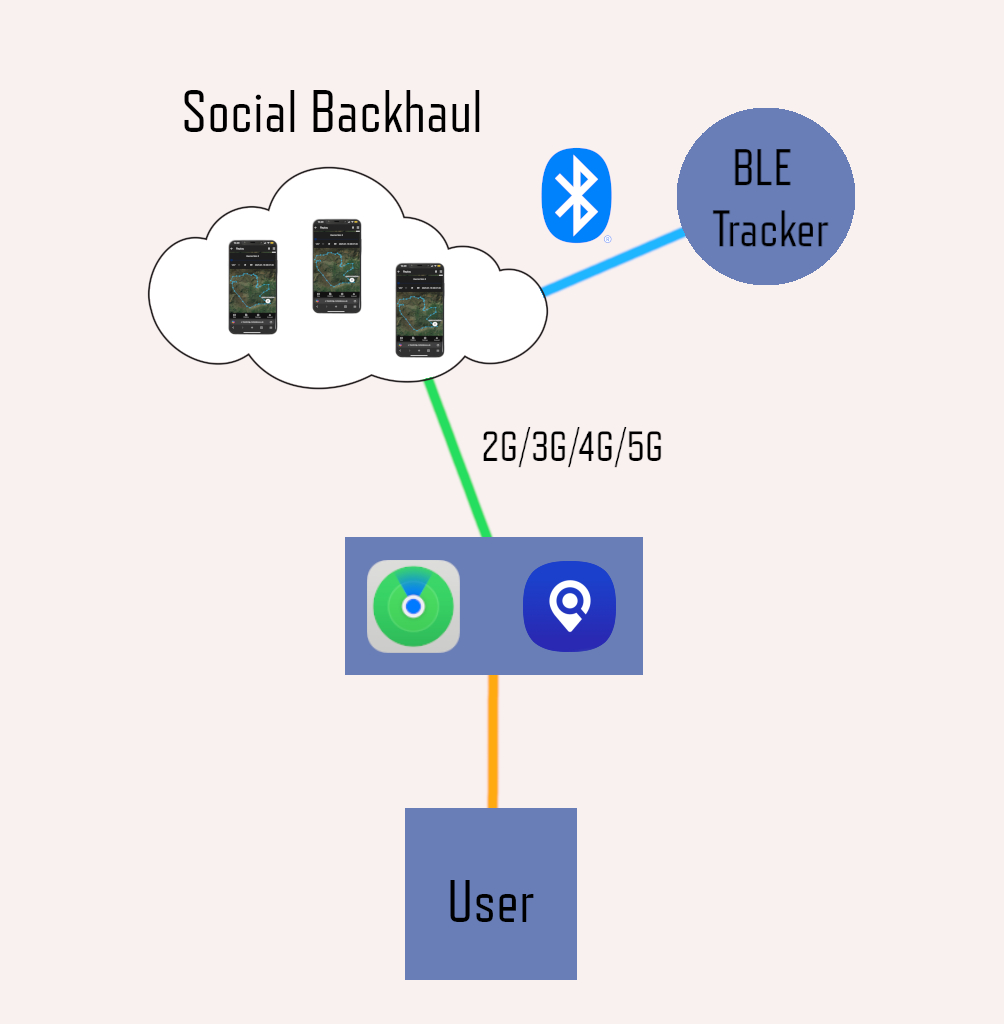
Trackers with BLE skip this step and use the mobile networks to send data to the internet which can be accessed by the user through their tracking portals.
![]()
As a result of the devices needing to be connected to a social backhaul, this can affect location data by sending the wrong locations. For instance, during a scouts trip, a concerned parent received an alert that their son’s AirTag was showing him to be 3 miles away from the campsite. In reality, the AirTag had been unable to connect to a mobile phone until a passing car provided a brief connection. The car’s phone, however, did not have mobile connectivity until it was 3 miles away, at which point it sent the location update. This created the false impression that the boy was far from the campsite, even though he had been there the entire time. This scenario illustrates how the dependency on mobile phones can sometimes lead to misleading information with BLE trackers. Despite this, when in an areas with a social backhaul such as an airport or a household, the BLE trackers are fairly accurate, with AirTags being accurate up to 10 metres. Alternatively, Complexus offer BLE trackers as an additional feature paired with a tracker to facilitate driver identification for fleet management.
Trackers with BLE integration don’t require a social backhaul of devices to operate, meaning that as long as you have mobile signal the device is tracking. For instance, the Complexus Service Package offers the best coverage across Europe, connecting to every available mobile network. Additionally, our trackers are accurate within 3 meters of the device’s location and provide various different features designed to make tracking simple and easy.
Low power consumption: One of the standout features of BLE trackers is their exceptionally low energy consumption. Designed to operate with minimal power, these trackers can function for extended periods on a single battery. This efficiency is achieved through the ability to remain in a low-power state when not actively transmitting data, only using significant energy during brief communication bursts. This ensures reliable, long-term performance without the need for constant power source management.
Cost effective: BLE trackers are cost-effective due to their relatively low deployment and maintenance costs. Their low power consumption means that batteries can last for years, reducing the need for frequent replacements and lowering long-term operational costs. This combination of affordability and low maintenance makes them an attractive option for businesses looking to implement efficient and budget-friendly tracking solutions.
Ease of use: Renowned for their ease of use, BLE trackers are accessible to a wide range of users. Setting up these trackers is straightforward, often requiring just a few simple steps to pair them with a compatible mobile device. Additionally, the compact and lightweight design allows them to be easily attached to various items.
Mobile phone dependency: One of the key considerations when using BLE trackers is their dependency on mobile phones. To fully utilise the capabilities of BLE trackers, users typically need a compatible mobile device with the necessary app installed. This reliance on smartphones can be a limitation, especially for individuals who do not own such devices or in environments where mobile signal is limited.
Signal interference: A common issue is that they are susceptible to various forms of interference that can impact their performance. One common issue is signal interference from other electronic devices operating on the same 2.4 GHz frequency band, such as Wi-Fi routers, microwave ovens, and cordless phones. This frequency congestion can lead to degraded signal quality and connectivity issues. Additionally, physical obstructions like walls, metal objects, and even water can significantly weaken Bluetooth signals, causing disruptions and reducing the effective range. Electromagnetic interference from power lines and electrical circuits can also pose challenges, further complicating the reliability of these devices. Understanding these potential interferences is crucial for users to mitigate their impact and ensure more stable and consistent performance.
Limitations: While useful for basic location tracking, BLE trackers often have limited functionality compared to more advanced tracking solutions. They primarily provide location data and may lack additional features such as detailed analytics, environmental monitoring, or remote vehicle immobilisation. This can be a drawback for businesses that require comprehensive tracking capabilities.
Similar to BLE trackers, there are BLE tracking sensors on the market such as the Eye Sensor, which can be paired with a compatible tracker or a mobile phone which act as the social backhaul.
![]()
The Eye Sensor has temperature, humidity, accelerometer and magnet detection sensors for various applications like tracking perishables or pharmaceuticals where temperature and humidity are important.
![]()
Whilst BLE trackers have their advantages, due to their design they lack the ability to track without other devices. This means that they can be good for tracking keys or luggage at the airport, but not for asset or vehicle tracking up and down the country in low signal / low population areas. For comprehensive tracking solutions, trackers that integrate BLE technology as a feature would be better suited for these deployments.
Check out our range of Complexus Trackers here.
For more information visit:
Bluetooth Low Energy (BLE) trackers, such as Apple AirTags and Samsung SmartTags, have become increasingly popular in recent years, offering a range of benefits for both personal and business use. However, like any technology, they come with their own set of advantages and disadvantages. Let’s explore the differences between BLE trackers and trackers with BLE to help you decide what is right for you.
Both types of tracker utilise the BLE technology, but they serve different purposes. BLE trackers are designed exclusively for tracking purposes, with a limited set of features and integrations. Whilst trackers with BLE incorporate the technology as one of their many features, which could include anything from panic alarms and fall-down alerts to DTC fault code data.
BLE trackers use Bluetooth to connect to a social backhaul (compatible mobile phones) of devices in order to send data over the mobile networks. This essentially means that the BLE device requires other compatible phones to be in range of the tracker to work, otherwise it has no way of sending data to the relevant tracking services (such as Apples’ Find My & Samsungs’ SmartThings Find). See diagram below.

Trackers with BLE skip this step and use the mobile networks to send data to the internet which can be accessed by the user through their tracking portals.
![]()
As a result of the devices needing to be connected to a social backhaul, this can affect location data by sending the wrong locations. For instance, during a scouts trip, a concerned parent received an alert that their son’s AirTag was showing him to be 3 miles away from the campsite. In reality, the AirTag had been unable to connect to a mobile phone until a passing car provided a brief connection. The car’s phone, however, did not have mobile connectivity until it was 3 miles away, at which point it sent the location update. This created the false impression that the boy was far from the campsite, even though he had been there the entire time. This scenario illustrates how the dependency on mobile phones can sometimes lead to misleading information with BLE trackers. Despite this, when in an areas with a social backhaul such as an airport or a household, the BLE trackers are fairly accurate, with AirTags being accurate up to 10 metres. Alternatively, Complexus offer BLE trackers as an additional feature paired with a tracker to facilitate driver identification for fleet management.
Trackers with BLE integration don’t require a social backhaul of devices to operate, meaning that as long as you have mobile signal the device is tracking. For instance, the Complexus Service Package offers the best coverage across Europe, connecting to every available mobile network. Additionally, our trackers are accurate within 3 meters of the device’s location and provide various different features designed to make tracking simple and easy.
Low power consumption: One of the standout features of BLE trackers is their exceptionally low energy consumption. Designed to operate with minimal power, these trackers can function for extended periods on a single battery. This efficiency is achieved through the ability to remain in a low-power state when not actively transmitting data, only using significant energy during brief communication bursts. This ensures reliable, long-term performance without the need for constant power source management.
Cost effective: BLE trackers are cost-effective due to their relatively low deployment and maintenance costs. Their low power consumption means that batteries can last for years, reducing the need for frequent replacements and lowering long-term operational costs. This combination of affordability and low maintenance makes them an attractive option for businesses looking to implement efficient and budget-friendly tracking solutions.
Ease of use: Renowned for their ease of use, BLE trackers are accessible to a wide range of users. Setting up these trackers is straightforward, often requiring just a few simple steps to pair them with a compatible mobile device. Additionally, the compact and lightweight design allows them to be easily attached to various items.
Mobile phone dependency: One of the key considerations when using BLE trackers is their dependency on mobile phones. To fully utilise the capabilities of BLE trackers, users typically need a compatible mobile device with the necessary app installed. This reliance on smartphones can be a limitation, especially for individuals who do not own such devices or in environments where mobile signal is limited.
Signal interference: A common issue is that they are susceptible to various forms of interference that can impact their performance. One common issue is signal interference from other electronic devices operating on the same 2.4 GHz frequency band, such as Wi-Fi routers, microwave ovens, and cordless phones. This frequency congestion can lead to degraded signal quality and connectivity issues. Additionally, physical obstructions like walls, metal objects, and even water can significantly weaken Bluetooth signals, causing disruptions and reducing the effective range. Electromagnetic interference from power lines and electrical circuits can also pose challenges, further complicating the reliability of these devices. Understanding these potential interferences is crucial for users to mitigate their impact and ensure more stable and consistent performance.
Limitations: While useful for basic location tracking, BLE trackers often have limited functionality compared to more advanced tracking solutions. They primarily provide location data and may lack additional features such as detailed analytics, environmental monitoring, or remote vehicle immobilisation. This can be a drawback for businesses that require comprehensive tracking capabilities.
Similar to BLE trackers, there are BLE tracking sensors on the market such as the Eye Sensor, which can be paired with a compatible tracker or a mobile phone which act as the social backhaul.
![]()
The Eye Sensor has temperature, humidity, accelerometer and magnet detection sensors for various applications like tracking perishables or pharmaceuticals where temperature and humidity are important.
![]()
Whilst BLE trackers have their advantages, due to their design they lack the ability to track without other devices. This means that they can be good for tracking keys or luggage at the airport, but not for asset or vehicle tracking up and down the country in low signal / low population areas. For comprehensive tracking solutions, trackers that integrate BLE technology as a feature would be better suited for these deployments.
Check out our range of Complexus Trackers here.
For more information visit:
The post BLE Trackers Vs Trackers with BLE appeared first on Complexus.
]]>The post How can a vehicle telematics tracker support a fleet of farm vehicles? appeared first on Complexus.
]]>
A vehicle telematics tracker can significantly support a fleet of farm vehicles by providing real-time data and insights that can enhance efficiency, safety, and overall fleet management. Here are several ways in which telematics trackers can benefit a fleet of farm vehicles:
Telematics trackers use GPS technology to track the location of each vehicle in the fleet. This allows fleet managers to monitor vehicle movements in real-time, ensuring that vehicles are where they should be and helping to prevent theft or misuse.
Telematics systems can analyse historical data to identify the most efficient routes for farm vehicles, taking into account factors such as road conditions, traffic, and weather. This can help reduce fuel consumption and save time, ultimately increasing productivity.
Telematics trackers can monitor the health of each vehicle in the fleet by collecting data on engine performance, fuel consumption, and diagnostic trouble codes. This allows fleet managers to schedule preventive maintenance and address any issues before they lead to costly breakdowns.
Telematics systems can track the usage of farm equipment, such as tractors and harvesters, to ensure optimal utilisation. This helps prevent overuse or underuse of equipment, maximizing efficiency and reducing operational costs.
Telematics trackers can monitor driver behaviour, such as speeding, harsh braking, and excessive idling, to promote safe driving practices and reduce the risk of accidents. Additionally, telematics systems can help ensure compliance with regulations such as hours of service for drivers and environmental standards for vehicle emissions.
Telematics systems can provide remote diagnostics capabilities, allowing fleet managers to troubleshoot issues and perform software updates without having to physically inspect each vehicle. This can help minimize downtime and improve overall fleet reliability.
Telematics trackers can enhance the security of farm vehicles and equipment by providing theft recovery capabilities. In the event of theft, fleet managers can use the telematics system to track the location of the stolen vehicle and coordinate with law enforcement for its recovery.
By leveraging the capabilities of a vehicle telematics tracker, fleet managers can optimize their operations, improve productivity, and ensure the safety and security of their farm vehicles and equipment.
Check out our range of Complexus Trackers here.
For more information visit:
A vehicle telematics tracker can significantly support a fleet of farm vehicles by providing real-time data and insights that can enhance efficiency, safety, and overall fleet management. Here are several ways in which telematics trackers can benefit a fleet of farm vehicles:
Telematics trackers use GPS technology to track the location of each vehicle in the fleet. This allows fleet managers to monitor vehicle movements in real-time, ensuring that vehicles are where they should be and helping to prevent theft or misuse.
Telematics systems can analyse historical data to identify the most efficient routes for farm vehicles, taking into account factors such as road conditions, traffic, and weather. This can help reduce fuel consumption and save time, ultimately increasing productivity.
Telematics trackers can monitor the health of each vehicle in the fleet by collecting data on engine performance, fuel consumption, and diagnostic trouble codes. This allows fleet managers to schedule preventive maintenance and address any issues before they lead to costly breakdowns.
Telematics systems can track the usage of farm equipment, such as tractors and harvesters, to ensure optimal utilisation. This helps prevent overuse or underuse of equipment, maximizing efficiency and reducing operational costs.
Telematics trackers can monitor driver behaviour, such as speeding, harsh braking, and excessive idling, to promote safe driving practices and reduce the risk of accidents. Additionally, telematics systems can help ensure compliance with regulations such as hours of service for drivers and environmental standards for vehicle emissions.
Telematics systems can provide remote diagnostics capabilities, allowing fleet managers to troubleshoot issues and perform software updates without having to physically inspect each vehicle. This can help minimize downtime and improve overall fleet reliability.
Telematics trackers can enhance the security of farm vehicles and equipment by providing theft recovery capabilities. In the event of theft, fleet managers can use the telematics system to track the location of the stolen vehicle and coordinate with law enforcement for its recovery.
By leveraging the capabilities of a vehicle telematics tracker, fleet managers can optimize their operations, improve productivity, and ensure the safety and security of their farm vehicles and equipment.
Check out our range of Complexus Trackers here.
For more information visit:
The post How can a vehicle telematics tracker support a fleet of farm vehicles? appeared first on Complexus.
]]>The post Maximising Efficiency and Safety: The Power of Vehicle Telematics Trackers for Commercial Fleets appeared first on Complexus.
]]>
In today’s fast-paced business world, efficiency and safety are paramount, especially for businesses that rely on fleets of vehicles to deliver goods, transport equipment, or provide services. This is where Complexus’ vehicle telematics trackers shine, offering a plethora of benefits that can streamline operations, improve productivity, and enhance overall safety.
What exactly are vehicle telematics trackers? These innovative devices utilise GPS technology and onboard diagnostics to track and monitor various aspects of a vehicle’s performance and location in real-time. From engine diagnostics to driver behaviour, telematics trackers provide valuable insights that can be leveraged to optimize fleet management.
Some of the key benefits of incorporating vehicle telematics trackers into commercial fleet operations:
With telematics trackers, businesses gain unparalleled visibility into the whereabouts of their vehicles at any given moment. This real-time tracking capability allows for precise route planning, efficient dispatching, and improved customer service. Whether it’s a delivery driver navigating urban streets or a plant hire company coordinating equipment transport, knowing the exact location of each vehicle ensures smoother operations.
Fuel costs can significantly impact a business’s bottom line. Telematics trackers provide insights into fuel consumption patterns, idling times, and inefficient driving behaviours such as speeding or harsh acceleration. Armed with this data, businesses can implement strategies to reduce fuel wastage, such as optimising routes, promoting eco-driving practices, and identifying vehicles that may require maintenance to improve fuel efficiency.
Vehicle breakdowns can disrupt operations and incur costly repairs. Telematics trackers offer predictive maintenance capabilities by monitoring the health of fleet vehicles in real-time. From engine diagnostics to tire pressure monitoring, these devices can alert businesses to potential issues before they escalate into major problems. By scheduling maintenance based on actual vehicle usage and condition, businesses can minimise downtime and extend the lifespan of their assets.
Safety is paramount in any commercial fleet operation. Telematics trackers provide valuable insights into driver behaviour, including speeding, harsh braking, and reckless driving. By identifying risky behaviours, businesses can implement driver training programs, set safety benchmarks, and incentivise responsible driving practices. This not only reduces the risk of accidents but also lowers insurance premiums and enhances overall fleet safety.
For businesses that operate valuable assets such as construction equipment or high-value goods, asset security is a top priority. Telematics trackers offer anti-theft features such as geofencing and remote immobilisation, allowing businesses to monitor unauthorised vehicle usage and take proactive measures in the event of theft or unauthorized access.
Numerous industries stand to benefit from the adoption of vehicle telematics trackers in their fleet operations. Examples include:
Plant Hire Companies: Telematics trackers can help track the location of equipment such as excavators, bulldozers, and cranes, ensuring efficient deployment and preventing theft or misuse.
Delivery Services: From local courier companies to national logistics providers, real-time tracking of delivery vehicles ensures timely and accurate deliveries, leading to improved customer satisfaction and retention.
Engineering Companies: Whether it’s servicing clients on-site or transporting equipment to project locations, telematics trackers help engineering firms optimise their fleet operations, reduce downtime, and enhance project management efficiency.
Construction Companies: Telematics trackers provide construction companies with vital insights into equipment utilization, fuel consumption, and maintenance needs, enabling better resource allocation and project cost management.
Transportation and Logistics: Whether it’s transporting goods across long distances or managing a fleet of trucks for distribution, telematics trackers play a crucial role in optimizing route planning, minimizing fuel costs, and ensuring compliance with regulations.
In conclusion, the benefits of using vehicle telematics trackers in commercial fleet operations are undeniable. By harnessing the power of real-time data and analytics, businesses can improve efficiency, reduce costs, enhance safety, and protect valuable assets. Whether it’s a small delivery service or a large-scale logistics operation, integrating telematics technology into fleet management practices is a strategic investment that yields significant long-term dividends.
Check out our range of Complexus Trackers here.
For more information visit:
In today’s fast-paced business world, efficiency and safety are paramount, especially for businesses that rely on fleets of vehicles to deliver goods, transport equipment, or provide services. This is where Complexus’ vehicle telematics trackers shine, offering a plethora of benefits that can streamline operations, improve productivity, and enhance overall safety.
What exactly are vehicle telematics trackers? These innovative devices utilise GPS technology and onboard diagnostics to track and monitor various aspects of a vehicle’s performance and location in real-time. From engine diagnostics to driver behaviour, telematics trackers provide valuable insights that can be leveraged to optimize fleet management.
Some of the key benefits of incorporating vehicle telematics trackers into commercial fleet operations:
With telematics trackers, businesses gain unparalleled visibility into the whereabouts of their vehicles at any given moment. This real-time tracking capability allows for precise route planning, efficient dispatching, and improved customer service. Whether it’s a delivery driver navigating urban streets or a plant hire company coordinating equipment transport, knowing the exact location of each vehicle ensures smoother operations.
Fuel costs can significantly impact a business’s bottom line. Telematics trackers provide insights into fuel consumption patterns, idling times, and inefficient driving behaviours such as speeding or harsh acceleration. Armed with this data, businesses can implement strategies to reduce fuel wastage, such as optimising routes, promoting eco-driving practices, and identifying vehicles that may require maintenance to improve fuel efficiency.
Vehicle breakdowns can disrupt operations and incur costly repairs. Telematics trackers offer predictive maintenance capabilities by monitoring the health of fleet vehicles in real-time. From engine diagnostics to tire pressure monitoring, these devices can alert businesses to potential issues before they escalate into major problems. By scheduling maintenance based on actual vehicle usage and condition, businesses can minimise downtime and extend the lifespan of their assets.
Safety is paramount in any commercial fleet operation. Telematics trackers provide valuable insights into driver behaviour, including speeding, harsh braking, and reckless driving. By identifying risky behaviours, businesses can implement driver training programs, set safety benchmarks, and incentivise responsible driving practices. This not only reduces the risk of accidents but also lowers insurance premiums and enhances overall fleet safety.
For businesses that operate valuable assets such as construction equipment or high-value goods, asset security is a top priority. Telematics trackers offer anti-theft features such as geofencing and remote immobilisation, allowing businesses to monitor unauthorised vehicle usage and take proactive measures in the event of theft or unauthorized access.
Numerous industries stand to benefit from the adoption of vehicle telematics trackers in their fleet operations. Examples include:
Plant Hire Companies: Telematics trackers can help track the location of equipment such as excavators, bulldozers, and cranes, ensuring efficient deployment and preventing theft or misuse.
Delivery Services: From local courier companies to national logistics providers, real-time tracking of delivery vehicles ensures timely and accurate deliveries, leading to improved customer satisfaction and retention.
Engineering Companies: Whether it’s servicing clients on-site or transporting equipment to project locations, telematics trackers help engineering firms optimise their fleet operations, reduce downtime, and enhance project management efficiency.
Construction Companies: Telematics trackers provide construction companies with vital insights into equipment utilization, fuel consumption, and maintenance needs, enabling better resource allocation and project cost management.
Transportation and Logistics: Whether it’s transporting goods across long distances or managing a fleet of trucks for distribution, telematics trackers play a crucial role in optimizing route planning, minimizing fuel costs, and ensuring compliance with regulations.
In conclusion, the benefits of using vehicle telematics trackers in commercial fleet operations are undeniable. By harnessing the power of real-time data and analytics, businesses can improve efficiency, reduce costs, enhance safety, and protect valuable assets. Whether it’s a small delivery service or a large-scale logistics operation, integrating telematics technology into fleet management practices is a strategic investment that yields significant long-term dividends.
Check out our range of Complexus Trackers here.
For more information visit:
The post Maximising Efficiency and Safety: The Power of Vehicle Telematics Trackers for Commercial Fleets appeared first on Complexus.
]]>The post Vehicle tracker maintenance management benefits for commercial fleet vehicles appeared first on Complexus.
]]>
Vehicle tracker maintenance management is a huge benefit for commercial fleet vehicles as it allows managers to optimise the vehicles use and plan for repairs accordingly.
Some of the vehicle tracker maintenance management benefits are:
Telematic vehicle trackers continuously monitor fleet vehicle diagnostics and performance metrics in real-time. By analysing this data, fleet managers can predict potential issues before they escalate into costly breakdowns. This proactive approach to maintenance helps prevent unexpected downtime and reduces repair costs.
Telematic vehicle trackers can automatically track vehicle usage metrics such as mileage, engine hours, and fuel consumption. Based on this data, fleet managers can can create maintenance schedules for each vehicle and receive automated reminders when a service is due. This ensures that maintenance tasks are performed on time, prolonging the lifespan of the vehicles and minimising the risk of major repairs.
By having access to detailed information about each vehicle’s condition and usage patterns, fleet managers can prioritise maintenance tasks more effectively. They can allocate resources efficiently, schedule maintenance during off-peak hours to minimise disruption to operations, and optimise the use of service facilities.
A vehicle tracker maintenance management key benefit is the ability to minimise downtime. Timely maintenance based on data provided by telematic vehicle trackers helps prevent unexpected breakdowns and minimises unplanned downtime. Vehicles spend less time in the workshop for repairs, allowing them to remain operational and contributing to increased productivity and revenue generation.
Regular maintenance facilitated by telematic vehicle trackers ensures that vehicles are operating at optimal performance levels. This results in improved fuel efficiency, reduced emissions, and enhanced overall reliability. Vehicles are better equipped to meet performance targets and deliver consistent service quality to customers.
By proactively managing maintenance tasks and avoiding costly repairs, telematic vehicle trackers help reduce maintenance expenses for commercial fleet operators. Additionally, the improved efficiency and reliability of well-maintained vehicles contribute to lower fuel consumption and decreased operational costs over time.
Overall, the integration of vehicle tracker maintenance management into commercial fleet operations enables more efficient and effective maintenance management, leading to reduced downtime, lower maintenance costs, and improved fleet performance.
Check out our range of Complexus Trackers here.
For more information visit:
Vehicle tracker maintenance management is a huge benefit for commercial fleet vehicles as it allows managers to optimise the vehicles use and plan for repairs accordingly.
Some of the vehicle tracker maintenance management benefits are:
Telematic vehicle trackers continuously monitor fleet vehicle diagnostics and performance metrics in real-time. By analysing this data, fleet managers can predict potential issues before they escalate into costly breakdowns. This proactive approach to maintenance helps prevent unexpected downtime and reduces repair costs.
Telematic vehicle trackers can automatically track vehicle usage metrics such as mileage, engine hours, and fuel consumption. Based on this data, fleet managers can can create maintenance schedules for each vehicle and receive automated reminders when a service is due. This ensures that maintenance tasks are performed on time, prolonging the lifespan of the vehicles and minimising the risk of major repairs.
By having access to detailed information about each vehicle’s condition and usage patterns, fleet managers can prioritise maintenance tasks more effectively. They can allocate resources efficiently, schedule maintenance during off-peak hours to minimise disruption to operations, and optimise the use of service facilities.
A vehicle tracker maintenance management key benefit is the ability to minimise downtime. Timely maintenance based on data provided by telematic vehicle trackers helps prevent unexpected breakdowns and minimises unplanned downtime. Vehicles spend less time in the workshop for repairs, allowing them to remain operational and contributing to increased productivity and revenue generation.
Regular maintenance facilitated by telematic vehicle trackers ensures that vehicles are operating at optimal performance levels. This results in improved fuel efficiency, reduced emissions, and enhanced overall reliability. Vehicles are better equipped to meet performance targets and deliver consistent service quality to customers.
By proactively managing maintenance tasks and avoiding costly repairs, telematic vehicle trackers help reduce maintenance expenses for commercial fleet operators. Additionally, the improved efficiency and reliability of well-maintained vehicles contribute to lower fuel consumption and decreased operational costs over time.
Overall, the integration of vehicle tracker maintenance management into commercial fleet operations enables more efficient and effective maintenance management, leading to reduced downtime, lower maintenance costs, and improved fleet performance.
Check out our range of Complexus Trackers here.
For more information visit:
The post Vehicle tracker maintenance management benefits for commercial fleet vehicles appeared first on Complexus.
]]>