MATH+ https://mathplus.de Wed, 11 Mar 2026 14:32:54 +0000 en-US hourly 1 https://wordpress.org/?v=6.8.1 https://mathplus.de/wp-content/uploads/2019/06/MATHPLUS-Favicon.png MATH+ https://mathplus.de 32 32 16 March – Processing Language, Images and Other Data Modalities (Special Talk) https://mathplus.de/events/16-march-processing-language-images-and-other-data-modalities-special-talk/ Wed, 11 Mar 2026 14:32:54 +0000 https://mathplus.de/?p=29481

A fundamental problem in artificial intelligence is how to simultaneously deploy data from different sources — such as audio, images, text, and video — collectively known as multimodal data. In this talk, Andrew Stuart will present a mathematical framework for studying this question, focusing primarily on text and images.


Stuart will begin by describing how large language models (LLMs) operate, addressing the challenging issue of using real-number algorithms to process language. In particular, he will explain next-token prediction — the core of current LLM methodology. He will then focus on the canonical problem of measuring alignment between image and text data (contrastive learning). Finally, he will describe how images can be generated from text prompts (conditional generative modeling).


From a mathematical perspective, a unifying theme underlying this work is the minimization of divergences defined on spaces of probability measures. A second key mathematical idea is the attention mechanism — a form of nonlinear correlation between vector-valued sequences. Andrew Stuart aims to explain these concepts — and their relevance to modern machine learning algorithms — in an accessible fashion, suitable for a broad audience from the mathematical and computational sciences.


Andrew Stuart is the Bren Professor of Computing and Mathematical Sciences at Caltech since 2016. Before he spent 17 years as Professor of Mathematics at the University of Warwick (1999–2016). Prior to that he was on the faculty in The Departments of Computer Science and Mechanical Engineering at Stanford University (1992–1999), and in the Mathematics Department at Bath University (1989–1992). He obtained his PhD from the Oxford University Computing Laboratory in 1986, and held postdoctoral positions in Mathematics at Oxford University and at MIT in the period 1986–1989.


Download the poster here

]]>
13. März – MATHINSIDE zum Pi Day 2026 https://mathplus.de/school-activities/13-maerz-mathinside-zum-pi-day-2026/ Thu, 19 Feb 2026 15:00:29 +0000 https://mathplus.de/?p=29352

© Anshoo Mehra, MATH+

In unserem Alltag sind wir umgeben von Hightech. Wir vernetzen uns täglich via Smartphone und Computer, bewegen uns mit Autos, Bahn und Flugzeugen fort, profitieren von hoch entwickelten medizinischen Geräten und Medikamenten.

Ohne Mathematik wäre all das nicht möglich.


Am Freitag, dem 13. März, kurz vor dem Pi-Tag und internationalen Tag der Mathematik, laden wir Schüler*innen sowie weitere Matheinteressierte zu einem Vormittag mit zwei spannenden Vorträgen an die TU Berlin ein. Die Vorträge bieten faszinierende Einblicke in die aktuelle mathematische Forschung.
Neben den Vorträgen wird es auch eine mathematische Austellung geben, mit Rätseln, visuell und inhaltlich eindrucksvollen Mathematikbüchern, einem Informationsangebot für Interessierte an einem Studium in den MINT-Fächern (Mathematik, Informatik, Naturwissenschaften, Technik) sowie einem Fahrsimulator zum Thema “automatisiertes Fahren”.

Das Programm richtet sich besonders an Schüler*innen ab der 10. Klasse und wird von vielen Schulklassen und -kursen als Ausflugsziel genutzt. Wir möchten mit dieser Veranstaltung das Verständnis für Mathematik auf kreative und praxisnahe Weise fördern.


Interesse geweckt?
Dann schreiben Sie uns eine E-Mail an [email protected], um sich für die kostenlose Teilnahme anzumelden. Bitte geben Sie dabei auch unbedingt die Anzahl der Teilnehmenden an.


Veranstaltungsort  und -zeit       

Wann? Freitag, der 13.03.2026 von 10-13 Uhr
Wo? Hörsaal MA 001 im Mathematikgebäude der TU Berlin, Straße des 17. Juni 136, 10623 Berlin


Das Programm am 13.03.2026


10 – 11 Uhr Vortrag von Demian Goos (HU Berlin): The hero we need, but don’t deserve – auf den Spuren eines Mathe-Krimis

Wir Mathemenschen haben alle unsere HeldInnen, die uns inspirieren und die wir bewundern. Gerne erzählen wir ihre Geschichten und von ihren Errungenschaften. Doch was tun, wenn wir plötzlich etwas über unsere Helden erfahren, das uns nicht gefällt? Das nicht zur Geschichte passt, die wir erzählen?
In diesem Vortrag lernen wir von einer solchen Situation: Neu gefundene Dokumente zeigen, dass unsere Verständnis der Entstehung der Mengenlehre vor 150 Jahren falsch ist – und einer unserer größten mathematischen Helden hat sich nicht immer so heldenhaft benommen. Es geht um Verrat, Emotionen und richtiges und falsches Handeln.


11 – 12 Uhr Mathematische Ausstellung mit der Mathebibliothek und dem Insitut für Mathematik der TU Berlin

Die mathematische Austellung bietet allen Teilnehmenden die möglich einen Blick in faszierende Bücher in und um die Mathematik zu werfen. Ob visuell oder inhaltlich eindrucksvoll, für jeden ist etwas dabei.
Neben den Büchern wird es auch einige kniffelige, aber spannende mathematische Rätsel zu lösen geben.
Für alle Interessierten an der Mathematik oder auch an verwandten Fachgebieten in der Informatik, Technik oder in den Naturwissenschaften gibt außerdem die Möglichkeit sich über ein Studium im MINT-Bereich zu informieren und sich darüber auszutauschen.
Ebenfalls wird es einen Fahrsimulator rund um das Thema “automatisiertes Fahren” geben.


12 – 13 Uhr Vortrag von Lena Weis (TU Berlin): Evolution explained – dank tropischer Geometrie

Evolutionäre Beziehungen verschiedener Spezies werden in der Biologie durch sogenannte Phylogenetische Bäume dargestellt. Ein häufiges Problem den Biologen begegnen, ist dass sie viele verschiedene Phylogenetische Bäume für dieselben Spezies vorliegen haben und einen oder wenige Bäume errechnen möchten, der die vielen Bäume darstellt. In diesem Vortrag lernen wir wie man Phylogenetische Bäume mathematische modelliert und sie mit Hilfe der tropische Geometrie, wo plus statt mal gerechnet wird und das Maximum zweier Zahlen ihre Summe ist, untersucht.


MATHINSIDE am 13.03.2026 ist Teil eines weltweiten Programms zum Internationalen Tag der Mathematik – dem Pi-Tag. Der Internationale Tag der Mathematik ist ein Projekt der Internationalen Mathematischen Union (IMU) und wurde von der UNESCO ausgerufen.

]]>
Junior Research Group Leaders (f/m/d) https://mathplus.de/news/jobs-mathplus/ Tue, 10 Feb 2026 09:00:25 +0000 https://mathplus.de/?p=4136

Hier muss nichts geändert werden, dieser Post ist nur ein Platzhalter. Neue Jobangebote werden unter “Pages”->”Jobs@MATH+” eingetragen. Damit neue Jobangebote als News auf der Startseite auftauchen, muss hier das “Published on” Datum auf den aktuellen Tag gesetzt werden und gegebenenfalls das Excerpt und Featured Image angepasst werden (die beiden Sachen sieht man auf der Startseite).


The Berlin Mathematics Research Center MATH+ invites applications for positions in the new projects in the Application Areas, Emerging Fields and Transfer Unit starting in 2021. Details for the individual projects can be found under the links below.


Research position (m/f/d) @ Weierstrass Institute Berlin (WIAS)
75% until to March 2024, in the new MATH+ project “Recovery of battery ageing dynamics with multiple timescales”
Application Area 4: Energy and Markets

Application Deadline: 14 February 2021


]]>
Interview with 2025 Hanna Neumann Fellows Following Their Berlin Research Stay https://mathplus.de/news/interview-2025-hanna-neumann-fellows-after-resarch-stay/ Thu, 05 Feb 2026 15:34:54 +0000 https://mathplus.de/?p=29234
© MATH+

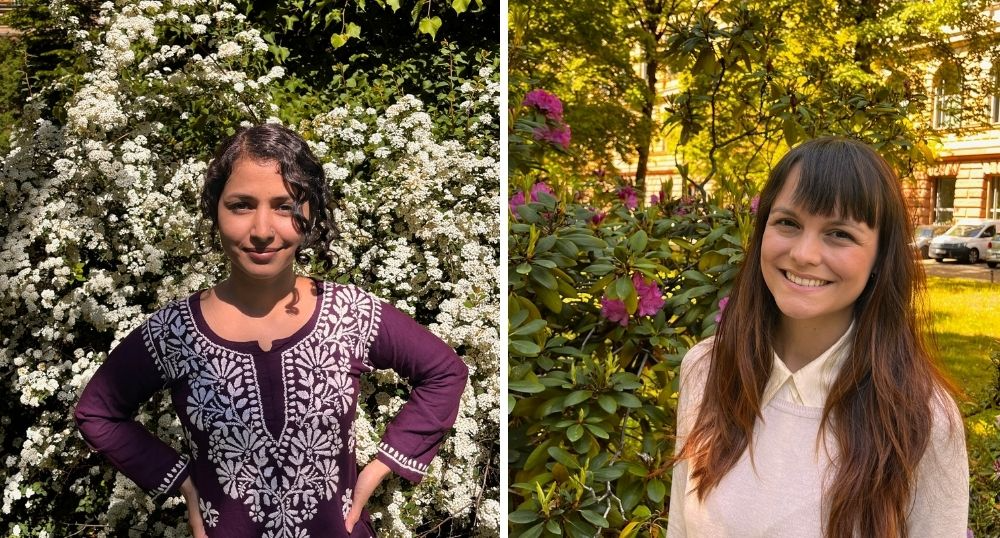
Following their research stay at MATH+ in Berlin, the 2025 Hanna Neumann Fellows Monika (Indian Statistical Institute Kolkata) and Alice Marveggio (Hausdorff Center for Mathematics, Bonn) share insights into their scientific work, collaborations, and experiences in a new follow-up interview.


The MATH+ Hanna Neumann Fellowship enabled them to work with leading mathematicians in Berlin and deepen their expertise. During their fellowship, Monika collaborated with Marc Kegel, while Alice worked with Barbara Zwicknagl, both are MATH+ members at Humboldt-Universität zu Berlin.


Monika’s research interests focuses on low-dimensional topology, knot theory, and contact and symplectic geometry. She is currently working on several projects related to the classification problem for Legendrian knots and 3-dimensional contact manifolds. Alice’s research lies at the intersection of partial differential equations and the calculus of variations, with a particular focus on interface evolution problems arising in continuum mechanics.


In the interview, both fellows discuss how the Berlin research environment shaped their work, highlight new collaborations and research directions that emerged during their stay, and reflect on how these experiences continue to influence their academic paths.


***

The MATH+ Hanna Neumann Fellowship
The fellowship is named after the outstanding Berlin mathematician Hanna Neumann (1914–1971), who was born in Berlin and forced to leave Germany in 1938. As a mathematician, she made key contributions to group theory.

MATH+ awards two Hanna Neumann Fellowships annually to female postdoctoral researchers in recognition of outstanding work and provides funding for a research stay of up to six months.

LINKS:

]]>
Young African Mathematician Program: Interview with the YAM Fellows 2025-2026 https://mathplus.de/news/yam-fellows-2025-interview/ Tue, 03 Feb 2026 11:33:05 +0000 https://mathplus.de/?p=29138
MATH+ YAM Fellwows 2025-2026: Manuella Kristeva NAKAM YOPDUP and Kessel Wilson MBOUCHE NZALI from Cameroon | © MATH+

MATH+ is a partner in the Young African Mathematicians (YAM) Fellowship Program, which brings together a network of five African Institute for Mathematical Sciences (AIMS) centers in Cameroon, Senegal, Rwanda, Ghana, and South Africa, as well as four German Clusters of Excellence mathematics located in Berlin, Bonn, Heidelberg, and Münster. The program provides fellowships to talented and motivated young African mathematicians at the master’s level who seek research experience in their chosen field.

The current YAM Fellows at MATH+, Kessel Wilson Mbouche Nzali (Host: Christian Bayer, TU Berlin/WIAS) and Manuella Kristeva Nakam Yopdup (Host: Sebastian Pokutta, TU Berlin/ZIB), share their academic journeys and first impressions of Berlin. In this interview, they talk about research and teaching cultures in Germany and Cameroon, life abroad in a new city, and their ambitions to pursue a PhD and make an impact in Africa in the future.

Kessel Wilson Mbouche Nzali from Cameroon holds a Bachelor’s and a Master’s degree in Mathematics from the University of Dschang, Cameroon. During his Master’s studies, he developed a strong interest in mathematical finance and received a scholarship to study at the University of Padova, Italy, where he worked on option pricing using quantization techniques and Fourier transform methods. After defending his Master’s thesis in Cameroon, he joined AIMS to further strengthen his training in advanced mathematics.

Since arriving in Berlin, he has attended courses in stochastic mathematical finance and control theory. After completing the fellowship, Kessel aims to pursue a PhD in stochastic analysis and its applications to mathematical finance. He hopes that this advanced training will enable him to contribute to research and teaching as well as tsupport the development of STEM education in Africa.

© MATH+

Manuella Kristeva Nakam Yodup completed her Bachelor’s and Master’s degrees in Computer Science, with a focus on data science and artificial intelligence, at the University of Yaoundé, Cameroon. Her interest in data science led her to pursue applied mathematics at an AIMS Centre in Rwanda. Her research interests lie at the intersection of AI and healthcare. Through the fellowship, she is deepening her experience in artificial intelligence, particularly in healthcare-related applications, while benefiting from the interdisciplinary research environment at TU Berlin and the Zuse Institute Berlin. This experience also allows her to assess her readiness for pursuing a PhD.

Following the fellowship, she hopes that this advanced training will enable her to contribute to research and teaching as well as support the development of STEM education in Africa. Her long-term goal is to apply AI-driven methods to medical research, especially in areas such as disease modeling and drug discovery.

© MATH+
******

INTERVIEW WITH THE TWO YAM FELLOWS

The interview was conducted in January 2026 by Beate Rogler, MATH+ PR Manager.

The conversation provided numerous valuable insights into the lives of the two Young African Mathematician (YAM) Kessel and Manuella who came to the Berlin Mathematical School (BMS) in Berlin through the MATH+ YAM program for the 2025-2026 academic year. They spoke about their first impressions of Berlin, differences in university culture compared to their home institutions in Cameroon, and about their academic goals and future plans.

MOTIVATION FOR THE YAM FELLOWSHIP

Manuella and Kessel, you are part of the MATH+ Young African Mathematician Program and will stay in Berlin until summer 2026. We are very happy to have you here. Could you tell us why you were interested in studying in Germany through the YAM Fellowship?


Kessel: Germany, and especially Berlin, is an ideal place to study mathematics—particularly financial mathematics, which is the field of interest. There are many experts working in this area, so the fellowship offers a great opportunity to learn from leading researchers.


Manuella: For me, the YAM Program was a great opportunity to experience research in a strong academic environment and to work closely with experienced researchers. I wanted to see whether this environment would suit me for pursuing a PhD over the next three to four years, possibly in Berlin.

FIRST IMPRESSIONS OF BERLIN

Did anything surprise you when you first arrived in Berlin?


Kessel: The public transport system was quite a challenge. On my first day, I was late for a meeting because I didn’t yet understand how the system works and got lost. That was my first real experience with German punctuality—my meeting partner was not happy about the delay. Despite this, I really appreciate the warm welcome from Annika, the BMS coordinator, the BMS team and the BMS student group, who organized many activities that helped us feel comfortable and explore Berlin, which is a beautiful city


Manuella: It was the same for me. The transportation system is difficult to understand at first. In the beginning, I didn’t know when to get off to take another bus and was confused when the bus was delayed. That’s why I also arrived late to the orientation. So, adapting to the transport system was challenging, especially since it is supposed to be punctual but is not always reliable. And yes, the BMS team and student group is very kind and welcoming.

ACADEMIC CULTURE AND TEACHING

How does studying in Berlin compare to your home universities in Cameroon, Rwanda, or Italy?


Kessel: In Italy, where I could study for a few months during my master’s study, classes were much larger than here in Berlin, but the teaching style is quite similar. In Cameroon, teaching is usually in French while at AIMS it is in English. Lecturers in Cameroon tend to be stricter regarding course content, which is common in many African universities, and students usually take several exams per course. In Berlin, having only one exam per course was surprising to me. Another major difference I the relationship with professors: in Berlin, it is more open and interactive. I really appreciate being able to ask questions freely and discuss topics with lecturers outside the class. One of my courses in mathematical finance is particularly well taught and fits my learning style very well.

GOALS AND FUTURE PLANS

What are your goals during your stay in Berlin?


Kessel: My main goal is to gain research experience, learn from experts, and build an international academic network. I am working on a research project related to cubature methods on Wiener space for option pricing, which is highly relevant to my interests in financial mathematics. I hope we achieve interesting results. In the long term, I hope to secure a PhD position in Berlin or Austria in order to contribute to solving mathematical problems and publishing research papers, although the competition is fierce.


Manuella: I hope to build a strong research network that will be useful for the next stage of my research journey. Currently, we are working on the pruning of large language models (LLMs) and it would be great to publish my first paper. I would like to pursue a PhD focusing on AI applied to healthcare, particularly in areas such as cancer research or osteoporosis. Thus, I want to contribute to the healthcare systems in Africa using AI, especially in drug discovery.


You’re right—obtaining a PhD position is highly competitive, but I sincerely hope that you will be successful. It was a pleasure talking to you.


Manuella: We would also like to thank MATH+ and the BMS for the wonderful opportunity to learn and to be involved in mathematical research. It is an outstanding program.


Kessel: Yes, and we are also having a great time here in Berlin.


Thank you very much for sharing your insights into your stay in Berlin. We wish you a successful and enjoyable time until the program ends in the summer!

]]>
Mathe, Energie und viel Begeisterung: Große Preisverleihung der Mathe-Adventskalender https://mathplus.de/news/grosse-preisverleihung-der-mathe-adentskalender/ Wed, 28 Jan 2026 13:33:28 +0000 https://mathplus.de/?p=28817

Fotos vom Mathe-Bazar und Bühnenprogramm im Audimax (FU Berlin): © Kay Herschelmann/MATH+ | Gruppenfotos: © Peter Himsel/MATH+ 

650 strahlende Gewinner*innen der beiden digitalen Mathe-Adventskalender wurden am 23. Januar 2026 im Audimax der Freien Universität Berlin feierlich ausgezeichnet. Nach einem Advent voller kniffliger Rätsel unter dem Motto „Powerwichtel – Auf Mathemission zur Energie der Zukunft“ standen die besten Knobler*innen aus Deutschland und dem Ausland im Rampenlicht und wurden mit viel Applaus empfangen. 

Mathe-Rätselaufgaben und Teilnehmende

Passend zum Wissenschaftsjahr „Zukunftsenergie“ zeigten die Mathe-Adventskalender 2025 eindrucksvoll, wie wichtig Mathematik für nachhaltige Energielösungen ist – von der Optimierung von Stromnetzen bis zur Prognose von Wind- und Sonnenerträgen. In fantasievollen Wichtel-Geschichten und spannenden Aufgaben ging es um die Energie der Zukunft sowie um vielfältige Anwendungsbereiche der Mathematik.

Die Beteiligung war erneut beeindruckend: Über 190.000 Teilnehmende aus ca. 70 Ländern knobelten mit, darunter mehr als 85.000 Schüler*innen. Besonders erfreulich: Beim anspruchsvollen MATH+ Adventskalender (ab Klasse 10) gingen alle drei Hauptpreise an Schülerinnen. Auch die Mitwirkung von über 10.000 Lehrkräften und rund 8.000 Schulen unterstreicht den festen Platz der Mathe-Adventskalender im Schulalltag.

Vom 1. bis 24. Dezember wurden die weihnachtlich verpackten Aufgaben täglich auf www.mathekalender.de veröffentlicht – für Einzelspieler*innen, Klassen und alle Mathefans. Während „Mathe im Advent“ (Klassen 2-9) spielerisch zum Entdecken einlädt, bot der MATH+ Kalender (ab Klasse 10) anspruchsvolle Aufgaben aus aktuellen Forschungsprojekten, etwa zur evolutionären Spieltheorie, zu algebraisch-geometrischen Objekten, Erreichbarkeitsspielen und pseudopolynomiellem Wachstum.

Festliche Preisverleihung

Den krönenden Abschluss bildete die große Preisverleihung in Berlin am 23. Januar 2026: Beim Mathe-Bazar konnten kleine und große Gäste an interaktiven Ständen tüfteln, spielen, und sich über die Forschung von MATH+ informieren, bevor im Festsaal die Auszeichnungen verliehen wurden. Dank großzügiger Spenden warteten attraktive Gewinne – von iPads über Sport- und Technik-Gadgets bis hin zu Klassenausflügen.

Eröffnet wurde die Preisverleihung von Günter M. Ziegler, Präsident der Freien Universität Berlin, die jedes Jahr ihr Audimax für die Preisverleihung zur Verfügung stellt. Ziegler ist Mathematikprofessor mit renommiertem Leibniz-Preis, Initiator von „Mathe im Advent“ und gewann schon als Schüler die Mathematik-Olympiade. In seiner Ansprache betonte er die vielfältigen Möglichkeiten, die Mathematik im Alltag sowie im Studium und Beruf eröffnet.

In ihrem Grußwort hob Claudia Schillings, Sprecherin von MATH+ und Mathematikprofessorin an der FU Berlin, die Bedeutung der Schulaktivitäten für das Forschungszentrum der Berliner Mathematik MATH+ hervor. Sie stellte auch zur besseren Einordnung der MATH+ Aktivitäten die zentralen Forschungs- und Anwendungsfelder von MATH+ vor – Gesundheit, Energie, Mobilität und Künstliche Intelligenz –, von denen das Thema Energie auch eine zentrale Rolle bei den Rätselaufgaben des diesjährigen Mathe-Adventskalenders spielte.

Das Publikum aus Gewinner*innen, Schulklassen und Einzelspieler*innen beteiligte sich begeistert am Bühnenprogramm: Gemeinsam wurde bei den Gesangseinlagen der Rapperin Sukini mitgesungen und geklatscht, während die vier mutigen Kandidat*innen des Quizspiels „Wer wird Pi-llionär?“ lautstark angefeuert und als Publikumsjoker lautstark unterstützt wurden. Es war eine gelungene Veranstaltung, die allen viel Spaß machte. Wir freuen uns schon wieder auf alle Mitspieler*innen am 1. Dezember 2026, wenn es wieder heißt: Spielstart für die Mathe-Adventskalender!

MATH+ Adventskalender

Die tragenden Institutionen hinter den Mathe-Adventskalendern, die sich an verschiedene Altersgruppen richten, sind Mathe im Leben gGmbH (Mathe im Advent) und der Exzellenzcluster MATH+ (MATH+ Adventskalender). Das gemeinsame Ziel: die Faszination der Mathematik zu wecken und nachhaltig zu stärken.

Der MATH+ Adventskalender ist ein Projekt des Forschungszentrums der Berliner Mathematik MATH+ in Kooperation mit der niederländischen Mathematik-Initiative 4TU.AMI. MATH+ ist der gemeinsame Exzellenzcluster der drei Berliner Universitäten FU, HU, TU und der beiden Berliner mathematischen Forschungsinstitute WIAS und ZIB. Die 24 anspruchsvollen Aufgaben des MATH+ Adventskalenders richten sich an pfiffige Schüler*innen ab der 10. Klasse sowie alle Mathematikbegeisterte und werden von MATH+ Wissenschaftler*innen und ihren niederländischen Kolleg*innen entwickelt. Sie ermöglichen faszinierende Einblicke in die aktuelle anwendungsorientierte Mathematikforschung und den Berufsalltag von Mathematiker*innen. Der MATH+ Kalender wird auf Deutsch und Englisch angeboten.

Herzlichen Dank!

Wir möchten allen BMS Studierenden, MATH+ Forscher*innen und ihren niederländischen Kollegen der Initiative 4TU.AMI danken, die sich in diesem Jahr mit ihren Aufgabenvorschlägen am MATH+ Adventskalender beteiligt und uns unterstützt haben, danken:

Fabien Nießen, Silas Rathke, Lukas Protz, Hajo Broersma, Pim van’t Hof, Thomas Nowotka, Nikola Sadovek, Stella Kapodistria, Marko Boon, Eva Deinum, Tobias Paul, Mehmet Akif Yıldız, Matthew Maat, Mar Curcó Iranzo, Tim Kunt, Lucas van Kreveld, Daniel Gembris, Max Klimm, Zoe Geiselmann, Kevin Kühn

Unser Dank gilt auch den Illustrator*innen der MATH+ Adventskalender-Aufgaben:

Friederike Hofmann, Julia Schönnagel, Ivana Martić, Zyanya Santuario, Mar Curcó Iranzo

************

Die Gewinner*innenlisten sowie weitere Eindrücke sind online abrufbar unter:

]]>
30 January – Alexei Skorobogatov: Rational points on surfaces https://mathplus.de/events/30-january-alexei-skorobogatov-rational-points-on-surfaces/ Mon, 26 Jan 2026 10:34:43 +0000 https://mathplus.de/?p=28550

Rational points are solutions of Diophantine equations in rational numbers and other fields of interest for number theory. The talk will survey the local-to-global principle for rational points, also known as the Hasse principle, with focus on surfaces. The story starts with Legendre who gave a necessary and sufficient condi-tion for solubility of conics in integers, an early precursor of the Hasse-Minkowski theorem.


After describing the state of the art for conic bundle surfaces (families of conics over a curve) and empha-sizing the role played by the Brauer group and the Brauer-Manin obstruction, Skorobogatov will talk about more recent results that go beyond conic bundles.


Alexei Skorobogatov is Professor of Pure Mathematics at Imperial College London. He received his PhD in Moscow in 1987 under the supervision of Yuri Manin. He is a recipient of the Whitehead Prize of the London Mathematical Society and a Fellow of the American Mathematical Society. He works in arithmetic geometry, mostly on rational points and Brauer groups.


Download the poster here

]]>
23 January – Frustration (in) Research (Fireside Talk) https://mathplus.de/events/23-january-frustation-in-research-fireside-talk/ Wed, 21 Jan 2026 10:41:25 +0000 https://mathplus.de/?p=28472

Mathematical research can be thrilling, beautiful, opening new horizons. At the same time, it can be frustrating, nerve-wracking, and overwhelming. How can one cope when stuck in the nth dead end, and it feels there’ll never be any progress (ever again)? Is that normal, or is one the only one person who gets stuck? Everybody else seems to understand everything and make constant progress, publishing the next article…. The road to the doctorate and beyond, towards professorial positions is long, lonely, and seems never-ending – or?


We invite you to join us for a talk with Gavril Farkas, Andrea Walther, and Alexandra Wesolek, who will share their experiences and strategies for coping with set-backs, dead ends, and other challenges in mathematical research.


Gavril Farkas is a professor of Algebraic Geometry at Humboldt-Universität zu Berlin (HU Berlin), Andrea Walther is a professor of Mathematical Optimization, at HU Berlin, and Alexandra Wesolek was a Dirichlet Postdoc in the group of Stefan Felsner (Technische Universität Berlin) until September 2025 and is now a substitute professor of Theoretical Computer Science at Universität Potsdam.


Download the poster here

]]>
MATH+ Scientists on the Containment of the Mpox Epidemic in Berlin https://mathplus.de/news/mathplus-scientists-on-the-containment-of-mpox-epidemic-in-berlin/ Thu, 15 Jan 2026 16:11:03 +0000 https://mathplus.de/?p=28256
Monkeypox Virus | Credits: Maurizio de Angelis / Science Photo Library | Source: WHO

Mpox (Monkeypox) is a viral disease spread through direct contact with infected individuals or contaminated materials. In 2022, major Mpox outbreaks occurred in several countries, especially among men who have sex with men (MSM). At its peak in Berlin, more than 200 new cases per week were reported, before numbers dropped rapidly over the summer. Scientists from the Robert Koch Institute (RKI) and Freie Universität Berlin, including MATH+ members Nils Gubela (PhD student) and Max von Kleist (MATH+ Professor), used mathematical simulations to explore how sexual contact patterns, temporary behavioral changes, and immunity from infection or vaccination shaped the outbreak. The findings from a MATH+ Emerging Fields project, were published in Communications Medicine in early 2026 and covered by the German newspaper Tagesspiegel.

Background

Mpox is a viral zoonosis caused by the orthopoxvirus Monkeypox (MPXV) and is endemic in West and Central Africa. In spring 2022, substantial outbreaks were reported in several high-income countries, predominantly affecting men who have sex with men (MSM). At the peak of the outbreak, more than 200 new Mpox cases per week were reported in Berlin, which hosts one of the largest MSM populations in Europe. Within the same year, the outbreak declined markedly; however, the factor contributing to this rapid decrease remained unclear.

Methods

To investigate the combined effects of sexual contact networks, temporary reductions in contact, and infection- versus vaccine-derived immunity on the 2022 Mpox outbreak, the scientists developed an agent-based model and used a novel exact and fast numerical simulation method developed in the context of MATH+. This novel numerical scheme allowed calibrating the agent-based model with epidemiological, vaccination, contact, and behavioral data.

Paper: Components of the infection model and distributions of input parameters, Fig. 1 | © Gubela, v. Kleist
Results

The results showed that vaccination had only a marginal effect on the decline of the epidemic. Instead, a combination of infection-induced immunity among individuals with many sexual contacts and temporary behavioral changes reduced the number of susceptible individuals below the epidemic threshold. However, the 2022 Mpox vaccination campaign, together with infection-induced immunity, may have contributed to herd immunity against sustained Mpox outbreaks within the Berlin MSM population. Demographic changes and waning immunity could compromise this herd immunity over time, and we may in fact witness a recent re-surge in Mpox cases in recent weeks.

Conclusions

These findings demonstrated that, in addition to vaccination, timely and clear communication of transmission routes could trigger spontaneous protective behaviors in key populations. They underscored the importance of targeted sexual health education as a central component of outbreak control for Mpox.

MATH+ Reference

The work is based on the MATH+ funded research project Effective Stochastic Simulation of Adaptive AB Models (EF 45-2) within the Emerging Fields Multi-Agent Social Systems.

LINKS:

]]>
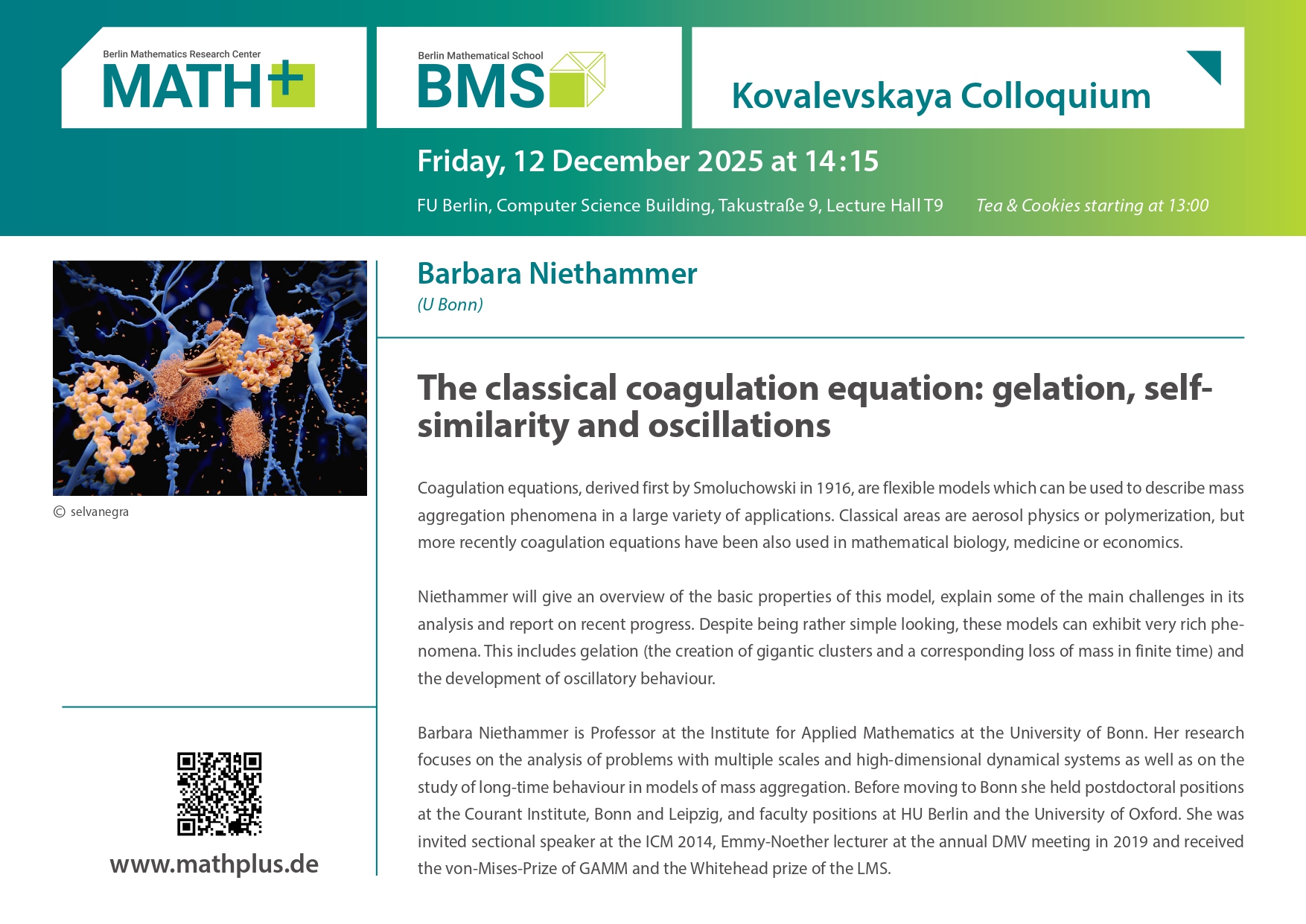
12 December – Barbara Niethammer: The classical coagulation equation: gelation, self-similarity and oscillations (Kovalevskaya Colloquium) https://mathplus.de/events/12-december-barbara-niethammer-the-classical-coagulation-equation-gelation-self-similarity-and-oscillations-kovalevskaya-colloquium/ Tue, 09 Dec 2025 10:36:25 +0000 https://mathplus.de/?p=27374

Coagulation equations, derived first by Smoluchowski in 1916, are flexible models which can be used to describe mass aggregation phenomena in a large variety of applications. Classical areas are aerosol physics or polymerization, but more recently coagulation equations have been also used in mathematical biology, medicine or economics.


Niethammer will give an overview of the basic properties of this model, explain some of the main challenges in its analysis and report on recent progress. Despite being rather simple looking, these models can exhibit very rich phenomena. This includes gelation (the creation of gigantic clusters and a corresponding loss of mass in finite time) and the development of oscillatory behaviour.


Barbara Niethammer is Professor at the Institute for Applied Mathematics at the University of Bonn. Her research focuses on the analysis of problems with multiple scales and high-dimensional dynamical systems as well as on the study of long-time behaviour in models of mass aggregation. Before moving to Bonn she held postdoctoral positions at the Courant Institute, Bonn and Leipzig, and faculty positions at HU Berlin and the University of Oxford. She was invited sectional speaker at the ICM 2014, Emmy-Noether lecturer at the annual DMV meeting in 2019 and received the von-Mises-Prize of GAMM and the Whitehead prize of the LMS.


Download the poster here

]]>