The post MDA Ambassador Guest Blog: Navigating a Busy Life with a Feeding Tube appeared first on Quest | Muscular Dystrophy Association.
]]>
Richard “Richie” Farrell Jr.
Living with a disability has required me and my parents to rise to meet many challenges, experiencing joys and heartbreaks. All in all, it has been an interesting ride – never a dull moment. We rely upon our Catholic faith for the strength to meet the challenges and setbacks and are always thankful for the blessings we have
I was diagnosed with Becker muscular dystrophy (BMD) when I was five years old. Life became a regular parade of doctor visits, trips to specialists, dealing with schools, and navigating daily life. When I was thirteen, I began using a power wheelchair. My family bought a modified van to transport both me and my grandfather, who also lived with muscular dystrophy.
In May of 2020, life took a turn when I required a feeding tube and enteral nutrition.
Adjusting to life with a feeding tube
My parents and I had to take several steps to adapt to this change in my daily life. One challenge is managing all of the materials. We order thirty days’ worth of formula, feeding bags, extensions, and tubing – which all takes up a lot of space. Keeping all of this organized is key. Reviewing the monthly shipments as they arrive is important. You cannot assume that they send the right materials every month, so it all has to be inventoried and stored. We have received wrong formula, wrong bags, bags that leak. Paying attention to the dates on the formula and using the oldest dates first is also important. We often receive various dates in one shipment and it is key to use the oldest stock first.
At about the same time that I started using the feeding tube, my medications increased. I also began to take all medications via the tube. The medications must be scheduled carefully so that they don’t overload my intestinal system yet still meet the medication schedule – which is quite a balancing act. On top of this, syringes (enfit system) need to be cleaned and reused. It is a constant cycle of filling and cleaning syringes. About 70 are in use over the course of one week.
We created a spreadsheet with the daily medication schedule, doses, delivery, etc. We update and track the spreadsheet daily to make sure nothing is missed.
Adding to the complexity of managing all of this, many of my medications need to be compounded at home and put in liquid form so they can be injected into the feeding tube system. Most can be done ahead of time, but some need to be prepared immediately before I take them. Again, keeping to the written schedule avoids missed doses.
Managing complex needs while staying active
The other challenge we face is that we are not always at home when I need my meds or feeding formula. I am involved in a lot of groups and activities – through my church, my role as an MDA Ambassador, and other organizations. Maintaining my social life, passions, and commitments is important to me. . We developed a daily system for measuring and storing what I need. Through a system of trial and error, my parents put together a system of packaging and transporting meds and formula when traveling, whether it is just being out and about for the day or going on an overnight trip. Our method is a combination of coolers, ice packs, and insulated lunchbag-style containers with our own alterations to make the bags work. The formula has to be in a temperature-controlled environment, which is why we need the ice packs and the coolers. Since all the packaging is different, we need to keep a variety of sizes of icepacks on hand. We also have an IV pole for traveling, we hang feeding bags or medication from the pole sometimes and other times I keep the feeding bag in my backpack.
The heart of my feeding tube system is the pump. While there are gravity systems, mine utilizes a Moog Infinity Green pump. We use a model with a pump because using a gravity system would require being in a Skilled Nursing/Nursing Home Facility due to the complexity of measuring drops and how fast it goes, and I would be stuck on an IV pole all day. The Pump allows me freedom to remain independent and to keep exploring the world. (I have never used a gravity system, but I do have one for critical emergency situations if the power were to go out for a long period of time.)
It took a bit of time for us to learn how to use pump system and become familiar with the various settings. We have a specially designed backpack that holds the formula, pump and tubing. Because I use a powerchair quite often when I need to walk long distances and for many of my doctor appointments, we need to be able to hang the backpack on the back of my wheelchair.
The tubing has also necessitated alterations for clothing, mostly for semi-formal and formal events. We cut slits into my dress shirts and then stitch them (to keep from tearing) to allow the tubing to be worn with my suit.
Another key to balancing it all is flexibility. At many times activities – church, MDA events, Knights of Columbus events, travel schedules, and social activities – conflict with my medication times, so flexibility is key. We are very fortunate to have good insurance. Between primary employer insurance provided through my parents’ employers and special needs government provided insurance, my parents have been able to provide everything that I need in order to live a robust and independent life. This is not to say there are no out-of-pocket costs. Spring water for formula, replacement syringes for medications, and devices to hold the tubing in place are all expenses my family needs to absorb. My parents help mitigate this cost by using a Flexible Spending Account through my step-dad’s benefits. This account allows for an amount of money from each pay period to be deducted pretax and then reimbursed as it is spent on medical necessities.
Making it work for us
We do our best to manage all of my needs, stay organized, and stay active while navigating life with a feeding tube. Are our methods perfect? No. Missed meds, complex daily schedules, and lack of facilities when needed can create challenges. It happens. The key is not to panic and to do the best you can.
There are many reasons why this all works for us. When traveling or attending special events, planning is key. Knowing the arrival time, the schedule for the main part of activity, when there are breaks in the activity, etc. all need to be coordinated. My parents and I communicate about what is needed and what issues there are as they come up (supply, insurance, schedules) and we work them out together. We are grounded in our faith and work around church activities and obligations. I want to be able to participate in everything that I am passionate about and a big part of doing that with a feeding tube is staying flexible and understanding that everything is not always going to work out perfectly – and that is okay!
The post MDA Ambassador Guest Blog: Navigating a Busy Life with a Feeding Tube appeared first on Quest | Muscular Dystrophy Association.
]]>The post 2026 MDA Clinical & Scientific Conference Opening Highlights the Power of Collaboration appeared first on Quest | Muscular Dystrophy Association.
]]>
Sharon Hesterlee, PhD, MDA President and CEO
On March 9, Sharon Hesterlee, PhD, MDA President and CEO, welcomed more than 2,400 people attending MDA’s annual Clinical & Scientific Conference, both in person at the Hilton Orlando in Florida and virtually. The conference is the largest global gathering of neuromuscular clinicians, researchers, industry partners, advocacy organizations, and community members.
After acknowledging “a new sense of responsibility” in her role as MDA’s leader, Dr. Hesterlee provided an overview of the extraordinary progress and unique challenges facing the neuromuscular field today. Seeing new scientific technology translated into approved drugs and therapies that can make a real difference in the lives of people living with neuromuscular diseases is deeply satisfying, she said, but it also raises new questions and barriers as the science outpaces the infrastructure to approve and deliver therapies.
“That reality places responsibility on all of us,” Dr. Hesterlee said. “It’s incumbent on this community not just to advance science but to work together to align scientific progress with the institutions and systems that might stand in the way.”
This is where she sees MDA playing a vital role. “For more than 70 years, MDA has served as a convenor, bringing together groups like this,” she said. “That role has never been more important than it is today.”
Meeting challenges with hope

MDA National Ambassador Lily Sander
The importance of overcoming challenges was exemplified by MDA National Ambassador Lily Sander, who invited the audience of neuromuscular experts to walk in her shoes. “When was the last time you felt completely exhausted — not just tired after a long day, but the kind of exhaustion that settles deep into your bones?” she asked.
The high school senior described her experience of living with fatigue as a symptom of Charcot-Marie-Tooth disease (CMT). “My mind pushes forward, eager to do more; my body asks me to pause. That tension shapes daily decisions in ways that many people never have to think about,” she said. Yet fatigue, being an invisible symptom, is often misunderstood.
By sharing her experience, Lily hoped to impress upon conference attendees the importance of listening to the people most affected by their work.
“Accessibility is not simply about removing barriers. It is about creating pathways — pathways that allow patients not only to receive care, but to help shape the future of that care, and one of the most powerful ways to create those pathways is by listening to the voices of the patients themselves,” she said. (Watch Lily’s speech.)
Next, John Crowley delivered the conference keynote address. In his role as President and CEO of the Biotechnology Innovation Organization (BIO) and a founder of two biotech companies, John brought a national leadership view on innovation and the path ahead for the neuromuscular field. In his role as father to two children with early-onset Pompe disease, John brought a very personal perspective.
His family’s story of fighting for the development of the first enzyme replacement therapy (ERT) for Pompe disease was dramatized in the film “Extraordinary Measures.”

John Crowley, President and CEO of the Biotechnology Innovation Organization
“In many ways, the film was a vehicle for our family to be a proxy for the many families, children, and adults living and thriving in the world of rare diseases … and to show in one family’s journey what it takes to live, to thrive, to navigate a very complex system to make newer and better medicines,” he said.
After his children were diagnosed, John left his job at Bristol-Myers Squibb to co-found Novazyme Pharmaceuticals, later acquired by Genzyme Corporation, where he helped advance experimental science that led to the first ERT for Pompe. He took a risk and argued that risks are sometimes necessary in the rare disease world.
Today, the challenges to taking those risks often have to do with the infrastructure around research funding and healthcare. “We’ve never had more technologies than we have today. … Lord knows we have enough unmet need … There’s lots of capital available. So why are we struggling?” he asked.
His answer: “There’s too much uncertainty in science, too much uncertainty in the regulatory process. And after [a biotech company goes] through all of that, runs that gauntlet, now we have the uncertainty and confusion and complexity of making sure that our inventions are paid for and that patients have 100% access to these medicines.”
To overcome these challenges, John described a “virtuous circle” of academic research, government agencies like the National Institutes of Health, advocacy organizations like MDA, small biotech companies, entrepreneurs, and late-stage investors working together to promote innovation and access.
In his leadership role at BIO, John regularly speaks with regulators and lawmakers in Washington, DC. He’s found bipartisan support for removing barriers to developing therapies and increasing access to them for the people who need them. He feels optimistic about the future. (Watch John’s keynote address and conference highlights.)
The opening morning of the conference also included three award presentations recognizing people who are making an impact in the neuromuscular field. Read MDA Awards Honors Those Driving Progress in Neuromuscular Research and Care to learn more about this year’s awardees.
Education and idea sharing
The three-day conference features a packed agenda of more than 30 sessions, with some of the world’s foremost experts in neuromuscular disease exploring bold new ideas to improve the lives of people living with neuromuscular diseases.

Attendees exploring and discussing scientific poster presentations.
Afternoon sessions provided conference attendees with the latest information on topics ranging from innovative technologies (e.g., Beyond 2D: Utilizing Curi Bio’s 3D Engineered Muscle Tissues for Predictive Disease Modeling) to practical knowledge about coordinating healthcare (e.g., The Role of Psychology in Supporting Patients & Families Receiving Gene Therapy).
The Exhibit Hall and Poster Sessions also gave attendees the chance to explore more than 500 research posters and connect with fellow clinicians and researchers to spark new conversations and collaborations. On Wednesday, the conference will feature 63 oral abstract presentations showcasing emerging research.
This year’s conference highlights MDA’s role as a convener, bringing together people from all areas of the neuromuscular field — from drug researchers working in laboratories to doctors and therapists caring for people with neuromuscular diseases — to learn about the real-world impact of their work and share visions for the future.
2026 MDA Clinical & Scientific Conference by the Numbers
2,020 in-person attendees
403 virtual attendees
40 countries represented
195 speakers
32 sessions
63 oral abstract presentations
500+ research poster presentations
27 Patient Advocacy Pavilion participants
The post 2026 MDA Clinical & Scientific Conference Opening Highlights the Power of Collaboration appeared first on Quest | Muscular Dystrophy Association.
]]>The post Clinical Study Alert: Phase 1 Study of MyoPAXon in Boys with DMD appeared first on Quest | Muscular Dystrophy Association.
]]>The study
This is an open-label, dose-ranging study, which means that all participants will receive one of four doses of MyoPAXon treatment, ranging from a low dose to a high dose. The goal is to determine the optimal dose for use in future studies. Participants will be started on tacrolimus one week prior to MyoPAXon administration and will then receive a single injection of MyoPAXon. They will then receive twice a day maintenance doses of tacrolimus for three months. Participants will be required to attend 5-10 clinic visits during the three-month study and monitored for an additional 15 years.
MyoPAXon will be administered through a one-time intramuscular (in the muscle) injection. The effects of the therapy will be evaluated using a number of tests and procedures including but not limited to blood testing for donor-specific anti-HLA antibodies and cellular response.
Eligibility criteria
To be eligible, individuals must meet the following inclusion criteria:
- Have DMD, diagnosed by mutations in the DMD gene and/or absence of immunohistochemical staining for dystrophin on muscle biopsy
- Non-ambulatory
- Intact extensor digitorum brevis (EDB) muscles bilaterally
- Off investigational therapies for > 30 days
- Age 18 years of age or older at the time of consent
- Have adequate organ function within 14 days prior to enrollment (28 days for cardiac and pulmonary function)
- If applicable, willing to use at least two forms of effective birth control while receiving the study product and for 3 months after stopping tacrolimus therapy
- Ability to follow commands sufficiently to perform voluntary aspects of outcome measures
- Willing to consent to monitoring for 15 years, including an extension period
- Voluntary written consent from the subject or parent(s)/guardian(s)
- Additional study criteria
Individuals may not be eligible to participate if they are affected by another condition or receiving another treatment that might interfere with the ability to undergo safe testing.
Please visit this link for more detailed listing of inclusion and exclusion criteria.
Interested in participating?
To learn more about the study or inquire about participation, visit the sponsor’s trial website or contact the study coordinator by email at [email protected].
The post Clinical Study Alert: Phase 1 Study of MyoPAXon in Boys with DMD appeared first on Quest | Muscular Dystrophy Association.
]]>The post In Case You Missed It… appeared first on Quest | Muscular Dystrophy Association.
]]>With so many valuable podcasts, blog articles, and magazine articles available to our audience, chances are that you may have missed one or two pieces of interesting content. Check out the summaries and links below.
In case you missed it… Quest Product Guide:
The Spring Quest Product Guide is Here!
This guide is designed to help you find tried-and-true products that make life more independent, stylish, and fun. All of the products that you see here were chosen by MDA Ambassadors, who shared exactly how each product helps them in their daily lives. From fashion and tech to daily tools, hobbies, and home goods – there is something for everyone. Read more.
In case you missed it…Quest Blog:
Recent Updates with Section 504
Here’s what you need to know to understand current threats and challenges to Section 504 of The Rehabilitation Act, which prohibits disability discrimination in programs receiving federal funding. Read more.
In case you missed it… Quest Podcast:
Episode 60: Fashion for Every Body: Izzy Camilleri on Style, Function, and Inclusion
In this Quest Podcast episode, we chat with internationally recognized fashion designer Izzy Camilleri, a true pioneer in adaptive fashion. She shares how her successful career in high-end fashion took a transformative turn when she began designing clothing for people with disabilities and partnered with Silverts—work that helped ignite today’s adaptive fashion movement. Izzy shares how to balances style with function, the importance of universal design, and the meaningful progress that the fashion industry has (and hasn’t) made toward true inclusion. Izzy shares her experiences, expertise and advice when it comes to what the future holds for adaptive apparel, customization, and technology as she shines a light on the power of fashion to help people feel seen, confident, and fully themselves. Listen here.
In case you missed it…Quest Magazine 2026, Issue 1:
Quest Magazine 2026, Issue 1 is Here!
The first issue of Quest Magazine for 2026 is here! Read up on RNA therapies, genetic testing, clinical trial readiness, insurance, research updates, community member milestones, and more. Read more.
The post In Case You Missed It… appeared first on Quest | Muscular Dystrophy Association.
]]>The post MDA Ambassador Guest Blog: Redefining How I View Myself appeared first on Quest | Muscular Dystrophy Association.
]]>
Stephanie posing in front of a colorful artistic street mural.
Being diagnosed with a rare muscle disease at 13 years old changed my perspective on the world and how I view myself in it. As I came to understand the disabled identity and all that comes with it, I came to understand myself better. Pre diagnosis, I knew I was different and I often felt like I had a different mindset than my peers. Once I was diagnosed with SELENON, I came to learn important aspects of my disabled identity and the world that was not built for us. I came to meet people that are welcoming, caring, and inclusive. And I came to know the importance of accessibility in its many different forms for different disabilities. With the acceptance and understanding of my identity, I redefined how I view myself.
As someone with a chronic illness and disability, I face symptoms every single day. Every day looks different to me, and I adapt to what I am facing with every new day. How I manage my time and energy becomes a crisis aversion plan. I overthink how I do things, when I can do things, or if I can do things. My priorities are kept in check every day.
Balancing needs and values
Having the mindset of keeping my hierarchy of needs met has helped me stay in tune to my values, morals and subsequently, away from drama.
As someone with a rare form of muscular dystrophy, my body reminds me every day how to take care of it. My weakened diaphragm reminds me to take deep breaths, my slow digestive system reminds me to eat well, and my already tired body reminds me to get a good night’s sleep. Having a good support system, access to good doctors, an accessible home, and the correct devices for me are intrinsic for survival. As long as those needs are met then all other areas of my life run smoothly. It becomes easier to handle other areas of my life when the most important areas are taken care of.

Stephanie enjoying a day in the mountainside of Virginia
Sticking to my values has helped me stay away from societal expectations and pressures.
A few principles that have helped me live my best life are staying authentic, leaning into the power of vulnerability, having empathy, and continuously working on my inner peace. Becoming aware of how rare my disease is has helped me understand that I need to prioritize living in alignment with my true self. Society already reminds me how different I am and – yeah, they’re right, but I am my own person. I will continue to advocate for my needs and stay true to myself. While being vulnerable is hard, it has led me to have great connections for continuing to be who I am. It feels great to be myself and to be loved and accepted for who I am. Being authentic helps others be themselves too. I care about being authentic because it helps those around me feel like they can be themselves too. Helping others feels safe and hoping that that feeling continues on through others inspires me to continue being me.
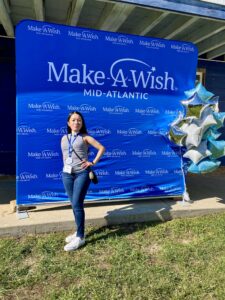
Stephanie at a volunteer event for Make a Wish
And since I do feel different from the norm, I have great empathy and compassion for others. Once you go through your own battles, you are reminded of how no one is exempt from hardship. As Robin Williams said, We all face battles that others might know nothing about, so it’s best to extend compassion for others as you would want extended to you. Having greater empathy offers more understanding and harmony. The more peace and harmony I have in my life and try to achieve every day, the more I feel like I can handle anything thrown at me. Handling things with peace is essential to me. While I do let myself express all of my emotions because I don’t want to bury anything and have it affect me physically, I also try to remain peaceful because doing so positively affects my health. Getting stressed or worked up over various things only makes my symptoms worse. Finding peace and harmony wherever I can, however I can, helps me cope with whatever life throws at me.
I decide what works best for my life and how I want to live it. It is a helpful tool when I think of it – how my body reminds me of what is truly important. My health always comes first and as long as I have the tools and support to take care of that, then I can better manage everything else with a level head.
Gaining confidence and staying true to myself
The confidence that I have gained since being diagnosed has increased exponentially as I find more self-acceptance, self-assurance, and freedom. As a patient who is familiar with advocating for health needs and navigating the health care system, I have grown to be more confident in knowing what is best for me and how to maneuver difficult situations. Women like me, who are living with neuromuscular diseases, become experts in our own care. We are resourceful in coming up with solutions and seeking help from the right people to receive the care we deserve. The self-advocacy that is required to manage our care only makes us that much more powerful. Being confident in my truth and in who I am has grown as I navigate life as a woman with a disability.

Stephanie at MDA’s On the Hill advocacy event in Washington, DC
Staying true to our values and gaining confidence truly aids in how authentic we are in our lives. Owning the disabled identity and getting rid of expectations from a world that wasn’t built for us boosts that authenticity. With the communication required to navigate caregivers, insurance companies, and medical staff, we become really good at expressing our thoughts openly and honestly. Living in a body that has weaknesses and coming to accept it helps us to embrace our different life for what it is. Our lives are not less than or something to be pitied but are just different. Although we may need help with physical tasks, we are very much skilled in other ways that are just as useful.
The post MDA Ambassador Guest Blog: Redefining How I View Myself appeared first on Quest | Muscular Dystrophy Association.
]]>The post Clinical Research Alert: Phase 2 Study of Rapcabtagene Autoleucel in Individuals with IIM appeared first on Quest | Muscular Dystrophy Association.
]]>The study
Individuals with refractory IIM may be eligible to participate in a phase 2 clinical trial (AUTOGRAPH-IIM) evaluating the safety and effectiveness of the investigational drug rapcabtagene autoleucel. This drug is a cell-based therapy (a CAR T-cell therapy) designed to target and eliminate B-cells, which contribute to autoimmune activity in IIMs. The study aims to determine if rapcabtagene autoleucel is effective and safe compared to currently available treatment options in people with IIM who have not responded to previous treatment.
This is a randomized, open-label, controlled study, meaning that participants will know whether they have been randomly assigned to the group receiving rapcabtagene autoleucel or to the comparison group receiving standard-of-care treatments. Participants receiving the study drug will begin with a 2-week hospital stay, followed by frequent visits that gradually space out from weekly to monthly, then to every 7–12 weeks, and eventually every 6 months through year five. Those in the standard-of-care arm will follow the same long-term schedule but without the initial hospitalization and with fewer early visits.
Rapcabtagene autoleucel is administered by a single intravenous (in the vein) infusion. The effects of the drug will be evaluated using a number of assessments including but not limited to: physical examination, body weight, body temperature, blood pressure, pulse rate, respiratory rate, pulse oximetry, blood sample, urine sample, questionnaires, electrocardiogram (ECG), and pregnancy test.
Study criteria
To be eligible, individuals must meet the following inclusion criteria:
- Men and women, aged >18 and ≤75 years, with a diagnosis of probable or definite myositis
- Inadequate response to prior therapy
- Diagnosed with active disease
- Meet criteria for severe myositis
Individuals may not be eligible to participate if they are affected by another condition or have received another treatment that might interfere with the ability to undergo safe testing.
Please visit this link for the full listing of inclusion and exclusion criteria.
Interested in participating?
To learn more about the study or inquire about participation, please contact the study coordinator at the closest study site listed here or visit the sponsor’s trial website.
The post Clinical Research Alert: Phase 2 Study of Rapcabtagene Autoleucel in Individuals with IIM appeared first on Quest | Muscular Dystrophy Association.
]]>The post MDA Awards Honors Those Driving Progress in Neuromuscular Research and Care appeared first on Quest | Muscular Dystrophy Association.
]]>2026 MDA Legacy Award for Achievement in Clinical Research: Michio Hirano, MD, Columbia University Irving Medical Center, New York

Michio Hirano, MD
As a global leader in translational neuromuscular research and a longtime partner to MDA, Dr. Hirano’s pioneering work has increased understanding of what causes certain diseases — including early innovations in mitochondrial disease research that helped shape modern approaches to precision medicine.
“I have been very fortunate to work during a period of breathtaking advancements in neuromuscular diseases over the last three-plus decades,” Dr. Hirano says. “Together with multiple laboratory and clinical colleagues, our research team at Columbia has contributed to the field by identifying the genetic causes and investigating the molecular pathways leading to several mitochondrial neuromuscular diseases.”
As a career highlight, Dr. Hirano points to his work that led to the recent US Food and Drug Administration (FDA) approval of the first therapy for thymidine kinase 2 deficiency (TK2d), a very rare mitochondrial myopathy. “This work has fulfilled a longstanding dream of taking a concept in the laboratory to improve the lives of patients with a debilitating neuromuscular disease,” he says.
Dr. Hirano’s leadership in mitochondrial disorder research and his commitment to families living with neuromuscular conditions have cemented his legacy as one of the field’s most influential voices.
“Working with MDA, patients, and their families, and with colleagues in the neuromuscular disease community, has not only opened my eyes to the huge unmet needs of these serious disorders, but has also enabled collaborative efforts to address those needs,” he says. “I am particularly grateful to the patients and families who have placed their trust in our efforts.”
2026 MDA Donavon Decker Legacy Award for Community Impact in Research: Allison Moore, Founder & CEO, Hereditary Neuropathy Foundation (HNF)
After her diagnosis with Charcot-Marie-Tooth disease (CMT) as a young adult, Allison founded the HNF. She has since built it into an internationally respected organization centered on advocating for people living with CMT and reshaping the scientific landscape for inherited neuropathies.

Allison Moore
From their first research project in 2007, the HNF was dedicated to listening to people living with CMT. “That was before you heard people talking about bringing the patient voice into research, but we did it, and that set the tone for how we were going to conduct research,” Allison says.
Under Allison’s leadership, the HNF has launched several initiatives aimed at advancing clinical trial readiness, expanding multilingual diagnostic tools, and driving meaningful cross-sector partnerships:
- Therapeutic Research in Accelerated Discovery (TRIAD) develops partnerships between biotech and pharmaceutical companies, academic researchers, and regulatory agencies.
- The Global Registry for Inherited Neuropathies (GRIN) houses patient data to help researchers better understand CMT.
- The CMT Biobank offers GRIN patient registrants the opportunity to participate in innovative and translational research to accelerate CMT therapies.
- Developing CMT cell and animal models allows researchers to test viable treatment approaches.
- Exploring the use of digital health technologies to track changes in symptoms and develop outcome measures for clinical trials.
Allison’s vision is driving innovation and collaboration in the CMT field.
“I just appreciate it so much, getting the validation from MDA that we’ve built something wonderful and that we’re making an impact,” she says of receiving the award. “I think it gave us even more credibility.”
Inaugural MDA Research Momentum Award: Łukasz Sznajder, PhD, Assistant Professor at the University of Nevada, Las Vegas (UNLV)
The Research Momentum award honors early-career investigators whose innovative, high-impact work is shaping the future of neuromuscular research.

Łukasz Sznajder, PhD
Dr. Sznajder is an expert in molecular genetics, with a particular interest in hereditary neuropsychiatric and neuromuscular disorders. At UNLV, he has been conducting pioneering research to uncover the mechanisms underlying neuromuscular and neuropsychiatric disorders. In 2025, he published a scientific paper on the connection between autism spectrum disorder and type 1 myotonic dystrophy (DM1).
“I’m really interested in the connection between neurodevelopmental disorders and neuromuscular disorders,” he says. “With something like congenital myotonic dystrophy, which is the most severe form of myotonic dystrophy, the same or similar genetic mutation, just different timing, probably makes the disease that we typically consider a muscular disorder into a neurodevelopmental disorder.”
Beyond his scientific innovation, Dr. Sznajder has demonstrated independent leadership and a commitment to collaboration and mentorship.
“Educating future professionals is a really important part of my work,” he says. “A lot of the challenges that we are facing right now are probably bigger than one generation.”
Dr. Sznajder notes that this award will signal to others that his research is worth supporting. “I hope for that because research is a huge investment, and it mostly relies on other people supporting researchers.”
MDA’s Legacy and Momentum awards will be presented at the opening session of the 2026 MDA Clinical & Scientific Conference in Orlando, Florida, on March 9, 2026.
The post MDA Awards Honors Those Driving Progress in Neuromuscular Research and Care appeared first on Quest | Muscular Dystrophy Association.
]]>The post Clinical Research Alert: Observational Study in Female Carriers of DMD/BMD and Their Biological Children appeared first on Quest | Muscular Dystrophy Association.
]]>The study
This is an observational study and does not involve a new intervention. Enrolled participants will be asked to provide informed consent over the phone and will then receive a one-time visit by a mobile phlebotomist who will perform a blood draw on both enrolled female carrier of DMD/BMD and her affected or unaffected child (in some cases a cheek swab for the child will be accepted). The study team will also request participant health request records, which may take several weeks to obtain.
Study criteria
To be eligible, individuals must meet the following inclusion criteria:
- A carrier female with a biological affected or unaffected child.
- Eligible female carriers – Must reside in the United State, be 18 years or older, have screened positive as a carrier for one or more inherited genetic conditions, are not currently pregnant, and are able and willing to sign informed consent.
- Biological child – Must reside in the United States.
- Children who are 17 years or younger – Able and willing to provide assent, when applicable and weigh 10 kg (22 lbs) or higher if a blood sample is collected.
- Adult >18 biological child/children – Able and willing to sign informed consent.
Individuals may not be eligible to participate if they do not meet the criteria of a dyad sample (carrier female and biological child).
Interested in participating?
To learn more or inquire about participation, visit the sponsor’s website or contact the Study Coordinator by phone: 650-674-4662 or email: [email protected].
The post Clinical Research Alert: Observational Study in Female Carriers of DMD/BMD and Their Biological Children appeared first on Quest | Muscular Dystrophy Association.
]]>The post Research Network Supports Limb-Girdle Muscular Dystrophy Treatment Development appeared first on Quest | Muscular Dystrophy Association.
]]>LGMD is a diverse group of disorders with many subtypes categorized by the gene mutation and inheritance pattern. Together, the disorders that constitute LGMD are the fourth most common genetic cause of muscle weakness.
Identifying gaps
“Companies were starting to develop gene replacement therapies for several of the LGMDs,” Dr. Statland says. “We knew that they were working on gene replacement for most of the recessive LGMDs, and we realized we didn’t have very much natural history data.”
Without this natural history data, which shows how a disease or subtype typically progresses, researchers wouldn’t truly know if their therapy was altering the disease course.
“If there are subgroups who have different trajectories, how are you going to tell if the drugs are working? What are you going to measure?” Dr. Statland asks.
He also notes that sponsored genetic testing programs, offered at no cost through MDA Care Centers, have increased access to genetic testing. But as more genetic testing was performed, more people received results indicating variants of unknown significance (VUSs).
“Somewhere between 50% and 60% of patients will have at least one VUS, so a real gap in the field was a pathway for resolving these variants,” he says.
Finding a solution
The solution was to form the GRASP-LGMD Consortium in 2018, a network of researchers and organizations working together to develop trial endpoints and prepare sites for potential gene therapy trials for LGMD.
“We put this network together to build those tools, biomarkers, and clinical trial outcomes to understand what happens to groups that have different trajectories, and then to find a pathway to resolve people who don’t have genetic certainty yet,” Dr. Statland says.
“Often you need a collection of investigators that are capable of seeing patients close to where they are to reduce burden with people with limited travel capacity,” adds Dr. Johnson, one of the original founders of the consortium. Currently, MDA, the LGMD2i Research Fund, and CureLGMD2i Foundation are co-funding the GRASP-LGMD Consortium, along with NINDS, Sarepta Therapeutics, ML Bio Solutions, and Edgewise.
The project evolved from a few centers to 15-20 in the US and internationally. It focused on developing natural history data, biomarkers, and tools to resolve genetic variants of unknown significance. The network, including the facioscapulohumeral muscular dystrophy (FSHD) and myotonic dystrophy networks, has facilitated large-scale clinical trials and real-world study designs.
“Our goal is to reduce barriers across those LGMDs so there’s not a question about what the natural history of the disease is or what the end points would be to incentivize drug development in those disorders,” Dr. Johnson says.
Critical support
Last year, MDA awarded a Clinical Research Network Grant to Dr. Statland to help GRASP-LGMD consolidate the administration of clinical trial networks where they overlap for myotonic dystrophy, FSHD, and LGMD. “Much of the way we organize these networks is similar, so it made it easy to consolidate,” Dr. Statland says.
The LGMD2i Research Fund and CureLGMD2i then provided additional funding at the end of 2025 to lower the cost of managing clinical trial sites. “Patients with LGMDs are facing a dearth of therapeutic options,” says Jean-Pierre Laurent, Director of the LGMD2i Research Fund. “It is critical that efforts to facilitate the development of these options be coordinated and done by experts in these conditions. We hope that, by completion of this grant, we will have significantly supported these efforts.”
Virginia Commonwealth University (VCU) serves as the central coordinating site for the GRASP-LGMD Consortium, under the direction of Dr. Johnson. Dr. Statland serves as the clinical research liaison. The biorepository is under the direction of Dr. Weihl at Washington University.
“We run the central coordinating center and the data management center,” Dr. Johnson says. “The data is deposited at VCU, we steward it, make sure it’s of appropriate quality, then share it with interested parties like pharmaceutical companies or biotech. As a clinical coordinating center, our goal is to identify sites close to where patients live and fully enroll these trials. If we can enroll patients in natural history studies, that’s a strong sign to drug developers that this is a disease that’s of interest to people.”
Support from MDA and other organizations has been crucial for maintaining and training coordinators and evaluators, accelerating drug development for muscular dystrophies.
The post Research Network Supports Limb-Girdle Muscular Dystrophy Treatment Development appeared first on Quest | Muscular Dystrophy Association.
]]>The post Clinical Research Alert: Phase 2 Study of NMD670 in Adults with Generalized Myasthenia Gravis (gMG) appeared first on Quest | Muscular Dystrophy Association.
]]>The study
People who have generalized myasthenia gravis (gMG) may be eligible to participate in a phase 2 clinical trial (SYNAPSE-MG) to evaluate the safety, efficacy, and duration of effect of the investigational therapy NMD670 to treat gMG. NMD670 targets skeletal muscle and is designed to enhance muscle activation with the goal of restoring and maintaining muscle function. It is being evaluated for the ability to improve muscle strength, power, and endurance, and to decrease some types of fatigue in people with gMG.
This is a phase 2, double-blind, placebo-controlled study, which means that participants will be randomly assigned to receive doses of the study drug (one of three possible dose levels) or an inactive placebo control. The study will be approximately 8 weeks in duration. During this time, participants will attend 6 in-person study visits, which will include a screening visit, a baseline visit 3-4 weeks later, and then weekly visits until the end of the study. Importantly, patients receiving gMG therapy can continue it as planned and receive NMD670 in addition.
The drug will be administered orally (by mouth) two times a day. The effects of NMD670 will be evaluated using a number of assessments including but not limited to: QMG score and MG-ADL, dynamometry + physical examination, and several questionnaires on the quality of life and fatigue.
Study criteria
To be eligible for the research study, individuals must meet the following inclusion criteria:
- Adults aged 18–75
- Those with a confirmed diagnosis of gMG with a positive antibody test for AChR or MuSK autoantibodies
- Those who are able to take tablets by mouth
Individuals may not be eligible for the research study if they meet the following exclusion criteria:
- Active or untreated thymoma
- Ongoing psychiatric disorders
- Other (cardiovascular, renal, gastrointestinal, etc.) chronic untreated conditions that may prevent from study compliance according to the Principal Investigator
Please visit this link for the full listing of inclusion and exclusion criteria.
Interested in participating?
To learn more about the study, please email the study coordinator at [email protected] or fill in this form https://nmdclinicaltrials.com/clinical-trials/synapse-mg/
The post Clinical Research Alert: Phase 2 Study of NMD670 in Adults with Generalized Myasthenia Gravis (gMG) appeared first on Quest | Muscular Dystrophy Association.
]]>The post Rare Disease Day: Momentum in Neuromuscular Diseases is Building, but Progress Depends on Sustained Investment appeared first on Quest | Muscular Dystrophy Association.
]]>A Decade of Progress
Neuromuscular diseases are a diverse group of conditions that impair the muscles and the nerves that control them, affecting a person’s ability to walk, lift their arms, breathe, or speak. Some begin in childhood, others emerge later in life, and most are progressive. While individually rare, together they represent both a substantial public health burden and a significant opportunity for medical advancement.
Over the past decade, rare disease drug development has advanced at an unprecedented pace. More than 30 therapies have now been approved for neuromuscular conditions alone, reflecting major scientific breakthroughs alongside policy frameworks designed to encourage innovation for smaller patient populations. Advances in gene sequencing, RNA-based therapies, and biomarker development have expanded what is scientifically possible. Researchers can now identify disease-causing mutations more precisely, track disease progression more sensitively, and design therapies that target the underlying biology of individual conditions.
Progress, however, is measured by more than regulatory approvals alone. Improvements in clinical trial design, patient-reported outcome measures, and natural history studies have transformed how neuromuscular diseases are studied. These advances make it possible to detect meaningful changes in small patient populations and to evaluate therapies more efficiently and ethically. Diseases that once had no research pipeline now have multiple therapeutic strategies under investigation, while conditions with early treatments are seeing second- and third-generation approaches aimed at improving durability, safety, and access.
Despite this momentum, developing therapies for rare neuromuscular diseases remains a long and complex journey. The path from discovery to approved treatment is rarely linear. Setbacks are common, and success depends on sustained collaboration among scientists, clinicians, patients, advocacy organizations, and funders. Without consistent support, promising lines of research can stall before they ever reach the people who need them most.
Today, the field stands at a critical inflection point. Advances in genomics, RNA biology, imaging, and data science are converging, creating unprecedented opportunities to translate basic discoveries into meaningful therapies. Fully realizing this potential requires sustained investment across the entire research ecosystem from foundational science that uncovers disease mechanisms, to long-term natural history studies, to clinical research infrastructure capable of supporting small and geographically dispersed patient populations. Equally important is investment in people. Training and retaining the next generation of scientists, clinicians, and trialists is essential for translating innovation into patient care. Rare neuromuscular diseases demand specialized expertise, and building that expertise takes time, mentorship, and stability.
As we approach Rare Disease Day on February 28, 2026, this moment calls for both celebration and action. Nowhere is this more evident than in the expansion of newborn screening. For families facing progressive neuromuscular diseases, time is the most precious currency, measured in muscle strength, respiratory capacity, and the ability to walk, breathe, or swallow independently. The recent addition of Duchenne muscular dystrophy (DMD) to the Recommended Uniform Screening Panel (RUSP) marks a historic milestone. Duchenne is a devastating genetic condition that leads to progressive muscle degeneration beginning in early childhood. Detecting the disease at birth, before symptoms appear, allows families and clinicians to intervene earlier, preserve function longer, and improve long-term outcomes.
The science supporting early detection is clear. Early genetic diagnosis enables timely access to therapies, clinical trials, and standards of care that are increasingly effective when initiated before irreversible muscle damage occurs. Today, families living with Duchenne have access to multiple FDA-approved therapies, with many more in development.
Newborn screening has already demonstrated its life-saving potential in other neuromuscular diseases, including spinal muscular atrophy (SMA). Once the leading genetic cause of infant mortality, SMA has been transformed by early screening and treatment. A recent FDA approval of a new SMA therapy further expands options for patients across age groups and disease stages, reinforcing what the rare disease community has long known: early diagnosis paired with rapid access to treatment saves lives.
Gene therapy is also reshaping the rare disease landscape. Advances in gene replacement, gene editing, and RNA-based approaches are opening new possibilities for conditions once considered untreatable. Today, hundreds of active clinical trials are underway in neuromuscular diseases, many building on decades of foundational research.
The Muscular Dystrophy Association (MDA) has played a central role in this progress. For more than 70 years, MDA has invested in basic, translational, and clinical research, often long before commercial interest emerged. That sustained commitment recently culminated in the FDA approval of the first treatment for thymidine kinase 2 deficiency (TK2d), an ultra-rare and life-threatening mitochondrial disease. The therapy traces its roots directly to MDA-funded research, demonstrating how early, mission-driven investment can ultimately deliver lifesaving treatments to patients with the rarest of conditions.
Yet progress is not guaranteed.
Behind every breakthrough in rare neuromuscular disease research is a community: patients who volunteer for trials, families who advocate in Washington, clinicians who translate science into care, and researchers who persist through the inevitable setbacks of discovery science. Public investment through NIH funding and thoughtful policy incentives like the Rare Pediatric Disease Priority Review Voucher Program that was just reauthorized for five more years, amplifies these efforts, turning individual dedication into collective progress.
On Rare Disease Day, we are reminded that rarity does not diminish importance. Neuromuscular disease are one example of how rare diseases can help illuminate the future of medicine, demonstrating how precision science, patient partnership, and sustained investment can transform lives. The challenge, and the opportunity, is to now ensure that this momentum continues and reaches every rare disease patient, no matter how rare their condition may be.
For more information, support, and guidance for people diagnosed with a neuromuscular condition, please contact the MDA Resource Center.
To learn more on research developments, the 2026 MDA Clinical & Scientific Conference, held March 8-11, 2026, will explore the latest research and clinical advancements for neuromuscular disease in the era of treatments. For additional information and to register, click here.
Source links:
- https://www.mda.org/care/mda-resource-center
- https://www.mda.org/get-involved/advocacy
- https://www.mda.org/press-releases/us-department-of-health-and-human-services-adds-duchenne-to-recommended-uniform-screening-panel
- https://www.mda.org/press-releases/mda-calls-fda-approval-of-novartis-itvisma-a-major-step-forward
- org/SupportNIH
The post Rare Disease Day: Momentum in Neuromuscular Diseases is Building, but Progress Depends on Sustained Investment appeared first on Quest | Muscular Dystrophy Association.
]]>The post Quest Podcast: Fashion for Every Body: Izzy Camilleri on Style, Function, and Inclusion appeared first on Quest | Muscular Dystrophy Association.
]]>As an additional treat for you, our friends at Silverts and IZ Adaptive are offering a limited-time 15% discount on purchases over $50 for the MDA community! For Silverts, shop here, and for IZ Adaptive, shop here for your discounts.
Thank you, Silverts and IZ Adaptive!
Read the interview below or check out the podcast here.
Mindy Henderson: Welcome to the Quest Podcast, proudly presented by the Muscular Dystrophy Association as part of the Quest family of content. I’m your host, Mindy Henderson. Together we are here to bring thoughtful conversation to the neuromuscular disease community and beyond about issues affecting those with neuromuscular disease and other disabilities and those who love them. We are here for you to educate and inform, to demystify, to inspire and to entertain. We are here shining a light on all that makes you, whether you are one of us, love someone who is or are on another journey altogether. Thanks for joining now. Let’s get started.
Our guest today is Izzy Camilleri, an internationally recognized fashion designer and a true pioneer in adaptive design. Izzy first made her mark in the world of high-end fashion dressing celebrities, and building a celebrated design house, known for its craftsmanship and style. But her career took a powerful turn when she began to designing clothes for people with disabilities, work that helped spark the modern adaptive fashion movement. Through her designs and her partnership with Silverts, Izzy has helped make clothing more accessible, more functional, and more dignified for people of all abilities, while also challenging the fashion industry to think differently about inclusion. Izzy, thank you so much for being here.
Izzy Camilleri: Thank you for having me.
Mindy Henderson: Absolutely. So I’m going to dive right in. There’s so much that I would like to ask you. First of all, let’s talk about your career as a high-end fashion designer. Can you tell us about just your journey, your early journey in fashion, and what drew you into the world in the first place?
Izzy Camilleri: Well, we can go way back. When I was a little girl, my mom taught me how to sew when I was a kid, and I really enjoyed it and took it up as a hobby, and then it was a hobby that turned into, I went to college for fashion and graduated and then just started freelancing. And my freelancing just … Wouldn’t say exploded, but I got pretty busy and before I knew it, I was in the Canadian fashion industry at a very young age because it all happened very fast. And so I just started doing that. And it was easier to do higher-end things because I wasn’t mass-producing, I couldn’t really get things at cheaper prices, for example. So by doing it higher end, I was able to ask a decent price for what I was doing. So that’s how it all started a nutshell.
Mindy Henderson: Yeah. Well, and your work is beautiful.
Izzy Camilleri: Thank you.
Mindy Henderson: I am excited that in the world of adaptive fashion, you don’t always see … In history, you don’t always see the cutest designs, and a lot of it started out as being a little bit clinical and a little bit … It wasn’t really on trend and all of that. I love that someone like you got the bug to move into the adaptive world. How did that happen?
Izzy Camilleri: In around 2005, a woman who’s a journalist and worked at our major newspaper here in Toronto asked the fashion editor who she would recommend because she was looking for a shearling cape that could work with her wheelchair. So this woman was quadriplegic and she had a service dog that she would take out for walks. So she wanted something that was going to be easy to put on, keep her super warm, easy to take off as well. So the fashion editor recommended me only because she wanted the cape. She wanted a cape and she wanted it in shearling. And shearling is like a fur leather material, natural material. And at the time, I was doing fur and leather as well as other textiles in my collection. So that’s really the only reason why the fashion editor recommended me.
So I met with her and talked about what this cape needed to be, and so we made it, it turned out great, and then I started doing more things for her. And then I just started realizing all the challenges she had with clothes. And I had no idea that these challenges existed because it was never in my world, even on a personal level. I didn’t know anybody at the time that used a wheelchair. And if I knew anybody with a disability, I just didn’t realize how limited their choices were, how difficult it was to get dressed, et cetera, et cetera. So that was the seed that was planted that got me excited about solving some problems in that area.
Mindy Henderson: I love it. And when you did first begin working in adaptive fashion, what gaps or unmet needs did you see specifically that really convinced you why this work is so important?
Izzy Camilleri: Well, I guess when I was working with this woman initially, I just started realizing if she’s got all these problems with clothes, there’s got to be a lot of other people there with the same problems. So that was the first step into digging deeper, I guess. And then as I worked with her, I came to understand that she can’t dress herself. She can’t raise her arms. She clearly needs other people to dress her and take care of most of her needs from a physical perspective. So because she was a wheelchair user, I just started thinking about clothing from a seated perspective and how challenging that could be and how uncomfortable traditional clothing would be because traditional clothing is made for standing, and it’s even designed for standing. Things are designed so they have hanger appeal, so they look good on a hanger. So you think of a coat, it looks great on a hanger, but if you sit down on a long coat, it gets all jumbled up. Or for her, she couldn’t stand up to tuck a coat underneath her. So these are all the things that started percolating I guess in my mind, just thinking of the challenges that existed that I didn’t think anything of it.
Or even where people tend to buy clothing that’s a little bit too big for them so that it’s easier to get dressed and then that’s just going to make you maybe look a bit sloppy or just not … Let’s say you have a job interview to go to, you want to look as polished as everybody else in the room, so that’s hard to do when you’ve got to buy something that’s a size or too bigger.
Mindy Henderson: Right. Yeah. Everybody wants to look polished. When we have to use the hacks that you’re talking about buying bigger clothes … And I buy bigger shoes so that they’re … But I’m five feet tall, and so by buying bigger shoes, they look a little bit disproportionate with my size and all of that, and it’s just not always the most flattering end results. So your designs and adaptive design, I feel like we’ve made progress in recent years in the world of adaptive fashion, and I think that people are realizing that it’s not just about fashion, but it’s about style and it’s about expression and it’s about a person’s dignity. How did you approach balancing function, comfort, and aesthetics in designing your clothing?
Izzy Camilleri: Well, when I first decided to do a line, my point of reference was a couple of women that I was working with. So the first one was the journalist. She was a professional, she was middle-aged. And then the second one I started working with was younger. She was in her 20s and she had a sports injury. And so when I decided to do a line, I just Googled wheelchair clothes because that seemed to be my focus at the time. And everything that came up was mostly clothing for the elderly, people living in long-term care and it was more about function than it was about style or fashion.
And so when I looked at these two women that I was working with at the time, none of that would be appropriate for them. And so I just decided that, okay, I’m going to do a line that’s functional, but also stylish to offer a sense of self, dignity as you mentioned inclusion, safety, freedom to express yourself. And initially and even to this day IZ Adaptive is really built on wardrobe basics. So what I decided to do at the time was just start building a person’s wardrobe.
And so I just thought, what are all the things that the average person has in their closet? Most of us wear jeans or chinos, we wear sweatpants. We all need a good dress pant or a suit. Just basic tops and t-shirts and things like that. And even a good coat for spring, for the wintertime rain here. So I just started thinking about what are all the things that we all have in our wardrobe and what are the things that are also timeless because it’s a drag when you buy something and it works really well for you, but then next season it’s gone. So what’s something that I can create that’s timeless, that a person can also style on their own? If you’re a real, let’s say a real goth girl, I’ve got black jeans for you. I even got a leather jacket for you that also has the functionality and ease of dress and things like that. Or if you’re fairly conservative and simple, I’ve got that too. And it’s really just the way you dress it up and you style it to work for you. So that’s how I blended the two.
Mindy Henderson: I love your clothes so much. The basics that you’re talking about … I think that the first time I went and looked at your clothes, it made me emotional because they were so good-looking and they looked like something that anyone else would wear. People my age, people younger. And I have to say you either had or have … I’m not sure if it’s still available. But the first item in your line that I got obsessed with was your trench coat. It’s so cute. I freeze in the winters because I can’t get coats on and off, and I’ve never found one that looks really, really nice and tailored and buttoned up, so to speak, that gives me the warmth that I … And so I just do without in the winter. And you probably have never seen someone move so fast from a car into a building or a house. That’s how I’ve gotten through winters. And knowing that there are these coats available that will keep me warm and allow me to look good, I absolutely love.
I also just want to mention that we’ve got a little surprise that I’m going to spill at the end of the podcast to share with our listeners. But let me ask you this. When it comes to disability, there’s a lot of variability to consider. People are ambulatory, they’re wheelchair users, there are sensory challenges. There are things like feeding tubes and catheters that people have to dress around just to name a few. How do you approach designing clothing and prioritizing such a complicated set of needs when you’re designing something new?
Izzy Camilleri: Well, initially I was focusing on wheelchair users, but there are many reasons why people use a wheelchair. So it’s not only paralysis, it could be a number of other conditions and diseases or paralysis as well if someone has an accident or becomes paralyzed from an operation or something like that. So initially I just started rejigging patterns so that they worked with a seated frame. So whether you are paralyzed, you have CP, MS whatever your body is in that position. So regardless of what your condition is, if you are a full-time wheelchair user, your body is just always in that position. And then the next level goes to people that can either dress themselves or they can’t. So then just thinking about how can we create clothes that are easier to get on and work for a body that’s in a wheelchair? And sometimes there’s things that can happen to a body when it’s seated all the time, especially with paralysis. Our stomach muscles actually don’t work the same. And often there’s something called organ settling where organs will settle throughout the day and you end up with a thicker waistline. A common slang for it is parapot or quad belly. I can tell you something you never knew.
Mindy Henderson: Yeah, I had no idea. And I’m sitting here thinking to myself, it’s my organs settling. That’s why my waist is bigger. That’s the explanation
Izzy Camilleri: Right. And that’ll happen throughout the day. So just thinking about pants that need some flexibility in the waist or even fabrics that have a stretch to them. Initially for me too, I started this from the ground up and my means were always limited and always a challenge. So I couldn’t really get into the weeds with all these different conditions as you mentioned, but how can I find this common thread that’s going to link a lot of people together?
Mindy Henderson: Nice.
Izzy Camilleri: So it’s like I’ve taken the close to a certain point, and then you as the customer might have to take it one step further. Let’s say you have one leg longer than the other and you’re a wheelchair user. You can take my pant because it’s going to be better for you already. And I’ve already made those adjustments. Now you just need to take it to a tailor or a family member or whatever and have that one leg shortened. And people that aren’t buying adaptive clothing right now, they are making due with what is available. And so as I grow and as the line grows, and also now that I’m a part of Silverts, we can start working together to create more and more and be more specific on clothing that will help certain needs, which Silverts already does. There’s opportunity to continue to grow the line and expand it and make it more accessible to different conditions.
Mindy Henderson: That’s so interesting. I’m glad you mentioned Silverts. That’s a perfect transition. It’s an adaptive clothing line that many of our listeners may be familiar with. How did that partnership come about and what has it allowed you to accomplish hasn’t been possible up until now?
Izzy Camilleri: I met Josh, who’s the current owner of Silverts several years ago. I actually did a consulting job with them around 2017, and it was just for six months, and Josh was working there at the time and he and I just hit it off. We became friends and stayed in touch. And I know that at the time, too, Silverts, the reason they brought me in is they wanted me to help with their website or with other just things that they had going on at the time. And then time went by COVID, blah, blah, blah, blah. Things were happening on their end.
And then Josh ended up acquiring the business. And last June, he reached out to me to let me know that, and we hadn’t talked in so long, and he just said, “Hey, it’d be great if we get together and catch up.” And so we did do that, and then he asked me if I would consider partnering with them. I know I’ve been trying to find partners and investors, and I’ve just been doing it on my own, and it’s been a lot, and it’s also very limiting. And so I just thought, oh my God, you would be the perfect partner. I don’t have to convince you of anything because so many investors I spoke to, they just didn’t get it. They didn’t see the size of the market, even though I told them what it was and what the potential is.
Mindy Henderson: It’s huge.
Izzy Camilleri: Yeah. They just didn’t see it. So when Josh asked me, it was just like, “You would be the perfect partner because you have so much experience in this field.” They’ve just done so much and are so established and that it would be almost a match made in heaven. So that’s how that came about.
Mindy Henderson: That’s amazing. That’s incredible. And I can definitely see how partnering with them, just like you were saying earlier, is going to open up the possibilities to expand and create more designs that will accommodate an even greater number of people. That’s so exciting. In recent years, like I said earlier, adaptive fashion has begun receiving more attention from mainstream brands and designers. From your perspective, what real progress do you feel like we’ve made in the world of adaptive fashion?
Izzy Camilleri: Well, I think there’s been a lot. It does take time, especially for bigger companies, let’s say, to move into this arena. I do get asked about this a lot. And one thing about adaptive clothing is you really need to know what you’re doing. Can’t just not designing a little mini collection or there’s a lot of things you have to consider, and there’s a lot of things you have to educate yourself on so that you don’t hurt someone. That you don’t create clothing that’s going to be difficult, or even closures that are going to be easier for someone to put on that has dexterity issues. So they have to understand that it’s not wise to use a tiny little button or things like that. So they really need to take the time to do their research. And depending on what kind of line they want to do, whether it’s a sportswear line or a bathing suit line, they need to go to people that would be their potential customers and understand what the challenges are. So unlike a regular fashion line, you don’t really need to do that, but in this case, you need to do that so that A, you don’t hurt someone, or B, all the things that you add into your collection are going to be a positive experience for the end user and something that they can get on easily. It’s comfortable, so on and so forth.
Mindy Henderson: And what do you think are the deterrents to … Is it just the complicated nature of it and the unknown, the step outside of mainstream design and the fact that they already know how to do it? Do you think that that’s what really keeps people from getting into that business, or is there more to it?
Izzy Camilleri: I think there’s what you said, and there’s more to it as well. I think A, like when I was talking about potential investors, they just didn’t see the market. They didn’t see the potential for the investment. And so I think there’s that. I think the average person doesn’t realize that this need exists because when you see someone with a disability, they’re dressed and you just figure that they’re buying like every other person out there, but they’re not realizing what it took to get dressed or how limited the options were. Even for me, before I started doing this, I had no idea. And often when I do talk with … Sometimes people would come into my studio saying, “What do you guys do here?” And then I’ll say what we do, and they’re like, “Oh, I had no idea.” So there’s a big education piece around this as well, because people do have no idea.
Mindy Henderson: It’s such a complicated topic once you really get into it. Even me, as a wheelchair user who knows every single day the challenges that I have, I think so many of us don’t realize how complicated a problem it is to solve. It’s a fascinating topic. If you could challenge the fashion industry though, to embrace one idea or mindset about disability and design, what would it be?
Izzy Camilleri: I think the simplest thing would just be to tell them to think of more like universally designed clothing. So it doesn’t necessarily have to be adaptive clothing that’s very specific to the disabled community. But if something is universally designed, then it’s good for everybody and anybody. So it could be just considering different closures on garments. I use magnets, for example, on our coats, and they just actually look really modern. They don’t take away from the garment at all. They look actually very chic and modern. So thinking of ways to make a garment easier to get dressed in ways that still look stylish and awesome.
Mindy Henderson: I love that. Yeah, I love that. Anytime someone says universal design to me, I get so excited because I think that it’s such a smart way to look at things. Like, for example, my husband and I built the house that we live in, and when I built it, I wanted every nook and cranny of the house to be accessible, but I didn’t want it to look like it was designed to be accessible and that’s exactly what … I know architecture is a lot different than fashion design, but I think it’s the same principle that you’re talking about. So looking ahead, what trends or innovation do you think are coming next in adaptive design, whether it’s the materials, the technology, or the way that designers collaborate even with the disability community?
Izzy Camilleri: Well, I think it’s everything that you just said. It does take time. There are different technologies out there that can measure a person’s body virtually, but it’s the next frontier to be able to do that with someone who’s sitting, for example, because you need to include the wheelchair in there, or not include it, but take it away. So stuff like that. And then the ability to customize a little bit more. So those things I think are on the horizon. And then with fabrics, I guess that’s another one too. There’s fabrics that with technology within it that can change temperature.
Mindy Henderson: Oh, interesting.
Izzy Camilleri: Things like that.
Mindy Henderson: Yeah.
Izzy Camilleri: So yeah. There’s lots of things. Sometimes I’m in a little bubble. I’m in my own little world, so I don’t know a lot, but those are some of the things that I’ve come across.
Mindy Henderson: Yeah. I’ve always wished for a company … And I’m sure that this is complicated 16 ways from Sunday. But I’ve always wished for a company that would take your measurements or one step better would be like what you’re talking about. If somebody could take a picture of you and get your measurements and things that way and then custom build a dress for you or something like that. I can only imagine how hard a business model that would be.
Izzy Camilleri: Well, I think companies like that do exist.
Mindy Henderson: Oh, really? Interesting.
Izzy Camilleri: Yeah. Yeah. I’m just not sure how perfect or accurate it can be because doing fittings, especially when you’re doing custom all our bodies are different whether you have a disability or not. I’m also very short. I’m under five feet, so my proportions are very different than the average person. So it’s hard for me to get stuff off the rack as well just because of my proportions. And then sometimes even if you measure someone or even virtually measure someone, like taking a picture and getting measurements off of that, some people carry their weight in their back. They might have a small chest and a bigger back or vice versa. So just understanding where … You might have a bust measurement of 36, but what’s the proportion of that 36 in the front versus the back?
Mindy Henderson: Oh, wow.
Izzy Camilleri: And things like that. So doing fittings is important. And so I just wonder with clothing that’s done that way, how perfect is it? There might need to be some just fine tuning or tweaking.
Mindy Henderson: Interesting. I would love to live inside your head for a couple of hours and know what you know about fashion. We’ve got a lot of people from the neuromuscular community who are probably listening and maybe advocating for accessibility in their own communities or professions. What have you learned about overcoming the fact that a particular industry or product was not built for someone with a disability?
Izzy Camilleri: Well, I guess there needs to be a will first. And then yeah. Just well, understanding the needs and how it can be accommodated. There’s an organization in Canada called StopGap. I don’t know if you’ve ever heard of it before.
Mindy Henderson: I haven’t.
Izzy Camilleri: So it started with this young guy who became quadriplegic from a mountain biking accident, and he had just graduated engineering in university. And so when he got out of the hospital and he was out and about in his power chair, he found that there was so many places he couldn’t get into because there was a step that his power chair could not get over independently. So he started something called Stopgap, which are these wooden ramps that he started to make. Home Depot, I think was one of his sponsors.
Mindy Henderson: Oh, wow.
Izzy Camilleri: So he started going in different communities and asking retailers if they would put this outside their stores so that-
Mindy Henderson: I love that.
Izzy Camilleri: Yeah. So not only wheelchair users, but also strollers or delivery men with a dolly could easily get in and out of their store. So he came up with a solution to a problem that you wouldn’t think of it unless you were in it. And it was a way that opened his mind as well as everybody else’s mind around access. I know this guy very well, and he would say, some retailers would say, “Well, you know what? People with wheelchairs don’t usually come in here.” And he’s saying, “Well, it’s because they can’t. It’s not that they don’t want to. And just imagine how many more people you can welcome into your store.”
Mindy Henderson: Interesting.
Izzy Camilleri: Yeah. And I think there is so much opportunity that people with disabilities can offer and should have access to. So hopefully answered your question.
Mindy Henderson: You absolutely did. And I think just personally elaborate on one of the things that you said about strollers and all of the different use cases for these little ramps. You hear it described in the disability community as the curb cut effect. It’s because when curb cuts were introduced, there were all of these additional uses for them besides wheelchairs that people didn’t even necessarily think about. But all of a sudden it solved a lot of different kinds of people’s problems. And so I love that you brought that piece of things up too, because one of the things that I know that I’m guilty of is having tunnel vision about a particular problem I’m trying to solve and not looking at the bigger picture and who else could benefit from a solution here. And I think that that also maybe opens up the world of solutions that you begin to see when you look at it that way. Interesting. So clothing is, like we’ve said, it’s so deeply connected to identity, confidence, self-expression. When you think about the people who wear your designs, what does it mean to you to help someone feel not just comfortable, but truly seen and empowered, which is exactly what you do?
Izzy Camilleri: Well, I feel great. When I first started doing this, I was like, “Why hasn’t anybody started wrapping their head around this?” There was some mom and pop little companies that were doing it. I just happen to have the right recipe of being a designer, but also being a pattern drafter, being able to think of it from a technical perspective. And then because my background is fashion, I can make something functional, but I can also make it look really good. So I’ll tell you a little story. There was one woman who called me after she had received … One time, I was doing this long denim skirt, and she ordered one, and she called me about a week after receiving it. And she said, “I just have to let you know that I’ve worn this skirt every day since I got it.” And she said, “I was in an accident about 20 years ago and became paralyzed and I haven’t been able to wear a skirt until now.” So she just wanted to thank me. And she said that it made her feel human again. And I think that’s probably the biggest compliment I have ever received.
I have seen people start to cry because they never thought they could wear a trench coat again. There was one girl, she was actually born with her disability, and her dream was always to wear a trench coat so she was able to do that. Or even some guy got teary when he put on one of our leather jackets. And just again, thinking he could never be that. He just couldn’t get into a leather jacket. It is really huge, and it just makes me feel like I’m putting my talents to some really good and important work. And when I was doing high fashion and all that stuff, it was great, but there’s just so much out there in that arena. So doing this is just so much more personally satisfying as well.
Mindy Henderson: Well, I’m glad that you’ve had those moments to see the impact that you’re having because it’s not a small thing to be a fashion designer, but it’s about more in this case than a trench coat. It’s the impact that you’re having on people and their ability to feel like themselves and feel like everybody else for once. And you take these limitations and you work with them and you melt them away with the trench coat that you designed for us, and all of a sudden you’re just a cute person wearing a smashing trench coat. You’re not a wheelchair user who had to make this jacket work as best they could.
And so I hope that you know the level of impact that you’re having on this community, and it’s important work. And not just impact that you’re having, but you’re also incredibly generous. And our friends at Silverts are incredibly generous, and I teased a little while ago a little treat that we were going to have at the end of this podcast here. And I want to share with everyone that Silverts and IZ Adaptive is giving 15% off of their purchases. For the next little while for anyone listening to this podcast. We’re going to put special URLs in the show notes that you’ll be able to click and take advantage of this discount that Silverts and Izzy have so generously offered us. So go check out those show notes and find something fabulous to wear.
Izzy Camilleri: Awesome.
Mindy Henderson: Great. Well, thank you so much Izzy, for being here. I really appreciate it and looking forward to continuing to watch your journey and watch you and Silverts work together.
Izzy Camilleri: Thank you. Thank you for the lovely conversation and having me on your program.
Mindy Henderson: Absolutely.
Thank you for listening. For more information about the guests you heard from today, go check them out at mda.org/podcast and to learn more about the Muscular Dystrophy Association, the services we provide, how you can get involved, and to subscribe to Quest Magazine or to Quest Newsletter, please go to mda.org/quest. If you enjoyed this episode, we’d be grateful if you’d leave a review, go ahead and hit that subscribe button so we can keep bringing you great content and maybe share it with a friend or two. Thanks everyone. Until next time, go be the light we all need in this world.
The post Quest Podcast: Fashion for Every Body: Izzy Camilleri on Style, Function, and Inclusion appeared first on Quest | Muscular Dystrophy Association.
]]>The post Simply Stated: Updates in X-Linked Myotubular Myopathy (XLMTM) appeared first on Quest | Muscular Dystrophy Association.
]]>Cause of XLMTM
XLMTM is caused by genetic mutations in the MTM1 gene on the X chromosome. This gene encodes the enzyme myotubularin, which is essential for normal development, maintenance, and regulation of skeletal muscle cells. Without myotubularin, the muscle cells experience structural and functional problems that lead to the symptoms of XLMTM.
Since males only have one copy of the X chromosome, defects in the X-linked MTM1 gene lead to a condition that almost exclusively affects males. While many females may carry the defective MTM1 gene without symptoms, some female carriers develop muscle weakness later in life.
Symptoms of XLMTM
About 80% of males with XLMTM have a classic, severe form of the disease that begins at birth or in the first year of life. These infants commonly experience:
· Very low muscle tone, sometimes described as “floppiness” (hypotonia)
· Severe skeletal muscle weakness
· Facial weakness, including drooping eyelids (ptosis) and limited eye movement
· Weakness of the bulbar muscles, which can cause difficulty with feeding and swallowing
· Respiratory muscle involvement, often leading to respiratory failure
Signs of severe XLMTM can often be detected before birth. Common prenatal findings include:
· Decreased fetal movement, reported in about 50–60% of pregnancies
· Excess amniotic fluid (polyhydramnios), likely related to impaired fetal swallowing
At birth, many infants with XLMTM are unable to breathe independently and require immediate respiratory support. It is estimated that about 25% of infants with severe XLMTM do not survive beyond their first year.
The other ~20% of males with XLMTM have a moderate or mild form, allowing them to reach motor milestones faster than those with the severe form. Many are able to walk independently and live into adulthood, though most will need feeding tubes or ventilatory support. In all forms of XLMTM, the muscle weakness is generally stable rather than progressive.
Female carriers of the defective MTM1 gene are usually asymptomatic. However, some carriers develop symptoms that can range from severe muscle weakness in childhood to milder, adult-onset issues. The most common symptoms affecting female carriers involve the limb-girdle muscles (hips and shoulders) and facial muscles. In some affected women, respiratory function may decline over time, leading to the need for ventilatory support.
For more information about the symptoms of XLMTM, as well an overview of diagnostic and management concerns, an in-depth overview can be found here.
Diagnosis and current management of XLMTM
XLMTM may be suspected based on clinical features such as severe muscle weakness, low muscle tone, breathing difficulties at birth, and characteristic facial findings. The diagnosis is confirmed by using genetic testing to identify disease-causing mutations in the MTM1 gene.
There is currently no disease-modifying therapy for XLMTM, so care focuses on supportive management by a multidisciplinary team. Early evaluations usually assess breathing, feeding and swallowing, vision, and orthopedic health. Genetic counseling may also be recommended for families.
Many children with XLMTM, particularly those with moderate to severe disease, require long-term respiratory support, which may include invasive mechanical ventilation, as well as feeding support through a gastrostomy tube (G-tube). Individuals with milder disease may also require support for respiratory complications, particularly during illness, as well as feeding assistance. Education, communication tools, and rehabilitation therapies are often important parts of care.
Ongoing monitoring for people with XLMTM usually includes annual pulmonary assessments, periodic sleep studies, screening for scoliosis, regular eye exams, and dental follow-up. Rare complications such as liver bleeding have also been reported and may require additional monitoring.
With coordinated care and careful supervision, many individuals with XLMTM can achieve improved stability and quality of life.
Evolving research and treatment landscape
Research into treatments for XLMTM is ongoing, with several promising strategies under investigation.
One of the most advanced approaches has been gene therapy, which aims to deliver a healthy copy of the MTM1 gene. Early animal studies of MTM1 gene therapy showed dramatic improvements in strength and survival, leading to the ASPIRO clinical trial of the investigational gene therapy AT132 (Astellas Gene Therapies). Results from this trial showed meaningful improvements in strength and ventilator independence for some boys treated with the therapy. However, the trial was placed on hold due to serious liver-related safety concerns. Development of AT132 has been paused while safety and regulatory reviews continue. Newer gene therapy efforts are continuing with an emphasis on safety and long-term benefits.
One new gene therapy candidate in clinical trials for XLMTM is:
ASP2957 (Astellas Gene Therapies) – This gene therapy is being investigated in the phase 1/2 VALOR trial in boys with ventilator-dependent XLMTM. This program is Astellas’ second attempt at XLMTM gene therapy after the halted AT132/ASPIRO trial. Like AT132, this therapy aims to delivers a healthy copy of the MTM1 gene using a viral vector (AAV), but it uses a next-generation viral delivery system intended to improve targeting to the muscle and reduce targeting to the liver. This is to address the underlying liver vulnerability in XLMTM that resulted in the clinical hold on their first program. The trial is currently recruiting participants.
Beyond MTM1 gene replacement, research efforts continue to explore new ways to modify disease pathways, including targeting proteins that influence muscle function. While these approaches have shown encouraging results in laboratory studies and preclinical models, they are not yet approved as treatments. However, ongoing research offers hope for future treatment options.
To support these efforts, patient registries and observational studies have been established to collect and analyze data from individuals with XLMTM. These initiatives are crucial for improving understanding of the condition and guiding the development of future treatments. Current efforts include:
A Study to Check Liver Health in Boys With XLMTM, a Serious Genetic Muscle Condition (EXCEL) (Astellas Gene Therapies) – This study follows boys younger than 18 years old with XLMTM for approximately 1 year to monitor liver health over time. The study is currently recruiting participants.
Myotubular and Centronuclear Myopathy (MTM & CNM) Patient Registry (Newcastle-upon-Tyne Hospitals NHS Trust) – This registry in the UK is collecting clinical and genetic data from patients to support research and connect participants with relevant clinical trials. The registry is currently recruiting participants.
To learn more about clinical research opportunities in XLMTM, visit clinicaltrials.gov and search for the disease name in the condition or disease field.
MDA’s work to further cutting-edge XLMTM research
Since its inception, MDA has invested more than $6.8 million in XLMTM research. Through strategic investments from MDA, partner advocacy groups, and the National Institutes of Health (NIH), XLMTM research is advancing, offering hope for breakthroughs and a better future for those living with this serious condition.
MDA’s Resource Center provides support, guidance, and resources for patients and families, including information about XLMTM, open clinical trials, and other services. Contact the MDA Resource Center at 1-833-ASK-MDA1 or [email protected].
The post Simply Stated: Updates in X-Linked Myotubular Myopathy (XLMTM) appeared first on Quest | Muscular Dystrophy Association.
]]>The post What Is a VUS? Variants of Unknown Significance in Genetic Testing and Why They Matter appeared first on Quest | Muscular Dystrophy Association.
]]>
Chris Weihl, MD, PhD
New genetic testing technologies are improving the diagnostic journey for many people with neuromuscular diseases. Now, doctors can test 100 or more genes simultaneously when they suspect a patient may have a muscular dystrophy or other inherited neuromuscular disorder. According to Chris Weihl, MD, PhD, a neurologist and Director of the MDA Care Center at Washington University in St. Louis, this increases both the likelihood of making a diagnosis and the rapidity of the diagnosis.
However, as more genes are tested regularly, more variants of unknown significance (VUSs) are found. This can lead to confusion for clinicians and people searching for a diagnosis.
“I don’t think we appreciated the number of variants of unknown significance that we would identify in patients,” Dr. Weihl says of the advances in genetic testing. “It can be just as frustrating to a patient because they’re left in this area of limbo.”
What are variants?
Your DNA contains genetic instructions for the development and function of every part of your body. Genetic testing, also called genetic sequencing, analyzes your DNA to look for changes in genes, called variants or mutations. Some of these changes cause diseases (pathogenic), while many are harmless (benign).
Humans have about 20,000 genes. Scientists have identified hundreds of pathogenic gene variants, but there are still a lot they don’t know.
A VUS is a change in a gene, but scientists are not sure yet whether it causes a disease or is harmless.
A simple way to think about a VUS
Scientists sometimes explain a VUS in terms of a recipe. Imagine instructions for baking a cake:
- If the recipe says “1 cup salt” instead of “1 cup sugar,” we know it’s a problem. Think of this as a pathogenic variant.
- If the recipe calls for whole milk and you use skim milk instead, the cake will still taste good, and we know this change doesn’t matter. Think of this as a benign variant.
- If there’s an instruction in the recipe that you’ve never seen before, we don’t know whether it alters the cake. This is a VUS.
Why do VUS results happen?
There are several reasons:
- Genetics is still a growing science.
- Some genetic changes are very rare.
- There may not be enough people studied yet with the same variant.
- We don’t know yet how this variant affects the body.
Over time, as more people get genetic tests, scientists may be able to reclassify a VUS as either benign or pathogenic:
- If many people with a certain VUS do not have a disease, they’ll determine it is benign.
- If a significant number of people with a VUS have the same disease, they’ll classify it as pathogenic.
“I’m hopeful that, as we sequence more patients and understand more of the variation of genetics, there’ll be fewer variants of unknown significance,” Dr. Weihl says.
What to do if your genetic test results include a VUS
If you have one or more VUSs in your genetic test results, the most important next step is to talk with a neuromuscular specialist or genetic counselor. They can look at the whole picture and decide what, if anything, to do next.
They might start by looking for more information about your VUS or similar variants to help determine if it is more likely to be benign or pathogenic. There are several collaborative scientific efforts — some of which MDA helps fund — to safely collect and share genetic information among researchers and clinicians to help them track and classify VUSs.
Your doctor or genetic counselor might also recommend that a family member be tested to see if they have the same VUS. If the family member has the same variant but does not have the same symptoms, the VUS is more likely to be benign.

Stephan Züchner, MD, PhD
Your doctor might recommend additional tests, such as a muscle biopsy or imaging, to look for signs that the VUS might be linked to your symptoms.
“I would say around 60% of the time we can resolve a VUS, but 40% of the time we’re still left in that area of limbo,” Dr. Weihl says.
It’s important to ask your doctor if you should revisit your results or retest in the future, because genetic tests are continuously updated as new disease-causing variants are identified.
Stephan Züchner, MD, PhD, Chief Genomics Officer at the University of Miami Miller School of Medicine, recommends reviewing prior inconclusive test results or repeating genetic testing about every five years until you receive a genetic diagnosis.
Important questions to ask about your results
Here are helpful questions to bring to an appointment with your doctor:
- Could this VUS explain my symptoms, or is it probably unrelated?
- Are there other tests that could help clarify what’s going on?
- Should any of my family members be tested?
- Could this VUS be rechecked in the future?
- Should I meet with a genetic counselor?
Ongoing care
Even when genetic testing does not give a clear answer, neuromuscular specialists often can provide a clinical diagnosis based on your symptoms, family medical history, and other diagnostic tests. A clinical diagnosis can help doctors treat your symptoms.
“You still have a diagnosis,” Dr. Weihl reassures patients who have inconclusive genetic test results. “You still have a disease that I understand, and I still can support you.”
Staying engaged with your neuromuscular care team ensures that you’ll receive appropriate ongoing care, and you’ll be informed about genetic discoveries, disease registries, clinical studies, and new therapies.
Amy Bernstein is a writer and editor for Quest Media.
The post What Is a VUS? Variants of Unknown Significance in Genetic Testing and Why They Matter appeared first on Quest | Muscular Dystrophy Association.
]]>The post Considering a Clinical Trial? 4 Things to Know Before You Enroll appeared first on Quest | Muscular Dystrophy Association.
]]>While exciting, enrolling in a study is a deeply personal decision — one often filled with hope, fear, courage, and uncertainty. Here, members of the neuromuscular community share their experiences and four key tips for participating in clinical research.
1. Lean on your care team
Healthcare providers often help community members begin the journey toward participating in clinical research — and are there for them throughout the process. For Shelby Herschberger, it was a non-medical MDA specialist who helped her decide to enroll her son Tyson, 15, in a clinical trial studying deflazacort (Emflaza) for Duchenne muscular dystrophy (DMD).
“She told us about the resources in our area and how to get involved in the clinical trials that were happening at Children’s Healthcare of Atlanta at that time,” says Shelby, who lives in Georgia.
Looking back, Shelby says those early conversations — and not being afraid to ask questions — made all the difference. “There’s no such thing as too many questions, especially when they are about your child,” she says. “Ask all your questions until you understand and feel comfortable.”
Darci Garcia, 46, of Texas, who lives with amyotrophic lateral sclerosis (ALS), participated in a clinical trial for an experimental therapy that regulates cells in the immune system. “Educate yourself on the trial, drug, and procedure as much as possible,” she advises. “The experts are there, so ask all the questions.”
2. Plan for the time commitment
Being involved in research demands flexibility and patience. Many participants say to budget more time than you think you’ll need for appointment days.
Chloe Crabb, 13, who lives with spinal muscular atrophy (SMA), frequently traveled five-and-a-half hours to Denver when she participated in a nusinersen (Spinraza) clinical trial about 10 years ago. Her mom, Kate, says the travel was tedious, but they made the most of it. “We turned it into a fun vacation,” she says. “We would go shopping or to the museum. For the longest time, we had Chloe believe that chocolate milk only existed in Denver, so she would be excited to go.”
In 2022, Omar Sheikh, of Portland, Oregon, who lives with Becker muscular dystrophy (BMD), took part in a local study using MRIs to observe muscle changes over time. The study required annual visits, and sometimes the tests would take most of the day. Omar learned to block off a full day for the study visits.
Ann Stanley of West Virginia, whose daughter, Winnie, 10, lives with SMA, says the upheaval to your schedule can be tough. “There’s a lot of travel, some missed school, and lots of time spent at the hospital,” she says. “Just be prepared for that.”
Many studies will reimburse travel expenses, including transportation, lodging, and food, to ease the burden. Be sure to ask about reimbursement if the information is not provided to you.
3. Prepare for a range of emotions
For many families, the physical and emotional demands can be just as challenging as the logistics.
When Winnie enrolled in a clinical trial, she had to overcome her fear of needles, as her trial required weekly shots given at home and bimonthly blood draws. What helped most was letting Winnie feel ownership over the choice. “We gave her a voice in the decision and talked it through,” says her mom, Ann. “She decided she wanted to help other kids with SMA by participating in this trial.”
Kate, whose daughter was in a placebo-controlled trial, constantly wondered whether Chloe was getting the active drug or the inactive placebo. “You’re providing your child to science but getting no feedback,” she says. She was surprised by how difficult that was, even though she knew about the possibility of a placebo going into the study.
Later, when Chloe felt exhausted after multiple surgeries, the family had to weigh whether to continue in the trial. “It takes such an emotional and physical toll to participate,” Kate says. “I think that’s a huge thing that people don’t realize.”
4. Consider the bigger purpose
Darci felt like her ALS symptoms improved while she was in a clinical trial for an investigational therapy, but, due to lack of funding, the treatment was no longer available after the trial ended. Still, she remains grateful to have been part of it.
“A positive attitude goes a long way,” she says. “You have to understand that the trial may not have the outcome you’re hoping for, and it may be a stepping stone to push research further — you have to be OK with that.”
AJ Bardzilowski, who lives with inclusion body myositis (IBM) and facioscapulohumeral muscular dystrophy (FSHD), joined a trial for an investigational drug that ultimately did not prove to be effective. Still, he loved being able to contribute to the study.
“Everybody’s journey is unique, and studies have side effects to consider,” he says. “But, if you’re offered the chance and it’s safe for you to do it, then I think it’s a no-brainer — 100% do it if you can. It’s the only way they’re going to make advances.”
Chloe feels proud knowing that her participation played a part in Spinraza’s approval. “As I got older, I really grasped the idea that I helped — I was part of this drug becoming approved because I participated,” she says.
Maggie Callahan is a frequent contributor to Quest Media.
The post Considering a Clinical Trial? 4 Things to Know Before You Enroll appeared first on Quest | Muscular Dystrophy Association.
]]>The post Expert Tips for Handling an Insurance Claim Denial for Gene Therapy appeared first on Quest | Muscular Dystrophy Association.
]]>
The Small Family
“Because of their specific mutation, they didn’t qualify for exon-skipping or gene therapy trials. We were just doing standard-of-care steroids, hoping for something new,” Alison says.
In 2024, hope arrived when the US Food and Drug Administration (FDA) approved a new gene therapy — Elevidys, developed by Sarepta Therapeutics — for ambulatory individuals at least 4 years old with DMD. They wanted to pursue it right away.
A difficult decision
The Small brothers, Hunter, 11, and Noah, 9, share the same exon-5 deletion — a rare mutation in DMD that had previously excluded them from clinical trials. During initial testing, doctors noticed that Hunter had cardiac abnormalities, while Noah’s heart looked healthy. Alison and William decided not to dose Hunter at the time, believing that was the safest choice.
Noah’s insurance approval for Elevidys came through in November 2024 — no denials, no appeals. Next, the family waited for the hospital to finalize a payment agreement with Blue Cross Blue Shield and order the therapy. This is a normal part of the process for new therapies, and it can involve weeks or months of waiting. Noah finally received his infusion in March 2025.
“He did really well,” Alison says. “Just some nausea early on, but cardiac and liver-wise, he was great.” The difference was immediate and striking. “Before gene therapy, he’d complain about end-of-day fatigue and leg pain several times a week. Since the infusion, not once. He has more energy, more endurance — people who haven’t seen him in months can’t believe the change.”
The denial no one expected
A few months later, the family repeated Hunter’s testing and met with their care team. By this point, more boys had been safely dosed with Elevidys, and combined with how well Noah was doing, the team felt confident it was the right time to move forward with Hunter’s treatment.
The family thought it would be a familiar process. “Same disease, same mutation, same insurance,” Alison says. “We thought it would be straightforward.”
It wasn’t. Their claim was denied, their first appeal was denied, and the following peer-to-peer review was also denied.
Determined not to give up, Alison crafted a strong appeal letter addressing the insurance company’s stated reasons for denial. She also contacted her employer’s HR department, Arkansas state officials, and the Office of Personnel Management in Washington, DC. The family even appeared in a national TV news segment highlighting their case, and shortly after it aired, they got the call they’d been praying for.
“When I saw ‘Blue Cross Blue Shield Federal’ pop up on my phone, I almost passed out,” Alison remembers. The denial was overturned, and after three months of back-and-forth, they were finally able to move forward.
A challenging system
New, single-dose gene therapies are the most expensive drugs on the market, with Elevidys priced at $3.2 million. This makes them out of reach for most people without insurance coverage.
“We were even looking into selling our house,” Alison says. “It just didn’t seem fair that I have insurance, and we would have to bankrupt ourselves to get an FDA-approved treatment.”
Unfortunately, Alison’s story is one that many families in the neuromuscular community can relate to. Insurance denials are a common hurdle, and the challenges often multiply as children age into adulthood and take on their own health and coverage decisions.
Research from Texas Children’s Hospital and Baylor College of Medicine found that many teens and young adults with chronic conditions feel unprepared to handle insurance on their own as they move into adult care. Even those with coverage often struggle to understand benefits, face limits on which doctors they can see, and encounter unexpected costs that delay or derail treatment. The study concluded that health insurance “is a complex system that directly affects young people’s ability to manage their health and transition successfully.”
These findings echo what families like Alison’s face: insurance literacy and access can make or break the path to timely care.
4 steps to insurance approval

Lindsey McKinnon
According to Lindsey McKinnon, Senior Specialist in MDA’s Resource Center, navigating health insurance approvals for gene therapy can be overwhelming and challenging, often requiring patience and careful organization.
“There are proactive steps families can take to stay organized and improve their chances for approval,” she says.
To help make the process feel a little less overwhelming, Lindsey breaks it down into four practical steps:
Step 1: Understand your coverage.
Request your entire insurance policy — not just the summary. Review benefit exclusions, deductibles, and what is considered investigational.
Step 2: Request a case manager.
Having one consistent point of contact at the insurance company streamlines communication and helps you track next steps.
Step 3: Work closely with your care team.
Make sure your healthcare provider compiles clear, well-documented medical evidence. Ask who on your care team handles prior authorizations and appeals.
Step 4: Build a strong letter of medical necessity.
Structure your letter in a two-column format: one column lists the insurer’s stated criteria; the other shows how your case meets each point. “Keep it factual, concise, and tied directly to their language,” Lindsey says.
The Texas Children’s Hospital study found that fewer than 1 in 5 patients ever had insurance explained by their pediatric provider. Families are largely left to figure it out alone — which is why MDA’s Access to Coverage workshops and one-on-one guidance through the Resource Center fill such a critical gap.
Common denial reasons — and what you can do
Denials can still happen, even with a strong application or appeal. Understanding common reasons, which are listed below, and how to respond, can help you take the next steps.
Denial: “Does not meet plan criteria.”
Insurers may rely on narrow clinical trial criteria rather than the broader FDA-approved label. Ask your doctor to highlight what’s actually in the drug’s label.
Denial: “Investigational or experimental.”
Even FDA-approved treatments sometimes receive this denial. You or your doctor can submit a request for an external review by an independent neuromuscular specialist. Setting clear response deadlines at this stage can help prevent further delays.
Denial: “Benefit exclusion.”
Some insurance plans omit gene therapy entirely. In this case, families can explore other options:
- If you have health insurance through your employer, ask Human Resources if an override is possible.
- Check if your child may qualify for Medicaid as secondary coverage.
- Review a spouse’s plan or Health Insurance Marketplace (HealthCare.gov) options during open enrollment.
- Rally community support or engage local media and elected officials.
In combating denials, persistence and escalation are key.
Understanding the appeals process
When an insurance denial happens, it sets in motion a structured appeals process — one designed to ensure your case receives a fair review. To follow this process effectively, it helps to know how it works.
Internal appeal: Reviewed within your insurance company
- Level 1: Peer-to-Peer Review. Your doctor speaks directly with the insurance company’s medical reviewer to explain the medical need for treatment.
- Level 2: Medical Director Review. A new reviewer within the insurance company re-examines the decision.
External appeal: Reviewed by an independent third party
- Level 3: Independent External Review. A specialist outside the insurance company, often with neuromuscular expertise, makes a final determination. You or your doctor can request this review.
Families usually have 60 days to request an external appeal, which can be requested after a Level 1 or Level 2 denial. Insurers typically have up to 30 days to respond to each internal appeal, meaning the full process often takes two to three months. However, expedited appeals can be decided within 72 hours if the condition is considered life-threatening.
“MDA can help families at any stage,” Lindsey adds. “We have an insurance worksheet and an Access to Coverage workshop that walks through the process step by step. Our Gene Therapy Support Network is available to answer questions, review policy documents, and offer guidance.”
Her parting advice mirrors Alison’s lived experience: Be persistent, and don’t take no for an answer.
Gratitude and hope
Hunter received his gene therapy infusion in October 2025, and today, the brothers are playing with newfound strength. The family knows there are still uncertainties. Elevidys can only be administered once, and long-term safety data only dates back to 2018. Still, Alison says the goal is clear: preserve her sons’ strength and mobility as long as possible.
After years of advocating for her boys, Alison wants systemic change, so fewer families have to wage the same battle.
“Fighting the disease is hard enough,” Alison says. “You shouldn’t have to fight for your care.”
Emily Blume is a freelance journalist living in Washington state.
Insurance and Gene Therapy Resources
These resources from MDA can help you navigate the health insurance process and learn about new therapies.
- Access to Coverage Workshops: On-demand online educational sessions on approved treatments, the appeals process, and other insurance issues.
- Health Insurance Worksheet: Helps families compare and choose the right health insurance plan. Find it under “General Neuromuscular Disease Resources.”
- MDA Advocacy: Learn how to contact your elected representatives and advocate for access to therapies.
- MDA Gene Therapy Support Network: Trusted guidance, access to care, and support for individuals and families at every step.
- MDA Resource Center: MDA Specialists can provide support and resources to families every step of the way. Call 833-ASK-MDA1 or email [email protected].
- MDA Toolkit: Checklists and resources to keep you in control and organized as you navigate insurance and healthcare landscapes.
- Navigating Insurance: Gene Therapy: A guide to understanding coverage, approvals, and appeals. Find it under “Gene Therapy.”
The post Expert Tips for Handling an Insurance Claim Denial for Gene Therapy appeared first on Quest | Muscular Dystrophy Association.
]]>The post Understanding Thymidine Kinase 2 Deficiency appeared first on Quest | Muscular Dystrophy Association.
]]>TK2d is very rare, affecting fewer than 2 per 1 million people worldwide. Yet in a milestone for mitochondrial myopathies, the US Food and Drug Administration (FDA) recently approved a therapy that alters the progression of this disease.
To learn more about TK2d, we talked with Michio Hirano, MD, a neurologist at the MDA Care Center at Columbia University in New York, whose research helped lead to the new therapy.
How do you describe TK2d?
TK2d is a genetic condition that predominantly causes progressive weakness in the arm, leg, oral, and respiratory muscles. Often, individuals with TK2d have difficulty swallowing or breathing and sometimes require respiratory and feeding support. For some individuals, seizures may also be a part of the disease.
People who develop the disease in infancy or very early childhood progress most rapidly. Unfortunately, it can lead to early death when it begins early in life. Those with onset after age 12 have the most slowly progressing form of the disease.
How is TK2d diagnosed?
Many patients with TK2d are not diagnosed immediately because it’s rare and not well-known. Often, more common diseases are considered first, like Duchenne muscular dystrophy (DMD) or spinal muscular atrophy (SMA), which can look very much like TK2d. But now, with genetic testing more widely available, the diagnosis can be made more quickly by screening for genetic causes of weakness in children.
What causes TK2d?
TK2d is an autosomal recessive condition, meaning both parents are usually carriers of a mutation in the TK2 gene, and the child inherits one mutation from each parent.
The TK2 gene is needed to make the building blocks for mitochondrial DNA, which is required to power cells. Individuals with TK2d lose many mitochondrial DNA molecules, and the quality of that mitochondrial DNA degrades. That’s why the disease progresses over time.
How are TK2d symptoms typically managed?
Supportive therapy is very important. TK2d patients can benefit from physical therapy, respiratory therapy (including noninvasive ventilation), and sometimes feeding tubes to support nutrition.
Since children with this disease may experience seizures, doctors should screen for that. TK2d can also affect the liver, so it’s important to screen for liver abnormalities. Lastly, some patients develop fractures easily, so bone health should be assessed with bone density scans.
Until recently, no therapies had been approved to slow or alter the progression of the disease itself. But we’re excited that a new therapy called doxecitine and doxribtimine (KYGEVVI®) is now available.
How does the new therapy work?
KYGEVVI® helps the body make the building blocks needed for healthy mitochondrial DNA, restoring the mitochondrial DNA to more normal levels. It’s a therapy that targets the root cause of the disease.
We first tested the treatment in mice and saw that it extended their lifespan two- to threefold. Later, we began treating patients through special approval from the FDA. Our first patient was just 19 months old and very weak when he started. Over time, he improved and is now 14 years old and going to school. (Read more about this case in How Expanded Access and Compassionate Use Broaden Access to Investigational Therapies.)
Since then, doctors around the world have treated patients with similar results through a rigorous industry-sponsored clinical trial. After more than six years of this pivotal clinical trial, the therapy received FDA approval in November 2025 and is now being produced and distributed by UCB Therapeutics.
What will this therapy mean for those living with TK2d?
KYGEVVI® has been approved for people who have confirmed TK2 gene mutations and whose symptoms began before age 12. The most important thing is that it clearly helps people live longer. Babies with early-onset TK2d often don’t live past their first year. This therapy completely changes that.
Many of the patients treated with this therapy have also regained lost skills, such as sitting, standing, or walking. In more than 70% of patients, there have been improvements in strength or movement.
While many patients show progress, not everyone who is on a ventilator or uses a feeding tube can come off them completely. Some can reduce their dependence, but for most, these supports remain an important part of care.
It’s not a cure, but it’s a major step forward that can help people with TK2d live longer and stronger lives.
Michelle Jackson is a writer for Quest Media.
MDA Backs Mitochondrial Myopathy Research
MDA has long been a driving force behind mitochondrial myopathy research. Early MDA research grant funding supported Michio Hirano, MD, in developing a TK2-deficient mouse model, which proved that targeted treatments could restore mitochondrial function.
In 2024, MDA awarded more than $480,000 in new research grants for mitochondrial myopathy, including one funded in partnership with AFM-Téléthon, the French muscular dystrophy association. These grants help advance promising work on mitochondrial diseases at leading institutions worldwide.
At the 2025 MDA Clinical & Scientific Conference, UCB Therapeutics presented compelling data demonstrating the significant benefits of its investigational therapy for people living with TK2d.
These efforts directly contributed to the FDA approval of KYGEVVI®, the first TK2d treatment.
The post Understanding Thymidine Kinase 2 Deficiency appeared first on Quest | Muscular Dystrophy Association.
]]>The post RNA Therapies Offer Keys to Treating Genetic Neuromuscular Diseases appeared first on Quest | Muscular Dystrophy Association.
]]>For example, in type 1 myotonic dystrophy (DM1), a variety of symptoms all stem from a single source: incorrectly produced, toxic proteins. As bricks are to a house, proteins are to the human body. When properly manufactured by the body’s cells, proteins construct our personal biology, allowing all sorts of functions — from running to sleeping — to happen without a hitch. But in DM1, proteins are improperly manufactured, resulting in symptoms like musculoskeletal pain, weakened grip, cataracts, and daytime fatigue, to name a few.
Brian Lin, PhD
But what if the production of those toxic proteins could be halted? Better still, what if those proteins could be manufactured correctly from the start?
Enter RNA-targeted therapies, a treatment protocol with enormous potential for a spectrum of neuromuscular diseases that affect how the body builds proteins.
“RNA therapies are extremely promising for the neuromuscular field,” says Brian Lin, PhD, Research Portfolio Director at MDA. “Because they can be flexibly designed, they can be targeted specifically to what the patient needs.”
Why RNA?
Let’s go back to high school biology for a moment. All living organisms contain deoxyribonucleic acid (DNA), which carries the genetic information for every cell in the body. But DNA can’t function alone. It depends on ribonucleic acid (RNA) to transcribe and deliver DNA’s instructions to the ribosome, the part of the cell that manufactures proteins.
| DNA | RNA | |
| Name | Deoxyribonucleic acid | Ribonucleic acid |
| Function | Stores genetic information | Copies and delivers genetic information |
| Location | Stays in the cell nucleus | Moves in and out of the cell nucleus to deliver DNA instructions |
| Structure | Double-stranded helix | Single-stranded helix |
Think of DNA as the instruction booklet for building a piece of furniture, and RNA as the individual pieces. These pieces are the main types of RNA central to protein creation:
- Ribosomal RNA (rRNA) forms part of the ribosome.
- Messenger RNA (mRNA) carries the genetic instructions to the ribosome.
- Transfer RNA (tRNA) brings amino acids to the ribosome to help them build proteins.
In our bodies, DNA is constantly being transcribed into RNA, which is translated into proteins. But what if RNA is copying a set of instructions with missing or incorrect steps? That is, essentially, what happens in neuromuscular diseases: The translation is the problem.
Deciphering the code
Because neuromuscular diseases begin with abnormal DNA, whatever RNA is transcribed is abnormal as well. In some cases, errors also occur during the transcription process, leading to faulty mRNA. While gene therapies seek to correct faulty genes that cause neuromuscular diseases, RNA-targeted therapies seek to interrupt faulty protein production by blocking or correcting it.
One of the most promising RNA therapy mechanisms is antisense oligonucleotides (ASO). ASOs are short, synthetic strands of RNA designed to enter cells and bind to mRNA sequences, altering the way they are processed.
For example, one known disease mechanism is when the mRNA includes a stop signal too early, telling the ribosome to stop making the protein before it is complete. An ASO can instruct the ribosome to ignore the misplaced stop signal and make the full protein.
An ASO can also alter mRNA that delivers instructions to produce toxic proteins. Small interfering RNA (siRNA), which targets and degrades mRNA, is another way to silence genes that encode harmful proteins. In the case of DM1, researchers are studying both methods to block or reduce the mRNA that leads to the disease’s symptoms.
In other words, RNA therapies target genetic mutations without touching the DNA. And, depending on what a specific disease requires, RNA therapies can increase, decrease, or modulate gene expression to stop faulty protein production or encourage the manufacturing of functional proteins.
According to Dr. Lin, this makes them easier to produce than some other therapeutic modalities and flexible enough to be tailored to different neuromuscular diseases. In addition, there are potentially fewer side effects compared to standard gene therapies delivered by a viral vector. This also means that RNA therapies don’t alter DNA permanently and are reversible.

James Dowling, MD, PhD
“You can give it multiple times, so if you need the effect to happen more than once, you can get that; if there are some side effects, you can discontinue it,” says James Dowling, MD, PhD, a professor of genetics and neurology at the University of Pennsylvania. “Whereas gene therapy can’t be discontinued once it’s been given.”
The tricky thing about RNA therapies currently is that their effectiveness varies by disease. “Muscle turns out to be one of the harder tissues to get therapies to go to when they’re given in the bloodstream,” Dr. Dowling says.
But scientists are getting better at it — particularly when it comes to a class of ASOs known as exon-skipping drugs. Exons are the parts of our genes that are encoded for making proteins, and mRNA transcribes these instructions.
In Duchenne muscular dystrophy (DMD), missing or abnormal exons in the dystrophin gene prevent the body from properly producing dystrophin protein. This protein is essential for keeping muscle cells intact; without it, muscles rapidly break down.
Five exon-skipping therapies for DMD are available now. They all work by instructing cells to skip over specific sections of faulty exons, effectively creating a molecular patch so that those exons are ignored. This enables the body to produce a shorter but functional dystrophin protein. So far, clinical trials and real-world results show that exon-skipping drugs could be effective in more than 80% of people with DMD.
See A Guide to RNA-Targeted Therapies for a list of approved RNA therapies and notable RNA therapies in clinical trials.
The road ahead
Many RNA-targeted therapies are still in preclinical development, which means they have not yet been tested in humans. However, several human clinical trials are studying various types of RNA therapies for neuromuscular diseases, including DMD, DM1, amyotrophic lateral sclerosis (ALS), and facioscapulohumeral muscular dystrophy (FSHD).
There are also several available therapies that demonstrate the future promise of RNA therapies for neuromuscular treatment. For people living with spinal muscular atrophy (SMA), where muscle weakness and wasting occur due to the loss of nerve cells in the spinal cord, there are two already approved by the US Food and Drug Administration (FDA).
Nusinersen (Spinraza) is an ASO drug that increases production of the survival motor neuron protein, while risdiplam (Evrysdi) is a small-molecule drug that achieves the same effect. Both are what’s known as splicing modifiers.
When RNA transcribes genes into mRNA, it initially transcribes exons and introns. But the introns, which are sometimes called junk DNA, are not needed for building proteins. They are removed, or spliced, keeping the exons in the final mRNA strand.
In some people with SMA, an error in this process leaves an exon out of the mRNA. This means part of the instructions for building survival motor neuron protein is missing. Evrysdi seeks to modify the splicing process to ensure that all exons are included in the final mRNA strand.
Progress continues in other areas. Tofersen (Qalsody) is the first approved RNA-targeted therapy for a type of ALS. Mutations in the SOD1 gene cause a rare, inherited form of ALS, which occurs when misfolded SOD1 proteins bunch together and harm motor neurons. Qalsody works by interfering with the mRNA that delivers instructions to produce those harmful proteins.
Such a treatment for ALS is, in fact, emblematic of what RNA therapies can achieve for the neuromuscular community: unique remedies for particular forms of a disease, able to be tweaked or tinkered with over time to make better, more targeted therapies.
“RNA therapies are more conducive to personalized medicines,” Dr. Lin says. “For the ultra-rare diseases, this is great because each individual could eventually have a treatment.”
Andrew Zaleski is a journalist in the Washington, DC, area. He wrote about living with myotonic dystrophy type 1 (DM1) for GQ magazine.
The post RNA Therapies Offer Keys to Treating Genetic Neuromuscular Diseases appeared first on Quest | Muscular Dystrophy Association.
]]>The post Young Leader Living with Muscular Dystrophy Champions Aiming High and Setting Goals appeared first on Quest | Muscular Dystrophy Association.
]]>
Caroline LeMay, her husband, and their dogs
The 27-year-old already has an impressive résumé, with positions as a financial analyst for J.P. Morgan Markets, a special advisor to a municipal government CEO, and roles across several nonprofits. She is bringing her intellect and life experience to her current role as Chief of Staff for the international nonprofit School of Leadership, Afghanistan (SOLA).
Caroline, who lives with collagen VI congenital muscular dystrophy (CMD), works closely with SOLA’s board and oversees cross-departmental strategic initiatives. Her role helps ensure that the Rwanda-based boarding school provides a safe and empowering environment for Afghan girls to continue their education and prepare to pursue college and careers worldwide. In Afghanistan, girls are not permitted to seek higher education and have few opportunities to pursue their dreams. As a young female leader herself, Caroline is passionate about creating opportunities for others who can help change the world. And as someone living with a disability, she knows the importance of overcoming obstacles to education and chasing her dreams.
An early desire to excel
“When I was young, my parents were really important in my journey of establishing confidence in my own abilities,” Caroline says. She recalls her father, a biochemistry professor with a PhD, urging her to rely on the power of her mind when planning her future. He and her mother, who holds a master’s degree, maintained that college was not only attainable but expected.
“The emphasis on education has always been important in my family,” Caroline says. “My parents raised me to recognize that my diagnosis is not a reason not to pursue my goals. Having those champions and, now that I am older, being that kind of champion for other people to set goals and aim high, is critical.”
In school and extracurricular activities, Caroline strengthened her ability to advocate for herself as she sharpened her mind. In high school, she received accommodations to leave class early to travel to the next class and type her exams instead of handwriting them. Navigating stairs and walking long distances were challenging with muscle fatigue and chronic pain issues. She used a walker in high school and college then began using a mobility scooter in business school.
College and workforce accommodations
When Caroline was accepted to Harvard as an undergraduate, she met with the disability services office and arranged accessible housing and classroom accommodations, and she registered for the school’s accessible van service. She built a network of friends and mentors who prioritized her inclusion, hosting gatherings at accessible locations and pushing her to think bigger about her career.
During her sophomore year, she began working at a Harvard-affiliated nonprofit in a building without an elevator. Her colleagues moved the office from the third floor to the first floor for her.
“That was one of my first times navigating conversations about workforce accommodations,” she says. “I was very up front about what I needed.”
As Caroline began her career, she focused on building networks and connecting with programs that were committed to inclusion. She attended a fellowship through Live Connect, a program that partners high-achieving individuals with disabilities with companies committed to inclusion. “That program was great because I met a lot of peers with a variety of disabilities. It was powerful to meet peers at the same stage of career and ambition,” she says.
Caroline interned and eventually worked for J.P. Morgan before attending Harvard Business School and completing a fellowship in government with the City of Cambridge. She credits networking and connecting with others for opening the doors to these opportunities and shares that every company she worked for has been proactive in meeting her accessibility needs.
Bolstering the mind and building networks
Recognizing the importance of the mentors she has had on her journey, Caroline counsels parents of children with neuromuscular diseases to instill strong educational values and motivate their children to develop their passions and use accommodations.
“My advice is always to focus on the things you can do. In this day and age, we live in a society and economy that prioritizes the mind over body in many professions,” Caroline points out. “My husband and I both have successful jobs that we can do from home with a laptop. In terms of technology, the time to be working with a disability is now because it doesn’t have to impact your job prospects.”
For Caroline, the key to success has been focusing on the power she holds in the “mind economy,” surrounding herself with valuable mentors, friends, and family who support her goals, and seeking companies that welcome people with disabilities.
“Building that community has been the biggest thing,” she says. “Having a supportive network pushes you to do things you might not initially feel comfortable with so that you can continue to expand your comfort zone.”
Rebecca Hume is a Senior Specialist and Writer for Quest Media.
The post Young Leader Living with Muscular Dystrophy Champions Aiming High and Setting Goals appeared first on Quest | Muscular Dystrophy Association.
]]>The post Progress Now: Research Updates and Breakthroughs appeared first on Quest | Muscular Dystrophy Association.
]]>Phase 1 Clinical Trial: Recruiting
This study, called LUMINA, is testing an investigational therapy, called AMX0114, in adults with ALS. The main goal is to learn about safety and how well the treatment is tolerated. The study will also look for early signs that the therapy may help people with ALS.
Inclusion criteria include:
- At least 18 years of age
- Diagnosis of clinically definite or clinically probable ALS
- ALS symptoms began less than 24 months before starting the study
Overview
AMX0114 is designed to lower levels of calpain-2, an enzyme linked to nerve cell damage in people living with sporadic ALS. The researchers hope that reducing calpain-2 will help slow the progression of ALS.
This is a randomized, double-blind, placebo-controlled study, meaning some participants will receive AMX0114 and others will receive a placebo (an inactive substance). AMX0114 is delivered with an intrathecal injection (an injection into the fluid around the spinal cord in the lower back).
Timeframe
The total duration will be 25 weeks.
Location
14 sites in the US and Canada
Learn more
Visit ClinicalTrials.gov and enter NCT06665165 in the “Other terms” search box.
Contact
Amylyx Medical Director, 857-320-6200 or [email protected]
Phase 2a Clinical Trial: Results
Spinogenix, Inc., released topline results from a phase 2a study of an experimental therapy called SPG302. The data suggest it may help slow ALS progression.
Overview
In ALS, the connections between nerve cells, called synapses, start to break down. When synapses weaken or disappear, the cells cannot send nerve signals as well.
SPG302 is designed to help the body grow new synapses. Researchers hope that by building new connections between nerve cells, SPG302 may ease ALS symptoms and slow the progression of the disease.
Key points
- SPG302 is a pill taken by mouth.
- This was a randomized, double-blind, placebo-controlled study.
- In this study, SPG302 was taken daily and was generally well-tolerated.
- Most participants who received SPG302 had a stable or improved rate of functional decline.
- Compared with past data, people treated with SPG302 showed a significantly slower disease progression over six months.
- Brain electrical activity tests showed improvements in patterns linked to ALS, which may support the findings of slower functional decline.
Learn more
Visit ClinicalTrials.gov and enter NCT05882695 in the “Other terms” search box.
Duchenne muscular dystrophy (DMD)
Treatment News: New Drug Available
In December, Upsher-Smith Laboratories launched Kymbee, a new deflazacort oral tablet for people ages 5 and older with DMD. Kymbee provides another option for a widely used DMD corticosteroid treatment.
Overview
Corticosteroids like deflazacort have been a key part of DMD treatment for decades. In DMD, corticosteroids can reduce muscle damage and help patients keep physical abilities longer.
Kymbee is a new oral tablet form of deflazacort, which is also available under the brand name Emflaza in tablet and liquid forms.
Patients taking Kymbee will have access to Upsher-Smith’s Promise of Support program, which was created to help rare disease patients and families access medication and manage insurance challenges.
Learn more
Visit MyKymbee.com.
Contact
Upsher-Smith, 888-650-3789
Friedreich ataxia (FRDA)
Extension Study: Results
Larimar Therapeutics announced positive data from an ongoing long-term open-label extension study of an experimental therapy, called nomlabofusp, for FRDA. Results suggest that taking nomlabofusp every day may help improve symptoms.
Overview
The open-label extension study began in 2024 by enrolling adults who had completed earlier phase 1 or phase 2 nomlabofusp studies. Later, it expanded to include adolescents ages 12-17 and other participants who had not previously received nomlabofusp.
In FRDA, the body does not make enough frataxin, a protein needed for healthy cell function. Nomlabofusp is designed to deliver a form of frataxin made in a lab. The goal of increasing frataxin levels is to support energy production in cells and potentially ease FRDA symptoms.
Key points
- Nomlabofusp is administered as a daily subcutaneous injection (a shot under the skin).
- It can be given by the patient or a caregiver.
- All participants with at least six months of data had frataxin levels closer to typical healthy levels.
- After about one year of treatment, participants showed clinical improvement in FRDA symptoms.
- Nomlabofusp was generally well-tolerated, but a few serious allergic reactions occurred, prompting Larimar Therapeutics to modify the dosing regimen going forward.
Learn more
Visit larimartx.com/our-programs/cti-1601 or go to ClinicalTrials.gov and enter NCT06447025 in the “Other terms” search box.
Limb-girdle muscular dystrophy (LGMD)
Phase 3 Clinical Trial: Results
BridgeBio Pharma announced new interim results from a phase 3 clinical trial testing BBP-418, an experimental therapy for LGMD2I or LGMDR9 (LGMD2I/R9). BBP-418 showed signs of improving walking ability and lung function in people living with this condition.
Overview
The results came from the phase 3 FORTIFY trial. This study is testing BBP-418 against a placebo in adults and adolescents with LGMD2I/R9. BBP-418 is taken my mouth as a liquid solution.
LGMD2I/R9 is caused by mutations in a gene that makes an enzyme called FKRP. FKRP is needed for a process called glycosylation, where the body attaches sugar molecules to certain proteins. In LGMD2I/R9, a muscle protein called alpha-dystroglycan does not get the right sugar molecules attached.
Without proper glycosylation, the protein does not work as it should. This makes muscles more likely to become damaged over time, especially in the hips and shoulders. BBP-418 is designed to help the body increase alpha-dystroglycan glycosylation to protect muscles from damage.
Key points
- This was a randomized, placebo-controlled, double-blind study.
- The trial achieved its primary goal of showing BBP-418 increases alpha-dystroglycan glycosylation.
- BBP-418 also significantly reduced levels of creatine kinase (CK), a key marker of muscle damage.
- After one year, participants taking BBP-418 had better results on walking and lung function tests compared to participants in the placebo group.
Learn more
Visit bridgebio.com/lgmd2i-r9 or go to ClinicalTrials.gov and enter NCT05775848 in the “Other terms” search box
Myasthenia gravis (MG)
Phase 3 Clinical Trial: Recruiting
This study, called MyClad, is testing an investigational therapy, called cladribine, in adults with generalized MG (gMG). The goal is to see if it improves gMG symptoms and the ability to carry out activities of daily living.
Inclusion criteria include:
- At least 18 years of age
- Diagnosis of MG with generalized muscle weakness
Overview
In MG, the immune system damages or destroys receptors that help the body control muscles. Cladribine is designed to recognize and remove some types of immune cells that are attacking these receptors.
This is a randomized, double-blind, placebo-controlled study, which means that participants may receive either cladribine or a placebo (an inactive substance). The drug is taken by mouth.
Timeframe
The study will take approximately three years and involve a total of 23 site visits and telehealth calls.
Location
71 global sites, including 14 in the US
Learn more
Visit MyCladStudy.com or go to ClinicalTrials.gov and enter NCT06463587 in the “Other terms” search box.
Contact
EMD Serono, US Medical Information, 888-275-7376 or [email protected]
Phase 1/2 Clinical Trial: Recruiting
Cour Pharmaceuticals is recruiting adults with gMG for a study testing an experimental treatment, called CNP-106. The goal is to test the safety of CNP-106 and see if it can reprogram the immune system, addressing the underlying cause of gMG.
Inclusion criteria include:
- 18-75 years of age
- A gMG diagnosis and positive test for anti-AChR antibodies
- Participants must agree not to become pregnant or cause pregnancy during the clinical study.
Overview
Often in gMG, the immune system targets acetylcholine receptors (AChR), which are essential for communication between nerves and muscles. CNP-106 is a small, biodegradable particle that carries pieces of AChR. It is designed to instruct the immune system to recognize them so it does not consider them a threat. This should restore nerve-to-muscle communication and ease the symptoms of gMG.
This is a randomized, double-blind, placebo-controlled study, which means that participants may receive either CNP-106 or a placebo (an inactive substance).
Timeframe
The study involves up to 42 days for screening and 180 study days. Participants will receive the therapy via two IV infusions (a tube into the vein), spaced one week apart.
Location
17 sites in the US
Learn more
Visit CourPharma.com/patients/cnp-106-clinical-trial-in-myasthenia-gravis or go to ClinicalTrials.gov and enter NCT06106672 in the “Other terms” search box.
Contact
Joseph Mide, 281-254-6305 or [email protected]
Spinal muscular atrophy (SMA)
Treatment News: Drug Approval
In November, the US Food and Drug Administration (FDA) approved a gene therapy, called onasemnogene abeparvovec-brve (brand name Itvisma), for people ages 2 years and older living with SMA.
Overview
Itvisma is a formulation of Zolgensma, a gene therapy previously approved by the FDA for infants with SMA. Itvisma is the first gene therapy available for older children, teens, and adults with a confirmed mutation in the SMN1 gene.
Itvisma is a one-time treatment delivered with an intrathecal injection (an injection into the fluid around the spinal cord in the lower back).
Learn more
Visit itvisma.com.
Contact
Novartis Patient Support, 855-441-4363
Thymidine kinase 2 deficiency (TK2d)
Treatment News: Drug Approval
In November, the US Food and Drug Administration (FDA) approved a new therapy, called doxecitine and doxribtimine (brand name KYGEVVI®), for children and adults living with TK2d. This is first and only treatment for TK2d, an ultra-rare, life-threatening mitochondrial myopathy.
Overview
Individuals with TK2d lose a number of mitochondrial DNA molecules and the quality of their mitochondrial DNA degrades, causing progressive weakness. KYGEVVI® is designed to help the body restore healthy mitochondrial DNA. KYGEVVI® is taken by mouth as a liquid solution.
Learn more
Visit kygevvi.com.
Contact
UCB Cares, 844-599-2273 or [email protected]
Clinical Trial Terms to Know
Double-blind: Neither researchers nor participants know which participants are taking the drug or placebo.
Multiarm: Comparing several experimental treatments against a common control group within a single study.
Multicenter: The trial is completed at more than one site.
Open-label: Participants know what treatment they are receiving.
Placebo-controlled: Some participants receive the treatment being tested and some receive a placebo that looks like the real treatment but has no active ingredients.
Randomized: Participants are randomly assigned to groups taking the drug or placebo.
The post Progress Now: Research Updates and Breakthroughs appeared first on Quest | Muscular Dystrophy Association.
]]>The post MDA Clinical & Scientific Conference Sessions Drive Innovation in Neuromuscular Care appeared first on Quest | Muscular Dystrophy Association.
]]>In 2026, MDA’s annual conference, which brings together neuromuscular researchers, clinicians, industry leaders, advocacy organizations, and community members, will be held March 8-11 in Orlando, Florida.
These three planned sessions (out of a packed agenda topping 30 sessions) highlight how discoveries presented at MDA’s conference are poised to transform real-world care.
Topic: Muscle Regeneration and Repair
Chair: Noah Weisleder, PhD, Professor and Chair, Molecular and Cellular Biochemistry, University of Kentucky College of Medicine
Dr. Weisleder will lead a discussion on the rapidly advancing science behind muscle regeneration. Dr. Weisleder studies how muscle fibers die in conditions such as Duchenne muscular dystrophy (DMD) and limb-girdle muscular dystrophy (LGMD) and, just as importantly, how they may grow back.
This session will highlight two complementary therapeutic strategies:
- Stopping muscle cells from dying by helping repair the outer membrane
- Helping muscles grow back by activating special cells that build muscle tissue
Improving these two processes could benefit many different muscle diseases. Dr. Weisleder notes that this could spark new industry collaborations to develop widely applicable treatment approaches.
By sharing the latest discoveries in muscle regeneration and MDA-supported collaboration efforts, this session aims to move promising science closer to real-world therapies that strengthen and restore muscle.
Topic: Inherited Peripheral Neuropathies: Unique Challenges in Drug Developments
Chair: Brett Morrison, MD, PhD, Neurology, Johns Hopkins Medicine
This session, led by Dr. Morrison, will focus on inherited diseases that cause injury to peripheral nerves in the arms and legs, such as Charcot- Marie-Tooth disease (CMT). Because he treats patients with peripheral neuropathies and researches treatments to reverse nerve damage, Dr. Morrison understands the challenges and opportunities in this field from two key viewpoints.
Other speakers will share updates on current and future therapy development, including new treatments targeting CMT subtypes that are in phase 3 clinical trials. For example:
- Megan Waldrop, MD, will discuss a gene therapy trial for CMT type 2S.
- Evan Bailey, MD, will share updates on a novel drug approach for neuropathy caused by SORD gene mutations.
- Vera Fridman, MD, and Jasper Morrow, MBChB, PhD, will report on developing biomarkers to track whether treatment is working in conditions that progress slowly over time.
By addressing the promise and complexity of drug development for inherited neuropathies, this session illustrates how far the field has come — and how collaborative research continues to drive new hope for patients with these diseases.
Topic: Immune Response Considerations in Gene Therapy
Chair: Armando Villalta, PhD, Associate Professor, Physiology & Biophysics, University of California, Irvine, School of Medicine
Dr. Villalta will lead a discussion on one of the neuromuscular field’s most urgent frontiers: understanding and managing immune reactions to gene therapies. Dr. Villalta has spent more than 20 years studying the complex relationship between muscle disease and the immune system.
The session will focus on two key challenges in gene therapy that can make gene therapies less safe or less effective:
- Vector immunity — when the immune system reacts to a viral vector, such as adeno-associated virus (AAV), that is used to carry a healthy gene into cells
- Transgene immunity — when the immune system attacks a new, healthy protein the body makes, thinking it is foreign
The session will also feature presentations by leading researchers, including Melissa Spencer, PhD, and Dongsheng Duan, PhD, about progress in modeling immune responses and developing strategies to mitigate them. Understanding these reactions is critical to delivering gene therapies to more people safely.
The future of neuromuscular medicine
Together, these three sessions highlight how scientists are exploring bold, new ideas to improve the lives of people with neuromuscular diseases. By sharing their discoveries and learning from one another, experts can develop safer, more effective treatments and bring them to patients faster.
Every bit of progress gives hope for a future with better care, more options, and greater independence for everyone affected by neuromuscular diseases.
Rene Ryan is a writer for Quest Media.
The post MDA Clinical & Scientific Conference Sessions Drive Innovation in Neuromuscular Care appeared first on Quest | Muscular Dystrophy Association.
]]>The post Community Members Share Their Everyday Milestones appeared first on Quest | Muscular Dystrophy Association.
]]>
Grayson
Grayson was diagnosed with spinal muscular atrophy (SMA) through newborn screening and began treatment as an infant. Now, at 2, he is exhibiting typical toddler antics. “Part of me wants to scoop him up and celebrate because climbing a chair is something I once wasn’t sure I’d see,” says his mom, Alyssa Woods, of Conroe, Texas. “At the same time, I have to say, ‘That’s not safe.’ It’s a mix of pride and protectiveness all rolled into one.”

Diana

José
Siblings José and Diana Colón Vega, of Puerto Rico, who live with limb-girdle muscular dystrophy (LGMD), learned to drive their adapted van. “It has not only given me the freedom to travel independently but has also fostered a sense of personal growth,” José says. “My journey has taught me that with perseverance and the right support, even the most daunting challenges can be overcome,” Diana adds.

Alexa
Alexa Dectis, of Los Angeles, couldn’t squeeze a tube of lip balm as her SMA progressed. “About a month into starting Spinraza, I mindlessly picked up an open tube of Carmex, squeezed, and applied. Suddenly, I realized that my muscles had gotten stronger,” she says. She posted about the experience on Instagram, and the maker of Carmex saw it and sent her a supply of their products.

David
“I love to be outdoors,” says David Daw, who lives with myofibrillar myopathy. In the fall, he and his wife spent a day at Angry Orchard in Walden, New York, with an accessible outdoor recreation group. “The orchard is absolutely beautiful, and the sunset was beyond amazing,” he says. “It was a very special moment in time.”
The post Community Members Share Their Everyday Milestones appeared first on Quest | Muscular Dystrophy Association.
]]>The post Sports, Disability, and Perseverance: How I Adapt to Stay in the Game appeared first on Quest | Muscular Dystrophy Association.
]]>
Michael at spring training
The legendary NFL Head Coach and two-time Super Bowl Champion Vince Lombardi once said, “It’s not whether you get knocked down, it’s whether you get up.”
Sports have been a part of my life since I was a little kid. I can remember wanting to run out onto the crisp, freshly cut grass of a football or baseball stadium. I lived vicariously through the athletes I watched, as if I were lacing up those cleats and playing the sports I had come to love.
The only problem with this story, and what set me apart from those athletes, is that I was diagnosed at a young age with familial spastic paraparesis (FSP), also called hereditary spastic paraplegia (HSP).
FSP is such a rare disorder that the doctors first thought I had muscular dystrophy or cerebral palsy (CP), due to the muscle weakness and tightness in my lower limbs and fingers. They called it a “spontaneous mutation,” as they had no idea how to exactly diagnose me.
FSP causes muscles to weaken over time, just as muscular dystrophy does. Similar to those who have CP, my gait is abnormal, and I use leg braces to walk due to my weaker lower leg muscles. For reference, my calves and shins are so weak and skinny that one could make the OK sign with their middle finger and thumb around them.
Following my passion
As Lombardi said, “it’s whether you get up.” As a kid from Colorado who couldn’t compete on the field, I decided to persevere and be a part of sports anyway. In middle school, I was on the C team for basketball and participated in Special Olympics cycling, basketball, and baseball. In high school, I was a team manager for our football, basketball, and baseball teams, bringing equipment to practices and games.
When I went to college at Colorado Mesa University, again, I had to adapt. Like many college freshmen, I didn’t know what I wanted to major in, but that passion for sports was always in the back of my mind. I couldn’t compete in college-level athletics, so I did the next best thing: I earned my bachelor’s degree in mass communication with a concentration in applied media strategies. With a degree and coursework in this area, I could cover sporting events in the media.
I gained hands-on experience in my chosen field by joining our student-run college radio station, becoming the Sports Director during my junior year and calling sporting events live on air.
To make the most of this opportunity, I pushed, moving heaven and earth, to get our radio station the chance to travel to away games. The highlight of my college career was traveling with our small student-run operation to call a game for Colorado Mesa University’s women’s basketball team when they reached the Elite Eight (national quarterfinals) in the NCAA Division II Women’s College Basketball Tournament.
Building a career
Coming out of college, I only knew of one person in the sports world living with a condition similar to mine — and that is still the case today. Jason Benetti, who has CP, is a sports broadcaster for the MLB’s Detroit Tigers and Fox Sports. Seeing him motivated me to continue to use my ability to adapt to get into the professional sports world, too.
I was hired as a Trackman Data and Video Operator for the Colorado Rockies’ minor league affiliate, the Grand Junction Rockies. I attended home games and recorded every play, pitch, and at-bat using a radar dish and video camera. After games, I uploaded the data and recordings to a computer app so the team could review them and use them to work on each player’s game. The Grand Junction Rockies later became an independent baseball team called the Grand Junction Jackalopes. In all, I spent nine years with these teams.
My boss with the Colorado Rockies, who I am still close with today, didn’t see my physical limitations as a downside; he only saw my work history, perseverance, and passion for sports.
As I sit here today, I’m working to get back into the sports world after a hiatus in 2024. I’m marketing my experience and the media skills I learned in college. My goal is to be a part of a professional sports team’s social media squad.
Once again, I’m in that perseverance mindset, showing that even though I have physical limitations, I can be in the sports world, doing the same work others do, in my own way.
Michael Chamberlain, 35, who lives in Houston, has spent his career showing that people with disabilities can work and belong in sports. Follow him on X @mchamber1990, Instagram @m_chamber44, and TikTok @s3gwaymast3r44.
The post Sports, Disability, and Perseverance: How I Adapt to Stay in the Game appeared first on Quest | Muscular Dystrophy Association.
]]>The post The New Diagnostic Journey: Advances in Genetic Testing Speed Rare Disease Diagnosis appeared first on Quest | Muscular Dystrophy Association.
]]>
Angela Lek, PhD (left), and Monkol Lek, PhD (right)
However, if someone with Monkol’s family history and symptoms visits the doctor today, there’s a good chance they’ll get the same diagnosis in a matter of weeks.
Over the last 15 years, continuous advances in technologies for genetic testing and identifying disease-causing genes have dramatically improved the diagnosis of neuromuscular diseases. We are already seeing how this can reshape the rare disease diagnostic journey from a frustrating search for answers to a more hopeful quest to treat, care for, and thrive with a neuromuscular disease.
Next-generation gene sequencing
The technology currently used for diagnostic genetic testing is called next-generation gene sequencing. According to Angela Lek, PhD, MDA’s Chief Research Officer, who is married to Monkol, next-generation sequencing actually refers to a group of technologies that enable rapid reading of human DNA and RNA, including the whole genome and exome.
It’s a marked shift from reading genes one at a time, as was the standard practice before next-generation sequencing enabled reading multiple genes simultaneously. In terms of efficiency, it’s equivalent to moving from using the “hunt and peck” method on a keyboard to typing with all 10 fingers.
Chris Weihl, MD, PhD
“In previous genetic testing, you had to intentionally choose the gene you were testing based on what condition you thought the person might have,” says Chris Weihl, MD, PhD, a neurologist and Director of the MDA Care Center at Washington University in St. Louis. He explains that this could lead to a long, hit-and-miss process. “For example, for a disease like LGMD, there are more than 35 genes that can cause the same clinical features. You would choose a gene, and if you weren’t right, then when the patient came back to clinic, you would choose another gene. Now, we can test those 35 genes and more at once. It increases the likelihood that we’re going to identify a diagnosis and the rapidity of making the diagnosis.”
A genetic test that analyzes multiple genes to find genetic mutations associated with specific diseases is called a gene panel. Gene panels usually group together genes with known disease-causing mutations that lead to similar diseases. These panels vary from small, targeted tests (e.g., two genes for an SMA panel) to large, broad tests (e.g., more than 200 genes for a comprehensive neuromuscular panel). This allows doctors to use patients’ family histories, clinical examinations, and previous testing to make informed decisions about what gene panels to order.
Several sponsored genetic testing programs offer gene panel testing at no cost if a doctor orders it because they suspect a neuromuscular disease. MDA has an agreement with Invitae and Labcorp to offer the Detect Muscular Dystrophy Program at no cost at MDA Care Centers. This sponsored genetic testing program includes a comprehensive neuromuscular disease gene panel, as well as panels focused on LGMD, dystrophinopathies, and other muscular dystrophies.
“These panel tests for genes associated with muscle diseases and conditions that mimic them offer a cost-effective and efficient way to reach a diagnosis,” Monkol says.
Identifying genes
Stephan Züchner, MD, PhD
As the genetic testing landscape was evolving, scientists were also making dramatic strides in identifying genes that can cause diseases.
“The world of genetics in neuromuscular disease has really changed in the last 15 years,” says Stephan Züchner, MD, PhD, Chief Genomics Officer at the University of Miami Miller School of Medicine. “We went from knowing a few dozen disease-causing genes to hundreds.” That number continues to grow.
Changes in genes (called mutations or variants) are a normal part of the human genome, and many of these changes are harmless. Researchers determine that a variant is causing a disease when they observe that all people tested who have that variant have a particular disease, and people without the variant don’t have the disease.
“In neuromuscular disease genetics, we are looking for rare events,” Dr. Züchner says. When a disease or disease subtype affects only a few thousand people or fewer, it takes more time and testing to pinpoint the genetic cause.
Next-generation sequencing gives scientists the ability to look at more genes at once in more diverse groups of people, adding to the databases of human genetic data and the knowledge of which genetic variants are commonly found in which populations. This leads to more discoveries of disease-causing genes.
As disease-causing genes are identified, doors are opened to more gene-targeted therapies.
“Genetic testing and genetic therapy are two sides of the same coin,” Dr. Züchner says. “Very few gene therapies are on the market, but there are dozens and dozens in development, and companies are actively looking for new targets that they can develop gene therapies for. That’s why I think the discovery part is so important.”
Dr. Züchner gives an example of a 2020 research paper he co-authored on the discovery of mutations in the sorbitol dehydrogenase (SORD) gene that cause a form of Charcot-Marie-Tooth disease (CMT).
“It turns out this is the most common recessive type of inherited neuropathy,” he says. Because there are already approved drugs for other diseases involving the SORD gene, a treatment was developed quickly.
“Within six months of the publication, a company had begun clinical testing in patients of such a drug to test safety,” he says. This drug is now in a phase 3 clinical trial.
The importance of genetic diagnosis
Getting a diagnosis through genetic testing is the most accurate way to identify your specific disease and its cause. In addition to putting a name to your condition, having a genetic diagnosis may allow you to enroll in clinical trials for gene-targeted therapies and receive new therapies when they become available.
“A lot of new therapies are specific to a gene, or even a particular mutation in that gene that’s causing the disease,” Monkol says. Angela points out that insurance typically does not cover such therapies without a documented genetic diagnosis.
A genetic diagnosis may also help you proactively manage your condition. “In some diseases, there’s a strong correlation between the gene mutation and disease progression, so it allows you and your healthcare team to know, for example, if there are going to be cardiac complications 10 years down the line. Then they could have a plan to manage it even before it manifests,” Monkol says.
However, even with next-generation sequencing, not everyone who gets genetic testing receives a genetic diagnosis. “The gene panels only sequence what we know,” Dr. Weihl explains. “Even if I’m sequencing 180 genes, I’m only looking at those 180 genes.”
Humans have about 20,000 genes, and scientists have only identified a fraction that are associated with diseases so far.
New disease-causing genes are constantly being discovered, and gene panels are updated. Whether you have not had genetic testing before or you received inconclusive results from a previous test, it’s worth asking your care team about genetic testing. Dr. Züchner suggests reviewing prior inconclusive test results or repeating genetic testing about every five years until you receive a genetic diagnosis.
No matter your diagnosis, staying engaged with your MDA Care Center or neuromuscular care team not only helps you manage your disease but also helps you stay informed about ongoing research. Neuromuscular clinicians keep up-to-date on genetic discoveries, disease registries, enrolling clinical studies, and impending therapies.
MDA Care Centers also give you access to neuromuscular clinicians with training in genetics and genetic counselors. The growing complexity of genetic testing means a specialist is generally needed to order gene panels, interpret results, and deliver a genetic diagnosis. They can also counsel you before and after testing about what to expect and how to inform family members about the results.
Can diagnosis get even better?
While next-generation gene sequencing is enabling faster, more accurate genetic testing and diagnosis, it hasn’t yet eliminated the diagnostic journey.
For instance, it’s common for genetic test results to include a variant of uncertain significance (VUS), which means that a gene appears to have a variant; however, it is not known if that variant causes a disease.
According to Dr. Weihl, there is a need to continue sequencing more patients and healthy individuals from all areas of the world to deepen our understanding of the human genome and expand libraries of disease-causing genes and variants. This will lead to fewer VUSs and clearer genetic testing results.
Collaboration among scientists to collect and share data is an essential part of this process, according to Dr. Züchner. As an example, he points to the MDA-supported Genesis Project database, which allows researchers to upload deidentified genetic data and analyze the aggregated data. This platform has contributed to more than 100 discoveries of disease-related genes, including SORD neuropathy.
The next frontier in gene sequencing is long-read sequencing. This technology enables in-depth analysis of complex genetic changes on long stretches of DNA, such as repeats, deletions, or inversions. These changes need to be studied more in neuromuscular diseases.
Long-read gene sequencing is more expensive and requires powerful computers to handle large datasets, so it is currently used mainly in research settings. However, considering how rapidly this technology is developing, it might not be long before it appears in standard genetic testing.
A swifter journey
For all the talk of progress in genetic testing and gene therapy, it’s easy to lose sight of the fact that about 50% of people living with neuromuscular diseases do not have genetic diagnoses. And although MDA encourages community members to get genetic testing — and works to make it accessible and affordable to everyone — many people do not receive conclusive test results.
Still, the best bet to change an inconclusive result to a genetic diagnosis is to stay engaged with your neuromuscular care team and revisit genetic testing frequently.
“I want people to know that it’s not the end of the road if you don’t get a confirmed genetic diagnosis,” Angela says. “There are still so many things we don’t know, and there are a lot of patients still seeking answers. That’s where we look to the realm of research.”
Fortunately, the researchers in this article are among those pushing this realm toward better outcomes. The progress made over the past 15 years has changed the landscape of the diagnostic journey. The momentum the research community has achieved will only continue to improve the efficiency of genetic testing and, by extension, the experience of living with a neuromuscular disease.
Amy Bernstein is a writer and editor for Quest Media.
Words to Know
DNA: A molecule found in every cell that contains genetic instructions for the development and function of every part of the body
Exome: The part of the genome consisting of exons, which are the portions of genes that code information for making proteins
Genes: Segments of DNA that control the expression of one or more traits or functions
Gene sequencing: The process of analyzing sections of DNA
Gene panel: A type of genetic test that looks for variants in multiple genes, often grouped into a single test because they cause similar diseases or symptoms
Gene variant (or mutation): A change in the DNA code
Genetic testing: Medical testing that involves analyzing a genetic sample (such as a cheek swab or blood) to identify changes in DNA. This can help diagnose a genetic disorder.
Genome: The entire set of DNA instructions found in a cell. In humans, the genome consists of 23 pairs of chromosomes located in the cell’s nucleus.
RNA: The molecule in cells that copies, translates, and delivers DNA instructions for making proteins
The post The New Diagnostic Journey: Advances in Genetic Testing Speed Rare Disease Diagnosis appeared first on Quest | Muscular Dystrophy Association.
]]>The post MDA Ambassador Guest Blog: The Secret to Navigating Life with a Rare Disease? Say Yes. appeared first on Quest | Muscular Dystrophy Association.
]]>
Charlotte on a walk in the botanical gardens
Alexa is Charlotte’s mom. She is” inching closer to 40 every day” and works as a product manager for a scientific publisher. Her favorite thing to do is make art with Charlotte and learn new crafts. We are currently exploring knitting!
When the MDA asked Charlotte and I to share our thoughts about navigating a rare disease diagnosis I said “yes!”.
I am saying “yes” to things this year.
I have said “no” a lot. No to social invitations, no to joy, no to commitments. Because everything – and if you also share a rare disease diagnosis, maybe you know – was just too much. But I think, after nearly ten years of Charlotte living with her LGMD2C diagnosis, that the secret, if I can be so bold, to navigating life with a rare disease is to say “yes” to as much as you can.
Early days of diagnosis
Looking back, getting Charlotte’s diagnosis felt like a giant, cosmic “no”. It meant that the future we imagined for her would get a lot harder, it meant the childhood we imagined for her would inevitably change, and it meant that a whole lot of things we took for granted weren’t guaranteed. In the early days of her diagnosis, I remember thinking, “How am I even supposed to do this?”
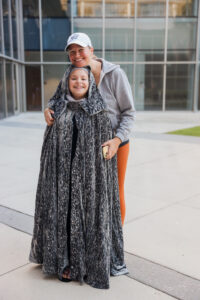
Charlotte (and mom) all dressed up for Halloween
Some of the early advice I received was to join online support forums for muscular dystrophy. We tried them – and maybe you’ve been where I was – but they weren’t what we needed at the time. Charlotte was diagnosed when her tiny little body went rigid with muscle cramps and she spiked a fever. She was admitted to the hospital and a clever geneticist observed her slightly enlarged calves and a CK that never “recovered”. We hadn’t experienced motor impacts and our only connection with the community was the diagnosis that we didn’t yet relate to.
I isolated myself. I am not the most social person to begin with, and I like to process alone – and this was a big, monumental thing to process. Charlotte was only two and a half at the time and our family had just moved to a new state, and we didn’t have roots yet. Isolating was the easiest thing to do. And maybe at the time it was the only thing I could do.
With a diagnosis like Charlotte’s, those roots end up in faraway places. Rare disease means that whatever life’s handbook is, you have to rewrite it. You plant roots in the places where you can both grow.
Learning to live a new normal
We spent a lot of time in denial, convinced that she would be less affected or that any day now there would be a clinical trial. Our denial was punctuated by bouts of rhabdomyolysis. (Rhabdomyolysis is a rapid breakdown of muscle (usually after a traumatic injury or intense exercise) that overwhelms the kidneys and can lead to kidney damage if not treated immediately.) Every time Charlotte got sick, we would pack up a bag for a few days in the hospital and prepare to explain what LGMD2C was and why we knew she had rhabdomyolysis. I remember once I spent months planning a joint birthday party with her best friend. They were turning five. Charlotte had to leave the party early, tears in her eyes after she mysteriously spiked a 104-degree fever. We waited in the ER in her party dress while she shivered in my arms.

Charlotte at MDA camp with her cabin counselors
It became hard to trust the people we should have been able to. Our faith in teachers and school administrators and doctors and nurses was replaced by hypervigilance and oversight. In the second grade, immediately after returning to school post-Covid, Charlotte would come home crying for hours every night, because gym class was too hard. She couldn’t jump on the trampoline and couldn’t roller skate. We asked the school to exempt her from gym class. They told us she was allowed to opt-out of activities but not allowed to leave the class altogether.
Navigating rare disease meant that we felt abandoned by the places where we were supposed to feel the most safe. Nothing was conventional and everything needed a new foundation. The way we learned how the world worked wasn’t reflected in this space and we needed to learn a new paradigm. And this new paradigm meant accepting that our lives would look different. We would need to unlearn what we knew and relearn new ways of interacting with the world.
I tried to protect Charlotte from the knowledge of her disease for a long time. I was struggling to wrap my head around what this diagnosis meant for her life, and I just wanted her to be a kid. I didn’t want her to think about what this might mean for her long term or internalize that she was different.
But she is different. And Charlotte wanted you all to know that this was the hardest part for her, too. That it was so hard for her to understand why she was different from her peers and why this disease happened to her. And looking back, she felt too young to understand but didn’t have a choice. She wishes she had more time with her muscles to be a kid; she doesn’t mind being disabled, but she doesn’t ever want to lose her independence.
Why am I sharing my thoughts like this?
Because navigating a rare disease diagnosis isn’t linear. There isn’t just one story to tell of how we went from the shock of the diagnosis in that doctor’s office in January of 2017 to organizing across the spectrum of Sarcoglycanopathies to help our children. It’s 1,000 little moments and small lessons that slowly build you into a new human. Just like new parents spend their children’s whole childhood learning how to parent, reflecting back on those years knowing that the lessons they learned were cumulative and hard won. The same is true for navigating a rare disease.
Saying yes
So, the meandering path to tell you about navigating a rare disease diagnosis was to tell you why I am saying “yes”. Because the most important things I learned were the things I never expected.
That one day, a girl named Blythe would text me and say that she also had LGMD2C and if Charlotte ever wanted to talk to her, that would be ok. She would go on to tell Charlotte that a silver lining of this disease is you always know who your friends are. I needed to hear that, too.
And that MDA Summer Camp would give Charlotte a sense of belonging that we had looked for in every corner of our lives but only found when she could be surrounded by kids that have lived the same experiences as her and where her disability didn’t mean she was singled out.
And that the Dion family would reach out to me to work together to take charge of how to get clinical trials to patient groups. And not only would they launch the first clinical trial for LGMD2C in the United States, but I’d get to work with them to help keep it going.

Charlotte at the aquarium
The nature of rare disease is that you won’t always find people with the same diagnosis near you, so maybe you’ll make friends with a mom whose child survived cancer and she will be one of the people in your life that you relate to most.
Finding a medical team that aligns with the goals you have for your child or that knows their diagnosis intimately is vital. You’ll form closer bonds with them than most people do with their physician’s office. They’ll get to know you and that’s important. A deep trust between your family and your specialists will help you ask questions without fear and make decisions with confidence.
You’re living life for the first time with a wrinkle that means many people in your life will not have any context for. There isn’t one right way to navigate this, but I can say from experience that isolation is one of the wrong ways – I learned the hard way – and maybe that’s just part of the process. You might need to go down a lot of paths to find the right one, but you can only do that if you say “yes” to something new.
The post MDA Ambassador Guest Blog: The Secret to Navigating Life with a Rare Disease? Say Yes. appeared first on Quest | Muscular Dystrophy Association.
]]>The post Everything You Need to Know About the Upcoming 2026 MDA Clinical & Scientific Conference appeared first on Quest | Muscular Dystrophy Association.
]]>“The 2026 MDA Clinical & Scientific Conference reflects the remarkable momentum of our field as treatments for neuromuscular diseases rapidly advance. Almost every major breakthrough in research, care, and treatment has roots in the connections and collaborations formed at this conference,” says Sharon Hesterlee, PhD, President and CEO, Muscular Dystrophy Association. “This year’s agenda highlights the innovation driving us forward—from gene therapies and disease-modifying drugs to transformative approaches in clinical care. The breadth of expertise represented by our session chairs and speakers underscores Muscular Dystrophy Association’s role as the central convener of the global neuromuscular community, bringing together the very leaders who are shaping the future of this field.”
Keynote Speaker: John F. Crowley
This year’s keynote presentation will be delivered by John F. Crowley, President and CEO of the Biotechnology Innovation Organization (BIO). His keynote, “Driving the Future of Innovation, Policy, and Patient Impact,” will explore how patient-driven advocacy, biotechnology entrepreneurship, and emerging technologies are transforming the landscape of medical research and care. He will highlight the vital role of organizations like Muscular Dystrophy Association and BIO in building a robust ecosystem that empowers early diagnosis, fosters equitable access, and accelerates the development of transformative therapies for rare and neuromuscular diseases.
“We are living in an extraordinary era for biotechnology—one where innovation, data-driven insights, and patient partnerships are transforming what’s possible for people living with rare diseases,” John says. “For 75 years, the Muscular Dystrophy Association has embodied that spirit, fueling discovery, accelerating new therapies, and uniting a global community of scientists, clinicians, affiliated healthcare providers, advocates, and families. I am honored to be part of this important conference and look forward to a lively gathering that deepens relationships, moves science forward and builds the types of partnerships that will transform the standard of care for patients around the world.”
Conference Agenda
Conference programming boasts seven tracks with multiple, topic-specific presentations from expert chairs. Planned tracks include:
- Allied Health
- Amyotrophic Lateral Sclerosis (ALS)
- Care Trends
- Disease Mechanism & Therapeutic Strategy
- Drug Development Considerations
- Lab to Life
- Neurology
You can view the full agenda and session topics online here.
Collective advocacy through the NeuroMuscular Advocacy Collaborative (NMAC) at Conference
Alongside the scientific sessions and research updates, an equally powerful convening takes place: the annual meeting of the NeuroMuscular Advocacy Collaborative (NMAC). This gathering unites more than 30 patient advocacy organizations to align on shared policy priorities and strengthen the collective voice of the neuromuscular community.
Conference registration
The conference will be held March 8-11 in Orlando, Florida. Detailed information about the conference and registration can be found here.
Members of the neuromuscular disease community registered with MDA are welcome to participate in the virtual conference at no cost or attend in person at a discounted rate offered for patients, caregivers, and MDA volunteers until allotted spaces are filled. People living with neuromuscular conditions and their families interested in attending virtually or in-person, please complete this form prior to registration. Once verified by MDA, individuals will receive a separate email containing a registration link for the 2026 MDA Clinical & Scientific Conference.
The post Everything You Need to Know About the Upcoming 2026 MDA Clinical & Scientific Conference appeared first on Quest | Muscular Dystrophy Association.
]]>The post MDA Ambassador Guest Blog: Grateful for the One by My Side on Valentine’s Day (and Every Day) appeared first on Quest | Muscular Dystrophy Association.
]]>
Me and the girl in the white leather jacket.
In May of 1981, I met the love of my life, Christine Maria Humrich. As is typical with most great stories of enduring romance, ours started in a bar. Daddy More Bucks was its name, on Old Highway 66 in Flagstaff, AZ. It was across the road from Andy Womack’s Pink Flamingo Motel (painted pink as pepto-bismol), where I was held up for a week or so while waiting for the dorms at North Arizona Univeristy (NAU) to open for the summer semester.
The Thursday night DJ at Daddy More Bucks offered up a mixture of new wave and punk hits of the time, which drew a lot of locals and NAU students out for the evening to pack the large, accommodating dance floor. Showing up strictly as an observer on a few of those Thursday nights, I repeatedly started to notice one young lady in particular. She wore a white leather jacket, had short, cropped black hair with a blue streak running through it, and (more so than anyone else out there) could truly dance to the music being played. I became infatuated.

Goofing around at Camp Rainbow Gold’s summer oncology camp for teens.
I suppose I should point out here that I moved to Flagstaff from Boston, and apparently (at least according to the locals) had a bit of a thick accent. So as the story goes, after a couple of times watching the girl in the white leather jacket dance, I got up the nerve to ask her onto the floor. She was standing with two friends when I approached her, and being the helpless romantic that I am, simply said: “Pardon me, my name is Jeff Thomas, and I just requested ‘I Want to be Sedated’ by the Ramones. Will you please dance with me?” (Now keep in mind here that I was a ‘chowdah-head’ and fresh off the boat from Bean Town, so difficulty in translation inevitably ensued.) All three of them began laughing hysterically. Then, while looking at me with a combination of confusion and amusement, she sarcastically asked me (and I quote), “WTF did you just say to me?”

Starting 2026 off right!
Although my confidence was shaken and I started to seize up inside, I didn’t flinch and calmly repeated myself. She laughed again, thought a moment while smiling, then sweetly replied, “Sure, why not?”
Almost 44 years later she still laughs at me and still questions just what it is that I’m trying to say to her. Most importantly, though, despite the fact I can no longer get out on the floor, she’s still the only one I would ever want to dance with.
I share this somewhat comical love story as encouragement to others to always remember to show the ones we love the appreciation that they justly deserve. I think that appreciation is especially valuable for partners of those living with neuromuscular disease. Christine endures the emotional and sometimes physical challenges of witnessing my disease progression, and she does it all with an endless supply of grace. Her love and support remain a constant in my life – helping me through every step of the journey. And I want her to always know just how much I appreciate having her by my side. I love her more than anything and her love adds light and joy to my life. Though I’m confident that I could live without seeing, swallowing, or walking, I know that I couldn’t live without her.

Spending time with family at our nephew Max’s graduation from NAU in Flagstaff (my alma matta!)
So, in honor of Cupid’s Holiday, I encourage all of us, no matter what the situation, to never cease showing appreciation for the ones who are always there to provide the love and support we need to make it through. The journey for those of us living with NMD is not an easy one. Nor is it easy for the ones who have chosen to stay beside us on this uneasy sojourn. What a wonderful time to let them know how loved they are.
Happy Valentine’s Day.
JT
The post MDA Ambassador Guest Blog: Grateful for the One by My Side on Valentine’s Day (and Every Day) appeared first on Quest | Muscular Dystrophy Association.
]]>The post Recent Updates with Section 504 appeared first on Quest | Muscular Dystrophy Association.
]]>This is a new iteration of the lawsuit Texas v. Kennedy, formerly Texas v. Becerra, in which the states argued that 2024 updates (described in Quest blog linked below) to Section 504 are unconstitutional. While some of the original states have withdrawn their claim, the remaining states – Texas, Alaska, Florida, Indiana, Kansas, Louisiana, Missouri, Montana, and South Dakota – continue to challenge the rule.
The Health and Human Services (HHS) rule at the heart of the action requires states and local governments, and any entity receiving HHS dollars, to serve people with disabilities in the most integrated setting appropriate, and that entities risk violation of Section 504 when people with disabilities are placed at risk of unnecessary institutionalization.
The revised complaint requests that the Court declare all of the Section 504 rule unlawful; prevent HHS from enforcing the rule in its entirety; and prevent HHS from requiring states to not take actions that lead to a serious risk of institutionalization for people with disabilities. If successful, it could make it harder for members of the neuromuscular community with disabilities to enforce their right to live in the community, not in isolating long-term care facilities, and receive equitable access to care and services.
Also, because Section 504 is incorporated into nondiscrimination provisions of federal law, this decision may have far reaching consequences such as limiting access to robust ACA plans or limiting accessibility standards in private healthcare settings. This is at odds with MDA’s mission, which is to empower people affected by neuromuscular conditions to live longer, more independent lives.
MDA continues to actively monitor the legal landscape and anticipates further developments to come as briefing continues. In late January, MDA submitted comments to the Department of Health and Human Services urging the Department not to repeal the expansion of nondiscrimination updates in the 2024 Final Rule, which Quest initially wrote about here.
Sign up for MDA’s Action Network to stay up to date on the latest news and for opportunities to take action.
The post Recent Updates with Section 504 appeared first on Quest | Muscular Dystrophy Association.
]]>The post International Day of Women and Girls in Science: MDA Spotlight on Elizabeth Madole appeared first on Quest | Muscular Dystrophy Association.
]]>
Elizabeth Madole at the 2025 MDA Clinical & Scientific Conference in Dallas, TX.
At only 12 years old, Elizabeth is already making her mark on scientific research through her collaboration on a case-based physiological study on respiratory aspects of neuromuscular disease and co-authoring of a scientific abstract to share those findings. Diagnosed with AChR antibody–positive generalized myasthenia gravis herself, the California native is motivated by her own patient experiences, the support of incredible mentors, and a deep desire to make a positive impact on patient treatment and outcomes.
Elizabeth has traveled to numerous scientific conferences, including the MDA Neuromuscular Symposium in Dallas (2025) and the Stanford Neuromuscular Symposium (2025). She recently spoke on a patient panel at UCSF, where she shared her experience living with neuromuscular disease and her treatment journey with an audience of more than 150 medical students. This March, she will be attending the MDA Scientific Conference in Orlando, FL, where she will present an abstract and poster, as a co-author with her neurologist, about respiratory monitoring in myasthenia gravis.
We checked in with Elizabeth to learn more about her journey, research, personal motivation, and her dreams for the future.
When did you first become interested in participating in medical research and why?
I think I have always been interested in medicine, but I didn’t always know what that interest would turn into. As I got older and lived longer with myasthenia gravis, I started to realize that many of the tools that doctors typically rely on don’t always show how sick someone with a neuromuscular disease can actually be. I could feel my breathing getting weaker, but things like oxygen saturation still looked “normal.”
There were times when I was in respiratory failure, even on maximum non-invasive ventilation, with abnormal blood gases showing that I was still hypercarbic (which means that my body couldn’t blow off carbon dioxide the way that it needed to). And the numbers that doctors usually rely on (oxygen sats) didn’t reflect how severe my exacerbation was – and, unless you are in the ICU, blood gasses aren’t done all the time. That made me start wondering if there was a better, more objective way to understand what was really happening.
That curiosity is what pulled me toward medical research. I want to help find better ways to measure and recognize what patients are experiencing so treatment can happen earlier and more safely.
You are currently collaborating with a physician on a case-based physiological study on respiratory aspects of neuromuscular disease. What does that entail?
I am working with my neurologist, Dr. Alex Fay, MD, PhD, who is part of the team at the MDA Care Center at UCSF Benioff Children’s Hospital. He is the best doctor in the world. He is very influential in neuromuscular medicine, but what matters most to me is how much he truly cares about his patients. No matter how busy he is, he always finds time and he always shows up. He always lets me ask questions and makes me feel like this research matters, even though I’m young.

Elizabeth with Dr. Alex Fay, MD, PhD, in 2022, at her first MG Foundation of America Conference.
Our study uses AVAPS ventilator data to better understand respiratory muscle weakness and response to treatment in myasthenia gravis in an effort-independent way. (AVAPS stands for Average Volume-Assured Pressure Support. It is a mode on a noninvasive ventilator that uses an algorithm to automatically adjust the amount of pressure support it provides.) In our study, we look at measurements like peak inspiratory pressure (PIP), minute ventilation (MV), spontaneous breaths, negative inspiratory force (NIF), and MG-ADL to see how breathing and weakness change during flares and how they improve with treatment.
How did you become involved in the study?
Dr. Fay and I both noticed patterns in my ventilator data during times when my breathing and weakness got worse. It happened every flare. One day he showed me a graph that he had made, and I pulled out my laptop and showed him that I had made almost the exact same graph. In that moment, I remember thinking it was really cool that I had done the same thing as Dr. Fay with my data. It made me realize that I must have been on the right track and that what I was seeing was important.
We decided that day that we should write an abstract together, and that’s where it began.
What does the study aim to achieve?
The goal of the study is to show that ventilator data can provide a continuous, effort-independent way to measure breathing strength and response to treatment in myasthenia gravis. Right now, most of the tools that doctors use depend on how hard a patient tries, which isn’t always reliable.
By using AVAPS data, we hope to give doctors a more objective way to understand what is really happening with a patient’s breathing so treatment decisions can be made earlier. I hope it helps make care safer and more objective for MG patients and maybe even people with other neuromuscular diseases too.
What has your role been like?
It’s been fun and challenging. I’ve had to learn a lot of new things and also learn how to separate my emotions from the data, which was kind of hard to do at first. I help gather and analyze data, talk through the results with Dr. Fay, and learn what really goes into doing research. I’ve also gotten to talk about this work with neurologists from many different institutions. Being part of this gives me a real sense of purpose.
I’ve also always noticed patterns and connections, even when I was little. My brain just likes to organize things and see how they change over time, and it turns out that’s really helpful in science, which is probably why I noticed what I did.
So far, what has been the most rewarding part?

Elizabeth and Dr. Alex Fay, MD, PhD, at a 2025 MDA Symposium at Stanford University.
I would say having the chance to make a meaningful difference and knowing that this research could actually help someone else. If it helps a patient or their doctors recognize what’s going on sooner and start treatment earlier so things don’t become life-threatening. That would make this work completely worth it. Being really sick or ending up in the ICU is not fun at all, so if this research can help prevent that, that would be amazing.
I also love learning new things and realizing that I can do more than I ever thought I could. It feels good to know that something I went through can turn into something that helps other people.
What are you most excited about in the current research and treatment landscape?
Well, lots of things are exciting! Like, how targeted treatments are becoming and how fast science is moving to make new medications. I hope more of them can be used in kids and that insurance is less of a problem one day. Every conference I go to gives me more hope.
I also believe there will be a cure for myasthenia gravis one day, and hopefully for all neuromuscular diseases. My mom has taught me that hope is important, because hope is what keeps you from giving up, even when things get hard.
It’s also kind of fun learning how to say all the medication names, like eculizumab, ravulizumab, rituximab, obinutuzumab, daratumumab, and nipocalimab. There are even more that I’m still practicing and learning about. Sometimes people think it sounds like another language when I say them, which makes me laugh. The fact that so many treatments already exist, and that even more are being studied right now, is really exciting.
Why do you want to become a doctor?
I’ve wanted to be a doctor for as long as I can remember. I even dressed up as one every year on Career Day when I was little!
But living with a serious illness showed me what that dream really means. I’ve seen how much it matters when a doctor listens, believes you, and doesn’t give up on you. I want to use science and my own experiences to help patients feel seen, believed, and have access to treatment that makes them better in the same way my doctors have done for me.

Five-year-old Elizabeth dressed as a doctor for Simpson University’s Career Day.
What specialty do you plan to pursue?
I plan to go into pediatric neurology. I want to become a neuromuscular doctor just like Dr. Fay, and I’m also very interested in research. I’m excited for the day that I get to put on my white coat and help kids like me. I hope all the people who have been part of my journey, and who helped me believe I can do this, will be there that day.
How will living with a neuromuscular disease make you a better doctor?
Living with a neuromuscular disease has taught me more than I could ever learn from a textbook. It has shown me how important it is to listen and really see the patient, not just the labs. It has helped me understand how illness affects everyday life, and that having a disease doesn’t make life less, it just makes it different.
When I was seven years old, I didn’t care what my diagnosis was called. I could barely even pronounce it at first. What I did know was that I could barely sit up, I choked when I tried to drink water, my vision was blurry, and I couldn’t even play at the park anymore because my arms and legs were so weak and tired. What I wanted was a doctor who would help me get better and never give up on me.
I think that’s what every person sitting in front of a doctor really wants. They don’t just want a name for what’s happening, but someone who is willing to fight for them. I want to be that doctor for my patients one day.
Living through what I have lived through will help me treat the person in front of me because I know that behind every chart, every test, and every lab is a real person who just wants to be heard, understood, and to feel better.
I also want to bake cookies for my patients during the holidays so they know I see them as a person, not just a patient. My neurologist did this for me, his other patients, and his staff, and it has always meant so much to me. Sometimes it’s the little things that matter the most.
Do you have mentors or role models who have encouraged you?
Of course, I have so many but here are a few that stand out.
Dr. Alex Fay, MD, PhD has been my biggest role model and mentor. He has always believed in me, even before I knew how to believe in myself. He reminds me that I am capable and that I can make a difference, even when things feel really hard. Somehow, he has always helped me stay positive. He taught me how to write a scientific abstract step by step, and how to think about data in a real and honest way. It’s not something that has to be perfect, but something that tells a story about what is actually happening to a patient. He showed me that the patterns I noticed were real, and that they could matter in ways that might change how doctors take care of people. I have learned so much from him, not just about science, but about what it means to truly care for patients. He is thoughtful, kind, and never gives up on you. I look up to him more than I can explain, and I hope that one day I can be even a little bit like the doctor he is.

Elizabeth with Dr. Michele Long, MD.
Another doctor who has made a huge impact in my life is Dr. Michele Long, MD (UCSF). She is one of my favorite people. She is silly, energetic, and very direct. She tells you how it is, but at the same time reminds you that you can do hard things. She is the kind of person who will get her shift covered just to show up across the city to watch me speak to a room full of medical students or be the first one jumping up and down when she hears I’m writing a scientific abstract. She even wore my Halloween costume for me one year when I was too weak to put it on. I don’t think she will ever really know how much her support means to me or how much she has shaped the kind of doctor I want to become, even if I might never have as much energy as she does. She has taught me that having a diagnosis doesn’t define what I can do in life; it’s about what I do with what I’m given.
Along my journey, I also met Dr. Remu, a resident at UCSF who focuses on genetics. He has his own medical condition, so he really understands what it’s like to go through hard things. When I talk to him, I never feel alone because he just gets it. He also talks with me about normal life, like hockey and traveling, not just medicine, and that means a lot. He shows me that it’s okay to be human with your patients, not just their doctor. Because of him, I know that my own journey will help me connect with my future patients in a real way, and that’s exactly the kind of doctor I want to be.

Elizabeth studying with Ms. Erika during one of her treatment cycles.
From the beginning, I’ve also been lucky to have mentors who aren’t doctors, but who have shaped me just as much. Ms. Erika is my hospital schoolteacher at UCSF and is one of my biggest inspirations. Ms. Erika works through UCSF Benioff Children’s Hospital and connects with my home district to keep me on track with schoolwork during admissions, infusions, and long hospital stays. She has been my hospital teacher since I was seven years old and one of my biggest supporters. She cheers me on whether I’m working on a scientific abstract or beating my Wordle streak. I actually think she would sometimes prefer that I skip my afternoon math lesson and get ice cream with a friend. She reminds me to be a kid, which is something I really need sometimes. When I’m sick, she makes me feel like that’s okay too, and that it’s okay to put my books down and rest. She makes me believe I can accomplish anything I dream of. She didn’t just help me with school; she helped me become confident in who I am. I couldn’t imagine having a better teacher, mentor, or friend.
You have also attended MDA Summer Camp over the years. How has your experience at Camp shaped you or helped you grow?
At Camp you see how much people care, like really care, about each other in a way that’s hard to explain unless you’ve been there. It allows you independence, helps your confidence grow, and provides space to just be yourself. At camp everyone understands what it’s like to live in a body that doesn’t always do what you want it to do. You are just simply understood there. It’s a feeling that’s hard to find anywhere else.
My weeks at camp have helped me realize just how capable I am. It’s the only place I’ve ever been where I’ve felt that kind of connection. It is truly the best week of my life every single year.

Elizabeth and her sister, Charlotte, with counselors at MDA Summer Camp.
Why do you think women make great STEM professionals?
Women bring perspective. Doctors like Dr. Alice Chan and Dr. Long inspire me because they are smart, strong, and compassionate. They care about the science, but they also care about the people, and that really matters. I remember when I was really sick a couple of years ago and scared to get a line placed in my neck, Dr. Chan called me just to help me feel less afraid. I can’t really explain her empathy in words, but that day she made me feel okay.
Women notice details, ask important questions, and bring empathy into everything they do, including science. When you see problems from different perspectives, science becomes better. My own perspective is different too, and I think that makes science stronger. Women belong in every part of STEM.
What advice would you give to other young women in STEM?
Don’t let anyone tell you that you don’t belong or that you are limited in any way. I promise you can do anything you dream of doing. Don’t let people make you feel like you’re too young, or even too old. Ask questions. Follow your curiosity. Your experiences matter.
Also, be okay when your interests change or grow, just like mine did. I always knew I wanted to be in medicine, but I didn’t know what that would look like, and now I do. STEM is kind of the same way. Science changes every day, and every time it changes, we get one step closer to a cure. And that’s pretty amazing.
The post International Day of Women and Girls in Science: MDA Spotlight on Elizabeth Madole appeared first on Quest | Muscular Dystrophy Association.
]]>The post In Case You Missed It… appeared first on Quest | Muscular Dystrophy Association.
]]>With so many valuable podcasts, blog articles, and magazine articles available to our audience, chances are that you may have missed one or two pieces of interesting content. Check out the summaries and links below.
In case you missed it… Quest Blogs:
How to Choose a College with a Disability
Along with the basics of finding a good college match — location, affordability, size, academic and cultural fit — students with disabilities must do some extra digging. To choose a college that best fits their needs, students with disabilities should visit college campuses in advance and use these tips to assess their accessibility and inclusiveness. Read more.
What to Know Before You Start Adaptive Driving
For people living with neuromuscular diseases, driving can be more than a convenience — it can be a road to independence. Read expert and community member advice on the steps to take for adaptive driving evaluations, equipment, modifications, and training before you get behind the wheel. Read more.
In case you missed it… Quest Podcast:
Episode 59 – Redesigning the Day: Accessibility and Mindset Life Hacks with Jax Cowles
In this Quest Podcast episode, we chat with public speaker, consultant, and disability advocate, Jax Cowles. Jax shares an honest, thoughtful, and deeply creative conversation about daily life, independence, and problem-solving. She opens up about how creativity and “life hacking” became essential tools rather than optional skills, and how small, low-cost adaptations can completely transform everyday tasks. Jax shares her experiences, expertise, and advice when it comes to practical insight, encouragement, and a refreshing perspective on living creatively and fully—exactly as you are. Listen here.
In case you missed it… Quest Magazine Featured Content, Issue 4 2025:
The Hidden Power of Self-Care in Caregiving
Caregivers often give so much of themselves that sometimes their own needs fade into the background. Yet the stories shared here reveal a powerful truth: Caring for yourself is not selfish — it’s essential. Four family caregivers candidly share the everyday ways they incorporate self-care into their lives, so they can continue to give their best to their loved ones. Read more here.
The post In Case You Missed It… appeared first on Quest | Muscular Dystrophy Association.
]]>The post Our 2026 Advocacy Agenda appeared first on Quest | Muscular Dystrophy Association.
]]>Celebrating early victories on previous priorities
2026 got off to a quick start as MDA and its advocates worked hard to pass the following priorities. Included in a bill that passed earlier in February were:
- $48.7 billion National Institutes of Health (NIH) funding – In addition, the bill included language limiting bureaucratic interference at the NIH.
- The Accelerating Kids’ Access to Care Act – This bill will make it easier for children living with neuromuscular diseases to access out-of-state care without unnecessary delays.
- Rare Pediatric Disease Priority Review Voucher Program reauthorization – Extending this program will encourage the development of life-changing treatments for rare pediatric diseases, including neuromuscular diseases.
Continuing to protect the community’s access to vital medical care
We expect to continue to see proposed changes to the nation’s health care system that could negatively affect the neuromuscular community. MDA and its advocates will continue to defend vital programs.
- Effects of 2025 Medicaid legislation – Last year, Congress passed many changes to Medicaid that will make accessing vital care more burdensome and even eliminate important benefits that are important for those who rely on the program. As decision-makers work to implement these changes, MDA and its advocates will continue to fight for ways to ensure the neuromuscular community can continue to receive vital Medicaid benefits.
- Enhanced advanced premium tax credits – These vital tax credits that help people afford insurance on the Affordable Care Act Marketplace expired in 2025. MDA will continue to push for reauthorization to ensure people can access vital insurance coverage.
Empowerment and increasing access in 2026
MDA and its advocates will work with decision makers at the federal level to improve care and support policies that will empower the neuromuscular community, including:
- Fully supporting caregivers by passing legislation that removes hurdles in accessing vital assistance and advocate for measures that promote financial support.
- Continuing to improve air travel for the disability community by ensuring full implementation of the 2024 FAA Reauthorization Act and robust enforcement of previous Department of Transportation regulations.
- Supporting policies that ensure those with disabilities can access quality education.
Over the next twelve months, MDA and advocates will be advocating for ways to improve access to treatments and therapies, including:
- Reauthorizing the ACT for ALS, which will accelerate access to much-needed therapies for the amyotrophic lateral sclerosis (ALS) and neuromuscular disease communities.
- Laying the groundwork for FDA user fee agreements, which must be passed by Congress in 2027. This is an opportunity to continue to reform how FDA does its work to ensure we can get much needed therapies to the NMD quicker.
- Expanding access to genetic testing and counseling, multi-disciplinary care, wheelchair repair, gene therapies, home and community-based services, and more.
Ensuring Everyone Can Vote
In 2026, the country will make their voices heard in midterm elections. However, we know that casting a ballot can be challenging for those living with a disability. This year, MDA will continue to provide resources and information so that our community can truly access the vote.
MDA and its advocates are ready to go, but we need your help, We need as many people speaking up as possible and raising their voices. Sign up today and make sure key decision-makers hear your voice!
The post Our 2026 Advocacy Agenda appeared first on Quest | Muscular Dystrophy Association.
]]>The post MDA Ambassador Guest Blog: Pursuing My Dreams While Living with a Rare Disease appeared first on Quest | Muscular Dystrophy Association.
]]>Living with a rare disease, I learned early on that I wouldn’t just have to fight against my own body, but against the world I live in, too. As a Black disabled woman in America, that fight extends far beyond my diagnosis. It shows up in the systems not made for people like me that I have to navigate and in the assumptions people make about my worth and ability. But within that reality, resilience wasn’t something I discovered by accident or in spite of my circumstances – it was something I developed because of them. Navigating healthcare systems, inaccessible spaces, and rigid stereotypes forced me to learn perseverance early, shaping how I move through the world and pursue my goals with intention, determination, and strength.
Persevering with intention

Gabrielle on a plane as she prepared to go skydiving, a dream she had since she was 10 years old.
Pursuing my education and career has never been just about talent or motivation; it has required constant recalibration. Living with a rare disease means my capacity isn’t fixed; it changes day to day, sometimes hour to hour. Deadlines don’t pause for my chronic pain and academic or professional spaces rarely account for bodies that need flexibility to function. I’ve had to learn how to plan further ahead, advocate more clearly, and push back against systems that equate worth with constant productivity. The cost of ambition, for me, often looks like exhaustion that others don’t see, extra time spent explaining my needs, and the emotional labor of proving, over and over, that my disability doesn’t negate my work. It’s through navigating these challenges that I’ve learned how to persevere with intention, finding ways to keep moving forward without abandoning myself in the process.
One of the most persistent misunderstandings about ambition and disability is the belief that determination should look the same for everyone. In academic spaces, this often shows up as rigid expectations that leave little room for adaptation, even when those expectations actively exclude disabled students. When accommodations are treated as exceptions rather than necessities, disabled ambition is framed as a problem to be solved instead of a reality to be supported.
I encountered this mindset firsthand during my undergraduate studies as a music therapy major, a field that allowed me to integrate two things I’ve always loved: psychology and music. Music has been a part of my life for as long as I can remember. My mom says I was singing before I could talk, and I saw music therapy as a meaningful way to connect with others. That path began to unravel in guitar class. Because my disability causes muscle weakness, pressing down on the strings of an acoustic guitar with enough force to produce sound was physically difficult, and the instrument itself was larger than my body. As my video assignment grades declined, the impact of my disability became increasingly visible. Still, when I explained my limitations, my professor insisted that I prove my disability was the reason I could not perform. After escalating the issue to the department head, I was offered a digital guitar as an accommodation. When I brought it to class, the professor refused to allow its use, citing a syllabus requirement that only acoustic guitars were permitted. In that moment, it became clear that the issue was not my willingness to work or adapt, but an unwillingness to recognize that success might look different for me. The stress of watching my grades fall, and fearing the loss of my scholarship, took a serious toll on my mental health, leading me to seek emergency counseling on campus.
Redefining resilience and redirecting your path

Gabrielle joyously celebrating at her graduation from the University of Louisville in May of 2024.
I eventually changed my major and had to come to terms with the fact that this was not a failure of ambition or giving up, but an act of perseverance and self-respect. That experience forced me to redefine perseverance, teaching me that resilience does not always mean pushing through harm at all costs. Sometimes, it means redirecting your path while holding onto your purpose. I went on to graduate with a degree in psychology and a minor in music, carrying forward the parts of myself that mattered most, even when the original path was no longer accessible.
I am now pursuing a master’s degree in counseling, a field that allows me to integrate my passions for psychology and music while helping others navigate the challenges that often feel invisible to the world. My path has not been linear, and it has required recalibrating my goals, navigating unwelcoming systems, and redefining what success looks like on my own terms. Yet these obstacles have not diminished me or my determination, they have sharpened it, teaching me perseverance that is intentional, embodied, and rooted in the realities of my life. Living with a rare disease has not only shaped the ways I persist, it has given me the resilience to pursue my dreams fully, in ways that are authentic to who I am.
The post MDA Ambassador Guest Blog: Pursuing My Dreams While Living with a Rare Disease appeared first on Quest | Muscular Dystrophy Association.
]]>The post Simply Stated: Understanding Myotonia Congenita appeared first on Quest | Muscular Dystrophy Association.
]]>Symptoms and subtypes of myotonia congenita
Most people with MC begin experiencing muscle stiffness in early childhood, although onset may occur later in some cases. This stiffness can affect many parts of the body, including the face, tongue, and eyelids, hands and feet, and the arms and legs. People with MC often have enlarged (hypertrophic) muscles, but stiffness in these muscles leads to problems with coordination, quick movements, and the ability to relax muscles after use. Affected people may have trouble releasing their grip after a handshake, closing or opening their eyes, or walking smoothly. Many experience weakness specifically when starting a movement.
The symptoms of MC often worsen in cold temperatures. Repeated movements, however, typically improve muscle stiffness caused by MC; this is known as the warm-up phenomenon. While MC is a lifelong condition, it is usually non-progressive, which means that it does not worsen over time. As a result, many people with MC can adjust to living with this condition and maintain their daily functions long-term.
There are two main forms of MC, Thomsen disease and Becker disease, which differ in inheritance pattern and disease severity. Common features of these forms include the following:
Thomsen disease
- Autosomal dominant inheritance (one mutated gene copy causes the disease)
- Often less severe
- Begins earlier in life
- Does not involve muscle weakness
Becker disease
- Autosomal recessive inheritance (two mutated gene copies cause the disease)
- Often more severe
- Associated with pain, transient weakness, and occasionally, progressive weakness of distal muscles (hands, feet, lower arms/legs)
For more information about myotonia congenita symptoms, as well as diagnostic and management concerns, an overview can be found here.
Cause of MC
MC is caused by mutations in the CLCN1 gene, which encodes the ClC-1 chloride channel in muscle tissues. The condition primarily affects striated muscles, which include the skeletal muscles required for voluntary movements and the cardiac muscles required for pumping blood throughout the body. The ClC-1 chloride channel plays an important role in the ability of muscles to relax after contraction. When the channel does not function properly, muscles have difficulty relaxing, leading to stiffness.
Diagnosis of MC
MC is typically diagnosed using a variety of assessments including a thorough medical and family history, complete clinical examination, electrophysiological testing, and confirmatory genetic testing.
In people with MC, nerve conduction studies (NCS) are usually normal, while electromyography (EMG) shows characteristic signs of delayed muscle relaxation (myotonic discharges). A short exercise test (SET) often shows a brief drop in muscle response after exercise that improves with repeated movements and worsens with cold. Given that similar symptoms can occur in other muscle disorders, such as myotonic dystrophy or sodium channel myotonia, genetic testing is typically used to confirm the diagnosis.
Current management of MC
There are currently no FDA-approved treatments specifically for MC and management focuses on controlling symptoms. Appropriate neuromuscular care is critical in developing a tailored management plan for each affected person.
Some pharmacologic treatments are available to help reduce muscle stiffness and improve function. Sodium channel–blocking medications are the main treatment options. MC therapies include:
- Mexiletine, a sodium channel blocker approved in Europe
- Lamotrigine, a sodium channel blocker that may be used if mexiletine is not effective or tolerated
- Other sodium channel blockers such as ranolazine, carbamazepine, quinine, and phenytoin, which may help select patients
- Acetazolamide, which works by a different method and is an alternative to a sodium channel blocker
It is important to note that these medications can affect heart rhythm and liver or kidney function, so ongoing monitoring and care are essential.
Non-pharmacologic strategies are also important for managing MC. These may include avoiding exposure to cold, keeping muscles warm, using the warm-up phenomenon, and maintaining a regular, moderate exercise schedule. Paying attention to diet, hydration, and lifestyle factors can also help manage symptoms.
Evolving research and treatment landscape
Pre-clinical research into MC is progressing on a several fronts. Researchers continue to identify new MC-causing mutations within the CLCN1 gene. They are also working to figure out how these specific mutations disrupt chloride channels and cause MC symptoms. Other efforts are using induced animal models of MC to study pathways that lead to specific symptoms, such as pain, with the goal of testing future therapies in these models. These and other studies are helping to understand the genetic and physiologic mechanisms that contribute to MC.
Clinical development for MC is still in its infancy. Most current therapies for MC, including mexiletine, lamotrigine, and ranolazine, are used off-label, meaning they are not yet FDA-approved for this purpose. Clinical trials have been completed or are ongoing to confirm their efficacy in people with MC. Furthermore, some studies are exploring the use of exercise interventions to improve symptoms of MC.
To learn more about clinical trial opportunities in MC, visit clinicaltrials.gov and search for the specific disease name (e.g., “myotonia congenita”) in the condition or disease field.
MDA’s work to further cutting-edge IIM research
Since its inception, MDA has invested more than $2.5 million in MC research. Through strategic investments from MDA, partner advocacy groups, and the National Institutes of Health (NIH), MC research is slowly advancing. While new therapies remain a long-term goal, ongoing research efforts offer hope for meaningful advances and improved care for those living with this condition.
MDA’s Resource Center provides support, guidance, and resources for patients and families, including information about myotonia congenita (MC), open clinical trials, and other services. Contact the MDA Resource Center at 1-833-ASK-MDA1 or [email protected].
The post Simply Stated: Understanding Myotonia Congenita appeared first on Quest | Muscular Dystrophy Association.
]]>The post Making the Impossible Possible: One Man’s Journey on the Camino de Santiago de Compostela appeared first on Quest | Muscular Dystrophy Association.
]]>
Kurt Aguilar and his wife, Cathryn Domrose, in Vigo, Spain, before starting on the Camino de Santiago de Compostela. (Photo by Rebecca Taggart)
Every year, hundreds of thousands of people embark on a challenging journey to traverse the Camino de Santiago de Compostela, traveling days and weeks on foot to arrive in Santiago, Spain. The pilgrimage, which consists of multiple trails leading to the burial site of Jesus Christ’s disciple James, serves as a spiritual journey for many. The trek provides the opportunity to challenge oneself while immersed in the beauty of the Spanish countryside and the tranquility of nature. With journeys ranging all the way up to 600 miles long, a variety of routes lead travelers through Spain’s beautiful towns and villages with many rural miles between.
While some portions of the trail include paved roads, large sections of the journey consist of narrow footpaths and uneven terrain. The nature of the journey creates accessibility barriers for people with physical disabilities. As a full-time power wheelchair user, Kurt Aguilar hadn’t considered that completing the Camino was even a possibility for him – until a friend made him realize that it was possible and he learned of a non-profit helping people living with disabilities to do just that.
Making dreams a reality
Kurt, a 72-year-old retired journalist who lives with congenital myopathy, splits most of his time living between San Francisco, California, and Valencia, Spain. When a close friend in Spain, whom he affectionately refers to as a “Camino-nut”, heard about wheelchair users completing the Camino on one of her own treks, she learned that there are organizations helping wheelchair users make the incredible journey.
Kurt did some research and found DisCamino, a non-profit based in Vigo, a port town in western Spain, that is dedicated to assisting travelers with disabilities to travel the Camino. The agency helps to plan the route, coordinate hotel rooms and stopping points in towns along the path, and provides volunteers to travel side-by-side with adventurers with disabilities on the journey, offering hands-on assistance as needed.

Kurt taking photos of the scenery on his journey.
“They have volunteers who will go along with you every step of the way on the Camino” Kurt says. “They’ll transport you, they’ll take your luggage, they’ll do it on your time. And they do all of that and won’t take any money for their services. They are just amazing.”
The organization, founded by a man named Javier Pitillas, started eighteen years ago when Javier met a man who was deaf and blind and wanted to complete a pilgrimage on the Camino. Javier learned to communicate with him through touch and accompanied him on the journey in order to help the man realize his Camino dreams. By the end of the trip, Javier was inspired to make it his mission to help other people living with disabilities to access the beautiful adventure.
“Since then, DisCamino has taken more than 600 people on over 150 different trips,” Kurt shares. “They’ve assisted people using wheelchairs or adapted tricycles on trips to the top of the two highest peaks in Spain. They did a trek from Rome to Santiago with disabled people and another one that circumnavigated Spain – from Vigo all the way down to the south and then around the country. They do more than just the Camino, they will do whatever someone dreams up.”
An incredible journey
For Kurt, that dream became completing a 12-day, 60-mile trek on the Camino with stops to explore small towns along the way. He and his wife partnered with DisCamino to plan their route and in June of 2025, they embarked on the journey of a lifetime.
“Normally the stages for this Camino are 15 miles each, but most electric wheelchairs can only go about 9 miles on a charge. They had a van that took us to the starting point of the Camino and then the van would pick us up after the 9 miles and take us back to the previous accessible hotel. The next morning, they would drive us to where we stopped off and we would continue that way,” Kurt says. “Every day they had two to three volunteers going along with us. They also gave me lists of hotels to contact because there are not a lot of accessible hotels out there, so they helped us to find towns with accessible hotels and book rooms there.”

Kurt traveling through the rain on the Camino. (Photo by Javier Pitillas)
In addition to his wife and the DisCamino volunteers, another traveler with a disability named Dabiz joined the group on their pilgrimage. Dabiz, a former research scientist living with amyotrophic lateral sclerosis (ALS), is also a disability rights activist. The two men bonded on their journey, overcoming obstacles and barriers, celebrating victories, and soaking in the beauty of the incredible landscape.
The volunteers provided both men with assistance on the trail, walking alongside them and advising of upcoming muddy areas or uneven ground. Dabiz’s full-time assistant walked with him as well. As the two men navigated miles of changing terrain, the volunteers kept a hand on each of their power wheelchairs to help prevent spin-out and positioned themselves on every turn so that they could physically redirect the chairs if needed. When approaching rain culverts, the volunteers determined if the chairs could go over the waterway or not, lifting the front wheels or manually pushing the chairs when needed.
“The most amazing instance of their assistance was when they carried me across a little river,” Kurt shares. “There was a stream that was a couple yards wide, maybe 8-10 feet wide and a foot deep. It didn’t look that terrible, but a power wheelchair can’t get wet so Javier and Dabiz’s assistant did this maneuver that they call the “royal chair”. They put their arms under my thighs and their hands on my back, and I put my arms around their necks and they carried me across the water. There was this little makeshift bridge where my wife and the other volunteers carried my wheelchair across to the other side and the guys redeposited me in the wheelchair. There were hundreds of other things that they did on the journey – watching out for roots in the road, stopping and keeping chair from going too fast down slippery slopes, and stuff like that – every step of the way.”

A scenic view from the Camino.
The group endured rainy days, navigated cobblestone and dirt paths, covering degraded pavement and gravel along portions of the journey – and appreciating sections of paved country road when they encountered it. All along the way, the beauty of Spain captivated the group. In addition to the lasting friendship that Kurt and Dabiz developed over the course of their adventure, the beauty of the landscape was Kurt’s favorite aspect of the incredible trip. From the beautiful gardens accompanying the picturesque homes that they passed on the trail to the tiny wildflowers blanketing rolling fields in a dazzling array of color, immersing himself in the stunning beauty of nature was an experience that Kurt will treasure forever.
“Where we spend most of our time in Spain it is hot and dry,” Kurt says. “But the area along the Camino is so amazingly verdant and has so many flowers. I took this one photo of the landscape, looking through the trees with the mist in the late morning air and the fog burning off and still rolling on the ground. I sent the photo to a friend, and she thought it was AI because she couldn’t believe that anything could be that pretty.”
An opportunity for advocacy
While the terrain proved to be the biggest obstacle on their journey, a barrier they faced entering the town of Santiago provided Dabiz with an opportunity to advocate and educate for accessibility.

Kurt in front of the cathedral in Santiago at the end of the journey.
When the entourage arrived at their destination after twelve days of traveling and visiting small towns along the way, they encountered a large stairway leading to the grand entrance of the town. The top of the stairway offers travelers an incredible view as they enter the town, a breathtaking celebration at the culmination of their arduous journey. However, wheelchair users could not make the grand entry because navigating the large stairway was not an option. They would be forced to go around the side and enter the town through a much less majestic vantage point.
Dabiz learned that, until about fifty years ago, there had been a ramp instead of a stairway but the municipality had wanted to discourage cars from using the ramp so they replaced it with a massive stairway. Irate at the lack of access, Dabiz entered the town and performed a demonstration in the town square, meeting with the Mayor of Santiago and educating others on the importance of access for people living with disabilities. Dabiz’s efforts exemplified the DisCamino motto: Don’t let anyone tell you that you can’t.
A world of possibilities
Kurt’s motivation to embark on the challenging journey was straightforward, a simple reasoning that many able-bodied travelers and adventurers take for granted – he wanted to complete the Camino simply because he could.
“I had never really thought about it until my friend said that people in wheelchairs could do it,” Kurt says of traversing the Camino. “I had never been able to hike or spend a lot of time in nature. Traveling in Spain is great and I can get to many places by train, but I can’t really get out into the little villages with a wheelchair. Just the idea that I could be out and doing this trek that is such a big deal to so many people made me think that I should do it. I have never thought I could do it – but with the help of the volunteers at DisCamino I realized that I could. It really opened my eyes to possibilities.”
At one point on the journey, Kurt expressed a desire to make a donation to DisCamino. Javier graciously informed Kurt that they receive sponsorships and implored Kurt to find a place within his own community that might benefit from his donation instead. The value of the assistance that the volunteers provided Kurt and the pure altruism that the organization demonstrated reinvigorated his faith in others. And the opportunity to complete a pilgrimage that previously seemed inaccessible to him cemented the realization that anything is possible.

Kurt rides a camel in Morocco.
“This really opened my eyes to what possibilities there are even with great limitations,” Kurt says. “Being able to go on the Camino inspired me to take another leap and go on a trip to Morocco. I was even able to get on a camel and sit on it! I connected with an organization that does wheelchair accessible Moroccan tours. They designed an accessible seat with a four-point seatbelt so that you can ride a camel. A year ago, I would never have even thought of considering riding a camel in Morocco.”
For Kurt, DisCamino made the impossible possible and opened a world of possibilities. He wants others living with disabilities to know that when it comes to seeking new experiences and adventures – nothing is impossible.
The post Making the Impossible Possible: One Man’s Journey on the Camino de Santiago de Compostela appeared first on Quest | Muscular Dystrophy Association.
]]>The post What’s Ahead for Your 2026 National Ambassador appeared first on Quest | Muscular Dystrophy Association.
]]>
MDA’s 2026 National Ambassador Lily Sander
Lily Sander, an 18-year-old living with Charcot-Marie-Tooth disease (CMT) has already made an undeniable impact, dedicating her time and talents to valuable advocacy efforts and sharing her story and personal life lessons as a 2025 National Ambassador. Lily raised her voice and shared her expertise at conferences, advocacy events, and community events across the country in 2025. She offered intimate insights and advice in her Quest Blog series Life with Lily, sharing her perspectives on the power of representation, the importance of accessing education, advice to parents, and her unwavering passion for advocating for disability rights. As the year drew to a close, Lily and fellow 2025 National Ambassador Ira Walker joined the Quest Podcast to share their experiences and reflections on a monumental year.
Now, as she gears up to embark on her second year in this role as the 2026 MDA National Ambassador, Lily is poised to continue her journey of advocacy, connection, and community leadership. Throughout the year, she will continue to speak on behalf of MDA, meeting and connecting with families, advocates, and supporters while amplifying the stories of people living with neuromuscular disease.
“I’m incredibly honored to continue as the MDA National Ambassador for a second year,” Lily says. “As I get ready to head to college in the fall, advocacy and policy work have become an even bigger part of my life — because I want the next generation of students with neuromuscular conditions to have the access, support, and independence they deserve. I’m excited to keep using my voice to make change and to represent this community that has given me so much.”
We checked in with Lily to learn more about what being a National Ambassador means to her – and what’s in store for the year ahead.
As you continue your role as National Ambassador in 2026, what is the biggest change you hope to help drive for the neuromuscular community?
As I continue my journey in 2026, my primary focus is to advance MDA’s mission of fostering longer, more independent lives for our community. I am particularly driven to empower the next generation of advocates, ensuring young people have the tools and confidence to lead. I am inspired every day by the brilliance and beauty of the neuromuscular disease community, and I hope to empower others to lead with the same authenticity and strength that this community has so generously taught me.
What was the most memorable or impactful moment being an ambassador this past year?
The most impactful part of this year wasn’t a single moment, but the cumulative power of every conversation and connection I’ve made. There is a profound, healing energy in simply being in each other’s presence; realizing that this connection is happening on such a large scale has been the most transformative experience of my year as National Ambassador.
How has living with CMT shaped the kind of advocate you want to be? Was there a moment when you realized you were making a real difference?

Lily advocating for disability rights at the U.S. Capitol
CMT has given me a front-row seat to the challenges of accessibility and the importance of research, shaping me into an advocate who leads with lived experience and an intimate understanding of the struggles of those in the neuromuscular community. Having this deep understanding allows me to more effectively advocate for the change I’d like to see for those living with neuromuscular disease. I realized I was making a real difference, not in one grand moment, but through the quiet, consistent connections made with community members. When someone reaches out to say that seeing my journey helped them feel less alone or more understood, I know that my work is creating the community and healing we all deserve.
When you imagine the future of disability rights, what does success look like to you?
Success looks like a future with groundbreaking medical treatments and cures, paired with a society that truly understands and embraces disability. It looks like universal accessibility and the creation of a world where every individual is empowered to live their life fully, authentically, and without barriers.
As a young advocate, what do you think your generation brings to disability and health equity conversations that others may have missed?
My generation brings a raw authenticity and vulnerability that hasn’t always been present in advocacy. By “pulling back the curtain” on our daily lives and experiences with neuromuscular disease through social media, we’ve moved beyond the status quo to share the real-life human experience. We are masterfully using digital platforms and unique candor to fundraise, build connections, and ensure that our stories are truly understood on our own terms.
For other youth who want to begin their own advocacy journey, what is a good first step if they don’t know where to begin?
The best way to start is to dive in and find your community. Sign up as an MDA Ambassador to connect with a community of like-minded community members. From there, stay active by engaging with blogs and webinars, attending local events, and using your social media platform to amplify our mission; your voice is more powerful than you think!
What issue facing the NMD community feels the most urgent to you right now?
Medicaid and NIH funding are vital to the neuromuscular disease community, providing the essential coverage and research needed to sustain our lives. Medicaid ensures we have access to the daily care and specialized equipment we deserve, while NIH funding drives the medical breakthroughs and treatments that offer hope for the future. Protecting these vital resources is not just a policy issue; it’s about ensuring we can live with the dignity, independence, and health we all deserve.
(Watch Lily’s recent advocacy campaign video in support of NIH research funding here. )
You’re applying to college to study policy and law—what inspired those goals, and how do you see them tying into your work with MDA?
My personal and academic ambitions are the same: to drive systemic change for members of the neuromuscular community. As I look ahead to my professional future, this goal is manifested through law and policy. Living with a physical disability has exposed me to the realities of inaccessibility, funding cuts, and structural barriers that my community faces daily. From a young age, I candidly understood these challenges and felt a deep-seated desire to act. With this goal at the forefront of my mind and work, I am intentional with how I engage with MDA’s advocacy endeavors (such as advocating in DC with MDA On the Hill). Truly learning and better understanding how to make my goal a reality from those doing the work I aspire to do has been essential.
What gives you the most hope about where research and treatments for neuromuscular diseases are heading?
I find the most hope in the unstoppable momentum sparked by our community’s tireless advocacy. We have pushed research to a tipping point where life-changing breakthroughs are no longer just possibilities but are happening now.
What do you want your legacy as National Ambassador to be when you look back years from now?
I want to leave behind a legacy of sincere connection and growth. I want people to see an Ambassador who was always learning, listening, and engaging; someone driven by a genuine desire to give back to the community that has shaped who I am today.
The post What’s Ahead for Your 2026 National Ambassador appeared first on Quest | Muscular Dystrophy Association.
]]>The post Quest Podcast: Redesigning the Day: Accessibility and Mindset Life Hacks with Jax Cowles appeared first on Quest | Muscular Dystrophy Association.
]]>Read the interview below or check out the podcast here.
Mindy Henderson: Welcome to the Quest Podcast, proudly presented by the Muscular Dystrophy Association as part of the Quest family of content. I’m your host, Mindy Henderson.
Together, we are here to bring thoughtful conversation to the neuromuscular disease community and beyond about issues affecting those with neuromuscular disease and other disabilities and those who love them. We are here for you to educate and inform, to demystify, to inspire and to entertain. We are here shining a light on all that makes you, you. Whether you are one of us, love someone who is, or are on another journey altogether, thanks for joining. Now let’s get started.
Today’s guest is someone who doesn’t just talk about inclusion. She designs it, lives it, and invites all of us to imagine it differently. Jax Cowles is a speaker, consultant, and disability advocate who uses creative storytelling, organizational strategy and her expertise in architectural and fashion design to challenge the way we think about the challenges that come along with living with a disability.
Diagnosed with spinal muscular atrophy at just 20 months old, Jax began sharing her story early in life, speaking at schools and community events to show that being different isn’t something to hide. It’s something to celebrate. From her early school days to serving as a 2024 keynote gala speaker, Jax has long been a proud and powerful voice within the MDA community. Through her travels from London to Paris to Amsterdam, Jax explores and highlights accessibility around the world, reminding us that nothing is impossible when you’re the writer of your own story.
She believes that accessibility should never be a question and that with the right tools, information and mindset, we can build a more inclusive world, not just by thinking outside the box, but by breaking the box altogether. I’m so excited for you to hear her perspective, her creativity, and her unapologetic approach to redefining what’s possible. Please join me in welcoming Jax Cowles.
Jax, I’m so excited you’re here.
Jax Cowles: I am so excited. Thank you so much for having me. Hello to everyone out there listening. I can’t wait for us to dive in together.
Mindy Henderson: Yes. I have so many questions for you. And you and I have actually known each other for a while. We’ve been acquainted, and then we met finally in person at a conference last year, and I was absolutely blown away. I started asking you about different things on your chair and how you do this and that, and we were fast friends. And I’ve continued to poke you and bug you about how could I make this work or what should I do about this? And you are just one of the most brilliant and creative problem solvers I have ever come across.
So let’s just start off with a little bit about you and what your daily life looks like. If I’m not mistaken, you live in New Jersey and work in New York, which is the epitome of hustle and bustle. And in a lot of ways, it may make things, I would guess, both easier and harder at the same time for someone living life from a wheelchair. What does a day in the life look like for you?
Jax Cowles: Well, first of all, thank you for all the wonderful compliments. I accept all of them. Thank you. Thank you. It’s so funny to go back and think about it because I feel like it’s something I may not think about on a daily basis, which everyone has their moments. We have those things where we think about today’s a really difficult day or frustrations, but I was honestly brought up where you figure it out and that there was no choice but to figure it out. So if you wanted to do something, you were doing it. And if something wasn’t accessible, we were making it accessible.
So I think that that mindset was given to me at such a young age, and it’s actually something that was given to my parents from my doctor that said, “Do not allow any excuses, if I can give you one set of advice, and to really push her to do everything that she wants to do and to figure it out.” My parents and my family took it to heart, and it’s the best thing they ever did for me because I now, without really thinking about it, I just figure it out. If something isn’t accessible, we make it accessible.
And at the same time, I understand that we’re not yet at a place where everything in the world is accessible. It would be great if it was, but the fact is, is that it’s not. So I’m very lucky that I have worked across a few different industries, entertainment, sports, fashion, also have done a lot of consulting and brand engagement. And I think across it all, every industry comes with its own positives and negatives when it comes to accessibility for what is available.
But at the same time, it really gives me that great 360 to bring everything that I’ve learned into what I do. And as you said, commuting and living in different cities and living in different states and working in different states and things like that, each one is very unique. So when I lived in Florida, it was a very different commute than working, let’s say, in New Jersey where I currently live now, or even working here and traveling and commuting into the city, there are things. And of course, weather is always a wonderful add-on to how you make things accessible or not.
Mindy Henderson: So very out of our control too.
Jax Cowles: Yes, weather is definitely always something. I try to simplify everything I do the most that I can so that accessibility is not overwhelming. It doesn’t have to be. We just need to simplify the way that we look at things.
Mindy Henderson: Well, and I want to reiterate something that you said because it feels to me like problem solving and creative thinking are part of your DNA with the way that you grew up. And it sounds like we had some similar experiences and came from similar families in that my parents also, I think one of the biggest favors that they did for me was to not let me make excuses not to do something because it was hard or it was inaccessible or whatever. Like you said, we just figured it out and that was the only option, really.
Jax Cowles: Yeah, and it’s something as small as my cousins were roller-skating outside and because of the way we were all brought up and that Jax will figure it out and she is supposed to be a part of everything, I remember putting skates on my feet, putting my feet to the ground and wheeling around in my chair. And in my mind, I was skating exactly the same as everybody else. It wasn’t like, that silly. It’s like, no, it’s not silly.
Mindy Henderson: No.
Jax Cowles: I’m a big believer in doing small things. So if you go to a yoga class and you want to meditate, give yourself that same environment. If that means putting a mat down for you and wheeling your chair over it or putting a chair on top of the mat, you do it because there is no reason not to.
Mindy Henderson: I love it. I absolutely love that. So gosh, so many questions. Just starting with daily living itself, and then we can go almost top down and get more and more narrow and specific about some of the hacks that you’ve come up with for yourself. But let’s start with transportation because that’s a biggie for so many people in the neuromuscular community, just getting from point A to point B. And of course, it varies according to where you live, like you also alluded to. How do you handle transportation or can you give us some different looks at different ways that you’ve approached transportation depending on where you lived?
Jax Cowles: Yeah, so transportation, of course, is something that is huge, right? It’s how we get around on a daily basis, and it’s so important to be able to have accessible transportation. But not just accessible transportation, but transportation that actually works, right?
Mindy Henderson: Right.
Jax Cowles: Every state, at least in the US, has to have some type of accessible transportation. A lot of times when you do transportation through the state, you get a giant four-hour window that is like, by the way, we might come at 1:00, but we also might come at 5:00, so make sure you give yourself four hours before you have to be somewhere, and it’s not great.
Mindy Henderson: Yeah, and if you have a job interview, that doesn’t work.
Jax Cowles: Exactly. It’s just not realistic. Not everyone, and I want to preface this, is that not everyone can always afford all the different ways that there are to make life accessible. Unfortunately, accessibility does sometimes come at a cost, just like everything else in life. And I think that some of the ways that I do it is I have a wonderful set of transportation options to make sure that my life is accessible for me. So I think, first and foremost, hiring great care is really important. And I always preference when I hire someone that they are a PA, a personal assistant that also does care.
Mindy Henderson: I do the same.
Jax Cowles: I think that a lot of times when people hire a caregiver, it is just that. It is a caregiver, someone that is caring for you. And that’s not necessarily what you always need as someone with a disability. I don’t need someone to care for me. I need someone to help me with things that I can’t do. So I think it’s really important to preface that and to make sure that the people that you hire have flexibility and are able to give you that independence.
I also have an amazing driving service that I use, and they will actually drive my vehicle. It is something that they offer to all of their clients. But if you do not have someone in a company that automatically gives that to all their clients, I do suggest calling a travel service, a transportation service and asking if they are willing to drive your vehicle because that’s the vehicle that is accessible for you to use. And sometimes you have to be prepared. They might say no because of insurance purposes, but other times you might be able to work something out great and be able to do it.
Mindy Henderson: That never would have occurred to me, ever. How-
Jax Cowles: It works really well. It’s really helpful. I’m able to call someone. Of course, you pay hourly or by the day or whatever the trip is. They come, they pick up me and my car, and we go wherever I need to go. They’re there. I feel very important that day when I have a driving service. You feel so important being driven around, but it really does make things really accessible for you and helpful. So that’s something I do. Also, before-
Mindy Henderson: Let me stop you for one second because I’ve got questions about that. How does it work if, let’s say you’re going to go to a movie and you need start to finish, maybe the movie is two and a half hours and they come pick you up in your car and then drop you at the movie, they’ve got your car. How does that work?
Jax Cowles: They hang out with your car. They wait.
Mindy Henderson: They do, okay.
Jax Cowles: Yeah, they wait, which is very nice. They wait. They find parking. They hang out in the area, all of that, which is wonderful. It’s a really wonderful service to have.
Mindy Henderson: Amazing.
Jax Cowles: I suggest people looking in their areas for driving services that are willing to use your car instead of their own.
Mindy Henderson: Wow.
Jax Cowles: Every time I travel, I also make sure that I check taxis, Uber, Lyft. Unfortunately, in New Jersey, there are no Uber and Lyfts that are accessible and no taxis, so I have to use driving services. When I fly to Orlando, there are handicapped cabs, Ubers and Lyft’s everywhere I go. So it’s not that difficult. It makes accessibility really easy. So it just depends on where you are. Same thing with London. Every single cab in London is wheelchair accessible, every single one.
Mindy Henderson: I heard that.
Jax Cowles: Yep.
Mindy Henderson: That’s amazing.
Jax Cowles: Every single one has a ramp that they can put up.
Mindy Henderson: That is how it should be.
Jax Cowles: Yeah, it’s amazing. So I think that no matter where you travel to, where you live, just look up transportation and find out something that works best for you so that you can go. If not, hire a PA that is willing to drive. Hire multiple PAs so that you have backups and people that can be on call so that if a friend calls you, you want to go out to dinner, you can do it, and you don’t have to ask family or friends to pick you up if you want that independence.
Mindy Henderson: Right. So you’ve mentioned caregivers and personal assistants a few times, and you’re the only person I’ve ever spoken to who also calls their caregivers personal assistants. And it’s because they help me with so much more than just caregiving or personal care. I love that.
Talk a little bit about, if you don’t mind, because caregivers or assistants, whatever you want to call them, is another hot topic right now. They can be hard to find. People have different situations going through state agencies or employing them privately, and there are a lot of different ways to do it and a lot of options. Can you talk about what you’ve done over the years?
Jax Cowles: Yeah, where do I get started?
Mindy Henderson: I know.
Jax Cowles: I’ve tried every single thing you can imagine. I am very lucky right now that I have the most amazing PA, and I have had some wonderful PAs that I’ve worked with in the past as well that I had for so many years and so thankful for each one of them. I think that as much as they are here to help, I also learn so much from them. Everyone does something a little bit different. So I like to say that I’ve taken a little piece of the way that each one of them has done something with me to the next.
Mindy Henderson: Nice.
Jax Cowles: And a few of them I definitely still keep in contact with to this day, which is wonderful. I think that a few things. So you have to look at financially-wise what works for you.
Mindy Henderson: Right.
Jax Cowles: That’s first and foremost.
Second, I think you need to look at what is available where you live, different states, different rules, different options available to you. So I think those two things are number one.
Then I really suggest writing a list. What are the things that would make you feel the absolute most independent? And that’s what I go by. What are my basic needs that I need for living that I know I can’t do myself? And then what are the things that make me feel mentally and emotionally independent because that’s so important to feel independent.
Mindy Henderson: I don’t want to get too nosy, but can you give me a few for examples of what those mental and emotional things are that you keep front of mind that help you to feel independent when you’re hiring someone?
Jax Cowles: Yeah, so I like to be a part of every single thing that I do. I always say that I’m hiring people to be my hands. That is exactly how I do it. So if I am asking for help with my laundry, that helps me be more independent, I don’t want to have to ask. If I’m living with a roommate, I don’t want them to have to do it. If I’m with family, I don’t want them to have to. I do not want anyone to have to have an obligation to do things that I can do independently with a caregiver or a PA.
So I’m a part of it. I have them go in with me. I go through my laundry together. We decide darks, lights, however, oh my God, they’re washing my clothes, and we do that because that’s how you feel independent. At least that’s how I feel independent. Not by other people just doing things, but being a part of everything. I think that really stems, as I was saying before, back from my parents.
As soon as I could be, I was a part of every single IEP meeting at a very young age. Even in elementary school, even if I didn’t know what was going on, I was a part of the decision of how my accessibility was. No one ever did it for me, and I think that’s important. Be a part of everything you do.
I absolutely love to cook. It is my favorite thing. And when I invite people over and I am cooking, or whatever it is, yes, I am not physically stirring the pot and flipping the steak or whatever, but the people that are there are helping me physically. And they will say, “Oh my God, Jax made the most incredible dinner,” or whatever it is. Physically, they did it, but that meal wouldn’t have came out the way it came out if I wasn’t hand in hand. So I think that’s where I talk about what makes me feel independent and I’m doing something with a PA, or whatever you may be, compared to I need help getting dressed in the morning. That’s more tactical.
Mindy Henderson: Right, okay. That makes a lot of sense. And it’s funny because I’ve got just a running joke with my assistants because I also love to cook, and I’m there telling them how much oregano I want and all of that. And so I had one that started calling me the head chef and they were the sous chef that was doing all the chopping and the mixing and stuff. So yeah, I love that you do the same thing.
Jax Cowles: Yeah, and it’s fun.
Mindy Henderson: It is fun. It’s so much fun.
Jax Cowles: I love it. I can drink my glass of wine and cook all at the same time. It’s wonderful.
Mindy Henderson: Exactly, I love it. How do you decide when something is worth hacking and finding a way to do it yourself and putting in the time and the energy and the time spent looking for products and things that you can make shift to be what you need it to be? And then when you decide it’s better just to ask for help or let someone else just handle it, even though you may be right there by their side, how do you decide which is which and what gets your energy?
Jax Cowles: So timing, to me, is everything, and the end result is let’s take, for example, and over the past few years my arms have gotten weaker.
Mindy Henderson: Same.
Jax Cowles: And because of that, it makes eating more difficult to do on your own. It is probably one of the most difficult things that I’ve dealt with having SMA because I felt it the most in regards of a loss of muscle. So that was definitely something that was hard.
I have tried every single hack you can possibly imagine to try to be independent for eating on my own. After doing that, I have bought super long forks. I have bought super lightweight plastic forks, and I used to carry them around. I bought this little thing on Amazon that held your arm so there wasn’t any weight on it so that you can move your arm around. I’ve tried quite a few things.
I even tried where I would prop my arm up in a certain way, and I realized that I wasn’t gaining anything by doing this. I was having a really hard time. I was eating super slow. It was super frustrating, and it wasn’t bringing the muscles in my arm back. So it was almost less work for me, less stress, and less stress on the person I’m with for them to just help me than it was for them to help me pull out a special fork, set up my arm in a certain way, make sure I have it. Ah, now my arm moved, now I can’t do it any more than just giving me the french fry, you know?
Mindy Henderson: Yeah.
Jax Cowles: So at that point, it was like, what is worth it? And it’s something that I’ve gotten more comfortable with as time has gone by, and it’s just a part of my daily life now. I don’t think anything about asking someone to help me take a jacket on and off. And now I really don’t think that much about asking someone to help me eat.
And I think that you will realize the more people that you talk to and are completely your unapologetic self around, the more people are willing to help than you know that really it doesn’t bother them. And I think the only uncomfortability that you will ever see in people is that they just don’t know and they don’t want to do something to offend you or hurt you or anything like that. It’s not that they’re not willing. They’re just afraid or in a state of unknown. And I don’t blame people for not knowing. It’s not their fault.
The more people that have helped me, I feel very fortunate with my coworkers now that I can ask anybody to help me with anything. And I feel so independent when I’m at work and I’m able to do what I need to do, and I can eat and I don’t have to think about it and be like, well, today I starved because I was by myself. No, I can ask someone to hand me my coffee or help me eat a slice of pizza or whatever it may be.
Mindy Henderson: Right. I’m having so many thoughts right now, and I adore you so much because I’ve got a few years on you. I’m a little bit older than you are. Well, you know this, but I really want to be you when I grow up because of the way that you live your life in this unapologetic demeanor that you’ve developed. And I think I’ve always, I think so many of us in this community worry about looking vulnerable, looking like a burden, feeling like a burden and all of those things. And that stopped me in my tracks more than a few dozen times when I needed something and I didn’t ask for it and therefore I didn’t get it and all of those things.
And you and I were having a conversation a few months ago, I think, and I can’t remember what it specifically was, but you were telling me about asking a stranger for help. I don’t know if it was getting something out of your bag or do you remember that conversation?
Jax Cowles: Yeah, so I’m a big believer, and I probably talk to strangers more than I should. Let’s just preface that. I really have no filter when it comes to talking to the people around me. And I want to preface too that, yes, I try to be as unapologetically myself as possible, right? It doesn’t mean that I don’t have hard days, and it doesn’t mean that I don’t sometimes feel that burden-y feeling because sometimes it’s hard, right?
Mindy Henderson: Yeah.
Jax Cowles: Especially in a big crowd or something like that where there’s a lot of people and everyone’s really busy and there’s a lot going on. When everyone has their own-
Mindy Henderson: Or people are going to notice.
Jax Cowles: There’s a lot of stuff going on. Everyone’s trying to do their own thing and you can’t do what you need to do because you need someone but everyone’s busy, and you have to bother someone for outside of what they need to do for you to do what you need to do. So I’m a big believer in therapy. I think that therapy is so important. Whether you feel like you are on top of the world or underneath it, I think that everyone should go to therapy and talk these things through. I think it’s really helpful to do so.
But to go back to your question about strangers, I mean, I ask strangers to push elevator buttons all the time. If I’m in a big hotel, when we were at that conference, that hotel was humongous and there were elevators everywhere, and I will literally go down the hallway to the first stranger I see to ask them to come back with me to the elevator.
Mindy Henderson: Yeah, it’s true.
Jax Cowles: Because I’m not not getting where I need to go, so I will ask people to open a door, do whatever.
When it comes to my bag, and I know you and I spoke about this, about the way that I handle my bags, I always preface my bags, and the things I’m with, that other people are going to go in them, and it’s because I can’t do it myself. So I organize my bags so that I can say, “In the back zipper, there is a black bag. Inside that black bag you will see X, Y, Z.” I think that that really helps people to be able to not feel like they’re snooping through your bag and to go straight to it.
I also have, I will call doom scrolls, of hacking through different products and items as to what can fit on the controller of my chair. And I’ve added straps to bags before that snap on. I want my wallet the same way a pocket would be and something like that to be right here so that if I am alone in the city, if I’m alone in another country, I can ask someone to take something out of my wallet right here in front of my face. I also feel that using something like a credit card is always safer because if something wild happens, you can dispute it on the credit card compared to someone taking cash out of your bag or grabbing your debit card or something like that.
So there’s little safety measures that I put in to make sure that I feel safe and comfortable asking strangers at a store to like, “Oh, can you grab my credit card to pay for something?” And I mean, now with Apple Pay and all these digital things, it’s amazing because I don’t really have to pull anything out anymore. It’s right on my phone.
Mindy Henderson: Yeah, it’s true. And I remember thinking when you and I were… It really opened my eyes because I used to be better at it than I am now. When I was in my 20s and 30s, I don’t know if it was a naivete that I had about me or a different kind of bravery, but I would go places by myself all the time, and I was better at asking strangers to do things when I needed them. And that’s, over time, the less I’ve done that, I’ve lost the skill a little bit. And when you told me that you, this one day, asked this stranger to do this particular thing, I was like, oh my gosh, you’re a rockstar. I’m going to do that.
And I do believe that the more I started to think about it, I was like, I really genuinely believe that more people in this world are kind and good than there are people who are going to be jerks if you ask them to open a door for you. And I think that that’s, honestly, it can be one of the gifts that we get by living with one of these conditions is that we do get to see the humanity in people and the kindness in our daily lives in the interactions that we have with people. So I just wanted to share that with you.
The other thing that’s coming up for me, because we’re talking about feeding ourselves, and this is something that I’ve also really started to struggle with lately. And I think that why this one is so hard, and I bring it up because I know there are going to be people listening that have this same issue, but it’s so much of it that gets intertwined with when do you problem solve, when do you put the energy into something?
There’s also the loss factor. And when you’re trying to retain a piece of function that you can see going away. And I am fighting like hell to keep my ability to feed myself because of what that loss represents. And so I don’t know if you can relate to that or if those are things that you’ve also seen in these things that you’ve had to work through for yourself.
Jax Cowles: Yeah, I think there’s so many. I mean, when you, at least for SMA, is that at a young age, you have more muscles, you’re tinier, so there’s less for them to move. I always say that my muscles are four years old trying to pick up a woman in her 30s. Imagine that. That is difficult.
So I think that I try to keep a positive mind about it, but it’s hard. It’s hard to think about not being able to do certain things that I used to be able to do. I mean, I used to be able to go through my entire school day and carry my binder around, open it, close it, put a key in an elevator, turn the key, go up and down in the elevator and be fine and be by myself and not worry. Yes, it was a little difficult, but I could do it.
Now there is no way that I could get a key in an elevator and turn the key, and it’s a grieving process to lose that sense of independence that you once have. That’s where I go back to finding what makes you feel independent. What is it? It’s not turning the key that makes you feel independent. It’s not having maybe to have someone attached to your side to bring you up and down.
And when I leave my office, I have so many people that are like, “Oh, do you want me to come push the elevator button for you?” Great, I do. That’s wonderful. And I think that not everyone realizes what a weight that is off someone’s shoulder that can’t do something. And it’s the small things I think that are harder to deal with than the big ones, at least for me.
But you’re right, it’s a grieving process I think for everybody. Having a good support system is everything.
Mindy Henderson: Everything.
Jax Cowles: When I’m having a bad day, my family and friends and the people I talk to on a regular basis, they remind me of who I am, and they remind me of all the things that I can do that a lot of other people can’t. So it’s like, are you mad about pushing the elevator button because you can do this, this and this, and I could never do that even if I wanted to. So I would give up pushing an elevator button.
Mindy Henderson: Yeah, that’s a really important point. And not to belabor, I am going to move on after I say this, but not to belabor the whole feeding yourself thing, but one thing that’s actually been surprisingly liberating for me is I spent so many years when I would go to a restaurant or go on a date, or whatever, I would look at the menu with an eye to what was going to be easiest for me to eat. Not what I wanted, but what was going to be the least messy, the easiest to get in my mouth and all of that.
And since I’ve had to start asking people to help me, I can order whatever I want on the menu. And I hadn’t eaten a hamburger in a restaurant for 20 years because I didn’t want to pick it up and risk dropping the whole thing down my front and feeling silly. And now I can order a burger if I want to.
Jax Cowles: Yeah, I’m right there with you. I mean, it’s so wonderful to be able to go out to dinner and drinks with friends and be able to do just that, go out to dinner for dinner and drinks with friends and enjoy yourself and eat the chicken wing and whatnot.
Something that I will say, because I know we’re talking about all these hacks and things, is that when you go to a restaurant, if you want to feel more independent, most restaurants and places will cut your food before they bring it out. It is something that I ask. So if I’m getting steak or whatnot, and I’ll tell you that sometimes your food comes out better because now the chef is normally the one cutting it and your steak will come out perfect every time because they’re looking at it before they bring it out.
Mindy Henderson: It’s true.
Jax Cowles: But it is something that a lot of times I will request. It’s a step that now I don’t have to worry about at the table trying to ask someone to help me cut my dinner where then where does their dinner plate go? Where does my dinner plate go? So don’t be afraid to ask the people that work at the spot that you’re at to help with those types of things because it’s wonderful.
Same thing for clothing stores. Ask for what you need. Ask them to put your bag on the back of your chair. Ask them if there’s other sizes. Ask them if they have tailoring. Ask them.
Mindy Henderson: Yes. Yes. I love this so much. I could talk to you forever, Jax. You’re amazing. And it always makes me get my own ideas and think of things I wouldn’t have thought of before.
So let’s switch gears a little bit. Is there anything that comes to mind as your favorite or your most rewarding moment or story from a time when a simple workaround completely changed a task or an experience for you, and what was it?
Jax Cowles: Okay. So I’m going to have to say with my phone, I know we’re all addicted to our cell phones, but I think that what’s really great is I found an adaptation for my cell phone that made it more accessible for me.
So I saw something for a PopSocket that hooks to your car. It was flat and I said, you can stick it anywhere. Just because they say things are for cars, it doesn’t mean it’s for cars. You can put on your wheelchair. You can put it on your computer. You put it wherever you want.
So I put a PopSocket on my chair. Before doing that, I used to use hair ties and rubber bands to rubber band my phone to the control box so that it was always visible, and I didn’t have to worry about carrying it after dropping my phone I don’t even want to say how many times.
But once I found this, my phone sits right on top of my controller. It’s always there. I use voice access and control now, which is my best friend. It’s amazing. I pushed myself for a long time to do this, do that. And now, I mean, I probably shouldn’t say it, but I can text and drive my chair at the same time. Probably very dangerous, but I can do it. So it allows me to fully use my phone, bring that independence back to me, and my phone is right here at all times.
And for safety, a long time ago, I was doing stuff and I lost my arm on my chair, and I was home alone, and I was stuck leaned over for a few hours home by myself.
Mindy Henderson: Been there.
Jax Cowles: I couldn’t reach my phone. I couldn’t call anybody. It was before we had Alexa and Google and all these wonderful things. So I couldn’t call anybody, and I just had to hang there waiting for someone to get home. And thank goodness someone was like, “Wow, she really has an answered. This isn’t normal. I’m worried.” And my neighbor came over and was like, “Hello?” And I was like, “I’m in here. I’m in here.” And technology can be so great for accessibility in so many ways if you utilize it in the right way. That’s probably my favorite of all times.
Mindy Henderson: I love that one. And I think that that might be the one that got us really talking because I saw your phone right there on your chair, and I was like, “How do you have that attached?” And that was the start of this amazing conversation.
That is a pretty inexpensive solution, that little PopSocket. And so many people think, I think, that an accommodation or a solution of some sort is going to be complicated or expensive. Do any others come to mind that are inexpensive little items that you found that are your favorites?
Jax Cowles: Yeah, so I’m the queen of returning. So sometimes you have an idea of something that’s going to help you in traveling, you’re making it more comfortable, accessible and everything. And then you find out, well, actually this is terrible and actually makes it a lot more difficult. And it’s like, okay, great. Let’s just back up and re-buy.
In all of my buying and returning, I have found a few things that I have shared out with so many people. Obviously, the PopSocket is one of them. The second is a clip-on cup holder. And yes, they make these things for the wheelchairs. A lot of the wheelchair brands make phone holders and cup holders and things like that, but a lot of times they’re permanent or they’re big.
I want people to see me first, not my chair. I don’t like equipment. I don’t even have my footrest on my chair. I don’t like anything on it that I don’t need. And so I got a clip-on little cup holder that can come on and off as I need it. And I even found this little lipstick… It’s for your car, and it’s like a little lipstick holder and it’s supposed to stick on in your car so you can put your ChapStick in. And I was like, great, I’ll take one of those. I put it to the cup holder and now I can have my cup and my ChapStick.
And I put the credit card holders that go on the back of your cell phone. That’s not useful for me. I can’t keep flipping my phone over. So I attached it to the cup holder or I’ve attached it to the side of my chair so that we can use it for anything.
One thing that I want to make sure everyone really think outside, not just outside the box, but we want to break the box altogether, is that glue is glue and the sticker is a sticker. So stick it where it is the most accessible for you. Just because it’s made for a cell phone, it doesn’t mean that’s where you got to put it. Just because it’s made for a car, it doesn’t mean that’s where it needs to go. That is where I have found the most useful tools is by reading articles on best travel hacks, best car items, ways to simplify your life.
Mindy Henderson: Interesting.
Jax Cowles: You start looking and you find products and then you stick it where it is most accessible for you.
Mindy Henderson: Yeah. And I have become best friends with little reams of Velcro that you can just cut off the piece of the Velcro that’s the size that you need it. I have bought Gorilla Glue. And I don’t want anyone out there to break their $100,000 wheelchair, but I have Gorilla Glued things to my wheelchair before. Be careful. Just think about what you’re doing and make sure that you’re not going to hurt anything. But I agree with you. I think that things can be repurposed so many different ways, and I love the way that you’ve embraced that.
If anybody is listening who maybe is either newly navigating a life with SMA or another neuromuscular condition or maybe wanting to move out on their own for the first time and want to be as independent as possible, what would your advice be to them, people who are just stepping into this and wanting to get comfortable with trying things out?
Jax Cowles: I like to play the worst-case scenario game. I think that that’s always the best, right? Think about the things of the what if. What if I don’t feel good this day? What if I have a caregiver call out? What are your safety measures? As we were talking before, I think that Google Homes or Amazon, Alexa, whatever you want to use, are incredible tools for safety.
So first and foremost, find your safety things. Talk to those strangers, make them not strangers anymore. If you’re living in an apartment, if you’re living in a house, talk to your neighbors. Have that safety guard around you wherever you are.
After college, I moved down to Florida. There were six of us. We all just met that day, moved in together, and it was very much like, “Hi, this is me. This is what I need. This is what I do,” and we all did the same thing to know. I mean, you have people with allergies. You have people that have anxiety, stress. It is overwhelming for everybody, so I think that remind yourself of that.
It’s also very overwhelming to constantly have to be adapting and learning how to let go of things and bringing everything back to basics. Bring it back to basics of reminding yourself what do you actually need to feel yourself? And not just like, oh, I need to shower, and I need to get dressed, and I need to go to the bathroom. It’s like, okay, but I also need to be able to cook, and I need to be able to put my makeup on the way that I want, and how do you do that with anyone?
So I like to make my routine foolproof, as much as it can be, so that anyone can help me, no matter who it is, so that I can feel like myself and not feel like, oh, I only feel like myself when this person helps me. Is it that you’re feeling like yourself or you’re feeling like them, right?
Mindy Henderson: Right.
Jax Cowles: And so to add in another little hack here is that I bought an electric makeup brush. It’s the best thing I’ve ever bought, and I can put my makeup on it. I can have someone hold it and bring my face to the brush, and it blends for me and now I don’t have to be like, “Do circular motions, back and forth, up and down.” The brush is moving, so I can move to the brush.
Mindy Henderson: So smart.
Jax Cowles: Little things like that. So I think anyone that is newly navigating SMA or any type of neuromuscular is that go to your basics, what makes you feel like yourself, what is important? I want to be comfortable doing the things that I want to do. I used to be able to do my makeup completely independently. Now I need a little bit of help, but I’m not going to have someone else do my makeup. I just need someone to hold my arm up so I can do my mascara.
Mindy Henderson: Right, same.
Jax Cowles: I’m not going to not wear mascara because I can’t lift up my arm. I’m going to pivot and adapt and not apologizing for needing to do it because mascara is great, and we all deserve to wear mascara if we want to. So I think that that’s important and remind yourself.
I was watching a show, and it really got me thinking that so many people hire help and personal assistants and makeup artists and hair people just because they want to or because they’re not good at makeup. So it’s really okay to ask people to do things because you want to feel like yourself because you can’t do it alone when you have other people in this world. And they’re not apologizing for hiring a makeup artist. You don’t need to apologize for asking someone to help you put makeup on or to help you shave your beard, for men, or whatever you want to do. Everybody deserves to look and feel the way they want to feel and adapt for what you need.
Same thing with clothes. I think you and I were talking about this, that I love blazers, and they were always the world’s biggest pain to put on and off.
Mindy Henderson: Yeah, they’re horrible.
Jax Cowles: They’re horrible, to be able to fit where they’re comfortable on your body. I did styling for a very long time for different modeling agencies. And in doing so, I learned so many hacks of ways to adapt clothes and the way that things fit, and we need to make our clothes fit our bodies. I actually had a seamstress split the jacket completely in half and add a hidden zipper. I put on the left side. I put on the right side.
Mindy Henderson: Genius.
Jax Cowles: And I zip it down so that I can wear the size that I need to wear without buying a bigger size just because my arms don’t lift up high enough and twist where I’m not like, well, I’m wearing a cute jacket, but my shoulder is now sprained.
Don’t be afraid. It’s fabric. Everything is fabric. Take the bottom off a pair of shoes, cut the blazer in half, do what you need to do to make your life accessible for you.
Mindy Henderson: I love it. I love it. And I don’t want that to be the last word, but I feel like it’s a perfect word to leave everyone on. You are an absolute goldmine of information, and I’m so glad that I have your phone number so that I can text you and be like, “So I’m trying to, I don’t know, do a half double twist with a vault and sprint and all of it. How can I do that with SMA,” and you always have the answer, so.
Jax Cowles: Well, I appreciate that so much, and I’ve learned so much from you too. And I would suggest everyone just have the conversations and talk to people, talk. You have to talk and find things out. You never know who’s sitting next to you. And they might know something in a way of doing something that you don’t, so have that conversation.
I think that finding a way to make your life accessible so you can be a part of everything you do and can be more independent is so important. I mean, I have a picture of every single thing in my closet so that I can pull it up and be like, “I want this shirt and this pair of pants.” And I can style an outfit myself without having someone standing there next to the closet being like, “Can you grab that jacket? Can you grab this? Can you grab that?”
Mindy Henderson: That was a hack I was going to ask you about. You were telling me that you have pictures of every closet, every storage space in your house.
Jax Cowles: I do.
Mindy Henderson: Which I love.
Jax Cowles: Yeah, I do. I am a big believer in taking photos of everything. They come in handy so often, especially when you’re out shopping. You’re like, “Do I own that?” And you’re like, “Hold on, I got a picture.”
But I do take pictures. And the reason being is that I cannot open a closet by myself and point exactly where a pair of shoes are that I want or something that I need. So my basement is not wheelchair accessible. Elevators are very expensive, and there’s no need for me to go down there, but I have stuff down there. So I ask my PA to take pictures of downstairs when we put stuff away and what is in the box so that when I am home alone, when I am at night I do a lot of before I go to sleep things. I’m shopping before I go to bed, organizing things. I’m like before bed my brain is like, this is when we want to work.
But I will go on and I will look, okay, it’s in this box. So then when my PA comes, I don’t have to hire them for as many hours because I can say, “Downstairs there is a box with this label on it. Inside is this,” and show them the picture, “This is what it looks like.” Or, “I need these shoes for the morning. Can you grab them?”
Mindy Henderson: Love it.
Jax Cowles: Pictures are so important. I highly recommend it. Take pictures.
Mindy Henderson: Well, you’re making me think because every time I hire a new PA, I have to train them on how to use the Hoyer lift and everything. It’s never occurred to me to have them take a video while my current PA is showing them how to do it and then they can watch it 87 times.
Jax Cowles: Yes.
Mindy Henderson: And, yeah, that-
Jax Cowles: I take videos of everything. If I like my clothes folded a certain way or if I learn something new from someone, I’m like, “Hold on, I’m going to take a video of that.” And then no matter who I’m with or where I am, a lot of people are visual learners. And I say this, and everyone takes this with a grain of salt, I always say I only have my voice. So I’m not physically doing things, and it’s such a blessing and a curse at the same time. I think that I have a lot of heightened senses because I can only do things verbally when it comes to big things.
Of course, I’m very lucky. I can still move my body. I can write. I can still do a lot, but I’m not picking up a heavy box, and I’m not getting myself dressed. My voice is my strongest asset. So because of that, I want to make sure that I can show the physical with it because sometimes verbal descriptions don’t work for people.
Mindy Henderson: So true.
Jax Cowles: So take the videos, have the conversations to go along with what you’re telling them.
Mindy Henderson: Yeah. I cannot thank you enough for your time. I’ve been looking forward to this conversation for a really long time, and you have shared so many good ideas. And I know that just by hearing you and how you think about things and look at things, I’m sure everybody else is now going to have their own brilliant ideas and new ways of figuring things out. So again, thank you. Come back sometime. We’ll have to do a round two.
Jax Cowles: I would love to. Thank you so much for having me. I just want to encourage everyone to try. It’s okay to make mistakes. It’s okay if something doesn’t work out, but take that trip, get on that plane, take that car ride, try that product, return it if it doesn’t work. You will learn the more that you do, so I just encourage everyone to do, to do.
Mindy Henderson: Yes. And it gets easier to ask for help to do the things.
Jax Cowles: Yes, it does.
Mindy Henderson: So wonderful.
Jax Cowles: Thank you.
Mindy Henderson: Well, thanks, Jax. We’ll talk soon.
Jax Cowles: Sounds good.
Mindy Henderson: Thank you for listening. For more information about the guests you heard from today, go check them out at mda.org/podcast. And to learn more about the Muscular Dystrophy Association, the services we provide, how you can get involved and to subscribe to Quest Magazine or to Quest newsletter, please go to mda.org/quest.
If you enjoyed this episode, we’d be grateful if you’d leave a review. Go ahead and hit that subscribe button so we can keep bringing you great content and maybe share it with a friend or two.
Thanks, everyone. Until next time, go be the light we all need in this world.
The post Quest Podcast: Redesigning the Day: Accessibility and Mindset Life Hacks with Jax Cowles appeared first on Quest | Muscular Dystrophy Association.
]]>The post What to Know Before You Start Adaptive Driving appeared first on Quest | Muscular Dystrophy Association.
]]>
Chad Strowmatt provides adaptive driving training.
“We want people not to have to worry about if the transit system is going to show up, or whether a ride service will get them to a job interview or doctor’s appointment on time,” says Chad Strowmatt, an occupational therapist and owner of Strowmatt Rehabilitation Services, which provides adaptive driving training and resources.
But getting behind the wheel with adaptive driving equipment involves a thoughtful approach that can require extensive preparation. While this might not be for everyone, “I believe everybody should have the opportunity to see if they can drive,” Chad says.
Work with the right driver rehabilitation specialist
Finding a qualified, collaborative certified driver rehabilitation specialist (CDRS) is one of the most important steps in the process. The Association for Driver Rehabilitation Specialists has a searchable list of evaluators by city, state, and province, along with information about their areas of expertise.
College student AJ lives with spinal muscular atrophy (SMA) and began adaptive driving in his junior year of high school. He spent more than a year studying and training, eventually buying a customized vehicle.
As he got closer to his licensing test, challenges arose that his instructor hadn’t accounted for, including insufficient seating stability.
“When I started out, I thought, ‘OK, I’ll get a trusted driving specialist, and whatever they say to do, I’ll do,’” AJ says. “I quickly realized that was a bad decision. One homemade device failed and led to me getting injured, so that kind of stopped the whole process.”
The device had a mechanical failure, but “luckily, someone else was driving at the time, so it didn’t cause a car accident,” AJ says. However, it caused him to injure his foot.
After this experience, AJ no longer felt safe driving, but he is open to trying again in the future.
“You need to advocate for yourself from the beginning,” AJ says. If something doesn’t feel right or if equipment doesn’t support your mobility and strength, ask questions early. Once modifications are installed in a vehicle, it is difficult to make changes.
According to Chad, a good CDRS will walk you through each step of the process, communicate expectations clearly, and ensure you feel supported.
Research adaptive vehicles and equipment
Before you meet with a specialist or test equipment, take time to understand the landscape, including the cars, evaluations, training, budgets, and more. After all, there is a lot to learn, and the technology varies in complexity and “road feel,” Chad says.
Adaptive driving equipment may include:
- Joysticks
- Hand controls
- Steering assist devices
- High-tech electronics
- Custom mounting systems
Vehicle selection is equally important, and potential drivers should evaluate ramp styles, interior height, seating needs, and the long-term maintenance costs.
When researching, AJ suggests leaning on the neuromuscular community, including connecting with people on social media who have tried adaptive driving — successfully and unsuccessfully.
Chad also notes that the cost of high-tech vehicles has roughly quadrupled since he started in the early 1990s, now often exceeding $120,000 for a converted van. Funding sources like vocational rehabilitation (VR) often cover the cost of modifying a vehicle, as they did for AJ. While this is more affordable, the funding source may have requirements about the vehicle and specialists or vendors you can use.
Usually, you’ll need to purchase a qualifying base vehicle and customize it. Once the car is outfitted for your needs, it can still be converted back to its original configuration. Each manufacturer of adaptive equipment has a procedure for reinstalling removed seats and seat belts, and turning off the after-market driving controls.
Adaptive driving evaluations and training
Each state has specific adaptive licensing requirements for testing, behind-the-wheel training time, and more. However, most states require completing standard driver’s education or earning a learner’s permit.
CDRS evaluations for driving safety and adaptive equipment needs typically include:
- Clinical testing: Vision, reaction time, perception, strength, and cognition.
- Endurance evaluation: Determining how long you can safely drive.
- Functional testing: Trying different adaptive control setups. Chad’s team maintains multiple vehicles that can be adjusted to accommodate different functional abilities for test driving.
- Stability assessment: Ensuring you can maintain a safe posture during turns, braking, and acceleration.
For many people with neuromuscular conditions, trunk and head control while driving are major safety considerations. When trunk and head stability are strong, technology can adapt to a wide range of abilities. According to Chad, many clients need a wheelchair headrest, snug-fitting thoracic support, and a molded seating and back support system.
Training usually starts with short sessions to build endurance, then progresses to customized sessions multiple times per week. Chad’s lessons include freeway merging, night driving, managing wind or road tilt, and reacting to unexpected traffic behavior.
Part of this process is getting comfortable on the roads because anxiety is common for new drivers. One fun way to get more comfortable? Driving video games that simulate roadway experiences. Chad also recommends that younger drivers pay attention while they’re riding as passengers to see how friends and family navigate various situations — whether that’s merging onto the highway, navigating a roundabout, or dealing with unusual roadway conditions.
“Now that cars have some self-driving features, it gives us more safety margins of error,” Chad says. “I think the integration of those two sides is going to really help folks who may not have been able to drive for a long time and keep that ability to stay independent for longer than they would have a few decades ago.”
Ultimately, safety must guide every decision. Chad adds that while technology continues to improve, it cannot compensate for every safety limitation. Not everyone will ultimately be able to drive — and that’s OK. The evaluation process exists to help individuals determine the safest path forward.
With preparation, the right team, and the right technology, many people with neuromuscular conditions can experience independence behind the wheel. Adaptive driving is a significant commitment — but for many, the freedom is well worth the preparation.
The post What to Know Before You Start Adaptive Driving appeared first on Quest | Muscular Dystrophy Association.
]]>The post Clinical Research Alert: Phase 3 Study of Salanersen in Presymptomatic Newborns with SMA appeared first on Quest | Muscular Dystrophy Association.
]]>The study
Newborns with SMA may be eligible to participate in a phase 3 clinical trial (STELLAR-1) to evaluate the safety and efficacy of the investigational therapy salanersen to treat presymptomatic SMA. Salanersen is designed to increase production of SMN protein from the SMN2 gene. SMN protein is essential for keeping motor neurons healthy and functional. This study aims to determine whether starting salanersen before the appearance of any signs or symptoms can prevent SMA from developing or reduce the severity of symptoms if they do occur.
This is an open-label, phase 3 study comprised of two parts. In part 1, all participants will receive two doses of salanersen, about 12 months apart. Participants in part 1 will engage in a screening visit, 11 clinic visits, and three phone calls over about 25-26 months. Participants who complete part 1 may enroll in part 2, during which they will receive three additional doses of salanersen, again 12 months apart. Part 2 will last up to 36 months, with seven clinic visits and 12 phone calls. The total study duration for participants will be about five years.
Salanersen will be administered through an intrathecal (into the spinal cord) injection once per year. The effects of the drug will be evaluated using a number of assessments including but not limited to:
- Physical and neurological examinations
- Blood and urine sample collections
- Vital sign measurements
- Electrocardiograms (ECGs)
- Assessments of development, strength, and movement
- Assessment of nerve health
- Questionnaires about how your child is feeling and acting
Study criteria
To be eligible for this study, individuals must meet the following inclusion criteria:
- ≤42 days of age at first dose of salanersen
- Genetic documentation of 5q SMA homozygous gene deletion or mutation or compound heterozygous mutation
- Two or three copies of the survival motor neuron 2 (SMN2) gene
- Ulnar compound muscle action potential (CMAP) amplitude ≥2 millivolt (mV) at Screening and Day 1 predose
- Body weight ≥3rd percentile for age based on World Health Organization (WHO) Child Growth Standards at the time of informed consent
- Meet other protocol-defined inclusion criteria
Individuals may not be eligible to participate if they are affected by another condition or have received another treatment that might interfere with the ability to undergo safe testing.
Please visit this link for the full listing of inclusion and exclusion criteria.
Interested in participating?
Travel support will be available for eligible participants and their families.
People interested in learning more can reach out to the study coordinator by email at [email protected] or visit the sponsor’s website.
The post Clinical Research Alert: Phase 3 Study of Salanersen in Presymptomatic Newborns with SMA appeared first on Quest | Muscular Dystrophy Association.
]]>The post MDA Ambassador Guest Blog: Adapting and Prioritizing a Healthy Lifestyle as I Age appeared first on Quest | Muscular Dystrophy Association.
]]>
Leslie practicing yoga
It’s hard to imagine there’s a photo from only 15 years ago of myself doing the yoga warrior pose in an airport waiting to board an international flight. When I first received my diagnosis of myotonic dystrophy type 1 (DM1) at 36 years old, I would tell people yoga was my primary treatment modality, along with a vegetarian-based diet and positive attitude. Now, as a senior of 63, I can no longer do a standing warrior pose, nor do I have the arm range of motion to do a seated version.
This is just one of the losses that I deal with living with DM1, a progressive multi-systemic disorder. I often question if a new normal is part of DM or just the aging process.

Leslie and her mother mid-1980’s
I’m grateful to experience aging as I can recall the first brochure I read about this condition listed expected lifespan of 48 – 55 years. I didn’t question it at the time since my mother had passed at 55 years old and due to anticipation (the expansion of the CTG nucleotide sequence for successive generations resulting in more severe symptoms for progeny ), I didn’t expect to live beyond 55. So, how did I get so lucky to age beyond that expectation?
One thing I know for sure is that I try to focus on what I still can do. And there is plenty. It’s not as if I ignore the changes, but I try my best to adjust to them and mitigate their impact. I’m still tweaking that exercise-diet-attitude algorithm that’s worked for me so far.
Adopting and adapting a healthy lifestyle

Leslie organized a MDA Dance Marathon in 1978
During my youth I did not participate in sports or any formal exercise, but I did love to dance. Growing up in the 70s, I appreciated the disco craze. That music still gets me moving now – whether I’m seated or at my barre stand. Sometime after college, I had my first introduction to yoga and I gradually became more disciplined. I practiced all types of yoga and eventually tai chi, Pilates, and most recently gyrokinesis. There are lots of online opportunities to practice adaptive, or seated, versions of these movement modes.
Also, while in high school, I began to question my diet. Over several years, I decided that a vegetarian diet was best suited for me. My body just felt better. As I’ve aged and a garden variety of endocrine issues have presented themselves, I’ve made modifications with supplements and even omega 3s, or fish oil.
As I age, I prioritize maintaining an adapted exercise routine and health-conscious diet even more.
Connecting with and helping others

Leslie as a MDA camp counselor in Florida with Chuck Zink
When I was first diagnosed, I wasted no time in contacting the local MDA office in San Francisco. I had the unusual privilege of being an MDA Summer Camp volunteer counselor in high school without any knowledge that DM1 was in my genetic makeup. Volunteering for MDA was a pivotal experience for me, and I was more than aware of the irony.

Leslie as an Outreach Coordinator
Nearly 30 years ago, after a few MDA support group meetings, I was asked to become a facilitator though nothing in my previous education or experience prepared me for it.
I took this role seriously. I learned so much by interacting with many families impacted by neuromuscular disease. Had it not been for MDA, I would not have crossed paths with many of these people due to so many differences, yet we bonded over our shared challenges and grew to respect and even love one another.
Practicing and promoting healthy behaviors
Eventually I returned to school to pursue a different direction than my undergraduate school of the arts. I spent five years researching health education and wrote a doctoral dissertation titled Professional and lay facilitators’ perceptions of roles, goals, and strategies to promote social support and self-management in face-to-face support groups for adults with multiple sclerosis and myotonic muscular dystrophy.
Quite a mouthful, but the research process led me to the concept of Self-Management Health Behaviors, which I’d been unknowingly practicing prior to diagnosis and subsequently promoting in the MDA in-person groups I facilitated and the current online groups I lead.

Leslie with two friends at an MDA “Walk and Roll”
Self-management is a set of behaviors to help a person manage their own illness in addition to what medical care provides. Numerous research studies of people with different chronic conditions – asthma, diabetes, cardiovascular disease, cancer, and HIV/AIDS – have identified specific areas of health behavior that can be managed by the patient. These self-managed health behaviors include exercise, nutrition and diet, medications, breathing techniques, and symptom management for fatigue, pain, stress, and emotions. Prior research suggests that promotion and practice of self-management behaviors for people with chronic health conditions have resulted in better functional outcomes such as increased physical activity, weight loss, and fewer hospital stays and physician visits.
Staying active and building community
While these support groups laid the groundwork for my newfound life purpose, focusing on self-managed health behaviors and teaching others gave me the confidence to create other DIY opportunities that give my life continued quality and purpose. When my career transitioned and my wage-earning capability lessened, I produced a podcast series called Glass Half Full, started an online May Movement Challenge during COVID, and launched a program called Leslie’s Accessible Walks (LAW) with a variety of partners from CalParks biologists to local historians, muralists, and gardeners.

A meeting of Leslie’s L.A.W. Program (Leslie’s Accessible Walks)
Shortly after I moved to Mendocino in 2021 – a northern rural California town – I began falling more frequently and needed mobility assistance with a walker but soon upgraded to a power wheelchair. The natural beauty of the mountains and coast was my magnet to this location, but I soon realized how limited the access is in parks and historical sites. I started a free walk and roll program and named it LAW. The program offers accessible walking adventures along accessible coastal routes, creating community through relaxed strolls and an opportunity to appreciate the areas beautiful scenery.
Although my warrior pose has lost some of its zing, my internal warrior keeps me going to face the new challenges with grace and veracity.
The post MDA Ambassador Guest Blog: Adapting and Prioritizing a Healthy Lifestyle as I Age appeared first on Quest | Muscular Dystrophy Association.
]]>The post How to Choose a College with a Disability appeared first on Quest | Muscular Dystrophy Association.
]]>“I told the other college that I need accommodations and an accessible route,” she says. “I got there, and the elevator was broken in the building where you check in. The tour started 20 minutes late. The accessibility office was not helpful and didn’t understand my requests.”

Abby Dreyer at Eastern Connecticut State University
She had a very different experience at ECSU. “When I toured ECSU, the Office of AccessAbility Services was very understanding. The person who runs the office actually has multiple disabilities. The college even has a disability cultural center,” she says.
Now, Abby is studying business administration at ECSU. Her advice to college-bound students with disabilities is to make on-site visits and ask lots of questions.
“Investigate the attitude of the accessibility office — if they don’t get it, they are not going to fight for you, and it will be harder to advocate for yourself,” she says.
Along with the basics of finding a good college match — location, affordability, size, academic and cultural fit — students with disabilities must do some extra digging.
Ask about their approach to the Americans with Disabilities Act (ADA)
“Any college that receives federal funding has to be ADA compliant, but what that looks and feels like can be different from place to place,” says Annie Tulkin, MS, CEO and Founder of Accessible College, LLC. She advises students with disabilities to search for the right academic fit while also balancing the college’s built environment and dedication to being inclusive.

Annie Tulkin founded Accessible College, LLC.
Historic buildings are not exempt from the ADA, but they may have alternative accessibility requirements. The ADA requires colleges to reduce barriers for students with disabilities and provide reasonable accommodations to ensure they can access the classroom. In some cases, this may mean moving the class to a more accessible building.
Annie notes that under the ADA, colleges are not required to provide personal care services as an accommodation, so it’s up to students to hire their own personal care attendants (PCAs) for daily living tasks. Typically, schools will allow a PCA to share a student’s room at no additional charge.
Think beyond basics to assess campus accessibility
Annie notes that several factors contribute to campus accessibility beyond accessible buildings. For example, consider geography and climate. A college that feels comfortable during a typical spring or summer visit could be harder to navigate in winter, with snow or ice. A hilly or spread-out campus will take more energy to get around.
Connor Stager
It’s also important to think about transportation on and off campus. Connor Stager is studying economics and genetics at the University of Georgia. He lives with distal arthrogryposis, which impairs the senses of touch and proprioception (the sense of the body’s movement and position) and affects his walking.
“When I met with the University of Georgia, they told me about the networks and systems in place, including the paratransit system,” he says. The campus has a paratransit system linking all the buildings, and the Athens-Clarke County public transit system has accessible buses that allow him to travel off campus.
Another consideration is access to specialized care. If you’re moving away from home, you’ll probably need to build a new team of physicians, physical therapists, and other specialists. An isolated college campus, or one far from a neuromuscular care center, may not have appropriate providers nearby.
Get to know the disability services office
Most colleges have a disability services office (sometimes called an accessibility, access, or ADA office) to ensure access for students with disabilities in compliance with federal law. Some offices go beyond compliance to serve as advocates for their students and promote inclusive campus life.
If you need accommodations in college, you’ll request them through your school’s disability services office, which requires disclosing information about your disability.
“It’s important to understand that the disability services office is separate from the admissions department,” Annie says. “Information that a student may share with the office prior to acceptance and enrollment is not shared with the admissions department.”
Start your research early and advocate for yourself
Jonathan Lengel, who lives with congenital muscular dystrophy (CMD) and uses a power wheelchair, is pursuing a double major in digital technologies/emerging media and music at Fordham University’s Lincoln Center campus in New York City. (Read about his college experience in First Semester in a New York Minute.)

Jonathan Lengel at Fordham University
In high school, Jonathan worked with Annie at Accessible College to create a list of questions to ask disability offices about housing, transportation, and overall accessibility at the schools he was considering.
“Start early. Visit the school in your sophomore or junior year of high school. Reach out to the disability office and gauge how proactive it is. This saved me a lot of time,” he says, noting that he used in-person visits to weed out some campuses with old buildings that weren’t retrofitted with ramps and elevators.
However, if there are accessibility issues at a school you like, don’t write them off until you’ve asked if they will address the issues. When Jonathan committed to Fordham, the school began modifying his on-campus residence and had it ready for his fall move-in.
“Always remember, self-advocacy is the most powerful tool,” he says.
Talk with current students
In addition to visiting a college campus, talking with students — especially students with similar disabilities — can give you a fuller picture of campus life.
Jonathan asked Fordham to connect him to another wheelchair user on campus. He asked them if campus facilities have accessible entrances, if elevators are well-maintained, and whether the university does a good job of clearing ice and snow from the accessible paths of travel. It was invaluable to get this information from a source with lived experience.
“They are the keys to the kingdom — find out how their experience has been,” he says.
The post How to Choose a College with a Disability appeared first on Quest | Muscular Dystrophy Association.
]]>The post In Case You Missed It… appeared first on Quest | Muscular Dystrophy Association.
]]>With so many valuable podcasts, blog articles, and magazine articles available to our audience, chances are that you may have missed one or two pieces of interesting content. Check out the summaries and links below.
In case you missed it… Quest Blogs:
Everything You Need to Know About Clinical Trials for Neuromuscular Disease
Clinical trials move research forward, putting people at the center of discovery. From understanding safety and risks to accessing cutting edge treatments, learn how clinical trials work and why participation matters. Read more.
Simply Stated: Understanding Idiopathic Inflammatory Myopathies
The idiopathic inflammatory myopathies (IIMs) are a group of rare autoimmune muscle diseases that include dermatomyositis, polymyositis, immune-mediated necrotizing myopathy (IMNM), antisynthetase syndrome, and inclusion body myositis (IBM). Learn about subtypes and symptoms, causes, current management, the evolving research and treatment landscape, and MDA’s work to further cutting-edge IIM research. Read more.
A recent 60 Minutes segment examining the cost of gene therapy put a national spotlight on a question families living with rare disease confront every day: how can lifesaving medical breakthroughs exist if they remain out of reach for the people who need them? Sharon Hesterlee, PhD, President & CEO at MDA, shares how the way we address affordability and access now will shape the future of medicine. Read more.
A Shift in Perspective: Person-First Language and Identity-First Language
The conversation around disability language is evolving and is being led by disabled voices like MDA Ambassadors Santana Gums and Payton Rule. They share why choice, respect, and lived experience matter most. Read more.
The post In Case You Missed It… appeared first on Quest | Muscular Dystrophy Association.
]]>The post Collective Advocacy at the MDA Clinical & Scientific Conference Propels Hope and Possibility appeared first on Quest | Muscular Dystrophy Association.
]]>This gathering unites nearly 40 patient advocacy organizations to align on shared policy priorities and strengthen the collective voice of the neuromuscular community. Ahead of the 2026 conference, Quest Media spoke with Paul Melmeyer, MPP, Executive Vice President, Public Policy and Advocacy at MDA, about why NMAC matters—and what’s at stake for people living with neuromuscular disease.
For readers who may not be familiar with it, what is the NeuroMuscular Advocacy Collaborative (NMAC), and why is its role so important to people living with neuromuscular disease?
The NeuroMuscular Advocacy Collaborative brings together the neuromuscular disease patient advocacy organization community to collaborate on public policy goals. Collectively, we join upwards of 40 organizations behind common public policy and advocacy initiatives to multiply the power of our individual organizations.
What are the primary goals of the NMAC meeting at the 2026 MDA Clinical & Scientific Conference, and what outcomes are you hoping it will help advance?
MDA’s annual NMAC meeting at our Clinical and Scientific Conference allows NMAC member organizations to see each other face-to-face, and share the priorities and challenges of the individual neuromuscular disease communities that they serve. From there, we are able to chart the public policy priorities for the ensuing year, and how we may be able to achieve them.
How does input from people living with neuromuscular disease and their families help shape the discussions and priorities of NMAC?
Input from community members is at the very center of our conversations. We always start with, “What are we hearing from our community on what they would like us advocacy organizations to prioritize?” We also have many members of the community in the room with us as they lead neuromuscular disease advocacy organizations. Not only are they able to speak for their organizations, they can speak from their personal experiences living with a neuromuscular disease.
Were there any specific topics or themes at this year’s NMAC meeting that reflect emerging needs or concerns within the neuromuscular community?
In March 2025, during our last in-person meeting, the prevailing concern among the advocacy organizations present was the health of the biomedical medical research ecosystem following the proposed—and in some cases implemented—cuts to federal medical research funding programs. We also discussed the critical importance of Medicaid to accessing care and services for those with neuromuscular diseases, as well as the importance of support for caregivers, both family caregivers and professional caregivers.
How does NMAC help ensure that MDA’s research investments and clinical initiatives remain aligned with what truly matters most to patients?
While the focus of the NMAC is on public policy, conversations often stray towards collaborative opportunities in research, clinical care, provider and community education, and other ways in which our organizations can work together outside of public policy. Those conversations often continue among the organizations outside of the NMAC.
For someone reading this article who may feel far removed from research or policy discussions, how do decisions made during the NMAC meeting ultimately impact their daily life or care?
The discussions conducted within the NMAC may impact whether a campaign to influence public policymaking is successful. If we put together an outstanding collective campaign and successfully achieve our public policy goals, this may mean more research dollars go to neuromuscular disease research, or access to care is maintained or even strengthened, or access to services that facilitate independence is improved.
What excites you most about the current research pipeline or clinical advancements discussed at this year’s meeting?
The field of neuromuscular disease biomedical research and clinical care is at an important junction in which translating the research community’s discoveries to the clinic has perhaps never been more promising, but the challenges to do so are only growing more stubborn. Plus, with the role of the federal government shifting, this year’s meeting will feature discussions on how the neuromuscular disease stakeholder community will need to adjust and evolve. Both topics are timely and very necessary.
How does NMAC collaborate with clinicians, researchers, and advocacy leaders to move promising ideas from discussion to real-world impact?
The collective advocacy of the NMAC does not stop with the advocacy organizations present. Our efforts will frequently bring in the clinical community, the research community, and most of all, the patient community sharing their voices with their elected officials. And when 40 organizations are asking the community to join us in our advocacy, it is so much more inviting than when a single organization puts forward a call-to-action.
What message would you like people living with neuromuscular disease to take away from the work NMAC is doing at the 2026 conference?
Our organizations recognize that the experiences of our community drive everything we do together. It is perhaps easiest for us to collaborate together in public policy because of the importance that public policies have in the everyday experiences of those living with neuromuscular diseases. We hope to prioritize the issues that are important to you—and if we ever get it wrong, please tell us.
Looking ahead, how do you see NMAC’s role evolving as treatments, technologies, and expectations for neuromuscular care continue to grow?
Not only do we see the NMAC’s role evolving, but we see it growing. The possibilities for collaborative and collective advocacy facilitated by the NMAC are endless. Opportunities such as collective in-person advocacy, public policy research commissioned collectively, and so much more could be ahead of us if we are able. The future is bright for the NMAC’s collective advocacy.
The power of collective advocacy
As the 2026 MDA Clinical & Scientific Conference approaches, the work of NMAC offers a powerful reminder that progress doesn’t happen in silos. When nearly 40 organizations come together—grounded in lived experience, united by shared priorities, and driven by hope—the impact can be transformative. From protecting access to care to fueling research and supporting caregivers, the collective advocacy taking shape at this year’s meeting reflects a community that is organized, energized, and forward-looking. For people living with neuromuscular disease and their families, that collaboration is more than policy—it’s a source of momentum, possibility, and real hope for what comes next.
We hope you’ll join us at the 2026 MDA Clinical & Scientific Conference, taking place March 8–11, 2026, at the Hilton Orlando in Orlando, Florida. This annual gathering brings together individuals living with neuromuscular disease, families, clinicians, researchers, and advocates for four days of learning, connection, and forward momentum. Registration is open for both in-person and virtual attendance. To learn more, view the agenda, and register, visit mdaconference.org.
The post Collective Advocacy at the MDA Clinical & Scientific Conference Propels Hope and Possibility appeared first on Quest | Muscular Dystrophy Association.
]]>The post MDA Ambassador Guest Blog: Finding My Rhythm Again: The Power of the Chair Workout appeared first on Quest | Muscular Dystrophy Association.
]]>
My family including, my husband, David and my two daughters, Addison and Lauren.
I can still vividly recall the cadence of my feet striking the track, the familiar rhythm accompanying every mile I ran. Throughout my teenage years and well into my twenties, running served as my sanctuary—a reliable space where I could alleviate stress and maintain my physical health. It was a cornerstone of my identity.
But once I crossed the threshold into my thirties, an unwelcome change began. A persistent weakness started setting in, and my body was no longer able to do the simple movements it once did so effortlessly. I began falling, often for no explainable reason, and everyday tasks like climbing stairs started to feel like scaling my own personal Mount Everest.
Fast-forward to age 43, when I finally received a diagnosis that brought clarity to a decade of confusion: adult-onset limb girdle muscular dystrophy (LGMD). It was a heavy diagnosis, but it all finally made sense—the reason why my body consistently felt as though it was betraying me.
Now I am 50 years old and in more recent years, the progression of LGMD has necessitated a significant life transition, moving from using a walker to relying primarily on a wheelchair. This shift brought new struggles, notably weight gain and reduced physical movement. Trying to pinpoint a fitness routine specifically tailored for my unique needs felt out of reach, a goal that seemed impossible to achieve.
My breakthrough moment arrived when I discovered chair workouts a few years ago
A new way to workout
Chair workouts are precisely as they sound: fitness routines designed to be executed while seated. This simple adaptation makes them inherently accessible for people with diverse disabilities, older adults, and individuals managing chronic conditions.
These routines have given me a vital, safe pathway to movement without the fear of falling or the risk of overexerting muscles that are already fragile. The beauty of these routines lies in their comprehensive focus; they prioritize gentle strength building and enhance flexibility and cardiovascular exercise—all while respecting individual physical limitations.
YouTube boasts an extensive library of chair workouts readily available at your disposal. I have explored several different routines, but my personal favorite and steady companion has been Caroline Jordan Fitness.

A screenshot of Caroline Jordan’s YouTube page, where you can find all her chair workouts.
Caroline is a vibrant, empathetic, and fun certified health coach who truly comprehends diverse physical challenges and who champions adaptive movement as a powerful form of medicine. Her extensive content library is free to access and includes everything from seated yoga to intense, no-impact cardio and strength sessions. You can find her YouTube channel at Caroline Jordan Fitness channel.
The benefits I’ve personally experienced have been genuinely life-changing, extending far beyond muscle tone.
A healthier (and happier) me
These workouts are genuinely challenging. I have lost weight, built strength, and improved my cardiovascular fitness. While the routines are designed to be modified to suit various physical levels (Caroline always explains how to adjust each exercise), they are far from “easy.” They effectively engage muscles, improve range of motion, and absolutely make you sweat!

Rebecca and her daughter, Lauren, at the recent MDA Engage Conference in November.
The satisfaction from completing a 30-minute seated aerobics class is immense and has given me a huge confidence boost. It has helped restore a part of the old “me” that I truly thought was gone forever; the part that loves a healthy challenge and the feeling of self-competition to improve myself. That has felt incredibly rewarding and similar to the satisfaction I used to feel when I was a runner.
The mental health impact has been substantial. Living with LGMD and the daily challenges that come with having a progressive condition led to anxiety and depression. The mindful breathing techniques and the focus on what my body can still accomplish, rather than dwelling on what it cannot, has been incredibly empowering.
Chair workouts didn’t just give me a new way to exercise; they restored my fitness autonomy. They are not merely a consolation prize for losing the ability to walk; they are a legitimate, effective pathway to a healthier, stronger and more positive life. For anyone navigating life with a disability and/or mobility issues, these routines are an absolute game-changer.
Finding a workout for you
There are some challenges to pay attention to. Muscular dystrophy makes overexertion a risk that may cause muscle fatigue; if you are not careful, pushing too hard can leave your body in a worse condition than when you started. I have learned to listen to my body and pause when needed. Before you start a new workout, talk to your doctor or care team to ensure that it is safe for you.

Rebecca Gregg
It is also crucially important to choose instructors who truly understand accessibility—some workouts merely labeled “chair” still inadvertently assume a level of mobility that not everyone possesses. I recommend previewing videos before starting. The best keywords for finding these routines on YouTube include “chair exercises,” “seated workout,” “wheelchair fitness,” “gentle seated yoga,” etc.
With so many options, you can find the right workout for you and discover your rhythm again – it’s waiting for you.
The post MDA Ambassador Guest Blog: Finding My Rhythm Again: The Power of the Chair Workout appeared first on Quest | Muscular Dystrophy Association.
]]>The post MDA Ambassador Blog: Steps of Strength: Finding Hope and Community on Our Duchenne Journey appeared first on Quest | Muscular Dystrophy Association.
]]>
Danny and I cheering on our KC Royals this past summer. He’s Bobby Witt Jr.’s biggest fan!
As our first year serving as an MDA Ambassador family draws to a close, it’s impossible not to reflect on the journey that has brought us here – a journey of challenges, hope, and ultimately finding community and a deeper purpose.
I still remember clearly the day our world shifted. Our son, Daniel, was three when we first heard the words “Duchenne muscular dystrophy” in 2022. At that moment, everything was a blur—medical terms we’d never heard before, tears I couldn’t stop, and a deep ache that no parent can prepare for. In the three years since that day, we’ve faced challenges we never imagined—doctor visits, some physical changes, and emotional waves that come and go—but we’ve also discovered a strength we didn’t know we had.
To begin, I had expressed concerns about Danny’s mobility when he was under two. I worried that he wasn’t crawling or had any interest in walking at 20 months old. I was told I was being “dramatic” by a medical professional, and I knew our time together needed to come to an end. We made the switch to a new pediatrician, and I finally started to feel heard about my worries. During Daniel’s three-year checkup, our primary care doctor noticed that he wasn’t making any progress on the growth chart. This was the start of countless appointments trying to pinpoint what was going on with his little body. I wasn’t prepared for what came next—for hearing that something in his muscles, something written into his very DNA, would slowly take away his ability to walk, to run, to move freely.
There was shock, then fear, then a kind of quiet grief that I didn’t know how to name. I didn’t know how I would ever explain something I didn’t yet understand myself.
Drowning in information
The first year after diagnosis was a haze of medical terms, specialists, and sleepless nights. Our family was suddenly thrown into a world of acronyms—CK levels, exon deletions, clinical trials, steroid protocols. I’d scroll through medical journals, stories from other parents, and hope that maybe, just maybe, the diagnosis had been wrong.
We immediately jumped into what Danny needed. We met with doctors. We worked on the exercises they gave us at home. We practiced our skills and Danny worked so hard. We began advocating—asking questions, pushing for answers, showing up to appointments with notes and binders. I realized that being a Duchenne parent means wearing many hats: caregiver, researcher, advocate, therapist, and most of all, a safe place for your child to land.
Finding our way and hope
Danny showing his skills at the ballpark.
Somewhere in the middle of the chaos, we began to find our footing. We learned to celebrate every victory. I met other Duchenne families through PPMD and the MDA. There’s a strange comfort in talking to people who don’t need explanations—who understand the ache behind your smile and the quiet bravery it takes to get through each day.
During this year, the FDA also approved a landmark milestone that offered hope for families like ours — the ELEVIDYS gene therapy was approved by the FDA for use in individuals with Duchenne muscular dystrophy (DMD). At the time of the approval, therapy had been limited to very young, ambulatory boys (ages 4–5) with DMD. Danny was turning four and half two days after the announcement. He was the first boy in the Kansas/Missouri area to receive this treatment in November 2023. He continues to show no signs of the disease effecting his mobility.
This therapy delivers a shortened version of the dystrophin gene—called “micro-dystrophin”—to help muscle cells produce the protein that Duchenne boys lack. It’s not a cure, but it’s a step forward. For families like ours, it’s a sign that the world is paying attention—that research, persistence, and love can move mountains. Knowing that science is catching up to hope gives us strength to keep going, to believe in better days ahead for Danny and for so many others.
Our world
Now, three years later, the fear is still there—but it’s softened. It lives beside gratitude and love and a fierce determination to make every day count. My son is six now, almost seven. He loves superheroes and Legos and being silly. He played t-ball in the spring and loves riding scooters with his big brother. He doesn’t yet understand what Duchenne means for his future, and for now, that’s okay. We let him be little. We let him try everything. We encourage him to continue being him.
This past summer, Daniel and I became Ambassadors for the MDA. We have met with the KCK Fire Departments and helped “Fill the Boot” during Labor Day. Sharing his story gives a face to this condition. It raises awareness, builds empathy, and reminds the world that progress in research isn’t just about science—it’s about giving kids like Danny the chance to live fuller, longer lives. If our words can help even one newly diagnosed family feel less alone, or inspire one more person to support research, then telling our story is more than worth it.
Danny at a MDA “Fill the Boot” event in October with the KCFD Captains.
What I’ve learned
Getting Danny’s story out into the world feels important—not just for us, but for every family walking this road. When Duchenne is talked about, it’s often through numbers, medical terms, or research updates. But behind every statistic is a child like Danny—a little boy with a huge smile and a heart that fills every room he enters.
I don’t know what the future holds, and that used to terrify me. I encourage those who are facing this world to find your support group. Reach out to PPMD. Get connected with the MDA. Find those people who are living a similar path and grieve and celebrate with them. Be an advocate. Be loud about the need for more testing and treatment. Be the voice for those who need your support.
The post MDA Ambassador Blog: Steps of Strength: Finding Hope and Community on Our Duchenne Journey appeared first on Quest | Muscular Dystrophy Association.
]]>The post Families Are Waiting appeared first on Quest | Muscular Dystrophy Association.
]]>The public reaction to the multimillion-dollar price tags for gene therapies was swift and emotional. After decades of effort, investment, and ingenuity, we crossed the scientific finish line only to discover that society does not yet know how to pay for what it asked science to deliver.
There has long been an implied social pact at the heart of medical research. If we could solve the technical challenges, take the risks, and develop safe and effective treatments, those treatments would be available to patients. That understanding has driven generations of donors, taxpayers, scientists, clinicians, and companies to share the hard work of medical discovery. In rare disease especially, the progress we made has been built on trust: trust that innovation would lead to access and that success would be met with readiness. That pact is now being tested.
Over the past several decades, rare disease organizations, donors, scientists, clinicians, and biopharmaceutical companies have made extraordinary progress. Diseases once considered untreatable – Duchenne muscular dystrophy, spinal muscular atrophy, and even ALS – now have therapies that slow progression, preserve function, and extend life. At the Muscular Dystrophy Association alone, more than $125 million has been invested directly into gene therapy research and development, helping advance the science that made today’s breakthroughs possible.
The science worked but what has not kept pace is our ability to pay for and deliver these therapies once they reach the market. Families are encountering delayed authorizations, prolonged coverage reviews, and inconsistent payer decisions even after treatments receive regulatory approval. For progressive neuromuscular diseases such as Duchenne muscular dystrophy and spinal muscular atrophy, delay is not benign. Even when immediate treatment is not clinically indicated, uncertainty weighs heavily on families. When disease progression can be slowed, time matters greatly: time for children to build and preserve function, and time for science to deliver the next breakthrough.
The recent decision to add Duchenne muscular dystrophy to the Recommended Uniform Screening Panel (RUSP) for newborns brings this challenge into sharper focus. Newborn screening will identify children earlier, often before symptoms are apparent. This is a critical advance for families and clinicians alike. But early identification does not automatically mean immediate intervention, particularly when evidence is still evolving. What it does mean is that more families will enter the system earlier, seeking guidance, evaluation, and coverage at the very start of life. That increased demand will further strain insurance systems that are already struggling to respond equitably and
transparently.
This moment reveals a failure of alignment.
Insurance decision-making frameworks were largely designed around diseases diagnosed after symptoms emerge, with treatments introduced gradually and costs spread over time. Gene and genetic therapies operate differently, with earlier intervention and more concentrated upfront costs. This is not a failure of science or commitment. It is a failure of structure.
The challenge extends well beyond rare disease. Cutting-edge technologies developed for rare conditions are already being applied to more common diseases across neurology and beyond. How we address affordability and access now will shape the future of medicine.
There is reason for optimism. As technologies mature, manufacturing becomes more efficient, and competition grows, prices are likely to come down. But families living with progressive disease cannot wait for market forces alone to catch up. What is needed now are new, evidence-based approaches to paying for these therapies. Creative and responsible models deserve serious consideration, including reinsurance models, outcomes-based payment arrangements, nonprofit drug development at cost, and other mechanisms that reflect the realities of modern medicine.
Healthcare has faced moments like this before. Organ transplantation, oncology, and neonatal intensive care all required new frameworks when science outpaced existing systems. Rare disease therapies now demand the same level of intentional design.
We asked science to solve the hardest problems and it did just that. Now society must decide whether it will build the systems needed to honor that success and make good on the promise that innovation would reach the people it was meant to help.
Science is advancing. Families are waiting. The question is whether our insurance and payment systems will evolve quickly enough to keep the social pact intact.
Sharon Hesterlee, PhD
President & CEO
The post Families Are Waiting appeared first on Quest | Muscular Dystrophy Association.
]]>The post Everything You Need to Know About Clinical Trials for Neuromuscular Diseases appeared first on Quest | Muscular Dystrophy Association.
]]>“A clinical trial is an experiment to try to bring an intervention — whether it is a medication or a device — to market,” says Chamindra Laverty, MD, a neurologist at UC San Diego, an MDA Care Center.

Chamindra Laverty, MD
Clinical trials go through several phases that usually take years to complete. Not every clinical trial ends with a new therapy on the market, but every study helps to grow scientists’ understanding of diseases and how to treat them. “Every experiment teaches us something,” Dr. Laverty says.
Regulatory agencies, like the US Food and Drug Administration (FDA), pharmaceutical companies, doctors, and patients rely on data from clinical trials to make evidence-based decisions about how to treat and manage neuromuscular diseases.
Why should you participate in a clinical trial?
Participating in a clinical trial helps advance neuromuscular disease research. You may be in a study that produces new knowledge about a disease or brings a new treatment one step closer to the people who need it, including yourself.
“One of the biggest advantages of participating in a clinical trial is that you could have access to an intervention, such as a medication, two or three years before it comes onto the market,” Dr. Laverty says. A clinical trial gives you access to experimental, cutting-edge treatment options and a medical team that will carefully monitor your disease and overall health.
“The role the clinical trial participant plays is almost like the star of the movie,” Dr. Laverty says. “The trial team is focused on your well-being while you are doing the study.”
Who can participate in a clinical trial?
People of all ages, races, ethnicities, and genders can participate in trials.

Sub Subramony, MD
Each study has its own inclusion and exclusion criteria to help researchers collect the data they need. Common eligibility criteria can include a specific diagnosis, a certain health history, or a target age range.
“Understand that many trials restrict the number of patients and have precise diagnosis requirements,” says Sub Subramony, MD, a neurologist at the University of Florida, an MDA Care Center. Testing a treatment on a group of people with similar characteristics helps researchers keep participants safe and obtain accurate, meaningful data.
Why is genetic testing important for clinical trials?
Many neuromuscular diseases are genetic disorders. Some studies require a confirmed genetic diagnosis for enrollment, especially those exploring gene therapies.
Genetic testing can confirm a clinical diagnosis or pinpoint a person’s specific disease-causing mutation. This information is needed to test therapies that target the underlying causes of genetic disorders.
What about the safety and risks of clinical trials?
The FDA generally requires clinical trials for new drugs to go through four phases, starting with very low doses to look for any signs of toxicity before moving up to doses that might be effective.
“During clinical trials, the study team monitors safety diligently,” Dr. Subramony says. “Patients often have many visits and exams and extensive safety lab testing throughout the trial.”
Though this process can be slow, the FDA’s primary concern is protecting people participating in clinical trials.
“Many drugs being tried are truly novel,” Dr. Subramony says. “As with any new drug, adverse events such as allergic responses or liver, kidney, or blood toxicities may occur. Testing the product in animal models before clinical trials mitigates these risks but cannot eliminate them.”
It’s important to weigh the risks and potential benefits when deciding whether to join a clinical trial.
What can you expect when you enroll in a clinical trial?
In general, you’ll start with a screening visit, sometimes called an informed consent visit. During this visit, the trial team may perform an exam or tests to confirm you are eligible for the study. They’ll also provide information about the purpose, protocols, and timeline of the study and answer any questions you have.
Most trials require one or more visits to receive the treatment being studied and several follow-up visits to monitor any side effects and your disease progression. If the trial site is far from home, visits may require travel and hotel stays. Your total time involved with the study could be months or years.
“If you have a job, you need to be sure your work environment can accommodate your absences. The trial team can often provide supporting letters,” Dr. Subramony says.
He also warns that some visits may involve invasive procedures, such as blood draws, muscle or skin biopsies, or spinal taps. The trial team should tell you what tests or procedures, if any, to expect at each visit. Read Considering a Clinical Trial? 4 Things to Know Before You Enroll for an honest take on the clinical trial experience and key tips from community members who have been there.
Most clinical trials provide medical care associated with the trial, but they do not provide overarching healthcare. You should maintain your regular visits with your primary care provider and neuromuscular care team.
What is a placebo, and why is it used in a clinical trial?
A placebo looks like the treatment being tested, but it contains no active ingredient. In a placebo-controlled study, participants are randomly assigned to either a treatment or a placebo group. Placebos are used to ensure that any benefits observed in the study are due to the treatment’s active ingredient, not simply the act of participating in the study.
“Double-blind, placebo-controlled studies (where neither the researchers nor participants know who is receiving the drug or placebo) continue to be the gold standard of clinical trials. This ensures the two groups of patients are treated exactly the same, with the only difference being the drug vs placebo,” Dr. Subramony says.
Some trials have an open-label phase in which all participants can receive the treatment after the placebo-controlled phase is over.
What are your rights and responsibilities in a clinical trial?
“The participant has the right to be fully informed of the nature of the trial, the procedures to be used, the expected outcome, and risks,” Dr. Subramony says.
You should receive these details in writing and have the chance to ask questions before you sign an informed consent document. You also have the right to withdraw from the study at any time.
“Responsibilities include cooperating fully with the visit schedule and performing all the procedures needed as instructed,” Dr. Subramony says. “Compliance with the drug regimen is most important; be honest about how you have taken the drug and report any deviations.”
Dr. Laverty adds that participants should keep the study team informed of any new symptoms, illnesses, or injuries. “For example, if a new symptom began once they got home from a treatment visit, that needs to be conveyed to the study team,” she says. Even illnesses or injuries unrelated to the study could affect the data collected, so the study team needs to know about them.
What are the costs of a clinical trial?
Study-related clinical visits, care, and treatments are generally fully covered by the clinical trial’s sponsor. Insurance usually is not required to participate in a clinical trial. The informed consent form should detail what is covered.
You may incur expenses if you need to travel to the clinical trial site. Ask if the study will reimburse travel, lodging, or other costs related to clinic visits, such as parking and meals.
It is also important to consider the amount of time away from work or school a clinical trial will require and how that would impact you or your family.
How can you find a clinical trial?
MDA’s resources for finding clinical trials include the Clinical Trial Finder tool, Clinical Trial Updates list, and Quest Media.
MDA Care Center providers also stay informed about clinical trials.
Find more tips for finding clinical trials in the Quest Magazine article What Is the Drug Development Pipeline?
If you can’t find a clinical trial right now, how can you let researchers know you’re interested?
Look for a natural history study or disease registry related to your diagnosis. Both help researchers understand the progression and prevalence of rare diseases and plan clinical trials.
According to Dr. Subramony, one of the best ways to learn about clinical trials is to see your MDA Care Center team regularly. If you tell them you’re interested in participating in research, they can alert you about any appropriate studies they find. In addition, many Care Centers participate in MDA’s MOVR Data Hub and other disease registries, which can help researchers identify potential clinical trial participants.
The post Everything You Need to Know About Clinical Trials for Neuromuscular Diseases appeared first on Quest | Muscular Dystrophy Association.
]]>The post A Year Built Together: Reflections on 2025 and the Road Ahead appeared first on Quest | Muscular Dystrophy Association.
]]>Gratitude for MDA Ambassadors and the Community Advisory Task Force
Sharon Hesterlee, PhD, President & CEO, Muscular Dystrophy Association
Our MDA Ambassadors, led by National Ambassadors Lily Sander and Ira Walker, touched every corner of this mission in 2025. Their advocacy influenced policy conversations, fundraising campaigns, media coverage, and community events. Their willingness to speak from lived experience helps the world understand neuromuscular disease with greater honesty and depth.
Members of our Community Advisory Task Force guided us with candor. Their insights support decisions about MDA research priorities, educational programs, care delivery, direct services, and accessibility. Their leadership continues to shape what MDA becomes over the next 75 years.
A historic year for science, treatments, and momentum
The 2025 MDA Clinical and Scientific Conference once again convened the largest gathering of global neuromuscular experts, researchers, advocates, industry partners, and families. The conference highlighted new science, evolving standards of care, real world data, and early insights into emerging therapies. It also created space for essential conversations about patient experience, clinical trial access, equity in care, and the responsible development of advanced technologies. The energy and collaboration across sessions reflected a field that continues to move quickly and thoughtfully. MDA’s annual conference is still one of the most important platforms for shaping the future of neuromuscular research and care, and I am grateful to every speaker, attendee, and partner who made this year’s gathering such a powerful catalyst for progress in neuromuscular disease research and care.
Our 75th anniversary year delivered milestones that speak to decades of discovery and scientific rigor. Multiple FDA approvals expanded treatment options across neuromuscular diseases.
- Thanks to research funding provided by MDA, KYGEVVI is now available as the first therapy for thymidine kinase 2 deficiency, one of the rarest mitochondrial disorders.
- ITVISMA became the first gene replacement therapy available to older children, teens, and adults living with spinal muscular atrophy.
- IMAAVY advanced treatment for people living with generalized myasthenia gravis.
These breakthroughs reflect the power of scientific persistence and the long arc of investment in early career researchers, many of whom received MDA funding at pivotal stages in their work. In 2025, we awarded and co-funded five million dollars in research grants to propel the next generation of discovery, with more grants coming in early 2026.
This year also reminded us that scientific progress carries real human cost, and that progress is never separate from grief. Some deaths were the result of disease progression. Others occurred during participation in gene therapy research, where people and families made the extraordinary decision to step forward in the hope of advancing knowledge and expanding options for those who would come next. Their courage matters.
Gene therapy remains one of the most promising paths forward for many neuromuscular diseases, but its future depends on careful study, transparent reporting, and shared accountability among researchers, clinicians, regulators, and families. MDA is committed to advancing this work both urgently and responsibly, centered on safety, equity, and the wellbeing of the people who place their trust in emerging treatments. We carry forward the memory of those we lost by insisting that progress be worthy of their courage.
Earlier Answers for Families: Duchenne Added to the RUSP
The addition of Duchenne muscular dystrophy last week to the Recommended Uniform Screening Panel (RUSP) is a powerful moment of progress for the Duchenne community and a transformative step forward for newborn screening nationwide. It means that more families will receive answers sooner, at the very beginning of their journey, when knowledge can bring direction, confidence, and possibility.
This milestone reflects years of determined advocacy, leadership, and belief in what early diagnosis can change. It was driven by families who shared their stories, advocates who refused to let this moment pass, and clinicians and researchers who move science into action. Together, they helped ensure that Duchenne is recognized early, giving families the time and information they deserve to plan, to act, and to hope.
MDA is proud to work alongside this community as the recommendation moves toward implementation in every state in the nation.
High-Impact Engagement, Delivered Locally
The MDA Engage events in Dallas and San Francisco this fall delivered unique learning and networking opportunities for people living with neuromuscular disease and their caregivers. Both symposiums drew in-person participation from families eager for practical, expert-led education, peer connection, and trusted resources, reinforcing the value of no-cost, community-centered programming that meets people where they are and supports real-world care and life decisions.
Advocacy at a time when families cannot afford to lose ground
Our largest Hill Day in MDA history made clear that the voice of this community carries real weight.125 advocates, ranging in age from seven to 70 met with lawmakers to defend Medicaid access, strengthen NIH funding, improve home care policies, expand newborn screening coverage, and protect the programs that allow people with neuromuscular disease to live with strength and independence.
This rallying point came at a critical moment. Federal agencies that drive rare disease research face cuts, and many essential disability supports remain under pressure. Your advocacy made the stakes visible and personal, and we will continue to grow this national presence in 2026.
Care Centers, camp, and direct support for families
Expert care is still central to our mission. MDA Care Centers and Affiliates continued to deliver multidisciplinary guidance, clinical trial access, and coordinated support that families rely on in over 150 locations. Our work with clinicians this year focused on strengthening quality, consistency, and readiness for emerging therapies that require careful long-term monitoring.
Summer Camp brought nearly 900 children experiences that help shape confidence and resilience well into adulthood. Campers tried new activities, formed friendships, and connected with volunteers who created safe and joyful environments. These weeks represent the spirit of MDA at its best.
Beyond these signature programs, donor generosity made it possible to expand grants for durable medical equipment. For many of our families, insurance will not cover the full cost of equipment that greatly improves quality of life and participation for people in our community. Often, the funding gap is too much for the family to cover without financial help. This support is a vital part of how we meet families where they are.
A new model of sustainable funding
This year also marked the establishment of the Helen Paves Fund for Care and a Cure, an endowed fund created with beauty expert and philanthropist Ken Paves in loving memory of his mother, Helen. We expect the fund will grow to at least $5 million over the coming year and will support ALS care through what is now known as the Helen Paves MDA ALS Care Center Network. Helen lived her life helping other ALS families find compassionate, gold standard care, and this fund continues that legacy.
Honoring the service of Dr. Don Wood, our board, our management team and staff members, and MDA volunteers
This year included a transition. Our former President and CEO, Dr. Don Wood, concluded his tenure with MDA after many years of dedicated service as CEO, as a member of the Board of Trustees, and as a researcher, including his early work as an MDA grantee. Dr. Wood cared deeply about strengthening MDA’s support for families, advancing research partnerships, and elevating the importance of community connection. We thank him for his leadership and wish him well in his next chapter.
Our mission and fundraising volunteers gave their time, energy, and lived experience to support families, strengthen programs, and extend MDA’s reach in communities across the country. So did our all-volunteer Board of Directors, who provide MDA with steady guidance, thoughtful oversight and a clear commitment to the long-term strength of the mission and the MDA brand.
Our donors make MDA’s work possible. Their trust, generosity, and belief in MDA’s mission sustained families, accelerated research, and strengthened care and community programs during the year. Their commitment continues to power both the progress we made in 2025 and the momentum carrying us forward into 2026 – and beyond.
I also want to call our legacy partners, including CITGO and the International Association of Fire Fighters, who have supported MDA for decades. The enthusiasm we receive from every stratum of these organizations – from employees bidding with good-natured competitive energy on auction items to support MDA, to fire fighters who stand on street corners from coast to coast to Fill the Boot – we are deeply grateful for your partnership and trust in our ability to advance our mission.
Meanwhile, MDA staff brought dedication and skill to every corner of MDA. They supported our families, advanced research, strengthened partnerships, delivered national campaigns to reach and engage our community, and upheld the values that define this organization. I am deeply grateful for their service.
Closing a milestone year and stepping into the future with you
Ending our 75th anniversary year carries pride and reflection in equal measure. We honored a powerful legacy. We saw breakthroughs once thought out of reach. We saw young people thrive at camp, and families receive expert guidance at Care Centers. We stood together on Capitol Hill and made the voices of this community impossible to ignore.
We also recognize what is still ahead of us. Families still face barriers to diagnoses and care. Scientific progress depends on consistent, protected research funding. Equity in access, education, and support requires constant attention. These realities shape our path and commitment for the years ahead.
The next era of MDA will deepen our work across research, care, advocacy, and community building. We will strengthen programs for people at every stage of life. We will continue to invest in emerging therapies and the clinical infrastructure that surrounds them. We will expand support services and education for families. And we will bring this mission to more people nationwide.
Above all, we will move forward together. This community is a partner in every success, every breakthrough, and every lesson learned. Thank you for your trust, your insight, your energy, and your belief in what we can build.
I look forward to our next year of progress and to the future we will shape together.
SH
PS. Would you like to engage with us in 2026?
The post A Year Built Together: Reflections on 2025 and the Road Ahead appeared first on Quest | Muscular Dystrophy Association.
]]>The post Simply Stated: Understanding Idiopathic Inflammatory Myopathies appeared first on Quest | Muscular Dystrophy Association.
]]>Subtypes and symptoms of IIMs
The IIM subtypes have many similarities in presentation and the classification of the different subtypes is rapidly changing in clinical practice. Currently, the main IIM subtypes are characterized as follows:
Dermatomyositis (DM) – Dermatomyositis is characterized by a combination of muscle weakness and distinctive skin rashes. Many people with DM have specific autoantibodies that help understand their subtype and guide prognosis, such as anti–TIF-1γ (linked to a higher cancer risk) or anti–MDA5 (linked to lung involvement).
Polymyositis (PM) – Polymyositis involves muscle weakness without a rash, but true PM is rare. Many cases once diagnosed as polymyositis are now understood to be different conditions, such as IMNM, early or misdiagnosed IBM, or other related diseases such as overlap myositis or antisynthetase syndrome without a rash.
Antisynthetase Syndrome – This form of IIM is marked by antibodies against tRNA synthetases, which are essential for making new proteins inside cells. People with this condition often develop a recognizable pattern of symptoms, including muscle inflammation, lung disease, “mechanic’s hands” (rough, cracked skin on the fingers), joint pain, and Raynaud’s phenomenon (episodes where fingers or toes turn white or blue in response to cold or stress due to reduced blood flow). This condition typically develops more suddenly than classic dermatomyositis.
Immune-Mediated Necrotizing Myopathy (IMNM) – IMNM causes severe muscle weakness but usually little inflammation as seen by muscle biopsy. Rather, the muscle cells show signs of active injury. Some people have anti-HMGCR antibodies (sometimes linked to statin exposure), while others have anti-SRP antibodies. IMNM often looks like polymyositis, but behaves differently and requires its own treatment approach.
Inclusion Body Myositis (IBM) – IBM is different from the other myopathies. It tends to affect older adults, especially men, and causes a slow, uneven muscle weakness, often making it hard to grip objects or climb stairs. Doctors may see specific changes called “inclusion bodies,” by muscle biopsy, though these structures are not always found. IBM has a different underlying cause than other myopathies and does not respond well to standard immune-suppressing treatments.
Sometimes the IIMs occur alongside another autoimmune disease, such as lupus, scleroderma, or mixed connective tissue disease. In these cases, muscle symptoms may be mild, and specific antibodies (like anti-RNP or anti–PM-Scl) can help clarify the diagnosis.
For more information about the characteristic symptoms of the IIM subtypes, as well as diagnostic and management concerns, a recent overview can be found here.
Cause of IIMs
The IIMs are autoimmune diseases, which means that the immune system mistakenly attacks the body’s own muscle tissue during the course of disease. Although the exact causes are still unknown, researchers believe these conditions develop through a combination of genetic susceptibility and environmental triggers. Certain inherited genetic variations can increase a person’s risk, while factors such as infections, medications, or UV exposure may activate the abnormal immune response. In many cases, specific autoantibodies, such as anti-MDA5, anti-TIF-1γ, anti-HMGCR, or anti-Jo-1, help define the IIM subtype and may contribute to how the disease develops. Ultimately, IIMs arise from an overactive immune system that leads to inflammation, muscle weakness, and damage to other tissues.
Current management of IIMs
While there is currently no cure for the IIMs, many of the symptoms can be treated with immunosuppressive therapy, physical therapy, and/or rest. Not all subtypes of IIM respond to immunosuppressive therapy, however, so the ability to accurately diagnose the IIM subtype is important to guide appropriate management. Therapeutic development in the IIM space is also accelerating, leading to promising new clinical trial opportunities for patients.
Treatment for IIMs depends on the specific subtype and the person’s symptoms. Most forms respond to immune-based treatments, while IBM typically does not. Care is tailored based on muscle weakness, how long the disease has been present, other organ involvement, cancer risk, age, and other health conditions.
For most people with IIM, initial treatment starts with broad-spectrum steroids (glucocorticoids) plus a long-term steroid-sparing medication such as methotrexate, mycophenolate, azathioprine, or rituximab. Intravenous immunoglobulin (IVIG) is FDA-approved for DM and is often an effective option. Supportive care is also essential and may include physical therapy, steps to prevent swallowing problems and aspiration, and measures to protect bone health.
People with DM skin disease may need additional treatments, including sun protection, antimalarial agents, or other immunosuppressive or immunomodulating therapies if the rash is hard to control.
Evolving research and treatment landscape
The most promising therapies in development for IIMs focus on using more precise methods to modulate the immune system. These treatments are designed to target specific disease pathways and offer better options for people who do not respond well to traditional broad-spectrum steroids. Some promising new therapies in clinical trials for IIMs include:
JAK inhibitors (Janus kinase inhibitors): This class of oral small molecules is a major area of research due to its ability to suppress multiple immune signaling pathways implicated in DM.
- Baricitinib is being investigated in a phase 3 trial (BIRD) for people with new or refractory DM. This study is currently recruiting participants.
- Brepocitinib, a TYK2/JAK1 inhibitor, recently met the primary endpoint in its phase 3 trial (VALOR) for adults with DM, demonstrating the ability to reduce steroid use in patients. An FDA filing (submission of trial and safety data for review and potential approval) is expected in the first half of 2026, moving brepocitinib closer to becoming a new treatment option.
FcRn inhibitors (Neonatal Fc receptor inhibitors): These monoclonal antibodies are designed to reduce the levels of disease-causing autoantibodies in the bloodstream.
- Efgartigimod is in a phase 3 trial for IIM to study long-term safety and efficacy, with positive phase 2 data showing clinical improvement across disease activity measures.
- Nipocalimab is also being investigated in a phase 2 trial (SPIREA) for DM, anti-synthetase syndrome, and IMNM.
CAR T-cell therapy (Chimeric antigen receptor T-cell therapy): This innovative cellular therapy approach targets specific B cells to potentially reset the immune system and achieve long-term, drug-free remission in severe, refractory cases. Multiple studies are underway for various IIM subtypes.
Anti-interferon agents: Many people with DM show increased activity of the type I interferon (IFN-a) immune signaling pathway, so therapies targeting this pathway show promise as potential therapies.
- Anifrolumab (Saphnelo), an agent targeting the type I interferon receptor, is being studied in a phase 3 trial that is currently recruiting participants with DM or PM.
B-cell depletion therapy: This therapeutic strategy has proven effective in other autoimmune diseases, highlighted by the recent FDA approval of Uplizna for treatment of myasthenia gravis. Several next-generation B-cell depletion agents are in development to provide stronger or more targeted effects, especially for people who do not respond to standard therapies.
- Obinutuzumab, a stronger B-cell-targeting antibody is being tested in patients who have not responded well to prior B-cell depletion therapy, such as rituximab.
Interferon-gamma targeting agents: While type I interferon (IFN-a) plays a role in skin manifestations in dermatomyositis, type II interferon (known as interferon-gamma (IFN-γ)) appears more relevant for muscle inflammation. Interferon-gamma–targeting therapies are therefore in development to address muscle inflammation in IIMs.
- Dazukibart (PF-06823859) is an anti-IFN-γ antibody under investigation in people with IIM. It is being studied in a phase 3 trial that is currently recruiting participants.
Inclusion body myositis (IBM) treatments: IBM has been particularly challenging to treat, but several agents are in development to slow disease progression or manage symptoms.
- Sirolimus (rapamycin), an mTOR inhibitor, is designed to preserve muscle function. The therapy is in a phase 3 trial for IBM patients.
- Ulviprubart (ABC008), an anti-KLRG1 antibody, aims to selectively remove the specific immune cells that damage muscle tissue in IBM. It is being studied in a phase 2/3 trial.
To learn more about clinical trial opportunities in IIM, visit clinicaltrials.gov and search for the specific disease name (e.g., “inclusion body myositis”) in the condition or disease field.
MDA’s work to further cutting-edge IIM research
Since its inception, MDA has invested more than $22.3 million in IIM research. Through strategic investments from MDA, partner advocacy groups, and the National Institutes of Health (NIH), IIM research is advancing, offering hope for breakthroughs and a better future for those living with these complex conditions.
MDA’s Resource Center provides support, guidance, and resources for patients and families, including information about idiopathic inflammatory myopathies (IIMs), open clinical trials, and other services. Contact the MDA Resource Center at 1-833-ASK-MDA1 or [email protected].
The post Simply Stated: Understanding Idiopathic Inflammatory Myopathies appeared first on Quest | Muscular Dystrophy Association.
]]>The post Clinical Research Alert: Phase 1 Study of Gene Therapy in Individuals with Myotonic Dystrophy Type 1 appeared first on Quest | Muscular Dystrophy Association.
]]>The study
This is a phase 1/2 open-label study with dose escalation (part A) and dose expansion (part B). This means that all participants will receive SAR446268 treatment. In part A, participants will receive different doses to determine the optimal therapeutic dose. In part B, additional participants will receive the optimal therapeutic dose as determined by part A. The total duration of the study for participants will be 104 weeks. This will include 22 doctor visits scheduled over two years, with 15 of the visits occurring in the first 3 months.
The drug will be administered by intravenous (in the vein) infusion. The effects will be evaluated using a number of tests and procedures including but not limited to: vHOT (video hand opening time), 10MWRT (10m Walk Run Test), dynamometer, needle biopsy, vector shedding, and routine safety labs and tests (blood, urine, ultrasound of heart, EKG and Holter monitor).
Study criteria
To be eligible for part A of the research study, individuals must meet the following inclusion criteria:
- Must be 18 to 50 years of age, inclusive
- Have non-congenital onset DM1
- Have a pacemaker and/or implantable cardioverter-defibrillator (ICD)
Individuals may not be eligible to participate if they are affected by another condition or receiving another treatment that might interfere with the ability to undergo safe testing.
Please visit this link for the full listing of inclusion and exclusion criteria.
Interested in participating?
Travel, food, and lodging support is available for eligible participants.
To learn more about the study or inquire about participation, contact the closest participating hospital using Clinical Trials.gov or Sanofi Studies.
The post Clinical Research Alert: Phase 1 Study of Gene Therapy in Individuals with Myotonic Dystrophy Type 1 appeared first on Quest | Muscular Dystrophy Association.
]]>The post Reflecting on 2025’s Advocacy Accomplishments appeared first on Quest | Muscular Dystrophy Association.
]]>As we prepare to enter 2026, we reflect on the remarkable work of MDA’s advocacy community this year.
The fight to protect Medicaid
In the spring and summer, MDA’s advocates were out in full force as threats to the Medicaid program loomed large. From catastrophic funding changes to overly burdensome red tape, the benefits of this vital program were in real jeopardy. However, MDA’s advocates ensured their voices were heard in a variety of ways, including:
- Meeting with lawmakers, both in Washington D.C. and in-district.
- Sending over 13,000 letters to lawmakers.
- Writing numerous op-eds and letters-to-the-editor in local newspapers.
Although Congress eventually passed a bill with major cuts to program, we’re proud of all the efforts of MDA advocates. Our work is far from over and we will continue to fight for the important benefits of this vital program.
MDA on the Hill 2025
On November 2-4, 2025, despite a historic government shutdown, MDA returned to Washington, D.C. for MDA on the Hill. Grassroots advocates from across the country traveled to the nation’s capital to urge lawmakers to support policies that will empower the neuromuscular community. Key areas of legislation that advocates pushed for included protecting access to health care, supporting medical research funding, and easing the burden of caregivers.
Here are the highlights of those impactful days:
- 125 total participants.
- 26 states represented.
- 106 meetings on Capitol Hill with lawmakers from both political parties, including many who serve on key committees or in leadership positions.
The effort to pass these priorities doesn’t end with the conclusion of MDA on the Hill. MDA advocates will continue to advocate for these policies and will not stop raising their voices.
Duchenne muscular dystrophy and newborn screening
This year marked a historic milestone for the Duchenne muscular dystrophy (DMD) community as the U.S. Department of Health and Human Services (HHS) officially added DMD to the Recommended Uniform Screening Panel (RUSP), the national list of conditions recommended for newborn screening across all states. This is a major step toward earlier diagnosis, and faster access to care and treatments for children living with DMD and their families. Thank you to every advocate who raised their voice and made this achievement happen.
More notable 2025 highlights
Finally, MDA continued its work to empower the neuromuscular community by advocating on a variety of key issues pertinent to those living with neuromuscular disease. Notable highlights include:
- Securing an ICD-10 code for LGMD2i, which had been a goal of that community for many years.
- Continuing to advocate for accessible air travel, including meeting with the Department of Transportation about implementation of the 2024 Wheelchair User rule.
- Building support for caregivers through gaining cosponsors for the Alleviating Barriers for Caregivers Act, which would review and simplify processes, procedures, forms, communications to streamline benefits navigation for family caregivers.
- Engaging MDA advocates in education policy, such as efforts to fully fund the Individuals with Disabilities Education Act.
Celebrating achievements and looking towards the future
2025 was an unprecedented year, but it also led to unprecedented opportunities for MDA advocates. We are so grateful to everyone who raised their voices and looking forward to a successful 2026.
The post Reflecting on 2025’s Advocacy Accomplishments appeared first on Quest | Muscular Dystrophy Association.
]]>The post Clinical Research Alert: Two Phase 4 Studies of Risdiplam in Pediatric SMA Patients Following Gene Therapy appeared first on Quest | Muscular Dystrophy Association.
]]>The studies
HINALEA 1 and HINALEA 2 are open-label, multicenter studies. This means that all participants, at multiple study sites, will receive risdiplam treatment. The studies will involve a 1.5-year treatment period, followed by a one-year treatment extension. The total study duration expected for each participant is approximately 2.5 years. Participants will visit the clinic during the screening and baseline visits, and then every 12 weeks (~8 visits) during the treatment period. There will also be one visit (week 96) during the treatment extension period and one visit (week 120) at study completion.
Assessments will be conducted during the scheduled study visits. The types of assessments will include motor development (BSID-III, PDMS-3 and WHO motor milestones), swallowing functions (OrSat and p-FOIS), growth measures (height and weight), physical examinations, and evaluations for safety events.
Study criteria
To be eligible for these studies, individuals must meet the following inclusion criteria:
- < 2 years of age at the time of informed consent
- Confirmed diagnosis of SMA
- Confirmed presence of two SMN2 gene copies as documented through laboratory testing
- Received onasemnogene abeparvovec for SMA no less than 13 weeks prior to screening
- If treated with risdiplam prior to onasemnogene abeparvovec, risdiplam treatment must not have exceeded 3 weeks and must be discontinued 1 day prior to onasemnogene abeparvovec administration
- Meet additional criteria as specified by the investigator
Additionally for HINALEA 1:
- Participant has not experienced clinically significant decline in function post-gene therapy
Additionally for HINALEA 2:
- Participant has demonstrated a plateau or decline in function post-gene therapy
Individuals may not be eligible to participate if they meet the following exclusion criteria:
- Previous or current enrolment in investigational study prior to initiation of study treatment
- Any unresolved standard-of-care laboratory abnormalities per the onasemnogene abeparvovec prescribing information
- Concomitant or previous administration of an SMN2-targeting antisense oligonucleotide or anti-myostatin agent
- Presence of feeding tube and an OrSAT score of 0
- Meet additional criteria as specified by the investigator
Please visit the following links for the full listing of inclusion and exclusion criteria.
Interested in participating?
Travel support will be available for eligible participants and their families.
Parents or caregivers interested in learning more can reach out to Genentech Trial Information Support Line (TISL) by phone at (888) 662-6728 (US/Canada), Hours: Monday – Friday, 5am – 5pm PT, or visit the sponsor’s website.
The post Clinical Research Alert: Two Phase 4 Studies of Risdiplam in Pediatric SMA Patients Following Gene Therapy appeared first on Quest | Muscular Dystrophy Association.
]]>The post Clinical Research Alert: Phase 1/2 Study of DYNE-101 in Individuals with Myotonic Dystrophy Type 1 appeared first on Quest | Muscular Dystrophy Association.
]]>The study
This is a phase 1/2 randomized, placebo-controlled trial. This means that participants will be randomly assigned to receive the study drug, DYNE-101, or an inactive placebo control. The total duration of the study for participants will be up to four years. This will include a 60-day screening period and a 24-week placebo-controlled treatment period. Following this, all participants will be eligible to receive 24-weeks of DYNE-101 treatment and enroll in a 168-week extension period, in which they can continue to receive DYNE-101. During the study, participants will have regularly scheduled visits at their study site.
The drug will be administered by intravenous (in the vein) infusion. The effects will be evaluated using a number of tests and procedures including but not limited to: blood and urine collection, a heart function test (ECG), a physical exam conducted by the study doctor, muscle function and strength tests, including change from baseline in myotonia as measured by video hand opening time (vHOT), biopsies, and questionnaires to capture any changes in a participant’s DM1-related symptoms or activities.
Study criteria
To be eligible for the research study, individuals must meet the following inclusion criteria:
- Diagnosis of DM1 with trinucleotide repeat size >100
- Age of onset of DM1 muscle symptoms ≥12 years
- Clinically apparent myotonia equivalent to hand opening time of at least 2 seconds in the opinion of the Investigator
- Hand grip strength and ankle dorsiflexion strength
- Able to complete 10-MWRT and 5×STS at screening without the use of assistive devices
Individuals may not be eligible to participate if they are affected by another condition or receiving another treatment that might interfere with the ability to undergo safe testing.
Please visit this link for the full listing of inclusion and exclusion criteria.
Interested in participating?
Travel support is available for eligible participants.
To learn more about the study or inquire about participation, contact the closest participating hospital using Clinical Trials.gov, EU Clinical Trials, or DYNE ACHIEVE FAQs.
The post Clinical Research Alert: Phase 1/2 Study of DYNE-101 in Individuals with Myotonic Dystrophy Type 1 appeared first on Quest | Muscular Dystrophy Association.
]]>The post A Shift in Perspective: Person-First Language and Identity-First Language appeared first on Quest | Muscular Dystrophy Association.
]]>More than fifty years later advocates continue to seek progress for a more accessible and inclusive society – celebrating key milestones and successes while continuing to work to overcome barriers and biases. Now, amongst the many changes over the decades, the conversation around identity and language is also changing.
Changes in perspective and preferences
Person-first language, which puts the person before the disability (person with a disability instead of disabled person), aims to promote dignity by focusing on the person first, instead of their disability – but for some, using language that distances oneself from their disability or treats it as an entirely separate attribute does the opposite.
In the last decade, a countermovement has gained traction within the disability community as perspectives and preferences shift towards using identity-first language. The movement has gained traction, especially among younger generations, based upon the ideology that person-first language essentially separates oneself from their disability, implying it is something that needs to be overcome.

MDA Ambassador Payton Rule
“I choose to use identity-first language because implying that disability needs to be separated from one’s identity can inadvertently suggest that disability is inherently a bad thing. That kind of message can contribute to stigma, which can make life harder for disabled people,” says Payton Rule, a 27-year-old MDA Ambassador living with Charcot-Marie-Tooth disease (CMT). “I grew up primarily using person-first language because I had learned from society that disability was something negative. Using person-first language felt like a way to distance myself from my disability as much as possible. However, as I became more involved in the disability community, I came to view my disability as not inherently bad and as a source of pride.”
“Identity-first language reflects the fact that my disability is part of my social identity,” she continues. “My disability has profoundly shaped the way I navigate and experience the world—in beautiful, neutral, and difficult ways. It has contributed greatly to the person I am today. Separating my disability from my sense of self doesn’t feel authentic. My disability is not something I fight or overcome; it’s simply a part of me that influences my perspectives and experiences, much like my other identities (e.g., being a woman). Yet we don’t use person-first language for any other social identity. In fact, it would likely sound odd to say, “I’m a person who is a woman.” For many other social identities, we automatically assume that the identity does not diminish someone’s humanity. We don’t make that same assumption for disability.”
Those who are embracing identity-first language (disabled person instead of person with a disability) intend to express that their disability is a core aspect and integral part of their identity. For many, the election of identity-first language promotes the view that not only is their disability a key component of who they are as a person, but it is also a source of pride and strength.

MDA Ambassador Santana Gums
“Identity first language is my preference because when I speak about my disability, I feel that it is part of my identity. My disability is one of the many things that defines me, and I think that’s a beautiful thing,” says Santana Gums, a 25-year-old MDA Ambassador who lives with limb-girdle muscular dystrophy (LGMD) Type 2b. “I view my disability as something that has shaped the way I identify myself in the world. It has shaped my worldview, my personality, and my life goals. Being disabled allows me to be patient, compassionate, and aware to an extent that I never was before my disability became prominent in my life.”
The power of words
The language that we use has the profound ability to shape reactions, inspire action, and impact reality. Recognizing and harnessing the power of how we communicate and the terminology that we choose is one more step towards creating a society in which everyone is valued.
“The language that we use is important because communication is a powerful tool that can be harmful or helpful,” Santana says. “It is important to be mindful of how you communicate to others, and it goes a long way to communicate in a respectful and compassionate manner.”
Payton elaborates how the language that we use shapes how we see the world and how we see each other. “The words we choose can contribute to exclusion and stigma or help people feel seen, valued, and understood. Thoughtful language can also challenge stereotypes or unfair assumptions and lead to greater inclusion in attitudes, physical access, and social policies. In short, the words we use matter because they don’t just describe reality but also help create it,” she says. “I want to live in a world where disability is viewed as a natural part of human diversity—where it isn’t stigmatized, and where our systems and policies are built with disabled people in mind. Using identity-first language is, for me, one small way to push back against stigma and move closer to that world.”
Personal choice
Ultimately, the true power of the words we choose to define ourselves comes from choice. The language that individuals adopt is a deeply personal choice that reflects one’s own views of self, identity, and disability – and there is not a right or wrong preference. For some, person-first language continues to resonate as terminology that emphasizes humanity and empowers the expression of self. For others, identity-first language creates a context which embodies the value and influence of life with a disability on one’s own identity.
“Language is deeply personal and different people connect with different terms for different reasons,” Payton says. “I don’t think there’s one “right” way to identify—what matters most is that each disabled person gets to choose the language that feels authentic to them.”
When it comes to personal preference, asking an individual what language they prefer to use is the best way to create an environment that allows others to feel seen, heard, and valued. Demonstrating inclusivity – both in language and action – contributes to creating equality and respect for all people.
The post A Shift in Perspective: Person-First Language and Identity-First Language appeared first on Quest | Muscular Dystrophy Association.
]]>The post Navigating College Scholarships and Financial Assistance with a Disability appeared first on Quest | Muscular Dystrophy Association.
]]>The key may be combining scholarships, grants, and other financial aid programs and benefits. Here, current college students and an expert provide tips for finding funding to help you start and finish college.
Start early
One key to getting financial assistance is starting early. According to MDA’s College Planning Timeline, 10th grade is a good time to start making a college budget plan. While researching schools, reach out to their disability or accessibility offices to ask about scholarships and financial aid options for students with disabilities.
College scholarship applications are generally due in the fall or spring of a student’s 12th-grade year. The deadline for the Free Application for Federal Student Aid (FAFSA), a program everyone should apply for, is usually June 30 in the year you are applying for. State deadlines may vary.
More tips from an education and disability advocate

Annie Tulkin founded Accessible College, LLC.
Annie Tulkin, MS, CEO and Founder of Accessible College, LLC, partnered with MDA to compile essential resources for college-bound young adults with neuromuscular diseases. Find links to webinars and other information at Accessible College and the Muscular Dystrophy Association (MDA): Working Together to Support Students.
Annie offers these essential tips for students:
- Before applying for college funding, understand each funding source’s requirements and how much time you will need to meet them. Many scholarships require personal essays and letters of recommendation, which take time to write.
- Look for scholarships offered by organizations that support people with your diagnosis. (For example, MDA’s scholarship for students with neuromuscular diseases.)
- Work with your high school counselor. Most high schools have access to college planning platforms that can help find financial aid.
- Use the Swift Student Form to create a Disability Expenses Request Letter and submit it to your college or university’s financial aid office. Federal law allows financial aid officers to consider disability-related expenses when determining the amount of financial aid a student can receive.
- For ongoing financial support, stay in contact with your college or university’s financial aid office and disability or accessibility office.
Consider public benefits
For support with expenses related to personal care attendants, accessible housing, and transportation, Annie recommends pursuing Supplemental Security Income (SSI) and Vocational Rehabilitation (VR) funds.
SSI provides monthly payments to people with disabilities who have little or no income. State-run agencies provide VR funds to help people with disabilities find and keep jobs. They may cover education-related expenses that help position a person to join the workforce.
“We all know it’s more expensive to live as a person with a disability,” Annie says. “The more funds you keep in your own pocket, the more you can live independently in school and after graduation.”
Advocate for yourself
Abby Dreyer, who lives with spinal muscular atrophy (SMA) and uses a power wheelchair, is studying business administration at Eastern Connecticut State University (ECSU). She is an MDA Scholar and wrote a Quest Blog post about transitioning to college and living independently.

Abby Dreyer is a student at Eastern Connecticut State University.
Her small-town high school was not helpful in her college search, so Abby took on the research herself. Because she was in the National Honor Society, she looked for honors programs at universities and learned that ECSU’s honors program pays full tuition. She also contacted ECSU’s Office of AccessAbility Services, which linked her to a disability-focused scholarship that helps cover part of her housing and food costs.
“Always do your research on websites and via direct email to accessibility offices,” she advises, noting that each person knows their own needs best.
Tell your story in your applications

Grace LoPiccolo is a student at Saint Louis University.
Grace LoPiccolo, who lives with Charcot-Marie-Tooth disease and walks with leg braces, is a Saint Louis University senior, majoring in bioethics and Catholic studies. After graduating in 2026, she plans to attend law school.
The MDA Scholarship is her only disability-based financial aid. She also receives a merit-based scholarship through her school and a tuition contribution for her service as student body president.
Even when applying for funding unrelated to disability, Grace advises not to shy away from framing your eligibility, skills, and goals through a disability lens. “My general college essays were about my disability. When I applied to law school, I mentioned why I want to be a disability rights attorney. Communicate yourself as a real person who also has a disability,” she says.
Look for planning tools to help
Maxey Mapp, who lives with myotonia congenita, which causes episodes of muscle stiffness, is pursuing a bachelor’s degree in exercise and sports science at the University of North Carolina. He plans to be a physical therapist.

Maxey Mapp is a student at the University of North Carolina.
In addition to an MDA Scholarship, he receives need-based financial aid through his school, and the university has helped him find paid summer internships.
Maxey built his financial support by being organized. Before applying, he created an account on fastweb.com, an online scholarship database, to keep track of the scholarships he was applying for and when they were due.
“You need to stay on top of scholarship applications — most require essays and letters of recommendation. Some ask you to create a 30-second video. Pay attention to deadlines and the time you need to meet them,” he says.
MDA makes an impact
Scott Wiebe, MDA’s Director of Community Programs, is thrilled that applications for MDA Scholarships are opening soon. The highly competitive scholarships pay up to $5,000 for first-year awardees and $2,500 for existing recipients who renew the scholarship.
“The scholarships are based on merit in leadership and community involvement,” Scott says. Now in its third year, the program receives about 200 applications and awards scholarships to the top 10 ranked applicants.
MDA Scholarships are not just for high school seniors — anyone with a neuromuscular disease who is in college, a trade school, or a vocational program is eligible.
Scott is proud that MDA is making a positive impact by being part of the support system for scholars with disabilities who are tomorrow’s business leaders, disability rights attorneys, physical therapists, and more.
The post Navigating College Scholarships and Financial Assistance with a Disability appeared first on Quest | Muscular Dystrophy Association.
]]>The post Insights by Ira: Mission Complete appeared first on Quest | Muscular Dystrophy Association.
]]>As this is my final article in the capacity of a National Ambassador, I would like to take this opportunity to reflect on these two impactful years marked by advocacy, leadership, encouragement, and resilience. I wish to acknowledge the successes realized, express gratitude for the experiences gained, and articulate optimism for the future of the neuromuscular community.
Achieving my goals as a National Ambassador
When I was offered the opportunity to fulfill the role of National Ambassador, I took some time to define a mission for this role. My goal became clear: to encourage, inspire, and uplift others. I wanted to demonstrate courage and champion for those living with neuromuscular diseases as they pursue independence, fulfillment, and their best selves. I aimed to lead passionately within the MDA community, raising awareness, advocating strongly, and supporting medical research funding. My hope was to serve as an example, showing people that it’s possible to achieve greatness, happiness, excitement, and live a life full of love and compassion, even while facing health challenges.
After two years on the national stage, I believe that I have fulfilled my mission. Through numerous speeches celebrating the generosity of MDA partners and donors, many appearances at events (both in person and online) where I brought enthusiasm and encouragement, and quarterly articles sharing my personal journey to motivate others—I feel that I have made an impact.
My trips to Washington, D.C. allowed me to advocate for a brighter future, and throughout this journey, members of the community have reached out to express how my work has helped illuminate new possibilities for them. Although my time as a National Ambassador has come to a close and so much more can be and will be done, I’m confident that my time, energy and purpose has been successful.
The opportunity to give back
In 1978, my parents welcomed my sister Romanda into the world. Six and a half years later, I was born. At the time of my birth, my father was serving in the army, leaving my mother to care for her infant daughter on her own. When my sister was about one year old, my mother noticed some unusual physical behaviors. Following the pediatrician’s advice, she took Romanda to a neurologist, who diagnosed her with spinal muscular atrophy (SMA). Although my mother was nurturing and determined, she realized she needed guidance and support to best care for a child with such a unique condition.
Fortunately, she found the help she needed at MDA, where a dedicated team provided resources and hope, helping her navigate the challenges ahead. A few years later, after my father returned from the army and began a career in law enforcement, I was born. Around my first birthday, it was discovered that I too had SMA.
Having two children with this diagnosis might seem overwhelming, but my parents faced the reality together and excelled at ensuring that both of their children lived fulfilling lives. Their success was made possible thanks to the incredible support network at MDA. Our family has thrived because of MDA’s unwavering presence in our lives. I am forever grateful for everything MDA has done for us, and serving as National Ambassador gave me a valuable opportunity to express my deepest appreciation.
What’s on the horizon

Over the past two years, I’ve experienced an important period of personal growth, allowing me to concentrate on what I value most: offering hope and support to the neuromuscular community through my life experiences. My role as National Ambassador offered me a platform to cultivate connections with members of the community. My dedication to creating meaningful contributions and connections has only strengthened – and I will continue to prioritize those connections. This year, I released my debut fiction novel, “Torn Branches,” which can be found on Amazon, Apple Books, and Barnes & Noble. As an author, I’m passionate about continuing to write stories that celebrate the resilience and determination of people with disabilities, aiming to inspire through both literature and other projects.
As I look to the future, I am confident that the ongoing progress in research will continue and that so many positive changes are on the horizon. Our community’s future looks promising, and I’m convinced that our youth will shape the path ahead. The power of young advocates is exemplified by National Ambassador Lily Sander. The talents and dedication of Lily and other advocates are vital in sustaining and enriching our community. Their innovation, commitment, and uplifting influence fill us with optimism for what’s to come.
In closing, I would like to share advice that has guided me over the years. My father once told me that carrying a smile and a spirit of gratitude each day is essential. While challenges are inevitable, it is important to recognize that many people would be grateful to be in your position. I encourage everyone to embrace this mindset and consistently strive to present their best selves in all aspects of life. It has been an honor, a privilege, and a great blessing to be your National Ambassador.
Thank you!!
Ira J. Walker III
The post Insights by Ira: Mission Complete appeared first on Quest | Muscular Dystrophy Association.
]]>The post In Case You Missed It… appeared first on Quest | Muscular Dystrophy Association.
]]>With so many valuable podcasts, blog articles, and magazine articles available to our audience, chances are that you may have missed one or two pieces of interesting content. Check out the summaries and links below.
In case you missed it… Quest Blogs:
Kevin Crowley, who lives with Charcot-Marie-Tooth disease (CMT), shares how finding community and leaning on support helped him face the fear of having his son undergo genetic testing for CMT. He shares his journey and the process that led to his decision. Read more.
How Expanded Access and Compassionate Use Broaden Access to Investigation Therapies
Expanded access (compassionate use) helps patients access promising treatments when no other options exist. Learn how this process works – and how it changed the lives of one family. Read more.
In case you missed it… Quest Podcast:
Episode 58: Wrapping Up 2025 with Lily & Ira
In this Quest Podcast episode, we chat with Muscular Dystrophy Association’s National Ambassadors, Lily S. and Ira Walker. Lily is a dedicated advocate finishing her first year as a National Ambassador. She shares her journey, why she believes it is important to advocate for yourself and others, and what she has learned along the way. As Ira wraps up his second year as a National Ambassador and prepares to start a career as a published author, he chats about how connecting with his community and sharing his story with others through MDA has been life-changing. These National Ambassadors join us to share their experiences, expertise, and advice. Listen here.
In case you missed it…Quest Magazine 2025, Issue 4:
The Newest Issue of Quest Magazine is Here
The final issue of Quest Magazine for 2025 is here! Read up on financial education, budgeting tips, self-care for caregivers, gene therapy, MDA’s umbrella of care, personal stories about careers with a disability, understanding spinal-bulbar muscular atrophy, Quest Media Photo Contest winners, and more. Read more.
The post In Case You Missed It… appeared first on Quest | Muscular Dystrophy Association.
]]>The post Clinical Research Alert: Phase 1b Study of SRD-001 in Adults with DMD-Related Cardiomyopathy appeared first on Quest | Muscular Dystrophy Association.
]]>The study
This is a multicenter, open-label, non-randomized study. Two active treatment cohorts will have three participants each and an observational control group will have six participants. Participants can choose whether they are a part of the treatment group or observational control group. The participants receiving SRD-001 treatment will be required to attend 10 study visits over two years, while the observational control group will have five study visits over two years. For long-term follow-up, participants will have biannual appointments for the next three years, which are completed remotely.
The gene therapy is administered by a one-time infusion into the coronary arteries of the heart. The effects of SRD-001 will be evaluated using a number of tests and procedures including but not limited to: physical examination and vital sign measurement, adverse event reporting, blood draw and analysis of cardiac biomarkers, urinalysis, electrocardiogram (ECG), cardiac MRI, performance of upper limb scale 2.0 (PUL 2.0), pulmonary function tests, and DMD-Quality of Life assessments.
Study criteria
To be eligible, individuals must meet the following inclusion criteria:
- Male at least 18 years of age at time of consent
- Willing and able to provide informed consent to participate in the trial
- Diagnosis of DMD based on clinical and phenotypic manifestations
- Diagnosis of cardiomyopathy with LGE on at least 3 segments of the cardiac MRI
- Left ventricular ejection fraction less than 50% at time of screening
- Receiving standard-of-care cardiac therapy at an experienced, multidisciplinary center
- On a stable dose of systemic glucocorticoid for at least 12 months prior to screening
Individuals are not eligible to participate if they meet any of the following exclusion criteria:
- Have a forced vital capacity <25% of predicted within the past 3 months
- Are unable to undergo cardiac MRI without sedation
Please visit this link for the full listing of inclusion and exclusion criteria.
Interested in participating?
Travel support is available for eligible participants.
To learn more about the study or inquire about participation, contact the relevant study sites at:
- University of Kansas Medical Center – Yolanda Murr at [email protected] or (913)588-8232
- Cincinnati Children’s Hospital Medical Center – Heart Institute Neuromuscular Intake Line at (513)803-3000
- Nationwide Children’s Hospital – Kelsey Craig at [email protected] of (614)722-2715
- For general information – [email protected]
The post Clinical Research Alert: Phase 1b Study of SRD-001 in Adults with DMD-Related Cardiomyopathy appeared first on Quest | Muscular Dystrophy Association.
]]>The post Holiday Gift Wrapping Made Easier: Accessible Tips & Tricks appeared first on Quest | Muscular Dystrophy Association.
]]>Whether you are wrapping a gift for your caregiver, partner, friend, or family member, these gift wrapping hacks can make the process a little easier and more accessible.
Setting up your station
Creating an accessible wrapping station is the first step in increasing independence while wrapping. Designate a workspace that allows you to easily reach all the items you will need while wrapping. Have a caregiver or family member help you set up your station if needed. Opt for a table or desk area where you can sit comfortably or easily pull up a wheelchair. Set small side tables or tall chairs on either side of where you are sitting for additional space to place unwrapped and wrapped gifts.
Staying organized and saving energy
If you have a lot of gifts to wrap, don’t pressure yourself to do it all at once. Plan multiple small wrapping sessions to save energy. Keep a list or spreadsheet of the gifts that you have purchased and for whom, then check each one off as you wrap them to take the guesswork out of remembering what you have already wrapped and what you still need to wrap.
Plan when you will wrap gifts based on when you have the most time and energy to commit to the task. Conserve strength and energy by taking breaks or asking for a hand when you need to.

Tape dispenser assistant.
Cutting and taping made easier
If you plan to wrap your gifts in traditional wrapping paper, there are a plethora of products that can make cutting and taping easier and more accessible. If you are having someone help you set up your station, a foldable tape dispenser assistant with multiple cutter sections is a great addition. This device allows you to pull tape across the compartments and cut each piece of tape ahead of time so that you can easily grab pre-cut pieces of tape as you wrap. A handheld tape dispenser is perfect for putting tape directly onto wrapping paper with one hand. And clip-on table tape dispensers make it easy to tear one piece of tape at a time using one hand, and you don’t risk losing your roll of tape as you work.
Some clip-on table models are designed so that you can attach a roll of wrapping paper between two clip-ons to easily roll out paper, place your gift, and access pieces of tape as you wrap. Other hand-held tape dispensers serve a dual purpose as paper cutters, with an opening so that you can slide the dispenser/cutter over the roll of the paper, wheels to roll the device and safely cut paper as you go, and an easy-to-hold handle. Similar paper cutting designs, like round slide-wrap cutters and wrap cutters with wheels and an easy to grip handle, don’t include a tape dispenser if you prefer a smaller model.

Wrapping paper cutter.
You can also opt for bundles of pre-cut wrapping paper sheets if maneuvering and cutting from large rolls of paper is difficult.
Getting creative with wrapping methods
In addition to innovative devices for traditional wrapping, there are also numerous alternative wrapping methods that may prove more accessible based on your needs. These creative and fun options are an easy replacement for paper and tape.
- Holiday gift boxes come in a variety of sizes and beautiful designs. Most dollar stores and off-price department stores, like Marshall’s, have an affordable selection of gift boxes that take the work out of wrapping. You can add tissue paper or simply place your gift inside.
- Gift bags are another easy and popular way to present gifts. Just like gift boxes, affordable and attractive gift bags are easily available online or at local stores. Save money by purchasing bundles of gift bags and by saving the gift bags that you receive to re-use next year.
- Another creative option for gift wrapping is to give a “gift-in-a-gift” by placing the present in a storage tote, small decorative crate, or cute woven basket that the recipient can use at home. Style the gift with tissue paper, bows, and/or a pretty card tucked in.
- Similar to the “gift-in-a-gift” idea, the Japanese gift-wrapping method known as furoshiki uses fabric, like a tea towel or scarf, wrapped around a present and tied with a knot.
- Themed containers – like burlap bags, fabric gift bags, mason jars or fancy glass cannisters (which are great for perishable gifts or small nonperishable gifts with tissue paper), and window treat boxes for baked goods or small gifts – are another easy and cute alternative to wrapping. For an extra creative touch, you can add a festive string or ribbon and evergreen sprig or pinecone.

A gift wrapped using the furoshiki method.
Making it fun and festive
Make your gift-wrapping session special by playing festive music, lighting a holiday candle, sipping a special drink, playing your favorite holiday movie, or inviting a friend to wrap with you. And however you choose to wrap your gifts this season, just remember that gifts don’t need to be elaborate, expensive, or perfectly presented – they just need to be given with love.
The post Holiday Gift Wrapping Made Easier: Accessible Tips & Tricks appeared first on Quest | Muscular Dystrophy Association.
]]>The post Progress Through Partnership: MDA’s Collaborative Research Grants Drive Neuromuscular Science Forward appeared first on Quest | Muscular Dystrophy Association.
]]>As MDA celebrates its 75th anniversary year, these grants reaffirm a core belief: when organizations work together, progress becomes possible. Sharon Hesterlee, PhD, President and CEO at MDA, underscores this mission: “As an umbrella organization, MDA represents families living with any of over 300 neuromuscular diseases. By combining resources and expertise with our colleagues at disease-specific organizations, we can fund more innovative projects and accelerate the development of treatments that have the greatest potential to change lives.”
Advancing science together
Below is a look at each of the new research projects and the partner organizations helping to drive them forward.
Targeting Calcium Pathways in LGMD R1/2A
Partner: Coalition to Cure Calpain 3
Investigator: Elisabeth Barton, PhD, University of Florida
Project: SOCE modulation as a potential therapeutic for LGMD R1/2A
This study examines how store-operated calcium entry (SOCE) affects muscle health in LGMD2A/R1 and explores whether modulating this pathway could serve as a therapeutic strategy. Jennifer Levy, Scientific Director of Coalition to Cure Calpain 3, shared, “This collaboration with Muscular Dystrophy Association will enable us to accelerate progress and bring hope to the LGMD2A/R1 community.”
Advancing Diagnostics and Gene Therapies for Congenital Myopathies
Partners: Cure ADSSL1, Cure CMD
Investigator: Alan Beggs, PhD, Boston Children’s Hospital
Project: Molecular Genetics and Therapies for Congenital Myopathies
This project uses next-generation genomic tools and AAV-based gene therapies to uncover disease mechanisms and develop treatments for SELENON- and ADSSL1-related congenital myopathies. Priyanka Kakkar, President of Cure ADSSL1, emphasized, “For patient-founded organizations like ours, collaboration is the most powerful accelerator.” Rachel Alvarez, Executive Director of Cure CMD, added, “Collaboration is critical to advancing rare neuromuscular disease research toward treatments.”
Studying Sensory Dysfunction in Friedreich’s Ataxia
Partner: Friedreich’s Ataxia Research Alliance (FARA)
Investigator: Jordi Magrané, PhD, Weill Cornell Medicine
Project: Somatosensory dysfunction in a Friedreich’s ataxia mouse model
By analyzing early nerve and sensory changes, this project seeks to identify new therapeutic approaches for Friedreich’s ataxia. FARA’s Director of Research, Liz Soragni, PhD, shared, “Collaborating with MDA amplifies the reach and impact of this work, bringing us closer to effective treatments for FA.”
Restoring Key Cellular Pathways in ALS
Partner: ALS Network
Investigator: Matthew Nolan, PhD, Massachusetts General Hospital
Project: Developing regulators of Stathmin-2 in ALS
This project focuses on restoring Stathmin-2 — a crucial protein lost in ALS — using chemical and genetic approaches. ALS Network CEO Sheri Strahl, MPH, MBA, noted, “Hope grows stronger when it’s matched with action — and that’s exactly what this partnership delivers.”
Characterizing Immune Dysfunction in Inclusion Body Myositis
Partner: The Myositis Association (TMA)
Investigator: Bhaskar Roy, PhD, Yale University
Project: In-depth characterization of immune dysfunction in IBM
Using single-cell analysis, this study explores how immune cells contribute to muscle degeneration in IBM, aiming to identify new therapeutic targets.
Paula Eichenbrenner, MBA, CAE, Executive Director of TMA, said, “This project reflects the TMA×MDA partnership in our mutual and relentless pursuit to investigate inclusion body myositis.”
Reducing Lipotoxicity in Mitochondrial Myopathy
Partner: United Mitochondrial Disease Foundation (UMDF)
Investigator: Mariena D’Aurelio, PhD, Weill Cornell Medicine
Project: Modulating ER stress-induced lipotoxicity in mitochondrial myopathy
This study investigates how lipid buildup drives muscle dysfunction and tests therapeutic strategies that may restore metabolic health.
UMDF’s Philip E. Yeske, PhD, shared, “Collaboration is at the heart of everything we do at UMDF, so working alongside MDA aligns perfectly with our mission.”
Understanding Neuronal Changes in CoQ10 Deficiency
Partner: United Mitochondrial Disease Foundation (UMDF)
Investigator: Alba Pesini Martin, PhD, Columbia University Irving Medical Center
Project: Investigating neuronal function in CoQ10 deficiency
This research examines how lipid and metabolic abnormalities in CoQ10 deficiency affect neuronal structure, survival, and function. By uncovering how these disruptions contribute to neurological symptoms — and why current CoQ10 supplements cannot effectively reach the brain — the project aims to identify new metabolic targets for therapy. UMDF’s Science & Alliance Officer Philip E. Yeske, PhD, emphasized the power of this partnership, which also supports the mitochondrial myopathy project. “Collaboration is at the heart of everything we do at UMDF, so working alongside Muscular Dystrophy Association to co-fund mitochondrial disease research aligns perfectly with our mission,” he shared.
Building a stronger research ecosystem
Across these seven projects, one theme is clear: collaboration multiplies impact. Each co-funding partnership broadens scientific reach, strengthens community connections, and accelerates paths to treatments across multiple neuromuscular diseases.
Angela Lek, PhD, Chief Research Officer at MDA, captures this shared purpose: “Partnering with organizations that share our mission allows us to maximize the impact of every dollar we invest. Together, we are building a stronger, more connected research ecosystem for the neuromuscular disease community.”
This collaborative model has guided MDA’s research legacy for 75 years, fueling more than $1.1 billion in research investment, over 7,000 supported investigators, and more than 25 FDA-approved treatments in the last decade. Today’s newly awarded grants carry that momentum forward — honoring MDA’s history while accelerating toward a future of more breakthroughs and more hope.
Together, we advance science. Together, we strengthen our community. And together, we move closer to a world where every neuromuscular disease has meaningful treatments and pathways to care.
The post Progress Through Partnership: MDA’s Collaborative Research Grants Drive Neuromuscular Science Forward appeared first on Quest | Muscular Dystrophy Association.
]]>The post MDA Updates on Air Travel Advocacy appeared first on Quest | Muscular Dystrophy Association.
]]>DOT Wheelchair Rule: Enforcement pause & new resource
This fall, the US Department of Transportation issued its third notice that it would be using its enforcement discretion on four areas out of roughly a dozen major provisions of the final rule until December 2026. The four areas include:
- Airline’s liability, if a passenger’s device is not returned in the condition received.
- Frequency of refresher training required of those who assist passengers using assistive devices or those stowing assistive devices.
- Passenger notifications about their wheelchairs and scooters.
- Reimbursement of fare differences for a flight that can accommodate the measurements of the passenger’s mobility device.
The rationale provided aims to reduce regulatory burdens on industry.
Refresher training requirements have not yet gone into effect, with an original implementation deadline of June 2026, which may not be met with the latest enforcement notice. There were many concerns about what this meant for airline liability for wheelchair damage, which was the subject of a lawsuit brought by Airlines for America earlier this year.
In September, the Department issued its regulatory agenda for 2026, and within the long-term agenda was a potential future regulatory action titled ‘Wheelchair User Rule II’, indicating the administration is reconsidering airline obligations for wheelchair users on the four provisions noted above. While the agenda slated a notice of proposed rulemaking on the issue in August 2026, timing is not guaranteed.
MDA meeting with the Department of Transportation (DOT)
In late September, MDA staff and advocates met with the then-Acting General Counsel Gregory Cote to share our concerns with delayed enforcement of the wheelchair user rule and the need for greater safety and protections for air travelers with disabilities in the neuromuscular community. The Department shared that it was committed to upholding the Air Carrier Access Act and that all areas of the rule not referenced in the regulatory agenda (e.g. loaner wheelchair accommodations, transport of delayed wheelchairs) would be enforced.
Coalition letter and DOT response
On September 16, MDA joined Paralyzed Veterans of America and other leading disability, veteran, and health organizations in a letter urging the Department to maintain the final rule and refrain from imposing any new regulatory burdens on passengers with disabilities, highlighting the variety of burdens travelers with disabilities already experience in the air travel process. We received a response to the letter from now-Principal Deputy General Counsel Gregory Cote on October 30 stating that the Department was “committed to upholding the principles of the Air Carrier Access Act” and that the rulemaking referenced in the regulatory agenda was initiated to “restore commonsense governance while also protecting the essential rights of individuals with disabilities”. Cote shared that the Department would carefully consider comments in determining how to proceed with rulemaking, and MDA intends to be fully engaged in that notice and comment period.
ACAA Advisory Committee nominations solicited
The 2018 Federal Aviation Administration Reauthorization law established an Air Carrier Access Act Advisory Committee, responsible for studying certain issues impacting the disability community. Committee members had been named earlier this year, then terminated with the change in administration. New nominations have been solicited, and the application process closed in September. We are waiting for new members to be named and we hope that applications from the neuromuscular community are among those selected.
Research update: Wheelchair spots on planes
With the shared vision of a future where the neuromuscular community can travel from the safety and comfort of their wheelchairs, MDA provided grant funding in 2025 to All Wheels Up to conduct crash testing on in-flight wheelchair restraint systems at the National Institute for Aviation Research at Wichita State University, following successful testing in previous years. The results were presented at the All Wheels Up Global Forum in September, finding both restraint systems tested successfully met FAA static load requirements for single-aisle aircraft without structural failure, meaning the surrogate wheelchair used in testing remained secured to the aircraft floor for the duration of the test. These findings confirm that the technology exists, and now policymakers must act to fund further research and pilot programs for onboard wheelchair securement.
The year ahead
Until air travel is truly accessible for all, MDA’s advocacy work on accessible air travel continues. In 2026, we know the Department of Transportation will be pursuing regulatory changes to the wheelchair user rule finalized last December and are prepared to safeguard the protections we’ve secured for passengers with disabilities, especially those who use wheelchairs. But, we’ll need your help! Join the MDA Action Network, take action when you receive alerts, and continue to share your air travel stories with us.
The post MDA Updates on Air Travel Advocacy appeared first on Quest | Muscular Dystrophy Association.
]]>The post Community Voices: Finding Connection in the Shared Language of Living with a Disability appeared first on Quest | Muscular Dystrophy Association.
]]>
Sonali Gupta
When I was diagnosed with muscular dystrophy twenty years ago, I had no idea what kind of life awaited me. At the time, I was a senior about to graduate from New York University. I had spent my college career securing prestigious internships at entertainment and music companies, catching the subway after class to spend hours inside fancy offices, hoping to climb the corporate ladder and own a record label of my own one day, and then rush back home to study. Muscular dystrophy was only a label for me – at that time I didn’t need mobility aids or caregivers and I wasn’t yet experiencing too many symptoms. But the more I moved around, the stronger my instinct was that there was something wrong with my body.
New York is a pedestrian city, so I walked and took subways and buses everywhere. In time, I started noticing how unstable I felt in my legs. It was becoming harder to climb up stairs without having to pull myself up the railing. And sometimes when I’d walk down the street, my knees would buckle and I’d crumble to the ground in a pile, struggling to get up on my own. I had weakness in my arms too though that didn’t impact my day-to-day life as much as my legs did. It was terrifying not knowing what was causing this sudden impairment in my abilities and there was a lot of self-blame that occurred too. I used a cane for many years – it had been my companion, travelling around the world with me. From ancient ruins in Istanbul to the Indian Ocean, my cane supported me as long as it could until I needed a walker and now a wheelchair. At twenty, I was headstrong and stubborn, certain that my diagnosis would not impact my goals – and maybe a little naïve that it would not impact my life.
I learned that I have a genetic mutation that causes something called limb-girdle muscular dystrophy (LGMD). I only told a few close friends and my supervisors at work about my health; fearful they’d think less of me, that I was making some sort of excuse to get out of doing work. I avoided Googling my diagnoses for a few months – until I caved one day and saw images of wheelchair and walkers. I called my mother, crying into the phone, scared that the images on the screen were what my future held for me instead.

Sonali at her college graduation.
I also worried about my relationships – friends, potential partners, anyone I’d be around. I’ve always been a social person, I still am. From the friendships I fostered during college or people I met out in the real world, to the caregivers (I eventually needed 24-hour care) who turned into friends, my relationships became more meaningful over time. I’m fortunate to have developed deep connections with people around the world. Those bonds carried over as I lived in India for many years, returning to the US during summers.
And yet, even in the safety of those connections, there was always something I couldn’t quite name—a small distance, a quiet gap. It wasn’t a lack of care or love. It was something subtler: the difference between empathy and living this life day-to-day.
For years, I was constantly explaining why my body moved the way it did. Whether it was to strangers or friends, I laughed off some tougher moments to hide my pain. I struggled to keep up with my able-bodied friends, pushing myself to show up at dinners and parties, sometimes spiraling in anxiety with the planning and strategy involved with every move. Though I knew my friends and family understood my challenges, I often felt alone even when surrounded by my loved ones.
It wasn’t until I learned to balance valuing my own independence and leaning on my community – finding and feeding a variety of relationships – that I was able to feel a true sense of belonging.
Making my own way in Mumbai
When I moved to India in my twenties, I thought I was going for a few years of holistic treatment. I ended up staying through most of my twenties and thirties, working and exploring my roots on my own terms. Living in India with muscular dystrophy was its own education and adventure. Mumbai is a vibrant city—packed with people, markets, traffic, it’s the city that never sleeps—and I loved being swept up in all that energy. But it also meant navigating buildings with large steps and no ramps, broken streets with no sidewalks and enduring long stares from strangers on walks when my body moved differently than theirs.
My disability was progressing during those years, which meant that every few years I had to relearn how to move through a complex, multi-cultural city and my life. And I met two wonderful caregivers who learned alongside me for years to come.
There were moments of deep frustration—not speaking the language, feeling invisible when infrastructure excluded me (but usually finding a way around it!)—but there were also many moments of unexpected kindness. Like shop owners who would bring their products to my car when they knew I couldn’t enter their shops or friends who would instinctively stand close to me or hold my hand tightly to guide me through a crowd.

Sonali in India with two of her caregivers, Balu and Martha.
I eventually began working with non-profits dedicated to fostering inclusivity like Point of View and Change.org, connecting with disabled and other marginalized communities. I wanted to support those communities in the best way I could while also experiencing what it felt like to be in community with other disabled folk. My writing career developed during those years as I worked to shed more light on accessibility in Mumbai and create more awareness/acceptance around the importance of having an inclusive culture, especially for younger people with disabilities. People with disabilities in India must often prove their worth time and again and often what is meant to be empathy looks and sounds a lot like pity.
In India, I didn’t have a built-in muscular dystrophy community nearby, but I eventually found close connections with friends throughout the city. That community wasn’t always disability-specific, but it was real, and it helped me grow into adulthood in a country that challenged and changed me in every way.
Connecting with others like me
When I eventually returned to the U.S. in 2024, to my hometown in New Jersey, I carried both the resilience I had built abroad and the awareness that something was still missing for me. After so many years of living with this disease, I still didn’t have a full sense of what being disabled meant to me.
Did living in America mean more wheelchair accessible pathways? That I had more rights as a person with a disability? That I would have more opportunities? I already knew that it meant more out-of-pocket expenses for my care. I had become frustrated with the healthcare system here and was also experiencing more limitations in my mobility as my disease progressed. By this time, I was using a power wheelchair and learning to navigate life with that.
It was the first time I acknowledged to myself that I needed to be around people who moved (or didn’t move) like me. Who knew what it was like to feel like your body isn’t your own, to know the creative energy that goes into finding solutions to open doors alone or using my core to reach down to pick up a stray sock. I was looking for people who knew firsthand what it meant to live in a disabled body.
After posting an ad looking for a caregiver in my building Facebook group, I got a message from a young lady named Carly who I learned lived across the hall from me. Her door is literally three steps away from mine. She had a spinal cord injury, and we bonded quickly, we talked about the realities of being a younger person with a disability: the logistics that shape every decision, the way people either underestimate us or put us on pedestals.
What struck me was the ease that we had with each other. With Carly, there was no need to explain or translate. I didn’t have to pause to define what accessibility meant in practice, or why something that looked “simple” from the outside carried ten layers of planning behind it. She just knew. And in turn, I knew when she talked about her own frustrations or victories.
Our first meeting was a unique one – I was alone in my apartment laying down on my bed with a heating pad. We had been messaging about meeting up until finally one evening we were both at home. I told her my front door was open and to come on into my bedroom. I didn’t have a caregiver so I couldn’t get out of bed, but I was also just way too comfy! I told myself, whoever she is, she’d better get used to this. She walked into my bedroom, laughed, and sat down on my bed with me. Of course she understood. She’d been there too. We talked about doctors, family, friendships, about the strange mix of grief and gratitude that comes with disability. I remember feeling a new sense of connection that I hadn’t felt before. Carly wasn’t just a new neighbor. She was someone who recognized my reality in a way no one else quite had.

Sonali celebrates a birthday with friends and family.
I met another resident in my neighborhood who also uses a powerchair, Samuel. I saw Samuel coming home from high school one day on the bus. He came down on a lift and I drove right up to him and his mom to find out more. ‘Hey!’ I almost said, ‘I have a powerchair too!’ We chatted about our health and lives. He told me about where he goes for physical therapy. I followed his lead and started going to therapy at the same center with the same therapist – who I’m very happy with!
Another friend Nikhilesh and I have spent hours talking about Medicare, insurance, and the endless maze of paperwork that comes with managing a progressive condition. With him, I can vent about the frustrations of coverage gaps and celebrate small achievements when a claim finally goes through. These are not glamorous conversations, but they are profoundly gratifying. They remind me that I am not navigating this system alone.
Making space for belonging
Each of these relationships is different, but all are essential. They don’t replace my long-standing friendships; they add another dimension. It’s like speaking two languages fluently. With some friends, I share the language of memory and history. With others, I share the language of lived experience in a body with a disability. Both languages are vital. Both make me whole.
I was 20 years old when I was diagnosed. I’ll be 40 next year. Twenty years of navigating a life where care was essential to my every day, learning how to depend on others for help (a real challenge for me), and finding my community. Twenty years later, I see community differently. It’s not one circle, but many—overlapping and interwoven. Some friends hold my history. Others hold my present. Finding this balance has been one of the greatest gifts of my life. Twenty years later, I no longer ask whether I’ll “find my people.” I know I have—and they come from different corners, each one offering something distinct and irreplaceable.
If there’s one lesson I’ve learned in these twenty years, it’s that connection doesn’t always look the same. My long-time friends who have walked beside me through every chapter are just as precious as the intimacy of those who understand my reality through their own disabilities.
Community, I’ve learned, is less about finding one perfect fit and more about allowing space for multiple kinds of belonging.
The post Community Voices: Finding Connection in the Shared Language of Living with a Disability appeared first on Quest | Muscular Dystrophy Association.
]]>The post Quest Podcast: Wrapping Up 2025 with Ira and Lily appeared first on Quest | Muscular Dystrophy Association.
]]>Read the interview below or check out the podcast here.
Mindy Henderson: Welcome to the Quest Podcast, proudly presented by the Muscular Dystrophy Association as part of the Quest family of content. I’m your host, Mindy Henderson. Together we are here to bring thoughtful conversation to the neuromuscular disease community and beyond about issues affecting those with neuromuscular disease and other disabilities and those who love them. We are here for you to educate and inform, to demystify, to inspire and to entertain. We are here shining a light on all that makes you, you. Whether you are one of us, love someone who is or are on another journey altogether, thanks for joining. Now let’s get started.
Welcome, everyone, to a very special end-of-year episode with the Quest Podcast. As we close out another remarkable year, I wanted to take a moment to reflect, to celebrate, and to look ahead. Who better to do that with than our incredible MDA national ambassadors. Joining me today are two people who have spoken with their hearts and moved mountains all year long. Ira Walker, who is wrapping up his second year as a national ambassador, and Lily Sander, who just completed her first year and will be continuing to represent MDA into 2026. These two have been busy speaking and sharing their stories to empower our community, and I can’t wait for you to hear their reflections, favorite memories and hopes for the future. Let’s jump right in. Welcome to you both.
Ira Walker: Thank you for having us.
Lily Sander: Thank you so much, Mindy. It’s amazing to be here.
Mindy Henderson: Absolutely. I’m so glad you all are here. I’ve got 93 questions for the both of you. I’m so excited to hear more about your year and what comes next for both of you, so let’s just start with some reflection. It’s been an amazing year I know for both of you. Can you each tell me maybe what one moment or event is from this past year as national ambassadors that stand out as unforgettable for you? Let’s start with you, Lily. Ladies first.
Lily Sander: As national ambassadors, we get to do a lot of cool things, speak at various events and engage with the community in very meaningful ways. It’s hard to pick out just one moment that is especially meaningful, but I would definitely say that the small moments of connections with patients and parents of patients always really strike me as this is why we do the work that we do. We represent this community and we make these connections that really uplift us as national ambassadors, and it truly is in the small moments of connection for me.
Mindy Henderson: I love that. I love that. What about you, Ira?
Ira Walker: Absolutely. I completely agree with what Lily just stated. It is the small moments of connection that truly make it remarkable and are those really remarkable moments. For me personally, earlier this year, I had the opportunity to spend the day down in South Florida with Chris Lewis at a film screening. Now, for those who don’t know, Chris is the son of the great Jerry Lewis. It was a truly amazing opportunity to be in the presence of the son whose father is one of the early pioneers of awareness for MDA and the face of the telethons to help to raise millions for MDA. Now, although I never got to meet Jerry before his passing, sharing a moment with his son was significantly meaningful to me and an opportunity that I took to thank Jerry and his family for the hope and future that they helped to shepherd for many in the neuromuscular community. Again, this was truly an unforgettable occasion.
Mindy Henderson: Yeah. You actually wrote a beautiful blog. You’ve both written beautiful blogs for us over the course of the year, and I know that you wrote about that experience. People can look at the blog and see more about that interaction, but I know that it was special to you and their family really has done a lot for MDA just to make it the namesake that it is. I think we’re all really grateful to him. You both talk about connection, and for me also as a member of the neuromuscular community, I struggle every time I try to find the words to describe this community and how we come together and work together and help each other even from afar. It’s something that’s so special. I love that both of you honed in on that in your answers. Ira, as you wrap up your second year, how do you feel you’ve grown? You are spectacular. I’ve loved every interaction I’ve had with you and watching you work over the last couple of years. But whether personally or as an advocate, how do you feel like you’ve grown over the last couple of years?
Ira Walker: Well, first and foremost, thank you for those kudos and those kind words. Being the adult national ambassador has been the gift of a lifetime and something that I will always cherish. Being in the spotlight and being the face of an organization truly means the world to me. But truth be told, it wasn’t something that I saw it after or ever thought that would be a reality for me. See, I believe that it’s a true testament and a sign that you’re doing the right thing in life when an opportunity like being the base of an organization comes knocking at your door when you least expect it. See, I’ve grown exponentially as a man because of this opportunity in the way of leadership, and I hope that I’ve been able to positively advocate for our community demonstrating that even with neuromuscular conditions, one can truly live and thrive in a value-add society.
Mindy Henderson: Yeah. You guys are both proof positive of that. Your stories are so interesting, and you’re both such accomplished people. I absolutely adore both of you. It’s been such fun, Ira, over the last couple of years and such a privilege to have you as one of the faces of MDA. Lily, you too. What’s something that you’ve learned from Ira in your first year in the role that you’ll carry forward into next year?
Lily Sander: Yeah. Watching Ira has been incredible. Ira, I feel like you’re truly a masterclass in charisma and how to engage with people in such a meaningful way. I really value and appreciate how each and every person that he talks to, it’s as if he is giving them all of the attention in the world and he is really honed in on exactly what they are saying. With Ira, there’s never a thought or moment wasted. I really appreciate that intentionality and it’s definitely something that I have learned from and I hope to carry forward. Ira, I just cannot say enough about how just you’re so good with people and that’s the whole thing about this role is connecting with our community members. I know everyone feels it too, so thank you.
Mindy Henderson: Love it.
Ira Walker: Thanks for the kind words.
Mindy Henderson: Lily, I think you are the most articulate, well-spoken 18-year-old I have ever had the pleasure to know. You are remarkable as well. Ira, you just released a book that I think we should tell the listeners the name of. But before you do that, I’ve got to steal the note from Lily, and I think that your next book should be called Master Class in Charisma.
Ira Walker: I… Yeah. I just finished publishing my very first novel titled Torn Branches. Let me say it again, Torn Branches, and you can get it on Amazon, Apple, or on Barnesandnoble.com. It’s a dream come true to be a published author, and it is just the start of many to come. Now, I will say my next novel is already being written and the title is already set in stone, but for future novels, I do like the titles that you guys have provided. But I really enjoy writing fiction novels, and maybe one day I’ll write a nonfiction book maybe telling the story of somebody like Lily or somebody like Mindy who really are champions in our community.
Mindy Henderson: I love that. You’re so great, Ira. Let’s stay with you for a second, Ira. You’ve both connected with so many people across the MDA community this year, families, researchers, clinicians, volunteers, advocates. What’s something, Ira, maybe in the last two years even, something that’s surprised you or maybe inspired you the most about the MDA family?
Ira Walker: Absolutely love this question. I want to first discuss the makeup of our community for just a moment. See, the MDA community is comprised of many brilliant, creative, enterprising individuals. See, we are a community of doctors, lawyers, educators, entertainers, influencers, and leaders of all avenues of society to say the least. We undoubtedly are a value add in our community and the world. See, it doesn’t surprise me, but it may surprise some of the breadth and the depth of our community.
Mindy Henderson: Yeah.
Ira Walker: Now, I’m personally inspired by the strong desire that I see from people in our community to drive positive change and help our vibrant community continue to grow. See, I see this passion reflected most recently in the Hill Day gathering, the various fundraising efforts throughout the year and the wide range of awareness opportunities that we offer year-round. We truly are an amazing community of amazing individuals.
Mindy Henderson: So well said. I feel like… I don’t know. I’d be curious to know if you both agree with me or disagree with me, but I feel like the disability community, even more broadly than the neuromuscular community, is having a moment. There are so many voices emerging that are really truly forging ahead and working toward progress and bringing attention to this community I feel like than ever before. Maybe it’s just because I’m living in this time that I feel this way, but I do really feel like there’s a focus on representation in media and entertainment and things like that. I feel like people are hearing things from the disability community that are really going to move the needle. What are y’all’s thoughts?
Lily Sander: I definitely agree. I think we’ve always known our value and have always seen just this vibrancy within our community. But I agree, I definitely think people are starting to catch on to just the amazing, the diversity. Like Ira said, we are an accomplished people.
Mindy Henderson: Yeah.
Lily Sander: I feel like every time I’m talking to someone, I’m just blown away by their endeavors and their careers and in their families and personally. Definitely with social media, I think people are getting a taste of our community and understanding just how beautiful our connection is. I agree, and I think social media has been a big part of that.
Mindy Henderson: I think you’re right. That’s a really good point. Lily, I know that you’ve been plugged into the MDA family for a long time, but is there anything this year as an ambassador, as you’ve gotten even more plugged in that’s surprised you?
Lily Sander: I’ve been able to connect with more people. I wouldn’t say I’m surprised, but I’m affirmed of just the connection that we share and the beauty within our people. I’ve been able to expand my understanding of our community as I’ve been able to travel and connect with more patients. I think these universal truths that I already held about our community, such as how resilient, beautiful, educated, and I think it was just affirmed honestly with seeing people all over the country. It’s very encouraging too to talk to the next generation of kids, especially at Hill Day. I was talking to a ten-year-old boy who was there to advocate for his rights, and he was so excited to quote, “Make the laws better.” I’m just enthused by the younger generation stepping forth and making change in our community. I would just say my understanding of how beautiful we are has been affirmed, and I hope that it will continue to be.
Mindy Henderson: That’s such a lovely sentiment, and I know who that 10-year-old was that you were talking about. I had the funniest interaction with him. It just made my heart swell. It made me so happy. It was the day everybody was arriving for Hill Day, and I was waiting for an elevator. The doors open and he spotted me. We were getting on different elevators or I was getting on a different elevator than they were on, but he spotted me and he yelled out before the doors could close, “I’m an advocate too!” It was so beautiful. It just made my heart smile. Lily, like you said earlier, talking about the small moments of connection is sometimes the best moments are the little ones. Is there a conversation that maybe stands out or a connection with another ambassador or community member or it may be an MDA staffer that really has touched your heart this year?
Lily Sander: Oh, boy. There are so, so many. I feel like every time I’m at an MDA event or connecting with patients, I’m excited by the future and I see that beauty that we’ve talked about, but what’s really impactful for me is talking to parents who don’t have disabilities and connecting with them about their children. I’m taken aback by how resilient these children are, especially when they are so young, taking the world into their hands and using their disabilities to make our laws better, like we talked about. It’s really connecting with parents that gives me a different perspective. Obviously, I’m a patient. I don’t have that knowledge of raising a child with neuromuscular disease, but it makes me see the beauty in a different way. I would say connecting with parents is just really special, especially when [inaudible 00:17:58] say things like, “Oh, my kid looks up to you,” or “Your story has helped us as a family.” Those moments are surreal and not something to take for granted.
Mindy Henderson: Yeah. Actually, I just recently… I’m going to make you blush, but I just recently read a draft that you submitted for your next blog where you were giving advice to parents of kids living with neuromuscular disease. It is so wise. It was one of the most wonderful things I’ve ever read. Knowing that you wrote it from your heart as a young person living with neuromuscular disease, I hope that every parent who’s listening will go read it. It should be published by the time this blog goes live, and it’s full of such great advice. What about you, Ira? Is there a conversation or a moment that stands out to you?
Ira Walker: Yeah. I had the opportunity to visit the MDA summer camp down here in Florida this year. Now, from the age of six through 21, I attended summer camp up in my home state of Missouri, but this was the first time I visited a summer camp outside of the one from my adolescence. Now, I must say this was a pretty special moment for me, not only to go down memory lane for a minute and see kids having the time of their life at camp like I did some years ago, but this was an opportunity that I had to connect and inspire some kids.
I got to encourage some of the camper’s nearing adulthood that their future with their neuromuscular condition is bright, and I got to show them that they truly have a life of independence and happiness ahead of them. I did this by showing off my cool unique vehicle that I drive and describing [inaudible 00:20:06] exciting enterprising life that I have as a professional living the good life down here in South Florida. See, Mindy, that’s what makes it all worth it, when you’re able to inspire and excite those who may not know that their future is truly bright. It makes it all worth it.
Mindy Henderson: Yeah. Another good point. Everything that you guys say is just gold, but I also went to summer camp and it was an absolutely… It was such a pivotal experience in my life. I went I think from the time I was maybe 10 until I was about 17 or 18, and I feel like the whole trajectory of my life would’ve been different if I hadn’t gone to MDA summer camp because it taught me, yeah, a lot about independence and what the possibilities were for my life. I think one of the things that I didn’t have as much of when I was a kid was role models, adults who were living with neuromuscular disease and had fashioned lives for themselves, like what you’re talking about, Ira, and could really show tangibles like, yeah, you can drive.
Yeah, you can move to South Florida and whatever you want to do. I think that that’s another thing that you both do in your jobs as MDA national ambassadors is serve that role model function for kids who really need those examples of what they can go on and do. Being a national ambassador means being a voice for thousands of people living with neuromuscular disease. How do each of you approach that responsibility? Because I jokingly say jobs, but you’re both volunteers. You do this out of the goodness of your heart, and there is a heavy amount of responsibility that comes along with it. How do you approach it and what does representation mean to you? Lily, let’s start with you.
Lily Sander: Yeah. I love this question because this is something that I have reflected on a lot in the past year as national ambassador. We’re put in these situations where, you’re right, we are representing thousands of individuals and our communities are so diverse, so it’s important that we represent our community well, but also that we are including everyone in our representation. When I’m going on stage or speaking with donors and clinicians, I remind myself that this isn’t about me and truly I envision the families that I am representing, the families that maybe couldn’t be here, or maybe they don’t know how to access their voice yet. I really try to think of myself as a vessel for representing others, and that’s a great way to stay grounded and also to remember the gravity of this position.
Mindy Henderson: Love that. What about you, Ira?
Ira Walker: Yeah. I love this question. I want to first tackle how do I approach the responsibility? When I started my position as adult national ambassador, see, I made a mission and that mission was to encourage, inspire, uplift, and to emulate courage and the spirit of a champion while helping to guide others with neuromuscular conditions to reach for independent self-fulfillment and to be the very best versions of themselves. Now, I believe I’m successful in this mission when I conduct myself in all situations, circumstances and environments with character, moral, fiber, and excellence. Now, you asked about representation. I approach this question by saying this, it takes us all to make the world go around.
Mindy Henderson: Amen.
Ira Walker: Now, this is a philosophical sentiment my father instilled in me from a very young age, and it still rings loudly in my head today as an adult. I do think that everyone in our community brings great value to the table, and I’m hopeful that as national ambassador through the speeches that I provided, the advocacy that I participated in and in my article writing that I’ve been able to echo this sentiment.
Mindy Henderson: Beautiful. You both each independently gave me goosebumps with your answers. I know though that in your journeys there are silly things and funny things that happen. Is there anything you can regale our audience with that has happened over the course of your journey so far that was maybe the funniest or the most unexpected thing that’s happened?
Ira Walker: Listen, and this is a light-hearted… But something that’s very near and dear to my heart. Many across the nation aren’t familiar with the Ed Morse Automotive Group, but I want to say that the president of that group, Teddy Morse, is a great friend to MDA and to our community. Teddy lives down here in South Florida and hosts an annual golf event, and I’ve had the opportunity to spend time with Teddy through the golf event and some media interviews that we’ve shared on behalf of MDA. I want to say this, everyone needs a friend like Teddy. He’s an amazing guy and always the life of the party and always keeps it light, keeps it fun, keeps it humorous. When you say fun, excitement or humor, my mind goes straight to our amazing partner and friend, Teddy. It’s never a dull moment when Teddy is around, and I just want to personally state in this forum how grateful and thankful we are for Teddy Morse.
Mindy Henderson: I love that. Thank you, Teddy, for everything that you’ve done. I also want to be your friend. Ira makes you shine. What about you, Lily?
Lily Sander: Yeah. I would like to echo the fact that our roles are serious and there’s a lot of time for business, but also MDA staff become like family. Whether we’re traveling or having meetings, there’s a banter where we’re able to connect with each other and be humorous and fun. I would say that that’s one of the best parts is just connecting with staff and community members on the human level where we understand that we are all connected by neuromuscular disease, but we can also connect on other things and be humorous and be our full complete selves.
Mindy Henderson: Love it. I love it. Ira, I’m going to try and not get misty when I talk about this, but as you pass the torch, what advice would you give to Lily as she steps into her second year and to MDA ambassadors generally who live all over the country as they share their stories?
Ira Walker: I was hoping you were going to ask me this question. See, Lily is a young woman who has a tremendously bright future ahead of her. She is someone who is going to achieve amazing things, great things in life, reach for heights that some can only dream about, and someone who I am more than confident will be a significant voice and visionary leader no matter where life takes her. Lily, I want to speak to you personally and I want to offer this to you.
No matter where you go, no matter who you are around, no matter what others may say, do or believe, always keep an appetite for doing the right thing. See, what I’ve learned is that you never know who’s watching you in life or who will want to invest in you. But I truly believe this, if you always keep and hold a mindset of doing what is right and ethical, you’ll ultimately always win in the long run. I believe this, that life is a long dance, a marathon, if you will. What you across the finish line in first place is courageously doing the right thing. I am amazed by you and I know that you are going to make us proud. We’re counting on you. I’m counting on you, and I am excited to see you shine in the future.
Lily Sander: Thank you so much, Ira. Those words are so kind, and I’m so glad to have someone like you to look up to and to learn from. Thank you.
Mindy Henderson: I want to bottle that moment and package it. Lily, looking ahead now to 2026. First of all, we’re thrilled that you’re going to stick around and let us be part of your journey for another year, but what are you most excited about now in this second year in your ambassador role?
Lily Sander: Yeah. First of all, I am thrilled to be given the opportunity to complete my second year. I am just honored to be in this position, and that’s never lost on me. I guess I’m just excited to enter a year where I know what to expect.
Mindy Henderson: Yeah.
Lily Sander: I feel like this year I’ve done a lot of learning and understanding my role, so I’m very excited to have a year where I have my bearings and hopefully my impact can go even further. I am so, so overjoyed and so excited for the future, although I’m so sad that Ira will be parting with us in this way. But the thing about our community is that we’re always in community with one another, so there never really is truly a good goodbye. He’ll be around.
Mindy Henderson: No.
Lily Sander: We are so lucky for. Yeah. I’m just overall very [inaudible 00:31:36] excited.
Mindy Henderson: I love that. Yeah. Ira can run, but he can’t hide.
Lily Sander: Yeah. Right.
Mindy Henderson: He’s stuck with us.
Lily Sander: Yeah.
Ira Walker: I’ll be around. Absolutely.
Mindy Henderson: Perfect. Well, Ira, what are your hopes as you look ahead now with this ambassador journey as you check that off your list of dones? What are your hopes for the MDA community and for your own journey beyond this chapter?
Ira Walker: Absolutely. I hope to continue to discover ways to be a true value add for the neuromuscular community in any way that I can. I am truly proud to have published a novel this year. I know that now that I’m a published writer, one way that I know that I can be a value add is to continuously create more novels. I look forward to creating novels that highlight the strength of those with disabilities and hope that through my writing and many other avenues, I will continue to inspire and continue to shine a light towards hope.
Mindy Henderson: Beautiful. Well, we will look forward to reading those words that you write. A bit of a serious question and maybe the opportunity to pay homage to someone or something that has played a big role in your life, but I’m curious to know who or what keeps you motivated, keeps you showing up, speaking out and spreading hope because there are definitely tough days and sometimes it comes more easily and more naturally. What keeps you going, Ira?
Ira Walker: I really appreciate this question. I was recently asked a very similar question, and I want to share the response that I provided at that time. See, the future of our community is shaped by our youth, those who are coming right now and helping to really mold our community. It’s individuals such as Lily who demonstrates their dedication and they have such innovative thinking and a positive contribution to our community that gives us hope and a bright future. The talents and commitments of Lily along with others, emerging ambassadors, play an essential role in sustaining our community. That’s what keeps me motivated. That’s what keeps me wanting to continuously investing in our community and wanting to constantly write speeches and be involved are those who are coming [inaudible 00:34:47] and those who are wanting to truly be a positive voice in our community.
Mindy Henderson: Yeah. I think it’s so, so true. I think we’ve talked a lot about community in this conversation, and we truly lift together even when we’re not in the same room with each other. I feel like we feel each other and the strength of the community when we most need it. I agree. What about you, Lily? What keeps you going?
Lily Sander: Yeah. I would also say people coming after me. I know that sounds a little crazy because I am very young, but seeing just the next generation already coming into themselves. I recently met a four-year-old little girl who has the same diagnosis as me, and that was very impactful to know that her family has more resources than I did at her age. It truly is that I want anyone that comes after me, whether they don’t know they have neuromuscular disease currently or they’re not born yet. Just having people having the ability to have an easier time to be better connected in community, that’s what keeps me going. But as well as making my younger self proud, as cliche as it sounds. I always wanted to do something big for the neuromuscular community as it really served me, especially through MDA camp. That’s when I first found my voice. I am always thinking about how can I make her proud and how can I help the people who come after me have an easier time with this journey?
Mindy Henderson: Well said. Very well said. I’ve got two more questions that I want to ask each of you. No pressure, but I feel like there’s some really good wisdom coming. Not that there hasn’t been. We’re almost full up on wisdom here today, but two more questions. First question. As we close out the year, this podcast is our final episode of 2025, what’s one word or maybe a short phrase that sums up how you feel about 2025 and… Well, let me leave it there. Let me ask that question first. Lily?
Lily Sander: I would say transformative. Yeah. Just in the way that our community has come together, I feel like every year we get better and we get better at supporting each other and we become better advocates and leaders. But especially this past year as my first year being national ambassador, it’s been a transformative experience and has taught me a lot. I think that’s where I’ll leave 2025.
Mindy Henderson: Amazing. Ira, how about you?
Ira Walker: The best is yet to come, and I think about that from a research and development with the various cures and treatments that are on the horizon for many of the various forms of muscular dystrophy. The best is yet to come.
Mindy Henderson: So well said. Finally then, what is the best piece of advice that each of you have been given by someone in your life that you would like to share with our listeners as we go into 2026? Lily, let’s throw that to you first.
Lily Sander: Yeah. My mother always has the best advice. She’s the wisest person I know, and she is truly the one that reminds me of the responsibility I have in this role, but also the privilege and to never get too caught up in… We do have a lot of responsibilities, so it can be easy to not see the absolute privilege that this role is and that working with an organization as amazing as MDA is. She’s the one that reminds me of my beginnings and gives me insight into my childhood and how to connect with others.
She’s also the one that gives me advice on my speeches and my blogs and really coaches me through life generally. She’s also the one that told me initially that I am a vessel for thousands of families, and that’s something to take seriously and to understand. She always has some tidbit of advice that I’m so grateful to hear. It’s just interesting to have her perspective as someone who doesn’t have neuromuscular disease. I would definitely [inaudible 00:39:53] anything that my mother tells me.
Mindy Henderson: Wow.
Lily Sander: She’s always right. They say that. Right? They say your mother’s-
Mindy Henderson: [inaudible 00:40:00]-
Lily Sander: … always [inaudible 00:40:00]. I think it’s true.
Mindy Henderson: It’s so true. That’s so true. Everyone remember that, your mother is always right. Your mother is fabulous. I’ve enjoyed getting to know her as well.
Ira Walker: She’s a lovely woman, isn’t she? She really is.
Mindy Henderson: She really, really is. Ira, I’m going to give you the last word here. What is the best piece of advice anyone’s ever given you?
Ira Walker: I’ve been fortunate that I have been raised by a father who has had a distinguished career of 37 years in law enforcement. It is been a blessing and it’s been one of the greatest gifts from God is being raised by somebody in law enforcement. Years ago, my father told me that it would be a mistake not to carry a smile and a spirit of gratefulness during each and every day of life. He followed up and advised that though challenges will present themselves along the way, the reality is that there are many people who would love to be in my position in life. I believe this to be true, and I hope that everyone is listening receives this advice and begins to or continues to approach life by presenting their very, very best because there’s always somebody that would love to be in your place in life. No matter the challenges that you’re going through, there’s always a reason to smile and to be grateful and to be hopeful.
Mindy Henderson: Y’all are so good. I am a little bit sad that our time has come to an end. I could talk to both of you forever. But I just want to thank you one more time for not just this time that you’ve spent with me today, but for all of the time that you’ve given to MDA and to our community. Ira, over the last two years. Lily, over this past year and the year to come. We are so grateful for you, and it’s truly a privilege to know both of you. You’re so special, and so thank you for all you do. I am looking forward to watching both of your journeys continue to unfold in the year to come.
Lily Sander: Thank you.
Mindy Henderson: Thank you, Mindy.
Lily Sander: Thank you. It was great. Amazing conversation. Thank you.
Mindy Henderson: Thank you for listening. For more information about the guests you heard from today, go check them out at mda.org/podcast. To learn more about the Muscular Dystrophy Association, the services we provide, how you can get involved and to subscribe to Quest Magazine or to Quest Newsletter, please go to mda.org/quest. If you enjoyed this episode, we’d be grateful if you’d leave a review. Go ahead and hit that subscribe button so we can keep bringing you great content and maybe share it with a friend or two. Thanks, everyone. Until next time, go be the light we all need in this world.
The post Quest Podcast: Wrapping Up 2025 with Ira and Lily appeared first on Quest | Muscular Dystrophy Association.
]]>The post Simply Stated: Updates in Primary Mitochondrial Diseases appeared first on Quest | Muscular Dystrophy Association.
]]>Symptoms of mitochondrial diseases
There are many different types of mitochondrial diseases, which can present with a wide range of clinical signs and symptoms. Skeletal muscles and the nervous system are commonly affected, but mitochondrial diseases can involve any organ system. Some clinical features that are commonly seen across mitochondrial disorders include:
- Muscle symptoms: weakness, exercise intolerance, fatigue, cramps, myalgia (pain and discomfort)
- Neurologic symptoms: developmental delay, seizures, stroke-like episodes
- Systemic involvement: cardiac, liver, kidney, endocrine, and gastrointestinal issues
Types of primary mitochondrial diseases
This post focuses specifically on primary mitochondrial diseases and not on conditions where mitochondrial dysfunction occurs secondary to another disorder. It is also not meant to be an exhaustive list of mitochondrial conditions, as this is a broad and complex area.
Primary mitochondrial diseases are diverse and may present differently in different individuals. They can be generally organized into four main clinical groups, based on which organs are affected and what symptoms occur.
Isolated Myopathic Forms
These disorders primarily affect skeletal muscle. Common features include exercise intolerance, proximal muscle weakness, and in some cases, breathing problems (respiratory insufficiency). Examples include:
· Isolated mitochondrial myopathy caused by mtDNA or nDNA variants
· TK2-related myopathy
· Myopathic form of coenzyme Q10 deficiency
Ocular / Ophthalmoplegic Forms
These disorders primarily affect the eye muscles, leading to drooping eyelids (ptosis) and eye movement weakness (ophthalmoplegia). Some patients may experience mild systemic involvement, but the eye symptoms are usually most prominent. Key examples are:
· Chronic progressive external ophthalmoplegia (CPEO)
· Kearns–Sayre syndrome (KSS)
Encephalomyopathic Forms
These diseases affect both skeletal muscle and the central nervous system (CNS). Infants and children may present with low muscle tone (hypotonia), developmental delay, seizures, or buildup of lactic acid in the blood (lactic acidosis). Examples include:
· Leigh syndrome
· Alpers–Huttenlocher syndrome
· Severe infantile mitochondrial encephalopathy
Multisystem Forms
These are the most complex mitochondrial diseases, affecting muscle along with multiple organs, including the brain, heart, liver, kidneys, endocrine system, and gastrointestinal tract. Examples include:
· Mitochondrial Encephalomyopathy, Lactic Acidosis, and Stroke-like episodes (MELAS)
· Myoclonic Epilepsy with Ragged-Red Fibers (MERRF)
· Neuropathy, Ataxia, and Retinitis Pigmentosa (NARP)
· Mitochondrial Neurogastrointestinal Encephalopathy (MNGIE)
· Maternally Inherited Diabetes and Deafness (MIDD)
· Pearson Bone Marrow–Pancreas Syndrome (Pearson syndrome)
· Barth Syndrome (Barth syndrome)
· Primary Coenzyme Q10 Deficiency, multisystem forms (multisystem forms of CoQ10 deficiency)
For more information about the types and characteristic symptoms of primary mitochondrial diseases, as well as diagnostic and management concerns, an in-depth overview can be found here.
Cause of mitochondrial diseases
Mitochondrial diseases arise from genetic defects that disrupt normal mitochondrial function, and their causes are often complex. As noted above, these disorders can result from mutations in either mtDNA or nDNA, which encodes most mitochondrial proteins. Since mtDNA is inherited only from the mother, disorders caused by mtDNA mutations typically follow maternal inheritance patterns. People with mitochondrial disease normally have a mix of normal and mutated mtDNA in their cells, a state known as heteroplasmy. The proportion of mutated mtDNA can vary between tissues and change over time, and in general, a higher proportion of mutated mtDNA is associated with more severe disease. This variability in mutation load is a major reason why mitochondrial diseases differ so widely in severity and symptoms. Some individuals may have only mild, isolated muscle problems, while others develop progressive eye-movement difficulties, involvement of multiple organ systems, or severe brain and muscle disease beginning in infancy. Overlap between these patterns is also common.
As understanding of the mechanisms underlying mitochondrial diseases grows, these conditions are increasingly categorized by the types of genetic or biochemical defects that cause them, rather than solely by clinical features (as above). These categories reflect the nature of the underlying mutations. For example:
- mtDNA deletion syndromes – caused by large deletions of mtDNA; e.g., CPEO, KSS, Pearson syndrome
- mtDNA point mutations – single changes in mtDNA affecting specific mitochondrial proteins; e.g., MELAS, MERRF, NARP
- mtDNA depletion syndromes (MDS) – caused by a shortage of mtDNA due to mutations in nuclear genes needed to copy mtDNA; e.g., TK2-related myopathy, myopathic mtDNA depletion, hepatocerebral mtDNA depletion
- Coenzyme Q10 biosynthesis defects – mutations in nuclear genes that reduce production of coenzyme Q10, a key mitochondrial molecule; e.g., primary CoQ10 deficiency
- Nuclear DNA maintenance defects – mutations in nuclear genes that help keep mtDNA intact and replicate it correctly; e.g., POLG-related disorder, TWINKLE-related PEO
Current management of mitochondrial diseases
Management of primary mitochondrial diseases is generally supportive and tailored to each patient’s symptoms. This can include monitoring and treating complications such as respiratory failure, cardiomyopathy, seizures, muscle weakness, vision or hearing loss, diabetes, and neurological problems. Care typically involves a multidisciplinary team, and treatment plans are individualized. Some people explore approaches such as exercise, avoiding certain medications, dietary modifications, and supplements like CoQ10, creatine, or B vitamins, though evidence for these interventions varies.
A recent major advance in the treatment of mitochondrial disease is the U.S. Food and Drug Administration (FDA)’s approval of oral deoxynucleoside therapy (brand name Kygevvi) for TK2 deficiency. This new therapy provides a disease-specific treatment for a previously untreatable mitochondrial disease.
Evolving research and treatment landscape
While the standard of care is still symptom management, therapeutic development in mitochondrial diseases is advancing rapidly. Strategies under investigation include:
- Small molecule therapies to improve mitochondrial function
- Gene therapies targeting specific nuclear or mitochondrial gene defects
- mRNA-based approaches and gene editing for precise correction of underlying mutations
While most therapies are still in early clinical trials, these approaches aim to move beyond symptom management toward disease-modifying treatments. To learn more about clinical trial opportunities, visit clinicaltrials.gov and search for “mitochondrial disease” in the condition or disease field.
MDA’s work to further cutting-edge mitochondrial disease research
Since its inception, MDA has invested more than $26 million in mitochondrial disease research. Through strategic investments from MDA, partner advocacy groups, and the National Institutes of Health (NIH), mitochondrial disease research is advancing, offering hope for breakthroughs and a better future for those living with these complex conditions.
MDA’s Resource Center provides support, guidance, and resources for patients and families, including information about primary mitochondrial diseases, open clinical trials, and other services. Contact the MDA Resource Center at 1-833-ASK-MDA1 or [email protected].
The post Simply Stated: Updates in Primary Mitochondrial Diseases appeared first on Quest | Muscular Dystrophy Association.
]]>The post A Government Shutdown Couldn’t Stop Advocates During MDA on the Hill 2025 appeared first on Quest | Muscular Dystrophy Association.
]]>
MDA Hill Day 2025 (Team Massachusetts)
Here are the highlights of those impactful days.
By the numbers
Even with the government shutdown, MDA advocates came to D.C. in full force with record setting numbers. Their efforts made a difference, and here are the numbers to prove it:
- 125 total participants
- 26 states represented
- 106 meetings on Capitol Hill with lawmakers from both political parties, including many who serve on key committees or in leadership positions.
Three vital asks for Congress
The number of reforms and policies that Congress can pass to truly empower the neuromuscular community is endless. However, in order to make the most impact with a unified message, those attending MDA on the Hill came with a consistent message with three vital asks of their elected officials.

MDA Hill Day 2025 (Team Iowa)
- Protect National Institutes of Health (NIH) research funding, which has historically driven the discovery of life-changing therapies and cures.
- Cosponsor the ABC Act (Alleviating Barriers for Caregivers), which aims to simplify administrative processes for family caregivers.
- Reauthorize Enhanced ACA Premium Tax Credits, ensuring affordable healthcare coverage for people, including those with chronic and progressive conditions such as neuromuscular disease.
There’s no doubt Congressional offices heard MDA’s message loud and clear, and we are hopeful lawmakers will make progress on all three of these vital issues.
The Power of advocates’ stories
Relying on statistics or talking points around legislation is important, but MDA’s advocates took their legislative meetings to the next level by sharing their own personal, powerful experiences with their lawmakers. These personal stories “cut through the noise” and left a memorable impression on the Congressional offices that will last long after MDA on the Hill ended. Some experiences included:
- The effect of the Administration’s actions around NIH, including funding cuts and lab closures, and how Congress has an opportunity to reverse these actions and fully invest in this life-changing research.
- The administrative burdens caregivers face and how legislation such as the ABC Act could remove some of these hurdles.
- Sharing how much one’s own premiums would increase if the Enhanced ACA premium tax credits are not reauthorized and how that would affect families.
These stories powerfully demonstrated why Congress needs to act on these three issues in order to support the MDA Community.
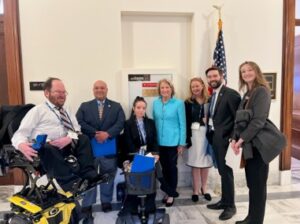
MDA Hill Day 2025
What’s next?
The effort to pass these priorities doesn’t end with the conclusion of MDA on the Hill. MDA advocates will continue to advocate for these policies and will not stop raising their voices.
But we need more people to join us! Sign-up to be an advocate at mda.org/advocacy.
The post A Government Shutdown Couldn’t Stop Advocates During MDA on the Hill 2025 appeared first on Quest | Muscular Dystrophy Association.
]]>The post MDA Ambassador Guest Blog: Breaking the Chains of Stigma in My Arab Community appeared first on Quest | Muscular Dystrophy Association.
]]>
Dancing with my parents at my brother’s wedding (April 2025)
I was born and raised in California, in an Arab household, surrounded by warmth, family, and support. As the first-born child, my mother noticed early signs of weakness and tiptoeing when I was three years old. By the age of six, I was diagnosed with beta-sarcoglycan deficiency, and in the fourth grade, I learned that I had a progressive condition called limb-girdle muscular dystrophy (LGMD). At that age, I didn’t fully understand what the diagnosis meant or how it would affect my life.
As I grew older, I began to recognize the deep-rooted stigmas and attitudes surrounding disability within the Arab community. Even though I had an uncle with the same condition, he never talked about it openly. Instead, he would make up wild stories about how he became disabled. Seeing someone so close avoid speaking about their disability revealed a painful reality: in many Arab households, disability is often met with shame, denial, fear, and prejudice. People with disabilities are often labeled as “not normal,” “a burden,” or “a failure.” Such labels can weigh heavily on a person’s sense of self, leaving them feeling incapable, unworthy, and misunderstood.
My mother faced her share of blame and judgment for giving birth to a child who wasn’t considered “healthy.” My grandfather tried everything he could from different diets, supplements, and even religious practices in hopes of “curing” me. As an adolescent who relied on a walker for mobility, I was kept at home during weddings and community gatherings, while my cousins my age were free to attend and enjoy themselves. Although my family acted out of love and protection, their fear of judgment from the community left me feeling isolated and unseen.

At a protest in San Francisco for Gaza (October 2023)
When my uncle passed away in 2015, it profoundly changed my perspective on life. He was only 32 years old when he died from complications following gallbladder surgery that led to sepsis. I remember feeling an ache that words couldn’t describe, not only because I lost him, but also because of the quiet, confined life he had lived. He spent the majority of his days at home, watching movies, rarely stepping into the world beyond his walls. He avoided Arab gatherings, community events, and places where he might be seen because he carried the heavy burden of stigma, both from within and from the society around him.
After his death, I made a promise to myself: I will not live a life hidden in the shadows of shame or fear. I refuse to silence parts of myself to make others comfortable. My disability is not something to fix, hide, or apologize for—it’s a defining part of who I am. Every challenge I have faced and every victory I have achieved has shaped my character, my resilience, and my outlook on life. I vowed to live with purpose and authenticity, to show that true strength is measured not by physical ability, but by courage, perseverance, and self-acceptance. I want to become the voice my younger self needed to hear, and the representation my uncle never had.
I was determined to challenge the notions and stereotypes about disability within the Arab community. I began with my inner circle, educating my extended family and relatives. For example, I would answer my cousins’ questions about my daily life, helping them understand my experiences and breaking down misconceptions and biases. I also started sharing my story publicly, whether online or in conversations with people I met at events, hoping that visibility could help change perceptions. Over time, I became more comfortable in community spaces; I no longer shied away from Arab festivals, concerts, protests, or family gatherings. I love meeting new people, sharing my story, and educating others about my disability, turning each interaction into an opportunity to challenge stigma and foster understanding.
Beyond education and visibility, I also celebrate my achievements, including earning my bachelor’s degree, tutoring others, and working as a mental health coach at

Dancing with a stranger at Palestine Day (September 2022)
MindRight. In that role, I used psychoeducation and evidence-based practices to support students affected by trauma, offering guidance and a listening ear as they navigated the challenges of their everyday lives. These accomplishments directly challenge the stereotypes and low expectations often imposed on people with disabilities in the Arab community, showing that disability does not define ability or limit potential. More recently, I applied to volunteer as a Peer Buddy with MUHSEN, a nonprofit that advocates for and supports people with disabilities in the Muslim community, where I look forward to connecting virtually with individuals who have special needs. With Muhsen’s strong presence in the Arab community, I hope to be a positive voice, to help challenge stigma, and inspire others to embrace their abilities with pride and confidence.
While I still encounter stares or awkward smiles from time to time, they no longer hold me back. One of my proudest moments was attending my brother’s wedding, walking in front of 600 guests, smiling, dancing, and celebrating freely. It was especially meaningful because it took place in front of the very Arab community that once kept me hidden, a community whose judgment and whispers I had long feared. In that moment, I felt the chains of stigma break, and the fear and hesitation that once held me back fade away. I was fully seen, fully present, and unapologetically myself—a living testament to my courage, strength, and the beauty that comes from embracing my own identity.
The post MDA Ambassador Guest Blog: Breaking the Chains of Stigma in My Arab Community appeared first on Quest | Muscular Dystrophy Association.
]]>The post Clinical Research Alert: Natural History Study of Individuals with Cardiomyopathy Associated with FRDA appeared first on Quest | Muscular Dystrophy Association.
]]>The study
This is an observational study, which means that participants will not receive an investigational study drug. The study will include two age groups: (1) Individuals who are at least 16 years of age and (2) individuals who are between 6 and under 16 years of age. After an initial screening visit, eligible participants will be required to attend five doctor visits over a period of one year. The study doctor will collect medical information and perform routine study assessments, including laboratory tests (e.g. blood and urine), imaging, questionnaires, and safety assessments.
Study criteria
To be eligible for the research study, individuals must meet the following inclusion criteria:
- Male or female, ages ≥6 years at the time of signing the informed consent (and assent, if applicable).
- Diagnosis of FRDA, based on clinical phenotype and genotype (GAA expansion on both alleles), with onset of FRDA occurring at ≤25 years of age
- Confirmed left ventricular hypertrophy (LVH)
- Left ventricular ejection fraction ≥40%
Individuals may not be eligible to participate if they are affected by another condition or receiving another treatment that might interfere with the ability to undergo safe testing. Eligibility criteria will be evaluated by the clinical study doctor.
Interested in participating?
To learn more about the study or inquire about participation, visit the study website through this link or email [email protected].
The post Clinical Research Alert: Natural History Study of Individuals with Cardiomyopathy Associated with FRDA appeared first on Quest | Muscular Dystrophy Association.
]]>The post Life with Lily: Advice for Parents of Children with Neuromuscular Disease appeared first on Quest | Muscular Dystrophy Association.
]]>The power of representation

Lily S.
A positive sense of self begins when children see people like themselves thriving and are able to connect with a community that understands them.
- Actively seek positive representation: Make an intentional effort to highlight disability in a positive light in media, toys, and books.
- Normalize mobility aids: Celebrate toys and characters, like a Barbie in a wheelchair or a character with orthotics, to help your child see their equipment as a normal and helpful tool.
- The goal: Cultivate a positive disability attitude by showing your child they belong to a visible, diverse, and vibrant world.
Foster deep community connection
Connecting with the disability community is life-changing, especially as children begin to understand what their diagnosis truly means.
- Peer understanding (for kids): Ensure your child has spaces where they are not “the different one.” Seek opportunities like the MDA Summer Camp and local community events to connect them with other children with disabilities.
- Adult role models: Introduce your child to adults with disabilities. Allow your child to see that all adults with disabilities can live successful and full lives!
Parent education, support, and community
Your knowledge and confidence directly support your child’s well-being and future advocacy, and you are not meant to do this alone.
- Get educated and find support: Commit to continually learning about the diagnosis and available resources. The MDA is a vast resource for tools, educational webinars, and mentorship programs.
- Find your community too (parents): Being a parent of a child with neuromuscular disease is hard and can be lonely. Find support groups for parents and caregivers. Other parents understand this journey best!
- Utilize Community Support Groups: Support groups designed for parents of children with neuromuscular disease to connect, get educated, and seek support are incredibly valuable through every stage of your journey.
- Search for online parenting advice: Look for Facebook groups or online discussion forums where parents can ask questions and get quick, practical advice from others who truly understand the day-to-day challenges of caregiving.
Supporting siblings and fostering family balance
Neuromuscular disease can and will change family dynamics.
- Educate siblings openly: Explain your child’s disease and needs to siblings in an age-appropriate way. Reiterate that these needs are just one part of who their sibling is, and that their sibling may need more help from parents, but that is okay. Embrace disability positivity and watch all of your children’s empathy and compassion grow!
- Be intentional with unaffected siblings: The needs of siblings without neuromuscular disease are equally important. Schedule dedicated, one-on-one time with each child. Ask them how they are feeling and acknowledge that their life is different because of their sibling’s condition.
- Shared family responsibility: The child with a disability should engage in appropriate chores and responsibilities and be an active part of the family structure, just like their siblings. Assign tasks that leverage their strengths (e.g., sorting laundry, reading to a younger sibling, supervising a pet) to foster independence and contribution.
Building confidence through honesty and advocacy
Open, honest discussion removes shame, builds self-trust, and equips your child to advocate for themselves.
- Embrace early and open dialogue: Initiate discussions about your child’s diagnosis and disability early and Your goal is to be disability-positive or neutral; never let shame enter the conversation.
- Encourage self-trust: Teach your child to trust their body and listen closely to their symptoms. Reinforce the fact that they know their body best and that their voice in medical and care settings is essential.
- Coach relentless advocacy: While you must be an advocate for your child, your ultimate role is to coach them to step into that role themselves, because they are their best advocate. Give your child the tools to speak up for themselves in the classroom and during 504/IEP meetings. Empower their unique voice and encourage them to take up space in every room they walk into.
Respecting their lived experience
Recognize that your role as a parent is to listen and learn from their unique perspective.
- Acknowledge your limits: Unless you have a disability, you will not fully comprehend the complexity of the disabled experience. Do not take offense if your child honestly and vulnerably says, “Mom/Dad, you just don’t get it,” because you don’t, at least from their perspective.
- Validate and learn: Humbly accept their understanding of their own experience. Listen with compassion and prioritize learning from your child and other adults with disabilities. Their experience is the ultimate authority.
A final word of encouragement
This journey is hard. There will be challenges, uncertainty, and moments that test your strength. But know this: it is so worth it, and it is beautiful. You are not alone. There are so many resources available, and the community you will find is one of the most incredible parts of this journey. Your child will grow up with resilience, empathy, and wisdom forged by their unique life experience. Keep advocating, keep loving, and keep connecting. You are doing an amazing job.
The post Life with Lily: Advice for Parents of Children with Neuromuscular Disease appeared first on Quest | Muscular Dystrophy Association.
]]>The post Clinical Research Alert: Real World Study of Male Fertility Following Risdiplam Treatment appeared first on Quest | Muscular Dystrophy Association.
]]>The study
The MARLIN study does not include a new intervention or procedures such as laboratory tests or doctor visits. It is an observational study that consists of a series of questionnaires to be completed remotely, through a designated app. Participants enrolled in the study will be required to provide data via a questionnaire at the beginning of the study (baseline) and then annually for 3 years. There is also an option for the sexual partner/surrogate/gestational carrier of the enrolled participant to complete a baseline and annual questionnaire for 3 years. The questionnaires will include questions on the following topics: (1) demographic information, including age and race/ethnicity; (2) information about how long the participant has been on or was taking risdiplam; (3) medical history, medication, and lifestyle; (4) sexual history; (5) fertility journey, including tests and treatment the participant has undergone during attempts to conceive a child. For more information, please visit the study registry at the following link.
Study criteria
To be eligible for the MARLIN research study, individuals must meet the following inclusion criteria:
- Males with SMA between 18 and 50 years of age, who are taking or have taken risdiplam, and are trying to conceive a child or have previously conceived a child after taking risdiplam
Individuals may not be eligible to participate if they meet the following exclusion criteria:
- Males who are using/used donor sperm for conception
- Males who are using/used their own cryopreserved sperm that was not exposed to risdiplam for conception
Interested in participating?
A stipend will be provided to study participants for their time and effort.
People interested in participating can contact the study team by phone: 1-855-662-7546 (1-855-6MARLIN), email: [email protected], or by visiting the study website at the following link: https://marlinstudy.com/
The post Clinical Research Alert: Real World Study of Male Fertility Following Risdiplam Treatment appeared first on Quest | Muscular Dystrophy Association.
]]>The post Quick Guide: Understanding Programs and Benefits for People with Disabilities appeared first on Quest | Muscular Dystrophy Association.
]]>
Jody Ellis
“Not only do people living with disabilities face higher rates of unemployment and lower wages, but the cost of living with a disability is also higher, requiring about 29% more income than a household without a disability,” says Jody Ellis, Director of the ABLE National Resource Center, managed by National Disability Institute. These additional costs, whether from healthcare, assistive technology, transportation, or caregiving, can make achieving financial stability difficult without support.
Fortunately, several programs and benefits are available to ease the financial burden of living with disabilities. Learning about these resources and understanding how they work can empower individuals and families to build independence and long-term security.
Here are some programs worth knowing about.
Financial programs
ABLE Accounts
ABLE stands for Achieving a Better Life Experience, and these versatile accounts allow people with disabilities to save without losing benefits. Funds grow tax-free and help protect assets from Medicaid and SSI resource limits, giving families flexibility and independence.
Funds up to $100,000 are not counted toward SSI assets and do not affect SSI benefits. Any amount of ABLE funds, up to the plan’s balance limit, is not counted as a resource for other public benefit programs (i.e., HUD, Medicaid, and SNAP)
“ABLE accounts open doors for opportunities, creating independence, promoting financial and community inclusion, and supporting financial empowerment,” Jody says.
Good to know:
- The ABLE account annual contribution limit is $20,000 in 2026 (higher for employed account holders).
- ABLE account funds may be used for qualified disability expenses (QDEs) and must benefit the account owner.
- Currently, a person is eligible for an ABLE account if their qualified disability began before age 26. However, on Jan. 1, 2026, eligibility will expand to anyone whose qualified disability began before age 46.
Special Needs Trusts
Special needs trusts (SNTs) protect inheritance, gifts, and larger sums while preserving eligibility for benefits. Unlike ABLE accounts, trusts do not have an annual contribution limit and are managed by a trustee.
There are two types of special needs trusts:
- First-party SNTs, funded with the beneficiary’s own assets (such as a settlement or back payment), must include a Medicaid payback provision.
- Third-party SNTs, funded by parents, relatives, or others, do not require Medicaid payback and can pass remaining funds to other heirs.
“Parents shouldn’t be leaving money in their child’s first-party trust — they need to set up a third-party trust,” says Bruce Sham, CLF, an advanced special care planner and founder of Special Journey Solutions.
As the father of a child with special needs, Bruce has firsthand experience with setting up a third-party SNT. “I’m leaving money to my daughter to supplement what she’s getting from government services, and it does not count against her,” he says. “She can’t touch the money directly — there’s a trustee who’s responsible for it, and they can only use it for her health, maintenance, and support.”
Good to know:
- SNT funds must be used for the beneficiary’s sole benefit. Even gifts or shared household items should be justified as benefiting the individual with disabilities.
- Money in an SNT cannot be paid directly to the beneficiary in cash or cash equivalents (like gift cards), or it will count as income and could jeopardize SSI and Medicaid eligibility.
- If the SNT pays for food or housing (such as groceries, rent, or mortgage payments), SSI benefits may be reduced because these are considered “in-kind support and maintenance.”
- SNTs and ABLE accounts can work together. For example, if a person received a sum higher than the ABLE annual contribution limit, they could save the excess in a trust account. Money from an SNT can also be deposited into an ABLE account. Housing expenses can be paid with ABLE funds without impacting the account owner’s monthly SSI payment amount.
- Some states require annual accountings or approval of trustee fees. Check your state’s SNT rules for specific requirements.
Tax deductions
Families managing disability-related expenses may qualify for various federal tax deductions and credits.
Good to know:
- Travel and lodging for medical care may qualify as deductible expenses. “Families often don’t realize that if they’re traveling to a conference, the hotel and the tickets are deductible expenses. Mileage is also deductible if you’re driving for medical care,” Bruce says.
- Always consult a tax professional familiar with disability-related deductions to ensure compliance and maximize your returns.
- For tips on finding a financial professional well-versed in disability considerations, read Financial Education and Planning Help You Take Charge of Your Financial Future.
Benefits programs
Children’s Health Insurance Program (CHIP)
CHIP provides low-cost or free health insurance coverage for children whose families earn too much to qualify for Medicaid but still need help affording care. It covers essentials such as doctor visits, prescriptions, hospital care, and, sometimes, dental or vision services.
Each state runs its own CHIP program, so benefits and cost-sharing rules differ. (Families can find details through their state’s Medicaid or CHIP office.) Most states cover children in families earning up to 200-300% of the Federal Poverty Level (FPL). For 2025, that’s about $62,000-$93,000 for a family of four.
Good to know:
- Many families pay no insurance premiums. When premiums apply, they’re often $0-$50 per child per month, with total costs capped at 5% of family income per year.
- States may charge small copays for office or ER visits, but preventive care (like checkups and vaccines) must be free.
- Children usually remain covered even if family income rises slightly, helping ensure consistent access to care.
- CHIP often works hand in hand with Medicaid to help ensure children get the care they need.
Medicaid
Medicaid is a joint federal and state health insurance program that helps people with limited income access essential care. For many people living with neuromuscular diseases, Medicaid provides necessary security, covering drugs, caregiving/home health, and hospital care that would otherwise be unaffordable.
The strict $2,000 asset limit can make financial planning tricky.
Good to know:
- Pensions, savings bonds, insurance policies, and, in some cases, even 529 college savings plans, can count toward the $2,000 asset limit.
- Once a child is 18, Medicaid looks at all their income and resources.
- It’s important not to confuse Medicaid with Medicare, which is a federal health insurance program for people 65 or older and people with disabilities. Enrolling in some Medicare Advantage plans can disqualify someone from essential Medicaid benefits. In addition, Medicaid offers benefits that Medicare typically doesn’t cover, such as personal care services.
Medicaid Buy-In and HIBI Programs
Some states offer Medicaid Buy-In or Health Insurance Buy-In (HIBI) programs that allow working individuals with disabilities to maintain Medicaid coverage while earning an income. These programs can make private insurance coverage affordable while preserving essential Medicaid services.
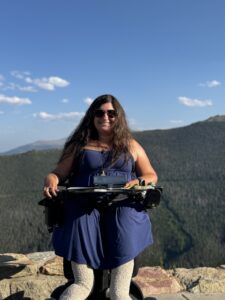
Lyza Weisman
“HIBI pays my premium, my deductible, my copay — Medicaid is covering it. It’s a huge help,” says Lyza Weisman, a law student from Colorado who lives with spinal muscular atrophy (SMA).
Good to know:
- Most states set income limits around 200-300% of the Federal Poverty Level (about $62,000-$93,000 for a family of four in 2025), but some state programs waive or raise asset limits.
- Monthly premiums or sliding-scale payments may apply, often modest compared to private insurance.
- HIBI programs may pay for part or all of a private insurance plan’s premiums, deductibles, and copays, keeping out-of-pocket costs very low.
- Check with your state Medicaid agency for specific availability and rules.
State Medicaid Waiver Services
State-specific waiver programs expand Medicaid coverage to services not typically included under standard plans, such as personal care, respite care, rehabilitation services, caregiving, behavioral supports, assistive technology, vehicle or home modifications, and employment assistance.
Requirements vary, but most waivers are for people who meet the level of care required to qualify for care in a nursing home or similar facility. Waiver programs are intended to help individuals avoid institutional care and remain in their communities.
Good to know:
- Some waiver programs allow participants to qualify based only on their individual income, not household income. This makes it easier for children or adults with disabilities to qualify even if parents or spouses earn more.
- Some waivers will compensate family caregivers, such as parents or spouses.
- Waivers often have waitlists, so applying early is crucial.
- Learn about your state’s waiver programs by visiting the Medicaid State Waivers List or searching for your state’s Department of Health or Human Services website.
Supplemental Security Income (SSI)
The Social Security Administration offers two main disability benefit programs: Supplemental Security Income (SSI) and Social Security Disability Insurance (SSDI). (Read on for information on SSDI.)
SSI provides monthly payments to individuals with disabilities who have limited income and resources. It’s often the first program that young adults with disabilities qualify for upon turning 18.
For children under 18 to be eligible, the child and parents must meet disability and income rules. The maximum monthly SSI payment in 2025 is $967 for an individual and $1,450 for a couple, although the exact amount can vary by state and is based on income and other factors.
Good to know:
- SSI benefits may be impacted by savings and income, but programs like ABLE accounts (see the section on ABLE accounts above) can help preserve eligibility.
- Families should track earnings carefully because overpayments may occur if their income increases and the increase isn’t reported right away.
Social Security Disability Insurance (SSDI)
SSDI supports individuals who have worked and paid Social Security taxes, as well as certain dependents of retirees or deceased workers.
Young adults with a disability between the ages of 18 and 22 may continue receiving benefits under special provisions if a parent is deceased, retired, or receiving Social Security. Additionally, children who qualify before age 22 can later receive half of a parent’s retirement benefit. “This means that if I’m retired and getting $3,000, my daughter may be eligible for $1,500,” Bruce says.
Good to know:
- The SSDI application process can be lengthy, often resulting in a delay between the initial application and benefits approval. In this case, recipients can apply for back payments for the months they were eligible but had not yet been approved.
- SSDI recipients should also be aware that they may owe repayments if they continue to receive benefits when they are not eligible. “If you get a job, it can take them three to four months to stop payments, but you do owe that money back,” cautions Lyza.
Vocational Rehabilitation (VR)
VR programs, which are typically run through a state’s Department of Education or Labor, help participants with disabilities prepare for, obtain, and retain employment. They offer assistance in paying for education, training, assistive technology, vehicle modifications, and professional coaching.
Lyza Weisman credits VR with making her legal career possible. “They helped me pay for law school, get my desk, phone, software, and my vehicle modification, which was $126,000,” she says. “Altogether, they’ve given me over $250,000.”
Good to know:
- VR isn’t just for job seekers. They can also assist if you’re already employed and develop a new disability or need workplace accommodations.
- VR counselors often coordinate with schools, employers, or community agencies to help create a personalized employment plan that aligns with your goals and strengths.
- Every state has a VR office or agency. Find yours through the State Vocational Rehabilitation Agencies directory on the US Department of Education’s Rehabilitation Services Administration website.
The post Quick Guide: Understanding Programs and Benefits for People with Disabilities appeared first on Quest | Muscular Dystrophy Association.
]]>The post Tis the Season for Holiday Hacks and Tips appeared first on Quest | Muscular Dystrophy Association.
]]>In How to Have Your Best Holiday Season Yet, we check in with experts and community members for their advice on how to address five common holiday challenges so that you can stress less and focus more on the happiness of the season. Check out their advice here and read more below for useful holiday hacks and advice.
Hosting and Cooking Made Easy
Hosting a holiday gathering or preparing a meal for friends and family often requires a lot of planning, prepping, and work. For those living with a disability, the process can entail extra considerations. From mindset and perspective to innovative gadgets and life hacks, we have the tools and tips you need for hassle-free holiday hosting.
In Stress Free Holiday Entertaining, community members and experts share how the right mindset, taking the time to plan and prepare, remembering to have a good time, and giving gratefully can minimize your holiday hosting stress and help you remember why you are having the party in the first place.
The holiday season is synonymous with the gathering of friends and family to share a meal. Whether hosting dinner or creating a dish to bring to a loved one’s home, meal prep and cooking are key elements of holiday festivities. For those living with neuromuscular disease, muscle weakness, fatigue, and limited range of motion can make meal preparation challenging. In Holiday Hosting Hacks for Thanksgiving Dinner, we share tools and tips that can increase independence, safety, and accessibility in and out of the kitchen for every holiday.
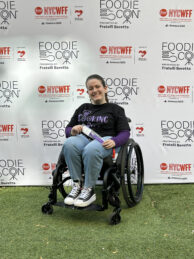
Gabby Disalvo
Growing up as a full-time wheelchair user living with myofibrillar myopathy (MFM), 21-year-old Gabby DiSalvo always considered the kitchen an inaccessible place, until she began cooking during the Covid-19 quarantine and fell in love with the process. She started an accessible cooking blog, Cooking on Wheels, to share her passion and advice with others, and even appeared as a guest on the Rachael Ray Show. In Cooking with a Disability? Yes, Chef!, Gabby shares adaptive cooking hacks, advice for cooking with a disability, and helpful holiday tips.
MDA Ambassador Barbara Ochoa, who lives with myotonic dystrophy (DM), is also passionate about cooking. In her MDA Ambassador Guest Blog: Cooking Tips & Tricks Just in Time for the Holidays, she shares how she has adapted in the kitchen as her disease progresses. From planning ahead and embracing the InstaPot to finding ways to increase nutritional value and holiday hosing hacks, she shares advice that resonates for a quiet dinner at home or happy holiday gathering.
And if you are hosting a large gathering at your home, presenting a clean home to your guests is often just as high on the to-do list as the menu. The cleaning tips, tricks, and tools in Accessible Spring Cleaning Tools & Tips can make cleaning your home a more accessible, efficient, and independent experience during the holidays and all year long.
Take the guess work out of gift giving
Another key aspect of the holiday season for many people is gift giving. For those who participate in gift giving, finding the perfect gift for everyone on your holiday shopping list can sometimes feel a little overwhelming. On the flip side, when others ask you what is on your holiday wish list, it might be a challenge to provide suggestions.
In Creative and Budget-Friendly Gifts to Say Thank You to Your Caregivers, we share gift ideas that friends, loved ones, and caregivers alike will love. From small tokens of appreciation and self-care items to thoughtful personal-interest gifts and treats that everyone will love, you are sure to find great gift ideas that won’t break the bank.
For the readers in your life, National Read a Book Day: Spotlight on Community Authors and Books to Add to Your Holiday Shopping List This Year: Spotlight on Community Authors feature books written by members of the neuromuscular disease community. Including motivational books, personal memoirs, fiction, poetry, children’s books, and books about parenting, you’re certain to find something here for every book lover on your holiday shopping list.
The MDA Quest Media Holiday Product Guide is the perfect place to shop for gift-giving inspiration and possibly find a thing or two for your own wish list. This guide is designed to help you find tried-and-true products that make life more independent, stylish, and fun. All the products on this curated list were chosen by MDA Ambassadors, who shared exactly how each product helps them in their daily lives.
Accessible holiday travel tips
Traveling to visit family or friends during the holiday season is often an added stressor for those living with disabilities. In the articles below, we share expert tips from seasoned travelers as they share their advice on how to navigate flying, ground travel, and avoid mishaps while traveling with a wheelchair and/or medical equipment.
- MDA Ambassadors Share Tips for Flying with Power Wheelchairs and Medical Equipment
- Airplane Travel Tips from a One Million Mile Traveler
- Quest Podcast Episode 29: Expert Accessible Travel Tips for Your Next Vacation
- Travelers with Disabilities Share Their Top Tips to Avoid Mishaps
- Essential Gear for Traveling with a Disability
Managing stress and finding joy
The holidays are meant to be a joyful season, but in reality – the season can often also bring stress. In Holiday Cheer: Smart Tips to Manage the Stress of the Season and the Quest Podcast Episode 9: Combating the Stress of the Holidays, we offer applicable advice so that you can stress less and enjoy the season more.
Creating simple holiday traditions is also an easy and special way to create meaningful memories while making the busy holiday season a little happier and brighter. Celebrating special traditions, either on your own or with loved ones, adds excitement and joy to your holiday season with magical moments each year. Make your holiday season a little brighter with the fun and easy ideas in Holiday Traditions to Make Your Season Happier.
Staying cozy at home

Allyson Pack-Adair
While the holiday season is a busy time of gathering for many, for many others it is a quieter season spent at home. For those who don’t have local family and friends to gather with, the holidays and winter season can sometimes bring feelings of loneliness. If this time of year weighs you down, Coping with Loneliness at the Holidays offers strategies to lessen loneliness from people in the neuromuscular disease community who have been there. Ally Pack-Adair, who lives with a mitochondrial disease, says that feelings of loneliness and isolation often hit her harder around the holiday season – and that focusing on her mental health helps her to cope. In her MDA Ambassador Guest Blog: Prioritizing Mental Health to Beat the Winter Blues, she reminds others in the community that they are not alone and shares her strategies to deal with negative feelings and embrace the season.
One way to embrace the season is by enjoying rest and relaxation in the cozy comfort of your own home. Get Cozy with Accessibility and Independence This Winter provides products and hacks that can help you snuggle in, cozy up, and enjoy your favorite leisure-time activities with accessibility and independence.
Another powerful way to increase happiness is by adopting the habit of practicing gratitude. Choosing to approach each day and experience with gratitude can have a significant impact on your mental, emotional, social, and even physical health. Seven Easy and Effective Ways to Increase Gratitude in Your Life shares simple practices that can help you cultivate a level of appreciation in your life that will make you happier and healthier – during the holiday season and all year long.
The post Tis the Season for Holiday Hacks and Tips appeared first on Quest | Muscular Dystrophy Association.
]]>The post 5 Things Advocates Should Know: The Alleviating Barriers for Caregivers Act appeared first on Quest | Muscular Dystrophy Association.
]]>One of the top challenges shared with MDA’s Resource Center by family caregivers is difficulty working with state and federal agencies to get the benefits their loved ones need, whether it be health insurance and home and community-based services through Medicaid or disability benefits like SSI. They report frustrating experiences of invasive, repetitive paperwork, waiting hours to speak to someone, difficulty scheduling in-person appointments – exacerbated by staffing and field office reductions, complicated application processes leading to frequent denials, and more. These hurdles result in barriers to obtaining necessary care and benefits that enable independence. For the neuromuscular community, time is muscle, and families cannot afford to waste hours overcoming bureaucratic hurdles.
Fortunately, there is bipartisan interest in reducing the administrative burdens on family caregivers through the Alleviating Barriers for Caregivers (ABC) Act (H.R. 2491/S. 1227). This November, MDA united advocates from across the country in the nation’s capital to advocate in support of this legislation to reduce bureaucratic red tape in benefits navigation for family caregivers and individuals affected by neuromuscular diseases.
Here are five things to know about the bill:
What does the bill do?
The bill requires the Centers for Medicaid and Medicare Services (CMS), which is the federal agency that provides health coverage through Medicare, Medicaid, and the Children’s Health Insurance Program (CHIP), and the Social Security Administration, which is the federal agency that administers disability benefits like Social Security Disability Insurance and manages Supplemental Security Income (SSI), to review and simplify processes, procedures, forms, and communications for family caregivers to help individuals determine eligibility, enroll in benefits, maintain coverage, and utilize the full benefits available under those programs.
What would the review include?
There are specific goals outlined in the legislation, including:
- Streamlining policies and simplifying procedures, as well as reducing the frequency of providing the same information more than once, completing multiple documents for each agency, or providing information to agencies they already have or could easily obtain from another agency
- Making it easier for family caregivers to work with state and federal agencies by:
- Decreasing call waiting times and ensuring agencies provide timely answers.
- Improving website accessibility.
- Improving timely access to in-person appointments or meetings.
- Providing translation or interpretation services and improving the relationship between family caregivers and agencies, such as through regular meetings with family caregivers and individuals eligible for, filing for, or receiving benefits.
Importantly, the legislation requires that agency officials must seek input from family caregivers, including caregivers with disabilities, and individuals filing for or receiving services in conducting the review, ensuring that people affected by neuromuscular diseases are actively involved in developing solutions.
Who supports the bill?
The bill was introduced by Senators Ed Markey (D-MA) and Shelley Moore Capito (R-WV) in the Senate, and Representatives Kat Cammack (R-FL) and Seth Magaziner (D-RI) in the House of Representatives. The bill enjoys broad bipartisan support in both chambers.
Where is the bill in the legislative process?
The bill has been introduced in the second session of the 119th Congress in both chambers and referred to the relevant committees for further action. In the House, it has been referred to both the Ways and Means Committee, which is responsible for overseeing Social Security issues, and the Energy and Commerce Committee, which oversees health issues. While committee activity largely stalled during the government shutdown, it has started to pick back up with the reopening of the government. Hearings on the legislation have not yet been announced.
What can I do to garner support?
Prior to committee activity, which is expected to pick up with the government reopening, it is important to have as many bipartisan co-sponsors on the legislation as possible. Reach out to your Senators and Representative and let them know why supporting family caregivers is important to you and how administrative burdens related to caregiving responsibilities have impacted your life. Urge them to co-sponsor the legislation (H.R. 2491/S. 1227). If your member is already a co-sponsor of the Senate or House bill (you can check here for the House and here for the Senate), share your thanks and urge action!
Are you interested in engaging with MDA Advocacy on caregiving or other issues? Join our Action Network or contact [email protected]. Share your caregiving story with us to better inform our advocacy work on the ABC Act and other caregiving issues. We will never share your story without your permission.
The post 5 Things Advocates Should Know: The Alleviating Barriers for Caregivers Act appeared first on Quest | Muscular Dystrophy Association.
]]>The post The Hidden Power of Self-Care in Caregiving appeared first on Quest | Muscular Dystrophy Association.
]]>Each of the caregivers featured here has learned that strength is built in the pauses — a moment of quiet, a trusted partner’s support, a laugh with friends, or a creative outlet that reconnects them to their identity.
Their wisdom reminds us that resilience doesn’t come from pushing endlessly forward, but from intentionally carving out space to breathe, reflect, and reconnect. They show us that by honoring our own well-being, we not only sustain ourselves — we deepen our capacity to care for the ones we love.
Christie West: Taking a minute, writing it out, leaning on community

Christie West and Zach enjoy activities and service projects.
When Christie talks about self-care, she doesn’t just mean something fun and relaxing. She means the gritty, practical work of pausing, processing, and plugging into people, so she can keep showing up for her 28-year-old son, Zach. She adopted Zach, who lives with Duchenne muscular dystrophy (DMD), when he was 3 years old.
First, she gives herself permission to “take a minute.” In moments when emotions run high, Christie reminds herself of a simple mantra: Emotions are normal. I just need a minute. For caregivers, she says, a brief reset is not indulgence — it’s maintenance. Sometimes it’s a hallway cry, sometimes it’s 10 minutes with an audiobook, praise music, or even tidying a pantry — anything small that restores a sense of control when so much feels uncontrollable. She schedules those minutes like meetings: short, protected blocks of time when she can focus on herself.
Second, she journals and invites Zach to do the same. “Your brain doesn’t know the difference between talking to someone and writing it out,” she explains. When anxiety swells, the page becomes a pressure valve. Journaling also serves as a tool to prepare for conversations: Dump it in the notebook first, then let’s talk about what is left to process. That rhythm lightens the emotional load and makes the conversation calmer and clearer.
Finally, Christie insists on community. Healing accelerates when she’s among people she has a connection with, whether that’s fellow MDA Ambassadors, Miracle League baseball teammates, teachers, counselors, or volunteers at the animal shelter. She also ensures Zach has community. With MDA Advocacy trips to Washington, DC, online connections, and service projects, Zach experiences himself as a person with purpose. That experience feeds Christie, too.
Her playbook is simple, though not easy: take a minute, write it out, don’t go it alone. In those small, consistent choices, a caregiver’s strength is replenished, and love has room to keep doing its quiet, extraordinary work.
Karen Clough: Gardening, art, laughter, and pool time
For Karen, self-care isn’t complicated or time-consuming; it’s a string of small, sensory pauses that make the day more enjoyable.

Karen Clough relaxes on her patio.
Most mornings start on the patio with coffee, prayer, Bible reading, birdsong, and her desert garden. She crushes a sprig of basil between her fingers, breathes in the sharp, green scent, and feels a sense of peace. Tending to plants gives her something tangible to nurture and watch grow, a comforting counterbalance when so much about her husband, Doug’s, amyotrophic lateral sclerosis (ALS) diagnosis resists control.
Inside her home, Karen keeps an upstairs corner stocked with watercolor supplies. Taking a half hour to draw or paint is enough — a quiet pocket where she is a learner again, not just a planner and problem-solver.
Some days, she opens her laptop to join a Zoom laughter yoga class, led by a certified laughter yoga leader and health coach. It’s simple by design: breathing, using physical sensations to anchor yourself in the moment, and, yes, laughing at silly prompts until the mood lifts. She loves the science of it (the body gets the same boost from a practiced laugh as a spontaneous one), but mostly she loves how it resets her mind. In 30 minutes, her shoulders drop; the list can wait.
Some of Karen’s best self-care happens along with Doug. Thanks to donated pool equipment and a bit of ingenuity, he can transfer into their backyard pool. In the water, his body feels lighter; they float, talk, and relax. It’s a cooling relief from the Arizona heat — and an emotional one, too. The pool is where they move together, laugh with grandkids, and feel a slice of normal.
None of this erases the responsibilities of caregiving, or the vigilance. But it brings joy on ordinary days: a hummingbird at the feeder, a wash of color on paper, a chorus of giggles on Zoom, the buoyancy of shared water. These small rituals don’t just pass the time — they restore the part of her that keeps choosing patience, presence, and hope.
Gavin Beeker: Cooking, reading, and welcoming others in

Gavin Beeker and Ranae welcome family into their home.
Gavin, 38, didn’t plan on becoming a full-time caregiver, but when his mom, Ranae, 67, who lives with facioscapulohumeral muscular dystrophy (FSHD), took a dangerous fall, he sold his house and moved in. What followed is what he describes as a 24/7 role overseeing morning routines, meals, meds, and household logistics, with breaks woven around Ranae’s volunteer work and frequent visits from extended family and friends.
Their house became a hub. And in that busy orbit, Gavin found a self-care rhythm that keeps him steady: reading, learning a new language, cooking, and welcoming people to the table.
Cooking is where he exhales. It’s tactile, creative, and finishable — an antidote to the open-endedness of caregiving. Food gives him a way to contribute something beautiful and concrete on days when little else feels within his control.
Reading offers a different refuge. He’s teaching himself to read German — slowly, deliberately — because the challenge engages his mind and reminds him that growth is still happening, even when the body has limits.
Entertaining ties it all together. Hosting is not just social; it’s therapeutic. A full living room means Ranae laughs more, and Gavin feels less alone. The conversation, the clink of cups, the easy coming and going — it restores them both.
The path here wasn’t linear. After his own emotional struggles, Gavin sought therapy that helped him build healthier coping tools. That reckoning became a turning point.
And although he shares the same diagnosis as his mom, who is passionately involved in MDA advocacy, he prefers the quiet dignity of learning and craft — pursuits that reinforce self-worth even as the body changes.
His self-care isn’t grand or rarefied. It’s soup on the stove, a paragraph in a new language, a door open to family. In that everyday hospitality, Gavin protects his stamina and keeps the home warm and welcoming.
Lillie Cleeton: Strength in support, teaching, and advocacy
For Lillie, caregiving has been a lifelong role that she shares with her husband, Ken. Their son, KL, was diagnosed with spinal muscular atrophy (SMA) as an infant and now, at 36, requires full-time caregiving. For many years, Lillie poured herself entirely into the work — overnight shifts, full days of balancing a job and being “everything for everyone.” It wasn’t until her own health broke down that she realized how unsustainable that approach was.

Lillie and Ken Cleeton take time to laugh and recharge.
Today, she talks openly about the lessons she learned the hard way. “If you don’t take care of yourself, it will catch up with you,” she says. “I hurt myself physically, emotionally, and mentally because I thought I couldn’t stop.”
That realization now fuels her work training other caregivers in Illinois. As an instructor through the Member Education Training Center, she urges them to pause, even if just for five minutes. “Take a breath, take a walk, go to a movie, get your nails done — something that’s just for you. Because if you don’t, you won’t be able to keep going,” she says.
She credits Ken as the “rock” who makes it possible to keep going. He handles much of the physical lifting, and his steady presence anchors their family. Friends, too, play an important role, offering weekends away to see grandchildren or simply time to laugh and recharge.
Lillie admits the guilt of stepping away never fully disappears, but she now knows breaks are not optional — they’re survival.
Adding inspiration is KL himself. He thrives as a professional poker player and an MDA advocate, with a girlfriend and a community of peers who push him forward. Watching him live fully, chase opportunities, and speak out for others gives Lillie and Ken fresh courage.
Her advice is simple, born of experience: choose your hard, choose to laugh, and above all, choose to care for yourself, so you can keep caring for the ones you love.
Quick Tips From Caregivers
Simple ways to protect your energy while caring for others:
- Take breaks. Even 5-10 minutes to breathe, pray, or reset can make the day better.
- Write it out. Journaling helps process emotions and lighten the mental load.
- Get creative. Whether trying a new recipe, painting, or learning a new language, creative outlets restore balance.
- Lean on your people. Family, friends, and peer groups provide perspective and laughter. Don’t go it alone.
- Teach and share. Helping other caregivers reinforces the importance of your own self-care.
- Laugh often. Join a group, tell stories, or just practice a laugh — the brain feels the benefit either way.
- Step outside. Gardens, patios, fresh air, and sunshine refresh body and spirit.
- Move together. Shared activities — like floating in a pool or cooking as a family — bring joy and connection.
- Remember: You matter. Caring for yourself is not shirking caregiving — it’s what makes it possible.
The post The Hidden Power of Self-Care in Caregiving appeared first on Quest | Muscular Dystrophy Association.
]]>The post Meet Our 2025 MDA Quest Photo Contest Winners appeared first on Quest | Muscular Dystrophy Association.
]]>Congratulations to our 2025 Quest Media photo contest winner, Paula Saxton, of Doylestown, Pennsylvania, who submitted the photo above of her son, Jake.
Sports photographer Karla Donohoe captured this moment of celebration after Jake scored a goal in the opening game of the 2025 North American Powerhockey Cup. His team, the Philadelphia Flyers PowerPlay, won the game against the Michigan Mustangs and went on to capture the championship.
“As a player, there is nothing more thrilling than tournament play,” says Jake, 22, who lives with spinal muscular atrophy (SMA). “I loved seeing the competitiveness on display from my teammates, coaches, and even our fans. The will to win was on high display throughout the weekend, making it something I will never forget.”
Jake started playing power hockey when he was 7 and loves how the sport welcomes competitors with different abilities, skills, and experiences.
“This team is made up of many selfless individuals who understand we each have a role to play in order to win, where everyone’s contributions are never overlooked,” he says of the Philadelphia Flyers PowerPlay. Like Jake, several of his teammates are MDA Summer Camp alumni. Read more about the team and the excitement of power hockey in MDA Summer Camp Alumni Put the Power in Powerhockey.

The O’Sullivan family, from left to right: Marcus, Zachary, Allison, Aubrey, and Brandon
Fun on Wheels
Congratulations to Allison O’Sullivan of Southern Illinois, a runner-up in the 2025 Quest Media Photo Contest. This photo was taken while celebrating her daughter, Aubrey’s, seventh birthday in June. Aubrey lives with reducing body myopathy, a rapidly progressing muscle disease, and the family must take extra precautions to avoid germ exposure.
“We rented a roller skating rink for an hour and had a blast as a family zooming around the rink to her favorite songs,” Allison says.

Lucas Garrett, photo courtesy of Stephanie J. Bartik
Striking a Chord
Congratulations to Lucas Garrett of Queensbury, New York, a runner-up in the 2025 Quest Media Photo Contest. Photographer Stephanie J. Bartik took this photo in December 2024 at the Strand Theater in Hudson Falls, New York, to promote Lucas’s live shows in Upstate New York.
“This photo is special to me because it highlights one of the main things that gives my life purpose: music,” Lucas says.
The 32-year-old singer-songwriter, who lives with Pompe disease, has also released a vinyl record, “Reaching Through Dreams” (lucasgarrettmusic.com).

Rachael Bae, photo courtesy of Pastor Seoplee Kim
The Joy of Song
Congratulations to Rachael Bae of Placentia, California, a runner-up in the 2025 Quest Media Photo Contest. Rachael, 21, has been active as a vocalist and speaker at churches, concerts, and events since she began using a power wheelchair in 2016 due to Ullrich muscular dystrophy. In 2018, she released “Grace,” her first digital single album, with a song written and composed by her mother (youtube.com/RachaelBae).
“This photograph was chosen as the cover image for that special album, symbolizing both the challenges of living with muscular dystrophy and the joy of expressing hope and faith through music,” she says.
The post Meet Our 2025 MDA Quest Photo Contest Winners appeared first on Quest | Muscular Dystrophy Association.
]]>The post A Lifetime of Learning: From College to a Career in Disability Advocacy appeared first on Quest | Muscular Dystrophy Association.
]]>Thriving in college
When I was in high school in Clarksville, Maryland, I knew I wanted to attend a four-year college, and I worked hard in physical therapy to master the activities of daily living I would need to live independently on campus.

Naomi at Princeton University
Educational attainment is lower for disabled people due to the many physical and attitudinal barriers in higher education. A 2025 analysis by the Bureau of Labor Statistics found that about 23% of people living with disabilities have a bachelor’s degree or higher, compared with about 42% of people without disabilities.
As a high schooler, I didn’t know many people with my diagnosis of congenital fiber type disproportion, or other neuromuscular diseases, who went away to college, so it was hard to imagine what was possible for me. Luckily, I visited a friend from MDA Summer Camp at her college, which opened my eyes to the resources available to college students with disabilities and showed me I could thrive on campus.
I applied to several colleges and was fortunate enough to be accepted to Princeton University in New Jersey. At first, I was worried about how I would navigate the campus in my wheelchair. After all, the school is older than the country itself.
I visited the campus and met with the college’s Office of Disability Services, which settled most of my nerves. I think these two steps are essential for all students with disabilities considering a specific school, because seeing the school in person and meeting the office that provides essential accommodations is the best way to determine if the school is a good fit.
Finding my calling
I graduated from Princeton in 2022 with a major in Public and International Affairs and certificates in Journalism and Gender and Sexuality Studies.
I had the most amazing experience that taught me so much, both in the traditional academic sense and also about what I was capable of.
When I began college, I was just starting to become politically engaged. But my public policy classes at Princeton helped show me that I wanted to work in disability policy, and my extracurriculars, especially serving as Associate News Editor for The Daily Princetonian, gave me the writing and leadership skills I use every day in my professional life.
I also made incredible friends who accepted and included me. Due to the efforts of myself and other students with disabilities in the student government’s Disability Task Force, which I founded, there have been substantive improvements to campus accessibility. I have continued my advocacy for more accessibility and inclusion through my position on the university’s Board of Trustees. It means so much to me that my peers elected me to this role because they believed in my ability to speak up for the needs of students with and without disabilities.
Starting a career
Because of my academic explorations of disability and several meaningful disability policy internships, I successfully started my career in disability policy.

Naomi in Washington, DC
I moved to Washington, DC, after college, where I worked at Mathematica, a public policy research organization. Then I worked in the Administration for Community Living in the Department of Health and Human Services, which serves people with disabilities and older adults. There, I managed grants that support disabled people and wrote material about the agency’s programs.
I loved living in DC, which is an extremely accessible city. I lived in my very first apartment, mastered the public transit system, and made so many memories with old and new friends. After the 2024 election, government work felt unstable to me, and I decided it was time to apply to graduate school. I thought an advanced degree would give me more skills and tools to learn about my interests and progress in my career.
Back to school
This fall, I started pursuing a master’s in Media Advocacy at Northeastern University in Boston. This unique program is at the intersection of journalism, public policy, and law, and it perfectly aligns with my interest in using media to generate social change.
Leaving DC was a difficult choice, but if I learned anything from my time at Princeton, it was that taking risks in pursuit of education leads to unexpected opportunities. While pursuing my degree, I’m also working in communications for the American Association of People with Disabilities. I’m glad I can directly apply my learning to my job and do my best to advance the organization’s mission at a time when advocating for disability rights is so important.
I hope anyone else who loves to learn does not let accessibility barriers prevent them from following their educational dreams. Even if it takes some effort to overcome these barriers, higher education is an incredible experience.
Naomi Hess, 25, is a graduate student at Northeastern University in Boston and the Editorial Manager at the American Association of People with Disabilities. She is happy to be a resource to others with disabilities who are interested in pursuing higher education. Find her online at naomihess17.substack.com and on Instagram at @naomihess17.
The post A Lifetime of Learning: From College to a Career in Disability Advocacy appeared first on Quest | Muscular Dystrophy Association.
]]>The post New Year, New Financial Plan: Tips to Get Your Budget Back On Track appeared first on Quest | Muscular Dystrophy Association.
]]>Jody Ellis
Fortunately, the new year is the perfect time to reassess your financial goals and start with a fresh plan. Here, MDA community members and experts offer their tips to avoid debt, shop smarter, and plan for a new year filled with less stress and more independence.
1. Create your budgeting plan
“Identify how much money is coming in and from what sources, whether it be benefits or earned income, as well as your monthly, quarterly, and annual expenses,” says Jody Ellis, Director of the ABLE National Resource Center, managed by National Disability Institute. “Once you know your financial situation, you can begin to identify some potential action steps.”

Tina Vassar
Tina Vassar of North Carolina, who lives with myasthenia gravis (MG), takes this approach. In her budget, she includes income and expenses like insurance premiums, travel, gifts, clothing, food, and a “nest egg” for emergencies. “If you find a deficit, look at ways you can reduce the budget monthly,” she says.
Creating a monthly spreadsheet to track expenses or using a personal budgeting app can make it easier to monitor and follow your spending plan.
2. Open an ABLE account

Vanessa O’Connell
Achieving a Better Life Experience (ABLE) accounts are savings and investment accounts designed specifically for people with disabilities.
“What makes an ABLE account so special is that funds are generally not counted as assets for public benefit programs, such as Medicaid or Supplemental Security Income (SSI), and the investment growth is tax-free,” Jody says.
The 2025 annual contribution limit is $19,000, allowing users to have access to funds well beyond the Medicaid asset limit of $2,000. Funds can be used for expenses like housing, healthcare, education, and transportation.
Currently, a person is eligible for an ABLE account if their disability began before the age of 26. However, on Jan. 1, 2026, eligibility will expand to anyone whose disability began before age 46. This will expand access to 6 million more Americans.
3. Save on essentials

Allyson Pack-Adair
Rising costs can make it seem difficult to save on necessities like food. Vanessa O’Connell of Florida, who lives with Pompe disease, finds her local farmers’ market to be an affordable option. “It provides fresh fruit and vegetables quite reasonably priced,” she says. “It’s an organic, local farm, so the inventory changes with the season.”
While some farmers’ markets have a reputation for being expensive, there are ways to save, such as comparison shopping between vendors for the best prices or visiting at the end of the day for deals on food they need to sell. Many farmers’ markets also accept the Supplemental Nutrition Assistance Program (SNAP).
The DIY approach can also save you money. “I hand-make my own self-care items and plant produce in my garden,” says Allyson Pack-Adair of Arizona, who lives with mitochondrial myopathy.
4. Curb impulse buying

Sophia Dipasupil
Sophia Dipasupil of Virginia, who lives with juvenile dermatomyositis, knows to stop shopping before buyer’s remorse sets in. “When I see something I want but maybe don’t need, I put it down and walk away. If I still want it after a while, I will go back and buy it,” she says. “Most of the time, I don’t end up buying the item.”
Jose Flores of Florida, who lives with spinal muscular atrophy (SMA), follows this simple rule: “Take a 48- to 72-hour pause before any nonessential buy. Most ‘wants’ fade; savings don’t,” he says.
Tina suggests making a shopping list and sticking to it, whether online or in person.
5. Research big purchases

Jose Flores
Medical equipment, mobility aids, and home modifications can be expensive. Before making one of these purchases, find out if they could be covered through your healthcare benefits or a state or community agency.
Lyza Weisman, a law student from Colorado living with SMA, says her $126,000 accessible van modifications were funded through her state’s vocational rehabilitation program. These programs are designed to help people with disabilities find and retain jobs and can provide assistance for a variety of expenses, such as education and training, assistive technology, home and vehicle modifications, and professional coaching.
For other big purchases, consider refurbished options or shop around for deals. Blythe Collins from Michigan, who lives with limb-girdle muscular dystrophy (LGMD), shares that her dad bought her a travel electric wheelchair on Amazon Prime Day for 30% off.

Lyza Weisman
6. Trim your bills
Monthly bills can be just as draining as big-ticket items, but many can be reduced with a little effort. Tina suggests contacting phone and internet providers to negotiate a lower rate. “Check for subscriptions you may have forgotten about or don’t use and cancel them,” she adds.
To address healthcare costs, comparing pharmacy prices is advantageous. Tina also recommends checking with insurance providers and your local government to see if they offer reduced rates for disabilities for insurance and taxes. You can also contact healthcare providers’ billing offices to ask if they have financial assistance programs you might qualify for.
Blythe Collins
7. Avoid or reduce debt
Staying in the black is one of the best long-term ways to save money. Jose has developed a system around his credit card use. “I use credit cards like charge cards, and pay them in full every month,” he says.
If you need help reducing existing debt, resources like National Disability Institute’s Financial Resilience Center can help.
Maggie Callahan is a frequent contributor to Quest Media.
The post New Year, New Financial Plan: Tips to Get Your Budget Back On Track appeared first on Quest | Muscular Dystrophy Association.
]]>The post Understanding Spinal-Bulbar Muscular Atrophy appeared first on Quest | Muscular Dystrophy Association.
]]>
Christopher Grunseich, MD
SBMA is sometimes called Kennedy’s disease, named after William Kennedy, the physician who first described the disease in 1968. SBMA usually progresses slowly, typically over decades.
Christopher Grunseich, MD, a Lasker Clinical Research Scholar in the Inherited Neuromuscular Diseases Unit at the National Institutes of Health, sheds light on the latest in SBMA research.
Who is affected by SBMA?
It typically takes effect in a person’s mid-40s and progresses slowly, meaning it can go unnoticed for a long time. It’s caused by a genetic mutation on the X chromosome, so it primarily affects males; females with the genetic mutation are carriers for the condition. If females are symptomatic, they can have cramping and tremors, but they usually don’t manifest with weakness.
How is SBMA typically diagnosed?
The key early features of the disease are muscle loss, weakness, and/or cramping, which will usually trigger an evaluation by a neurologist. They may perform a creatine kinase (CK) test, and CK can be elevated about five to six times above normal levels. That is a reflection of the muscle breakdown. Family history can also be helpful in diagnosis. Doctors typically recommend genetic testing to confirm a diagnosis. Genetic testing can be conducted based on a family history, but it should always be done in consultation with a genetic counselor to discuss the benefits and risks of genetic testing.
There are other signs and symptoms, including androgen insensitivity, which means the body does not respond to male hormones. This could present as breast enlargement, testicular atrophy, and infertility, along with other metabolic symptoms, such as insulin resistance. In our lab testing, we’ve also found that between 80% to 90% of SBMA patients can have nonalcoholic fatty liver disease.
What really sets this disease apart from other related conditions is the sensory neuropathy. Patients can experience a loss of sensation and feel numbness. Typically, the fingertips or feet are among the first parts of the body to lose sensation.
What does treatment look like?
Right now, we don’t have any treatments that impact the progression of the disease. What works best is a multidisciplinary approach, which typically involves:
- A neurologist to oversee care
- Physical therapy to identify how patients may benefit from strength exercises or assistive devices to improve their gait and reduce the risk of falls
- Occupational therapy to improve hand and arm function
- Speech therapy, including exercises for the bulbar muscles, to reduce the risk of choking and improve speech
- Sleep studies to detect sleep apnea
- An endocrinologist to monitor for insulin resistance and liver disease
Are there any promising treatments in development?
I’m currently engaged in a phase 1/2 study of a drug called AJ 201. The genetic mutation that causes SBMA leads to muscle and neuron degeneration through mechanisms involving cellular toxicity, oxidative stress, and neuroinflammation. AJ201 is a unique drug compound that has shown potential to reduce that toxicity. Some encouraging preliminary results indicate that AJ201 may reduce CK levels and improve muscle function. With these supportive findings, we hope to advance to a phase 3 study in 2026. There are two other drugs in phase 2 trials, NIDO-361 and clenbuterol, which also look encouraging.
With these trials, it’d be terrific to see stabilization of muscle function and less muscle degeneration. If we could stabilize the muscle membrane and prevent the continued atrophy and fatty replacement of the muscle, I think that would provide a meaningful impact on the lives of people with SBMA.
What else should patients and families know?
The Kennedy’s Disease Association has set up a registry in partnership with Coordination of Rare Disease at Sanford (CORDS). The registry enables research teams designing studies to identify patients, determine potential interest, and contact patients if they are eligible. It doesn’t automatically sign you up for research. It simply provides a venue for the research teams to inform interested patients that these studies are taking place. I would suggest that any patient who’s interested in participating in research studies or clinical trials consider joining the registry.
Matt Schur is a Chicago-based writer and editor who frequently covers health topics.
The post Understanding Spinal-Bulbar Muscular Atrophy appeared first on Quest | Muscular Dystrophy Association.
]]>The post From Classroom to Courtroom: How Eric Arnold Navigated Accessibility in His Education and Career appeared first on Quest | Muscular Dystrophy Association.
]]>The 39-year-old, West Virginia-based attorney attributes his success to recognizing his own capabilities, working hard to reach his potential, connecting with others, and asking for accommodations.

Eric and friends at a WVU basketball game
Early life lessons
Eric was diagnosed with spinal muscular atrophy (SMA) at 18 months old. He began using a manual wheelchair when he was 3 years old, switching to a power wheelchair before second grade. Throughout his early schooling, he rode an accessible school bus, had access to a bathroom where he could transfer himself, and used a table instead of a school desk to accommodate his wheelchair. He excelled academically and socially and learned how to advocate for himself.
“I realized early that I had the natural ability to appeal to others and connect with them. Whether it was a teacher or a classmate, I knew if I wanted to be independent, I needed to not only accept help but also give back to people like they gave to me,” Eric recalls.
Being involved in the development and execution of his Individualized Education Program (IEP) also taught Eric a valuable lesson about asking for what he needed to excel. He credits his public school system with actively meeting his needs and creating an inclusive environment.
Chasing the college dream
Eric set out for college to find a profession he could thrive in and achieve financial independence. First, he researched financial aid programs, resources, accommodations, and accessibility at several universities. He recommends that anyone interested in college reach out to schools’ accessibility offices to learn about the support and accommodations they offer for students with disabilities.
Eric attended West Virginia University (WVU), where he earned a bachelor’s degree in journalism, a Master of Business Administration, and a law degree. Eric believes that a large part of his success stems from understanding his own worth.
“I think that one of the hardest things for people like me, who live with a disability, is struggling with this defeatist idea that your worth won’t be recognized. Whether it is communication or facing barriers or losing out on an opportunity, that mindset and those challenges can be very hard to overcome,” he says. “The way to face those pitfalls or mental blocks is by finding what you can do well and pursuing opportunities through that.”
Leaning into work accommodations
Eric recalls a conversation with his boss while interning at Hendrickson and Long, the law firm where he now works. Eric’s boss overheard him turn down a coworker’s offer to help with a task and told Eric, “Nine out of 10 times, someone offering to help you wants to be part of your life and sees value in you.” Eric realized that accepting help at work allows someone to be part of his experience and fortify his talents.
Now entering his 12th year as a litigator, Eric splits his time working from home and the office, sometimes attending courtroom hearings by telephone or Zoom when judges allow it. Eric is upfront with new clients that his physical limitations will not compromise their representation.
“Ask for help if you need it,” he says. “Ask your office or state programs for assistive technology. Ask your employer for accessibility accommodations. As long as you approach it in a way that shows these things will help you contribute, and by doing so, you are going to add intrinsic and external value to where you work, most employers are eager to oblige.”
Living independently
Eric lives in a condominium where he can commute by wheelchair a couple of blocks to his office and the courthouse. He also has a modified van that caregivers drive.
Eric balances earning an income and remaining eligible for benefits. He has caregivers through his state’s Medicaid waiver program and private pay. He is also enrolled in a work incentive program through Medicaid. He closely monitors his income, assets, and spending each month to maintain eligibility while working.
“My position is not salaried, so I work as much as I need to each month and monitor my income to stay under the amount needed to qualify for my benefits,” he says. “If I have a really busy month, then I spend money on something I need that qualifies as a write-off. I set up my own special needs trust. While I don’t have full access to that money, I can request it for qualified spending, and I can deposit money into it to stay within requirements.”
Eric enjoys advising others on how to navigate programs that allow people with disabilities to maintain independence and achieve success. Finding value in helping others and accepting help when needed has propelled him on his quest for success.
To others on that same quest, he says: “There are avenues to get where you want to go. There is always a way to open the door for yourself. It may not always look exactly how you want it to look. You may need some help, but you can do it.”
Rebecca Hume is a Senior Specialist and Writer for Quest Media.
The post From Classroom to Courtroom: How Eric Arnold Navigated Accessibility in His Education and Career appeared first on Quest | Muscular Dystrophy Association.
]]>The post Progress Now: Immunotherapy Study Recruiting, Drug Cleared for Expanded Access, and More appeared first on Quest | Muscular Dystrophy Association.
]]>Immunotherapy Study Recruiting
Coya Therapeutics has launched the phase 2 ALSTARS trial to evaluate the safety and efficacy of COYA 302, an investigational treatment for adults with ALS. This large trial will recruit an estimated 120 people with ALS and be conducted at approximately 25 sites in the US and Canada.
COYA 302 combines two immunotherapies: low-dose interleukin-2 (LD IL-2) and DRL_AB (similar to abatacept, used to treat rheumatoid arthritis). This combination therapy is intended to enhance the function of regulatory T cells (white blood cells that help control the immune system’s response) and suppress inflammation. The study will assess whether this changes the progression of ALS.
The study begins with a randomized, double-blind period in which participants will be randomly assigned to receive COYA 302 or a placebo (an inactive substance) for 24 weeks. Those who complete this part of the study may be eligible to participate in an additional 24-week active extension phase. COYA 302 is administered via subcutaneous (under the skin) injection.
For more information, visit ClinicalTrials.gov and enter NCT07161999 in the “Other terms” search box.
Drug Cleared for Expanded Access
The US Food and Drug Administration (FDA) has cleared NKGen Biotech Inc. to launch an Expanded Access Program (EAP) to make its experimental therapy troculeucel available outside of clinical trials to patients with neurodegenerative diseases, including ALS.
NKGen has an ongoing phase 2a clinical trial studying troculeucel as a treatment for Alzheimer’s disease. However, two phase 1 studies demonstrated that troculeucel, administered via intravenous (into the vein) infusion, crosses the blood-brain barrier and reduces signs of neuroinflammation, which may be beneficial for other neurodegenerative diseases. The FDA authorization will allow NKGen to offer expanded access to troculeucel to up to 20 patients.
To learn more about NKGen’s Expanded Access Program, visit nkgenbiotech.com/clinical-trials.
Duchenne muscular dystrophy (DMD)
Participants Needed for Gene Therapy Trial
Regenxbio Inc. is enrolling boys ages 4-11 living with DMD to participate in a phase 3 clinical trial to evaluate the safety, tolerability, and efficacy of the investigational gene therapy RGX-202 to treat DMD.
In DMD, a gene mutation in the dystrophin gene prevents cells from making enough working dystrophin protein. Dystrophin protein is needed for muscles to function and repair themselves. RGX-202 is a single-dose gene therapy designed to introduce a shortened dystrophin protein (microdystrophin) into the body, potentially slowing the loss of muscle function.
This study, known as AFFINITY DUCHENNE, is a multicenter, open-label study. The study will last approximately two years and involve a one-time intravenous (in the vein) infusion and approximately 26 clinic visits to evaluate the effects of RGX-202 by various tests. At the end of two years, participants will be encouraged to enroll in a three-year, long-term follow-up study to monitor the participants’ health and the effects of RGX-202.
Travel support is available for eligible participants and their caregivers.
To learn more about the study, including locations and inclusion and exclusion criteria, visit RegenxBioDMDTrials.com, or go to ClinicalTrials.gov and enter NCT05693142 in the “Other terms” search box. To inquire about participation, email [email protected].
Gene Therapy Study Enrolling Boys
Researchers at Solid Biosciences are seeking boys with DMD to participate in a phase 1/2 clinical trial, called INSPIRE DUCHENNE. This study will evaluate the safety and efficacy of the investigational gene therapy SGT-003, designed to introduce a microdystrophin protein to replace the dystrophin protein that is missing in DMD.
This is a multicenter, open-label study lasting five years for each participant. The drug will be administered as a single intravenous (in the vein) infusion. For the first 30 days following treatment, participants will have frequent visits to the hospital for check-ups and bloodwork to monitor the safety and effects of SGT-003. Visits will become less frequent over the following years of the study.
Researchers are currently enrolling boys ages 0-4 who are nonambulatory or ambulatory, and boys ages 4-12 who are ambulatory. They plan to add groups of boys ages 12-18, ambulatory and nonambulatory, at a later date, but are not yet enrolling them.
Travel support is available for eligible participants and their caregivers.
To learn more about the study, including locations and inclusion and exclusion criteria, visit ClinicalTrials.gov and enter NCT06138639 in the “Other terms” search box. To inquire about participation, email [email protected].
Facioscapulohumeral muscular dystrophy (FSHD)
Drug Targets Root Cause of FSHD
Epicrispr Biotechnologies is enrolling adults with FSHD in a phase 1/2 clinical trial for EPI-321, an investigational therapy designed to address the root cause of the disease.
In FSHD, genetic mutations result in abnormal activation of the DUX4 gene, leading to progressive muscle degeneration, especially in the face, shoulders, and arms. EPI-321 is a gene-modifying therapy designed to silence the abnormal expression of the DUX4 gene in skeletal muscle. The drug is administered via a one-time intravenous (into the vein) infusion.
The trial is expected to enroll nine people with FSHD, ages 18-75. The study’s main goal is to evaluate the safety and tolerability of the experimental therapy. Participants will visit a clinic regularly for tests and checkups for about five years after receiving the therapy.
According to Epicrispr, in preclinical studies, EPI-321 demonstrated robust suppression of DUX4 expression and protection of muscle tissue. The US Food and Drug Administration (FDA) awarded the drug Fast Track, Rare Pediatric Disease, and Orphan Drug designations. These designations incentivize the development of treatments for rare diseases.
For more information, visit ClinicalTrials.gov and enter NCT06907875 in the “Other terms” search box.
Myasthenia gravis (MG)
Positive Results for Self-Administered Therapy
Gefurulimab, an experimental self-administered injection therapy, performed better than a placebo at easing symptoms of generalized MG (gMG) and gives patients more control over their therapy, according to Alexion, AstraZeneca Rare Disease.
The drugmaker released positive high-level results from a global, randomized, double-blind, placebo-controlled phase 3 trial in adults with anti-acetylcholine receptor (AChR) antibody-positive gMG. This is the most common type of MG. The trial involved more than 250 people with gMG across 20 countries.
In MG, the immune system attacks the neuromuscular junction, blocking signals from nerves to muscles. Gefurulimab is a complement C5 inhibitor, which means it works by binding to the C5 protein in the immune system and blocking it from targeting the body’s own healthy cells.
Two other C5-blocking therapies developed by Alexion — ravulizumab-cwvz (Ultomiris) and eculizumab (Soliris) — are already approved for patients with AChR antibody-positive gMG. But while Ultomiris and Soliris are given by intravenous (into the vein) infusions that must be administered by a healthcare provider, gefurulimab is given by subcutaneous (under the skin) injection, and can be self-administered by patients or given by caregivers.
To learn more about the study, visit ClinicalTrials.gov and enter NCT05556096 in the “Other terms” search box.
Myotonic dystrophy (DM)
Gene Therapy Trial Enrolling
Researchers are enrolling patients in a phase 1/2 clinical trial evaluating the safety, tolerability, and efficacy of SAR446268, an experimental gene therapy for DM type 1 (DM1). The open-label, multicenter study, known as BrAAVe, is sponsored by Sanofi.
DM1 is caused by abnormal DNA expansion within the DMPK gene, which leads to weakness in voluntary muscles. SAR446268 is designed to reduce levels of abnormally long DMPK messenger RNA (mRNA) in muscle cells, improving muscle function.
The trial is expected to enroll approximately 32 people with DM1, ages 10-50, at sites in Florida, New York, and Argentina. It will begin with a dose escalation phase, during which participants will receive a single infusion of SAR446268 at one of several doses. Based on findings from the first phase, a dose will be identified for the dose expansion phase of the study.
Each participant will be involved with the study for about two years, including screening before and follow-up after the drug infusion.
To learn more about the study, including inclusion and exclusion criteria, visit ClinicalTrials.gov and enter NCT06844214 in the “Other terms” search box.
Pompe disease
Study Compares LOPD Therapies
Top-line results from a phase 3 clinical trial comparing alglucosidase alfa (Lumizyme) to avalglucosidase alfa (Nexviazyme) showed that Nexviazyme outperformed Lumizyme at improving lung function in adults with late-onset Pompe disease (LOPD).
Lumizyme is approved by the US Food and Drug Administration (FDA) for treatment of early-onset (infantile) and late-onset Pompe disease in all ages. Nexviazyme is approved by the FDA for treatment of LOPD for ages 1 year and older. Both Lumizyme and Nexviazyme are enzyme replacement therapies (ERT) that contain a lab-made version of acid alpha-glucosidase (GAA), the enzyme missing or defective in Pompe disease. Nexviazyme is designed to enhance the delivery of GAA to muscle cells, which they need to function properly.
The study found that adults with LOPD who switched from Lumizyme to Nexviazyme improved in measures of lung volume and airflow, and these improvements persisted for at least two years after making the switch. The study was funded by Sanofi, which markets both therapies.
To read the study results, visit onlinelibrary.wiley.com/doi/10.1002/jmd2.70033.
Clinical Trial Terms to Know
Double-blind: Neither researchers nor participants know which participants are taking the drug or placebo.
Multiarm: Comparing several experimental treatments against a common control group within a single study.
Multicenter: The trial is completed at more than one site.
Open-label: Participants know what treatment they are receiving.
Placebo-controlled: Some participants receive the treatment being tested and some receive a placebo that looks like the real treatment but has no active ingredients.
Randomized: Participants are randomly assigned to groups taking the drug or placebo.
The post Progress Now: Immunotherapy Study Recruiting, Drug Cleared for Expanded Access, and More appeared first on Quest | Muscular Dystrophy Association.
]]>The post Say Yes to Gene Therapy? Factors to Consider When Gene Therapy Is an Option appeared first on Quest | Muscular Dystrophy Association.
]]>
Carrie Miceli, PhD, and Stanley Nelson, MD, with their son Dylan (center)
Neither of them took this choice lightly. They made their decisions after learning as much as they could about their own diagnosis and the gene therapy they were considering, as well as discussing the risks and benefits — and their own personal goals — with their parents and their healthcare teams. Ultimately, they both feel they made the right decision.
That is the essence of gene therapy decision-making. It is a personal decision that each individual and family must make by weighing all the relevant factors and making the choice that is best for them.
New therapy opportunities on the horizon
Right now, not everyone in the neuromuscular disease community has access to gene therapy. The US Food and Drug Administration (FDA) has approved two gene therapies for neuromuscular diseases: Zolgensma® for spinal muscular atrophy (SMA) in 2019 and Elevidys® for DMD in 2023.
However, there is a robust research pipeline, and initiatives like MDA’s Kickstart for Ultra-Rare Neuromuscular Diseases are helping to push gene therapy development forward. Gene therapies are being explored in clinical trials for amyotrophic lateral sclerosis (ALS), Charcot-Marie-Tooth disease (CMT), congenital myasthenic syndromes (CMS), Friedreich ataxia (FRDA or FA), limb-girdle muscular dystrophy (LGMD), Pompe disease, and more.
Already, many members of the neuromuscular community have had the opportunity to receive gene therapies through clinical trials, and more gene therapies are expected to be approved in the coming years.

Michelle Werner
It’s a good idea to be prepared for new opportunities that may arise. Dylan and Caffrey both have parents in biomedical fields who were eagerly following the development of gene therapies for DMD.
Dylan’s parents, Carrie Miceli, PhD, and Stanley Nelson, MD, are professors and researchers at the University of California, Los Angeles (UCLA). They started the Center for Duchenne Muscular Dystrophy at UCLA after Dylan was diagnosed. When they learned that Sarepta Therapeutics was recruiting nonambulatory (unable to walk) boys and men with DMD for a gene therapy clinical trial, Dylan enrolled. In 2021, at age 20, he received the experimental gene therapy that became Elevidys.
Caffrey’s mother, Michelle Werner, is the CEO of Alltrna, a biotechnology company. “After Caffrey was diagnosed, we were very eager to participate in clinical trials, especially for gene therapies, but he was not eligible for any of the trials that were underway,” she says.
Michelle and her husband, William Lester, paid close attention to the news after the FDA initially approved Elevidys for boys ages 4 and 5. Caffrey was 14 when the FDA expanded the approval to ages 4 and up in 2024. “That’s when we started to get a lot more serious in terms of considering it as an approach for Caffrey,” Michelle says.
Benefits of gene therapy
Gene therapies aim to treat the root cause of genetic diseases by replacing a mutated gene with a working gene, repairing a flawed gene, or altering how a gene is controlled.
Zolgensma and Elevidys are both gene replacement therapies. They work by delivering a functional gene into the body using an adeno-associated virus (AAV). The AAV is not harmful, but it can enter cells to deliver a gene that provides new instructions to make a needed protein.
“The goal of gene replacement therapy is to restore the missing or dysfunctional gene, allowing for protein production with the aim to lessen or slow disease progression,” says Diana Bharucha-Goebel, MD, Medical Director of the Gene Therapy Center of Excellence at Nationwide Children’s Hospital.
For some neuromuscular diseases, the best approach might not be to add a working gene but to fix a flawed gene, increase the expression of a gene, or “turn off” an abnormally active gene. Promising gene therapy methods being developed include gene editing, where a targeted section of DNA in the mutated gene is deleted or replaced, and RNA-based gene therapies, which target genetic material in RNA to modify how proteins are made. Therapies using these methods are in preclinical studies and clinical trials.

Diana Bharucha-Goebel, MD
Most gene therapies are designed as one-time treatments and are intended to lead to long-term, lasting improvements in function and overall health. However, they will not restore muscle or nerve cells that are already lost to disease progression.
“To maximize the benefit, time to treatment is important,” Dr. Bharucha-Goebel says.
For example, with SMA, administering Zolgensma early in infancy has the potential to stop damage before it occurs. With Elevidys for DMD, younger, ambulatory (able to walk) patient groups have experienced the most benefits in clinical trials.
“We’re at an exciting point where we’re trying to find strategies that work for different disease groups, depending on the type of genetic change, the size of the gene, and what cells in the body you’re targeting,” Dr. Bharucha-Goebel says. “The successes and knowledge learned from approved and previously studied therapies will hopefully pave the way for ongoing exploration for gene replacement therapies for other, more rare neuromuscular conditions where there is still great unmet need.”
Risks of gene therapy
For all the promise of gene therapies, there are real risks. Dylan’s and Caffrey’s parents were clear-eyed about this.
Gene replacement therapies using AAVs cause an immune response. Even though the virus is harmless, due to the large dose required, the body responds by activating different pathways of the immune system.
There is potentially more risk if the therapy induces the body to produce a protein it has not seen before. “The body may react by attacking the new protein, seeing it as foreign,” Dr. Bharucha-Goebel says.
Another serious concern is liver injury, a common side effect of AAV-based gene therapies. In July, Sarepta paused dosing of Elevidys for nonambulatory patients after two deaths from acute liver failure were reported. Researchers are continuing to study different methods to deliver large doses of AAV-based gene therapies safely.
While we will continue to learn more about commonly observed side effects, it is not always possible to predict the type or severity of a response to gene therapy in an individual. Unexpected and severe side effects can occur following gene therapy.
While extreme events are uncommon, they reinforce the need for caution before and after gene replacement therapy, including safety monitoring.
“We are very closely communicating with our families in the hours, days, and weeks after gene transfer and want to know about any changes in the child and how they appear, their energy level, or if they’re seeming in any way unwell,” Dr. Bharucha-Goebel says. Monitoring often continues for months after gene therapy administration.
Redosing not yet possible
Another concern is that, at this time, AAV-based gene therapies can only be given once.
“I describe it as the opportunity cost that comes with the decision,” Michelle says. “With any AAV-based therapy, you’re likely going to be able to get one in your lifetime, and then when you develop antibodies, you’re unlikely to ever be able to get another.”
That means that if an opportunity comes around to take a new approved gene therapy or enter a clinical trial for a potentially better approach, someone who has already received an AAV-based gene therapy would not be eligible.
However, Dr. Nelson points out that living with a neuromuscular disease carries risks, too. “There’s a risk every year of losing skills. With DMD, there’s a risk of death every year, and that has to be the counterweight to the risks of the actual therapy,” he says.
At 20, Dylan was not walking and was in danger of losing more functions, such as feeding himself. This was a big part of the family’s decision for Dylan to receive the gene therapy.
Factors to consider
Every individual’s and family’s calculus for weighing risks against benefits is different.
“The decision is never one-size-fits-all,” Dr. Bharucha-Goebel says. “Each person will have unique circumstances around their baseline laboratory findings, their clinical status, their genetic variant, as well as personal considerations around their current level of function, hopes or goals as related to a therapeutic approach, and the risks they are willing to consider.”
Considering personal goals and priorities is an essential part of the decision-making process. Children who are old enough to understand their diagnosis should be involved in setting those priorities.
“I’d say we were really thoughtful about what is going to be important for Caffrey, and what we were trying to achieve from any type of therapy for him,” Michelle says. She points out that next-generation DMD therapies currently in clinical trials may have advantages, but they are likely years away from being available.
Michelle recounts a pivotal conversation she and William had with their son about the opportunity to take Elevidys: “We told Caffrey, ‘If we go for it, we hope that it might keep you walking for another few years. If we wait, maybe another gene therapy will be available. You will not be walking by then, but maybe that gene therapy will be able to help your lungs and your heart.’ And he said, ‘It’s much more important to live than to walk.’ So, we followed his lead on this decision.”
In addition to personal goals, it’s important to weigh your family’s ability to commit to the gene therapy protocol. Receiving gene therapy is a multi-step process that involves laboratory tests before the administration, going to a clinic for the therapy infusion, and follow-up monitoring and clinic visits for three months or more afterward. Participating in a clinical trial also requires a commitment that may last months, or even years.
While these requirements are time-consuming, it’s important to know that they are there for the patient’s safety and the advancement of science, according to Dr. Miceli. “That follow-up will inform the field, and that’s how we’re going to make these therapies better,” she says.
It’s also important to discuss all these factors, and your goals and priorities, with your care team. They can answer questions and direct you to reliable information and research that will help you make an informed decision.
“Your MDA Care Center or neuromuscular care team should be able to help guide some of that discussion, which should involve an in-depth review of the risks and benefits, and also the alternatives,” Dr. Bharucha-Goebel says. “It’s never the same discussion twice. Each discussion, or series of discussions, must be tailored to that particular family and individual.”
Support for your decision-making
Before deciding on gene therapy, it’s critical to have a support system around you.
MDA offers several resources to help you make a decision about gene therapy and get the support you need. The Gene Therapy Support Network guides you to educational resources and offers one-on-one conversations with MDA Gene Therapy Support Specialists. The Access to Gene Therapy Workshop is a free online tutorial covering gene therapy developments, insurance coverage, and more. MDA’s Resource Center (833-ASK-MDA1 or [email protected]) is a one-stop shop for information to help you navigate life with a neuromuscular disease, including access to therapies.
Your care team is an important part of your support system, as are patient advocacy organizations like MDA and parent groups.
“I met a number of different parents, some of whom participated in gene therapy programs, some of whom were taking different approaches for their kids, but they really understood the lay of the land more than I did in those early months,” Michelle recalls.
Above all, Michelle emphasizes the personal nature of decision-making. “It’s not a straightforward choice,” she says. “It’s an agonizing decision, but there is no wrong or right answer.”
Amy Bernstein is a writer and editor for Quest Media.
Gene Therapy Resources
MDA offers several resources to help individuals and families navigate the evolving landscape of gene therapy:
- Access to Gene Therapy Workshop. Take this online workshop to learn about common considerations before, during, and after gene therapy treatment.
- Gene Therapy Community Support Group. Monthly online meetings welcome parents or guardians of kids eligible for or already treated with an FDA-approved gene therapy.
- Gene Therapy Support Network. Find resources and learn how to contact a Gene Therapy Support Specialist.
- Print-Ready Education Materials. Download fact sheets, checklists, and other materials on gene therapy topics.
The post Say Yes to Gene Therapy? Factors to Consider When Gene Therapy Is an Option appeared first on Quest | Muscular Dystrophy Association.
]]>The post Financial Education and Planning Help You Take Charge of Your Financial Future appeared first on Quest | Muscular Dystrophy Association.
]]>Jody Ellis
“Financial planning can be stressful for anyone, but when you add a neuromuscular disease to the equation, it can feel especially daunting,” says Marissa Lozano, MDA’s Director of Community Education.
Fortunately, with the right knowledge, planning tools, and professional guidance, people living with neuromuscular diseases and their families can improve their financial security and peace of mind, says Jody Ellis, Director of the ABLE National Resource Center, managed by National Disability Institute.
“People with disabilities deserve financial stability and empowerment,” she says. “They need to know that they are not alone and there are services and programs that can help.”
Whether you have $10 in the bank or $10 million, financial planning is accessible to you.
Build your financial foundation
Creating a solid financial plan involves education and guidance, but the best place to start is by evaluating your current situation.
“You need to begin by assessing all accounts and policies you have, who is involved in your finances, and who might be involved in the future, such as relatives who might leave you an inheritance,” says Bruce Sham, CLF, an advanced special care planner and the founder of Special Journey Solutions, a financial planning firm specializing in supporting families with special needs individuals in Pennsylvania.
When compiling this list, include information such as:
- Income sources: wages, Social Security Disability Insurance (SSDI), Supplemental Security Income (SSI), or benefits programs
- Assets and accounts: checking, savings, ABLE accounts, retirement accounts, 529 college savings programs, trusts, and any other assets
- Insurance policies: life, health, and long-term care coverage
- Monthly expenses: medications, therapies, housing, utilities, food, personal care products, and other recurring costs
- Future considerations: inheritances, guardianship arrangements, or special needs trust planning, as well as beneficiary information for any of your accounts and policies
Find affordable financial education
Next, take advantage of the many free and affordable financial education resources available in person and online.

Marissa Lozano
For in-person learning, community colleges, libraries, local government agencies, and nonprofits may offer free or low-cost finance classes that cover topics such as credit, debt management, and household economics.
MDA’s Community Education programs are an essential resource for individuals in the disability community seeking to gain a deeper understanding of benefits, budgeting, and planning for the future.
“Whether you are a parent of a young child with a neuromuscular disease, a young adult with a neuromuscular disease going to college, or a retiree who was just diagnosed, we have financial planning information tailored for your stage in life,” Marissa says. “These resources are designed to help you feel confident and empowered to pursue your goals one step at a time.”
MDA’s offerings include self-paced Access Workshops, printable checklists, and on-demand webinars with practical steps to understanding anything from securing a job to insurance to the difference between SSI and SSDI.
“Our educational resources take out the guesswork and allow you to see a clear path forward to your financial goals,” she says.
Other organizations also provide valuable resources online, including:
- National Disability Institute’s Financial Resilience Center provides regularly updated resources on topics such as credit, taxes, identity theft, and more.
- The Consumer Financial Protection Bureau (CFPB) offers free consumer financial education resources through the Your Money, Your Goals toolkit and its companion guide Focus on People with Disabilities.
- MyMoney.gov, offered through the US Financial Literacy and Education Commission, provides financial tools like calculators, budgeting worksheets, and checklists.
- Khan Academy offers a free online course in financial literacy.
Enlist a financial professional
Education is essential, but it doesn’t replace expert advice. For parents navigating finances after a child’s neuromuscular diagnosis — or adults planning for the future after being diagnosed with a neuromuscular condition — working with a financial advisor or special needs expert can ease the burden and reveal resources they might otherwise miss.
“It is so important to work with someone well-versed in special needs and disabilities,” Bruce says. Illustrating his point, he tells the story of a family he worked with: “The man had ALS, and I was able to inform him that the group life insurance he pays into — a couple bucks a month — accelerated access to $250,000 of his life insurance policy to help pay for care at home. He didn’t know that, and nobody offered to tell him about it.”
For law student Lyza Weisman, who lives with spinal muscular atrophy (SMA), working with a financial professional gave her the reassurance she needed. “I found my financial planner through my state’s vocational rehabilitation service in Colorado, and what I got from her was the reassurance that I wasn’t doing something wrong,” she explains. “When you’re managing Medicaid, SSI, an ABLE account, and a trust all at once, it gets so blurry and confusing. Just having someone confirm that I was crossing my T’s and dotting my I’s gave me peace of mind.”
Lyza Weisman
Plan for your future
No matter where you are in your neuromuscular disease journey, Bruce says it’s never too early or too late to begin financial planning.
Lyza, who plans to pursue a career in disability law, agrees. While the process can be daunting, achieving financial independence has given her the power to build the life she wants.
“It’s frustrating when you realize how many financial barriers are holding you back and keeping you from doing what you want to do,” she says. “But it is worth the fight. The more we push forward by learning and planning, the closer we get to financial freedom and the lives we want to live. And when we get there, the most important thing is to pay it forward and help others who are on the same path.”
Maggie Callahan is a frequent contributor to Quest Media.
Tips for Working with a Financial Professional
Who to work with?
Look for one of these types of professionals:
- Chartered special needs consultant (ChSNC®)
- Disability law attorney
- Special needs trust attorney
- Certified financial planner with expertise in disability benefits and experience working with individuals with disabilities
Where to find them?
These organizations and resources can help:
- MDA Resource Center staff members can provide one-on-one support for individuals and families looking for information and resources to help them navigate their disease journey. Contact the Resource Center at 833-ASK-MDA1 or [email protected].
- The American College of Financial Services has a professional directory that can help you locate a ChSNC®.
- Every state has a vocational rehabilitation (VR) agency that helps people with disabilities access education, employment support, and benefits. They may have suggestions for financial and legal professionals.
- Professional associations, like the Academy of Special Needs Planners, can connect families with attorneys, financial planners, and trust officers experienced in disability and special needs planning.
- Local Centers for Independent Living (CILs) or disability rights groups can help connect families with specialists in their area.
Is it affordable?
Working with a professional might sound intimidating and expensive, but it doesn’t have to be.
“Ask if they’ll offer a free consultation,” says Bruce Sham, CLF, an advanced special care planner. In some cases, the fee is contingent on results. “If we don’t get clients the benefits or back payments from sources like Social Security, then there’s no fee. If we do secure the benefits, they pay me once they receive the money,” he says.
Colorado law student Lyza Weisman’s state vocational rehabilitation program covered the cost of her financial planner. Check out your state’s benefits.
The post Financial Education and Planning Help You Take Charge of Your Financial Future appeared first on Quest | Muscular Dystrophy Association.
]]>The post 7 Essential Tips for Family Caregivers to Avoid Common Injuries appeared first on Quest | Muscular Dystrophy Association.
]]>
Areti Vassilopoulos, PhD
While being a caregiver is one of the most meaningful roles you can take on for your family member, it does come with challenges and risks to your own health.
Caregiving is physically demanding — lifting, transferring, bending, reaching — as well as emotionally and mentally taxing. Many caregivers experience injuries. They may also feel stress, anxiety, depression, or fatigue, says Areti Vassilopoulos, PhD, a pediatric health psychologist and assistant professor at the Yale School of Medicine.
Fortunately, most injuries are preventable with the right knowledge, habits, and tools, and there is support available for mental health needs.
Here are some practical tips to help you give care with confidence — and take care of yourself.
1. Know the most common caregiver injuries

Angela Escalante
Before you can truly prevent an injury, it’s helpful to understand what parts of your body are most at risk and why. Common caregiver injuries include:
- Back strains and sprains
- Shoulder and neck pain
- Wrist and hand injuries
- Knee pain
Most of these injuries result from repetitive strain, improper body mechanics, or lack of muscle support, according to Angela Escalante, an occupational therapist at the Barrow Neurological Institute. That’s why prevention involves more than just being careful — it’s also about building strength, using the right techniques, and employing assistive devices.
2. Master body mechanics
How you move your body matters. Angela recommends educating yourself on techniques for lifting and transferring, including:
- Bend your knees, not your back. Always lift using the muscles in your legs, keeping your back straight and your core engaged.
- Keep the person close to your body. The farther away their weight is, the more strain it places on your spine.
- Avoid twisting. Turn your whole body with your feet instead of rotating your torso.
- Use a wide stance. This helps distribute weight evenly to keep your balance.
- Ask for help or use assistive equipment. Don’t risk injury trying to do a difficult lift alone.
It’s always important to think about these techniques. It can be difficult to take the time to position yourself correctly when you’re in a hurry or feeling stressed, but doing so can prevent pain and injury, which is better for you and your loved one in the long run.
“When caregivers take care of their own bodies and protect themselves from injury, they are able to give their best care to their loved ones,” Angela says.
3. Strengthen your body
Doing a handful of simple exercises consistently can help strengthen and protect your muscles and joints from injury. Here are some exercises you can do at home, with little to no equipment.
Core strengthening
Your core (which consists of your abs and back) is your powerhouse — it stabilizes your body when lifting and moving and protects your back. Engage your core muscles by drawing your belly button in toward your spine. To strengthen your core, do one or more of these exercises:

Starting position for supine march and leg extensions
- Supine march. Lie on your back with your knees bent. Raise one foot off the ground at a time.
- Supine leg extension. Lie on your back with your knees bent. Straighten one knee and hold your leg a few inches off the ground. Bring it back to the starting position and repeat with your other leg.
- Plank. Begin on all fours with your arms directly under your shoulders. Extend your legs behind you and hold the position with your back straight.
- Bridge. Lie on your back with your knees bent. Raise your hips off the ground and lift your chest, keeping your core tight and head relaxed on the ground.
Back and shoulder strengthening
These are your primary lifting muscles. Try these exercises to strengthen your back and shoulders:
- Seated rows with dumbbells. Sit with a light- to medium-weight dumbbell in each hand. Lean your torso forward, keeping your back straight, and let your arms hang toward the floor. Pull the dumbbells up, bending your elbows and squeezing your shoulder blades together.
- Shoulder blade rolls/squeezes. Sit up straight and gently squeeze your shoulder blades together. Pause, then relax.
- Shoulder external rotations with a resistance band. Stand with your elbows bent to 90 degrees and your palms up, holding a resistance band in both hands. Slowly rotate your forearms out to the sides while pinching your shoulder blades together. Pause, then return to the starting position.
Leg strengthening
Using your legs for heavy lifting protects your back. These exercises strengthen the leg and glute muscles:

Squat position
- Squats or mini squats. Stand with your feet shoulder-width apart and your toes pointing forward. Keeping your back straight, bend your knees, lowering until they are at a 90-degree angle, then return to the starting position. For mini squats, rest your hands on a stable surface, such as a counter, and do not bend down as deeply.
- Clamshells. Lie on your side with your knees bent and hips stacked. Lift your top knee, keeping your feet together. Repeat on both sides.
Wrists and hands
Repetitive strain and poor positioning can lead to wrist and hand pain. To protect your wrists, keep them straight while completing tasks, and do these exercises to stretch and strengthen the muscles and connective tissues:
- Wrist circles. Start with your hands in loose fists. Circle your fists in one direction, then the other.
- Wrist stretches. Hold one arm out straight at shoulder height and bend your wrist backward so your fingers point up. Use the other hand to gently pull the fingers back until you feel a stretch in the forearm. Let go and bend the wrist forward so the fingers point down. Use the other hand to gently push on the back of the hand until you feel a stretch in the top of the arm. Switch arms and repeat.

Wrist stretches
- Hand stretch. Make a fist and hold it for a few seconds. Open your fist and spread your fingers as far apart as you can. Repeat with the other hand.
Listen to your body
Pay attention to how your body feels while exercising and performing caregiving tasks. If you feel sudden, sharp pain, ongoing soreness that doesn’t improve, or numbness, weakness, or tingling in your limbs, speak with a healthcare provider immediately.
Early treatment can prevent a small issue from becoming a long-term problem.
4. Use the right tools
Assistive equipment can decrease your chance of injury by supporting the weight of moving and transferring your loved one and enhancing their own mobility.
Here are some products that can help.
Transfer aids
- Gait belt. Goes around the waist of the person being assisted to give the caregiver a secure hold to help steady or move them

Product credit: Vive Gait Belt
- Transfer board or slide board. Helps move someone in a sitting position, such as from a bed to a wheelchair

Product credit: DMI Transfer Board
- Transfer sheets. Reduce friction and help reposition someone in bed safely

Product credit: Vive transfer sheet
- Floor lift (often called a Hoyer lift). Portable lift that can help pick up and move a person from a bed, toilet, bathtub, shower, or wheelchair

Product credit: Bestcare floor lift
- Ceiling lift. Motorized lift that moves on built-in rails on the ceiling; often installed in bedrooms and bathrooms

Product credit: Mackworth ceiling lift
Mobility support
- Bed rails and grab bars. Help prevent falls and increase independence for people with mobility issues

Product credit: HealthCraft bed rail
- Stair lift. Motorized seat that transports a person up and down stairs safely

Stair lift
Ergonomic tools
- Raised toilet seats. Make transferring or standing up from sitting easier, minimizing the need for lifting during bathroom visits

Raised toilet seat
- Shower chairs and transfer benches. Allow for safe, seated bathing

Product credit: AquaSense shower chair.
- Standing desk and anti-fatigue mats. Reduce strain on caregivers’ joints while doing paperwork, cooking, and other tasks

Anti-fatigue mat
5. Take care of yourself
Injury prevention isn’t just physical — it’s mental and emotional, too. When you’re exhausted or overwhelmed, you’re more likely to move incorrectly, rush, or ignore warning signs from your body. You are also more vulnerable to stress and fatigue when you don’t take care of your mental health.
Here are some tips for caring for yourself:
- Don’t try to do it all alone. Ask family members or close friends for help or, if possible, hire part-time or respite care. “Surround yourself with your village,” Dr. Vassilopoulos says. “This can include loved ones, but if you do not live near them, consider leaning into your medical team, as well as local and national organizations with resources. I recommend doing this long before you think you need to, because if you wait, it will feel harder.”
- Learn to say no. It may not be easy to say no to your loved one, but if you’re already feeling stressed, it’s OK to decline an extra task or something nonurgent that you don’t feel up to doing.
- Stay hydrated, eat well, and rest when you can. Your body needs fuel and recovery to keep going. “If you follow a schedule, consider blocking off time for yourself,” Dr. Vassilopoulos says. “These do not need to be large chunks of time — even 15-minute blocks sprinkled throughout your day can make it easier to breathe.”
- Seek therapy as early as possible. “Try not to wait until a mental health crisis happens,” says Hillary Cohen, LICSW, a clinical social worker in the Department of Neurology at MedStar Georgetown University Hospital. “Therapy can teach you techniques to cope if or when a crisis does happen.”

Hillary Cohen, LICSW
- Acknowledge your feelings. Hillary says it’s important to know that your feelings are valid and be open about them with your friends and family, as well as your therapist, so they know how they can support you. “Caregivers may not always be fully honest in how they’re feeling because there is a stigma around this,” she says. “Try not to judge yourself for how you’re feeling. It’s normal to hold many, seemingly conflicting feelings at once.”
- Take care of your physical health. “Do not neglect your annual primary care visits, vaccinations, dentist appointments, and eye care,” Dr. Vassilopoulos says. “Feeling physically better will help you feel mentally better and support your caregiving efforts.”
- Remember, caring for someone doesn’t mean neglecting yourself. Learn how caregivers in our community practice self-care in their own lives.
6. Communicate with your loved one
Communicating openly and honestly is necessary for any relationship to thrive. Effective communication between caregivers and loved ones can limit misunderstandings and accidents and help with decision-making, which reduces overall stress and frustration for everyone.
Here are some communication tips:
- Approach conversations with empathy. Try to understand your loved one’s point of view before jumping to conclusions or making accusations.
- Remain respectful. When you’re frustrated, it can be easy to lash out in the moment. But expressing yourself clearly and respectfully will lead to better outcomes in the long run.
- Prepare your thoughts. If it’s difficult to address a tough topic, try writing down what you’re feeling and what you’d like to say before you approach your loved one.
- Practice active listening. Listening is the other side of the communication coin. Make sure you’re fully present in conversations and are listening with the intent to understand, not just to respond. Try to pick up on nonverbal cues and repeat what your loved one said back to them to ensure you’re on the same page.
If you have help from other caregivers or support systems, practice these tips with them, as well.
7. Use your resources
Hillary and Dr. Vassilopoulos both recommend seeking resources for caregivers, including support groups where you can connect with others in similar situations. Check out MDA’s list of caregiver resources.
“You’re not alone,” Hillary says. “There are so many people in caregiving roles. We all struggle at times, and this is really normal. It’s okay — and important — to take care of yourself and get help.”
Megan Kramer-Salvitti is a writer for Quest Media.
The post 7 Essential Tips for Family Caregivers to Avoid Common Injuries appeared first on Quest | Muscular Dystrophy Association.
]]>The post MDA’s Umbrella of Care: One Organization Connecting 300+ Neuromuscular Diseases appeared first on Quest | Muscular Dystrophy Association.
]]>In the same way, MDA supports people living with a wide spectrum of neuromuscular diseases — each distinct but all connected under one canopy of care.
“Being an umbrella organization means that we cover multiple diseases that are fundamentally related,” says Sharon Hesterlee, PhD, MDA’s Interim President and CEO. “They’re mostly genetic, all are rare, and all lead to muscle weakness. Those unifying factors give us a broad reach and strength, allowing us to serve a wide community while recognizing each disease’s uniqueness.”
That reach is especially important for individuals with ultra-rare diseases, which may not be supported by a disease-specific organization. “For example, when it comes to research funding, we’re able to advocate for broader neuromuscular disease research at the National Institutes of Health, which may benefit the ultra-rare conditions that otherwise might not receive research dollars,” says Paul Melmeyer, Executive Vice President of Public Policy and Advocacy at MDA.
Extending our reach
Working across multiple diseases doesn’t divide MDA’s efforts; it multiplies them.
Research
MDA’s research dollars go further because findings from one disease often inform discovery and drug development across many others.
“Because of the unifying factors that tie together all neuromuscular diseases, breakthroughs often have a ripple effect,” Dr. Hesterlee says.
She points to a successful gene therapy developed for spinal muscular atrophy (SMA) in infants. “Those learnings have been really helpful in understanding how we would set up a program in another disease like congenital myasthenic syndromes (CMS),” she says.
Care
At MDA Care Centers, specialists treat the spectrum of neuromuscular diseases. The same neurologists and clinicians often care for people living with various types of muscular dystrophies, amyotrophic lateral sclerosis (ALS), Charcot-Marie-Tooth disease (CMT), myasthenia gravis (MG), and many other conditions.
“One of the immediate outcomes of that unifying factor — muscle disease — is that care tends to be applicable across diagnoses,” Dr. Hesterlee explains. “By operating under one umbrella, MDA ensures that care approaches, expertise, and resources are shared more widely, benefiting all individuals in the entire neuromuscular community.”
Programs
MDA’s umbrella structure also enables programs that would be difficult for single-disease organizations to scale.
“MDA Summer Camp is an excellent example,” Dr. Hesterlee says. “Because we bring together kids with different neuromuscular conditions who share similar needs, we can create a camp experience that simply couldn’t be scaled by a single-disease organization.”
Community support
One of the most powerful aspects of MDA’s umbrella model is the connections it fosters, even for those with the rarest conditions.
“An individual with an ultra-rare disease may be the only person they know with that condition,” Paul says. “But by meeting others with similar neuromuscular diseases, they discover shared experiences, and a true community can be built.”
A careful balance
MDA advances policies, research, and resources that empower the entire neuromuscular community while also addressing the needs of people living with specific conditions, including ultra-rare diseases. By blending broad advocacy with targeted support, MDA ensures that both collective and individual needs are met.
Dr. Hesterlee emphasizes that MDA aims to enhance, not duplicate, the work of disease-specific groups. “We work hard to determine how we fit into that ecosystem so that we complement the work of single-disease organizations in ways where we bring the most value,” she says. “Single-disease organizations may report out information with a lot more detail for their disease, while MDA, as an umbrella organization, provides a big-picture perspective that connects insights and resources across more than 300 conditions.”
Both approaches are crucial to providing the breadth and depth needed to support the neuromuscular community.
“Collectively, we are all working to make sure the whole is greater than the sum of the parts,” she says.
Michelle Jackson is a writer for Quest Media.
Bringing More Voices to the Table
Coalitions — networks of organizations or individuals united around a cause — play a vital role in advancing the rights and needs of people with disabilities. As an umbrella organization, MDA amplifies these voices, turning many into one powerful chorus.
“We are uniquely capable of bringing along other rare neuromuscular disease advocacy groups in public policy and advocacy efforts that otherwise might have difficulty collaborating,” says Paul Melmeyer, MDA’s Executive Vice President of Public Policy and Advocacy. “We’re able to look for commonalities and put 50 or 60 voices behind an effort rather than one or two.”
MDA takes a leadership role in many neuromuscular disease coalitions, such as the Neuromuscular Advocacy Collaborative, made up of more than 30 patient advocacy organizations.
At the same time, MDA joins larger groups focused on chronic disease or disability advocacy to ensure that the neuromuscular voice is represented.
“For individuals with a neuromuscular disease navigating their health condition or disability, we’re able to provide that voice for these coalitions that are advocating for an even broader number of individuals,” Paul says.
The post MDA’s Umbrella of Care: One Organization Connecting 300+ Neuromuscular Diseases appeared first on Quest | Muscular Dystrophy Association.
]]>The post Clinical Research Opportunity: Phase 3 Study of Cladribine in People with Generalized Myasthenia Gravis (gMG) appeared first on Quest | Muscular Dystrophy Association.
]]>The study
People who have generalized myasthenia gravis (gMG) may be eligible to participate in a phase 3 clinical trial to evaluate the safety and efficacy of the investigational therapy cladribine to treat gMG. Cladribine is designed to recognize and remove some types of immune cells that do not work properly in people with gMG. It is being evaluated for the ability to improve MG signs and symptoms, as well as the ability to carry out activities of daily living in people with gMG.
This is a phase 3, randomized, double-blind, placebo-controlled study, which means that participants will be randomly assigned to receive the drug or an inactive placebo control. The study will be approximately 3 years in duration, divided into three periods. In periods 1 and 2, participants will attend site visits every 4 weeks with telehealth calls between visits, for a total of 27 visits and calls. In period 3, participants will have site visits every 12 weeks, with two telehealth calls in between each site visit, for a total of 23 visits and calls.
The drug will be administered orally (by mouth). The effects of cladribine will be evaluated using a number of tests and procedures including but not limited to: physical examination, clinical assessments, blood tests, pregnancy tests, assessment of vital signs, and health-related questionnaires.
Interested in participating?
To learn more about the study, please visit the following links: www.mycladstudy.com and NCT06463587 | ClinicalTrials.gov.
If you have questions or inquiries about participation, contact the US Medical Information at EMD Serono – phone number: 888-275-7376 and email: [email protected]
The post Clinical Research Opportunity: Phase 3 Study of Cladribine in People with Generalized Myasthenia Gravis (gMG) appeared first on Quest | Muscular Dystrophy Association.
]]>The post MDA Ambassador Guest Blog: How Finding Community Helped Me Face the Fear of Having My Son Tested for CMT appeared first on Quest | Muscular Dystrophy Association.
]]>Being a father and stepfather has definitely had its challenges. Everything from building a relationship with a 12-year-old girl who really didn’t want a stepdad at first, to sleepless days and working night shifts to keep my own newborn son at home during his early years.

Kevin and his daughter.
Not much of it was easy – but all of it was worth it.
My daughter is 25 years old now and our bond is unshakeable. All the work we put in has developed into a beautiful relationship that I couldn’t live without. Without bragging too much, I’d say she and I both got it right.
My son is 11 years old. There are days when he tests me. There are days when he makes me the proudest dad I could ever be. Watching him and his mannerisms every day, it’s clear that he is a chip off the old block. His hobbies align with mine, his snarky sense of humor has a lot of me in it, and I’ll even admit that on the challenging days I catch myself repeating to him what my dad would say to me 37 years ago. So, I have to own that too!
He’s a beautiful blend of his mother and I, but she and I could pass as siblings, so it makes it easy to claim his physical traits for both of us. He’s a tall, pasty white Irish kid that I adore. Family and old acquaintances of mine are always quick to point out that he looks like me or “I remember you looking exactly like that!”
No doubt he is my son.
And that, that is where I have had the hardest struggle of my life.
Fatherhood unchartered
I live with Charcot-Marie-Tooth 1-A, passed down from my maternal side. I struggled in sports, my career, and my personal life. CMT is a part of me and my journey and fighting it every day has become my norm.
CMT progresses as you age so my body changes as the calendar flips, but I’ve done very well adapting and having a full life. As I get older, I pay more attention to how my feet and toes are deteriorating and I am now aware of the symptoms starting to show in my hands. It’s nothing more than being mindful of my status and taking better care of myself, especially after becoming a father.
Then…one day…I caught myself watching my son’s feet. Watching him walk. Watching him move his toes. I found myself running my hand over his calves and feet while he napped on my lap. Without even realizing it, I was looking for things that only I could see.
The older he got, the more I watched.
“What are you doing to my feet, Dada?!”

Kevin and his son.
“Move your toes for me bud. Can you feel this? How about this?”
Each time I did things like this, I felt a relief that his feet were not like mine – but my CMT didn’t set in until puberty and that time is coming near for him.
This spring, my wife and I were trying to make the decision to have our son complete genetic testing to see if he carried the gene for CMT. What felt like out of the blue, my depression started to come into play more and more. I had a strong grip on it after building the life and family that I always wanted, and I had kept it at bay for nearly a decade. But no matter how busy I stayed, no matter how positive I tried to be…something had ignited it and was pouring fuel on it.
I attended many counseling sessions; we discussed things in my past and moments in time that I felt gave birth to my depression. Then one day…a bad day, while sitting with my counselor, she asked about my son. I knew she was trying to redirect me to positive things in my life, and she knew that little boy was my everything. After some smiles and giggling about how much he’s his father’s son, she…unknowingly…dropped a bomb on me.
“Does he have CMT as well?”
She verbalized it and that’s all it took. The way that I was feeling was because of the fear that my son might also have CMT.
Once the smoke cleared, she very lovingly said, ”We found it, now we can fight it,” about what was triggering my depression: fear.
Facing the fear and finding answers
If you’re a Gen-Xer like me, and played with GI Joes as a kid, you’ll remember that every GI Joe cartoon and commercial ended with, “And knowing is half the battle!” The problem is, sometimes you hate knowing.
I know now this is the jet fuel that’s been feeding my depression, and I came to realize that I need to know if I’ve passed the gene for CMT onto my son. It needed to be more than me watching his feet, it needed to be more than my hopes.
We set up a meeting with our physician and ordered genetic testing for my son. During this process, I had never felt so alone and so guilty. I covered his blood work appointment up with, “It’s just stuff to find out about your allergies,” so that he wouldn’t worry. I found myself feeling so guilty that I wouldn’t speak to his mother about it. I felt like I had created a huge problem inside this perfect little family, and that I alone had to face it and fight it.
I couldn’t.
Nothing I did seemed to make a dent in it.
Then I did something not only out of my comfort zone…out of my comfort world…I joined the MDA.
Realizing I don’t have to fight alone
Nervous, anxious, uneasy, and actually sick to my stomach…I sat in on my first MDA Ambassador meeting. As I looked at my computer screen, which was full of faces from all over the world, I slowly realized that I may be alone in my head, my home, and even my town with this disease and battle I’m fighting, but I’m not alone in this world.
Every square had a different face, a different story, a different life. Some young, some parents, some with a few things in common with me and some with what I thought was nothing in common…until I realized we all had one thing in common…each other.
We were all looking for each other.
Whether we were sitting alone or in a home full of family, we were all looking for each other knowing that no matter how much we’re loved, how much support we have, we need our people that understand us in our darkest, deepest struggles. You need a person that you don’t have to act with. You need people that don’t depend on you to be a spouse, a parent, or a coworker. You just need a face that looks back at you and says, “I get it.”
Today, I’m still waiting for the results of my son’s testing to return. It’s not easy. I know that if his tests come back negative, I’ll shoot off fireworks. But if it comes back positive, I know how to manage it from my own life experiences. I know that being a member of this community and an Ambassador for the MDA, I have so many good souls that will “get me.”
That is why I will get through this.
The post MDA Ambassador Guest Blog: How Finding Community Helped Me Face the Fear of Having My Son Tested for CMT appeared first on Quest | Muscular Dystrophy Association.
]]>The post MDA Ambassador Guest Blog: My Journey to Gratitude is Paved with Acceptance and Advocacy appeared first on Quest | Muscular Dystrophy Association.
]]>
John’s 2025 visit to Graceland.
Living with a disability is never easy, and there are some days where I just don’t want to get out of bed. And I do have days when I ask, “why me.” But I refuse to let my disability define me. I’ve come to a point in my life where I need help with things I can no longer do. I used to feel that I was swallowing my pride when I needed and asked for help. But I now know that’s the way my life is now. And I now know that for the people who are helping me, that is their way showing me an invitation of love. I have a wonderful supportive group around me. My wife is my biggest supporter. I’m very close with my daughter who’s always there when I need her. I’m very close with my cousins and childhood friends. When one of us needs help, we tend to “circle the wagons” for each other. They’re always ready to help me. And I’m thankful for that. Some days it’s what keeps me going.

John Krepps
No two people living with Charcot Marie Tooth experience the same symptoms. Other than the obvious physical problems, it can also cause mental stress. I, myself have struggled mentally because every day is a challenge. In the last five or six years, I’ve seen my body go from pretty good shape, being able to work out and lift weights, to needing help from my wife for simple things that we take for granted every day, like tying my shoes or opening a zip lock bag. I’ve had eight surgeries on my feet that have helped with my feet deformities and my ability to walk. But this year I was fitted with my first AFO’s and I now need to use a cane when I’m walking.
2025 is my 25th anniversary of being associated with the MDA. My journey started as a volunteer, answering phones on the old annual Jerry Lewis Labor Day MDA Telethon. That evolved into various opportunities, including speaking at different events. One of the greatest things I’ve ever accomplished was being awarded volunteer of the year twice for the Western Pennsylvania District of the MDA.This presented me with a fantastic platform to advocate for MDA. A few years ago, when I was asked to be an ambassador, it was near the end of the pandemic, so there were a few slow years for being an advocate.

John speaking at the 2025 Dean Martin Festival.
Still, I decided if I was going to do this, I was going to give it everything I could. I know the value of using my voice. My future plans are a YouTube channel and eventually a podcast. I’ve been given so many great opportunities to spread awareness, because of the MDA. In June of this year, I was asked to speak at the Dean Martin celebration days in Steubenville, Ohio representing the MDA as an Ambassador because MDA was the organization that was being spotlighted to raise money for. It was the biggest audience I’ve ever spoken in front of, and It was truly an honor to be able do this.
I have accepted the realization that I have a disease that there is no cure for. I also realize I can be a voice for others living with muscular dystrophy. “Every day is a struggle living with a disability, but I believe that having a rare disease and my association with MDA gives me the greatest opportunity there is to spread awareness.” and for that I’m thankful.
The post MDA Ambassador Guest Blog: My Journey to Gratitude is Paved with Acceptance and Advocacy appeared first on Quest | Muscular Dystrophy Association.
]]>The post Clinical Research Alert: Phase 1 Study of AMX0114 in Adults with ALS appeared first on Quest | Muscular Dystrophy Association.
]]>The study
This is a placebo-controlled study that will examine at least four dose levels of AMX0114, sequentially, in approximately 48 participants. The participants will be divided into four cohorts made up of 12 participants. In each cohort, nine participants will receive active AMX0114 and three participants will receive an inactive placebo control. For all participants, the study will consist of three periods including a Screening Period, a Treatment Period, and a Safety Follow-up Period. During the Screening Period, participants can expect to come to the clinic between one and three times. During the Treatment Period, participants can expect to come to the clinic at least 10 times and be called on the phone at least eight times. During the Safety Follow-up Period, participants can expect to come to the clinic at least once and be called at least once. The total duration of the study will be 25 weeks.
AMX0014 will be administered intrathecally through a lumbar puncture. Participants will undergo a total of five lumbar punctures throughout the study. The effects will be evaluated using a number of tests and procedures including but not limited to: examination of adverse events, lumbar puncture to collect cerebrospinal fluid (CSF) samples, blood tests to collect blood biomarker and pharmacokinetics samples, collection of blood and urine samples, assessments of ALS progression using the ALS Functional Rating Scale – Revised (ALSFRS-R) and the slow vital capacity test (SVC), and additional physiological and neurological exams, assessments, and questionnaires.
Study criteria
To be eligible for this research study, individuals must meet the following inclusion criteria:
- Ability to understand the purpose and risks of this study and willingness to comply with the study and to provide informed consent in accordance with local laws and regulations
- Male or female, at least 18 years of age.
- Diagnosis of clinically definite or clinically probable ALS
- Time since onset of first symptom of ALS should be <24 months prior to beginning the study
- If treated with riluzole and/or edaravone before or during the trial, must be on a stable regimen for at least 30 days prior to starting the study and through the end of the study
- No plans for pregnancy or sperm donation during the trial for up to 90 days after the last dose
Individuals may not be eligible to participate if they are affected by another condition or receiving another treatment that might interfere with the ability to undergo safe testing.
Please visit this link for the full listing of inclusion and exclusion criteria.
Interested in participating?
Travel support will be available for eligible participants.
To learn more about the study or inquire about participation, contact the Amylyx Medical Director at [email protected] or visit our trial listing at https://clinicaltrials.gov/study/NCT06665165.
The post Clinical Research Alert: Phase 1 Study of AMX0114 in Adults with ALS appeared first on Quest | Muscular Dystrophy Association.
]]>The post In Case You Missed It… appeared first on Quest | Muscular Dystrophy Association.
]]>With so many valuable podcasts, blog articles, and magazine articles available to our audience, chances are that you may have missed one or two pieces of interesting content. Check out the summaries and links below.
In case you missed it…Quest Product Guide:
The Quest Holiday Product Guide is Here!
As the holiday season approaches, this product guide is the perfect place to shop for gift-giving inspiration (and possibly find a thing or two for yourself). This guide is designed to help you find tried-and-true products that make life more independent, stylish, and fun. All the products you see here were chosen by MDA Ambassadors, who shared exactly how each product helps them in their daily lives. Shop here.
In case you missed it… Quest Blogs:
What to Know About Changes to Food Assistance through SNAP
Funding for the Supplemental Nutrition Assistance Program, which provides food assistance to more than 42 million children and adults across the country – including 4 million people with disabilities – will run out in November as a result of the federal government shutdown. Learn more about changes to SNAP as a result of the government shutdown, changes to SNAP as a result of the reconciliation bill, and what families affected by neuromuscular diseases can do to prepare for these changes. Read more.
Simply Stated: Updates in Neuropathy Ataxia and Retinitis Pigmentosa (NARP) Syndrome
Neuropathy ataxia and retinitis pigmentosa (NARP) syndrome is a rare, maternally-inherited condition caused by mutations in mitochondrial DNA, affecting the energy-producing structures within cells. The condition typically begins in childhood or early adulthood and presents with a wide range of symptoms. These may include learning difficulties, muscle weakness (particularly around the eyes), uncoordinated movements (ataxia), and sensory changes in the hands and feet. Check out an overview of symptoms, causes, current management, observational studies, therapeutic efforts, and MDA’s work to further cutting-edge NARP research. Read more.
In case you missed it… Quest Podcast:
Episode 57: Voices of Inclusion – Celebrating NDEAM with Disability:IN
In this Quest podcast episode, we dive into accessibility and inclusion in the workforce with Russell Shaffer, Executive Vice President of Strategy & Programs at Disability:IN. Drawing on his lived experience of vision loss and his years of working in corporate diversity, equity, and inclusion, Russell shares how businesses can move from compliance to strategic disability inclusion, key metrics and benchmarking that have led to tangible recommendations for employers, and how individuals with disabilities and organizations alike can lead the change. He shares his expertise and advice as we discuss creating inclusive workplaces, what’s next in the field of disability inclusion, and how we can all play a role in advancing employment and empowerment. Listen here.
The post In Case You Missed It… appeared first on Quest | Muscular Dystrophy Association.
]]>The post Exoskeletons Improve Movement for Those with Neuromuscular Diseases appeared first on Quest | Muscular Dystrophy Association.
]]>Exoskeletons are most often used to support and assist the lower body due to paralysis or weakness in the spine, hips, and/or legs.
According to Ekso Bionics, an exoskeleton technology company, exoskeletons may improve muscle strength, spasticity, and gait, allowing people with paralysis or other mobility issues to perform daily activities more easily and independently.
Currently, exoskeletons are mainly used in physical therapy (PT) settings, under the guidance of physical therapists (PTs) trained in their use. However, as the technology improves, more devices are becoming available for home use.
Exoskeletons increasingly used in PT
As a recent report in the Expert Review of Medical Devices notes, “Wearable technologies will continue to transform neurorehabilitation by enabling more precise, consistent, and personalized therapy both in the clinic and at home.”
According to Joshua Breighner, PT, DPT, a board-certified clinical specialist in neurologic physical therapy in New York City, that transformation is happening now. Joshua is the owner and Physical Therapy Director of Walk in New York, a partnership with Wandercraft, a manufacturer of self-balancing exoskeletons that enable people with neurological conditions to stand and walk.
Joshua says Wandercraft’s exoskeletons can assist adults with cerebral palsy, multiple sclerosis, and neuromuscular diseases.
PTs conduct thorough screenings to ensure individuals can use exoskeleton devices safely, focusing on range of motion. Whether a person needs to be ambulatory or weight-bearing depends on both the patient and the device.

Doug McCullough uses the Atalante X exoskeleton with physical therapist Joshua Breighner.
Wandercraft’s first version, Atalante X, was introduced in 2019. It is FDA-approved and is available in hospitals and rehabilitation facilities, including some PT clinics. Atalante X fits over the trunk and lower body and is attached to a safety tether. It allows patients with severe gait impairment, including those with upper extremity dysfunction, to stand upright and walk hands-free, mimicking a natural gait. Twelve motors and many sensors throughout the legs and feet enable the device’s self-balancing. The PT can adjust the assistance level to match the patient’s needs.
The company has also developed Eve, the first self-balancing exoskeleton designed for home use, which is currently being evaluated in clinical trials.
Doug McCullough lives in central New Jersey but travels to Manhattan to work with Joshua, using the Atalante X. Diagnosed with spinal muscular atrophy at age 11, Doug learned about Wandercraft at a Global Accessibility Awareness Day event in 2025.
“I first tried an exoskeleton in 2013,” says Doug, 58. “Earlier versions of exoskeletons required users to use crutches or walkers, which is difficult for people with below-average upper-body strength. The Atalante device has the benefit of not needing the user to provide any upper body support.”
Doug began using a power wheelchair periodically two years ago, when it became more difficult to walk long distances or on uneven terrain. Then he broke his thigh bone in a fall.
“I’m still rehabbing my leg, and this device helps me use muscles I haven’t been able to use,” he says. “This technology is very exciting.”
Robotic exoskeletons detect intended movements

Dwayne Wilson used the Hybrid Assistive Limb (HAL) robotic exoskeleton for physical therapy.
For Dwayne Wilson, who was diagnosed with Pompe disease in 2018 at age 50, the Hybrid Assistive Limb (HAL) device is changing the way he moves his muscles during PT. This exoskeleton device resembles a large double leg brace extending from the lower back to the feet.
HAL, manufactured by Cyberdyne, is one of several FDA-approved robotic exoskeletons, a type of exoskeleton that uses sensors to detect bioelectrical signals — the wearer’s intentions — and then perform the appropriate movement, such as taking a step forward.
Practicing walking with HAL at his PT clinic has helped Dwayne improve his balance and rebuild some of his strength and confidence.
“HAL made me feel like I was a superhero in ‘The Avengers’ movies,” says Dwayne, 57, of Irvine, California. “It gave me a greater range of motion, and I could actually do squats with HAL.”
Exoskeletons as assistive aids
In Monument, Colorado, Mary Jane Niles, 70, uses the Hypershell X Go exoskeleton as an assistive aid for walking and everyday motion. She was diagnosed with facioscapulohumeral muscular dystrophy (FSHD) in 1990. In addition to affecting the muscles of the face and upper arms, FSHD can cause weakness in the abdominal, hip, and lower leg muscles.
The Hypershell X Go has a padded waist belt with hinged carbon fiber rods extending down the outsides of the thighs to straps above the knees. Motors at the hips facilitate leg movement.

Mary Jane Niles uses the Hypershell X Go exoskeleton as one of her mobility aids for walking.
Mary Jane says the exoskeleton helps her maintain good posture while using her walker. She also uses ankle-foot orthoses (AFOs) to manage foot drop. Adding the exoskeleton to her mobility aids has helped her extend her mobility without a wheelchair.
She hopes to upgrade to a higher powered Hypershell X model for more assistance on inclines; however, neither Medicare nor private insurance covers this device because it is not manufactured for rehabilitation — and that’s a critical difference.
Anyone who would like to use an exoskeleton device for medical reasons should consult their doctor and request a referral to a physical or occupational therapist for advice on which type is best and whether insurance coverage is available.
Joshua explains that Medicare opened a reimbursement pathway for personal exoskeletons — meaning not solely for use in a clinic — in April 2024. While this is still evolving and every case is reviewed individually, it is a step forward.
“It was a clear acknowledgement that this technology could provide real medical and social benefits,” Joshua says. Medicare classifies exoskeletons as braces and generally covers 80% of the total cost. (Some devices exceed $100,000.) However, as this is still a new area of medical coverage, insurance decisions are made on a case-by-case basis.
Joshua hopes that the availability of exoskeletons and understanding will broaden as they are used more. “To hear what patients say about them is compelling and powerful,” he says.
The post Exoskeletons Improve Movement for Those with Neuromuscular Diseases appeared first on Quest | Muscular Dystrophy Association.
]]>The post How Expanded Access and Compassionate Use Broaden Access to Investigational Therapies appeared first on Quest | Muscular Dystrophy Association.
]]>At the time, there was no approved treatment for TK2d, but his parents, Olga and Art, learned of an investigational therapy being studied by Michio Hirano, MD, a neurologist at Columbia University Irving Medical Center in New York, an MDA Care Center. They reached out to Dr. Hirano, who agreed to see Arturito.
At this point, Arturito’s condition was declining rapidly. In just a few months, he had lost almost all movement and the ability to swallow, and he required breathing support.

The Estopinan family with Michio Hirano, MD (left)
“When TK2d progresses, unfortunately, it can lead to early and premature death,” Dr. Hirano says. He was involved in a clinical trial for a therapy that helps the body make more mitochondrial DNA, which is lacking in TK2d. “This therapy, in many cases, restores some motor functions to the patients, especially young patients.”
Dr. Hirano thought the therapy could help Arturito, but it was not yet approved by the US Food and Drug Administration (FDA), and Arturito could not join the clinical trial.
With Olga and Art’s support, Dr. Hirano requested that the investigational therapy be administered to Arturito outside of the clinical trial through a pathway called expanded access. After the pharmaceutical company developing the therapy agreed, the FDA reviewed the request and approved it within two weeks. When Arturito was 20 months old, he began receiving the therapy, which he continues to this day.
Now, at 14 years old, Arturito has gained back much of the movement he lost. He drives a power wheelchair and breathes independently at school. “Arturito is a very determined young man,” Art says of his son.
What is expanded access?
Expanded access, also called compassionate use, is when a pharmaceutical company provides an investigational, unapproved product to a patient outside of a clinical trial.
Expanded access may be granted in cases where an individual is not eligible to participate in a clinical trial and has a serious or life-threatening condition.
A physician must request expanded access on behalf of their patient. If the pharmaceutical company is willing to provide the drug outside of a clinical trial, the physician will seek approval from an Institutional Review Board (IRB) and the FDA. The FDA will consider many factors, including whether the potential benefits to the patient outweigh the risks and if providing the drug to the patient would interfere with the drug development program.
“All of these experts need to get together and decide that the benefits of taking this investigational product — for which we don’t have a full understanding of the effectiveness and safety because the FDA has not yet approved it — still outweigh the risks for the patient,” says Paul Melmeyer, MDA’s Executive Vice President of Policy and Advocacy. “That is not an easy bar for a prospective therapy to overcome, and consequently, at any given time, only a handful of therapies may be permissible to be obtained via expanded access.”
If a patient is in a life-threatening situation, the FDA may give immediate approval for expanded access. Typically, the review process takes about 30 days.
When expanded access is granted, the drug is provided free or at cost; the pharmaceutical company is not allowed to make a profit. However, families may be responsible for costs associated with administering the therapy — such as infusions and examinations by healthcare providers, or hospital stays — which may not be covered by health insurance.
Balancing risks and rewards
Investigational, unapproved therapies are still being studied, and researchers may not be aware of all the potential side effects. The earlier a therapy is in the drug development process, the less is known about its possible effects. Before requesting expanded access, individuals and families should carefully consider how potential risks compare to the potential benefits of an investigational treatment.
In Arturito’s case, Olga and Art understood that the therapy could cause side effects and was not guaranteed to help Arturito. However, there were no other treatments, and his TK2d had progressed to the point of causing frequent episodes of life-threatening respiratory distress. “This was the only saving answer that we had potentially for our son, and no one really knew what would happen,” Art says.

Arturito, now 14, has gained much of the movement he lost.
After Arturito started the therapy, his breathing improved, and he began regaining motor milestones he had lost. However, while the therapy was beneficial for him, that is not always the case. Sometimes, promising results in a clinical trial do not translate to other situations, such as when a disease is more advanced. There is also the risk that the investigational therapy could lead to reduced quality of life and even shortened life expectancy.
For these reasons, pharmaceutical companies and the FDA consider each request for expanded access on an individual basis. They also have other reasons to be cautious about granting expanded access.
Pharmaceutical companies must consider whether there is enough supply of the drug to make it available outside the clinical trial. Before a drug is approved and made commercially available, there may not be a way to manufacture extra doses. Companies may also be concerned about whether allowing the therapy to be used outside the closely controlled conditions of a clinical trial will affect the review and approval of the product.
In addition, the FDA must consider how granting expanded access could impact other clinical trials. Once a patient takes an investigational therapy, they may not be eligible for future clinical trials.
“The FDA is thinking about all those folks who might participate in a clinical trial. Is giving them expanded access now potentially compromising those future efforts?” Paul says. This is an especially important consideration for rare diseases because the patient population is small.
While expanded access gives individuals in need the opportunity to take investigational drugs, clinical trials have the potential to develop new therapies that will benefit a broader group of people.
“Clinical trials are still the most important and best way for our community to access therapies before FDA approval,” Paul says. “However, we know many folks are unable to participate in a clinical trial, and there isn’t an FDA-approved product that would comparably benefit their health, and consequently, an expanded access program may be their best option.”
MDA’s role in expanded access
Many neuromuscular diseases do not yet have effective treatments, and there is a robust drug development pipeline. MDA’s advocacy team engages with pharmaceutical companies and the FDA to encourage them to consider expanded access programs.
“We want to empower the FDA to have all the information and resources that they need to make an educated choice when it comes to expanded access,” Paul says.
In fact, Art has spoken with the FDA multiple times, serving as a parent advocate to help them understand the impact TK2d and expanded access have had on his family. The neuromuscular community plays a significant role in encouraging the FDA to consider patient and family experiences and the urgency of treating progressive diseases.
“For example, we think about the ALS community,” Paul says. “Some folks, after being diagnosed with ALS, may have as short as a handful of months. It’s such an urgent situation that if there’s an expanded access possibility, we strongly encourage everybody involved with that investigational product — the pharmaceutical company, clinical community, FDA, and IRB — to do everything possible to offer expanded access.”
MDA recognizes that expanded access to investigational drugs can be a lifeline in cases like Arturito’s. The ultimate goal is to balance current and future patient needs.
The post How Expanded Access and Compassionate Use Broaden Access to Investigational Therapies appeared first on Quest | Muscular Dystrophy Association.
]]>The post Books to Add to Your Holiday Shopping List This Year: Spotlight on Community Authors appeared first on Quest | Muscular Dystrophy Association.
]]>Including motivational books, personal memoirs, fiction, poetry, and books about parenting, you’re certain to find something here for every book lover on your holiday shopping list – or to add to your own wish list!
Don’t Let Your Struggle Become Your Standard by Jose Flores
 Forty-eight-year-old Jose Flores, who lives with spinal muscular atrophy (SMA) and resides in Fort Lauderdale, Florida, is a best-selling author and professional speaker. In his book, Don’t Let Your Struggle Become Your Standard, Jose shares his insights and expertise about overcoming struggles, harnessing a positive mindset, and recognizing the power within to triumph through life’s challenges. The “mindset disruptor” joined us in 2023 on the Quest Podcast Episode: New Year, New Mindset to share his experience growing up with a physical disability and to give advice on using the power of your mind to overcome anything that life throws your way. The podcast and his book both dive into a truth that he is eager to share with others: “In life, struggles are inevitable. But being defeated by them is optional.”
“I wrote Don’t Let Your Struggle Become Your Standard to show people that your circumstances don’t define you—your choices and mindset do. As you dive into the pages of this book, I will show you creative and practical ways to overcome many struggles through my own personal stories and experiences. I will also show you ways to manage your mind and get rid of the negative thoughts that try to hinder your success,” Jose says. “I want to empower others to rise above life’s toughest challenges, break free from limiting beliefs, and realize they were created for more. This book is a reminder that your struggle can be the steppingstone to your greatest success.”
Check out English, Spanish, and Audio Book options.
Courage, Motivation, and Tenacity by Ed Linde
 Ed Linde, 68, shares his journey living with Charcot-Marie-Tooth disease (CMT) in his memoir Courage, Motivation, and Tenacity. The MDA Ambassador and Riverview, Florida resident invites the reader into his personal experiences living with a progressive disease – the challenges, insecurities, disappointments, successes, and adaptations. As his disease progresses, Ed embraces the question “What do I want to do and how can I do it”, learning to adapt to ever-changing conditions with an unwavering faith in the ability to overcome obstacles.
“I wrote this book to share my journey of living with a progressive disease, not as a story of struggle, but as a testament to resilience and the power of a never-give-up attitude,” Ed says. “My goal is to offer hope, strength, and encouragement to others facing their own challenges—reminding them that even in the face of uncertainty, we can choose determination over defeat.” Read more about Ed’s story here.
The Art of Living, The Joy of Fighting ALS by Michelle Yelland
 Michelle Yelland, a 53-year-old Pennsylvania author living with amyotrophic lateral sclerosis (ALS), invites readers into her life with raw honesty, grace, and humor. Her memoir, The Art of Living, The Joy of Fighting ALS, shares her deeply personal experiences finding strength, love, and joy in the fight of her lifetime. Michelle invites us to seek hope and strength – and to remember that joy can coexist with pain.
“The Art of Living, The Joy of Fighting ALS is not just about surviving a chronic illness — it’s about embracing life more fully because of it. It’s about abiding through illness, finding meaning in everyday beauty, and showing others that we are more than our diagnosis,” says Michelle. “I wanted everyone to know what I was doing every day and to share what life with ALS is really like. A lot of people don’t know much about it—even people I worked with didn’t really understand. Writing the book was a way to give people that insight.”
Learn more about Michelle’s journey here.
As Life Went On, Caste Aside, and Life without Love is Impossible by Pinky Patel
 Pinky Patel is a 43-year-old, multi-book author living with Friedreich’s ataxia (FA). Born in India, Pinky now lives in Cartersville, Georgia, and has published a personal memoir, a novel, and a collection of poetry.
- As Life Went On is a collection of articles and essays recording Pinky’s life experiences. She wrote the autobiography with hopes of raising awareness about the deceptions that society tells us about life with a disability. Focusing on the aspects of our culture that sometimes base perceived abilities on appearances, Pinky challenges false narratives about living with a disability and embraces empowerment.
- Caste Aside is a romance novel set in Australia that includes themes of living with a disability, cultural differences, family loyalty, and love. The story is a blend of deep moments and comic relief, following the fictional romantic journey of Preya Patel as she battles herself between following her heart and honoring her family and culture’s expectations of her relationships. “It’s a tear-jerker with comical moments,” Pinky says. “This multicultural romance novel can take your mind off of a long day!”
- Life without Love is Impossible is a collection of romantic poems (available as a Kindle ebook) inspired by Pinky’s own experiences with love. She shares her own deeply personal insights that universally resonate with anyone who has ever been in love or searching for love.
Just say, Oscar by Oscar Coto
 Thirty-three-year-old Oscar Coto is a California-based poet who lives with Duchenne muscular dystrophy (DMD). His book, Just say, Oscar, is a collection of poems dedicated to the greatest love that he ever had – and lost. Oscar takes his readers on a rollercoaster of complicated emotions through a journey of falling in love, losing love, lingering regret, and the lasting impressions they leave on the heart.
“I wrote this book to honor the most profound love of my life – a connection that left echoes in every corner of my soul,” Oscar says. “Through poetry, I have captured the ache of loss, the beauty of longing, and the dreams that still refuse to sleep.” Read Oscar’s poetry compilation here.
Mothering with Muscular Dystrophy by Savannah Jordan
 Savannah Jordan is a California-based, 32-year-old mother of two, living with limb girdle muscular dystrophy (LGMD) 2B (R2). She describes her book, Mothering with Muscular Dystrophy, as a “how-to-guide” for mothers living with neuromuscular disease. She documents her personal experiences from diagnosis, pregnancy, delivery, and infancy – through her current chapter parenting school-aged children. Savannah hopes to reach others living with disabilities who might be hesitant or concerned about pursuing motherhood and that her book can provide them with empowerment and tangible tools to navigate parenthood.
“I wrote this book because I wished someone else would have written one before I became a mother. There were truly no resources available for disabled mothers that I could find, and this is my opportunity to offer my knowledge,” Savannah says. “My story is meant to empower other women with disabilities who are struggling with confidence about being a parent. My hope is that, through my story, they can learn how to manage each parenting phase with ease. Motherhood is the greatest blessing in my life, and I want others to know that it can be for them too!”
Read more about Savannah’s parenting journey here.
Rare Mamas: Empowering Strategies for Navigating Your Child’s Rare Disease by Nikki McIntosh
 Nikki McIntosh has learned a lot about parenting a child with a rare disease throughout her journey with her 13-year-old son, Miles, who lives with spinal muscular atrophy (SMA). She wrote Rare Mamas: Empowering Strategies for Navigating Your Child’s Rare Disease as a compassionate and actionable guide to help other mothers navigate the complexities of rare disease parenting – noting that it is the guide that she wishes she had when her son was first diagnosed. She also hosts The Rare Mama Podcast and provides strategies and resources for parents to navigate their child’s rare disease on her website.
Nikki aims to empower mothers with hope, strength, and a sense of sisterhood on a unique path by helping caregivers feel less alone and better equipped for their journeys. “It’s a blend of heartfelt encouragement with practical tips for advocacy, self-care, and community connection,” Nikki says. “Drawing from over a decade of hard-won lessons, I poured everything I’ve learned into this book – to save other moms time, help them feel empowered, offer an infusion of hope, and ensure that no rare mama ever has to walk this road alone.” Read more here.
The post Books to Add to Your Holiday Shopping List This Year: Spotlight on Community Authors appeared first on Quest | Muscular Dystrophy Association.
]]>The post Simply Stated: Updates in Neuropathy Ataxia and Retinitis Pigmentosa (NARP) Syndrome appeared first on Quest | Muscular Dystrophy Association.
]]>Symptoms of NARP syndrome
Many people with NARP syndrome begin experiencing symptoms in childhood or early adulthood. The syndrome is progressive, meaning it worsens over time, and can present with a diverse range of symptoms, which may include, but are not limited to:
- Developmental delays
- Pain, tingling, or numbness in the limbs due to sensory neuropathy
- Balance and coordination problems (ataxia)
- Vision loss due to degeneration of the retina (pigmentary retinopathy)
- Muscle weakness, including potential involvement of cardiac or respiratory muscles
- Recurrent seizures (epilepsy)
- Learning difficulties or, in some cases, cognitive decline
NARP syndrome represents a spectrum of disease. In some cases, the prognosis for NARP syndrome is poor, leading to functional disabilities such as blindness, deafness, and wheelchair dependence in affected individuals over time.
For more information about the signs, genetic causes, and clinical management of NARP syndrome, see the overview published by the American Academy of Ophthalmology.
Cause of NARP
NARP belongs to a class of disorders known as mitochondrial disorders. Mitochondrial disorders are caused by inherited mutations affecting the function of mitochondria, the energy-producing structures in cells. These disorders typically impact organ systems with high energy requirements, such as the brain, skeletal muscles, and heart.
Mitochondrial disorders can result from mutations in either mtDNA or nuclear DNA. In the case of NARP, the condition is most often caused by a mutation in the mitochondrial ATPase 6 (MT-ATP6) gene, typically a T to G or sometimes a T to C change at nucleotide position 8993. Since the mutation occurs in mtDNA, the disorder is inherited exclusively from the mother. The same MT-ATP6 mutations are also linked to a form of Leigh syndrome, a more severe mitochondrial disorder that often begins in infancy. Some researchers believe NARP and Leigh syndrome are part of the same disease spectrum. The severity of disease depends on heteroplasmy, the ratio of mutant to normal mtDNA in cells. People with about 50–70% mutant mtDNA usually develop NARP, while those with over 90% mutant mtDNA tend to develop Leigh syndrome.
Current management of NARP
There is currently no known cure or disease-modifying therapy for NARP syndrome. Management is supportive and tailored to each individual’s symptoms. This may include treatment for complications of NARP such as high levels of lactic acid in the blood (lactic acidosis), seizures, uncontrolled movements (dystonia), and heart problems. Some patients may benefit from vitamins or dietary changes aimed at supporting mitochondrial function or reducing cell damage due to oxidative stress.
Given the variability of symptoms, care often involves a team of specialists, including neurologists, ophthalmologists, cardiologists, geneticists, and others, as well as regular monitoring and psychological support. Certain medications (e.g., sodium valproate, barbiturates, dichloroacetate, and anesthetics) can worsen symptoms and are generally avoided.
Observational studies
While the standard of care is still symptom management, research advances offer hope for people living with NARP syndrome. Patient registries and observational studies, in particular, are being established to help collect and analyze data from people with NARP in order to improve understanding of this syndrome and inform future therapeutic development. Notable efforts include:
Global Registry and Natural History Study for Mitochondrial Disorders (LMU Klinikum) – A patient registry and natural history study that is recruiting participants with mitochondrial disease in Germany. This is a longitudinal study that collects clinical data over time.
North American Mitochondrial Disease Consortium Patient Registry and Biorepository (NAMDC) (Columbia University) – A patient registry and tissue biorepository that is recruiting participants with mitochondrial disease at sites throughout the United States. This effort collects both clinical information and biological samples.
Mitochondrial Disease Sequence Data Resource Consortium (MSeqDR) – An international database that primarily collects genetic and clinical information from people with mitochondrial disease.
Rare Disease Patient Registry & Natural History Study – Coordination of Rare Diseases at Sanford (Sanford Health) – A patient registry that is recruiting participants with rare diseases, including mitochondrial disorders, at sites in South Dakota and Sydney, Australia.
Tissue Sample Study for Mitochondrial Disorders (Columbia University) – An observational study that is enrolling participants with mitochondrial disease by invitation in New York City. The focus of this effort is on collecting tissue samples.
UMDF Global Mitochondrial Patient Registry (United Mitochondrial Disease Foundation) – A global patient registry that collects clinical and demographic information from individuals with mitochondrial disease, including NARP.
Therapeutic efforts in NARP
Therapeutic development for NARP is still in the early stages, with no approved disease-modifying treatments available. Emerging approaches under investigation include mitochondrial-targeted antioxidants, such as EPI-743 and coenzyme Q10 analogs, which aim to improve cellular energy function and reduce oxidative stress. Nucleoside therapy, while currently used for some mtDNA depletion syndromes, has not yet been applied to NARP. In addition, gene therapy and mtDNA editing are being explored in preclinical studies as potential future strategies to address the underlying genetic defects in NARP and other mitochondrial disorders.
MDA’s work to further cutting-edge NARP research
Since its inception, MDA has invested more than $26 million in mitochondrial disease research. Through strategic investments from MDA, partner advocacy groups, and the National Institutes of Health (NIH), mitochondrial disease research is advancing, offering hope for breakthroughs and a better future for those living with conditions such as NARP syndrome.
MDA’s Resource Center provides support, guidance, and resources for patients and families, including information about neuropathy ataxia and retinitis pigmentosa (NARP) syndrome, open clinical trials, and other services. Contact the MDA Resource Center at 1-833-ASK-MDA1 or [email protected].
The post Simply Stated: Updates in Neuropathy Ataxia and Retinitis Pigmentosa (NARP) Syndrome appeared first on Quest | Muscular Dystrophy Association.
]]>The post Getting Ready for the 2026 MDA Clinical & Scientific Conference appeared first on Quest | Muscular Dystrophy Association.
]]>This conference is one of the most meaningful gatherings in the (NMD) community—bringing together clinicians, researchers, industry partners, advocates and individuals living with NMD. The four-day conference promises rich content, networking, and collaboration across the entire NMD landscape. Join us March 8–11, 2026, at the Hilton Orlando in Orlando, Florida.
Here’s your insider’s guide to attending, registering, and making the most of the experience.
Who Can Attend & How to Register

2025 MDA Clinical Scientific Conference
Whether you’re a clinician, researcher, caregiver, patient, industry partner or advocate, this conference is for you. A few important registration details:
- Registration for all attendees is open.
- For patients, caregivers and MDA volunteers who are registered with MDA: you may attend in person at a discounted rate (spaces are limited), or virtually at no cost.
- To attend: if you are a patient, caregiver, or volunteer, please complete the verification form. Once your status is confirmed, you’ll receive a separate registration link. Early-bird registration deadline: December 31, 2025.
Tip: Since the hotel block is limited and will fill fast, register early and book your stay as soon as your spots are confirmed—especially if you’re coordinating travel for a group or need accessible accommodations.
Agenda Tracks
Below is a list of the major content tracks for the 2026 conference. These tracks reflect the full spectrum of research, care and advocacy—all in the voice of innovation and impact. You can also view the full agenda here.
- Allied Health
- Amyotrophic Lateral Sclerosis (ALS)
- Care Trends
- Disease Mechanism & Therapeutic Strategy
- Drug Development Considerations
- Lab To Life
- Neurology
This robust agenda reflects the full spectrum of the neuromuscular disease ecosystem—from bench to bedside, policy to practice, care to cure.
A few words from MDA’s Chief Research Officer, Angela Lek, PhD
How do you choose each year what specific topics are most relevant for this group of almost 2000 clinicians and researchers who attend?

2025 MDA Clinical Scientific Conference
We get inspiration from a variety of sources. First, we send out an email to all attendees to ask for session topic suggestions for the following year. We take those results and discuss them within our team and also with our RAC members who volunteer to chair sessions related to their research expertise. Our medical advisors also offer input. We try to select topics that are timely and relevant to several diseases in our portfolio (e.g. session topic on muscle regeneration and repair, repeat expansion diseases, inherited peripheral neuropathies, inflammation and immune dysregulation, non-viral delivery approaches.)
For each lab-to-life session – these usually spotlight diseases that are closely linked (e.g. limb girdles, autoimmune NMDs, mitochondrial myopathies). Each year, we spotlight a different group in these sessions. The session can be composed of speakers who are clinicians, researchers, patient advocates.
Are there different tracks or topics that are created for clinicians versus researchers? Or is all of the content structured to be relevant to both?
Yes, we create different tracks to accommodate the different stakeholders that attend our conference – clinicians, researchers, allied health professionals. There are CME accredited sessions for clinicians.
For anyone living with neuromuscular disease who may be attending the conference either in person or virtually, what topics or sessions do you think would be most beneficial for them?
It depends on what their interest is (preclinical, clinical or care), and also what specific disease they are interested in.
Which sessions are you the most excited for this year?
This is hard. I would say the clinical trial updates session on the last day. The MDA conference is often the first forum that new clinical trial results are presented for drugs in testing. The poster sessions are also exciting because much of the data presented will be unpublished.
Anything else you would like to share about this year’s agenda or speakers?
Drug development considerations is a new track composed of the following sessions:
Next Generation Registry Development, Chair – Andre Paredes, PhD
Beyond the Science: Navigating Today’s Drug Develop Climate, Chair – Paul Melmeyer
Immune Response Considerations in Gene Therapy, Chair – Sergio Villalta, PhD
These conversations are evidence that the field is rapidly moving towards clinical translation for many of the diseases we cover.
Why This Matters & How to Make the Most of It
As we consider the intersection of community voice + research + impact, here are a few thoughts and tips:
- Connect the dots: This conference isn’t just about listening to talks—it’s about making new connections. Whether you’re a volunteer, clinician, researcher or industry partner, bring your “why” and your question. Humans × ideas × energy = progress.
- Scholarships & rates: The in-person discounted rate makes attendance more accessible—especially for patients, caregivers and volunteers.
- Virtual option: If travel is challenging due to mobility, fatigue, or scheduling needs, you can join virtually. You’ll have access to the same world-class content—just from wherever you are.
- Plan for accessibility: Book your hotel early. Request your needed accessibility features. Pre-schedule days so you don’t burn out.
- Mix sessions wisely: With so many tracks, plan your day by picking one or two key sessions per time slot, and allow buffer time for networking, rest and reflection.
- Bring your story: As a volunteer/family member/community voice, come ready to engage. Your lived experience matters just as much in the room as the data.
- Follow up: After the conference, turn inspiration into action—whether it’s a new partnership, a panel you’ll host, an article you’ll write or a volunteer initiative you’ll launch.
Conclusion

2025 MDA Clinical Scientific Conference
Let’s treat March 8–11 in Orlando not just as another item on the calendar, but our moment. Our community—those of us living with neuromuscular disease, advocating for each other, researching treatments, and showing up as professionals and volunteers—has never been stronger. The pace of discovery is fast, the stakes are real, and the opportunity to move from “what if” to “what’s next” is here.
We invite you—your voice, your curiosity, your passion—to join us in Orlando. Let’s gather, let’s learn, let’s collaborate, and let’s accelerate change for the people we serve.
Breakthrough begins when we gather.
The post Getting Ready for the 2026 MDA Clinical & Scientific Conference appeared first on Quest | Muscular Dystrophy Association.
]]>The post What to Know About Changes to Food Assistance through SNAP appeared first on Quest | Muscular Dystrophy Association.
]]>The impacts of the government shutdown come on top of historic cuts to SNAP included in the reconciliation legislation passed by Congress earlier this year, which may lead to some families seeing their benefits ended or significantly cut at their next eligibility recertification (typically every 6 or 12 months, although it varies by state).
Below is an overview of what SNAP is; changes to SNAP as a result of the government shutdown; changes to SNAP as a result of the reconciliation bill; and what families affected by neuromuscular diseases can do to prepare for these changes.
What is SNAP?
SNAP provides critical food assistance to children and adults with disabilities and low-income families. SNAP has special eligibility rules for people with disabilities, regardless of age. Under SNAP rules, you are considered to have a disability if you meet any one of the following criteria:
- You receive federal disability payments including Supplemental Security Income (SSI) or Social Security Disability Insurance (SSDI)
- You receive state disability or blindness payments based on SSI rules.
- You receive a disability retirement benefit from a governmental agency because of a permanent disability.
- You receive an annuity under the Railroad Retirement Act and are eligible for Medicare or are considered disabled under SSI.
- You are a veteran with total disability, are permanently homebound, or need regular aid and assistance
- You are the surviving spouse or child of a veteran who is receiving benefits and is considered to have a permanent disability.
If you have a disability and want to apply for SNAP, your household must meet the following two conditions: your net monthly income must be equal to or below 100% of the federal poverty line and your countable assets must be $4,500 or less. If you live alone, this means your net income monthly income must be $1,225 or less. For a two-person household, it’s $1,704. If you live in a household where every member receives SSI benefits, you may ‘categorically’ qualify for SNAP without having to meet the net income test.
How does SNAP work?
Once enrolled, recipients receive an average payment of $187 per month on prepaid cards they can use to buy household food staples like produce, meat, and dairy. SNAP is federally funded through the US Department of Agriculture (USDA) with states administering benefits. In order to get benefits to recipients on the first of the month, states must send electronic files with SNAP recipient information monthly to an electronic benefit transfer (EBT) vendor to process the data and load benefits onto cards. Benefits are issued monthly and last for a full calendar year, meaning any leftover money in one month can be used in the next.
How is the government shutdown impacting SNAP benefits?
The US Department of Agriculture sent a memo to states this month stating if the current lapse in government funding continues, there will be insufficient funds to pay out full benefits in November. The Department instructed states to hold on sending their November files to EBT card processors in late October ‘until further notice’.
A number of states – reportedly, half – have announced they’ll begin pausing or winding down SNAP benefits due to the government shutdown, including: California, Connecticut, Texas, Alaska, New York, Pennsylvania, Washington State, Arizona, Colorado, Arkansas, Indiana, Mississippi, New Hampshire and New Jersey.
What changes did the budget bill (One Big Beautiful Bill Act) make to SNAP?
The 2025 reconciliation legislation made the largest cut to SNAP in the program’s history (20%) and made several policy changes to the program. One such change was that it shifted costs to states based on their SNAP benefit payment error rate, requiring states to contribute more towards SNAP. Based on FY2024 data analyzed by the Food Research and Action Center, 43 states would face new financial liabilities under this provision, worsening service disruptions and fiscal impacts to states. In addition, the bill cut the federal match for administrative costs, reducing it from 50% to 25% beginning October 1, 2026, leading to additional costs to states. Another change under the law is the immediate expansion of time limits, or work requirements, with states now required to enforce stricter rules on SNAP recipients ages 18-64 and greater restrictions on noncitizen eligibility. For some, the changes began 9/1/2025, and for others, they will begin 11/1/2025.
How can families affected by neuromuscular diseases prepare for these changes?
Be sure to keep your contact information up-to-date with your state agency and the US Postal Service to ensure you receive timely information about your benefits. Be on the lookout for communications from your state agency about new work requirements. Know that if you have a disability, you may qualify for an exemption. If you see a reduction or end to your benefits, contact the MDA Resource Center for support in locating other forms of assistance. While food banks and pantries cannot replace SNAP (SNAP provides nine meals to every one provided by a food bank), the MDA Resource Center can help you locate forms of food assistance near you. In addition, Hunger Free America operates the National Hunger Hotline, which can connect individuals and families with emergency food providers in their community and other social services (1-866-3-HUNGRY).
Editor’s note: since the publication of this blog, over two dozen states have sued the USDA for suspending SNAP during the government shutdown. As the legal process evolves, join the MDA Action Network to stay up to date on changes to SNAP during this time.
The post What to Know About Changes to Food Assistance through SNAP appeared first on Quest | Muscular Dystrophy Association.
]]>The post Quest Podcast: Voices of Inclusion: Celebrating NDEAM with Disability:IN appeared first on Quest | Muscular Dystrophy Association.
]]>Read the interview below or check out the podcast here.
Mindy Henderson: Welcome to the Quest Podcast, proudly presented by the Muscular Dystrophy Association as part of the Quest family of content. I’m your host, Mindy Henderson. Together we are here to bring thoughtful conversation to the neuromuscular-disease community and beyond about issues affecting those with neuromuscular disease and other disabilities, and those who love them. We are here for you, to educate and inform, to demystify, to inspire, and to entertain. We are here shining a light on all that makes you, you. Whether you are one of us, love someone who is, or are on another journey altogether, thanks for joining. Now let’s get started.
In honor of National Disability Employment Awareness Month, we’re joined today by a true leader in the field of disability inclusion, Russell Shaffer, Executive Vice President of Strategy and Programs at Disability:IN. Russell’s career spans journalism, communications, and corporate leadership, including his work at Walmart where he advanced global diversity, equity, and inclusion strategies. He now leads key programs at Disability:IN, including the Disability Equality Index, accessibility, supplier diversity, and next-gen leadership. Russell also brings a deeply personal perspective to this work shaped by his own experience with vision loss and by the lasting friendship he shared with a childhood friend who lived with muscular dystrophy. Russell, thank you so much for joining me. I’m so glad to have you here.
Russell Shaffer: Mindy, thanks so much for having me on the Quest Podcast. Thanks for the very gracious introduction and the opportunity to chat with you a little bit today in honor of National Disability Employment and Awareness Month, looking forward to it.
Mindy Henderson: Thank you. It’s a busy month with lots of activity and awareness. You and I spoke on a panel together this morning, which was-
Russell Shaffer: We did?
Mindy Henderson:… kind of an uncanny coincidence, but there’s a lot to talk about. So first of all, I would love to start with that personal connection that I mentioned. You shared that one of your best childhood friends, Josh, lived with muscular dystrophy. How did your friendship with him shape your understanding of inclusion apart from your own disability that you also shared with me, and ultimately influence your life’s work in this space?
Russell Shaffer: Yeah, thanks so much for that question, Mindy. When the opportunity to be a part of this MDA podcast came through to us at Disability:IN, it came my way, and nobody on my team really knew my connection to muscular dystrophy. It just was one of those serendipitous coincidences that I just knew it was meant to be, and it was really an opportunity to draw on the experience that I witnessed with my friend Josh as we were growing up and getting ready to go off to college and enter the workforce, opportunities, or lack thereof for him were very, very different. And so this is just an opportunity for me to really pay homage to somebody who was a really critical part of my life. But Josh and I, we grew up in a small town in Ohio. He was a year younger than I.
And so I would see him in school in the halls. And I remember when we were in elementary school, Josh would walk. And as we got a little bit older and into middle school, he started using a wheelchair. I remember our middle school in town was very, very old and not terribly accessible, but I remember the school district purchasing a special piece of equipment that would help Josh and his wheelchair get up to the second floor of the school where 7th and 8th grade classes were. We didn’t have an elevator in the building, but they made it work. It was a pretty wild contraption as I remember it. It was-
Mindy Henderson: Wow.
Russell Shaffer: … something out of a science fiction movie it seemed like, but it worked, and every day Josh would make his way up there. And the thing that always struck me about Josh is that he just wanted to be in the thick of it with everyone. And I really got to know him when I was in high school. We were in a computer class together, and I think that that was a prevailing theme. I really got to know just what a wicked sense of humor Josh had, which is indicative, I think of a sharp mind. He was brilliant, and he was particularly adept at computers, and in the early 2000s, online and all that went with that. And when we graduated high school, he went and studied computers at one of the local community colleges. And I remember that transition for him from high school, with having an IEP and all of the things, to going to college where accommodating disability at the collegiate level is quite different than at the high school level. And that adjustments and some of the challenges that he faced with access to campus buildings, and with faculty, and just some of the patronizing approach that some of his faculty and fellow students would take to him. But he was there to learn, and he wanted to push himself and perform just like everyone else.
I think the thing that for me is the most disheartening is Josh passed away in 2012 at the age of 33. And a lot of the advances that we’ve made in digital accessibility and work-from-home, AI and all of the things that I think would’ve really closed the employment gap for Josh and allowed him to be able to lean into his deep technology love and his IT education and knowledge he just wasn’t able to fully leverage in his lifetime. And so I think that’s one of the things that makes me so passionate about accessibility, makes me passionate about the advances that we’ve made as a society, particularly post-COVID in remote work, virtual work, and how that helps those of us with disabilities that are transportation constrained especially be able to enter and contribute in the workforce. I know that our workforce today is vastly more inclusive and accessible for individuals like Josh than it was in his lifetime. And my goal is that by the end of mine, it will be even more accessible.
Mindy Henderson: That’s so beautifully said. And I’ve got to say that by continuing to share his story, you’re doing a real service to his legacy and continuing to have important conversations and create progress. To your point, we’ve certainly made progress in the world of employment for people with disabilities. I think there’s certainly still a lot of work to do, but I think it’s conversations like these that are really making the difference.
Russell Shaffer: Absolutely.
Mindy Henderson: Yeah. So October is of course National Disability Employment Awareness Month. From your perspective, what does NDEAM mean in 2025, and how can we ensure that it leads to real action in the workplace, not just the awareness that I just mentioned?
Russell Shaffer: Yeah, Mindy, you went where I was going to go. I think this is the 80th anniversary of what we celebrate as NDEAM. And I am not 80, though my kids tell me I’m old all the time. I’m not that old, but I have been a part of the labor force as a person with a disability for almost 1/3 of that timeframe. And so I’ve seen a lot of progress firsthand from when I entered the workforce in the early 2000s to now just in terms accessibility, companies prioritizing disability inclusion in terms of culture, policies, processes, companies’ intentional recruitment efforts for people with disabilities, recognizing the differentiated skills that a diverse workforce that includes people with disabilities can bring.
We often say as people with disabilities that we are natural problem solvers. I don’t know if natural is the case, but we are definitely very practiced problem solvers from living each day in a world that’s not necessarily built for us. And I think that that is a transferable skill into the modern-day workforce. I mean, every industry is facing disruption from competition, from technology, from a variety of different angles. And I think the one thing, if you ask most companies what are they trying to do, they’re trying to innovate. They’re trying to innovate so that they don’t become extinct. And I think we as people with disabilities, that adaptation to a non-accessible, non-inclusive world, one that is becoming increasingly so by the day but is still not there, makes us very valuable to a workforce that prioritizes innovation, if they also prioritize inclusion. If we are able to bring our experiences to bear, then we really can help drive the business forward, not only in terms of being able to broaden market reach for other customers with disabilities, but also the talent pool for other potential employees with disabilities. But just also in totality, when you give people the space to be able to bring their whole self to work, when they view a problem and idea differently, they might have the unlock, but they’re not going to necessarily share it if that psychological safety is not there.
That webinar that you and I were on earlier today, one of our fellow speakers talked about FOMU, fear of messing up, which I hadn’t really heard before, but so encapsulates, I think a lot of people with disabilities experience in the workforce. Many of us are grateful and thankful to have been given the opportunity, and we don’t want to do anything to mess it up. So that means we might not take risks, we might not push ourselves. We’re going to try to stay in this little box that we perceive as safe, that has been carved out for us. And ultimately when we do that, we and our employer misses out. And so it doesn’t just go for those of us with disabilities, it goes for everyone, but it goes double for us. When an employer can create an environment and atmosphere where people with disabilities feel that they can strive and fail forward and learn, then you’re going to get the best from us. And we’re going to bring something that the rest of your workforce might not necessarily have, it’s our point of view, it’s our perspective. And what I’ve seen in my 25 years of working is companies are valuing that more from people with disabilities today, Mindy, than they did when I got started a quarter-century ago.
Mindy Henderson: You spoke so much wisdom in that answer that you just gave me, and I think that there’s two sides to employment. There’s hiring, and I would love to know your perspective because you work in the thick of this day in and day out at Disability:IN, but I feel like we’ve heard a lot in the years leading up to present day about inclusive hiring and hiring of people with disabilities, but there’s the other side of the coin, which is really that inclusion or belonging piece once you do make the hire. And I feel like that is a side of the coin that the conversation is maybe just getting off the ground and beginning to evolve, which maybe is indicative of the fact that, like you said, the numbers and some of the statistics that we’ve seen around hiring of people with disabilities, I think we’ve seen the needle move a little bit, maybe not as much as we would like, but maybe that’s indicative of having more people in the workforce with disabilities. And I think that it’s equally important to work on the aspects of your culture once people are in the doors and boots on the ground with you to making sure that they feel safe to be who they are, like you said.
Russell Shaffer: Absolutely. I think particularly drawing on some of my past work in the private sector, to me the simplest definition of culture is the things we all do. And the fact of the matter is that you can have an inclusive culture or you can have a non-inclusive culture, it is your culture. And so for me, I’ve always felt like inclusion is an action verb, belonging is a reaction verb. And so what are you as a leader, or as a peer, as a colleague doing in your everyday behaviors to try to put forward an inclusive environment for the people that you work with, the people who work for you, even the people who you work for in some instances? There’s so much that we can do.
Deloitte published this great study a few years ago that they called the Six Signature Characteristics of Inclusive Leadership. And for Ease, they all start with C. So they make it really easy to remember, but are you committed to this work? Are you committed to inclusion? Do you have the courage to challenge the status quo, to speak up when you see things that aren’t right? Are you curious to expand your learning, to be able to create spaces for conversations that are going to help you grow? Are you cognizant of your own bias? Mindy, on that webinar we did earlier, you talked about bias. We all have biases, even ourselves, even those of us with disabilities, and we have our own internalized biases of.
Mindy Henderson: Course.
Russell Shaffer: So be cognizant of those biases. Are we culturally competent, taking steps to learn language, to learn new ways of thinking, new ways of behaving? Are we collaborative? Are we willing to work with others to source ideas? So all of these things are indicators of inclusive leadership that we can practice in our own behaviors. And then ultimately, and the data shows that the more of these behaviors that are present, the higher likelihood that an employee is going to feel like they belong. And so for those of us with disabilities, do we have a leader who’s willing to stand up and say, “You know what? This meeting, it’s not captioned. Let’s make sure that we’ve got captions on this.” Do you see that your company is committed to disability inclusion by having an employee resource group present? Do you see your colleagues are curious because they engage you in conversation and they want to understand how they can be more inclusive? These things are indicators of an inclusive culture.
It doesn’t happen by accident. It is truly an intentional. And I think one of the things that we see at Disability:IN is there are a lot of companies who are really, really committed to figuring out how to do this right and to be able to create the type of culture inside of their organization where their employees with disabilities can perform at their level best and can feel psychologically safe, and moreover that they are able to attract more employees with disabilities to join their organization because they see the value that a diverse, inclusive workplace brings.
Mindy Henderson: Yeah, truly. And of course, any time you include people, give people a seat at the table with different lived experiences, their perspective is going to be different and they’re going to be able to think of things that you may not have. And so I love just the conversation about diversity and inclusion itself. And those six things that you mentioned, I think are a great list to work from for any company that might be listening that is wondering how they get started. And I think that too, it’s important to mention, and I get this question all the time, is, “How do I even begin? What’s the first step that I can take to creating that inclusive culture?” And I think it’s important to tell people that they don’t have to boil the ocean, so to speak. Just like you so eloquently said, I think you do one thing at a time and take one step at a time. And those things in aggregate become a beautiful organization where you are more competitive and more successful, and your employees really enjoy being there and can lean into who they are.
So the Disability Equality Index that Disability:IN is famous for really, I mean, among other things, but that’s one of them, it’s become a key benchmarking tool for corporate disability inclusion. First of all, I would love for you to talk about it, and for anyone who may not be familiar, help them understand exactly what it is, but also how you’ve seen it evolve, and maybe what some of the promising trends or examples are that show that companies are moving that needle.
Russell Shaffer: Absolutely. Been fortunate to have been involved with the disability index since its inception. When I worked at Walmart, Disability:IN was one of my external partners that I worked closely with. And I remember Disability:IN coming to me and saying, “We want to stand up this benchmark to help companies better understand corporate disability inclusion policies and practices. Is this something Walmart would help support?” And so at the time we did, we were one of the founding sponsors of the disability index and participated in the index in its first year in 2015 along with 79 other companies, there were 80. Participation now a little more than a decade later has grown by more than 6X, 70% of the Fortune 100 who participated-
Mindy Henderson: Wow.
Russell Shaffer:… in the disability index. And so it really has grown and evolve, but fundamentally it is intended to be an objective forward-looking, reflective third-party assessment of disability inclusion policy and practice across the enterprise, from culture to leadership to enterprise-wide access, benefits, recruitment, retention and advancement, accommodations, community engagement and supplier inclusion. We are actually retooling the index for 2026, totally revolutionized and simplified the question sets, the recognition, the scoring for 2026, and we’ll be opening the index for next year on January 7th. And we’ll be sharing a lot of details in the coming week. So anybody who’s interested, please stay tuned to our website, disabilityin.org for a lot more details on the future of the index. But I think the thing that I will say there is that one of the great evolutions of the index over the past few years is that we’ve evolved it from being a US-centric benchmark to a truly global benchmark pilot with seven international countries in the past two years, Brazil, Canada, India, Germany, Japan, the Philippines, the United Kingdom, taught us a lot. And now for 2026, regardless of where a company is in the world, can take the disability index. So it is truly gone global.
But I think, Mindy, back to the prior question, it’s interesting, before we got started you talked about having a little magic in our conversation. And it’s funny, as we were talking about culture on the last question, one of the things that we found with the index that we affectionately refer to as the magic formula, and what we’ve found is that culture and leadership really drive disability inclusion. And what I mean by that is companies that have a disability-focused employee resource group and have a senior leader within two levels of the CEO who is active and visible as an ally for disability inclusion or themselves a person with a disability, those companies are much more likely to have inclusive hiring practices, accommodations, and accessibility strategy and plan, and many of the other downstream policies and practices that are key contributors to a disability-inclusive environment for their employees. But it really starts with that culture. Are you prioritizing that employee network and resource sharing through ERGs? And do you have a leader who’s outspoken and vocal about championing disability inclusion? And so a lot of times companies will want to look at practice or policy as indicative of results. And that’s important, but they’re usually an indicator of something that can often go overlooked, and that’s that leadership and cultural commitment.
Mindy Henderson: Interesting. So I think I know the answer to this, but I’m going to ask it anyway, but to be listed in that index, is that a set of questions that any company can go in and answer the questions and get their scoring, their evaluation and be listed on the index?
Russell Shaffer: Any company that meets eligibility for the index, yes. So eligibility is pretty simple, are you a non-governmental organization with 500 or more employees? If that is the case, then you are eligible to participate in the disability index wherever you operate in the world.
Mindy Henderson: Great. And I love that you shared with us the top two things that you see in the trends that move that needle. What challenges do you currently see, and what kinds of things does Disability:IN do to help companies overcome those hurdles?
Russell Shaffer: I think that one of the things that we’re seeing become an increasingly high priority for companies is accessibility and digital accessibility. And I think there are so many reasons for that, just digital transformation in society in general, but what we talked about earlier with more work being done virtually and at distance, I think prioritizing accessibility and our virtual meeting platforms and how we set up virtual meeting spaces is really, really critical, but then just the proliferation, Mindy, of artificial intelligence. And AI can be such a powerful tool for accessibility and inclusion, but only if it’s designed in a way that supports that. And so companies are just now trying to figure out, “How do we use AI in general for our business operations and productivity across the workforce? And then how do we use it as a lever to drive disability inclusion? How do we ensure that it’s accessible?”
And so that’s one of the things that we’ve been seeing over the past several years with the disability index, is we’ve seen a gradual click-up in the adoption rates of accessible practices across our participating companies. So the companies that have an accessibility policy for their organization has crept up from under 50% five, six years ago to now about 2/3 of companies. And similar progression in the number of companies that indicate that they audit their internal employee-facing products for accessibility. And so the more companies prioritize these things, the more they realize and recognize that they need support to understand how to operationalize that. That’s one of the things that we at Disability:IN are very fortunate to be able to help the companies that we work with be able to move forward on in their journey.
Mindy Henderson: You put on a conference every year, Disability:IN does, and I had the good fortune of attending this year over the summer. And it was an incredible conference for disability inclusion, and the companies that I saw participating and in attendance at the conference was really impressive, but I learned things about Disability:IN that I didn’t know prior to attending that conference, probably one of the takeaways that you hope people would leave that conference with. But I want to talk about two of those things in my next couple of questions because I thought they were really fascinating, and I’d love to know more about the work that you do. The first one is Disability:IN’s Supplier Diversity Program, which helps connect disability-owned businesses with major corporations. What progress have you seen in supporting these entrepreneurs? And what again, can organizations do to expand those opportunities?
Russell Shaffer: Yeah. No, thanks for that question, Mindy. That’s a program that’s near and dear to me. It was actually one of our first signature programs at Disability:IN, our Supplier Inclusion Program turns 15 this year. We are the leading global third-party certifier of what we call disability-owned business enterprises or DOBEs, and that includes service-disabled-veteran DOBEs as well. At the time that this goes live, we will probably have crossed the 1,000 certified DOBE threshold. We are sitting at about 993 as we record today.
Mindy Henderson: Wow.
Russell Shaffer: Yeah, so not only will we celebrate 15 years this year, we’ll celebrate 1,000 certified small businesses. And most of these know DOBEs that we are working with are small businesses. They meet that qualification of a small business, and they’re working on a whole host of things. More than 90% of them are doing B2B type of work, goods not for resale or professional services, training, marketing, legal consulting, et cetera. We do have some of our DOBEs who do consumer products. And we publish a DOBEs gift guide each holiday season. As the holidays are coming up, keep an eye out for that on our website and shop disability owned. But most of our DOBEs are looking to do business with government contractors, with the private sector, and bring a whole host of skills and expertise and products to bear for businesses. And so any procurement professionals out there, anyone who works in talent development inside of companies, please look at our DOBE database, reach out to us at Disability:IN through our website, or to me, [email protected], love to get you connected with these DOBEs.
And these business owners collectively have a tremendous economic impact. Those 1,000 DOBEs we are publishing this month, our 2025 DOBE impact study, Mindy, where we found that collectively those 1,000 DOBEs account for nearly $3 billion in total revenues [inaudible 00:31:55].
Mindy Henderson: Wow.
Russell Shaffer: 21,000 individuals across those 1,000 DOBEs. And moreover, as one would expect, to be disability-owned business enterprise, 51% owned, operated and managed by a person with a disability. And so people with disabilities, we are more likely to employ other people with disabilities. Our DOBEs, 82% of them employ people with disabilities at a rate higher than the median for disability employment, which is 4%.
Mindy Henderson: That’s fascinating. What is the process like to become a DOBE?
Russell Shaffer: A certification process. And so usually it takes anywhere between 30 to 60 days, entails completing an application that includes operating documents, articles of incorporation. Because we are certifying you as a disability-owned business, we do ask for documentation about your disability as well as other business documentation. And then we’ve got a certification committee that reviews all of those documents and makes recommendations on whether to certify or not to certify. Our certification rate is well over 95%. Most of our companies who get through the application process for certification do get certified. If this sounds like you out there, if you’re an entrepreneur with a disability, and your business is 51%, so majority owned, operated and managed by you and/or co-owners with disabilities, come our way. We’d love to help certify your business and expand your market.
Mindy Henderson: I love it. I love it. And obviously these are companies that are doing exactly what we’re talking about here today. The next program that I want to talk about, I also thought was very cool when I heard about it at the conference, the NextGen Leadership Program is helping young professionals with disabilities launch successful careers. When I was starting my career six months ago… No, a little longer than that ago, I had great role models in business and things like that, but I didn’t have anyone who told me how to be a disabled professional, and how to thrive in that environment with the stigmas and things that I was going to come up against. And so I loved hearing about this program. Is there a story that comes to mind that captures the spirit of this program and the change that it’s driving?
Russell Shaffer: Yeah, this is another one of our programs that means a lot to me. This one has been around, the NextGen Leaders Program, for more than a decade, 12 years now. And Walmart, once upon a time when I was there, helped fund the NextGen Leaders Program through the Walmart Foundation. So it’s a program I’ve been tracking for a very long time. The first year of the program we had 20 NextGen Leaders. This year we had a record-sized class of 438.
Mindy Henderson: Wow.
Russell Shaffer: And so yeah, each of those 438 individuals are a college student or recent graduate with a disability, all types of disabilities. And they have educational and career-aspirational backgrounds from business to finance, STEM, communications and more, but a lot of STEM. And that’s really driven by what our disability and corporate partners are looking for in employees. So each one of those 438 individuals is matched with a mentor from one of our disability and corporate partners, and they have a six-month virtual-mentoring relationship. And the goal is to help get them job ready, to get them ready to enter the workforce with the durable skills that they need to be able to get that first job and to succeed once they do.
And Mindy, I think you’re absolutely right. As I shared at the outset, I’ve been in the labor force for about 25 years, graduated college in 2001, viewed myself as part of that first wave of post-ADA people with disabilities entering the workforce. And yeah, I didn’t have role models with disabilities to look up to and to ask questions of, to get counsel from on how to navigate the workforce as a person with a disability. I would’ve loved for something like the NextGen Program to have existed when Josh and I were in college and coming out of college, it would’ve made a huge difference, but today, we’re able to provide these talented young people with that mentorship and that access to employers.
You asked for a story. We are right in the midst of recruitment for our 2026 NextGen Leaders Program right now. And so please check out our website if you are a college student or recent grad with a disability, or you know somebody who fits that bill, we’re accepting applications through December 5th for our 2026 program, which we’ll launch in January. And looking at our collateral for this year’s program, I was reading a story of one of our recent program alums who got plugged in with the program in 2024 as a NextGen Leader, came to our conference as part of our NextGen Talent Accelerator, met a recruiter from one of our disability and corporate partners and was hired for an internship that concluded this past summer. And at the end of that internship, they were invited back for that company’s development and fellowship program in 2026.
Mindy Henderson: Wow.
Russell Shaffer: And so countless stories like that. We have tracked more than 100 job offers to NextGen Leaders and NextGen alums this year alone and counting, more than we tracked last year. And that was more than we tracked the year before, which I think goes back to what we talked about before, many companies are committed to hiring talent with disabilities. And when we create opportunity for access and for application and for recruitment, these talented people are doing the rest. They’re landing the jobs and they’re crushing it when they do. And so the NextGen Leaders Program is one where we just love to see those success stories each and every time, because it changes the trajectory of somebody’s life and their career.
Mindy Henderson: Incredible. And I think it’s really powerful to think that you have that many people also, not just the new professionals that are up and coming as part of this program, but that you have that kind of volume of organizations, companies, people wanting to be mentors to the 400 people that you talked about. I think that that’s really incredible.
Russell Shaffer: I mean, yeah, to have 438 NextGen Leaders, that means we need to have 438 corporate mentors doing these one on one. And yeah, those 438 mentors are coming from nearly 200 different companies, Mindy.
Mindy Henderson: Wow, that’s incredible. You should be really proud of that, that’s incredible. Accessibility is one of Disability:IN’s core pillars. How are you helping organizations see accessibility as more than compliance, helping them see it as an innovation opportunity that really benefits everyone?
Russell Shaffer: Yeah, absolutely. I think this is one, for me as somebody who’s blind, there is no inclusion without accessibility. And so we like to say at Disability:IN that accessibility is at the intersection of everything, and accessibility technology can be a barrier or a bridge to inclusion depending upon how it’s developed and deployed. Accessibility is how we can navigate the barriers on that bridge to a more inclusive workforce. Accessibility really unto itself is innovation, but it unlocks innovation, and it opens up the market. We often like to talk about universal design as a way in which we can ensure that all people have equal access and are afforded opportunities to participate in the physical or the digital space. And we like to point to the curb-cut effect as an indicator of that. So when we think about those sidewalk curb cuts that everybody is familiar with, I think, Mindy, the residents in the MDA community especially is we know that those curb cuts were originally put there specifically for individuals in wheelchairs, to help them navigate city streets effectively and safely. But today, they’re used ubiquitously by anybody who’s operating something with wheels, a bicycle, a scooter, a baby stroller, a dolly, a piece of luggage. They benefit anyone and everyone who’s using something on two wheels, but that’s not who they were created for.
And so when we design intentionally in a way that includes people that have historically been marginalized or left out, we create a demonstrably better experience for everyone. One person’s access is another person’s convenience. And so similarly with websites, repeated studies have shown that the user experience for all users is increased on websites that are accessible and designed in a way that is inclusive of people with disabilities, that takes into consideration web content accessibility guidelines. And so when we shift left in our design-thinking organizations, and ensure that the edge cases are no longer on the outside looking in, but they are considered in every facet of the design process, and people with disabilities are involved in product development and testing, we’re going to get a better, more inclusive product that’s accessible for people with disabilities. But moreover, we’re going to get a product that is going to be more applicable and utilitarian for all users, all consumers, regardless of disability.
Mindy Henderson: Well said.
Russell Shaffer: When you say that to a business, it’s, “Where do I sign?”
Mindy Henderson: No kidding.
Russell Shaffer: Because they recognize the market reach and potential value of what they’re creating goes up.
Mindy Henderson: Yeah, and boy, I love that you mentioned universal design, because man, I don’t understand why universal design is not more of a prevalent factor in so many ways in our built environment and product development and in a lot of different ways, there are ways to design to include everyone that don’t detract from anyone else’s experience. For me, it’s a no-brainer that this would be the way that organizations, companies, city planners, you name it, architects, would operate. And I know we’re getting there, but I love that you mentioned it.
Russell Shaffer: Absolutely. What I would say too, to put a fine point on that, Mindy, your prior question was like, “What is the case beyond compliance?” And so I’ll just kind of circle back to that. Compliance is a very real and tangible thing that businesses have to consider. And so when you do not prioritize universal design, and then compliance comes a knocking, you’ve got a retrofit after the fact. And that costs money. It costs on average 10 times more to retrofit something, to make it accessible after the fact, than if it was born accessible from the outset. And so not only do you get all of those benefits that we talked about before with universal design, you circumvent compliance come a knocking and having to retrofit, which is going to cost more to the bottom line than if you would’ve just prioritized accessibility in the first place.
Mindy Henderson: So very true. I’m glad you followed up with that. I seriously could talk to you for the next six hours, you have such great knowledge and advice. It’s rare to have a conversation like this where I think the people who are listening can take away very tangible ideas for how to transform what they’re doing. Beyond numbers in terms of DEI and measuring inclusion and belonging, what metrics matter the most, do you think, in creating sustainable progress?
Russell Shaffer: I think that there are metrics that every company can measure, many do, not necessarily metrics that we at Disability:IN measure, but that we would encourage our companies to look at. And at the end of the day when we’re talking specifically as it relates to disability inclusion from an employment perspective, as it is National Disability Employment Awareness month, what are your employees saying about their experience? And almost every company is doing employee engagement, whether it’s annually, whether it’s quarterly through little pulse surveys, what have you, but paying particular attention to employee engagement and sentiment, and then segmenting that by disability, which requires you to know who in your workforce is a person with a disability.
And so to again circle back to our webinar from earlier, that means you’ve got to have a self-identification campaign. You need to have your employees confidentially and voluntarily self-identifying that they are a person with a disability. And then ultimately you need to enrich that sentiment and engagement data with that disability-representation data to understand what is the employee experience of your employees with disabilities, and what are those drivers telling you? So what is their intent to stay? What are they telling you? Are they telling you they are actively looking for another job at a rate above, below, or similar to the rest of your workforce? What’s their referral behavior? Are they telling you that they are more inclined, less inclined to recommend your company as a place to work for their family and friends?
And so these are really clear, high-fidelity indicators of the health of your organization at large, but specifically when you put that disability-inclusion lens on there. Listen to your employees, they’re going to tell you how you’re doing. And if it looks like that employee engagement amongst your employees with disabilities is lagging, then reach out to your employee resource group, presuming you have one, create listening sessions, do some more targeted focus group and listening to understand where the disconnect is from policy and process and practice. But your employees are going to tell you how you’re doing, you just need to listen.
Mindy Henderson: So true. We’re almost out of time, but I have two more questions that I would love to ask you. You’ve spoken candidly about your own experience with retinitis pigmentosa and how it’s shaped your approach to leadership. What insights have you gained about adaptation, resilience and purpose through your own journey?
Russell Shaffer: Yeah, there’s a lot. We might chew up a lot of those six hours that you mentioned a minute ago, Mindy [inaudible 00:49:23].
Mindy Henderson: I have the time if you do.
Russell Shaffer: I do. I think what I will say is perhaps something that’s your listeners might not expect me to say, is we’re recording this podcast, we’re a few days removed from World Mental Health Day. I think when people meet me or learn about me and my disability, I think the presumption is, oh, I’m engaged with this work because I’m blind, because I lost my vision. And that is predominant, but there are other reasons. There’s my relationship with Josh that I mentioned earlier, but both my parents had disabilities. My mom lived with epilepsy my whole life, and my dad was diagnosed with type 2 diabetes when I was still in school. And so I saw a disability from a different perspective with them.
But for me, there’s so many of us who have acquired disabilities or disabilities progress over time, physical, sensory disabilities, there is a mental health component to that. To be told at 10 years old that you’re going to go blind one day, and then for that diagnosis to come true later in life, to discount that there’s going to be a mental health component to that is really discounting the human experience overall. And so for me, to tell people, Mindy, the most disabling thing that ever happened to me wasn’t losing my vision, it’s what losing my vision did to me emotionally and psychologically. So we’ve talked about it a lot here with accommodations, with accessibility, for my disability in particular, whether it’s a light cane or whether it’s a service animal, whether it’s a screen reader, whether it’s some other piece of assistive tech or technology, there are so many things that exist today that help us close the productivity gap as people with disabilities. But ultimately, none of those things matter if you don’t want to get out of bed in the morning and face the world.
And I found myself at a point like that in my life as I was losing my vision much more rapidly and aggressively than I expected to. Doctors told me when I was a kid, I’d go blind in my 40s or my 50s. I went blind in my late 20s, early 30s. I knew I was going to go blind, I just wasn’t prepared for when I did. And I didn’t have the tools and the training that I needed in order to be able to navigate the rest of my life. And it just so happened I was smack dab in the early stages of my corporate career, I was newly married, and my wife and I had just welcomed our first child. And so there was so much that I was challenged by and struggling with that compounded my mental health.
And so fortunately, I worked at an employer that prioritized supports. I was able to leverage an employee-assistance program and speak to a mental health counselor, and be able to get the support that I needed to be able to proceed with my life and live it to the fullest. So any and every opportunity I get, I don’t ever want to discount the mental health part of my experience, but recognize that for many of us in the disability community, our disability identity begins and ends with mental health. And so the more we can do to break the stigma around mental health, to normalize comments like those that I just made, and ensure that it’s okay and safe for people to be able to say those sorts of things to me, it’s not a hyperbole to say it can save lives.
Mindy Henderson: 100%. And it’s such an important component for so many of us in this community, I’m so grateful to you for sharing that. As we wrap up, what is your message to employers, educators, and community leaders this National Disability Employment Awareness Month? How can each of us contribute to a future where disability inclusion is woven into every aspect of work and entrepreneurship?
Russell Shaffer: Yeah. So for me, Mindy, it’s what I like to call the three L’s, listen, learn, and lead where you’re at. So create spaces where people with disabilities feel psychologically safe to share, to disclose. You’ll be curious, appropriately so. Don’t tokenize someone or put them on the spot or expect them to speak on behalf of anyone and everyone with a disability or their particular disability. Give them the space to speak from their own experience. And then listen actively and respond with empathy, and with action when action is merited. And then take action yourself to learn. Back to biases, bias is all a result of our experience and our exposure. And the great thing is we can retrain our experiences and exposures time and time again. So if disability is not a part of your knowledge base or lived experience, then go read a book or listen to a podcast that features a person with a disability. Watch dramatized shows that accurately, authentically and affirmingly portray disability. And learn through consuming media that is created by or appropriately represents people with disabilities in a variety of environments and settings, including the workforce.
And then finally, lead where you’re at. So often we want to make the big, grand gesture, and we don’t know how, or we don’t have the opportunity. As a baseball fan, my Cleveland team went out, but I love to talk about baseball. And so the analogy I use is don’t swing from the fences when a single will do to get the runner in from third. So put another way, I had a leader who used to talk about tiny noticeable things, or TNT, just like a stick of dynamite, it’s small, but it has a big impact. And collectively, if we all do little things, incrementally they’ll add up to one big collective impact. And so lead where you’re at. Take the opportunity to learn and listen wherever and however you can.
Mindy Henderson: Well, that’s about the best note I can think of to end things on. Russell, thank you so much for your time and for sharing your wisdom and your experience with us. We’re going to put all of your information in the show notes so that people can connect with you and keep an eye on Disability:IN, and potentially participate in some of your programs. Thank you for being here with me today.
Russell Shaffer: Thank you so much for having me, Mindy. I look forward to seeing you at our Disability:IN conference, your second one, in Dallas next July. And anyone, everyone, come one, come all, we’d love to have you.
Mindy Henderson: Thank you for listening. For more information about the guests you heard from today, go check them out at mda.org/podcast. And to learn more about the Muscular Dystrophy Association, the services we provide, how you can get involved, and to subscribe to Quest Magazine or to Quest Newsletter, please go to mda.org/quest. If you enjoyed this episode, we’d be grateful if you’d leave a review, go ahead and hit that subscribe button so we can keep bringing you great content, and maybe share it with a friend or two. Thanks everyone. Until next time, go be the light we all need in this world.
The post Quest Podcast: Voices of Inclusion: Celebrating NDEAM with Disability:IN appeared first on Quest | Muscular Dystrophy Association.
]]>The post Cooking with a Disability? Yes, Chef! appeared first on Quest | Muscular Dystrophy Association.
]]>Creating recipes and learning how to cook soon consumed her days. “I was cooking so much that I fell in love with it,” Gabby says. During one sleepless night in 2020, Gabby realized that starting a blog was the perfect opportunity to share her love of cooking and advocacy. She even thought of a name: Cooking on Wheels.

Gabby appeared virtually on the Rachael Ray Show to demonstrate adaptive cooking.
“I was already sharing most of my recipes with friends and family, and I was like, I might as well start posting them,” says Gabby, who now has fans on Instagram, TikTok, and Facebook.
At the age of 16, Gabby fed her newfound passion by taking online classes through the Food Network’s New York City Wine & Food Festival. During the virtual lessons, Gabby had the chance to submit questions to daytime TV talk show host Rachael Ray, who was one of the instructors. In 2020, when the Rachael Ray Show celebrated its 2,500th episode, she invited Gabby to appear on the show remotely. In 2023, Gabby made another virtual appearance on the Rachael Ray Show, this time from the University of Connecticut (UConn), where she was a freshman.
The exposure Gabby garnered from the television appearance and her social media led her to teaching cooking classes. She’s taught classes open to the community at College of Staten Island in New York and provided virtual instruction to adults with developmental disabilities in Canada.
Now a senior at UConn, Gabby is majoring in Disability Studies in Media and Food Culture and hosts a cooking show on the student-run television station. She is the first student with a disability to have a show on UCTV. (Watch episodes at youtube.com/@TheUCTVchannel14.)
Gabby also works as a kitchen assistant at UConn, which gives her the opportunity to learn from culinary professionals and gain valuable experience in a professional kitchen.
Gabby’s adaptive cooking hacks

Gabby and hosts a cooking show on her college TV station.
MFM causes weakness throughout the body, and Gabby’s muscles are approximately 16 times weaker than those of an average adult. Fortunately, Gabby knows that a chef doesn’t have to do 100% of the work themselves and it’s OK to ask for help. For example, if she needs to use a heavy pot, she doesn’t hesitate to ask someone to lift it for her.
 Gabby chooses mobility equipment to fit her kitchen environment. When she needs to maneuver in tight spaces, she uses a compact manual wheelchair. In roomier kitchens, she uses her power wheelchair with an elevating seat, which gives her a better view of the stovetop.
Gabby also experiments with cooking techniques and tools that work with her physical abilities. For example, after boiling pasta, she removes it from the water using a slotted strainer (a spoon with holes) instead of lifting the pot and draining it in a colander. Because this takes a bit longer, Gabby cooks the pasta al dente (firm when bitten).
Conserving energy is a priority for Gabby. Simply chopping food can overwork her shoulder, so she frequently cooks with precut frozen or fresh ingredients. Instead of mincing garlic cloves, Gabby substitutes garlic paste, which comes in a tube and is easy for her to squeeze.
Advice for home cooks

Gabby promotes her brand, Cooking on Wheels.
Gabby recommends finding tools and shortcuts that help make cooking less strenuous for you. Here are some ideas:
- If standing to prep food is tiring, sit down to do the chopping and mixing.
- Look for easy-to-hold kitchen tools from brands that specialize in ergonomic design, such as OXO.
- For wheelchair users, it can be difficult to get close to the stove with no knee space. Instead, use a portable cooktop on the kitchen table.
- If it’s difficult to lean over an oven, use a toaster oven on the countertop for baking and broiling.
- Expand your cooking repertoire with other small, countertop appliances, such as an air fryer or slow cooker.
Representing the disability community
Through her cooking, Gabby hopes to be an advocate for the disability community by demonstrating adaptive cooking techniques. Her dream job is hosting her own cooking-based talk show (à la Rachael Ray), where she would invite guests who have disabilities or work on disability-related projects.
Gabby wants to share her knowledge and enthusiasm for cooking with others. “My motto is, ‘Anyone can cook,’” she says.
Holiday Cooking Tips
The holidays are a special time for gathering with friends and family — usually around a meal. To handle the holiday cooking, Gabby teams up with her mom. They prepare as many dishes as possible in advance and freeze them.
Here are a few more strategies to make holiday food prep more fun and less stressful:
- Let others contribute to the meal. Ask guests what they are bringing so you can coordinate oven space, serving dishes, etc. You could also ask guests to bring a slow cooker and extension cord to help keep dishes warm.
- Guests who do not cook can contribute by bringing a store-bought fruit plate or dessert, ice, storage containers, or paper products.
- Forgo the fancy dinnerware and use paper plates and cups for easy clean up.
- Let guests assist with hosting. Assign tasks to friends and family members, such as attending the drinks counter, setting the table, cleaning the kitchen, and packing up leftovers.
The post Cooking with a Disability? Yes, Chef! appeared first on Quest | Muscular Dystrophy Association.
]]>The post MDA Ambassador Guest Blog: Why I am Speaking Up for Our Community at MDA Hill Day appeared first on Quest | Muscular Dystrophy Association.
]]>
Faith in front of the Washington Monument.
This year I am going to be part of MDA Hill Day, and I think it’s an important opportunity. Hill Day is when people from the MDA community meet with lawmakers in Washington, D.C. to talk about what matters to us. It’s a way to make sure our voices are included when decisions are made about healthcare, research, accessibility, and other things that impact people living with neuromuscular diseases.
Sometimes I think people don’t realize how much our voices actually matter—especially people with disabilities. That’s why this is so important, so lawmakers can really see and understand us! When they hear directly from people like me, it makes a difference in how they understand the challenges we face and the changes we need.
I’m glad that I have the opportunity to do this because advocacy is something I’ve learned to value. Over time, I’ve realized that using your voice is one of the strongest ways to create change. Even small actions can make a big impact, and I’ve learned that when you share your story honestly, people listen.
Speaking up at school

Faith at the US Capitol.
One way I’ve practiced using my voice is at school. This year, I ran for Class President of my freshman class and was elected. I didn’t run just for the title – I wanted to represent my classmates and make a difference. Being Class President has shown me that people listen when you speak up and lead. It taught me that my ideas can matter not just for me, but for everyone I’m representing.
That experience is part of what makes me feel ready for Hill Day. If I can represent my class at school, I can also represent my community in conversations with lawmakers. Running for President helped me realize that leadership isn’t just about giving speeches or making decisions – it’s about making sure people feel heard and included. Even small actions, like asking for input or listening to suggestions, make a difference.
Lessons from MDA Summer Camp
MDA Summer Camp has also been a big part of how I’ve grown as a leader. Camp is fun, but it’s also where I’ve learned how powerful it is when people share their stories. I’ve talked with friends about what we go through, and I’ve seen how those conversations build connection and strength.

Faith headed to MDA Summer Camp.
Camp showed me that our voices matter not just for ourselves but for each other. That’s a lesson I want to carry into Hill Day – because when I speak up, I’m not only sharing my story, I’m sharing the voices of the larger MDA community. Seeing other people speak about their experiences also motivates me to speak clearly and honestly. It reminds me that advocacy is not just about asking for help, but about showing the world what life is really like.
Why advocacy matters
Advocacy matters because lawmakers don’t always know what it’s like to live with a disability. They might make decisions without realizing how much those decisions impact people like me, my friends, and my family. Speaking up gives them a chance to hear from us directly.
But advocacy isn’t only about Congress. It happens every day, in smaller ways – like standing up for what’s fair, not being afraid to stand up for yourself, and not being scared to use your voice for what you need help with. Those everyday moments prepare us for bigger opportunities like Hill Day. I’ve noticed that every time I speak up, even in small ways, I feel more confident and more capable of handling bigger challenges.
What I want to share
At Hill Day, I want to make sure lawmakers understand that people with disabilities have goals, dreams, and plans for the future. Their choices – whether about research, funding, or accessibility – play a role in helping us reach those goals. I also want them to understand that living with a disability doesn’t mean we don’t have big ambitions. We want to go to college, have careers, travel, and live full lives just like anyone else, and the right support makes that possible.
I also want to show others that everyone can be an advocate. People in our community live these experiences every day, and our voices should be part of the conversation. Even if we’re not the ones passing laws, we can help lawmakers understand the real-life impact of their decisions.
Looking ahead

Faith with MDA Summer Camp volunteers.
I’m looking forward to Hill Day because it’s a chance to represent more than just myself. It’s an opportunity to stand up for everyone in our community. My experiences have taught me that using your voice can make a difference. Every story matters, and even small details about our daily lives can help people understand what we need.
Hill Day is about being honest, sharing your story, and making sure people in power actually hear what matters to us. I’m ready to be part of those important conversations and to keep learning how to use my voice to create change.
The post MDA Ambassador Guest Blog: Why I am Speaking Up for Our Community at MDA Hill Day appeared first on Quest | Muscular Dystrophy Association.
]]>The post MDA Ambassador Guest Blog: How Adaptive Sports Changed My Life appeared first on Quest | Muscular Dystrophy Association.
]]>Both of my brothers played sports, and my parents made sure that I wasn’t any different. Through their prompting, I was introduced to the love of my life one Saturday morning when I was 8 years old: wheelchair basketball.

Brayden ‘s 2025 basketball picture
It wasn’t love at first sight, and honestly, I wasn’t very good, but I kept on going. I’ve been playing for 8 years, and I finally can say, I’m pretty skilled. The majority of disabilities that I had seen represented in adaptive sports were mostly people with amputations and spinal cord injuries. I had not seen many people with a disability like mine, and neither had my coaches. I had to learn A LOT. I had to figure out my own playing style, how to catch with limited feeling, how to shoot with limited arm strength, and how to deal with the fatigue.
During my freshman year of high school, I joined the track team and found I had a natural talent (for the first time ever). My first year on the team I won my first state championship in track and field, and I have won five more since then. I also started competing nationally, and my current medal count includes: one gold, two silver, and two bronze. These achievements are pretty cool, but what they did was even cooler. Sports have helped me accept my disability and have changed my identity from disabled to an athlete. For the longest time, I identified as an athlete but was labeled as disabled. Now, people know I’m an athlete. An elite one. People call me “state champ,” not “hot wheels”, and it makes me feel amazing that people know my identity.
In my sophomore year, my school district decided to start a wheelchair basketball team. I had already been playing for seven years, and the other players had never played. So, in the middle of my basketball season, I went from player to player/coach. I loved it. I discovered my true passion: being a mentor and sharing my knowledge. It didn’t just make them better; it made me better. I became a better ball handler, a better passer, a better leader, and a better team player. As a bonus, I have a group of kids who LOVE me and are my biggest supporters.
Throughout my experience I’ve learned a lot, and I’ve found some of the keys to success. Be an advocate, know your own limits, and don’t be afraid to try.
Be an advocate

Brayden setting the current State record for the adaptive 100m dash, winning his 6th state championship
Advocacy is a skill that anyone with a disability truly has to master. In adaptive sports, it is still vital. Many sports may not have opportunities in your area, and you may have to push for them. It may be something as simple as asking to practice with an able-bodied team. No matter what, you can’t be afraid to ask and explain. Many people are uneducated about disability but truly care about others and want to help you along the journey – they just need to be guided. The sad fact is that if you don’t say anything, nothing will happen.
And while playing adaptive sports, it is important to be an advocate for yourself and your needs on the field. Others may not understand your disability, your needs, or your limits until you explain them – which leads me to my next point.
Know your disability and your limits
Knowing your disability is such a valuable skill. When I started playing, my coaches often had no clue what all my disability entailed. If you don’t communicate what your abilities and limitations, they may expect things from you that you can’t do. For example, my disability causes me to fatigue very easily, so I can’t play a whole game and still maintain my energy and well-being. I had to explain this to my coaches so that they could accommodate my body’s needs.
Nobody knows what’s going on inside of your body, except you. So, if you feel too fatigued, or you can’t do something, you have to communicate that. You have to know where your limit is, so you don’t push past it and possibly harm yourself.
But equally important to understanding your limits is recognizing your abilities. You can do – and play – anything, if you just give it a try!
Don’t be afraid to try

Brayden at the 2025 Move United Track Nationals
The hardest part of adaptive sports is getting started; whether it’s cost, finding a team, or even just overcoming fear about trying something new for the first time. The first step is to try to find a team or program near you — you can find many on the NWBA’s (National Wheelchair Basketball Association) website, Move United’s website (which is an organization that covers multiple sports), or through Quest’s Guide for Getting Involved in Adaptive Sports. Most organizations have programs where you can go to a practice, try-it clinic, or another experience just to test it out; and you can usually borrow the equipment needed for that sport.
I’ve tried A LOT of sports, including: wheelchair basketball, adaptive track and field, wheelchair rugby, quad rugby, boccia ball, swimming, power soccer, and a few other sports. Many of which I never expected to like, but I did. I never expected to like wheelchair basketball, and now it’s a huge part of my life. You may NEVER expect to like any sport, but you don’t know until you try.
The community of adaptive sports is so special and has some of the least judgmental people that I have ever met. Even if you don’t like the sport, by trying it – you may just find an amazing community of people with a variety of different disabilities and talents who will empower you.
The post MDA Ambassador Guest Blog: How Adaptive Sports Changed My Life appeared first on Quest | Muscular Dystrophy Association.
]]>The post In Case You Missed It… appeared first on Quest | Muscular Dystrophy Association.
]]>With so many valuable podcasts, blog articles, and magazine articles available to our audience, chances are that you may have missed one or two pieces of interesting content. Check out the summaries and links below.
In case you missed it… Quest Blogs:
MDA Ambassador Guest Blog: Life Lessons from My Service Dog (and Best Friend)
Community Voices: Disability is Not a Disappearing Act
In case you missed it… Quest Podcast:
Episode 56: Precision Medicine – Mapping the Genetic Code for New Treatments
In this Quest Podcast episode, we chat with Dr. Stephan Züchner, Dr. Conrad “Chris” Weihl, and the Interim Chief Research Officer of the Muscular Dystrophy Association, Dr. Angela Lek. Leaders in the field of genetic mapping, all three have devoted their time and expertise to research and treatments for neuromuscular diseases. Their goal is to map the genome for neuromuscular diseases, develop successful treatments, and ultimately find a cure for those effected by neuromuscular diseases. These specialists join us to share their experiences, expertise, and advice. Listen here.
In case you missed it…Quest Magazine 2025 Issue 3, Featured Content:
Neuromuscular Disease Research: Going Strong
MDA was founded on the hope for a better future for people with neuromuscular diseases. 75 years later, we continue to drive progress. Here, we take a look back through the decades at MDA’s impact on NMD research, hope in action through a continuously developing treatment landscape, and how we are building momentum as we look forward to the future. Read more.
The post In Case You Missed It… appeared first on Quest | Muscular Dystrophy Association.
]]>The post Employer Matching Programs Double the Impact appeared first on Quest | Muscular Dystrophy Association.
]]>Companies with corporate matching programs offer to match, and sometimes exceed, individual charitable donations made by their employees. “Employer matching helps provide an impressive impact with little friction. From a business perspective, it’s an investment with outsized return – both in terms of community good and employee engagement,” says Kyle Francis, the Founder & President of Professional Transition Strategies (PTS). “From a cultural standpoint, it reinforces that we value what our people value. When leaders step up to match, it sends a powerful message about shared purpose.”

Kyle Francis, Founder & President of Professional Transition Strategies (PTS).
PTS is a Colorado based private dental practice transition advisory firm. The agency helps dental practice owners navigate the process of buying and selling practices or successfully finding a strategic partner. Their goal in business is to help others grow, succeed, and build a legacy – and that goal is paralleled in their commitment to community and philanthropy.
A man with a mission
For Todd Sheets, a Practice Transition Consultant who has been with PTS for three years, that commitment has significant meaning. As a long-time donor to MDA, Todd’s passion for MDA’s mission stems from his familial experiences with neuromuscular disease. With multiple generations in his family impacted by myotonic dystrophy, Todd values the opportunity to contribute to funding research and supporting a mission that provides hope for future generations.
“Throughout my life, I’ve seen firsthand the challenges and strength of the neuromuscular community,” Todd says. “MDA has been a source of support, advocacy, and hope. Donating each year is my way of giving back and standing behind the mission to fund research and care.” And when Todd learned of his company’s matching program, he jumped at the chance to increase support for that mission.
The culture of giving at PTS not only provides additional financial support to the causes that are important to its employees, but it also creates an environment where employees feel supported and community is paramount.
“We’ve built our company on the pillars of trust, integrity, adaptability and excellence. Those same principles guide our philanthropic efforts. We empower our team to give back in ways that are meaningful to them, and we match their generosity because we believe in amplifying their impact,” Kyle says. “When someone on our team supports a cause close to their heart, like Todd does with MDA, we want to stand beside them – not just in words, but in action.”
Exponentially increasing impact
When looking strictly at the numbers, employer matching doubles the impact of a donation. Progress, breakthroughs, and hope itself are increased with every dollar donated to MDA’s mission. The value and impact are undeniable. However, the impact of employer matching is multi-fold and goes beyond the dollars and missions.
When employers value philanthropy and making a difference in the lives of others, especially causes that are important to their employees, it creates a unified commitment to community and signals that their employees’ values matter. Additionally, matching programs can help motivate employees to take philanthropic action as they see the value of giving exemplified within their own company.

Todd Sheets, Practice Transition Consultant at PTS.
“When companies back the causes their people care about, it deepens employee appreciation and loyalty – and it shows real alignment between mission and action,” Todd says. “I believe that philanthropy and community support helps connect us to something bigger than ourselves. At PTS, we often talk about legacy. That applies not just to businesses, but to the lives we impact along the way. Giving back creates a domino effect, and I want to help be an agent of positive change. When people see their peers or companies contributing, it normalizes and stokes generosity. I think the people that live with that sort of abundance tend to live happier lives.”
Kyle echoes that sentiment, pontificating on the premise that philanthropy is truly much more than giving money. “It’s about standing for something beyond profit because it connects people to a shared sense of purpose. My team and I at PTS have seen how even modest donations – especially when matched – can scale into something significant,” Kyle says. “I also think that supporting our team in giving back isn’t just about being a good steward. It’s good leadership because it sets the tone for how we want to operate and our core values.”
Employer matching programs provide an impressive impact for the missions that they support, doubling the donation and doubling the impact. Kyle and Todd also believe that it’s an investment whose return is outsized both in terms of community good and employee engagement. At PTS, the employment matching program reinforces what they value and what their people value.
Cultivating a culture of giving
While many companies currently offer matching programs, those who don’t have these programs in place may be open to embracing the idea. Todd’s advice to anyone who is interested in approaching their own employer about creating a matching program is: don’t assume the answer will be no. If your company doesn’t have a formal program, your approach could be the first step towards starting one. He advises others to reach out to their HR managers to make the ask. He says to let your employer and company know why it matters to you. Sharing why the cause matters to you and the kind of impact your donation – and their match – could make is a powerful way to get your employer to consider your proposal.
Kyle advises those interested in approaching their employers about a charitable matching program to lead with their personal connection to the cause, sharing why the cause matters to you in a clear and simple ask. Noting that most business leaders want to support their teams, he urges others to start the conversation that just might spark a lasting program. And in addition to fulfilling the desire to support their employees, matching programs also help facilitate the development of a purpose-driven business and culture of good.
“It’s one of the most meaningful and efficient ways to build culture,” Kyle says. “Matching shows your team that you care about more than the bottom line. It boosts morale, strengthens retention, and helps define your company’s identity in the eyes of both your employees and the community. We built our charitable matching program because we want our team members to feel empowered to give back and care deeply about the causes that matter most to them.”
“Todd’s ongoing commitment to MDA is a powerful example of that. When someone on our team makes a personal investment in a deserving cause, we want to support that generosity and amplify it,” he continues. “Matching is one way to say, “We see you, appreciate you, and stand with you.”
And for Todd, the impact of both his donations and PTS’s matching donations to MDA is undeniable.
“I’ve seen the progression in both the research and the support networks through MDA. As a family affected by muscular dystrophy, we’ve felt the support firsthand,” Todd says. “I know that PTS and I are helping play a role in advancing treatment that will help change lives.”
The post Employer Matching Programs Double the Impact appeared first on Quest | Muscular Dystrophy Association.
]]>The post MDA Ambassador Guest Blog: Entrepreneurship, Advocacy, and Innovation: Building a More Accessible Future from the Inside Out appeared first on Quest | Muscular Dystrophy Association.
]]>
Owen Kent
When I first started my company, Assistive Technology Development (ATDev), my goal wasn’t just to create another piece of equipment. It was to solve a problem I knew firsthand. As a person with spinal muscular atrophy (SMA) Type II, and a lifelong wheelchair user, I’ve experienced both the frustrations of inaccessible products and the life-changing impact of thoughtful design. Those experiences became my blueprint for building solutions that aren’t just functional, but liberating.
Entrepreneurship can be challenging for anyone, but living with muscular dystrophy means I’ve been training for it my entire life. Problem-solving is second nature when your daily routine requires constant adaptation. The same resilience that gets me through a day of logistical hurdles also fuels my business. Every time I figure out a creative workaround in my personal life, I’m reminded that innovation is born from necessity.
Breaking stereotypes about disability and leadership
Society often has a narrow view of what people with physical disabilities can do. When I tell people I’m a filmmaker, drone pilot, engineer, and startup co-founder, the reaction is often surprise or even disbelief. That is exactly why it is so important to share these stories. Disability is not a limitation on ambition or creativity. If anything, the challenges we face can expand our vision of what is possible.
The stereotype-breaking goes beyond my own story. I have met so many people in the neuromuscular disease community who are redefining what leadership looks like, including scientists, entrepreneurs, artists, and athletes. All are proving that innovation thrives when we dismantle assumptions.
Innovation from the inside out

Individual using Reflex, a smart knee brace
At ATDev, our flagship product, Reflex, is a smart knee brace that combines lightweight exoskeleton technology with integrated telehealth features to help people recover from knee surgery at home. The device guides the leg through safe ranges of motion, provides resistance for strengthening, and records daily progress automatically. Patients wear Reflex just like a brace, and with the press of a button can complete stretching and strengthening sessions without needing to travel to a clinic. The idea came directly from my lived experience, drawing on the barriers I faced in accessing consistent, high-quality physical therapy. While Reflex was not specifically designed for people with neuromuscular conditions, this technology will ultimately benefit them by making rehabilitation more accessible, more measurable, and more flexible.
What sets Reflex apart is not only its engineering but its ability to connect patients and clinicians seamlessly. The brace collects objective data on range of motion, strength, and usage, then shares that information securely through a telehealth platform. Therapists can log in, review progress, and adjust treatment plans in real time, making remote care both practical and effective. The product was shaped by people who will actually use it, so every feature, from the adjustable fit to the software interface, was influenced by real-world feedback. Across industries, products designed with direct input from users with disabilities consistently outperform those created without it. When you build from the inside out, you do not just meet minimum requirements. You create solutions that are intuitive, efficient, and empowering.
Accessibility benefits everyone
One of the biggest myths about accessibility is that it only helps a small group of people. History proves otherwise. Curb cuts, which were first introduced to help wheelchair users, also benefit parents pushing strollers, travelers with rolling luggage, and workers moving heavy equipment. Voice assistants like Siri and Alexa, initially developed with accessibility in mind, are now mainstream tools.
When we invest in accessible design, we are not solving a special interest problem. We are creating a better experience for everyone. That is why I see accessibility not as a compliance checkbox, but as a driver of innovation. The most forward-thinking companies understand that inclusive design is not charity. It is good business.
From personal experience to policy change
While building products is one way to make an impact, influencing policy is another. In Colorado, I have been involved in advocacy efforts to make our state more inclusive, from improving transportation access to strengthening disability rights legislation. These changes often start small, such as a conversation in a committee meeting or a personal story shared with a lawmaker, but they can have lasting ripple effects.
Representation matters in these spaces. When people with muscular dystrophy and other disabilities are part of the decision-making process, policies are more likely to address the realities we live every day. Entrepreneurs have a unique role to play here. We understand both the systemic barriers and the practical steps to overcome them, which makes our voices valuable in shaping the future.
Building the future together

Owen Kent at the Berkley Skydeck
If there is one lesson my journey has taught me, it is that accessibility, entrepreneurship, and advocacy are deeply interconnected. The same drive that pushes me to design better technology also pushes me to speak up in policy discussions and challenge outdated stereotypes.
Creating a more accessible future is not the work of a single person or company. It is a collaborative effort between innovators, advocates, policymakers, and everyday people who believe that independence and dignity should be universal.
For me, the path forward is clear. Keep building from the inside out, keep breaking barriers, and keep proving that when accessibility leads, everyone wins.
The post MDA Ambassador Guest Blog: Entrepreneurship, Advocacy, and Innovation: Building a More Accessible Future from the Inside Out appeared first on Quest | Muscular Dystrophy Association.
]]>The post MDA Ambassador Guest Blog: Helpful Tips for Accessible Halloween Costumes appeared first on Quest | Muscular Dystrophy Association.
]]>
Megan dressed as a fairy.
When I was growing up, Halloween was never just about candy – it was about imagination. In my family, we made our costumes from scratch. Some years that meant raiding the craft bin and recycling boxes; other years it meant hot glue gun burns and glitter everywhere. My eldest brother and I both have spinal muscular atrophy (SMA) and have used wheelchairs for most of our lives, but that has never stopped us from creating incredible and creative Halloween costumes. In fact, it added a whole new dimension to the art of costume-making. We didn’t just dress up as characters—we built worlds around us. One year, the chair became a train; another year, a bobsled; and sometimes it was just there in the background while we went all in on masks and capes.
Halloween quickly became my favorite holiday. It’s the one time of year when kids get to decide exactly who they want to be—no limits, no rules. Want to be a pirate? A robot? A superhero? Done. All it takes is creativity and commitment. For children with disabilities, I believe this lesson is even more crucial. Halloween is the perfect opportunity to show them that their identity is not defined by what they can’t do, but by how far their imagination and determination can take them.
Step One: Brainstorm together

Megan, with friends, dressed as “Cousin It”.
The process of designing a costume starts with a conversation. Ask your child what they’d love to be for Halloween. Don’t hold back—no idea is too wild at this stage. During this step, it’s important to talk about whether or not they’d like to incorporate their equipment (such as a wheelchair, walker, or crutches) into the design of their costume. Some kids love the chance to turn a chair into a race car, rocket ship, or even a dragon. For those who use crutches, canes, or walkers, there are equally creative ways to turn these into interesting costume accessories as well. For instance, with the addition of a spray-painted empty paper towel roll and some glow-in-the-dark gaffer tape (which is designed for easy removal without residue), a cane can be turned into a relatively excellent lightsaber. Others may prefer a costume that doesn’t highlight the equipment at all. Both choices are completely valid. What matters is that your child feels a sense of ownership over their costume. At this stage, it might be helpful to have your child sketch what they are imagining. This might be done by your child, either with their favorite art supplies or digitally, or you and your child could create the sketch together, with them describing to you how to draw what they want.
Step Two: Hunt for supplies

Megan dressed as Captain America.
Once you’ve got the idea nailed down and sketched out, it’s time to track down materials. This is where creativity truly shines. Costumes don’t need to come from expensive specialty stores—they can be built out of cardboard, paint, fabric scraps, old clothes, thrift store finds, and even kitchen supplies. The trick is to see possibilities where others might see junk. A shower curtain can become a superhero cape. A cardboard box can be transformed into a treasure chest or a spaceship. Foam sheets and duct tape can be made into armor. The best costumes are often the ones made with a bit of ingenuity and a lot of heart. You can then use the sketch created during brainstorming to compile a list of all the items you will need to make the costume a reality. This is an excellent opportunity for your child to think of creative solutions. Children are incredibly imaginative, and I’m sure you’ll be surprised by how readily your child can think of things that can be used for their costume.
Step Three: Get crafting
Costumes can be made with very inexpensive materials and can be made fairly easily in a short amount of time if necessary. Cardboard, Styrofoam, spray paint, felt, crafting foam, hair clips, Velcro, hot glue, gaffer tape, and duct tape can be your best friends when crafting a costume. Vintage stores, discount stores, and bargain bins are great resources for costuming supplies. Hand-me-down items can also make for excellent costuming supplies.

Megan in her “Steampunk” costume.
From creating a go-go dancer costume with supplies found solely at discount stores and in bargain bins to designing a steampunk costume around a vintage purse handed down to me by my mother, I find that part of the fun is in the hunt for the materials you will need for your costume. One year. I created a costume as a train conductor. My power wheelchair served as the engine of the train with two train cars made from my old manual wheelchairs tethered behind it. I sourced cardboard boxes used to create the train costume by asking local grocery stores for their empty boxes after they restocked their shelves.
Another time, I dressed as Cousin It from the Adams Family. I made this costume at MDA Camp from a simple piece of white fabric that had been spray-painted. My Captain America costume was built using a Styrofoam shield and spray-painting a costume army helmet and plastic mask. My brother, Ryan, crafted an impressive Mr. Potato Head costume using felt material, Velcro, hot glue, and Styrofoam.

Ryan, Megan’s brother, in a “Mr. Potato Head” costume he created.
Costumes don’t have to be extravagant to still be awesome. Sometimes, a little makeup or a simple mask can go a long way. And sometimes you can create a complete costume using items you already have on hand. One year to answer the door for Halloween, I dressed up as a fortune teller using only items I found in my own closet.
If you don’t have time to craft a full costume, smart shopping can help you provide the perfect costume for the occasion. Custom costume pieces can be found online from artisans, and often, simple costume accessories can be excellent finds in retail stores. The day after Halloween, stores usually offer extreme discounts on their costuming supplies, making it a good idea to stock up for next year.
Other options
Of course, these days, not everyone has the ability to take on a crafting project like making their kid’s Halloween costume with them. For children without disabilities, there is an easy solution for this, as many major retail stores sell Halloween costumes for kids. But when you have a disability, it can often be challenging to find a Halloween costume that works for you, given that pre-made costumes are often not very accessible to wear. Perhaps you are the parent of a child with a disability and you are interested in helping them have an amazing costuming experience for Halloween, but lack the time and resources to create a costume with them. In that case, you may also consider commissioning costume pieces from freelance artisans and crafters. As someone who has done this myself through Etsy, I can recommend doing so. I suggest finding an artist who is willing to work closely with you during the process and such an endeavor should be done well ahead of the Halloween season.
Additionally, there are several philanthropic organizations dedicated to making Halloween more magical for children with disabilities by designing custom costumes that cater to their specific needs. Groups like Magic Wheelchair and Walkin’ & Rollin’ Costumes work with volunteers to transform wheelchairs, walkers, and other accessible equipment into incredible creations—think pirate ships, race cars, superheroes, and princess carriages. These costumes go beyond dress-up; they give kids a chance to shine, feel included, and experience the same joy of imagination as their peers, while also reminding families that they’re part of a larger community of support and creativity.

Reveals with previous sweepstakes winners from the Muscular Dystrophy Association and Magic Wheelchair collaboration. L to R: Carter as a Ghostbuster; Katherine as Velma in her Scooby Doo Mystery Machine; Mason hard at work in his dream dinosaur digger truck.
In fact, the Muscular Dystrophy Association has continued collaborations with Magic Wheelchair each Halloween with an annual sweepstakes that provides one winner from the neuromuscular community with a custom-made, accessible, and dream costume. This year’s contest will run October 27 – 29 on Instagram and the winner of the sweepstakes will receive a costume reveal in 2026 (enter the sweepstakes by following @MDAorg and @MagicWheelchair on Instagram and commenting on daily collaborative posts with a purple heart emoji. Read the rules of engagement here).
Why it matters
Halloween is more than dress-up. It’s about empowerment. When kids learn that they can create something magical out of everyday items, they start to believe they can shape the world around them, too. For children with disabilities, this lesson is golden. It reminds them that their disability doesn’t have to be a limitation and that imagination has no boundaries. For me, those nights spent crafting with my family taught me not just to love Halloween, but to love creativity itself. And now, whenever I see kids with gleaming eyes showing off their homemade or customized costumes, I know they’re learning the same thing: they can be whoever they want to be. That is a lesson that even us adults should be reminded of regularly, which is why, in my opinion, costuming isn’t just for kids. For me, it’s a lifelong creative outlet.

Megan as a “Fortune Teller”.
As an adult, I still throw myself into creating costumes with the same enthusiasm I had growing up. I’ve dipped into cosplay, building characters piece by piece, and I’ve even been fortunate enough to have had some experience in theatrical costume design. Additionally, a few years ago, I decided to create a “forever” Halloween costume that I could add to or alter a little every year. Most of it, except a few pieces that I ordered custom-made, has been crafted little by little at home from upcycled materials and bargain craft supplies I’ve picked up over time, which makes it even more rewarding. For me, it’s proof that costuming isn’t about age – it’s about imagination, resourcefulness, and the joy of bringing an idea to life. So this Halloween, I encourage you to embrace costuming!
The post MDA Ambassador Guest Blog: Helpful Tips for Accessible Halloween Costumes appeared first on Quest | Muscular Dystrophy Association.
]]>The post Simply Stated: Updates in Facioscapulohumeral Muscular Dystrophy (FSHD) appeared first on Quest | Muscular Dystrophy Association.
]]>Symptoms of FSHD
The onset, severity, symptoms, and rate of progression of FSHD can vary widely between individuals. Most people with FSHD begin experiencing symptoms by their teens or twenties, however, a small number show symptoms in infancy. Muscle weakness begins in the face, shoulders, and upper arms, often in an asymmetric pattern, before slowly progressing to other muscle groups. Some people with FSHD experience “extra-muscular” symptoms, such as hearing loss and weakness in the eyelids. About 20% of people with FSHD experience more severe disease leading to wheelchair dependence. Although it is often said that FSHD does not affect life expectancy, severe cases can cause respiratory complications that can be life-threatening.
Cause of FSHD
FSHD is caused by genetic changes that cause inappropriate expression of the DUX4 gene. This creates a toxic environment in muscles that result in cell death and progressive weakness and atrophy (loss) of muscles throughout the body.
Additional reading and resources about FSHD
For a clear introduction to signs, symptoms, and genetic basis of FSHD, see the earlier post Simply Stated: Research Updates in Facioscapulohumeral Muscular Dystrophy (FSHD). For a more detailed overview, consult the updated review article by Preston and Wang (July 2025). Additional information and resources are also available through the FSHD Society website.
Current management of FSHD
An FSHD diagnosis is typically based on a combination of clinical symptoms and genetic testing. Once a diagnosis has been obtained, therapies and strategies are available to help manage the symptoms and improve the overall health of people with FSHD. Based on their symptoms, physical therapy, occupational therapy, exercise regimens, assistive devices (e.g., orthotics), medications (e.g., NSAIDs, antidepressants, antiepileptics), and sometimes surgery (e.g., to stabilize the shoulder blades) may be recommended for people with FSHD.
Disease-modifying therapies for FSHD are not yet available; however, genetic and RNA-based approaches are in clinical trials. Among these, RNA-based therapies are further along in development and showing promising signs of efficacy.
Evolving treatment landscape
While the standard of care is still symptom management, research advances and the promise of better therapeutics on the horizon offer hope for people living with FSHD. Understanding of the genetic elements that cause FSHD have led to improved diagnosis and are guiding the development of new treatment strategies. The following is a selection of promising therapies currently in clinical development, though is not a complete list.
DUX4-targeting therapies
ARO-DUX4 (Arrowhead Pharmaceuticals) – An RNA interference (RNAi) therapy designed to silence DUX4 mRNA. A phase 1/2a dose-escalation study in adults (ARODUX4-1001) has been initiated in Australia, New Zealand, and Thailand, and is currently recruiting participants. In November 2024, Sarepta acquired the rights to ARO-DUX4 and will lead its future phase 3 development and eventual commercialization.
Clenbuterol (University of Kansas Medical Center) – A small molecule, classified as a β2-adrenergic agonist, that was shown preclinically to suppress DUX4 expression. Clenbuterol is approved in some European countries to treat the respiratory disease COPD. It is now being studied in a phase 1 trial that is recruiting participants in several states to examine its safety and tolerability in people with FSHD.
Delpacibart braxlosiran (Del-brax or AOC 1020) (Avidity Biosciences) – A targeted therapy that links an antibody to siRNA (small interfering RNA) to block DUX4 gene expression. The phase 1/2 FORTITUDE trial of del-brax showed favorable safety and tolerability, reductions (greater than 50%) in DUX4-regulated gene expression, and signals of improved muscle function in treated participants. The sponsor is pursuing accelerated FDA approval based on these positive results. A confirmatory phase 3 trial (FORWARD or FORTITUDE-3) is now underway and enrolling participants at about 45 global sites across the U.S., Canada, Europe, and Japan.
EPI-321 (Epicrispr Biotechnologies) – A single-dose therapy that uses a CRISPR-based genome editing system to silence the DUX4 gene by adding a methyl group to the DNA. A first-in-human phase 1/2 trial of EPI-321 began in August 2025, with initial data expected in early 2026. This trial is currently recruiting participants.
Muscle growth therapies
RO7204239 (Hoffmann-La Roche) – An anti-myostatin antibody designed to increase muscle mass and strength. A phase 2 trial (MANOEUVRE) of R07204239 in people with FSHD is active, but not recruiting participants.
Umbilical cord lining-derived (ULSC) stem cell product (Restem, LLC) – This therapy aims to regenerate or replace damaged muscle cells using stem cells. A phase 1 trial is planned, but not yet recruiting participants.
These various therapies are still in the early stages of development and may not be available for widespread use for some time. They represent promising areas of research, however, that could lead to new and effective treatments for FSHD.
Insights from past therapeutic efforts
Losmapimod (Fulcrum Therapeutics) – A small molecule that inhibits the p38MAPK enzyme, thereby reducing expression of the DUX4 gene. Although early studies were promising, the phase 3 REACH trial of losmapimod did not meet its primary or secondary endpoints, including shoulder and proximal arm mobility (reachable workspace), and the program was discontinued in September 2024. Although the program was discontinued, the REACH trial provided critical knowledge for designing more effective trials, selecting appropriate endpoints, and accurately interpreting treatments effects. The trial highlighted that current outcome measures, such as reachable workspace, may not be sensitive enough to capture subtle changes in muscle function. Furthermore, the unexpected stability in the placebo group underscored the need to further understand the natural history of the disease.
Natural history studies
The limitations of clinical trials such as the REACH trial have elevated the importance of natural history studies, which aim to clarify how the disease evolves over time and to validate outcome measures and biomarkers that can strengthen future clinical trials. Two notable efforts include:
MOVE and MOVE+ (University of Kansas Medical Center) – The largest natural history studies of FSHD to date, designed to track how the disease affects muscles, movement, and daily life, while generating data to improve clinical trial design and patient care. Participants in MOVE and MOVE+ need to complete at least three visits over three years with strength tests, movement assessments, and questionnaires. MOVE+ also includes tests such as blood/saliva samples, MRI, and biopsy, and is limited to adults aged 18–75 with lower leg weakness who can walk 30 meters without assistance. The studies are currently enrolling participants in about 20 sites across the U.S., Canada, the U.K., and Brazil.
MDA’s work to further cutting-edge FSHD research
Since its inception, MDA has invested more than $27 million in FSHD research. Strategic investments from MDA and other advocacy organizations, alongside support from the National Institutes of Health (NIH), are accelerating FSHD research and offering new hope for people living with the disease.
MDA’s Resource Center provides support, guidance, and resources for patients and families, including information about facioscapulohumeral muscular dystrophy, open clinical trials, and other services. Contact the MDA Resource Center at 1-833-ASK-MDA1 or [email protected].
MDA’s Resource Center provides support, guidance, and resources for patients and families, including information about facioscapulohumeral muscular dystrophy, open clinical trials, and other services. Contact the MDA Resource Center at 1-833-ASK-MDA1 or [email protected].
The post Simply Stated: Updates in Facioscapulohumeral Muscular Dystrophy (FSHD) appeared first on Quest | Muscular Dystrophy Association.
]]>The post Izzy Camilleri Merges High Fashion and Adaptive Clothing Design appeared first on Quest | Muscular Dystrophy Association.
]]>But it wasn’t until she received a unique design request in 2004 that she discovered her true design passion. A Toronto Star journalist who used a wheelchair was on the search for a shearling cape that would work in her seated position.
“She asked the fashion editor at the Toronto Star who she would recommend, and the editor pointed her in my direction because, at that time, the fashion collections I was making included leather, fur, and shearling,” reflects Izzy. “I had never made clothes for someone who used a wheelchair, but she was so helpful in explaining her needs.”
The shearling cape was a hit, and the journalist hired Izzy to make similar versions in denim and cashmere, as well as a pair of pants. “It was through this that I started to understand all the challenges and limitations she had with clothing,” Izzy says.
Fashion for wheelchair users

The IZ Adaptive coat is cut to follow the line of a seated person.
The experience opened Izzy’s eyes to a wider need. She began gathering feedback from other wheelchair users in a focus group.
“I figured that there had to be a lot of other people who had similar problems,” Izzy says. Through the group, she found her next client: a young, fashionable woman who became paralyzed after a sports injury.
“She was very stylish and particular about her clothing,” Izzy says. “I made a coat for her, and it turned out to be more gratifying than I could have imagined. A week after she got it, she called me and thanked me, saying people were stopping her on the street. It was then that I realized I had given her way more than a coat — I gave her a sense of self, dignity, inclusion — all of these things that I had never really given people in my previous fashion career. I got a lot of compliments on my work, but this was way deeper.”
After working with this client, Izzy began exploring ways to make a complete collection for people with disabilities. At the time, the adaptive clothing options were primarily for seniors or people living in long-term care. “These people were young and didn’t want to dress like their grandmothers,” Izzy says.
In 2009, IZ Adaptive was born. In this collection, Izzy combines her experience in high fashion with adaptive designs custom-made for people with disabilities.
Inclusive designs
While most of the IZ Adaptive clothing is designed for wheelchair users, Izzy tries to create designs that work for a broad audience. Her clothing features a variety of closures to cater to different ability levels and comfortable fabrics that stretch. Two of her most popular items are seamless-back pants that reduce the risk of pressure sores and coats cut to follow the line of a seated person.

IZ Adaptive pants have a seamless back panel and high rear waistline.
“Our coats look just like regular long coats, but they are bottomless, so they are easier to put on,” she says. “And I redrafted the coat pattern to remove any extra length in front, so they do not bunch up in a seated position.”
A popular accessory in her line is an elastic strap available in a variety of sizes that holds the knees together while seated.
To keep her designs fresh and able to serve a large audience, she relies on feedback. “Over the years, I’ve learned a lot, and I’m still listening, learning, and trying to find common ground, because I know I can’t be everything to everybody,” she says.
The future of adaptive fashion
The adaptive fashion industry has exploded in recent years, but Izzy is frequently called the “OG” of adaptive fashion. She credits social media with the segment gaining traction.
“Social media has allowed people with disabilities to gain visibility and make their voices heard,” she says.
The growing number of major retailers entering this arena — such as Target, Zappos, Primark, and Anthropologie — is shining a brighter light on and normalizing the need for adaptive clothing. Highlighting the growth of the industry, Izzy frequently receives requests from students to work or intern at her company.
Whether for these aspiring fashion designers or bigger brands looking to expand into adaptive clothing, Izzy’s advice is the same: “Educate yourself. Meet people with disabilities to gain a deeper understanding of their challenges and spark fresh ideas. Ask yourself if you can create pieces that will simplify someone’s life while still making them feel sexy, stylish, or attractive. And don’t assume you know the answers unless you’re living it yourself or have experienced it through someone close to you.”
The post Izzy Camilleri Merges High Fashion and Adaptive Clothing Design appeared first on Quest | Muscular Dystrophy Association.
]]>The post MDA Ambassador Guest Blog: Life Lessons on My Journey with Becker Muscular Dystrophy appeared first on Quest | Muscular Dystrophy Association.
]]>
Jon Bruns and his wife at a game.
Living with a progressive neuromuscular disease brings a unique set of challenges and experiences that might make one reflect on the saying, “If I knew then what I know now.” This certainly applies to my journey with BMD. Looking back at my childhood and teenage years, I clearly had the classic symptoms of BMD. I did not know what was going on until my primary care doctor referred me to a neurologist in my early 20’s. It took a quick observation by that doctor and a muscle biopsy to confirm that I had Beckers muscular dystrophy. I had never heard of this before. Receiving this diagnosis was a challenging and emotional time for me. Instead of accepting the diagnosis and preparing for the future, I went into complete denial and didn’t tell anyone about my diagnosis for many years. In hindsight, that was not the best decision. But that denial is something that many of us diagnosed with a rare disease often go through. My thought process at the time was: if I don’t talk about it, I won’t have to deal with it. I would learn that only works for so long.
In fact, I would learn a lot of things over the next three decades. From learning to share my diagnosis to adapting and accepting help, here are a few of the life lessons that I have gained on my journey with BMD.
Letting people in lightens the load

Jon caught a fish!
What I did not realize when I was in denial is that the people who love you will be there for you if you reach out. But you must reach out because those who love you may be afraid to bring it up. What really changed for me was when I started dating my wife, Lynn. As our relationship became serious, I needed to share with her what I was dealing with. Obviously, I feared what this would do to our relationship. But my fear was unfounded, she has been my greatest advocate and supporter since that first conversation we had about it. From that point on, she gave me the courage to tell my mom and siblings. Since that time, everyone I share my story with has been so supportive. The lesson to be learned is that accepting an initial diagnosis of a disability can be a challenging and emotional process – but know the people who love you will be there to support you. Just give them the opportunity.
Adapting sometimes means letting go

Jon and wife at another game.
The biggest challenge for me on my journey has been to accept the lifestyle changes that a progressive disease brings and try to find new ways to live my life to the fullest. Over time I have had to give up hobbies that I had been doing since I was a kid. Some I gave up and some I held onto as long as I could. I owned a fishing boat for many years, but finally had to sell my boat during the pandemic. I had been making annual fishing trips to Canada for many years, but it just became too physically demanding and unsafe. I loved woodworking, my dad taught me this skill when I was kid. But I stopped using table saws and other power tools when I felt it was no longer safe. I try my best not to regret what I am no longer able to do. And embrace the things I am still able to do. This life lesson goes hand-in-hand with the idea of focusing on the things I can control and accepting the things I cannot control.
The power of family and community
What has helped me the most in my journey is the support I get from my family and the community of people affected by a neuromuscular disease. I would not be the person I am today without the support I have received from my wife, daughter, and other family members. My wife is my number one advocate in making sure I am doing everything I can to make life with BMD as easy as possible.
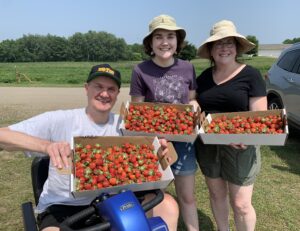
Jon and his family picking strawberries.
I know many people with neuromuscular diseases are also parents. Bringing up children in this world can be one of the most challenging things we will face. And being a parent with a disability can be even harder. Despite the physical things you may not be able to do as a parent, there is so much more that you give your children. I honestly believe children who are brought up in this situation are more empathetic and understanding of the struggles many of us deal with. I know that is true for our daughter Ava.
Connecting with the MDA community has also been so important for me. Being an MDA Ambassador connects me with people like me, that I can learn from and that I admire. I am actively involved in a local adult support group that is a safe space to share with others my experience dealing with the adversity that living with a neuromuscular disease can bring. I also try to accept any opportunity I get to share my story and advocate for the MDA, including speaking to the firefighters at the Fill The Boot bootcamp each year.
Advice for your journey

Jon Bruns, author
I have a lot of advice that I would give to that younger me who faced a life-altering medical diagnosis. And I want to share that with anyone else who is on a similar journey.
Seek support; there are so many helpful resources out there that can make life easier for you. Accept help; one trait many of us have is stubbornness but letting people help you makes your life easier and makes others feel good. Focus on what you can control. One thing that you can control is your attitude. I try my best to choose a positive attitude. Yes, I have days when I want to give up, but I remind myself of everything that I am grateful for instead. My life with BMD has been a challenging journey and it’s ok to have good days and bad days. Don’t beat yourself up over things you cannot control.
And finally, be kind to yourself.
The post MDA Ambassador Guest Blog: Life Lessons on My Journey with Becker Muscular Dystrophy appeared first on Quest | Muscular Dystrophy Association.
]]>The post MDA Summer Camp Alumni Put the Power in Powerhockey appeared first on Quest | Muscular Dystrophy Association.
]]>
Philadelphia Flyers PowerPlay Orange Team takes the court in Game 3 of the tournament. Photo credit: Bradley Digital.
On the weekend of August 1, five Powerhockey teams from across North America hit the arena to compete for victory in the 2025 Powerhockey Cup. Hosted by the Philadelphia Flyers PowerPlay at Neumann University in Aston, PA, the tournament was a dazzling display of strength, abilities, and heart. Powerhockey, whose rules are based on a combination of ice hockey and floor hockey guidelines, is a fast-paced, competitive game of hockey with the use of power wheelchairs.
Teams are comprised of athletes living with a variety of diagnoses, including individuals living with neuromuscular disease. The tournament – and league itself – provide an opportunity for community, camaraderie, competition, growth, and sportsmanship. Open and free to the public, the event brought more than 200 spectators over the course of four days, and hundreds more tuned in to livestreams on YouTube.
The Philadelphia Flyers PowerPlay organization had two teams participating in the tournament, the Flyers PowerPlay Black team and the Flyers PowerPlay Orange team. The Flyers faced off against teams from Michigan, Toronto, and Ottawa for the coveted Powerhockey Cup.

Philadelphia Flyers PowerPlay Black Team celebrates victory. Photo credit: Eric Hartline
“The Flyers PowerPlay Black team won the tournament with an undefeated 6-0 record,” says Jake Hartline, the Team Manager and a member of the Executive Committee for the organization. “The highlight of the tournament was the Flyers PowerPlay Black third period comeback to win the Championship Game. The PowerPlay Black team were down 3-1 against the Michigan Mustangs going into the third period. With just under six and a half minutes left in the game, PowerPlay Black scored 3 goals in 68 seconds to take the lead and never looked back.”
Three players from the organization also won individual tournament awards: PowerPlay Black’s Jake Saxton was named Tournament MVP, PowerPlay Black’s Alex Pitts was Championship Game MVP, and Josh Scoble of PowerPlay Orange won the award for Outstanding Rookie.
MVP Jake Saxton and a number of his teammates are MDA Summer Camp alumni, many of whom first experienced playing Powerhockey during their time at camp. We checked in with four of the players about what Powerhockey and MDA Summer Camp means to them.
Jake Saxton, 22 years old, Forward

Jake Saxton
Jake, a former MDA camper who lives with spinal muscular atrophy (SMA), currently serves as an Assistant Captain and a committee member of the Philadelphia Flyers PowerPlay power wheelchair hockey team. Jake has been on the team for fifteen years and is a five-time MVP. This year, Jake led his team, and the entire tournament, with 20 goals and 30 points.
“I’ve been playing power wheelchair hockey since I was 7 years old, and my journey with the MDA community started when I became a camper at age 9,” Jake says. “Each summer, I looked forward to that incredible week of fun and connection. Not only did MDA camp give me the chance to experience independence, but it is also where I built lifelong friendships and became part of a truly remarkable community. I’m grateful for the experiences and relationships that shaped me through both hockey and MDA.”
The love of the game and the powerful community connection are Jake’s favorite aspects of being part of the PowerPlay team. “What I like best about being on the team is being able to express myself in a competitive setting and forming friendships on and off the court,” he says.
Liam Miller, 27 years old, Forward

Liam Miller
Liam Miller, who lives with Ullrich muscular dystrophy, has been a part of the Philadelphia Flyers PowerPlay for almost 20 years and serves as the Flyers PowerPlay Team Captain. He scored 8 goals and tallied 5 assists in this year’s tournament.
“The PowerPlay is so deeply important to me. Over the years, it has given me an abundance of chances to learn and grow, to exercise, to compete, to make relationships, to make decisions, and much more. The league has been a critical resource for community, advice, friendship, and support in addition to hockey. It has given me so much and I wouldn’t be who I am without it,” Liam says.
“When I was around 6 years old, I attended MDA Camp for the first time, and it changed my life. I immediately fell in love with it and ended up spending 12 summers in a row going back to hang with my friends and make memories. The beauty of camp was being able to have the freedom to do what you wanted, which helped me to learn to be independent. Sometimes that was going to the camp-organized activities like swimming or arts and crafts, sometimes that was heading to the gym with my cabin mates to play wheelchair hockey. Over the years, hockey and camp became synonymous and I always looked forward to going back to camp so I could play with my friends. As I got older and heard about the PowerPlay league, a lot of those friendships carried over into playing for the PowerPlay – and so camp and hockey are closely intertwined in my heart. Both have had such a profound impact on my life and their meaning to me is hard to put into words.”
“I love the community it provides for people,” he continues. “I’ve met so many incredible friends by being on this team that it’s hard to imagine a life without it. I love being able to compete at a high level with friends I care about and when we work together to win our games. We’ve all gone through our lives with disabilities and sometimes the world makes that challenging, but it feels so sweet to share that experience with other people you care about.”
Michele Boardman, 39 years old, Defense

Michele Boardman
Michele, who lives with limb-girdle muscular dystrophy (LGMD) Type 2i/R9, was introduced to Powerhockey at MDA Summer Camp when she was 13 years old. It quickly became her favorite sports activity at camp as she embraced the newfound freedom and independence she discovered in adaptive sports. Her love for Powerhockey and the time spent with her camp family, building bonds that have lasted a lifetime, have shaped who she is today.
“After I aged out of MDA Summer Camp, graduated college, and got my master’s degree, I became reacquainted with my favorite camp sport, through my good friend Pat Hilferty, who continued to pester me about joining his wheelchair hockey team for 10 years,” Michele says. “I’ve been playing since 2012, and love the camaraderie, competition, leadership opportunities, and the chance to be part of something greater than myself.”
“Our team accepts the challenges that life has placed in our path, and we rise above adversity. Powerhockey is the conduit through which we can let go of the constraints of our disability, and let out our aggression, overcome our fears, take risks, and put our pride on the line to pursue excellence, learn, grow, and achieve,” she continues. “I often think of my hockey team as the continuation of the MDA camp legacy in adulthood. Being part of this team feels a lot like being at MDA Camp, in the sense that you are surrounded by people who have similar challenges as you and they get it. They get what it’s like to navigate the world in an environment that wasn’t built for them. Being in that community feels like family, surrounded by people who care about you and want you to succeed, both in the sport and in life. We cheer for and support each other’s accomplishments both on and off the court.”
Lea Donaghy, 26 years old, Forward/Goalie

Lea Donaghy
Lea Donaghy, who lives with SMA Type 3, has been a proud member of the Philadelphia Flyers PowerPlay for ten years. She notes being part of this team as one of her favorite things in the world. This was Lea’s first tournament playing as the team’s goalie. She finished the tournament with 2.38 Goals Against Average, allowing only 11 goals throughout her 208 minutes of play.
“I’m also a former MDA Camp camper, an experience that had a huge impact on my life. It was the first time I got to be independent and away from my family, and it helped me grow in ways I never imagined. Even more special, it’s where I met some of the most important people in my life, my chosen family. These are the people who believe in me, understand the challenges I face, and support me unconditionally,” Lea says. “MDA Summer Camp introduced me to the amazing sport of Powerhockey. Through the game, I’ve learned so much, especially about teamwork and communication. It’s given me a chance to compete, stay motivated, and push myself to be the best I can be. I’m so thankful for the friendships, memories, and opportunities that came from MDA Camp. It’s what led me to one of my biggest passions, and I wouldn’t trade that for anything.”
Competition, community, and comradery

Philadelphia Flyers PowerPlay Black Team prepares to compete. Photo credit: Eric Hartline
Echoing the sentiment of these experienced competitors, first-time MDA Summer Camp attendee and rookie PowerPlay athlete, 8-year-old Roland, wrapped up his first year on the Flyers PowerPlay team with gratitude and passion. “My favorite thing about competing in the tournament was seeing so many athletes just like me,” Roland says. As the youngest player on the team, he shares one of the best things about being part of the organization is learning from the older athletes whom he looks up to on the team.
In a sport that celebrates abilities, perseverance, and teamwork, victory exceeds far beyond claiming the title of Powerhockey Cup Champions – the true victory is found in the community and growth that the league provides.
The post MDA Summer Camp Alumni Put the Power in Powerhockey appeared first on Quest | Muscular Dystrophy Association.
]]>The post Quest Podcast: Precision Medicine: Mapping the Genetic Code for New Treatments appeared first on Quest | Muscular Dystrophy Association.
]]>Read the interview below or check out the podcast here.
Mindy Henderson: Welcome to the Quest Podcast. Proudly presented by the Muscular Dystrophy Association as part of the Quest family of content. I’m your host, Mindy Henderson. Together, we are here to bring thoughtful conversation to the neuromuscular disease community and beyond about issues affecting those with neuromuscular disease and other disabilities and those who love them. We are here for you to educate and inform, to demystify, to inspire, and to entertain. We are here shining a light on all that makes you, you. Whether you are one of us, love someone who is or are on another journey altogether, thanks for joining. Now, let’s get started.
September is Muscular Dystrophy Awareness Month, and I couldn’t think of any better guests than the three individuals I have with me today to talk about muscular dystrophy and related diseases, as well as some of the exciting advancements that have led to faster, easier, and more accurate genetic diagnoses. Their credentials and accomplishments are far too many to cover, but suffice it to say their work is incredibly impressive and I am so proud to have them here with me today. First up, I have Dr. Stephan Zuchner. Dr. Zuchner is a professor of human genetics and neurology in the role of chief genomics officer at the University of Miami Miller School of Medicine. Next, Dr. Chris Weihl is a professor of neurology, head of the neurology neuromuscular section, and director of the Muscular Dystrophy Association clinic at Washington University School of Medicine in St. Louis. And last but certainly not least, I have my friend and colleague, Dr. Angela Lek, who is the interim chief research officer at the Muscular Dystrophy Association.
Thank you all so much for being here. I’d like to just start because, like I said, reading your bios made my head spin and the work that you’ve all done is incredible. So I would love to just have each of you talk a little bit about your areas of focus and really what led you into this work. Maybe we can start with you Dr. Zuchner.
Stephan Zuchner: Sure. Mindy, first of all, thank you for having me here. Happy to participate in this. I actually grew up in Germany and most of my education there. So I went to med school in Germany and ended up doing research work at my university there, which happened to be in the key German center for neuromuscular pathology. In fact, I trained as a neurologist there, but also I trained as a neuropathologist as well. So that was sort of my first deep entry into the field of neuromuscular diseases, basically, as a pathologist. But I did also discover for other reasons, I guess, that I really liked genetics. I was always drawn to genetics, the power of genetics. I vividly remember the first sequencing experiment I did myself as a young doctor identifying a mutation in a patient with neuromuscular disorder, and realizing late night by myself in the laboratory that this single change there put this life of that individual on a completely different trajectory.
We all have our little aha moment, so that was for me there. I was very lucky to get a fellowship to come to the United States to do a research here away from clinic. That was so convincing for me that I, in the end, decided to stay in the United States and make this my full-time profession, being a neuromuscular scientist and economist.
Mindy Henderson: Amazing. Thank you for that. Dr. Weihl, let’s switch over to you.
Chris Weihl: Sure. Again, thank you for having me. It’s a pleasure to talk to you, Mindy, and to be with the rest of this group. I would say that I did med school and I did my graduate school work at a time where molecular biology and molecular genetics were just emerging, and really understanding how to manipulate genetics in experimental systems was something that was really interesting and exciting to me experimentally. And then seeing patients in clinic and starting to realize that there was likely an underlying genetic etiology to some of the diseases that we’re seeing really began to kind of emerge and cement itself. One area, as a neurologist, that we see is probably the greatest breadth of different types of diseases and presentations that can be caused by different disease genes. Meaning that you can see the same patient with a neuropathy or with a muscular dystrophy, yet the number of genetic variations that can cause that disease just felt limitless.
So I think that’s really added to this idea of solving a genetic puzzle, solving a clinical puzzle that really made me more interested in neuromuscular disease, but also interested in identifying the underlying pathogenic mechanism. Another aspect with genetics is once you find the genetic etiology, you really have found the answer. It’s not like in some diseases where you still don’t actually know what’s causing it, you really have gone down to the fundamental roots. And that’s just really satisfying and gratifying. And then I would say I started my career about 18 years ago, and I entered into a very large already existing Muscular Dystrophy Association clinic in which there were patients that had been well phenotyped and families that we’d had for many years being seen in that clinic that didn’t have a diagnosis at the time because genetic medicine wasn’t as readily available for the patients and, in many cases, the disease gene had not been identified.
So it was really at that point that I was able to start, with the advent of newer sequencing technologies, things that you could do on smaller families where the importance of finding a patient from one family or an individual patient that phenotypically was very similar to another patient, and then matching those genetics together. It was a very different way, a very physician-led way of understanding diseases rather than long families and looking at linkage. It was really pattern recognition in the patient phenotypically and then pattern recognition genetically. So I think that’s probably what made me begin to be so interested. And then obviously, staying on top of new genetic variations is just as exciting to then understand pathogenic mechanism, and it’s really led to just a endless amount of intellectual questions that could be answered in experimental models.
Mindy Henderson: Well, you both have a knack for making what you do sound very easy. I wish that all the time that I could live in the brains of scientists like yours for just an hour or two, and I think it would be fascinating. Dr. Lek, if I’m not mistaken, you’ve had a 15-year career in research and now, of course, working for MDA. What led you into this field of work?
Angela Lek: To be honest, it was all the publicity around the completion of the Human Genome Project, which was in the early two 2000s, that really fascinated me. That happened while I was in high school. I’m revealing my age a little bit here. But I was super fascinated, super excited by the fact that our traits are encoded within our genome, whether they be good or bad. And then that there were technologies and machines that could be deployed to interpret this genetic code for the first time in human history. That was just really mind blowing to me. And that was what attracted me to the field of molecular biology, which delves into how DNA works, how it encodes genes and proteins. All that was super fascinating. And I pursued some of those studies in college back in Sydney, Australia, which is my home. Along the way, I met my husband along with several members of his family, and they were diagnosed with a form of muscular dystrophy called limb-girdle. It’s an autosomal recessive condition with an adult onset that causes progressive muscle weakness and wasting, and loss of independence over time.
So that sort of spurred me on to dedicate my career to neuromuscular disease research, first, during my PhD, which involved trying to understand how a particular gene called dysferlin gives rise to a form of limb-girdle muscular dystrophy and what the cellular consequences of that were. And then I pursued postdoctoral studies in Boston Children’s Hospital, in the laboratory of Luke Hinkle, where I pursued further studies into Duchenne muscular dystrophy and also facioscapulohumeral dystrophy. That one’s always a mouthful to say.
Mindy Henderson: Definitely.
Angela Lek: Yeah. Now, I’m at MDA. I started off as a vice president of research, and now I’m the interim chief research officer. I have the privilege of working with leading researchers and clinicians around the world, such as Dr. Weihl and Dr. Zuchner, to help accelerate progress across the entire neuromuscular disease landscape.
Mindy Henderson: Amazing. Well, we love having you at MDA. We’re incredibly fortunate. I’m excited to dig into more of the work that you all do every day and some of the concepts that you mentioned. But Dr. Weihl, the term muscular dystrophy gets used pretty broadly in the public. Could you explain what it actually means, and what types of diagnoses fall under that umbrella?
Chris Weihl: Yeah, sure. Muscular dystrophy is an inherited disorder, meaning that you get a variation in a gene, typically a gene that’s expressed in muscle, that then is defective and then causes the muscular dystrophy. In some cases, you need two mutations, which is a recessive disorder. In some cases, it’s passed on the X chromosome, and so it ends up presenting more commonly in boys. And then in some cases, it can be autosomal dominant, meaning you need just one variation. But at its simplest form, it is a disease of degeneration of muscle and then regeneration of the muscle that then leads to this pattern that we call a dystrophy, which ends up being degeneration of muscle leading to fibrosis and fatty replacement. And it’s due typically to fragility of that muscle fiber for variety of different reasons, whether that muscle fiber is fragile because the muscle membrane is somewhat leaky, whether that muscle is fragile because of a mishandling of calcium that causes it to contract in abnormal ways, or whether it’s due to mutations that affect maybe the nuclear lamina that then leads to secondarily a fragile muscle. Those are the molecular kind of mechanisms.
But as far as whenever we think of muscular dystrophy, it causes a pattern of muscle weakness often presenting in the proximal musculature, so often the shoulders and the legs. However, there are a variety of different forms and they often have names that kind of describe their pattern of weakness. One form we call limb-girdle muscular dystrophy, and that’s a description of how the patient’s pattern of weakness would be. So typically shoulder girdles and pelvic girdle. Angela mentioned another facioscapulohumeral dystrophy, which typically cause facial, weakness in the arm muscles, and weakness in the lower extremities. So that’s one way that we name muscular dystrophies.
Another way that we name muscular dystrophies are historic kind of eponyms, and so a historic eponym that we think of is Duchenne muscular dystrophy. That was named after the clinician who astutely identified these patients and kind of characterized them as being a single disease entity. Another one is Becker muscular dystrophy. So all of these are muscular dystrophies. And what I think is important is they cause progressive muscle weakness, and they’re due to a genetic etiology that causes either a deficiency or a dysfunction of the muscle that leads for it to be fragile and often degenerate, leading to then replacement with fatty tissue and connective tissue.
Mindy Henderson: Similarly, Dr. Zuchner, I’d like to ask you the same question, but your expertise, if I’m not mistaken, is in Charcot-Marie-Tooth disease and neuropathy. How do those conditions differ from the muscular dystrophies?
Stephan Zuchner: First of all, this name CMT or Charcot-Marie-Tooth neuropathy or disease, it sounds very complicated. What it actually means, Charcot, Marie, and Tooth are three individuals who lived about 150 years ago, three doctors, who were the ones who defined what that is. So what is that? It’s essentially a neuropathy, and specifically an inherited neuropathy. So you typically would inherit from your parents. And neuropathy is a disease that affects your nerve, the nerves that run in your legs, in your arms. These nerves connect, for instance, to your muscles. So they make the muscle move. And that is why when the nerves are not working properly, you see somewhat similar symptoms than for muscular dystrophies. You have this weakness, muscle weakness, muscle wasting, but the reason why you have that is quite different. It’s not the muscle fiber itself, the muscle itself, it’s actually the nerve that connects to the muscle.
Nerves are a bit like the electric cables maybe in your house, in a way. They’re sort of wires that transmit information from your brain, in this case. You may have this idea to get up and go and get some coffee, then your brain tells your body to start moving. And to move your muscles, you need that interconnection between your brain and your muscles that… these are the nerves. So neuropathies affect the nerves. That’s really what it is. There was certainly the idea early on that… Doctors first studied patients 100 years ago, and they came up with systems to put patients with neuropathies into certain groups. That was just what was possible at the time because of technology, basically. So they became better and better in understanding these groups. There aren’t that many groups, and I don’t even want to go into the detail here. But there was certainly the hope that once we understand the genes underlying, there may only be a few genes that explain these groups. Doctors are very smart. Even 100 years ago, they understood this is inherited from your parents.
How did they know that? Because they observed that these disorders, they run in families often. So they understood this was something that had to do with the transmission of genes from parents to children. The first gene was found in the early ’90s for CMT, and it was a huge success. It did explained a lot of patients, especially for the so-called demyelinating type. But then, pretty quickly, doctors also realized it didn’t explain every patient. It did also not explain every demyelinating type of patients. So this was the beginning of a long journey, and we’re still on this journey. Since then, scientists have discovered over 130 genes that can cause CMT or neuropathy. And still, depending a little bit on how you count, between 30 and 60% of patients still don’t have a change in any of the known genes.
So this is sort of where we are right now, a tremendous success. Over 100 factors were discovered, the understanding of the categories, the different types of CMT has immensely increased. At the same time, a lot of patients don’t know their diagnosis yet. Clearly, many of those, they clearly have some gene underlying. And I guess we’ll talk a little bit more about this topic as we go on here. Yeah, I’ll leave it there.
Mindy Henderson: Yeah. No, that’s a perfect segue actually. I’ve been told that something called next-generation sequencing is what I’d like to spend a lot of time on today, and talk about the implications of that and what it is exactly. But before we do that, Dr. Lek, I would like to ask you… There are two different ways, in my understanding, that patients get diagnosed today. Some receive a clinical diagnosis and some receive a genetic diagnosis. Can you talk a little bit about the difference between those two things? I personally, until I worked for MDA, didn’t realize there was a difference between those two things and what that meant exactly.
Angela Lek: From a high level point of view, and perhaps Chris can maybe expand in more detail afterwards, a clinical diagnosis is a diagnosis based on your clinical symptoms, based on associated with different muscle groups, different parts of your body. And together, they will give rise to a clinical picture that maybe points towards one disease over another. However, it’s not very precise. A genetic diagnosis is when you obtain blood from a patient or a muscle, you isolate the DNA, sequence that DNA or do some sort of genotyping panel, and then figure out where the exact disease-causing pathogenic mutation occurred in your genes, which gene is affected. And that way, you can say, “Oh, you have Duchenne muscular dystrophy, you have a mutation in the dystrophin gene. Or you have limb-girdle type 2G or R7 because you have a mutation in your TCAP gene.” It’s very, very precise. Sometimes a clinical diagnosis is less precise, and it can result in misdiagnosis is my understanding. Is that true, Chris?
Chris Weihl: Sure. I think you did a great job at explaining that, Angela. I would say they’re not mutually exclusive, and they work hand in hand. So what I would say is getting a genetic diagnosis is important and becoming more and more imperative as gene-focused therapies are being developed to understand. But I would say that having a variation on your genetic panel, if you don’t have the clinical symptoms, I would say that doesn’t mean that you have the disease. So you still have to go hand in hand.
Angela Lek: That’s true. Yeah.
Chris Weihl: And then I would say that a clinical diagnosis, as we talked about, and Stephan explained it really well, in a patient with neuropathy, which may look very similar to patient after patient, has a neuropathy. We might say they have CMT. We might even say they have CMT of demyelinating features. That’s a clinical diagnosis that then helps us make the genetic diagnosis. Because they may then look at the genetic panel, and so I think often patients get confused. So I know in the field of limb-girdle muscular dystrophy, we say, “Oh, you have limb-girdle muscular dystrophy.” As Stephan said, the same is true in limb-girdle muscular dystrophy where about, depending on how you count, 30 to 50% of patients with limb-girdle muscular dystrophy don’t have a genetic cause. But that does not mean they don’t have limb-girdle muscular dystrophy, just like it doesn’t mean they don’t have CMT if you can’t find the genetic cause. So I think of them, a clinical diagnosis, as kind of an overarching umbrella for many different genetic diagnoses, about half that we know and about half we still are trying to figure out.
Mindy Henderson: Interesting. I hear stories all the time, and what we’re going to be focusing on for the rest of this conversation is a lot about diagnostics and treatments. But I hear stories all the time from individuals who have symptoms and they know that something’s wrong, and they’ve been working for 5, 10, 30 years to try to get a diagnosis. And my sort of phrasing of choice has become, “You don’t want there to be something wrong, but you want there to be an explanation.” So I feel so terribly for people who I speak to regularly who have these sometimes really serious symptoms and things breaking down in their bodies, but they just don’t know what it is and they can’t get the appropriate help because they haven’t been able to pinpoint what the problem is. So with that, I would like-
Chris Weihl: Mindy, I’m sorry to interject.
Mindy Henderson: Please.
Chris Weihl: I caution those patients because they do have a diagnosis, they have a muscular dystrophy. They might not have a genetic subtype. I often see patients get very frustrated because they don’t think they have a diagnosis because they don’t have a genetic subtype, but they do have a diagnosis. They’ve got a muscular dystrophy, and it’s something we take very seriously and want to help treat even if we don’t know the underlying genetic etiology. I apologize for interrupting, Mindy.
Mindy Henderson: No, not at all. That’s very helpful. You live and breathe us every day, so I’m glad that you added that. So like I said just a little while ago, one of the most transformative technologies in patient care that I’m hearing about is next-generation sequencing. For anyone listening who may not be familiar, would one of you like to break that down for us in simple terms and just tell us a little bit about what that is?
Stephan Zuchner: Yeah, I’m happy to start this. Basically, it’s true in medicine and in science that technology, in general, is a very strong driving force. While we like to believe we’ll sit in our libraries and come up with these great ideas, it’s often the technologies that help us to break through walls basically and discover new things. So sequencing the DNA is one of these fundamental abilities that really started what we know as genetics today. And what it means is DNA is the entity that’s huge. It’s a molecule really, a chemical molecule that we inherit from our parents. Basically, in one way, you often see it portrayed as this long line. It’s sort of a long string, and there are four bases, like four letters. We have some 25 letters in the alphabet or so. The DNA language is four letters, A, C, G, and T. Like in a book, with letters of the alphabet, the exact sequence of these letters give meaning to words, to sentences.
So that is really fundamentally what genetics is, being able to read these four-letter code in the DNA and discover, “Oh, they are actually words.” We call them genes maybe, and there are sentences. So I would say we’re still, in some sense, at the very beginning of understanding the human DNA and its meaning. But first of all, you need to be able to read the book. You need to recognize the letters and the sequence of them, and that is what sequencing technology means. Okay? There have been many iterations of this over the decades, and the latest is called… I guess we ran out of new cool words. So instead of coming up with a new word for sequencing, we called it next-generation sequencing. And really all you need to know is it’s just way more effective. It enabled that we can now read a person’s entire genome for really less than a thousand dollars now. It’s something that was unthinkable of just 30 years ago, simply unthinkable.
Now, it’s sort of routine. And it’s here in diagnostics, it’s available. There are, even now, new iterations of next-generation sequencing as we speak. The latest you might hear sometimes is called long-read genome sequencing. It produces an even better version, a better resolution of the genome. And every time there is a new version, like this long-read sequencing, scientists realize, “Gosh, there is so much more in this book of life. That genome, there’s so much more we can now read.” To some degree, it enables us to read better, like we get better with reading classes literally. Now, what’s very important to understand is, “Okay, now we can read the book,” but that doesn’t mean we understand it. And understanding also has layers. Maybe I can sound out the words, but do I really understand the meaning of the words? Sometimes the sentences, they have a deeper meaning, right? It’s the same in DNA. There’s a deeper meaning, “Do we really understand this yet?” That’s sort of where we struggle still.
Mindy Henderson: Interesting. Dr. Weihl, is there anything you would want to add to that?
Chris Weihl: I love that analogy. I guess the way I think about it is we used to have the book that we thought had all the words in it. And as Stephan said, technology evolves and we find that there were words there that we couldn’t see until we put on a different set of glasses. And I think when we talk about these diseases, that 30 to 50% we can’t find a diagnosis for, it’s not that we haven’t looked at the genes that we can read and have known that are there. It’s likely that these diseases have genes or changes or rearrangements in the language that we haven’t fully appreciated how to detect them yet. And I think that’s the most exciting about next-generation sequencing, and then as Stephan said, long-read sequencing, is that it’s allowing us to go back to that patient that may not have a genetic diagnosis and revisit that patient with a new type of sequencing technology so that maybe we can identify a novel new gene, something that Stephan has made his career doing.
Mindy Henderson: Yeah. It’s making me think of… I think every year, you hear new words that have been added to Webster’s dictionary, and that’s what you’re saying is making me think of that translates for me. We talked about the difference between a clinical and a genetic diagnosis, and how they’re interconnected and both importance in different ways. Can you talk about the impact that this technology has had, just a little bit more on people’s diagnostic journeys and the ability to cut time down on the duration to get a diagnosis, and things like that?
Chris Weihl: Yeah. Go ahead, Angela.
Angela Lek: Yeah. No, I just wanted to jump in and just share my personal story. So when my husband was diagnosed with muscular dystrophy and we would see the neurologist every year or annual visits for 10 years, and they said, every year, “We don’t know what’s causing it. We don’t know the gene that’s defective. We don’t know the root cause of your muscle wasting disease.” That was very frustrating. So having that clinical diagnosis was great, but I felt like we needed more answers. Particularly for looking towards his future prognosis, therapeutic intervention, family planning, all those sorts of factors, it was really important that we had the answers, the genetic answers. So actually the reason why I took 10 years was because this was prior to the introduction of next-generation sequencing in clinical practice. They were doing it the old way, screening each gene one by one, and it was really painstaking. It took a very long time, and they couldn’t find the offending gene.
But now, if he were to go to his neurologist now, or any new patient with his exact same disease, I imagine they’d get a diagnosis in just a matter of weeks using next-generation sequencing technology instead of waiting for a decade for answers. That’s the power of the technology.
Mindy Henderson: I love that. Thank you for sharing that. And like you’ve talked about, there are new discoveries all the time that are happening. Is it a question of just working with your own personal neurologist, day to day, year to year, however frequently, to know when the time might be right? If they didn’t have the right insight into what your genetic issue might be, how do you know when to test again?
Chris Weihl: Yeah. That’s a great question, Mindy. I think it’s something that… We probably, as clinicians, need to do a better job of letting patients know that if they don’t have a diagnosis, we’re always continuing to look for a diagnosis. So I tell patients who often come to the clinic and I can’t give them a diagnosis today, I will usually look through and make sure that I’ve done everything or the previous doctor has done everything. I will try to understand their genetic tests that they had. And then often these panels increase, often you can escalate genetic testing to larger genome sets, often it may be that we need to try doing a different type of sequencing, as Stephan said. Often it means reaching out to collaborators and saying, “I have this patient.” Stephan has developed a network where, if I have a patient with CMT, I can give it to people that can aggregate things together.
So I think being at an MDA clinic is important. I think asking… it’s a great question. I don’t know if somewhat the clinician needs to be the one that kind of says, “Hey, I think we need to revisit your genetic testing.” There’s a new panel I can say from experience. Maybe 10 years ago, we did a very small genetic panel of maybe 30 genes. And the patient will hear they don’t have a diagnoses, and then they will somehow drift away into the community. And then they’ll come back to clinic 5, 10 years later and we’ll be able to do a different panel that’s expanded that might have 180 genes on it, and we will then identify a diagnosis. So one thing that pains me is to think that there are patients out there who could have a diagnosis but haven’t reengaged with an MDA clinic or with a neurologist, or asked the question about, “Could this be a hereditary disorder?”
Angela Lek: Actually, can I jump in and say that all MDA care centers can send off patient sample to Invitae, the company that can run a testing panels for common disease-causing genes for neuromuscular conditions, and that’s done… Invitae does that for us free of charge. And then should that not yield any answers, then as Stephan said, it then becomes a research project. And you can put on a different pair of reading glasses and look deeper using a different technology, such as exome sequencing or genome sequencing that both can give you more resolution to see if you can find the disease-causing gene that way.
Chris Weihl: I will say that neurologists, and even neuromuscular physicians, do not often get formal training in genetics. So having a genetic counselor in clinic with you or having someone that’s comfortable with it. Because these panels, they only sequence what we know. So if I’m going to sequence 180 genes, I’m only going to look at those 180 genes. There are some things, in particular, in muscular dystrophies that are missed on those panels. One of them being facioscapulohumeral dystrophy, which would not be detected on a traditional panel and needs to be intentionally looked at other repeat disorders which need to be looked at intentionally. So I think that we need to do a good job of educating clinicians on knowing the limitation of the tests that they order, knowing what is on that test.
SMA, which can sometimes look like a limb-girdle muscular dystrophy, is not necessarily on some of the sequencing panels. It might be on Invitae. I don’t know for sure. Becker muscular dystrophy, which can be found from a very small deletion, may not be picked up on some of the panels. So, again, your clinical suspicion needs to really drive the genetic testing, and so we need to go hand in hand.
Stephan Zuchner: Mindy, as Chris said, there’s no strict guideline.
Mindy Henderson: Mm-hmm.
Stephan Zuchner: I would say from looking backwards, if you have a clinical diagnosis and your physician says, “That must be a genetic cause, but we can’t find it yet,” every five to seven years, if your insurance company agrees, it’s probably worthwhile to revisit. If you’re in a specific situation, maybe it’s a child, it’s growing, and you have this desire and panic to find an answer, then joining a research project isn’t also a good idea.
Chris Weihl: Stephan brings up a good point. So it’s not getting a genetic test every year. It’s not going to one doctor getting a genetic test and then going to another, and hoping… It’s really an evolution of years that needs to be aggregated.
Mindy Henderson: The other thing that’s coming to mind for me is just the momentum that’s being built in the research community right now and the progress that we’ve seen and that you’ve talked about today, and Dr. Zuchner, you mentioned clinical trials. How important is having an accurate genetic diagnosis to participating in a clinical trial, let’s say?
Stephan Zuchner: Yeah. I would say it’s increasingly fundamentally important. I sometimes use this picture of a coin. You have a coin that has two sites, right?
Mindy Henderson: Mm-hmm.
Stephan Zuchner: The genetic diagnosis, knowing what the gene is that doesn’t work properly in you, is nowadays married to a potential for treatment. It would be great if there was sort of an aspirin or an ibuprofen type of drug like we have for pain, it covers all kinds of pain and fevers, and it would exist for neuropathies, for muscular dystrophy. People have tried and they still try to find this kind of aspirin for muscular dystrophy. But so far, it’s not being super successful. So what the medicine is now looking, and Chris mentioned already, is gene-specific therapies. Drugs that target a particular gene, sometimes even a particular mutation. Of course, you can only do this when you know the gene that you carry. In fact, I’ve seen many stories over the years. Sometimes there is somewhat lucky situation where we find a new gene and then we realize, “Oh.” We basically look around and say, “Oh my gosh.”” All these patients around, we find like a dozen and more patients right away that have this new gene that was there all the time.
And then, luckily, it turns out we understand this gene actually quite well. There is even a drug that looks promising that maybe was developed for another disease, sometimes even for cancer or something. And it’s very obvious to scientists that this drug might actually work. So in some fortunate situations, it has happened that suddenly there was a great drug candidate. But again, it all happened with the discovery of the gene and the diagnosis in these particular patients. And that allows then these patients to participate in clinical trials, for instance. I mean, Angela, that’s at the heart of much of what the MDA is doing these days is pushing this message. That’s sort of gene-centric approach to diagnosis, of course, to future therapies, trials, all of that.
Angela Lek: Yeah. A lot of the trials that are emerging are utilizing gene replacement technologies, RNA-targeted therapies, even now, gene editing. And all that requires a genetic diagnosis, knowing exactly which gene is causing your disease and the type of mutation that’s causing that effect.
Chris Weihl: This is why it’s so critical for patients if they get a genetic diagnosis. So first off, to hear about a therapy, the therapy is going to be for one related neuropathy. Patients are going to need to know that they have a mutation in that gene. I don’t expect patients to know that. What I do want patients to do is to feel empowered to ask their clinician for their genetic test results, put it in a file somewhere. Even if it’s in negative genetic test result, hold onto it because invariably patients come back to me and say, “Hey, I’ve already had genetic testing.” “I don’t actually know what that means. We just talked about that.” So if they have their genetic test result, it’s helpful.
As Angela said, it’s not just going to be gene-specific therapies, it may be mutation-specific therapy. So you may tell me you have a mutation in dystrophin, but I have a therapy that’s only amenable if it’s Exon 45 skippable, that’s only going to be on your genetic test result. So this needs to be people’s new social security card that they hold onto and have because, as we heard, the journey to get the diagnosis took years. And if you have that diagnosis, keep it in a piece of paper and put it somewhere so that whenever… The expectation that I’m going to be able to find it in the medical record is really hard. There’s no tab for genetics-
Angela Lek: Put it in your wallet. Carry it with you.
Mindy Henderson: Have it laminated. Exactly. So what would you all say are still the biggest challenges that remain in terms of getting diagnoses to people, and how are researchers working to address those gaps that still exist and maybe among the biggest?
Stephan Zuchner: I guess, there are two categories. One is challenges around how healthcare is working in our country, and the other is the more scientific challenge. And maybe I can talk about the scientific challenge. Chris, I’m sure is happy, or Angela, to talk about our healthcare system. For me, it’s the scientific point of view. We just made it very clear how important it is to know your gene if you have a neuromuscular disorder. And it drives me personally, the realization, that so many patients that it still don’t know their gene. If you know, it opens a whole set of doors for you once you know it. So the challenges for knowing your gene from a scientific point of view is often related to… there are more genes to be discovered. Or maybe a new sequence technology gives us new reading classes and, suddenly, we understand the meaning of parts of the genome. Okay?
Mindy Henderson: Mm-hmm.
Stephan Zuchner: That’s sort of what we are trying to tackle with different approaches. One thing that’s close to my heart for a long time is… When I started my career, the way to do this type of research was to find patients that had many family members that were still available to study. And these families with multiple affected individuals, they were sort of almost the only way to get to the core of the genetics. So we would study these families, everybody would study these families. And if you had just a handful of these families, you actually had somewhat the power to find a new gene. In some ways, most of these families have been studied. But there are other ways to do it. So the way today to do it is, even very small families where maybe only one or two people are affected, to bring them together into a research database. And when you put them all together, you also gain the power to understand what’s wrong with certain sets of individuals and patients.
So the core here is that scientists collaborate with each other, in the United States, but also internationally. And this has wonderfully developed over the years also to share the data. It’s very important also to hang on to data that’s already been produced. That sounds maybe obvious, but a genome is a very large dataset. It’s like 20 Netflix movies. Okay? That’s one genome. So it’s hard to hold onto that kind of data. So to do that and to share all that continues the momentum that we find these missing genes that we still haven’t discovered, so that more patients get into this situation where they can then go to Angela and say, “Here, this is my gene, MDA. What is the next step?”
Mindy Henderson: I like that idea.
Chris Weihl: I would say another challenge we have… I totally agree, identifying new genes and identifying those in the patients. But I would say, clinically, another challenge we have are indeterminate genetic test results. These are genetic test results where the geneticist has identified them as something called a variant of unknown significance, or perhaps they have a variation in only one gene and not on the second gene. I think these can be just as equally frustrating to a patient because they’re left in this area of limbo. And sometimes it takes a little bit more legwork. So it may require doing a muscle biopsy on the patient. It may require sequencing a family member in order to help kind of understand, “Did that little variation in that patient truly means something pathogenic?” And the other way is exactly what Stephan said, which is collaborating and building a network so that we can understand, “This variation that’s found in this one patient, is it also found in another patient? Or is it found in a patient…”
Whenever we start thinking about patients, I think we need to be thinking not just about patients in our local community, not just patients regionally or in the US, but we need to be thinking about patients globally. We need to think about sequencing in under-represented areas, in areas that we don’t often have the breadth of genetic diversity from, and that will continue to inform us about, “Is a sequence variation causal or is it perhaps something incidental?” And I would say identifying a incidental variation is equally important because that means we need to start looking again and seeing if we can find the real cause.
Mindy Henderson: So interesting. I have time for about two more questions. I could talk to you all day, you’re all so interesting. But Dr. Lek, let me ask you, what types of research and initiatives have MDA supported over the years to help overcome the kinds of challenges that we’re hearing described so that we can get more and more patients answers?
Angela Lek: Yeah. Look, Mindy, we’ve funded several efforts as it relates to helping patients obtain a genetic diagnosis, to better understand genetic variants that lead to disease, and to discover new disease genes, as Stephan talked about. For example, we funded Doctors Lowell and Todd from NIH to develop a comprehensive database to link genetic mutations in the ryanodine receptor gene with specific clinical features, in order to get a better understanding of the spectrum of disease-causing mutations and how they can cause disease-related symptoms associated with this calcium channel disease, so to begin cataloging each of the mutations that’s seen in patient cohorts. MDA has also funded my better half, Dr. Lek from Yale University, to develop cell-based assays to predict the pathogenicity that is, “How likely a genetic variant or mutation is to cause a disease?” And this approach was applied to a subtype of limb-girdle muscular dystrophy in an attempt to shed resolution on the variants of unknown significance in the FKRP gene, something that Chris touched on.
This method is also now being expanded to interpret mutations or variants in the sarcoglycan genes that give rise to a few other different types of limb-girdle muscular dystrophy. And I believe Dr. Weihl is also doing some of that research and contributing efforts to that. Finally, MDA has also contributed funding to Dr. Zuchner’s Genesis platform, which is a platform for genomics data management comparison and analysis, that gives researchers the tools they need to help families with their diagnostic journeys. I believe the Genesis platform has supported over 100 gene discoveries, and this is so powerful in helping to end the diagnostic odyssey for some families that have been struggling to get a genetic diagnosis for years.
Mindy Henderson: It’s amazing to listen to all of you, and to hear you talk about the different areas and factors. It feels like we should know all the answers to listen to you. It feels like we know so much, but I know that there is still a lot that we don’t know. And as for someone speaking who lives with one of these neuromuscular conditions, if there’s not a way to make a condition like spinal muscular atrophy or Duchenne dystrophy, or any of these neuromuscular conditions that we’re talking about, if there’s not a way to turn that into just a bad dream that you can wake up from, the next best thing I think is to uncover the treatments of the therapies that are going to lighten the load a little bit on what these conditions do to your body. So I’d love to give each of you the opportunity to answer this question and talk a little bit about the use of next-generation sequencing and how it’s opening new doors for therapies to expand more and more possibilities for research. And ultimately, what we all want is, “Which are the therapies to treat these conditions?”
Chris Weihl: Right. I can start, I guess?
Mindy Henderson: Mm-hmm.
Chris Weihl: I think what we don’t realize is we just don’t know the prevalence of many of these disorders. And when I say that, we don’t know how many patients with a mutation in calpain-3, for example, are out in our communities. So I think that next-gen sequencing, which has allowed easy, rapid genetic testing, has allowed us to bring patients together. And I think by bringing patients together, we then can create power of these patients to create patient communities to then lobby to interest groups, whether that’s drug companies, whether that’s the government, whether that’s the MDA and say, “Hey, we’re not this rare disease. We’re this rare disease that is well organized, well connected. And we’re looking for more patients because we’re able to do genetic testing so easily.”
So I think that’s been really powerful, is just allowing the identification of more and more patients with what we call rare diseases in our rare diseases. But whenever you can bring them together because of a genetic diagnosis across the country, I think that ends up being really, really powerful. So I would say next-gen sequencing has allowed me to do genetic testing in the clinic without having to ask insurance companies, without having to go through a lot of leg work, and then give the patient the answer and allow the patient then to use that to empower themselves and their patient community.
Mindy Henderson: That’s great. Dr. Zuchner, what are your thoughts?
Stephan Zuchner: Yeah. All of this, and I’ll give you a bit more of the sort of basic science taste here. I think what next-generation sequencing really has changed is… We used to print things out and have it in paper files. And this technology, when it started some 20 years ago, made everything digital. I’ve seen in the last decade, genetics has become very much a data field, a computational field. It has attracted mathematicians and engineers. And now the latest, of course, it’s probably quite amenable to AI. I think we will see breakthroughs from AI. It’s already been used to help us understand what this all means. So the transformation of this field to this digital powerhouse is still underway, and it’s one of the most fascinating things to see.
Mindy Henderson: Amazing. Dr. Lek, I’ll give you the last word.
Angela Lek: Sure.
Mindy Henderson: What would you like to leave us with?
Angela Lek: Well, look, next-generation sequencing really creates the foundation for targeted treatments, I think, that can be tailored to patient’s genetic profiles. Once the genetic cause is known, therapies can be tailored to the specific mutations. So for instance, antisense oligonucleotides that correct RNA splicing, gene replacement therapies for loss of function mutations, or even gene editing to correct a range of mutation types. Next-generation sequencing has really opened the door for genetic medicine. I want to share one of the most powerful examples of what’s possible in genetic medicine, and it’s the story of baby KJ. I don’t know if you’ve been following that or read about that in the news. Baby KJ was born with a life-threatening metabolic disorder caused by a unique genetic mutation. And using rapid genome sequencing or next-generation sequencing to pinpoint the exact defect, scientists were then able to design and deliver a custom gene-editing therapy using CRISPR technology specifically for him just six months later.
This case really showed what’s possible, to go from a genetic diagnosis to a bespoke genetic medicine treatment in just a matter of months. And most importantly, that it could be applied to newborns who have a life-threatening genetic condition to give them a fighting chance. This has become a landmark moment for personalized therapies, genetic medicine, and also showcases the advancement of next-generation sequencing technology to obtain that rapid genetic diagnosis that enables all of this in the first place. And hopefully, this can one day translate to life-threatening neuromuscular conditions diagnosed at birth.
Mindy Henderson: That’s incredible. That gave me goosebumps. Thank you for sharing that. It feels like there’s so much to be hopeful about, and I have thoroughly enjoyed speaking with all of you today. I can’t thank you enough for your time. Honestly, I want to take the opportunity just to thank you for the work that you do every day. Because knowing that you all are behind the scenes, working on solving these problems, is what allows the rest of the community to live every day with the hope that things will change. So thank you.
Chris Weihl: Thank you, Mindy.
Angela Lek: Thank you.
Stephan Zuchner: Thank you.
Mindy Henderson: Thank you for listening. For more information about the guests you heard from today, go check them out at mda.org/podcast. And to learn more about the Muscular Dystrophy Association, the services we provide, how you can get involved, and to subscribe to Quest magazine or to Quest newsletter, please go to mda.org/quest. If you enjoyed this episode, we’d be grateful if you’d leave a review. Go ahead and hit that subscribe button, so we can keep bringing you great content. And maybe share it with a friend or two. Thanks everyone. Until next time, “Go be the light we all need in this world.”
The post Quest Podcast: Precision Medicine: Mapping the Genetic Code for New Treatments appeared first on Quest | Muscular Dystrophy Association.
]]>The post Insights by Ira: From Telethons to Treatments – Decades of Impact appeared first on Quest | Muscular Dystrophy Association.
]]>A celebration of connection

Ira making connections at an MDA event.
Historically, the MDA Telethon was hosted and televised nationally while many cities across the USA also hosted smaller, local telethons that ran in concert with the national event. Today, MDA still hosts a telethon in my hometown of St. Louis, an event that has been taking place for as long as I can remember. When I was growing up, we commonly would meet down at Grant’s Farm and partake in the telethon festivities. These included media interviews, great food, entertainment, and a variety of fundraising activities. For me, the most cherished part of the MDA Telethon was the opportunity to re-connect with all of my friends from the MDA community.
This holiday occasion is near and dear to my heart. And I personally owe the telethon and its memories to one of the people who was intrinsic to the telethons of years past, Jerry Lewis. An icon and legend to me since I was a small boy, Jerry is one of my heroes.
Through his decades of work on the silver screen, stand-up comedic routines, and visionary as an entertainer, Jerry paved the golden Hollywood way for many future stars. And from 1966 to 2011, that same Hollywood star hosted and led the National MDA Telethon. The annual televised fundraising endeavor helped to raise over a billion dollars during the 7 decades that it ran each Labor Day weekend. The tireless effort, work, and dedication that Jerry and everyone involved with the telethon brought to the community were not only incredible but were also truly impactful. The MDA Telethon raised funding for MDA Summer Camps, advocacy, awareness, and medical research for life-changing treatments for the more than 300 neuromuscular conditions that impact millions of people worldwide.
An opportunity for joy and growth at MDA Summer Camp
The opportunity to attend MDA Summer Camp is one example of how this dedication to raising awareness and securing funding has had a significant impact on individuals living with neuromuscular conditions. This significance is easily reflected in the strong participation of youth at MDA Summer Camp.

Ira enjoying time with friends at MDA summer camp.
During my childhood and adolescence, I attended the MDA Summer Camp in Missouri, which stands out as a formative experience. These camps, held nationwide, offer youth living with neuromuscular disease the opportunity to engage with peers in the neuromuscular community, enjoy outdoor activities, and foster enduring friendships.
Recently, I had the opportunity to visit an MDA Summer Camp in my new home state of Florida. This experience reminded me of previous years spent at camp and the activities that took place there. I would like to extend my sincere appreciation to those who devote their time, effort, and care each summer to facilitate these camps. Their commitment, combined with mission of champions like Jerry, ensures that youth living with neuromuscular diseases are able to participate in enriching summer experiences that help them grow and shine.
Life-changing treatments
The aspiration, determination, and optimism held by individuals affected by neuromuscular disease—and the mission of MDA —remain focused on the ultimate goal of finding treatments for these challenging conditions. In the past decade, significant advancements have been made toward achieving this objective, as evidenced by the introduction of multiple treatment options to the medical field. These treatments have produced a range of outcomes: some patients have experienced increased muscle strength or slower pace of progression, while others have achieved remarkable improvements in regaining mobility.
I have been receiving one of the recent therapies, Evrsydi, since December of 2020. Based on my personal experience, I have observed encouraging progress. For me, the treatment resulted in improved muscle strength, physical endurance, and energy. These outcomes have allowed me to maintain full-time employment in a demanding corporate environment, operate a modified vehicle, prepare meals independently, and lead an active lifestyle in South Florida. It is my conviction that this represents the outcome Jerry intended—providing many individuals with the opportunity not only to live longer, but to live fully.
Continuing the legacy of giving back

Ira at “MDA on the Hill”
Last year, I was honored to be named MDA’s National Ambassador. An honor that I’m currently blessed to hold. A role that has been the gift of a lifetime as it provides me with the opportunity, on a national stage, to showcase strength of character, offer encouragement to those in my community, and celebrate the champions who have done heaven’s work on earth to ensure that those living with neuromuscular conditions truly have an optimistic and beautiful future.
In 2017, Jerry passed away leaving a legacy from his work in Hollywood and unmatched efforts as a pioneer of hope at MDA. I never got the opportunity to personally meet or thank Jerry for his contribution to MDA’s efforts that have made it possible for me to have a blossoming future. But I’m certain that if we had met, Jerry and I would have shared a grand friendship.
Earlier this year, I did get the great opportunity to meet with Jerry’s eldest son, Chis Lewis, on a picture-perfect afternoon in Miami, at the Miami Jewish Film Fest. As was Jerry, Chris is an amazing man with a heart for the betterment of our society and philanthropy. We spent the afternoon discussing his legendary father and took in a private screening of one of Jerry’s films, The Bellboy, that was filmed right here in south Florida. At the end of our time together, I exchanged a warm handshake with Chris and I advised him what I will advise you all today: like Jerry and all of those who have contributed to MDA’s mission to change the lives of those living with neuromuscular disease, you can use your time and talents, your golden key, to open the door of hope for many others.
The post Insights by Ira: From Telethons to Treatments – Decades of Impact appeared first on Quest | Muscular Dystrophy Association.
]]>The post MDA Ambassador Guest Blog: Better All the Time: Fighting Against Bitterness appeared first on Quest | Muscular Dystrophy Association.
]]>Forgive me for stating the obvious: Neuromuscular disease is no fun. It is terrifying, frustrating, deeply saddening, and has countless other negative attributes that combine into a massive cacophony, blaring ceaseless, immutable reminders of your situation. It was a “gift” that was thrown at you, undoubtedly at the worst possible time, and you are now expected to nurture and care for and adapt to this “gift” ad infinitum. Then you look around at your friends, your peers, the world, and see that they do not carry the same burden. They can experience life as it was intended to be, unencumbered by disability and muscle weakness, and untroubled by woe. They have what you desperately long for but will never have—not in this lifetime, anyway—and it’s hard not to resent them for it, them and this society that was not made with you in mind.
Pushing back against pessimism
It is all too easy to find yourself slipping into this pessimistic headspace. Mainly because parts of this thought pattern are undeniably true: Most people do not have to contend with neuromuscular disease and society was not designed with much consideration for those with disabilities. And it is in rumination on these facts that bitterness begins to emerge slowly, gnashing teeth and spewing venom. Then you begin to view yourself as wholly different from everyone, and that you are fated to one immovable station in life. A single defining trait that you struggle to embrace, but cannot escape: A person with a disability.
I have also been down this path, and although “person with a disability” is not necessarily an incorrect descriptor for myself, I have found a word that fits neatly at the end of that statement: “and.” In other words, while my disability is visibly undeniable (I am a wheelchair user), and while my disability has, for various reasons, come to be a part of my identity, I do not let my definition of my personhood end at “disabled.” I take into account who I am and my accomplishments, namely being a college honors graduate, writer, and (fingers crossed) will-be published author. This way of viewing myself has helped shape the way that I perceive my disability. While it is burdensome and challenging to wrestle with, it is important to recognize that I am more than my disability, and the obstacles that it throws my way are nothing more than stumbling blocks compared to my achievements despite them.
We all have our own journeys
And although these stumbling blocks may not be present for able-bodied individuals, it is important to remember that this is no fault of their own. Just as you and I were born with a neuromuscular disease with no say in the matter, so too were those without. It can be easy to compare yourself to someone who is unburdened by muscle disease, and even easier to become bitterly jealous of them. In moments like these, I remind myself of something a wise man once told me: “We all have our own journeys.” This simple quote reminds me that everyone, regardless of ability, has their own story, complete with triumphs and struggles of their own. While there is truth that many spend their lives unobstructed by neuromuscular disease and the heartache that comes with it, this is no guarantee of a perfect life. Everyone has their own struggles, disability-related or not. In moments where I find myself comparing my life with others, I remind myself that no one is perfect, and that everyone has something they are dealing with. This helps me to remember that, although it may come from a different source, no one truly struggles alone.
Positive doesn’t mean perfect
None of this is to say that I am perfect; anyone who knows me could tell you that I am far from it. I have been through good days and bad, seasons of happiness and of grief. I aim to focus on my strengths and accomplishments, that all-powerful AND after disability, and I am usually able to stay rather positive through that perspective. Of course, I have moments where even I can succumb to some of the negative and bitter sentiments that I’ve described, as much as I hate to admit it. And if this also happens to you, that’s fine. There are moments where the sadness and the frustration can grow to be too overwhelming, and you may find yourself slipping into these bitter headspaces. Even when this happens, I strive to maintain and promote a more positive approach, one where we view our disabilities—and everything that accompanies them—in a more positive light. Rather than viewing our limitations as something that separates us from others, they should instead be seen as something that can bring us together; something that unites us. After all, it is our imperfections and our shortcomings, every last one, that make us all human.
The post MDA Ambassador Guest Blog: Better All the Time: Fighting Against Bitterness appeared first on Quest | Muscular Dystrophy Association.
]]>The post MDA Ambassador Guest Blog: The Unequivocal Power of Using Your Voice appeared first on Quest | Muscular Dystrophy Association.
]]>
Victoria in front of Montgomery Elementary School
Everyone finds their voice at different times in their life and, for me, that was after receiving a diagnosis of Limb-Girdle muscular dystrophy (LGMD). I found my purpose and realized my words have power. I shed the fear of what others thought of me, and I stopped focusing on what I couldn’t do and focused on what I could do.
I often reflect, what does using your voice mean to you? It means standing proud, chin up, not being preoccupied with reactionary views. Many people will have opposing opinions and carrying all of those judgements can feel heavy at times, but it isn’t until you feel an unadulterated self-love that those sentiments start to feel weightless.
Using your voice means making sure you are being seen, heard, and acknowledged as worthy. It means looking into the mirror and accepting who you are as a person despite your faults, insecurities, and self-doubt. We as human beings are all multilayered and we as a disabled community are defined by more than what we lack. Our identities are comprised of many experiences interwoven to shape powerful, lived realities. Amplifying our voices uplifts others and helps to illuminate the path for those beyond to find inner strength to accomplish great feats.

Victoria and her son
I sought to make sure that I stayed humble with my intentions in life, showing gratitude in every fiber of my being, and embodying this authentic sense of self. Equally, I wanted my words to transcend into action and the best way I knew how to do that was stand tall in front of a group of local elementary students – bright eyed, hungry with the quest to learn, and curious about why and how the world worked. The next generation of children can shape the way we see adversity. I specifically wanted to make sure my son’s friends had the toolbox to know what to say and how to act in order to be tolerant and accepting of others.
My words were meant to empower children to be all they could be, whether faced with a disability or not. In a small way, one school at a time, I wanted to make a big impact by promoting advocacy and awareness by hosting inclusion assemblies.
Each elementary school in my immediate area has “town hall meetings” throughout the year that reinforce the school’s motto and key pillars of success as it aligns with the district’s curriculum initiatives. For example, strive for excellence, foster teamwork and empathy, and lead by example are a few positive pronouncements they learn and recite each morning like the Pledge of Allegiance. These important tenants, especially how to be respectful to others, be responsible for your actions and feelings, and show kindness wherever you go, are at the core of my inclusion assemblies.
I teach the children that it’s okay to be different – we all look different, we come from different upbringings, and we’re all rich in our abilities to celebrate that diversity in our community. I do not, however, talk about my disease or chronic illness. Having a disability is not a label I choose to describe myself. I do not tell the children about my daily struggles. I instead show my ability to adapt, overcome challenges, and be resilient with my positive words, my temperament, and my body language.
My goals for the students are to know that I’m approachable and that it’s okay to ask me questions. Never do I want to meet a child and have their parents look the other way simply because they see me in a wheelchair as someone less than them. Children learn by asking questions and I’m here to listen to them – that’s the kind of response and reception I seek.

Victoria speaking to a room of students
I then reached out to a special education school in my area that serves kids (K-12) with complex challenges – learning differences, behavioral challenges, those who do not fit the mold of the mainstream classroom. I included a checklist of all the things these students needed to do to prepare themselves for success in life. We discussed what to do when faced with challenges, of which there will be many. The answer: Hold your head up high. You may be presented with obstacles but remember that you are capable of so much more. Believe in yourself and be proud of your accomplishments. A positive mindset that focuses on your potential rather than your limitations will make you a better person. Try new things even if you feel you might fail. Stepping outside of your comfort zone not only expands your horizons but also builds confidence. Determination, candor, and levity go a long way. Sometimes progress can be slow, but every step forward is a victory. Stay focused on your goals even when the journey feels impossible. And lastly, make a promise to yourself to be open to others’ perspectives, as listening is an opportunity for personal growth.
If I could offer one bit of advice to instill the power to use your voice, it would be to share your story out loud. Be proud of who you are. Be vibrant and unapologetic. Be you.
The post MDA Ambassador Guest Blog: The Unequivocal Power of Using Your Voice appeared first on Quest | Muscular Dystrophy Association.
]]>The post Guest Ambassador Blog: What #MDAstrong Means to Me appeared first on Quest | Muscular Dystrophy Association.
]]>
Saida as “2024 National Miss Amazing”
For me, being strong means using my voice to help others and make changes, building a community that empowers me, and sharing my story with others. Traveling has become another form of independence and empowerment for me. Whether for advocacy, legislative work, beauty pageants, or ambassador duties, I love traveling to uplift others and spread awareness. Connecting with others, standing up for what I believe in, and sharing my gifts with the world are all aspects of what make me #MDAstrong.
Learning to raise my voice
I first found my passion for advocacy when I was just 19 years old. At the time, I was the youngest person in most of the groups that I joined, and I was nervous about speaking up. But I also knew that I was determined to do my part to make a difference for people living with disabilities and rare diseases.

Saida Mahoney enjoying outdoors
My motivation and strength were both born from my own personal experience. Growing up with a rare disease and navigating life with a disability, I often did not have anyone to speak up for me. And I did not always receive the care and support that I needed. Those difficult moments shaped me; they also inspired me. I didn’t want anyone else to go through what I had been through. Advocacy became my way to turn hardship into hope for others.
The first step of my advocacy journey was accepting myself, disabilities and all. I started with doing presentations and slide shows to educate others about life with a disability and began connecting with others. Within months of starting my advocacy journey, I expanded my focus to include serving communities impacted by chronic medical conditions, mental health challenges, epilepsy, and neuromuscular diseases. Over the years, my advocacy efforts have taken me to 48 states, working alongside elected leaders to push for change in healthcare, education, air travel accessibility, gender equality, and inclusion.
A proud milestone for me was advocating on a national level as an activist for the rare disease, disability, and human rights communities. Traveling to Washington, D.C, to raise my voice for so many people who deserve to be heard was an unforgettable experience.
Advocacy has not only allowed me to raise my voice and to speak out for others, but it has also made me a stronger woman and leader. It has given me purpose, confidence, and a community of support.
Overcoming barriers and building a community of support
As a medically fragile young adult, I often faced societal barriers and assumptions that I couldn’t achieve certain things. But I’ve proven that with strength and grace, we can do anything.

Saida kayaking
Now, in college, I continue to work hard to overcome learning and memory challenges, as well as moments of discrimination tied to both my disabilities and my identity as a member of the LGBTQIA+ community. . By being active within my communities and advocating for others, I have grown a strong support system. And I’ve found encouragement from my strong support system, which has helped me succeed. Following my personal passion for the performing arts has also helped me share my gifts with the world and create more connections. The performing arts have been life-changing for me. Through singing, playing instruments, acting, and musical theatre, I’ve found confidence and healing. Music and theatre have helped me cope with the challenges of living with genetic diseases, neuromuscular conditions, chronic illnesses, and the mental health struggles that often come with them.
Every year, I’m grateful for the chance to perform in the Miss Amazing beauty pageant. The stage has become a place where I can express myself fully, showing that disability is never a barrier to talent or creativity.
Looking ahead, I hope to build a career in the performing arts and one day start my own nonprofit. My dream is to create opportunities for people with intellectual and developmental disabilities, rare diseases, and medically fragile conditions to engage in performing arts as a way to build confidence, community, and change.
Sharing my story through podcasting
In 2021, I launched a podcast, WONDERGIRLSAIDA, during one of the most difficult times of my life. I was struggling deeply with depression and mental health challenges, and podcasting gave me a safe way to express myself without fear of judgment.

Saida Mahoney, author
On my show, I talk openly about disability, rare diseases, healthcare, mental health, and more. While I faced challenges with my speech and language disabilities at first, the support of a speech therapist gave me the tools I needed to thrive.
One of my proudest moments was learning that organizations used my podcast to support parents raising children with disabilities and rare diseases. Today, my podcast reaches listeners in 13 countries—a reminder that my voice can make a difference far beyond what I imagined.
For me, I find strength in remembering the reason that I became an advocate and the reason I want share my own story. I want to ensure that no one ever feels alone in their struggles with disability, rare disease, or identity. My journey has taught me many lessons, and one of the most important is this: never give up. You know who you are and what you stand for—don’t let anyone tell you otherwise. Stay strong.
The post Guest Ambassador Blog: What #MDAstrong Means to Me appeared first on Quest | Muscular Dystrophy Association.
]]>The post Community Voices: Disability Is Not a Disappearing Act appeared first on Quest | Muscular Dystrophy Association.
]]>
Chase the Entertainer
“My name is Chase the Entertainer. I’m a mentally ill, physically disabled, Native American, professional magician, and I only look like one of those things.”
This is how I open every show.
It gets a laugh, which is good, because I need that laugh. Not just because it loosens the room, but because it gives me control of the story. Before they can wonder why my hands are shaking or why I needed to sit down before the curtain rose, I’ve already handed them the answer, gift-wrapped in a punchline. I’m not hiding anything. I’m not trying to make my disability disappear. I’m painting it red.
I tour the country with a one-man magic show about being a sleight-of-hand magician whose hands shake. For the record, they shake because I have something called essential tremor (ET), a neurological condition that causes involuntary, rhythmic shaking. And I get tired fast because of a condition called congenital myasthenic syndrome (CMS). It’s a neuromuscular disease that basically means I have the stamina of a phone battery left in the sun.
I started using a wheelchair in elementary school, always explaining that I got really, really tired really, really fast due to my CMS. Extreme fatigue essentially. And my recovery time from over-exertion was (and is) awful. Using the wheelchair let me participate in life a bit more without paying for it for two to three days (sometimes more). At that point, people could see something was “wrong” and would give me a little extra room to be winded after walking ten feet. The chair was visible, undeniable. It was my red paint, even if I didn’t know it at the time.

A young Chase with his father at a golf event.
When I got a little older, I learned more about how my body works and that there is no shame in sitting down. I chose to stop using the wheelchair after high school. Now, I try to pace myself and take breaks when I need to. Sometimes I overdo it, and my recovery time is still terrible. I try to manage my abilities each day and incorporate rest. But a strange thing happened when there was no longer a wheelchair to notify others that I had a disability. The symptoms certainly didn’t go away. They just got harder to explain.
Suddenly, being exhausted from one flight of stairs looked suspicious. Shaky hands looked like nerves. Or worse: intoxication. I found myself constantly trying to prove I was not lazy, not drunk, not anxious, just, you know, disabled. I was defensive. Angry. Exhausted in ways that had nothing to do with stairs.
Then I heard the late, great British comedy magician Paul Daniels say, “If you can’t hide it, paint it red.”
He wasn’t talking about a sleight-of-hand or a secret move, he was talking about a piece of stage dressing that didn’t quite meet his standards. So, instead of trying to disguise it, he made a joke about it. He leaned in. He gave it flair. And in doing so, he made it work.
It was a throwaway line, but it stuck with me.
I took the advice literally. As a street performer in San Francisco, I started calling out my tremors. Not in a sad, self-serious way – but in a joke. Something like, “In case you’re wondering why my hands are shaking, it’s not nerves. I’ve got essential tremor. And it’s essential I have it, because otherwise this trick would be way too easy.”

Chase performing a magic show in San Francisco, CA.
And the crowd… shifted. They weren’t looking for a reason to doubt me anymore. They were rooting for me. I could drop a prop and get a laugh instead of a wince. My worst fear, that they were assuming the worst about me, got replaced by something better: they got it.
Owning the thing that made me insecure took the sting out of it. It gave me freedom to focus on the show, to play, to fail, to perform. It didn’t make my symptoms go away. It made them irrelevant.
And the best part? Painting it red didn’t just help with disability.
I’ve produced theatre shows where only three people showed up. That can be soul-crushing. But instead of hiding it, I leaned in. “I got my start as a street performer in San Francisco,” I told the audience, “So I assure you I’ve performed for fewer people than this.” Suddenly, it wasn’t a flop. It was a private show. A story.
That same philosophy has gotten me through technical failures, empty venues, rough crowds, and bad days. I don’t pretend they didn’t happen. I grab a brush and paint them red.

Chase performing with Malini the Mind Reading Orange.
Not everything lands as a punchline. But for the things that do, for the tremors and the fatigue and the weird little cocktail of issues that make me me, I get to decide what they mean. I get to choose the frame.
I own it. I say, “Yep, this is mine. It’s weird. It’s not going anywhere. Let’s make it work.”
I paint it red.
Not because I want to make it pretty. But because when it’s visible, when it’s claimed, it can’t be used against me. And maybe, just maybe, someone else sees it and feels like they can do the same.
So yes, I open every show by saying, “I’m a mentally ill, physically disabled, Native American, professional magician, and I only look like one of those things.”
Because it tells you what to expect: honesty, irreverence, and a guy who knows exactly what he’s working with.
If you can’t hide it, paint it red.
The post Community Voices: Disability Is Not a Disappearing Act appeared first on Quest | Muscular Dystrophy Association.
]]>The post MDA Ambassador Guest Blog: Life Lessons from My Service Dog (and Best Friend) appeared first on Quest | Muscular Dystrophy Association.
]]>
Lyza and Jewel at graduation.
Jewel has been by my side since eighth grade. Now, as a law student, she has journeyed with me through over ten years of school. She has been on family vacations, flown on many airplanes, gone on every adventure, joined me through my doctor’s appointments—no matter what life brought me she was there. She has also been with me through every stage of my education -from cross-country trips, and choir rehearsals to college tours, campus events, and job interviews -Jewel has been a constant, loving presence. She even has a literal high school diploma that she earned beside me when I graduated. She is more than my service dog,she is my heart, my best friend, my companion, and my champion. I would not trade her for the world.
Jewel is specially trained to assist me with everyday tasks. She effortlessly retrieves items from the ground, anything from a coin, to a credit card, or my phone. She opens and closes doors, turns lights on and off, and even goes to get help when needed. She stands beside me for light stability and, somehow, always knows when I need her.

Jewel comforting Lyza during a hospital stay.
One of the most remarkable things about Jewel is her ability to sense my pain. Without ever having been taught, she instinctively knows where I hurt and will lay by my side to provide comfort. She has even figured out how to place her body against mine or put her head on my foot in a way that relieves a significant portion of the chronic pain that I constantly suffer from. Every night, she rests next to me, offering relief in ways I cannot explain.
Socially, she has helped me find connections and confidence, making it easier to step out into the world. She has a unique ability to dissolve questioning glances and stares. When people see Jewel, they see her—not my disability. That shift in perception is just one of the many gifts she has given me. She is the ice breaker I never knew I needed. Before her, I was never one to go out in the community often or talk very much. But with everyone coming up to me because of her, I was able to grow out of my shadow. Now, as she gets older, I am the one bringing her out into the crowd. We are both along for the ride together and complement each other every step of the way.
Jewel’s warm, social nature has brought me out of my shell. She is the first one to hop onto my hospital bed when I am not feeling well and the last to leave my side when the world feels too heavy. If I am sick, she rests and recovers with me. If I am in a happy party mood, she joins me in the mosh pit at a concert. She knows when it is time for me to look up from my desk after a long day at work or if I am lost in my phone, she reminds me it is time for cuddles by pawing my phone out of my hands. She reminds me to look up from life’s many tasks and challenges and all the craziness they bring. She is peace with four legs and carries my whole heart.
Her support is unwavering. The encouragement and love she gives are unmatched. She has taught me that I can take care of someone else—whether brushing her fur, filling her water bowl, or preparing her food. These small tasks might seem ordinary to others, but to me, they represent independence, growth, and purpose.

Lyza cuddling with Jewel .
She understands what I am going through in a way no one else can. Having her with me helps me see my abilities in a new light. Even when I am alone, when no one else is there, she is. She has gotten me through nights when a caregiver did not show up, and days when my pain was overwhelming. She knows when to curl up with me, or if it’s time to pull me outside. Her presence is a quiet reassurance that I am never truly alone.
Service dogs are a profound gift. Anyone fortunate enough to have their own service dog knows what it is like to have your best friend with you all the time. They are very well-trained dogs and are allowed to go everywhere for a reason. They help with the daily tasks in life, and they help carry the burden of what it takes to fight and live with a disability. That said, they are more than helpers – they are best friends, healers, and motivators. Jewel has shaped me into who I am today. She has taught me how to love, how to be social, and how to see the dog instead of the disability. And that, perhaps, is the greatest lesson of all – not just for me, but for the world.
The post MDA Ambassador Guest Blog: Life Lessons from My Service Dog (and Best Friend) appeared first on Quest | Muscular Dystrophy Association.
]]>The post In Case You Missed It… appeared first on Quest | Muscular Dystrophy Association.
]]>With so many valuable podcasts, blog articles, and magazine articles available to our audience, chances are that you may have missed one or two pieces of interesting content. Check out the summaries and links below.
In case you missed it… Quest Blogs:
Building More Than Slides: MDA Engage Events Cultivate Community
As MDA and the Engage Steering Committee gear up for a full day of learning, connection, and empowerment at the upcoming MDA Engage Symposium in Dallas, Texas, the excitement is about more than just a day of presentations – it’s also about connection. Read more.
MDA Ambassador Guest Blog: Ten Tips for High School Life with a Disability
MDA Ambassador Madison, who lives with congenital muscular dystrophy, shares valuable and insightful advice for students with disabilities navigating life in high school. Read more.
Simply Stated: Updates in Charcot-Marie-Tooth Disease (CMT)
Charcot-Marie-Tooth disease (CMT) encompasses a group of inherited disorders that affect movement and sensation in the arms, legs, hands, and feet. Read up on the causes, subtypes, diagnosis, current management, and updates to the evolving research and treatment landscape. Read more.
In case you missed it…Quest Magazine 2025, Issue 3:
Quest Magazine’s 2025 Issue 3 is here!
Take a journey with us as we look at MDA’s legacy, impact, and momentum in this special 75th Anniversary edition issue. Check out articles about MDA Summer Camp magic, research news and updates across MDA diseases, community members’ reflections on MDA’s impact over the years, how MDA community programs support and empower, and more. Read more.
The post In Case You Missed It… appeared first on Quest | Muscular Dystrophy Association.
]]>The post Clinical Study Alert: Phase 2 Study of Brogidirsen in Boys with DMD appeared first on Quest | Muscular Dystrophy Association.
]]>The study
In the current phase 2 clinical study, the investigators are examining whether brogidirsen is safe and well-tolerated in people with DMD amenable to exon 44 skipping, and whether treatment may increase dystrophin levels and help stabilize or improve motor function.
Interested in participating?
Visit this link for more detailed information about this study. To learn more about the study or inquire about participation, contact the study coordinator at email: [email protected].
The post Clinical Study Alert: Phase 2 Study of Brogidirsen in Boys with DMD appeared first on Quest | Muscular Dystrophy Association.
]]>The post MDA Advocacy Team Reports Updates in Newborn Screening Legislation appeared first on Quest | Muscular Dystrophy Association.
]]>Progress was achieved in Duchenne muscular dystrophy (DMD) newborn screening as well. Minnesota started screening for DMD in February, and Florida, Texas, and Arizona announced their intentions to screen for Duchenne in the coming few years.
The importance of newborn screening
Newborn screening facilitates a diagnosis of a serious and progressive condition within the first few weeks of life. This allows treatment to be administered as quickly as possible, often preventing the most severe effects of the disease from harming the child. In many diseases, newborn screening is lifesaving. Before newborn screening, these diseases would go undetected until some of the worst clinical manifestations progressed to irreversible levels. Children born with certain types of SMA and Pompe frequently died before their first birthday. With newborn screening and early treatment, these same children are able to thrive, often seeming unaffected to those unaware of their diagnosis.
Progress and setbacks
Unfortunately, the news this year was not all positive. In April, the federal Department of Health and Human Services announced the termination of the Secretary’s Advisory Committee on Heritable Disorders in Newborns and Children. This decision came just over a month before the committee was set to vote on whether to recommend DMD to be added to the federal Recommended Uniform Screening Panel (RUSP). This was a major setback as MDA, along with our co-nominator Parent Project Muscular Dystrophy, had been working for several years to reach that moment. Instead, the future of the Duchenne nomination remains up in the air.
Thankfully progress has still been made. In August, the Department of Health and Human Services announced a “Request-for-Information” (RFI) in which they ask for the public’s viewpoints on adding DMD to the RUSP. We are asking the entire Duchenne community to voice their support for Duchenne newborn screening. The deadline is September 15th.
Improvements for a brighter future
At the same time, we are trying to improve our newborn screening ecosystem for future generations of the neuromuscular disease community. In July, MDA worked with Congressional partners to introduce the Newborn Screening Saves Lives Reauthorization Act. This legislation strengthens our newborn screening ecosystem in many ways. The bill strengthens programs that assist states with adding new screens onto their panels, expands technical expertise offered to state laboratories and follow up programs, and more. The legislation should also eventually help more neuromuscular diseases find their way onto newborn screening panels in the not-so-distant future.
Newborn screening continues to be one of the very best ways to accelerate diagnostic timelines for those with NMDs. Please join us in the effort!
The post MDA Advocacy Team Reports Updates in Newborn Screening Legislation appeared first on Quest | Muscular Dystrophy Association.
]]>The post Head Back-to-School in Style with Adaptive Fashion appeared first on Quest | Muscular Dystrophy Association.
]]>As the fashion industry continues to make strides towards a more inclusive arena, more and more clothing companies are introducing lines of adaptive clothing geared towards better meeting the needs of those living with disabilities. From magnetic and hook-and-loop shirt closures to pants designed to fit comfortably while using a wheelchair, there are more options now than ever before.
Clothing lines with you in mind
Large companies are beginning to focus on designing and providing articles of clothing, both for kids and adults, that are inclusive by design. These companies are increasing inclusion in their clothing lines by including adaptive features like easy on-and-off components, seated wear for wheelchair users, sensory friendly fabric and designs, and more.

JCPenney now carries multiple brands that have embraced the importance of providing fashion that serves those living with disabilities. ThereAbouts offers a wide variety of kids’ clothing options for young learners, while popular brands like Arizona, liz claiborne, and St. John’s Bay provide a multitude of options for high schoolers and college bound students. You can shop all of JCPenney’s adaptive fashion lines here.
Kohls and Target are also among some of the larger corporations getting on board with creating clothing that is both stylish and accessible. Target’s kids’ line, Cat & Jack, and a variety of brands carried at Kohl’s, like Sonoma, Tek Gear, and Nine West, now carry clothing with designs informed by those living with disabilities.
In addition to large name stores and brands, the last two decades have seen an increase in the creation of smaller, disability-focused clothing lines and companies. Fashion designers like Izzy Camilleri, creator of IZ Adaptive, are recognizing the needs within the disability community for fashion that not only removes barriers and increases comfort, but that also empowers individuals with access to stylish clothing to express their own personality. Along that same thread, June Adaptive aims to provide clothing that is struggle-free while also bringing the joy of fashion to the community. With lines for teens, men, and women, both brands feature options that can make back-to-school shopping a little easier, and more fun, for teenagers and young adults.
Magnaready and Joe & Bella are two lines that feature men and women’s clothing with magnetic zippers. And the children’s line, be easy kid, aims to remove barriers of buttons and zippers with both magnetic and hook and loop closures. The hidden adaptations allow for expressive fashion without limits.
Our fan favorite staples

The increase in brands focusing on creating adaptive clothing means an increase in options for back-to-school clothes shopping. We chose a few of our favorite wardrobe staples below.
Adaptive pants and shorts
Seated-wear adaptive pants are designed with a higher-waisted back and often include side-seam openings and hook-and-loop fasteners, making it easier for wheelchair users to dress and undress while also increasing comfort. Other bottoms are designed with easy-on-easy-off features and accessible fabric.
- Thereabouts girls’ seated flare-leg jeans (kids)
- Therabouts girls’ seated wear knit, full length leggings (kids)
- Arizona women’s seated wear, wide leg cargo pants (teens and young adults)
- John’s Bay women’s seated wear, bootcut jeans (teens and young adults)
- n.a women’s high rise, straight leg, easy-on + easy off jeans (teens and young adults)
- Tek Gear women’s adaptive, ultra-stretch, high-waisted leggings (teens and young adults)
- Thereabouts boys’ pull-on, adjustable waist cargo short (kids)
- Thereabouts boys’ seated wear jeans (kids)
- Izod boys’ easy-on + easy-off, adjustable waist khaki pants (kids)
- Cat & Jack boys’ seated fit, pull-on woven pants (kids)
- John’s Bay men’s seated wear khaki pants (teens and young adults)
- Sonoma Goods for Life seated wear jeans (teens and young adults)
Tops for every style

Adaptive tops often feature a wider neckline to pull on more easily, hidden magnetic or hook and loop fasteners, and side openings. From T-shirts to button-ups, these staple tops are anything but basic.
- French Toast uni-sex adaptive hoodie (kids) Note: This brand offers a wide variety of adaptive boys’ and girls’ clothing and specializes in kid’s school uniform pieces. Check out all of their adaptive options
- Okie Dokie girls’ adaptive peplum top (toddlers)
- Thereabouts girls’ easy-on + easy-off, V-neck, short sleeve shirt (kids)
- IZOD girls’ easy-on + easy-off polo shirt (kids)
- Thereabouts girls’ easy-on + easy-off sweatshirt (kids)
- Nine West women’s adaptive ruffle blouse (teens and young adults)
- Jamey Perry women’s adaptive, cowl neck, short-sleeve sweater (teens and young adults)
- Sonoma Goods for Life women’s adaptive, button-down, boyfriend shirt (teens and young adults)
- n.a women’s adaptive, round neck, long sleeve T-shirt (teens and young adults)
- Dry Tek women’s adaptive athletic shirt (teens and young adults)
- Thereabouts boys’ adaptive, short sleeve T-shirt (kids)
- Thereabouts boy’s easy-on + easy-off flannel shirt (kids)
- Sonoma Goods for Life boys’ adaptive short sleeve, button-down shirt (kids)
- Sonoma Goods for Life men’s easy dressing, crew neck T-shirt (teens and young adults)
- John’s Bay men’s easy-on + easy-off polo (teens and young adults)
- John’s Bay men’s easy-on + easy-off, seated wear flannel shirt (teens and young adults)
- Tek Gear men’s adaptive, zip-up, light jacket (teens and young adults)
Shopping made simple
Whether you are shopping for yourself, a young child, a teenager, or a college-bound young adult – access to affordable, adaptive, and stylish back-to-school clothing is just a click away. Didn’t find what you were looking for in our suggestions? Search “adaptive clothing” on your favorite shopping sites for even more options.
Note: Quest Media does not have paid endorsements with any of these brands.
The post Head Back-to-School in Style with Adaptive Fashion appeared first on Quest | Muscular Dystrophy Association.
]]>The post Clinical Research Alert: Phase 1/2 Study of SGT-003 in Boys with DMD appeared first on Quest | Muscular Dystrophy Association.
]]>The study
This is a multicenter, open-label, non-randomized study. This means that all participants, at multiple study sites, will receive SGT-003 treatment. There are five cohorts in the study, which are each primarily based on age. The total duration of the study for each participant will be five years. For the first 30 days following treatment, participants will have frequent visits to the hospital for check-ups and bloodwork to monitor safety. Visits will become less frequent over the next two months and then continue to be every three months for the first year of the study. Following this period, the check-ups will be every 6 to 12 months over the remainder of the five-year study period.
The drug will be administered as a single intravenous (in the vein) infusion. The effects of SGT-003 will be evaluated using a number of tests and procedures including but not limited to: safety testing, muscle biopsies (at screening, 90 days, and 360 days for evaluation of microdystrophin expression), and functional assessments to monitor changes in disease progression over time.
Study criteria
The following cohorts are currently enrolling participants:
- Cohort 1: 4 to < 7 years of age, ambulatory
- Cohort 2: 7 to < 12 years of age, ambulatory
- Cohort 3: 0 to < 4 years of age, ambulatory or non-ambulatory
The following cohorts are planned but are not currently enrolling participants. Initiation of participant enrollment in Cohorts 4 and 5 will be subject to the accrual of safety and efficacy data from Cohorts 1-3.
- Cohort 4: 12 to < 18 years of age, ambulatory
- Cohort 5: 10 to < 18 years of age, non-ambulatory
In addition to age and ambulatory status, individuals must meet the following eligibility criteria:
- Diagnosis of DMD, excluding those with any deletion mutation in exons 1 to 11 and/or exons 42 to 45, inclusive, in the DMD gene
- On a stable daily steroid regimen for at least 12 weeks (except for Cohort 3)
- At least 12 weeks since last having received an exon-skipping therapy, vamorolone, and/or givinostat
- Negative for AAV antibodies
- Additional functional and safety criteria based on age
Individuals may not be eligible to participate if they are affected by another condition or receiving another treatment that might interfere with the ability to undergo safe testing.
Please visit the ClinicalTrials.gov posting for this study (NCT06138639) at this link for additional information and study locations.
Interested in participating?
Travel support will be available for eligible participants and their caregivers.
To learn more about the study or inquire about participation, contact the Solid Biosciences’ team at [email protected] or reach out to the contacts listed under study locations in the ClinicalTrials.gov posting.
The post Clinical Research Alert: Phase 1/2 Study of SGT-003 in Boys with DMD appeared first on Quest | Muscular Dystrophy Association.
]]>The post Five Common Corticosteroid Questions and Considerations appeared first on Quest | Muscular Dystrophy Association.
]]>According to Elizabeth McNally, MD, PhD, a cardiologist and Director of Northwestern University’s Center for Genetic Medicine in Chicago, corticosteroids “are used to slow disease progression and reduce inflammation-mediated muscle damage, especially in genetic muscular dystrophies and autoimmune myopathies.”
The trade-off is a range of side effects — some of which are serious.
When you’re prescribed corticosteroids, it’s important to ask questions and consider all the ways they could impact your health.
What are corticosteroids and how are they used?
Corticosteroids are a class of steroids that target inflammation, a cause of muscle damage and weakness. They work by mimicking cortisol, a hormone produced by the adrenal glands. Cortisol helps regulate the body’s stress response and limits inflammation when used in short bursts.
Corticosteroids are primarily prescribed as a first-line treatment for Duchenne muscular dystrophy (DMD), for which there’s the most extensive data on long-term risks and benefits. When used for DMD, they can slow the rate of muscle weakness, improve cardiovascular health, and slow the rate of decline in ambulation (ability to walk).
They may also be prescribed off-label for other forms of muscular dystrophy that involve inflammation, such as Becker muscular dystrophy (BMD) and facioscapulohumeral muscular dystrophy (FSHD), but studies have not shown them to be as effective for these conditions.
Because corticosteroids suppress the immune system, they also may be prescribed for autoimmune neuromuscular diseases, including myasthenia gravis, Lambert-Eaton myasthenic syndrome, inclusion body myositis, polymyositis, and dermatomyositis. In these conditions, corticosteroids help lessen symptoms.
Are there options besides prednisone?
There are three FDA-approved corticosteroid options: prednisone, deflazacort (Emflaza), and vamorolone (Agamree).
- Prednisone is a pill that has been in use for more than 70 years across a wide variety of diseases, including those beyond neuromuscular diseases. Its usage for neuromuscular diseases is on an off-label basis.
- Emflaza (deflazacort) is a derivative of prednisone, was approved by the FDA in 2017 and is available in tablet and oral suspension forms. Emflaza is indicated for the treatment of DMD in patients 2 years of age and older.
- Agamree (vamorolone)is an oral suspension approved in 2023 for the treatment of DMD in patients 2 years of age and older. It has anti-inflammatory benefits with fewer side effects than its predecessors.
“The studies comparing vamorolone to prednisone show that bone growth was significantly better in boys taking vamorolone compared to prednisone,” Dr. McNally says. “This is a clear benefit for boys with DMD.”
Agamree received early funding through MDA’s Venture Philanthropy program.
What are the risks of taking corticosteroids?
Although corticosteroids are effective therapies, they have serious side effects when taken long-term, including:
- Effects on blood sugar. “Taking corticosteroids stimulates an increase in blood sugar and insulin,” Dr. McNally says. “This can mimic the early phases of diabetes. Over months and years, this leads to obesity, bone loss, and cataracts.”
- Weight gain. Corticosteroids often lead to weight gain, which can make mobility more difficult. Proper nutrition, therefore, is imperative. Dietitians who are part of the MDA Care Center team can work with patients to develop a healthy eating plan to manage this symptom.
- Stunted growth. Long-term corticosteroid use in children and adolescents can affect growth hormones and bone formation, inhibiting their growth potential. Agamree has been noted to cause less stunted growth or weight gain than prednisone or Emflaza.
- Bone loss and osteoporosis. Long-term corticosteroid use can cause bone loss, which can lead to osteoporosis, a condition that makes bones weak, brittle, and prone to fractures. To offset this risk, patients may be prescribed calcium or vitamin D supplements. To monitor bone loss over time, a DEXA scan (bone density test) and X-rays can be taken annually. Many MDA Care Center teams have affiliated endocrinologists or orthopedists who are familiar with corticosteroids and their impacts on bone health.
- Mental and behavioral health issues. Corticosteroids have been known to cause or exacerbate mental health issues. “The most common are mood disturbances like irritability, anxiety, depression, euphoria, and mood swings,” Dr. McNally says. “In children, this can be seen as hyperactivity and appearing stimulated. Insomnia and disrupted sleep can also occur.”
- Lower testosterone. Long-term corticosteroid use also leads to reduced testosterone levels. “It is important to follow testosterone levels and consider treating low testosterone if it is present,” Dr. McNally says. “Anyone beyond puberty can show signs of low testosterone, which can cause increased fat mass and lower muscle mass. Judging low muscle mass in the face of muscular dystrophy is really difficult, if not impossible, since muscular dystrophy causes low muscle mass. This is why testosterone is measured in the blood.”
- Long-term effects on the adrenal and immune systems. Long-term corticosteroid use can raise the risk of severe side effects, including death, if the dose is too low in certain situations.
“Taking corticosteroids every day leads to suppression of the body’s own adrenal function,” Dr. McNally says. “This can be a problem when the body is placed under stress and cannot respond to that stress by naturally increasing cortisol production. This acute adrenal insufficiency can be life-threatening and can be treated by giving higher doses of steroids.”
In the last decade, efforts have been made to establish guidelines on how to taper off corticosteroids and manage stress dosing. PJ’s Protocol was developed after the tragic loss of PJ Nicholoff, who died of an adrenal crisis.
Is there any new research on corticosteroids?
Research into corticosteroids is ongoing.
One particular avenue of interest is adjusting the dosing of current therapies to maximize benefits while mitigating side effects. “Our group has been very interested in intermittent dosing of prednisone,” Dr. McNally says. “We tested using prednisone just once a week in animal models with different forms of muscular dystrophy, including two forms of limb-girdle muscular dystrophy, and we found substantial benefit. We did a small pilot trial in people with limb-girdle muscular dystrophy, suggesting once weekly steroids could be a useful strategy.”
Another area of study involves using biomarkers to fine-tune steroid dosing and optimize benefits, as steroids are metabolized differently from person to person. Biomarkers are defined by the NIH as “a biological molecule found in blood, other body fluids, or tissues that is a sign of a normal or abnormal process, or of a condition or disease. A biomarker may be used to see how well the body responds to a treatment for a disease or condition.”
Says Dr. McNally: “We studied multiple biomarkers including many proteins measured as aptamers, insulin, cortisone, branched chain amino acids and others.”
How do I know if corticosteroids are right for me?
If you are prescribed corticosteroids for a neuromuscular disease, discuss the potential benefits, side effects, and risks with your care team.
“This is a conversation to have with your doctor,” Dr. McNally says. “Nearly all children with DMD are offered steroids. It is a more open question in BMD and other forms of muscular dystrophy, where we do not have as much data.”
If you are taking corticosteroids and have concerns or notice any worrisome symptoms, don’t hesitate to speak up, especially regarding mental health. “If there are any sudden changes in mood or behavior, it is a good idea to discuss this with your doctor,” Dr. McNally says. “You should not stop or change medications without talking with your doctor.”
The post Five Common Corticosteroid Questions and Considerations appeared first on Quest | Muscular Dystrophy Association.
]]>The post MDA Ambassador Guest Blog: Someone Like Me appeared first on Quest | Muscular Dystrophy Association.
]]>Back in February of this year, I attended the Arizona Muscle walk, which just so happened to be my first ever MDA event. Being new to the community, I wasn’t sure what to expect, who would be there, or how I would feel. So naturally I invited my best friends.

Santana at the Arizona Muscle Walk with friends Mackenzie, Savanna, Cece and Louise.
Upon arrival, I saw the most comforting sight for a person like me, and that’s other disabled people. Some were using wheelchairs, some with canes, and I had my walker. For the first time in the year that I finally started using mobility devices, I did not feel like the odd one out. The weather was perfect, the walk was doable, and the people were so kind and welcoming.
As I soaked in the experience, I realized that I felt something I had been longing for for a while, a sense of community. Not only were there other people dealing with similar struggles, but there were even more people who were there simply for support. Friends, family members, loved ones all gathered in one place to show that they are a part of the fight too. And that’s what community is. It is those who are willing to show up, not just when it’s easy or convenient, but every chance they get. Being present for those you know, and being open to those you don’t know.
After the walk, my friends and I sat down at a restaurant for lunch and had a conversation that I will never forget. As one of my friends broke into tears, I couldn’t help but do the same. There was an energy that had been felt by all of us – the tidal wave of emotions that come from being in an environment with so much love. As we reflected on the different stories, backgrounds and support systems that people shared, we were all in awe of the power of this community.
Having been diagnosed at 16 with LGMD-2b, a rare, progressive and, at the time, invisible disability, I had gone 8 years with little to no community that understood me. I fought a battle that I thought had to be fought alone, because how could anyone possibly understand what I’m going through. On social media, I found others sharing similar stories, but these people were scattered all across the world and not part of my daily life.
For the first time, I was face to face with people I had never met before who were fighting for the same cause as me. When you’re in these spaces, there’s an unspoken agreement, I am here for you and you are here for me. Being around people who were gathered together for a common goal, this was the first time I realized I am not fighting this fight alone. There are people fighting for more research, more accessible spaces, more opportunities and everything in between. And the crazy part to me was half of the people weren’t disabled themselves. To know that people care, even if it’s just one person who cares about what you’re going through, will change your life. The best thing I ever did for myself was reach out and let people know that I am here, and I just hope that anyone reading this who is going through something similar knows that the MDA is a place in which they can do that.
The post MDA Ambassador Guest Blog: Someone Like Me appeared first on Quest | Muscular Dystrophy Association.
]]>The post Clinical Research Alert: Observational Study on Parent and Caregiver Perspectives on Adherence to DMD Care appeared first on Quest | Muscular Dystrophy Association.
]]>The study
This observational study consists of a one-time online survey that takes approximately 10-15 minutes to complete. Participants will be asked to submit responses electronically via REDCap. Responses will be fully de-identified. The participant’s decision to participate or not will have no impact on the medical care their child receives.
The survey will include questions to assess (1) parent/caregiver and child demographics, (2) information and resources offered to parent/caregiver at time of child’s diagnosis, (3) child’s current clinical status, (4) child’s adherence to specialist visits and maintenance care guidelines, (5) parent/caregiver priorities for care improvement, (6) parent/caregiver satisfaction with their child’s care, and (7) resources that parent/caregivers may find helpful to enhance their child’s care.
Study criteria
To be eligible for the research study, individuals must meet the following inclusion criteria:
- Be at least 18 years of age;
- Be able to speak, read, write, and understand English;
- Be a parent or caregiver of a child with DMD (child can be of any age)
Interested in participating?
To learn more or to participate in the study, please click here:
https://redcap.amc.edu/surveys/?s=HLJYYRHH79JTNHHR.
For any inquiries, contact the study coordinator Michelle Tram by email at [email protected].
The post Clinical Research Alert: Observational Study on Parent and Caregiver Perspectives on Adherence to DMD Care appeared first on Quest | Muscular Dystrophy Association.
]]>The post Simply Stated: Updates in Charcot-Marie-Tooth Disease (CMT) appeared first on Quest | Muscular Dystrophy Association.
]]>Causes of CMT
CMT is caused by defects (mutations) in more than 100 different genes, many of which encode proteins involved in the structure or function of peripheral nerves and/or the myelin sheath that protects the nerves. The most common defects occur in the PMP22, MPZ, GJB1, or MFN2 genes.
In CMT, peripheral nerves gradually degenerate, reducing the speed and strength of electrical signals (nerve conduction) from the spinal cord to the muscles. This impaired communication causes progressive muscle weakness and atrophy (thinning), often affecting the arms, legs, hands, and feet. Depending on the subtype, CMT is inherited in one of three patterns: autosomal dominant (caused by one defective gene copy), autosomal recessive (caused by two defective gene copies), and X-linked (caused by a defective gene on the X chromosome).
CMT subtypes
CMT is classified into subtypes based on clinical features, the type of nerve dysfunction, and inheritance patterns. These subtypes are named CMT types 1 through 4, plus an X-linked type. A letter is added after the name of the subtype to denote association with a particular gene defect.
CMT subtypes fall into three main groups based on nerve conduction speed. Demyelinating forms are caused by myelin sheath defects and exhibit the slowest nerve conduction speeds. Axonal forms are caused by damage to nerve fiber itself and exhibit mostly normal nerve conduction speeds, but with a weaker signal. Finally, intermediate forms of CMT exhibit nerve conduction speeds in between the demyelinating and axonal forms.
Select demyelinating forms of the CMT
- CMT1: Most common; onset usually in childhood
- CMT1A: PMP22 gene duplication; progressive muscle weakness
- Hereditary neuropathy with liability to Pressure Palsy (HNPP): PMP22 deletion; recurring episodes of nerve damage
- CMT1B: MPZ mutations; onset varies from infancy to adulthood
- CMT3 / Dejerine-Sottas disease: Early-onset demyelinating form; peripheral nerve thickening, weakness, and sensory disturbances; can result in the inability to walk
Select axonal forms of CMT
- CMT2: Less common; there are more than 30 known subtypes of CMT2; some subtypes affect speech and breathing
Subtypes of CMT with both demyelinating and axonal forms
- CMT4 (recessive, severe): Childhood onset; many lose walking ability by teenage years; most forms are demyelinating, though some are axonal
- CMTX (X-linked): Mutations on X chromosome; boys typically more affected than girls; CMTX exhibits a combination of demyelinating and axonal pathology.
Intermediate forms of CMT
Many intermediate forms of CMT are known, some with dominant and some with recessive inheritance patterns. Intermediate forms are characterized as intermediate not based on severity, but because the nerves send signals at an intermediate speed between the axonal and demyelinating CMT forms.
In addition to the established subtypes of CMT, researchers have recently identified a new form, called recessive intermediate CMT E (CMTRIE), caused by changes in the KCTD11 gene. CMTRIE is inherited in an autosomal recessive pattern and can cause muscle weakness, sensory loss, balance issues, and foot deformities. The discovery of CMTRIE was shared at the 2025 Peripheral Nerve Society meeting.
Diagnosis and Management of CMT
Diagnosis of CMT typically involves review of medical and family history, a neurologic examination, electrodiagnostic testing (nerve conduction studies), and confirmatory genetic testing. Advances in understanding of the genetic basis of CMT subtypes have expanded genetic testing options and increased the likelihood of providing patients and families with a definitive diagnosis. No disease-modifying treatments currently exist for CMT, but multidisciplinary care can improve overall health and quality of life.
For more information about the signs and symptoms of CMT, as well an overview of diagnosis, prognosis, and care management concerns, an in-depth review can be found from T. Bird, 2024.
Evolving research and treatment landscape
Promising strategies are under active investigation for CMT, including small molecule therapy, gene therapy, stem cell therapy, and siRNA and antisense oligonucleotide (AON) gene silencing therapies. A high-level overview of ongoing research and development in CMT was presented in the previous blog post Simple Stated: Updates in Charcot-Marie-Tooth Disease (CMT).
A few notable investigational therapies currently in clinical trials for CMT include:
ABS‑0871 (Actio Biosciences) – This therapy is being studied in a phase 1 trial in healthy volunteers to evaluate safety, tolerability, and activity in the body. ABS-0871 is an oral small-molecule therapy designed to inhibit the TRPV4 ion channel, which is overactive in CMT2C.
AGT-100216 (Augustine Therapeutics) – Augustine Therapeutics is conducting a phase 1 clinical trial to assess the safety, tolerability, and pharmacokinetics of AGT-100216 in healthy volunteers. AGT-100216 is an HDAC6 inhibitor designed to target the root causes of nerve damage in CMT with fewer side effects.
EN001 (Encell) – EN001 is being studied in a phase 1b study to evaluate the safety and efficacy of higher dosing in patients with CMT1A. It is a specially designed mesenchymal stem cell therapy that works by targeting damaged nerves and secreting substances that may help regenerate the protective myelin sheath.
NMD670 (NMD Pharma) – The SYNAPSE-CMT trial is a phase 2a study evaluating the efficacy, safety, and tolerability of NMD670 in adult patients with genetically confirmed CMT1 or CMT2. NMD670 targets the skeletal muscle-specific chloride ion channel 1 (ClC-1), aiming to improve nerve-muscle communication and address skeletal muscle weakness associated with CMT.
By the end of 2025, MDA will have invested more than $44M in CMT research. Strategic investments from MDA and other advocacy organizations, combined with traditional funding sources such as the National Institute of Health (NIH), are helping to move the field of CMT forward.
MDA’s Resource Center provides support, guidance, and resources for patients and families, including information about CMT, open clinical trials, and other services. Contact the MDA Resource Center at 1-833-ASK-MDA1 or [email protected].
The post Simply Stated: Updates in Charcot-Marie-Tooth Disease (CMT) appeared first on Quest | Muscular Dystrophy Association.
]]>The post Clinical Research Alert: Natural History Study of Individuals with Non-Dystrophic Myotonias appeared first on Quest | Muscular Dystrophy Association.
]]>The study
This observational study consists of a one-time Zoom interview that will last approximately one hour. Eligible participants will be contacted by an external recruitment partner to receive information about the study. Then, they will be directed to make contact with the research team to provide informed consent prior to the study enrollment. The Zoom interview will be scheduled with the study team via email. The interview questions will focus on symptoms of NDM that participants feel are most prevalent and impactful. All demographic and clinical data provided during the interview will be stored securely, with access restricted to study team members only.
Study criteria
To be eligible for the research study, individuals must meet the following inclusion criteria:
- An individual with a diagnosis of NDM, including but not limited to myotonia congentia, paramyotonia congenita, potassium-aggravated myotonia, Thomsen’s disease, and/or Becker’s disease
- 18 years of age or older
- English-speaking
- Resides in the United States
Individuals may not be eligible for the research study if they meet the following exclusion criteria:
- Do not meet all the inclusion criteria above
- Do not have access to a phone
- Are unable to provide informed consent
Interested in participating?
To learn more about the study or inquire about participation, visit the study website through this link or contact the study coordinator Charlotte Irwin by email at [email protected]
The post Clinical Research Alert: Natural History Study of Individuals with Non-Dystrophic Myotonias appeared first on Quest | Muscular Dystrophy Association.
]]>The post National Read a Book Day: Spotlight on Community Authors appeared first on Quest | Muscular Dystrophy Association.
]]>With personal memoirs, nonfiction, fiction novels, poetry, and children’s books claiming their space on the bookshelf, these published authors have taken their experiences, passions, and way with words to share something beautiful with the world.
 My Own Pace by Bryan Steward
Thirty-two-year-old Bryan Steward, who lives with Becker muscular dystrophy (BMD), shares the story of his incredible journey traversing the 500-mile walk across Spain on the Camino de Santiago in his personal memoir, My Own Pace.
“I wrote this book to show that far more is possible than we often believe,” Bryan says. “Even if we have to crawl or ask for help, the drive to reach a goal can be incredibly powerful.” Read more about his powerful account of strength and resilience in the face of adversity here.
My Unexpected Life: Finding Balance Beyond My Diagnosis by Jennifer Gasner
 Published in 2023, Jennifer Gasner’s personal memoir, My Unexpected Life, was named the the 2024 Chrisalysis Nonfiction Book of the Year and the 2025 Journey Chanticleer International Book Awards First Place winner for Overcoming Adversity Non-Fiction. The fifty-one-year-old author shares her journey from fear to acceptance after being diagnosed with Friedreich’s ataxia (FA) when she was 17.
“I write about navigating college, finding a job, going to graduate school, and embracing my identity as a disabled woman,” Jennifer says. “I wrote this book to make others with disabilities not feel so alone and isolated, like I did.” Read more about Jennifer’s journey to find balance and empowerment here.
Fighting Towards Victory by Brad Miller
 Brad Miller, 49, shares his journey living with a Becker muscular dystrophy on his YouTube channel, his blog, and in his honest and deeply personal memoir, Fighting Towards Victory. Diagnosed at age 10, Brad shares the physical, emotional, and social challenges that he’s faced – from navigating school and relationships to grappling with identity and self-worth. His book offers readers a raw look at life with a chronic illness, the power of persistence, and the importance of defining success on your own terms.
“I wrote Fighting Towards Victory to share my journey with Becker muscular dystrophy and support others living with or newly diagnosed with neuromuscular disease,” Brad says. “I also hope it offers parents deeper insight into what their child might be feeling. It’s my way of shedding light on both the inner and outer realities behind the diagnosis.” Read more about Brad’s story here.
A Journey to Freedom VICTORIOUSLY by Jessica Alvarado
 Jessica Alvarado, a 30-year-old author living with nemaline myopathy, shares her life story in her personal memoir A Journey to Freedom VICTORIOUSLY. She peels back the layers of discrimination that people living with disabilities are often exposed to, sharing personal obstacles that she has overcome, and discussing experiences within the education and healthcare system as she advocates for change.
“I wrote this book because I first wanted to put my story out to the public eye,” Jessica says. “But my main goal is to bring awareness of the disability community. And I believe society needs to change, and laws need to change.” Learn more about Jessica’s journey to freedom here.
A Billion People in the Shadows by Doug McCullough

Doug McCullough’s short and powerful book about societal perceptions, the vibrance of diversity, and the value of inclusion has been touted as the ultimate 1-hour guide to understanding disability. It has a foreword by legendary broadcast journalist Judy Woodruff and reached #1 in Amazon’s Business Diversity & Inclusion category.
While working for Johnson & Johnson, Doug, who is 57 years old and lives with spinal muscular atrophy (SMA) type III, did a speech on disability perspectives and misconceptions for their internal TED talk program. His talk garnered thousands of views across the company, becoming the third most popular talk globally out of more than 500 talks, and inspired him to write A Billion People in the Shadows.
“It became obvious that people want to be more inclusive and help people with disabilities lead their best lives, but don’t understand the disability experience,” Doug says. “My book delves into the societal and self-imposed marginalization often experienced by those in the disability community. It concisely dissects and counters misconceptions routinely encountered by those with disabilities. It establishes that disability is a vibrant form of diversity, offering valuable skills and perspectives. That disability inclusion is not about being nice but about being better and the need to strive for full inclusion rather than mere accessibility.” Read more about Doug’s book here.
Up-Island Harbor and A Vineyard Christmas by Jean Stone
 Jean Stone is the author of more than 26 novels. Diagnosed with a neuromuscular disease that is most likely limb girdle muscular dystrophy (LGMD) two decades ago, the over-65-year-old often chooses her favorite place for the setting of her novels: Martha’s Vineyard.
“Martha’s Vineyard is filled with wonderful people, cultures, and inspiration,” Jean says. “When I moved to the island year-round, my long-time editor asked me to write a series “or two” that take place there. Because I had set several earlier novels there, I happily agreed. Now back on the mainland (for more specialized healthcare), the island remains with me—I visit often and am thrilled to have been able to adapt my physical condition so I can continue writing my books.”
She shares novels from two of her favorite series that take place on the island:
- Up-Island Harbor (the 2nd in a series) When Maddie Clarke learns that her grandmother—who she thought had been dead for decades—has now died on Martha’s Vineyard, she goes to the island and learns that more secrets await.
- A Vineyard Christmas (the 1st in a 6-book series) Annie Sutton finally follows her dream and moves to the island to reinvent her life—and is quickly met with challenges she could not have predicted…a blizzard…and a baby on her doorstep.
Check out all of Jean’s books here.
One Wants to be a Letter and The Dilly-Dally Parrot by Jake Marrazzo
 Twenty-two-year-old Jake Marrazzo is the author of two children’s books and often visits schools to share his story about embracing what makes you different. Born with Duchenne muscular dystrophy (DMD), Jake’s motto is “Don’t Live the Diagnosis, Live the Life.” His #dontcallmebuddy campaign aims to educate society about how to talk “normally” to people using wheelchairs.
He wrote his children’s books with the goal of helping kids to better understand the world around them – and their place in it.
- One Wants to be a Letter – One is a number, but he wishes he could be just like his friends who are letters. Read the wholesome story of how One finds himself and celebrates his uniqueness!
- The Dilly-Dally Parrot – Captain Brain Beard lives in the mind of Johnny, a young boy who loves school. But when Johnny gets assigned a big project, the Dilly-Dally Parrot wreaks havoc in Johnny’s head, causing him to dilly-dally instead of doing his schoolwork! Can Brain Beard stop the parrot before the due date? Find out in this humorous tale about time management.
“I wrote these books to help kids think more deeply about their lives and the world around them,” Jake says. “As a young child, I struggled deeply living with a rare disease, finding myself, and feeling comfortable with who I am. I felt I could have an influence on kids, able-bodied and disabled alike, by speaking to them through silly and colorful characters, helping them better understand their place in the world.”
I Am Just Me by Sydney Horak
 Twenty-two-year-old Sydney Horak is an MDA Ambassador, disability advocate, and author of the children’s book I Am Just Me. Sydney, who lives with spinal muscular atrophy (SMA) type II, wrote I Am Just Me to encourage kids to embrace who they are. Combining her love for both storytelling and advocacy, her book aspires to make children feel seen, valued and confident. Told from the perspective of a young girl who uses a wheelchair, Sydney uses gentle rhymes and bold affirmations to remind children that they are capable, worthy, and made with a purpose – just they way they are.
“I wrote I Am Just Me to empower children with disabilities and shift the way the world views disability. My goal is to spark empathy and open hearts – because the true impact begins when we recognize our shared responsibility in building a more compassionate world,” Sydney says. “I want readers to walk away feeling empowered to embrace their own story and to never let limitations be their limit. My hope is that this book encourages people to live boldly, love deeply, and never underestimate the impact of simply being themselves.” Read more about I Am Just Me here.
The post National Read a Book Day: Spotlight on Community Authors appeared first on Quest | Muscular Dystrophy Association.
]]>The post Building More Than Slides: MDA Engage Events Cultivate Connection appeared first on Quest | Muscular Dystrophy Association.
]]>
Dr. Kaitlin Batley, Engage Steering Committee member, MDA Care Center Director, Assistant Professor at UT Southwestern, and neurologist at Children’s Health.
As MDA and the Engage Steering Committee gear up for a full day of learning, connection, and empowerment at the upcoming MDA Engage Symposium in Dallas, Texas, the excitement is about more than just a day of presentations – it’s also about connection.
The free educational event, which is open to individuals living with neuromuscular disease and their families, caregivers, and support networks, creates an opportunity to build community, share stories, and foster meaningful connections.
“For people living with a neuromuscular disease, we hope they will connect with peers in their community who truly understand their journeys,” said Dr. Kaitlin Batley, Engage Steering Committee member, MDA Care Center Director, Assistant Professor at UT Southwestern, and neurologist at Children’s Health. “For family members and caregivers, this event offers reliable, up-to-date information to better support their loved ones.”
Designed with the community in mind, the symposium will feature expert-led sessions on the latest updates in research, treatment options, care strategies, and available resources.
By the community, for the community
“As someone living with a neuromuscular condition and serving on MDA’s Board, I know how important it is to have engaging events that truly speak to our community’s needs,” shares Matt Plummer, member of MDA’s Board of Directors and the Engage Steering Committee. “Being part of the Steering Committee lets me help shape an experience that’s not only informative but also connects our community. I want our families to feel more connected, more informed, and more hopeful.”

Speakers at the 2024 Engage Symposium
Attendees will have the opportunity to choose from a number of learning sessions on daily living as well as disease-specific topics. The session on public policy and advocacy will help attendees distinguish fact from fiction and invite them to take action on matters that impact the neuromuscular community. One of the most requested topics, Navigating Equipment, will be led by both an assistive technology professional (ATP) and an occupational therapist (OT) sharing practical tips and resources. Other topics include nutrition, gene therapy, caregiving, and transition to adulthood. For a full agenda, click here.
Of the most notable changes this year: disease-specific sessions will be transformed into interactive discussions rather than traditional lectures. Guided by expert clinicians, these sessions are designed to create space for participants to ask questions, share experiences, and gain support and insight from others facing similar diagnoses.
When asked why the neuromuscular community should attend, Dr. Daragh Heitzman, MDA Care Center Director at Texas Neurology and Engage Steering Committee member said, “It gives patients and families an opportunity to interact and ask questions from health care providers that they likely cannot obtain elsewhere.”
Connecting through conversation
“As a clinician, I’m most excited to connect with our patients and families, learn more about them, and discover how we can better support their journeys,” Dr. Batley shared.

Attendees at the 2024 MDA Engage Symposium
Leading the day’s inspiration will be keynote speaker Mindy Henderson, Vice President of Disability Outreach and Empowerment at MDA. Mindy is also the Editor-in-Chief of Quest Media, an award-winning motivational speaker, and a person living with spinal muscular atrophy (SMA).
“Living with SMA, I know how transformative it is to connect with people who understand your reality,” Mindy says. “The MDA Engage Symposium is where those connections happen — where information turns hope into action and where community is empowered.”
Lasting impact
Whether you’re newly diagnosed or have been navigating the journey for years, MDA Engage offers a space to learn, connect, and grow — not just as individuals, but as a community.
Over 150 people have already registered to attend the symposium. Maria Ramos, parent of a young adult with a neuromuscular disease and registered attendee shared, “I’m hoping to make connections, find additional support and develop long lasting relationships with others at MDA Engage. For our family, making those face-to-face contacts is the best. This allows us to really get to know others in an environment where everyone around us understands, identifies, and most likely has had the same questions as we do. This kind of support is the best!”
Join us in Dallas
The MDA Engage Symposium in Dallas, Texas, on Saturday, November 15, 2025 is free to attend, but registration is required.
To learn more and reserve your spot, visit: mda.org/engage-dallas.
If travel costs are a barrier, financial assistance may be available. Please complete the financial support form or email [email protected] for more information.
Special thanks to our sponsors:
Empowerment Sponsors
Champion Sponsors
Mitsubishi Tanabe Pharma America
The post Building More Than Slides: MDA Engage Events Cultivate Connection appeared first on Quest | Muscular Dystrophy Association.
]]>The post Life with Lily: The Right to Access My Education Fully appeared first on Quest | Muscular Dystrophy Association.
]]>I remember my mom saying that like it was a small thing. It wasn’t. I was in middle school, nervous, unsure, and still coming to terms with the idea that having a disability meant I’d have to explain my needs to adults who didn’t always understand them. Sitting in that meeting, surrounded by teachers, staff, and administrators, I was expected to speak up for myself. I had to advocate not just for accommodations but for dignity, inclusion, and respect. That moment changed me.

Lily S. on the first day of school.
Advocacy did not begin for me in Congress or through campaigns. It started in a classroom. I had to raise my hand and say, “I need help,” or “This isn’t accessible for me.” At the time, those words felt exposing. I was afraid of being a burden. I was afraid of being different. I was afraid of being told no.
But with each conversation and meeting, I slowly began to understand something important. I had the right to access my education fully. I had the right to be supported. I had the right to be included. I had the right to take up space. That understanding helped me build confidence. Things did not necessarily get easier, but I started to believe I deserved to be heard.
Advocacy in school often looked quiet. Sometimes it meant emailing a teacher who forgot to provide me with note-taking support. Sometimes it meant setting up a meeting with my 504 coordinator because my accommodations needed to be tweaked. Sometimes it meant crying in frustration and then showing up again the next day. It was uncomfortable, imperfect, and at times discouraging, but it was always powerful.
The more I advocated, the more I realized I was not just speaking for myself. I was also challenging systems and expectations that were never created with disabled students in mind. Every time I raised my voice about an inaccessible practice, I was doing something that helped more than just me. I was creating the possibility of change for the next student.
Advocacy in education matters because too often schools are not set up with disabled students in mind. Accessibility is treated as a side issue instead of a foundation. When students speak up and say, “This isn’t working for me,” or “I need this to learn,” they are helping shift the idea of who belongs in a classroom.
This does not only benefit students with disabilities. Inclusive practices create better learning environments for everyone. When a school commits to accessibility, it fosters a culture of belonging for all students.
Advocacy is important, but it is also difficult. One of the most frustrating parts of being a student with a disability is having to prove your needs over and over again. Even though there are legal protections like Section 504 of the Rehabilitation Act and the Individuals with Disabilities Education Act, those laws are not always followed consistently. That inconsistency can leave students feeling exhausted.
Some educators do not fully understand disability law. Some administrators push back on accommodations because they are focused on fairness or budgeting. Even when a student has a 504 Plan or an IEP, there can still be gaps in support.

Lily S. at a school function.
This is why it matters to learn your rights. When I started understanding the legal framework behind accommodations for students with disabilities, I felt more confident in meetings. I realized that my 504 Plan was not a favor from the school. It was a right protected by law. Knowing that changed how I showed up in those spaces.
If you are a student with a disability, or a parent raising one, I want you to know this: your voice matters. You deserve to be heard in every room. You deserve to learn in an environment where you feel supported and respected.
To students, you do not need to know all the right words to begin. It is okay to be unsure. It is okay to feel nervous. Start where you are. Ask questions. Speak up when you can. What you are asking for is not special. It is essential.
To parents, support your child in learning to speak for themselves. Give them space to practice. Let them try. Be there when they stumble. Help them build the confidence to walk into a room and believe that they deserve to be there.
I still think about that first 504 meeting. I remember how anxious I felt and how proud I was afterward. That day, I was not just a student with a disability. I was someone discovering my voice, learning to advocate, and beginning to understand that I had a right to take up space.
Advocacy is not always big or dramatic. Sometimes it is small. Sometimes it is repetitive. Sometimes it is incredibly hard. But each time you speak up, you help shape a world that is more inclusive and more just. You make it a little easier for the next person.
And that, to me, is worth everything.
The post Life with Lily: The Right to Access My Education Fully appeared first on Quest | Muscular Dystrophy Association.
]]>The post MDA Summer Camp Magic appeared first on Quest | Muscular Dystrophy Association.
]]>One of the first to be led by a voluntary health organization, this innovative summer camp experience was offered exclusively for kids living with muscular dystrophy.
The pilot program was a success. MDA Summer Camp is now celebrating its 70th year. Today, at MDA’s nationwide network of camps, youth with neuromuscular diseases can have traditional camp experiences — enjoying outdoor adventures, discovering new interests, and making lifelong friends — in a barrier-free environment. Many former campers credit their time at Summer Camp with helping them build the self-confidence and independence they need to take on everyday challenges well beyond their camp years.

Camper Kelly Berger with counselor Tyler Snow in 2006
As one of those former campers, I have such fond memories of the five years I attended Summer Camp in Louisville, Kentucky. I’m 36, living with collagen VI muscular dystrophy, and I still reminisce about Summer Camp with the friends I made there more than two decades ago. It was a week where I lived freely, felt like a star, and celebrated my achievements, big and small. It was a welcome break from focusing on my physical limitations — at camp, anything is possible.
What’s Special About Summer Camp?
MDA Summer Camp is a week-long overnight camp for kids and young adults ages 8-17 who have been diagnosed with neuromuscular diseases. From the beginning, MDA has provided Summer Camp at no cost to families.
Each camp location is unique in its features and facilities, but all are safe and accessible for campers with neuromuscular diseases. In addition, volunteer medical professionals and counselors are trained to meet every child’s healthcare needs and provide physical and emotional support, so campers can fully enjoy the camp experience.
“We are able to utilize equipment and technologies that are specifically designed for campers with disabilities to be able to enjoy the magic and freedom of being a kid at summer camp,” explains Kelsie Andreska, MDA’s Director of Recreation Programs.
This allows them to participate in quintessential summer camp activities, like fishing, swimming, and horseback riding. But being at Summer Camp means so much more than trying archery or ziplining. It means getting to know your cabinmates and giving your cabin a creative nickname. It means showing your camp spirit with flags and spirit sticks, dressing up for theme days, and joining campfire sing-a-longs — with s’mores, of course.
Camper favorites vary from epic talent shows to Sponsor Days featuring exciting visitors to the unforgettable dance on the final night. Experiencing these activities while surrounded by other youth living with disabilities and embracing a new level of independence creates a magic that is unique to MDA Summer Camp.
Alicia Dobosz, MDA’s Executive Vice President of Community Engagement, has witnessed firsthand how campers transform, even in the few short days after their arrival, learning to advocate for themselves and create new dreams for the future.
“This incredible change is undoubtedly due to the support, camaraderie, and connection that is almost palpable from the minute you enter camp,” she says. “There’s a certain magic about it that’s hard to describe unless you’ve experienced it.”
The Best Week of the Year
Campers, both new and seasoned, have one echoing parallel: Attending MDA Summer Camp is their favorite week of the year.

Sophia Dipasupil (front row, third from left) with camp friends in 2015
Sophia Dipasupil, 18, of Minnesota, who lives with juvenile dermatomyositis and attended Summer Camp for 10 years, found that “being around others who could understand me made it easy to be far from home. I got to experience things I never had the opportunity to do before, like ziplining, pontoon boat rides, and horseback riding,” she says.
That rings loudly for Sory Rivera, 37, of Texas, a 17-year Summer Camp veteran who lives with spinal muscular atrophy (SMA). She adored the week-long getaway that brought her out of her shell. “I remember having the time of my life and bawling my eyes out when I had to leave,” she says.
Brothers Caden Sanchez, 21, and Cody Sanchez, 18, of Wisconsin, who both live with LAMA2-related muscular dystrophy (LAMA2-RD), attended nine years of Summer Camp together. “It’s a week to be free and have fun and not feel different than anyone else,” Cody says.

Cody (left) and Caden (right) at camp with their sister Cassidy, a counselor, around 2015
Caden and Cody were often in different cabins, and one of their favorite activities was being rivals in adaptive sports like basketball or baseball. “We would always compete against each other’s cabins and try to win. We were very competitive,” Caden says.
The Sanchez brothers also enjoyed swimming, and Cody particularly liked building pinewood derby cars. He raced the finished cars in tournaments and received medals for winning. Both brothers looked forward to Sponsor Day, when local fire fighters would visit and play baseball with the campers.
Finding a Community
For Caroline LeMay, 27, of Massachusetts, who lives with collagen VI muscular dystrophy and attended camp for eight years, her fondest Summer Camp memories involved bonding with her cabinmates and counselors. Those years were formative in building friendships with the women she calls sisters. “It was the first time I met people who could understand the disability experience,” she says.

Caroline LeMay (standing, second from left) and friends dressed up for the camp dance in 2013
Even when camp friends are separated most of the year, the distance is no barrier to longevity, according to Sophia. “To this day, my friends from camp inspire me in so many ways. The memories we made together and the impressions they’ve made on my life will last forever,” she says.
These strong friendships formed a secure base that helped her build self-confidence. “The sense of community I felt helped me realize that I’m not alone and that we are all stronger because of each other,” she says. “It helped me see and believe that my opportunities and life experiences are not limited.”
Building Confidence
Feeling empowered seems to come naturally for campers when they are surrounded by others like them.

Sory Rivera (right) and a friend at a camp dance
in the 1990s
To Sory, Summer Camp was a safe place where she fully embraced herself. “If I hadn’t gone to MDA Summer Camp, I wouldn’t have blossomed in the way I have with my confidence,” she says.
At Summer Camp, for the first time, Sory didn’t feel like her 400-pound power wheelchair was a barrier to inclusion. She participated in fishing, boating, and even climbed a three-story wall — all activities she couldn’t do outside of camp. Sory still remembers the tough, brave kid she was at camp and uses that to carry her through adverse times in her adult years.
 Isaac Banks, 41, of Illinois, who lives with limb-girdle muscular dystrophy (LGMD) and attended camps for 10 years, claims his first camp fears easily faded once he was surrounded by people like him. “No worries about people staring at my wheelchair — we were all in one. No concern about not being able to play the games — they were all designed for our needs,” he says. “My first time going to Summer Camp made me realize there is a big world, and there is room for me in it.”
Summer Camp is where Isaac first saw others in wheelchairs successfully navigating life with disabilities. Eventually, he became one of those influential camp veterans. “My desire to be a motivational speaker came from talking with the younger kids as I tried to motivate them for greatness the way that I was motivated,” Isaac says. “I can honestly say that Summer Camp is the reason I am who I am.”
Volunteers Feel the Magic
The magic of Summer Camp would not be possible without the generous efforts of volunteers who make camp a reality year after year.
Many volunteers, moved by this transformative week, say they get as much out of the experience as the campers themselves.
“Medical team members tell us that it changes the way they provide care and interact with their patients,” Alicia says. “Some volunteers choose new career paths based on their time at camp. It’s life-changing for all involved.”
Tyler Snow, 45, of Indiana, who volunteered as a counselor for more than 16 years, credits Summer Camp with giving him a new perspective on life.
“My main job was to make sure the campers had the best week of their lives,” he says. He would often go above and beyond to entertain the campers in his care. Whether it was taking a whipped cream pie to the face or stuffing his mouth with marshmallows for a “chubby bunny” challenge, he embraced it, so campers could leave with epic stories to tell and photos to show all the fun that took place.
“Camp fills my cup, fills my soul, and revives my faith in humanity,” says Naomi Sullivan, RN, 45, of Illinois, a 12-year camp medical staff volunteer. Summer Camp has reminded her not to take life or her abilities for granted.
Alexander Fay, MD, PhD, 49, a pediatric neurologist in San Francisco, started volunteering at Summer Camp because he wanted to learn what his patients could do for fun outside of a clinical setting. He was moved by the selflessness of the counselors and the joy created at camp and went on to serve for five years as a camp doctor at multiple locations. “I try to carry the spirit of MDA Summer Camp with me through the rest of the year, because it reminds me that our calling is to serve each other,” he says.
Adapting to the Changing Landscape
As the world has changed in the last 70 years, MDA Summer Camp has evolved with it, incorporating new programming and exciting sponsors, enhancing safety protocols and policies, and, most importantly, expanding access to more youth with neuromuscular diseases.
Since 2020, MDA Virtual Summer Camp has provided an engaging and meaningful experience for kids and young adults to enjoy the feeling of Summer Camp from the comfort of their homes. Virtual campers join in on arts and crafts, STEM projects, and cooking activities and spend time connecting with their fellow campers and volunteers during Cabin Chat video calls.
While much has changed over the decades, one thing remains constant: Summer Camp is a place where campers find joy, independence, and newfound freedom as they try new things, forge new friendships, and embrace a week where the world is fully accessible.
For those of us who have had the pleasure of experiencing Summer Camp, the spirit of camp lives on forever in our hearts — a cherished time of camaraderie, connection, and maybe even some pranks.
Kelly Berger lives in Cincinnati and freelances in writing and digital marketing. She’s an avid music festival and concertgoer. Follow her journey at thekellyberger.com.
The post MDA Summer Camp Magic appeared first on Quest | Muscular Dystrophy Association.
]]>The post Progress Now: Research News and Updates Across MDA Diseases appeared first on Quest | Muscular Dystrophy Association.
]]>New Treatment Approved for gMG
In April, the US Food and Drug Administration (FDA) approved Johnson & Johnson’s nipocalimab-aahu (IMAAVY ) for the treatment of people ages 12 and older living with generalized myasthenia gravis (gMG) who are anti-acetylcholine receptor (AChR) or anti-muscle-specific tyrosine kinase (MuSK) antibody-positive. This is a significant advancement for the more than 100,000 people in the United States living with gMG, a chronic autoimmune neuromuscular disease.
IMAAVY is a neonatal Fc receptor (FcRn) inhibitor designed to reduce the levels of pathogenic autoantibodies that drive MG. By targeting these autoantibodies, IMAAVY offers patients a targeted, effective, and potentially life-changing treatment option. Data from the pivotal, ongoing Vivacity-MG3 study support the FDA’s approval of IMAAVY.
While current treatments exist for gMG, many patients experience incomplete symptom relief or challenging side effects. IMAAVY approval expands the treatment landscape, offering a novel approach to reducing disease burden and providing a new option for those who have struggled with conventional therapies.
For more information on the ongoing Vivacity-MG3 study, go to ClinicalTrials.gov and enter NCT04951622 in the “Other terms” search box.
FDA Expands Use of Eculizumab (Soliris) to Pediatric MG
The FDA’s approval of Alexion/AstraZeneca’s eculizumab (Soliris) for adults with gMG who are AChR antibody-positive has been expanded to patients ages 6 and older. This landmark approval makes Soliris the first and only treatment available for pediatric patients living with gMG.
The expanded use of Soliris is supported by clinical trial data from adults with gMG, as well as data on drug safety and how it interacts with the body in pediatric populations. A 26-week study of 11 pediatric patients ages 12 to 17 demonstrated that adverse reactions to Soliris were consistent with those observed in adults.
Soliris was first approved in 2007 for the blood disorder paroxysmal nocturnal hemoglobinuria. It works by inhibiting the complement system (part of the body’s immune system) to prevent it from damaging tissues. The treatment has since been approved for multiple blood disorders and autoimmune conditions besides gMG.
Vyvgart Hytrulo Prefilled Syringe Approved
The FDA approved a new option for patients to self-inject efgartigimod alfa and hyaluronidase-qvfc (VYVGART® Hytrulo) with a prefilled syringe. The therapy is approved for the treatment of adults with gMG who are AChR antibody-positive
While the earlier version of VYVGART® Hytrulo requires administration by a healthcare provider, the new prefilled syringes allow the drug to be administered at home by a patient or caregiver after receiving instruction. According to the drug sponsor, argenx, this option enhances patient independence and reduces the time required for treatment.
VYVGART® Hytrulo is designed to reduce the circulating immunoglobulin G (IgG) autoantibodies in the bloodstream. By lowering the levels of these harmful antibodies, it may ease MG symptoms and overall disease severity.
MDA research in action
Supporting Science and Education
In addition to providing a significant number of research grants each year to scientists working in the neuromuscular field, MDA offers conference grants to other organizations to support scientific or educational meetings related to neuromuscular diseases. The goal is to promote connections and knowledge sharing between researchers, clinicians, and the patient community. MDA’s 2025 conference grants include:
2025 CMD Scientific & Family Conference
This conference brought together stakeholders in congenital muscular dystrophy (CMD), nemaline myopathy, and titinopathy, including researchers, clinicians, affected individuals and their families, industry representatives, advocacy groups, and government officials.
2025 RYR-1-Related Diseases Patient-Led International Research Workshop
This workshop united international experts in RYR-1-related diseases with affected individuals and family members to share knowledge, form collaborations, and develop strategies for finding therapies.
2025 CMTA Patient & Research Summit
The summit included presentations on living well with Charcot-Marie-Tooth disease (CMT) and updates on the Charcot-Marie-Tooth Association’s Strategy to Accelerate Research (STAR) programs and initiatives, presented by CMT researchers.
Amyotrophic lateral sclerosis (ALS)
Drug Selected for Platform Trial
Transposon Therapeutics announced that TPN-101 has been selected for testing in the HEALEY ALS platform trial, a groundbreaking research effort aimed at testing multiple therapies simultaneously to find effective treatments for ALS.
TPN-101 is an oral small-molecule drug designed to block an immune response that leads to inflammation and damage to nerve cells, which may contribute to the progression of ALS related to C9orf72 gene mutations. The decision to include the treatment in the platform trial was based on its unique mechanism of action and final data from a phase 2 clinical trial. The trial involved 42 adults with ALS or frontotemporal dementia (FTD) related to C9orf72 mutations. The results showed that treatment with TPN-101 significantly reduced the rate of disease progression compared to placebo.
HEALEY is the first ALS platform trial designed to accelerate the path to new ALS therapies by testing multiple treatments at once and comparing the results against a pooled placebo group. This reduces the cost of research, decreases the trial time, and allows more participants to be given an active drug rather than the inactive placebo. MDA has supported the HEALEY ALS trial with a clinical research grant.
For more information on the phase 2 trial, visit ClinicalTrials.gov and enter NCT04993755 in the “Other terms” search box.
Phase 3 Trial Opening Soon
A phase 3b clinical trial to test Brainstorm Cell Therapeutics’ debamestrocel (NurOwn), a stem cell-based therapy for ALS, is expected to open soon at multiple sites across the US.
NurOwn aims to slow disease progression and potentially extend survival in people with ALS using a patient’s own mesenchymal stem cells (MSCs), which are collected from their bone marrow. In a lab, the MSCs are turned into cells that can promote healthy nerve cell growth and survival. Then they are infused back into the patient.
In a phase 3 clinical trial of 189 adults with rapidly progressing ALS, NurOwn was not shown to significantly slow disease progression compared with a placebo, but a subset of patients with less advanced disease did appear to benefit from the treatment.
Brainstorm announced that it plans to recruit about 200 adults with moderate disease who have been experiencing symptoms of ALS for less than two years for the phase 3b trial, called ENDURANCE. The FDA has reviewed and agreed to the trial protocol, which allows Brainstorm to activate clinical trial sites quickly and potentially supports a future application for approval of NurOwn.
For more information, visit ClinicalTrials.gov and enter NCT06973629 in the “Other terms” search box.
Duchenne muscular dystrophy (DMD)
Positive Data From Gene Therapy Trial
Regenxbio Inc. announced new positive interim data from a phase 1/2 clinical trial of RGX-202, an investigational gene therapy for DMD.
In DMD, a mutation in the dystrophin gene prevents cells from making enough functional dystrophin protein, which muscle cells need to function and repair themselves. The AFFINITY clinical trial is testing the safety, tolerability, and efficacy of a one-time intravenous (into the vein) dose of RGX-202 in boys ages 4-12 with DMD. This therapy is designed to deliver a gene with instructions to make microdystrophin (a shortened but functional dystrophin protein) to muscle cells.
New findings suggest that RGX-202 positively impacts the disease trajectory, with participants receiving a specific dose level showing meaningful functional improvement. Regenxbio also reported that the therapy continues to be well-tolerated, with no serious side effects reported.
For more information, visit ClinicalTrials.gov and enter NCT05693142 in the “Other terms” search box.
New Therapy May Improve Muscle Repair
A new oral small-molecule therapy for DMD, SAT-3247, is safe and shows early signs of increasing muscle strength in a phase 1b clinical trial, according to Satellos Bioscience Inc.
DMD impairs the production or function of dystrophin, a protein that helps protect muscles from damage during movement. In addition, the condition appears to disrupt the body’s natural process for repairing muscle damage. SAT-3247 is designed to address progressive muscle loss in people with DMD by restoring muscle regeneration in response to damage.
In the open-label phase 1b trial, five adult male participants took SAT-3247 concurrently with standard-of-care corticosteroid therapy. Data show that average grip strength doubled across participants.
Satellos plans to advance SAT-3247 to a placebo-controlled phase 2 trial.
For more information, visit ClinicalTrials.gov and enter NCT06565208 in the “Other terms” search box.
Support for Gene Editing Therapy
The FDA has granted rare pediatric disease designation to Precision Biosciences’ PBGENE-DMD, an experimental gene-editing therapy for DMD.
Gene mutations that cause DMD occur in specific sections of the dystrophin gene, called exons. These exons are numbered, and more than 60% of people with DMD have mutations between exons 45-55.
PBGENE-DMD is designed to remove exons 45-55 with one administration, using an adeno-associated virus (AAV) to deliver the therapy to cells in the body. According to Precision, this approach will permanently edit the person’s DNA sequence, resulting in naturally produced, functional dystrophin protein.
Rare pediatric disease designation incentivizes companies to develop treatments for rare and serious or life-threatening diseases affecting people under age 18. Precision may use this award to support a request for FDA priority review of PBGENE-DMD.
Clinical Trial Terms to Know
Double-blind: Neither researchers nor participants know which participants are taking the drug or placebo.
Multiarm: Comparing several experimental treatments against a common control group within a single study.
Multicenter: The trial is completed at more than one site.
Open-label: Participants know what treatment they are receiving.
Placebo-controlled: Some participants receive the treatment being tested and some receive a placebo that looks like the real treatment but has no active ingredients.
Randomized: Participants are randomly assigned to groups taking the drug or placebo.
The post Progress Now: Research News and Updates Across MDA Diseases appeared first on Quest | Muscular Dystrophy Association.
]]>The post Neuromuscular Disease Research: Going Strong appeared first on Quest | Muscular Dystrophy Association.
]]>When New York businessman Paul Cohen founded MDA in 1950, very little was known about neuromuscular disorders, which, at the time, were usually referred to simply as muscle disease. Only one person was interested in studying these diseases: Ade T. Milhorat, MD, a doctor at New York Hospital-Cornell Medical Center. Paul, who lived with facioscapulohumeral muscular dystrophy (FSHD), invited several other families affected by muscular dystrophy to join him in founding MDA and raising money for Dr. Milhorat’s research. This led to a better understanding of muscle diseases and the founding of MDA Care Centers in 1953.
The same hope and determination can be traced through all the major discoveries and breakthroughs in neuromuscular medicine over the last 75 years. Thousands of researchers and clinicians now dedicate their efforts toward treating and, perhaps one day, eliminating neuromuscular diseases that affect millions of people worldwide — including this article’s author. I live with type 1 myotonic dystrophy (DM1), and I hope that MDA’s investments in research might one day lead to a method that blocks the mutated DMPK gene that causes my condition.

Angela Lek, PhD, Interim Chief Research Officer at MDA
Since MDA’s founding, the organization has poured more than $1.1 billion into supporting research on my own disease and many others, moving closer to answers. “We planted the seed that has now blossomed into an active field of research and drug development in 2025 and beyond,” says Angela Lek, PhD, Interim Chief Research Officer at MDA.
With 20 neuromuscular disease therapies approved in the last 10 years, and a robust research pipeline with thousands of preclinical studies and clinical trials, there is every reason to believe that the extraordinary progress the field has made will continue.
Hope leads to landmark discoveries
Over the decades, MDA has supported research in areas that other organizations deemed impossible.
Much of the early study into muscular dystrophy focused on the muscle itself, aiming to understand how muscle tissue formed and functioned. A leader in this area was physiologist Don Wood, PhD, MDA’s Immediate Past President and CEO.
In 1976, Dr. Wood developed the technology to measure the strength of muscle fibers from muscle biopsies. This method was commonly used to measure strength in people with Duchenne muscular dystrophy (DMD), Becker muscular dystrophy (BMD), and myotonic dystrophy (DM). Grants from MDA helped fund this work.
In 1983, while serving as MDA’s head of research, Dr. Wood established a task force on genetics. Because many neuromuscular diseases are hereditary, he concluded, it was vital to identify their genetic causes. MDA awarded funding for this research to several labs, and in 1986, geneticist Louis Kunkel, PhD, was the first to succeed, identifying the genetic defect responsible for DMD and BMD.

Louis Kunkel, PhD (left), identified the dystrophin gene in 1986.
It was a landmark discovery, one that still resonates, transforming the field of neuromuscular medicine by demonstrating that treating many neuromuscular diseases may be possible at the genetic level.
“At the time, we knew a lot about the symptoms of neuromuscular diseases, and we knew they’re genetic because we could see the inheritance patterns, but until we began to find the genes, it was hard to make progress,” says MDA Interim President and CEO Sharon Hesterlee, PhD. “That was a big breakthrough.”
Dr. Wood recalls that, before Dr. Kunkel’s discovery, the National Institutes of Health (NIH) rejected his application for a research grant. The NIH told him the technology didn’t exist to look for the genetic defect. Without MDA’s funding, the discovery might not have happened until much later.
It’s a sentiment that Jeffrey Chamberlain, PhD, knows well. Now the director of the Senator Paul D. Wellstone Muscular Dystrophy Specialized Research Center in Seattle, he recalls being at his own lab in the early 1990s when peers told him that gene therapy for muscle diseases would never work. He pressed on.
Dr. Chamberlain’s research led to the creation of the first microdystrophin, a modified version of the gene that causes DMD, as well as the adeno-associated virus (AAV) mechanism for delivering genetic material to muscles throughout the body. These innovations have been used in gene therapies approved by the US Food and Drug Administration (FDA), as well as many currently in clinical trials.
“MDA believed in my ideas,” Dr. Chamberlain says. “Without their support, the AAV microdystrophins would have never been developed.”
Building momentum for neuromuscular research

“[MDA] really helped me hit the ground running and start understanding more about DMD and what it might take to come up with a treatment. — Jeffrey Chamberlain, PhD
“MDA was the first to train and recruit scientists and clinicians to study muscle disease,” Dr. Wood says. “The fellowships provided financial security, so people had, in effect, scientific jobs to study muscular dystrophy.”
To date, MDA has supported more than 9,000 scientific investigators focused on various neuromuscular diseases.
But MDA hasn’t just been a funder — it’s also provided inspiration. One of Dr. Chamberlain’s enduring childhood memories is turning on the television during Labor Day weekend to watch comedian Jerry Lewis host the annual MDA
Telethon, which ran from 1966 to 2011. The stories shared by people living with neuromuscular diseases influenced his professional path.
Dr. Chamberlain earned his doctorate degree while working with Stephen Hauschka, PhD, a biochemist at the University of Washington.
In Dr. Hauschka’s laboratory, Dr. Chamberlain and his colleagues were among the first to clone muscle genes and identify the on-off switches that help muscle tissue form as people grow.
“Years later, it turns out that those muscle on-off switches are critical for the development of gene therapy approaches for DMD and many other types of muscular dystrophy,” he says.
MDA provided funding to Dr. Hauschka’s lab, and when Dr. Chamberlain established his own lab at the University of Michigan in 1990, his first grant also came from MDA.
“They really helped me hit the ground running and start understanding more about DMD and what it might take to come up with a treatment,” Dr. Chamberlain says.

Stanley Appel, MD
But it wasn’t solely in the field of research where MDA made a difference. Stanley Appel, MD, recalls moving to Houston in 1977 to work at Methodist Hospital while heading the Baylor College of Medicine neurology department. There, he had the keen insight that patients with amyotrophic lateral sclerosis (ALS) needed comprehensive evaluations — encompassing walking, breathing, speech, swallowing, and muscular function — and these evaluations should happen in one place, at one time, so patients wouldn’t spend anxious days lining up different appointments. That led to the formation of the ALS Research and Clinical Center at Houston Methodist in 1982, with MDA’s support.
“MDA was there in the beginning, supporting the concept of multidisciplinary care, and we’ve been doing it ever since,” Dr. Appel says. “That is where we’ve made a big difference in quality of life for our patients.”
The next generation of neuromuscular researchers
For 75 years, MDA has invested in hope by supporting talented researchers and clinicians who looked beyond what seemed possible to forge an entirely new field of medical science.
A key to this effort is MDA’s coveted Development Grants, which award three years’ salary and additional funding for supplies and equipment to promising early career scientists pursuing neuromuscular research.

This year, Łukasz Sznajder, PhD, published a scientific paper on a surprising finding: the connection between autism spectrum disorder and type 1 myotonic dystrophy.
Łukasz Sznajder, PhD, an assistant professor of biochemistry at the University of Nevada, Las Vegas, used his MDA Development Grant to develop a research program for type 1 and type 2 DM. This year, Dr. Sznajder published a scientific paper on a surprising topic: the molecular connection between autism spectrum disorder (ASD) and DM1. This finding is significant because it demonstrates a complete mechanism for how ASD can be caused by a genetic mutation.
MDA’s commitment to funding research and supporting clinical care has always been about pushing the boundaries of what’s possible — while keeping in mind that our mission is centered on the individuals and families affected by neuromuscular diseases. Perhaps the best way to take stock of 75 years of MDA history is through the impact made on this community.
“MDA has played a very important, unique, and inspirational role in helping people with various neuromuscular diseases,” says Dr. Appel. “All the experts who have been trained and all the disciplines that have grown under MDA’s leadership take second place to the impact it’s had on patients, their families, and the quality of life for many individuals who might never have had that quality without MDA’s presence.”
Looking forward to future neuromuscular research
While there’s more work to be done, there is reason to celebrate the current state of the neuromuscular field. Research has led to improved treatment and symptom management for many neuromuscular conditions, and new therapies continue to come on the market. Those investigating rare diseases — scientists, doctors, and organizations like MDA — are now turning to a frontier once thought unimaginable: regenerating functional muscle tissue.
By applying modern biomedical knowledge and technology to the science of how muscle tissue forms and functions, researchers hope to develop methods to restore muscle after it is lost to a neuromuscular disease. To this end, MDA held the first international muscle regeneration summit in 2024, bringing together leading researchers on the topic.
The progress doesn’t end there. Current breakthroughs — life-saving gene therapies, rapid diagnostic advances, first-in-class drug approvals — were made possible by the decades of foundational work done by MDA. And we’re only beginning to reap the rewards. According to MDA Interim Chief Research Officer Dr. Lek, the number of drugs approved to treat neuromuscular diseases is expected to grow exponentially over the next decade.
“We envision a future where every person living with neuromuscular disease can benefit from timely diagnosis, individualized care, and transformative therapies,” she says. “Looking back, MDA changed the trajectory of entire lives and disease categories, through decades of partnership with scientists, clinicians, industry, and, most importantly, our patient community.”
Andrew Zaleski is a journalist who lives near Washington, DC. He wrote about living with type 1 myotonic dystrophy (DM1) for GQ magazine.
The post Neuromuscular Disease Research: Going Strong appeared first on Quest | Muscular Dystrophy Association.
]]>The post Community Members Reflect on MDA’s Impact appeared first on Quest | Muscular Dystrophy Association.
]]>We asked community members what comes to mind when they think of MDA and what they hope to see in the future. Here’s what they have to say.
Why MDA Is Top of Mind
“I think of MDA’s wonderful events, giving me a chance to connect with other families. Knowing you are not alone in your diagnosis is huge for me, especially since I was diagnosed in my early twenties.”
— Emily lives with late-onset Tay-Sachs disease in St. Louis, Missouri
“I remember taking my son Benjamin to the Fill the Boot events in our area, and having him out there helping with the cause was an amazing feeling.”
— Valerie has a son living with Duchenne muscular dystrophy (DMD) in Farmville, North Carolina
“When I think of MDA, the first thing that comes to mind is a strong community. It is an organization that promotes people supporting people. It is a place for people who live with rare diseases to find ‘their people.’ People who understand exactly what they are going through and can understand each other on a level that can be hard to find in our everyday lives.”
— Amy lives with Bethlem myopathy in Noblesville, Indiana
“MDA is an incredible resource that helps you with answers to questions you didn’t even know to ask.
— John lives with amyotrophic lateral sclerosis (ALS) in Seabrook, Texas
Why I’m Involved
“MDA completely transformed my life as a small child, and its impact continues to this day. It was through MDA that I finally received my diagnosis and accessed state-of-the-art care. Beyond the medical support, MDA helped me learn, both mentally and socially, how to live with my new reality after diagnosis. It’s also where I began my journey in fundraising, advocacy, and connecting with other patients and families. MDA has truly been there for me through every stage and every need.”
— Lily lives with Charcot-Marie-Tooth disease (CMT) in Charlotte, North Carolina
“To be able to do things inclusively and be proactive! Summer Camp, Fill the Boot, Shamrock pin ups — I look forward as an MDA Ambassador to being at these events and helping others learn, as I also learn, about muscular dystrophy.”
— Dakota lives with myotonic dystrophy (DM) in Waterbury, Connecticut
“Since getting involved with MDA, I’ve seen advancements that either didn’t exist or I didn’t have access to when I was a kid. I believe one very important thing that still needs to be worked on is bringing awareness.”
— Rodrigo lives with congenital muscular dystrophy (CMD) in Dallas, Texas
Looking to the Future
“We are now seeing the realization of our long-held hopes for muscular dystrophy treatment options. There are numerous treatments available for various forms of this condition. My hope and desire is that just around the corner, we will arrive at the day when there will be treatments for all conditions, allowing everyone in the MDA community to live their best lives.”
— Ira lives with spinal muscular atrophy (SMA) in West Palm Beach, Florida
“ From when I was born to now, the field of neuromuscular disease has progressed so much through MDA’s support … This brings me hope that I will see change in my lifetime.”
— Justin lives with LAMA2 CMD in Concord, Massachusetts
“ I hope and pray that neuromuscular disease continues to be better understood and that effective treatments, preventions, and cures are found that are reasonably priced and readily accessible to those impacted by neuromuscular diseases.”
— Michael lives with limb-girdle muscular dystrophy (LGMD) in Chatham, New Jersey
The post Community Members Reflect on MDA’s Impact appeared first on Quest | Muscular Dystrophy Association.
]]>The post MDA Community Programs Support and Empower appeared first on Quest | Muscular Dystrophy Association.
]]>How we accomplish our mission has evolved through the years — as have so many aspects of life in the last three quarters of a century. What hasn’t changed is our commitment to supporting and empowering you, our community, to navigate the complexities of living with a neuromuscular disease.
“When I think of MDA, I think of hope,” says Lily Sander, an MDA National Ambassador from Charlotte, North Carolina, who lives with Charcot-Marie-Tooth disease (CMT). “It’s a powerful hope for brighter days where treatments, cures, and an end to these conditions are not just dreams, but a tangible reality. MDA embodies this hope by focusing on advancements today that lead to breakthroughs tomorrow. But their impact goes beyond research; they also provide vital patient support and everything in between, ensuring that families receive the care and resources they need right now.”
Here, we take a look at the many MDA programs, services, and resources that directly impact members of our community, and how we meet you wherever you are in your neuromuscular disease journey.
Specialized Neuromuscular Care

“MDA has been my source of hope, helping me thrive with my neuromuscular condition. Their support has guided me through challenges and helped me become the best version of myself.” — Ira, spinal muscular atrophy (SMA), West Palm Beach, FL
MDA Care Centers started in 1953 with two locations in New York. Now, the MDA Care Center Network comprises more than 150 Care Centers providing comprehensive, specialized neuromuscular care at top medical institutions nationwide.
From the early days, MDA recognized the importance of coordinated care, bringing together experts in various fields to offer patients a holistic approach to treatment. This approach is called multidisciplinary care.
Research shows that multidisciplinary care is especially beneficial for people with rare diseases and complex care needs. Bringing together a range of skills and knowledge improves the quality of care and provides patients and their families with more resources and support.
It also adds convenience. “Multidisciplinary care means one journey, one team, one place,” says Nora Capocci, MDA’s Executive Vice President of Healthcare Services. “By bringing multiple specialists together under one roof, we turn a series of appointments into a single, supportive experience — giving families more time for what truly matters.”
Healthcare providers also appreciate the opportunity to coordinate and collaborate on their patients’ care. “MDA has provided the opportunity to engage in a multidisciplinary team approach,” says Mercedes Medeiros, a social worker at the MDA Care Center at Rhode Island Hospital in Providence, Rhode Island. “This allows us to address not only our patients’ neuromuscular needs, but their basic needs as well. We also have access to a local representative who is knowledgeable regarding MDA resources available to our patients.”
Through personalized care plans, access to clinical trials, and state-of-the-art treatments, MDA Care Centers have dramatically improved patient outcomes. Patients benefit from the expertise of leading clinicians and the support of a multidisciplinary team dedicated to their well-being. The network has become a lifeline for families, offering hope, continuity of care, and the latest advancements in treatment.
“I was able to get a clearer understanding of my diagnosis and speak with doctors who knew and understood my concerns and what I was going through,” says Henryne Dillard, who lives with limb-girdle muscular dystrophy (LGMD) in Stockton, California.
Moving into the future, MDA’s Care Center Network will continue to lead the way in providing access to exceptional care that adapts to the needs of the neuromuscular community.
Support for Those Living with Neuromuscular Diseases
We know that families across the country rely on MDA for guidance, support, and access to vital services, so we offer several ways to connect one-on-one with MDA specialists. From answering questions about gene therapy to helping you find durable medical equipment, our specialists are ready to assist you and your family on your neuromuscular disease journey.
The Resource Center is known as the “front door to MDA.”
It helps individuals, family members, and caregivers find answers to their questions and discover MDA programs and local resources. The Resource Center is staffed by a team of dedicated and caring staff who are available to assist by phone or email.
MDA Connect gives community members the opportunity to have a 30-minute one-on-one video call with an MDA Support Specialist. These specialists can provide information on education, careers, accessibility, caregiving, transportation, community engagement, general disease education, and more. MDA also has Support Specialists with experience living with neuromuscular diseases and healthcare backgrounds who can help individuals and families navigate MDA Care Center visits.
MDA’s Gene Therapy Support Network offers education and support to community members who are eligible to receive gene therapy or who want to learn more about it. Gene Therapy Support Specialists can help you access gene therapy or navigate insurance, answer general questions, and share resources. You can connect with a Gene Therapy Support Specialist by phone, email, or video call.
Whether through our Resource Center or online support, we’ve helped countless people manage their conditions and find hope in the face of challenges. Our resources have empowered families to make informed decisions and take control of their healthcare journeys.
“MDA meets people where they are and has a variety of options, so they don’t need to navigate things alone,” says Alicia Dobosz, MDA’s Executive Vice President of Community Engagement.
Neuromuscular Disease Education: Practical and Actionable

“MDA has impacted my family in a positive way. I gained lifelong friends and a support system. MDA has helped me embrace my disability to my fullest capacity.” — Olivia, CMD, Liberty, MO
“Community Education is a staple of MDA because it embodies MDA’s mission, which is to support the independence of those we serve,” says Marissa Lozano, MDA’s Director of Community Education. “That’s exactly what our programs and print materials do ― give people tools and resources to help them feel empowered.”
Offerings range from in-person symposiums to online webinars and workshops to printable fact sheets. They span disease-specific topics and new therapies, as well as issues related to daily living, social-emotional well-being, caregiving, and more. All are offered at no cost.
Program speakers include clinicians, healthcare providers, and researchers who are leaders in the neuromuscular field, as well as advocates, community members, and others who understand the experience of living with or caring for someone with a neuromuscular disease.
“Informing people and empowering them to make decisions in their care and in their lives is a big part of Community Education. It’s not just the information, but what you can do with that information,” Marissa says.
In addition to providing timely, actionable information, many Community Education programs create opportunities for community members to meet and connect. Marissa points to the Next Steps Seminars, which focus on navigating major life transitions, as an example. “Our Next Steps Seminars are not your traditional webinar, where you just listen to a presenter,” she says. “We encourage people to unmute, turn on their cameras, and interact. You get to have conversations and share resources.”
Conversations between community members are a valuable aspect of in-person programs. “We had a family who traveled from Ohio to Atlanta for one of our in-person Engage Symposiums, and it was the first time their son met somebody with the same diagnosis. It was extremely powerful,” Marissa says. “I think that’s where the impact of education comes in.”
Elevating NMD Awareness With Advocacy
“MDA has always excelled at elevating awareness for neuromuscular diseases,” says Paul Melmeyer, MDA’s Executive Vice President of Public Policy and Advocacy.
This legacy began in 1950, when a group of families affected by muscular dystrophy established MDA. It continued with the MDA Labor Day Telethon, hosted by the legendary Jerry Lewis from 1966 to 2011. Today, it is carried on by MDA’s Public Policy and Advocacy team, which works tirelessly to champion issues important to people with neuromuscular diseases. Along with promoting access to care, disability policy, and accelerating drug development, the team also organizes and empowers MDA’s grassroots advocates. These community members contact lawmakers and work in their neighborhoods to raise awareness of issues that affect the neuromuscular disease community.
MDA’s advocacy has led to increased research funding for neuromuscular diseases and innovations in drug development for rare diseases, as well as important legislation, such as the MD-CARE Act, Newborn Screening Saves Lives Act, ACT for ALS, and accessible air travel reforms in the Federal Aviation Administration (FAA) Reauthorization Act.
“None of these accomplishments would have been possible if it wasn’t for our advocates,” Paul says. “Members of our community are leading the way with their voices. It’s their experiences that drive lawmakers to enact transformative policy reforms.”
That’s why MDA Ambassadors are an essential part of the effort to raise neuromuscular disease awareness. Every year, MDA selects two National Ambassadors from the hundreds of general MDA Ambassadors who share their stories and perspectives at MDA events and on platforms such as Quest Media.
“It’s the people who are delivering those stories that actually make things change,” Paul says.
[H2] Empowering the Lives of Those Living With Neuromuscular Diseases
The impact of MDA’s recreation programs is evident in the way they transform lives. Kids who go to MDA Summer Camp gain lifelong friends. MDA College Scholarship winners pursue their academic dreams. Young adults in MDA’s Mentorship Program gain confidence and discover new opportunities.
MDA Summer Camp (mda.org/Summer Camp), the first program of its kind, started in 1955 to give youth with neuromuscular diseases a true camp experience.
“MDA Summer Camp is a perfect example of a program that equips individuals to live independent lives,” Alicia says. “Spending a week at camp and trying new things while learning how to advocate for their needs with new caregivers — every aspect of the program is designed to build confidence, expand thinking, and create opportunities to feel excited about the future. This beloved program is life-changing for all involved and is central to our mission.”
In recent years, MDA has created new programs to support young people with neuromuscular diseases beyond the camp years.
“Given the immense progress made in the last decade, many individuals are pursuing higher education, careers, and independent living,” Alicia says. “We created programs that not only financially support the cost of higher education but provide additional support for people pursuing their dreams.”
The MDA College Scholarship program grants merit-based scholarships of up to $5,000 to students living with neuromuscular diseases who demonstrate leadership qualities. Scholars are eligible to apply for additional support for up to four years. In 2024, MDA provided scholarships to 10 promising students.
Individuals with disabilities are often underrepresented in career fields. Yet, research shows diversity in the workforce drives innovation. MDA’s Mentorship Program aims to increase the number of people living with neuromuscular diseases in the workforce by connecting youth to mentors in a variety of fields. These five-week virtual programs are open to young adults with neuromuscular disease ages 14-21. An application is required, but there is no cost to participate.
“The Mentorship Program connects individuals with peers and mentors who have navigated similar journeys and exposes youth to a variety of career options to consider,” Alicia says. “It’s powerful to have a role model who can help you see yourself in a career.”
The ripple effect of these programs extends beyond individual participants to strengthen families and communities.
Connecting People Living With Neuromuscular Diseases

“When I first think of MDA, I think of a community of people who live with neuromuscular diseases, like me, but also as a place where there is empathy and respect for me. As a kid, I used to be afraid of my disabilities because I was bullied. Five years ago, I became an MDA Ambassador, and never did I imagine how many doors it would open for me. Probably the biggest door MDA opened for me was the door of independence.” — Rodrigo, congenital muscular dystrophy (CMD), Dallas, TX
Community members formed MDA, and we still consider it our mission to foster connections and create a sense of belonging among people living with neuromuscular diseases. That’s why we’ve developed programs that bring individuals and families together to have fun, like Let’s Play and Family Getaways.
Let’s Play is an online community for gaming and camaraderie. The centerpiece of Let’s Play is a custom Discord channel, a group messaging platform popular among youth and the online gaming community. Through the Discord channel, individuals, families, and MDA supporters can play games together and interact. Let’s Play also has a channel on Twitch, a live-streaming platform, where gamers share their gameplay, or people can gather virtually for special events like movie nights, talent shows, and more. It’s a safe and welcoming place to play, connect, and make friends.
Family Getaways were created to offer an accessible outdoor recreation experience for families to enjoy together. Provided at no cost, this program offers a weekend for families to spend time in nature, participate in activities, and gather around a campfire with other MDA families.
“Summer Camp is an invaluable experience and core program for MDA, but we felt that we could expand the impact of a recreation experience to engage the whole family,” Alicia says.
MDA also recognizes that our community members are a vital source of support for one another. The MDA Peer Connections Program helps members of the neuromuscular disease community build bonds with one another — across the country or in their neighborhoods. By request, MDA Support Specialists will make introductions between individuals with similar diagnoses or interests, and the individuals can decide when and how to connect. The program is open to individuals with neuromuscular diseases or their caregivers, parents, spouses, or siblings and has made more than 300 connections since it started.
MDA Community Support Groups are supportive online groups that provide safe spaces to interact, gather resources, and exchange valuable information with others in the neuromuscular disease community. MDA has established several groups for people in specific circumstances, such as parents of kids with neuromuscular diseases and families living with ALS.
MDA’s community programs have always been about more than support; they’ve been about fortifying families.
Pursuing Progress for the NMD Community
Looking ahead, MDA is expanding and enhancing our resources to meet the evolving needs of the community. We’re continuing to invest in digital platforms, virtual support networks, and innovative outreach programs to ensure that every family, regardless of location, has access to the care and support they need.
“Our programming truly is constantly evolving to ensure we are offering a variety of options and connection points for all individuals,” Alicia says.
MDA National Ambassador Ira Walker, who lives in Florida with spinal muscular atrophy (SMA), says it best: “When I think of MDA, the first thing that comes to mind is community. MDA is truly the community that those with neuromuscular conditions need. It’s the community that listens, understands, and unites us while propelling us toward our very best days.”
Amy Bernstein is a writer and editor for Quest Media.
NMD Support Every Step of the Way
While each neuromuscular disease journey is unique, they all have one thing in common: MDA can be an invaluable guide and resource. Here are some of the many ways MDA touches lives at different points in the journey.
Getting a New Diagnosis
The MDA Resource Center is the place to start for individuals, family members, and caregivers who have questions. Translators are available for more than 100 languages.
MDA’s Print-Ready Educational Materials include Disease Fact Sheets and helpful guides on topics related to neuromuscular diseases.
Finding the Right Care
MDA Support Specialists can assist with finding MDA Care Centers and navigating visits. You can schedule a video call or an in-person meeting at an MDA Care Center.
Access Workshop: Access to Medical Care is an engaging online learning module that covers the essentials of neuromuscular care.
Considering Gene Therapy
The Gene Therapy Support Network offers education about gene therapy and support to anyone eligible to receive a gene therapy.
Gene Therapy Support Specialists are available for video calls, phone calls, or emails to talk about anything gene therapy-related.
Living Well with a Neuromuscular Disease
MDA Community Education produces webinars and online workshops on topics of daily living, social-emotional well-being, and caregiving.
MDA’s Mental Health Hub provides mental health resources tailored to individuals with neuromuscular diseases and their families and caregivers.
Connecting with Others
Family Getaways are group experiences at accessible destinations, provided at no cost, for families affected by neuromuscular diseases.
Community Support Groups are safe places to get to know others with similar experiences and learn from each other.
Transitioning to Adulthood
MDA’s Print-Ready Educational Materials include guides to moving from pediatric to adult healthcare and preparing for college. Select “Transition to Adulthood” at mda.org/education.
Next Steps Seminar: Transition to Adulthood is a live, interactive online seminar for people ages 14-26 living with neuromuscular diseases.
Pursuing Employment
Access Workshop: Access to Employment is an online learning module that covers disability rights and workplace considerations.
Career Quest is Quest Media’s employment resource hub, with content on finding job opportunities, interviewing, and advocating for yourself.
The post MDA Community Programs Support and Empower appeared first on Quest | Muscular Dystrophy Association.
]]>The post Elite Para-Dressage Athlete is Ready to Ride to Victory appeared first on Quest | Muscular Dystrophy Association.
]]>
Para-dressage athlete, Riley Garrett
Riley Garrett has found her passion and purpose as a para-dressage competitor and through coaching and empowering other young athletes to challenge themselves and pursue their dreams. Born with Bethlem myopathy, the 25-year-old elite equestrian athlete is already a national and international standout in the para-equestrian dressage arena. And now she is gearing up to pursue one of her biggest dreams: securing a spot on the 2028 U.S. Paralympics Team.
Falling in love with the dance
The equestrian sport of dressage is most often described as horse ballet. The choreographed movements of the rider and horse together demonstrate the horse’s training and athleticism while spotlighting the education and skillset of the rider.
“It’s communication between the horse and the rider, very subtle and very intentional, coming from your seat, your breath, your posture, and entire biomechanics and anatomy,” Riley says. “We speak to the horse without words. It’s an elegant discipline. I have been studying this and biomechanics for 15 years now.”
In fact, Riley is one of the earliest riders in the para-dressage arena. Through the early tutelage and mentorship of two legendary equestrian greats and pillars in the paralympic community, Riley has been honing her craft and helping to build an incredible program since she was a toddler.

Riley at Thorncroft with Hope Hand, Vinnie the horse, and Vinnie’s owner, Caroline Moran
Riley fell in love with horses while spending time with her grandmother in Saratoga Springs, New York, as a young child. That love evolved into her love of dressage after meeting her grandmother’s best friend, Hope Hand, who was the President of the United States Para-Equestrian Association. Riley began riding at the Thorncroft Equestrian Center and quickly connected with her mentor, Carole Laulis, Vice President of the United States Para-Equestrian Association.
“Hope and Carole raised me at Thorncroft. What started as therapy to keep my mobility and range of motion turned into a sport for me,” Riley says. “I started my competitive journey when I was 13 years old. I watched the Selection Trials in Rio and said that is what I want to do. I have been competing internationally since I was 15 and have competed in over 100 para-dressage competitions, including more than 10 three-star international competitions.”
Riley, who was shortlisted for the Tokyo 2021 Paralympics, is a recipient of the Lloyd Landcramer Memorial Sportsmanship Award, and authored Building the Para Dressage Pipeline for Equestrian Magazine, has been making a name for herself as a top-tier athlete – and as an advocate for para-dressage inclusion and recognition.
Adapting for excellence

Riley training and connecting with her horse, Quasi Cool.
“The para-dressage aspect is parallel to able-bodied dressage. We have adaptive aids that make us parallel to the able-bodied rider. If I can’t use my right leg to communicate with my horse. I am going to use a whip as my leg and I now have this equality that an able-bodied person would have,” Riley says. “Para is so incredible because it’s not about what you can’t do, it’s about what you can do. We get so creative because no matter the ability in the position, we can succeed. It’s a way to express and communicate even if your body can’t.”
Living with Bethlem myopathy, Riley experiences muscle fatigue, pain, contractures, and weakness. She occasionally uses a cane, especially during periods of increased fatigue. Her young service dog, Henry, is already proving to be a lifesaver in helping to prevent falls and is in training to support her more fully as her progressive condition advances. Riley’s father and two siblings share her diagnosis, and she was raised in a home where disability was never a reason not to do something. She grew up with the mindset that navigating life with a neuromuscular disease is about figuring out accommodations and adaptations to parallel the physical motions that might be challenging – just like in para-dressage.
“I always thought that even if I can’t walk as fast, I can still keep up. But really believing those words is a different conversation. The sport, the competition, even this disease, gave me the strength to fight and keep fighting even when I thought I couldn’t,” Riley says. “You find it in your soul to keep going and figure it out. Finding that worthiness, that advocacy in yourself when someone says you can’t, and believing you can. It then becomes your version of normal – and that is enough. I have learned that I am so much stronger than I gave myself credit for.”

Riley competing in a para-dressage event.
Riley uses rubber bands to help keep her feet in the stirrups, as contractures in her hamstrings prevent her from dropping her heels, making it easy for her feet to slip out during movement. She uses two whips if her legs get tired, each whip acting as an extension of her leg and countering the muscle fatigue common to her diagnosis. She also uses a looped rein to increase control and provide a consistent place for her hands, which also have muscle contractions.
She wears an orthotic appliance, similar to a retainer, that is designed to relieve temporomandibular joint (TMJ) pain and support proper airway function. This holistic, non-invasive therapy helps stabilize the muscles in the jaw, neck, and head, promoting better alignment and breathing. It’s a cutting-edge approach that high-level athletes are increasingly beginning to adopt for improved performance and recovery.
“When you get tired or start experiencing pain, you tend to clench your jaw,” Riley explains. “The appliance works by gently separating the jaw joints, preventing that clenching. As a result, your jaw and airway stay more open and stable, which, in turn, helps regulate your entire nervous system. I was previously unable to stabilize my right shoulder. I went through treatment and use my appliance, and now I can. It is an incredible aide and is very new, but it is so effective.”
Riley first learned about this new method working with a team of doctors through TMJ International, she specifically mentions Dr. Steven Olmos, Dr. Kristina Wolf, and Dr. Thomas Sims as having a tremendous impact on her journey. Riley learned how this method could positively impact complex cases like hers, involving muscular dystrophy and sports performance, and how to advocate for access to care. Now, Riley’s success serves as a real-life example at medical conferences, demonstrating how the airway-centered, holistic approach can make a significant difference, even in challenging cases. Her experience has opened the door to future conversations about how this approach could help others with neuromuscular disease.
Chasing her dream

Riley, Vinnie the horse, and Carole Laulis
For an athlete of Riley’s caliber, the Paralympics are the pinnacle of championships in the para-dressage world. Her potential candidacy to compete for Team USA at the Los Angeles 2028 Paralympics Games has been years in the making. Unlike other sports that require a cut-and-dry tryout or final competition, dressage teams are determined by invitation status and judge observation over years of competition. Para dressage uses a grading system from I to V to classify athletes based on the severity of their impairments, with Grade I representing the most significant impairment and Grade V the least.
“You are going out and campaigning at different venues with your horse every weekend to compete in front of judges, basically competing against yourself because you win by doing better,” Riley says. “The judges score using percentages and you need certain percentages to qualify for higher competitions. You want to be recognized and invited to ride at higher level championships. If you do well then you can compete internationally and if you do really well at an international level then you can be selected to ride for elite teams, like Team USA.”
A large part of that journey for a para-rider is solidifying and finalizing their partnership with their horse. Riley is currently trialing and training with Quasi Cool, a former eventer and cross-country horse. “This is a second opportunity for the horse and for me,” Riley says. “I was short listed for the Paralympics last time and it didn’t happen. Quasi is learning para-dressage and just trying to figure out how to work with me and my disability. The partnership is going really well.” Quasi is the narrowest horse that she has ever trained with, which is a huge advantage given her muscle and balance challenges, especially because sitting with widened hips can be difficult for her. “He’s truly special in a way words can’t fully capture,” Riley says.

Riley and Quasi Cool.
The second hurdle to secure a place on the US para-dressage team, which typically includes four primary riders and two alternates, is to impress the US Para-Dressage High Performance Coach, Michel Assouline. Campaigning for a spot involves submitting videos and demonstrating a strong partnership between rider and horse to earn invitations to elite training camps and selection trials. From there, the journey continues through multiple qualifying competitions, with the 2026 FEI World Equestrian Games in Aachen, Germany, serving as a key milestone. This event offers Riley the chance to showcase her talent on the international stage and strengthen her bid for selection to the US team for the 2028 Los Angeles Paralympic Games.
Making an impact for growth
As Riley gears up for her biggest competitions yet, she is also using her platform and prestige to advocate for increased inclusivity. As one of the first people involved in the para-dressage industry from the beginning and witness to growth and development of the sport over the years, Riley is committed to contributing to that growth and increasing inclusion of the para-community. That commitment honors the mission that Hope started so many years ago.

Riley and Quasi Cool at a competition.
“Watching para dressage grow over the years has been incredible,” Riley says. “For a long time, the United States Dressage Federation (USDF) didn’t fully integrate para dressage into their core programs, but we’ve made significant progress in breaking down those barriers. Now, para-athletes are increasingly included in USDF-sanctioned competitions, and this year marks one of the first times the Para-Dressage Championship is held alongside an able-bodied championship. It’s a huge step forward. This inclusion is especially inspiring for young riders with disabilities. I keep telling them—they can do this. They can do anything!
Riley’s actions and goals model that she truly practices what she preaches. In addition to pursuing her position on Team USA, coaching, and working full-time as the Head of Business Development and Communications for Anchor Corps Digital Marketing (specializing in the medical division), she is committed to changing the way that the world views para-riders – including advocating for the opportunity to sit as a judge.
“To my knowledge, there has never been a para-dressage athlete certified as a judge for able-bodied competitions,” Riley says. “So, I started that conversation. My brain works just like anyone else’s—I want to go through the judges’ program and earn that seat at the table. The current path requires riding through every level to qualify, which can be limiting for riders like me with physical restrictions. As a Grade III para-athlete, I may not meet the traditional requirements to physically ride every test, even though I can study, analyze, and understand the sport at the highest level. That’s the challenge I’m determined to work through—because para riders deserve that representation in the judge’s box too.”

Hope and Riley.
As Riley vies for a spot on Team USA and a seat at the table, her advice to others living with a disability is simple: do not stop chasing your dreams. “Do not give up. You are not different or less than because of your disability, even if that might be what society or culture tries to drive into our brains,” she says. “Our version of normal is always enough. We are enough. Know in your heart and soul that you are enough and don’t let anyone get in the way or stop you from going after your goals. There might be an adaptation, and that is okay. Finding that strength and equality to make it work, you can do anything you want to do.”
The post Elite Para-Dressage Athlete is Ready to Ride to Victory appeared first on Quest | Muscular Dystrophy Association.
]]>The post MDA Guest Ambassador Blog: Ten Tips for High School Life with a Disability appeared first on Quest | Muscular Dystrophy Association.
]]>High school can be challenging but being a high school student living with muscular dystrophy can be even more challenging. Unfortunately, there is no book or guide on how to navigate through such a tough time for someone living with a disability. That’s why I am here, typing this, hoping to share some positive insight on how I managed to stay afloat in the most uncertain time of my life.

Spending the day volunteering at my brother Clyde’s football camp—a reminder of how far we’ve both come.
Let’s begin with understanding that having a disability while in high school does not change your value or worth. We, as teenagers, deserve the same exciting, memorable, unforgettable, four years of high school as a teenager without a disability. I’d like to present my first tip with high priority.
-
Always speak up for yourself
If you don’t remember anything from this blog post, remember to speak up for yourself, even when it feels uncomfortable or scary. If you find yourself struggling to get better seating, accessibility accommodations, an adjusted classwork load, or anything else that you need: do not be afraid to use your voice and say something. There is nothing wrong with understanding and embracing that you need some changes. I used this tip when I realized that my books were too heavy, causing back pain. I spoke to someone at the school administration office and had adjustments made. I first communicated with my teachers about my disability and my concerns about how trying to carry heavy books was challenging and could negatively impact my muscles in the long term. The solution we found was for me to leave my heavy textbooks in class and use the online versions for studying at home.
-
Rest is best
Take rest days seriously. Do not let other students around you who are doing more sports or physical activity than you damage your positive mindset. There will never be anything wrong with needing rest. Rest is not a sign of weakness or laziness; it is simply the way to recharge and keep going. I take dance class in school; whenever I feel my body starting to slow down and fight against me, I know that I need to take a seat and give my body a chance to recharge.
-
Find your adult advocate
Find at least one trusted adult at school. High school is the first place you truly learn independence; you are officially away from your guardians at home. Therefore, you need to have someone you can have in your corner, who understands what you are going through so when things get hard, you know there is someone who can be there. I have gone through many depressing seasons due to my disability. This could sometimes affect the way I performed in school. Having people like my counselor and student deans, I was able to understand that I am truly never alone in such a big place and time as high school.
-
Stay organized
Keep track of your appointments and daily life schedule. Whether you use Time Tree, sticky notes, planners, or (my favorite) Google Classroom, staying organized helps you stay afloat and not get overwhelmed when things pop up unexpectedly.

Homecoming. One night, no worries—just music, friends, and being a teen.
-
Trust your own intelligence
Remember that having a disability does not define your intelligence. Never let anyone make you feel as though you are unable to keep up, just do things the way that works best for you to ensure you can succeed.
-
Don’t let others bring you down
It is important to understand that not everyone will understand you or your disability. Unfortunately, we live in a world where not everyone is the nicest to others. That does not mean we let them turn our own hearts ugly. I utilize this tip often, specifically when participating in physical activities. Many of my peers make “joking” comments saying that I am faking it or lying about how much pain I am in. While these comments may be hurtful, I have learned to stay true to the good person I am. Others and their comments mean nothing – the only thing that should matter is what you think of yourself.
-
Love your life
Enjoy the life you were blessed with. I know having a disability can often feel like a curse rather than a blessing, but you should remember that you have a purpose and you matter to this world. You are more deserving than you will ever believe and it is your job to maintain this mindset. Do not be afraid to romanticize the life you have, you only get one.
-
Ask for help
Always ask for help when you need it. Asking for help does not mean you are weak, it is mature. You are allowed to receive support. I spent much of my high school experience wishing I had asked for help earlier, do not make the same mistake as me.
-
It’s okay not to be okay
Learn how to be okay with bad days. We often see the people around us living a “perfect” life and get discouraged. But please know that no one is ever actually living a “perfect” life, they just learn how to manage their days, and you need to do the same. Give yourself grace and never force yourself to be the “strong” one 24/7.
-
Embrace who you are

Saturday night lights with friends, holding on to the happiness & fun of it all.
Be proud of what makes you different. Learn to embrace your wheelchair, braces, your story. Once I recovered from scoliosis surgery, I decided on a roller backpack. I customized it and added my own spin on the plain purple backpack. I was embarrassed at first, until all my friends hyped me up and gave me encouraging words, which is why it is so important to find people who see you and embrace you for the person you are. To be truly open to finding those people and your own community, you have to embrace yourself first. And remember, you are amazing.
The post MDA Guest Ambassador Blog: Ten Tips for High School Life with a Disability appeared first on Quest | Muscular Dystrophy Association.
]]>The post In Case You Missed It… appeared first on Quest | Muscular Dystrophy Association.
]]>With so many valuable podcasts, blog articles, and magazine articles available to our audience, chances are that you may have missed one or two pieces of interesting content. Check out the summaries and links below.
In case you missed it… Quest Blogs:
Simpler, Safer Transfers: Helpful Tips and Useful Equipment
Transferring from one spot to another, such as from a bed to a wheelchair and from a wheelchair to a toilet, can be a daily challenge for those living with neuromuscular diseases. We checked in with an occupational therapist to gather expert modifications and pieces of equipment that can make transfers easier, safer, and more comfortable. Read more.
Simply Stated: Updates on Friedreich’s Ataxia (FRDA
Multidisciplinary care can improve the quality of life of people living with FRDA and research advances provide hope for therapeutic breakthroughs. Learn about symptoms, causes, research, treatment, and interventional trials. Read more.
In case you missed it… Quest Podcast:
Episode 55 – Unpacking Disability Pride: Voices from the MDA Community
In this Quest Podcast episode, we chat with MDA Ambassadors, Payton Rule, Fred Graves and former MDA National Ambassador Amy Shinneman. These ambassadors share their experiences, expertise, and advice when it comes to celebrating identity, strength, and the ongoing journey toward empowered self-expression. Listen here.
In case you missed it…Quest Magazine 2025 Issue 2, Featured Content:
Accessible Air Travel is Ready for Takeoff. Can It Avoid Turbulence?
Recent policy and rule changes improve protections for airline passengers with disabilities and their wheelchairs. Advocates helped bring about these reforms and are key to keeping the momentum going. While there is still a way to go before air travel is fully accessible, policy and rule changes promise to make it safer and more dignified for people with disabilities. Read more.
The post In Case You Missed It… appeared first on Quest | Muscular Dystrophy Association.
]]>The post Behind the Drug: Nusinersen (Spinraza) for SMA appeared first on Quest | Muscular Dystrophy Association.
]]>SMA is categorized into four types:
Type 1: The most severe type. Symptoms are apparent at birth or within the first six months of life and result in progressive muscle weakness that leads to life-threatening complications if not treated.
Types 2 and 3: Onset is in infancy or childhood, and the disease course and symptoms are less severe.
Type 4: The least severe form, with symptoms appearing in teens and adults.
SMA is an autosomal recessive condition, meaning that a person with the condition receives two copies of the mutated SMN1 gene, one from each parent.
The SMN1 gene is responsible for producing the SMN protein, which is essential for motor neuron development. Motor neurons are cells in the spinal cord that send signals that tell muscles when to contract. Without enough SMN protein, these motor neurons degenerate and die, leading to muscle weakness and atrophy. Humans have a “back-up” gene called SMN2, which produces only a small amount of functional SMN protein. People with SMA are born with the SMN2 gene, but they may have fewer copies of it. Fewer copies mean less SMN protein and more pronounced symptoms.
Before 2016, there were no SMA treatments approved by the US Food and Drug Administration (FDA). In the last decade, the FDA has approved three: nusinersen (Spinraza) in 2016, onasemnogene abeparvovac-xioi (Zolgensma) in 2019, and risdiplam (Evrysdi) in 2020.
In this article, we’ll explore the development process for Spinraza, from early research to approval.
What is Spinraza?
Spinraza is an antisense oligonucleotide (ASO), a type of molecule that binds to RNA (a gene’s instruction book) and alters how a gene’s message is processed, tailoring it to correct the production of a specific protein — in this case, SMN.
Because an ASO cannot pass through the blood-brain barrier when taken orally or intravenously (through the vein), Spinraza is administered via lumbar puncture (into the spine).
“An ASO, which is like a short strand of nucleic acid — similar to RNA or DNA — has advantages if you’re targeting nerve cells and the central nervous system because it can be injected directly into the spinal fluid and reach motor neurons,” says Adrian Krainer, PhD, a professor at Cold Spring Harbor Laboratory on Long Island in New York and a key scientist behind the development of Spinraza.
Once injected behind the blood-brain barrier, Spinraza works by targeting the SMN2 gene’s RNA and helping it produce fully functional SMN protein.
Approved in 2016 for patients of all ages with SMA, Spinraza requires only three maintenance doses per year, making it a manageable and well-tolerated treatment for patients.
“Spinraza is remarkable because it was the first disease-altering drug approved for SMA,” says Sharon Hesterlee, PhD, MDA’s Interim President and CEO. “It had this incredible impact and converted a disease that’s almost 100% fatal in its most severe form into one where you had children growing up and meeting motor milestones. Spinraza was the first treatment with the dramatic benefit we’d been looking for, which is gratifying because MDA directly funded its research.”
Developing Spinraza
1999-2003: The journey to Spinraza’s approval began when Dr. Krainer attended a workshop on SMA at a National Institute of Neurological Disorders and Stroke conference, where they discussed the subtle differences between the SMN1 and SMN2 genes.
“They’re nearly identical, but the SMN2 gene cannot make as much functional protein because of a splicing defect,” he says.
For decades, Dr. Krainer’s lab had been studying RNA and exon splicing. “It was clear that, if we could figure out why the splicing is ineffective in SMA, and we could figure out how to fix it, we might be able to help all the patients with the same drug. So I was very excited, and soon after I came back, my lab started working on SMA,” he says.
2003-2008: In 2003, Dr. Krainer and his associates published a paper on how they might fix the splicing of the SMN2 gene. That paper came to the attention of Frank Bennett at Ionis Pharmaceuticals, who was interested in the findings and initiated a collaboration.
“That collaboration made it possible for us to begin testing different ASOs in culture cells in the lab,” Dr. Krainer says. Some ASOs had no effect, some improved the splicing defect, and some made it worse. By 2007, they had identified the most promising lead molecule — which would become known as Spinraza — and published the findings in the American Journal of Human Genetics.
In 2007, MDA awarded Dr. Krainer a grant of $750,000 to support his research, enabling him and his colleagues to begin testing the drug in mouse models.
“MDA’s funding was absolutely crucial for us to begin that important step,” Dr. Krainer says.
2009-2011: After the mouse models, Ionis carried out toxicology studies in nonhuman primates to identify the maximum safe dosage and detect any safety concerns. In 2011, the FDA approved an Investigational New Drug (IND) application for Spinraza, and the first human clinical trials began.
Clinical trials
Early clinical trials were sponsored by Ionis. After Ionis partnered with Biogen, Biogen sponsored the phase 2 and 3 trials. The clinical trials included several phases and types of trials:
2011: Phase 1: An open-label (everyone received the active drug; no placebo) trial in children with SMA, assessing safety, tolerability, and pharmacokinetics (how the drug interacts with the body).
2013: Phase 2: An open-label trial assessing motor function in infants and children with SMA.
2014: Phase 3 ENDEAR: A randomized (assigned randomly to the drug or placebo), double-blind (neither researchers nor participants know which participants are taking the drug or placebo) study testing the drug in infants with SMA type 1. Results showed significant improvement in motor function and survival benefits. This study was stopped early due to the strong benefit demonstrated at the time of an interim assessment of the data.
2014: Phase 3 CHERISH: A randomized, double-blind study testing the drug in children ages 2-12 with SMA type 2. Results demonstrated significant gains in motor function, supporting the approval of the drug. This study was also stopped early due to the strong benefit demonstrated at the time of a data assessment.
2015: Phase 2 EMBRACE: A smaller phase 2 study for individuals who did not meet criteria for ENDEAR or CHERISH (due to age, symptom severity, or timing). Results were positive and supported the use of the drug across broader age ranges and symptom severity levels.
2015: Ongoing open-label studies begin: Two trials are providing additional data on Spinraza.
- NURTURE tests the drug in infants with a genetic diagnosis of SMA before they show symptoms to see if early intervention could prevent or delay disease progression. Results show that early treatment with Spinraza has allowed infants to live without ventilation and meet age‑appropriate motor milestones, such as sitting and walking, with significantly better outcomes than would be expected without treatment. “These results were dramatic and supported the case for newborn screening of SMA so that genetically diagnosed patients could initiate treatment pre-symptomatically and not get the disease manifestations,” says Dr. Krainer.
- SHINE continues to evaluate the long-term safety and sustained efficacy in people who participated in ENDEAR, CHERISH, and EMBRACE. Interim results show that Spinraza remains well-tolerated and provides durable motor function benefits, especially when started early.
Drug approval
2016: The FDA approved Spinraza for the treatment of SMA in both pediatric and adult patients with all types of SMA.
2017: The European Commission approved Spinraza. It has since been approved in more than 70 countries.
2018: SMA was added to the recommended newborn screening panel. By 2024, all 50 states had implemented newborn screening for SMA.
“The clinical trials were very impactful. The drug worked better than anybody expected,” Dr. Krainer says. “Now, Spinraza has been used to treat about 14,000 patients in more than 70 countries. SMA went from being the leading genetic killer of infants to being manageable.”
Real-world impact
Spinraza has made a real difference in the lives of many people with SMA. Thanks to early detection of SMA through newborn screening, infants with a genetic diagnosis of SMA type 1 can begin treatment before symptoms begin. Dramatic results are also seen in older children and adults, like Sory Rivera of Tyler, Texas, who lives with SMA type 3. In her 20s, Sory experienced a sudden progression in her condition, quickly losing abilities like driving and eating on her own. She began taking Spinraza in 2018, at the age of 30, and immediately experienced results.
“I noticed a significant increase in my abilities and stamina,” she says. “I wasn’t tired all the time. I had a boost of energy that I hadn’t had in a long time.”
She has since regained a lot of the strength she had before starting the treatment, being able to drive and write again.
“After Spinraza, I’ve gained a sense of peace and joy that I can continue living my life like I used to,” she says.
Dr. Krainer says results like this make his work incredibly rewarding.
“Seeing the fruits of many years of fundamental research and hard work by trainees and our collaborators and saving lives — that’s a dream come true,” he says. “We strive to do this, but realistically, we can’t expect it to happen. In this case, over a 12- to 15-year period, we went from bench to bedside with great success, and no one can ask for anything more.”
Promise for other diseases
The success of Spinraza and other ASO drugs, such as Exondys 51 for Duchenne muscular dystrophy (DMD), has generated renewed interest in the potential of ASOs.
“There’s significant activity surrounding other ASO drugs, particularly because Spinraza was the first ASO approved for a neurological condition,” Dr. Krainer says. “Its success opened the door to extensive research in neurological and neuromuscular disorders. The approach of delivering ASOs directly into the cerebrospinal fluid marked a pivotal advancement.”
The post Behind the Drug: Nusinersen (Spinraza) for SMA appeared first on Quest | Muscular Dystrophy Association.
]]>The post MDA Ambassador Guest Blog: Built to Rise – Strength Forged Through Every Challenge appeared first on Quest | Muscular Dystrophy Association.
]]>
Darlene and her family on a Hilton Head beach trip in 2025
I just turned 55. That milestone alone feels surreal — not because of the number, but because of the path it took to get here. My life has been a journey marked by challenges most people never see or experience, yet filled with a joy and purpose that I never take for granted.
At 19, I was diagnosed with spinal muscular atrophy (SMA) Type 3 — a progressive neuromuscular condition that changed the course of my life. Living with SMA profoundly impacts my daily life, even though I manage most activities without significant issues. The constant threat of falling heavily influences my health and well-being. I must always be vigilant, whether it’s navigating uneven terrain or simply walking down a sidewalk. A loss of balance inevitably leads to a fall. I’m unable to run or walk quickly because it instantly destabilizes me. Since age 35, I’ve broken both kneecaps and both ankles in separate incidents. Thankfully, I’ve avoided surgery each time, but every injury required a cast and months of physical therapy.
In recent years, steps have become my biggest adversary. I struggle immensely with both ascending and descending them, and I’ve fallen numerous times. The strength in my legs is consistently lacking, regardless of how much I exercise. In fact, sometimes exercise seems to weaken me further, highlighting a delicate balance between beneficial activity and over-exertion. I began taking Evrysdi a couple of years ago, and thankfully, I’ve seen some improvement. However, as I age, the weakness is becoming more pronounced—likely a combination of SMA and the natural aging process.
SMA affects me not just physically, but mentally as well. While I consider myself mentally strong, the limitations can sometimes overwhelm me, especially when I dwell on what I can’t do instead of what I can. This feeling intensifies after a fall and subsequent injury. I’ve often found myself asking, “Why me?” or “Why again?” Even writing about it now brings tears to my eyes. While I know I’m no better than anyone else, some days it simply feels like too much.
Despite these challenges, I strive daily to rise above it, though it’s not always easy. I’m incredibly grateful for all I have, yet I sometimes feel I’ve paid a significant price for it.
When I was 46 years old, I was also diagnosed with multiple sclerosis, and in 2022, I faced breast cancer head-on. Each of these moments could have broken me — but they didn’t. They built me. They revealed a strength I didn’t know I had, and taught me how to fight with grace, live with intention, and find joy even when the odds seemed stacked against me.
Some people see obstacles and stop. I see them and RISE.

Darlene at her daughter’s wedding
I’ve been married for 32 years to a man who’s stood beside me through every diagnosis, every doctor visit, and every triumph. Together, we’ve raised two incredible daughters — strong, compassionate, and brilliant women — and gained a son-in-law who feels like he’s always been part of the family. They are my heart and my greatest source of joy. Watching them grow, achieve, and live with their own purpose fills me with pride and hope.
Professionally, I’ve built a successful career as a Realtor in North Carolina for over 20 years. Real estate is more than just a job for me — it’s a way to connect with people, to help them find not just houses, but homes, security, and new beginnings. Being part of those moments in others’ lives has always felt like a privilege. My work grounds me. It keeps me moving forward, even when my body tries to slow me down.
Living with SMA and MS is not easy. There are days when the fatigue is overwhelming, when mobility is limited, and when the simple things others take for granted feel monumental. And yet, somehow, joy finds a way in. Sometimes it’s in the quiet of a morning coffee, the laughter around a dinner table, or the feeling of handing house keys to a first-time buyer. Other times, joy is found in the hard places — in the resilience built through pain, the strength forged in uncertainty, and the fierce decision to keep going, no matter what.
When I was diagnosed with breast cancer in 2022, it felt like one hit too many. I’d already overcome so much — wasn’t it enough? But life doesn’t ask what we’re ready for. It just shows up, and we decide who we’ll be in the face of it. I chose to fight. I chose to believe that I wasn’t done yet — not by a long shot. I am now considered to be in remission for my breast cancer.
There is something powerful about reclaiming your life, again and again, with every setback. I’ve learned that joy is not the absence of struggle — it’s the presence of gratitude, even when things are hard. It’s the courage to keep showing up. It’s the fire that says, “I’m still here, and I’m not going anywhere.”

Darlene is employed as a realtor
For anyone reading this who feels buried under the weight of a diagnosis, a loss, or a season of uncertainty, hear this: You are stronger than you think. You are more capable than you realize. And even in the darkest chapters, there is light to be found — sometimes you just have to dig for it.
I don’t write this from a place of perfection or ease. I write it from a place of deep joy, fierce love, and unshakable purpose — with a body that’s endured, a spirit that won’t quit, and a life I’m proud to claim as my own.
This life is mine. Hard and beautiful, broken and bold. And every day, I choose to rise. And so should you…
The post MDA Ambassador Guest Blog: Built to Rise – Strength Forged Through Every Challenge appeared first on Quest | Muscular Dystrophy Association.
]]>The post Clinical Research Alert: At-Home Research Study in People with DM1 appeared first on Quest | Muscular Dystrophy Association.
]]>The study
This study is observational and does not test a new intervention or drug. Participants will be asked to provide a blood and urine sample during a one-time at-home visit by a mobile phlebotomist.
Study criteria
To be eligible, individuals must meet the following criteria:
- Diagnosed with myotonic dystrophy type 1
- Age 18-85 years of age
- Willing and able to provide appropriate written informed consent (as applicable)
- Willing and able to provide a non-expired, government-issued photo identification to mobile phlebotomist for verification of identity
Individuals may not be eligible to participate if they are affected by a condition that would interfere with the ability to undergo safe testing. This may include another illness or pregnancy, treatment with an investigational drug, or recent donation or receipt of blood.
Interested in participating?
To learn more or see if you qualify, contact the research coordinator Emory Bowen by phone: 855-836-4759 or email: [email protected].
The post Clinical Research Alert: At-Home Research Study in People with DM1 appeared first on Quest | Muscular Dystrophy Association.
]]>The post Community Voice: Why We Decided to Name MDA in Our Wills appeared first on Quest | Muscular Dystrophy Association.
]]>
Donna Albrecht and her daughters, Katie and Abby (circa 1980).
When our daughters were born, we saw a lawyer and wrote wills to protect them in the event that we couldn’t. While they were still infants, they were diagnosed with spinal muscular atrophy (SMA) and it became critical to identify guardians and protect their financial interests if we were to die. In addition, we had other concerns that weighed on our minds. What if the doctors were right and our girls didn’t survive us? We still had aging family members we would want to assist if we were childless, organizations and charities that were important to us, and more. Our wills outlined our wishes in many of those possible outcomes.
For decades, we were honored to raise our daughters; much longer than originally predicted. We gave them the very best lives possible, and we had help. Lots of help. Much of that help came from the Muscular Dystrophy Association.
- MDA’s help started with a diagnosis after years of uncertainty. MDA doctors had expertise with this condition. They gave it a name and could tell us what to expect.
- The MDA Care Center helped us acquire some basic equipment we desperately needed.
- MDA gave us practical help. Professionals at the Care Centers taught us ways to handle our non-standard problems that other parents didn’t understand.
- The MDA Telethons were more than a dramatic fundraiser. Watching them, and later participating in our regional MDA Telethon, gave us a sense of community in a world that kept reminding us that our family was . . . different.
- On the larger stage, MDA helped change laws and social attitudes.
- On our personal level, MDA helped us successfully negotiate with schools that made it painfully obvious they would prefer not to deal with the accommodations our daughters needed.
- MDA Camp!!! Camp provided annual experiences for our daughters in learning independence skills and making friends with peers who shared their disability. Camp was also a true opportunity for us as parents to relax and refresh, knowing our beloved daughters were in a safe, caring place.
For all these reasons and so many more, we will always be deeply grateful for the people and help from MDA.
That gratitude played a role in our estate planning.
We realized recently that major changes in our lives meant it was time to review our wills. Our daughters have passed and so have our relatives who might have needed our financial assistance in their old age. What were our priorities now?
In our earlier wills, we had a back-up position that MDA and a few other organizations were listed beneficiaries should those other commitments no longer exist. When we sat down and talked about rewriting our wills, we realized that life and time had brought changes to some of those organizations. We saw changes in direction that made some organizations less relevant, another group we had been deeply committed to was failing for reasons that money could not change, and we had experienced a loss of connection with organizations we previously supported.
MDA was different. The commitment was still there. The research was bearing enormous fruit. Spinal muscular atrophy, which killed our daughters, can now be diagnosed at birth and treated, reducing or eliminating life-shortening disability. Current and planned research, patient care, and advocacy are vibrant and continue to have an undeniable impact on MDA’s families and their loved ones. And MDA Summer Camp! Kids who are living with neuromuscular disease still experience the joy of a summer camp designed just for them!
Like us, when your life is measured, you undoubtedly want to leave the world a little better than you found it. We know MDA’s research and patient care are not only current, but that they will continue to be needed for decades to come. That is why my husband, Mike, and I have named MDA as the primary beneficiary of our estate. For us, this is a way that we can honor the memory of our Katie and Abby, as well as help protect future families from the tragedies we have experienced.
We may not be able to change the world for everyone, but we can leave a legacy that makes the world better for countless children and adults in the future.
The post Community Voice: Why We Decided to Name MDA in Our Wills appeared first on Quest | Muscular Dystrophy Association.
]]>The post Behind the Drug: Risdiplam (Evrysdi) for SMA appeared first on Quest | Muscular Dystrophy Association.
]]>The SMN1 gene is responsible for making SMN protein, which promotes normal development of motor neurons. Motor neurons are cells in the spinal cord and brain with long nerve fibers that connect to muscles and tell the muscles when to contract. Humans have a “back-up” gene called SMN2, which produces only a small amount of functional SMN protein, but not enough to fully support motor neuron development and function. People with SMA are born with the SMN2 gene, but they may have fewer copies of it. Fewer copies mean less SMN protein and more pronounced symptoms.
There are four main types of SMA. Type 1 (SMA1) is the most severe and most common form. Symptoms are apparent at birth or within the first six months of life and result in progressive muscle weakness that leads to life-threatening complications if not treated. SMA types 2, 3, and 4 are less severe and correlate with later onset of symptoms than SMA1.
“Without treatment, babies with SMA1 never achieve motor skills such as sitting or rolling over, and they typically die before their first or second birthday because of complications such as breathing difficulties,” explains Richard Finkel, MD, Director of the Center for Experimental Neurotherapeutics at St. Jude Children’s Research Hospital.
Just a decade ago, there were no approved treatments for SMA. But since 2016, three therapies have been approved by the US Food and Drug Administration (FDA) to treat the disease: nusinersen (Spinraza) in 2016, onasemnogene abeparvovac-xioi (Zolgensma) in 2019, and risdiplam (Evrysdi) in 2020.
Here, we’ll explore how Evrysdi went from concept to approval.
What is Evrysdi?
Evrysdi is an oral medication that works by helping the SMN2 gene produce more full-length SMN protein to support and protect motor neurons. This helps improve muscle strength and function in people with SMA.
Evrysdi is FDA-approved for people with SMA at all ages, and it has also been tested in utero. It is taken by mouth in liquid or tablet form.
Early research and background work
MDA’s investments in SMA background research — about $50 million — helped lay the groundwork for this drug. This funding has supported 200 SMA research programs and trained 24 young SMA investigators, helping them forge their paths as independent researchers.
“From funding research in 1987 that mapped the gene for SMA to supporting the pivotal mouse models in 2002 that identified which tissues are affected by SMA, MDA’s support of SMA research was essential for the future development of SMA drugs like Evrysdi,” says Sharon Hesterlee, PhD, MDA’s Interim President and CEO.
2009: The development of Evrysdi began during investigational research by pharmaceutical company PTC Therapeutics. The company set out to develop a small-molecule drug that could be administered orally, rather than by lumbar puncture or intravenous (into the vein) administration, as is the case with other approved SMA drugs.
2011: Receiving financial support from the SMA Foundation, PTC partnered with Switzerland-based pharmaceutical company F. Hoffmann-La Roche AG (Roche) and created an experimental drug called RG7800.
2014: RG7800 moved into human clinical trials, and children treated with RG7800 showed a positive clinical response. However, as researchers tested the drug in animals to determine toxicity levels and safety thresholds, they discovered a serious side effect: irreversible damage to the retina, the light-sensitive tissue at the back of the eye. This prompted researchers to pause the study in 2015.
“This created some disappointment in the community, because doctors were seeing their patients getting better.” Dr. Finkel says. “While you don’t like to stop a drug that’s working, Roche did the responsible thing to pause and investigate the retinal toxicity.”
Ultimately, researchers determined that the risk was too great, so Roche permanently halted the clinical development of RG7800.
Improving and refining
2016: After carefully studying RG7800 and how it was causing retinal damage, researchers made adjustments and developed a second drug called RG7816 — the drug now known as Evrysdi.
Through numerous clinical trials, this drug was tested in a variety of trial participants with SMA. Genentech, a member of the Roche Group, managed the US-based clinical development and regulatory submissions to the FDA.
“We actively ensured that Evrysdi’s clinical trial program was the most inclusive in SMA, including patients who had different levels of disease severity and functional ability, both ambulatory and nonambulatory patients, those with and without scoliosis (mild to severe), and those with and without prior disease-modifying treatment,” says Sheila Seleri, MD, PhD, Executive Medical Director and Therapeutic Area Lead, Neurological Rare Diseases, at Genentech.
Clinical trials
The clinical trials included:
2016: SUNFISH, a two-part trial involving 231 participants, ages 2 to 25 years, with later-onset SMA (types 2 and 3). Participants were randomly assigned to groups receiving the drug or a placebo. After 12 months, patients showed improvements in motor function and upper limb function.
2016: FIREFISH, an open-label (all participants take the drug), two-part study involving infants ages 2 months to 7 months with SMA1. After 12 months of treatment, 29% of infants could sit without support for at least 5 seconds. At the 24-month mark, 61% achieved this milestone. Five-year data showed that 91% of treated children were alive, with 81% not requiring permanent breathing assistance.
2017: RAINBOWFISH, an open-label study assessing infants treated before 6 weeks of age who were not yet showing signs of SMA. These babies were primarily identified by newborn screening or by positive family history, meaning the parents already had a child with SMA and knew the infant was at risk. After 12 months, 81% of infants could sit without support for at least 30 seconds. At 2 years, all children could swallow and eat orally, with none requiring permanent breathing assistance.
2019: JEWELFISH, an open-label study involving 174 participants, ages 1 to 60 years, who had received prior SMA treatments. Participants were given Evrysdi and monitored for two years. Evrysdi was well-tolerated, and no new safety concerns were identified. Additionally, results showed that Evrysdi increased SMN protein levels and stabilized motor function over the two years.
2020: Evrysdi received FDA approval in August.
The clinical trials included extensive testing to confirm that retinal toxicity was not a side effect of this drug.
“The results showed an extremely favorable safety profile — so much so that since the drug was FDA approved, there’s actually no requirement or even suggestion to do any monitoring,” Dr. Finkel says. “That’s very unusual for drugs treating the nervous system. Usually, you have to check at least blood counts and chemistry values for things like liver and kidney function and monitor them. But the label for Evrysdi doesn’t indicate any requirement, or even suggestion, to do that. There’s also no recommendation for eye monitoring. And so far, that seems to be holding up very well.”
The clinical trial data also highlights the importance of early intervention. “In SUNFISH and FIREFISH, the results showed that the babies with the more severe form, SMA1, actually responded to a greater degree than the older children with SMA2. It highlighted that restoring this SMN protein early in life seems to have more impact than in older children or adults,” Dr. Finkel says. This finding confirms the importance of newborn screening and early intervention in children born with SMA.
Groundbreaking treatment
Remarkably, Evrysdi has been successfully used prenatally. In late 2022 and early 2023, Dr. Finkel administered Evrysdi to a patient who had previously lost a child to SMA. During her next pregnancy, she opted for genetic testing via amniocentesis, which revealed that the fetus lacked both copies of the SMN gene. Given the family history and additional genetic findings, this result strongly suggested the baby would be born with SMA1.
Knowing this, the patient opted to start taking Evrysdi in the third trimester in the hope that it would help her baby.
Administering Evrysdi to the pregnant woman was not an easy decision for Dr. Finkel. “I conferred with the head of our ethics team at St. Jude, and I had to get intimately familiar with the FDA guidance for administering any sort of investigational drug in a pregnant woman, because there would be two patients involved — the mom and the fetus,” he says. “Next, I reached out to Roche and said, ‘Is this a crazy idea? Do you have any safety information to say that this is safe and likely to provide any additional benefit, rather than waiting until the baby is born to start treatment?’ Roche replied that it did have abundant data from animal models.”
The researchers were confident that Evrysdi would pass through the placenta, meaning if the mom took it, the drug would reach the fetus. They also had data on dosing, so they could give an amount that would be adequate without risking overdose.
The baby continued to receive Evrysdi after birth. Now, at nearly three years old, the child has presented no symptoms of SMA. Although the baby was born with other abnormalities, doctors believe they developed in utero before the mother began taking Evrysdi. “Currently, we don’t see any symptoms of SMA from our exams and different tests that we’ve performed, which is favorable,” says Dr. Finkel. Within the past year, several other babies with SMA have been treated prenatally with Evrysdi.
Daily impact
Evrysdi has proven to be a game-changer for many people living with SMA. For example, Dana Carpenter of Austin, Texas, who lives with SMA2, was drawn to the oral administration method and started taking Evrysdi in October 2020 when her strength began to decline. Since then, her stamina has increased, her swallowing feels stronger, and she has been able to drive her power wheelchair again.
“Having that independence back has been life-changing,” she says. “I feel as if my outlook on life has gotten brighter. I have peace of mind that I am doing something to slow the progression of my disease and taking control of my life in a way that was not afforded to me in the past.”
For Kenzie, who was born in 2019, combining Evrysdi with the gene therapy Zolgensma has proven to be the ideal combination. She was diagnosed with SMA1 at one week old and started Zolgensma at one month. Just after her first birthday, Evrysdi was approved. At the time, she was standing but not crawling.
“We decided to go ahead and try Evrysdi, and she started crawling a couple of months later. She started walking on her own at about 21 months,” says Sydney Knobel-Graves, Kenzie’s mom. Today, Kenzie continues to thrive, meeting most developmental milestones.
Looking to the future
Researchers continue to learn about Evrysdi through clinical trials and observational studies. For example, as of the time of this writing, a study is examining Evrysdi’s effects on fertility in adult men with SMA, and a clinical trial is further investigating how the body processes Evrysdi in very young babies with SMA.
These findings could deepen the understanding of SMA and potentially inform the development of treatments for other neuromuscular conditions.
“Successfully developing a drug for one neuromuscular disease can spur the development of therapies for other diseases,” says Dr. Hesterlee. “For those living with SMA, it’s incredible that they have treatment options, allowing them to see which drug makes the most sense for them. All of the drugs, Evrysdi included, have made an impact on the futures of those living with SMA and have potential impacts beyond SMA.”
The post Behind the Drug: Risdiplam (Evrysdi) for SMA appeared first on Quest | Muscular Dystrophy Association.
]]>The post Simply Stated: Updates on Friedreich’s Ataxia (FRDA) appeared first on Quest | Muscular Dystrophy Association.
]]>Multidisciplinary care can improve the quality of life of people living with FRDA and research advances provide hope for therapeutic breakthroughs.
Symptoms of FRDA
People with FRDA typically begin experiencing symptoms between 5 to 15 years of age. The condition is marked by progressive ataxia, which leads to an unsteady gait when walking and poor control of fine movements of the limbs. Over time, weakness in the muscles of the mouth and throat can cause dysarthria (slow or slurred speech) and dysphagia (impaired swallowing). Muscle weakness and thinning (atrophy) often develop in the feet, lower legs, and hands. As the disease progresses, people with FRDA often require the use of a wheelchair for mobility. While most cases follow this early-onset pattern, approximately 25% of individuals with FRDA present with an “atypical” form, with late onset (early adulthood), very late onset (40 years and older), or with long-lasting retention of tendon reflexes (known as FA with retained reflexes or FARR).
FRDA is sometimes associated with complications, including diabetes mellitus (a disorder in which blood sugar levels are abnormally high), bladder and lower urinary tract symptoms, visual impairments, or hearing loss. Approximately two-thirds of individuals with FRDA develop cardiomyopathy, a disease of the heart muscles that may lead to irregularities in heart rhythm (arrhythmias) or heart failure.
For a general overview about the signs and symptoms of FRDA, read the previous post Simply Stated: What is Friedreich’s Ataxia?. For in-depth information, see the clinical review article found here.
Causes of FRDA
FRDA is caused by mutations in the FXN gene, which provides instructions for making frataxin protein. Frataxin is important for the proper functioning of mitochondria, the energy producing structures in cells. In most cases, the mutation involves an abnormal expansion of a repeated DNA sequence (GAA) within the FXN gene. This type of mutation causes reduced production of frataxin protein, disrupting mitochondrial function and impairing the health of cells. Nerve and heart cells are particularly affected because they depend on high levels of energy production from the mitochondria. FRDA is inherited in an autosomal recessive manner, meaning that two copies of the abnormal FXN gene, one from each parent, are required to cause the disease.
Current management of FRDA
Though there is currently no cure for FRDA, multidisciplinary care of affected individuals can help manage symptoms and improve quality of life. Management is based on each person’s symptoms and may include specialties such as rehabilitation medicine, occupational therapy, orthopedic intervention, speech therapy, nutrition support, cardiac and pulmonary care, and psychological care. Care recommendations developed by physician and scientist experts in FRDA (Corben, et al, 2014 and Friedrich’s Ataxia Research Alliance) are available to guide physicians in evidence-based treatment of people living with FRDA.
In addition to symptom management, new therapeutics offer hope for people living with FRDA. On Feb. 28, 2023, the US Food and Drug Administration (FDA) approved omaveloxolone (SKYCLARYS) (Reata Pharmaceuticals) for the treatment of FRDA in adults and adolescents aged 16 years and older. Skyclarys is a small molecule drug that activates the Nrf2 transcription factor, and is thought to trigger a cellular response that helps reduce inflammation and restore mitochondrial function in individuals with FRDA.
Evolving research and treatment landscape
While the standard of care for FRDA is still symptom management, research advances and the promise of better therapeutics on the horizon offer hope for people living with the disease.
Researchers are currently investigating therapeutic strategies that may reverse some of the abnormal processes that occur within the cells of people with FRDA. In FRDA, reduced levels of frataxin disrupt normal mitochondrial function, leading to iron buildup and the excessive production of free radicals that cause oxidative stress and cellular damage, particularly in the nervous system and heart. Therapies to improve mitochondrial function and reduce oxidative stress have shown promise in clinical trials. Also under active investigation are methods to increase frataxin levels and gene replacement therapy approaches to correct the underlying defect in FRDA.
Several promising therapies are being studied in clinical trials that are actively enrolling participants. While the following is not a comprehensive list, it highlights select opportunities for individuals who may be interested in contributing to ongoing research.
Interventional trials
Frataxin replacement and gene therapies
Nomlabofusp (CTI‑1601) (Larimar Therapeutics) – This therapy works by delivering a functional, human frataxin protein to the mitochondria in cells. A phase 2 study to determine the optimal dose in adults with FRDA was completed in 2023, with an open label extension currently enrolling by invitation. The therapy is also being studied in a phase 1/2 clinical trial in children ages 2-17 years old with FRDA.
LX2006 (AAVrh.10‑hFXN) (Weill Medical College of Cornell University and Lexeo Therapeutics) – This therapy uses an adeno-associated virus (AAV) gene therapy vector to deliver a normal copy of the FXN gene into heart muscle cells. It is being studied in both a phase 1 trial sponsored by Weill Medical College of Cornell University and a phase 1/2 (SUNRISE-FA) trial sponsored by Lexeo Therapeutics in adults with cardiac symptoms related to FRDA.
Frataxin expression enhancers
DT‑216 (Design Therapeutics) – This therapy is a small molecule that targets GAA repeat expansions in the FXN gene, helping to restore normal gene expression and increase frataxin protein production. It is being studied in a phase 1 clinical trial in adults with FRDA. Investigators are evaluating the safety and biological effects of increasing dose levels.
Oxidative Stress and Neuroprotection Modulators
Omaveloxolone (BIIB141) (Biogen) – As mentioned previously, omaveloxolone is the first FDA-approved therapy for FRDA in patients aged 16 years and older (approved in 2023). It is also currently being studied in children. A phase 1 trial is evaluating pharmacokinetics and safety in children ages 2–15, and the phase 3 BRAVE trial is assessing efficacy, safety, and pharmacology in children ages 2 to <16 years.
Vatiquinone (PTC Therapeutics) – This is a small molecule therapy that is taken orally (by mouth). It is designed to target an enzyme (15-lipoxygenase) that regulates inflammation, oxidative stress and death pathways in the cell. The long-term effect of vatiquinone in people with FRDA is being studied in an open-label phase 3 trial that is active, but not recruiting participants. In August 2025, the FDA denied approval of vatiquinone, citing insufficient evidence of efficacy and the need for an additional well-controlled study. PTC Therapeutics has stated that it remains committed to addressing the agency’s concerns and advancing development of vatiquinone for people with FRDA.
Natural history studies
In addition to interventional trials, several natural history studies are actively enrolling participants with FRDA. These studies are not testing treatments directly, but will provide crucial clinical data and infrastructure to support future interventional trials for FRDA. Natural history studies currently enrolling in the United States include, though are not limited to, the following:
Biomarkers in FA (University of Florida) – This study is characterizing cardiac and neurological measures using MRI, metabolic testing, and neurophysiology. People with FRDA from ages 8–70 years old are being recruited for this study.
UNIFIED Natural History Study (Friedreich’s Ataxia Research Alliance) – This is a global longitudinal (over time) study open to people with FRDA. The goal is to collect data that will help to understand disease progression and support the development of safe and effective drugs and biological products for FRDA.
To learn more about clinical trial opportunities in FRDA, visit clinicaltrials.gov and search for “Friedreich’s ataxia” in the condition or disease field.
MDA’s work to further cutting-edge FRDA research
Over the past two years, MDA has proudly partnered with the Friedreich’s Ataxia Research Alliance (FARA) to co-fund two research grants aimed at advancing therapeutic discovery for FRDA:
- Jonathan Watts, University of Massachusetts Chan Medical School – Paired Prime Editors to treat Friedreich’s ataxia (2024). In this project, Watts and team are developing a gene editing approach called prime editing to precisely remove the GAA repeat expansion that causes FRDA, aiming to correct the FXN gene at it source. They are testing and comparing several versions of the technology to identify the most efficient and safest strategy for targeting the gene with minimal off-target effects.
- Giovanni Manfredi, Weill Medical College of Cornell University – Molecular and cellular mechanisms of cardiac fibrosis in Friedreich’s ataxia (2025). This project aims to better understand how heart damage develops in FRDA, focusing on the role of fibrosis, or scarring, that stiffens the heart and contributes to the heart failure and arrhythmias. Using mouse models, the researchers are studying the specific cell types and molecular pathways that drive this scarring process, with the goal of identifying new therapeutic targets to protect the heart in people with FRDA.
Through its Venture Philanthropy program (MVP), MDA previously provided funding to AavantiBio, a biotechnology company developing an AAV-based gene therapy to correct the underlying genetic defect in FRDA. In 2022, AavantiBio was acquired by Solid Biosciences, which is now advancing its lead candidate, SGT-212, a gene therapy designed to address both the neurological and cardiac symptoms of FRDA. SGT-212 received FDA Fast Track designation earlier this year, a status intended to accelerate its development and review in order to address the unmet medical needs of individuals living with FRDA.
MDA’s Resource Center provides support, guidance, and resources for patients and families, including information about Friedreich’s ataxia, open clinical trials, and other services. Contact the MDA Resource Center at 1-833-ASK-MDA1 or [email protected].
The post Simply Stated: Updates on Friedreich’s Ataxia (FRDA) appeared first on Quest | Muscular Dystrophy Association.
]]>The post MDA Ambassador Guest Blog: Parenting, LGMD, and Choosing Joy appeared first on Quest | Muscular Dystrophy Association.
]]>Being a parent to two children is a full-time job. Being a working parent makes it a daily balancing act. Add muscular dystrophy into the mix and life becomes a journey, filled with unique challenges, quiet victories, and deep love.
I was diagnosed with limb-girdle muscular dystrophy (LGMD) when I was 13 years old. I grew up in a large, loving family full of children and for as long as I can remember, I wanted to be a father. Becoming one has been one of the most fulfilling experiences of my life. What I didn’t expect was how fatherhood would unlock a strength I never knew I had.
I’m not sharing this for sympathy or to be seen as a superhero. I want people to see my real story as a full-time working father who lives with a disability and uses a manual wheelchair. The story that includes both exhaustion and joy, limitations and adaptations, guilt and grace.
The physical realities
Let’s be honest; parenting is physical. Picking up toys, chasing toddlers, folding laundry, driving kids everywhere – it’s constant. Add working a full-time job, and it can become overwhelming. With LGMD, that weight feels heavier.
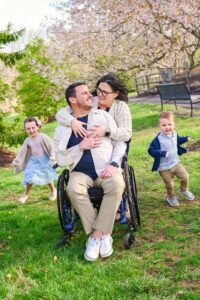
Chris, Joy, Jordy and Brogan
Simple things like getting out of bed, showering, getting dressed, and driving to work take more time and energy than most people imagine. Some days, it feels like I’ve climbed a mountain before 9 a.m. Thankfully, I work for an employer who gets it. I can work from home several days a week and I have coworkers who are always willing to help. That kind of support means everything.
But getting to this point was not easy.
When I was a teenager, my first job was at a local supermarket. On the first day, I was assigned to clean and lift heavy deli equipment, something that I physically was not capable of doing. Instead of speaking up, I just left. I was too embarrassed to ask for help or request an accommodation.
That moment stayed with me. I promised myself I would never let my condition stand in the way of my career. But even now, it’s not always easy. When I applied for my current job, I was hesitant to ask for accommodations because I did not want to seem incapable. After I was hired and I met with human resources, I realized that they were not only willing to agree with my requests but also offered additional accommodations beyond what I initially requested. That experience reminded me: advocating for yourself isn’t a weakness; it’s a strength.
Teamwork at home
At home, “teamwork makes the dream work” is more than just a saying. My wife, Joy, and I operate as a team. We’ve built a rhythm where we anticipate each other’s needs and support one another. On hard days, especially when the kids are pushing our limits, I sometimes feel helpless. Watching her do the things I physically cannot do can be tough. But instead of feeling inadequate, we’ve built a partnership grounded in trust and communication.
Facing differences
One of my biggest fears before becoming a parent was how my kids would react when they realized I was different. I worried about them being teased or having to explain my condition to their friends. I feared they’d see me as “less than” because I couldn’t run or play like other dads.

Hanging out on Daddy’s chair
But here’s what I’ve learned: they don’t measure me by what I can’t do. They watch how I respond to setbacks. They see how I keep going, even when it’s hard. Together, we’re learning patience, compassion, and adaptability. Through them and through Joy, I’ve learned not to hide my condition, but to talk about it, teach others, and answer questions with honesty.
This has helped in my personal life and has also helped with my success in my career.
The small wins
Living with LGMD has taught me to celebrate the small victories that others might overlook. Some days, just getting to work feels like a major win. Other days, it’s rolling my kids into school and watching their faces light up. Whether I’m clocking in at my job or showing up for my kids, those moments remind me that my value isn’t measured by what LGMD tries to take away—it’s found in being present, and most of all, in being their dad.

The ones who give me strength!
Choosing Joy
And I do choose Joy—in every sense of the word.
This journey isn’t easy. There are hard days when the weight of it all threatens to overwhelm me. But there are also moments of laughter, bedtime stories, and simple, quiet joy. Those moments keep me going.
To every working parent living with a neuromuscular disease: I see you. Your resilience matters even when it doesn’t feel heroic. Your path might look different, but it’s no less valid. You are adapting, evolving, and showing up.
The post MDA Ambassador Guest Blog: Parenting, LGMD, and Choosing Joy appeared first on Quest | Muscular Dystrophy Association.
]]>The post MDA Ambassador Guest Blog: The Joy of Accessible Sailing appeared first on Quest | Muscular Dystrophy Association.
]]>
Mike Huddleston on a larger sail through CRAB with an organization called The Impossible Dream. They are from Miami and were visiting CRAB and invited some of us to go out on their quite large catamaran.
Safe and accessible recreation is so important for members of our community, Getting involved with accessible sports and recreational activities provides opportunities for new and enhanced friendships, family bonding, improved physical and mental health, a sense of well-being, building confidence, and may help foster a sense of community and belonging. As a member of the disability community, I encourage you to explore the wide array of amazing accessible recreational opportunities that are available to you.
I firmly believe in the physical, emotional, and mental benefits of accessible recreation and adaptive sports.
For me, sailing or just being near the water provides a sense of serenity, calming frayed nerves, as well as providing a feeling of belonging. Sharing this experience with others helps me feel more connected to those in our community and brings me closer to nature. After sailing, I feel refreshed and peaceful, and always filled with anticipation looking forward to my next adventure on or near the water. As a power wheelchair user, I have had amazing experiences sailing with Chesapeake Region Accessible Boating (CRAB), the country’s premier accessible sailing facility, in Annapolis, Maryland.

Accessible Ramp at Chesapeake Region Accessible Boating (CRAB), the country’s premier accessible sailing facility, in Annapolis, Maryland.
In addition to sailing with CRAB myself, I also often volunteer as a guest liaison welcoming guests to their accessible sailing adventure. I greet the guests as they arrive, make sure their water bottles are full, that they are properly attired for the weather, and help with their personal flotation devices (PFDs). The guests are assigned to one of six accessible 22-foot Beneteau First 22As sailboats and its designated skipper and crew member. The guests are escorted, one assigned boat at a time, by the skipper and crew members down the gently sloped gangway to the 80-foot T head floating dock.
Depending on the needs of each guest, CRAB staff and volunteers provide assistance to help guests board the sailboat. This may include the use of a hydraulic lift (similar to a Hoyer lift) or a transfer box with a slide. The safety of each guest is paramount, and all staff and volunteers are trained in these processes. Each sailboat is designed for sailors with physical disabilities and features two accessible chairs mounted directly to the cockpit that provide safety and security throughout the sail. In addition to serving guests with various disabilities, caregivers and family members are also allowed and encouraged to sail, making this a rewarding experience for all. Each sailing outing lasts about two hours, and all guests are encouraged to participate in actual sailing-related activities.

Mike Huddleston’s view from a catamaran
In addition to sailing, CRAB also provides several other accessible activities. These include adaptive fishing or cruising outings on their Gemini power catamaran, aptly named ‘Dream Catcher’, which provides access to the water for guests who prefer not to leave their wheelchairs. They also offer completely accessible adaptive programs for artwork, musical programs and benefit concerts, photography, and exercise classes such as yoga on their property or in their Adaptive Boating Center (ABC), which meets and often exceeds all ADA compliance standards. The views from the property or ABC overlooking Back Creek and their marina provide a calming and peaceful atmosphere for all of their offered activities and programs, which are offered free of charge to guests and are supported by generous donations, sponsorships, and partnerships.
In addition to CRAB, there are many other types of accessible and adaptive forms of recreation and sports offered locally to members of our community here in Maryland, as well as all around the country. A quick Internet search for “adaptive sports” or “adaptive recreation” will provide you with a wide range of activities in your area or even nationally.
- If you’re interested in accessing CRAB’s free and accessible activities, please visit CRAB’s website for more information: Chesapeake Region Accessible Boating – Therapeutic Sailing.
- Read more about adaptive sports in A Guide to Getting Involved in Adaptive Sports
- Check out other adaptive sports resources, like the Challenged Athletes Foundation, which under their resources menu has a list of adaptive organizations by state, and Move United, which shares activities by type and location.
The post MDA Ambassador Guest Blog: The Joy of Accessible Sailing appeared first on Quest | Muscular Dystrophy Association.
]]>The post Expedia’s New Initiative is Transforming Accessibility for Short-Term Rentals appeared first on Quest | Muscular Dystrophy Association.
]]>
Lorraine Woodward, founder and CEO of Becoming rentABLE.
Expedia Group is not only opening the door, but widening the doorway, when it comes to accessible short-term rentals (STR) and vacation homes. As one of the largest travel companies in the world, hosting travel metasearch engines like Vrbo, Tavelocity, and more, the initiative to increase accessible options has the potential to transform accessibility in the STR industry.
The initiative aims not only to increase search features for potential travelers living with disabilities, but also to empower and educate hosts with actionable tools. In order to increase their understanding of the myriad of accessibility needs of those living with disabilities and how to equip hosts to best meet those needs, Expedia teamed up with accessible STR experts, Becoming rentABLE.
“As with any effort focused on creating change, this collaboration has taken a lot of planning to come to fruition,” says Lorraine Woodward, founder and CEO of Becoming rentABLE. “It’s not just a win for inclusion—it’s a major shift in how accessibility is defined and implemented in the travel industry.”
Creating and providing access to rentABLE vacation homes
Becoming rentABLE initially developed and grew from the challenges that Lorraine and her own family experienced when attempting to find an accessible vacation home. Lorraine and her two sons live with muscular dystrophy, which made traveling difficult due to the small supply of accessible STRs and the limitations in accessibility features and filters on online listings. Wanting a place that her sons could enjoy time with friends and family, creating lasting memories without barriers, but unable to find that on existing vacation search engines – Lorraine took matters into her own hands.
“We ended up buying and building an accessible place for our family, using our needs as the basis for creating accessibility there,” she says. “We really looked at something for someone with limited abilities and installed an elevator, roll-in-shower, roll under kitchen cabinets, accessible mirrors, wide doorways, and other features. We created a safe space where the boys and their friends could gather, look at the ocean, enjoy the beauty of nature, and enjoy time together. To me, that was really important as I looked at their growth and the opportunities that I wanted them to have.”

The Woodward family enjoying time at the beach while staying their renovated, accessible home.
Lorraine wanted other families to have those same opportunities. Well aware of the need for accessible STRs, her family decided to make their own vacation home available to others. Now, ten years later, over 450 families have stayed at their beach house.
Since then, the Woodwards have renovated a second accessible property in her hometown area of Arkansas and created Becoming rentABLE, an online platform that serves as a hub for hosts to certify and list their accessible properties. The site allows travelers living with disabilities to more easily filter and search for a vacation home that will meet their specific accessibility needs.
“Accessibility is not about a checklist that these 10 things equal accessibility for everyone, it is really about choices,” Lorraine says. “When we developed Becoming rentABLE, it was about a filtering choices. We have 43 mobility filters and 20 cognitive filters. We look at the broadness of what accessibility means and what are the varying needs. What we found in our research is that finding an accessible place to stay is hard because there aren’t filters across the board with details. We wanted to create a clearing house and listing platform that you could go to that listed only verified, accessible short-term rentals and with clear filters.”
Expanding accessibility with Expedia
Through their new initiative, Expedia it is now the first global STR platform to expand accessibility filters beyond “wheelchair accessible” and “elevator”. Recognizing the diversity of travel needs through collaboration with companies like Becoming rentABLE, Expedia has added options for cane, walker, crutches, hearing, and vision needs. New filters also include:
- Stair-free path to entrance
- Single-level property
- Accessible parking
- Accessible pool
- Accessible path of travel
- Entrance ramp
- Handrail in stairway or hallway
- Accessible van parking

At her STR vacation home, Lorraine provides guests with a beach wheelchair to access fun in the sun.
“It’s really about providing that information so that the renter can choose what they need to select a property to meet their needs,” Lorraine says. “So much of what we are doing is not that one thing is right or wrong. For example, thinking of me, I would say having a bathtub is not accessible, but I have so many friends that are paraplegic who would prefer a tub over a shower. And you go into sensory and autism, tubs play an important role in soothing and calming. The more information you give the better the experience you can provide, with more filters you can customize your experience.”
The initiative goes beyond increasing options and choices for the customer though. In order to achieve systemic change in the STR industry, it’s imperative to provide education and tools to the hosts of properties. By tapping into the needs of travelers with disabilities, Expedia is providing an opportunity for hosts to not only serve an under-served population, but also to access an untapped market.
Increased understanding equals increased access
The educational aspect of reaching hosts to increase their understanding of accessibility needs is paramount in reshaping the landscape of travel for those living with disabilities. Lorraine shares that through the collaboration, they created invaluable educational materials targeted at hosts and managers in order to share and increase the broadness of what accessibility means.
“The initiative is launching with an education-first approach, featuring authentic imagery representing real disability experiences—from youth in wheelchairs to seniors with walkers and individuals with guide dogs,” Lorraine says. “Most importantly, we’re equipping hosts with actionable tools—including our new infographic with more than 50 specific accessibility features found in STR properties.”
Becoming rentABLE created and wrote all of the initiative’s educational modules. Consulting on imagery and weighing in on the accuracy of a depiction of a hoyer lift or the efficacy of grab bar placement, Lorraine and her team ensured that the content provided to hosts would truly encompass the needs of those in the community.
“Expedia understood the value of education and the role that education plays in looking at the broadness of accessibility. No other company has taken that approach to bring about change for accessible STR,” Lorraine says. “That is really the significance. If we want to grow accessible lodging options globally and within North America, we have to provide education and understanding to what that means – and how it is an untapped market. It is about understanding and recognizing that we all have different needs and identifying those needs that give us opportunities to travel.”
Partnering for change
Currently there are around 1,000 properties in the United States that are listed as accessible to travelers with disabilities, a number that Lorraine is motivated to change through her commitment to increasing inclusion and opportunities to travel for those living with a disability. Becoming rentABLE’s partnership with Expedia in their first-of-its kind initiative is a monumental step towards that goal.
“There should be 1000 accessible properties in every city, not 1000 properties across the whole country. But you can’t get there without providing education to hosts and increasing their understanding of what makes an accessible short-term rental,” Lorraine says. “What we are doing now with Expedia is helping to move that needle in understanding what an accessible property is – and expanding the STR market for those living with disabilities.”

A graphic guide designed by Becoming rentABLE and Expedia to educate STR hosts on accessibility.
The post Expedia’s New Initiative is Transforming Accessibility for Short-Term Rentals appeared first on Quest | Muscular Dystrophy Association.
]]>The post Quest Podcast: Unpacking Disability Pride- Voices from the MDA Community appeared first on Quest | Muscular Dystrophy Association.
]]>Read the interview below or check out the podcast here.
Mindy Henderson: Welcome to the Quest Podcast, proudly presented by the Muscular Dystrophy Association as part of the Quest family of content. I’m your host, Mindy Henderson. Together we are here to bring thoughtful conversation to the neuromuscular disease community and beyond about issues affecting those with neuromuscular disease and other disabilities and those who love them.
We are here for you to educate and inform, to demystify, to inspire, and to entertain. We are here shining a light on all that makes you, you. Whether you are one of us, love someone who is, or are on another journey altogether, thanks for joining. Now, let’s get started.
July is Disability Pride Month, and with me today, I have three talented and accomplished MDA Ambassadors joining me to discuss what Disability Pride means to them. I think you will find that what is ahead is an empowering conversation about the beauty, power, and strength we can all find in ourselves because of those things that make us unique. So first, I would like to welcome Amy, Payton, and Fred. Thank you all so much for joining me today.
Payton Rule: Thanks for having us.
Amy Shinneman: Thanks so much for having us.
Fred Graves: Thanks.
Mindy Henderson: So before we dive into Disability Pride, would you each introduce yourselves and maybe just tell us a little bit more about yourself? I’m going to start with you, Amy. Amy is an ambassador alumni. Was it 2023 and ’24 you were our National Adult Ambassador. Do I have that right?
Amy Shinneman: ’22-’23 I think.
Mindy Henderson: Okay.
Amy Shinneman: I should know this.
Mindy Henderson: I wasn’t sure which way it slid, but yes, I’m so glad you’re here today.
Amy Shinneman: Thanks for having me. Like she said, my name’s Amy Shinneman, and I live with a type of muscular dystrophy called Bethlem myopathy. And for those that aren’t familiar with my story, it took me 44 years to finally get my diagnosis, even though growing up we knew there was something, but it just took a really long time to figure out what that something was.
But I just see that as part of my story in shaping who I am today. And I am a columnist for my local newspaper writing about my disability and all the experiences I’ve had with that, as well as I have a blog called Humbly Courageous and do some freelance writing also regarding accessibility in my county. I’m so glad to be here.
Mindy Henderson: Love it. Thank you, Amy. Payton, how about you?
Payton Rule: Yeah. Hi, I’m Payton Rule. I have Charcot-Marie-Tooth disease or CMT, and I was diagnosed when I was five. And I am currently a PhD student in clinical psychology at Washington University in St. Louis, where my research focuses on disability and well-being, including a little bit on Disability Pride. Extremely excited to be here both personally and professionally. I’m just excited to learn from everybody.
Mindy Henderson: Amazing. Last but certainly not least, Fred.
Fred Graves: Hello, hello, my name is Fred Graves. I’m also living with Limb-girdle muscular dystrophy type 2A. My journey was really odd because I had several muscle biopsies, and this was before genetic testing, so I’ve been through the gamut of it all. I was originally diagnosed with Becker muscular dystrophy, and maybe about 10 years later I was re-diagnosed with limb-girdle.
And currently, I’m a commissioner for the City of Hartford Commission on Disability Issues. This is my second year as a MDA Ambassador. I’m here. I’m excited as well to learn from these ladies, these wonderful ladies, and just share my journey.
Mindy Henderson: I love it. I love it. Like I said, a very accomplished group of people. One thing that I think you all have in common, Amy, you write professionally, but Fred and Payton have also written for the Quest blog for us. And you’re all incredibly talented writers. Let’s dive in and talk about Disability Pride Month.
I would love to just do one more round robin. I may go in the opposite, counterclockwise this time, and I would love to hear from each of you what Disability Pride means to you. I feel like it means something a little bit different to everybody. So Fred, let’s start with you.
Fred Graves: Wow. I would say Disability Pride for me, first of all, it’s been a journey. With the progression of this condition, it’s like you start in the place and you dip into it, and then you come into this acceptance. I think Disability Pride for me is loving yourself where you are and not comparing yourself to other people and knowing that you too are worthy. During my years at the state police, I was a dispatcher for almost 10 years.
I dealt with a lot of ableism, and I was the only person with a physical disability in the agency. And this is an agency of 4,000 people. So every day I was met with, how’s he going to do this? And how’s he going to do that? And I think that over those years I was like, “Oh, I’m going to show you.” You know what I mean? So I think that Disability Pride is that, but it’s also just loving yourself and being kind to yourself and with the changes that come with the conditions, whatever you’re dealing with.
Mindy Henderson: That’s a great answer. Payton, what about you? What does Disability Pride mean to you?
Payton Rule: Such a great question, and I completely agree with what Fred was saying about it just being a journey, I think, and it’s not a linear thing. I don’t think that I have always had Disability Pride. I think it goes up and down. But I think to me, I really view my disability as a source of something valuable, positive experiences, something that’s really enriched my life in a lot of ways. And so that’s not to say that there’s not hard things about it.
There’s absolutely ableism out there, like you were talking about, and there’s a lot of difficult aspects, but I also think that it’s something that’s brought a lot of positive, enriching experiences and friendships and relationships to my life as well. And so I think that’s what Disability Pride means to me. But it’s cool to see how it’s different for everybody, and I don’t think there’s any right or wrong answer.
Mindy Henderson: Absolutely. And I could not agree more that it’s not a straight line. To get to Disability Pride, it ebbs and flows. I think any person who’s living with a human experience have hard things in their lives. It’s just part of the human condition. And yeah, you said it beautifully. There are good days and bad days. And you may not always feel it, but I think what’s important is getting back to it, however you see fit to do that. Amy, what about you?
Amy Shinneman: Yeah. So for me, I mean; to be honest, Disability Pride is for me a new thing to celebrate. In the past I would say five, six years growing up, when I did, I certainly wasn’t encouraged, I didn’t feel like, to have pride in my disability. But as Fred and Payton both said, it is a journey and it does fluctuate. But for me, I’m so excited for this Disability Pride thing that I’m now involved in.
And I take really great pride in seeing other members from my community, like all of you and so many more, and just learning. I’ve learned so much in how to accept myself and what that looks like, and that does bring about a sense of pride when you can accept yourself just as you are. But I also think that with that comes knowing that as with anything, that it is going to fluctuate, and some days you’re going to maybe not be proud of who you are.
But when we take time to celebrate as a whole, I think that’s just a really powerful statement that helps all of us to fully accept who we are.
Mindy Henderson: I agree, and I’m going to throw this out there because I think… I don’t know that everyone listening may be aware that I live with spinal muscular atrophy, and so I’m also a member of the neuromuscular disease community. What each of you are saying resonates with me so much because this is going to sound strange to say because I’m a wheelchair user, and so it’s obvious when someone looks at me that I have a disability.
But the strange part is that growing up, and I think I’ve got a couple years on probably all of you, but growing up, like you said, Amy, it wasn’t something that I was encouraged to be proud of that particular piece of me. I was taught to be proud of a lot of things about me, but that wasn’t one of them. And so I spent a lot of my life trying to almost hide my disability, which is again a weird thing to say. You can’t really hide a wheelchair. But anywhere I could downplay it, I did.
And I tried to fit in and move with the crowd. And it wasn’t until I was an older adult that I started to really look at the community around me. And that’s when I started to see the beauty in it. I saw it in others first, and then I was like, wait a second, I’m one of them. If it’s beautiful in them, it should be beautiful in me too. And I started to really embrace it and enjoy what it had…
Even though a lot of it was difficult, really enjoy what it had brought into my life. So through the journey of living with a progressive neuromuscular disease, how has your perspectives on embracing your disability and finding pride in your strengths evolved? I shared how it had evolved for me. And I’m going to let anyone who wants to grab that first answer, but what’s that journey been like for you?
Amy Shinneman: Mindy, I’ve heard you say that before about how you tried to downplay something. And same for me, I’m a part-time wheelchair user, but growing up I was not. But the way that I walk is very obvious that I have a disability, but I spent so much time and effort trying to downplay my struggles or just make myself fit in because as a kid, that’s what you want. You want so badly to fit in. And I think that as with anyone growing up and aging, you learn and you become more mature.
But even more than that, I think that it’s just a beautiful thing. When I heard you say that, I had never heard anyone talk about how they tried to hide themselves. And I spent probably 40 years doing that. And at 51 now, it’s not been that long that I have accepted myself. But I think that the overall message there is just to be patient with who you are and don’t try to be everybody else. Just be yourself. I think the acceptance comes with learning and finding your way.
Mindy Henderson: 100%.
Fred Graves: That’s super powerful. I think for some of us who were encouraged to love yourself, when I do my ambassador stuff and I do the camp, the fundraising things, and I get to touch the younger ambassadors, I’m so proud of them because they embraced this condition and this life way more than some of us from that earlier generation. I’m in my 40s as well, so it’s like I too. I’m six-three. I used to tell the guys, “Oh, I have a basketball injury.” I went through all of those phases.
And it’s like for some of us, I mean, I don’t want to put any words in anyone’s mouth, but it was like this brick wall I hit where I couldn’t hide it anymore. And I had to embrace this community. And like you said, when I started embracing the MD community, it wasn’t, oh, I only wanted to connect with people with limb-girdle. That’s what I came in first. I want to meet people with limb-girdle.
But then Jose Flores, the SMA community, you guys are so inspiring. SMA people are awesome. I don’t know why you guys have the personality that’s through the roof. You guys are just great.
Mindy Henderson: I want a t-shirt that says that.
Fred Graves: But I’ve learned so much. And like you said, you see other people and you see qualities you wish that you had in yourself. And it just empowers me to say, “I can do that. If that person can do that, I can do it too.” And to touch base with people who struggle like you, it was like blinders came off. And I went through a lot of adversity to get there. But like I said, I hit that brick wall and I said, “You know what? I can’t hide it anymore.” I’ve blossomed, I think, so much more post 40 than I did in those first 40 years. I don’t know.
Mindy Henderson: Yeah, it’s really well said. And Fred, I’m going to say, I see a lot of personality in you too. And so I think there’s a lot of just such magnificent people in the neuromuscular disease community. And to echo what you said, there’s something… I mean, anytime I hear about whether it’s disability or some other aspect of life where someone feels like they have to hide any part of who they are, it just breaks my heart because of how I felt for so much of my life.
It’s so stifling. And I think that you hit the nail on the head. When you do finally step into and embrace all of who you are, the hard and the easy and everything in between, it’s so freeing, and that’s when who you truly are can really shine. And so I love your answer. Payton, how about you?
Payton Rule: I think what everybody has said so far about feeling like they need to hide, I think that really resonates with me as well. My parents were always very supportive, always never taught me that I should hide anything, but I think the world in general is there’s ableism. And I think disability is often viewed as a tragedy or an inspiration in media. There’s not a middle ground. And so I think I viewed it that way growing up as well. You either overcome it or you are just tragic.
But I think I when I was a teenager started connecting more with the disability community. And I remember going just for an outing on actually Hollywood Boulevard with a bunch of teens with CMT and an adult with CMT and he had a lot of Disability Pride. And I remember him just up to people on Hollywood Boulevard, random people, and starting to tell them about CMT, and me just wanting to run and hide.
But nothing bad happened. And I think reflecting on that experience, it was just like you were saying, Fred, it was an attribute that I really wanted to have to be able to go out there and just own it. And so I think that was one thing that started shifting my mindset about it and really started that journey for me towards a little bit more Disability Pride.
Mindy Henderson: Yeah, I love that. Payton, I want to ask you a follow-up question because the term ableism has come up already a couple of times in this conversation. And honestly, until a couple of years ago, I had never heard that word. And I feel like it’s something that as the conversation has evolved, it’s something that more and more attention has been called to.
And it’s something that the disability community has gotten more comfortable talking about and talking about their experiences with it. For anyone that’s listening that may not be familiar with the term ableism or exactly what that is, do you mind giving us a little bit of background?
Payton Rule: Yeah, absolutely. Honestly, I don’t think ableism was in my vocabulary until I got into research either. So completely agree. I think a lot of people are familiar with discrimination, which is related to ableism. But when people think of discrimination, I think they often think of these big events, things like getting fired from your job because of your disability, or being denied housing because of your disability.
And those things can be forms of discrimination, forms of ableism, but I think a lot of ableism can also come in the form of microaggressions. So things like people telling you that you’re inspirational for going to the grocery store if you have a disability, or people assuming that your partner is your caregiver because you have a disability. Things that are really I think well-intentioned by non-disabled people, but can be very harmful for people with disabilities.
So I think that’s how I think about ableism. It can be big things, but it can also be these little subtle things every day that can really impact disabled people’s well-being, but also maybe are well-intentioned and not necessarily recognized as ableism by most people.
Mindy Henderson: That may be the best description I’ve ever heard of it. That was really well done. Let’s switch gears just a little bit and dig into… Because I think there’s so much power in people sharing their stories of the hard things that they’ve maybe had to walk in life. I think that there’s so much about it that makes people feel less lonely and maybe less isolated.
Can any of you share any personal experiences where you may have had to really, really dig deep and intentionally choose to invoke pride or self-confidence regarding your disability in order to navigate a particular issue or circumstance in your life and come out of it trying to feel a bit more empowered?
Amy Shinneman: I can go. When I had my first son in the hospital, I had a really bad experience with… I had had a C-section. It was in the middle of the night and my husband had to call the nurse to come and him help me walk to the bathroom because it was really hard. Number one, I had just had surgery and my body had been through all that I have a disability and just walking after any of that is hard.
And so he called for help. And the next day I found myself in my hospital room alone while my husband had gone to grab dinner and a social worker from the hospital popped into the room. And the nurse had called the social worker because she thought that I was unable to care for my son. And what had happened is she hadn’t truly researched to know even that I did have a disability.
And I think I found myself at that time just being so proud of myself for stepping up and saying, “No, this is my son and I’m quite capable of taking care of him. That might look differently than you would think it would, but this is how we’re going to do it.” And I just felt like in that moment, maybe that was the first time I had really stepped up and stood up for myself in a confident way. I guess that probably has to do with I was protecting my child, but I think that’s what for me something that stands out that was really hard, but also I felt so good on the other end of that.
Mindy Henderson: That’s really great. Fred, how about you? Does anything come to mind?
Fred Graves: I mean, there’s so many different ones, but I would say the one I’m most proud of was my time with dispatching for the state police. Like I said, those first few years, everywhere I went, every troop that I went to, every person I worked with, it was always, can he do this? And you hear that. You can hear people saying these things. And it was the first time that I said, “You know what? No, I’m going to keep showing up. I’m going to keep showing up.”
And then eventually you get into these situations where a trooper that you’re working hand in hand with, he’s like, “High five, man. Thank you so much.” And you know that you really showed up and it showed them that, wow, it didn’t matter that he has anything. He showed up. And he’s actually a good dispatcher and he helped save my life. So I think that that was something that I was so proud of. I mean, eventually I had to…
Being an essential worker and having a condition like this is probably not the best thing, but I was able to leave on my own terms, but I was able to show up and show that you shouldn’t just look at someone who’s in a chair or whatever case that you might see them in and recognize that they are more powerful than you even think. And I think that that’s directly combating ableism, because ableism is seeing someone and then, “Oh, well, she couldn’t walk in the hallway. How’s she going to deal with her son?”
It’s like, you don’t know. That’s the thing about having a disability is that people tell us we’re inspirational, but it’s like, dude, if you had this issue, you would figure out a way to work through it. That’s all it is, is just dealing with adversity as it comes and people respecting that. I think that was a great point where I showed up for myself and I was so proud of myself.
Mindy Henderson: Yeah. Well, and I have to go there because your example is so perfect and so relevant for I think a lot of what people with disabilities come up against in employment, in our world today. And there’s so much education and awareness I think that is still needed among employers and then by extension the people that work for those employers because so many assumptions are made about what a person with a disability can and can’t do.
And that seeps into job descriptions and interview processes and requests for accommodations and the whole enchilada. I love that this came up today because I think it’s a really important area to mention and just to encourage any employers that might be listening to really think about getting some outside consultation about what their operating processes and procedures are when it comes to hiring and employment and maintaining staff because it’s so fraught with bad assumptions and unconscious bias.
I think that people may not realize that they’re making certain assumptions a lot of the time too. And Amy, I’ve got to say, I’m right there with you too. When I applied to adopt, actually I was denied based solely on my disability the first time. And not much in life has made me more angry than that. And you want to see a mama fight for her child. I don’t think I’ve ever fought so hard for anything in my life. I don’t speak about it a lot publicly, but I’ll share that today.
Amy Shinneman: Well, thanks for sharing that. And yeah, nothing like mama bear, right?
Fred Graves: Absolutely.
Mindy Henderson: No, that’s right. Don’t poke her. So Payton, what about you? Any specific instances come to mind?
Payton Rule: I think you just mentioned accommodations, and I think there’s been some points in my journey where I’ve been denied accommodations, like workplace or academic accommodations. And I think in the past, if I was younger, I think there might’ve been a point where I would’ve just accepted that and accepted that the accommodations that I was asking for were too burdensome for people or maybe were unfair or something like that.
But I think the fact that I have Disability Pride now and can recognize that my disability is something that brings a unique perspective to everything that I’m doing. And so being able to have equitable access is not unfair. It’s something that makes the world a little bit better for all disabled people, all people in general. And so I think that’s given me the courage or the ability to push back against those denials and to be able to actually fight for the accommodations that I need to be able to do my work and be on a level playing field with other people.
Mindy Henderson: Absolutely. There’s a term that I heard, Payton, that I want to share with all of you today because I think it is one of the smartest things I have ever heard when it comes to disability employment and accommodations. There’s a company called Inclusively that I went to a training session once and they talked about accommodations and actually encouraged people to flip the script and talk about them in terms of success enablers instead.
And you talked about leveling the playing field. I mean, we all know language makes such a difference, and a success enabler versus an accommodation has a completely different connotation, I think. And really that can apply to anybody, disability or not. It’s just about what a person needs to be successful to do their job.
Payton Rule: Absolutely.
Mindy Henderson: So maybe that’s something that can go in one of your research papers that you will inevitably publish and become famous for.
Payton Rule: I love that though. I love that that change in terminology is so powerful, and I think a lot of the accommodations that we use as disabled people are actually benefiting non-disabled people too. Microphones in classrooms help non-disabled people who are sitting in the back hear better. Curb cuts help people with strollers get around a little bit better. So I think they actually end up helping everybody, but I love that change in language.
Mindy Henderson: Absolutely, absolutely. So Payton, I’m going to stay with you for a second because I mentioned earlier that you recently wrote a really, really good guest blog for us. Actually in some of the email back and forth with you about the article itself, it actually opened a discussion amongst us on the Quest team that I really appreciated. And I was so glad. I, of course, want to be educated if there’s something that we should be doing differently.
And sometimes as a person with a disability, you think you’ve got it all figured out. But you open this discussion about identity first versus person first language in the disability community and how we speak about people, how we write about people. And you shared, I think, that you prefer maybe identity first language.
Because I have sort of become accustomed to person first over the last few years as the conversation about disability and inclusion has started to emerge more and more, but can you tell us why you prefer that and whether it’s representative of a widespread shift in the disability community and how people are speaking about themselves or maybe what preferences may be?
Payton Rule: Yeah, absolutely. For anybody who maybe has not heard about identity or person first language, which I know I had not when I was younger, so person first language would be saying, “I’m a person with a disability.” You’re always saying you’re a person before you talk about the disability, to where identity first language would be more like, “I’m a disabled person,” putting the disability as a descriptor.
I want to be completely transparent, but I don’t think there’s one that’s right and one that’s wrong. Everybody has different preferences. And I usually will use identity first language for myself when you hear me talking about myself. But that being said, I will not be offended if you use person first language or anything like that. The reason why I prefer Identity first language is I really view my disability as a part of my social identity, so similar to my identity as a woman.
I view it that way because it’s really shaped my experiences and my perspective and the way I navigate the world in a similar way that I feel like my other social identities do. And so if I said, “I’m a person who’s a woman,” that would sound a little weird. You just assume that I’m a person first. But by saying person with a disability, I feel like that implies that you have to say that you’re a person first. It’s not implied by saying you’re a disabled person.
For me, I think person first language separates me from my disability in a way that doesn’t feel super authentic. But that being said, I don’t think that one’s right and one’s wrong. The American Psychological Association, who gives guidelines for writing for my field, they actually say you can go back and forth in your writing. So that’s generally what I’ll do when I write scientifically. I don’t think there’s one right and one wrong answer, but that’s just why I prefer it when I’ll talk about myself.
Mindy Henderson: That’s really helpful. And for anyone who finds themselves listening to this who does not have a disability and maybe doesn’t have a person with a disability in their life, because to your point, everyone may have different preferences for themselves. And so how do you know when you are a person speaking with a person with a disability what the right way to describe them or talk about them may be?
Payton Rule: Yeah, it’s tricky. I think it probably depends on the situation that you’re in, but I think the safest bet is probably just to ask them if you have that kind of a relationship. If you don’t have that kind of a relationship, I think the consensus might be that person first language is maybe a little bit safer, but I don’t think that there’s a right or wrong answer. I think there’s a lot of discussion out there about that.
I know there’s been some research studies that have shown that the majority of people prefer identity first language or don’t care, but there’s still a sizable amount of people, I think it’s around a third of people that said that they prefer a person first language. So it really I think just depends and varies across people.
Mindy Henderson: Oh, interesting. I love having the three of you here today. You guys have such smart perspectives on things. Amy, I want to go to you next and talk about your writing. You talked about your blog, Humbly Courageous, which is wonderful, and your local newspaper, which we can certainly name if you think that they would be okay with that, that chronicles your journey and your advocacy efforts.
Talk a little bit, if you don’t mind, about the role that your writing has played in your disability journey, so to speak. Has it helped evolve how you look at your disability, how you feel about your disability, anything like that?
Amy Shinneman: Yeah, absolutely. I think it’s been the number one thing that has changed me as a person. And I write for the Hamilton County Reporter is the newspaper that I write for. And writing my blog and the newspaper, they’re not always the same. They’re similar. But when I started writing and the more vulnerably that I was able to share my story… I mean, I’d heard sharing your story is so powerful so many times, and I always thought, well, okay, sure.
But when you start doing it, and even when I was doing speaking things and talking about my story, it wasn’t the same as writing about it. It was kind of like I could… And I write a lot about childhood and all of it combined. So I’m going back in time and I’m able to see myself through a different lens. And that’s so interesting to show that just transformation that has taken place in me throughout the years.
I was actually talking with my son, who’s home from college right now, about that. He happened to see the list of questions and he said, “What do you think you’re going to say to that?” And I said, “Well, I don’t know if I’m sure yet.” And he said, “Can I tell you what I’ve seen?” And he hit the nail on the head. He said what I’ve seen in you is that I’m a negative thinker naturally.
I have to really fight against that just because I take on what I think other people are perceiving me to be. And when I started writing and getting feedback from my community, I was proven very wrong. And it helped me to turn my mindset from the negative view I had towards myself and my disability. It turned that around for me hearing that I’ve taught people things or what they’ve learned from me, or the things they say are empowering to me because it allows me to look at myself in a different way and not take on so much of those negative feelings.
It’s transformed me into a much positive thinker, which has been really interesting to me, I think fighting that negative mindset that I could get really down on myself. But I think we’re all probably hard on ourselves at times for different reasons on different days, but I’ve just been astonished at how it’s changed me for the better as a person. And I’ve really enjoyed it.
Mindy Henderson: That’s interesting. That is not the answer that I was expect… I mean, I never quite know what to expect in terms of the answers people are going to give, but I don’t think I was expecting that answer. It’s really poignant. And you’re right. I think speaking and writing are very different things. And writing, to be original all the time and to always have new thoughts and new experiences and things to write about, you have to dig pretty deep.
And it’s interesting to hear you say that it’s changed you in that way. I’ve known you for a few years now, and I have to say I never thought of you as a negative person, but I suppose that’s something that maybe only someone living in our heads would know. So I love that for you. I love that that’s been your experience.
Amy Shinneman: That’s a good point that you make. I mean, I think that a lot of people might say what you said, “I never viewed you as a negative person.” And I think because a lot of that negativity was internal and it was in my head and the way I talk to myself has really changed in my mind. And I’m glad to know that I’m viewed as a positive person. I like that. That’s what I would like to be. And I think the change has really taken place inside of me in the way that I talk to myself for sure.
Mindy Henderson: Absolutely. Absolutely. Well, Fred, I want to talk to you a little bit about being a father, because you recently wrote a really great Father’s Day blog for Quest where you shared parenting experiences and advice. What advice can you give regarding teaching children about Disability Pride and finding strengths in our differences? Do you have one child?
Fred Graves: I do. I just have my son.
Mindy Henderson: Okay. Does he know what Disability Pride is?
Fred Graves: I don’t think he knows those words together, but I think we talk about it all the time. Especially because he’s eight years old, so he’s becoming aware that my dad’s different than other people’s dads. And sometimes he’ll go, “I really feel bad that you can’t do this or that.” And I’m like, “Well, son, it’s okay because I can do this.” And he’ll go, “Good point.” I try to replace it with the things that I can do. I replace it with unique opportunities. Like yesterday we went on a little walk.
He wanted to bring his razor out to the skate park. So we went to the skate park and I’m like, “Are you going to ride it all the way there because I’m not carrying it back,” even though I know I’m going to have to do it anyway. So as he’s riding back on the back of my chair and I have this razor on the front of my footrest, he’s like, Those people are looking at us.” And I said, “This is because they’re interested and other little kids want to stand on the back of my chair.”
And I try to frame it in a way of, it’s different, but it’s just as vivid and fun and it can be just as much as a learning process as anything. It’s just our experience, and it’s part of life. It’s part of someone’s life. Not everyone can see that, but you have a different perspective. And I think that’s something that how I instill that pride in him. I don’t want him to feel like, oh, my dad’s in a wheelchair and he can’t do these things.
No, we do different things. When we go to amusement parks, we get to the front of the line. You know what I mean? So it’s just about finding what’s good. And something that Amy said reminded me of a point that I’ve learned in the last I want to say two years. Because when I left the state police, I said, “What am I going to do with my career? Do I want to do advocacy? Do I want to go back to school for social work?” All these different things.
And it hit me one day that advocacy is just showing up wherever you are and being uniquely you. And whether it’s in Payton’s program that she’s in for her PhD, whether it’s at the newspaper with Amy, whether it’s what you do in your day-to-day life, Mindy, advocacy is us showing up being a person with a disability or a disabled person and showing up and showing what we can do. And that’s how I show my pride and how I advocate for myself and people like us. It is just showing up.
Mindy Henderson: I love that. And it sounds like your little boy is already a sweet, empathetic person and you’re absolutely really instilling that in him I think in everything that you just said. I think that one of the most beautiful things, and you talked about this, that parents with a disability have to teach their children is just the beauty of differences. I always say the kiss of death when you’re a kid is being different than your friends or anybody else.
And I think that our kids in that sense, or in a lot of senses, but in that sense are lucky because they have living, breathing examples every single day of the differences that we have from one another and how that can be a good thing. It can be a positive thing. It doesn’t have to be a good or a bad thing. It just is, and it’s the way of the world. I love that that’s something that your son is taking from you.
Fred Graves: Yeah.
Mindy Henderson: Yeah. Well, we’re almost out of time. I have one last question that I want to give each of you the opportunity to answer, and then hopefully we can… I think we just need to all hang out on Tuesday afternoons and have virtual coffee. Yes. But for anyone who’s listening, maybe our younger listeners who may be struggling to find the beauty and recognize the unique strengths that come with living with a disability, what advice would each of you give to them on maybe how to be begin to shift that mindset to one of a more powerful pride kind of mindset in who they are?
Fred Graves: I’ll go first. I would say community. If you can’t get out to a conference, if you can’t, if you don’t have a hospital that has clinic days, I love… That was my starting point, clinic days for… I don’t know if the MDA does it now, but just fellowship with other people in the MDA community or whatever community you’re part of, whatever it is, the things that you struggle to identify with, community, because there’s somebody who’s a little further down the road than you or around that bend where you can’t see something for yourself.
I see it all the time. For me, career was a huge thing. How am I going to provide for my son with this condition? And you see other people and you say, “You know what? Let me stop worrying because I can see it now.” And sometimes your family, they want to encourage you, but they just don’t have it. They don’t experience it, so they don’t know what to say. But community, the people who go through it every day just like you, they can help instill that in you. So that would be my biggest advice, and that’s helped deliver me in a lot of ways. So I would definitely suggest that.
Mindy Henderson: That’s such good advice. And I will say there are people in this community, the three of you are amazing examples of this, but there are people in this community that are so spectacular and problem solvers and creative people and pragmatic people. You name it. MBA has got a lot of ways to connect you with people in this community that I think can be really great examples for you, mentors for you, friends to you, all of that.
I couldn’t agree more, Fred. I think it’s so important to seek out people that are living a similar experience to this one because it is very unique and the sky’s the limit. And I think there are a lot of people out there that really want to help. Payton, what about you?
Payton Rule: I completely agree with that. I think community was the number one thing that came to my mind too. With the disability community, like you were saying, and then also non-disabled people as well who can just be there to help advocate, to help support you when you’re going through ableism, those kind of things. And I think just finding spaces where you feel accepted, disability and all.
I think I used to want to find spaces where I felt accepted despite my disability, but I think now I look more for spaces where I feel accepted with my disability, where they see my disability and me. And I think personally that’s been really helpful. They’re out there. Those spaces are all over the place. So I think finding them can be really helpful.
Mindy Henderson: Such a good point. Amy, we’ll let you have the last word.
Amy Shinneman: I would agree with both of them. I think that community is a great source of wealth, of knowledge. I wrote a blog piece called Disability Defined, and it was just talking, and I know that can be a controversial thing, but it was mainly talking about how I can’t separate from my disability. That is a part of me. In my mind, it does define me, but that’s not a negative thing, but that can be a powerful and positive thing. And looking to our communities and just…
I think a lot of times when we’re talking to younger people with disabilities or they’re thinking, well, I have to learn from somebody that’s gone before me and they have all this wisdom, but I’ve learned a lot about self-acceptance from people much younger than me. I’ve just been blown away. And the younger group of people have helped me so much and just used that. I wish that I had a community like that growing up. I think it would’ve changed my life. So really, I think we all agree, just tap into the community that’s available for you and find the beauty in there.
Mindy Henderson: You guys are the actual best. I have loved this conversation so much and I wish we had two more hours. But thank you from the bottom of my heart for being here and for talking about such an important topic. I wish everyone who’s listening a wonderful Disability Pride Month, and I hope that you’ll come back and listen again soon. Thank you.
Amy Shinneman: Thank you for having us.
Fred Graves: Thank you.
Payton Rule: Thank you.
Mindy Henderson: Thank you for listening. For more information about the guests you heard from today, go check them out at mda.org/podcast. And to learn more about the Muscular Dystrophy Association, the services we provide, how you can get involved, and to subscribe to Quest magazine or to Quest newsletter, please go to mda.org/Quest.
If you enjoyed this episode, we’d be grateful if you’d leave a review, go ahead and hit that subscribe button so we can keep bringing you great content, and maybe share it with a friend or two. Thanks, everyone. Until next time, go be the light we all need in this world.
The post Quest Podcast: Unpacking Disability Pride- Voices from the MDA Community appeared first on Quest | Muscular Dystrophy Association.
]]>The post In Case You Missed It… appeared first on Quest | Muscular Dystrophy Association.
]]>With so many valuable podcasts, blog articles, and magazine articles available to our audience, chances are that you may have missed one or two pieces of interesting content. Check out the summaries and links below.
In case you missed it… Quest Blogs:
Your Guide to Genetic Testing for Neuromuscular Disease
Genetic testing is a key tool in diagnosing neuromuscular diseases and accessing new therapies. Fortunately, thanks to increasing insurance coverage and sponsored testing programs, genetic testing has become more accessible and affordable. Read expert advice from genetic counselors on the benefits of genetic testing, how much it costs, and how it works. Read more.
Simply Stated: Myasthenia Gravis Therapeutic Landscape
Myasthenia gravis (MG) is a chronic neuromuscular disease characterized by muscle weakness that worsens after activity and improves after rest. Most people with MG experience one of two forms, ocular or generalized. While there is currently no cure for MG, many therapeutic options are available for affected people and the symptoms of MG can be controlled with treatment. Here, we provide an overview of the current therapeutic landscape for MG. Read more.
In case you missed it… Quest Podcast:
Episode 54: Service Dogs, Inc. – Paws with a Purpose
In this Quest Podcast episode, we chat with a former attorney who left her law practice to devote her time to building Service Dogs, Inc. Sheri Soltes founded Service Dogs, Inc. in 1988 on the concept of training dogs rescued from animal shelters. Under her guidance, Service Dogs, Inc. has led the industry in combining the use of all rescue dogs with positive reinforcement training methodology. While offering her clients more independence and a new leash on life, she joins us to share her experiences, expertise, and advice when it comes to service dogs and navigating life. Listen here.
In case you missed it…Quest Magazine 2025 Issue 2, Featured Content:
Accessible Travel on a Budget: Smart Tips for Exploring Affordably
Travel opens doors to new perspectives, cultures, and experiences. But for many, exploring the world can seem like an unattainable luxury — too expensive, too complicated, or simply inaccessible. The good news? Affordable and accessible travel is more possible than ever with the right planning and resources. Whether you’re dreaming of a weekend getaway or a bucket-list adventure, this step-by-step guide will show you how to make travel work for your budget and needs. Read more.
The post In Case You Missed It… appeared first on Quest | Muscular Dystrophy Association.
]]>The post Understanding MDA Advocacy’s Education Policy Efforts appeared first on Quest | Muscular Dystrophy Association.
]]>Why is MDA involved in education policy?
Education is vital to the empowerment and independence of the neuromuscular community, which is at the heart of MDA’s mission. Students living with neuromuscular disease may have different needs in the classroom, such as accommodations to manage symptoms like muscle weakness and fatigue, and may need support to fully participate in classroom activities. As an organization, MDA advocates for the services and supports that our community needs to achieve their educational goals. A set of principles guides our work in this area.
MDA’s principles
- MDA advocates for strong enforcement and funding of the Individuals with Disabilities Education Act (IDEA) and Section 504 of the Rehabilitation Act, which guarantee students with disabilities – including many students in the neuromuscular community – receive access to appropriate in-school accommodations, individualized supports, and individualized education plans (IEPs).
- The U.S. Department of Education (ED) is the only agency with the authority to enforce the IDEA and that holds appropriate expertise on the education of students with disabilities. The IDEA serves more than 8 million students, and Section 504 of the Rehabilitation Act (Section 504) serves nearly 1.5 million students. Without oversight, public education funding intended for students with disabilities could be diverted to other education priorities. This could mean diverting funds away from supports for children and young adults with neuromuscular diseases, including those mandated by individualized education plans (IEPs) or 504 education plans – supports like physical accommodations, assistive technology and equipment, mental health services, occupational therapy and physical therapy – that enable equal access. Adequate federal funding ensures schools can obtain the staff needed to support students with IEPs and under Section 504 plans. While states are entitled by law to play a role in implementing the IDEA and direct where their IDEA funding goes, they often do not have the capacity to enforce its provisions and provide a similar level of guidance and technical assistance provided by ED. IDEA protections may not be enforced consistently in all states, for example. Further, without the necessary school personnel, such as occupational therapists and speech language therapists, students’ needs may not be met.
- MDA opposes cuts to ED, including within the Office for Civil Rights (OCR), which threatens to worsen an already-deep backlog of civil rights investigations that fall under Section 504 of the Rehabilitation Act and Title II of the Americans with Disabilities Act (ADA).The OCR and its data are key to ensuring access and opportunity for students living with disabilities.
- Access to specialized support services, such as physical and occupational therapy, assistive technology, and more, help students participate in the least-restrictive classroom environment (LRE), a core component of the IDEA. The LRE means that students with disabilities receive education alongside their peers to the maximum extent possible in the regular classroom environment and are supported through any necessary accommodations. This is critical for equal access.
Legislative activities
As we shared above, MDA advocates for strong federal funding for ED and full funding for the IDEA. Since 1975, IDEA has promised students with disabilities – including members of the neuromuscular disease community – access to a free and appropriate public education (FAPE). However, today, the federal government contributes less than 15% of the total costs related to educating students with disabilities, far below the 40% promised in 1975.
To address this shortfall, Congressmen Don Bacon (R-NE) and Jared Huffman (D-CA), along with Senator Chris Van Hollen (D-MD), introduced the IDEA Full Funding Act (S.1277/ H.R. 2598) to ensure that schools have the resources they need to support all students with disabilities, including those living with neuromuscular diseases. For the neuromuscular community, these resources are vital to obtaining IEPs, classroom accommodations, and much more. Below, we share how you can help us support this bill.
Legal developments
AJT v. Osseo:
A recent ruling by the U.S. Supreme Court (SCOTUS) held that plaintiffs bringing a lawsuit alleging discrimination under Section 504 of the Rehabilitation Act and Title II of the ADA in educational settings do not have to meet a legal standard that requires them to prove that they were discriminated against intentionally in order to receive relief.
Prior to AJT v. Osseo, several federal Circuit Courts of Appeal had determined that a plaintiff seeking relief under ADA or 504 claims must prove that someone acted with “bad faith” or “gross misjudgment.” This standard would have made it far harder for children and families to pursue a lawsuit within educational contexts. Outside of educational settings, for injunctive relief, plaintiffs can obtain relief without proving intent to discriminate. For compensatory damages, the plaintiff must show intentional discrimination.
SCOTUS ruled in AJT v. Osseo that ADA and 504 claims based on educational services should be subject to the same standards that apply in other disability discrimination contexts.
- Join us in urging Congress to cosponsor and pass the IDEA Full Funding Act! You can share your experiences and urge Congress to pass this bill and support students with disabilities by sending a letter today.
- Are you a member of the neuromuscular community passionate about strengthening access to education for students with disabilities? If so, MDA wants to hear from you! To help us make the greatest impact, please share your education experiences and stories with us so that we can share perspectives with Congress.
- To hear when MDA Advocacy shares new opportunities to support policies that strengthen educational access and disability rights, join us!
The post Understanding MDA Advocacy’s Education Policy Efforts appeared first on Quest | Muscular Dystrophy Association.
]]>The post Simpler, Safer Transfers: Helpful Tips and Useful Equipment appeared first on Quest | Muscular Dystrophy Association.
]]>
Theresa Berner is an occupational therapist.
Transferring from one spot to another, such as from a bed to a wheelchair and from a wheelchair to a toilet, can be a daily challenge for those living with neuromuscular diseases. Whether at home or out and about, being able to transfer easily, safely, and comfortably is a high priority for people with limited mobility and their caregivers.
Occupational therapists (OTs) are trained to help people complete daily tasks, and transfers are an important part of daily living.
“When I begin working with someone, I ask them to consider what daily activities are difficult for them to do, and we look for ways to make it easier or find modifications,” says Theresa Berner, MOT, OTR/L, ATP, an OT and Rehabilitation Clinical Manager at The Ohio State University Wexner Medical Center.
Theresa works with many patients living with amyotrophic lateral sclerosis (ALS) and is familiar with many modifications and pieces of equipment that can make transfers easier, safer, and more comfortable. Here, she shares her top recommendations.
Useful equipment
Transfer boards
These portable boards help a person using a wheelchair move to and from a bed, toilet, or car. Transfer boards come in various sizes and materials. Plastic boards are usually lighter than wooden options. Some styles, such as BeasyBoards, have a movable disc that glides with the person being moved.

Pivot disc
Pivot discs
These go under a person’s feet, for those who can’t bear much weight or stand up all the way. This allows the caregiver to pivot the person so they can sit or lie on the new surface.
Slings
There are many types of slings. Some connect to a floor lift that is on wheels (often called a Hoyer lift), allowing the caregiver to push it from room to room. A ceiling lift also helps a caregiver move someone sitting in a sling from room to room, but it attaches via tracks in the ceiling. These are ideal for people who can’t bear weight. Portable lifts are available for traveling.
Sit-and-stand slings are helpful for those who can bear some weight, and they reduce strain for caregivers, helping to protect against injuries.
“These sit-and-stand portable options are helpful anywhere,” Theresa says. One portable sling example is the AbleSling Lite.
Slings typically have multiple loops, allowing the person to be held more tightly or more loosely as needed. Theresa suggests color coding the links or loops for easier communication. “A person could say, I’d like to be held tighter, so please use the blue loop,” Theresa explains.

Gait belt
Gait belts
For people with some weight-bearing ability, a gait belt offers protection and assistance for them and their caregiver. The person transferring wears the best around their waist, and the caregiver can hold onto it as they assist. Some belts have several loops for a caregiver to hold onto.
Car handle assists
Because many cars are low to the ground, it can be difficult to gain the necessary leverage to transfer to a wheelchair or walker. A portable car handle assist hooks onto the car’s door frame, offering a stable handle for a person to grab as they rise out of the car.

Car handle assist
Lift aids
Other aids, such as the Sara Stedy sit-to-stand aid, can be very helpful for transfers, especially getting to the toilet. A Sara Stedy has a central support bar for the user to grasp, pivoting seat flaps, knee supports, and locking wheels, so semi-weight-bearing individuals can safely stand and transfer with their caregiver. Doctors’ offices and clinics that work with neuromuscular diseases may have sit-to-stand aids. Inquire before your appointment.
Tips for easier transfers
Plan ahead
Consider where you are going, what equipment you will need, and what equipment the location may have available. “Do your homework and reach out for this information if you are not sure,” Theresa says.
For example, if you are going to a doctor’s appointment, she suggests asking questions such as:
- “I need help with transfers. What equipment do you have available?”
- “Will I need to get out of my wheelchair/scooter?”
- “Do you have somebody who can help me?”
For a visit to a barber or hair salon, you may ask:
- “Will I be able to stay in my wheelchair/scooter, or will I have to transfer to a barber chair?”
- “If I have to move to your chair, does it have an arm that can be raised out of the way or removed?”
She adds that staying in a hotel is another notoriously unpredictable experience. Helpful questions to ask before your visit include:
- “Do you have a roll-in shower?”
- “What is the height of your toilet?”
- “What is the width of the bathroom doorway?”
- “What is the height of your bed?”
Asking these questions will help you prepare for less-than-ideal transfer circumstances.
Lift safely
This applies to both the person being lifted and the person doing the lifting.
“Understand the proper body mechanics, so no one gets hurt,” Theresa says. She suggests working with a physical therapist (PT) to learn safe lifting techniques for caregivers.
Speak up
Don’t be afraid to ask for the specific help or assistance you need. When you’re being lifted, be sure to communicate with the person assisting you.
“It’s OK to guide the person helping you and let them know what works or feels best,” Theresa says. “To make it easier, you can have a pre-rehearsed speech, such as, ‘Thank you for trying to help me. I would prefer you put your hand here instead.’”
Lastly, Theresa urges people with neuromuscular diseases to be aware of when they need extra help with transitions. “Neuromuscular diseases can progress slowly, so it’s important to know what your options are for safe transfers as your needs change.”
With the right tools, patience, and planning, transfers can be safe and comfortable.
The post Simpler, Safer Transfers: Helpful Tips and Useful Equipment appeared first on Quest | Muscular Dystrophy Association.
]]>The post Quest Podcast: Service Dogs, Inc. – Paws with a Purpose appeared first on Quest | Muscular Dystrophy Association.
]]>Read the interview below or check out the podcast here.
Mindy Henderson: Welcome to the Quest Podcast, proudly presented by the Muscular Dystrophy Association as part of the Quest family of content. I’m your host, Mindy Henderson. Together, we are here to bring thoughtful conversation to the neuromuscular disease community and beyond about issues affecting those with neuromuscular disease and other disabilities and those who love them.
We are here for you to educate and inform, to demystify, to inspire and to entertain. We are here shining a light on all that makes you, you. Whether you are one of us, love someone who is, or are on another journey altogether. Thanks for joining. Now, let’s get started.
Sheri Soltes founded Service Dogs, Inc in 1988 on the concept of using dogs rescued from animal shelters. Under her guidance, SDI has led the industry in combining the use of all rescue dogs with positive reinforcement training methodology. In 2023, Sheri served as new chair of Assistance Dogs International North America or ADINA. She chaired the ADINA Legislative and Advocacy Committee from 2018 to 2022. Her work contributed to the revisions of the Air Carrier Access Act, making air travel safer for passengers traveling with service dogs.
Sheri has mentored assistance dog programs around the world, including Australia, Japan, Spain, Chile, and has been a featured speaker at many conferences and institutions. Her articles on the legal rights of assistance dog users have been published by Assistance Dogs International, the International Association of Assistance Dog Partners and Leader Dogs for the Blind.
She drafted the 1995 revisions for Texas Assistance Dog Accessibility Statute. And in 2023, Austin Business Journal selected Sheri as a finalist in their Women in Business Awards and their CEO Awards among other things. Sheri, it’s so good to have you with me. Thank you for joining.
Sheri Soltes: I’m thrilled to be here. I can’t wait to have a great chat with you.
Mindy Henderson: Well, thank you. You personally have a really interesting backstory. I know that you were an attorney and you pivoted away from that work to create this organization. Take us through that. How did that happen?
Sheri Soltes: Well, I had been a trial lawyer in Houston and I was finding it stressful. It’s very combative. And this was before the internet, but my stomach started hurting and I went to see the doctor and he said, “Well, here’s some pills, but this is usually caused by stress.” So I never took the pills. I just started looking for something different to pursue and found an article in a magazine at check-out at the grocery store about dogs that help people with disabilities.
And at the very end of the article, it said some of the groups use dogs adopted from animal shelters. And I like rescuing things, so that was what caught my interest. And little by little, I transitioned from being a lawyer to working with the service dog industry, and now it’s been almost 40 years and it’s been very rewarding.
Mindy Henderson: Fantastic. And you and I have quite a long history. I’ve known you for a long time. I worked with your organization years ago as an intern coming out of college and then received a service dog from you, my beloved Jenny, who is no longer with us, but she lived a long and happy life with me as a happy little service dog.
And one of the things that drew me to your organization was just what you talked about, your philosophy on finding dogs and your training methods. Will you tell us a little bit more about both of those things and why they’re so important to you and what you’ve seen in terms of their effectiveness?
Sheri Soltes: Sure. We’re one of maybe fewer than a handful of groups globally that use dogs adopted from animal shelters, including mixed breeds and mixes of mixes. Last year, our success rate was 100%. Every dog we adopted went through the program, and that was after adopting 40% more. So we’re a medium-sized organization. The groups that breed will say they have 30% success, maybe 50. The rest of those dogs have to be absorbed by the community.
We’ve combined that with positive training, which the industry’s finally starting to think about it. We’ve been doing it for over 30 years because guess what? When you train something without hurting it and making it afraid of you, it’s more successful. So we’ve also emphasized enrichment. So when the dog is not in a training session, there are staff that are taking the dogs on walks, playing games with them, having a relationship session where they’re both just chilling and petting and being calm.
So that way the dogs are not subject to kennel stress, because they’re just shut up in a room by themselves unless it’s a training session. So we are trying to give the dogs a wonderful quality of life. When we go to a shelter to select a dog, we are not looking at the breed, we’re looking at its temperament or its personality. And we’re looking for dogs that like people, and we have four different training programs. We’re like the Harry Potter of dogs.
So at Hogwarts or Dogwarts, we have the hearing dogs, the service dogs for folks with mobility issues, courthouse facility dogs and first responder facility dogs. So depending on what we’re looking for, mainly hearing and service, we might set off a timer and see if the dog’s interested in sound, throw a toy and see if the dog wants to retrieve. But if they pass the temperament test, we’ll adopt them. We don’t care about the breed. So I like to say it’s just like your co-workers. If you can do the job, we don’t care who your parents are.
So think of your favorite band, the Beatles or whatever, if you’re younger, whoever, we don’t know who their parents are and we don’t care. We just like what they do. And when you use training that’s based on a good relationship and trust, then the dog will become heroic if it needs to. We’ve had dogs where the human person part of the partnership passed out or was in some kind of emergency and the dog has to problem-solve on its own. It had to think of how to fix the situation when we hadn’t specifically trained it for that, like a gentleman passed out and fell into a bathtub filling with water, or a lady was knocked out because an outdoor porch swing collapsed and hit her in the head.
And another one, a guy in a power wheelchair, it turned over in the park in the middle of nowhere. And the dog had to go off leash and bring someone back. So if the animals are only doing something because they are trying to avoid you hurting it or punishing it if it makes a mistake, they’re less motivated. The guy in the wheelchair that overturned, they’re like, “Free at last. See you.” And dogs that get punished for making mistakes stay in a tiny box and they don’t experiment. They’re not creative thinkers because they get punished for it. So they’re trying to avoid that.
Mindy Henderson: Interesting.
Sheri Soltes: But we don’t do that. The worst thing that happens is you get the opportunity to try again or the trainer will take a minute, think how the trainer can do their job better. It’s usually information or motivation. Either the dog doesn’t understand what you want, that’s you; or whatever you think is a reward, the dog is not interested in, back to you again. So it’s like that Monty Python movie where the guy eats the whole giant dinner and the waiter’s like, “Have one more mint. Just one mint.” And he doesn’t want it, where if you haven’t had breakfast all day, you would love to have a mint.
There’s I Love Lucy where they’re waiting for dinner, it keeps getting delayed, and they eat all the mints. They just scoop the whole bowl. So you have to read what’s reinforcing to that animal in that moment. And also, is what you’re asking it clear to the dog? So 99.9% of the time, it’s the trainer’s fault, not the animal, but we like this because unlike trial law, everybody wins. The client gets the dog.
And we train free of charge, which hardly any of the groups do. Even if you’re a nonprofit, it’s rare that they don’t ask the client to either pay thousands of dollars or go run around and fundraise. And we use dogs that need a second chance. So we’re very proud of that.
Mindy Henderson: That’s amazing. And once you place a dog with a human, do you stay in their lives? Do you continue to be connected to them, checking on the dog and things like that, or is the person flying solo?
Sheri Soltes: We do a lot of extensive one-on-one training. We are unique in that, typically. Also, a lot of groups use the guide dog model where you go take a class for two or three weeks and then you go home with your dog. We have a five-day class at the training center, which is near Austin, Texas in a town called Dripping Springs. Then we move in the dog, and we come to the client’s house once a week for at least three months until they can pass the certification exam. That includes public outings, going to your work, and whatever behaviors the dog is doing to help you.
We’re accredited by Assistance Dogs International, and so one of the things you have to do for that is we recertify every team annually. When you first get certified, we’ll check up on you in three months and six months just to make sure, because that’s when everybody has the most questions when they’re new, and we always are there to do follow-up. If the person needs an extra behavior, like someone deaf is having a baby, and they want the dog to now alert them to the baby’s cry or whatever the situation is, we are always there to help you and the dog.
Or if the client passes away and the dog needs to be adopted or whatever the situation is, we can help with that. If a family member wants a dog, we can talk about that or we’ll find a pet home for it. But by the time we’ve seen the client weekly for at least three months, we have a very strong relationship. So our only goal is to make this successful.
Mindy Henderson: I love that. I’m such an animal person myself. I’ve adopted all of the animals that I’ve ever had. And yeah, I think it’s absolutely fantastic that that is your mission too. You’re not only helping the humans that need what the dog can do for them, but you’re helping the dogs by finding them a home and helping the homeless animal population. I love it.
Sheri Soltes: Absolutely.
Mindy Henderson: Do you know over time how many dogs you’ve rescued and placed?
Sheri Soltes: Probably over 1,000 at this point.
Mindy Henderson: Wow.
Sheri Soltes: And if any dog does not complete training, we’ll adopt it to a pet home. We never send a dog back to a shelter. So all of the dogs we adopt have a better life, even if they don’t become a working dog. But the more experience we get, the more we improve and the more higher percentage of the dogs go all the way through.
Mindy Henderson: I love it. And I do just want to mention, obviously, you… Well, not obviously, but you work in the Texas area, correct?
Sheri Soltes: Yeah. Yes. We serve the state of Texas, and because we’re part of Assistance Dogs International, they have a website. So if people live outside of Texas, they can go to Assistance Dogs International’s website and look for providers that serve their area.
Mindy Henderson: Love it.
Sheri Soltes: We also don’t do every type of assistance dog out there. There are different purposes that we don’t train for, and so if somebody has a need that we can’t meet or they’re in a location we don’t serve, they can go to ADI’s website and see what they can find.
Mindy Henderson: Great. That’s wonderful. The other thing that you’ve mentioned already, but I want to circle back to it, is the fact that you do provide dogs free of charge to people who need them. How did that become part of your model? Was that always your intention or how did that happen?
Sheri Soltes: That’s always been my intention. I figured the client has enough on their shoulders without having to run around and have cupcake sales to raise $50,000 for a dog. It gives us more control to protect the dog also. That way, we retain ownership. And if a dog is being mistreated or whatever, neglected, we can take the dog back.
Or if the client’s noncompliant, which in 37 years, we’ve done five or fewer times, but once in a while, you need to pull the dog out. So it’s for the best interest of the ethics, of the best care of the dog. And we’ve been lucky to have good community support, because basically I tell our story and if people share my enthusiasm for it, they want to be part of it because they find it very rewarding or reinforcing on their journey through life too to know they’re really making a difference.
Mindy Henderson: Yeah. You all have had an event every year for as long as I can remember. You do a giant dog walk. Would you tell us about that event?
Sheri Soltes: Yeah, I’d love to. It has its own website. It’s mightytexasdogwalk.org. This is year 25 of doing that. That’s our big special event fundraiser. So it’s a 2,000-person dog walk. It’s basically a parade combined with a doggy trade show. So it’s in Austin at a facility called Camp Mabry, which is our little Texas military forces base outdoors.
If you’re in Austin, you’ll know it because when you drive past it, you see the aircraft models, the helicopters and the aircraft. And you pay a little ticket fee. You come with your dog, you do the walk, you can go visit all the booths and get bags and bags of free samples of dog food and treats, and there’s training groups out there and boarding groups and a lot of veterinary practices with free advice. We try to win a Guinness World Record every year because it zhuzhes it up.
So we’ve won Most Dogs Walked. We beat Canada and England, although England cheats. We beat England for Biggest Cake for Dogs. Theirs was weighed in the metric system. It was some metric thing. So we have no way of really knowing what it weighed, but we estimate our 300-pound cake weighed more than theirs. Some engineers deciphered their kilometers or whatever they use and whatever English weight is, but ours was better.
It was baked by the Austin Pastry Guild. It was a giant dog bone made out of baked dog food and stuff. And then the frosting… You’re looking like that’s not appetizing, but it is. The frosting was-
Mindy Henderson: I’m sure the dogs loved it.
Sheri Soltes: … instant mashed potatoes. Well, not only the dogs, the roadies liked it. The cleanup crew was eating it, and they kept saying, “Gee, this is salty for a cake.” It’s like, “That’s dog food, but okay.”
Mindy Henderson: Wow.
Sheri Soltes: Yeah, bless their hearts. We won one year for Biggest Coloring Book. We beat China. One of our clients works for a billboard company, so they printed the coloring book on the big billboard vinyls. And a couple of years ago, we beat England for World’s Biggest Dog Bowl. It was 15 feet across and you could park a Subaru in it. And sometimes it’s most dogs wearing the same bandana. Oh, my favorite is one I created that has not been challenged. We hold the Guinness World Record for two years in a row for World’s Biggest Fur Ball.
Mindy Henderson: Ooh.
Sheri Soltes: Yeah.
Mindy Henderson: Gross.
Sheri Soltes: We commissioned, or I did. Yeah, gross. Thank you. That’s ego-dystonic. A giant sphere, like a snow globe with a hole in it. And we had a $3 carpet from Party City. And you walked the red carpet, brush your dog and put the fur in the globe, and then we weighed it. We had already weighed the gloves, so we subtracted that. I can ethically say there was no cat hair that I know of, even though I have 11 cats and the one in the attic or whatever’s up there. So it was 315 pounds of dog hair and it has not been challenged.
Mindy Henderson: Wow.
Sheri Soltes: Yeah, classy.
Mindy Henderson: That is one of the most creative things I’ve ever heard.
Sheri Soltes: It’s simple, it’s visual, and it’s slightly disgusting. So that’s how we roll. So because we do a Guinness World Record, now we have costume contests that we’ve added. It’s more than just a typical charity event. It’s a lot of fun and people do it every year.
Mindy Henderson: That’s fantastic.
Sheri Soltes: So last year, our theme was pajama party, so we had 2,000 people in their pajamas walking their dogs like Walmart. And then this year it’s Renaissance, because it’s right around when the Texas Renaissance Festival is, so we’ll have a lot of lords and ladies-
Mindy Henderson: Love it.
Sheri Soltes:… walking, promenading with their dogs. And we’ll allow Middle Ages themes too because I’m not a monster. But everybody says Renaissance and what they come up with is Middle Ages, like King Arthur, but two different things.
Mindy Henderson: Not exactly.
Sheri Soltes: But that’s not what we’re here to talk about, I don’t think.
Mindy Henderson: Yeah, do your research.
Sheri Soltes: But we could. Yeah, Renaissance is Leonardo da Vinci and Michelangelo and all that. Middle Ages is King Arthur, who’s not even real, and Lancelot and all of that. But it’s all good.
Mindy Henderson: So make sure to get your costumes straight, y’all, is what Sheri is saying.
Sheri Soltes: Well, I’ll be silently judging you, but we actually do the costume contest on audience applause. So my vote does not count.
Mindy Henderson: Okay, okay.
Sheri Soltes: But if you do win in the costume contest, you get a giant tacky gold trophy that’s about five feet tall.
Mindy Henderson: Great.
Sheri Soltes: It’s bigger than a lot of children.
Mindy Henderson: Who doesn’t need one of those?
Sheri Soltes: At least. Yeah. We have one group, the Mighty Mutts, they start sewing their costumes the minute they hear the theme and they’ve won every year but one. So there are a lot of determined women. We had Furry Tales one time, which was like fairy tales, but they had about eight dogs dressed all like Alice in Wonderland, the Mad Hatter and the Queen of Hearts and all that. It was very cute.
Mindy Henderson: So fun.
Sheri Soltes: They cleaned up.
Mindy Henderson: So fun. Well, we’re going to make sure that not only your organization’s website, but that the dog walk website gets put into the show notes so people can find it. So let me pivot just a little bit and talk about what a service dog can do for you.
And you mentioned earlier there are a few different kinds of service dogs, but most of our listeners have mobility-related disabilities. What are some of the ways a service dog can be of assistance to, let’s start with wheelchair users in particular with limited mobility?
Sheri Soltes: I’m just going to use the term service dog as a dog that helps somebody with a mobility-related disability. The main thing they’re doing is retrieving. They’re either retrieving things that you drop or things that you are indicating like, “I can’t reach that thing. I didn’t drop it, but I still can’t reach it.”
And we have them deliver it to your lap. So if you don’t have enough use of your arms to reach out and take something, the dog is going to retrieve it to your lap. When we match somebody with a dog, we don’t just say, “Well, you’re next and this dog’s next. That’s it.” We match the dog that fits your size and your wheelchair, your lifestyle, your preferences, if you have a male or female preference or a coat. We can’t do everything about, “I want a polka dot dog that sings Dixie.”
Mindy Henderson: That’s the one I want.
Sheri Soltes: Yeah, that’s the one you want. That’s the one you have. But some people, like one woman was in sales and she was on the go a lot, so we had an Australian Shepherd with her because it’s a herding dog and it likes to be on the go where somebody else might be somebody who’s at a desk all day and is more sedentary, and that dog has to be comfortable, chilling until the person needs something.
Other behaviors are based on tug: tugging open a door, tugging open the refrigerator and getting something out of it for you, tugging off a jacket or a sock. One woman had rheumatoid arthritis and she couldn’t unzip her hoodie, but we had an extra-long tab on the zipper, and the dog could pull the zipper down and help her take the rest of the little sweatshirt thing and she could shrug out of it.
Mindy Henderson: Oh, cool.
Sheri Soltes: So we can build custom behaviors that the person wants. Nudging things. If your arm or leg falls off the armrest or the footrest of the wheelchair, the dog can nudge it back up into position. Close a dishwasher, close a drawer. Some people want help with their laundry. They can’t reach all the stuff at the back of the dryer so the dog can get the clothes out and put it in a laundry basket for you.
Mindy Henderson: Wow.
Sheri Soltes: And then you can attach a cord or an old necktie to the laundry basket and the dog can pull it for you.
Mindy Henderson: That’s brilliant. That’s really, really cool.
Sheri Soltes: That one, one of our clients came up with, and then we started doing it. So the clients basically become trainers themselves, and you have the tools to put together new behaviors. And sometimes if a client comes up with a cool behavior, we’ll start training it too.
Mindy Henderson: Very nice. One of the things about muscle weakness with a neuromuscular condition is pretty standard. Not everyone with a neuromuscular disease is a wheelchair user. Some remain ambulatory but maybe have some stability issues or things like that. Can you train a service dog to help a person brace themselves as they’re getting up out of a chair, things like that?
Sheri Soltes: Yes. We do a behavior where the dog steadies itself, and you can brace over their shoulders and hips, I call it your little support beams. Not in the small of its back. It’s not like a horse where you would touch it where you would put a saddle because they’re not equines. But their shoulders and over their hips, you can boost to transfer from one thing to the other, from the floor to a chair, from the chair to the toilet, in and out of the tub, those things.
If someone’s walking, they wouldn’t use the dog for weight-bearing. We did that once, and it’s just too much stress on the dog physiologically. But they can counterbalance you. So we just graduated somebody who has multiple sclerosis, and Diane and Jaguar, it’s in our… I think I said MD, but she has MS. Whatever it is, I got it backwards. But she’s gone from using a wheelchair to a walker to a cane to pretty much nothing, because a dog can counterbalance you and they can steady you.
Mindy Henderson: Wow.
Sheri Soltes: And we try to adapt that to what the individual client needs.
Mindy Henderson: That’s really cool. And because of the muscle weakness that the neuromuscular community so often deals with, what would you say to someone who wonders if they could control or hold on to their service dog while they’re out in public walking down the street or what have you?
Sheri Soltes: Well, that’s what we’re training for. We’re not going to put you with a dog that is going to put your safety at risk. And we are going to be working with you weekly and you have homework to do, and we build up two complicated environments a little bit at a time. So the first place you might be healing with your dog is your hallway where there are not a lot of distractions, and then maybe your backyard.
So you work up a little at a time. We don’t ever use a metal collar or anything painful, but we might use a head halter, which is like a horse halter, if that would help. If they’re in a chair, obviously we can put something on the chair and you can loop the dog’s leash over that. So if you’re in a chair, especially a power chair, it can become the anchor for the dog. And again, we’re trying to match the person with the dog that fits their needs.
So if somebody is more fragile on their feet, we would make sure that dog is super focused on them and not one of our boy athlete dogs that’s more likely to be too strong for someone that’s fragile. But we don’t certify anybody until they can do all the behaviors themselves, and we’ll keep at it until you’re at that level.
Mindy Henderson: That’s really cool. I love talking about dogs so much. So then what about for a person who again, maybe has limited arm strength, limited dexterity with respect to getting the leash on the dog or the harness or whatever the dog might need? How do you work around that?
Sheri Soltes: We try figure it out with the person, one client at a time and customize it for them. So far, over all this time, we’ve figured it out one way or another. Sometimes they have someone that can help them or we can pre-hook some stuff up or use Velcro or a different kind of fastener.
And treat delivery can be adapted too. When we work with someone who has a spinal cord injury that has a lot of quadriplegia, there are workarounds, like a little gadget that they can boot with their phone or something and it pops a treat to the dog.
Mindy Henderson: Oh, cool.
Sheri Soltes: So whatever the situation is, we’ll try to have a way to figure it out. And the dogs also are very patient with treat delivery. The thing that helps us is it’s based on using a clicker, but we use the word yes to bridge. Right when the dog does what you want, you say yes quickly, and then the dog knows a reward is coming. So if you get that yes out, that marks a behavior, they’ll wait for you to get a piece of kibble and give it to them.
Mindy Henderson: I see.
Sheri Soltes: We had a client years ago. This was in the ’80s. Well, let’s say the ’90s. Her father made a device that attached to her wheelchair, like a Pez dispenser, and she could just touch it with her forearm and it would have a piece of kibble that would come out. So there are a lot of gadgets, a lot created by the community that would end up using them that can help with things like with treat delivery.
Mindy Henderson: Okay, okay. That’s all very innovative. I like it. Is anything coming to mind that’s maybe the most unusual or unique thing that you’ve trained a dog to do for someone?
Sheri Soltes: One gentleman who was a veteran, he’d been hurt in a helicopter accident when he was a medic in Vietnam. He wanted the dog to pull Velcro on his tennis shoes, which nobody has asked for before or since. The Velcro was an interesting one. Pulling the woman’s zipper down was one that we hadn’t done. I always say we can train them to open a refrigerator and fetch a non-alcoholic beverage.
Ray McCoy was a pastor. Well, he still is. He has a rare condition called Von Hippel syndrome where there’s tumors on the spinal cord, and if you bend a certain way, it hits the nerve and he would just pass out. So that was an odd condition, but then the dog will go get help. So that came in very handy for him, but we haven’t seen… It’s a rare condition. We have another gentleman who’s now a board member. They still don’t know what it is, but every six weeks he just gets episodes where his vision blurs, he has nausea, he gets dizzy, and he just has to lay down.
And his dog will bring him a bucket if he’s going to be sick, or a bottle of water or a portable oxygen thing that you squeeze that pumps oxygen into your face. So it’s still retrieval, but the dog is being cued by him having a seizure. Now, the dog’s gotten to where he knows a seizure is going to happen a couple of hours ahead of time. So if the client is at church with his kids, he can leave and drive home so he can beat the seizure and be in a safe place when it happens.
So sometimes the dogs will surprise you with what they figure out or start doing on their own. We’ve had deaf clients that we train a hearing dog to alert for a certain set of sounds, and they’ll start alerting the additional sounds because they figure out the person can’t hear. One lady, we trained her dog to alert her to the tea kettle whistle, and it started alerting her to just the sound of boiling water. So when her soup bubbled, it would let her know.
We had a dog that woke her deaf partner up in the middle of the night and she didn’t know what it was, and she kept looking around. It turned out the picture behind her bed had fallen down, and that’s what the dog was alerting her to. So it’s pretty interesting what you’ll discover as you continue with you and the dog.
Mindy Henderson: That’s so interesting.
Sheri Soltes: And besides all the technical things, they’re a wonderful supportive friend to have as well. So I call them technology you can hug.
Mindy Henderson: Yeah. I feel like any of them, regardless of their classification and what kind of helping animal they are, I feel like they all fall into the bucket of emotional support animals. Would you agree with that just because of the nature of-
Sheri Soltes: Well, they help you. An emotional support animal has been a fraught with controversy category.
Mindy Henderson: Oh. Oh, interesting. Okay.
Sheri Soltes: So I’m not going to use that term. That, by definition, is any species does not have to have training. It’s basically covered by the Fair Housing Act, so people could have different… But that’s where you’ve got all the unruly animals on airplanes and stuff like that and whatever. So yes, animals are great friends, but I won’t use that term because it’s super distinctive from we’re at the top echelon of training and that’s a different thing.
But yeah, the emotional benefit of having some kind of working dog as your partner is huge. And you were talking about muscle weakness. We’ve had people with fibromyalgia that went into remission because you’re brushing a dog, you’re petting the dog, sometimes you’re taking little walks with the dog, even if it’s just in your house, and you’ll regain a lot of muscle strength doing those things.
Mindy Henderson: Wow.
Sheri Soltes: And the pain can recede too.
Mindy Henderson: That’s amazing. That’s absolutely, absolutely spectacular. What would you encourage a person to think about if they’re considering a service dog and trying to decide if it’s the right way to go for them?
Sheri Soltes: I would say carefully research the providers and apply to more than one to give yourself more choices. I don’t want anybody to go get a dog where they use any kind of punishment training. And the terms that you see used are corrections, which means punishment or balanced training, which means sometimes they get a treat, sometimes we punish them. So none of that.
If you look at their website and you see metal collars on the dogs, whether it’s a choke chain or a pinch collar, which has all spikes or anything that looks like a shock collar, which is usually an orange or wide black collar with a square box on it, and you’ll see the person may be wearing a lanyard with a little… looks like a teeny remote control. That’s a shock collar. So none of that. We don’t want that. Then how much individual time do you get training, personalized training?
Accredited by Assistance Dogs International is good. That’s why you go to their website. They’re not all the same, but at least they tried that much, like the good housekeeping seal of approval. Are they asking you to raise money? Are they treating you with respect? Let’s go the positive way. Are they treating you with respect? Not infantilizing you, not being parental, not being super, “I’m telling you how it’s going to be,” that kind of thing? So do you feel comfortable with them? That sort of thing.
Those are some of the aspects of evaluating the provider because they are not all the same. And when I started, I had to learn that too when I was looking to hire staff. If anyone could make a dog sit, I was impressed and now I know what to look for. And you can tell from the dog’s body language. Are their muscles relaxed? Or is their tail wagging? Or are they rigid?
If you’re thinking about it, it’s like having a small child where it’s a lot more responsibility for you, whether you’re physically doing everything or your support group is. Things take longer; you will attract more attention in public. These days, people are challenged less, but you’re still going to get people that want to talk to you and you have to become comfortable with saying, “This isn’t a good time,” or listening to them.
They’re going to want to tell you about their dog, “I have a dog just like that, only different.” And then they’ll just start telling you about their dog. If you’re challenged, we prepare our clients with the law and all that. But no, the challenges have really died down over nearly 40 years. Although the fake service dogs are a little bit of an issue, but so far so good.
That’s part of our orientation is, “Here are some things to consider. You’re going to have dog hair, you’re going to have to take the dog out to toilet no matter what the weather is, several times a day. Stuff’s going to take longer. You have to pack all their baby bag stuff,” things like that.
In summer, in Texas, you have to be mindful of, “Don’t have them on the dark pavement because it can burn their paws. So trying to keep them on the grass or on the white sidewalk,” stuff like that. It’s like having a little kid with you. But it’s fun too. It’s a big old icebreaker. People will start talking to you. They’ll forget about whatever makes you different and they’ll just start talking to you about the dog. So it’s very nice way of making new friends also.
Mindy Henderson: Very true, very true. Which actually brings another question to mind. Do you provide dogs for children and adults? Just adults? Are there age limits?
Sheri Soltes: We do only adults because in the early days when we did younger people, the parents end up taking care of the dog and then the dog bonds with the parents. So we want the client to be responsible for advocating for the dog. We’ve had parents with adult children that they want to give the dog back because, “Oh, we have a Persian carpet. We didn’t realize there would be fur.”
And even an adult comes with parents, we’re noticing if the parents are answering all the questions for the applicant, or a spouse is doing all the talking, whether they’re doing all the talking and pushing them into it or they’re not really for it, we’re trying to be cognizant of that also. Because we want the client to be the one taking responsibility for the dog, we’re just doing adults. We’ve even shied away from college students because they have so much else going on, this tends to be too much.
Mindy Henderson: Okay, good to know. Good to know. There are probably too many to count, I would guess, but do you have a favorite moment or a favorite story from doing this work?
Sheri Soltes: Well, the favorite moment is anytime you are driving home with a dog you just got out of a shelter, you’re driving and you’re looking at the back seat at the dog and you’re like, “You’re going to be safe and loved from now on.” And the dog kind of knows it, and they finally relax, and that’s elation every single time.
Mindy Henderson: I love that.
Sheri Soltes: Another favorite time is when we match the client with the dog, we will introduce a client to maybe three or four dogs and then talk with them about their preferences. And every client thinks they have the most beautiful, smartest dog, and they do.
Mindy Henderson: Right. Well, I know I do.
Sheri Soltes: Right. And so those are wonderful moments now. And now because of cell phones and stuff, every day the trainers are sending videos of training sessions, and when you see a dog that came in that was thin with its ribs showing, it had a dusty coat, and now it’s glowing and it gets its vest and it starts doing things like tugging the door open or walking down the aisle at Home Depot real proud and real focused on a trainer, it’s very moving every time.
It’s all those little things. We’ve had dogs save people’s lives, but the everyday things they do are just as wonderful. And like this story with Diane and Jaguar that’s in our current e-news, she’s now walking where before she was really dependent on a wheelchair. So seeing her excitement is very elating, exhilarating as well.
Mindy Henderson: Makes me so happy. And I feel like too, just thinking back to Jenny, they get these expressions on their faces when they’re helping you, and I swear they’re proud of themselves. They know that they’ve done good.
Sheri Soltes: Yeah. And the way that we train is basically, you are the most interesting thing in the room. So the reason the dog is focused on you and not on the hamburger wrapper on the floor, wherever you are, is because you won the personality contest. So you’re not punishing it for ignoring you. You’re Las Vegas and Santa Claus and Miss America all rolled into one.
So you are that dog’s favorite thing, and it’s giving you its attention because something good’s always going to happen. And sometimes our clients, especially folks that were born with different challenges, they’ve only been on the receiving end of people taking care of them and all of that, and it’s very nice. And also, our clients who maybe had an accident or something happened later, they’re responsible for that dog and they find it a positive that someone’s depending on them too. And that’s nice.
Mindy Henderson: That’s really great. Well, I could talk to you all day, period, but especially about dogs. I’m really grateful to you for joining me. Is there anything that you would want to leave people with or any final thoughts on the world of service dogs?
Sheri Soltes: Well, we’re happy to answer people’s questions. I know you’re going to provide all of our contact information. We’d love to see you at the dog walk in your Renaissance or Medieval finery. And if you feel enthusiastic and you’re having positive feelings because of our chat together, you and your audience, that’s all I want, just to connect with more people and share our story and maybe be a part of your story too.
Mindy Henderson: Well, thank you. That’s very well said, and a perfect note to leave things on. Thank you so much, Sheri.
Sheri Soltes: Thank you also.
Mindy Henderson: Thank you for listening. For more information about the guests you heard from today, go check them out at mda.org/podcast. And to learn more about the Muscular Dystrophy Association, the services we provide, how you can get involved, and to subscribe to Quest Magazine or to Quest Newsletter, please go to mda.org/quest.
If you enjoyed this episode, we’d be grateful if you’d leave a review, go ahead and hit that subscribe button so we can keep bringing you great content and maybe share it with a friend or two. Thanks everyone. Until next time, go be the light we all need in this world.
The post Quest Podcast: Service Dogs, Inc. – Paws with a Purpose appeared first on Quest | Muscular Dystrophy Association.
]]>The post Clinical Research Alert: Phase 3 Study of RGX-202 in Boys with DMD appeared first on Quest | Muscular Dystrophy Association.
]]>The study
This study, known as AFFINITY DUCHENNE®, is an open-label, multi-center, single-dose study. This means that the study will take place at multiple study sites and that all eligible participants will receive a single dose of the study drug, RGX-202. The study will last approximately two years, and will require a one-time intravenous drug infusion and approximately 26 clinic visits. Visits will be more frequent immediately following RGX-202 administration and become less frequent over time. At the end of two years, participants will be encouraged to enroll in a three-year, long-term follow-up study to monitor the participant’s health and the effects of RGX-202.
The drug will be administered as a one-time, intravenous (in the vein) infusion. The effect of RGX-202 will be evaluated by various tests, including muscle biopsy to determine microdystrophin levels, safety assessments, and timed function tasks (Time to Stand [TTStand], Time to Walk/Run 10 Meters [TTWR], and Time to Climb 4 STairs [TTClimb], and the North Star Ambulatory Assessment [NSAA]). Participants younger than 4-years-old will be assessed using the Peabody Developmental Motor Scale, 3rd Edition (PDMS-3), and a digital health technology measurement, the stride velocity (SV95C).
Study criteria
To be eligible, individuals must meet the inclusion criteria. Individuals may not be eligible to participate if they are affected by another illness or receiving another treatment that might interfere with the ability to receive gene therapy.
Please visit this study link for the full listing of inclusion and exclusion criteria.
Travel support is available for eligible participants and caregivers.
Interested in participating?
To learn more about the study or inquire about participation, please visit REGENXBIO’s trial website (www.regenxbiodmdtrials.com), email the REGENXBIO Patient Advocacy team at [email protected], or connect with a patient navigator.
The post Clinical Research Alert: Phase 3 Study of RGX-202 in Boys with DMD appeared first on Quest | Muscular Dystrophy Association.
]]>The post Simply Stated: MG Therapeutic Landscape appeared first on Quest | Muscular Dystrophy Association.
]]>To learn more about the signs and symptoms of MG, see the previous blog post entitled Simply Stated: What is Myasthenia Gravis (MG)? and/or this comprehensive review article about MG.
While there is currently no cure for MG, many therapeutic options are available for affected people and the symptoms of MG can be controlled with treatment. Here, we provide an overview of the current therapeutic landscape for MG.
Considerations for MG therapies
Therapeutic development in MG has been guided by an understanding of the biology underlying the disease. In MG, the immune system produces antibodies that mistakenly attack components at the neuromuscular junction, impairing communication between nerves and muscles.
About 80-90% of people with MG have abnormal antibodies in their blood that attack the acetylcholine receptor (AChR) on muscle cells. This form of MG, called AChR MG, is often linked to abnormalities in the thymus, an immune organ located behind the breastbone. A dysfunctional thymus may fail to eliminate harmful immune cells that attack the body’s own tissues.
Some individuals who test negative for AChR antibodies have antibodies against another muscle cell receptor known as muscle-specific tyrosine kinase (MuSK). The MuSK MG subtype represents about 5-8% of MG cases and is less likely to involve the thymus.
Other antibodies (e.g., to LRP4) have been identified in some people with MG, though these forms are rare and not well understood. When no known antibodies are detected, the condition is referred to as seronegative MG.
Since MG is caused by irregular immune responses, many current therapeutic strategies target inflammation or aim to reduce the number of abnormal antibodies in the blood.
Overview of current MG therapies
Management of MG involves a range of therapies, each with unique benefits and limitations. The choice of treatment is influenced by patient age, disease severity, antibody status, and individual preferences, and is typically made through shared decision-making with a person’s care team. Modern therapies have considerably improved the prognosis for people living with MG.
Key categories of MG therapeutics include:
- Symptomatic treatments (anticholinesterase agents)
- Chronic immunosuppressive therapies (corticosteroids and steroid-sparing agents)
- Surgical therapy (thymectomy)
- Targeted therapies (complement inhibitors, B cell depletion, neonatal Fc receptor inhibitors)
- Rapid-acting immunomodulators (plasmapheresis, IVIG)
Symptomatic treatments
Cholinesterase Inhibitors
Cholinesterase inhibitors are typically the first drug of choice for the treatment of MG. These drugs have been used to treat MG since the early 1990s and can produce symptomatic relief within minutes. Pyridostigmine bromide (Mestinon) is the most commonly used cholinesterase inhibitor. Cholinesterase inhibitors work by boosting levels of acetylcholine (ACh), the signaling molecule released by nerve cells and detected by the AChR on muscle cells at the neuromuscular junction. Sometimes these drugs can cause side effects such as diarrhea, abdominal cramps, and/or excessive saliva. Many people with MG who are treated with cholinesterase inhibitors will eventually require escalation to immunosuppressive therapy.
Chronic immunosuppressive therapies
Corticosteroids
Corticosteroids, such as prednisone, are effective, relatively fast-acting agents that broadly suppress the immune system. These drugs can begin to work within weeks to months and are both widely available and cost-effective. Long-term use of corticosteroid therapy, however, can produce serious side effects, such as weakened bones, mood changes, weight gain, high blood pressure, and stunted growth in children. Prednisone is used as first-line immunotherapy, but is usually decreased over time and followed by transition to a steroid-sparing agent.
Steroid-Sparing Agents
Steroid-sparing agents in MG are immunosuppressive medications used to reduce or eliminate the need for long-term corticosteroids like prednisone.
Azathioprine (Imuran) is used to reduce AChR antibodies, but acts more slowly than prednisone, producing improvements after about 6–18 months. It is typically initiated at a low dose and gradually increased based on the patient’s needs. Side effects include bone marrow suppression, liver toxicity, and a rare risk of malignancy, requiring regular monitoring of blood counts and liver function.
Mycophenolate mofetil (CellCept) is an immunosuppressant therapy that is effective in about 75% of patients over time. It commonly causes gastrointestinal side effects like nausea, diarrhea, or abdominal discomfort, but also carries a rare risk of serious infections or malignancies.
Cyclosporine (Neoral, Sandimmune) is a fast-acting therapy that has a high response rate, but may cause high blood pressure, kidney toxicity, and growth of excessive body hair. This therapy is often used to treat more severe cases of MG in which cholinesterase inhibitors are ineffective. Cyclophosphamide (Cytoxan) is another therapy reserved for severe, refractory MG cases due to its significant toxicity.
Tacrolimus produces less kidney toxicity compared to cyclosporine, with possible side effects including hyperglycemia (too much glucose in the bloodstream), paresthesias (“pins and needles” sensation), and tremor.
Finally, methotrexate is considered a second-line agent for MG. This therapy suppresses immune activity by inhibiting DNA synthesis.
Surgical therapy
Surgical removal of the thymus, known as thymectomy, is recommended for patients with thymoma (tumor of the thymus gland), as well as for those with AChR gMG, with or without thymoma. The procedure is most effective in older adults with AChR MG without thymoma, with most experiencing remission or a reduced need for medication. In most people, improvement of MG symptoms after thymectomy may take months to years to become apparent. It is generally not recommended for people with MuSK MG or for young children.
Targeted therapies
To date, a handful of targeted therapies have been approved by the US Food and Drug Administration (FDA) to treat MG. These therapies fall into two categories, complement inhibitors and neonatal Fc receptor inhibitors.
Complement inhibitors
Complement inhibitors block part of the immune system that contributes to antibody-mediated damage at the neuromuscular junction in MG.
Eculizumab (Soliris), approved in October 2017, was the first complement inhibitor indicated for refractory AChR gMG. Ravulizumab (Ultomiris), a longer-acting form of eculizumab, received approval in April 2022. More recently, Zilucoplan (Zilbrysq), a self-administered subcutaneous (under-the-skin) complement inhibitor, was approved in October 2023 for AChR gMG.
Fc receptor (FcRN) inhibitors
This class of therapies works by accelerating the clearance of abnormal antibodies in MG.
The first Fc receptor inhibitor to treat AChR gMG, Efgartigimod (Vyvgart), was approved in December 2021. It was followed by a subcutaneous formulation (Vyvgart Hytrulo) in June 2023. Another Fc receptor inhibitor, Rozanolixizumab (Rystiggo), was approved in June 2023 for both AChR and MuSK gMG. Most recently, Nipocalimab (IMAAVY) was approved in April 2025 for people aged 12 and older with AChR or MuSK gMG.
Rapid-acting immunomodulators
Under some circumstances, such as before surgery or to treat a life-threatening complication of MG known as myasthenic crisis, rapid-acting treatments may be required.
People affected by myasthenic crisis experience extreme weakness of the bulbar (speech and swallowing) and/or respiratory (breathing) muscles, which can lead to respiratory failure. The first priority in managing this type of emergency is providing respiratory support, often through mechanical ventilation. Additional treatments typically include plasmapheresis and intravenous immuglobulin (IVIG) therapy to address the underlying immune system dysfunction.
Plasmapheresis (also called plasma exchange)
This therapy uses an intravenous (in-the-vein) line to remove antibodies from the blood.
IVIG therapy
In IVIG therapy, nonspecific antibodies (immunoglobulins) are injected into the bloodstream in order to stop the immune system from producing new antibodies, including the abnormal antibodies that contribute to MG.
These treatments bring about fast, but short-term, relief from MG.
Summary
Ultimately, the goal of management in MG is to decrease symptoms to their lowest point, while minimizing side effects from medications. Treatment decisions are based on the specific symptoms and disease course experienced by each person with the disease. In most cases, symptoms can be well-controlled with treatment, allowing people with MG to maintain good overall health and a high quality of life.
MDA’s Resource Center provides support, guidance, and resources for patients and families, including information about MG, open clinical trials, and other services. Contact the MDA Resource Center at 1-833-ASK-MDA1 or [email protected].
The post Simply Stated: MG Therapeutic Landscape appeared first on Quest | Muscular Dystrophy Association.
]]>The post MDA Ambassadors Share Tips for Flying with Power Wheelchairs and Medical Equipment appeared first on Quest | Muscular Dystrophy Association.
]]>
Lyza Weisman loves to travel to new places.
But for many people with neuromuscular diseases, the benefits of travel are worth the challenges.
“Traveling is freedom; I love to see different things and places,” says Lyza Weisman, an MDA Ambassador living with spinal muscular atrophy (SMA). “That does not mean traveling is easy … but it is always worth it.”
Here, Lyza and other MDA Ambassadors share their best air travel tips and hacks.
Planning your trip
Experienced travelers know that planning ahead maximizes the chances of having a problem-free trip. Find tips for planning your destination, transportation, and more in Accessible Travel on a Budget: Smart Tips for Exploring Affordably.
The first rule of traveling with medical or mobility equipment is to inform the airline about your equipment and any assistance you need as early as you can.

On flights, Doug Clough brings a medical bag as a carryon.
“The most important thing I think I do is call the disability contact for the airline when making reservations. They can guide you through the whole process at the airport,” says Doug Clough, who lives with amyotrophic lateral sclerosis (ALS) and uses a power wheelchair.
Taking the time to gather as much information as you can, including your wheelchair’s specifications, can save headaches on departure day. “Providing the airline with details like weight, dimensions, and battery type helps them load and store your chair correctly,” says Sory Rivera, who lives with SMA.
Even with advance planning, you should arrive at the airport early, according to Sory. “Giving yourself extra time at the airport allows you to communicate with staff about your needs and ensure proper handling of your chair,” she says.
Sory also recommends taking pre-flight photos of your wheelchair. “Documenting your chair’s condition before check-in can serve as evidence in case of damage,” she says.
Packing and prepping equipment
While some medical equipment, like BiPAP machines, can be brought onboard as carry-ons, power wheelchairs must travel in the luggage compartment. That makes it even more important to protect your wheelchair and ensure it’s properly handled.

Tamara Blackwell wants airline staff to treat her wheelchair as an extension of her.
For example, Doug wraps bubble wrap around sensitive electronics that can’t be removed from his wheelchair. Many travelers also attach handling instructions to their wheelchairs.
“I’ve developed what I call the Wheelwise Card,’’ says Tamara Blackwell, who lives with limb-girdle muscular dystrophy (LGMD). She was inspired to make the card after a recent travel experience where her wheelchair was damaged. “This card includes sections where the chair owner can input vital information for airport workers, detailing precise specifications of their personal wheelchair and providing instructions on how to handle and store it correctly. I’ve personalized the card to emphasize the human aspect — hoping those handling my chair will see it not just as luggage, but as an essential part of my mobility and independence,” she says.
Lyza takes the extra step of translating the card she attaches to her power chair. “I have translated one side of the sheet to Spanish so more people can understand the instructions,” she says. “When I travel abroad, I translate one side into whatever language is the primary language of the country I am going to. I have also started attaching an Air Tag to my chair during the flight, just in case.”

Tamara Blackwell attaches this card to her wheelchair before checking it for a flight.
Experience has also taught Lyza that packing light isn’t always the best policy.
“Space is valuable, and with a ton of medical equipment, it is limited,” says Lyza. “Still, make sure to bring everything you need and perhaps a backup when traveling abroad. Make sure you understand what the voltage is in the country you are heading to.”
Having the right travel gear can help you travel more comfortably and confidently. Read Essential Gear for Traveling with a Disability for more tips on what to put on your packing list.
Ready for takeoff
When going through security at the airport, Lilly, a teenager living with Charcot-Marie-Tooth disease (CMT), communicates her needs to Transportation Security Administration (TSA) agents and requests not to take off her shoes. “It’s hard for me to tie my shoelaces and move that fast in line,” she says.

Lilly knows it’s key to communicate her needs while traveling.
TSA agents can and should modify security procedures to accommodate individuals with disabilities. For example, they can perform a seated screening if you can’t walk through the scanner, or they may test your shoes for traces of explosives if you can’t remove them.
The TSA offers a free service called TSA Cares, which allows you to submit a request for screening assistance in advance. This may help you get through airport security more quickly on your travel day.
It’s also important to communicate your needs to gate agents, who should allow passengers with disabilities to board early. “I also ask the flight attendants to help me with my bag since I can’t lift it,” Lily says. “I always try to check my [suitcase] and carry something light on the plane.”
Doug brings everything he needs for medical reasons in his carry-on. “The airlines allow an extra carry-on that is used as a medical bag. In that bag, I have my prescriptions and equipment I use, like my dense gel toilet seat cushion that helps prevent pressure sores,” he says.
“I carry a tool to help me open bottles, so I don’t have to ask anyone around me to do it,” Lilly adds. “Because my CMT hurts my hips and back, I try to get up and stand on longer flights.”
When you land

Planning ahead helps Sory Rivera relax on vacation.
Even with the most careful preparation, wheelchairs and other equipment can get damaged or lost during flight.
“If the airline damages your equipment, stop by the airline’s customer service desk BEFORE leaving the airport so they can file a claim. Airlines have mishandled my equipment, leaving me in difficult situations without my essential mobility device,” Sory says.
“When something happens, don’t get mad,” Doug says. “Staff members are much more willing to help someone who genuinely needs their help and appreciates that they deal with thousands of people, many of them mean and nasty. … Plus, there is no reason to let negativity into your vacation.”
While experienced travelers plan ahead, they also know that a plan can only take them so far. Travel is unpredictable, and being flexible can salvage a difficult situation. Learn how other travelers with neuromuscular diseases handle travel challenges in Travelers with Disabilities Share Their Top Tips to Avoid Mishaps.
Lyza emphasizes that adventure is part of the joy of travel. “You must be willing to try new things and work around problems — don’t let small things get in your way or stop you from enjoying the trip. Be open-minded and have fun,” she says.
The post MDA Ambassadors Share Tips for Flying with Power Wheelchairs and Medical Equipment appeared first on Quest | Muscular Dystrophy Association.
]]>The post MDA Ambassador Guest Blog: Finding Passion & Purpose in Art appeared first on Quest | Muscular Dystrophy Association.
]]>
Jennifer Lane
Art has had a major impact on my life. It has given me purpose and comfort, especially after being diagnosed with neuromuscular disease. The Lord gave me art when I needed it the most and in quite miraculous fashion.
In 2009, I was working at my dream job doing office management and paralegal type work at a well-known attorney office in the beautiful state of Alabama. I was working towards law school, and I was just finishing up my associates degree when muscular dystrophy made it clear that it had a different idea. I was on my way to beautiful Lake Lure, North Carolina for a vacation with my family when I started having intense pain in my hands. By the end of the vacation, the pain seemed to be all over my body, and I had horrible fatigue. The pain and fatigue only increased over the next few months and after many doctor appointments, I was feeling weaker, using a walker, and no closer to finding out what was going on with my body.
I ended up having to quit my job to limit activity, because the pain was so excruciating. I found that I felt better if I took things easy and didn’t have to stick to a schedule. This was a very dark time for me as I was a very active, on-the-go kind of person. I had three young children, a wonderful husband, a house to keep, and a busy ministry. For a healthy person that was a lot, but for someone now living with a disability it all seemed absolutely daunting. I was a very goal driven person, and I struggled with the big life change of spending more time sitting at home alone and needing to let my body rest.

Portrait created by Jennifer Lane
One day I was sitting on the couch feeling bad for myself and I looked over and saw my son’s art sketch book of my sons. I thought maybe I should give it a try -what did I have to lose? I know the Lord intervened on that day because before then, my art skills were limited to mediocre stick figures at best. I opened YouTube and started to learn to draw using the grid method and whatever else I could get my hands on. As a person who had always been driven when pursuing a new task or talent, I worked constantly. I drew with graphite and then moved on to artist grade colored pencil and then to PanPastel. (PanPastel is a brand name of pastels that come in cake form. Traditionally they are applied with sponges, but I prefer to use paint brushes and makeup brushes giving my art a unique look.)
Creating art gave me purpose. I started giving my artwork to loved ones as presents. As more people saw my artwork, they began to ask me to do commissions for them. My artwork was chosen for monthly online challenges. And as I dug deeper into the gift of creating art, I found that I was quite good at photorealism. I was so happy drawing God’s creations, my favorite being flowers, which to me are smiles from Heaven. I also started drawing people and doing memorial art of beloved family members and friends.
My artwork and numerous articles that I have written about art have been featured in blogs, websites, and published in art magazines. I have won “Best in Show” in competitions. And, as what I consider my crowning achievement, I earned a spot in a CP Treasures book that features colored pencil masterworks from around the globe. I was tickled pink to find out that the book considered my art as one of the top 100 colored pencil pieces in the world – two years in a row!

Artwork created by Jennifer Lane
To me, these aren’t my own accomplishments but are gifts given to me by God when I needed purpose, love, and comfort. Creating art gave me meaning and purpose when I needed it most. In those dark days when I thought life was through with me, I learned that even while facing the challenges of living with a disability, I could truly make a difference. I could show God’s love to others through drawing his beautiful creation. I truly feel, if I had not gone through the ups and downs of life with a neuromuscular disease, I would have never found the gift of art. God works in mysterious ways through things that we can never understand. I am so incredibly grateful for how he has used me and my experience to create beauty.
After thirteen years of searching and advocating for myself, I finally received a diagnosis of Limb Girdle muscular dystrophy (LGMD) Type 1C in 2022. I use a wheelchair now and I am not always able to draw as much as I used to because of weakness and pain in my hands, but God has given me newer purpose. He has given me a chance to work as an advocate and Ambassador for the MDA… and life could not be sweeter.
The post MDA Ambassador Guest Blog: Finding Passion & Purpose in Art appeared first on Quest | Muscular Dystrophy Association.
]]>The post Your Guide to Genetic Testing for Neuromuscular Diseases appeared first on Quest | Muscular Dystrophy Association.
]]>
Genetic counselor Jennifer Roggenbuck
“Since many neuromuscular diseases have a genetic basis, genetic testing may be the quickest and least invasive way to get a diagnosis,” says Jennifer Roggenbuck, MS, CGC, a licensed genetic counselor and professor of neurology at The Ohio State University Medical Center. Genetic testing can provide an accurate genetic diagnosis and prevent misdiagnosis.
Unfortunately, many people with neuromuscular diseases have not had genetic testing done. Lack of access and high cost are common barriers. Fortunately, thanks to increasing insurance coverage and sponsored testing programs, genetic testing has become more accessible and affordable.
Benefits of genetic testing
The main benefit of genetic testing is getting an accurate diagnosis. Neuromuscular diseases can be clinically complex and often share symptoms. While traditional diagnostic tests for neuromuscular diseases, like creatine kinase (CK) tests and muscle biopsies, can give doctors useful information, they do not pinpoint the exact cause of a disease.
Genetic testing can offer a more definitive diagnosis by identifying mutations or variants in specific genes known to cause neuromuscular diseases. This is especially critical given the long diagnostic journeys many people in the neuromuscular community have had to endure.
For example, researchers have found that Pompe disease is “underrecognized and can be misdiagnosed as a variety of other conditions, including muscular dystrophy, inflammatory myositis, or even hepatic disease.” According to Pompe Disease News, diagnostic delays are common for both the infantile-onset and late-onset forms of the disease. Genetic testing for a GAA gene mutation is important for this community and their families, particularly because Pompe is an inherited disease.
Genetic testing can also help refine a diagnosis. “For example, in the case of a general diagnosis of limb-girdle muscular dystrophy, we can establish exactly what subtype by identifying the specific genetic variant responsible for the condition,” Jennifer says.
Increasing access to new therapies
Having exact information about the cause or subtype of a disease can help doctors provide a more accurate outlook, plan the best treatment course, and bring in supportive treatment, such as cardiology or surgery, when appropriate.
Testing can also open the door to treatments like gene therapy. Many new treatments may only be effective or approved for individuals with specific genetic diagnoses, so genetic testing can increase access to these options.
Increasing access to clinical trials

Genetic counselor Elicia Estrella
Many studies now require a confirmed genetic diagnosis for enrollment, especially those exploring gene-targeted therapies.
Access to clinical trials has the potential to benefit the person living with a neuromuscular disease and contribute to a broader understanding of the disease, potentially leading to new treatments and improved care.
“Medicines and clinical trials for neuromuscular diseases have exploded in the last three to five years,” says Elicia Estrella, MS, CGC, a licensed genetic counselor at Boston Children’s Hospital. “Without genetic testing, you may be closing the door to these opportunities.”
Cost of genetic testing
The out-of-pocket cost of genetic testing can range from under $100 to more than $2,000, depending on the type and complexity of the test. Health insurance plans may cover the costs of genetic testing when an individual’s doctor recommends it. Insurance providers have different policies about which tests are covered, so it’s important to contact your insurance provider to ask about coverage before testing.
Another avenue for low- to no-cost genetic testing is sponsored genetic testing programs. As the name implies, these programs are sponsored by third parties, so testing is free to the patient, healthcare facility, and provider who orders it. As part of the program, data that does not include personally identifiable information may be shared with the sponsors, which are typically pharmaceutical companies that develop treatments for neuromuscular diseases. Access to this data allows the companies to track disease trends and determine types of patients who may be candidates for their clinical trials or treatments.
To find out your options for genetic testing, talk with your neuromuscular specialist or genetic counselor.
Frequently asked questions about genetic testing
Common questions Jennifer and Elicia hear about genetic testing include:
What can I learn from genetic testing?
Through genetic testing, medical professionals can examine your genes for changes (called mutations or variants) that may cause a neuromuscular disease.
Genetic testing may be used to look for a genetic diagnosis in people with clinical signs or symptoms of a neuromuscular disease. Individuals with a family history of a genetic disease who do not have symptoms may choose genetic testing to learn if they carry a disease-causing gene.
“If you have a known diagnosis in your family and you’re going to get carrier testing, you will likely get a ‘yes’ or ‘no’ answer, and it will be very black and white,” Elicia explains. “But if you are the first person in your family to seek a diagnosis, there is a chance the results could come back less certain. For example, about 20% to 30% of results come back as a variant of unknown significance.” This means there is a gene variant detected, but there is no clear evidence that it causes a disease.
In these cases, individuals can have their tests re-examined over time. Researchers are uncovering new genes and data almost every day. “More data means more confirmed diagnoses,” Elicia says.
How does genetic testing work?
It depends on the test. Genetic tests may be done using blood, saliva, or buccal swabs (swabs of cells inside your mouth and cheeks). Some tests allow a person to collect their saliva or a cheek swab at home and send in their specimen by mail.
Are there drawbacks to genetic testing?
While genetic information is protected from health and employment discrimination under the Genetic Information Nondiscrimination Act (GINA), a confirmed diagnosis could affect your life insurance options.
Genetic testing also has limitations and may not be able to predict the severity of symptoms or how quickly a disease will progress.
You should be aware that genetic testing could have emotional effects. Waiting for results or receiving a positive diagnosis can be stressful and scary. Results can also lead to feelings of guilt in families with genetic conditions.
How can genetic testing help families and parents?
“While a genetic diagnosis is the starting point for understanding and managing a condition, it has benefits for family members, too,” Jennifer says. When there is a family history of an inherited disease, genetic testing can help family members understand their risks, prepare for them, and take action if they choose to.
Carrier screening has gained importance as part of family planning, as it helps identify genetic conditions that can be passed on to children. A carrier is someone who has a gene associated with a condition but is not affected by the condition themselves. Carrier testing done before pregnancy can help prospective parents decide if they’d like to explore alternative reproductive options, such as preimplantation genetic testing (PGT) with in vitro fertilization (IVF) or using donor eggs or sperm.
What is genetic counseling?
Genetic counseling can give you information about how a neuromuscular disease may affect you or your family. Elicia and Jennifer encourage anyone considering genetic testing to see a genetic counselor for support. A genetic counselor can address the pros and cons of genetic testing, inform you of any risks and possible results, walk you through results when you receive them, and help you decide how to communicate the results to your loved ones.
“I try to focus on the whole family,” Elicia says, “and I’m always here for questions.”
The post Your Guide to Genetic Testing for Neuromuscular Diseases appeared first on Quest | Muscular Dystrophy Association.
]]>The post Insights by Ira: Let’s Get Active This Summer! appeared first on Quest | Muscular Dystrophy Association.
]]>Engage in the great outdoors and foster social connections

Ira at a baseball game
One effective method to transition from winter to summer is by engaging in physical activity in your local area. During my time living in St. Louis, I found that visiting the park to ride along the paved paths was particularly enjoyable when the snow melted and the flowers began to bloom. These solo excursions allowed me to absorb the sun’s energy and rejuvenate both physically and mentally. As an extrovert, these outings also provided an excellent opportunity to interact with others, whether by exchanging greetings with fellow park-goers or engaging in friendly conversations with new acquaintances. Utilizing local parks and their paved paths is a highly beneficial and cost-effective way to embrace an active lifestyle during the summer months.
Engage in active travel and explore new destinations

Ira exploring his community
Living in 2025 offers numerous advantages for the neuromuscular disease community, particularly in terms of travel. Whether by airplane, train, bus, or accessible vehicle, traveling has become considerably more comfortable, convenient, and accessible. Being active in the summer is best achieved through exploration. There are many magnificent sights and sounds to experience within our country or abroad. Having enjoyed numerous trips and vacations, both domestically and internationally, I can assure you that with thorough research, consultation with fellow members of the neuromuscular disease community who have traveled, and a spirit of adventure, you too can find ways to be active this summer.
Here are some of my favorite travel destination suggestions:
- Washington D.C.: The nation’s capital is an excellent summer destination, offering numerous accessible and accommodating options for people with disabilities. If you have not yet visited Washington D.C., I highly recommend it. The city boasts many accessible (and free!) museums, smooth paved pathways, and a superior public transit system that makes navigating the area effortless.
- Denver, Colorado: For those who prefer mountain landscapes, Denver is a must-visit. Recognized by various travel magazines as one of the most accessible cities in the country, Denver features an eclectic and lively scene set against the backdrop of the Rocky Mountains.
- Southeast Florida: This region offers accessible beaches and boardwalks, a variety of shopping options, exceptional cuisine, and beautiful palm trees. Southeast Florida provides numerous ways for individuals with disabilities to enjoy fun in the sun during the summer.
These destinations offer unique opportunities for people with disabilities to enjoy travel and leisure activities. Conducting proper research and consulting with experienced travelers can help ensure a delightful and memorable experience.
Engage in activities that involve contributing to the community and volunteering

Ira in Washington, D.C.
I firmly believe that the greatest joy one can experience in life is derived from extending peace and happiness to others. One practical way to embody this philosophy is through volunteering. Summer is an excellent time to find meaningful and productive opportunities to contribute to your community. You can engage in outdoor community gatherings and activities or participate in missions or causes that align with your interests. Being active while contributing to a worthy cause is an honorable way to be part of society during the summer.
If you require suggestions on finding a suitable avenue for involvement, I advise conducting an online search for volunteer activities in your vicinity. Contact those that appeal to you the most. By explaining your unique situation and your aspiration to add value to their initiative, you will undoubtedly find an excellent means of participation. Additionally, consider engaging in the Muscular Dystrophy Association (MDA) events and initiatives, which occur throughout the year, especially those outdoor activities during the summer. Actively participating in the improvement of our community and society, alongside good people, is a commendable way to stay engaged.
As I conclude and prepare my sunscreen for the glowing sunshine, I want to further encourage you to spend generous amounts of time this summer enjoying the fresh air of the great outdoors, get in the spirit of socializing and meeting new friends, grasp that adventurous spirit within, see the magical destinations of our land, and find ways to be create value added impact by serving and giving back. As your MDA National Ambassador, I join with you in these aspects to have a wonderful and active summer season! Cheers!
The post Insights by Ira: Let’s Get Active This Summer! appeared first on Quest | Muscular Dystrophy Association.
]]>The post MDA Ambassador Guest Blog: How Making an Impact Renewed My Purpose After FSHD Diagnosis appeared first on Quest | Muscular Dystrophy Association.
]]>
Ranae Beeker
I can’t change my diagnosis of facioscapulohumeral dystrophy (FSHD). What is within my power, however, is to learn to adapt through lifestyle changes and physical and emotional coping strategies. What has been even more powerful than these methods, has been to reach out and forge human connections that deepen my understanding and increase my joy.
Progressive diseases can feel as though they’re threatening to isolate and alienate us from our lives as they chip away at our physical autonomy. They can leave you feeling helpless and alone. But through outreach, networking, and advocacy, we can flip the entire dynamic on its head and – despite the course of our bodies – we can build community, emotional resilience, and a stronger purpose in life.
Working as a nurse for more than 40 years, I found joy and meaning in helping my patients. As my disease progressed, I was able to transfer these skills to less physically challenging roles: first as a case manager and then as a professional in the quality department. I adjusted within my career and maintained the joy and purpose that helping others brought to my life.
After my physical limitations made retirement necessary, I was faced with the daunting prospect of facing my progressing condition on my own at home. My mind itself seemed to recoil at the change of pace – to go from juggling dozens of needs at once to sitting at home in my chair was like taking an exit off the highway at 80 miles per hour. It was scary. My body agreed – I had several nasty falls at home and my son moved in to serve as my caregiver. It was a huge adjustment.
But little by little, I found nodes of connection. My decades-long interface with the Muscular Dystrophy Association and the FSHD Society offered chances to apply myself and share my gifts. Though I was sitting at home in my office on my computer, I was engaged with the world again. I began learning new ways to apply my knowledge and capabilities, making new friends, learning new skills, and (best of all) helping others and paying forward the multitudes of blessings I have experienced in my life.

Ranae Beeker in Washington, D.C.
I was made aware of an opportunity, through the MDA, to lobby my local and national legislators. I am truly amazed by the great minds that the MDA employs. They are so knowledgeable and exquisitely positioned to make a difference. I became involved with the MDA Advocacy Team and dedicated myself to supporting positive change for the neuromuscular disease community. Now I enjoy working with them to lobby our US senators and representatives on issues that will promote important and necessary research. The skills they have taught me have helped me to continue my advocacy work at the local level. Reinforcing to myself, that indeed this ol’ nurse can learn new tricks – and with success!
I have also had the opportunity to serve the FSHD community directly. The FSHD Society identified a need to provide community and support during the pandemic and I was asked to participate. We built a group called Women on Wellness. We also built an expansive Wellness Hour for all, including families and loved ones of those affected. I have been happily running the Women on Wellness support group for about 4 years now. It is a great experience to work with our great community of women with FSHD.

Ranae Beeker enjoying nature trails with her friends
One day while reading my local newspaper, I noticed an article about individuals in wheelchairs promoting community walks on our beautiful county trails. This group is called the Accessibility Communities Advisory Committee, which is a county-sponsored advisory group. I joined the group and have been absolutely thrilled with the great work we are able to facilitate. One of my favorite success stories with this group has been creating a “Bikes for All” event for our county. This event promotes everyone’s ability to ride a bike. We work with a local non-profit named Outdoors for All, which brings a trailer full of adaptive bikes to events and encourages everyone to try them out. Folks that believed that they wouldn’t be able to ride a bike are thrilled to discover that they can ride these adaptive bikes! I absolutely love the expressions on the riders’ faces when they realize they are actually riding independently. This event requires a great deal of work to plan and execute, but it is all worth it when we see those beaming faces.
World FSHD Day is a time to celebrate the mission of community-building, advocacy, and education. Let’s all reflect on the great work that organizations like MDA and The FSHD Society are doing to lift us up, promote community, and work towards a cure. Through them I’ve made many new friends and found a new purpose in life. I may not be able to change my diagnosis, but I can help to change the world.
The post MDA Ambassador Guest Blog: How Making an Impact Renewed My Purpose After FSHD Diagnosis appeared first on Quest | Muscular Dystrophy Association.
]]>The post The Joys (and Lessons) of Fatherhood from MDA Ambassadors appeared first on Quest | Muscular Dystrophy Association.
]]>In celebration of fatherhood, we checked in with six MDA Ambassadors about what they have learned and what they love about being a dad.
Frederick Graves, father of an eight-year-old son, lives with limb girdle muscular dystrophy (LGMD) 2A/R1.

MDA Ambassador Fred Graves with his son Greyson.
“As a dad living with muscular dystrophy, I’ve learned that parenting isn’t about physical abilities, but about showing up, connecting, and leading with love. I’m reflecting on what fatherhood has taught me, the lessons I hope to pass on to my child, and the unique perspective my disability has brought to this journey.
My favorite thing about being a father is watching my child grow and being able to share the things I love with him. It was so exciting to see his face light up the first time he heard “Bad” by Michael Jackson.
Fatherhood has taught me that I didn’t give my dad nearly enough appreciation for all he did. He made being a father look so easy, and I never realized how much it truly took. On a personal level, it’s also taught me to be more mindful of my own self-talk. I’ve realized I was holding onto a lot more self-inflicted ableism than I ever knew. And I’ve learned that kids are always watching and listening.
I focus a lot on communication with my son. The more he understands, the easier it is to get his cooperation. He learned very early on that he’s faster and stronger than me! So, I make communication a top priority.
My disability has prepared me for parenthood in two big ways. First, it’s made me very, very patient. I don’t mind moving at my child’s pace because sometimes he needs to move at mine. Second, it’s made me resilient. If there’s a will, there’s a way!
Three key lessons I want my son to learn from me are: One, that he can do anything he sets his mind to with the right planning and effort. Two, that God loves him. And three, that he has a family that will always be there for him.
The best parenting advice that I ever received was: “Rules without relationship breed rebellion.” I don’t parent from a “because I said so” place. I’d much rather he respect and appreciate my guidance.
When I first became a dad, I focused a lot on what I couldn’t do and how my limitations might affect my son. But I’ve learned to focus more on what I can do, and not on what I can’t. I encourage other dads with LGMD or MD to quiet those negative thoughts. We’re our children’s superheroes, no matter our limits.”
Justin Lopez has a three-year-old son and lives with LGMD 2B.
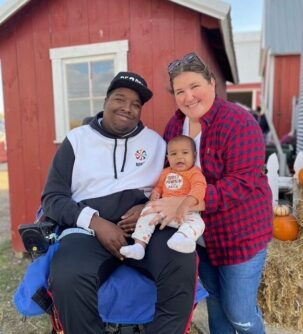
MDA Ambassador Justin Lopez with his wife, Alexis, and their son, Tatum.
“My favorite part of being a father is watching Tatum grow and discover the world around him. He has an incredible curiosity, especially for the little details most people overlook. Once something catches his attention, he dives deep, staying focused until he truly understands it. I love being part of that journey—guiding him, encouraging him, and witnessing those moments of realization. It’s pretty cool to support him as he learns and evolves every day.
Fatherhood has taught me a lot about selflessness and presence. I’ve learned that I’m capable of more love and responsibility than I ever imagined. It’s also shown me how important it is to lead by example: how my actions, even the small ones, shape how my child sees the world. I’ve discovered strengths I didn’t know I had, and at the same time, I’ve learned to embrace my imperfections and keep growing—for both of us.
Living with a disability has challenged me to adapt my parenting style in more mental and psychological ways, especially when physical tasks can be limiting. With Tatum, that means relying more on communication, creativity, and emotional connection to guide and teach him—which can definitely be an uphill battle with a curious and energetic three-year-old. But it’s also helped me become more intentional and patient, and it’s strengthened our bond in unique ways
Without question, living with a disability has taught me patience—and that same patience has become one of my greatest strengths as a father. Managing my disability requires me to approach life slowly and methodically, which translates well to parenting a toddler like Tatum. I’ve learned to accept that things won’t always go right the first time—or even the second or third. But what matters most is showing up consistently, staying calm, and leading with love through every attempt. That mindset has shaped how I support and connect with him every day.
The three key lessons about life that I hope to instill in my child are: One, whatever you do and everything you do, give 110%. Two, be yourself, it will always be enough. And three, be a man of your word.
The best parenting advice I’ve ever received is to avoid comparing yourself to other parents—whether it’s your peers or what you see on social media. Every child and every family is different. Instead, focus on raising a kind, resilient, and thoughtful human being. If you keep that as your guiding principle, everything else will fall into place. Trust and rely on your village to get you through peaks and valleys of parenting
My advice to other parents living with a disability is don’t dwell on what you can’t do—focus on what you can. I know that’s easier said than done, but it’s true. Kids are incredibly adaptable; they’ll adjust to your lifestyle with more ease than you might expect. What matters most is being present, loving, and engaged. Focus on what’s within your control and let go of the rest.”
Kevin Crowley, who lives with Charcot-Marie-Tooth (CMT), is a father of two and author of the My Dad’s Garage blog series.
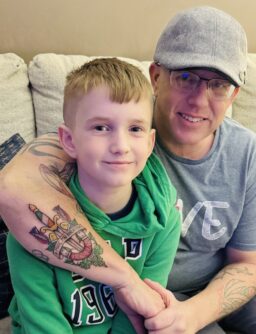
MDA Ambassador Kevin Crowley with his son.
Excerpted from his recent blog about fatherhood, he shares his experience and advice.
“I have so many favorite things about being a father, but my most precious is the fact that with one of my children I had to work, grind, sometimes fight, and I always had to earn my spot in her life. I met my wife Carrie in 2011. Along with her came a sweet, very opinionated, beautiful 12-year-old little girl. Sometimes blending the two of us was much like stirring vegetable oil into water but she turned 26 this year and she is, and always will be, one of my true loves. I’ve grown into Dad and she’s the most perfect daughter I could’ve ever asked for. But, needless to say, we both earned those titles.
With my son, who was born in 2014, I’ve been Dad since day one and there’s nothing he can do about it. While both of my children and I have very different foundations, our end prize is still the same. They are my most precious gifts and I’m their Dad.
They are the most important people in my life and in turn I’ve shifted more focus on my own health and well-being. I’ve found more strength and compassion for my own body and soul than I ever had and I thank my kids for being the reason for that.
The older I get the more my CMT affects me. While the struggles are real, hard, and continuous, I’ve embraced that my mind still functions. While I’m never going to play sports again or run the Boston Marathon, my mind can still coach my own son and so many other youth athletes.
By the time both my children have become adults and have lives of their own, I hope that I have instilled some traits in them that I hold very important. Respect- always respect others and acknowledge that you live in your own shoes, not theirs. Bravery- whether it’s facing your own struggles or fighting for what you feel is right, be brave and more importantly, be brave enough to ask for help. Responsibility- be responsible for your actions and who you are. Be responsible for your own life and commitments!
When my son was on his way, I fretted about everything. Food, diapers, schedules, and generally how in the heck are we going to do this?! A close friend told me, “You’re going to blink, and his childhood will be over and you will have forgotten how you got it done. It’ll happen, don’t stress yourself preparing for it.” That has been the best advice I’ve received on parenthood.
If I had to give advice to other fathers who live with a disability it would be this: know that your children see your strengths, not your disabilities. Many times, I watch and compare myself to other coaches and I get frustrated that I’m not as mobile, not as strong, or maybe can’t keep up physically with some of the younger dads. But if my son needs support and reassurance, he comes to me first. He looks to me for love and protection. At the end of every practice and every game, my son walks out of a crowd of 30 boys and through five other coaches to put himself under my arm. Nothing else matters to him except that I’m his person and I’m his Dad.
Realize that you are that too. Love your children. Support your children. Teach your children. Be Dad and everything else will come.”
Marshall Eckert has a two-year-old daughter and lives with LGMD 2B.

MDA Ambassador Marshall Eckert with his daughter, Estelle.
“My favorite thing about being Estelle’s father is watching her discover the world around her and seeing her realize she has a major role in it.
Fatherhood has taught me that one failure or mistake does not define you. Fatherhood is about the culmination of your efforts. Kids remember your effort and action, not your missteps.
Parenting with a disability can be difficult from several perspectives. First, and probably most obvious, is that I am not physically able to do everything an able-bodied parent might. This means adapting play when possible. It also means leaning on my wife to take over tasks that I may not be physically able to do, like climbing to the top of playground equipment. The second and maybe less obvious adaptation is changing the way I think a parent should show up. My perspective of parenthood came from my lived experience of having two able-bodied parents. I always imagined being able to ride bikes with my kids, go on difficult hikes, or carry them from the car to bed. While this is not the reality, my child’s perspective of a father is me. That means doing what I can and showing up in different ways. I am constantly adapting on the fly, both physically and mentally.
Living with a disability from my perspective is controlling what you can and letting go of what you do not control. This has helped me during my parenting journey because there are things I can control, but a lot that I cannot. My responsibility as a father is to help my daughter in the ways that I can and be with her when things are out of our control (which is difficult for a two-year-old to always grasp).
There are so many lessons that I want to instill in my daughter, but I will try to narrow it down to three: One, you are loved immeasurably more than you can ever know. Two, don’t be afraid to take up space, being your authentic self and bringing your own skills to the table. And three, life if tough, but you are tougher; you can do hard things.
The best parenting advice I have ever received is that the days are slow but the years are fast. Soak up every moment.
My advice to other parents living with a disability is to ensure that you are keeping up with your own physical and mental health. When you are at your best, you can devote yourself to being the best for your child.”
Levi Stanger is father to a four-year-old son and lives with CMT.

MDA Ambassador Levi Stanger with his son, Landon.
“My favorite thing about being a father is playing with my son and getting to be silly together.
Fatherhood has taught me that I can still be very present in my kid’s life even with my limitations. I play with him from my power chair and have adapted how we can play together. I have my wife set me up with everything he needs and then I can help him.
I already knew that I can do hard things and that has helped me with parenting and figuring out what I need to do to help my son.
Three lessons I hope to instill in my son are: Always work hard. Help other. Have fun.
The best parent advice I have ever received is that you are going to make mistakes but that is how you learn.”
Isaac Banks has three children (ages 7, 9, and 10) and lives with LGMD.
“My favorite thing about being a Dad is hearing my kids say “I love you” unprompted. Any parent knows the struggle of chasing down your kids for a hug or a verbal term of endearment, but when one of my kids comes up to me and hugs me and tells me how much they love me it lets me know that they feel safe, and what more could a Dad want?
Fatherhood has taught me that there is no greater calling for a man. Muscles fade, hair turns gray, and good looks are fleeting, but having a child tell you that when they grow up they want to be just like you is the highest compliment someone can have. I have wanted to be a dad my entire life, and now that I am, I realize I was made for it.
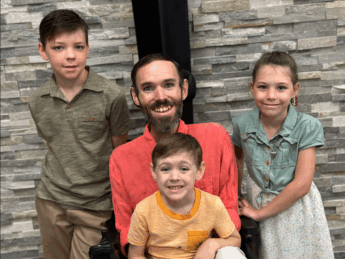
MDA Ambassador Isaac Banks with his children (left to right), AbiYah, UriYah, and Eliana.
Almost every aspect of my parenting has had to be adapted, or at least redirected, through my disability. I am not able to play on the floor, or catch, or take them fishing. I can’t just put them in my van and take them to the park. I have to plan every detail, make arrangements, and seek help, but that is the physical part of parenting. I can still love them, nurture them, and correct them. My favorite part of parenting is when my kids help me come up with new ways of doing things that become our “normal”. Kids are so much smarter than we give them credit for, and they are always seeking time to spend with us.
Communication has been such an amazing parenting tool. Since I am not able to physically take care of myself, I have had to learn how to communicate my needs in a way that is easy to understand. When I talk with my kids, I feel like I am better suited to talk and listen to them instead of just assuming and asserting my own thoughts. Having to express myself clearly to others for assistance has been vital to parenting my children. My words hold weight to them, so in situations where all I have to keep them safe are my words, they listen, and that makes all the difference.
Three key lessons about life that I hope to instill in my children are: First, no one should have to earn love. I have loved them freely and happily, and it is my heart’s desire for them to give it away to everyone they meet. Second is that there is always a way. It may not be the way others do it, but that is what makes it unique. Never give up on someone just because it will take time to figure out a new way. Third, life is going to hurt. I cannot protect them from it. It’s not fair and it’s a struggle, but it’s worth it, and I believe in them.
The best parenting advice I have received is: don’t ever wish away the phase of childhood they are in. It’s easy to be tired and wish they were old enough to sleep on their own or walk on their own. It’s a trap. You can never get those years back. Enjoy them where they are and you will make the most of your precious time with them.
And my biggest advice for a disabled dad is to try. Dare to fail. Pride and embarrassment steal so much of us because of the disability. Your kids don’t care if you look silly driving around a yard or rolling a ball in your lap… they care that you love them enough to try.”
The post The Joys (and Lessons) of Fatherhood from MDA Ambassadors appeared first on Quest | Muscular Dystrophy Association.
]]>The post In Case You Missed It… appeared first on Quest | Muscular Dystrophy Association.
]]>With so many valuable podcasts, blog articles, and magazine articles available to our audience, chances are that you may have missed one or two pieces of interesting content. Check out the summaries and links below.
In case you missed it… Quest Media Product Guide:
The Quest Media Summer Product Guide is here!
This guide is designed to help you find the products you need to live a more independent, stylish, fun, and all-around great life. All the products you see here were chosen by MDA Ambassadors, who shared exactly how each product helps them in their daily lives. Find something for yourself, or for someone else in your life who you want to get a thoughtful gift for. Shop the newest product recommendations here.
In case you missed it… Quest Blogs:
How to Plan the Perfect Summer Staycation
As the cost of living continues to rise in the United States, many individuals and families are re-evaluating their budgets. Typically, vacations are among the first things to get cut when creating a plan to save money. But trying to stay on budget this summer doesn’t mean that you have to cut out all of the fun. These staycation ideas provide fun and affordable options without the high cost of travel and lodging. Read more.
How to Manage Stress and Fear in Uncertain Times
People in the neuromuscular disease community are hearing many different reports about policy and funding changes that could affect their lives or their loved ones. This has many people feeling uncertain. These worries naturally affect people’s well-being. In times of uncertainty, it’s important to practice self-care and develop strategies to build resilience. Read more.
In case you missed it…Quest Magazine:
Quest Magazine’s 2025 Issue 2 is here!
The second issue of Quest Magazine for 2025 is here! Read up on all things accessible travel, gene therapy, disability representation in Hollywood, MDA Community Education programs, and more. Read more.
The post In Case You Missed It… appeared first on Quest | Muscular Dystrophy Association.
]]>The post Quest Podcast: Invisible People: Making the Rare Seen appeared first on Quest | Muscular Dystrophy Association.
]]>Listen to her song “Invisible People” that MG Holistic has chosen for the 5 year Anniversary video and official MG Conference Song: https://daniaquill.com/track/4291421/invisible-people
Read the interview below or check out the podcast here.
Mindy Henderson: Welcome to the Quest Podcast, proudly presented by the Muscular Dystrophy Association as part of the Quest family of content. I’m your host, Mindy Henderson. Together we are here to bring thoughtful conversation to the neuromuscular disease community and beyond about issues affecting those with neuromuscular disease and other disabilities, and those who love them. We are here for you to educate and inform, to demystify, to inspire, and to entertain. We are here shining a light on all that makes you, you. Whether you are one of us, love someone who is or are on another journey altogether. Thanks for joining now. Let’s get started.
Dania Quill has a background as a pharmacist, is an incredibly talented musician and happens to live with myasthenia gravis. As her condition progressed, she had to leave her job as a pharmacist, but she became determined to share music with the world. Lacking the stamina to play long sessions, she taught herself to record her songs, coaxing her muscles and voice to sustain long enough to lay down one sound bite at a time, which is so impressive. One of her recent videos got over 16,000 views on TikTok, but the proudest moment for Dania was knowing it resulted in the search for happy things to cheer you up, which I can’t read that out loud without it making me smile. I love it, and I’ve got to say that when I first saw you on video, it immediately brought a smile to my face. You just emit such joy. So let’s jump right in. Thank you so much for being here with me today.
Dania Quill: Thank you so much for having me.
Mindy Henderson: Let’s start out by talking a little bit about what may be the least interesting thing about you, myasthenia gravis. So first we’ve got lots of other things to talk about, but let’s dive into that just a little bit. First of all, how old were you when you were diagnosed?
Dania Quill: Well, I don’t want to give away my age.
Mindy Henderson: Of course. No. Adult? Child? That’s fine.
Dania Quill: But I was an adult. I think people will be able to figure out how old I was because I was already well into my… Five years into my pharmacist career. So that doesn’t happen overnight.
Mindy Henderson: Okay. Well, honestly, I am looking right at you and you look like you’re 21 years old.
Dania Quill: Thank you.
Mindy Henderson: Yeah. So tell me a little bit about, I know just from reading a little bit about you, that it was a bit of a challenge to get that diagnosis, which I think is so common in the neuromuscular world when people with these conditions are trying to get diagnoses for both myasthenia gravis, but things like ALS and so many other conditions that fall under this umbrella. Tell me maybe a little bit first about what that diagnostic journey looked like for you and how long it took to get a diagnosis. Then I just want to delve into a little bit how it impacts your daily life. So let’s start with the diagnosis itself.
Dania Quill: Right. It’s so difficult because at first you have to realize and come to terms with yourself that there’s something wrong.
And then going to the doctors, they’re like, “Oh, you don’t want there to be something wrong with you.” You are seeking for there to be something wrong. This is after a few years of struggling with like, “Oh, I think this is more than I initially thought it was.” I can’t even put my finger on a day or a time when it just was like something happened and all of a sudden I had myasthenia. It was like I was working and I stopped taking the elevator because when the elevators would stop, I would feel like I was still bouncing up and down, and my migraines kind of changed to where I felt like I’d have a headache, but I had a migraine, but no headache. And instead it was just my eyes were blurry and I didn’t know how else to describe it. Words and things were blurred.
And then once I stopped taking the elevators, I realized, “Oh, I’m way out of shape. I can’t even climb the stairs.” So I started really trying to climb the stairs multiple times a day, and instead of getting stronger and that getting easier, it kept getting harder and harder. And so then I was like, “Oh, I need to go jogging.” And around that time, I moved from the Central Valley to the Bay Area in California, and at one point I couldn’t even jog, so I just was walking. And when I got back from my walk, I all of a sudden felt like I was so light that I was struggling to stay on my tiptoes. And then my legs, muscles were twitching all up and down my legs. And that’s when I realized for me, “Oh, it’s a neurological thing.” And I was so scared because I mean, as a pharmacist, I knew, knew it was something neurological. And you do that Google search and it’s like ALS was the first thing that popped up, and I was like, “Oh, I don’t want to go to the doctor.” But I forced myself to. And then they’re like, “Oh, it could be an inner ear problem.” And I’m like, “It could. I don’t think it is. I think it’s something much more serious.”
And from the time that I had that first inkling of what it might be, I think it was two or three years to get a diagnosis. I mean, I didn’t take it serious trying to get a diagnosis until I fell on Halloween. And then I fell at a little later at work and I couldn’t get up. And they took me to the ER and I made an appointment with a neurologist the following Monday, and he said, “Oh, it seems like you have all the symptoms of myasthenia gravis. Take these pills.” And he gave me some Mestinon and he says, “Then we will wait to have you be seen by the neuromuscular specialist.” Well, I took the pills. After a few days I could walk. He had taken some labs, but the labs came back negative.
Mindy Henderson: Oh, interesting.
Dania Quill: Yes. So he says, “Well, now we don’t know whether you would’ve gotten better on your own or if the pills had anything to do with it.” And then they started treating me with a lot of suspicion like-
Mindy Henderson: Wow. “I just did what you told me to do.”
Dania Quill: I was like, “But the pills are working. Can I have more?” And they’re like, “No, you don’t have myasthenia, because it didn’t show up in your labs.” And then the neuromuscular specialist, they just started doing tests and more tests and more tests, and they were like, “It’s not myasthenia because,”… And then they started saying, “Well, we have to consider that it could all be in your head.” I did my research. I researched everything. I learned about so many different neuromuscular diseases, like stiff person syndrome. I asked to get a second opinion from so many… I saw six different neurologists, and some of them I paid for out of pocket. I was struggling at work the whole time. I was having trouble breathing, going to the ER, crawling under my desk to just take a break sometimes-
Mindy Henderson: Oh, my gosh.
Dania Quill:… because my whole job was just sort of talking on the phone to doctors and nurses, and sometimes I couldn’t even hold my head up to do that. It was an incredibly difficult time. And then everyone was like, “Oh, you’re stressing out too much. You just can’t handle the pressure.” And I’m like, “No, excuse you. I’ve been doing this for a while now.” I was up for promotion. I was really trying to… I was like, “No, I’m happy. I am doing what I want to be doing.” And it was kind of torture to be told, “This is all in your mind.” Because I was like, “Well, then, poof, be gone.”
Mindy Henderson: Right, exactly. Exactly. I can’t imagine how frustrating that would be. And I say to people sometimes who I talk to that are in this situation and they’re trying to get answers, it’s like, you don’t… Kind of like you said earlier, you don’t want there to be something wrong, but you want an explanation. You want answers. And hearing that you were made to question yourself just angers me on your behalf.
Dania Quill: Thank you. Yeah, it’s like medical gaslighting.
Mindy Henderson: Yes. Yeah.
Dania Quill: And my aunt had myasthenia gravis and so I told them, “You know, I looked at the research, you are like a thousand times more likely to have it if you have a first degree relative that does.” And they’re like, “Nah.”
Mindy Henderson: Oh, no.
Dania Quill: So finally I got to see, I call them the uber specialist, the guy, the neurologist who only does myasthenia gravis in San Francisco, and he had already diagnosed me before I even got there. He had looked at my chart and he said, “Yeah, I had said to my colleague, ‘Look at this poor girl. Look what they’re putting her through.'” And so he started to treat me and I got my diagnosis that day. It was 2017, and it was weird because it was like, “Okay, now I have the diagnosis.” And then I started thinking about next steps. It was like, “Okay, now what?” And it was supposed to be all good, but it was supposed to be easy to treat, and here we go. But then it turned out that I had, because I’m seronegative, meaning I don’t have the three or four antibodies that they know of, my myasthenia is a little bit different.
Mindy Henderson: Is that why it didn’t show up in the blood test?
Dania Quill: Yes.
Mindy Henderson: Okay.
Dania Quill: Yeah. And they act like there’s something wrong with me, which I hate patient shaming in the medical field where it’s like, “There’s something wrong with you.” No, it’s just that we know so much about so much. We know what we know in the medical field, but there are still things we don’t know. Believe it or not, there’s still 10% of people with myasthenia gravis, who we don’t know what antibodies they have. We know they have antibodies and they call it like myasthenic syndrome because we’re not quite sure what the antibodies they have are doing, but they’re still attacking the junction between the nerve and the muscle. And those antibodies might be affecting the body a little differently than the acetylcholine receptor antibody or the MuSK antibodies might. So they’re a little bit harder to get rid of.
Mindy Henderson: Okay. Interesting. So many questions that I want to ask you. For anyone listening who isn’t familiar with myasthenia gravis, how… And yours, given the antibodies that you have or don’t have or the classification that it falls into, how does myasthenia gravis present? Or does it vary according to the classification that you have?
Dania Quill: Yeah, it varies. It usually presents as double vision. So people will complain about their eyes and about seeing double. That’s the most typical presentation.
Mindy Henderson: One of the hallmarks?
Dania Quill: Yes. And then they’ve got a breakdown of percentages. Some people will present with having difficulty swallowing or speaking, and then the numbers go down from there. Difficulty with arms or difficulty with legs is a very small percent of people will present with that. So I didn’t even present the right way.
Mindy Henderson: Right.
Dania Quill: Most people will have double vision and droopy eyelids, and some people will stay that way. It’s just the ocular myasthenia gravis where it only affects their eyes. But for other people, it will progress to be generalized myasthenia gravis where it affects their whole body.
Mindy Henderson: Gotcha. How does it affect you, if you don’t mind my asking, in your daily life? I know that for example, you had to stop working as a pharmacist. Can you talk a little bit about that and how it affects you physically?
Dania Quill: Since it is an autoimmune disease as well as a neuromuscular disease and being a nerve disease, it just responds to a lot of different factors like stress. So it does respond to stress, heat because nerves don’t like the heat or the cold. Some people complain more about the cold. So if you’re in a really stressful situation or you’re not getting enough sleep, it can cause exacerbations. And an exacerbation is just when… The goal of treatment of myasthenia gravis is to get you stable or to put it into remission where you basically don’t have symptoms and you can live your life day to day without even thinking about it.
But mine was a bit refractory, meaning I wasn’t responding to treatment. I was taking these medications and still having a lot of symptoms on a daily basis and having exacerbations even in between that. And then the scariest thing is having a crisis because myasthenia affects every muscle that is a voluntary muscle, not so much the automatic muscles, but muscles that you control with your mind. But those also include the muscles of breathing because we control taking a breath. So an exacerbation would be your diaphragm or your other muscles of breathing just shutting down on you and suddenly you can’t breathe. And I did have one or two of those, and that was really scary.
Mindy Henderson: It’s scary.
Dania Quill: Yeah. And it happened when I was trying to work and there was too much in my life going on in addition to work, and it was like something’s got to give, and every time I’d try to go back to work, I would have to step out again, be hospitalized again or go on a medical leave again. And then I think the final straw was that, it very rarely happens, but sometimes where along with myasthenia, I also got dysautonomia, which is in addition to the muscles that we control, then it also affects the muscles that just automatically roll on their own.
Mindy Henderson: Wow.
Dania Quill: So it affects my digestion and my heart rate. So I was fainting and-
Mindy Henderson: Oh, my gosh.
Dania Quill:… couldn’t eat, and that is still going on. So it’s like, “Okay, I got a whole bunch of stuff going on.” I had to have a feeding tube and or be on TPN.
Mindy Henderson: Okay. Well, thank you for sharing. I know it’s hard to talk about these things, but I appreciate your candor and your transparency. I know it’s going to be helpful to people who are listening and maybe able to relate to your story. So I am sure that you were a brilliant pharmacist. However, I kind of wonder, the way my mind works and where I tend to go in my mind with stories like this is, I think you had another calling, and I feel like maybe that was music. I don’t want to put words in your mouth, but I’d love to shift a little bit and you shared, I mentioned it in the opening that as things progressed, working on music helped you through things like long hours of infusions and hospital stays. Can you talk a little bit more about that and sort of the journey through the MG diagnosis and treatments to coming into your own with music and learning to use that as a tool and ultimately it sounds like, to replace your pharmacy career?
Dania Quill: Yeah. I’ve always had music or done music, played music.
Mindy Henderson: Is that right? I was curious actually.
Dania Quill: Yeah. I fell in love with guitar when I was just really small. I don’t know. We went to visit a family friend and he had a guitar. I just remember this old, old man, and he had this instrument and it was a guitar, and he was playing it, and I just fell in love with it. And I told my parents, “I want one of those.” And they were like, “Oh, it’s kind of expensive,” because we were all really young back then. But they did get me one, and I just was determined to learn and they got me lessons, and I just always had the guitar with me through high school and college and life.
Mindy Henderson: Were you always a singer or was it guitar that you spent your time on?
Dania Quill: I don’t even consider myself a singer.
Mindy Henderson: I beg to differ. You’re definitely a singer.
Dania Quill: Yeah. In elementary school, they used to teach music. They had a music class, and that’s where I learned to sing. That’s where our teacher taught us to breathe properly and to count beats. And I learned a lot of music theory through guitar lessons. And so when I stopped working, I was lost. I didn’t know what to do. And whenever I’m that way, it’s like I cling to my guitar like a life raft. But I didn’t like the way playing it felt at first because I could feel the weakness in my fingers, and it made me slower at it, not as fast, not as good. And even sometimes when I was really weak, I was shaky and it really bothered me.
But one night I just woke up in the middle of the night or I wasn’t quite asleep, and I was just thinking about life and wondering if this was it, my career is over a lot faster than I thought, and what if life is over a lot faster than I thought? Would I be satisfied with what I’ve done this far? And I was like, “What about my music though? What if no one ever gets to hear the songs that I wrote?” I had written quite a few songs in college and after college and always meant to record them and never did. And I was like, I don’t know. It just bugged me. I got up out of bed right then it was like midnight, and I went and I copyrighted… I went and found out how to copyright the song right then and there,
And I was like, “No, I’m going to do it. I’m going to at least record the song so that I can copyright it.” And I did, literally play one chord and recorded it at a time and just spliced the chord together.
Mindy Henderson: That’s amazing. Wow. That’s incredible. I can’t imagine-
Dania Quill: It kept me busy.
Mindy Henderson:… the patience that would take, I mean, I’m so impressed.
Dania Quill: I had a lot of time.
Mindy Henderson: Well, I shared with you, and when I asked you to be on the podcast that I used to be a singer, and I don’t know that I would’ve had it in me to painstakingly record one note, one chord at a time. And so I love, number one, I love that you were capable of that, but I also love that. I think that speaks a lot to how much it meant to you.
Dania Quill: Yes. Yeah. I was determined.
Mindy Henderson: Yeah. No kidding. No kidding. So now you have songs that you’ve released and are out in the wild, so to speak, for people to listen to. Tell me about the songs that you’ve created so far and where people can listen to them. And by the way, we’re going to put all the information in the show notes so that people can find them after the fact.
Dania Quill: Great, thanks. Yes. I released four singles so far. They’re actually going to be together in an album eventually.
Mindy Henderson: Love it.
Dania Quill: I’m out on social media, so I’m on Instagram, Facebook, what’s that? TikTok, all of the places as Dania Quill. And all of the songs can be downloaded wherever you stream music.
Mindy Henderson: Great.
Dania Quill: I also have a store on Bandcamp where you can purchase the music and the money will go directly to me as well as my brand-new website, which is just DaniaQuill.com. And you can purchase the music there too as well.
Mindy Henderson: Wonderful. Now, do you focus mainly on recording music or do you perform live?
Dania Quill: I have not gotten into performing live yet. It’s very physically taxing.
Mindy Henderson: It is. Yeah.
Dania Quill: Yeah. And I’ve gotten better. I mean, I’ve gotten stronger and I’ve gotten on a different medication regimes where I am able to play a whole song, sing a whole song, but I use a lot of tricks to help me, like holding my hands above my head to help me breathe.
Mindy Henderson: Oh, interesting.
Dania Quill: Yeah. I am in my recording booth right now, but I use straps that are, they’re just strung above my head so that I can rest my arms.
Mindy Henderson: Oh, that’s such a good idea.
Dania Quill: So that I open up my rib cage. It’s something that my neurologist told me about when I was having a hard time breathing one day. And then I even have a little device that’s like an exercise for the respiratory muscles that’s been helping a lot. And I record in layers. So I’ll record one guitar part and then go back, record another layer of guitar over that. And then I’ll go back and record ukulele or harp over that-
Mindy Henderson: Oh, wow.
Dania Quill:… and then keys and put them all together.
Mindy Henderson: And I’ve listened to some of your music. It’s beautiful. It’s fun. It’s beautiful. You have a gorgeous voice and you’ve got harmonies and things worked into your songs. Do you sing all your harmonies and everything?
Dania Quill: Yes.
Mindy Henderson: Wow. That’s really… I can’t imagine. With everything you just described. How long did it take to maybe record? And it may vary from song to song, but how much time have you spent recording a song from start to finish?
Dania Quill: I think from the time that I purchase my first piece of equipment that would allow me to start recording, I think it’s been like five years.
Mindy Henderson: Oh my gosh, that’s amazing.
Dania Quill: But it’s-
Mindy Henderson: That’s dedication.
Dania Quill: There was a lot for me to learn because I didn’t have the money to just go into a recording booth and a recording studio and be like, “Oh, I’ll pay the time.” So I built my own recording booth at home, and then I didn’t want to pay a producer to mix and master the songs, so I learned how to do a serviceable job at that myself.
Mindy Henderson: That’s fantastic.
Dania Quill: And as I go, the process has become a lot quicker. Now I’m moving pretty quickly and putting the song out there now that I’ve got all of the equipment that I need and all of the knowledge that I need. So I think this last song, it was only a month to get the song together.
Mindy Henderson: And that’s still significant, but it’s absolutely quicker than five years, and it shows in your music. It’s so well done. Now, I understand that you’re also working with a partner on a song specifically for MG, is it Awareness Month that you’re creating that for?
Dania Quill: Yeah.
Mindy Henderson: Tell me a little bit about this other person you’re working with and about that project.
Dania Quill: It’s actually, it’s still my song that I wrote, and I invited several other people to sing and play on the piece with me. Kind of got tired of my own voice, but-
Mindy Henderson: Well, I think as a singer, you appreciate other amazing voices because you know what goes into the craft.
Dania Quill: Right. And the song is not specifically about myasthenia gravis, but that is the lens that I am seeing through. But I know that it is a very common thing and theme for people to feel invisible. I even thought about, I was listening to the April episode that you interviewed Jess, I think his name-
Mindy Henderson: Oh, Jess Westman. Yeah.
Dania Quill: Yes. And he was telling a story about him on the Metro and how people were telling him to move because he’s not disabled. And I was like, “Oh, see, there’s another example.” The song is called Invisible People.
Mindy Henderson: Okay. I love that. Oh, that gave me goosebumps.
Dania Quill: And it’s about having an invisible illness and the kind of effect that has, and that I’ve seen people struggling with it. And we were lucky enough to get a sponsor in MG Holistic, and I’ve been working with Dawn through MG Holistic. She is just amazingly been like, “I believe in you. I believe in your project.” So like I said, she’s put her money behind her words, and that’s like…
Mindy Henderson: Amazing.
Dania Quill: Yeah, that is amazing. So the song is sung by Aimee Zehner, who is another young person that has MG, and the piano is played by Mika Filborn, who is another artist. He is also amazing, who also is living with MG.
Mindy Henderson: Okay. Fantastic.
Dania Quill: So that’s why I wanted it to be a group of people that are experiencing this with me.
Mindy Henderson: I love that. I absolutely love that. When is it going to be available? Did you tell me June?
Dania Quill: In June.
Mindy Henderson: Okay.
Dania Quill: Hopefully early June.
Mindy Henderson: Okay.
Dania Quill: I don’t have an exact date, but hopefully early June, it should be out, and it should be just like the other songs.
Mindy Henderson: Same places.
Dania Quill: Mm-hmm.
Mindy Henderson: Wonderful. I can’t wait to hear the finished product. It sounds beautiful, and it sounds so important because there are so many people in this world who have invisible disabilities, and that’s a whole different unique set of struggles and things that you come up against in your life. And so I love that you are acknowledging that and giving time and space to it. I think even beyond the MG community, I think it’ll speak to a lot of people.
Dania Quill: Yes. Yeah.
Mindy Henderson: Yeah,
Dania Quill: Exactly.
Mindy Henderson: So tell me, just in general, your thoughts on, clearly you are out here raising awareness for MG. Tell me about why that’s important to you and how you hope your music will do that.
Dania Quill: Well, because I don’t think that anyone should ever have to go through what I did to get diagnosed. It is traumatizing. It’s damaging.
Mindy Henderson: Absolutely.
Dania Quill: And it happens way too much to young women. And myasthenia is bimodal when it comes to the incidence of diagnosis. So it first shows up in young women of childbearing age, and again in older men. And unfortunately, there’s a lot of misogyny. And like I said, medical gaslighting and just sexism in the world still. And so when a young woman shows up with a mysterious disease that maybe they covered one day in a medical school, because it’s a rare disease, it’s easier to tell her, “Oh, I’m sending you to the psychiatrist.” And that’s not right.
Mindy Henderson: No, no, it’s not. I mean, it breaks my heart hearing you talk about this and knowing how many people are out there that this is happening too. If anyone’s listening who feels like they are going through this right now, do you have a best piece of advice for them, sort of looking back on your own journey and what you maybe wish somebody would’ve told you?
Dania Quill: Just trust yourself and listen to your body.
Mindy Henderson: Yeah.
Dania Quill: And it’s not worth fighting with the doctor about. I thought I had to deal with this doctor and make understand me and make them hear me. But really, there are so many doctors out there. Just, “Next.”
Mindy Henderson: Yeah. If you don’t feel heard. Absolutely.
Dania Quill: Yeah. You don’t have to deal with that doctor. You can-
Mindy Henderson: So true.
Dania Quill:… ask for a second opinion and another opinion. You don’t only get two. I think it’s misleading, a second opinion, but you can get a third and a fourth and a fifth. You get to someone who will listen to you and take your concerns seriously.
Mindy Henderson: Yeah. I love that. I absolutely love that. So let’s finish on maybe a happier note of, let’s talk about also in this community or neuromuscular community, there are so many people out there with incredibly valuable talents and gifts. What advice would you give to them about learning to share their gifts with the world and step into that kind of vulnerable, maybe a little bit scary place and putting themselves out there?
Dania Quill: Yeah, I think you just got to try it. You know where there’s a will, there’s a way. And yeah, these diseases, they suck. They take a lot out of you, but don’t let them take your self-expression. There’s so many different ways to do that and to experience the joy of that. And I think Aimee had a really eye-opening experience with this. She was like in a bulbar crisis just the week before she recorded the song. So she was trying to pump herself up on meds and get strong enough to sing. And she didn’t tell me, because I would’ve said, “No, never mind. It’s not worth you stressing out about.” But she really wanted to do it really bad. And once she had, she was just absolutely in love with it. And she was like, “I want to do this more. This is one thing that I think has been missing from my life and I haven’t been trying to do.” Because you can talk yourself out of stuff.
Mindy Henderson: Yes. So easily.
Dania Quill: Right? Yeah. It’s, “Oh, I never,” and “they wouldn’t put up with me how many breaks I need.” But yeah, they would if they’re your people. And artists, I have found to be some of the most kind-hearted and understanding people. And I mean, I just say go for it.
Mindy Henderson: Yeah. I love it. And just what you said is absolutely perfect. And I want to add to that, that we are so much more than these conditions that we live with. And it’s just like you said, if you love something, if you can’t stop thinking about something, if it’s your passion, one step at a time and just get out there and do it however you can, like you did. One note, one chord at a time.
Dania Quill: It’ll get easier.
Mindy Henderson: It’s made beautiful music.
Dania Quill: Yeah.
Mindy Henderson: Yeah.
Dania Quill: It’ll get easier.
Mindy Henderson: It does. It absolutely does. Thank you so much-
Dania Quill: Thank you.
Mindy Henderson:… for sharing your time and your story with all of us. It was such a pleasure to get to know you, and I just look forward to hearing more music from you and hopefully getting to stay in touch.
Dania Quill: Thank you so much.
Mindy Henderson: Thank you.
Dania Quill: I’m like, you’re going to make me cry now.
Mindy Henderson: Happy happy tears. Thank you, Dania.
Dania Quill: Thank you.
Mindy Henderson: Thank you for listening. For more information about the guests you heard from today, go check them out at mda.org/podcast and to learn more about the Muscular Dystrophy Association, the services we provide, how you can get involved, and to subscribe to Quest magazine or to Quest newsletter, please go to mda.org/quest. If you enjoyed this episode, we’d be grateful. If you’d leave a review, go ahead and hit that subscribe button so we can keep bringing you great content and maybe share it with a friend or two. Thanks everyone. Until next time, go be the light we all need in this world.
The post Quest Podcast: Invisible People: Making the Rare Seen appeared first on Quest | Muscular Dystrophy Association.
]]>The post MDA Ambassador Guest Blog: How My MG Journey Has Shaped Who I Am Today appeared first on Quest | Muscular Dystrophy Association.
]]>Life doesn’t always go the way we expect.
That’s something we all learn eventually, but for those of us with chronic illnesses, it feels like the world can change in an instant. You’re walking down one road, and suddenly — without warning — everything shifts. That’s how it felt when I was diagnosed with myasthenia gravis (MG) at nine years old.
Keeping faith against all odds
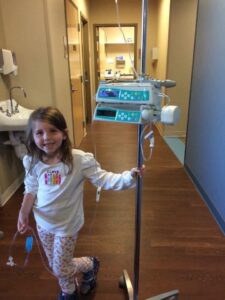
Courtney B. in the hospital getting long treatments
Before MG, I had already faced numerous health challenges. From a rare form of arthritis to a heart condition, and more than 20 other medical issues — I’ve spent much of my life in hospital rooms and doctor’s offices. But nothing prepared me for MG.
When I was first diagnosed, it felt like everything had been turned upside down. My muscles — the ones I had always relied on — began to betray me. Holding my head up, walking, even smiling — things I never thought twice about — became impossible. But even then, I didn’t give up. I couldn’t.
At the age of 9, a doctor told me I had only two years left to live.
Two years.
That moment felt like the world had come crashing down on me. But I made a choice — not to give in to fear, but to fight. To live. I found a new doctor at the Children’s Hospital of Philadelphia (CHOP), and with them, I found something else too: hope. A renewed belief that my story wasn’t over yet. That maybe, just maybe, I could write a different ending.
Eight years later, I’m still here. Still fighting. Still living. And I’ve learned more about what it truly means to live than I ever imagined.
Writing my own story
And as I sit here today, reflecting on everything I’ve been through, there’s one thing I know for sure — I wouldn’t change a thing. Not the pain. Not the struggles. Not the tears. Because every step of this journey has shaped me into who I am today.

Courtney B. in her scooter with her friend at MDA camp 2024 about to do the zip line
Living with MG has taught me to trust. To trust in God, to trust in the strength He’s given me, and to trust that He’s not finished with me yet. Through all the struggles, I’ve held onto my faith. I’ve kept my heart open to life, even when it felt like everything was closing in around me. God has been my strength when I had none left. And by His grace, I’ve been able to accomplish things people once said I couldn’t.
This fall, I’ll be attending Xavier University, where I’ll be a Division I cheerleader — not just continuing my journey but rising higher than many ever expected. Because no diagnosis can define what I’m capable of.
When people meet me now — the cheerleader, the high school senior graduating early, the lifeguard, the law intern — they see strength, smiles, and joy. But what they don’t see is the quiet fight I live with every single day. They don’t see the long nights when I wondered if I’d be able to walk the next day or if I’d be able to lift my head without help.

Courtney B. at the Zip line
If I could offer one piece of advice to someone starting their journey with MG, it would be this: You are not defined by your diagnosis. You will have hard days. You will doubt yourself. There will be moments when you feel like giving up. But know this — you are never alone. You are stronger than you think, and with God’s guidance, you will find a way to move forward, even on the toughest days.
MG is a part of my story, but it will never be the whole story. With God in my life and determination in my heart, I know the best chapters are still ahead of me.
Because I’m living proof that life doesn’t end with a diagnosis. In fact, it’s often just the beginning. And no matter what anyone says — you can do anything.
The post MDA Ambassador Guest Blog: How My MG Journey Has Shaped Who I Am Today appeared first on Quest | Muscular Dystrophy Association.
]]>The post Accessible Air Travel Is Ready for Takeoff. Can It Avoid Turbulence? appeared first on Quest | Muscular Dystrophy Association.
]]>
Shannon Wood, MDA’s Director of Disability Policy
Most of the changes came in the Federal Aviation Administration (FAA) Reauthorization, an act that is reapproved every five years, most recently in May 2024.
“Senator Tammy Duckworth, a Democrat, was instrumental in getting disability provisions included. Senator Ted Cruz, a Republican, helped move the bill forward on the Senate floor — it had very strong bipartisan support,” says Shannon Wood, Director of Disability Policy at MDA. “We can say that in conjunction with disability advocates from across the disability rights community, those living with neuromuscular diseases played a huge role in getting disability-rights provisions successfully included in FAA reauthorization.”
Advocates will continue to play an essential role in ensuring that all the promised reforms are implemented without delay or reversal.
Advocacy gets results
Shannon noted that MDA advocates sent more than 400 comments to the US Department of Transportation (DOT), and many testified at listening sessions the DOT held to gather input for the final FAA reauthorization.
Disability-related provisions in the FAA reauthorization include:
- Strengthening training requirements for those assisting passengers with limited mobility, as well as for those who stow wheelchairs and assistive devices
- Improving the complaint process with the DOT
- Requiring better reporting of data on mishandled wheelchairs
- Funding continued study into in-cabin wheelchair tie-down systems
At the end of 2024, the DOT released additional disability-positive rules that went into effect in January 2025, such as:
- Codifying that airline actions that result in a “heightened risk of bodily injury, which may include loss or damage to wheelchairs and other assistive devices that result in bodily injury,” violate the rights of passengers with disabilities
- Stating that personnel and boarding chairs must be ready to assist passengers no later than when other passengers have left the aircraft
- Requiring airline workers and contractors to get enhanced training on wheelchair disassembly and reassembly, proper wheelchair loading and securement, and safe and dignified passenger transfer assistance
However, in February 2025, the trade group Airlines for America and five air carriers — American, Delta, JetBlue, Southwest, and United — filed a lawsuit, arguing that some of the DOT’s new rules regarding protections for passengers with wheelchairs are unnecessary and an overreach. As of press time, the DOT’s rules are still in effect.
Holding airlines accountable
In October 2024, the DOT showed that its commitment to safer, more inclusive air travel was more than lip service. It levied a $50 million fine against American Airlines for violating laws protecting passengers with disabilities, sending a signal to the industry that poor treatment of passengers with disabilities would not be tolerated.
The largest disability enforcement action before this fine was only $2 million. Shannon notes that while half of the fine goes to the US Treasury, the remaining $25 million will be credited to American Airlines in the form of offsets.
“Offsets could be used for investments in equipment to reduce wheelchair damage, wheelchair lifts used to safely lower wheelchairs from the jet bridge down to the tarmac, system-wide wheelchair tagging systems, or other improvements,” she says.
MDA works closely with Paralyzed Veterans of America (PVA) and other nonprofit organizations to advocate for better air travel. PVA filed formal complaints about American Airlines’ “physical assistance that at times resulted in unsafe and undignified treatment of wheelchair users.” When the fine was levied, the DOT cited PVA’s complaints that outlined egregious actions.

Heather Ansley, Chief Policy Officer for Paralyzed Veterans of America
Heather Ansley is Chief Policy Officer for PVA and the co-chair of the Air Carrier Access Act (ACAA) Advisory Committee. The 2024 FAA reauthorization extended the life of the committee and charged it with researching and advising on crucial mobility issues, such as the use of lithium batteries in assistive mobility devices and best practices for service animals in flight.
“Overall, the disability community is focused on our advocacy to make sure any administration knows that we are watching the deadlines given by Congress, and we feel strongly about action being needed,” Heather says.
Many changes that will benefit disabled passengers are still in the rulemaking stage or have longer deadlines for implementation. This means it is too early to see widespread change, and it is imperative to work with the administration and the airline industry to ensure forward momentum.
Encountering issues
“People with disabilities have the right to access any mode of transportation and have the same safe experience that everyone else has,” Heather says. “If you have to be across the country the next day — to address an urgent family matter or attend a critical business meeting — the only way you can do that is to fly. People with disabilities are no different. They’ve paid the fare, so the airline needs to provide a safe and dignified experience.”
If something happens to your wheelchair or other mobility device during air travel, document the damage or other issues in writing and take photos. The quickest way to get a response is to contact the airline. Check the airline’s website to see if they have a specific phone number to call for disability-related concerns (Find more advice from experienced travelers in MDA Ambassadors Share Tips for Flying with Power Wheelchairs and Medical Equipment.).
“If the issue is not resolved sufficiently, or if you have concerns that your rights were violated, also submit a complaint to the DOT,” Shannon says. “It’s those complaints to the DOT that led to the unprecedented fine against American Airlines last year.” (Fill out the DOT Air Travel Service Complaint or Comment Form.)
Still pushing for wheelchairs in flight

Michele Erwin, Founder and President of All Wheels Up
MDA, PVA, and other disability-related organizations agree that adjusting airplane cabins to allow travelers to remain in their wheelchairs while flying is the seismic shift needed in air travel.
For 15 years, All Wheels Up Founder and President Michele Erwin has been leading that charge. She believes airlines are starting to see that it makes economic sense.
“We know 80% of power wheelchair users do not travel by air because of the possibility of lost or damaged mobility devices,” Michele says. “There are 4 million wheelchair users in the United States and at least 20 million globally, but only a fraction are traveling. When someone travels by plane, airlines don’t just sell one ticket — they sell two to four more tickets to family members, friends, and business associates. More accessibility means more revenue.”
In addition, the FAA Reauthorization Act includes some victories for moving toward in-flight travel in an assistive mobility device:
- Congress will fund an in-depth budget impact model exploring how a wheelchair spot in the cabin impacts airlines, equipment manufacturers, tourism dollars, and damage cost avoidance.
- Testing will focus on tie-down devices that provide safe travel for wheelchair passengers.
- The FAA will conduct studies on creating evacuation plans for travelers in their own wheelchairs on board. Safety studies and evacuation plans are a core element before the airline industry can move forward.
Michele says momentum is building, evidenced by several airline equipment manufacturers visiting with her during the Aircraft Interiors Expo, the world’s largest aircraft interiors trade show. She also notes that aircraft manufacturers, such as Airbus, have been attending All Wheels Up’s conferences.
Keeping the momentum going
Just as MDA advocates were key in shaping the provisions of the FAA Reauthorization and new DOT rules, they play a significant role in telling the airline industry and lawmakers that their work is not done.
“MDA stands ready to work with all our champions to drive positive policy change for travelers affected by neuromuscular disease,” Shannon says. She encourages everyone to write to their elected officials and the DOT to keep building momentum for more inclusive and safer travel. (Search for your elected officials on MDA’s Advocacy website, or submit comments to the DOT through the Air Travel Service Complaint or Comment Form.)
“Safety and dignity for wheelchair users is a basic right, but it also opens up travel for people with disabilities, which is good for them, good for the industry, and good for business,” Michele says.
Steve Wright is an award-winning writer and advocate based in Miami. He lectures throughout the US and abroad on creating a better built environment for people with disabilities.
Know Your Rights as an Airline Passenger
Stay up-to-date on rules regarding accessible air travel and your rights with these resources.
- Find updates on air travel reforms at org/airtravel.
- Visit the US Department of Transportation’s page on Aviation Consumer Protection for people with disabilities.
- Familiarize yourself with the Airline Passengers with Disabilities Bill of Rights.
- Learn about federal policies and protections for flying with service animals.
- Learn how the Air Carrier Access Act prohibits discrimination based on disability in air travel.
- Find more details on the FAA Reauthorization Act of 2024.
The post Accessible Air Travel Is Ready for Takeoff. Can It Avoid Turbulence? appeared first on Quest | Muscular Dystrophy Association.
]]>The post My Father’s Journey with ALS appeared first on Quest | Muscular Dystrophy Association.
]]>
Rachel and her father, Paul Coleman
My father’s name is Paul Coleman. He was born on August 10, 1945, in the Fordham section of The Bronx in New York City. He was the third child born to Paul and Anne Coleman. Both of his parents worked hard to support their family and to provide their children with everything they needed, which is where my dad’s strong work ethic came from. I never once saw my father give up on anything. When I went through struggles and growing pains throughout my childhood, my dad would say to me “You’re a Coleman! You can do anything you set your mind to!” Even to this day, I repeat those words to myself, sometimes silently and sometimes out loud, when I find myself under pressure. Those words work. They’ve gotten me through a lot, including having to watch amyotrophic lateral sclerosis (ALS) take my dad from us.
My dad was a strong man intellectually, spiritually, and physically. When we moved to our house in New Jersey in 1976, he built a fence around the entire backyard with his own hands. There was no YouTube to reference back then, he just did it. I suspect he got some helpful tips from the guys at the hardware store or from a neighbor, but that was about it. Over the years, he also built a brick patio and two decks on our property. He loved taking care of the yard and mowing the lawn while singing at the top of his lungs. My dad was a proud patriot, a resourceful man, a good cook, and a huge New York Yankees fan who enjoyed working out regularly and loved his family deeply.
Creating a legacy of family gatherings
Spending time with his family was one of the most important things to my dad. In the mid-1980s, he came up with “Cousins’ Day”. This was a weekend of activities where all the Coleman cousins, aunts, and uncles gathered together near our house, his sister’s house on Long Island, his brother’s house in upstate NY, or a destination away from the NY/NJ area. Over the years, we went to Six Flags Great Adventure in NJ, the beach and whale watching on Long Island, camping at Bear Mountain, NY, and (my favorite trip) spent a long weekend in Newport, RI Plenty of other smaller get-togethers and trips came out of Cousins’ Day — Las Vegas, Virginia, dinners in NYC, and summer backyard or beach cookouts. My dad loved having his entire family together in one place, even if it was just for a day or two.

Rachel’s father and grandmother
My dad was also a proud man who preferred not to show weakness, which is probably why it took so long for my mom, my brother, and me to see what was happening to him physically. The guy who was physically fit and dressed handsomely slowly began to wear baggier clothes with long sleeves, even in the summer, as if to hide his appearance. We didn’t understand why, and he brushed it off if we brought it up with him. There were also moments when his mental sharpness seemed to be off.
In January 2010, we finally convinced him to see a doctor, and through my brother’s methodical research, we took him to a highly regarded neurologist for a diagnosis – all signs pointed to amyotrophic lateral sclerosis (ALS). The doctor observed a definite degeneration of motor nerve cells. He noted muscle wasting and weakness in my dad’s hands, chest, back, arms, and legs. My dad passed the cognitive tests but, based on what we told the doctor and what he himself observed, the doctor recognized that there were cognitive issues as well. He noted that the cognitive deficits were most likely coincidental and not necessarily tied to ALS.
His diagnosis was a punch in the gut for us. There was no treatment that could save him, no hope of him ever getting better. He was only 64 years old and should have had many more happy years ahead of him. Our only option was doing our best to manage this disease and give him the best life he could have while he was still with us. Life changed forever at that moment.
Navigating life with ALS

Paul Coleman
Never once did I hear my dad complain about what was happening to him. I believe that his cognitive decline – which was eventually diagnosed to be frontotemporal dementia – kept him from understanding or recognizing his reality or showing his emotions if he did comprehend the gravity of it at all. When we told him he had ALS, his reaction was very matter of fact. In my heart, I believe that the dementia was a blessing that spared him from living in a mental trap as his body withered away, knowing full well the final outcome. Having to tell the rest of the family what my dad was facing was not easy, especially having to tell his mother. How do you tell a 91-year-old mother that she’s going to outlive her child?
As a family, we were committed to making my dad’s life as pleasant, positive and normal as possible. Every weekend, I made my dad a tray of macaroni and cheese and brought it to my parents’ house for him to eat throughout the week. The high fat and calorie count helped him keep weight on. He also drank Ensure shakes to get more nutrients as eating became difficult. After three months, the doctor decided it was time for my dad to get a feeding tube because swallowing had become more difficult. Six days before Easter Sunday 2010 was the last day that my dad ate regular food. I remember being at my parents’ house for Easter and feeling awful that we were enjoying dinner together at the table while my dad sat in the other room watching TV. I asked him if he wanted me to sit with him and told him that I could eat later, but he said no thank you and that I should go enjoy my dinner. I did what he asked, but I felt so selfish doing it. The simple daily tasks that we so easily take for granted, like eating a meal, took on new weight as we watched him lose his abilities.
When my dad became more dependent on caregivers, my brother made arrangements to work remotely from my parents’ house so that he could care for my dad while my mom went to work. When my mom got home in the evening, my brother was relieved of his duties. My husband and I spent weekends with my dad so that my mom could take a break. My job became adding some comic relief to the horrible situation. I became an expert at giving my dad his meals through the feeding tube, and playing waitress with a silly accent always made him smile. Most Sundays that summer other family members came over to visit and spend time with my dad. We had a birthday party for him in August. It would be his last birthday. On November 19, 2010, at the age of 65, my dad passed away peacefully at home.
Honoring his memory with family and community
We were very fortunate that the Department of Veterans Affairs helped our family cope and manage. They guided us on unique benefits that my dad had as a veteran of the US Army. All the doctors, nurses, social workers, and staff members that were assigned to my dad’s care were a blessing and a tremendous help. The support of family, neighbors, and friends near and far gave my family comfort in every visit, email, text, phone call, and prayer.

Rachel and her father, Paul Coleman
Two months before my dad’s passing, many of my cousins and I had decided to participate in the ALS Association’s Walk to Defeat ALS in Long Island, NY. Although he was not able to join us the day of the walk, it was an opportunity to gather and celebrate my dad in a way that he would love – spending time together as a family rallying around one of our own. After he passed away, we kept that tradition for three more walks. Seeing his name on the banner for those who the walk’s participants honored was an emotional experience, but one that was worth it.
I keep my dad’s memory alive when I tell my daughters stories about the grandpa they never met. His memory is alive when I imagine how he would interact with them and love them. It’s alive at every Cousins’ Day or family event we’ve had since he left us. It’s no coincidence that I work at MDA and now am part of the mission to find treatment for ALS and other neuromuscular diseases. All the right things fell into place at the right time with the right people for me to take the role that I have, a role that allows me to honor my dad’s legacy and memory every day. Of everything we have done to keep my dad’s memory alive, the opportunity to tell his story in this blog and share it with this wonderful community is by far the most exciting, challenging, satisfying, gracious way. I know how proud he is.
Author: Rachel Barber is the manager of legal and compliance for the Muscular Dystrophy Association (MDA) and resides in New Jersey with her husband and two daughters, ages five and eight. To keep her work/life balance in check, she loves going for longs walks at the local wooded park as often as she can – it brings her peace of mind and body. While she is there, she likes to listen to music and take photos to capture the beauty of nature.
The post My Father’s Journey with ALS appeared first on Quest | Muscular Dystrophy Association.
]]>The post Simply Stated: Updates in Ryanodine Receptor 1-Related Disorders (RYR-1-RD) appeared first on Quest | Muscular Dystrophy Association.
]]>Cause of RYR-1-Related Disorders (RYR-1-RD)
RyR1 proteins are typically located in skeletal muscle cells and function as channels that control the release of calcium, which is needed for muscles to contract. When the nervous system sends a signal, the RyR1 channels open and allow calcium to be released from a special compartment in the muscle (the sarcoplasmic reticulum) into the other parts of the muscle cell. This release of calcium triggers skeletal muscles to contract and produce force or movement. In RYR-1-RD, a variety of changes to the RYR1 can occur, including 1) too much calcium being released, 2) An insufficient amount of calcium being release, 3) A chronic calcium “leak” resulting in a gradual loss of calcium from internal stores in the cell, and 4) A reduced number of RyR1 channels. The specific change to the RyR1 channel is determined by the specific variant in a patient’s RYR1 gene. These changes to the RyR1 channel result in varying types and severities of muscle weakness and dysfunction that can be seen in RYR-1-RD.
To date, hundreds of RYR1 gene variants have been identified, however, it is not clear how many of these variants actually cause disease. The different RYR1 gene variants can lead to alterations in the number, structure and/or function of RyR1 channels. Furthermore, RYR-1-RD can be inherited in a dominant (caused by one copy of the RYR1 gene variant) or recessive (caused by two copies of the RYR1 gene variant) manner or can develop due to spontaneous (de novo) RYR1 variants. The wide range of genetic causes and inheritance patterns in RYR-1-RD helps explain why the age of onset, symptoms, and disease severity can differ so much from person to person.
Types and symptoms of RYR-1-Related Disorders (RYR-1-RD)
RYR-1-RD include many different muscle conditions that are caused by variants in the RYR1 gene. These conditions can vary greatly in symptoms, even within the same family. They are often more severe when inherited recessively, though this is not always the case. Common muscle-related symptoms include weakness in the eye, face, and proximal (close to the body center) muscles, muscle pain, heat and exercise intolerance, and cramping. Breathing problems can occur due to weakness in respiratory muscles, and can sometimes necessitate breathing support. People with RYR1 variants are also at risk for malignant hyperthermia and some may experience exertional rhabdomyolysis, a condition in which muscles break down after exercise or illness.
Historically, many RYR-1-RD were classified by histopathology, or how affected muscle tissues looked under a microscope. Major subtypes that were classified in this way include:
Central Core Disease (CCD)
● The most common RYR-1-RD
● Usually causes mild to moderate muscle weakness, especially in the hips and legs
● Characterized by “cores” seen in muscle biopsies (areas lacking mitochondrial enzymes)
● Can be inherited in dominant or recessive patterns
Multi-minicore Disease (MmD)
● Often caused by variants in either the RYR1 or SEPN1 genes
● Is typically more severe than CCD
● Symptoms include weakness in facial, neck, and respiratory muscles, abnormal curvature of the spine
● Multiple small lesions or “minicores” seen in muscle biopsy
● Often inherited in a recessive pattern
Centronuclear Myopathy (CNM)
● Characterized by centrally placed, rather than peripheral, nuclei (structures that contain DNA) in muscle fibers
● Commonly caused by variants in the RYR1, MTM1, or DNM2 genes
● Symptoms include muscle weakness, droopy eyelids (ptosis), eye movement problems
Congenital Fiber-Type Disproportion (CFTD)
● Characterized by type 1 (slow-twitch) muscle fibers being smaller than type 2 (fast-twitch) muscle fibers
● Typically causes mild to moderate weakness, especially in the muscles of the face, shoulders, hips, upper arms, and thighs
● Commonly caused by variants in the RYR1, ACTA1, TPM3, or SEPN1 genes
Over the years, additional disorders linked to RYR1 variants have been described based on their clinical symptoms. Some of these disorders include the following:
Malignant Hyperthermia Susceptibility (MHS)
● A potentially life-threatening reaction to certain anesthesia drugs (e.g., halothane, succinylcholine)
● Characterized by a sudden rise in body temperature and metabolism, muscle rigidity, and increased heart rate
● Is not always associated with muscle weakness
● Can be associated with increased muscle strength and athleticism
Exertional Rhabdomyolysis
● Sometimes associated with RYR1 variants, but can result from other causes
● Muscle breakdown triggered by intense exercise, heat, or illness
● Can occur in people with or without baseline muscle weakness
● Symptoms include muscle pain, dark urine, risk of kidney damage
King-Denborough Syndrome
● Rare and severe condition
● Features include susceptibility to malignant hyperthermia, skeletal abnormalities, and muscle weakness
● Often diagnosed in early childhood
Adult-Onset RYR1 Myopathy (RYR1-RM)
● Muscle weakness that starts in adulthood
● Often milder and progresses slowly
● May be confused with other types of muscular dystrophy
The various RYR-1-RD can present with overlapping symptoms, making diagnosis and management challenging. For more information about the types and characteristic symptoms of RYR-1-RD, as well as an overview of diagnostic and management concerns, an in-depth overview can be found here.
Diagnosis and current management of RYR-1-Related Disorders (RYR-1-RD)
A RYR-1-RD may be suspected based on clinical signs and symptoms as well as family history. In this case, further testing will likely be recommended. This may include muscle biopsy, muscle MRI, and genetic testing. Gene sequencing to identify specific changes in the RYR1 gene and gene panels to identify other contributing genes, such as SEPN1, can help to reach a definitive diagnosis.
Current strategies to manage RYR-1-RD are designed to alleviate signs and symptoms, but do not fix the underlying cause of disease. Multidisciplinary care focused on monitoring symptoms, providing supportive care, and preventing complications can help improve the quality of life and activities of daily living for affected people. The care team for a person with a RYR-1-RD may include a neurologist, pulmonologist, orthopedist, physical and occupational therapists, speech-language pathologist, and genetic counselor, among other specialists.
Importantly, steps can be taken to prevent the triggering of Malignant Hyperthermia (MH) in a person with RYR1 variants. An affected person should wear a medical alert bracelet, notify their healthcare providers of the genetic condition, and avoid exposure to certain anesthesia medications. If an RYR-1-RD patient requires anesthesia, the care team should be advised to take “MH precautions.” If an episode of MH is triggered, then the muscle relaxant dantrolene may be given to block excessive calcium release and blunt the dangerous symptoms of MH.
Evolving research and treatment landscape
There are still many unmet needs for people with RYR-1-RD. Although effective therapies have not yet been developed, a couple of clinical trials have tested new therapies to treat these conditions. These include:
ARM 210 (Surlorian formerly RyCals) (RyCarma Therapeutics formerly ARMGO Pharma, Inc.) – A small molecule designed to bind to and stabilize leaky RyR channels and restore normal calcium signaling in cells. This therapy showed preliminary evidence of safety and effectiveness in a phase 1 trial completed in 2023.
N-acetylcysteine (NAC) (National Institute of Nursing Research (NINR)) – Antioxidant therapy designed to reduce damaging oxidative stress, which can be caused by increased calcium levels in the cell. This therapy showed promise in preclinical models and a phase 1/2 trial completed in 2018.
It is important to note that these therapies remain in the early stages of development and are not yet widely available. However, they represent promising advancements in the field, with the potential to improve treatment options for RYR-1-RD.
In addition to emerging therapies, patient registries and observational studies are being established to help collect and analyze data from people with RYR-1-RD in order to improve understanding of these diseases. One such opportunity is:
A Natural History Study of RYR1-Related Disorders (National Institutes of Health Clinical Center (CC)) – In this study, researchers are seeking people aged 7 years and older with an RYR-1-RD to participate in non-invasive testing, activity tracking, and quality of life questionnaires. This observational study is currently recruiting participants. People interested in participating can contact the NIH Office of Patient Recruitment by telephone (800) 411-1222 or email [email protected] and reference Research Study #001737-CC.
To learn more about clinical trial opportunities in RYR-1-RD, visit clinicaltrials.gov and search for the disease name in the condition or disease field.
MDA’s Resource Center provides support, guidance, and resources for patients and families, including information about RYR-1-related disorders, open clinical trials, and other services. Contact the MDA Resource Center at 1-833-ASK-MDA1 or [email protected].
The post Simply Stated: Updates in Ryanodine Receptor 1-Related Disorders (RYR-1-RD) appeared first on Quest | Muscular Dystrophy Association.
]]>The post Speech Devices Improve Communication When ALS Affects the Voice appeared first on Quest | Muscular Dystrophy Association.
]]>“Communication is such a key factor in who we are as people and how we represent and express ourselves that this is one of the more devastating aspects of the disease and can be one of the more challenging things to overcome,” says Matthew Harms, MD, a neurologist at Columbia University and an MDA Care Center physician.
Fortunately, with advances in technology, there are more options than ever for communicating when ALS affects speech.
How ALS impacts speech
ALS is a neurodegenerative disease that affects motor neurons — nerve cells in the brain and spinal cord. As motor neurons are depleted, ALS weakens muscles throughout the body, including the muscles involved in speech.

Matthew Harms, MD, is a neurologist at the MDA Care Center at Columbia University.
“Typically, at first, people have slow but intelligible speech,” says Dr. Harms. “As the disease progresses, speech can become so slow that it’s inefficient for communicating, or it can become slurred and difficult to understand.” For about one-third of people with ALS, changes with speech or voice are among the first noticeable symptoms.
ALS can affect the ability of the lips and tongue to form clear speech. It also affects the larynx (voice box) by making the vocal cords tight or spastic. “This can make the voice breathy or hoarse,” says Kim Winter, a speech language pathologist (SLP) in the neuromuscular clinic at the Hospital for Special Care in Connecticut.
As symptoms progress, breathing muscles also become affected. “Breath support is kind of like gas in a car — if the person doesn’t have good breath support, they’re not going to be able to produce good-sounding speech or project their voice so people can hear,” says Kim.
Caring for speech loss
A multidisciplinary care team can help people with ALS prepare for and manage voice changes.

Kim Winter helps people with ALS communicate effectively.
ALS care is generally managed by a neurologist. The neurologist may bring in an SLP to assess the patient’s current speech loss and work with the patient to determine a course of action. “My goal is to help people use their speech and their voice to communicate effectively as much as possible and for as long as possible,” says Kim.
An occupational therapist (OT) is typically involved to assess a patient’s ability to operate communication devices. When verbal speech is limited, OTs and SLPs work together to determine which devices and techniques can make communication easier. This is especially important if the person is also experiencing decreased hand function.
“Their goal is to pair the patient with the right, most efficient way of communicating,” says Dr. Harms.
Communication options for people with ALS
Various resources and technologies are available to help with communication, depending on the severity of a person’s speech loss and their ability to control devices.
“There are lots of technologies, including off-the-shelf devices that are more readily available today than they used to be,” says Kim. “At the Hospital for Special Care, we have a lot of equipment available for patients to test. We like them to come in and try things before they go out and purchase something.”
People with adequate hand strength may opt for a simple method of communication:
- Writing with pen and paper or a Boogie Board, which has an LCD screen that allows the user to write and erase words
- Typing on a computer or touch-screen tablet
- Using hand straps to hold a pen or stylus if hand strength starts to weaken
For people with more advanced ALS, other communication technologies are available:
- Microphone: Wearable headband and collar styles help amplify the voice for those who speak softly.
- Text-to-speech device or app: This can be a separate device or software added to an existing device. Users type, and the system reads the text aloud in a synthesized voice.
- Eye-gaze device: This technology enables a person to control a device with their eye movements. The user can select phrases or letters on a screen to spell out what they want to say, and the system reads the text aloud in a synthesized voice.
- Brain-computer interface: In this rapidly evolving technology, a chip or electrode is implanted in the head. It sits on the brain and uses artificial intelligence (AI) to determine what the person is trying to say. “Even if the person can’t say the words out loud, the computer can figure out what was intended and then say the word or the letter,” says Dr. Harms. “This technology is getting really good. We’re very excited to have these come to everyday patient care eventually.”
Voice banking and cloning
Many people facing speech decline choose to preserve their voice through voice banking, a process of digitally recording a person speaking to create a synthetic voice that sounds like them. This synthetic voice can be paired with text-to-speech and eye-gaze devices.
It’s ideal to begin voice banking as early as possible after an ALS diagnosis, before voice changes occur. Sometimes, however, this is not possible.
Fortunately, a new technology has emerged within the last few years: voice cloning. This technology uses AI to create a digital replica of someone’s voice.
“Voice cloning can create a voice from as little as a one-minute recording,” says Kim. “A person can use a voicemail message from before their voice changed, or it could be extrapolated audio from home videos. It’s been a game changer for a lot of folks.”
The AI audio company ElevenLabs has partnered with nonprofit Bridging Voice to help give ALS patients access to voice cloning and text-to-speech technology.
More resources for ALS and speech devices
In addition to the devices mentioned above, there are many accessories that can help people use communication technologies more effectively. For an overview of devices and equipment, check out the ALS Association’s Communication & Assistive Devices Equipment List. Read the Les Turner ALS Foundation’s ALS & Communication webpage for more information and tips.
The post Speech Devices Improve Communication When ALS Affects the Voice appeared first on Quest | Muscular Dystrophy Association.
]]>The post Accessible Travel on a Budget: Smart Tips for Exploring Affordably appeared first on Quest | Muscular Dystrophy Association.
]]>Whether you’re dreaming of a weekend getaway or a bucket-list adventure, this step-by-step guide will show you how to make travel work for your budget and needs.
Step 1: Planning
Travel blogger Cory Lee, who lives with spinal muscular atrophy (SMA), emphasizes the importance of planning ahead. This allows time to research accessibility options, secure the best deals, and avoid last-minute expenses.
Choosing a budget-friendly yet accessible destination is crucial. Large cities tend to have better accessibility but can be expensive. However, high-tourism areas often provide competitive pricing through promotions. Experienced travelers recommend Las Vegas in the United States, Prague and Budapest in Europe, and Hong Kong in Asia for their combination of accessibility and affordability.
For outdoor adventures, look at state parks, which generally charge low fees and have impressive accessible areas. For example, at First Landing State Park in Virginia Beach, the 8-foot-wide boardwalk trail, with handrails and edge barriers, takes nature lovers to Chesapeake Bay, where mats for wheelchairs stretch across the sand to the water’s edge.
Travel experts also recommend:
- Choosing destinations with accessible public transportation (some transit systems offer reduced fare for people with disabilities)
- Booking travel during off-season months for deep discounts
- Selecting international destinations with a favorable currency exchange rate
Step 2: Getting there
Airfare is a major expense. Sylvia Longmire of Spin the Globe, a website about accessible travel, recommends tracking prices through Skyscanner and setting fare alerts to catch price drops. While nonstop flights may seem more expensive upfront, they often reduce hidden costs, such as baggage fees, and reduce the risk of mobility devices being mishandled during plane transfers (Find more air travel advice in MDA Ambassadors Share Tips for Flying with Power Wheelchairs and Medical Equipment.)
Using credit card points or airline miles can significantly reduce travel costs. Cory has a credit card tied to Delta’s frequent-flyer program. “Every time I use my credit card, I’m earning SkyMiles, which leads to free flights,” he says.

Kristy Durso owns a travel agency specializing in accessible trips.
Packing wisely can help you avoid extra baggage fees. However, airlines cannot charge for medical equipment if you’re flying in the US. “As long as the flight departs from or lands in the US, these laws apply,” says Kristy Durso, owner of Incredible Memories Travel, a travel agency specializing in accessible trips. The only caveat is that medical bags cannot contain personal items.
Step 3: Lodging
Cory suggests picking a hotel chain and staying loyal to it. Reward points can add up to free stays and valuable perks, such as room upgrades or food and beverage credits.
Some hotels provide transportation to the airport or tourist spots. “If a hotel in the US offers a complimentary shuttle, wheelchair users also get a complimentary shuttle,” Kristy says. According to the Americans with Disabilities Act (ADA), if the shuttle isn’t accessible, the hotel must provide alternative transportation at no extra charge. Travelers can also explore accessible vacation rentals. Airbnb allows users to filter listings by accessibility features such as step-free entry and accessible bathrooms. Becoming rentABLE is a platform devoted to accessible short-term rentals.
Simplify travel
Cruises are a convenient option for wheelchair users. They visit multiple destinations while allowing travelers to return to the same accessible accommodations each night. Many cruise lines have accessible staterooms with grab bars, raised beds, shower seats, and wide doorways. (Read about one MDA Ambassador’s cruise experience in The Sailing of a Lifetime.)
“Cruising is one of my favorite ways to travel,” says Mindy Henderson, Vice President of Disability Outreach and Empowerment at MDA and Editor-in-Chief of Quest Media. “Cruise ships today are like giant cities on the ocean. Everything you need is on board, which cuts out the need for a lot of transportation.” Mindy, who lives with SMA, recommends calling the cruise line’s accessibility service office to request accommodations before a trip.
“If you book a cruise that starts and stops in the US, the ADA applies, and the accessible room cannot cost more,” Kristy adds.
Another cost-effective option is group travel. Cory collaborates with Wheel the World to organize fully accessible group trips, offering an affordable way to explore new destinations. “Group trips are great because they give you a chance to meet new people and make new friends,” Cory shares.
The world is waiting
Traveling with a disability and on a budget doesn’t mean sacrificing adventure. From budget-friendly destinations and group trips to accessible accommodations and smart transportation choices, there are countless ways to explore the world without breaking the bank.
Emily Blume is a freelance journalist living in Washington State.
Accessible Travel Resources
AbleVu.com — an online tool to find disability-friendly businesses and attractions.
BecomingRentABLE.com — a portal for booking accessible short-term rentals.
CurbFreeWithCoryLee.com — an accessible travel blog covering destinations worldwide.
IncredibleMemoriesTravel.com — a travel agency specializing in trips for those with disabilities and special diets.
KultureCity.org — helps make tourist destinations and venues sensory inclusive.
SpinTheGlobe.net — a travel blog focusing on wheelchair-accessible travel experiences.
WheeltheWorld.com — a booking portal, as well as a resource for information on accessible destinations.
WheelchairTravel.org — an accessible travel blog that also offers wheelchair-friendly group tours.
WheelchairTraveling.com — an online accessible travel guide covering destinations, adaptive adventures, and travel products.
The post Accessible Travel on a Budget: Smart Tips for Exploring Affordably appeared first on Quest | Muscular Dystrophy Association.
]]>The post Understanding Congenital Myasthenic Syndrome: Causes and Treatments appeared first on Quest | Muscular Dystrophy Association.
]]>
Hanns Lochmüller, MD, PhD, is a neurology professor and biomedical researcher.
To better understand CMS, we spoke with Hanns Lochmüller, MD, PhD, Professor of Neurology at the University of Ottawa and Senior Scientist in the Molecular Biomedicine Program at the Children’s Hospital of Eastern Ontario Research Institute.
What causes CMS?
In CMS, genetic mutations prevent molecules at the neuromuscular junction (where nerves send signals to muscles) from forming or functioning correctly, leading to incomplete signal transmission between nerves and muscles.
CMS is congenital, meaning it is present from birth and caused by mutations in specific genes. It’s a recessive condition, so a person must inherit mutations from each parent.
CMS primarily affects voluntary muscles, including those in the arms and legs, and muscles involved in swallowing or lifting the eyelids. While not everyone experiences symptoms immediately, about 80% of children with CMS show symptoms within the first three years. Unlike muscular dystrophies, which worsen over time, CMS symptoms fluctuate and may improve or worsen at different times.
How many types of CMS are there?
CMS is divided into types based on the genes that cause it, with about 35 known genes linked to the condition. Some are more common, affecting dozens or even hundreds of individuals, while others are extremely rare, reported in only a few families worldwide. These genes are further grouped based on whether they affect the nerve or muscle side of the neuromuscular junction, treatment response, or age of onset.
How is CMS diagnosed?
CMS is often missed in childhood due to its rarity, leading to delayed diagnosis. A clinical examination is the first step, as fluctuating fatigue or weakness suggests a neuromuscular transmission defect.
Antibody testing helps distinguish CMS from autoimmune myasthenia gravis (MG), with negative results suggesting CMS. From there, a neuromuscular specialist or geneticist can order genetic testing to identify mutations through multigene panels or whole-exome/genome sequencing. This is essential for determining treatment and accessing clinical trials.
Doctors may also perform a repetitive nerve stimulation test to assess nerve-to-muscle signaling.
In rare cases, muscle biopsies may be used to rule out other conditions.
What is the current standard of care?
The good news: 70% of CMS patients have access to an effective oral medication. However, genetic diagnosis is essential for selecting the right treatment, as CMS types can respond differently to the same medications. Below are common medications used to treat CMS, though most are prescribed off-label, meaning they are not specifically licensed for CMS treatment:
- Acetylcholinesterase (AChE) inhibitors: Help improve nerve-muscle communication for most CMS patients, but should be avoided in slow-channel CMS, COLQ-related AChE deficiency, and DOK7-related CMS.
- 3,4-Diaminopyridine (3,4-DAP): May be used alone or with AChE inhibitors, but should be used with caution in young children and fast-channel CMS.
- Ephedrine (adrenergic agonist): Can improve strength in some CMS subtypes like COLQ and DOK7.
- Albuterol (beta2-agonist): Effective for DOK7-related CMS and endplate AChE deficiency. May also help reduce long-term side effects of AChE inhibitors.
A neuromuscular specialist should be involved for proper identification, specialized treatments, and monitoring of CMS over time.
Are any promising new therapies in development for CMS?
Researchers are actively exploring new treatments, including gene replacement therapy and monoclonal antibody therapy.
Gene replacement therapy delivered by an adeno-associated viral (AAV) vector, a method successfully used in infants with spinal muscular atrophy (SMA), has shown promising results in mice with CMS. (MDA’s Kickstart program is currently focusing on developing a gene therapy for an ultra-rare type of CMS caused by mutations in the choline acetyltransferase [ChAT] gene. Read about it in Why MDA’s Kickstart Program Is a Game-changer for Gene Therapies.)
Monoclonal antibody therapy, a treatment that uses lab-made proteins to replace or support missing or faulty proteins at the neuromuscular junction, is also being tested — specifically, a muscle-specific kinase (MuSK) agonist designed to restore DOK7 protein function. A clinical trial involving 15 patients worldwide is in progress, with initial results expected later this year.
Given the rarity of CMS, ongoing research, patient registries, and data collection remain crucial for advancing treatment options and improving long-term care. People with CMS can talk to their healthcare providers about research opportunities.
Justine Savage is a writer for Quest Media.
How Types of CMS Differ
The different genes that cause CMS affect neuromuscular transmission in different ways. This means symptoms and treatment responses vary. Some CMS types respond well to certain medications while others do not or may worsen with the same drug.
Differences between CMS types can be complex. Here is an example of two CMS causes and how the symptoms and treatment needs differ.
ChAT deficiency
Endplate choline acetyltransferase (ChAT) deficiency causes low muscle tone, paralysis, and apnea (breathing issues) in infancy, sometimes leading to brain damage caused by oxygen loss.
Treatment: Pyridostigmine (AChE inhibitor), emergency neostigmine (cholinesterase inhibitor) injections, and apnea monitoring.
AChE deficiency
Endplate acetylcholinesterase (AChE) deficiency leads to severe muscle weakness, feeding and breathing difficulties, delayed movement, and scoliosis from early childhood.
Treatment: Pyridostigmine is not effective. Ephedrine (a central nervous system stimulant) and albuterol (a bronchodilator) may provide gradual improvement.
The post Understanding Congenital Myasthenic Syndrome: Causes and Treatments appeared first on Quest | Muscular Dystrophy Association.
]]>The post Is Train Travel a Wheelchair-Friendly Alternative to Flying or Driving? appeared first on Quest | Muscular Dystrophy Association.
]]>
Leah (left) and Bevi Zelaya (right).
“When we travel on an airplane, we rush to get through the terminal, and I never know if my wheelchair is going to come back to me in one piece,” says Leah, a 17-year-old actor, dancer, and model who walks with bilateral leg braces and uses a wheelchair for long distances. “Using the train is like a different, stress-free world. It’s way better.”
Leah’s mom, Bevi, says that, as a caregiver, it is stressful to worry about wheelchair damage or loss during a flight.
“You can’t stay in your wheelchair on a plane, and it will be ages before you can,” Leah adds. “On the train, you have that independence.”
Train travel is a viable option for people with disabilities who are tired of having their wheelchairs mishandled in an airline industry known for treating mobility devices poorly. In 2024, a single air carrier was fined $50 million for its treatment of passengers with disabilities and their mobility equipment.
People with neuromuscular diseases and other disabilities may enjoy less hassle and a more inclusive ride on trains. Seasoned travelers point out that a regional train ride of two to four hours is just as expedient as a one-hour flight because a flight includes early arrival, security screening, and an uncomfortable boarding process involving transfers between their personal wheelchair, an aisle chair, and the plane seat. Even for long-distance routes, accessible sleeper cars can make train travel more inclusive.
Accessibility on Amtrak
David Capozzi, who uses a wheelchair, joined the Amtrak Board of Directors in 2024. The Maryland resident worked for the US Access Board for 28 years, including more than a decade as its executive director.

David Capozzi, who uses a wheelchair, is on the Amtrak Board of Directors.
David became an Amtrak board member thanks to disability rights activist and US Senator Tammy Duckworth, who pushed to require the board to include at least one person with a disability who has experience with accessibility in passenger rail. This change was made after Amtrak came under fire in 2020 for trying to charge a group of wheelchair users traveling from Chicago to Bloomington, Illinois, $25,000 to accommodate them by removing seats. A one-way ticket for that route was $16. Amtrak backed off after public outcry, but more inclusive representation on its board was needed.
“Our son and daughter-in-law live in New York City, and we take the train there often,” David says. “From the station by Baltimore/Washington International Airport, we can go right to the Moynihan Train Hall in Manhattan. It’s easier than a flight.”
David is enthused that Amtrak’s 2025 budget includes $243 million for improving compliance with the Americans with Disabilities Act (ADA) on trains and in stations. However, he understands the nation’s passenger rail agency did a poor job of addressing ADA issues in the first 20 years after the legislation passed.
“There is a lot of catching up to do, as some trains are 40 to 50 years old, and many stations are very old,” he says. Roughly half of the train stations Amtrak uses are accessible now, and 173 station construction projects are scheduled through 2029.
David prefers to use stations that have platforms level with the train, so only a portable bridge plate is needed to fill the small gap between the train and the platform. He suggests that travelers who use wheelchairs look up their Amtrak stations to learn about their accessibility before booking.
Amtrak is boosting accessibility on trains with 576 new long-distance cars, 28 next-generation Acela cars between Boston and Washington, DC, and 83 new Airo trains on several train lines. According to Amtrak, the new trains will have more spacious vestibules and restrooms, accessible café cars, and wheelchair lifts. Amtrak also offers wheelchair-accessible sleeper cars on overnight routes.
“I’ve used the accessible bedroom cars on the Auto Train,” David says, describing a special Amtrak train that transports passengers and their vehicles nonstop from Washington, DC, to Orlando. “They take my wheelchair van onto the train, offload it, and I have it in Florida without having to drive 810 miles one way,” he says.
Christopher Rosa, PhD, President and CEO of the Viscardi Center in New York, lives with limb-girdle muscular dystrophy (LGMD) and often travels by train.
“Trains, in general, are more accessible than air travel,” Dr. Rosa says. “Amtrak is still a work in progress, with some of the 30- to 40-year-old trains requiring a sharp turn while boarding and aisles too narrow to access the dining car, but I find accessibility in the Northeast corridor is trending in a more inclusive direction. Newer cars have design features that make them generally more accessible to passengers with disabilities.”
Dr. Rosa praises the new Acela cars for wider aisles, more integrated accessible seating, and better shock absorbers for a smooth ride.
“From my home in Queens, I can take an accessible bus to the Long Island Railroad to the Amtrak station. From there, I can get to DC, Boston, and Philly,” he says. “For most of my life, I couldn’t take trips independently. I can’t tell you how liberating it is to be totally independent.”
Varying service
While the heavily traveled Northeast corridor has many modern, accessible train cars, experiences on trains can vary in other regions.

Quest Media Editor-in-Chief Mindy Henderson took Amtrak’s Texas Eagle from Austin to Dallas.
Mindy Henderson, MDA’s Vice President of Disability Outreach and Empowerment and Editor-in-Chief of Quest Media, who lives with spinal muscular atrophy (SMA), recently took her first Amtrak ride. She described the five-hour trip from her home in Austin, Texas, to Dallas as a “mixed bag.”
“Getting on the train was dreamy compared to air travel. I could stay in my chair, and I didn’t have to worry about being lifted or dropped,” she says. “The portable ramp from the platform to the train was a bit steep, but the staff were good about standing behind me so I didn’t flip.”
Mindy rode on the Texas Eagle, which has bilevel Superliner cars. She says the aisles were too narrow to maneuver her power wheelchair easily. There were tie-down restraints to secure her wheelchair; however, the Red Caps (Amtrak attendants) didn’t offer to help, so her personal care attendant (PCA) did the work. The dining area was up steps with no ramp or lift, so her PCA also did the food run.
Overall, Mindy rated the experience higher than flying, but because of significant delays during her train trip to Dallas, she would prefer driving in an accessible van to taking the train for a journey of that length.
Accessible beds and bathrooms
Vanessa O’Connell is an MDA Ambassador in the Orlando area who lives with Pompe disease. She travels twice a year on Amtrak’s Floridian from Winter Park, Florida, to Raleigh-Durham, North Carolina, to visit family and see specialists at Duke University.

Vanessa O’Connell regularly takes an overnight train trip from Winter Park, Florida, to Raleigh-Durham, North Carolina.
Although a nonstop flight from Orlando to Raleigh-Durham would take less than two hours, Vanessa swears by the overnight, 13-hour Amtrak trip.
“I used to drive it before my diagnosis. Since then, I take the train,” Vanessa says. “I have a breathing disorder, and my physician says the train’s air is much better than the air on a plane. The station in Raleigh-Durham has excellent access. The one in Winter Park is a quaint little whistle stop, but I can make do with the access.”
Vanessa walks on the train, though she is careful with her balance. She has an electric scooter for long distances but generally does not bring it on the train. “The accessible sleeper is the first room from the boarding door. It’s a pretty good size and has windows to take in the view. The in-room bathroom is big enough to fit a wheelchair in the shower,” she says.
Even though the trip takes longer, Vanessa says train travel takes the stress and hassles out of her regular trip. She notes that Amtrak’s Red Caps help with her luggage on board the train and deliver a meal to her room.
“As a person with a disability, you have an accessible restroom right in your room,” Vanessa says. “On a plane, the restrooms are typically extremely small. Many people that I know must dehydrate for a few days before flying, as the restroom is not accessible or large enough to accommodate them.”
Leah and Bevi also praise the barrier-free restrooms aboard Amtrak trains they have taken in the Northeast. Both noted that it is difficult to walk down a plane aisle to a restroom that is too tiny to fit a second person to assist.

On the train, Leah stows her wheelchair and sits in accessible seating.
“The Red Caps must have good training because they are polite, accommodating, and don’t look at you like you have three heads,” Leah says. “Travel by train is very relaxed.”
Train travel does have some drawbacks: It can take more time than flying or driving, and service and accessibility are inconsistent nationally. However, in some cases, these disadvantages are outweighed by the opportunity to travel with greater access and dignity.
Steve Wright is an award-winning writer and advocate based in Miami. He lectures throughout the US and abroad on creating a better built environment for people with disabilities.
Know Your Rights on Trains
The Americans with Disabilities Act (ADA) applies to trains and train stations. Here are a few key points.
Train cars
- Any train cars acquired after 1990 must be ADA-compliant, including designated wheelchair spaces and accessible bathrooms.
- Older train cars should be modified to improve accessibility but do not have to be fully retrofitted.
- Sleeper cars should have accessible bedrooms, restrooms, and access to dining and lounge areas.
- Service animals must be permitted on trains at no additional charge.
Train stations
- All intercity train stations are required to be ADA-compliant.
- Any new station or significant alteration to an existing one must comply with ADA standards, including ramps, elevators, and accessible ticket counters.
- Level boarding (when the boarding platform is level with the train floor) must be provided in new or altered stations, where feasible.
- Staff must assist with boarding and deboarding, using lifts or bridge plates for wheelchair users.
Learn about Amtrak accessibility
- Accessible bookings
- Accessible bedrooms for long-distance train travel
- Look up a train station to see its accessibility
How to file a complaint
Train travel is regulated by the Federal Railroad Administration (for Amtrak) and the Federal Transit Administration (for other rail providers).
- File a complaint with Amtrak
- Federal Railroad Administration ADA Complaint Form
- Federal Transit Administration ADA Complaint Form
- File a Complaint with the US Department of Justice
The post Is Train Travel a Wheelchair-Friendly Alternative to Flying or Driving? appeared first on Quest | Muscular Dystrophy Association.
]]>The post Advocating for Himself Helps Matt Curcio Serve Others appeared first on Quest | Muscular Dystrophy Association.
]]>Learning self-advocacy

Matt Curcio is passionate about accessible travel.
Matt, who lives with collagen VI-related dystrophy, has experienced fatigue, muscle weakness, and balance issues since childhood. He was diagnosed with general muscular dystrophy when he was 2 years old, before receiving his official diagnosis at 26. He recalls vividly his first experience with self-advocacy as a 12-year-old when his older sister insisted that he call to schedule his own appointment to be fitted for specialized shoes.
“She was determined to make me advocate for myself and really emboldened me to be independent,” Matt recalls. “It was such a simple thing, but a pivotal moment for me. It was my first time using my voice for my needs and realizing I had that ability.”
From that point on, Matt began actively seeking the support he needed. He participated in writing his Individualized Education Plan (IEP) in middle school and high school. When the middle school insisted that he have an attendant, he pushed back and asked for his friends to be permitted to leave class early to walk with him between classes. He carried a walkie-talkie to contact attendants if he needed additional assistance.
By the time he began college at Eastern University in St. Davids, Pennsylvania, Matt was using a mobility scooter full-time. The historic campus presented several barriers, including a disabilities office on the third floor of a building without an elevator.
“I really had to fight for everything,” Matt says. “But I am the type of person that if you tell me I can’t do something, I am going to show you 50 ways I can.” That included getting creative with accommodations.
He obtained an accessible dorm room intended for four students, but only assigned three, so he would have ample space for his scooter. He convinced the school to allow the common area housekeeping crew to clean his room once a week. He was also given a key to the back entrance of the dining hall, which had a ramp, because the building lacked an elevator.
Matt developed a close relationship with a professor who also used a wheelchair. “He was married with a son, had a doctorate in theology, and was a renowned author,” Matt says. “Just seeing this is possible was enough evidence to convince me that it might be possible for me as well.”
Career inclusion
After college, Matt invested his talents in roles that he considers stepping stones to where he is today. He worked for a program that created a manual to teach faith communities how to find jobs for people with disabilities, started a nonprofit that provided accessibility training, served as a Publications Director and writer for a publishing company, and spent a few years in the insurance sector before finding his niche at the Ability Network of Delaware.
Matt chose to disclose his disability when interviewing for his current role. “When to disclose can elicit a lot of anxiety. I got into a space where I was very attuned to what I was applying for, which was a position where my disability would be seen as a benefit instead of a burden,” Matt says. “I don’t want to be part of a company or mission that is going to ostracize me or be caught off guard by my disability. I am proud of who I am.”
Although his position is remote, Matt drives a modified van that can accommodate his scooter, and he travels frequently as co-owner of Beautiful Tomorrow Adventures.
Accessible travel
During his honeymoon in Disney World, Matt was impressed by the level of accessibility. Later, he realized that he could use his love of travel to serve others. He connected with his travel agent, and they eventually opened their own agency, where Matt specializes in accessible travel for people with disabilities.
“My first step is to understand their needs, and then I have a lot of phone calls with resorts and hotels. A website might say they are ADA compliant, but that doesn’t necessarily mean they are accessible,” Matt says. He often requests measurements of doorways and bathrooms and real-time confirmation that elevators and pool lifts are working. “I remind my clients that they are not a burden; it’s the rest of the world that has to get with the program,” he says. “You do not need to feel bad because you need accommodations. They should be standard, and you deserve them. You deserve every opportunity — in work and travel — and you are worth it.”
Rebecca Hume is a Senior Specialist and Writer for Quest Media.
The post Advocating for Himself Helps Matt Curcio Serve Others appeared first on Quest | Muscular Dystrophy Association.
]]>The post Navigating Life with MDA Community Education Programs appeared first on Quest | Muscular Dystrophy Association.
]]>
Marissa Lozano is MDA’s Director of Community Education.
MDA’s Community Education program strives to be that guide for individuals and families, providing information directly from experts, opportunities to connect with others in the community, and practical tools and resources for daily living.
“Community Education will always be a staple of MDA because it embodies MDA’s mission, which is to support the independence of those we serve,” says Marissa Lozano, MDA’s Director of Community Education. “That’s exactly what our programs and print materials do ― give people tools and resources to help them feel empowered.”
Serving our community
While education has always been a component of MDA, it has evolved over the years.
“Technology advancements have allowed us to reach a bigger group of people and meet them consistently with topics that are relevant to them,” Marissa says. “The purpose of our programming is to provide people with support right from the point of getting a diagnosis and throughout all the points in their journey.”
MDA Community Education uses different platforms to serve the community where they are. For example, if you want a learning experience from the comfort of your home, join a live Next Steps Seminar or Virtual Learning webinar. If you want to explore a topic at your own pace, take an online Access Workshop. If you want information about a disease to keep on file and share with family and caregivers, download Print-Ready Educational Materials. If you want to meet others in the neuromuscular community and learn in person, attend an Engage Symposium.
Across platforms, MDA’s programs are designed to help community members overcome barriers and make informed decisions about their care.
Teamwork
Each member of MDA’s Community Education team has a background in education, social work, or patient advocacy, and some have personal connections to the neuromuscular community.
Jessica Hubbard, a Community Education Manager at MDA, is a former elementary school teacher and parent of a son with Duchenne muscular dystrophy (DMD). She enjoys using her skills and experience to help others in the community.

Jessica Hubbard is a Community Education Manager at MDA.
“As a parent, I see how helpful our resources are,” Jessica says. “I’m passionate about our Next Steps Seminars because I’ve been in those shoes of receiving a diagnosis and not knowing what to do next.”
Jessica has heard from other parents that these programs make an impact by giving them information that helps them in their lives and connecting them with other people going through similar experiences. “The human side of things — that is the most important part of what we do,” she says.
Community Education programs
All Community Education programs are offered at no cost to the community.
2025 MDA Engage Symposium
This in-person event will be held Nov. 14-15 in Dallas. It is a half-day program with sessions led by experts in the neuromuscular field. Attendees will have the opportunity to connect with other individuals and families impacted by neuromuscular disease and explore exhibitor booths to learn about resources. MDA offers travel support to ensure travel is not a financial barrier to attendance. Learn more about MDA Engage Symposiums.
Access Workshops
These engaging online learning modules focus on increasing health literacy, empowerment, and self-advocacy to overcome barriers to treatment, education, employment, insurance coverage, and more. Participants can move through the workshops at their own pace. Learn more about Access Workshops.
Mentorship Programs
This program connects youth to mentors in various career fields while providing hands-on learning in a supportive environment, so they can discover their strengths and interests. The five-week virtual program is open to teens and young adults with neuromuscular diseases ages 14-21. Learn more about Mentorship Programs.
Next Steps Seminars
These live virtual seminars focus on navigating major life transitions, such as receiving a new diagnosis or moving into adulthood. Seminars are interactive, offer a small-group environment, and provide each learner with useful materials to supplement learning. Learn more about Next Steps Seminars.
Print-Ready Educational Materials
These expert-reviewed materials include disease fact sheets, care guideline overviews, planning worksheets, teacher guides, and more. Many are available in Spanish. New materials are always being added, so check back periodically. Read and download Print-Ready Educational Materials.
Virtual Learning Programs
These webinars provide in-depth information from subject matter experts on specific diseases and topics related to daily living, social-emotional well-being, caregiving, and more. Each program is recorded and available for on-demand viewing a few weeks after the live session. Find upcoming and recorded Virtual Learning Programs.
Amy Bernstein is an editor and writer for Quest Media.
By the Numbers
MDA Community Education in 2024:
5,800+ registrations
60+ presenters
28 virtual programs
25+ MDA Care Centers represented
6 new Print-Ready Education Materials
4 MDA Engage Symposiums
2 new Access Workshops
The post Navigating Life with MDA Community Education Programs appeared first on Quest | Muscular Dystrophy Association.
]]>The post MDA Milestone: How ‘Fill the Boot’ Was Born appeared first on Quest | Muscular Dystrophy Association.
]]>The first Fill the Boot campaign was such a success that, on August 19, 1954, the International Association of Fire Fighters (IAFF) membership passed a resolution to support MDA as their national charity. Today, the sight of fire fighters collecting money in their boots is familiar in cities and towns across the nation. Thanks to the generosity of neighbors and passersby, dollars collected in boots over the decades have contributed to game-changing research progress for neuromuscular diseases.
The names of the brave fire fighters in the photo above are lost to history, but we believe they were members of Local 1637 in Belmont, Massachusetts. The picture was probably taken in the 1950s, when fire trucks typically used an open-cab design.
MDA extends our gratitude to all the fire fighters who, for more than 70 years, have not only put themselves on the line to protect lives and property but also supported the effort to find treatments and cures for all neuromuscular diseases.
The post MDA Milestone: How ‘Fill the Boot’ Was Born appeared first on Quest | Muscular Dystrophy Association.
]]>The post How We’re Changing the Narrative on Disability in Hollywood appeared first on Quest | Muscular Dystrophy Association.
]]>
Danny Kurtzman is an actor, model, entrepreneur and advocate.
But here’s the thing: Those stories were never true.
It took me 33 years and an incredible disabled coach, Carson Tueller, to realize that the story I had been living wasn’t mine. That realization changed everything. I rewrote my story — one where I wasn’t broken, but powerful. Where my disability wasn’t a limitation, but a superpower. And when we, as a disabled community, reclaim our narrative, it unleashes a power that is unstoppable.
This is the foundation of “Good Bad Things,” a film that isn’t just a film — it’s a revolution in storytelling. My best friend, Shane D. Stanger, directed this project, but more than that, he gave me the space to bring my truth to the screen. I play Danny, a successful entrepreneur who has everything — his dream house, a thriving business, a best friend who loves him, and a father who cares. But despite all that, he’s struggling. Not because of his disability, but because of the limits he has placed on himself. The film isn’t about Danny’s disability — it’s about his humanity, his growth, and his realization that the only thing standing in his way is himself.
That’s what makes “Good Bad Things” so powerful. It isn’t a story about overcoming disability. It’s a story about a man navigating love, identity, and self-worth. And that’s why it resonates with so many people, disabled or not.
Hollywood has long dictated what disabled stories look like. They either make us objects of pity or symbols of inspiration — rarely anything in between. The industry has been slow to recognize that disabled people don’t need to be saved or glorified — we just need to be seen as we are. That’s why it was so important for us to make this film authentically. We didn’t create some exaggerated drama for the sake of entertainment. We told the truth. We cast disabled actors, we had disabled voices behind the scenes, and we made something real.
Steve Way, our executive producer, has been a huge inspiration in showing me that disabled people can create, lead, and change the industry. And the timing for this change couldn’t be better. Disabled talent has been ignored for too long, and yet we exist in every facet of this industry — actors, writers, directors, editors, producers. The gatekeepers of Hollywood have underestimated us, but we’re here, and we’re not waiting for permission anymore.
As “Good Bad Things” enters the homes of many, disabled audiences will finally see themselves in a story that isn’t about their limitations but their possibilities. I can’t tell you how many people at our screenings have come up to us, saying they’ve never seen themselves represented this way before. That’s the impact of rewriting the narrative. That’s the power of owning our stories.
And yet, every day, we are reminded of how fragile progress can be. The media still controls the dominant narrative about disability. Harmful, outdated perspectives still shape how people see us — and how we see ourselves. The words of powerful figures, the exclusion from mainstream stories, the societal structures that tell us who we can and can’t be — it all reinforces the same old lies. But I feel something shifting.
I’ve spent the last couple of months on calls with disabled leaders, talking about how we can work together to rewrite what it means to be disabled. The biggest takeaway? We are capable of anything. The stories the media tells about us are dangerous, and they are not true. I know that, my community knows that, and anyone who truly sees us knows that.
We are not waiting for the world to change. We are the change.
I love being disabled. I am beyond grateful to be part of this community. And I know, without a doubt, that when we unite and reclaim our stories, we will show the world exactly what we are capable of.
“Good Bad Things” is just the beginning. The story doesn’t end here — it starts now.
Danny Kurtzman is an actor, model, entrepreneur, and advocate for the disabled community who lives with facioscapulohumeral muscular dystrophy (FSHD). Danny starred in “Good Bad Things” (goodbadthings.com) and co-wrote and produced the movie with his childhood friend, director Shane Stanger.
The post How We’re Changing the Narrative on Disability in Hollywood appeared first on Quest | Muscular Dystrophy Association.
]]>The post Why MDA’s Kickstart Program Is a Game-changer for Gene Therapies appeared first on Quest | Muscular Dystrophy Association.
]]>This presents unique challenges for the researchers and biopharmaceutical companies that develop new therapies:
- An ultra-rare disease may not have been studied enough for scientists to understand how it works in the body and how symptoms typically progress. This knowledge is crucial for designing clinical trials and measuring the effectiveness of a new therapy.
- Rarity makes it difficult to recruit patients for studies and clinical trials. It also adds expense if patients scattered across the country, or even the world, must be brought to a location to administer a therapy or conduct testing.
- Fewer people with a disease means the market for a new therapy will be small. However, the cost of developing a drug is the same whether the market is large or small.
Sharon Hesterlee, Ph.D., is MDA’s interim President and CEO
Many drugmakers consider it too risky to invest in developing a drug if they might not make their money back through sales. That’s why MDA started the Kickstart for Ultra-Rare Neuromuscular Diseases program. By partnering with academic institutions, industry leaders, and the broader community, Kickstart is working to bridge the gap between early scientific research and the development of gene therapies for neuromuscular diseases.
“This is a bold new venture designed to accelerate the development of gene therapies for conditions so rare that they often fall under the radar of traditional drug development efforts,” says Sharon Hesterlee, PhD, MDA’s interim President and CEO.
Kickstart came about from listening to members of the ultra-rare disease community who often feel overlooked by the industry. In late 2024, Kickstart launched a pilot project to develop a gene therapy for a type of congenital myasthenic syndrome (CMS) that affects about 200 American children and adults.
What is Kickstart?
The gene therapy development process is long and involves several steps during the discovery and preclinical stages before a drug is tested in humans in clinical trials. (Learn more about drug development in What Is the Drug Development Pipeline?) The process often starts with early research in an academic lab. If the research shows promise, industry partners, including biopharmaceutical companies, generally step in with the funding and knowledge to help prepare for clinical trials, initiate drug manufacturing, and navigate the US Food and Drug Administration (FDA) review process. All too often, treatments for rare diseases don’t attract the attention of biopharmaceutical companies.
With Kickstart, MDA aims to solve some of the challenges that prevent ultra-rare disease research projects from moving beyond preclinical stages and make them less risky for industry partners to support.

Angela Lek, PhD, is MDA’s interim Chief Research Officer
As an umbrella organization that has backed groundbreaking research across neuromuscular diseases for decades, MDA is uniquely positioned to bridge the gap between early scientific research and the development of gene therapies.
“Developing a gene therapy involves going through a long drug development process, aligning incentives for all stakeholders, and dealing with a lot of things beyond the science,” says Angela Lek, PhD, MDA’s interim Chief Research Officer. “We’re thinking about the entire landscape and ultimately how to get this drug to the patients.”
Kickstart’s initial focus is adeno-associated virus (AAV) gene replacement therapy, which delivers a healthy copy of a gene to replace or do the job of a mutated gene.
“The path of drug development for AAV gene replacement therapy is pretty well mapped out, and there’s precedence for approval of gene therapy drugs in neuromuscular diseases,” says Dr. Lek, referring to Zolgensma® for spinal muscular atrophy (SMA) and Elevidys® for Duchenne muscular dystrophy (DMD). “If you select the right disease that’s amenable to gene replacement therapy, you can potentially make a big impact in patients’ lives with this technology.”

Pilot project
The first research project in MDA’s Kickstart program focuses on developing a gene therapy for CMS caused by choline acetyltransferase (ChAT) gene mutations.
The ChAT gene provides instructions for making a protein that the body needs to transmit electrical signals from nerves to muscles. A ChAT gene mutation disrupts these electrical signals, resulting in low muscle tone, paralysis, and apnea (pauses in breathing) in infancy, sometimes leading to death or brain damage caused by oxygen loss.
“This is a rare disease that doesn’t have any interest from industry, but the disease has a big impact,” says Ricardo A. Maselli, MD, Professor of Neurology and Clinical

Ricardo A. Maselli, MD, is working with Kickstart to develop a new gene therapy.
Neuroscience at the University of California (UC) Davis and a leading expert on CMS.
Dr. Maselli first realized that AAV gene therapy might work in CMS in 2017, when he attended a research presentation at UC Davis. “The researcher described a project that tackles spinal muscular atrophy by carrying a healthy gene in an adeno-associated virus that has a predilection to go to the motor neurons,” Dr. Maselli says. “All of a sudden, it dawned on me that if that could work on spinal muscular atrophy, it could work in other conditions in which the translation of the protein is occurring in the motor neuron.”
At the time, he didn’t know that the research he had learned about would lead to the approval of Zolgensma in 2019, but he began looking for a form of CMS that would be amenable to AAV gene replacement therapy. He obtained funding to create a mouse model of ChAT-related CMS, and although he achieved promising results with the mice he treated, large companies weren’t interested in helping him take his research further. “They care about the revenue and how common the disease is. Congenital myasthenic syndromes are rare, and this subtype is ultra-rare,” he says.
This is where MDA’s Kickstart program came in. For their first project, the Kickstart team wanted to focus on a disease with a combination of great need, low industry interest, and a viable pathway to success and approval. Dr. Maselli’s project was the perfect fit.
Currently, Dr. Maselli is studying four different AAV prototypes in mouse models. “We want to see which one is the best performing,” he says. When a lead candidate is selected, he’ll work on refining the therapy’s effectiveness.
MDA’s Kickstart team acts as a true partner in this process. They meet with Dr. Maselli weekly, bring in other researchers to consult, and have established a partnership with Forge Biologics to manufacture the gene therapy drug for initial testing. MDA also manages communications with the FDA. In October 2024, MDA announced that the project received Rare Pediatric Disease and Orphan Drug designations from the FDA, which provide incentives to develop drugs for rare diseases and may help attract other industry partners.
“I think it’s a huge success for us,” says Marina Kolocha, PhD, PharmD, Kickstart Project Manager. “These two designations mean that the FDA accepts how we define the disease, our estimate of patients, and the emergency of unmet need.”
Dr. Maselli hopes that by the end of the year, the team will begin talking with the FDA about how to transition the gene therapy from animals to human clinical trials.
An innovative model
The pilot project has taken significant steps toward developing an effective therapy for ChAT-related CMS, but Kickstart’s ultimate goal is larger.
“With this pilot program, we are forming due diligence, strategic, and operational practices for translating from academia and nonprofit to patients for access and use,” Dr. Kolocha says. “Along the way, we’re looking to share lessons learned and partner with other nonprofits that want to act as drug developers.”
Dr. Kolocha points out that it is beneficial to have nonprofit organizations involved in drug development because they are just as concerned with the human impact as the science.
“For most of us working with ultra-rare diseases, it’s personal,” she says. “We either have a relative or we are affected with ultra-rare conditions. We know what it means to fight for yourself and for loved ones.”
“We would like to be a model,” Dr. Maselli says. “Kickstart is very innovative. If this works for MDA, it can be moved to other types of organizations. We can show the rest of the scientific community that agencies and researchers can be successful partners.”
This model holds great promise for hundreds more ultra-rare diseases that could be treated with gene therapy.
“Our goal is to ensure that even those with the rarest conditions have a chance to benefit from the incredible advancements being made in genetic medicine,” Dr. Hesterlee says.
Amy Bernstein is an editor and writer for Quest Media.
Gene Therapy Resources
News about gene therapies can be exciting and overwhelming. MDA offers several resources to help individuals and families navigate the changing neuromuscular disease treatment landscape.
Access to Gene Therapy Workshop: Take this online workshop to learn about common considerations before, during, and after gene therapy treatment.
Gene Therapy Community Support Group: This monthly online meeting welcomes parents or guardians of kids eligible for or already treated with an FDA-approved gene therapy.
Gene Therapy Support Network: Gene Therapy Support staff are available to answer questions by phone, email, or video call. Contact them through the MDA Resource Center at 833-ASK-MDA1 or [email protected].
Print-ready Education Materials: Download fact sheets, checklists, and other materials on gene therapy topics.
The post Why MDA’s Kickstart Program Is a Game-changer for Gene Therapies appeared first on Quest | Muscular Dystrophy Association.
]]>The post WAV Taxis and Rideshares Open Doors for Inclusive Transportation appeared first on Quest | Muscular Dystrophy Association.
]]>
Aaron Marks’ law firm is representing disability rights organizations in a class-action lawsuit over lack of accessible rideshares.
However, this ridesharing access is not common, according to New York-based attorney and disability rights advocate Aaron Marks. Aaron is an associate in the antitrust practice of Cohen Milstein, a plaintiff-side law firm representing disability rights organizations in a class-action lawsuit over rideshare companies’ lack of services for disabled passengers.
“There are jurisdictions and cities that have taken the initiative to force rideshare companies to stop blocking wheelchair users from their services, and New York City is one of them,” Aaron says. “We see in those jurisdictions that WAVs are available to people who need them.”
Accessible taxis and rideshares don’t exist everywhere. In cities like New York where they do, however, they’re a powerful reminder of the fundamental rights guaranteed by the Americans with Disabilities Act (ADA) and the opportunities that unfold when people with disabilities have the same access to transportation as their non-disabled friends and neighbors.
Your rights and protections
“It’s difficult to imagine something more important to participating in public life than access to transportation,” Aaron says. “Despite all the advances that have been made in remote work and remote connection, people still need to be able to get from one place to another. When they’re prohibited from traveling within their community on the basis of having a disability, it meaningfully affects all facets of their life, including their ability to access work, groceries, social gatherings, religious ceremonies, and civic engagement like elections.”
More than 18 million Americans have a travel-limiting disability, according to the Bureau of Transportation Statistics’ 2022 National Household Travel Survey. If you’re one of them, you should know that Titles II and III of the ADA guarantee equal access to transportation. Title II protects people with disabilities from discrimination in public transportation and guarantees them equal access to public transit systems. Title III forbids discrimination by private transportation providers like taxi companies, and advocates are currently litigating the extent to which the law requires them to operate WAVs.
When the ADA was enacted in 1990, Uber and Lyft didn’t exist, and it’s not yet clear whether the ADA’s protections extend to rideshares. Disability rights advocates argue that rideshare companies are transportation providers. Rideshare services say they are technology companies whose core business is mobile apps instead of motor vehicles. They also claim there’s not enough demand for WAVs to justify the cost of acquiring and operating them.

Joel Cartner is MDA’s Director of Access Policy.
“If rideshare companies are transportation companies, then they are to some extent offering a public service, and to the extent that they’re offering a public service, they need to be in compliance with the ADA,” says Joel Cartner, Director of Access Policy at MDA. “If they’re tech companies, then they aren’t providing a public service; they’re just providing a window into the ridesharing world and aren’t required to be in the same amount of compliance with ADA.”
Although multiple lawsuits have been brought over this issue, there has not been a decisive court ruling. How courts eventually rule could impact the availability of WAVs on ridesharing apps nationwide.
But accessibility isn’t just about WAVs. Another important issue is service animals. On that question, the ADA is clear.
“Service animals have full access to all public spaces and services,” Joel says. “Obviously, that doesn’t stop people from breaking the law — a driver could still pull up, see your service animal, and drive away — but if you’re wondering whether you have legal recourse on that matter, the answer is yes. Absolutely.”
A patchwork of regulations
Until the courts determine how the ADA applies to rideshare companies, they are subject to local regulations. Therefore, geography determines your ability to hail an accessible ride via Uber, Lyft, or one of the new services emerging in some areas, such as Via, Revel, or Curb.
“Right now, there is a patchwork of local and state regulations, which leads to varying outcomes for people depending on where they happen to live,” Aaron says. “Somebody living in one city may have access to WAVs in their ridesharing app, but they could move to an apartment building across the street and no longer have access to the same vehicles because now they’re living in a different city. It’s an inconsistent experience.”
The best way to find out if WAVs are available in your area is to check your rideshare app. Uber and Lyft both list several cities where they officially provide WAV service, but user experience varies.
Follow this process to check for WAV service in your area:
- Uber: Open the app, choose your destination, and select “WAV” from the list of available ride options.
- Lyft: Open the app, go to “Settings” and toggle on “wheelchair access.” Then, you can input your destination and select “Wheelchair” from the list of available rides.
Shannon Wood is MDA’s Director of Disability Policy.
Of course, just because a service is available doesn’t mean it works perfectly. “Even in the larger cities where they’re available, it can be difficult to locate an accessible vehicle at the moment you want it,” says Shannon Wood, MDA’s Director of Disability Policy.
That’s because the ability to hail a ride depends on how many WAV drivers are on the road at any given moment. Sometimes, wait times are long — or a WAV might not be available at all. Joel emphasizes the importance of planning ahead. “Try to request a ride at least 24 hours in advance because the pools for accessible rides still aren’t big,” he says. “They’re getting bigger, but they’re not there yet in terms of providing a rapid response.”
It’s worth noting that taxis have many of the same challenges with availability and wait times. Because they’ve been around longer, taxi companies are more likely to have WAVs in their fleets than rideshare companies, but the availability is still limited.
“On the bright side, it’s a market that’s growing a lot,” Joel says. Increased demand for accessible rides should lead to increased supply.
Positive policies
The cities where Uber and Lyft offer WAVs are models for what’s possible in communities nationwide. By passing laws requiring WAVs or creating incentives for companies to offer more, they’ve successfully moved the needle toward increased mobility and independence for all. Here are a few examples of policies that have made a positive difference for passengers with disabilities:
- New York City requires rideshare companies to either dispatch 25% of their trips to WAVs or fulfill 90% of WAV requests in under 10 minutes. In 2023, it also lifted a policy limiting the number of licenses it would grant to rideshare vehicles operating in the city; it now issues an unlimited number of licenses as long as new vehicles are either electric or wheelchair accessible.
- San Francisco mandates that rideshare companies offer WAVs in their apps and report how many WAV requests they fulfill. It also establishes an incentive for more WAVs by requiring rideshare companies to pay a fee on every ride they give. Companies that can show they’re increasing WAV access on their platforms are refunded the fees.
- Chicago requires rideshare companies to create and implement accessibility plans to operate in the city. It also offers rideshare companies $30 per trip for WAV rides as an incentive for maintaining WAV service.
- Boston’s Massachusetts Bay Transportation Authority (MBTA) partnered with Uber and Lyft to furnish on-demand rides to users of its paratransit service, The RIDE. Paratransit riders who sign up can book a WAV using their smartphone; they pay a $3 co-pay for each trip, and MBTA subsidizes the rest of the fare, up to $40.
Some cities likewise mandate and incentivize WAVs for taxi companies. Chicago, for instance, pays up to $25,000 to taxi medallion owners to subsidize the cost of converting their standard taxi into a WAV and up to $35,000 to subsidize the purchase of a new, factory-built WAV. In Washington, DC, taxi companies with fleets of 20 vehicles or more must dedicate at least 20% of their fleets to WAVs.
What you can do
While local actions are helpful, what’s most needed is regulation on a national scale. “Some jurisdictions have taken the initiative and the positive step of opening up WAV access to people who need it, and it’s been successful. But ultimately, those jurisdictions only control what happens in their boundaries,” Aaron says. “As advocates, what we’ve been pushing for is enforcement of the law nationally so rideshare companies are required to stop blocking wheelchair users from their platforms across the country.”
Members of the neuromuscular community can do their part to catalyze change locally and nationally by speaking up when they experience discrimination in transportation and demanding that rideshare and taxi services in their areas offer WAVs.
“It’s important to understand that you have rights as a rideshare consumer with a disability,” Shannon says. “If you feel you’ve been discriminated against, you can file a complaint with Uber, Lyft, or whatever company you’re using.”
You can also seek support from your state’s protection and advocacy agency (find a state protection agency) or file a complaint with the US Department of Justice (file a complaint).
“It can be frustrating because companies will often just give you a refund for your ride instead of making real, structural changes,” Shannon continues. “But even so, it’s important to file those complaints.”
Aaron agrees: “The squeaky wheel gets the grease. If people speak out and continue to speak out, then eventually change will come.”
Matt Alderton is a Chicago-based freelance writer who frequently covers health topics.
The post WAV Taxis and Rideshares Open Doors for Inclusive Transportation appeared first on Quest | Muscular Dystrophy Association.
]]>The post How to Manage Stress and Fear in Uncertain Times appeared first on Quest | Muscular Dystrophy Association.
]]>“I see that the community is understandably concerned,” says Mark Fisher, MDA’s Director of Advocacy Engagement. “They’re nervous and worried that programs they rely on will be changed, underfunded, or removed altogether.” (Learn more about current issues impacting the neuromuscular disease community, and how MDA’s Advocacy team is addressing threats to Medicaid, research funding, education, and more.)
These worries naturally affect people’s well-being. In times of uncertainty, it’s important to practice self-care and develop strategies to build resilience.
Find the Goldilocks level of informed

Mark Fisher, MDA Director of Advocacy Engagement
In this climate, staying informed is essential to know what’s at stake. But there’s a balance between knowing what’s happening and getting so deep in the weeds that worry and fear occupy your thoughts too much.
“You have to give yourself permission to take a break from the news,” says Shannon Wood, MDA’s Director of Disability Policy. “There will always be more news waiting for you when you’re ready to plug back in. So listen to your body. Rest when it tells you to rest.”
To that end, Shelly Johnson, an MDA advocate living with muscular dystrophy, has changed her media consumption. Watching TV news channels was too intense, so she switched to only reading the news, allowing her more control over which news stories get her attention.
Mark’s advice? Pick only three or four issues to follow. “If you try to follow everything, you’re going to be overexposed,” he says. “Pick the issues you care about the most and commit to them. But know that for the rest of the issues out there, someone else is paying attention to them. Someone else is fighting for them.”
In that vein, Mark says, it’s not only OK to put your phone down to escape the daily news, it’s often necessary.
Manage stress and fear
When assessing how you are and what you need emotionally, Mark says that you should first recognize that whatever feelings you have in that moment are legitimate. Extending that grace to yourself is the foundation of self-care.
Shannon Wood, MDA Director of Disability Policy
To manage stress and fear, Shannon turns to mindfulness and consciously acknowledges that some things are beyond her control. “You have to think about how to fill yourself back up,” she adds.
Such compartmentalizing likely looks different for everyone. It could involve watching TV shows or reading books you enjoy, hanging out with friends and family, taking up a craft, or playing with a pet.
In addition to investing in your hobbies and interests, it is worthwhile to invest in others. “I think this is a really good time for people to reinvest in their friends and family, their community, and the things and people who have their back,” Mark says.
Shannon says that it’s incumbent on all of us to invest in building community. Prioritizing relationships with people who make her feel understood and validated “reminds me that I’m not alone at the end of the day,” she says.
Faith is important to Shelly, so the idea of compassion and looking after one another has helped her in similar situations. “I do a lot of service work, which makes me feel good,” Shelly says. “Any time we’re making human connections with other people and trying to lift them up in some way, we can’t help but walk away from that also feeling lifted.”
Cultivate a sense of purpose

Shelly Johnson, an MDA advocate living with muscular dystrophy
Another way to address feelings of anxiety and fear is to get involved in advocacy on the issues that are causing them.
“We can do things on a daily, weekly, or monthly basis, whatever our schedules allow, to advocate for the issues we feel strongly about,” Shelly says. “It helps me to feel that I’ve done my part. I can’t complain or be sad if I’m just sitting by and letting things happen.”
Mark and Shannon have witnessed this call to action firsthand. “I see a lot of people deciding to act on that nervousness,” Mark says. “They’re not idle. They’re making their voices heard, they’re sharing their thoughts with elected lawmakers, and they’re showing up.”
For those who aren’t sure how to start, Mark’s advice is simple: Just take the first step.
MDA makes those efforts easy and comfortable, with advocacy pages dedicated to contacting lawmakers, getting in touch with the advocacy team, and more. Some steps are as simple as typing in an email to send a letter to your elected officials.
“Your lawmakers want to hear from the people they represent. They want to know your concerns,” Mark says.
These grassroots advocacy efforts are already paying off. While there’s still a long way to go, Medicaid is at the forefront of conversations around spending cuts. “That happened because people were speaking up and talking about the threat to an important program,” Mark says. “We have seen it over many decades: When organizations, groups, and people speak up, officials will listen.”
This shared community around advocacy is giving Mark, Shannon, and Shelly hope. As Shannon says, “History teaches us that we can overcome challenges when we work together. History is filled with examples of everyday people rising up, speaking up, and demanding better.”
The post How to Manage Stress and Fear in Uncertain Times appeared first on Quest | Muscular Dystrophy Association.
]]>The post MDA Conference Grants Support Resources to the Community appeared first on Quest | Muscular Dystrophy Association.
]]>Below, we are excited to share information about conference grants MDA has awarded in 2025 to supplement conference planning and production geared toward individuals living with specific neuromuscular conditions, their families and other stakeholders.
Conferences receiving funding from MDA in 2025 include:
2025 CMD Scientific & Family Conference
Intended Audience:
Researchers, clinicians, affected individuals and their families, industry, advocacy, and government stakeholders engaged in Congenital Muscular Dystrophy (CMD), Nemaline Myopathy, and Titinopathy, including the following early-onset neuromuscular disorders and genetic subtypes:
- Collagen 6 (Bethlem, Ullrich, LGMD-related COL6)
- α-Dystroglycanopathy (e.g., Walker-Warburg, Muscle-Eye-Brain, Fukuyama, MDC1C, MDC1D, LGMD-related αDG)
- LAMA2 (MDC1A/Merosin Deficient)
- LMNA (L-CMD/Laminopathy)
- SELENON (SEPN1)
- Nemaline Myopathy
- Titinopathy (TTN-related disorders)
City and State: Philadelphia, PA
Conference Dates: August 1–5, 2025
Registration Link: https://www.scifam.info/
About the Conference:
The 2025 CMD Scientific and Family Conference (SciFam) will convene as many as 500 stakeholders in congenital muscular dystrophy, nemaline myopathy, and titinopathy, and include researchers, clinicians, affected individuals and their caretakers/families, industry, advocacy, and government representatives.
SciFam is a two-part event with agendas tailored for 1) affected individuals, caregivers, and families to learn about the latest updates in research, care optimization, and opportunities to improve quality of life, and 2) researchers and clinicians working in the above listed subtypes to share their latest body of work, learn about advancements in other labs/clinics, and identify opportunities to propel these subtypes to clinical trials, as well as improve proactive care management practices.
Please Note:
While all are welcome to attend, SciFam programming is designed specifically for those affected by congenital-onset neuromuscular conditions such as CMD, nemaline myopathy, and titinopathy. Sessions will not include content tailored to Duchenne Muscular Dystrophy, SMA, ALS, or other conditions not listed above, and may not be relevant for those communities.
2025 RYR-1-Related Diseases Patient-Led International Research Workshop: Novel Perspectives, Treatments and Interventions
Intended audience: Stakeholder in RYR-1-related diseases
City and State: Pittsburgh, PA
Conference date(s): July 23 – July 24, 2025
Registration link: https://ryr1.org/research-workshops
About the Conference: This workshop will unite international experts (researchers and healthcare providers) with affected individuals/family members to share knowledge, exchange ideas, form collaborations, and develop strategies for finding therapies.
Additional objectives are to develop a consensus for clinical/research priorities, create actionable items to move the field forward, and provide a platform for trainees to engage with patients/family members and leaders.
The workshop will consist of patients/family members, expert speakers, and members of the organization’s Scientific Advisory Board. Each session will include patients/family members as speakers. These individuals will share their experience related to challenges, successes, and recommendations. Sessions are designed to help healthcare providers/researchers appreciate patient perspectives, while also providing patients/family members the opportunity to interact with experts.
2025 CMTA Patient & Research Summit
Intended audience: Stakeholders in CMT
City and State: Plainfield, IN
Conference date(s): September 5–7, 2025
Registration link: https://summit.cmtausa.org/
About the Conference: The CMTA Summit offers life-improving presentations on living well with CMT and will provide a comprehensive update on CMTA’s Strategy to Accelerate Research (STAR) programs and initiatives, presented by top CMT researchers.
Presenters will share updates on the progress of both preclinical and clinical research in CMT, highlight the essential role of patient participation in the development of new treatments, and encourage attendees to support the advancement of CMT research by taking part in clinical trials and studies. There will be opportunities throughout the weekend to socialize with other Summit attendees, vendors, CMT experts, and more.
The post MDA Conference Grants Support Resources to the Community appeared first on Quest | Muscular Dystrophy Association.
]]>The post Understanding the Threats to the ACL – and What It Means for You appeared first on Quest | Muscular Dystrophy Association.
]]>Both members of the neuromuscular community and their caregivers frequently engage with ACL and its programs, including nutrition programs like Meals on Wheels, independent living supports, and transition services.
Amid the uncertainty, Quest Media sat down with Theo Braddy, Executive Director of the National Council on Independent Living (NCIL), to unpack what ACL does and what these proposed changes may mean for individuals affected by neuromuscular conditions and other disabilities.
What is the ACL?

Theo Braddy, Executive Director of the National Council on Independent Living (NCIL)
The Administration for Community Living (ACL) is a federal agency within the U.S. Department of Health and Human Services (HHS) that is dedicated to enhancing access to community supports for older adults and people with disabilities. Established in 2012, ACL’s mission is to maximize the independence, well-being, and health of individuals with disabilities across all ages, ensuring they have the necessary support to live independently in their communities.
What are the specific services the ACL provides?
ACL provides a wide range of services designed to support individuals with disabilities and older adults, including, but not limited to:
- Independent Living Services: Funding and support for Centers for Independent Living (CILs) across the country.
- Aging and Disability Resource Centers (ADRCs): One-stop shops for information on community-based supports.
- Protection and Advocacy Systems: Legal support and advocacy for individuals with disabilities facing discrimination or rights violations.
- National Family Caregiver Support Programs: Assistance and support for family caregivers.
- Traumatic Brain Injury (TBI) Programs: Services for individuals with TBI and their families.
- Long-Term Care Ombudsman Programs: Advocacy for residents in long-term care facilities.
Under the proposed changes, some programs and services will be moved or eliminated.
Prior to the creation of the ACL, how were these services organized and made available to the disability community?
Before the creation of the ACL, services for older adults and people with disabilities were fragmented across various federal agencies, including the Administration on Aging (AoA), the Office on Disability, and other divisions within HHS and/or other federal departments. This led to inconsistent service delivery and created barriers for individuals trying to access the supports they needed. Often, older adults and people with disabilities were left to figure things out themselves. It created a maze of confusion for people with diverse disabilities and older adults.
What, if any, misconceptions exist about the work the ACL does and the services it provides?
One common misconception about ACL is that it only serves older adults. In reality, ACL provides a wide range of services for people with disabilities of all ages, including youth and working-age adults. Another misconception is that ACL’s services are only focused on healthcare. However, ACL’s core mission is centered around promoting independent living and community integration, which goes beyond traditional healthcare to include advocacy, legal rights, workforce support, and more.
There are currently proposals being discussed in Congress around either cutting funding or making other organizational changes to the ACL. Can you tell us more about the changes that are being proposed?
The proposed changes call for ACL to be dissolved. Its programs will be redistributed among other HHS agencies, including the Administration for Children and Families (ACF), the Centers for Medicare & Medicaid Services (CMS), and the Office of the Assistant Secretary for Planning and Evaluation (ASPE).
Several programs under the ACL are proposed for elimination, totaling approximately $326 million in cuts. These include:
-
-
- Preventive Health Services
- Elder Falls Prevention
- Lifespan Respite Care
- Long-Term Care Ombudsman
- Chronic Disease Self-Management Education
- Elder Rights Support Activities
- Elder Justice/Adult Protective Services
- Aging & Disability Resource Centers
- State Health Insurance Assistance Programs
- State Councils on Developmental Disabilities
- Developmental Disabilities Protection and Advocacy
- Developmental Disabilities Projects of National Significance
- Paralysis Resource Center
- Limb Loss Resource Center
- Voting Access for People with Disabilities.
-
How would the changes described above affect the disability community and caregivers who support the disability community?
Some implications concern the disability community of dismantling the ACL and eliminating its programs. It could significantly impact older adults and people with disabilities. Services such as Meals on Wheels, senior centers, and independent living support may be reduced or lost, affecting millions who rely on them for daily assistance and community engagement.
NCIL strongly opposes any funding cuts to the ACL, which directly impact the ability of Centers for Independent Living to provide vital services and other programs and services essential to living well for older adults.
Consolidation of ACL programs into other HHS divisions risks diluting the focus on independent living and disability rights.
Protecting ACL means protecting the right of individuals with disabilities to live independently in their communities and the many other programs and services offered by disability-led organizations and community agencies.
Do we know the timeline for these changes?
At this time, the timeline for any proposed changes to ACL is not certain. Congressional discussions are ongoing, and any changes would need to go through the standard legislative process, including committee review, potential amendments, and approval by both the House and Senate, followed by the President’s signature. However, stakeholders in the disability community should remain vigilant and engaged in advocacy efforts to protect critical services.
Ways to get involved:
NCIL encourages advocates to contact their Congressional representatives and voice their support for protecting ACL funding and services. Go here for NCIL’s Call to Action.
Urge your member of Congress to protect the Administration for Community Living. Take action with MDA at: MDA’s Call to Action
The post Understanding the Threats to the ACL – and What It Means for You appeared first on Quest | Muscular Dystrophy Association.
]]>The post Life with Lily: Advocating for Disability Rights appeared first on Quest | Muscular Dystrophy Association.
]]>
MDA National Ambassador Lily S.
It began in school. I had to request accommodations, articulate my needs, and advocate for access in environments that were not designed with me in mind. It was often uncomfortable and, at times, profoundly challenging. Yet, I persisted, because remaining silent only compounded the difficulty. I was learning with each experience, stumbling occasionally, but ultimately gaining the confidence to assert myself without apologizing for taking up space.
At work, it’s much the same. Advocacy requires engaging in conversations that are often fraught with discomfort. It involves articulating my needs, asserting my position when others fail to comprehend, and trusting the validity of my lived experience, even when questioned. At times, it feels as though I am repeating myself endlessly. Yet repetition is intrinsic to the process; with each instance, I refine my approach and grow more adept.
With friends and family, it’s deeply personal. I’ve had to talk about things I didn’t always have the words for: why some things take more energy than they seem like they “should”, why sometimes I need people to meet me where I am, why access matters even when it’s invisible to others. These conversations can be exhausting, but they also build connections. They give people a chance to grow and understand, and when they do, the impact is unmatched.
Going to the Capitol on Hill Day brought all of this lived experience to another level. I met with lawmakers, shared my story, and advocated for policies that would impact people with disabilities all over the country. Some intently listened to truly gain a better understanding, and others didn’t. But every meeting was an opportunity. As the day went on, I could feel my voice getting stronger. I wasn’t just speaking for myself; I was speaking for my community.
The moment I was invited onto the floor of the House of Representatives to witness a vote was surreal. It felt like stepping into a space I was never meant to be in, but I was there. I got to see how the process works up close, and I understood in a new way just how important it is for the voices of those living with disabilities to be present in every part of that process.
Since returning, I continue to follow the legislation that we advocated for. But more importantly, I continue to show up in daily life. Advocacy doesn’t start or stop with one event, but rather it’s a constant process. It’s trial and error. It’s learning what works, what doesn’t, and how to keep going anyway. There’s no one right way to do it, there’s just doing.
Each time I speak up, whether for myself or others, my hope is that it paves the way for those who come after me. That, in essence, is the purpose. This has never been about my individual experience; it’s about the broader fight for disability rights. It is about fostering equity, amplifying visibility, and driving lasting change.
Simply put, advocacy is hard, scary, and it can be embarrassing. But those feelings are temporary; the impact is not. In the moments when I want to shrink away, I remind myself that what I’m advocating for is bigger than me. My discomfort is nothing compared to the barriers others still face. If my voice helps even one person feel seen or heard, then it’s worth it.
This is what it means to turn pain into power; to keep learning, keep pushing, and keep showing up, again and again, until something shifts.
The post Life with Lily: Advocating for Disability Rights appeared first on Quest | Muscular Dystrophy Association.
]]>The post How to Plan the Perfect Summer Staycation appeared first on Quest | Muscular Dystrophy Association.
]]>These staycation ideas provide fun and affordable options without the high cost of travel and lodging.
Take time off
First and foremost, vacations are a break from work and home responsibilities. When you take a trip away from home, you are often able to be more present in what you are doing because you don’t have your standard to-do list running through your head. Whether you prefer to relax and rest on vacation or be on the go, enjoyment is much more attainable without the constraints of day-to-day tasks.
Apply the same preparation and mindset to planning your staycation. Take time off of work. Get ahead on chores at home so that you are comfortable taking a break for a few days. Clear your schedule of other obligations the same way that you would if you were going out of town. And then… activate vacation mode.
Be a tourist in your own town
Whether it is your own downtown area or a neighboring town that you don’t often visit, plan a day to explore everything the area has to offer. Research ahead of time to find a café that you have never been to, a restaurant you might want to check out, a bustling shopping area, a local park with accessible trails, a museum, an art gallery…you might be surprised how many things there are to do so close to home. You can use websites like TripAdvisor to search for places that you want to check out or even just type “planning a day in [insert town name]” into the Google search bar for AI generated suggestions.
Create a loose itinerary but also allow room in the day to just roam around and take your time exploring and window shopping like you would if you were in a brand-new place.
Soak up the sun at a local swimming pool or lake
Summer vacations often involve swimming and waterfront fun. If you aren’t able to take a trip to the beach, that doesn’t mean that you can’t enjoy a day in the water. Plan a day at a local swimming pool or lake near you.
Many local pools have accessible pool lifts or flat-ground splash pads. Follow these tips for finding accessible pools near you and a flotation device to meet your needs.
State Parks with lakes often have beaches and swimming areas for visitors. Larger bodies of water also might have rentals available for water sports. Check with boating and water activity organizations to see if they offer accessible activities like adaptive kayaking or boating.
Check out a local event or festival
While you are staycation planning online, be sure to search for local upcoming events and festivals. Community calendars, Facebook events, and Googling “events near me” are all great ways to find out what’s going on in your area. Many summer festivals and street fairs are free to attend. Expand your search to surrounding areas if you are willing and able to travel.
Whether it is a food truck festival, a free concert in the park, or a fine art street fair, contact the organizers in advance to discuss accessibility. Parks often have paved pathways, and many festivals are held on blocked off streets or courtyards.
Buy tickets to a show, concert, or game
Check the schedule for your state theater, concert venue, or favorite sports team. Call or email the box office to discuss ADA seating and access options when purchasing tickets; and follow these tips from MDA Ambassador Justin Lopez to help navigate ensuring accessibility at your venue.
Plan a potluck picnic gathering
Vacations usually revolve around spending time with family and/or friends. You don’t need to sacrifice that quality time simply because you aren’t traveling together. Plan a gathering with local family and friends at a public park that offers picnic or pavilion areas. Have guests bring a dish, lawn chairs and blankets, and outdoor games. Spend the day outside, enjoying a day off with loved ones.
Call the park office ahead of time to ensure that there are paved walkways to all of the areas that you want to access, to ask about accessible bathrooms, and to determine if a rental fee is required to use grilling areas.
Take a day trip
If one of the things that you love most about taking a vacation is the opportunity to go somewhere new, plan a day trip to check out an area within driving distance that you have never been to. Research towns, parks, hiking, or whatever interests you within a two-hour drive from where you live. While there are costs involved in making travel arrangements to spend the day experiencing a new place, being able to return home the same day will save money on lodging.
When planning an all-day outing, be sure to consider these tips from Get Outside: Tips for Accessible Outdoor Activities :
- Medication schedule If you will be out and about during the time that you need to take certain medications, don’t forget to pack them with you. If medications require temperature control, bring a small cooler.
- Sun and heat sensitivity If you will be in a sunny area with limited shade, bring an umbrella or hat, sunscreen, and plenty of water. Be sure to choose a day with mild or comfortable temperatures for longer outings.
- Allow for rest If you experience fatigue or muscle weakness and are planning a longer excursion, plan for rest as well. That could mean ensuring that there are areas to sit and rest or bringing a folding chair, walker, or wheelchair.
- Pack the essentials If you are going somewhere that doesn’t sell food or beverages, be sure to pack snacks and plenty of water.
- Layer clothing Choose clothes that can be layered to easily add or remove as the weather heats up or cools off.
- Utilize travel products Even if you are only going a few miles from home, accessible travel products like soft pouch water bottle holders, portable phone chargers, adjustable umbrellas with clamps, and rechargeable mini fans can keep you comfortable on your outing. Check out accessible travel products and tips.
Have an R & R day
Vacation is also about rest and relaxation. Plan a day of your staycation to do just that: rest and relax. Whether that involves reading in your own backyard, staying comfortable on the couch to binge watch your favorite show, or going to the movie theater – take a day to enjoy your favorite leisure activities.
You can create a perfect combination of adventure, new experiences, relaxation, and quality time without breaking the bank this summer! Happy staycation!
The post How to Plan the Perfect Summer Staycation appeared first on Quest | Muscular Dystrophy Association.
]]>The post MDA Ambassador Guest Blog: A Life of Service appeared first on Quest | Muscular Dystrophy Association.
]]>
Greg’s photo featured on the Tennessee State website
My name is Greg and I am living with ALS. My wife, “who has put up with me for 45 years”, and I live in beautiful Tennessee. In 2019, I was diagnosed with non-familial amyotrophic lateral sclerosis (ALS) and certain aspects of my life changed. I found that my ability to continue with a lot of the activities that I had enjoyed throughout my life became increasingly difficult to continue. I had been an avid golfer, playing several times per week with friends and coaching adults with disabilities on a Special Olympics team. Other hobbies included woodworking in my home shop, riding motorcycles, and making repairs to my home and vehicles. While living with ALS has changed my ability to participate in some of these hobbies, it hasn’t changed my desire to find joy and meaning in serving others.
A commitment to serving
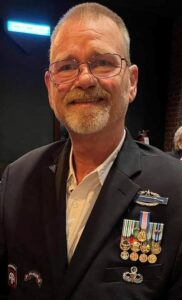
Greg at an event in Nashville
As a small child I knew that I wanted to join the military, to follow in my father’s footsteps and beyond. I joined the military at the age of seventeen, with the goal of being the best soldier I could be. I enlisted as Infantry in the U.S Army, with a goal of becoming Airborne and Ranger qualified, in the fall of 1979 and headed for Ft. Jackson, SC., for reception. I spent two weeks receiving my uniforms, haircut, shots, and pulling guard duty while I waited for my Basic Training cycle to start at Ft. Benning, Ga. When I got to Georgia, I did my basic training, advanced infantry training and basic airborne training before moving on to 78 days of Ranger school. The Army Rangers is one of the most elite branches in the U.S. military and it was a proud accomplishment and honor to serve as a Ranger.
When I left Ft. Benning for the first time, I had orders to report to Ft. Bragg, NC… and my adventure began. During my time in the service, I learned many lessons, the most valuable being that desire alone is not enough to achieve your goals. Along with that desire, you have to make a personal commitment to achieving your goals and make a plan to accomplish them. You must be willing to do the work, be open to input from others, and be willing to be flexible as your situation changes.
Civilian Service
After leaving the military in 1990 I looked for other ways to serve. I earned my Associate degree in Fire Science and became a Firefighter. I also trained as an Emergency Medical Technician, working with a Volunteer Fire Department and received a Bachelors’ degree in Emergency Management. In 2019, I ended my civilian employment working as a County Veteran Service Officer (VSO) assisting veterans in applying for benefits from the Veterans Administration.
Making my mark at the VFW

Greg on the Tennessee Senate floor
After retiring from the Army, I became active with several veteran service organizations, including the Veterans of Foreign Wars (VFW) and the American Legion, to help other veterans and the community.
I have been a member of the Veteran of Foreign Wars for decades and have held many positions, as a member-at-large, as a post member, and in several leadership positions at Post, District, and State levels. Currently, I am serving as State (Department) Surgeon. In this position, my role is to stay up to date with all aspects related to health care as it relates to veterans, ensuring that information pertaining to changes, updates, and services are made available to veterans. This can be achieved through in-person meetings in a one-on-one setting, in a group meeting, or in a virtual group meeting online. We also distribute information in the form of a monthly newsletter and online blog posts.
I also have been appointed on behalf of the VFW as a board member for TNVET, a group made up of multiple veteran groups who lobby the government on behalf of veterans and their dependents. Currently I am working on establishing a Veterans with ALS support group program within the VA system.
Life with ALS

Greg and his family
When I was diagnosed with ALS in 2019, my life took on a new direction. I found myself retired with an abundance of free time, searching for something to occupy my days. I knew that I wanted to help others who were dealing with ALS. I started reaching out to others with ALS to offer support, advice, and assistance within my abilities. I joined the ALS association and became an advocate, speaking with both state and federal lawmakers to rally support for funding research and increasing assistance for individuals. I became an MDA Ambassador. Helping to raise awareness and support for research in this role is something I am looking forward to and proud to be part of. The work the MDA does is invaluable.
I believe that we are more than just ourselves, we are mankind. As such, individually we should, and need to, approach neurological disorders of all types as a societal issue and attack it collectively in force. One voice can be heard, but a cacophony of voices can bring down a wall.
I have always been interested in keeping up with legislation being introduced by both state and federal lawmakers. I now pay even more attention to what is being introduced, discussed, and passed. I work in conjunction with others advocates to advance the fight forward to find treatments and cures for all neurological disorders.
Hope for the future

Greg and his wife
I know that I am one piece in this large puzzle that is life. But it is my sincere hope that with my small contribution, combined with everyone else’s, we will not only win the battles – but we will win the war and wipe neuromuscular disease in all of its forms from existence.
Fighting the good fight together, we will win.
The post MDA Ambassador Guest Blog: A Life of Service appeared first on Quest | Muscular Dystrophy Association.
]]>The post A Message of Gratitude and Momentum: Leadership Changes at MDA appeared first on Quest | Muscular Dystrophy Association.
]]>
Dr. Don Wood
This transition brings both celebration and reflection. For nearly five decades, Dr. Wood has been part of MDA’s mission as a scientist, a research leader, vice chair of MDA’s Board of Directors, and most recently, as President and CEO. During his time as President and CEO, MDA reached major milestones. We raised the bar for multidisciplinary care across our nationwide Care Center Network. We launched the MDA Kickstart and Gene Therapy Support Network programs and deepened our advocacy and research initiatives to achieve groundbreaking results. Our breakthroughs include unprecedented legislation to secure accessible, dignified air travel policies and to bring to market FDA-approved treatments for Duchenne muscular dystrophy, ALS, Friedreich’s ataxia, and myasthenia gravis. These outcomes didn’t happen by chance; they came from Dr. Wood’s vision, persistence, and his abiding belief in what is possible when science and community come together.
“It has been the honor of my life to serve the Muscular Dystrophy Association and the families who inspire everything we do,” Dr. Wood shared. “This is the right moment to pass the baton. I have every confidence in MDA’s mission and the team that will carry it forward.”

Dr. Sharon Hesterlee, interim President and CEO of MDA
To ensure a smooth transition, MDA’s Board of Directors has appointed Dr. Sharon Hesterlee as interim President and CEO. Dr. Hesterlee is well known across the neuromuscular research and biotech communities and most recently served as MDA’s Chief Research. Her leadership has in that capacity has shaped major initiatives and guided strategic research investments that are accelerating the development of new therapies.
“Thanks to the work Dr. Wood has done to build footing for mission growth and innovation, we are entering a new chapter with strength, realism, and resolve,” Dr. Hesterlee said. “MDA’s foundation is solid, and our sights are set on what comes next.”
We invite you to visit our tribute page to share your thanks and memories with Dr. Wood as he begins a well-earned retirement. And we hope you’ll continue to visit Quest for updates as MDA moves boldly into its next chapter.
The post A Message of Gratitude and Momentum: Leadership Changes at MDA appeared first on Quest | Muscular Dystrophy Association.
]]>The post How to Maximize Your College Experience by Advocating for Accommodations and Accessibility appeared first on Quest | Muscular Dystrophy Association.
]]>Attending college with a disability can present a variety of challenges, including accessibility. In the past several decades, universities across the United States have made significant strides in improving accessibility and accommodations for students with living with disabilities. However, a multitude of obstacles remain and, on most campuses, more action is needed. Persistent self-advocacy and a commitment to pushing for systemic change can act as catalysts in creating more accessible college experiences.
Students living with neuromuscular disease have a wide range of different needs and accessibility is not always one-size-fits-all. By actively collaborating with their respective college campuses, students can maximize their personal experiences and promote long-term impact projects that will benefit future students.
Self-advocacy and taking initiative on campus

UCLA Center for Accessible Education
Many universities have general measures for ensuring that students with disabilities are supported in an inclusive and accessible environment. Yet, one of the most pertinent things to do as a student with a neuromuscular disease is to speak up for yourself by advocating for specific accommodations that you may require.
These steps can help ensure that both you and your college are prepared for an accessible school year:
-
Work with the Disabilities Service Center
A majority of colleges have centralized disability service centers, where students can meet with staff to discuss appropriate learning and housing accommodations. It is imperative that you reach out as early as possible to avoid delays or unforeseen circumstances. If there are no current suitable accommodations in place for your needs, do not be afraid to voice your concerns. Several key requests to keep in mind might include:
- Automatic doors and ramps to access lecture halls, classrooms, dining halls, dormitory buildings, and other common student areas.
- Adjustable desks and tables to allow comfortable work posture and reduce muscle strain.
- Voice-to-text assistance technology to reduce muscle strain and energy needed to write and type to complete school assignments.
- Time accommodations for completing assignments and tests and/or to travel between classes if needed.
- Handheld shower heads and benches in shower stalls to avoid fatigue from standing; showers large enough to accommodate hands-on assistance from a caregiver if needed.
- Accessible dorm rooms that allow enough room for any necessary equipment, power wheelchairs, etc.
-
Reach out to academic advisors and professors
Meeting with an academic advisor and/or professor before or early on in the academic term is vital. Professors are often very understanding of personal situations but have to be informed to work with students to create the necessary accommodations.
- Discuss specific timelines and/or assignments that may require accommodations.
- Create a personalized, manageable schedule that satisfies both academic and personal well-being.
-
Utilize campus medical resources
University health centers across the United States vary in their availability of specialists and medical services for students living with neuromuscular disease. Access to this specialized care is vital to maintaining good health.
It is important to:
- Reach out to the health center to discuss physical and occupational therapy appointments to maintain muscle strength and mobility. Some schools provide these health maintenance services to students.
If the school does not provide therapy services, request a referral for neuromuscular specialists in the area and ask for assistance to arrange necessary transportation for off-campus medical appointments. For example, UCLA offers physical and occupational therapy services through the Ashe Center, however, if your school currently does not have access to or provide these services, it is important to self-advocate to see if they would be willing to help connect you to local medical centers and assist in arranging transportation.
Creating lasting change on campus: Your voice can pave the path for the future
Beyond advocating to ensure the best possible college experience for yourself, you also have the opportunity to push for systemic change that will benefit future students with disabilities. Your voice and your experiences can help create change and increase universal accessibility. Several things you can do include:
-
Document and report barriers
Universities often attempt to identify areas that could be improved in terms of accessibility; however, direct documentation and reports from students can help pinpoint specific locations across campus.
A straightforward three-step process can help meet this goal. First, take a photo or video of the barrier. Second, think about how this barrier negatively impacts your educational or personal experience. Third, file a formal complaint with your school’s student disability services department.
-
Work with student organizations/government and faculty
Many voices are much louder and stronger than one voice alone. By undertaking collective action, you can help amplify the message to campus officials, especially those who are less aware of the daily challenges that students with neuromuscular diseases face. You can inspire and empower change through your own experiences.. Many universities have organizations dedicated to social justice and advocacy, and you could get involved by:
- Collaborating with the student government to brainstorm policies to pitch to administration.
- Working with faculty that support disability rights to identify barriers and push for meaningful outcomes.
- Spreading the message by working with your school’s newspaper to write blogs, hosting awareness weeks, and creating/sharing petitions to address specific identified issues.
Advocacy for accessibility makes a positive impact

Jaylin Hsu
At UCLA, I have seen firsthand the positive impact persistent advocacy efforts can yield. New academic and residence buildings have been built with accessibility and accommodation purposes in mind, including automatic doors, larger shower stalls with hand-held shower heads and benches, and ramps that meet the needs of wheelchair users. Even older buildings have been renovated to include these arrangements. Moreover, UCLA’s Center for Accessible Education and Ashe Center provide students with the opportunity to maximize their academic experiences and ensure they continue to be in good health through a wide variety of medical services offered.
If you are a student living with neuromuscular disease and starting university or are currently enrolled in one, know that your voice matters. Universities are willing to listen, and you have the opportunity to advocate both for yourself and students coming after you. With the necessary persistence and collaboration, you can enact meaningful, long-term change and reach our goal of ensuring college campuses accommodate the needs of each and every student.
The post How to Maximize Your College Experience by Advocating for Accommodations and Accessibility appeared first on Quest | Muscular Dystrophy Association.
]]>The post In Case You Missed It… appeared first on Quest | Muscular Dystrophy Association.
]]>With so many valuable podcasts, blog articles, and magazine articles available to our audience, chances are that you may have missed one or two pieces of interesting content. Check out the summaries and links below.
In case you missed it… Quest Blogs:
Essential Gear for Traveling with a Disability
Travel should be exciting, not stressful. However, when you have a disability, packing the right mobility equipment and adaptive travel gear can mean the difference between a smooth adventure and unexpected challenges. Whether you’re heading out for a weekend getaway or an extended trip, having the right equipment can help you feel confident, comfortable, and ready for whatever comes your way. Read more.
Simply Stated: Updates in Pompe Disease and Other Glycogen Storage Diseases
Glycogen storage diseases (GSDs) are a group of rare inherited conditions that occur when the body is not able to use or store glycogen properly. People with GSDs may experience frequent low blood sugar (hypoglycemia), muscle weakness, and liver damage. Glycogen is processed by many different enzymes in the body, and defects in some of these individual enzymes can lead to different types of GSD. Read more.
In case you missed it… Quest Podcast:
Episode 50: PJ’s Protocol: A Lifesaving Procedure Fueled by Love
In this episode of Quest Podcast, we chat with three pillars of the Duchenne muscular dystrophy community who are here with us on the 10th anniversary of PJ’s protocol. First, we have Brian Nicholoff whose son’s untimely passing was the catalyst for the creation of PJ’s protocol. Next is Amy Aikens whose son’s life was saved by PJ’s protocol. And finally, we have Dr. Jerry Mendell, a legend in the Duchenne muscular dystrophy scientific community. We are so grateful to them for joining us to share their experiences, expertise, and advice. Listen here.
In case you missed it…Quest Magazine 2025 Issue 1, Featured Content:
Ready to Work: How People with Disabilities Balance Benefits and Employment
People with disabilities face tough choices between the benefits they need and the job opportunities they deserve. Fixing this requires changing outdated policies. Members of the community share how they navigate. Read more.
The post In Case You Missed It… appeared first on Quest | Muscular Dystrophy Association.
]]>The post A Fire Fighter’s Lasting Impact on the Fight Against ALS: Bob McAlvey’s Life & Legacy appeared first on Quest | Muscular Dystrophy Association.
]]>
Monty Nye
The mission to find treatment for amyotrophic lateral sclerosis (ALS) hits especially close to home for fire fighters, with research revealing that they are twice as likely to develop the disease. For Monty Nye, his commitment to the fight to end ALS is fueled by a deeply personal connection – and provides a meaningful opportunity to continue the legacy of his close friend, Bob McAlvey.
A man on a mission
The International Association of Fire Fighters (IAFF) has a long-standing commitment to serving the neuromuscular disease community through their powerful partnership with MDA. Monty, a retired Captain Fire Fighter Paramedic with Meridian Township, Michigan, and IAFF Local 1600, spent decades of service significantly contributing to that partnership. The 64-year-old spent his career raising awareness and critical funds through the Fill the Boot campaign and facilitating MDA Boot Camps to train other fire fighters.
“I was appointed as the MDA liaison for the Michigan Professional Fire Fighters Union (MPFFU) in 2004 and every year we put on Boot Camps,” Monty says. “We bring fire fighters together from across the entire state and teach them how to put on a safe and effective Fill the Boot campaign. They get to meet families from the MDA community and build lifelong bonds with them. We get to see them grow. One of the coolest things was seeing a young lady that had been to our Boot Camp who started taking Spinraza when it came out in 2016, and we got to see the effects of that treatment on her over the next couple of years. And it dramatically changed her life.”

Monty at a Fill the Boot event in 2005.
Witnessing firsthand the life-changing implications of new treatments made possible by Fill the Boot efforts offers a full-circle perspective, reminding Monty and his team that what they are doing to support the cause is truly impactful.
Although he retired from active service as a fire fighter in 2014, his commitment to continuing that impact was far from over. Passionate about maintaining his role as a liaison between MPFFU and MDA, Monty was elected Vice President of the 5th District in the Michigan Professional Fire Fighters State Union, where he remains active with the IAFF and continues to serve as an MDA/MPFFU Liaison. He accepted a part-time position with MDA as a Government Relations and Ordinance Specialist for the MDA Fire Fighter Partnership Team and became active with the MDA Advocacy Team.

Monty advocating in Washington D.C.
In his position with MDA, Monty ensures that cities and towns allow Fill the Boot campaigns. He is responsible for researching ordinance guidelines and meeting with local municipalities to advocate for changes in street ordinances, when necessary, sometimes going so far as to have laws changed. His efforts ensure that critical funds can be procured through generous donations that significantly increase research funding.
“I love doing it,” Monty says. “I love a good fight.” For Monty, fighting the good fight to cultivate and secure effective Fill the Boot campaigns and advocating for medical research funding is a key component in the larger battle to end ALS. His commitment to that battle is a meaningful way of honoring Bob, his fellow fire fighter and close friend who passed away from ALS in 2006.
An unbreakable bond
Monty met Bob when he joined the fire department in 1990 and the two quickly became close friends. At the station and outside of work, the men forged an unbreakable bond of brotherhood. Bob, a nature lover, talented cook, impressive athlete, and all-around knowledgeable guy, shared many of his future dreams with Monty. Bob owned a large property that he wanted to build a home on and hoped to eventually create a program for school children to visit and learn about animals and the environment.
Monty and Bob McAlvey in 2004.
“He loved sharing his expertise and love of nature. Bob was the kind of guy that everyone went to – if you had a question about anything, you could ask Bob. You could find a piece of wood, a bug, a snake, anything… ask him what it was, and he could tell you,” Monty says. “He could do anything. He could make an apple pie from scratch. A friend just called the other day to get one of Bob’s recipes from me.”
Bob exemplified the loyalty, stamina, bravery, and servitude characteristically attributed to fire fighters. He was committed to keeping his community safe, providing for his family, and advocating for others. His sense of humor and easy readiness to help others drew people to him, aspects of his personality that Monty admired as their friendship deepened over the years.
When Bob was diagnosed with ALS at the age of 44, Monty and their entire IAFF Local came together to support him, his wife, and his five sons. His fellow fire fighters played a vital role in bringing Bob’s dreams to build a home on his property to fruition and Monty adopted the role as a steadfast advocate for Bob’s care.
Unwavering support
Bob had dreamt of an eco-friendly home, with heated flooring and solid concrete walls and siding designed to reflect his passion for ecology and nature. As his physical limitations increased, Bob’s community of friends and fire fighters stepped in and built his dream home for him, creating a physical, lasting representation of his incredible foundation of support.

Bob and Monty in 2005.
“We were there almost every day,” Monty recalls. “Bob’s cousin coordinated the plans. We all got together, all of the local departments from up to 50 miles away, and helped build this house to make it a reality for Bob. And he was able to move in and live there before he passed. His family still lives there today.”
In addition to helping build Bob’s dream home, Local 1600 offered unwavering support to assist Bob and his family as they navigated his ALS journey. Monty often drove Bob and his wife to the MDA Care Center at Michigan State University, accompanying them on appointments and offering support as they processed the progression of his disease. When Bob’s speech became difficult, Monty spoke up as his advocate, especially during hospitalizations with general practitioners who did not have expertise in ALS or the equipment that Bob needed.
Monty and Local 1600 made sure that Bob had someone with him along every step of his journey, at home and during hospitalizations. When Bob passed away, Local 1600 provided support and guidance to his wife and children, offering compassion through their grief and ensuring that they received necessary benefits.
“The most important thing that you can do for someone is to listen to that person, to be present and be their advocate,” Monty says. “As someone that loves them, be there. And we as fire fighters, and everyone else who wants to make a difference, can do a lot to raise money for research.”
Through it all, Bob remained dedicated to tirelessly raising awareness and funds for neuromuscular disease research, hoping to contribute to a brighter future for those to come after him.
The magic dollar
Now, nearly twenty years after Bob’s passing, Monty fondly recalls Bob’s sense of humor, optimism, and steadfast commitment to fighting to end ALS.

Monty facilitating an MDA Boot Camp.
“His smile stands out in my mind, the smile that he would get when he got one over on someone or won something,” Monty says. “But the most impactful memory I have of Bob is from a day when we were out doing a Fill the Boot collection in late August, and it was incredibly hot.”
Monty remembers walking the quarter of the block back to the station from the intersection where the fire fighters were collecting, grumbling about the heat. He entered the station hot, tired, sweaty, and ready for a break.
“I am sure I was complaining,” Monty says. “Bob was already using a wheelchair and speaking through a communication device at that time, and he wasn’t physically able to be out collecting with us. It took him awhile to type out what he was saying, but I knew he was chewing me out and about to tell me to suck it up. Bob said, ‘You are able to get out there and do it – so do it. What if one of those cars going by has that magic dollar and you are sitting in here complaining?’ And it impacted all of us at the station. To this day, we still talk about that magic dollar at every MDA Boot Camp.”
A lasting legacy
“He was a great guy – that wraps it all up,” Monty says of his dear friend. “Father, fire fighter, wrestler, educator… he was just great. Someone you are proud to call a friend. And he never gave up fighting for a cure or coaching us to get back out there. Right up until his last days, he was talking about MDA and what he could do to fight for the cause.”

Bob McAlvey
Bob was a coach to all of those around him, taking his own diagnosis in stride and redirecting his focus to what he could do to bring awareness to ALS. He participated in Fill the Boot, went to the MDA Telethon and other events, and did public service announcements throughout the progression of his disease. Before he lost his speech, Bob recorded a video to motivate new fire fighters to passionately join the fight to end ALS, an emotional and powerful video that is still used today at MDA Boot Camps.
“Bob continues to impact others and support the cause through his video,” Monty says. “He wanted to be able to motivate our guys at future Boot Camps, so he recorded himself sharing his experience with the progression of his disease, how it affected him, and why people need to keep fighting.”
Bob’s legacy continues to inspire others and serves as a reminder of the powerful impact fire fighters across the country have on the future of neuromuscular treatments. His memory fuels the fight against ALS and ignites hope.
The post A Fire Fighter’s Lasting Impact on the Fight Against ALS: Bob McAlvey’s Life & Legacy appeared first on Quest | Muscular Dystrophy Association.
]]>The post MDA Ambassador Guest Blog: Balancing Gracefully: A Mother’s Day Reflection from Ms. Wheelchair America appeared first on Quest | Muscular Dystrophy Association.
]]>
Tamara Blackwell as Ms. Wheelchair America 2024.
I am Tamara Blackwell, a 41-year-old wife, mother, entrepreneur, First Lady of New Philadelphia Church of God in Christ, advocate, and the current Ms. Wheelchair America. I was born visually impaired and was later diagnosed with limb-girdle muscular dystrophy. My life is full—overflowing with love, purpose, and challenges—and I wouldn’t trade it for anything.
I became a mother at 18 and welcomed my second and third children into this world when I was 20 and 22 years old. Now, I’m the proud mom of an 18, 20, and 22-year-old. Motherhood has always been my “why.” It gave me a reason to fight and continue pushing forward when life got hard. My children have been a major part of my motivation, and they remain at the heart of everything I do.
My favorite part about raising my children is simply getting to love them, getting to see a piece of me and their dad come together and form these amazing people, and being able to share in helping them become good humans. I love seeing them grow and accomplish things, watching their personalities take shape. It’s been such a blessing to know that God entrusted me with the responsibility and honor of being their mother.

Jonathan and Tamara traveling to an event on-board a flight to LA
Motherhood has taught me balance. It’s taught me patience, understanding, flexibility, and grace. Even when I can’t do everything that I want to do for my family, I know that sharing my life with my children and showing up for them is one of the greatest gifts I can give. I’ve learned that showing up, however and whenever I can, allows my children to see the importance of pushing through challenges and getting back up whenever you’re knocked down. I love being a mother because it means that I get to love deeply, guide patiently, and be an example of strength and perseverance for my children every day.
As I reflect on how motherhood has shaped me, I realize that it has also been the key to learning how to balance everything else in my life. Juggling the demands of family, career, advocacy, and personal health has been no small feat, especially with my visual impairment and mobility limitations. But the lessons I’ve learned from motherhood—how to prioritize, how to understand my limits, and how to give myself grace—have become foundational to everything I do.
Like many women, my days are full of juggling and balancing life. With low vision and mobility limitations, it can get tough—but I do all I can. I manage the administrative work for the daycare that I started 15 years ago, and I’m blessed that my family stepped up when my health challenges grew. My daughter now runs day-to-day operations, and my sons help with setup and transportation for events when my husband can’t. My husband is a constant encouragement and always willing to help in any way he can.

Jonathan and Tamara the day he was named Pastor of New Philadelphia COGIC
As First Lady of New Philadelphia Church of God in Christ, I prepare sermons and Bible study lessons. As a content creator and advocate, I stay engaged with what’s happening in the world and create pieces to educate and raise awareness. And as Ms. Wheelchair America, I travel not just throughout my state, but across the country. I also serve as an Ambassador for the Muscular Dystrophy Association, sit on the board for the Kansas Disability Caucus, and work with various groups in my city and county.
To manage it all, I rely on multiple calendars, reminders, segmented tasks, and an organized to-do list. I prioritize what matters and move things around when needed, always trying to give myself grace. I’m not afraid to rest or listen to my body, and I put my faith in God daily to give me the strength I need. I’ve learned to measure success not by how much I check off my list, but by the intention and heart I put into each task.
Advocacy is so important to me because it allows me to share my life as a woman with a disability while shedding light on the broader changes that we need in our communities, healthcare systems, education systems, and beyond. I feel called to use my voice—to show up not only for myself but for others who share similar struggles. Becoming Ms. Wheelchair America gave me a new platform and renewed purpose. I now have a national stage to champion rights, push for change, and empower others.

Jonathan and Tamara together at their church
My children may not be directly involved in my advocacy work, but they are absolutely part of it. Through their lived experiences as children of a parent with a disability, they are more in tune with the world around them. They see what works and what doesn’t. They speak up, they notice inequities, and they call out what needs to be addressed. Their awareness and empathy are part of my legacy—and I’m proud of that.
To all the moms out there living with disabilities: you rock, and you’re doing an amazing job. I know it may feel overwhelming sometimes when you want to do everything for your family. But remember—being present, showing up, and loving your children is more than enough. You’re teaching them resilience, strength, and the power of grace. And that’s a beautiful legacy to pass on.
The post MDA Ambassador Guest Blog: Balancing Gracefully: A Mother’s Day Reflection from Ms. Wheelchair America appeared first on Quest | Muscular Dystrophy Association.
]]>The post Fire Fighters Go the Distance for MDA appeared first on Quest | Muscular Dystrophy Association.
]]>Thomas’s mother and sister both live with Dejerine-Sottas syndrome (DSD), a rare form of Charcot-Marie-Tooth disease (CMT). Growing up there were times when his mother needed emergency assistance in the home and the local fire department came to the rescue. His sister also attended MDA Summer Camp, where fire fighters play a key role in creating and facilitating a week of magic for youth living with neuromuscular disease. As his family’s relationship with MDA evolved over the years, he saw firsthand the involvement and impact that fire fighters had in the neuromuscular disease community.

Thomas Beers (right) with an MDA Summer Camp camper.
“There were times growing up that the fire department was called, and I would see the fire fighters in action,” Thomas says. “And they were also a big part of MDA Summer Camp and raising money for MDA. Just seeing both of those images and roles face-to-face and seeing everything that fire fighters do, made me want to do that too.”
Now in his fourth year as an Engineer Paramedic & Professional Fire Fighter at Missoula Rural Fire District Station Number 1 and member of the IAFF Local 2457 Union, Thomas is following a legacy that spans decades by reigniting a passion for service at MDA Summer Camp within his department.
A lasting partnership
MDA and the International Association of Fire Fighters (IAFF) have shared a powerful partnership since the early 1950s, collaborating to empower and serve families living with neuromuscular disease. For decades, fire fighters across the country have collected critical funds in their communities as part of the Fill the Boot program. Their incredible commitment to the neuromuscular disease community and to raising awareness and funds to ensure the discovery and development of effective treatments has become a foundational cornerstone in MDA’s history and efficacy.
Through their ambassadorship with MDA, the IAFF and fire fighters play many key roles in MDA programs. In addition to Fill the Boot, Magic Wheelchair reveals, participating in local Muscle Walks, and providing support at local MDA events and fundraisers, fire fighters across the country dedicate their time and talents to bring magic and joy to MDA Summer Camps.
Going the distance for camp
As part of Missoula Rural Fire District, Thomas and his colleagues have participated in a multitude of Fill the Boot events and take pride in the opportunity to be part of an initiative that serves the neuromuscular disease community. For Thomas, contributing to a cause that serves his own family as well brings an additional level of meaning. Having witnessed the positive impact of MDA Summer Camp on his sister, who attended camp for twelve summers, and his stepfather, who volunteered at 25 camp sessions, Thomas was eager to get involved with camp himself. The only issue? His current location in rural Montana was no longer in close proximity to an MDA Summer Camp location.
“My sister made lifelong friends and enjoyed all the counselors and the fire fighters at camp,” Thomas says. “And talking to some of the other guys at work that used to attend camps, participating in Fire Fighter Day or volunteering to be camp counselors, really motivated me to find a way to camp. It touched home for me because our role at camp was one of the reasons I wanted to be a fire fighter. I wanted to follow in the footsteps of my brothers and sisters in firefighting. I wanted to make an impact on the campers and be part of that legacy.”

Thomas (fifth from left) with MDA Summer Camp campers and fellow counselors.
Motivated by that desire, Thomas embarked on a journey to find a way to represent his department at camp. He connected with Jenni McGahan, an Account Director on MDA’s Fire Fighter Partnerships team, to determine which MDA Summer Camps were in closest proximity to his department. A camp in Gig Harbor, Washington, which is a 6-to-7-hour car ride from Thomas, was the closest location. However, a camp in Colorado, 13 hours away, was home to many Montana-based campers and had camp dates that fell later in summer, which would allow Thomas more time to plan.
IAFF’s undeniable commitment
Thomas spoke at his IAFF Local 2457 Union meeting to propose Missoula Rural sending fire fighters the long distance to volunteer at the MDA Summer Camp in Colorado. Albeit a significant amount of travel, the union agreed that the value of service and participation far outweighed the cost and time required to participate. Local 2457 voted to send two fire fighters from Missoula Rural Fire District and committed to covering all costs associated with travel, including flights, rental cars, and hotel rooms before and after camp for both volunteers. As testament to the unshakable level of commitment that the IAFF has towards serving MDA, they also set forth plans to continue to support this endeavor each year.
Ron Lubke, Battalion Chief at Missoula Rural Fire District, volunteered to travel and serve as a counselor with Thomas. “I thought that it was incredibly impressive that someone of Ron Lubke’s rank was willing to share his time and volunteer at camp,” Thomas reflects. “He showed that anyone at any level can and should volunteer at camp.”
One incredible week
Thomas and Ron attended camp at Rocky Mountain Village in Empire, Colorado, an experience that deepened their relationship and further fueled Thomas’ passion to continue the IAFF’s commitment to having a presence at MDA Summer Camp.

Thomas (far right), campers, and counselors after an epic paint battle at MDA Summer Camp.
Amidst the fun and magic of camp, there is an opportunity for volunteers to empower and help campers realize their abilities and achieve their goals. Thomas recognizes the incredible value of that contribution, and the lasting impact of the connections made at camp.
“My favorite thing about camp was connecting with the campers, learning their life stories, and giving them one week to take a break from reality and have fun. They can just go fishing, have water balloon fights, play, and be able to do things with no barriers,” Thomas says. “One thing that really stands out is a day that we had a huge water balloon paint fight. It was absolute chaos and so much fun. The kids were smiling and the world just stopped for a minute as all of our cabins came together, laughing and having a great time.”
Thomas is eager to return to camp and is currently working to gain interest amongst his colleagues and work out logistics to volunteer at the Gig Harbor camp next, an initiative backed by the unwavering support of the IAFF. “The possibilities are endless to make it back to MDA Summer Camp,” Thomas says. “I will make my way back and I know that a lot of the guys will do it as well. It’s a life changing opportunity.”
A positive impact
Like all fire fighters, the desire to help people and have a positive impact on others is a driving force that motivates Thomas’s choices in life. A commitment to service and deep-seated respect for legacy permeates the culture of fire fighters and resonates in their relationships within their own communities and within the neuromuscular disease community.
When asked his favorite thing about his role as a professional fire fighter, Thomas’s answer was simple: helping people.

Thomas (back row, far left) with campers and fellow counselors at MDA Summer Camp.
“We run a lot of calls where we are able to make a positive impact on people’s lives,” he says. “Whether that is helping to change a smoke detector, lifting someone after a fall, or saving a life in crisis. Most people call on 9-1-1 on what feels like their worst possible day, we show up and try to have the most positive impact possible.”
That truth exists in beautiful juxtaposition with the fact that volunteering at MDA Summer Camp provides fire fighters with an opportunity to show up for a camper’s best days and make the most positive impact possible. To fire fighters across the country – true heroes that go the distance on the worst days, best days, and every day in between – we say thank you for all that you do and for the incredible impact that you have on the lives of others.
The post Fire Fighters Go the Distance for MDA appeared first on Quest | Muscular Dystrophy Association.
]]>The post MDA Ambassador Guest Blog: What I’ve Learned as a Disability and Wellbeing Researcher appeared first on Quest | Muscular Dystrophy Association.
]]>
Payton Rule
A few summers ago, I was standing outside my apartment when a woman approached and asked why I was wearing leg braces. I happily shared that I have a disability called CMT and my braces help me do the things I need and want to do each day. Before I could process what was happening, she dropped to her knees and began to pray.
“Lord, please help this girl. I can tell she’s very depressed and sad. Please heal her legs so that she can be well.”
While well-intentioned, the woman’s reaction was based on an incorrect assumption: living with a disability is inherently tragic, with limited possibility for happiness. This perspective is common in society and is often reflected in media.
When I was young, perhaps influenced by these portrayals, I often wondered if it was possible to live a “good life” with a disability. Motivated by this belief, I vowed to find a cure for CMT. In middle school, I pored through medical books and journal articles, obsessing over gene therapy’s potential for treating CMT. I was convinced that individuals with disabilities could only truly thrive if their disabilities were eliminated. As a symbol of my dedication, I had a DNA double helix inscribed on my leg braces.

My old leg braces with a DNA double helix on them
As I grew older and got more involved in the disability community, I noticed that many disabled individuals seemed genuinely happy and engaged in meaningful activities. This challenged my beliefs about disability: Was disability itself the problem, or were there other factors at play? Just as I had once turned to research in search of a cure, I now turned to research to understand disability and wellbeing.
As I suspected, research found that individuals with disabilities are at a higher risk for mental health challenges. However, this work also suggests that societal barriers—such as inaccessibility, ableism, and discrimination—play a significant role in shaping disabled individuals’ wellbeing. Disability itself was not the primary or only factor impacting the wellbeing of people living with disabilities.
I found this research simultaneously disheartening and hopeful. On one hand, this research reveals the many ways society makes life unnecessarily harder for people with disabilities. On the other hand, it suggests that improving overall wellbeing for people with disabilities doesn’t require “fixing disabled bodies”. Instead, we can change the world around us to help people with disabilities thrive. For example, improving public accessibility and challenging ableist attitudes could have a meaningful impact.
Societal change, while promising, takes time. So, what can someone living with a disability do to empower themselves and increase their wellbeing while we work toward a more inclusive world? Motivated by this question, I chose to dedicate my PhD research to exploring how individuals with disabilities can cultivate wellbeing and mental health in a world that often presents barriers.
Working with Dr. Emily Willroth and Dr. Patrick Hill at Washington University in St. Louis, we have conducted multiple studies to better understand these questions. While much work remains, some findings have been particularly eye-opening.
First, we identified a variety of factors that may help support wellbeing for individuals with disabilities.

Me giving a research presentation at a conference
These included:
- Developing confidence in managing disability-related challenges.
- Fostering strong social connections.
- Engaging in meaningful activities that provide a sense of purpose.
The good news is that even if someone feels low in one or more of these areas right now, research suggests that any of these factors can be strengthened over time. For example, for me, identifying adaptive devices that enabled me to do the things I need and want to do gave me more confidence in handling disability-related challenges. Making friends within the disability community provided stronger social support. Engaging in activities aligned with my values—such as volunteering with shelter dogs—helped me develop a greater sense of purpose.
Second, our research found that viewing disability as a part of one’s social identity may be beneficial for wellbeing.
For much of my life, I resisted identifying as disabled. Throughout my childhood, my mantra was, ‘I am not disabled; I just have a physical challenge.’ However, my research suggests that embracing disability identity can be beneficial. Individuals who embrace their disability identity—by connecting with the disability community, being open about their experiences, and taking pride in their identity—report higher levels of wellbeing and mental health. This shift in perspective isn’t easy, but research suggests it can be a meaningful step toward greater wellbeing for many individuals.
What we have discovered through our research has influenced how I think about and navigate my own wellbeing as a disabled person.
One of my biggest takeaways from our research is that it is possible for individuals with disabilities to have high wellbeing and mental health.
To be clear, individuals living with disabilities experience many real challenges related to our disabilities and societal barriers. But contrary to common portrayals—and to what the woman assumed as she prayed over me— individuals with disabilities have the potential and ability to live truly great and healthy lives.
The post MDA Ambassador Guest Blog: What I’ve Learned as a Disability and Wellbeing Researcher appeared first on Quest | Muscular Dystrophy Association.
]]>The post Simply Stated: Updates in Amyotrophic Lateral Sclerosis (ALS) appeared first on Quest | Muscular Dystrophy Association.
]]>There is currently no known treatment that stops or reverses the progression of ALS. A number of FDA-approved medications (e.g. – riluzole, edaravone) may be prescribed by doctors to help manage symptoms, reduce the rate of decline, and prolong survival, and in some cases, potentially stabilize disease and improve function (e.g. – tofersen). Supportive care provided by a multidisciplinary care team can also help improve overall health and quality of life for people with ALS. Furthermore, research advances and the promise of therapeutic development on the horizon offer hope for people living with ALS. On clinicaltrials.gov, there are 93 interventional clinical trials currently enrolling people with ALS to test therapeutic candidates. Some promising therapeutic candidates in late-stage clinical trials were covered in a previous post, Simply Stated: Updates in Amyotrophic Lateral Sclerosis (ALS).
In addition to traditional clinical trials that test single interventions, platform trials are offering flexibility in studying new therapies and interventions to treat ALS. Platform trial designs allow multiple interventions to be studied simultaneously or sequentially against a common control group and also allow new interventions to be added throughout the trial. The use of platform trials is intended to reduce the cost of research, decrease trial times and increase patient participation in clinical trials. The HEALEY ALS Platform Trial is the first platform trial to evaluate safety and efficacy of investigational products for treatment of ALS. Results for several interventions studied in HEALEY ALS were published earlier this year and will be covered in this post.
Challenges of ALS clinical trials
Platform trials such as HEALEY ALS have emerged to address various challenges that have hindered traditional efforts to develop and study new therapies for ALS.
ALS is a complex disease with different subtypes, progression speeds, and patterns of nerve damage. This makes it difficult to find patients who meet strict clinical trial criteria and to measure treatment effects across a diverse group of patients. In addition, ALS drug trials have mostly relied on slow-to-change outcomes like function and survival. Without reliable biomarkers or ways to confirm drug targeting, it has been difficult to quickly tell if a treatment is working.
These challenges highlight the need for new clinical trial designs that better account for disease variability, allow more patients to participate, and help identify effective treatments more quickly.
New trial designs facilitate targeted drug discovery for ALS
Clinical trial networks such as NEALS (Northeast ALS Consortium) in North America and TRICALS (Treatment Research Initiative to Cure ALS) in Europe are playing a pivotal role in advancing ALS research. These collaborative platforms are working to streamline trial design, patient recruitment, and data sharing across institutions. Notably, TRICALS has developed a risk-based patient selection tool that broadens clinical trial eligibility while preserving the scientific integrity of trials. This approach allows more patients to participate in trials, including people previously excluded due to rigid criteria, while still keeping the study group homogenous (consistent) enough to run the trial and derive meaningful results.
The work of clinical trial networks such as NEALS has laid the groundwork for innovative trials like the HEALEY ALS platform trial. The HEALEY ALS platform trial is the first platform trial to evaluate safety and efficacy of investigational products for treatment of ALS. It is a large, multi-center study, launched through a collaboration between NEALS, The Sean M. Healey & AMG Center at Massachusetts General Hospital (MGH), Barrow Neurological Institute, the University of Rochester, and Berry Consultants. The study is headed by researchers at MGH and funded by multiple partners, namely pharmaceutical, foundation, and philanthropic partners, including MDA, as well as federal funding and other fundraising initiatives.
The therapies under evaluation in the HEALEY ALS platform trial, zilucoplan, verdiperstat, CNM-Au8, priodopidine, trehalose, ABBV-CLS-7262, and DNL343 are being compared to placebo controls in a regimen and with study conditions dictated by a Master Protocol. HEALEY ALS trials use a special type of protocol, known as a perpetual, adaptive protocol, which allows drug candidates to be added for evaluation or removed from the trial based on predefined criteria. Furthermore, additional participants may enroll in the study as needed. Trial sites are available across the US for eligible participants. HEALEY ALS trials are expected to speed the time-to-market of promising ALS therapies and lower costs associated with drug development.
Recent findings from the HEALEY ALS trial have been published in the journal JAMA, including the treatment effects of four investigational treatments: CNM-Au8, pridopidine, verdiperstat, and zilucoplan.
- CNM-Au8: This oral therapy, developed by Clene Nanomedicine, is made of a stable suspension of pure gold nanocrystals designed to increase energy production from the mitochondria (cell powerhouses) and to protect cells against oxidative stress (damage caused by free radical molecules). CNM-Au8 can cross the blood-brain barrier and is expected to prevent nerve cell death and slow disease progression in people with ALS. While the primary endpoint, slowing disease progression over 24 weeks, was not met in phase 2 of the HEALEY ALS trial, exploratory analyses indicated that patients receiving the lower dose had significantly better survival odds compared to placebo. Additionally, CNM-Au8 was associated with reduced markers of nerve damage and was generally well-tolerated.
- Pridopidine: Developed by Prilenia Therapeutics, pridopidine selectively activates a receptor within the cell, the sigma-1 receptor (S1R), triggering a number of actions that contribute to nerve cell protection. Although pridopidine did not achieve its primary endpoint in the phase 2 HEALEY ALS trial, some promising data were observed, suggesting potential benefits that warrant further investigation. The drug demonstrated a favorable safety and tolerability profile, and a subset of participants who had longer exposure to the drug showed signs of slower functional decline and improved survival signals, although these did not reach statistical significance within the limited duration of the trial.
- Verdiperstat and Zilucoplan: These treatments did not demonstrate significant benefits in slowing disease progression or improving survival rates compared to placebo.
Based on these findings, CNM-Au8 and pridopidine will move on to phase 3 testing, while study of verdiperstat and zilucoplan will be discontinued.
Additional platform trials are also underway to accelerate the development of treatments for ALS. In Europe, TRICALS has launched the MAGNET (Multi-arm, Adaptive, Group-sequential trial NETwork) platform trial, designed to evaluate multiple treatments simultaneously. The first treatment arm focuses on lithium carbonate in patients with a particular ALS-associated mutation (UNC13A mutation), and the trial is expanding across Europe and Australia.
In the UK, MND-SMART (Motor Neuron Disease – Systematic Multi-Arm Adaptive Randomised Trial) is the country’s first multi-arm adaptive platform trial for motor neuron disease. It is testing multiple treatments concurrently, initially focusing on repurposed drugs like memantine and trazodone. Although these initial drugs were found to be ineffective and subsequently removed, the trial continues to evaluate new candidates, such as amantadine hydrochloride.
MDA is instrumental in the movement to End ALS, supporting both research and advocacy efforts. Since its inception, MDA has invested more than $178M in ALS research. MDA support for HEALEY ALS, in particular, includes two $500,000 grants, one in 2021 and a renewal in 2024, to Sabrina Paganoni, MD, PhD, Co-Principal Investigator of the trial at MGH and Co-Director, MGH Neurological Clinical Research Institute (NCRI). Strategic investments and advocacy efforts from MDA and other organizations like the ALS Association, combined with traditional funding sources such as the National Institute of Health (NIH), are helping to move the field of ALS forward.
MDA’s Resource Center provides support, guidance, and resources for patients and families, including information about amyotrophic lateral sclerosis (ALS), open clinical trials, and other services. Contact the MDA Resource Center at 1-833-ASK-MDA1 or [email protected].
Also, see MDA’s community resources for ALS to learn more.
- Download our ALS Impact Sheet to see how MDA supports families living with ALS and uses your donations to help find treatments and cures.
- Download our ALS Fact Sheet
- Watch MDA Facebook Live: ALS Care and Research Updates to learn about the latest in care and research updates related to ALS.
The post Simply Stated: Updates in Amyotrophic Lateral Sclerosis (ALS) appeared first on Quest | Muscular Dystrophy Association.
]]>The post MDA Ambassador Guest Blog: How the Power of a Few People (and a Dog) Can Change Your World appeared first on Quest | Muscular Dystrophy Association.
]]>I was officially diagnosed with myofibrillar myopathy and spheroid myopathy Dr. Hirano at the Columbia University MDA Care Center in NYC on July 4, 2023, after struggling with symptoms my entire life. My doctor suggested that I register with MDA. Within a day or two, I was contacted by Michelle Pagán, a Senior Support Specialist at MDA. At first, I was skeptical and figured this was just a money grab. I was even rude, to the point of hoping she would stop calling. What I didn’t realize was that she was a resource and support that would forever change my life.
Learning to lean on supports

Dave with friends Adam and Nadine
After a few discussions with Michelle, I realized that she was someone that I could trust and that was knowledgeable about my experience. I told her that my biggest struggle was that I needed to use a wheelchair now and I just couldn’t bring myself to do it. She suggested that I join the MDA Community group for newly diagnosed people. At first, I blew it off, thinking I am just not the type for community groups. Or so I thought. As things started getting darker and I inched closer towards depression over my circumstances, my wife became more aware that I was struggling. She insisted that I see a psychiatrist or at least try joining the group. As one who hasn’t done well with psychiatry in the past, I opted for the community group – secretly thinking that I would go once and that would be it. Also wrong!
When I went to my first meeting with the group, I had no clue how to use “Microsoft Teams” or how to get my microphone to work. Once we got that straightened out, I rudely introduced myself, saying that I was forced to come to the group, that I hate Teams, that I hate groups, and that I really hate seeing myself on camera and talking about this. I definitely started out with a negative mindset, but that soon changed as I began to open up to the others on the call.
I then explained that my biggest fear was using a wheelchair and that I hadn’t left my house for over 3 years, except to go to medical appointments and Walgreens. Almost immediately, Dr. Priya, who was facilitating the group, and the other individuals knocked down my walls and helped me to drop my guard. We discussed all of the reasons why I felt the way that I did about using a wheelchair, and they all understood. I had finally found my people!! People that could relate to me and I could relate to them.
Finding strength in connection
By the third meeting that I attended, another member of the group named Lisa decided that it was time to really motivate me to try using a wheelchair. Lisa was a force to be reckoned with. She had this amazing gift of knowing how and when to put pressure on someone to really inspire change and growth. I promised the group that I would at the least get the wheelchair out and try it before our next meeting.

Dave shopping at Lowe’s
That week I kept putting it off. When two of our dear friends, Adam and Nadine, stopped by, we had a long talk that resulted in me making a promise to them as well – that I would try the wheelchair. They called to follow up a few days later, holding me accountable to my promise. Even though I didn’t want to do it, I had to follow through.
My wife and I loaded the chair into our vehicle and drove to Lowe’s to look at tools, something that I always enjoyed but hadn’t done in ages. We sat in the parking lot for about 15 minutes – and I just couldn’t bring myself to do it. Just as we were about to leave, I said, “I can’t let everyone down without at least trying it.” Honestly, I couldn’t face Lisa if I didn’t try.
Off we went. Shaking. Scared. And not knowing what was going to happen.
Overcoming fear and embracing freedom
The first thing that I realized was that I no longer had to chase after my fast-walking wife. I then realized that I could go anywhere in the store. Something I hadn’t done in years. Just as we were getting ready to check out, I decided that I needed to check one more thing. I ventured off on my own with my chair, but just as I went down the aisle, I saw someone that I recognized. I did not want them to see me in my wheelchair. I quickly went back to my wife at the check-out and said, “Let’s go now!!”

ChicoLu
She wasn’t sure exactly what had happened, but she knew I was running from something. As I rushed her to leave, she gave me “the look” and said sternly, “go back down that aisle.” (All men know that look.) I reluctantly, but quickly, went down the aisle. As I rounded the corner, hoping not to see anyone else when, to my surprise, I spotted a French bulldog in a wheelchair! I stopped to meet him and his owner, Agaphen. Agaphen explained that his dog, ChicoLu, had been in a wheelchair for 5 years and that he loves it. We chatted a bit and I learned that Agaphen actually made wheelchairs for animals for a living. Needless to say, my mind was blown, and I couldn’t help thinking how much joy and freedom the wheelchair offered ChicoLu
As we said goodbye and my wife and I drove off, the tears just started coming as a wave of emotion and relief hit me. Had it not been for my MDA group, my dear friends, and my wife never giving up on me, I would have never met Agaphen and ChicoLu. Without that experience, I think that things would have turned out very differently in my life. I thank God that they happened to be at the store when I was there and that they took the time to talk to me and wake me up. The support that I found in my community group empowered me to go out into public using a wheelchair – and ChicoLu made me realize that I could find freedom by embracing my wheelchair. (It’s crazy to think that a dog could completely change my perspective but also makes sense if you know me. Dogs are a huge part of my life.)
Celebrating community
I couldn’t wait until the next meeting to tell everyone in the group. To thank everyone. To let them know that they literally saved my life. That they gave me back my freedom. That they gave me back myself.
That pivotal experience happened about one year ago and since then, I have grown so close with many others in the group. We have been there for each other at our lowest and highest times. We have formed unbeatable bonds that mean the world to me. Priceless bonds. I look forward to each and every meeting. I even became an MDA Ambassador to advocate for others living with neuromuscular disease and to pass on to others what this group has given to me. I truly believe that the MDA community group is MDA’s biggest asset.
Author’s Note: I would like to dedicate this blog to my dear Lisa, who we lost in February to muscular dystrophy. You made not only my world, but the entire world, better. Run free of pain, my sweet girl. No more worries! It’s my job now to pass along all that you have taught me.
The post MDA Ambassador Guest Blog: How the Power of a Few People (and a Dog) Can Change Your World appeared first on Quest | Muscular Dystrophy Association.
]]>The post Top 5 Things to Know About MDA’s Efforts to Protect Medicaid appeared first on Quest | Muscular Dystrophy Association.
]]>We sat down with MDA’s Director of Advocacy Engagement, Mark Fisher, to learn the latest.
Why is Medicaid important to those living with a disability?

Mark Fisher, MDA Director of Advocacy Engagement
Medicaid is a lifeline, covering 2 in 5 non-elderly adults living with a disability. It provides medical care, coverage for prescription drugs and therapies, home healthcare and durable medical equipment, and much more. For millions of Americans, Medicaid is vital to living an independent life.
Why is Medicaid under threat by Congress? What is the latest news?
Congress is trying to substantially reduce government spending and is looking to cut programs. Due to the breadth of the program, Medicaid has become a target. Recently, Congress passed a budget resolution, or instructions, which tasked the Senate Finance Committee to cut $1.5 trillion in federal government spending, and the House Energy & Commerce Committee to cut $880 billion to their programs. Both of these committees oversee Medicaid and are looking to help achieve these spending cuts by slashing Medicaid.
But I keep hearing that the budget resolution doesn’t mention Medicaid. What’s really going on?
While the budget resolution may not have specifically mentioned Medicaid, we are very concerned they will ultimately have to make dramatic cuts to Medicaid in order to achieve their goals for spending cuts. According to the nonpartisan Congressional Budget Office (CBO), it is impossible to enact cuts of this magnitude without significantly impacting Medicaid. In the end, there is no way to cut the amount of spending Congress wants to cut and not touch Medicaid. The numbers just do not add up.
How could people on Medicaid be affected?
Cuts to the program would jeopardize millions of Americans’ access to healthcare. Those living with neuromuscular diseases would face a delay in obtaining treatments, be unable to afford life-saving medication, and have greater difficulty finding the in-home care assistance they need to thrive. More families might enter medical debt in order to make ends meet. Medicaid enables people navigating these diseases to live more independently by providing the support they need in their personal and professional lives. Major cuts to Medicaid would be disastrous for people who rely on the Medicaid program for their healthcare and independence.
Is this a done deal? What is next in our effort to protect Medicaid?
Even though Congress passed a budget resolution instructing cuts to Medicaid, the fight to protect Medicaid is far from over. Now the hard part begins, as Congress must specifically write into legislation how they want to achieve these spending cuts, including how they plan to make cuts to the Medicaid program. There is still plenty of time to urge our lawmakers to stop these potential Medicaid cuts!
How can I learn more and get involved in protecting Medicaid?
MDA has put together a few handy resources to learn more, including:
- MDA Advocacy Institute: Protecting Medicaid
- Fact Sheet on Protecting Medicaid
- MDA Quest Podcast about Protecting Medicaid
Also, there are many ways to get involved in our effort to protect Medicaid! The first step is to visit our dedicated website at MDA.org/Medicaid to get started. On our website, you can learn more about our efforts to protect Medicaid and easily contact your lawmakers urging them to protect the program. Your voice matters!
The post Top 5 Things to Know About MDA’s Efforts to Protect Medicaid appeared first on Quest | Muscular Dystrophy Association.
]]>The post Why Multidisciplinary Care for ALS Yields Better Outcomes appeared first on Quest | Muscular Dystrophy Association.
]]>A multidisciplinary care approach leverages the combined expertise of specialists across disciplines to provide coordinated, patient-centered care. This enables patients to see their care team at one location in one visit. Research shows that this model helps adult and pediatric patients achieve better outcomes.
What is multidisciplinary care?
Matthew Harms, MD, is a neurologist at the MDA Care Center at Columbia University.
The multidisciplinary care model brings various specialists together to provide comprehensive, holistic patient care. At MDA Care Centers, the care team is led by a healthcare provider specializing in diagnosing and treating neuromuscular conditions. They work with other healthcare providers to ensure the individual’s needs are addressed, both physically and emotionally.
According to Matthew Harms, MD, a neurologist at the MDA Care Center at Columbia University, most multidisciplinary care teams span several core functions.
“Multidisciplinary care creates a community of specialists who understand the nuances of what patients with ALS and other neuromuscular diseases need,” he says.
Depending on patients’ needs, multidisciplinary care teams may include any of the following specialists:
- Cardiologists, who manage heart health
- Dieticians, who offer advice on feeding and nutrition
- Geneticists and genetic counselors, who coordinate genetic testing and provide information and supportive counseling on results
- Occupational therapists, who help with activities of daily living
- Palliative care doctors, who address quality of life for those with serious illnesses
- Physiatrists (physical medicine and rehabilitation doctors), who specialize in the nonsurgical management of conditions that affect movement and function
- Physical therapists, who manage movement and pain
- Psychologists and social workers, who attend to emotional well-being
- Pulmonologists and respiratory therapists, who provide respiratory care and ventilation support
In addition, at MDA Care Centers, MDA Support Specialists offer hybrid support and resources to patients and families.
4 benefits of multidisciplinary care
The multidisciplinary care model benefits neuromuscular disease patients and clinicians in several ways:
-
Coordinated care
“At visits, the care team is on the same page, compares notes, and ensures that the patient receives comprehensive, holistic care,” says Dr. Harms. “This is important when cases are complex.”
When healthcare providers from different specialties come together, they can optimize the patient’s care. “Most multidisciplinary care teams meet at the end of the clinic day to share their insights for each patient for their specific area of expertise,” he continues. “That time is a really good opportunity to get a holistic picture of what’s happening with the person’s health and needs.”
-
Convenience
Because families often must travel for neuromuscular clinic visits, seeing the entire team of clinicians in one visit cuts down on the frequency of travel and costs. It also means patients don’t have to schedule separate appointments at different times with different providers.
Additionally, because the care team members talk to each other, there is less redundancy and a lower risk of important clinical information being misunderstood or lost in translation.
Reduced stress and discomfort for patients increases the likelihood that they’ll return for future visits to continue their care.
-
Clinical trials
When clinical trials are available for neuromuscular diseases, multidisciplinary clinics are well-positioned to administer them.
According to a 2017 research paper in the journal Muscle and Nerve, multidisciplinary care clinics “are often located in academic centers where neuromuscular research occurs, putting the clinic staff in a unique position to recruit patients into the most potentially impactful research.”
-
Improved health outcomes
The benefits of the multidisciplinary care model have been shown to improve health outcomes. The Muscle and Nerve research paper noted that several studies have shown that the quality of care delivered in multidisciplinary settings is consistently high and that quality of life and survival are better in neuromuscular populations treated in multidisciplinary clinics than in isolated neurological clinics.
Multidisciplinary care has the added benefit of reducing hospitalizations by proactively addressing potential complications and issues, such as helping patients obtain adaptive equipment or managing their pain.
Multidisciplinary care for ALS
“We know from carefully done studies that, for ALS patients, attending a multidisciplinary care center improves quality of life and shortens the amount of time to receiving the equipment they need,” says Dr. Harms. “Some studies have suggested that it even improves survival as we help to anticipate the potential complications that can come up for ALS.”

Stanley H. Appel, MD, founded the MDA ALS Research and Clinical Center at Houston Methodist Neurological Institute.
Complications can arise because ALS affects multiple organ types. “ALS is not just a disturbance of the neuromuscular system; it is associated with widespread inflammation and impaired breathing,” says Stanley H. Appel, MD, who founded the MDA ALS Research and Clinical Center at Houston Methodist Neurological Institute in 1982. “The more that patients understand the multiple systems involved and the fact that you need experts in each of these areas to contribute to your care, the better the patient is going to do and the more likely we are to enhance the quality of their life.”
Some forms of ALS progress quickly, so it’s important to take a preventive approach. “There are things multidisciplinary care teams can do today,” Dr. Appel adds. “You can enhance breathing. You can prevent falling. You can prevent choking and coughing. You can change the diet. … The goal is to deal with these problems before they arise.”
Focusing on preventive care and enhancing daily living function can make a big difference for ALS patients, especially as the drug development landscape evolves.
“With the trials going on and all that we’ve learned scientifically, we’re not that far away from making a difference by modifying progression of the disease,” Dr. Appel says.
How to find multidisciplinary care
MDA Care Centers around the country use the multidisciplinary care model to deliver care to individuals living with neuromuscular diseases, including ALS. There are 150+ MDA Care Centers at leading hospitals nationwide, including 47 MDA/ALS Care Centers.
The post Why Multidisciplinary Care for ALS Yields Better Outcomes appeared first on Quest | Muscular Dystrophy Association.
]]>The post Clinical Research Alert: Observational Study in Female Carriers of SMA and Their Biological Children appeared first on Quest | Muscular Dystrophy Association.
]]>The study
This is an observational study and does not involve a new intervention. Enrolled participants will be asked to provide informed consent over the phone and will then receive a one-time visit by a mobile phlebotomist who will perform a blood draw on both the enrolled female carrier of SMA and her affected or unaffected child (in some cases a cheek swab for the child will be accepted). The study team will also request participant health records, which may take several weeks to obtain.
Study criteria
To be eligible, individuals must meet the following inclusion criteria:
- A carrier female with a biological affected or unaffected child.
- Eligible female carriers – Must reside in the United State, be 18 years or older, have screened positive as a carrier for one or more inherited genetic conditions, are not currently pregnant, and are able and willing to sign informed consent.
- Biological child – Must reside in the United States.
- Children who are 17 years or younger – Able and willing to provide assent, when applicable and weigh 10 kg (22 lbs) or higher if a blood sample is collected.
- Adult >18 biological child/children – Able and willing to sign informed consent.
Individuals may not be eligible to participate if they do not meet the criteria of a dyad sample (carrier female and biological child).
Interested in participating?
To learn more or inquire about participation, visit the sponsor’s website or contact the Study Coordinator by phone: 650-674-4662 or email: [email protected].
The post Clinical Research Alert: Observational Study in Female Carriers of SMA and Their Biological Children appeared first on Quest | Muscular Dystrophy Association.
]]>The post MDA Ambassador Guest Blog: How Genetic Testing Helped Us Feel Empowered appeared first on Quest | Muscular Dystrophy Association.
]]>
Will in the Florida Keys with his baby brother, Paul, aka “baby Paul / Big Boy / cute monster”
We have discovered that, for us, learning who our little ones are is 95% exciting, exhilarating, and full of light and openness. The other 5% is heart wrenching, stressful, and to put it plainly…scary. I will never forget the day we found out that parenthood as we thought we would know it would be entirely different – when we discovered that like life, parenthood is entirely unpredictable. I walked out of my 20-week anatomy scan to my husband who was waiting in our car (it was the pandemic) with tears in my eyes, barely able to keep it together. The doctor had just relayed the news that Will’s legs were hyperextended with little movement, and she couldn’t get a good look at his feet. We didn’t know what this meant, but from the look in her eyes I could tell she was concerned. Time stood still in this moment, not knowing where this could lead.
It took 6 long weeks for our OB team to research and find a potential diagnosis of Arthrogryposis Multiplex Congenita (AMC), a term used for people presenting multiple joint contractures. I remember rushing home and researching questions: would he ever walk, what other symptoms come with this, what do kids look like, will this give him higher chances of being bullied? How can we raise him to be strong and happy? These questions break my heart to think about now, but it’s the unwavering truth of my biggest fears at that moment. After a few weeks of allowing ourselves to feel the grief and fear, something changed. I felt something shift in my perception at my maternity photoshoot. I distinctly remember placing my hand over my pregnant belly and saying to Will “whatever happens, we got this – we are strong, and we will do this together.”

Will at age 2 on his “set go!”, his primary source of transportation at home until he got accustomed to his wheelchair.
When William was born on December 15, 2020, with the confirmed diagnosis of AMC alongside a vertical talus foot deformity, we put that resolution and strength to work immediately. His femur broke before we left the hospital, at 3 weeks he started progressive casting for his feet, he had surgery at 2 months, another surgery at 5 months, started wearing boots with a bar that links the boots together and holds his feet in position (referred to as the Ponsetti method), 3rd surgery at 7 months, then a helmet at 9 months.
Through it all, Will showed incredible resilience and positivity. Will was curious, happy, and full of smiles, but most of all, he was “Chill Will.” He was never happier than when he could sit and flip through his ABC and number cards. He never really complained despite his circumstances. His playfulness and love were our guiding light.
At a couple months old, his team at The Paley Institute recommended we complete genetic testing, and we quickly agreed. Through the genetic testing we found that Will has a de novo (new) gene change in his BICD2 gene. Changes in the BICD2 gene are associated with two diagnoses: lower extremity-predominant spinal muscular atrophy type 2A (SMALED2A) and lower extremity-predominant spinal muscular atrophy type 2B (SMALED2B). Will presents several features from both of these diagnoses, with his main symptom being low muscle tone in his lower extremities.
It turned out that genetic testing was one of the best medical decisions we’ve made as parents. We have more certainty about his future, and it has helped us focus on his treatment now. I would be lying if I didn’t say that we had a heavy hope of him just getting up and walking one day, but knowing his exact underlying cause has helped us better support him. Instead of forcing what is typical for kids his age, we are more willing to let Will show us how he is going to grow and move through the world. At age 3, Will got his first wheelchair and quickly (very quickly) adapted to it. It is now his main mode of transportation. We have learned that, like all kids becoming spatially aware of their body, Will has an extra extension and has automatically included his wheelchair into his spacial awareness. It is beautiful to see.
At the time of testing in 2021, reports of gene changes in the BICD2 gene were very new with limited information. There is still some mystery into what Williams’ clinical picture will turn out to be, but it feels good to know what is causing his current picture. Though there are still emotional ups and downs, we have truly embraced SMALED2 with love and light, just like every other aspect of William. We have learned that perspective is everything. We have also learned to give ourselves space to grieve the hard moments and to celebrate the great.

Will on his 4th birthday! Circling the Christmas Tree at Reagan National Airport.
Will is now 4 years old and is an absolute ray of sunshine. He has a wonderful sense of humor and loves to keep everyone laughing with jokes and tickling. His favorite wheelchair tricks are doing donuts and wheelies. He is caring and nurturing to his younger brother (most of the time!). He knows he is different from other kids – and sometimes struggles with how that leaves him out – but it doesn’t stop him from loving and celebrating himself or others.
Although Will’s story is different it is also a story that is exciting, exhilarating, and full of light and openness.
The post MDA Ambassador Guest Blog: How Genetic Testing Helped Us Feel Empowered appeared first on Quest | Muscular Dystrophy Association.
]]>The post Quest Podcast: Defending Medicaid with the MDA Advocacy Team appeared first on Quest | Muscular Dystrophy Association.
]]>Please join us at: www.MDA.org/Advocacy
Say no to Medicaid Cuts: www.MDA.org/Medicaid
Interested in media engagement opportunities: email [email protected]
Read the interview below or check out the podcast here.
Mindy Henderson: Welcome to the Quest Podcast, proudly presented by the Muscular Dystrophy Association as part of the Quest Family of Content. I’m your host, Mindy Henderson. Together, we are here to bring thoughtful conversation to the neuromuscular disease community and beyond about issues affecting those with neuromuscular disease and other disabilities and those who love them. We are here for you to educate and inform, to demystify, to inspire, and to entertain.
We are here shining a light on all that makes you, you. Whether you are one of us, love someone who is, or are on another journey altogether, thanks for joining. Now, let’s get started. With me today, I have two individuals from the Muscular Dystrophy Association’s advocacy team here to talk about a very serious topic that has the potential to affect a large number of individuals in the neuromuscular community.
There are daily changes happening within the federal government right now, and today, we want to talk about one of them, potential upcoming cuts to Medicaid. There is a lot to unpack, and I want to take just a moment to introduce our two guests. First, Joel Cartner is a lawyer and public policy professional working as MDA’s Director of Access Policy. Joel leads MDA’s efforts in conceiving, enacting, and supporting the implementation of public policy proposals that expand access to care for the neuromuscular disease community.
Joel has a background in health, disability, and education law, including complex litigation and policy. And next, Jori Houck is the manager of advocacy engagement at MDA. Jori mobilizes advocates, helps craft legislative and advocacy strategies alongside the public policy and advocacy team and works to elevate the voices of the neuromuscular community. Prior to joining MDA, Jori worked in nonprofit education and career training advocacy and spent time as a congressional staff member.
She enjoys building relationships with advocates, legislators, and partner advocacy organizations and other stakeholders. She is always looking for innovative ways to bridge gaps between lived experience and legislative action that elevates the voices of the neuromuscular and disability communities, which is going to serve us well today in our conversation. Welcome to you both. Thank you so much for being here and for agreeing to help us navigate this complicated topic.
Jori Houck: Glad to be here. Thank you.
Joel Cartner: Happy to be here.
Mindy Henderson: So Jori, let me start with you. Would you maybe give us an overview of what Medicaid is and some of the different benefits that it provides to the neuromuscular community and how many are currently served by Medicaid benefits?
Jori Houck: Yeah, so that’s a great question, Mindy, to get us started. So Medicaid is a jointly administered federal and state program that provides health insurance to low-income Americans. Within these groups that it provides insurance to are pregnant women, people with disabilities, older Americans, and really anyone who may need health coverage. It is the largest insurer for the disability community, and it covers at least 72 million Americans who rely on it for low-cost health coverage.
And specifically to highlight for the neuromuscular community, the community relies on services covered by Medicaid such as occupational and speech therapies, durable medical equipment, access to doctors and specialist care to live healthy and independent lives. And so it’s really vital that the neuromuscular community continues to have access to Medicaid, which is why we’re having this whole conversation today.
Mindy Henderson: Absolutely. Thank you for that, Jori. It’s good to set the stage for the rest of this conversation. So Joel, Medicaid has been a big topic of conversation for the disability community, recently. This is probably a tall ask, but can you tell us a little bit about what’s going on in Washington, DC and what the impacts to Medicaid could be?
Joel Cartner: Yeah, so there is a lot going on right now. Ironically, right before we started recording this podcast, the Senate dropped its version of a budget resolution. Well, not specifically with the Senate’s version because obviously it having just dropped, I haven’t read it yet in its entirety, but to start there at the budget resolution process. So the House and the Senate are trying to pass a budget through a process called reconciliation.
It’s an arcane legislative vehicle that essentially allows Congress to legislate in matters of policy and budget navigating around the Senate filibuster. So they only need a simple majority in both the House and the Senate to pass something in the budgetary policy framework. The way that they do this is each, the House and the Senate, will pass what’s called a budget resolution, which essentially sets the floor for where spending needs to come from, either cuts or spending, from the various committees of jurisdiction.
So for our purposes, that’s Energy and Commerce Committee, which houses oddly the healthcare policy priorities on the House side, and the Senate Health, Education, Labor, and Pensions Committee and the Finance Committee on Senate side. Well, and also Ways and Means I should also add them in on the House side as well. The House budget resolution contains what would be $880 trillion in cuts.
To be very clear, you cannot cut $880 trillion from the Energy and Commerce budget without touching Medicaid. It’s been very clearly outlined by, if no one else, the Office of Management and Budget, who is responsible for looking at proposals like these and coming to terms with what that means for spending proposals. So we know that Medicaid would be impacted by the House’s version of the budget.
What we do know from the Senate version that just dropped is they’re asking for 1.5 trillion from the Senate Finance Committee and 800 billion from Energy and Commerce. So again, massive programmatic cuts would have to happen there if these proposals were passed. Probably the biggest, or maybe not the biggest, but one of the biggest cuts that would need to happen there is from voluntary programs from the states.
The biggest bucket there are home and community-based services, which as we know are huge for the neuromuscular community. Those services are what allow people in the community to get up out of bed in a lot of cases and go out and do things like have jobs and see their friends and families and things like that. So cuts like these have a massive potential impact for the community for sure.
Mindy Henderson: That’s a lot. So Jori, is there anything that you can share right now about how individuals currently receiving Medicaid will also be impacted in addition to what Joel just said? Do we have any glimpses into… I mean, those are big cuts that Joel just outlined for us. Do we have any indications right now of what those cuts will look like and how it is going to translate into the real-life benefits that people are receiving? I think everybody really is biding their time waiting to know, but what does this mean for me in my daily life?
Jori Houck: Yeah, Mindy, and you nailed it exactly. When we talk about, we’re still trying to figure everything out, what does this look like for members of the neuromuscular community? And that’s something that’s definitely going to be ongoing. I think Joel highlighted the lightning-fast nature of how this legislative text is created and dropped and analyzed because we’re doing it all in real time.
We’re trying to figure out what it means, but we do have a little bit of a roadmap where things would end up. So I think it’s also important to note that no matter how the federal government goes about enacting Medicaid cuts, it will result full stop in a loss of coverage for potentially millions of Americans. And this is for a reason that I think it’s also important to highlight, and that is that state budgets are…
Being that Medicaid is a jointly administered program between the federal government and states, states are not prepared to absorb the blows that would result from a cut in federal funding. So as Joel highlighted, this could lead to states have to make up the difference. So how do they do that? They might have to cut optional services. Wait lists for services become longer.
Providers may not be reimbursed, so that leads to workforce shortages. Who’s going to be your specialist? Who’s going to be your provider? Personal care attendance, who’s going to be coming into your home and helping you live a healthy and independent life? Are you going to have to seek care in a facility that doesn’t really meet your medical needs because that’s the only option available to you?
Of course, this also increases strain on the healthcare system. So there are many out of pocket costs that could result in really devastating consequences for folks. And I just want to highlight that while we don’t know exactly what this will look like for every member of our community listening, we do have an idea. And if I missed anything, Joel, please feel free, but definitely the list of consequences is getting longer.
Joel Cartner: The other thing that I would highlight there is there’s every potential with cuts like these that we would also see a sharp increase in what’s called uncompensated care, which leaves both providers and states in a little bit of a lurch because they don’t have the funds to cover the care that they’re being asked to cover, and that’s going to cause potential coverage losses, hospital closures, things like that as well. So there’s really a lot of volatility around what these cuts could potentially mean.
Mindy Henderson: I just want to say, for anyone listening right now, I know that this all sounds really heavy, and it is. There’s simply no denying that what we’re currently facing, it is an uphill battle and there are very real significant consequences that could come about as a result of this. I do want to assure you if you’re listening that we’re also at the end of this conversation going to move into some ways that you can get involved and make your wishes known.
There are some actionable things that we’re going to talk about here in just a few minutes if you are growing more and more concerned as we are. So Joel, I’m going to keep ping-ponging back and forth between the two of you, but Joel, can you walk us through what the rest of this process looks like to determine how much these cuts are actually going to be, where the cuts are going to come from, what exactly is going to be cut, and then what the process looks like to decide how those budget cuts will be implemented?
Joel Cartner: Yeah. So the good news, as far as there is good news, is that we are near the beginning of what is a very long and windy road to get to where we’re going. So the House and Senate versions of the budget resolutions, so again, setting those floors for where cuts need to come from in terms of committees, they still have to agree, and right now they don’t. So the House has passed its version. The Senate’s passed its version. There will need to be some version that it’s the same from both of those entities.
The Senate, again, just dropped its text, so we’ll see probably a vote on that at some point this week. The House could move on a combined budget resolution as early as next week probably. Assuming that we get clean versions of those things that agree passed through both chambers, then it goes to committees, and that’s, again, where advocates are going to have the opportunity to speak up and make their voices heard all over again along with these votes upcoming, of course.
But when things go to committee, it’ll go through the normal process. So there will be a hearing that basically is just the representatives and senators talking to each other and to experts about where these cuts could potentially be. And then there will be a markup where in the old days you literally used to go through with a red pen and mark up a bill on the floor.
That’s not really how it works these days. It’s more of a process whereby amendments get raised and you can talk them through. But again, hearing and then markup in the various committees of jurisdiction. Then it’ll go to the House floor where there will be yet another vote, where each chamber will have to pass independent bills themselves. And then that, of course, then goes to the president for his signature.
So there are still a lot of steps along the way, and that’s assuming that we get a unified version here this week and next week as well. We could be going back to the table all over again if we don’t get a unified version as well. So there are a lot, a lot of steps between us and the final budget.
Mindy Henderson: Well, here’s the crystal ball question. So the things that you just described that need to happen, do you have a ballpark estimate or range for how long all of that could take until something goes to the president for signature?
Joel Cartner: So they keep laying out timelines and then they keep saying, “Well, we thought it going to be this and now it’s going to be this.” The latest we had heard as of late last week was, “Oh, we think we’re going to get a unified version passed through by Easter.” And that’s the first floor setting passage. I think that’s maybe still a possibility.
In terms of it’s all said and done, I honestly think these committee decisions about what gets cut from where could really be knocked down, drag out fights. So I don’t think it’s terribly realistic to assume that we’re out of committee. And forgive me, I don’t have my legislative calendars up in front of me. But if I had to guess, I would say probably July would be my guess.
Mindy Henderson: And we won’t hold you to it. I understand you’re making some educated guesses and you’re well-versed, both of you are, in what you do. So then I guess my next question is, because I think probably the two biggest questions that people in the community are wondering are what and when. And so the second part of this when question is, so let’s say that everything goes to the president to sign, but then there’s an implementation process that has to happen, right?
So can you talk a little bit about that? I mean, if you’re talking about making, for the sake of argument, $800 million worth of cuts, it feels to me like that could take a minute to figure out how to roll that out. It might take some time, but I could be wrong. Is that something that would happen over the course of a few months, a few years?
Joel Cartner: No, yeah, it would absolutely take a lot of time. And you’ve teed me up to say my favorite joke, or one of them, which is when we work with Medicaid, if you know one state’s Medicaid program, you know one state’s Medicaid program. They’re all vastly different beasts, that’s for sure. But we saw this with the Medicaid unwinding from the pandemic. That took a solid year, and things happened over the course of that year.
And there were opportunities for us to say things as things were unwinding, but it did take a year plus for them to totally unwind that process. And I wouldn’t want to presume things. It’s all going to depend on the size of the state and how much Medicaid money they’re potentially losing. But I would think it would take several months to possibly even a year to fully realize exactly what this new program under this new funding regime would really look like.
In terms of when cuts happen and timelines for that, that’s really going to depend on individual state legislatures because they have to do their own budgetary crafting, and some of them are only in for the front half of the year. I would imagine some emergency sessions probably get gaveled into session as well. So it’s really going to be a stepwise process when we do eventually find ourselves in the implementation phase as well.
Mindy Henderson: Okay. Okay. Thank you for that. Jori, I’m going to go back to you now. MDA has made a very concerted effort to help lead the conversation around these cuts and to defend Medicaid. Can you tell us a little more about what MDA has been doing as an organization to try to prevent what we’re seeing, what we’re potentially looking at?
Jori Houck: Yeah, absolutely. And I’ll share that we’re also pulling out all of the stops. We are trying every technique we know of, every story collection, everything we can do to get lawmakers to understand the human impact of these potential cuts, what it would just do to the daily living tasks of many in our community. So just to give you an idea, we’ve been sending letters to Capitol Hill very, very regularly, sharing our thoughts, our concerns, where we think lawmakers need to be actually dedicating their time, which is not to putting Medicaid, but rather to strengthen and protect the program.
So we’re sharing that on Capitol Hill as often as we possibly can to get both those in leadership, but also just all 100 senators and all 435 some House representatives to understand there is someone in each one of your states and districts who is facing real challenges that Medicaid helps them address in healthcare, in care at home, just really anything that goes into living a healthy life and ensuring that you have the tools to be set up for success in doing that.
We’ve also been really leaning hard into sharing personal family stories about Medicaid and what the Medicaid program has meant to so many of our advocates. We’ve been able to share quite literally snapshots from the community of what having access to Medicaid looks like in terms of going out to concerts, going out to the grocery store, going to bake a cake in your kitchen, things that the rest of us just take for granted.
And it’s really important to note that all of these everyday little things are things then become threatened if these cuts go through. These are all things that will harm our community, harm members of the broader disability community. So we need to put that human face on there. So we’re sharing personal stories with the Hill and really trying to get lawmakers to understand who is affected and why.
Actually just a couple hours ago, we’ve had great success with encouraging our advocates to go to the district offices of their congressmen and congresspeople and senators and introduce themselves and introduce MDA and introduce the impact of Medicaid on themselves and their families. And some connections that have historically been hard to get into different offices, we’ve actually found a window into that through our advocates.
The proof is in the pudding that our advocates are hands down the best tellers of their own experiences, the best messengers to share why this is not good for our community, and that’s been really, really impactful. We’ve had over 8,000 MDA advocates take action through our… We have a very easy… I’ll do a little plug for it now. It’s MDA.org/Medicaid, and that’s our one stop shop for how we’re asking our advocates to send their letters into Congress and they personalize them.
So over 8,000 messages, at least half of those have included personal stories, which is an incredible statistic. I know we’re talking about putting a face to the name, but I just want to highlight that as a really, really strong metric of our advocates engagement. We’ve also been leaning into things like earned media opportunities. So we’ve been doing letters to the editor, encouraging our advocates to share why Medicaid is important to them in their local communities because those local touch points are often the same touch points that members of Congress have.
So it’s important to meet them on the ground in their states and districts where they’re seeing the most impact to this. We’re also doing things like podcast ads. We’re doing things like YouTube ads, social media posts that we have never really had an outlet to do that before, but we’re changing with the times. And as digital media has grown, so are we at MDA Advocacy and making sure that we can meet everyone who has a stake in this campaign exactly where they’re at.
And so that’s how we’ve been able to really drive a lot of attention towards our campaign. Not just our campaign, but there are so many other… Strength in numbers, right? So many other organizations who are working handing glove with us to make sure that these cuts are not enacted and share the impact.
We’ve also been sharing public statements through our MDA Press Room, on social media as well, joining our coalition partners for both in-person and virtual education opportunities for congressional staff to make sure that they have an opportunity to right in their backyard to hear exactly why Medicaid’s important. And then also we’ve been pitching ourselves as experts, as policy experts, to share why this is something that we don’t want to have happen.
We’ve had the grassroots voice, but we have room for grasstops voices as well. We’re being told by Capitol Hill that this message is breaking through, so we’re not giving up the fight and we’re going to be here until the last bill is signed.
Mindy Henderson: Amazing. I mean, that’s a ton of stuff, and I work alongside your team regularly and I’ve been watching it all unfold and it’s been so impressive. And you’ve set me up for the perfect transition. I’m going to ask Joel, are we seeing any response to… It sounds like we are from what Jori just said, but what is the response to the community-wide efforts to prevent cuts to Medicaid? How are individuals in Congress responding and do we have any indication that makes you feel hopeful?
Joel Cartner: Yeah, we absolutely are seeing a response from members of Congress. Every meeting that I’m in these days, and trust me, between MDA’s work and our work with coalition partners, we’re in a lot of meetings these days. And every meeting that I’m in, we’re hearing from staff members of members of Congress saying just how inundated they are with stories and phone calls and concerns from their constituents about the direction these cuts are headed in.
So they are absolutely hearing from us. They’re also constantly asking us nonstop and to continue sharing their individual stories. Just a few weeks ago, a member of Senator Schumer’s staff asked us if we had specific stories from constituents in New York that the senator could use as he was reading statements on the Hill. Just last night, Senator Booker during his marathon speech mentioned Medicaid and the impacts therein several times throughout his long, long remarks.
So we are absolutely seeing the impact, we’re absolutely hearing the impact, and we’re absolutely seeing that impact in action. And we do see some wobbly members of both the House and the Senate who are less than thrilled about being asked to make these cuts. So just continuing to knock on those doors and continuing to make sure that people know that we see and hear the plans that are being banded around and that they have real world impacts to their constituents is super, super important as we continue to go forward.
Mindy Henderson: That’s really good news. And I promised everyone that we would get to the silver lining and the bright side and the actionable tactics. So let’s talk about that for just a second, either of you who wants to catch this one. For anyone that’s listening who does want to join efforts to stop cuts to Medicaid, what would you suggest? I know, Jori, you mentioned the website that I’ll let you mention again in addition to anything else either of you want to mention.
Jori Houck: Yeah, so I can chime in first. And I want to borrow an MDA Advocacy inside joke, and I have three things. So Joel will know exactly what that is. So first things first, I just want to say that for anyone listening who wants to jump in and get involved, we have that one-stop shop. So you can see that by going to MDA.org/Advocacy, and that’s stop number one. Stop number two from there is MDA.org/Medicaid, but I actually want to encourage you to MDA.org/Advocacy first if you haven’t already signed up to be part of our Action Network.
That will ensure that you are able to get all of our real-time updates. You can read directly from our team, many times myself, who is working on these issues and where we’re at in real time. So we try to provide as comprehensive update as we possibly can, as often as we can.
And then finally, if you’ve already shared your story with Congress, if you sent that letter already to your members of Congress and shared why Medicaid’s important to you, we also have another Share Your Story tool where basically we’re asking a set of questions about what folks experiences with Medicaid in our community has been, what it means to them in more of a written format, and then also what they want policymakers to know about Medicaid and why it’s important.
So we have lots of ways for you to share your experiences with us, and then we are then stewards of those stories and then are able to, with our community members permission, of course, but we’re able to then use those within our advocacy work. So it’s tremendously helpful to us. I’ll also share that you may have seen in the news about town halls and many members of Congress having them, or rather a lack thereof.
I would also encourage you to sign up for your lawmakers’ email lists. Oftentimes they have on their websites contact me or stay in touch with me or something like that. Please sign up for those email lists because those are the first place where you will hear about upcoming opportunities to interact with your member of Congress. So whether it’s a tell-the-town hall or a traditional in-person town hall, those are still options as well.
If you’re interested in media engagement opportunities, myself and our advocacy team are always willing to work with community members on that. And I would encourage folks to email us at [email protected] and someone is happy to talk through that as well. And then finally, just keep an eye on the news. I know it’s easier said than done these days, but keep an eye on the news and research your lawmakers’ current stances on Medicaid because things they’ve been saying in public don’t match what we are seeing in our policy work.
Lawmakers have been very diligent in not being totally truthful with how they’re going about making these cuts and saying things like Medicaid is not mentioned in this budget resolution proposal. But as Joel shared, the reason behind that is it’s actually necessitated that you have to cut the certain amount of money has to come from somewhere. Where’s it coming from? It’s coming from Medicaid. So things like that where we have to cut through the noise a bit and try to figure out what the real message is I would say are also very important. But Joel, if I’ve missed anything?
Joel Cartner: So unfortunately, I don’t have three things, I only have two. But just in addition to that, in terms of actionable things that people can be doing, one, I just want to give people what the other side of through the looking glass of you share your story with us what happens after you do that. What that allows people like me to do on the lobbying side of the house is it allows me to go into a meeting and inevitably what’ll happen is I will run through the, “Okay, so this is Medicaid and this is what all the stats are and this is what it means as a practical matter.”
And then what the staffer is going to ask me nine times out of 10 like clockwork is they will say, “Do you have stories from my district? Are there any constituents that would be impacted by this that you know of?” And what that allows me to do is I can then take that story and say, “Well, yes I do. And then here’s someone who wrote into our advocacy inbox telling us exactly what Medicaid means to them.”
And that honestly, I can spew out stats and things all day long, and it’s not that that’s not important, it is, but at the end of the day, what’s going to land so much harder is me being able to point to a constituent of theirs and say, “Hey, this has practical implications for someone who votes for you and therefore gives you a job.” The other thing along that same line is absolutely do please email us, share your story, email your member of Congress, share your story there. You can also call your member of Congress.
And speaking of someone who used to work in a district office, those phone calls have an impact. I was required to go to my superiors and say, “Hey, I got this many calls on this thing every single day,” and that made its way up to Washington, DC as well. So whether you’re calling the DC offices or you’re calling the district offices, that’s also something that has true honest impact that you can be doing as well.
Mindy Henderson: That’s fantastic. And I’m going to make sure that all of those websites and email addresses and everything that you mentioned makes it into the show notes so that people have easy access to that as well. Any final words from either of you, either about just the issue in general, things that you would want people to know or additional ways they can maybe stay up to date around what the latest is? I think both of you covered that, but any final thoughts?
Jori Houck: Just want to share the notion also something we’ve heard of carve outs, carve outs for folks with disabilities, folks who are unable to work and what that looks like. And two quick points on that. One being, there’s no way to shield folks with disabilities from coverage loss if these things are implemented, these cuts are implemented. There’s just no way to do that.
The second thing is that in states that have piloted things like work requirements, they actually found them quite onerous to oversee. They found them difficult to communicate with their constituents in there within their states and communicating about what they were required to do, where they might’ve messed up in the process. If you were an applicant and you were trying to report your work search results, they are a set of red tape in and of themselves, these new restrictions or cuts.
And for all the discussion about we want to improve efficiency, evidence is really not pointing to that being the case with many of these proposals on the table. I just think that’s worth mentioning as another push back to some of the messaging we’ve heard about these cuts.
Joel Cartner: And here I do actually have three things, piggybacking on Jori’s point, the first of which is on the work requirements. Specifically, work requirements are not about work. They’re about red tape. When Arkansas attempted to implement its work requirement program, it eventually got struck out by federal courts, but they very briefly had a program up and running and we saw 16,000 people lose coverage over the course of about six months just through that program alone.
And the vast majority of people who lost coverage there didn’t lose coverage because they weren’t working. They lost coverage because they weren’t successful in getting through the red tape of that process. Ninety-four percent of people in the Medicaid expansion group are either already working or disabled themselves or students or being a caregiver for someone with a disability.
So really these programs just flat out don’t work. The other piece to that pie is we have good data on the fact that work requirements also don’t incentivize people to work. We had really good data showing that there was no spike in people having jobs under these programs. It’s just that particular bee in the bonnet of work requirements is particularly annoying because we just have so much data showing that contravening to the goal that it’s purporting to serve.
The other two things that I wanted to hammer home are I’ve heard over and over and over again in Hill meetings, “Well, there’s just so much bloat in Medicaid now because there’s so many more people in the program. And frankly, even if that were a problem, which I would argue it’s not, it’s people finding their way to health insurance that they need to have in order to have the services and have the coverage that they require, that’s also not the fault of the patient, and it’s not something that’s going to be addressed by cutting Medicaid.
If you cut Medicaid and there’s this massive bloat and people fall off the program, they’re just going to find themselves in search of care and coverage somewhere else, which is going to present the exact same issues for both people and states regardless of whether it’s on Medicaid or they’re receiving care through ERs that eventually goes compensated, or they have to find their way over to ACA insurance plans and that’s subsidized through tax credits.
All of it winds up in the same place, which leads me to the third and final thing that I want to raise here, which is… Well, three and a half things. One is we need to be working on healthcare affordability broadly. So there are tax credits that need to be reauthorized for people who need access to ACA plans, which if we are successful as we would like to be, and Medicaid does get impacted, that’s their next stop.
And then second though, and this one I really want to hammer home here, is the waste, fraud, and abuse that they purport to be looking for in cutting these programs, which is again what you hear from a lot is, “Oh, we’re not actually cutting Medicaid. We’re just looking for waste, fraud, and abuse.”
One, just by the text of the thing, if you were looking for waste, fraud, and abuse in the program, you would be doing things like investing in the Office of the Inspector General for Health and Human Services whose job it is to go looking for waste, fraud, and abuse. They’re not doing that. They’re looking to cut the program, and somehow that’s magically going to impact waste, fraud, and abuse. But two, waste, fraud, and abuse is, again, not the fault of the patient who is on Medicaid.
The people that perpetrate things like waste, fraud, and abuse in the Medicaid and Medicare programs are brokers and potentially even docs who bill inappropriately and things like that. But the number of patients who are perpetrating fraud to the system is infinitesimally small. And so by impacting the patients as a way of getting at waste, fraud, and abuse is, again, just incredibly contravening to the point of these programs.
Mindy Henderson: Thank you for that. Some really important points that I’m glad you have the opportunity to raise. It’s a big topic. You both are brilliant and clearly really hold a lot of expertise in this field. So I just want to encourage anyone who’s listening who wants to know more, to engage with MDA’s Advocacy team, send that email to us, join the Grassroots Action Network. And it’s going to take a village. It’s going to take the power of all of our voices making enough noise to bring this to a happy ending. Thank you both so much for your time, and we’ll keep an eye on things.
Joel Cartner: Thanks so much for having us, Mindy.
Jori Houck: Thanks for having us, Mindy.
Mindy Henderson: Thank you for listening. For more information about the guests you heard from today, go check them out at MDA.org/podcast. And to learn more about the Muscular Dystrophy Association, the services we provide, how you can get involved, and to subscribe to Quest Magazine or to Quest Newsletter, please go to MDA.org/Quest.
If you enjoyed this episode, we’d be grateful if you’d leave a review, go ahead and hit that subscribe button so we can keep bringing you great content, and maybe share it with a friend or two. Thanks, everyone. Until next time, go be the light we all need in this world.
The post Quest Podcast: Defending Medicaid with the MDA Advocacy Team appeared first on Quest | Muscular Dystrophy Association.
]]>The post Travelers with Disabilities Share Their Top Tips to Avoid Mishaps appeared first on Quest | Muscular Dystrophy Association.
]]>Seasoned travelers with disabilities understand that there’s always the possibility of a glitch. While you can’t anticipate every potential problem (aggressive hippos?), you can plan and prepare for a variety of scenarios.
Ground transportation

The first thing that Cory researches when planning a trip is transportation. “Sometimes there just isn’t great accessible transportation, so I will not even go to that destination,” he says.
Many of Cory’s international trips are orchestrated by accessible tour companies, such as Wheel the World, that arrange transportation, hotels, meals, and more. Accessible tour companies understand the needs of travelers with disabilities. “Luckily, there are more of them than ever before,” Cory says.
Cory loves New York City and its abundance of wheelchair-accessible taxis. However, he has repeatedly encountered taxi drivers who do not want to use the tie-down straps to secure his wheelchair in the vehicle.

Don Talley has flown more than one million miles.
“Sometimes, I have to argue with them to use those straps and make it a safe ride for me,” says Cory. “It’s great they have the option of accessible taxis, but implementing safe practices is also really important.”
Getting from the airport to the hotel is a challenge for frequent flyer Don Talley, who has a form of congenital muscular dystrophy (CMD) and uses a 170-pound power wheelchair. He has traveled more than one million miles by air.
He often chooses a hotel with an airport shuttle for guests. Hotels that offer that service are required to provide that service to guests with disabilities. The service should be equivalent in terms of fare, response time, and hours of operation, according to the Americans with Disabilities Act (ADA). Don calls his hotel several days before his trip to discuss the availability of an accessible airport pickup. Often, hotel staff members seem unaware of this ADA rule, and Don escalates the conversation to a manager to resolve the issue.
Tips
- Research the accessibility of public transportation, such as subways and buses. Have a backup plan (taxi, bus) if a subway station has a broken elevator — a common occurrence in cities with subways.
- Find out if Uber or Lyft offers wheelchair-accessible vehicles (WAVs) in your location.
- Investigate renting an accessible van or hiring a car service when planning your trip.
Hotels

Mindy Henderson during a visit to Washington, DC
For many people with disabilities, a roll-in shower is essential. In the United States, the ADA guidelines stipulate the number of accessible guest rooms with a roll-in shower that hotels must provide. For example, a hotel with 51-100 rooms must have at least one guest room with a roll-in shower, and hotels with 301-500 rooms must have at least four. (Hotels with 50 or fewer rooms do not have to provide roll-in showers.)
According to the research report “Portrait of Travelers with Disabilities: Mobility and Accessibility,” 81% of respondents have dealt with inaccessible showers and tubs, and more than half (54%) have been given a room that did not match what they booked.
Mindy Henderson, MDA’s Vice President of Disability Outreach & Empowerment and Editor-in-Chief of Quest Media, experienced this on a recent trip. She requested an accessible room, but the hotel staff upgraded her to a larger room that was not accessible. Mindy, who lives with SMA, could not fit her power wheelchair through the bathroom door. All the accessible rooms were occupied, so the hotel’s solution was to remove the bathroom door. “My caregiver and I had to spend our visit using a bathroom with no door and no privacy,” Mindy says.
Tips
- Book your hotel stay as far in advance as possible. Get written confirmation that the hotel room is accessible and has the features you need (for example, a roll-in shower, grab bars, and communication devices).
- Ask for the room, doorway, bathroom, and shower dimensions to ensure that your equipment will fit.
- If you make a reservation online, call the hotel directly to confirm the room is accessible. Cory also calls the day before his arrival and the day he is arriving to ensure the hotel saves him the accessible room he reserved.
- You can also reserve accommodations using specialized booking services like AccessibleGo, Wheel the World, and Becoming rentABLE.
- Contact the property’s front desk or housekeeping service to determine if they have a shower chair. Bring any equipment you need to make the bathroom accessible for you.
Flying

Don Talley visiting Heidelberg, Germany
Arriving at your destination only to discover your wheelchair is missing, inoperable, or broken is a legitimate concern. Over a 20-year period, Don has boarded planes about 1,500 times. His wheelchair has been damaged seven times.
Don is a frequent flyer on United Airlines, which partners with Global Repair Group to repair assistive devices nationwide and even in some international destinations. When his wheelchair was damaged on a recent flight to Dallas, the airline contacted the repair service and had the wheelchair operating in less than an hour.
Tips
- Don recommends joining the airline’s free rewards program, even if you’re an occasional flyer. You’ll build a profile of preferences regarding seating and boarding needs.
- Download your airline’s mobile app. Most airlines make it easy to modify your reservation, change seats, choose onboard entertainment, and track your luggage in the app.
- Contact the airline’s Special Assistance or Mobility Services department to verify your assistance needs, such as using an aisle chair.
Travel insurance

Mindy Henderson in New York City
Before you take a trip, consider purchasing travel insurance to cover yourself for:
- Trip cancellation or disruption
- Travel health insurance
- Medical evacuation
Travel insurance can replace the cost of a canceled trip for a covered reason, such as a serious illness or injury of the insured person, travel companion, or family member.
If you are injured or ill while traveling, hospitalization or medical evacuation may be necessary. Be aware that Medicare and Medicaid do not cover medical costs when you are outside the United States. Private health insurance policies vary on this coverage. Find out ahead of time if your insurance has the coverage you need for your trip. If not, purchase travel insurance that includes medical coverage.
Pack a positive attitude
“When I’m traveling, I know that at some point, something is going to go wrong — whether it’s a fire alarm going off in the hotel or transportation not being accessible,” says Cory.

Don Talley enjoying a coffee in Hawaii.
Being flexible with your plans can salvage a trip. For example, if inclement weather means you can’t attend an outdoor event, switch gears and head to a museum, theater, or cozy coffee shop.
Arrive a day early if you are boarding a cruise or attending a special event, such as a wedding. An extra hotel night is worth the peace of mind.
Be realistic about your stamina. A hotel near the attractions you wish to see will be more convenient and allow you to rest if you are tired. Don’t overschedule yourself. Plan to take breaks and enjoy your surroundings.
“Traveling as a wheelchair user is never going to be easy. As long as you have a positive mindset and know that for every problem, there is a solution, you can get through almost anything,” says Cory. “I try to take a deep breath, remain calm, and stay positive with the people I’m interacting with.”
The post Travelers with Disabilities Share Their Top Tips to Avoid Mishaps appeared first on Quest | Muscular Dystrophy Association.
]]>The post MDA Ambassador Guest Blog: Spreading Awareness One T-shirt at a Time appeared first on Quest | Muscular Dystrophy Association.
]]>
The Pompe Champ is smashing pompe in his Miami Dolphins 68 jersey
If you get to know me, you will discover that I am a huge sports fan. I have a passion to cheer on my favorite teams in football, baseball, hockey and college basketball. Wherever I go, you’ll see me wearing jerseys, t-shirts, shorts, and hats all decked out in my teams’ colors. When I received my diagnosis of Pompe disease in November of 2018, I decided that it would be cool to combine my love of sports with my advocacy for Pompe disease.
At the time of my diagnosis,I had never heard of Pompe disease, and I found that many people that I encountered had not heard of it either. It is a rare inherited genetic muscle-weakness causing disease. How could I educate others about this debilitating disease? I decided that creating T-shirts would be an awesome way to spread awareness. I created designs and instead of having my last name “Wilson” on the back of a jersey or shirt, I had the word “Pompe” custom printed onto the apparel. With each different sport, I have different sayings that I use such as “Cure Pompe”, “Pompe Champ”, and “Smash Pompe”.

Virtual AI background for a Zoom meeting as Dwayne shares his story with others
Designing clothes with the word “Pompe” to start conversations and educate others is one of my main focuses in life. It has become an ice breaker for me to open up and talk about Pompe disease and share my story. Custom jerseys or t-shirts also allow a number on the back. My first shirt had the number ”50,” which represented my age when I was diagnosed with Pompe. As I created more shirts, I used other numbers that were important to me on my journey. The number “68” for the year I was born, “17” for my birthday, and “4” with the saying “Cure 4 Pompe”.
For me, sometimes it’s hard to talk to a total stranger, let alone talk about a rare muscle disease that is eating my muscle cells away from the inside out. I have an invisible disability and sometimes people cannot see how I feel. I have had numerous occasions where a person will ask if “Pompe” is a person on that team, if my name is Pompe, or just what is it all about. I have multiple custom t shirts for the Miami Dolphins, Los Angeles Angels, Anaheim Ducks, and the Gonzaga Bulldogs. These custom jerseys and t-shirts allow me to spread awareness about my Pompe disease daily.
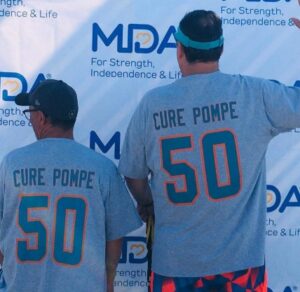
Team Hope for Pompe at the 2019 MDA Muscle Walk of Los Angeles where Dwayne and team were the #1 fundraisers
In addition to all of my own custom-designed sports Pompe shirts, I have also purchased t-shirts from other Pompe families who have had fundraisers to raise awareness for Pompe disease and created apparel for their events. These shirts have sayings to draw more attention to Pompe with slogans like “Not Today Pompe,” “Pompe Strong,” or “I am just here for the Muscle Juice”. All of these have morphed into my own saying: “I am Smashing Pompe.” Being a part of the fundraisers and working with others to raise awareness is a great way to be involved in our Pompe Community.
I often wear these shirts at my infusions and even some nurses will say that they have never heard of Pompe disease. The shirts open a door for me to tell them that I have Pompe disease, what it is, and to start talking about my journey. Now one more person knows about Pompe. If just one more person living with Pompe could be helped down the line somewhere, it would be a great day!
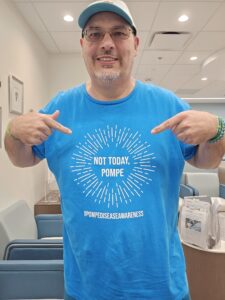
Not Today Pompe starting out my bi-weekly infusion for pompe disease treatment
On International Pompe Day, Apil 15th, I wear my Pompe shirts. However, for me, every day is a Pompe Day. Therefore, I wear my custom apparel every day, everywhere I go, to spread awareness and a positive, fun experience with others. My shirts make me feel like I am a walking billboard for Pompe disease wherever I may roam. It’s important to me to spread my message not only for me, but for others, young or old, in this rare disease community.
Sometimes it is something simple that makes the biggest impact. Just wearing a shirt that says “Not Today Pompe” goes a long way for my mental health in the lifelong journey with Pompe disease. Spreading awareness one t-shirt at a time is something the MDA has done for a long time with their Shamrock campaign and ALS – Lou Gehrig day. I am grateful to be part of something bigger. As an MDA Ambassador, I have a passion for spreading awareness about Pompe disease and other neuromuscular diseases. I am passionate about bringing hope and positivity to everyone – and making a difference in this world one Pompe shirt at a time.
The post MDA Ambassador Guest Blog: Spreading Awareness One T-shirt at a Time appeared first on Quest | Muscular Dystrophy Association.
]]>The post In Case You Missed It… appeared first on Quest | Muscular Dystrophy Association.
]]>With so many valuable podcasts, blog articles, and magazine articles available to our audience, chances are that you may have missed one or two pieces of interesting content. Check out the summaries and links below.
In case you missed it… Quest Blogs:
Essential Gear for Traveling with a Disability
Travel should be exciting, not stressful. However, when you have a disability, packing the right mobility equipment and adaptive travel gear can mean the difference between a smooth adventure and unexpected challenges. From mobility aids to adaptive equipment, experienced travelers living with neuromuscular disease provide expert tips on essential gear for smooth travels with a disability. Read more.
Simply Stated: Updates in Pompe Disease and Other Glycogen Storage Diseases
Glycogen storage diseases (GSDs) are a group of rare inherited conditions that occur when the body is not able to use or store glycogen properly. Learn more about the causes, types, symptoms, current management, and evolving treatment landscape for glycogen storage diseases. Read more.
In case you missed it… Quest Podcast:
Episode 50: PJ’s Protocol: A Lifesaving Procedure Fueled by Love
In this episode of Quest Podcast, we chat with three pillars of the Duchenne muscular dystrophy community who are here with us on the 10th anniversary of PJ’s protocol. First, we have Brian Nicholoff whose son’s untimely passing was the catalyst for the creation of PJ’s protocol. Next is Amy Aikens whose son’s life was saved by PJ’s protocol. And finally, we have Dr. Jerry Mendell, a legend in the Duchenne muscular dystrophy scientific community. We are so grateful to them for joining us to share their experiences, expertise, and advice. Listen here.
In case you missed it…Quest Magazine 2025 Issue 1, Featured Content:
Ready to Work: How People with Disabilities Balance Benefits and Employment
People with disabilities face tough choices between the benefits they need and the job opportunities they deserve. Fixing this requires changing outdated policies. Learn how individuals in the community are balancing benefits and employment as they share their experiences and advice. Read more.
The post In Case You Missed It… appeared first on Quest | Muscular Dystrophy Association.
]]>The post One Family’s Decades of Dedication to MDA Summer Camp appeared first on Quest | Muscular Dystrophy Association.
]]>
Craig Helget and his brother, Terry Helget, at MDA Summer Camp in 1985.
The Helget family has been volunteering at MDA Summer Camp for more than four decades. It all started with Craig, who lived with Duchenne muscular dystrophy, attending camp for the first time in 1984. Nine-year-old Craig returned home from his first week at camp and regaled his parents and siblings with tales of his adventures and the joy that he had found. Over the next years, his siblings signed up as volunteers, eager and enthusiastic to add to that joy. It has been a rite-of-passage for the family ever since.
Now, more than forty years later, the Helget family’s commitment to lending their time and talents to MDA Summer Camp is woven into the tapestry of their family – and serves as a heartfelt way to honor Craig’s life and legacy. Maddy Helget, Craig’s oldest niece, reignited the summer camp spark in 2011 when she turned sixteen and volunteered with her friend, Rachael, for her first summer.
A family tradition
“Volunteering and giving back has always been an emphasis in my family,” Maddy says. “It is important to think about others and help however you can – whether it is time or financial – it is all valuable and all adds up. It is important to be appreciative of the blessings you have and to share those with the world. It has always been instilled in us that we don’t have to volunteer at camp, but that we can step into that opportunity and embrace how humbling and rewarding it is to be part of this life changing week for campers and their families.”
Since Craig’s first summer at camp, fifteen Helget family members have served as volunteers, many returning year after year to culminate in a total of 93 camp sessions between them. Maddy’s uncle Darrin holds the record with 17 summers spent contributing to the magic of MDA Summer Camp. Between 1985 and 2003, six of Craig’s siblings and numerous cousins served as camp counselors.
When a second generation of Helgets came of age starting in 2011, Craig’s nieces and nephews began volunteering at camp as well. Now nine of them have been camp counselors, inspiring their parents, Terry, Kelly and Darrin (Craig’s siblings) to dust off their old camp T-shirts and jump back into their volunteer roles.

Craig’s nephew, Jay Helget, and brother, Darrin Helget, at MDA Summer in Camp in 2022.
And the Helgets aren’t just volunteering for one year. Nine of the fifteen family members have served as camp counselors for at least five or more years: Darrin (17), Kelly (11), Maddy (11), Terry (9), Jay (8), Erik (8), Caitie (7), Mallory (6) and Greg (5). The Helgets have also encouraged some friends and significant others to join in the camp fun as volunteers, adding to their family’s impact.
“My grandparents, Marlin and Carol, speak so highly of camp and are so proud of the many family members who have continued to honor Craig through volunteering. I never met my Uncle Craig, but I feel like I know him by going to camp each year,” says Maddy. “It’s a powerful way to honor him. He only had 14 years on this earth, but it’s amazing to think about the way that his life has impacted so many other kids because of the legacy that he started in our family with MDA Summer Camp. It’s a way to continue to honor him and to be part of something so special that he loved.”
“And it’s a great week for our family to spend together,” she adds. “It’s such a wonderful connection and bonding opportunity for my family. We get to spend a full week giving back and making a positive impact.”
Having attended the same camp year after year, Camp Courage in Maple Lake, Minnesota, the Helget family especially enjoys swapping stories about how camp has changed over the years and what traditions remain the same.
While much has changed over the decades, one thing remains constant: MDA Summer Camp is a place where campers find joy, independence, and newfound freedom as they try new things, forge new friendships, and embrace a week where the world is fully accessible, and everyone is empowered.
The magic of MDA Summer Camp

Craig’s sister, Kelly McGauley, with camper Andrew at MDA Summer Camp in 2023.
As a veteran volunteer, two of Maddy’s favorite things about being a counselor at camp is the opportunity to help campers experience a new level of independence and to witness their pride and sense of accomplishment when they do. Camp offers a week for youth living with neuromuscular disease to have access to many adaptive activities that they might not have had access to before – swimming, boating, fishing, zip-lining, adaptive sports, bonfires, talent shows, and more. Each camp across the country has a variety of different activities, and all of them are completely accessible. For one whole week, campers don’t have to worry about barriers and can just have fun and experience new things, a freedom that fosters independence.
“As a counselor, it’s really about trying to encourage campers to try new things, without pushing them beyond a place that they feel safe, which is something that they can bring back to their life outside of camp. That it is okay to be unsure, but it’s also okay to try new things,” Maddy says. “We’ve had kids that are terrified to go on the zip-line and then they conquer that fear, and they are so proud to show a video to their parents at the end of the week. Oftentimes they feel like they have to sit on the sidelines, but this week is for everyone to be able to do things. Showing them that there are activities that they can pursue and enjoy, introducing them to new activities, and helping them gain confidence and independence is so important”
One of Craig’s favorite things about camp was the opportunity to go swimming every day. He loved the sensation of feeling free and weightless in the water. His other favorite part of camp was building friendships and creating incredible connections that grew stronger each year. He had a special bond with his counselor, a volunteer named Tracy who was with Craig for five of his six summers at camp and became a big part of Craig’s life. He also met his best friend, a camper named Tony who happened to have the same birthday (June 14, which often landed right in the middle of camp week) and was in his cabin every year. Tony and Craig wrote letters throughout the year and counted down the days until they could spend the week together again each summer.
“Those bonds that he made were highlights in his life,” Maddy says. “And when you start thinking about all the connections that we make as volunteers, both campers and volunteers, the impact is just incredible. And those bonds, experiences, and memories that you are making with people you have grown to truly care about, make you want to keep going back every summer.”
Memories that last a lifetime
Volunteering at MDA Summer Camp, spending an entire week providing personal care, ensuring safety, and facilitating activities for campers living with neuromuscular disease, is certainly a big commitment and responsibility. Albeit hard work, it is also undeniably rewarding and full of fun. Camp serves as a backdrop for both campers and counselors to share incredible adventures and create amazing memories that last forever.

Craig’s niece, Mallory Helget, receives a “pie-in-the-face” from camper Mason in 2018.
As a returning counselor year-after-year, some of Maddy’s favorite memories revolve around small but special traditions practiced each summer, both across the camp and within her own cabin.
One such tradition that most cabins participate in at Camp Courage is earning certificates that can be redeemed by campers to smash a pie in a counselor’s face. One year, Maddy’s camper, Mason, earned more than 20 certificates. She laughs remembering how much fun he had lording his power over the counselors, with playful jests and friendly threats to “pie” them. “The kids certainly enjoy the pie zone more than the counselors, but you can’t help but be on board with it after seeing how excited they get with pie certificates in hand.”
Another fun tradition is where the camp nurses hide lawn flamingoes each morning and the campers hunt for them to earn a prize. Maddy, who is a cabin leader for the youngest boys’ cabin, loves how excited the boys get as they work together to decide where to look to find the flamingoes.
“It’s also really fun to watch the ‘Stan Can’ Floor Hockey Championship each summer. The campers really get into it and compete all week for a chance at summer camp immortality with the winning team’s names getting engraved on the Stan Can trophy, which dates back to the 80s,” Maddy shares.
“In my cabin every year, we also have the tradition of having a movie night ‘sleepover’ in the common room of our cabin,” she continues. “We pull all of the mattresses onto the floor, vote on a movie, and pop popcorn. The campers go back to their beds to actually sleep, but the whole thing feels like a sleepover. Every year at least one camper says, ‘I never get to do sleepovers,’ and its emotional as an adult to be able to create this atmosphere that just lets them be kids doing kid things.”

Craig’s niece, Maddy Helget, finds a hidden flamingo with her camper at MDA Summer Camp in 2023.
The powerful impact of volunteers
As a cabin lead, Maddy is also responsible for training, guiding, and assisting fellow volunteers throughout the week. The role has personally allowed her to develop more confidence, strong leadership skills, and valuable problem-solving skills. It also allows her to watch new volunteers blossom and grow in the role.
“Most new volunteers come in the first day feeling a little apprehensive about all that the role entails. It’s so rewarding to be there as a support and to provide the training and then watch them grow into their role – and especially rewarding to see them come back the next summer,” Maddy says. “My family and so many other folks come back year after year and it makes my heart so happy to see that they had a good experience and that they want to continue to give their energy and time to camp.”
The Helget family has found a source of joy and connection in their commitment to volunteering at MDA Summer Camp and they cherish being able to honor Craig’s life and legacy by making a difference in the lives of others living with neuromuscular disease. Maddy’s advice to anyone who might be considering volunteering at an MDA Summer Camp is simple: just give it a try.
“My family motivated me to try it and now I am going back for year twelve,” she says. “It changed my life. Even if you feel uneasy or outside your comfort zone at first, the veteran staff of cabin leaders, nurses, and MDA camp directors will help you succeed and feel empowered to take on the challenge. You have to go to truly know the power of that impact, on the campers, on their families, and on your own life. It’s the best week of the year – join us!”
The post One Family’s Decades of Dedication to MDA Summer Camp appeared first on Quest | Muscular Dystrophy Association.
]]>The post Quest Podcast: Finding Joy in the Midst of Change appeared first on Quest | Muscular Dystrophy Association.
]]>Read the interview below or check out the podcast here.
Mindy Henderson: Welcome to the Quest Podcast, proudly presented by the Muscular Dystrophy Association as part of the Quest family of content. I’m your host, Mindy Henderson. Together we are here to bring thoughtful conversation to the neuromuscular disease community and beyond about issues affecting those with neuromuscular disease and other disabilities and those who love them. We are here for you to educate and inform, to demystify, to inspire and to entertain. We are here shining a light on all that makes you, you, whether you are one of us, love someone who is or are on another journey altogether. Thanks for joining. Now, let’s get started.
With some heaviness in the world right now, I wanted to have a conversation today with a gentleman who always makes me feel a little more joyful after I spend time with him. And I have no doubt that you’ll also come away feeling good about life and the world with a little extra pep in your step and motivation. So today I am bringing you a conversation with a gentleman I am proud to call my friend, Jess Westman. He is a 25-year-old actor, disability activist, writer and composer, comedian, and human person. He says in that order. Having grown up on stage just took the leap from West Texas to New York City in 2021 to pursue a professional career in the arts.
Today, he is involved with the Second City Improv, the Grammy Award-winning Brooklyn Tabernacle and hosts the all-new comedy podcast, This Podcast Just Might Change Your Life. I’m counting on it, Jess, which will be streaming everywhere starting on March 31st. He also has many musical projects in the works, and if that weren’t enough, he’s working on an upcoming musical comedy album. Holy Cow, Jess, when do you sleep? Let’s start with that.
Jess Westman: That was the nicest thing I’ve ever heard about myself. You’re an amazing person. Thank you for having me, Mindy. Wow.
Mindy Henderson: Thank you so much for being here. Clearly you are a busy person and so I really appreciate you having a conversation with me and sharing… No pressure, but sharing some wisdom and wit with our listeners. So I’m going to jump right in and start pummeling you with questions. So like I said, you do all the things. You’re a singer, writer, composer, actor, and more. Can you tell us a little bit about just how you got started in the entertainment world? I mentioned in the opening that you grew up on stage, but have you always known you wanted to be a performer?
Jess Westman: Oh, boy. Okay. Well, those are big shoes to fill. You just set up this beautiful episode. I’m going to try to-
Mindy Henderson: You got this.
Jess Westman: Well, I think when it came to performing, it was like… There wasn’t really a choice to my parents. I’m really blessed to have had, and still have supportive parents who didn’t know much about muscular dystrophy, but they knew that we probably wouldn’t have sports late in our teens, so why would they give it to us early on just to deal with that grief of, “Oh, I can’t play football ball anymore, but that’s all I’ve known.”
So they immediately put us in costumes on stage and I was… Man, there’s this tragic home video of me doing Zip-A-Dee-Doo-Dah in an audition for High School Musical, 2006, and you have my brother singing angelically << zippity-doo-dah >> like just amazing. And then I go, << zippity-doo-dah, zip-a-dee-ay >>. And I-
Mindy Henderson: As one does, yes.
Jess Westman: As one actually shouldn’t do, but I have lot of finger guns as a kid like [inaudible 00:04:27].
Mindy Henderson: Nice.
Jess Westman: And I think I just developed a brand of carefree, fun performance. And so any character I did growing up, it was less about… I think especially growing up, it’s less about becoming a character and more about just escaping the realities of life. And I have this disease. I don’t know what it’s going to mean one day, but I’m just going to go full speed ahead into this stuff and distract myself as healthy people do. We distract ourselves with putting on costumes.
Mindy Henderson: I love that. I think everyone should do that. Not to make light of what you’re saying, I think that part of how we get through life, because nobody has, I don’t think… At least I haven’t met them yet, someone with an easy life. We all have our challenges. And so I think we all find those ways to distract ourselves, like you say, and find the lightness where we can. Is that a word, lightness?
Jess Westman: Lightness. I like lightness. It’s good.
Mindy Henderson: Okay. If it’s not, it’s going to be now. And we should mention also, if you don’t mind, you live with Becker muscular dystrophy, correct?
Jess Westman: I do. I do.
Mindy Henderson: Okay. How old were you when you were diagnosed?
Jess Westman: I was six months old. So all I knew until I was like five maybe was that I’m different, but they’re not going to say to a six month, “Okay, now say muscular…” No, it wasn’t like that.
Mindy Henderson: Yeah.
Jess Westman: Just grow up with it and then you learn the medical term as time goes on.
Mindy Henderson: Okay. Fair enough. So back to the fun stuff. One of your most well-known projects and the project that helped us get acquainted is the musical, Wheels, which you wrote, composed. I’m in awe of the talent. Can you tell us a little bit more about how that play came about?
Jess Westman: Sure. It’s funny to jump from the adolescents figuring it out, stuffing my pain down to then talking about my pain. A lot of people listening might ask, how do you even get there? What was that? What was going through my head? To be honest, nothing really was, other than just jump onto the stage and forget about what’s going on. You get to a point; you’re jumping onto the stage so much that you actually have… There are physical ramifications with this disease to where you can’t not think about it. And I think especially late teens, people know with Becker, late teens, early twenties, that’s when it gets real and it’s being the psychological demon of like, “This will happen. This will happen.” And it starts happening. And I think when that happens, people pendulum swift, like crazy swift. Did I say pendulum swift? Shift, shift?
Mindy Henderson: I don’t know. Sure. Yes.
Jess Westman: I don’t know what I said, but-
Mindy Henderson: That’s fine.
Jess Westman: She’s great, the nun who I’m talking about. Okay, pendulum shift. And then just go back and forth between being open about it, not wanting to talk about it. There’s just so many places to go with it. But I decided when it became really real, developed a limp when I was around 19 performing all the time. I decided why not talk about it just in a musical? Because I’m not normal. I don’t know if you can tell, Mindy, I’m not a normal person.
Mindy Henderson: I don’t think I’ve met many normal people. What is normal really?
Jess Westman: It is normal. That’s a good… This episode, what is normal? We’re trying to find out. It doesn’t exist. But I just decided I love the whimsy behind musicals in general. They elevate life. They dramatize life. And I would always come home in middle school with a story about a teacher, and I always said one more punch line than was actually had that day. There was one more funny thing the teacher did that actually didn’t happen. I’m confessing to being a liar. I am a liar. That’s what I’m saying. But no, I think growing up in theater you learn to just put more plot behind some [inaudible 00:08:56]
Mindy Henderson: Great. Yes, you dramatize actual events maybe.
Jess Westman: For fun. [inaudible 00:09:01] And so I was like, “Let me translate that to something serious.” And I had written a lot of goofy stuff. I had thought, “Okay, I’m going to be a talk show host. I’m going to be community.” This is all I’m going to be. But this stuff just felt, it felt like it was put on my heart, so I had to do it. I love that I have five minutes into my answer about Wheels and I haven’t talked about Wheels. I’m going to get there. I’ll just say it was necessary to talk about. It felt necessary to talk about it.
Mindy Henderson: Yeah.
Jess Westman: So I wrote about it. We put on a tri-collegiate version of Wheels, the first iteration in 2021. I was a senior in college. We got support from the National Theater Organization, the Alpha Psi Omega organization, and we’ve got support connected. I got connected with MDA.
Mindy Henderson: I have to say I had the incredible pleasure of seeing a… What’s the right word for it? It was kind of a preview of Wheels. What’s the word I’m looking for?
Jess Westman: Yeah, we had a professional reading at the drama league in 2023.
Mindy Henderson: And I was incredibly honored to be there. I am not going to lie, I was a little put out with you because I watched it and it was the first time that I had ever seen people who look like me on any kind of stage for the purpose of entertainment in a play, in a musical, in a movie. It reduced me to tears because it was beautiful and it was so well done. You sang a couple of songs that touched my heart and looked into my soul and how I’ve experienced life. It was the first time that I felt so seen and so understood by someone like yourself who is there to entertain.
You had done me the honor of asking me to moderate a piano hall afterward, which I was so happy to do. But I was tear-stained and it was such a moving experience. And then to go on to try to ask intelligent questions of yourself and the other panelists after that was a tall order. But I was so grateful and I just wanted to share the power of that moment and that experience for our listeners because you’ve done all of us such a service by creating something like Wheels.
Jess Westman: I don’t even… Okay. God bless you. Thank you. You give me these hefty… I don’t even know how to respond. That’s so beautiful. It bless me that you were even there.
Mindy Henderson: Thank you.
Jess Westman: Just knowing who you were… I read your stuff. I was just really excited that you would even come. You and Mary Fiance, part of MDA, and Keith Gordon, he’s an associate. He works with them. I couldn’t believe these incredible… I call you guys fighters because that’s what you got to be these days especially… But you are. And you’re on the front lines of justice and kindness, and love, and so I was honored. I just want people to feel like they missed out by not being there. I guess that’s what we’re doing.
Mindy Henderson: I know.
Jess Westman: You guys we’re-
Mindy Henderson: I think we’ve accomplished that for sure. And if they are feeling that way, I’m going to put it out into the ether that I hope they will get the chance to see it. So let’s talk a little bit more about that. So as a playwright, is that the right word for… Something that’s a musical and a play, is playwright still the right term?
Jess Westman: As long as it’s before a human person.
Mindy Henderson: Okay, perfect. So you have been through… You and I have continued to talk and you’ve kept me up to date, but you’ve been through some iterations of Wheels. Can you tell me a little bit about how it’s evolved?
Jess Westman: Yeah, absolutely. I mean, if you’re a writer, you’re listening to this, you know, you know. It’s like, “I finished it.” No, you didn’t. No, you didn’t.
Mindy Henderson: No.
Jess Westman: You think you did and you finished a version of it. But never say I finished the script because the script… Even when… You could have the most published thing, you’re going to rewrite it. There’s always going to be something to fix and change. But to me, that’s what has improved the material over time is the willingness to change and adapt. For example, what you saw in 2023, which is exactly two years after the first version, couldn’t have been more different.
A through line that was similar was this guy has muscular dystrophy, but nothing, not a single plot point aligned with the initial version besides maybe a character saying hello, which I think did happen. There was not a lot of crossover into me. It’s actually, looking back from 2023, I can’t pinpoint a lot that is the same from even then, which might sound horrible because you really enjoyed 2023. Not like I’m knocking down those trees that made you cry and gave people life that night. But it’s just that I’m finding new trees to plant. I’m going with the plant metaphor.
Mindy Henderson: I like it. It works.
Jess Westman: Just genuinely, every version has gotten closer and more true to my experiences as I age with this disease. Now, if I was just this person who they didn’t age and the disease didn’t change, then the show probably would change a whole lot less. But as I’ve grown up and as it’s affected me more, I’ve learned so much more. So I think it’s probably going to be prime Wheels much further from right now. But I think I’m also giving myself the space to accept that and be ready for what my life becomes and what the show becomes at the same time.
Mindy Henderson: So I don’t know if this is a fair question right this second, but I’m going to ask it anyway and then there are so many other things to talk about. You’ve got a thousand other projects you’re working on, so I definitely want to move on to those. But is there a particular message that’s important to you that people who may get to see Wheels at some point that they come away with? Or is it multiple messages? What are your thoughts there?
Jess Westman: I mean, a core message for those individuals with muscular dystrophy watching it, any version they have seen or will see I think is that your pain, your struggle, as people don’t like to say, but it’s true, it very much can be that as you age is not in vain. These experiences you have, they’re not in vain. These will grow you if you let them. Adversity can grow us. I meet people who have this and for some reason they’re some of the happiest people I’ve met, some of the most content people I’ve met, because I think something about knowing how hard, impossible actually that life can be makes you really enjoy the little things.
Oh no, now I’m having five different answers for this. Okay, I got to stay on one track. Maybe just know that your experiences aren’t in vain and there are other people that I can relate to you. It’s going to sound cliche and it’s going to sound very musical theater. Circa 2010, you’re not alone.
Mindy Henderson: Yeah. I think those are fine answers. I love those answers, and I think that those are good reasons to do what you’re doing. And by the way, I think you’re accomplishing those things. So as someone living with a disability, let’s just talk about the entertainment industry, which from what I’ve heard, no matter who you are, I think it’s a tough industry to crack. But as someone living with a disability, how do you feel your disability has affected your journey in the entertainment industry? What have the barriers been that you’ve had to overcome?
Jess Westman: Well, I think we’ll definitely get more into this soon, but the subway, that was when you pursue a career in something like this. You move to a big city. You move to a city that probably isn’t really set up for someone with a disability. Not just that. Someone who’s half and half. A friend of mine jokes, he’s also disabled, who I can say it. He jokes that I’m demi-disabled. Like a [inaudible 00:18:42]. Because I am-
Mindy Henderson: For people who don’t know you, you’re ambulatory. You walk.
Jess Westman: I’m ambulatory.
Mindy Henderson: But yeah,
Jess Westman: Demi-disabled, it might be one of the worst things I could have said. I’m so sorry.
Mindy Henderson: I might have to steal it. I don’t know.
Jess Westman: Okay. Yeah, maybe steal it. And so I’ll give an example, after a long day rehearsing, paying for the rehearsal space out of pocket with these actors for six hours sheet music, I spent 24 hours with beforehand just getting it perfect to the day that I had set up for everyone to show up whatever. I get on the subway and I just want to sit down. Then I told you this story. I did.
Mindy Henderson: I want to hear it again. I love this story.
Jess Westman: I’ll tell it again.
Mindy Henderson: Yeah.
Jess Westman: Sorry to tell it.
Mindy Henderson: I mean, it’s going to sound weird that I love this story, but it…
Jess Westman: It’s actually kind of messed up that you love this story.
Mindy Henderson: It is a little bit messed up. So now we’re equally twisted, I think. But it resonates with me when you tell this story.
Jess Westman: Sure. And I am sure there’s many out there who probably had many worse experiences. I count myself. Just, I’m thankful that I have had not too many of these, but when it happens, you never forget it. There’s a section of the subway, it says, persons with disabilities. Of course, that’s never really honored. And on a lot of cars, there aren’t people with disabilities. I’ll say that. But on the carts where there are, you walk on or you roll on. And that was one of those days where, I was… I mean, I felt like I could just explode, my legs, my back, my right knee.
You’re thinking about all that stuff and so you just want to sit down. And so I was going to take a seat and basically what happens is you have a random stranger assuming that you are not disabled. And so someone says, “Excuse me, you’re not disabled.” And it’s so interesting because… And I think this is actually the point of the story. I didn’t yell at them. I didn’t scream at them.
I assumed that identity that I’m not disabled. I just accepted it even though it wasn’t true. I didn’t want to fight it. And I think that’s what we had talked about in the talk back is that I didn’t want the conflict, any more conflict than there already was with being seen as the guy who’s pretending to be disabled, isn’t disabled, but actually is disabled.
Mindy Henderson: Right. Well, and to stand there and argue with her about the fact that, “Actually, I am,” I can’t help but… And I think that… Yeah, I think that’s what I like this story is the conundrum that you found yourself in and the strength that you had to find in yourself to stand there. Not that this is right, but to stand there and take the… Not the criticism, what word am I thinking of? To sort of…
Jess Westman: The heat maybe?
Mindy Henderson: The heat, yeah. Rather than do what you needed for yourself, which was probably to defend yourself and find a way to get to sit down. You stood there and you took it. And I think that that’s something that all of us can relate to because we’ve all felt our own form of prejudice and discrimination and judgment and that sort of thing. You made a choice in that moment to stand there and not argue with this woman and face how exhausted your body was and power through it despite the judgment that was being made against you.
Jess Westman: Right. I’ve learned that lesson since times of adversity. It can seem like you’ll get all the power in the world back if you fight back or if you bully back the bully, whatever scenario it is, whether it’s a person or a situation, whatever it is. But I found there’s actually no power in that. Vengeance doesn’t really have power in it. It has passion. But to me it’s not actually anything that’ll help you or benefit you. And I’ve found the best thing I could do in moments like that is either, this is going to sound crazy, pray for that person or write about it and put all of that effort into something that can actually make the world a better place.
In fact, I was thinking about this today, that as opposed to criticizing people we hate or hating people in general, there’s something we can do to combat that, which is to spread joy with our lives and spread awareness and educate people that way. Because people aren’t going to listen to, “I hate you.” People aren’t going to listen to, “You’re the worst and I will never be in the same room with you.”
People are going to listen to, “Well, here’s where you’re wrong. This is who I am.” So to me it’s like you’re not fighting fire with fire. You’re fighting fire, “Oh, it’s going to sound like I’m a care bear, fighting fire with love.” Like a Care Bear.
Mindy Henderson: I think that that’s one of the beautiful things about art and entertainment is that it’s a platform to share those pieces of ourselves where maybe people are, in a lot of cases, going to be a little more inclined to listen and to hear it and receive it. They’re not always going to hear you in the moment, say, “Actually, you’re wrong.” Maybe they will. Some people will. And there’s a time and a place I’m sure to say those things. But I think what you do, this passion that you’re living for art and entertainment, there’s a lot of power behind that. And so much opportunity, I think to teach people new things and expose them to things maybe they haven’t been exposed to before.
Jess Westman: Prove them wrong with your life, not with [inaudible 00:25:36] with the art you create. And in time you don’t have to get the satisfaction of seeing if they changed. You just have to hope that they could and that more people could, and that you’re making work that makes people self-reflect. And I would hate to make art that doesn’t teach people anything. Even if it’s a [inaudible 00:25:56] lesson. I think art should convey some sort of educational value for someone. I feel like it’s necessary.
Mindy Henderson: Yeah. Could not agree more. So you have also shared with me that some of what you’ve experienced as someone living with Becker, as well as just life experiences recently have caused you to pivot in your career and focus your energies and your talents on comedy right now, which I love. You’re a natural for comedy. What motivated you to make that change?
Jess Westman: Well, one, in middle school I was told I had a face for comedy because girls would laugh. They would just laugh at it. I know. No, it hurts. No, that didn’t happen. But… Okay, I-
Mindy Henderson: I didn’t think so.
Jess Westman: Yeah, definitely didn’t happen. That was an example. I’m the liar. That’s the through line. That’s the title. Jess is a liar. That’s the title.
Mindy Henderson: I’m going to make that the title of the episode.
Jess Westman: Please, and thank you.
Mindy Henderson: Okay.
Jess Westman: What I mentioned before about Wheels, it’s a story that’s being written as my life unfolds. So that is just a fact that it was a hard pill to swallow, but it was great to accept it because I think in doing so, I’m not going to write about an experience I don’t have yet. So the previous iterations, I’ll address this. I was writing about a fully disabled man. So I was essentially writing 40-year-old Jess into a 20-year-old character. But I wasn’t considering that because that’s not my experience, maybe I could be falsely conveying. With inexperience, not really speaking on something I truly understand and fully lived.
Mindy Henderson: That makes so much sense.
Jess Westman: Yeah, thank you. And a lot of people actually didn’t. They would disagree and they’d be like, “Jess, it’s not that big of a deal.” Personally to me, it’s a big deal. Not just do I want people with muscular dystrophy to be writing about people with muscular… but also the experiences of how the muscular dystrophy affects you. There’s someone that has the same thing but affects them differently. It’s hard for me to speak exactly for them. So that’s where I put myself in the place of, “Okay. You can have more time for that.” Here’s when the answer gets kind of funny. I met Conan.
Mindy Henderson: Yes. I was hoping this would come up. Conan O’Brien, right, is who you’re referring to.
Jess Westman: Comedian Conan O’Brien who just won the Mark Twain award for American humor. He’s like a dad to me. Okay, I do have a dad, by the way. By the way, dad, if you’re listening, you are my dad. And I acknowledge that. But I met Conan and spur of the moment…. Okay, so there was a person next to me and they were like, “Bro, when Conan comes out, don’t ask him a question and don’t make it about you.” So as soon as Conan comes out, I said, “Conan, will you adopt me?”
Mindy Henderson: It felt great.
Jess Westman: So I asked him a question and I made it about me.
Mindy Henderson: Perfect.
Jess Westman: I was like, “Let’s see what happens.” Thankfully, we riffed. He said something about he’d have to talk to his lawyer and his kids, but it should be all right. In that moment, I was like… It wasn’t like a flip switch, but I was like, my mouth was dry as it is when you meet your hero. Your mouth is dry, your hands are shaking, you’re like, “My neck hurts. Did that just happen?” And then someone afterward came up to me and was just asking me if I do stand up.
I expressed reluctance for that because it’s scary. But also so was that, and it happened. It could have gone worse. And so I looked into it and I look into it. I mean, I did stand up. As soon as I got back home from that, I did stand up.
Mindy Henderson: What?
Jess Westman: 18 in a row. 18 days in a row.
Mindy Henderson: I didn’t know that.
Jess Westman: Twice a day almost, sometimes.
Mindy Henderson: Oh my gosh.
Jess Westman: So much that I got a headliner spot in July at this place. I bombed that. I got another one, I succeeded. I got another one, half succeeded. And I just kept going and going, and going. And then I stopped. I was just like, “Okay, I think I’ve learned a lot from this. Let me take a breather because this is not healthy.” I was [inaudible 00:30:36] 2:00 AM you socializing with these comedians and I have work in the morning. What am I doing?
So I took a step back. But from that I learned, “Wait a second, while I have this hesitancy of the timeline of Wheels, not really knowing what that looks like.” In the meantime, I’m like, I love banter. I love making people laugh. I love tech being laughed at. I don’t care. If you’re laughing at me or with me, we’re having fun.” And so I was like, “Is there an element of that that I can more so incorporate into my personal journey?” And that’s where happenstance, which I’ll talk about comes in. That’s where this podcast comes in.
But I think it was also, I had this moment in January that was sort of this life or death moment. My heart was enlarged. I was in the hospital. I didn’t think I’d make it through the night. Literally, I believe that God performed a miracle and just me seeing the next day and what that looked like. I knew I had a second chance for a reason. I didn’t really understand what for. And for me it’s like, “What is joy, if not just laughter with the people you love.”
I mean, that’s pure joy. And so I thought this is an opportunity to go that direction. And I’ll say this, as a huge disclaimer, not abandon Wheels, but take the time to understand it looks like as I grow as a human person.
Mindy Henderson: I love that. I love that. Which kind of dovetails into this next question, which I think you’ve partially answered, if not fully answered, but I’m going to ask it anyway. Why do you think that comedy is good for the soul?
Jess Westman: Do we have three hours to unpack this?
Mindy Henderson: We have two hours and 59 minutes, not quite three hours.
Jess Westman: I can make that work.
Mindy Henderson: Okay.
Jess Westman: I can do this. Why is comedy good for the soul? Was it why or how?
Mindy Henderson: Why, but how is also good?
Jess Westman: How would be three more hours?
Mindy Henderson: Okay. You go with whichever one you’re feeling drawn to.
Jess Westman: Why? Because life is short, man. I don’t know. I mean wouldn’t it be devastating if we just all sat here crying the whole time? I don’t know.
Mindy Henderson: Yes.
Jess Westman: Why is comedy so important? Because it’s priceless. Because it can’t be traded for anything in the world. A good laugh with your mom, a good laugh with your best friend that’s known you for 10 years, you’re roasting each other because that’s how you express your love for each other. I mean, come on. I can’t even put to words how important to me comedy is. And if people were looking for a funny answer in that, I think a funny answer would not do it justice.
Comedy is so necessary. Okay, fine. I’ll bring it back to Conan. He was talking about Mark Twain, and he was talking about just the importance of comedy. And Mark Twain didn’t punch down. He wasn’t a bully. There’s so much about who he was. And the point of comedy, I don’t think is to punch down. I think it’s to people an escape. Not to remind people of what is broken within them, what’s wrong with them, but to maybe just have a good time. That’s it. There’s my three-hour answer.
Mindy Henderson: I love that answer. And I think that you nailed it because so much… I mean, I said it at the top of the show, there’s so much about life that’s just heavy. I’m not a doctor, I just play one on my podcast. But I think that there are physiological things also that happen within us when we laugh. And I feel like… I don’t know. This may be a negative attitude, but I feel like it’s easier to look around you and find things to pick apart. And you can always find something to feel bad about and to get hung up on. And I think you have to work a little bit harder.
Correct me if you think I’m wrong, but I think you have to work a little bit harder to find the light spots and the things to laugh at and the things to smile about. And if there’s someone like you with a gift who can give us those things, I think it’s really important.
Jess Westman: Yeah. I mean, I echo what you said. I actually don’t know how much I could add to that. I know you have more wisdom and experience, but I have learned that the brightest days come after the darkest ones. And it’s only once we’re able to laugh at the situation, laugh at ourselves. Laugh through the pain, I guess. Why was Conan my hero? Actually, maybe the title will be about Conan in some way. It was because I would have a hard day getting bullied when I was 15 and home, and see this guy doing a weird string dance and had this confidence, and he had a goofy haircut. He was tall and he had technically every reason to get made fun of in my school, but he was a hero to them. And he was the guy.
So I saw that and I thought, I’d love to have that reckless abandon. I’d love to walk into a room and not care so much of the way I’m coming off to just spread joy. And if it’s perceived in a negative way, if it’s perceived in a, “Oh, he’s not as good as he thinks…” Who cares? I don’t live for you. I used to, but I can’t anymore. I don’t think I’d have a reason to live if I just lived for the approval of others anymore.
Mindy Henderson: Well, and I think that’s where your wisdom is showing a little bit. And as you grow and get older, and wiser, and all of that, I think that that’s what’s going to make Wheels. It’s going to take it from great to mind-bogglingly astonishing because you’re going to be able to incorporate wisdom like this. I mentioned earlier that you’re taking improv classes at the esteemed Second City Improv, which is notorious for training actors who have gone on to perform on Saturday Night Live, a little show people may have heard of. Can you tell us a little bit about the school, the classes you’re taking, and what your comedy and acting goals are?
Jess Westman: Of course, of course. Mindy with the loaded questions. I can do this. Okay, Second City, I always wanted to do it. Of course, I knew that’s what started Steve Carrel’s career, Tina Faye, so many of my heroes.
Mindy Henderson: Yeah.
Jess Westman: So I’d always had interests. I always knew what it was. I also never wanted to move to Chicago or Toronto, or LA. Those were financial impracticalities. Then I moved to New York for the musical, still not thinking comedy is going to play a relevant part in my life. And then stuff transpires this past year. And I really just felt like, “Why would I not? Why would I not? Because I’m scared? Because I’m a little coward? Because the same guy who wouldn’t do this is the same guy who wouldn’t ask Conan to be his father.”
Mindy Henderson: There you go.
Jess Westman: And I think I’ve proven to myself and to God, as God is my witness, that I can be that guy. So why would I not? Just take the leap? Just go for it. Just take a jump. So I did. I signed up and I have… I can’t say this enough, and I found that it’s possible. One, yes, mom, I do believe that there are people funnier than me. I have my big head and I’m like, “No, no, I’m not that great.” These people, they… I cry. I cry laughing. They hurt my sides. I think I need surgery after I’m done laughing.
Mindy Henderson: Wow.
Jess Westman: These people I’ve been in classes with are so funny. I mean, I’m looking at literally in class with the next Lisa Kudrow, the next Jason Sudeikis. I’m not even joking. And some of them, they go right from that to the comedy club to pitch new material that they tried out in a scene. And so I can very clearly say, I don’t know why. No, I am stupid for not doing this earlier. Every time I walk in, I’m mad at teenage me for not just moving to Chicago.
Now, of course, for context, they opened the New York location 2024. So this was not an option until that point, which is just crazy to me because it’s right by where my favorite spot was, where I used to come the first three years, and I’d sit at the beach and I think, “What is my purpose? I’m going to stare at this river and listen to Mumford & Sons in my AirPods.
Mindy Henderson: Bang the bongos. Yeah.
Jess Westman: Yeah, exactly. And just do that. I’m a lone wolf. I’m figuring things out thing. And it’s right in that area. Now, I have a reason to go there. Before I’d go there just to be like this Hopeless Wanderer, Mumford & Sons song. But now it’s like I have class and we do jams, which are like these basically stand up or open mic for improv and you jump up there. And the craziest thing that happened with this… And then I’m done. I’ll get off my soap box, my improv box about this.
But the craziest thing was we had this orientation, this jam, if you will, with 200, 300 students, people just there. And the guy I was sitting next to, believe it or not, we met. We were playing the same show three months before. He’s this ex-military standup comedian, hilarious guy. Doesn’t seem like he’s funny, but he kills it. He’s the funniest guy on earth.
Mindy Henderson: Oh, wow.
Jess Westman: We met, we reconnected. He goes on stage the first game they’re playing I went to. And I remember as I got up, “No, no, no. Sit back down.”
Mindy Henderson: There you go.
Jess Westman: But literally they’re all watching you. You’re establishing yourself either as the guy who fails or doesn’t. To me, there’s two ways to go with improv. You land it… So we’re talking… I think the game was go up in bad occupations. So you go up and you pretend to be someone who’s bad at their job. So they said, “Doctor,” I was like, “No, that won’t be good enough.” Troll. I’m like, “Troll is not [inaudible 00:41:51].” And then they said, therapist. And I didn’t even think, I just walked forward.
Just please don’t die is all I thought. Don’t digest. Don’t explode and die. And they said, therapist. And remember, it’s bad therapist. I stared for 10 seconds. I looked like I was about to cry. And I said, “But you didn’t ask me how my day was.” Because I guess a lot of people have had bad therapists, they didn’t just laugh, they cheered.
I felt in that moment, “Wait a second, I don’t even think it was that good.” I don’t even think delivery was that good. I literally think this is just confirmation that I’m in the right place. I realized you don’t have to say the funniest thing, just say the first thing, the most exciting thing. And you can’t-
Mindy Henderson: The realest thing.
Jess Westman: The realest thing. And it is real. I can imagine that a narcissistic therapist… Not saying all of them are narcissistic. I’m sure there could be some narcissistic therapists that are thinking the whole time, “I wish I could talk about myself. Why aren’t they asking me about me?” Right? I’m sure there are therapists that think that. I don’t know which ones do, but they’re out there. So there’s a relatability factor. And I’ve found that. The funniest stuff often isn’t funny because it’s just out of this world. It’s funny because it’s true and it’s true.
Mindy Henderson: First of all, that story gave me goosebumps because the punchline was so good and the cheering, but when you were setting the stage and talking about having to get up and do this, I was sweating and feeling nauseous and trying to imagine this. My hat is off to you, sir, because I couldn’t do it.
Jess Westman: Well, my mom, she was the one who heard the before and after, so she heard, “I don’t know, mom. I don’t know.” And then after, “Yeah, we’re good.” Just completely different people. But that’s how tantalizing it is. It’s like, “Whoa, this? In front of all these people that I don’t know?”
Mindy Henderson: Yeah. It’s like walking a tightrope without a net.
Jess Westman: Yes, exactly.
Mindy Henderson: You had me with the suspense of that story, and I am eternally more grateful than I already was that I will never have to do that in my life.
Jess Westman: Do it. I don’t recommend it, but it’s this weird… I have a loathing about it, but once you do it, it’s like, “Okay, I should have been doing this the whole time.” It’s that thing about diversity.
Mindy Henderson: Well, you should have.
Jess Westman: What’s that?
Mindy Henderson: I probably should not, but you should have.
Jess Westman: No. This is improv right now. People don’t [inaudible 00:44:51] If you have a good conversation, that’s improv. I’m just saying.
Mindy Henderson: You’re very kind. I will give you that. That’s true. So I want to get into the other projects that you have that you’re working on right now. But before I do that, we talked a little bit… And you went down this road, but I want to revisit it because number one, I want to know the answer to this. And so there’ve got to be other people out there that want to know the answer. So we talked about pivoting and change and how you made this decision to go with comedy and make that your focus right now.
And you said it. I think sometimes we grow the most when we pivot. How do you know though when it’s time to pivot or change course, or if you just need to stick with your path that you’re already on and work through the problems?
Jess Westman: Well, I think, I felt called. I really did feel called to comedy. And I have my whole life, but it wasn’t like this unfamiliar thing. I had been down that route before the genesis of Wheels. It was just performance, musical theater and comedy. That was it. And I think it was taking a leap in one way because it was revisiting something. But in another way, it was like I felt like I was just upgrading into Prime Jess. I don’t know. I’m not a superhero, but I feel like Prime Jess or closer to him. Now that I’m doing this, I feel like I’m doing the right thing. And I feel like-
Mindy Henderson: That’s telling.
Jess Westman: Yeah, it may be. I mean, I don’t know if I come off more at ease or happy or whatever, but I just feel like Wheels will be ready for me. And I’ll be for Wheels. It’s not like I just woke up one day and said, “I’m going to be funny now. I’m going to learn how to do…” I have been messed up in the head like this since birth. I have always been like this. That’s why I mentioned the whole video. I mean, we’re talking about it a seven-year-old who does finger guns all the time. Not just like people are having serious conversations and I’d be [inaudible 00:47:29] to everyone. I thought I was pranking them.
A prank has to have a punchline. I would just do this and think I was pranking people. So in that, the silliness has always been a part of my life. If you know me personally, you’ll know. Even during my most serious Wheels years, I didn’t take myself too seriously and always tried to have fun. So I think I’m just really doing what I feel like I’ve always been doing, just pursuing it in my art now as well.
I think there is also going to be more to Wheels and more nuance to that story. Once I’ve lived a more fulfilled life doing this, I think I’m going to learn a lot more than I would have if I just sat wallowing in the changes that are happening which are [inaudible 00:48:17] that my body is changing. I am losing stuff. But why would I just focus on that hopelessly when I can have some fun with life and the good things that are going on?
Mindy Henderson: And bring joy and happiness to the people around you. I like that.
Jess Westman: I attempt to do that, yes.
Mindy Henderson: Yeah. So tell me a little bi…, and I want to cry because we’re almost out of time, but I have just a couple of more questions for you. You talked earlier about how you’ve got like 8,000 other projects going on. You’ve got a comedy album in progress that I need to know more about that. And anything else that you would like to talk about that you’re currently working on?
Jess Westman: Of course. Happenstance time. I’m about to become insufferable.
Mindy Henderson: Oh, dear.
Jess Westman: Let’s do this.
Mindy Henderson: Got to go.
Jess Westman: Got to go, yeah. We have you said two hours and 59 minutes.
Mindy Henderson: We do. There’s time. Go for it.
Jess Westman: Let’s go. Okay, Happenstance: A Reverent Odyssey of Life and a Jess Because Death is Not an Option. That is the full title because death is not an option, parentheses, of course.
Mindy Henderson: I like it.
Jess Westman: Thank you. It doesn’t play well anywhere. I don’t think anyone likes the title that long. So there is an acronym for it. I’m not going to try to find it right now, so that would take a while. HT. No, see, I’m already doing it.
Mindy Henderson: Yeah, you have to think way too hard.
Jess Westman: Yes. But Happenstance. It’s a tale of tragedy and joy, and grace, and mercy, and family, and love. It’s basically a story about-
Mindy Henderson: Wow.
Jess Westman: I grew up just very unseriously and I had very serious parents. I had very serious circumstances, but I made a lot of silly decisions and cost full decisions. I am infamous in my hometown for wrecking cars. I’m a very expensive person. No, I would get hit by cars. And then I also hit a car. And I had bad car luck. So just things happen in adolescence that I think taught me a lot. The main sort of through line of the story is I was heavily bullied as a kid, and then later in high school I became a bully trying to take that power back.
And then I think Wheels was my pendulum swing and really coming back to a place of empathy and not thinking about justice for me being bullied and all that, but more so thinking, “Okay, what is thoughtful to do? What is thoughtful to say? What is caring?” It sounds like I’m describing a psychopath trying to adjust to being normal, but-
Mindy Henderson: Not at all. I don’t think a psychopath has it in them. So I think you’re good.
Jess Westman: Okay. Thank God. So I really… Happenstance was on my heart when I was in the hospital. I didn’t know what it was called, but I knew it was something funny, and I knew it was something real. And I knew it was something to establish myself as an artist before Wheels ever hit the biggest stage it could be on. So that’s the idea of Happenstance is this is my story. You’ll never get this hour and 15 minutes back, but maybe you’ll be okay with that because it’s real, it’s honest. People can relate to it and people can sympathize. People can be frustrated with me. It’s a human story, and I think it is… This answer is too long. That’s what I think. So, yeah.
Mindy Henderson: No, you’re good. I am so excited to hear about this. So a couple of follow-up questions.
Jess Westman: Please.
Mindy Henderson: Number one, do you have a timeline, which I know can be an artist’s nightmare to ask that question, but do you have a timeline and where would someone find something like this when it’s finished?
Jess Westman: Of course. Timeline. So it’s very humorous. We’ve done a few promos out in the ether, and I bring a microphone to different parts of New York. I was by the Brooklyn Bridge the first time, went to Times Square, second time Manhattan area. And I asked people, “What are you looking for in a new comedy album?” And I’ve already written a lot of it, so I’m not even going to use this stuff, but I just like to ask for promo’s sake. But we went around and it was actually October 1st, 2024 was the first release date I ever put out.
And about four days after that, we didn’t release it. Instead, I went on the street and asked people how they felt about me as an artist because I didn’t release it when I said I would. And you would guess most answers were roasting me. Just completely destroying me, which I found hilarious. That’s a long way to say 2025. That’s all I’ll say.
Mindy Henderson: Fair enough. I like it. It builds the suspense.
Jess Westman: Yes, exactly. And it could potentially be the December 31st, 2025. I’m telling you, 2025. That’s all I will say right now.
Mindy Henderson: Okay.
Jess Westman: Can they release it? Everywhere you stream music, but also in your heart.
Mindy Henderson: Okay. Well, keep us posted. I definitely want to have a listen when it is available. Any other projects that you want to mention?
Jess Westman: Well, I don’t know if this is a project like something you write, but I do have a podcast.
Mindy Henderson: Yes.
Jess Westman: Yes. But I don’t know if we were going to speak about that.
Mindy Henderson: Go right ahead. Let’s talk about the podcast.
Jess Westman: I’ll be so quick. I’m plugging endless stuff.
Mindy Henderson: I love it. Let’s do that.
Jess Westman: This podcast just might change your life. Listen to it. Bam. That’s all I got. That’s [inaudible 00:54:29] podcast.
Mindy Henderson: Brilliant. That’s end of March, yeah? When it’ll-
Jess Westman: March 31st. Okay.
Mindy Henderson: Anywhere you can listen to podcasts.
Jess Westman: Everywhere you listen to podcasts. And you guessed it, also in your heart.
Mindy Henderson: Love it.
Jess Westman: Yes. Mindy, will… There may be an episode with Mindy. It could be…
Mindy Henderson: Maybe, maybe not. I don’t know. We’ll have to see.
Jess Westman: I don’t like the suspense. It scares me.
Mindy Henderson: See, it works both ways. I can do suspense too, but I hope so. I’ll just say that. So let’s do this. Let’s talk about… I’ve said it a couple of times. The world is a bit heavy right now. What advice would you give to listeners who might need some more joy, laughter, levity in their lives right now?
Jess Westman: So I wrote down an answer for this because I really want to be sincere, but I also think sincerity is just the truth of what’s inside you, not something you have. I really think that we need each other. I think seeing people less as an enemy and more as an opportunity to forgive, move forward. I mean, I really don’t… Well, that’s easy for me to say, forgive. But I really do believe there is a lot of hate everywhere. It’s on all fronts.
Obviously decisions are being made that are affecting people with disabilities, my kids’ futures, my future kids. And I know there are people scared about that. There’s equal, if not more amount of people that are happy about that. I think what is alarming is people aren’t willing to meet on the divide. People aren’t willing to talk to each other. I think we should be talking to each other more. I think we should be listening more.
As a man, as a person, I follow the teachings of Jesus very closely just how he loved everyone. He uplifted the marginalized. He was with them in their brokenness. He was there for people. And I think that’s what we need to be. We need to be there for people. People we disagree with, people we do agree with, just be there, be present. Again, five answers. I’m giving you five answers in one.
Mindy Henderson: No, that’s good.
Jess Westman: Just trying to give all these nuggets of things that this is how I live my life. It’s what keeps me away from bitterness and toward growth. But again, it’s easy for me to say. I think there’s a lot of people who need accommodations that are being jeopardized right now. I’m ambulatory, I’ll say that. We need to lead with empathy. We need to come together. And that was the most beautiful thing that I think I have seen. And my relationships is in times like this, we come together. We learn how to work together as one and again, meet on the divide.
Mindy Henderson: Well said. Well said. That was not the answer I was expecting. I was expecting something about watching comedy movies or something like that.
Jess Westman: That too. Watch Conan.
Mindy Henderson: Sure.
Jess Westman: Watch Conan.
Mindy Henderson: Obviously, that too.
Jess Westman: Yes, please.
Mindy Henderson: But that answer was so much better than the one I was thinking I was going to get. And I could not agree with you more. You’re so wise. Thank you for that. And unfortunately, my last question for you, I’m going to ask you right now, no pressure, but what is your favorite joke?
Jess Westman: Come on. Oh, this is my favorite question.
Mindy Henderson: Yes. I’ve been waiting for this one.
Jess Westman: Boy, are you ready?
Mindy Henderson: I’m so ready.
Jess Westman: I got to crack my knuckles.
Mindy Henderson: Oh, wow.
Jess Westman: I know. Wow, I have been… It’s been-
Mindy Henderson: That needed to happen. Wow. That was quite a crack.
Jess Westman: It kind of hurt. My index finger is swollen. Weird. All right. I’ve got to hand it to babies because their little arms can’t reach anything. That’s great. Hey, that is more of a, “I can’t believe he thinks that’s funny,” type of joke. The joke is that that is my best joke. And I will always assert that as my best joke anytime anyone asks me a joke.
Mindy Henderson: That was pretty good. I’ve got to say, it’s kind of like spicy food. It creeps up on you.
Jess Westman: I got to ask you, you know this is a two-way street, and I actually wish I could ask you every question. My promise is my podcast, I will. I will ask you if you ask me. Curated to you. What is your favorite joke?
Mindy Henderson: Oh, so I will tell you, I was an ambassador for MDA as a little small kiddo. Started when I was like four and did it until I was about 12. And my mom and her infinite wisdom because she would’ve to show up places and thank people for being there and for their support. And that’s not something that comes naturally to a four or five, six-year-old child. And so she always primed me with an elephant joke to start out with. And it was my way of warming up the audience. The look that you just gave me, do you know elephant jokes?
Jess Westman: I don’t. But I’m about to learn. And I need to-
Mindy Henderson: They are the dumbest jokes you will ever hear in your life, but they’re brilliant.
Jess Westman: Yeah, I make those every time.
Mindy Henderson: Yeah. So I will ask you, I’m trying to decide which one. I have like 80,000 of them. It’s a two-part joke. Why do elephants paint their toenails?
Jess Westman: Why?
Mindy Henderson: So they can hide in M&M bags. Part two. Have you ever seen an elephant in an M&M bag?
Jess Westman: I’m not supposed to say yes. No, I haven’t.
Mindy Henderson: You see how good they are? They’re the worst jokes ever. So, so bad. Right?
Jess Westman: You know what? Courage.
Mindy Henderson: I tried.
Jess Westman: [inaudible 01:01:37] courage. Me doing the improv thing, it takes courage. You knew the end of that before I did.
Mindy Henderson: Yeah.
Jess Westman: And still did it. And to me, I actually respect… I respect you twice as if I could respect you more.
Mindy Henderson: It was-
Jess Westman: [inaudible 01:01:50] twice as much.
Mindy Henderson: It was much more charming coming from a six-year-old. But they still make me chuckle. So that’s what I’ve got.
Jess Westman: No, now it’s hitting me. You know how you did the drum sound and then you laugh. To me, it’s like there is… All right.
Mindy Henderson: Yeah. Like I said, dumbest joke you’ll ever hear. But, Jess, thank you so much for being here. This has been an absolute pleasure. I said at the beginning that you are someone who always makes me smile. You do always make me laugh. And so thank you for that. Thank you for being here. I look forward to watching everything unfold that you’re putting out into the world and sort of tagging along on that journey with you.
Jess Westman: Mindy, you are amazing. And even with your last statement, I don’t even know how to follow it up. You really encourage me to just be a better person. And I’m just honored that you would have me on. So thank you. Oh, one of your book titles, the truth about things that suck.
Mindy Henderson: Yes.
Jess Westman: But you don’t.
Mindy Henderson: Thank you very much. I appreciate that. And on that note [inaudible 01:03:09] thank you all for being with us. Thank you for listening. Jess, it will not be the last time. We’ll talk to you soon.
Thank you for listening. For more information about the guests you heard from today, go check them out at mda.org/podcast. And to learn more about the Muscular Dystrophy Association, the services we provide, how you can get involved, and to subscribe to Quest magazine or to Quest newsletter, please go to mda.org/quest. If you enjoyed this episode, we’d be grateful if you’d leave a review. Go ahead and hit that subscribe button so we can keep bringing you great content and maybe share it with a friend or two. Thanks, everyone. Until next time, go be the light we all need in this world.
The post Quest Podcast: Finding Joy in the Midst of Change appeared first on Quest | Muscular Dystrophy Association.
]]>The post Clinical Research Opportunity: LION-CS101 a Phase 1/2 Study of AB-1003 in Adults with LGMD2I/R9 appeared first on Quest | Muscular Dystrophy Association.
]]>The study
LION-CS101 is a phase 1/2, double-blind, randomized, placebo-controlled study. This means that participants will be randomly assigned to receive the study drug, AB-1003, or an inactive placebo control. Following the study, an open-label extension period will be open to eligible participants, during which all participants will receive AB-1003. The total duration of the study for participants will be five to seven years. In year one, participants will be required to attend approximately 17 check-ins, including a combination of clinic and home visits. In the subsequent four years, participants will be monitored twice a year for the long-term follow-up. Concierge services to support study visits, including transportation, lodging and meals, may be available for study participants.
The drug will be administered by a single intravenous (in the vein) infusion during a 24-hour hospital stay. The effects of AB-1003 will be evaluated using a number of tests and procedures including but not limited to: physical checkups/assessments, muscle biopsies (needle), blood tests, pulmonary function tests, cardiac MRI, lower extremity MRI, echocardiogram, and quality of life questionnaires.
Study criteria
To be eligible, individuals must meet the following inclusion criteria:
- Male and female individuals between the ages 18 and 65 years with a clinical diagnosis of LGMD2I/R9 and confirmation of FKRP gene mutation
- Ability to ascend 4 stairs between 2.5 and 10 seconds
- Ability to walk/run 10 meters in < 30 seconds
- Additional requirements, which will be discussed with the study investigators
Individuals may not be eligible to participate if they are affected by another illness or receiving another treatment that might interfere with the ability to undergo safe testing.
Please visit this link for the full listing of inclusion and exclusion criteria.
Interested in participating?
To learn more about the study or inquire about participation, please visit the study website or contact AskBio at [email protected].
The post Clinical Research Opportunity: LION-CS101 a Phase 1/2 Study of AB-1003 in Adults with LGMD2I/R9 appeared first on Quest | Muscular Dystrophy Association.
]]>The post Simply Stated: Updates in Neuromuscular Junction (NMJ) Disorders appeared first on Quest | Muscular Dystrophy Association.
]]>Cause of NMJ disorders
NMJ disorders may be confused with motor neuron diseases, such as amyotrophic lateral sclerosis (ALS), because both are characterized by progressive muscle weakness. The underlying cause of these disease types, however, is what differentiates them. Motor neuron diseases involve the degeneration of motor neurons, while NMJ disorders involve defects at the neuromuscular junction (NMJ).
The NMJ is the place where neurons connect with muscle fibers in the body. When neurons receive specific impulses from the brain, they release a chemical messenger known as acetylcholine (ACh). This messenger travels across the NMJ and is sensed by acetylcholine receptors (AChRs) on muscles cells. Other receptors at the NMJ (e.g., muscle-specific kinase (MuSK) and low-density lipoprotein receptor-related protein 4 (LRP4)), help with ACh signaling and also with maintaining the structure of the NMJ. The transmission of information from neurons to muscle fibers causes the muscle to contract. Afterwards, the ACh messenger is broken down by an enzyme known as acetylcholinesterase (AChE). This terminates the signal so that the ACh does not continue to stimulate muscle contraction indefinitely.
NMJ disorders occur when the communication between neurons and muscle fibers is disrupted. This can occur due to a variety of factors including autoimmune conditions, genetic mutations, and exposure to toxins.
Types of NMJ disorders
Many different defects can disrupt signaling at the NMJ and cause NMJ disorders. These disorders can present with a variety of symptoms, including muscle weakness, fatigue, difficulty swallowing, respiratory problems, eye muscle weakness, and muscle cramps, among others. Some NMJ disorders are mild and manageable with treatment, while others can be life-threatening. The disorders include:
Autoimmune disorders
Myasthenia gravis (MG) is caused by autoantibodies against AChR or associated proteins (MuSK, LRP4). People with MG experience fluctuating weakness that worsens with activity. MG presents in two main forms, ocular MG (oMG) in which weakness is limited to the eyelids and muscles controlling eye movements and generalized MG (gMG) in which weakness may affect the eyelid/eye muscles, but also involves a combination of muscles in the face/neck and limbs, and muscles required for breathing. In some people, MG is linked to a tumor of the thymus gland (thymoma).
Lambert-Eaton myasthenic syndrome (LEMS) is caused by autoantibodies against specific calcium channels found on nerve cells, leading to reduced ACh release. People with LEMS experience muscle weakness close to the body center (proximal muscles) that typically improves with activity. In many people, LEMS is associated with malignancy, most commonly small-cell lung cancer (SCLC).
Congenital myasthenic syndromes (CMS)
Mutations in the AChR or other NMJ proteins can disrupt communication at the NMJ, leading to the genetic disorders known as congenital myasthenic syndromes (CMS). The onset of CMS is typically in infancy or childhood and affected children experience symptoms similar to those with MG, such as weakness that worsens with activity, though the exact symptoms vary depending on the underlying genetic defect.
Learn more about CMS causes and treatments in a Q&A with researcher Hanns Lochmüller, MD, PhD.
Toxic/drug-induced NMJ disorders
Botulism is caused by a toxin produced by the Clostridium botulinum bacteria, which prevents ACh release from neurons at the NMJ. This can lead to paralysis and problems with involuntary body functions like breathing and digestion.
Organophosphate poisoning, resulting from exposure to some chemical agricultural products or weapon reagents, inhibits AChE, causing excessive ACh accumulation at the NMJ. This can lead to muscle weakness, twitching (fasciculations), and respiratory failure.
Some medications, such as muscle relaxants, can also impair communication at the NMJ.
To learn more about the causes, signs and symptoms, and management concerns of NMJ disorders, see the following review articles about MG, CMS, and NMJ-related diseases.
Current management of NMJ disorders
Modern therapies have considerably improved the prognosis for people living with certain NMJ disorders, such as MG. Other NMJ disorders still represent a great unmet need. To date, a handful of therapies have been approved by the US Food and Drug Administration (FDA) to treat NMJ disorders. These include:
Approved MG therapies
Soliris (eculizumab) – Approved in 2017
Vyvgart (efgartigimod) – Approved in 2021
Ultomiris (ravulizumab-cwvz) – Approved in 2022
Rystiggo (rozanolixizumab-noli) – Approved in 2023
Approved LEMS therapies
Firdapse (amifampridine) – Approved in 2018
Treatment decisions for NMJ disorders are based on the specific symptoms and disease course experienced by each person with the disease. The primary therapies used to treat MG are:
Symptomatic treatment:
- Acetylcholinesterase (AChE) inhibitors (e.g., pyridostigmine, neostigmine) – Increase nerve-to-muscle communication
Disease modifying treatments:
- Corticosteroids (e.g., prednisone) – Inhibit the immune system
- Non-steroid Immunosuppressants (e.g., mycophenolate mofetil, azathioprine, cyclosporine, tacrolimus) – Modulate the immune response
- Intravenous immunoglobulin (IVIG) – Introduces normal antibodies into the blood
- Plasma Exchange/Therapeutic Apheresis – Filters out abnormal antibodies from the blood; typically used in severe cases for rapid symptom relief
- Complement Inhibitors (e.g., eculizumab, ravulizumab) – Block an immune pathway that contributes to disease
- Neonatal Fc receptor inhibitor (e.g., efgartigimod, rozanolixizumab-noli,) – Helps to eliminate abnormal antibodies
- Thymectomy – Removes the defective thymus
Treatment of LEMS and CMS has some similarity to treatment of MG. AChE inhibitors, immunosuppressants, and procedures such as plasmapheresis and IVIG infusion may be used for disease management. Inhibitors of other NMJ proteins may also be recommended, depending on the cause of disease. In the case of LEMS associated with SCLC, treatment of the underlying cancer may also be necessary.
The goal of management in NMJ disorders is to decrease symptoms to their lowest point, while minimizing side effects from medications. In most cases, symptoms can be well-controlled with treatment and people with NMJ disorders can experience a high quality of life.
Evolving research and treatment landscape
Research advances and the promise of better therapeutics on the horizon offer the hope of improved disease management for people living with NMJ disorders. A number of therapies are in clinical trials for the NMJ disorders. Some are approved therapies being studied for expanded use, while others represent novel investigational therapies.
These include (not an exhaustive list):
Investigational MG therapies
- B-cell depletion therapies (e.g., rituximab, inebilizumab) – Prevent the formation of abnormal antibodies
- Complement inhibitors (e.g., eculizumab, ravulizumab, zilucoplan, gefurulimab) – Block an immune pathway that contributes to disease
- Interleukin-6 inhibitor (e.g., satralizumab) – Blocks an immune pathway and cells that contribute to disease
- Neonatal Fc receptor inhibitors (e.g., efgartigimod, rozanolixizumab, batoclimab, nipocalimab) – Help to eliminate abnormal antibodies
- Chimeric antigen receptor T cell (CAR-T) therapy (e.g., Descartes-08, KYV-101, MuSK-CAART) – Uses a cell-based approach to stop B-cells from making abnormal antibodies
Investigational CMS therapies
- MuSK activator (e.g., ARGX-119) – Activates MuSK at the NMJ, thereby stabilizing or improving NMJ function
To learn more about clinical trial opportunities in NMJ disorders, visit clinicaltrials.gov and search for the disorder name in the condition or disease field.
MDA’s work to further cutting-edge NMJ research
Since its inception, MDA has invested more than $71 million in the research of NMJ disorders. MDA funding has helped to support foundational research underlying development of targeted therapies for NMJ disorders, including the US Food and Drug Administration (FDA)-approved drugs amifampridine, efgartigimod, ravulizumab-cwvz, rozanolixizumab-noli, and zilucoplan.
MDA’s Resource Center provides support, guidance, and resources for patients and families, including information about neuromuscular junction disorders, open clinical trials, and other services. Contact the MDA Resource Center at 1-833-ASK-MDA1 or [email protected].
The post Simply Stated: Updates in Neuromuscular Junction (NMJ) Disorders appeared first on Quest | Muscular Dystrophy Association.
]]>The post Pro Tips to Add More Movement to Your Day appeared first on Quest | Muscular Dystrophy Association.
]]>Finding a balance

Occupational Therapist Kristin Myers
“Our bodies, brains, and integrated systems are designed to move and interact. The components of our bodies and systems that we do lose if we don’t use are our strength, endurance, and flexibility,” says Kristin Myers, an Occupational Therapist and Founder of Myers Therapy Team and The Hope and Recovery Foundation.
Kristin has worked with individuals living with neuromuscular disease for over 30 years and is a strong believer that the more muscle function and movement that can be sustained through small exercises, the slower mobility will decline. By increasing daily movement, individuals have a better chance of preventing contractures, maintaining independence, and maintaining (and optimizing) muscle function.
“The more immobility or lack of flexibility our body has, the more strength or power it takes to move through that tightness actively. The less power or strength that we have, the less movement range we can go through, and therefore, the less flexibility we can reinforce,” she says. “The fewer times we move through available ranges, the less endurance we build or sustain, and the less endurance we build or sustain results in an eventual reduction of power or strength and ability.”
It is important to balance an increase in activity with rest, and to listen to your body to avoid fatigue or muscle damage. Everybody – and every body – is different. There is no one-size-fits-all for how much movement your body needs to maintain strength and flexibility without increasing fatigue or negatively impacting muscle health. It is important to talk to your doctors or therapists before adding exercises to your daily routine to ensure that exercises and activities are safe and appropriate for your condition.
“The neuromuscular disease umbrella covers a wide variety of diagnoses with varying levels of ambulation, muscle use, and dexterity,” Kristin says. She advises others to listen to their body’s signals and stresses the importance of identifying healthy limits and adding rest breaks. One tip she shares for measuring fatigue is to pay attention to energy recovery after movement. With intentional rest breaks between activities or exercise, she says that one should feel a recovery of energy within two minutes. If it takes longer, lessen the amount of activity and increase rest breaks to manage fatigue by not allowing the energy tank to get empty.
Increasing activity at home
There are multiple ways to intentionally integrate more movement at home, whether through increasing participation in tasks related to areas of daily living, creating and implementing exercise or range of motion (ROM) regiments, or adding muscle movements to leisure activities. Focus on small, manageable activities throughout the day.
Turn daily tasks into mini workouts by increasing your involvement, reaching, and effort. This can be especially beneficial if you typically have hands-on assistance with areas of daily living. Identify areas where you can increase your movement (without draining your energy bank or risking injury) by manually assisting with portions of a task. Whether that is trying to hold your arms in the air after an attendant raises them to change your clothes or assisting with aspects of meal prep that are within your abilities.
“Do the things you can do efficiently without assistance. Try not to ask for assistance for things you can do yourself and when assistance is needed, ask for assistance for the portion of the task you need help with, then take it from there,” Kristin says. “Consider fatigue and think ahead for the next few hours to plan when your activity will be and when your next rest break is.”

Adapted yoga provides low impact exercises and stretches.
Adding intentional exercise or range of motion exercise to each day also makes it easier to schedule both physical activity and the necessary rest after. Plan exercise for a part of the day when you have high energy and the ability to rest and refuel afterwards. Seek adapted exercises that are beneficial for people living with neuromuscular disease.
Muscle strengthening exercises that work smaller muscles through a pushing or pulling motion (with or without resistance) can easily be done at home from a seated position. And there are a wide variety of exercises and stretches specifically designed to be executed while sitting or positioned in a wheelchair. Calf raises, straightening and bending knees, reaching in various directions with arms, and side twists are simple exercises (if your body allows). If your diagnosis makes it difficult to navigate exercises independently, you can reap the same benefits through assisted range of motion exercises (where a caregiver helps move your body to gently stretch and warm muscles). Plan a discussion with your medical professionals to determine the best exercises and frequency for you.
One handy hack to add more movement to your day without drastically changing your day-to-day routine is to plan your exercises to coincide with a specific activity. If you are going to watch a movie in the evening add exercise or range of motion to that window of time and increase your movement while you watch. Incorporate flexibility exercises or stretching into daily activities. If you require hands-on-assistance to change clothes, use that time to integrate range of motion exercises to the movement that they are already assisting. Use meal prep and clean up time to implement pushing and pulling exercises as you reach for different items. Add a few repetitious movements to hygiene routine in order to increase muscle use. Find areas that work for you to add movement to your daily routine.
Adopting and adapting an active lifestyle
Another way to add more movement to your life is to increase physical activity by participating in adaptive sports, whether that is by joining a team, taking a class, or participating independently. Its easier than ever to get involved with adaptive sports with many areas offering adaptive basketball, baseball, tennis, soccer, and more. There are also a wide variety of low-impact sports that you can do on your own schedule. Low-impact sports help with joint mobility, muscle strength, and flexibility while also offering cardio benefits. Check with local YMWCA’s and local studios to find adapted yoga, tai chi, or water aerobics classes.
If organized sports are not the thing for you, consider joining a local pool and having your caregiver assist with swimming, stretching, and aerobic activity in the water. Contact local gyms to determine if they have adaptive equipment and accessible work out space. Plan seated strolls with friends or family. Making movement fun by choosing activities that you enjoy will help you to stay motivated – and moving!
The post Pro Tips to Add More Movement to Your Day appeared first on Quest | Muscular Dystrophy Association.
]]>The post Essential Gear for Traveling with a Disability appeared first on Quest | Muscular Dystrophy Association.
]]>Your packing list will depend on where you’re going, how you’re getting there, your accommodations, and whether you’ll have support along the way. No matter your travel experience, checking in with your healthcare team can help you anticipate potential hurdles and plan ahead — so you can focus on enjoying the journey.
Luggage
Although I am a full-time power wheelchair user living with Charcot-Marie-Tooth disease, I use a manual wheelchair whenever I fly because it is more compact and maneuverable than my 350-pound power chair.
Because I cannot roll, my husband, Jim, pushes me. This is particularly difficult when he is also toting our luggage. Once, in a Paris train station, Jim strapped on a duffle bag and simultaneously pushed me and pulled a rolling suitcase behind him.
Purchasing luggage and bags designed for use with a wheelchair can help avoid this situation. I also recommend testing how you and your companions will handle heavy luggage and gear before a trip.
Gear
- Phoenix Instinct sells rolling luggage that attaches to the back of a wheelchair.

Phoenix Instinct rolling luggage
- CushPocket is a wheelchair bag for storing essentials designed by a wheelchair user.
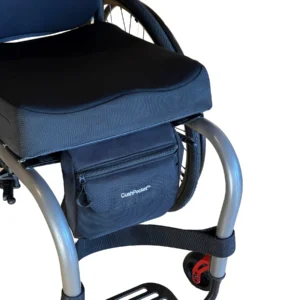
CushPocket wheelchair bag
- Check with your wheelchair manufacturer for accessories such as backpacks, cupholders, and cane holders.
Tips
- Put luggage tags on everything, even your carry-on bags.
- Whenever possible, use a valet service. Always carry cash for tipping.
- To be prepared for minor luggage snafus, pack bungee cords and duct tape.
Mobility aids
From navigating a large airport or cruise ship to visiting sprawling museums and strollable neighborhoods, you’ll likely walk (or roll) longer distances when traveling than you do at home.
If you are ambulatory and a wheelchair or scooter is an option for you, you should probably bring it, according to Becca Schroeder, OTR/L, an occupational therapist (OT) at the MDA ALS Care Center at Northwestern Memorial Hospital. “That’s always a good idea, if only for energy conservation purposes,” she says.
Gear

Fold and Go power wheelchair
MDA Ambassador Dwayne Wilson, who has Pompe disease and is semi-ambulatory, travels with a 60-pound folding power wheelchair by Fold and Go.
He likes it because it functions as more than just a wheelchair. “I am able to use it as a walker and push it from behind. I can also use it for a comfortable chair at a concert or a restaurant instead of trying to sit on a hard metal chair that may be too low to the ground for me to stand up from,” he says. “It is very practical and easy to maneuver in tight spaces like a restroom at an airport, stadium, arena, or amusement park.”
If you don’t have a wheelchair or scooter, consider bringing a lightweight folding stool to sit on when you need a break or are waiting in line. A rollator (a walker with a seat) helps with balance and has a place to sit and rest. Some models fold up compactly.
Tips
- When choosing mobility aids for a trip, consider your needs and the ease of transporting and using them. For example, can you or someone in your party lift a scooter? Does your wheelchair fold to fit in a car trunk?
- When flying with equipment, always review the airline’s rules regarding traveling with mobility and medical devices.
- You may be able to rent medical equipment and have it delivered to your hotel or cruise cabin. Contact a local durable medical equipment vendor or a worldwide company such as Special Needs at Sea before your trip to make arrangements.
- Many attractions (zoos, parks, museums) loan wheelchairs or scooters on a first-come, first-serve basis. Review their websites to see what they offer.
Bathroom concerns
One of the most stressful aspects of traveling is bathroom functionality. Being able to use the toilet and bathe are basic needs. I’ve stayed in hundreds of hotels and encountered a range of issues, even in rooms advertised as accessible, from low toilets to roll-in showers without a seat.
Gear
Becca recommends traveling with a portable commode/shower chair, such as:
- The Go-Anywhere Commode ‘n Shower Chair by Go! Mobility Solutions. A wheeled carrying case may be purchased separately.

Go-Anywhere Commode ‘n Shower Chair
- The Nuprodx MC3000TX model shower and commode chair comes with a rolling travel case.

Nuprodx MC3000TX shower and commode chair
- Consider a travel toilet riser that can fit in a tote bag, such as Earth Throne.
Tips
If you are not ambulatory, airplane lavatories are a major concern. Most plane lavatories (even those designated as accessible) are cramped and have inadequate space for a caregiver to assist. Becca suggests using a portable urinal, catheter, or incontinence products when flying.
Transfers
Hotel beds are frequently a foot higher than the seat of my wheelchair, and lifting me onto the bed is hard for Jim. Traveling with a transfer board has remedied this problem.
Gear
A transfer board aids wheelchair users in moving on and off a bed, getting on and off a toilet, or entering and exiting a car. These boards are lightweight and portable:
- Dolphin Toilet Board

Dolphin Toilet Board
- Beasy Plastic Transfer Boards

Beasy Specialty (bathroom)
For someone who needs more assistance, Becca says a transfer sling, such as the AbleSling Lite, can help with a lateral transfer into a car or airplane seat. The device has several straps and handles, enabling caregivers to lift a wheelchair user.

AbleSling Lite
Tips
Some people travel with a portable patient lift (also called a Hoyer lift) to enable transfers in a hotel room. Many hotel rooms have platform beds, which do not have space under the bed needed for a Hoyer lift. Call the hotel before making a reservation to find out what type of bed they provide (Find more tips and equipment for safe, easy transfers.)
Portable ramps
On road trips, I bring a lightweight, portable ramp in my van. That ramp has allowed me to stay at a charming bed and breakfast, attend a wedding, and visit a friend’s home—all experiences that required negotiating some steps.
Gear
Portable ramps come in various price points depending on the size and material they are made from. Brands to consider include:
- Roll-A-Ramp can be customized by adding or taking away sections.

Roll-a-Ramp
- EZ-Access Suitcase Ramps fold up and have a carrying handle.

EZ-Access Suitcase Ramp
Tips
I rely on family and friends to carry and position my portable ramp. Experience has taught me to buy the lightest weight ramp available.
Embrace the adventure
Carefully considering your options and packing list will go a long way to smoothing your travels.
“Everybody’s needs are so different, so some things might work for some and be totally useless for others,” says Becca. She tells her clients to thoroughly research their destination and find accessible travel Facebook groups and blogs to learn where other travelers with disabilities go and how they handle accessibility issues. (Some suggestions: Curb Free with Cory Lee, Wheelchair Travel, and Wheel the World.)
Jim and I recommend checking with the Convention and Visitors Bureau (CVB) at your destination for upcoming events such as art shows, baseball games, and festivals. CVBs are often a good resource for finding affordable and accessible things to do.
While this sounds like a lot of work, it’s worth it to get out of your comfort zone and experience something new. One study found simply planning your vacation can boost your happiness eight weeks before the travel date.
If you’re not an experienced traveler, begin with a destination close to home. Even a single night away can be fun and a good test run of equipment you will want to bring for a lengthier stay.
The post Essential Gear for Traveling with a Disability appeared first on Quest | Muscular Dystrophy Association.
]]>The post Insights by Ira: A Celebration of the Best of MDA Center Care Physicians appeared first on Quest | Muscular Dystrophy Association.
]]>
Ira Walker lives independently in Florida
Like many others living with muscular dystrophy, the desire for a full life of achievement, comfortability, and independence is present. A life complete with care, community, peace, and accord. A life that contains the level of independence that is most obtainable to our specific situation of life. The life that one desires with a realistic level of independence. Countless numbers of individuals with muscular dystrophy are living proof that it’s possible to achieve these things. I, Ira Walker, am evidence that its possible.
I am a 40-year-old individual with spinal muscular atrophy (SMA) who lives an independent, cosmopolitan life in south Florida, drives a nice vehicle, holds a full-time job in a great career, cooks, stays active, and does it all with a beautiful smile firmly reflected on my face. And this is possible because of those who raise us to see possibilities and have a winning/can-do spirit, it’s possible because of a community that sees our unique gifts, abilities, and talents as value added to the community, and it’s possible due to the MDA care physicians who keep encouragement, hope, and optimism front and center in all conversations while interacting with those with muscular dystrophy. I know this because I have received this support and it has helped me live the life that I am living.
From the time of my birth until my move to south Florida in my late 30’s, I was blessed to receive world class care from one of the nation’s top MDA Care Centers from the physicians at Washington University in St. Louis. From pediatric care to adult internal medicine, the physicians at Wash U provided me with the exceptional, dedicated care and treatment that truly made a difference in my life.
It doesn’t take deep introspection into my journey or my life for me to find a physician that has been paramount in uplifting me, caring for me, keeping me accountable, and demonstrating truly what it means to be the Good Doctor. For me, that individual is Dr. Anne Connolly. During late adolescence and into early adulthood, I had the great honor of having Dr. Connolly as my trusted medical advisor, my healthcare guide, and my doctor. Now, although Dr. Connolly was my neurologist, she was also more than just a physician specialist to me. She truly was the doctor that showed and demonstrated to me what it means to be a physician of class, compassion, empathy, and kindheartedness. Dr. Connolly spent generous amounts of time to get to know me, to see the best in me, and to recognize the value in me. By getting to know me, Dr. Connolly consistently and assertively encouraged me to excel in life and to never stop pursuing my dreams and ambitions that I shared with her. Every appointment and encounter with Dr. Connolly would begin with a big hug from her that would lead to a warm uplifting conversation and the question that she always asked, “Ira, when are you going to find a good woman in your life?” Listen, if Dr. Connolly is reading, I want to give her a quick update and state that some things in life apparently just take longer than others to come into existence…That’s the best response I can give on that matter!

Ira Walker enjoying a open beach cafe.
Dr. Connolly’s gentleness, understanding, and partnership in making certain that she provided me with excellent care, available resources, and love was incredibly valuable to me. To me, she is the paradigm of the Good Doctor. Years have passed since I’ve been under Dr. Connolly’s excellent care, but one thing is certain, Dr. Connolly is truly a large piece of the equation that resulted in my independence.
As of recent, my neuromuscular care has transitioned down to the southern tip of the sunshine state. I’m blessed to now be under the medical expertise and the great medical advisement of Dr. Mario Saporta. Although it’s only been a brief period of time so far that Dr. Saporta and I have shared a patient/physician relationship, it has been clear to me from the start that I’m with the right physician. Dr. Saporta is one of the very best and his remarkable staff of medical professionals at the University of Miami MDA Care Center have quickly taken me in and shown me the superior care that I’m most accustomed to receiving.
In closing, I want to once again thank the many neuromuscular physicians that have entered my life and those who dedicate their careers to care for people in our community. I truly believe that without the compassion, determination, and care of our MDA Care Center physicians, the future for those living with neuromuscular diseases would not be as bright as it is today. These specialists and experts that support and empower us to be our best are undoubtably the cornerstone and the key to a brighter future – and I am so grateful that they are part of mine!
The post Insights by Ira: A Celebration of the Best of MDA Center Care Physicians appeared first on Quest | Muscular Dystrophy Association.
]]>The post Making an Impact on Day 1 of the MDA Clinical and Scientific Conference appeared first on Quest | Muscular Dystrophy Association.
]]>
Donald S. Wood, PhD, President and CEO of MDA
“Let’s take a moment to reflect on our history, to celebrate the groundbreaking progress we’ve made together, and look ahead to the future we are building,” Dr. Wood said. He emphasized the power of collaboration in building MDA’s legacy and keeping progress moving forward. “MDA’s role as a convener in the neuromuscular space … is essential. Together with you and with our broad and diverse community of MDA families, we create spaces where ideas become action, where research moves from theory to therapy, and where the lives of the people we serve are changed forever, as we have and continue to alter the trajectory of diseases like the muscular dystrophies, Friedreich ataxia (FRDA or FA), ALS, myasthenia gravis, and many, many more.”
Dr. Wood then reflected on the current challenges in the neuromuscular field, including threats to biomedical research funding and infrastructure. Meeting these challenges, he said, requires renewed dedication to collaboration. “It is more important than ever that we, the clinicians and researchers doing lifesaving and life-changing work, join with the advocacy community to protect rights and opportunities for the families MDA serves,” he said. “We must continue our work to advance science, innovate, and bring treatments and cures forward. Families are waiting.”
Award winners
For the first time, MDA presented two awards honoring contributions to neuromuscular research — one to a scientist and one to a community member.

Katherine Mathews, MD, recipient of the 2025 MDA Legacy Award for Achievement in Clinical Research
Nora Capocci, Executive Vice President of Healthcare Services at MDA, introduced Katherine Mathews, MD, the 2025 MDA Legacy Award for Achievement in Clinical Research recipient.
Dr. Mathews, a leader in genetic medicine and pediatric neurology at the University of Iowa, is best known for her early work in helping to pinpoint the genetic cause of facioscapulohumeral muscular dystrophy (FSHD), as well as her work in documenting the natural history of Duchenne muscular dystrophy (DMD), the dystroglycanopathies, and FRDA. She has conducted more than 30 industry-sponsored clinical trials focused on neuromuscular diseases, significantly advancing clinical care and scientific understanding. In addition to her research, Dr. Mathews has played a key role in mentoring the next generation of clinical researchers through her leadership as part of the Iowa Wellstone Muscular Dystrophy Specialized Research Center.
Sharon Hesterlee, MDA’s Chief Research Officer, introduced Donavon Decker, who accepted the 2025 MDA Community Impact in Research Award on behalf of himself and his family.
Donavon and four of his siblings were diagnosed with limb-girdle muscular dystrophy (LGMD) type 2D (LGMD2D). Donavon volunteered to participate in the first gene therapy trial for a muscular dystrophy in 1999, which involved having the therapy injected into muscles in his feet. Later, his sister, June Burney was the first person to receive gene therapy via vascular delivery for muscular dystrophy. Their efforts have led to significant improvements in the understanding of LGMD, and his advocacy has inspired others to engage in and support research for rare diseases.

Donavon Decker, recipient of the 2025 MDA Legacy Award for Community Impact
Donavon gave a fascinating account of his experience in the early clinical trial and the relationship he built with Jerry Mendell, MD, of The Ohio State University, who ran the study. Since then, Donavon has continued to work tirelessly to accelerate research efforts and improve the quality of life for individuals affected by LGMD, including testifying in front of Congress for the MD CARE Act in 2001. He also co-founded Angle Therapeutics, which is working to develop non-viral gene therapy for LGMD.
Donavon concluded by giving the scientific audience his perspective on rare disease: “With roughly 30 million Americans that have rare disease, just think of the number of people that know somebody with a rare disease. I would guess that probably 80% to 90% of the people in this country know somebody with a rare disease and would like to see them helped. We need to have clinics and families contact their congressional representatives. The NIH funding for rare diseases is critical. This is not a handout. It returns approximately $2.50 for every dollar investment by the government. It creates thousands of jobs, but better yet, it extends thousands of people’s lives.”
MDA Advocacy wins and goals
MDA Advocacy has also had a milestone year. Paul Melmeyer, MDA’s Executive Vice President of Public Policy and Advocacy, took the stage to talk about significant accomplishments in public policy that MDA hopes to accomplish in the coming year.
He started by recognizing the significant achievements made recently in reforms for accessible air travel, newborn screening for spinal muscular atrophy (SMA) — which is now in every state — and community inclusion for people with disabilities.

Paul Melmeyer, Executive Vice President of Public Policy and Advocacy at MDA
For 2025, key legislative initiatives include:
- Enacting streamlined Medicaid coverage across state lines
- Expanding access to genetic counselors and paid caregivers
- Reauthorizing the US Food and Drug Administration’s (FDA’s) Rare Pediatric Disease Priority Review Voucher Program
- Expanding newborn screening for Pompe disease and DMD
However, Paul expressed concerns about potential threats to some of the advancements the community has made, including lawsuits by airlines to roll back new air travel rules and proposed Medicaid cuts, which would impact access to care and home-based community services for neuromuscular diseases.
“We know that Medicaid is the largest insurer covering those with neuromuscular diseases,” he said. “About 45% of those with neuromuscular diseases are covered by Medicaid.”
Paul urged the audience to go to mda.org/medicaid to share their stories of how cutting Medicaid will affect the neuromuscular community. “Our community is sharing our stories, and we ask for you to do the same,” he said.
Keynote address

Robert Califf, MD, MACC, former FDA Commissioner
Keynote speaker Robert Califf, MD, MACC, has had many milestones in his career. A renowned cardiologist and clinical trial expert, he served as Commissioner of the US Food and Drug Administration (FDA) from 2016-2017 and 2022-2025. He is currently an Instructor in Medicine at Duke University School of Medicine.
Dr. Califf outlined the challenges in biomedical research and healthcare, as well as the opportunities.
Challenges, he noted, include that our healthcare system is fragmented and increasingly driven by a focus on profit. On the drug development side, there currently is not a viable financial and organizational model for manufacturing and distributing treatments for rare diseases. At the same time, biomedical research is losing funding and support from federal agencies.
But Dr. Califf pointed out the silver lining among all the challenges: “This is an opportunity, and it’s people like you who can really make a difference, but you’re going to have to get out there and let your voices be heard.”
Bringing people together
The morning’s keynote session ended with a panel discussion featuring Dr. Califf, Elizabeth McNally, MD, a researcher at Northwestern University specializing in cardiovascular genetics and inherited heart conditions; Barry Byrn, MD, a physician-scientist at the University of Florida specializing in gene therapy and neuromuscular diseases; David Allison, CEO of TREAT-NMD Services Ltd., an international organization dedicated to advancing neuromuscular disease research and care; and Timothy Miller, MD, Vice President of Enterprise Science and Innovation at ThermoFisher Scientific.
The panel brought together different perspectives on what is currently working well in the neuromuscular disease field, as well as current challenges and solutions.
It was a fitting conclusion to the opening session of the 2025 MDA Clinical & Scientific Conference, which is the largest global gathering of clinicians, researchers, and healthcare professionals from the neuromuscular disease community. For the remaining days of the Conference, participants will attend 39 sessions led by some of the world’s foremost experts in neuromuscular disease. They’ll learn about groundbreaking research through the sessions, with 263 in-person posters, 379 virtual posters, and 56 oral poster presentations provided at the Conference. And, they will have opportunities to meet other clinicians and researchers and build new collaborations to keep the momentum of neuromuscular research progress going.
The post Making an Impact on Day 1 of the MDA Clinical and Scientific Conference appeared first on Quest | Muscular Dystrophy Association.
]]>The post Celebrating 25 Years of Impact: MDA’s Wings Over Wall Street Gala Honors Leaders in ALS Research and Advocacy appeared first on Quest | Muscular Dystrophy Association.
]]>Set against the vibrant backdrop of New York City’s Edison Ballroom, this year’s event recognizes Dan Doctoroff, who will receive the Spirit Award, and Dr. Michael Benatar, the recipient of the Diamond Award. Their contributions to ALS research and advocacy embody the relentless spirit that defines this event.
Dan Doctoroff: A Leader, Advocate, and Inspiration

Dan Doctoroff and his family.
Dan Doctoroff, former Deputy Mayor of New York City for Economic Development and Rebuilding under Mayor Michael Bloomberg, is a titan of urban development. Doctoroff is being honored with the prestigious Spirit Award. This accolade is reserved for people who have demonstrated extraordinary commitment to eradicating ALS through advocacy, awareness, and fundraising. Born out of the loss of his father and uncle to the disease, Doctoroff founded Target ALS in 2013 to break down barriers to ALS research to find effective treatments. Doctoroff was diagnosed in late 2021 and has become a driving force in ALS research, channeling his experience in leadership and public policy to accelerate scientific advancements and push for critical funding. Driven by Doctoroff’s leadership, Target ALS has fueled breakthroughs in the space by funding unprecedented collaborations between academia and industry, enabling access to critical scientific tools and resources, and conducting ALS research across the globe. Over the 11 years since Target ALS was founded, he has raised $350 million. His resilience and determination reflect the core values of the Wings Over Wall Street mission, and his contributions will have a lasting impact on people diagnosed with ALS. “I won’t stop until I can’t anymore. I’m dedicating my life to battling this disease,” said Doctoroff, founder of Target ALS.
Dr. Michael Benatar: Advancing ALS Research

The Diamond Award, named in honor of Wings Over Wall Street co-founder Toni Diamond, is awarded to a scientific leader dedicated to the eradication of ALS. This year, the honor goes to Dr. Michael Benatar, whose groundbreaking work in ALS research has paved the way for the new frontier of ALS prevention and the use of biomarkers to accelerate ALS therapy development. His dedication and innovative research approaches have helped bring forward promising therapies that offer hope to individuals and families affected by ALS as well as those at elevated genetic risk for ALS.
“As we continue the urgent search for new treatments and a cure, it is also essential that we focus on strategies to intervene therapeutically as early as possible, ideally even preventing ALS before symptoms even begin,” said Dr. Michael Benatar, professor of neurology at the University of Miami. “By identifying biomarkers that include the earliest biological evidence of disease, we aim to predict who may develop ALS and when. In the same way that we’ve used this strategy to design the first ever ALS prevention trial for carriers of SOD1 mutations, this knowledge could pave the way for interventions that delay or even prevent other forms of ALS as well.”
A Legacy of Progress and Hope
For 25 years, MDA’s Wings Over Wall Street has been a powerful force in ALS fundraising and awareness. With longstanding support of dedicated sponsors, advocates, and researchers, the event continues to contribute to progress toward better treatments and, ultimately, a cure. The funds raised play a crucial role in advancing and sustaining MDA’s groundbreaking ALS research, driving innovation and progress in the fight to end ALS
As we celebrate this milestone anniversary, we reflect on the commitment of those who have shaped the event’s legacy. Their efforts serve as a reminder that together, we can drive real change and move closer to a world without ALS.
“This event is so personal to our family because we have lost loved ones to ALS, a devastating disease. Since we started funding research with Muscular Dystrophy Association, we have seen growth in treatment medications, improved understanding of the disease itself, a hopefulness in the research community that is building, and the satisfaction that we are doing our small part to ensure that the silenced voices of the people who we’ve lost to ALS, or lost their ability to speak are still heard,” said Warren J. Schiffer, co-founder of MDA’s Wings Over Wall Street
How to Get Involved
MDA’s Wings Over Wall Street would not be possible without the generosity of its sponsors, attendees, and donors. Those interested in supporting ALS research and care can participate by attending the gala, sponsoring the event, or making a donation. Every contribution brings us one step closer to breakthrough treatments and, ultimately, a cure.
For tickets, sponsorship, or donations to MDA’s Wings Over Wall Street event, click here.
The post Celebrating 25 Years of Impact: MDA’s Wings Over Wall Street Gala Honors Leaders in ALS Research and Advocacy appeared first on Quest | Muscular Dystrophy Association.
]]>The post MDA Ambassador Guest Blog: Make Sense? Say Yes! appeared first on Quest | Muscular Dystrophy Association.
]]>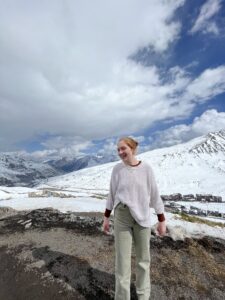
Grace LoPiccolo hiking in the mountains.
When I first walked into Burn Boot Camp, a leading boutique fitness franchise that supports MDA’s mission, I wasn’t sure what to expect, but one thing kept standing out: the trainer always says, “Make Sense? Say Yes!” It’s their way of making sure we’re mentally present and ready to give it our all. And that simple phrase stuck with me because it’s more than just a workout—it’s a reminder to push past doubt, to embrace the challenge, and to always be open to what’s possible. No matter what my body is capable of on any given day, I’m here to say ‘yes’ to showing up, pushing myself, and making it work.
I’ve been living with Charcot-Marie-Tooth (CMT), a neuromuscular disease, for as long as I can remember. It affects my muscles and nerves, but it doesn’t define me. For years, I watched others crush workouts at Burn Boot Camp, thinking it wasn’t for me. I spoke at Burn Boot Camp MDA events and shared my story. However, I stayed on the sidelines, assuming my body couldn’t handle the intensity of the workouts. I was wrong.
Showing up at Burn Boot Camp hasn’t been about the workouts themselves—it’s about pushing myself beyond what I thought I could do. I’m not here to make excuses or feel sorry for myself. I’m here to get stronger, no matter what. And sometimes, that means modifying exercises to make them work for my body on any given day. And you know what? That’s not a setback—that’s smart. Modifying doesn’t mean I’m weak; it means I’m adapting and giving another muscle a chance to shine. Strength isn’t about doing everything exactly like someone else might do it—it’s about doing what works for me, still showing up, and giving my all.
What I love about Burn Boot Camp is that it’s not “one size fits all.” The trainers get it. If there’s a movement I can’t do because of my body’s limits, they consistently offer alternatives without question. It’s never “you must do this”—it’s “here’s how you can adjust.” This isn’t about giving up; it’s about finding what works, and continuing to get stronger, even on days when my body isn’t 100%. The trainers at Burn Boot Camp are my biggest cheerleaders. They don’t just teach the workouts—they honestly want to see each member succeed. Every time I walk into camp, they’re there to encourage me, push me, and make sure I’m getting the most out of my workout, no matter what adjustments I need to make. It’s not about perfection; it’s about progress. They celebrate every win, big or small, and create a space where I feel supported to do my best. Their belief in me fuels my personal belief in myself, and that makes all the difference.

At Burn Boot Camp with family and friends.
And here’s the thing: “giving my all” sometimes looks different than someone else giving their all—and that’s beautiful. My “all” might not look like running a mile or picking up that 50-pound weight, but that doesn’t make it any less powerful. Strength comes in all shapes and sizes, and every time I show up, I’m giving my best for that day. And that’s what matters.
One of the things I love most about Burn Boot Camp is how we celebrate each other’s victories, no matter how big or small. During a recent workout, members were sharing their celebrations for the day—like doing power rolls on the flat floor instead of the ledge. For me, though, I was proud of doing my power roll on the ledge, even though it was what we were technically supposed to do. It might seem simple, but for me, it felt like a huge accomplishment. And when I shared that, I got celebrated too! That’s what’s so special about Burn Boot Camp —the encouragement and the recognition we get from each other, and the way we lift each other up every step of the way.
Everyone is there to push each other, but more importantly, to cheer each other on. High fives, cheers, and words of encouragement fill the room. The energy is contagious. On the days when I’m struggling or feeling like I’m not doing my best, the support I get from others keeps me going.
There are days when I feel unstoppable, crushing every exercise. But there are also days when I need to adjust and listen to my body. And that’s okay. Strength isn’t defined by perfection. It’s about consistency. It’s about showing up, putting in the work, and owning every moment, no matter how I adjust. On the days I need a modification, I’m still moving my body, still progressing, and that’s what matters.
Burn Boot Camp has taught me that strength isn’t just about lifting heavy weights or doing every exercise to perfection. It’s about adaptability. It’s about resilience. It’s about pushing through the hard days, showing up no matter what, and never apologizing for taking the modifications I need. In fact, doing so is a form of strength all on its own.
If you’re out there thinking that you’re not strong enough, not capable enough, or that you have to do everything the way it’s demonstrated, I’m here to tell you: You are strong. Don’t let anything hold you back. The only thing standing between you and your goals is consistently showing up and being willing to do the work, in your own personal way.

Grace LoPiccolo
To anyone with a disability, I want to say: find your place where you’re pushed to keep being better. Burn Boot Camp might not be for everyone, and that’s okay. My dad has CMT, too, and Burn Boot Camp isn’t the right fit for him, but he works with his physical therapist to discover what his body can do and how to continue progressing in ways that work for him. It’s not about forcing yourself into a one-size-fits-all approach. It’s about finding the right space, the right support, and the right people to help you grow and reach your potential. No matter where you are in your journey, remember that your strength is unique, and you have the power to keep showing up and being your best—one step, one rep, and one day at a time.
So, when it comes down to it, showing up and giving my best is what really matters. Whether that’s modifying a move or celebrating a small victory, I’m embracing it all. And just like the trainers say, “Make sense? Say Yes!” – because sometimes, the hardest part is saying yes to yourself. For anyone with a disability or challenge, remember this: say yes to showing up, say yes to progress, and say yes to the strength that lies within you. We are all stronger than we think.
The post MDA Ambassador Guest Blog: Make Sense? Say Yes! appeared first on Quest | Muscular Dystrophy Association.
]]>The post Five Tips to Increase Socialization this Spring appeared first on Quest | Muscular Dystrophy Association.
]]>But human beings need connection, and socialization is a key aspect to overall health and happiness that offers a wide variety of health benefits. In addition to improving mental and emotional well-being and creating a sense of belonging, spending time with others has positive impacts on cognitive function, the immune system, and one’s ability to manage and regulate stress.
These tips can help you find easier ways to increase socialization and connection in your life.
Stick with what you know – and love
Meeting new people or joining a group can feel overwhelming or exhausting, especially the aspect of making small talk. Pursuing groups that focus on your own personal hobbies creates a natural shared interest with others and ensures your own level of interest and engagement. Social media makes it easier than ever to find local hobby groups.
If you love to read, join a local book group. Even if you don’t contribute to every discussion, gathering with the group will still provide socialization and time around others. Groups like this that meet on an on-going basis also foster an environment where you can take your time to get to know others and choose when and how you interact over time.
Many solitary activities and hobbies, like gardening, bird watching, photography, arts and crafts, can be converted into social activities at your own pace by joining interest groups. The basis of friendships is often a shared interest, and joining an interest group introduces you to other people in your community who love the same thing that you do.
If joining an in-person group doesn’t fit your life right now, take a baby-step and join a local online group focused on your hobby. Online community groups provide a forum for discussion and connection – and can lead to in-person activities and gatherings.
Take an activity class
Most local community colleges and many small businesses or venues offer community classes on a variety of subjects. Search local events and your community colleges non-credit course catalog for an activity that interests you. Whether that might be cooking, painting, writing poetry, or any of the other wide variety of hobby classes, by choosing a topic that interests you and gathering in a teacher-led, small group environment, classes alleviate some of the individual work of socialization. A smaller group dynamic can also be less intimidating for people who don’t feel comfortable in large group settings. And you can set the pace and level of your participation to match your own comfort level, while still spending time with others pursuing a shared interest.
Check out local events
Attending local events, especially at a place of interest like a park, museum, or historical site, can provide socialization without requiring as much interaction as a small group or class. Many nature centers, community groups, parks, and local venues host free events to bring the community together or promote programs. Whether it is a Bacon Festival downtown, an evening concert in the park, or an outdoor art show – warmer weather brings more opportunities to gather outside while enjoying outings and events at your own pace.
If there is a ticketed event that you are interested in but can’t afford, consider signing up to volunteer!
Increase community involvement by giving back
Volunteering is a wonderful way to connect with others in your community while also building a stronger sense of purpose and belonging. Volunteering your time and talents to a cause that you care about naturally connects you with others who share your passion and interests. Most organizations assign volunteers specific tasks, making it effortless and easy for you to have a role and a place of meaning within a group or at an event.
Many non-profit organizations, advocacy groups, environment groups, faith organizations, and animal shelters are constantly seeking and open to new volunteers. Whether it is volunteering to promote and facilitate a one-time event, joining a monthly park cleanup crew, or committing to a weekly volunteer shift at a local animal shelter, volunteer opportunities offer a wide variety of options to give back in a way that fits your schedule and interest level.
Working with others towards a shared project or cause provides a natural camaraderie. Whether you are outgoing or more of an introvert, having a role and a purpose within a group or organization that you care about helps to create an organic setting for socialization and meaningful action. And when others rely on you, it serves as motivation to get and stay involved. Additionally, volunteering offers its own slew of positive benefits to your overall well-being! When reaching out to an organization, be sure to share your accessibility needs so that they can find a role that best suits you.
There is no “one-size fits all”
Find your own comfort zone when it comes to increasing socialization in your life. While finding that space may require you to step out of your comfort zone a little at first, finding the level and type of interaction that best suits you is a personal assessment. Maybe you join a book club and find that the group gathering isn’t your speed, but you meet a friend in the group that you can grab a coffee or tea with once a month and chat about books one-on-one. Maybe you think you would prefer a behind-the-scenes role at a volunteer event and then find yourself passionate about doing more and reaching out to others to get involved.
There is no one-size fits all when it comes to building the social life and relationships that you desire – so don’t compare your level of socialization to others. Take the time to think about if and where there are unmet needs for interaction and friendship in your life, and then try something new to fill that need. If the first thing you try isn’t the right fit, try something else. A social butterfly might want three to four engagements on their weekly calendar while someone who enjoys quiet solitude more might be happy and content with a monthly outing. A healthy social life looks different to everyone – but we are all worthy of connection and community.
The post Five Tips to Increase Socialization this Spring appeared first on Quest | Muscular Dystrophy Association.
]]>The post In Case You Missed It… appeared first on Quest | Muscular Dystrophy Association.
]]>With so many valuable podcasts, blog articles, and magazine articles available to our audience, chances are that you may have missed one or two pieces of interesting content. Check out the summaries and links below.
In case you missed it… Quest Blogs:
MDA’s Origin Story: A Grassroots Legacy
As we celebrate MDA’s 75th anniversary, you may be asking, how did this all begin? It’s no surprise that MDA started as a grassroots organization. From the earliest days, our mission has been shaped by the stories and needs of people living with neuromuscular diseases and their families. Take a look back at the impact and innovation over the years. Read more.
Hoyer Lifts and Beyond: Choosing the Right Lift for You
Lifts make transfers safer for everyone. But with so many types of lifts available, how do you choose the right one? These tips and considerations can help you to find the lift that works best for you. Read more.
In case you missed it… Quest Podcast:
Episode 49: Navigating Romance
In this episode of Quest Podcast, we chat with three of our MDA Ambassadors. Nora is a passionate animal advocate and lives with Selenon (SEPN1)-related myopathy (RM). Justin is a disability advocate and an Operations Manager and lives with Limb-girdle Muscular Dystrophy and K.L. is an entrepreneur, poker professional, and influencer living with Spinal Muscular Atrophy. They have each devoted themselves to finding their path in life and advocating and teaching others about their respective neuromuscular disease. While offering unique perspectives on dating and marriage, they join us to share their experiences, expertise and advice when it comes to navigating romance and finding love. Listen here.
In case you missed it…Quest Magazine:
Quest Magazine 2025 Issue 1
Quest Issue 1 is here! Read up on how stem cell innovations are driving advances in muscle regeneration, why you should practice shared healthcare decision making, innovations in GNE myopathy research, how people with disabilities balance benefits and employment, ways to support siblings of kids with neuromuscular disease, accessibility options on your smartphone, how volunteers make a big impact on the MDA community, and more
The post In Case You Missed It… appeared first on Quest | Muscular Dystrophy Association.
]]>The post Quest Podcast: PJ’s Protocol: A Lifesaving Procedure Fueled by Love appeared first on Quest | Muscular Dystrophy Association.
]]>- Please review the PJ Nicholoff Steroid Protocol
- Download the MDA DMD Emergency Alert Card
- Learn more about the history of PJ’s Protocol here.
Read the interview below or check out the podcast here.
Mindy Henderson: Welcome to the Quest Podcast, proudly presented by the Muscular Dystrophy Association as part of the Quest family of content. I’m your host, Mindy Henderson. Together, we are here to bring thoughtful conversation to the neuromuscular disease community and beyond, about issues affecting those with neuromuscular disease and other disabilities and those who love them. We are here for you, to educate and inform, to demystify, to inspire, and to entertain. We are here shining a light on all that makes you, you. Whether you are one of us, love someone who is, or are on another journey altogether, thanks for joining. Now, let’s get started.
For patients living with neuromuscular disease and their families, there are important tactics and strategies unique to these conditions that it’s imperative to be aware of and prepared for in an emergency situation. Specifically for patients living with Duchenne muscular dystrophy, there’s an important protocol we will be talking about today. March marks the 10th anniversary of what has become known as PJ’s Protocol, and today, I have three incredibly impressive guests with me to discuss the protocol. Their credentials are far too many to mention, and you’ll hear more about their accomplishments as the conversation unfolds. But I am truly grateful to each of them for taking the time to be here with me today.
We’re going to jump right in and start with Brian Nicholoff. But first, I want to just thank all of you for taking the time out of your busy schedules to be here with me today. Brian, your passion and powerful advocacy led to the creation of PJ’s Protocol. I know that your son, PJ, passed in 2013 and the protocol in his name was established in March of 2015. It’s now available in several languages and referred to by countless families and physicians in many parts of the world. Can you just share your son’s story with us and how PJ’s Protocol came to be?
Brian Nicholoff: Thank you, Mindy and Dr. Mendell and Amy for being here and sharing this special journey of love, labor of love, with PJ. He passed in 2013. I’m going to try to compress a little bit of this six days from hell. We were down in Florida, and we’re getting ready to go to the pool. And I picked him up to transfer him to the wheelchair, and he kind of, didn’t fall, he kind of sat. And he said, “Dad, I think I broke my hip,” or, “my femur,” whatever. He would know, because he’s done it before on both sides. And I said, “Well, just relax for a minute.” So I picked him up, and when I tried to pick him up, I shattered his humerus bone.
We called emergency, and then, they come by. And this was in Tampa, and they went to Tampa General. And naturally, he had broken his hip, up by the hip joint, or his femur up by the hip joint. And he’s broken every bone in his right leg before, due to the fact of being on prednisone since 1987. Matter of fact, he was in the first prednisone trial at Ohio State with Dr. Mendell, which was 30-some years ago. And so, instead of having surgery there, we transferred him up here to Indianapolis, because we had a surgeon already set that worked with him before. And that was on a Tuesday. And we came up, and he didn’t have surgery until a Thursday. Now, remember that, because that’s about 48 to 50-some hours, where long bone fracture, that keeps on coming up, long bone fracture, which is the humerus and, naturally, the femur.
But he had his surgery, and everything seemed to go fine. And then, Friday, everything seemed to go fine. Saturday, things were different. His heart beat was different, his blood pressure was way low, a lot of symptoms were coming up. And those symptoms were, according to the physicians, it could have been ARDS, it could have been pneumonia, this, this, and that. Never did come up about steroid deficiency or stress dose or anything like that. Why? Because we brought PJ’s Deflazacort to the hospital, gave it to the nurse for them to administer. Okay. They administered the other drugs, because they had them there. They didn’t. So long story short, he had several different tests, and one thing led to another. And he did not survive. About three days later, on a Tuesday, he passed. He didn’t pass in any pain. He was under at that time. He didn’t talk to us for the last three days, because this was all part of, which we learned, part of the steroid adrenal crisis, whatever, all these factors, all these symptoms.
So we immediately came home after he passed and brought his clothes home, and Barb noticed that he didn’t give him any of the pills. That blew my mind. Blew my mind. So we thought about it for a little bit, and we immediately called Dr. Mendell. I might not have this exactly, but we called him and he said, “Well, tell me again.” So I told him what the blood pressures were and the other symptoms and this and that. He said, “Well, can’t make a total definition of it or that, but I would think that that would have something to do with not having steroids.” Steroid deficiency, I believe it was. “Look into that.” And I said, “Well, I don’t know how to look into that.” He said, “Well, call Pat Furlong and Kathi over at PPMD.” That’s why I made initial contact with them. And that led into a total connection that is indescribable, not only with PPMD, but MDA and other organizations, just DMD, just the neuromuscular world in general, the village, it’s really something.
So one thing led to another, and I got the medical records. And I didn’t get all of them. And according to my personal physician, he said, “There should be boxes of those.” So I went back, and I got boxes of those. And my personal physician took about three months to verify that so-and-so was in there, that he signed. So he determined also that it was steroid deficiency per se. I met with the insurance risk people at the hospital, and they declined that. And so, I told them, point blank, I says, “You know, I’ve got the time and the resources to take this to the limit, but I don’t want to do that. I want a win-win-win. I want PJ’s legacy. I don’t want this to happen to anybody again. I want your physicians, your staff, to be educated about DMD and neuromuscular disease and the symptoms of what happens in critical care situations, different things can arise and you’ve got to refer to these and so forth.”
And so, that ended up being passed. Pat and Kathi came over here a couple of times, got it written up. Dr. Mendell was involved with that. Dr. Norris, Norris and several other physicians, and it created PJ’s Protocol, a six-page protocol, which Dr. Mendell will describe more in those terms. And so, that was instituted on March 2nd of 2015, about a year and a half. And I remember when we took it into effect, we had a, not a function, but kind of a release of that. And I remember standing in front of the physicians, Dr. Norris read it and all that, that, “You know, I hope to God, someday, that this protocol will be acknowledged anywhere from Boston to Bakersfield.” And I tell you what, it sure as hell have been a lot more than that. So that 10 years of that has been… I’ve stated this over thousands of times, I’ve got it memorized in my heart of what happened day by day and minute by minute.
Naturally, sometimes, the emotions take over and change that. But to put it in a nutshell, PJ passed, he was failing to a degree anyway. He was 31. His fraction was in the mid twenties. He was obese. His bones were like brittle. They were minus six or something like that. But what a joyful, joyful person. We would’ve never expected that, because we’ve been in and out of hospitals many a times with the surgeries. Everything went well, we came back home, we went through our rehab, we went through all that, and the times just kept on going on. This was different. This was life-altering by all means. But to have people like yourself join this and lead me through this, you’re the wind beneath our wings, Barbara and I. It really is. It’s undescribable of how I can sit here and be in front of you three and the other people and share this situation. And I’m encouraged that it’ll continue on more and more. So PJ is right next to us all the time.
Mindy Henderson: Always. Absolutely. Thank you so much for sharing that, Brian. I know it’s not an easy story to tell. And I have deep admiration for you and your passion that led us to this point. I am going to move to Dr. Mendell now. Dr. Mendell, you have a background that is, Brian’s already talked about it, it’s so important to the neuromuscular community. And I want to share just a little bit about you, if you don’t mind indulging me. You attended medical school at UT Southwestern Medical Center and completed your residency at Columbia University. You also completed a postgraduate fellowship at the NIH, and your first employment provided contact with the first patient with Duchenne, inspiring decades of work as a translational clinician and researcher. Over a 50-year career, you devoted efforts to understanding Duchenne muscular dystrophy and ways to intervene. You are the lead author introducing prednisone for DMD treatment, and the importance of that treatment is validated in over 30 publications.
It’s the standard of care for DMD and led to FDA approval for, I hope I’m going to say these right, Deflazacort and Vamorolone. Your impacts to the DMD community are mind-blowing and your awards are too many to mention, so I’m going to stop there. But Dr. Mendell, for anyone listening, could you give us a little bit of an overview of DMD and how corticosteroids and steroids, I’m not sure if it’s one or the other or both, but come into play with and use for treatment for that condition? What’s accomplished with those drugs?
Dr. Jerry Mendell: Duchenne muscular dystrophy is what we call an X-linked recessive disease. It affects boys predominantly. The remarkable thing is it actually starts in utero before the boys are born. We know that, because they’re born with an elevated muscle enzyme, which tells us that their muscles are already affected. It also manifests by not uncommonly delayed motor milestones, but it’s ignored at that age until about three to four years old when parents want to have some answers why their kids are not playing up or not playing as well with the other kids on the block. And that leads to the diagnosis. So most kids are diagnosed by four and certainly by five years of age, and that’s improved tremendously over the last 10 years, certainly since PJ was diagnosed. And once the disease is diagnosed, the kids now are put on steroids, and we’ll come back to that point.
The steroids, Brian mentioned them all, prednisone, Deflazacort and Vamorolone, and we’ll discuss those a bit more. But any one of those steroids are effective. They have different side effect profiles. And then, about early teenage years, well, actually, before steroids, it was before teenage years, but now that’s been extended to teenage years, that wheelchair dependency comes into the picture. And then, after kids are in a wheelchair, they have a slowly progressive disease that leads with accompanying heart involvement. The heart also depends on dystrophin. Dystrophin is the protein that supports the muscle. It was known first to support skeletal muscle, and now, we know it supports heart muscle and actually even smooth muscle, that is the GI tract is also dependent on dystrophin. And so, with that dependency, the patients really suffer, progressively, their heart becomes more severely involved, develop heart failure, and then, the respiratory muscles are affected and they pass, as Brian described for PJ.
The story of steroids does involve me from very early on. In the late seventies, I was involved with a muscle study group. There were four of us who had been trained at the NIH, and we got together and said that, “There’s no treatment for this disease. Steroids are debated as to whether they can be effective.” And we developed a protocol for a clinical trial. It was a very large protocol for the time. This was 50 years ago basically. And we did a study of 103 actually boys with Duchenne dystrophy, and PJ was part of that clinical trial.
And we did a dose escalation study to establish clearly the dose of prednisone. We found that prednisone was effective. It was debated before that, but now, it showed efficacy, it increased strength, delayed the progression of the disease, and improved the quality of life. Of course, it came with many side effects, and the impact of prednisone was illustrated in many ways. First of all, it was published in the New England Journal of Medicine, which is the highest level of clinical publication recognition you can have. So that kind of spread the word that prednisone was effective.
And then, it led to further developments, and Brian mentioned one was Deflazacort. Deflazacort was introduced because it had fewer side effects and the same efficacy of prednisone. And more recently, Vamorolone, which I’ll mention a little bit later in this discussion, Vamorolone has dissociated side effects or efficacy as we refer to it. Because it preserves adrenal function and doesn’t allow what happened to PJ. So it has merit. So that’s the story of where we are with PJ and how we got to prednisone and potential withdrawal, which we’ll discuss more in a few minutes. So I’ll leave it there.
Mindy Henderson: Perfect. Can you talk a little bit more about PJ’s Protocol and how it’s applied in a medical setting, what parents who may be listening should know about making sure that it’s enacted?
Dr. Jerry Mendell: Well, we know PJ’s story, so I don’t need to reiterate that. But just to emphasize the salient points about PJ is everything was going well with the doctors, but they didn’t have an appreciation for steroids and muscular dystrophy. And that’s not uncommon. That’s why Brian and Barb developed the PJ Protocol. They recognize that other doctors who don’t have much familiarity with Duchenne muscular dystrophy, and remember it is a rare disease, although, over the last 50 years, we have more and more recognition for this, because it’s the most common severe form of muscular dystrophy. But still go to the emergency room, the doctors, they may know a little bit about muscular dystrophy in a generic sense, but they don’t know much about the importance of prednisone within the disease or the other steroids I mentioned, and that these steroids have to continue.
Once you’ve been on long-term steroids, your own source in the body of producing prednisone or its equivalent, which is hydrocortisone, is suppressed. It won’t make it anymore. If it doesn’t make it anymore, you have to take it by mouth or worse, by intravenous, but that’s usually not the case. Usually, you can take it by mouth. And this occurs in any stressful situation, whether it’s emotional stress, surgical stress, dental stress, you can name it. But boys who are under stress need five to 10 times, depending on how much stress there is, five to 10 times the dose of prednisone that they ordinarily get. And in this situation that Brian described with PJ, he underwent major surgery, and we came out of major surgery and his body is expecting to have more steroids and not getting any. So the setting for crisis is set, and that’s what happened.
So we owe a lot to Barb and Brian to develop this PJ Protocol and the people they worked with, he mentioned the private foundations that supported that, PPMD and MDA, and then, other doctors who pitched in to develop the protocol. The protocol is really basically an emergency manual that tells people stepwise how to use prednisone or how to use steroids. It is a six-page document and goes through every phase of what should be done, when it’s needed, and why it’s needed. It’s needed because the body will not produce its own hydrocortisone anymore. It’s needed because if you don’t give it, you go through what’s called a withdrawal or adrenal crisis, and this makes it impossible for these children to survive. So then, it will tell how, the protocol actually is very detailed, it tells how this happens, explains that. It explains what the stress doses of prednisone are.
It explains when it’s needed. It explains how to administer it. Some boys who are under such stress, for example, coming out of surgery, a major surgery, they can’t take oral medication, the doses that are equivalent to what they were taking. It describes the symptoms of withdrawal. And even for doctors who are taking care of patients with muscular dystrophy, it provides test protocols for how to test if a boy is susceptible to developing or susceptible to being dependent on steroids and what doses would make that acceptable in any crisis situation. And then, of course, it describes the adrenal crisis and the symptoms that Brian alluded to, heart rate going up, fever developing, blood pressure dropping, weakness developing, faintness and really essentially passing out. So it describes everything. It’s a critical protocol that PCPs or primary care physicians, especially emergency room physicians and doctors that encounter the boys during their medical care for any, whether it’s mild, moderate, or severe. So it’s critical. And I don’t know if you want to talk about how parents should handle this, but I’ll stop there and give you the lead for the…
Mindy Henderson: Absolutely. Thank you. That was such a great overview. And clearly, this is an incredibly powerful tool for parents to have in their toolbox for their children. If you can believe it, I have one more equally impressive guest that I want to introduce now, Amy Aikins. Amy, you are a board certified patient advocate and were led to your current career from your experience as a mother to a young man also with Duchenne muscular dystrophy. You have unselfishly utilized your personal experience, navigating systems and overcoming barriers for your son in order to assist others. I understand that you’re currently the Director of Patient Access at the Little Hercules Foundation, where you tackle treatment access concerns, through extensive engagement with a variety of stakeholders and involvement in various groups and projects focused on access issues within the rare disease community. Would you please just start by telling us a little bit about your son?
Amy Aikins: Sure, Mindy, and thank you for that introduction. So my son, Elijah, he is currently 20 years old. He’s a high school graduate. And while he does live with Duchenne or DMD, he definitely doesn’t let that stop him from having a full life and doing the things that he loves to do. He’s a rock music lover, just like his mama. He’s a movie buff, a baseball fan, and he enjoys museums and all sorts of community activities in our city. And as a family, we go to many concerts, movies, and baseball games, so we live a pretty full life here.
Mindy Henderson: Fantastic. And Amy, how did you first hear about PJ’s Protocol? And what role has it played in your son’s treatment journey and medical safety?
Amy Aikins: Well, it played a very important role, and I’ll talk about that in a little bit. I first learned of the protocol from Parent Project Muscular Dystrophy or PPMD, that’s now been mentioned a couple times by both Brian and Dr. Mendell. And on one December day, when Elijah was 13 years old, we actually ended up having to use it. So at 13, he fell walking down our hallway, tripped over carpet. And his falls are a common occurrence in Duchenne, especially when our boys are slowing down. Initially, it didn’t seem like a big deal. We thought, “We’ll just rest. He’ll be fine and bouncing back by tomorrow.” Well, that’s not what happened. Several hours following the fall, he was still in a lot of pain and he wasn’t able to bear any weight at all. He felt hot to the touch, and he started to stop making sense when he was speaking, appeared to be passing out mid-sentence. Sound very familiar, just like Dr. Mendell was just mentioning.
At that point, I feared a fracture, as well as FES or a fat embolism syndrome, which can be a life-threatening emergency as well, that results from a fracture. So at that point, we headed straight to the emergency department. We lived in a rural area, so we self-transported. Because we knew we’d have to wait a decent amount of time for an ambulance and we didn’t feel we had that kind of time. Upon arrival at our local emergency department, in that rural community, he had a very high temperature. His breathing was very fast and his heart rate was extremely high. His pulse ox, which monitors blood oxygen levels, was in the mid to upper seventies, and for reference, the normal range is 95 to a hundred. So obviously, that is significantly decreased. He was immediately put on oxygen, blood work was completed, and X-rays were taken. And after the x-rays were read, just as I expected, they informed us that he did have some femur fractures. We later learned that he had three fractures in his femur. At that point, I requested an emergency steroid dose multiple times. The doctor at the rural hospital refused.
At that point, he admitted a transfer to the hospital where our clinic was. And I also put a call into Kathi at PPMD, who really helped me along this process, because this was rather sudden. During the two hour ambulance ride down to our clinic hospital, I was able to obtain a digital copy of the protocol. Upon arrival to the emergency department, I told them that he needed the stress dose of steroid and that the rural hospital had refused to do so. I also told them of my fears of a fat embolism syndrome, also known as FES. I provided them the information on PJ’s Protocol, and they administered the stress dose.
I will say, following that administration, it was pretty much like night and day. His stats and appearance vastly changed for the better, very, very quickly. And that FES, just as a side note, was diagnosed on day two of the admission. Over the course of that hospitalization, I shared the protocol with as many physicians as I could. Some of them had even taken down the link, so they could review it again for themselves and they would have the protocol if they would ever need it again. I will say, had it not been for PJ’s Protocol, I really feel like our outcome could have been substantially different. So I’m very thankful.
Mindy Henderson: Amazing. Thank you so much for sharing that story, Amy. And as a mother, my heart goes out to you and having to live through that, but I think your son is incredibly fortunate that you were his mother and advocated for him in the way that you did. Dr. Mendell, clearly, parents of children with DMD need to have access to the protocol to provide to doctors, but is there any other advice that you can offer parents about preparedness, whether your child with DMD experiences a medical emergency, the type of information you should have prepared and ready or if you’re working even with first responders or paramedics?
Dr. Jerry Mendell: So it’s a tough issue, because you can’t tell people what to do. And it’s frustrating to do that. But I will give advice for this circumstance. And the advice is that the parents of muscular dystrophy, of Duchenne patients, should have the protocol handy. They should have a copy of the protocol. That means that they’ll have the protocol in their home, and I would advise that it could be put in a folder and put in their car, put in the glove compartment of their car. So that there are circumstances that both Amy and Brian described where the necessity for encountering doctors, emergency doctors, providers, who aren’t familiar with the disease and have no idea the importance of long-term steroids, of long-term care when there’s withdrawal at risk, so I would also recommend that they carry a card with them that shows the internet link. So that it could be like a credit card in their wallet, if they go to the emergency room.
And under both the circumstances that were described by [inaudible 00:30:23] and Amy, they could show the first encounter doctors that are not familiar with that this is a necessity, the stress causes the adrenal insufficiency, and we need to have replaced the steroids. So these are issues that I think can best be handled by parents’ awareness. And I don’t want to put more stress on the parents, because this is the very difficult disease to deal with on a day-to-day level.
Mindy Henderson: Brian, turning tragedy into advocacy and creating a safer, better world for people with DMD has impacted so many families, like Amy’s. It’s kind of beautiful that PJ’s legacy lives on in that way. Can you share why you feel it’s important for people to use their stories to create progress and better care?
Brian Nicholoff: We’ve had webinars and conferences in various countries, in various organizations. As Dr. Mendell alluded to, the parents are the biggest advocate, there’s no doubt. Parent’s the one who has to tell the doctor this and that, who has to insist on it. And if things don’t go right, then they need to get ahold of those that can get it done. Some doctors will say, “I don’t need to know that,” but then, they do. That’s when you kind of put the pedal to the metal. You really have to, and Amy did that. Otherwise, those things could have been different. And I’ve got emails and texts and Facebook posts in numerous ways, unbelievable ways, that were very similar to Amy. And they said, “I showed them this. I gave them this. I gave every nurse this. They have them with the teachers at the school. He’s got a hanging card on his wheelchair. We’ve got them in our wallets, we’ve got them on the website.”
Everything. They’ve got it covered. They’ve got it covered, because that’s what can happen in that critical situation. And then, your mind’s not thinking right anyway, you need to relay that information as soon as possible. So for that to happen in this protocol, that’s why we advocate as much as we do. That’s why I’ve been so involved with this over the years, because I know that it can save people’s lives. And it has. And it has, and Amy’s a perfect example of that with Elijah. I’ve got them all over the country. Matter of fact, in a couple of weeks, they’re going to have every attendee, and they’ve done this at various conferences, every attendee, scientific physicians, researchers, et cetera, get the protocol in their attendee bag or whatever.
Mindy Henderson: Amazing.
Brian Nicholoff: It’s been numerous, numerous times it’s been flooded with information about this. So hopefully they use it. Again, it goes back to the parents. Number one advocacy is the family.
Mindy Henderson: Absolutely. And I think Brian, what you’re alluding to is MDA has its clinical and scientific conference coming up in the middle of March. There are going to be almost 2000 researchers, clinicians, scientists, people from pharmaceutical companies. And like you said, PJ’s Protocol is going to be included in their gift bags. The other thing I want to mention is that, in the show notes for this episode, we’re going to make sure to put a link to PJ’s Protocol. And I believe, like Dr. Mendell was saying, we’ve got, on the MDA website, another sort of emergency information card that you can download. So we’ll put links to all of that for people listening to go on and grab. Amy, is there anything else that you would like to add about, you’re such clearly an amazing advocate for Elijah, anything you want to add about the importance of being an advocate for your child?
Amy Aikins: Sure. So I believe that we, as parents, we have to be ready to advocate in multiple areas of our child’s life. With Duchenne being a rare condition, as Dr. Mendell mentioned, it’s not well known by the general public. And this advocacy, I think it really can take forms in multiple things. Everything from educating medical staff who aren’t familiar with Duchenne, like I attempted to do during the emergency department visit and getting down to our clinic hospital, to engaging with school staff, when maybe an approved IEP isn’t being followed, to even an accessibility concern in your community, maybe there’s no ramp to get into a restaurant. And I really think we can’t be afraid to keep just pressing the issue when we know something’s needed or change is necessary.
And then, I also believe that, by advocating and modeling effective ways to advocate, we’re also teaching your children effective ways to advocate for themselves. Because let’s be honest here, Duchenne is a condition that’s going to require a lifetime of advocacy. And as a parent, you’re not always going to be there a hundred percent of the time to advocate for them. So I think it’s really important that children, even from a young age, learn to self-advocate as well for themselves, and then, as they age, increase the responsibility of self advocating.
Mindy Henderson: Absolutely. You nailed it. So Dr. Mendell, can you tell us a little bit about some of the newer treatments that are available to people living with DMD?
Dr. Jerry Mendell: Well, things are advancing very rapidly in Duchenne muscular dystrophy field, and we are very grateful for that. We’re talking about steroids, so let’s open up that discussion first. There’s a new drug called Vamorolone. Vamorolone is what we call a dissociative steroid. That means that we separate now the anti-inflammatory component of the steroid, the prednisone, from the adrenal function, so that adrenal function is now preserved. And we can achieve the same benefit of prednisone, but not have the adrenal crisis, because the body doesn’t shut off hydrocortisone or the steroid from it. And at the same time, it can do everything that Brian alluded to. It can preserve bone health. Bone health is very important, so we don’t have kids who have multiple, multiple fractures. So that is one important development. Number two, we have another drug called givinistat. Givinistat is a drug that promotes muscle regeneration, and it prevents one of the complications of steroids and of the disease in general that we fear very greatly, and that is fat infiltration, fat replacing muscle and scar tissue replacing muscle. So givinistat has that potential benefit.
Then we have another group of drugs called exon skipping, and the concept of exon skipping is relatively simple in one sense. Of course, technically, it’s complicated, but it means, if you have a mutation, these drugs can skip over the mutation. If they skip over the mutation, then dystrophin, the vital protein for muscle, can still be produced. And in the past, we have had three acceptable exon skipping drugs. Now, we have a new one called Viltepso, that skips exon 53. So the mutation is in exon 53. It’ll skip over that. The problem with exon skipping is it can’t be applied to all patients. It can only be applied to about 30% of the Duchenne population. Then we move on to gene therapy, which is something I’ve worked on for the last 25 years. And we now have a drug that’s successful called Elevidys, which is successful in the treatment.
And it is beneficial in the sense that it can slow the progression of the disease. It doesn’t cure the disease, but it definitely slows the progression, improves the quality of life, and it’s the best drug that we have for the treatment. Now, in that same sense of gene therapy, there are two more developments that could be very important that are improving on the gene therapy, that potentially improve on Elevidys. Elevidys is approved by the FDA and available to all patients who have Duchenne dystrophy. But these drugs are in clinical trial. One is produced by REGENXBIO, and it is one that allows for a slightly different form of the gene that’s put in. The gene that’s put in by REGENX includes the final component of the gene. The final component is called the C-Terminal. And the C-Terminal potentially improves gene expression and improves the quality of the dystrophin that’s produced.
We’ll have to see. It’s in clinical trial. The second one is also in clinical trial, and it’s produced by Solid Biosciences. And this is an important one, because it improves the delivery of the gene. And so, it changes the capsid of the virus, which is where you put the gene into the virus, and it can hold a different transgene. It can allow for greater transgene expression, in other words, dystrophin expression. So we have many advances now, and we’re really waiting for these new drugs to be fully tested in clinical trial. And we’ll continue to improve the picture. So things are looking very good, and as I like to say, this is helpful, if you’ve been around long enough, you can appreciate this statement, this helps Jerry’s kids, if you understand what that means.
Mindy Henderson: Yeah.
Brian Nicholoff: Yeah.
Dr. Jerry Mendell: All right.
Mindy Henderson: Well, it’s funny that you bring that up, because of course, MDA is celebrating our 75th year this year. And so, I think there are a lot of people out there who know that reference. Boy, I wish I could live inside your brain for a day, Dr. Mendell. It’s absolutely fascinating, the things that you talk about. One question, obviously, each patient needs to be evaluated independently, but theoretically, some of the drugs that you mentioned or therapies that are available today, can they, again, theoretically, be taken simultaneously and used to address different pieces of the condition?
Dr. Jerry Mendell: Different pieces of the…
Mindy Henderson: Well, can they be taken simultaneously, I guess, it’s really the question.
Dr. Jerry Mendell: Well, I’ve been in this healthcare provider business for more than 50 years, as we’ve stated a number of times. And I saw my first patient with Duchenne muscular dystrophy in 1969, when I was at NIH in a postdoctoral fellow. And at that time, there were no treatments. And I made a commitment to myself that I would do everything I could over my lifetime to make a difference. And in that way, I was involved and instrumental in bringing prednisone on the clinical market, bringing exon skipping on, and bringing gene therapy on. And all these improvements have merit, but they fail in one regard, they don’t cure the disease. We have to have treatments that cure the disease, and we’re working on that. And those advancements are also taking place. So we’ll never be completely satisfied until we have a cure for Duchenne muscular dystrophy, and we’re on the way to achieve that. So I think that’s where I can end my contribution to this. But I appreciate being asked to participate in this podcast.
Mindy Henderson: Absolutely. Thank you. And Amy, for parents of newly diagnosed children who may be listening, what advice can you share, anything that’s helped you and your family along your journey?
Amy Aikins: I think the best piece of advice that I could share would be to find your tribe, so to speak, parents who are walking the same path. I actually have an amazing group of Duchenne parents that I interact with on an almost daily basis. And sometimes, I don’t know what I’d do without them. We’re spread through the country, but the distance doesn’t matter. We lean on each other and learn about navigating the condition itself by sharing our stories and learning from each other.
For local resources, I’d suggest finding a group that supports the special needs folks in your community. And it doesn’t necessarily have to be Duchenne specific to find community resources. These folks will help you learn about what services and supports are available in your area that you live in, such as Medicaid or Medicaid waivers. And if you can’t find one or one just doesn’t exist, there are a few Duchenne organizations who also assist with resource navigation. I guess, as a final, I’d also like to add to not get tied up on social media, comparing what other individuals and families are doing. A friend just recently reminded me that comparison is the thief of joy, and really just to keep in mind that what’s right and what’s good for somebody else might not be right for you and your family. And your family and your child will forge their own path, so just to keep that in mind.
Mindy Henderson: That’s great advice. And Brian, I’d like to give you the last word. What would you like to leave everyone with today?
Brian Nicholoff: Well, first of all, Amy, we’ve met each other on a few occasions. It’s always been with an organization and such, and I consider you a good friend. I know you’re one heck of an advocate for the disease. You live it every day. You stated something very important as find your team, find your village, reach out, communicate. Conceiving plus believing equals achieving, and if good is enough, better is possible. And that’s what Dr. Mendell says all the time. I want to reach out to you, one thing, Dr. Mendell, I met you in June of ’87 at OSU. PJ was on the first prednisone trial. He had a second biopsy done through you, okay?
Dr. Jerry Mendell: Wow.
Brian Nicholoff: He started out at, oh, I don’t know, eight, 10 milligrams of prednisone, ended up at 51 Deflazacort. We’d come there every quarter. It was 181 miles one way, with Wendy and with Linda. And you would say, and you didn’t have anything but, “Keep it going, this and that,” there was nothing to really hold your hat on, except the prednisone. And look where we are now. And that’s what I tell people who just recently found out that their son’s been diagnosed or whatever. “What do I do?” Et cetera. Find a group, find an organization. And like Amy said, because it works for you doesn’t mean it works for them, whatever. You will get the feeling of that. Dr. Mendell, I’ve got to say that at ’19 or 2016, I came by and saw you at Nationwide, and you said, “Come here.” I went into your office, and you said, “Let me show you this picture.” And it was of a young girl, about two years old, maybe less. And he says, “See this? Her head’s floppy.” And he says, “Now look it. It’s not.”
He says, “That’s SMA.” And he says, “I know,” he looked at me in the eyes, he says, “I know that Duchenne can have a cure too. I know we can do this for Duchenne.” So you’re one of the most highly respected, knowledgeable individuals, humans that pioneer with neuromuscular disease that anyone could imagine. And I am more than, more than grateful and indebted you forever for what you’ve done for the community. Mindy, I’ve only known you a couple hours. What you do for Quest Magazine and what the advocate you are for disabilities, you’re talking earlier about airlines, disabilities, and so forth, you’re a total inspiration. You’re a total inspiration. And I’m so grateful to each one of you for this opportunity. That’s all I can say. I’m very grateful and very hopeful for the future, very hopeful for the future, not PJ’s Protocol, because that’s going to go on and on and on. That’s going to keep on building. It’s what we start now that builds up. Like Dr. Mendell referred to, there’s a lot of things in the oven, that’s going to come out baking, there’s a lot of things happening. That’s it.
Mindy Henderson: Well, thank you for that. That was a beautiful tribute to each of the guests that we have here today. And I would like to just reiterate my gratitude for all of you being here today, and I echo your sentiments, Brian, there is no community like the neuromuscular disease community. It’s like nothing I’ve ever been a part of before in my life. And that all of the scientists, clinicians, medical professionals, I include in that community. It’s, I think, one of the true gifts that comes from all of this. And so, thank you all for being here. I know that there are people out there listening who needed this information. And like I said, we’re going to put all of the key links and things, resources into the show notes, so people can grab all the information they need. Thank you so much.
Brian Nicholoff: Thank you, Mindy, for everything you do. Appreciate it.
Mindy Henderson: Thank you for listening. For more information about the guests you heard from today, go check them out at MDA.org/podcast. And to learn more about the Muscular Dystrophy Association, the services we provide, how you can get involved, and to subscribe to Quest Magazine or to Quest Newsletter, please go to MDA.org/Quest. If you enjoyed this episode, we’d be grateful if you’d leave a review, go ahead and hit that subscribe button, so we can keep bringing you great content. And maybe share it with a friend or two. Thanks everyone. Until next time, go be the light we all need in this world.
The post Quest Podcast: PJ’s Protocol: A Lifesaving Procedure Fueled by Love appeared first on Quest | Muscular Dystrophy Association.
]]>The post MDA Ambassador Guest Blog: Finding My Way to a Sober and Healthy Way of Living appeared first on Quest | Muscular Dystrophy Association.
]]>We all go through things in life that shape us and make us who we are today.

Attending the MDA Toast to Life Gala before delivering the event’s mission speech
I truly feel like I have been 100 different versions of myself throughout my adult life. Learning so many new lessons and absorbing so much new information throughout each year. I started working at my first job when I was 14 years old, sometimes having two jobs at a time throughout high school. I also started drinking alcohol and partying with my friends at that same age. Drinking became an escape for me and my relationship with alcohol continued into my adulthood. When I was diagnosed with muscular dystrophy my career as a hairstylist had just taken off.
Fast forward a few years, I had ended up living back at my parent’s house after living in Los Angeles for three years. I had to abandon my dream of being a hairstylist and get on SSDI as my body could no longer endure the physicality of being on my feet all day. Depression and mourning what my life “could have been” set in and I began drinking even more often. I always knew drinking was problematic for me, and I would likely have to give it up at some point, but it took many years for me to get there.
The journey to sobriety
I moved out of my parents’ house a few years later and had my daughter Capri in 2018, when I was 27 years old, making my dreams of becoming a mother come true. The second I saw her I knew I would do absolutely anything for her. Nothing can ever compare to the love you feel for your child! However, it took me some time to make the changes in my life that I needed to make for her and for myself.

My mom, Martha, and I at Coopers Hawks a few months into my sobriety journey and my first time taking my power wheelchair out!
I went through some of the toughest times of my life after having Capri, ultimately becoming a single (disabled) mom and moving back into my parents’ house yet again. There were times where I struggled with the will to even live. Drinking became a significant coping mechanism for me. I looked forward to getting into bed at the end of the day and having wine. I felt I deserved it to unwind and decompress after all I had been through. This is a topic I don’t think is openly talked about enough in our community: the sometimes toxic things we do to cope with our disease and what we go through day to day. There is always a real sense of mourning, that if not processed in a healthy way, can be excruciating and so harmful to our wellbeing. I was losing every sense of who I was. The guilt I lived with was constant because I was in a vicious cycle. I was really struggling with my will to live, but then I remembered the saying “you would die for your child but would you LIVE for them?”.
I was at a crossroads, and I had a real sense of clarity. I knew I had to make a change, first for myself but also for my daughter who needs me! So I said goodbye to alcohol and my unhealthy drinking habits. I have been sober since August 8th, 2022.

Having a cappuccino a few months into my sobriety
My dad suffered from alcoholism; it has been a long generational disease on both sides of my family. He stopped drinking when I was 8 years old and has been sober for nearly 30 years now. My dad made up his mind to cut out drinking from his life and achieved that through dedication and willpower. That is something that has always inspired me about his strength, it also really encouraged and propelled me to be able to do the same. I read the book “This Naked Mind: Control Alcohol, Find Freedom, Discover Happiness & Change Your Life” by Annie Grace. It helped me tremendously and I always recommended it to anyone who struggles with their relationship with alcohol. I also used the Reframe app to track my sobriety and learn coping techniques; and I started going to therapy to work on healing and processing traumas and triggers.
Clean (and happy) living
The journey has not been easy, but it has opened up my life in so many ways! Mocktails have become my new best friend and so has an overall healthy way of living. I am fully invested in mine and my daughter’s health. Sobriety and working on clean living in all aspects of my life has improved my mental and physical health tremendously.

Enjoying a mocktail on my 34th birthday
Trying to live a clean and healthy lifestyle impacts so many different daily choices that we make, but it is easiest to focus on one thing at a time. I really enjoy cooking and preparing meals at at home with the help of my caregiver. We opt to buy organic as much as possible and try to look for foods with minimal ingredients. I do a lot of detoxing to get rid of harmful heavy metals and parasites, as well as keeping my liver and other vital organs functioning well. Staying away from endocrine distributors, like fragrance and dyes in skincare and personal hygiene products, is another big health choice that I make in our lives. I also opt for natural fiber in clothing and bedding like cotton, wool, silk and bamboo. I take a good quality CBD capsule daily to help with pain and anxiety, as well as many vitamins and minerals. (It’s important to chat with your doctor and care team to determine which vitamins and supplements are safe and effective for you.)
We live in a world with so much toxicity, we owe it to ourselves to invest in our health and make it our number one priority – and to take the time to enjoy the small things and live one day at a time. The joy is in the journey!
The post MDA Ambassador Guest Blog: Finding My Way to a Sober and Healthy Way of Living appeared first on Quest | Muscular Dystrophy Association.
]]>The post Accommodations and Independence: Spreading My Wings on Campus appeared first on Quest | Muscular Dystrophy Association.
]]>My first year as a commuter student at Lewis University was great. I felt a sense of independence while on campus. There was a lot of freedom, but I also needed to set priorities to ensure that I focused on my studies and earned good grades. During my first year studying Air Traffic Control Management and Aviation Administration, I joined three clubs on campus and met other classmates who were in my program. The clubs I joined are Women in Aviation, the Airline Pilots Association, and the American Airports Association Executives. Even though I didn’t get the “full” freshman experience of college life by living in the dormitories, I still enjoyed my first year.

Sydney Bryant on her Make-A-Wish trip to Hawaii
At college there are so many new opportunities – and choices. If you have a disability, it’s important to reach out to someone in Academic Services. My Learning Access Coordinator serves as my advocate. I shared my needs with her, and she created an accommodation letter for my teachers to request the necessary accommodations in my classes. This includes access to software that assists me with taking notes and scheduling time at the Accommodated Testing Center for my exams. I can request a reader for my exams or extended time if needed. Additionally, my instructors were notified of my closed-captioning requests since I am deaf and have bilateral cochlear implants. I also have the opportunity to register for classes before other students to ensure I get the classes I need. Together, we make sure I have enough time to get from one class to the next.
Since I have a neuromuscular disease, some tasks are challenging for me, including areas of daily living. My mom assists with my personal needs and acts as my caregiver. This was the primary reason I chose to be a commuter student during my freshman year; we did not have a caregiver available for me. I had never had anyone take care of me other than my mother or grandmother. Since I have always had some level of assistance, my mom initially wanted me to have an aide to assist me on campus. However, I was determined to gain my independence as a college student. I wanted to show my mom that I could handle taking care of myself while on campus and was ready for a new chapter on my own.
During orientation week, I had my first test to demonstrate to my parents that I could navigate a different building by myself. I wanted to start fresh as a college student and make new friends. I succeeded! I navigated the campus on my own, which was such a wonderful feeling. I experienced personal growth, and I applied all the lessons my parents taught me, earning A’s and B’s during my first year in college.
My parents and grandparents constantly give me advice. Some examples of good advice that come to mind are to advocate for myself, ask questions, think before I say something, read over your work before turning it in, take the initiative to do the things that will make me strong and healthy and lastly, try to make friends. My mom always tells me to advocate for myself and try to be independent. She reminds me that when I advocate for myself or do things on my own and take initiative, it builds confidence.

Sydney Bryant in Hawaii
Now, I am entering my second year and was able to get a caregiver through the Department of Human Services Division of Rehabilitation Services for the school year. I can’t wait to live on campus. With my Learning Access Coordinator’s assistance, I not only received help with my classes but also secured an accessible dorm room. I got a single room that is spacious enough for me to move around in my wheelchair and includes a personal accessible bathroom. Did I mention that my room accommodates my wheelchair and bath chair? Initially, I wanted a roommate, but my morning routine requires a personal care assistant to help me get dressed, and I realized it would be too disruptive to share a room.
My room has everything I need and want, and it feels like my sanctuary. Everything is accessible to me—the desk, bed, and drawers. The building has an elevator.
As someone with a neuromuscular disease, when you’re looking for colleges, ensure they have academic services for students with disabilities and the ability to accommodate your needs. This support makes attending school much easier, and your primary focus can be your studies.
Living on campus this year has allowed me to finally take full advantage of student life. I now hold leadership positions in the clubs I joined during my freshman year. I feel more confident in my independence and look forward to learning and experiencing even more in my junior year. I found it challenging to make friends during my first year because I couldn’t always stay on campus to participate in activities or socialize. However, my friend group has expanded, and I now hang out with classmates on campus —something I couldn’t do as a commuter. The commute to campus, which took 45 minutes to an hour, is a hurdle I no longer face.
In the end, if college is your aspiration, go for it! If there’s a will, there’s a way. Just remember to utilize the academic resources on campus to help you succeed in college.
The post Accommodations and Independence: Spreading My Wings on Campus appeared first on Quest | Muscular Dystrophy Association.
]]>The post From the Ski Slopes to the Spirit of Inclusion appeared first on Quest | Muscular Dystrophy Association.
]]>That began to change around the second grade, when I was diagnosed with Becker muscular dystrophy (BMD). By age 10, skiing was getting harder. My legs fatigued faster, walking in ski boots was draining, and I spent more time in the lodge than on the slopes.
Eventually, I decided I couldn’t ski anymore. It wasn’t the first time my diagnosis would challenge my sense of identity, but it was one of the most profound. I knew about adaptive ski programs that my brother volunteered with many years ago, but I never thought it was for me. Could I really do sports and be active?
Years later, in my 20s, I finally tried adaptive skiing with Seattle-based Outdoors for All. The familiarity of gliding down a mountain came rushing back, but in a new way that worked with my changing body. Adaptive skiing gave me back something I thought I’d lost: the freedom to move and connect with the mountains.
The importance of representation

Sean Marihugh enjoys being an adaptive ski instructor.
The phrase “nothing about us without us” is central to the disability rights movement, and it applies just as much to adaptive sports as it does to policy and advocacy.
I use a sit-ski consisting of a form-fitting seat on top of two skis. I typically ski with someone holding onto the back of my sit-ski — I’m controlling my turns and the path down the mountain but have support from a ski partner when I need it. Advancing to a level of competition is a common path for athletes, but because I don’t ski independently, it is closed off to me. I remember feeling discouraged after I began adaptive skiing, not sure what my path was or how I could continue developing in my sport.
Along the way, I realized that I rarely saw people “like me” as instructors or leaders in adaptive programs. The instructors I saw were skilled and passionate, but their lived experiences didn’t always align with those of the athletes they coached.
This is where I found my motivation to become an adaptive ski instructor. Even though I couldn’t ski competitively, I could be the mentor I wish I had all those years I didn’t ski — someone to show me that I do belong on the mountains.
When athletes see instructors who share their lived experiences, it’s easier for them to imagine what’s possible for them. It’s not just about teaching technique; it’s about showing people that they, too, can be athletes.
Connecting through experience
As an instructor with a disability, I can relate to athletes in unique ways — not only do I understand the mechanics, but I’ve been where they are. I’ve been anxious to try something new and learned to use my body in a way that felt foreign. I also know the joy of breaking through those feelings.
Each person’s body is different, and I love the creativity this inspires. Experimenting with new equipment and methods opens limitless possibilities to find what works. With BMD changing my body over time, I’m always in learning mode. Yes, it’s often scary and uncertain, but it’s rewarding to try something new and succeed at it.
Instructing has reminded me that the outdoors is for all of us — disability just means we experience it in unique ways. The best instructors, with and without disabilities, are the ones who want to understand you — how you learn, what motivates you, and the value of your lived experience with disability.
Building an inclusive future
Adaptive skiing gave me back something I thought I had lost, and becoming an instructor allows me to help others find that same freedom. But the work doesn’t stop there. The culture of these programs and the equipment available must evolve to include more voices and perspectives from the disability community.
That’s why I’m excited about the future of adaptive sports. Innovations like the TetraSki, a joystick-controlled sit-ski, are making skiing more accessible. These innovations can help people with neuromuscular diseases discover new ways to experience the mountains.
But inclusion isn’t just about tools; it’s about ensuring that the culture of adaptive sports reflects the community it serves. To bring more people to adaptive sports and the outdoors, we need more people “like us” to shape the direction, tell our unique stories, bring our creativity and passion, and demonstrate the joy of pushing our limits in new ways.
Representation isn’t just about individual moments; it’s about creating a culture of inclusion. When people with disabilities are in leadership roles, we create opportunities for others to see themselves as more than just participants.
When we say “nothing about us without us,” it’s not just a phrase — it’s the path to a more inclusive future.
Sean Marihugh, 32, has spent his career working in accessibility based on a fascination with how people with disabilities use technology. He is also a ski instructor, accessibility consultant, cat dad, and writer.
The post From the Ski Slopes to the Spirit of Inclusion appeared first on Quest | Muscular Dystrophy Association.
]]>The post Why You Should Practice Shared Healthcare Decision-Making appeared first on Quest | Muscular Dystrophy Association.
]]>“It used to be that you went to the doctor, and the doctor told you what you were going to do,” says Matthew Harms, MD, a neurologist and Director of the MDA Care Center at Columbia University. “Now, the best healthcare comes when the patient is in the driver’s seat, and their route is informed by the information they receive from their care team.”
This concept of putting the patient in the driver’s seat is known as shared decision-making. It is a collaborative approach where individuals and their healthcare providers make decisions together, considering medical evidence and the patient’s personal preferences, values, and lifestyle.
In neuromuscular disease care, this approach is especially critical given the progressive nature of these conditions and the frequently changing landscape of emerging therapies and clinical trials.
Benefits of shared decision-making
Research has shown that shared decision-making is especially beneficial for those with ongoing medical conditions.
For example, a 2017 study published in the journal Circulation: Cardiovascular Quality and Outcomes found that people with heart disease who went through shared decision-making had better physical and mental health, better medication adherence, and lower hospitalization and emergency department use rates.
Neuromuscular conditions often require complex, ongoing management. This makes shared decision-making more than a nice-to-have; it’s a must-have for effective care.
“When you introduce choice to a family, and they have time to consider the options, their ability to follow through on a plan improves significantly, leading to better outcomes,” says Saunder Bernes, MD, a pediatric neurologist and Director of the MDA Care Center at Phoenix Children’s Hospital.
This collaborative approach fosters trust and a sense of empowerment. It also accommodates individuals’ and families’ diverse needs, such as scheduling flexibility for multidisciplinary care.
“Not every family can manage a full day of appointments,” Dr. Bernes says. “Shared decision-making allows us to adapt care plans to their unique circumstances.”
Key areas of care
Along the neuromuscular disease journey, families face many difficult decisions. Here’s how shared decision-making works in some common areas of care.
1. Treatments and therapies
Treatment options for neuromuscular diseases vary in their administration, side effects, and lifestyle implications.
“For milder forms of spinal muscular atrophy (SMA), for instance, one medication requires spinal tap administration while another is taken orally every day,”
Dr. Harms says. “Patients must weigh factors like convenience, potential side effects, and long-term implications to make an informed decision.”
Receiving clear information about the risks, benefits, and practical aspects of each option is essential. Dr. Harms advises telling your healthcare team if you don’t understand something. They should welcome questions and provide as much information as you need to fully understand your choices.
2. Surgeries
Surgical interventions, such as scoliosis correction or gastrostomy tube placement, can address symptoms or improve daily life but require careful deliberation.
“Families need to understand the natural history of the disorder and the expected outcomes of surgical procedures before making decisions,” Dr. Bernes says.
Shared decision-making ensures that surgical recommendations align with the individual’s goals and lifestyle.
3. Palliative care
Palliative care is often misunderstood as being synonymous with end-of-life care. However, with neuromuscular diseases, it encompasses symptom management and support to improve daily living throughout the course of the disease. For example, palliative care may involve treating pain and depression or addressing sleep issues.
“It’s crucial to introduce palliative care discussions early, so families understand it’s part of ongoing care, not just for advanced stages of the disease,” Dr. Harms says.
This proactive approach demystifies palliative care and integrates it seamlessly into the overall care plan.
4. Clinical trials
Participating in clinical trials can provide access to cutting-edge treatments but sometimes involves significant commitments.
“We discuss alternatives to participation, the potential burdens of travel, and the risks involved, ensuring patients and families are fully informed,” Dr. Harms says. He generally begins the conversation during a clinic visit and then dedicates time to address families’ follow-up questions.
Your healthcare providers can also alert you to other opportunities to participate in research, such as natural history studies that track the course of a disease, which may lead to better treatment. It’s important to have all the details and know what to expect before joining any research study.
The value of specialized care
Neuromuscular specialists, such as those available at nearly 200 MDA Care Centers nationwide, are a vital resource for patients with neuromuscular diseases. These providers offer access to multidisciplinary teams of experts, advanced diagnostic tools, cutting-edge treatments, and more. Beyond medical care, specialized providers also provide access to social work services, mental health support, occupational therapy, and resources for durable medical equipment.
“It’s more than just managing the symptoms; it’s about slowing the disease progression whenever possible,” says Nora Capocci, MDA’s Executive Vice President of Healthcare Services. “Bringing in all the experts, having access to the latest research and clinical trials, and providing that full wraparound support is crucial to ensuring our community members receive the best care possible.”
This holistic model is essential for managing the complexities of neuromuscular diseases.
“Often in caring for these patients, when you pull on one string, it affects another,” Nora says. “They’re so much more than their neuromuscular disease; they’re a whole body, a whole person, and a knowledgeable specialist can provide care.”
Currently, there are MDA Care Centers in 46 states, with over 3,200 providers who saw more than 70,000 patients in 2024.
Best of both words
Shared decision-making is not just a method — it’s a mindset that places individuals at the center of their own care. It respects their autonomy while leveraging the expertise of specialized healthcare teams to deliver the best possible outcomes.
“Neuromuscular disease treatments and interventions are evolving extraordinarily quickly,” Dr. Harms says. “Specialists have insider knowledge of developments long before they’re widely available, ensuring patients get the most up-to-date care.”
By fostering open communication, building trust, and aligning care with individuals’ goals, shared decision-making creates a supportive environment where the individual feels empowered to navigate the challenges of their neuromuscular disease with confidence.
“There are so many different choices now — what to do, when to do it, how safe it is — that there’s no way of proceeding without making decisions together,” Dr. Bernes says. “It’s about giving patients options and then giving the family time to decide based on their socioeconomic status, personal beliefs, where they live, and more. There are so many issues that come up, and it’s our job to help them navigate, not tell them what to do.”
Meredith Landry is a journalist focusing on health and sciences.
7 Reasons to Choose a Specialized Healthcare Provider
For people living with neuromuscular diseases, having a neuromuscular specialist is invaluable. Matthew Harms, MD, a neurologist and Director of Columbia University’s MDA Care Center, shares several reasons why:
- Expertise beyond medicine. “When a care specialist sees hundreds of individuals with a particular disease, they pick up some things you won’t find online about care hacks or best practices. They’ll have insider information on which brands of equipment actually deliver, and which ones have higher repair needs.”
- Up-to-date knowledge. “Neuromuscular disease treatments and interventions are evolving extraordinarily quickly. Care specialists are the ones who will have heard about those developments long before they’ve managed to make it to the internet, and usually with more accurate information.”
- Tailored treatment plans. “As physicians or clinic care team members, we don’t know what might be doable or possible with the amount of time you have, the amount of caregiver support you have, or what else you’re trying to accomplish. However, because of our breadth of experience in the space, we have a lot of experience in being creative and flexible.”
- Access to clinical trials. “We tell our patients about studies they may qualify for in as unbiased a fashion as possible. We go over the alternatives, the relative risks, the burden on their time, and other factors to help them think through the options.”
- Proactive palliative care. “Palliative care is something that should be taking place all along the disease severity spectrum. It’s extraordinarily important and gets far too little attention.”
- Continuity of care. “One reason to continue seeing your neuromuscular specialist on a regular basis is to stay connected to the art and evolution of medicine for your disease.”
- Telehealth and accessibility. “We are seeing patients in clinic less frequently, but we’re seeing them in their homes more often. Many times, we can do 90% of what we need to do virtually instead of in person.”
The post Why You Should Practice Shared Healthcare Decision-Making appeared first on Quest | Muscular Dystrophy Association.
]]>The post Milestone Moment: A Look Back at the First Gene Therapy Trial for DMD appeared first on Quest | Muscular Dystrophy Association.
]]>
Jerry Mendell, MD (second from right), led the first clinical trial for a DMD gene therapy.
The trial, led by Jerry R. Mendell, MD, Professor of Pediatrics and Neurology at Nationwide Children’s Hospital and The Ohio State University College of Medicine in Columbus, Ohio, focused on gene-based approaches to restore dystrophin protein production. In DMD, mutations in the dystrophin gene cause a lack of dystrophin protein, which muscle cells need to stay intact.
Dr. Mendell and his team showed that it is possible to use gene therapy to target the disease-causing gene. This success set a new course for treatment possibilities. Today, gene-based therapies, including exon-skipping drugs and advances in gene-editing technologies, owe much of their progress to the foundation laid by early trials like this one.
Everybody at MDA would like to express our gratitude for the scientists who devote their careers to making this research possible, as well as the individuals and families who participate in studies and clinical trials to advance the development of therapies for the whole community. Because of you, the milestone we achieved in 2006 will continue to benefit the neuromuscular community for generations to come.
The post Milestone Moment: A Look Back at the First Gene Therapy Trial for DMD appeared first on Quest | Muscular Dystrophy Association.
]]>The post Volunteers Make a Big Impact on the MDA Community appeared first on Quest | Muscular Dystrophy Association.
]]>We spoke with Wendi Dressen, MDA’s Senior Director of Volunteer Programs, to learn more about MDA’s volunteer program and its impact.
How did MDA’s volunteer program start, and what do volunteers do for MDA?

Supporters are a vital part of every Muscle Walk.
MDA was started at a grassroots level. Since its inception, volunteers have been involved in raising awareness and funds, including developing partnerships with the National Association of Letter Carriers and the International Association of Fire Fighters. Volunteers would assist with events, office work, retail support, advocacy, the Telethon, MDA Summer Camp — pretty much anything MDA needed.
Volunteers are still involved in many of the same ways, and they are still expanding MDA’s impact and reach. Today, our volunteers help plan and execute our MDA golf events, galas, Muscle Walks, Summer Camp, Family Getaways, and more. They support our retail partners and cheer on athletes raising funds through Team Momentum. And our volunteers continue to advocate in their communities for those who are living with neuromuscular diseases.
Where can we see MDA volunteers at work?
If you participate in any kind of MDA event, you’re very likely to run into a volunteer. Last year, volunteers helped at about 100 unique events. They might be behind the scenes as committee members who help organize and prepare for events or on the front line the day of the event. You might see them at registration, connecting with participants, or staffing silent auctions. Volunteers are involved in lots of different ways.
How do volunteers usually get involved with MDA?

Volunteers make MDA Summer Camp a great time for campers.
Many of our volunteers are family members of someone living with a neuromuscular disease, so they’re very passionate about what we do and about raising awareness and funds.
For events like Summer Camp, some volunteers are looking to gain more experience in their field — they might be going to school for physical therapy, nursing, or research. Some folks come to us because they need to complete service learning hours for their school. We also work with volunteers from corporations that encourage their employees to volunteer. Sometimes, volunteers just want to support their community, and an MDA event happens to work with their schedule. There are a ton of different motivational factors for volunteering.
However they start, we hear many volunteers return year after year.
For a lot of them, once they get involved and see the impact their work has on our community, they keep coming back.
For example, one young man came to us early in his college career needing service learning hours. Years later, he’s still very involved in Summer Camp and our mentorship program. He recently started a new job and told his employer the one caveat is he always has to have the week off for MDA Summer Camp. And that’s not an unusual story. We’ve got some folks who’ve been volunteering at Summer Camp for up to 50 years.
Another great story is a family that had a son with a neuromuscular disease who went to Summer Camp, and he enjoyed it so much that the next year, one of his brothers also went as a volunteer. This continued not just for the camper’s siblings but also for their children. Now, multiple generations of the family have been Summer Camp volunteers, and it’s part of their family tradition.
Are volunteering opportunities accessible for people with disabilities?
As an organization dedicated to serving and empowering individuals living with disabilities, we’re committed to removing barriers to ensure that people can engage in whatever activity they’d like to participate in, including volunteering.
We offer virtual opportunities, and most of our events are wheelchair accessible. We can explore what volunteering looks like for each individual and find something that works for their abilities and interests.
Why should someone consider volunteering with MDA?
A volunteer distributes snacks at a Muscle Walk event.
This is an amazing time to be involved with the neuromuscular community and MDA. There are so many advances in therapies and research that it’s really exciting to be a part of what’s going on at MDA.
Right now, even small volunteer efforts can have a big impact on the community we serve. Our volunteers help raise vital funds for research and support families living with neuromuscular diseases.
We encourage anybody interested in volunteering to reach out and see if it’s a good fit.
Amy Bernstein is a writer for Quest Media.
The post Volunteers Make a Big Impact on the MDA Community appeared first on Quest | Muscular Dystrophy Association.
]]>The post Stem Cell Innovations Drive Advances in Muscle Regeneration appeared first on Quest | Muscular Dystrophy Association.
]]>It was MDA’s inaugural Muscle Regeneration Summit, a first-of-its-kind effort not only to summarize the research to date on regenerating muscle but also to outline strategies currently underway to improve the lives of people struggling with muscle disorders.
It’s not difficult to understand what the ability to regenerate muscle tissue would mean for people with Duchenne muscular dystrophy (DMD), Becker muscular dystrophy (BMD), myotonic dystrophy (DM), and many other conditions that cause muscles to weaken and waste. Everyday tasks would become easier. Overall health, perhaps even greater longevity, might follow. The neuromuscular research community has been discussing the possibility of bringing back deteriorated muscle — but lacking real-world methods to do so — for decades.
“We have been working on this problem for many years now, but it’s clear that there are still things that we don’t understand about muscle regeneration,” says Sharon Hesterlee, PhD, MDA’s Chief Research Officer.
Yet this summer’s Muscle Regeneration Summit ended on a promising note: We’re closer than ever to discerning and deploying the science of muscle regeneration. Much of this optimism has to do with understanding the function of stem cells.
Stem cells and muscle
Stem cells help the human body manufacture new muscle tissue. Whenever you perform a strenuous activity, whether it’s lifting weights at the gym, taking a brisk walk, or doing yard work, microtears form in the muscles. At this point, a specific type of muscle stem cell rushes in to make repairs.
Stem cells are basically primitive cells that can differentiate into more mature cell types. Muscle stem cells are known as satellite cells, and when muscles become damaged, satellite cells wake up and begin replicating. Some of these cells stay behind to make sure the population of satellite cells remains. Meanwhile, the other satellite cells begin to take on features of muscle cells and fuse with the targeted muscle fibers to repair and rebuild it, a process known as myogenesis.
In neuromuscular diseases, this process may be thrown off. For example, in some cases of muscular dystrophy, stem cell function is altered, causing myogenesis to be less efficient. In addition, the muscles are more prone to injury, putting more burden on the satellite cells and potentially exhausting the body’s capacity to repair muscle.
The potential of stem cells
Myogenesis is a process where muscle stem cells repair and rebuild damaged muscle.
Researchers are now looking at ways to use stem cells to drive muscle regeneration. Enhancing the body’s natural ability to build muscle through myogenesis is one option. By stimulating the satellite cells inside the body, the thinking is that enough muscle could be replaced to keep up with ongoing muscle deterioration.
However, a genetic muscle disease poses a problem. “If you are asking a patient with an underlying genetic mutation to generate more muscle, keep in mind that the newly regenerated muscle also harbors the genetic defect,” says Angela Lek, PhD, Vice President of Research at MDA. In other words, the body is regenerating muscle, but not healthy muscle.
Combining muscle regeneration with gene therapy could effectively solve this problem. Imagine someone with myotonic dystrophy type 1 (DM1), which is caused by a faulty DMPK gene. Snipping out or blocking the mutated gene in muscle cells could theoretically allow the satellite cells to regenerate muscle that doesn’t carry the defect.
There are currently only two gene therapies approved for neuromuscular diseases: Elevidys for DMD and Zolgensma for spinal muscular atrophy (SMA). However, many more are in preclinical studies or clinical trials to treat diseases such as limb-girdle muscular dystrophy (LGMD), X-linked myotubular myopathy (MM), and Pompe disease.
The other option discussed at the MDA summit involves transplanting muscle cells that do not harbor disease-causing mutations. In 2012, two researchers were awarded a Nobel Prize for their work on reprogramming mature cells to a more primitive state, called induced pluripotent stem cells (iPSCs). This was a significant breakthrough because it meant that any cell could be extracted from the body and treated in a lab to make it an iPSC. The iPSC could then be differentiated with growth factors to create any mature human cell type. Imagine taking a skin cell from a patient with DMD and creating a healthy muscle cell by correcting the mutation in the dystrophin gene, then transplanting it back into the body to help regenerate lost muscle.
Challenges remain with this approach, too. Getting the new muscle cell to engraft (grow and make new cells in the body) and properly function is a hurdle. Dr. Hesterlee points out that muscle degeneration leads to inflammation in the body, which may disrupt a healthy cell’s ability to settle in and try to repair damage. Dr. Lek adds that engrafted cells may not contribute to regeneration the same way naturally occurring stem cells in the body do.
“It’s the holy grail to transplant into patients healthy stem cells that can regenerate new muscle and also maintain a regenerative pool of muscle stem cells,” Dr. Lek says. “Everybody knows what the end goal is; we just don’t know how to get there yet.”
Signs of progress

Researcher Rita Perlingeiro, PhD, works with muscle stem cells.
Despite the obstacles, there’s great cause for hope on the horizon. Rita Perlingeiro, PhD, is a faculty member at the University of Minnesota Department of Medicine with two decades of research experience in generating muscle progenitor cells from iPSCs. She is also the lead inventor of the MyoPAXon platform for muscle regeneration, licensed by Myogenica, a company she cofounded in 2022. The platform is based on iPSCs that express Pax7, a transcription factor that develops iPSCs into myogenic satellite cells. Animal studies demonstrated that transplanted MyoPAXon cells produced healthy muscle fibers, generated new muscle stem cells, and expressed dystrophin, a protein in skeletal muscle that is lacking in DMD.
A first-in-human phase 1 clinical trial, led by Peter Kang, MD, at the University of Minnesota, is recruiting participants with DMD who are non-ambulatory (not able to walk). This year, the trial will start testing the MyoPAXon platform on a muscle in the upper foot. If it demonstrates MyoPAXon’s safety, the team may move on to tests in other muscles, like those in the hand.
“Of course, as scientists, we really want to target all the muscles,” Dr. Perlingeiro says. “But to make progress, we have to think incrementally and move step by step.”
Keeping the conversation going
MDA is committed to helping researchers further demystify the biological processes behind rebuilding healthy muscle tissue with neuromuscular diseases. As part of this effort, MDA is inviting researchers to submit grant applications for projects that study muscle regeneration. In addition, MDA is fostering more discussions among the world’s foremost neuromuscular researchers, with muscle and nerve regeneration on the agenda during the 2025 MDA Clinical & Scientific Conference.
Dr. Hesterlee and Dr. Lek feel confident that it will not be decades before advancements in stem cell therapies lead to new therapies — ones that empower people with neuromuscular diseases to live longer, more independent lives. It’s also apparent that the expanding scientific knowledge around muscle regeneration has
broad applicability.
“Most of these muscle replacement strategies could be used in any muscle disease,” Dr. Hesterlee says. “If we can figure out how to do this in one muscle disease, we can probably do it in many others.”
Andrew Zaleski is a journalist who lives near Washington, DC. He wrote about living with myotonic dystrophy type 1 (DM1) for GQ magazine.
The post Stem Cell Innovations Drive Advances in Muscle Regeneration appeared first on Quest | Muscular Dystrophy Association.
]]>The post Innovations in GNE Myopathy Research appeared first on Quest | Muscular Dystrophy Association.
]]>In 2001, the GNE gene was discovered to cause GNE myopathy, also called hereditary inclusion body myopathy, distal myopathy with rimmed vacuoles, or Nonaka myopathy. Since then, researchers have learned more about the mechanisms of the disease and are exploring different pathways for potential therapies.
To learn more, we spoke with three researchers at the National Human Genome Research Institute (NHGRI) who are involved in GNE myopathy research: Marjan Huizing, PhD; May Malicdan, MD, PhD; and Francis Rossignol, MD.
What do we know about the cause of GNE myopathy?

Marjan Huizing, PhD
Dr. Huizing: We know that it’s autosomal recessive. This means a person gets the disease if they inherit two mutated copies of the GNE gene, one from each parent. We also know that the GNE gene codes for an enzyme that helps produce sialic acid, a substance found on the surface of cells and proteins. We found evidence that the amount of sialic acid on proteins in muscle membranes is lower than normal in people with two GNE gene mutations. We have also seen in mouse models of GNE myopathy that if we give them sialic acid or N-acetylmannosamine (ManNAc), a sugar molecule that is converted by cells into sialic acid, the sialic acid on muscle proteins and muscle symptoms seemed to improve in the mice. This suggests that sialic acid is an important part of the disease mechanism. However, there might be other factors involved, like problems with how the GNE protein interacts with other proteins or pathways that we don’t fully understand yet.
How does the disease typically progress?
Dr. Rossignol: There’s a wide variability in GNE myopathy — even members of a single family may experience the disease differently. Typically, symptoms start with foot drop, which causes problems with walking. Then there’s progression from the lower to upper legs. We may see weakness in the muscles that help bend the knee or the muscles that move the leg from the hip, but the quadriceps (front thigh muscles) are usually less affected.
About five to 10 years after the leg weakness starts, people may notice upper extremity involvement, which does not follow a clear distal to proximal pattern as in the legs. Weakness may start with the shoulders rather than the hands.
About 10 to 20 years after disease onset, we may see loss of ambulation (ability to walk) and less ability to do activities of daily living. Breathing can be involved as the disease progresses. However, GNE myopathy typically does not affect facial muscles, swallowing, or the heart.
How is GNE myopathy diagnosed?
Dr. Rossignol: Many people go through several diagnoses before finding out they have GNE myopathy. At first, it can seem more like a nerve problem than a muscle problem. Because of the non-specific first symptoms and the rarity of GNE myopathy, some people are misdiagnosed with other conditions first, such as the nerve-related condition Charcot-Marie-Tooth disease (CMT).

Francis Rossignol, MD
Doctors familiar with GNE myopathy may recognize it by noticing the typical symptoms, like foot drop, and the fact that the quadriceps are not affected as much as other leg muscles.
Some doctors suspect the diagnosis when a muscle MRI shows most of the lower limb muscles are affected except for the quadriceps. Doctors who suspect a myopathy may do a muscle biopsy. If the biopsy shows rimmed vacuoles (small holes in the muscle tissue), it’s a strong clue for GNE myopathy.
Currently, most people are diagnosed through genetic testing. This might happen after tests for neuropathies don’t provide answers, leading to broader tests like exome or genome sequencing.
Dr. Huizing: More patients are getting a diagnosis in the last five years, but we think the disease is still underdiagnosed. If we look at mutations that occur in patients and the general exome databases we have access to, we can do a calculation for autosomal recessive disease with the mutations that are occurring in the general population. The prevalence of GNE myopathy should be much higher than the number of patients diagnosed so far.
How are researchers looking for GNE myopathy therapies?
Dr. Huizing: Therapies being tested in clinical trials for GNE myopathy are based on increasing the amount of sialic acid in muscle cells. There have been clinical trials for treatment with the sialic acid molecule in the US and worldwide. In 2024, slow-release sialic acid was approved as a GNE myopathy therapy in Japan. Also, sialyllactose, a highly sialylated protein therapy, was used in a clinical trial in Korea, and the analysis of the results is still ongoing.
Our group at NHGRI is studying ManNAc therapy to enable the body to produce sialic acid. We’ve gone through phase 1 and 2 clinical trials to test ManNAc’s safety and efficacy, and a pivotal multicenter study is ongoing.

May Malicdan, MD, PhD
Dr. Malicdan: Gene therapy efforts are also underway in different stages of preclinical development, but it will still require some time before these therapies can be tested in humans. One big challenge is that there are few patients with GNE myopathy and a small number of doctors involved in GNE myopathy research. Because of this, much of the focus has been on the sialic acid-increasing therapies that show promise.
However, researchers are also considering other forms of therapy. Current studies include looking at how the GNE protein interacts with other proteins and creating simpler animal models or new cell models based on induced pluripotent stem cells (iPSCs) to help test new treatments. These efforts are helping to find more options for future therapies.
What is promising in the GNE myopathy field right now?
Dr. Huizing: The field has evolved into collaborations and sharing resources. You see this happening in many rare disease fields: Different research groups interested in the disease start out competitive. Then, a patient advocacy group brings different stakeholders together and encourages collaborations, sometimes by offering research grants, resulting in interactions and collaborations. That very much happened in the GNE myopathy field, where advocacy groups continue to play a large role in bringing international research groups together.
Amy Bernstein is a writer for Quest Media.
The post Innovations in GNE Myopathy Research appeared first on Quest | Muscular Dystrophy Association.
]]>The post Mashauna Black Keeps Following Her Passion appeared first on Quest | Muscular Dystrophy Association.
]]>Finding a path that fits

Mashauna visited Las Vegas with her cousin.
Mashauna always knew she wanted a career in healthcare, so she enrolled at the National College of Business and Tech in Andover, Virginia, to pursue a degree in nursing. While she was in college and working as a guard at a correctional facility, she began experiencing muscle weakness and pain in her back and hips. After a few misdiagnoses, she learned that she has LGMD.
Mashauna realized that she needed a career path that was less physically demanding, but she didn’t want to give up on her goals. She changed course at school and earned a medical secretary diploma. “I adapted the track I was on so I could still be in the field where my passion is and use my skills to serve others,” she says. “Now, I am still in the medical field, but in a different way, working to help people.”
Mashauna’s muscle fatigue and weakness progressed after graduation, and she began using a cane and wheelchair for mobility. She moved back to Winston-Salem, North Carolina, with her mother and joined her local YWCA, where she built relationships with the staff and other members. Mashauna began working at the front desk, and it wasn’t long before she was promoted to direct the Gateway to Success program for individuals living with diabetes. Now, she uses her passion and skill set to educate prediabetic and diabetic YWCA members about healthy cooking and eating on a budget.
“I am so grateful to be where I am, and I believe God has a plan for my life,” Mashauna says. “Once I found my purpose, it made it so much easier for me to keep going and growing. Getting to see the success of our members and the smiles on their faces when their blood sugar numbers come down, when they step on a scale and have lost a few pounds, when they learn a new dish, or when they bring in a recipe to share with the group is so rewarding.”
Independence and community
Because she was already well-known at the YWCA, Mashauna did not need to decide whether to disclose her disability when interviewing for the position. Her team provides informal support, assisting with transfers to her desk chair and other hands-on assistance as needed. Mashauna drives herself to work with her mother, who also teaches classes at the YWCA, and receives assistance to transfer from the car to her wheelchair. “I can do everything I need to for my job, with or without my wheelchair,” she says. “And I have the support of my ‘village’ of employees if there is a task I cannot do.”
Mashauna values this balance between independence and accepting assistance when needed. She also must balance her health and financial needs with her job. “I know what hours I need to work and how many days I need to work to keep the balance,” she says. “I work four hours a day, three to four days a week, and no more than that. I understand that my body needs to rest, and I also need to keep tabs on how many hours I work to ensure I don’t risk losing my disability benefits.” (Read Ready to Work: How People with Disabilities Balance Benefits and Employment)
Living on her own terms
Pursuing her passion and adjusting her path as her disability progresses has taught Mashauna the value of embracing who she is and everything she can do. When she began using a wheelchair, she worried about what others would think, but she has grown to embrace the mindset that her wheelchair gives her the freedom to pursue work, leisure, and travel.
“It took me a minute to get here, but I learned that I can still do the things I want; I just may have to do them in a different way, and I understand that is OK,” she says. “I may be a bit slower, but I still get out. I travel, I get my nails and hair done, and I dress up. You have to step into your own zone and dig deep — and know you are worth it. We are all made to be different in some way. You don’t have to follow the leader and do what everyone else does. You just have to follow your own passion.”
Rebecca Hume is a Senior Specialist and Writer for Quest Media.
The post Mashauna Black Keeps Following Her Passion appeared first on Quest | Muscular Dystrophy Association.
]]>The post Ready to Work: How People with Disabilities Balance Benefits and Employment appeared first on Quest | Muscular Dystrophy Association.
]]>
Justin Moy gave up some disability benefits to receive a stipend through his doctoral program.
The first step toward his professional dream was to pursue a bachelor’s degree in bioinformatics and computational biology at Worcester Polytechnic Institute in Massachusetts. Because LAMA2 CMD causes severe muscle weakness and contractures, Justin uses a power wheelchair and needs help with daily living activities.
“I can’t transfer from my wheelchair, change my clothes, or go to the bathroom by myself,” says Justin. “To function independently at college without my parents, I had to hire a personal care attendant (PCA).”
Justin needed Medicaid to afford the care he required, and to get Medicaid coverage, he first needed to qualify for Supplemental Security Income (SSI).
“I was on SSI for all four years of my undergraduate career,” explains Justin, who graduated in 2022 and then enrolled in a doctoral program that provides him with a monthly stipend. Because SSI has an asset limit, receiving that stipend required him to surrender his SSI benefits.
“To go into a career that actually makes money, I needed to get off of SSI,” says Justin, who is now a third-year PhD student at Boston University.
Though his stipend disqualifies him for SSI, it luckily does not exclude him from Medicaid in Massachusetts, whose state-run MassHealth plan has a Medicaid buy-in program that allows people with disabilities to earn wages while maintaining their Medicaid coverage.
Not everyone is so fortunate. In many cases, asset limits require people with disabilities to choose between the assistance they need and the self-actualization that comes from employment. If much-needed reforms to disability benefit rules and policies come to fruition, it might one day be possible to enjoy both.
Banking on benefits
Having a disability significantly increases the cost of living. People with disabilities often have higher costs related to food, shelter, transportation, and healthcare. In 2020, researchers working with the National Disability Institute estimated that a household where one adult has a disability that limits their ability to work requires, on average, 28% more income to maintain the same standard of living as a similar household without a disability.

Shannon Wood is the Director of Disability Policy at MDA.
Government-run benefits programs like SSI and Social Security Disability Income (SSDI) help cover some of the extra costs. SSI pays a modest monthly sum to people with limited income and resources who cannot work, including those with disabilities; for beneficiaries ages 18 to 64, the average monthly payment is $722.82, with a maximum of $943.
SSDI, on the other hand, exists to help individuals who were employed but can no longer work due to a disability. For individuals who previously paid into Social Security through payroll taxes, the average monthly payment is $1,542.43, and the maximum is $3,822.
“These disability programs that the federal government provides are critical for meeting people’s basic needs,” explains MDA Director of Disability Policy Shannon Wood, who says benefits are especially precious for those in the neuromuscular disease community because they offer vital pathways to essential healthcare by way of Medicare and Medicaid — both of which cover many medical costs for individuals with low income or limited resources, including those with disabilities.
The rules for Medicare and Medicaid are complex to begin with, but they are even more so for those receiving disability benefits. SSDI beneficiaries, for example, are automatically enrolled in Medicare — a federal program — after a waiting period of two years. If they have a qualifying condition, such as amyotrophic lateral sclerosis (ALS), they might be eligible sooner.
Medicaid is a joint federal-state program, so eligibility requirements and benefits vary from one state to another. In some states, SSI beneficiaries are automatically eligible for Medicaid, and there is one application process for both programs. In other states, individuals receiving SSI must apply for Medicaid separately or with an entirely different agency. (To learn about the rules in your state, contact your state Medicaid agency.)
“If you ask anyone who receives SSI or SSDI, the application process and reporting requirements to confirm that you’re eligible for benefits are a nightmare. But many persevere because it unlocks access to medically necessary healthcare that in many cases is unavailable or unaffordable through private insurance,” continues Shannon, pointing out that private insurers generally do not cover PCAs and home health aides — a critical service for Justin and many others like him. “At the end of the day, many people with neuromuscular diseases need long-term care services to live and fully participate in society. And they would not be able to get those services were it not for Medicaid, which many people get by qualifying for SSI. That’s true no matter how much you make in the private sector. We know of attorneys who are living with spinal muscular atrophy (SMA), for example, who cannot afford home health aides or PCAs out of pocket even with six-figure salaries. The level of care that’s required is just that expensive.”
Workforce worries

Joel Cartner is the Director of Access Policy at MDA.
Clearly, government assistance can be a lifeline for people with disabilities. The same benefits that set them free, however, can sometimes hold them back.
That’s because disability benefits have eligibility requirements, including limits on an individual’s assets and income. For SSDI and SSI, federal guidelines require a monthly income of less than $1,620. SSI puts a $2,000 ceiling on an individual’s total assets, including bank accounts, investments, insurance, and personal property other than a primary residence and one car. (SSDI does not have an asset limit.)
In theory, it makes sense: Benefits should go to those with financial need. In practice, however, it traps beneficiaries in a cycle of hardship and dependence, suggests Joel Cartner, Director of Access Policy at MDA.
“When you limit people’s assets, you limit their ability to take care of themselves,” explains Joel, who lives with cerebral palsy and was an SSI beneficiary in college and law school. “With the asset limit being only $2,000 for individuals, you have to make hard choices, like: Do I take a job that pays more than I’m allowed to make, and then potentially lose my Medicaid? Or do I avoid working so I can continue receiving the money I know is coming in and the health insurance that I know will cover my medical bills?”
Because they feel it’s the safer thing to do, many people choose the latter, according to Stephanie Flynt McEben, a public policy analyst at the National Disability Rights Network (NDRN). “There are a lot of individuals with disabilities who are hesitant to start working out of fear that they might lose their benefits or insurance,” Stephanie says. “That perpetual fear is something that keeps a disproportionate amount of the disabled community in poverty.”
Julie Christensen, LMSW, PhD, is Executive Director of the Association of People Supporting Employment First.
Were it not for that fear, many nonworking people with disabilities would jump at the chance to gain employment. Doing so would not only stabilize their bank accounts but also enhance their quality of life, suggests Julie Christensen, LMSW, PhD, Executive Director of the Association of People Supporting Employment First (APSE), a national organization that promotes the inclusion of people with disabilities in the workforce.
“There are many different components of people’s lives that contribute to overall good health, and there’s ample research showing that employment is one of them,” notes Julie, who says employment gives people with disabilities — just like people without disabilities — opportunities to learn new skills, interact with peers, and contribute to shared goals. This increases self-esteem, socialization, civic participation, independence, mood, and cognition, among other things.
“Your professional confidence impacts your personal confidence,” Stephanie says. “Individuals with disabilities want to work. But when they’re unable to work, or when the system assumes that they can’t, that can lead to depression and anxiety, which becomes an additional barrier.”
What’s good for people with disabilities is also good for their communities. When more people work, it also means more people are paying taxes and buying goods and services from local businesses.
“Individuals with disabilities want to participate actively and personally in their communities, and contributing to the economy is a big part of that,” Stephanie continues. “It’s easy to take for granted, but something as simple as being a taxpayer can mean so much.”
Real-world consequences
To stay within income and asset limits, employees receiving disability benefits typically can accept only the lowest-paying positions while working minimal hours and turning down raises, promotions, and bonuses — trade-offs their peers without disabilities don’t have to make.

For Caeser Chacon-Carro, being employed is an important part of how he lives an independent and fulfilling life.
Caeser Chacon-Carro of Tampa, Florida, who lives with limb-girdle muscular dystrophy (LGMD), walks that tightrope daily. He spent years looking for employment before landing a job at a local amusement park in 2020. He currently works there as a Park Ambassador.
“I’m just trying to live the most independent and fulfilling life that I possibly can, and for me, part of that is being employed,” says Caeser, 34, who gave up his SSI benefits when he started working but still receives a combination of Medicaid and Medicare — most of the time. If he’s not careful about his hours and wages, his income can easily exceed what the programs allow, in which case he loses his healthcare benefits until his assets fall enough to be reinstated.
That happened in September 2024. “It was almost two months where I went without physical therapy or doctor’s appointments. My caregiver is my cousin, and he came anyway because he loves me, but I couldn’t pay him. It was really difficult,” says Caeser, who persists despite the challenges. “I’m here to represent people who cannot speak for themselves and to keep my position warm for all the disabled kids who come after me.”
Progress through policy
Eligibility and income restrictions can only be changed with new legislation and policies at the federal and state levels. Fortunately, there is growing awareness of the challenges, and several programs help people with disabilities access meaningful employment while retaining critical benefits.
Some states, like Massachusetts, offer Medicaid buy-in programs that allow former SSI beneficiaries to retain Medicaid coverage by paying for it — just as they would with a traditional insurance premium. Section 1619(b) of the Social Security Act likewise allows qualifying individuals to retain Medicaid coverage if their income is too high to qualify for SSI but not high enough to compensate for the loss of Medicaid.
Other notable opportunities include the Social Security Administration’s Plan to Achieve Self-Support (PASS) and Trial Work Period. PASS allows SSI beneficiaries to set aside money that will help them gain employment or start a business without it counting toward income and asset limits. Trial Work Period allows SSDI beneficiaries to receive their full disability benefits, regardless of income, for nine months after returning to work. They can continue receiving benefits for another 36 months if their income does not exceed $1,620 per month.
“There are success stories, but the application process for these programs is difficult to navigate,” Shannon says. “A lot of people end up just giving up.”
New within the last decade are Achieving a Better Life Experience (ABLE) accounts, which are tax-free savings accounts that allow people with disabilities and their family members to save money to cover disability-related expenses. Only savings above $100,000 count as assets for the purpose of determining benefit eligibility.
“ABLE accounts are a really innovative policy solution,” Julie says. “The problem is that they’re not well known, they’re not well utilized, and they’re a little bit restrictive in terms of what you can save money for.”
There is also an age restriction: ABLE accounts are available only to individuals whose disabling condition occurred before the age of 26. (That will increase to before age 46 in 2026.)
Although programs like PASS and offerings like ABLE accounts are helpful, more reforms are needed to strengthen benefits and workforce participation among people with disabilities.
“There needs to be a complete overhaul of Social Security law,” Julie says. “But that is a huge undertaking, and Congress is unlikely to do it in what has become a very divided political climate.”
Still, progress is possible, with lawmakers already considering numerous changes to disability benefits, according to Shannon. In 2017, for example, President Donald Trump signed the Tax Cuts and Jobs Act, which contained several provisions strengthening ABLE accounts — including letting employed persons make additional annual contributions to their ABLE accounts, allowing a tax credit for ABLE account contributions, and allowing funds from a 529 college savings plan to be rolled over into an ABLE account without tax penalty.
“All of these will expire at the end of 2025 without congressional action, so getting them renewed is a huge priority,” Shannon says.
An even bigger priority is the SSI Savings Penalty Elimination Act, which would raise the asset limits for SSI beneficiaries from $2,000 to $10,000 for individuals and from $3,000 to $20,000 for married couples while providing annual increases tied to inflation.
“The SSI Savings Penalty Elimination Act is a straightforward bipartisan bill that makes important upgrades to SSI,” Shannon says. “Asset limits haven’t been updated in almost 40 years and have never been indexed for inflation. That’s why they’re so low. This bill would modernize benefits so people with disabilities aren’t living at poverty levels to receive the care they need.”
Along with other reforms, raising the SSI individual asset limit to $10,000 would pull an estimated 3.3 million Americans out of poverty, according to the Urban Institute.
MDA is doing its part to champion reform with advocacy efforts like MDA on the Hill, an annual event that brings more than 100 people living with neuromuscular diseases face-to-face with members of Congress for dialogue about disability benefits and other issues.
“If we want to make these programs better, we need members of our community to share their stories and advocate for bills that improve the lives of people living with neuromuscular diseases,” Shannon says.
People like Justin and Caeser are determined to do their part — for themselves and the whole neuromuscular disease community.
“I feel like I’m stuck right now, but I don’t intend to be in this position my whole life,” Caeser says. “I’m going to break out of this.”
Matt Alderton is a Chicago-based freelance writer who frequently covers health topics.
Employment Resources
These resources can help you navigate a transition to work and minimize its impact on your benefits.
AbilityOne: A federal program with a network of more than 600 community-based agencies that provide job training and opportunities for people with disabilities.
Campaign for Disability Employment: A consortium of disability and business organizations that showcase supportive, inclusive workplaces.
Centers for Independent Living: Local advocacy organizations run by and for people with disabilities that provide independent living services.
State Vocational Rehabilitation Agencies: State-supported agencies that help individuals with disabilities pursue employment.
Ticket to Work: A Social Security Administration program to support career development for people ages 18 through 64 who receive disability benefits.
The post Ready to Work: How People with Disabilities Balance Benefits and Employment appeared first on Quest | Muscular Dystrophy Association.
]]>The post 4 Key Ways to Support Siblings of Kids with Neuromuscular Diseases appeared first on Quest | Muscular Dystrophy Association.
]]>
Emily Holl is Director of the Sibling Support Project.
“First and foremost, we recognize that siblings are on this journey, too, with parents and the child who has the diagnosis,” says Emily Holl, Director of the Sibling Support Project. “It’s important to give siblings the support they need to navigate the journey.”
Here, three families share their experiences, and Emily shares tips on helping siblings cope with emotions and build resilience.
Open, age-appropriate communication
Kaitlyn was 5 when her little brother Danny was born. Doctors noticed some issues soon after his birth, and Danny was in the NICU for about seven weeks while doctors gave him nutrients and tried to determine the cause of his difficulty sucking and swallowing. Danny came home with a feeding tube, and a few months later, a genetic test revealed Danny’s diagnosis: Bethlem myopathy. Kaitlyn began learning about the disease along with her parents, Monica Ramos and Keith Schmitz, of San Antonio, Texas.

Siblings Danny and Kaitlyn
“We explained things to her in a very open manner,” Monica says. Even before they knew the diagnosis, they tried to give Kaitlyn the information they had in terms she could understand. “Danny didn’t cry much because he was so tired, and it was hard for him to even move the muscles in his face to smile. Kaitlyn didn’t know what to make of that until we explained, ‘There’s something inside him that’s not working. We don’t know what it is, but we’re trying to find out.’”
Once they had a diagnosis and sought specialized neuromuscular care for Danny, they brought Kaitlyn to doctor’s appointments so she could hear what the doctors had to say. “We had a wonderful developmental pediatrician and nurse practitioner. As they were explaining things to us, they also explained to her, and they would tell her, ‘You can help him by holding him this way’ — just little things to make her part of the process,” Monica says.
Jessica and Ryan Hubbard, of Knoxville, Tennessee, parents to Emily and Deacon, who lives with Duchenne muscular dystrophy (DMD), also handled their daughter’s curiosity by providing as much age-appropriate information as possible. When Deacon was diagnosed as a toddler, Emily was 7, and they explained that Deacon couldn’t run fast or climb stairs because he has “special muscles.” A few years later, Deacon received a new gene therapy, and Emily started asking more in-depth questions. Jessica sat at the computer with Emily and helped her conduct research on DMD and gene therapy, guiding her daughter to websites and videos that she had vetted beforehand.
Before starting the research session, Jessica asked Emily about her specific concerns. Emily was worried that the therapy would hurt her brother. “We did read about a couple of clinical trials that had some adverse effects, and I did that on purpose so she could see how many boys went through the therapy and that only a few had problems with it, and it wasn’t terrible, and they were still OK,” Jessica says. “I wanted to help ease her worries, but I didn’t want to promise everything would be perfect because that’s not accurate.”
Expert advice: Siblings need real information about a diagnosis

Siblings Emily and Deacon
“We know from research that siblings have many of the same questions and concerns as parents,” says Emily of the Sibling Support Project. “Siblings need the same kind of information as parents, but in age-appropriate language.”
Emily recommends asking your neuromuscular care team for help explaining information on neuromuscular disease and therapies at your child’s level.
Sometimes, parents don’t share information about a disease with siblings because they don’t want to worry or confuse their child. “The reality is that a neuromuscular disease happens not just to one person but to everyone in the family,” Emily says. “By not talking with siblings, parents may inadvertently send the message that this is something we don’t talk about, and it’s not OK to ask questions.”
She cautions that when kids don’t have accurate information, they tend to put the pieces together themselves. Children — especially young children — may come to conclusions that don’t make sense, leading to fear or guilt.
Of course, parents don’t know all the answers, and it’s OK to say that. “It’s very powerful for a parent to say to a child, ‘We don’t know that right now, but we’re going to do everything we can to work with the doctors to find out,’” Emily says. “Honesty goes such a long way with children.”
Many paths to inclusion
When Danny was a baby, Kaitlyn always wanted to be there during his physical, speech, and feeding therapy sessions. “The therapists would allow her to participate, which helped her understand that this is not a little kid taking all of mom and dad’s time because they love him more; he needs that help,” Monica says.
Danny was also included in Kaitlyn’s activities. “We would take him and his feeding pump and IV poles to her Little League games,” Monica says. “It was not easy, but that made them feel connected.”
Now, 13-year-old Kaitlyn is a competitive gymnast, and the whole family travels around Texas and the country for her competitions. “Danny has a special shirt that he wears for her meets, and he’s right there yelling and screaming when he sees Kaitlyn,” Monica says.

Siblings Kara and Emmaline, with parents, Jason and Amy
Inclusion also means encouraging typical sibling relationships and friendships. Kara, 15, and Emmaline, 11, who lives with collagen VI-related dystrophy, have their own groups of friends. Their parents, Amy and Jason Johnson, of Nashville, Tennessee, have always encouraged each of them to include the other when playing with friends.
Recently, Kara wanted to go to the mall with a friend, and Jason offered to give them a ride if Emmaline went with them. “They all three had a good time. Emmaline was strolling around in her electric wheelchair with the two older girls, and they were shopping together,” he says.
Expert advice: Get siblings involved in important conversations and activities
According to Emily of the Sibling Support Project, siblings need to be included in conversations about the diagnosis and treatment plan. This allows them to ask questions and better understand their brother’s or sister’s needs.
A sibling may take an active interest in their brother’s or sister’s care, but their role may change over time as they get involved in their own activities. This is natural, and they should be encouraged to pursue their interests.
Sometimes, siblings feel guilty for doing things their brother or sister can’t. “We present ability as being on a spectrum; we all have things we are good at and things we need help with, and we try to normalize that,” Emily says. “We could say to a sibling, ‘You might learn to ride a bike first, and maybe your older brother will not be able to ride a bike, but there are things he can do really well.’”
It’s also important to look at each child as an individual and consider their unique needs. How you support each child and how they support each other may look different based on what works for your family.
Handling big emotions
According to her mom, Jessica, Emily has always been a worrier, but her anxiety got worse after her brother was diagnosed with DMD. “At that point, she started seeing a counselor,” Jessica says. “I’m sure there are things she doesn’t want to tell me because she doesn’t want to worry me. Having someone else to talk through that with has been really beneficial for her.”
Sharing parents’ attention is a natural source of conflict between siblings. When a sibling with a neuromuscular disease needs extra care, those feelings can be heightened.
When Kaitlyn started middle school, Monica saw this issue come to a head. “She started getting very moody, and we tried to ask her, ‘What’s going on?’”
Kaitlyn told her parents that she felt like she couldn’t talk to them because they were so busy with Danny. Monica and Keith immediately started setting aside time to spend with her one-on-one. “There would be time for just the two of us to talk and connect, whether I was taking her out for pizza or spending time with her at her gymnastics practice,” Monica says. “And there were times when she and her dad would go to breakfast together.”
Amy also takes opportunities to give Kara one-on-one time. Emmaline has a long bedtime routine, which involves Amy stretching her legs and setting up her breathing machine. “I’m in Emmaline’s bedroom for a while, so when I go to Kara’s room to say good night, she wants me to sit down and talk,” Amy says. “It’s the end of my day, and I’m tired, but I know it’s important, so I’ll sit down and listen to whatever she wants to bring up. Taking that time to sit and talk with her is always worth it.”
Amy acknowledges that Emmaline’s medical care can take a lot of time. One way she addresses that is by scheduling Kara’s healthcare appointments separately from her sister’s, even if it is less convenient. “I want Kara to know that she has every right and should take care of herself,” she says. “Her health is just as important as Emmaline’s.”
Expert advice: Help siblings talk about their feelings and know it’s OK to not be OK
Having a sibling with a neuromuscular disease can bring up big feelings, and sometimes, kids need help coping with them.
“I think therapy can be a great tool for siblings,” says Emily of the Sibling Support Project. It may be appropriate if you notice a change in their behavior or if they are acting out to get attention. But even if a sibling is not exhibiting these behaviors, it’s important to check in with them. “Sometimes a sibling is a classic overachiever — they’re getting good grades, they’re participating in activities, they have friends. But they may be putting pressure on themselves to be the perfect kid so as not to put more burden on their parents. We want to encourage their achievements, and we also want to let them know that it’s OK to not be OK all the time.”
Setting aside special time with siblings is a great way to give them the attention they need and do those check-ins.
“The reassuring message for parents is that a little time can go a long way with siblings,” Emily says. “It might be something as simple as bringing a sibling on a trip to the grocery store and finding ways to make it fun — play a game in the store or stop for a treat afterward. It might be letting the sibling stay up 20 minutes after you put your other child to bed and doing a puzzle or reading together. Siblings will appreciate those small, consistent gestures.”
Planning for the future
While children typically live in the moment, having a sibling with a neuromuscular disease may lead them to think ahead early. Jessica was surprised when Emily seemed concerned about her brother’s future in third or fourth grade.
“She started asking questions, like, ‘What will happen to him? Will he always be in a wheelchair?’” Jessica and Ryan addressed Emily’s questions with help from Deacon’s doctors and told her when they didn’t know the answer. Emily is 11 now. “At this point, she is fully aware of Deacon’s DMD, and she knows what the future could look like,” Jessica says.
Monica and Keith know that Danny’s future also affects Kaitlyn, who is close to her brother. The family jokes that Kaitlyn will take Danny to college with her because they don’t want to be separated. In fact, Monica and Keith want her to have the opportunity to go to college and experience young adulthood without being a caregiver.
“We have paperwork set up for Danny, should anything happen to my husband and me before he comes of age or if he’s not able to support himself,” she says. “We want Kaitlyn to be able to have her own life and do what she needs to do for herself.”
Expert advice: Start long-term care discussions early
“Even young siblings are thinking about the future care of their brothers and sisters,” says Emily of the Sibling Support Project. “They tend to realize early that they are likely the next generation of caregivers.”
Emily recommends beginning to think about the future early and involving siblings in those discussions. Transition points are natural times to start these conversations, such as asking a sibling for their input before an IEP meeting or at the beginning of the school year.
It can be difficult to talk about the long-term future, but discussing the unknowns and challenges, as well as each family member’s priorities and hopes, helps a family be ready for whatever may happen.
“The reality is that most siblings will step into the role of caregiver at some point,” Emily says. “If we have a voice and choices along the way, we come to that role with much more willingness and capacity because we can prepare for it.”
In Their Words
What advice would you give other parents?
“We always want to pay more attention to the one that we believe needs us most because they have a neuromuscular condition. But the reality is that a lot of times, they’re not as dependent on us as we think they might be. It’s important to let go a bit and see what happens. Not only does that help the child, but that helps you as a parent and as a spouse, and it helps your other child.” —Monica Ramos
“Siblings need support for their mental well-being. They may not verbalize what they’re feeling, they may be internalizing a lot, so it’s even more important as they’re developing to take care of their mental health and make sure they have an outlet to speak about it.” —Jessica Hubbard
“I think taking care of ourselves and our kids seeing their parents do that is important. We try to exercise, and we go out on dates or run errands together. For all kids, but especially siblings, it’s important to know they should take care of themselves, too.” —Amy Johnson
“Find ways to incorporate everybody and make sure everybody feels comfortable and gets to do things they want to do. It may look different when you have special challenges, but I think if you face those together as a family and talk through them, you’ll make it work.” —Jason Johnson
The post 4 Key Ways to Support Siblings of Kids with Neuromuscular Diseases appeared first on Quest | Muscular Dystrophy Association.
]]>The post Tap Into Accessibility with These Underused Smartphone Features appeared first on Quest | Muscular Dystrophy Association.
]]>Read on to learn about features and apps available on most smartphones that can enhance accessibility in your daily life.
Voice control

Tyler Dukes is a DevOps professional.
While voice assistants have come a long way, Siri, Alexa, and even Google can’t control all of the functions on your phone. Enter voice control. Voice control is available on iPhone and Android (Google, Samsung, Motorola) smartphones as a standard feature to manage your device hands-free.
Voice control uses your device’s microphone to actively listen for a keyword, such as an app name or number, and an action. Commands are generally intuitive, such as “Open Facebook,” “Scroll down,” or “Take a screenshot.” Check your device’s accessibility feature for specific commands and options.
Enable voice control on an iPhone:
- Open the Settings app.
- Select Accessibility.
- Choose Voice Control.
- Tap Set Up Voice Control.

Enable voice control on a Samsung Galaxy* phone:
- Open the Settings app.
- Select Accessibility, then Interaction
and dexterity. - Choose Voice Access.
- Tap Use Voice Access.

*Check with your phone maker for instructions for other Android phone models.
Switch control
If voice control doesn’t work for you — whether because your speech is impaired or you’re in a loud environment — controlling your device via switch is the way to go. This accessibility feature on iPhones and Android phones allows you to connect external switches to your device, such as joysticks or game controllers. You can set up the switch to scan your screen (the cursor moves from one item to the next) or perform actions tied to specific movements of the switch.
Enable switch control on an iPhone:
- Connect your phone to a switch via
Bluetooth or a cable. - Open the Settings app.
- Select Accessibility.
- Choose Switch Control, then Switches.
- Tap Add New Switch to select the switch and choose settings.
- Go back to Switch Control to turn the
function on.
Enable switch control on a Samsung Galaxy* phone:
- Connect your phone to a switch via Bluetooth or a cable.
- Open the Settings app.
- Select Accessibility, then Interaction and dexterity.
- Choose Universal switch.
- Tap Add switch to select the switch and choose settings.
*Check with your phone maker for instructions for other Android phone models.
Next-level automation
One of my favorite apps is IFTTT: if this, then that. (Free and paid plans are available.) This app allows users to automate tasks between apps and devices.
You can use the app to have the GPS location of your device trigger certain actions. Leaving home? The app can automatically turn off your smart lights and lock your smart front door. Going to work or school? Have your phone automatically go into silent mode when you arrive. Coming home at night? When you approach, your lights automatically turn on, and your front door unlocks. These are just a few of the actions you can program easily with IFTTT’s intuitive interface.
How to use IFTTT to send an automatic notification when you arrive at a location:
- Download the IFTTT app and create an account.
- Tap Create an Applet.
- Select If This.
- Choose Location.
- Tap You enter an area.
- Choose Connect and enable location services if needed.
- Input the desired address, and select Save.
- Select Create Trigger.
- Tap Then That.
- Search for Notifications.
- Choose Send a Notification from the IFTTT app.
- Create your message, and tap Create Action, Continue, then Finish.
Password managers
In today’s digital world, usernames and passwords abound. It is tempting to reuse the same password repeatedly. Who can remember all those symbols and numbers required by high-security standards? Unfortunately, it is a matter of when, not if, your password gets compromised.
Password managers make it easy to create a digital vault for all your unique passwords; you only need to remember the password to your vault. iPhones and Android phones come with password managers that are good within their ecosystems. But, if you want to access your password manager across multiple devices and operating systems, opt for a third-party password manager, such as Bitwarden (free and paid plans available) or OnePassword (requires a paid plan).
How to use a password manager:
- Download your chosen password manager and create an account.
- Follow directions to complete the user setup.
- When you log in to a website, the password manager will capture the password and save it for you. It will warn you if you try to reuse a password.
- The next time you visit the website, it will prompt you with the option to fill in the password for you.
- Some password managers can spot fake websites and notify you if your password appears in a known data breach so you can change it.
Artificial intelligence (AI)
The next frontier within the digital space is AI chatbots. Open AI’s ChatGPT and Anthropic’s Claude are the two front runners within the space right now. Both have mobile apps for iPhone and Android and work well with phones’ native accessibility tools.
Here are some ideas for using an AI chatbot to improve accessibility in your life, with prompts to get started. Pro tip: Write your prompt like a message to a friend, not a machine.
Ideas and prompts:
- Learn what an AI chatbot is and how to use it.
- Prompt: Hello, I’m new to using AI chat models. Can you help me understand what you can do and how I can get started with you?
- Create a personal care attendant (PCA) ad tailored to your needs.
- Prompt: Help me craft a personalized ad for a personal care attendant (PCA) based on my specific needs, schedule, and preferences. Ask me questions to gather all the necessary details if I don’t provide enough information.
- Develop a PCA task list and caregiving plan.
- Prompt: Help me create a detailed PCA task list and caregiving plan. Ask me questions to ensure all tasks are covered and highlight any potential issues.
- Write polished social media posts in your voice.
- Prompt: Help me craft a social media post by asking me about the content, style, and tone I want. Use my responses to create an engaging and tailored message.
- Plan a trip with accessible activities at your destination.
- Prompt: Help me plan a trip to my destination by suggesting interesting events and venues. Ask me about my preferences and accessibility needs, like wheelchair accessibility, and include tips to navigate accessibility challenges while maximizing enjoyment.
As technology continues to advance, more tools are available. Explore, experiment, and embrace the possibilities of your smartphone to make life simpler, more accessible, and infinitely innovative.
Tyler Dukes is a DevOps Manager at PDI Technologies. He leverages his professional expertise and experience living with spinal muscular atrophy (SMA) to explore technology’s potential to enhance accessibility.
The post Tap Into Accessibility with These Underused Smartphone Features appeared first on Quest | Muscular Dystrophy Association.
]]>The post Simply Stated: Updates in Pompe Disease and Other Glycogen Storage Diseases appeared first on Quest | Muscular Dystrophy Association.
]]>Cause of GSDs
GSDs are caused by defects in enzymes involved in breaking down or storing glycogen, the stored form of glucose (sugar). When a person eats a meal rich in carbohydrates, their body breaks down the food into glucose, the body’s main source of energy. If there is too much available glucose, enzymes are used to connect these extra glucose molecules together, to create glycogen, and store it in the liver and muscles. When energy is needed during times of extreme physical activity or fasting/starvation, then different enzymes are used to break down the stored glycogen to create glucose again. Mutations in the genes encoding these various enzymes are the cause of GSDs. These mutations can be passed on from parent to child, making GSDs inherited conditions.
Types and symptoms of GSDs
There are at least 19 different types of GSDs, and disease symptoms can vary greatly based on the type and on the person. The onset of a GSD can occur from before birth (in utero) to adulthood. The liver and skeletal muscles (which control voluntary movements) are most affected by GSDs. People with GSDs may experience some of the following characteristic features:
GSDs with liver involvement
· Low blood sugar (hypoglycemia) – shaking, sweating/chills, dizziness, weakness, fast heart rate, intense hunger, difficulty thinking, anxiety, pale skin, seizures
· Hepatomegaly (enlarged liver)
GSDs with muscle involvement
· Muscle pain and cramps
· Becoming easily tired from physical activity (exercise intolerance)
· Progressive weakness
· Slowed growth and poor weight gain in children
· In some cases:
- Harmful muscle breakdown (rhabdomyolysis), leading to the presence of muscle proteins in the blood and urine (myoglobinuria)
- Heart problems like cardiomyopathy and/or conduction defects
The different types of GSDs were traditionally categorized by number according to when their enzyme defect was identified. Researchers know more about some of these diseases than others. A handful of the more commonly recognized GSDs include:
· GSD type I (Von Gierke disease): Caused by deficiency of the glucose-6-phosphatase enzyme, which leads to glycogen accumulation in the liver.
· GSD type II (Pompe disease): Caused by deficiency of the acid alpha-glucosidase enzyme, which leads to glycogen buildup in muscles and other tissues.
· GSD type III (Cori/Forbes disease): Caused by deficiency of the glycogen debranching enzyme, which leads to abnormal glycogen structure in the liver and muscles.
· GSD type VII (Tarui disease): Caused by deficiency of the phosphofructokinase enzyme, which leads to glycogen accumulation in muscles.
For more information about the types and characteristic symptoms of the GSDs, as well overview of diagnostic and management concerns, an in-depth overview can be found here.
Current management of GSDs
Most current strategies to manage GSDs are designed to alleviate signs and symptoms, but do not fix the underlying cause of disease. To address hypoglycemia and nutritional concerns associated with GSDs, doctors may recommend a modified diet or nutrition/feeding support. Physical therapy may be prescribed to help delay muscle weakness, maintain range of motion, and improve mobility. An individualized plan for cardiac care can help with early detection of heart issues. In severe cases, liver transplantation may be recommended for patients who have GSDs that have progressed to liver failure.
Some GSDs, such as GSD type II (Pompe disease), can be treated with enzyme replacement therapy (ERT), which helps break down accumulated glycogen. Approved treatments for Pompe disease are life-saving, especially in the case of early-onset disease. Several groups are working to improve the efficacy of ERT and to explore its optimal use in late-onset Pompe disease. Approved and emerging therapies for Pompe disease were covered in the 2023 Quest blog post Simply Stated: Research Updates in Pompe Disease, though research advances have been made since that time. In particular, the approval of the advanced ERT option, cipaglucosidase alfa-atga + miglustat, provided a new therapeutic option for adults with late-onset Pompe disease. The potential of ERT to treat other types of GSD is currently being investigated.
Evolving research and treatment landscape
There are many unmet needs for people with GSDs, and researchers are attempting to address these needs through various therapeutic strategies. Both supportive interventions and disease-modifying therapies, including genetic correction strategies, are in the drug development pipeline for GSDs. Some promising therapeutics in development include the following:
Gene therapy
• ACTUS-101 (AskBio/Duke University) – An investigational gene therapy that uses an adeno-associated-virus (AAV)-based vector to replace the alpha-glucosidase (GAA) gene in liver cells. A phase 1/2 clinical trial (ACT-CS101) is assessing the safety and efficacy of this therapeutic approach in patients with Pompe disease. The trial is active, but not recruiting new participants.
• AT845 (Astellas Gene Therapies) – A gene therapy intended to deliver a functional GAA gene to muscle cells. The phase 1/2 trial (FORTIS) aims to assess its safety and efficacy in adults with late-onset Pompe disease. This trial was temporarily on hold due to safety concerns, but is now active and recruiting patients.
• DTX401 (Ultragenyx Pharmaceutical Inc) – An AAV type 8 (AAV8)-based gene therapy to introduce the glucose-6-phosphate gene in people with GSD type Ia (a form of Von Gierke disease). DTX401 is being studied in a phase 3 trial that is active, but not recruiting participants.
• RP-A501 (Rocket Pharmaceuticals Inc.) – An AAV9-based gene therapy to introduce the lysosome-associated membrane protein 2 isoform B (LAMP2B) gene in people with GSD type IIb (Danon disease). RP-A501 is being studied in a phase 2 trial that is active, but not recruiting participants.
• SPK-3006 (Spark Therapeutics) – An investigational gene therapy designed to replace the alpha-glucosidase (GAA) gene in liver cells. A phase 1/2 clinical trial (RESOLUTE) is evaluating its safety and efficacy in adults with late-onset Pompe disease. The study is active but not recruiting new participants.
New therapeutic strategies
• mRNA-3745 (ModernaTX, Inc) – An RNA-based therapy to deliver the glucose-6-phosphate gene message to the liver to treat GSD type Ia. This therapy is being studied in a phase 1/2 trial that is currently enrolling participants.
• BEAM-301 (Beam Therapeutics Inc) – A therapy that uses a gene editing strategy, delivered to the liver using a lipid-nanoparticle (LNP) formula, to correct the underlying genetic defect in GSD type Ia. This therapy is being studied in a phase 1/2 trial that is currently enrolling participants.
These therapies remain in the early stages of development and are not yet widely available. However, they represent promising advancements in the field, with the potential to significantly improve treatment options for GSDs. As clinical trials advance, these innovative approaches could reshape the standard of care, offering more effective, long-term solutions and enhancing the quality of life for individuals affected by GSDs.
To learn more about clinical trial opportunities in GSDs, visit clinicaltrials.gov and search for “glycogen storage disease” in the condition or disease field.
MDA’s Resource Center provides support, guidance, and resources for patients and families, including information about glycogen storage diseases, open clinical trials, and other services. Contact the MDA Resource Center at 1-833-ASK-MDA1 or [email protected].
The post Simply Stated: Updates in Pompe Disease and Other Glycogen Storage Diseases appeared first on Quest | Muscular Dystrophy Association.
]]>The post MDA’s Development Grants Support Promising Researchers Entering the Neuromuscular Field appeared first on Quest | Muscular Dystrophy Association.
]]>“Supporting the next generation of scientists is key to pushing innovative research forward,” says Brian Lin, PhD, Research Portfolio Director at MDA. “Young scientists bring fresh perspectives and creative ideas that complement the expertise of seasoned researchers, helping us move closer to finding treatments for neuromuscular diseases.”
What are Development Grants?
MDA has been awarding Development Grants since we started funding research. This grant program provides three years of salary support and funding for research supplies for early-stage career scientists. To qualify, applicants must have obtained a doctorate (PhD) or medical degree (MD) and have a minimum of a year and a half of work experience in a laboratory. Development Grant applications are peer-reviewed by MDA’s Research Advisory Committee, an expert panel of independent researchers with significant contributions in neuromuscular disease research, neuromuscular medicine, biotechnology, and therapeutic development.
All Development Grant recipients are paired with senior investigators. The goal is to prepare them for a scientific career path, whether in a laboratory, clinical setting, nonprofit, or government agency.
“Development Grants are a crucial support, giving early-career scientists the resources and opportunities to explore their ideas, collaborate with a global network of researchers, and cultivate the curiosity that will drive their future independent careers,” Dr. Lin says.
Success stories
Many Development Grant recipients have established their own labs or become leaders in their field. Here are just two examples of young scientists who have built successful careers around the work they started in their Development Grant projects.
Dwi U. Kemaladewi, PhD, received an MDA Development Grant in 2013. She is now a Principal Investigator at the FDA.
Dwi U. Kemaladewi, PhD, received a Development Grant in 2018 to study the development of therapeutic genome editing in LAMA2-deficient congenital muscular dystrophy (LAMA2-CMD), a project she started in Dr. Ronald Cohn’s lab at Hospital for Sick Children in Toronto. She credits the Development Grant with making her application for a faculty position at the University of Pittsburgh School of Medicine stand out. She established her independent laboratory and continued her work at that institution, eventually winning additional grants and the NIH Director’s New Innovator Award in 2021.
This year, Dr. Kemaladewi joined the Office of Gene Therapy and Office of Therapeutic Products, Center for Biological Evaluation and Research at the US Food and Drug Administration (FDA) as a Principal Investigator leading a research laboratory on therapeutic genetics and disease modeling in rare diseases. In this role, she also reviews and evaluates the quality and safety of gene therapy products.
“I’m very excited for this once-in-a-lifetime opportunity and grateful to the MDA Development Grant for helping me jumpstart my career,” she says.
Matthew Alexander, PhD, received a Development Grant in 2013 while working as a postdoctoral research fellow in the lab of Dr. Louis Kunkel. His project involved defining a key microRNA pathway that regulated muscles in people with Duchenne muscular dystrophy (DMD).
Matthew Alexander, PhD, received an MDA Development Grant in 2013. He now leads an independent research lab at the University of Alabama at Birmingham.
“Once I received the award, I remember how excited I was to start molecularly and functionally characterizing my DMD microRNA using some of the newest molecular sequencing techniques,” he says. The work led to a significant publication in a scientific journal that helped him establish his independent laboratory at the University of Alabama at Birmingham and Children’s of Alabama. In addition, the data from his Development Grant project eventually led him to other new areas of research, including other muscular dystrophies and spinal cord injury responses.
“I believe it is essential for MDA and other organizations to help the next generation of muscular dystrophy scientists, as many new and innovating lines of research have been the result of the early-stage career support that the MDA Developmental Grant offers,” he says. “I am very grateful for the support MDA showed me early in my career and plan on ‘paying it forward’ by helping both the next generation of muscle investigators and discovering new treatments for those affected by these disorders.”
Meet the new Development Grant recipients
MDA recently awarded Development Grants to these six promising scientists conducting research related to neuromuscular diseases.
Adam Bittel, DPT, PhD
Institution: Children’s National Research Institute, Washington, DC
Development Grant project title: Defining the Protective Effects of Estrogen in FSHD
Research focus: Investigating the mechanisms contributing to less severe disease in females with facioscapulohumeral muscular dystrophy (FSHD) and the potential of using estrogen signaling as a therapeutic strategy.
Why study this? “Clinical and experimental evidence suggests females with FSHD are less severely affected than males. This curious and potentially significant phenomenon may provide critical insight into how this disease develops and/or progresses in skeletal muscles. We are especially excited to continue our investigation into the role of estrogens and estrogen-signaling in this process and to further explore if estrogen-based therapies can be used to mitigate symptoms of FSHD.”
Michele Brischigliaro, PhD
Institution: Miller School of Medicine, University of Miami, Florida
Development Grant project title: Aberrant mt-mRNA Folding as a Mediator of Mitochondrial Encephalomyopathies
Research focus: Gaining a new understanding of mitochondrial disorders by investigating changes in messenger RNA (mRNA) structure.
Why study this? “I am excited to uncover how mRNA structure — a newly discovered layer of mitochondrial gene expression — shapes disease mechanisms. Understanding this hidden regulation is key to revealing how mutations altering mRNA folding contribute to mitochondrial disorders and could pave the way for entirely new treatment approaches.”
Bradley Alan Hamilton, PhD
Institution: Stanford University School of Medicine, California
Development grant project title: Addressing Immunotoxicities to AAV Gene Therapy for DMD and Other Disorders
Research focus: Innovating methods to understand and avoid potentially dangerous immune responses in people administered adeno-associated virus (AAV) based therapies, expanding the population receiving therapeutic benefits.
Why study this? “I believe a world in which no one dies of a genetic disease is possible, and we are moving in that direction one step at a time. My research aims to remove a significant obstacle along the path.”
Felipe de Souza Leite, PhD
Institution: Boston Children’s Hospital and Harvard Medical School, Massachusetts
Development grant project title: Notch Pathway Modulation in Satellite Cells of Two Novel mdx Models
Research focus: Investigating the molecular mechanisms of Notch modulation in DMD and testing a strategy to extend motor function without dystrophin.
Why study this? “I’m thrilled to join a team translating basic science to help patients with Duchenne muscular dystrophy.”
Gianvito Masi, MD
Institution: Yale University, New Haven, Connecticut
Development Grant project title: Investigating Mechanistic Drivers of MuSK Autoimmunity
Research focus: Investigating factors that contribute to the initiation and relapses of muscle-specific tyrosine kinase (MuSK) myasthenia gravis (MG)
Why study this? “MuSK MG is a chronic neuromuscular condition characterized by IgG4, an antibody with intriguing yet still poorly understood properties. Understanding the mechanisms that drive MuSK IgG4 production could inform future therapeutic strategies and have a tangible impact on the care of MuSK MG patients and those with other IgG4-mediated conditions.”
Hichem Tasfaout, PharmD, PhD
Institution: University of Washington, Seattle
Development Grant project title: Development of Next-generation Therapies for Duchenne Muscular Dystrophy
Research focus: Developing a new method to make the dystrophin gene, or any large gene, transportable in an AAV vector for gene therapy.
Why study this? “This project tackles a long-standing challenge faced with AAV vectors. The goal of this award is to optimize further this new approach for efficient and safe applications.”
The post MDA’s Development Grants Support Promising Researchers Entering the Neuromuscular Field appeared first on Quest | Muscular Dystrophy Association.
]]>The post First Semester in a New York Minute appeared first on Quest | Muscular Dystrophy Association.
]]>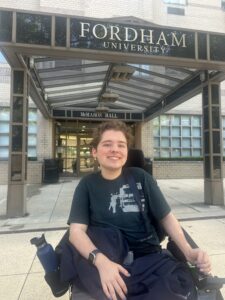
Freshman move-in day at Fordham
Nobody would ever accuse me of being inconspicuous. Aside from the fact that I wheel into a room in a power wheelchair, I’m known for having a big personality. The first night of freshman orientation at Fordham University: Lincoln Center, I decided to make an entrance. At the open mic night, I belted out “New York, New York” on the campus Plaza in front of the entire freshman class. After that, my whirlwind of a semester began. From that point on, I was never able to blend into the crowd or remain anonymous. The funny thing is, I like it that way because it serves a purpose. If I’m being honest, it’s a personal icebreaker. That performance ensured that my classmates will forever see me as the guy who can sing and put on a good show, rather than just the kid in the wheelchair. Performing has always given me a certain level of confidence. Let’s face it: navigating and living on a college campus for the first time is a huge transition and most definitely requires confidence. College as a power wheelchair user comes with a myriad of challenges other students can’t even begin to imagine. Confidence, as it turns out, wasn’t the only thing I needed.
College was the first time that I would live on my own and manage a personal care attendant to help me each morning. I also had to make sure I was getting enough rest when needed and keeping up with my weekly visits to my physical therapist. In addition, finding your way around campus is something all freshmen worry about but comes with added layers of concern for me. Which buildings have or don’t have automatic door openers? Where are the accessible entrances located? Should I just knock to cue someone to open the classroom door for me? Should I ask the person next to me to help get my backpack off my chair? How do I adjust the accessible desk in the classroom? Where do I go when the fire alarm goes off in the middle of the night? And, because it’s New York City, how do I push my way into a crowded elevator during the morning rush to class? On and on, a slew of questions went through my mind day in and day out. Initially I felt pressure having to think logistically about everything just to get through the day. However, I learned by doing until it became part of my daily routine. I attribute my ability to adapt in the face of adversity to my circumstance as a person born with a physical disability.

On stage with the Fordham F-Sharps A cappella Team at the 2024 Winter Concert
While I adjusted, wonderful things started to happen. It became second nature for the other students to prop open the doors for me and help out when I needed it. I made so many friends as I auditioned for and made it onto the F-Sharps, the college’s a cappella team. I also participated in musical theater cabarets, songwriting club, and open mic nights. I fell into a groove with my academic workload and thrived in the small environment at Fordham LC, getting to know each of my professors personally. The sheer fact that I was living in the heart of New York City was also a dream come true for me.
“New York is my campus. Fordham is my school,” is our school motto and it’s very true. My wheelchair logged hundreds of miles exploring Central Park, the Shops at Columbus Circle, Broadway, Times Square, Hell’s Kitchen, and my Upper West Side neighborhood. I saw Cyndi Lauper at Madison Square Garden, Jason Robert Brown at Carnegie Hall, and a variety of shows at Dizzy’s Jazz Club. Outside my two-block campus, I reveled in the sights, sounds, and culture of the city. I’ve met people from around the world as far away as Indonesia and China. I frequently visit the Fordham Rose Hill Campus in the Bronx, volunteering in University Heights and taking in the diverse neighborhood along Arthur Avenue.
Choosing a college and accessing higher education certainly comes with an array of challenges and barriers for students with disabilities. It’s not always easy or smooth and my journey to finding and choosing Fordham was no easy feat but that’s for another blog. I’ve been fortunate to have found my place at Fordham and have been very supported by the University, including the offices of Disability Services and Residential Life. I started out my college journey with a big entrance and it personally helped me to successfully transition. At the end of the day, while my disability definitely presents its daily dose of challenges, I choose to focus on things that are in my control. I am seeking the same meaningful college experience that all students who choose to live away from home want for themselves.
And with the risks have come the rewards. One night, early in my first semester, as I waited outside for my Uber Eats driver next to the fountain at Lincoln Center, I could hear the opera over the loudspeakers. I thought to myself, “it doesn’t get any better than this.” I was home.
The post First Semester in a New York Minute appeared first on Quest | Muscular Dystrophy Association.
]]>The post Hoyer Lifts and Beyond: Choosing the Right Lift Device appeared first on Quest | Muscular Dystrophy Association.
]]>These devices generally have a supportive seat or sling attached to a sturdy arm or frame. They allow a caregiver to move a person from one place to another with minimal physical effort while letting the machine do the heavy lifting — a benefit important to the comfort and safety of both the individual using the lift and the caregiver helping to operate it.
Deciding what type of lift to use depends on the unique needs of each person and their caregivers.
Finding the right lift
If you’re in the market for a lift, here are three things to consider before making a decision:
1. Talk to an occupational therapist (OT) or physical therapist (PT).
An OT or PT will evaluate your needs by asking questions and offering guidance based on your situation.

Theresa Berner, MOT, OTR/L, ATP
“It’s ideal if the caregivers work together with a therapist to complete a trial of the equipment before buying it,” says Theresa Berner, MOT, OTR/L, ATP, an occupational therapist and Rehabilitation Clinical Manager at The Ohio State University Wexner Medical Center.
An OT or PT will generally start by asking, “What do you want this piece of equipment to do?” For example, a lift may be used to help a person get out of bed in the morning or get them to their feet if they fall. It may also help with transferring to different surfaces, such as a wheelchair or toilet. A lift can also help reposition a person in their wheelchair.
Next question: “In what environment do you want to use this equipment?” Is the lift needed at home, work, school — or all three? How big is the environment, and how much space is there to store the lift?
The choice of lift also depends on whether it will be used daily. You should also consider whether the lift is comfortable, provides dignity, and supports the person being moved.
It’s also important to know if the caregiver can comfortably operate the lift. Does the caregiver have enough upper-body strength for a manual lift? Can they get a sling around someone who has fallen on the floor? If the caregiver has weak knees, bad shoulders, arthritis, or other limitations in the joints or general strength, a power lift may be needed. Power lifts can be difficult to fund, but insurance will cover them in some cases.
2. Check your insurance coverage and funding options.
Each state’s benefits programs and private insurance companies are different, so it’s essential to learn about the rules where you live and understand your insurance coverage. Remember that there may be different guidelines for children and adults.
The healthcare system uses codes to identify each piece of durable medical equipment (DME). These codes are used to bill insurance and reimburse patients. New and unique pieces of equipment may not have the codes needed to process them through insurance. Insurance companies also pay set fees based on the codes, so if you ask for something the insurer considers an upgrade, it may be more expensive.
Insurance may not pay for more than one lift system, such as a stationary and a portable lift.
While most manual lifts can be covered by insurance or funded by Medicare or Medicaid with a prescription from your doctor, power lifts are trickier to get funded. Documenting that your caregiver has physical issues that don’t allow them to use a manual lift may help, but it does not guarantee that a power lift will get approved. “They are considered deluxe pieces of equipment and require special circumstances for approval,” Theresa says. “Some people ask if they can pay the difference between a manual and power lift, but many insurances do not allow for that request.”
When insurance does not cover a power lift, there may be other avenues:
- Your state’s Medicaid waiver program may have a budget for DME, such as a power lift or home modifications, including installing a ceiling or wall lift.
- A Vocational Rehabilitation Office will fund a power lift if it is necessary to find and keep a job.
- If a lift is needed at work, it may be considered a “reasonable accommodation” under the Americans with Disabilities Act (ADA), and the employer may be required or willing to pay for it. (If the employer doesn’t cover it, the price may be tax deductible under “unreimbursed business expenses” related to a disability.)
“Some families do fundraisers to assist with the cost of their lift,” Theresa says. MDA can also help locate lifts and other DME through in-kind partnerships and referrals to community resources.
3. Research dealers, prices, and sales.
Talk with local DME supply companies and ask them to keep you informed about sales. Looking for a used lift may be a good idea if you can find a lift that is in good condition and suitable for you.
Before you make a purchase, get an idea of what size, shape, and style of lift you need. “Working with an OT or PT can give you guidance on what lifts are suitable for your circumstances and what options may be safest,” Theresa says. “An OT or PT can also help you try out the equipment before you purchase it. Once a lift is purchased, it often cannot be returned.”
Types of lifts
Most lift companies offer a range of choices. Besides helping you accomplish your daily personal needs, many lifts can assist in physical therapy or recreational and leisure activities.
In this section, we’ll cover several types of lifts:
Floor lifts
A floor lift, also called a rolling lift, is a metal framework with a lifting mechanism and an extending arm. The term “Hoyer lift” is often used generically for this type of device, but Hoyer is a particular brand.
A floor lift can be wheeled from room to room and doesn’t need to be installed anywhere permanently. However, these lifts are large and difficult to maneuver in tight spaces like narrow hallways and small bathrooms. “They can also be difficult to store, and you should think of where you want to keep it,” Theresa says.
To transfer in and out of bed using a floor lift, you typically need several inches of clearance so the base can roll under the bed.
A floor lift can be manual or electric (powered by a rechargeable battery). Two main factors determine which kind of floor lift is right for you: ease of use and price.
With a hydraulic manual lift, such as the Hoyer Manual Hydraulic Lift, a caregiver operates the lifting action by pumping a lever. Some manual lifts use a hand crank instead of hydraulics.
The main reasons for getting a manual lift are the price, which ranges from about $600 to $3,000, and the fact that it is more likely to be covered by insurance. You can expect to pay anywhere from about $900 to $9,500 for an electric floor lift, such as the Diana lift from Horcher.
An electric lift is operated with the touch of a button and is less physically strenuous for the caregiver, although it can still be heavy to push from room to room.
Folding lifts
Want to take your floor lift with you on the go? Choose a lightweight, folding electric floor lift, such as the Protekt Take-Along from Proactive Medical, Advance-E 340 from Hoyer, or MoLift Smart 150 from etac. These lifts can be folded without using tools or separated into parts for transportation in a car trunk. Some companies offer a carrying case for air travel.
Expect to pay about $1,000 to $4,000 for a folding floor lift.
These smaller units may also be easier to maneuver in small spaces at home than standard floor lifts. However, they may not last as long with daily use and may be slightly less stable.
Ceiling lifts
A ceiling lift, also called an overhead lift, has a motorized lift device attached to a track mounted on the ceiling. A sling or harness is attached to the device, and it can move a person between points along the track. This type of lift works well in small spaces where a floor lift would be difficult to maneuver.
SureHands, Guldmann, and Horcher are a few of the companies that sell these systems. Ceiling lift systems are expensive (about $4,000 to $14,000); the cost depends on the length and configuration of the track and the ceiling structure.
Besides making it easier for a caregiver to maneuver, a major advantage of some ceiling lifts is that the lift user can operate it independently with a remote control if they can put the sling or body support on.
There are numerous options for ceiling lifts. The track system could be installed on the ceiling in one area or through multiple rooms. For example, the lift could take you from your bed through the bathroom doorway to the toilet or shower. Two- and four-way switches enable you to reach more places from the same track.
To go from room to room, the ceiling track must fit through the doorway and allow the door to close. An installer cuts into the doorframe or through the wall to accommodate the track.
Some companies have systems for room-to-room transfers that don’t require altering doorways, such as the Likorall R2R system from Liko. This involves having a lift unit on either side of a doorway and using a special transfer strap between them. Another option is having one lift unit that can be transferred from one track to another. The P440 from Prism Medical is a lightweight, portable lift system designed to be moved between tracks in different rooms. Room-to-room transfers require the assistance of a caregiver.
If your ceilings are vaulted or have obstructions such as heating or skylights, suspending the track from the ceiling is a way to keep it level. However, this method is typically more expensive because it is harder to install.
You might not be allowed to install a ceiling track system if you live in an apartment or dormitory. In that case, a freestanding track lift system may be the solution. These include the Easytrack from BHM Medical and free-standing rail systems from Guldmann. These systems can be set up in one area of a room, such as over the bed or in the bathroom.
Wall lifts
Like ceiling lifts, wall-mounted lifts are motorized systems that are convenient for tight spaces. However, they’re generally easier, faster, and less expensive to install, especially in bathrooms, where ceilings may have skylights or other obstructions.
You can expect to pay about $3,500-$8,000 to purchase and install a wall lift.
If you would like a wall lift in two rooms, such as the bedroom and bathroom, you can either get two separate wall lifts or put wall plates on each wall and transport the lift unit between the two rooms. The SureHands wall-to-wall lift system is made for this kind of transfer.
Of course, the first choice is more expensive but more convenient. The second option saves you money, but the lift itself is heavy (35 pounds), which may be difficult for a caregiver to transfer back and forth often.
Try equipment before you buy
The next step is trying out the equipment. You’ll find some types of lifts (mostly floor lifts) at your local DME dealer. If the dealer doesn’t have an OT or PT on staff, talk with your OT or PT about options that meet your needs and take time to try the equipment together so they can watch you try out lifts and provide guidance on the best fit.
One caveat: Most local DME dealers don’t have ceiling or wall lifts. You may need to call a company specializing in these lifts and ask to work with a local representative. They may be able to help identify where a trial piece of equipment is before you purchase one. Companies that install ceiling and wall lifts often also do home modifications. Some companies are associated with complex rehabilitation suppliers, and others exclusively work on home modifications.
“The ideal situation is to work with a therapist to try lifts to understand the ideal setup,” Theresa says. “Once you have an idea of what works best, you can begin exploring many options.”
Other considerations
To submit a claim to insurance, you will need a prescription for the lift device and a letter of justification that outlines the size and features. Each DME vendor has its own way of submitting claims and may require different information from you or your doctor. Be sure you understand what your DME dealer needs to submit your claim to insurance.
Medicaid waiver programs will require a denial from traditional Medicaid before considering funding the device. However, some DME companies do not process claims through Medicaid, which makes it challenging to use Medicaid waiver funding. If this is the case, work with your Medicaid waiver service coordinator. They may be able to help navigate around this issue.
Don’t forget to look at slings, which are sold separately from lift devices. Many lift companies carry a variety of slings that offer different levels of support and mobility for the lift user. A standard sling has a seat and back for body support. Head support can be added if needed. A hygiene sling with a large cutout makes transferring to the toilet more convenient. Slings made for bathtub and pool transfers are made of a quick-drying mesh material. Some lifts may use other types of harnesses or supports.
The right lift is out there. By following the advice of an OT or PT, consulting with your insurance and DME dealers, and doing careful research, people with neuromuscular diseases and caregivers will be able to transfer from one place to another with more ease.
Lift Resources
Lift and DME dealers
1800Wheelchair.com Patient Lifts & Slings
etac Patient Handling (Molift)
Horcher Medical Systems Patient Lifts
Used equipment
Goodwill Home Medical Equipment
The post Hoyer Lifts and Beyond: Choosing the Right Lift Device appeared first on Quest | Muscular Dystrophy Association.
]]>The post MDA’s Origin Story: A Grassroots Legacy appeared first on Quest | Muscular Dystrophy Association.
]]>It’s no surprise that MDA started as a grassroots organization. From the earliest days, our mission has been shaped by the stories and needs of people living with neuromuscular diseases and their families.
Founded in 1950
MDA began in 1950 when Paul Cohen, a New York business leader living with facioscapulohumeral muscular dystrophy (FSHD), invited a group of individuals to meet in his office in Rye, New York. Each had a personal connection to muscular dystrophy, and the gathering focused on the urgent need for research seeking treatments and cures. At the time, scientists didn’t understand genetics or the biology behind muscle function, and only one doctor at New York Hospital-Cornell Medical Center was interested in seeing patients with muscular dystrophy: Ade T. Milhorat, MD. Going door-to-door, apartment-to-apartment, the group raised money to award MDA’s first research grant of $1,500 to Dr. Milhorat, a pioneer in muscle disease research.
Building a network of care
MDA’s visionary founders recognized the need for quality neuromuscular disease care and sought to link clinical care and scientific research in a single environment. In 1953, they founded the first MDA Care Centers at NYU Langone Health and University of Rochester Medical Center. These Care Centers brought together clinicians and scientists in collaborative projects to address diagnostic and treatment issues in muscle diseases. This set the stage for what we now know as neuromuscular medicine and gave rise to a network of MDA Care Centers starting in the 1960s.
Today, we know that multidisciplinary care — a treatment approach that involves bringing together healthcare professionals from different disciplines — is the best model of care for people living with neuromuscular diseases because they affect so much more than the muscles. MDA Care Centers were pioneers in this model. MDA Care Centers now serve more than 70,000 unique patients at over 120,000 visits annually.
Scientific breakthroughs
The field of neuromuscular medicine has grown, with more than 300 distinct neuromuscular conditions identified. The turning point in MDA-supported efforts to advance diagnosis and treatment occurred in 1986 with the discovery of the dystrophin gene and its defects that cause Duchenne muscular dystrophy (DMD) and Becker muscular dystrophy (BMD). The dystrophin gene remains the largest known gene in the human genome. Its discovery marked a milestone in neuromuscular disease research specifically and in genetic research generally.
The dystrophin gene discovery and the technology that made that discovery possible was developed by Louis Kunkel, PhD, Professor of Genetics and Pediatrics at Boston Children’s Hospital and Harvard Medical School, with funding from MDA.
“The work of Dr. Kunkel and many other MDA-supported clinicians and researchers over the last four decades has opened the frontiers of neuromuscular medicine with some of the first treatments for genetic diseases,” notes Dr. Sharon Hesterlee, MDA’s Chief Research Officer.
Today, MDA has funded more than $1.2 billion in research, and there are more than 20 approved drugs for neuromuscular conditions, including two gene therapies. This March, MDA will host its annual Clinical & Scientific Conference, bringing together around 2,000 researchers and clinicians, allied health professionals, and pharmaceutical professionals working in the neuromuscular medicine field, as well as advocacy organizations and people living with neuromuscular diseases. This meeting helps move the field forward and keeps the individuals and families affected by these conditions at the center of its efforts.
75 years of impact
From the beginning, MDA’s supporters have funded critical research and made MDA’s community programs possible, including MDA Summer Camp. This life-changing week-long overnight camp for youth living with neuromuscular diseases grew from one location in Sussex, New Jersey, with 16 campers in 1955, to thousands of campers and a network of camps across the country today.
Over the years, MDA’s Care Center Network, groundbreaking research, and community initiatives have been shaped by the stories and needs of the families we serve. We have many people to thank for making this possible: people living with neuromuscular diseases, their families, volunteers, researchers and clinicians, donors, corporate partners, and advocates.
In our 75th year, we reflect with gratitude on our lasting impact and how we want to continue to expand access to life-saving therapies, drive momentum in neuromuscular research, meet the changing needs of the people we serve, and empower the neuromuscular disease community.
“MDA has been supporting programs to help people and families with muscular dystrophy and related diseases for 75 years. Over the years, we have helped hundreds of thousands of individuals,” says Donald S. Wood, PhD, President and CEO of MDA. “My goal for MDA is to grow our mission to support more research, advance MDA Care Centers, and to continue to advocate on behalf of patients with neuromuscular diseases so that, ultimately, treatment will be available to all.”
The post MDA’s Origin Story: A Grassroots Legacy appeared first on Quest | Muscular Dystrophy Association.
]]>The post Clinical Trial Alert: Phase 2/3 Study of an Investigational Medication in Pediatric Patients with Generalized Myasthenia Gravis appeared first on Quest | Muscular Dystrophy Association.
]]>vibrance‐mg is a phase 2/3 open‐label study, which means that all participants will receive the investigational medication. The study will consist of a screening period of up to 4 weeks, a 24‐week active study treatment phase, and an optional long‐term extension (LTE) phase that will last for different lengths of time. Two cohorts will take part in the study; cohort 1 will include adolescents (12 to less than 18 years of age) and cohort 2 will include younger children (8 to less than 12 years of age). Participation will require approximately 15 clinic visits over the 24‐week active study treatment phase, with a total duration of approximately 36 weeks. After completion of the active study treatment phase, all participants will have the option to enroll in a LTE phase. Participants who do not enroll in the LTE phase will be required to complete a safety follow‐up visit 8 weeks after their last treatment of the study medication.
The investigational medication will be given by intravenous infusion which means that it will be given via a tube attached to a needle inserted into a vein in the arm. The effects of the investigational medication will be evaluated using a number of tests and procedures including but not limited to: physical exam, measurement of vital signs, urine samples, blood draws, review of potential adverse effects and questionnaires to assess how effective the study medication may be in participants.
To be eligible, individuals must meet the following inclusion criteria:
- Between the ages of 8 and less than 18 years of age
- Diagnosed with gMG
- Experiencing MG symptoms despite receiving stable standard of care therapy
Individuals may not be eligible to participate if they are affected by another illness or receiving another
treatment that may interfere with the study assessments or potentially impact the safety of participants. Please visit this link at clinicaltrials.gov for the full listing of inclusion and exclusion criteria.
Support for study‐related travel costs is available for participants.
To learn more about the study or inquire about participation, please contact the study coordinator by email: Participate‐In‐This‐[email protected].
The post Clinical Trial Alert: Phase 2/3 Study of an Investigational Medication in Pediatric Patients with Generalized Myasthenia Gravis appeared first on Quest | Muscular Dystrophy Association.
]]>The post Life with Lily: Finding My Voice appeared first on Quest | Muscular Dystrophy Association.
]]>My CMT story began in my early childhood, marked by physical differences that, in their initial rapid progression, abruptly disrupted what had been a typical, mobile childhood. I quickly experienced difficulty moving around my world when my feet began “turning in” – also known as clubbed feet. These swift changes were disorienting, forcing my young body to adapt quickly and unexpectedly. The journey to diagnosis was a long and often frustrating one, filled with misdiagnoses and uncertainty, until finally, CMT 1e and HNPP (Hereditary Neuropathy with liability to Pressure Palsy) was identified when I was four years old. Those early years were a whirlwind of medical interventions, including reconstructive surgery that fundamentally changed my relationship with my body. Learning to walk again, spending a year navigating the world in a wheelchair – these experiences shaped my understanding of both my own resilience and the accessibility barriers many others also face.
Growing up with CMT has been a complex dance between challenge and growth. When I was younger, I felt a profound sense of shame, a desperate desire to hide my differences, to fit in seamlessly. The fear of rejection, of being seen as “other,” was a heavy burden. But within that struggle, seeds of resilience were being sown. I discovered the transformative power of community, the profound connection that comes from sharing experiences with others who truly understand. Meeting people who knew firsthand the daily realities of living with a disability, without needing explanation or judgment, was a turning point. It was the beginning of transforming shame into pride, of recognizing the unique strengths and perspectives that disability can foster.

Lily S. during an interview at MDA Summer Camp.
A pivotal part of this journey was my experience at MDA Summer Camp as a child. It was there, surrounded by other kids who “got it,” that I first truly felt a sense of belonging. The camp was more than just a place to have fun and be a kid; it was a place where I found my voice. I was given opportunities to speak about my experiences, to share my story with donors through interviews. Those early interviews, though I was just a young child, were the first steps on my path to advocacy. They gave me the language to articulate the complexities of living with CMT, the challenges, the frustrations, but also the resilience and the hope. It was the beginning of understanding that my story had power, that it could connect with others, inspire change, and make a difference. My advocacy has only grown from there, culminating in advocating for disability laws in Congress this year and now serving as your MDA National Ambassador.
CMT is a progressive condition, and with its progression comes a unique set of challenges. The gradual loss of function, the “little deaths” as some describe them, is a constant process of adjustment and grief. There’s the grief for what was, for the physical abilities I once had, and the grief for the future I might have imagined. Disability is marked by these losses, these constant adjustments to a changing physical reality. It’s not just the loss of physical function, but also the loss of expectations, the loss of a certain kind of normalcy that society often dictates. There’s also the very real fear of what lies ahead, the uncertainty of how CMT will continue to impact my life. These feelings are layered and complex, often existing side-by-side with hope, determination, and an unwavering spirit.
Living with a disability also means navigating a world that wasn’t designed with me in mind. From seemingly small obstacles like heavy doors and missing curb cuts to larger systemic barriers, I’m constantly reminded that accessibility is not a given. These experiences fuel my passion for advocacy, my commitment to creating a more inclusive and equitable world. I believe that everyone deserves to feel welcome and valued, and I’m determined to use my voice to push for change.
One of the most significant challenges, and yet another catalyst for growth, has been the lack of representation. Growing up, I rarely saw people with disabilities reflected in mainstream media, in the stories we tell about ourselves. This absence can be profoundly isolating, making it harder to forge a positive disability identity. It’s why I’m so passionate about sharing my story, about amplifying the voices of others in the disability community, and about working to create a world where everyone sees themselves reflected and celebrated.

Lily S.
My journey with CMT has been a complex tapestry woven with threads of challenge, resilience, community, and growth. It’s a journey marked by both profound grief and immense joy, by moments of frustration and unwavering determination. It’s a journey that has taught me the importance of self-acceptance, the power of advocacy, and the transformative strength of community. I am deeply honored to serve as your 2025 National Ambassador, and I look forward to sharing more of my story, connecting with each of you, and working together to build a more inclusive and accessible future. Thank you for being a part of this journey with me.
The post Life with Lily: Finding My Voice appeared first on Quest | Muscular Dystrophy Association.
]]>The post 2024 MDA Advocacy Collaboration Grantees are Working Towards Change appeared first on Quest | Muscular Dystrophy Association.
]]>MDA launched the Advocacy Collaboration Grants Program in 2022 to help achieve this goal. Now, in our third year of the program, we would like to introduce you to the 2024 MDA Advocacy Collaboration Grantees! Together, these groups received a total of $160,500 in grant funding to support their important advocacy projects.
This year’s list of grant recipients is comprised of a wide variety of neuromuscular disease patient advocacy organizations, each with their own unique projects developed to support their communities. Each grantee proposed a collaborative plan designed to support and enhance their neuromuscular disease advocacy and grassroots networks. This year’s grant applications opened in August 2024, with a focus on non-partisan advocacy initiatives likely to advance positive changes within the neuromuscular community and lead to federal, state, and local initiatives and laws. Grantees’ projects were selected in December 2024.
2024 Advocacy Collaboration Grant Recipients:
- The Akari Foundation will provide materials, webinars, training, and more in Spanish to the Hispanic community with rare diseases. There will be a specific focus on Duchenne muscular dystrophy (DMD), spinal muscular atrophy (SMA), and limb-girdle muscular dystrophy (LGMD).
- All Wheels Up will continue to test a variety of Wheelchair Tie-Down and Occupant Restraint Systems (WTORS) for compliance with aircraft seating standards, in addition to drafting and publishing an article on the medical necessity of wheelchair spots on commercial airplanes.
- Christopher & Dana Reeve Foundation will expand upon its grassroots advocacy toolkit from last year’s grant cycle by conducting Regional Advocacy Trainings in underserved areas.
- Cure CMD will expand its programing around the CMD Advocacy Advisory Council, including an in-person or virtual skill building event for advocates.
- Cure LGMD2i will continue the development of its grassroots advocacy program by hosting and conducting webinars and other sessions to build familiarity with grassroots advocacy among the LGMD2i patient population.
- Cure Rare Disease will expand last year’s award to continue their project to create an innovative coverage and reimbursement model for “angel” therapies for rare and ultra-rare disease patients.
- FSHD Society will assess and explore Congressionally Directed Medical Research Program (CDMRP) Peer-Review Research eligibility.
- Hereditary Neuropathy Foundation will test and evaluate BioSensics wearable technologies for potential use within Charcot-Marie-Tooth clinical trials.
Collaboration is Key
Fundamentally, there is strength in numbers when engaging in advocacy, which makes MDA’s Advocacy Collaboration Grants a vital part of creating change. By supporting these organizations, MDA is fostering collaborative advocacy that empowers advocates at the local, state, and national level to make change happen.
What’s Next
We are excited to continue working with our grantees to advance and support public policy goals for the neuromuscular community and will continue to share the impactful work that they are developing. Building strong partnerships is one of the many ways that our Advocacy team works to support the MDA community.
To learn more about MDA Advocacy, visit MDA.org/advocacy.
The post 2024 MDA Advocacy Collaboration Grantees are Working Towards Change appeared first on Quest | Muscular Dystrophy Association.
]]>The post Quest Podcast: Navigating Romance with MDA Ambassadors appeared first on Quest | Muscular Dystrophy Association.
]]>Read the interview below or check out the podcast here.
Mindy Henderson: Welcome to the Quest podcast, proudly presented by the Muscular Dystrophy Association as part of the Quest family of content. I’m your host, Mindy Henderson. Together, we are here to bring thoughtful conversation to the neuromuscular disease community and beyond about issues affecting those with neuromuscular disease and other disabilities, and those who love them. We are here for you, to educate and inform, to demystify, to inspire, and to entertain. We are here, shining a light on all that makes you, you. Whether you are one of us, love someone who is, or are on another journey altogether, thanks for joining. Now let’s get started.
Well, it is February, and romance is in the air. So, today I have three of our incredibly talented MDA ambassadors with me to talk about all things dating and marriage. Because ladies first, we have Nora Ramirez, who lives in California and was diagnosed with SELENON-related myopathy at the age of nine years old. She’s one of four siblings with SEPN1-RM, and Nora is a dog mom, a woman after my own heart, of two, and a wife, a daughter, and an aunt.
Next up we have KL Cleeton, who is an entrepreneur, get this, a poker professional, so interesting, I don’t think I’ve ever talked to a poker professional before, and an influencer committed to empowering individuals to realize their potential. He focuses on startup development and motivates others to overcome their limitations, achieving more than they could have imagined.
And last, but certainly not least, I have Justin Lopez, who is a 30-year-old disability advocate and operations manager. Diagnosed with limb-girdle muscular dystrophy, or LGMD2B, at the age of 13. Justin has dedicated much of his life to advocating for disability rights and promoting inclusivity in both personal and professional spaces. As a son, brother, husband, and father, Justin understands the importance of community and support.
Thank you all so much for being here. Everybody who’s probably listening is ready for us to get on with the show and talk about all of the dating, and marriage, and relationship tips. So, lots to talk about. I’m going to jump in. So, since we’re here to talk about relationships, of course, as I already mentioned, each of you are ambassadors with MDA and are clearly accomplished individuals. Would each of you mind letting me know, let’s just confirm your status, married, single, otherwise. Justin, let’s start with you. You’re married, correct?
Justin Lopez: Yes. Married and have a son, who is actually turning three in March.
Mindy Henderson: Oh, my gosh, such a fun age. Wonderful. And Nora, let’s go to you next.
Nora Ramirez: Yes, I’m married. We’ve been married for seven years, and our two dog babies.
Mindy Henderson: Wonderful. What kind of dogs? Super important.
Nora Ramirez: A Maltese girl and a Bull Wolfhound boy.
Mindy Henderson: Oh, my gosh. So a little one and a huge one.
Nora Ramirez: Medium. Yeah.
Mindy Henderson: Medium? Okay. Wonderful. And then KL?
KL Cleeton: So, I am not married, but I am in a wonderful relationship with someone from the Austin area, and it’s a long-distance thing, but we see each other as often as we can, and we’re coming up on eight months.
Mindy Henderson: Great. Okay. So, let’s just jump into it. I’m going to let whoever wants to go first go, someone’s got to be the brave one, but tell me a little bit about your experience. Let’s talk about dating, navigating dating. We all know dating in general comes with challenges. It’s not easy for anybody. But then living with a disability, every now and then, it can make things just a little bit more complicated. So, what’s your dating journey been like? Who wants to go first?
Justin Lopez: Yeah. I can go first. I would say, and mine was a while back, I’ve been married for five years now. I’ve been with my wife since 2016, so it’s been a while. But I would say that dating was, even going through high school and then into college, it was unique. It was more of, I tried to keep it as traditional as possible. When my condition would come up at the time, I initially began to hide it, actually. Stated that it was more of a leg injury, which I did have, but obviously, when I had the leg injury, it progressed, and we learned what it was, which is limb-girdle. But at the time, I really just kept it as, “Oh, it’s just a leg injury.” And then depending upon how deeper the relationship gone, that’s when I opened up and explained more of my condition.
Mindy Henderson: You know what? You make a really good point, because I think that sometimes the society that we’re living in, we have to downplay bits and pieces of who we are, whether that’s a disability or something else, I think that it’s a theme that probably can resonate with a lot of people, not being allowed almost to embrace all of who we are. Right?
Justin Lopez: Yeah. And I would say, just to add on to it, I lived on campus in Ohio, I went to Bowling Green State University, and so I would be walking to class, and at the time I was walking, I may have crutches or something like that, and someone may stop me and ask me like, “Hey, what happened there? Are you okay?” And for someone who’s just asking simply what’s wrong, I might give them a short answer, “Oh, yeah.” I tore my ACL or something like that.” Versus someone who really wanted to sit down and actually understand. So that also gauged whether I give you maybe a short story or maybe a long-term story too. So those are things that also played a factor.
Mindy Henderson: Yeah. Well, and to that end, I don’t want to put words in your mouth, but no one is entitled to our story. And so while I say that, it’s a shame that I think a lot of people in a lot of ways have to feel like they have to hide or downplay pieces of themselves. I think a lot of times we want someone to earn the right to know our story as well, even though it’s not something that should be tied to shame. There’s a trust factor there before we share. So, Nora, let’s go to you. What was dating like for you?
Nora Ramirez: I feel like for me it was challenging just putting myself out there, even aside from my disability, my personality is very, even more back then, very shy and very just scared of people and the world, and everything. So, I tried to focus on that, and I tried to not even try to think about my disability and how I look, and what questions they’re going to ask, about all the what-ifs and what nots. I try to not think about that. I already have this struggle to even get started. So, that was my main focus on building confidence and just going on dates, whether they were friend dates or getting to know each other dates. And working on that was my main focus. During dating stages, I never brought up my disability, even though it was visible and noticeable a lot of things. I needed to ask for help sometimes, but they didn’t ask questions. I never had anyone I dated ask questions, and I just didn’t bring it up myself until that’s when things got serious and we were in a relationship, and that’s when I opened up to him about it.
Mindy Henderson: Yeah. I see a theme here beginning to emerge. So, I’m going to come to you in just a second, KL, but Justin and Nora, did you guys date a lot? What volume are we talking about?
Nora Ramirez: I did in college. Yeah, I did. I wanted to really get to know what things I liked and didn’t like in a partner and dating, and all of that. I think I was scared of committing to something that doesn’t work out, and it’s like being vulnerable with someone, and then it turns out we’re not compatible, so I wanted to do a lot of practice just dating, but they were just casual dates.
Mindy Henderson: Well, I think that’s important anyway. Like you said, knowing what you want, what you don’t want, what’s important to you, that takes a minute and it takes a lot of experience and dating different people. Justin, did you date a lot?
Justin Lopez: Yeah. I would say I definitely did. I would say that similar to what Nora just said, as far as we are people, we are just as people as everyone else, so learning what you like, what you don’t like about an individual and trying to find that connection that’s genuine. But I also think a connection that you can trust, even at a higher level, in comparison to maybe other relationships or traditional relationships. Because obviously, as we embark on our journeys with the ones that we have now, it requires a lot more additional confidence in that significant other to do some additional responsibilities, different things of that nature. So, I would say that definitely early on, I was definitely dating a lot as far as getting to know people, things of that nature. And then towards my later years of college, I really wanted to settle down and find someone that I knew that I had a lot of trust in. I did.
Mindy Henderson: Yeah. That makes sense. So KL, tell us a little bit about your dating journey. I know that you’ve got a girlfriend, it sounds like you’ve been together for a little bit, but did you date a lot before this?
KL Cleeton: Well, you talked about trends. I’m going to now [inaudible 00:11:51] trend, and do the exact opposite of Nora and Justin. So, my disability, I have spinal muscular atrophy, technically type two, but it’s only because I have outlived type one.
Mindy Henderson: I see.
KL Cleeton: It’s fine. So, my disability, my relationship with my disability was much more in the forefront. Most of the listeners probably are aware of what SMA is, but for those who aren’t, I compare it to something like being paralyzed from the neck down, but I feel everything, but I have no movement whatsoever. So, because of that, my fear, my struggle was that burden of confidence. I was going to be a burden for a romantic partner and nobody could ever really see past the wheelchair and the super skinny arms, and all of that good stuff.
And what I found was the few times I did put myself out there, it just led to heartbreak after heartbreak. Not in the, like you see in the movie where they a [inaudible 00:13:22], they show up and throw eggs on your head. I’m not saying it’s definitely like that, but just, oh, we’re [inaudible 00:13:32] friends, things like that. But eventually for [inaudible 00:13:38] time and work on myself, what I found was that I couldn’t expect other folks to find me desirable as a romantic partner, if I didn’t do the work to find myself worthy of that sort of compassion and that sort of romance, [inaudible 00:14:05].
So, I did that. I spent a lot of time on that work. And then whenever I did meet [inaudible 00:14:14] and we met online like basically everybody does nowadays it seems like, especially in a post-COVID era, I took a new tact, I took a new mindset into that. There was no expectation of like, oh, I’m looking for something or someone. Basically, it was just getting to know somebody new and in the process of that, getting to know someone, I was completely open and completely vulnerable in a way I hadn’t done before. And that I was really lucky because that allowed me to get to know this person and for her to get to know me on, not a superficial level, but on a deeper, personal level.
And she knew about my disability literally from my message one. I was very open about everything. You could see my [inaudible 00:15:29] and my avatar, and my [inaudible 00:15:33] headshots and things like that. So, it wasn’t like a surprise or anything. Yeah. That was my journey, my path, was first, convincing myself I deserved that sort of love and then changing my own behavior to make it where other people were able to see that I felt like I deserved it as well.
Mindy Henderson: And that’s so important what you just said because I also live with SMA and so I can relate to so much of what all of you are saying, and I’ve had my own experiences and things, but I think that, I’ve talked to a number of people over the years who have been forced into that self-acceptance as part of their dating journey. And I think that there’s actually, that can be a little bit of a gift, if you want to turn this all on its ear, I think there are other people out there who may never get there with the self-acceptance and self-love, and all of the things that, like you’re saying are so important, that need to come first before someone else can love you.
And so I think that that’s, maybe, one of the sort of hidden gems or hidden gifts that some of us in this community come by because of the journeys that we’re on. So, you’ve all touched a little bit on how you approached sharing about your disability with a potential partner. Are there any specific strategies or conversations that you found helpful in opening and understand, and creating an open and understanding environment from the beginning or near the beginning?
Justin Lopez: I think that it was very important to talk about what situation that explained what muscular dystrophy was from the beginning and making sure my wife had a solid understanding of what it was. Because obviously with muscular dystrophy there’s an umbrella, a variety of different types. And so understanding my particular type was important to be able to explain because I think what we envisioned down the future was that, if in a situation where she needed to explain it to someone and say, my dog is going off, she would need to be able to talk about it and understand it. So, I think we talked about exactly what were limitations and what did those look like too at the beginning.
Mindy Henderson: What about you Nora?
Nora Ramirez: Yeah. For me, communication is huge. So, I feel like I made sure to set up just communication in general once we got serious, me and my husband after the dating stage, and worked my way up to telling him about my disability. And then when I did it didn’t feel, it was still a little scary, but it didn’t feel as, because we were already used to communicating and being able to talk about anything, nothing was off topic. So, then when I was talking about it with him, it was going down bullet points, it felt like, I just teaching him.
So, I was [inaudible 00:19:21] a mini class about muscular dystrophy and then I made sure to ask him if he had any questions because I didn’t know if I talked too fast or if it was just too much information and he didn’t hold any of it, so I made sure to ask. He didn’t have questions and then we just continued normal. But he still continuously learning because some things it’s different to talk about it and hear about it versus see it and experience it. So, [inaudible 00:19:51] a lot throughout the years and learn a lot and now he’s a great advocate.
Justin Lopez: I think learning as you go along because, at least for me, no one else in my family ever had it. So, this was a learning thing for me as well. And at the time when we first started dating, at least when my wife and I started dating, I was still walking, I was able to take walks and steps and things like that. And then I progressed into using crutches a little bit more, then using [inaudible 00:20:19] and then [inaudible 00:20:20] to use to a wheelchair, then a wheelchair now to where I am now, which is a power chair. S, she’s seen the journey of it all from the beginning. So, that was interesting and learning as a couple, how the dynamic shifts.
Mindy Henderson: Nice. KL, talk to me about first dates because, just to kick us off, when would go on first date, there can be a lot of anxiety there, particularly as a wheelchair user or somebody with a disability. It’s all of the question, how am I going to get there and are we going to sit somewhere that’s accessible, are they going to want to do something that’s not accessible to me and all of those kinds of things. How, in the past, have you approached first dates and what kind of wisdom can you give our listeners about handling those situations?
KL Cleeton: Yeah. So, obviously, first of all, fellow SMA, I did not know that, high five, you and I. Yeah. I think that what it comes down to, I’ll just use my first date with [inaudible 00:55:54] as a really good example because I think it was a really positive experience, but for some really key reasons that I think are reproducible. First of all, she’s amazing, so there’s that.
Mindy Henderson: I feel like you like her just a little bit.
KL Cleeton: Just a little bit. But also, I’m not going to lie, very fortunate that she is able bodied, but she works in or worked in the accessibility [inaudible 00:22:22]. She is a developer that worked on digital accessibility for a large portion of her career. She had some basic knowledge and understanding. This is really, really helpful. But even more than that, having a partner that is just curious, interested in problem solving, interested, not in what can or can’t we do, but “Hey, this thing isn’t really doable, is there something we can do that’s adjacent or adapting [inaudible 00:23:03] so we can do it?” And so what we ended up doing was our first date was very unusual by societal standards because, well, first of all she flew from Texas to where I live in the middle of Illinois. So, already she’s making a massive leap of faith to that I’m not serial killer or something like that.
But because of the weight of that 1,000-mile distance, we talked a lot about everything before we ever came to visit. That was the last step to, is this real? Is this a thing that translates? We did something stupid, we drove over to St. Louis, which was about 100 miles away, which was a really big step by itself because she had to be shown how I need to be moved, if something needs to be adjusted, she had to learn some caregiver stuff. But she was like, “This is, forget it. My eyes are open. I know what this means. I’m not coming at this blind.” But because of that communication and because of that understanding [inaudible 00:24:45], it made it so much easier.
And we went over to St. Louis, we had ice cream, we went to children’s museum that was closed for the day, that had opened for a fundraiser. So it was a bunch of [inaudible 00:25:02] in children’s museum. It was fantastic. And we’ve got photos obviously from that first day. I think really the reason that was so positive, from my perspective, and the reason it’s replicable for other folks is because it was foundational on two basic things, which is curiosity and communication. And because each of us had both of those things, I think it made the evening something we’ll never forget.
Mindy Henderson: She sounds special. I feel like you should hold on to her.
KL Cleeton: I plan too.
Mindy Henderson: Nora, what are some of your favorite first date activities from back when you were dating?
Nora Ramirez: Some of my favorites were, because of my overthinking part, restaurants that I was familiar with, that I knew what food had, how the layout was. So, I think I was in charge. I like to take control of where it would be just so I knew and I didn’t have anxiety about being there. I also love nature. So, another one of my favorites was going to the park, specifically the parks that I liked and the areas and tables, and chairs to sit at. Because I think it also helped that there’s things going on in the park, there’s people, there’s dogs chasing a ball, there’s kids, there’s even just the wind blowing on the leaves. So, it was a good space to be able to talk, to get to know the other person. And when there was silence, it didn’t feel awkward because there was things going on. We could watch what was going on around us while we thought of something else to ask or to talk about.
Mindy Henderson: Very low pressure. I like that idea. That’s a good one. So, Justin, I’m going to shift gears a little bit and ask you a different question, if you don’t mind. So, let’s talk about conflict for just a second. Conflict is natural in relationships, but it sounds like all of you are in what they refer to as inter-abled relationships. And so there are times, even if, and I don’t know what your specific situations are, the three of you, but even if your significant other is not your primary caregiver, there are times when maybe you’ve had a horrible fight, but then you need help in the restroom or not to get too personal or getting into bed or something like that. And that can be a vulnerable time to need to speak up and ask for help, frankly. Is that something that you’ve encountered? And if so, how do you navigate it?
Justin Lopez: Yeah. Definitely. I would say that, like you said, in relationships, conflict happens. So, it’s definitely, it’s inevitable. And dealing with that situation where my wife is my primary caregiver, it definitely comes up where a pride thing has to also come into factor where you have to acknowledge, okay… And sometimes I think it helps the conflict I think because it’s like you can’t be mad forever, we have to come to an agreement because at the end of the day, maybe, “Hey, I need to get into bed” or “Hey, we both need to go get something to eat” or we need to go to an event or whatever the case may be. So it does work out sometimes.
I think what also needs to happen is that communication, like you said earlier, in the relationship, understanding that where we’re going to have separate opinions and we’re going to debate on things at times, but knowing that as a foundation of, hey, caring for one another regardless of the situation still needs to happen. It is important. But definitely there’s been some times where that’s been a learning curve for both of us, where my pride, I wouldn’t accept my pride sometimes, I’ll admit it, where I would end up, whether it’s staying up a little bit later because I didn’t want to ask to go to bed because we just finish something, finish argument or whatever the case may be. But it definitely does happen. But I think the best thing is just to be able to communicate through it. It is important to happen and understanding from that standpoint.
Mindy Henderson: Love it. Does anybody else have anything they want to add to that?
KL Cleeton: I don’t know. [inaudible 00:30:07] ever in a million [inaudible 00:30:06]. No, I agree with Justin 100%. I think that, and the idea that, the caring aspect is tying to the cheat code to conflict resolution because like you said Justin, I still need to eat, I still need to have a drink or my face scratched or whatever it is. And so if we have a disagreement about whatever it may be, usually it’s something really stupid and I’m the idiot, who’s wrong, but at the end of the day it’s forced to not be able to sit there and simmer and stew because eventually, I need to have a sip of something to drink [inaudible 00:31:05]. Eventually, we’re going to be eating and she’s going to be feeding me. And so it’s hard to continue to let that simmer.
Justin Lopez: I will say though, there have been those silent moments of helping me feed [inaudible 00:31:26] or helping me get into the bed, there’s been those silent agreements to help like, “Hey, I’m here just because I’m helping you, but we’re still arguing.”
KL Cleeton: You know what? Your significant other to absolutely be your champion to help you and whatever, and they can still be pissed at you at the exact same time. They are not either or.
Justin Lopez: Yeah.
Mindy Henderson: There you go.
Justin Lopez: Yeah. [inaudible 00:31:53] doesn’t give you a pass, for sure. 1000%. And like you said, it’s always our fault, right? Always our fault. Always.
Mindy Henderson: I’m so glad y’all know that.
KL Cleeton: [inaudible 00:32:06] know anything about that. She’s never fault because she is the leader in the relationship. And so Justin and I, you and I are on the same page then.
Mindy Henderson: Very nice. Well, let’s talk a little bit about people outside of our relationships and I’m going to let whoever wants to chime in here first, go right ahead. But I think there’s times a stigma or a misunderstanding around the romantic lives of people with disabilities. Have any of you faced challenges in how people outside your relationship perceive your relationships and how do you address those misconceptions to foster a more inclusive or open mindset about dating and marriage?
KL Cleeton: I know I just got done talking and I promise [inaudible 00:33:13].
Mindy Henderson: Go right ahead.
Justin Lopez: Go for it.
KL Cleeton: [inaudible 00:33:14] would be absolutely livid if I didn’t share this story because its equal parts horrifying and hilarious. The first time I went down to visit her in Austin, we did all the things [inaudible 00:33:32], but one particular evening we went to dinner just she and I, to a more upscale suburb of Austin. It’s like where the Bushes live and all of that neighborhood. This restaurant had a beautiful, it was up on a real high hill that overlooks of below lands. Beautiful. The hostess was very kind, put us at a table right by the window. We ordered our flight of wine; we’re having a good time and I’m not able to turn my head to the right. So, [inaudible 00:34:20] always sits on my left. And I did not actively see this, but I was getting real time updates, every, I don’t know, probably a minute and a half.
Because there was a gentleman and his pregnant wife that were having dinner at the table beside us. And she is talking about, I don’t know what, I’m going to assume new baby things or whatever it was and he is not absorbing a single syllable of what she is saying. And I was informed that the reason that he was not absorbing anything was because he could not wrap his mind at the table next to his. He was like, the way [inaudible 00:35:08] describes it was, he went from, “Oh, that’s nice. Kid in a wheelchair and his assistant out for dinner. Oh, that’s weird they ordered a flight of wine. Oh shoot, he’s kissing her. Oh my God, that’s more than a kiss.” It just was like, the wave of emotions that this poor guy was going through. And we laugh about it even to this day. [inaudible 00:35:46].
Mindy Henderson: Justin or Nora, have you guys found yourselves in a similar situation or a dissimilar situation?
Nora Ramirez: I’ve just noticed stares, [inaudible 00:36:01]. I’ve had strangers come up to me and ask what’s wrong? What happened? But other than that, I don’t know what they’re thinking. That could be thinking things. But [inaudible 00:36:13].
Justin Lopez: Yeah. I would say me and my wife’s situation is even a little bit more dynamic because we’re an inter-able, inter-racial couple. And so with that one too, my wife time and time again gets ask if she’s just a caregiver for me, which is, depending upon the day, the time of day, that might not be the right question to ask her. It might get a little disturbing, but I think that, that definitely does happen though when it comes to the staring. Some people have had enough courage to come up and ask, which is interesting. And I think we just try to be respectful and understanding and say, “Hey, we’re a couple, this is what happened.”
There’s actually been, more recently, in the last, later years where we’ve had our child and he was just born and people would come up and even ask, “Oh wow, that’s your kid?” And they would just assume, assume that we’re not able to have kids or things of that nature. And so that does happen. But I think, in public we try to keep it very educational to them because I think sometimes, I think people just don’t know and it’s okay if you don’t know, if it’s not in your day-to-day activities or you don’t see it as much. So, we try to help people as much as we can. But it’s definitely come up sometimes where we either, like I said, they’ve asked whether, “Are you a caregiver to him or what’s going on there?” And we have to explain it.
Mindy Henderson: Yeah. I like that. I think that’s a very gracious, all of you are very gracious in your outlets about it, and I’m glad to hear that there hasn’t been anyone that’s been horribly offensive about things like this. I think the only thing I would add is, in situations that have come up for me, I’ve taken the approach of just convincing myself that maybe they’re looking because they’re jealous that they’re not with me. And so that’s what I’ve chosen to believe sometimes.
Justin Lopez: Yeah. I will tell you that I’ve been perceived as other individuals, we went on our honeymoon, some of them thought that I was a professional athlete and that she was with me. And so we went along with that for a day or two. We thought that was funny. And so things like that happen, like you said, where people would stare and then we just go along with it. But we definitely keep it within ourselves and we laugh about it on the back end.
Mindy Henderson: Exactly.
KL Cleeton: I do like what you said about using it as an opportunity to educate them. Because I think we can do that and keep it light and funny at the same time. It doesn’t have to be an either-or thing. It can be a [inaudible 00:39:27] thing. And I think, like you said, a lot of times folks are just, it falls into two tents what I gather, they either can’t comprehend it and those are folks that won’t be able to be educated as easily. But there are folks who are just legitimately curious and have that curiosity. And I’m a big believer of curiosity should be rewarded and not critiqued. Otherwise, how can we ever imagine wearing something new?
Mindy Henderson: Yeah. Absolutely. And you make good points because not everyone has disability as part of their life. And if it’s not part of, I heard a saying once that I’m probably going to butcher, but if it doesn’t exist for you, it doesn’t exist. And so I think a lot of people who come into contact with something that might be new for them, while, I want to make it clear, it’s not necessarily our responsibility to educate them, but it sounds like we’re all like-minded in that we get it. We understand that this may be a new idea for them. And I think that if we’re having fun, if we have fun with the situation, then the person’s going to come away from it having had a good first experience, and a good exposure to something that they maybe didn’t know about before. So, I would throw that in too, which I think is an extension of what all of you have said.
Unfortunately, we’re almost out of time and I’ve got so many more questions. But as a relationship evolves, and I think Justin, you’ve alluded to this in some of your other answers, but not alluded to, but you were actually quite frank about it. Physical or health challenges may also change over time, particularly with a neuromuscular condition. So, how have you and your partner adapted to shifting needs? It’s a hard thing to generalize, but whether it’s emotional, physical, or logistical changes that need to happen or shifts that need to happen, how do you make those shifts to ensure that your relationship remains strong throughout the changes?
Justin Lopez: Well, I think the first thing is just having a conversation about how we’re feeling about that situation and having it between us first, before we let any outside factors, family, friends, other opinions come in and crowd the judgment, and maybe cause conflict, or not even call conflict, but just change opinions because it can’t happen. So, I think that we initially just talk about it as a couple first, talk about what things, either A, if we feel comfortable with sharing about the situation or doing or B, talking about how that affects you as a person, because I think that that’s super important.
I think as I was transitioning from, I think the later stage of me going from maybe a [inaudible 00:43:17] to a chair, it was difficult for my wife to understand exactly what was going on and she’s more of a, how do we fix it? How do we get it resolved? And it wasn’t going to be a one size fit all kind of fix. So, again, it comes with more communication and more just education around it, so then that way she feels comfortable understanding exactly like, “Hey, this is the situation that we’re in.” And making sure that she feels that she has all her answers that she needs to be able to move forward.
And then also just, I think the other aspect of it too then is maybe letting up in other aspects of the life. So if she’s taking on more responsibility at home, whether it’s more chore responsibility, maybe we do bring in an additional caregiver to relieve some of those other responsibilities and things of that nature. So, it’s a balance of, as something comes in or an approach happens, how do we make adjustments to, I guess, improve and make sure everyone’s comfortable with the situation?
Mindy Henderson: I love that so much, that it’s not about one person, it’s about both of you and how you’re both affected and what you’re both experiencing, and making sure that all of those, both sides of the relationship are being accounted for. I think that that’s really great. Nora, what about you? You’ve been married for a little while now. Is this something that you’ve gone through with your partner?
Nora Ramirez: Yeah. Definitely. Because throughout the years there’s always, I feel like, something new, every few months or every year, a new symptom or just a new change, a new device I have to introduce to my life. So, it’s been a learning journey for both of us. And I think just us remembering that we’re on the same team and that having, a lot of the things that Justin said, good communication and addressing things before anyone else has time to say anything about it or before anything else, just being open with each other, especially me being very open about how I’m feeling, so he understands.
I have to remind myself that he can see things, but he’s not feeling them, so it’s not the same type of understanding, going through something as seeing it or hearing about it. So, it does help him be able to put himself in my shoes if I explain exactly how it makes me feel. And if I can openly tell him what things he can do. So, it takes the guesswork out of it for him, [inaudible 00:46:19] how he can help, I can let him know what I think, and trial and error maybe [inaudible 00:46:26]. So, we’ll both brainstorm ways to, both of us, better adjust to the change.
Mindy Henderson: That’s really good. So, I have to follow up that question with asking you, it sounds like communication is paramount in your relationship. Were you and your partner always, were you naturally good communicators or have you had to work on it? And do you have any advice if someone’s not a naturally good communicator?
Nora Ramirez: We were both open to it and open to, we still continue to learn and to better our communication, and expand on it, and all those things. And it helped that I’m really into psychology and I went into that field to get my degree in it, but also, his personality style, he was open to the things I was teaching him. And for example, we have him take, us together, the love languages quiz. It opens up a new level of conversation and does take, we find things about ourselves that we didn’t know. So, things like that. And having also, starting from the dating stage and boyfriend/girlfriend stage, I liked playing the, I don’t know if it’s called 21 questions, the game where we just ask back and forth. But we would play often enough to where the questions got deeper because we had to get more creative with the questions. We couldn’t ask the basic, what’s your favorite color? What’s your favorite hobby anymore?
So, that also, I think, gave us practice, practice of asking deeper questions, how we word questions and being open to answering everything that nothing was off topic. You tend to address things or talk about things before we need to. It’s easier or after, if something happens. I know I still struggle, well, for a while I struggled with, if I get upset, my go-to is like, I don’t want to talk. I just want to close off. I just want to, wasn’t sometimes even anything that he did, it was just like he didn’t read my mind or he didn’t read my mind [inaudible 00:48:49].
Mindy Henderson: I hate it when they don’t read your mind.
Justin Lopez: We’re sorry.
KL Cleeton: [inaudible 00:49:00].
Mindy Henderson: You guys are so good.
Nora Ramirez: Yeah. Being aware of it and then apologizing and fixing it. So it’s just, I guess my advice would be don’t be scared to communicate just because you don’t know how to. Practice, it will get better and it will get a lot easier, and it will prevent a lot of conflict, a lot of misunderstandings, and a lot of things that are just not needed in the relationship.
Mindy Henderson: Such good wisdom and advice. Which leads me to the last question that I’m going to have time to ask all of you. And I think that we just need to all hang out every Wednesday afternoon and-
Justin Lopez: Sounds good.
Mindy Henderson: And be best friends because you guys are awesome. No pressure. But I am going to ask you as a parting gift to our readers, KL, what’s your best piece of, and I’m going to come to each of you, but KL, what’s your best piece of advice that you would give our community or our listeners, who maybe is just beginning to date or maybe is struggling in their dating life?
KL Cleeton: I think the biggest thing that is universal is just understanding that two basic foundational things. A, that you are indeed worthy and deserving of that sort of connection. And if you don’t believe that, that leads to the second foundational thing, which is finding that sort of acceptance for yourself, in yourself before you can hope to have somebody else find that in you as well. And I think that’s true of whether you have a disability or not. I think that covers the banner of the human experience, which is, you need to recognize that you are valuable as a human and you need to recognize that in order for other people to see that you are valuable and worthy, you have to be able to understand that, and truly believe that in yourself. The MDA community has a whole bunch of amazing resources, people that you can connect with, people that are going through similar experiences as you, that can give you that feedback. And so you don’t have to do that alone, but in order to find love, you have to find the love for yourself first. Yeah.
Mindy Henderson: Love it. And I have to agree, I think, genuinely, I think this is the best community in the whole entire world. I love everyone that I’ve gotten the pleasure to know, all of you included. So Nora, let’s go to you next. What’s your best piece of advice?
Nora Ramirez: I go back to communication, I guess because that’s what I’ve seen has worked the most and has helped the most. And not being afraid to put yourself out there, doesn’t matter, any type of disability, it shouldn’t interfere with dating because we’re humans. And also, it’s okay to ask for help during dates.
Mindy Henderson: Yes.
Nora Ramirez: The biggest obstacle is usually just putting yourself out there, whether it’s dating or being vulnerable, in a committed relationship, whatever it may be, the first step is the hardest. But it does get easier, especially with practice. Whether it’s practicing dating, practicing communication, practicing being vulnerable.
Mindy Henderson: So, true. And I am going to re-emphasize what you said about asking for help on dates. If they have a problem with that, you probably don’t want a next date.
Justin Lopez: 1,000%.
Mindy Henderson: Yeah. So, I love that. And communication is the secret sauce, for sure. Justin, I’m going to give you the final word. What’s your best, give me your best shot?
Justin Lopez: Yeah. I would say control what you can control, I think that’s the biggest thing. Control the controllables, that’s what I would say. So, that way you could be your best version of yourself on that date, so that way it’s strictly about the connection, whether it’s a genuine one or not. If it means that making sure that you’re in an accessible spot for dinner, let’s do that. Or if it means that, like Norris said, having it in the park or going to a movie theater, whatever it is, finding something that’s a comfortable setting for you to be truly yourself, that way it’ll allow the data to actually take place.
And then you can be able to make that relationship either flourish or understand that like, “Hey, baby, it’s just not compatible.” But I think that you control those things first, initially, and then the other things that are uncontrollable, you get to a place that you find out the elevator is not working that day. Let that be a part of the story then and let that flourish into what could be. Those are things that are uncontrollable that are out of your hands. So, just do that and then you go from there.
Mindy Henderson: Amazing. You guys are absolutely fantastic. I can’t thank you enough for spending part of your afternoon with me today and for sharing your wisdom with our listeners. And happy Valentine’s Day to all of you.
KL Cleeton: You too.
Nora Ramirez: Happy Valentine’s Day.
Justin Lopez: Happy Valentines Day.
Mindy Henderson: Thank you for listening. For more information about the guests you heard from today, go check them out at mda.org/podcast. And to learn more about the Muscular Dystrophy Association, the services we provide, how you can get involved, and to subscribe to Quest magazine or to Quest newsletter, please go to mda.org/quest. If you enjoyed this episode, we’d be grateful if you’d leave a review, go ahead and hit that subscribe button, so we can keep bringing you great content and maybe share it with a friend or two. Thanks everyone. Until next time, go be the light we all need in this world.
The post Quest Podcast: Navigating Romance with MDA Ambassadors appeared first on Quest | Muscular Dystrophy Association.
]]>The post MDA Ambassador Guest Blog: More Than a Mold: Building Authentic Love and Relationships appeared first on Quest | Muscular Dystrophy Association.
]]>
K.L. Cleeton
There’s a moment in everyone’s life when the quiet whisper of self-doubt becomes deafening. For many, it happens in love—when you’re left wondering, “Am I truly worthy of being loved? Am I desirable?” These thoughts creep in slowly, often fueled by past rejections, societal pressures, or the weight of our own insecurities. For those of us who feel different—whether through physical disability, past experiences, or our unique journeys—these questions can feel insurmountable.
But here’s the truth: we are all worthy of love and being desired. The journey to believing that starts within.
The roots of self-doubt
It’s easy to internalize feelings of unworthiness when the world sends us conflicting messages about what makes someone “lovable.” For me, living with spinal muscular atrophy (SMA) meant facing societal assumptions that people with disabilities are somehow “less desirable.” Combine that with the sting of rejection—something everyone faces at some point—and self-doubt can settle in like an unwelcome houseguest.
But self-doubt doesn’t always originate externally. Sometimes, it comes from the stories we tell ourselves: “I’m not good enough,” or “Who could want someone with my challenges?” These narratives often become so loud that we forget to examine what truly makes us valuable.
Redefining love and romance

K.L. and Sadia at The Lodge
To overcome these feelings, we must start redefining love and romance. They are not just about fitting into societal molds of beauty or perfection. Love isn’t earned by being flawless; it’s about connection, understanding, and shared growth.
My girlfriend put it perfectly in a text she sent me after I told her about being asked to write this blog. She mused on our relationship by writing: “One of the things I’ve been reflecting on about us is that we have the gift of having no mold to fill. There’s no other couple that works like us, so we’re not trying to fill anyone else’s idea of love. We just carve out the shape that works for us, and somehow, there are more and more dimensions to connect on.”
This quote resonates deeply because it shifts the focus from comparison to creation. Love isn’t about living up to someone else’s expectations—it’s about building something authentic and unique.
The role of vulnerability

K.L. and Sadia at The Wheat Penny
Believing you are worthy of love requires vulnerability—a willingness to be seen, even when it feels risky. Vulnerability isn’t weakness; it’s the courage to say, “This is who I am; take it or leave it.”
For most of my life, I wore what I call my “positivity mask.” On social media and in public, I presented the relentlessly happy version of myself: the guy in the wheelchair with the big smile who seemed like nothing could ever get him down. And it wasn’t fake—I am a positive person. But it wasn’t the whole truth. Behind the smile, there’s also sadness, fear, and doubt.
The turning point came when I met my girlfriend. For the first time, I felt safe enough to let my mask slip. I shared the parts of myself I usually kept hidden: the frustration of my limitations, the grief over lost opportunities, and the fear that I might never be enough for someone else. Instead of turning away, she leaned in. She saw the whole me—the joy and the pain—and she loved me not despite it but because of it.
In that moment, I realized that being fully authentic wasn’t just the key to building love with another person—it was also the key to loving myself.
Building self-belief
Self-belief doesn’t happen overnight, but it’s a muscle you can strengthen. Here are some steps that have helped me:
- Affirm yourself daily: Replace negative self-talk with affirmations like, “I am deserving of love” or “My differences make me unique and valuable.”
- Celebrate your qualities: Identify the traits that make you who you are—your humor, kindness, resilience—and lean into them.
- Shift perspectives: Instead of seeing challenges as obstacles, view them as part of your unique story that adds depth to your identity.
- Seek support: Therapy, friends, and communities like MDA can be powerful allies in helping you see your worth.
Recognizing your value in relationships

K.L. and Sadia in Austin
A common fear for many is that love comes with pity or obligation. This couldn’t be further from the truth. Love is a choice, not a charity. In a healthy relationship, both partners bring value to the table. You are not “less than” because you have challenges—you are equal because you have qualities that make you a great partner.
It’s important to recognize that love isn’t about what you lack; it’s about what you bring. Whether it’s your humor, intellect, or compassion, these are the things that make you magnetic.
Overcoming the fear of rejection
Rejection is painful, but it’s not the enemy. The real enemy is letting rejection keep you from trying again. I’ve learned that rejection isn’t about worth. It’s about compatibility. Not every person is the right match, and that’s okay.
Every “no” is one step closer to finding someone who sees and values you for who you are. It’s a lesson in resilience, and each attempt builds confidence in your ability to love and be loved.
Finding confidence in authenticity
One of the greatest gifts you can give yourself is permission to be authentic. Hiding parts of yourself, whether out of fear or shame, only diminishes your light. By embracing who you are, you’ll attract people who are drawn to your authenticity.
When I stopped worrying about how others perceived my disability and instead focused on being the best version of myself, I noticed a shift. The people who mattered saw me for me, not for my chair or my condition.
Celebrating love in all forms

K.L. and Sadia
Romantic love is beautiful, but it’s just one form of connection. Self-love, friendships, and community ties are equally important. Each of these relationships reinforces your worth and reminds you that love isn’t conditional—it’s abundant.
Nurturing love in all areas of life will create a foundation of confidence that will radiate into your romantic pursuits.
Believing you are worthy of love and desire is a journey, not a destination. It’s about rejecting societal molds, embracing your authentic self, and creating a love story that is uniquely yours. As my girlfriend said, love doesn’t have to fit into pre-made shapes. It’s something we carve out for ourselves, layer by layer, connection by connection.
To anyone doubting their worth, know this: You are not just worthy of love; you deserve a love that celebrates you in all your dimensions. The journey begins with believing this.
The post MDA Ambassador Guest Blog: More Than a Mold: Building Authentic Love and Relationships appeared first on Quest | Muscular Dystrophy Association.
]]>The post In Case You Missed It… appeared first on Quest | Muscular Dystrophy Association.
]]>With so many valuable podcasts, blog articles, and magazine articles available to our audience, chances are that you may have missed one or two pieces of interesting content. Check out the summaries and links below.
In case you missed it…Spring 2025 Quest Product Guide:
The Newest Quest Product Guide is Here!
Welcome to the MDA Quest Media product guide! This guide is designed to help you find the products you need to live a more independent, stylish, fun, and all-around great life. All the products you see here were chosen by MDA Ambassadors, who shared exactly how each product helps them in their daily lives. Shop here.
In case you missed it… Quest Blogs:
Championing for Change: MDA’s 2025 Advocacy Agenda
With a new Congress and Administration in office, it’s safe to say that 2025 is going be a year full of change. But what remains consistent is MDA’s commitment to advocating for public policy that will empower the neuromuscular community. This year’s agenda includes protecting healthcare programs, increasing access to care, improving air travel, and more. Read more.
Picking AFO Braces is Like Buying Jeans: How to Find Your Perfect Fit
Picking AFO braces is like buying jeans, you need to find your perfect fit. Estela Lugo, Program Development Manager at the Hereditary Neuropathy Foundation and co-host of the EmBrace It Podcast who lives with Charcot-Marie-Tooth (CMT), offers personal insights and practical advice to help you navigate the world of AFOs. Read more.
In case you missed it… Quest Podcast:
Episode 48: Living with Intention & Creating a More Beautiful Life
In this Quest Podcast episode, we chat with a certified Life Coach who lives with spinal muscular atrophy (SMA). Amber Bosselman has devoted her career to providing living skills for individuals with physical disabilities and helping them find personal fulfillment and develop strategies to improve their lives and reach their goals. Amber joins us to share her experiences, expertise and advice when it comes to navigating life and following your dreams. Listen here.
The post In Case You Missed It… appeared first on Quest | Muscular Dystrophy Association.
]]>The post International Day of Women and Girls in Science: MDA’s Spotlight on Dr. Kathryn Moss appeared first on Quest | Muscular Dystrophy Association.
]]>
Dr. Kathryn Moss, PhD (Photo credit: University of Missouri)
Dr. Moss earned her bachelor’s degree at the University of Michigan and her PhD at Emory University before completing a postdoctoral fellowship at John Hopkins University. The 40-year-old Michigan native is currently engaged in research at her lab in Columbia, Missouri, where she serves as an assistant professor at the University of Missouri’s NextGen Precision Health and Department of Physical Medicine and Rehabilitation. As someone living with CMT, her pursuit of developing future treatments is fueled by a personal passion to bring innovations in care and hope to others living with the disease.
Dr. Moss shares her journey, research, professional experience, personal motivation, and insight about being a woman in science below.
When did you first become interested in medical research and what motivated you to choose a career in medical research?
I knew from a young age that I had a condition that resulted in certain limitations, like not being able to run on the playground well and being unable to walk in my mom’s high heels. However, I didn’t appreciate the underlying cause of these limitations until I learned more about biology in middle school and high school. I was naturally drawn to science throughout school and my interest in biology was truly fortified while taking AP Biology in high school. This experience solidified my goal of becoming a researcher dedicated to studying the disease that affects both me and other members of my family. Despite this ambition, I had no idea how to turn it into reality; I had never met a scientist and had a complete lack of understanding about the path to becoming one. I knew college was the first step, and through determination and some trial and error, I navigated the process to complete my bachelor’s degree and eventually my PhD. Along the way, I was fortunate to find incredible mentors who guided me on my journey to becoming an Assistant Professor and establishing my own lab.
What is your area of research and what accomplishments have you achieved in your career thus far?
I study Charcot-Marie-Tooth disease (CMT), and I consider myself a molecular and cellular neuroscientist. My overarching goal is to identify molecular and cellular mechanisms driving disease development and progression for specific subtypes of CMT and understand how these diseases affect patients on a system-wide basis so we can develop therapeutic strategies with the best outcomes for patients. My career journey has exposed me to incredible opportunities, like serving as chair of the junior committee for the Peripheral Nerve Society and being the faculty advisor for the University of Missouri student group Care for Rare Mizzou. I have also received several competitive grants and awards for my research including an NIH NINDS K22 Career Transition Award in 2021, Johns Hopkins Helen B. Taussig Young Investigator Award in 2023, and Charcot-Marie-Tooth Association ”40 under 40” Award for Advancing CMT Research and/or Clinical Care in 2023.
What is your current research focus? Can you tell us what you are working on and what your work aims to achieve?

Kathryn Moss, PhD, discussing research findings with two junior scientists. (Photo credit: Ben Stewart at University of Missouri)
My research currently focuses on the most common CMT gene, Peripheral Myelin Protein 22 (PMP22). It is remarkable how little we know about the function of the protein encoded by this gene given that it plays such an integral role in peripheral nerve myelin. Duplicating this gene causes CMT Type 1A (CMT1A), deleting this gene causes Hereditary Neuropathy with Liability to Pressure Palsies (HNPP), and smaller mutations in this gene cause CMT Type 1E (CMT1E). My research is hoping to address three critical questions about PMP22 protein. One, what is the function of this protein in myelin? Two, how is the function of this protein regulated? And three, when is precise expression of this protein in myelin most critical? We believe answers to these basic questions will provide important insight about mechanisms driving CMT1A, HNPP, and CMT1E, and generate knowledge for designing therapeutics to treat them.
What are you most excited about in the current research and treatment landscape for neuromuscular disease in general? And CMT specifically?
We have seen amazing progress with other neuromuscular diseases, like spinal muscular atrophy (SMA) and amyotrophic lateral sclerosis (ALS), in recent years and I am optimistic that this success will spread to the CMT field. There are some clinical trials currently underway for CMT and I anticipate there will be treatment options for some subtypes of CMT in the next five to ten years. This provides hope for a patient community suffering with a relatively prevalent yet underappreciated disease. The first approved therapy for CMT will be a major milestone, but we have seen in other neuromuscular diseases that continued research is needed to keep working towards better or more effective therapeutic options. I am very excited for where the field of CMT research is headed, and I hope patients are feeling hopeful about the growing momentum in recent years.
It is a long and intense road to complete your level of education. What would your advice be to young girls who are interested in STEM but have reservations about the amount of education required?
My advice to young girls interested in STEM but hesitant about the amount of education required is to focus on their passion and dedication. If you truly want to pursue a STEM career, you’ll find the determination to navigate the challenges along the way. While the journey can be long and intense, it’s important to recognize that education is not just a series of hurdles; it’s also an opportunity to explore fascinating topics, develop your skills, and connect with mentors and peers who share your interests. School may feel arduous at times, but the rewards of making meaningful contributions, solving complex problems, and achieving your dreams are more than worth the effort. If you find joy in learning, even in small moments, that will help sustain you through the harder parts of the journey.
Were there people along the way who were role models that motivated or encouraged you to go into this field?
Yes, absolutely. While my personal experience with CMT initially drove my resolve to pursue this career path, my determination was strengthened by the incredible role models I encountered along the way. I was especially inspired by the women in leadership positions during my PhD and postdoctoral training, particularly those who managed to balance the demands of being both successful scientists and dedicated mothers. Their resilience and ability to navigate these dual roles challenged the outdated stigma that one must choose between excelling in science and motherhood. Although this stigma is fading, there remains a noticeable gap in the representation of mothers in leadership positions, which made these role models even more impactful to me.

Kathryn Moss, PhD, crosses the stage to accept her doctorate degree at Emory University.
As a young girl, what did you want to be when you grew up?
As a young girl, I initially wanted to be a veterinarian because of my love for animals. However, as I grew older and became more interested in science, I shifted my focus toward research. At the time, I thought pursuing research meant I would need to become a medical doctor, so I briefly considered that path. It wasn’t until I learned that scientists could earn a PhD instead of an MD that I realized a medical career wasn’t necessary to achieve my goals. From that moment on, I was fully committed to the idea of becoming a researcher and never looked back.
What has been the most rewarding part of your career?
The most rewarding part of my career has been the opportunity to make a meaningful impact on both the scientific community and the lives of individuals affected by CMT. Providing guidance to make the path towards a career in science easier for future generations and inspiring people with CMT to pursue research careers brings me immense fulfillment. Training the next generation of scientists and seeing their growth fuels my passion for mentorship and discovery. Advocating for research on the disease that impacts me and my family is a deeply personal mission, and connecting with patients to offer them hope and build community reinforces the greater significance of my work.
Why do you think women make great STEM professionals?
Women make exceptional STEM professionals because they bring diverse perspectives and innovative approaches to problem-solving, which are essential for advancing science and technology. Historically, women have been underrepresented in STEM, and this imbalance has contributed to gaps in medical research and healthcare standards, particularly in addressing the needs of women and other marginalized groups. By ensuring equitable representation, women help promote fair allocation of research funds and amplify diverse voices, fostering ingenuity and collaboration. Their presence in STEM enriches the field, drives creative solutions and ensures that science and technology serve the needs of a broader, more inclusive population.
What advice would you give young women who are considering a career in STEM?
My advice to young women pursuing STEM careers is to stay determined and connect with mentors who will support and advocate for you. While it’s not always easy to find the right mentors, take advantage of the many online resources available, such as LinkedIn, professional organizations, and academic networks, to connect with individuals who can guide and support you on your journey. Fight imposter syndrome by reminding yourself that you belong in these spaces and deserve to pursue your goals. Surround yourself with supportive peers who uplift and motivate you and build a community outside of science to help maintain balance and prevent burnout. Don’t hesitate to cold email professionals whose work inspires you, just be respectful of their time and approach them professionally. Finally, be proactive and aggressive about seeking out opportunities, such as summer research programs and grant mechanisms, to build your skills and strengthen your career path.
What advice would you give to young adults living with neuromuscular disease in general who might be feeling overwhelmed about navigating college/higher education and pursuing career goals?

Kathryn Moss, PhD, graduating from Emory University.
To young adults living with neuromuscular disease and feeling overwhelmed about higher education, my advice is to start by building or joining a supportive community of individuals facing similar challenges. Surrounding yourself with people who understand your experiences can be incredibly empowering, creating a space where you can authentically be yourself without navigating the burden of ableist expectations. Consider using tools like a bike or scooter to deal with mobility limitations on campus and reach out to disability centers for academic accommodations and support. Don’t hesitate to send cold emails or attend networking events to connect with mentors who can advocate for you. Patient foundations like MDA, CMTA, CMTRF, and HNF are valuable resources for discovering support networks, educational tools, and career opportunities. Most importantly, don’t set limitations for yourself. Your potential is limitless, and with determination and the right resources, you can achieve your goals.
The post International Day of Women and Girls in Science: MDA’s Spotlight on Dr. Kathryn Moss appeared first on Quest | Muscular Dystrophy Association.
]]>The post MDA Ambassador Guest Blog: The Intersectionality of Identities as a Black Woman Living with a Disability appeared first on Quest | Muscular Dystrophy Association.
]]>
Gabrielle and another founder of Disabled Cards United. The first organization created at the University of Louisville by and for disabled students.
As I sit down to write about what it means to live as a Black woman with a disability, I’m struck by how impossible it feels to fully encapsulate my experience in just a few paragraphs. My story, like so many others, is layered and expansive, filled with moments of struggle, resilience, and joy. Yet, I hope these words will offer a glimpse into the realities of my life and the perspectives I’ve gained along the way.
Being a Black woman in this world already comes with a complex web of expectations and stereotypes. Add living with a disability, and the weight of intersectionality—the way our identities overlap and interact—creates unique barriers that society often overlooks. Kimberlé Crenshaw’s concept of intersectionality resonates deeply with me. It explains how the identities I hold as a Black woman with a disability don’t simply stack—they intersect, magnifying the challenges I face while simultaneously shaping my strength.
Navigating expectations and stereotypes
From a young age, I learned what it meant to fight against assumptions. My first memory of this was in third grade, during an emergency room visit. The doctor treating me casually assumed I was in I had an intellectual disability. His surprise when I explained that I was actually in my school’s advanced program stayed with me, though I didn’t fully understand the implications at the time. As I grew older, similar instances piled up—small moments that revealed how society often doubted my abilities because of my intersecting identities.
These experiences forced me to develop a strong sense of self-advocacy. By the time I reached college, this advocacy became a cornerstone of my identity. I encountered ableist professors who resisted providing accommodations and found myself advocating not just for my needs but for those of other students. In response, I co-founded the first organization for disabled students on campus, creating a space where we could empower one another and challenge the systems that ignored us.
The power of collective strength

Gabrielle speaking to a local news station about her advocacy on campus.
Black women have always been trailblazers, carving out spaces in a world that was not built for us. From Fannie Lou Hamer to Maya Angelou, we have a long history of resilience and innovation. The disability community is no different. Connecting with other disabled individuals—especially other disabled Black women—has shown me the transformative power of collective strength.
Social media has played a pivotal role in building this community. Online platforms have given disabled Black women like me a space to share our stories, advocate for change, and educate others. Seeing others who reflect my experiences reminds me that I’m not alone—and that our voices are vital. These connections have become a source of strength, reminding me of the beauty and power that come from solidarity.
Finding joy amid challenges
Despite the hurdles, I’ve learned to find joy in the little things. Whether it’s through music, meaningful conversations with those who understand my journey, or moments of peace in my day, I celebrate every win—big or small. Joy, I’ve realized, is a form of resistance.
A call to action
To those outside of this experience, I urge you to educate yourselves and amplify the voices of disabled Black men and women. Our stories are as nuanced as they are powerful, and by listening, you can help create a more inclusive, compassionate world. Support looks like meaningful allyship: advocating for accessibility, challenging stereotypes, and creating spaces where everyone belongs.
To my sisters at this intersection, know this: you are loved, you are valued, and you are enough. Our journeys are not easy, but they are significant. Together, we continue to shape a world that sees us, values us, and honors the complexity of our lives. In doing so, we leave this world better than we found it.
Let’s keep moving forward, boldly and unapologetically.
The post MDA Ambassador Guest Blog: The Intersectionality of Identities as a Black Woman Living with a Disability appeared first on Quest | Muscular Dystrophy Association.
]]>The post Quest Podcast: Living with Intention and Creating a More Beautiful Life appeared first on Quest | Muscular Dystrophy Association.
]]>Read the interview below or check out the podcast here.
Mindy Henderson: Welcome to the Quest podcast, proudly presented by the Muscular Dystrophy Association as part of the Quest family of content. I’m your host, Mindy Henderson. Together we are here to bring thoughtful conversation to the neuromuscular disease community and beyond about issues affecting those with neuromuscular disease and other disabilities and those who love them.
We are here for you to educate and inform, to demystify, to inspire and to entertain. We are here shining a light on all that makes you, you. Whether you are one of us, love someone who is or are on another journey altogether, thanks for joining. Now let’s get started.
My guest today is Amber Bosselman, a certified life coach who specializes in coaching people with disabilities. She brings a strong clinical background with a degree in psychology, blending that with practical and everyday tools she offers in life coaching. With over a decade of experience studying mental health and the human mind, Amber is committed to helping people with disabilities overcome obstacles and increase their independence. Amber, thank you so much for being with me today.
Amber Bosselman: Thank you so much for having me, Mindy. It’s such a pleasure to be here.
Mindy Henderson: Thank you. Well, as we are ramping up this new year, I am really excited to have this conversation with you. Among other things you’ve shared with me your top three mindset challenges that you come across in your work with your clients. So we’re going to delve a little bit into some advice that you have on those things and sharing with our listeners how they can develop some new thought processes in how they approach their own lives.
Lots to talk about. So let’s dive right in. So as I said, you are a professional life coach. Can you tell us exactly what that means and what your role entails?
Amber Bosselman: Sure. So a life coach is someone who, it’s kind of like a different flavor of counseling. We’re not a licensed therapist or counselor in any way, but it’s similar in that we help people just with the messiness that comes from just being a human being. There’s a lot of challenges that come from living life, and my particular style of coaching is mostly focused on the mind.
So learning how to really manage your mind. It’s the most powerful tool that we have. We’re just not taught how to use it. That’s where my niche as a disability life coach comes in. I specialize helping people with physical disabilities. There’s a lot about our life living as a person with a disability that we can’t change.
The amazing thing is that the quality of our life can vastly improve when we learn how to leverage our thinking, learning how to manage our thoughts, process emotions in a healthy way, things like that. So a life coach is just someone who helps you achieve the goals that you want, work on the areas that you feel stuck or just confused on and really start creating the life that you want instead of just letting life happen to you and going on autopilot. That’s what I get to do as a life coach is help you accomplish those things.
Mindy Henderson: Beautifully said. How did you get involved in this field and why did you decide to focus specifically on clients living with disabilities?
Amber Bosselman: Yeah, let me answer the first part of that question of how I got involved in it. It started first with my degree in psychology where I first developed my love of human behavior and the human mind. I was planning to go on and become either a professor, teach at the university level, or do counseling. I saw this gap where people didn’t maybe necessarily need full-on counseling. They were still struggling to make their everyday life the best it could be.
That’s when I found life coaching. It’s all the beautiful things that I love about psychology and that strong scientific research packaged in an everyday usable method for just the average person. So when I found life coaching, I thought, this is the gap that we need. More people just need help with their everyday life. So I found a certification program that blended well with the degree that I already had in psychology.
I couldn’t help but notice as I went through certification, how many of the tools that I was being taught really benefited my life as a person with a disability. I just thought, oh man, this is so helpful for this area and this is helpful from this area. So I did some research and tried to find someone who’s doing life coaching for people with disabilities and there aren’t very many people out there that are doing that. So I thought, well there’s a real need here.
Mindy Henderson: Absolutely. You yourself, you live with a neuromuscular condition, is that correct?
Amber Bosselman: I do. I have spinal muscular atrophy.
Mindy Henderson: Same as me. Okay, wonderful. Well, I could not agree more. For the longest time I wanted to be a child psychologist and clearly, I didn’t go into any kind of a psychology field, but I agree with you. The mind is an absolutely fascinating thing and the power of our minds and the way that we think is, it’s so interesting to me.
Amber Bosselman: Yeah, it truly is just the most powerful tool we have. We need to know how to use that a little bit better and then suddenly so many opportunities open up.
Mindy Henderson: Absolutely. Probably like so many things, practice makes perfect. So a lot of this is probably… I would imagine it’s a lot of things that people may not be completely comfortable with right off the bat, but have to incorporate it into their lives and be really intentional about how to use the tools that you give them before it really becomes second nature. Is that true?
Amber Bosselman: It is. It is. You bring up a really good point, Mindy, that the practice is such an important part. What I found with working with my clients is that they’re so hungry for a person who understands at least on a fundamental level what life with a disability is like. Many of my clients have worked with a therapist or a counselor or some mentor figure in the past, and they have to spend time establishing that foundational understanding of what does my day-to-day life look like? How do I rely on other people and how does that affect my mental health?
So with my clients, we can jump straight into the nitty-gritty because we have that foundational understanding. Everyone’s experience is unique, but we don’t have to start from the baseline of like, I can’t get out of bed in the morning, or I need help with all my tasks of daily living, and that’s hard. We can skip all that and jump straight to how is your mental health affected and how can we help that be stronger?
Mindy Henderson: I love that. Do you have a neuromuscular specialization so to speak, or do you work with people with all kinds of disabilities?
Amber Bosselman: I do specify all kinds of physical disabilities. I [inaudible 00:08:04] be exclusionary just because we try and be so accepting in this community.
Mindy Henderson: Of course.
Amber Bosselman: My tools are for people with physical disabilities, not any sort of cognitive or mental disability. Beyond that, I think just because of my social circles that I work in, many of my clients do have a neuromuscular condition, but many don’t. Clients with all sorts of different physical disabilities have found coaching beneficial.
Mindy Henderson: Fair enough. Honestly, I think that it’s great that you do specialize. You, I hate to use the phrase stay in your lane, but stay in a lane so that you can serve your customers or your clients really, really well, and know them really, really well and the issues specifically that they face that may vary according to someone with a different kind of disability that they might live with. The issues and challenges might be completely different.
Amber Bosselman: Yeah, exactly.
Mindy Henderson: Yeah. Do you work with people virtually or in person?
Amber Bosselman: Virtually. I launched my practice during Covid actually. So at the time we were all meeting virtually, and that trend has just continued. I certainly could meet with clients in person, but again, with life with a disability, it’s a little easier if you can just stay cozy at home in the comfort and safety of your own place. So currently I meet with all my clients virtually.
Mindy Henderson: Absolutely. I think that that’s one of the beautiful things about the world that we’re living in today post Covid is that those boundaries have really been expanded with the opening up of the virtual world, so I love that. So as a life coach, what does a typical day look like for you?
Amber Bosselman: Great question. I love my day-to-day life. I’ve crafted it very intentionally. So a typical day in my life looks like waking up in the morning and I have caregivers who come in, in the morning. My husband is still here, milling around the house getting ready for his own work, but that allows me to have just some flexibility and independence in my schedule.
Caregivers help me get ready for the day. Then I’m typically working from about 10 to usually four or five in the evening seeing clients and wearing all the different hats of the business. I am a business owner. I have my own private practice, and so when I’m not coaching clients, then I’ll be working on all the other aspects of the business. That’s been a really challenging, but helped me grow in some beautiful ways to learn how to run all the aspects of the business.
Then mixed in there might be all the other disability life stuff. Like today I had a physical therapy appointment and maybe some exercises at home or errands out in the community. I drive a vehicle independently, which I love. It gives me a lot of freedom and independence. So once I wrap up my workday, then I’ll have dinner with my husband and typically something relaxing in the evening.
Right now it’s the winter here where I live in Minnesota and it’s very cold, and so we’ve been doing a lot of cozy nights on the couch under the heated blanket with a book or a movie. Then I always make sure to wrap up my day with either some planning for the next day so I know what I’m going to be attending to or maybe some spiritual worship. That’s another big part of my life. Just making sure that I’m ending the day on an intentional note before going to bed at night.
Mindy Henderson: That’s fantastic. It sounds like you’ve got a great routine, but also as a business owner, a lot of flexibility that comes with the territory and is a perk of owning your own business and making your own schedule.
Amber Bosselman: It really is wonderful.
Mindy Henderson: Yeah. So I heard you speak at a conference, I think it was last summer. I wanted to say this before I delve into those key themes, three themes that I mentioned that you sent to me ahead of time, but I was immediately drawn to you. You’re so poised and so articulate and you are so thoughtful. I could tell it was sort of a home; I don’t think it was a home automation seminar exactly, but it was a seminar about making your home accessible for you. Some of that was home automation and a bunch of other things.
Honest to goodness, you had some of the most creative ideas and things that I had never heard before. You’re in this business for long enough and you start to hear a lot of the same ideas and things, which is validating, and it is great to hear those things reinforced, but I heard so many new ideas from you, which I absolutely loved. So I’m really excited to hear your advice on these three mindset challenges.
So the first one that you shared with me that you come across fairly regularly is the feeling of being unworthy of meaningful relationships. So how does this mindset often present itself in the community that you serve?
Amber Bosselman: The place I most often see it is in romantic relationships. It can bleed into all other relationships in our life, friendships, family connections, even just the quality of the connections of the people that we work with. I most often see it in romantic relationships. It’s pervasive, Mindy.
There’s so many clients who come to me feeling like they just are not worthy of a romantic partner simply because of the fact that they’re disabled. That’s why I wanted to touch on this one as a really common mindset challenge that I see because it holds us back from opening ourselves up to experiences and possibilities. At the end of the day, we are just as worthy of any loving relationship as the person next to us.
I think because we don’t see that demonstrated in a lot of media or just we don’t see that around us a lot in the world, somehow those seeds of doubt get planted in our mind that no one will love us just because we have to do life a little bit differently or we require more help to do day-to-day life than the other person. It’s just so limiting and it’s so untrue. It’s really important to recognize that if that is a mindset that you yourself have.
Mindy Henderson: I think it’s such a flaw in the culture that we live in day in and day out, which is I think what I heard you say, there’s so much work still to do around perceptions and things of the disability community. Unfortunately, I think that you hear or see certain ideas for long enough and a lot of us in the community start to believe them.
I love that this is an area that you pointed out to me as something that you wanted to talk about because I think it’s messaging that so many people need to hear and probably struggle with, like you say. So what are some key points that you share with clients to reframe this kind of mindset and help them embrace their worth?
Amber Bosselman: There are two main points to this that I recommend, and the first is doing the work to recognize your own self-worth. It’s tempting to want to wait for someone else to come along and see that and recognize that and reinforce that in you to say, I see that you are a beautiful loving soul and you’re worthy of that love.
We have to do the work first to say, what is it about me that I love? Why do I think I am worthy of love? That self-confidence and self-love has to come first so that it’s there, it’s present, and it’s not shaken by other people’s reactions. Dating is messy in any world, especially with a disability, it can become a little more complicated. So developing fierce self-love and self-confidence is the first step.
Second, I think it’s important to fill that gap that you mentioned of representation in society. So seek out examples of what you are looking for. I remember the impact it had on me when I was in my 20s and very single and very much not wanting to be and how comforting it was to see other inter-abled couples out there living life.
Just to see them and hear their stories and just to show my brain that this is possible. It’s working for them; it will someday work for me. I’m going to find it in my own time and my own way. Give your brain some evidence to counteract the absence that we find in media and society and things like that. It takes some work to seek it out, but it’s so worth it.
Mindy Henderson: It does, and you make such an interesting point because I think so often, we do look outside ourselves for that validation that we are worthy. I think that in listening to you, I had a bit of an aha moment because I think that it’s, I don’t know if you’re going to agree with this, but maybe harder to do that work yourself and to go that deep and to look within yourself to find the things that you do love about yourself and all of that.
Whereas if we’re looking outside of ourselves for that validation, it’s almost like slapping a band-aid on the issue. As quickly as the validation is given, it can be taken away. If we develop it within ourselves, am I on the right track here, that it’s going to be stronger and more withstanding?
Amber Bosselman: You’re so spot on. It is harder to do that work yourself, but so rewarding and so worth it in the long run when you take the time to find those things. I would add too, examine what you bring to a relationship because really easy to see the areas where things would look different.
As a wife, I can’t do the typical, have a hot meal on the table by 5:30 every evening when my husband walks in the door. I can’t do that every night, but I can be very emotionally present for him when he comes home. Just a little example of things where find your strengths and what you would bring to a relationship to recognize that you do bring a lot, even if it looks different.
Mindy Henderson: We’re certainly going to put information in the show notes about how people can connect with you. I hope that people will reach out to you to get into this and really do the work. Are there any little tidbits of some daily practices or things that you can talk about that you do assign to people to help them get started down this path?
Amber Bosselman: One fun assignment I would recommend if you want to get started on this learning to love yourself is dive in deep. I would challenge my clients who are working on this to make a list of a hundred things they love about themselves. Even your face just now, Mindy, you look a little surprised. Like, a hundred things? Yes, it initially feels so big, but when we force our mind to think big and not just instead of maybe daily writing down three things you love about yourself.
We’re going all the way, it expands our mind and challenges us to think about all the areas of our life, all the nuanced and complex aspects of me as a human being. I promise you; you’ll learn a lot about your relationship with yourself as you do that exercise of a hundred things you genuinely love about yourself. So that’s a fun place to get started.
Mindy Henderson: Amazing. I’m going to try that. I could see where it might be easy to write down 10 things or even 15, but to come up with a hundred things, you would have to go very deep and get a little bit creative maybe even about how you’re looking at yourself to figure out what kind of meter you’re using to look at yourself. That’s interesting. I love it.
Okay, so the second mindset challenge that you said that you see a lot in your community is the burden complex. This is one that really, really resonates with me. Can you talk a little bit more about that and what burden complex is?
Amber Bosselman: Yeah, just to introduce the term a little bit for those that aren’t familiar, the burden complex is what we’ve kind of in the community come to call the belief that a person with a disability is a burden on the people around them because of the help that we need to do day-to-day life. It becomes a complex because we can get overly sensitive or triggered and we start to feel like a burden in every area of our life.
So that’s just a little introduction to what the burden complex is. It is pervasive, I’m going to use that word again, that so many people feel like they need too much, that they ask too much, that just their existence is a burden to the people around them.
Mindy Henderson: Yeah, and it’s such a heavy thing. I can feel my chest get heavy just talking about this and knowing like you say, how pervasive and prevalent it is in this community. It makes my heart sad to know how many people there are out there who struggle with this and feel this way about themselves. When in fact, just something so simple as framing it as you were talking, it slapped me in the face a little bit when you said because of the help that we need, and that’s something no one should ever feel bad about is we all need help, disability or not.
It’s something that I think that we tend to really judge ourselves about. Needing help is part of the human condition. So it’s funny how you can hear somebody say something and it’s like, oh my gosh, of course. It’s true. So this is one I could talk to you about all day and pick your brain about, but what are some tactics then for reframing this particular mindset challenge?
Amber Bosselman: A tactic I would recommend to start with is separate the thing that you need help with that maybe feels a little triggering for you. Separate that from the response of the person who’s providing that help. I think we have sadly had experiences in our life where someone responded poorly to a request for help. They planted that little seed, that’s where the burden complex starts.
We said, “Hey, I can’t do this. Can you help me do this?” Someone said, “Oh my gosh, I guess, yeah.” Or they make you feel bad. They respond poorly to that request. What I want everyone listening to this podcast to know is that their response to your request for help is not your responsibility. That’s on them. It hurts. I’m not saying you shouldn’t feel anything. We’re not robots. It hurts.
Bottom line is, like you said, Mindy, we do need help. That’s a part of the human existence from infancy to elderly years. We all need help at different stages. So stay confident, stay strong in asking for what you need. I know that we always try and be kind and considerate of the needs of others around us when we make those requests.
As much as you can, if you’re feeling like a burden, try and separate the request that you’re making, the help that you need from the response that the person gives. Let them give whatever response they’re going to give that day. That is not your responsibility. Your responsibility is to meet your needs in the best way that you can. For most of us, that looks like asking for help in the most kind and considerate way that we can.
Mindy Henderson: That is so good. I got goosebumps. That response was absolutely brilliant. Of course this particular thing can show up in all kinds of relationships. Familial relationships, friendships, co-worker relationships, but I want to talk about romantic relationships for a second.
In the work that I do, we talk to people all the time who may live with a partner and also rely on that partner for care. It’s something where the lines get so blurry. It can be really tricky to have both a relationship of a romantic nature and also rely on someone for your daily needs and help. Is this something that you’ve seen a lot in your line of work? What advice do you usually give people for addressing that nuance of their relationship?
Amber Bosselman: It is very common. I see it in many of my clients. The advice… Oh, that’s a tricky question because it’s so individual. I have seen couples who have loving, thriving relationships and they make it work where the partner provides 100% of the care. That’s great, and they love it and it works. I’ve seen other couples who do not care, maybe the partner isn’t going to provide any care and that’s what they need to make it work.
So I think some tools that work for everybody are communication. I know that might sound basic, but truly you have to talk about this as you go so that there aren’t these resentments or hurt feelings stockpiling and building up until they explode one day. I think too that some clear distinction of which role is in effect right now, have some separation between I need you right now as a caregiver versus I need you right now as my partner because they’re different.
There are times when I need both from my partner. I need to tell him like, “Hey, I need care right now. So maybe that means that that argument that we just had an hour ago needs to be put on the shelf because I need to go to the bathroom and I need you to kindly help me do that.” We need to separate that a little bit because I can’t wait until we’ve cooled off and peace has been restored to go to the bathroom. I need to go to bathroom now. So being able to talk about that and address those openly is huge so that there can be balance between both roles for both people.
Mindy Henderson: Really, really good. So lastly, the third mindset challenge that you mentioned seeing a lot is getting stuck on trying to change things outside of our control as being a pretty common stumbling block. On this one where do you usually start with people in helping them overcome this?
Amber Bosselman: The first step is awareness. Mindy, it’s crazy how much we just don’t realize how much effort we spend trying to control things that are outside of our control. Even with just what I mentioned earlier with the burden complex, we want the caregivers to be kind and happy and cheerful when we ask for help and we spend a lot of effort trying to change their response, which is completely outside of our control.
Instead, focus where you can on your own emotions, how you phrase requests. I think even this can bleed into the community at large. We are advocates. We are trying to impact the world in a good way, but you have to be careful with where you maybe focus your energy so that you are still taking care of your personal life and not spreading yourself too thin, things like that. So this is where I focus a lot on the mind.
I mentioned this at the beginning that our thoughts are completely within our control. I think that’s very empowering. As people with disabilities living in a world that is largely outside of our control, there are barriers right and left and things that we cannot control. I cannot control my physical environment at all.
So recognizing that we have so much power and control in our minds because our thoughts are where everything starts. Our thoughts create the feelings that we experience, our emotions. Emotions drive how we act, what we do, and what we do creates how our life looks around us.
So if you know that the domino effect all goes back to your mind, the thoughts you think, the perspectives you have, the stories that you tell yourself about the day-to-day life that you’re living, that is entirely within your control. That’s something that can’t be taken away by anyone. That’s why it’s especially important for us as people with disabilities to learn these tools is because we need more control in our lives.
Mindy Henderson: Absolutely. Absolutely. So I think that as humans, a lot of us, again, disability or not, go through our lives to an extent on some kind of autopilot. You have loops playing in your head all the time that you may not be aware of, and you talked about awareness. So if we are on that kind of autopilot and we’re not used to stopping and reflecting or whatever it is that we need to do first or second or third to try to shed some light on the control that we’re trying to impose when we may not realize it, what are some good ways to catch ourselves doing that? Is that a fair question?
Amber Bosselman: Yeah, I think I understand what you’re saying there, and unfortunately it is the first and second and third things that you’re mentioning. There’s no cheat around that one. It’s just good old-fashioned intentional living where you just have to practice it as much as you can. This is one reason why I also love being a life coach is it’s hard to do that in the beginning on your own. So find some helps.
Journaling is a really good one where you can just sit down and turn on that reflection for the day, look back on what were my thoughts? How was I feeling? How did I react? If that’s feeling hard, then maybe just try talking to a friend about that. It’s just that again, turning on that intentional thinking. Schedule a session with a life coach. Go to someone who has some skills that can help you reflect and learn, okay, where are those blind spots? Where am I not seeing the own gaps in my thinking?
The freebie that I offer to everyone, I offer a free session to anyone who’s interested in coaching. So my contact information will be like you said in the show notes, come to a session with me. Come try it out and come let me show you some of those thoughts where you’re not even aware that you have some thinking that’s getting in your own way.
Mindy Henderson: Amazing, amazing. So this last question I mentioned that we’re ramping up in a new year, no pressure, but as we start this new year, apart from what we’ve already talked about, which there were some great nuggets of wisdom in there, what is your best advice for people to go into this new year with an empowering mindset?
Amber Bosselman: Yeah, I love the word empowering specifically. So the tip that I want to give to best help you feel empowered is to focus on specifically how your disability has set you up for success. I wish we talked about this more, Mindy, because disability, is seen as a limiting thing, an inhibiting thing, makes life harder, and we don’t talk enough about how disabilities create and hone these skills within us.
You are so kind in your compliment today where you said I am poised and articulate. I credit that from my disability. Those were skills that I learned because I had to navigate life differently. There are unique skills that we have because life has thrown unique challenges at us. Once you can learn and harness the incredible superpower that your disability has created for you, a lot opens up and it will start to shift your own relationship with your disability.
Everyone has their own relationship with their disability ranging from, I hate it, to, I love it, to everywhere in between. If you want to move forward on a path of self-love, self-confidence, which are key to overcoming those mindset challenges that we talked about, learning to love and accept your disability is part of that. So you can get started on that right now by contemplating and exercising what unique skills your disability has created in you and start to leverage those more.
Mindy Henderson: I love that advice so much. I wasn’t sure what you were going to say as an answer to that question, and I think that’s the best answer I could have asked for. Absolutely brilliant. Amber, you’re wonderful. I am so glad to know you and so glad that you were able to spend a few minutes with me today and to do what you do every single day is you’re empowering our community every day. So I thank you for that.
Amber Bosselman: Thank you, Mindy. It’s been such a joy to talk about these things that I am passionate about and to share a little bit of that with our community. I hope that these tips and tools and perspectives are helpful and that people can get a fresh start to their new year for this.
Mindy Henderson: Amazing, happy New Year to you, Amber, and thank you again.
Amber Bosselman: Thank you, Mindy. You too.
Mindy Henderson: Thank you for listening. For more information about the guests you heard from today, go check them out at MDA.org/podcast. To learn more about the Muscular Dystrophy Association, the services we provide, how you can get involved, and to subscribe to Quest magazine or to Quest newsletter, please go to MDA.org/quest.
If you enjoyed this episode, we’d be grateful if you’d leave a review. Go ahead and hit that subscribe button so we can keep bringing you great content and maybe share it with a friend or two. Thanks, everyone. Until next time, go be the light we all need in this world.
The post Quest Podcast: Living with Intention and Creating a More Beautiful Life appeared first on Quest | Muscular Dystrophy Association.
]]>The post The Complex Beauty of the Unexpected appeared first on Quest | Muscular Dystrophy Association.
]]>
Abby poses in front of a background of greenery.
If I had to describe my first semester of college in one word, it would be unexpected. I’ve always been a planner. In high school, I planned everything from the order I’d complete my homework in, to when I’d go to the bathroom, and everything in-between. Being this way, I began preparing for college very early. I researched how to request accommodations and which schools had the best accessibility, chose a school the perfect distance from home, talked to other college students living with disabilities, and planned for just about anything else that could come up.
The one thing that I didn’t plan on, however, was not having a PCA (personal care attendant) for my first semester of college. I had talked to a plethora of people and organizations about how to attain one, and they all had half-answers or nonchalantly reported that they simply applied through state services. However, it was this subtle catch that ended up being my downfall. I chose a college out of state; and even though it’s less than an hour from my house, because of this, I didn’t qualify for certain state services. The only services I could receive would take months to enact, so I was left in an unexpected predicament.
They say necessity breeds innovation. It was during my transition to college that I truly realized what this meant. Once I realized I would not have a PCA for the beginning of the school year, I had two weeks to figure out how to adapt my lifestyle to minimize the amount of care I needed; as I couldn’t hold my family hostage to help me at all times.
So, being the planner I am, I got to work. I’d always thought about things in a certain way, however by examining it from all angles to figure out how I could potentially work around it, I realized that the barrier I’d perceived wasn’t, in fact, the barrier at all.
For example, I had always needed help to get my school supplies out on my own when I was in high school. Once I looked at the problem, I realized that it wasn’t that I couldn’t get out my school supplies on my own, the barrier was that I couldn’t reach my backpack on the back of my chair. So, I scoured the internet; and, while it wasn’t exactly easy, I eventually found a bag that attaches to the front of my chair, allowing me to access my school supplies. With this new adaptation, I wondered what other boundaries I could push with this mentality.
I could’ve predicted that I would solve predicaments. But if you told me I would figure out a way to use the bathroom on my own a year ago, I would have thought you were crazy. Using my new logic, I deduced that the conflict wasn’t that I couldn’t go to the bathroom independently, the barrier was that I couldn’t transfer. And, after another long internet search later, I discovered an external catheter that I could use by myself. Not only has this been a game-changer for my college life, but also for other parts of my life; as I can now go out with friends, without being on a bathroom time-limit.

Abby navigates the wide open campus on her way to class.
With all this troubleshooting, I wasn’t exactly focused on the college experience. Before all this happened, I’d set the goal of forging new connections. I had found that living with a neuromuscular disability sometimes made making new friends more difficult and I wanted to have a better social life than I did in high school.
I made some attempts during the first couple of weeks; but I soon stopped trying as hard, as I was preoccupied trying to resolve barriers to my independence. It was during that exact time that another unexpected thing happened. Even though I was preoccupied, even though I’m an honors student who was constantly doing homework instead of socializing, despite everything: friends found me. Genuine, lasting ones too.
So, what’s the point of this story? I’m not telling you that all of your problems are magically going to be solved with some innovation and a time crunch, or that you should stop trying to make friends because they’ll always find you. But, the reality is, that no amount of planning can prepare you for everything.
If I could offer one piece of advice to all of you going off to college soon, it would be to trust yourself. You’re more capable and resilient than you realize. Sometimes things are just going to go wrong, and sometimes it’ll seem like nothing is going right. Transitioning to college is huge, and, especially for us living with disabilities, it’s going to be anything but easy. But just keep pushing through. You can’t stop bad things from happening, so sometimes you just have to roll with it. Solve one problem at a time. Focus on all you’ve accomplished and keep your eye on all the successes to come.
The post The Complex Beauty of the Unexpected appeared first on Quest | Muscular Dystrophy Association.
]]>The post Simply Stated: RNA-Based Therapies in Development for Myotonic Dystrophy appeared first on Quest | Muscular Dystrophy Association.
]]>There are currently no therapies that can reverse the muscle loss caused by DM, and current treatment primarily aims to manage the symptoms. New therapeutics on the horizon, however, provide hope for people living with DM. The disease is caused by genetic defects within one of several genes, and new methods are being explored to overcome these underlying defects. We review here recent progress in the use of RNA-based therapies as a strategy to treat DM.
The causes and effects of DM
There are two major forms of DM: DM1, also known as Steinert disease, and DM2, recognized as a milder version of DM1. DM1 is caused by a genetic defect, known as an abnormal expansion, within the myotonic dystrophy protein kinase (DMPK) gene, while DM2 is caused by a similar change in the nucleic acid-binding protein (CNBP) gene (also known as ZNF9). The DMPK and CNBP genes encode proteins important for the proper functioning of voluntary muscles used for movement and involuntary muscles, such as the heart or the brain.
Abnormal expansions in the DMPK or CNBP gene results in RNA copies of these genes that have extra, repeated sequences of genetic material (CUG repeats) and cannot be used to make proteins. These defective RNA copies clump together and clog the protein-making machinery. Additionally, they bind to and sequester proteins, such as muscleblind-like (MBNL1), which normally process other RNAs, preparing these messages for protein production. Without the ability to process RNA and make proteins, affected muscle cells cannot function normally. This leads to the signs and symptoms of DM.
DM typically begins in adulthood, usually in a person’s 20s or 30s. A person with DM will likely experience muscle weakness of the skeletal (voluntary) muscles used for movement. A signature feature of DM in many cases is the inability to relax muscles at will (known as myotonia). For example, it may be difficult for someone with DM to let go of an object after gripping it. Many people with DM also experience muscle thinning or loss (atrophy) that gets worse over time.
In addition to muscle issues, DM can also affect the function of a person’s eyes, heart, endocrine system, and central nervous system. People with DM will have some combination of the possible symptoms, with disease severity ranging from mild to life-threatening.
For a general overview of the etiology, symptoms, and progression of DM, see the previous Quest blog post: Simply Stated: What is Myotonic Dystrophy? For an in-depth clinical overview of DM1 and DM2, visit the following links: DM1 GeneReviews and DM2 GeneReviews.
Evolving research and treatment landscape
While the standard of care for DM is symptom management, research is underway to develop disease-modifying treatments. Preclinical research in DM is focused on strategies such as gene-editing technology or small molecules treatment to remove the RNA clumps that are thought to cause DM symptoms. However, these therapies are not yet available for clinical use in humans.
Clinical research into DM is focused in three main areas: (1) therapeutic interventions to block the underlying disease processes, (2) physical/exercise interventions to improve DM symptoms, and (3) observational studies to identify markers of disease and measures that can be used to track improvements in clinical trials.
RNA-based therapies
Within the category of therapeutic interventions in development for DM, RNA-based technologies, specifically antisense oligonucleotides (ASOs) and small interfering RNAs (siRNAs), have emerged as powerful tools. ASOs are short sequences of single-stranded RNA and siRNAs are short sequences of double-stranded RNA. Both molecules bind specifically to RNA messages and either lead to their destruction or block their ability to bind to other molecules. In the case of DM, these RNA-based therapies are designed to bind to defective DMPK RNA and either reduce toxic RNA clumps or block the sequestration of important proteins such as MBNL1.
Targeting defective RNA molecules with RNA-based therapy has some benefits over other strategies. First, the therapy is less likely to elicit immune responses than gene therapies, which are usually made using viral components. RNA-based therapies are also designed to be specific for particular gene defects and therefore provide more precision than small molecule therapies, which can work non-specifically and lead to unwanted side effects.
A known barrier to the effectiveness of RNA-based therapies is the ability of these molecules to get into the correct cells in the body. One approach to overcome this problem involves the use of peptide-, lipid-, or antibody-based-delivery tags (conjugates) that correctly target the therapies to specific tissues or enable them to enter specific cell types.
Therapeutic development for DM
A number of RNA-based therapies are in clinical development for DM. These include:
ARO-DM1 (Arrowhead Pharmaceuticals) – An siRNA-based therapy designed to reduce levels of the abnormal DMPK RNA in muscle cells. This therapy is being studied in a phase 1/2 clinical trial that is currently recruiting participants.
ATX-01 (arthemiR) (ARTHEx Bioetch S.L.) – A type of ASO that targets a small RNA molecule in the cell (microRNA 23b) that regulates production of MBNL proteins. In preclinical studies, this therapy was shown to both reduce toxic DMPK RNA and increase MBNL protein levels. ATX-01 is being studied in a phase 1/2 clinical trial that is currently recruiting participants.
Del-desiran (formerly AOC-1001) (Avidity Biosciences, Inc.) – An antibody-conjugated siRNA designed to reduce levels of the abnormal DMPK RNA in muscle cells. The antibody portion of del-desiran binds specifically to the transferrin receptor 1 (TfR1), which is highly expressed on muscle cells, improving the targeting of this therapy. Recently published one-year data from the phase 2 MARINA-OLE trial indicated that del-desiran treatment of DM1 patients led to long-term reductions in the severity of myotonia and improvements in muscle strength. Participants are being recruited for the phase 3 HARBOR clinical trial to further assess the safety and effectiveness of del-desiran in people with DM1.
DYNE-101 (Dyne Therapeutics) – An ASO conjugated to an antibody fragment (Fab) that binds to TfR1. DYNE-101 is designed to reduce levels of the abnormal DMPK RNA in muscle cells. Recently published clinical data from the phase 1/2 ACHIEVE trial indicated that DYNE-101 treatment of DM1 patients had positive impacts on key disease biomarkers and reversed disease progression as assessed by multiple tests of muscle strength and function. DYNE-101 continues to be evaluated in the ACHIEVE trial, which is currently recruiting participants. Based on the recent positive data, the sponsor plans to expand the study, with addition of a new cohort, to support a potential submission to the US Food and Drug Administration (FDA) for accelerated approval of the therapy.
PGN-EDODM1 (PepGen) – A peptide-conjugated ASO designed to block abnormal CUG repeats in DMPK RNA, thereby releasing MBNL1 protein and restoring its function. This therapy is currently being evaluated in the ongoing FREEDOM1-DM1 phase 1 (US) and FREEDOM2-DM1 phase 2 (Canada) clinical trials for the treatment of people living with DM1. Both studies are currently recruiting participants.
VX-670 (Vertex Pharmaceuticals) – A peptide-conjugated ASO designed to block abnormal CUG repeats in DMPK RNA, thereby releasing MBNL1 protein and restoring its function. This therapy uses a special Endosomal Escape Vehicle (EEV) technology to increase uptake by cells. VX-670 is being evaluated in a phase 1/2 trial (Galileo) that is currently recruiting participants.
With these RNA-based therapies currently in clinical trials, as well as other therapeutic strategies under investigation, the outlook for achieving an FDA-approved treatment for people with DM looks promising. To learn more about clinical trial and patient registry opportunities in DM1 and DM2, visit clinicaltrials.gov and search for “myotonic dystrophy” in the condition or disease field.
MDA’s Resource Center provides support, guidance, and resources for patients and families, including information about myotonic dystrophy, open clinical trials, and other services. Contact the MDA Resource Center at 1-833-ASK-MDA1 or [email protected].
The post Simply Stated: RNA-Based Therapies in Development for Myotonic Dystrophy appeared first on Quest | Muscular Dystrophy Association.
]]>The post Championing for Change: MDA’s 2025 Advocacy Agenda appeared first on Quest | Muscular Dystrophy Association.
]]>As we begin a new year, check out MDA’s Advocacy Agenda!
Unfinished 2024 business

MDA 2024 Hill Day
Unfortunately, at the end of 2024, Congress had not yet passed a few of MDA’s priorities and proposed legislation. However, we are not giving up and will continue to work to get the following bills and initiatives across the finish line.
- The Accelerating Kids’ Access to Care Act – The bill would make it easier for children living with neuromuscular diseases to access out-of-state care without unnecessary delays.
- Rare Pediatric Disease Priority Review Voucher Program reauthorization – Extending this program will encourage the development of life-changing treatments for rare pediatric diseases, including neuromuscular diseases.
- Extending telehealth flexibilities – Changes that made telehealth easier to access are set to expire at the end of March and must be extended further.
- Prescription drug price reforms– MDA will continue to advocate for positive improvements and reforms to how Pharmacy Benefit Managers affect prescription drug prices and access.
Protecting the community’s access to healthcare
Unfortunately, we expect to see reforms proposed to the nation’s healthcare system that could have negative effects on the neuromuscular community. However, MDA and its advocates are committed to defending key programs.
- Protecting Medicaid from harmful cuts – We know many living with disabilities, including those with neuromuscular conditions, rely on Medicaid coverage. MDA will continue to fight and protect this vital program.
- Protect Affordable Care Act tax credits – Many Americans have benefited from increased premium tax credits to afford coverage via the Affordable Care Act marketplaces. MDA will work to ensure these tax credits remain in place.
- Pre-existing condition protections – Key protections for accessing affordable, accessible health insurance must be protected.
Increasing access to newborn screening
In 2025, MDA will continue to advocate for increased access to newborn screening, including:
- Working with Congress to reauthorize the Federal newborn screening program.
- Adding Duchenne Muscular Dystrophy (DMD) to the Recommended Uniform Screening Panel.
- Continuing to add Pompe disease and DMD to state programs.
Advocating for empowering policies for those with disabilities
MDA and its advocates will work with Congress and government agencies to pass policies that will truly empower the neuromuscular community including:
- Protecting federal benefit programs, including Supplemental Security Income (SSI) and Social Security Disability Insurance (SSDI).
- Strengthening access to and awareness of ABLE accounts.
- Continuing to improve air travel for the disability community by ensuring full implementation of the 2024 FAA Reauthorization Act and new Department of Transportation regulations.
- Addressing the economic and support needs of unpaid family caregivers.
Expanding access to treatments and care:
While protecting current access to care remains essential, MDA and our partners will also be looking for ways to improve treatment development and access to care in a variety of additional ways, including:
- Preparing for the reauthorization of the ACT for ALS and FDA user fee agreements, both due to be reauthorized in the ensuing two years.
- Expanding access to genetic testing and counseling, multi-disciplinary care, wheelchair repair, gene therapies, home and community-based services, and more.
Save the Date: MDA on the Hill 2025
On November 2-4, 2025, MDA advocates will return to Washington, D.C. and urge their lawmakers to support policies that will empower the neuromuscular community. Together, we will ensure Capitol Hill hears our voices loud and clear! MDA will share more details soon.
MDA and its advocates have an ambitious agenda for 2025, and we need your help! Advocates speaking up is crucial to our success. Sign up today and make sure key decision-makers hear your voice!
The post Championing for Change: MDA’s 2025 Advocacy Agenda appeared first on Quest | Muscular Dystrophy Association.
]]>The post Getting to Know Your 2025 MDA National Ambassadors appeared first on Quest | Muscular Dystrophy Association.
]]>Our Ambassadors are incredible partners who volunteer their time, share their stories, raise awareness, and shine a light on all that MDA does and means to them – while putting a face to the community we serve.
Each year, these Ambassadors share their experiences and perspectives about living with neuromuscular disease, talk about how MDA has impacted their lives and the importance of supporting the MDA, and dedicate their time and talents to valuable advocacy efforts and a multitude of events geared to support MDA’s mission.
The MDA’s National Ambassador Program has been around for over 70 years, and with this year’s additions, we are proud to have had almost 50 National Ambassadors so far. Our Ambassadors are our most visible spokespeople and some of our greatest champions for the cause. This year, we are excited to announce our 2025 MDA National Ambassadors: Ira Walker and Lily S.
We checked in with them both to learn more about what being a National Ambassador means to them.
MDA 2024 and 2025 National Ambassador Ira
How would you describe your first year as the MDA National Ambassador?

2025 MDA National Ambassador Ira Walker
A complete success filled with a plethora of great moments and connection. When I took on the role of National Ambassador, I came up with the mission to encourage, inspire, uplift, and emulate courage while helping to guide others with neuromuscular conditions to reach for independence, self-fulfillment, and be the very best version of themselves. Now, I believe I accomplish that mission by setting a good example of peace and happiness and letting people into my life as a man with neuromuscular disease. I hope to show others that, even though challenges and adversity present themselves through the seasons of life, one is able to be a champion. It’s an honor that I’m beyond blessed and humbled to receive.
What was one of your favorite experiences thus far as a National Ambassador?
I would say that my favorite moment was going to the annual MDA Clinical & Scientific Conference and speaking in front of the Care Center Directors. Why? This was my opportunity to candidly share with some of the nation’s top neuromuscular physicians that I truly had one of the best MDA care physicians in my early adult life, Dr. Anne Connolly. Celebrating Dr. Connolly, someone who I admire greatly and one of my favorite individuals on planet earth, was great. When you think of a doctor that truly cares, truly gets to know her patients, truly has a full heart for the neuromuscular community, that’s Dr. Connolly. Yes, celebrating her in front of her colleagues through my care center speech was easily the top moment of the year!
What are you looking forward to in your second year as a National Ambassador?
This is an amazing opportunity to be the MDA National Ambassador during the 75th anniversary and to be in this leading role during such a grand time in this great organization’s history. I have a goal to participate in ways that can truly leave a value-added impact to this organization and community. My hope for the 2nd year is that I receive even more opportunities to connect with the many outstanding individuals in our diverse community and to continue to serve as a source of encouragement. In addition, I have a goal to utilize the articles I write in Quest as opportunities to describe the many accomplishments by those in our community and to celebrate those who are true champions and achievers.
We have really enjoyed reading your Quest Guest Blog Series Insights by Ira throughout the last year. How has being able to share your personal experiences and stories with such a widespread audience helped you reach your goals as a National Ambassador?
As an individual that is passionate about writing, having a quarterly blog in Quest has been the right avenue for me to share my message of hope and encouragement! The blog provides me with a way to share my experiences thoroughly and authentically as an adult with a neuromuscular disease. After each article, the positive feedback I get by those in the MDA community who share that the blog posts have been impactful always warms my heart and gives me assurance that the articles are being received as notes of inspiration.
How has the MDA impacted your life to this point?
Since the start of my life, MDA has been a positive force of encouragement, enlightenment, and motivation for me. The staff at MDA and our amazing community have consistently been a guiding light to evolving my life for the better. My time as a National Ambassador has only helped to amplify this golden bond and relationship that is near and dear to my heart.
What is one thing you would like everyone out there to know about MDA that you think may not be widely known?
In September, I got the opportunity to travel to Washington D.C. and advocate to law makers on behalf of MDA. This amazing opportunity allowed me to see that MDA is an organization that is substantially making a better day for those in the neuromuscular community. It’s truly an organization that cares and is invested in a bright future!
Do you have any words of wisdom to share with our newest National Ambassador?
There’s great responsibility in being the national face of any organization, especially one that adds significant value to the neuromuscular community the way that MDA does. Remember to always lead with authenticity and with courage – and let the best part of you shine!
MDA’s New 2025 National Ambassador Lily

2025 MDA National Ambassador Lily S.
What are you most excited about as you become MDA National Ambassador?
As an MDA National Ambassador, I am proud to support the Muscular Dystrophy Association’s mission to empower individuals living with neuromuscular diseases. I look forward to contributing to this important work on a larger scale.
What is your biggest goal as a National Ambassador?
As I step into this role, my biggest goal is to foster community and support in the neuromuscular community. Often disability is perceived by society as an enormous tragedy that cannot be reconciled with. My mission, in my daily life and in my advocacy work, is to exhibit the immense joy and prosperity that can and does exist in the disability community.
What would you most like people to know about living with your condition?
Living with Charcot-Marie-Tooth (CMT) is a complex and nuanced experience that contains a wide range of the human condition. There exists a dichotomy between the utmost joy and heartbreak; there is much happiness and friendship, but also immense pain and debilitation. Individuals affected by CMT possess intelligence and capability and are actively working to better our futures.
What would you most like people to know about MDA?
MDA is a leading non-profit organization dedicated to helping people with muscular dystrophy, ALS, and related neuromuscular diseases. While many people are aware of their groundbreaking research efforts, MDA does so much more. They provide essential patient care and support services, including summer camps, care centers, and support groups. MDA also advocates for policies that improve the lives of those affected by these diseases. I wish more people knew about the breadth of MDA’s work, as it truly makes a difference in the lives of patients and their families.
What is one word that best describes you?
Aspiring- I am incredibly driven and often work toward goals bigger than just myself.
What are some of your favorite hobbies and activities?
Outside of school and my advocacy work, I take great joy and pride in running a menstrual justice nonprofit, tutoring elementary and middle school aged children, and spending time with my friends. On a day off, I enjoy sitting down with a good book and a delicious cup of coffee or matcha tea.
As you get closer to graduating high school, what are your goals and ambitions for the future?
I am planning on attending a four-year institution with the goal of attending graduate school. While undecided about my major, I am interested in law and the social sciences as I would love to work in the disability advocacy space in the future.
What MDA Care Centers have you gone to, and how has multidisciplinary care helped your care/treatments?
When I was a new patient without established providers, my local MDA Care Center allowed me to receive all the services I needed in one visit. As a small child, this was convenient and a visit I looked forward to. Multidisciplinary care can truly make the biggest difference in the lives of patients and their families. The convenience, world-class care, and ability for providers to work together to support patients is unique and incredible for patients and their families.
Reflecting back on attending MDA Summer Camp as a child, what impact did MDA Summer Camp have on you in regard to gaining independence and confidence?
MDA Summer Camp dramatically changed my life. The six days I spent at camp when I was eight years old were transformative; I finally saw myself in other kids and was able to connect with my peers in an intimate and meaningful way. Essentially, camp was the first place in which I felt truly understood and supported. Through this, I was able to express my emotions about living with a disability and have a platform to do so: one afternoon, I sat down in front of a camera for a formal interview. This video would contain footage of campers describing camp to donors. This was the first formal setting in which I was given the space to speak to others about my disability, and this experience changed the trajectory of my life. Having developed those skills at a young age at camp, I now am able to tell my story to create change and understanding. These new skills and connections with others made me feel substantially more confident about my disability. I was shown that people with disabilities exist everywhere and that we are capable of living happy and fulfilling lives. The connections I made over my five years at camp have carried on years later, a testament to the pure magic of camp and the MDA.
You have had a busy year with advocacy, including running your own non-profit, advocating for disability rights in your community, and participating in the 2024 MDA Hill Day Event and sharing that experience with Quest. What has your advocacy work meant to you?
My advocacy work has given me a voice in an otherwise extremely vulnerable position. Those with progressive diseases live at the will of their conditions, often forcing them to completely give up control. By using my story to enact positive change, I feel in control of my future and as if I have the power to positively affect the futures of those I care about.
Why is it important to you to make a meaningful impact in the lives of others?
In my mind, it is imperative for me to turn the pain and heartbreak CMT has caused me into a true and unending purpose. I believe that I have CMT for a reason, and I must use the skills and gifts I have in any way possible to support people with neuromuscular disease.
The post Getting to Know Your 2025 MDA National Ambassadors appeared first on Quest | Muscular Dystrophy Association.
]]>The post Breaking Barriers in Higher Education: My Journey as a Student with Muscular Dystrophy appeared first on Quest | Muscular Dystrophy Association.
]]>Navigating college life comes with its own unique set of challenges for every student, but as someone living with muscular dystrophy, I quickly learned that my journey through higher education would require a mix of grit, adaptability, and advocacy. I was diagnosed with limb girdle muscular dystrophy (LGMD) when I was 14, and while I faced the reality of my diagnosis, I resolved not to let it define my potential. Now, as a senior at the University of Arizona majoring in physiology and medical sciences, I’m excited to share what I’ve learned and how this journey has helped shape my vision for a career in physical therapy.
Embracing accessibility and independence

Serena uses her scooter, “Kachow”, around campus
College campuses present obstacles that require creative problem-solving for students with neuromuscular disabilities. From getting around campus on time to navigating buildings that aren’t always as accessible as they should be, each day brings fresh reminders of the importance of accessible design. This past year, I began using my accessibility device, “Kachow,” which is a lightweight scooter that helps me get around campus. It’s been a game-changer, not just for the practical support but for the sense of freedom it’s given me. While it was initially hard to adjust to the visible progression of my muscular dystrophy, Kachow has allowed me to tackle challenges that once seemed daunting, reminding me that embracing the right tools isn’t about “giving in”—it’s about empowering myself to go after my dreams. I won’t sugarcoat it and say that this was an easy transition—it took a lot of self-acceptance and a supportive network of people advocating for me to get to where I am today.
Advocating for accessibility isn’t always easy, and I’ve learned that persistence is key. When I encounter a building or resource that isn’t fully accessible, I don’t hesitate to reach out to campus administration or student services. For any other students with neuromuscular diseases, I can’t stress enough the importance of speaking up. Many universities have resources to increase accessibility for students, but they’re often underutilized. Advocating for myself has helped me access accommodations like accessible classrooms, sporting event accommodations, and even support groups. I was one of the first people at the University of Arizona with a disability to bring forward solutions to accessibility at sporting events. My voice and persistence weren’t just for myself, but also for others with progressive disabilities who want normal experiences just like everyone else. I am happy to say that I fully believe that football and basketball game venues at my university are now more aware and accommodating to those with disabilities.
Finding support and community
One of the most significant factors in my college journey has been the support network I’ve built. Early on, I connected with mentors and peers who share similar experiences, and this has made a world of difference. I joined clubs and honoraries at the university where I met peers with similar interests and career goals as me. Their support has not only encouraged me to keep pushing through academic and physical challenges but has inspired me to offer support to others. If you’re just starting college or feeling isolated, I highly recommend reaching out to campus organizations or online communities that can connect you with peers. Having people who truly understand what you’re going through can turn challenging moments into opportunities for growth.

Serena riding a horse
The community I’ve built in Tucson has played a foundational role in my personal growth, inspiring me to dedicate part of my graduate school personal statement to them. One of my favorite excerpts from that piece illustrates a moment when their support meant everything. “I collapse. My legs crumple beneath me and I slam into the concrete floor. I can feel my face turning red and try my best to ignore the pit in my stomach. I crawl on my hands and knees to find a secure spot where I try to stand up, but I can’t. I try to propel myself upward, using the leverage of my hands against the ground to generate the necessary momentum, but instead crash to the floor again. Two of my friends rush to my side and offer their arms. I let them walk me to my car, blinking back tears as a numbness takes over my legs. With each step we take, all I can think about is “what if I fall again?” But I also realized, that I had support and that, quite literally, when I fall they are there to help to pick me up.
This community and the friendships I have built over these four years is something I am forever grateful for. I can’t stress enough how lucky I am to have this community and how important it is to have this in your life. I truly wouldn’t have the strength or the grit to do what I am doing today if it weren’t for the family and community that I have made.
Beyond student support groups, I’ve had mentors who have helped me consider the professional applications of my experiences with muscular dystrophy. I was able to connect with mentors through my major and through core classes. The more often that I went to their office hours, the more time I had to connect with my professors. This created a whole cohort of professors that I consider mentors. They have encouraged me to bring my perspective into a field where I could make a meaningful difference: physical therapy. Through their guidance, I realized that my personal understanding of the physical and emotional aspects of living with a disability would bring unique value to my future patients. With each step I take, I’m more motivated to pursue this path, where I can advocate for others and develop accessible care solutions.
Advice for students with a disability
For students living with a disability, my biggest advice is to take ownership of your college experience. I know it can be overwhelming, but staying proactive is one of the most powerful tools we have. Reach out to the accessibility office as early as possible, explore mobility aids, and don’t hesitate to ask for accommodations. It took me time to realize that seeking help or using assistive devices like AFO braces or Kachow doesn’t make me less capable—it gives me the strength to keep pursuing my goals.
Don’t be afraid to lean on others when needed. College can be a balancing act, and I’ve found that trusting friends and mentors has only enriched my experience. Sharing the load with people who genuinely care for me has made it easier to focus on what truly matters: my education and my passion for helping others.
Looking to the future

Serena at a college football game
My journey in higher education has made me more determined than ever to help others in the neuromuscular community. The challenges I’ve faced have shaped my ambition to become a physical therapist, where I’ll be able to combine my knowledge with a personal understanding of disability to provide compassionate and accessible care. I want to be a voice for accessibility in health care and show others that no matter the challenges they face, there’s always a path forward.
To anyone with a neuromuscular disease thinking about higher education: embrace the journey. Every challenge, every step forward, is a testament to your strength. You’re not defined by your diagnosis, but by the passion and determination you bring to each goal. And remember, you’re never alone. There’s a vibrant community of us out here, cheering you on every step of the way. I am and always will be your biggest cheerleader.
The post Breaking Barriers in Higher Education: My Journey as a Student with Muscular Dystrophy appeared first on Quest | Muscular Dystrophy Association.
]]>The post MDA Ambassador Guest Blog: Music is the Best Medicine appeared first on Quest | Muscular Dystrophy Association.
]]>“Ring out the old, ring in the new,
Ring, happy bells, across the snow:
The year is going, let him go;
Ring out the false, ring in the true.”
—Alfred, Lord Tennyson, “In Memoriam”, 104th canto

A portrait of the artist, Richard Fry, as a young man.
No less than the turning of the seasons, the new year is our stellar motivation to be prospective and retrospective in equal measure. It is our annual invitation to account all that is most dear to us, to discard that which does not gladden our lives, and in so doing renew ourselves that we might bring cheer to others. Fortunate though I have been to draw comfort from a number of depthless sources, it is music which has most made my life worth living. From a certain point of view, it was always meant to be music.
In retrospect, tracing back the thread of my musical lineage often makes the odyssey feel both predestined and perplexing. Save for my paternal uncle and his sons, musicianship didn’t necessarily blossom among my father’s family. On my mother’s side I can at least trace the musical seed back to a grandfather I never knew, a boozing balladeer as apt to pick and grin as grin and pick a fight. Indeed, the only tangible heirloom in our family was his battered (if intact) guitar, a J-50 bent to more blunt-force purposes than the Gibson Guitar Corporation surely intended. Roses can bloom in the desert, I suppose. And for as perplexing as I find the tuneful road which I’ve walked (and rolled), that I should be the one to possess his legacy comes as no surprise. I’m the only one to whom it means much more than a relic or an easy payout.

Richard Fry’s Senior Portrait with his guitar
Bear in mind, it wasn’t always guitars. For much of my childhood music was more diversional than vocational, something to fill the blank space between my sister’s soccer games. For a time, it wouldn’t have taken much convincing to admit that I simply didn’t like music beyond novelty artists like ‘Weird Al’ Yankovic. Not until my mother introduced me to the gospel of folk rock, bluegrass, and singer-songwriters like James Taylor and Jackson Browne did my horizons begin to broaden at breakneck speeds. Albeit, by then I was already a musician. Technically I had been so since I joined show choir in 5th and 6th grade to get out of P.E. and escape the ridicule I often faced for my sluggish, flabby body and awkward gait; the portents of regression, I later realized.
My music-making began in earnest, however, at thirteen when I took up the trombone with the school symphony, following after my sisters, the effortlessly proficient hornist and flautist that they were. For my own part, I was just good, neither arising to notable nor content with mediocre. Cutting my teeth on Holst and Stravinsky was the sort of optimal start any practitioner of the low brass could hope for, and—with practice beyond petty struggles for first chair—I might have dug out some professional niche down the line. But then I turned fourteen, and the world all at once modulated toward a stark and discordant key.
One too many falls to excuse for mere clumsiness, a frailty unbecoming an ostensibly healthy-yet-sedentary teenager, the enfeeblement didn’t start all at once, but it certainly accelerated at a dizzying tempo. It took all of thirty minutes for my first neurologist to suspect muscular dystrophy, and a muscle biopsy two years later yielded LGMD as the conductor of my newfound misery. The years that followed became something of an existential blur, occasionally punctuated by some new regressive milestone. And gradually the horn so carefully perched on my shoulder began to sag and sink toward the floor, my embouchure, diaphragm, and arms unable to keep up with lengthier and more complicated pieces. By the end of my senior year, I could barely hold my horn bell upright, let alone limp to class in sustained motion, and by turns I seemed to shed just about every friendship, craft, and joie de vivre I once possessed. LGMD was devouring everything I took solace in.
All except for literature, poetry—and music.

Richard Fry with his guitar named “Wade”
Somewhere between using music as a salve to my adolescent awkwardness and choosing to follow after my sisters in the school symphony, I had fallen under a sort of spell I wouldn’t comprehend for years to come. Not that I was cut out for music from the start or simply happened upon my passion; but because music stripped away all the pretense of my life, pierced through my melancholy armor, and seemed to speak to me—in turn, inviting me to speak—directly in a language which had no dilution, no deficiencies; only infinite bliss. It didn’t matter that my entire world started tumbling down when I was diagnosed with muscular dystrophy, because I had music to steady my fall and always would; one might even argue that you can no more leave behind such a magic than have it taken from you. Even when I could no longer hold my trombone up to my lips, I could channel my instrumentation into other means—choir, jazz orchestra, praise band, and, yes, guitars and adjacent instruments. For every one thing taken from me, the music returned twofold; and no matter what I lost, or what I gave up, the music never left. As though having foreseen the oncoming agony, a mandolin was in my hand the instant I learned of my mother’s untimely death, and a year later I sang something which moved my father to tears only hours before he himself passed on no less abruptly.
It was as though all my life music had been trying to communicate an elemental truth: that the theme and cadence of life can, and always will, change; still, the song carries on.
The bitter irony to life’s volatility, though, is that for me, and others like me, it is often a reality delineated (though not defined) by erosion; fortunately, a byproduct of this is that little lasts long enough to ever be taken for granted. Rust never sleeps, so says Neil Young, and I’m not so naïve as to think that my hands, or even my lungs, are immunized to atrophy or the passage of time. Yet even the inevitable loss of one’s music-making does not spell doom for those that reckon music for what it truly is. Consider this portion of the refrain to “Best Medicine” by The Stray Birds:
Well, if the body is a temple, the soul is a bell
And that’s why music is the best medicine I sell.
In no uncertain terms, music is not just the best medicine to an aching soul—it is the sincerest form of commiseration, an expression of a quality which no infirmity can encroach upon. We are drawn to music because the purest quintessence of our humanity is a note which yearns to resonate, bell-like, to the frequency of another.

His grandfather’s J-50 guitar which is almost 70 years old.
Tacking back to my maternal grandfather, one of the reasons I feel a strange sense of predestination as a musician and the inheritor of his guitar is that, as my father was adopted, my mother’s side is the only genealogy which I have; in effect, the only lineage I can lay claim to. For forty years his guitar lay wrapped in a pair of pillowcases, tucked away in a closet, waiting. Waiting for me, as it should happen. In a strange stroke of fate, my maternal genetics are as responsible for my condition as my musicianship, malady and medicine—for myself, aye, but no less for others. To that end, I feel a sense of responsibility as a music lover to not only let the bell of my soul ring on without end, but, as a music-maker, be the bell which rings for another, however faintly.
So as this new year takes its hold, make time in life’s unceasing hurly-burly to reflect on what truly buoys your spirits and discard the whatnots which weigh you down. But don’t let the going of auld lang syne be for naught. In the words of folk singer Kate Rusby, let the old year’s shadow be a darkness from which to learn. Cast off the cruel and the sad. Make no room for fear in your heart; only the glad. Let your bells ring, and let the sun rise on a happy new year.
The engineers responsible for the following video were Russ Knight and Eric Tysinger, and production and venue were furnished by Spencer Baker and Rachel Fry, and Arborlawn UMC respectively.
The post MDA Ambassador Guest Blog: Music is the Best Medicine appeared first on Quest | Muscular Dystrophy Association.
]]>The post Everything You Need to Know About the DOT Ruling on Accessible Air Travel appeared first on Quest | Muscular Dystrophy Association.
]]>But what does it mean for you?
We sat down with Shannon Wood and Mark Fisher from MDA’s Advocacy Team to chat through this monumental action by the Department of Transportation.
How monumental is this DOT rule and when does it take effect?
This new rule is huge and was a multi-year effort from MDA and its advocates. MDA advocates sent over 400 comments to the DOT, and many testified at Department listening sessions. We’re thrilled that these regulations are now final.
Many of the items in the rule went into effect January 16, 2025, but there are some that have longer deadlines for implementation.
I thought airlines were already required to provide people living with disabilities safe and dignified assistance. What has changed?

Mark Fisher, MDA Director of Advocacy Engagement
Yes, but for the first time, “safe” and “dignified” are now defined, which should lead to greater accountability from airlines.
We know passengers with disabilities face unsafe situations, such as being dropped by airline staff during transfer or experiencing bodily harm caused by broken or damaged wheelchairs. According to this rule, actions that result in a “heightened risk of bodily injury, which may include loss or damage to wheelchairs and other assistive devices that result in bodily injury” violate the rights of passengers with disabilities.
In addition, we’ve heard undignified stories of clothing being removed during transfers or passengers soiling themselves due to delays in restroom access. DOT clearly states in the final rule that any actions that do not “respect a passenger’s independence, autonomy, and privacy” are strictly prohibited.
What will the experience boarding and deplaning an aircraft be under this new rule?
Under this new rule, it is required that airline’s assistance in boarding, deplaning, and connecting (such as to a different terminal) – which was already required by law – must be given in a prompt manner. For those living with a disability, this could look different depending on your circumstance. But examples include:
- The ability to pre-board before other passengers.
- Personnel and boarding chairs must be ready to assist passengers no later than as soon as other passengers have left the aircraft. Waiting for this assistance long after passengers have deplaned is not allowed.
- Equipment to navigate the airport, such as motorized wheelchairs or scooters, must also be made available in a prompt manner.
What if I need to check my wheelchair? What should I know?
Before even arriving to the airport, airlines must now post the dimensions of aircraft cargo holds, including cargo entries, on their websites. This will ensure passengers will know if their wheelchair fits inside the plane before they arrive at the airport.
In addition, by December 17, 2025, when a passenger checks their wheelchair with an airline, the airline must:
- Notify passengers of their rights, including the right to file a claim if the wheelchair is mishandled or damaged.
- Notify the passenger when the wheelchair or device is loaded onto the aircraft and unloaded off the aircraft.
- Notify the passenger if the size, weight, or another attribute prevented the carrier from loading the wheelchair or scooter.
What is being done to prevent a wheelchair from being damaged? Will airline workers receive any training?
New requirements have been placed on airlines following wheelchair mishandlings. Under this new rule, wheelchairs and other assistive devices checked with the airline, will fall under the same mishandling rules airlines face with baggage. Though airlines will still be able to dispute any claims of mishandling wheelchairs, they can no longer claim “acts of God” or “damage because of a third party”. The Department adopted a ‘prompt’ standard for repair and replacement of damaged wheelchairs, stating that airlines should remain active and responsive to the maximum extent possible once the repair or replacement process has been initiated.
In addition, airline workers and contractors must go through enhanced training on specific topics, such as:
- Wheelchair disassembly and reassembly
- Proper loading and securement
- Safe and dignified transfer assistance
- Proper use of airline equipment
Workers must demonstrate knowledge on these training topics and receive refresher training every 12 months, expanding existing requirements for employees and contractors to be trained ‘to proficiency’. This new training requirement will take effect on June 17, 2026.
What happens if my wheelchair is damaged?
If the airline damages a wheelchair, the airline must notify the passenger in writing of their rights, including:
- The right to file a claim with the airline.
- The right to receive a loaner wheelchair that best meets their physical and functional needs. If a loaner chair is not available that meets the passenger’s needs, the airline must reimburse the passenger if they find an alternative that works for them.
- The ability for the passenger to choose a preferred vendor for repair or replacement. The passenger may also have the airline seek out a vendor to repair the wheelchair. The airline will bear the costs of the repair or replacement.
- The right to have a Complaints Resolution Officer available.
Many of these regulations will take effect on March 17, 2025.
What if my wheelchair is delayed in being returned to me after my flight?
If the airline is delayed in returning a wheelchair, they must transport the wheelchair to you within 24 hours at their expense. They also must reimburse the passenger for travel costs if the passenger elects to pick up the delayed wheelchair themselves. This part of the rule goes into effect by the summer of 2025.
In addition, by December 17, 2025, airlines must provide safe and adequate seating accommodations for people with disabilities who are waiting for delayed wheelchairs or loaners at the airport. Airlines are required to work with disability rights organizations to determine seating options that work for most people with disabilities.
What if I need to rebook my flight because the wheelchair does not fit in the cargo hold?

Shannon Wood, MDA Director of Disability Policy
Even if people check to ensure their wheelchair can fit in the cargo hold when booking a ticket, there’s always a chance something could go wrong when they show up at the airport. For example, the airplane type could change last minute and the new cargo hold might be smaller. This could result in the passenger needing to book another flight, even if it’s more expensive.
The final rule adopted by the Department requires airlines to reimburse a passenger who uses a wheelchair or scooter the difference between the fare on a flight taken and the fare on a flight they would have taken if their wheelchair had fit. Note: This is limited to flights on the same day, on the same airline, and between the same origin and destination. In addition, this portion of the rule goes into effect on March 17, 2025.
I want to learn even more about these changes, where can I go?
MDA has a full analysis of these rule changes, including the exact implementation dates of each provision and MDA’s work to shape these final regulations. You can find that document here.
The post Everything You Need to Know About the DOT Ruling on Accessible Air Travel appeared first on Quest | Muscular Dystrophy Association.
]]>The post MDA Ambassador Guest Blog: Unexpectedly Finding Nakama appeared first on Quest | Muscular Dystrophy Association.
]]>There is a Japanese word, nakama「仲間」, that loosely translates to “friends, teammates, or comrades” but denotes something more than friendship—recalling a close, family-like relationship that one chooses for oneself. Growing up, I was blessed to have nakama in the form of an extremely supportive family that included an older brother, with my same diagnosis of spinal muscular atrophy (SMA), who prided himself on making my path a little bit clearer as I navigated life with a neuromuscular disease. He fulfilled the need I didn’t even realize I had for a community of peers who could relate to my experiences with a disability, and, for this reason, I had never really sought out any other available support groups. Honestly, I was also always a bit reluctant to join such communities because of what I imagined them to be, which was a place for someone like me—a “fixer” personality—to lose her core positive beliefs amongst the negativity that would surely be paramount. Throughout my life, I have been taught not to limit myself in any respect and, in my youth, the idea of having a social group predominantly designed for individuals with disabilities felt limiting. It is for these reasons that when I first saw the MDA Let’s Play flyer a few years ago I wasn’t fully convinced, but despite this I wanted to give it a try anyway.

Megan Jennings, AKA: Sybil Thorn
I never really considered myself a gamer, so I didn’t know how well I would fit in. I always loved playing boardgames and card games with my family during “Family Game Nights”, but my videogaming experience was somewhat limited. I had grown up cheering for my brothers as they played the traditional video and computer games that were available during that time, and my brothers worked hard to adapt the experience the best they could to help me be involved. However, as I grew up and went on to college, I found out that other people—including well-meaning friends—had a much harder time incorporating me into their gaming community. Fast forward to my introduction to MDA Let’s Play via that flyer and you can see where my reservations came from. If gaming was already so frustrating in person, then even the thought of participating virtually was daunting. Putting my reservations aside, I decided to join the group and give it a try – and I can’t tell you how glad I am that I did!
So, what is so special about MDA Let’s Play that it took this unsure participant and made me into an enthusiastic community member who is dedicated to doing whatever I can to help facilitate the group? Upon joining our community, I immediately learned that whether one is a gamer or not, fitting into our inclusive family-friendly group is a given – as long as you are there to have fun. Gaming together in MDA Let’s Play is great because our members, whether living with a neuromuscular disorder themselves or not, are all enthusiastic about inclusivity in gaming and eager to support MDA as they play, often actively seeking out accessible games and ways to make games more accessible for each other. Everyone is very understanding of the limitations and difficulties that may be experienced by our members while also appreciating the strengths that each individual brings to the group, making playing together a pleasant experience!

Playing Among Us, one of the most popular games within the MDA Let’s Play community.
While our group may have started with gaming, we do so much more than just that! Regularly throughout the week, you can find members online together doing art, watching movies, listening to music, or simply just chatting. In our community, everyone supports each other and we have become somewhat of a family, a nakama,—an ever-growing one at that—one in which new and old members alike are always welcomed and supported with open arms! Every single person in our community is free to offer or ask for support and advice as they feel comfortable, without feeling pressured to do so, and know that they will be heard. On a personal note, the “fixer” part of me is relieved to not feel the weight of responsibility—the pressure to always have an answer to every need—that I had dreaded I might feel in such a community, as we all offer support to each other in this safe space. This has allowed me the freedom to discover my strengths in sharing my experiences and advice in support of others, bringing me much joy. The support of our community is such that even if you just need to vent, you can feel free to do so without fear of judgement. (And let’s be honest, when living life with a neuromuscular disorder, sometimes venting is exactly what you need!) Having always relied on my family, particularly my older brother, for this kind of thing, I honestly didn’t realize what a relief it would be to have a whole community of people I could rely on.

Art created by Megan, AKA: Sybil Thorn, for the MDA Let’s Play community.
MDA Let’s Play is now such a huge part of my life that I can hardly believe that I almost passed up the opportunity to be a part of it! The people I’ve met through it have become some of my closest friends, people I know that I can rely on through thick and thin. In the years since I joined this amazing community, my life has had its fair share of highs and lows—MDA Let’s Play has been there to support me through all of them. When things are good—like when I adopted a new puppy—they celebrate with me, when times are tough—like when my older brother was very sick and in critical condition in the hospital—they bolster me with strength through them, and whenever I become less active in the group than normal, they check on me to make sure that everything is okay and ask if I need anything. MDA Let’s Play is the type of community I am happy to be a part of and feel truly blessed to be able to serve!—After all, where else (except your own family, if you are as blessed as I have been) can you find such a fantastic group of people who accept you for who you are, strengths and limitations and all, and have a ton of fun playing games to boot? At MDA Let’s Play I have found nakama when I wasn’t even looking for it!
The post MDA Ambassador Guest Blog: Unexpectedly Finding Nakama appeared first on Quest | Muscular Dystrophy Association.
]]>The post Picking AFO Braces Is Like Buying Jeans: Find Your Perfect Fit appeared first on Quest | Muscular Dystrophy Association.
]]>
Estela Lugo, who lives with Charcot-Marie-Tooth disease (CMT) shares her insights on choosing AFOs.
This guide combines personal insights and practical advice to help you navigate the world of AFOs. Whether you’re a first-time user or upgrading your current braces, this article will ensure that you’re informed, prepared, and ready to embrace the possibilities.
AFO basics
An AFO is a brace designed to support the foot and ankle, addressing challenges like foot drop, instability, and gait abnormalities. Modern AFOs are available in various styles and materials and can be customized to individual needs.
Common types of AFOs:
- Posterior leaf spring: Flexible and lightweight for mild support.
- Solid ankle: Maximum stability by limiting ankle motion.
- Energy-storing carbon fiber: A spring-like effect for a dynamic gait.
- Articulated or hinged: Adjustable for movement and flexibility.
- Floor reaction: Helps improve balance and lower leg alignment.
For an in-depth look at AFO options and their benefits, visit the Hereditary Neuropathy Foundation’s Bracing Resources.
Find your perfect fit in five steps
1. Understand your needs.
Ask yourself these questions:
- Are you active or stationary?
- Do you need support for daily activities or high-intensity movements?
- What type of shoes do you wear, and will they accommodate an AFO?
2. Consult a professional.
An orthotist is a healthcare professional who evaluates your muscle strength, balance, and gait to recommend the right AFO. Tests may include:
- Dorsiflexion and plantarflexion: Assessing your ability to lift and point your toes.
- Gait analysis: Identifying issues in walking patterns.
- Balance tests: Determining your stability needs.
3. Choose custom or off-the-shelf.
For custom AFOs, the process includes casting, fitting, and adjustments for optimal alignment and comfort.
4. Explore materials and design options.
Some materials allow you to personalize your AFO with colorful covers and designs. Here are the main qualities of common AFO materials:
- Carbon fiber: Lightweight, durable, and great for high activity levels
- Thermoplastics: Fully customizable and long-lasting
- Fabric braces: Flexible and ideal for mild support needs
5. Choose the right brand for you.
Top brands offer innovation, comfort, and style:
- Allard USA: Dynamic options like the BlueROCKER and ToeOFF.
- Ossur: Advanced carbon fiber designs like the AFO Light.
- Turbomed: External braces that fit outside your shoe.
- Kinetic Research: Flexible, customizable braces.
- Ottobock: High-quality materials and advanced technology.
- Helios Bracing: Known for lightweight designs that prioritize comfort and durability.
Style meets function
Finding AFO-friendly clothing, especially jeans, can be tricky, but adaptive fashion is here to help. Pull-on jeans with elastic waistbands or adjustable hems are practical and stylish solutions for brace users.
Trend-Able is a fantastic resource for adaptive fashion tips. Their blog covers everything from AFO-friendly jeans and stylish shoes to accessible accessories and staying fashionable while using mobility aids. Trend-Able ensures you don’t have to sacrifice style for function.
The good, the bad, and the reality
Wearing AFOs takes some adjustment. It helps to understand how they can help you and be aware of issues you might encounter.
AFO benefits:
- Fewer falls and injuries.
- Improved walking efficiency and reduced fatigue.
- Enhanced independence and confidence.
AFO challenges:
- Adjustment takes time and patience.
- Finding compatible shoes can be difficult. Check out BILLY Footwear and Zappos Adaptive.
- Blisters and calluses may appear initially.
Tips for success:
- Be patient — it could take weeks or months to fully adjust to wearing AFOs.
- Incorporate daily stretching to improve mobility and prevent muscle atrophy.
- Ask your orthotist for trial fittings and adjustments to ensure a perfect fit.
- Don’t sacrifice style. Personalized options can make AFOs blend seamlessly into your wardrobe.
Final thoughts: Your Goldilocks moment

AFO-friendly clothing and shoes help Estela express her style.
Finding the right AFO is a journey, but the rewards far outweigh the challenges. With so many options and technological advancements, there’s an AFO for everyone. Be ready to try, adjust, and learn — but also prepare to enjoy the newfound comfort and mobility that an AFO can provide.
If you’re unsure about wearing your AFOs, remember that only the coolest people wear AFOs. Welcome to the club!
For more inspiration on living your best life in AFOs, listen to the EmBrace It Podcast and check out Trend-Able for AFO-friendly fashion tips.
Estela Lugo is Program Development Manager at the Hereditary Neuropathy Foundation and co-host of the EmBrace It Podcast.
The post Picking AFO Braces Is Like Buying Jeans: Find Your Perfect Fit appeared first on Quest | Muscular Dystrophy Association.
]]>The post Decades of Making a Difference: One Volunteer’s Lasting Impact appeared first on Quest | Muscular Dystrophy Association.
]]>
A young Jon Coppinger
Jon Coppinger’s commitment to serving others and raising funds for the neuromuscular disease community began more than four decades ago. The now 51-year-old, the Cleveland, Tennessee native began what would become a lifetime of volunteerism as a young toddler. When he was three years old, Jon’s mother instilled the value of altruism in her young son as she tasked him with collecting pennies from local stores and family members to donate to MDA. She was inspired by watching the MDA Telethon and decided to get involved, teaching her son that volunteering his time to serve others is an important and valuable trait.
“My mom got me involved when I was three. She would take me to shops and I would go around the neighborhood and collect pennies. She would give me a fishbowl and I would dump all of the pennies that I collected into the fishbowl and count them while I watched the MDA telethon,” Jon says. “Then we would go to our local NBC network affiliate (that hosted the telethon) and I would take the money to them to give to MDA.”
Throughout his childhood and young adulthood, Jon often brought a jar with him while visiting family and friends or running errands at local stores, continuing to collect money to donate to MDA. When he was 25 years old, he decided that he wanted to do more. MDA Summer Camp provided the perfect opportunity to do exactly that – and Jon found a volunteer role that would result in lifelong relationships and purpose.
A lasting passion and commitment
“In 1998, I thought there is something more that I want to do, more than just raising money. I am not one that dives into going out and doing new things, but I took a chance – and that first year, I just fell in love with it,” Jon says of volunteering as a camp counselor. “I had a great Camp Director who took a chance on me and who taught me a lot of stuff. I started volunteering at camp in 1999 and I am still a volunteer today. I eat, drink, sleep, and breathe camp.”

Jon with one of his former campers, Bobby Baird.
Like many people who have volunteered at MDA Summer Camp, Jon’s role as a counselor and his responsibilities to and relationships with the campers had a lasting impact. Camp is a unique and magical week of empowerment, growth, and – equally important – FUN, for both campers and volunteers. While campers find joy, freedom, and grace in an environment created to allow them to have adventures and try new activities surrounded by others like them and without barriers, volunteers find meaning and passion in being a part of facilitating that magic. Bringing joy and inclusion to campers has become Jon’s purpose in life, and the relationships that he has forged with campers have extended beyond that annual week of magic that he returns to year after year.
“The kids keep me going back – I love the kids,” Jon says. “I have a purpose, and I have a mission that will never be complete – to serve and give back to, not only the community, but the MDA summer camp community specifically. Because after camp and as they age out of certain programs, sometimes they don’t have as much interaction in the community as they did before. I stay in contact with them still.”
Jon keeps in touch with about a dozen campers that he has met over the many years at camp. Those campers who live locally, Jon will often go to a movie with or go out to lunch or dinner. For those who live further away, Jon keeps in touch with phone calls and sometimes plans visits with their families. He has traveled to Atlanta, GA, and Dallas, GA, on multiple occasions to visit with campers and their families, taking in a Jonas Brothers concert or going to the movie theater.

A quilt made from Jon’s many MDA t-shirts, collected throughout his years volunteering.
“My favorite thing about camp, the number one thing, is the kids. Having the opportunity to build lifetime relationships with them and just having fun and kidding with them,” Jon says. “Being able to show them that others can see them for who they are, not for their disability, and that they belong. And camp helps them to lose their shyness, to come out of their shells. They light the camp on fire with their personalities, they just light the whole camp up.”
Many sides of impact
Just as his service leaves a lasting impact on the campers and community, it is also a source of great personal purpose and passion for Jon. The opportunity to provide care at camp, empower growth and independence, cultivate friendships, and build positive relationships with campers is immeasurably rewarding and meaningful. And the impact of his experiences as a volunteer extends into his own personal life and growth as well.

Jon and his mother, Mary Lane Timpany
“It has helped me to grow a tremendous amount,” Jon says. “It has brought me out of my shell, I am not as shy as I used to be. I talk about Camp all the time, and nobody can get me to stay quiet now! I go to local MDA events and am part of a community that I care about.”
Jon participates in Fill-the-Boot events, has attended the Black & Blue Ball and other Nashville galas, volunteers at as many other local MDA events as he can – and of course, continues to volunteer each summer at MDA Summer Camp.
The skills and training that Jon has acquired as a counselor have also served him well in handling emergency situations and providing hands on care to others. As his grandparents aged, Jon felt well equipped to provide personal care to them after many summers doing the same for campers. When his mother had a mini stroke earlier this year, Jon used his skills and expertise to stay calm and quickly call 911, and later provide her care at home as she recovered.
“My mom was so impressed when I helped her because I used all of the stuff that I had learned from camp about how to be a caregiver,” Jon says. “Everything I learned from camp I took home and was able to teach her about transfers and other things to help her in her recovery.”
A volunteer for life
What began as a desire to make a positive impact on others and give back to the community has evolved into finding his own life’s passion. Through decades of aspiring to make a difference, Jon has impacted the lives of countless individuals and has added joy and purpose to his own life. When asked what he would say to someone who has never volunteered but might be interested in volunteering at MDA Summer Camp for the first time, his answer was simple: Do it.
“I would tell them to do it. That it is a life-changing experience. That they will fall in love with the kids. That they will have more fun than they can imagine. That they will want to come back again and again,” Jon says. “And that camp will help them grow too – it is a learning tool because it will change their lives and help them to care for their own families and friends. And it will add so much meaning and joy to their lives.”
The post Decades of Making a Difference: One Volunteer’s Lasting Impact appeared first on Quest | Muscular Dystrophy Association.
]]>The post In Case You Missed It… appeared first on Quest | Muscular Dystrophy Association.
]]>With so many valuable podcasts, blog articles, and magazine articles available to our audience, chances are that you may have missed one or two pieces of interesting content. Check out the summaries and links below.
In case you missed it… Quest Blogs:
Simply Stated: Therapeutic Strategies to Treat DMD
An overview of DMD causes and effects and currently approved therapies, including therapies that increase dystrophin levels, exon skipping therapies, therapies that inhibit inflammation, and therapies that promote muscle growth. Read more.
Both adults and children living with neuromuscular disease can experience medical trauma, but there are ways to cope. Learn what medical trauma is, common reactions to trauma, how medical trauma impact children, and tools and resources for coping. Read more.
In case you missed it… Quest Podcast:
Episode 47: Wrapping up 2024 with Leah and Ira
In this Quest Podcast episode, we chat with Muscular Dystrophy Association’s National Ambassadors, Leah Z., and Ira Walker. Leah is a dedicated advocate finishing her second year as a National Ambassador. Leah shares her journey and why she believes it is important to advocate for yourself and others. As Ira wraps up his first year as a National Ambassador and prepares to start his second year, he chats about how connecting with his community and sharing his story with others through MDA has been life changing. These Ambassadors join us to share their experiences, expertise, and advice. Listen here.
In case you missed it…Quest Magazine 2024 Issue 4, Featured Content:
Vocational Training as an Alternative to Traditional College
Vocational training, sometimes called trade school or technical education, provides job-specific instruction that equips trainees with skills needed in the workforce. Vocational training can be a desirable option for people with disabilities who are interested in entering the workforce for the first time or wish to develop new skills. In addition to saving time and cost over four-year college, vocational training can capitalize on common skills in the disability community. Read more.
The post In Case You Missed It… appeared first on Quest | Muscular Dystrophy Association.
]]>The post Starting the New Year with Intention appeared first on Quest | Muscular Dystrophy Association.
]]>Unlike new year’s resolutions, which are often structured and sometimes restrictive specific goals, new year’s intentions tend to focus on broader mindset, positivity, and feeding one’s passions. Whether setting intentions to adopt a more positive mindset, slow down and appreciate the joy in quiet moments, or invest energy in pursuing projects and priorities that you are passionate about – setting an intention for the new year is a great way to focus on growth and happiness.

Sydney Horak, an MDA Ambassador and student
For Sydney Horak, an MDA Ambassador and student, who lives with spinal muscular atrophy (SMA), setting intentions for the new year includes prioritizing gratitude and also making a positive impact on the mindset of others in the disability community. “For 2025, my intention is to embrace gratitude daily and to foster meaningful connections within my community,” Sydney says. “I aim to approach challenges with a growth mindset and positivity, continually seeking ways to make a positive impact on others.”
Having noticed frequent negativity and limiting narratives on social media, Sydney has decided to use her social media platforms as a medium to spread positivity and empowerment by sharing her story.
“I believe people with disabilities are capable of much more than what negative narratives suggest,” she says. “I want to inspire people to see disabilities not as limitations, but as opportunities for personal growth, perseverance, and faith. My ultimate goal is to cultivate a space where individuals feel seen, understood, and empowered, while also fostering a supportive and uplifting community.”
To align her intentions with action, Sydney plans to create and share authentic content that incorporates faith and positivity to promote awareness and advocacy while engaging with the disability community. She aspires to collaborate with organizations and engage with government officials to advocate and amplify her message. “I’ll continue use my platform to highlight important issues faced by individuals with disabilities, advocate for positive change, and share resources that may help others navigate similar challenges,” she says. “I hope to not only challenge societal and internal misconceptions, but also inspire others to cultivate gratitude, embrace resilience, and create meaningful connections.” You can follow Sydney on Instagram and TikTok under the handle @sydneyhorak as she shares her journey, connects with and encourages others, and promotes a mindset of empowerment.
We checked in with other members of the neuromuscular disease community, including MDA Ambassadors, MDA staff, and previous Quest contributors, to learn their intentions for the new year. With messages of gratitude, positivity, empowerment, and community, they share their intentions below.
Community members’ 2025 New Year’s intentions
“A new year signifies a beginning, as we all wind down the end of the year spending time with our loved ones, we also take this time to rest and reset. While I don’t like to look at the new year as a ‘new year new me’ moment, I do like to look at it as a refresh and beginning. This year, as I reflect on 2024 and prepare for what 2025 may bring, I am setting the intention of saying yes! What does that mean? So often we all spend a lot of time over-thinking and over-analyzing and we forget to look up from our devices and live in the moment and just say yes! Take the trip, have a night in watching a movie and say yes to trying something new!” says Jax Cowles, Project Manager at Gucci and Founder and Chair of GUCCIBILITY ERG (Employee Resource Group), who lives with SMA.

William Quickel, Owner/Content Creator of Able Orange Enterprises and MDA Ambassador
“As someone who thrives on connecting with others and spreading awareness, my intentions for 2025 focus on growth, advocacy, and joy. Through my new project, Able Orange, a daily life and Advocacy vlog on YouTube, I aim to highlight stories of resilience and community, showing how individuals with neuromuscular conditions and other disabilities can inspire and impact the world around them. Additionally, I will continue my work with the autism community, helping others find their voice and thrive in their unique journeys. My overarching intention is to be a light for others helping them see that their challenges do not define them but can fuel a life of purpose and joy. 2025 is all about embracing opportunities to grow and uplifting those I encounter along the way,” says William Quickel, Owner/Content Creator of Able Orange Enterprises and MDA Ambassador, who lives with limb-girdle muscular dystrophy (LGMD).
“For me, I will be working on being more attuned to what matters in life. It is too easy to get caught up in the minutia of daily life and not remember that life is short and to make the most of each day. Sounds very cliche’ but it is true. I just finished a book called “The Untethered Soul” by Michael A. Singer. It has changed my perspective on a grander scale,” says A.J. Bardzilowski, California State Certified Real Estate Appraiser, who lives with sporadic inclusion body myositis (sIBM)
“My intention in 2025 is to take more action. I fall into a trap of perpetual planning sometimes, and never actually get anything done!” says Chris Anselmo, Writer of Hello, Adversity newsletter, who lives with LGMD type 2B. (We, at Quest Media happen to know that Chris gets A LOT done… but it’s great advice, nonetheless!)
“As I look ahead to 2025, my intention is to embrace every opportunity to uplift and empower others through my work as a speaker, author, and advocate. I aim to deepen my commitment to creating spaces of inclusion and possibility, where people are encouraged to see their unique value and potential. On a personal level, I intend to cultivate gratitude daily, celebrate small wins, launch a new marriage book (with a curriculum and journal) and prioritize self-care so I can continue showing up as my best self,” says Jose Flores, Professional Speaker, “Mindset Disruptor,” #1 best-selling Author of “Don’t Let Your Struggle Become Your Standard”, and MDA Ambassador, who lives with SMA. Jose shared his expertise and insights on cultivating an empowering and positive mindset on the Quest podcast.
“My intention is to lead with curiosity and conviction, recognizing that empathy isn’t just a feeling—it’s an action. I will continue to work to cultivate spaces where people feel seen, heard, and valued, because the strength of any community lies in its ability to embrace shared humanity,” says Morgan Roth, Chief Marketing Officer at MDA, who lives with Charcot-Marie-Tooth (CMT).
Jennifer Lane, MDA Ambassador
“My intention this year is to choose joy every morning. It is so easy to get frustrated and even angry about things that I can’t control. I plan to choose joy instead of letting the world decide how my day will go and to smile at everyone I pass. Maybe if I feel joy, they will too,” says Jennifer Lane, MDA Ambassador, who lives with LGMD.
“I believe we rise by lifting others. For me, this is more than a motto—it’s a purpose that shapes my life and work. Living with muscular dystrophy has taught me that true strength isn’t defined by physical ability, but by the positive impact we have on those around us. My intention for 2025 is to continue to extend a helping hand to others and to work towards creating a cycle of kindness and generosity that drives growth and success for everyone involved. This purpose has led me to found Promote Disability, which will be a podcast and community dedicated to amplifying the voices of business professionals with disabilities. We’re excited to be launching in Spring 2025! Visit promotedisability.com to subscribe for updates,” says Jeremy Siegers, President of Sharp Mill Graphics and President/Podcast Host of Promote Disabilityand MDA Ambassador, who lives with LGMD.
“Every year, I set a few new goals for myself. This year, my intention centers around a new goal setting process I read about: a goal cascade. Not rocket science, but sometimes the simplest ideas are the best. First, I have set five goals for myself that I want to achieve in my lifetime. Next, I am writing a set of five-year goals that support those lifetime goals. After that, I will create a handful of goals for 2025, and then at the beginning of each month, I will brainstorm a couple of goals that support my broader goals,” says Mindy Henderson, Vice President of Disability Outreach & Empowerment at MDA and Editor-in Chief for MDA Quest Media, who lives with SMA.
“My intentions for 2025 are rooted in growth, joy, and hopefully good health. I aim to expand the impact of Girls Chronically Rock, creating more inclusive opportunities in fashion while amplifying advocacy for the disabled and chronically ill community. I’ll focus on self-care, nurturing personal relationships, and embracing new challenges with gratitude and resilience. This will be a year to inspire, uplift, and celebrate every win, big or small, while prioritizing my well-being and happiness,” says Keisha Greaves, Founder & CEO of Girls Chronically Rock and MDA Ambassador, lives with LGMD.
Keisha Greaves, MDA Ambassador and Founder & CEO of Girls Chronically Rock
“I am in a place in my life where my intentions are to strive to make myself grow and be better in some ways, but less of the thought of “I need a total overhaul each year.” I want the growth I make to have staying power, not just be fleeting. Great things happen when we consistently keep promises to ourselves, and our intentions are realistic. Intentions for me are flexible. If things change in my life, my intentions are something that can be revised to change along with me. Going into 2025, my top intention is to continue to practice gratitude daily. Being grateful for small things, leads to big joy when practiced regularly,” says Amy Shinneman, Writer and MDA Ambassador, who lives with Bethlem myopathy.
“For 2025, I’m excited to focus on doing my best every day! Living with a neuromuscular disease sometimes means that my “best” is just getting out of bed, and that’s perfectly okay. I believe in celebrating both the big wins and the small ones! I’m all about personal growth so I can keep helping others and always try to see the cup as half full, rather than half empty. Here’s to a positive year ahead!” says Ashleigh Ocasio, Family & Clinical Senior Support Specialist at MDA, who lives with LGMD type 2C.
A year of growth, joy, and impact
As community members shared their intentions for the new year, an over-arching theme of positivity, empowerment, and community resonated. The desire of many to uplift others, to pour passion into projects and positions that promote self-growth and serve those around them, and to approach each day with positivity is sure to make 2025 a year of great growth, great joy, and even greater impact.
The post Starting the New Year with Intention appeared first on Quest | Muscular Dystrophy Association.
]]>The post Celebrating a Milestone Year in MDA Advocacy appeared first on Quest | Muscular Dystrophy Association.
]]>Let’s take a moment and celebrate everything we’ve accomplished together in 2024.
A monumental year for accessible air travel
After a multi-year campaign, MDA and it’s advocates celebrated passage of FAA Reauthorization. This bill includes the most substantive changes for air travel accessibility in nearly 40 years. Specifically, the legislation includes:
- Mandating regular training for airline and airport personnel who assist passengers with disabilities and load and stow wheelchairs for flights.
- Establishing a pathway for wheelchair spots on airplanes.
- Continuing to study wheelchair tie-down systems.
- Holding airlines accountable for reporting any damage to wheelchairs.
- Giving the disability community a seat at the table when the government makes future decisions about air travel.
- Additional initiatives to increase air travel accessibility.
The law is the culmination of more than two years of work by MDA’s Advocacy Team, our advocacy partners, and most of all – all the advocates who shared their experiences with their lawmakers to ensure that air travel is more inclusive, dignified, and safer for everyone.

MDA National Ambassador Leah Z. advocating at Hill Day
In addition, the US Department of Transportation finalized a landmark rule that reinforces the safety, rights, and dignity of air travelers with disabilities. Together, with FAA Reauthorization, 2024 was a monumental year for accessible air travel.
Bringing the community together for MDA on the Hill
Once again, MDA and its grassroots advocates came together in Washington D.C. and ensured that lawmakers heard their voices during MDA on the Hill. This multi-day event from September 8-10, 2024, brought together advocates from across the country and featured advocacy training, networking, meetings with members of Congress and staff, and much more.
There is no doubt that MDA’s advocates made a difference, and that impact is evident in these numbers:
- 95 participants participated in this three-day event.
- 24 states from across the country were represented.
- MDA advocates had 97 meetings with lawmakers and staff.
Ensuring the community can raise its voice during the election

MDA’s Access the Vote campaign educated and empowered people living with disabilities to vote in the 2024 election.
Every vote matters, but many in the neuromuscular community and those living with disabilities face hurdles in casting their ballot during elections. From inaccessible polling places to confusing voting options, it can be a challenge to vote. That is why MDA’s Advocacy Team embarked on a new campaign to educate, engage, and empower those living with disabilities to vote with its Access the Vote Campaign. The goal of the initiative was to provide resources and information while motivating and empowering those in our community to raise their voices in the 2024 election.
Working on key priorities
Finally, MDA worked diligently to advance and make progress on other key initiatives that will truly empower those living in the neuromuscular community. This includes:
- Achieving full implementation of routine screening for spinal muscular atrophy (SMA) in all 50 U.S. states and Washington, DC. This means that every child born with SMA in the United States will be diagnosed in infancy and have access to early intervention and treatment.
- Seeing the first two states, Ohio and Massachusetts, begin screening for Duchenne muscular dystrophy. We expect other states, such as Minnesota and New York, to follow suit quickly.
- Celebrating the US Department of Health and Human Services finalizing key updates to Section 504 of the Rehabilitation Act of 1973. This was the first time the legislation had been updated in the 50 years since its passage.
- Making progress on the Accelerating Kids’ Access to Care Act and reauthorization of the Rare Disease Priority Review Voucher program. Although both bills didn’t pass Congress this year, we will build on this momentum as a new Congress comes to Washington, D.C. in 2025 and work to get them over the finish line.
As we close out 2024, we have many accomplishments to be proud of. Let’s take a moment to celebrate before we get ready for 2025 and the brighter future that we continue to build toward.
The post Celebrating a Milestone Year in MDA Advocacy appeared first on Quest | Muscular Dystrophy Association.
]]>The post Innovative Research: Spotlight on MDA Research Grant Recipients appeared first on Quest | Muscular Dystrophy Association.
]]>Neuromesodermal defects in SMA

Natalia Rodríguez-Muela, PhD, of the German Center for Neurodegenerative Diseases (DZNE), is studying early neuromesodermal defects in SMA.
Natalia Rodríguez-Muela, PhD, of the German Center for Neurodegenerative Diseases (DZNE) in Dresden, has been awarded a $300,000 MDA grant to study the early neuromesodermal defects that are precursors to spinal muscular atrophy (SMA), a degenerative disorder whose most severe type can affect lifespan.
To date, the U.S. Food & Drug Administration has approved three therapies for SMA: nusinersen (Spinraza®), an injectable medication that won FDA approval in 2016; the gene therapy onasemnogene abeparvovec-xioi (Zolgensma®), which won FDA approval in 2019; and an oral therapy, risdiplam (Evrysdi®), approved in 2020.
“Although in many cases these treatments have drastically improved the disease prognosis, none of them represents a cure, even if administered soon after birth,” says Dr. Rodríguez-Muela, who is originally from Spain.
She adds: “There’s a diversity of responses to the treatment, so not all patients respond equally positively.”
The vast majority of current SMA research — like that for most neurodegenerative diseases, she argued — is postnatal and focuses on understanding how the motor neuron and the muscle cells degenerate to find ways to delay disease progression while ignoring the potential contribution of a developmental aspect to the pathology.
“In severe cases, the disease starts in utero. We already know this happens from mouse cells, our human organoids and scarce but solid data from postmortem fetal-infantile SMA tissues,” she says. “We believe that when levels of SMN protein are very reduced, early spinal cord development is altered. If we can understand the signaling pathway responsible for this, we could come up with approaches to correct it.”
What Dr. Rodríguez-Muela and her team hope to learn is whether early developmental defects constitute the basis of the pathology affecting motor neurons and muscle cells in severe forms of SMA. She also seeks to discover what causes those abnormalities during embryo development, then combine therapies with available SMN-increasing ones. For that, she’ll use complex patient-derived 3D in vitro human spinal cord organoid, as well as a commonly used mouse model, of SMA.
Gene repair therapy for limb-girdle muscular dystrophy

Charles P. Emerson Jr, PhD, and Scot A. Wolfe, PhD, are collaborating on an MDA-funded research project on limb-girdle muscular dystrophy (LGMD) at UMass Chan Medical School in Worcester, Mass.
Scot A. Wolfe, PhD, and Charles P. Emerson Jr., PhD, are collaborating on limb-girdle muscular dystrophy (LGMD) research at UMass Chan Medical School in Worcester, Massachusetts.
LGMD is an umbrella term that defines several rare disease types of muscular dystrophy that cause muscle weakness in the shoulders, upper arms, hips, and upper legs. This $300,000 MDA grant targets R7, a particular subtype of LGMD that affects fewer than one in a million people.
As Dr. Wolfe explains, “LGMD R7 is associated with mutations in the TCAP gene encoding for telethonin that interacts with titin in the sarcomeric Z-disk. Loss of telethonin leads to degeneration of muscles around the shoulder and core area. Patients slowly lose their ability to walk, require a wheelchair for mobility, and can have respiratory and cardiac challenges that can shorten their life span.”
There’s currently no cure for LGMD R7, nor even therapeutics to effectively treat the disease. Wolf and Emerson’s project combines stem cell, nanoparticle, mouse model, and genome editing technologies in translational studies to develop a corrective gene repair therapy, as well as establishing a platform to correct other gene mutations that cause the diversity of LGMD and other muscular dystrophies.
“The gene editing approach we’re using is called prime editing. What that allows you to do is precisely write any sequence you want into the genome,” Dr. Wolfe says. “It differs from base editors, which allow you to change a single base pair, and nucleases, which break the double strand of DNA and are typically imprecisely repaired. So, you could think about a prime editor like a word processor for the genome — you go into the text and delete a word, add a word, correct a misspelled word — whereas these other genome editing technologies are more limited.”
Dr. Wolfe said his team has been studying a common mutation in the TCAP gene since 2018.
“Originally, we were working on using nucleases for gene repair. We’ve done some testing of that in vivo and can show that we can turn TCAP back on, restoring protein expression,” he says. “Once we get prime editing optimized for correcting our target mutation in TCAP for R7, we’ll be able to apply the system to most other mutations by reprogramming the prime editor to provide a general approach for gene correction in myotubes and satellite cells.”
Conclusion
For 75 years, MDA has been at the forefront of groundbreaking research, advancing our understanding of neuromuscular diseases and bringing treatments and improving care for to countless individuals and families. Through innovative projects like Dr. Rodríguez-Muela’s study of developmental defects in SMA, and Dr. Wolfe and Dr. Emerson’s gene repair therapy for LGMD, MDA continues to push the boundaries of science.
These efforts are more than just medical milestones; they represent the dedication to improving lives and building a future with better treatments—and, ultimately, cures—within reach. To date, there are more than 25 drugs approved to treat neuromuscular disease, almost all of which benefited from direct or indirect MDA funding. The profound impact of the MDA’s work underscores the importance of ongoing investment in research and the collective power of science and collaboration to create meaningful change.
The post Innovative Research: Spotlight on MDA Research Grant Recipients appeared first on Quest | Muscular Dystrophy Association.
]]>The post Simply Stated: Emerging Therapies to Treat DMD appeared first on Quest | Muscular Dystrophy Association.
]]>There are currently no therapies that can reverse the muscle degeneration caused by DMD, though eight US Food and Drug Administration (FDA) approved therapies have enabled improvements in muscle function and quality of life. To learn more about approved therapies for DMD see Simply Stated: Therapeutic Strategies to Treat DMD.
New therapeutics on the horizon also provide hope for people living with DMD. Research efforts to restore or replace dystrophin have taken center stage; these therapies work by increasing dystrophin levels in the body. Alternative therapeutic strategies that do not rely on modulating dystrophin levels are also under active investigation to treat DMD.
The causes and effects of DMD
DMD is caused by mutations of the dystrophin (DMD) gene, that lead to loss of dystrophin protein. Normally, dystrophin protein prevents muscle cell membranes from becoming damaged when muscles contract and relax and also holds other important proteins in place at the muscle cell membrane, helping to preserve the structure of muscle cells. The lack of dystrophin in people with DMD starts a cascade of damaging and degenerative events, including:
- Breakdown of muscle cell membranes, which allows calcium ions to enter the cells and signal for cell death (necrosis)
- Increase in damaging inflammation in the muscles
- Loss of the muscles’ ability to repair and regenerate over time
- Replacement of muscle tissue by connective and fat tissue (known as fibrosis or scarring)
- A type of heart disease (DMD-associated cardiomyopathy) that prevents the heart from pumping blood efficiently and can result in irregular heartbeats (arrhythmias) and heart failure
Understanding of the processes involved in DMD is prompting the development of new strategies to treat the disease. Researchers are testing new therapeutics to boost dystrophin levels, regulate the balance of calcium, target the inflammation that occurs in damaged muscles, boost regenerative capability of muscle cells, prevent fibrosis, and improve the function of heart muscle.
Evolving research and treatment landscape
Despite the availability of FDA-approved treatments for DMD, there are still unmet needs. More efficacious therapies would further improve the life of people with DMD and curative therapies have not yet been achieved. Here, we highlight some promising therapies in development that utilize dystrophin-modifying or alternative strategies to improve DMD symptoms. Most of the drug candidates listed below are being studied in clinical trials in the US.
Investigational therapies designed to increase dystrophin levels
Next generation exon skipping therapies
Exon skipping therapies are made of bits of genetic material, known as antisense oligonucleotides (AONs), that promote skipping over a section of genetic code (known as an “exon”) to avoid the DMD gene mutation, allowing the body to produce a truncated, but functional dystrophin protein. Four such therapies are already approved by the FDA. Next generation exon skipping therapies are being designed with modified genetic sequences, chemistry, and backbone structures to improve delivery into skeletal and cardiac muscles. Another approach involves the use of peptide- or antibody-based-delivery tags that enable the therapies (known as antibody oligonucleotide conjugates or AOCs) to get into specific cell types in the body. The goal is to better target the drugs so that they are more effective in boosting dystrophin levels in the muscle cells that need it.
- AOC 1044 (Avidity Biosciences) – An AOC indicated to treat DMD amenable to skipping exon 44. This therapy is being studied in a phase 2 trial (EXPLORE44OLE) that is currently enrolling patients with DMD.
- BMN 351 (Biomarin) – An AON indicated for treatment of DMD amenable to skipping exon 51. This therapy is being studied in a phase 1/2 trial that is currently enrolling patients with DMD.
- Dyne-251 (Dyne Therapeutics)- An AOC indicated to treat DMD amenable to skipping exon 51. This therapy is being studied in a phase 1/2 trial that is currently enrolling patients with DMD.
- ENTR-601-44 (Entrada Therapeutics) – An AON indicated for treatment of DMD amenable to exon 44 skipping. This therapy that uses a special Endosomal Escape Vehicle (EEV) technology to increase uptake by cells. Based on proof-of-concept findings in healthy volunteers in a phase 1 trial, the company is planning to initiate a phase 2 clinical trial.
- NS-050/NCNP-03 (NS Pharma) – An AON indicated to treat DMD amenable to skipping exon 50. This therapy is being studied in a phase 1/2 trial that is not yet recruiting patients.
- NS-089/NCNP-02 (NS Pharma) – An AON indicated to treat DMD amenable to skipping exon 44. This therapy is being studied in a phase 2 trial that is currently enrolling patients with DMD.
- PGN-EDO51 (PepGen) – An AOC indicated to treat DMD amenable to skipping exon 51. This therapy is being studied in a phase 2 trial that is currently enrolling patients with DMD.
- SQY51 (Sqy Therapeutics) – An AON indicated to treat DMD amenable to skipping exon 51. This therapy is being studied in a phase 1/2a (AVANCE1) trial that is currently enrolling patients with DMD in France.
- WVE-N531 (Wave Life Sciences) – An AON indicated to treat DMD amenable to skipping exon 53. This therapy is being studied in a phase 1b/2a clinical trial that is active, but not recruiting patients.
Gene replacement therapy
Most gene therapies for DMD use a viral vector to introduce microdystrophin into cells. Microdystrophin is a shortened dystrophin protein that may restore dystrophin functions in people with DMD. Gene therapies are usually designed to be administered as a single-dose.
- RGX-202 (REGENXBIO) – An AAV8-based gene therapy. This therapy is being studied in a phase 1/2 clinical trial that is currently enrolling patients with DMD.
- SGT-003 (Solid Biosciences) – An AAV-based gene therapy that uses a new viral capsid design and modified microdystrophin to improve delivery to and function in muscle cells. This therapy is being studied in a phase 1/2 clinical trial that is currently enrolling patients with DMD.
Exon skipping gene therapy
Instead of introducing new microdystrophin, some gene therapies are designed to restore dystrophin production in cells using methods such as exon skipping of DMD gene mutations.
- U7.ACCA (Nationwide Children’s Hospital) – An AAV9-based gene therapy that introduces a small piece of genetic material (snRNA) that promotes exon skipping over the mutations in exon 2 of the DMD gene, resulting in a shortened, but functional dystrophin protein. This therapy is being studied in a phase 1/2 clinical trial that is active, but not recruiting patients.
Surrogate gene therapy
Another gene therapy strategy under investigation introduces genes other than microdystrophin into cells to compensate for the loss of dystrophin and block changes that occur in DMD.
- MCK.GALGT2 (Sarepta/Nationwide Children’s Hospital) – A AAV-based gene therapy that introduces the GALGT2gene to promote production of proteins essential for muscle function. Preclinical studies and a first-in-human, phase 1/2a trial showed safety and potential efficacy of the therapy. The current status of therapeutic development is not known.
Investigational therapies designed to reduce inflammation
Muscle damage triggers inflammation and recruitment of immune cells to the sites of damage. In DMD, the muscles are chronically inflamed; some new therapies aim to reduce this level of inflammation.
- Satralizumab (Hoffmann-La Roche) – A monoclonal antibody that blocks a cell receptor in the immune system (IL-6 receptor) involved in promoting inflammation. This therapy is being studied in a phase 2 trial (SHIELD DMD) in children with DMD (ages 8-15 years old) who are also receiving corticosteroid therapy to reduce inflammation. The study is currently enrolling patients.
- ATL1102 (Percheron Therapeutics) – An ASO designed to block the function of a receptor (CD49d) on T cells in the immune system involved in the inflammatory response. This therapy is being studied in a phase 2 study in Europe and Australia that is active, but not recruiting patients.
- Canakinumab (Children’s Research Institute) – A monoclonal antibody that blocks an inflammatory protein of the immune system (IL1b). This therapy is used to treat autoinflammatory conditions in children, and is being studied as a possible treatment for DMD in a phase 1/2 trial that is active, but not recruiting patients.
Investigational therapies designed to promote muscle growth/protection
A number of new therapies are designed to encourage muscle growth and discourage muscle degeneration in people with DMD.
- CAP-1002 (Capricor Therapeutics) – A cell-based therapy derived from donated heart muscle that is believed to work by releasing signaling molecules that can stimulate muscle regeneration, reduce scarring, and modulate the immune response. This therapy is being studied in a phase 3 clinical trial (HOPE-3) that is currently enrolling patients with DMD.
- EDG-5506 (Edgewise Therapeutics) – An oral small molecule that may help to stabilize muscles. EDG-5506 is being studied in phase 2 clinical trials in children with DMD and children/adolescents with DMD who have previously been treated with gene therapy. Both studies are currently recruiting patients.
- MyoPAXon (Myogenica) – A cell-based therapy derived from induced pluripotent stem cells (iPSC). This therapy is designed to be injected into muscles affected by DMD so the healthy stem cells can contribute to generation of new muscle fibers. In July 2024, the FDA approved an Investigational New Drug (IND) application for MyoPAXon, allowing the company to start a clinical trial testing the stem cell therapy in people with DMD.
- SAT-3247 (Satellos) – An oral, small molecule drug that inhibits the enzyme AAK1 and is designed to regenerate skeletal muscle in DMD. This therapy is being studied in a first-in-human, phase 1 study in healthy volunteers and adult participants with DMD. The study is currently recruiting patients in Australia.
Investigational therapies designed to improve heart function
DMD almost always lead to DMD-associated cardiomyopathy in affected people, a condition that can worsen rapidly and become fatal. A number of therapies in development, therefore, are aimed at improving and protecting heart function.
- Oral Ifetroban (Cumberland Pharmaceuticals Inc.) – A small molecule inhibitor of a receptor involved in blood clotting (thromboxane receptor). This drug has been studied in other diseases and has been shown to protect the heart from scarring and to help maintain normal heart function. It is being studied for efficacy in people with DMD in a phase 2 clinical trial that is currently enrolling patients with DMD.
- SRD-003 (originally designated SRD-001) (Sardocor Corp.) – An AAV-mediated gene therapy designed to introduce a particular gene, the SERCA2a gene, into heart muscle. This therapy may help regulate calcium balance in the heart muscle cells and help the heart squeeze/contract better, thereby improving the ability to pump blood to the rest of the body. This therapy is in a phase 1 trial that is expected to begin recruitment of patients soon. A phase 2b trial is anticipated in the second half of 2025.
MDA’s Resource Center provides support, guidance, and resources for patients and families, including information about Duchenne muscular dystrophy (DMD), open clinical trials, and other services. Contact the MDA Resource Center at 1-833-ASK-MDA1 or [email protected].
The post Simply Stated: Emerging Therapies to Treat DMD appeared first on Quest | Muscular Dystrophy Association.
]]>The post MDA Ambassador Guest Blog: How I Stay Active and Involved in My Community appeared first on Quest | Muscular Dystrophy Association.
]]>
Sundae Duyssen
Here in Western New York, it will soon be winter, and we usually have quite a bit of snow. I love the cooler weather, so when I get a chance to go out, I do! I try my best to avoid isolation, especially in the wintertime. I have an aide that assists with my day-to-day activities, whether they be at home or out in our community, and the rest of the time, my mom is my caregiver. Many of my family members are trained to be with me as well, which allows me to get out and about in our area several times a week.
Earlier this year, I was bedridden for a couple of months because my body became dependent on my bipap machine to assist me with breathing. I now wear my bipap 24 hours a day, which gives me more energy to get out of the house and be active. During those months of isolation, I wrote a book about disability inclusion. I also had many visitors during this time period. I wasn’t sure I would ever be able to get back out and do the things that I enjoy doing.
My community assisted with getting me out of bed and getting back to my regular routine and daily day-to-day activities. My mom did some research and found battery packs that were specifically used for the bipap, but they were pretty expensive. Friends and family came together to assist us in purchasing a couple battery packs for me, so that I could be mobile and not stuck in my home. My aunt had a friend who welds, and he offered to make a shelf on my wheelchair so that it would hold my bipap machine. This has enabled me to get back to being active and doing the activities I like to do.
This last year, I’ve held a couple of large fundraisers for our local Children’s Hospital, a nursing home in our town, and for the Muscular Dystrophy Association. I reached out to community members and businesses through my Facebook and Instagram accounts, asking for their help for each of these fundraisers. We came together and collected well over 300 items (toys, clothing and games) for the Children’s Hospital. In February, my community assisted in collecting blankets, socks, and crossword puzzles to give as gifts to each of the 135 residents in the nursing home for Valentine’s Day. We were also able to give items for their wingo prize closet! My biggest achievement came in September, which is also Muscular Dystrophy Awareness Month, when I held a Family Day and Fun-Walk at my local fairgrounds to benefit MDA. We called the event “Steps for Sundae.” The community came together once again to help me raise over $17,000 for MDA!
Sundae enjoying time out in the community.
My mom and dad both work full time, so I usually do the grocery shopping or run errands for my mom. During the summer, my dad is busy on the farm, but we take a lot of day trips, visit our local parks, attend baseball games and concerts. I have a wheelchair accessible van that I am thankful for because if I didn’t have that, I wouldn’t be able to go anywhere, as we live several miles from town.
From September until about May, my mom and I stay busy by attending a lot of high school and club volleyball games to support my cousins. Most of the JV & Varsity teams volunteered at my MDA walk! While attending these games, I have had the opportunity to meet many people inside and outside of our community. Besides going out to volleyball games, I like to go shopping, try new restaurants, go on coffee runs, and travel.
My aide and I wrote out a bucket list of activities that I’d like to do over the next year or so. This will give me things to look forward to throughout the year and as I complete each one, crossing it off my list will give me a sense of accomplishment. I’ve set a goal for myself to get out of bed and out of the house at least 4-5 days a week.
I would encourage you to get out at least two or three times a week to avoid isolation. Write a bucket list – it doesn’t matter if it takes you one year or five years to cross it all off, it will give you something to look forward to and plan for. Join a club, take a class, make plans with a friend or family member to go window shopping or for a walk. I know it can be easy to lay in bed and become complacent with it, but it really does a person good, physically and mentally, to get out and be active!
The post MDA Ambassador Guest Blog: How I Stay Active and Involved in My Community appeared first on Quest | Muscular Dystrophy Association.
]]>The post Neuromuscular Advocacy Collaborative at the 2025 MDA Clinical & Scientific Conference: Q&A with Paul Melmeyer appeared first on Quest | Muscular Dystrophy Association.
]]>
Paul Melmeyer, MDA’s Executive Vice President, Public Policy & Advocacy
The 2025 MDA Clinical & Scientific Conference will be held March 16-19, 2025, at the Hilton Anatole in Dallas, Texas. This highly anticipated event will offer a hybrid format enabling participants to join either in person or virtually. The conference gathers distinguished researchers, clinicians, academics, advocates, and industry leaders, to foster discussions and advance discoveries in the ever-evolving field of neuromuscular disease (NMD).
We recently had the opportunity to speak with Paul Melmeyer, MDA’s Executive Vice President, Public Policy & Advocacy, about the role of advocacy in the conference’s activities:
The MDA Clinical and Scientific Conference is coming up in March and brings together scientists and clinicians to learn about and have conversations related to the latest in neuromuscular science and research. Tell us about the marriage between this conference and the MDA Advocacy Team and how the two tracks came together.
The MDA Clinical and Scientific Conference is instrumental to the MDA Advocacy Team’s efforts for a number of reasons. Nowhere else is there a greater and more diverse convening of neuromuscular clinical, research, biopharmaceutical, and community experts under one roof. The conversations that start at the MDA Conference often catalyze policy and advocacy initiatives and collaborations. Furthermore, attendees can join our Advocacy network to get more involved, and Advocacy’s initiatives can be amplified.
What is the Neuromuscular Advocacy Collaborative (NMAC), and when did it begin?
Since MDA is an umbrella organization, one of the ways we can be impactful is to bring together the many organizations that work on one single neuromuscular condition and find ways for us all to collaborate together on shared priorities. That is why MDA decided to form the Neuromuscular Advocacy Collaborative over five years ago, so we could harness our collective efforts into one powerful force on Capitol Hill.
Who makes up the NMAC and how do the various groups collaborate? What have you accomplished together in years past?
The NMAC is made up of over 30 patient advocacy organizations who each serve neuromuscular disease communities. Together, we find joint opportunities to work together on advocacy and public policy efforts that will help all our organizations and the community we serve. Together we have successfully advocated for reforms to make air travel more accessible as well as passing legislation to reform FDA’s approaches to rare diseases. Currently we are advocating together to ensure access to pediatric specialists across state lines within the Medicaid program.
What are the goals or objectives for the NMAC session at conference this year?
The goal of our annual NMAC session at the MDA Conference is to reflect on our public policy and advocacy accomplishments of the past year but then plan for the year ahead. We will convene to discuss what we are hearing from our community and what the neuromuscular disease community is expecting from each of our organizations to best serve them. We then work to outline joint priorities and brainstorm advocacy tactics we can collectively launch to make real change.
There will also be a Patient Advocacy Pavilion at conference again this year. What does that look like, and what role does it play at the MDA Clinical and Scientific Conference?
The Patient Advocacy Pavilion is a wonderful way for many organizations, including those who are NMAC members, to share with the conference goers about what they do and how people can get involved. The Pavilion is centrally located in the exhibit hall, so it’s a great way for groups to share their organizational mission with attendees. The Pavilion continues gain more popularity each year, which is a credit to the organizations who participate.
Details about registration
Don’t miss out on Early-Bird registration rates—secure your spot now. Join us in Dallas, TX to network, collaborate, and learn alongside leading researchers, academics, clinicians, allied health professionals, advocates, and industry experts in the neuromuscular disease field. Register Here
In-Person Early-Bird registration ends December 31, 2024.
The post Neuromuscular Advocacy Collaborative at the 2025 MDA Clinical & Scientific Conference: Q&A with Paul Melmeyer appeared first on Quest | Muscular Dystrophy Association.
]]>The post Managing Medical Trauma appeared first on Quest | Muscular Dystrophy Association.
]]>Emergency personnel arrived at Crystal’s home only to find the door locked. They stood at her doorway but did not enter her home. Crystal gently rocked her body just enough to fall off her sofa, slowly scooted her way to the door, and used her head to push the handle up. Luckily, the door could be opened from inside and did not require a key to unlock it.
Although this incident occurred 16 years ago, Crystal refuses to have a door locked whenever she is alone or even has an aide with her. She even refuses to have the door closed when waiting at the doctor’s office if she’s in the room by herself. She believes this is just one of the many ways she’s been traumatized by a medical incident.
What is medical trauma?
Crystal Killian
Researchers began describing traumatic stress reactions from pediatric medical events in the mid-1980s. As the decades passed, there has been more awareness and study surrounding the distress that can result from a negative experience in a medical setting.
Both children and adults can be affected by medical trauma. It is highly subjective; everyone responds differently. The fear of reliving a stressful event might lead to avoiding treatment, being anxious, and mistrusting medical professionals.
“Medical trauma is an emotional and physical response to pain, injury, serious illness, medical procedures, and frightening treatment experiences,” according to the International Society for Traumatic Stress Studies, an organization that comprises clinicians and researchers.
Living with a neuromuscular disease and medical trauma
Situations that might trigger medical trauma include receiving a troubling diagnosis, undergoing invasive procedures, and misdiagnosis.
“When you have a neuromuscular disease, you may have repeated issues on multiple fronts,” says Melissa Grove, MS, LLPC, a retired therapist and licensed professional counselor who lives with limb-girdle muscular dystrophy (LGMD). “Managing a chronic illness may mean being your own medical case manager.” Coordinating multiple doctor appointments, frequent hospital stays and coping with complex health concerns are stressful and anxiety-producing.
Typically, medical care concentrates solely on a patient’s physical condition, while their mental needs are often ignored, never discussed, or misunderstood.
Reactions to medical trauma
The reactions associated with medical trauma can affect day-to-day functioning, impede adherence to medical treatment, and affect recovery when persistent.
According to The National Child Traumatic Stress Network, some reactions to medical trauma include:
Avoidance
- Avoiding talking or thinking about one’s illness, hospitalization, or experiences associated with it
- Being disinterested in one’s usual activities
- Feeling detached from others or emotionally numb
Re-experiencing
- Frequent, unwanted, and intrusive thoughts about the trauma-causing event
- Feeling distressed when reminded of it
- Having flashbacks and nightmares
Hyperarousal
- Difficulty concentrating or sleeping
- Exaggerated startled response — always expecting danger
- Increased irritability
Other reactions
- Feeling spacey
- New physical ailments such as stomach issues or headaches
Feeling traumatized at diagnosis

Tina Vassar
Receiving a diagnosis can be a trigger. Many individuals wait for years to be accurately diagnosed. And while there is relief at having a name for the illness, grieving over the loss of one’s health and functionality is a common response.
“Parts of this country are not covered well by medical specialists,” says Tina Vassar, a retired RN who lives with myasthenia gravis (MG). “And patients who do not have access to a neurologist who specializes in neuromuscular disease can, in some cases, receive their diagnosis from a primary care physician who may not be very familiar with their condition.”
When Tina received her diagnosis some thirty years ago, there was very little information about her rare disease. “I was basically told to get my affairs in order, and that I probably wouldn’t survive five years,” she says. The delivery of a diagnosis does not need to be so grim; it’s important the message is presented to patients with a sense of hope.
Children and medical trauma
Up to 80% of kids who are ill or injured, as well as their families, have experienced some traumatic stress reactions after an injury, life-threatening illness, or a painful medical procedure, according to the National Child Traumatic Stress Network.
Mesa OeDell has Duchenne muscular dystrophy (DMD) and asthma. She has undergone a variety of hospital visits — some planned and some not. After a wonderful weekend celebrating her tenth birthday, Mesa had a seizure at school. She spent the evening in a hospital emergency department undergoing tests. Dealing with a chronic medical condition can be scary for a young child and stressful for their parents.
During medical testing, Mesa expresses her fear by throwing tantrums and screaming — behaviors that have made it difficult for the medical team to complete their tasks.
“Mesa’s DMD has caused a cognitive and intellectual delay,” says Kimberly OeDell, Mesa’s mom. “She understands what you say but her ability to verbalize her exact thoughts is delayed. This can be frustrating to her if people do not give her time to respond. Also, since she can’t verbalize things quickly enough, in a stressful environment, her frustration comes out as tantrums because she is so overwhelmed.”

Mesa OeDell
To combat her child’s anxieties, Kimberly tries to prepare her for difficult medical procedures by explaining to her what will happen in great detail. She has found Mesa does not like surprises. For example, knowing in advance that the gel placed on her body for an echocardiogram will be cold and then get warmer helps Mesa tolerate the procedure.
Keeping a child informed about the steps in a procedure gives them more control over a medical encounter and can help alleviate stress, according to the National Child Traumatic Stress Network.
Parents who are upset or just need to talk with someone when their child is hospitalized can ask the staff for guidance or assistance. Speaking with the care team, a social worker, chaplain, and/or mental health professional can be beneficial to a parent.
The National Child Traumatic Stress Network website also provides a variety of handouts for families and healthcare professionals. These resources are filled with easy-to-understand suggestions on helping parents, children, and family members manage potentially traumatic medical scenarios.
Coping with medical trauma
You can combat medical trauma with an arsenal of tools:
- Melissa is a huge proponent of joining a Facebook group made up of people who have the same disease you do. For 15 years, she’s participated in one and finds tremendous comfort in being able to vent, as well as provide empathy for others. “Even if we don’t have an answer to a complicated problem, we can always say, ‘I don’t really know how I would deal with that, but I’m thinking about you and I’m sorry you’re going through this.’ This simple exchange is powerful and helpful,” she says.
- Tina encourages everyone to join a support group. She’s led several in-person groups and says to share this resource with your physician. “Make your doctor appointment a two-way conversation — you are helping them,” she says.
- Avoid “talking to Dr. Google.” Misinformation is rampant. Become knowledgeable about your neuromuscular disease using reputable resources. Knowledge is empowering. “You have to be your own advocate,” Tina says. Prepare for situations that can occur when you are in a medical crisis and may not be able to speak. Carry the paperwork with you that explains your condition and treatment protocols. Be sure to include your doctor’s name and their phone number.
- Be prepared for emergencies, especially when traveling. If you are taken to a hospital that doesn’t understand your illness, then you or someone traveling with you needs to be able to provide the information.
- Crystal finds journaling and writing poetry about her medical trauma helps her interpret these experiences.
- Find an avenue to express your story. “Share your grief, anxieties, and fears,” Melissa adds. Routinely talking to a therapist can help you manage the stress associated with having a neuromuscular disease.
Remember that having a strong emotional reaction to medical emergencies or procedures may be unexpected but it’s perfectly normal. (These feelings might even sneak up on you well after the fact.) Help is available, however. Check for support groups in your community and online, with your MDA Care Center or through the MDA Resource Center.
The post Managing Medical Trauma appeared first on Quest | Muscular Dystrophy Association.
]]>The post Letters from Leah: “Fin” (A Farewell Note) appeared first on Quest | Muscular Dystrophy Association.
]]>What an honor it has been to be one of MDA’s National Ambassadors! I will never forget all the amazing connections and friendships I have made along this journey. There have been many impactful pivotal moments in my time as an ambassador. I can’t believe how fast these two years have gone by. Throughout this time, I have met so many incredible individuals living with muscular dystrophy leading the way to create change in our community. I have seen firsthand what the Muscular Dystrophy Association does for families and the communities around them. MDA fights every day to create more awareness, increase accessibility, and encourage people living with neuromuscular disease and their families to live their best lives.
With that said, this brings me to the first of many impactful memories: the MDA Clinical and Scientific Conference brings together worldwide neuromuscular disease experts and has led breakthroughs in the latest research, treatments, and care. This conference has allowed me to see behind the scenes of how MDA works. It has empowered me to continue to share my story and to help others.
Another one of my favorite memories is advocating with my family at our nation’s Capital, sharing our personal stories to legislative officials to create change nationwide. It is incredible to see so many people in our community come out and raise awareness for not only ourselves, but for the younger generation too. I was born and raised in New York City, and it is known for having beautiful buildings and being hectic. Because of the amount of action that takes place, oftentimes the needs of people living with disabilities are not thought about. Now more than ever, I have seen increased awareness and changes made for people who have disabilities because of the work that is being done in Washington D.C.
In the spring of 2024, I had the privilege to attend the DECA Conference in Anaheim, California. DECA is a worldwide educational conference that supports national curriculum standards and the development of the 21st century. I had the opportunity to speak to approximately 20,000 students and advisors. DECA has a partnership with MDA and has raised funds for people living with NMD for 30 years. It was incredible to witness people my age display so much dedication and passion. I was so moved by the work that they do and the encouragement they displayed towards me.
Most of all, as National Ambassador, the most impactful experiences that I have had were the people that I have met along the way. I would especially like to thank Scott Wiebe, Dr. Donald S. Wood, Dr. Chris Rosa, Mary Fiance, Amy Shinneman, Mindy Henderson, and Justin Moy for making my ambassadorship a pleasant experience. In my 2-year term as National Ambassador, I also had the honor to connect with you – the reader. Thank you all for your loving support and encouragement. I am so proud to be a part of the neuromuscular disease community. While my time as a National Ambassador is coming to an end, I look forward to continuing to grow together with you.
Love,
Leah
The post Letters from Leah: “Fin” (A Farewell Note) appeared first on Quest | Muscular Dystrophy Association.
]]>The post Ambassador Guest Blog: Cooking Tips & Tricks (Just in Time for the Holidays) appeared first on Quest | Muscular Dystrophy Association.
]]>What’s for dinner? Those three simple words can bring so much dread. Before the onset of my symptoms and my myotonic dystrophy diagnosis, I always cooked a main course and at least two side dishes. As my disease progresses, that’s not realistic anymore. But we still need to eat, so I have had to adapt how I cook and prepare meals.
It’s been almost 8 years since my diagnosis and, as with many neuromuscular diseases, eating and swallowing have become increasingly complex. I have had to adjust and change not only how I prepare food but also the kind of food that we eat. I hope I can offer you some tips and tricks.
Planning ahead and the power of the Instant Pot

My dinner book! I put tabs in for our old favorites and also for new recipes I want to try. When I’m stuck for dinner ideas I go through and pick things from it.
Let’s start with some simple goals, shall we? A useful goal is to know how many meals you want to make for the week. I also love giving my week a bit of a plan to make meal ideas easier. In my family, we do Meatless Monday, Taco Tuesday, and Italian Wednesday. Thursday is usually leftovers or something simple like grilled cheese with ricotta cheese and spinach. We have a fantastic farmers’ market on Friday, so I usually just get some fresh vegetables and snacks for dinner.
My go-to appliance is an Instant Pot. This has made cooking so simple and quick. You can literally make anything in that pressure cooker in such a short amount of time. With meat, it helps make it soft and tender for easier chewing and swallowing. Soups are an absolute must, and there are so many phenomenal recipes online. It’s taken soup to a new level since my Grandma’s cooking days!
I find foods with gravy or that are cooked in a sauce much easier to eat. I try to incorporate sauce as often as possible when making chicken or meat.
Stews and chilis are also easy meals you can whip up quickly with a pressure cooker. With chili, you don’t even need to add any meat if you don’t want to. You can opt for extra canned beans (packed with protein) and a can of diced roasted tomatoes.
Another great hack is to double the recipe when you cook and then freeze some for when you’re too tired or not feeling well enough to make a meal.
Hidden veggies, smoothies, and power breakfasts
I love vegetables, but the only way I can eat them now is to cook them. Again, the pressure cooker makes this simple and quick! You can also broil them with olive oil, salt, and pepper. Keep them in an airtight container and they will be good for a few days. I like to keep things as healthy as possible, so don’t be afraid to throw in vegetables anyplace you can! Try adding some extra vegetables to soups or even pasta sauce. Carrots and zucchini can be easily added to almost any dish, and the flavor isn’t changed enough to even notice them.

Homemade bagels easy and quick ! You’ll never want to go back to store bought ones again!
You can also put some vegetables in a smoothie. I like a base of coconut water, frozen pineapple, bananas, and spinach. I always add a little chia seed, too. With a quality, high-powered blender, you don’t know it’s in there, and it has so many health benefits.
Frozen vegetables and some types of fruit are sometimes the best options because they last much longer. Even if I’m not up for cooking them right away, they retain more nutrients when frozen and don’t spoil as fast as fresh fruits and vegetables.
Breakfast is essential, so don’t skip it! Add cottage cheese or Greek yogurt to your eggs before cooking. Whisk them well or use a blender and then scramble to cook. I also like just Greek yogurt with honey and fresh fruit.
If you enjoy oatmeal, overnight oats can be made with only a mason jar and any type of milk you prefer. Recipes for this are all over the internet, too. You can make a few on Sunday for the week.
Holiday hosting hacks
So now, let’s talk about the holidays and some prepping that will save you time and energy! Mashed potatoes can be made up to two days ahead of time. Keep them refrigerated and warm them up in the microwave the day you are ready to use them. Buy already chopped and ready-to-go vegetables to make. There are so many different options to add for a festive vegetable casserole, or just roast or steam them.
Sweet potatoes are healthy and easy to prep for holiday cooking. You can bake them whole the day before, leave them a bit on the undone side, dice them up the day of, put them on a cooking sheet with parchment paper for easy clean-up, and broil them with butter.
Our kids at my son’s wedding.
You can also plan appetizers that are quick and easy to do! I love charcuterie boards. Simple, easy, and delicious.
You can make any combination you like. Add cheese, fresh fruit, nuts, crackers, and sliced meat. I prefer salami and pepperoni. I usually add green grapes for a festive look. Another easy crowd please is a chili charcuterie board. One big pot of chili and all the fixings arranged on a board or large plate! I go for cornbread muffins, corn chips, onions, sour cream, and of course, cheese! You could add jalapenos and canned corn to the board as well.
I hope this has offered you some ideas to help you plan and prepare meals for your table – whether it is a quiet Monday night dinner or a happy holiday gathering!
The post Ambassador Guest Blog: Cooking Tips & Tricks (Just in Time for the Holidays) appeared first on Quest | Muscular Dystrophy Association.
]]>The post In Case You Missed It… appeared first on Quest | Muscular Dystrophy Association.
]]>With so many valuable podcasts, blog articles, and magazine articles available to our audience, chances are that you may have missed one or two pieces of interesting content. Check out the summaries and links below.
In case you missed it… Quest Blogs:
MDA Ambassador Guest Blog: Embracing Resilience and Navigating Life’s Unexpected Turns
Sorayda Rivera, a 37 year old Ambassador who lives with SMA, shares her experience making difficult decisions, prioritizing her health, and recognizing when to change course. She offers keen insight into overcoming challenges, changing gears as her disease progresses, and re-focusing on self care and the things that bring her joy. Read more.
Behind the Drug: Tofersen (Qalsody) for ALS
The story behind how Qalsody went from a concept in a lab to an approved therapy on the market shows that drugs for rare diseases and small patient populations can have a path forward. Read more.
In case you missed it… Quest Podcast:
Episode 39: Behind the Scenes: A Look at the Science and Research for New Treatments
In this Quest Podcast episode, we chat with geneticist, Dr. Jeffrey Chamberlain and the Chief Research Officer of the Muscular Dystrophy Association, Dr. Sharon Hesterlee. Both have devoted their time and expertise to create and move forward research and treatments for neuromuscular diseases. Their goal is to create successful treatments and eventually a cure for those effect by neuromuscular diseases. These specialists join us to share their experiences, expertise, and advice. Listen here.
In case you missed it…Quest Magazine 2024 Issue 4, Featured Content:
Stress-Free Holiday Entertaining
From Hanukkah to Christmas to Kwanzaa, the holidays bring family and friends together with festivity, food, and fun. It also can be one of the most stressful times of the year for many people, especially when you’re hosting and you have a neuromuscular disease. Follow these recommendations from community members and experts to minimize your holiday hosting stress — and remember why you’re having that party in the first place. Read more.
The post In Case You Missed It… appeared first on Quest | Muscular Dystrophy Association.
]]>The post Get Cozy with Accessibility and Independence This Winter appeared first on Quest | Muscular Dystrophy Association.
]]>Increase independence with your favorite devices
In today’s technological world, there are many ways to watch a television series or movie – and a variety of ways to make navigating your options more accessible. Using voice activation systems like Alexa or the voice activation options on your television remote can make watching something on the big screen easier. Depending on your provider and the type of television that you have, universal accessible remotes like Comcast’s Xfinity Web Remote, are taking television accessibility to the next level. If you are not comfortable sitting for long periods of time and are most at ease lying on your back, horizontal prism glasses for lying down while watching (or reading) allow you to turn your vision to a downward 90 degree angle for ease of watching without having to sit up or move your head.

A clip-on, adjustable gooseneck stand for your tablet, phone, or kindle allows for easy viewing.
For those of you who prefer to enjoy screen-time on a smaller device, like a tablet, phone, or laptop, there are a multitude of clever ways to set up your device and relax and unwind with easy access. Phone and tablet stands can be found in all shapes and designs to fit your specific set up and needs. There are table top stands (including foldable and easily portable ones), clip on gooseneck stands, height adjustable gooseneck floor stands, mounted adjustable stands that can be secured to the wall behind your bed or couch or secured to a table, and fabric pillow stands that can rest on your lap for watching or reading.
Fingertip Bluetooth remotes make scrolling social media, watching or creating short videos, and turning the page on kindle reader devices a breeze. Remotes like this are compatible with most iPhones, iPads, iOS, Androids, and Kindles. There are also page turning remotes specific to Kindle that make comfy, cozy reading easy and accessible. Setting your device on a stand at your preferred distance and angle for viewing or reading and utilizing one of these remotes will limit the amount of movement required to kick back and relax while you scroll or read on your screen.
Make reading your favorite book more accessible

A remote control page-turner increases accessibility for reading on your kindle.
While Kindles are fantastic devices for reading the latest books or your favorite classics, there is also something to be said about reading a good, old-fashioned paper book. Tabletop book nooks (in wood or acrylic), lap pillow book holders, lap trays designed for books, and adjustable book stands with clamps make it easier to read physical books hands-free. If you prefer holding your book in your hands but experience fatigue keeping the book open, simple wooden or rubber placeholders can remove some of the strain. Clip on rechargeable book lights and innovative bendable neck reading lights can ensure ample lighting for your reading pleasure.
Get cozier
Whether your favorite thing to do is watch a movie, scroll social media, or a read a book, getting comfortable and setting a cozy mood can level up the enjoyment. Super soft and warm wearable blankets with sleeves and open backs are ideal for snuggling up without the need to continuously readjust a blanket or worry about it slipping off if you shift your position. For individuals with limited mobility or arm strength, readjusting a heavy blanket can be a challenge, wearable blankets alleviate that issue. There are a wide variety of styles, fabrics, and price points online – and most are designed with convenient, oversized pockets to store your remote, phone, and other devices, while the sleeves leave your hands free.

Enjoy your favorite scented candle with a flame-free candle warmer.
Filling your room with the calming scent of your favorite candle can stimulate the limbic system in your brain and make you feel more relaxed. If dexterity issues make it difficult to use a traditional lighter to ignite a candle, electric rechargeable lighters require less effort to use and can be lit by simply pressing a button. They have long adjustable necks to make it easier to reach and can be charged by plugging into any device. Many, like this one, have additional safety features of automatically shutting off after a number of seconds. There are also a wide variety of candle warmers that remove the necessity of a live flame altogether while still allowing you to enjoy your scented candle with ease and safety at the push of the button. Simple hot-plate design candle warmers can be used to melt the wax for any glass jar candle and release the scent without lighting the wick. (And bonus, these can also be used to heat your cup of coffee!) There is also a wide variety of décor-inspired, aesthetically pleasing candle warmers designed to look like lamps. We especially love this vintage inspired electric candle lamp, but with so many designs to choose from, you can be sure to find one that perfectly fits your home.
So, snuggle in, cozy up, and use these hacks and products to enjoy your favorite ways to relax at home this winter.
MDA does not endorse specific products or receive compensation for items shared in this article.
The post Get Cozy with Accessibility and Independence This Winter appeared first on Quest | Muscular Dystrophy Association.
]]>The post MDA CEO and President Dr. Wood Reflects on 2024: A Year of Milestones and Momentum appeared first on Quest | Muscular Dystrophy Association.
]]>As we approach the close of 2024, it’s a moment for all of us at the Muscular Dystrophy Association (MDA) to reflect on the profound impact we’ve made together with our partners, supporters, and families. This year has been marked by extraordinary progress in our mission, strengthened through connection and collaboration. From groundbreaking treatments and significant legislative victories to inspiring annual initiatives like MDA Summer Camp, we have made strides in advancing care and treatment for neuromuscular diseases.
A year of major achievements
In 2024, we achieved several remarkable milestones that underscore the strength of our collective efforts. Notably:
Advocacy and legislative impact:
- One of the standout accomplishments was the inclusion of essential accessibility provisions in the FAA Reauthorization, which is a significant step in advancing the rights and access for individuals with neuromuscular diseases.
- Additionally, MDA’s Access the Vote campaign empowered voters to understand and exercise their rights during a pivotal election year, ensuring that the voices of those impacted by neuromuscular diseases were heard.
Clinical and scientific advancements:
- This year’s MDA Clinical and Scientific Conference saw an inspiring address by Brooke Eby, who shared an urgent call for continued progress in research.
- Furthermore, we saw the introduction of new treatments for myasthenia gravis and Duchenne muscular dystrophy, reflecting our ongoing commitment to advancing research and treatment.
Community support:
- MDA celebrated the launch of its first college scholarship program, which aims to connect a new generation of advocates and supporters to the cause.
These milestones are a testament to the power of teamwork, determination, and vision. They lay the groundwork for what promises to be an extraordinary 75th anniversary year in 2025.
Investing in research and treatment
A central pillar of our mission is advancing research to find effective treatments and cures for neuromuscular diseases. This year, MDA demonstrated its continued commitment through key investments and partnerships:
- ALS research: MDA awarded a $500,000 grant to Dr. Sabrina Paganoni of Massachusetts General Hospital, supporting the HEALEY ALS Platform Trial. This pioneering initiative tests multiple therapies simultaneously to identify promising treatments for ALS, one of the most challenging neurodegenerative diseases. Dr. Paganoni highlighted the importance of collaborations like these to expedite breakthroughs that offer hope to patients and families.
- Gene therapy innovations: MDA’s Kickstart Program reached key milestones, receiving FDA designations for its gene therapy project aimed at treating congenital myasthenic syndrome caused by CHAT gene mutations. This partnership with UC Davis and Forge Biologics brings us closer to providing life-changing therapies for ultra-rare neuromuscular diseases.
Honoring advocacy and leadership
This year also saw a celebration of the outstanding advocacy and leadership within the neuromuscular community:
- MDA advocate and Major League Baseball player Rhys Hoskins was honored with the 2024 Marvin Miller Man of the Year Award and the inaugural Most Valuable Philanthropist Award by his peers. These awards recognize his leadership on and off the field and his longstanding commitment to MDA’s mission. In honor of Hoskins’ advocacy, The Players Trust awarded MDA a $50,000 grant to support our efforts.
- We are also thrilled to welcome Barry J. Byrne to the MDA Board of Directors. A renowned pediatric cardiologist and geneticist, Dr. Byrne’s contributions to gene therapy and neuromuscular research will play a pivotal role in shaping our future strategies.
- This year, MDA introduced Ira Walker as the organization’s new adult National Ambassador, bringing fresh perspectives and insight to our advocacy efforts. Ira’s addition symbolizes the growth of our reach and the diverse voices that are now a part of our mission.
Looking ahead to 2025: 75 years of impact
As we approach MDA’s 75th anniversary in 2025, we reflect on the profound legacy we’ve built and the momentum we’ve generated in our work. The upcoming 2025 MDA Clinical & Scientific Conference in Dallas promises to be a landmark event, highlighting transformative therapies for conditions such as ALS, Duchenne muscular dystrophy, and spinal muscular atrophy. This event will bring together researchers, clinicians, patients, and advocates to share knowledge and accelerate progress.
Capitol Hill advocacy
Our grassroots advocacy continues to drive real change. In September, MDA on the Hill brought together 95 advocates for impactful meetings with lawmakers, advocating for critical bills that support the neuromuscular community. With over 97 meetings held, we worked tirelessly to promote bills such as the SSI Savings Penalty Elimination Act and the Accelerating Kids Access to Care Act, which will improve financial independence, rare disease treatment development, and access to care for children.
Gratitude and reflection
As we step into the 75th year of our mission, I offer my deepest gratitude to each of you for the focus, creativity, and dedication you bring to MDA’s work. Your commitment has made possible incredible milestones and created lasting change for families affected by neuromuscular diseases.
Before we ring in the new year, I encourage you to reflect on what this anniversary means to you, your team, and the families we serve. Together, we are stronger, and together, we will continue to make a difference.
Wishing you and your loved ones a holiday season filled with joy, peace, and a renewed sense of connection and purpose for the year ahead.
Together, we bring forward the spirit, the vision, and the commitment that define MDA.
Sincerely,
Donald S. Wood, PhD, President and CEO, Muscular Dystrophy Association
The post MDA CEO and President Dr. Wood Reflects on 2024: A Year of Milestones and Momentum appeared first on Quest | Muscular Dystrophy Association.
]]>The post Episode 47- Wrapping up 2024 with Leah and Ira appeared first on Quest | Muscular Dystrophy Association.
]]>Read the interview below or check out the podcast here.
Mindy Henderson: Welcome to the Quest podcast, proudly presented by the Muscular Dystrophy Association as part of the Quest family of content. I’m your host, Mindy Henderson. Together we are here to bring thoughtful conversation to the neuromuscular disease community and beyond about issues affecting those with neuromuscular disease and other disabilities and those who love them. We are here for you. To educate and inform, to demystify, to inspire and to entertain. We are here shining a light on all that makes you, you. Whether you are one of us, love someone who is or are on another journey altogether. Thanks for joining. Now, let’s get started.
Today we are having our December podcast conversation, which is our last podcast of the year. And I am incredibly excited that my two guests today are the 2024 MDA national ambassadors, which has become something of an annual tradition for our last podcast of the year. First up, because ladies first is our national youth ambassador, Leah.
Leah is 17 years old and was born with an ultra-rare form of neuromuscular disease. She’s an accomplished actress, dancer, model, and adaptive athlete. She has impressively danced on the Lincoln Center stage, walked in New York Fashion Week twice. Thank you very much. And appeared in the Jennifer Lopez movie, Marry Me. And certainly not to be outdone. We have our national adult ambassador, Ira. Ira lives with spinal muscular atrophy just like me. And he is an avid sports fan, cultural connoisseur of the arts, and an impressive cook who is constantly evolving his culinary abilities. A highly independent and active gentleman who is living his dreams and his best life in South Florida. I’m a little jealous. While working as an exciting career in HR and loves exploring in his very sophisticated modified van. Ira and Leah, thank you so much for being here with me.
Leah Z.: Thank you for having us.
Ira Walker: Thank you for having us.
Mindy Henderson: Oh my goodness. I am so happy to see both of you. You are two of my favorite people. But in keeping with the whole ladies first theme we’ve got going, Leah, let’s start with you. You have been our youth national ambassador for two years now, and can I just say time flies? It feels like it’s been a minute and a half. But what has being an ambassador meant to you?
Leah Z.: Being an ambassador has meant so much to me. I’m so grateful that I was able to serve as a national ambassador and just have this incredible opportunity. I’ve gotten to meet so many incredible individuals like Ira and you Mindy. And just the impact you both have had on my lives and so many has been tremendous. I think that’s what being ambassador means to me, is just seeing everybody come together and work towards a cause that means so much to them. The basis is raising awareness for the neuromuscular disease community and the disabled people as well. And that’s just such a powerful thing for me and I’m so grateful for this opportunity and just to be here with you today.
Mindy Henderson: Oh, that’s so nice. Thank you. Well, Ira, as our adult national ambassador, you’ve served for almost a year now. Same question. What does being an ambassador mean to you?
Ira Walker: Yes. So first I want to start by thanking you, Mindy, for providing this great forum for us to have a good conversation. Wow. What does being an ambassador mean to me? Many things. Listen, when I took on the role of national ambassador, I came up with the mission to encourage, inspire to uplift, emulate courage while helping to guide others with neuromuscular conditions to reach for independence, self-fulfillment, and to be the very best versions of themselves. Now, I believe I accomplished that mission by being an upstanding person, being a good example of peace and happiness, and letting people into my life as a man with a neuromuscular condition. And seeing how even through the challenges and adversity that present themselves through the seasons of life, one is able to be a champion. Now it’s an honor that I am beyond blessed and humble to receive, and one that I carry with the highest level of dignity, poise, and gravity. That’s what an ambassador means to me.
Mindy Henderson: I love it. You both had such beautiful answers. And one thing that I want to say in response to both of you is I just want to acknowledge Ira, you talked about letting people into your life. And I want to acknowledge that that’s not always an easy thing to do. And I know that I speak for … I try not to do it often, but I think I speak for all of the people who work with me at the Muscular Dystrophy Association when I express my gratitude to both of you and your extended families for letting us into your life. Because it is such a powerful role and for so many different reasons. All of the reasons that you both stated. You set examples and you help people problem solve. You are examples of the community that MDA serves and you talk to people about why that’s important and so many different things. But like I said, it’s not easy to let people into the most private parts of your life. And so I just want to thank both of you for your willingness to do that.
So let’s talk a little bit about the nitty-gritty of the role itself. So as a national MDA ambassador, what do your responsibilities look like exactly? And I’ll let whoever wants to grab this question and kick us off, go for it. But how do you spend your time working on behalf of MDA?
Ira Walker: Well, ladies first. Please, Leah.
Leah Z.: Thank you. Well, for me, every day looks like just trying my best to raise awareness and the basis is reaching out to my community. I believe in community, and the way I raise awareness is going out to my community and just sharing my story with them and telling them how impactful MDA has been to me. And when you get your community involved in an organization, it really does bring a powerhouse. So for me, it’s raising awareness, continuing to thrive in my life, and just to set a goal for myself. My goal has always been to advocate for people and to give people hope and to continue to pursue what they love. So to me, that’s what being an ambassador is and looks like for me on a day-to-day basis.
Mindy Henderson: Love it. Ira, anything in terms of responsibilities? Or how about this. Now that you are a veteran and you’ve been doing this for a whole year, what do you think would surprise people about being an ambassador? What has been particularly surprising to you?
Ira Walker: Yeah. Leah really captured the essence of the responsibilities beautifully. I’m grateful to take on the question that will surprise people. It’s a lot of writing. Writing on blogs, speeches, letters, you name it. Lots of writing. Which you know what? It’s just a great thing for me because I enjoy writing and presenting speeches. Lots of smiles and taking pictures.
Mindy Henderson: So your cheeks ache a lot.
Ira Walker: Absolutely. It’s all the things I enjoy doing and I have the great honor of doing it for a truly admirable organization.
Mindy Henderson: Well, yeah. And I love that you zeroed in on the writing aspect because I think that a lot of people look at the national ambassador role and think that it looks really glamorous and like a lot of fun, and you two both make it look insanely easy, but it’s work. Am I right?
Ira Walker: You’re exactly right. Yeah. There is a lot of really communicating with MBA staff, meeting deadlines, really being available, doing some traveling, doing this and that. But it is, there’s a lot of work. But you know what, though? It is good work. It is work that I am blessed to take part in. I know Leah feels the same way. It’s truly a blessing.
Mindy Henderson: Love it. Love it. So Leah, I’m going to come back to you for just a second. You like we said, our wrapping up your second year as youth national ambassador and I recognize that this may be a hard question to answer. But if I were going to make you pick one top favorite moment of the last two years as national ambassador, do you have one that really stands out?
Leah Z.: The problem was, you’re right. This is a very hard question. So many. There’s so many. But for me, I always loved it. I feel like everybody has been impacted by the Scientific Conference who’s ever went. For me for my first-year last year I went and it was just so beautiful because I got to see behind the scenes of the way MBA works and the community behind it. Of all these doctors and scientists coming together and really working for the neuromuscular disease community. For me, that was so impactful. Because a lot of the times, I think for myself, I didn’t really think of that in that way. And when I got to see that it was so moving and I felt so blessed because it shows that people really do care and really want to find and fight for change and create cures for yourself. And that was just so beautiful. And I’m so grateful for MBA and all they’ve done and everybody a part of MBA. So for me, that was the most special moment that I ever got to witness.
Mindy Henderson: That’s a really good one. And I also love conference. As an employee now of the Muscular Dystrophy Association I’ve had the pleasure to go for the last couple of years and research that MBA does has always been, in my mind, one of … There are so many things that MBA does that are important to me. But I think there’s such hope in research, and you hear a lot about the research that MBA contributes to. But when you see a room of 2000 scientists and researchers and clinicians who are all working to create change and bring therapies to market and help to eradicate neuromuscular disease, you’re right, Leah. It’s really, really powerful. What about you, Ira? Do you have a number one top favorite moment?
Ira Walker: Yeah. This is a tough one. There have been some great moments throughout this year, and I’ve met some amazing folks in the MBA community that have truly captivated me. Hill Day this past September was an incredible experience, right? Leah,
Leah Z.: Yeah.
Ira Walker: We did some amazing work and got to meet many from our community that are truly remarkable. It got to meet Leah and her amazing family. It was a truly inspiring moment. But if I was to say my favorite moment, honestly was truly going to the MBA Annual Scientific Conference. But let me tell you why. So this was my opportunity to candidly share with some of the nation’s top neuromuscular physicians that I truly had one of the best MBA care physicians in my early adult life, Dr. Anne Connolly. Now listen, celebrating Dr. Connolly, someone who I greatly admire and one of my favorite individuals on planet Earth. See, when you think of a doctor that truly cares, truly gets to know her patients and truly has a full heart for the neuromuscular community, see, that’s Dr. Anne Connolly. She’s in Ohio and I’m in Florida, and we rarely get to see each other. But seeing her at the conference and celebrating her in front of her colleagues through my care center speech was easily the top moment of the year.
Mindy Henderson: I have goosebumps. I love it. I love it. So Ira, I’m going to stay with you for just a minute. We’ve had the pleasure to tell a lot of your story, both of your stories on Quest Media. But I know that part of your journey has been moving to Florida and creating a life of independence that you really wanted for yourself.
Ira Walker: Yes ma’am.
Mindy Henderson: Yeah. Which is something that I know a lot of our listeners may also be working toward right now and wanting to achieve for themselves. And so in creating this life of independence, you undoubtedly took on some risks. Can you talk about some of the riskier decisions that you’ve made and how you approached them with maximum courage while still ensuring your safety and your health? Because probably I think I’ve got some years on both of you, and I know that in creating that independence for yourself with physical limitations, there are risks, there are rewards, and you’ve got to do things in a smart way. So can you talk about that Ira?
Ira Walker: Absolutely. I absolutely love this question. So moving from Missouri to Florida. So yeah, let me pause here. Have you ever seen the movie The Wizard of Oz?
Mindy Henderson: Oh yeah.
Ira Walker: Remember the scene when Dorothy and Toto landed out of the tornado and opened the door and started walking around Oz and Dorothy says, “I don’t think we’re in Kansas anymore, Toto.”
Mindy Henderson: Totally.
Ira Walker: That’s exactly how I felt the first year living in south Florida.
Mindy Henderson: I bet.
Ira Walker: It is a different world down here. It’s always hot, always lively, which is great. But it takes time to get used to. Listen, living down here in South Florida has been a dream come true for me, and I would not change it for anything. Now you’re right. There are an array of risk that one takes when independently living in really any city, let alone a major city that is far, far away from one’s hometown. Now, let me start by saying this. I’m a pretty organized person. I’m pretty structured when it comes to most things in my life. And if I’m being a hundred percent here, I’m not a huge risk-taker. Those who know me best would tell you I’m quite straight raised. I don’t drink gamble or party much. I’m an early riser and probably searching for my bed by the time the streetlights come on, which is a head scratcher that I would choose the city like Fort Lauderdale to live in.
Listen, I like to have fun, but all in moderation. And yes, moving across the country to a new environment, new city, new, everything comes with its level of risk. But there’s a significant upside to living in Florida, believe it or not. Especially for someone with a disability. See, the weather is amazing. Most of the time here, the terrain is flat, it’s diverse, and you can just about see and find anything that one would want. And I think it’s a big reason why people retire down in the state of Florida. Yeah, it’s true enough they’re taking a risk too with a neuromuscular condition, with some vulnerabilities is a risk. But I think if one does their due diligence and thoroughly planning, visiting and doing normal things when you visit. That’s something that I did. I spent a couple of weeks down in Florida the year before I moved here with some friends just doing normal things. Really navigating the terrain. Meeting with various care organizations. Looking at several apartments to see could this truly work? And another thing is just talking to people. Talking to people who have made the transition down here. Who have moved from various cities across the country down to Florida. Having those candid conversations I think is key because you really learn what another person experienced and how to avoid some of the risk and the pitfalls maybe that they had experienced.
Mindy Henderson: Yeah.
Ira Walker: If I was to give any advice, I would say tour the environment, come and check it out, and really think deeply, is this really the right place for one to be? And reach out to those who have made that transition. If you’re interested in moving to South Florida, reach out to me. I am more than happy to have a candid conversation. If you decide to come and visit, Hey, reach out to me, I’ll meet you, take you to the beach and let you know how I did it. But really taking a note from other people’s experiences I think is key and the key to a successful transition from one city to another.
Mindy Henderson: I love it. And you made such a good point and we’re going to talk about this in a little more detail in just a few minutes. But I love that you just put that out there for people to contact you if they wanted to.
Ira Walker: Absolutely.
Mindy Henderson: I have never been part of a community that is as supportive and helpful as this one is. Seriously, if you need help, as soon as anyone gets a whisper that you’re needing help, everyone just rallies to help each other. So I think that’s fantastic. I am curious from the time when … Because it does sound like you really did some good research, did some diligence about moving. From the time that you started thinking seriously about moving to Florida until you were boots on the ground living in Florida how long did that take?
Ira Walker: About a year. It was about a year, yes, ma’am. And I think that is a good timeframe. It wasn’t I visited in July and I was living there in September. No, it took some time. And again, I think that comes from the planner in me. The person that wants to do my due diligence and making sure all T’s are crossed I’s are dotted. Making sure that I really do a full risk analysis on the move. And that’s important. And I would definitely say give time. Be patient.
Maybe your timeline may look different. And again, I think this is true, whether if somebody wants to move, let’s say from Iowa to Florida, or if somebody wants to move from Georgia to California. I think this advice, I think wins true for any move. Be patient, do your due diligence and be honest with yourself to say, is this truly the right move for one? When I did my full risk analysis on the move, I knew at the end of the day that this was the right move for me and the place that was in my destiny to be.
Mindy Henderson: Well and the fact that you just said risk analysis shows me … I think that illustrates perfectly how … What’s the word I’m looking for? How scientifically, if you will, you approached this decision. But I think it’s good advice. Patience is not always a virtue of mine. Especially when I’m excited about something. But I think sometimes you just have to take a minute and you need to relax, calm down, and take the time that you need to really weigh your options and feel something out.
So Leah, you have, we’ve already said this crazy array of interests and talents. All of these things that we all know that you do. You’ve had to find adaptive ways to get involved in things like sports and dance and all of that. I would love for you to talk a little bit about your recommendations for other people who might be listening who are interested in trying new activities and getting involved in new hobbies and what you would suggest to people when they’re just starting to figure things out and how they could get started, particularly in something that’s maybe not an obvious activity for someone with a disability. How can you find adaptive ways to do things?
Leah Z.: Well, that’s a great question. For me, for the longest time, I’ve always had a love for sports and I’ve been dancing for 12 years. And a lot of the times I’ve always wanted to dance and people would say, “Oh, how are you going to dance? You can’t dance.” And they would always look at my braces that I would have a wheelchair. And I actually first started with a walker at my dance studio. And I started dancing. And ever since I started dancing, I let go of that walker because I wanted to build that independence. If I love something and if I have a true drive towards something, I want to better it. And that’s what I did with dance. I completely just started walking without walkers and crutches. So for me, just finding outlets that have inclusion and are also working with able-bodied people and disabled people really worked for me because in New York City, we are not that accessible. It’s not that great. They don’t really think about people who have wheelchairs or who just have involved conditions in general. And that can be tough to maneuver around the city to get some place to place to place, especially traffic. The traffic is terrible. I can’t even tell you about that.
Mindy Henderson: Oh my gosh, the traffic in New York is ridiculous, but that’s a whole other topic.
Leah Z.: Yeah. So I love skiing as well, and I saw that there were a lot of people doing adaptive skiing and a lot of adaptive athletes. And every time I recommend places to people, I just make sure that this is something that they really want to commit to and to do. And not to prove to people that, oh, I can do this. Because I feel like for the longest time, I felt like I had to prove myself to others, but that didn’t make me feel better. What made me feel better was doing something that I truly loved and that I knew I could do. And I think that’s for anybody going into anything you want to do. It could be sports, it could be media, it anything you love, do it because you love it. Don’t do it for others and don’t do it to show glory towards yourself. Do it because you want to encourage other people. And there’s so much lack of encouragement now, especially in the city. I really love to encourage younger kids to pursue what they love and just to do things wholeheartedly. Do things to wholeheartedly towards others.
Mindy Henderson: I love it, Leah. I want to be you when I grow up seriously. You’re so smart and so wise. And I think she-
Ira Walker: She’s amazing.
Mindy Henderson: Isn’t she? I know. I think the other thing that is coming to mind for me that I want to add to everything that you just said, which is so smart, is you have to be, I think, willing to be bad at something. Because I think it’s rare for someone to be phenomenal at dancing or skiing or public speaking or writing right off the bat. I think you have to be willing to be bad at it and to love it enough to stick with it and get good at it.
Leah Z.: Yeah. Of course. And that was the thing with me. It took me a long time to be a good dancer. It took so long because of the people who had the opportunity to actually have patience to teach me.
Mindy Henderson: So true. So true. So I want to go back to the writing that you both have done for Quest Media. First of all, thank you for sharing your writing talents with us and for doing …I think it’s been like a quarterly thing where you all have been… Leah, you’ve got letters from Leah and Ira, now you’ve got insights from Ira. So you have been writing for us all year. Tell me Ira, what has that experience been like and how has it felt to have a larger platform to share your story and your thoughts? And are there people from the community that have reached out after reading something that you’ve written or any responses that you’ve gotten that have been meaningful to you?
Ira Walker: Yeah, you know what, it’s been great. As I was saying earlier in our conversation, I love writing. I actually do a lot of creative writing in my free time.
Mindy Henderson: Which shows. You’re a beautiful writer.
Ira Walker: Well thank you. But the articles I feel are a way for me to thoroughly and authentically share my experiences as an adult with a neuromuscular condition. And to share that with the community. I take the opportunity to write the quarterly blog as a way to truly be candid in a way that honestly, I probably wouldn’t be otherwise. Now, it’s easy for me to pour my heart out in my writing and share my thoughts, feelings, and part of life. It’s not always that easy for me to do that when you’re face to face with me. I’m pretty much a truly ball of optimism when you meet me in person. So having the outlet to do it, to really share some tough feelings in things in my life through writing, it really is a good outlet. And I think it’s helpful for those in the neuromuscular community.
Now, listen, I usually get a handful of folks that will reach out after each article and say how it positively impacted them one way or another. And I’m blessed by those kind notes. Now, I did have several people reach out after my first article and they were curious on my cooking abilities. Listen, I stated in my first article that I wanted to become a good cook by the end of this year. And listen, I’ve truly succeeded 10 bounds. It’s not the easiest thing in the world to cook with a neurovascular condition but I am happy to say I figured out a way to do it and to do it very well. So this is actually something I actually wish more people would be more curious on how I cook and reach out to me on it. I have toyed with the idea of maybe doing some cooking videos, and maybe that’s something that I’ll do in 2025. See, I post a lot of photos of the dinners and desserts that I cook a few times a week on Facebook and people always like the post. I’ve had a few inquiries on how I’m doing it. And I really think that that is really taking it to the next level is doing some videos and maybe doing some cooking classes.
Mindy Henderson: Love it.
Ira Walker: Do that in 2025.
Mindy Henderson: Very nice. I think the Food Network needs Ira Walker in their life. What do you think?
Ira Walker: Maybe. Maybe
Mindy Henderson: That’ll be nice. Okay. I have to ask as a follow-up, do you have a specialty that’s emerged? Do you have a favorite recipe?
Ira Walker: Listen, so I’m in South Florida. The seafood … This is a seafood paradise. And I absolutely love seafood. So really any type of fish, I think I can do it the right way. And I’ve become really creative in the way that I season fish, and the way I cook it, whether frying it, baking it, salt. That’s really started to become really my go-to and my winning dish, whether it be my amazing salmon or my great grilled tilapia that I did. Maybe my homemade crab cakes that I’ve learned how to make.
Mindy Henderson: Okay, now I’m hungry.
Ira Walker: You’re getting hungry. Yep. Come on down to South Florida.
Mindy Henderson: I am on my way. I’m telling you. We’ll stop by. We’ll pick up Leah and we’ll head to Florida.
Ira Walker: Yes ma’am.
Mindy Henderson: Leah, what about you? What has writing for Quest Media been like? What’s it meant to you, if anything, and have you had any readers reach out to you?
Leah Z.: I’ve loved writing for Quest Media. I love the name of my blog. Actually, my mother helped me come up with that. So that’s all her brain.
Mindy Henderson: Love it.
Leah Z.: But it’s meant so much. It’s really helped me improve as a writer through school and throughout, even with this. I’ve gotten so many amazing letters and feedback from people and older. And they just mean the world to me because it encourages me to continue writing. And just to know that there are people who’ve reached out to me and said how much they struggled in the beginning of the year and how far they’ve come now and how they want to advocate for other people living with disabilities is just so beautiful to see and so breathtaking because for a long time I didn’t think I was a great writer and I felt like I had to improve more, but just to hear messages come is really what encourages me. And I just enjoyed it so much because it’s connected myself with my family closer and also my friends to understand my life more and just sharing my story about my condition. It’s beautiful.
Mindy Henderson: Well, and you are also a beautiful writer, and you have been from the first letter from Leah that you wrote for us. I’ve been blown away at your youthful wisdom and the way that you look at the world and the lessons that you have already learned that I didn’t learn until I was 30 years old. And so it’s really been fun to get your letters and get to them. So yeah. Ira, I am very, very excited. If people haven’t heard yet, you’re going to join us for a second year as our national adult ambassador. And so I’m wondering, do you have any goals for yourself in this second year based on what you’ve experienced this year?
Ira Walker: Do I have goals? Listen, I most certainly do. Listen, this has been an amazing opportunity to be the MDA national ambassador. And I am truly blessed that I get to be the national ambassador during the 75th anniversary and being in this leading role in such a grand time in this great organization’s history. So I have a goal to participate in ways that I can truly lead a value add impact to this organization. I have a goal to whether it’s in person or virtually, to connect with many of the outstanding individuals in our diverse community throughout our nation, and truly be an encouragement.
But one goal that I am really excited about is utilizing the articles that I write in Quest as opportunities to describe the many accomplishments by those in our community and to celebrate those who are true champions and achievers. Individuals like Leah, individuals, like the individuals that we shared Hill Day with. Individuals like so many of the amazing folks that we have across our nation that are in our neuromuscular community. See, I want to capture those uplifting stories and help to share those through the amazing platform, which is Quest. Now another goal … Now Mindy, you’re a big shot at MDA.
Mindy Henderson: No stop.
Ira Walker: And I think the person that could maybe make this happen. Listen, I think it would be a great goal for me to travel to all 50 states.
Mindy Henderson: Oh my goodness.
Ira Walker: In 2025 and celebrate with all of our MDA communities nationwide. Loft y goal, I know. But listen, Mindy, see if you can put in a good word to everyone in charge and let them know Ira is ready to travel the country and showcase the MDA communities. Just don’t send me to Alaska in the winter.
Mindy Henderson: You got it. Okay. I love that suggestion. And I think that we should get you a little RV and send you on your way. I think that would be fabulous.
Ira Walker: Yes ma’am.
Mindy Henderson: Yeah. Okay. I’ll get to work on that. I’m glad that you shared that with me and we will see what we can make happen. Okay. So Leah, you have done … And I’m going to try not to cry because you are one of my absolute favorite people on the planet. And you have done such an amazing job in your two years as MDA national youth ambassador. Tell us about what’s next for you. The world is your oyster. What are you going to do next?
Leah Z.: Mindy, you’re so sweet. You’re absolutely my favorite person. What’s next for me is college. That’s what’s next for me. My next step is college and just beginning a new chapter of my life and exploring things that I want to do and things that I’m passionate about. And this has been honestly, the most incredible two years of my life. And MDA ever since I was six years old, has built me and shaped me and showed me independence. And they’re making me into, I hope, what a great woman. Next year I’m 18 so that’s college for me and just I’m really excited to see what the future has, connections I’ll make along the way, and just the bonds that will be forever. And I will never forget meeting you Ira and you Mindy and just everybody part of MDA. You all are amazing and you all mean the world to me. So thank you for this amazing opportunity.
Mindy Henderson: Oh my gosh. Well, you are already an amazing young woman. So you don’t need to give a second more thought to how wonderful a woman you are going to be because you’re already there. And whatever college you end up is going to be so lucky to have you. And I just have to say that this is … I know that this is not the last MDA has seen of you. I can say personally that you are stuck with me. You are in my life forever. And you can run, but you can’t hide. So I just wanted to prepare you for that.
Leah Z.: Thank you. Thank you.
Mindy Henderson: Absolutely. Like I was saying earlier, if there’s anything that I know about the neuromuscular disease community, it’s that we are just that. We are a community and you’ve both really, I think hit on the theme of connection in your answers a lot. I think that that’s a lot of what a national ambassador role is. Is making connections with people. And the way that people support each other, mentor each other, show up for each other is unlike anything I’ve ever seen. So for anyone who may be listening that maybe is new to the neuromuscular disease community or hasn’t had the opportunity to get connected to this community yet, how would you suggest they do that?
Leah Z.: I think the best thing you can do is just … I don’t know. I believe it’s just have open arms. This is a really warm, loving community. Everybody supports everyone. And I for sure have felt that. I know there are times where you can feel lost and you don’t know what to do, especially when you are diagnosed with a new condition or you know what you have but it can be hard to accept who you are. But just always remember everybody is made for a certain way for a reason. Well, that’s truly what makes everybody special, is the way they are made. And what makes a person even more special is the way they give back, like you said, to a community. And for me, everything is community because the community is my family. I’ve grown up in a really loving and powerful, strong community, and they’ve shown me love.
And through this two-year ambassadorship with MDA, they even supported you guys. They see all the amazing change that so many people do like Mindy and Ira. And I think that’s the best thing about this community is the impact it has on even people who are able-bodied is they feel impacted to give back to a community that has helped people living with these conditions. So just coming here with open arms, knowing that everybody loves and cares about you and that it’s okay to feel a certain way. Not every day is going to be a happy day. But just embrace who you are and love who you are and live your life to the fullest.
Mindy Henderson: I love it. I love it. Ira, anything you want to add?
Ira Walker: Leah has stated it perfectly. That’s tough to follow up on, but the best way that I truly feel is to just get involved. And there are many ways to get involved. Sign up to be a local ambassador. Look for local or virtual events that are frequently happening. Reach out to MDA. Ask to be connected to others in your area. If you’re in South Florida, reach out to me. I’d be willing to connect with you and hang out. We got plenty of beaches, plenty of excitement, and I know we could find something to do in a way to really be value add in the MDA community. But that’s the way to do it. And if you really want community, get involved.
Mindy Henderson: Nice. Ira, I have a feeling some people are going to slide into your DMs after this. Awesome. Well, Ira, I’m going to stick with you for a second and then I’m going to let Leah have the last word. So I want to ask this question of both of you, but Ira, as I said, you guys are my last guests for the podcast for 2024. And so as we close out this year and transition into a new year, what would you like to say to anyone listening? Pie in the sky, any final advice you would like to give people?
Ira Walker: Listen, 2025, in my opinion, is going to be an amazing year. May turn out to be one of the best years for many. And I encourage anyone listening to have the expectation that 2025 will be a great year and see how that mindset can help bring that notion to reality. Listen, I was always told that it takes us all to make the world go round. And I believe that to be a golden principle. And in 2025, I invite you to make it a year to be a part of the MDA 75th anniversary celebration and to take part in the action, the events, in the many ways that will be available. Listen, I’m truly blessed, truly honored to have this opportunity to meet with you, Mindy and Leah. And listen, you guys have a happy and joyous holidays and look forward to the new year.
Mindy Henderson: Love it. Love it. That’s beautiful advice. Leah, what about you? Any final advice that’s coming to mind that you want to leave our community with?
Leah Z.: The best advice I could give you all is just continue to do the amazing work that you all do. Everybody’s so powerful and so strong in this community. And just to keep up the good work. I really thank you all for your support that you’ve shown towards me and the love, and I’m grateful for each and every one of you. And I’m so grateful to be here with Mindy and Ira today. And I hope everybody has a happy new Year. And Feliz Navidad.
Ira Walker: Feliz Navidad.
Mindy Henderson: I love it. I will second that. Thank you so much to both of you for your time, your wisdom, and just sharing yourselves all year long with all of us. And to anyone who’s listening happy Holidays to all of you. And like Leah and Ira said, let’s make 2025 great. Thank you.
Thank you for listening. For more information about the guests you heard from today, go check them out at mda.org/podcast. And to learn more about the Muscular Dystrophy Association, the services we provide, how you can get involved, and to subscribe to Quest Magazine or to Quest Newsletter, please go to mda.org/quest. If you enjoyed this episode, we’d be grateful if you’d leave a review, go ahead and hit that Subscribe button so we can keep bringing you great content and maybe share it with a friend or two. Thanks everyone. Until next time, go be the light we all need in this world.
The post Episode 47- Wrapping up 2024 with Leah and Ira appeared first on Quest | Muscular Dystrophy Association.
]]>The post A Year of Progress: Looking Back on the 2024 Changes in Air Travel Accessibility appeared first on Quest | Muscular Dystrophy Association.
]]>FAA Reauthorization
In May of this year, President Biden signed into law the bipartisan FAA Reauthorization Act of 2024, which included several provisions to improve air travel accessibility for people with disabilities. These provisions include: strengthened training requirements for those assisting passengers with limited mobility, as well as for those who stow wheelchairs and assistive devices; improvement of the disability complaint process with the Department of Transportation; continued study into in-cabin wheelchair tie down systems; greater reporting requirements of mishandled wheelchair data; reauthorization of the Air Carrier Access Act Advisory Committee; new requirements related to the availability of onboard wheelchairs; and the creation of a service animal pilot program.
Passage of this important law was in no small part due to the action and efforts of MDA advocates and volunteers, who advocated for increased air travel accessibility at the 2023 MDA on the Hill and in the months leading up to the FAA reauthorization bill passage by Congress. Advocates living with neuromuscular disease held over 30 meetings with Congressional offices and sent over 11,500 messages to the Hill.
American Airlines Fine
In October, the U.S. Department of Transportation announced that it was levying a $50 million penalty against American Airlines after finding the air carrier violated laws protecting passengers with disabilities. In its investigation, the Department found that between 2019 and 2023, American Airlines provided ‘unsafe physical assistance that at times resulted in injuries and undignified treatment of wheelchair users, in addition to repeated failures to provide prompt wheelchair assistance’, as well as mishandling thousands of wheelchairs by damaging them or delaying their return.
The amount of the fine was historic, with the largest disability enforcement action prior to this fine being in the amount of $2 million. Of the $50 million, $25 million will be paid to the U.S. General Treasury Fund, where most civil penalties go, in three installments over three years. The remaining $25 million will be credited to American Airlines in the form of offsets, which could include investments in equipment to reduce wheelchair damage, wheelchair lifts used to safely lower wheelchairs from the jet bridge down to the tarmac, investments in system-wide wheelchair tagging systems, and other offsets. These offsets are not credited at 100% or valued dollar-for-dollar, meaning American Airlines will spend more than the $25 million needed to receive the $25 million credit.
This fine showed a strong commitment by the Department of Transportation to investigate complaints and enforce laws protecting airline passengers with disabilities. It also demonstrates the importance of people with disabilities submitting complaints to the Department when they are injured, mistreated, or have their equipment mishandled.
Looking Ahead
In this year’s FAA reauthorization law, Congress required the Department to take certain actions by certain deadlines, depending on the provision. For example, on the issue of lithium-ion powered wheelchairs, there was a requirement for the Department to ask the Air Carrier Advisory Committee to do a review of regulations related to this issue and provide recommendations within two years. The ACAA Advisory Committee, reauthorized in this year’s bill, has been selected and will be working on this issue moving forward.
With regards to improved training for those assisting wheelchair users or stowing wheelchairs, a notice of proposed rulemaking was required within 6 months of enactment with a final rule required by 12 months (May 2025). The Department is still working on reviewing public comments that were due in June, and MDA has been working actively to urge the Department to finalize the rule by the end of the year.
The Department of Transportation issued a final rule on December 17, 2024, strengthening protections for passengers with disabilities. The final rule can be found here, and includes several references to MDA’s organizational comments on the proposed rule.
The Department is behind on implementation of other requirements, including the seating accommodations rule, which has been required by the FAA law since 2016. The inflight entertainment accessibility rule is also similarly delayed. Other requirements don’t have a deadline or have a longer time for execution. Looking to the new administration, MDA will continue to advocate regarding the requirements of the bill and urge them to complete their work by given deadlines, even if it is uncommon for those deadlines to be met.
Research & Development Advancements in Accessible Travel
This fall, the Federal Aviation Administration shared that the Department of Transportation is working on setting safety parameters for testing and certification of in-cabin wheelchair restraint systems starting in 2025. So far, the FAA has not found any major issues with installation of the restraints and will determine feasibility by the end of next year. While work remains to be done, this is a significant step forward towards flying in one’s wheelchair.
Once safety standards are in place, it is up to airlines and manufacturers to actually create the in-cabin restraint system, but there is already interest from air carriers. Delta Air Lines submitted early concept designs to the FAA and displayed early concepts at the Aircraft Interiors Expo this year, as did Airbus at the APEX Global Expo. It would be up to the Department of Transportation to mandate these accommodations for all carriers.
Your voice can make a difference
While there is still work to be done towards a future with the ability to fly in one’s wheelchair, advocates made remarkable progress this year towards improved air travel accessibility. We need the powerful voices and stories of the neuromuscular disease community as we continue our advocacy efforts on accessible air travel. To engage with us as an advocate, join our Action Network: https://www.votervoice.net/MDA/home
The post A Year of Progress: Looking Back on the 2024 Changes in Air Travel Accessibility appeared first on Quest | Muscular Dystrophy Association.
]]>The post Simply Stated: Therapeutic Strategies to Treat DMD appeared first on Quest | Muscular Dystrophy Association.
]]>Though there are currently no therapies that can reverse the muscle degeneration caused by DMD, approved therapies have enabled improvements in muscle function and quality of life. Research efforts to restore or replace dystrophin have taken center stage, leading to approvals of gene therapy and exon skipping therapies, which work by increasing dystrophin levels in the body. Alternative therapeutic strategies that do not rely on modulating dystrophin levels are also under active investigation to treat DMD and have also led to several therapy approvals.
The causes and effects of DMD
DMD is caused by mutations of the dystrophin (DMD) gene. The DMD gene instructs the production of dystrophin, a protein that is essential for keeping muscle cells intact. Dystrophin works, in part, like a shock-absorber, preventing muscle cell membranes from becoming damaged when muscles contract and relax. Dystrophin also holds other important proteins in place at the muscle cell membrane, helping to preserve the structure and function of muscle cells. In people with DMD, mutations in the DMD gene result in little or no production of the dystrophin protein.
The lack of dystrophin in people with DMD starts a cascade of events that ends with muscle damage and degeneration. First, the lack of dystrophin causes the breakdown of muscle cell membranes, enabling calcium ions to enter the cells and signal for cell death (necrosis). The death of muscle cells, in turn, triggers damaging inflammation in the muscles. For a time, the body is able to repair and regenerate the damaged muscles. Eventually, however, the ability of the muscles to regenerate decreases and the muscle tissues are replaced by other types of tissue (connective and fat tissue) in a process known as fibrosis or scarring.
Among other effects, DMD almost always lead to a type of heart disease known as DMD-associated cardiomyopathy in affected people. This condition is caused by weakening of the heart muscles, which prevents the heart from pumping blood efficiently and can result in irregular heartbeats (arrhythmias) and heart failure. DMD-associated cardiomyopathy can worsen rapidly and become fatal.
Understanding of the processes involved in DMD has prompted development of targeted strategies to treat the disease. Researchers are testing therapeutics to restore or replace dystrophin, regulate the balance of calcium, target the inflammation that occurs in damaged muscles, boost regenerative capability of muscle cells, prevent fibrosis, and improve the function of heart muscle.
Approved therapies for DMD management
Current management of DMD includes the use of various therapeutics. Corticosteroids, such as prednisone, are commonly prescribed to people with DMD to slow the progression of muscle weakness and delay the loss of ambulation (walking ability). Additionally, a number of drugs have been approved by the US Food and Drug Administration (FDA) to treat DMD over the last decade. These include:
Therapies that increase dystrophin levels
Gene therapies for DMD use a viral vector to introduce a modified dystrophin gene into cells, leading to production of micro-dystrophin, a shortened dystrophin protein that can restore dystrophin functions in people with DMD.
- Elevidys(delandistrogene moxeparvovec) (Sarepta Therapeutics) – First gene therapy approved for DMD. Elevidys is a single-dose adeno-associated virus (AAV)-based gene therapy indicated for the treatment of patients 4 years or older with a confirmed mutation in the DMD
Exon skipping therapies
These drugs promote skipping over a section of genetic code (known as an “exon”) to avoid the DMD gene mutation, allowing the body to produce a truncated, but functional dystrophin protein.
- Amondys 45(casimersen) Injection (Sarepta Therapeutics) – A therapy made of bits of genetic material, known as an antisense oligonucleotide (ASO), for treatment of patients with DMD who have genetic mutations in the DMD gene amenable to skipping exon 45.
- Viltepso(viltolarsen) Injection (NS Pharma, Inc.) – An ASO indicated for the treatment of patients with DMD who have genetic mutations in the DMD gene amenable to skipping exon 53.
- Vyondys 53(golodirsen) Injection (Sarepta Therapeutics) – An ASO indicated for the treatment of patients with DMD who have genetic mutations in the DMD gene amenable to skipping exon 53.
- Exondys 51(eteplirsen) Injection (Sarepta Therapeutics) – An ASO indicated for the treatment of patients with DMD who have genetic mutations in the DMD gene amenable to skipping exon 51.
Therapies that inhibit inflammation
- Agamree (vamorolone) (Santhera Pharmaceuticals) – A synthetic steroid, which appears to cause fewer side effects than corticosteroid therapies, and is approved for the treatment of DMD in patients 2 years of age and older.
- Emflaza(deflazacort) Tablets and Oral Suspension (PTC Therapeutics, Inc.) – A corticosteroid indicated for treatment of DMD in patients 2 years of age and older. Deflazacort is a derivative of prednisone.
Therapies that promote muscle growth and regeneration
- Duvyzat(givinostat) Oral Suspension (Italfarmaco Group) – A histone deacetylase (HDAC) enzyme inhibitor approved for the treatment of DMD in patients 6 years of age and older. By inhibiting HDACs, Duvyzat slows DMD disease progression, increases muscle mass and reduces improper death of muscle tissue (necrosis).
To learn more about therapies available to people with DMD, speak with your doctor or contact the MDA Resource Center.
Despite the availability of approved treatments for DMD, there are still unmet needs. More efficacious therapies would improve the life of people with DMD, and curative therapies have not yet been achieved. Various strategies are being investigated, preclinically and clinically, in the effort to develop new therapeutics for DMD. Research advances and the promise of better therapeutics on the horizon offer hope for people living with DMD.
MDA’s Resource Center provides support, guidance, and resources for patients and families, including information about Duchenne muscular dystrophy (DMD), open clinical trials, and other services. Contact the MDA Resource Center at 1-833-ASK-MDA1 or [email protected].
The post Simply Stated: Therapeutic Strategies to Treat DMD appeared first on Quest | Muscular Dystrophy Association.
]]>The post MDA Ambassador Guest Blog: Embracing Resilience and Navigating Life’s Unexpected Turns appeared first on Quest | Muscular Dystrophy Association.
]]>
Sorayda “Sory” Rivera
I was diagnosed with a form of muscular dystrophy when I was just three years old. My parents learned about my condition and the challenges it would bring, but I only came to understand the reality myself at 13. I found a letter on our kitchen table that they had written outlining my diagnosis and the life expectancy that had loomed over me for so long. Reading that letter transformed how I saw the world and myself, opening my eyes to the meaning of gratitude. Today, I’m a public speaker and advocate, sharing my story while balancing work, school, and caring for two beloved dogs, both with their own health challenges.
As I write this, I find myself at a crossroads. I’ve had a semester full of excitement and growth as a new graduate student, but it has also been mentally and physically overwhelming. With multiple speaking engagements, the pressure of juggling graduate school, work, and personal responsibilities has been immense. After much reflection, I’m facing a tough decision: taking a step back from my graduate studies to prioritize my well-being.
The decision-making process wasn’t easy. I’ve always seen education as a pathway to independence and purpose, so choosing to pause grad school felt like letting go of something significant. Over several weeks, I weighed the pros and cons, talked with family and friends, and reflected on my values and long-term goals.
I began noticing symptoms of the stress I was under, which helped me recognize the need for a change. First, I forgot to turn in an assignment I’d spent hours working on, resulting in my second zero of the semester. Then, while traveling for a speaking engagement in Monroe, Louisiana, I forgot to pack my medication and, even more importantly, my power chair charger—items that are my lifelines and things I never leave without. These incidents made me realize that my stress was impacting areas of my life I usually manage with great care.

“Fish” is one of Sorayda’s beloved dogs
After discussing everything with my psychologist, I finally accepted that I needed to take a step back to prioritize my mental health. This break isn’t about abandoning my dreams but honoring my limitations and giving myself the chance to reset. One day, when I’m ready and mentally prepared, I hope to return to grad school. For now, I’m working on accepting that a degree doesn’t define my worth or the importance of who I am.
While I knew leaving graduate school was the best thing to do at the moment, I struggled with feelings of failure, questioning if I was “giving up.” But life has taught me a valuable lesson in grace. Giving myself grace means understanding that this decision isn’t a failure; it’s a lesson and a necessary step to keep moving forward without compromising my health.
These last few months have brought challenges not just in school but also in my personal life. After nine years with my partner, we endured a difficult breakup, another reminder that not all things are meant to be forever. And as much as that change hurt, it’s led me to recognize my resilience. I believe that in life, we live, love, and lose, all while never giving up. Sometimes, the most challenging choices lead to the most profound growth.
I’ve learned to practice self-care through regular meditation, exercise, and spending time with my dogs. I also love to write. Writing has always been a vital outlet, especially during challenging times. I love to journal because it allows me to process my thoughts, helping me work through my problems with clarity and peace.

“Buddy” is one of Sorayda’s beloved dogs
My two beloved dogs, Buddy and Fish, have also been a source of joy and concern as they navigate their health challenges. Buddy, my 14-year-old poodle, has been a faithful companion for many years. He has lived with seizures for over a decade, and recently, he was diagnosed with congestive heart failure. I know that soon, I’ll need to make some difficult decisions about his care, but for now, every day with him is precious. On the other hand, Fish, my spunky 8-year-old long-haired chihuahua, has been struggling with gastrointestinal issues for months. We’re still working to find the proper treatment for him, and despite his health struggles, his resilient spirit never fails to bring a smile to anyone who meets him. Buddy and Fish remind me daily of the love and strength that exists even in the face of illness.
Alongside caring for my health and my pets, I am deeply committed to my public speaking and advocacy work, which brings me a profound sense of purpose. I believe people can find inspiration in everything, and I was given the gift of gab to help others on their journeys. By sharing my experiences, I hope to encourage those living with disabilities—and anyone facing challenges—to pursue their goals with resilience and adaptability. Each story may be unique, but the strength to overcome is universal, and I find fulfillment in inspiring others to embrace that strength in their own lives.

Sorayda “Sory” Rivera
I’ve learned resilience isn’t about sticking to the same course no matter what—it’s about knowing when it’s time to pause, adapt, or change direction. Making these choices doesn’t make us weak; they make us human. They remind us that in a world of high expectations, it’s okay to step back, reassess, and decide what truly matters. Life isn’t always easy, but I have convinced myself that it doesn’t have to be impossible.
So – here’s to embracing resilience, trusting ourselves, and giving ourselves the grace to make tough decisions and adapt to life’s many changing paths with joy and gratitude.
The post MDA Ambassador Guest Blog: Embracing Resilience and Navigating Life’s Unexpected Turns appeared first on Quest | Muscular Dystrophy Association.
]]>The post Understanding Creatine Kinase Levels and Testing appeared first on Quest | Muscular Dystrophy Association.
]]>Throughout this article, Quest Media will share advice from clinicians and members of the neuromuscular disease community to help you navigate this process.
What is creatine kinase?
Creatine kinase (CK) is an enzyme found primarily in muscles that is released into the bloodstream as the result of muscle degeneration. This makes CK a useful biomarker for physicians to use to determine if there is an underlying muscle disease, injury, or inflammation.
How is the CK test used?
Many, but not all, neuromuscular diseases have elevated CK levels. (Two examples are Duchenne Muscular Dystrophy and Emery Dreifuss Muscular Dystrophy.) This can alert doctors to the presence of a muscle disease, sometimes even before outward symptoms are present. A CK test is often given as part of an initial clinical examination, after a doctor reviews a patient’s medical history and conducts a physical exam.
A normal CK level range is between 22-198 U/L (units per liter). However, for those with a neuromuscular disease, the levels are often significantly higher, ranging from several hundred, to in some instances, tens of thousands U/L.
Based on the results of the CK test, if it’s elevated, a doctor may be able to make a clinical diagnosis, but sometimes, further testing is required if the diagnosis isn’t clear.
If you’d like to learn more, in Simply Stated: The Creatine Kinase test, Dr. Sharon Hesterlee, MDA’s chief research officer, provides additional information on the biological role of CK, and how physicians use the test to reach a diagnosis.
Navigating the diagnostic journey
The diagnostic journey can be a confusing time for individuals and families. Quest Media has several articles to help demystify this process:
What’s the Difference Between a Clinical and Genetic Diagnosis? provides an overview of the two types of diagnoses — clinical and genetic — and how they’re used. According to Dr. Margherita Milone, a neurologist at the MDA Care Center at the Mayo Clinic in Rochester, Minnesota, “Many patients with muscle diseases share common symptoms, like muscle weakness, fatigue, muscle pain, or muscle cramps. However, there are many types of muscle diseases.” This can make a timely diagnosis tricky. Depending on a host of factors, which the article summarizes, a clinical or genetic diagnosis might be most relevant for your situation.
If you are considering genetic testing, a genetic counselor can accompany you through the process. These experts empower individuals and families to make well-informed decisions about their health and the implications of receiving a genetic diagnosis. In What do Genetic Counselors Do?, hear from genetic counselors about what to expect in a visit and how they can help.
There are many types of neuromuscular disease, each presenting different combinations of symptoms, ages of onset, and underlying genetic causes. In Simply Stated: Revisiting Muscular Dystrophy, Dr. Hesterlee reviews the most common types of muscular dystrophy, and the array of diagnostic tests that can help diagnose these diseases. Key Diagnostic Tests for Neuromuscular Diseases goes into greater detail about these tests, including the CK test.
If you’re still feeling unsure about how to navigate the diagnostic process, 6 Questions to Ask Your Doctor to Get a Diagnosis can help. MDA ambassador Amy Shinneman, who lives with Bethlem Myopathy, and pediatric neurologist Dr. Jena Krueger share the most important questions you should ask your care team at your next appointment. Asking these questions could make a difference in shortening your diagnostic journey.
Why is a diagnosis so difficult?
If you or a loved one has a high CK level, but still lack a definitive diagnosis, this uncertainty can leave more questions than answers and can be incredibly frustrating. In Why is it So Hard to Get a Diagnosis?, MDA care center experts explain why some neuromuscular diseases are tricky to diagnose. According to neurologist Dr. Ericka Greene, “Compared with common diseases, patients with neuromuscular diseases often are delayed in getting a confirmed diagnosis due to a variety of factors, ranging from the barriers to access within the healthcare system to specific patient factors, including social determinants, and the disease itself.” The article shares what you can do to help mitigate these barriers.
Many members of the MDA community have experienced challenging diagnostic odysseys and their personal stories can help others in their search for a diagnosis. In Navigating the Long Journey to a Rare Disease Diagnosis, Aimee Zehner shares her 38-year journey to receiving a Myasthenia Gravis diagnosis, and MDA ambassador Amy Shinneman recounts her road to a diagnosis of Bethlem Myopathy at age 44.
Receiving a diagnosis brings its own challenges
When an elevated CK level leads to a neuromuscular disease diagnosis, it can come as a major shock. While receiving a diagnosis can bring feelings of relief and better understanding, especially after a long diagnostic journey, it can also bring myriad new emotions and questions.
If you’re struggling to come to terms with your diagnosis, MDA care center experts share helpful advice in Coping With a Difficult Diagnosis: Your Emotions Are Normal. One useful suggestion is to change your view — how you deal with your emotions depends partly on how you think about them. According to Julianne Meiser, MSS, LSW, a social worker at the MDA Care Center at Children’s Hospital of Philadelphia, “To process your emotions healthily, you first need to accept all the negative and positive things you feel. Then you can learn ways to reframe perspectives you find troubling.”
For parents of children diagnosed with a neuromuscular disease, the guilt can be overwhelming. In How to Cope When Your Child is Diagnosed, experts share different ways to process your emotions. For example, it’s important not to beat yourself up. “‘Guilt is a common and powerful emotion for parents,’ says Cory Smid, MGCS, CGC, a genetic counselor at the MDA Care Center at University of Wisconsin Health. ‘Many neuromuscular diseases diagnosed in infants and young children are hereditary, and parents can feel it’s their fault. But no one picks what genes are passed on.’”
Communicating about a neuromuscular disease is another challenge many people face. If you’re struggling to let people know about you or your loved one’s disease, Talking About a Diagnosis is a Personal Decision provides useful strategies from MDA community members Jodi O’Donnell-Ames and Sabrina Johnson, along with clinical social worker Rebecca Axline.
Coping with your diagnosis
One of the most effective ways to navigate what comes next is to read stories from the MDA community. Many people have been in your shoes and understand what you’re going through:
In Finding Freedom in Accepting My Disability, MDA ambassador Becca Ball-Schaller shares how she learned to cope with her Bethlem myopathy diagnosis and focus on the positives. “Embracing my disability actually opened up my world…My quality of life has significantly improved since I stopped trying to power through or hide my disability.”
In Learning to Manage the Grief of a Progressive Disease, MDA community members Billy Zureikat and Chris Anselmo share their experience learning to move forward after their diagnoses. Says Chris, “There’s nothing easy about losing an ability, but it can be managed. The loss does not have to take over your life. It doesn’t have to consume you.”
In Five Things You Should Know When Diagnosed With Neuromuscular Disease, Billy shares additional life lessons that he learned from his diagnosis, one of which is the importance of asking for help. “I always tried to do it alone. Unfortunately, that’s not possible and it could do more harm than help…Whether it’s a mobility aid, a handicap placard, or a helping hand, it’s okay accept the help.”
Navigating expert care for neuromuscular diseases
Many members of the MDA community are seen at MDA Care Centers, which are multidisciplinary neuromuscular clinics at leading hospitals around the country that provide quality, expert care. In one day, patients can see their entire care team, including neurologists, physical therapists, pulmonologists, occupational therapists, social workers and other experts. In MDA Care Centers: A National Network of Expert Care, learn more about how these vital centers work.
It is also important to develop skills in advocating for yourself and your medical needs with your doctors and healthcare teams outside of the Care Center. Advocating for yourself when you are in a healthcare setting means communicating what you need or want to the doctors, nurses, and other providers who can help you get it. Hear from individuals living with neuromuscular disease and doctors on how you can advocate for yourself and what you can do to prepare for medical appointments in How to Speak Up for Your Healthcare Needs in Hospitals and Doctors Offices,
Remember that you are not alone
A neuromuscular disease diagnosis can be an isolating experience, but there is an entire community to offer support, resources, and camaraderie. There are numerous ways to connect with others in the neuromuscular disease community, both virtually and in person, through online groups, MDA programs, community events, and more.
Cultivating a one-on-one relationship with someone who shares elements of your own experience and/or lives with the same diagnosis is a powerful and valuable way to connect and grow together. The MDA Connections program seeks to connect newly diagnosed individuals and family members with mentors in the community who understand what they’re going through. MDA mentors who participate in this program bring a wealth of lived experience and knowledge and are eager to support you on your journey. Peer connections are made by MDA Care Specialists, who aim to connect individuals with shared diagnoses and demographics. If you’d like to connect with a mentor in the MDA community, reach out to the MDA Resource Center at 1-800-572-1717 or [email protected].
Virtual programs, like MDA Let’s Play, educational programs, and support groups are other opportunities to connect with members of the community online. MDA also offers a variety of in-person events and programs designed for community connection. MDA Summer Camp and MDA Family Retreats are specifically designed to create experiences the cultivate connection, friendship, and community.
Next Steps:
- Learn more about neuromuscular disease with this A-Z list of neuromuscular diseases under the MDA umbrella
- Find up-to-date disease specific information in the Simply Stated Archive
- Learn more about common medical terminology you need to know.
- Find an MDA Care Center near you.
- Connect with the MDA Resource Center for resources, guidance, advice, and more information about MDA programs.
The post Understanding Creatine Kinase Levels and Testing appeared first on Quest | Muscular Dystrophy Association.
]]>The post Ambassador Guest Blog: Prioritizing Mental Health to Beat the Winter Blues appeared first on Quest | Muscular Dystrophy Association.
]]>Across the United States, winter means different things to everyone. For some, it can mean heavy blizzards and long days indoors. For others, specifically those in warmer climates, it can mean mild, cooler temperatures and a chance to spend more time outdoors. I live in the western part of Arizona, which is typically a warmer climate and a place that the general public might not think individuals experience the “winter blues” in. Our days also get shorter, which can influence mental health, but I have found that my mental health is most influenced in the winter by stressors more than the weather. Throughout my 20 years of life, I have had many mental health struggles and have learned coping skills along the way.
General tips to boost your mental health

Ally opens cards and gift during the holiday season.
Mental health has to do with an individual’s general well-being. It contributes to how someone is able to function in society, the ways they think, and how they behave. This can affect decision-making, social relationships, performance at work at school, physical health, and more. One key aspect about well-being is a concept known as emotional resilience- which is the adaptation and coping to unexpected stressful situations. There are many factors that may impact mental health, including biological factors, socioeconomic status, lived experiences, support from others, and lifestyle. An individual’s mental health can vary from day-to-day due to internal and external factors, and they may need tools to help maintain and remain in a regulated state. Developing coping skills can lead to improved emotional regulation, decreased stress, long-term well-being, and more.
When needing to deal with challenges and stressful situations that appear in my life, I turn to coping skills. These often give a chance for emotional regulation and resilience.
Here are some of my favorite mental health tips to use year-round:
- Staying connected to others to avoid social isolation in the most currently accessible way, including in-person visits, texting, phone calls, or video calls.
- Keeping a daily (or weekly) gratitude journal to help focus on positive things occurring in life.
- Create a calming environment in your main living area by filling it with your favorite colors, soft lighting, controlled temperatures, access to music or background noise, decorations you enjoy, and more.
- Prioritize enjoyment in life by engaging in accessible hobbies that may also double as distraction techniques including watching a favorite movie or TV show, reading a book/audiobook, participating in visual arts activities, and more.
- Address physical pain by engaging in activities that may also double as self-care and relaxation activities including aromatherapy, taking a shower or bath, massage therapy with lotions, and gentle adaptive yoga.
Overcoming holiday season and winter blues
Having a life-threatening illness causes me to miss out on experiences that my healthy peers are able to participate in, especially around the holidays, which makes focusing on my mental health even more important.

Ally enjoys participating in holiday experiences.
For me, I think negative thoughts or feelings of isolation hit a little harder around the holidays, as winter marks the passing of the New Year (and time passing in general) and access to activities and socializing sometimes have more barriers. There are activities that happen in the wintertime that do not happen year-round and, depending on how my health is that year, I may not be able to participate in those activities the way I had been able to in the past. Additionally, there are activities that are inaccessible for my physical mobility and temperature sensitivity. The fear of missing out and the depression that can comes along with that can be very hard to deal with for those with physical disabilities and health concerns. For example, some traditional activities that I am not always able to participate in or have to adjust the way that I participate are traveling to northern Arizona to see snow, engaging in winter sports, attending certain festivals, and attending large New Year’s Eve celebrations.
It can be hard to cope with the “winter blues” regardless of where you live. My personal strategies for managing my mental health and negative emotions in the winter, that expand throughout the year, have grown as I have grown. The strategy that I personally find the most helpful is planning ahead for major holidays, as these can be stressful. I like to make sure I have relaxation time built in when family comes to visit, foods that I am able to eat, and activities that I am able to participate in. My favorite strategies for relaxing are engaging in some of my favorite hobbies (like reading), grounding exercises, calming music, and simple art activities. Specifically with winter, I try to practice gratitude for the experiences I have had throughout the year. This helps me to reflect on the positive things that I have in my life and to combat negative feelings to the best of my ability. Lastly, I like to decorate the space around me to represent winter. I spend the majority of my time in my bedroom depending on my physical health and physical ability at the time. Having festive decorations and seasonal touches in my personal space helps me to embrace the season.
The post Ambassador Guest Blog: Prioritizing Mental Health to Beat the Winter Blues appeared first on Quest | Muscular Dystrophy Association.
]]>The post Episode 46- Creating Beauty from your Dreams with Shakiira Rahaman appeared first on Quest | Muscular Dystrophy Association.
]]>Read the interview below or check out the podcast here.
Mindy Henderson: Welcome to the Quest podcast, proudly presented by the Muscular Dystrophy Association as part of the Quest family of content. I’m your host, Mindy Henderson. Together we are here to bring thoughtful conversation to the neuromuscular disease community and beyond, about issues affecting those with neuromuscular disease and other disabilities, and those who love them. We are here for you to educate and inform, to demystify, to inspire, and to entertain. We are here shining a light on all that makes you, you, whether you are one of us, love someone who is or are on another journey altogether. Thanks for joining. Now let’s get started.
Kira Cosmetics was founded by Shakiira Rahaman as 37-year-old Florida woman with muscular dystrophy. After an extended hospital stay in 2019, she went home and was inspired by a YouTube entrepreneur video. As a former makeup sales rep, she set out to create her first makeup line. Perfect for makeup lovers who loved the art of makeup, Kira Cosmetics is cruelty-free, recyclable, and has packaging that I personally love, and becomes decor. Shakiira, I am so excited you’re with me today. I am a makeup girl, and so I’ve been really looking forward to this conversation.
Shakiira Rahaman: Yes, me too. Thank you for having me.
Mindy Henderson: Absolutely. So, let’s just jump right in. Would you tell us a little bit of the background? I gave a little bit of an overview in the intro, but do you want to give us some background on how you came up with the idea to start a cosmetics line, and how you developed this company?
Shakiira Rahaman: Back in 2019, I got really sick with pneumonia. I had it three times in one month, and I had to be intubated. I did end up with a trach and on a ventilator, and I spent four months in the hospital. After I came out, I knew I didn’t want to just sit around and feel sorry for myself. So, I was watching a YouTube video one day and I just got the idea to start my own company. At first it was lashes, and I did that for a year in 2020, and I decided to start a cosmetic line after that.
Mindy Henderson: That’s incredible. And I love the attitude. I think that we’re a little bit like-minded. I had some circumstances a few years ago where I had the option to either feel really sorry for myself, and become bitter and angry, or I actually decided to write a book instead. So, slightly different paths. I don’t have a makeup line, which is super cool. But yeah, I love the way that it sounds like you look at the world. So, why makeup and why lashes?
Shakiira Rahaman: I have always been a girly girl. I love makeup. I love playing with makeup and trying different techniques, and I just decided to start one day. I’m like, you know what? Since I love makeup so much, I’m going to create my own line.
Mindy Henderson: Yeah, that’s awesome. So, the thing is, I have thought about what I might do if I were going to start another business, and like I said, makeup, skincare, bath and body products, all of that stuff are things that I love, but I would have absolutely zero idea how to get started on any of it. There’s so much chemistry involved and ingredients, and I know that you’ve chosen to make your line cruelty-free, which I love, which is probably an additional layer of complexity. So, I would love to know a little bit more about the creation process. How does one even begin to start to create a lipstick or a lip gloss, for example? How did you figure all of that out?
Shakiira Rahaman: So, a lot of research. That was the beginning. And then, of course, you have to find a manufacturer, somebody to handle the amount of products that you need. And yeah, I mean, you just communicate back and forth with a manufacturer. You tell them what you want and they produce it.
Mindy Henderson: Okay. So, that’s incredible. So, I know you said a lot of research. It sounds like you probably did a lot of reading and may have spent a bunch of time on Google, which is my best friend any time I’m trying to figure things out, or YouTube, which we’ve already mentioned.
Shakiira Rahaman: I’ll Google anything.
Mindy Henderson: Yes, absolutely. And so was it a question of… Did you have to come up with the formulas or did your manufacturer help you with those things? What’s first, the chicken or the egg?
Shakiira Rahaman: So, yeah, I had no idea about what goes into it, so I just let my manufacturer handle that. They have formulas, and it’s a lot of testing as well, so they’ll send you samples back and forth.
Mindy Henderson:That’s really cool. That would be so much fun. So, they send you things to try and you get to give them your feedback and tell them what you like, what you don’t like, and then they tweak it?
Shakiira Rahaman: Of course.
Mindy Henderson: I love it. That’s so fun. I also have to comment, I already did comment, on how great your packaging is, but it’s really glamorous, it’s pretty. What was your inspiration for that packaging and that… It’s a very specific sort of unique style.
Shakiira Rahaman: Yes. I hate boring makeup.
Mindy Henderson: Yes.
Shakiira Rahaman: I mean, I think most people buy makeup because of the packaging.
Mindy Henderson: It’s true.
Shakiira Rahaman: So, I knew that I wanted something unique, something that wasn’t out there. And between the designers that work with the manufacturers, they came up with the idea.
Mindy Henderson: Wow, you’re making this sound very easy. I suspect it was not as easy as all of this, but in true CEO form, you make it sound very simple and straightforward.
Shakiira Rahaman: Yes, it is not.
Mindy Henderson: Yeah. So, I mean, like I said, I’m trying to think what words to use to describe your packaging. It’s glamorous, like we said, there’s almost something regal about it. It’s very sort of, I don’t know, the word royalty is coming to mind. I think of tiaras and things when I think of your packaging. Is that the vision that you really went into it with or did you have to play with that too a little bit and see where you landed?
Shakiira Rahaman: I knew that I always wanted the brand to be glamorous and luxury.
Mindy Henderson: Yes.
Shakiira Rahaman: So, I think the royalty was just included in it.
Mindy Henderson: Yeah. That’s really cool. I will say, you just said the word luxury and what I… There’s so much that I love about your line and what I saw of it, but it looks beautiful, it’s glamorous, it’s everything that we’ve said, and it looks very much like a luxury brand, but I was not scared away by the prices. I feel like you’ve managed to still keep it affordable. Would you agree with that? Is that something that you’re intentional about?
Shakiira Rahaman: Definitely.
Mindy Henderson: Yeah, that’s really great. Has style always just been a part of your life? You mentioned that, I can’t remember if you used the words girly girl or a glam girl-
Shakiira Rahaman: Girly girl.
Mindy Henderson: But yeah. Has that role always played a part in your life and how you express yourself?
Shakiira Rahaman: So, growing up, my mom would always dress me in these beautiful dresses when I was much younger, and I think I kind of grew out of it for a while, but as I evolved, I have gotten back into the high standards for myself.
Mindy Henderson: Yeah. I love it. And you-
Shakiira Rahaman: And I love dressing up.
Mindy Henderson: Yes, clearly. Well, if you all can… This may be an audio podcast that you’re listening to, but we’ll have stuff on social media, and I’m looking at Shakiira, and she is dressed to the nines and looks very much like a style or a makeup CEO that you would expect. So, why do you think it’s important? I feel like the disability community is having a little bit of a moment, and we’re making some progress in some areas in terms of employment, and representation, and entertainment, and things like that, where we’ve really been a bit behind the eight ball. It’s been a collective community that I think has not really been recognized and acknowledged for all of the talents and things in this community, and so, I love what you’re doing. I love anytime I see someone from our community who’s an entrepreneur and they’re creating something. But when we talk about style, why do you think it’s important for people with disabilities specifically to really embrace their own style and express themselves in that way?
Shakiira Rahaman: I feel like being a disabled person, we have limitations of certain things that we can’t do. We have a lot of limitations. And expressing yourself, whether through makeup or clothes, is very important, because you get to know that person and what they like, and they can express themselves through their clothing or through their makeup.
Mindy Henderson: Yeah. It’s something that I think just really makes us all unique. And through your style, I personally think that you can say a lot without saying a word.
Shakiira Rahaman: Exactly.
Mindy Henderson: Yeah. So, how has living with a disability provided you with skills that have… So often some of the things that are challenges in life can become our greatest advantages. So, are there things that your disability has given you that served you well in starting and managing your own business?
Shakiira Rahaman: So, I would think, yeah, just because my body doesn’t function the way that a normal person would function, I do have a strong, educated mind, whereas I can start the business and keep it going, and not everybody has that. So, for me personally, I feel like that works for me.
Mindy Henderson: Yeah. I love it. Do you have formal education? Are you self-taught? Talk a little more about that.
Shakiira Rahaman: I do have a degree in health information management, basically medical billing and coding.
Mindy Henderson: That’s a great kind of… What’s the word I’m looking for? Bucket of expertise to have. That’s something where there will always be jobs in that field I feel like.
Shakiira Rahaman: It’s hard though for a disabled person trying to find the job. But that knowledge also helps me, because I deal with a lot of infections. So, with that medical background that I have, it helps me understand better about what’s going on with my body.
Mindy Henderson: Oh, that’s great. I wouldn’t have quite turned it around that way, but it makes complete sense now that you’ve said it. On that note, I know actually a fair number of entrepreneurs, people who have started their own business and from watching them do it, starting a business is a grind, it’s a hustle, and so many-
Shakiira Rahaman: It really is.
Mindy Henderson: Yeah. So, many of the people that I know have worked 24/7 for years to get their businesses off the ground. So, how do you balance building this business with still having a personal life and paying attention to your body’s need for rest and care?
Shakiira Rahaman: That is very tricky. No, I don’t work 24/7. I don’t want to push my body to where I do get sick if I’m overdoing it. So, I do what I can every day, and if it grows slowly, then that’s what’s going to have to happen. But yes, I do also have to pay attention to my body, especially when there are changes, because I don’t get… Okay, so the normal body response to an infection is fever, I don’t get fevers.
Mindy Henderson: Oh, interesting.
Shakiira Rahaman: So, any changes in my body, I have to get tested.
Mindy Henderson: Really?
Shakiira Rahaman: Yeah.
Mindy Henderson: Oh, wow. That would be hard to learn. I don’t want to get too much into your personal business, but are there surefire symptoms and things that you’ve learned over time to look for? Of course I will say, we never want anyone who’s listening to diagnose yourself on Google or online, or by listening to us, but yeah. What have you learned about yourself and to look for?
Shakiira Rahaman: So, if I’m really mucusy, I don’t know if this is TMI, I have to pay attention to that. Or if I start feeling extra tired, then I need to go get checked.
Mindy Henderson: Interesting.
Shakiira Rahaman: And the symptoms that I normally do end up with is shortness of breath, and then I have to be hospitalized.
Mindy Henderson: Oh, boy. Okay. Well, we’re going to cross our fingers that you stay good and healthy. So, I want you to take care of yourself. What has surprised you the most about being an entrepreneur?
Shakiira Rahaman: I think just learning all the different skills that you need to have a business. I mean, you’re everything for your business. You’re not just coming up with ideas. You’re the photographer, you’re the content creator, you are everything. So, just learning how to do different things, and the podcast interviews.
Mindy Henderson: Yeah. Well, you’ve nailed that one. You seem like you’ve perfected that art, so you can check that box off. Are you a one woman show at this point or do you have help? [inaudible 00:18:08] You are okay. Yeah, it’s true. I mean, you have to have business skills, you have to have marketing skills, you have to have creative skills, social media skills. I’m sure that with what you do in creating formulas for different things, you’ve probably learned about chemistry and ingredients. Yeah, it just kind of never ends.
Shakiira Rahaman: No, you’re always learning.
Mindy Henderson: Always learning. The thing that I’ve learned too is I think successful entrepreneurs are very disciplined, because you don’t have anyone looking over your shoulder saying, okay, you have to get these three things done today. You do it or it doesn’t get done. And so, have you found that also has your level of, maybe you were always disciplined, but have you found that your discipline has been enhanced?
Shakiira Rahaman: I wouldn’t say I’m disciplined yet. There’s days where I don’t want to do anything.
Mindy Henderson: Yes.
Shakiira Rahaman: But I think I’m getting there.
Mindy Henderson: But that’s the beauty of it, is you get to choose. And if your body needs some rest one day or your mind needs a rest one day, you can take Thursday off or whatever the case may be. So, that’s great. So, what have your favorite parts of this journey and this creation been for you?
Shakiira Rahaman: Just being a business owner and I just love the different parts of business.
Mindy Henderson: Yeah. It’s definitely interesting. There’s probably not a lot of dull moments. So, what’s the biggest lesson?
Shakiira Rahaman: Heck not.
Mindy Henderson: Yeah, for sure. What’s the biggest lesson that you’ve learned along the way?
Shakiira Rahaman: Trusting. Trusting the vendors, the manufacturers, to get things right.
Mindy Henderson: Yes.
Shakiira Rahaman: It’s been a challenge.
Mindy Henderson: Yeah. Well, and that makes sense too. I don’t know what I was expecting you to say, but it wasn’t that. And it’s such a good point though, because this is your baby and you are reliant on other people with certain expertise, certain equipment, things like that, to get things done the way that you feel good about, and that would be a big kind of leap of faith. And you, I’m sure, do have to put a lot of trust in people.
And you said something a little while ago that made me think, and I think what you said was that you’ve had to be very open to the process and stay open, and kind of let things come to a little… I mean, obviously you’ve worked for things, but I think that one of the other things that I’ve learned in life is that the more open you can stay to what you’re doing, what’s happening, who is maybe crossing your path, showing up in your life, all of those sorts of things, that’s I think a skill that it sounds like you have acquired that I don’t think a lot of people let come easily, because it’s giving up…. It’s not that you’re giving up control, but just letting it be and letting things come to you, I think is a hard skill to navigate. Would you agree?
Shakiira Rahaman: I definitely agree.
Mindy Henderson: Yes. Yeah. So, let’s talk for just a second. I’ve just got a couple more questions. I know that we mentioned, or you mentioned, that you started your line with lashes, and I know I saw lashes when I went onto your website. They look beautiful. What are the rest of the products that you’ve created already? I feel like I saw lip products. I’ll let you talk about what you’ve got out there so far.
Shakiira Rahaman: So, I have lipsticks, lip gloss, these beautiful blinged brushes. They sparkles so much. I think that’s my favorite thing. Setting powders, the bow top, that’s actually my bestseller.
Mindy Henderson: Really?
Shakiira Rahaman: Yes. Lashes, eye shadows.
Mindy Henderson: Love it. So, it doesn’t sound like there’s much that someone can’t get on your website. Do you sell just direct so far from your website or do you have other places people can purchase from you?
Shakiira Rahaman: Right now it’s mostly my website.
Mindy Henderson: Which is? And we’ll put it in the show notes too, but let’s tell everyone.
Shakiira Rahaman: Kiracosmetics.com.
Mindy Henderson: Okay. Very simple. Love it. Straightforward, to the point. That’s great. So, what advice would you give? We’ve probably got other people listening who maybe have thought about starting their own business, may have a dream that they’re kind of squashing down and resisting. What would you say to others in the neuromuscular community who are interested in starting their own business, whether it’s makeup or anything else?
Shakiira Rahaman: Start, just do it. Just start. Any idea or dream that you have, go for it. Try it.
Mindy Henderson: It’s so true. And you don’t have to do everything all at once, right?
Shakiira Rahaman: No, start small.
Mindy Henderson: Yeah. A lot of people, I think, maybe get, and I’ve been my own worst enemy in this way, but I think people get overwhelmed when they have an idea and they start thinking of all of the things that there might be to do. And you just really have to, like you said, pick one thing and start, that’ll lead to the next thing. Yeah, that’s great. So, what’s next for you?
Shakiira Rahaman: Next?
Mindy Henderson: Yeah.
Shakiira Rahaman: Well, I definitely want to grow bigger, and I also have a dream of starting a foundation for the disabled community who wants to get into business.
Mindy Henderson: That’s great. I love that. I think there’s a definite need for that, as there is for beautiful cosmetics that look gorgeous in their packages and also make us feel good about ourselves. So, actually, one other question that just came to mind is you mentioned your brushes, which are beautiful. Is there anything in your plans to get into adaptive tools or things of that nature?
Shakiira Rahaman: That is part of my plans. I’m not sure how I will start that yet, but it’s definitely in the works.
Mindy Henderson: That’s great. Well, I am going to keep my eye on you and watch for all of the amazing things that it sounds like you are going to be doing. Again, thank you so much for joining me today. And yeah, I look forward to seeing what does come next for you. I think it’s really exciting.
Shakiira Rahaman: Thank you for having me.
Mindy Henderson: My pleasure. Thank you so much.
Thank you for listening. For more information about the guests you heard from today, go check them out at MDA.org/podcast. And to learn more about the Muscular Dystrophy Association, the services we provide, how you can get involved, and to subscribe to Quest magazine or to Quest newsletter, please go to MDA.org/quest. If you enjoyed this episode, we’d be grateful if you’d leave a review. Go ahead and hit that subscribe button so we can keep bringing you great content and maybe share it with a friend or two. Thanks everyone. Until next time, go be the light we all need in this world.
The post Episode 46- Creating Beauty from your Dreams with Shakiira Rahaman appeared first on Quest | Muscular Dystrophy Association.
]]>The post Gene Editing Holds Promise as Viable Therapy appeared first on Quest | Muscular Dystrophy Association.
]]>At the moment, gene editing is still in the early stages. In 2023, the US Food and Drug Administration (FDA) approved the first gene editing-based therapy for the treatment of sickle cell disease. Although no therapies using gene editing are currently approved or in clinical trials for neuromuscular diseases, it’s beneficial to understand what it is and why the scientific world is excited about it.
How does gene editing work?
Gene editing involves altering a targeted section of DNA within cells. This approach can precisely target genetic mutations.

An illustration of the CRISPR-CAS9 gene editing process.
The most well-known gene editing tool is CRISPR-Cas9. This technology can enter cells, cut a specific section of DNA and then remove, add to, or replace that section. This change becomes permanent, allowing cells containing the repaired DNA to make functional proteins.
Another method being explored is base editing. This is an ultraprecise gene editing method that targets just one of the four base chemicals that make up DNA. These bases are called adenine (A), guanine (G), cytosine (C), and thymine (T). Certain bases pair with each other — A with T and C with G — to form units called base pairs. A base that is missing, mismatched, or out of order can alter how cells make proteins.
“Typical CRISPR-Cas9 editing involves cutting both strands of the DNA helix. With base editing, there’s no cut in the DNA; we simply modify a single letter in the DNA,” says Eric Olson, PhD, Founding Chair of the Department of Molecular Biology at the University of Texas Southwestern in Dallas and a pioneer in the gene editing field. “We are very excited about this approach, which we’re taking, as it does not have the concerns associated with making a double-stranded DNA break.”
MDA has funded several research studies on promising new approaches to gene editing, including base editing.
How is gene editing different from other gene therapy methods?

An illustration of the base editing process.
Gene editing is a type of gene therapy. Most of the currently available gene therapies work by delivering a working gene into the body using an adeno-associated virus (AAV) vector. The AAV is not harmful, but it can enter cells to deliver a working gene that provides new instructions to produce a needed protein. This is called gene replacement.
“With gene replacement, we’re trying to add a functional copy of a gene. We’re not fixing the mutation or changing anyone’s DNA,” explains Sharon Hesterlee, PhD, Chief Research Officer at MDA. “The person still has the mutated gene in their chromosome; we’re just putting in a healthy copy. The idea is that this healthy copy can stand in.”
This method of gene therapy is used in onasemnogene abeparvovec-xioi (Zolgensma®), approved by the FDA in 2019 to treat spinal muscular atrophy (SMA). This therapy has had demonstrable benefits. Some children who were identified with SMA through newborn screening and given Zolgensma as infants have not yet developed symptoms of the disease.
It’s possible these benefits will last a lifetime, but gene therapy has not been around long enough to know. Our bodies are constantly making new cells to replace old cells. With gene replacement, the new cells still contain the genetic mutation. As new cells replace older cells that received the functional copy of the gene, the effects of the gene therapy may become “diluted.” Dr. Hesterlee points out this is especially concerning with a muscle disease like Duchenne muscular dystrophy (DMD). “The child who receives gene therapy will continue to grow muscle, and that new muscle will not have the gene you delivered,” she says.
Among the biggest issues with current gene therapies using AAV vectors is that they can only be given once, even if they wear off.
“Once patients have been dosed with AAV, they can’t be dosed again — at least not currently — because of the body’s immune response,” Dr. Olson says. “There may be ways to bypass that response, but we’re not there yet.”
In addition, because AAV is a naturally occurring virus, some people have been exposed to it without knowing it and have developed immunity. They would not be eligible for any gene therapy using an AAV vector.
Advantages of gene editing
The biggest advantage of gene editing is that it truly “fixes” a genetic mutation.
“Gene editing offers the opportunity to correct a mutation within the patient’s DNA,” explains Dr. Olson, who directs UT’s Hamon Center for Regenerative Science and Medicine, as well as the Wellstone Center for Muscular Dystrophy Research. “This is particularly attractive for a disease like DMD because the dystrophin gene is one of the largest genes in the human genome,” he says. To develop an AAV-delivered gene therapy for DMD, researchers have to use a miniaturized dystrophin gene that doesn’t have the full functionality of the whole gene.
“When one uses gene editing, the corrected gene is then expressed at the right time, in the right place, and at the right level,” Dr. Olson says. “This is why we think it’s the ultimate solution for many neuromuscular diseases — but it’s going to take time and careful experimentation to ensure a safe approach.”
Challenges of gene editing
Because gene editing permanently changes DNA, it might not require redosing, but it does raise safety concerns.
“You’re introducing into the patient an enzyme that can modify the genome, though so far, we and others have not seen significant off-target editing,” Dr. Olson says.
A chance that a gene editing therapy might result in an off-target edit (an unintended genetic modification) may be considered too risky. “Even if it’s cutting in the right place 99% of the time, the problem is the 1% where it doesn’t,” Dr. Hesterlee says.
Despite these concerns, neuromuscular disease researchers continue to pursue gene editing because of the promise it offers. “If you can get it right, then you’ve done a permanent correction,” Dr. Hesterlee says.
Where gene editing research is heading
Dr. Olson’s lab is working on solving one of the major challenges of gene editing: how to deliver gene editing in vivo, or inside the body. The only FDA-approved gene editing therapy is performed ex vivo, or outside the body — cells are extracted from the person being treated, modified in a lab, and then implanted back into their body.
Currently, AAV vectors are the most effective way to deliver gene therapy in vivo, but gene editing materials are difficult to fit in an AAV. According to Dr. Olson, the long-term solution may be a combination of gene editing with nonviral delivery. This would accommodate the size of gene editing materials while lowering toxicity associated with large doses of viral vectors, which in the past has resulted in some adverse reactions in DMD gene therapy clinical trials.
Dr. Olson is encouraged by the highly successful Pfizer and Moderna COVID-19 vaccines, which rely on messenger RNA (mRNA) technology as a delivery method. Inside the body, mRNA gives instructions to cells, and it has proven to be a safe, effective, and precise way to deliver vaccines and, potentially, treatments for genetic diseases.
“We’ve certainly seen the transformative impact of nonviral approaches with COVID vaccines, though there are other challenges with muscle, which comprises 40% of the human body mass,” he says.
Dr. Olson believes he and others are close to breakthroughs on these challenges. “I’m hopeful that gene editing and other approaches will bring long-term benefits to the many patients in need,” he says.
Larry Luxner is a freelance journalist based in Israel. He writes frequently about rare diseases.
CRISPR-CAS9 Gene Editing
- Find
A CRISPR molecule finds a specific DNA section containing a genetic mutation.
- Cut
The Cas9 enzyme cuts both strands of DNA at the target location. DNA can be removed from or added to that location.
- Repair
The cell’s natural DNA repair process makes the change permanent.
Base Editing
- Find
The base editor finds a targeted location on the DNA with an incorrect letter in the genetic code.
- Modify
The base editor chemically changes the incorrect letter to the correct letter.
- Restore
The correct DNA sequence is restored, allowing cells to make functional proteins.
Words to Know
Here is a guide to terms used in this article.
CRISPR-Cas9: A tool used to “edit” pieces of a cell’s DNA. Also called CRISPR, this tool uses a specially designed RNA molecule to guide an enzyme called Cas9 to a specific sequence of DNA. Cas9 then cuts the strands of DNA and removes a small piece, causing a gap where a new piece of DNA can be added.
DNA: A long molecule that carries a cell’s genetic information.
Genes: Segments of DNA that act as blueprints for making proteins for virtually every structure and function in the body.
Gene editing: A type of gene therapy in which a particular segment of DNA is removed or altered.
Gene therapy: Adding, removing, or changing genetic materials in a person’s genetic code to treat or cure a disease.
Genetic mutation: A flaw in a sequence of DNA that alters gene function.
Genome: The sum of all genes in the body.
Messenger RNA (mRNA): A molecule that contains instructions for cells to make proteins.
Proteins: Complex molecules that play many critical roles in the structure, function, and regulation of the body’s tissues and organs.
Vector: A delivery vehicle that carries new genes to cells
The post Gene Editing Holds Promise as Viable Therapy appeared first on Quest | Muscular Dystrophy Association.
]]>The post Stress-Free Holiday Entertaining appeared first on Quest | Muscular Dystrophy Association.
]]>Fortunately, Quest Media has put together a guide to easy holiday entertaining with a disability. Follow these recommendations from community members and experts to minimize your holiday hosting stress — and remember why you’re having that party in the first place.
The right mindset

Amber Bosselman enjoys a holiday meal.
To get in the proper holiday party planning spirit, ask yourself a simple question: What kind of party would I enjoy?
“Do what’s best for you,” says Amber Bosselman, a Disability Life Coach in St. Paul Minnesota, who lives with spinal muscular atrophy (SMA). “I try to entertain in a way that’s natural and comfortable. When I feel confident, it’s fun for me and others, too.”
Here are more ways to maintain a joyful frame of mind while preparing a seasonal gathering:
- Keep it simple. “Don’t overdo or overthink things,” says Leah Zelaya, an MDA National Ambassador living with scapuloperoneal spinal muscular atrophy (SPSMA). “There’s no need to feel pressured or try to prove you can do something you can’t.” For example, it’s OK to keep the guest list small, order prepared food, or use paper plates.
- Pace yourself. Do the tasks on your to-do list a little at a time in the weeks before the party. Taking on too many tasks at once can lead to fatigue, a common symptom of neuromuscular diseases. Marisa Palandri, OT-L, CLT, CDRS, an occupational therapist at Oregon Health Science University, explains our energy is like a battery. “Before neuromuscular symptoms, you’re charged to 100%, but as your disease progresses, maybe you’re waking up every day at 50% to 70%. After one or two tasks, you drop to 25% to 50%. At that point, take a break so you can recharge and avoid hitting 10%.”
- Enlist help. “Often, people feel bad asking for help. However, what is worse is not asking for help when you need it,” says Leah. When you allow others to step in, you lighten your load, and you give them a chance to contribute to the fun occasion.
- Know your guests. Before you decide on food and beverages, ask guests about any dietary restrictions. Consider who might want to meet or sit near each other and enjoy certain games. “Have something for everybody and plenty of everything,” says Ira Walker, an MDA National Ambassador living with SMA.
- Go with the flow. Keep in mind that nothing is going to be perfect. “Don’t sweat the small stuff you think people might be bothered by; they won’t be,” says Ira. Amber says, “You may think the spotlight is on you, so you might feel scared to make mistakes. The truth is, everyone attending feels like the spotlight’s on them.”
Plan and prepare
Here are the main elements to get ready for your party.

Leah chooses simple, crowd-pleasing recipes.
Your budget
Decide on a budget, then determine what type of party you can have within that. “Don’t add unnecessary stress by overspending,” Ira says. “Most of your expenses will go to food and beverages. The last should be decorations.”
Your home
In the weeks before your holiday party, clean your home (or hire someone to do it), designate a place for guests’ coats, set up tables or arrange small group sitting areas, get out serving dishes, and make room for the food and beverages.
The kitchen
If you like to cook or bake but muscle weakness slows you down, consider investing in some new kitchen equipment. Ira recommends lightweight pans and countertop appliances, such as a small grill, crockpot, and a toaster oven/air fryer combo. Leah’s family has purchased adaptive kitchen equipment, such as a rocker knife, nonslip cutting boards, and vegetable choppers, from wellness4ky.org/resource/adaptive-kitchen-equipment.
The menu
Love homemade? “Stick to what you know and do well,” says Therese. “Now is not the time to try a new recipe unless you give it a trial run first.” You can ease the burden on yourself by making one or two dishes you enjoy and rounding out the meal by asking guests to bring other dishes or ordering food.
The food and drink

Therese asks guests to bring desserts and charitable donations to her holiday party.
Think about what you can prepare ahead of time. “You can cook and bake things a day or even weeks before and freeze them,” recommends Leah’s mom, Bevi. Then, you’ll just need to thaw or heat them on the day of the party.
The table
Will your dinner be sit-down or self-serve? Either can be formal or casual, but one is a lot easier, at least for Leah and Bevi, who prefer buffet style. For a potluck, have empty platters, bowls, and serving utensils waiting for guests who bring dishes.
You!
Yes, you are an essential element of the party, so don’t neglect your own care. Get plenty of sleep, especially the night before. Marisa, an occupational therapist, suggests using the evening before the party to shower and fix your lunch for the next day. On the day of the party, do as little as possible so you can save your energy for your guests. If you live alone and think your home will feel too empty and quiet once everyone leaves, ward off loneliness by asking a friend to call you afterward.
Have a great time
When it’s time to mix and mingle, follow these tips to make sure your guests — and you — enjoy the occasion.
- Be welcoming. “Warmly greet each guest and let them know how happy you are that they’re there,” says frequent hostess Therese. Designate someone to help you take their coats and offer drinks as they arrive.
- Get comfy. “As host, you want to create an environment for people to enjoy themselves,” says Amber. This might involve helping quieter people mingle and bringing those who don’t know the other guests into the fold. “When you introduce guests to each other, say lovely things about them,” suggests Therese. This makes each person feel special and can spark conversations.
- Take breaks. It’s OK to leave the party for a few minutes. Privately ask someone to play substitute host during those moments. “No one needs to know you’re gone except the person privy to your ‘code phrase,’ so they can take over the host job for a little bit,” says Marisa.
- Stay put. Don’t be flitting around cleaning up as the party is happening. Conserve your energy so you can give your full attention to your guests.
- Have fun. Why entertain unless you do? “It’s not your home or the food that matters most. But rather, if you’re relaxed and enjoying yourself, then your guests are, too,” says Therese.
Give gratefully
In hosting a holiday gathering, you do more than open your home to others. “You give them a peek into your life and share how you’ve adapted to some of the challenges you face every day,” Therese says. This may seem like a small thing, but it matters in ensuring that people with disabilities are visible and represented in our society.
Entertaining can also have benefits for the host: “You create more opportunities to continue building deep connections, which is also a great antidote if you’re prone to feeling lonely,” Amber notes.
When you make entertaining easier on yourself, the stress you alleviate opens up your heart to spend quality time with those you love more generously. There’s no better gift than that. Q
Claire Sykes is a freelance writer in Portland, Oregon, who covers health and the human side of bioscience.
Party Profile: The Zelaya Family
“The meaning of the holidays is to gather with loved ones and appreciate each other,” says Bevi. Her husband, Jaime, and their 16-year-old daughter, Leah, both live with scapuloperoneal spinal muscular atrophy (SPSMA), and it doesn’t stop this family of five in Brooklyn, New York, from hosting annual holiday gatherings for friends and family. Even preparing for their guests is a party for Bevi and her three children. “We’re building memories,” Bevi says.
Party Profile: Ira Walker
Growing up, Ira enjoyed the parties his parents had in their suburban St. Louis home. “My sister, Romanda, also was born with spinal muscular atrophy, and we were both in wheelchairs. Knowing that not everybody’s house was accessible, my parents wanted to make sure we were included, so they always raised their hands to host,” he says. When Ira moved into an apartment, he started having parties of his own.
“I learned from watching my parents how to throw a great get-together, and I’ve hosted lots of them, of various sizes,” he says. “The most important thing is to be together and celebrate with one another.”
Party Profile: Therese Gabriel
“I love making people happy. And they are when you feed them good food and provide a welcoming home,” Therese says. She’s been spreading happiness for more than 40 years. Up to 18 friends and family come to her home in St. Louis for Thanksgiving dinner. For Christmas, she hosts a dinner/cookie party where, instead of gifts, guests bring cookies and items to donate to a local charity. Therese assures that no one is left out: “If plans have changed for any neighbors, friends, or family, and they have no place to go, all are invited to join us!”
Cheerful or challenging?
How do Quest readers feel about the holidays? See the latest Quest Poll on page 48. If you’re feeling holiday stress, listen to the Quest Podcast at MDAQuest.org/podcast/holiday-stress.
You Are Not Alone
Everyone feels lonely sometimes. That feeling can be especially difficult during the holiday season. Learn how you can take healthy steps to lessen or avoid loneliness in a Quest Magazine online exclusive article at MDAQuest.org/not-alone.
The post Stress-Free Holiday Entertaining appeared first on Quest | Muscular Dystrophy Association.
]]>The post Understanding Myotonic Dystrophy (DM) appeared first on Quest | Muscular Dystrophy Association.
]]>Nicholas Johnson, MD, is a clinical neurologist and researcher at Virginia Commonwealth University and the Children’s Hospital of Richmond at VCU, as well as Director of the Center for Inherited Myology Research in the VCU School of Medicine’s Department of Neurology. He has a particular interest in inherited muscle disorders, including myotonic dystrophy. Dr. Johnson and his research team are excited about the likelihood that effective gene therapies could soon be available to treat DM and other neuromuscular disorders. Quest Media asked him to share his knowledge about DM.
What is DM?

Myotonic dystrophy type 1 is the most common form of muscular dystrophy in adults, affecting about 1 in 2,100 individuals, and is a multisystemic condition.
There are two types of DM. Type 1 (DM1) is the most common form of muscular dystrophy in adults, affecting about 1 in 2,100 individuals, and is a multisystemic condition. It is classically characterized by the development of muscle weakness that starts in the hands and feet; slowly progressive myotonia, which is the inability to relax your muscles; and early-onset cataracts that develop before the age of 50. DM1 also affects many other organ systems in the body, including the heart and lungs.
Type 2 (DM2) is less common than DM1. They share a development of progressive muscle weakness, but this time, the muscle weakness starts in the shoulders and hips. Patients with DM2 also develop early-onset cataracts and often have significant musculoskeletal pain. Heart issues may occur, but this is less common in DM2 than DM1.
When is DM typically diagnosed?
The diagnosis of DM1 and DM2 can be a little challenging, since either type can present with symptoms in any organ system. For example, some patients may develop stomach problems first or sometimes the pain in DM2 can look like fibromyalgia. Often, individuals with DM1 experience an approximate seven-year delay in their diagnosis. And it’s even more challenging for DM2, where the delay in diagnosis may be up to 14 years.
In the most severe form of DM1, symptoms can be present at birth or develop in childhood, but sometimes individuals don’t develop symptoms until their 40s, 50s or 60s. DM2 is also variable in terms of the age at diagnosis, but symptoms usually appear in early adulthood.
What causes DM?
Both types of DM are caused by changes in genes. In DM1, there’s a gene called DMPK where a section of DNA with the letters CTG repeats too many times. In DM2, the same thing happens with a different gene called CNBP, but the repeated section is CCTG. These extra repeats interfere with how proteins are made, leading to the disease.
These are genetic disorders that are autosomal dominant, which means that you only need to have one mutated copy to cause disease. (We all have two copies of each gene, one from each parent, and in this case inheriting one gene mutation leads to the disease.) They are also passed along to every generation, and there’s a 50% chance that future offspring will inherit the repeat expansion. It affects males and females equally.
DM1 also has a phenomenon called anticipation, where each child who inherits the gene mutation may have more repeat expansions than their parent, and therefore experience more severe symptoms. This difference in severity might also show up in siblings, where one has more severe symptoms than the other.
What are the typical symptoms?

DM1 is classically characterized by muscle weakness starting in the hands and feet.
One of the top symptomatic complaints, particularly in DM1, is daytime sleepiness and fatigue, which can be really debilitating. Oftentimes, we’ll treat patients with stimulants to try to help keep them awake. In both DM1 and DM2, people may need mobility aids. In DM2, we often need to provide medication to deal with the significant pain that can develop with the disorder. Apart from that, it’s important that individuals get regular cardiac monitoring for the cardiac heart rhythm disorders that can develop, and regular lung function testing for the pulmonary complications that can develop. From a combination of those issues, lifespan is usually shortened in DM1. In DM2, it’s not yet clear that lifespan is shortened because of the disorder.
How do clinicians help individuals manage the disease?
For DM1, we can treat people with anti-myotonia medications like mexiletine. Current management also includes ankle braces and walking aids, as they are needed, and monitoring for heart rhythm disorders, pulmonary compromise, and early-onset cataracts. There are a number of endocrinological abnormalities that can occur, such as underactive thyroid or an increased risk of diabetes, so we also check for those.
Are there new treatments on the horizon?
We’re very interested in the development of genetic therapies that have the potential to modify the course of the disease. Researchers are working on a way to help muscles absorb a special type of RNA (a molecule similar to DNA that is involved in protein production) by attaching it to an antibody or protein that can get inside muscle cells. Several companies have shown that this approach can fix the RNA issues involved in DM, reduce muscle stiffness, and improve strength. Specifically, Avidity Biosciences and Dyne Therapeutics have announced positive phase 1 and 2 results and are expected to move those products forward into phase 3 trials. It’s been an exciting time for therapeutic developments in DM1, and of course, many of us in the field are quite hopeful that the same therapeutic approach will be applied to DM2 in the future.
Are there any related diseases whose treatments might help with DM?
Another diagnosis that benefits from a very similar therapeutic technology is facioscapulohumeral muscular dystrophy (FSHD).
Myrna Traylor is a writer for Quest Media.
The post Understanding Myotonic Dystrophy (DM) appeared first on Quest | Muscular Dystrophy Association.
]]>The post Connect With Your MDA Community appeared first on Quest | Muscular Dystrophy Association.
]]>Would you like to connect with others with similar experiences?
Community Support Groups
MDA Community Support Groups are virtual support groups that provide a safe place for meaningful connection with others within the neuromuscular community. Regularly scheduled online meetings give participants the opportunity to exchange valuable information and resources with others who share similar experiences.
There are multiple active groups at any given time, currently including:
- Pediatric, for children or their parents/guardians
- Adult, for individuals ages 18 and up
- ALS, for individuals living with the disease
- Gene therapy, for parents/guardians of children with DMD or SMA who receive or are interested in gene therapy
Each group is facilitated by an MDA Care Center provider, MDA staff, or other specialist in the community.
To join a Community Support Group, visit mda.org/CommunityGroups and complete an interest form. If you do not find a group that would be a good fit, contact the Resource Center at 1-800-572-1717 or [email protected].
Peer Connections
MDA’s Peer Connection program helps community members connect with each other one-on-one. By request, MDA Support Specialists will make introductions between individuals with similar diagnoses or their caregivers, parents, spouses, or siblings.
“Participants can specify that they are open to being connected to others in MDA’s community based on criteria including diagnosis, age, interests, and preferred form of communication,” says Sara Melton, Senior Family and Clinical Support Specialist. “Once a program entry form is completed, a Support Specialist will work with you to find your match.”
Support Specialists will check in to see how the matches are going, but participants decide when, where, and how often they connect. The program has made more than 300 connections since its inception, and is open to Spanish speakers.
“We have fostered connections that decide to meet twice a month for a phone call and others who have decided to meet in person for coffee,” Sara says. “It is a joyous experience to be a part of connecting families who are in the same community, in different states, or across the country.”
To join Peer Connections, contact the Resource Center at 1-800-572-1717 or [email protected] and ask for a program entry form.
Are you looking for fun activities to enjoy with other MDA community members?
Family Getaways
MDA’s Family Getaways are three-day all-ages destination experiences for people living with neuromuscular diseases and their families to enjoy accessible recreation activities together. They are held at summer camp facilities, resorts, or adaptive recreation centers in locations throughout the United States.
Getaways are provided at no cost for MDA members and their family unit, such as spouses, siblings, and caregivers. “Anyone registered with the MDA community is welcome to attend with their family, from toddlers to adults,” says Kelsie Andreska, MDA’s Director of Recreation Programs.
MDA recognizes that everyone’s situations are different. “We encourage you to reach out to us if you have questions on who can attend with your family. For instance, if an adult MDA member lives independently with a care provider and considers them family, we absolutely welcome that,” Kelsie says.
MDA Recreation Program Specialists are involved every step of the way, from registering people for Family Getaways to planning adaptive activities at Getaway locations, so families can enjoy time with each other and connect with other families there.
“Everyone deserves the opportunity to experience really cool recreation activities and experiences away from home with their loved ones,” Kelsie says.
Learn about upcoming Family Getaways at mda.org/family-getaways.
Let’s Play
MDA Let’s Play members meet online nearly every day of the week to game, host art and design classes, watch movies, play trivia, and more. “It fosters a safe and inclusive online space for members to practice self-expression, share with others, and feel a sense of belonging,” says Scott Wiebe, MDA’s Director of Community Programs.
Let’s Play has its own channel on Discord (a free app for messaging and chatting) that is open only to group members and moderated for problematic behavior or community rule violations. Let’s Play activities are streamed on Twitch, a free interactive livestreaming service. Discord and Twitch are open to users ages 13 and up without adult supervision, but parents/guardians can sign their younger children up for Let’s Play and are encouraged to watch along.
Scott says most members are ages 14 to 20, so Let’s Play programming is aimed to be appropriate for this age group. But anyone who lives with a neuromuscular disease or wants to support the MDA community can join Let’s Play. “The only prerequisite is being kind and encouraging toward others,” Scott says.
Learn how to join Let’s Play at mda.org/lets-play.
The post Connect With Your MDA Community appeared first on Quest | Muscular Dystrophy Association.
]]>The post Vocational Training as an Alternative to Traditional College appeared first on Quest | Muscular Dystrophy Association.
]]>Vocational training, sometimes called trade school or technical education, provides job-specific instruction that equips trainees with skills needed in the workforce. Unlike traditional academic education, it focuses on practical knowledge and on-the-job training related to a particular trade rather than broad exposure to the liberal arts and sciences.
Vocational training can be a desirable option for people with disabilities who are interested in entering the workforce for the first time or wish to develop new skills. In addition to saving time and cost over four-year college, vocational training can capitalize on common skills in the disability community.
Benefits of vocational training

The Viscardi Center in New York offers a range of services for people with disabilities, including vocational training and job
placement.
People may assume vocational training is for manual labor (think plumbers or mechanics), but that isn’t always the case. Increasingly, many vocational jobs rely on technical skills rather than physical abilities — think of a civil engineer technician who helps an engineer draft building plans and analyze materials and costs using special software.
The shorter timeframe and lower cost of vocational training can mean lower student loan debt and a fast track to employment. With employers much more supportive of remote work after the pandemic, vocational programs can open a wide range of careers that can evolve and grow.
According to Alice Muterspaw, Vice President of Vocational Services at The Viscardi Center, traditional vocational training fields, such as mechanical, culinary, and cosmetology, still exist, but there is a growing number of well-paying jobs that are not focused on physical labor.
“You can get IT training and be hired to work at a remote help desk,” she says. “Call centers are a large market right now, and people can be set up to do that remotely.”
The Viscardi Center in New York offers a range of services for people with disabilities, including vocational training and job placement. Alice believes that in a rapidly changing workforce, vocational training can make a worker just as attractive to employers as a person with a four-year academic degree.
She also notes that state vocational rehabilitation agencies, which provide services to help people with disabilities pursue employment, often fund vocational training programs and provide tools or support needed to complete them, such as transportation.
A flexible career

Vocational training gave Cassidy Nilles a flexible career.
MDA Ambassador Cassidy Nilles launched her career through vocational training and plans to take that route again when she reenters the workforce.
While growing up in the Chicago suburbs, she wanted to be a hairstylist. She liked the idea of being her own boss and having a career right out of high school.
“From junior year on, I spent every day of the week training for what I wanted to do,” Cassidy says. “I lived and worked in Los Angeles for about three years — as long as I could after being diagnosed with limb-girdle muscular dystrophy [LGMD] at age 20.” She liked controlling her destiny and earning money via talent and hard work.
Cassidy is currently a stay-at-home single mom to her 6-year-old daughter and uses a power wheelchair for mobility. She observes that vocational training can be easier for a single parent, as well as a person with a disability, to afford and manage around their needs.
“There are many options for certification programs and opportunities to expand the career you’re in,” she says. For example, although Cassidy can no longer work as a hairstylist, she plans to stay in the beauty industry, perhaps as a licensed colorist who creates custom hair color formulas for an online company.
“If my daughter wanted to go into vocational training, I’d say, ‘heck yeah,’” she says.
Adaptable skills
Another advantage of vocational training is that it allows an individual to focus on their interests and adaptable skills.

Richard Vagen attended a Starkloff career program.
“If you are a great problem solver, into computers, or love travel, there are careers, many remote, that can be attained via vocational training that leads to certification,” Alice says.
Lori Becker, CEO of the Starkloff Disability Institute in Missouri, is also a graduate of the Starkloff Career Academy. She has seen firsthand how vocational training can leverage transferable skills.
“Every disability is unique and has different impacts on the body,” she says. “I’m legally blind. Our chief financial officer has congenital muscular dystrophy [CMD]. The great thing is that there are plenty of vocations that are not the typical carpenter or electrician.”
She gives an example: “Cybersecurity is a booming field that can be done on your computer at home. You could get a certification in as little as six months and get an entry-level job. Then you can grow in increments — whether it is going back for a higher IT certification level or pursuing a master’s degree.”
While each person’s interests and needs may be different, people in the disability community commonly have skills that are adaptable to just about any job.
“Many people with disabilities are great at planning, organizing, and problem-solving because they live in a world not designed for them,” Lori says. “Employers are looking for more diverse talent. They want to hire a workforce that reflects the community.”
Richard Vagen, who has a type of muscular dystrophy and uses a wheelchair for mobility, works part time in enrollment for continuing education at St. Louis Community College, which delivers professional development and vocational opportunities. After earning a bachelor’s degree in art history, Richard attended a Starkloff career program aimed at honing job interview skills for people with disabilities.
“I think the number of programs offered in the vocational space and the way they adapt with the times gives people with disabilities the opportunity to discover fields in which they can rise,” he says. “My job evolved into virtually all remote work, with flexibility that allows me to help raise my kids and manage my disability.”
Presenting oneself to employers as a person with a disability who is confident in their skill set and has the certification to back it up can be a pathway to a career, not just a paycheck.
Steve Wright is an award-winning writer and advocate based in Miami. He lectures throughout the US and abroad on creating a better built environment for people with disabilities.
Mentorship Program
Teens and young adults with neuromuscular diseases can join the MDA Mentorship Program to connect with mentors in a variety of fields and get hands-on learning in a supportive environment. The aim is to help youth discover their strengths and interests and increase the number of people living with neuromuscular diseases in the workforce. Learn more at mda.org/mentorships.
Choosing a Path
Deciding what to do after high school is challenging for everyone. Read about strategies to help teens with disabilities think about their next steps or future careers at MDAQuest.org/career-path.
The post Vocational Training as an Alternative to Traditional College appeared first on Quest | Muscular Dystrophy Association.
]]>The post Photo Contest Winner: Love in Motion appeared first on Quest | Muscular Dystrophy Association.
]]>The couple got engaged in January 2023 and planned a party in the spring. “I took my son and Gill to Longwood Gardens to take some engagement photos,” Liliana says. The public garden in Kennett Square, Pennsylvania, has many beautiful wheelchair-accessible spaces, and they shot this photo in the historic conservatory building.
“It was Gill’s idea to ride the back of the wheelchair,” Liliana says. “We took a lot of different photos, and this one was the most fun because he had to go a little bit fast, and she kicked her leg up. We took several shots of it, and we had a blast.” She made the photo into a poster for the engagement party.
Santino, who lives with spinal muscular atrophy (SMA), is an appellate attorney in Delaware. Gill is a legal assistant. They were married in June 2024. “It was a beautiful wedding,” Liliana says. She still looks at this photo and sees the pure happiness of the moment. “We had so much fun that day,” she says.
More Photos
Congratulations to the runners-up in our reader photo contest: Alec Chapman of Perry, Michigan; Rebecka Croxall of Carson City, Nevada; and Jeffrey Gibler of Vail, Arizona. See their photos at MDAQuest.org/2024Photos.
The post Photo Contest Winner: Love in Motion appeared first on Quest | Muscular Dystrophy Association.
]]>The post Finding a New Career Path Suited for Your Needs appeared first on Quest | Muscular Dystrophy Association.
]]>Throughout his school experience, Scott did not request accommodations or use assistive devices. The lack of accessibility support made college life difficult as his muscles fatigued throughout the day. After spending one year trying to traverse a large campus, carrying heavy books and supplies without assistance, he decided to leave school. A few years later, he made an even more important decision to begin acknowledging and addressing his needs.
“My path forward has been an evolution — as my muscular dystrophy has progressed, I have progressed, too,” Scott says. “I have learned to adapt and pivot, grow, change, and admit to myself that I do, in fact, need help or need to do things another way.”
The road to acceptance
Scott eventually found his place in HR with Bosque Brewing, a New Mexico brewing company and restaurant group with an inclusive business model centered on celebrating and engaging everyone, including those living with physical or mental disabilities. That culture helped Scott recognize that embracing his disability would empower him to move forward.
When he began working for Bosque Brewing, he was not yet using a wheelchair. After several falls at work and a poignant conversation with a colleague, he recognized that using a wheelchair would not take away from who he was but instead would allow him to be himself.
“I refused to admit that I needed a wheelchair for a long time. But once I had it, I realized it was not a bad thing but a tool that enables me to do more, be more involved, and go more places,” Scott says. “I went from being unable to do what I wanted because of this progressive disability to gaining mobility with a power wheelchair. I had to shift this unhealthy internal point-of-view that people would see my chair instead of seeing me.”
Scott’s manager at that time helped him face his negative preconceptions about using a wheelchair. When he told her he wished he could “just be normal,” she responded, “But what is normal? And who is normal? Why can’t you just be you? Everyone is normal.”
That line of thinking propelled Scott into a new chapter of his life, where he no longer feels the need to hide his disability. Although he can stand and walk short distances, Scott uses a power wheelchair to enhance his mobility at work and in daily life. He finds freedom and opportunity using the supports available to him. As an HR professional, a husband, and a father, Scott says his work is just beginning.
“To me, my muscular dystrophy doesn’t mean that I can’t do something — it means I need to find a way,” he says.
Achieving balance
Because Bosque Brewing is an inclusive organization, Scott’s workplace was already accessible for his power wheelchair, and he didn’t need additional on-site accommodations. However, muscle fatigue affects his ability to work. Scott compares his energy throughout the day to a rechargeable battery. As he uses energy, his battery gets lower. When it’s too low, he feels fatigued and needs to recharge. His employer gave Scott the option of working from home a few days a week or working entirely remotely. Working from home allows Scott to reserve energy by avoiding taxing routines like commuting, packing and unpacking, and setting up to work. But he also enjoys his time at the brewery with his co-workers and finds balance alternating between working at home and on-site. He values the relationships he has built and especially enjoys providing guidance and assistance to others.
“I wouldn’t have the satisfaction or feeling of achievement in my life if I had stopped working because of my symptoms or refused to adapt. In fact, it gives me strength to serve others,” he says. “I can relate to the process of requesting an accommodation or being timid in coming forward to say you need an accommodation. I tell others, ‘You are a valuable member of a team and have a place on that team, whether you need an accommodation or not.’”
Rebecca Hume is a Senior Specialist and Writer for Quest Media.
Quest Media content on employment: https://mdaquest.org/tag/employment/
Other Quest for Success stories: https://mdaquest.org/tag/quest-for-success/
Personal stories: https://mdaquest.org/personal-stories/
The post Finding a New Career Path Suited for Your Needs appeared first on Quest | Muscular Dystrophy Association.
]]>The post Winter Weather Safety Tips for Neuromuscular Diseases appeared first on Quest | Muscular Dystrophy Association.
]]>In recent years, even regions of our country that aren’t known for cold weather have endured widespread power outages and dangerously icy roads. Millions of Texans experienced this firsthand during the winter storm of February 2021. “It got cold here, and our infrastructure wasn’t set up for that type of weather, so our power went out for about a week,” says Roger Lopez, a former Safety Officer for the San Antonio Fire Department and current National Coordinator between the International Association of Fire Fighters and MDA.
During a winter weather event, access to needed resources and the ability to use medical and mobility equipment are jeopardized. Sometimes, it impacts even more fundamental needs, like shelter and warmth. “Making sure people with neuromuscular diseases stay warm is important,” Roger says. That’s because muscle loss and immobility make it harder for the body to generate heat.
Here are five essential tips for people with neuromuscular diseases and their caregivers to prepare for winter weather emergencies.
1. Sign up for emergency alerts.
Your school, workplace, or local community may have phone or email alert systems that notify people of weather-related closures and emergency plans, including warming centers. Roger encourages people to sign up for text messages to ensure they see these alerts and can act quickly.
2. Contact local services in advance.
Call 311, the nonemergency assistance number, to contact your local police, fire, and emergency services and let them know about your medical condition, essential medications, and any allergies. Also tell them if you use special medical equipment or oxygen canisters and where to find those in your home. The dispatch center can keep this information in a file connected to your address and share it with emergency services should the need arise.
Display essential medical information in an easily accessible spot in your home, like the front of the refrigerator. This will expedite getting the help you need if you or a caregiver can’t explain your medical needs to emergency responders.
Also, alert your power company if you use a ventilator, power wheelchair, or other electronic medical device. In case of an outage, they may be able to prioritize restoring power to your home.
If you work in an office, talk with your supervisor about emergency plans and mention any concerns or needs. You may want to store a manual wheelchair or backup wheelchair battery at work in case of an emergency.
3. Stock up on medications and emergency supplies.
You may not be able to leave your home during a winter storm. Keep enough extra medication, drinking water, and nonperishable food on hand to last several days in case you’re snowed in.
Remember that if you have an electric stove or can opener, you won’t be able to use those during a power outage. Shelf-stable foods that don’t require heat include:
- Canned tuna or sardines (a pull top doesn’t require a can opener)
- Crackers
- Protein bars
- Nuts and dried fruits
On the other hand, if you need to evacuate, have your medications and an emergency kit ready to grab and go. Your winter emergency kit should include:
- Backup battery for a power wheelchair or other medical equipment
- Flashlight
- Battery-powered radio
- Extra batteries
- Cell phone charger
- Blankets
- Hand and foot warmers
4. Check smoke and carbon monoxide detectors regularly.
Many people use space heaters or generators to keep warm during the winter. But without proper ventilation, these devices can create the risk of fire or carbon monoxide poisoning. This is especially dangerous during a weather event when emergency services are overtaxed and may not be able to respond quickly.
“Any type of energy-producing device is going to produce carbon monoxide, which is not detectable to human senses,” Roger says. Running a vehicle in the garage to keep warm or charge devices also creates carbon monoxide risk.
Test smoke and carbon monoxide detectors at least once a month and replace the batteries at least twice a year unless you have a recent model with long-lasting batteries. “Every time you change your clocks for daylight savings, change your battery,” Roger recommends.
5. Plan your escape route.
In case of a fire or other emergency, you should have at least two ways to exit your home and get to safety. If you use a wheelchair, there should be more than one accessible exit in case the main exit isn’t safe.
“During a winter storm, if you can leave the house and go somewhere else, like a warming center in a library or school gym, that’s probably one of your better bets,” Roger says. If you can’t leave, being stocked up on medications and emergency supplies will see you through.
Everyone hopes emergency plans and measures won’t be necessary. However, being prepared gives you and your caregivers peace of mind no matter what winter throws at you.
Susan Johnston Taylor writes about health and general interest topics.
Be Prepared
Be ready for anything with these MDA resources
Webinar: Preparing for Emergencies
This webinar covers how to make an emergency plan, how to build an emergency kit, and other ways to prepare for many types of emergencies. youtube.com/watch?v=OI0x41Mm3-0
Downloadable guide: Emergency Preparedness for People with Disabilities
This guide provides helpful lists of what to do before, during, and after natural disasters and other emergencies. mda.org/emergency-preparedness-with-disabilities
Checklist: Preparing for Emergencies, A Checklist for People with Neuromuscular Diseases
Use this checklist to help you prepare an emergency plan that will protect you and your loved ones. mda.org/emergency-checklist
Wallet cards: Emergency Room Alert Cards
Disease-specific Emergency Room Alert Cards detail precautions needed in a medical emergency for people with amyotrophic lateral sclerosis (ALS), Duchenne muscular dystrophy (DMD), and myasthenia gravis (MG). They can be printed and folded to fit conveniently in a wallet or purse. The Emergency Room Alert Summary is designed to be filled out with specifics on any neuromuscular disease. Find them under “Emergency Care Resources” at mda.org/education.
The post Winter Weather Safety Tips for Neuromuscular Diseases appeared first on Quest | Muscular Dystrophy Association.
]]>The post Coping with Loneliness at the Holidays appeared first on Quest | Muscular Dystrophy Association.
]]>Loneliness hurts
Loneliness arises when we desire more connection with others than we have. “It’s an emotion generated by our thoughts, usually negative ones,” says Amber Bosselman, a disability life coach in St. Paul, Minnesota, who lives with spinal muscular atrophy (SMA).
Humans are wired to be sociable to survive as a species. Loneliness increases our cortisol levels, throwing us into a fight-flight-freeze response where we can feel fear, anxiety, anger, and sadness. When we have too much of this stress hormone for too long, we’re met with melancholy, depression, dread, and despair. This can also have physical effects: suppressing our immune system, straining our cardiovascular system, and raising our risk of Alzheimer’s disease.
Not feeling so jolly?
Why do many people feel lonely during the holidays? “It’s those darn expectations, those picture-perfect moments in your mind where society and the media tell us we should be surrounded by friends and family having a wonderful time,” says Amber. Maybe we can’t have that and wish we could, or we can’t help comparing what we have to an unattainable ideal.
For those living with a disability, there are a variety of circumstances that can lead to feelings of loneliness. Accessibility barriers, transportation limitations, or not living near friends and family can lead to isolation, especially in the winter. Additionally, a disability can sometimes lead individuals to feel lonely or left out even when gathering with friends and family.
Over the holidays, Nena Jackson’s home in Byram, Mississippi, is filled with family. “But I feel separate from them,” she says. Nena has been living with inclusion body myositis (IBM) for about 20 years, and she mostly uses her power wheelchair for mobility.
“I see my family do things I used to be able to do, like get down on the floor and play with the kids,” she says. “I used to cook big holiday dinners, but now I can’t stand for very long. This makes me feel so disconnected, even though I’m right there with everyone.”
Rodrigo Duran, who lives with congenital muscular dystrophy (CMD), also feels lonely during family holiday gatherings. “I’m the only one with a disability,” says the Dallas resident. “Born in the US to conservative Mexican parents, there’s a lot of pride in my culture and indirect discrimination of people with disabilities. I could be at Thanksgiving with family, and they’d all be talking together without me.”
10 ways to ease loneliness
These experiences might sound familiar to many people living with disabilities, but there are also ways to help alleviate negative emotions. Community members and experts recommend these tips for tackling holiday loneliness:
- Acknowledge your emotions. “Don’t cover them up with Band-Aid fixes. Whatever you resist will persist and be waiting for you later,” says Amber. “It’s better to feel the loneliness. It’ll pass after a couple of minutes and might return, but then you can better handle each incoming wave.”
- Tame your thoughts. Ruminating might lead you into a downward spiral. To reel yourself back in, Amber suggests deep breathing and focusing on being in the moment. “Concentrate on what you see, smell, hear, touch, or taste,” she says.
- Get it out of your head. The thoughts and feelings inside you can build up and become overwhelming. Amber likes to put her thoughts in a journal, but talking it out works, too. “Writing your thoughts or dictating, typing, or video-recording them — or talking them out with someone — forces the brain to slow down,” she says. Rodrigo, an artist, draws and paints his feelings.
- Reconsider your expectations. Your holidays might not live up to a preconceived image. And that’s OK. “Identify which expectations are too high or unrealistic and make you feel bad. Those rob us of the joy of our reality,” Amber says. For example, if you believe that family far away should come to your Thanksgiving and they don’t, your disappointment could impede your enjoyment with those who do come.
- Be kind to yourself. “Do things that feel good and feed your soul, where you’re emotionally present and sending lots of love to your mind and body,” says Amber. Rodrigo enjoys watching uplifting films. Nena gets her nails done. “I love fashion,” she says. “I keep up my appearance because it makes me feel better about myself.”
- Let others help. It’s not easy to ask for and accept help, and feeling lonely may make you even more reluctant to put yourself out there. But it’s worth the emotional risk. “Don’t deprive friends and family of the opportunity to serve and love you. It’s an honor and privilege for them,” says Amber. “Also, when you open up about how you’re struggling with your loneliness, you let them know they can turn to you, too.”
- Get professional support. A counselor or therapist can help you navigate feelings of loneliness. When Nena first learned about her IBM, “I felt like I was the only one in the world with it,” she says. Talking with a therapist has helped her see she’s not alone. To find one, use the American Psychological Association’s Psychologist Locator. If you need to talk with someone immediately, dial 988, the National Council for Mental Wellbeing Suicide and Crisis Lifeline.
- Reach out. If you are lonely, there is a chance that someone else you know is, too. Maybe they could use a break from family, or they don’t have New Year’s Eve plans either. Call or text someone who might appreciate that you thought of them. Extending yourself to others eases loneliness for you both and deepens your social ties and relationships.
- Give to others. Doing so can ease your loneliness. “Don’t minimize the positive impact of your ability to serve,” Amber says. This might involve looking for an accessible volunteering opportunity or just lending a compassionate ear to a friend. Nena enjoys making herbal hair oils for people in her family.
- Focus on being thankful. Gratitude is a great antidote for loneliness. Whether it’s big or small, reflecting on something you’re grateful for when you’re feeling down can help.
You’re not alone
“It’s important to be with people,” says Amber. “It’s a basic human need.” You don’t have to face loneliness on your own. If you don’t have people you can physically spend time with, there are online resources that can help. MDA offers various programs for fostering virtual connections:
- MDA Let’s Play! is an online group where members can play video games together, as well as other fun activities.
- MDA Community Support Groups offer a safe place to gather resources, interact meaningfully with others, and exchange valuable information from the neuromuscular disease community.
- MDA Peer Connections helps community members connect with each other one-on-one.
If you feel isolated by yourself or among others, take proactive measures and make healthy choices to help you beat loneliness and find some joy during the holidays.
The post Coping with Loneliness at the Holidays appeared first on Quest | Muscular Dystrophy Association.
]]>The post 2024 Quest Media Photo Contest Winners appeared first on Quest | Muscular Dystrophy Association.
]]>Triumph on the Track

Alec Chapman loves being on his high school track team.
Congratulations to Alec Chapman, 18, of Perry, Michigan, a runner-up in the 2024 Quest Media Photo Contest. This photo is special to Alec, who lives with Duchenne muscular dystrophy because, after transferring schools due to bullying, he found comfort and camaraderie by joining the track team.
“It felt good to be part of a team,” Alec shares. “I thank my coach for getting me involved and the team for helping me be part of the team.” Participating in track has helped Alec discover the joys of teamwork and personal achievement and improved his overall well-being and confidence.
Brotherly Bond

Rebecka Croxall’s three sons – Hunter, 23, Logan, 29, and Tyler, 18 –enjoy their favorite beach at South Lake Tahoe in California.
Congratulations to Rebecka Croxall of Carson City, Nevada, a runner-up in the 2024 Quest Media Photo Contest. She took this photo of – Hunter, 23, Logan, 29, and Tyler, 18 – who all live with Becker muscular dystrophy (BMD), enjoying their favorite beach at South Lake Tahoe in California. “Their resilience is inspiring as they face life’s challenges with joy and adaptability,” Rebecka says. “I’m grateful for their strong brotherly bond and the love and support they share.”
In Harmony

Jeffrey Gibler shares a special bond with his grandson.
Congratulations to Jeffrey Gibler, 64, of Vail, Arizona, a runner-up in the 2024 Quest Media Photo Contest. This photo, taken by Jeffrey’s wife, Wendy, shows Jeffrey sharing a special bond with their grandson, now 3.
“One of his favorite fun things to do with me is to go for rides on my wheelchair,” says Jeffrey, who lives with facioscapulohumeral muscular dystrophy (FSHD). “On this ride, I noticed a harmonica on the keyboard stand and stopped and began to play it. As you can see by his expression, he was mesmerized by the sound of the music.” This story beautifully shows how music can unite generations.
The post 2024 Quest Media Photo Contest Winners appeared first on Quest | Muscular Dystrophy Association.
]]>The post Seven Easy and Effective Ways to Increase Gratitude in Your Life appeared first on Quest | Muscular Dystrophy Association.
]]>In fact, making the conscious choice to approach each day and experience with gratitude can have a significant impact on your mental health, emotional health, social health, and even physical health. Benefits of consistently implementing gratitude practices include:
- Increasing overall feelings of happiness and contentment
- Reducing symptoms of depression and anxiety
- Increasing intimacy in friendships, families, and relationships
- Increasing sensitivity and empathy for others
- Increasing self-esteem and self-worth
- Improving physical health by lowering stress
For all of the positive outcomes, creating easy and effective habits that increase gratitude in your life is surprisingly easy. Small but consistent steps lead to significant positive changes in mindset and mood. Cultivating a level of appreciation in your life that will make you happier and healthier doesn’t have to be complicated. These seven practices can help you get started.
Start each day with a few moments of gratitude
Each morning, before you are pulled into the many tasks and distractions of your day, carve out five minutes to meditate on the things that you have in your life to be grateful for. It might be the people with whom you share your life and love. Focus on the privilege that it is to know them and love them. It might be the things that you have but often take for granted, the simple blessings in your life like a roof over your head, food to eat, water to drink, the opportunity to chase your own dreams. Taking a moment to consciously recognize and appreciate the abundance of things that you do have, instead of allowing your mind to focus on the things that you don’t have, will help you to start your day with more joy and positivity.
Slow down and smell the roses (or even just your coffee)
As you go through your day, be mindful of the beautiful and positive things around you and take the time to appreciate them. Even if it is just taking an extra moment to truly savor and appreciate your morning coffee, the colors of the sunrise, or the smell of fresh flowers – little moments of gratitude add up to bigger feelings of well-being and contentedness.
Take your gratitude outside
Daily gratitude walks are a great opportunity to intentionally focus on being mindful and appreciative of nature and the world around you. Take your time and pay attention to what you see, feel, and smell. Use your senses and thoughts to be fully present in your surroundings and shift your perspective to experience each element with appreciation. Focus on the fresh air that you are breathing, the sun or wind on your skin, the sights and sounds in your neighborhood or on a nature trail near where you live, and all of the atoms and objects and other living things surrounding you.
Keep a gratitude journal or jar
At the end of each day, write down one thing that you are grateful for in a journal, on slips of paper to keep in a jar, or on your digital device. Whether it is a small pleasure or a large victory, like a warm blanket on a chilly afternoon or significant good news about a large concern you had been carrying, writing the things that you appreciate each evening adds value to your day and positively impacts your mindset. The habit will also inspire you to pay attention more closely throughout each day for the thing that you are most grateful for and plan to jot down. (Bonus: the gratitude jar is a great activity to do with children! Prompting them to draw or write one thing that they are grateful for each day can be a fun arts & crafts activity that will also cultivate a high level of appreciation.)
Express appreciation to others
One surefire way to increase the level of gratitude in your own life is to express it to others. Write a thank you card, send a text, or make a phone call to tell someone in your life that you appreciate what they have done for you or who they are to you. Often, the gifts we receive in relationships are overlooked, taken for granted, or silently and subconsciously appreciated. Think about what the people in your life bring to your life – and thank them for it.
Lend a helping hand
Take your gratitude practice one step further by putting it into action. Reach out to a loved one in need. Offer your time and talents to your community. Get involved with local volunteer organizations. Whether it is by lending an ear to a friend experiencing a challenge or showing up to be a helping hand at an event or cause that you care about, giving to others increases the abundance that you have in your own life.
Weekly reflections and intentions
At the start of each week, reflect on the previous week as you plan and prepare for the new one. Identify one thing that you learned or a change that you experienced in the last week. Recognizing that change is an opportunity for growth and new experiences can help to shape an abundance mindset. An abundance mindset enables you to feel excited and grateful for changes (even challenges) by viewing them as opportunities to grow, excel, and to create more positive outcomes. Using that mindset, also identify one thing that you are excited about or looking forward to in the upcoming week. If you are struggling to identify something in the week ahead that you are excited about, take positive action by planning an activity that you enjoy and can look forward to – it can be as simple as planning a cozy movie night at home to watch a new flick or rewatch an old favorite, having your favorite meal, or scheduling a visit with a friend or family member. Create space for things that you enjoy.
Let the appreciation and excitement for what and who you already have, for the changes, lessons, and growth that you have experienced, and for all that is yet to come in your life propel you into a positive day, week, and year – filled with gratitude.
The post Seven Easy and Effective Ways to Increase Gratitude in Your Life appeared first on Quest | Muscular Dystrophy Association.
]]>The post Ambassador Guest Blog: How Fostering Dogs Despite Living with a Disability Gives Me Joy and Purpose appeared first on Quest | Muscular Dystrophy Association.
]]>
Nora Ramirez
Volunteering can be so fulfilling and rewarding. Not only can I help others by volunteering, but it also helps me mentally and emotionally. One way I feel helpful, while also having companionship, is when I foster dogs. Specifically, during the holiday season when shelters are the most overcrowded. My first experience fostering a dog was when I was 22 years old. It was physically a lot easier for me back then, but the increased level of difficulty has not stopped me because of how emotionally rewarding it is. Fostering can be for as little as 2 hours, to weeks or months, the choice is up to you when you sign up. When fostering, all costs are usually covered by the rescue or shelter, which makes it a good option for those who are not able to take on the financial responsibility of owning a dog but would like the companionship. The downside is that when the dog you are caring for gets adopted, you must part ways with them and that can be heartbreaking. However, knowing that you provided them with a warm and loving place while they found their forever home and that they will remember you as a kind soul makes it worthwhile.

The first puppy Nora Ramirez fostered.
For me, the biggest reward is knowing that these dogs are a lot happier in a home rather than in a kennel at the shelter or on the streets. In addition, fostering also increases their chances of adoption. Prospective adopters are able to get a more accurate view of the dog’s personality and temperament when they are in a relaxed and comfortable environment. I am glad I can make the transition smoother and easier for both the dog and the adopter. A lesser-known reward as someone living with a disability, is being able to focus on something other than my disability. There is purpose, joy, and motivation when I can focus on what I can do, instead of what I can’t do. It also feels great that the things that dogs love the most can be given by anyone, regardless of physical conditions, such as attention, petting them, cuddling, and giving them food. The physical pain and mental toll my disability causes me are not going away – both will be in my day-to-day life whether I focus on them or on something else. But for me, it makes my days a lot more enjoyable when I can focus on something other than my symptoms. And believe me, a dog will definitely claim your focus and attention. They are also so forgiving, I feel like they understand if I am having a physically difficult day and just stay home with them to cuddle instead of going for a walk. I find it difficult to maintain the motivation to stay physically active every day, but having a dog makes me at least try. Sometimes I am only able to walk them around my backyard on a difficult day, but most of the time they motivate me to walk them around my street, to get on my scooter and go for an even longer walk, or to go to the park or beach. The joy that dogs demonstrate with the smallest things is contagious, and in turn it brings me joy to do the things they enjoy. I do not see the tasks I do for them as a burden, I am instead thankful that I am able to do something, thankful that I can be helpful, and thankful that such caring, loving, and forgiving creatures exist on this earth. However, it is also not a problem if taking them on walks is not a possibility for someone, there are foster dogs that are seniors, have a disability, or just have the type of personality that prefers to sleep all day. Anyone can be foster dog parent.
Shopping with a foster puppy
If fostering is something you are interested in doing, decide whether you want to do it through a rescue or a shelter. Both offer different types of support and accommodations when matching applicants. Then, google search animal rescues or shelters in your area, and ask for a foster application. Once you submit it, they will review it, and match you with a dog or cat that fits your preferences and lifestyle. Most of the shelters and rescues will provide you with the food, medication, toys, pen, pads, crate, and anything else they may need. All you need to provide is a home and love.
There is no challenge that makes fostering impossible if that is what you want to do. One of my biggest challenges with fostering dogs is that my physical weakness and limited mobility requires me to adapt tasks to my limitations. After fostering on and off for more than nine years, I have found what does and doesn’t work for me. I have learned to accommodate, adapt, and have patience with myself and my foster dogs.

Foster puppy with training homework
We do not have to try to do things the same as everyone else, it is okay to adapt tasks to our abilities. A reacher/grabber tool is a must-have, and the sturdier it is the better. It is helpful for anyone that has trouble bending over or reaching down. I use it to lay down potty pads, to pick-up and throw away the used ones, to clean-up potty accidents on the floor, to pick-up dog toys and beds or blankets, and to put down and pick up food bowls. Having potty pads is also very useful for when I am not able to get up fast enough to let them outside, and they are great for having throughout the night. A playpen is very useful for puppies and small dogs that cannot jump over it. For dogs that are not potty-trained, I use it during the night by putting their bed inside and covering the rest of the floor inside the pen with potty pads. It is a lot less physically exhausting to clean-up one small area, rather than different parts of the house. When I use a playpen, I make sure to have a trash can by it, and a reacher-grabber tool to save my legs the extra steps when cleaning up. I also have a designated dog couch, but any couch or chair will work. Since I am not able to bend over to pick them up, I use treats to lure them onto the couch. Once they are on the couch, I can pick them up or put there leash on from there, or if they’re still too short then I sit down on the couch with them to put their leash or harness on. They can be trained with repetition to jump on a chair or couch when they see the leash. I first use treats to lure them onto the couch, then I combine it with a word like “up” or “jump”. If the dog wears a harness, I leave the leash attached to the D ring on the harness at all times, so when I put the harness on them it already has the leash and it’s a little less work. There are different types of leash and harnesses that attach differently, I would recommend trying different ones out at the store to see which one is the easiest for you to use. Rescue organizations are also sometimes able to drop-off the dog(s) at your home if transportation is a problem. When I foster, I let the organization know about my physical limitations and I ask to get matched with a dog whose personality and physical demands fit within my abilities and lifestyle. I now know that I cannot keep up with an energetic medium or large dog, especially with jumping on me, so I make sure to state that.

Nora Ramirez and her husband with their adopted dogs during Christmas
Overall, my dog foster care experiences have all been positive in their own ways, and it is why I continue to do it. I do take breaks, I do not do it year-round, but as soon as I feel I have a chance to volunteer I do it again without giving it a second thought. You will not know if it is right for you or not until you give it a chance. For animal lovers, we have so much to gain from this experience, and nothing to lose. You will gain the comfort and love from a furry companion that is a lot more patient and understanding with us than we think. All of the foster dogs I have had throughout the years have brought so much joy to me and my time with them has been worth the challenges and hard work.
The post Ambassador Guest Blog: How Fostering Dogs Despite Living with a Disability Gives Me Joy and Purpose appeared first on Quest | Muscular Dystrophy Association.
]]>The post Behind the Drug: Tofersen (Qalsody) for ALS appeared first on Quest | Muscular Dystrophy Association.
]]>While most amyotrophic lateral sclerosis (ALS) cases are sporadic, meaning no known family history or genetic cause exists, around 10% are genetic. About 2% of those are caused by a superoxide dismutase 1 (SOD1) gene mutation. That equates to fewer than 500 out of the estimated 31,000 Americans currently living with ALS.
And yet, SOD1-associated ALS (SOD1-ALS) is the only type of ALS that has an approved therapy targeting the cause of the disease. Tofersen, marketed by Biogen under the brand name Qalsody, won U.S. Food and Drug Administration (FDA) approval in April 2023.
The story behind how Qalsody went from a concept in a lab to an approved therapy on the market shows that drugs for rare diseases and small patient populations can have a path forward.
What is tofersen (Qalsody)?
Scientists believe the SOD1 mutation causes cells to produce a defective form of the SOD1 protein that damages motor neurons.
Qalsody is a type of drug known as an It is administered in intrathecal (in the spine) doses and usually requires a maintenance dose every 28 days.
“It’s the first time a drug that targets the root cause of any type of ALS is available,” says Sharon Hesterlee, PhD, Chief Research Officer at MDA.
This milestone did not come about suddenly but was years in the making. “The timeline on tofersen goes back 30 years,” Dr. Hesterlee says.
1990s: Background work
MDA, which has spent more than $176 million on ALS research since the 1950s, helped finance the research of Robert H. Brown Jr, DPhil, MD, who discovered the SOD1 gene in 1993. The following year, Teepu Siddique, MD, developed the first ALS mouse model with MDA funding.
“Some background work had to happen,” Dr. Hesterlee says. “We needed to understand what mutation was involved. A mouse model needed to be made. That laid the groundwork for the drug development that came later.”
The drug compound that became Qalsody emerged in the early 2000s. Preclinical studies began in April 2004, where it was tested in multiple animal models of disease in Don Cleveland’s lab at the University of California, San Diego. In 2007, Timothy Miller, MD, PhD, of Washington University School of Medicine in St. Louis, Missouri, launched the first clinical trial of a drug for SOD1-ALS.
2010s: Clinical trials
In 2011, MDA awarded funds to James Berry, MD, MPH, of Massachusetts General Hospital to conduct a phase 1/2 trial to assess the safety and efficacy of the Ionis therapy and build upon the prior study. Finally, in 2018, Biogen exercised its option to acquire the Ionis compound and develop a second-generation version of the SOD1 therapy, which was named tofersen.
In the 2022 VALOR open-label extension study, tofersen reduced SOD1 levels by 35% compared to 2% with placebo in cerebrospinal fluid. The 2022 ATLAS study is also used to assess presymptomatic ALS patients and serves as the confirmatory trial for the accelerated approval of tofersen, which the FDA approved in April 2023. The drug costs around $100,000 per year.
Real-world impact
Qalsody has made a real difference in the lives of many people with SOD1-ALS. Blaine Dangel, 40, of New York City, is one of them.
In 2014, she developed a faintly painful limp while walking around the city. As her limp worsened over the next few years, the software developer consulted a series of orthopedic specialists and neurologists, but nobody could find the cause. Finally, a specialist recommended reconstructive surgery for flat feet. After a second opinion confirmed that suggestion, Blaine got the surgery and spent a full year off her feet.
“I never fully recovered, and at that point, my mom, who had progressive neurological disease for the last 15 or 20 years, also started talking about surgery,” she says.
Realizing that their conditions might be related, Blaine’s mom got genetic testing and learned she has SOD1-ALS, which is known to be passed down in an autosomal dominant inheritance pattern. Blaine soon received the same diagnosis as her mother.
After her diagnosis, Blaine signed up to participate in the Families Project, a research study for asymptomatic carriers of SOD1-ALS at New York’s Columbia University. She learned that she was showing symptoms of the disease that she hadn’t recognized, and within a month, she was allowed into the expanded access program (EAP) for tofersen, which was not yet FDA-approved.
“The path of diagnosis is scary for a lot of people, but because I went so quickly from being diagnosed to having a treatment option, there was never a long period of time where nothing was available,” Blaine says.
Her doctor warned her that the experimental drug might halt or slow her progression but was not likely to restore lost strength. Yet, about three months after starting on tofersen, Blaine did start seeing some progress.
“I was doing physical therapy at the time and was also measuring my strength and calf size,” she says. “It was growing, and the amount of exercise I was able to do was increasing.”
Unfortunately, after a year and a half on tofersen, Blaine got meningitis following her last lumbar puncture, and her doctors recommended discontinuing the drug. But she’s grateful for the time on the drug when her disease did not progress and even improved. “Tofersen reset the clock for me,” she says. “It bought me time to live, and it brought me hope about the other drugs out there in trials right now — not just for SOD1 but for everyone with ALS.”
While numbers of people taking Qalsody have not yet been reported, studies estimate that a little over 300 people in the U.S. live with SOD1-ALS. In addition, Europe received approval for Qalsody in May 2024, and Biogen reported that 330 people with confirmed SOD1-ALS received Qalsody across 18 European countries through their early access program. In alignment with new European Academy of Neurology (EAN) guidelines, patients with a confirmed genetic diagnosis should be offered Qalsody as a first line of treatment.
Improvements in ALS patients taking Qalsody have been observed, but are mostly reported anecdotally, from regained muscle strength to remarkably improved motor function. Based on clinical trials, earlier initiation of Qalsody has been associated with slower declines in functional measures (ALSFRS-R) and muscle strength.
This section needs more detail. Please provide some bullet points of steps you would recommend adding to the timeline of how toferson was developed. Then, we can flesh them out and incorporate them into the story.
The post Behind the Drug: Tofersen (Qalsody) for ALS appeared first on Quest | Muscular Dystrophy Association.
]]>The post In Case You Missed It… appeared first on Quest | Muscular Dystrophy Association.
]]>With so many valuable podcasts, blog articles, and magazine articles available to our audience, chances are that you may have missed one or two pieces of interesting content. Check out the summaries and links below.
In case you missed it… Quest Blogs:
Five Things You Should Know About the SSA’s Changes to Supplemental Security Income
This year, the Social Security Administration (SSA) announced several important changes to how it calculates Supplemental Security Income (SSI) benefits. For members of the neuromuscular disease community receiving SSI, these benefits are critical to meeting basic needs, including shelter, food, clothing, and care. Here are five things you should know about the changes. Read more.
Tips for Dating a Person with a Disability
When it comes to dating and relationships, people with disabilities are like everyone else — many are interested in finding romance or even a lifelong partner. Here’s what people in the neuromuscular disease community want others to know about dating a person with a disability. Read more.
In case you missed it… Quest Podcast:
Episode 45: Making Space and Creating Pathways with Keely Cat-Wells
In this Quest Podcast episode, we chat with world-renowned advocate, entrepreneur, public speaker and educator, Keely Cat-Wells. She devotes her time and expertise to creating education and employment opportunities and inclusive spaces for those with disabilities – and delivers advice and inspires action while sharing stories of resilience and positivity. Keely is the founder and CEO of Making Space, a talent acquisition and learning experience platform and a co-founder of Making Space Media, a production company that focuses on increasing representation in TV and film. She joins us to share her experiences, expertise, and advice. Listen here.
In case you missed it…Quest Magazine 2024 Issue 3, Featured Content:
Understanding Myositis
Myositis, a chronic inflammation of the skeletal muscles (muscles that connect to bones), can cause symptoms similar to those experienced by people with muscular dystrophy, including muscle weakness and fatigue. To learn more about myositis, Quest Media spoke with Tahseen Mozaffar, MD, a neuromuscular neurologist at the University of California, Irvine, and director of the UC Irvine-MDA ALS and Neuromuscular Center, who has been studying this group of diseases for 30 years. Read more.
The post In Case You Missed It… appeared first on Quest | Muscular Dystrophy Association.
]]>The post Creative and Budget-Friendly Gift Ideas to Say Thank You to Your Caregivers appeared first on Quest | Muscular Dystrophy Association.
]]>This Caregiver Gift Guide offers ideas and inspiration for creative and meaningful gift-giving, while staying on budget.
A token of appreciation

A lavender-scented Thank You candle
Gifts don’t need to be large and extravagant to make someone feel special or valued. In fact, a simple thank you and expression of appreciation can be incredibly meaningful. From candles to keychains, there are endless options to say, “thanks for all you do.” You can find a wide variety of thank you gifts on Amazon or Etsy. We love these lavender scented thank you candles and these vanilla scented thank you candles. Keepsake ornaments are a thoughtful way to display gratitude, either as a holiday ornament or hung as a daily decoration in the home. And keychains with gratitude quotes, like this one and this one, are great daily reminders of the difference someone makes in your life. Curated thank you boxes also make fantastic gifts, with a variety of price points, sizes, and content.
Caregivers need self-care too

An assorted set of soothing facemasks for self-care.
A little bit of pampering and self-care can make anyone feel re-energized and appreciated. And for caregivers, the physical aspect of providing care can sometimes take a toll on the body. Give the gift of relaxation and rejuvenation with easy, affordable self-care items. Shower steamers are a great way to transform showering into a spa-like retreat with essential oils that de-stress and relax. Some shower steamers can even help ward off winter colds and congestion. Hand masks that re-moisturize and soften skin and heated foot masks that help relax and soothe tired, achy feet make great gifts for easy self-care treats. And there is an endless variety of face masks for at-home spa quality care! Opt for an affordable gift set with multiple face mask choices or splurge a little on gold energizing eye masks. If you really feel like splurging, you could choose to purchase a gift card for a facial or massage at a local spa.
But self-care isn’t only about the surface. Thoughtful gifts to help unwind and re-center are also a great way to show that you care. A pretty notebook or journal to slow down and record thoughts or a guided gratitude journal, like the Two Minute Mornings journal, can increase emotional and mental well-being help anyone start their day with positivity. If writing isn’t something that your caregiver has an interest in, lean into his or her personal interests to find a gift that fits.
Thoughtful, personal interest gifts

Customized bookmarks make great gifts for readers.
If your caregiver is an avid reader, a book by their favorite author or a creative life-lesson book, like the How to be More Tree book, make great gifts. If you aren’t sure what they have or have not read already, you could choose a customized bookmark or a cozy blanket for them to snuggle up and read under. For a pricier gift option, sign them up for a few months of a book club membership, like a Cratejoy Fiction Book Club or the BOTM (Book of the Month) subscription.
For artistic or crafty caregivers, adult coloring books and sticker books are fun gifts for unwinding and de-stressing while channeling their creative side. You can find a wide variety of themes and styles online. A beautiful set of fine-tip and brush-tip markers or a quirky mini drawing book are prefect gifts for someone who loves to draw. Embroidery kits and other crafting kits for specific interests are also great options if you know that your caregiver is interested in a certain form of art or crafting.
Thoughtful cooking-themed gifts are great for people who love to be in the kitchen. Purchase a recipe book, recipe binder, a cute recipe tin, or a recipe box and add a few of your favorite recipes. You can even order a personalized recipe book for an added touch of thoughtfulness. For someone interested in trying new dishes and flavors, a spice subscription or a cookbook with a specific theme, like the Old World Italian Cookbook, are great options!

Mystery Tackle Boxes make great gifts for people who love to fish.
There are thoughtful and unique options for every hobby. If they love gardening, cute plant marker sticks or an at home herb garden make great gifts. If they love fishing, Mystery Tackle Boxes come with a variety of baits and lures, offer multiple sizes and price options, and are a unique and functional gift option. In fact, simply searching on the internet or Amazon for gift ideas based on someone’s hobby will open the door to a multitude of creative ideas!
And nothing is quite as personal as a personalized gift. From magnets to tote bags and calendars to coffee cups, you can use photos and favorite quotes to design personalized gifts on sites like Shutterfly and Zazzle. Most sites even offer an option to do the design work for you, creating a meaningful and memorable gift that shows how much you care.
Treats for everyone
One of the biggest challenges with gift giving is finding a gift that is meaningful, useful, and that won’t burden the recipient with more stuff to take up space in their life. Opting for consumable gifts or universally useful daily items is a fantastic way to ensure that your gifts are enjoyed – especially when shopping for someone who seems to already have everything.

Glass tumblers for hot or cold drinks come in a variety of colors.
Time marked water bottles to help your caregiver stay hydrated or glass tumblers for hot or cold drinks are sure to get lots of daily use. For tea lovers, a quality bag of loose tea (like Tealyra) and a set of adorable tea infusers are a perfect fit. Coffee lovers are sure to appreciate a bag of fresh ground coffee from a local market or an easy to use at home frother. If you are looking for a slightly bigger ticket item, an electric tea kettle, elegant pour over coffee maker, or coldbrew coffee maker will be sure to please – or even a coffee club subscription!
A charcuterie board and accoutrements, like this sampler kit from The Wisconsin Cheeseman, also make wonderful gifts. When it comes to gifting food, you can’t go wrong with choosing someone’s favorite treat or snack. You can place food gifts in a pretty basket with a pack of decorative napkins (Talking Tables has tons of options) or pretty cloth napkins (we love this set of handblock multi- patterned napkins). Or opt for a gift card to their favorite local restaurant!
When it comes to giving gifts of gratitude, it is truly the thought that counts – and these thoughtful gift ideas are sure to make your caregiver feel appreciated and valued.
The post Creative and Budget-Friendly Gift Ideas to Say Thank You to Your Caregivers appeared first on Quest | Muscular Dystrophy Association.
]]>The post A Q&A Look into the Planning and Upcoming Topics of the 2025 MDA Clinical & Scientific Conference appeared first on Quest | Muscular Dystrophy Association.
]]>This year’s event, to be held in Dallas, Texas, March 16-19, will once again bring together top researchers and practitioners in the neuromuscular disease treatment landscape. Quest Media had the opportunity to speak with the MDA research team to gain insights and information about what attendees can look forward to hearing more about. Below, Dr. Sharon Hesterlee, PhD , Dr. Angela Lek, PhD , Evrim Atas, PhD, and Brian Lin, PhD dive into the broad range of topics in development for what is gearing up to be the best MDA Conference yet!
A Q&A inside look at planning the MDA Clinical & Scientific Conference
First of all, how do you select tracks and topics for each year for the conference?
Dr. Sharon Hesterlee, Chief Research Officer: So that’s a combination of ideas that we have internally as staff from being out in other meetings, talking to investigators, talking to our Research Advisory Committee members. And then we also solicit ideas from MDA teams on the clinical side, because they’re out talking to investigators and families all the time. We follow up each conference with a call for ideas, so that’s a very rich source of ideas. Many of our ideas come from conference attendees themselves, who are invited each year to submit proposals for sessions or talks.
Then we pull all that together, and massage it into our total conference layout. We spend time to make sure we’re balancing indications. We consider what is timely, and we balance the clinical and the research. We consider the pacing of the conference itself – we want to keep it lively, make sure there’s something for everybody, AND we have to look at how we schedule the tracks and the ones that are running parallel to make sure that they’re not interfering with each other so everyone can get to everything they want to get to.
What are you most excited about that will be a focus/topic at conference this year?
Dr. Evrim Atas, Research Portfolio Director: I think muscle regeneration.
Dr. Angela Lek, Vice President of Research: Yes, because it’s continuing the conversation that we began in Quebec this year at the Muscle Regeneration Summit.
Can you tell us more about muscle regeneration, and what that means for the neuromuscular community?
Dr. Sharon Hesterlee: The idea is, muscle regenerates – not quickly, but it happens. It doesn’t turn over as quickly as your skin cells that regenerate in weeks, or red blood cells, for example. These are very short-lived cells. They are produced constantly. Muscle does turn over, but with a much slower pattern. So, we know that muscle can regenerate, but this regenerative ability is diminished with something like muscular dystrophy where you have ongoing muscle damage and inflammation – it overwhelms your ability to regenerate muscle.
Recently, we said we’ve got to revisit this because a lot of these drugs that are coming out now like gene therapy, as promising as it is, are limited is some ways because you can’t put genes into muscle that’s not there. You could back up and say, well, maybe we need to treat infants before they experience a lot of muscle loss, but then if you treated a baby with muscular dystrophy, they’re going to grow a lot more muscle over time. And that new muscle is not going to have the new gene. So, this is a problem we need to work out. We need another strategy to add to the arsenal, whether that’s adding muscle stem cells or helping the body improve it’s own internal capability of regenerating muscle.
It’s an engineering question. We will eventually figure it all out – I have absolute faith. No matter how hard the problem is in medical research, we will figure it out. It just sometimes takes time.
So, we had the meeting this summer. It was a small workshop digging into those questions, and then we’re going to continue that at our conference.
Turning to some of the conditions that the conference will focus on, CMT and myositis are two that will be covered this year. What is emerging in terms of the science and research that is exciting for these conditions?
Dr. Angela Lek: TBD
Are there any conditions that attendees can expect to see session content for that may not have been covered as recently as others?
Dr. Evrim Atas: We’re excited to have TREAT-NMD co-funding the Pompe session, which will focus on the latest research and advances in understanding the pathology of the disease, current treatments, and clinical trials like gene therapy, along with patient perspectives. The OPMD Foundation is also supporting a session on Oculopharyngeal Muscular Dystrophy (OPMD), discussing the most recent advancements in treating the disease.
Also, there’s a lot of excitement around the upcoming session on myotonic dystrophy, particularly because it will focus on the non-muscle aspects of the disease. This session will explore how myotonic dystrophy affects other organs—like cognitive functions, the gastrointestinal system, and even how patients metabolize medications and anesthesia—giving a more comprehensive view of the disease beyond muscle.
What can attendees expect to hear about ALS and Frontotemporal Dementia (FTD)?
Dr. Brian Lin, Research Portfolio Director: We have a full-day agenda dedicated to ALS and FTD at the 2025 MDA conference. We’re going to cover all different areas of ALS and FTD from the genetics and translational models that people are using in preclinical studies. We have a session that’s focused on non-motor neuron cell types because in general in ALS a lot of people focus on motor neurons because those are the ones that are directly affected. But then there are other cell types that are involved as well in mediating the pathology. Then, we will also have a session on AI and brain computer interfaces.
We’ll have speakers who have generated brain computer interfaces that go in and help ALS patients speak, sometimes even in their normal voices. And then the final two afternoon sessions will be on the more therapeutic clinical stage side talking about some treatments that people are testing in the clinics and then also biomarkers to detect ALS hopefully earlier.
2025 MDA Clinical & Scientific Conference Tracks
This is an unprecedented and exciting time in the neuromuscular disease scientific and research fields, and there will be conference programming to cover it all. Below is a description of the tracks the team is currently working to develop programming around:
- Allied Health –This track addresses key aspects of holistic care in neuromuscular disease (NMD), covering nutrition, exercise, and cardio-pulmonary health. Sessions will explore their implications for interdisciplinary care management and include a full-day workshop on coordinating care across changing needs. Attendees will engage with peers to discuss challenges in adopting assistive devices and share resources to enhance patient care.
- Disease Mechanisms and Therapeutics Strategy – This 1.5-day track highlights cutting-edge research such as strategies for regenerating nerve and muscle tissue lost to disease. Other topics covered will explore the latest in genetics research, including genetic modifiers, next-generation therapies, and strategies for correcting large disease genes. Discussion will also cover signaling pathways and fibro-adipogenic progenitors, offering insights into new directions for therapeutic interventions.
- Care Management –This track presents innovative care approaches aimed at improving outcomes for NMD patients, including underrepresented populations. Topics include care transitions, co-managing patients with community providers, and overcoming healthcare policy challenges. Sessions will also discuss preparing future leaders in NMD and fostering diversity, equity, and inclusion among care providers.
- Diagnostic Rolodex – This track will explore unique considerations associated with specific neuromuscular disease diagnoses with focus on Myasthenia Gravis and Myositis. Speakers will discuss up-to-date considerations for care, focusing on clinical management of specific neuromuscular diseases as well as emerging therapies, recent clinical studies, and best practices in disease management.
- Catalyzing Innovation: Strategies for Streamlining Drug Development – This track explores innovative strategies and collaborations shaping drug development and data-sharing platforms. Sessions include advances in rare disease research, advocacy group initiatives, real-world data collection, and novel drug development strategies. Highlights include TREAT-NMD’s expert evaluations for optimizing drug design and the MDA Kickstart program, which bridges academic and commercial drug development for ultra-rare gene therapies. Attendees will also engage in workshops and collaborative discussions designed to foster strategic input and data sharing among Principal Investigators (PIs).
- ALS / FTD –This track covers the latest ALS and FTD research, with a focus on genetics and translational models. Sessions will examine the role of glial cells in neurodegeneration, explore brain-computer interfaces and AI applications, and discuss emerging biomarkers and therapeutic targets shaping future therapies.
- Genetic Medicine –This track highlights the latest approved genetic therapies for DMD and SMA across pediatric and adult populations. Sessions will focus on new approvals, clinical trials, and emerging therapies. Workshops will address gene therapy for experienced sites and financial/therapy reimbursement for families.
- Lab to Life – This track explores the translation of cutting-edge research into real-world NMD treatments. Topics include non-muscle system involvement in myotonic dystrophy, targeted therapies for ultra-rare myopathies, and advancements in CMT clinical trials. Additional sessions will cover therapeutic approaches for oculopharyngeal muscular dystrophy (OPMD) and strategies to optimize outcome measures for clinical interventions.
The 2025 MDA Clinical & Scientific Conference will be held March 16-19, 2025, at the Hilton Anatole in Dallas, Texas. Early bird registration ends on December 31, 2024. Register here.
The post A Q&A Look into the Planning and Upcoming Topics of the 2025 MDA Clinical & Scientific Conference appeared first on Quest | Muscular Dystrophy Association.
]]>The post MDA National Ambassador Blog-Insights by Ira: A Journal of Gratitude appeared first on Quest | Muscular Dystrophy Association.
]]>
Ira J Walker III
During the recent pandemic, I created a written nest of emotional solace by constructing a daily gratitude journal. This was a journal that I diligently spent time each evening before bed documenting the various articles in my life that I was most grateful for. Through completing this daily exercise, I can conclusively concur a notion that I had heard recited many times before: the more you reflect on the good things in your life, the happier and more content you will be, even in trying times. The pandemic presented many moments of anguish, heartache, and challenge, but turning to writing and purposefully concentrating on the good in my life helped bring a sense of calm and a focus on better times. As we once again enter into the holidays and a season of gratitude, I want to share with you some of my sentiments of gratitude from a time ago and describe a few of the things that I am most grateful for during our current time. These are the things nearest and dearest to my heart and I invite you to my journal of gratitude.
Journal Entry from August 17, 2020: I’m grateful and blessed to be in a community within this great nation where we can peacefully have different viewpoints and ideologies, all while being diplomatic and remaining on a path of respect…

Ira at MDA Hill Day
The late Coretta Scott King once wrote that, “The greatness of a community is most accurately measured by the compassionate actions of its members.” I earnestly believe this to be the golden truth and want to share with you reflections from my astonishing community, the MDA community! This past September, I was honored with the opportunity to join with several individuals from the MDA community in our great nation’s capital city, Washington D.C. It was through this occasion that we together met with our nation’s law makers to passionately advocate for legislation that will undoubtably bring about meaningful measures of support and continuously elevate those in the neuromuscular disease community. The occasion was a tremendous success and, most importantly, clearly demonstrated the dynamic and incredible individuals that are a part of the MDA community.

Ira and Bill Bates
Our community is made up of individuals of different genders, ethnicities, socioeconomic statuses, political affiliations, philosophies, and ways of life. It’s vividly clear to me, from the recent event in DC and the many other opportunities that I have had to gather with those from our community throughout the years, that we are a strong, vibrant, determined community that collectively wants to bring about meaningful change and awareness – and show that we truly are a valuable entity to this world. I’m honored, blessed, and proud to be part of the MDA community and during this season of gratitude, I want to say, “Thank You” to everyone who ardently helps to evolve our community and strives for better days.
Journal entry from June 15, 2020: I’m grateful and blessed to have receive needed encouragement from a friend and a warm spirit…

Ira and Katharine at Camp in 2004
There’s a timeless adage that says, “opposites attract.” I believe this to be true and the evidence is in the friendship and bond that I share with Katharine Krekeler-Odom. She is my closest friend and someone who I am deeply grateful for. MDA Summer Camp 2004 was one that I will never forget. I was having the time of my life and thoroughly enjoying camp with all of my friends. That year, the pool lifeguard was a new volunteer who proudly wore an assortment of athletic t-shirts from a rival college, the dreaded Kansas Jayhawks. The lifeguard was Katharine. Throughout the week, I strongly let Katharine know how displeased I was with her choice of collegiate affiliations, and she gladly took breaks from her lifeguard duties when I was in the pool. Just kidding.

Ira and Katharine at their friends wedding
That week, Katharine and I developed a strong bond that has lasted nearly 20 years. Katharine and I have spent countless times together over the years, while evolving into adulthood, taking in the best parts of life, including enjoying a multitude of musicals and cultural events togethers, sharing meals at the best of restaurants, celebrating the creation of her wonderful family, and witnessing many of our friends unite in matrimony together! Katharine is, and has always been, a friend that holds a massive heart for those within the neuromuscular community and has selflessly volunteered countless times to serve MDA initiatives. Katharine truly is the person who I lean on when I need a warm, kindhearted friend to extend encouragement, reassurance, and hope. She is the person that, without hesitation, pushes me to strive for excellence. Katharine is an amazing, classy, and beautiful person that will always be a sister from another mother to me. She is someone that I want to celebrate during this season of gratitude and say, “Thank you!”
When practicing gratitude, it is so meaningful to reflect on the valuable and precious relationships that you have in your life.
Journal Entry from March 20, 2020: I’m grateful that there are many individuals in our society that take on the role of being brave and selfless…

Ira Jr. & Ira III
I truly believe this is the greatest nation on earth and it is a place that I’m unbelievably grateful to call home. Outside of the great people that encompass this great nation, I believe the reason this is a remarkable country is due to those who bravely and proudly serve our neighborhoods and community with the highest dignity. Throughout my adult life, I have developed a habit of extending words of appreciation when I see those who serve our nation and communities. From our men and women in the US military, to those who proudly wear the badge to serve as law enforcement, and those who courageously take the role as firefighters. It’s one thing to personally make this a consistent initiative, but I want to invite us all to adopt this stance on taking a moment to verbally thank those in services roles when we encounter these heroes in our communities. They truly are putting their life on the line for our safety and comfort.

Officer Ira Walker Jr.
I fully grasp this notion as I was blessed to be raised by a first responder, my father Officer Ira Walker, Jr. As an individual that has spent over 35 years in law enforcement in the St. Louis area, my father taught me many things, including respect, the importance of decency, how to be a man of peace, and how to value those who audaciously commit their lives in protecting and serving our society. Being the son of a police officer has been a gift that I cherish, and I effusively understand the breadth and depth to the role that these brave individuals fearlessly take on. Many of these individuals not only serve on the clock, but also take time to be guardians to our community outside of their work, with many serving in various initiatives including those who volunteer for the MDA. From the annual MDA Summer Camps to the Fill the Boot drives and many other occasions, first responders have been an essential part of these initiatives. During this season of gratitude, and as we should do each and every day, I want to extend a strong, “Thank You” to those who serve!
To come full circle and conclude, allow me to wish you and yours peace, joy, and (the greatest of these) LOVE, during these holidays. Whether your holidays

Ira and his dad
involve gathering around the dinner table while connecting with friends and family, volunteering in the community, exchanging gifts and good tidings, or taking time to relax and unwind on your own, remember to reflect on the areas in your life that you can most appreciate and be grateful for. There is great power in the thoughts of gratitude and tis the season for intentional thankfulness.
Your MDA National Ambassador,
Ira J. Walker III
The post MDA National Ambassador Blog-Insights by Ira: A Journal of Gratitude appeared first on Quest | Muscular Dystrophy Association.
]]>The post Five Things You Should Know About the SSA’s Changes to Supplemental Security Income appeared first on Quest | Muscular Dystrophy Association.
]]>Here are five things you should know about the changes:
1. Overall changes to “in-kind support and maintenance” guidelines
Earlier this year, SSA finalized three SSI rules to reduce barriers and expand access to the benefit. These rules focus on improving “in-kind support and maintenance’” or ISM determinations. ISM determinations consider circumstances where an SSI recipient’s monthly benefit can be reduced by up to one-third if they are determined to be receiving in-kind (i.e., paid for by another person) support, such as food or shelter, from others. With these changes, more people affected by a neuromuscular disease who live in low-income households will qualify for SSI and receive the full SSI benefit to which they’re entitled.
2. Redefining “public assistance household”
The first change expands the definition of a “public assistance household”. Prior to the change, if an SSI applicant or recipient lives in a household where everyone receives a ‘public assistance’ benefit (previously defined as SSI, Temporary Assistance for Needy Families [TANF], and General Assistance [GA] or General Relief [GR]), they were considered to be living in a ‘public assistance household’, and SSA would not further evaluate whether other households members are providing the applicant or recipient with in-kind support, as the assumption is that each member of such households needs their own income to meet their own needs. This year, SSA made several changes to the ‘public assistance household’ rule. First, the rule adds Supplemental Nutrition Assistance Program (SNAP), or food stamps, as a public assistance benefit. In addition to adding SNAP as a public assistance benefit, SSA now defines a ‘public assistance household’ as one where only one other member of the household must receive a public assistance benefit, as opposed to all members of the household.
3. Removing reductions for informal food support
The second change surrounds SSI reductions for food from family and friends. Prior to the rule change, groceries or food support from friends and family counted as in-kind income and would lead to a reduction in SSI benefits. With this new change, food will no longer be counted as income. This will reduce the reporting burden on beneficiaries and strengthen food security for SSI beneficiaries, as they will no longer need to worry about accepting groceries or food assistance from friends and family. It is estimated that this change will increase monthly SSI payments by about $131 per month for over 90,000 individuals and allow more people to qualify for SSI.
4. Expanding the rental subsidy rule
The third change expands the rental subsidy rule. Prior, in all but seven states, if an SSI beneficiary is a renter and has their parent or child as their landlord, SSA would ask questions to determine if the landlord was charging less rent than they would have charged someone else. If so, SSA could reduce the monthly SSI benefit by up to one-third of the federal benefit rate + $20, which in 2024 amounts to $334.33 – a hefty deduction out of already modest benefits. With this new change, if an SSI recipient or applicant pays rent equal to or greater than the ‘presumed maximum value’ ($334.33), SSA will consider the rent as charged under a ‘business arrangement’ and will not reduce the SSI monthly benefit. This change will allow more individuals affected by a neuromuscular disease who currently rent a room from a parent or child keep their full monthly benefit and see less changes to their benefit month-to-month. SSA has estimated that this change could increase monthly SSI payments by about $132 per month for about 41,000 people, in addition to helping more people qualify.
5. Qualifying for higher benefits
These changes went into effect on September 30, 2024, but it’s important for members of the neuromuscular disease community receiving or applying for SSI to understand these changes and whether they apply to their situation in the redetermination or application process. If they believe they qualify for higher benefits as a result of these changes, SSI recipients should contact SSA or your local Social Security office. MDA’s Resource Center can help with such connections.
Join us in advocating for change
To drive its mission to empower the people we serve to live longer, more independent lives, MDA advocates for strengthening Social Security and SSI to provide better access to vital benefits for families affected by a neuromuscular disease. Join MDA’s Grassroots Advocacy Network to add your voice to MDA’s advocacy efforts.
The post Five Things You Should Know About the SSA’s Changes to Supplemental Security Income appeared first on Quest | Muscular Dystrophy Association.
]]>The post Simply Stated: Updates in Amyotrophic Lateral Sclerosis (ALS) appeared first on Quest | Muscular Dystrophy Association.
]]>ALS was first described by Dr. Jean-Martin Charcot in the 19th century. Today, ALS is sometimes called Lou Gehrig’s disease in the United States (US), referring to the New York Yankees baseball player who lived with the disease until his death in 1941. ALS is rare, with one recent study reporting a prevalence estimate ranging from 7.7 to 9.9 cases per 100,000 people in the US.
Symptoms of ALS
The onset of ALS can happen at any age, though most affected people begin experiencing symptoms between the ages of 40-70 years old. ALS typically affects the upper motor neurons, which are in the brain, and the lower motor neurons, which are in the brainstem and spinal cord. Motor neurons are the large nerve cells that control voluntary movement. Degeneration of the upper motor neurons can cause muscle stiffness (spasticity), slowness of movement (bradykinesia), incoordination, and poor balance when walking or standing (postural instability). Degeneration of the lower motor neurons can cause muscle weakness, shrinkage (atrophy), twitching (fasciculations), and sometimes cramps. Generally, upper and lower motor neurons are affected at the same time in ALS; however, the body site where symptoms begin, the pattern and speed of disease spread, and the degree of upper and/or lower motor neuron dysfunction can be extremely variable between different people with ALS.
Typical course of disease
A person with ALS may experience impairments of arm/leg (limb), face/head/neck (bulbar), trunk (axial), and breathing (respiratory) muscles. Most cases begin with persistent weakness or spasticity in an arm or leg. In some cases, the problem begins in the muscles controlling speech or swallowing.
Problems with mental processes (cognitive impairment) occur in some people with ALS and may come before or after the onset of upper motor neuron and/or lower motor neuron symptoms. A condition known as frontotemporal dementia (FTD), which impacts a person’s behavior and ability to produce and understand speech, is associated with ALS in 15-50% of cases. ALS can also present with pseudobulbar affect (PBA), a condition in which the affected person experiences outbursts of uncontrolled laughing, crying, or yawning.
As ALS progresses, affected people may experience a variety of additional symptoms, including constipation, dysphagia (difficulty swallowing), and incomplete eye closure and drooling due to weakened facial muscles. Some may have symptoms similar to Parkinson’s disease, such as lack of facial expressions (facial masking), tremor, bradykinesia, and postural instability. About 20-30% of people with ALS may have sensory impairments, such as reduced ability to feel pain or temperature or reduced awareness of body positioning (proprioception). In some people with ALS, pain is a side effect of muscle problems (cramps, spasticity, etc.).
ALS is relentlessly progressive. Symptoms typically spread within the location of onset (e.g. limb, bulbar) and then to other body regions in a predictable pattern. Eventually, ALS progression leads to life-threatening respiratory failure and/or dysphagia. In most cases, this occurs within 3-5 years following symptom onset, however, about 10% of people diagnosed with ALS survive for a decade or more.
For more information about the signs and symptoms of ALS, as well an overview of diagnosis, prognosis, and care management concerns, an in-depth review can be found from Siddique, et al.
Causes of ALS
Sporadic ALS presents in people with no family history of the disease and accounts for ~90% of ALS cases. The root cause of sporadic ALS is not known, although it’s generally thought that a combination of environmental exposure and genetic susceptibility may lead to the disease. Familial ALS (fALS), on the other hand, generally has a known genetic cause and presents in people with family history, accounting for ~10% of cases. Variations in more than 25 different genes and genetic loci have been associated with ALS susceptibility. C9ORF72 gene mutations (~40% in fALS cases) and SOD1 gene mutations (13-20% in fALS cases) are the most common genetic causes of fALS. fALS can be inherited in different ways, but autosomal dominant inheritance, in which one copy of a defective gene from one parent causes the disease, is the most common inheritance pattern. ALS-causing gene mutations lead to protein defects that impact the survival or function of motor neurons.
Management of ALS
Several drugs for ALS have been approved by the US Food and Drug Administration (FDA) that may help manage symptoms, reduce the rate of decline, or prolong survival. There is currently no known treatment that stops or reverses the progression of ALS. The following FDA-approved medications may be prescribed by doctors as part of a treatment plan for ALS:
- Riluzole (Rilutek) – An oral medication that may reduce motor neuron damage by decreasing levels of glutamate (molecule involved in signaling between nerve cells and motor neurons). In clinical trials, riluzole prolonged survival in people with ALS by three to six months. A thickened liquid form (Tiglutik) or dissolvable tablet (Exservan) may be prescribed for people with swallowing difficulties.
- Dextromethorphan HBr and quinidine sulfate (Neudexta) – An oral therapy approved for treatment of pseudobulbar affect.
- Edaravone (Radicava) – An antioxidant, given intravenously, that is thought to protect neurons from the damage caused by oxidative stress (toxicity due to harmful free radicals). Edaravone was shown in clinical trials to slow functional decline in some people with ALS. RADICAVA ORS is a form of edaravone taken orally or by feeding tube.
- Tofersen/BIIB067 (Qalsody) – An antisense oligonucleotide (ASO) given through spinal injection to treat people with ALS caused by mutations in the SOD1 gene (SOD1-ALS). In clinical trials, tofersen missed the primary endpoint of decreasing ALS functional changes, but met the secondary endpoint of lowering levels of plasma neurofilament light (NfL), a biomarker of nerve injury and neurodegeneration. Tofersen was approved to treat people with SOD1-ALS based on these results. The benefit of the drug is now being studied in presymptomatic people carrying the disease-causing SOD1 gene variant in the phase 3 ATLAS study.
Other medications to help manage symptoms such as muscle cramps and stiffness, excessive saliva and phlegm, pain, depression, sleep disturbances, or constipation may also be prescribed by a doctor. Additionally, supportive care provided by a multidisciplinary care team can help improve overall health and quality of life for people with ALS. An ALS care team might include physicians, pharmacists, physical, occupational, speech, and respiratory therapists, clinical psychologists, nutritionists, social workers, and home care and hospice nurses, among other professionals. This team can help create a personalized treatment plan and recommend medications and adaptive equipment to keep people with ALS comfortable, mobile, and independent for as long as possible.
Evolving research and treatment landscape
Research advances and the promise of therapeutic development on the horizon offer hope for people living with ALS. On clinicaltrials.gov, there are 74 interventional clinical trials and 72 observational trials currently enrolling people with ALS to test therapeutic candidates and collect data about disease progression, respectively.
Therapeutic candidates under investigation
Promising therapeutic strategies under active investigation for ALS include antisense oligonucleotide, small molecule, and cell-based therapies. Some drug candidates in late-stage clinical trials include:
ION636 (Ionis Pharmaceuticals, Inc.) – An antisense oligonucleotide (ASO) being investigated as a treatment for ALS caused by Fused in Sarcoma (FUS) gene defects (FUS-ALS). In FUS-ALS, toxic levels of the FUS protein cause rapid and progressive loss of motor neurons. ION636 binds to the genetic message required to make the FUS protein and reduces production of this protein. The efficacy of ION363 is being studied in the FUSION phase 3 clinical trial, which is currently enrolling.
Mastinib (AB Science) – A chemical inhibitor of tyrosine kinases, that is given orally. Mastinib is designed to block the function of specific immune cells (mast cells and neutrophils) and thus prevent the damage and degeneration of neurons in the spinal cord. The safety and efficacy of mastinib to treat ALS is being studied in a phase 3 clinical trial that is currently enrolling.
RAPA-501 (Rapa Therapeutics LLC) – A cell-based therapy in which T cells of the immune system are harvested from an ALS patient, engineered in the lab to better suppress central nervous system (CNS) inflammation, and then re-introduced into the patient as an anti-inflammatory therapy. This cell-based therapy is in a phase 2/3 clinical trial that is enrolling.
Ibudilast/MN-166 (MediciNova) – A small molecule that appears to have anti-inflammatory effects, though the mechanisms are not completely understood. The safety, efficacy, and tolerability of MN-166 in people with ALS is being investigated in the COMBAT-ALS phase 2b/3 clinical trial, which is enrolling participants.
CNM-Au8 (Clene Nanomedicine) – A stable suspension of pure gold nanocrystals designed to increase energy production from the powerhouses of the cell (mitochondria) and to protect cells against oxidative stress. CNM-Au8 can cross the blood-brain barrier and is expected to prevent nerve cell death and slow disease progression in people with ALS. Though CNM-Au8 did not meet the primary endpoint in phase 2 clinical trials, the results have been promising for a number of measures, including survival, delayed time to clinical worsening, and impact on biomarkers such as NfL (RESCUE-ALS, HEALEY, expanded access studies). Based on these findings, the sponsors are planning a large, international, multicenter, phase 3 trial of CNM-Au8 (RESTORE-ALS) to further investigate clinical outcomes.
In addition to traditional clinical trials that test single interventions, platform trials are offering flexibility in studying new therapies and interventions. Platform trial designs allow multiple interventions to be studied simultaneously or sequentially against a common control group and also allow new interventions to be added throughout the trial. Platforms trials are being employed to study ALS therapeutic candidates:
The HEALEY ALS Platform Trial (Massachusetts General Hospital (MGH)) – HEALEY ALS is the first platform trial to evaluate safety and efficacy of investigational products for treatment of ALS. It is a large, multicenter study, headed by researchers at MGH and funded by multiple partners, including MDA. The therapies under evaluation in HEALEY ALS, zilucoplan, verdiperstat, CNM-Au8, pridopidine, trehalose, ABBV-CLS-7262, and DNL343 are being compared to placebo controls in a regimen and with study conditions dictated by an overarching Master Protocol. This trial is active, but not currently enrolling participants.
Platform Trial to Assess the Efficacy of Multiple Drugs in Amyotrophic Lateral Sclerosis (ALS) (Stichting TRICALS Foundation) – This phase 3 study is testing the efficacy of multiple treatments for ALS simultaneously. Currently, one study-arm is investigating the efficacy and safety of the chemical compound lithium carbonate, which affects signaling between neurons, to treat people with ALS caused by the specific UNC13A gene mutation.
Observational studies
Several groups have established patient registries and observational studies to help collect and analyze data from people with ALS in order to improve understanding of the disease.
MDA is collaborating with Mitsubishi Tanabe Pharma America, Inc. (MTPA) on such an effort, ALS Go-Digital. This project pairs remotely collected digital data (i.e. from smartphones) with longitudinal (over the course of one year) clinical data collected from people with ALS in MDA’s NeuroMuscular ObserVational Research (MOVR) database. The goal of the study is to help determine which method of data collection may be the most useful in tracking the progression of ALS and how the results compare to commonly used assessments made by healthcare professionals in the clinic. ALS Go-Digital is actively seeking participants.
MDA commitment to End ALS
MDA is instrumental in the movement to End ALS, supporting both research and advocacy efforts. By the close of 2024, MDA will have invested more than $176M in ALS research. MDA’s annual Lou Gehrig Day, in collaboration with Major League Baseball (MLB) parks and teams, is raising awareness and funds to support the End ALS campaign. Together, strategic investments and advocacy efforts from MDA and other organizations like the ALS Association, combined with traditional funding sources such as the National Institute of Health (NIH), are helping to move the field of ALS forward.
MDA’s Resource Center provides support, guidance, and resources for patients and families, including information about amyotrophic lateral sclerosis (ALS), open clinical trials, and other services. Contact the MDA Resource Center at 1-833-ASK-MDA1 or [email protected].
Also, see MDA’s community resources for ALS to learn more.
- Download our ALS Impact Sheet to see how MDA supports families living with ALS and uses your donations to help find treatments and cures.
- Download our ALS Fact Sheet
- Watch MDA Facebook Live: ALS Care and Research Updates to learn about the latest in care and research updates related to ALS.
The post Simply Stated: Updates in Amyotrophic Lateral Sclerosis (ALS) appeared first on Quest | Muscular Dystrophy Association.
]]>The post Episode 45- Making Space and Creating Pathways with Keely Cat-Wells appeared first on Quest | Muscular Dystrophy Association.
]]>Read the interview below or check out the podcast here.
Mindy Henderson: Welcome to the Quest podcast, proudly presented by the Muscular Dystrophy Association, as part of the Quest family of content. I’m your host, Mindy Henderson.
Together, we are here to bring thoughtful conversation to the neuromuscular disease community and beyond about issues affecting those with neuromuscular disease and other disabilities, and those who love them. We are here for you to educate and inform, to demystify, to inspire, and to entertain. We are here, shining a light on all that makes you you. Whether you are one of us, love someone who is, or are on another journey altogether, thanks for joining.
Now, let’s get started. October is National Disability Employment Awareness Month. And I am here to talk with a heavy hitter in the disability community, Keely Cat-Wells, who is an entrepreneur and disability rights advocate dedicated to driving social, systemic, and economic change. After experiencing a multitude of health issues that resulted in a physical disability, Keely focused her career on advocacy and inclusion in entertainment.
Keely is a public speaker and staunch advocate for disability rights and mental health awareness. She’s a founding member of the WeThe15 campaign, which is considered the most significant human rights movement in sports history.
Keely has presented to national leaders, including a little guy you may be familiar with, named President Joe Biden. She’s delivered speeches to the UN and large companies and organizations, and has received numerous awards and honors, including, but not only, the Forbes 30 Under 30 and Great British Entrepreneur of the Year.
Keely, I am so happy you’re here.
Keely Cat-Wells: Oh, thank you so much for having me. I am thrilled to be here speaking with one of my role models. [inaudible 00:02:14].
Mindy Henderson: Oh, thank you. Likewise. My goodness. Well, I’m going to jump in because there is so much here to talk about. You also, which I didn’t mention in the intro… But you are also the co-founder and CEO of a company called Making Space, which does amazing things, including providing training to individuals living with disabilities who are wanting to get into the workforce. So, do you mind just starting at the beginning, just talk a little bit about your background and what inspired you to focus on the work that you do?
Keely Cat-Wells: Yeah, absolutely. So, oh, goodness, where do we begin?
Mindy Henderson: I always hate that question.
Keely Cat-Wells: How far back should we go?
Mindy Henderson: Exactly.
Keely Cat-Wells: So, this transparently was not the plan. I had the dream from a young age of being a dancer and going primarily into musical theater. I was bullied pretty badly in school. So, my mom put me in dance class and I fell in love with it. And I started to realize, as I got to probably around the age of maybe 9 or 10, that I could actually make a living from doing something that I loved. And because of that, I was determined to go to dance college when I was a teen.
I ended up getting into a very prestigious academy. And then, just soon into that training, I ended up feeling really unwell. So, went to the doctors, shared my symptoms. They didn’t do any tests. They just said, “It’s all in your head. You’re making it up. You’re attention seeking,” and, “Go away and do some meditation and then you’ll be fine.” Was not fine.
Mindy Henderson: [inaudible 00:04:11].
Keely Cat-Wells: And it really just took to the point of me becoming so unbelievably unwell that I was dying, that anyone did anything. And I ended up being hospitalized for about four years, went through many, many surgeries, and a lot of medical malpractice, a lot of medical trauma, and came out the other end as a disabled person.
And that was really the start of my next chapter, which led to me moving to the US and wanting to find a path back into the creative industries, which was just my passion and what I loved so much. And as soon as I got a job within the industry, after disclosing and asking for reasonable accommodations, I got told that I could no longer have a job.
So, that was, I would say again, another light bulb moment. And just another chapter, the start of C Talent, which was my first company, which was a talent agency that represented disabled actors, writers, directors, content creators, and athletes. And we had the goal of changing the way the world views and defines disability using the massive reach and power that we have within the entertainment and media industries. So, we placed talent within high profile projects in Hollywood and brokered deals for people with major brands. And then, that company was acquired by a marketing firm back in 2022. I met Sophie Morgan and-
Mindy Henderson: Love her.
Keely Cat-Wells: … [inaudible 00:05:50] chapter began.
Mindy Henderson: Yes.
Keely Cat-Wells: And we created Making Space and Making Space Media, which is what we’re currently working on and building, which is both a tech company and also a media company.
Mindy Henderson: It’s so impressive. I mean, if we had the time, I would sit here and talk about all of the amazing things that you have done with this company, but there’s just too much to mention. It’s so impactful, and you are really making waves and creating opportunities for people, which is that’s the end goal and what the world so desperately needs.
So, do you mind telling us a little bit more about the individuals that you work with and some of the… I want to drill into the training piece of this a little bit, some of the skills that you focus on developing in people during your training programs.
Keely Cat-Wells: Yeah, absolutely. So, Making Space is a talent acquisition and learning platform for companies to train, access, and retain disabled talent. And we really have this theory of change that, if we put accessible education, skill-based education at the forefront of the hiring process, we can get disabled people into higher paying, higher quality careers, and not just… And I say careers, very firstly, because we really believe that disabled people deserve the careers of their dreams as opposed to just jobs that are going to maybe pay the bills.
So, the way that it works is it’s not your traditional certificate program or Coursera course. What we really do is work with our partner companies, which is like NBC, Netflix, Indeed, and we take specific job openings that they have and turn that into very job-specific education. And then, anyone who completes their education on Making Space then goes into a pre-qualified pipeline for that role and for that company.
Mindy Henderson: Amazing.
Keely Cat-Wells: And everything on the platform, education-wise is… Well, everything, the whole platform is, and always will be, completely free for disabled talent. And it’s the employers that pay to use the platform.
Mindy Henderson: Wow. Now, that I didn’t know. That’s incredible. What a brilliant service that you’re providing people.
Keely Cat-Wells: Thank you.
Mindy Henderson: Yes. Oh, my goodness. So, the trainings then, do you do one-on-one training? Or is it more video modules that people can complete at their discretion, at their pace?
Keely Cat-Wells: Yeah, self-serer and on-demand content, video-based content that anyone can choose to complete at any time. It is accessible beyond basic compliance. We’ve got the ability for people to turn on and off sign language interpretation, change the color, font size of captions, keyboard preferences, compatibility with assistive tech, audio description. All the things. All the things.
Mindy Henderson: Amazing, and I love what you just said, it made my heart swell, “Accessibility beyond compliance”. I mean, what a novel idea that is. That’s amazing. So, tell me, what are some examples of things that people could come to your website and find courses and things for?
Keely Cat-Wells: So, I would say one of my favorite courses on the platform is the Netflix course that we did with them around key art, which is a very specific part of the graphic design world, and it’s focused on creating posters for shows and for films. And in the Netflix course, they really hone in on specifics, on the Netflix-specific concepts, and lighting that they use, and the systems that they use. And you get a really good insight into what it’s also like to be a graphic designer or key artist at Netflix.
And Netflix are continuously hiring from, or considering, those people that complete that course and who are in that pipeline. So, it’s an evergreen pipeline too. So, it’s not just a dead end. When you’ve completed that course, it’s not just a thing that you can put on your resume. Of course, you can put it on your resume, but it’s also a opportunity to be in that pipeline and to actually have that direct opportunity for employment.
Mindy Henderson: Wow, that’s really cool. So, what are some of the common challenges that you face in doing this work, and creating trainings, and marketing the trainings?
Keely Cat-Wells: Great question. I would say we really want to open this up to as many people as we possibly can, who may have not even considered a career in the job-specific training that we provide. We got a lot of feedback from some of our users on the platform who said, after they completed the Netflix course, that, “I never even realized that opportunity at Netflix would be accessible for me or that kind of job would be something that I could do.”
And that’s also something that we want to do, is just open up the ambitions and the goals of people who have been forced by society to think that we are less than, or should [inaudible 00:11:37] less than non-disabled people. And we’re really passionate about developing and supporting the next generation of disabled leaders. So, yeah, I would say one of the challenges is just reaching that broad, broad network of people.
Mindy Henderson: Interesting. You triggered a couple of thoughts in my mind when you were answering that question. And so, I think that we’re all aware, in the entertainment industry, of a lot of the stigmas and resistance that still exists to disability inclusion and things like that. I guess first part of this question is do you see it improving? Do you think that we’re making progress in mainstream Hollywood and the mainstream entertainment field to be more accepting and inclusive?
Keely Cat-Wells: I am an incredibly optimistic person.
Mindy Henderson: Yeah.
Keely Cat-Wells: So, I would have to say, “Yes, hello, we see so much improvement.” I mean, I do think where we are today is so much further than where we were five years ago. When I first moved to LA, I was in rooms with incredibly passionate disabled professionals and advocates who had been working for decades on making Hollywood more inclusive and accessible. And they were just hitting roadblock after roadblock. And I think we have seen people break through. We’ve had these milestone wins. We’ve had CODA. We’ve had Peanut Butter Falcon. We’ve got that show on Disney Plus, which I’m now forgetting the name of-
Mindy Henderson: I know what you’re talking about.
Keely Cat-Wells: … [inaudible 00:13:21] Phoebe. Yeah.
Mindy Henderson: Yes.
Keely Cat-Wells: [inaudible 00:13:23] actor with CP. I think we’re seeing more and more big, big projects with disabled leads, which is phenomenal. But I think we’re also not seeing the massive lack of representation behind the screens and in leadership positions. The first thing, the first kind of domino to fall I think is that very visual in your face, like “Look what we’re doing.” Like, “This is… We’re doing the work.” But we often don’t see behind the curtain.
Mindy Henderson: Very true.
Keely Cat-Wells: And I think that’s where the majority of work now needs to happen. So, they’re not just big milestone moments, they’re constant and it’s always happening. It doesn’t necessarily need a massive press release or big moment. It’s just always there. But I think we’re getting there.
Mindy Henderson: That’s really interesting perspective. And I have to agree with you, I think it’s a lot more… Just as a bystander, turning on my television once or twice a day, and seeing things online, and going to the movies, it is more commonplace to see someone who is a wheelchair user or with any myriad of kinds of disabilities than you used to. I think it’s becoming a lot more common.
And what I love about what you just said is that the behind the scenes work, it sounds like, is a lot of what you’re targeting your training to, because the second part of my question was going to be… And again, I think that you kind of alluded to this, but how much do you think people self-select out of careers in this field, either because they don’t think that they’ll be accepted, or given opportunities, or things like that or, even maybe more painfully, don’t believe that they can do this work? Do you see much of that?
Keely Cat-Wells: I do. I really do. And I think the other thing is, disability aside, a career in the creative industries to most people is like, “What? Is that even possible?” They just think of the screenwriter, director, producer-
Mindy Henderson: Right.
Keely Cat-Wells: … and forget about things like production accountants, and script supervisors, and people who work in the legal departments, and all of these other… There’s a myriad of opportunities.
Mindy Henderson: Yeah.
Keely Cat-Wells: Something I’m also passionate about is showcasing to the world that there is so much more than just those actor, writer, director. But I do think, with the disabled people, an example that I use often is when I first moved to LA, it became so glaringly obvious that trying to get an entry level position in the entertainment industry was going to be nearly impossible. Because there is this constant prioritization of stamina over talent, where those entry level positions would be like, “You have to lift a certain amount of weight. You have to drive a car.” You have to do all of these endurance related tasks that don’t actually correlate to really any skill.
And then, the roles that are slightly higher than that say, “You must have prior experience.” How can we get prior experience if we can’t do those entry level positions? So, then we’re stuck in this cycle of unemployment.
Mindy Henderson: It’s true. So, are there things, that either in your training or otherwise, and in other work that you do, ways that you work with people to help them overcome barriers to employment, like societal stigmas and things that still exist, and help get them into… It’s kind of a head space issue of helping them to think differently about how marketable they are and how they’re going to potentially be successful in these fields.
Keely Cat-Wells: Yeah. One of the things that we are aiming to do is we’re utilizing the education on Making Space as a new pathway to employment. So, instead of that entry level position that may be completely inaccessible to many of us, is this training could kind of be subsidized as that prior experience. And anyone who completes that gets to go through this different door into the industry or into roles.
And then, the other piece of what we do is education for the employers. Because as we know, it’s usually not us. So, it’s really supporting them with creating more accessible and inclusive processes, and educating the hiring managers and recruiters on how to create more accessible processes.
And then, I guess a third thing that we do is we’ve built this new tool. It’s an AI tool. And it turns the lived experiences of disability into transferable skills. So, it’s just like your basic chatbot, but it will ask questions about your prior career experiences, the barriers that you face in society. And then, based on that, it will say, “Oh, you could have product management skills or skills that support supply chain management.” Or-
Mindy Henderson: Wow.
Keely Cat-Wells: … [inaudible 00:19:14] skills based off lived experience, which is good.
Mindy Henderson: That’s so interesting. That literally gave me goosebumps. What a cool piece of technology. I had a 20-year career in high-tech before doing what I do now. And so, that fascinates me. And back in the day, it was all about you would go and take these career aptitude tests and things like that. And now, it sounds like you’re putting it right at people’s fingertips and helping them drill into what some of the careers that maybe they haven’t thought of, like you said. That’s amazing.
Keely Cat-Wells: Yeah, sharing and showing people how these transferable skills could absolutely relate to different industries, different roles. And then, it also will support with suggested educational experiences-
Mindy Henderson: Yeah.
Keely Cat-Wells: … people generally take to support with getting into those other opportunities.
Mindy Henderson: I love it. I’m sitting here thinking I want to carve out some time this afternoon, and go play on your website a little bit this afternoon, and see all of this in action. If you were going to give a Netflix, or a Hulu, or some… I’m drawing a blank on other possible employers in this space. And you are going to give them one piece of advice to start down the path to being more inclusive, what would you say to them?
Keely Cat-Wells: I would say, first and foremost, hire disabled people, promote disabled people, fund disabled people, celebrate disabled people. And see disability as a competitive advantage rather than a negative.
And actually, around accommodations, I would say to reframe your thought around accommodations. We often talk about access requirements instead of accommodations because, I feel like accommodations, it puts the burden on us as disabled people. And it kind of makes it seem like the employer is doing a nice thing or they’re doing you a favor by giving you this accommodation. But instead, the access requirement, it’s a requirement for me to do my best work. So, I would say to even just reframe one’s thinking around what we need to do our best work.
And then, the last thing I would say is use disabled-led businesses to support, as vendors, to support with the work that you’re doing. Don’t rely on your disabled employees, because we have to normalize disabled people being experts in subjects beyond disability.
Mindy Henderson: So true. And the other thing that I’ll just throw out… Well, a couple of things I’m going to throw out there. On the accessibility front, I heard, and I can’t take credit for it… A company that was doing some training with an organization that I work with, they talked about, instead of using the word accessibility, or I’m sorry, accommodations, to talk about it in terms of success enablers, because that… And I loved that so much because, to your point, number one, it takes the onus off of the employee to educate you or create what’s needed for them. But it also puts us on, I think, a bit of a level playing field. Because if you look at it that way, it kind of throws disability out the window, and you really would be thinking of, “How do I just make my employees successful and what things can I implement to make that possible?” So, I wanted to add that to what you said.
Keely Cat-Wells: I love that.
Mindy Henderson: Yeah. So, for anyone listening, how would you say that the rest of us can get involved, and support organizations that are focused on this work, and help to keep some of the pressure on the industry to make changes?
Keely Cat-Wells: I would say absolutely continue to pull out bad representation. But equally, let’s celebrate the companies when they do do something right.
Mindy Henderson: So true.
Keely Cat-Wells: That is the only way they’re going to continue to do the right thing. And I think, as a community, we do a very good job at calling them out.
Mindy Henderson: Yeah.
Keely Cat-Wells: And rightly so.
Mindy Henderson: That’s true.
Keely Cat-Wells: But we also need to do what we often preach, around taking the fear off things and off disability. And that burden should absolutely not be on us. But I think it’s exciting when we do get to finally celebrate the wins and good representation.
Mindy Henderson: So true. It’s like a positive versus negative reinforcement kind of a model, and I think there’s a time and a place for both, but what you’re saying really resonates. And if companies out there are doing the work, then absolutely they should be recognized for that and the work should be spotlighted.
And in fact, I started using a hashtag that I would love it if everybody else would use the hashtag also. But I started using inclusionspotted#.
Keely Cat-Wells: Oh, [inaudible 00:24:53].
Mindy Henderson: And I would post if I saw a Pizza Hut commercial with a person with a disability that happened to be in the commercial. I would post that. I’ve posted Gap ads before and a number of other things where I’ve seen inclusion pop up different places.
Keely Cat-Wells: I love it. Inclusion spotted, I love that.
Mindy Henderson: Inclusion spotted, yes. So, what final thoughts or messages do you want to share with our audience about the importance of inclusive employment training specifically? Let’s turn back to that a little bit.
Keely Cat-Wells: I would say… There’s so much. I mean, it makes me so sad to think that we are still twice as likely to be unemployed than non-disabled people. And it saddens me so much that we still have laws like Section 14(c).
Mindy Henderson: I know. For people who may not know who are listening, do you mind explaining what that is?
Keely Cat-Wells: Section 14(c), for those who don’t know, is a very outdated discriminatory law which was put in place to, what the government thought, would support employers with employing more disabled people because they wouldn’t have to pay them equal wage. It’s less than minimum wage.
And still today, we have thousands of disabled people being paid cents on the dollar, sometimes even in candy, and often in… Well, always in things called sheltered workshops. Sheltered workshops are things that don’t provide any career advancement opportunities, no development opportunities, and really just it’s discrimination at its worst. And it makes me so upset and furious because I truly believe that if any job is benefiting an employer, it deserves an equal wage.
And disabled people are the last group left within the Fair Labor Standards Act. We’re the last group to have not now received equal wages. So, there’s some work to do.
Mindy Henderson: Yeah. Yeah, I agree with you. And I will say, I know that there are some states in the country that have banned sub-minimum wage, fortunately, but not all of them. Which, in 2024, it pains me to think that this is where we still are on some things.
I can’t think of a company out there that doesn’t offer some kind of training, whether it’s employee training, or candidate training, or so many different things. What are some of the things that employers should be thinking about in terms of providing inclusive training for people with disabilities?
Keely Cat-Wells: When we started researching existing training and education, on both the employer side internally and also for candidates, job seekers, it was really shocking to find how many platforms and how much training is so inaccessible. Whether that be for the lack of sign language interpretation, or the lack of audio description, or even just the language that was used within the trainings, it’s really poor. And also representation. I have barely seen any training, unless maybe it is a disability-specific training, that has disabled people within it.
And that’s again, as I said earlier, normalizing disabled people, being experts and things beyond disability. We have to make sure disabled people are teaching and being the educators within these other trainings as well. So, I would say to employers, make it accessible, make it representative. And go beyond that basic compliance, that basic what should just be naturally done anyway. Let’s look at accessibility as an opportunity rather than this problem to be solved.
Mindy Henderson: Thank you. I love that. You have such a way with words. And of course there are the people that you may be talking to right now, who are hearing this and want to do more. Of course, there are resources and all kinds of information out there that they could potentially find to help inform how they create trainings, and classes, and things like that. Which brings me back to Making Space. Where can people find more information? And we’ll put all of this in the show notes. But where can people find more information about your organization and the programs that you offer?
Keely Cat-Wells: So, anyone can sign up. Check out Making Space at www.making-space.com. And as I say, it’s completely free, always will be, for talent to sign up. You can explore various offerings. There’s no commitment to say… If you’re a job seeker, but you don’t want to have a job within at Netflix, you can make sure that you’re not visible to the employer. So, you can still benefit from the training.
Mindy Henderson: Interesting.
Keely Cat-Wells: Yeah. And then, employers can also do the same. Check out makingspace.com and sign up for a demo of the platform from their perspective. And then, my co-founder, Sophie Morgan, also has Making Space. She leads and runs Making Space Media. And you can also find more information about that on Making Space too.
Mindy Henderson: Wonderful. You are one of my favorite people. You’re fantastic. Just what you have already done in your years, which I don’t think are many, is so impressive. You’re one of the leading advocates in the disability space in this country. And I know that people who know you, love you. And I am so grateful to you again for spending a few minutes out of your day with me, and sharing your wisdom, and helping contribute to National Disability Employment Awareness Month. Which hopefully, one day, because of the work that we’re doing and the conversations we’re having, we won’t need a National Disability Employment Awareness Month. It will just be all the time.
Keely Cat-Wells: I enjoy you so much. So lucky to know you, and get to learn from you, and work with you, and collaborate. Thank you very much for having me.
Mindy Henderson: Thank you.
Mindy Henderson: Thank you for listening. For more information about the guests you heard from today, go check them out at mda.org/podcast. And to learn more about the Muscular Dystrophy Association, the services we provide, how you can get involved, and to subscribe to Quest Magazine or to Quest Newsletter, please go to mda.org/quest.
If you enjoyed this episode, we’d be grateful if you’d leave a review, go ahead and hit that subscribe button so we can keep bringing you great content, and maybe share it with a friend or two.
Thanks, everyone. Until next time, go be the light we all need in this world.
The post Episode 45- Making Space and Creating Pathways with Keely Cat-Wells appeared first on Quest | Muscular Dystrophy Association.
]]>The post Ambassador Guest Blog: Advocating for Change at Hill Day appeared first on Quest | Muscular Dystrophy Association.
]]>
Lily S.
My recent trip to Washington, D.C. to advocate for disability rights was an experience that profoundly transformed me. As a woman living with a disability, I felt empowered and inspired throughout the week. From meeting with lawmakers to casting a vote on the House floor, every moment was filled with a sense of purpose and fulfillment.
It all began with a single email from the MDA’s advocacy team inviting me to apply to participate in MDA On the Hill, a day where people with neuromuscular diseases lobby their representatives and senators for legislation that would improve the lives of Americans with disabilities. I applied with a mix of hope and anxiety, uncertain if my application would be accepted. To my delight, a few months later, I received the long-awaited email: I had been selected to attend MDA On the Hill. At this news, I felt immense excitement; the opportunity for me to enact change was a prospect unlike anything I’d ever done before.
The day finally arrived, after the previous day’s training on advocacy and legislation, I found myself walking through the halls of the Capitol building. Adorned in my baby blue business suit and a slicked-back bun, I felt enlivened and ready to make a difference.
My first Congressional meeting with Senator Tim Scott’s office was a nerve-wracking experience. However, as I discussed the bills I was advocating for, my confidence grew. The meeting went exceptionally well, and I left feeling prepared for the day ahead.
In my second meeting, I used my sharpened advocacy skills and increased confidence to educate my Senator’s Lindsey Graham’s staffer about the issues facing my community and how passing the legislation we were pushing for would truly make a difference. He was receptive and compassionate, a response I deeply appreciated and hadn’t expected. The day was filled with a whirlwind of meetings, each one a unique experience. Some staffers were receptive, while others were more resistant. But I remained determined, using my voice to advocate for Americans with disabilities; this was bigger than myself, my community’s well-being was on the line.
After our final meeting, with Representative Ralph Norman, we stood outside with the camera crew and debriefed. To everyone’s shock and disbelief, Representative Norman walked out and asked if we wanted to join him in casting a vote. Of course, I agreed, unsure if I had heard his offer correctly. As I went about my day, I would’ve never dreamt of this opportunity; it was truly a once in a lifetime experience.
We anxiously waited for the bell to ring, a sign that voting in the House had begun. Once it did, we followed Representative Norman through security and into the Capitol building. It was a breathtaking experience. The architecture was stunning, and the energy was palpable. Representative Norman gave me a tour of the chamber, showing me where the Speaker of the House sits and allowing me to pretend to gavel in a vote. He also introduced me to his associates, including several prominent politicians. I was in disbelief as I stood in the same room as numerous notable figures.
One of the most memorable moments of the day was when I met Representative Alexandria Ocasio-Cortez (AOC). I was starstruck and couldn’t believe my luck. We talked about the bills I was advocating for, and she was incredibly supportive. She even gave me a hug and encouraged me to keep fighting for disability rights.
I also had the opportunity to cast Representative Norman’s vote, gaining a deeper understanding of how the legislative process functions. It was a surreal experience, and I felt honored to be a small part of the democratic process.
After our time on the House floor, Representative Norman took me on a tour of the Capitol building. Adrenaline was pumping through my veins; I couldn’t believe what I had just experienced, and the gravity of the moment was not lost on me.
At the end of the day, I felt a profound sense of accomplishment. I had met with lawmakers, discussed important issues, and worked with my fellow advocates to ensure our voices were heard. The experience has transformed me, giving me a newfound confidence and a deeper sense of purpose.
Since returning from D.C., I have been following the progress of the bills I advocated for. I am thrilled to report that the House has passed the Accelerating Kids’ Access to Care Act, which will provide critical access to healthcare for children with rare diseases. Additionally, the House has reauthorized the Rare Pediatric Disease Priority Review Voucher Program, which incentivizes the development of treatments for rare pediatric diseases. These legislative victories are a testament to the power of advocacy and the importance of having a strong voice in the political process. It is imperative that individuals with disabilities are the leading voices in advocating for change in our communities. It is a rewarding and empowering experience that can and will make a tangible difference in the lives of others.
The post Ambassador Guest Blog: Advocating for Change at Hill Day appeared first on Quest | Muscular Dystrophy Association.
]]>The post Passion and Purpose Unite for Certified Disability-Owned Business Owner and Branding Manager appeared first on Quest | Muscular Dystrophy Association.
]]>
Jeremy Siegers, Owner and President of Sharp Mill Graphics
For Jeremy Siegers, the key to success is combining passion and purpose. What started as a hobby for the 43-year-old living with limb-girdle muscular dystrophy (LGMD) has grown into a lucrative and fulfilling career. As a certified disability-owned business owner, he wants others in the disability community to know that their talents, skills, and gifts are valued and needed in the employment and entrepreneurial world.
Finding his passion
Jeremy was excused from gym class in high school due to the physical limitations of his diagnosis and began taking additional art classes to fill the gap. Those classes sparked a passion as he discovered a liberating interest and ability for art and design. His time in the art studio brought an additional solace to the teenager, who at that time exerted energy hiding his disability from his peers and struggling at times to navigate his large high school in Tinley Park, IL. “When I got into those art classes, I was learning to draw, do ceramics, do graphic arts – I could sit at the desk and be totally calm and relaxed and let my brain do the work,” Jeremy recalls. “I could be creative and not worry about my body holding me back. And unlike gym class or on the football field, I was just as good, if not better, than the other students in art class.”
Jeremy took as many art classes as he could add to his schedule during his four years of high school. Art became a hobby that he was passionate about, that brought him joy, and that also taught him that he has many skills and talents that he can share with the world. As he began to think about college and his future, he also considered the way that his disease would progress throughout the years and sought a career path that would allow him to focus on his abilities, instead of his disability.
“I knew that my muscles would get weaker and that I would need to use a wheelchair eventually,” he says. “I didn’t see a future careerwise in art, like becoming a famous painter. So, I thought what else can I do where if I go to college and get a job, I can sit at a desk and take my body out of the equation? Computers. I started with some research and ended up going to college for network and communications management.”
While pragmatic in his choice of study at DEVRY University, Jeremy still had a strong passion for art and a job offer his freshman year provided an opportunity to see other ways that art exists in the professional world. A friend of his father owned a local sign company in need of extra help and asked if Jeremy would work for the business after school and on weekends. Jeremy’s dad Big Al and John, the business owner, discussed the requirements of the position and that Jeremy would not be able to lift heavy things or walk around the shop for extended periods of time. John confirmed that Jeremy’s tasks could be completed sitting down and set up an accessible space for him.
“I went to work on my first day and walked into the shop, and I was like whoa! This is commercial art. This is it,” Jeremy says. “It’s what I was doing in high school but on the commercial and professional side. This was what businesses needed for advertising and marketing. This was the side of art that you can make money doing. I found my niche in life without even looking for it on that very first day. Before I even learned anything, I knew I loved it.”
Turning passion into profession
In the early 2000s, when Jeremy began to learn and hone his skills, professional signage and branding were created using large screen-printing presses. He was able to sit in a chair behind the press and operate the machine to create products for the shop’s many large projects. “Every day I went home from work and was excited to tell my parents what I made. I always had a cool story to share,” Jeremy says. “I wasn’t coming home and complaining or upset about my disability – I was coming home happy and passionate about something that I could do and that I was thriving at.”

Jeremy’s first sign shop set up in his basement.
After six months of working at the shop, the accounts that Jeremy had been hired to assist with were complete and other family members returned to work at the business. He wanted to find another job that sparked his passion the way that screen-printing had, but there weren’t any available. Jeremy did his own research and discovered that one of the country’s largest distributors for sign-making equipment was hosting a trade show nearby. Jeremy and his dad traveled to the show, where Jeremy purchased equipment to set up his own sign shop in his basement.
“I took the money that I made working at the sign company and invested in myself,” he says. “I bought myself some software and equipment. I would go to college during the day, come home and eat dinner and do my homework, and then go to my set up in the basement every day. Rinse and repeat. I started self-teaching myself how to design on the computer, how to use a plotter, how to start making my own stuff. Being creative. It all started as a hobby.”
College remained his focus, but Jeremy’s graphic design hobby continued to grow, and word started to spread to family and friends. His grandpa owned a wrecking business with large heavy equipment to demolish buildings and asked Jeremy if he would be able to brand and letter some of his trucks and tractors. Jeremy was able to create and design, but he could not physically install the lettering – so he enlisted his dad. Jeremy trained his dad and the two began accepting jobs, with Jeremy designing and directing and his dad installing, and Jeremy’s hobby grew and became a side business that could pay his bills.
“The end game was finishing college and getting a job with my degree and also having my side business. I thought things would go that way, but they didn’t,” Jeremy says. “By the time that I graduated college and started going on interviews, I was using a mobility scooter. I felt like every person I interviewed with only saw my scooter and had the bias that this person with a disability was not going to be dependable, would be taking sick days, need medication, etc. Granted things have changed a lot since the early 2000s, but I interviewed for a solid year trying to get a job with my degree, and nobody would give me a shot. Meanwhile, I was also building my business, where nobody cared about my disability because I was good at what I did.”

Sharp Mill is a certified disability-owned business nationally with Disability:IN and in the State of Illinois.
After a year of feeling frustrated and discriminated against, Jeremy decided to pursue his printing, promotional, and signage business full-time and create his own success and inclusion. Now, he has been running his certified disability-owned branding management company, Sharp Mill Graphics, for more than 20 years, working with medium-sized and Fortune 500 companies and doing what he loves every day.
Promoting abilities
Jeremy believes that his disability has helped him gain tools along his journey that bolster the talents and skillsets that he brings to the workforce. Both as a creator and as a business owner, he has learned to embrace living with a neuromuscular disease as something that increases certain abilities, instead of something that results in disability.
“For me and other folks with disabilities, we overcome obstacles every day and problem-solve every day, from the moment we wake up to the moment we go to bed,” Jeremy says. “There is always an obstacle or challenge that we have to solve, things that able-bodied people’s brains don’t have to think about. We do it on a daily basis and it makes us extremely incredible problem solvers. Thinking outside the box and overcoming adversity is instilled in us. We were not taught it, we were born with it and had to learn naturally how to do it. And large companies want partners like that.”
In fact, Jeremy has found that large companies seek partners like that. He obtained his certification through Disability:IN, the largest advocate supporter for people with disabilities to get hired by Fortune 500 companies. The organization helps individuals find jobs with large corporations seeking to hire or contract people with disabilities. Disability:IN also is the only national certifier in the United States for businesses owned by people with disabilities, increasing inclusion and diversity with larger companies in their supply chains while providing connections to talented individuals and entrepreneurs with disabilities.
Recognizing the opportunity to create community and support other business owners with disabilities, Jeremy is in the process of launching a social enterprise platform as a subsidiary of Sharp Mill Graphics. While still in the works, Promote Disability will aim to create a brand that amplifies awareness and support for business owners and leaders living with disabilities. He plans to invite fellow business professionals with disabilities to share their stories, to share their passion, and purpose, with the ultimate goal of creating a network that not only spotlights disability-owned businesses but that will speak loudly to the disability – and broader – community to say: We are able to do anything.

Promote Disability will aim to create a brand that amplifies awareness and support for business owners and leaders living with disabilities.
“I want to empower others with disabilities to join the workforce or become entrepreneurs. I want to help them see through other people’s stories that anything is possible. So that they might think, I can’t do some of the things that able-bodied people can do, but I still have opportunities because these people are doing it,” Jeremy says. “I want to help break the barrier of people’s ignorance and misconception about people living with disabilities – we all have something valuable to contribute. When your passion meets your purpose, that can take you wherever you want to go.”
The post Passion and Purpose Unite for Certified Disability-Owned Business Owner and Branding Manager appeared first on Quest | Muscular Dystrophy Association.
]]>The post National Disability Employment Awareness Month (NDEAM) Panel for Jobseekers and Employers appeared first on Quest | Muscular Dystrophy Association.
]]>- Donna Bungard, Senior Marketing Accessibility Program Manager, Indeed
- Nicholas Iadevio, Jr., Vice President Diversity, Equity and Inclusion, L’Oréal
- Stephane Leblois, MA, Chief Community and Programmes Officer, The Valuable 500
- Theo Braddy, Executive Director, National Council on Independent Living
They join us to share their experiences, expertise, and advice in a discussion on the benefits of inclusive work cultures for jobseekers and employers.
Read the interview below or check out the webinar here.
Mindy Henderson: Welcome to the Quest Podcast, proudly presented by the Muscular Dystrophy Association as part of the Quest family of content. I’m your host, Mindy Henderson. Together we are here to bring thoughtful conversation to the neuromuscular disease community and beyond about issues affecting those with neuromuscular disease and other disabilities and those who love them. We are here for you to educate and inform, to demystify, to inspire and to entertain. We are here shining a light on all that makes you, you. Whether you are one of us, love someone who is or are on another journey altogether. Thanks for joining. Now let’s get started. Well, hello everyone.
Thank you so much for joining us today. My name is Mindy Henderson and I am the Vice President of Disability Outreach and Empowerment and the editor-in-chief of Quest Media for the Muscular Dystrophy Association. October is National Disability Employment Awareness Month. I am so excited to host all of you and this esteemed panel of experts who I am honored to have here today to talk about issues related to disability employment, and a bit about how individuals living with disabilities can better navigate some of the issues that we face. I’d love to turn it over to the panelists at this point, and we’re just going to go in order of this slide, which happens to be alphabetical order. And let’s start with Donna. And if you would please briefly introduce yourself and share what maybe National Disability Employment Awareness Month means to you.
Donna Bungard: Fantastic. Thank you so much and thank you everyone who’s joining us here today. My name is Donna Bungard, pronouns she/her. I am the senior accessibility program manager within marketing at Indeed and I help build disability inclusion and accessibility into our brand’s, DNA, along with a whole lot of other people because everyone really needs to be involved in this work.
In terms of what does this month mean to me, growing up I’ve seen barriers. I usually start off by saying, growing up, I was the only one in my house without a profound disability with physical implications. I am as we’ll talk in a bit mysteriously neurodivergent. But growing up and seeing barriers to employment and barriers and how that impacted someone’s life long-term outside of just a paycheck or just this or just that, it’s a larger community base. And so when I see this, it’s like, well, of course disability is a part of our diversity metrics. Of course disability provides innovative insights into brands and into companies and into products. Of course this happens. But what I see as being of course, doesn’t actually translate into real world experiences for a lot of people. So I want to be here and I want to shout about this month, all month long because of course we all should be there and working to bring broader equity in this space.
Mindy Henderson: Well said. Thanks, Donna. Nick.
Nicholas Iadevio: Thanks Donna and thanks Mindy. I do identify with two disabilities. I am today wearing a black sweatshirt with a white undershirt. I do have receding salt and pepper hair and a salt and pepper beard. I am wearing black rimmed glasses and you can’t see that I am also wearing two assistive hearing aid devices in my ears. First of all, I just want to just take a moment to just put a positive energy out there for our friends, family, loved ones, and coworkers who were in the path of these hurricanes and let’s just keep them in our thoughts and prayers because this is not a good time for a lot of people and all of us are in this space of caring for others so there’s a lot of people being cared for right now, and they’re going to need a lot of help afterwards so let’s just keep them in our thoughts and prayers.
So for me, the work of inclusion is the work that we’re all doing, and I’m proud of the work that this community has done to influence our society. I see it in all the different organizations that we work with together, including MDA. One of the things I always say is, and we think about when the ADA was enacted, it was enacted 26 years after the first Civil Rights Act. So we have been alongside the Civil Rights Act, civil rights movement for years in the disability community, but we’ve lagged behind many times. So I think having conversations like this will bring forth the fact that disability goes across all dimensions of diversity, and we know that some of us have a disability when we’re born, some of us acquire one or two as we or more as we get older. So it’s a dimension of diversity that is going to impact all of us at some point in our lives. So it behooves us to understand how we can best support, enable empower, and most importantly be proximate. And I think when Donna talks about how do we create services and opportunities that are relevant and resonate with communities that are of difference, the way to do that is be proximate. So this is one of those conversations where we can be proximate. Thank you and I’m looking forward to the conversation.
Mindy Henderson: Thanks, Nick. Stephane.
Stephane Leblois: Hi folks. My name is Stephane Leblois. I’m the chief community and programs officer at The Valuable 500. I use he and him pronouns. And today I’m wearing a black sweater over a green button-down. I too have receding salt and pepper hair. Although Nick, I feel like you’re selling yourself short mate. I am wearing glasses and I am wearing a silly-looking mustache that suggests that I’m a lost and very much less debonair musketeer. I’m coming to you from Atlanta, Georgia, and for all those who are in the path of Milton, as Nick mentioned here, some really important work being done by the likes of the World Institute on Disability with Marcie Roth and Access Israel in the realm of emergency and disaster risk preparedness for people with disabilities and aging populations. Milton is already a terrible tragedy for people without disabilities, but people with disabilities are disproportionately and adversely affected by things like this. So just bear that in mind, listeners, especially folks without disabilities, that this is something that y’all should pay attention to and certainly look into.
But what does NDEAM mean to me? I have the great fortune of working the disability rights space and working for an organization that is de facto inclusive and accessible. So I can bring my whole self to work, and I trust that my employer has my well-being and certainly my identity expression in their interest, and certainly they allowed me to express myself in that way. But many employers simply don’t do that. Simply don’t provide that trusting, that safe environment for people to bring their whole selves to work, for people to request accommodations when they need it, to strive for equity, and to certainly achieve higher levels of performance, and indeed higher levels of leadership and remuneration. A lot of employers simply aren’t at that stage, aren’t at that level of maturity where they’re offering that yet to all their employees with disabilities. And so what NDEAM means to me is an opportunity to highlight these issues while celebrating the successes that individuals and companies have had in this space, highlighting the fact that there’s still a long way to go and that I suppose we can learn from the successes that we may highlight today to, I suppose, lead systemic change tomorrow. So that’s it.
Mindy Henderson: Brilliantly said. And certainly last but not least, Theo.
Theo Braddy: Yeah. Thank you, Mindy. And to the rest of the panelists, thank you all for allowing me to join you. My name is Theo Braddy. I’m the executive director of the National Council on Independent Living as well as a member of the National Council on Disability. My visual description, a black man, blue glasses. The world has been a little bit meaner to me than the rest of my male colleagues. I only have a salt and pepper beard. I’m a bald man with disability at age 15 due to a high school football accident. So I use a complex wheelchair since the age of 15. My wife says I’m colorblind, so I think I got on an orange and blue, white plaid shirt. But again, thank you for inviting me.
Why am I here? I think work is essential to people with disabilities, diverse disabilities, and I think ableism is our greatest challenge. And one of the things I always like to do is collaborate with other organizations to really try to provide some education, because I do believe education is a key to eliminating ableism. And so whenever I get an invite to shed some light on how America got it wrong, when it comes to people with disabilities, I jump at it. And so thank you for inviting me.
Mindy Henderson: Well, thank you all so very much for being here. You are all role models of mine, and I’m just thrilled to have this conversation with you and to be able to bring awareness to this topic. I will also add that I am a white woman with curly light brown, brown hair, a bold red lipstick on, and a blue and white collared top. I’ll also add that I myself am a wheelchair user and live with a neuromuscular condition called Spinal Muscular Atrophy. So this is a topic that is near and dear to my heart.
So I’m going to switch gears just a little bit and start off the conversation with some data. Data and hard numbers I think can be powerful. And I wanted to share a few just to get us started and to underscore how much work there still is to do around equity and inclusion for people living with disabilities in the workforce.
So first of all, according to the U.S. Bureau of Labor Statistics, in 2023, only 22.5 of working age people with disabilities were employed, which is shockingly a record high, but is still far below the 65.4% employment rate of those without disabilities. Next, people with disabilities on average make 66 cents on the dollar versus their non-disabled counterparts according to the census bureau. Now, this statistic is intertwined with the fact that there is still a sub minimum wage that is still perfectly legal in some states, which is yet another problem. And then in 2023, a report released by Accenture, 76% of employees with disabilities do not fully disclose their disabilities at work, which I think really speaks to the stigma and the risk to our opportunities that we all still feel exist heavily in professional settings should a person disclose that they have a disability. And finally, in 2023 Disability In released a report that mentioned that only 24% of employers with a diversity program include disability explicitly in their reporting.
So those are some of the hard data points that I pulled together leading up to today that I think really sets the stage for what we’re going to be talking about. So clearly this is a dream team panel of incredibly accomplished individuals, many of whom, as you heard, are living with disabilities. And in addition to the statistics that I just shared, I’d like to have our panelists who live with disabilities talk a little bit about their lived experience and how the lack of disability and inclusion have affected their own professional experiences. And then we’ll move into other expertise that they all hold and talk about the solutions potentially to the problems that we’re all aware of. So Nick, let’s start with you. You grew up with a disability like I did, and I would love to have you share your journey of growing up with a disability, acquiring a second disability, and how those lived experiences have impacted your professional experience over the years.
Nicholas Iadevio: Happy to do so, Mindy. Thank you for the opportunity. So as I said, I do wear two assistive hearing devices. I’ve been wearing them since I was three years old. I was diagnosed with a hearing disability probably around age three or four. And back then the technology isn’t what it is today. I now have Bluetooth hearing aids where I can stream right into my hearing aids and that didn’t exist years ago. It was a box with wires. It was almost like, if you remember the old Sony Walkman’s with the wires and a big box in the side of your hip clipped onto your belt. And growing up, parents, teachers, and coaches … Not my parents, but other parents, teachers and coaches were not so receptive to someone with a box with wires, and you’re an active young man wanting to play sports or get involved with the kids.
It was always, oh, Nicky’s not allowed. Nicky can’t. Nicky’s got that thing. Meanwhile, all the children were like, “Let’s let him play.” So I encountered so many of these can’t statements or won’t. Like you’re not going to be able to. My dad always said to me, Nick, can’t lives on won’t street. That was his famous phrase.
My dad was a World War II veteran, and he would always tell me to go talk to my Uncle Ralph, who was actually one of the first documented triple amputees of World War II. So my Uncle Ralph was a big inspiration to me as someone who had severe disabilities and never let that ever get in his way. He would do everything everybody else would do just maybe in a different way. So when I was always feeling maybe that I had barriers or that I couldn’t participate or that I wasn’t being going to be accepted, my dad would say, “You need to go look at your Uncle Ralph and see what he can and can’t do.”
But as I got older and the technology got better and I got more competent and those types of things, I still are faced with microaggressions and biased behavior as time went on. And I say this all the time, we go out to dinner with my family in a noisy restaurant, I can’t participate in that conversation because it’s too noisy and I’m watching the family and they’re all conversing over there, and then I can’t really hear. I’m a bit of an extroverted introvert, but I will fall back into myself. So if that happens with people that I love and know and they know me, what happens when we’re in places that we’re not so familiar with, where people don’t really know our disabilities or we haven’t disclosed because we’re afraid to? So that’s why I do the work that I do. I always say, I’ve been given a gift and the gift is my disabilities.
You mentioned the second disability that I acquired. It’s the anxiety and depression. So when I walk into a conference room, my colleagues know Nick needs to sit in a certain place so that he can participate. So my colleagues will all ahead of time be very thoughtful. Let’s make sure that Nick sits over here. But sometimes I’ll go to offsite meetings and people don’t necessarily know Nick that well or don’t know that I have a hearing disability. So I can walk into a conference room and I’m thinking about, okay, where am I going to sit so I can be able to participate and read and hear the conversation and have to be able to lip-read and everybody is an active conversation. If I’m not able to do that, the anxiety goes up. And so that’s one of the triggers that I have is when I’m not able to have control over my situation and the anxiety will definitely impact me. So it’s been a journey. I think that certainly the technology has helped, but also me being able to share my story and lean into conversations with people so that they can understand my lived experience and I can understand theirs. And I think that’s the point, is we have to lean into conversations with people that are not like us so that we can learn and best create those connections.
Mindy Henderson: Yeah. And Nick, I want to come back to something that you said in just a few minutes because I know that from having known you for a while now and worked with you a bit, I know that you and your team have done things at L’Oréal to make that professional workspace a safe place for people to disclose and talk about what they want to talk about and ask for what they need. So I just want to raise that point and come back to that in just a few minutes. But first, Theo, I spent time at the White House with you a few weeks ago and a few hundred of our closest friends as we celebrated the 34th anniversary of the ADA and Disability Pride. You also got, I believe, a private audience with the president and lead the council on the National Council on Independent Living, as you said. And you are certainly a leader in helping individuals with disabilities create independence for themselves, but I suspect this is not where your career began. Do you mind talking a little bit about your experience as you’ve risen through the ranks and did that as a person living with a disability and some of the challenges that maybe you had to overcome?
Theo Braddy: Yeah. Yeah. No doubt. Living with a disability … I was a quadriplegic so the first year of my life I was spent in a nursing home. So I know the sting of that. I know the oppression of that and the isolation that comes with that. And so yeah, most of my life I have been fighting to be included just like Nick indicated. At one time, I internalized a lot of the discrimination and ableism that exists. I believed that it was me that need to accommodate myself and make myself go through all the hoops in life that a person with disability go through. This world was not designed for people with disabilities. It wasn’t built for people with disabilities. So it called for us to do all the necessary changes. So it took me a minute to really understand that it was not about me, it was about the society who really believed differently about me and other 61 million or so people with disabilities. So I started advocating for change. And throughout my whole career, it’s been a fight to push through these things.
I have used peoples lack of knowledge about me, the lack of expectation, those low expectations they have about me and other people with disabilities. I see that as my greatest motivator. It motivates me to prove people that they’re wrong. They got it wrong from the start. They have all these beliefs about people disabilities as subhuman, or we take more than we give, we are less than. And those beliefs, whether intentional or unintentional, cause us to be oppressed. And so I use that to motivate me. I believe that in order to change people ableist thinking, you have to be with them. You have to interact with them. So whenever I get the opportunities to be around … Especially decision makers and people with power influence, because they are for the most part, the ones that create these systems of oppression and discrimination. So whenever I get an opportunity, including the president, I will challenge what I call people thinking thinking. S-T-I-N-K-I-N-G. It stinks. They got it wrong.
And whenever you leave something like that, unchecked, it just produces more of itself. And we got to challenge that thinking whenever we can. And so for example, in my early career, probably about 25 years ago … And I shared this with the Secretary of Transportation, Pete Buttigieg. I shared with him that I decided not to fly because the airlines always destroyed my chairs and made me go without my complex wheelchair for months and months. And so I just stopped flying. There’s no doubt in my mind that that had effect on my career, a negative effect on my career path because I just wouldn’t put myself through that and my wife do that. And so that’s why I worked so hard to push through this stuff. Especially in the area of employment. It’s so important in regard to someone’s quality of life.
But in the area of employment, a person with disability, it’s not taken serious. Especially compared to non-disabled professionals. And so in the area of work buying homes, I had that kind of discrimination. Even healthcare where doctors don’t really believe that you know your body and with their unconscious bias, they tell you some really weird stuff about your life and how you should live it. And so that’s what motivates me, Mindy, and that’s what I try to improve. And like I said earlier, education is the key.
How will you ever know me if you don’t interact with me and have a relationship with me? In society unfortunately with a lot of non-disabled folks, they are uncomfortable around people with disabilities but you’re going to see me, you’re going to hear me and you’re going to interact with me, and then you’re not going to talk to me about my disability. You’re going to talk to me about stuff that you talk to everybody else about. Talk to me about the Warriors, Stephen Curry or anything else, but don’t ask me about … Your first conversation should not be about my disability. And so that’s what we fight. That’s what I fight. So that’s enough. So go ahead.
Mindy Henderson: That’s amazing. You are clearly a brilliant advocate and we’re lucky to have you. And I just want to add that I think I’ve always believed that there’s a lot of power in our stories, and you’re right, our disability is part of us, but it’s not all of us. And so I think it’s really important for people to understand that. I love the point that you made about not having that be the first conversation that a person has with you because there’s so much more to know about you than that. But once that happens, we can talk about it and we can share our experiences. And that’s exactly what we’re doing here today because there is so much power in our stories. And statistics are great. I shared some statistics, but I think what people are really going to remember is the individual stories that you all share today. So Donna, I want to ask you about living with really a non-apparent disabilities.
Donna Bungard: Absolutely. And just to backtrack a little. Sorry, folks, I’m a 40-something woman with dark hair, red glasses, bright pink shirt, and a small garden of Lego flowers behind me, as well as a monitor that has Indeed’s mission of we help people get jobs showing. So sorry about that omission earlier. Yes. So I have described myself as mysteriously neurodivergent. That means that in ’88, ’89 when I was originally tested, they went, huh, this is a female. There’s clearly something going on here, but we really don’t have any idea what. I teasingly tell people. They just said she’s weird. That was mostly my classmates, but I think it counts. We decided because the ADA was in process, and frankly I would not have been permitted in my school to take college prep courses, we decided to wait until I think it was ’91 to get me officially coded. But even then, there was no identification of what’s up. It’s just she doesn’t think in straight lines is basically how I’ve often summed it up.
So with that mysterious piece and growing up around people who had much more profound disabilities, I never really felt disabled enough to count or to disclose it because, well, I had a barrier, but I know what more profound barriers look like. And there was all this self-doubt and a lot of shame not about the idea of being disabled, but of being an imposter. So I didn’t want to show up in a workplace as an imposter because I desperately respect the disability community. And it took a long time for me to realize that early in my career, burning out fantastically over and over in a way that was a atypical was not … Well, maybe I needed something that I wasn’t getting. And it took me years of my career to get to the point of believing that my needs were valid because they were non-apparent, because I didn’t have a defined, this is your label. Because I didn’t have that grounding piece for me to push past the shame of not being fitting in or not understanding. There was one manager I had, brilliant woman. I still to this day could not tell you what her feedback actually meant. I had no idea. And it was just a communication breakdown, and I didn’t know how to advocate for my own needs because I didn’t feel I had a strong enough definition.
And part of that made it so that other people couldn’t help me but also I didn’t go for certain things and I didn’t take certain risks and I didn’t try for certain things because I figured I wasn’t worthy of that because I couldn’t fit into a mold that was never meant for me and I didn’t have the words and the vocabulary and frankly, the self-forgiveness and understanding and empathy and compassion to actually take those steps until nearly 40 years old, at which point I went … I’m trying to think of a more PC way of saying it. To heck with it. There were lots of other words involved. But I’m going to go after everything I want and I’m going to focus on where my passions are and I’m going to follow my curiosities and let’s just see what happens.
And I’m very fortunate. I have a very supportive partner and family and all of these things. It wasn’t until I decided to take my own voice and my own power and say, I don’t need to know a label. I have valid needs and I need to work through them before that was something that set me up for success. And for me it was that growing up in a speak that in coming into my own and not relying on some external person giving me a label, which someday I’ll probably get one because I think I know and I’m curious if I’m right. But I don’t need that label right now. I know that I don’t think the same patterns of the other people, and that’s actually now my strength because I can multitask like nobody’s business. You want to shoot slacks and emails and switch gears and back-to-back calls, bring it on. I decided to harness all the things that were holding me back into something powerful, but it took me almost 20 years into my career before I felt strong enough to do that.
So I think the fact that we’re now talking about neurodivergence and we’re talking about the fact that processing information differently actually adds value. And we’re talking about the idea that diagnostics, like diagnostic recognition of a specific neurodivergent identity is actually a privilege in a lot of places around the world. There’s a lot of … Whether it be a lack of access to them or there’s a lack of research that’s applicable to other underrepresented groups due to the intersectional identities. All this research is coming out that there’s a barrier to these neurodivergent identities and that labeling that it creates all this self-doubt. I think that we’re coming through to a point in our lives where, okay, it is common within the autistic community, for example, for somebody to be like, “I can’t get there, but I understand this is me and I’ve come to this understanding.” There’s understandings within different aspects of the neurodivergent community that says, maybe you can’t get to the doctor who’s going to say this is you and these are your accommodations, but it doesn’t mean you have a less powerful voice.
Mindy Henderson: It’s so good. And what’s coming to mind for me in listening to your story is the loneliness that an individual can feel when they don’t either feel like they can disclose or talk about their disability, but it’s bringing to mind for me that I have a very apparent disability. You can’t look at me and miss it. And I worked for 20 years in the high-tech space before doing what I do now, and I went 20 years without seeing another individual in a wheelchair. And it was incredibly lonely at times because I had so much fear about asking for something. Even something as simple as taking my laptop to a conference room for a meeting and having to ask a coworker to bring it along or something. Every single day, six or eight times that came up and I felt squishy about it. And it was an incredibly lonely feeling. It’s not the same exact thing as what you’re describing, but there there’s a loneliness I think, in a lot of these stories and the fact that we can’t be ourselves and give our whole selves authentically to our employers, and it does a disservice to us, and frankly, it does a disservice to our employers who aren’t getting all of us.
So Stephane, I’m coming for you next. The Valuable 500 works with, of course, more than 500 companies globally to end disability exclusion. And I want to talk in just a few minutes about how exactly you do that. But first, can you talk a little bit about … I think we’ve heard a number of things through the stories in the last few minutes, but a little bit about the problems in working with employers that you see are the most prominent amongst employers as it relates to disability inclusion. Some of the biggest stumbling blocks that you think still need to be overcome, particularly in the United States in order to move the needle faster when it comes to inclusion in the workplace.
Stephane Leblois: Being based in the United States, I think it’s easier for me to answer the US specific question, but our previous global. We count more than 520 companies from around the world, many in Europe, many in East Asia, the Middle East, Latin America. So we hear about different challenges and some of them are geo specific, industry specific. It’s very interesting every day is drinking from a fire hose in terms of the amount of information and inputs you get. But as it relates to the US, there are some commonalities with global challenges. And I think it begins with, there still exist misconceptions and myths around hiring people with disabilities, the fact that it might be too expensive or that it might be too hard.
The reality is that time and again, the disability community and even businesses now have come up with research and with case studies and things to suggest that no, in fact it’s not super difficult to hire people with disabilities, nor is it super expensive to provide reasonable adjustments. Something like 80% of reasonable adjustments cost less than $500 to implement. That’s a drop in the bucket compared to what companies are willing to spend on learning L&D and other opportunities to enhance the experience and skill sets of their employees. So I think that there’s a fundamental … There still exists some of these myths out there. And so there’s a big problem in education to go back to what Theo was talking about. The education being the key driver, the key bottle opener, if you will, to prevent the bottlenecks of information and inclusion from happening. So that’s one piece.
And actually with that education piece, there’s generally the cultural readiness in addition to understanding, to demystifying the practical components of hiring people with disabilities, there also exists the need for both leaders and employee basis to better understand what we’re about when we talk about disability. I for example, contrary to most of the people on this panel came into my disability diagnosis later on in life. As a working adult, I have had to come to terms with that and contend with that. And so if I weren’t in an environment where people embraced my journey of self-discovery and my journey of understanding who I am and exploring this new identity I may have sunk. And the reality is many employers are simply not equipped to host that conversation. Many employers are not equipped to support caregiving individuals in the workplace.
You talk about new mothers, you talk about the parents of a child who has a complex medical need or who has a disability that requires caregiving at home or an aging parent or what have you, these are really complex problems. And to solve that, the first thing that you need as an organization to solve that problem is a cultural awareness and understanding of these things. And then when you talk about better paid leave policies, streamlined and efficient workplace adjustments or accommodations processes. And lastly, making sure that employees feel psychologically safe to explore their identities, disclose, interact with other individuals with disabilities in the workplace. That happens through affinity groups, that happens through creating safe spaces as leaders, as employee bases.
And then lastly, so there’s all that infrastructural stuff that companies still need to do a better job of doing. But a big piece … And Donna and I have talked about this a lot, is messaging. Is external communications. Look, if I’m a brand, say I’m a B2C brand that creates … I don’t know. That sells shampoo hypothetically. If I’m not including people with disabilities in my ads, if I’m not including people with disabilities messaging in the ads I’m providing to job seekers, how can people possibly think that I trying to hire them? How can people possibly think that I’m a disability inclusive employer if I’m not saying it or if I’m not loud and proud and saying, “Hey, look, these are our consumers, these are our employees and these are them enjoying our products, or these are them working in our workplaces.” If I’m not doing that as an employer, I’m missing the point. So there’s no amount of you creating accessible job reqs or working with Indeed in all the wonderful things they’re doing to make applying to a job more accessible and inclusive. There’s no amount of that that you can do without first properly communicating the fact that you’re a disability inclusive employer to the people that matter, the job seekers.
The last thing I’ll mention here, and then I’ll move on, is there’s also a big to do with some external forces that are impacting the success of employers in hiring people with disabilities. It comes down to job readiness training. Like are disability service organizations really providing the job readiness training for the jobs of today and tomorrow, or are they applying training that was relevant like 40 years ago? Having worked at The Arc of the United States I can tell you that there are many organizations in that space that simply are providing training that is irrelevant or is no longer useful for the jobs of today or tomorrow. And the second bit, and this sounds trite, but it’s true, transportation. Transportation is a huge issue. And especially for job seekers looking for jobs that are onsite, looking for jobs in remote places, rural counties, rural places in the United States. Transportation is a huge issue for job seekers with disabilities. So how can cities, how can municipalities, how can states work on better schemes to be able to have job seekers afford to get to work? That’s why remote work was such a huge boom during COVID or one of the many reasons. But transportation is still key for everything. So I’m going to stop there because spoken a lot, but there’s still plenty of challenges. That’s all I’ll say. But still great work being done too. I don’t want to glance over that.
Mindy Henderson: No. I would love to have you keep talking because this is all such good stuff. I love that you mentioned transportation, all of the things that you mentioned, but I want to pause and give a plug to voting and the fact that we have an election coming up. I think that it’s so important for issues like what you’re mentioning to get out there and make your wishes known by casting a vote in your country and putting the people in power who are going to make priorities of the things that matter to you. However you vote, get out there and vote. So all of that very well said, Stephane. Does anyone else have anything they want to add to what Stephane had? I want to bounce around a little bit and let this be more of a conversation as well. If anyone else has anything to add.
Donna Bungard: I just am sitting here nodding yes, yes, yes, yes to pretty much everything everyone’s been saying. I had love to just absolutely second the idea that you have to build the culture and it has to permeate every aspect of your organization. And what I typically tell any team is please include a wheelchair user, but don’t only include one wheelchair user and think that you have a disability inclusive promotion. This is such a hugely diverse audience. And also there’s more and more AI generation we’re seeing online. You can always tell because it’s the person with six fingers that is AI generated six fingers. I’m not suggesting limb differences are bad. But they’re usually not in a place that a limb difference would occur. That’s one of the huge tells of AI. But in doing so, you’re getting a lot of stereotypes from our history produced, and we have to be mindful of that. Our language learning models, there’s a lot of organizations out there trying to make them very ethical. There’s a lot of great, amazing work happening, but still a lot of the image generators out there are relying on historical of what is in medical books, which is historically white skinned individuals. It’s going through what are stereotypes of autism and Asperger’s, which were always showing young men, skinny frowning, short hair, just that was it.
They ask about wheelchair users and they’re always showing older individuals when as the was explaining, or both of you actually are explaining, this has been a lifelong journey. This is not something that you magically got something when the hair started turning a little lighter. These are whole exciting lives, and there are brands and companies that are making efforts in this space, but there’s so much work to do. There’s so much under-representation in our media, in our advertising, in our online experiences that we need to really help amplify voices that do the whole spectrum of what the disability experience is because it’s beautiful in its difference.
Mindy Henderson: It’s so true. And I want to ask Nick a follow-up question about culture in just a second, but to echo what you said about representation. I think there’s such a trickle-down effect from popular culture and things like movies and television and advertising has been mentioned. And if you’re not seeing people with disabilities included in your line of sight every day, then it stands to reason that no one’s ever going to know it. They’re never going to understand it. And I give talks to companies sometimes, and I admire people’s forthcomingness with me. But one of the questions that I tend to get is, I’ve never been around a person with a disability and I don’t know how to do that. I don’t know how to help. I don’t know what to do. How to talk to a person. And I think that it’s so representative of the problem that we’re here talking about today and the lack of understanding and knowledge. Before I worked for the Muscular Dystrophy Association, I admittedly wasn’t terribly plugged in myself to the disability community. And I have got to say in the last six years that I have been doing advocacy and working for MDA, some of the coolest people I know are in this community. And it’s sad to me that more people don’t know them and have them in their daily lives.
Donna Bungard: If I can just jump in, I promise I will give other people more of a turn too. But with that, one thing that did occur to me that most people I guess don’t realize is that disability is normal. And I would challenge anybody who says, “I have not worked with a disabled person before.” Because I’m sorry, you have. They might not have told you about it.
Mindy Henderson: So true.
Donna Bungard: And the other piece of it is that when we start normalizing it and start bringing these conversations … And thank you so much for your disclosure in the chat, by the way, that’s beautiful. And when we start realizing how normal it is, we’ll realize that … And I feel sad telling the story with Nick on the phone. You see, my sister has profound hearing loss and would wear hearing aids that would feedback. So the little sister might go up behind her and play jingle bells every year with the feedback and be all these awful things. But it wasn’t because she had hearing loss, it was because she was my sister and I wanted to annoy her. And that was a very easy way to do it. And I also really honed my reflexes. But the idea that disability isn’t … There are barriers, but the disability isn’t the barrier. It’s just part of life. And the more we talk about it, the more we see it, the more we normalize it, maybe people are going to recognize that yes, they have worked with people with disabilities. That’s not even a question. We’re up to 28.7% of the US identifies … EU is at 27%. Yes, you have. And so maybe people would be able to recognize that and support each other better. And frankly, companies would get better … Since we’re talking about work, would get more too.
Mindy Henderson: So true. Absolutely. Thank you. Thank you, Donna. So Nick, like I mentioned earlier, I’ve had the opportunity to see firsthand some of the great work you’ve done around disability inclusion at L’Oreal. L’Oreal is a massive company, a huge, huge company. And I would think that would make achieving goals around diversity and inclusion incredibly challenging. And yet in 2024, L’Oreal has been named one of the top 100 companies to work for in disability inclusion. Do you know how L’Oreal’s commitment to disability inclusion came about? And I’d love for you also to talk about some of the things that you’ve done and implemented there that make it such a safe, inclusive culture to be a part of.
Nicholas Iadevio: Yeah. First of all, it’s been such a great company to work for as it relates to inclusion. I always say we go back a hundred years to Dr. Schueller, who was the creator of the company in his kitchen, creating synthetic hair color. He knew that he was going to grow his company through the power of people. Now, maybe he didn’t understand back then the word diversity or what it really meant because it wasn’t in our … To Donna’s point earlier, I think that was a really good point Donna around the words we have now that we maybe didn’t even have five or 10 years ago. So I just think that he knew the power of his company was going to grow through the power of people and different points of view. So we’ve always had that as part of our culture of this company not being so much about products as it is about the people that create those products.
And I think as we’ve grown in the last 20 years, I’ve watched us +grow from a company that creates products for people to use to understanding that there’s such a big opportunity for us to use and leverage technology to be able to create relevant and resonating experiences for all of our ecosystem. So much so had our CEO actually presented at the Consumer Electronic Show this year. So a beauty company was presenting the Computer Electronics Show. Not some startup tech company or Google or Amazon or IBM> It was us because we are seeing how technology is so much a part of our lives and for people with disabilities, it’s become obviously a very much of a part of our lives. So it behooves us to understand each of these dimensions of diversity that all of us represent. And we’ve been doing the work of diversity, equity and inclusion for I would say a good 20 years now. Intensely for 10 or 15. I’ve been on the team for about six now. And I’ve watched even in the last six years, our ERG strategy grow.
So we just had an ERG summit last week and we had 15 ERGs there represented and we had the leaders there. They’re creating the strategies for next year. And they’re empowered and they’re creating intersectional moments. I always say to people that come up to How did you get where you are? Well, first of all, if you look at Dr. Taylor’s journey of D&I learning, we’re never going to get there. There’s never there there because we’re always learning about each other. Everyone has a different lived experience, and we can never know fully about each other. So I think we’re always continuing to learn. And I think that as we continue to create the culture of inclusion, it’s really all about how do we listen to each other, lean into conversations with each other, learn about each other, learn about communities that we’ve not tapped into that are largely underrepresented or untapped, and create those support mechanisms, those moments for us to understand better how we could support, enable, create products that are relevant and resonate.
And you might’ve heard about a hapta device. The hapta device was created as a result of some innovation thinking around from our ERGs. Well, what happens if you have a motor disability and you can’t use the products? Someone wrote a brief. That brief went to R&I, R&I developed the concept. Concept got reviewed with the ERGs. There’s this whole way to come to market. And now that that product is being beta tested. We showcased it at the Disability In conference this year. And it was really exciting to watch the feedback from our community and give us interesting insights about what we need to do and how we can make it even better. I think the question was how do we start this journey? I think it’s been, in our vernacular, it’s been in our thread, it’s been in our DNA since the founding of this company. Certainly we always want to continue to learn and grow together and create those moments where we learn about maybe lived experiences like this, like we are right now. And I’m hearing my colleagues tell me about their stories, and I’m learning right here and now. Took a few notes already.
So I think it’s just continually creating moments where we can continue to learn. Last week, the HR team had an HR conference for three days, and they gave me a spot where I created a disability panel for them to understand different aspects of disability from externally from NGO partners of ours, as well as L’Oreal employees’ stories that they heard as well. So the HR team heard these stories and they came up afterwards and it was very moving, very powerful. And it’s just how do we create those moments so people can feel supported, feel heard, feel seen, feel understood. And there was a conversation earlier around accommodations. I don’t even like that word. I think we need to come up with a better word for that in our community. Enablement or empowerment tools. I don’t know. We need to come up with something better than accommodations because I think even in the words we use … Even think about the diagnosis, attention deficit hyperactivity disorder. The diagnosis itself is already using deficit language. So we need to disrupt deficit narratives. And when we do that, we’ll create more safe psychological safety for people. So hopefully that answers your question.
Mindy Henderson: It’s so good. And I think that what employers need to do is find ways to make the people part of the fabric of their company just like you said. I think that that’s key in all of this.
Nicholas Iadevio: If I may, I just wanted to say one thing. Thanks Mindy. It’s a major pillar in our D&I strategy. Our D&I strategy is built around SMO, socioeconomic multicultural origins, LGBTQ and gender, aging generation and disability and mental health. So disability and mental health is a major pillar in the DNI strategy for the company. So to your point, when you make it a part of your strategy, it’s going to be driven. But you don’t want to boil the ocean. There’s so much you can do. And that’s what I was trying to say earlier. People come up to you, how did you get where you are? There’s so many things we could do. You got to pick a lane and go down that lane. Let’s not boil the ocean and try to do everything all at once.
Mindy Henderson: It’s true. It’s true. So Theo, I’m going to switch gears just a little bit and ask you a question that I think is going to be so important to people who may be listening who live with disabilities. Such a big issue I think, is that individuals who want to go to work want to advance their careers, but one of the very real issues they face has to do with social security income, social security, disability, income, and Medicaid. They’re all very connected. And Medicaid in particular provides individuals with things like caregivers that help them in some cases, get out of bed in the morning so they can go to the job or do their work. However, income limits and savings and asset limits remain incredibly low in order to qualify for these benefits.
I know that people who have lost these benefits, and it can cost anywhere from $30,000 a year and up to pay for caregivers. So you find yourself in these positions where you maybe make too much money to qualify for the benefits, but nowhere near enough income to pay for the things that you need to live your daily life. And so there’s a lot to unpack on this one. First of all, what would you say to someone who might be listening who wants to create a plan for themselves, either get their first job or advance in their career, like I said, but they may be worried about losing their benefits?
Theo Braddy: Very good point. We could talk all day on this one. So the first thing I would say, educate yourself. It’s so important for people with disabilities seeking employment to educate themselves. And sometimes we think the employer is going to do it, but they are required by some regulations to post and give people resources. And obviously Nick just mentioned, the employer resource groups and creating that, that is all very important. But more than that, educate yourself on your rights when it comes to seeking employment. If you make the mistake of coming off SSI, coming off Medicaid, coming off social security disability insurance, and you have not looked into how that will affect your day-to-day needs such as healthcare and attendant care, doable medical equipment, your prescription … If you don’t know and have looked into that … One of the things a lot of people don’t know, that people with disabilities on a day-to-day basis spend more in regard to expenses. 28% more in regard to everyday expenses than people without disabilities. And so one real reality is that when you become employed, you still got to carry that. You still got to pay those additional costs for your complex wheelchair. You still got to pay those additional costs for getting up in the morning and getting in bed again with attendant care. And you got to pay for all of those additional things that everyday folks without disabilities don’t.
And once you lose your coverage on the Medicaid, SSI and so forth, it becomes very important for you when you get that job to know and weigh those pros and cons. And most people with disabilities do not know that. So you got to talk to you’re … There’s place that you can go. Social security can give you information on this, Ticket to Work, can give you information on this. National Council of Independent Living I run can give you information on that. Vocational rehabilitation agencies can give you information on that. Even social security and benefit.gov can give you information on this. And most people really need to go online, talk to experts and find, if I get a job, how much will I lose compared to income? And I know people, as you probably know, people Mindy who will turn down raises based on their fear of losing attendant care and other resources that they need to focus on.
And so we are working on legislation that is going to increase those amounts in regard to asset limits and so forth. But they’re not in place right now. So Medicaid eligibility requirements, other things keep people with disabilities locked into poverty. And you get in this limbo. And you got to count every penny, otherwise you’re going to lose what is needed for your everyday life. And I know people who want to work because work is so important to one quality of life, but they can’t do it because of the fear of losing healthcare. And so the first thing that I can tell anyone is to talk to the experts about what you will gain and what you will lose if you want to go back to work.
There’s an option like Medicaid buy in but it’s not everywhere. It’s not in every state where you can buy into some low-cost medical insurance and so forth to keep your benefits. But it’s not in every state. And so again, don’t depend on an employer to tell you these things. There’s peers out there like myself and other people who’ve been doing this for a living and navigating what I call a maze of confusion. It’s just a maze of confusion. You just got to do so much Sherlock Holmes investigation, inductive reasoning to figure out how to make it in this world. Because people created these oppressive systems that you got to now figure out how to navigate and survive. And so my best thing for you, those who seeking employment, is to contact those entities out there that really can guide you through the decision making. That’s very important.
Mindy Henderson: That’s really helpful. And you’re right, it’s so complicated. I spoke to someone the other day whose whole job is helping people navigate the process. And that is all she does all day long is talk to people about how to fill out the paperwork and where to look for information. And they just don’t make it easy. But I think to your point, it varies a lot from state to state, but I think that probably it’s not as straightforward as applying for SSI and Medicaid. There are nuances and things that I think a lot of people don’t know about that are different paths that you can take to qualify for certain things. So thank you for that, Theo. It’s such an issue. Yeah, please.
Theo Braddy: I will add this. Contact your local center for independent living. There is a center for independent living in every part of the country, in every county. And those are individuals who have lived experience and working in all kinds of things, and they can really be your navigator. And so if you need information about that, contact NCIL, ncil.org as your starting point, and we’ll get you those right places. Okay.
Mindy Henderson: Wonderful. Thank you. Thank you. I cannot believe how fast this hour and a half y’all has gone by. I’m going to try and sneak in one more question that I would love to hear from a few of you on, and then we’ll see if there are any questions in the chat and give a few audience members the chance to get their questions answered. But what I would like to ask is … Particularly for Donna and Stephane and Nick, if we’ve got employers listening who are wondering what … Maybe they don’t have that culture created today and they haven’t taken steps to wrap disability inclusion in particular into the fold of their businesses, what would you say? I don’t know if this is an impossible question to answer. But what are one or two things do you think that companies could consider doing or implementing? Because you’ve got to start somewhere that could move them in the right direction. Donna, you want to start?
Donna Bungard: I can jump in with a couple of thoughts off the top of my head. The first is to start focusing both on skills first hiring and skills management. Disability community don’t start in the workplace. They start with a five-year-old being told, this is all you get. There’s a whole lifetime of barriers. So we need to focus less on degrees, which are just proxies, and start focusing on the skills people are bringing. I assume outside of my narrative versions, who knows, but nobody wants me to manage their finances of a corporation. That’s just not in my skill set. But I don’t talk about that in interviews. I talk about what I bring with me. So if you set up your company to let people talk about what they bring, that’s going to be equalizer for a lot of underrepresented groups, especially the disability community.
And also though I’m saying skills management internally because everyone wants a promotion path. Everyone wants to learn and grow. And even if it’s not up a line, maybe it’s a lateral growth, it’s still growth, it’s still following curiosity and being engaged and being a part of a professional community. So these opportunities based on skills is really important. And then the other piece of it is ask your ERGs what you need to do. If you don’t have one, grab a bunch of people. People have been saying nothing about us without us since the 1960s. It’s important. You need to have people with disabilities help you see what you’re missing, but don’t expect them unless they are someone who’s studied and trying to be the expert, don’t expect anybody to be an expert other than on their lived experience. You can’t just say, “Hey, Carl, guess what? You’re our one disabled person that we know of. Will you tell me what we need to do for our whole company?” No. Give me a break. Nobody wants Donna to tell you exactly everything either. There has to be a chorus. So involve the disability community, focus on skills, and start focusing on what everybody brings with them and stop looking for deficits.
Mindy Henderson: So good. And I may be opening a can of worms here, but when you talk about skills first hiring, I also just want to point out the biases that get injected. Unconscious biases even that get injected into things like job descriptions that are posted on websites when you’re looking for talent. So I would also really encourage people to rethink how they’re writing job descriptions and look for resources on how to avoid those biases. Stephane, what about you? What’s coming to mind?
Stephane Leblois: So there are a couple of things. I’m going to build off of what Donna said and go a little bit further down the path to ecosystem, if you will, or downstream, and talk about talent retention, cultivation. Because in addition to up skilling the people that you have, you also want to give them agency. And you want them to be able to feel like they’re part of the change. And I think that organizations who do well in disability inclusion and accessibility listen to their people and leaders are consistently open to learning from lived experience if they themselves don’t have it. Like we often talk about in inclusive leadership, one of the biggest drivers for excellence there, for disability confidence is purpose. And you get purpose by knowing or by having firsthand experience of what it is you you’re working for, you’re fighting for.
And if you’re not listening to your people, either your consumers, so the stakeholders that you’re directly impacting through your business outputs and outcomes, if you’re not listening internally to the people who are powering the engine, powering the machine with disabilities, you’re missing a trick as a leader. So in order to do that, you have to create agency. You have to create the space to talk to people.
We have this program at The Valuable 500 called a Generation Valuable Program. It pairs somebody who’s middle management who has lived experience with a disability, preferably somebody with a disability, with a senior level leader. We’re talking C-suite. And actually in our pilot program, we had four or five CEOs participate as mentors of this program. But mentor is a misnomer here because it’s a reverse mentorship program. It’s actually the mentor is the C-suite leaders who are getting more value from it because they’re sitting here and listening to somebody who’s internal to the organization talking about this is what’s working, this is what’s not. This is how we can work together to create a solution to some of the challenges that we’re facing in the business as it relates to our experiences and employees or as consumers. So it’s really important to just give agency, provide the space for people to grow into leaders and to help and support to drive the change. And I’ll stop there.
Mindy Henderson: Thank you. That was great. Nick, any last thoughts?
Nicholas Iadevio: I’ll go back to what I said earlier. Let’s not boil the ocean. If you’re an organization that’s just starting the disability journey in the organization, I think my colleagues have already given you some great suggestions. And I would add, maybe align yourself with an organization that could help you. That’s in the space. Whether it’s in muscular district or it’s a Disability In or an NOD or Tourette or anybody that would resonate with your employee population. Maybe there’s somebody in your employee population that is connected to one of those organizations or others that can … Best Buddies is another one. That can help you take that journey and create educational moments for you leaders and managers. You don’t need to do it alone. In fact, you should never do it alone.
John Maxwell, the author, and writer always says we grow better when we grow together. The other thing I would say is we’ve said it before in this group, storytelling. If there’s a way for you to create moments of storytelling. We’ve done it during mental health awareness month. We’ve done it during different key moments, whether it’s Black History Month or disability employment month. We’ve created these moments where people can share their stories and their lived experiences and watch the momentum that happens when people start to share their stories. One of the thing that I don’t think we’ve talked about is also we know the size of the disability market. It’s an $8 trillion market. One billion people in the world have a disability or are connected to someone who is. So chances are the point that Donna made earlier, there’s someone in your team who either has a disability or is caring for someone at home that is either older or younger than them, or both.
We’re in this sandwich generation now where some of us are caring for older parents and caring for children that all have disabilities. And some of us may also have disabilities. So there’s this network of people that might be right in front of you that you don’t even realize that they’re caring for people at home, they’re caring for their children, they’re caring for themselves. And if we can tap into that lived experience, wow, that’s a powerful journey and a powerful insights that you would get for your organization by just creating them an opportunity to tell their story. One last thing, really important. You want to make any kind of move I think you need the executive team to be behind it. So getting executive sponsorship as you build your ERGs is really important. So every one of our ERGs at L’Oreal has someone who’s attached to it that is at the executive level of some sort.
Mindy Henderson: Great. And Theo, did you have something?
Theo Braddy: Yeah. I just want to add this to what he’s saying. People with disabilities bring so much to the table. Like I said earlier, they have figured out how to live in a world that was not built or designed for them. And if they can figure that out, they can pretty much meet any challenge you or employees looking for, because that’s what employers most likely looking for. Someone creative, someone who can resolve problems in a way. And that’s what we was built for. And so I just wanted to add that part to it.
Mindy Henderson: Mic drop moment. I love it. That was really, really good. So we have five minutes left. I’ve got The Wizard of Oz behind the scenes who’s been watching the chat for questions. Rebecca, do we have any questions from the audience? I think we can maybe get to one or two. Okay.
Nicholas Iadevio: I know Stephane and I have been answering questions in the chat as they come along.
Mindy Henderson: Oh, perfect.
Nicholas Iadevio: But maybe there’s somebody that wants to raise their hand.
Mindy Henderson: Or Holli, are you able to unmute Rebecca?
Rebecca Hume: I am. Are you able to hear me?
Mindy Henderson: Yes. We’ve got a little bit of an echo, but we can hear you.
Rebecca Hume: Okay. Wonderful. Well, first of all, thank you all for your so eloquently shared insights, advice, and experiences. As Nick just mentioned, sharing our stories and so powerful. And a few of the questions that were answered in the chat speak to the power and impact of storytelling to increase inclusivity and psychological safety. So thank you for those who asked questions in the chat that were answered by Nick and the other panelists. Another question that we have on the audience is from somebody currently in the workforce with a disability, aside from formally disclosing disabilities with HR and supervisors, what advice can you give about informally sharing accessibility and communication needs with peers and colleagues who might not be privy to that formal conversation of what is needed for you to simply operate in the workforce?
Mindy Henderson: That’s a great question.
Donna Bungard: It is.
Mindy Henderson: I’m going to repeat it because with the echo, I’m not sure everyone caught it. It’s essentially asking for, outside of disclosure in the workforce, how can you broach these access needs to peers and whomever may not be in those more private conversations of official disclosure. And I think that one of the ways … And I’m really interested to hear what our colleagues here will have to say too. One of the important things to keep in mind is that nobody owes anybody any disclosure, but everybody has needs. And you might need an agenda before a meeting for a neurodivergent diagnosis or because maybe that meeting comes in right at pickup time and you need to be able to take it from the car and you’re not going to have any of the visuals there so sending the agenda ahead helps.
Or maybe it’s that you’re going to ask people to … Or not even ask, but just say, “I need my camera off on a Zoom call.” That can happen for a bunch of emotional or mental health needs. That can happen for a lot of neurodivergent or physical disabilities. That again, can help if you have a three-year-old who keeps running through the backyard with God only knows what. Or even a partner who is going to be home and maybe doesn’t want to get caught on camera that day. Whatever the reason, you don’t owe them an explanation. You are adding value to that company, and you can ask for your needs to be met regardless. So that’s my 10 cents, but I’d love to hear other people’s.
Theo Braddy: Yeah, I would just encourage people to meet the challenge. Don’t be afraid to let anyone know what your needs are. How can you feel welcome or sense of belonging if you are afraid to ask people for adjustments in your workplace or work hours. Every time you want to make a request that they start talking about financials and how much it’s going to cost, how would I feel comfortable in that work site? Because I’m then afraid that everything I say or do is going to jeopardize my belonging there. And so it’s important for people to feel a sense of belonging. And what better way to do that than your employer knowing that they will make these modifications and adjustment when you ever bring something to their knowledge.
Mindy Henderson: So good. Well, my friends, that is unfortunately all the time that we have today. If we didn’t get to your questions, I apologize. But I really want to thank all of you for joining. And I want to give a massive thank you to the panelists who took the time out of their days to join me for this important conversation.
We’re going to pop up a slide that gives all of the URLs for the companies that our panelists work for. And last, it has been an absolute pleasure for the Muscular Dystrophy Association’s Quest Media to host this conversation. Today. We’ve just launched our new career resource hub on Quest Media that you can find at the URL, at the in blue, at the top of that slide, along with tons of articles and podcasts on a huge variety of adaptive lifestyle topics, including employment. And I also invite you to hit the little subscribe button on the URL mdaquest.org to get your free subscription to the quarterly Quest Magazine and to our monthly e-newsletter. Thank you again for joining. Happy National Disability Employment Awareness Month. Let’s all go and do our part to make the world more equitable and more inclusive for people living with disabilities. And for that matter, for all people. Thank you so much everyone.
Thank you for listening. For more information about the guests you heard from today, go check them out at mda.org/podcast. And to learn more about the Muscular Dystrophy Association, the services we provide, how you can get involved, and to subscribe to Quest Magazine or to Quest Newsletter, please go to mda.org/quest. If you enjoyed this episode, we’d be grateful if you’d leave a review. Go ahead and hit that subscribe button so we can keep bringing you great content and maybe share it with a friend or two. Thanks everyone. Until next time, go be the light we all need in this world.
The post National Disability Employment Awareness Month (NDEAM) Panel for Jobseekers and Employers appeared first on Quest | Muscular Dystrophy Association.
]]>The post MDA Ambassador Guest Blog: From Deals to Disabilities: How a Serial Entrepreneur is Innovating Accessibility appeared first on Quest | Muscular Dystrophy Association.
]]>As a serial entrepreneur and disability rights advocate, I’ve always believed that great achievements stem from the power of collaboration and community. My professional experience spans a variety of industries, including real estate, insurance, hospitality, and finance. However, one of my most rewarding experiences has been serving as a liaison to the MTA/LIRR ADA Committee and advising on accessibility improvements at New York City’s Penn Station.
Penn Station, as one of the busiest transportation hubs in the world, is more than just a gateway to New York City. It represents a lifeline for millions of commuters and travelers, including those with disabilities who rely on its accessibility to navigate the city. However, like many older infrastructures, Penn Station faced significant challenges in ensuring that it met the accessibility needs of all users. My role on the MTA/LIRR ADA Committee allowed me to address these challenges head-on, collaborating with stakeholders to identify and implement meaningful solutions.
A journey of advocacy and impact

Naji Nizam giving a presentation
My work with the MTA/LIRR ADA Committee and on accessibility improvements at Penn Station began with a simple yet profound goal: to ensure that everyone, regardless of physical ability, could access and benefit from the station’s services. It was a task that required not only an understanding of the architectural and logistical barriers within the station but also a deep empathy for the individuals whose daily lives were affected by these limitations.
With my background in real estate and project management, I approached this endeavor with a strategic mindset. I engaged with key stakeholders to assess the station’s existing conditions and identify areas for improvement. We examined everything from elevator placements and platform access to signage and communication systems. My experience in negotiating complex transactions and my passion for advocacy enabled me to bridge the gap between different parties, fostering open dialogue and collaboration.
Living with a disability has given me a firsthand understanding of the barriers that others may overlook, even well-intentioned committee members. My experience enables me to identify challenges that aren’t always obvious, and it helps me evaluate proposed solutions with a critical eye. What might seem fully accessible to someone without a disability can sometimes fall short when considering the diverse needs of the disabled community. This perspective allows me to advocate for more comprehensive inclusivity solutions that serve a broader range of individuals.
One of the significant challenges we faced was balancing the historic elements of Penn Station with the need for modern accessibility features. This required a creative approach, blending the old with the new in a way that respected the station’s architectural integrity while enhancing its functionality. Our team proposed solutions, including enhanced lighting to provide greater accessibility and safety for passengers with disabilities and passengers without disabilities alike.
Building partnerships for progress:
Serving as a liaison to the MTA/LIRR ADA Committee meant more than just sitting at a table and voicing my opinions; it involved building partnerships with various organizations and community groups. I knew that to make a genuine impact, we needed to bring everyone to the table—commuters, disability rights advocates, engineers, and city officials. My role was to act as a bridge, ensuring that the needs of all parties were considered and that our proposed solutions reflected a truly inclusive vision.
To achieve this, I spent countless hours in meetings, workshops, and public forums, listening to feedback and gathering insights from those directly affected by the station’s accessibility shortcomings. I advocated for the inclusion of voices often marginalized in these discussions, believing firmly that the best solutions are born from diverse perspectives. This approach not only helped to foster a sense of shared purpose but also ensured that our plans were realistic, actionable, and grounded in the real-world experiences of those who used Penn Station every day.
Overcoming challenges and celebrating milestones:
Of course, no major project comes without its fair share of obstacles. Navigating the complexities of public infrastructure, budget constraints, and differing stakeholder priorities required resilience and determination. Yet, each challenge presented an opportunity for growth, learning, and innovation. We encountered setbacks, such as funding limitations and unforeseen structural issues, but we tackled these hurdles with a commitment to find practical, effective solutions.
One of my proudest moments during this process was witnessing the tangible improvements that were made as a result of our collective efforts. From the installation of new elevators to the enhancement of wayfinding systems, each change represented a step forward in our mission to create a more accessible Penn Station. These improvements not only benefited individuals with disabilities but also enhanced the overall experience for all commuters, reflecting our shared goal of building a truly inclusive transit hub.
The road ahead: continuing the journey of advocacy–

Naji Nizam
While much has been accomplished, the journey toward full accessibility is ongoing. As I reflect on my experience, I am filled with gratitude for the opportunity to contribute to such an important cause. I’ve learned that accessibility is not a one-time project but a continuous commitment to listening, learning, and improving.
As I continue my work in advocacy, business, and beyond, I remain committed to promoting accessibility and inclusion in every endeavor. Whether I am advising on a large-scale infrastructure project or underwriting a new real estate project, my approach is always rooted in the belief that every individual deserves access to the opportunities and experiences that shape our world.
New York City’s Penn Station stands as a testament to what can be achieved when passionate individuals and organizations come together with a common purpose. The accessibility upgrades we’ve achieved serve as proof that with collaboration, innovation, and unwavering commitment, we can create spaces that are not only functional and efficient but also welcoming and accessible to all.
I look forward to continuing this journey and embracing new opportunities to make a difference, one project at a time. Together, we can build a world where accessibility is not an afterthought but a fundamental principle that guides everything we do.
The post MDA Ambassador Guest Blog: From Deals to Disabilities: How a Serial Entrepreneur is Innovating Accessibility appeared first on Quest | Muscular Dystrophy Association.
]]>The post Domestic Violence Awareness Month: Know Your Risk and Resources appeared first on Quest | Muscular Dystrophy Association.
]]>According to the Centers for Disease Control and Prevention (CDC), people with disabilities are 4 to 10 times more likely to experience abuse than people without disabilities. With this heightened risk, learning how to recognize abuse and what to do about it is essential.
Defining domestic abuse

Briana Mills is a marriage and family therapist living with congenital muscular dystrophy (CMD).
Domestic abuse is a pattern of behavior used by one person to gain and maintain power and control over another person in an intimate or family relationship. It can manifest in various forms:
- Physical abuse involves intentional physical acts causing injury or trauma to another person.
- Emotional abuse includes actions or words that harm an individual’s self-esteem or psychological well-being.
- Financial abuse involves controlling a person’s ability to earn, access, or use money or other financial resources.
- Sexual abuse refers to any unwanted sexual activity initiated by using force, making threats, or taking advantage of a victim’s inability to give consent.
Barriers to communication or mobility can make people living with disabilities more vulnerable to abuse and affect their ability to report the abuse or seek help. In some cases, individuals may be dependent on their abuser for care, making it challenging to leave the abusive environment.
“The systems that we live under aren’t built for us,” says Briana Mills, a licensed marriage and family therapist living with SEPN1 muscular dystrophy, a type of congenital muscular dystrophy (CMD). Briana uses a power wheelchair and needs assistance with activities of daily living.
“We have to rely on other people to meet our basic needs. I would say, in most cases, survivors with disabilities experienced abuse from someone they trusted — a family member, a partner, a friend, or even a caregiver,” she says.
People with neuromuscular diseases often need assistance with daily tasks like cooking and cleaning, intimate tasks like dressing and toileting, healthcare needs like taking medication, and transportation, giving caregivers quite a bit of control over their well-being. Family members or others may also be involved in their financial management. This makes people with neuromuscular diseases more susceptible to various forms of abuse, isolation, and neglect.
“You always have risk,” says Eileen Carlo, a licensed mental health counselor living with Charcot-Marie-Tooth disease (CMT). She is one of the 10% of those diagnosed with CMT who experience full degeneration of the motor nerves. She uses a ventilator and has only facial and vocal muscle control.
“You have to be careful of your safety, even when you feel like you might know someone,” she says.
Recognizing domestic abuse
Abuse can look different for every person, and it doesn’t always involve physical violence. Knowing common signs can help you and your loved ones identify when abuse occurs and seek help.
Common signs of abusive behavior:
- Using your disability to shame or humiliate you
- Minimizing your disability or claiming you’re faking symptoms
- Preventing you from making your own decisions, including about working or attending school
- Controlling your finances, such as by taking your money or refusing to provide money for necessary expenses
- Isolating you by preventing or discouraging contact with friends and family members
- Threatening to abandon you or harm themselves or others
- Removing or damaging your mobility devices
- Withholding medications or caregiving
How to navigate domestic abuse with a disability

Eileen Carlo is a mental health counselor living with Charcot-Marie-Tooth disease (CMT).
Finding a way out of an abusive situation can be challenging for anyone, and people with disabilities often face additional barriers. However, it is possible with the right resources and support.
Being prepared is key. Consider potential scenarios based on your situation and develop an action plan to get to safety. Your plan should include emergency contacts, ways to get messages to trusted loved ones, local resources like women’s and family shelters, and accessible transportation methods.
After understanding her heightened risk for abuse, Eileen developed a plan that could be set in motion with a blink. “In my home, I have established a signal with my family and trusted nurses, so if I need to get taken out of the house, I use my eyes like an SOS signal,” she says. Next, a friend would be alerted to come and take her to safety.
If you are ever in immediate danger, call 911 and ask for assistance. It’s a good idea to have a device that responds to voice commands, such as a smart speaker, watch, or phone, in case you can’t dial. Emergency responders can also help guide you to local resources for domestic abuse victims.
Know your resources
Whether you’re looking for support for leaving an abusive relationship or trying to understand what an abusive situation is, turn to these online resources:
- Office of Victims of Crime: Victims with Disabilities — Links to publications, events and training, and other resources to support victims with disabilities
- American Psychological Association: Women with Disabilities: How to Identify Abuse and Get Help — Article on recognizing abuse, what to do, and how to find help
- National Domestic Violence Hotline: Abuse in Disability Communities and People with Disabilities and Domestic Violence — Information on recognizing abuse, exercising your rights when seeking help, and an accessible hotline service for domestic abuse victims
- Sanctuary for Families: The Links Between Disability and Domestic Violence — Article on being an advocate for survivors of domestic violence with disabilities and resources in the New York area
- CDC: National Intimate Partner and Sexual Violence Survey — A collection of national and state-level data on intimate partner violence, sexual violence, and stalking victimization
By fostering an environment of education and support, we can work toward dismantling the barriers that perpetuate cycles of abuse. Advocating for disability rights and protection from domestic violence is essential, not just during October but every day. Collective action and informed advocacy can empower individuals with disabilities to live free from the threat of domestic violence.
The post Domestic Violence Awareness Month: Know Your Risk and Resources appeared first on Quest | Muscular Dystrophy Association.
]]>The post MDA National Ambassador Blog- Letters from Leah: Friendships appeared first on Quest | Muscular Dystrophy Association.
]]>Hello! I hope you are well. Throughout our lives, you and I have met, and will continue to meet, many people who come from different paths. Some become lifelong friends and others drift away.

Leah Z.
People can either be a blessing or a lesson. At one point in time, everyone has grown apart from someone who they would have never thought of losing. I think most of us tend to blame ourselves for those friendships that have ended. Instead, I think that it is important that we honor the lessons of past friendships while we seek true and lasting friendship.
I have had my share of great and not-so-great friendships.
When I think of my closest good friends, I am immensely grateful for all the wonderful memories shared over the years. They have been a source of unwavering support during my times of need. I particularly reminisce on the numerous long cell phone conversations where we would share many laughs, secrets, cares, tiffs, and tears. I also think of the many fun trips to the movies, where we would snack on large tubs of popcorn. I love how we always came to a compromise on even the slightest of things, for instance, what to have for dinner (7 out of 10 times, it was pizza). We always had a great time together.
I also remember the negative experiences with unfriendly friends. The worst feeling in the world is feeling like an outsider with people you knew practically your entire life. I had certain friends who would only look for me when no one else was around or when they were bored. And it was painful. But I believe that bad experiences should be used as life lessons. Lessons on what to look for in others and also how not to treat others. I realized that I needed to start valuing myself a little more instead of trying to be popular. A person’s value should not be determined by the amount of friends he or she has. It is better to have a handful of really good friends, than a plethora of bad ones.
Lessons like this can show us the meaning of true friendship. So, what is true friendship? Or better yet, how can we obtain and keep good friendships? The best place to start is by being a true friend to yourself. Do you deeply love and value yourself? There is no way you can be a good friend to others if you are not being kind to yourself first.

Leah Z.
Being friends with someone is an honor! It is a privilege to call someone a friend. For the most part you cannot pick the members of your family (nor would I ever want to change mine.) However, you have been given the awesome gift of being able to pick your friends. This means you are invited into someone’s else’s life and them in yours, in order to better it. Even if days go by without a word, the bond of true friends always remains unbroken. Always remember a true friend does not care if you are rich or poor, what you look like, what type of car you drive, or where you live. Friendship means understanding. It means forgiveness. It gives memories that last!
I am so thankful for the beautiful friends that I have been blessed with. They have shown me the true meaning of what friendship is. I am also thankful for the unfriendly friendships. I learned how not to treat people, to forgive, and to wish people the best.
If there are a few things you can take from this letter, one is to embrace the hard lessons of unkind friendships. Do not wish bad against people who have hurt you in the past. Be kind to yourself and love others. And appreciate the people you do have in your life who love you. You do not need many friends. All you need is a few great ones. Friendship is not about whom you have known the longest. It is about who came, stayed, and continues to be by your side.
Love Always Your Friend,
Leah
The post MDA National Ambassador Blog- Letters from Leah: Friendships appeared first on Quest | Muscular Dystrophy Association.
]]>The post Tips for Dating a Person with a Disability appeared first on Quest | Muscular Dystrophy Association.
]]>Take Abigail Phillips as an example. Throughout high school, she had a steady boyfriend. But not long before she left for college, two major things happened: that relationship ended, and she was diagnosed with Charcot-Marie-Tooth disease (CMT), which causes muscle weakness in the extremities (hands and feet, lower arms and legs). When she arrived at college, Abigail wanted to do what almost everyone at that age does: date.
“I was a basic college kid doing what college kids do, so I was always interested in dating,” says Abigail, now 24 and in graduate school in Alabama.
If you’ve ever wondered how to approach dating someone with a disability, follow these tips from people in the disability community.
1. Don’t be afraid to talk about disability.

Abigail Phillips is a graduate student in Alabama.
“Instead of avoiding the issue, I want people to ask me about my disability if they’re interested in dating me,” Abigail says. She is able to walk now but may need to use mobility devices, like a walker or wheelchair, as her CMT progresses. “If we’re going to date, they need to know what they’re signing up for,” she says.
She met her current boyfriend almost three years ago through a dating app. In her dating profile, she prominently discussed her neuromuscular condition, and when she connected with her now-boyfriend, she was open about her abilities and limitations. “I don’t want to wait until there are feelings involved before I tell someone,” she says.
Communication is key in any relationship, but it becomes even more crucial when one or both partners have a disability, says Danielle Sheypuk, PhD, a clinical psychologist in New York City, who draws from her professional experience and personal journey living with spinal muscular atrophy (SMA).
“I recommend that my patients be upfront about their disability in their dating profiles and during initial conversations,” she says.
2. Ask before you jump in to help.

Justin Lopez lives with his wife, Lexi, and their son in Ohio.
When Justin Lopez, 30, met his wife, Lexi, in college at Bowling Green State University in Ohio, he could walk up the stairs to his dorm room. But about five years into their relationship, his limb-girdle muscular dystrophy (LGMD) progressed to the point that he uses a power wheelchair full time.
“It’s been an interesting journey for us. We met when I could walk, and now I can’t,” Justin says.
Because of his diminishing mobility, Justin has had to adjust to accepting more help from others, but he still wants folks, including his wife, to ask him first if he needs the help.
“I know from an outsider’s perspective, it may look like I’m struggling, but I would rather make the attempt first, and maybe even make multiple attempts at something before I reach out for help,” Justin says. “Because when you start to rely more on individuals doing things for you, you lose your muscle memory.”
3. Don’t make assumptions.

Danielle Sheypuk, PhD, a clinical psychologist in New York City.
According to Dr. Sheypuk, one of the most important things to understand about people with disabilities is that you should not assume they are asexual or incapable of maintaining a meaningful relationship. These misconceptions can be deeply hurtful and limiting, not only for the person with the disability but also for potential relationships. It’s essential to approach dating someone with a disability with an open mind and avoid making assumptions about what the person can or cannot do.
For example, Justin encountered many people who didn’t consider him a potential father. But he and Lexi welcomed a baby boy in March 2022.
“I’ve always wanted to have kids, but most people assumed I wouldn’t be able to,” Justin says. “I’m not able to change his diaper or play catch with him, but I can help in lots of other areas. I can schedule appointments for him, make sure that we have plans for him throughout the week, make sure groceries are ordered, and do story time at night.”
4. Respect boundaries.

Olivia Holler and her boyfriend, Jacob, live in St. Louis.
Olivia Holler met her boyfriend, Jacob, in high school. Back then, Olivia, who has congenital muscular dystrophy (CMD), was able to walk about half the time. Today, seven years later, she uses her power wheelchair most of the time. At first glance, she says, many people assume that Jacob is her caregiver or friend, not her long-term partner.
“People assume that no one would willingly go out with someone in a wheelchair,” she says.
People with disabilities are often used to invasive questions and uncomfortable comments. That makes it especially important to be sensitive to their boundaries. When planning a date, it’s OK to ask about their mobility or accommodations they might need, for example, but there may be questions they don’t want to answer.
Dr. Sheypuk stresses that people with disabilities should only answer questions about their disability if they feel comfortable and want to — not because they feel they have to. And while communication is important, sometimes it’s OK to figure things out together as you go along.
After years together, Olivia’s boyfriend has become an expert at planning their excursions around St. Louis: avoid rough roads, long distances, and high-top tables, and make sure the bathrooms are accessible if they’ll be at a venue for more than an hour.
“Dating with a disability can be a struggle,” Olivia says. “I just hope everyone else can let go of their assumptions about what we can and can’t do and what we really want.”
Dating with a disability is more challenging due to social stigmas. People with disabilities often have high self-esteem in many areas of life, but not when it comes to dating. Dr. Sheypuk wants people with disabilities to remember their own worth.
“I call it ‘dateable self-esteem,’” she says. Her final advice is for anyone with a disability who has started feeling down about dating. “Go into it with confidence, accept small gestures of help if they’re appropriate, be honest and clear in your communications, and set whatever boundaries you’re comfortable with. If a potential suitor has a problem with any of that, you know they’re not the one for you.”
The post Tips for Dating a Person with a Disability appeared first on Quest | Muscular Dystrophy Association.
]]>The post In Case You Missed It… appeared first on Quest | Muscular Dystrophy Association.
]]>With so many valuable podcasts, blog articles, and magazine articles available to our audience, chances are that you may have missed one or two pieces of interesting content. Check out the summaries and links below.
In case you missed it… Quest Blogs:
MDA Kickstart: A New Hope for Ultra-Rare Neuromuscular Disease Treatments
We’re thrilled to share an exciting new initiative that brings hope to those affected by ultra-rare neuromuscular diseases. Introducing the MDA Kickstart program, a bold new venture designed to accelerate the development of gene therapies for conditions so rare that they often fall under the radar of traditional drug development efforts. Read more.
Our Affordable Accessible Bathroom Renovation
Barbara Twardowski, a writer with Charcot-Marie-Tooth disease (CMT), shares what she learned from her own affordable accessible bathroom remodel experience and provides tips and tricks to others considering accessibility renovations. Read more.
In case you missed it… Quest Podcast:
Episode 44: Voting Rights and Accessibility
In this Quest Podcast episode, we chat with Shaun Hill, MDA’s Manager of Public Policy & Advocacy and Mark Fisher, MDA’s Director of Advocacy Engagement. They join us to share the most recent updates and information about accessible voting, your rights when it comes to accessible voting, and information about MDA’s Access the Vote program and advocacy efforts. Please join us and make your vote count at https://mda.org/vote. Listen here.
In case you missed it…Quest Magazine 2024 Issue 3, Featured Content:
Your Vote Matters: Disability Advocates Can Help Change Legislation for the Better
Voters and advocates with disabilities have been making positive change for decades. It’s important that we continue to make our voices heard to influence legislation for the better. Learn about current issues and how you can advocate for change. Read more.
The post In Case You Missed It… appeared first on Quest | Muscular Dystrophy Association.
]]>The post Billy Moehle’s Family Continues His Legacy of Making an Impact appeared first on Quest | Muscular Dystrophy Association.
]]>
Billy Moehle by his team sign at an MDA Muscle Walk.
Billy Moehle lived his life with an undeniable passion for connecting with others and making a difference in this world, especially when it came to supporting efforts and research for neuromuscular disease treatments. His hope for the future, faith in progress, commitment to a cause, genuine love for people, and exuberant joy for life were woven into the tapestry of his soul. Born with Duchenne muscular dystrophy (DMD), Billy dedicated his life to sharing positivity, embracing growth and independence, and raising funds and awareness for the future of those in the NMD community. Billy passed away on November 21, 2023, at the age of 33, but his spirit of giving and the light of his love shines on – and his family is making sure to keep that light bright by continuing his mission and honoring his legacy.
A life well lived
One of six children, Billy grew up in a busy, loud, and loving home in Scotia, NY. Billy was diagnosed with DMD when he was three years old, but his role in his family was never defined by his disability. Instead, Billy’s enigmatic energy was a staple in family events and his positive outlook on life served as a model of mindset for his siblings, friends, and family. With a myriad of interests, Billy brought that energy to all of his childhood hobbies: soccer, biking, playing in the pool, slip and slides in the yard, video games, and just talking and connecting with those he loved.

Billy as a young child
“He loved his family and friends,” his brother, Tom Marchesani, says. “Just being one of the guys, one of the kids. Growing up, he did everything. Billy and I would confide in each other and just talk, we were really close with a lot of similar interests. We had a great relationship, and he did with all of our siblings. He was a rock to our family. He was a partner in crime, a confidant, someone to hang out with, a best friend.”
Billy started using a wheelchair in high school but didn’t allow the progression of his disease to interfere with the pursuit of his dreams. After graduation, Billy embarked on a new adventure, attending Mohawk Valley Community College and SUNY IT near Utica. “Something very powerful about him is that he went away to college on his own without an aide or anybody but his friends to help him,” Tom says. “The people he met became people who wanted to be around him and naturally wanted to help him. It’s impressive – he was 18 years old, away at school over an hour and a half from home, living on campus in a dorm room, making friends, gaining independence, and living his life how he wanted.”
The magnetic pull of Billy’s bright personality and “gift of gab” that drew people to him throughout his life allowed Billy to make a positive impact on everyone he encountered. Returning to his hometown after college, he thrived on connecting with others and was often spotted cruising around his neighborhood, stopping to chat with friends and strangers, and cultivating community – sometimes roaming around for so long that he needed to call home for a lift when his power wheelchair battery died.

Billy and his friends at college.
“A lot of people called him The Mayor,” Tom recalls fondly. “He made friends wherever he went. You would be driving home from work and see him chatting outside someone’s house and ask him who they were, and he had just met them and started gabbing. He loved rolling around in the sunshine.”
That easy ability to connect with others served Billy well as he found his life’s passion in raising awareness and funds for neuromuscular disease research.
Man on a mission
Billy first heard about the MDA Muscle Walk in 2010 and quickly formed a team of more than twenty people to participate in the event. Motivated by a desire to create a better future for others living with DMD, Billy recognized the opportunity to contribute to progress towards future treatments by investing his energy and talents in fundraising events that would support critical research.
“Billy wanted to get involved and he always said, “Even if we can’t find a cure for me, I want to do what I can to make sure other families don’t have the same experience.” It was never, “woe is me,” it was always about attacking the day and attacking the challenge,” says Tom, who had also been heavily involved in fundraising during his time at college. “Fundraising together became a way for Billy and me to really connect – and hang out and have fun.”

Billy (left) and Tom (right) at an MDA Muscle Walk.
In addition to continuing to participate in the Muscle Walk, where Billy’s team Willy Wheelz would become the top-raising team for his local walk, Billy and Tom began to plan their own DIY-fundraisers. They wanted to find a way to raise more money for MDA beyond asking friends and family to walk, preferably in a way that would also bring the community together. Billy visited local businesses, hitting the streets to share his story, his experience living with DMD, and his dream of a cure, and asked proprietors to donate to MDA. The brothers organized a variety of fundraising events, from golf outings and bowling events to proceed nights at restaurants and a pig roast at the local fire company. They approached businesses to donate items for raffles, sought donations from vendors for beverages and food, and invited the community to join their cause. “We leveraged a lot of personal relationships, but we were also going to folks that didn’t know us,” Tom says. “We always had a really good turn out with family and friends and people in the community. The community knew Billy and knew us – they really supported us and what we were trying to do.”
Billy and Tom started with one or two events per year, eventually bumping it up to four events each year, raising more than $50,000 for MDA within four years. For Billy, contributing to the future of DMD treatment, albeit a future that he knew he might not see himself, brought meaning and joy to his life. His commitment to sharing his story with others, shining his love of life and positive light on the many connections that he made, and a deep appreciation for the blessing in his own life while feeding a hope for the future, resonate and echo in the hearts of those who knew him.
“I think for him, it was a source of hope,” Tom says. “It was a source of hope, and he knew he was serving a greater good. He knew that we wouldn’t get a cure for him but felt that if we could contribute to finding a cure for someone else then he could live with that. That would be enough for him.”
An echoing impact

Billy’s parents, Mary and Bill, at the 2024 Billy Moehle Memorial Golf Classic fundraiser for MDA.
This year, Billy’s family honored his legacy and followed his footsteps as they continued to share his story and raise money in his name. The first annual Billy Moehle Memorial Classic golf tournament was held on June 22, 2024, hosting 110 golfers and raising just shy of $15,000. Tom found comfort and catharsis in sharing Billy’s story and completing the many event-planning tasks that the brothers used to do together.
“Given our past, it was kind of a natural thought to plan a fundraising event to honor Billy,” Tom says. “As a family, we wanted to carry on his legacy of giving back and fighting for those families that are going through the muscular dystrophy experience and give them hope. Billy always valued that the money we raised could go to help a family, find a new treatment, or send a kid to summer camp. It was an honor to do that in his name and to remember him with friends and family and the community again – to keep his name out there and keep all of the good that he was about at the forefront of their minds, and in our minds too.”
Golf was an easy choice for the event, invoking memories of Billy spending sunny days on the golf course with his dad and brothers. Tom is confident that the people who participated in the event, including friends, family, and even strangers, felt the light, love, and positivity that Billy radiated throughout his life. Being able to talk about Billy and keep his name alive, through planning and MCing the event, was incredibly valuable to Tom as he remembered all of the years of joy that Billy brought to his family and the incredible impact that Billy’s efforts had on the future for others.
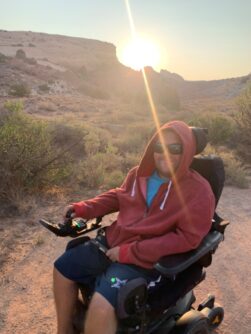
Billy’s legacy shines on
“What’s been amazing over the past couple of months is some of the recent announcements about gene therapy and the progress in treatments that MDA is contributing to,” Tom says. “Treatments are coming for future generations, and it was nice to be able to call that out at the event. To share that this is why we are here and what we are supporting. It made it very real that we know our efforts – and Billy’s efforts – are not in vain.”
As his friends and family remember Billy for the loving, positive, outgoing, impactful man that he was, his life and legacy serve as a testament to the lasting impression that a heart of service can have on the lives of others and the tangible hope for a brighter future.
The post Billy Moehle’s Family Continues His Legacy of Making an Impact appeared first on Quest | Muscular Dystrophy Association.
]]>The post MDA Ambassador Guest Blog: Resetting Priorities: A PhD’s Journey appeared first on Quest | Muscular Dystrophy Association.
]]>
Dr. Tye D. Martin
Growing up in rural New Mexico with muscular dystrophy had its share of ups and downs, including occasionally peeling out in my three-wheeled motorized scooter. At times I felt like I was driving a miniature motorcycle, weaving through desks and chairs (sometimes “bumping” through) on my way to becoming valedictorian of the Estancia High School graduating class of 2007. Collegiate coursework and laboratory research at the University of New Mexico in Albuquerque brought a host of new challenges as I completed my bachelor’s, master’s, and doctoral degrees in Chemical and Biomedical Engineering. In 2019, after defending my thesis with honors and earning my PhD, I took a month off to visit my sister and brother-in-law in Tennessee. By September, I was plunging back into academic research as an NIH funded postdoctoral fellow. Nobody, including myself, would have believed how drastically life would change a year later when COVID-19 entered the picture.
Truthfully, even prior to the pandemic I was beginning to feel the strain of research, grant writing, teaching, and training to become a professor. During the height of the pandemic in 2020 and 2021, that struggle escalated as I dealt with severe burnout that was worsened by the isolation and pressure to be more productive. I think much of this pressure was self-imposed, because I felt that the additional time at home should lead to more productivity. Unfortunately, my disease progression advanced and I began feeling severe discomfort when sitting in my wheelchair. I couldn’t sit comfortably for more than 15 minutes without adjusting my position. The fall of 2021 is when my system reached overload. I experienced heavy mucus and phlegm levels that began taking away my ability to talk. You can imagine how disruptive the combination of these symptoms became during a stage of my career when I needed more and more time to succeed as a professor in training.
Tye and his nephew, Nathan, intently watching the Disney movie Cars!
The holiday season was rapidly approaching, and my family and I were ecstatic to be planning for my nephew’s first Christmas visit to New Mexico. On a Saturday morning roughly a week and a half before Christmas day, I transferred into my wheelchair with my dad’s help. I started feeling dizzy and more weak than usual, so my mom checked my oxygen level. Upon seeing the reading below 60, my parents called 911. The last thing I remember is the deep breath of oxygen coming from the tank that the paramedic gave me before blacking out. I woke up to a hospital room and realized I was intubated with a feeding tube. I found out my gallbladder had turned septic and had been removed. It was my first surgery.
Countless challenges, from a tracheostomy to a hairline hip fracture, made recovery nearly impossible – especially since I initially had no way to communicate with doctors or nurses. No one had any idea how to work with someone who had muscular dystrophy in the ICU. For example, I experienced excruciating pain up and down my legs when the nurses turned me side-to-side because of my contractures. A long list of medications including a blood thinner that actually caused clots to form in my left arm and fentanyl for pain relief brought more issues. As an optimist (almost to a fault at times), I was accustomed to finding silver linings in difficult circumstances – but there were moments in the hospital where I hit rock bottom.

Tye and his friend (and fellow PhD) Marilyn Nicol who he first met on Instagram upon starting his social media journey during an MDA awareness event.
A turning point occurred, when after a week or two, one nurse finally realized I was motioning to write a note to communicate with her. I could actually explain why I was uncomfortable and self-advocate again. My doctors approved my request for my parents to alternate staying with me and we were able to train my nurses how to turn me less painfully. As I gradually regained small amounts of strength, I began to consider what my life would look like if I was ever able to leave. After forty days in intensive care, I was finally able to move back into my house – and that is really when my recovery truly started. Therapy, speech valves, portable ventilator care, eating solid food, driving my wheelchair, and pain management dominated my and my parents’ time. Eventually, around June or July of 2022, I decided that it was time for me to jump back in and explore social media while also taking time for focusing on my mental health needs for the first time.
I made the decision to diverge from my original career path in biomedical engineering research, but to continue in academia through sharing knowledge of science and engineering as applied to spreading awareness neuromuscular disease. I also began working part time in the area of critical disability studies focusing on higher education, ableism, and disability service policy.
Graduation photo of Tye during the PhD commencement ceremony at the University of New Mexico in 2019.
Academics was, and in many ways still is, a part of me that I apply to other aspects of my life to this day, but it’s no longer the primary focus. Since the events surrounding my surgery and symptom progression over two years ago, I’ve had the opportunity to share my story with the Instagram community, resulting in amazing new friendships and connections. Volunteer work and advocacy with nonprofits, including Laughing at my Nightmare, Inc. and MDA, have allowed me to begin helping others living with neuromuscular disease, which is something I wasn’t able to even consider when I was a postdoctoral fellow. When I look at the current landscape of disability inclusion and the many challenges that need attention, I realize the unique position I am in to use everything I’ve learned through almost 36 years to make a difference. The stigmatizing nature surrounding our community and the prevalent lack of empathy have my constant attention now. Although I am traveling a different path than the one that I originally set out on, I don’t regret my journey to becoming Dr. Tye D. Martin, PhD. I had the honor and privilege of working with so many folks at the University of New Mexico, many of whom are still an important part of my life. As a friend and former mentor once told me: “A PhD is a plane ticket to fulfill your true passion and purpose.” And I have found both in advocacy and a commitment to empowering others in the community.
The post MDA Ambassador Guest Blog: Resetting Priorities: A PhD’s Journey appeared first on Quest | Muscular Dystrophy Association.
]]>The post Episode 44- Voting Rights and Accessibility appeared first on Quest | Muscular Dystrophy Association.
]]>Read the interview below or check out the podcast here.
Mindy Henderson: Welcome to the Quest podcast, proudly presented by the Muscular Dystrophy Association as part of the Quest Family of Content. I’m your host, Mindy Henderson. Together we are here to bring thoughtful conversation to the neuromuscular disease community and beyond about issues affecting those with neuromuscular disease and other disabilities and those who love them. We are here for you to educate and inform, to demystify, to inspire, and to entertain. We are here shining a light on all that makes you, you; whether you are one of us, love someone who is, or are on another journey altogether. Thanks for joining. Now, let’s get started.
There is something very big coming very soon, unless you’ve been living under a rock, you are aware of what I’m talking about. Voting day is November 5th. This is a huge election that includes a presidential vote, and we know that unfortunately from time to time, people in the neuromuscular disease community or in the broader disability community can run into some obstacles when trying to exercise their right to vote. So today I have two experts with me who are going to talk through information that you may need, questions you may have, and where you can find any additional information that you may need to get ready for voting day.
So first up, I have Shaun Hill with me who currently serves as the manager of Public Policy and Advocacy for the Muscular Dystrophy Association. Shaun is a veteran government relations professional who has worked continuously in the healthcare arena, championing causes on behalf of both patients and providers, working through legislative regulatory and advocacy channels to impact change. And in many of these roles, she’s led the charge on advocacy campaigns such as MDA’s current initiative Access the Vote, which you will hear more about in just a little while. And not to be outdone, I have Mark Fisher with us, the director of Advocacy Engagement at the Muscular Dystrophy Association. In his role with MDA, Mark leads the grassroots program and advocacy volunteer efforts. He works to empower advocates and connect them with key decision makers in order to advance public policies that improve the lives of the neuromuscular disease community. And in 2023, Mark was honored to receive the Top 20 in 2023 Award from The Advocacy Association. Phew, thank you both so much for being here.
Shaun Hill: Thank you for having us.
Mark Fisher: I’m super thrilled to be here. Thanks, Mindy.
Mindy Henderson: Absolutely. So there is no shortage of things to talk about on this topic, so I am going to dive right in, and whoever wants to catch this question, let’s just talk a little bit about some of the common barriers that people with disabilities face when trying to vote. Let’s set us up with some of the challenges first and then we’ll talk about the solutions.
Shaun Hill: Well, certainly there are a ton of logistical challenges. I mean, does the polling place have ramps? Are the doors wide enough to accommodate wheelchairs? Are the voting machines accessible? Transportation issues. Does a person with disability have a way to even get to the polling place? Those are just some of the issues off the top of my head that come to mind.
Mark Fisher: Yeah, Shaun’s right. I mean, the physical barriers that are in place for folks who have disabilities to get into the voting precinct. I mean, if you can remember, these places are churches or schools or neighborhood places and just have physical barriers that might be in place that could hurt folks, the ability just to get in that building. But there’s actually some barriers before that election even happens. Every state has their own different roles, especially how to register to vote. Some use forms that might not be the most up to date, they might not be the easiest for folks to fill out. So even getting registered, there could be some accessibility issues. And then just some of the voting options have constantly changed. Some states, you might have a longer window to vote early, which I know we’ll talk about, and that might have shrunk a bit. Drop boxes might have shrunk a bit. So it’s constantly changing each state, but there are definitely still some barriers that folks have to overcome.
Mindy Henderson: Now, let me ask you this just as a follow-up. When you show up at a polling place, there are, of course, people there working at those polling places, and I don’t know if they’re always volunteers. I think a lot of times they’re volunteers. I don’t know if that’s a hundred percent of the case. But I’ve heard just anecdotally, I’ve heard from people who have showed up to vote, and there may be confusion amongst the people helping to run the voting polls out of the kindness of their heart in a lot of cases or a sense of duty. What can we expect in terms of how much individuals who are there and are in charge should know about what is and isn’t allowed and accessible and things for us? And what should we come armed with in terms of facts and information about what we need and how we’re going to get it?
Shaun Hill: I think when we talk about making a plan, I think for the disabled voter, that’s imperative. Like you said, these people may be volunteers, but at every polling place, there should also be a polling place supervisor. So that may be a person that’s armed with more knowledge than some others that may be assisting. But anything you could bring, I think screenshots, ADA rules, anything that might be beneficial for their lack of knowledge if you come prepared with it. So if you already have the knowledge of, “I have the right to take someone into the booth with me. If I don’t have anyone to take with me, I can request that a voter worker goes in with me to help me be able to navigate the voting process.” So I think it’s almost like having to prepare for a test, so to speak, that you have to come in the door armed with all the knowledge. So in case others are not aware, you’re able to provide that valuable information.
Mindy Henderson: That’s great. I love the screenshot idea. That’s really smart. And I suspect that there are multiple places where people can find information that outline what their rights are, what should be accessible, how it should be accessible, and all of that. I mentioned Access the Vote, MDA’s campaign, and we’ve got an entire website dedicated to voting for people with disabilities. Can y’all talk a little bit about Access the Vote and if there are additional places where they should go to get sort of official information that like you say, Shaun, they could potentially print and bring with them if needed?
Shaun Hill: Sure. On the Access the Vote website, there’s certainly a great deal of information about voter rights. There’s certainly information in terms of making that plan and kind of step-by-step logistics of things to do on the front end. There’s a frequently asked question section that I think would be helpful to voters to prepare. There’s also information beyond navigating the polling place in terms of just giving voters an opportunity of how they should prepare in terms of making the decision about who they’re voting for. So we’ve also provided a great deal of materials around assessing the candidates and how you do the research on the front end prior to election day. So I think all of those things are helpful. In addition, there is a U.S. Election Assistance Commission that offers a great deal of help, particularly for disabled voters, and could navigate people through what your rights are, what you’re entitled to, and also navigating some challenges, and if they should occur, what recourse you have and what are next steps.
Mindy Henderson: That’s super. This may be a stupid question, I suspect the name of the site is probably in the URL, but what is the website for Access the Vote?
Shaun Hill: It is mda.org/vote.
Mindy Henderson: Ah, okay. Even simpler than I thought. I love it. Mark, is there anything else you want to add about resources? Or is Access the Vote a good place to start? And then do we link out to other places from there, like Shaun was saying?
Mark Fisher: Yeah, I would say mda.org/vote is the way to go. Shaun mentioned some really good ones. The one that I really like that Shaun did mention is the United States Election Assistance Commission. It’s a government agency. It clearly outlines everything that folks have rights to. In addition, there’s vote.org, which we link off to a lot. It’s a very handy site, but equally is easy to remember URL. And then there is a spot on there, and then we might get this in a second, of what to do if you run into a problem and who you can call to help resolve any issues that you have. So there’s a hotline on there that folks can call. They have day of issue.
So Access the Vote is hopefully kind of a one-stop shop where we will provide you the information or we’ll link off to something really that might be even more useful. I’ll say that with MDA, we’re non-political, nonpartisan. So all we want is for folks to vote. We don’t tell you who to vote for. We don’t tell you which candidate to vote for. We just want you to vote. So there’s no leanings, no political leanings. Our goal is to get you to cast that ballot.
Mindy Henderson: Love it. Love it. And I love that you mentioned that phone number too, that toll-free number that you can find on, did you say vote.org?
Mark Fisher: It’s on mda.org/vote.
Mindy Henderson: Oh, it is. Okay, perfect.
Mark Fisher: Yep, it’s in FAQ.
Mindy Henderson: That would be probably a wise phone number to bring with you just in case. So that’s great information. Is there anything particular that you hear from people in the disability community that’s maybe one of the biggest misconceptions about our rights to vote or the biggest challenge that people come up against?
Shaun Hill: I think there is a misconception that in an effort to accommodate the disabled voter and perhaps a need to take someone with you to assist you, that there is a concern or fear that your vote may not be private, that you’re not voting independently. And I think the polling places certainly are charged with making sure that even if you need assistance, that is done in the most private manner so that like anyone else, your vote is your vote and no one else has privy to that. So I think that slight concern over perhaps if it’s not someone you’re bringing into the booth, but rather that you’re requiring the assistance of a poll worker, that, is my vote still private? So I think that’s a possible concern among voters.
Mindy Henderson: That makes sense.
Mark Fisher: And I would just add to that that any sort of accommodation or an accessible voting machine or accessible polling place, those are your rights. Those are your rights. You can exercise them. So everyone in this country obviously has a right to vote if they meet certain standards that we all know. But if you do, that’s your right, and you have every reason to demand that you have the ability to cast your vote. So there’s laws that protect you, there’s laws to ensure that you can cast your ballot. You have every right to exercise those.
Mindy Henderson: Love it. Okay. Let’s talk about voting machines for just a second and what features and sort of, I don’t want to say alterations, but what should an accessible voting machine look like? Are there certain requirements or criteria for making a voting machine accessible? And does every polling place have one? And if not, how can you find one that does?
Shaun Hill: I don’t know that there is a uniform standard. I think probably like most things’ type with voting, that it tends to be on a state-by-state basis. I think it’s probably prudent to either call your polling place ahead of time to, one, be able to make sure that they have a voting machine that could accommodate your needs. And if not, that gives you lead time and try to see if then you can navigate to a polling place that may be able to accommodate your needs or to see what can be done to assure that that type of voting machine is available at the polling place that your voter registration card dictates that you go to. But I’m not sure in terms of uniformity. Mark, do you have any knowledge of uniformity? Or is that governed state by state?
Mark Fisher: Yeah, some insights to that. I would also say that federal law requires that every polling place have an accessible voting machine.
Mindy Henderson: It does.
Mark Fisher: At least for federal elections. So that is required. But Shaun brings up a good point. Just because it’s required, doesn’t mean you … We all know how many different voting places there are. Just because they’re required, it might not mean they have one or it’s in service. As some states are leaning towards paper only ballots, and they might inadvertently not know that they have to have an accessible voting machine, which are more electronic. In my polling place, we’re almost a hundred percent paper ballots. But in the rush to do that, they might get rid of the accessible voting machine because they don’t want electronic voting machines, but they have to have an accessible voting machine in every location by federal law. But Shaun makes a good point of doing a double check to ensure that they are doing that and that it’s functional, because sometimes just because they have one, it might not be functional.
In terms of the features, you can expect them to have for folks to have visual and audio impairment. So you can put headphones on so they can read the ballot to you. You can have it so they enlarge the text. Some of the newer ones, they’re able to connect to personal devices to help select the candidate you want. But it’s a little bit all over the board. And you can imagine, as things, as technology improves, the voting machines will improve as well. So a voting machine that might have been accessible 15 years ago has probably seen some things. So it might not be as fast as a new one that might be able to read you the ballot quicker or print the ballot out quicker for you. So like a lot of things election-wise, it probably does vary a bit of what an accessible voting machine would offer, but they are required in federal election in every polling place. So the rest is sure, but Shaun’s right to do that double check just to ensure that you’re polling place actually has one.
Mindy Henderson: Okay. If you do show up at your polling place, and let’s say maybe you tried to call and you couldn’t get through or who knows what, and so you go and they don’t have an accessible voting machine, it sounds like, I’m going to make the assumption that maybe they are required to accommodate you in some other way by maybe having someone that works there or someone who’s with you help you vote using a different machine. Obviously, you’ve got the option of going somewhere else, but is all of that true? Are they required to accommodate you somehow if they don’t have the right machine?
Shaun Hill: Yeah, they are required by law to make sure that you’re able to exercise your right to vote. So if that means kind of navigating through a different process, then they would have to do that.
Mindy Henderson: Okay. Okay. So let’s talk about getting to a voting station. I think it was mentioned earlier. That can be one of the challenges, is transportation and getting to the voting station. If a person doesn’t drive and doesn’t have someone readily available to help them or to drive them to the polling station, what are the rights of people with disabilities around getting to a voting station? Is there anything spelled out around just that transportation piece?
Shaun Hill: I don’t know that there is anything in terms of spelled out rights. I think there are certainly recommendations that could be made. Certainly, we know the shared ride services such as Lyft and Uber in some cases provide free or discounted rides on election day. But again, depending on where you are in the country, their wave program or the vehicles that they have to cater specifically to the disability community are few and far between. There could be the pursuit of going through other paratransit companies. Sometimes local agencies, local office or disability may garner volunteers to be able to transport disabled voters back and forth through the polls. So again, I think it goes back to that notion of planning for election day. In some cases, that’s where I think the option of early voting may be helpful just because there is a challenge. Everybody’s trying to get there on November 5th and everybody’s experiencing challenges that perhaps the opportunity to avail yourself of early voting may avert some of that.
Mindy Henderson: Absolutely.
Mark Fisher: Just to add to that too, if you know who you’re going to vote for, maybe know what party you’re going to be voting for, I would reach out to that local party’s office and say, “Hey, can you get me to the polls?” I worked in a campaign a while ago, and our office had volunteers who that was their whole volunteer role during election day, was to help folks get to the polls that day. So that might be a way to go to reach out to your local party office and see if they assist you. Trust me, if they think you’re going to vote for one of their candidates, they’re going to get you to that polling place or find an option for you to get to that polling place. And then so many community groups. I can’t tell you how many church groups do this, how many community service organizations that are not affiliated do this. I think that, Shaun is right, making that plan ahead of time to figure out how you can get to the polls. If you need that, I think there are some options to explore.
Mindy Henderson: That’s fantastic. I would not have thought of several of those options. So that’s all really helpful. We’ve talked a little bit about this, but I just want to go back to it one more time. If you get to a voting station and somebody is unhelpful or aware of our rights, is there anything else that you guys want to throw out there apart from the suggestions that have already been made of maybe how that should be handled?
Shaun Hill: Well, I think that, as I mentioned earlier, that first line of defense is always the poll supervisor. I think if that person is unaware or not helpful, I almost feel like then you start going through the various options. You come prepared with what you know your rights are. Mark mentioned earlier the telephone number, that’s kind of the election hotline. So maybe even in that moment, that call may have to be placed. I would hope that people wouldn’t encounter barriers based on those that work there. But in the event that those things happen, I think we just kind of go down the ladder in terms of recourse.
Mindy Henderson: That’s perfect. Of course, we hope that that will not be something that anyone who’s listening to this encounters, or anyone else for that matter. But unfortunately, it’s something that I know has come up in the past, and so just so that we can all be ready. If you’re not yet registered to vote, what are the different options that are available to get registered? Specifically, if you have a disability and you’re maybe not incredibly mobile in terms of transportation, can you register online? Does it vary from state to state?
Mark Fisher: I might go. It varies from state to state.
Mindy Henderson: Okay.
Mark Fisher: So first, my first advice, if you’re not registered, do it now. Whenever you read this, do it now, because every state has different rules, different deadlines. Some are 30 days out, some are closer to the election day. Some, you can register in person. It’s the gamut of your options, but it really does depend on the state and maybe locality. Some, you can a hundred percent register online via a form. Now, I’ll be candid, some of those forms are not entirely accessible as we would hope they would be. But there are some online options depending on the state you’re in.
And then again, I go back to some of the community groups. You could probably find a nonpartisan, non-political affiliated community group who would be doing a voter registration drive that might be able to assist you in your community. If you live near a college town, I guarantee there’s some sort of college group, whether it’s associated with free or some sort of a ride. I did some of these voter drives back in school that might be able to assist. So I’ll say it again, it’s like what Shaun has said, make that plan and that plan starts with registration. But yeah, it’s a wide, wide variety. Anything from 30 days out to some places, you can register on election day if you want, and you could do that in person. It just depends.
Mindy Henderson: Great. Where would someone go to look to see what their state’s rules and things are?
Mark Fisher: I would say vote.org.
Mindy Henderson: Or could you just Google how to register to vote?
Mark Fisher: You could do that. Vote.org is one. We link that from mda.org/vote. You can go to vote.org/ you could probably Google your state election office or state election commission. They might be able to help you as well. I think the good news is, there’s a lot of organizations that want to help you vote. Now you got to be discerning. Do they have an agenda? Do they not? But MDA is definitely right up there, that we can help you get started. But there’s a lot of good information. But I would say vote.org is kind of where I’d go. We link that off from our website. And then you can always Google your state election commission and they can help as well.
Mindy Henderson: Great. Great. We’ve mentioned, and I think the theme of the day might be have a plan, have a voting plan. We’ve mentioned that it’s come up a number of times. I think it was Mark who mentioned in passing earlier, a little bit about voting early if you can. So while we’re on the topic of having a plan and making sure that you get registered yesterday, if you are not yet registered to vote, also, I think there are a lot of benefits to trying to vote early if you’re ready and you know who you want to go in and vote for, and your research is all done. So I just wanted to stress that one more time.
Mark Fisher: Just to add about early Voting. A couple of things that I think is important with early voting, at least in a lot of places, they tend to have early voting centers in person that are usually in bigger places. So it might be your community center might have early voting versus maybe your local church that would have it on election day. A larger center might just be more accessible period than your local precinct would be on election day. They probably would have maybe a few accessible voting machines that would probably be more likely to operate if it’s a larger venue than a smaller one you might go to on election day. So I think you might wait a little longer, you might wait a little longer, but I do think you might have a more accessible experience because these are usually in larger venues that have more things.
In addition, if for some reason something might not go as well as you thought, well then you have more times to vote. So if something doesn’t go right on election day, that might be it. At least with early voting, you might have a second shot, and you never know what could happen on election day. You could have a sick child, a sick parent. You yourself might be facing an illness or something and you just can’t make it that day. Well, that’s the last day. So there’s so many benefits to early voting that I really think, Mindy, you said it right, if you know your choice and you know what you want to do, I think it’s worth taking the time just to truly ensure that your voice is heard this election, because you never know what can happen on election day.
Mindy Henderson: Love it. The other thing too, and this is just sort of a personal curiosity of mine, but as you’re talking about some of the things that can go south on voting day, if you wait until the last minute, those lines can be incredibly long on voting day. Do they close the polling places at a certain time? Or do they make sure that everyone who’s in line before that time hits can get in and vote? Or does that vary also?
Shaun Hill: To my understanding, the general rule of thumb is, if the polling place closes at 7:00, everyone that is in line by 7:00 will get an opportunity to go in and vote.
Mindy Henderson: Okay. That’s kind of what I thought. Just wanted to make sure and ask the question. Let’s talk a little bit about as a community and allies of the disability, how can we all create more awareness and a more inclusive voting environment for people with disabilities going forward?
Shaun Hill: I certainly think the key word that resonates for me is education. I think we can all use our voices to amplify the importance of disability voting rights, of educating one another. I think one way MDA has tried to do that is certainly through our Access the Vote campaign. But I think as we as individuals or various communities within our hometowns, within our church groups, within our community groups, to use those forums as opportunities to educate one another on the issue, it’s certainly being amplified, certainly because it’s a presidential election and people tend to be more honed in and focused on elections during the presidential election years. But the National Council of Disability has recently put out a study regarding disability and voting rights. So it’s on a lot of people’s radar screen, and I think if we kind of tap one another on the shoulder and say pay attention to this, then it certainly raises the issue tenfold.
Mindy Henderson: That’s great.
Mark Fisher: I think for me, a couple thoughts come to mind, Mindy. One, I will plug the recent Quest magazine, the front-page story is all about some of the laws and some of the things that were passed for the disability community lately. Well, that happened because people voted. That happened because people raised their voices. They overcame some barriers and cast that ballot. If folks don’t do that, then we might stall in terms of getting more things across the finish line. So our elected officials listen to us because we’re voters, so let’s be a voter and let’s make sure they know that our voices are heard. And continue the momentum we have seen that that article has mentioned.
Also, we have a long way to go. So we have a long way to go to make voting accessible for everyone. I mean, we’re giving folks a lot of great tips and we really are, but it’s not perfect. It’s not a perfect system. So I would recommend as folks vote this year, take note of some of the obstacles you might’ve faced. Take note of some of the things that maybe we as MDA could have provided you more information on, what could have made your voting experience easier. And then tell us at advocacy.mdausa.org. You can email that to us. You can see it on our website as well. Tell us, because next year we want to grow this even bigger and get more information for folks out. So let us know how your voting experience went and what can we do in the next election to give you the more resources to make that even better.
And then the third one is stay involved, especially at the local level. So many of these laws, and candidly, hurdles, are local and state driven. When we see a cutback on early voting or a cutback maybe on drop boxes, or maybe you live in a state that has an expansion, maybe it’s expansion of early voting or expansion of drop boxes, that happens at the state and local level. It’s important for folks to recognize, “Oh, these are some of the challenges I had. I bet we can sell this at a state level.” So keep getting involved. We have a way to go. But our lawmakers, whether federal, state or local, only will listen to you if they know you’re a voter. So that’s the first step, is to vote, and then we’ll continue to make change after that.
Mindy Henderson: So well said by both of you. Last question, anything that you would either like to leave our listeners with in general about voting, the importance of voting, or anything about how listeners can continue to stay informed and engaged with these issues? Mark, you just named a bunch of them. MDA has an incredible advocacy team. You two are part of that wonderful team. We have a grassroots advocacy group. How can people stay informed and engaged?
Shaun Hill: Again, I think keeping a conversation going. Storytelling is among them. Share with MDA, share with others what has your experience been as you’ve navigated the voting process. I believe that the U.S. Election Assistance Commission reported that there are 1.95 million voters who classify as disabled that say they experience challenges when they go to vote. That’s a huge number. Probably even more staggering is that that same report says that if the disabled voter were able to vote at the same rate as someone not experiencing challenges, there would be an additional 1.75 million votes cast in the United States. That’s a lot of power. You have to wonder if in fact, people are staying home because of the challenges that they face in trying to get to the ballot box.
So wanting to move beyond those numbers and encourage people that it’s worth it. It’s worth the challenge. You are exercising your voice. You are casting your vote for decision-makers that are getting inside of local election offices, are getting into inside the walls of Congress to make decisions that impact your day-to-day life. So despite the fact it may be a bit of a challenge is so vitally important.
Mindy Henderson: Love it. I think that that’s a huge number, first of all. My mind is a little bit blown by that number that you just shared with us. And again, regardless of how you vote, who you vote for, I think that sometimes it can be underestimated how much your vote counts. But if you add your vote to that million and something, other people who are voting, it can really make a difference. And I think that what you’re voting for is a very clear reflection of just the kind of world that you want to live in. Again, issues aside, candidates aside, your vote is your way to say, “This is how I feel, and this is what I am in support of, and this is the world that I want to live in.” So vitally, vitally important, and I think the power of a single person’s vote can’t be underestimated because it’s compounded when you add it up with all the other people that can get out there and vote. Mark, any final thoughts or words from you?
Mark Fisher: I mean, Shaun hit it out of the park. I mean, I’ll just repeat our tagline of Access the Vote, which is, your vote is your power, access it, and access it this year. So Shaun said it perfectly. I couldn’t say any better.
Mindy Henderson: Perfect. Wonderful. Well, we will leave it on that note. Again, all of this information, we’ve cited a lot of resources, we’ll put all of that in the show notes for everyone. Shaun and Mark, I want to thank you for joining me and everyone who is listening. Thank you for taking the time out of your day to listen. Please subscribe, please share the podcast with a friend, and please go vote. Thanks, everybody.
Mark Fisher: Thank you.
Shaun Hill: Thank you, Mindy.
Mindy Henderson: Thank you for listening. For more information about the guests you heard from today, go check them out at mda.org/podcast. And to learn more about the Muscular Dystrophy Association, the services we provide, how you can get involved, and to subscribe to Quest magazine or to Quest newsletter, please go to mda.org/quest. If you enjoyed this episode, we’d be grateful if you’d leave a review, go ahead and hit that subscribe button so we can keep bringing you great content, and maybe share it with a friend or two. Thanks, everyone. Until next time, go be the light we all need in this world.
The post Episode 44- Voting Rights and Accessibility appeared first on Quest | Muscular Dystrophy Association.
]]>The post 18th Annual MDA Night of Hope Gala Highlights the Byars Family’s ALS Journey and Honors Choate Construction appeared first on Quest | Muscular Dystrophy Association.
]]>The MDA Atlanta Night of Hope Gala for ALS Research has become one of the nation’s largest galas in support of amyotrophic lateral sclerosis (ALS) research and has raised over $12 million since its inception in 2006. The event was started 18 years ago by Holly and Palmer Proctor, to honor Holly’s father, Steve Ennis, and his strength, determination, and hope throughout his ALS journey.
We recently had the opportunity to speak with Holly and Palmer about the community the Night of Hope has fostered and the impact it has made in ALS research. We also spoke with April and Guy Byars, who will be recognized as the 2025 Night of Hope Mission Impact Family, as they share April’s experience living with ALS.
A History of Night of Hope with Holly Proctor

Holly & Palmer Proctor
What led you to start the MDA Atlanta Night of Hope Gala for ALS Research?
When my father was diagnosed with ALS in July of 2005, our family was devastated, hopeless, powerless and uneducated about ALS. Fortunately, we found help and hope through the MDA/ALS Clinic and Dr. Jonathan Glass in Atlanta. In 2005, before the ice bucket challenge in 2014, we discovered there was limited awareness, research, and support for ALS. I wanted to do anything and everything to help my father and so many others affected by ALS. With my husband, Palmer, and the support of our family, friends, and community, we embarked on a mission to raise funds and awareness for ALS. The Gala was started in 2006 in my father’s honor to raise awareness for ALS, bring hope to families living with the disease, and ultimately find new treatments through research funding so that one day others will survive ALS.
How has the MDA Night of Hope Gala evolved over the past 18 years?
The MDA Night of Hope Gala continues to be a testament to my dad’s strength, courage, and determination. Over the past 18 years, the Gala Committee and MDA continue to be passionate and dedicated in their commitment to find treatments and a cure for ALS. Thanks to the Gala committee, MDA, friends, family, and our community, the event has raised over $12 million since its inception in 2006. With these funds, giant steps toward a solution to the mystery of ALS are being made and our hope for a cure continues.
What are you looking forward to most at the 2025 MDA Night of Hope Gala?

2024 MDA Choate Group
I am looking forward to this year’s MDA Night of Hope Gala as we support the ALS community and continue the momentum of raising awareness and proceeds for ALS research. This year we are thrilled to honor Choate Construction Company as a founding sponsor and staunch supporter of the MDA Atlanta Night of Hope Gala. Choate Construction, one of the largest general contractors in the Southeast, consistently demonstrates its commitment to the communities it serves and stands as a model of corporate citizenship. Their leadership has always shown a deep commitment to giving back. The Night of Hope has been fortunate to be a beneficiary of their generosity and friendship in the fight for a cure for ALS over the last 18 years. Through their continued support, Choate Construction has played a vital role in supporting this important cause, and we are profoundly grateful for their unwavering partnership in helping us works towards finding a cure.
April and Guy Byars share the impact of hope and community
How did you become involved in the MDA Atlanta Night of Hope Gala?
Harry Foster is a part of a men’s prayer group with me, he and his father, Jim Hinsdale, heard about April via a prayer request and offered us their table as they wouldn’t be able to make it in 2023. We invited a large group of friends and had a wonderful time.
Why do we need fundraisers like the MDA Night of Hope Gala for ALS Research?
The necessity of Night of Hope is in its name. ALS is awful, its nature as a currently indomitable thief of agency can lead to feelings of hopelessness in patients and their families. The Night of Hope helps lift the shroud of despair, it gives us all our agency back as we take action, and it acts as a beacon, something to look forward to the next year.
What is giving you hope through your ALS diagnosis?

April & Guy Byars
The work of all the doctors and scientists seeking to eradicate ALS gives us hope, certainly, but the community more than anything helps patients, and their families feel like we are not alone. We have people around us who care deeply–many of whom we don’t even know–they show up certainly at the events, but we feel love and support throughout the year, each action no matter how tiny acting as a ray of sunshine.
How has the work of Dr. Jonathan Glass and the Emory University MDA/ALS Care Center been part of your diagnosis and journey?
The MDA/ALS Care Center at Emory University is April’s clinic. Dr. Glass and his colleague at Johns Hopkins, Dr. Rothstein, have been working very closely with April since 2022 to slow down her progression and study her specifically to research her CSF in medical trials. April has the C9 variant, which is familial, so the true hope is that our sons, if they have to face ALS in the distant future, are equipped with the fruits of Dr. Glass’ labor and easily defeat it.
Event details
The 2025 MDA Night of Hope Gala will be held on Saturday, March 15, 2025, at The InterContinental Buckhead Hotel. To become a sponsor, purchase tickets or donate, please click here.
The post 18th Annual MDA Night of Hope Gala Highlights the Byars Family’s ALS Journey and Honors Choate Construction appeared first on Quest | Muscular Dystrophy Association.
]]>The post Empowering Others to Enter the Remote Workforce: Q & A with ENDisabilty Founder Nayeem Amin appeared first on Quest | Muscular Dystrophy Association.
]]>
Nayeem Amin, Founder of ENDisabilty
With a focus on providing IT certification training and job preparedness, ENDisability is empowering adults with disabilities to take advantage of the multitude of opportunities for remote work. ENDisability aims to support individuals to hone their skill sets and join the workforce to share their talents with the world. The organization, which has partnered with the state of Texas, also provides support for resume writing, interview skills, and job seeking tools. Nayeem is passionate about increasing an inclusive culture in the workforce and empowering others to create and achieve goals with a life-long learning mindset.
We checked in with Nayeem to learn more about ENDisability and the importance of an inclusive employment culture.
Can you tell me a little bit about your organization ENDisability?
ENDisability empowers individuals with disabilities to learn new skills and advance their careers. We specifically try to assist college students living with disabilities and adults with disabilities who are employed and seeking job skills training, although we are always open to ANYONE looking to learn! We currently provide certification training in Scrum, Salesforce, and Kanban for those who are looking to get started or get ahead in the IT domain.
What inspired you to start this organization?
Equality of opportunity in the workplace has always been our #1 mission. Even with our parent company, Decca Recruiting – where we help recruit the best talent for our partners- we are always focused on the talent of the candidate and not necessarily their circumstances. ENDisability is meant to help bring individuals with disabilities to the forefront and upskill them to join their peers in the workforce while enjoying a salary that can provide a better quality of life. However, anyone may take our courses to enrich their own lifelong learning journey.
How did you choose the name?
We had many names, but the word “End” struck me because I really wish I could end the challenges that come with living with a disability, especially in the employment sphere.
I understand that you offer training programs that provide certification on three different tech platforms. What made you decide to focus on those three?
These are three platforms that I know and understand very well. My expertise in these programs allows me to ensure that the trainers we have onboard are the best in the industry with extensive training experience. One may know technology, but to be able to teach requires a special skill. I hired people I know were capable of teaching these specific platforms.
Who has your organization partnered with? And how are those partnerships creating opportunities for people living with disabilities?
We partner with many large organizations and government groups! We partner with the people who make it a priority to include diverse talent in their workforce. We are certified by the DOBE, SBA, and NMSC and are committed to finding the best talent, regardless of physical ability.
Why is empowering others living with a disability to join to the workforce an important mission to you?
What is stopping someone whose mind is capable of achieving the same as those living without disabilities? Nothing. And I want others to realize that. With so many advancements in technology, there is a variety of hardware and software available that help people with limited mobility perform their tasks. And COVID created an environment where a lot of companies now let people work from home. Now is the time to get out and accept the challenge to join the rest of the world and shine.
With more and more companies providing remote work opportunities, how has the job landscape changed for people living with disabilities?
I have had challenges with our customers who didn’t allow remote work for anyone – until COVID hit. Now, one can work from home for most companies, so there’s no need to get up and drive to work. The issues with using the restroom, eating, and whatnot become eliminated. Now a person with a disability can work from the comfort of their own home – or even their own bed if needed. Remote allows that. More jobs are remote now. It is a game changer.
As someone living with a disability, what has your personal journey been like and what tools have you gained on your own journey in the workforce?

Nayeem with his wife and children.
My personal journey has been a series of transitions from denial to anger to acceptance and equanimity. When I first started my company, I could walk, travel, and do many things that I cannot do today. From walking to manual wheelchair to automatic wheelchair to weakness in my extremities, the transition has been both challenging and interesting. It has brought me close to myself, I learned to accept the challenges, and keep fighting. When I saw some light, I decided to spread this news and bring more people onboard to join the fight. I have traveled the world with my family, I have raced cars, volunteered, and I am still living the best life thanks to acceptance. Thanks to my company that gives me the financial strength to live a great life and provide for my family. All we have to do is get up and go give it a try. There is no failing, not until we give up.
What key advice would you give to others about the interview process?
Be yourself, be honest, and always show eagerness to learn. If you don’t know something, don’t pretend you do. And always ask good questions. Most importantly, LISTEN.
What key advice would you give to others about writing a resume?
Don’t fill it up with tons of information, keep it at 2 pages, have an objective. Don’t use one resume for every job. Take the time to build the narrative around the job description. Focus on quality, not quantity.
What would you share with someone who has never had a job before and might be feeling a little overwhelmed about joining the workforce?
I will walk you through, there is more respect in trying than not. Don’t worry, we have all been there. Even the most able actors get nervous before an audition. Be brave, keep your chin up. We need you to make a difference. Feel free to reach out to us as soon as you’re ready.
What would you say to someone who might be afraid to accept a job and potentially lose their caregiver benefits?
There are tons of programs with SSI and Workforce Commission that can show you how to navigate through these questions. There are ways to receive both. Work with resources that are available to help you.
What do you want others to know about the value of sharing their skill sets and becoming active members of the workforce?
Our fingerprints don’t match. Everyone is unique. Have you fulfilled your purpose? Do you know why you are here? You are here to make a difference. To yourself, to others. You are here to chase your own dreams. YOU MATTER. You can come out and join the workforce and be a part of it. So, give it a try. It can be tough and challenging, but overall, it is amazing to be doing something that you love and value.
The post Empowering Others to Enter the Remote Workforce: Q & A with ENDisabilty Founder Nayeem Amin appeared first on Quest | Muscular Dystrophy Association.
]]>The post Simply Stated: Updates in Charcot-Marie-Tooth Disease (CMT) appeared first on Quest | Muscular Dystrophy Association.
]]>The National Institute of Neurological Disorders and Stroke (NINDS) describes CMT as one of the most common inherited neurological disorders, affecting an estimated 126,000 individuals in the United States (US) and 2.6 million people worldwide.
To get a birds-eye view of the current understanding of CMT, see Q&A with CMT expert Stephan Zuchner, MD, PhD.
Causes of CMT
CMT is caused by defects (mutations) in more than 100 different genes. In general, the genes associated with CMT encode proteins that contribute to the structure or function of peripheral nerves (those that transmit information between the brain/spinal cord and the rest of the body) and/or myelin (the protective covering that surrounds the nerves). Most cases of CMT are caused by defects in one of four genes: PMP22, MPZ, GJB1, or MFN2. The disease is hereditary, and can be passed down from parents to their children through three common inheritance patterns, autosomal dominant (caused by one defective gene copy), autosomal recessive (caused by two defective gene copies), and X-linked (caused by a defective gene on the X chromosome).
In people with CMT-causing mutations, the affected nerves degenerate over time and lose the ability to communicate with muscles in the body. This can cause weakness and atrophy (thinning) of the muscles in the arms, legs, hands, and feet, leading to CMT symptoms.
CMT subtypes
The genetics of CMT are complex. Defects in different genes can produce similar symptoms. Alternatively, different defects in a single gene can produce different symptoms. The various presentations of CMT are classified into subtypes based on similarities found in clinical features, the type of nerve dysfunction, and inheritance patterns. These subtypes are named CMT types 1 through 4, plus an X-linked type. A letter is added after the name of the subtype to denote association with a particular gene defect (e.g. CMT1A is caused by a PMP22 mutation, CMT1B is caused by a MPZ mutation, etc.).
The different subtypes of CMT present with different features, including age of onset, severity, specific patterns of neuropathy (nerve damage), and clinical symptoms. CMT1 is the most common subtype, affecting more than 50% of people with the disease. Symptoms of CMT1 usually begin in childhood. The X-linked form of CMT is the second most common form, and primarily affects males beginning in late childhood or adolescence.
Diagnosis and Management of CMT
CMT is typically diagnosed using a variety of assessments including a thorough medical and family history, complete neurologic examination, electrodiagnostic testing, and confirmatory genetic testing.
There are no disease-modifying treatments currently available for CMT, but supportive therapies can help improve overall health and quality of life of people with the disease. Multidisciplinary care provided by neurologists, genetic counselors, nurses, physical therapists (PT), occupational therapists (OT), physiatrists, and orthopedic surgeons can be beneficial. Some recommendations may include:
- Strategies and adaptations to help accomplish tasks of daily living
- Special stretches and exercises to maintain arm and leg strength and reduce muscle cramping
- Braces/orthopedic devices and assistive devices such as canes and walkers to help with mobility
- In some cases, corrective surgery to help with foot problems
For more information about the signs and symptoms of CMT, as well an overview of diagnosis, prognosis, and care management concerns, an in-depth review can be found from T. Bird, 2024.
Evolving research and treatment landscape
Both supportive interventions and disease-modifying therapies, including genetic correction strategies, are in the drug development pipeline for CMT. Promising strategies under active investigation for CMT include small molecule therapy, gene therapy, stem cell therapy, and siRNA and antisense oligonucleotide (AON) gene silencing therapies. Dozens of drug development programs are underway, targeting CMT subtypes including CMT1A, CMT2A, CMT4B1, SORD deficiency, CMT1B, CMT2S and CMT4J. Here, we highlight a few recent developments in CMT research:
Therapeutic development for SORD deficiency
In 2020, genetic defects in the sorbitol dehydrogenase gene (SORD) were discovered as the cause of a form of CMT known as SORD deficiency. Two drugs, epalrestat and ranirestat, appear to reverse some effects of SORD mutations in the context of another condition, diabetic neuropathy. Epalrestat is currently marketed in a few countries (not the US) for the treatment of diabetic complications, while ranirestat has been studied in late-stage clinical trials. Both drugs have been shown to be safe and well-tolerated in patients. Re-purposing of these drugs to treat SORD deficiency represents a promising therapeutic strategy for CMT.
Another drug, govorestat (AT-007) (Applied Therapeutics), is also being developed as a therapy for SORD deficiency. Interim 12-month results from the phase 3 INSPIRE trial of govorestat were announced in February 2024. The trial sponsors reported that patients receiving govorestat showed physiologic improvements (i.e., reduction in toxic sorbitol levels) and improvements on measures of disease severity and well-being. Improvements were specifically seen in lower limb function, mobility, fatigue, pain, sensory function, and upper limb function. Though currently investigational, govorestat may become the first therapy approved by the US Food and Drug Administration (FDA) for the treatment of SORD deficiency.
Gene delivery strategies
As the underlying genetic causes of the different forms of CMT become known, subtype-specific genetic correction strategies are becoming a focus of new therapeutic development. One research group is targeting CMT1A using a gene therapy strategy to counter the defective PMP22 gene that causes the disease. The researchers have developed a genetic tool, specifically a viral vector (AAV9) that introduces a small piece of genetic material (miRNA) to stop too much of the toxic PMP22 gene product from being made. This gene therapy was tested in a mouse model of CMT1A and was shown to decrease markers of disease and increase functional outcomes in the animals. This study provided proof of principle for treating CMT1A using a gene therapy approach.
In 2023, MDA and the Charcot Marie Tooth Association (CMTA) co-funded another group working on a gene therapy strategy to treat CMT. The grant was for a 3-year research project entitled: Nanoparticle-based gene delivery to Schwann cells for treating CMT disease, led by Dr. Alexia Kagiava of the Cyprus Institute of Neurology & Genetics in Nicosia, Cyprus. In this project, Dr. Kagiava and her research team are working to improve a gene therapy approach that they previously developed to treat X-linked CMT. X-linked CMT is caused by mutations affecting connexin32 (Cx32), a protein that is involved in signaling between nerves. Dr. Kagiava’s gene therapy works by delivering the gene encoding Cx32 using a viral vector (AAV9) into the space surrounding the spinal cord (intrathecal injection). In a mouse model of CMT, use of this viral vector resulted in widespread and long-lasting expression of the gene encoding Cx32, leading to improvements in disease pathology and functional improvements. Dr. Kagiava is now working to develop a safer and potentially more targeted gene therapy using a specially designed nanoparticle to deliver the gene encoding Cx32.
Clinical trial readiness
Natural history studies
To support treatments that are entering the clinic, researchers are also working to optimize clinical trial design. This includes conducting natural history studies of individual CMT subtypes to gain greater clarity on disease progression and to identify outcome measures for use in future clinical trials. A number of such studies are being led by the Inherited Neuropathies Consortium (INC), a research group funded by the National Institutes of Health (NIH) and advocacy organizations including MDA, and run by researchers at leading universities and neuromuscular centers. The INC is currently recruiting patients to enroll in CMT natural history studies across the US and in several sites in Europe and Australia.
Patient registries
Several advocacy groups have established patient registries to help collect data from patients with CMT, which can be used for research to improve understanding of the disease. CMTA has an extensive patient registry that people with CMT can now sign up for using a convenient mobile application. The Hereditary Neuropathy Foundation (HNF) hosts a global patient registry for people with CMT, and has also launched a digital health study in collaboration with BioSensics to collect patient data remotely. MDA works with these foundations in various ways, including co-funding grants and sponsoring INC along with these other organizations.
Outcome measures
One challenge in drug development for CMT is that the disease is typically slowly progressive. As a result, it is difficult to capture efficacy of new interventions within the time window of a clinical trial, contributing towards a number of failed clinical trials thus far. There is an urgent need to identify responsive outcome measures that can be used to more quickly measure efficacy of new therapeutics in clinical trials.
One outcome that has recently been identified as a responsive measure in many common subtypes of CMT is the intramuscular fat fraction (FF). The feasibility of FF as an outcome measure for CMT1A and other subtypes of the disease was recently reported in two studies from Doherty, et al., both of which were funded by MDA.
Biomarkers
Another area of evolving research in CMT is the identification of sensitive biomarkers of disease. Specifically, researchers are attempting to identify proteins in the blood of people with CMT that can be used to quickly and accurately diagnose the disease. Several biomarkers have been proposed as sensitive diagnostic biomarkers in animal models of various CMT subtypes and in patients with CMT.
Training of CMT clinical evaluators
Given the variability of CMT presentation and the lack of standardized measures of disease progression, evaluating outcomes in clinical trials for CMT interventions has been challenging. Dr. Joshua Burns of St. Jude Children’s Research Hospital is working to establish a global certification standard for evaluating CMT disease, which includes training of reliable clinical evaluators and implementing use of standardized outcome measures, to improve the quality and consistency of CMT trials. In August 2024, MDA awarded Dr. Burns a $300,000 Research Infrastructure Grant to further this work.
MDA commitment to CMT research
By the end of 2024, MDA will have invested more than $44M in CMT research. Strategic investments from MDA and other advocacy organizations, combined with traditional funding sources such as the National Institute of Health (NIH), are helping to move the field of CMT forward.
MDA’s Resource Center provides support, guidance, and resources for patients and families, including information about CMT, open clinical trials, and other services. Contact the MDA Resource Center at 1-833-ASK-MDA1 or [email protected].
The post Simply Stated: Updates in Charcot-Marie-Tooth Disease (CMT) appeared first on Quest | Muscular Dystrophy Association.
]]>The post MDA Ambassador Guest Blog: Championing Accessibility as Ms. Wheelchair Kansas: A Journey of Advocacy and Action appeared first on Quest | Muscular Dystrophy Association.
]]>
Tamara Blackwell, Ms. Wheelchair Kansas 2024
As Ms. Wheelchair Kansas, my journey has been one of advocacy, education, and action. Ms. Wheelchair is a national organization that advocates for people with disabilities by promoting leadership, education, and advocacy. The competition highlights contestants’ achievements and their ability to articulate the needs and accomplishments of the disability community. I became Ms. Wheelchair Kansas through a competitive process that involved interviews, speeches, and sharing my platform on accessibility, and I went on to earn the title of Ms. Wheelchair America through the same process. As Ms. Wheelchair America, I now have the opportunity to raise awareness and drive change on a national level, advocating for critical issues affecting people with disabilities.
This role has opened doors for me to meet with leaders, engage with communities, and share my platform on a larger scale than I ever imagined. It’s a privilege and responsibility that I don’t take lightly, especially as I work to promote inclusivity and accessibility across Kansas.
Engaging with Local Leaders

Tamara speaking with Mayor Lily Wu of Wichita about the importance of accessibility.
One of the highlights of my advocacy work has been the opportunity to meet with local leaders who are in positions to influence change. Recently, I met with Mayor Jim Benage of Bel-Aire, KS, where we discussed several pressing issues related to accessibility in our community. Our conversation was insightful, focusing on the need to ensure that all public spaces, including parks and government buildings, are accessible to everyone, regardless of their abilities. Mayor Benage showed a genuine interest in these concerns, and I’m hopeful that our discussion will lead to meaningful improvements in the future.
I also had a productive meeting with Mayor Lily Wu of Wichita, KS, where we delved into the importance of creating more accessible public spaces. Our discussion highlighted the need to ensure that new developments include features that accommodate people with disabilities, making Wichita a more inclusive city for all. Mayor Wu’s commitment to accessibility is truly inspiring, and I’m optimistic about the positive changes that will follow our conversation.
Governor Laura Kelly is another leader I’ve had the opportunity to meet with. Her support and recognition of the importance of accessibility underscore the significance of the work we are doing to ensure that Kansas is a welcoming place for everyone.
Spreading the Message Through Media
Beyond meetings with officials, I’ve had the chance to share my platform with a wider audience through various media channels. I’ve appeared on television, been featured in newspapers, and taken part in community events to spread the word about the importance of inclusivity. These appearances have been pivotal in reaching people who might not otherwise be aware of the challenges that individuals with disabilities face on a daily basis.
Through these media opportunities, I’ve been able to educate the public, dispel misconceptions, and encourage more people to join the movement for accessibility. Each interview, article, and appearance is a step toward building a more inclusive society, and I’m grateful for every platform that allows me to share my story and advocacy work.

Bel-Aire city council meeting. Tamara was presented with a citizenship award, Mayor medal, and challenge coin
Collaborating with the Bel-Aire Lions Club
Recently, I had the pleasure of speaking with the Bel-Aire Lions Club about a project that is close to my heart: the creation of an accessible park in our community. While we didn’t get into the specifics of a plan, our conversation focused on the importance of making this dream a reality. We discussed the need to bring this topic back to the city council, to ensure that it remains a priority for our town. The members of the Lions Club were incredibly supportive, and I’m optimistic that with their help, we can turn this vision into a reality.
The idea of an accessible park is about more than just swings and ramps; it’s about creating a space where all children and families can come together and enjoy the outdoors, regardless of their physical abilities. It’s about fostering a sense of community and inclusion, and I’m committed to doing everything I can to make this park a reality.
A Visible Advocate for Accessibility

Tamara speaking with the Bel-Aire Lions Club about her advocacy and hopes for the community.
Throughout my journey as Ms. Wheelchair Kansas, I’ve learned that real change happens when communities come together. Advocacy isn’t just about speaking up—it’s about building relationships, finding common ground, and working together toward a shared goal. Whether it’s through meetings with mayors, media appearances, or discussions with local organizations like the Lions Club, every interaction contributes to the larger movement for accessibility.
But beyond being an amplified voice for change, I’ve made it a point to be a visible advocate in my community. I’ve visited schools, where I’ve spoken to students about the importance of inclusivity and understanding the challenges faced by people with disabilities. I’ve attended community events, where I’ve had the opportunity to meet with residents and share my experiences, helping to raise awareness and foster a culture of accessibility. Being present in these spaces ensures that the message of accessibility isn’t just heard—it’s seen and felt.
Looking Forward
As I continue on this journey, I’m more motivated than ever to keep pushing for change. The support I’ve received from leaders, media, and community members has been overwhelming, and it fuels my passion to keep going. But there’s still much work to be done.
I’m committed to continuing these conversations, advocating for accessibility, and working with others to make Kansas a place where everyone, regardless of their abilities, can thrive. Together, we can create a more inclusive world, one where accessibility is not just a dream, but a reality for all.
The post MDA Ambassador Guest Blog: Championing Accessibility as Ms. Wheelchair Kansas: A Journey of Advocacy and Action appeared first on Quest | Muscular Dystrophy Association.
]]>The post Commitment and Passion for Volunteering: A Family Affair appeared first on Quest | Muscular Dystrophy Association.
]]>
Doug and Angela Britton
Doug Britton has been a dedicated MDA volunteer since 2011 when he spent his first summer as a counselor at MDA Summer Camp. His commitment to serving others and passion towards making a positive impact on the world are key values that he is instilling in his children. The father of three and his wife, Angela, recognize that volunteer work provides an opportunity for their children to develop a higher level of kindness, compassion, humility, and desire to be of service. They have built their family around these values – with a passion for serving the neuromuscular disease community at its core.
“Our experiences volunteering for MDA have shaped my family priorities,” Doug says. “We embrace each other’s desires to find ways to creatively be of service – the concept of giving and being of service are visceral parts of our family fabric.”
Falling in love with MDA Summer Camp
Doug, an Army Veteran and co-founder of a cyber security company, first learned about MDA Summer Camp when he began dating Angela. When they met, she worked as a manager of clinical operations for muscular dystrophy research at the Children’s Hospital in Washington D.C. and had been volunteering at camp for eight or nine years. Doug is quick to admit that he initially signed up as a counselor to impress his now wife. While romantic love initially inspired him to become a volunteer, it was his experiences with the youth at camp that kept him coming back year after year.
“I fell in love with the community and the kids. I learn so much from the kids each year – from the latest slang to gaining a powerful perspective from being able to witness the grace with which these youngsters meet challenges,” Doug says. “Camp is something that is unlike anything else. It is truly magical.”

Doug and Nick at MDA Summer Camp
Doug still keeps in touch with his camper from that very first year, a young man named Nick who lives with SMA Type 2 and is now a successful software developer. While he has a number of stories from camp that make him chuckle, there are also profoundly impactful moments and lessons that he cherishes from his time spent providing service to meet the daily needs of campers. Those moments have shaped and humbled him in ways that add value to his view of his own life.
“When I look back on my life, I want to know that I was of service to those around me. And I like being able to be of service in a way that is inglorious and is the kind of thing some people might shy away or run away from,” he says. “Being able to meet even the most vulnerable need of another person with dignity and kindness is what is important to me about being a human.”
And as a parent, he hopes to share those lessons with his children, not only through them hearing about him and his wife’s volunteer efforts, but also through volunteering their own time and gaining their own experiences.
Instilling values of volunteerism
Angela and Doug have compelled their three children, Daniel (16), Dexter (12), and Bella (10), to commit to at least one summer volunteering at MDA Summer Camp once they are of age. Next year, Dan will be eligible to volunteer alongside his father at camp. While Doug hopes that they will want to continue volunteering at camp after their first year, he also wants to allow them the opportunity to pursue volunteer roles of their own choosing.
“I am confident in their service-mindedness, so even if camp isn’t what they continue to do, they will grab onto something and commit themselves,” Doug says. “But there are so many reasons that it is important to me that I bring them to camp. It’s important to me that they get comfortable with people who are different from them, that they put themselves in the service of others in the humblest way possible, and that they see that there is an ability to make a connection with someone and with a group that is richer than you can even imagine.”

The Britton Family
As a parent, Doug recognizes that it is his job to prepare his children to be successful in the myriad of circumstances that life is going to throw at them, and he wants them not only to be prepared but to be confident and compassionate. Pulling from his own experiences at camp, Doug places importance on his children also volunteering at camp because he wants them to gain confidence and experience in putting the needs of someone else before their own. He teaches his children that the actions in life that can truly drive outcomes and positively change lives require you to serve others and to put yourself in uncomfortable situations, navigating both with kindness, compassion, and humility.
“I want my kids to have the confidence to be comfortable in what might initially feel uncomfortable, as they work with fellow humans in a decent and kind way. And this experience really sets them up to gain those skills and to grow as people. Being of service to your fellow human and subjugating your wants and desires to what someone else needs is important,” Doug says. “To put your resources and marshal all of your creativity and capability and the parts of who you are into providing a voluntary service is incredible. Things like that are how people change the world.”
Paving the path forward
In addition to donating his time and talents as a volunteer at MDA Summer Camp, Doug is raising awareness and funds for neuromuscular research as a member of the MDA’s Team Momentum at the NYC marathon. This will be his second year running the marathon, after raising $7000 last year.
Having witnessed Angela’s work with some of the scientists who have been foundational in shifting the treatment landscape for the NMD community and observing MDA’s influence in creating a model that drives progress, Doug is passionate about supporting MDA’s mission. His participation in the marathon also provides him an opportunity not only to teach his children about perseverance, but to model it for them in real time.

Doug at the NYC marathon
“I was never someone who was compelled to run a marathon. I am not naturally, physically gifted at all. But my kids have a lot of gifts and when I saw what they were physically capable of, and also saw them get impatient with some of the challenges required to keep growing and be competitive, I saw an opportunity to teach them grit using my body as a canvas,” Doug says. “I want to show them how to get good at something that yesterday was impossible, but today is not impossible because of sheer will. That has been my commitment – that they can watch someone become capable of anything. I would never have qualified for the NYC marathon, but by fundraising I am able to have a slot. Which perfectly aligns with my love of MDA.”
Doug shares that there are early indicators that his lessons are working, as his kids push through their own runs and challenges. He celebrates every one of those little victories as a brick in the wall towards building and becoming stronger people. And seeing his family at the finish line last year made all of the personal challenges that he overcame to achieve his goal, including injuries and shin splints, worth it.
A commitment to service
When it comes to instilling perseverance and a value for volunteerism, Doug believes that parents need to serve as a model in order for those lessons to truly take shape in their children.
“For it to really take hold in your child’s psyche and in their id and their soul, it takes investment from the parent,” he says. “There are different lessons to learn at the camps that I am compelling my kids to volunteer at – but I am going to be there, too. I will help frame the lens that they look at the experience through. And I believe that the outcome is very different than if I just shipped my kid off and said, “Hey, go do good. Good job,” versus standing right next to them providing delicate services to a person that needs your help. You have abdicated influence over how this takes root in your child’s soul.”

The Britton family
And as a co-founder of his company, RunSafe Security, Inc., Doug’s ability to influence the value of volunteerism in others reached beyond just his own family. Early in the partnership, Doug informed his co-founder, Joe Saunders, that he would need a week off each summer to go to camp. The two decided to create a policy within their company that all employees are eligible for a paid week off of work to provide volunteer services. Inspired by Doug’s volunteer work with MDA, the company has created a culture of support for people embracing volunteerism in their own lives.
Through the many days training for marathons, weeks of volunteering at camp, and years spent fostering a passion for service unto others in his family, Doug finds that his experiences have served him well in defining a life well lived and well loved. “I come away from this feeling like I am the big winner,” he says. “The things I have gotten out of my collaboration with the MDA community will echo with my family for the next eighty years, regardless of if I am alive or not. And I am so excited that long after I am gone, this is what is going to echo.”
The post Commitment and Passion for Volunteering: A Family Affair appeared first on Quest | Muscular Dystrophy Association.
]]>The post Everything You Need to Know About MDA Hill Day 2024 appeared first on Quest | Muscular Dystrophy Association.
]]>We sat down with MDA’s Director of Advocacy Engagement, Mark Fisher, to recap this amazing event.

Steve Way gives Hill Day Kickoff Speech
What when and where was MDA on the Hill?
This year, MDA on the Hill took place from September 8 through September 10 in Washington, D.C. This multi-day event brought together 95 advocates from 24 states from across the country and featured advocacy training, networking, meetings with members of Congress and staff, and much more.
MDA on the Hill is an annual event that provides an opportunity for groups to meet with members of Congress with the goal of influencing policy decisions. Can you tell us a little bit about the history of Hill Day?

Team Florida meets with Florida Representative John Rutherford
MDA has gone to Capitol Hill many times over the years, but the COVID-19 pandemic caused us to reset and rethink the event. In 2022, we had advocates successfully participate in a virtual Hill Day event. In 2023, we brought people back to Washington, D.C. for the first time since 2019 to meet in-person with their lawmakers about accessible air travel. The 2024 MDA on the Hill event has continued to build off our 2022 and 2023 events into a larger, more impactful experience of advocates.
Why is this event especially important to the MDA Advocacy team and the NMD community?
MDA on the Hill is MDA’s premier advocacy event of the year and it’s important for many reasons. First, for the NMD community to raise their voices and ensure their elected officials hear them is vitally important. It’s powerful to feel that those who represent you are truly listening, and MDA on the Hill provides that opportunity. In addition, the importance of the NMD gathering together in the same space is invaluable. Connecting with old friends and making new ones is usually the main highlight for participants.
How does the Advocacy Team participate in MDA on the Hill?

Team Nebraska meets with Nebraska Senator Deb Fischer
It’s all hands-on deck for MDA’s advocacy team during MDA on the Hill. The advocacy team coordinates the issues advocates will talk with lawmakers about, develops the necessary training to ensure participants are prepared, and attends meetings along with advocates. That’s in addition to all the logistical work that goes into this multi-day event. It’s all-encompassing work…but 100% worth it!
What issues have we addressed in the past? And how has our presence impacted current legislature?
We have lobbied on many issues in the past, including improving air travel, increasing access to newborn screening, increasing the number of genetic counselors available to the NMD community, improving and modernizing FDA policies and clinical trials, and much more. There is no doubt MDA advocates have made an impact. For example, in 2023, a few weeks after MDA on the Hill, which focused on improving air travel, both the U.S. House and Senate released strong bills that reflected many of the asks MDA advocates made during the event. That culminated with a passing of FAA Reauthorization in 2024, which had the most consequential air travel reforms in nearly 40 years. Our advocates make a big difference!
How many people attended MDA on the Hill this year to advocate for issues important to the NMD community? How many meetings did advocates attend, and how many lawmakers from how many states did they meet with?
We had an amazing MDA on the Hill event and here are the numbers to prove it.
- 95 participants participated in this three-day event.
- 24 states from across the country were represented.
- MDA advocates had 97 meetings with lawmakers and staff.
What key issues did the Advocacy Team focus on this year at MDA on the Hill? What were the specific asks around these issues that we collectively made with lawmakers? And why are these issues important to our community?
We asked lawmakers to support three key bills that are important to many people and families in the NMD community.

Team Massachusetts after a meeting with Rep. Trahan’s Office
- SSI Savings Penalty Elimination Act: A bill to eliminate the savings penalty for SSI beneficiaries by raising outdated asset limits. We know that many who rely on SSI cannot take that promotion, get married, or save a little extra money because of outdated asset limits. This bill would help modernize the program.
- Rare Pediatric Disease Priority Review Voucher Reauthorization: A vital program that incentivizes the development of treatments for rare pediatric diseases which will expire without Congressional action. The is program expires on September 30 of this year, so ensuring it gets reauthorized is crucial for the future of therapies for rare diseases.
- Accelerating Kids Access to Care Act: A bill to streamline the process for children with complex medical needs to access care through Medicaid across state lines. Right now, there is a lot of red tape if a child on Medicaid needs to access care in another state, which can cause issues when trying to obtain medical care. This bill would make the process much easier.
We hope that these three bills will be passed by Congress by the end of the year.
What do you hope our advocacy efforts will accomplish this year?

Team Missouri meeting with Senator Eric Schmitt’s Office
The first goal is to gain more support for the three bills that we will be meeting with lawmakers about during the Hill meetings. In addition, we hope advocates will take the skills and connections they made while in Washington, D.C. back home with them and continue to advocate on issues affecting the neuromuscular disease community where they live. Finally, we hope participants will make lasting connections with fellow advocates because those are invaluable. In the end, we hope MDA on the Hill will energize people to become lifelong advocates.
What do you want others to know about getting involved in advocacy?
It’s simple. Your voice makes a difference. No matter how you participate in advocacy, whether it is sending an email to members of Congress or meeting with them in person, you voice matters. And one person can truly make a difference!
What is the MDA grassroots advocacy program, what other opportunities are there for grassroots advocates to get involved – how do people join MDA’s grassroots advocacy group?

From left to right – Back row: Mary Fiance, Evan Haynes-Knepper, Michael Haynes-Knepper, Jamie Shinneman, Joel Cartner – Front row: Steve Way, Amy Shinneman, Alicia Dobosz
MDA’s advocacy program is one of the organization’s ways to live up to our mission of empowering the people we serve by ensuring the right public policies are in place to truly help the neuromuscular community. We primarily focus on federal work in three categories: Access to care, Accelerating Therapeutic Development, and Empowerment and Independence.
Our grassroots advocates are crucial to the program. Together they contact decisionmakers on key issues, have in-person or virtual meetings with lawmakers, testify at government agency events, write blog pieces, and much more. Our grassroots advocates ensure their voice and the voices of all the NMD community are heard. You can join is at mda.org/advocacy!
The post Everything You Need to Know About MDA Hill Day 2024 appeared first on Quest | Muscular Dystrophy Association.
]]>