The post AI Readiness for Banks: CDO Guide for DACH appeared first on mindit.io.
]]>Introduction
This guide addresses the most common challenge facing CDOs, CAIOs, and CTOs at DACH retail banks in Germany, Switzerland, and Austria in 2026: how to build genuine AI capability while satisfying BaFin and FINMA regulatory requirements. The recommendations are grounded in the specific regulatory context of DACH and the practical realities of organisations managing legacy infrastructure alongside ambitious AI transformation programmes.
Understanding AI Readiness in DACH Banking
AI readiness for DACH banking organisations is a multi-dimensional assessment across data infrastructure, governance, regulatory compliance, and organisational capability. Most organisations in DACH significantly overestimate their readiness on the governance and data quality dimensions while underestimating the time required to close gaps.
The consequences are predictable: AI projects start with optimistic timelines, encounter data quality and governance issues at the PoC stage, and either stall or deploy models of insufficient quality for BaFin and FINMA approval. A rigorous AI readiness assessment prevents this pattern by identifying gaps before project commitments are made.
The assessment covers five domains:
- Data infrastructure — quality, accessibility, freshness
- Governance and compliance — BaFin, FINMA, GDPR, BCBS 239 alignment, model risk framework
- Organisational capability — AI talent, executive sponsorship, change management
- Technology stack — cloud readiness, MLOps infrastructure
- Use case portfolio — ROI estimates, regulatory risk classification, data availability
Key Points
- Most DACH banking organisations overestimate governance readiness and underestimate data quality gaps — independent assessment prevents expensive mid-project surprises.
- Five-domain readiness assessment (data, governance, capability, technology, use cases) provides a complete picture — single-domain assessments miss interdependencies.
- Gap identification before project commitments prevents the stall-at-pilot-stage pattern that affects 60–70% of banking AI programmes.
Closing the Readiness Gaps: Sequencing and Prioritisation
Not all readiness gaps are equal. Some are blockers — they must be closed before any AI project can proceed. Others are accelerators — closing them speeds delivery but does not prevent it.
The critical distinction for DACH banking organisations: data quality gaps in the training data domain for your priority use case are blockers; organisational AI literacy gaps are accelerators. The sequencing principle: close blockers first, then accelerators, in parallel with first use case delivery.
For most DACH banking organisations, the blocker list includes:
- A governed, accessible dataset for the first use case (typically 12–24 months of clean historical data)
- A named model risk owner
- A documented legal basis for data use under BaFin, FINMA, GDPR, and BCBS 239
These can be addressed in 4–12 weeks. The accelerator list — cloud platform, MLOps infrastructure, AI Centre of Excellence — can be built in parallel with first model development, so that the infrastructure is ready when the first model needs to scale to production.
Key Points
- Blocker readiness gaps (data quality, governance ownership, legal basis) must be resolved before project start — typically 4–12 weeks for targeted remediation.
- Accelerator readiness gaps (cloud platform, MLOps, AI CoE) can be built in parallel with first model development — avoid sequentialising these unnecessarily.
- Legal basis documentation under BaFin, FINMA, GDPR, and BCBS 239 is the most commonly overlooked blocker — confirm before training any model on customer or transactional data.
Building a 90-Day Readiness Sprint
A structured 90-day readiness sprint can close the critical blockers and launch the first AI use case in parallel. The sprint structure:
- Weeks 1–4: Assessment and gap identification
- Weeks 4–8: Priority gap remediation — data quality for first use case, governance framework skeleton, legal basis confirmation
- Weeks 8–12: First model development kickoff alongside remaining gap remediation
This approach compresses the typical 6–9 month readiness-then-pilot sequence into a parallel workstream that delivers faster time to first AI value.
For DACH banking organisations, engage your BaFin and FINMA relationship manager in week 1 or 2 — a brief notification that you are beginning a structured AI readiness programme creates goodwill and provides early clarity on any supervisory expectations that should inform your governance framework design.
mindit.io runs structured AI readiness assessments and 90-day sprints for DACH banking organisations, delivering both the assessment output and the initial delivery capacity for first use case development.
Key Points
- 90-day sprint (assess, remediate, kickoff in parallel) compresses the typical 6–9 month sequential readiness-then-pilot approach.
- Early BaFin/FINMA engagement (week 1–2) creates goodwill and surfaces supervisory expectations before governance framework design is finalised — prevents retrospective redesign.
- Parallel remediation and first model development is the key structural innovation — most DACH banking organisations sequence these unnecessarily, adding 3–6 months to time-to-first-AI-value.
Pro Tips
Engage BaFin and FINMA relationship managers early — pre-notification of significant AI initiatives builds regulatory goodwill and surfaces expectations that should inform your governance design.
Nearshore partners with documented BaFin, FINMA, GDPR, and BCBS 239 delivery experience significantly reduce implementation time — they arrive with frameworks rather than building them at your cost.
Design all AI governance documentation to be regulator-readable from day one — if you cannot explain your model governance to an examiner in 10 minutes, you have a compliance gap.
Conclusion
AI readiness is not a precondition for starting — it is a framework for starting well. DACH banking organisations that invest in structured readiness assessment before committing to transformation programmes consistently deliver faster, lower-risk AI implementations than those that jump directly to use case development. mindit.io provides AI readiness assessments and structured delivery for DACH banking clients.
Ready to start your AI & data transformation?
mindit.io works with banking, retail, and insurance organisations across DACH, UK, and BENELUX. Talk to our team about your programme.
Contact mindit.io →
Related Resources from mindit.io
- SUCCESS STORY — Top Romanian Bank + mindit.io: Integration Platform Migration to TIBCO Business Works 6
- ACCELERATOR — Chat With Your Data
- ARTICLE — AI Readiness Checklist for Retail Banking – DACH 2026
- REPORT — The State of Modern AI in Banking 2026
mindit.io · AI & Data Engineering · [email protected]
📌 Follow us for more AI & data insights: Follow mindit.io on LinkedIn →
The post AI Readiness for Banks: CDO Guide for DACH appeared first on mindit.io.
]]>The post AI Readiness Checklist for Retail Banking — DACH 2026 appeared first on mindit.io.
]]>Organisations in DACH (Germany, Switzerland, Austria) face mounting pressure to deliver AI initiatives that satisfy both business stakeholders and BaFin and FINMA regulators. This checklist gives CDO, CAIO, and CTO at DACH retail banks a systematic way to assess data infrastructure, governance, and organisational readiness before committing budget to an AI transformation programme. Each item is grounded in the specific BaFin, FINMA, GDPR, and BCBS 239 requirements applicable in DACH.
Data Infrastructure and Architecture Readiness
Audit all source systems feeding AI models
High Priority
Map data flows across core banking (SAP, Temenos, Finastra), CRM, AML, and DWH. Most banks in DACH discover 8–15 disconnected systems during this exercise. A unified data inventory is the baseline for any production AI deployment.
Establish documented data lineage for tier-1 assets
High Priority
BaFin and FINMA regulators expect complete data lineage for any model used in credit or AML decisions. Define data stewards for each critical data domain and automate lineage tracking using dbt or Azure Purview. Target: 100% lineage coverage for models in regulatory scope.
Validate cloud readiness for sensitive financial data
High Priority
Review data residency requirements under BaFin, FINMA, GDPR, and BCBS 239. Hyperscaler contracts must include specific jurisdiction and sub-processing clauses. Engage your compliance team before moving any customer or transactional data to a cloud AI environment.
Implement automated data quality monitoring
Medium Priority
Deploy data quality checks at ingestion and transformation layers. BaFin and FINMA supervisory reviews increasingly probe AI input data quality. Target >97% completeness and accuracy for training datasets. Tools: Great Expectations, dbt tests, or Azure DQ suite.
AI Governance and Regulatory Compliance
Create a formal AI model inventory with risk tiers
High Priority
Classify each model under EU AI Act risk tiers and BaFin, FINMA, GDPR, BCBS 239 requirements. Credit scoring, fraud detection, and AML models are high-risk under EU AI Act Article 6. Maintain a model registry with owner, purpose, training data, and last validation date.
Appoint a named AI Model Risk Officer
High Priority
BaFin and FINMA guidance on machine learning (2021 onwards) requires a named owner for every AI model in regulated decisions. This role validates model performance, monitors drift, and prepares documentation for supervisory examination.
Define explainability standards for all decision models
High Priority
Any AI model used in credit, AML, or fraud decisions must be explainable on demand to customers and regulators under BaFin, FINMA, GDPR, and BCBS 239. Implement SHAP or LIME layers before production deployment. Explainability is not optional for BaFin and FINMA-regulated institutions.
Run EU AI Act gap analysis for all existing models
Medium Priority
The EU AI Act’s obligations for high-risk AI systems apply from August 2026. Conduct a gap analysis for all models in scope. Banking AI models in credit, AML, and fraud typically require Articles 13–17 compliance: transparency, human oversight, and accuracy documentation.
Organisational Capability and Change Readiness
Assess AI literacy across C-suite and business units
Medium Priority
Survey CDO, CTO, CFO, and Head of Risk teams on AI understanding and appetite. Banks in DACH consistently underestimate internal enablement needs. A 2-day AI literacy programme for leadership reduces project friction by an average of 8 weeks.
Identify and designate AI champions per business unit
Medium Priority
Assign one AI champion in each key business unit: retail banking, corporate banking, risk, and operations. Champions translate business problems into AI requirements and prevent the common pattern of data teams building models that business units do not adopt.
Define KPIs and success metrics before project start
High Priority
Establish measurable KPIs for each planned AI initiative before any technical work begins. Examples: 30% reduction in manual AML review time, 15-point improvement in fraud detection precision. Without pre-defined metrics, AI projects cannot demonstrate ROI to boards or regulators.
Evaluate partner capabilities against regulatory requirements
Medium Priority
Shortlist AI/data partners by three criteria specific to DACH: documented BaFin, FINMA, GDPR, and BCBS 239 delivery experience, nearshore capacity for agile iteration, and willingness to produce model documentation for BaFin and FINMA examination. Request model cards and regulatory evidence in your RFP.
💡 Pro Tips
- Start your AI readiness assessment in the data domain where quality is already highest — for most banking organisations in DACH this is the domain already subject to the most stringent regulatory reporting requirements.
- BaFin and FINMA supervisors increasingly request evidence of AI governance frameworks during routine examinations. Building governance documentation as a by-product of your AI readiness work saves significant remediation effort later.
- The EU AI Act’s transition timeline creates a natural project structure: use the 2025–2026 window to assess and remediate high-risk models before August 2026 compliance obligations apply.
Ready to start your AI & data transformation?
mindit.io works with banking, retail, and insurance organisations across DACH, UK, and BENELUX. Talk to our team about your programme.
Related Resources from mindit.io
Accelerator
Chat With Your Data
ACCELERATOR
AI Innovation Funnel
ARTICLE
AI in Banking 2026: How Tier-1 Banks Are Scaling Agentic AI
📌 Follow us for more AI & data insights:
Follow mindit.io on LinkedIn →
The post AI Readiness Checklist for Retail Banking — DACH 2026 appeared first on mindit.io.
]]>The post AI in Banking 2026: How Tier-1 Banks Are Scaling Agentic AI appeared first on mindit.io.
]]>Free Report · 2026 Edition
65 real-world case studies. A practical roadmap for CTOs, CFOs, and Heads of Digital. The post-hype era is here. The banks that act now will define the next decade.
Published February 2026 · by mindit.io · Free · No paywalls
The novelty of generative AI in banking is over. The banks that spent 2023 and 2024 running cautious pilots are now making a clear choice: scale or fall behind.
In 2026, the question is no longer “can AI work in a regulated banking environment?” The real question is “how do we industrialize it without compromising data sovereignty, failing a regulatory audit, or destroying the trust we have built with customers?”
To answer that question with precision, mindit.io spent months analysing what is actually happening inside Tier-1 banks, not in conference keynotes but in production systems, risk committees, and engineering teams. The result is The State of Modern AI in Banking 2026: a free, 65-case-study report designed as a definitive roadmap for CTOs, CFOs, and Heads of Digital.
“Leading financial institutions are no longer asking if AI works. They are asking how to scale it without compromising data sovereignty or failing a regulatory audit.” The State of Modern AI in Banking 2026, mindit.io
Why 2026 Is the Inflection Point for AI in Banking
The GenAI wave that swept through financial services in 2023 produced thousands of pilots and prototypes. Very few survived contact with the real world. Integration complexity, data quality issues, governance gaps, and an operating model misaligned with AI velocity killed most of them before they ever reached production.
A widely cited MIT-backed analysis from 2025 confirmed what many banking CIOs already knew: most generative AI pilots fail not because the technology is wrong, but because the organisation is not ready to absorb it. Security review cycles, procurement constraints, legacy architecture, risk committee sign-offs: these are the real blockers, not the model quality.
In 2026, the banks that diagnosed this problem early, having built the organisational scaffolding AI needs to survive, are now pulling ahead. This report documents exactly how they did it.
Key Insight
Approximately 61% of financial institutions have either implemented AI in production or are actively piloting technologies, but far fewer have achieved measurable, scaled outcomes. The gap between piloting and producing is where the competitive advantage is won or lost.
From Chatbots to Agentic Banking Infrastructure
The most important conceptual shift documented in the report is the transition from isolated AI tools (a chatbot here, a summarisation model there) to agentic banking infrastructure, where AI agents autonomously plan, reason, and execute multi-step workflows across systems, with humans kept in the loop at every critical decision point.
This is not a minor upgrade. It is a fundamental rethinking of how banking operations are designed. Agentic workflows are structured, auditable, and traceable, which matters enormously in environments governed by the EU AI Act, MiFID II, PSD3, and Basel IV. For banks in Germany, Austria, and Switzerland especially, traceability and human-in-the-loop approval are not optional features: they are regulatory requirements.
The report maps exactly which banking functions are ripe for agentic transformation and which still correctly rely on traditional machine learning.
Where Traditional ML Still Wins
Credit risk scoring, fraud detection pattern matching, time-series forecasting, and probability-based decisioning in structured data environments.
Where Generative AI Excels
Document processing, regulatory report drafting, customer communication synthesis, knowledge retrieval, and analyst-support workflows.
Where Agentic AI Transforms
End-to-end loan origination, compliance monitoring pipelines, onboarding orchestration, and multi-system operational workflows.
Where Human Oversight Remains Critical
Final credit decisions, regulatory submissions, customer dispute resolution, and any process with direct regulatory or fiduciary accountability.
Escaping Pilot Purgatory: The Framework That Works
“Pilot purgatory” describes a state in which a bank is running twenty AI pilots simultaneously, none of which are anywhere near production. It is perhaps the most universally recognised problem in financial services AI today.
It happens when teams build proofs of concept in isolation: no defined production path, no budget owner, no integration plan, no change management strategy. The pilot impresses in a demo environment. It dies in procurement. Or in a security review. Or because the data it needs is locked in a system the team does not have access to.
The banks featured in the report’s 65 case studies escaped this trap through a consistent structural approach: a use-case funnel that prioritises ROI, operational fit, and production readiness from day one, not as an afterthought once the model performs well on test data.
The report provides a detailed version of this funnel, including the evaluation criteria, the governance checkpoints, and the organisational design decisions that separate banks scaling AI from banks perpetually piloting it.
Core Principle
Banks do not lack AI ideas. They lack focus. The winners use a structured funnel to identify the 3-5 use cases with the best combination of business impact, data readiness, technical feasibility, and regulatory compatibility, and then go deep, not wide.
The DACH Context: Why This Market Requires a Different Playbook
The DACH region (Germany, Austria, and Switzerland) occupies a unique position in global banking AI adoption. It is home to some of Europe’s most systemically important financial institutions, operates under some of the continent’s most stringent data protection and regulatory frameworks (GDPR, BDSG, the EU AI Act, and Swiss nVoFD), and carries a cultural emphasis on reliability, precision, and long-term institutional trust that is not always compatible with the “move fast and iterate” mentality that characterises AI culture in US technology companies.
This is not a weakness. It is a different kind of constraint. When respected, it produces AI deployments that are more durable, more auditable, and more aligned with what large enterprise and institutional customers actually expect from their bank.
The report is written specifically for this context. Every case study and framework has been evaluated against DACH regulatory realities. The roadmap it provides is designed to work within those constraints, not despite them.
What’s Inside the Report: A Chapter-by-Chapter Overview
The State of Modern AI in Banking 2026 is structured as a practical executive resource: dense with real examples, light on vendor hype, and built to be used in strategy sessions, not filed away unread.
Report Structure at a Glance
- The Post-Hype Reality: What “modern AI” actually means in a banking context in 2026, and why the GenAI hype cycle has given way to a much more nuanced and productive conversation.
- Traditional ML vs. Generative AI vs. Agentic AI: A clear framework for when to use each, with real examples from retail and corporate banking.
- 65 Case Studies Across Retail & Corporate Banking: Documented implementations from Tier-1 banks covering credit, compliance, operations, customer service, and risk management.
- The Pilot-to-Production Framework: How leading banks structure their AI investment decisions, governance models, and delivery methodologies to move from experimentation to measurable outcomes.
- Agentic AI Architecture for Regulated Environments: Technical and organisational design patterns for building AI agents that are auditable, compliant, and human-in-the-loop by design.
- The DACH Market Perspective: Specific analysis of how AI adoption is evolving in Germany, Austria, and Switzerland, including regulatory considerations and market-specific challenges.
- The 90-Day Executive Roadmap: A concrete starting point for banking leaders ready to move from strategy to execution.
AI Adoption Is a Cultural and Operational Challenge, Not Just a Technical One
One of the most consistent findings across all 65 case studies is that technology is rarely the bottleneck. The models work. The infrastructure exists. The cloud capacity is available.
What stops AI from scaling in banks is almost always organisational: misaligned incentives between business and IT, a risk culture that has not been updated to account for AI-specific risks, a workforce that does not understand what AI can and cannot do, and executive sponsorship that is nominal rather than operational.
The banks succeeding in 2026 treat AI literacy as leadership work. Their CIOs and CTOs are not just signing off on AI budgets. They are defining the governance model, setting the risk appetite, and personally championing the organisational change that AI at scale requires. Adoption sticks when executive sponsorship is real, ownership is defined, and business and IT build together from the start.
Who Should Download This Report?
This report was designed as an executive-grade resource. It is most valuable for banking leaders who are directly responsible for AI strategy, technology investment, or operational transformation.
Frequently Asked Questions
What is agentic AI in banking?
Agentic AI refers to AI systems capable of autonomously planning, reasoning, and executing multi-step tasks including loan processing, compliance monitoring, and customer onboarding, with structured human oversight built in. Unlike a standalone chatbot or summarisation tool, an agentic system connects across multiple workflows and data sources, taking actions and escalating decisions to humans at defined checkpoints. For regulated environments, this matters because it supports full traceability, approval chains, and audit logs.
What is “pilot purgatory” and why does it affect so many banks?
Pilot purgatory describes the trap of running many AI proofs of concept that never reach production. It typically occurs when pilots are built without a production path, a defined owner, a change management plan, or consideration for the integration complexity of real banking environments. Most banks have brilliant ideas and capable technical teams. What they often lack is a structured use-case funnel that evaluates ideas against ROI, data readiness, regulatory compatibility, and operational fit from the very beginning.
How are DACH banks approaching AI in 2026?
German, Austrian, and Swiss banks are moving from cautious piloting into deliberate scaling. The shift is driven by competitive pressure from pan-European digital banks, cost efficiency mandates, and the growing maturity of AI tooling that can now satisfy the stringent data sovereignty, explainability, and audit requirements these markets demand. The conversation in DACH has moved from “Can we pilot this?” to “How do we run the bank safely and profitably with AI as an operational layer?”
Is the report relevant outside the DACH region?
Absolutely. While the regulatory and market analysis is calibrated to the DACH context, the 65 case studies, the ML-vs-GenAI-vs-agentic framework, the pilot-to-production methodology, and the executive roadmap are directly applicable to any Tier-1 or Tier-2 bank operating in a regulated environment, across Europe and beyond.
How is this report different from other banking AI reports?
Most banking AI reports are written by analysts who study the market from the outside. This report is written by practitioners who build AI systems inside banks. The 65 case studies are drawn from real implementations, not surveys, roundtables, or vendor testimonials. The frameworks it provides have been pressure-tested against real regulatory, technical, and organisational constraints.
Is the report free?
Yes. The State of Modern AI in Banking 2026 is free to download. No subscription, no paywall, no vendor pitch deck attached. It is a resource built for the banking community, available at mindit.io/whitepaper/the-state-of-modern-ai-in-banking-2026/.
Ready to Move from Pilot to Production?
Download the free report and get 65 real-world case studies, a proven use-case prioritisation framework, and a 90-day roadmap your executive team can act on today.
The post AI in Banking 2026: How Tier-1 Banks Are Scaling Agentic AI appeared first on mindit.io.
]]>The post The State of Modern AI in Banking 2026: What DACH Leaders Need to Do Now appeared first on mindit.io.
]]>
Modern AI is no longer a lab topic for banks. In Germany, Austria, and Switzerland, the conversation has moved from “Can we pilot this?” to “How do we run the bank safely and profitably with it?”
That shift is exactly why we created “The State of Modern AI in Banking 2026”, a practical, executive-ready report built to help banking leaders (CEO, CIO, CTO, COO, CFO, Heads of Risk, Legal, HR, and Customer Operations) understand what’s working, what’s failing, and how to scale modern AI with control.
The report brings together 65 real-world case studies across retail and corporate banking, plus frameworks to help you move from experimentation to measurable business outcomes, without losing sight of compliance, risk, and operational reality.
Why “Modern AI” (not just “GenAI”) matters for banks in 2026
When most people say “AI” today, they mean generative AI. But in a banking context, modern AI is broader:
- Traditional machine learning still wins in many areas like forecasting, probability-based scoring, and pattern detection in structured data (for example credit risk and time-series).
- Generative AI shines when the work involves language, documents, knowledge retrieval, synthesis, reasoning support, and creating “first drafts” at scale (customer communications, internal operations, legal review support, employee copilots).
In practice, most high-impact banking programs combine both. They use machine learning where it is cost-effective and predictable, and GenAI where it unlocks productivity in knowledge-heavy workflows.
The next productivity leap for banking is already underway
Banking has seen major productivity waves before. Core banking systems, ATMs, electronic transfers, spreadsheets, then online and mobile banking. Modern AI is shaping up to be the next one, not because it is trendy, but because it changes how work is executed.
Two macro forces are accelerating adoption:
- Costs have dropped dramatically. According to Stanford HAI’s AI Index, the cost to query models at GPT-3.5 level performance fell from about $20 per million tokens (Nov 2022) to around $0.07 (Oct 2024), which is a 280x reduction in about 18 months.
- Regulation is becoming clearer. The EU AI Act is rolling out in phases, with key milestones that matter for banking governance, especially around general-purpose AI obligations starting 2 August 2025 and broader application following later.
For DACH banks, this combination is critical. The business case is getting stronger while the “how to do it responsibly” is becoming more defined.
What’s changing fast: from chatbots to agentic banking workflows
Early generative AI adoption was mostly Q and A. Ask a question, get a response. Then came RAG, retrieval augmented generation. It grounds responses in internal knowledge bases to reduce cutoff-date issues and improve accuracy.
Now the frontier is agents and agentic workflows:
- Agentic loops: the system plans, takes actions in tools, observes results, and iterates until it meets a goal.
- Agentic workflows: structured, auditable flows where humans remain in the loop and AI steps are controlled and evaluated.
For regulated environments like Germany, Austria, and Switzerland, this matters because it supports traceability, approvals, and operational control. This is the difference between a cool demo and something you can defend in front of compliance and audit.
The DACH reality: what banks underestimate when scaling AI
In our webinar discussion, one theme kept repeating. Technology is rarely the blocker. The hardest part is adoption in a regulated, legacy-heavy environment, where security, procurement, legal, and risk controls can slow progress.
A widely cited MIT-backed finding from 2025 highlighted that most generative AI pilots fail when they collide with real organizational complexity, such as integration, data quality, governance, and operating model constraints.
For DACH banks, pilot purgatory typically happens when:
- teams build proofs of concept without a production path
- governance is bolted on too late
- ownership is unclear (IT vs business vs risk)
- legacy systems make integration slow
- adoption is treated as training instead of operating model change
What successful banks do differently: the 3-part formula
Across the case studies we selected, successful programs consistently align around three pillars:
1) Strategy: a clear ambition and prioritized use cases
Banks do not lack ideas. They lack focus. The winners use a structured funnel to identify use cases with the best ROI and operational fit, rather than chasing dozens of disconnected pilots.
2) Organizing: champions, governance, and top-down adoption
AI at scale is cultural and operational. Successful banks treat AI literacy as leadership work, not a side initiative. Adoption sticks when executive sponsorship is real, ownership is defined, and business and IT build together.
3) Technology: the right infrastructure for speed and control
Banks need an AI layer that supports:
- model and vendor flexibility (cloud and open source options)
- evaluation and observability (to track quality and risk)
- secure integration into existing systems
- rapid iteration as models evolve
This is how you create a safe space to experiment, without losing governance.
What you’ll find inside “The State of Modern AI in Banking 2026”

This report is designed to be used as a reference guide by DACH banking leaders and transformation teams. Highlights include:
65 real-world banking case studies (retail plus corporate)
- Retail banking: 47 examples across front office, middle office, back office, and corporate and IT functions
- Corporate banking: 18 examples including legal, document processing, productivity copilots, and platform modernization
Proven ROI patterns banks can replicate
You will see repeatable value levers such as:
- customer service automation and improved containment
- document processing acceleration and cost reduction
- legal and compliance workflow support
- employee copilots for email, knowledge queries, and drafting
- AI-enabled modernization paths that work with legacy constraints
A pragmatic roadmap to move from pilots to production
The report includes frameworks that help leaders answer:
- Where do we start?
- How do we prioritize?
- What governance do we need?
- What operating model changes are required?
- How do we measure success continuously?
The takeaway for 2026: speed matters, and control matters too
The question for DACH banking leaders is not “Should we adopt modern AI?” It is this:
How do we build the foundation to scale responsibly, fast enough to capture the productivity leap, while staying compliant and in control?
That is the purpose of this report. It helps you benchmark what is happening, learn from deployed examples, and choose a scalable path.
Download the report
Use this link to access “The State of Modern AI in Banking 2026”.
Next steps
- Book a 30-minute call with our architects
- Follow us on LinkedIn to stay updated with the latest news from mindit.io
- Connect with us to explore partner integrations for your data and AI journey
The post The State of Modern AI in Banking 2026: What DACH Leaders Need to Do Now appeared first on mindit.io.
]]>The post Databricks as a Compute Layer: Core Concepts, Best Practices, and Why It Outperforms Legacy Systems appeared first on mindit.io.
]]>
Modern data platforms are no longer built around fixed infrastructure and monolithic systems. As data volumes grow and workloads become more diverse, organizations need architectures that are scalable, flexible, and cost-efficient. Databricks addresses these needs by positioning itself not as a traditional database, but as a compute layer on top of cloud storage.
What Databricks is (and is not)
Databricks is a distributed data and analytics platform designed to operate in cloud environments. At its core, it functions as a compute layer that sits on top of cloud object storage, built on Apache Spark and Delta Lake, and optimized for scalability, elasticity, and parallel processing.
It is important to clearly distinguish Databricks from traditional systems.
Databricks is:
- A distributed data and analytics platform
- A compute layer on top of cloud storage
- Built on Apache Spark and Delta Lake
- Designed for scale, elasticity, and parallelism
Databricks is NOT:
- A traditional database server
- An always-on system
- A place where data “lives” on its own
The key architectural principle behind Databricks is the decoupling of storage and compute. Data resides in cloud storage, while compute resources are provisioned only when needed.
Key Architectural Takeaways
The separation between control and execution layers brings several important advantages across security, scalability, and cost efficiency.
Security
With Databricks, data never leaves the customer’s cloud account. The Control Plane does not access or process raw data, which simplifies compliance requirements and makes audits easier to manage.
Scalability
The Control Plane remains stable and lightweight, while the Data Plane scales independently based on workload requirements. This design eliminates bottlenecks at the management layer and allows compute resources to grow or shrink dynamically.
Cost Efficiency
The Control Plane is always on but consumes minimal resources. The Data Plane, where actual computation happens, is fully on-demand. Organizations pay only for the compute they actively use.
Core Databricks Concepts
Databricks is built around a small set of foundational concepts that shape how workloads are designed and executed.
Decoupled Storage and Compute
In Databricks architectures, data is stored in cloud object storage such as ADLS or S3. Compute is provided by clusters that can be scaled independently or completely shut down when not in use.
This separation delivers clear benefits:
- Lower operational costs
- Improved scalability
- No data duplication
Because data is not tied to compute resources, clusters can be treated as disposable, purpose-built execution engines.
Clusters as Disposable Compute
Clusters in Databricks are ephemeral by design. They are created when needed and terminated when their work is complete. No critical process should depend on a cluster remaining alive.
Key characteristics of Databricks clusters:
- All persistent data lives in cloud storage, not on the cluster
- Clusters scale to the workload, not the other way around
- Size is selected per job or query
- Auto-scaling dynamically adds or removes executors
- Different workloads can use different cluster configurations
For example:
- A daily refresh job may run on a small cluster
- A month-end budget computation may require a much larger cluster
Clusters exist solely to execute code. They run Spark tasks and read from or write to storage, but they do not host data themselves.
Notebooks vs. Jobs
Databricks clearly separates interactive development from production execution.
Notebooks are intended for:
- Development
- Exploration
- Debugging
Jobs are designed for:
- Production workloads
- Scheduled or triggered execution
- Repeatable and reliable processing
A common anti-pattern is running production logic manually from notebooks. Production workloads should always be executed as jobs to ensure consistency, reliability, and traceability.
Best Practices for Consuming Data
Beyond architecture, Databricks encourages specific best practices to ensure performance, reliability, and maintainability.
Prefer Tables Over Files: Delta Tables
While working directly with files is possible, it comes with limitations:
- No transactional guarantees
- No schema enforcement
- Harder optimization
Delta Tables address these issues by providing:
- ACID transactions for safe concurrent reads
- Schema enforcement for predictable execution plans
- Time travel for safe reprocessing and debugging
- File-level metadata for better query optimization
Using Delta Tables improves both data reliability and execution efficiency.
Time Travel for Safe Recomputation
Time travel allows teams to access previous versions of data without restoring backups or duplicating datasets.
This capability is particularly valuable for:
- Re-running last month’s budget logic
- Comparing old and new calculations
- Debugging historical results
From a business perspective, time travel enables:
- What-if scenarios
- Retroactive rule changes
It provides a safe and controlled way to recompute results as logic evolves.
Read Only What You Need: Column Pruning
Efficient data consumption is not only about storage format, but also about reading only the necessary data. Column pruning ensures that queries process only the required columns, reducing I/O and improving performance.
Why Databricks Outperforms Legacy Systems
The architectural differences between Databricks and traditional data warehouses explain its performance and cost advantages.
Legacy Data Warehouses
Legacy systems typically rely on:
- Fixed hardware sized for peak capacity
- Vertical scaling by purchasing larger machines
- Always-on servers running 24/7
This leads to:
- Idle resources most of the time
- High costs even when no work is happening
- Physical scaling limits and diminishing returns
In shared environments, resource contention becomes a major issue. Heavy queries block other users, and performance tuning often turns into an organizational challenge rather than a technical one.
Databricks’ Approach
Databricks replaces these limitations with a modern execution model.
Elastic compute
- Compute is provisioned on demand
- Scale up for heavy workloads
- Scale down or shut off when idle
Horizontal scaling (MPP)
- Scale by adding more nodes
- Massive parallel processing by default
- Performance improves as cluster size grows
Pay-for-use model
- Clusters start only when needed
- Auto-terminate when work is complete
- Costs align directly with actual usage
Isolated workloads
- Separate clusters per workload
- No competition for resources
- Predictable and consistent performance
Conclusion
Databricks is fundamentally different from legacy data platforms. By acting as a compute layer on top of cloud storage, it enables scalable, secure, and cost-efficient analytics without the constraints of fixed infrastructure.
Through decoupled storage and compute, disposable clusters, clear separation between development and production, and best practices such as Delta Tables and time travel, Databricks provides a modern foundation for data processing at scale.
For organizations looking to move beyond traditional data architectures, Databricks offers a model built for flexibility, performance, and real-world usage patterns.
Next steps
- Book a 30-minute call with our architects
- Follow us on LinkedIn to stay updated with the latest news from mindit.io
- Connect with us to explore partner integrations for your data and AI journey
The post Databricks as a Compute Layer: Core Concepts, Best Practices, and Why It Outperforms Legacy Systems appeared first on mindit.io.
]]>The post From Monoliths to Modern Platforms: How AI Simplifies Cloud Migration appeared first on mindit.io.
]]>
Migrating legacy applications to the cloud is no longer just a technical project, it’s a business imperative. AI-assisted tools are making it possible to modernize even the most complex systems, from monolithic apps to supply chain platforms and online transaction-heavy services.
Monolithic Applications
Monoliths have long been a headache: tightly coupled components, high maintenance costs, and limited scalability. Changing one module often breaks another.
AI-driven strategies offer a new way forward:
- Breaking down systems into microservices with Docker and Kubernetes
- Refactoring outdated code into modern languages
- Deploying on cloud-native platforms that enable scalability
This transformation allows enterprises to replace fragile infrastructures with flexible, future-proof architectures.
Manufacturing and Supply Chain Systems
Manufacturing apps often rely on proprietary or embedded software, making them difficult to integrate with modern IoT and analytics. AI helps by:
- Connecting cloud services with IoT devices for real-time data processing
- Using predictive models to anticipate supply chain disruptions
- Adopting hybrid architectures to keep critical processes on-premises while migrating non-core systems to the cloud
The result is a more responsive, data-driven manufacturing landscape.
Online Platforms
E-commerce and online platforms face unique challenges: fluctuating demand, compliance with strict standards like PCI DSS, and performance bottlenecks.
AI-assisted migration strategies include:
- Implementing serverless architectures for dynamic scaling during traffic peaks
- Leveraging AI for security audits and compliance checks
- Optimizing back-end queries with AI-driven analytics
These steps ensure that online platforms can remain competitive, secure, and scalable even under heavy demand.
Why AI Makes the Difference
Traditional migration methods are slow and resource-intensive. By contrast, AI tools analyze, document, and refactor code faster, allowing IT teams to focus on strategy rather than repetitive tasks. Combined with expert engineering oversight, AI reduces costs and accelerates transformation.
Conclusion
Whether it’s modernizing a monolith, streamlining supply chain apps, or scaling online platforms, AI provides the intelligence and automation needed to overcome migration roadblocks. Enterprises that embrace AI-driven cloud migration gain not only cost savings but also agility and resilience – critical advantages in today’s fast-paced digital economy.
Next steps
- Book a 30-minute call with our architects
- Follow us on LinkedIn to stay updated with the latest news from mindit.io
- Connect with us to explore partner integrations for your data and AI journey
The post From Monoliths to Modern Platforms: How AI Simplifies Cloud Migration appeared first on mindit.io.
]]>The post Reinventing Cloud Migration with Agentic AI appeared first on mindit.io.
]]>
Cloud migration has become a strategic priority for enterprises, yet legacy systems remain a persistent obstacle. According to industry studies, 74% of organizations recognize legacy systems as a barrier to digital transformation, and 70% of IT budgets are consumed by maintenance rather than innovation. Add to that the fact that 42% of developers’ time is spent repairing old systems, and it becomes clear why modernization is so urgent – and so difficult.
The Role of Agentic AI in Migration
Agentic AI tools such as Cursor, Cline, Claude Code, and Windsurf are redefining how organizations approach modernization. Unlike traditional manual migrations, these tools work interactively with codebases to:
- Understand and analyze code
- Generate automated documentation
- Formulate tailored migration strategies
By augmenting engineers’ expertise, Agentic AI provides not only speed but also accuracy, reducing risk during migration.
Case in Point: TOP 5 CEE Bank operating in over 15 countries
One example of this approach in action comes from a TOP 5 CEE Bank operating in over 15 countries. The objective was to transform a legacy IBM WebSphere application into a Liferay portlet – all while upgrading the stack to Java 21 and Spring Framework 5.
By leveraging AI in the migration process, the bank successfully moved 80+ applications and workflows from on-premise to cloud. The result: a 40% reduction in effort and timelines, without compromising functionality.
This showcases the potential of AI-assisted frameworks to manage infrastructure setup, configuration updates, and code enhancement efficiently.
Why Human Expertise Still Matters
Despite the automation benefits, skilled engineers remain essential. They must:
- Select the right models
- Define precise migration specifications
- Apply prompt engineering techniques
- Write AI rules for manipulating code
AI doesn’t replace engineering judgment – it amplifies it.
The Future of Cloud Migration
With AI, the risks and costs traditionally associated with modernization are reduced. Agentic AI empowers organizations to tackle what was once seen as unfeasible: migrating mission-critical, monolithic, or industry-specific applications at scale.
For enterprises weighed down by outdated systems, AI-driven migration offers a path to innovation, agility, and cost efficiency.
Next steps
- Book a 30-minute call with our architects
- Follow us on LinkedIn to stay updated with the latest news from mindit.io
- Connect with us to explore partner integrations for your data and AI journey
The post Reinventing Cloud Migration with Agentic AI appeared first on mindit.io.
]]>The post Databricks x mindit.io on Governance in Action: How Traceability Builds Trust in Data, Analytics, and AI appeared first on mindit.io.
]]>
Trust in data is one of those problems every organization talks about, but few solve at scale. Everyone wants to be “data-driven,” yet decision-making often slows down the moment people start questioning the numbers. Where did this KPI come from? Why does this dashboard say something different than last week? Which dataset is the real source of truth?
In the webinar Governance in Action, Vlad Mihalcea (BI Technical Lead at mindit.io) and Eileen Zhang (Senior Solutions Engineer at Databricks Switzerland) broke down a practical view of governance, not as a compliance exercise, but as a platform foundation for transparency, speed, and confidence across the organization.
This article summarizes the key ideas from the session and highlights the mechanisms that help governance scale in real-life environments.
The real problem is not data. It is trust.
Vlad opened with a reality most teams recognize immediately: data comes from many systems, it is transformed multiple times, ownership is often unclear, and definitions change over time. When trust drops, everything slows down. Decisions get delayed. Innovation gets cautious. Delivery gets stuck in endless validation cycles.
The goal of governance, as framed in the session, is to restore confidence through visibility and controls that scale. Not more process. Not more manual checks. A system that helps everyone understand what data exists, how it changes, who can access it, and whether it is reliable.
Why governance is hard to scale
Eileen emphasized that many companies do have governance of some kind, but scaling it across an entire enterprise is where things break. The reasons are familiar:
- Fragmented data sources: legacy on-prem systems, cloud migrations, and often multi-cloud reality.
- More than tables: governance is no longer just about relational data. It includes files, unstructured datasets, notebooks, queries, dashboards, and machine learning artifacts.
- New assets: AI models and feature tables are now part of the data estate and require governance too.
- Different formats, different tools: modern ecosystems need governance that can unify, not only document.
The conclusion is simple: manual governance does not scale. Anything that depends on people maintaining lineage, definitions, or classifications by hand will eventually lag behind reality.
Governance as a platform layer: the Unity Catalog approach
A core message from the webinar is that governance works best when it is built into the platform rather than layered on top.
Eileen positioned Databricks’ approach as an open, unified data platform where open formats (such as Delta tables and other open table formats) sit at the base, and a unifying governance layer sits above them. In Databricks, that governance layer is Unity Catalog.
Compared to traditional catalogs that focus mostly on access control and auditing for tables, Unity Catalog is presented as a broader governance layer that includes:
- Data discovery
- Data lineage
- Data quality monitoring
- Business semantics
- Cost controls
- Governance for multiple asset types (tables, views, files, notebooks, dashboards, models)
- Openness through APIs and federation to external systems and catalogs
With the foundation set, the webinar deep-dived into four practical pillars: lineage, data quality monitoring, classification and governed tags, and attribute-based access control.
1) Data lineage: answering “Where did this number come from?”
Vlad described the “simple question” most organizations cannot answer quickly: Where did this number actually come from? Data typically flows through ingestion, transformations, curated datasets, and semantic models. Without lineage, tracking a single metric across thousands of tables becomes painful and slow.
Eileen explained how Databricks lineage works in a way that avoids one of the biggest problems with lineage in the wild: manual maintenance.
Automated lineage at runtime
A key point: lineage is created automatically based on how workloads actually run on the platform.
- Spark generates a compute plan for a job or query.
- The platform logs metadata from execution.
- A lineage service analyzes those logs and produces lineage automatically.
This means lineage is created dynamically as pipelines and queries run, reducing the risk of gaps caused by outdated documentation.
Column-level lineage, not just table-level
Many tools stop at table-level lineage. The session highlighted that Unity Catalog can provide column-level lineage, letting teams trace individual fields from ingestion to consumption. This becomes critical in complex reporting environments, where a single business metric might be derived from multiple transformations and joins.
Time-scoped lineage
Another practical detail: lineage can be inspected over specific time windows. For example, you can view dependencies from the last two weeks vs the last year, which helps in investigations, audits, and change tracking.
External sources and federation
In Q&A, Eileen clarified that external sources appear in lineage when they are governed through Unity Catalog constructs such as external locations or external catalogs. If data is pulled via arbitrary connections in code outside governed definitions, it may not appear in lineage.
2) Data quality monitoring: lineage shows flow, quality shows trust
Lineage explains how data moves, but it does not guarantee the data is correct, fresh, or complete. This is where the second pillar comes in: data quality monitoring.
Eileen introduced Lakehouse Monitoring features, focusing on two areas:
Data quality monitoring at the schema level
This is positioned as an “easy start” approach:
- Enable monitoring at the database (schema) level.
- Get out-of-the-box tracking for freshness and completeness across the tables in that schema.
- Use it primarily for production databases, because background monitoring introduces cost and should be prioritized where it matters most.
The system looks for expected refresh patterns and volume trends. If ingestion jobs fail, refresh patterns change, or data volumes drop unexpectedly, alerts can be triggered.
Data profiling at the table and column level
Profiling goes deeper:
- Calculates statistics for columns.
- Detects drift and anomalies, such as sudden null spikes or distribution shifts.
- Supports multiple table types and workloads, including streaming tables, time series monitoring, feature tables for ML, and inference tables.
A practical theme emerged here: quality monitoring is not just for engineers. Vlad highlighted that visibility into quality metrics helps business users too, because they can understand reliability through dashboards and trends rather than waiting for engineering confirmation.
3) Automatic classification and governed tags: finding sensitive data at scale
Next, the webinar tackled a governance challenge that often blocks adoption: sensitive data and responsibility.
Eileen described how fear of mishandling personal data creates hesitation and “protectionism,” where teams avoid sharing data because they do not know what is inside it or do not want accountability in case of a breach.
Automated PII detection
The session presented automated classification that scans metadata and sample data to identify sensitive data types, offering out-of-the-box detection categories (like email addresses, phone numbers, IP addresses, and other identifiers). This helps organizations gain visibility into what they hold, which is the first step toward protecting and safely sharing it.
Governed tags
Once identified, data needs consistent labeling. Governed tags support:
- Standardized classification values (for example: internal, sensitive, commercially sensitive)
- Better discovery and search
- Compliance and governance policies
- Cost attribution and organizational tagging (like cost center or business domain)
The key idea: tags should not be free-form chaos. Standardization is how you scale consistency.
4) ABAC: fine-grained control through policies that scale
After classification and tags, the next step is policy enforcement. Eileen walked through Attribute-Based Access Control (ABAC) as a dynamic model where access is determined based on properties of users, resources, and requests.
She described a simple three-step flow:
- Columns and tables get tagged (manually or via classification).
- Governance administrators define access policies based on those tags.
- When a user queries data, the platform applies policies dynamically.
Column masking and row filtering
Two practical forms were highlighted:
- Column masking: mask sensitive columns (emails, phone numbers, identifiers), either fully or partially.
- Row filtering: restrict rows based on attributes like geography (for example, restricting EU customer records from a US analyst group).
Together, these cover common enterprise privacy and access requirements without requiring teams to create multiple copies of datasets for different audiences.
What “lack of trust” looks like in real organizations
One of the most useful parts of the session came from the Q&A: how to recognize when an organization lacks data trust.
Vlad’s signal: spreadsheet proliferation. If many teams recreate the same reporting in Excel or create parallel versions of the truth, trust is broken.
Eileen’s signals:
- Protectionism: teams hesitate to share data due to fear of responsibility and lack of controls.
- Duplication: data copied everywhere because no one knows the ground truth or trusts the central dataset.
- Transparency gaps: unclear lineage and unclear ownership lead to local forks and bloated volumes.
These behaviors do not just add cost. They slow analytics and derail AI initiatives by creating inconsistent inputs and fragmented interpretations.
Who owns data quality?
A common question came up: is data quality the responsibility of data engineers?
Both speakers agreed the answer is evolving. Engineers play a major role, but quality in production becomes a shared concern across teams. Some monitoring belongs closer to data engineering (freshness, completeness, schema expectations). Some belongs to data science or product teams (feature drift, inference drift). In mature organizations, governance functions may also play a role in defining standards and ensuring accountability.
The practical takeaway: platform-level monitoring makes ownership easier to distribute because visibility becomes shared and actionable.
The shift that happens when governance works
Vlad closed with a powerful framing: governance is not about slowing teams down. When governance is built into the platform, teams move faster because uncertainty drops and rework decreases.
When lineage, quality monitoring, classification, and fine-grained controls come together, people stop asking “Is this correct?” and start asking “What can we do with this?”
That is the moment governance becomes a business accelerator.
Final takeaway
Governance becomes impactful when it is practical, automated where possible, and integrated into the platform. The webinar’s message is that traceability and trust are not optional add-ons for modern analytics and AI. They are prerequisites for scale.
If your organization is investing in dashboards, data products, or AI initiatives, the question is not whether governance matters. The question is whether it is built to keep up with reality.
Watch the full webinar
If you want to see the full walkthrough and hear Vlad Mihalcea (mindit.io) and Eileen Zhang (Databricks Switzerland) explain these concepts with real examples and Q&A, watch the complete webinar recording here:
Next steps
- Book a 30-minute call with our architects
- Follow us on LinkedIn to stay updated with the latest news from mindit.io
- Connect with us to explore partner integrations for your data and AI journey
The post Databricks x mindit.io on Governance in Action: How Traceability Builds Trust in Data, Analytics, and AI appeared first on mindit.io.
]]>The post Gekko Group at mindit Forward: Building Digital Hospitality That Actually Moves appeared first on mindit.io.
]]>“I am not a salesperson. I am an IT person. But I want you to understand what we do.”
“We own 100 percent of our technology, and it became a strength.”
Who Gekko is and what it operates
Founded in 2009 and acquired by Accor, Gekko remains an autonomous digital business inside the group, with its own strategy and engineering teams. It distributes more than two million properties across hotels and alternate accommodation, serving both corporate travel and leisure. That dual focus is rare in hospitality and shapes the platform decisions Gekko makes every day.
Gekko buys inventory from hotel chains and independents, from wholesalers and B2C sources, and from global distribution systems such as Amadeus, Sabre, and Galileo. It then sells through APIs and B2B portals, creating a single, simplified feed for customers that hides the multi-sourcing complexity behind the scenes.
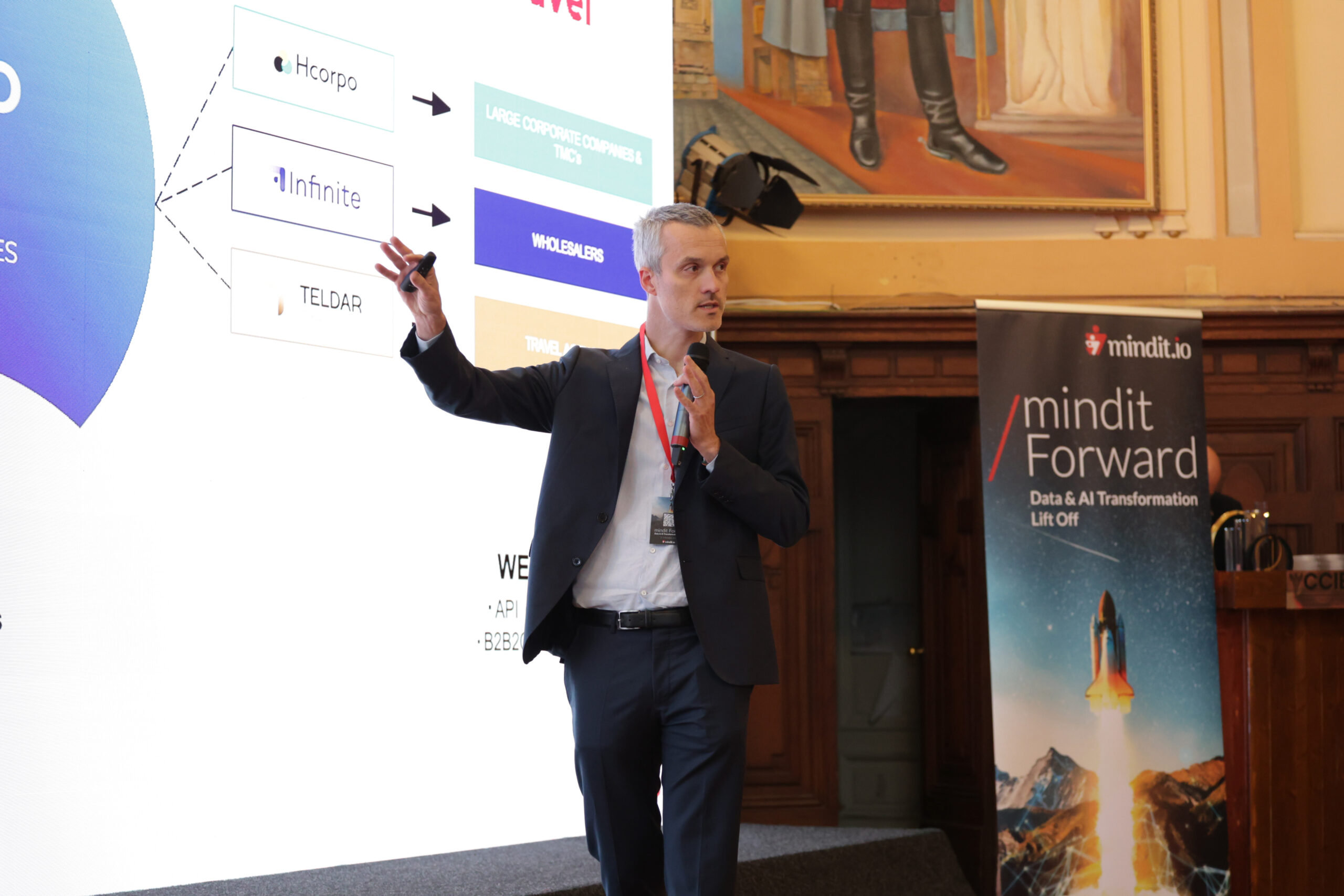
What this means for customers: a consistent search and booking experience that draws on the widest pool of supply without forcing users to care where that supply came from.
Scaling with data, speed, and a product mindset
Matthieu’s operating model is simple and disciplined. Aggregate widely. Normalize relentlessly. Ship value where customers feel it. That is how you turn millions of rate and content variations into a reliable experience for booking teams and travelers.
Two details stand out:
- End-to-end ownership of the core platform creates room for faster iteration and competitive advantage.
- Serve both corporate and leisure without fragmenting the codebase or the roadmap.
“We cover both leisure and corporate. Not so many hospitality companies do both.”
Gekko’s AI strategy in three layers
Gekko treats AI as a portfolio, not a single feature. Matthieu breaks it down into three layers.
- AI for customers
Customer-facing use cases that are visible and valuable. Examples include an AI travel itinerary assistant and support automation. Gekko is also preparing to distribute corporate hotel content directly into customer AI systems using protocols such as MCP, so large clients can query their own GPT-like agents and receive Gekko results natively. - AI for hotels and suppliers
Automation that improves data freshness, content quality, and operating speed. This is mostly invisible to travelers, yet it is critical for accuracy and trust. - AI for Gekko staff
Gekko GPT is the plan for an internal, safe environment where employees can leverage company data and AI responsibly. The goal is to educate the entire organization while protecting privacy and compliance.
“It is very important to have a safe environment where you control the data.”

The takeaway: start from clear outcomes. Put governance and observability in place. Teach the whole company to use AI within a controlled perimeter, then scale what works.
Buy or build: a pragmatic and hybrid stance
Matthieu’s most quoted slide asked a classic question: should you buy or should you make. His answer avoids dogma and favors pragmatism.
- Build when the feature touches the core business and can become a competitive advantage.
- Buy when the capability is not core, is ready to use, and the economics make sense.
- Remember the full picture: build cost and time, run cost, compliance and data location, in-house knowledge, flexibility, and real competitive edge.
The Wizard project with mindit.io: productizing an AI itinerary
One example of building for advantage is the AI travel itinerary wizard developed together with mindit.io. Gekko chose to make this product because it touches the customer experience directly and aligns with core strategy.
The wizard collects a Customer 360 context in a five-step flow: destinations, trip dates, party details, accommodation preferences, and a unique interest profile using sliders that map to a dynamic keyword cloud. The agent then generates a day-by-day plan and enriches it by orchestrating third-party services for geocoding, maps, and place content. It connects to Teldar, Gekko’s B2B distribution, so that a suggested plan is never a dead end. You can regenerate parts of the plan, give the agent guidance, or use an I am feeling lucky option for rapid alternatives.
Under the hood, the team used agentic interactions, LLMs, advanced prompting, and tool use to call external APIs. On the interface side, the wizard ships as custom web components, which means it can be embedded across Angular, React, Vue, plain HTML, and even mobile web views. That design choice lowers total cost of ownership and allows upgrades via npm or CDN without rewriting host apps.
“For this project we chose to make with mindit.io. We considered it a competitive edge and part of our direct strategy.”
Trust, compliance, and the Accor context
Even as a nimble unit, Gekko operates within the standards of a global hospitality group. That raises the bar for security, GDPR, and data location. Building certain components in-house increases control and transparency. Buying from major software providers can also work, but only when pricing and assurance align with enterprise reality.
The principle: keep core data paths explainable, auditable, and ready for executive scrutiny. You cannot create confidence at the end of a project. You design for it at the beginning.

Partnership as a multiplier
Throughout the talk, Matthieu linked Gekko’s progress to empathy, curiosity, and collaboration. That ethos matches mindit.io’s own journey. The itinerary wizard is one example where a shared product mindset turned a concept into a reusable asset that can live across channels and evolve quickly.
What strong partnerships create: faster learning cycles, safer delivery in regulated contexts, and a common language that connects business intent with engineering decisions.
Lessons hospitality and travel leaders can use now
- Own your core so you can move faster where it matters. Buy the rest when time-to-value and economics are better.
- Teach the whole company to use AI safely. An internal GPT with company data turns AI from a side project into a habit.
- Design for reuse. Ship capabilities as components that can run across stacks and channels.
- Aggregate supply, simplify the feed, and hide the plumbing behind a consistent API and UI.
- Attach AI to outcomes, not demos. If travelers and booking teams do not feel the difference, keep iterating.
How mindit.io can help

We partner with retailers and operators to build modern data foundations that harmonize sources and unlock personalization, modernize applications from monoliths to modular, observable ecosystems, and enable AI responsibly with governance, privacy, and measurable outcomes front and center.
Watch and explore
- Full talk by Matthieu Chevrier, CDO, Gekko Group.
- mindit Forward recap hub with all sessions and articles.
Ready to explore your roadmap
If you are building the next generation of travel and hospitality products, we can help you assess the buy-versus-build split, set up a safe internal AI environment, and ship reusable front ends that lower cost while increasing speed.
Next steps
- Book a 30-minute call with our architects
- Follow us on LinkedIn to stay updated with the latest news from mindit.io
- Connect with us to explore partner integrations for your data and AI journey
The post Gekko Group at mindit Forward: Building Digital Hospitality That Actually Moves appeared first on mindit.io.
]]>The post Avolta at mindit Forward: Modernizing Global Travel Retail with Data and AI appeared first on mindit.io.
]]>
Who Avolta is today
Avolta has grown through strategic acquisitions and mergers, including Hudson in the United States, building a footprint that blends travel retail and food & beverage into one networked experience. The company reaches travelers across dozens of countries, manages millions of catalog items, and operates thousands of stores ranging from walkthrough concepts and convenience formats to brand boutiques and specialized jewelry and watch locations. That commercial reach is matched by a public commitment to sustainability and to supporting local suppliers.

In short: blending retail and F&B creates a seamless journey for travelers, but scale only works when master data, integration, and governance are strong. Sustainability is no longer a slide in a deck; it is becoming a measurable engineering requirement that influences how platforms are designed and operated.
Hybrid concepts that change the journey
Avolta’s strategy is to make airports feel easier and more enjoyable. That shows up in hybrid store experiences and new formats that reduce friction: walkthrough general stores that meet natural footfall, brand boutiques that deliver depth, and food venues from cafés to restaurant bars. On the edge, grab-and-go and fully automated formats bring technology forward without removing human warmth.
The lesson: the store journey should be intentional and quick, with automation handling the repetitive parts. Format diversity can meet very different traveler needs without adding operational chaos, as long as design and data quality are treated as front-of-house features, not back-office chores.
Loyalty that centers on the traveler
Avolta’s loyalty program has attracted millions of members, with a roadmap to make benefits more meaningful across retail and F&B. The ambition is a single, trusted view of the traveler across channels and brands, so recognition and rewards follow the customer, not the silo.
What matters most: loyalty works when data is harmonized across touchpoints. Personalization is a form of respect, not a gimmick, and the roadmap should tie features to outcomes members actually notice, such as recognition, relevance, and time saved.

Destination 27: a strategy built on resilience
Ioannis described a multi-year plan often referenced internally as a destination goal, with four pillars: a travel experience revolution that makes the door-to-door journey calmer and more engaging, geographical diversification to spread risk and withstand shocks, an operational improvement culture that makes excellence repeatable, and sustainability metrics that quantify the footprint of everything from a database query to a store build.
Why it works: diversification protects customers and shareholders alike, culture enables scale more than any single platform choice, and sustainability belongs in the architecture phase, not as a retrofit. When these elements line up, resilience becomes a property of the system, not a lucky outcome.
The role of AI in connected, personal experiences
AI at Avolta is practical. It powers forecasting and assortment, staff enablement, loyalty personalization, and store automation that ties retail and F&B into one connected journey. The goal is not to show off models; it is to make better decisions faster and to help people on the floor deliver the right service at the right moment.
The takeaway: start with outcomes and then choose AI patterns that serve them. Put governance and observability in place before scaling models, and keep human teams in the loop so brand, privacy, and experience stay protected while the system gets smarter.
The Avolta x mindit.io partnership
The Avolta and mindit.io story began in 2015, stabilizing critical applications for what was then widely recognized as Dufry. From there, the collaboration expanded into data products, warehousing, analytics, and a robust integration layer that keeps platforms in sync. Today the teams are co-developing applications in new ways, raising the bar on speed, quality, and customer impact.

What that teaches us: stabilize first, then modernize, then co-create. Treat integration as a product so everything “ticks without hiccups,” and measure value where it is felt most: customer experience, resilience, and time to outcome.
Leadership notes worth repeating
Ioannis kept returning to three themes. People first, because an operational improvement culture starts within the team. Sustainability as a metric, not a mantra, including understanding the footprint of queries, pipelines, and AI usage. And courage, to think differently and push ceilings when co-developing the next generation of applications.
Three big lessons for global retailers
From silos to systems: blend retail and F&B, loyalty and operations, data and design, so travelers feel one journey rather than a series of disconnected handoffs.
From projects to products: own outcomes with roadmaps, SLAs, and clear KPIs; modernization is a steady march, not a big bang.
From pilots to platforms: standardize integration, governance, and security, then scale AI where it compounds benefits across the network.

How mindit.io can help
We partner with retailers and operators to build modern data foundations that harmonize sources and unlock personalization, modernize applications from monoliths to modular, observable ecosystems, and enable AI responsibly with governance, privacy, and measurable outcomes front and center.
Watch and explore
- Full talk by Ioannis Zouroudis
- mindit Forward recap hub with all sessions and articles.
Ready to explore your roadmap
If these themes map to your priorities, let’s review your current stack together, identify quick wins, and shape a path from idea to outcome that fits your business rhythm.
Next steps
- Book a 30-minute call with our architects
- Follow us on LinkedIn to stay updated with the latest news from mindit.io
- Connect with us to explore partner integrations for your data and AI journey
The post Avolta at mindit Forward: Modernizing Global Travel Retail with Data and AI appeared first on mindit.io.
]]>