The post Towards Passenger-Centric Multimodality in Europe: MultiModX Project Concludes with Key Insights and Policy Directions appeared first on MultiModX project.
]]>This White Paper presents the key outcomes of the project, which aimed to accelerate the development and deployment of multimodal, passenger-centric solutions across Europe. MultiModX focused on bridging the gap between air and rail transport by providing evidence-based tools, performance indicators, and policy recommendations to support integrated mobility governance.
Using real-world data and stakeholder input, MultiModX shows that modest timetable adjustments can significantly improve connectivity and that coordinated disruption management substantially reduces stranded passengers and delays. Building on this evidence, the document proposes targeted policy actions on performance frameworks, pre-regulatory modelling, timetable coordination, disruption recovery and enabling conditions. Together, these recommendations provide an evidence-based pathway to translate Europe’s multimodal ambition into reliable door-to-door mobility.
At the heart of the project are three SESAR Solutions:
-
Solution 399 – Multimodal Evaluation Framework: A structured catalogue of passenger-centric indicators that extends existing aviation performance frameworks to multimodal journeys, complemented by a set of open-source models enabling the evaluation of planned and executed door-to-door travel.
-
Solution 400 – Multimodal Schedule Optimiser: Tools to optimise air–rail timetables, improving connectivity and reducing transfer times.
-
Solution 401 – Multimodal Disruption Management: Tool to optimize passenger-centric decision making during disruptions.
The White Paper also outlines future directions, including the need for a common European catalogue of multimodal performance indicators, the definition of connectivity targets, and the importance of long-term research and cross-sector collaboration.
The White Paper, the public deliverables and further information are available on the project website: https://multimodx.eu
The post Towards Passenger-Centric Multimodality in Europe: MultiModX Project Concludes with Key Insights and Policy Directions appeared first on MultiModX project.
]]>The post Final deliverables, solutions and key messages now available appeared first on MultiModX project.
]]>The publication of these outputs follows a series of important final milestones for MultiModX, including its participation in the SESAR Innovation Days in Slovenia, a dedicated debate at the European Parliament, and the organisation of the project’s final event. These occasions provided a valuable opportunity to present the project’s results, have discussions with stakeholders, and confirm the importance of MultiModX solutions for the future of long-distance multimodal passenger transport in Europe.
While a comprehensive white paper will shortly be published to further consolidate the project’s findings and recommendations, the other deliverables already provide a detailed and concrete insight into the solutions developed by the consortium. They reflect almost three years of continuous dialogue with professionals from the rail and aviation sectors, through both face-to-face meetings and online discussions, during which the project’s hypotheses and approaches were discussed and endorsed.
At MultiModX’s core are three complementary solutions addressing key challenges surrounding multimodal passenger transport. To facilitate readability, the main outputs made available to the community include:
- An integrated schedule design solution which explores how rail and air timetables can be better coordinated to improve connectivity, reduce transfer times, and make more efficient use of existing infrastructure capacity.
- A multimodal disruption management solution which focuses on how rail and aviation stakeholders can jointly anticipate, manage, and recover from disruptions, improving predictability, reliability, and the provision of information to passengers across modes of transport.
- A multimodal modelling and assessment framework which enable stakeholders to test scenarios and assess the impacts of operational and strategic choices from a passenger-centric, door-to-door perspective.
In addition, the project has developed the Multimodal and Passenger Experience Performance Framework and a number of open-source tools, designed to support the practical application, reuse, and further development of MultiModX’s results by the wider research and operational community.
Together, these deliverables demonstrate how closer cooperation between the rail and aviation sectors can contribute to a smarter and more resilient transport system.
Visit the MultiModX project website (https://multimodx.eu/) to access the final deliverables, the open source tools and performance KPIs, and to watch the recap videos presenting the project’s solutions and key messages, main results and vision for the future of multimodal passenger transport in Europe. The website also provides direct links to scientific publications already released by the consortium, with additional publications to be made available as they are published.
The post Final deliverables, solutions and key messages now available appeared first on MultiModX project.
]]>The post UIC represents MultiModX EU project at Rail Live appeared first on MultiModX project.
]]>Rail Live / 26 November 2025 – 14:20 to 15:00
Moderated by Vanessa Pérez, Senior Advisor at UIC, the session was designed as a roundtable discussion for a limited number of registered participants. It brought together key representatives from the Swiss Federal Railways (SBB), Benerail, the Spanish National Railway Network (RENFE), UIC, and Nommon, with Bertrand Minary, UIC Director of the Passenger and Freight Departments also participating.
Vanessa Pérez introduced the topic by highlighting UIC’s collaboration with Nommon within the SESAR EU-funded Integrated Passenger-Centric Planning of Multimodal Transport Networks (MultiModX) project, which aims to develop data-driven tools and harmonised methodologies to support seamless multimodal travel chains. She explained that MultiModX focuses on improving the integration of transport modes through enhanced data interoperability, advanced mobility analytics, and user-oriented multimodal journey planning — components that framed the challenges discussed in the session.
The discussion underscored that multimodality challenges arise not from a single factor but from a complex interplay of operational, regulatory, and technological gaps between modes of transport. Nevertheless, despite this complexity, a high level of commitment was displayed across the sector to move forward collectively.
Booking horizons: A structural misalignment
A key issue highlighted by Benerail was the misalignment between air and rail booking horizons. Airlines often open sales more than a year ahead, while rail operators typically offer much shorter windows. SBB, one of the leaders in this domain, offers up to eleven months depending on the season, yet this remains insufficient for fully coordinated long-haul multimodal planning.
Infrastructure gaps and the burden of transfers
Infrastructure limitations continue to pose major obstacles. Many airports lack direct high-speed or long-distance rail links, resulting in slow and uncertain transfers. As part of this discussion, RENFE outlined Spain’s ongoing commitment to connecting the Madrid-Barajas and Barcelona-El Prat airports to the high-speed rail network — a strategic step toward strengthening multimodal connectivity at both national and European level.
Emerging air-rail partnerships
The session showcased innovative cooperation models, such as Eurostar’s integration into SkyTeam as its first rail member. This milestone opens the door to integrated loyalty programmes, enabling travellers to combine miles and points across air and rail modes within a single travel chain.
Passenger data and operational flexibility
Airlines are increasingly seeking information on passengers arriving by train, but rail’s modus operandi (such as multi-point boarding, non-nominative tickets, variable reservation systems) complicate data sharing. Here, SBB gave a presentation on its flexible air-rail tickets that allow passengers to board within a defined time window, striking a balance between customer convenience and operational feasibility.
Baggage handling: A persistent operational challenge
Baggage handling remains one of the most complex challenges. Swiss regulations require continuous custody by a single operator up to the aircraft, which is not possible with open rail networks. This therefore requires third-party logistics providers to be used, introducing further constraints such as luggage not always travelling with passengers and requiring early drop-off.
Disruption management and compensation responsibilities
Clear rules for disruption management in multimodal journeys are still lacking. Rail operators, particularly regional and commuter services, cannot absorb the cost of missed long-haul flights, nor is there a harmonised compensation framework. Robust commercial agreements will be essential to address these challenges.
OSDM and the importance of interoperable digital standards
Bertrand Minary highlighted the importance of interoperable digital standards. UIC emphasised the growing relevance of the Open Sales and Distribution Model (OSDM), which provides a modern, API-based framework for fare distribution, inventory sharing and multimodal ticketing. OSDM reduces complexity, supports integrated booking platforms, and serves as a foundational digital layer for European mobility. Its compatibility with standards such as Transmodel and the General Transit Feed Specification (GTFS) further reinforces its potential as a catalyst seamless multimodal solutions.
Principles for future-proof multimodal integration
Speakers stressed that future multimodal systems must be intuitive, affordable, flexible, and interoperable, with solutions avoiding increasing distribution costs and remaining compatible across markets. Within this, standards such as OSDM will help build a scalable and sustainable digital ecosystem.
Policy direction: Balancing drive and feasibility
The European Union is advancing initiatives to strengthen multimodal travel, including enhanced passenger rights, improved data quality, and major infrastructure programmes such as the European High-Speed Rail Plan. However, the session cautioned that policies must remain proportionate and feasible, avoiding excessive complexity that could hinder uptake.
Additional points highlighted in the discussion
As part of the session, three essential conditions for real progress in multimodal integration were put forward:
1. Policies that can be effectively implemented in real operational environments
2. Robust and reliable data exchange between transport operators
3. A strong focus on the passenger experience to ensure multimodal journeys are genuinely seamless, convenient, and attractive
MultiModX contributes to these priorities by providing tools, methodologies, and evidence that help authorities and operators design better, more resilient, and more user-centred multimodal connections.
Thank you to all of the participants for the inspiring discussion and commitment to building a seamless and sustainable European mobility system.
The post UIC represents MultiModX EU project at Rail Live appeared first on MultiModX project.
]]>The post Unlocking Seamless Multimodality in Europe: Air–Rail Integration Takes the Stage at the European Parliament appeared first on MultiModX project.
]]>The event was hosted by MEP Sophia Kircher, Vice-Chair of the Committee on Transport and Tourism, and co-organised by three EU-funded projects – SIGN-AIR, MultiModX, and TRAVELWISE – with SIGN-AIR and MultiModX supported by the SESAR Joint Undertaking, and TRAVELWISE supported jointly by Europe’s Rail and SESAR. Together, they presented complementary perspectives on how to build a connected, passenger-focused transport system across Europe.
“Europe grows together through its transport networks – by rail, by road, and by air. But true European connectivity can only succeed when ticketing, the systems, and the standards are aligned. That’s the way forward!”, said MEP Sophia Kircher, Host of the event.
Representing SESAR JU, Executive Director Andreas Boschen emphasised the importance of seamless multimodal travel, noting: “Air transport does not exist in isolation — making journeys truly seamless means aviation must connect effectively with the wider mobility ecosystem. That is why we are working to make seamless, multimodal travel a reality, so passengers can move smoothly between air, rail, and other modes, with reliable information and minimal hassle.”
Passengers Still Navigate a Fragmented System
Today, 90% of multimodal air-rail journeys are self-assembled by passengers, who must manage separate tickets, prices, and disruption responses. As Delphine Grandsart from the European Passengers’ Federation noted, travellers still lack simple answers to basic questions: What happens if my train to the airport is delayed? How do I compare options? Who protects me if I miss a connection? “Passengers shouldn’t need to be detectives to plan a simple journey. Today they face different tickets, different rules, different websites – and no guarantee if something goes wrong between modes. If Europe wants people to choose sustainable travel, it must give them seamless information, fair prices, and real protection across the whole journey, not just each leg.”
Research Projects Deliver Concrete Multimodal Solutions
SIGN-AIR
Develops the legal, contractual, and data-sharing foundations for multimodality – including smart data-sharing agreements, interoperability templates, and tools to identify and validate combined air-rail itineraries.
“Multimodality will never work without trust, and trust starts with transparent data and clear rules. Today, every operator uses different standards, different contracts, and different assumptions. SIGN-AIR is building the missing legal and data foundation — so that air and rail can finally exchange information reliably, synchronise schedules, and offer passengers a single, seamless journey instead of disconnected pieces.” said Ismini Stroumpou, SIGN-AIR Project Coordinator.
MultiModX
Provides open-source tools for performance assessment, schedule optimisation, and disruption management across air-rail networks. Case studies show 5-7% more passengers served and significant reductions in missed connections when schedules are synchronised.
“Multimodality cannot be delivered by isolated fixes. Europe needs holistic, data-driven regulation that evaluates door-to-door performance, anticipates unintended consequences, and aligns incentives across air and rail. When we plan, measure, and manage the system as a whole, passengers finally experience the seamless travel we talk about.” said Prof. Andrew Cook, MultiModX.
TRAVELWISE
Delivers real-time multimodal situational awareness and joint operational plans at major hubs including Paris CDG, Amsterdam Schiphol, and Bologna.
“Most multimodal journeys today are self-built by passengers, who must navigate separate tickets, separate systems, and separate rules. TRAVELWISE – co-funded by Europe’s Rail and the SESAR 3 Joint Undertaking – changes this by giving operators a shared picture of what is happening across modes. When air, rail, and other transport partners finally see the same information, they can coordinate, react faster during disruptions, and keep the passenger’s journey intact.” said Micol Biscotto, Deep Blue.
*Clear Policy Priorities for the Next EU Mobility Cycle
Speakers converged on five urgent priorities:
- EU-wide integrated ticketing with transparent data access and real-time updates.
- Stronger multimodal passenger rights, including journey continuation and cross-mode reaccommodation.
- Incentives for timetable synchronisation and air-rail cooperation at major hubs.
- A European framework for coordinated multimodal disruption management across operators and modes.
- Investment in open mobility data and modelling to support performance-driven policy.
Why Now?
New EU proposals (MDMS, SDBTR), revised passenger rights, and maturing multimodal technologies give Europe a unique opportunity to turn decades of ambition into real, passenger-facing services.
“2026 will decide whether multimodality becomes the European passenger norm – or stays a patchwork of systems,” concluded the organisers.
Contacts
SIGN-AIR – sign-air.eu
MultiModX – multimodx.eu
TRAVELWISE – travelwise.eu
Read about SESAR JU’s multimodal innovation
The post Unlocking Seamless Multimodality in Europe: Air–Rail Integration Takes the Stage at the European Parliament appeared first on MultiModX project.
]]>The post MultiModX: Two key events held for seamless and sustainable multimodal mobility in Europe appeared first on MultiModX project.
]]>On 12 November, a high-level policy lunch debate entitled “Unlocking Seamless Multimodality in Europe” was held at the European Parliament in Brussels, hosted by MEP Sophia Kircher. The event brought together representatives from three EU multimodal projects: MultiModX, SIGN-AIR (also funded by SESAR JU), and TravelWise. MultiModX was founded by SESAR JU and Europe’s Rail, to discuss political and technological catalysts for advancing multimodality in Europe.
The discussions emphasised the importance of innovation, digitalisation, and harmonisation, particularly in building effective bridges between the rail and aviation sectors. The need to create knowledge-sharing and collaborative spaces was underlined, to better understand the specifics of each sector and to develop tailored solutions, especially in areas such as data sharing (ticketing) and modelling.
Key takeaways from the event included in-depth discussions on regulatory and business challenges, policy recommendations to support cross-border multimodal travel, and a renewed focus on data sharing, passenger rights, seamless customer experience, trust, and service continuity.
The event was opened by Kircher, and Andreas Boschen, Executive Director of SESAR JU.
Speakers included Delphine Grandsart, European Passengers’ Federation; Micol Biscotto, Deep Blue/TravelWise; Ismini Stroumpou, Universitat Politècnica de Catalunya /Sign-Air; and Andrew Cook, University of Westminster/MultiModX.
The following day, on 13 November, the Airport Regions Council hosted the final MultiModX project event, bringing together stakeholders from the rail and air sectors to share the results of three years of collaboration.
After opening remarks by Sergio Alegre Calero, Director General of ARC; Erich Valentin, President of ARC; and Marcello Kivel Mazuy, Innovation Manager at SESAR JU; Dr Eric Tchouamou Njoya, project coordinator at Bauhaus Luftfahrt, gave a presentation on the overview and achievements of MultiModX. He especially highlighted the solutions developed to support air-rail integration through a performance-driven approach.
Three key solutions were presented by the project’s technical leaders:
- Lucía Menéndez-Pidal de Cristina, from Nommon, introduced the Schedule Design Solution, aimed at optimising integrated air-rail timetables.
- Christopher Szymula, from TU Dresden, presented the Disruption Management Solution, which enhances multimodal coordination through an improved Airport Collaborative Decision Making (A-CDM) approach.
- Luis Delgado, from University of Westminster showcased the Performance Assessment Solution, designed to evaluate environmental and passenger impacts using robust performance indicators.
Next, a dynamic stakeholder panel, moderated by Sergio Alegre Calero, brought together sector experts to discuss the future of passenger-centric multimodality.
Panellists included Daniel Freire, Renfe Operadora; Jan Eklund, Swedavia AB; and Jan Brumagne, European Commission, DG MOVE. Their insights highlighted the importance of aligning multimodal strategies with passenger rights, operational realities, and long-term sustainability goals.
The two days served to underline the collective commitment among transport stakeholders to build a smarter, more sustainable, and seamless European mobility system. The MultiModX project leaves behind a concrete legacy of innovative solutions and policy recommendations to help make multimodality a reality for European citizens.
A special thanks goes to the MultiModX consortium members for their dedication: Bauhaus Luftfahrt, Nommon, Airport Regions Council, Technische Universität Dresden, International Union of Railways (UIC), and University of Westminster. Together, we are shaping the future of smart, sustainable, and seamless European mobility.
The post MultiModX: Two key events held for seamless and sustainable multimodal mobility in Europe appeared first on MultiModX project.
]]>The post The Technical Summary of the European MultiModX Project is Now Online appeared first on MultiModX project.
]]>The Technical Summary presents the three flagship solutions developed and tested during the project:
- SOL399 – Performance Assessment: a methodology and multimodal modelling platform that evaluates network performance at both strategic and operational levels. It considers door-to-door travel time, reliability, and environmental impact, and introduces the first digital catalogue of multimodal performance indicators in Europe.
- SOL400 – Schedule Design: a timetable optimisation solution designed to improve interoperability and the overall efficiency of the multimodal network.
- SOL401 – Disruption Management: a disruption management tool that simulates various scenarios and anticipates operational responses to unexpected events.
These tools are designed to be transferable and adaptable to different national and regional contexts. They are intended for a wide range of stakeholders, including infrastructure managers, railway and airline operators, airports, public authorities, and researchers.
The project framework emphasises a passenger-centred approach, supported by a shared analytical foundation (including passenger archetypes and policy frameworks). This enables both operational planning and strategic decision-making, helping to bring multimodal mobility goals closer to reality while improving the passenger experience and enhancing the resilience of Europe’s transport system.
Discover this document now on our website.
The post The Technical Summary of the European MultiModX Project is Now Online appeared first on MultiModX project.
]]>The post MultiModX featured in multimodality innovations – towards its Final Event in Brussels appeared first on MultiModX project.
]]>Project highlights
MultiModX is developing a set of advanced tools to achieve seamless integration between air and rail networks, with a strong passenger-centric focus:
- Real-time disruption management, coordinating flights and trains to reduce the impact of delays.
- Multimodal schedule design, optimising transfer times and connections.
- Performance assessment, with indicators measuring efficiency, resilience and sustainability.
These solutions improve operational efficiency, enhance the passenger experience and support Europe’s transition to a more sustainable transport system.
A European innovation ecosystem
MultiModX is featured alongside other pioneering European projects advancing digitalisation and multimodality in transport: JARVIS, ORCI, PRIAM, TRUSTY, FASTNet, MAIA, SIGN-AIR, Travel Wise, HERON, PEACOCK and ASTAIR. Together, they contribute to the vision of the Digital European Sky, aiming for a smarter, more sustainable and resilient mobility system.
A collaborative consortium
The project brings together five leading European partners:
- Bauhaus Luftfahrt e.V. (coordinator, Germany)
- University of Westminster (United Kingdom)
- Technische Universität Dresden – TUD (Germany)
- Nommon Solutions and Technologies (Spain)
- Union Internationale des Chemins de fer – UIC (France, International Union of Railways)
Upcoming milestones: Final Event and lunch debate
MultiModX will hold its Final Event in Brussels on Thursday, 13 November 2025, presenting its main results and findings.
The event will be preceded by a lunch debate on 12 November with a Member of the European Parliament (MEP), focusing on the challenges and opportunities of multimodality in Europe.
For more information about the event, see the article here.
Or you can directly register here Register for the Final Event.
The post MultiModX featured in multimodality innovations – towards its Final Event in Brussels appeared first on MultiModX project.
]]>The post MultiModX final event appeared first on MultiModX project.
]]>MultiModX Final Event
Thursday, 13 November 2025
On-site – Brussels
Register now
Join us for the Final Event of the MultiModX project – a dynamic in-person gathering that marks the culmination of 30 months of collaborative innovation toward a more integrated European transport system.
Together, we will:
– Showcase MultiModX outcomes
– Explore real-world use cases
– Co-create pathways toward seamless, intelligent, and sustainable mobility systems
At the core of the project are three key decision-support solutions developed to enhance multimodal network planning and passenger experience:
1. MultiModX Performance Assessment Solution
A holistic framework that introduces passenger-centric KPIs to evaluate multimodal systems. It enables ex-ante assessment and ex-post monitoring of transport network efficiency, resilience, and sustainability – focusing on what really matters to passengers: delays, missed connections, cancellations, and denied boarding.
2. Schedule Design Solution
A tool for the coordinated planning of air and rail schedules based on anticipated demand and passenger behavior. This supports transport providers in designing services that are not only operationally efficient but also better aligned with real-world mobility needs.
3. Disruption Management Solution
An innovative extension of the A-CDM (Airport Collaborative Decision Making) concept to multimodal contexts, allowing real-time responses to disruptions. It helps decision-makers minimize passenger impact during events such as delays, strikes, or weather-related incidents.
Additional Event – Save the Date!
Wednesday, 12 November 2025
On-site – EU Parliament, Brussels
We are also organising a lunch-debate with a Member of the European Parliament focused on European mobility policy.
Details to be confirmed in September.
We look forward to welcoming you to Brussels to connect, collaborate, and shape the future of multimodal mobility in Europe.
If you have any questions feel free to contact Alena Maximova at [email protected]
The post MultiModX final event appeared first on MultiModX project.
]]>The post MultiModX contributes to passenger-focused sustainability debate at ATRS 2025 appeared first on MultiModX project.
]]>While sustainable aviation fuels (SAF) and clean propulsion technologies remain crucial areas of research, this year’s ATRS sessions revealed increasing interest in understanding and influencing traveller behaviour as a key lever in decarbonising air transport. Speakers, including Wen-Chun Tseng, Henrik Wittwer, and Julia Herget, underscored this point with compelling talks on how passenger preferences, perceptions, and decisions shape the trajectory of aviation sustainability.
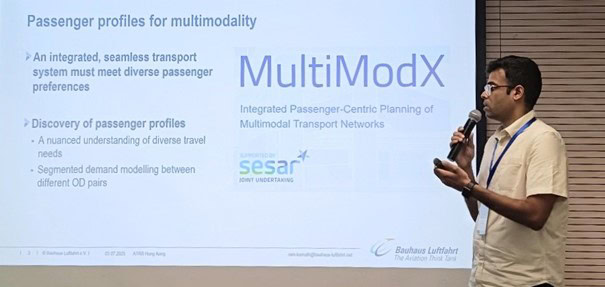
In his presentation, Ram Kamath introduced a novel approach to identifying and predicting passenger profiles using agile modelling and data-driven tools. This work is part of the broader research efforts under MultiModX, a project funded by SESAR and the European Union, which explores multimodal transport solutions with a focus on integration, digitalisation, and environmental performance.
Kamath’s contribution emphasised the importance of understanding how passengers respond to different travel options, particularly when nudging behaviour toward more sustainable choices such as modal shifts, off-peak travel, or multimodal alternatives.
The ATRS Conference, held annually, is a leading forum for academic and industry researchers in air transport economics, policy, and operations. It provides a valuable platform for exchanging ideas at the intersection of technology, strategy, and traveller behaviour.
MultiModX’s participation reflects its commitment to addressing the complexity of sustainable mobility not just through infrastructure or fuels, but through smart, passenger-centric insights.
The post MultiModX contributes to passenger-focused sustainability debate at ATRS 2025 appeared first on MultiModX project.
]]>The post MultiModX introduces a multimodal journey evaluator at UIC High-Speed Rail Congress in Beijing appeared first on MultiModX project.
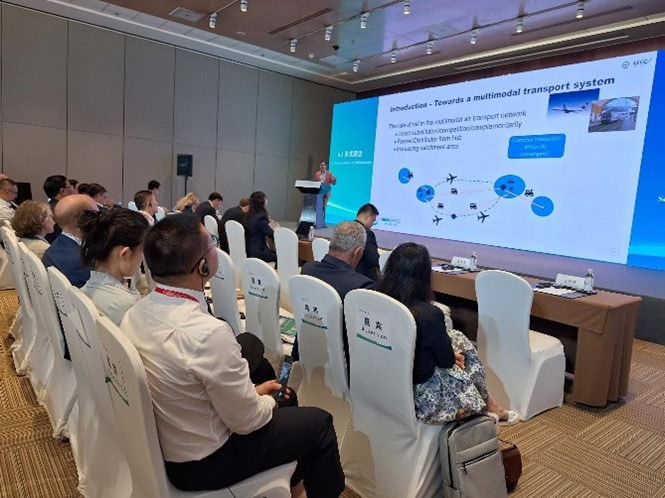
]]>Representing the project, Luis Delgado, researcher at the University of Westminster, introduced a new set of open-source tools aimed at improving integration between rail and air travel. The centrepiece of the presentation was one of the three Solutions developed within MultiModX: the intermodal performance framework and train–air intermodal journey evaluators. These tools enable the assessment of potential trips which combine rail and air options, considering total door-to-door travel time, cost and the environmental impact.
Beyond its practical use for travellers, the tools also allow operators and planners to perform network-level assessments and real-time scenario simulations, testing the efficiency and resilience of multimodal systems.
The presentation took place during a week that gathered more than 2.000 participants from over 60 countries, including technical experts, government officials, transport operators, and industry leaders. Organised by the International Union of Railways (UIC) in collaboration with China State Railway Group, the UIC Congress is held every two to three years and provides a global platform for exchanging knowledge and promoting best practices in high-speed and sustainable rail systems.
With this contribution, MultiModX advances its mission to support better-informed travel decisions, promotes modal complementarity and modal shift to rail, where appropriate, and contributes to a more connected and sustainable European mobility network.
The post MultiModX introduces a multimodal journey evaluator at UIC High-Speed Rail Congress in Beijing appeared first on MultiModX project.
]]>