Modernizing Data Architecture for
Real-Time Decisioning
This blog post is the first of a three-part series that explores some of the major real-time decisioning Data, Offer Management, and Omnichannel Activation technical challenges encountered and solutions used when migrating marketing campaigns from SAS Real-Time Decision Manager (RTDM) to SAS Intelligent Decisioning (ID) by a major financial services client. While some of the content may be vendor or industry-specific, we hope you find it insightful and relevant in your daily work.
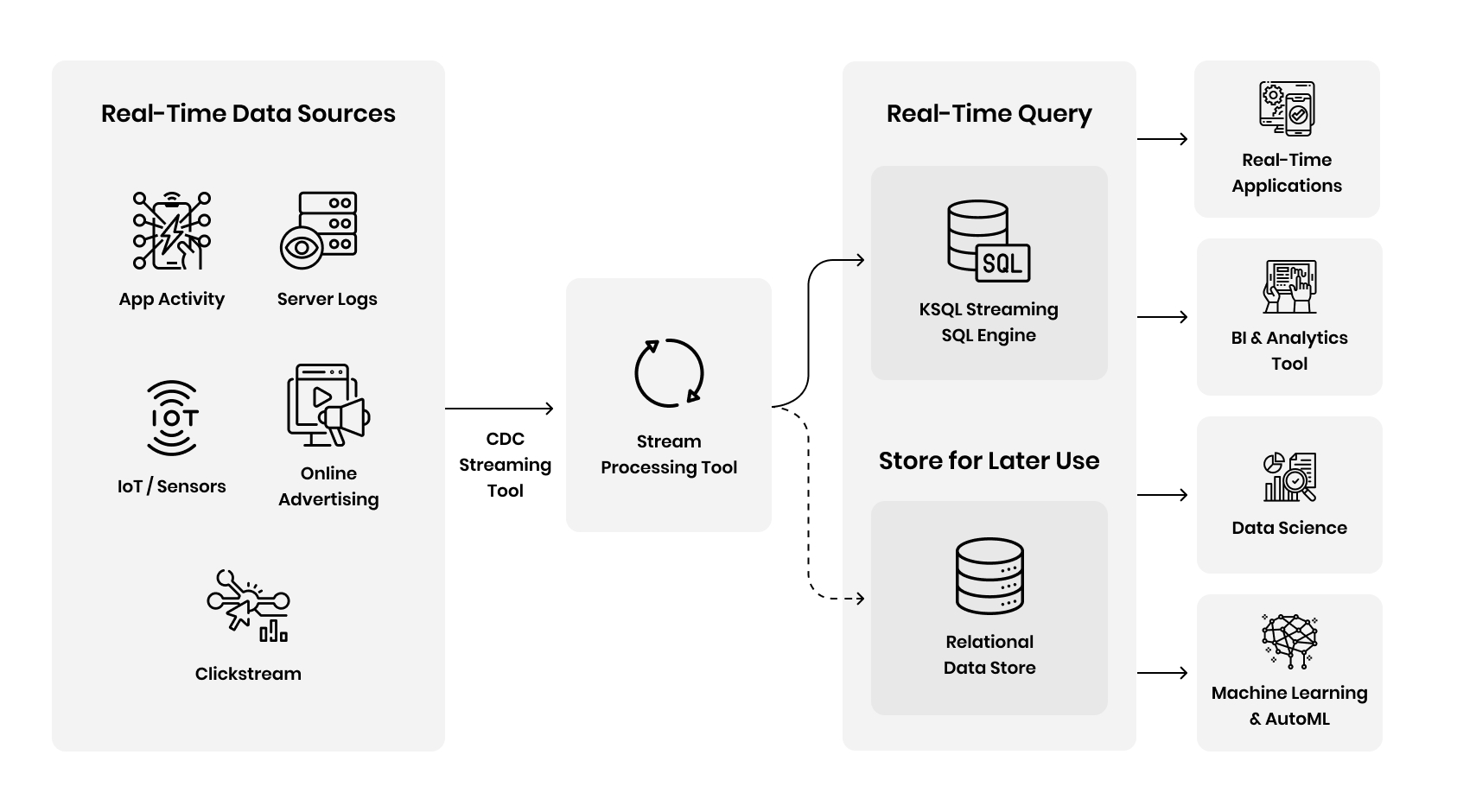
Click image to enlarge
Services Provided: MarTech Modernization, Data Engineering, Testing & QA, Real-Time Marketing, Real-Time Decisioning Strategy, MarTech Modernization, Cloud-Hosted Migration, SAS Intelligent Decisioning Implementation, SAS Real-Time Decision Manager
Key Topics Covered
- Migrating from SAS RTDM to SAS Intelligent Decisioning
- Designing cloud data architecture for real-time decisioning
- Validating decision logic without exposing customer PII
- Optimizing legacy decision rules for modern data platforms
The Challenge
The client, a leading financial services provider, needed to upgrade the marketing orchestrator or the “brain” behind their real-time marketing campaigns, transitioning from their legacy SAS Real-Time Decision Manager (RTDM) instance to the modern, cloud-hosted SAS Intelligent Decisioning (ID) solution using a multi-phased migration plan. Real-time marketing led to generating incremental revenue of over one hundred million dollars, which made it a key strategic decision for our client and imperative to move forward with a trusted professional services partner.
In any major marketing technology upgrade, the biggest hurdle is rarely the software itself; the data preparation is the underlying prerequisite – where the data is stored to how it is structured. The client’s customer data lived in a secure, on-premise IBM DB2 database, and with over 200 complex marketing campaigns to migrate to SAS ID which leverages this data, our team faced three major challenges:
- The “Chatty Connection” Delay:
Connecting a new AWS cloud-hosted instance of SAS ID directly to the existing on-premise database using standard methods (e.g., a JDBC connection) was too slow to transfer data, especially since it still had to be used for the existing SAS RTDM campaigns. This created a bottleneck, requiring the systems to constantly ping each other back and forth over the network. This delay threatened to exceed various overnight time limits which were used to calculate customer’s offers, so this was not acceptable. - Testing “In the Dark” (Strict Privacy):
Because customer PII (Personally Identifiable Information) including highly sensitive financial data was used, copying the production data into safe testing areas (often called “lower environments”) was not permitted. This meant the Munvo team would have to write and test new code without being able to look at the actual data, posing significant risk to the marketing campaign migration. - The (Programming) Language Barrier:
The old system’s marketing rules were written in outdated, highly specific coding languages (SAS DS2 and Groovy). The new cloud environment required a modern, distributed language (SparkSQL and Python). We couldn’t just copy and paste; everything had to be translated and completely re-engineered.
- The “Chatty Connection” Delay:
The Munvo Solution
To overcome these roadblocks, our client and Munvo engineered a modern data pipeline that prioritized security, speed, and architectural flexibility.
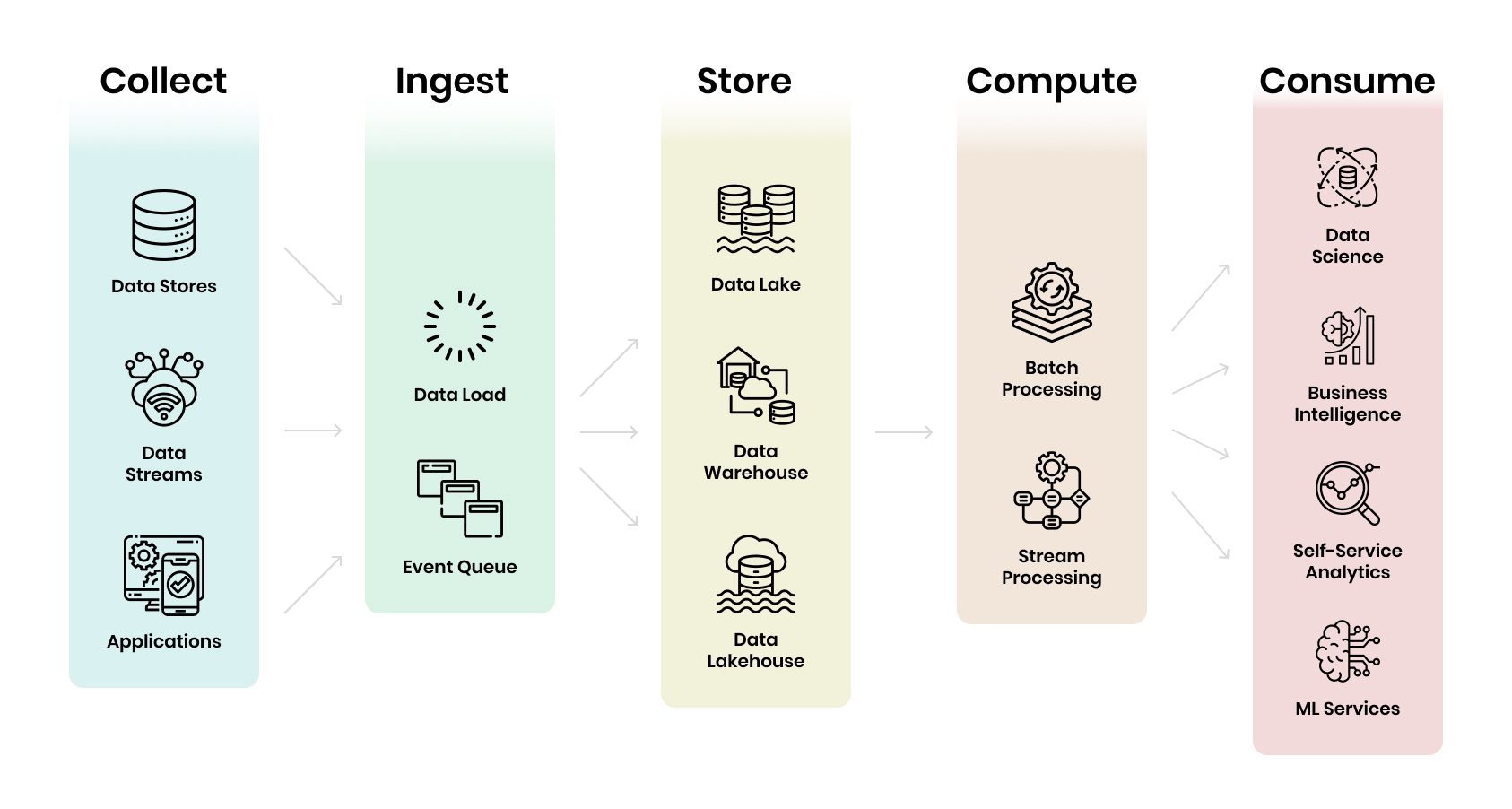
Click image to enlarge
- Building a Replication Loop to fix the “Chatty Connection” delay:
Instead of forcing the AWS cloud instance to constantly ping and ask the on-premise database for information row-by-row or customer-by-customer, we built a bulk-transfer system.- Ingest: We securely copied the necessary daily data into cloud storage folders (AWS S3).
- Process: We used cloud computing engines (AWS Glue) to process the data all at once, taking the heavy lifting off the client’s internal servers.
- Consolidate: Finally, we saved the results in a highly compressed, efficient file format (Parquet) and sent it back to the main database.
This replication method completely bypassed the existing network bottleneck while ensuring additional delays were not added to the overall process.
- Developing a creative testing strategy without “Test Data”:
In most campaigns, a high match rate (99%+) between the number of customers (and which ones exactly) in Production versus testing in non-Production was required for the client to sign-off on the migrated campaign. Since mock or “fake” test data could not be used as it would not be the same as data in Production, Munvo built a unique validation process where scripts were written to compare the results of our new cloud code directly against the old system’s historical records. For live campaigns where history wasn’t available, we built a tool to digitally “call” the old system’s rulebook (i.e., its API) in real-time.
If our new system and the old system returned the exact same customer offer, we knew the logic was accurate, without ever exposing private customer data. This provided for an apples-for-apples testing approach using the same API-driven process as if with real customers in real-time, further cementing the test results. - The “Triple Jump” code optimization for the (Programming) Language Barrier:
We didn’t just act as translators; we acted as optimization experts. We 1) took the old legacy code, 2) extracted the core business goals, and 3) rewrote it into platform-agnostic SQL. We then optimized it specifically for the AWS cloud (SparkSQL). This triple jump ensured that scanning billions of customer records would happen in minutes, rather than hours.
Key Benefits

Eliminated Network Delays: By moving the heavy data processing to the cloud (AWS) rather than relying on direct, slow connections to the on-premise database, the client achieved significantly faster processing times and lowered their operational and infrastructure costs.
Zero-Risk Deployment: Despite working under strict privacy rules with no test data, Munvo’s creative validation tools resulted in a flawless launch. We successfully reduced technical defects to zero by the final month of the project, ensuring the new system went live with 100% accuracy.
Future-Proofed Marketing Logic: Migrating away from older, proprietary code into standardized SQL meant that the client’s campaign logic is now flexible. It can easily be understood by modern developers and integrated with other new data tools in the future.
Empowered the Internal Team: By removing the strain on their on-premise servers and cleaning up the underlying code, the client’s marketing operations team can now focus on building new, personalized campaigns rather than troubleshooting slow data queries.
This blog post is the first of a three-part series that explores some of the major real-time decisioning Data, Offer Management, and Omnichannel Activation technical challenges encountered and solutions used when migrating marketing campaigns from SAS Real-Time Decision Manager (RTDM) to SAS Intelligent Decisioning (ID) by a major financial services client. While some of the content may be vendor or industry-specific, we hope you find it insightful and relevant in your daily work.
Click image to enlarge
Services Provided: MarTech Modernization, Data Engineering, Testing & QA, Real-Time Marketing, Real-Time Decisioning Strategy, MarTech Modernization, Cloud-Hosted Migration, SAS Intelligent Decisioning Implementation, SAS Real-Time Decision Manager
Key Topics Covered
- Migrating from SAS RTDM to SAS Intelligent Decisioning
- Designing cloud data architecture for real-time decisioning
- Validating decision logic without exposing customer PII
- Optimizing legacy decision rules for modern data platforms
The Challenge
The client, a leading financial services provider, needed to upgrade the marketing orchestrator or the “brain” behind their real-time marketing campaigns, transitioning from their legacy SAS Real-Time Decision Manager (RTDM) instance to the modern, cloud-hosted SAS Intelligent Decisioning (ID) solution using a multi-phased migration plan. Real-time marketing led to generating incremental revenue of over one hundred million dollars, which made it a key strategic decision for our client and imperative to move forward with a trusted professional services partner.
In any major marketing technology upgrade, the biggest hurdle is rarely the software itself; the data preparation is the underlying prerequisite – where the data is stored to how it is structured. The client’s customer data lived in a secure, on-premise IBM DB2 database, and with over 200 complex marketing campaigns to migrate to SAS ID which leverages this data, our team faced three major challenges:
- The “Chatty Connection” Delay:
Connecting a new AWS cloud-hosted instance of SAS ID directly to the existing on-premise database using standard methods (e.g., a JDBC connection) was too slow to transfer data, especially since it still had to be used for the existing SAS RTDM campaigns. This created a bottleneck, requiring the systems to constantly ping each other back and forth over the network. This delay threatened to exceed various overnight time limits which were used to calculate customer’s offers, so this was not acceptable. - Testing “In the Dark” (Strict Privacy):
Because customer PII (Personally Identifiable Information) including highly sensitive financial data was used, copying the production data into safe testing areas (often called “lower environments”) was not permitted. This meant the Munvo team would have to write and test new code without being able to look at the actual data, posing significant risk to the marketing campaign migration. - The (Programming) Language Barrier:
The old system’s marketing rules were written in outdated, highly specific coding languages (SAS DS2 and Groovy). The new cloud environment required a modern, distributed language (SparkSQL and Python). We couldn’t just copy and paste; everything had to be translated and completely re-engineered.
The Munvo Solution
To overcome these roadblocks, our client and Munvo engineered a modern data pipeline that prioritized security, speed, and architectural flexibility.
Click image to enlarge
- Building a Replication Loop to fix the “Chatty Connection” delay:
Instead of forcing the AWS cloud instance to constantly ping and ask the on-premise database for information row-by-row or customer-by-customer, we built a bulk-transfer system.- Ingest: We securely copied the necessary daily data into cloud storage folders (AWS S3).
- Process: We used cloud computing engines (AWS Glue) to process the data all at once, taking the heavy lifting off the client’s internal servers.
- Consolidate: Finally, we saved the results in a highly compressed, efficient file format (Parquet) and sent it back to the main database.
This replication method completely bypassed the existing network bottleneck while ensuring additional delays were not added to the overall process.
- Developing a creative testing strategy without “Test Data”:
In most campaigns, a high match rate (99%+) between the number of customers (and which ones exactly) in Production versus testing in non-Production was required for the client to sign-off on the migrated campaign. Since mock or “fake” test data could not be used as it would not be the same as data in Production, Munvo built a unique validation process where scripts were written to compare the results of our new cloud code directly against the old system’s historical records. For live campaigns where history wasn’t available, we built a tool to digitally “call” the old system’s rulebook (i.e., its API) in real-time.
If our new system and the old system returned the exact same customer offer, we knew the logic was accurate, without ever exposing private customer data. This provided for an apples-for-apples testing approach using the same API-driven process as if with real customers in real-time, further cementing the test results. - The “Triple Jump” code optimization for the (Programming) Language Barrier:
We didn’t just act as translators; we acted as optimization experts. We 1) took the old legacy code, 2) extracted the core business goals, and 3) rewrote it into platform-agnostic SQL. We then optimized it specifically for the AWS cloud (SparkSQL). This triple jump ensured that scanning billions of customer records would happen in minutes, rather than hours.
Key Benefits
Eliminated Network Delays: By moving the heavy data processing to the cloud (AWS) rather than relying on direct, slow connections to the on-premise database, the client achieved significantly faster processing times and lowered their operational and infrastructure costs.
Zero-Risk Deployment: Despite working under strict privacy rules with no test data, Munvo’s creative validation tools resulted in a flawless launch. We successfully reduced technical defects to zero by the final month of the project, ensuring the new system went live with 100% accuracy.
Future-Proofed Marketing Logic: Migrating away from older, proprietary code into standardized SQL meant that the client’s campaign logic is now flexible. It can easily be understood by modern developers and integrated with other new data tools in the future.
Empowered the Internal Team: By removing the strain on their on-premise servers and cleaning up the underlying code, the client’s marketing operations team can now focus on building new, personalized campaigns rather than troubleshooting slow data queries.
Key Takeaway
Modernizing real-time decisioning requires more than a platform upgrade. By redesigning the data pipeline, validating campaign logic safely, and translating legacy decision code, organizations can successfully migrate to SAS Intelligent Decisioning while improving performance and scalability.
Thank you for reading this first blog post on real-time decisioning’s Data challenges. Next in the series we will explore Offer Management challenges for real-time campaigns. Stay tuned!
Is Your Real-Time Decisioning Architecture Ready for Modern Marketing?
TL;DR article summary
A major financial services client migrated 200+ real-time marketing campaigns from legacy SAS RTDM to cloud-hosted SAS Intelligent Decisioning, overcoming critical data architecture challenges.
The migration faced three major obstacles: slow “chatty connection” delays between AWS cloud and on-premise IBM DB2 database that threatened overnight processing deadlines, strict privacy rules preventing test data usage with customer PII, and outdated legacy code (SAS DS2/Groovy) requiring translation to modern languages (SparkSQL/Python).
Munvo solved these by building a bulk-transfer replication loop using AWS S3 and Glue to bypass network bottlenecks, developing creative validation tools that compared new code against old system results via API calls without exposing customer data (achieving 99%+ match rates and zero defects), and performing a “triple jump” optimization that extracted business logic and rewrote it as platform-agnostic SQL optimized for cloud processing.
The result eliminated network delays, enabled zero-risk deployment with 100% accuracy, future-proofed marketing logic with standardized code, and empowered internal teams to focus on building campaigns rather than troubleshooting—demonstrating that successful real-time decisioning modernization requires redesigning data pipelines and validating logic safely, not just upgrading platforms.
Sales Inquiries + 1 (514) 223 3648
General Inquiries + 1 (514) 392 9822
[email protected]
© 2026 Munvo is a trademark of Munvo Solutions Inc.
Personalization in Retail Marketing: From Mass Messaging to Meaningful Relevance
Personalization in retail marketing did not begin with artificial intelligence, real-time decisioning, or advanced automation. It began with a far simpler idea: understanding what customers buy and using that knowledge to influence future behavior.
In North America, the earliest form of personalization took shape through loyalty programs and database marketing. Retailers collected transactional data, grouped customers into segments, and delivered targeted offers based on past purchases. For its time, this approach was powerful. It helped retailers move away from one-size-fits-all promotions and toward more relevant communication.
That first wave of personalization laid the foundation for everything that followed. But it was also limited. The data was historical, the targeting was broad, and the marketing execution was slow. Personalization existed, but only at a coarse level.
Today, retail marketing operates in a fundamentally different environment.

Click image to enlarge
Why Personalization Is Accelerating Across Retail
Retailers are under intense pressure from multiple directions at once. Customer expectations continue to rise. Competition is increasingly aggressive. Margins remain thin, especially in grocery and big-box retail. At the same time, marketing has become a continuous, multi-channel operation that never pauses.
Consumers now expect relevance as a baseline. This expectation for relevance signals a broader shift in retail marketing, where effectiveness is increasingly defined by how well brands align strategy, execution, and operational reality. Research consistently shows that a majority of shoppers expect personalized interactions from brands and feel frustrated when messaging is generic or disconnected from their needs. At the same time, studies reveal a gap between what brands believe they are delivering and what customers actually experience. Many retailers believe they are personalizing effectively, while customers only recognize personalization in a fraction of interactions.
This gap is becoming more visible as digital and physical channels converge. Customers move seamlessly between email, mobile apps, websites, digital flyers, in-store signage, and physical shelves. They expect continuity. When messaging breaks down, trust erodes quickly.
As a result, personalization is no longer a competitive advantage. It is a requirement for relevance.
The Reality Retailers Are Facing
Most North American retailers are not short on technology. They have invested heavily in CRM platforms, customer data platforms, loyalty engines, marketing automation tools, and analytics. Many operate sophisticated stacks built on platforms such as Adobe, Salesforce, SAS CI360, or Unica.
Yet personalization often fails in execution.
The reason is not a lack of intent. It is the operational reality of retail.
Retail is governed by physical constraints. Inventory levels change constantly. Prices vary by region and by store. Promotions are influenced by suppliers, compliance rules, and local regulations. Substitutions are common and often unavoidable. When marketing messages are created without full awareness of these realities, problems surface immediately.
Customers see offers for products that are out of stock. Prices in marketing do not match shelf prices. Digital banners promote items that are not available locally. Flyers require last-minute changes that ripple across every channel. Creative teams are pulled into endless cycles of rework and manual fixes.
These issues are not edge cases. They are everyday occurrences in grocery and big-box retail. And they undermine even the most advanced personalization strategies.

Click image to enlarge
How Personalization Is Evolving
Retail personalization is moving beyond customer targeting and toward experience orchestration.
Early personalization focused on who the customer was. Modern personalization focuses on what is possible in the moment.
This shift is driven by three critical changes.
First, personalization is becoming situational. Customer history still matters, but relevance now depends on real-time conditions such as store-level inventory, local pricing, promotion eligibility, and substitution rules. A personalized offer that ignores these factors risks being inaccurate and ineffective.
Second, content production is changing. Traditional creative workflows were never designed to support thousands of variations across regions, stores, channels, and formats. Leading retailers are moving toward modular, template-driven content that can be assembled dynamically based on rules and data inputs. This allows personalization to scale without proportionally increasing effort or cost.
Third, marketing is becoming more tightly connected to retail operations. To deliver accurate and trustworthy experiences, marketing systems must be informed by the same sources of truth that drive merchandising and supply chain decisions. When marketing reflects operational reality, personalization becomes credible rather than aspirational.

Click image to enlarge
The Role of Disruptive Retail Technology
This evolution is driving demand for a new class of retail-specific technology. These solutions are designed to bridge the gap between operational data and customer experience.
Rather than replacing existing marketing platforms, they operate as an enabling layer. They connect inventory data, pricing systems, product information, and promotional rules to creative and activation channels. The result is marketing that adapts automatically as retail conditions change.
This approach addresses one of the most persistent challenges in retail marketing: the cost and complexity of rework. When inventory shifts or promotions change, content updates automatically across channels. Teams spend less time fixing errors and more time focusing on strategy and performance.
For retailers competing in fast-moving categories such as grocery and big-box retail, this capability is becoming essential. It allows personalization to keep pace with the business.
The Business Impact Is Tangible
The value of effective personalization is well documented. Industry research consistently shows that well-executed personalization can drive measurable revenue lift and improve marketing return on investment. However, those gains are only realized when personalization is accurate, timely, and operationally aligned.
Basic personalization techniques such as name insertion or broad recommendations no longer differentiate brands. The impact comes from aligning offers with availability, relevance, and context. Retailers that achieve this reduce customer frustration, improve conversion, and increase trust.
Equally important, they reduce internal friction. Creative teams face fewer last-minute changes. Marketing cycles become more predictable. Errors decline. Costs associated with manual production and correction fall significantly.

Click image to enlarge
How Munvo Helps Retailers Move Forward
Delivering this level of personalization requires more than technology alone. It requires thoughtful integration, clear operating models, and cross-functional alignment.
Munvo works with North American retailers to help them adopt advanced personalization capabilities without disrupting their existing ecosystems. We focus on connecting retail reality with marketing execution.
We help retailers design personalization strategies that are inventory-aware and promotion-correct. We support the implementation of scalable content production models that reduce rework and improve speed. We integrate seamlessly with established MarTech platforms so retailers can build on what they already have rather than starting over.
Most importantly, we help teams operationalize personalization, so it becomes repeatable, measurable, and sustainable.
Looking Ahead
Personalization in retail marketing is entering a new phase. It is no longer defined by how well a brand knows its customers alone. It is defined by how effectively marketing reflects the reality of the retail business.
Retailers that succeed will be those that can deliver relevant experiences grounded in accurate data, supported by automation, and executed at scale. They will move faster, waste less effort, and build stronger relationships with their customers.
For retailers looking to compete in an increasingly complex and demanding market, the path forward is clear.
If you want to explore how modern personalization can work within your retail environment and your existing technology stack, connect with Munvo. We help retailers turn personalization into a practical, high-impact capability that delivers results.
Is Your Personalization Strategy Grounded in Operational Reality or Breaking Down at Execution?
TL;DR article summary
Retail personalization is shifting from historical customer targeting to real-time orchestration that aligns marketing with operational realities like inventory and pricing.
Early personalization used loyalty data and broad segmentation, but modern customers expect real-time relevance across channels. Most retailers struggle because marketing ignores physical constraints—promoting out-of-stock items and mismatched prices—creating rework and eroding trust. Modern approaches use situational relevance with real-time store conditions, modular template-driven content, and direct connections to operational data.
New retail technology bridges this gap by automatically updating marketing content as inventory, pricing, and promotions change—reducing rework, improving accuracy, and delivering measurable results when marketing reflects retail reality rather than just customer history.
Sales Inquiries + 1 (514) 223 3648
General Inquiries + 1 (514) 392 9822
[email protected]
© 2026 Munvo is a trademark of Munvo Solutions Inc.
Rethinking how we build modern marketing
This is the final post in a five-part blog post series that delves into modernizing marketing strategies through the integration of advanced marketing platforms. I had the pleasure of interviewing Shaun Memon of Munvo for this series, where we discuss a wide range of topics, from fragmented MarTech stacks, first-party data use and cross-channel marketing to modern marketing journeys and complex decisioning.
Marketers today are sending more campaigns than ever.
Why isn’t that translating into better customer experiences or outcomes?
Shaun Memon: A lot of it comes down to mindset and operating model. Many organizations say they’re customer-centric, but in reality, they’re still organized around channels, products or lines of business that compete for the customer’s attention. Each group has its own targets and stack, so the enterprise is optimized for “more marketing” instead of “better experiences” and lifetime value.
Teams send more emails, more notifications, more offers but they’re often overusing single channels instead of designing orchestrated, cross-channel journeys. Instead of the right next message at the right time, customers get overlapping campaigns that don’t reflect their context or needs.
That shows up as over-reliance on batch messaging rather than coordinated journeys. Customers get overlapping campaigns that don’t reflect their context. Modern best practice is to think in terms of next-best action, not just next-best offer. Sometimes the right action is educational or supportive, such as teaching a customer how to tackle a home project or helping a new grad understand credit and loans, not just pushing the highest-fee product.
Legacy, stitched-together stacks make that shift harder. Data, audiences and offers are synchronized manually across multiple tools, which creates technical debt and slows teams down. Journeys get simplified to what the plumbing can handle, not what’s best for customers. More messages that are less relevant just open the door to more agile competitors.
When leaders say they want to modernize,
what usually gets in the way?
Memon: It’s rarely about intent. Most leaders genuinely want to serve customers better. The blockers are usually operational: legacy infrastructure, technical debt and the sheer complexity of making anything new work with what’s already in place. Marketing teams are often under pressure to “do more with what we have.”
Each new idea means another integration, another handoff, another dependency. Rules and offers get duplicated across platforms, and different channel teams end up working in their own stacks. This leads to extraneous tools and custom integrations onto a fragile stack instead of stepping back to rethink the model.
Over time, that creates brittle integrations, duplicated rules and siloed execution across channels. Different teams own different platforms with their own audiences, offers and reporting. That increases effort and risk of mistakes, and makes it difficult to deliver a coherent customer journey.
The result is a lot of hidden cost: overlapping licenses, custom connectors to maintain, manual processes, slow approvals and inconsistent execution.
All of this shows up directly in the customer experience:
- Slow time-to-yes and abandoned journeys.
- Customers re-explaining context as they move between web, app, contact center or in-store.
- Irrelevant or conflicting offers that erode trust and create fatigue.
- No ability to “rescue” in the moment when someone drops an application, abandons a cart, or signals interest in something different than what we planned.
Teams stay stuck in “good enough” mode, more sends, more campaigns, while more agile competitors with modern stacks test, learn and meet customers where they are with far less effort.
Why is complex, real-time decisioning so important
if a company already has journeys and campaigns running?
Memon: Most organizations already use segmentation, models and journeys to decide who gets what offer. The implicit assumption is that a customer’s context stays roughly stable while they’re in that journey. In reality, intent shifts quickly. New signals from browsing behavior, life events and in-store interactions may not match what we originally predicted, even if our models were directionally correct.
Marketers shouldn’t have to design every journey manually. As organizations mature by getting data in order, building profiles, refining segmentation and automating journeys, real-time decisioning becomes the next layer to reduce friction by avoiding offers that are technically “on model” but wrong for the moment. The future is self-optimizing decisioning. Instead of optimizing one campaign or one journey at a time, you’re optimizing for the customer’s overall lifetime value, building trust and attachment over time.
As we saw in Mary’s journey in the last post, the ability to pivot when you learn something new about a customer is what makes the experience feel truly personal and relevant in the moment.
Historically, that kind of adjustment happened in a branch, at the call center or in a store, with a human picking up on cues and adapting the conversation. Real-time decisioning engines are how we scale that human, in-the-loop judgment into a digital, omnichannel world while keeping messaging coordinated across channels.
Journey builders are among the latest product offerings in the MarTech world. However, most can only scale to a limited rule set. For most large enterprises, there are hundreds of micro moments customers have that signal their intent and are impossible to script. That’s where decisioning scales where journeys alone do not.
A real-time decisioning engine becomes the brain of the MarTech stack: the place where the next-best communication or offer is decided. Because it’s reading and writing against your centralized data, it can incorporate all available customer and streaming signals, update context as it changes, and ensure that when you do need to pivot away from what was pre-planned, every channel stays in sync around the new decision.
We have heard a lot about CDPs over the last decade.
Why are we now talking about customer engagement platforms instead?
Memon: Customer data platforms (CDPs) took off around 2014, when most organizations were still dealing with enterprise data warehouses, mainframes and slow batch jobs. Marketing teams couldn’t easily access unified customer data, so CDPs emerged to pull data from core systems into one place for identity resolution, segmentation and basic activation.
The trade-off was another data silo. You now have the warehouse and a CDP copy to maintain, sync and push back downstream. Over time, many CDPs added features – such as personalization, channel orchestration and deployment, AI/ML modeling – and started to look like bundled marketing stacks. Meanwhile, cloud data lakehouses like Snowflake and Google’s BigQuery changed the game. Done well, they let you centralize customer data once and let multiple systems read and write to the same environment in near-real time.
In that world, the question isn’t “where do we put the data?” anymore. It’s “how do we engage with the data we already have?” That’s where customer engagement platforms (CEPs) come in as the action/decision layer on top of your first-party data. They are the place where decisions, journeys and inbound/outbound orchestration come together. CEP isn’t in the same class as a CDP, event stream processing or data management platform.
Instead of being another data repository, a CEP is designed to:
- Use data where it lives (your lakehouse or customer data mart).
- Orchestrate omnichannel journeys across outbound and inbound, digital and physical, and owned and third-party channels from a single place.
- Apply real-time context signals and decisioning to choose the right message for the moment.
- Activate offers and experiences across channels with minimal integration work.
- Capture contact and response history in one model so you can measure lift and iterate.
To simplify this, we can think of the data warehouse or cloud lakehouse as the single source of truth and the CEP as the decision, coordination and action layer. The CDP is the middle layer that compiles customer data in a marketing-usable format. This layer becomes largely unnecessary as a separate entity with cloud lakehouses and medallion data architecture taking the place of standalone CDPs.
For leaders trying to move from their current stack
toward CEPs and the next-best-action model, where should they start?
Memon: Customer experience platforms let strategy, segmentation, messaging and offers, channel activation, journey orchestration and measurement all run from a centralized layer. That reduces the number of integrations, keeps data movement to a minimum, and gives marketing, analytics and frontline teams a shared view of the customer so they can behave in a customer-centric way. CEPs that support continuous learning loops with offer management and metadata capture to support detailed lift analysis and insight generation will outperform static journey builders.
For leaders trying to move toward that CEP model, I’d start in this order:
1. Begin with the customer experience, not the tools. Get clear on what “good” looks like in two to three years:
- Which journeys matter most (onboarding, activation, cross-sell, retention, service recovery, etc.)?
- Which channels really matter for your brand: owned digital, in-person, contact center, social, paid media, app, SMS, push?
- What kind of value do you want customers to feel – education, guidance, convenience, financial benefit – instead of just pushing more offers?
2. Align on data, governance and cloud strategy. Before buying more MarTech, make sure:
- You are aligned with IT cloud and data strategy. Do you have (or are moving toward) a unified customer data mart or lakehouse that serves as one place to read and write customer data?
- Channels can feed signals back in close to real time, so you’re not acting on a three-day-old shadow of the customer.
- You can capture a unified contact and response history (who saw what, when, and how they reacted).
- You account for governance. Next-best-action engines need auditable rules, traceable AI, and guardrails on what can be offered to whom.
3. Map current capabilities against four core domains. Look at what you already own and where the gaps really are:
- Data – access, timeliness, golden record (individual/account/household).
- Segmentation and modeling – can marketers easily build and use segments, models, and eligibility rules?
- Orchestration and activation – can you coordinate offers and journeys across inbound and outbound channels from one place, or are you duplicating work per tool?
- Real-time offer arbitration – can you change the message in the moment when context shifts, or are you locked into whatever the journey said on day one?
4. Design a lean CEP layer, not another pile of tools. Use a few principles to guide investment decisions:
- Keep it simple – go for a small number of interoperable components instead of a lot of bespoke glue.
- Centralize data – access from your cloud warehouse/lakehouse and avoid unnecessary copies.
- Minimize overhead – favor SaaS/PaaS, automate operations, keep admin burden low.
- Avoid tech debt – use standards-based, API-driven integrations and a composable architecture.
- Design for privacy – consent, lineage, explainability for AI, and regulatory checks baked in.
- Run lean for ROI – prioritize use cases with fast payback, such as digital sales, application rescue, churn saves, pre-approved offers.
- Measure relentlessly – define North Star metrics (digital adoption, time-to-yes, CPA, LTV) and review them monthly.
5. Ask whether you’re solving use cases or buying a category. As you evaluate platforms, pressure-test them with concrete scenarios:
- Can this help us run the journeys we care about, across the channels we actually use?
- Does it reduce integrations, data copies and manual work or add more?
- Will marketers and CX teams be able to run with it day-to-day, or does every change require input and work from IT or analytics?
Tools like SAS® Customer Intelligence 360 and upcoming SAS 360 Marketing Decisioning can play a central role in that journey. Together, they give you a single place for segmentation, offers, decisioning and activation across owned, inbound, outbound and third-party channels with the ability to pivot in near-real time using AI and machine learning in a responsible, governed way.
That said, the best decisioning engine won’t fix a channel-centric operating model; you need strategy, process and technology pulling in the same direction.
If a marketer is feeling the pain of a fragmented stack today,
what should they do next?
Shaun Memon: The real risk of sticking with fragmented stacks isn’t only operational, it’s strategic. Competitors with modern CEPs that learn and adapt faster will widen the gap over time. There’s a lot to consider and align on as an organization.
Figuring out how to get from “where we are” to “where we want to be” can feel daunting. It’s important to start by identifying gaps, sequencing changes and keeping overhead manageable so teams can stay focused on delivering value to customers.
Is your MarTech stack holding you back?
TL;DR article summary
Modern marketers need to shift from “more campaigns” to better customer experiences through Customer Engagement Platforms (CEPs) that enable real-time decisioning and orchestrated journeys.
The core problem facing marketers is that legacy, fragmented stacks organized around channels and products create technical debt, duplicated rules, and siloed execution—resulting in customers receiving overlapping, irrelevant campaigns instead of contextual experiences. Real-time decisioning has become critical because customer intent shifts rapidly based on browsing behavior, life events, and cross-channel interactions that static journeys can’t accommodate. While CDPs emerged in 2014 to solve data access problems by creating another silo, modern cloud lakehouses (Snowflake, BigQuery) now centralize customer data once in near-real time. CEPs serve as the action/decision layer on top of this unified data, orchestrating omnichannel journeys, applying real-time context signals, and choosing the right next-best action (educational, supportive, or transactional) rather than just pushing offers.
Leaders modernizing their stack should start with customer experience—defining key journeys and channels—then align on unified data strategy with real-time signal capture and governance. The implementation focuses on designing a lean CEP layer that accesses data where it lives, reduces integrations and copies, and enables continuous learning loops with offer management and lift analysis. Key principles include thinking in terms of next-best action rather than next-best offer, minimizing technical complexity while giving teams a shared customer view, and optimizing for lifetime value rather than campaign volume. The strategic risk is clear: competitors with modern CEPs that learn and adapt faster will widen the gap, making this transition essential for staying competitive in customer-centric markets.
Sales Inquiries + 1 (514) 223 3648
General Inquiries + 1 (514) 392 9822
[email protected]
© 2026 Munvo is a trademark of Munvo Solutions Inc.
Reinventing Retail Marketing: Where Relevance Meets Reality
Behind this complexity is a truth that many retailers reluctantly acknowledge: Retail marketing was never designed to operate at this pace.

Click image to enlarge
The result is predictable; Endless revisions, Creative bottlenecks, Last minute overnight work, Brand inconsistencies, Offer errors, Inventory mismatches that disappoint customers and cost you sales.
Retailers feel the strain every single week. And they feel it in every department merchandising, CRM, creative, store operations, regional management, and the C suite.
Yet a quiet transformation has begun.

Click image to enlarge
A new generation of retail intelligent technology built specifically for this industry’s chaos is enabling retailers to deliver experiences that are both deeply personal and operationally flawless, without the rework, manual effort, and complexity that currently bog down their teams.
This is what that world looks like.
When Marketing Is Aware of Reality, Everything Changes
Consider the typical weekly flyer cycle:
A grocery chain plans 100–300+ items for the circular.
Pricing is confirmed by merchandising, Inventory forecasts are prepared, Creative teams design the layouts, Regional teams request localization, Legal performs compliance checks, Marketing scrambles to generate the digital equivalents: web banners, email hero images, homepage tiles, but in the middle of the workflow, something always shifts:
A product’s stock dips. a vendor updates a rebate. a region changes the price. a category manager substitutes an item because shipments are delayed.
Every change forces creative to redo layouts, adjust placements, regenerate assets in different aspect ratios, and update metadata.
Multiply this by dozens of product swaps, every single week, for every region and the cost becomes staggering. Not just financial, but operational and emotional.
Now imagine a world where your marketing engine simply knows:
It knows that yogurt is low in Store 1445.
It knows that the detergent promo is valid only in Ontario.
It knows that a vendor funded discount just went live for apples.
It knows that in store bakery inventory changes every hour.
It knows which alternative SKUs can be substituted without breaking compliance.
It knows that your CRM platform is preparing an email and automatically feeds the correct image, correct price, correct size, and correct promotional copy, without a designer touching the asset again.
Marketing becomes 100% aligned with reality. creative becomes fluid instead of static. and customers never see offers that don’t exist.
This is the future modern retail is moving toward where every channel reacts to retail conditions in real time.

Click image to enlarge
The Power of Inventory Aware Personalization
True personalization in retail is more than knowing a customer’s loyalty status or past purchasing patterns.
It is about personal relevance grounded in operational truth.
For example, imagine sending an email with personalized offers for a shopper’s local store:
If the bagels are out of stock at Store #7263 by the time the email is opened, the engine automatically promotes an alternative SKU with the correct price and photo before the customer even scrolls down.
Or consider a customer browsing your mobile app:
If the BBQ sauce category is overstocked due to an unexpected shipment, the promotional tile adjusts instantly to highlight those items, pushing high margin inventory where it matters.
And in the flyer world:
If Store A still has peaches but Store B has switched to plums because of availability, each customer sees the right fruit without manual intervention, without duplication of the design process, and without adding pressure to creative teams.
This is personalization that respects the operational heartbeat of a retailer.
It reduces rework.
It prevents customer disappointment.
And it drives measurable revenue uplift because the promotions are grounded in what is truly available to sell.

Click image to enlarge
A Seamless Layer on Top of Your Existing MarTech Stack
Retailers have already invested heavily in their marketing technologies such as Adobe, Salesforce, Unica, SAS CI360, AEP and AJO, Custom data lakes, POS integrations, Loyalty engines, Pricing systems, PIMs and DAMs, and E commerce platforms. Replacing these would be disruptive, costly, and unnecessary.
The new breed of retail intelligent solutions sits above the stack not replacing it but orchestrating it.
Think of it as a creative intelligence layer that connects your inventory, pricing, offer management, content production, templates, in-store signage, CRM journeys, all into a single source of truth that feeds every channel.
Emails become more accurate, flyers become more consistent, signage becomes easier to update, digital ads become more dynamic, store specific experiences become effortless, and the best part?
Retailers keep their existing systems.
This operates as the connective tissue an intelligence engine that harmonizes everything.

Click image to enlarge
Real Retail Use Cases Already Happening
Across Europe and North America, retailers are experiencing dramatic improvements:
- Grocery chains generating hundreds of store localized flyers in minutes rather than days.
- Big box retailers eliminating 60–80% of rework tied to last minute substitutions.
- Brands reducing creative production spending by millions annually.
- Stores seeing fewer customer complaints due to mismatched signage or outdated promotions.
- Marketing teams finally breaking the cycle of manual artwork changes.
- Loyalty teams generating personalized, inventory aware weekly offers at national scale.
Everything becomes faster, smarter, more accurate, and more human.
Not because teams are working harder but because the technology is doing the heavy lifting.

Click image to enlarge
What This Means for Retailers
Retail competition is tighter than ever. Margins are thin, customer expectations are rising, supply chains fluctuate, and personalized marketing is no longer a differentiator but a baseline expectation.
Retailers that embrace inventory aware, automated creative and intelligent offer distribution are positioning themselves to win.
Those who don’t risk falling into the cycle of inefficiency, rework, and inconsistent customer experiences.
The future belongs to retailers who operate with real time intelligence, across every channel, from print to digital to in store.

Click image to enlarge
Munvo Can Help You Get There
Munvo team works directly with retailers to bring this new class of retail ready technology to life integrating it within existing MarTech stacks like Adobe, Salesforce, SAS, and Unica.
We help retailers modernize their entire workflow Using Aristid:
From offer management, to creative automation, to real time personalization, to store specific content distribution, to reporting and optimization, all without disrupting how your business operates today.
If you want to explore how leading retailers are reducing production costs, eliminating rework, accelerating go to market workflows, and delivering truly relevant, inventory aware customer experiences.

Click image to enlarge
Looking to elevate your retail marketing with smarter, more impactful strategies?
Get in touch with Munvo, and our team will help you make it happen.
TL;DR article summary
Retail marketing is struggling to keep pace with today’s operational complexity—real-time inventory changes, regional pricing, omnichannel demands, and rising customer expectations—because most marketing systems are fragmented and manual. A new generation of retail-specific, inventory-aware intelligence layers is emerging to solve this problem by connecting existing MarTech stacks (e.g., Adobe, Salesforce, SAS, Unica) with real-time data from inventory, pricing, and promotions.
These solutions automate creative updates, personalize offers based on actual product availability, and ensure every channel reflects operational reality without constant rework. Retailers using this approach are dramatically reducing creative rework, accelerating flyer and campaign production, lowering costs, and improving customer satisfaction. The future of retail marketing belongs to organizations that adopt real-time, inventory-aware personalization—delivering accurate, relevant experiences at scale while freeing teams from manual, error-prone processes.
Sales Inquiries + 1 (514) 223 3648
General Inquiries + 1 (514) 392 9822
[email protected]
© 2026 Munvo is a trademark of Munvo Solutions Inc.
Architecting Autonomous Workflows: Implementing the Gemini Enterprise ADK on Google Cloud
AI systems are rapidly evolving from simple prompt-response tools into autonomous agents capable of planning, reasoning, and executing multi-step workflows. Organizations want LLM-powered systems that can not only generate content but also coordinate tasks, interact with APIs, and make context-aware decisions.
However, agentic workflows introduce real engineering challenges. LLMs don’t maintain state consistently, struggle with long contexts, and can produce incorrect reasoning if not carefully orchestrated. Without structure, a model can lose instructions, mis-handle tools, or hallucinate outputs during complex logic chains.
The Gemini Enterprise Agent Development Kit (ADK) provides the orchestration layer needed to bring reliability to these workflows. It bridges probabilistic model behavior with predictable system logic, allowing teams to build repeatable, production-ready processes on top of Gemini models.
Architectural Paradigm: From Single-LLM to Micro-agents
The ADK implements a modular design pattern, moving away from traditional Single-LLM workflows where one model and one system prompt attempt to handle all tasks and edge cases. This often results in context saturation, reduced instruction adherence, and unstable reasoning in complex workflows.
The ADK instead enforces a Micro-agent Architecture, decomposing complex objectives into isolated, specialized agents. This operates as a Hub-and-Spoke model, where a central Router or Root Agent maintains state and delegates work to ephemeral sub-agents (e.g., Retrieval, Analysis, Content Generation) via API hooks.
Technical Comparison: Single-LLM vs. ADK
FEATURE
SINGLE LLM WORKFLOW
ADK ORCHESTRATION
Context Management
Single Context Window: One long context window; harder to preserve instructions across steps.
Scoped Context: Root Agent keeps long-term state and passes clean, concise prompts to worker agents..
Concurrency
Serial Execution: one reasoning chain at a time.
Scatter-Gather Pattern: agents can run in parallel, reducing overall latency.
I/O Operations
Text-to-Text: Generates passive strings. No native ability to interact with the environment.
Function Calling: Native integration with OpenAPI specs. Agents invoke specific tools to perform CRUD operations on external databases and APIs.
Compute Strategy
Static Model Allocation: Utilizes high-parameter models for all tasks, resulting in inefficient compute usage.
Semantic Routing: Dynamically routes logic-heavy tasks to Gemini Pro and high-volume extraction tasks to Gemini Flash based on complexity scoring.
Technical Use Case: Asynchronous Campaign Orchestration
To illustrate the architectural advantages, consider a “Campaign Orchestrator” implementation. In a legacy script-based approach, logic is brittle. In the ADK, the “Reasoning Engine” (LLM) is decoupled from the “Execution Layer” (Tools), connected via a middleware layer.
The Workflow:
A Root Agent receives a high-level directive. Instead of attempting a single-shot completion, it constructs a Directed Acyclic Graph (DAG) of tasks:
- Parallel Execution: The Root Agent spawns a DataAgent (generating BigQuery SQL) and a CreativeAgent (generating copy). These execute asynchronously to reduce total latency.
- Tool Execution: The DeploymentAgent utilizes custom tools defined via Python functions (e.g., schedule_post(payload)).
- State Validation: The ADK validates the tool output against a defined JSON schema before confirming success.

Engineering Challenges & ADK Solutions
1. Reliability & Governance
LLMs may generate incorrect tool arguments or hallucinate values.
ADK Approach: enforce schema validation (Pydantic/JSON) on all agent outputs before invoking tools or APIs.
2. Connecting to Legacy Systems
Enterprises often rely on older on-prem systems that don’t natively support modern LLM integrations.
ADK Approach: wrap SOAP or legacy endpoints inside Python functions and expose them as ADK tools, accessible through VPC service controls.
3. Latency & Cost Efficiency
Running everything on one large model increases compute usage.
ADK Approach: use dynamic routing—Gemini Pro for reasoning-heavy tasks and Gemini Flash for repetitive or extractive tasks.
Implementation Guidance
- Keep agents focused. Narrow scopes make prompts cleaner and reduce reasoning drift.
- Use async patterns. Parallelize network-bound tasks to improve user-perceived performance.
- Structure API wrappers. Return well-structured JSON or DataFrames from tools to simplify downstream processing.<li?
- Apply complexity routing. Use a simple complexity classifier to choose between Gemini Pro and Gemini Flash dynamically.
About Munvo
Munvo is a Google Cloud Premier Partner specializing in MarTech architecture and ML Ops. We assist enterprises in transitioning from experimental AI pilots to production-grade Vertex AI implementations, focusing on scalability, security, and measurable system throughput. To continue exploring the latest in enterprise AI, check out our other blog posts.
Ready to bring autonomous, production-grade AI workflows to your MarTech stack?
Connect with Munvo’s Google Cloud experts to architect, deploy, and scale agentic systems powered by the Gemini Enterprise ADK.
TL;DR article summary
Google’s Gemini ADK enables reliable AI agent workflows by replacing single-LLM approaches with a modular micro-agent architecture.
Single-LLM workflows struggle with context overload, inconsistent state management, and hallucinations when handling complex tasks. The ADK solves this through a Hub-and-Spoke model where a central Router Agent delegates to specialized sub-agents that execute in parallel. This architecture provides scoped context management, native API integration with schema validation, and smart routing that assigns complex reasoning to Gemini Pro while using Gemini Flash for simple extraction tasks.
For example, a Campaign Orchestrator can have a Root Agent create a task workflow where DataAgent and CreativeAgent run simultaneously, then DeploymentAgent executes validated tools to schedule posts. This structured orchestration transforms unreliable LLM outputs into production-ready systems through modular design, async patterns for better performance, and schema validation that prevents errors before execution—ultimately optimizing both cost and compute efficiency.
Sales Inquiries + 1 (514) 223 3648
General Inquiries + 1 (514) 392 9822
[email protected]
© 2026 Munvo is a trademark of Munvo Solutions Inc.
Beyond Demographics: How Smart Persona Is Redefining Audience Understanding
For years, marketers have relied on well-established research methods — surveys, interviews, focus groups, and behavioral analytics – to understand their audiences. These approaches offer valuable insights, but they also come with limitations: they are slow, expensive, difficult to scale, and often fail to keep up with the complexity of modern customer journeys. As expectations rise and attention decreases, organizations need new ways to uncover not just what people do, but why they do it.
This shift has opened the door to more dynamic, data-driven research technologies – and Smart Persona, developed within the Plus Company ecosystem, is becoming one of the most powerful among them. It enables teams to explore audience motivations through natural conversations with synthetic personas, transforming the research experience into something faster, more flexible, and deeply human-centered.

Why a Different Approach is Needed
Anyone responsible for understanding customers knows that demographics alone don’t explain behavior. Two people of the same age and income can make completely different choices depending on their values, priorities, emotions, experiences, and even identity. Traditional research methods can uncover these nuances, but they’re not practical for rapid experimentation or ongoing learning.
Smart Persona is designed specifically to fill that gap. Instead of relying on scheduled interviews or time-consuming panel studies, marketers can engage instantly with realistic, data-grounded personas that reflect real behavioral and psychological patterns. These conversations reveal motivations, hesitations, expectations, and emotional drivers in a way traditional tools simply cannot replicate at scale.
How Smart Persona Works

The foundation of Smart Persona is a sophisticated synthetic population model built from dozens of open-source and commercial datasets. Each persona integrates more than 12,000 attributes — everything from household composition and spending habits to personality traits, media consumption patterns, and lifestyle preferences.
Once the persona is constructed, its behavior is further shaped using the OCEAN personality framework (Openness, Conscientiousness, Extraversion, Agreeableness, and Neuroticism). This combination of demographic realism and psychological modeling creates virtual individuals who can express reasoning, preferences, and even emotional tendencies consistent with real people.
What makes Smart Persona especially powerful is its conversational interface. Instead of reading static reports, teams can ask personas open-ended questions, challenge their answers, follow up with deeper probes, and explore unexpected directions — just like in a qualitative interview. The platform responds in natural language, providing explanations that enrich understanding rather than just supplying data points. What once required weeks of coordination and analysis can now unfold in minutes.
Validating the “90% Match” — Why It Matters

A breakthrough technology must prove its reliability. To validate Smart Persona, the team conducted a rigorous comparison against a completed qualitative study involving more than seventy real human participants. Both groups – the human participants and the synthetic personas – were asked the same one hundred open-ended questions.
The resulting transcripts were analyzed using thematic coding and insight alignment. The outcome was striking: Smart Persona achieved a 90%+ match rate with human-generated insights. Interestingly, the alignment wasn’t limited to surface-level themes.
For example, when human participants said that a particular retail policy “made a significant difference” to their confidence, Smart Persona independently reached the same conclusion – and even cited the same underlying psychological triggers.
This demonstrates that Smart Persona doesn’t simply produce plausible answers; it mirrors consistent patterns of reasoning found in real-world segments.
Why Smart Persona Isn’t Just Another Large Language Model
One question inevitably arises:
Why use Smart Persona if generative AI tools like ChatGPT already exist?
The difference is profound.
General-purpose LLMs are designed to represent the collective voice of the internet – a broad, averaged perspective meant to answer general questions. They may generate useful content, but they do not simulate specific audiences or reflect the lived context of a defined segment.
Smart Persona, on the other hand, is built for market simulation. Each persona is grounded in demographic patterns, behavioral data, and psychological profiling. It does not answer as a generalized AI – it answers as the persona, with the constraints, assumptions, and motivations that come with that identity.
Where a generic LLM aims to please the user with the “best sounding” output, Smart Persona aims to replicate how a specific type of person would think, respond, and rationalize their choices. It becomes a research participant – not a writing tool.
A Closer Look: The “Value-First Shopper” Case Study
To better understand how Smart Persona captures human nuance, consider a validation case involving a large retailer. The goal was simple: test whether Smart Persona could mirror not only behavior, but self-perception.
When asked, “Tell us about your overall approach to shopping,” a real participant responded:
“I am the type of person who looks for good deals, offers, discounts, and coupons.”
The corresponding Smart Persona – representing a budget-conscious household segment – replied:
“Well, I’m definitely a budget-conscious shopper, so I always look at prices first.”
Both descriptions expressed the same identity: a value-driven shopper who actively prioritizes savings. The AI didn’t merely provide a generic answer; it adopted the role of the persona and articulated motivations consistent with that segment’s attributes.
This ability to reflect not just actions, but psychological framing, is what distinguishes Smart Persona as a research tool.
Where Smart Persona Makes a Meaningful Difference
Smart Persona has been used across a variety of contexts – from brand positioning and creative testing to customer experience optimization and public engagement.
In one exploratory project, teams used Smart Persona to analyze attitudes toward home renovation. What emerged was a nuanced landscape of motivations. Some personas viewed renovation as a way to strengthen community ties, investing in improvements that reflected collective pride. Others approached renovation as a form of personal expression, prioritizing aesthetics, design trends, and individuality. A third group was motivated primarily by practicality or environmental considerations, focusing on durability, local materials, and long-term value.
Insights like these give creative and strategy teams the ability to tailor messaging to emotional drivers rather than just functional needs — something that is difficult to uncover using traditional survey data alone.
Built with Privacy and Ethics at Its Core

Despite its realism, Smart Persona never uses real customer data. It’s powered entirely by synthetic datasets that meet global data-protection standards, ensuring no personally identifiable information is used.
Data is hosted on Google Cloud Platform, protected by ISO 27001-certified security protocols. Each client’s workspace operates in a separate environment, guaranteeing full data isolation and compliance.
What This Means for the Future of Research
Smart Persona represents a shift in how organizations can approach insight generation. It makes qualitative exploration easier, faster, and more continuous. It enables teams to experiment, test hypotheses, and uncover rich emotional and behavioral drivers — without the logistical burden of traditional research cycles.
Importantly, it doesn’t replace researchers. It amplifies them. By freeing teams from operational barriers, it allows them to spend more time analyzing, connecting dots, and building strategy informed by deeper understanding.
Smart Persona is not just another analytical tool; it’s a new way to think, probe, and imagine the people behind the data.
Ready to See a Smart Persona in Action?
Smart Persona is part of a broader vision shared across Munvo and Plus Company: empowering organizations to make smarter, data-driven marketing decisions through innovation.
If you’d like to see how Smart Persona can transform your audience research and insight process, reach out to Munvo to schedule a personalized demo.
TL;DR article summary
Traditional research methods are too slow and rigid for today’s complex customer journeys. Smart Persona — a synthetic, data-driven audience simulation developed within the Plus Company network — enables fast, conversational exploration of customer motivations using realistic personas built from 12,000+ attributes and psychological modeling.
Validated through a study showing a 90%+ match with human insights, Smart Persona replicates reasoning patterns rather than producing generic AI responses. It helps teams uncover emotional drivers, test ideas quickly, and scale qualitative research across use cases like brand strategy, creative testing, and customer experience.
Built on synthetic data and strict privacy controls, Smart Persona enhances—not replaces—human researchers, making insight generation more continuous, flexible, and deeply human-centered.
Sales Inquiries + 1 (514) 223 3648
General Inquiries + 1 (514) 392 9822
[email protected]
© 2026 Munvo is a trademark of Munvo Solutions Inc.
Munvo Achieves Adobe Journey Optimizer Specialization in the Americas Region
Munvo is proud to announce that we’ve officially achieved the Adobe Journey Optimizer (AJO) Specialization in the Americas Region, a recognition that highlights our proven expertise in designing, implementing, and optimizing personalized customer journeys across channels in real time.
This new milestone reinforces Munvo’s commitment to helping organizations modernize their marketing ecosystems through data-driven, customer-first strategies powered by the Adobe Experience Cloud.
Driving Real-Time Customer Experiences with Adobe Journey Optimizer
Earning this specialization is the result of Munvo’s extensive hands-on experience with Adobe Journey Optimizer. Our team includes 20+ certified and accredited AJO experts, supported by a broader Adobe-certified organization capable of delivering end-to-end AJO implementations — from data architecture and event ingestion to journey design, testing, and optimization.
Our work spans 15+ AJO projects across industries such as financial services, gaming, hospitality, and retail, helping clients deliver near real-time, value-added customer journeys that drive measurable ROI.
Across these engagements, Munvo has supported clients with:
- Event-driven journey orchestration
- Real-time decisioning and enrichment
- Complex integrations across marketing automation, CRM, and cloud data platforms
- Modernizing legacy infrastructures to support responsive, omni-channel personalization
- Operational support, QA, and governance for scaled journey delivery
This specialization is a testament to that collective expertise.
A Proven Track Record Across Adobe Experience Cloud

The AJO Specialization adds to Munvo’s growing list of Adobe achievements, which already includes:
- Adobe Real-Time CDP
- Adobe Campaign Classic
- Adobe Analytics
Together, these specializations position Munvo as a trusted partner for brands aiming to build connected, data-driven experiences across the Adobe ecosystem. With dedicated sub-practices in Journey Management, Campaign, Content & Commerce, AEM, and Data & Insights, Munvo brings the full power of Adobe Experience Cloud to every engagement.
Adobe + Munvo Partnership

Munvo is an Adobe Gold Partner with expertise built on 18+ years of delivering high-impact enterprise marketing solutions. Our partnership with Adobe is strengthened by our place within the Plus Company network – an entrepreneurial group of 24+ creative, data, and technology agencies that enables Munvo to pair deep MarTech engineering with world-class strategy and creative execution.
Through this partnership, clients benefit from:
- Integrated teams with industry-specific expertise
- Technology and data platforms designed to support large-scale digital experiences
- Seamless collaboration between strategy, creativity, and MarTech execution
- A shared commitment to delivering measurable business impact
Together, Adobe and Munvo deliver the foundation, tools, and operational scale needed to build meaningful, personalized customer experiences that evolve in real time.
Looking Ahead
Ready to Get Started?
To explore how Munvo can help your organization accelerate customer journey innovation with Adobe Journey Optimizer, get in touch with our team.
TL;DR article summary
Munvo has earned the Adobe Journey Optimizer (AJO) Specialization for the Americas, recognizing its deep expertise in building real-time, personalized, cross-channel customer journeys.
With 20+ certified AJO experts and experience delivering 15+ AJO projects across multiple industries, Munvo supports clients with event-driven orchestration, real-time decisioning, complex integrations, and modernization of legacy marketing stacks.
This new specialization adds to Munvo’s existing Adobe certifications — including Real-Time CDP, Campaign Classic, and Analytics — solidifying its position as a leading Adobe Gold Partner. Backed by the Plus Company network, Munvo delivers end-to-end strategy, engineering, and creative execution to help brands scale personalized experiences and maximize their Adobe investment.
Sales Inquiries + 1 (514) 223 3648
General Inquiries + 1 (514) 392 9822
[email protected]
© 2026 Munvo is a trademark of Munvo Solutions Inc.
Building modern marketing journeys
This is the fourth in a five-part blog post series that delves into modernizing marketing strategies through the integration of advanced marketing platforms. I had the pleasure of interviewing Shaun Memon of Munvo for this series, where we discuss a wide range of topics, from fragmented MarTech stacks, first-party data use and cross-channel marketing to modern marketing journeys and complex decisioning. This blog will focus specifically on using SAS Customer Intelligence 360 for orchestrating customer journeys.
What makes building consistent omnichannel journeys so challenging,
and what changes when orchestration happens from one place instead of separate tools?
Shaun Memon: Most teams stitch journeys together across separate tools. Segmentation occurs in one place, triggers are in another, and outbound delivery takes place in a third. Some systems pull live data from on-site sources, while others require pushes into a vendor cloud. Every handoff introduces more teams, more skills, more APIs that break when events or attributes change, and more latency to manage – plus higher costs associated with integrating so many items. The result is fragile orchestration that pushes marketers toward simple, email-heavy flows instead of dynamic, cross-channel journeys.
When orchestration happens in one place, the picture changes. Audiences, offers, events and creative are defined once and reused everywhere. Marketers work in a single UI, respond to live signals, and adjust logic without opening tickets. Fewer handoffs reduce delays and errors. Journeys become truly omnichannel across digital and physical touch points, with messaging that pivots in the moment and measurement that is consistent end to end.
How does SAS® Customer Intelligence 360 unify journey orchestration across digital and physical touch points,
and how are online and offline signals used together in a journey?
Memon: Marketing is no longer just media and coupons. Every touch point is part of the customer experience, including frontline staff, call centers and in-store teams. SAS Customer Intelligence 360 unifies these digital and physical interactions by coordinating journeys from a single platform.
Audiences created in the software can drive email, SMS, push and web personalization immediately. The same segments and rules also inform offline touch points. SAS Customer Intelligence 360 ingests real-time events from systems (e.g., POS and call centers), updates context and returns the next-best action so staff see the right offer or guidance immediately.
Because orchestration occurs in a single interface, the logic behind eligibility, prioritization and creative stays consistent across channels. Online activity can trigger an in-store follow-up, and an in-store event can adjust web and mobile experiences within the same journey. The result is a cohesive, phygital experience where every channel works from the same audience, the same decisions and the same source of truth.
How does the SAS Customer Intelligence 360 journey tool let marketers build
and manage journeys without heavy IT or multiple disconnected systems?
Memon: It coordinates web, mobile, email, call center and in-store from a single interface. Live events from both environments update context in the moment so offers and messaging reflect what just happened online or at the point of sale. Journeys stay synchronized as customers move between channels.
There is some initial IT involvement to connect digital and offline channels, but these are one-time integrations. Once the end points are configured, marketers can build and manage journeys entirely within the software.
From there, everything runs through a marketer-friendly interface. Create outbound tasks for delivery channels and define inbound event triggers for signals like site visits, app actions or POS interactions. These reusable tasks become building blocks you can use on their own or assemble into larger journeys. No ongoing API work, no rewiring per use case and no new tickets each time you add a branch or offer. Marketing stays in control while IT maintains a stable, low-maintenance connection.
How does the solution’s real-time decisioning handle complex offer selection across touch points,
and how does it improve journey outcomes?
Memon: Real-time decisioning matters because customer context changes. A static journey, even if well designed, will miss moments where a different offer is more valuable to the customer and the business. Real-time decisioning is an advanced capability to adopt once the foundational pieces are in place. Not every customer fits well into the propensity models; even when they do, a customer’s context may not always stay valid for the duration of a planned journey.
For example, a customer may be in a birthday campaign with a specific promotion. However, they instead look for winter gear and you have a higher value winter coat promotion coming up. In that moment, the winter offer is the better fit.
The goal is to capture real-time signals from digital and in-person channels, use a decisioning engine to choose what to showcase, and orchestrate that choice consistently across channels. This shifts you from static, journey-based offers to responding to current needs and thinking in terms of lifetime value.
Can you walk through a real-world example of a journey that demonstrates speed, control and real-time orchestration?

Memon: Sure, let’s expand on the birthday campaign mentioned earlier. Mary is a loyalty member and a month before her birthday she gets an email and a push message that lets her know there’s a birthday offer waiting. When she visits the website, she’s greeted with the same message. If she stops by a store, the POS and associate view show the birthday offer so the frontline team can acknowledge her, reinforce the perk, and make the experience feel personal. As her birthday gets closer, the cadence and creativity tighten, moving from awareness to reminder to a clear “use it now” nudge.
Now context shifts. While Mary is in the store, her mobile browsing and location signals show she’s spending time in the winter jackets section. This is where real-time decisioning earns its keep. SAS Intelligent Decisioning reads the signals, checks eligibility and business rules, and ranks the winter-coat promotion above the birthday offer for this moment. SAS Customer Intelligence 360 carries that choice everywhere: the associate sees “winter-coat promo” first, with the birthday offer still visible as a secondary option.
Frontline staff and CSRs see the recommended offer order on their screen, along with the birthday perk still available. That visibility empowers the associate to say, “I can apply the winter jacket promotion today, and you still have your birthday offer for your next visit.” The conversation becomes consultative, not transactional, which builds customer trust.
On the way out, Mary gets a short thank-you SMS and sees her updated loyalty balance. The journey continues automatically. On the website and mobile app, she sees complementary accessories rather than repeated birthday offers. In paid and social, she sees messages that match what just happened. As her birthday approaches, reminders resume with fresh creativity so the experience stays relevant without feeling repetitive.
In retail and financial services, this customer journey example is especially powerful since customer intent can change fast and the cost of getting it wrong is high. Real-time decisioning enables you to pivot gracefully and ensures that the right offer shows up when it matters.
This approach is what marketers strive for. We stop optimizing for a single send and start thinking about the customer’s full life cycle and lifetime value. SAS Customer Intelligence 360 keeps every touch point – email, web, app, POS, call center, paid media – aligned so staff are informed, customers feel understood and the relationship strengthens over time.
Is your MarTech stack holding you back?
TL;DR article summary
This article highlights how SAS Customer Intelligence 360 simplifies and modernizes omnichannel journey orchestration by unifying segmentation, triggers, delivery, and decisioning in one platform. Shaun Memon of Munvo explains that most organizations rely on fragmented tools, causing delays, complexity, and inconsistent customer experiences.
With SAS CI 360, marketers can coordinate digital and physical touchpoints from a single interface, use real-time signals from online and offline channels, and adapt journeys instantly without IT support. Its real-time decisioning engine selects the best offer based on current context—improving relevance, lifetime value, and customer satisfaction.
A real-world example illustrates how dynamic decisioning outperforms static journeys by shifting offers in the moment while keeping all channels aligned.
Sales Inquiries + 1 (514) 223 3648
General Inquiries + 1 (514) 392 9822
[email protected]
© 2026 Munvo is a trademark of Munvo Solutions Inc.
From Hype to the Agentic Enterprise: Munvo at Dreamforce 2025
The Munvo team joined thousands of Trailblazers in San Francisco for Dreamforce 2025, held from October 14–16. This year’s theme — “Building the Agentic Enterprise” — marked a major shift in how organizations use AI.
The message was clear: the era of testing and experimenting with AI is over. Businesses must now operationalize it — with trust, governance, and control at the core. Salesforce unveiled powerful innovations that bring this vision to life across every cloud, redefining how Financial Services and enterprise organizations operate.
Agentforce 360: Trust, Control, and Action
At the center of Dreamforce was Agentforce 360, the next evolution of AI in Salesforce.
Built across every core cloud — Sales, Service, Marketing, and Data — Agentforce enables autonomous AI agents to work alongside humans, streamlining operations while maintaining full transparency and compliance.
Key capabilities include:
- Conditional Controls and Agent Script: Define “IF/THEN” logic to keep workflows predictable and compliant.
- Agentforce Observability: Offers end-to-end visibility into AI-driven decisions, helping organizations audit, explain, and verify every action.

For Financial Services organizations, these capabilities ensure that automation never comes at the expense of compliance. AI can now be powerful and predictable — a must in regulated industries.
Data Cloud Evolves into Data 360
Salesforce also introduced Data 360 — the renamed and reimagined Data Cloud that powers every Agentforce capability.
Data 360 acts as the trusted intelligence layer, connecting all customer data into a real-time, compliant foundation.
What’s new:
- Intelligent Context: Agents can act on unstructured data such as PDFs, emails, and chat logs.
- Data Clean Rooms: Enable secure, privacy-safe collaboration between partners.
- Zero-Copy Connectors: Access data instantly without risky duplication.
For financial institutions, Data 360 delivers a single, real-time view of each client — empowering advisors to make faster, data-driven decisions while staying compliant.
Marketing Cloud Next: Agentic Marketing in Action

Salesforce continues to evolve its marketing vision with Marketing Cloud Next, built natively on Data 360 and powered by Agentforce AI.
This reimagined platform turns campaigns into intelligent, two-way conversations — where AI agents handle execution, response, and optimization in real time.
Key highlights:
- End-to-end campaign building orchestrated by AI.
- Real-time two-way engagement across email, SMS, and web.
- AI-generated content, segmentation, and journey flows in hours — not weeks.
- Continuous optimization through Segment Intelligence.
For marketers, this represents the true beginning of agentic marketing — where campaigns learn, adapt, and act autonomously.
Real-World Impact: Financial Services Transformation
Dreamforce showcased practical use cases across banking, insurance, and wealth management.
Financial Services organizations are already leveraging Agentforce AI to:
- Reduce eligibility verification and claims processing times from hours to seconds.
- Automate client onboarding and pre-meeting research for relationship managers.
- Improve transparency and compliance with explainable AI workflows.
AI is no longer replacing people — it’s elevating them, enabling professionals to focus on strategy and relationships instead of routine tasks.
A Defining Moment for Intelligent Enterprise
Dreamforce 2025 made one thing clear: Salesforce’s Agentforce ecosystem is setting the standard for responsible, data-driven automation.
The future of AI is transparent, governed, and action-oriented — and it’s here today.
At Munvo, we help organizations harness these capabilities — from Data 360 optimization to Marketing Cloud Next enablement and Agentforce implementation — to drive real results.


Ready to Get Started?
Whether you’re modernizing your Salesforce ecosystem or exploring how to operationalize Agentforce AI across your business, Munvo is here to help. As a trusted Salesforce partner, we specialize in enabling intelligent, compliant, and data-driven marketing strategies that deliver measurable impact.
TL;DR article summary
Dreamforce 2025 showcased Salesforce’s shift from AI experimentation to operationalization with Agentforce 360, emphasizing trust, governance, and autonomous AI agents.
Major Announcements:
- Agentforce 360: AI agents work alongside humans across Sales, Service, Marketing, and Data clouds with conditional controls and full observability for compliance
- Data 360: Renamed Data Cloud with intelligent context for unstructured data, data clean rooms, and zero-copy connectors
- Marketing Cloud Next: Built on Data 360, enables agentic marketing with AI-orchestrated campaigns, real-time engagement, and autonomous optimization.
Financial Services Impact:
- Reduce eligibility/claims processing from hours to seconds
- Automate client onboarding and pre-meeting research
- Maintain compliance with explainable AI workflows
- Single, real-time client view for data-driven decisions
Key Theme: AI era moves from testing to operational deployment with transparency, governance, and predictability — especially critical for regulated industries.
Bottom Line: Salesforce’s Agentforce ecosystem sets the standard for responsible, data-driven automation that elevates professionals to focus on strategy and relationships instead of routine tasks.
Sales Inquiries + 1 (514) 223 3648
General Inquiries + 1 (514) 392 9822
[email protected]
© 2026 Munvo is a trademark of Munvo Solutions Inc.
Elevating B2E Communications: How to Strengthen Employee Engagement Through Email
In today’s fast-moving business environment, attracting, empowering, and retaining top talent is more critical than ever. Many companies dedicate significant resources to customer-facing marketing but overlook one key audience—their own employees.
This is where Business-to-Employee (B2E) communications come in. B2E emailing isn’t just about sending internal memos; it’s a strategic approach to engaging your workforce by treating employees as valued internal customers.

What is B2E Communication?
B2E (Business-to-Employee) communication refers to how organizations deliver important updates, initiatives, and engagement opportunities directly to their employees. Done right, B2E emails build trust, improve employee experience, and create a stronger sense of connection.
Unlike external marketing emails, B2E communications focus on retention, productivity, and culture—making them a critical driver of organizational success.
What Challenges Do Companies Face With Internal Email?
1. Information Overload and Fatigue
Employees are bombarded with digital content every day. On average, they receive 16 corporate emails per month, and research shows 60% of employees report burnout due to overwhelming digital demands.
If internal emails lack relevance, they risk being ignored and adding to inbox clutter.
2. Lack of Analytics and Measurement
Without robust analytics, many organizations are in the dark about the effectiveness of their communications. Who actually read the email? What content resonates most? Where are the drop-off points?
Without answers to these questions, optimization is impossible and proving the value of internal comms to leadership becomes a challenge.
3. Generic Messaging and Poor Design
Outdated templates and generic messages often fail to display correctly across different devices. This creates a frustrating experience, signaling to employees that their digital experience isn’t a priority.
In an era where workers expect modern tools, clunky internal systems can undermine retention and recruitment efforts.
What Are the Benchmarks for B2E Email Campaigns?
Monitoring internal email performance provides insights into overall employee engagement. According to the 2025 Internal Email Communication Benchmark Report by PoliteMail, which analyzed over 4.8 billion emails:
- The average corporate email open rate is 64%, with a top 20% average of 82%.
- Of employees who open a message:
- 15% will skim the content
- 138% will read at least 30%
- 134% will read more than half
- The average click-through rate is 6.8%.
These benchmarks show that while engagement is measurable, rates vary widely depending on the content type. Exciting company updates may drive high engagement, while compliance reminders might not. The key is understanding what motivates your employees and tailoring communications accordingly.
Best Practices for Impactful B2E Email Campaigns

The same strategies that drive success in B2C marketing can be adapted to internal communications. Here’s how:
Crafting Engaging Content and Clear Calls-to-Action (CTAs)
- Be specific and action-oriented: Use strong verbs like “Register Now” or “Learn More.”
- Keep it concise: Aim for five words or less for maximum clarity.
- Use the first person: CTAs like “Claim my benefit” feel more personal and engaging than “Claim your benefit.”
Additionally, ensure your B2E emails are professional, branded, and aligned with your company identity to reinforce culture and brand consistency.
Designing for the Mobile-First Workforce
With a growing number of employees accessing internal emails on mobile, mobile-first design is a necessity.
Key design practices include:
- Short subject lines (30–35 characters)
- Larger fonts (16px minimum) for readability
- Short paragraphs (1–3 sentences)
- Use images wisely (400–650 px wide) and ensure the message still comes across if images are blocked
- White space for clarity and scannability
- Buttons and links large enough to tap easily
- Single-column layouts for simple navigation
Without mobile optimization, a large portion of your workforce will experience degraded communications—resulting in reduced engagement and missed critical updates.
The Power of Personalization and Segmentation
Employees should be treated as individuals, not just a collective. Audience segmentation (by role, department, location, or past engagement) combined with message personalization makes communication significantly more effective and builds trust.
Consider these tactics:
- Use their name: Including the recipient’s name in subject lines can boost open rates by 29–50%; using the name in the email body can drive 10.64% higher CTR.
- Dynamic content: Personalizing content based on behavior or preferences can deliver 202% better CTA conversion rates.
- Relevant details: Incorporate job titles, teams, or relevant professional context to make emails feel uniquely tailored.
Why Does B2E Communication Matter?
Strong B2E email strategies help organizations:
- Improve employee engagement and morale</li?
- Increase productivity by delivering clear, actionable updates
- Strengthen retention by showing employees they are valued
- Build a unified culture across teams and geographies
In short: when employees feel informed and connected, they perform better, stay longer, and contribute more to organizational success.
Conclusion
Effective B2E communications are more than internal memos—they’re a way to shape culture, improve engagement, and build loyalty. By applying proven strategies from external marketing—such as mobile-first design, analytics, and clear CTAs—companies can transform email into one of their most powerful tools for workforce engagement.
At Munvo, we specialize in helping organizations improve both customer-facing and employee-facing communications. With our expertise in marketing technology, analytics, and personalization, we empower companies to elevate B2E strategies that truly resonate with employees.
Ready to elevate your email strategy?
Contact us today to learn how Munvo can help you transform internal communications into a competitive advantage.
TL;DR article summary
B2E communication uses strategic email campaigns to engage employees as internal customers, boosting retention and productivity.
Key Problems:
• Employees overwhelmed by 16+ corporate emails monthly (60% report burnout)
• No analytics to measure email effectiveness
• Generic, poorly designed messages hurt employee experience
Performance Benchmarks:
• Average open rate: 64% (top performers: 82%)
• Click-through rate: 6.8%
• Only 38% read 30%+ of content
Best Practices:
• Content: Action-oriented CTAs, first-person language, professional branding
• Design: Mobile-first, short subject lines, larger fonts, single-column layouts
• Personalization: Use names (29-50% higher opens), segment by role/department
Impact: Strategic B2E emails improve engagement, increase productivity, strengthen retention, and build unified culture.
Bottom Line: Treating employees like valued customers through strategic internal communications drives organizational success.
Sales Inquiries + 1 (514) 223 3648
General Inquiries + 1 (514) 392 9822
[email protected]
© 2026 Munvo is a trademark of Munvo Solutions Inc.