The post Projection‑Driven Situational Awareness Aker Security – Global Security Operations Center appeared first on Norxe AS.
]]>Global security operations depend on the ability to transform large volumes of heterogeneous data into a clear, shared operational picture. At Aker Security’s Global Security Operations Center (GSOC), teams operate continuously, monitoring incidents, intelligence feeds, and live video streams across regions and time zones.
The GSOC visualization environment is built around a projection-based videowall using the Cyviz CP10, based on the Norxe P10 projection platform, operating at its native WQXGA resolution. Projection was selected not as a design choice, but as a technical response to stringent requirements for lifecycle stability, visual integrity, and sustained human performance in a 24/7 mission‑critical environment.

Designed for Continuous Operation
The GSOC operates without interruption. Displays are expected to run continuously, maintaining predictable performance characteristics over many years of use.
The CP10 platform is built on a true solid‑state LED illumination system with a rated lifetime of up to 100,000 hours. This architecture eliminates consumable light sources and removes a major failure and maintenance variable commonly associated with traditional projection systems.
For Aker Security, this long illumination lifetime translates into:
- Consistent brightness and color performance over time
- Minimal planned maintenance interventions
- Reduced operational risk in a mission‑critical environment
The projection system is engineered to match the operational lifecycle of the GSOC itself, rather than short display replacement cycles.

Native WQXGA Resolution for High‑Density Information
Security operations demand clarity, not headline resolution numbers.
The GSOC videowall operates at the native WQXGA (2560 x 1600) resolution of the CP10 projectors, providing a high‑pixel‑density visualization surface optimized for data‑rich content. This resolution is particularly well-suited for control room applications, where dashboards, maps, timelines, and video streams must be displayed simultaneously without sacrificing legibility.
By operating the projectors at their native resolution, the system avoids unnecessary image processing overhead and preserves pixel‑accurate rendering of critical content. Text, icons, and geospatial overlays remain sharp and readable across the entire display surface, from operator desks to standing collaboration positions.
A Seamless, Bezel‑Free Operational Canvas
The videowall functions as a single operational surface, not a collection of individual displays.
Projection enables a continuous, bezel‑free image that supports natural visual flow across the entire wall. This is particularly important in security operations, where visual fragmentation can slow interpretation or obscure relationships between data sources.
Maps, threat overlays, and video feeds can span the full width of the wall without interruption, allowing operators to track developing situations intuitively and maintain spatial context across multiple data layers.

Color Fidelity and Visual Consistency Over Time
Color is a functional element in security visualization. It is used to indicate priority, severity, status, and escalation.
The Norxe P10 platform employs a sealed optical engine and advanced color processing, ensuring stable color reproduction and contrast performance over long operational periods. This stability is essential in environments where color shifts or brightness drift could undermine operator confidence in what they see.
With 2,500 ANSI lumens of RGB brightness, the CP10 provides sufficient headroom for control room environments while maintaining balanced color performance and uniform illumination across the entire image surface.
Human‑Centric Visualization by Design
Operator performance is a system parameter in a GSOC.
Projection contributes directly to a more comfortable working environment by producing a diffuse, evenly illuminated image with low perceived glare. This reduces eye strain during extended shifts, supporting sustained focus and cognitive performance.
Equally important, projection introduces no forward heat output toward operator positions. This helps maintain stable thermal conditions in front of the videowall, improving comfort in an environment where operators remain seated for long periods and concentration is critical.
Stable Performance in Dynamic Lighting Conditions
Operational lighting conditions vary throughout the day, night, and during incident response scenarios. The projection system maintains stable brightness and contrast characteristics across these changes, ensuring that critical information remains visible and clearly prioritized at all times.
This predictable visual behavior allows operators to focus on situational awareness and decision‑making rather than compensating for display variability.

A Scalable Foundation for Evolving Operations
Security operations evolve continuously. New data sources are introduced, visualization workflows change, and information density increases.
Projection provides a scalable foundation that can adapt in size and configuration without fundamentally redesigning the visualization architecture. The CP10 platform supports professional multi‑channel configurations and embedded warp and blend capabilities, enabling the videowall to evolve alongside operational requirements.
This makes projection not just a display solution, but a long‑term visualization platform aligned with the future development of the GSOC.
Conclusion
In Aker Security’s Global Security Operations Center, projection technology—powered by the Cyviz CP10 / Norxe P10 platform operating at native WQXGA resolution—forms the backbone of a visualization environment designed for clarity, reliability, and sustained human performance.
By combining:
- Up to 100,000 hours of solid‑state illumination lifetime
- Native WQXGA resolution optimized for data‑dense content
- Seamless, bezel‑free visualization at scale
- Stable color and brightness performance over time
- Operator‑centric comfort for continuous use
projection enables the level of situational awareness required in modern, mission‑critical security operations—where reliability and clarity are non‑negotiable.
Photos courtesy of Cyviz
Read more about the P10 Platform

The post Projection‑Driven Situational Awareness Aker Security – Global Security Operations Center appeared first on Norxe AS.
]]>The post Norxe elected to light up the Switzerland Pavilion at Osaka Expo 2025 appeared first on Norxe AS.
]]>At the exhibit’s centre, visitors are immersed in an interactive 8.3m diameter dome illuminated by 8 Norxe P60 projectors. These 4K native projectors produce a stunning 6,100 lumens and a contrast ratio of up to 12,000:1 sequential. This image fidelity is the cornerstone of the exhibit, resulting in pin-sharp, beautifully saturated visuals. Professor Sarah Kenderdine from EPFL—Swiss Federal Technology Institute of Lausanne led the project, which is already proving to be an incredibly popular exhibit.
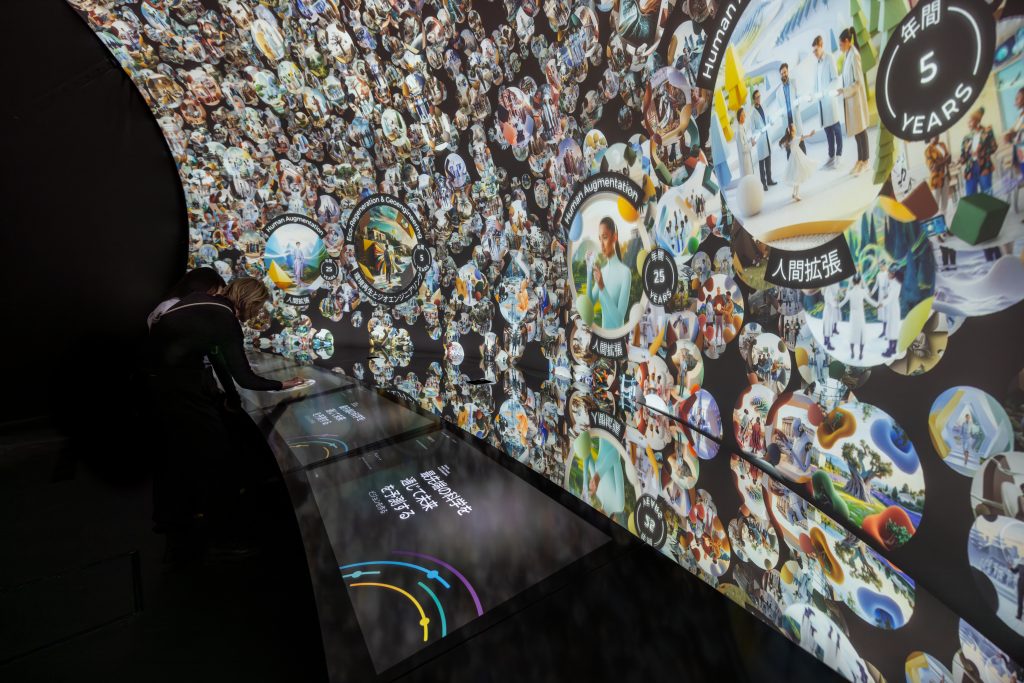


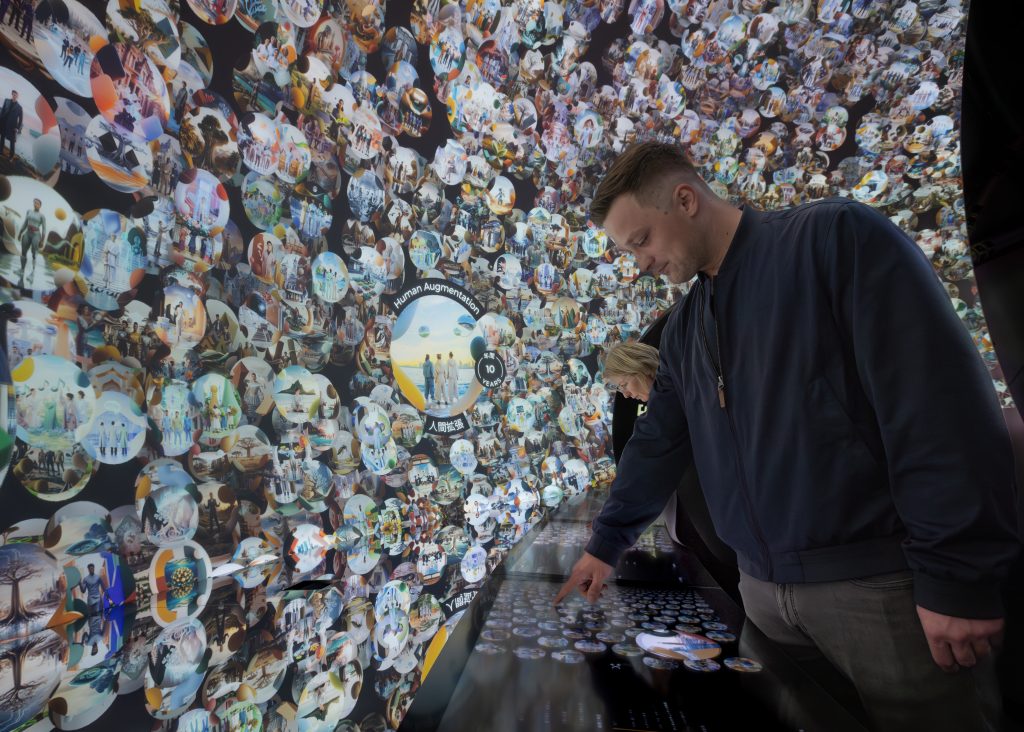
The Public Portal to Anticipation (P2A) is an ambitious collaboration between the Laboratory for Experimental Museology (eM+) and the Geneva Science and Diplomacy Anticipator (GESDA) to transform how global audiences engage with complex scientific knowledge.
The Geneva Public Portal to Anticipation is based on the GESDA Science Breakthrough Radar® database compiled by 2100 leading scientists. Its initiative is to engage the global public with emerging science.
By inviting interaction with this world-leading scientific knowledgebase, global citizens ‘re-engineer’ a canvas of speculative futures through their own perspectives. Participants use a series of parameters, including human/non-human; emotion and sphere of influence—to help craft their vision. Ultimately, this experience empowers individuals and groups from diverse cultural backgrounds to anticipate their world to come.
The knowledge creation architecture ingests 65,000 words including 5 scientific platforms; 29 topics; 116 subfields. This material is prompt engineering process which combines the Radar with a series of parameters that participants enter through a touch screen. Across 197 countries, it generates both a narrative story and an image located in the future @ 5- 10- or 25-year time horizons.
The project involves 3 million precomputed images and speculative future stories, powered by the language and image generators, ChatGPT 1o and Ideogram. In real-time the different narratives generate visions of anticipation for our world to come.
Commenting on the installation, André Jensen, Marketing Manager at Norxe said, “Firstly we would like to thank Damian Leonard of Immersive Realisation for choosing our projectors for this unique exhibit. This is a perfect example of how our projectors are deployed for the world’s most impressive visitor attractions. Where image quality and reliability are non‑negotiable … Norxe’s history of manufacturing simulation‑grade projectors made the P60 the perfect choice.”
The Laboratory for Experimental Museology (eM+) at EPFL is a transdisciplinary initiative at the intersection of immersive visualization technologies, visual analytics, aesthetics and cultural and scientific (big) data. eM+ engages in research from scientific, artistic and humanistic perspectives and promotes post-cinematic multisensory engagement using experimental platforms. eM+ has ten unique visualization systems combined with powerful sonic architectures that are benchmarks in the realms of virtual, augmented, mixed realities.
The post Norxe elected to light up the Switzerland Pavilion at Osaka Expo 2025 appeared first on Norxe AS.
]]>The post 3D stereoscopic projection just made a quantum leap in performance appeared first on Norxe AS.
]]>3D stereoscopic projection just made a quantum leap in performance

The stunning P20 4K 3DS is just back from IAAPA 2025 where it made a serious impression on the show floor. Boasting 3800 lumens per eye after filters, and a near 100% efficiency, the P20 in combination with true 6P color separation from Infitec is raising the bar in compact projection for Themed Entertainment:
3800 lumens/eye
4K native resolution (4096 x 2176 pixels)
Up to 240Hz refresh rate, pr eye, at native resolution
99% of REC.2020 color space
Min. 50,000 hours lifetime
CLO for stable and continuous performance
Motion platform certified
Compact at only 22,5kg/49lbs pr head
Check out Norxe’s new range of 3D stereoscopic projection systems:
Contact the Norxe team with your questions: www.norxe.com/contact
The post 3D stereoscopic projection just made a quantum leap in performance appeared first on Norxe AS.
]]>The post 1DLP vs 3DLP: Understanding the Evolution appeared first on Norxe AS.
]]>For over 25 years, 3DLP (Three-Chip Digital Light Processing) was widely regarded as the gold standard for projection performance. Its key advantages included higher brightness, enhanced color accuracy, and the elimination of certain visual artifacts associated with 1DLP (Single-Chip Digital Light Processing).
1DLP projectors, while more affordable and compact, faced limitations in brightness and color performance due to their reliance on sequential color projection using a color wheel. For applications demanding brightness levels above 5,000 lumens, 3DLP was the preferred choice, establishing itself as the benchmark for premium performance. However, 1DLP remained a solid and reliable choice for less demanding environments, offering excellent value for many use cases.
Technological Differences
Legacy Designs: 1DLP and 3DLP
- 1DLP
Earlier (and still today, some lower-quality) 1DLP projectors used a rotating color wheel to sequentially display red, green, and blue light. This design resulted in compact, cost-effective projectors that performed well in a variety of environments. However, the sequential color process limited brightness potential, bit-depth, and could produce minor visual artifacts, such as the “rainbow” effect, in specific scenarios.
- 3DLP
By employing three DMD chips—one each for red, green, and blue—3DLP projectors delivered simultaneous color projection. This design allowed for higher brightness, improved color fidelity, and smoother image quality, particularly in high-lumen applications. The trade-off was increased complexity, size, and cost.
Lamp Technologies: UHP vs Xenon
Historically, the performance differences between 1DLP and 3DLP were influenced not just by their architectures but also by the type of lamps they utilized:
- UHP Lamps (Used in 1DLP)
- Emit a broad-spectrum light with pronounced peaks in the blue and green wavelengths.
- Optimized for brightness and sharpness in digital projectors, making them highly efficient.
- However, their spectral output demanded sacrifice of brightness and color fidelity to reach D65 white point.
- Lifetime avg. 2000 hours.
- Xenon Lamps (Used in 3DLP)
- Produce a continuous and uniform spectrum similar to natural daylight.
- Deliver excellent color fidelity across the visible range, ideal for applications requiring precise and natural color rendering.
- Their even spectral output contributed significantly to the superior color performance of 3DLP systems in legacy designs.
- Lifetime avg. <1000 hours.
The Solid-State Illumination Revolution
The introduction of solid-state illumination technologies, such as LED and laser light sources, has effectively neutralized the historical disparities caused by lamp technology:
- Consistent, Uniform Output
Solid-state sources now deliver color fidelity rivaling or exceeding that of Xenon lamps, producing color gamuts close to REC.2020. - Extended Lifespan
Solid-state illumination vastly outlasts traditional lamp technologies, further enhancing operational efficiency and reducing maintenance requirements.
Modern Advances in 1DLP
The advancements in 1DLP technology, such as those seen in Norxe projectors, have significantly elevated its performance, bringing it closer to—and in some cases surpassing—traditional 3DLP capabilities:
- Solid-State Illumination
Today’s 1DLP projectors from Norxe utilize true solid-state illumination, using LED and laser, eliminating the need for rotating color wheels and phosphor wheels. This has eradicated color-sequential artifacts and increased illumination lifespan up to 50 times. The need for lamp changes and frequent recalibrations has been eliminated, ensuring consistent performance over time, and significantly reduced operational expenses (OPEX). (For context, a traditional UHP lamp has an expected lifetime of 2,000 hours towards 50% brightness, while the Norxe P10 and P55 with NXL/LED has an expected lifetime of 100,000 hours towards 70% brightness). - Expanded Color Gamuts
Models like the Norxe P20 achieve a near REC.2020 color gamut, offering color performance that rivals or exceeds 3DLP systems. The unchallenged color excellence of the 3DLP projector is a thing of the past. - Sharper Images
Equipped with select DMD packages from Texas Instruments, Norxe 1DLP projectors support native 4K resolution and refresh rates up to 240Hz. The single-chip design eliminates convergence issues found in multi-chip systems, delivering sharper, more precise images. - Efficiency and Portability
1DLP projectors are lighter, more compact, and more energy-efficient than 3DLP equivalents, with a smaller overall footprint and reduced operating costs. - Affordability
1DLP projectors are more cost-effective, making high-performance projection accessible for a broader range of applications.
Performance Comparison Today
Thanks to these advancements, there is no longer a clear technical or performance advantage to choosing 3DLP over modern 1DLP projectors in most scenarios. Instead, the primary differentiator is brightness requirements:
- Historically, 3DLP dominated for applications exceeding 5,000 lumens.
- Today, the crossover point has shifted to approximately 15,000–20,000 lumens, with modern high-end 1DLP projectors performing well in this range.
This evolution is reflected in the portfolios of projector manufacturers, with 1DLP becoming the preferred choice for most installations requiring premium performance at moderate brightness levels.
Conclusion
Modern advancements have transformed 1DLP into a high-performance solution that challenges the traditional dominance of 3DLP. While 3DLP still has a role in ultra-high-brightness applications, high-end 1DLP now offers superior value and comparable color performance for many use cases.
This shift underscores how innovation has expanded the capabilities of projection technology, redefining what is possible with single-chip systems.
Today, 1DLP is no longer the alternative; it is a premier choice for diverse projection needs.
Product information:
P10 4K | Norxe AS
P20 4K | Norxe AS
P60 4K | Norxe AS
The post 1DLP vs 3DLP: Understanding the Evolution appeared first on Norxe AS.
]]>The post Discover the Norxe P20 3DS, P10 3DS and P60 Projectors appeared first on Norxe AS.
]]>The post Discover the Norxe P20 3DS, P10 3DS and P60 Projectors appeared first on Norxe AS.
]]>The post Collaboration is the key to innovation says Cobra Simulation Limited. Learn more about the Cobra320 Full Motion Simulator. appeared first on Norxe AS.
]]>COLLABORATION IS KEY TO INNOVATION
In business collaboration is key. Take a closer look at the new Cobra320 full motion simulator. A project delivered by a collaborative international effort.
Sitting at the heart of everything Cobra Simulation stands for is our mantra – Combine Create and Innovate. Bringing together immersive technologies to create something innovative and unique. This does not happen without a substantial team of experts sitting behind the vision. Recognising those organisations and people that have contributed to the success of a project we believe is important.
Alexander Bradley – Managing Director at Cobra Simulation said:
“Launching this product brings many emotions to the surface. We have spent 12 years building a network of contacts and companies. I have met some amazing people in that time, truly amazing. The enthusiasm to collaborate with Cobra and help make our product visions come to life are inspiring to me, the team at Cobra and our clients.
I want to personally thank every company, organization and individual that have supported this project with passion, determination, resource, and pride. We could not have done it without you.”
See the video:
To read more about Cobra Simulation Limited visit our partner section or go direct to Cobra Simulations website www.cobrasimulation.com
The post Collaboration is the key to innovation says Cobra Simulation Limited. Learn more about the Cobra320 Full Motion Simulator. appeared first on Norxe AS.
]]>The post Maximising ROI: The advantage of virtual testing in automotive engineering by Ansible Motion appeared first on Norxe AS.
]]>The post Maximising ROI: The advantage of virtual testing in automotive engineering by Ansible Motion appeared first on Norxe AS.
]]>The post Read about RSi Visuals’ and Norxe’s effort to offer materiel solutions to high-risk training enterprises. appeared first on Norxe AS.
]]>RSi and Norxe provide another instance of a collaborative effort to offer materiel solutions to high-risk training enterprises. Whereas RSi’s business portfolio has an approximate 50%-50% split between the military and commercial aviation training sectors, similarly, Norxe’s projectors are in service at training sites in both markets and in other sectors.
The RSI-Norxe partnership allows similar, baseline content and systems to be offered to multiple training communities. “This partnership enables both parties to deliver a ‘handshake solution,’ as projectors will never be better than the image generator and the IG provider, when working with partners on the display side, is the major way to meet resolution, numbers of channels and other specific, official requirements for the system,” Sondre Fauskanger, Senior Product Manager at Norxe, said.
Training and simulation are core, number one markets for Norxe, the executive added. To meet this part of the company’s business model, Norxe’s projectors may deliver similar capabilities, including high image quality for flight training devices, multi-channel capacity for dome configurations, and others, for training audiences in different sectors. As significant, the company’s agile projector portfolio can also meet the defense market’s more rigorous materiel requirements for its unique missions sets, for instance, for higher refresh rates, the supply of a dedicated infrared channel and other capabilities.
Alex Gibson, Marketing and Accounts Manager at RSi Visuals, provided another vital data point on meeting different sectors’ S&T requirements. In the case of commercial aviation pilot training, “it’s all about regulations.” And while RSi can help enable a full-flight simulator conform to a regulator’s level D flight training standards, it can also help the military customer exceed these standards and meet their additional mission-essential requirements.
While more demanding military training scenarios are one imperative driving more rigorous materiel requirements, there remains security compliance.
Norxe hears the unique, clarion call from military departments, mainly in the West, for higher-level security capabilities – providing another differentiator between hardware and software content delivered for military training purposes and the commercial aviation market, for example. To point, the company has appointed a dedicated cyber security officer, whose oversight includes ensuring the company’s new software releases are compliant with the most current military standards for the expanding cyber domain. This should be no surprise, as Fauskanger recalled an early line of questions from a prospective military-industry team member may include: do you have a dedicated cyber security program; what is your certification level; and other queries.
Read the hole article “Blurring the S&T Lines – Up to Security and Other Emerging Challenges” by Marty Kauchak, Halldale, March 20th, 2024
The post Read about RSi Visuals’ and Norxe’s effort to offer materiel solutions to high-risk training enterprises. appeared first on Norxe AS.
]]>The post BBC News looks to our partner, Ansible Motion, to see how simulators provide a tool for car companies to develop new vehicles and conduct testing. appeared first on Norxe AS.
]]>The BBC interview begins with the following from Bundock:
These simulators provide a tool for car companies to develop new vehicles and conduct testing on new components like tyres. . . . This sounds exciting and it’s interesting. But for the car industry, this is new tech saving them time and money. Is it as simple as that?
Clark replies:
That’s absolutely correct. The car industry is going through many step changes in technology at the moment, as we know, associated with the move to electric vehicles, other fuel types, the advancement of safety systems, and the drive towards autonomy. And these simulators provide car makers with an engineering tool to reduce both the duration and the risk of the design phase by doing more efficient development in a virtual environment. Our Driver-in-the-Loop simulators put humans in contact with a virtual vehicle at a very early stage in the development process, and that allows humans to make a huge input into the design, characteristics and features of the vehicle before time is committed to building prototype vehicles for real world testing.
Probing further, Bundock asks if simulation is more accurate than real-world testing, to a degree.
Clark provides some additional insights:
I wouldn’t say that it’s more accurate. One of the most significant differences between simulation and real-world testing is the safety aspect. A simulator is essentially a very safe environment which mitigates the risks to both humans and expensive equipment. This is particularly important when we look at the development of new, advanced safety systems – which are becoming more autonomous in their nature. Simulation allows manufacturers to explore purposefully dangerous situations and scenarios before committing to real-world testing and the associated risks.
In the UK, the full interview can be viewed on the BBC website. For others, the interview is embedded above.
The post BBC News looks to our partner, Ansible Motion, to see how simulators provide a tool for car companies to develop new vehicles and conduct testing. appeared first on Norxe AS.
]]>The post I/ITSEC 2024: Experience the Norxe Projectors appeared first on Norxe AS.
]]>
I/ITSEC will take place in the South Concourse at the OCCC.
Norxe will exhibit from Booths #1808 & #1809.
Exhibit hall hours are as follows:
| Monday 02nd December | 14:00 – 18:00 |
| Tuesday 03rd December | 12:00 – 18:30 |
| Wednesday 04th December | 09:30 – 18:00 |
| Thursday 05th December | 09:30 – 15:00 |
Book a meeting with us and make sure to experience the latest within projection technology.
2nd – 6th December in Orlando FL
For more information, please contant
[email protected]
The post I/ITSEC 2024: Experience the Norxe Projectors appeared first on Norxe AS.
]]>