The post Perfect pairings: Top spots to hike and bike (based on what you like) in Madison, Wisconsin appeared first on Outdoor Writers Association of America.
]]>
Photo by Phil Levin
There’s a reason the Outdoor Writer’s Association of America (OWAA) leadership team chose Madison, Wisconsin for its annual conference this August 22–24: let’s just say it came down to numbers.
Five lakes. 270 parks. 200+ miles of biking and hiking trails.
Stats like these make Madison THE Midwest mecca for outdoor adventurists. Not to mention, it’s one of only two U.S. cities located on an isthmus, creating a one-of-a-kind, lake-city-lake landscape that blends stunning natural beauty with urban amenities.
So you can spend a morning fishing for walleye and perch, then cool down at a State Capitol tour just steps away from the lake. Enjoy a sunset paddle to the sounds of live music from the UW–Madison student union on the shoreline. Or bike from downtown to rolling hills in a matter of minutes.
As you make your 2026 conference arrangements, plan to linger longer and discover all the places that prove that in Madison, you never have to choose between outdoor adventure and city center—just choose an adventure that matches your passions.
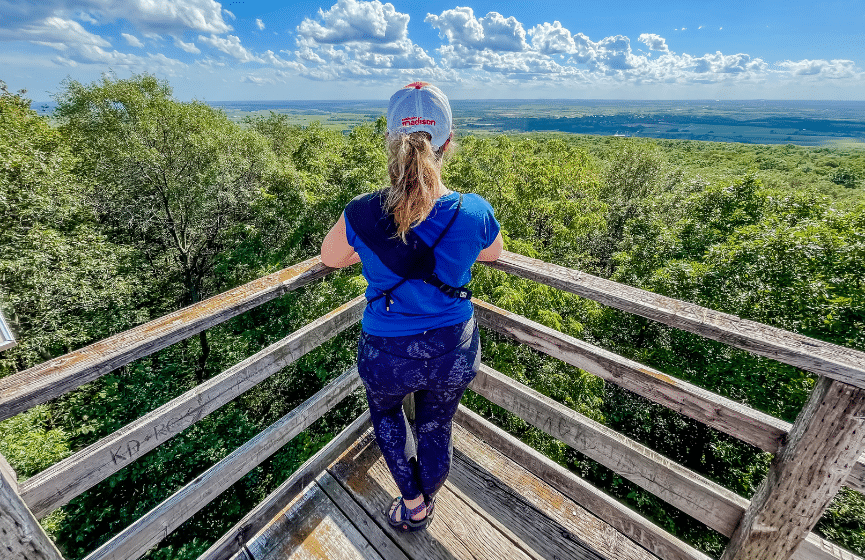
Blue Mound State Park Tower | Photo by Divergent Travelers
Impressed by iconic landmarks: Ice Age Trail
There are only 11 National Scenic Trails in the U.S. And the Ice Age Trail, contained entirely in Wisconsin, is one of the longest and most diverse. This 1,000-mile footpath was carved during the Wisconsin Glaciation period that ended 10,000 years ago. Today, its trails run through rocky terrain, open prairies and peaceful forests, offering hiking adventures that range from after-work strolls to once-in-a-lifetime thru-hikes.
The Ice Age Trail Alliance (IATA) headquarters is located in nearby Cross Plains, where you can access the Cross Plains segment of the trail, a 9.9-mile stretch of woods and restored prairies. If you begin in Verona, try the 6.3-mile segment that passes through three county parks and features several kettle ponds—remnants of the area’s glacial history—found in the Moraine Kettles Preserve.
Getting there: Verona is just six miles from Madison and Cross Plains is 15 miles away. Check the Verona and Cross Plains itineraries for ideas on local spots for eats, shops and stops to refuel on your journey.
Heads up for hunters: You can hunt deer, turkey, small game and waterfowl depending on the season. Be sure to check IATA’s helpful tips on hunting regulations and “blaze orange season” safety practices for hikers.
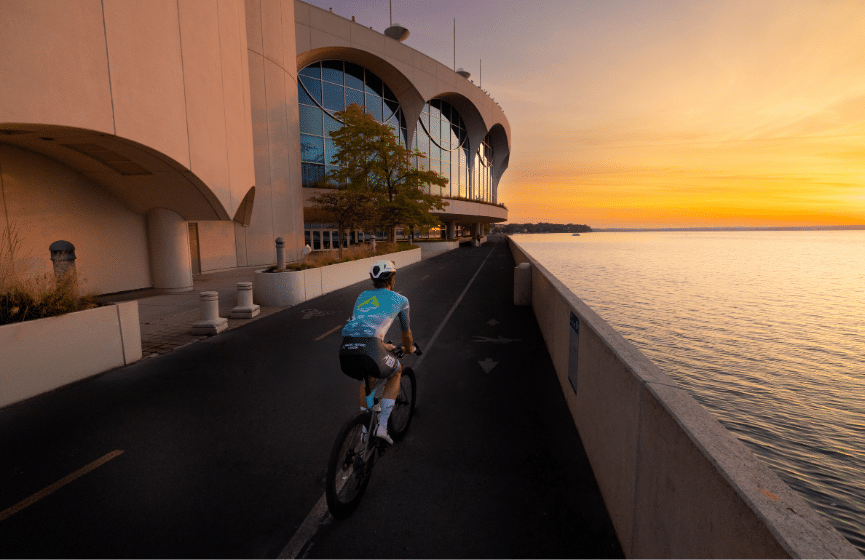
Monona Terrace Convention Center and Monona Loop | Photo by Sharon Vanorny
Do it all in a day: Devil’s Lake
If you’re looking for a spot where the terrain can change from stride to stride, check out Devil’s Lake State Park. This 10,000-acre park is situated on ancestral Ho-Chunk lands, who know it as Tee Wakącąk (Sacred Lake), where many culturally significant ancient effigy mounds remain to this day. From climbing rock formations and bluffs to hiking wooded paths and grassy trails, there are more than 29 miles of paths for varying skill levels that wind through this park.
But that’s not all. There’s swimming and watercraft rentals by the hour at the North Shore and South Shore beaches. Mountain biking on the Upland Trail where you can traverse a combination of grass and dirt terrain that climbs 350 feet in elevation. There’s also a one-mile interpretive nature trail and 1.5 miles of accessible trails for people with disabilities.
Getting there: 45 miles from Madison, an easy day trip with the option to stay and camp at one of the 423 individual sites in the park.
Stunning side trip: The waterfall at the end of Parfrey’s Glen, located just four miles east of Devil’s Lake State Park.
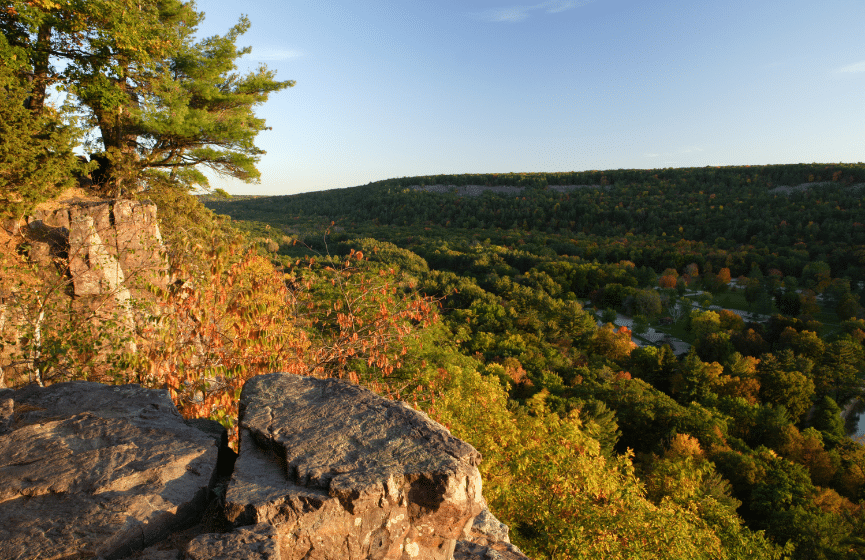
Devil’s Lake State Park | Photo by Destination Madison
Put in some miles: Military Ridge Trail
Military Ridge Trail is a 40-mile crushed limestone trail that connects bikers from Madison to Dodgeville, starting at the eastern trailhead at the Quarry Ridge Recreation Area in Fitchburg to the western trailhead at the DNR Dodgeville Service Center.
Along the way, you’ll pass through Verona, Riley, Mount Horeb, Blue Mounds, Barneveld and Ridgeway. Whether your cycling level makes this a “Half-Century” or a “Long Ride” journey, each community offers plentiful places to stop for restrooms, restaurants and refreshments.
Know before you go: A State Trail Pass is required for cycling and inline skating on this trail ($5 daily, $25 annual).
While you’re there: Military Ridge Trail runs along the southern borders of Governor Dodge and Blue Mound state parks, and both park entrances are available just off the trail.
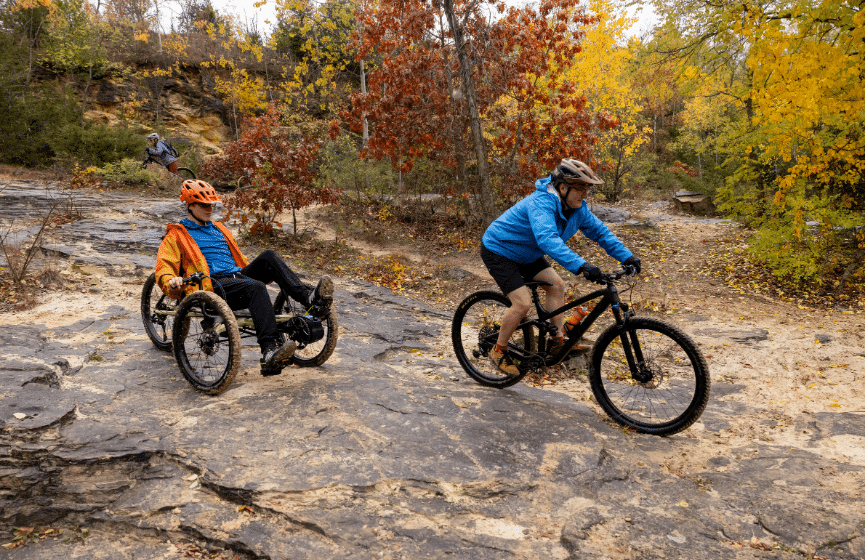
Madison trails mountain biking | Photo by Sharon Vanorny
Best views: Blue Mound State Park
If you’re looking for sweeping views as far as the eagle-eye (or camera lens) can see, don’t miss the observation towers at Blue Mound State Park. The towers are 40 feet high, affording panoramic views of the Lower Wisconsin Riverway and Baraboo Bluffs, which are particularly phenomenal in fall when the leaves are changing.
If you’re up for more of a challenge, the trails are top-notch, taking you through forest and geological formations. Mountain bikers love the dolomite and chert outcroppings that are both beautiful and challenging.
Getting there: 25 miles west of Madison, an easy day trip with the option to stay and camp at one of the 77 wooded sites or 12 bike/hike-in sites. There’s also an accessible cabin for people with disabilities.
Fun fact: Blue Mound is located atop the largest hill in the southern half of Wisconsin, thanks to a geological “quirk of fate” that left Southwest Wisconsin untouched by glaciers (now called the “Driftless Area”). On a clear day, you can see Iowa from one of two observation towers in this park.
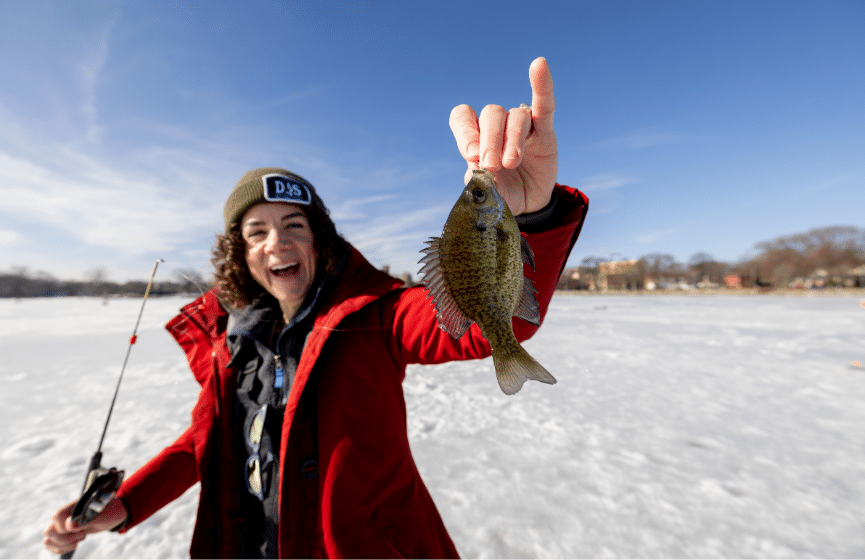
Madison lakes ice fishing | Photo by Sharon Vanorny
A Park for Every Season: Governor Dodge State Park
Governor Dodge is one of the state’s largest parks, covering 5,000 acres of the Driftless Area. Its sandstone bluffs date back 450 million years and it’s home to wow-worthy topography: steep hills, deep valleys, two lakes and a waterfall.
It’s also why Governor Dodge is known as the most winter-friendly park: Several hills offer family thrills for sledding, cross country skiers get 12 miles of groomed trails, and snowshoeing is allowed anywhere that is not designated for skiing or snowmobiling. In summer, the park offers biking, boating, camping, canoeing, kayaking, fishing, hiking, horseback riding, hunting and swimming.
Getting there: 48 miles from Madison, with the option to camp overnight at one of 300 sites. This park also boasts an equestrian campground and remote backpacking sites.
Selfie-worthy spot: You can view Stephens’ Falls from above and below, via a quarter-mile, paved trail with accessible parking at the trailhead.
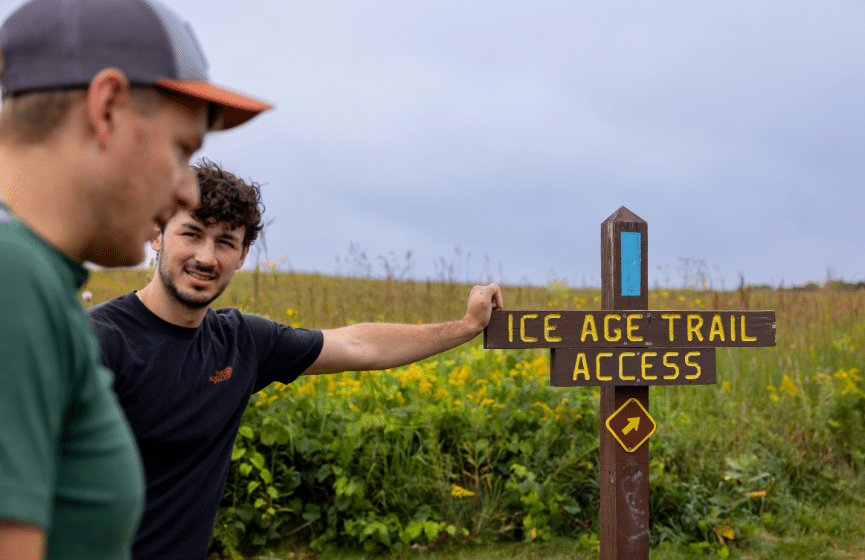
Ice Ridge Trail | Photo by Sharon Vanorny
Give back before you go: Drop-In voluntourism opps
Sustainability is a tradition in Madison: Conservation pioneer and UW–Madison professor Aldo Leopold wrote A Sand County Almanac at his farm in neighboring Baraboo, Wis.. Madison offered the first curbside recycling program in the country, starting in 1968. And Earth Day originated in Madison, inspired by former Wisconsin governor Gaylord Nelson in 1970.
So it felt natural to launch a voluntourism portal that allows visitors a chance to give back and leave our city a little better than they found it. The portal offers visitor-friendly, drop-in opportunities for activities like lake cleanup, invasive species removal and food pantry support.
No matter which of these locations you choose, one thing always remains true: Madison is THE Midwest gateway to adventure—no matter the weather. With direct flights from across the U.S. and four seasons of fun, we can’t wait to welcome you to our walkable, bikeable, hikeable destination.
Register for the conference today!
Are you an outdoor media professional or outdoor organization? Registration is now open for the OWAA conference.
Learn more and register today!
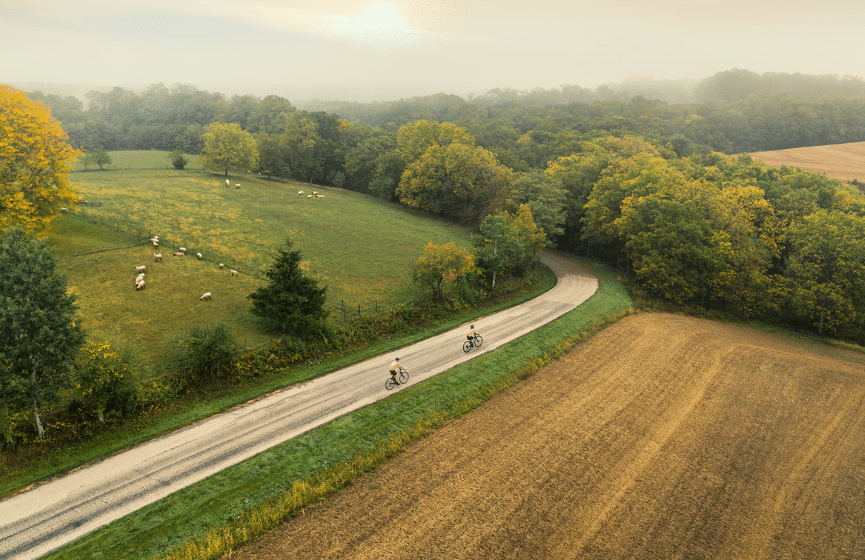
Madison rolling hills | Photo by Jason Lindsey
The post Perfect pairings: Top spots to hike and bike (based on what you like) in Madison, Wisconsin appeared first on Outdoor Writers Association of America.
]]>The post Cowgirl Candace, fourth-generation farmer: Turning heritage into high-impact storytelling appeared first on Outdoor Writers Association of America.
]]>
Cowgirl Candace is a fourth-generation Georgia farmer, award-winning agriculture and outdoor adventure writer, and cultural storyteller redefining how rural America is seen, heard, and understood worldwide. Raised on her family’s centennial homestead, Edward Hill Farm, Candace brings lived experience, historical grounding, and creative rigor to every story she tells, bridging agriculture, outdoor life, and Black cowboy culture with authenticity and care.
A longtime member of the Outdoor Writers Association of America, Cowgirl Candace’s work spans brand partnerships, editorial features, and multimedia storytelling rooted in the American South. During 2025, her personal essay celebrating farm heritage and cowhand culture featured in Beyoncé’s Cowboy Carter Tour Book, traveling the world as part of one of the most influential cultural moments of the year. Profiling modern land stewards, collaborating with legacy outdoor brands, or helping to mentor women writers through OWAA’s group calls, Cowgirl Candace is committed to elevating stories that honor farming history, the people who work it, and the futures they’re building.
Before we step into the mechanics of craft, platforms and professional milestones, it helps to return to the place where Candace’s storytelling begins. Not at a byline or a brand brief, but in red Georgia soil. In family footsteps worn into the land. In the quiet education that comes from watching generations work the same fields in different ways. Her global reach is built on local memory.
The questions below move past résumé and recognition to the lived experiences, values and moments that shaped how she sees the world, and how she teaches it to see her back.
Tell us about your personal journey. How did your multigenerational farming background and connection to Black cowboy culture shape your identity as a storyteller and outdoor communicator?
Edward Hill Farm raised me. It’s the homeland my farming family still owns, stewards, and protects today. I grew up watching four generations move across our farmland in different but equally powerful ways. My Great-Grandma GG baked from scratch, ran a tight household, and was often found clotheslining in the backyard. My Grandpa Amos, a former USDA professional, shared his regenerative agriculture knowledge with me long before those practices became buzzwords. And my parents (true rodeo lovers) spent evenings in our home arena working calf roping and barrel racing drills.
My childhood wasn’t siloed. It was multitasking, a lot of movement, outdoor adventure, and joy, which was lived through multiple interpretations of homesteading and cowhand culture. That upbringing shaped how I tell stories today. I don’t romanticize the land. My editorial work honors it. I understand agriculture, outdoor life, and Black cowboy culture as lived systems, not mere aesthetics. My grounding is what allows me to communicate these stories with honesty and authority.

Your story was featured in Beyoncé’s Cowboy Carter Tour Book, a project that traveled the globe with one of the biggest cultural phenomena of 2025. Walk us through how that opportunity came together … from idea to execution … and what it meant to you personally and professionally.
GG always said: “You never know who’s watching.” That wisdom has guided my entire career. As a 20-year marketing and communications professional, intention sits at the core of my storytelling. My website, cowgirlcandace.com, is a digital front porch and space that invites conversation and collaboration while reflecting my real cowgirl and agricultural background.
Well, I check my business email routinely. During March 2025, I saw a message from the executive editor of Saint Heron Press, the creative agency founded by Solange Knowles (Beyoncé’s sister). The agency discovered my work and fourth-generation farming story. The Saint Heron team asked me to write a paid feature within a 72-hour turnaround centered on my American South lifestyle and themed “BEEN COUNTRY.” I was like: “Let’s Deep South do this.” We negotiated, contracted, and I delivered both the story and photography on deadline.
What I didn’t know was that the “luxury art publication” mentioned during our email exchanges would ultimately become the official Cowboy Carter Tour Book. My story traveled globally as part of a historic tour that grossed more than $400 million across 30-plus shows. I first found out through Instagram DMs — friends, family, and strangers messaging me screenshots from around the world. Saint Heron followed up with the good news as well. I felt fuzzy wuzzy in the best way. To know my farm family’s legacy was being celebrated on a global stage was deeply affirming. Professionally, it validated my belief that authentic, place-based storytelling can move through the world without losing its soul.

How do you approach telling stories about agriculture, outdoor life, and cultural heritage in ways that resonate both within niche communities and on global platforms? What techniques or philosophies guide your work? Give me one solid example of a specific piece you crafted and walk us through your process.
I go into every story from a human stance first. I’m not chasing trends at all. I’m translating universal experiences. Agriculture and outdoor life are about love, family, responsibility, resilience, and care. Those themes resonate everywhere. My narratives are “Sunday best” (how we stylishly show up for church) service to the world — researched, fact-checked, reported, interviewed, and written with purpose.
One example is my long-standing collaboration with Justin Boots. Together, we document Deep South farming and cowhand culture. During the height of the Cowboy Carter tour, I profiled Georgia farmer Kaneisha Miller. This farmers market mom is raising preschool twins while sustaining multigenerational land. I spent time on her farm; observed how she blended community, motherhood, and modern agribusiness; and translated that lived experience into a story that felt intimate, relatable, and scalable. The result? A Justin Boots × Cowgirl Candace feature that sparked meaningful engagement and showed what legacy land ownership can look like in today’s digital economy.
Representation matters, especially in traditionally underrepresented spaces like country culture and outdoor media. How has your work helped broaden audiences’ understanding of Black cowboy culture and the diversity of rural America? What challenges and opportunities have you encountered? Give us an example of at least one challenge and one opportunity.
I have the privilege of reintroducing — and sometimes correcting — the narrative around Black cowboy and agricultural contributions. We’ve always been here. What’s changed is visibility. One challenge is navigating stereotypes that still linger in editorial and brand spaces. There’s often an assumption that these stories are “niche,” when in reality they’re foundational. The opportunity, however, is immense. Digital platforms have allowed my work to reach global audiences and opened doors to brand partnerships that respect cultural truth. The sincere stories I publish expands the frame, showing multicultural rural lifestyles as innovative, joyful, skilled, and deeply rooted.
Visual imagery plays a significant role in outdoor and cultural storytelling. How do you collaborate with photographers, designers, and creative partners to craft images that elevate your narrative? Can you share a moment when visual storytelling changed how people engaged with your work? And what’s one photo you particularly love and why?
I study visual storytellers across social platforms, especially those rooted in authenticity and edge. Many of my strongest and coolest collaborations come from creatives in America’s Black Belt Region because these stories are their grandparents and neighbors, too. One pivotal moment for me was modeling for Wrangler alongside my farming friend Sedrick Rowe of Rowe Organics in Albany, Georgia, as part of an Earth Month 2021 campaign project. Seeing us represented — natural hair, denim, land-stewarding, fully ourselves — shifted how audiences engaged with my work. That imagery by Ivan McClellan (creative colleague, professional photographer, and now rodeo boss of the 8 Seconds Rodeo) told a bigger story: modern Black farmers as healthy, hip, and heritage-driven. It invited new audiences into a creative South they hadn’t fully seen before.
In your experience, what are two key elements of building trust and credibility (especially across cultures, communities, and industries) that might initially seem worlds apart)?
First: Show up prepared and consistent. Trust is built when people see you do what you say you’ll do. Repeatedly. Second: Honor the source before the spotlight. When communities know you’re protecting their story — not extracting it — credibility follows naturally.

For OWAA members and outdoor professionals who want to push beyond traditional markets and pursue unconventional or high-profile opportunities, what two pieces of advice would you offer? Are there mindsets, skills, or practices you believe are essential for success?
One: Build your digital front porch. Your online home should speak for you when you’re not in the room. Two: Practice saying yes before you feel “ready.” Skill grows through execution, not perfection. My mentor and marketing guru Lisa Bourne reminds me: “Progress over perfection.”
Looking ahead, what kinds of stories are you most passionate about telling next, and how do you see your work contributing to evolving the narrative of agriculture and outdoor life on both national and global stages?
I’m deeply invested in documenting modern land stewards: farmers, foresters, and outdoor professionals who blend heritage with innovation. I want to continue evolving the narrative of agriculture and outside adventures as dynamic, culturally rich, and globally relevant.
Follow Candace Cowgirl’s work
Instagram: @thecowgirlcandace
Are you an outdoor media professional?
Learn more about OWAA and apply for membership today.
OWAA provides resources to help our members flourish as outdoor communicators and establish themselves as industry leaders. We create opportunities to make valuable industry and personal connections, sharpen professional skills, showcase work and gain access to in-demand educational resources and mentorship opportunities. Individual member benefits include:
“I’ve been in a number of writer groups — travel writers, baseball writers, pro football writers, motorsports writers — and so far OWAA is far, far better than all of them in terms of welcoming, declaring and pursuing its mission, etc.”
– Matt Crossman
The post Cowgirl Candace, fourth-generation farmer: Turning heritage into high-impact storytelling appeared first on Outdoor Writers Association of America.
]]>The post Meet the founders of OWAA: The stories behind four Pioneers appeared first on Outdoor Writers Association of America.
]]>
Photo above: Hazel Clements, Photo courtesy of the Clements family.
Editor’s note: In the history blog post, “Writers who changed outdoor journalism: The founding of OWAA”, Phil Bloom profiled four of OWAA’s founders — Morris Ackerman, Cal Johnson, Jack Miner and Edward G. Taylor. This installment looks at the other four founders – Hazel Clements, Peter P. Carney, El Comancho, and Buell Patterson.
Hazel Clements (1891-1967)
Often part of OWAA conference agendas is a storytelling session during which attendees take to the microphone to relate personal outdoor experiences. In short order it has become a popular and well-attended event for entertainment, including some laughs.
Retha Charette told of her adventures hiking the Appalachian Trail. Steve Griffin talked about nearly tossing out a carefully prepared soup by accident. Christine Peterson gave an account of helping her husband and his brother track an elk they’d shot after discovering both men were color blind and unable to see the blood trail.
If such a storytelling event had been in place nearly 100 years ago when OWAA was being formed at an Izaak Walton League convention in Chicago, it’s a safe bet Hazel Clements would have shared some doozies.
Long considered a mystery in OWAA circles, her signature on the Bill of Organization is the only evidence of her participation in the organization’s founding, and only then as Mrs. Hall Kane Clements.
The story she likely would have told that 1927 spring evening in Chicago happened eight months earlier when a plane she was aboard in Canada crash landed into a lake from a height of 300 feet.
“How far, gentle reader, have YOU fallen?” she asked in an article she wrote on the accident for the Cleveland Plain-Dealer. “Have you ever stood and gazed thirty stories to the street below and wondered what would happen if you were to find yourself falling through the air at the speed of something like 150 miles an hour?
“There is, I have found, at least one thing about an airplane crash. It doesn’t take long.”
She watched it unfold from a seat next to the pilot, who lost control of the plane while trying to turn it around in high winds.
“I didn’t know much about flying then,” she wrote, “and if I had realized the awful helplessness of the pilot to swerve a falling plane, I might not have been quite so thrilled as the great, grey rocks of the small island leaped up at us.”
Everyone on board miraculously survived the harrowing experience but not without injuries. Clements, who was catapulted through the fuselage on impact, suffered three broken ribs and her scalp was ripped from the crown of her head to just above the neckline. Misfortune turned to good fortune when picnickers on shore revved up their motor boat and came to the rescue as Clements and the others clung to the plane.
“In the silence which hung over the mess of wreckage, human and mechanical, that was strewn over that section of the lake, we could hear the staccato put-put of the boat coming nearer and nearer,” she wrote.
They were rushed to a hospital, where Clements stood by “shaking with a nervous chill” while others were treated for their injuries. Seeing that Clements also was injured, a hospital worker picked her up and summoned help.
“I found myself, to my surprise, with the whole hospital staff gathered around the bed into which I had been bundled,” she wrote. “My teeth were chattering so that the staff couldn’t or wouldn’t understand my protests that I was perfectly all right.”
Clements got the impression the hospital staff thought she was going to die from shock.
“However, being an altogether unamiable person, I decided that wasn’t my day for dying, and after the scalp had a few tucks and neat seams taken in it … I wanted to get away from that place,” she wrote.
She succeeded three days later and in four months began a 40-day tour flying with the Royal Canadian Air Force.
Photo Below: Hazel Clements with daughter Enid.

Flying became her passion with multiple trips into the Canadian bush that she called “gorgeous fun.” She helped do aerial mapping of timberland, flew fishery patrols over Hudson Bay and fire patrols over northern Manitoba, and had more than 50,000 miles of airtime doing roundtrip mail delivery in harsh winter conditions to the remote village of Seven Islands, almost 600 miles north of Montreal, Quebec.
“Somehow, in spite of a very whole-hearted enthusiasm for flying for several years, this flight to Seven Islands was my most vivid realization of what a miracle air travel can accomplish in overcoming the handicaps of distance, storms and inaccessibility,” she said. “We had come through a wilderness which for hundreds of miles at a time showed no sign of civilization or mark of any kind of travel.”
Clements also delivered written accounts of her aerial exploits to magazines and newspapers as “Letters of a Little Lady Vagabond.”
She was born Hazel Philomenia Kane in Olean, New York, and married shortly before her 17th birthday in 1908 to George H. Brenner, a tool shop worker. They had one daughter, Enid, in 1912 and divorced four years later. She remarried in 1921 to George Clements, who worked in newspaper advertising.
Clements also worked in advertising for the Cleveland Plain Dealer and Illinois State Journal before turning to writing. To make her stories more saleable in a male-dominated industry, she disguised that she was a woman by using a byline of Hal Kane Clements. Over time she adjusted it to Hall Kane Clements, perhaps to avoid confusion with Hal Clements, an actor and silent movie director of the same era.
In 1929, she launched a radio show – the Women’s Aviation Hour – on a New York station. Among her guests were pioneering female flyers Amelia Earhart, Phoebe Fairgrave Omlie, and Elinor Smith.
As hair-raising as her own flying adventures were, Clements found them less traumatic than standing before a studio microphone.
“I have never felt the least bit nervous flying over some of the most hazardous country I have ever seen, hundreds of miles from any civilization,” she said. “But when I get up before the mike, my knees wobble. My hands shake. Maybe I seem frightened! I’m going up one day soon and try broadcasting from a plane to see if I can only get over being afraid of the mike!”
Clements continued writing for newspapers in Chicago, Cleveland, and New York, but went a different direction once the United States got involved in World War II. She participated in the Victory Book Campaign, a program started by the American Library Association, American Red Cross, and United Service Organizations to collect and distribute books to members of the armed services.
In 1942, the USO hired her as associate director for its station in Port of Spain, Trinidad, where she worked 14- to 16-hour days. She was quoted in a short news item that circulated widely about a Maltese cat that adopted the USO station as its home and was fitted with proper identification. Clements said it was “the only cat in the army wearing ‘dog’ tags.”
Before retiring in 1963, she wrote a series of articles on Latin America for the U.S. Information Agency.
She died of a cerebral hemorrhage in 1967, leaving a legacy of adventurous spirit.

Photo above: Peter P. Carney
Peter P. Carney (1882-1954)
None of OWAA’s founders had a more jumbled career than Peter P. Carney.
Messenger boy, grocery store clerk, amateur athlete, sports organizer and official, newspaper reporter, public relations director for firearms manufacturers and milk producers, and college lecturer. The last is the most peculiar. Carney was a grade-school dropout but developed enough life and business experience to land a job in 1949 teaching salesmanship at Boston University.
Born in England, he was the oldest of four children when his parents emigrated to America. After his father was killed in a mine explosion in Pennsylvania, his mother relocated the family to Trenton, New Jersey, where Carney quit school at age 9 to work for American District Telegraphy Company.
Looking for something better, he landed a job at age 12 as a grocery clerk making $3 a week while continuing to work for the telegraph company. He showed prowess in sports, winning more than 100 races in track and field as a short-distance runner. In 1906, he won the first of two New Jersey all-around track titles and became sports editor of the Trenton Sunday American, starting a string of jobs at several newspapers.
Carney dreamed of competing in the Olympics but was injured in 1907 and never competed again. The Netherlands reportedly tried to hire him as its Olympic coach in 1914, but it didn’t materialize.
He turned to bowling, where he was individual champion or runner-up of Trenton over a five-year period while captaining the five-time team champion.
To ensure ready-made fodder for his columns in the Trenton State Gazette, Carney created local baseball and basketball leagues.
In 1909, he took a newspaper job in Philadelphia and moonlighted as a referee in that city’s Interscholastic Basketball League. A year later he formed the Philadelphia Basketball Officials Association.
All the while he was still living in Trenton, where he became involved in that city’s chapter of the Amateur Athletic Union. He served five years organizing track meets before he was expelled in 1915 for publicly accusing the chapter president of orchestrating an illegal election of officers. Of the ouster, a Philadelphia Inquirer sportswriter opined: “It is evident that Mr. Carney refused to look upon the side of the bread with the butter and will now be left only the crumbs.”
The year wasn’t a total loss for Carney. He was elected vice president of the Philadelphia Sporting Writers Association, landed a job as editor of the National Sports Syndicate, and began doing public relations work for Winchester Repeating Arms.
He parlayed the Winchester job into interviews and information for his coverage of trap shooting over the next decade. His focus on trap shooting provided him a national audience. A Memphis newspaper declared “It is doubtful if any writer on subjects pertaining to guns and ammunition is better known than Carney.” His extensive coverage of shooting sports chronicled the participation of professional baseball players, royalty, and women.

Photo above: Peter P. Carney (1949)
He also wrote about hockey, ice skating, roller skating, and snow skiing.
Carney’s promotional savvy surfaced in 1921 when he arranged 6,000 tickets to be sold at Winchester stores for the Jack Dempsey title fight against Georges Carpentier. The bout drew 91,000 fans and generated the first million-dollar gate in boxing history.
Carney then landed a position as advertising director for Remington Arms, but that, too, was short lived when he began two PR jobs far removed from the work he had been doing – one with a dairy producer and the other with New York’s Grand Central Palace, the largest expo hall in the country.
The dairy business seemed to suit him. Until Liberty Dairy hired him, his only connection to dairy products was an appetite for milk. He reportedly drank two quarts a day. He launched a radio program on KDKA radio in Pittsburgh that focused on the nutritional value of milk, and later became president of the Greater Pittsburgh Milk Dealers’ Association.
The lecture position at Boston University put him on location for his last job as wholesale manager for Herlihy Brothers Dairy in nearby Somerville, Massachusetts.
El Comancho (1867-1940)

Photo above: “El Comanco” Photo retrieved from Historylink.org.
Walter Shelley Phillips was a man of many works … and many names, most given to him by American Plains people with whom he mingled for a good part of his early life.
The one that stuck was a spinoff of Comanch or Comanche, a nickname attributed to different individuals. Phillips tweaked it to El Comancho, and it became his byline on thousands of nature stories, 11 books, seven unpublished manuscripts, and hundreds of drawings and photographs, most of which are archived at the University of Washington.
Phillips was born in 1867 in Illinois, the son of a Civil War veteran who moved his family by covered wagon a year later to the Nebraska Territory, settling in Otoe tribal hunting territory where the town of Beatrice was soon established.
His father worked as a surveyor for the railroad, became postmaster and then mayor of Beatrice.
Phillips, an elementary school dropout, spent his childhood days playing with Otoe children and hunting and fishing with Otoe adults.
His first job was hanging telegraph lines, after which he hired on as a hunter providing fresh meat to a railroad crew plotting a route from Nebraska to Montana. Roaming the Black Hills, the Rockies, and land that became Glacier National Park put him among even more Native American tribes – Blackfoot, Crow, and Sioux among them. He learned their languages, stories, and how they lived, all grist for his writing career.
He sold his first story to Forest and Stream magazine in 1887. Intent on improving his writing, Phillips moved back to Beatrice and took work at the local newspaper under an exacting editor, Lehman C. Peters.
Returning to Beatrice also reunited Phillips with a childhood friend, Rena Egleston. They married and eloped to Seattle, where he walked into the Seattle Telegraph newsroom with a dime in his pocket and a desire to be a reporter. He was hired but lost the job when the Seattle Post-Intelligencer bought the Telegraph.
Phillips then landed a job as reporter and illustrator with Chicago-based Northwestern Lumberman, a trade magazine for the timber industry. During a seven-year stint with the magazine he polished his drawing skills at the Chicago Art Institute, a move that enabled him to illustrate his articles and books.
He bounced back and forth between Chicago and Seattle as his writing career blossomed into other magazines, including Field & Stream and Forest & Stream.
In 1904, Phillips created his own magazine – Pacific Sportsman – and ran it for several years before selling it to Outdoor Life. He wrote a column for that magazine over the next decade.
By 1920 he’d written and illustrated a half dozen books, cranked out a syndicated newspaper column titled Teepee Tales, and begun traveling from coast to coast giving lectures on his experiences. He claimed to have crossed America nearly 200 times on the lecture circuit, wearing out four automobiles in the process.
Izaak Walton League president Will Dilg recruited him to make presentations on stream conservation and establish new IWLA chapters in the process. Frequently dressed in a corduroy suit and donning a Stetson hat, Phillips gave nearly 500 lectures over a five-year period. He further extended his reach – and his reputation – by doing a regular program on WMAQ radio in Chicago.
He made up for a lack of formal education through reading and became well-versed in biology, geology, and natural history.
“Why I’m so well known,” he once said, “that I couldn’t steal a man’s horse, couldn’t burn a barn, couldn’t rob a bank, couldn’t steal another man’s wife, without someone seeing me that knew me.”
He settled in the Black Hills of South Dakota at Twelve Mile Ranch, where he spent his time painting, collecting fossils, prospecting for gold, and writing before making plans to move to California and live with a daughter.
He died in 1940 in Seattle, reportedly from cerebral hemorrhage.
Buell A. Patterson (1895-1958)

Photo above: Buell A. Patterson
A lot of people win awards. Few have an award named after them.
Buell A. Patterson is one of those few. Long associated with newspapers, radio, and public relations, Patterson was the first president of the Publicity Club of Chicago when it formed in 1941. The club annually recognizes the best use of technology with the Buell A. Patterson Award.
Although Patterson spent the latter part of his life in public relations for a variety of businesses, it’s not how his career began.
He attended the University of Chicago, where a 1914 Chicago Tribune article indicates he was a prospect for the school’s football team coached by the legendary Amos Alonzo Stagg. Two years later he was on the Maroons’ swim team that shared the championship of the Western Conference, now the Big Ten Conference.
After graduating, Patterson became a sports commentator and built a solid reputation broadcasting major college football games, including Notre Dame matchups against Navy and Southern Cal in 1928 – the season when Irish coach Knute Rockne gave his famous “win one for the Gipper” halftime speech. A year later Patterson joined WJR radio in Detroit and continued announcing football games. While working at WJJD in Chicago in the 1930s, he also did on-air book reviews and handicapping of horse races.
Patterson added newspaper writing to his résumé in the 1920s and continued for almost 20 years. Hearst Newspapers published his Rod and Gun stories, and he added two syndicated columns – America Out of Doors and Dog Chats – that reached 110 major daily newspapers.
“The backwoods are about tops for enlightening one on character,” Patterson wrote in one of his America Out of Doors columns. “If anyone wants to discover what manner of man any individual is, there is no more accurate measuring stick than a trip into the wilds.”
He had affection for dogs, writing in a 1940 column that “often I have wished for the time, the money, and the land to have a dog of every breed … Under ideal circumstances it might work out, but in truth it would be a difficult venture.”

Photo above: Buell Patterson at the University of Chicago.
Despite the column writing, Patterson never strayed far from a radio microphone while working in the publicity department of Chicago station KYW. In 1930, he announced speed boat races on the St. Joseph River in South Bend, Indiana, where loudspeakers carried his description of the events to 30,000 spectators.
Public relations appealed to Patterson, who founded his own firm in Chicago before taking advertising sales or PR jobs with Curtiss-Wright Corp., American Airlines, Pan-America Grace Airways, and U.S. News & World Report.
From 1939 to 1942 was a particularly transitional period for Patterson. American Airlines hired him in 1939 as central district public relations representative based in Chicago. Two years later he helped launch the Publicity Club of Chicago and was elected its first president. American promoted him in 1942 to publicity director working out of New York City.
While working in the airlines industry, Patterson continued his outdoor writing. He joined the North American Sportsman’s Bureau, a syndicate that distributed his columns to numerous newspapers along with the work of others affiliated with OWAA – J.N. “Ding” Darling, Cal Johnson, Robert Page Lincoln, Sigurd Olson, and others.
In 1948, Patterson left American Airlines to become director of the public relations division of the U.S. News & World Report but reversed course in 1951 when Pan-American Grace (Panagra) Airways hired him as its PR director. He sometimes wrote about fishing opportunities related to Panagra flight destinations.
He left Panagra in 1954 to become an account executive with Communications Counselors, Inc. In that capacity, he accompanied the Shenandoah Apple Blossom Festival queen and her mother on a promotional trip to Havana, Cuba.
On the return trip to New York, Patterson died of a reported heart attack during an overnight stopover in Miami.
Read more OWAA history:
Dinner in Chicago, 1927: The night outdoor writers founded OWAA
Writers who changed outdoor journalism: The founding of OWAA
The post Meet the founders of OWAA: The stories behind four Pioneers appeared first on Outdoor Writers Association of America.
]]>The post OWAA staff 2025 gear guide appeared first on Outdoor Writers Association of America.
]]>
OWAA staff spent the year hiking, paddling, camping and wandering across the map with all kinds of gear in tow. These are some pieces we reached for again and again. These are the things that made our outdoor adventures easier, cozier or just plain more fun.
OWAA Member Books
You know that feeling when you can’t be outside but you want your mind to be? That’s what OWAA member books do best. With more than 130 titles from field guides to conservation stories to adventure nonfiction, these books are written by the very people living the outdoor beat every single day. Our staff has many of them.
Who these books are for:
The reader, the dreamer, the road-trip passenger or anyone who wants their nights to feel a little more like campfire season.
Pro Tip:
These books make a great gift. Buy a book bundle and pair it with a handwritten note about why you chose each title. It’s personal, thoughtful and affordable.
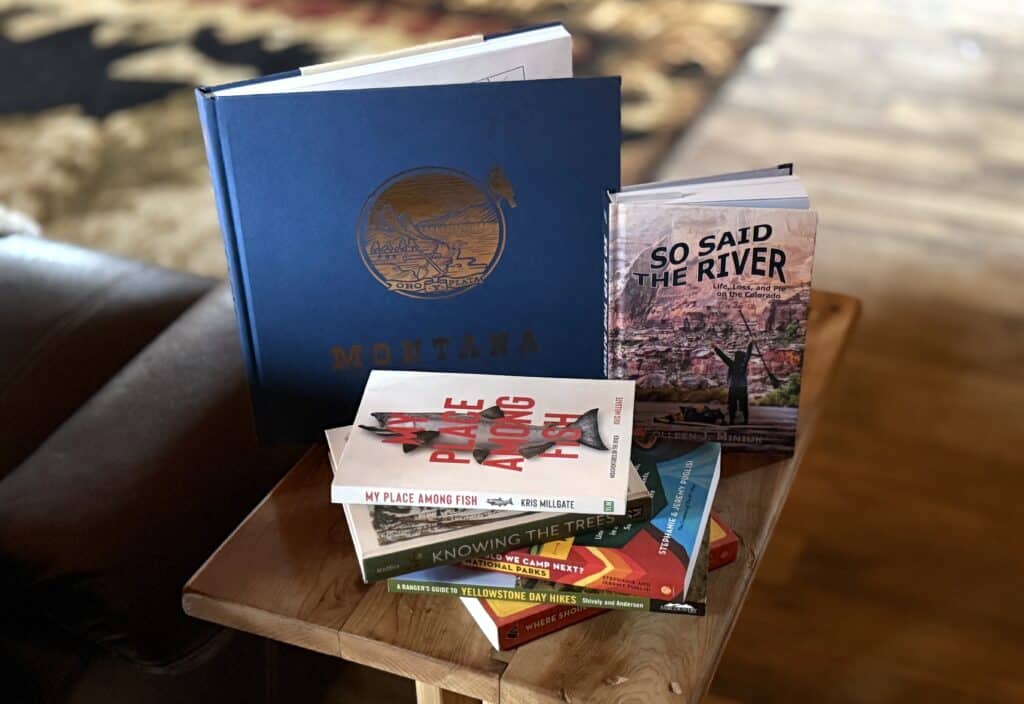
Here are the top five OWAA member books on my bookshelf:
So Said the River by Colleen Miniuk
Montana Photography Book by Andy Austin (This one makes a beautiful coffee table gift.)
My Place Among Fish: by Kris Millgate
Knowing the Trees by Ken Keffer
Where Should We Camp Next? by Stephanie & Jeremy Puglisi (Available on our OWAA book shop.)

Bajío Hopedale Sunglasses
Named after the iconic Louisiana fishing community, the Bajío Hopedale sunglasses use bio-based nylon frames and crisp polarized, blue-light-blocking lenses that cut glare so cleanly you’ll swear someone turned up the definition on real life.
These are great for fishing since they block 100% of UV rays. And they somehow work on almost every head shape without that “tight-squeeze headache.” Hidden Sun Ledge technology blocks sneaky top-down rays too and the recessed nose pads keep them from slipping. And yes, the built in nose pads actually work.
Who this is for: Anglers, paddlers and anyone who wants daily-driver sunglasses that perform like premium fishing optics without looking like “fishing” glasses.
Pro tip: Choose mirrored lenses if you fish bright water. The glare reduction is nice.

Rab Women’s Khroma Latok GORE-TEX Pro Bib and Rab Khroma Pro Jacket
I call this my outdoor heirloom-quality winter kit. This shell system is great if you spend a lot of time outdoors in the snow, sleet and rain. It’s an investment set that can easily last you for the next ten years. From snowshoeing, nordic skiing and downhill skiing, they are also great for sledding with kids.
The word pro often gets overused in the outdoor world, but in this case it actually means something. These bibs are engineered to perform in harsh, unpredictable conditions. They’re waterproof and breathable. And they’re super light with an ePE membrane.
An ePE membrane is a newer, lighter more eco-friendly waterproof layer in GORE-TEX that blocks wind and rain while letting sweat escape. It’s kind of like upgrading from a thick old raincoat to a high-tech shell that protects you bette but feels way less heavy and stuffy.
These bibs also have reinforced hems and adjustable internal gaiters, but my favorite thing about these is the high bib design to prevent any snow from getting in.
They’re also safe for skiing with an integrated RECCO® Reflector, so it helps search-and-rescue teams locate you quickly and requires no batteries or upkeep.

The Khroma Pro Jacket pairs perfectly with the bibs and has the same GORE-TEX PRO construction, same mobility, same bomber reliability. The hood is also helmet-compatible and seals out wind.
I’m no fashion pro, but I feel like the melba orange bibs with the blue jacket is the best-looking color pairing the Rab team has ever released. I had multiple people stop me on the trail out in Lolo Pass to ask what I was wearing.
The craftsmanship and fit make it feel custom-tailored. The durability means you could hand this down someday. And the performance is so dialed that you start planning outings because you want to wear it.
Who this is for: All types of skiers, snowshoers and winter hikers. It’s also great for guides, patrollers and winter professionals.
Pro tip: Open both your thigh vents (bibs) and pit zips (jacket) before starting a climb. This system moves heat so efficiently that pre-venting makes long, sweaty ascents noticeably more comfortable.

Paka Women’s Alpaca Hoodie
Made from a supersoft Royal Alpaca blend, this women’s hoodie is breathable, temperature-regulating and polished enough to wear from trail to town. And it’s signed by the artist who wove it, which is a detail I love. It also has a slightly longer back that adds coverage, especially if you’re pairing it with leggings.
Who this is for:
Women who run cold, love natural fibers or want a single hoodie to wear from airports to alpine mornings.
Pro tip: Size up if you want roomy, relaxed fit.

Buzz Centris Folding eBike
I’d say this is the funnest gear on this list. And you don’t need a bike rack on your car or a truck to travel with it. It’s fairly heavy, though, at around 68 pounds so you may need an extra hand to lift it into your car. (It’s much easier with two people.) The trade off, though, of needing an extra hand is that you can store it easier and take it out easier. You can also go up to 20 mph, so it doubles as a “take everywhere” commuter bike and adventure bike. It rides really well on groomed trails and has thick 4 inch tires. It’s also pretty versatile for different adult height ranges since hit has a step-through frame. The suspension (60mm in front) is good to for a bike in this price point (under $700) and makes bumps from pavement and forest roads and trails comfortable.
Who this is for:
RV travelers, van lifers, urban commuters, campground goers or anyone who wants an e-bike without needing large amounts of storage space.
Pro tip: Keep a small pump and multi-tool in the storage bag as those wide tires love proper pressure.

RUX 70L Collapsible Gear Box
This gear box is unique. Think of it more as a gear “room” you can carry. You can stuff it with camping equipment, camera gear, winter layers and even folding paddles, fishing rods and helmets. It packs like a gear box, but carries like a tote or backpack. It also collapses flat when you don’t need it. It’s waterproof and the frame doesn’t warp even when fully loaded to its 50-lb limit.
Who this is for: Overlanders, van lifers, weekend warriors, road-trip families and Type-A organizers (or their opposite: the perpetually chaotic).
Pro tip: Load it with all your “grab-and-go” essentials (stove, headlamp, med kit) and keep it ready by the door.

Rocky Talkie Mountain Radio
I’ve used the Rocky Talkie Mountain Radio and Rocky Talkie’s traditional radios here in my home state of Montana. They’ve never once failed or died unexpectedly. The shatterproof screen, thermoplastic body and bomber carabiner-and-leash system make it nearly unlosable (if you attach it to your pack).
The battery lasts about 4 days for me on a charge, even in the cold. And it’s easy to use since it only has five buttons. It typically works 35+ miles in ideal conditions in flat lands but if you’re traveling in the mountain the range is about 1-5 miles in mountain terrain. I tested this while driving from my home out to the forest and it cut out about the 2.5 mile marker. This set is good for hiking and keeping in touch with your crew if you get split up, especially where cell service is low or non-existent.
Who this is for: Ski partners, climbing teams, hunters, guides or families and friends who like being able to find each other while hiking.
Pro tip: Pair it with the waterproof hand mic if you often wear gloves or ski with a pack.

Merrell MTL Adapt Matryx Trail Running Shoes
These are a surprise favorite (comfy) trail running shoe. They have Merrell’s FloatPro+ midsole and the Vibram® MegaGrip outsole, you get a cushioned, shoe that’s also responsive. The padded collar also hugs your ankle without rubbing (if you know you know). These are nice in rocky and technical terrain.
Who this is for: Trail runners and hikers who like a nimble shoe with grip.
Pro Tip: They shine on rugged terrain so save them in your running rotation for your hardest trails.

Zenbivy Light Bed (Light Sleeping Bag System)
If traditional mummy bags make you feel like a burrito wrapped too tight, Zenbivy may be for you. This Zenbivy Light Bed works with alpine overnighters and road-trip car camping. It’s also great for side sleepers (like me). And the quilt-and-sheet system gives you the warmth of a premium bag with the comfort of an actual bed. I’ve used Zenbivy sleep systems for the past eight years.
This light bed is warm, ultralight, compressible and non-claustrophobic. You can sprawl like a starfish and be comfy. Zenbivy also has a good origin story.
Who this is for: Campers and backcountry hikers who toss and turn, side sleepers or anyone who wants comfort without carrying a heavy sleep system.
Pro tip: Pair it with the Zenbivy mattress for full “sleeping at home” energy.

Glerups Wool Slippers (Leather Sole)
These are the unofficial footwear of my remote OWAA home “office”. Made from natural wool that warms and wicks moisture, Glerups are nice to slip into after ski days, trail runs, long drives or cold mornings shuffling around camp. They mold to your feet over time (and are best without socks), and they don’t get too hot. The leather sole is quiet, durable and perfect for cabin life or van life. They’re sort of addictive. They also have this slipper with a rubber sole for more indoor/outdoor use.
Glerups also has a unique origin story. Nanny Glerup and her husband, Ove, embraced the idea of living self-sufficiently on their rural Danish farm in the 1970s. As their flock of Gotland sheep expanded (a hardy, curly-fleeced breed known for its soft yet durable wool) so did their supply of wool. That eventually led to their slipper production.
Who this is for: Anyone who loves comfort, and especially outdoor folks who appreciate natural fibers and staying warm without sweating.
Pro tip: Size down if you’re between sizes. Wool loosens slightly as it forms to your foot.

Teton Mesa Canvas Tent
The Mesa Canvas Tent is one of those tents you buy once and use for the next ten years or so. It’s great for base camps. Think staying multiple days or weeks. It also doubles as a storm-proof canvas shelter as it feels like a tiny cabin in bad weather. Inside, it’s roomy enough for cots, kids, dogs, extra gear and chairs. A 6ft person can stand comfortably inside and the large doors and ventilation make it work for every season.
Check out the Teton Sports founder’s story here.
Who this is for: Basecamp lovers, hunters, overlanders, family campers and anyone who wants a “home away from home” tent.
Pro tip: Invest in a good ground tarp. It’ll extend the tent’s life dramatically.
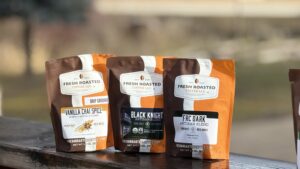
Fresh Roasted Coffee – Guatemala Huehuetenango FTO
If you like a good French press style coffee, this coffee comes out smooth. It’s rich without the bitterness common in camp brews. The Huehuetenango origin (my personal favorite) has a chocolatey sweetness with just enough fruit to be interesting. It’s also organic, fair-trade and roasted fresh. This coffee works for any coffee loving outdoor person.
Who this is for: Camp coffee snobs, road-trippers, early-morning anglers and anyone whose day starts with a cup of Joe outside.
Pro Tip: Grind it coarsely right before you leave. The flavor payoff is huge.

Women’s Astral High Noon Hemp Hoodie
You may know Astral for their water gear, but their apparel may surprise you. I adore this hemp-blend hoodie because it breathes well yet still takes the chill off. And the fabric gets softer every wash without losing durability.
Who this is for: People who want a sustainable, breathable midlayer for active days outside.
Pro tip: Hemp resists odor naturally so it’s great for multi-day trips without needing to wash it.

BRANWYN Merino Wool Baselayer Leggings
These leggings move with you. The merino-blend POWRspun fabric gives you compression, warmth, breathability and a sculpted fit that stays put during hiking, running, yoga and everyday wear. They’re odor-resistant, soft, and designed for performance without plastic-feeling synthetics. Beware that they do stretch. and the brand is transparent about “slight sheerness” in deep bends, but for most outdoor activities, they’re flawless.
Who this is for: Women who want high-performance, natural-fiber base layers for cool-weather adventure.
Pro tip: Size up if between sizes as they are very fitted.

Gregory Alpaca Wheeled Duffel 40L
This bag is great to haul around the airport without having a full-sized roller. And it’s small enough to carry on a plane. The outside material is tough. It reminds me of Patagonia’s black hole line. The wheels are smooth and it’s waterproof so you can protect your gear without bulk. There are also inside straps to keep clothes separate from muddy or wet equipment. The grab handles make it easy to yank from truck beds, boat docks or airport carousels.
Who this is for: Travelers, photographers, guides and weekend warriors who want an easy to roll bag for rough conditions.
Pro tip: Pack heavy items near the wheel end for the smoothest rolling.

Aged & Ore Bottle Flight (Silicone-Wrapped Travel Bottles)
A hit with Chez Chesak, OWAA’s executive director, this travel-friendly set has four silicone-wrapped glass bottles, each with measurement markers, labeling windows and a protective EVA case. It fits easily into your daypack or carry-on. And it’s TSA-compliant, classy and perfect for sharing spirits around the campfire without lugging full bottles.
Who this is for: Camp mixologists, whiskey enthusiasts or anyone who wants to bring “a taste of home” on adventures.
Pro tip: Keep at least one bottle filled with water or juice so non-drinkers (or early risers) have something fun to sip around the fire, too.
Bonus recommendations: OWAA Supporting Group Gear
OWAA has a number of organizations that support our non-profit. Below are the supporting organizations that also have outdoor gear.
Henry Repeating Arms
- Henry Lever Action .22 (“H001”) – classic entry rifle, among their most widely sold.
- Golden Boy .22 – iconic octagon-barrel lever gun that often appears on top-seller lists.
- Big Boy Series (.357/.44/.45 Colt) – centerfire lever rifles popular for hunting and cowboy-action shooting.
Lowa Boots
LOWA’s top sellers. (The Renegade boots are my favorite. I’m on my second pair over 6 years.)
- Renegade GTX Mid – their signature best-selling hiking boot. (Staff overall pick.)
- Renegade GTX Lo – low-cut version for lighter hiking/travel.
- Zephyr GTX Mid TF – very popular for tactical / mixed use.
MyTopo– Custom maps
They sell downloadable & printed custom maps.
- Custom USGS Topographic Maps (centered on your hunt/fish/hike area).
- Satellite & Aerial Photo Maps for e-scouting and land navigation.
- Public/Private Land Ownership & Hunting Maps (property boundaries, unit overlays).
Seaguar
Fishing line & leaders
Seaguar literally invented fluorocarbon line; their “freshwater lines and leaders” collection highlights these staples.
- Blue Label Fluorocarbon Leaders – go-to premium leader material.
- InvizX Fluorocarbon Mainline – widely recommended all-around fluoro.
- Tatsu Fluorocarbon – high-end, super-supple flagship line.
Star brite
Marine/RV cleaners & protectants
Top sellers:
- Premium Marine Polish with PTEF – heavily recommended hull polish.
- Mildew Stain Remover – top-rated cleaner on multiple retail sites.
- Instant Hull Cleaner / Hull Cleaner Gel – core boat-care products.
Mountaineers Books
Outdoor books, guidebooks, skills manuals
- Mountaineering: The Freedom of the Hills – classic bible of climbing.
- Regional “Day Hiking” series (e.g., Day Hiking Mount Rainier).
- Avalanche & snow safety / ski touring titles (e.g., Staying Alive in Avalanche Terrain).
ENO (Eagles Nest Outfitters)
Hammocks & camp accessories
ENO’s own “best sellers” highlight these products.
- DoubleNest Hammock – their flagship two-person hammock.
- Atlas Suspension Straps – best-selling strap system.
- Guardian Bug Net – very common add-on for backpackers.
Power-Pole
Shallow-water anchors (boat fishing gear)
- Blade Series Hydraulic Anchors – premium shallow-water anchors.
- Sportsman II Anchors – more budget-friendly hydraulic line.Power-Pole
- ONE Pump System – new pump that powers dual anchors from one unit.Power-Pole
Teren
Mens travel / outdoor apparel
- Lightweight Traveler Pants – repeatedly highlighted in “best travel pant” gear guides.
- Daily Driver Pants – everyday/adventure pant near top of best-selling list.
- Cloudland Shell Jacket – widely reviewed as their hero outerwear piece.
Smokies Life
Books & gifts for Great Smoky Mountains NP
Their store and gift-guide pieces call out consistent top sellers.
Into the Mist (photo/coffee-table book on the Smokies).
- The Cades Cove Story – very popular history title.
- Smokies trail guides, maps & calendars – recurring best-selling formats.
USA Clay Target League
They run a full online store for teams & fans.
- USA Clay Target League Hats (red/white/blue patch hat, etc.).
- League Hoodies & Joggers (e.g., Desert Camo Hoodie, heather ¼-zip).
- Event Pins & Window Clings (season pins are a big recurring item).
OWAA Supporting groups selling outdoor services / experiences
ROW Adventures – guided whitewater & adventure travel
They sell guided trips directly; their own “Best of Rafting” page calls these out.
- Middle Fork of the Salmon Rafting Trips – billed as their premier wilderness trip.
- Rogue River Lodge-to-Lodge Rafting – “gateway” classic in Oregon.
- Salmon River Canyons / “Family Magic” Trips – signature family-friendly best-of.
World Nomads – adventure travel insurance
They don’t sell gear, but do sell trip-coverage products.
- Standard Plan – baseline coverage for most travelers.
- Explorer (or Epic) Plan – higher-limit, higher-risk adventure coverage.
- Annual Plan – multi-trip yearly coverage.
XGRiD Campers – off-road campers & trailers (sales + some rentals)
They’re an RV dealership for overland rigs.
Representative “top” offerings by prominence in their inventory:
- Opus OP15 / OP13 Hybrid Caravans – featured overland trailers.XGRiD Campers
- Imperial Outdoors X195 / OB-120 Trailers – highlighted new inventory.XGRiD Campers
- Australian Off Road (Sierra / Quantum) Trailers – premium off-road line.XGRiD Campers
Natural Bridge Caverns – ticketed tours & adventure park
They sell combo and individual tours directly.
- Discovery Tour – classic guided walk through the original chambers.
- Hidden Wonders Tour – newer, immersive lighted cavern tour.
- Adventure / Discovery Adventure Tours – more technical “crawl & climb” style tours.
Parks Canada – park passes, camping & permits
They directly sell passes, permits, and reservations.
- Parks Canada Discovery Pass – annual pass to 80+ sites (flagship product).
- Single-Location Annual / Seasonal Passes – park-specific passes.
- Camping & Lockage/Mooring Permits – via reservation system.
Arkansas Game and Fish Commission – licenses
They sell licenses that enable hunting/fishing (outdoor access service).
- Resident & Nonresident Fishing Licenses.
- Hunting Licenses & Tags.
- Lifetime & Senior Licenses (e.g., 65+ Resident Lifetime Fishing).
Tennessee State Parks – camping & lodging
Reservations are sold directly online.
- Campsite Reservations (tents & RV).
- Cabins & Lodge Rooms at state park resorts.
- Shelter / Pavilion Rentals for events.
Infinite Outdoors – membership & private-land access
They sell memberships and property bookings in an “Airbnb-for-hunters/anglers” model.
- Access Membership – free tier for public-land tools.
- Access+ Membership – paid membership unlocking private-land bookings.
- DIY Hunt / Fish Property Bookings via their app.
JET Hospitality – glamping, hotels & RV stays
They operate multiple “lifestyle lodging” properties at outdoor destinations.
Representative “hero” offerings:
- Pacific Dunes Resort (WA) – Beachfront hotel, RV and glamping.
- Teton Peaks Resort (ID) –Cabins/hotel with Grand Teton views.
- Cottonwood Camp (MT) – Fishing, camping and glamping on the Bighorn.
Small Craft Sales – online marketplace for small boats
They sell listings and facilitate buying/selling SUPs, drift boats, etc.
Think of their “top sellers” as categories rather than one SKU:
- Inflatable SUPs & kayaks.
- Rafts & drift boats for anglers/rafters.
- Skiffs / small motorboats & specialty craft.
USA Clay Target League – league participation (service side)
In addition to merch, they sell participation in their youth clay-target leagues.
- High School League Team Fees.
- College League Team Fees.
- Associated training/safety materials & events.
The post OWAA staff 2025 gear guide appeared first on Outdoor Writers Association of America.
]]>The post 10 tips for selling your small boat faster (and smarter) appeared first on Outdoor Writers Association of America.
]]>
If you’ve got a drift boat in the driveway, a raft rolled in the garage, or a canoe that’s gathering dust, there’s never been a better time to sell. The small craft world like rafts, skiffs, SUPs and canoes is booming, and buyers are actively hunting for well cared for boats that are water ready.
But here’s the problem: traditional marketplaces bury small boats under a sea of powerboats and yachts. That’s why a growing number of boat owners are turning to Small Craft Sales, a new platform built by boat people, for boat people.
Launched quietly in spring 2025, Small Craft Sales is already shaking up how guides, anglers, and outfitters buy and sell. For sellers, it’s an especially good moment to jump in. Through the end of 2025, listings are free, and every boat gets a paid Instagram boost (ad), plus feature placement in the brand’s 7,000 + subscriber newsletter.
Whether you’re listing your first raft or your tenth, these ten insider tips will help your boat sell faster, attract serious buyers and get you the best possible return.
Start with the story
People don’t just buy boats they buy stories. Did your drift boat see you through your first guide season? Has your canoe logged miles with your family on alpine lakes? Tell buyers about it. Share how you used it, where it’s been and what makes it special.
Buyers in this niche community are emotionally invested. When you write your listing, open with a sentence that paints a picture, like: “This raft has floated four seasons of the Smith River and just got new floors and valves last spring.” A listing that reads like a story catches attention and builds trust.
Clean, repair and photograph like you mean it
A clean boat sells. A dirty one doesn’t. Before you list, take some time to wash, vacuum and patch anything that looks worn. Even simple fixes tightening bolts, replacing rope handles, or polishing metal show buyers you’ve cared for your boat.
Then, take clear, well lit photos in natural light. Include full boat shots, interior details, and close- ps of upgrades or wear. Avoid cluttered backgrounds and show your boat at its best.
Know your boat’s true value
Pricing is part art, part science. Start by researching similar boats currently for sale on Small Craft Sales or in regional marketplaces. Consider upgrades: new floors, frames, or oars can add value. If your raft comes with accessories coolers, straps, or fishing frames note those separately.
You don’t have to undercut everyone else, but realistic pricing matters. If you’re unsure, list slightly higher and include “open to offers.” You’ll invite conversation instead of scaring off serious buyers.
Write a listing that feels human
Avoid dealership jargon. The best listings sound like someone who knows and loves their gear.
Instead of: “Excellent condition, priced to sell.” Try: “She’s been my go-to drift boat for early-season floats – tracks great, loads easy and still has plenty of river miles ahead.”
Write in your own voice. The goal is to make the buyer trust that you’re the kind of person they’d want to buy a boat from.
Be transparent about condition
Honesty sells faster than spin. Small Craft buyers are usually experienced, they’ll notice if you gloss over damage. Be upfront about wear, repairs and quirks. If you replaced valves, note it. If the frame has a small dent, mention that it doesn’t affect performance. Transparency builds confidence, and confidence gets you to a deal. On platforms like Small Craft Sales, your reputation matters it’s a small world, and good sellers become trusted go-tos for repeat buyers.
Include the details that matter
A listing without specs is like a map without labels. Include the basics: brand, model, year, size, material, accessories and upgrades. Buyers want to know how your boat compares to others. Specificity helps filter out window shoppers and attracts those ready to make a real offer.
Tap into the power of community marketing
Most sellers stop at posting a listing. Smart sellers go one step further. One of the biggest perks of listing on Small Craft Sales right now is the free marketing boost every boat gets: a sponsored Instagram post reaching targeted outdoor buyers and a feature in the Small Craft Sales newsletter (7,000+ subscribers of anglers, outfitters, and paddlers). That’s free advertising you’d normally pay for and it positions your listing in front of exactly the right audience. Founder Tim Romano calls it “a thank-you to early believers,” adding, “It’s our way of giving sellers the full marketing push before paid tiers launch later. You get maximum visibility for zero cost.”
Respond quickly (and be a real person)
When the messages start rolling in, speed matters. Buyers often reach out to multiple sellers at once. Replying within a few hours increases your chances of closing the deal. Use a friendly tone, remember, you’re talking to fellow boat people, not corporate buyers. If you’re firm on your price, say so politely. If you’re flexible, invite an offer. Many successful boat sellers even suggest a phone chat or Facetime walkaround, especially for buyers in another state. Quick, personal responses often turn inquiries into handshakes.
Time your listing right
The small-boat market follows the seasons. Late winter through spring is best for rafts and drift boats as guides and anglers gear up. Mid-summer favors paddleboards, kayaks, and canoes. Fall is great for off-season deals before winter storage. But with Small Craft Sales’ free listings through the end of 2025, you don’t have to wait for peak season. Listing now gets your boat featured before the site’s paid tiers roll out, meaning your post stands out with less competition and maximum promotion.
Close the loop and stay connected
Once your boat sells, don’t ghost the buyer. Follow up, share setup tips, or offer to meet if they’re local. The small-craft community runs on relationships. That buyer might later become your next customer, a trade partner, or even a friend who invites you on their next river trip.
Staying connected also builds your reputation on Small Craft Sales. As the platform grows, trusted sellers are likely to gain early access to premium tools and verified-seller badges.
Why Small Craft Sales is unique
What makes Small Craft Sales special isn’t just its design. It’s the culture behind it. Traditional platforms treat boats like numbers in a spreadsheet. This one treats them like companions with miles of stories. Listings are curated, conversations are real, and the people behind them understand what it means to scrape a hull over gravel or row against the wind.
For the small craft community, this isn’t just another sales site. It’s a return to connection—to the same energy you find swapping stories at the put-in or helping a stranger patch their raft.
And right now, the company is rewarding early adopters with a deal that’s hard to ignore:
• Free listings through 2025
• Paid Instagram promotion for your boat
• Feature placement in their newsletter reaching 7,000+ subscribers
That’s a lot of free exposure for anyone who lists before the end of the year.
Final Call: List Now, While It’s Still Free
If you’ve been thinking about selling your boat, stop waiting for the “perfect” moment. The perfect moment is right now. With no listing fees, professional promotion, and a community that actually understands your gear, Small Craft Sales gives your boat the spotlight it deserves—without the noise of big-box marketplaces.
Here’s your quick launch checklist:
✓ Gather your photos and write your boat’s story
✓ Visit SmallCraftSales.com
✓ Create a free account
✓ List your boat before the end of 2025 to secure your early-adopter perks
Your next buyer might already be scrolling. So go ahead—dust off that drift boat, clean up the raft, and tell its story. Because when you sell in the right place, to the right people, you’re not just passing along a boat, you’re passing along a piece of water life.
About Small Craft Sales
Founded in 2025 by Tim Romano, Small Craft Sales is an online marketplace dedicated to buying and selling small watercraft. Think rafts, drift boats, canoes, skiffs, SUPs, and other “smallish” boats. The platform connects real boaters through curated listings, honest storytelling, and community-driven marketing. Learn more or create your free listing at SmallCraftSales.com. Small Craft Sales is also a proud supporting group of OWAA.

The post 10 tips for selling your small boat faster (and smarter) appeared first on Outdoor Writers Association of America.
]]>The post OWAA 2026 Excellence in Craft Contest: How to enter your work appeared first on Outdoor Writers Association of America.
]]>
It’s that time of year again! Leaves are changing color, temperatures are dropping, and OWAA’s Excellence in Craft Contest is open! Enter your work in the 2026 Excellence in Craft Contest today.
If it is your first time hearing about OWAA’s Excellence in Craft Awards, we invite you to take a look at last year’s winners. You can find their work here.
The Outdoor Writers Association of America annually recognizes exceptional work in outdoor journalism through its Excellence In Craft Awards. The 2025 contest opened for entries on Nov. 1, 2025.
Check out the guidelines below and link to the rules for submission! Guidelines and full category rules are posted on OWAA’s Submittable homepage under EIC Contest.
Categories, deadlines, and everything you need to know to enter
Entry Process
The EIC Contest is open to all OWAA individual members in good standing (i.e. your membership dues are current) and will award first-, second- and third-place winners in 11 Media Categories: Blog, Book, Column, Graphic/Illustration, Magazine/E-zine, Newspaper/News Website, Photography, Photo Essay, Radio/Podcast, TV/Video/Webcast, plus an Open Category.
All entries must be related to the outdoors, published either in traditional media or online, as a professional effort, meaning the member has received direct payment or otherwise derived income through advertising or other sponsorship related to the published entry.
All entries must be published, broadcast, or sold during the contest period – Jan. 1, 2025 through Dec. 31, 2025, except for the Book Contest which is for works published between Dec. 1, 2023 through Nov. 30, 2025.
Entries in all contest categories can be submitted beginning Nov. 1, 2025. The final deadline for the Book Contest is Dec. 1, 2025. The early bird deadline for all other entries is Jan. 15, 2026. The final deadline for all other entries is Jan. 31, 2026.
The entry process for the 2026 EIC Contest is managed through a partnership with Submittable, an OWAA Supporting Group that specializes in online contest submissions. All entries must be submitted online through Submittable, exceptfor Book entries, which must be mailed to OWAA EIC Contest, c/o Chez Chesak, 3420 Lyleburn Pl, Cincinnati OH 45220 with a postmark no later than midnight EST Dec. 1, 2025.
Members must enter only their OWN work. This eliminates the chance an entry is inadvertently submitted twice (once by the member and once by a co-worker, editor, or someone else). In such cases, the second submission will be disqualified. Entry fees for disqualified submissions are not refunded.\
Accessing Submittable
If you are using Submittable for the first time, create your FREE Submittable account by going to https://owaa.submittable.com/signup. If you are new to Submittable or need a refresher, visit https://submittable.help/en/articles/904856-how-do-i-submit for assistance.
Once your Submittable account is created, you can begin submitting entries at https://owaa.submittable.com/submit, which allows you access to all EIC Contest entry forms. Each Media Category – Blog, Book, Column, Graphic/Illustration, Magazine/Magazine Website, Newspaper/News Website, Photography, Photo Essay, Radio/Podcast, and TV/Video/Webcast, and Open – has its own entry forms.
Deadline to enter
The final entry deadline is midnight EST, Jan. 31, 2026, for all categories except the Book Contest in which entries must be postmarked no later than midnight EST Dec.1, 2025.
Entry fees
The entry fee is $15 per submission if entered by midnight EST Jan. 15, 2026.
Entries submitted after midnight EST Jan. 15, 2026 but before midnight EST Jan. 31, 2026, will be charged an additional $10 late fee. Entries submitted after midnight EST Jan. 31, 2026 will be disqualified.
Entry fee(s) can be paid through Submittable or by check. Credit card payments can be made individually for each entry or with a single payment for multiple entries. Contact [email protected] for guidance. Check payments with single check for all entries (one or multiple) must be mailed to OWAA EIC Contest – c/o Chez Chesak, 3420 Lyleburn Pl, Cincinnati, OH 45220. Checks must be postmarked before the contest deadline.
General rules
Except for the Book Contest, all entries must be submitted online using Submittable. No mail-in entries allowed.
Members may submit up to two entries each in Book, Column, Graphic/Illustration, Open, and Photo Essay. (NOTE: Entries in the Open Contest may not be submitted to any other contest.
Members may submit up to two entries per topic in Blog, Magazine, Newspaper, Photography, Radio/Podcast, and TV/Video/Webcast. For example, two entries in Magazine/Fishing or two entries in Photography/Scenic, etc.
Members may submit one work in multiple topics if the topic description applies. For example, a Photography/Action entry also may qualify for Photography/Fauna, or a story on fishing that includes substantial information about the gear used may qualify for Magazine/Fishing and Magazine/Gear-Technical.
If you have any questions about an entry and what category/topic it best fits in the EIC Contest, please contact [email protected] for guidance.
Categories or topics receiving fewer than three entries will be canceled and entry fees reimbursed.
Categories or topics receiving only three entries will award only first- and second-place prizes.
Entries submitted during a previous contest year that have simply been re-published or re-broadcast are not eligible.
A second or later edition of a book may be entered in the Book contest if 1) at least 20% of the content is new material, 2) it was republished within the contest dates, and 3) the original version was not entered in a previous OWAA EIC Contest.
Book contest entries are not returned to the author but instead donated to the Book contest judges (per Board directive in 2000). Co-authored, co-photographed and co-produced creations may be entered only once in a topic, regardless of how many people received bylines/credits. For co-authored,co-photographed and co-produced entries, all authors/photographers/producers must be OWAA members except in the Book Contest in which only one author must be an OWAA member. The prize will be split among the co- authors/photographers/producers, and one certificate will be awarded with all co-authors/photographers/producers’ names on it.
A letter of verification from the editor or publisher must accompany newspaper and magazine entries published under pen names.
Family or friends may enter deceased OWAA members’ works published or broadcast during the contest year.
Award certificates and checks are made out to individuals, not organizations, publications or broadcast stations.
Entry constitutes a waiver of copyright restrictions on reprinting or reproducing entries by OWAA to promote the organization and the EIC Contest.
If you have any questions about the guidelines listed above, please contact the EIC contest coordinator at [email protected]
If you have any questions about using Submittable, contact the help desk at [email protected] or the EIC Contest coordinator at [email protected]
View a full list of the 2026 Excellence in Craft contest categories here!
The post OWAA 2026 Excellence in Craft Contest: How to enter your work appeared first on Outdoor Writers Association of America.
]]>The post Writers who changed outdoor journalism: The founding of OWAA appeared first on Outdoor Writers Association of America.
]]>
It could be fair to say the eight people who put their names on the statement creating the Outdoor Writers Association of America had little idea what the fledgling organization would become or that it would last as long as it has.
Their collective interest was elevating the status of outdoor writers, which they felt was being undercut by less reputable storytellers.
Jimmy Stuber, who served as OWAA’s secretary from 1929 to 1944, summarized the situation in an article for the Pittsburgh Press:
“Outdoor writers who had won their spurs through experience were griped at the counterfeit, the phony and the bunkum which crept into so-called outdoors columns and magazine articles as well. The reading public was being duped by ‘pikers,’ ‘quack writers’ and ‘clip artists’ who had never been there.”
The solution came in 1927 at the fifth annual Izaak Walton League convention in Chicago with handwritten words on the back of a banquet menu accompanied by eight signatures. With that, OWAA was born.
Morris Ackerman penned the OWAA Bill of Organization during the convention’s closing banquet. Later, a group of writers gathered again, according to one account, in Jack Miner’s room at the Hotel Sherman to elect officers.
OWAA’s organizers wanted only accredited writers. Once vetted and approved for membership, Stuber said they could “join those who knew the scent of pine and hemlock, the odor of a campfire being wafted to them in the wilderness or the deep stillness of a hidden lake.”
Ackerman was elected OWAA’s first president and was reelected in 1928 and 1929. Most of the other seven founders had leadership roles over the next few years. Buell A. Patterson was OWAA’s first secretary, and Edward G. Taylor was chosen honorary president in 1927 and 1928. Miner and W.S. Phillips (aka El Comancho) later served on the board of directors.
Records from the early years are incomplete, but recently uncovered evidence indicates Cal Johnson was elected president four times over the next decade. Peter P. Carney and Mrs. Hal Kane Clements, whose first name was Hazel, were the only co-founders who didn’t serve OWAA in some capacity.
At the time, Taylor was the oldest (71) and Patterson the youngest (32). The others ranged in age from 35 (Clements) to 61 (Miner).
Who were these people? Where were they from? What did they do to get a seat at the table on that April night in 1927 when OWAA was formed? Each of the eight had noteworthy and varied careers. Here are the stories for four of them.

Photo above: Morris Ackerman fishing with Spanky McFarland. Photo retrieved from theCleveland Public Library.
Morris Ackerman (1883–1950)
Georgia-born Morris Ackerman earned a law degree from Western Reserve University in Cleveland—not so much to be a practicing attorney but to earn enough to support his true interests: fishing and hunting.
His degree took him to Grand Junction, Colorado, where he clerked in a law office and coached high school football. After his mother’s death, he returned to Cleveland to work in his father’s food brokerage.
While attending a food brokers convention in Baltimore, he noticed the local newspapers published tables of tidal, sun, and moon activity. Thinking such information might be helpful to anglers and hunters, he pitched his first outdoor story to the Cleveland Leader in 1912.
“I took a gamble,” said Ackerman, who was paid $5 for the article.
What followed was an illustrious career that included stints as outdoors editor for the Cleveland Press and Scripps-Howard Newspapers, syndication through the Newspaper Enterprise Association, and time as publisher of an annual fishing and hunting guide that grew to more than 300 pages before he turned it over to his son, Bill, in 1941.
He somehow found time to organize the American & Canadian Sport, Travel and Outdoor Show that began in 1927, took a break during the Great Depression, and after resuming in 1937, ran it for several decades before it closed.
Atlanta Journal outdoor writer O.B. Wells called Ackerman “one of the exceedingly few men I have met who earn an honest living doing exactly what they want to do.”
In a 1938 feature article in the Knoxville News-Sentinel, Joe Williams wrote:
“There is little about fishing that Mr. Ackerman does not know. He can tell you the domestic habits, political leanings, and social eccentricities of all the known denizens of the deep.”
At least twice, Ackerman had brushes with death—once as a boy when a gun discharged and grazed his forehead, and later while hunting grizzly bears in Alberta when a massive female rose behind him.
Ackerman fished or hunted with famous writers such as novelist Rex Beach, sportswriter Grantland Rice, and Hugh Fullerton, who broke the “Black Sox” scandal of the 1919 World Series. His outdoor companions also included baseball stars Ty Cobb, Walter Johnson, and Tris Speaker.
“I have fished and hunted with prize fight champs, baseball champs, football stars, bankers, brokers, actors, authors, millionaires, and poor men like myself,” he once said. “Any fishing or hunting shack is my home.”
Ackerman traveled widely in pursuit of fish, game, and stories—visiting all 48 states, plus Alaska, Canada, Europe, Mexico, and the West Indies. He spent three months each year in Quebec’s Gatineau Valley, where he leased 75 square miles of territory. By 1934, he’d made more than 50 trips to Canada and died of a heart attack in 1950 during his 23rd trip to Florida.

Cal Johnson (1892–1953)
Despite a career full of achievements as a magazine and newspaper outdoor writer and editor, radio and television broadcaster, and publicity director for outdoor manufacturers and the Izaak Walton League, Cal Johnson is best remembered for what he did after retirement.
On July 24, 1949, Johnson caught a massive muskellunge on Lac Courte Oreilles near Hayward, Wisconsin. It was weighed, measured, and certified as a world record—67 pounds, 8 ounces.
Three months later, Louie Spray claimed a bigger catch. Debate over the true record lasted decades, with different organizations recognizing each fish.
Johnson’s life before and after that day was equally remarkable. He wrote for Outdoor Life, edited Outdoor America, hosted Chicago radio shows, and contributed to Collier’s, Esquire, and Liberty. Diagnosed with a heart condition in 1947, he found healing through fishing and lived another six years.
“The outdoors is the greatest doctor in the world,” he said. “If you feel yourself slipping, go fishing—it is the world’s most soul-satisfying pastime.”
Jack Miner (1865–1944)
In a 1940s newspaper poll of North America’s most influential people, Jack Miner ranked fifth—behind Edison and Ford.
Born in Ohio and later moving to Ontario, Miner became one of the early 20th century’s most important conservationists. He founded the Jack Miner Bird Sanctuary and pioneered bird banding, helping track migratory patterns of ducks and geese.
He was also a charismatic public speaker and an early advocate of game protection. Honored with the Order of the British Empire in 1943, Miner’s work continues today through Canada’s annual National Wildlife Week, held in his honor.

Photo above: Edward G. Taylor. Photo retrieved from the Chicago History Museum.
Edward G. Taylor (1856–1945)
Taylor was a Chicago newspaper writer whose career began with the Chicago Inter Ocean and later the Chicago Daily News. Known for his column “With Rod and Line on Lake and Stream,” Taylor was one of the most prolific outdoor writers of his time.
He also wasn’t afraid to challenge authority—famously writing President Calvin Coolidge in 1927 to criticize him for using worms as trout bait, calling it “slaughter.”
Taylor’s influence was wide-ranging. His articles combined news, technique, and philosophy, and his contests and reader engagement helped build enthusiasm for fishing as both sport and lifestyle.
OWAA in the 1920s
After OWAA was formed and its first officers were elected, the group’s focus was on discrediting “nature-faking” writers and strengthening relationships with editors.
By 1928, members met again in Cleveland, voting to standardize the names of fish and game species. The “musky” was officially adopted as the preferred spelling for muskellunge.
At the 1929 convention in Chicago, OWAA saw growth and its first female member since Mrs. Hal Kane Clements. Proposals covered dues, insignia, and ethical standards for outdoor writers.
Not everyone applauded. A Detroit Free Press column in 1929 lumped OWAA with groups like the Rotary Club and the National Pickle Packers Association, accusing them all of shaping public thought—a humorous footnote in the history of an organization that continues to shape the voice of outdoor communication nearly a century later.
Phil Bloom is two-time president of OWAA and a lifelong resident of Fort Wayne, Indiana.
The post Writers who changed outdoor journalism: The founding of OWAA appeared first on Outdoor Writers Association of America.
]]>The post Dinner in Chicago, 1927: The night outdoor writers founded OWAA appeared first on Outdoor Writers Association of America.
]]>
By Phil Bloom
First in a series
Do a Google search on quotations about history and you’ll find plenty of people reflecting on the subject. For instance, British statesman Winston Churchill said, “The farther backward you can look, the farther forward you are likely to see.”
Poet and civil rights activist Maya Angelou said, “The more you know of your history, the more liberated you are.”
Science fiction novelist Michael Crichton: “If you don’t know history, then you don’t know anything. You are a leaf that doesn’t know it is part of a tree.”
And as perhaps only he could, humorist Mark Twain said, “History does not repeat itself, but it does rhyme.”
Accurately chronicling OWAA’s past has been challenging for anyone who ever tried. Inadequate records from the early years; an occasional reliance on sketchy memories; the likely loss of documents and photographs during office relocations; and, perhaps, indifference contribute to holes in the OWAA timeline.
Even from the outset, there was scant reporting on OWAA’s formation. The only known account was a four-paragraph item in the May 1927 issue of The Sporting Goods Dealer one month after OWAA was founded at an Izaak Walton League of America convention in Chicago.
No single document has more significance to OWAA than a menu from that event.
If not for Morris Ackerman and George Robey Sr., even that piece of paper may have remained stuffed in a box or even discarded, thus preventing OWAA from knowing without doubt who its founders were.
It was Ackerman, a newspaper journalist from Cleveland, who penned the words that formed OWAA during a dinner at the IWLA’s convention in 1927 in Chicago. He used the back of the dinner menu to write:
“We the undersigned, being agreed that an organization of recognized outdoor writers should be formed in America, for the purpose of bettering our profession, to give more stability and standing to the same, and to eliminate untruths from stories of the outdoors, do hereby form the Outdoor Writers Association of America.”
It was Robey, a longtime outdoor writer for the Columbus (Ohio) Citizen-Journal and OWAA board member in the 1930s, who somehow obtained the document and other materials from Ackerman, who died in 1950.

Above: Morris Ackerman fishing with Spanky McFarland
Robey rediscovered the menu in his files in 1965 and offered it to OWAA, but he died before he could make the exchange. His oldest son, George II, followed through with his father’s intentions and presented the document to OWAA a year later. It is framed and currently resides with Executive Director Chez Chesak.
The words Ackerman scratched out on the banquet menu confirm who was behind OWAA’s start. Eight people, including Ackerman, signed the menu. Some, like Ackerman, Cal Johnson, and Edward G. Taylor, were well-known outdoor writers at the time. Jack Miner operated a migratory bird sanctuary in Canada and was a frequent lecturer on birds and conservation. Buell Patterson had a radio show in Chicago and wrote a syndicated column on dogs.
Two others – Peter Carney and Mrs. Hal Kane Clements – were mysteries because they never appeared again in OWAA records.
Equally mysterious was the signature El Comancho, whose real name was Walter S. Phillips, a self-educated writer and lecturer who spent his childhood among Native American tribes in Oklahoma. It was Sioux chief High Horse who gave him the nickname “Comanche,” and Phillips tweaked it for his byline.
Another 30 names are listed below the signees, of which about a dozen presumably became charter members.
OWAA met again om 1928 in Cleveland, Ohio, before returning to Chicago in 1929; both times in conjunction with IWLA conventions.
Officers and board of directors kept things limping along, but was “somewhat like a stagnant pond” by 1936, according to long-time member Henry P. Davis in a presentation at the 1958 conference in Hot Springs, Arkansas. When members did convene, he said it “consisted merely of a dinner meeting, with informal discussion, election of officers and the consumption of considerable liquor. Sometimes we had a ‘speaker of the evening,’ usually some top banana in the conservation field who had an axe to grind.”
A consistent instrument for tracking OWAA affairs didn’t materialize until 1940 when Outdoors Unlimited was launched. It was one sheet of legal-sized paper, mimeographed and mailed to members.
J. Hammond Brown, a newspaper reporter with the Baltimore News and News-American, started OU and oversaw its content for the next 15 years.
“This is your newspaper, and it will be just as interesting as you yourself make it,” Brown wrote in the first issue. “Its primary reason for existence is to bring about a better comradeship among the members of our association.
“Meeting once a year does not make for any great amount of understanding between us. This little journal can do the job if all of us pull together. … What we want are simple bits of personal news about yourself. Tell us where you are going, what you are doing—just bits of personal chat.”
Brown filled OU with tidbits about members, from their work in books, magazines, and newspapers, as well as engagements, weddings, birth announcements, death notices, and who was fishing or hunting and where and with whom.
Elected OWAA president in 1941, Brown used OU as a platform for pushing members to support assorted conservation issues. He was re-elected president repeatedly, filling the post 14 times in a 15-year span. Seventy-some others have served as OWAA president, including six women: the first being Sheila Link in 1981-82.
Bent on turning OWAA into a conservation advocacy group, Brown capitalized on his dual capacity as president and executive director to loosen qualifications to grow the ranks. By 1950, OWAA had a reported 1,400 members, but such unbridled growth didn’t meet with everyone’s approval.
In a letter to Col. Louis B. Rock, publisher of the Dayton Journal-Herald and OWAA president in 1946, former OWAA president Jack Van Coevering wrote: “Seems to me I have heard the remark that even a plumber with $3 can become a member.”
In 1948, OWAA approved its first constitution and bylaws, and became incorporated in 1953 in Maryland.
At conferences during the 1940s and 1950s, attendees often voted on resolutions on various topics. Some were only tangentially related to the outdoors or writing. One, for example, called on cigarette manufacturers to label each packet, not with a warning about the health dangers of smoking but with a warning about tossing butts out the windows of vehicles and causing fires.
Becoming a 501(c)3 tax-exempt non-profit diluted Ham Brown’s ambition to turn OWAA into a powerful lobbying force on conservation issues. By the end of the 1950s, OWAA had revamped its constitution and turned its focus away from resolutions and policy statements and more toward providing skill-building resources for its members.
After Brown died in 1955, Lew Klewer of the Toledo Blade succeeded him as president and the OWAA Board of Directors turned to long-time treasurer E. Budd Marter III to serve as executive director.
Marter, a municipal court judge from New Jersey, wore the ED and treasurer hats until 1963, when Don Cullimore was hired on a part-time basis as OWAA’s first paid executive director.
Cullimore’s hiring was one of several recommendations outlined in the Johnson Report, a study of OWAA governance done by a Chicago marketing firm.
Ed Hanson succeeded Cullimore in 1972, and both men were later linked as chroniclers of OWAA history.
Hired to prepare a book celebrating the 50th anniversary of OWAA in 1977, Cullimore expressed doubts over the challenge he faced in a letter to a few of the group’s most veteran members, including charter member Nash Buckingham.
“Since the early members still remaining are few in numbers, and inasmuch as some recollections conflicted or were nebulous as to specifics in terms of time, place and persons; there was some question in my mind as to whether a documentarily accurate compilation could be achieved,” Cullimore wrote. “Now, through a sequence of events, I think we can begin to piece this together in chronological form and fill in many gaps.”
The result was a 96-page paperback. A few years later, Hansen and Cullimore collaborated on an updated version.
The saving grace for their efforts included reams of correspondence – typewritten and sometimes handwritten notes and letters between executive directors, presidents, board members and members at large. Board agendas, meeting minutes, and an evolving Outdoors Unlimited added background.
From the past to the present, OWAA’s ranks have included prolific writers and broadcast personalities, celebrities, conservation icons, outdoor industry innovators, Pulitzer Prize winners, a cadre of colorful characters and curmudgeons, and a baseball legend, not to mention freeloaders and perhaps a scoundrel or two.
Membership has come from newspapers small and large, from the Clinton (Indiana) Daily Clintonian and the Tabor City (North Carolina) Tribune to the New York Times, Washington Post, Chicago Tribune, Miami Herald, etc.
From the outset, OWAA members were associated with magazines as writers and editors for “The Big Three” – Field & Stream, Outdoor Life, and Sports Afield – not to mention dozens of other periodical publications. TV and radio broadcasters joined the fold, including the likes of Curt Gowdy, Jerry McKinnis, Tony Dean, and Grits Gresham.
Leaders of national organizations – Izaak Walton League, The Wilderness Society, Wildlife Management Institute, Ducks Unlimited, National Rifle Association – gravitated to OWAA, including such icons as “Ding” Darling, Olaus Murie and Sigurd Olson.
After its formative meeting in Chicago, OWAA has met all across the United States, plus trips to Mexico, Ontario, Saskatchewan, and Quebec.
The Covid-19 pandemic resulted in a virtual conference in 2020.
Although a permanent headquarters was often a topic of discussion, OWAA bounced around to rental properties where executive directors lived – Baltimore; Columbia, Missouri; Milwaukee, Wisconsin; Phoenix; and State College, Pennsylvania.
Finally, in 1997, OWAA members approved a move to Missoula, Montana, where it built but later sold its interest in an office condominium. With dwindling onsite staff and a string of executive directors working remotely from their homes, OWAA physical presence in Missoula was reduced to a UPS mailing address.
Membership records are incomplete until 1971, when OWAA reported 1,228 individual members. The roster grew in fits and starts until peaking at 1,944 in 1993.
A decade or so later, the membership splintered over a Board decision to send a letter to then-NRA president Kayne Robinson for his speech at the 2004 conference at Spokane, Washington, in which he criticized the Sierra Club. The Board’s letter recognized Robinson’s free speech rights but called some of his comments “inappropriate in light of the spirit of cooperation which is the hallmark of our annual conference.”
Some OWAA members saw it as an assault on the NRA and the Second Amendment. Others saw it as attempted censorship and a violation of the First Amendment.
The controversy – not the first but maybe the hottest in OWAA history – boiled for more than a year before hundreds of individual members and outdoor industry supporters, including the NRA, dropped their affiliation.
OWAA survived and remains the largest organization in the world devoted to outdoor journalism.
As OWAA approaches the century mark, interest in its history is accelerating. This article is the first in a series to be published in Outdoors Unlimited over the next couple of years.
Future articles in the series will explore the careers of OWAA’s eight founders; women in OWAA; assorted traditions and awards; conference locations, meals, and keynote speakers; the pendulum swing of organizational focus; missed opportunities; controversies and squabbles that threatened to rip the organization apart; memorable pranks and stunts; the impact – both good and not-so-good – of long-time leader Ham Brown; other influential members and some surprising ones; plus other topics.
The hope, nay, intent, is to provide OWAA members with an understanding of where we’ve been and how we got here.
In addition, Colleen Miniuk is chairing an ad hoc committee exploring ways to celebrate our 100th anniversary in 2027.
“Our committee is already actively developing, discussing, and implementing an abundance of ways to celebrate this momentous occasion,” Miniuk said. “In 2026, the year leading up to our birthday, we plan to focus our efforts on celebrating OWAA’s century of leadership and innovation in outdoor communications and conservation.
“In 2027, the year following our big day, we’ll shift to ‘breaking trail for the next 100 years.’ ”
Next: Who were OWAA’s eight founders, and what did they do?
The post Dinner in Chicago, 1927: The night outdoor writers founded OWAA appeared first on Outdoor Writers Association of America.
]]>The post Meet OWAA member Annika Hipple appeared first on Outdoor Writers Association of America.
]]>
Annika Hipple is a freelance writer and photographer who has covered outdoors-related topics for Lonely Planet, BBC Travel, Atlas Obscura, Sierra Magazine, Northwest Travel & Life, Bats Magazine, and many other publications. A dual citizen of the U.S. and Sweden, she was raised in the Boston and Stockholm areas and now lives in Seattle, Washington. Her recent outdoor adventures include an 11-day wilderness rafting expedition through remote British Columbia and Alaska, a six-day sea kayaking trip off northern Vancouver Island, and small-ship expedition cruises in Hawaii and Antarctica.
What are your areas of Outdoor Communication?
I write about outdoor adventure, wildlife, conservation, and sustainability for publications, nonprofit organizations, and other clients. I also do a lot of outdoor and conservation photography and am working on making this a larger part of my business.
What drew you to the field?
I have a B.A. in environmental studies and an M.A. in Latin American studies with an environmental focus. After grad school I had initially planned to go into the nonprofit world but began doing freelance writing work while looking for a full-time job. Eventually I managed to focus my writing more and more on topics I care about, so I stuck with freelancing and never did get that full-time job.
What enticed you to join OWAA?
I have known Chez* for a long time through my involvement with the Adventure Travel Trade Association and became aware of OWAA when he became the executive director. After learning more about the organization through his Facebook posts I decided to join when a new member discount was offered.
*Chez Chesak is OWAA’s Executive Director.
What is your favorite outdoor activity and how did you get into it?
Anything that gets me into or onto the water. During my childhood summers in Sweden we spent a lot of time swimming in the Baltic Sea and some of the country’s nearly 100,000 lakes. During a college semester abroad in Ecuador I had my first opportunity to snorkel (in the Galapagos Islands), and that quickly became another favorite activity, which I indulge in every chance I get.
What are you currently working on?
In addition to writing outdoor stories for various publications, I am working on adding more well-funded nonprofit conservation organizations to my client list, as well as expanding my efforts to market my photography.
What have you gained from the organization?
For various reasons I haven’t yet been as actively involved as I’d like, but I have gained contacts within the outdoor industry and had some interesting press trip opportunities come my way. I have enjoyed connecting with other members online and hope to attend an OWAA conference soon.
What is one piece of advice you’d give to someone thinking of joining OWAA?
If you write about the outdoors and are looking to join a community of highly qualified communicators with similar interests, don’t hesitate. Once you join, be as active a participant as you can and attend online and in-person events as your budget and schedule allow.
Anything else you’d like to add?
OWAA is an organization that is growing in membership and reach, so I encourage any writer who covers the outdoors in any way, shape, or form to consider joining.
Check out some of Annika Hipple’s work.
12 best things to do in Sweden for The Lonely Planet.

OWAA membership
Do you work in the outdoor communication space? See if an OWAA membership is right for you.
Learn more about OWAA’s individual membership.
The post Meet OWAA member Annika Hipple appeared first on Outdoor Writers Association of America.
]]>The post After Helene, the outdoor community rebuilds appeared first on Outdoor Writers Association of America.
]]>
Blue Ridge Paddling after hurricane Helene. Photo courtesy of Blue Ridge Paddling.
Media members of OWAA touring the new home of Blue Ridge Paddling in July of 2024 were duly impressed. The recently-completed, lodge-like building in Erwin, Tennessee was bright, airy and full of light. There was ample space for retail. Boats, paddles, throw bags, personal flotation devices and branded merch covered the racks and shelves.
The building included the Blue Ridge Taphouse which served up an array of beverages, presented multiple TVs, and had a patio filled with yard games like corn hole, ladder-ball and giant jenga. You could see the Nolichucky River running peacefully by, just a few hundred yards away. For an outdoorsperson taking it all in, it really was a beautiful thing.
OWAA members tour Blue Ridge Paddling in 2024.
But the night of Friday, September 27, 2024, Hurricane Helene arrived, having worked its way up from the Gulf Shore the day prior. As the rains fell, the waters ran down the ridges, consolidated in mountain streams and started feeding the rivers. Throughout the region, the rivers started to rise.
Before Helene
For companies large and small, the outdoors is big business here.
Steven Foy, the Director of Outpost Operations at the Nantahala Outdoor Center (NOC) noted that just for rafting alone, they would see about 105,000 clients per year. And 2024 was on track to just about hit that, perhaps topping 108,000. After years of planning, Foy and his colleagues at NOC were especially excited as they prepared to open some new lodging units on their property, bungalow-style cabins with kitchens, private decks and king bedrooms.
On the other end of the business spectrum, Blue Ridge Paddling was just starting to get traction. Founded by two brothers in 2022, they saw their first full season in 2024 and with a focus on taking smaller, more intimate groups rafting, they catered to nearly 600 clients in 2025.

“We were finally getting into our groove,” said co-owner Mason Schmidt. “As most people know, as a small business, if you can get through your first three years, your chances of survival are much better. We were finally able to take a deep breath and realize we’d made a good decision and were growing at a good pace. We were just so close to breaking through…”
Uncle Johnny’s Nolichucky Hostel, Cabins & Camping is located just about forty feet from the Appalachian Trail (AT). Originally built in 1998, the previous owner of Uncle Johnnys battled a long illness, to which he succumbed, passing away in 2018. Having thru-hiked the AT in 2021, Terry Wise came in, bought the neglected property and then spent two and a half years fixing it up.
He said, “The work on the hostel was really coming along. I felt good about it. I was resolved that I was going to spend the rest of my life putting band aids on it, fixing the electrical, the plumbing, a warped floor and what have you, but it was coming along.”
The Projects & Attractions Director and Whitewater Director at Ober Mountain Adventure Park and Ski Area, Lacy Bramlett has also guided on the Pigeon River since 2010. As a boater, she always watches the weather as it comes toward them. Bramlett went rafting twice the day before, on Thursday the 26th.
“There were some big water flows at 4,000 and 10,000 CFS [cubic feet per second] but it was odd to have a big water event in September after drought conditions through the summer. I usually like to see water coming in. But as I started looking at the maps, it raised a red flag as the system became stationary.”
Helene had a herald in that a predecessor rain (which happens 24-36 hours ahead of a tropical storm) already dropped 6-12 inches of precipitation in the mountains – and the hurricane hadn’t even arrived yet.
Anna Rawlins is the Chief Marketing Officer at Eagles Nest Outfitters, Inc (ENO) in Asheville, North Carolina. “We were at work the day before. We saw that there was going to be some normal flooding. We brought our laptops home in case we had to work from home ‘for a few days’ and then the next day we were texting before the cell towers went out. We just kept telling everyone to stay safe.” She was worried about missing ENO’s 25th Anniversary party, which was scheduled for that Saturday.
As rafting company owners, Schmidt and his brother are always watching the weather and the conditions of the rivers. Having received a surprising amount of rain that week, the Nolichuky was already up around 25-30,000 CFS and Helene hadn’t even arrived yet.
He said, “We knew it was going to get high, but we had no idea just how high.”
Helene hits

Uncle Johnny’s Nolichucky Hostel after hurricane Helene. Photo courtesy of Uncle Johnny’s Nolichucky Hostel.
Schmidt was on the Blue Ridge Paddling property on Friday morning. “We went out to look at the river and saw it was coming up even more, like 50-60,000 CFS. We started to see spaces in the floodplain filling with water. Then we knew that this was something we’d never seen before. We sort of went into shock.”
Luckily a friend came by and encouraged the Schmidt brothers to start loading up everything they could. They grabbed rafts and whatever they could carry from their boat barn, threw it all onto trailers and hitched them to their vehicles. Schmidt, who was living on the property, barely had time to grab his laptop, a cell phone and a charger. They drove the vehicles to a ‘safe space’ in front of the boat barn, but then noticed water around the tires. So they moved the vehicles again, this time across the street. About 40 minutes later, they saw four to five feet of water in their buildings and again water was lapping the tires of their vehicles. They then drove the vehicles higher, to the local high school which was now being used as an emergency shelter.

Inside Uncle Johnny’s Nolichucky Hostel after hurricane Helene. Photo courtesy of Uncle Johnny’s Nolichucky Hostel.
“That’s when it sunk in that we’d just lost everything that we’d put our lives into. It wasn’t like when a river rises and you can predict it. It just happened so darn fast.”
During the night of the 27th, the flow of the Pigeon River accelerated, speeding up and building in volume all night long, reaching an astounding 98,000 CFS – until the gauge stopped working.
The Schmidt brothers didn’t sleep at all that night and were back on property at about six A.M.
“We showed up to the site [of the business] and it was a scene that we’ll never, ever forget. It was a total apocalyptic zone. There was nothing. No road. The boat barn was completely gone. A quarter of the main building had been ripped off and was 100 yards downstream.”
Uncle Johnny’s Nolichucky Hostel after hurricane Helene. Photo courtesy of Uncle Johnny’s Nolichucky Hostel.
With their mother, the two brothers walked as near to their property as they could and just cried.
Bramlett went out and got coffee about 8:30 A.M. She wanted to see what the flooding was going to be like but saw that her town of Hartford, Tennessee was already under water. As she watched a shipping container float by, she realized she just had to get out of there. She grabbed her cat and went west to a hotel in Newport, Tennessee.
“While I was there, I heard that the dam broke. It turns out that wasn’t true but I didn’t know that at the time. Just in case, I immediately left and went to Morristown so that I wasn’t stuck in that situation [in Newport]. The river peaked at about eight or nine that evening, I just assumed that my belongings were gone, that my town was gone.”
“We started making our way back the next day, but topographically things had changed, between the landslides and the tree debris that came down the river. Once we got downtown, we saw that two or three feet of water was still in the cafe and the BP had at one point had water up to its ceiling, at about ten or twelve feet. We went to find friends and check on them. I mean, day one was just mind blowing, like, ‘What happened here?!?!’ Day two was boots on the ground and people responding. I was very happy and proud to be a river guide right then, as in those moments you saw our community come together.”
Rawlins’ home has a well. With the electricity out, the pump couldn’t work and so she had no water. But as an outdoors person, Rawlins pulled out water filters, propane stoves and other gear and started teaching her neighbors how to use them. They then simply fetched buckets full of creek water to flush their toilets as some families rationed their use, flushing just once per day.


The day after the flood, residents take stock of what’s left of their town – and find some provisions that had been dropped for residents on Trail Hollow Rd before the road was made accessible again for car traffic. Photos courtesy Lacy Bramlett.
“We turned to our neighbors and were all talking to each other, not having an idea of the scale of the thing. We wondered, ‘Are we the only ones without power?’ Our daily routine was checking in on everyone. We tried going to downtown Mars Hill and everyone was walking around, all the gas stations and groceries all shut down. There was no communication. No one knew what was happening.”
In situations like this, with the skills and equipment the outdoor community has, they can provide a certain level of additional disaster assistance, almost de facto emergency responders.
Noah Wilson is the Director of Sector Development for the Asheville-based incubator, Mountain BizWorks: “In the midst of all that devastation, there was a bigger recognition that our outdoor community can be a key lifeline. It was the outdoors community who supplied people that knew how to do complex chainsaw work. The white water guides became swiftwater rescue (or recovery) crews. We had people who stood up and said, “Hey, I’m a ‘Woofer’ [Wilderness First Responder], I can help!”
Volunteers started backpacking supplies and insulin up to ten miles to get necessary items to isolated homes that couldn’t be reached any other way. Outside Asheville, ATV rental companies just loaned out their vehicles so that people could distribute aid to isolated mountain communities. Ober Mountain opened up its resort for displaced people to stay. Rawlins’ company, ENO, made sure to continue to pay their employees while shuttling supplies out to them and tracking how everyone was doing. On a broader scale, the Outdoor Business Alliance stepped up with micro grants and funding to small brands in the area, primarily to help keep employees paid.
Eventually Rawlins made her way to downtown Asheville. “There were posted flyers (on paper mind you) from aid groups and various community meetings all over. There were people with solar chargers in parking lots letting people charge up. It was beautiful to see everyone come together but also devastating.”
“The hardest day was the day we got cell service back because then we could see the true breadth of everything. By then our days were all about unloading semi-trucks of water, food, and toilet paper by hand with people of all backgrounds working side by side. Everything was day-to-day, just surviving and helping other people.”
She credits the outdoor community in Asheville with their response as, once she got cell service back, she had messages from people with tractors, chainsaws and other resources.
She said, “I honestly think if this had happened in another city, the response would have been much, much worse. It’s a unique place because there are so many outdoors people and jack-of-all-trades who have equipment and are uniquely qualified for a situation like this.”

A photo with friends on a pew that had washed down from upstream and landed in the public river access area in Hartford, Tennessee. Photo courtesy of Lacy Bramlett.
At Uncle Johnny’s, Wise saw almost all of his work undone. “The hurricane pretty much negated everything I’d done over those two and a half years. Everything was either full of mud, wiped away or had tree branches through the roof.”
He estimates that debris washed up and covered over 60% of his property. Some buildings on higher ground, like the bathhouse and some cabins, survived while the store, hostel and several other cabins were completely destroyed.
Schmidt and his brother sat tight for the first few days, allowing crews to do their work to find and recover bodies and as the remains of their own property was checked several times by local fire and rescue. After about a week, they posted on Facebook to see if they could get some help removing the more than four feet of mud, sand and wet sludge that had impacted itself throughout what remained of their building. Some forty friends showed up, so the brothers bought as many shovels and they all spent the next two weeks cleaning out the building, taking the walls down to the studs. They even had to contend with some looters who a neighbor spotted one night. After that, they were sure to remove everything of any value that was still left in the building.
In Asheville, it took four days to get power back. It would be another month for the water to come back on. Further, in the midst of this exceptionally stressful time, all of these outdoors people were suddenly bereft of their favorite activities.
“That was the other challenge at that point,” Rawlins added. “So many of us go outside as therapy but then the trails and parks were all shut down. So they were no longer the places for respite that they once were, instead they were just devastated.”
While so many lost their solitude and their connectivity to nature, others lost their livelihoods entirely. One campground owner told the Mountain BizWorks team, “I have no way of being in business right now. I had a campground on the river. But now I can’t get people to the campground, the campground itself is an absolute mess and we can’t take people on the river. We don’t know how we can operate.”
The Aftermath
In the months since the storm hit, Foy said, “It’s amazing to see the amount of progress and improvements and recovery but it’s still just immense in terms of the work that still needs to be done.”
NOC has been at reduced capacity but is still booking as much business as it can, including legacy youth groups that come every year. He says it’s still too early to get a pulse on what overall tourism demand is going to be like.
He added, “We were really unsure until about a few months ago if the French Broad and Pigeon Rivers would even have access points.”
The U.S. Forest Service generously allowed them to do a scouting trip along with American Whitewater. “When we went on the French Broad River we were overjoyed to see the river had stayed in the same condition. There was lots of debris but nothing of major concern. The run is the same, although the aesthetic value has changed. Now, the Pigeon is a different story. It runs along I-40. When that highway got washed out, much of it went into the river so now it’s a different run, a different river entirely. Further the take-out was damaged. Worst of all, we not only lost the put-in, we lost the entire road TO the put-in.”
He continued, “There are plenty of outdoor resources that won’t be able to open for this season and that’s heartbreaking. I mean, there are still places where there’s no difference between the road and the riverbed. Some Nolichucky businesses have no confidence in being able to open this year and taking a year off means you’re unstable for up to three seasons after that. There are still resources that won’t be able to support tourism and that’s gut wrenching.”
Schmidt’s business is a case in point. While their first GoFundMe quickly raised $55,000 and they were able to get grants from local nonprofits Rise Erwin and Region AHEAD for $20,000 and $25,000 respectively, the damage was in excess of $2,000,000. He mentioned that they got no assistance from the Federal Emergency Management Agency (FEMA) and that it was impossible to take out any loans, since they were already in debt as a new, small business.
Yet Foy is effusive in his praise for the agencies that stepped up to support initial recovery efforts. He quickly rattled off how helpful and responsive Duke Energy and the North Carolina Department of Transportation were while FEMA and then Tennessee Emergency Management Agency got to work removing debris.
He praises work by the staff members of Senator Marsha Blackburn, Senator Ted Budd, Senator Thom Tillis, Congressman Chuck Edwards and Congresswoman Diana Harshbarger and credits their teams for being instrumental in advocating for supplemental relief funding, which was passed by the 118th Congress. Although the approval process was relatively quick, the funds weren’t confirmed until December and only came through in early 2025. Further, the states wouldn’t release their own emergency funds until the federal funds came through, so speedy implementation was crucial.
The Tennessee Department of Tourist Development then launched a campaign to promote recreation on their rivers while the state outdoor recreation offices for both North Carolina and Tennessee were, in his words, “Critical in their response in getting infrastructure back on line and getting the right people to be at the table together.”
The Future
If you go to the website of Blue Ridge Paddling now, you’ll see a photo of their devastated headquarters building. Other parts of the site bely a better time, before Helene. The page for their taphouse shows a bright, sunny bar filled with people enjoying beverages and still asks you to, “Come enjoy a cold beverage poured in a frosted glass and share your river stories!”
The Schmidt brothers were eventually able to secure some $515,000 from the Governor’s Response and Recovery Fund, which they’re using to develop architectural drawings and engineering plans to rebuild. They’re focused on getting their building back up and running and reopening the taphouse by the new year. They hope to start rafting again in the spring of 2026.
The GoFundMe site for Uncle Johnny’s Nolichucky Hostel has raised more than $25,000 toward a $45,000 goal. The page is also full of images of the destruction that Helene wrought upon this business.
While he noted deep appreciation for the donations received, which came from local organizations, national organizations like Samaritan’s Purse, and individuals, he said it’s still a fraction of what he needs to rebuild his passion project.
“The longer term goal is about rebuilding and the longest term goal is getting back to the place we were before the storm – thriving,” noted Rawlins passionately. “But a lot of the brands and companies here right now are still in that initial phase. If you lost a building, the insurance hasn’t come through yet. Or you’re paying a mortgage and for repairs, but you have no revenue. So much of that land that was buildable and flat by the river just isn’t there anymore. A lot of the day to day isn’t totally focused on the long term planning yet, but we’re getting there.”
While the scars to the landscape and structures are still very obvious, there are unseen emotional scars that will linger on as well. One local official said that she still can’t talk about Helene without bursting into tears and openly shared that she’s suffering from Post Traumatic Stress Disorder from it.
Foy said, “It’s been months since the storm hit. It’s amazing to see the amount of progress and improvements and recovery but it’s still just immense in terms of the work that still needs to be done. Still, we’re feeling better than a month ago and a month ago we were feeling better than the month before that. We completed guide training, have been hiring and are just feeling good about operating this season, albeit in limited capacity.”
“We pride ourselves on the outdoors and try to be a tourism town,” said Wise. While the rafting industry has been devastated, it will come back and it will survive. The hikers will keep coming down the trail. I’ll be okay this year.”
He paused, then added, “To this day it’s remarkable to look up and down the river and it just looks so different from even several months ago. It’s hard to convey the force that ran through there for a day and a half that affected millions of people. But there is recovery and optimism here. The whole town wants people to not be afraid, to come out, enjoy the outdoors and pump money into the economy.”
But while some areas were deeply affected by the storm, many were virtually untouched and still ready to welcome outdoors people to come recreate. Other areas are recovering quickly.
Schmidt is optimistic. “Yes, we will come back. And we’ll build back stronger than what it was before. But it will take time, comebacks take time. There are now plans in the works to redesign the entire Nolichucky River Corridor, to add parks and more parking lots and better access and better community spaces. We have a blank slate and people are working to create some really cool stuff here.”
“The next step now is to convince people to come back,” said Foy. “We certainly have the capacity and if folks want to come here and go rafting, we sure can take ‘em, I tell you what.”
The post After Helene, the outdoor community rebuilds appeared first on Outdoor Writers Association of America.
]]>