The post A 1990s Playbook for 2025: What John Malone and the Telecom Era Can Teach Us about AI Infrastructure appeared first on Point72 Ventures.
]]>A question I hear over and over in venture circles right now: is AI ushering in a real transformation? Or are we repeating the telecom bubble of the 1990s?
This summer, I picked up John Malone’s new autobiography, Born to Be Wired. Through Liberty Media, Malone backed iconic consumer brands like Formula 1 [3], SiriusXM [4], and Live Nation [5], and also held positions in Expedia [6] and QVC [7]—proving his eye for durable, consumer-facing businesses.
But his career-defining move came much earlier. During the telecom boom of the 1990s, he scaled and sold Tele-Communications Inc. (TCI)—then one of the largest cable providers in the U.S.—to AT&T for $48 billion [9], in a deal that many now see as a parallel to today’s AI buildout.
I was expecting some good media anecdotes. What I got instead was a masterclass in how to think about infrastructure, consumer pull, and capital strategy—three themes that feel eerily relevant to what I think we’re seeing in AI today. I had personal reasons for picking it up: Malone grew up in Milford, Connecticut, just 10 minutes from where I did [1]. He also went to Yale, where I studied as well [2]. But the deeper resonance came from his approach to building in uncertain environments.
Malone’s story reminds us: just because something looks like a bubble doesn’t necessarily mean it is. And more importantly, even bubbles can leave behind infrastructure that powers generational companies—if those companies are built with the right mix of vision, discipline, and creativity. Here are the most important lessons I think founders can take from Malone’s story:
Bet on Infrastructure, But Pressure-Test the Demand
John Malone was a man who saw around corners. Long before “broadband” was a buzzword, he envisioned cable as the “information superhighway” [10], a vast network capable of delivering far more than just television.
But the high costs of set-top boxes (up to $7,000 each) and the complexity of early interactive TV meant business models didn’t deliver immediate ROI [14]. Yet Malone didn’t pull back. Instead, he stuck with his vision, betting that the infrastructure he was building would eventually become indispensable. He was right. The same fiber-optic pipes once dismissed as failures became the foundation for broadband internet and made today’s platforms like YouTube and Facebook possible [12].
The idea that killer applications can come years later is one our team talks about often when speaking with AI infrastructure companies with AI infrastructure companies. Right now, everyone seems to be focused on compute, GPUs, and model architecture. The capital going into this space is enormous, and the obvious question is: are we investing ahead of sustainable demand, or just chasing a moment?
Malone’s mentor, Monty Shapiro, had a mantra that stuck with him: “What if not?” [13] What if the consumer use case never comes? What if the ROI isn’t immediate? That lens—optimism tempered with scenario planning—is something I believe founders should adopt today. Especially those building deep tech foundations.
The cautionary tale here is Nortel. In the 1990s, Nortel’s revenue ballooned in part because it was financing its customers’ purchases. It was a short-term win that unraveled when demand didn’t materialize. Today, as Nvidia sells record volumes of chips, I think it’s fair to ask: are we seeing similar dynamics? And if so, how do we make sure we’re building something that lasts beyond the hype?
Only Real Demand Justifies AI’s Infrastructure Spend
There’s a lot of dazzling AI content out there—viral Drake songs, anime-style art, hyperreal videos—but in my opinion many of these tools still feel like tech demos. What’s the consumer hook that keeps them coming back? That’s the question that I think matters.
Malone understood this intuitively. He didn’t just invest in cable infrastructure, he backed HBO, CNN, MTV, BET [18]. Because he knew what actually drove growth was content people cared about. He believed distribution only mattered if you had something worth distributing.
As I read the book, I saw parallels to some of the ways our portfolio companies are playing in the AI sphere:
- Fever uses AI to match consumers with live experiences they’ll love—and does so in a way that feels invisible, seamless, and consumer-first. This is a direct application of Malone’s consumer-driven philosophy to the experiential economy.
- GlobalComix applies AI translation to make global comics accessible to more readers. It’s not about the AI—it’s about unlocking demand. This reactive approach, exemplified by their partnership with Marvel, demonstrates how AI can unlock and expand the reach of beloved content.
- Range Media Partners puts talent at the center, and sees AI as a tool to amplify creators, not replace them. That mindset is critical. Whether it’s a blockbuster film or a compelling series, the core appeal of a well-told story remains paramount, and AI can serve as an invaluable co-pilot in its creation and distribution, not a replacement for its essence.
In each of these cases, I believe the tech only matters because it solves a real problem. If you’re a founder in AI media or consumer, the bar isn’t novelty, it’s staying power. I think you should ask yourself: would a user still care about this six months from now?
Modern Consumer Startups Need Modern Financing Models
I used to structure equity derivatives at Goldman Sachs. Back then, John Malone’s name came up constantly. Not just because of what he built, but how he financed it. He made cable work in a capital-intensive environment by inventing new ways to deploy it: spin-offs [21], tracking stocks, tax-advantaged swaps [22]. EBITDA as a metric was practically weaponized [20].
Consumer companies today are running into their own capital constraints, but the dynamics are different than they were for John Malone. Most aren’t spending on infrastructure; they’re spending on customer acquisition. And equity financing isn’t always the right tool, especially when founders want to protect ownership.
That’s why we’re excited about the rise of UA financing and revenue-based funding. As John Malone did with EBITDA, we’re excited to see the consumer startup industry rethinking growth investment strategies. When the payback math works, I think there’s no reason not to at least consider financing with non-dilutive capital.
Our portfolio company Ladder is a great example. They recently raised UA financing from General Catalyst that allows them to scale without giving up equity. That’s a Malone-style move—structuring capital to match the business model.
I believe founders should be thinking this way: how do you fund growth without mortgaging the future? I think that’s what creative capital allocation is really about.
Build for the Long Game, Grounded in Demand
John Malone’s story is more than a telecom history lesson. It’s a roadmap. For AI founders, I believe the path forward isn’t just about building fast. It’s about building right. That means:
- Being patient enough to bet on infrastructure that won’t pay off right away
- Staying grounded in what consumers actually want
- Finding smart, flexible ways to finance growth
If you’re building in AI infrastructure, media, or consumer experiences and wrestling with the same “What If Not?” questions, let’s talk: [email protected].
Footnotes
- John Malone, Born to Be Wired: Lessons from a Lifetime Transforming Television, Wiring America for the Internet, and Growing Formula One, Discovery, SiriusXM, and the Atlanta Braves (Simon & Schuster, 2025), 17. [
 ]
] - Malone, Born to Be Wired, 29. []
- Malone, Born to Be Wired, 329, 334-335. []
- Malone, Born to Be Wired, 291-292, 296-299. []
- Malone, Born to Be Wired, 280-281, 288-289. []
- Malone, Born to Be Wired, 272, 275, 283. []
- Malone, Born to Be Wired, 93, 103, 151, 275, 277. []
- Malone, Born to Be Wired, 12, 59-60, 243, 341. []
- Malone, Born to Be Wired, 241. []
- Malone, Born to Be Wired, 139. []
- Malone, Born to Be Wired, 71, 139, 147. []
- Malone, Born to Be Wired, 16, 71, 179, 386-387. []
- Malone, Born to Be Wired, 14, 43. []
- Malone, Born to Be Wired, 65, 139-140, 158. []
- Malone, Born to Be Wired, 51. []
- Malone, Born to Be Wired, 99, 152. []
- Malone, Born to Be Wired, 99, 112, 115. []
- Malone, Born to Be Wired, 59-60. []
- Malone, Born to Be Wired, 120-123. []
- Malone, Born to Be Wired, 244, 339-341. []
- Malone, Born to Be Wired, 66, 77, 79. []
The post A 1990s Playbook for 2025: What John Malone and the Telecom Era Can Teach Us about AI Infrastructure appeared first on Point72 Ventures.
]]>The post Our Investment in Heidi Health appeared first on Point72 Ventures.
]]>
We are excited to announce that Point72 Private Investments is leading a $65 million Series B in Heidi Health, an AI-powered clinical documentation platform focused on reducing the administrative burden on clinicians.
Clinical documentation is essential to delivering safe, coordinated care and securing reimbursement, yet, in our view, it remains one of healthcare’s most persistent pain points. A 2022 study found that clinicians spent an average of 13.5 hours per week on documentation – a significant burden that frequently spills into personal time.
Heidi seeks to address what it sees an unhealthy dynamic where clinicians often find themselves hunched over laptops during patient visits, typing notes, and later spending additional hours between appointments or after-hours refining documentation, which can exacerbate clinician burnout, reduce meaningful patient interaction, and ultimately diminish healthcare system capacity.
Heidi is seeking to tackle this problem head on by reimagining documentation processes through AI. The team builds from a deep conviction that accurate clinical transcription is the critical foundation for true healthcare automation. By capturing medical encounters in precise detail, Heidi’s platform aims to be the key that unlocks the automation of complex workflows – from care coordination to revenue cycle management – and to lay the groundwork for products that could transform how care is delivered.
Heidi has experienced impressive results. In just 18 months, Heidi has returned more than 18 million clinical hours to frontline caregivers and now supports over 2 million patient consults weekly across 116 countries and 110 languages, demonstrating both the urgency of the problem and the effectiveness of Heidi’s approach.
Heidi is designed to work alongside clinicians in every patient interaction, capturing the conversation in real time and automatically producing structured, high‑quality clinical notes. The goal is that clinicians can stay present with patients during consultations while ensuring comprehensive documentation is ready the moment the visit ends, eliminating the need to type during the appointment or spend nights refining notes.
From there, Heidi offers clinicians tools to customize their workflows with specialty‑specific templates and share them with Heidi’s global community. This collaborative approach has created a growing library of best‑practice templates, now used by thousands of clinicians worldwide. By standardizing high‑quality documentation at the specialty level, Heidi’s goal is that these templates will reduce review time and help avoid costly errors.
Beyond documentation, Heidi’s AI capabilities aim to address the broader administrative workflow:
- Ask Heidi uses natural language prompts to trigger follow‑up tasks or generate additional documents.
- Task‑list automation offers care teams tools to coordinate on next steps without manual tracking.
- Clinical coding works to translate documentation into billable codes to improve reimbursement efficiency.
- Calls can be used to automate routine patient outreach for check‑ins and reminders to keeping patients connected to their care between visits.
Heidi’s work to streamline these processes is in service of its mission to return precious hours to clinicians, help prevent burnout, and improve the patient experience, all without sacrificing accuracy or compliance. It means that every clinician is practicing with an AI partner in care.
Heidi’s goal is for clinicians to experience dramatically reduced documentation time, lighter cognitive load, and newfound ability to maintain work-life balance, allowing the doctors to focus on their patients rather than screens. Users have exhibited consumer-like engagement metrics on Heidi’s platform, suggesting the platform is integral to their daily workflow.
When we first met Tom, Waleed, and Yu, we were impressed by their single-minded focus on serving clinician end-users. From our first meeting, we saw a sense of urgency driven by lived clinical experience and a relentless focus on progress. Tom, a former clinician who built Heidi based on his own experience with excessive paperwork, brings what we see as valuable customer empathy to how the company approaches platform development.
What stood out to us was the combination of the traction that the team had already achieved and their vision for what comes next. Heidi has attracted customers ranging from solo practitioners to some of the world’s largest health systems.
Our investment in Heidi builds on our broader healthcare AI thesis. When we invested in Adonis last year, we believed that AI-powered automation could narrow the gap between healthcare cost and quality, driving meaningful improvements to patient outcomes and economics globally. Our partnership with Heidi continues this thesis.
We are proud to support Heidi Health’s mission to provide meaningful relief for the clinicians at the heart of our healthcare system, giving them more time and energy to focus on what matters most: delivering better patient care.
The post Our Investment in Heidi Health appeared first on Point72 Ventures.
]]>The post Inside the Consumer Health Renaissance: Navigating Personalized Wellness in a Shifting Landscape appeared first on Point72 Ventures.
]]>Over the past few years, we’ve observed consumer health evolve from a niche category into something that feels fundamental. It’s no longer just “wellness” on the fringe—it’s a $6.3 trillion global economy, including a $2.2 trillion U.S. market. And from what we’re seeing, it’s still expanding, driven by changing consumer expectations and increasingly accessible technology.
What we might have once thought was reactive and physician-led now appears to be proactive and consumer-directed. Supplements, wearables, diagnostics and treatments that were once considered luxury goods or niche tools are seemingly commonplace. I’m seeing today’s consumers increasingly prioritize solutions that help them feel better, look better and live longer—and that they’re willing to invest in what works. Even, it turns out, in a down market.
So where are we today? I’d describe this as a pivotal moment: one where foundational consumer behaviors are colliding with emerging tech to redefine what “health” means on a personal level.
The Shifts We’re Watching Closely
Several converging factors are changing the shape of how we think about the consumer health landscape. Some dynamics we find particularly compelling:
1. The GLP-1 Effect
The rise of GLP-1s (Ozempic, Wegovy, Mounjaro) has been a cultural and clinical tipping point, with 1 in 8 U.S. adults using these medications in 2024. I see this as an indicator that when a solution is both effective and relatively frictionless, adoption can often follow. More broadly, this may also be a signal on how demand is shifting across adjacent categories, which are now being re-evaluated through this new lens.
Some surgeons report that about 20% of their new cosmetic patients are GLP-1 users, often interested in skin tightening after rapid weight loss. In the food and beverage sector, households with GLP-1 users have cut their grocery and dining spend by about 6% and demand has shifted toward more “functional” nutrition such as high-protein snacks and low-sugar options. Users are also looking for ways to preserve muscle mass, fueling demand for protein supplements, strength training and recovery services. Finally, a growing number of wellness platforms are integrating GLP-1 programs, signaling that clinical interventions are becoming part of mainstream consumer health.

2. Information Overload
Social media is a powerful discovery engine, with 39% of consumers buying wellness products from influencer recommendations. But this can also increase information overload and misinformation. Just one recent, personal example: I searched for a specific recovery tool for an ankle injury and was suddenly served over 20 related products across each of my social media accounts. Meanwhile, it feels like a single health-related TikTok trend can go viral overnight with users contributing their own takes, regardless of their credentials.
3. From Manual to Passive Tracking
Nearly 1 in 3 Americans now use a health-tracking device, and we’re seeing a shift from manual logging of meals, workouts and sleep toward continuous, automated data capture. I think one of the most exciting shifts in consumer health is how passive tracking has become. With wearables, at-home diagnostic, and AI-powered platforms, people no longer have to log every meal or workout manually. The data flows from the wearable. I’ve explored some platforms that offer over 100 biomarker panels, which to me signals how much deeper consumer curiosity is getting. And with daily feedback from continuous monitoring, health insights are becoming more immediate, more personal, and from my perspective, more useful than ever before.
In parallel, interoperability standards such as Apple HealthKit, Google Health Connect and FHIR APIs are enabling fitness, lab and nutrition data to flow between platforms. Together, we see these shifts pointing to a consumer health experience that is becoming more connected, automated and personalized.
4. Aesthetics and Measurable Outcomes Matter
In my view, visible and tangible progress is one of the most underrated motivators in consumer health. Whether it’s clearer skin, improved body composition, or better sleep metrics, I think people are simply more likely to stick with routines when they can see that something is working. It’s not vanity — it’s basic psychology. Measurable results tend to reinforce behavior, and in a world flooded with wellness choices, outcomes are often what make something worth continuing.
Studies suggest that appearance-linked confidence can motivate consistent health behaviors like gym attendance and following dietary plans. The key, we believe, is blending functional health with aesthetic results for improvements that are both seen and felt.
Where We See Opportunities for Founders
As a team, we’re actively thinking about how companies can best serve this evolving consumer. Some of the areas we’re particularly excited about include:
Building Around GLP-1 Ripple Effects
As more people experience weight loss, we expect to see continued demand across the categories mentioned above: skin tightening and cosmetic procedures, muscle preservation and performance, high-protein snacks and supplements. We believe the winners won’t just be the drugs themselves, but the ecosystem builders—the products and services that help consumers navigate new bodies, new routines and new needs.
Trusted Distribution Models
In-app shopping features make it easier than ever to buy products without leaving your social platform of choice. Just one example: 43.8% of TikTok users made a purchase from the platform’s shop in 2024 and 79.3% of TikTok Shop sales in the U.S. are health and beauty products.
Meanwhile, a single trend like #GutHealth on TikTok can generate billions of views in a matter of weeks. But the same dynamics that drive discovery can also accelerate misinformation. In this environment, trust is a critical factor: 52% of US adults and 77% of Gen Z use social media as a trusted source for beauty and personal care information. Surveys indicate that more than half of consumers consider recommendations from health experts to be their most reliable source when making wellness purchases. This suggests an opportunity for platforms that help reduce noise by guiding consumers toward evidence-backed solutions, and for models that enable practitioners and experts to play a larger role in the consumer discovery process.

Simplification through Integration
To me, one of the biggest pain points in consumer health right now is just how fragmented the ecosystem still is. You’ve got wearables over here, supplements over there, diagnostics in one portal, coaching in another. Consumers I’ve spoken to end up juggling multiple apps, devices, and dashboards with no single source of truth. It’s not for lack of innovation, it’s just that none of it talks to each other. From our perspective, the most defensible solutions will likely be those that lower friction and create continuity across different aspects of the health journey, reducing cognitive load and making the experience feel integrated, not scattered.
Diagnostics as a Consumer Product
I think one of the subtle-but-important shifts in consumer health is how diagnostics have moved beyond the doctor’s office. What used to be physician-gated can now be a direct-to-consumer experience—accessible, even aspirational. We’re seeing lab tests rebranded into tools for self-optimization, tapping into what I’d call “health curiosity” as a cultural norm. But here’s our perspective on the catch: We believe that data alone isn’t enough. Without utility—coaching, guided behavior, personalized insights—it’s likely just noise. In my view, the stickiest platforms are the ones that make diagnostics feel as habitual and actionable as checking your bank account or tracking your daily steps.
Behavioral Design
In my experience, access to health data is no longer the problem. It’s what people actually do with it that matters. Meaningful results are still hard to achieve, and long-term retention often hinges on whether a product becomes second nature. The best platforms I’ve seen don’t just deliver data but aim to create habits. Whether it’s visible progress tracking, social accountability or gamified streaks, these small design choices can make a huge difference. I’m also seeing community playing a big role. People stick with routines when they feel supported. Personally, I think the most effective consumer health experiences are the ones that blend behavioral science—like habit formation and motivation—with biology, translating metrics into something people can actually see and feel.
Clinical efficacy = differentiation
In my view, clean ingredients and transparency are just the starting point for today’s consumer, not the finish line. People are more discerning than ever when it comes to health and wellness purchases. Whether it’s a protein bar, supplement, device or diagnostic, they want evidence that it actually works. I’ve personally seen countless brands with strong marketing fail to get traction because they lacked scientific credibility. Especially in crowded categories like personal care and supplements, I believe that science-backed, proprietary innovation is no longer a nice-to-have, but table stakes. If you want to earn trust and stay relevant, proof seems to be more important than ever.

Our Lens as an Investment Team: Tangible Over Trendy
Despite the pace of innovation, we approach this space with a healthy dose of skepticism. It’s easy to get swept up in the excitement of new modalities or viral trends, but we try to focus on what sticks, not just what spikes.
That lens informs how we think about the broader category. We see consumer health as a combination of behaviors, technologies and motivations. Our perspective is rooted in a few core beliefs:
- We prioritize behavioral reinforcement. In our experience, companies that embed into existing routines tend to have more staying power than those that require full lifestyle overhauls.
- We value visibility. Progress that can be seen, felt, or measured is often a better driver of adherence than abstract goals.
- We assess trust. In an age of information overload, trust can be scarce. Whether through credentialed experts, peer recommendations or proof of efficacy, consumers are often seeking validation.
The consumer health and self care companies we’ve backed that reflect these themes:
- Mirror (acquired by Lululemon): A rethinking of in-home fitness that aimed to merge function with form—and showed that connected fitness could feel aspirational.
- Ladder: Fitness infrastructure that leverages accountability and habit loops to help drive stickiness.
- Bliss Aesthetics: Built to capture the new demand emerging from body transformation trends. Focused on accessibility, transparency and personalization.
- Natural Cycles: A science-backed, non-hormonal birth control app that allows users to monitor fertility through daily temperature tracking and personalized insights.
- Boulevard: Vertical software solution for med spa owners to create more personalized self-care experiences.
- Quantune: A non-invasive glucose monitoring platform using laser spectrometry.
What’s Next for the Category?
In the near future, I think we’ll see greater interoperability between data sources (think wearables, diagnostics and apps) combined with AI-powered guidance. That could lead to more personalized, responsive recommendations across nutrition, fitness, sleep and stress management.
Even with all the hype and tech cycles, I think our core health needs haven’t really changed. At the end of the day, most people just want to feel good, age well and remove friction from staying healthy. New tools come and go, but what seems to stick are the solutions that make those fundamentals easier to achieve. Ultimately, I believe the real test of an enduring consumer health startup isn’t whether the science sounds fancy, but whether consumers stick with it—and whether, when they look in the mirror, they find themselves feeling better and realizing they got there more easily than they expected.
The post Inside the Consumer Health Renaissance: Navigating Personalized Wellness in a Shifting Landscape appeared first on Point72 Ventures.
]]>The post Defense Tech is at an Inflection Point – The Opportunities, Challenges and Innovations Shaping the Sector’s Future appeared first on Point72 Ventures.
]]>To the average observer, the most dramatic story of recent tech progress likely centers on generative AI’s seemingly breakneck evolution over the past several years. Yet behind the scenes and often beyond the view of the general population, we believe defense tech has been evolving just as rapidly. Now, several trends are converging, including geopolitical instability, an urgent need for more modern defense solutions, and maturing capabilities of dual-use technologies. As a result, governments are now reevaluating their priorities and looking beyond traditional large contractors for military and defense projects.
Together, these forces underscore our belief in the strategic importance of investing in solutions that enhance global stability and security. Emerging technologies are a key factor in the global power balance, and at Point72 Ventures, our view is that AI, autonomy, and software-first systems will redefine modern conflict with their prioritization of agility over mass and scale.
The Problem and the Opportunity
From 2020 to 2024, defense budgets increased by $146B in the United States and $480B globally. But we don’t think the pace of innovation has kept up. The defense industrial base was designed for a different era—one where 6-8 year timelines, monolithic programs, and hardware-first thinking were the typical norm. Today, our view is that’s not going to cut it. Recent conflicts have shown us that there’s an urgent need for new technologies including autonomous solutions, cybersecurity, electronic warfare, advanced manufacturing, energy and more.
Autonomous systems must operate in coordination, adapt on the fly, and reduce the need for human operators. Cyberspace is now a contested domain and, in our view, decision speed, the ability to evade surveillance, and offensive capability provide a clear advantage. And space has grown from a support layer to critical infrastructure.
At the same time, modern defense requires new ways to generate and store energy to move quickly and quietly through contested zones. This is where advanced manufacturing comes in.
We have seen that this is where startups shine because they can typically move fast, build modularly, and are increasingly staffed by people who’ve worked at the edge of both technology and mission. But for too long, we have seen them be shut out of meaningful defense spending.
Historically, less than 1% of total defense spending in the United States has been channeled into startups (venture investment in defense-tech startups reached approximately $3 billion in 2024, while the Department of Defense’s annual discretionary budget is around $850 billion). Now that seems to finally be shifting, with bipartisan support for strengthening industrial base capabilities and aligning commercial tech with national security goals. Other nations are following suit. All 32 NATO members have recently pledged to increase their defense and security-related spending to 5% of their GDP by 2035, some of which we anticipate could flow into startups.
To us, the opportunity is clear—and so is the urgency. To maintain deterrence, we believe we need to invest in the technologies that define the future, not the ones that won the past.
Why We Believe Specialized Support is Critical to Defense Tech Startup Success
Defense is not like other markets. Having the best technology will only get you so far. Success also hinges on understanding how the government buys, who the decision-makers are, and how to align with long-term programs of record. We often see startups win early R&D or pilot contracts, but struggle to transition into full-scale procurement. Navigating all of this requires a clear understanding of paths to acquisition, timing and budget windows.
The Department of Defense isn’t a single customer—it’s hundreds of stakeholders across services, commands, and acquisition offices. Each has different pain points, risk tolerances, and procurement approaches. Sales cycles often last multiple years, customers are often classified, and budget processes are often opaque. Our view is that specialized support helps startups identify the right customer and build for real demand.
Policy and timing matter, too, in an ecosystem where programs can shift quickly based on elections, budget cycles and evolving global threats. We don’t think startups in this sector can just track trends, but also must track policy developments, new executive orders, and upcoming budget authorizations so founders can time their moves correctly to have the best possible chance at success.
Another reality of defense tech: in our experience, talent and partnerships are hard to find. We have seen that startups need to tap into the expertise of those who understand both cutting-edge engineering and the unique, complex realities of the sector. Often, they need connections to advisors who have operated in classified environments, former military who know the on-the-ground realities and can validate and pressure-test product-market fit, and trusted lobbyists and legal experts who can help navigate security clearance and contracting.
Our Advantage: For Us, This is Personal
For our team at Point72 Ventures, being a dedicated partner to the next generation of defense tech companies is about more than investing. We care deeply about the sector because we’ve lived the mission firsthand with combined experience that includes the CIA, US Navy, Marine Corps, In-Q-Tel, BAE Systems, NATO Innovation Fund and Northrop Grumman. For the past five years, we’ve been investing in and supporting founders who we believe offer products that give those working across national security the tools they need to do their jobs effectively.
Our conviction as investors comes from the fact that many of us started out building and deploying systems, not just analyzing them. Now, we are able to evaluate defense startups like product managers to understand and form our opinions about what’s actually possible in the field. Our careers leading up to Point72 Ventures reflect in our networks, too. We’re fortunate to be part of a broader community of former users and operators who also answered the call to build for national security. These are relationships that have been built over many years, and often decades.
In short, we believe that succeeding in the defense tech industry requires more than building great products. We think it requires a deep understanding of government systems, timing and policy. Startups that can navigate this complexity stand to deliver transformational capabilities. But to do so, we believe they need investors and advisors who bring not just capital, but clarity, networks and real-world experience.
There’s much more work to be done in this sector and the potential for many more startups to be launched. To the talented and dedicated founders bold enough to build in one of the most difficult spaces out there, we’re excited to be your partners on that journey.
The post Defense Tech is at an Inflection Point – The Opportunities, Challenges and Innovations Shaping the Sector’s Future appeared first on Point72 Ventures.
]]>The post When AI Helps, Not Hurts, the Entertainment Ecosystem – Our Investment in Fever appeared first on Point72 Ventures.
]]>In December, I wrote about how media companies may view new technological advancements, especially AI, as a threat rather than an opportunity. And how they may have good reason to do so: from lawsuits over training data to platforms that undermine IP value, the entertainment industry has been put on the defensive.
But I also made the case that there’s another path: one where tech can help media companies monetize their content more effectively, and where AI is used to expand the value of IP, not exploit it.
I believe Fever is one of those companies.
Founded in 2014, Fever is a global live entertainment discovery platform that uses AI and behavioral data to help people find immersive, real-world experiences — with the goal of helping creators, producers, and IP holders fill more seats, earn more revenue, and reach more fans. Their tech stack is built around a data-driven engine that is designed not only to personalize recommendations for consumers, but also to help optimize pricing, forecast demand, and unlock incremental revenue.
I believe this approach is an example of the type of alignment between tech and media I discussed in my post in December. We do not view Fever as trying to outsmart the entertainment ecosystem; we believe it’s enabling it. Fever’s technology is specifically focused on discovery, distribution, and monetization and is set up to work with content owners, rather than around them.
For consumers, Fever is working to use AI to personalize event recommendations, helping them find new experiences beyond the usual concerts or Broadway blockbusters. For organizers, enhanced customer discovery tools could offer the chance to reach targeted audiences and optimize performance — two pain points we believe are persistent in the live events space.
But what makes Fever especially exciting to us is what they have been able to do with IP. Through their Fever Originals initiative, they partner with rights holders to develop exclusive, immersive events based on beloved properties from Bridgerton and Stranger Things to Van Gogh and Squid Game. These are more than just themed nights out; we believe they’re new ways to monetize content libraries, deepen fan engagement, and extend the life of creative work.

Image: Fever
In my opinion, the real bottleneck in today’s entertainment landscape isn’t production, it’s discovery. We already have access to more content than anyone could reasonably consume. As of 2023, it would take 36,667 hours or four years, two months, and eight days of nonstop viewing — to watch everything available on Netflix. For context, the average user only gets through about 2% of their Netflix library each year. Instead, I think the real challenge is distribution: how do you get the right content in front of the right audiences, at the right time? Fever’s model is targeting that directly, both through personalized recommendations and a broader tech-enabled approach to live event marketing.
At Point72 Private Investments, we believe in backing companies that are rethinking entertainment in ways that work with creators and content owners. Our early investments in Mirror as well as Range Media reflected that belief and our recent investment in Fever is a continuation of that strategy.
We see Fever as a critical piece of the next era of the experience economy — one where AI enables smarter, more personalized entertainment without compromising the creative integrity that makes it all worthwhile.
We’re excited to support Ignacio, Alex, Francisco, and the rest of the Fever team as they continue to build a platform that brings people closer to the experiences they love and helps creators and IP owners reach new audiences in meaningful ways.
The post When AI Helps, Not Hurts, the Entertainment Ecosystem – Our Investment in Fever appeared first on Point72 Ventures.
]]>The post Our Investment in CX2 appeared first on Point72 Ventures.
]]>We are proud to announce our lead investment in the Series A for CX2, a company we think is redefining electronic warfare (“EW”) with software-first systems built for adaptability, speed, and scale.
We believe that EW has long been a foundational – but often underrecognized – pillar of military operations. From jamming to spoofing to sensing, it has shaped conflicts for decades. In recent years, however, the domain has taken on new urgency. The rise of drones, software-defined threats, and spectrum-driven battlefields has made EW indispensable. Ukraine’s commander-in-chief recently named EW the country’s second-highest military priority, calling it “key to victory in the drone war”.
Despite this growing relevance, the U.S. has historically underinvested in EW. In his confirmation testimony, General Dan Caine said that the military has “lost some muscle memory” in the spectrum and that the military would have trouble defending itself against electronic attack from advanced adversaries. While rival nations have invested heavily in multi-domain spectrum capabilities, much of the U.S.’s EW stack remains tied to platforms which are outdated, large and exquisite like EA-18G-Growler and EC-130H-Compass Call. We believe these are powerful but expensive, hardware-bound systems that are slow to evolve. In response, the Department of Defense is taking a whole-of-force approach to EW modernization. For years, Army officials have said that EW “keeps [them] up at night” and the service aims to train every soldier in EW, while the Marine Corps and Air Force are pursuing parallel efforts to make EW more agile, expeditionary, and software-defined.
We believe modern EW must be distributed, tactical, adaptive, and software-native—and that is exactly what CX2 is building. The company’s AI-enabled platform is designed to autonomously detect, classify, and respond to RF threats at the edge. Its modular, hardware-agnostic architecture offers the potential for deployment across drones, vehicles, and other systems—enabling faster iteration, wider distribution, and significantly lower cost.
In our view, CX2’s four co-founders bring a rare mix of technical and operational depth: Nathan Mintz is a serial deep tech entrepreneur with national security expertise; Mark Trefgarne is a seasoned software founder who exited a company to Meta; Lee Thompson is a former SpaceX RF engineer; and Porter Smith is a former U.S. Army helicopter pilot and investor with firsthand experience as a former user.
EW is no longer niche—it’s foundational. And we believe CX2 is leading the way forward.
CX2 is but one portfolio company in which a ventures fund advised by Point72 Private Investments, LLC (“Point72 Ventures”) has invested. Additional examples of publicly announced investments are available on Point72 Ventures’ website.
The post Our Investment in CX2 appeared first on Point72 Ventures.
]]>The post Scaling our Commitment – Investing in Apex appeared first on Point72 Ventures.
]]>We are excited to announce our continued investment in Apex supporting their mission to revolutionize satellite bus manufacturing for the evolving space economy.
Spurred by the decline in launch costs, and the rise of proliferated constellations such as OneWeb and Project Kuiper, the demand for commercial satellites is robust. In fact, the General Accountability Office (GAO) estimates as many as 58,000 active satellites will be launched by the end of the decade. In the quest for more resilient space capabilities, the U.S. government is moving away from bespoke, expensive, long-lifespan satellites to more numerous, cheaper, and rapidly replaceable spacecraft. Additionally, expanded increases in U.S. Defense budgets over the next few years will likely increase national security demand for spacecraft, in our view. These tailwinds are not just limited to the United States, with other countries from Asia to South America pursuing their own sovereign space capabilities as barriers to do so come down.
Yet, the space industrial base is still largely oriented towards low-rate, exquisite satellites. The space supply chain struggles to keep pace with the demand of commercial and government customers as a result. In a high visibility example, the Space Development Agency recently announced it was delaying Tranche 1 of its proliferated constellation due to system readiness and supply chain issues. This is after the program saw one of its primes enter into litigation with a subcontractor over delays and reliability issues with supplied parts. This is not limited to the U.S. government. Commercial customers such as as Telesat, Viasat, and SES have all announced delays or reliability problems over the past three years because of supply chain issues.
Ian Cinnamon and Max Benassi built Apex from the ground-up to service the new space industry paradigm. Like the automakers of the Freedom’s Forge era, they are applying mass manufacturing techniques in an effort to deliver scale, efficiency, and reliability of their product. Apex’s configurable, standardized, buses are designed to limit bespoke engineering and leverage an extensible software layer to easily integrate with customers’ payloads. Their lineup includes spacecraft designed for geostationary, medium, and low earth orbit at significantly more affordable price points than traditional providers.
Following our investment in their Series B in 2024, we’re now proud to lead Apex’s Series C and work with Ian, Max, and the rest of the team as they build the supply chain to help support the new space industry.
Ad astra sine aspera.
The post Scaling our Commitment – Investing in Apex appeared first on Point72 Ventures.
]]>The post Our Investment in Luminance appeared first on Point72 Ventures.
]]>We’re excited to welcome Luminance, a London-based legal AI company, to our portfolio – joining our other founding teams with Cambridge roots including PolyAI, Glyphic, and Tunic Pay.
Our investment leads their $75M Series C round, fueling their growth as a leader in AI-powered legal automation and augmentation. Under the leadership of CEO Eleanor Lightbody, Luminance is working to transform how legal teams handle contracts, compliance, and workflows— and to deliver AI-driven innovations globally.
Based on discussions with a number of in-house legal professionals, we believe their teams are critical to sales and operational workflows, but they often grow slower than their counterparts in sales and operations. This gap has the potential to lead to bottlenecks, missed opportunities, and rising costs. With the demand for in-house legal services continuing to climb, 79% of legal departments expect increased demand in 2025, while 67% anticipate maintaining or shrinking their teams. As a result, we believe legal teams need new solutions to increase efficiency. AI adoption in legal workflows is gaining momentum, making workflow automation a top priority.
Luminance has designed an end-to-end legal AI platform that we believe is redefining contract management and analysis. The platform offers a tailored AI model, built by analyzing a company’s documents, contract rules, and clause playbooks, with the goal of empowering both legal and non-legal teams to more efficiently draft, review, and analyze documents with high accuracy. Luminance automates tasks like NDA reviews and contract analysis, with the goal of not only streamlining workflows but also surfacing critical insights, like flagging expiration dates, regulatory issues, and non-standard clauses before they become roadblocks. Luminance is also designed to integrate with platforms like DocuSign, Salesforce, and SharePoint. We believe its specialist AI has the potential to make navigating complex workflows as easy as having a conversation.
Our confidence in the AI-driven legal technology market remains strong. Nearly two years ago, we invested in Lexion, (since-exited), and we remain convinced that legal teams need solutions to navigate an increasingly complex and fast-paced landscape. Today, we’re excited to invest in Luminance, who we believe is an innovative leader in the space, with the potential to empower organizations to work smarter, faster, and more effectively.
We’re thrilled to support the Luminance team as they continue working to push the boundaries of what’s possible in legal AI. We look forward to supporting their vision, execution, and commitment to cutting-edge solutions in the years to come.
The post Our Investment in Luminance appeared first on Point72 Ventures.
]]>The post Doubling Down on Netradyne appeared first on Point72 Ventures.
]]>Point72 Private Investments is proud to be leading Netradyne’s $90M Series D round. We first partnered with Avneesh Agrawal and the Netradyne team back in 2018 when we invested in the Series B – today, we’re excited to double down on our investment as the company continues working to make commercial transportation around the world safer and more efficient.
Netradyne’s main product is Driver-i, an AI-powered, vision-based fleet safety platform designed to help companies manage their vehicles and enforce safe driving standards. Through continuous, real-time visibility into driver behavior, Driver-i rewards and incentivizes positive habits, and aims to decrease high-risk behavior such as distracted driving or speeding. To date, the platform has processed more than 18 billion miles of driving data and achieved 99% alert accuracy. As a result, Netradyne is building goodwill not only with fleet managers, but also with the drivers who use the platform every day.
Safety doesn’t just save lives, it is also good business – the Federal Motor Carrier Safety Administration (FMCSA) estimates that the average cost of a truck crash is ~$91,000, increasing to ~$200,000 if there’s an injury and $3.6 million if there’s a fatality. As fleet managers grapple with challenges like thin margins, a persistent driver shortage, high turnover, and rising insurance costs, driver safety and performance become existential operational considerations. We believe Driver-i has been able to consistently deliver material improvements in driver safety and operational efficiency for fleets of all sizes around the world.
When we wrote our first check into Netradyne back in 2018, we believed that video-based safety systems would become ubiquitous, and that Driver-i was best-in-class technology that would help establish Netradyne as the market leader in fleet safety. In the 6+ years since we made that bet, we’ve had the privilege of watching the Netradyne team deploy Driver-i into hundreds of thousands of commercial vehicles across thousands of customer fleets all over the world. There’s still much work to be done, but we are more excited now than we’ve ever been about Netradyne and its mission to make our roads safer.
We are thrilled to be continuing our support for Avneesh and the Netradyne team on the journey ahead.
The post Doubling Down on Netradyne appeared first on Point72 Ventures.
]]>The post Looking back on 2024: The AI playbook takes shape appeared first on Point72 Ventures.
]]>AI Founders’ Chicken-and-Egg Problem
Like many, we believe startups benefit from a moat. But creating one as a tech startup – especially an AI startup today – feels increasingly daunting. Investors and builders keen to find the next enduring businesses are increasingly looking to unique datasets as one potential moat. While some first-generation foundational model startups build upon public datasets (hence the name “wrappers”), the next wave of companies are seeking to amass and capitalize on their own novel datasets.
We believe the vertical application ideas leveraging proprietary datasets are the most likely to become long-term defensible businesses – but, how do founders acquire this data without an existing product, customer base, or go-to-market strategy? In this perspective, I’ll share my observations on how teams are navigating this paradox and offer illustrative examples as startups, founders and incumbents are collectively trying to write the next-generation’s playbook.
Propriety Datasets Can Help Startups Standout in a Crowd
We believe much of the low-hanging “software” fruit has been plucked. Either the software solution is increasingly commoditized and thus challenging the economics, and/or the incumbents possess an innovation advantage via resources, talent, historical data, existing customers, etc. Additionally, many pure-play software markets are becoming crowded markets – a Martech Map below for illustration:


Source: chiefmartec.com
Be Opinionated, But Openminded
However, this can encourage early-stage founders to reinvent the typical startup playbook and for investors to be more progressive when evaluating potential business strategies. In our framework below, we charted hypothetical paths to a data moat – and potentially big businesses – by analyzing both their target business model and end markets over time. The arrows below represent five examples of hypothetical startups building novel datasets and pivoting the business upstream – seeking higher margins and/or Annual Contract Values (ACVs):

For example, the two lower arrows 1 and 2 represent hypothetical hardware startups that transformed into software-with-a-hardware-component businesses. Arrow 1 initially sold hardware to enterprise customers before building a consumer product, and arrow 2 consistently sold to government – both chasing higher margins with a business model evolution.
- Rethink Hardware Startups: While hardware development is capital-intensive and often lower margin, startups creating novel data through their hardware are attracting renewed investor interest.
In a quest to graduate beyond a great demo to a great product, we’re seeing some software-as-a-service businesses position themselves to be the next software leaders.
- Trojan-horse Services Businesses: While sometimes difficult to scale, services businesses can leverage their initial experience to inform product development and achieve a “good enough” offering at scale.
Additionally, we’re optimistic about founders reconsidering non-traditional venture markets, such as midmarket or government customers.
- Energized SMB Startups: Traditionally associated with lower contract values, we believe SMB-focused startups are attracting venture capital by building comprehensive end-to-end solutions instead of point solutions.
- Superpowering Local and Regional Governments: Aided by Defense Tech’s tailwinds, we read a trend of states, cities, municipalities, etc. considering tech-forward solutions to improve efficiency and/or increase revenue.
Finally, these new datasets have the potential to be steadily improved to help that company stay ahead of competitors. In our view, the unique insights from this data can then open up more opportunities and use cases, making the data a valuable asset.
Enhancing “Better, Faster, Cheaper” for the AI Era
When building a data moat, we believe it’s crucial to determine whether you’re aiming for depth or breadth:
- Deep (Vertical Focus): Are you striving to become the default solution for a specific niche?
- Wide (Horizontal Focus): Are you aiming to solve a similar problem across various sectors and industries?
Next, you might consider some of the following questions:
- Quality: Are you improving the collection or utility of data?
- Collection: Are you building proprietary technology to enhance data quality? Quantune’s advancements in optics and photonics technology exemplify this approach, aiming to create an accessible instrument without compromising data quality.1
- Utility: Are you breaking down data silos? For example, Glyphic’s AI sales copilot aims to leverage customer conversations to empower data-driven decisions across departments. 1
- Time: Are you creating new markets, growing existing ones, or accelerating adoption?
- Ephemeral: Is the value of your data short-lived, similar to live sports? Blackshark’s efficient 3D mapping for change detection illustrates this concept. 1
- Perpetual: Are you generating valuable data byproducts? Netradyne’s fleet safety technology also enables fleet management and compliance solutions, demonstrates this principal. 1
- Pace: Are you accelerating your customers’ ability to act based on data insights? PolyAI’s customer-led voice assistants, deployable in weeks, showcase this rapid value delivery. 1
By identifying the desired data asset, we believe founding teams can more effectively shape their early product and choose initial partners or customers to help build that specific dataset.
Selling Budget Protection or Convenience Bliss?
One challenge many founders may face is acquiring those initial design partners or customers who will kickstart the data flywheel needed to attract future customers. To overcome this paradox, we believe you need a “wedge product” that delivers immediate value, establishes early relationships, and encourages customer retention.
Two common approaches to building a successful wedge product include:
- Sell on Budget: Can you offer a more affordable solution that provides immediate value?
- Sell on Convenience: Can you streamline a process to save customers time and hassle?
This initial offering may provide access to valuable data or generate proprietary data as a byproduct. From there, we advise founders to focus on creating a virtuous loop:
- More customers lead to…
- More insights, which enables…
- More value delivery, resulting in…
- More customers, continuing the cycle and reinforcing your data moat.
As your data asset grows, we believe you should begin introducing features that leverage the asset to push insights or actions. This old-school transition is exemplified by companies like Instagram, which evolved from a photo editing app to a data-driven social media platform.
NRR is the new ARR
Retaining your customers is paramount, as we believe many investors are increasingly prioritizing Net Revenue Retention (NRR) over net new Annual Recurring Revenue (ARR). This “stickiness” may reveal enterprises transitioning from their innovation budgets to core spend, and ultimately validating your product as “good enough” not just “good.” With a sharp focus on retention, startups can expand within existing accounts and leverage a repeatable onboarding process. At the same time, these startups can increase their margin profile by introducing higher-margin, software-like features powered by their growing data assets.
Navigating Common Pitfalls
Building a successful AI data moat is not without its challenges, and the below are some common pitfalls that we’ve observed:
- Over customization: Excessive customization for early customers can inadvertently lead to building a services business that lacks scalability.
- Targeting the Wrong Customers: Catering to the wrong customer profile can trap startups in local maxima, sacrificing the pursuit of a larger market opportunity.
- Rigid Ideal Customer Profile: Sticking too rigidly to an ideal customer profile can blindside startups to unforeseen opportunities.
Talk Data to Us!
Ultimately, we believe that regardless of your starting point, strategizing how you can turn your initial dataset into a novel asset will be time well spent. While you can’t predict every step amid this quickly changing landscape, you can think early and often about your data moat. By prioritizing data acquisition and taking a disciplined approach to product development and customer selection, we believe you can build a wedge product that sets your flywheel in motion. If you’re a founder building in the space, a researcher, or an operator, we’d love to hear from you.
- Selected portfolio companies. For a full list of our portfolio, please visit Portfolio – Point72 Ventures
The post Looking back on 2024: The AI playbook takes shape appeared first on Point72 Ventures.
]]>The post How AI media startups can help solve existential issues for the industry and artists appeared first on Point72 Ventures.
]]>I encounter a surprising number of AI media startups that offer tools whose use I cannot intuit; whose features make me wonder, “Who would actually want to do this?” And whose models seem to have been built or trained without considering intellectual property (IP) law.
Perhaps there’s an advantage to entering an industry with no prior knowledge. But is it a good idea? In media? Take Napster. Napster disrupted music. But the music labels sued it and forced it to shut down. I believe history shows the music and entertainment industry is unkind to startups that ignore copyright: The value chain is complicated and full of litigious players and established rules.
This is relevant because we have entered an era where AI is good enough to produce believable images and art—where you no longer have to be trained as an artist to create remarkable drawings or songs—and I expect there will soon be a lot of this content. Especially since this next wave of startups can build upon already strong foundational models that are now two years old.
In this article, I explore some of our observations and the enduring media dynamics I believe some generative AI startups overlook. It’s based on our thematic research plus conversations with nearly 80 people building in this industry, investing in it, or directly impacted by it.
Don’t build a legally dubious business
Naivete may free you to innovate, but it may also expose you to age-old risks. Where major labels attacked Napster, they eventually welcomed Spotify, which played by the rules and paid them royalties. Spotify respected copyright. If you’re a founder working in this industry, take the time to learn it. There are layers of financiers and administrators, music labels and movie studios, producers and distributors, each with their own economic interests and legal teams. After our work researching this space, my conclusion is that these players are willing to work with startups, but on their own terms.
Don’t make the mistake of ignoring them and training on datasets you do not have permission to use. IP owners are watching and many are taking legal action. For example:
- Suno and Udio are being sued by major labels for copyright infringement.
- Pocketpair Inc. is being sued by Nintendo for patent infringement.
- OpenAI is being sued by the New York Times for infringement.
- Stability AI is being sued by Getty over watermarked images.
- Anthropic is being sued by Universal Music Group over song lyrics.
- Perplexity is being sued by News Corp for copyright violations.
Those lawsuits are compelling AI companies to pay publishers for access to their content. To me, these lawsuits suggest that the days of unregulated training data are coming to an end. And while we’ve spoken with IP attorneys who don’t think there will be significant legal action to shut down companies like OpenAI, we do believe startups should put aside some of their capital to fight legal cases as they arise.
But consider this. What if instead of running these risks, your startup embraced IP law? Some are building technology to do that. For example, NEX, Raive, and Bria AI are working to build foundation models that allow application developers and IP holders to know precisely what was in the training set. That could greatly reduce the risk and give IP holders the opportunity and incentive to participate, like the Council of Fashion Designers of America, which has partnered with Bria AI.
All to say, we believe it’s best to build a business where the model respects the existing ecosystem.
Try to solve a real problem
I recently came across an AI video generation app where you can type text to generate a several-seconds-long video. The tech is computationally expensive so it can’t actually create more than that. And the output is typically not very watchable. In which case, what is the point? This is one place I believe some AI startups go wrong—they don’t address an existing problem.
There are plenty of existing media problems to solve. As just one example, AI could help IP owners instead of exploiting them. As an artist myself, I take offense to infringement given the effort and dedication that goes into putting your work out there, just to have others use it without permission. Today many artists struggle to prevent others from infringing upon their copyright, and the companies that represent those artists sometimes use software to monitor the internet and social media to, say, block YouTubers from using song clips. But they are finding it harder to protect their work when more creators are remixing and speeding up their songs.
Could your AI tech startup safely empower remixers to respect artists’ rights? To allow for widespread, IP-safe sharing and reuse? Some music labels may be coming around to the idea. “Rights holders understand that this process is inevitable, and it’s one of the best ways to bring new life to tracks,” Meng Ru Kuok, CEO of music technology company BandLab, told Billboard.
Or consider how expensive intellectual property is for artists to create, and what a short life it can have. Artists or labels make money when their music is streamed, but there’s often a drop-off after launch. What if that wasn’t the case? What if an AI platform allowed fans to remix songs with the artist’s permission to spark a new generation of fandom, as has happened for the band Fleetwood Mac on TikTok? (The AI startup Hook — one of our portfolio companies — is focused on creating this platform.)
Or consider smaller artists without the legal resources necessary to license their music. Could startups help them license to local radio stations or TV channels? It’d be similar to how publishers like The Atlantic strike deals with OpenAI, but for everyone else. Two companies, Created by Humans and Human Native AI, are working on such licensing platforms.
Or what about using IP to help with generative AI’s engagement problem? ChatGPT famously reached 100 million users, making it the fastest-growing consumer application in history, but then usage fell. We read this initial spike as evidence consumers are excited, but now these companies must give them a reason to stay. Perhaps media crossovers could sustain this demand. Coca-Cola, for one, opened its archives to allow creators to remix images with DALL-E. The so-called “creator economy” is expected to reach $500 billion by 2027. How can you help those creators monetize while working with existing IP holders?
I believe founders need to think critically about the problem they’re solving. Look at big consumer businesses. They tend to be big because people use them. How are you using technology to allow people to do things they previously couldn’t, and would pay to?
Find a way to differentiate
Let’s say you work at a media-related startup that has built a legally upstanding business that addresses a real problem. If it’s a real problem, there are likely competitors. How do you differentiate? I believe it helps to deeply understand what the media and entertainment industry is facing today to solve those problems in a noteworthy way.
To me, the great challenge in media today is not on the supply side. Artists and media companies want to grow, but they are constrained by the ever-finite sum of consumer attention. Box office visits are down marginally this year. The streaming wars are tapering off. There’s too much competition for too few eyeballs.
Yet I see many AI companies still trying to help creators create more. We can now create far more content than anyone can possibly watch. Streaming consumers aren’t looking for infinite titles—their attention is finite and they’re looking for shows and movies they enjoy, which they say is nearly as important to them as cost. What makes Netflix and Max (formerly HBO Max) great, in my opinion, is the quality of their content. So how can AI startups solve that problem? How can they help build audiences and bring more viewers for more time?
The demand/distribution side is also where I feel the money is made—the value is captured at the connection to customers. For example, Spotify doesn’t make music, and Netflix only makes some of its content. How might your startup open new channels to allow IP owners to distribute their works? I think there is still room for new players. For instance, Webtoon, which offers smartphone-native comics, just went public at $2 billion.

Source: Spotify (as of 12/09/24), Riverside FM, Netflix (as of 12/09/24), A24, YouTube (as of 12/09/24), ProTools, SnapChat (as of 12/09/24), Shutterstock (as of 12/09/24)
Finally, don’t discount the power of fandom. Many artists and creators are worried about AI’s power to create, but I personally believe people are invested in these artists because they are people. Would someone listen to AI Drake and get just as much value? Perhaps. But what many people seem to really care about is Drake’s beef with Kendrick Lamar. Artificial music doesn’t replace real drama.
So how can AI help those artists do more things that are truer to them? Perhaps AI can help them with writer’s block, remaster old footage, or finish an incomplete song as Paul McCartney did with John Lennon’s work. Platforms are flooded with content. If fandom matters, what are the bottlenecks to those fans enjoying the artist even more?
Media companies want to work with AI startups—on their own terms
I believe there is great potential for generative AI startups in media and entertainment. Especially since the foundation models are so good, creators can build on top of them. (Including new, IP-protective ones.) The question is, will they build in a way that plays by the industry’s rules and uses those forces to their own advantage? Or will they fight like Napster and potentially go down in a blaze of legal action?
I’m optimistic and excited to see what emerges. If you’re a founder building in this space, or a researcher or investor, I’d love to hear from you.
The post How AI media startups can help solve existential issues for the industry and artists appeared first on Point72 Ventures.
]]>The post Clunky copilot or benevolent boss? Why I believe AI should prompt us appeared first on Point72 Ventures.
]]>Consider how much time predictive typing on your phone or in email saves you. Perhaps one minute per day? If so, those savings don’t exactly reduce our work to the 15-hour work week John Maynard Keynes predicted in the 1930s. In fact, one study of 37,000 people found predictive typing actually slowed them down. But that’s the sort of AI available to the mass market these days and there is a lesson in that.
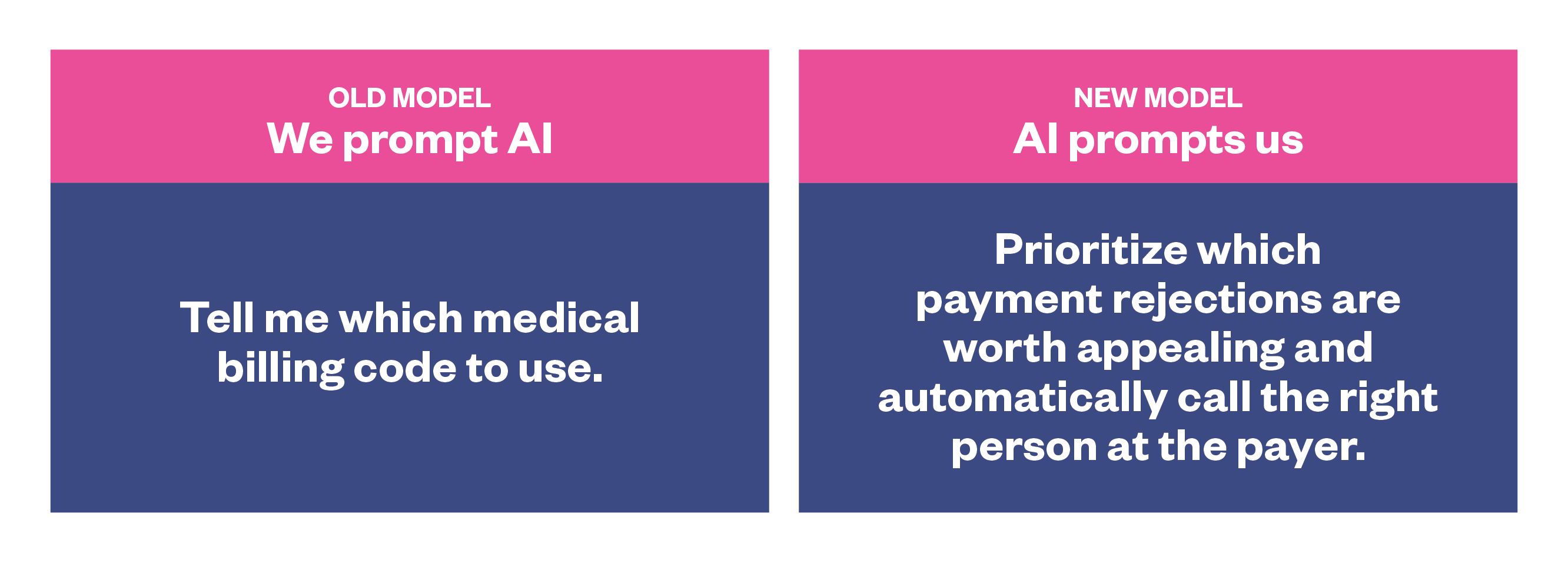
I believe predictive typing is representative of the way many companies are applying AI—in ways that feel obvious but ultimately don’t increase productivity. I personally don’t think we need an AI to finish our sentences. And we shouldn’t need to prompt an AI to write us something. Instead, I think AIs should be prompting us.
It’s my belief that the right tool with access to the full repository of our work information can draw upon enough context to tell us what to prioritize. Rather than an AI copilot, it’d be a chief of staff that knows enough to set the agenda.
Perhaps this sounds counterintuitive or dystopian, but let’s explore what it would look like applied to four common use cases where, in my observation, AI copilots haven’t yet made a meaningful productivity difference.
Most jobs aren’t actually that easy to automate
Let’s define what we mean by AI: software that uses algorithms to simulate human intelligence by reasoning, drawing conclusions, applying judgment, and possibly, acting on the result. The current generation of models perform best where the success criteria are repetitive and clearly defined, such as making a diagnosis, producing an image, or answering a question.
When it comes to divergent, nonlinear thinking, skilled humans still outperform AI on a range of tasks—like most jobs require. Because while a majority of workers do some repetitive tasks, my sense is that most jobs are actually full of heterogeneous tasks. It’s part of what makes work interesting. There may be some areas where automation can completely eliminate rote, repetitive jobs, but I observe that software as a service (SaaS) has largely done that or made serious inroads. The big opportunities in AI, I believe, will not necessarily all come from further process automation.
The big opportunities in AI, I believe, will not necessarily all come from further process automation.
At least some Wall Street analysts are reporting that only one publicly traded software company has reported revenue/profit gains as a result of using gen AI. To me, it’s worth asking whether copiloting really drives productivity gains. AI startups also appear to have lower gross margins than other software startups: that computation is expensive, especially compared to the output.
Yes, there are many studies about jobs “exposed to AI” on the assumption the gains will come from process automation. But I find most literature on this flawed because it confuses potential with probability, in the same way people in the 1950s felt flying cars were imminent because they were possible. Mind you, that primary “replacement” study was produced by OpenAI, which sells AI software. And Pew Research’s definition of “job exposure” is based on conjecture and thought experiments, not actual tests.
So where’s the AI opportunity? Consider what actually restricts worker productivity: I think it’s that people don’t know what action to take next. They’re blocked when their instructions are vague or abstract, or where they’d have to sift through an unrealistic volume of information to prioritize their day.

What if instead of AI saving people one minute per day writing emails, it saved them one hour in organizing their materials for a meeting? Or saved them two hours by canceling meetings that lack an agenda? Or told them the optimal way to spend their day?
AI may be able to help us get clear on the most valuable activities so we can focus on just those. I have observed that this is difficult for people because while enterprises are awash with information, a human can only access and weigh so much. Brains have limits. Our working memory is just seven numbers in a string or 3-5 essential items, and the prevailing theory is we can only maintain 150 close relationships.
Machines do not face these precise limits. This is not to bash the brain. It’s the result of 500 million years of experimentation. But AI by comparison has a vastly larger active memory and capacity for more concurrent connections. It doesn’t just review some Slack messages. It can access all of them, all of the time, for every decision.
So why don’t I see more AI startups taking the chief of staff approach, where the AI uses all that data to make decisions and prompt us?
Perhaps startups find the copilot model appealing because it requires less context. Or perhaps these startups are following in the well-worn groove of some software applications that came before, which aimed to solve task management issues. But imagine the chief of staff model applied to these use cases, where instead of you filling in the software, the software fills in itself. You might go from digitally recording a meeting you booked to the AI booking your meetings, declining requests, and also making cancellable dinner reservations.
One of the great benefits I see to the chief of staff model is it could attune itself to you. If you correct it, I believe it would be able to learn your preferences just as a person would. I am excited about the idea of a tool that taps into AI’s potential to be a learning machine, realizing that you prefer new business calls in the morning and to not have meetings the day after a red-eye flight.
I can see this applying to industries such as the following hypothetical examples:
- Medical billing—In the copilot model, AI can help workers input medical reimbursement codes marginally faster (the predictive typing approach). But in the chief of staff model, I believe it could aim to make people more productive. It could scan all those files and say, “Here are the 37 billings that are the most valuable, do those first. Reject that dental visit, don’t reject the cosmetics claim,” and so on.
- Legal issues—AI drafting or reusing clauses is an okay use case, though only slightly faster than without AI because a human must still verify the work. I believe AI applied to helping you identify legal risks could generate much more value. For example, “These 17 leases will auto-renew, do you want that? And this contract you signed three years ago has a pricing uplift charge you should contest. And this contract has a typo that substantially alters the meaning of this provision, and you should correct it.”
- Customer success—I believe an AI chief of staff could use a wide variety of data (emails, tickets, app telemetry, phone calls, and more) to pinpoint what’s working and what’s not in a customer relationship. It could possibly observe what works across similar accounts based on the geography, product features, and champion profile to suggest a next-best action to that account manager. This approach could theoretically transform a one-to-many customer success strategy into a many-to-many approach for all accounts—something that today is very difficult at scale.
- Product management and user research—I believe AI could simulate user behavior at scale to predict how users will interact with (or break) software. These insights might proactively guide engineers towards additional features that would increase engagement, flag bugs, or safeguard against bad behavior. It would be something of a virtual product manager or chief of staff for engineers.
How does this work practically?
I think the chief of staff play may best be tested as an enterprise use case. There, people usually aren’t fully deciding on how to spend their time, and the data is multitudinous and reasonably well-structured in record-of-work software. If organizations are setting clear goals for their people but the prioritization is nebulous, I believe an AI chief of staff could work its magic.
This is something I’m thinking about a lot as an investor. And also, as an individual who interacts with predictive typing in my email where I suspect it slows me down. I believe AI can do much more for us. If you’re a founder or researcher in this space who wants to talk, I’d welcome the conversation.
The post Clunky copilot or benevolent boss? Why I believe AI should prompt us appeared first on Point72 Ventures.
]]>The post Where conflicts are determined by logistics, startups are innovating to win appeared first on Point72 Ventures.
]]>When Russia invaded Ukraine in 2022, its massive tank column reached the capital Kyiv in less than one week—then stalled just 30km outside. After days of waiting for resupply, those soldiers retreated and with them went Russia’s hopes for a sudden coup.
Military experts have noted this isn’t a one-off anecdote—it can be emblematic of how real conflicts transpire. Though they aren’t frequently mentioned, logistics and materiel often play important roles. During the 2000s conflicts in the Middle East, approximately 52% of casualties occurred from hostile attacks during resupply missions, even with total ground and air dominance. Logistics may not always decide conflicts, but they are a key factor, because at the end of the day, “all our operations are underwritten by logistics,” as the Secretary of the Air Force Frank Kendall has said.
And now, logistics are growing more difficult and future conflicts could occur in more inhospitable regions, against more advanced adversaries using technology to disrupt supply lines from afar. This is why the U.S. Department of Defense (DoD) is actively identifying its innovation gaps in logistics, many of which we believe startups are best positioned to fill.
Logistics are growing more difficult
If we think of logistics as the backbone of an armed force, the U.S. military’s is particularly long and twisted. It consumes nearly 270,000 barrels of oil per day and employs nearly three million personnel who maintain approximately 225,000 army vehicles, 280 naval ships, 14,000 aircraft, and 800 bases in 70 countries. It requires a beehive of C17s delivering fuel to troops and fleets of massive vessels whose sole job is to supply Navy ships.* Such complexity and dependence can create a rigid force with many logistics tails, or areas of exposure, with the potential to invite attacks.
Successful military capabilities are underwritten by assured access to … energy. – U.S. Department of Defense
And while the U.S. military is not getting any easier to supply, in the future, it may operate in environments that pose even greater challenges. For starters, the U.S. is unlikely to be facing small, dispersed opponents without an air force, but highly capable near peers who can pressure American supply lines at great distance and scale. Furthermore, potential theaters include the Pacific region, which is vast and strategically complex. The “INDOPACOM” region covers half of the Earth’s surface with limited locations for bases, creating a “tyranny of distance.” Lastly, many advanced technologies can make it harder to hide or defend supply lines. For example, modern observation satellites and drones are capable of illuminating the entire battlefield, which can make easy work of uncovering supply lines. Once supply lines are discovered, $200 remote-controlled pieces of plastic can sever them from afar.
We really have to look at [logistics] through a different lens and not just use the lessons for Europe to pull them over to the Pacific. – General Edward M. Daly
The DoD and Congress are taking action
In response to escalating vulnerabilities in logistics operations, the U.S. Marine Corps and Army are re-training for new environments and Congress is pointing out strategic vulnerabilities, such as the Navy’s cumbersome strategy for storing and transporting fuel.
While these changes are important, we believe they won’t lead to success unless paired with new tools. We are convinced the U.S. military must consider moving away from planning its logistics on whiteboards, which is a slow and rigid process, and adopt dynamic software that reveals our broad, and complex, supply chain ecosystem. This becomes increasingly important as experts expect data-enabled decisions to decide future battles and decision-making loops grow faster. We also believe the U.S. military should prioritize limiting logistics tails to fight the tyranny of distance. This might include replacing today’s battlefield generators, which barely run at 35% efficiency and demand constant resupply.
Logistics data is an unrealized weapon and critical vulnerability in its current state – Leigh E. Method, Deputy Assistant Secretary of Defense for Logistics
The U.S. Army was the first to take a strong stance on logistics modernization in late 2022 when Army Secretary Christine Wormuth tasked two Generals to collaborate with commercial sector to develop requirements and technology. In comparison, the commercial sector has achieved great feats in addressing logistics challenges, like Amazon fine-tuning its operations to deliver 60% of purchases in top metros the same day they were ordered in 2023. Since the Army took that stance, other organizations have followed. The Defense Logistics Agency announced that it wants to replace its self-described “antiquated system” and the Office of the Secretary of Defense published a new logistics IT strategy in 2024.
We believe these efforts have highlighted four key areas where the DoD needs new tools. These include advanced power generation, demand reduction, adaptive planning, and autonomous systems.
Four areas where startups can help with logistics
- Advanced power—Fuel is one of the main things the DoD moves around, which itself uses fuel. We believe that if the U.S. can innovate on these power sources, say, with advanced nuclear power, it might seriously reduce the need to ship diesel. The DoD is no stranger to nuclear microreactors, as they’ve been safely powering submarines with them for decades. Nuclear reactors can generate so much power in such a small form that they can create large amounts of synthetic fuels or purify water at the edge, further reducing the logistics tail.
- Demand reduction—In addition to solving for power supply, the DoD could also look to reduce fuel demand. For example, electric vehicles eliminate the need to move fuel altogether and can be stealthier due to their heat signature and noise. We believe that electrification will happen slowly, so in the meantime, hybrid vehicles can better conserve energy, as can engines and equipment that automatically shut off when idle.
- Autonomous systems—Another approach is to take humans out of the logistics equation with autonomous vehicles for sea, land, and air. These systems would be used to transport food, munitions, and fuel, amongst other things and could even be prepositioned.
- Adaptive planning—We believe moving away from whiteboards and excel and towards software will offer greater visibility and adaptability to logistics planners. Such a platform could enable “self-healing” supply webs that reduce attack surface area during contested logistics, as the U.S. Naval Institute has written, or increase resiliency when sudden changes occur.
We believe new technology is needed in an increasingly contested logistics environment
We believe that logistics is a cornerstone of military operations, but U.S. logistics operations are falling behind as potential future conflicts grow more complex. The U.S. military recognizes this and is taking steps to identify and address the most pressing gaps. We believe many of these gaps will require new tools, like software to optimize how materiel is moved around the world, and hardware to shorten those logistics tails. We believe the commercial sector will be a valuable partner in this transition, particularly startups, which are innovating across many vectors the DoD wants to overhaul. If you’re a startup or founder in this space, we’d love to hear from you.
* At normal operating levels, an Arleigh Burke class destroyer burns 24,000 gallons of fuel a day and can hold 450,000 gallons of fuel, implying 19 days of fuel on board.
The post Where conflicts are determined by logistics, startups are innovating to win appeared first on Point72 Ventures.
]]>The post Can today’s startups help parents raise happy, healthy, independent adults? appeared first on Point72 Ventures.
]]>We believe the anxieties of modern parenting are powerful and pervasive. Parents today spend twice as much time with their children as 50 years ago and 4 in 10 describe themselves as “overprotective.” Many wonder, are they doing enough? What are the exact products to best help their children learn and grow? Their children are exposed to online content like never before, and those parents are inundated with sprawling advice from self-styled experts on social media.
As thematic investors, we spend considerable time researching and developing viewpoints on how technology enables shifts in consumer behavior and vice versa. Technology for parents ranges from multi-billion dollar corporations to early-stage startups, and the proliferation of parenting tools can leave parents wondering how to ensure their child’s success.
In this article, we explore the growing field of FamilyTech and the ways we believe startups can play a productive role—enriched by my own recent experience as a new parent. I’ll touch on 4 consumer trends that have caught our eye 1) the influencer mom-economy, 2) screen time, 3) the promise of EdTech and 4) … AI parenting?
Prior to joining Point72 Ventures, Ben worked on M&A transactions across a range of consumer verticals. Ben previously spent two years in the military before attending Columbia University where he studied economics and business management. He’s the proud father of two young children.
The influencer mom-economy
Today, parents are exposed to a great deal of “influence.” Many seek advice from friends and family who nudge them into the parental blogger vortex, much of it via social media platforms, which quickly figure out their new status. (The CDC says social media is now a leading source of parenting advice.)
It’s difficult to sort through all this advice, and parents’ decisions are complicated by online comparison—they often see what others purchase. Most new parents today are digital natives: 80% with children under 12 are millennials and a large majority of moms in that demographic say it’s important to be “the perfect mom,” a higher rate than among Gen X parents. How are these unusually driven, uniquely digitally connected parents using technology to manage that journey?
Some call this the “mom economy” and estimate it generates a staggering $46 billion across everything from homes to education, toys, media, and more. A family can spend anywhere from $10,000-$20,000 per year on their newborn – we view this as a major market, making this a unique opportunity for startups to cement enduring, early relationships with parents.
Screen time may look like a disaster, but perhaps it’s controllable
How can startups support children, given how much of life has moved onto screens? Screen time is often depicted as the opposite of “green time,” or time outside and tactile play. High levels of screen time are associated with…
- Slower language development – National Library of Medicine
- Interrupted social and emotional growth – National Library of Medicine
- Eating disorders – IJED
- Depression and anxiety – National Library of Medicine
- Poorer executive functioning and academic performance – NIH
…to name a few. Many of the papers cited recommend imposing parental controls—both as a feature and by removing devices from children’s reach—but this strikes me as unrealistic because we adults are subject to the same allure. We can find screens everywhere from entertainment tablets at restaurants to schools. Eighty-one percent of primary schools in the U.S. used computers in the classroom before the pandemic, and devices are so integral to learning that 45% of schools say they provide home internet for children who don’t have it.
What can parents do? One way is to help parents distinguish between passive and interactive screen time. Are children watching or problem-solving? Engaging intentionally or incidentally? Some studies suggest that educational apps that prompt children to engage increase persistence, reading skills, and creativity.
Startups have a role to play in creating the next wave of educational content that nonetheless engages and entertains children in constructive ways.
Could kids’ content better stimulate engagement?
Animated children’s content is the leviathan you’ve never heard of until you have children or know people who do. Eight of the 10 top-grossing franchises of all time are largely animated, a Blackstone-backed firm purchased the maker of the hit show Cocomelon for $3 billion, and children’s content programs took 2 of the top 5 spots in 2023 Nielsen viewership last year.
As a parent, I find too much of this content mindless; my son could watch it forever and gain little. I think parents may prefer to direct their kids toward more immersive experiences or co-viewing. I believe there can be a parallel between what Pixar did for animated movies with cheeky references for adults and what educational media startups could do for today’s parents whose children are watching on tablets. Similarly, what choose-your-own-adventure books did to help kids see themselves in the story, I similarly believe AI-powered startups could now do for kids at scale, visually, and much more immersively. This tracks with a growing desire for personalized media with diverse representation—84% of millennial parents prefer diverse casts in children’s entertainment.
At the same time, AI can introduce safety concerns we cannot overlook. AI hallucinates, and may invent scenarios where “viewer discretion is advised”, which is increasingly concerning when children are in the picture. Startups in this space face the challenge of strict compliance with regulations such as COPPA, but these are protections parents (like me) are likely glad to have.
AI can help adapt and personalize educational content
As parents, we want to provide our children with the best possible resources for success. When a student receives one-on-one instruction, their performance can potentially leap significantly. We see generative AI disrupting and supercharging the $250 billion children’s learning market.
In the early 2000s, a generation of edtech startups launched to help children learn by digitizing content and developing flexible learning pathways. Unfortunately, we believe many of these platforms featured workflows that relied on teachers inputting content and adjusting curriculum. These software systems couldn’t help teachers who were already spread too thin, and we are skeptical they have collectively done enough to improve student outcomes, which by NAEP metrics have largely stalled since 2012.

Source: NAEP, Point72 Ventures research
It is possible that generative AI can finally fulfill the promise of edtech. Focused AI applications, in our opinion, will help modulate the order, delivery, and pace of learning materials for each student in a way that’s adaptive and helpful, while aiding teachers at scale across disciplines—in math, reading, writing, language, music, and more. Perhaps AI can and will supply a personalized tutor to every child who needs one.
Can AI help us co-parent?
One of the more prevalent anxieties I experience as a parent is ensuring my child is developing at the same rate as others. I tend to think this is unique from prior generations of parents, in part because we now have access to much more data: parents I know panic if their child doesn’t roll over by eight months, frequently scanning reddit posts and blogs to find others in the same boat. I find this anxiety is heightened by the fact that much of the information online is often written by companies selling products and not necessarily professionals or academics. Sometimes, however, having this data on our children can be useful.
For example, our baby monitor helped us discover that my son preferred sleeping with his head tilted to the left side. When we consulted the pediatrician, they diagnosed him with a slight case of torticollis—a condition where stiff neck muscles cause the head to lean to one side. Left untreated, torticollis can cause the skull to solidify unevenly, and my son would have to wear a helmet for 23 hours a day – never fun for a 6-month old. We were able to do daily exercises to fix this issue within a few months.
An industry is developing around building insights and providing advice like this. Companies may act as quasi copilots for parents, answering questions about the noises they hear or the causes of spitting up. Can technology summarize all that wisdom for scenarios that don’t quite justify a hospital visit, and make it available to all parents?
The future of FamilyTech
As we think about FamilyTech as a subset of the consumer market and population, we’re not just looking at what the tech can accomplish, but at what we believe are large shifts in consumer behaviors. What do people want? How are younger generations thinking about being a parent? How can companies best support parents in this journey? At Point72 Ventures, we’re engrossed in this topic and if you’re a mission-driven founder or researcher in this space, we’d love to hear from you.
The post Can today’s startups help parents raise happy, healthy, independent adults? appeared first on Point72 Ventures.
]]>The post The Expert Economy appeared first on Point72 Ventures.
]]>Pre-internet learning was a largely formal affair. Beyond primary and secondary education, people typically learned new skills through apprenticeships, trade schools, and company programs, while upskilling usually involved going back to school for a graduate degree. Even learning in one’s personal life mirrored a similar degree of formality – consumers might go to a library, call certified advisors, or speak to a salesperson in-store to learn anything from how to get a mortgage to which vacuum to purchase.
5G streaming knowledge in everyone’s pockets has helped democratize learning. 86% of YouTube’s US viewers use YouTube to learn and 91% of people have watched an explainer video. Topics from mixology to financial modeling can be learned from free content on blogs, social media, video platforms, and other online resources.
Smartphone cameras and content distribution platforms have made it possible for people to produce content without specialized equipment or television deals. This has helped fuel the Creator Economy, which includes 200 million people globally today. How did we get there?
The Evolution of the Creator Economy
If we define Experts as a subset of Creators, it’s useful to first understand the evolution of the broader Creator economy. The Creator Economy emerged from three trends:
- Content production democratization – Affordable tools like smartphones and iMovie dramatically reduced content production costs. For example, the iPhone 3GS launched in 2009 for $199, while Hollywood’s RED cameras cost $40,000+. Anyone with a smart phone could now shoot and share video.
- Content distribution democratization – Platforms like Facebook, YouTube, Instagram, and TikTok allowed users to share content and reach audiences through algorithm-driven feeds, allowing internet Creators to build a following and influence.
- Monetization and democratization – Initially, YouTube’s ad revenue-sharing was one of the only ways for creators to monetize online. As the 2010’s progressed, Patreon and Teespring allowed Creators to monetize directly, regardless of audience size.
Goldman Sachs estimates that the Creator Economy will reach $480 billion by 2027. Being a Creator can now be a viable career, with some creators reporting average expected annual revenues over $100,000 and median expected revenue of $50,000, higher than the US median personal income. Perhaps relatedly, in a survey offering children a choice between becoming a YouTuber, a teacher, a professional athlete or an Astronaut, 29% of American children responding chose Vlogger/YouTuber, while only 11% picked astronaut.
As another possible result of this boom, the internet is increasingly noisy – 167 million TikTok videos are watched each minute. Anyone can write a blog post or make a short-form video regardless of their knowledge, experience or truthfulness – in fact, low-quality, untrustworthy content is structurally incentivized. Social media algorithms reward user engagement, liking and content sharing, oftentimes leading to misinformation.
Generative AI images, text, hallucinations, and deep fakes may exacerbate these problems. Google recently published a research paper looking at 200 examples of AI being misused to manipulate or defraud people online:

Whereas a few years ago if a reputable brand or source surfaced to you on social media, you usually viewed it as trustworthy; these days consumers seem much more skeptical. We believe that consumers will look more to actual people that they trust for content, advice, and guidance and increasingly turn away from mainstream channels. “Actual people” – or in other words, creators. Instead of talking broadly about a subject, we are seeing more and more creators focus on a specific subject. We anticipate that we are entering a phase of creation and distribution of expertise.
The Rise of the Expert Economy
We define experts as thought leaders within specific niches whose reputations are built on relevant social proof (experience, credentials, etc.) and the value of the knowledge they share on their subject matter. This subject matter could be professional (e.g. coding, sales) or lifestyle-focused (e.g. fashion, fitness). Experts solve their target audience’s pain points through educational content and products, which they can monetize along the way.
We believe that expertise can be both objective and/or subjective.
In a social media-driven world, almost anyone, regardless of their official credentials (degrees, accreditations, etc.), can share what knowledge they have with the public. Doing so allows people with knowledge to build trust over time with prospective customers. Not only that, but each of us who has done a particular task or skill will know more about that task or skill than someone who has not. In that regard, expertise is subjective relative to the prospective customer. For example, if you make delicious ribs, you could be an Expert to someone who has never barbequed.
Everyone is an Expert in something to someone.
We’ve observed that one of the keys to monetizing expertise is being able to convey that expertise in a compelling and authentic way to build trust with prospective customers – and that’s where Experts collide with the Creator Economy to make the Expert Economy.
On top of this, we also expect more people to turn to online monetization of their expertise given certain macro-economic developments. For example, over half of Gen Zers and millenials have a side hustle, and stagnant wages, rising living costs, and soaring education expenses should catalyse this movement.
As a result, we believe that new platforms will be built around Experts, giving them different modalities to distribute their knowledge, earning income while educating their audience.
What are we thinking about?
Looking forward, we believe the largest businesses built in the service of Experts will be driven by new technologies and business models, and, as a result, we are thinking deeply about the following:
What is the next iteration of Expert-driven commerce?
- How will Experts build communities and sell goods online? Will existing commerce models be disrupted by new business models and platforms that let Experts monetize their communities beyond directly selling to them?
What will the true value of generative AI be to help Experts build businesses?
- Generative AI is already helping supercharge content production for Experts. What are the applications of generative AI beyond content creation that provide true value to Experts? Separately, do consumers want to interact with a generative AI persona of an expert?
How will Experts translate their influence from online to offline?
- Will in-person events be a significant part of Expert businesses? What new platforms will disrupt event organization, production, and monetization via AI, communities, and other emerging technology and business models?
How to get in touch?
Please reach out if you are addressing the above questions or have similar ones – we want to hear from you!
The post The Expert Economy appeared first on Point72 Ventures.
]]>The post To outwit existential GTM threats, invert your thinking appeared first on Point72 Ventures.
]]>I get to spend a lot of time observing founders and where they focus. Mostly, they look to the next revenue goal, the next round, the next big account. Few focus on how their business might die. Perhaps obviously! But maybe they should—that’s what famed investor Charlie Munger used to do.
“All I want to know is where I’m going to die so I’ll never go there,” he often said. And even though I’m an eternal optimist, I’ve learned to do the same to help founders see hidden threats. Because when you invert your thinking to view scenarios in the reverse—in the negative—you may see things you missed.
Sometimes, it’s the only way to spot the deadliest time traps.
Let’s explore this idea through examples and ways to apply it to the five go-to-market (GTM) areas where I see startup founders trip up, often through no fault of their own.
I’ve spent 15 years of my career in GTM roles at startups and in portfolio support roles at early-stage investment firms where I’ve worked with over 100 companies. I studied physics and math but also enjoy singing, painting, and writing poetry. I love to see the world from multiple perspectives, often lightheartedly. Today, I help Point72 Ventures founders maximize their potential for success by doing the same.
Let’s look at where founders can accidentally waste their time
Some companies might engage prospects who don’t need their products. Some might call the right prospects but ask the wrong questions and never learn their real issues. Some might retain unprofitable customers and waste dev cycles on unreasonable requests. Some might act contrary to their own brand promises in ways that are obvious to customers.
But those founders might never know until it’s too late. This is one of the great startup dilemmas, even for veteran operators: Time is a precious, finite resource. It is non-renewable and non-transferable. The clock is always ticking—every useless moment is gone forever.
But it’s hard to know that you’re wasting time in the moment—it’s often only clear after.
That’s why I think it can help to flip the way you prioritize your time. Instead of deciding where to spend it (abundance thinking), also think about where it would be wasted (inverted scarcity thinking). Because I contend that the startup journey isn’t just about what you do, but also about what you selectively don’t do.
The startup journey isn’t just about what you do, but also about what you selectively don’t do
Take the design software startup InVision (no affiliation). Once valued at $2 billion, it will shut down operations this year. Not sell. Shut down. (After selling off one of its business units last fall.) That’s how quickly they were eclipsed by their competitor Figma. In an X (formerly Twitter) thread, the co-founder and former CEO explained the company invested time in the wrong areas, and when the right areas became clear, it was too late.
Ask yourself how you could face a similar competitive scenario. What are all the ways another vendor could corner you? Some of the brightest minds (like Charlie Munger) think like this naturally, but for most of us, it’s a learned skill. Shall we give it a try?
→ Direct thinking: Let’s get to $1M ARR by the end of the year
This sounds like a reasonable goal. So easy, right? With this thinking, a founder might spread their time across a wide variety of opportunities and hope the wins accumulate. But 3-6 months later, they might be off-track and curious. Why didn’t it all add up? They missed something important.
→ Inverted thinking: What could we do to ensure we earn no revenue this year?
Well, we could:
- Talk to people with no tech budget.
- Talk to people without the authority to decide.
- Talk to companies with a 13-month sales cycle.
- Build flashy features that don’t convince the real economic deciders.
- Drive up lead volume without regard to close rates.
- Confuse logos for dollar signs.
With this new thinking, they’d probably tighten up their qualifications. The very real fear of failure might convince them to conduct more thorough prospect discoveries and keep looking for the right leads, not settle for just any leads. I bet they’d prioritize more ruthlessly.
“Many problems can’t be solved looking forward … [they] are best solved when they are addressed backward.” – Charlie Munger
Of course, it’s not always clear what’s going to be a waste of time. (Wow, wouldn’t life be different if we knew for sure?) That’s why I’d advise categorizing the result of this brainstorming using the diagram pictured, which makes deciding easier.
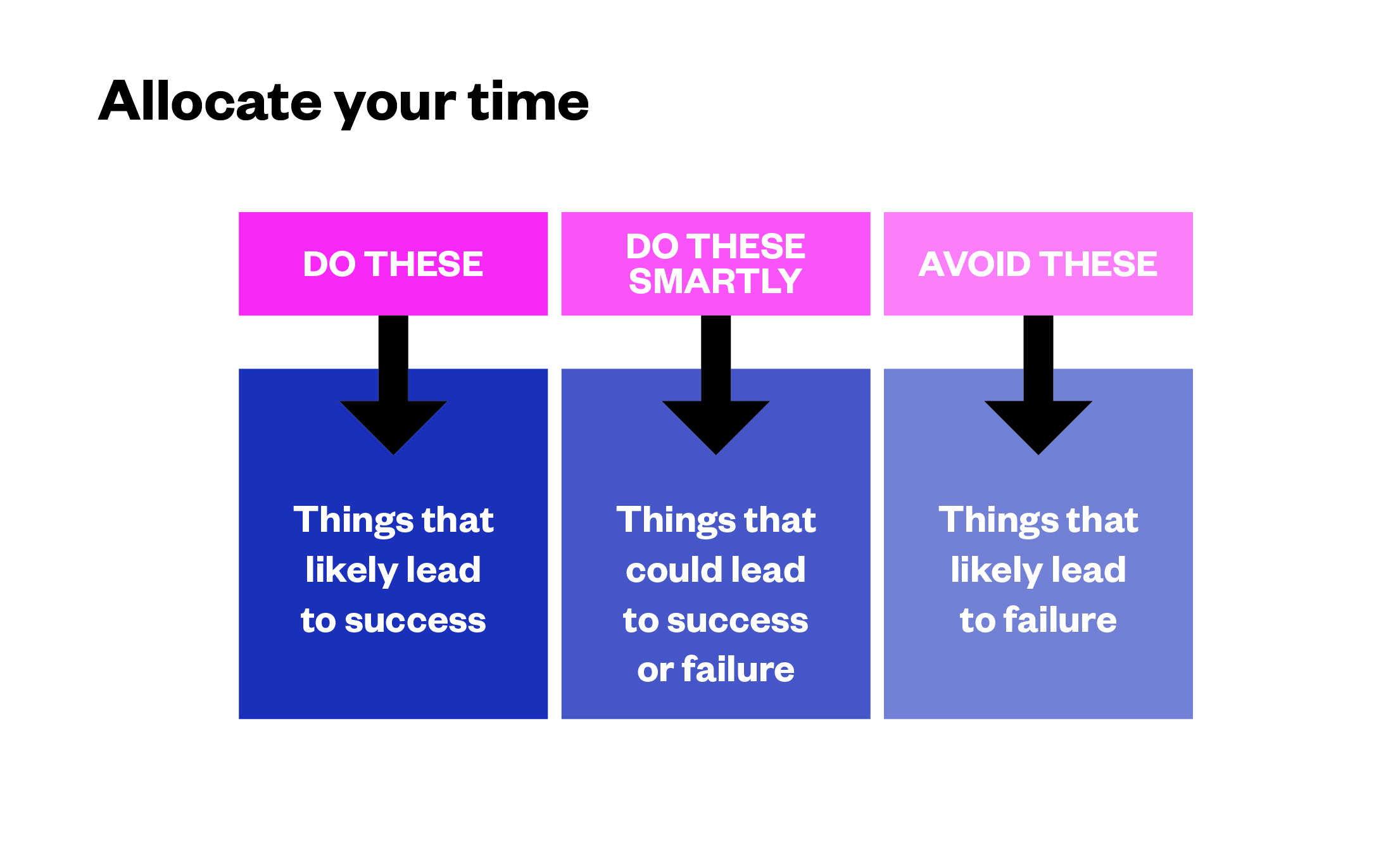
When you avoid things that will likely waste your time, you free yourself up for more valuable things that won’t.
And before we go too far, let me add, this is not about saying you should be totally risk-averse. Founders often need to move fast and take smart risks. Inverted thinking is simply about weighing your risks and betting on more gray-area risks than red-area ones. Also, inverted thinking is not about always being negative. It’s about learning to consider the inverted worldview tactically, then turning it off. It’s learning to ask, “Wait, before we proceed, what if we invert our thinking on this?”
Now let’s apply it to the five GTM areas that can save you the most time—with five questions I like to ask.
1. What are the primary ways we will fail as a business?
It might seem painful to ask, but I think it’s quite useful. One of the things venture investors can do when investing in a company is conduct a “pre-mortem” with the founders to talk about what might go wrong. When we have conducted these in the past, we found that rather than worry the founders, we see it decrease the temperature in the room. Suddenly everyone can be honest. Founders can stop trying to “impress the investor” and we grow closer. Many are relieved that we don’t expect them to pretend to be forever optimists, and with that, we can plan ways to mitigate their greatest fears. We ask, what can we do as a firm to assist and augment in these areas?
Here’s a hypothetical example of a pre-mortem:
[callout]
This company could fail if:
- The company lacks GTM focus—it pursues many small, disparate deals that don’t translate into a repeatable motion with predictable efficiency.
- The primary target market shifts course—buyers come to prefer a full-stack solution and the company fails to identify these signals or adapt.
- The company fails to pivot to being a “product company”—the founders are unable to shake their engineering backgrounds and spread resources too thinly across projects that don’t contribute to a quality, scalable product.
- The founders fail to grow into strong leaders who can scale the org—each is a first-timer and only one has commercial experience. As the company grows, they fail to develop a clear vision translated into near-term goals and a healthy culture.[/callout]
2. Who’d be a truly awful customer for us?
Startups are often so eager for customers, some happily take on the wrong ones, and then do gymnastics to make the product fit. Not all money is created equal. Some money is more expensive than other money because some customers are more demanding and can distract founders from profitable growth.
The difficult thing, but potentially right thing, is to keep searching for true product-market fit with the right product in the right market.
This is why I think founders should also build a non-ideal customer profile and keep everyone at the company accountable for disqualifying these prospects from their funnel. People may laugh. But it’s actually very useful.
[callout]
A hypothetical non-ideal customer profile:
As an early-stage startup trying to sell software to online retailers, a bad customer for us has no clear product roadmap, has an archaic back end, has a low-average cart size, just laid off a portion of their workforce, and has few SKUs. If multiple of these are true, it’ll be nearly impossible for us to show quick value. We will disqualify any prospects that exhibit 3 in 5 of these characteristics and will instead nurture them until we’re ready to expand.[/callout]
3. What could really slow down our deals?
Many founders naturally think about accelerating deals. But what things are sure to slow them down? Are founders looking for and addressing common speed bumps and potholes? I like to encourage them to identify those deal velocity risks early and to get ahead of them.
For example, when customers grow confused, they tend to stall their evaluation. A founder can ask, “What could we do to really confuse our customers?” Then act on the results:
- The pricing is not entirely clear → User test and simplify.
- #1 objection is “Not right now” → The CEO distributes a “perfect response” voice note.
- The brand is unclear → Refresh positioning, messaging, brand assets.
In my experience, startups without a clear brand tend to confuse their biggest prospects. Those evaluating committees can get tied up asking, “But do they serve companies like us?” Investigate not only where your brand is helping you, but where it’s not helping or perhaps working against you. (This is especially important since in one study, 84% of buyers purchased from the first vendor they spoke to. I believe a good brand helps startups get noticed earlier.)
4. Who would NOT be a good fit for our sales team?
A bad hire isn’t just a financial drain; it’s also a time and culture drain. Yes, a founder can see all the ways a prospective account executive hire might work; they have an impressive record of exceeding quota. But how might they fail? It’s a bummer to ask, but useful.
Perhaps in asking this, a founder realizes that in their prior role, this prospective hire had lots of support from marketing and a well-trained business development team cold-calling into their territory. That new hire won’t have that support. Instead, they’ll be hacking together pipeline while the founder tests the pricing. Is the recruit agile enough? Emotionally ready to do things they may think are beneath them? Now, that founder can develop much better interview questions.
It can also help the startup design a much stronger interview process. They can create tests for those major red flags. For example, let’s say their top value is to be “customer-first.” Who’d be a terrible hire? Naturally, someone who:
- Hogs the mic and rambles.
- Asks few questions.
- Shows little curiosity.
Fortunately, those are easy to test for. That startup can make a point of sharing facts, but not explaining them. They can see if prospective hires dig to discover.
[callout]
The hiring process I recommend to startups:
- Scope the role correctly to help with self-selection.
- Use a structured scorecard to identify the 10-12 attributes that matter most, including team values.
- Design your process.
- Screen for hats to be worn and for red flags (e.g. by inverting the company values to know what would NOT be a good fit).
- Use a project to immerse the prospective hire in the role.
- Include 2-3 other prepared interviewers to test for specific attributes.
- Ask for references to pressure-test areas of concern.[/callout]
5. Where should we NOT spend any time and energy this year?
As the InVision example shows, development time is a precious resource and founders must devote it to the areas that matter most to their customers and profitability. They must identify the essential features to build while they backlog the less immediately essential ones.
I encourage founders to empower everyone in the company to practice inverted thinking and openly name distractions. Set SMART goals (specific, measurable, achievable, relevant, time-bound) and hold your teams to them—a goal that isn’t SMART is a wish.
Ask: How might we totally mis-build the product this year?
- Build features the customers say they want but don’t actually need.
- Build features on unit economics that don’t make sense.
- Fail to prioritize and select too many key features.
- Fail to build what 4 in 5 of our right-fit customers are asking for.
- Build infrastructure for plans that don’t materialize.
- Focus on new things rather than improving usage metrics on existing ones.
If you aren’t impressed by the number of tasks in your backlog, you probably aren’t being ruthless enough.
Negative thinking leads to positive outcomes
Again, don’t think I’m encouraging you to view the whole world through the lens of disaster. Just that you may be able to train your brain to spot all the wasteful assumptions that may come with always thinking optimistically. Too much of any good can be harmful—either thinking optimistically or pessimistically—and inverse thinking is just another tool. One that I believe can help founders avoid wasting time, pivoting unnecessarily, and making common GTM mistakes.
And you don’t have to be Charlie Munger to practice it. For as he famously said, “Knowing what you don’t know is more useful than being brilliant.” 
The post To outwit existential GTM threats, invert your thinking appeared first on Point72 Ventures.
]]>The post Our Investment in Adonis appeared first on Point72 Ventures.
]]>Point72 Private Investments is excited to be leading a $31M Series B round in Adonis alongside Tina Hoang-To at Kin Ventures. Adonis is building next generation revenue cycle management (RCM) software designed to reduce the significant administrative burden imposed on medical providers in the US.
On a per capita basis, the US far outspends other developed nations on healthcare, but outcomes have not kept pace. Administrative costs are the largest contributor to this discrepancy – the US spent ~$925 per capita on healthcare admin costs in 2021, 75%+ higher than the next highest country (Switzerland) and more than Germany, France, the UK, Spain, and Italy combined. This amounts to over $300B of spend each year in the US that adds nothing to the quality of healthcare delivery but nonetheless drives significantly higher costs of care for patients and consumers.
Much of the blame for this inefficiency can be placed on the massively complex and arcane medical billing practices that dominate healthcare payments in the US – to get compensated for treatment, providers need to provide detailed records of diagnoses and conditions to payers, whose rules and codes change constantly. As a result, providers may rely on dedicated outsourced billing firms, or hire armies of professional billers at a high price.
Adonis was created to address this very problem – helping streamline medical billing processes with the goal of maximizing revenue outcomes and ultimately enabling healthcare providers to deliver the highest form of clinical care.
The company’s end-to-end platform was created to integrate directly with a customer’s existing systems of record, creating a unified data layer to deliver AI-driven insights that could better predict claim denials, provide recommendations, and surface actionable alerts. Adonis aims to help customers improve prioritization, productivity, and revenue capture while automating away many of the manual processes that bog down legacy billing.
We’ve long believed that advancements in AI have the potential to significantly reduce administrative inefficiencies in healthcare. When we met Akash and Aman Magoon, we saw in them a team that we found particularly well-equipped to try and solve the RCM problem – the two brothers are seasoned startup veterans who have spent the last 5 years immersed in the dynamics between payers and providers. Their deep domain expertise and compelling product vision complement their innate drive and ability to execute – we’ve been hugely impressed with Adonis’s commercial traction and the praise they’ve earned from customers so far.
We are very excited to support Akash, Aman, and the entire Adonis team as they work to make the healthcare system better, less expensive, and more accessible for all.
The post Our Investment in Adonis appeared first on Point72 Ventures.
]]>The post Our Investment in Overland AI appeared first on Point72 Ventures.
]]>We’re proud to announce our investment in Overland AI to support their progress in building intelligent uncrewed ground systems for defense and national security.
Autonomy is hard, but ground autonomy can be especially difficult. Terrain introduces perception and navigation challenges not found in air or sea. Vegetation, ground conditions and weather can complicate the environment in which these systems operate. Additionally, autonomous ground systems must deal with a greater number of moving objects in close proximity compared to other domains.
For years, we’ve been hearing about a future filled with self-driving cars, but so far, developers of automotive autonomy have piloted a limited set of experiments in a few cities such as San Francisco or Phoenix. Their vehicles operate under strict conditions, typically in benign climates and rely on remote operations when their systems encounter edge cases.
We believe existing ground autonomy solutions such as these will not work for the Department of Defense (DoD). War is anything but predictable. Operations take place in the harshest conditions – on mountain ranges, dense forests, and expansive deserts, in snow, sleet, dust storms or driving rain, where the high-fidelity maps commercial autonomy providers rely on aren’t available. Roads and bridges are damaged or destroyed. There might not be roads to begin with. Radio signals and communications are jammed – making reliance on GPS and teleoperation not feasible.
This lack of flexibility and reliability is why we believe leaders at the DoD have expressed frustrations in ground autonomy projects to date. General James Rainey, head of Army Futures Command, has complained about the state of existing efforts, “Every time it’s like, go watch one [robotic tactical vehicle] follow another one around a parking lot and it runs over the curb and I’m like ‘Come on, we got to do better than this’.”
We believe that status quo vendors will continue to struggle to deliver operationally relevant ground autonomy. Historically, defense ground autonomy efforts have often focused on experimental leader-follower convoys and logistics use cases reminiscent of the conflicts in Iraq and Afghanistan. We don’t believe these fully reflect the dynamic battlefield of the future: the DoD needs tactically relevant autonomy built for use cases like off-road maneuver, mobile anti-ship platforms, long range artillery, or air defense systems.
Overland AI was built to help tackle these challenges. The Overland AI team first came together through the DARPA Robotics Autonomy in Complex Environments with Resilience (RACER) program, which was created to address gaps in existing ground autonomy efforts. Byron Boots, Overland AI’s co-founder and a robotics expert, recruited a team from leading tech companies to focus on this problem. They began with the hard part first: navigating completely off-road, with no maps or markers, in snow, sleet and rain.
In addition to working with DARPA, the Overland AI team is engaged on autonomy projects with the U.S. Army and Marine Corps. They were recently announced, along with Anduril and Palantir, as new participants in DIU’s GVAP project.
No human should be put at risk when a machine can do the job. We look forward to supporting Byron, Steph, Greg and the rest of the Overland AI team as they work to bring these critical capabilities online – helping keep servicemembers safe and out of harm’s way.
The post Our Investment in Overland AI appeared first on Point72 Ventures.
]]>The post The Next Wave of Consumer Startups: Why Point72 Ventures is All In appeared first on Point72 Ventures.
]]>Is consumer investing dead? A one-way street? We don’t think so. We believe that right now is the greatest opportunity for groundbreaking companies to be built since the advent of smartphones – here’s why.
The Early Days of the Internet
I spent the early part of my life as a nomad of sorts. My father’s career had us moving internationally every one to two years, from India to Germany to Japan and more. In the early 2000s, as someone that was constantly on the move, I found community in an unexpected place: the internet.
For those who are old enough to remember, that era of the internet provided the first opportunity for people to experience the world outside of our immediate physical surroundings. Online forums served as hubs for likeminded people with similar interests to trade ideas, unconstrained by geography. Crowd-sourced and community-edited websites became our new digital encyclopedias to learn about the world around us. And of course, who could forget the early days of instant messaging – and chatbots! While there’s another AI chat interface that we use today, I have fond memories of SmarterChild, a text-based, sassy chatbot messenger that served as my generation’s first interaction with artificial intelligence (we actually met SmarterChild’s founder a few years ago and invested in his new company – but that’s a longer story for another time).

We look back on it with a sense of nostalgia now, but much of the “v1” of the internet was ugly and clunky. The underlying products and services – communication with anyone in the world, file sharing, and e-commerce – were a magical new experience, but it took some time before real businesses were built on the foundations that these early products set. I remember discovering the early versions of Reddit, Soundcloud, and YouTube while I was in middle school; I had no idea that these would become generational companies that were still used by millions of people nearly 20 years later.
What’s Happening Now?
Fast forward to 2024 – the internet has evolved. We acknowledge the challenges of building a net new consumer internet company today:
- The battle for consumer attention is as fierce as it’s ever been…
We are now over 15 years removed from the launch of Apple’s app store. It was far easier to get a user’s attention in 2008 when every new application on your iPhone was relatively novel. Now, ~68% of consumers report that they are actually keen to get rid of applications on their phone. On top of general crowding, getting a user’s attention is hard. Social and entertainment platforms are all fighting for your time; TikTok currently leads the pack with users spending ~54 minutes/day on the app on average.
- …and customer acquisition in a post-IDFA world has never been more challenging
With the introduction of App Tracking Transparency (ATT) in iOS 14.5, which requires apps to obtain explicit user permission to track their activity, the cost of acquiring new customers through traditional mobile advertising channels has increased significantly.
That said, we at Point72 Ventures believe that we are on the precipice of a shift that will result in the next generation of transformational companies like the ones I gravitated towards in the early 2000s. We’re observing the following dynamics:
- Founders are harnessing new technology to build innovative products that are captivating consumers…
Technologies like (but not limited to) generative AI have enabled founders to create captivating products that are cutting through the noise in a challenging attention economy. We all know of success stories like OpenAI’s ChatGPT, whose rise to 100 million users just two months after launch was perhaps the fast app growth in history, but we’re also seeing significant growth across modalities like music, visual art, video, and gaming. This new wave of applications is clearly piquing consumer interest in a way that we haven’t observed in years.
- …and are finding unique ways to build audiences
In the face of customer acquisition challenges, we think savvy founders are leveraging social and community platforms to build audiences from scratch. As advertising budgets shift away from traditional digital marketing channels, we believe platforms like TikTok and Discord will become more important in fueling zero-to-one growth.
We’re big believers that the future of the internet will lean into the idea of digital communities and that large businesses can be built against this theme: People are increasingly organizing themselves online, whether it’s for shared interests, fandoms, or to rally around emerging products or services. Entire businesses – including large ones like Midjourney – have been built within single Discord servers. In 2024, we’ve already seen one IPO of an online community in Reddit; later this summer, we expect to see another one in Webtoon.
Where Are We Spending Our Time?
We pride ourselves in remaining steadfast in our convictions – if we identify a potential opportunity, we’re not going to back away from a challenge. We launched a dedicated Consumer and Media team at Point72 Ventures in October 2023 because we believe that the biggest opportunities are ahead, not behind us.
For example, we’re thinking deeply about the following questions:
- In our view, consumers want products that provide them with either a solution to a problem or truly novel entertainment. Technology that unlocks new experiences is valuable, but we believe it’s simply a building block of a consumer application, not the selling point. Who is building the next great consumer application that meets user’s demands and also harnesses the experiential benefits of today’s technology?
- In a world where there are challenging copyright issues in generative AI, how should we think about creator and IP rightsholder fairness?
- Now that the barriers to entry for content creation are falling, will value in the ecosystem accrue to content creators or content distributors?
Please reach out if you are addressing the above questions or have similar ones – we want to hear from you! Our team is exploring ideas across media & entertainment, sports, education, family technology, commerce, gaming, healthcare, travel/experiences, and more.
The digital nomad in me is excited to learn about what “v2” of the internet will be, and Point72 Ventures excited to invest in the next generation of companies that we believe will create the sense of wonder that I felt in the early 2000s.
The post The Next Wave of Consumer Startups: Why Point72 Ventures is All In appeared first on Point72 Ventures.
]]>The post Meet the new Point72 Ventures Partners – Sugam Sarin appeared first on Point72 Ventures.
]]>- To start, can you share a brief overview of your career journey leading up to Point72 Ventures?
I started my career as an investment banker at Citigroup within their Financial Institutions Group (FIG) where I covered banks and specialty finance businesses.
To me, financial institutions truly connect every industry together given every business deals with the movement of money. Understanding these institutions was an interesting challenge and eventually became a personal moat. At the time, there was no “Fintech” investment banking coverage, and I was fortunate enough to be able to work on/cover the IPOs of companies like LendingClub, OnDeck etc. as they first came onto the scene which in turn also introduced me to the VCs they were backed by.
Fascinated by some of the innovation that was taking place in financial services, I chose to then join American Express Ventures where I spent time understanding how a large financial behemoth like an American Express thinks about innovation. The biggest pain points & startup opportunities live within the walls of these types of institutions but navigating them is a complex undertaking. After 5+ years doing a mix of strategic investing and business development and helping amazing entrepreneurs partner with American Express, I joined Point72 Ventures as part of their Fintech practice.
- What sets Point72 Ventures apart from other firms and what has your experience been working here so far?
Intellectual horsepower and curiosity. Our organization is filled with incredibly sharp and driven individuals. Daily, people are thinking about big, new, creative ideas. A day can start out with payments, take a detour towards healthcare, then to space and then end up in video games. The number of fascinating areas our investors have deep and insightful perspectives on never ceases to amaze me and makes me a better investor.
- What is your area of expertise and what are some of the key trends you are currently observing that excite you?
I lead the Fintech practice here at Point72 Ventures. To me, Fintech makes the world go round as it truly touches every industry and individual in some way. If a transaction is taking place, we believe there is a critical infrastructure needed to power it and we want to know all about it. The world is increasingly digital and global which I believe only amplifies the need for better financial infrastructure horizontally (payments, capital markets, wealth management) or in specific industries (sports, gaming, ESG etc.).
- Can you share an example of a project or deal that you’re particularly proud of?
It is a beautiful thing when signals around burning fintech pain points cluster together after a variety of conversations and you then find an amazing founding team that is building the exact solution you think should exist and has the right background to do so. It never happens as seamlessly as I just laid out but there is a great deal of satisfaction when you can marry thematic research, domain specific expertise and great founding teams together. We are fortune to partner with companies such as Pagos, Skipify, Aghanim, Card91, Tesouro, PayEngine, Certa and others that have invited us to join them on their journey.
- What is your approach to identifying and supporting promising startups in the Fintech space?
We believe domain specific expertise is critical for investors and entrepreneurs. We work hard to understand the needs of customers, including banks, payment processors, networks, asset managers, merchants etc. and, and to have a strong perspective on headwinds and tailwinds in the ecosystem. Our view of the biggest pain points and next big opportunities is formed in large part by listening to the people who live and breathe financial services every day. From there, we look for founders who are hungry to build something big and who we think are in a great position to tackle the problem at hand. I am lucky that founders have allowed me to be a part of their journeys and I see my job as doing everything I possibly can to make their lives easier.
- Finally, what advice would you give to someone who is aspiring to work in venture capital?
On the one hand, hustle and grit. You need to have an insatiable desire to win and go the extra mile. No successful founder or investor can succeed without it. You will be told “no”, things won’t work out the way you planned; your To-Do list will only get longer & longer. If it were easy, everyone would do it. Keep grinding! On the other hand, empathy and the ability to build meaningful relationships. It is easy to be a supportive investor or partner when things are all going according to plan. That is rarely the case. Getting to know the person on the other side of that coffee chat or zoom room regardless of the context goes a long way. This is a people driven business and we should strive to really get to know the people we are doing business with in order to support them in the best way we can  .
.
The post Meet the new Point72 Ventures Partners – Sugam Sarin appeared first on Point72 Ventures.
]]>The post Road Work Ahead: AI Won’t Fix Enterprise Process Challenges appeared first on Point72 Ventures.
]]>Despite what billions of VC dollars seem to imply, generative AI is not a magic bullet for companies. In fact, unless businesses fundamentally rethink how work actually gets done, they will lose out on the real value of AI or worse, they will become more inefficient.
Before AI, companies had robotic process automation (RPA). RPA is most effective on highly structured, simple workflows. Generative AI automation is more adaptable and far less constrained, but much higher risk. Whereas RPA bots were highly controlled because they were so precisely designed, AI agents have more autonomy, but not necessarily any deeper business insight.
Generative AI is an amplifier: adding it to a bad process transforms a manual inefficiency into an automated one – and likely scales it. For example, an underperforming salesperson that sends hundreds of poorly crafted messages and loses out on deals is not going to magically evolve into a top performer with an AI agent. Rather, a bad salesperson with an AI amplifier might send thousands of ineffective messages and lose more deals.
A recent BCG study confirms this: they found that GPT-4 reduced employee performance by 23% when used in business problem solving. That’s because large language models like GPT-4 are trained on language to sound plausible. They hallucinate if they don’t have the right context or fine-tuning. But there’s no equivalent “large process model” since there’s no public process data to train on. For that reason, many AI agents today rely on explicit human instruction to handle complex, ambiguous workflows. If the worker doesn’t understand their role, or is a poor performer, that’s like giving a toddler the keys to a Ferrari – the best-case scenario is they don’t get behind the wheel.
When we hear large companies talk about AI, what they say they want is automation but what we think they really need is optimization. McKinsey recently suggested that enterprises need to perform deep “organizational surgery” to fix how work gets done before generative AI vastly scales whatever processes are in place. For example, Siemens uncovered that one of their processes had ballooned to more than 900,000 variations. Is the solution to automate 900,000 variations? Probably not!
A useful analogy is the self-driving car. In many ways, the goal of business automation is the same: give AI agents the ability to perceive the world, plan a path forward, and act on that plan. The most complex tech in an autonomous vehicle is probably not the hardware that turns the wheel or the camera that observes the road – it’s the perception and planning model that needs to make decisions at a moment’s notice. You could probably argue that self-driving cars have it easier! Autonomous vehicles drive on well-defined roads with clear signage, governed by straightforward rules and assisted by GPS.
In contrast, AI agents are tasked with making sense of a company’s complex, ambiguous processes that lack clear markers and evolve constantly. So, how can businesses prepare to adopt generative AI automation? They need to develop a form of enterprise GPS to chart internal functions: not only as they are but as they should be. Over-emphasizing how to automate ignores the important question of whether we are automating the right processes – or the right version of processes.
From MapQuest to GPS
One could argue that large companies already have their own version of a GPS. It’s called process mining. But process mining tools produce snapshots, or static maps, of workflows as they are. Getting slightly pedantic, there’s a huge difference between a map and a GPS! Enterprises need real-time insight into their operations to effectively manage workflows – just like a GPS reacts to changes in road conditions and optimizes for the fastest, cheapest, or most scenic route.
Combined vision/language models (“multi-modal” models) are strikingly capable of identifying patterns in vast amounts of unstructured workflow data. These insights could feed an enterprise GPS to reveal process bottlenecks, inefficiencies, and opportunities for improvement that were invisible or ignored. This GPS could further guide process optimization before AI agents are deployed. Most importantly, we believe this allows businesses to train AI agents on their private, optimized process data to make them more effective partners. An enterprise GPS represents a digital infrastructure that mirrors the clarity and organization of the roads that autonomous vehicles navigate.
Consider why we use a GPS. Typically, it’s because we don’t know how to get to our destination. Even if we do – a GPS helps us develop a route based on real-time conditions that we are unaware of. A GPS would not be useful if we were prompting it at every step with weather conditions, road closures, traffic. We value the GPS because it prompts us with information that we can’t access. We believe the same dynamic applies to automation in the enterprise. The most valuable automation tools will explore new ways of “reverse prompting” that requires grounding AI agents in real-time process intelligence.
The AI Inflection Point
As businesses seek to expand the breadth and depth of their AI strategy, it is a critical time to invest in this enterprise GPS. With OpenAI reportedly working on models that directly control software there is even more urgency. Misdirected AI could wreak havoc on internal systems if it learns by observing inefficient processes or poor performers. Getting process intelligence right, however, could help business realize durable ROI on generative AI initiatives that has so far failed to materialize.
The magic of AI won’t fix internalized process challenges. In our view, the businesses that recognize the importance of process management – before they adopt AI at-scale – will be the true winners of the AI revolution.
The post Road Work Ahead: AI Won’t Fix Enterprise Process Challenges appeared first on Point72 Ventures.
]]>The post Meet the new Point72 Ventures Partners: Tara Stokes appeared first on Point72 Ventures.
]]>- To start, can you share a brief overview of your career journey leading up to Point72 Ventures?
I started my career at Morgan Stanley in New York as an equity trader focused on technology, media, and telecom, then as an Associate in the Investment Banking Division. Very different routines, responsibilities, and even elevator banks – but I was fortunate to have great mentorship across the firm.
Then, I headed west to attend the Stanford Graduate School of Business and completed internships in management consulting and growth equity. After graduation, I joined Point72 Ventures to work with our Managing Partners Sri Chandrasekar and Dan Gwak on AI investments.
- What sets Point72 Ventures apart from other firms and what has your experience been working here so far?
The velocity and the intentionality of our business has been remarkable. We’ve not only doubled in size since I joined, but there’s a collective sense of ownership. It drives a collaborative, competitive spirit where we’re all aspiring to be the best players and coaches.
- What is your area of expertise and what are some of the key trends you are currently observing that excite you?
I lead the firm’s investments in artificial intelligence and machine learning companies. In practice, I spend a lot of my time in vertical software – especially with teams working to unleash the latest technological breakthroughs in traditional industries. I’m always excited to work with well-rounded teams designing interactive, persona-specific products and platforms.
- Can you share an example of a project or deal that you’re particularly proud of?
That’s like picking a favorite child! I am particularly proud of our process, and one illustrative example jumps to mind. We were conducting network conversations as part of our generative text thematic, and we were kindly introduced by a San Francisco based founder to Adam and Devang in London. They were tinkering with ideas, and we shared our thematic work with them. The timing was perfect, and we immediately began jamming on business opportunities. The Glyphic team is a great example of our exceptional community and network’s commitment to ‘doing the work.’
- What is your approach to identifying and supporting promising startups in the AI space?
There is a lot of noise, especially in AI. To stay disciplined, I’m constantly iterating on my own frameworks – a skillset I honed as a Public Policy and Economics student at Duke.
I also played D1 collegiate lacrosse and was taught to get your heels to the sideline in order to see the whole field. In investing, I try to do the same for markets, technologies, defensibility, etc. – but ultimately, I get to conviction on people. That foundation is critical as founders rely on us to be available for trusted advice.
- Finally, what advice would you give to someone who is aspiring to work in venture capital?
It’s a career based on constant learning and meeting remarkable individuals. Find ways to demonstrate your intellectual curiosity, genuine passion, and hustle, as that’s what will compel others to help you succeed.
The post Meet the new Point72 Ventures Partners: Tara Stokes appeared first on Point72 Ventures.
]]>The post Meet the new Point72 Ventures Partners – Chris Morales appeared first on Point72 Ventures.
]]>- To start, can you share a brief overview of your career journey leading up to Point72 Ventures?
This is a while back, but it really started when I was in high school in Manhattan during 9/11. Seeing the aftermath of that day firsthand, drove me to enroll in the U.S. Naval Academy, where I majored in National Security Studies. After graduation, I served as an F/A-18F Super Hornet Weapons Systems Officer. My tours included a deployment flying missions over Iraq and Afghanistan, as well as a couple of years as a flight instructor. After I wrapped up my time in the Navy, I studied law and business at the University of Pennsylvania. My first job out of grad school was as an investment banker at Goldman Sach’s Tech, Media, and Telecommunications group – where I first got a taste of the intersection of tech and finance. The one thing that was missing was the sense of mission I had while serving in the Navy. I joined Point72 Ventures in 2020, where I was able to find that by helping build our Defense Tech practice. I wasn’t sure I’d be able to tie that all together, but here we are!
- What sets Point72 Ventures apart from other firms and what has your experience been working here so far?
People and Expertise. I find the people who work here incredibly smart, motivated and great to work with. They have fascinating stories. Some examples – Dan Gwak, one of our Managing Partners, paused his HBS education to deploy as an enlisted infantry Marine to Afghanistan. Ryan and Graham, fellow defense tech investors, both have interesting paths as well. Ryan was a Marine Intelligence Officer who did counter-intelligence work, and Graham’s background spans artificial intelligence, agriculture and natural resources. interesting paths aren’t limited to Defense Tech.
Each of our investors make it their priority to know their areas really well, and I’ve found that founders recognize that when talking to us. We can stand behind our investments because of the rigorous work we did validating the market and understanding the companies we back. When founders work with us, it’s often because we’ve demonstrated incredibly strong knowledge of their market, and the ability to be helpful in their journey.
- What is your area of expertise and what are some of the key trends you are currently observing that excite you?
I focus on Defense Tech, where we’ve seen a pretty a strong shift in both customer and investor sentiment. Four years ago, when we started investing in the space, I would have characterized Defense Tech as a backwater in VC and barely a thought for DoD program offices and buyers. Now it feels like it has gone mainstream on both counts – with more and more VCs investing, and more policy makers in the Pentagon and on Capitol Hill making it a core focus. The latest budget passed by Congress sets aside over $1B for Defense Tech, including $900M+ for the Defense Innovation Unit and $200M for an initiative known as Replicator to fund autonomous systems. There’s still much work to be done on the customer side, and those funds still have to make it to the companies building for national security. But I think things are overwhelmingly moving in the right direction.
- Can you share an example of a project or deal that you’re particularly proud of?
We were the Series A co-lead for Vannevar Labs. When we invested in that company, they had 13 people and many folks were skeptical of start-ups selling software into the DoD. But we thought Brett and Nini, the co-founders, were absolute rockstars. Their primary product, Decrypt, tackles an area we were very familiar with – intelligence. The team shows up every day and brings it. It’s been very rewarding to be part of their journey.
- What is your approach to identifying and supporting promising startups in the Defense Tech space?
There are two primary things we look for – first is a team that blends technical and national security expertise. We’re looking for folks who are solving hard problems that an incumbent is unable to tackle for one reason or another. It’s a space that can be difficult for an outsider to sell into – so we look for someone on the founding team with national security experience. Finally, we’re looking for products that we believe have the potential to shift the global superpower balance, and to move the needle enough to break into a historically tough market.
- Finally, what advice would you give to someone who is aspiring to work in venture capital?
There’s one thing I think every VC values in a new hire – a track record of engaging with a community of founders along with the network that comes with it. There are a lot of ways to do this. You can intern with start-ups, or work for an organization that engages many of them. If you have domain expertise in a given area, you could work as an advisor helping a start-up operate in that area or function. I find domain expertise and network to be generally a winning combination
The post Meet the new Point72 Ventures Partners – Chris Morales appeared first on Point72 Ventures.
]]>The post Meet the new Point72 Ventures Partners – Ishan Sinha appeared first on Point72 Ventures.
]]>- To start, can you share a brief overview of your career journey leading up to Point72 Ventures? Prior to joining Point72 Ventures, I worked on the long/short platform via the Point72 Academy, the firm’s investment analyst training program. That was an incredible experience, where I got to learn all about investing from portfolio managers at the firm. I spent most of my time covering consumer internet and fintech stocks. I began my career at Goldman Sachs as an investment banker, where I advised clients in the consumer internet and media sectors as well.
- What sets Point72 Ventures apart from other firms and what has your experience been working here so far? Our process. We’re thematic investors; we start by thinking broadly about how markets are changing and evolving and from there develop theses in our respective categories such that by the time we meet a founder we’re capable of having an intelligent conversation. As a result, my experience at the firm has been one of continuous learnings.
- What is your area of expertise and what are some of the key trends you are currently observing that excite you? My area of expertise is in consumer and media. I’m particularly excited about interactive entertainment, consumer applications of generative AI, commerce infrastructure, consumer healthcare, the leisure economy, and more.
- Can you share an example of a project or deal that you’re particularly proud of? Our firm’s investment in Mirror Fitness was the culmination of a thematic deep dive into connected wellness. We were proud to back an incredible team with strong initial traction and support them through their eventual exit to Lululemon.
- What is your approach to identifying and supporting promising startups in the Consumer space? We’ll often start with our thematic work; our investors will analyze handful of categories each quarter where we’re interested (that’s not to say that we aren’t reactive to the market – if you have a compelling idea for us, we’re always happy to listen). We’ll then leverage our firm’s resources – from our network to our data – to get smart on a particular idea so that we can move quickly when we find a founder that we think has the potential to move the needle in the market. After investment, we work hard to support the founder however they may need. That could mean acting as a thought partner via a board seat, leveraging our operating advisors to help with things like go-to-market or partnerships, or assisting with future fundraises. I’m on the phone with our founders on nights and weekends to make sure that they’re always supported.
- Finally, what advice would you give to someone who is aspiring to work in venture capital? Find the right team. This is an apprenticeship business where you learn by working for great people. I’m very fortunate to have had great mentors at this firm and attribute most of my career success to learning from them.
The post Meet the new Point72 Ventures Partners – Ishan Sinha appeared first on Point72 Ventures.
]]>The post TypeScript – Popular, enterprise ready and an ideal option for AI application development appeared first on Point72 Ventures.
]]>- We see parallels between Java and TypeScript in their enterprise-adoptability and enterprise-friendliness. The introduction of Java led to the creation of multi-billion-dollar businesses like Databricks, Confluent, and Atlassian. We anticipate that TypeScript will do the same
- This tide change will be driven by AI. While Python is still the go-to language for AI training and development workflows, TypeScript is becoming the language of choice for AI application development
- We are excited to see open-source projects and companies that offer TypeScript-first AI application development frameworks
Context
TypeScript is here and on the upswing—that is our main takeaway from our conversations with practitioners and engineers leading up to and at the TypeScript Congress 2023 conference. This is supported by research on programming language trends: According to JetBrains’ recent Developer Survey, TypeScript’s user share tripled from 12% in 2017 to 34% in 2022 and 2023.
TypeScript: JavaScript made enterprise friendly
TypeScript is a superset of the JavaScript programming language, which means that it is a language that “extends” JavaScript by offering new features and capabilities. A key differentiation of TypeScript is that it helps developers be more explicit about the types of data that are used in code. As a result, TypeScript’s tagline is “JavaScript that scales” because these types embed context: types enable developers to get up to speed on codebases more quickly, collaborate with other teams more effectively, and to catch bugs earlier on in the development process. We believe that Typescript’s enterprise friendly scalability isn’t its only benefit: its effectiveness with the modes of computation required for AI applications will mean that it is increasingly important, as more and more developers set out to leverage LLMs.
Big languages, big potential
When we kicked off this round of research into the latest in the TypeScript ecosystem, we asked ourselves: can we expect TypeScript to be transformational enough that it will be as defining a technological moment as Java was? Java became a standard that set off a retooling event and resulted in the emergence of a class of multi-billion-dollar businesses like Databricks, Confluent, and Atlassian, and accelerated the growth of companies like Apple and Netflix. At its peak, Java captured over 50% of the developer market, and as more enterprises continued to adopt Java, new tooling was created to integrate with it. We argue that data infrastructure was the greatest beneficiary of the Java retooling, as the language was instrumental in the creation of data infrastructure projects like Spark, Kafka, Hadoop, and Cassandra.
Like Java, TypeScript is evolving as a standard, and we think it has the potential to disrupt existing tooling on the market. The biggest parallel is in enterprise-readiness as both languages have seen impressive adoption at the enterprise level.
With that in mind, who stands to benefit the most from the TypeScript retooling? While Vercel (the TypeScript web-app hosting behemoth) has already emerged as one potential disruptor, we see opportunities for TypeScript beyond the front-end.
TypeScript: for AI applications
The TypeScript for AI paradigm is a compelling one. Web application developers who want to use LLMs naturally turn to TypeScript.
Shawn Wang, a leader in the AI Engineering community, writes in his Latent Space newsletter,
Data / AI is traditionally extremely Python centric, and the first AI engineering tools like LangChain, LlamaIndex, and Guardrails arose out of that same community. However, there are at least as many JavaScript developers as Python developers, so now tools are increasingly catering to this widely expanded audience.
We still see Python as the go-to language for AI training and development workflows, because ML frameworks and libraries like PyTorch and TensorFlow are geared toward Python developers, and we don’t see this changing—AI engineers live in these languages.
But for AI application development, we believe TypeScript is becoming a front-runner.
We believe TypeScript is suitable for these applications because it offers asynchronous programming and strict types (although types loosely exist in Python), which can enable developers who are building user facing applications to do so in ways that are performant (i.e., they keep running while the LLM is thinking).
In a typical program, there are certain things that often take time, like making an API call to an external service. TypeScript’s suitability for asynchronous programming provides a solution by enabling tasks to run concurrently and processing responses as they come in. Although Python does offer async / await benefits, based on our discussions with developers, we believe many find that it’s tacked on as an afterthought rather than a core element of the language.
We think TypeScript is not only useful for browser applications, but also for native applications and server applications. “Server on the edge” is one such development that companies including Cloudflare, Vercel, and Lambda@Edge are offering. Many of these support TypeScript / JavaScript natively.
The Future of TypeScript
We are excited about companies that are building tooling for the next iteration of the TypeScript ecosystem, a TypeScript 2.0. We believe emerging runtimes like Bun stand to replace Node.js to make server-side and serverless TypeScript applications faster and better. We have also come across companies that are aiming to redefine categories like alerting, authentication, and email for this new architectural shift.
Most notably, we see potential for TypeScript to play a role in the evolution of the AI infrastructure ecosystem as developers across the stack start building applications with LLMs. Based on our conversations with practitioners, we believe that web application developers, not ML engineers, are increasingly being asked to run point on implementing AI applications at the enterprise. We anticipate that the language will only grow in popularity as more developers discover that it enables reactivity and offers LLMs more context and guarantees.
We believe the existing tooling for AI application development will need to evolve beyond Python. While they offer TypeScript versions, LangChain and LlamaIndex are centered around Python. It seems to us that these companies are actively seeking to remedy this by improving support for TypeScript. LangChain offers LangChain.js, and LlamaIndex offers LlamaIndex.TS and its new chat.llamaindex.ai application is built entirely on top of the TypeScript library. We are excited about frameworks like Axflow that offer a TypeScript-first approach to support the full lifecycle of AI applications including model abstractions, prompt management, dataset management, and more. We anticipate that TypeScript driven frameworks will grow into the default for embedding AI in applications.
We also believe that more established players are already making moves here. For example, Vercel launched the Vercel AI SDK in June 2023 that is an open-source library geared toward helping developers build streaming, conversational, and chat user interfaces in JavaScript and TypeScript. Microsoft (the creator of TypeScript) released TypeChat, a library that allows developers to build natural language interfaces with types.
We think TypeScript is proving itself to be popular, scalable, and enterprise ready. Java did that too. So, is TypeScript the next Java? We think it has the potential to be and AI stands to benefit from it.
The post TypeScript – Popular, enterprise ready and an ideal option for AI application development appeared first on Point72 Ventures.
]]>The post Testing Built for AI Software: Our Investment in Distributional appeared first on Point72 Ventures.
]]>Validation of AI-Based Software is Incomplete
Testing is a critical component of software development today; there are entire teams responsible for developing tests to ensure the software behaves in the expected manner. Traditional testing is deterministic, meaning you know what to expect the software to output for any given input — if “A” then “B.”
What if the underlying software leverages generative AI? If you’ve used ChatGPT, you’ve almost certainly experienced different responses to the same question. AI software is non-deterministic; the same input can lead to a huge number of potential outputs. How can we ensure that these outputs are accurate and acceptable before we ship the software into the world?
We believe AI product teams do not have a reliable, standardized, and streamlined way to answer this question today, as existing tools are built for traditional software testing, rather than AI software that is unpredictable and constantly changing. Current, deterministic testing tools compare observed behavior to expected behavior, but in the case of generative AI, defining “expected behavior” may not be possible. We think most teams testing AI software today can at best rely on qualitative validation or basic summary statistics during the model development phase, and many companies are simply ignoring this gap in pre-production testing and only “testing” by monitoring once the software is live.
Many businesses are facing pressure to deploy AI products, yet surveys show that testing has not kept pace, and safety, trustworthiness, and stability of the software is not yet up to par. In our view, companies are scrambling for makeshift solutions, like giving LLMs standardized tests like the LSAT to check their quality. The White House has also noted the problem, issuing an executive order that specifically calls out the need to “develop standards, tools, and tests to ensure AI systems are safe, secure, and trustworthy.” We have seen multiple signals that AI testing is insufficient and risky, and that a secure and reliable solution is needed, and needed fast.
Distributional’s Solution
We were excited to connect with Scott Clark, a veteran entrepreneur and AI expert, who had also been thinking about this paradigm shift within software testing and the limiting factors of broad AI adoption. With a team of AI researchers and platform engineers experienced in testing AI systems at Bloomberg, Google, Intel, Meta, SigOpt, Slack, Stripe, and Uber, he started Distributional, a new testing platform designed to achieve exactly that: make AI software safe, robust, and secure. Distributional is collaborating with several design partners to create a user-friendly testing platform to help teams working on AI products easily understand and manage risks before they go live. Their vision is to build a platform that supports all AI model types across industries such as finance, tech, or energy. Distributional’s mission is to enable teams to identify and fix problems before they impact customers.
We believe Distributional’s executive team has the right expertise to execute on this vision. They understand both the technical complexity of model pipelines and the distinct pain points of engineers who are trying to build with insufficient tooling. We are thrilled to collaborate with a technical team with a bold vision to address both a practical and impactful problem.
Why This is Important
GenAI has the potential to be transformative. However, in our view, enterprises will not be able to effectively adopt this technology until they can be assured that the systems they are building are trustworthy and don’t cause more harm than good. We believe that Distributional is the missing enabling piece. As we have seen several alternatives come to market, we feel that none of them address the challenges of in–development and continuous post-production testing of AI products. We are excited to back Distributional’s vision to create a testing platform that enables teams to catch and address issues, shepherding a future where reliable, secure, and trustworthy AI is a reality.
The post Testing Built for AI Software: Our Investment in Distributional appeared first on Point72 Ventures.
]]>The post America Builds Podcast: Dan Gwak, Managing Partner and Head of Point72 Private Investments appeared first on Point72 Ventures.
]]>Listen to the full episode here!
The post America Builds Podcast: Dan Gwak, Managing Partner and Head of Point72 Private Investments appeared first on Point72 Ventures.
]]>The post Gaming – The Next Big Opportunity in Fintech? appeared first on Point72 Ventures.
]]>If you were asked to envision the stereotypical video gamer, what would you see? Most likely a teenager, perhaps no more than 17 years old, with no real-life responsibilities, whiling away the hours late into the night in virtual worlds. The fictional character you’re imagining also wouldn’t be concerned with financial technology or see themselves as an important actor in the global fintech ecosystem. If this is what you’re imagining, the reality of the typical gamer might surprise you.
Video Games: The King of Entertainment
Over the past two decades, the size of the video gaming industry has swelled from what was once a $22 billion industry in 2002 centered around single-purchase, console-based games into a $184 billion multi-platform market with a host of parties (publishers, platforms, and studios) vying for consumer attention. The COVID-19 pandemic only accelerated this growth as consumers turned to gaming for social interaction and a sense of community – since 2020, audiences on Twitch have watched over 60 billion hours of content.

Source: MarketWatch
Mobile games have played a pivotal role in expanding this ecosystem. Since the introduction of the iPhone in 2007, mobile games have risen to now account for more than half of the gaming industry’s revenues. The proliferation of smartphones, particularly in Asia, has allowed game developers and publishers to bypass the traditional console and hardware model, making games more readily accessible by placing them directly into the pockets of users without the need for specialized gaming hardware.

Additionally, contrary to common assumptions, the gaming population is not limited to just teenagers or young adults. The average age of a gamer is 35 years old, and they spend an average of more than six hours per week gaming. Given these facts, it stands to reason that individuals with real purchasing power are heavily engaged across the gaming ecosystem, dedicating nearly an hour each day to their preferred gaming experiences. Viewed collectively, the gaming community encompasses nearly all age groups and financial profiles, with an estimated 3.2 billion gamers worldwide.
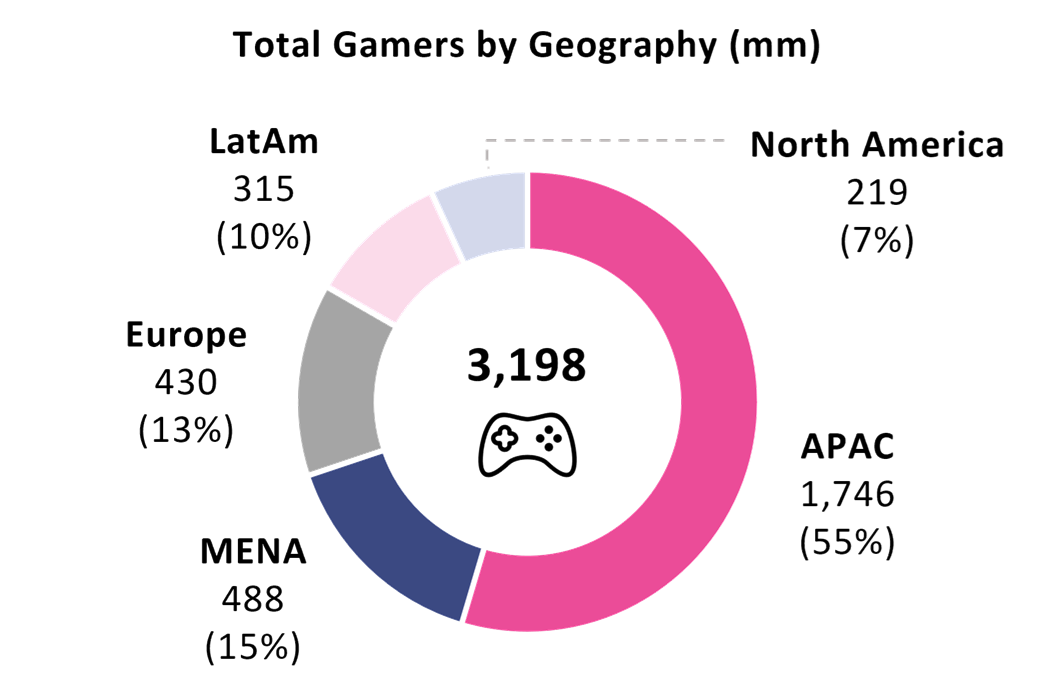
The Next Level: It’s A-Me Fintech!
Point72 Ventures is aiming to underwrite the future of finance and support companies and products that we think will be instrumental in how people move and spend money. To understand the fundamental issues and recurring problems, we take a research-based approach, with our network being an integral part of this process. We look to build real relationships with a broad and deep array of industry experts across banks, merchants, payments businesses, vertical software players and more. We make an effort to learn about their pain points and priorities at the source and then attempt to find innovative solutions to their problems.
Based on our conversations with our network, we see financial technology as truly horizontal, impacting nearly every vertical as businesses monetize. We believe every business needs to consider access, distribution, or manufacturing of financial products, and that gaming is a perfect example of this. We believe payments and gaming have always been connected – from inserting a coin to play at the local arcade, to paying cash for console gaming cartridges (Mortal Kombat for our Sega Genesis was a Point72 Ventures’ team favorite!) at brick-and-mortar game stores, to buying a skin for a MMORPG character.
However, while the gaming industry has made many leaps over the last two decades, we think the financial infrastructure attached to it has not kept pace. Despite the lack of financial innovation, millions of dollars continue to flow through the global gaming industry every day. We believe this presents an opportunity for technology to facilitate, accelerate and improve the status quo.
In our view, recent economic and regulatory headwinds (e.g., the Digital Markets Act in the European Union, Apple vs. Epic Games, etc.) are only accelerating this trend and there are early signs of financial institutions and gaming platforms working together.
Here are 3 key areas of opportunity that we’re most excited about:
- Interoperability of content, payments and virtual currencies.
Historically, game developers built walls around their games to capture and retain consumer attention for as long as possible (e.g., single purchase titles, exclusive content libraries, etc.). But what if that is starting to change?
Many individual games utilize in-game virtual currencies, but according to conversations with gaming publishers in our network, many players wind up hoarding instead of spending those currencies. We think increasing virtual currency spending velocity is key to monetization. An analogue would be credit card points – card networks give us a way to cash out our points on travel, retail, restaurants, or entertainment, but gaming mostly does not offer the same options yet. Would allowing consumers to move virtual currencies to new versions of the same game, or to other adjacent games compel them to spend more? This is what we mean by ‘interoperability.’ If such currency interoperability across games is indeed the future, we think it will require additional infrastructure and tools alignment (e.g., fraud prevention, licensing management, value calculation / exchanges, dynamic ledgers, money transmitter licenses, etc.). Today, those capabilities aren’t widely available, and we think getting there would require industry-wide agreements that consider regulatory and economic challenges among other hurdles. Certain publishers are starting to produce games that share universes, and virtual economies are becoming increasingly embedded in games. Although we are still in early innings, we believe that this is the direction the gaming world is headed and that getting the financial infrastructure on the back-end right will play a pivotal role in the future.
- Enhanced global payments connectivity and fraud and compliance capabilities.
As gaming expands globally outside of markets like the U.S. and the U.K. where payments infrastructure is well-established, we believe emerging markets’ payments acceptance and digital wallet connectivity is a current challenge that the industry must meet. For example, in developing markets like Indonesia, payment methods like GoPay wallets may be more common than traditional credit or debit cards, and accepting and processing those transactions can present more complexity.
To reach more consumers, we believe gaming platforms will need to offer increased connectivity between the numerous payment methods and processors globally. To do that, these platforms will also need to have enhanced payments intelligence that can help them manage pain points around fraud, false declines, KYC, acceptance, and cost optimization. If successful, these platforms could unlock access to new consumers, resulting in increased payments volume and, ultimately, more revenue. For example, our portfolio company, Pagos, has already begun working with some gaming platforms who needed help understanding and analyzing their fragmented and unstructured global payments data. Pagos aims to surface structured payments data that those customers can analyze to derive actionable insights to improve their payments performance and ultimately improve their operations.
We believe there are meaningful opportunities for third-party “fintech-as-a-service” solutions to help gaming platforms and publishers to tackle payments, fraud prevention, and compliance, freeing them up so they can focus on building and distributing world-class games.
- Gaming studios are increasingly focused on distribution, monetization and in turn true ownership of their games.
Frustration from mobile gaming participants with traditional app stores continues to mount, as shown through the persistent agitation from publishers and studios with the over-reliance on existing distribution channels (e.g., Epic Games’ lawsuit against Apple) and the high tolls levied on transactions that flow through their systems. We believe publishers and studios are realizing that they can not only preserve meaningful margin but also unlock additional revenue by being able to control the distribution, back-end infrastructure, and monetization mechanics for their own games. While the distribution platforms will continue to fight this trend, we see increasing appetite to explore options that help publishers and studios own more of the consumer relationship and economics. We believe new and large businesses will be built around this space by teams with strong fintech and gaming backgrounds.
The post Gaming – The Next Big Opportunity in Fintech? appeared first on Point72 Ventures.
]]>The post Making Cultural Values Stick – A Guide for Start-Up Founders appeared first on Point72 Ventures.
]]>Over the past several weeks, we spoke with founders, HR leaders, learning scientists, and culture champions to explore where we tend to go wrong when creating and incorporating cultural values in companies.
We believe that when cultural values accurately reflect an organization, they can shepherd productivity, a sense of belonging, shared purpose, and engagement. When they don’t, it can disappoint employees, erode their trust, and leave them feeling like they don’t belong. This article explores where cultural values tend to fail (so you can avoid them) and tactics you can use to weave cultural values into the fabric of your company.
What are cultural values
For the purpose of this article, cultural values are an articulation of behaviors for how we believe and agree that we should engage in the workplace, including how we treat each other, how we communicate, and how we make decisions. They are the foundation for how we will accomplish our goals and shared purpose at work. When lived out successfully, cultural values should facilitate trust, purpose, and a sense of belonging.
Where values tend to go wrong
Here are some common pitfalls we’ve seen detract from establishing effective cultural values:
- Creating values on day one: Rushing to codify values can mean they become outdated quickly. It takes time to build rapport and relationships with a new team. It takes even longer to be able to step back to extrapolate and articulate how people are showing up to work and making decisions. Just like early product development, what your team values and how they work together will rapidly evolve early on.
- Set it and forget it: You have a great rollout plan with a slide deck and a dedicated all-hands meeting—you even hired a local sign painter to paint them on your wall. Nice job, but that’s not enough. Your team will not remember them in two months if they’re not incorporated into the everyday experience.
- Values don’t reflect reality: Stated values that are out of touch with the reality of a workplace can be counterproductive. This typically happens when leadership crafts values in a vacuum, or when values are too aspirational. When only leaders develop values, they may reflect leadership’s subculture but not the experience of the entire organization. Aspirational values that don’t reflect reality can feel hollow, disingenuous and lose meaning over time. Additionally, I think aspirational values can contribute to employee churn when people who were attracted to the stated values find the culture is different than expected.
- Failure to hold people–particularly leaders–accountable: I think most people have seen companies make exceptions for the jerk who is great at their job. However, when we don’t see people held accountable to agreed-upon behaviors, cultural values are merely lip service. Actions speak louder than words, so organizations that fail to hold team members accountable are implicitly prioritizing performance over cultural values. It can also create organizational inefficiencies or duplicate work because leaders veer away from the agreed-upon path for doing things. Failing to hold people accountable can erode trust, a core element of a functional organization.
- Overly complex phrasing can make cultural values hard to remember and difficult to incorporate into everyday conversation: If they don’t sound like everyday language, then they won’t come up in everyday conversation, so it’s important to express your values in accessible, colloquial terms. Another common mistake is having more than seven values; don’t make them harder to remember than a telephone number—our generation already struggles with that.
Tips to get your values to stick
Here are some effective methods we’ve seen to establish and incorporate cultural values into organizations:
- Capture your current culture: While creating values can be initiated top-down or bottom-up, aim to create values that reflect who you are today, not who you wish you were. Intentional or not, happy with it or not, all companies have a culture. The hard part is distilling it. To overcome this hurdle, solicit feedback from a diverse group of stakeholders across seniority, departments, and locations. Whether your start-up is three months old or you’re a new executive joining an existing company, take at least six months to understand the organic behaviors before rushing to codify them.
- Describe what good looks like (and what not to do): Include a few lines below each value that describe what behaviors or actions embody that value and which behaviors do not, or what it looks like to take it too far. If “Radical Candor” is one of your values, include a description such as, “We give direct feedback with clear asks for what we’d like to see change. We give feedback as quickly as possible. We abstain from being overly critical or harsh.” Give your team a toolkit for how to act values-aligned. For example, introduce a standard framework so the team gives feedback in a consistent format that is aligned with the “candor” value.
- Turn your values into a shared language that you use repeatedly and constantly: Make your cultural values easy to remember (hashtags and emojis help.) Create a #shoutouts or #praise channel in your messaging app, and develop a norm where praise always ties to a value, e.g., #shoutout to Danielle for helping me troubleshoot a spreadsheet and always being willing to jump in #rowtogether. Leverage cultural values as part of your shared language and use them as a vehicle for change management and when providing the “why” behind big decisions.
- Build cultural values into the employee life cycle: From hiring to quarterly engagement surveys to semi-annual performance reviews, values should be surfaced and present in every process. Follow the marketing rule of seven – it takes seven touchpoints for something to stick. In hiring, review values with candidates and ask, “Which value resonates with you most?” and “Which value do you need to grow into?” In performance reviews, take the descriptions of good behaviors and solicit feedback from a leader’s peers, manager, and direct reports for a full picture. Set forward-looking goals for how to embody values, don’t just retroactively assess them. Hold people accountable and manage up or out when they don’t embody the values. Remember, the worst thing you can do is hang on to a culture corroder.
- Identify and designate culture leaders throughout your org: HR can own the lifecycle, but you need a trusted person in the room who brings the culture lens to conversations when no one’s watching. Cultural values are an internal product that needs ownership and upkeep after launch. Someone must be trained and designated responsible for tending to your cultural values. They ask, “Are we achieving our goals in a way that upholds our values?” This is as valuable a perspective to bring to the table as other forms of expertise. This role can successfully be embodied by generalists, cross-functional leaders, chiefs of staff, GMs, and OKR champions because they tend to have established trust across multiple teams.
- Own up when you screw up: No matter how much you promote cultural values, if you act counter to them even once, your team will notice and hold on to that. We’ve all had bad days that prevented us from bringing our A-game to work. Values tend to be pressure tested in high-stress moments. If you bungle giving feedback or get caught on your phone in a meeting, get ahead of it and acknowledge it. You will likely gain more trust and credibility when you take the time to acknowledge your mistake.
- Evolve your values as your company grows: Remove values that no longer serve or feel aspirational and add those that reflect an effective behavior not yet captured. Update supporting language to clarify behaviors and intentions. Solicit feedback from the entire organization to understand if company-wide day-to-day decisions reflect the values. Take off the pressure of perfection and normalize iteration.
As you develop your cultural values, ask yourself, “What are you willing to sacrifice to uphold your values?” Is it really a key value if you’re willing to put revenue or business outcomes before it? It’s ok if the answer is yes, but then it probably isn’t a core value to your company and shouldn’t be painted on the wall. When cultural values don’t reflect reality, it can contribute to people feeling disappointed, disengaged, and like they don’t belong; it can erode psychological safety and trust, which are table stakes for any company.
We hope this framing helps you design cultural values that resonate and reflect your team and foster trust, purpose, belonging, and productivity. To get them to stick, designate owners, keep people accountable, and create multiple touch points in the everyday employee experience. And of course, don’t be afraid to change them to reflect who your team becomes over time.
The post Making Cultural Values Stick – A Guide for Start-Up Founders appeared first on Point72 Ventures.
]]>The post The Next Technological Shift – Why we believe now is the time to invest in consumer technology appeared first on Point72 Ventures.
]]>Since 2016, Point72 Ventures has invested more than $1 billion in over 100 early-stage companies. While our focus has predominantly been in Fintech, Deep Tech, Defense Tech, and Enterprise technologies, we’ve invested in several exciting consumer companies and assets over the years.
Our team has spent time studying the consumer landscape, building an investment thesis, and backing founders we believe in, all of which have culminated in this new strategy.
Why now? We believe we are simultaneously experiencing multiple paradigm shifts within consumer technology and behavior.
Traditional customer acquisition has become more challenging, but we think the best founders are still finding ways to attract and retain users. We believe Apple’s App Tracking Transparency policy has categorically upended the way businesses acquire customers. Users can now opt out of in-app data tracking across different apps and websites, which makes it more challenging and expensive for companies to deliver targeted advertising. As a result, founders looking to target a consumer audience must find new and unique ways to acquire and engage users.
Consumers are changing the way they interact with technology. At the heart of humanity lies the need for community and connection – nearly 76% of internet users participate in an online community, whether it’s a Facebook group that discusses the happenings of their neighborhood, a sub-Reddit for their favorite TV show, or a website specific to their interests or hobbies. At the same time, around 64% of online community site visitors say they are visiting those sites more often now than they did before. On top of that, personalization has evolved from a “nice-to-have” to a “must” in consumers’ technology expectations; right now, 71% of consumers expect companies to deliver personalized interactions. We believe these numbers are only amplified for Gen Z cohorts, who will soon have meaningful purchasing power.
We’re in the early innings of the next technological shift in consumer technology. The early 2000s saw the commercialization of the internet. The early 2010s saw the commercialization of mobile. The early 2020s have brought the commercialization of AI and immersive technologies. We believe the ability to enable interactivity in engagement, augment traditionally less efficient workflows, and create new content at scale, has the potential to accelerate the formation of new consumer businesses across a number of categories, which we lay out below.
Content is king and the Creator Economy is the fuel. We see content as the digital currency of consumer businesses, as social media platforms like Instagram and TikTok deploy content-led algorithms. The creator economy is estimated to be worth more than $100 billion, and more than 50 million people worldwide consider themselves content creators. We envision creators becoming a driving force in bringing together digitally native communities, since high-quality content from trusted creators drives meaningful engagement. Additionally, we think generative AI is removing once-high barriers for creative pursuits, allowing anyone to create in ways they couldn’t before.
Also, people now spend record amounts of time and money online and engaging with technologies in new ways, giving us conviction that the next generation of breakout consumer technology businesses will be built alongside these macro shifts.
Why us?
We are thematic investors at our core…
We think consumer investing is unique among other categories in that its sub-verticals have little overlap. For example, gaming, commerce, and entertainment all operate very differently, and each individual category calls on investors to develop verticalized knowledge.
We believe this uniqueness is a great match for our firm’s thematic approach: we try to dive deep, ask questions, and leverage our internal resources to come to a data-driven view on who the winners in that category will ultimately be.
…and we are not afraid to invest early…
Our thematic approach to investing means that we can get to conviction on an idea very early. We do our work to identify white space in a market – often hand-in-hand with a potential founder – and are prepared to invest in businesses as early as incubation. Our mandate allows us to invest early while still being able to support you as you grow.
…and we can help you along the way.
The incredible assets that Point72 and Steven Cohen have assembled over the years give us front row seats to changing market dynamics while also providing us with tools to help founders unlock distribution.
Steve’s ownership of the New York Mets gives us a unique window into the world of sports and the technologies and communities built around them. Additionally, our partnership with Range Media Partners, a technology-forward talent agency representing A-list celebrities, creators, and athletes, provides us with unique access to the nuances of the entertainment industry.
We understand that technological innovation is not happening in a vacuum – it is happening in the context of complex industries and ecosystems that founders need to navigate. We believe these assets lend expertise and allow us to lean into emerging opportunities, while also providing industry access to our portfolio companies.
What are we excited about?
At Point72 Ventures, we’re focused on key consumer sectors and are asking questions to frame our research and identify emerging trends, including:
- Media & Entertainment. How will generative AI augment the creators in their respective fields? We recently invested in GlobalComix, a subscription service platform for comic book readers, which is actively building out AI tooling for its creators to bring comics to their readers faster. How is generative AI going to impact content creation in other fields like film and music? AI can enable meaningful interactivity with content – do consumers want this? How does the entertainment industry need to change if we’re going to have an explosion in the supply of new, interactive content? For example, how will consumers discover new content? How will creators finance new content?
- Sports. Sports franchises seem to only rise in value and we believe the increasing influx of institutional capital will force investors to think about how to monetize these assets more effectively. Importantly, we believe fan engagement is at an inflection point: Gen Z interacts with leagues and teams differently than older generations. What does the future of fandom look like? How will businesses capture this? What technologies and channels are resonating with younger cohorts?
- Education Technology. The pandemic was a major setback for public education; U.S. children’s test scores are significantly lower than pre-pandemic levels as they struggle to catch up. School systems across the nation are dealing with crowded classrooms and staffing shortages. Can AI level the playing field by offering 1×1 experiences? How can we capture the attention of a young student with technology? For adults, generative AI is set to automate a significant number of jobs; what does the future of reskilling look like?
- Consumer Health. We were lucky to have participated in one of the last big consumer health trends in connected fitness with an early investment in Mirror. Fitness is the fastest growing Gen Z spending category, growing 37% YoY. What’s the future of data-driven and personalized consumer healthcare?
- Commerce. Commerce has already been moving towards hyper-personalization. What does AI unlock in new commerce experiences? How does Gen Z’s shopping habits differ from older cohorts? How does sustainability impact supply chains, shopping habits, and other considerations?
Please reach out…
We are also looking at travel, gaming, and other verticals – and we want to hear from you to learn what you’re working on. We are excited to embark on this new journey and partner with outstanding founders that actively push the boundaries within consumer and media. Please reach out if you are…
- A founder of an innovative early-stage business in consumer or media.
- Someone with deep domain expertise in any of the above categories who wants to found a business in the space and would like a sounding board.
- Leveraging tailwinds in new technologies such as generative AI to empower new consumer applications and businesses.
The post The Next Technological Shift – Why we believe now is the time to invest in consumer technology appeared first on Point72 Ventures.
]]>The post Navigating the DoD budget cycle: End-of-year funds present opportunity for Defense Tech startups appeared first on Point72 Ventures.
]]>Whether it’s navigating the multiple stakeholders necessary to make a government sale, long contracting cycles, budgets that get caught in political crossfire – there is no shortage of challenges facing the startups we see and work within the Defense Tech space.
But we believe that savvy founders can help accelerate their growth and sidestep the hurdles that typically slow Defense Tech growth by tapping into the fiscal year-end frenzy caused by the DoD’s “Use it or Lose it” budget phenomenon, in which organizations scramble to spend their unused budget to justify greater allocations in the following year. The real effects of the frenzy are clear. In the last week of the 2017 Fiscal Year, the DoD spent $23 billion on contracts – four times the average amount of any other week.
First, some context: The DoD budgets (and Congress authorizes and appropriates) approximately $850 billion annually divided across major categories or “colors of money” including Operation and Maintenance (O&M); Research, Development, Test, and Evaluation (RDT&E); Procurement; Military Construction (MilCon); and Military Personnel (MilPers). Funds earmarked toward these categories and the individual programs within are “obligated” or committed throughout the fiscal year for different contracts that fall within each color of money. Budgeted funds that are not obligated within a specific period (usually one or two fiscal years) will expire.
The DoD’s spend rate is far from consistent across a given fiscal year – obligations typically spike in September, the last month of the fiscal year, as contracting officers rush to commit remaining funds before they are set to expire.

In our view, these funds present a crucial opportunity for Defense Tech startups, because a relatively small reallocation for DoD, anything under the $10 million threshold that requires Congressional approval, can provide a Defense Tech startup with a critical middle-ground of funding that can help bridge early-stage R&D grants and hard to secure Programs of Record. These allocations can help startups to capture revenue quickly, accelerate their growth, and demonstrate their ability to earn market share to investors.
The challenge lies in being prepared to capture end-of-year funds effectively. We suggest Defense Tech startups initiate conversations and establish trust with Program Managers early on, showcasing the startup’s capabilities and demonstrating their value proposition to end users so that when it comes time to move money from under-obligated programs, it’s a clear choice. We believe that March, the halfway point of the DoD’s fiscal year, when obligation rates can be meaningfully evaluated, is the critical moment for startups to position themselves to be ready when end of year funds become available.
While this strategy can be a critical source for immediate revenue, it is also important for companies to focus on how contracts obtained in the fiscal year-end rush can act as a map towards more stable and long-term opportunities for recurring revenue. We believe diversification of revenue streams and a solid pipeline of opportunities beyond end of year spending is a must, otherwise startups risk turning these awards into one-off events.
Seeking to leverage the DoD’s “Use it or Lose it” budgetary mindset at the end of a fiscal year can be a key driver of growth for Defense Tech startups. By capitalizing on end–of–year funds, we think Defense Tech startups can avoid one of the most vexing challenges that plagues the Defense Tech industry and access a lifeline of flexible funding that allows them to deliver their critical technologies to warfighters.
The post Navigating the DoD budget cycle: End-of-year funds present opportunity for Defense Tech startups appeared first on Point72 Ventures.
]]>The post Strictly VC: Dan Gwak of Point72 Ventures on why defense tech is becoming the next big thing for investors appeared first on Point72 Ventures.
]]>Listen to the full episode here!
The post Strictly VC: Dan Gwak of Point72 Ventures on why defense tech is becoming the next big thing for investors appeared first on Point72 Ventures.
]]>The post Authorization Built for Developers: Our Investment in Abbey Labs appeared first on Point72 Ventures.
]]>The Authorization Problem
Managing who is permitted to do what actions with your data and your infrastructure is some of the most important work in securing your software and organization. This work typically comes in two parts: authentication and authorization.
You may be more familiar with authentication. It answers the questions (1) are you allowed “in” and (2) are you the person you say you are. Think usernames, passwords, and two-factor authentication. Authentication lets you in the door.
Authorization (or Permissions Management) can be much more nuanced. It answers the question, “what are you allowed to do once you are in?”. It helps you manage who gets access to what data, and who can read or edit data sources, infrastructure, or code. Based on conversations we’ve had with data teams, we believe that this complexity—this “authorization hell” is a leading cause of stress and data engineering churn in companies. There are too many points of friction, and most modern solutions are not designed with engineering in mind. It can feel like the worst type of bureaucracy—processes that the team is subject to, responsible for, but not in control of.
Co-Founders Arvil Nagpal and Jeff Chao have firsthand experience with this problem after spending several years at large companies tackling authentication and data infrastructure. Our alignment on the problem space made the Abbey Labs team a team we were interested in supporting.
Abbey Labs’ Solution
Abbey Labs is working to turn the existing, painful paradigm on its head by building a developer centric approach to authorization. Engineers are already familiar with infrastructure as code. Why not loop authorization into the same workflow?
Their approach separates policy from infrastructure from enforcement by building authorization into the code that defines an organization’s cloud infrastructure. What used to fall solely on the Data Engineering and Data Product teams is now distributed.
The engineers now translate a policy into code, which is embedded into the infrastructure as code framework that governs the systems that they are managing permissions for (any infrastructure that can have its permissions managed through terraform).
That’s it. That’s the job (at least for the engineers). All the other steps, the validation of policy and the final approvals, are managed by Abbey Labs’ software and executed by the subject matter experts—the data product owners, compliance teams, or other relevant stakeholders.
We think it’s a win for security if an organization’s legal and compliance policies around permissioning are enforced programmatically rather than by people manually interpreting those policies at the margins. We think it’s a win for the data product owners, the people requesting permissions, and any other stakeholders in the process, who’ll now all have visibility of the request, the remaining steps that are required, and which approvals are holding up the process.
But we are most excited about what Abbey Labs could mean for engineers, who could stop acting as data bureaucrats. Once engineers do the initial work in Abbey Labs, they can step out of the process, and devote their time to working on delivering new things.
Why we think this is important
We believe Abbey Labs has the potential to reshape how the industry thinks about solving authorization challenges and counteract a growing engineering headache that’s approaching untenable. We’ve explored several approaches to these issues over the years, but we didn’t believe there was a viable path to aptly attack the problem until we started working with Arvil and Jeff.
We see a paradigm shift happening in technology, with enterprise solutions becoming more developer centric, with a parallel focus on simplifying workflows and removing underlying complexity.
We see this progression to developer centricity as no different in security. As the number of assets that people need access to grows in conjunction with more fine-grained authorization necessary to maintain security, plus engineering’s demand for simpler and easier-to-use tools, we think people need to start thinking about the problem differently.
Arvil and Jeff have a deep understanding of the evolving cloud-native environment and ecosystem, while also bringing valuable perspectives from both the authentication and data spaces. We worked closely with Arvil and Jeff on the earliest iterations of this product, and have seen their approach develop and resonate with their design partners and broader market.
We are thrilled to be partnering with them on this journey and look forward to sharing more about their progress in the future. Our investment in Abbey Labs is in line with our commitment to strong founders, great products and to those bringing the next generation of enterprise software to market.
Abbey Labs’ Open Beta
Abbey Labs has released their open beta. If you’ve felt authorization hell, or if you’re interested in being a design partner, sign up for the open beta here: https://www.abbey.io/
The post Authorization Built for Developers: Our Investment in Abbey Labs appeared first on Point72 Ventures.
]]>The post Association of Computational Linguistics Conference (ACL) 2023 – Our Expectations appeared first on Point72 Ventures.
]]>“I am so clever that sometimes I don’t understand a single word of what I am saying.” – Oscar Wilde.
Have you ever returned to your writing to realize it was a bit less coherent than you thought? It shouldn’t be a surprise then that machine learning models struggle to dissect human language. After all, as cognitive science scholar Douglas Hofstadter writes, “the recursive structure of language mirrors the recursive structure of cognition, and vice versa.”
Thankfully, the authors and organizers at the Association of Computational Linguistics (”ACL”) have been pushing the limits of natural language understanding for many years, which is why we’re so excited to attend this year’s conference in Toronto.
Of the many compelling topics at the conference, we’re particularly excited to explore AI’s intersection with e-commerce. We see this use case as a microcosm of the broader field. We view online sales channels and backend systems as data-rich, but retailers’ inability to leverage that data keeps them insight-poor. We’re not surprised by this, since it is no small feat to parse unstructured and multi-modal data, react to ambiguous searches and reviews, and predict buying behavior in the age of the micro-trend. However, we believe new research presented at ACL can address these fundamental challenges.
Below are some of the most compelling topics that we reviewed:
Classification: When is a Shoe Not a Shoe?
What you call a shoe, I might call a sneaker. And what a model classified as a small, grey shoe may in fact be a medium, off-white boot. In extensive SKU databases, product classifications like color, size, and subcategory can have a major impact on downstream tasks like search. Having the wrong classification is the difference between the shoe showing up in your search results or not – and if you can’t find it, you can’t buy it. To tackle this concern, authors of a recent ACL paper aim to improve traditional classification models using generative AI. Other accepted papers dealt with topics such as multi-modal attributes on product pages and unified vision-language image captioning. A related paper was presented at this month’s Computer Vision and Pattern Recognition conference (”CVPR”) that reconciles inconsistent labeling between image datasets to improve classification. We’re excited about the way these work together to refine product and image categorization, ultimately offering the potential to improve downstream, customer-facing models.
Search and Discovery: The Customer (Search) is (Not) Always Right
The business of search and discovery is in many ways the business of bringing the offline shopping experience online. Think about how a physical store is structured: as a buyer, you are likely to be guided through many aisles, where you might make unplanned purchases (or go ’treasure hunting’). Additionally, you might stop and speak to store workers, who can answer questions and recommend related products. Now, consider your latest online purchase. If you didn’t know exactly what you wanted, you may have struggled to navigate a site’s massive inventory. Search results were probably inconsistent, and recommendations may not have been relevant—after all, to the retailer you’re just an anonymous visitor who’s entered a few vague searches!
We believe brands are eager for ways to better understand user preferences based on online buyer behavior. However, recent changes in Apple’s app tracking transparency policy and EU regulations on cookies have left many business with only session-level behaviors such as search results to rely on.
Several papers at this year’s conference touch on different ways to address these challenges – including inferring intent from a customer’s history of searches, correcting spelling mistakes (which affect 32% of searches), and even greatly improving speech recognition for voice-powered search.
Forecasting and Demand Planning: Trend Tracking in the Age of Fast Fashion
Did you know that for brief moment in 2022, bright pink dipping sauce dominated “FoodTok”? Or that there are over 20,000 mentions of luxury fashion a day on Twitter? Social media ecosystems can reveal quite a bit about consumer preferences – if retailers can keep up.
While this subject may not have received prominent coverage in this year’s ACL papers, it will be discussed in a joint ACL workshop at the Knowledge Discover and Data Mining Conference (”KDD”) in August. We view forecasting and planning as both crucial challenges and enormous opportunities—ones that multi-modal models are especially suited to address. The sheer volume of this unstructured data is daunting, and additionally, signals may be ambiguous and extremely high velocity. However, we believe that improvements in interpreting these signals have the potential to dramatically reduce overstocking, saving the industry billions and reducing its environmental impact.
Let’s Chat!
If you’re excited about these use cases, or any other breakthroughs and applications in ACL work, shoot us a note or find us in Toronto. We may not be as clever as Oscar Wilde, but perhaps we can understand a few words between us.
The post Association of Computational Linguistics Conference (ACL) 2023 – Our Expectations appeared first on Point72 Ventures.
]]>The post Software Bills of Material (SBOMs) – All the right ingredients, but something is still missing appeared first on Point72 Ventures.
]]>- The hype for SBOMs (Software bills of material) in the application security community and in the government is widespread—reaching a boiling point
- While SBOMs are trying to solve an undeniable problem the industry faces, we are skeptical of the current, regulatorily driven approach for SBOMs
- Rather than being a security solution, we see the regulatory requirement to provide SBOMs as a compliance solution, which while well meaning, is likely to create barriers to startup innovation in this space
- With the existing regulatory approach, we expect existing players and specialized consultants to be in the best position to succeed in the space
- There could be space for startups to disrupt the incumbents, but we think they will have to create a solution that goes further than the regulations require, such that it is attractive to a broad audience
Context
Log4Shell showed that open-source software in a proprietary software stack can have long-lived, high risk vulnerabilities. The software supply chain attack on the US government through SolarWinds showed the same for third party software.
SBOMs seek to address this by making those vulnerabilities apparent—if you know the ingredients of your software, you can make better decisions about your software. Relevant XKCD. SBOMs, as a solution, are snowballing in popularity. We heard application security engineers literally chanting “SBOM! SBOM!” at CloudNativeSecurityCon 2023.
The promise of SBOMs
Initial excitement for SBOMs is easy to understand—software compositions transparency should put a consumer or buyer in a better position to:
- Conduct diligence on the software they are acquiring or using (by checking versions, patches, etc. against known vulnerabilities)
- Negotiate with suppliers on remediating known vulnerabilities
- Respond quickly if a vulnerability is found
The open source application security community is creating and rallying around two standardized SBOM formats (SPDX and CycloneDX). In part, these standards aim to ensure that the SBOM they create will be consumable by their users; and programmatic approaches to generating and consuming SBOMs become possible.
The U.S. Government has already demonstrated its support for SBOMs, passing an amendment to the Food, Drug & Cosmetic Act in December 2022 that requires sponsors of certain new medical devices to include an SBOM with their premarket application. The White House has also, through EO 2021-10460 and the NIST guidance enacting it, and through its March 2023 National Cybersecurity Strategy, directed Federal agencies to require those selling “critical software” to the Federal Government to provide SBOMs. The government is to require a vendor’s attestation of adherence to cybersecurity standards (which have so far included SBOMs, see NIST guidance on EO14028) in vendor contracts, and they explicitly mention that their policy includes seeking to enforce contractual adherence through the DOJ under the False Claims Act.
The White House further proposed to work with Congress to develop legislation that would prevent large market players from contractually disclaiming liability for cybersecurity attacks (a common practice currently) unless they abide by safe-harbor provisions based around the same cybersecurity standards as imposed on government vendors.
We will be following to see whether and how these NIST guidelines are enforced, and what legislation might arise out of the White House’s Cybersecurity Strategy. In the meantime, we expect consultancies to jump at the opportunity to give CISOs the comfort of compliance and give large security companies another product line to sell to their existing customers.
We think SBOMs are attractive, but not yet, and not like this
SBOM support is narrow, and most of their value is already captured. Whilst we think the open-source security communication is firmly on team SBOM, the broader open-source development community doesn’t seem to be. We view one issue as mainly a burden-shifting one: who should do the work, and who should pay for it? Some arguments we have seen against SBOM requirements center around the creation of additional “chore” work that primarily benefits corporate users of the application—both from a creating/maintaining an SBOM perspective, and from being required to quickly patch software if dependencies become vulnerable. These are soft criticisms.
The harder criticism, as we see it, come from security industry professionals (vendors and buyers) who seem bearish about SBOM adoption generating value in their business. Vendors we spoke to told us that even though they have heard of SBOMs, they haven’t been required to produce one, or don’t expect to be required to produce one in the next year. Buyers have spoken about the requirement being a formality, with SBOMs not being seen to be adding more than an extra check-box step in vendor onboarding.
Why is there such a disconnect between SBOM proponents and skeptics? SBOM skeptics argue that:
- Existing SBOMs don’t generate enough value to be wanted:
- They are largely static, largely one-off
- They only generate real value during vendor negotiation (rather than during the whole software life-cycle)
- They don’t give a buyer more visibility over their own use of open source when compared to existing dependency mapping and vulnerability scanning
- They don’t increase the motivation for vendors to patch security vulnerabilities—if a vulnerability is known and high priority, reputational risks serve as an acute enough motivator
- And if SBOMs aren’t wanted, but nonetheless required, they will tend to become less meaningful and valuable over time
- Where vendors are required by rule (as opposed to organic demand) to satisfy a particular requirement, they may wind up doing the bare minimum to ‘check a box’ rather than truly trying to add value. The resulting ‘bare minimum’ can then depress demand, since it doesn’t provide value, leading to a vicious cycle. In our experience, vendors and buyers who are regulatorily compelled have historically done the bare minimum to “check a box”, reducing the incentive to provide value, reducing demand—a viscous cycle. Where these box-checking exercises occur in highly regulated industries dominated by large incumbents, they may spread slowly through those industries’ chain of contractors and subcontractors, and face pushback especially from smaller, regional contractors in the chain who feel the regulatory burden more acutely
What’s driving our hesitancy: We believe that security standards that are regulation-driven have a tendency to be satisfied with the least amount of effort; we believe security industry professionals may not perceive any real value in SBOMs; and we’re concerned about a lack of time-certainty for regulatory and industry adoption.
Even mandatory rollout will be slow
If key decision makers remain skeptical of the value being generated by SBOMs, we expect that even mandatory adoption will be slow. Further, we think the industries that will be affected by the first tranche of SBOM regulation—Defense, Critical Infrastructure and healthcare/medical devices—are cautious, with buyers (and the vendors that service them) who tend to be conservative:
- We expect them to await regulatory certainty before pulling any triggers
- We expect them to be cost-driven, rather than feature-driven
Altogether, that makes us think this will be a hard market to innovate in.
SBOM first adopters will prefer existing players
We believe that the requirement for SBOMs in Defense, critical infrastructure, and healthcare and the medical device industries will tend to create a bias in favor of large existing players in the software industry and specialized consultancies, because of the specific contractual and regulatory requirements those industries work with. We think this is especially true for the foundational elements of SBOM adoption: their creation, storage, and sharing. However, we still think there may be an opportunity around subsequent plays that build off of this foundation—in operationalization and automation of SBOM-related value drivers such as notification and risk management. This could be an area where startups can compete and drive value.
The post Software Bills of Material (SBOMs) – All the right ingredients, but something is still missing appeared first on Point72 Ventures.
]]>The post Computer Vision and Pattern Recognition Conference (CVPR) 2023 – Our Expectations appeared first on Point72 Ventures.
]]>Vision is the central technological element in some of the best works of science fiction like iRobot, 2001: A Space Odyssey, and The Matrix. Without significant advancements in computer vision, these works would have no plot! The robots in iRobot interact so fluidly with their world because they ingest and process vast amounts of visual information. What is HAL from 2001 besides a giant red camera – an eye – that represents the powerful awareness of AI. The Matrix is itself an unbelievably robust computer-generated, visual world. While we’re more glass half full than “robots are taking over”, we agree with the thrust of these works that computer vision is the foundation for awe-inspiring technological advancements.
If you watched these movies growing up, it was probably hard to picture any of it becoming reality. However, while some innovations are still on the horizon, others are just around the corner. CVPR is a great opportunity to get a glimpse at what will soon be viewed as real-world science – no longer fiction. Below are four key areas we are particularly interested in:
Visual Reasoning: Interacting with the World like Never Before
We take for granted our ability to look at the world around us and rapidly analyze the actions of everyone and everything in the scene to predict what’s about to happen. But if you’ve ever played an unfamiliar level in a video game, you’ve likely experienced the frustration of starting over and over again as new traps and enemies appear as you progress (cc: Elden Ring). For so long, that’s how computer vision models viewed the world: a structured process of familiar pattern recognition that would break if presented with anomalies and edge cases.
Advancements in visual reasoning capabilities like the ones discussed in this award-nominated paper allow for better predictions of complex interactions between multiple agents. At the conference, we’re eager to attend workshops like End-to-End Autonomous Driving and Open-Domain Reasoning Under Multi-Modal Settings, alongside speakers from DeepMind, Waymo, and other industry leaders.
Multi-Modality: The Rise of the AI Agent
When was the last time you only interacted with text for a full day? Probably never! We absorb information through sounds, visuals, text, code, smells, etc. It’s what makes our world so rich, and so complex for computers to process. Multi-modality is all about fusing different types of data—such as images, text, audio, and video—into a comprehensive model of the world.
One of the papers at CVPR introduces an innovative, audio-video generation model. This model appears to be capable of delivering an enhanced viewing experience, but that’s just the start. In the future, the authors hope to add more capabilities such as editing and expand accessibility with a user-friendly UI.
Efficiency: Pocket-Sized CV
Unless we’re going to start carrying Graphics Processing Units (GPUs) in our backpacks, we believe the power of CV advancements will only reach scale in the real world if the models can work robustly and efficiently on the edge. Researchers are consistently striving to streamline the speed and resource utilization of AI models, making them more widely applicable to everyday life. Methods like distillation, compression, parallelization, and distributed training work to reduce model size and complexity without sacrificing performance.
One paper explores a new method to tackle resource-intensive sampling in diffusion models. The authors demonstrate that a new distillation approach can be used to realize an order of magnitude improvement in efficiency, lowering compute costs for high resolution images.
Generative AI: Expanding the Content Horizon
How many times have you taken 15 photos to get the perfect shot? Generative AI gives you the tools to edit photographs, generate novel views, or produce entirely new worlds and creatures with natural language prompts. We expect these developments to propel generative AI towards more enterprise use cases, from video game and film production to architecture and product design, even extending to implications in fashion, art, and marketing.
The papers presented at the conference cover a wide range of topics, from generating new perspectives of moving scenes to predicting the articulation structure of 3D objects. The AI for content creation workshop adds to the excitement, as industry and academic leaders will come together to discuss what it will take to thoughtfully incorporate AI into content creation processes.
Real-World Applications
We believe that addressing everyday paint points is key to catalyzing the transition to commercialization. With that in mind, below are end-uses that are top of mind for us.
- Smart Manufacturing and Quality Control: Cost of poor-quality production can be as high as 20% of revenue, reinforcing a need for more effective quality control technology. Industrial inspection is a highly repetitive and extremely nuanced task, but AI models can process vast amounts of data from production lines and detect deviations or anomalies in real-time to minimize production errors.
- Retail and E-commerce Personalization: Rapidly changing consumer preferences are making it even harder for retailers to make merchandising decisions, leading to inventory misjudgments that can cost up to 12% of sales per year. Generative AI and computer vision can help retailers reduce this cost with personalized recommendations, virtual try-ons, and predictive analytics. We’re looking forward to discussing this at the RetailVision workshop.
- Automated Video Production and Editing: Studios spend hundreds of millions on visual effects (VFX) each year even as VFX studios struggle to survive increasingly tight margins. Further, video-first social media like TikTok and Instagram have turned almost everyone into potential creators. Advancements in generative AI offer a toolkit that both studios and amateur creatives could use to dream up new worlds with far fewer resources. To us, it’s not a question of whether but when and how AI will be more deeply incorporated into creative processes.
If you’re excited about these use cases or the themes highlighted above, shoot us an email or find us at the conference – we’d be happy to discuss interesting papers or a novel application of research in the real world.
The post Computer Vision and Pattern Recognition Conference (CVPR) 2023 – Our Expectations appeared first on Point72 Ventures.
]]>The post 10 Fintech Trends from Brazil appeared first on Point72 Ventures.
]]>1. We have never felt better about investing in Latin America
Latin America experienced a funding boom in 2021 with record venture capital inflows to the region. While this was a great vote of confidence for a historically under-capitalized tech ecosystem, the influx resulted in frothy valuations as many investors underwrote entry pricing and exit outcomes in line with developed market comps. Pricing for startups has come back down to earth since then as publicly traded fintechs from the region such as digital bank Nubank, cross-border payments platform dLocal, and others have traded downward. As funding in Latin America dried up in response to public markets volatility and macro headwinds, most startups have responded by cutting costs or raising bridge financings to extend runway or find a path to profitability.
Despite these headwinds, we believe the quality of founding teams at the seed stage has only gone up, because difficult environments demand the determination that we typically see in more seasoned entrepreneurs. Meanwhile, venture capital funds in both the US and Latin America still have significant dry powder to deploy, albeit that investments must meet a higher bar than in the past. We believe the confluence of these factors – a return to reasonable pricing, high quality founding teams, and a captive pool of capital ready to be deployed to the best companies – is likely to result in one of the best venture capital cohorts in Latin America to date.
2. Favorable regulation from the Brazilian Central Bank is creating opportunities for fintechs
The Brazilian Central Bank has been highly proactive in introducing new regulation and licenses with lower capital requirements to increase competition in the financial system.
For example, new licenses were first introduced to end the merchant acquiring duopoly held by incumbents Cielo and Rede, enabling StoneCo and PagSeguro to take share and eventually go public. Likewise, digital bank Nubank would not have been able to break up incumbent banks’ oligopoly without the introduction of a new electronic payments license, and the same is true of secured lender Creditas benefiting from a new direct lending license.
We believe ongoing regulatory changes from the Brazilian Central Bank will sustain this trend, opening previously un-tapped profit pools to digital entrants and producing the next wave of fintech winners in the country.
3. Instant payments are ubiquitous in Brazil, but the underlying infrastructure has growing pains
Brazil’s real-time payments network is seemingly everywhere – on a recent trip, we even saw the Pix logo emblazoned on the shirts of sellers hawking beers and sunglasses on the beaches of Rio de Janeiro. Adoption has exceeded expectations, with Pix outpacing India’s equivalent UPI launched only a few years earlier.
Notably, Pix brings benefits over legacy rails – the network rolled out by the Brazilian Central Bank is free, available 24/7, and can be used by both consumers and merchants. However, it does come with some pain points – for example, offline merchant acceptance is still cumbersome, with many consumers opting to use physical cards or NFC at the terminal, and fraud remains a major concern.
While the Brazilian Central Bank is in the process of rolling out additional features to the network including automatic debit and installment functionality, we believe fintech startups have a compelling opportunity to build on top of or solve for gaps in Pix’s functionality.
4. Brazil is positioning itself as a global crypto and digital assets hub
Even as other countries have increased regulatory scrutiny of digital assets in the aftermath of the downfall of FTX, the president of Brazil signed a bill in January 2023 enabling crypto payments, and in December 2022 the Brazilian Central Bank announced plans to launch its own digital currency, known as real digital, as soon as next year.
We are most excited about business models that will enable the roll-out of the real digital, as well as platforms focused on digital asset tokenization, reducing bureaucratic intermediaries responsible for packaging assets ranging from real estate to agriculture receivables.
5. Once highly opaque and inefficient, Brazil’s credit markets are going fully digital
A recent regulatory change by the Brazilian Central Bank mandated acquirers to register all merchants’ credit card receivables into centralized registrars such as Nuclea and CERC.
Following the major accounting scandal at Brazilian retailer Americanas, we believe regulators are likely to expand the scope of the registrars even further to encompass other receivables, known as duplicatas, including supply chain finance. In tandem with this trend, we anticipate many of these receivables will also eventually be tokenized via the blockchain as well.
We believe this will create new use cases for fintech, and for digital assets startups looking to package and provide liquidity against these tech-enabled assets. Likewise, we believe fintechs can also create more efficient back-office infrastructure for originators managing complex credit operations, including orchestration across multiple receivables registrars.
6. The confluence of embedded fintech and open finance is creating novel business models
We believe Brazil has a mature ecosystem of fintech infrastructure startups providing a variety of modular financial services from embedded banking to insurance, as we described in a prior blog post. At the same time, the Brazilian Central Bank has been pushing a progressive open finance agenda, mandating that banks open up data aggregation capabilities and enable payments initiation.
We believe this unique confluence of modular fintech capabilities and open finance functionality is enabling startups to launch new products quickly and at low cost, or even create entirely new business models that aren’t possible in developed markets due to a lack of enabling infrastructure or regulatory constraints.
7. Consumer fintech is over-saturated, while the B2B space is just getting started
Consumer fintechs such as digital bank Nubank and secured lender Creditas paved the way as first movers, with a number of competitors launching shortly after to fill the product or demographic gaps left by market leaders. Compared to the consumer fintech market, we think the B2B space in Brazil is still early days and presents a greenfield opportunity.
Against this backdrop, it remains to be seen which fintechs will win the race to serve small businesses and enterprises in Brazil. We have seen startups tackle this segment with different initial wedges – some led with digital banking as the hook, others with spend management software, verticalized capabilities such as FX for import / export businesses, and others touting AP / AR and cash management as the winning formula. We are monitoring this space closely and are excited to see who comes out on top.
8. Entrepreneurs are expanding beyond copycat models to solve local pain points
Many early movers in Latin America tropicalized business models from US or Europe, and we have seen quite a few startups approach fundraising by pointing to successful international comps. While this copycat strategy has proven fairly successful, most of the obvious models have already been attempted. As such, we anticipate more entrepreneurs to develop home-grown solutions that target unique pain points in Brazil.
Examples include the digitalization of meal cards, known as vale refeição, new takes on payroll lending, or crédito consignado, easy loan and direct deposit switching, or portabilidade, tech-enabled alternatives to Brazil’s notoriously bureaucratic notaries, called cartórios, and super-charging legacy investment advisors, known as agentes autónomos. Some spaces remain relatively untouched, such as the private pension space, or previdência, and lending circles, known as consórcio.
These unique approaches are fondly referred to as jabuticaba by entrepreneurs, which is a fruit that can only be found in Brazil. They are often associated with some of the largest remaining profit pools in the country that have yet to experience tech-enabled disruption. We believe they can be compelling opportunities for those investors who take the time to understand the local nuances.
9. Generative AI adoption is a global phenomenon, including in Latin America
The generative AI phenomenon is not constrained only to developed markets, with major platforms such as OpenAI’s ChatGPT also available in Brazil.
While we think the next set of foundational models are more likely to be developed and refined in the US or Europe, we are already seeing early movement from teams in Latin America building or incorporating compelling use cases at the application layer.
In a region where many business functions are highly people-intensive due to cheaper labor costs and a lack of automation, there is interest from financial institutions, corporates, and startups in the region to incorporate generative AI, tackling use cases ranging from streamlined customer service to synthesizing legal documents.
10. Brazil is primed to become a leader in climate tech and decarbonization efforts
Home to the Amazon rainforest, Brazil has an opportunity to be a leader in climate and conservation technology. Startups are enabling both local and international companies to calculate and offset their carbon foot print with certified projects in Brazil, and many have global ambitions. We think that this space, though in its early days, has major fintech product implications, and is certainly worth watching in the coming years.
The post 10 Fintech Trends from Brazil appeared first on Point72 Ventures.
]]>The post Generative AI is Coming for Real Estate – Why we’re backing EliseAI appeared first on Point72 Ventures.
]]>In multifamily real estate, we believe that demand for seamless and intuitive digital experiences among younger and tech-adept renter populations will grow commensurately. This is placing increased demand on multifamily operators to offer faster and more robust communication with renters. Historically, property managers have tried to meet these needs by hiring more leasing agents and on-site staff, but this has shown to be slow, cumbersome, and cost prohibitive, especially in recent inflationary times.
EliseAI’s platform fully automates interactions between tenants and multifamily operators, allowing property managers to scale operations while delivering excellent customer service to potential and existing tenants. The company combines conversational AI that we found to be best-in-class with critical workflows built around how modern multifamily operators work. These workflows can help solve the most time-consuming tasks for operators such as efficient scheduling, centralization of the workforce, rent collection and more. Beyond real estate, we believe the company is well primed to bring their technology to more verticals in the quarters and years to come.
While the introduction of technology like ChatGPT APIs has made AI more accessible, we think the biggest game changers lies with the industry-specific training that can make these applications truly effective. After interacting with competitors in the space, we are confident that EliseAI has built a unique and highly defensible business of empowering the operators of multifamily home.
Beyond real estate, the EliseAI team is looking at another market with similar trends: health care. As is the case in real estate, health care operators are increasingly burdened by administrative demands. In fact, about one-quarter of all healthcare spend in the United States is administrative. EliseAI’s platform seeks to automate the back-and-forth throughout the patient journey of finding and choosing a provider, booking and scheduling, providing intake information, billing, and subsequent follow-up.
We are thrilled to be partnering with EliseAI’s co-founders Minna Song and Tony Stoyanov, whom we believe are true visionaries. They have dedicated the last six years towards building advanced conversational AI for business automation long before many companies were considering adoption of AI. We are impressed by the way they have anticipated customer needs and build product in record time, driving deep customer satisfaction and retention. When we spoke to EliseAI’s customers, they were impressed at about how quickly they were able to scale operations, decrease vacancies, and increase tenant satisfaction, and they couldn’t wait to see what the EliseAI team had in store next.
We’re excited to welcome EliseAI to the Point72 Private Investments portfolio and look forward to supporting their next phase of growth.
The post Generative AI is Coming for Real Estate – Why we’re backing EliseAI appeared first on Point72 Ventures.
]]>The post Pitch Perfect: Generative Voice and the Future of Content Consumption appeared first on Point72 Ventures.
]]>Disclaimer: this was not written by ChatGPT. However, the same can’t be said for an increasing portion of the content we come across online. In the space of 6 months we’ve gone from laughing at how obvious AI-generated text was to marveling at its ability to write Shakespearean poetry. How long until the same is true for audio?
Historically, the most widespread examples of generative voice have been 1) used in short-form outputs like GPS directions and 2) applied to business contexts rather than creative ones. But it won’t be long before you listen to a podcast or watch a movie and not only ask “was this written by AI” but also “was this spoken by AI”?
The pace of change can be hard to comprehend. In April 2023 alone we saw two viral examples of creative generative voice in the wild: DeepZen narrated a book using a long-passed narrator’s voice; a fake single using AI-generated Drake and Weeknd vocals went viral. We think these examples barely scratch the surface of what’s possible with complex, contextual generative voice.
In a previous post, we compared foundational models to the Pensieve from Harry Potter, and we view generative voice tools as equally magical. Imagine listening to emails in the voice of the sender or having real-time, unique conversations with video game characters, like a Hogwarts student listening to Howler letters or talking to a portrait.
Below, we take a closer look at why we believe we’re at an inflection point in generative voice applications and what opportunities excite us the most:
Why is now the right time to think about generative voice in creative media?
Until recently, AI-generated voices in GPS, Siri or Alexa, or on phone calls with robot customer support sounded, well, robotic. Rule-based systems that concatenated sounds produced clunky, emotionless outputs.
However, advances in Natural Language Processing (NLP), computing power, and audio datasets needed to train AI on a diverse range of voices have led to a rapid improvement in AI generated voice technology in recent years. Generative voices have evolved from the monotonous tones of Dr. Who’s Daleks to more closely resemble the deeply human expressions of Scarlet Johansson’s OS character in HER.
We assess use cases across two spectrums: creativity and length. In this context, we define creativity as the variety and depth of emotions, pace, volume, and timbre of the voice acting required. For example, while educational videos are certainly long-form, the range required in narration is far narrower than the range required of a voice actor portraying a main character in an animated film.

What have we learned from our research and network conversations?
- We believe consumers are increasingly excited about non-native creative media. Netflix’s most popular show ever is a Korean drama, Squid Game, drawing 1.65B viewing hours in 28 days – and the majority of viewers chose to watch a dubbed version of the show! But creators still struggle to access new geographic markets due to the cost and time of producing dubbed versions – it can take months of studio and post-production time.
- Short-form creative media is no different, and the production bottlenecks that constrict big-budget TV shows are even more limiting for small-scale content creators. However, there is clearly demand for audio-rich, cross-border content. A recent MrBeast video received 1/5 of its total views at time of writing from its Spanish-dubbed version (57M out of 259M).
- Audiobook consumption is growing rapidly, but a strikingly low percentage of books are translated outside of their native language – only 3% of books published in the US are in translation. A publishing industry expert we spoke with said that many authors preferred to clone their voices with AI.
- Finally, generative voice opens up entirely new features in content that were impossible to realize with earlier technology: from post-production dialogue edits to inserting localized ads into a podcast using a host’s voice to interactive characters in video games that respond to the player in real time.
What are the current shortcomings of generative voice?
While there are many promising tools on the market today, there are several hurdles that we think are limiting their full adoption in the creative media industry:
- Outputs can still come across as robotic in certain contexts and refining them can require significant manual and technical input. You cannot yet give AI voices direction the same way a director might work with an actor.
- There are concerns about copyright and attribution. Voice actors are understandably reluctant to offer their voice for cloning if a proper compensation framework is not developed. Further, with the notable exception of Grimes (who owns her own catalogue), musicians and studios have been extremely cautious in their approach to AI in creative production.
None of these hurdles are insurmountable, and we believe many companies are working thoughtfully with creators and industry executives to ensure that generative voice augments the creative process rather than disintermediates it.
What’s the opportunity?
Our investments into short-form applications of generative voice such as PolyAI and Tenyx sparked our interest in longer-form, creative use cases
We think some of the most compelling long form, creative applications of generative voice include:
- [Augment] Reshape how users interact with content: allow users to listen to and converse with routine content, such as email and news summaries. Generate dialogue in video games based on user inputs.
- [Automate] Audiobooks, ads, learning & development: clone an author or actor’s voice to automate the tedious process of narrating an audiobook, voicing education content, or producing ads.
- [Augment] Creative media localization: dub media into new languages, using the original voice actor’s work as a guide for the AI-generated voice.
- [Augment] Pre-production script prototyping and post-production tweaks in film, TV, and videogames: This could give creative teams more flexibility to try out dialogue before hiring a voice actor, or fix in post-production.

What does it take to win here?
- A platform advantage (making it magical): The end markets for voice acting are large by themselves, but we think the most exciting opportunity is in serving all of them via a universal platform (for example, a high-performance API and a robust creator studio). A successful generative voice tool should be able to work across multiple mediums the same way a voice actor would.
- Talent moat: Today, professional actors play a critical role in productions. We expect that a successful company will develop a proprietary marketplace of cloned voices that can be deployed in a variety of applications while appropriately compensating the original actor.
- Data moat (feeding the beast): the most powerful AI tools in any industry can win by learning from the user. Generative voice is no different: we expect a platform that continuously improves its outputs via feedback loops to outpace non-adaptive solutions.
- Powerful translation: dubbing represents a major opportunity for generative voice. But translations are complex even in standard use cases, let alone creative contexts. The most famous example may be the monumental task of translating Lewis Carroll’s Jabberwocky. Squid Game itself was not immune from translation controversy. We believe getting the translation piece right will be nonnegotiable for a generative voice platform looking to scale as a viable dubbing alternative.
We are excited for the future of generative voice in creative media, just as much as we are excited about the use cases we are already seeing in short-form contexts. Generative voice will expand content across many new geographies and put new tools in the hands of creators in order to elevate creativity by augmenting and inspiring artists. We’d love to connect if you are exploring the power of AI in creative media – please reach out! We promise you’ll reach a human at the other end of the line 
Let us know if you are…
- Forming your own perspective on the generative voice space
- Building the next generation of generative voice tools
- Thinking more broadly about the applications of AI in creative media
The post Pitch Perfect: Generative Voice and the Future of Content Consumption appeared first on Point72 Ventures.
]]>The post A New Chapter for WebAssembly? appeared first on Point72 Ventures.
]]>On the other hand, there is a huge question mark around widespread adoption – will the ecosystem mature fast enough? Will the right champion(s) emerge? Will people change their existing workflows to leverage WebAssembly? Just like with any startup, reaching escape velocity requires both a technological and a go-to-market advantage. In the case of WebAssembly, we will see if the latter emerges.
Below, we explore the state of WebAssembly today, the gap it could fill for the next era of application development, and the opportunities we see in the space today.
The Status Quo: WebAssembly in the Browser
Today, we interact with WebAssembly all the time—probably without realizing. If you have ever designed a model in SketchUp, collaborated with a colleague on wireframes in Figma, or played any one of Unity’s online games, then you have benefited from WebAssembly.
In the simplest terms, WebAssembly moves compute to your computer (i.e., directly within your browser) as opposed to server-side, so web applications are lightning quick. Long gone are the days where third-party plugins, such as Adobe Flash, were required to view or interact with large amounts of data within a web application.
Leveraging WebAssembly, developers can write applications in highly performant computing languages, such as C/C++ or Rust, compile that code into a standard WebAssembly binary format, and execute directly in browser at near-native speed. This enables data processing directly within the browser with little to zero latency, even for complex tasks such as video editing.
WebAssembly is already powering applications worth billions of dollars today and given its performance advantages we expect it to continue to grow. That in-browser potential, however, is likely dwarfed by the size of the broader cloud and edge computing market, which we believe WebAssembly could meaningfully disrupt (IDC’s Worldwide Public Cloud Infrastructure as a Service Forecast, August 2022).
WebAssembly Outside the Browser: A New Container?
We believe leveraging WebAssembly outside the browser has the potential to transform distributed application development — both in cloud and edge environments.
Today, distributed computing relies heavily on the use of containers and container images, which were developed to solve some of the “clunkiness” introduced by their Virtual Machine (VMs) predecessors. Together, these two components make it possible to run isolated processes without virtualizing the underlying hardware, thus making application deployment much faster and highly scalable.
However, certain modern application requirements are starting to expose the limitations of containers, potentially paving the way for the increased usage of WebAssembly both instead of, and alongside traditional containers. A few places where we think WebAssembly has an advantage are:
- Start Up Speed: Because WebAssembly was built for the browser initially, it is both extremely lightweight and fast to stand up. It is possible to spin up and shut down WebAssembly modules almost instantly, creating both performance and cost benefits. This level of spin up performance might not be necessary in all situations, but where you need something flexible to execute all or parts of an application quickly (think IoT), WebAssembly can fill this need. One area where this is particularly beneficial is with serverless architectures, where each resource follows a spin up/spin down cycle. Additionally, this start up speed advantage could lead to meaningful cloud cost savings over time.
- Portability: Containers are still hardware or platform dependent, meaning different images are required depending on the architecture. WebAssembly, however, is portable over different hardware and operating systems. While this might not make a big difference in the case of a datacenter, we see huge implications for edge computing and IoT.
- Security: Security was a design priority from the beginning for WebAssembly. WebAssembly runs in a “sandbox”, which means each module runs in a separate environment separated from the host runtime. Whilst WebAssembly is not alone in sandboxing, its memory isolation, filesystem isolation, and network isolation make its execution model less prone to vulnerabilities.
- Complexity: Containers across large scale deployments often become hard to maintain over time. Engineering resources are frequently leveraged on application maintenance and deployment instead of on building new products.
These qualities make WebAssembly an attractive compute unit for distributed applications or workloads — not dissimilar to how containers are treated today. While WebAssembly modules might not always be a direct substitute for containers, we are excited about how they will operate together to build faster, more dynamic, distributed systems.
Framing the Opportunity for WebAssembly Today
We are focused on three interesting buckets of opportunity for leveraging WebAssembly:
- Tools that make use of WebAssembly as it exists today. We’re seeing companies dip their toes into virtualization, emulation and even basic orchestration with WebAssembly, especially in situations where performance is not a key factor. For example, Prospective, the company behind the open-source project Perspective, is leveraging WebAssembly as a core part of their platform aiming to transform the way users approach large-scale data exploration and visualization. We also believe there is still significant progress to be made on improving the ergonomics of the developer experience when using WebAssembly. This could include things like allowing developers to write in languages they are more familiar with than JavaScript.
- Tools that will require WebAssembly to improve its performance. As WebAssembly improves, we expect it to be able to take on some use cases that were previously performed by other virtualization options, such as VMs and hypervisors, or containers and orchestration tools. This would enable developers to trivially abstract both the operating system of the device they are running their software on and the hardware itself. This could mean that the same application could run as written on an x86 computer, an M2 laptop, an ARM phone, or even a PowerPC workstation.
- Tools that are designed explicitly for WebAssembly. It is also possible that existing computing patterns, (i.e., the way we currently design distributed systems) change to take advantages of the strengths of WebAssembly completely. It might be hard to see what these use cases look like today, but we are excited to work with entrepreneurs who are thinking about these. What use cases could uniquely benefit from short-lived systems? What types of hardware could share computing resources to expand the use of edge computing? This could include new use cases that shift the line between front and back-end development. Whereas before all compute-heavy business logic was handled by the back-end, with WebAssembly users can write back-end functions in Python or Rust, and then run the same business logic on the front end, removing the risk of drift or inconsistency between front and back-end development.
While we remain excited about WebAssembly, reaching mainstream adoption will be a challenge. Existing container technologies, such as Kubernetes and Docker, certainly have limitations and drawbacks, but there is a huge ecosystem around these technologies — developers, companies, experts, contributors — that we believe drastically reduces the barriers to implementation and makes them the de facto standard. Similarly, we believe these non-technical elements will play a more important role in WebAssembly’s future success than the technology itself. We will continue to watch for evangelists to emerge and developers to rally around standard best practices.
The post A New Chapter for WebAssembly? appeared first on Point72 Ventures.
]]>The post The Defense Tech Revolution – Why we’re investing behind a unique moment in time appeared first on Point72 Ventures.
]]>Concurrently, there has been a spike in geopolitical tension unlike what we have seen since the end of the Cold War. It’s not an understatement to say we are living in historic times.
Defense tech as an investment vertical has been lying dormant for many years, slowed down by an industry notoriously hard to penetrate, innovate, and disrupt. The 1950’s gave us nuclear submarines, intercontinental ballistic missiles, and the dawn of the space race. This period is often believed to be the last meaningful wave of rapid innovation in the defense industry. But technology is once again converging with current events, and we believe it has the potential to shift the world’s geopolitical balance on a similar scale. We can’t afford to wait any longer.
At Point72 Ventures, we believe that mastering these modern technologies will be imperative to keep the geopolitical landscape stable and secure, now and in the decades to come.
We think the opportunity set for founders cannot be ignored – annual defense spending between the U.S. and partner nations stands at $1.6T, with the U.S. alone spending half of that global budget. In FY21, the U.S. government paid $400B of that to contractors and spent $117B on the critical technologies listed above (The National Security Scorecard Critical Technologies Edition, Govini 2022). As these technologies continue to mature and new use cases emerge, they may consume even greater portions of the budget.
Over the past several years, the U.S. government has begun to recognize the need to look beyond legacy defense companies and has made meaningful efforts to fund and adopt innovative technologies. One of the latest signals is the $220B+ U.S. Chips and Sciences Act, authorizing funding and research in areas such as quantum computing, semiconductors, and advanced communications. Others include the standing up of organizations such as the Defense Innovation Unit and the Office of Strategic Capital.
We believe these emerging companies are going to become increasingly important to the defense industry. We’ve seen progress at two defense tech startups in our portfolio, Shield AI and Vannevar Labs. Shield AI develops intelligent systems to protect the lives of servicemembers and civilians. Its AI pilot, Hivemind, enables self-driving capabilities for aircraft to intelligently and autonomously operate without reliance on a human pilot, communications, or GPS. Vannevar Labs builds software products for defense in the digital age. Their first product, Decrypt, collects and processes overseas data for missions such as providing battlefield information for allies in war zones and operational security for U.S. persons in dangerous areas. Both Shield AI and Vannevar Labs have seen their products fielded by servicemembers in operations around the globe.
We are backing the tech we wish we had when we served.
Point72 Ventures is home to several veterans, former intelligence community members and others who have held positions related to national security. Many of us felt the frustration of using antiquated technology to carry out a mission, especially knowing that the tech in our phones was vastly superior to what we were using on the battlefield. At the time, we felt that there was not much we could do about it. Now things are different, and as investors we are in a position to apply that experience and empathy with end users to guide our work with founders building products to address critical national security needs.
We want to help founders tackle the unique challenges start-ups face in this space.
Building a start-up is hard, building a defense tech start-up is harder. The defense industry is notoriously difficult to penetrate, innovate, and disrupt, due to the unique challenges associated with defense work. Export controls, programs of record, or clearances to work on classified materials, for example, are obstacles that start-ups looking to succeed in fintech or consumer technology typically don’t have to deal with. Added to those challenges is the difficulty of coordinating with multiple separate stakeholders to line up funding, end users, and contract vehicles just to complete a sale. Constant rotation of personnel throughout each organization within the DoD makes this even more difficult.
But, if built the right way and with solid execution, defense tech companies can overcome these barriers and proceed to thrive in an otherwise adverse environment. We’re excited to share a common mission with these founders and apply our tech and national security experience to help them navigate the tough road ahead.
We are ready for more.
There is much more work to be done in the sector and plenty more start-ups to be built – we believe the critical challenges in national security are only getting more complex. Together with the ongoing evolution of modern technologies, these are tasks that will demand dedicated and talented founders willing to build in one of the most difficult spaces to do so. We are excited to be partners on that journey.
The post The Defense Tech Revolution – Why we’re investing behind a unique moment in time appeared first on Point72 Ventures.
]]>The post The Transformative Power of ChatGPT in Education: Bringing “The Diamond Age” to Life appeared first on Point72 Ventures.
]]>I’ve always thought that Neal Stephenson’s The Diamond Age was his best book. One might claim that Snow Crash was better (it was the book that introduced the concept of the Metaverse), but there was something about The Diamond Age that stuck in my head for years afterwards. This was a fictional world where nanotechnology reigned supreme – and interestingly, where usage of private decentralized currencies caused the collapse of most nations. But neither of those points was what made this book interesting to me.
At the heart of the book was the “Young Lady’s Illustrated Primer,” an interactive book that played an important role in the growth and development of the story’s main characters, Nell and Elizabeth. The Primer, an educational tool powered by advanced AI, provided individualized tutoring and guidance – and it adapted to each girl’s unique circumstances and learning needs. It became the girls’ life-long companion – and it not only enriched their lives but also empowered them to become the heroines of their own stories.
I can’t help but think about how recent advancements in AI, such as ChatGPT, could help us build something like the Primer now. As a father with two young children, I’ve been thinking a lot about what made the Primer so powerful. For me, it all comes down to the idea of individual tutoring. Numerous studies have highlighted the significant impact of individual tutoring on educational outcomes. One of the most influential studies in this field is the ”2 Sigma Problem” by educational psychologist Benjamin Bloom. Bloom’s research demonstrated that students who received one-on-one tutoring performed two standard deviations better than their peers who learned through conventional classroom instruction (this is the difference between 50th percentile and 98th percentile!). More recently, in his study titled “The Relative Effectiveness of Human Tutoring, Intelligent Tutoring Systems, and Other Tutoring Systems”, psychologist Kurt VanLehn indicated that modern intelligent tutoring systems could achieve effects that were very close to human tutors – albeit closer to one standard deviation instead of the two sigma Bloom indicated.
Individual tutoring can be game-changing – but has historically been unscalable. As a family with two working parents, making time for personalized study sessions with our children isn’t always an option (it doesn’t help that our kids seem to never listen to us ). Additionally, finding tutors in many non-urban locations can be difficult and even if you do find one, you must make it work in limited time windows. Financial access is another barrier to entry – you must have the means to afford these tutors – a proposition that has largely been limited to the ultra-wealthy. This is frustrating because the findings on individual tutoring underscore the profound impact of personalized attention on students’ learning progress. What could be the answer?
To me, it’s technology. I believe ChatGPT has opened the door to the creation of individual tutoring applications that can provide personalized, adaptive learning experiences for students. But I see potential for enhancing educational interactions far beyond text-based AI, especially when I consider how generative AI models could revolutionize the way we interact with digital learning environments. For example, models like OpenAI’s DALL-E can generate realistic images, while AI-driven voice synthesis technologies, such as WaveNet, can create lifelike voices.
Combining these advancements with language models like ChatGPT could pave the way for the development of truly immersive learning experiences. Students could engage with AI-powered tutors that not only adapt to their learning needs but also manifest as realistic characters with images and voices, making the learning process more engaging, relatable, and effective. I can’t help but be excited about the potential of using these technologies.
I envision a range of features that would be essential to bring these AI-driven “Primers” to life:
- Integration of cutting-edge AI models, such as ChatGPT for natural language understanding, DALL-E for image generation, and WaveNet for voice synthesis
- Training of the AI models on current school curriculums, pedagogical best practices, and individual learning strategies to ensure alignment with educational standards
- Designing the Primer to run on a wide variety of devices, from low-end laptops to high-end tablets, making the technology accessible to students from all socio-economic backgrounds
- Prioritizing accessibility and adaptability, allowing the AI-driven learning companion to cater to each student’s unique needs and circumstances
There’s a lot that needs to happen before companies can deliver on this vision. I would be remiss if I didn’t note that these models are still far from perfect. Today, they still frequently deliver incorrect information and hallucinate details that potentially stretch the truth. Many topics the models could engage on are not appropriate for children, and there are questions about bias in these models that need to be addressed. But I believe these are all tractable challenges for founders looking to build a product in this space.
If you’re a founder who has ideas on how you can enable and improve access to individualized tutoring, we want to hear from you.
The post The Transformative Power of ChatGPT in Education: Bringing “The Diamond Age” to Life appeared first on Point72 Ventures.
]]>The post Demo Day: Five Tips for Founders appeared first on Point72 Ventures.
]]>Setting the Stage
Startup accelerators such as Y Combinator, Techstars or Entrepreneur First can be an extremely valuable resource for early-stage teams looking for capital, mentorship, network and playbooks from the people who have been there before.
At Point72 Ventures, we have partnered with many founders who have successfully completed these programs and gone on to build exciting companies. For example, we’ve invested in Y Combinator grads including Atomic Industries, Dashworks, Felix Biotechnology, Fieldguide, Focal Systems, Homebreeze, Stoke Space and Unbabel.
The end of these programs is often marked by the so-called Demo or Pitch Day, where start–ups present their products to an audience full of potential customers and investors.
The weeks leading up to these final presentations are equal parts exciting and nerve-racking. Below are some tips founders may want to consider when preparing for initial investor meetings.
1. No Pressure, no Diamonds
Congratulations! Preparing for this moment means you’re here! A Demo Day is the result of a lot of courage and innovation. As a founder, you will be asked to synthesize months of hard work into a short pitch. Practically, teams often pitch their startup as [TechCo] for [New Market] to efficiently communicate their mission and spark investor interest. For example, Uber for Mars or Stripe for Dinosaur Breeders.
Tip: “[TechCo] for [New Market]” is just an initial hook. Prepare to sell investors on your larger vision (and thereby potentially expand the TAM) during subsequent 1:1 conversations. Furthermore, pitch investors on your Founder-Market fit. Why are you (or your team) the person to win this market?
2. Divide and Conquer
These 1:1 conversations often occur around the Demo or Pitch Day, and your team’s time is valuable. Stay organized with an investor tracker and be disciplined when managing your teammates’ time.
Tip: We love meeting founders – but we don’t need to talk to every co-founder on the initial call. A 30-minute meeting is 30 minutes of your time, unless you also invite your co-founder to join (60 minutes of your team’s time) or two of your co-founders (90 minutes).
3. Be Specific to be Terrific
There is one question that you should knock out of the park, “How much are you looking to raise?”
Tip: Be prepared to answer how you will use the $X raise, and to provide the key milestones you intend to achieve with that capital to ensure a successful next raise. Even better, be prepared for the follow-up, “what would $X+Y do for you?” Be specific, numbers instill confidence. For example: “It allows me to hire A and B six months sooner, which will accelerate the launch of our beta by 3 months.”
4. Do Your Homework
Taking a step back, you’ll need to know whether you’d prefer a round size of $X or $X+Y. Evaluate both, and remember that a larger round size has consequences.
Tip: Build an excel worksheet to understand the consequences of round size and valuation on dilution. For illustration, assume the following 50/50 split among co-founders and an option pool to hire and retain the best talent:

To keep numbers simple, let’s also assume the below round dynamics:

We can also assume an accelerator may make 2 separate SAFE investments (“Simple Agreement for Future Equity”, more here) totaling $500k:
- “$125k SAFE” – $125k on a post-money SAFE in return for 7% of your company
- “MFN SAFE” – $375k on an uncapped SAFE with an MFN provision (“Most Favored Nation”; i.e., the best terms issued)
Painting with broad strokes, you may arrive at the following investment makeup:

Tip: Calculate Total FD Shares as =IFERROR(“pre-funding total shares”/(1-“total converted %”),1)
These SAFEs won’t convert until a priced round. At which time, there may be terms that impact the final outcome (ex. option pool increase), but the below is a ballpark estimate:
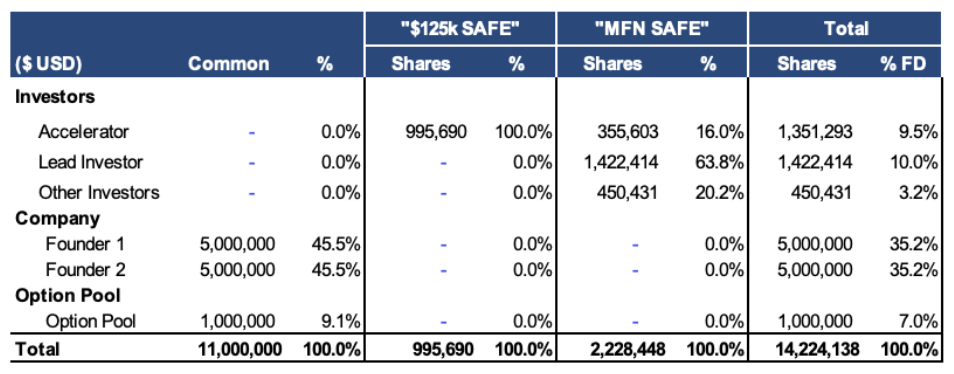
5. Know Your Audience
This fundraise is just the beginning of your journey! Negotiations can be an excellent way to continue building trust and rapport with a new investor at the table.
Tip: Understand how the levers you have as a founder (round size, valuation, option pool, etc.) can be used towards your ultimate aim (capital raised, valuation, dilution, etc.), and also try to understand your lead investor’s objectives (check size, ownership, valuation, etc.).
In the illustrative scenario outlined above, the lead investor may have been solving for a minimum ownership stake of 10% with their $1.5M check – consequently, there was less than $500k available for other investors to participate. By toggling scenarios in advance, you’ll be able to prioritize conversations and ideally solve for a win-win outcome with prospective investors.
Let’s Talk
We’re here to help founders on their journeys. Get in touch if we can be helpful as you prepare for pitch days. We fiercely believe in doing our part to foster a more diverse and inclusive start-up ecosystem for everyone.
The post Demo Day: Five Tips for Founders appeared first on Point72 Ventures.
]]>The post Customer Service x Large Language Models appeared first on Point72 Ventures.
]]>Our Perspective
In Generative AI: Context Is All You Need, we shared our excitement for the application of large language models (LLMs) like GPT-3 for use cases across the enterprise. When evaluating different business workflows that would benefit from LLMs’ retrieval and synthesis capabilities, customer service stands out to us as a particularly great fit.
Today, customer service teams operate in information siloes, deal with spikes in request volumes, and struggle to hire and retain talent. These characteristics set the stage for new, context-aware search and generation tools that make it possible to scale high-quality, in-house customer service in ways that were not previously possible.
Companies using LLMs may:
- Make customer service agents more productive through AI copilots.
- Enable intelligent, automated resolution of customer service requests.
- Build omni-channel and/or multi-lingual product offerings.
- Sell to businesses that purchase this technology for their in-house customer service teams.
Why is now the right time to apply LLMs to customer service?
LLMs, also referred to as foundational models, are spurring renewed enthusiasm for applying AI to enterprise use cases by lowering the costs of training and making state-of-the-art machine learning more accessible.
In the past, models had to be built and trained specifically for a use case making it expensive to deploy and maintain models in production. Leveraging a new neural network structure called transformers and using vast training data sets, LLMs have demonstrated the ability to handle common enterprise tasks like information retrieval and text generation out-of-the-box without explicit task-specific training. The industry refers to this as few-shot or zero-shot learning. Few-shot / zero-shot learning capabilities reduce training costs by reducing the size of training data corpus and computation necessary to deploy state-of-the-art machine learning models. LLMs can be further fine-tuned or fit to domain-specific use cases (e.g., healthcare insurance summarization) with smaller datasets.
We believe LLMs could allow in-house customer service teams to achieve up to 10x productivity gains through a mix of intelligent automation and AI-augmented productivity tools for agents.
What are shortcoming of LLMs?
- LLMs are still costly and computationally intensive to train, fine tune and host.
- Limitations on the amount of input they can consume.
- A risk of “hallucinating” or producing output that is false.
The Market and Opportunity
Customer experience encompasses all touch points a customer has with a business – before, during, and after a sale. These touch points include:

While all stages of the customer experience lifecycle are interesting to Point72 Ventures, here we will focus on the opportunities in the Customer Service segment.
What did we observe in network conversations and market research?
We believe that customer service presents a large market opportunity…
- Changing consumer preferences increase the complexity of customer service workflows.
- Customers today are digitally savvy and demand better customer service. [Zendesk, 2022]
- Businesses desire solutions, especially as the perception of customer service shifts from cost center to organic growth center.
- Customer service headcount has traditionally scaled linearly with the number of customers; and yet, businesses are struggling to hire and retain agent talent. [Harvard Business Review, 2021]
- Worsening the issue, the volume of customer service requests is only increasing.
…for solutions addressing the pain points related to these manual, rote tasks.
- Request volume is volatile and unpredictable.
- Issue resolution is a fragmented, convoluted process.
- Software that improves agent productivity improves the agent experience and reduces agent churn.
What’s the opportunity?
We’ve been busy to date, investing in companies that have the potential to lower costs by automating simple tasks or augmenting workflows that require human review.
- [Automate] Superhuman conversational AI agents like PolyAI and Tenyx allow businesses to reduce the cost of staffing customer service agents around the clock and handle simple requests from intake to resolution.
- PolyAI works with FedEx to autonomously assist customers that call to check on the status of their package, select preferred delivery timeslots, or even reschedule their delivery date. The company also works with restaurants to handle customers that call to book a table, change an existing reservation, or even cancel a reservation entirely.
- [Augment] Agent augmentation solutions like Tomato allow businesses to tap into cheaper offshore workforces.
- Tomato is building a technology that aims to make agents more intelligible in real-time.
- [Augment] Agent augmentation solutions like Unbabel can help businesses do more with the current workforce they have.
- Unbabel’s real-time language translation technology can allow agents to understand and communicate with customers from around the globe through chat.

We believe there are additional opportunities around AI solutions that can create improvements in the research and resolution process.
- [Automate] Large, pre-trained models may allow businesses to leverage conversational AI agents that can handle more complex issues from intake to resolution.
- [Augment] AI-augmented tools for agents could equip support teams with technology that will help them resolve complex issues faster.
Technology
Why do we believe LLMs are important?
- Customer service operations produce rich sets of training data that can be used to configure LLMs.
- LLMs are particularly applicable to the customer service space due to the corpus of domain-specific, text-based training data that arises from customer service requests, tickets, and transcripts of calls.
- This data can be used to train or fine tune LLMs in order to alleviate the workload on customer service agents and enhance the customer experience.
- These LLMs provide the underlying architecture for virtual agents; thereby enhancing the intelligibility of human agents and improving existing workflows, such as routing and analytics, by parsing through customer service tickets and providing customer insights.
- LLMs have powerful retrieval and generative capabilities.
- They can quickly search through more text than any human, which could allow LLM-based conversational AI to respond more effectively to customers during more complex conversations than previous rules-based bots.
- LLM-augmented agent tools could anticipate, synthesize, and deliver the right answers and context to agents for each task. This would eliminate the need for the agent to open up a bunch of tabs and software tools to go fishing for information.
- We’ve observed that LLMs perform well on generating meaningful, logical content in medium form lengths. Most customer service interactions require only the generation of short form text (a few sentences), so they are well positioned to generate text that is coherent and relevant.
- LLMs are able to handle many tasks with few-shot learning capabilities.
- This means that they can quickly generalize to unseen text and issues, and generate compelling responses, with just a few examples. LLMs are thus particularly well suited for customer service, where there is a long tail of potential customer requests that are impossible to plan for up front.
- For example, LLM-based conversational AI could handle many more task edge cases without needing to be explicitly trained using finely-labelled and curated training data sets.
- LLM-augmented agent tools could also detect many more edge cases in how a customer might describe an issue without being explicitly trained to recognize those cases.
- LLMs require less configuration effort from customer service teams, meaning there is a faster anticipated overall time to value.
- First-generation chatbots required customer success teams to manually define rules and outcomes (e.g., “if customer inputs X, output Y”), a significant up-front configuration effort for limited triaging capabilities.
- LLMs are pre-trained, and can be fine-tuned on company specific data. While this process requires implementation time and costs, it is automated and the model cancould be deployed immediately thereafter, reducing the time to value.
Conclusion
The proliferation of department-specific software created SaaS sprawl and data silos.
- Okta’s 2022 annual report estimated that organizations use about 89 applications on average. Larger organizations (2,000+ employees) may have over 180. [Okta, 2022]
- Marketing, sales, and customer success teams have their own systems, creating tool sprawl and data silos.
Data integration and pipeline solutions enable organizations to centralize and analyze data from across disparate systems.
- SaaS platforms increasingly offer API / database replica access to allow developers to access and centralize information across systems.
- Businesses have started to develop ecosystems of integrations that allow insights from one system to enrich another.
- For example, businesses have started to leverage pre-built or custom integrations to be able to hydrate customer engagement systems with information from other tools (e.g., surfacing Salesforce data in Zendesk).
LLMs will take advantage of data centralization and more robust API pathways to integrate ML more intelligently into end user workflows.
- Coupling LLMs’ few-shot, zero-shot capabilities with vast, centralized enterprise datasets could enable machine learning models to handle many downstream tasks without explicit training.
- We believe businesses will be able to deploy LLM byproducts to customer-facing interfaces (e.g., issue management platforms, chat) more easily as enterprise API infrastructure continues to mature – i.e., more flexible API design, troubleshooting tools, monitoring.
We expect in-house teams (businesses) to capture more value from LLMs than outsourced service providers.
- Businesses can reduce reliance on outsourced solutions by using LLMs to automate less complex customer requests and equip agents with AI to resolve more complex issues faster.
- Businesses leverage outsourced solutions to offload workload, tap into cheaper labor pools, or expand into new geographic regions.
- While outsourced solutions allow businesses to tap into cheaper labor pools and expand coverage into new regions, external solution providers lack the data access and context necessary to provide holistic customer service experiences.
- Outsourced solutions like contact centers also have per-hour business models that reduce the value of increased productivity.
Please reach out if you are…
- Forming your own perspective on the LLM space
- Building the next generation of LLM-enabled tools to assist in research and problem resolution
- Looking to join an exciting early-stage startup working on LLMs
- Searching for customer service solutions that leverage LLMs
The post Customer Service x Large Language Models appeared first on Point72 Ventures.
]]>The post The Next Dimension of Generative AI appeared first on Point72 Ventures.
]]>The old adage “a picture is worth a thousand words” shows why there’s currently such an explosion of interest in and excitement around AI. It started as enthusiasm for AI text generation (i.e., text-to-text; e.g., ad copy generation) and its potential, and has escalated to fervor as advances in image generation lead to a flurry of compelling showcases and proofs-of-concept.
We’re intrigued by these eye-catching demonstrations of how models can reduce barriers to creating everything from digital portraits to interior design ideas. While experimenting with text-to-image interfaces, we were also struck by the difficulty of generating content requiring a high degree of precision. It took us a few prompts in Stable Diffusion before producing the beautiful Pensieve image we used in Generative AI: Context Is All You Need.
These exciting interfaces are primarily generating 2D content, which begs the question, If a picture is worth a thousand words, then how many is a video worth? We believe 3D content is not only valuable, but also a great place for startups to build. 3D content generation is much more difficult and time-consuming to create. Additionally, there are fewer people that have the necessary skills to produce it.
Landscape:
We believe AI can contribute to huge improvements in scaling 3D content generation. We have sought over the past few years to identify companies working on problems that require fast and precise generation of 3D assets and models. A few use cases that we come across frequently include 3D for digital commerce, 3D for simulation, and 3D for manufacturing.
For example, we invested in Hexa in 2020. Hexa uses generative models to produce high-fidelity 3D counterparts that can be used for digital commerce. Large digital retailers rely on Hexa’s technology to give customers the option to view potential purchases in 3D, and game developers use Hexa to populate virtual worlds with precise replicas of real-world objects. With each generated asset, Hexa collects valuable information such as object shape, surface texture, and color that the company uses to improve model performance, making it cheaper and faster to generate content over time.
Like Hexa, Point72 Ventures’ portfolio company Blackshark uses models to generate 3D assets from 2D data. While Hexa is focused on objects, Blackshark uses generative models to reconstruct assets at planetary scale. Traditional 3D applications required hand modeling or photogrammetry solutions to create digital twins, but Blackshark is able to transform 2D imagery into synthetic 3D scenes. In less than 72 hours of processing time, Blackshark reconstructs the entire planet including its billions of buildings and billions of vegetation acres in annotated 3D [VentureBeat, 2022]. By creating accurate and multi-faceted 3D worlds, the company can enable immersive user experiences like Microsoft’s Flight Simulator.
Finally, we anticipate companies will build generative models that can simulate complex, time-consuming, and expensive processes. For example, Atomic Industries is building models to help manufacturers generate designs for tool and die making – a critical process in producing plastic objects. Traditionally this process requires skilled tool engineers to iterate on designs for months until they arrive at one that meets requirements. Atomic’s technology would rapidly generate designs and evaluate each iteration using simulation and models, which could significantly reduce design time and engineer involvement. In summary, Atomic believes that its generative design technology will help reduce the complexity of tool design and alleviate a major bottleneck in manufacturing.
We’re excited about these businesses because they demonstrate how generative models could solve pressing enterprise problems in specific verticals. As these model-driven businesses expand their engagements with early adopters, they collect valuable data that can be used to further refine their generative capabilities. Over time, we expect their models to improve to the point where they can efficiently serve the long tail of customers.
Action Shot:
As generative models continue to improve their ability to generate image and video content over the coming months, we anticipate startups will tackle novel use cases that were not previously possible. For example, we’re eager to speak with individuals considering generative AI solutions for film and television, or founders building tools to enable low latency, immersive 3D environments in the gaming space.
The post The Next Dimension of Generative AI appeared first on Point72 Ventures.
]]>The post Latin America’s financial infrastructure revolution appeared first on Point72 Ventures.
]]>Re-bundling fintech in Latin America
Launching a fintech product in Latin America a decade ago was no easy feat. Regulation at the time made it difficult to launch financial offerings independently, and entrepreneurs had no choice but to partner with financial services incumbents and legacy technology vendors to bring their product to market. As a result, launching a fintech offering tended to be expensive, slow, and require significant domain expertise.
Given the high barriers to entry, first movers in the region typically started out as point solutions targeting specific product verticals such as banking, lending, or investing, among others. Our portfolio company Ualá launched with a simple prepaid card in Argentina while Covalto offered secured loans to small businesses in Mexico.
In order to fend off competition and avoid commoditization of their core offerings, more mature fintech startups in Latin America have come under pressure to expand their product sets. Today, both Ualá and Covalto have transformed from mono-product solutions to one-stop-shops offering a wide array of financial services. Rather than rely on financial institution partners, both companies acquired legacy banks.
At the same time, we believe non-financial companies such as marketplaces, enterprise software providers, proptechs, and even ride-hailing players are also looking to incorporate financial products that generate new revenue streams and increase the stickiness of their client bases. Our portfolio company Contabilizei in Brazil launched as an accounting software product for small businesses, but later expanded their offering by embedding bank accounts, payments solutions, and other financial services. Likewise, our portfolio company Influur offers cross-border payouts as part of their marketplace for influencers and brands in the U.S. and Latin America.
Developing a new financial infrastructure layer
Fortunately for companies today, we believe it has never been easier or cheaper to launch a fintech product in Latin America. Thanks in part to the success and scale of first movers in the region, incumbents ranging from MasterCard to Amazon Web Services now have dedicated teams focused on startups. Likewise, companies don’t need to acquire a legacy bank license in order to operate – local central banks have rolled out new regulatory frameworks with lower capital requirements in an effort to shake up entrenched banking oligopolies.
In response to rising demand, an entire ecosystem of financial infrastructure startups has emerged that enables companies to on-board users, facilitate payments, unlock alternate data, and embed a wide range of financial products in a seamless and cost-effective manner:

Building blocks for the next wave of innovation
These embedded solutions will enable entrepreneurs to launch the next generation of digital banks, investing apps, lenders, and payments companies in Latin America. For example, our portfolio companies DriveWealth and Zero Hash enable companies in the region to launch stock and crypto trading products. Notably, by building on top of de novo infrastructure, these new entrants have the capability to launch faster while potentially avoiding the technical debt incurred by their predecessors.
At the same time, mature startups adopting embedded finance solutions may increasingly resemble super apps, offering everything from crypto to cell phone plans and even embedded marketplaces. Thanks to new embedded solutions, some of the largest fintech companies of the next decade in Latin America may not come from financial services origins at all.
We believe embedded solutions will also optimize a variety of business processes for both startups and corporates. For example, our portfolio company Incognia provides frictionless mobile authentication in order to decrease fraud rates, while Syncfy provides centralized API access to financial data that can be utilized for user on-boarding, underwriting, and other use cases.
Even more exciting, this infrastructure layer has the ability to produce entirely new business models made possible by modular product capabilities. For example, our portfolio company Ontop built a global payroll solution with USD accounts powered by next-generation infrastructure. This type of platform would have been highly cost-prohibitive and taken significant time to launch even a few years prior.
We believe innovation will only continue to accelerate in the region as financial infrastructure players lower barriers to entry for launching new products and business models. We believe we are still in the early innings of the fintech revolution in Latin America and will continue to actively pursue investment opportunities in both financial infrastructure as well as the next wave of platforms built on top.
Why startups work with Point72 Ventures?
Point72 Ventures is a global venture capital strategy led by a diverse set of domain experts with the capital and mandate to lead rounds through all stages of a company’s growth, from idea to IPO. The team invests in founders with bold ideas who use the latest technologies to drive transformational change across industries. Point72 Ventures offers entrepreneurs access to expertise and insights, executive and technical talent, and hands-on support. Point72 Ventures is an affiliate of Point72, the global asset manager founded by Steven A. Cohen.
The Point72 Ventures fintech investment team has deep expertise in financial services and technology, with over 100 years of combined experience across our team and an active portfolio of nearly 50 fintech companies. We work with our portfolio companies on everything from go-to-market strategy to fundraising to business development to helping build the right product. We are applying this expertise, and resources to a growing portfolio of Latin America investments.
Please reach out if you are…
- Building a financial infrastructure company in Latin America. We are focused on investing in companies from first money in up to seed and Series A.
- A financial institution, fintech, or enterprise in Latin America looking to partner with financial infrastructure partners.
- Looking to make the career leap into Latin America fintech. Our portfolio companies Contabilizei, Covalto, DriveWealth, Incognia, Influur, Ontop, Syncfy, Ualá, and Zero Hash are all hiring for various roles. You can find open positions here.
The post Latin America’s financial infrastructure revolution appeared first on Point72 Ventures.
]]>The post Generative AI: Context Is All You Need appeared first on Point72 Ventures.
]]>Generative AI: Context Is All You Need
In Dumbledore’s office, Harry Potter stumbles across a Pensieve – a magical stone basin allowing his Hogwarts Headmaster to transfer and store memories from his mind to be referenced and studied at a later moment.
 Pensieve illustration created with Stable Diffusion
“One simply siphons the excess thoughts from one’s mind, pours them into the basin, and examines them at one’s leisure. It becomes easier to spot patterns and links, you understand, when they are in this form.”
In short, using the Pensieve allows Dumbledore to avoid information overload and identify insights that weren’t apparent to him when stuck in his head. We see many parallels between Dumbledore’s Pensieve and foundational models like BERT and GPT-3 – large pre-trained machine learning models trained over vast swaths of the Internet. Like a Pensieve, foundational models can store vast amounts of information that humans would struggle to hold in short-term memory and help uncover insights relevant to completing the task at hand.
Foundational models already power technology that we use every day. A few examples include (1) Google’s query completion feature which predicts a user’s search phrase based on the first few typed words and (2) its answer snippet feature which predicts and synthesizes an answer in response to the user’s search query.
1. Query prediction leveraging foundational models

2. Answer snippets leveraging foundational models

Google’s intelligent search features are great demonstrations of how models can serve as a sort of Pensieve for users – equipping them with terabytes of memory which can be leveraged just-in-time for any task. In the near-future, users may no longer need to click into and read webpages and documents to identify the answer to a question – by leveraging foundational model’s retrieval and synthesis capabilities, search will become single-page, and answer-first.
While Google was early to implement foundational models into its products, we anticipate that these technological advances will be impactful across enterprises where 80-90% of data is unstructured in the form of text, audio, images, and video.
The future of work
This technology will have widespread impacts across businesses by making workers more productive and more collaborative. First, we believe context-aware generation will drive productivity gains in the workplace – particularly where there is a large demand for throughput and compressed timelines.
Companies like Copy AI and Jasper have rapidly built large customer bases by helping content creators automate the rote, manual work of rephrasing and iterating on advertising copy – a time-consuming task at-scale. Shifting the burden of drafting and optimization to models creates time for human writers to focus on the nuances that require human intuition.
A second major benefit of this technology is enabling businesses to break down information siloes, making it easier for workers across the organization to easily access insights produced in different parts of the business.
For example, product marketers today may have multiple meetings with cross functional teams to collect and stitch together the information necessary to write a relevant and compelling case study. Imagine an AI application for long-form marketing documentation that leverages insights from every customer conversation, competitive intelligence briefings, and product strategy documentation to assist the writer in generating drafts and suggest supporting points.
By embracing context-aware workflows, business will be able to proactively push insights to their knowledge workers at the most opportune time. Enterprise knowledge has ephemerality – in today’s ever-changing environments, insights are most useful when they can inform a conversation, negotiation, decision, or debate. Imagine this paradigm spreading to design, learning and development, brand identity and more, unlocking new ways of working and creating value.
How we evaluate opportunities
Point72 Ventures has made several investments in context-aware, generative AI. We look forward to speaking with founders that are thinking about or already building businesses that leverage these advancements. When evaluating these investments, we consider factors such as:
Feasibility
- Domain-specificity: Is the context and information for the task general or public knowledge?
Desirability
- Throughput scale: How much rote, manual work is being done today?
Viability
- Value creation: How expensive is the time of workers who complete these tasks today? Could their time be shifted to tasks that require more human intuition?
In addition to these criteria, a few questions we ask for all AI application founders include:
- Making it Magical: How does the product weave AI into the fabric of workflows to make them more meaningful, productive, and even magical?
- Feeding the Beast: How does the product build feedback loops to make features and workflows iteratively better over time?
While foundational models unlock a vast set of compelling use cases, they come with a host of obstacles that founding teams will need to consider as they build more complex interfaces for enterprise adoption. These challenges include the potential for models to produce non-truths (hallucinate) or produce offensive or biased content. With current methods of pre-training, models can also quickly become outdated, unable to keep up with current events or changes in knowledge.
Despite these challenges, we are energized by the pace of innovation and believe that advancements in infrastructure and tooling will help entrepreneurs overcome these hurdles and amplify the benefits of these large pre-trained models.
We welcome founders who can bring their own experiences and views to help us “spot patterns and links” and we are committed to helping them strengthen their own conviction through close partnership and collaboration.
“I sometimes find, and I am sure you know the feeling, that I simply have too many thoughts and memories crammed into my mind.”
The post Generative AI: Context Is All You Need appeared first on Point72 Ventures.
]]>The post Looking Ahead in Growth-Stage Investing appeared first on Point72 Ventures.
]]>In many instances, private companies were focusing more on “growth at all costs,” and took their eye off the need to build enduring, healthy businesses. Now the capital markets are adjusting and we’re in a period where even the largest tech firms in the world are scaling back or tapering growth.
This has caused some in the venture capital and private investments space, stung by falling valuations, to scale back on investing in the tech space, but we’re not. We’re actively leaning in.
At Point72, we know what the best enduring public companies in the world look like. We invest in private companies at every stage of their growth, and we know the enormous amount of effort and work it takes to build a world-class business.
We’re as bullish about the potential of private technology companies as we’ve ever been and believe the scalability of technology, especially software, feeds the power laws that will continue to reward the best companies in a category. Many technology business models have the best margins, go-to-market potential, repeatability, and network effects out there.
Throughout the last 20 years, we’ve seen some companies scale incredibly efficiently by capitalizing on advances in technology, and we believe we’ll continue to see that pace accelerate over the next 20 years as innovation continues to grow. Now is when we will see the very best companies flourish in the market.
We’re excited about companies like Boulevard, our latest investment, which is the most comprehensive modern-day software solution for the self-care market. It’ll allow spas, salons, barbershops, med spas and a host of other self-care services to offer a seamless digital experience for booking and managing appointments. We think there’s still a long runway in the take-up of technology by consumers and businesses, and this is just one example of a company driving that transformation.
Founders sit at the nexus of these changes and are balancing different priorities in terms of runway, driving topline growth, continuing to execute on product, and pursuing strategic initiatives. We think it’s an opportune time to partner with founders and support them in building enduring market-leading technology companies, and we are creating a growth platform that is designed to be the very best partner to founders as they scale to IPO.
Why work with Point72 Private Investments?
Point72 Private Investments is an institutional private investing platform that includes Point72 Ventures and Point72 Hyperscale, a private equity strategy that uses applied artificial intelligence to build and modernize market-leading companies. Point72 Private Investments, Point72 Ventures and Point72 Hyperscale are affiliates of Point72 Asset Management, the global asset manager founded by Steven A. Cohen. For more information, visit p72.vc and p72hyperscale.com.
Legal disclaimer: The contents of this page are intended to inform about the value of potential partnerships with Point72 Private Investments. The contents are not directed to any investors or potential investors, do not constitute an offer to sell, or a solicitation of an offer to buy, any securities, and may not be used or relied upon in evaluating the merits of any investment. Content published in posts written by Point72 Private Investments personnel does not necessarily represent the positions, strategies or opinions of Point72 Private Investments or its affiliates, regardless of whether links to these posts are provided on this website. For other website terms of use, please visit here.
The post Looking Ahead in Growth-Stage Investing appeared first on Point72 Ventures.
]]>The post Point72 Ventures Supports Stellar Health and Other Portfolio Companies with Social Impact Partnership appeared first on Point72 Ventures.
]]>Stellar Health, a healthcare technology company, recently became the first of our portfolio companies to hire from the DS4A program’s diverse pool of vetted data talent when two fellows, Kyle Thomson and Angel Zelazny, joined their Business Intelligence department after a competitive interview process.
“We believe that all teams are made better by having a diverse set of voices, backgrounds, and perspectives,” said Miguel Vargas, a member of Point72’s proprietary research team and business partner for the DS4A program. “Jobs in technology, data analytics, and fintech have chronic representation gaps for women, BIPOC, Hispanic / Latin and LGBTQ+ professionals, and we’re committed to identifying tangible solutions.”
“Point72 is proud to be partnering with DS4A to expand their reach and increase representation not just at our Firm, but with Point72 Venture’s portfolio companies,” said Jeanne Melino, Chief Inclusion and Community Officer at Point72.
Point72 was a founding partner of DS4A in 2019, and has helped grow the initiative to one of the most recognized, world-changing ideas in education and social impact in the data analytics space.
DS4A’s admissions process is extremely competitive. The program receives nearly 50,000 applicants per year and invites nearly 1,000 individuals to join the program as DS4A fellows. To date, the initiative has provided free training and career support to over 4,000 individuals, with nearly 90% of graduates achieving a career advancement after program completion.
Point72 partners with DS4A throughout the year by providing mentorship and financial support, and by connecting program graduates with roles at our firm and our portfolio companies.
“DS4A presented us with a diverse array of talent from non-traditional backgrounds,” said Eddie Mengana, hiring manager at Stellar Health. “Finding and recruiting top technical talent has changed in a fundamental way in a post-pandemic world. Buoyed by a tight labor market, we have had to be strategic about the outside resources that we leverage to build our business. Thanks to our partnership with Correlation One by way of Point72, we were able to zero in on strong candidates that really met our needs in a short period of time.”
Angel has a background in data analysis and graduated from Kansas State University with a degree in mathematics and statistics. Kyle has a background in user research and data quality analysis and graduated from California Polytechnic State University with a degree in physics and a minor in mathematics.
Angel and Kyle said they were both excited for the opportunity to join Stellar Health.
“Everyone I’ve talked to from the company has been absolutely great,” Angel said. “I think it’s going to be a great opportunity for me to develop my career and analytics skills, and I’m glad I found the opening through DS4A. My degree in mathematics and statistics has been a great foundation, but the DS4A program really opened doors to other opportunities through the network it provided me and by giving me more hands-on experience in building foundational skills.”
Kyle said that his experience with DS4A “has been extremely rewarding and has had a major impact on my confidence and ability to succeed as a data analyst. I originally applied to DS4A just a couple months after I had graduated college and my only experience with data science was mainly theoretical and wouldn’t transfer well to a business environment.”
“The professional development opportunities DS4A gave me have made me so much more confident in my ability to succeed as a data science professional,” he added. “I’m so excited to contribute to the success of Stellar Health.”
We hope Stellar Health is the first of many portfolio companies to take advantage of this relationship with Data Science for All! They can help bring diverse and exceptional talent to your organization and save you time along the way.
The post Point72 Ventures Supports Stellar Health and Other Portfolio Companies with Social Impact Partnership appeared first on Point72 Ventures.
]]>The post Our Investment in Boulevard appeared first on Point72 Ventures.
]]>The self-care market is booming. Spas, salons, barbershops, med spas and a host of other self-care services have not only seen appointments spike after years of Covid lockdowns and social distancing but are now growing faster than ever. According to a recent survey, two-thirds (67%) of Americans agreed that the expanded personal self-care routines they developed during the pandemic had become a permanent part of their daily lives.
At the same time, when the Covid pandemic caused much of the world to hit pause on brick-and-mortar stores and services, the public’s engagement with technology irrevocably changed. People became accustomed to technology making their lives easier and more connected, whether it was one-click shopping or grandparents setting up family Zoom calls. As we’ve resumed normal life, many store owners have realized that their outdated software is no longer keeping up.
This confluence is fueling the incredible growth potential for Boulevard. As the self-care industry continues to grow, so too will the role technology plays in creating the seamless experiences that keep clients coming back. Not only has Boulevard designed an elegant and visionary platform that fills a pressing need in a fast-growing industry, but we believe they’ve also built a thoughtful, customer-centric culture validated through world-class client retention numbers.
When we spoke with Boulevard’s customers, we heard over and over again how Boulevard created additional revenue opportunities for their businesses, streamlined operations, and leveled up the digital experience for their customers. Boulevard co-founders Matt Danna and Sean Stavropoulos spent months working out of the very salons and spas that they now provide their software to. Their knowledge of their customers informs their ability to create an effective software solution to drive customer satisfaction and retention.
We’re excited to welcome Boulevard to the Point72 Private Investments portfolio and look forward to supporting their next phase of growth.
Legal disclaimer: The contents of this page are intended to inform about the value of potential partnerships with Point72 Private Investments. The contents are not directed to any investors or potential investors, do not constitute an offer to sell, or a solicitation of an offer to buy, any securities, and may not be used or relied upon in evaluating the merits of any investment. Content published in posts written by Point72 Private Investments personnel does not necessarily represent the positions, strategies or opinions of Point72 Private Investments or its affiliates, regardless of whether links to these posts are provided on this website. For other website terms of use, please visit here.
The post Our Investment in Boulevard appeared first on Point72 Ventures.
]]>The post Building Bridges to Crypto appeared first on Point72 Ventures.
]]>We believe we are in the early stages of Web3, a new paradigm of the internet powered by blockchain and crypto technology. Web 1.0 was a read-only internet that gave users access to information like never before; Web 2.0 was a read-write internet that allowed users to consume and create content; Web3 will be a read-write-own internet built on crypto rails where users are also the owners of the platforms. This will allow users to have more direct access to the decision making and financial benefits of these platforms that was previously available only to management and shareholders.
A complete transition to this new crypto world will take time, as customer behavior isn’t easy to change, and the many different innovations need time to mature. But, as consumers begin adopting new Web3 crypto-powered experiences, financial institutions and businesses will all need to start adapting to remain competitive—and they will need a lot of help getting there.
At Point72 Ventures, we are interested in investment opportunities in the new set of infrastructure companies that are bridging the crypto and non-crypto worlds for financial services, enterprises, and consumers—ultimately helping to bring crypto to millions of businesses and billions of people around the world.
Financial Institutions
We believe that crypto is the largest disruptive force to the financial services industry since fintech, which has taken market share from incumbent financial institutions over the past decade. Financial institution participation in crypto began reluctantly because crypto was still nascent, misunderstood, and very risky, but there has recently been a seismic shift in receptivity as the industry has watched crypto scale to become a $2 trillion asset class, opening an entirely new frontier of blockchain-based financial services.
Financial institutions are also seeing a meaningful increase in client demand for crypto exposure. Fidelity’s most recent Institutional Investor Digital Assets Survey found that 52% of surveyed asset managers had purchased digital assets (up from 36% the prior year) and 70% of all investors surveyed have a neutral-to-positive outlook on digital assets (up from 60%).
Widespread adoption of crypto as a new asset class by traditional financial services firms will require new infrastructure that makes crypto look and feel like other tradable asset classes (i.e., equities, FX, or derivatives markets). But, building crypto products will likely present challenges for incumbent financial institutions as it requires domain expertise, regulatory licensing, and new technology.
Because of this, we believe that most incumbent financial firms will look to crypto-native infrastructure companies to help them launch new crypto products for their customers. We are already seeing the emergence of a new crypto-focused vendors ecosystem within custody, trading technology, embeddable infrastructure, and research and market data providers, and we only expect that to grow.
Our early investments in the crypto space have been in companies that help traditional financial institutions adopt crypto, such as:
- Messari, a crypto data, news and research aggregator that provides a trusted source around crypto tokens for both retail and institutional investors
- Zero Hash, which enables fintechs, neobanks, and financial institutions to quickly and easily launch their own crypto trading, rewards, and yield products
- 24Exchange, which has pioneered the crypto non-deliverable forward contract, which will enable the world’s largest financial institutions to trade crypto without taking custody of tokens
Consumers
Consumers are another key market for crypto products. Up to this point, early adopters of crypto, especially users who wanted to participate in decentralized finance (DeFi) or NFTs, have needed to be technically savvy. But in order for crypto to reach a broader consumer marketplace, an abstraction layer is needed to make it more user friendly and to allow non-technical people to buy, sell, or hold crypto in this new and complex token-based world.
This will require bridges to be built to enable digital assets to be incorporated into payments systems, e-commerce, entertainment, gaming platforms, and much more while also delivering a smooth user experience. In many cases, consumers may not even realize that the platform they are using is powered by a crypto product or blockchain, but the benefits of this new generation of technology will be obvious.
One such company in our portfolio is Massive, which has created a new way for consumers to pay for apps and digital services by leveraging the idle processing power and bandwidth of their devices, and a new way for developers to monetize their applications, without having to rely on paywalls or advertising.
We believe that some new crypto-native companies (ones that don’t have existing business models or non-crypto products) will emerge and scale, but we believe the best avenue for mass consumer adoption will be through established, trusted brands that partner with crypto infrastructure companies. A survey by crypto custodian NYDIG finds that 80% of Americans would rather hold tokens with a bank or fintech and 85% would rather purchase them through their bank or fintech. Zero Hash is one such example of an infrastructure company that is helping existing fintechs, neobanks, brokers and financial institutions to offer crypto to their existing customers.
Enterprises
Similarly, enterprises have a multitude of use cases in which they might want to incorporate crypto into internal systems for treasury, supply chain management, invoicing and billing, payroll, and more. Leveraging crypto provides some advantages over legacy solutions because everything is tracked by the blockchain, which allows for a higher level of transparency and traceability. This means companies can monitor their supply chain at both a global scale and at the most granular levels, or pay contractors in 10 different countries without the complexity and reliance on several local banks or currencies. The ability to move assets between accounts, businesses, and countries almost instantaneously and at extremely low costs unlocks a new level of efficiency within these organizations. In some cases, businesses will be forced to handle crypto and digital assets simply because that is what their customers and the market demands. We expect that enterprises will also partner with specialized crypto infrastructure providers as they make the jump to a digital world.
What’s next: Investing directly into Web3
While we initially focused our investment thesis on investing in the crypto infrastructure that’s building the bridges to Web3 (mainly equity investments), we are also exploring opportunities to invest in Web3 companies directly (token investments). Given our fintech expertise, we expect to be mainly focused on the emerging world of DeFi. However, we are also excited about blockchain infrastructure (L1s, L2s, developer tools, DAO tooling) and Web3/crypto-based consumer application infrastructure supporting industries such as NFTs, gaming, social, commerce, and media.
Why work with Point72 Ventures?
Point72 Ventures is a global venture capital strategy led by a diverse set of domain experts with the capital and mandate to lead rounds through all stages of a company’s growth, from idea to IPO. The team invests in founders with bold ideas who use the latest technologies to drive transformational change across industries. Point72 Ventures offers entrepreneurs access to expertise and insights, executive and technical talent, and hands-on support. With offices in the U.S. and Europe, Point72 Ventures is an affiliate of Point72, the global asset manager founded by Steven A. Cohen.
The Point72 Ventures fintech and crypto investment team has deep expertise in financial services and technology, with over 100 years of combined experience across our team and an active portfolio of nearly 50 fintech companies. We work with our portfolio companies on everything from go-to-market strategy to fundraising to business development to helping build the right product. We are applying our deep expertise, network, and resources to a growing portfolio of crypto investments.
Please reach out…
- If you are building bridges to the crypto world for financial institutions, enterprises, or consumers, or are building Web3 itself and launching a decentralized project. We are focused on investing in crypto companies from first money in up to seed and Series A.
- If you are a financial institution, fintech, enterprise or brand looking to enter the crypto/Web3 world. We would be happy to share our thematic work and help drive strategic partnerships.
- If you are looking to make the career leap into crypto. Our portfolio companies Messari, Zero Hash, 24XExchange and Massive are all hiring for various roles. You can find open positions here.
Crypto @ Point72 Ventures
The post Building Bridges to Crypto appeared first on Point72 Ventures.
]]>