What Are ICMP Pings?
ICMP pings, part of the Internet Control Message Protocol (ICMP), are a way to test if a network device, like a server, is reachable. When you send a ping, your device sends a small message called an echo request to the target, and if
]]>What Are ICMP Pings?
ICMP pings, part of the Internet Control Message Protocol (ICMP), are a way to test if a network device, like a server, is reachable. When you send a ping, your device sends a small message called an echo request to the target, and if it’s up, it sends back an echo reply. This helps check if the device is online and measures how long the round trip takes, which is useful for spotting network delays.
How Do They Work?
ICMP pings work by using specific message types within ICMP. The echo request is type 8, and the echo reply is type 0. When you run a ping command, it sends an echo request to the target IP address. If the target is active and set to respond, it sends back an echo reply. The ping tool then calculates the time it took, giving you the round-trip time (RTT), which shows network latency.
Uses in Uptime Monitoring
For businesses monitoring server uptime, ICMP pings are key. They help check if a server is reachable, alerting admins if there’s no reply, which might mean the server is down. However, some networks block ICMP for security, so uptime monitors often combine pings with other checks like HTTP requests for a fuller picture.
In Depth
Introduction to ICMP and Its Role
The Internet Control Message Protocol (ICMP) is a vital component of the Internet Protocol (IP) suite, operating at the network layer to facilitate error reporting and diagnostic functions. Unlike protocols like TCP or UDP, which focus on data transmission, ICMP is designed to communicate issues related to IP packet delivery, such as when a packet cannot reach its destination due to network problems. This makes it essential for network management and troubleshooting, particularly in contexts like uptime monitoring for SaaS businesses.
ICMP messages are encapsulated within IP packets, allowing them to interact directly with the network layer. They are categorized by a type field (e.g., echo request, destination unreachable) and a code field for additional context. Common types include:
| Type | Description |
|---|---|
| 0 | Echo Reply |
| 3 | Destination Unreachable |
| 4 | Source Quench |
| 5 | Redirect |
| 8 | Echo Request |
| 11 | Time Exceeded |
| 12 | Parameter Problem |
This structure enables ICMP to handle various network diagnostics, with echo request and reply messages being central to the ping utility.
How ICMP Pings Operate
ICMP pings, specifically, utilize the echo request (type 8) and echo reply (type 0) messages. When you execute a ping command, your device sends an ICMP echo request packet to the target IP address. If the target is operational and configured to respond, it returns an echo reply. The ping tool measures the time from sending the request to receiving the reply, known as the round-trip time (RTT), which indicates network latency.
The process can be broken down as follows:
- The sender initiates a ping by sending an ICMP echo request to the target.
- The target, if reachable, responds with an echo reply.
- The sender calculates the RTT based on the time elapsed.
- Multiple requests are typically sent to assess average RTT and detect packet loss.
This mechanism is simple yet effective for checking connectivity and performance, making it a staple in network diagnostics. For example, the ping command is available on most operating systems, such as Windows and Linux, and can be customized with options like packet size or count to gather more detailed insights.
ICMP Pings and the OSI Model
To fully grasp ICMP pings, it helps to place them in the OSI model—the seven-layer framework that maps how data moves through networks. The model starts at the physical layer (Layer 1, think cables and switches) and climbs to the application layer (Layer 7, where your browser lives). ICMP operates at Layer 3, the network layer, alongside IP itself.

Layer 3 is all about routing and addressing—getting packets from one IP to another across networks. ICMP piggybacks on IP, using it to deliver its messages without needing higher-layer protocols like TCP or UDP, which kick in at Layer 4 (transport). This makes ICMP lean and focused: it doesn’t establish connections or move data; it just reports and probes.
Pings, as echo requests and replies, are a classic Layer 3 operation. They test if a device is reachable at the IP level, no handshake required. But their scope stops there—unlike a Layer 7 HTTP check, pings won’t tell you if a web server is actually serving pages. For uptime monitoring, this Layer 3 focus is both a strength (simple, fast reachability checks) and a limit (no insight into application health), which is why robust systems pair them with higher-layer tests.
ICMP Ping Packet Structure
ICMP ping packets have a fairly simple packet structure. Here's how it looks:
      0                   1                   2                   3
      0 1 2 3 4 5 6 7 8 9 0 1 2 3 4 5 6 7 8 9 0 1 2 3 4 5 6 7 8 9 0 1
    +---------------------------------------------------------------+
    |  Type   |   Code   |          Checksum         |               |
    +---------------------------------------------------------------+
    |                 Identifier                |   Sequence Number |
    +---------------------------------------------------------------+
    |                               Data ...                       |
    +---------------------------------------------------------------+
Type: 1 byte, set to 8 for echo request or 0 for echo reply.
Code: 1 byte, always 0 for these messages.
Checksum: 2 bytes, ensures message integrity.
Identifier: 2 bytes, matches requests with replies.
Sequence Number: 2 bytes, tracks multiple messages.
Data: Variable length, often used for padding or additional info.
Applications in Uptime Monitoring
For SaaS businesses focused on uptime monitoring, ICMP pings are a fundamental tool. They enable monitors to verify if a server is reachable by sending periodic ping requests. If no reply is received within a set time, it may indicate the server is down or there’s a network issue, triggering alerts for administrators. This is crucial for ensuring service availability, especially for critical applications.
However, a notable limitation is that some networks block ICMP traffic for security, such as to prevent ping floods or other attacks. This means uptime monitors often complement pings with other methods, like HTTP requests to check web server status or TCP connects to verify specific ports. This multi-faceted approach ensures a more comprehensive assessment, acknowledging that ICMP alone might not always suffice.
Other Use-Cases
While ICMP pings are primarily for diagnostics, they have intriguing applications beyond the basics:
- Network Mapping and Discovery: Administrators can ping a range of IP addresses to identify active devices, aiding in network inventory and security audits.
- Troubleshooting: Pings help isolate issues, such as when you can ping a local router but not an external site, pointing to internet connectivity problems.
- Security Monitoring: Monitoring ICMP traffic can detect attacks like ping floods, where attackers overwhelm a device with echo requests, impacting performance.
- Bandwidth Estimation: Some use large ping packets to gauge network capacity, though this is less precise than dedicated tools like iperf.
- Novel Communication: Theoretically, the data field in echo requests can be customized to send simple messages, echoed back in replies. For instance, using the -p option in Unix-like systems (e.g.,
ping -p "hello" google.com), you can include text, though this is more a novelty and not a secure communication method, given ICMP’s design for control, not data transfer.
These uses highlight ICMP’s versatility, though some, like communication, are unconventional and not recommended for practical use due to security and efficiency concerns.
The Story Behind the Ping
ICMP’s history traces back to the early internet era, with its first standardization in RFC 792 in 1981, defining the protocol for IPv4 networks. For IPv6, ICMPv6 was later specified in RFC 4443. The ping command, a key implementation of ICMP, was developed in December 1983 by Mike Muuss at the Ballistic Research Laboratory, now part of the US Army Research Laboratory. Inspired by a comment from Dave Mills about using ICMP echo packets for latency measurement, Muuss named it “ping” after the sonar sound, reflecting its echo-like function. This utility, initially public domain, became widely adopted, included in 4.3BSD, and remains a cornerstone of network troubleshooting.
Conclusion
ICMP pings are a cornerstone of network management, offering a simple way to check connectivity, measure latency, and diagnose issues. For uptime monitor businesses, they are essential for ensuring server availability, though their effectiveness depends on network configurations, especially with potential ICMP blocking. As networks evolve, ICMP continues to play a critical role, supported by its long history and adaptability to modern needs.
This exploration underscores the importance of understanding ICMP pings for effective network monitoring, ensuring services remain reliable and responsive for users.
]]>In this article, we'll walk you through the concept of web uptime, its importance, and how its consistent monitoring can lead to a better user experience and SEO.
Web Uptime and Why it Matters
Web uptime is the period during which a website or web service is available and accessible to users. In the tech world, web uptime can be quantified using various metrics, but it's usually represented as a percentage and is a direct indicator of a website's overall accessibility. The higher the percentage uptime and the lower the downtime, the better your site's accessibility and overall performance.
For example, a website with an uptime of 99.99% means it's accessible almost all the time, with a downtime of roughly 52.56 minutes per year.
Imagine walking into a store only to find it unexpectedly closed. How frustrated would you be? That's how your users feel when they can't access your website. Long website downtimes can make you lose visitors, revenue, and most importantly, trust. It can also hurt your brand's reputation and give competitors an edge. Moreover, website availability is paramount to retain existing customers and attract new ones. Your website's uptime influences everything, from a user's first impression to the SEO rankings.

Note: Achieving 100% uptime is nearly impossible due to necessary server maintenance activities, unexpected disruptions, or issues with your hosting provider. The industry standard for good uptime is usually 99.9% or better.
How Web Uptime Impacts SEO and User Experience
Web uptime plays a surprisingly substantial role in SEO. Search engine algorithms, notably Google's, take into consideration the accessibility of your website. Excessive downtime can lead to lower search engine rankings, causing a significant decrease in organic traffic.
Similarly, a website's uptime equally impacts user experience. A site that is consistently available provides a seamless user experience, leading to longer session durations, higher user satisfaction, and lower bounce rates. It ensures that users can access the information they need when they need it, leading to a more favorable impression of your brand.
The Impact of Web Uptime on SEO
Most website owners understand the basics of SEO, but there's one often-overlooked factor that can make a huge difference: web uptime. Google is (understandably) highly concerned with user experience, which means your site's availability plays an important role.
Google's Stance on Website Availability
Google has always stressed on the importance of providing a quality user experience, and having a website that's consistently available is a big part of that. According to Google's own documentation, if a site is down when Googlebot tries to access it, the bot will note that it's inaccessible.
Note: Though Googlebots are intelligent enough to differentiate between temporary downtime and a permanently closed website, frequent server errors may flag your website as unreliable, affecting your search engine rankings.
How Downtime Affects Search Engine Rankings
While a short, infrequent downtime might not have a significant effect on your SEO, consistent and long periods of downtime can absolutely cause your rankings to drop. During downtime, your site cannot be crawled, and this can lead to a loss in indexed pages. Over time, a pattern of recurring downtime can cause Google to view your site as unreliable, which can harm your organic ranking.
Crawling and Indexing Issues
Crawlers like Googlebot are designed to follow links and gather information about webpages. This data is used to index those pages. However, if your site is down or unavailable when Googlebot comes knocking, it can't gather the necessary data or index your site properly. Unavailability of your website during the crawling process doesn't necessarily mean removal from the index, but it could negatively affect how you appear in search results.
Having high availability is crucial in making sure Googlebot can access your site for crawling and indexing. After all, an unseen webpage is an unloved webpage. So make sure your site's up when Googlebot drops by to check it out! Trust me, you don't want to ghost Googlebot.
Negative Impact on Website Authority
The issue of frequent downtime can severely harm your website's authority. Web authority, in this context, conveys the notion of trustworthiness and relevance attributed to a website by search engines like Google. If your site experiences more downtime, Google will perceive it as unreliable, and that definitely impacts your website's ranking negatively.
High number of downtimes signals that your website is not reliable, which leads to lower rankings in search engine results and it affects your overall website authority negatively. Hence, it's critically important to keep your website's downtime to a minimum.
Web Uptime in User Experience
The uptime of your website is intrinsically connected with user experience. It's arguable that providing a consistent and reliable online service should be one of the top priorities of any digital business. After all, if your users cannot reliably access your website, satisfying their needs becomes nearly impossible.
How Downtime Affects User Behavior
Downtime on your website is more than just an inconvenience. It can have a significant impact on how users behave when interacting with your site. When a user tries to access your site and finds it unavailable, it disrupts their flow. They might have been just about to make a purchase, sign up for your newsletter, or share your content with their social network.
An unexpected website downtime can lead to an immediate reaction of frustration, leading the user to abandon their initial plan and leaving your site. This abandonment is reflected in your bounce rate, session duration, and overall credibility.
Bounce Rates
Bounce rate refers to the percentage of visitors who navigate away from your site after viewing only one page. In terms of user experience, a high bounce rate often indicates that site entrance pages aren't relevant to your visitors.
A study by BigCommerce shows that if a user experiences a delay in webpage loading, the bounce rate can increase by as much as 100%.
Note: Bounce rate also plays a role in how Google ranks your site. If your bounce rate increases due to downtime, this will negatively affect your SEO ranking, as Google is able to indirectly measure a website's bounce rate.
Session Duration
Session duration refers to the average length of a session. Users who encounter a site that is down are likely to leave immediately, drastically reducing your session duration. Think back to a time when you visited a site for the first time and it was unavailable or even just incredibly slow to load. I bet you didn't stick around, right?
Also, reduced session duration could also signal to Google that your site lacks relevance or value to the visitor, being yet another negative influence to your SEO.
User Frustration and Loss of Credibility
A website's credibility isn't built in a day, but it can be lost in a moment. The arbitrary absence of your website creates frustration amongst users. People expect a stable and reliable online presence, especially if they're considering becoming clients or regular users of your service.
Imagine you're in dire need of a product or service and the website you have been recommended is down. Your immediate feeling would probably be one of frustration and disappointment. This could not only lose you a potential customer in the immediate term, but possibly also for the long term if the word spreads about your site's unreliability.
Maintaining High Web Uptime
To prevent such scenarios and maintain a high web uptime, there are several best practices you could follow.
Implementing reliable uptime monitoring tools
Relying on your users to notify you about your website's downtime is not a feasible or professional approach. That's where uptime monitoring tools, like Ping Bot, come into the picture.
Ping Bot continuously monitors your website and infrastructure's uptime and promptly alerts you in case of any downtime so you can act swiftly to resolve the issue.
Note: Having an uptime monitoring tool is just like having a 24/7 digital guard that ensures your website is always up and running. It's a proactive approach to maintaining high web uptime.
Regular Website Maintenance and Updates
Maintaining an uninterrupted online presence isn't just about reacting swiftly to downtime. It also involves proactively maintaining and updating the website.
Regularly scheduled maintenance can optimize performance, maximize security, and prevent any potential issues that could contribute to downtime. Plus, it ensures that your website is always equipped with the latest updates and standards, which certainly enhances the overall user experience.
For instance, not updating your WordPress plugins regularly can make your site vulnerable to attacks or bugs, which can increase the likelihood of experiencing downtime.
Sure, regular maintenance might involve temporary and planned downtime in itself, but when done correctly and at off-peak hours, its effects on your site's SEO and user experience are minimal compared to sudden and unscheduled downtime. And given enough planning, you can even perform maintenance without any downtime at all.
Using High-Quality Hosting Services
High-quality hosting is akin to the foundation of a house, it's what keeps your website stable, safe, and accessible. The importance of a reliable and robust hosting service for maintaining high web uptime cannot be overstated. Hosting providers affect the performance, load times, and ultimately the uptime of your site. A lower-grade host might offer attractive prices, but the cost of frequent downtimes and slow page load times will hurt your SEO and frustrate users.
Many premium hosts will provide additional services like regular backups, security protections, and 24/7 support. It's worth investing in a well-known, trusted hosting provider. Consider aspects like the speed, reliability, customer support, and the reputation of the company.
Setting up Redundancy and Failover Systems
Some advice you've likely heard many times over: Don't put all your eggs in one basket. This is very relevant for web uptime. Placing all your trust in a single server or location is risky. We must prepare for the inevitable - hardware failures, network disruptions, power outages, you name it. That's where redundancy and failover systems come into play. These are arguably the most reliable and most-used methods to ensure high web uptime.
Redundancy means having multiple copies or versions of your site on different servers spread around geographically. If one server goes down, your traffic can be routed to another server, ensuring that your website stays up.
A failover system, on the other hand, is an automated process that seamlessly switches over to a redundant or standby system in case of failure or downtime. This maintains the availability of your website, helping you prevent those dreaded periods of downtime.
Quick Response to Downtime Alerts
Responding quickly to downtime alerts is as crucial as having a reliable uptime monitoring tool. Let's say you have a great tool like Pingbot.dev tracking your website's uptime, but the alerts it sends out get buried in your email and you don't get to them in time.
Fast response times mean less downtime, which means fewer frustrated users and potential damage to your ranking in search engine results. Responding promptly to these downtime alerts aids in prompt troubleshooting and problem resolution, leading to better web uptime.
Tools and Techniques for Monitoring Web Uptime
Protocols and techniques for monitoring web uptime have become intrinsic to maintaining a reliable online presence. Using specialized monitoring tools like Ping Bot can ensure you are alerted of any downtime, enabling you to react promptly.
Effective monitoring tools will not only let you know when your website is down but also keep track of server response times, provide detailed information on why a site went down, and deliver prompt alerts via email, SMS, or other means. They also offer reporting features to analyze uptime trends over a given period.
When setting up these tools, consider turning on alerts for any unusual server response times. When configured properly as part of your overall strategy, these tools can significantly contribute to maintaining high web uptime.
Features to Look for in an Uptime Monitoring Tool
When choosing an uptime monitoring tool, you should consider several essential features. First and foremost, the tool should provide consistent and accurate uptime monitoring. It should check your website's availability from different locations around the world, ensuring its accessibility regardless of the geographical location.
The tool should also offer immediate alerts via multiple channels (like Email, SMS, Slack, etc.) when downtime occurs. Reporting is another crucial feature; the tool should provide detailed reports on uptime, performance, and it should keep logs of past incidents.
Ping Bot offers real-time monitoring, multi-channel instant alerts, and detailed reporting. Plus, it's extremely user-friendly, making setup and deployment a breeze.
Setting Up and Configuring Uptime Alerts
Setting up and configuring uptime alerts can vary from tool to tool. However, most services make this process quite simple. With Ping Bot, configuring uptime alerts involve entering the website URL you want to monitor, setting the checking interval, and specifying the methods you prefer for alert notifications.
Note: Remember to regularly update your alert preferences and contact details. Outdated contact information can result in missed alerts, leaving your website stranded in downtime. Monitoring tools aren't very useful if you don't receive the alerts!
Conclusion
Web uptime is not just about SEO and user experience, it's about maintaining the trust and credibility of your online presence. Maintaining high uptime is achievable with consistent monitoring, using reliable uptime tools, and adopting best practices for website upkeep.
Tools like Ping Bot simplify the process of monitoring uptime, taking away the stress and arduous manual tracking efforts. Together with an understanding of the vital role uptime plays for SEO and user experience, you are well-equipped to manage your website's uptime effectively.
So why wait? Step up your website game today, prioritize uptime monitoring, and see the difference it makes for your SEO rankings and user satisfaction. Try Ping Bot today for a reliable uptime monitoring solution.
Have any questions or comments? Feel free to reach out to Pingbot support.
]]>Ping Bot is a robust uptime monitor that acts as your digital watchdog, keeping an eye on all of your web assets. Whether it's your marketing website, app, database, infrastructure, or even third-party dependencies that your applications use, Ping Bot is here to ensure everything is
]]>Ping Bot is a robust uptime monitor that acts as your digital watchdog, keeping an eye on all of your web assets. Whether it's your marketing website, app, database, infrastructure, or even third-party dependencies that your applications use, Ping Bot is here to ensure everything is running smoothly.
What can Ping Bot do?
We designed Ping Bot to be the go-to place for when your app or dependencies go down. This means that Ping Bot is not just a simple uptime monitor, but a comprehensive incident management tool that helps you diagnose and resolve issues faster. You'll get detailed uptime and response time reports, as well as alerts when things go wrong.
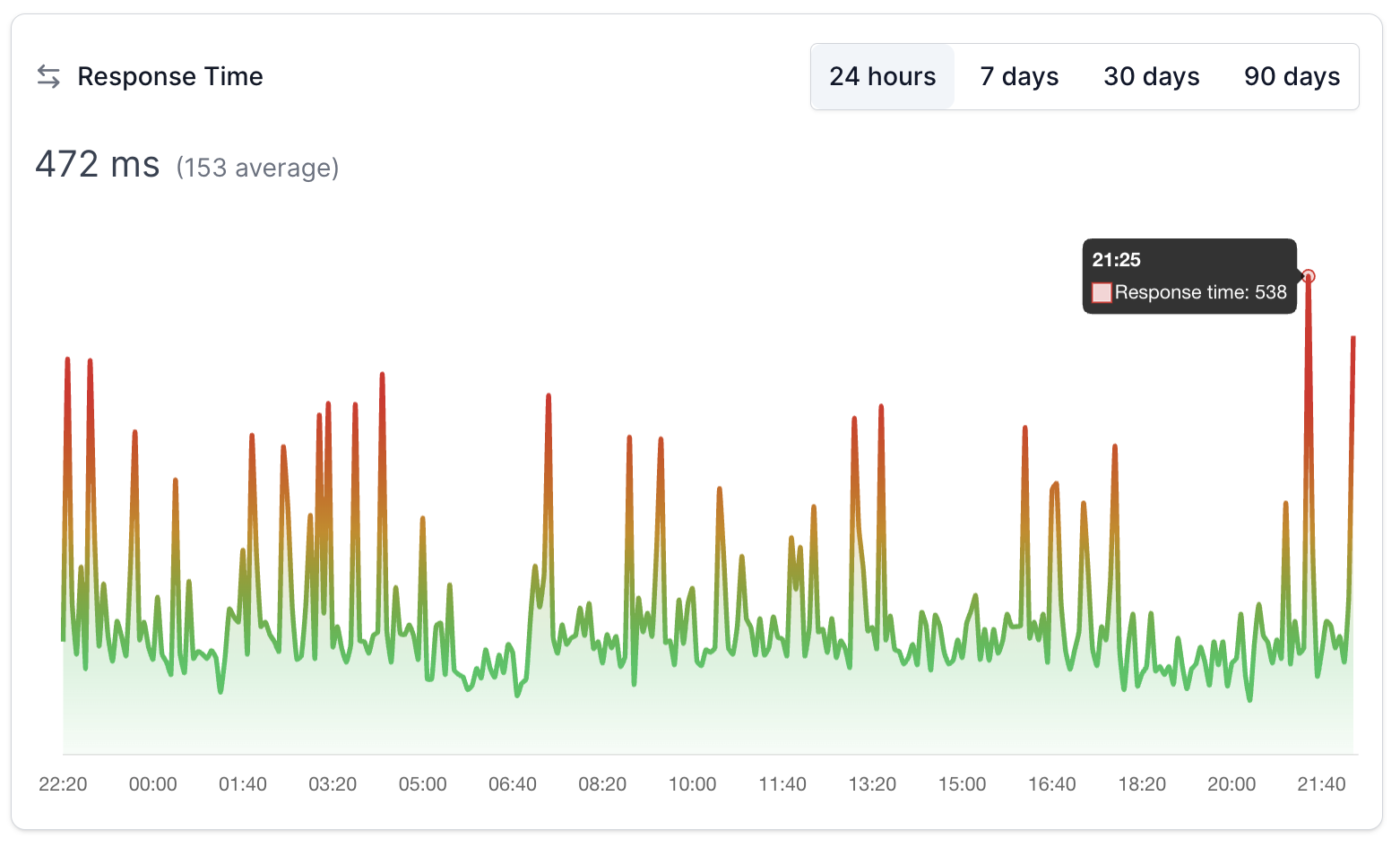
With most apps these days having some form of integration or external dependencies, whether it’s using OpenAI’s API, Vercel for hosting, or MongoDB Cloud for your database, Ping Bot aggregates detailed incident information from hundreds of sources to give you a comprehensive view of what’s happening.
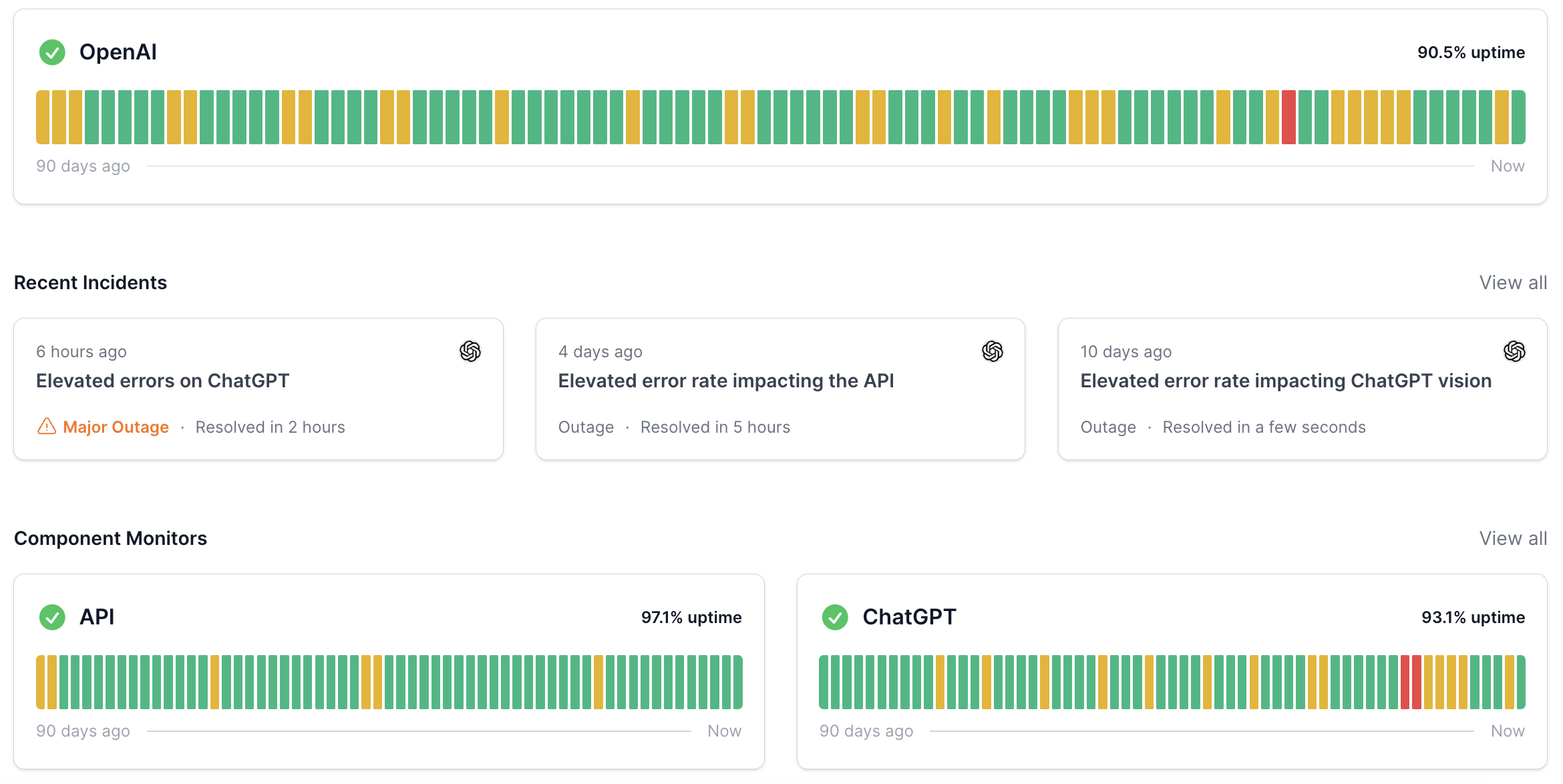
Ping Bot comes packed with features designed to make your life easier:
- Custom Monitoring: Ping Bot keeps a constant check on your web assets, ensuring they're up and running. In the event of an outage, Ping Bot springs into action, alerting you to the problem at hand.
- Vendor Monitoring: Ping Bot pulls data from hundreds of the most popular vendors and services, allowing you to see current and historical uptime and incident data. Was your app down a few hours ago? Ping Bot will help you figure out why.
- Incident Tracking: When things go south, Ping Bot provides you with detailed incident information, helping you diagnose and resolve the issue faster.
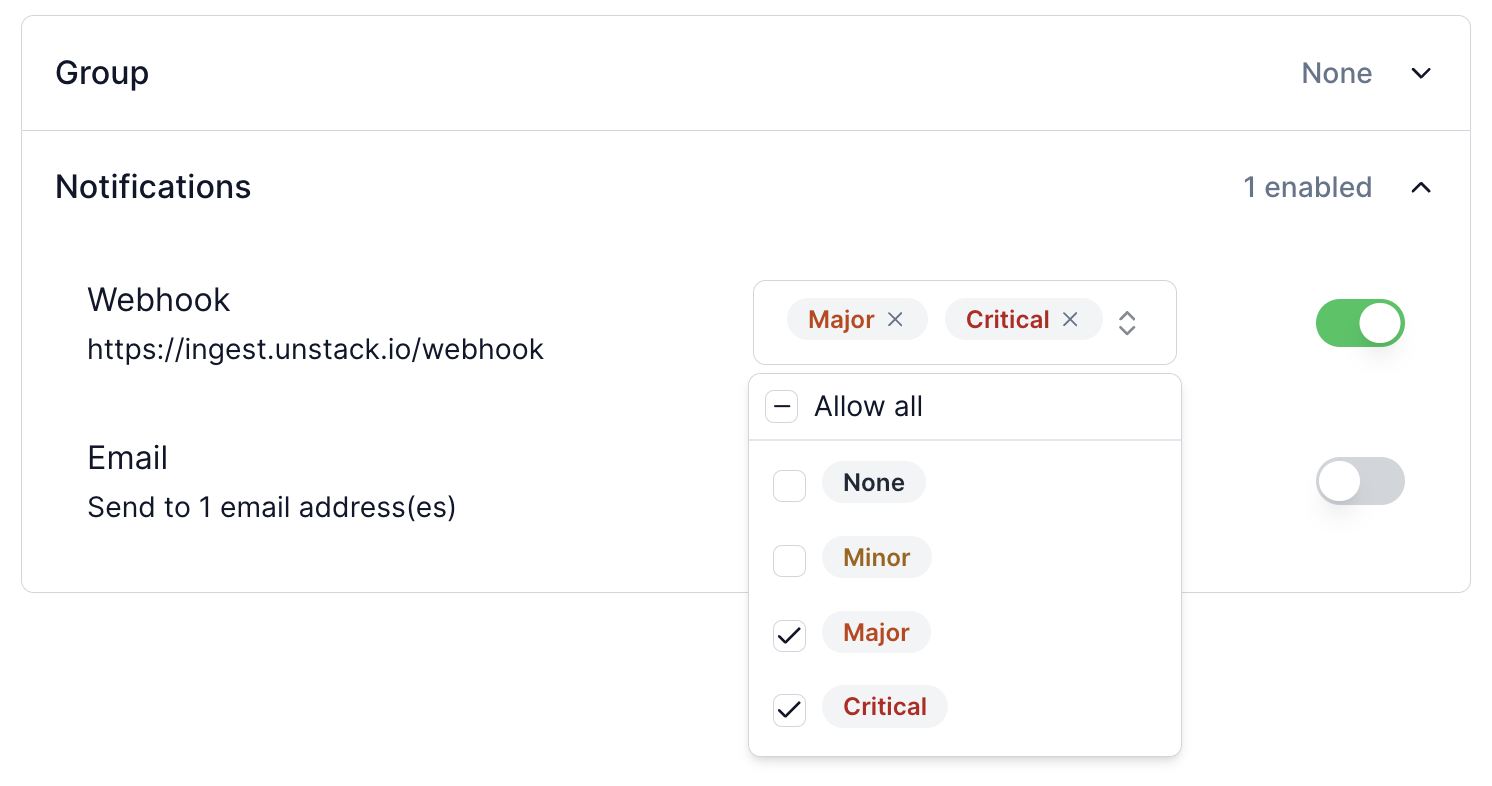
- Configurable Alerts: It turns out that some vendors (i.e. Cloudflare) have lots of incidents, most of them being minor. To ensure you're not inundated with alerts, Ping Bot allows you to filter them by severity or subcomponent, letting you focus on only those that truly matters to your team.
Getting Started
Ping Bot is free to use and takes less than 2 minutes to get set up. You can use either the free plan forever, or upgrade to get access to more monitors, vendors, and alerting features.
To start, sign up your organization for an account by entering the org name, website, and your desired account information. From there, we’ll create your first monitor to get you going!
The main page will give you an overview of your account, including stats like global ping time, recent incidents, and a quick view of the historical uptime of your monitors.
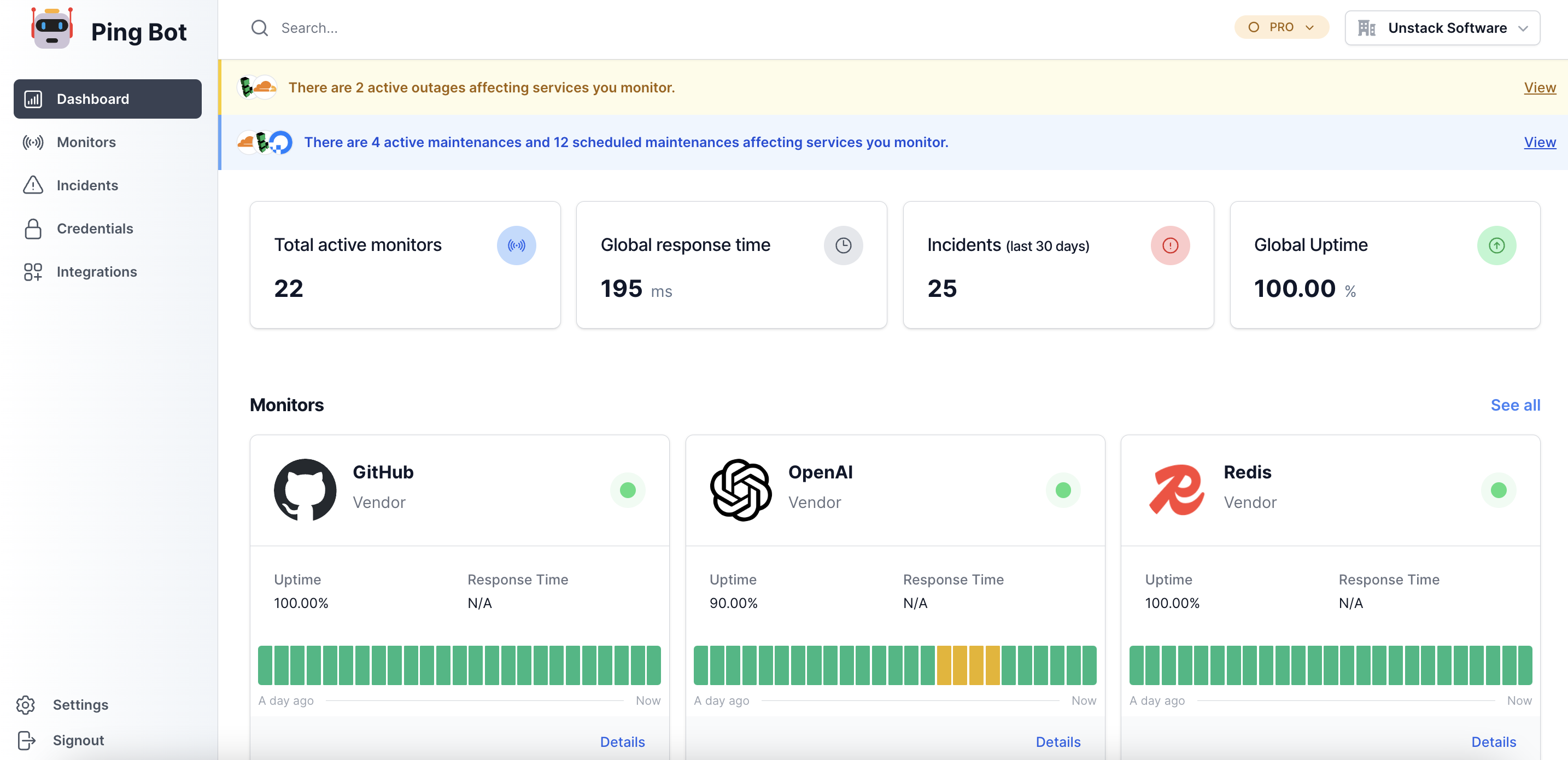
For upgraded or trial accounts, we’d suggest you add all of your 3rd party vendors right away to start getting notifications for when they’re down, which is where many of our early users get most of the value. We’d also suggest adding a filter to only see the incidents you care about - for some vendors there can be a lot of them!
Alerts and Notifications
When an incident occurs, Ping Bot will alert you via your preferred method of communication, be it email, SMS, or webhook notifications. One of the most frustrating parts of many other uptime monitors is the number of alerts you get for things that don't actuallly matter to you. Ping Bot solves this by allowing you to filter alerts by severity or subcomponent, ensuring you only get notifications for the incidents that matter most to you.
Ping Bot can also be used as an internal status page for you and your team. In the dashboard we'll display the current status of your monitors, as well as any ongoing incidents or upcoming maintenance. This can be shared with your team or customers to keep them in the loop.
Advanced Usage Tips
While we created Ping Bot to be easy to use, we also wanted to make sure it was powerful enough for the most demanding of use-cases. Here are a few tips to help you get the most out of Ping Bot:
- Groups: If you have a lot of monitors, you can group them together to make it easier to manage. For example, you could group all of your marketing website monitors together, or all of your database monitors. This way you can see the status of all of your monitors at a glance. Or, if you're a development agency, you could group all of your client's monitors together to make it easier to manage and view.
- Webhooks: If you have an internal system that you'd like to integrate with Ping Bot, you can use webhooks to send alerts to your internal systems. This way you can automatically create a ticket in your ticketing system, or save incident data to your internal database.
- Alert Settings: Change the monitor interval, alerting threshold, and renotify interval to better suit your needs. For example, if you know that a certain system takes a while to recover, you can increase the renotify interval to avoid spamming your inbox with too many alerts.
What's Next?
We can't wait to get Ping Bot v1.0 out into the world and see how it helps you and your team. We're constantly working on new features and improvements, with a ton of useful tools launching soon, so if you have any feedback or suggestions, please don't hesitate to reach out to us at [email protected].
]]>Ping Bot, a subsidiary of Unstack Software LLC, will collect certain non-personally identifiable information about you as you use our sites. We may use this data to better understand our users. We can also publish this data, but the data will be about a large group of users,
]]>Ping Bot, a subsidiary of Unstack Software LLC, will collect certain non-personally identifiable information about you as you use our sites. We may use this data to better understand our users. We can also publish this data, but the data will be about a large group of users, not individuals. We may also collect certain personal information about you and your use of the Service (as defined herein) which may be published and used in the aggregate as set forth in this Privacy Policy.
We will also ask you to provide personal information, but you'll always be able to opt out. If you give us personal information, we won't do anything evil with it.
We can also use cookies, but you can choose not to store these.
That's the basic idea, but you must read through the entire Privacy Policy below and agree with all the details before you use any of our sites.
Reuse
This document is based upon the Automattic Privacy Policy and is licensed under Creative Commons Attribution Share-Alike License 2.5. Basically, this means you can use it verbatim or edited, but you must release new versions under the same license and you have to credit Automattic somewhere (like this!). Automattic is not connected with and does not sponsor or endorse Ping Bot or its use of the work.
Ping Bot makes available services include our web sites (https://pingbot.dev (the "Site")), our blog, our API, our dashboard, and any other software, sites, and services offered by Ping Bot in connection to any of those (taken together, the "Service"). It is Ping Bot's policy to respect your privacy regarding any information we may collect while operating our Site.
Questions
If you have question about this Privacy Policy, please contact us at [email protected]
Visitors
Like most website operators, Ping Bot collects non-personally-identifying information of the sort that web browsers and servers typically make available, such as the browser type, language preference, referring site, and the date and time of each visitor request. Ping Bot's purpose in collecting non-personally identifying information is to better understand how Ping Bot's visitors use its website. From time to time, Ping Bot may release non-personally-identifying information in the aggregate, e.g., by publishing a report on trends in the usage of its website.
Ping Bot also collects potentially personally-identifying information like Internet Protocol (IP) addresses. Ping Bot does not use such information to identify its visitors, however, and does not disclose such information, other than under the same circumstances that it uses and discloses personally-identifying information, as described below. We may also collect and use IP addresses to block users who violated our Terms of Service.
Gathering of Personally-Identifying Information
Certain visitors to Ping Bot's websites choose to interact with Ping Bot in ways that require Ping Bot to gather personally-identifying information, such as names and email addresses. The amount and type of information that Ping Bot gathers depends on the nature of the interaction. Ping Bot collects such information only insofar as is necessary or appropriate to fulfill the purpose of the visitor's interaction with Ping Bot. Ping Bot does not disclose personally-identifying information other than as described below. And visitors can always refuse to supply personally-identifying information, with the caveat that it may prevent them from engaging in certain Service-related activities.
Additionally, some interactions, such as posting a comment, may ask for optional personal information. For instance, when posting a comment, may provide a website that will be displayed along with a user's name when the comment is displayed. Supplying such personal information is completely optional and is only displayed for the benefit and the convenience of the user.
Aggregated Statistics
Ping Bot may collect statistics about the behavior of visitors to and users of the Service. For instance, Ping Bot may monitor and store data about the most popular parts of the Ping Bot Site, the most commonly monitored vendors, aggregated uptime data, or other statistics. Ping Bot may display this information publicly or provide it to others.
In addition, Ping Bot may, from time to time, collect certain personal information from you or your company, your use of the Services, and/or your monitored services (your "Data"). Ping Bot may publish and display your Data in the aggregate to the public through our Site or on our blog, e.g. by publishing a report on average downtime on the Site. However, all Data is only used and published in the aggregate which means that any published Data will not identify you, your website, your company or your users, or link you to the published information in any way.
Ping Bot does not disclose personally-identifying information other than as described below.
Protection of Certain Personally-Identifying Information
Ping Bot discloses potentially personally-identifying and personally-identifying information only to those of its employees and contractors that (i) need to know that information in order to process it on Ping Bot's behalf or to provide services available at Ping Bot's Site websites, and (ii) that have agreed not to disclose it to others. Some of those employees and contractors may be located outside of your home country; by using the Service, you consent to the transfer of such information to them. Ping Bot will not rent or sell potentially personally-identifying and personally-identifying information to anyone. Other than to its employees, contractors, and affiliated organizations, as described above, Ping Bot discloses potentially personally-identifying and personally-identifying information only when required to do so by law, or when Ping Bot believes in good faith that disclosure is reasonably necessary to protect the property or rights of Ping Bot, third parties or the public at large.
If you are a registered user of the Service and have supplied your email address, Ping Bot may occasionally send you an email to tell you about new features, solicit your feedback, or just keep you up to date with what's going on with Ping Bot and our products. We primarily use our website and blog to communicate this type of information, so we expect to keep this type of email to a minimum. If you send us a request (for example via a support email or via one of our feedback mechanisms), we reserve the right to anonymize and publish it in order to help us clarify or respond to your request or to help us support other users. Ping Bot takes all measures reasonably necessary to protect against the unauthorized access, use, alteration or destruction of potentially personally-identifying and personally-identifying information.
Monitoring Internet Connected Resources
In order to properly monitor response time, uptime, and other metrics, Ping Bot will periodically access your website, API, or other internet-connected resources using the access method provided to it by you. This access method may include HTTP, HTTPS, TCP, or some other protocol specified by you or the resource being accessed. Access to your resources will stop when you remove your resource from the Ping Bot Service.
In order to provide monitoring services, Ping Bot may require you to provide credentials to access your resources. These credentials may include API keys, usernames, passwords, or other access tokens. You are responsible for providing these credentials in a secure manner, and Ping Bot will not be held responsible for any data breaches or other security issues that may arise from the use of these credentials. You should provide credentials with the least amount of privilege necessary for Ping Bot to perform its monitoring tasks. You may revoke access to your resources at any time by removing your resource from the Ping Bot Service.
Ping Bot will store your credentials in a secure manner, using encryption and other security measures to protect your data as specified in the Service. However, no security measures are perfect, and Ping Bot cannot guarantee the complete security of your data. You provide your credentials to Ping Bot at your own risk.
Ping Data Access, Usage, and Storage
Upon being given access to a resource for monitoring purposes, Ping Bot may access, measure, or store the following information from your monitored resource:
- Response time data
- Uptime data
- Error data
- Endpoint data (such as IP address, domain, or URL)
- Resource metadata (such as name, description, tags, location, or other data)
- Logs, traces, or other data generated by the resource
Access to your monitor and ping data is used as described in previous sections of this Privacy Policy, as well as the following:
- Notify you of downtime or other issues with your monitored resources
- Provide you with reports, metrics, or other data about your monitored resources
- Aggregate and anonymize your data for use in reports, metrics, or other data about the Service
- Provide you with access to your data through the Service
Cookies
A cookie is a string of information that a website stores on a visitor's computer, and that the visitor's browser provides to the Service each time the visitor returns. Ping Bot uses cookies to help Ping Bot identify and track visitors, their usage of Ping Bot Service, and their Service access preferences. Ping Bot visitors who do not wish to have cookies placed on their computers should set their browsers to refuse cookies before using Ping Bot's websites, with the drawback that certain features of Ping Bot's websites may not function properly without the aid of cookies.
Business Transfers
If Ping Bot, or substantially all of its assets, were acquired, or in the unlikely event that Ping Bot goes out of business or enters bankruptcy, user information would be one of the assets that is transferred or acquired by a third party. You acknowledge that such transfers may occur, and that any acquirer of Ping Bot may continue to use your personal information as set forth in this policy.
Data Transmission, Security, and Storage
Ping Bot uses third party vendors and hosting partners to provide the necessary hardware, software, networking, storage, and related technology required to run the Service. You understand that although you retain full rights to your data, it may be stored on third party storage and transmitted through third party networks.
It is extremely difficult to guarantee the complete security of data transmitted through the Internet, via mobile devices, or through the physical transfer of information. While we will take precautions to limit security risks, we can not fully eliminate all security risks associated with personal information. We do not guarantee or warrant the security of any data or information transmitted to us by you, and you do so at your own risk.
Privacy Policy Changes
Although most changes are likely to be minor, Ping Bot may change its Privacy Policy from time to time, and at Ping Bot's sole discretion. Ping Bot encourages visitors to frequently check this page for any changes to its Privacy Policy.
]]>Unstack Software LLC operates the Ping Bot service, which we hope You (the "Customer", "You", or "Your") use. If You use it, please use it responsibly. If You don't, we'll have to terminate Your account.
For paid accounts, you'll be charged on a monthly or yearly basis. You
]]>Unstack Software LLC operates the Ping Bot service, which we hope You (the "Customer", "You", or "Your") use. If You use it, please use it responsibly. If You don't, we'll have to terminate Your account.
For paid accounts, you'll be charged on a monthly or yearly basis. You can cancel anytime, but there are no refunds.
You own the endpoints, credentials, and other monitor data that you provide to Ping Bot and You're responsible for keeping it safe.
The Terms of Service (the "Terms"), the Ping Bot Service (as defined herin), and our prices can change at any time. We'll warn you 30 days in advance of any price changes. We'll try to warn you about major changes to the Terms or Ping Bot, but we make no guarantees.
That's the basic idea, but you must read through the entire below and agree with all the details before you use any of our sites (whether or not You have created an account).
Reuse
This document is an adaptation of the Heroku Terms of Service, which is turn an adaptation of the Google App Engine Terms of Service. The original work has been modified with permission under the Creative Commons Attribution 3.0 License. Neither Heroku, Inc. nor Google, Inc. is connected with and they do not sponsor or endorse Ping Bot or its use of the work.
You're welcome to adapt and use this document for Your own needs. If you make an improvement, we'd appreciate it if You would let us know so we can consider improving our own document.
Your Agreement with Ping Bot
Your use of the Ping Bot Service is governed by these Terms. The "Service" means the services Ping Bot makes available include our web sites (https://pingbot.dev/ and its subdomains), our blog, our API, and any other software, sites, and services offered by Ping Bot in connection to any of those.
In order to use the Service, You must first agree to the Terms. You understand and agree that Ping Bot will treat Your use of the Service as acceptance of the Terms from that point onwards.
Ping Bot may make changes to the Terms from time to time. You may reject the changes by terminating Your account. You understand and agree that if You use the Service after the date on which the Terms have changed, Ping Bot will treat Your use as acceptance of the updated Terms.
If you have any questions about the Terms, please contact us at [email protected].
Your Account
- You may not use the Service if You are a person barred from receiving the Service under the laws of the United States or other countries, including the country in which You are resident or from which You use the Service.
- You may not use the service unless you are over the age of 13.
- You must be a human. Accounts created by automated methods are not permitted.
Use of the Service
- You must provide accurate and complete registration information any time You register to use the Service.
- You are responsible for the security of Your passwords and for any use of Your account.
- Your use of the Service must comply with all applicable laws, regulations and ordinances.
- You agree to not engage in any activity that interferes with or disrupts the Service.
- Ping Bot reserves the right to enforce quotas and usage limits (to any resources, including the API) at its sole discretion, with or without notice, which may result in Ping Bot disabling or throttling Your usage of the Service for any amount of time.
- You may not allow multiple people to use the same account or otherwise access the Service in a manner intended to avoid incurring fees. This includes You creating multiple free accounts to avoid incurring fees.
Service Policies and Privacy
The Service shall be subject to the privacy policy for the Service available at https://pingbot.dev/privacy (the "Privacy Policy"), which are hereby expressly incorporated into the Terms of Service by reference. You agree to the use of Your data in accordance with Ping Bot's Privacy Policy.
Fees for Use of the Service
- The Service may be provided to You without charge up with certain limits or for a certain "trial" period of time.
- Usage over this limit (or after the "trial" period) or requires Your purchase of additional resources or services.
- For all purchased resources and services, we will charge Your credit card or PayPal account on a monthly or yearly basis.
- Payments are non-refundable. There will be no refunds or credits for partial months of service, upgrade/downgrade refunds, or refunds for months unused with an open account.
- Charges are solely based on Ping Bot's measurements of Your use of the Service, unless otherwise agreed to in writing.
- All fees are exclusive of all taxes, levies, or duties imposed by taxing authorities, and You shall be responsible for payment of all such taxes, levies, or duties.
- You acknowledge and agree that any credit card and related billing and payment information that You provide to Ping Bot may be shared by Ping Bot with companies who work on Ping Bot's behalf, such as payment processors and/or credit agencies, solely for the purposes of checking credit, effecting payment to Ping Bot and servicing Your account.
- Ping Bot may change its fees and payment policies for the Service by notifying You at least thirty (30) days before the beginning of the billing cycle in which such change will take effect.
Cancellation and Termination
- You must either cancel Your account via a support request to [email protected] or at https://app.pingbot.dev using your account email. Any other contact, such as phone requests, to cancel Your account will not be considered a cancellation.
- You will not receive any refunds if You cancel Your account.
- If You cancel the Service before the end of Your current paid up month, Your cancellation will take effect immediately and You will not be charged again.
- You agree that Ping Bot, in its sole discretion and for any or no reason, may terminate or suspend Your account. You agree that any termination of Your access to the Service may be without prior notice, and You agree that Ping Bot will not be liable to You or any third party for such termination.
Ideas and Feedback
You may choose to or we may invite You to submit comments or ideas about the Service, including but not limited to ideas about improving the Service or our products ("Ideas"). By submitting any Idea, You agree that Your disclosure is unsolicited and without restriction and will not place Ping Bot under any fiduciary or other obligation, and that we are free to use the Idea without any additional compensation to You, and/or to disclose the Idea on a non-confidential basis or otherwise to anyone.
Modification of the Service
- You acknowledge and agree that the Service may change from time to time without prior notice to You.
- Changes include, without limitation, changes to fee and payment policies, security patches, added or removed functionality, and other enhancements or restrictions.
- Ping Bot shall not be liable to you or to any third party for any modification, price change, suspension or discontinuance of the Service.
External Resources
The Service may include hyperlinks to other web sites or content or resources or email content. You acknowledge and agree that Ping Bot is not responsible for the availability of any such external sites or resources, and does not endorse any advertising, products or other materials on or available from such web sites or resources.
License from Ping Bot and Restrictions
All of the content available on or through the Service, including without limitation, text, photographs, graphics, logos, trade/service marks, and/or audiovisual content, is owned and/or controlled by Ping Bot, or other licensors or Service users and is protected, as applicable, by copyright, trademark, trade dress, patent, and trade secret laws, other proprietary rights, and international treaties. You acknowledge that the Service and any underlying technology or software used in connection with the Service contain our proprietary information.
Subject to and conditioned upon Your compliance with these Terms, we grant to you a personal, worldwide, royalty-free, non-assignable and non-exclusive license to use the software provided to You by Ping Bot as part of the Service as provided to You by Ping Bot. This license is for the sole purpose of enabling You to use and enjoy the benefit of the Service as provided by Ping Bot, in the manner permitted by the Terms.
You may not (and You may not permit anyone else to): (a) copy, modify, create a derivative work of, reverse engineer, decompile or otherwise attempt to extract the source code of the Service or any part thereof, unless this is expressly permitted or required by law, or unless You have been specifically told that You may do so by Ping Bot, in writing (e.g., through an open source software license); or (b) attempt to disable or circumvent any security mechanisms used by the Service.
Open source software licenses for components of the Service released under an open source license constitute separate written agreements. To the limited extent that the open source software licenses expressly supersede these Terms, the open source licenses govern Your agreement with Ping Bot for the use of the components of the Service released under an open source license.
You may not use the Service in any manner that could damage, disable, overburden or impair our servers or networks, or interfere with any other users' use or enjoyment of the Service.
You may not attempt to gain unauthorized access to any of the Service, member accounts, or computer systems or networks, through hacking, password mining or any other means.
Without limiting anything else contained herein, You agree that You shall not (and You agree not to allow any third party to):
- remove any notices of copyright, trademark or other proprietary rights contained in/on or accessible through the Service or in any content or other material obtained via the Service;
- use any robot, spider, website search/retrieval application, or other automated device, process or means to access, retrieve or index any portion of the Service;
- reformat or frame any portion of the web pages that are part of the Service;
- use the Service for commercial purposes not permitted under these Terms;
- create user accounts by automated means or under false or fraudulent pretenses;
- attempt to defeat any security or verification measure relating to the Service;
- provide or use tracking or monitoring functionality in connection with the Service, including, without limitation, to identify other users’ actions or activities;
- impersonate or attempt to impersonate Ping Bot or any employee, contractor or associate of Ping Bot, or any other person or entity; or
- collect or store personal data about other users in connection with the prohibited activities described in this paragraph.
Our Copyright Dispute Policy
Ping Bot respects the intellectual property of others and requires that our users do the same. It is our policy to terminate the membership of repeat infringers. If You believe that material or content residing on or accessible through the Service infringes a copyright, please send a notice of copyright infringement containing the following information to the Designated Copyright Agent listed below:
- identification of the copyrighted work claimed to have been infringed, or, if multiple copyrighted works are covered by a single notification, a representative list of such works;
- identification of the claimed infringing material and information reasonably sufficient to permit us to locate the material on the Ping Bot Service (providing the URL(s) of the claimed infringing material satisfies this requirement);
- information reasonably sufficient to permit us to contact You, such as an address, telephone number, and an email address;
- a statement by You that You have a good faith belief that the disputed use is not authorized by the copyright owner, its agent, or the law;
- a statement by You, made under penalty of perjury, that the above information in Your notification is accurate and that You are the copyright owner or are authorized to act on the copyright owner's behalf; and
- your physical or electronic signature.
Our Designated Copyright Agent for notification of claimed infringement can be reached at Ping Bot, Attn: Copyright Infringement, (402) 819-8761, [email protected].
Links to Other Websites
The Service may contain advertisements and/or links to other websites ("Third Party Sites"). Ping Bot does not endorse, sanction or verify the accuracy or ownership of the information contained in/on any Third Party Site or any products or services advertised on Third Party Sites. If You decide to leave the Site and navigate to Third Party Sites, or install any software or download content from any such Third Party Sites, You do so at Your own risk. Once You access a Third Party Site through a link on our Site, You may no longer be protected by these Terms of Service and You may be subject to the terms and conditions of such Third Party Site. You should review the applicable policies, including privacy and data gathering practices, of any Third Party Site to which You navigate from the Site, or relating to any software You use or install from a Third Party Site. Concerns regarding a Third Party Site should be directed to the Third Party Site itself. Ping Bot bears no responsibility for any action associated with any Third Party Site.
Disclaimer of Warranties
IF YOU ACCESS THE SERVICE, YOU DO SO AT YOUR OWN RISK. WE PROVIDE THE SERVICE "AS IS", "WITH ALL FAULTS" AND "AS AVAILABLE." WE MAKE NO EXPRESS OR IMPLIED WARRANTIES OR GUARANTEES ABOUT THE SERVICE. TO THE MAXIMUM EXTENT PERMITTED BY LAW, WE HEREBY DISCLAIM ALL SUCH WARRANTIES, INCLUDING ALL STATUTORY WARRANTIES, WITH RESPECT TO THE SERVICE, INCLUDING WITHOUT LIMITATION ANY WARRANTIES THAT THE SERVICE IS MERCHANTABLE, OF SATISFACTORY QUALITY, ACCURATE, FIT FOR A PARTICULAR PURPOSE OR NEED, OR NON-INFRINGING. WE DO NOT GUARANTEE THAT THE RESULTS THAT MAY BE OBTAINED FROM THE USE OF THE SERVICE WILL BE EFFECTIVE, RELIABLE OR ACCURATE OR WILL MEET YOUR REQUIREMENTS. WE DO NOT GUARANTEE THAT YOU WILL BE ABLE TO ACCESS OR USE THE SERVICE (EITHER DIRECTLY OR THROUGH THIRD-PARTY NETWORKS) AT TIMES OR LOCATIONS OF YOUR CHOOSING. WE ARE NOT RESPONSIBLE FOR THE ACCURACY, RELIABILITY, TIMELINESS OR COMPLETENESS OF INFORMATION PROVIDED BY ANY OTHER USERS OF THE SERVICE OR ANY OTHER DATA OR INFORMATION PROVIDED OR RECEIVED THROUGH THE SERVICE. EXCEPT AS EXPRESSLY SET FORTH HEREIN, BLOCK SENDER MAKES NO WARRANTIES ABOUT THE INFORMATION SYSTEMS, SOFTWARE AND FUNCTIONS MADE ACCESSIBLE BY OR THROUGH THE SERVICE OR ANY SECURITY ASSOCIATED WITH THE TRANSMISSION OF SENSITIVE INFORMATION. BLOCK SENDER DOES NOT WARRANT THAT THE SERVICE WILL OPERATE ERROR-FREE, THAT ERRORS IN THE SERVICE WILL BE FIXED, THAT LOSS OF DATA WILL NOT OCCUR, OR THAT THE SERVICE OR SOFTWARE ARE FREE OF COMPUTER VIRUSES, CONTAMINANTS OR OTHER HARMFUL ITEMS. UNDER NO CIRCUMSTANCES WILL BLOCK SENDER, ANY OF OUR AFFILIATES, DISTRIBUTORS, PARTNERS, LICENSORS, AND/OR ANY OF OUR OR THEIR DIRECTORS, OFFICERS, EMPLOYEES, CONSULTANTS, AGENTS, OR OTHER REPRESENTATIVES BE LIABLE FOR ANY LOSS OR DAMAGE CAUSED BY YOUR RELIANCE ON INFORMATION OBTAINED THROUGH THE SERVICE.
Limitations on Liability
YOUR SOLE AND EXCLUSIVE REMEDY FOR ANY DISPUTE WITH US IS THE CANCELLATION OF YOUR REGISTRATION. IN NO EVENT SHALL OUR TOTAL CUMULATIVE LIABILITY TO YOU FOR ANY AND ALL CLAIMS RELATING TO OR ARISING OUT OF YOUR USE OF THE SERVICE, REGARDLESS OF THE FORM OF ACTION, EXCEED THE GREATER OF: (A) THE TOTAL AMOUNT OF FEES, IF ANY, THAT YOU PAID TO UTILIZE THE SERVICE OR (B) ONE HUNDRED DOLLARS ($100). IN NO EVENT SHALL WE BE LIABLE TO YOU (OR TO ANY THIRD PARTY CLAIMING UNDER OR THROUGH YOU) FOR ANY DIRECT, INDIRECT, SPECIAL, INCIDENTAL, CONSEQUENTIAL, PUNITIVE OR EXEMPLARY DAMAGES OR ANY BODILY INJURY, EMOTIONAL DISTRESS, DEATH OR ANY OTHER DAMAGES ARISING FROM YOUR USE OF OR INABILITY TO USE THE SERVICE, WHETHER ON-LINE OR OFF-LINE, OR OTHERWISE IN CONNECTION WITH THE SERVICE. THESE EXCLUSIONS APPLY TO ANY CLAIMS FOR LOST PROFITS, LOST DATA, LOSS OF GOODWILL OR BUSINESS REPUTATION, COST OF PROCUREMENT OF SUBSTITUTE GOODS OR SERVICES, WORK STOPPAGE, COMPUTER FAILURE OR MALFUNCTION, ANY OTHER COMMERCIAL DAMAGES OR LOSSES, OR ANY PERSONAL INJURY OR PROPERTY DAMAGES, EVEN IF WE KNEW OR SHOULD HAVE KNOWN OF THE POSSIBILITY OF SUCH DAMAGES. BECAUSE SOME STATES OR JURISDICTIONS DO NOT ALLOW THE EXCLUSION OR THE LIMITATION OF LIABILITY FOR CONSEQUENTIAL OR INCIDENTAL DAMAGES, IN SUCH STATES OR JURISDICTIONS, OUR LIABILITY SHALL BE LIMITED TO THE EXTENT PERMITTED BY LAW. IF YOU ARE A CALIFORNIA RESIDENT, YOU WAIVE YOUR RIGHTS WITH RESPECT TO CALIFORNIA CIVIL CODE SECTION 1542, WHICH SAYS "A GENERAL RELEASE DOES NOT EXTEND TO CLAIMS WHICH THE CREDITOR DOES NOT KNOW OR SUSPECT TO EXIST IN HIS FAVOR AT THE TIME OF EXECUTING THE RELEASE, WHICH, IF KNOWN BY HIM MUST HAVE MATERIALLY AFFECTED HIS SETTLEMENT WITH THE DEBTOR."
Indemnification
You agree to hold harmless and indemnify Ping Bot, and its subsidiaries, affiliates, officers, agents, employees, advertisers, licensors, suppliers or partners from and against any third party claim arising from or in any way related to (a) Your breach of the Terms, (b) Your use of the Service, or (c) Your violation of applicable laws, rules or regulations in connection with the Service, including any liability or expense arising from all claims, losses, damages (actual and consequential), suits, judgments, litigation costs and attorneys' fees, of every kind and nature. In such a case, Ping Bot will provide You with written notice of such claim, suit or action.
Choice of Law and Dispute Resolution
The Terms of Service shall be deemed to have been entered into and shall be construed and enforced in accordance with the laws of the State of Nebraska as applied to contracts made and performed entirely within Nebraska, without giving effect to any conflicts of law statutes. Any controversy, dispute or claim arising out of or related to the Terms, the Privacy Policy or the Service shall be settled by final and binding arbitration to be conducted by an arbitration tribunal in the State of Nebraska and the County of Douglas, pursuant to the rules of the American Arbitration Association. Any and all disputes that You may have with Ping Bot shall be resolved individually, without resort to any form of class action.
General Legal Terms
The Terms, including the Privacy Policy, constitute the whole legal agreement between You and Ping Bot and govern Your use of the Service and completely replace any prior agreements between You and Ping Bot in relation to the Service.
If any part of the Terms is held invalid or unenforceable, that portion shall be construed in a manner consistent with applicable law to reflect, as nearly as possible, the original intentions of the parties, and the remaining portions shall remain in full force and effect.
The failure of Ping Bot to exercise or enforce any right or provision of the Terms shall not constitute a waiver of such right or provision. The failure of either party to exercise in any respect any right provided for herein shall not be deemed a waiver of any further rights hereunder.
You agree that if Ping Bot does not exercise or enforce any legal right or remedy which is contained in the Terms (or which Ping Bot has the benefit of under any applicable law), this will not be taken to be a formal waiver of Ping Bot's rights and that those rights or remedies will still be available to Ping Bot.
Ping Bot shall not be liable for failing or delaying performance of its obligations resulting from any condition beyond its reasonable control, including but not limited to, governmental action, acts of terrorism, earthquake, fire, flood or other acts of God, labor conditions, power failures, and Internet disturbances.
We may assign this contract at any time to any parent, subsidiary, or any affiliated company, or as part of the sale to, merger with, or other transfer of our company to another entity.
]]>