
by Eduardo Gonzalez and Mary Woodworth
At a moment when technology is reshaping civic life faster than institutions can adapt, the need for public interest technologists has never been clearer. Over the past six years, working with 51 active U.S.-based and three international institutions, PIT-UN has funded members to research the skills and uncover the educational opportunities needed within higher education to support the development of public interest technologists. The research is unwavering: higher education still struggles with silos, funding constraints, and cross-disciplinary collaboration—but public interest technology investment continues to deliver real world impact to communities and open new pathways for innovation in an in-demand sector.
Future-Casting in Real-Time
This year’s PIT-UN Summit in October marked a shift. With a strong emphasis on civic engagement, workforce development, and strengthening democratic resilience, the Summit asked attendees to foster honest reflection, open dialogue, and a collective vision of PIT work. Rather than rehashing ongoing obstacles, the convening served as a strategic leadership retreat centered around the core question: What is needed now to build and sustain the future of public interest technology? A select group of sector leaders, practitioners, researchers and partners explored issues central to that vision—career pathways, field identity, curricular integration, community partnerships, and multi-sector collaboration.
The one-day program balanced high-level framing with practical strategy. Sessions featured pivotal fireside chats, focused panels, practical spark talks and breakout discussions, and a “show and tell” highlighting a public benefit company incubated by PIT-UN. The agenda progressed from centering student and early-career perspectives, to examining the academic leadership needed to support PIT, to highlighting PIT practices within nonprofits and the public and private sectors. A recurring theme was the need to increase broader awareness of PIT and expand meaningful opportunities for students and professionals to apply their socio-tech skills in service of the public good. Strategic breakout groups explored PIT narrative building, community partnership infrastructure, student pipelines, and incentive structures for PIT faculty and professionals. The Summit closed with a vision of PIT professionals as founders and builders of PIT tools and practices grounded in community centered values that directly advance and protect the public interest.
No Time Like the Present
Across conversations, a clear message emerged: PIT is essential civic infrastructure—a discipline that strengthens democracy, public trust, and community well-being. Participants emphasized the opportunity to deepen partnerships with regional nonprofits, governments, funders, and businesses, and to expand the ecosystem of careers and products aligned with prosocial values.
Turning Lessons Into Action
Reflections from participants highlighted five overarching lessons:
- PIT as Public Infrastructure: Case studies must show how PIT strengthens civic, legal, health, and informational systems—and the local capacity required to adopt responsible adoption of technology into our public systems.
- Workforce and Pipeline Maturity: The field needs deeper integration across fellowships, career networks, and academic offerings in order to allow students and faculty to engage in PIT activities that leverage their PIT training.
- PIT as a Bridge Discipline: Discussions explored how PIT deliberately integrates ethics, service, design, and policy into technology development that other disciplines struggle to achieve, a valuable contribution for government and market actors focused on interfacing with the public.
- Legibility and Narrative Power: The field needs more visible stories about PIT successes and visionaries to build public understanding and momentum. In the absence of federal support and advisory groups, a community of practice shaping PIT narratives can help shift how PIT is perceived, valued, and funded.
- Incentives Still Misaligned: Vital to the future vision for PIT is the need for tenure, funding, and leadership incentives that reward PIT-aligned work, and remove roadblocks to cross-sector or public-facing activity. Beyond academia, professionals emerging from PIT programs likewise need career incentives and professional development for the field to retain and build a robust national talent pool.
Emerging Themes for 2026 and Beyond
These cross-cutting themes from the Summit will shape PIT-UN’s strategic focus in the year ahead:
- Narrative Building and Civic Engagement. PIT emerged not only as a pedagogy or design discipline but as an essential part of civic, legal, health, and informational systems. Storytelling and archiving the PIT movement are instrumental for building narrative power around tech for the public interest. Writers, socially engaged artists, and cultural organizers remain vital in mobilizing community voices and translating across fields.
- Building the Field by Supporting Talent and Training. Experts highlight an urgency to build viable career pathways and mentor networks across sectors. In training and education, models for curricular and institutional PIT integration can center ethics, public service, interdisciplinary programs, and transcript recognition to support career building and professional development. Beyond the classroom, early career programs and fellowship serve as building blocks and platforms for launching PIT careers.
- PIT in National and Cross-Sector Contexts. PIT training and talent is necessary across government, nonprofit, and tech sectors, not only in compliance and research, but also in advocacy, procurement, and legislative roles to rebuild public trust and leverage tech for the public good. Likewise, funders and corporate leaders can align around values-based tech as the field deepens coordination to avoid fragmentation and amplify impact.
- Markets are Ready for PIT Products. Strategies and approaches from mission-aligned startups and civic entrepreneurs support future planning and offer new ways for PIT talent to thrive and provide a sustainable career pipeline. More investments in infrastructure, funding, and legitimacy for direct-to-public PIT delivery models and deeper engagement with nonprofits, corporations, governments, and community groups can expand what PIT makes possible. Incubators and accelerators within and outside the academic setting can support the development of products and tools embedded with PIT values from the start.
The 2025 Summit has paved the way for PIT-UN’s next chapter, advancing stronger partnerships, greater impact, and a future where public-interest-centered technology is actively shaping real-world products. Join us as we explore how PIT can thrive across geographies, institutions, and sectors—and chart a course toward a more just and impactful technological future.
PIT UNiverse Newsletter
Find case studies, resources, and opportunities in public interest technology.
Related Posts
PIT-UN members to guide NSF-funded AI research project
Year 2, November 2025
PIT-UN members continue to contribute their Public Interest Technology expertise to partner organizations and external entities. In the fall of 2025, seven PIT-UN faculty members were selected to provide their expertise to the NSF National Deep Inference Fabric (NDIF). NDIF is a research computing project that will enable researchers and students to unlock the mysteries within these enormous neural networks.NDIF project.
The NSF National Deep Inference Fabric (NDIF) is a unique combination of hardware and software that provides a remotely accessible computing resource for scientists and students to run detailed, reproducible experiments on large pretrained AI models, such as open-source large language models. NDIF enables researchers and students to conduct transparent, reproducible experiments on large-scale AI systems, providing much-needed visibility into their inner workings.
An interdisciplinary Advisory Board of PIT-UN members and other non-PIT faculty provides ongoing feedback and guidance to NDIF’s leadership and engineers, helping to ensure the project aligns with ethical, responsible, and inclusive AI practices.

Meet the PIT-UN Advisory Group Members

Timothy Beal
Distinguished University Professor, Case Western Reserve University
Timothy Beal is Distinguished University Professor, Florence Harkness Professor of Religion, and Director of h.lab and the Experimental Humanities initiative at Case Western Reserve University. Projects include “Finite Futures: Imagining Alternative Ways Forward in the Anthropocene” (Henry Luce Foundation) and “Responsible AI Curricular Design” (National Humanities Center). The recipient of a NEH Public Scholar Award, he has published sixteen books.

Jonelle Bradshaw de Hernandez
Research Associate, Texas Advanced Computational Center, University of Texas at Austin
Dr. Jonelle Bradshaw de Hernandez is a researcher and public speaker who focuses on the societal impacts of scientific and technological innovations. Her interdisciplinary work stems from her PhD in Engineering, Technology, and Society, where she studied the field’s outcomes in education, national economy, and vulnerable populations. She couples her academic work with 15+ years as an executive in higher education. She intersects her current AI work with workforce and economic development, efficient philanthropy, education, and, most recently, high-performance computing and cybersecurity.

Deun Horng (Polo) Chau
Professor, Georgia Institute of Technology
Dr. Duen Horng (Polo) Chau is a Professor in the School of Computational Science and Engineering at Georgia Tech, where he co-directs the MS Analytics program and serves as Director of Industry Relations for IDEaS. His research bridges machine learning and visualization to create scalable, interactive tools for interpreting complex AI models, with a focus on AI security, explainable AI, and adversarial machine learning. With 19 best paper awards and over 200 published articles, his work has been featured in media outlets including The Wall Street Journal, Wired, and MIT Technology Review and deployed by major technology companies including Google, Microsoft, Meta, and Nvidia.

Kathleen M. Cumiskey
Director and Professor, CUNY PIT Lab, City University of New York
Rev. Dr. Kathleen (Katie) M. Cumiskey, Professor of Psychology at the City University of New York, is known for her research on mobile media and the evolving relationship between technology and profound human experiences. She is the Co-PI on an NSF award leveraging blockchain technology to enhance student retention. A founding member of the Public Interest Technology University Network, Dr. Cumiskey is the director of the CUNY PIT Lab.
Youngbok Hong
Professor, Indiana University
Dr. Youngbok Hong is a Professor of Visual Communication Design at Indiana University. She specializes in community-based design research that bridges participatory methods with the critical use, development, and evaluation of LLMs to ensure technologies reflect local needs and values. Her recent work integrates Value Sensitive Design and Critical Participatory Action Research to explore how GenAI can support teachers in creating inclusive, rigorous, and culturally sustaining STEM learning. The work includes capturing educator and family wisdom, co-designing appropriate AI systems, and examining how teachers engage with and benefit from GenAI.

Herman Shakeri
Assistant Professor, University of Virginia
Dr. Herman Shakeri is an Assistant Professor at the University of Virginia’s School of Data Science, where he serves as the Principal Investigator of the DYNAMO Lab and is a member of the UVA Center for Diabetes Technology and the UVA Cancer Center. His research focuses on algorithm development in machine learning, learning-based control, and network science. Before joining UVA, Dr. Shakeri was a Postdoctoral Associate at the Institute of Computational Comparative Medicine at Kansas State University, where he conducted statistical analyses of complex, interconnected networks and multi-drug resistance networks.

Michael Simeone
Associate Research Professor, Arizona State University
Dr. Michael Simeone is an Associate Research Professor at ASU’s School for Complex Adaptive Systems. He is an interdisciplinary researcher who bridges data science to humanistic and social methodological considerations. He specializes in applying machine learning to cultural and sociotechnical systems and in understanding how people make meaning in immersive information environments. His work also integrates computational techniques with a focus on ethical considerations and the epistemological foundations of interdisciplinary research.
PIT-UN 2025-2026 Tech for Change Hackathon Request for Proposals
In 2025, the fourth year of the Public Interest Technology University Network (PIT-UN) Tech for Change Hackathon Request for Proposals aims to foster collaborations among PIT members, employers, and other educational institutions, incentivizing the sharing of resources and information and creating a robust public interest technology field that drives economic advancement for all.
PIT-UN anticipates supporting several Tech for Change Hackathons across PIT-UN. We are particularly interested in projects that do not replicate existing or previously funded Hackathons but offer a new approach or lens for accelerating or innovating the development or use of public interest technology.
Tech for Change Hackathons are civic-focused, community-driven, and deployed by students to address local injustices. Tracks, issue area prompts, and challenges are equity- and values-centered while encouraging relationship building between students and the community. We request that sponsors of the Tech for Change Hackathons encourage all teams to address complex social issues with innovative projects.
A PIT-UN Tech for Change Hackathon proposal should highlight career-relevant technology or policy development aligned with PIT competencies and connect students with employers and community partners who design, develop, and deploy technology and policies that serve the public interest. The grant aims to empower PIT-UN member institutions’ student clubs and club sponsors to become critical players in growing and diversifying the PIT workforce pipeline.
All proposals should focus on specific areas that cultivate students as the future of the PIT workforce. We are expecting proposals that catalyze:

- Careers with hands-on, high-impact work driven by innovation and entrepreneurship in public interest technology.
- Communities where students learn and work alongside creative, ambitious, and passionate thinkers in establishing the public interest in technology.
- Regions that welcome bold, imaginative ideas to foster the most pressing challenges in workforce development.
Eligibility Guidelines
Eligibility is limited to PIT-UN member institutions that have not previously hosted or co-hosted a PIT-UN Tech for Change Hackathon. Grantees must be affiliated with a PIT-UN member institution and a student club, and the institution must be the primary recipient of grant funds.
Projects that are a partnership between two or more universities should submit a single application from the lead institution. Projects should clearly explain the nature of the alliance, including the division of labor and allocation of funds in the proposal.
The issuance of this RFP does not constitute a commitment by PIT-UN to award grants. Applications will be evaluated after the due date, and PIT-UN reserves the right to issue partial awards as deemed in the best interest of the Network.
PIT-UN is a project of the New Venture Fund (NVF), a 501(c)(3) public charity that supports innovative and effective public interest projects.
]]>PIT-UN 2025-2026 Career Fair RFP has Closed Submissions
The Public Interest Technology University Network (PIT-UN) is seeking applications from its member institutions’ Career Placement or Career Counseling Service staff for career fair(s) that focus on specific areas that cultivate students as the future of the PIT workforce. PIT-UN Career Fairs should highlight career-relevant technology curriculum designed to illuminate PIT competencies and connect students with employers and community partners designing, developing, and deploying technology that serves the public interest.
Career Fairs connect students with workforce opportunities in their communities by providing students with direct interaction with businesses, non-profits, and/or the government sector to understand opportunities that align with their interests. This creates a robust public-interest technology field and drives economic advancement for all. The grant-funded RFP intends to cultivate real-life work opportunities outside the classroom for aspiring technologists interested in PIT and offer employers the chance to experience the value of having PIT-trained technologists on their teams, strengthening supply and demand for the emerging PIT workforce.
Building on previous PIT Career Fair models, successful 2025-2026 PIT Career Fair proposals will align with the theme “The Future PIT Workforce”. Innovative Career Fair proposal will recognize the workforce pipeline has changed significantly this year and will seek to foster collaboration between a member institution’s Career Placement or Career Counseling Office, partnerships with regional employers and/or employer organizations, and other PIT-UN Network members to develop an event that facilitates opportunities for alliances to better meet the workforce’s needs ahead. The grant aims to empower PIT-UN member institutions’ Career Services and Student Support staff to become critical players in growing and diversifying the PIT workforce pipeline.
We expect proposals that catalyze on:

- Regions that welcome bold, imaginative ideas to foster the most pressing challenges in workforce development.
- Careers with hands-on, high-impact work driven by innovation and entrepreneurship in public interest technology.
- Communities where students learn and work alongside creative, ambitious, and passionate thinkers in establishing the public interest in technology.
PIT-UN anticipates making multiple awards. Grantees must be affiliated with a PIT-UN member institution’s Student Success or Career Services Office and must be the primary recipient of grant funds.
The issuance of this RFP does not constitute a commitment by PIT-UN to award grants. Applications will be evaluated after the due date, and PIT-UN reserves the right to issue partial awards as determined to be in the Network’s best interest.
PIT-UN is a project of the New Venture Fund (NVF), a 501(c)(3) public charity that supports innovative and effective public interest projects.
The ComPITence Project

Lauri Goldkind is professor at Fordham’s Graduate School of Social Service and the Editor in Chief of the Journal of Technology in Human Services. Dr. Goldkind’s current research has two strands: artificial intelligence and data ecosystems in nonprofits and social justice and civic engagement in organizational life. She has a robust network of community partners in New York City and internationally, including the International Federation of Settlement Houses, United Neighborhood Houses and Caritas Macau.

Connor White works in the communications department at Fordham University’s Graduate School of Social Service
At a recent online workshop, members of the comPITence project came back together to unveil a beta version of the nine Public Interest Technology learning competencies they’ve been developing since the project began in November 2023. This ambitious framework is designed to prepare university graduates for the ethical and societal challenges of the evolving digital age.
The project’s original title, Building Inclusive Public Interest Technology Learning Competencies, was launched with a $178,000 grant from the 2023 PIT-UN Network Challenge. Working in collaboration with ethical technology advocacy partner All Tech Is Human, and industry fellows from IBM research, the group’s charge is to bridge the gap between academia and industry, ensuring that students graduate with technical skills alongside a strong foundation in ethics, equity, and social responsibility.
Defining the Core of Public Interest Technology
The comPITencies are centered on a critical question: What should students know and be able to do before entering the workforce as public interest technologists? The competencies answer that question and offer a structured yet adaptable framework that can be integrated into both new and existing curricula across higher education.
Drawing inspiration from social work education—where students must also demonstrate core competencies before entering the field—the PIT competencies aim to establish a common language for what it means to be a responsible Public Interest Technologist. Goldkind emphasized that these competencies are not just theoretical; they are grounded in real-world application, ensuring students can navigate ethical dilemmas and advocate for responsible technology practices throughout their careers.
“Inclusivity is a core value of what a public interest technologist should hold dear: equity, access, and participation,” says Goldkind. “We shape assignments and readings around these principles, giving students multiple touchpoints [of engagement].”
The framework began as a “laundry list” of values and skills, ranging from accessibility to open-mindedness. Over time, the team refined these into a set of guiding principles that underpin nine core competencies, each emphasizing the intersection of technology, ethics, and societal impact.

Building an Adaptable Framework for Public Interest Technologists
A key challenge in developing these competencies has been ensuring they are flexible enough to apply across disciplines and at different degree levels. Just as social work students gain exposure to legal and policy issues without a single course being the sole “keeper” of that content, the PIT competencies are embedded throughout a student’s academic journey, building upon one another.
The competencies will also evolve as technology does. As new innovations emerge, the goal is to equip students with an adaptable skill set—one that allows them to raise critical ethical questions, regardless of whether they enter civil service, corporate tech, or nonprofit advocacy.
“The toolkit in tech might change,” Goldkind said, “but we’re grounded in the real-life things that matter. How can we teach students to adapt their skills and thinking to what’s happening in the world around them?”
Goldkind and her team want students to complete the iPIT curriculum with a solid foundation in ethics and the confidence to challenge industry norms. The competencies produce graduates who can critically assess the role of technology in society and push for accountability in an industry often driven by profit over public good.
The pilot version of the competencies’ release marks a significant milestone, but the work isn’t over. Goldkind and her team will test the framework, gather feedback, and refine it to ensure it meets the needs of both educators and industry leaders. Check out the framework here https://compitencies.org/
]]>2024 PIT-UN Summit Voices: AI in Healthcare
from the October, 2024 PIT UNiverse Newsletter
On November 7 and 8, 2024, leaders from across academia, government, civil society and industry will gather at San José State University for the PIT-UN Summit, the marquee annual event for public interest technologists.
In the coming weeks, you’ll hear from our panelists and keynote speakers about the big issues they are excited to discuss at the Summit. In-person registration is now closed, but you can join us virtually through the registration link below.

Join Us Virtually
Register for a virtual pass and gain access to two days of dynamic, interactive keynotes, panels and presentations, plus exclusive content from the PIT-UN Summit Live! studio.
Why is technology advancement, especially applications of artificial intelligence, in healthcare delivery so important for public interest technology? What current events, policies, or big questions are you excited to dive into at the PIT-UN Summit?
Joe Grzywacz of San José State University will lead a session on Public Healthcare Delivery in the Era of AI on Day 1 of the PIT-UN Summit.
Joe Grzywacz, Assoc. Dean and Faculty, San José State University College of Health and Human Sciences
As artificial intelligence increasingly becomes integrated into healthcare delivery, its potential to improve medical diagnostics, treatment plans, and resource management has captured the public’s imagination. However, while AI promises to transform healthcare, it also raises significant ethical, social, and economic challenges.
This is especially true in relation to biases in data that disproportionately affect racial minorities, low-income individuals, rural residents, and other vulnerable populations.

“Access to quality healthcare is a fundamental human right, but innovations like AI constantly reshape the meaning of ‘quality,” with unanticipated consequences.
Furthermore, issues around affordability, particularly for healthcare delivery systems reimbursed primarily through Medicare and Medicaid, underscore the need for public interest technology to ensure that these innovations serve all members of society equitably.
The Promise of AI in Healthcare
AI applications in healthcare are numerous and growing. Machine learning algorithms can analyze large datasets to help identify diseases early, provide personalized treatment recommendations, and streamline hospital operations. For instance, AI has demonstrated remarkable capabilities in interpreting medical imaging, offering accurate diagnoses for cancer, cardiovascular diseases, and even neurological disorders. These advancements improve patient outcomes and reduce strain on healthcare professionals, allowing them to focus on more complex and human-centered tasks.
AI’s ability to process vast amounts of medical literature and patient data offers the potential for more personalized and precise medicine. Instead of a one-size-fits-all approach, AI can tailor treatment plans based on an individual’s genetic makeup, lifestyle, and medical history. Predictive analytics is another promising area where AI can anticipate disease outbreaks, optimize resource allocation, and enable preventive healthcare measures, thereby reducing the overall cost of care.
However, as AI becomes more embedded in healthcare systems, it’s crucial to examine these technologies’ social impact. Access to quality healthcare is a fundamental human right, but innovations like AI constantly reshape the meaning of “quality” in healthcare with the unanticipated consequences of exacerbating health inequalities rather than reducing them.
The Promise of AI in Healthcare
One of the most pressing concerns with AI in healthcare is biases in the data used to train these algorithms. AI systems learn from historical data, which often reflect societal inequalities related to race, gender, and socioeconomic status. As a result, these biases, if not properly addressed, can perpetuate or even worsen disparities in healthcare outcomes.
For example, studies have shown that Black and Hispanic patients are more often underdiagnosed or misdiagnosed than white patients. If these historical patterns are not corrected in AI training data, they will be replicated and amplified by predictive algorithms. Because the depths and breadth of biases by race and ethnicity in AI models are largely unknown, health inequities could easily be exaggerated.
Similarly, low-income individuals and rural residents, who face increased barriers to accessing healthcare, are at risk for greater health equity by AI if algorithms are trained primarily on data from urban, well-resourced clinics or hospitals and fail to account for the different patterns of disease progression, types of infectious agents, or availability of treatment options in rural clinics.
The Promise of AI in Healthcare
The affordability of AI-driven healthcare technologies creates practical threats to quality healthcare for all. Many AI tools require sophisticated infrastructure, specialized training, and expensive technology to operate, making it difficult for smaller hospitals, clinics, and healthcare providers — particularly those serving low-income or rural populations — to afford these innovations.
This issue is particularly acute in the context of fixed-point pricing systems like Medicare and Medicaid. These government programs provide healthcare to some of society’s most vulnerable members, including elderly and disabled populations and children living in poverty. Healthcare delivery systems serving these groups often struggle to afford the latest medical technologies and to maintain, update, and evaluate whether AI algorithms built into the data platforms are appropriate for their clientele.
High upfront costs of acquiring AI tools, coupled with the ongoing expenses of maintaining and updating these systems, create financial barriers that limit widespread adoption of AI in settings that serve underserved populations. As a result, hospitals in affluent areas are more likely to benefit from AI innovations than hospitals that serve marginalized communities, exacerbating the healthcare inequality already present in society.
The Role of Public Interest Technology
Given these challenges, public interest technology has a critical role to play in ensuring that AI in healthcare is developed and deployed in ways that promote equity and serve the public good.
Mitigate Bias in AI
To reduce bias in AI algorithms and ensure that these tools work effectively for everyone, public interest technologists must:
- Develop tools and strategies to detect and mitigate biases inherent in every data source.
- Advocate for creating diverse datasets representing the rich tapestry of racial, ethnic, economic, and rural groups that characterize modern society.
Public interest technologists and policymakers both have roles to play in making AI technology more affordable.
- Public interest technologists must design affordable AI technologies, particularly for hospitals and clinics that serve vulnerable populations.
- Policymakers must address the affordability of AI technologies, perhaps through government subsidies or incentives for facilities heavily reimbursed by Medicaid and Medicare.
- Public interest technologists can help shape policy discussions around affordability, bringing attention to the needs of marginalized groups and ensuring that technology benefits all members of society.
Learn More
Health TechQuity, a new multidisciplinary and cross-sectorial network based in San José, is looking for additional minds, ideas, and hands.
In-person attendees at the PIT-UN Summit can attend “Betwixt and Between: Public Healthcare Delivery in the Era of Artificial Intelligence” from 10 to 10:50 a.m. PST Nov. 8 to learn more.
In the weeks and months to follow, our emerging network will dig in through monthly meetings, regular homework and activities, and quarterly events to press toward our goals. Contact Joe Grzywacz ([email protected]) if you want to learn more or are interested in joining the quest.
Transparency statement: Some ideas and elements of this op-ed were supported through generative artificial intelligence tools.
PIT-UN SUMMIT
The Public Interest Technology University Network (PIT-UN) reimagines its annual convening and launches, PIT-UN Summit 2024, the marquee event for public interest technologists from across academia, government, civil society, and industry.


PIT UNiverse Newsletter
2024 PIT-UN Summit Voices: Smart Cities
from the October, 2024 PIT UNiverse Newsletter
On November 7 and 8, 2024, leaders from across academia, government, civil society and industry will gather at San José State University for the PIT-UN Summit, the marquee annual event for public interest technologists.
In the coming weeks, you’ll hear from our panelists and keynote speakers about the big issues they are excited to discuss at the Summit. In-person registration is now closed, but you can join us virtually through the registration link below.
Join Us Virtually
Register for a virtual pass and gain access to two days of dynamic, interactive keynotes, panels and presentations, plus exclusive content from the PIT-UN Summit Live! studio.
We hear a lot about Smart Cities these days – but whose interests are centered in these conversations? Brian Hofer, Executive Director of Secure Justice, and Professor Ahmed Banafa of San José State University will speak on this topic during Day 2 of the Summit.
Brian Hofer, Executive Director of Secure Justice
Across the country, municipalities are implementing emerging – and often unproven – technologies intended to improve our lives as we navigate through traffic, approve development plans, and consider how to reduce our environmental footprint.
Applications that seem archaic today, like pedestrian counters, are being integrated into generative AI tools that promise to reduce congestion, crime, and carbon emissions, while making delivery of services more efficient.

“How cities deal with data privacy trade-offs will determine whether smart city applications do more harm than good.”
Can these promises be realized? It’s possible. As with most things in life, these decisions come with trade-offs. As data becomes less siloed, greater insights and efficiencies can be gained. But they come at the potential cost of intrusive and abusive impacts increasing on privacy, such as profiling, stalking, and identity theft. Municipalities have become a prime target for ransomware attacks. Data breaches of both public and private entities affect millions of people.
Every day, we share enormous amounts of data with private companies. While we might willingly do so for convenience, there can be immense consequences that result from forfeiting our privacy so casually. As jurisdictions around the country criminalize reproductive and gender-affirming care, law enforcement is leveraging data to enforce restrictions, such as tracking GPS coordinates on personal devices that show digital records of a visit to an abortion provider, or accessing online searches for mifepristone. As instances like these become more prevalent, public interest technologists and policymakers must grapple with issues of data privacy and constitutionality.
How cities deal with data privacy trade-offs will determine whether smart city applications do more harm than good. For example, the use of real-time citywide facial recognition, which could help locate missing persons, leads to false arrests when utilized improperly. Can cities protect data sufficiently to earn the trust required to facilitate widespread adoption and effective macro-level planning efforts?
I have worked with 100 municipalities across the country to establish privacy commissions that help vet these technologies and examine data collection practices. I’ve witnessed a range of expertise, financial resources, and policy decisions as cities struggle with these difficult questions. One of the most promising models is the Civilian Oversight Body, which provides local residents with opportunities to participate in the rulemaking around smart city applications. The promise of new methods like this equals or surpasses the perils we face, and I look forward to sharing and discussing more concrete examples with my co-panelists at the PIT-UN Summit.
Ahmed Banafa, Professor in the College of Engineering, San José State University
The topic of smart cities is becoming increasingly important for public interest technology due to several factors. Rapid urbanization is leading to overcrowding, infrastructure strain, environmental degradation, and other challenges, and smart city technologies offer potential solutions.

“The ethical implications of smart cities must be addressed as these technologies become more pervasive.”
Moreover, smart city technologies can enhance public health and safety by monitoring air and water quality, traffic congestion, and crime rates, while promoting economic development by attracting businesses and creating jobs.
At the PIT-UN Summit, I am particularly interested in discussing several key topics:
- Exploring the ethical implications of smart cities, including data collection, privacy, and surveillance, which must be addressed as these technologies become more pervasive.
- Ensuring equity and inclusion as smart city technologies are built, so they benefit all citizens.
- Thecollaboration among governments, businesses, and citizens required for success
- Sustainably financing smart cities projects
- Establishing metrics for measuring the impact of smart cities to ensure that they deliver tangible benefits to society, individuals and the environment.
PIT-UN SUMMIT
The Public Interest Technology University Network (PIT-UN) reimagines its annual convening and launches, PIT-UN Summit 2024, the marquee event for public interest technologists from across academia, government, civil society, and industry.
PIT UNiverse Newsletter
How to Apply a Rhetorical Approach to Political Communication Technology Research
PIT in Practice: Missouri University of Science & Technology
by Ryan Cheek, Ph.D. (Missouri S&T) and Samuel T. Allen, Ph.D. (Randolph-Macon College)
Is your smartphone lighting up with text messages from political campaigns? You’re not alone. Texting and other digital marketing technologies provide campaigns with unprecedented, direct access to voters — evidenced by the 15 billion political text messages sent during the 2022 U.S. midterm elections alone. Though the medium might be relatively new, the strategy is part of the age-old practice of rhetoric: the art and science of persuasive communication.
Jump to: Missouri S&T’s 4 Keys to PIT & Ethical Communication.
Our goal is to shift the conversation from short-term voter manipulation to long-term voter engagement.
Ryan Cheek, Asst. Professor of Technical Communication, Missouri S&T

Unfortunately, political text messages are often part of a larger rhetorical strategy of manipulation, designed to drive quick, emotional responses that short-circuit political deliberation and promote divisive, polarized debates. How can public interest technology practitioners bring light to these deceptive practices and push for digital communication technologies that respect voter autonomy, the value of transparency, and democracy itself?
As researchers at very different institutions — one, a STEM-dominant university and the other a small liberal arts college — we’ve developed a process of rhetorical analysis to uncover the ethical and political implications of these technologies, while building a space for our students to contribute meaningfully to PIT research on political communication.
Here, we explain our approach, describe students’ contributions to this work, and outline four PIT principles to guide the design of future political communication technologies.
Rhetorical Methods as Tools for Examining Political Communication Technology
Rhetorical methods are systematic approaches to examining how a speaker’s choice of language, symbols, and stories interact to construct meaning and motivate audience behavior. Revealing the persuasive strategies and power dynamics embedded in political communication technology requires a critical toolbox capable of unpacking the meaning and implications of metaphors, enthymemes, hyperbole, and other rhetorical devices.
Many campaigns rely on emotional manipulation, using fear-based messaging, guilt-tripping, and clickbait subject lines to drive immediate voter action. These tactics may produce short-term gains but often lead to voter fatigue, disillusionment, and a breakdown of trust in political communication.
By applying rhetorical analysis, we can better understand these tactics and advocate for more ethical approaches. Our goal is to shift the conversation from short-term voter manipulation to long-term voter engagement, fostering a political communication ecosystem that respects voter autonomy and prioritizes informed participation.

Students from Missouri S&T’s First Year Research Experience (FYRE) program present their research findings. Courtesy of Missouri S&T.
Students Unpack Manipulative Political Communication Designs
Our research into manipulative political communication design has been enriched by the dedication of our student research assistants, who have been integral to the process.
One student from Missouri S&T’s interdisciplinary First Year Research Experience (FYRE) program, Sofia (a pseudonym used for student privacy) took on the critical task of analyzing the interface designs of political donation pages. She learned how to apply a digital rhetoric method called critical interface analysis, which examines the relationship between interfaces (speakers), users (audiences), and ideologically motivated manipulative design (persuasion).
Sofia’s research focused on how campaigns use deceptive interface design techniques, also known as dark patterns, such as trick wording, preselected recurring donation boxes, and obstructive pop-ups that can mislead donors to sign up for contributions they did not intend to make. Sofia’s findings were presented at a virtual summer conference, shedding light on how these subtle, manipulative design choices exploit donors’ generosity and undermine their trust in political campaigns.
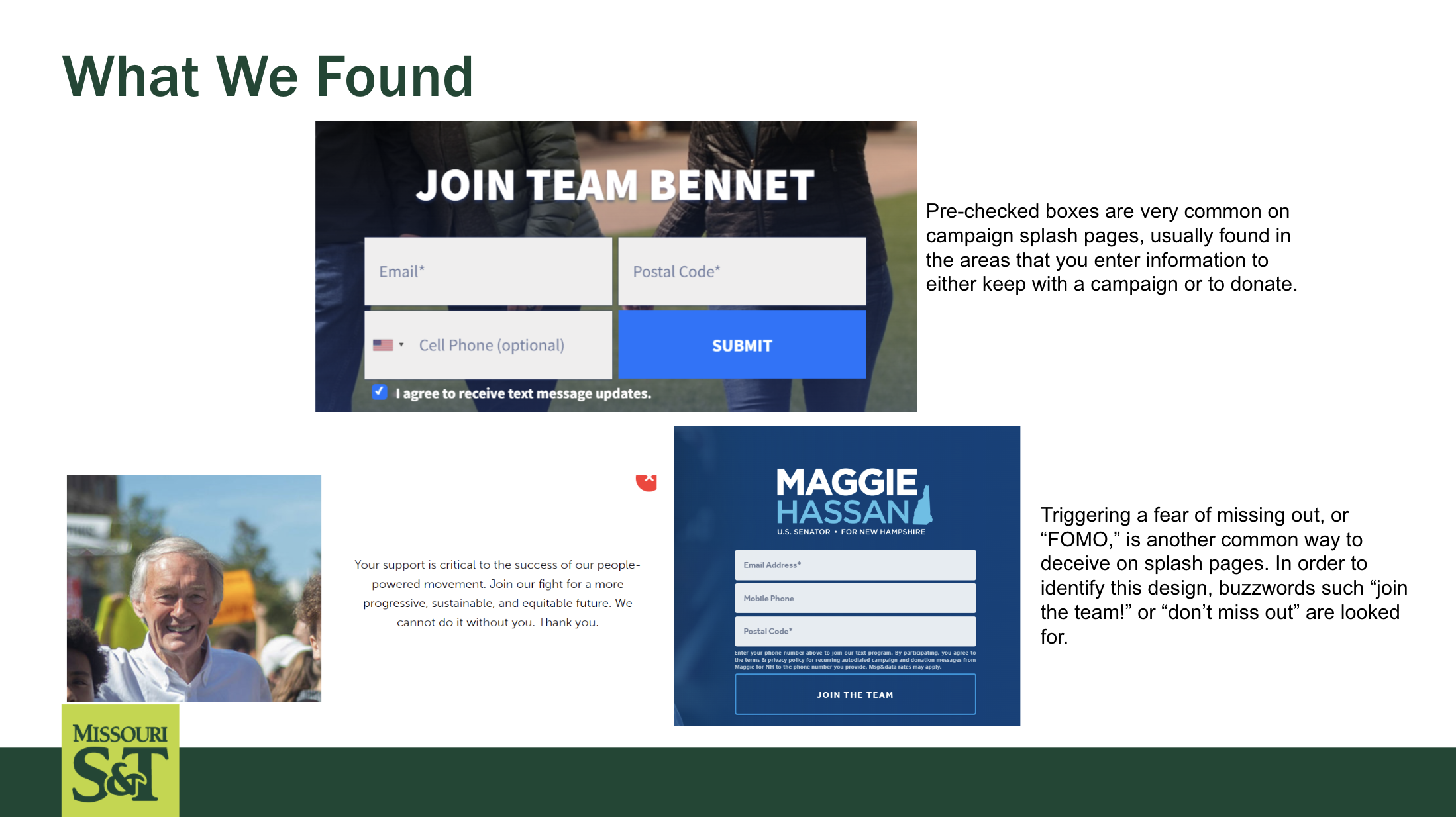
Findings from Missouri S&T’s student researchers on political donation pages.
Another student, Jade Schneider, whose work was funded by the Missouri S&T’s Office of the Vice Chancellor of Research and Innovation, was instrumental in helping us set up technical infrastructure for collecting political advertising, emails, and texts. She learned how political marketing differed from business marketing and how to collect political communication data from Google’s Ad Transparency Center, Meta’s Ad Library, and other sources.
Jade combined these new skills with her background in technical communication to help us develop systems for capturing and categorizing ads, texts, and emails using Google tools (Apps Script, Drive, and Sheets) and the qualitative data analysis software ATLAS.ti. Without Jade’s efforts in creating this robust data-collection pipeline, we wouldn’t have the breadth of materials necessary to analyze the reach of these manipulative tactics. Her work allows us to keep expanding our corpus, ensuring that we can track trends over multiple election cycles. She is now applying her PIT skills as a data scientist for Accenture Federal Services.
The students are learning firsthand how subtle choices in interface design or data collection systems can have far-reaching consequences for voter behavior and trust. Their projects have provided invaluable data for our research while giving the students a real-world understanding of the ethical challenges that come with designing and analyzing communication technologies and equipping them with the skills to engage ethically with technology in their future careers.
4 Principles of Public Interest Technology and Ethical Communication
PIT emphasizes such ethical principles as transparency, respect, and accountability — values that align closely with rhetorical approaches to communication. By integrating these two approaches, we can design political communication tools that build trust and promote informed voter decision-making.
Based on our research findings, here are four PIT principles for political communication technologies that can support, rather than harm, healthy voter engagement and democracy:
1. Ethical Communication Design: Communication tools should be designed with transparency and respect for the user. Avoiding pre-checked recurring donation boxes and other manipulative design elements can help restore trust between voters and campaigns.
2. Promoting Informed Participation: Rhetorical strategies can also shift political communication from emotional manipulation toward educating voters. Political texts and emails should focus on providing information voters need to make thoughtful decisions — whether that’s policy updates, voter resources, or event details — rather than using fear or deception to trigger knee-jerk reactions. This approach respects voter agency and aligns with PIT’s goal of empowering individuals through technology.
3. Building Trust through Transparency: Transparency is central to voter trust, and campaigns should be upfront about how they collect and use voter data. By creating systems that responsibly gather and categorize political communications, PIT researchers can hold campaigns accountable for their messaging tactics and data usage. Voters deserve to know how their information is being used and should have the option to easily opt out.
4. Leveraging Positive Reinforcement: Instead of using fear or guilt to drive voter action, campaigns can use positive rhetorical appeals that emphasize the impact of collective action. Messages that thank voters for their participation and highlight the progress they’ve helped achieve can build long-term relationships, rather than treating voters as financial targets.
Learn More About Our Work
Rhetorical methods offer powerful tools for collaboratively advancing the goals of public interest technology in political communication. This work, enriched by the contributions of our students, both strengthens democratic participation and aligns with PIT’s mission to create technologies and technologists that serve the public good. To learn more about our work, check out these recent publications:
Allen, S. T. (2022). Donald Trump Isn’t Laughing: Affect, Laughter, and Hegemonic Masculinity. In The Routledge Companion to Gender and Affect (pp. 310–320). Routledge.
Cheek, R., & Allen, S. T. (2024). Hoodies in the Halls of Power: a Rhetorical Materialist Critique of Professional Decorum in the United States Senate. In the proceedings of the IEEE International Professional Communication Conference (ProComm ’24), July 14–17, Pittsburgh, PA (pp. 54–58). IEEE.
Cheek, R., & Allen, S. T. (2023). Professionalizing Campaign Text Spam: How Technical Marketing Rhetoric Influences Rapid Change to the Professional Communication of Politics. In the proceedings of the IEEE International Professional Communication Conference (ProComm ’23), July 17–20, Ithaca, NY (pp. 190–194). IEEE.
Cheek, R. (2023). Making a case for political technical communication (PxTC). Technical Communication Quarterly, 32(2), 121–133.
Cheek, R. (2021). Political technical communication and ideographic communication design in a pre-digital congressional campaign. Communication Design Quarterly Review, 8(4), 4–14.

PIT UNiverse Newsletter
Related Posts
Building Community & Careers in Public Interest Tech
Student Voices from across the PIT University Network
From the October 2024 PIT UNiverse Newsletter
As PIT-UN continues to grow its Tech for Change Student Network, we’re highlighting five students doing exceptional work to build community and career opportunities as they chart their paths in public interest technology (PIT).
To learn more about student work, opportunities or starting a Tech for Change Club on your campus:
- Let us know about an existing PIT club on your campus through this survey
- Apply for a fellowship with Coding it Forward, Govern for America, or U.S. Digital Corps
Building PIT Community on Campus
Ting Fong Chen and Anjali Tandon, University of Michigan
Tech for Social Good (T4SG) at the University of Michigan is a student-led group that offers a non-evaluative and non-stressful environment to gain exposure to public interest technology through coding workshops, reading groups, and speaker series.


We provide hands-on PIT experiences through project teams where students can learn firsthand how to utilize their background in software, design, and data analysis to impact a local nonprofit. Examples of project teams include Arbor Advisor, which aims to ease the onboarding process for immigrants into Washtenaw County, Mich., and Maize and Blue Cupboard, an accessible platform to the university’s food pantry.
This year, we plan to extend that exposure beyond our direct T4SG community by hosting a Michigan-wide Civic Tech Hackathon to allow all students to see the benefits of PIT firsthand in a low-stress and collaborative setting.
Exploring Technology’s Impacts (Ting Fong Chen)
Growing up in multicultural communities in Taiwan, Hong Kong, and Canada, I became interested in how cities are built and how technology shapes our relationship with cities, and that’s what I now study as an urban technology major. T4SG has helped me understand the layered assumptions and beliefs behind our digital systems.
Most of my work has been facilitating discussions around themes like algorithmic bias and predictive policing through Bytes of Good, where T4SG members present on specific practices and policies, shedding new light on ordinary technologies and encouraging reconsideration of technology’s impacts.
I am interested in public interest technology because I believe communities should actively participate in designing and governing technology. From an educational perspective, students should have a say in the STEM curriculum and can advocate for coursework on how to serve the public good. T4SG last year created a Course Guide that identifies courses across all departments that critically rethink technology in the broader social context.

From a civic standpoint, PIT enables collaborative problem-solving for local challenges. Technology is not the sole focus, but rather is a tool used within existing systems to help create a more inclusive, equitable, and resilient community.
Finding a Language, a Map, a Community (Anjali Tandon)
I entered college certain of two things: Public service was the best way to have an impact on people, and technology was the best way to do so at scale. I took political science and computer science courses to find the intersection between the two fields. However, I often left feeling isolated and lacking a clear road map to pursue my goals.
Public interest technology gave me the necessary vocabulary to explain my interests and, equally important, it gave me a community with which to do that. Entering into PIT spaces such as the Siegel Public Interest Technology Summer Fellowship at Princeton University and T4SG at University of Michigan was the first time I felt like I was speaking a common language with everyone else.
Now, as a senior majoring in information analysis, serving as the co-president of T4SG is how I share that experience by ensuring that Michigan students interested in PIT can explore the field and use their technical skill sets to aid communities beyond themselves.
My best PIT experiences have emphasized community and personal growth, and that is why I see T4SG and other student-centric spaces as the strongest way to create a real, long-lasting pipeline into PIT.
Connecting PIT Students to Public Service
Jennifer Wang, Brown University
Kayla Huang, Harvard College
While interning at the White House in fall 2023, during a meeting on tech policy initiatives, we heard from city and state government leaders that their primary challenge was talent and capacity; there just wasn’t enough money to hire tech policy staff. Meanwhile, we were regularly hearing from students who wanted to know how to get into tech policy.


We felt motivated to design a solution that would address both sides of the talent pipeline, and established the Paragon Policy Fellowship, which provides college students with opportunities to work on policy solutions for their state and local governments. We have recruited, mentored, and managed 32 organizing team members and 142 fellows, all volunteers.
Meeting the Need for Tech Policy Talent
Paragon aims to address three emerging needs in the technology policy arena:
1. Issues at the intersection of technology and government within the context of public policy and civic institutions.
2. Responsible governance frameworks that keep up with technology’s rapid developments and a growing new generation of public employees with both technical and policy expertise.
3. Tech policy opportunities for college students, especially those from historically underrepresented backgrounds.
By connecting students with state and local governments, we hope to empower the next generation to chart a career in technology policy and address the most pressing issues in their communities.

The first cohort of Paragon Fellows.
Early Results from the Paragon Fellowship
So far, we’ve supported dozens of projects for state and local government agencies. In just the first cohort, our work led to:
- Guidelines for the city of San José to mitigate the threat of deepfakes on communication with constituents.
- The first statewide, civil service-oriented AI education guideline for 40,000 Georgia government workers.
- Recommendations for increased, large language model-enabled translation services in St. Louis.
Fellows come out of Paragon with a foot in the policy door and a deeper understanding of the realities of working in local government.
Paragon, now sponsored by the Federation of American Scientists, has helped fellows make a genuine impact on their communities. In addition, the Paragon team is working to expand fiscal sponsorships and partnerships with more government agencies, academic institutions, and industry leaders. We are helping fellows publish their research at top-tier academic conferences. And over the summer, the Paragon fellows presented their projects to our staff members in the White House Office of Science and Technology Policy.
To keep up with Paragon’s latest updates, you can:
- Visit our website
- View our past projects
- Follow Paragon on LinkedIn for the latest fellowship updates
- Subscribe to Paragon’s newsletter for deep dives on fellowship projects
PIT Lessons for the Long Haul
Joel Yong, Google Public Policy Fellow at New America’s Open Technology Institute, and alum of Rhode Island School of Design.
I was born and raised in Los Angeles, where early exposure to its harsh inequalities brought me into advocacy work and social impact discourse. As I built my studies in college at the intersection of product design and public policy, I was fascinated by technology’s power to connect people and facilitate change at greater scales.

Coding it Forward Fellowship Experience
The Coding it Forward Fellowship with the U.S. Census Bureau in summer 2022 expanded my perspective on how technology can be used for access, democratization, and empowerment. I worked on a project looking at how the Census Bureau was collecting and disseminating data. A partner fellow and I co-created equitable solutions alongside nonprofits across the country, focusing on homelessness.
Our iterative process produced recommendations on three fronts:
1. Creating custom visualization tools so organizations can better compare and apply Census data to their organizational needs.
2. Designing more responsive census surveys that no longer asked people experiencing homelessness for data points like their home address.
3. Integrating data collection points at centralized community organizations such as food banks and shelters.
We developed prototypes that recontextualized a constituent’s user experience to encompass not only the websites they interact with, but also the policies that affect them, the services they receive, and the systems that define what resources are available to them.
This project was pivotal in shaping my PIT practice, as I learned that technology is just one component of building holistic solutions.

A prototype of custom visualization tools of U.S. Census data Joel Yong created during his Coding it Forward Fellowship.

Site render of a model Food Bank for Data Collection station.
Driving Towards Holistic Solutions
Since then, I’ve worked with Princeton University’s Center for Information Technology Policy and the U.S. Digital Service, and I’m now a Google Public Policy Fellow at New America. As I mature in the PIT space, one of the most profound lessons I’m still learning is how to pull the right levers of change. Had I known then at the Census Bureau what I know now, I would have done even more to find allies and champions to continue advocating for the work to be done after my term concluded. In PIT, especially in government where institutions are slow to change, it’s critical to find levers that can set up long-term success.
I’ve also learned that this work requires thick skin, as does any work dedicated to change. But I have met an incredible array of people who continue to inspire me and remind me why this work is important.
Mentors, colleagues, friends — the relationships I’ve grown in this space have been just as important to me as the work I’m able to do. Wherever I go, I hold confidence that technology unlocks its full potential when it is complemented with humanity.
As I continue to refine my PIT practice, I build upon my belief that technology is a powerful medium to make holistic solutions possible, facilitating a more galvanized, connected world.
Joel Yong’s TEDx talk at TEDxRISD.
Learn More & Get Involved in PIT Student Work
- Visit the Tech for Change Student Clubs page
- Connect with Student Network Coordinator Nia Brazzell
- Let us know about an existing PIT club on your campus through this survey
- Apply for a fellowship with Coding it Forward, Govern for America, or U.S. Digital Corps
Author Bios
Ting Fong Chen is a public transit enthusiast, inclusive designer, and passionate urbanist studying Urban Technology at the University of Michigan, Ann Arbor. An advocate for human-scaled, walkable neighborhoods, he is bilingual in Mandarin and English and strives to examine and appreciate cities to address urban conditions including safety, sustainability, and equity
Anjali Tandon is a student at the University of Michigan’s School of Information passionate about bridging the gaps between technologists and policymakers to create and regulate inclusive technologies so they best meet the end-user’s needs. She has engaged with PIT through a variety of roles on campus by creating data visualizations for analyzing exhibit efficacy at the University of Michigan Art Museum, organizing an AI & Justice symposium on behalf of and writing for the Michigan Technology Law Review, and co-leading Tech 4 Social Good to provide students a space to explore and engage with engineering ethics and civic tech firsthand.. Outside of school, she has worked in technology and venture capital, as well as at the Consumer Financial Protection Bureau, working to develop and apply industry perspectives on emerging technologies to consumer-driven advocacy and policy work
Kayla Huang is a Chicago native and a senior at Harvard College studying computer science and government. She is broadly interested in the intersection of tech, governance, and entrepreneurship and hopes to lead initiatives in this field in the future. After taking time off to work at the White House on tech policy, she co-founded the Paragon Policy Fellowship and has interned as an engineer at a variety of startups (Scale AI, AidKit, Watershed). She now conducts research at the Kempner Institute for the Study of Natural and Artificial Intelligence at Harvard University and the MIT Lincoln Laboratory with a focus on modeling techniques to support foreign policy decisions in civil conflicts.
Jennifer Wang, who hails from Harvard, Massachusetts, is a senior at Brown University studying computer science. She is interested in informing and influencing the development and governance of algorithmic systems. Her experience as a Coding it Forward fellow at the U.S. Census Bureau and data analytics intern in the Rhode Island state government during the COVID-19 pandemic inspired her decision to co-found the Paragon Policy Fellowship. More recently, she has worked at the White House Office of Science and Technology Policy, Brookings Institution, and Mozilla to advance the trustworthy development of AI and promote investments in public AI infrastructure.
Joel Yong is a Google Public Policy Fellow at New America’s Open Technology Institute, based in Washington, D.C. Otherwise, he studies the intersection of product design and public policy, having led the public interest student organization Design for America (RISD/Brown) and having worked with PIT-adjacent clubs such as Hack@Brown, 180 Degrees Consulting, and Brown Initiative for Policy. He continues to investigate technology as a means to holistically build better democracies and create infrastructures of public trust.
PIT UNiverse Newsletter
Find case studies, resources, and opportunities in public interest technology.
Related Posts
How to Apply Interdisciplinary Research and Historical Perspectives to Current PIT Issues
PIT in Practice: University of Michigan
As a fundamentally interdisciplinary field, public interest technology offers powerful methods for tackling complex, multifaceted challenges such as climate change. At the University of Michigan, Shobita Parthasarathy and Molly Kleinman have developed processes and tools for bringing together experts from across disciplines to shed light on the environmental, social, economic, and political impacts of emerging technologies.
Jump to: UM’s 3 Keys to Interdisciplinary Research.
Many of these research projects, which are housed in the Science, Technology and Public Policy program (STPP) in the Gerald R. Ford School of Public Policy, focus on climate issues for a simple reason: “None of this technology operates without electricity,” says Kleinman.
We are all living through the effects of climate change. It is shaping our daily lives, and the work we do has the power to move us in the right direction or the wrong direction.
Molly Kleinman, Managing Director of STPP

Through the Technology Assessment Project (TAP), Kleinman and Parthasarathy bring together faculty and students from multiple disciplines to analyze and articulate the likely social, economic, ethical, equity, and political impacts of artificial intelligence and other emerging technologies. Their final products are reports for communities, leaders, and policymakers to help them understand the true pros and cons of a given technology and to inform governance frameworks that can minimize the harms and maximize the benefits.
Analogical Case Studies: Examining the Past to Understand the Future
TAP’s main research method is the analogical case study. By examining historical examples of similarly groundbreaking technologies such as cars, airplanes, and medical devices, the teams illustrate the potential impacts of an emerging technology.
Because emerging technologies are exciting (and potentially lucrative), they are often deployed speedily, without fully considering and preparing for their potential downsides.
“There’s this argument of ‘the technology is so new, we can’t possibly regulate or govern it, we just have to wait and see what happens,’” Kleinman says, pointing to the example of social media. “Then, by the time we’re ready to create or enforce policy, they say ‘it’s too late and we just have to learn to live with whatever the consequences are.’”
By grounding its research in historical examples, TAP’s interdisciplinary, analogical case study method helps cut through common misperceptions about emerging technologies and the overinflated claims of tech companies rushing them to market.

STPP Director Shobita Parthasarathy discusses the role of social scientists in shaping technology policy alongside former White House Office of Science and Technology Policy Director Alondra Nelson / University of Michigan.
An Analogical Example: Cutting Through AI Hype
The power of interdisciplinary, analogical case studies is on full display in TAP’s spring 2022 report on large language models (LLMs). The report accurately anticipated, six months before the release of ChatGPT, many of the problems with LLM-powered AI technologies we now face, such as deepening environmental injustice.
A review of the ecological impacts of data extraction, led by a graduate student from environmental studies, showed how water- and fossil fuel–intensive data centers might harm local communities.
This issue was further crystallized through an analogical case study of the U.S. highway system. “Highways were a boon to the auto industry, but not so much to the towns and neighborhoods that have highways running through them, and the people who breathe the pollution,” says Kleinman.

TAP’s current research project — a joint project with faculty and students from the university’s Nuclear Engineering and Radiological Sciences and the Graham Sustainability Institute — explores how advanced nuclear technologies can support a large-scale transition to renewable energy.
Interdisciplinary Research: 3 Keys for Successful Teams
Throughout their research, Kleinman and Parthasarathy have brought together faculty and students from a wide range of disciplines to do this type of analogical analysis, honing their approach to interdisciplinary research. Here, they share three keys to doing this work in a successful and impactful way.
1. Be transparent about power differentials. It’s essential but not sufficient to assemble a team with strong diversity across disciplines, identities, and perspectives; you also have to put the people with less power, often social scientists and humanists, in the lead.
- When recruiting your team, make clear you’re looking not just for STEM researchers but also those from non-STEM disciplines (i.e., history, psychology, environmental studies) and prompt applicants to describe what nontechnical skills, knowledge, or lived experience they could bring to the project.
- In team discussions, make space for each person to share their expertise and lived experience. Name and celebrate relevant expertise and experiences that are not necessarily academic or technical.
- Set and maintain rules for discussion that ensure equal opportunity for each person to contribute.
2. Take time to get everyone on the same page — literally. “For the first few weeks of the project, we pay our team to read,” Kleinman says. Remember that members of an interdisciplinary team will all have different and partial expertise.
- Develop a mini-syllabus that gets everyone reading a mix of foundational texts and background on the specific topic.
- Incorporate movies, TV shows, science fiction, or other creative stories that engage the imagination and get team members thinking in analogies.
- Make time and space to discuss and reflect on that material, encouraging team members to make connections across disciplines.
3. Build team trust throughout the project. Team building is important, both early on and throughout the project. A foundation of trust is necessary so that when the challenges of interdisciplinary collaboration inevitably arise, they won’t cause ruptures or derail the whole project. Without trust, it is much harder to address and recover from problems.
- Schedule longer meetings so there is time to develop relationships through informal conversation and sharing interests outside of work.
- Plan regular one-on-one check-ins, so people can raise concerns they might not feel comfortable bringing up to the full group.
- If your team is dispersed, try to find opportunities to connect in-person, even if it’s just a few team members getting together during a work trip or a conference that brings people to the same university or city.
Learn More
Interdisciplinary research is a challenging but powerful opportunity to activate faculty and students around climate change and other pressing PIT issues. To learn more, check out:
- TAP’s report on facial recognition in schools, which was cited in a New York State ban on using the technology in public schools.
- TAP’s current project, Advanced Nuclear Energy Technology in a Carbon-Neutral Energy Future.
