The post The Apple Farmer – Part II appeared first on PolyAPI.
]]>The car with license plates from far away rolled to a stop just beyond the fence line, kicking up a faint cloud of dust that settled slowly on the dry earth. The team had been carrying the orchard through a punishing drought these past weeks, the soil cracked and the leaves hanging heavy with unspoken strain. The door opened, and out stepped a tall figure in a crisp button-down, sleeves rolled to the elbows, carrying a worn leather satchel that looked like it had seen more airports than orchards. He had the easy gait of someone who’d walked through plenty of fields, but his eyes scanned the rows with the quiet hunger of a man who knew value when he saw it.

Paul was halfway down the path, wiping his hands on a rag, when the visitor called out.
“Paul Lee? Pleasure to meet you—I’ve heard a lot about you. Name’s John, but they call me Salsa.”
Paul nodded, a small smile creasing his face. “Heard you were coming. Welcome.”
Salsa didn’t waste time on pleasantries. “I heard really good things. Real good. What you and the team have pulled off here—it’s not just impressive. It’s rare. I’d be interested in learning more. If you’ve got the time.”
Paul studied him for a beat, then gestured toward the main house. “Stay with us. We’ve got room. Come on, I’ll show you around.”
That afternoon stretched into evening. Paul introduced Salsa to the team—quiet introductions in the shade of the young saplings, hands shaken over soil-stained palms. They weren’t just names; they were the heart of it. The ones who’d planted the first rows, the ones who’d stayed through the lean years. Salsa listened, asked questions that weren’t scripted, and by the time the sun dipped low, Paul was walking him end to end.
He showed him the graphs first, pinned up in the old barn they’d turned into a workshop. Lines that tracked the Natural Development Ratio—NDR, they called it—climbing north of 300%. “See here,” Paul said, tapping the paper. “That’s not just growth. That’s the trees telling us they’re happy. Roots deep, leaves strong. And through this drought? Not a single one lost. Not one.”

Salsa leaned in, tracing the curves with a finger. “How?”
“Care,” Paul said simply. “And giving them exactly what they want.”
Over dinner—simple fare, fresh from the garden and the last of the season’s apples—they talked numbers. Paul laid it out plain: costs held low because the team owned the work and the trees were planted right, morale high because they owned the vision. No one clocked out at five; they stayed because the orchard was theirs too. Salsa nodded through it all, jotting notes in a small book, his questions sharp but respectful.
The days that followed blurred into a rhythm. Salsa stayed on, sleeping in the spare room, rising with the crew at dawn. Paul showed him how they planted the new trees—careful, deliberate, each one its own way, but done fast, almost at the speed of machines, each team member knowing their role and handing off the work with minimal language. And then the breakthroughs: the different species they’d coaxed from the soil.
“We’ve got the ones producing now,” Paul said one morning, kneeling by a row of sturdy trunks with respectable amounts of fruit. “Malus Operarius. Solid producers. Reliable. But these—” He led Salsa to a fenced patch where saplings stood taller already, their leaves a deeper green, veins pulsing with promise. “Malus Vendratus. Early days, mind you. Way too soon to model anything solid. But the signs… they point to something big. Ten times the return, if the patterns hold.”
Salsa crouched low, running a hand along a young stem. “How?”
“The key is the cross,” Paul explained, his voice steady as he described it. “Vendratus and Operarius, bred in turns. Each generation faster than the last, but the quality? It doesn’t dip. It sharpens. And the Vendratus—when they mature, they cast this perfect shadow. Not too much, not too little. Saplings underneath grow quicker, sip less water, need less fuss. Just the right sun filtering through.”
Salsa straightened, eyes wide. “You’ve cracked it.”
By the end of the week, Salsa was on the phone. “I’m bringing the whole partnership down. They need to see this.”
Deep research followed—Salsa’s team digging into the records, the yields, the quiet testimonials from buyers who’d stuck. They told Paul that usually when they dug in, it got worse the deeper they went, but not this time; this time they liked what they saw more and more the more they dug. And then the offer came, typed out on heavy paper, slid across the table one crisp morning.

Paul read it slow, then set it down. “Appreciate it. Truly. But the value here… it’s not the fruit we’re picking now. Not even the ones still hanging. It’s the technique. The way we’ve taught these trees to grow bigger than anything else out there. The cross that makes each new batch stronger, quicker, without losing a bit of what makes them ours. And the promise of the Vendratus gene.”
Salsa leaned back, grinning despite himself. “I’m excited, Paul. Damn excited. But a hundred times revenue? That’s… a stretch. The best I can do is 75x.”
Paul chuckled softly. “I get it. I do. You could always wait and invest when it’s more proven at a smaller multiple, but the absolute valuation will be even higher.”
They stayed in touch after that. Salsa called every couple weeks, and Paul kept him posted—updates on the saplings, the first hints of bloom on the new lines. In no time, the Vendratus started producing. Yields ticked up, orders followed, and the numbers shifted. What had been a hundred-x multiple on revenue now sat at fifty-three—and it was just the first batch.
But Paul raised his ask by twenty-five percent. “Sixty-six times,” he told the team over breakfast. “Feels right.”
The call came a few days later. Salsa’s voice was warm but measured. “Paul, the models… they’re still saying you’re way above what we see in the market. Comfortable ratios, you know? This is solid, but… I can’t do it.”
Paul scratched his head, staring out at the orchard as the line went quiet. Seventy-five times had been fine four weeks ago. But now sixty-six times wasn’t? He shook it off with a smile, the kind that came easy after years of watching the seasons turn. There must be something here I’m just not aware of, he thought.
Over the next few months, as the seasons went, the orders kept rolling in—for both the Operarius and the Vendratus, steady as the rains that finally broke the drought. The team could now settle into their work, pouring every ounce into the soil, the trees, the quiet hum of the land. Paul tuned out the noise from the world beyond the hills—the stories swirling in the valley, the messages piling up from other investors. He turned them all away gently, no tours, no pitches. The orchard was for the work, not the show. Until one day…

To be continued…
The post The Apple Farmer – Part II appeared first on PolyAPI.
]]>The post Darko’s Thoughts: Why Hospitality? Our First Strategic Focus as a Startup appeared first on PolyAPI.
]]>The Pragmatic Case: Focus Wins in Early-Stage Startups
Geoffrey Moore’s Crossing the Chasm is the startup gospel: Pick a focused TAM of $10-50 million where you can capture 50% share before scaling. Spreading focus thinly dilutes resources, slows product-market fit, and risks spending cash ineffectively. Hospitality fits perfectly—a $5+ trillion global industry, but we targeted mid-market U.S./European chains (20-200 locations) and vendors outsourcing integrations due to domain-specific expertise needs. This gave us two winnable TAMs; one would’ve been ideal, but I’ll explain why two was better.
Our platform is industry-agnostic by design—flexible infrastructure adaptable to any sector or system, but we needed an initial focus. Early on, we learned services atop the platform were essential for solving pain points fully. This combo delivers full-stack integrations at great prices and fast timelines, which has been well-received by enterprises. The reality of this model is that real domain-specific expertise is required for the “whole product” customers demand (another Chasm insight). After evaluating industries, hospitality won—acute pain points, limited internal bandwidth, and growing integration demand.
My experience working on the Oracle OHIP product provided the initial subject matter expertise for this market, which we’ve since scaled through targeted hires and a platform that institutionalizes knowledge. The result is a continuously expanding function catalog with thousands of reusable integration building blocks for core hospitality systems, backed by an engineering team that specializes in hospitality integration patterns. The combination of expertise and our modern middleware platform is our moat, enabling us to deliver the best pricing, fastest timelines, and reliable outcomes. Our customers pay predictable fixed bids for the business impact they want to see, resulting in Poly becoming the glue for critical enterprise cross-system workflows.
Choosing The Right Market
Hospitality vendors cannot deliver their value proposition without integrations. Every modern hospitality product, whether it is a booking engine, loyalty platform, guest messaging tool, or revenue management system, depends on connecting to other core systems that hotels run on, especially property management systems. If a vendor cannot integrate quickly and cleanly into a hotel’s core stack while providing the ability to customize and extend core functionality, they cannot scale adoption and revenue. Integration is a prerequisite for effective distribution.
For hotels, the stakes are different but just as high. Guests expect a seamless experience from booking through checkout. At the same time, staff need to operate efficiently across front desk, finance, food and beverage, spa, and events. When systems do not talk to each other, the burden falls on employees through manual work, which is a drain on resources and distraction from focusing on the guest. Integration is what enables both guest experience and operational productivity.
The challenge for both vendors and hotels is that hospitality stacks are deeply fragmented, and the number of potential integration combinations, from ARI to reservations and payments to accounting and guest tools, is effectively endless. Even within the same segment, implementations vary widely. One group may operate a 10-property luxury portfolio, another a 3,000-room casino resort, and another a 1,000-property international chain. Requirements and expectations differ significantly, even when some of the underlying systems are the same.
This fragmentation shaped our strategy. Rather than attempting to become an expert on every system, we focused on the foundational systems that dominate market share. We prioritized deep partnerships and hands-on projects with leaders like Oracle for OPERA Cloud PMS and Adyen for payments. By working through real implementations with these core platforms, we built expertise around the important endpoints and integration approaches as well as the hundreds of edge cases that slow projects and cause production disruptions.
So why focus on both vendors and chains instead of one or the other? This approach creates a growth flywheel: vendors see our integration work in chains, then pull us into more clients or hire us to help them build out-of-the-box integrations. High-touch vendor rollouts expose chains to our full offering, sparking additional use cases with a direct engagement. This propagation drives our GTM: “Do great work; the rest follows.” We spend $0 on traditional demand gen channels like paid ads and outbound sales—yet struggle to keep up with continually growing demand.
From a VC view, this is defensible: our business KPIs are zero customer churn, 300%+ NDR. These metrics indicate that we’re serving our customers well and that we’re solving real pain in a disruption-ripe sector.
The Natural Expansion Path
Today, we also serve F&B (restaurants, bars, chains) and retail (e-commerce, multi-store) — close relatives to hospitality that face similar challenges: labor shortages, regulatory burdens (wage laws, data privacy, taxes), and cost pressures from inflation and supply chains. In all three markets, innovation is existential and automation is key. Automation starts with digital systems and data, but is inevitably moving into hardware and robotics. I believe these sectors will see a humanoid robot renaissance in the next decade — a wave we are positioning Poly for by becoming the go-to automation and integration partner in hospitality first. As AI-enabled robotics enter these labor-intensive environments, they will need to integrate into enterprise systems, workflows, and training data. The real bottleneck will not be the technology. It will be integration — and that is the layer we are positioning Poly to own.
We’re building F&B/retail competence via hands-on work and strategic hires, leveraging the core patterns and foundation that we have developed for hospitality so that we are ready to support this wave for all three industries.
The People are the Real Reward
Beyond metrics and market insights, hospitality is a rewarding industry to work in. The people are down-to-earth, diverse, passionate—a melting pot from developers dreaming up properties to operators, accountants, security pros, housekeepers, event planners, bartenders, cooks, and entertainers, united by infectious service ethos.
If we were starting all over again, we’d do it exactly the same.
The post Darko’s Thoughts: Why Hospitality? Our First Strategic Focus as a Startup appeared first on PolyAPI.
]]>The post Darko’s Thoughts: Revolutionizing Integration at Poly & Embracing the Work to Achieve Exponential Scale appeared first on PolyAPI.
]]>At Poly, we embrace the work, especially the complex, undervalued craft of systems integration. Integration is often seen as “shitty work” because it lacks the glory of greenfield platforms or applications. Yet, it’s some of the most intellectually rewarding work, demanding abstraction, mental dexterity, and creativity to solve problems across uncontrollable systems. It’s the art of making things work, no matter the circumstances, and it’s far more challenging than building from scratch. Our customers love us because we tackle these challenges head-on, delivering solutions that drive real value.
Poly’s Vision: A Full-Stack Integration Revolution
Poly is revolutionizing the systems integration space by offering a unified, full-stack solution—analogous to Apple’s integration of hardware and software. We combine the team to execute integrations, the training to empower clients, the tools to develop and operate solutions, and the platform to run them. This holistic approach eliminates the fragmentation that plagues traditional integration efforts, delivering unparalleled value to our customers.
The Four Es: Our Framework for Exponential Scale
Scaling a full-stack integration business isn’t easy—it doesn’t come for free. But at Poly, we’re addressing this challenge through our “Four Es” framework: Execution, Expertise, Efficiency, and Effectiveness. Each pillar offers opportunities for significant gains, and when compounded, they unlock game-changing outcomes for enterprises.
- Execution: We work harder, faster, and better together
By fostering seamless team collaboration and leveraging Agile methodologies, we deliver integrations with speed and precision. Our focus on performance metrics ensures we consistently improve, driving faster project turnaround and higher client satisfaction. - Expertise: We build shared knowledge systems and networks
We’re creating a centralized knowledge base to capture integration patterns and solutions, reducing onboarding time and enabling reusable frameworks. By building internal communities of practice and partnering with platforms like AWS or Salesforce, we tap into a vast network of expertise to solve complex challenges. - Efficiency: We leverage procedures and technology
Through automation, modular templates, and AI-driven tools, we streamline repetitive tasks like data mapping and testing. Standardized processes and lean methodologies minimize waste, allowing us to handle more projects with fewer resources. - Effectiveness: We focus on high-value problems
We prioritize integrations that deliver significant ROI, avoiding mundane tasks. By aligning with clients’ strategic goals and offering self-service tools for simpler needs, we reserve our expertise for transformative, high-impact projects.
The Power of Compounded Gains
The scalability potential of the Four Es is staggering. A 2x improvement in each dimension—Execution, Expertise, Efficiency, and Effectiveness—yields an 8x overall gain, translating to an 8x acceleration in time-to-market and roughly a 90% reduction in costs. But we believe we can do better. A 3x or even 4x improvement in each area is achievable as our processes mature. A 4x gain across all Four Es could result in a 99% reduction in time and cost—a true game-changer for enterprises seeking seamless integrations.
This vision isn’t theoretical. By doing the work, we gain the insights needed to identify where these gains come from. Every integration project sharpens our ability to execute, deepens our expertise, streamlines our processes, and hones our focus on what matters most. And WOW do we have a lot of work to do.
Join Us in Doing the Work
At Poly, we’re building a team that thrives on the challenge of integration. We seek talent who share our passion for solving complex problems, who see the beauty in crafting solutions across diverse systems, and who are driven to achieve exponential scale through the Four Es. We’re committed to creating an environment where doing the work is celebrated, and where every project pushes us closer to our vision.
We will soon be scaling our engineering team 2x. If you’re interested in joining us to revolutionize integration, reach out.
The post Darko’s Thoughts: Revolutionizing Integration at Poly & Embracing the Work to Achieve Exponential Scale appeared first on PolyAPI.
]]>The post Modern Middleware: How PolyAPI Accelerates Integration Projects and Gives IT Teams Control appeared first on PolyAPI.
]]>IT leaders often face a difficult decision: build integrations in-house for full control, or purchase a middleware platform from a vendor to move faster. We believe you should have the best of both worlds.
On one hand, fully custom development offers freedom and control, but often results in long development cycles, supplemental workflows to ensure documentation stays up to date, and numerous obstacles that come from building integration infrastructure from scratch, such as institutional knowledge loss. On the other hand, legacy middleware platforms provide helpful tools and robust runtime infrastructure, but impose proprietary languages, require niche skills, and come at a high price.
It’s a tough choice. Make the wrong call, and you either end up pouring time and resources into maintaining an internal integration platform rather than driving innovation or renting your own logic back from a vendor.
PolyAPI gives you the best of both worlds. It’s a developer-first platform for building and managing integrations, all while using your favorite development and operations tools. Poly provides you the missing pieces of the development stack optimized for integrations, such as auto-generated SDKs so developers can work with APIs using typed functions in their native language, an AI assistant to speed up discovery of functions from your catalog and code development, and a growing catalog of reusable out-of the box API functions for core enterprise systems – helping teams ship faster, encapsulate best practices, and reduce repetitive work. Everything runs on scalable, serverless infrastructure powered by Kubernetes and Knative, so integrations scale automatically and incur no cost when idle. And if you want a faster path to value, Poly’s expert Solutions Engineering team can partner with your team to help you develop the integrations your business needs.
Homegrown Solutions
Many teams choose to build their own integration platform in-house, often to avoid the cost and constraints of legacy middleware. At first, this approach offers maximum control. Developers work in their own language, deploy to familiar infrastructure, and tailor everything to fit their stack. This approach is widely popular with internal technical teams, because it offers the allure of an exciting new project.
But over time, a custom-built integration platform can become a burden to maintain and operate. Without standardized patterns, reusable functions, or centralized documentation, each new project requires just as much effort as the last. This makes it hard to scale delivery as demand grows. Institutional knowledge in the minds of a few becomes the glue holding everything together, making the system fragile and slowing down development. Losing this institutional knowledge can be catastrophic. Onboarding new engineers becomes hard because they have to be trained on this proprietary stack. What starts as an exciting and fast path to flexibility can quickly turn into a bottleneck and a massive drain on budgets.
Why Do Homegrown Solutions Slow Development?
- Own the full infrastructure burden. You’re responsible for hosting, scaling, and securing your own integration runtime.
- Inconsistent developer experience. Without shared tooling or standards, every integration is built differently and development is slow. Debugging, onboarding, and reuse all become harder over time. This is further exacerbated if multiple different contracting companies are used over time.
- Outdated or missing documentation. Docs often live in wikis or in someone’s head, not in code and are not property cataloged. When teams change, context is lost and integrations become fragile and error-prone.
- Reinventing the wheel. Teams spend time building internal tools for tasks like a microservices deployment pipeline, source code integration, SDK generation, job scheduling, secrets management, and more – reducing the capacity allocated to implementing business critical integrations.
The result: A system that gives you control, but becomes a maintenance burden that slows down delivery, increases operational risk, and creates a massive drain on budgets. At Poly, we’ve seen internal integration efforts balloon into teams of 8 to 50 engineers, costing millions per year just to keep things running, only to eventually get abandoned.
Legacy Middleware
Over the past decade, the rise of integration platforms marked a significant step forward in how enterprises connect their systems. Platforms like MuleSoft, Boomi, and Workato replaced point-to-point connections with drag-and-drop UIs, reusable connectors, and a centralized place to run and manage integrations. These platforms made projects faster to deliver and easier to manage, especially for those involving commonly used systems like Salesforce, SAP, ServiceNow, and Oracle products.
The impact of the first wave of middleware is reflected in the rapid growth of the integration platform as a service (iPaaS) market. According to Gartner, iPaaS revenue climbed from $5.9 billion in 2022 to $7.8 billion in 2023, and surpassed $9 billion in 2024. Gartner projects the market will more than double by 2028, an indication of just how central integration has become to modern IT strategy.
But iPaaS revenue alone doesn’t tell the full story of the cost and complexity enterprises face when dealing with integrations. In parallel, the larger market of systems integrators (SI) has continued to grow, highlighting the ongoing need for professional services to implement, migrate, and integrate systems, even when integration platforms are available to help. IDC estimated that enterprises spent $153.8 billion on software-related systems integration services in 2024, with that number projected to reach $183.4 billion by 2027.
The scale of the SI market underscores a stark reality: while legacy middleware platforms delivered meaningful efficiency gains, they haven’t kept pace with the growing complexity and volume of enterprise integration needs. And this demand isn’t slowing down. As systems become more specialized and customization becomes the norm, enterprises need technologies that are better equipped to handle the innovation they want to deliver.
Where Has Legacy Middleware Fallen Short?
- Work inside proprietary platforms. You don’t work in your preferred native language or IDE, introducing inferior tools and languages supported by proprietary vendors instead of the top most powerful ecosystems of open source.
- Smaller, more expensive labor pool. Proprietary platforms require specialized expertise, limiting who can build and maintain integrations and increasing the cost of staffing and support.
- Hit the ceiling fast. Prebuilt connectors and drag-and-drop interfaces work for simple use cases but break down with real complexity. Customization often means bringing in expensive specialists.
- Costs grow over time. The more you build, the more you pay – not just in license and usage fees, but also in specialized SI engagements and maintenance. For many companies, these costs become unsustainable over time.
- Rigid scalability models. Legacy platforms rely on fixed infrastructure or usage tiers, leading to over-provisioning, performance bottlenecks, and idle costs.
- Hard to support multi-tenant integration use cases. Supporting different schemas, credentials, or workflows for each tenant often requires duplicating flows and creating fragile logic or custom workarounds.
- Vendor lock-in. Logic, flows, and orchestrations live inside the vendor’s platform. You own the code, but you can’t take it with you if you move to a different system.
The result: A solution that starts fast but becomes unsustainably expensive, inflexible, and hard to scale – locking your core business workflows into infrastructure you can’t easily evolve or exit.
Modern Middleware
Modern Middleware, offered by PolyAPI, is not just about incrementally better tooling. It is about redefining the model of how enterprise integrations should be done, with better efficiency, freedom, and cost. Poly gives you full control – use your preferred open source tools and own everything you create, while leveraging our platform as a service to give you the operational capabilities typically provided by middleware platforms.
How Is Modern Middleware Different?
- Build where you’re comfortable. Write integrations in TypeScript, Python, or Java in your IDE of choice. Poly comes pre-trained on ~10,000 functions from enterprise APIs and offers a full ecosystem of libraries and SDKs in those languages, all available directly in your IDE.
- Engage a larger talent pool. Developers can onboard quickly using familiar tooling. No certifications, no proprietary language learning curve. If you want a faster path to value, our Solutions Engineering team can help deploy and operationalize it with you.
- Accelerate development with AI. Prompt Poly or GitHub Copilot in any human language to find and use APIs and event handlers within your catalog. And as you build, Poly automatically adds your new functions, webhooks, and snippets to your catalogue.
- Automatically catalog your APIs. Poly captures and organizes your API endpoints and custom functions, whether imported via OpenAPI, observed from Postman, or cataloged at deploy time, creating a centralized, discoverable integration layer.
- Generate native SDKs automatically. From your catalog, Poly auto-generates SDKs in TypeScript, Python, and Java, giving developers instantly usable functions with built-in auth, error handling, and autocomplete, so they can build faster, reduce bugs, and stay consistent across teams.
- Choose where it runs. Poly runs on Kubernetes, uses Knative for serverless scaling, and supports both self-hosted and fully managed deployments. What you build can run anywhere: your laptop, your servers, your cloud, or our platform.
- Enhance security and permissions. Poly integrates with HashiCorp Vault and other popular vault providers to store and manage secrets securely. Credentials are injected at runtime, never exposed in integration runtime logs or memory, and management rights can be permissioned.
- Own what you build. Your microservices and orchestrations are written in native TypeScript, Python, or Java and versioned in your own repositories. You’re not renting functionality or writing code which only runs on a third party platform. You’re building assets your team owns and can choose to self-host in the future.
The result: Enterprise integrations delivered faster, with lower cost, no lock-in, and code your team fully owns. All built on top of the best open technologies that your developers already know and love.
Conclusion
Middleware should not be a tax on growth. It should accelerate delivery, reduce friction, and give your team full control over how integrations are built, maintained, and scaled. The first wave of integration platforms helped enterprises move faster, but at a cost: proprietary languages, rigid tooling, and long-term lock-in. Our mission at Poly is to enable you to offload the complexity of integrations so that you can focus on your mission.
PolyAPI accelerates integration timelines by 5X, while lowering total cost through increased developer throughput, fewer external dependencies, and infrastructure that scales efficiently. It helps your team deliver faster without increasing overhead, and turns integration from a sunk cost into a durable, reusable asset you own. Want to see Poly in action? Check out our growing list of case studies.
Ready to take ownership of your integration layer? Talk to the PolyAPI team to see how Modern Middleware can accelerate your roadmap or learn more about common use cases built on Poly.
The post Modern Middleware: How PolyAPI Accelerates Integration Projects and Gives IT Teams Control appeared first on PolyAPI.
]]>The post Smarter Python Integrations that Help You Process Data Faster appeared first on PolyAPI.
]]>At PolyAPI, we’ve been listening.
While most customers still rely on TypeScript, Python adoption is accelerating. Over the past quarter, we’ve seen a significant rise in Python developers building with Poly, and we’ve prioritized giving them the same fast, intelligent experience our TypeScript community enjoys.
In Release 22, we’re excited to roll out several powerful updates to the PolyAPI Python Client that make integrations more intuitive, reliable, and developer-friendly.
More Accurate Types = More Confident Code
If you’ve ever built API-based integrations across different systems, you know how quickly things can get messy. Each API might represent the same concept, like a “reservation,” “user,” or “property,” with entirely different structures. Without solid type support, you’re left guessing what shape the data takes, wasting time on trial and error.
That’s why this release focuses heavily on improving type detection.
We’ve overhauled how our Python Client interprets schemas and arrays, dramatically reducing the fallback to Any. The result is precise, contextual types that bring Intellisense to life in your Python editor. Whether combining multiple data sources or orchestrating new workflows, your code becomes easier to understand, debug, and extend.
For developers, this means fewer runtime surprises and more clarity when stitching together complex systems. You’ll spend less time checking documentation and more time building.
Schema Support That Feels Native
Another significant step forward is full support for schemas in Python.
If you’re working with structured data, like a guest profile from a PMS system or a booking object from a travel API, you’ll see those structures reflected directly in your code. Poly automatically detects these schemas and turns them into Python-native types so your functions, variables, and models all stay aligned.
It’s not just about code hygiene. It’s about collaboration.
Teams can now confidently share logic across projects, knowing that their code follows consistent schemas across all environments. Onboarding a new team member becomes easier when your codebase is readable and strongly typed. Even in large enterprises, where developers span geographies and time zones, this update creates a shared language that reduces bugs and accelerates delivery.
Smarter Function Signatures, Fewer Errors
Another upgrade worth highlighting is support for optional arguments in API functions. If you’ve ever had to write around rigid function contracts or insert null checks to handle a simple API variation, this change is for you.
With proper support for optional parameters, your function signatures reflect the real-world flexibility of your API logic. This mirrors how developers write and test integrations experimentally, iteratively, and often with partial data sets.
More flexibility in function design means cleaner, more maintainable code without sacrificing structure or safety.
A Python Client That Respects Your Environment
Python developers rely on virtual environments to isolate dependencies, avoid version clashes, and manage libraries across projects. That’s why we’ve added native support for virtual environments in the Poly client.
When you run the Poly client, it automatically detects if you’re in a virtual environment and installs packages accordingly. There’s no need to switch terminals or override defaults. It works seamlessly with your preferred setup.
This small change eliminates one of Python developers’ most common frustrations when integrating with external tools. It helps ensure your local setup stays clean, reproducible, and easy to manage.
Built for the Long Haul
We’re just getting started.
Improving type detection and schema handling is the first step. In future updates, we plan to expand support for advanced schema patterns, introduce better introspection tools, and enable smarter syncing across environments. Our goal is to make PolyAPI the most developer-friendly integration platform for Python.
That means providing tools that feel intuitive, fit into your workflow, and help you move fast without sacrificing quality. Whether you’re automating guest workflows, creating custom dashboards, or orchestrating complex pipelines, these updates bring real value to every build step.
A Better Experience for Builders
These aren’t just “Python updates.” They’re part of our belief that developers deserve tools that elevate their work.
By improving type safety, enabling schema clarity, respecting your environment, and adding flexibility where it matters most, we’re giving developers the confidence to move quickly and the control to build with precision.
If you work in Python, try out these updates today and experience the difference in your workflow. Let us know what you’re building.
The future of integrations is intelligent, fast, and Python-ready.
Get started for free by creating an account, following our Getting Started Guide, or reach out for a live demo. Whether you’re integrating systems, automating data flows, or scaling your backend, PolyAPI is built to help you move faster with confidence.
Let’s build something smarter together.
The post Smarter Python Integrations that Help You Process Data Faster appeared first on PolyAPI.
]]>The post New in Canopy: Tooltips, Date Pickers, Smarter 404s & More appeared first on PolyAPI.
]]>We’ve made several targeted UX/UI enhancements to the PolyAPI Canopy web app to make building and managing applications smoother, more informative, and developer-friendly.
Here’s the latest hotness:
Configurable Tooltips and Helper Text
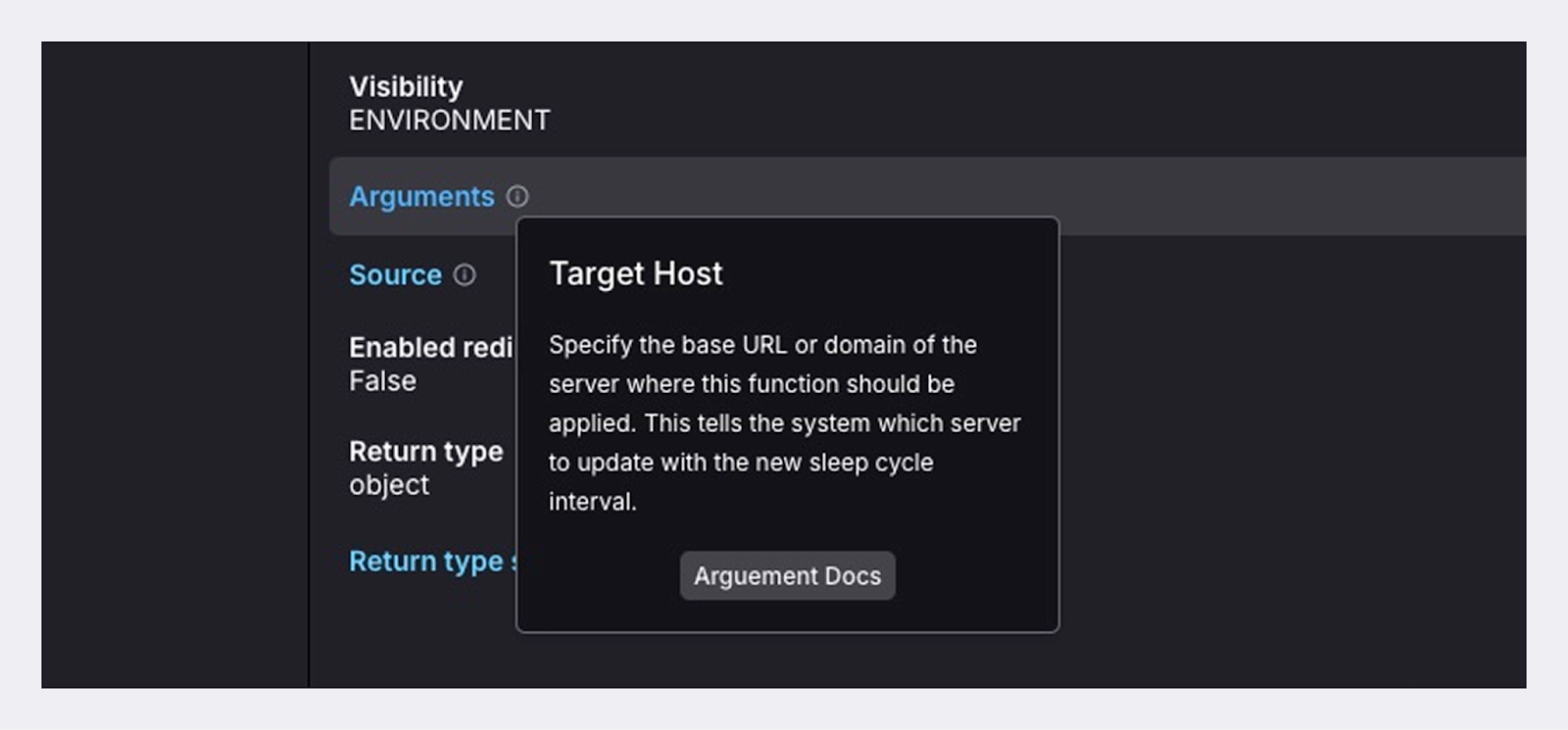
One of our most requested features is now live: fully configurable tooltips and helper text across all Canopy item detail views. You can now define tooltips directly in your application config to explain each field’s purpose. Each tooltip can include a title, body (value), and an optional “Read Docs” button. This clarifies the field level, helping users know what to enter and why.
TOOLTIP CONFIGURATION:
{

  "name": {

    "label": "Name",

    "type": "text",

    "placeholder": "Enter a unique name",

      "tooltip": {

    "title": "Name",`

    "value": "A unique, human-readable name for this item.",

    "url": "https://docs.polyapi.dev/canopy/fields#name",

    "action": "Read Docs"

    }

  }

}
New Date/Time Picker Controls
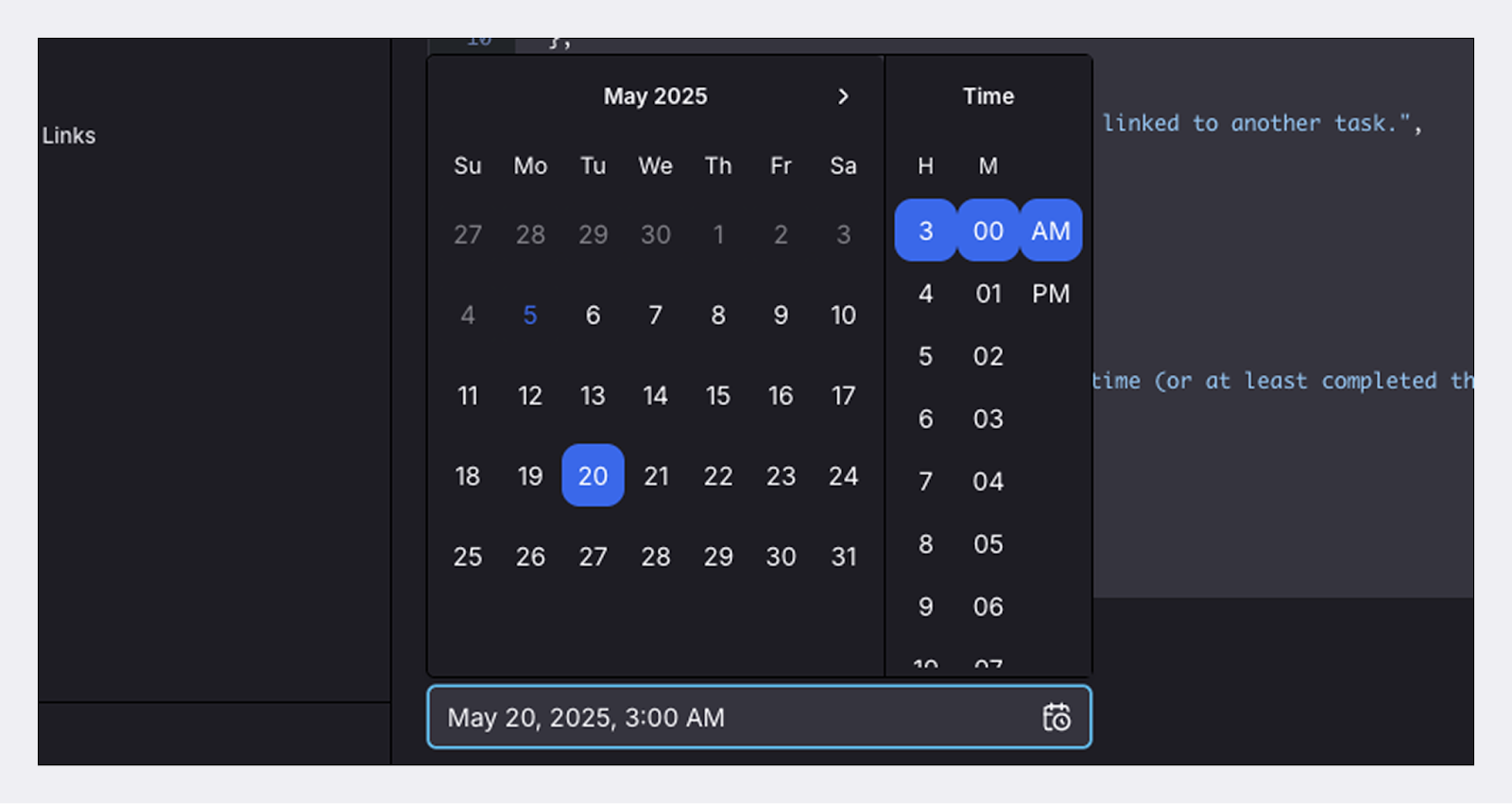
We’ve added native support for datetime, date, and time input types in Canopy. These controls support input/output time zones, default values, and value ranges. You now get a simple calendar + clock UI for managing variable expirations and API key lifetimes. Here’s an example configuration:
DATE/TIME CONFIGURATION:
{

  "type": "datetime",

  "min": "now",

  "max": "now + 1 year",

  "defaultValue": "now + 1 hour",

  "inputTimezone": "PST"

}
This update adds affordances for more accurate, time-sensitive configuration workflows.
Redesigned 404 Pages
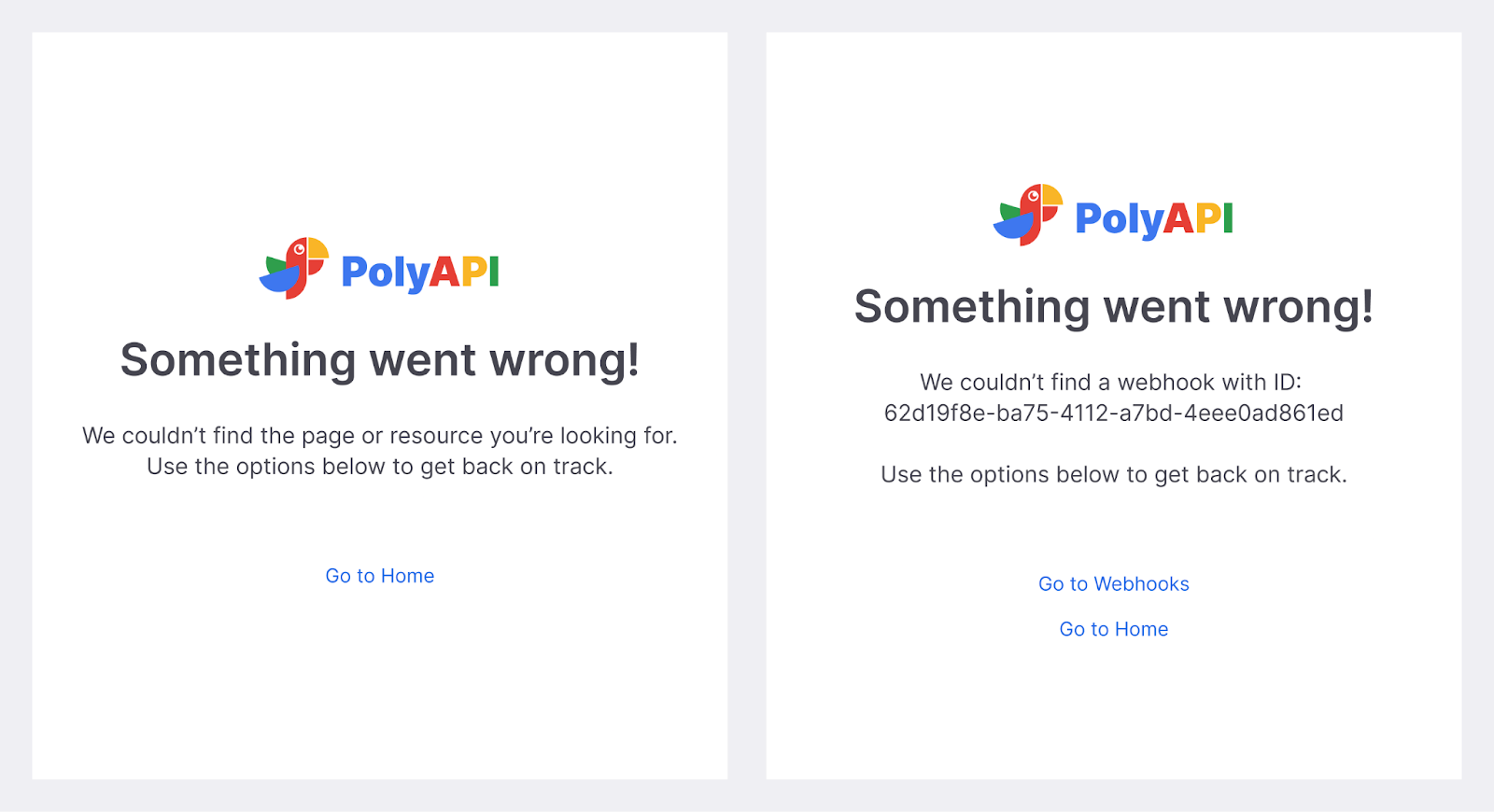
We’ve overhauled our 404 pages to be more helpful and customizable. Canopy now shows tailored messaging for general 404s and specific missing resources, with configurable links and brandable visuals. No more dead ends—users always have a clear path forward (or backwards!  ).
).
Improved Environment Selector in API Key Views
We’ve made the environment selector more robust to reduce confusion when managing API keys across multiple environments. It now displays the full context and the environment name, helping you quickly understand where each key belongs, because every key deserves the right chest.
Webhook Response Code Field Fixed
The Response Status Code input on the Webhook creation form has been fixed. Previously, users were blocked from editing standard HTTP status values like 200 or 201. The field now correctly accepts numeric input, supports keyboard and stepper controls, and prevents invalid characters like e.
These UX/UI improvements are part of our ongoing effort to make Canopy the most powerful and user-friendly interface for building with PolyAPI. Try them out in your app and let us know what you’d like to see next!
Have questions or want a demo? Contact us to get started.
Want to collaborate with other developers building on PolyAPI? Join our Slack community.
The post New in Canopy: Tooltips, Date Pickers, Smarter 404s & More appeared first on PolyAPI.
]]>The post Enterprise Integrations: When to Use Off-the-Shelf, Partner Solutions, or Build Your Own appeared first on PolyAPI.
]]>Integrations are no longer an afterthought. They are the backbone of operational efficiency, automation, and customer experience. But when it comes to implementing them, one of the most strategic decisions is deceptively simple: should you use an integration provided by a vendor, buy one from a service provider, or build your own? Each path has trade-offs involving speed, control, cost, and long-term flexibility. This article walks through the key considerations you should weigh before making that choice, offers guidance for different scenarios, and introduces a decision framework to help you confidently choose the right path.
This decision isn’t one-dimensional; it requires balancing technical, operational, and strategic factors that don’t always align neatly. Some considerations, like regulatory compliance or uptime guarantees, may be non-negotiable. Others, like cost or time to value, might have more flexibility depending on the context. What matters is being explicit: identify which factors are true deal breakers for your organization, and which ones you’re willing to optimize for. That clarity allows you to assess trade-offs rationally rather than reactively, and to avoid costly missteps down the line.
Key Questions to Ask Before Choosing or Building an Integration
- Does an integration already exist for this use case? Is there an off-the-shelf solution available from the vendor or a partner?
- Does the existing integration fully meet your business and technical needs? Are there critical gaps in data coverage, workflows, or functionality?
- How critical is this integration to your business operations or differentiation? Would failures or limitations significantly impact revenue, compliance, or customer experience?
- Who built the integration, and who controls its functionality? Can you request changes or fixes, or are you locked into someone else’s roadmap?
- How well does the integration perform against your needs? Consider latency, uptime, error rates, throughput, and scalability under load.
- How gracefully does the integration fail? Are errors transparent and recoverable, or do failures cascade and impact other systems?
- Who is responsible for monitoring and receiving alerts when issues arise? Is alerting in place, and do you have visibility into failures?
- Who will fix it, and how quickly can issues be resolved? Is there a clear support path with defined SLAs?
- Where does your data flow, and how is it handled in transit or at rest? Are there risks related to data residency, storage, or regulatory compliance?
- What does it cost to implement and operate? Is there a fixed price or usage-based pricing model? What are the hidden or scaling costs?
- Is the integration a direct connection or mediated through a third-party middleware? Does this add complexity, latency, or operational dependencies?
- How likely are you to need changes to the integration in the future? Will evolving business needs require flexibility, customization, or expansion?
- What skills are required to develop, maintain, or customize the integration? Does your team have these skills today, or are they easily attainable?
We’ve included a simple decision diagram below to make this process easier. It walks you through the core questions to help you quickly assess which integration approach—vendor-built, partner-provided, or custom-built—is most aligned with your needs. Use it to narrow down the options that make the most sense for your situation.
Once you’ve worked through the key questions, you’ll often find that the right path reveals itself. In many cases, a fairly clear-cut decision framework can help you either zero in on the best approach or quickly rule out options that don’t fit. By following this framework, you can determine whether to build, buy, or use a vendor-provided integration with much greater clarity. And if you don’t have a definitive answer on specific questions, that’s okay too. Both paths remain viable in those cases, and you can continue exploring each with a sharper understanding of what trade-offs to evaluate and who your real contenders are from a strategic standpoint.
It’s reasonable and often necessary for organizations to mix approaches. Some integrations will come from vendors, others from service providers, and some must be built in-house. It’s not a pure model, but it’s the most effective way to move fast while staying in control. What matters most is that each integration approach aligns with the nature of the problem. Delegate the wrong ones, such as critical, sensitive, or frequently changing integrations, and you’ll face trouble when it’s time to switch vendors, adapt behavior, or pass an audit. But if you try to build everything yourself, including standard or non-differentiating connections, you risk delaying your project, wasting engineering effort, and overspending. Making deliberate, case-by-case decisions separates effective integration strategies from chaotic ones.
Have questions or need guidance? Reach out to our team or schedule a demo. You can also jump in right now. Create an account and start setting up Poly yourself for free.
Want to connect with other builders and get support? Join the conversation in our PolyAPI Community on Slack!
The post Enterprise Integrations: When to Use Off-the-Shelf, Partner Solutions, or Build Your Own appeared first on PolyAPI.
]]>The post Function Owners and States appeared first on PolyAPI.
]]>In Release 20, we introduced API support for function states and owner relationships. With Release 21, we’ve expanded on this by adding UI support for both capabilities, enabling more intuitive and collaborative development workflows.
These enhancements help teams better coordinate by making it clear what state a function is in—such as ALPHA, BETA, or STABLE—and who the designated owner is. This structure has now been extended across the platform to include all object types, such as variables, webhooks, and all function types.
What’s New in R21
- Function Ownership: All function types can now be associated with individual users. While currently this is informational, we’re laying the groundwork for future features like:
- Better representation of the relationship visually with one click navigation
- Notifications about schema discrepancies
- Usage alerts
- Approval workflows
- Streamlined owner assignment during deployment, training, and creation
- Function Lifecycle States: Every function now includes a lifecycle state indicator. Learn more about these states and their long-term significance here: Function Lifecycle States
Questions or Feedback?
Have questions about our roadmap or platform? We’d love to hear from you! Reach out to us at [email protected], fill out a contact form, or book an intro meeting.
Connect with us on Slack and join our community!
The post Function Owners and States appeared first on PolyAPI.
]]>The post What If You Could Launch a New Guest Experience in Days, Not Months? appeared first on PolyAPI.
]]>In the hospitality industry, timing is everything.
Guests expect seamless, intuitive experiences from the moment they discover your property to the moment they check out. Loyalty often hinges on minor details, such as an automated upgrade notification, real-time room readiness, or personalized in-room services delivered on demand.
Yet behind these moments lies a reality that many hospitality leaders know too well. Building the digital infrastructure to power these experiences is rarely fast, easy, or inexpensive.
Custom integrations can take months. Connecting systems like PMS, POS, loyalty engines, CRMs, and mobile apps often involves coordinating multiple vendors, outdated APIs, manual workflows, and siloed teams. The result is a delayed timeline, rising costs, and missed opportunities.
But what if this could change?
What if your team could design, integrate, and launch new digital experiences in days instead of months?
PolyAPI is making that possible.
The Hospitality Bottleneck: Integration
Hospitality businesses today rely on a mix of legacy and modern systems. Brittle point-to-point connections or manual workflows often hold these together. Even simple use cases like:
- Sending personalized dining promotions based on guest profiles
- Routing food and beverage orders from the mobile app to the correct POS terminal
- Syncing loyalty status across reservation and check-in systems
These can require weeks of custom development and vendor coordination.
This integration drag does more than slow operations. It limits how fast teams respond to changing guest expectations and market opportunities.
Marketing teams want to launch new promotions, loyalty experiences, and mobile features. Guest experience teams want to personalize services. But the answer from IT is often, “We’ll need 6 to 12 weeks.”
The backlog of great ideas grows while the guest experience stays static.
The Opportunity: Decoupling Development from Delay
The key to speed is not more developers. It is better infrastructure.
PolyAPI provides a framework for connecting, orchestrating, and automating services, systems, and functions without building every link from scratch.
It acts as a development and operations layer across your tech stack. PolyAPI allows your team to:
- Discover and connect APIs from internal systems and vendors
- Automate workflows based on real-time events or batch jobs
- Combine data from PMS, POS, loyalty, and CRM in a single logic flow
- Securely expose services with typed SDKs and auto-generated documentation
- Build and launch features quickly using tools developers already know
What used to take months of planning and implementation can now be scoped and shipped in days.
Example Use Case: Cross-System Room Service Ordering
Let’s say your team wants to introduce in-room dining that guests can order from your app. Charges will be sent directly to their folio, and fulfillment will be managed by your kitchen staff.
In a traditional environment, you would need to:
- Connect the guest’s mobile profile to their reservation
- Expose item availability from the POS system used by the restaurant
- Route the order to the kitchen display system or ticket printer
- Add the charge to the guest folio in the PMS
- Sync the experience data to your CRM for future personalization
With PolyAPI, this process becomes much easier:
- Discover APIs for your POS, PMS, and mobile app backend in PolyAPI
- Orchestrate a service that connects item availability, order submission, and billing logic
- Trigger actions based on in-room location, loyalty status, or dining preferences
- Expose the new function for your mobile app team to integrate directly
- Monitor workflows to ensure all systems respond as expected
Launching a new ordering experience becomes a low-risk, high-impact initiative with this structure in place.
Shared Customer Information Across the Guest Journey
One of the most significant opportunities in hospitality is making customer data work across the entire journey.
For example, a guest might check in via a kiosk, order room service, visit the bar, and book a late checkout, all in a single stay. But often, each of those actions lives in a separate system.
The POS knows what they ordered, the PMS knows when they arrived, and the CRM might not know either until after the stay is complete.
PolyAPI helps unify this fragmented data by enabling orchestrations across all systems. You can build a single view of the guest by combining:
- Check-in and checkout times from PMS
- Dining and purchasing data from POS
- App interactions and concierge requests from mobile
- Loyalty tier and preferences from CRM
This shared information allows teams to personalize recommendations, automate follow-ups, and understand guest behavior without exporting data manually or writing custom sync scripts.
For example, a high-value guest who orders premium wine might receive a post-stay offer tailored to their preferences. Or housekeeping might receive alerts to prepare the room for an early arrival based on loyalty tier and flight tracking.
This level of coordination helps hotels deliver personal and effortless experiences.
Why PolyAPI Enables Speed and Flexibility
PolyAPI offers several capabilities that allow teams to innovate without being blocked by infrastructure:
1. Auto-Generated SDKs and Documentation
Every API or function defined in PolyAPI comes with SDKs and full documentation. Developers can integrate new features without needing backend handoffs or waiting for API teams to write documentation.
2. POS and Vendor Abstraction
Whether you use Toast, Micros, Square, or another POS provider, PolyAPI can abstract these into consistent interfaces. This allows your team to build once and adapt later if vendors or locations change.
3. Event-Driven Orchestration
You can trigger functions when a payment is made at the bar, when a keycard is issued, or when a table is closed. This enables real-time automation that enhances the guest experience while reducing manual handoffs.
4. Secure Access and Configuration
Credentials and environment-specific configurations are stored securely and injected automatically, keeping your APIs secure while making development and deployment safer and faster.
5. Operational Visibility
PolyAPI provides real-time logging and execution history for every service, so you can troubleshoot problems and monitor performance without adding external tools.
Empowering Hospitality Teams to Move Faster
This platform is not just for engineers. It is for hospitality leaders who want to empower their teams to:
- Test ideas quickly
- Launch new services with confidence
- Avoid the delays of legacy system integration
- Reduce vendor lock-in
- Improve the guest experience in real-time
Whether it is a new loyalty feature, digital concierge service, or POS-connected promotion, PolyAPI allows teams to build smarter and launch faster.
The Competitive Advantage of Agility
Guests compare brands based on convenience and personalization, being able to adapt quickly is a competitive edge. The brands that win will be the ones that can launch offers, automate interactions, and personalize services faster than the market expects.
PolyAPI gives you the infrastructure to do that. It does not require a massive engineering team. It requires vision and a willingness to think differently about how systems can work together.
Innovation in hospitality is not about dreaming bigger. It is about delivering smarter.
PolyAPI helps make what is possible achievable. Let us help you connect the dots across systems, teams, and guests.
If you are ready to move faster, reduce complexity, and unlock new digital experiences, PolyAPI is prepared to support you. Reach out to us if you have any questions, or schedule a demo. You can also get started by creating an account, and setting up Poly on your own for free.
The post What If You Could Launch a New Guest Experience in Days, Not Months? appeared first on PolyAPI.
]]>The post How AI Is Enhancing API Documentation appeared first on PolyAPI.
]]>API documentation has long been the foundation of software development, integration, and collaboration. Yet, for all its importance, traditional documentation practices often lag behind the speed and complexity of modern software development. Teams deploy faster, build microservices rapidly, and integrate with dozens of third-party platforms, but the documentation often comes later, incomplete, or not at all.
This is where artificial intelligence is beginning to reshape the landscape.
By automating and enhancing how documentation is captured, structured, and surfaced, AI is helping developers move faster, avoid mistakes, and retain institutional knowledge in ways that static docs never could. Rather than replacing developers or writers, AI is a force multiplier, automating the rote work and surfacing the most relevant information in context.
Let’s explore how AI is changing API documentation and how platforms like PolyAPI are helping teams turn API sprawl into structured, reliable, and accessible information.
The Challenges of Traditional API Documentation
Before diving into AI, it’s important to understand why documentation has been a pain point for so long.
In many teams, API documentation is a manual task. Developers often write it after coding is complete or skip it altogether. Even when tools like OpenAPI or Swagger are used, the documentation may lack meaningful descriptions or fail to stay in sync with live deployments.
Some common challenges include:
- Documentation is written once but never updated
- Missing or inconsistent descriptions of endpoints, parameters, or responses
- APIs without any documentation at all
- Lack of visibility into internal functions or events
- Difficulty navigating and searching extensive API catalogs
The number of interfaces skyrockets as teams adopt microservices, serverless functions, and real-time event-driven architectures. Without a scalable system, teams lose track of what they’ve built and how it’s supposed to work.
AI introduces new methods to address these problems automatically and in real-time.
What AI Brings to API Documentation
AI enhances documentation in three key ways:
- Automatic Capture of Behavior
- Instead of relying on developers to describe every endpoint, AI can observe how APIs behave. For example, it can monitor requests through tools like Postman or record live API traffic to understand usage patterns.
- Smart Generation of Descriptions and Schemas
- Using machine learning models trained on large sets of public and private APIs, AI can generate function summaries, parameter descriptions, and schema definitions. It can fill in missing documentation based on naming conventions, behavior, and common patterns.
- Context-Aware Delivery
- AI directly enables dynamic, searchable documentation to developers’ tools, such as IDEs. Rather than reading docs in a separate browser tab, developers can search for and use APIs within their code environment, complete with type safety and auto-suggestions.
These enhancements make documentation more accurate, complete, and accessible.
How PolyAPI Uses AI to Enhance Documentation
PolyAPI is a platform built around the idea that documentation, integration, and development should all happen together. Rather than treat documentation as a separate phase, PolyAPI captures and generates documentation as part of the development and deployment process.
Here’s how it works in practice:
1. Capture API Behavior from Postman
When a team is working in Postman or making live API calls without existing documentation, PolyAPI can observe those requests and generate structured documentation based on the payloads, endpoints, and parameters in use.
This allows developers to document APIs without writing anything manually. The documentation reflects actual usage, which makes it more reliable and useful.
2. Ingest and Enhance OpenAPI Specifications
If you already use OpenAPI or Swagger files, PolyAPI can ingest them and fill in any missing pieces. Many teams stop at generating the skeleton, but Poly enhances the spec with descriptions, schemas, and connections to actual function implementations or event handlers.
This improves the readability and usability of your docs, especially for external consumers or partner teams.
3. Catalog New Microservices Automatically
As your teams deploy new services, PolyAPI detects them at runtime. It catalogs functions, events, and microservices and generates metadata, typed schemas, and links to the source code. All of this is available for indexing, search, and code generation.
You no longer need to maintain a central wiki or worry about tracking what each team is building. PolyAPI builds and updates the catalog automatically.
4. Pre-trained API Knowledge for Faster Starts
PolyAPI comes pre-trained on approximately 1,000 commonly used API functions. This allows developers to start building immediately, using familiar patterns and examples. PolyAPI can suggest structure, naming, and schema templates if your internal function resembles a popular public API.
This speeds up onboarding, reduces documentation errors and allows developers to work faster from day one.
API Documentation Inside the IDE
One of the most practical ways PolyAPI improves developer workflows is by bringing everything directly into the IDE.
As developers write code, they can:
- Discover APIs, functions, and events available in their environment
- View typed definitions and usage patterns
- Generate example code based on their stack (TypeScript, Python, Java, .NET)
- Search by keyword, context, or schema
- Copy function calls that include correct payloads and authentication references
Because the SDKs are generated automatically with proper type safety, developers get immediate feedback if they use the wrong parameters or forget the required fields.
This reduces errors and removes the need to switch browser tabs or reference outdated documentation.
Retaining Institutional Knowledge
One of the most valuable outcomes of AI-generated documentation is knowledge retention.
Developers come and go in fast-moving teams, services change, and naming conventions evolve. New team members struggle to understand what has been built without up-to-date documentation, making legacy services harder to maintain.
PolyAPI captures and maintains this information automatically:
- Each API, function, or event includes structured documentation
- The documentation is tied to source code and schema definitions
- A full history of activity supports compliance and troubleshooting
- Search and discovery are consistent across all services
This keeps institutional knowledge intact and accessible, even as teams scale or reorganize.
The Next Phase of Documentation
As APIs evolve, the need for consistent, accurate, and accessible documentation will only grow. AI is here to support developers by doing the repetitive, time-consuming, and often neglected parts.
PolyAPI combines intelligent automation with developer-centric design. It supports every stage of the API lifecycle, from discovery and design to deployment and documentation. The result is a platform that helps developers move faster, reduce errors, and retain control of their growing service ecosystems.
If your documentation still relies on manual updates and scattered wikis, now is a good time to rethink the role AI can play.
Explore how PolyAPI helps teams retain knowledge, reduce support needs, and integrate services faster. Reach out to us if you have any questions, or schedule a demo. You can also get started by creating an account, and setting up Poly on your own for free.
The post How AI Is Enhancing API Documentation appeared first on PolyAPI.
]]>