
The Gaming Browser Continues Its Over-The-Top Ad Series, Reaching Millions on YouTube, Discord, Twitch, Vyro, TikTok, X – and Even Tinder
Oslo, Norway – 12 March 2026 – Opera GX, the gaming browser, is back with a fourth installment of its new ad series, “Your Setup Wants GX.” In this latest spot, protagonist PC Man – a sentient computer – leaves its neglectful partner (the gamer) and rebounds with another user who finally gives it what it’s been yearning for all along: Opera GX. Originally slated to run for only two weeks, the spot significantly surpassed the brand’s awareness and engagement goals, thanks to widespread sharing, memes, and unconventional distribution across gaming and social platforms. This prompted Opera to officially extend the PC Man campaign.
At a time when one in three brands say they are “highly risk-averse” when making creative decisions, Opera GX has built its identity by leaning into internet culture, gaming humor, and risque topics – most recently through PC Man’s unconventional love story and other exploits. The irreverent ad series highlights the intimate relationship that gamers have with their gaming setups – often obsessing over every single detail that affects their game…except for the browsers they play on. Without the right browser, even the most high-end hardware can feel the strain of resource-intensive gaming.
Opera originally created PC Man in October 2025 to give the PC itself a point of view. Through its Your Setup Wants GX series, PC Man delivers a growing list of consequences of not treating it well (e.g., not equipping it with a proper browser). In past spots, viewers saw PC Man accuse a player of settling for “basic browsers” for so long that the player had come to believe that his unacceptable behavior was acceptable. In another, PC Man stages a funeral for a player that neglected it and resists arrest when protesting a subpar browser.
This most recent episode takes a decidedly more passionate turn. The spot begins with PC Man accusing a gamer of not respecting or giving the computer the love it deserves. After demanding a browser that can keep it running at peak performance, PC Man leaves. The spot concludes when the original gamer finds PC Man with another player right at the moment PC Man is finally getting the right treatment: an Opera GX installation.
“Gamers obsess over every part of their setup, except the browser,” said Maciej Wójcik, Senior Product Marketing Director at Opera. “PC Man exists to point out that contradiction in a way that feels native to gaming culture. If your browser slows your system down, it is part of the problem, not a neutral tool. We wanted our campaign to not only reflect this, but to feel like a game itself: immersive, interactive, and fully rooted in the gaming world.”
Opera has taken an equally unconventional approach to distributing the campaign. In addition to running the PC Man video across YouTube, TikTok, Discord and Twitch, the brand rolled out interactive formats, including a game called “Maximum Load” through gaming community GameJolt and on Vyro, a platform by internet personality MrBeast. In this game, users steer PC Man through a satisfying installation of the browser and are ultimately encouraged to download Opera GX.
With romance on the mind, Opera additionally encouraged Tinder users to “match” with PC Man via an in-app ad that simulated scrolling through dating profiles, only to match with PC Man. Meanwhile, gaming creators amplified the experience live with their communities, driving users from social platforms into hands-on engagement with Opera GX.
Viewers who encountered in-browser and display ads featuring PC Man found themselves doing a “double take,” hunting down the original YouTube video to watch again, confirm it was real, and share it with friends. Within two weeks, the campaign video alone had exceeded its original viewership goal by 16%. A large contributor to this was user-generated memes, which delivered 2.6× more views than original ad posts.
Opera worked with ad agency OFFICER & GENTLEMAN and production company Jakiens to create the campaign.
About Opera GX
Opera GX is the browser of choice for millions of gamers seeking a more personalized internet experience. The first browser to allow users to fully customize its appearance, color themes, sounds effects and audio effects, Opera GX additionally optimizes the computer’s resources for gaming through CPU, RAM and Network Bandwidth limiters that make the browser less resource-hungry. Users can simply download one of over 10,000 mods to start enjoying a new look that suits their preferences. Opera GX was born in Oslo, Norway in 2019.
]]>
Oslo, Norway – February 17, 2026 – The Opera browser is turning thirty and we’re celebrating by launching the “Opera Web Rewind”, a digital archive and interactive experience designed to preserve the most iconic moments of the web. It’s an invitation to rediscover how the web evolved – from the screech of 56k modems connecting to the internet to the rise of AI prompt.
We launched our first browser to the public in 1996. For three decades, we’ve been the go-to for millions of users who, like you, looked at the default browser pre-installed on their devices and thought: “I can do better”.
“In three decades, the web has evolved from a niche scientific tool to an indispensable part of our entire lives. At Opera, we’ve spent 30 years building a faster, better, and more creative window to the world,” said Jan Standal, Senior Vice President at Opera. “Web Rewind is our tribute to the community that shaped the web. We want to celebrate the memes, the breakthroughs, and even the quirks that made the web what it is today.”
The Archive: Rediscover 30 years of digital culture
The Web Rewind isn’t a static museum; it’s a playground. It lets you rediscover the gems from the web’s history by interacting with digital “artifacts” directly in your browser – whether you’re on your phone or your desktop.
- You can simply hold the space bar (or tap and hold on mobile) to fast-forward through time or click on specific years to explore a curated collection of early social media layouts, viral trends, and internet iconic lore.
- The archive covers everything from the “You’ve Got Mail” era and the first customized MySpace pages to the birth of viral video culture.
The Competition: A Journey to the birthplace of the Web
To mark the big 3-0, we’re hunting for the best web memories that actually stuck. We’re encouraging everyone to reflect for a second and submit their own “Web Rewind” moments – whether it’s a life-changing online interaction, a nostalgic gaming site, or a piece of internet folklore that defined your experience online.
The authors of the three best entries will win a trip to the birthplace of it all: CERN in Switzerland. This is where the World Wide Web was born in the early 90s. Winners will get the rare chance to visit the home of the Large Hadron Collider and stand where Sir Tim Berners-Lee first revolutionized how we share information.
How to participate:
- Submission: Visit the Web Rewind website and click the “Submit” button.
- Format: Users can provide a description (up to 500 characters) and attach images or videos (up to 10MB).
- Deadline: Entries are open until March 27th, 2026.
- Winners: To be announced shortly after the deadline, with the trip scheduled before June 30th, 2026.
About Opera
Opera is a user-centric and innovative software company focused on enabling the best possible internet browsing experience across devices. Hundreds of millions of people use Opera browsers for their unique features on mobile phones and desktop computers. Founded in 1995 and headquartered in Oslo, Norway, Opera is publicly listed on the Nasdaq stock exchange under the ticker symbol OPRA. Download Opera browsers and other Opera products at opera.com. Learn more at investor.opera.com.
]]>
2 February 2026 – Tether, the world’s leading stablecoin issuer, announced the expansion of USDT and Tether Gold (via XAU₮0*) support within MiniPay, Opera’s self-custodial wallet built on the Celo blockchain. The initiative is helping millions of users across emerging markets gain stable, dollar-denominated access to value and savings, reinforcing Tether’s role in advancing global financial inclusion.
USDT, with a market capitalization of over $186 billion, remains the most widely used and trusted digital dollar globally. Its integration into MiniPay enables users to send, receive, and hold USDT with a tap, without navigating the complexities of the blockchain.
Opera’s MiniPay wallet has become one of the largest self-custodial stablecoin wallets globally, with over 12.6 million activated wallets, 350 million transactions, and 3.64 million estimated on-chain users on Celo. In Q4 2025 alone, MiniPay saw 50% growth in on-chain users, highlighting accelerating USDT adoption across Africa, Latin America, and Southeast Asia.
As of December, 2025, MiniPay has 7 million phone-verified USDT wallets, seeing 300,000 unique buyers of USDT in December, up 33% month over month, Celo became the fastest-growing native USDT chain, with user growth of 506% in the last 12 months, from 825 thousand to 5 million users. MiniPay users initiated more than 96 million USDT in stablecoin transfers in December 2025 and over 3.5 million peer-to-peer payments that month.
Users have also added more than $49 million USD in cash to their MiniPay wallets through local partners including Fonbank, Partna, Daimo, Cashramp, Binance, and Bybit, connecting local economies directly to Tether’s global liquidity network. Across all integrations, more than 153 million USD was sent or received through MiniPay in December, underscoring growing demand for stable, dollar-based payments in mobile-first regions.
“Tether’s mission has always been to provide simple, reliable access to stable value for people who need it most,” said Paolo Ardoino, CEO of Tether. “By supporting USDT and XAU₮0 in MiniPay, we’re helping create tools that make digital assets genuinely useful, whether for sending money, saving in dollars, or protecting value in gold. Financial inclusion is not just about technology; it’s about building systems that work for everyday life.”
“Integrating USDT directly into MiniPay turns smartphone reach into real financial access,” said Jørgen Arnesen, EVP Mobile at Opera. “Millions of users are now holding, sending, and saving in digital dollars seamlessly, often for the first time. MiniPay brings stable, on-chain money to the people who need it most.”
In addition to USDT, MiniPay supports Tether Gold, a token representing ownership of physical gold, through its support for XAU₮0. With gold prices rising nearly 50% in 2025, XAU₮0 offers households an accessible and inflation-resistant savings option. Users can convert part of their balance into XAU₮0 with a single tap, maintaining liquidity while preserving value.
Tether Gold remains one of the most established tokenized real-world assets, providing a transparent, on-chain bridge between traditional value stores and the emerging digital economy.
Tether’s ongoing commitment to transparency, liquidity, and accessibility continues to expand the real-world use of stablecoins. Together with Opera, Tether is building practical financial tools that help people move, save, and store value securely, bringing the benefits of stable digital money to millions beyond the traditional banking system.
*XAU₮0 is a bridged version of Tether Gold (XAU₮). XAU₮0 is not issued by Tether.
About MiniPay
MiniPay is a non-custodial stablecoin wallet built on the Celo blockchain and designed to make digital finance accessible, affordable, and user-friendly – especially across emerging markets. MiniPay is offered by Blueboard Limited, an Opera company. Opera is publicly listed on the Nasdaq stock exchange under the ticker symbol OPRA. Learn more at investor.opera.com.
Important Note
This press release is not an offer to sell or the solicitation of an offer to buy USDT or XAU₮. Tether International, S.A. de C.V. will only sell or redeem USDT pursuant to its terms of service available (as of the date of this press release) at tether.to/en/legal. TG Commodities, S.A. de C.V. will only sell or redeem XAU₮ pursuant to its terms of sale and service available (as of the date of this press release) at gold.tether.to/legal.
Disclaimer
As a non-custodial stablecoin wallet, MiniPay exclusively enables individual users to initiate on-chain P2P stablecoin transfers. Through integrations with our third-party partners, however, the MiniPay ecosystem also enables users to discover a rich array of additional services provided by such third parties including on-ramp/off-ramp, top-up, or payment services. MiniPay itself does not facilitate or provide any form of exchange services, payment services, or remittances. Any and all references to such functionality indicates the availability of third-party services discoverable within the MiniPay ecosystem. XAU₮0 is available in Mini Apps via a third party.
]]>
Oslo, Norway – January 13, 2026 – Imagine a world where all your tabs are neatly organized into Tab Islands and color-coded and your AI works in the context of each of those groups. All the while, your browser is soothing you with a custom theme and soundscape. Well, that vision is now reality and the time to up your browsing game is now.
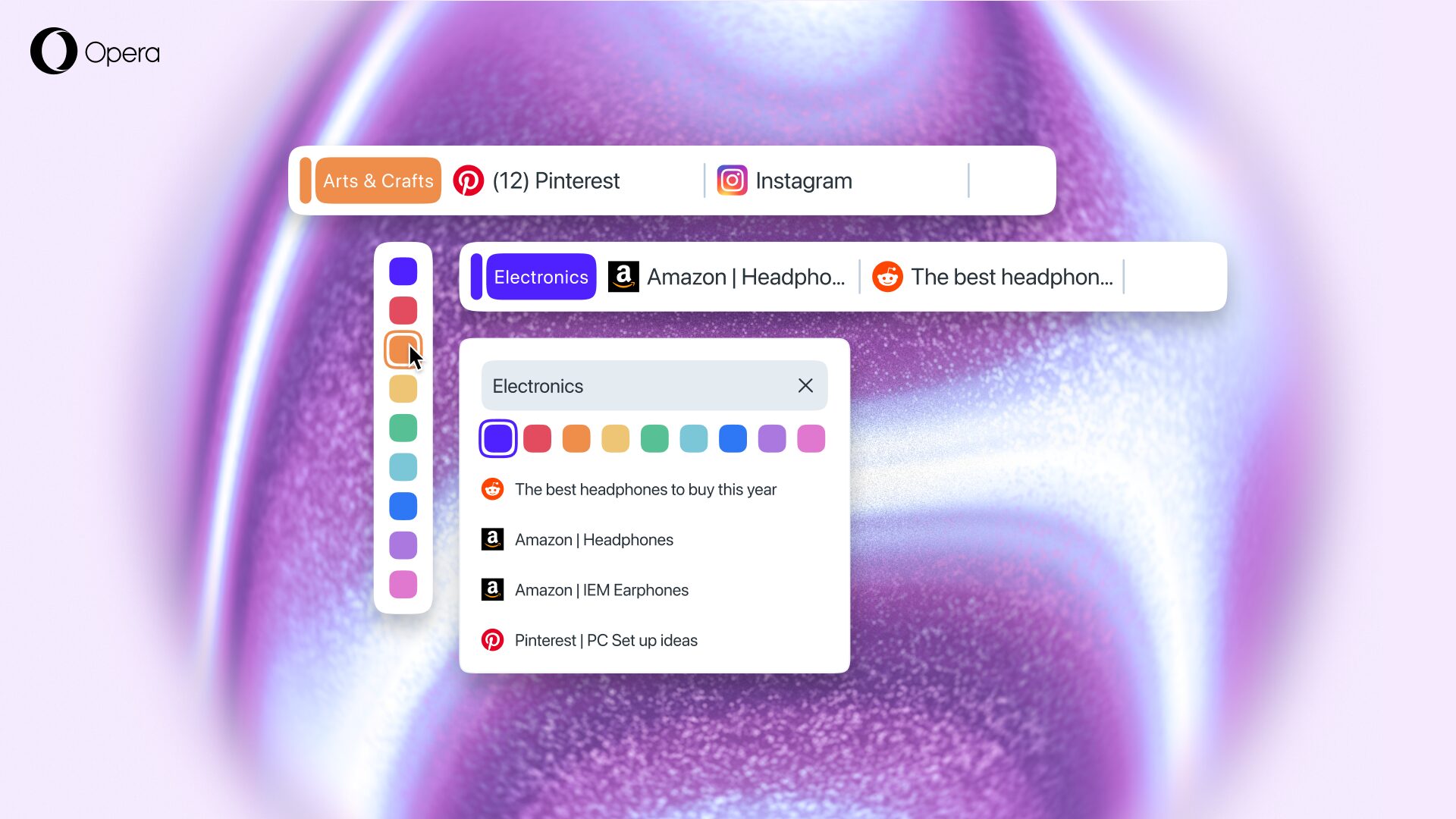
Opera [NASDAQ: OPRA], the Norwegian browser innovator and agentic AI company, is presenting Opera One R3 today, the latest version of its flagship browser, Opera One. This update lets you get more things done than ever before: Tab Islands are Opera’s intuitive alternative to tab groups: they automatically place the tabs from one browsing context into a neat Tab Island. Tab Islands can now be color-coded and named, and the faster, re-engineered Opera AI can work in the context of each one of them or in the context of each one of your tabs. Add Google services in the sidebar and a split screen with more tabs and layout options and you’re better set up to achieve anything you want in 2026. Opera One R3 arrives just in time for new year’s resolution season and requires absolutely zero cardio to get your life in order.
“The beginning of a new year can be overwhelming, but the time to get things done is now. We’re giving you the best browser to work with as many AI tools, websites and services, all within a beautiful visual and auditory experience,” said Mohamed Salah, senior director of product at Opera.
Opera One R3 brings tabbed browsing to a new level
Tab Islands are one of Opera user’s most beloved features, and with this release Opera is bringing them to a whole new level. Opera One R3 marks the third time Opera One is being reborn – it’s Opera’s tradition to gradually improve the browser and for it to be reborn each year. This version brings improvements to one of the user’s favorite features Tab Islands, which are an intuitive and automated way of grouping tabs. Users can now color-code and name them as they wish. This makes it easier to quickly identify what a specific Tab Island is holding,without opening any of its tabs.
This update also introduces Opera browser AI – a rebuilt browser AI that brings a new engine architecture from Opera Neon’s agentic engine that provides 20% faster responses. Opera browser AI has the capability of using the current open tab (or Tab Island) to provide answers based on the context of those tabs, meaning that the responses from the AI don’t mix up contexts – users can turn this feature off in the chat.
Additionally, Opera browser AI also lets users ask questions about a Youtube video. The AI can understand what the video is about and help the user find a specific moment in it, or help them understand the topic it is discussing – making it ideal to help digest long videos that are packed with information.
The beta program is being replaced by early bird
Speaking of new year’s transformations. Opera is also making changes to its beta program. Instead of a separate browser build, users can now simply switch on the early bird mode in the browser and immediately test beta features. The best motivator to toggle early bird on is the new split screen feature available in Opera One R3.
Up until now, Opera One allowed you to split the screen to view two tabs at the same time. Starting today, users will be able to view up to four tabs at the same time and in various layouts, including a horizontal and grid ones – an ideal feature for those who use the browser in big screens with high resolutions, without leaving behind the convenience for users who like to work on their laptops.

Doubling down on modular design with Google services
Opera One’s design philosophy is modular design, and the R3 release is bringing more modular elements to the browser.
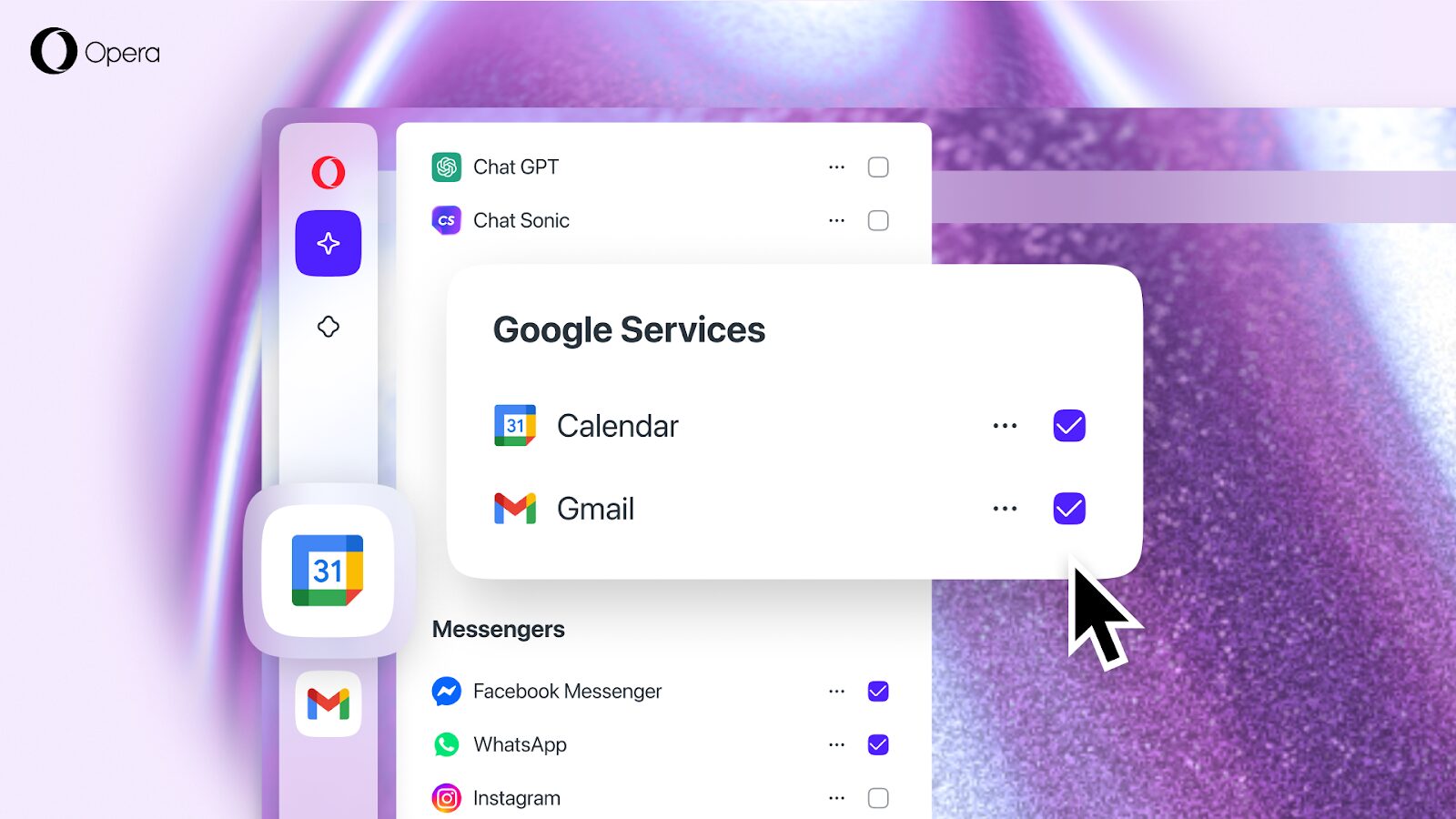
The browser sidebar is one of Opera users’ favorite features, which gives them access to social messengers, a music player, Slack, Discord, and many others. Today, Opera users can also access Gmail and Google Calendar from the sidebar. Integrations like this add to the modular design, and in turn enhance the work in the browser, as they make it easier to have more webpages and webapps always at hand without having to switch from the current task.
New year, new browser
This wouldn’t be a major Opera One update without the iconic dynamic Themes that come with it. That’s why Opera One R3 is bringing three new Themes that have been carefully created to make each browsing session feel unique and engaging: Radiance, Orbit, and Sonic.
Radiance comes in dark mode only and Orbit in light mode, and both Themes revolve around a sphere with the new R3 signature look. Each one of them also includes a dedicated soundscape. Finally, the Sonic Theme is a special one we created in a cross Scandinavian collaboration with Spotify. This Theme is dynamic because the background reacts to the music that users are listening to in the Opera music player (which works with various streaming services), making the browser groove to the user’s music.
All of these updates make Opera the most powerful, as well as best looking and best sounding browser to enter the new year with. Opera One R3 can be downloaded here.
About Opera
Opera is a user-centric and innovative software company focused on enabling the best possible internet browsing experience across devices. Hundreds of millions of people use Opera browsers for their unique features on mobile phones and desktop computers. Founded in 1995 and headquartered in Oslo, Norway, Opera is publicly listed on the Nasdaq stock exchange under the ticker symbol OPRA. Download Opera browsers and other Opera products at opera.com. Learn more at investor.opera.com.
Contacts: Investor relations: Matthew Wolfson, [email protected]; Media: [email protected]
]]>
OSLO, Norway – 11 December 2025 – Opera [NASDAQ: OPRA], the browser innovator and agentic AI company, has today opened public access to Opera Neon. Opera Neon is Opera’s experimental browser for AI power users, who wish to get access and make the most of the newest AI technologies as they emerge. Since Oct 2, Opera Neon was available within a closed “Founders” phase, which gave the company time to work with its community and incorporate its feedback. Starting today, the waitlist is removed, and anyone can subscribe to Opera Neon.
What is Opera Neon?
Opera Neon is an agentic browser designed for AI power users. Unlike a standard web browser, Opera Neon uses AI agents to perform tasks and even code web apps rather than just display web pages. It also provides its users access to the latest top-tier models, including Gemini 3 Pro and GPT 5.1.
Opera Neon is Opera’s testing ground for the latest advancements in AI, intended for those who want to use raw, developing technology before it becomes a mainstream product. To get it, one has to subscribe at $19.90/month.
“Opera Neon is a product for people who like to be the first to the newest AI tech. It’s a rapidly evolving project with significant updates released every week. We’ve been shaping it with our Founders community for a while and are now excited to share the early access to it with a larger audience,” said Krystian Kolondra, EVP Browsers.
One subscription, top models
Thanks to its LLM-agnostic AI engine, Opera Neon integrates the industry’s latest AI models into a single workspace, allowing them to pay a single monthly fee rather than paying for multiple separate subscriptions.
Current features available to subscribers include:
- Model Access: Immediate use of top-tier models including Gemini 3 Pro, GPT-5.1, Veo 3.1, and Nano Banana Pro.
- Neon Chat, Do, and Make agents: Tools that can book entire trips or build websites, generate videos, edit documents autonomously.
- ODRA deep research agent: A new agent that performs deep research for the user. Its “1-minute research,” can gather and synthesize information (with sources) on complex topics.
Community-Led Development
Subscribing to Opera Neon also grants access to an exclusive Discord community. Here, users test features first, discuss the product directly with Opera’s developers, and help shape the browser’s roadmap.
Availability
Opera Neon is available now for $19.90 per month. Users can download it from https://operaneon.com.
Opera’s main browsers (Opera One, Opera GX and Opera Air) continue provide free AI features for general users through Opera AI.
About Opera
Opera is a user-centric and innovative software company focused on enabling the best possible internet browsing experience across devices. Hundreds of millions of people use Opera browsers for their unique features on mobile phones and desktop computers. Founded in 1995 and headquartered in Oslo, Norway, Opera is publicly listed on the Nasdaq stock exchange under the ticker symbol OPRA. Download Opera browsers and other Opera products at opera.com. Learn more at investor.opera.com.
Contacts: Investor relations: Matthew Wolfson, [email protected]; Media: [email protected]
]]>
Oslo, Norway – 4 December 2025 – Today Opera [NASDAQ: OPRA], the browser innovator and agentic AI company, is bringing an update to Opera for Android that improves the user experience, allowing users to use websites as well as images as context for AI queries. Opera for Android’s AI capabilities are now becoming closer to those of the company’s flagship browser for desktop, Opera One, providing a more consistent experience across devices.
New access point to Ask AI
With this update, Opera for Android has a new access point for AI queries in the browser: Ask AI. To access it, users simply need to open Opera for Android, tap on the search bar, and then select the Ask AI option to open the new search bar.
Now, when users tap on the search bar, they can choose between traditional web search (with any of the search engines available) or the Ask AI option. With this new interface it’s much easier for users to switch between the traditional search and AI queries on the go.
Attach file in the new search bar
This new search bar also allows users to attach files that are stored on their Android device, or take a picture with the device’s camera and attach it. For example, if a user needs to translate a document, they simply need to attach it as a PDF or take a picture of it and then go to Ask AI to get it translated. And because it’s AI, the user can keep asking questions about the just-translated document to better understand what it’s all about.

To attach files to the search bar, users simply need to:
- Access the Ask AI interface.
- Tap on the “+” sign underneath the text input field.
- Choose to attach a document, an image, or take a picture with the device’s camera.
Use the current tab as context for the prompt
With Ask AI, Opera for Android can now take the tab a user is browsing as context for a prompt, enabling the user to better understand the page they’re on. For example, a user might be reading an article about quantum computing, and wish to have parts of the text explained to them more simply.
To use the current tab as context for the prompt, users need to:
- While in any webpage, tap the three dots at the top right of the browser (to the right of the search bar).
- Select the “Ask AI” option.
- The search bar will appear and users will see that the webpage they were on has been attached to the chat and will be used as context for the prompt.
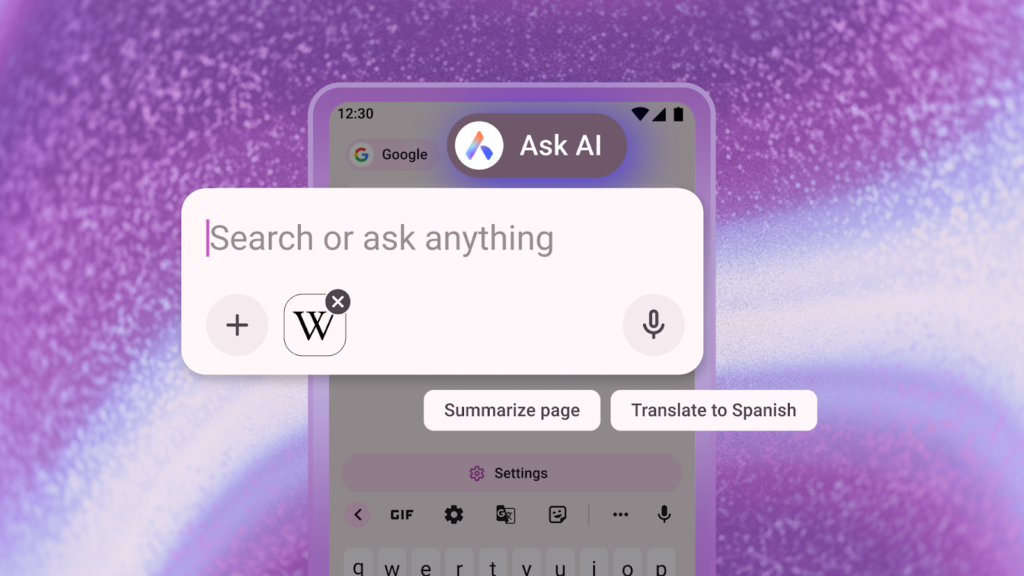
Once the user has done that, they simply need to type in the prompt and continue asking follow-up questions about the content of the webpage.
To protect user privacy, Opera AI only understands the context within the specific Tab being used, and cannot access information outside it. Page context data will only be sent to the AI Engine when this is necessary to perform the task requested. Opera AI does not send the user’s browsing activity or history to the AI Engine.
Prompt and page context data is sent to Opera’s servers and to the AI model that is the most relevant to the desired task. This data is encrypted, so no one at Opera can read it. It is stored for up to 30 days, only to enable conversation continuity for tasks that the user might return to, and to enable faster processing. It is never used for AI training, advertising, or any other purpose. All such data is then deleted from the servers automatically after the 30-day mark.
Download Opera for Android
Download Opera on your Android device today and experience the most advanced browser AI for mobile.
About Opera
Opera is a user-centric and innovative software company focused on enabling the best possible internet browsing experience across devices. Hundreds of millions of people use Opera browsers for their unique features on mobile phones and desktop computers. Founded in 1995 and headquartered in Oslo, Norway, Opera is publicly listed on the Nasdaq stock exchange under the ticker symbol OPRA. Download Opera browsers and other Opera products at opera.com. Learn more at investor.opera.com.
Contacts: Investor relations: Matthew Wolfson, [email protected]; Media: [email protected]
]]>
Key highlights:
- With over 11 million activated wallets and more than 300 million transactions, Celo Foundation and Opera announce an extension of their strategic, long-standing partnership in support of Celo’s 2030 vision to broaden widespread adoption of instant, onchain stablecoin payments in emerging markets, sharing a joint mission of promoting financial inclusion and building for the next billion users
- MiniPay, Web3’s fastest-growing stablecoin wallet, built on Celo, enables stablecoin to real-time payments via leading digital payment platforms, including Mercado Pago and PIX, with planned integrations of stablecoin-powered cards and more
- Celo has recently emerged as the number one Ethereum Layer 2 with over 700,000 daily active users, and the #1 transport layer for USD₮ with more than 3 million weekly active users
- A Mini App Roadshow will engage developers beyond Africa from markets across Asia and South America in H1 2026, building for MiniPay’s growing onchain economy, which features Tether Gold (XAUt0), bill payments, and everyday use cases
Dubai, UAE – December 3, 2025 – The Celo Foundation, stewards of the mobile-first, Ethereum Layer-2 Celo blockchain built for real-world payments, and Opera (NASDAQ: OPRA) the company behind MiniPay, a leading non-custodial stablecoin wallet built exclusively on Celo, today announced at Binance Blockchain Week the extension of their long-standing strategic partnership to make open, low-cost digital stablecoin payments ubiquitous around the world.
Since launching on Celo in September 2023, MiniPay has grown to 11 million unique activated wallets and facilitated over 300 million transactions, optimized by Celo’s pioneering L2 with fast, low-cost, real-world payments, sub-cent fees, and near-instant finality.
MiniPay’s global distribution supports Celo’s emergence as the number one Ethereum Layer 2 by daily active users (DAUs) and #1 transport layer for USD₮ by weekly active users (WAUs). With over 700K DAUs, and more than 3 million WAUs of USD₮.
Celo and MiniPay connect Celo-based stablecoin infrastructure with several digital payment platforms, including Binance, Transak, Transfi, YellowCard, Daimo, and Noah. Just weeks ago, MiniPay rolled out support for Mercado Pago and PIX payment functionality, allowing for stablecoin to real-time payment transactions in Argentina and Brazil. This early pilot will expand to all users globally to further reduce off-ramping friction.
“MiniPay is crypto’s killer user case, leveraging Celo’s infrastructure to make stablecoins useful for everyday people around the world,” said Rene Reinsberg, Celo co-founder and Celo Foundation President. “Our longstanding partnership has grown with the industry, from a simple integration in the Opera Mini browser to scaling the fastest-growing Web3 app, with millions of users. With product market fit and our thesis confirmed, we’re ready to double down on this exclusive partnership together to supercharge stablecoin adoption in the real world.”
“Our goal with MiniPay has always been simple: to give people a reliable stablecoin wallet that allows them to receive payments, save, and send payments – no matter where they are,” said Jørgen Arnesen, EVP Mobile at Opera. “By continuing to team up with Celo’s tech and ecosystem, we’re turning that experience into one that developers and payment companies can build upon, and that benefits the users.”
Additionally, as part of their Q1 2026 roadmap, Celo and Opera announce plans to deepen MiniPay’s role as a gateway to both traditional payment infrastructure and onchain utility.
The recently launched Tether Gold (XAUt0) integration for example, now sees nearly 30,000 users in its first weeks, moves beyond traditional stablecoins, now offering gold-backed, real-world assets (RWAs). The move comes as a direct response to user feedback, addressing the growing demand for assets that can provide a hedge against inflation and offer greater stability – a crucial feature for wealth preservation.
Furthermore, MiniPay users will soon be able to use stablecoin-backed cards and payments. Together, these integrations will position MiniPay on Celo as both a user-friendly front door for users and the connective tissue for partners who want to tap into stablecoin rails and onchain infrastructure.
To expand its developer and partner ecosystem beyond Africa, Celo and Opera MiniPay will host a joint Mini App Roadshow across new markets in Asia and South America in H1 2026 to encourage developers to build for MiniPay.
With this Roadshow, Celo and Opera MiniPay are bringing a physical presence to Asia, home to 32% of Web3 developers, and throughout Latin America, where cryptocurrency usage grew by 116% in 2024, and an additional 65% in H1 2025.
Download MiniPay on iOS or Google Play for instant, onchain stablecoin payments, access to the expansive Mini App ecosystem, and more.
About Celo
Celo is an Ethereum Layer-2 and mobile-first blockchain network built for the real world and designed for fast, low-cost payments worldwide. The Celo ecosystem consists of a decentralized, proof-of-stake blockchain technology stack, the CELO native token, USDC and USDT (both enabled as gas currencies), several Mento stable assets (cUSD, cEUR, cREAL, eXOF), and popular infrastructure including Aave, Uniswap V3, Curve, Velodrome, and Chainlink. Launched on Earth Day in 2020, the open-source Celo mainnet supports a rich ecosystem of projects (1,000+) contributing to Celo’s global mission of prosperity for all. For more about Celo, visit https://celo.org/.
About MiniPay
MiniPay is a non-custodial stablecoin wallet built on the Celo blockchain and offered by Blueboard Limited, an Opera company. MiniPay is designed to make digital finance accessible, affordable, and user-friendly – especially across emerging markets. Available as a standalone Android and iOS app, or as integrated into the Opera Mini browser, MiniPay enables users to send, receive, and save stablecoins like USD₮, cUSD, and USDC with sub-cent fees, no gas management, and a phone number-linked experience. Since its launch in 2023, MiniPay has expanded to over 60 countries and surpassed 10 million activated wallets, making it one of the fastest-growing stablecoin wallets globally. Learn more at www.minipay.to
About Opera
Opera is a user-centric and innovative software company focused on enabling the best possible internet browsing experience across all devices. Hundreds of millions use Opera web browsers for their unique and secure features on mobile phones and desktop computers. Founded in 1995 and headquartered in Oslo, Norway, Opera is a public company listed on the Nasdaq stock exchange under the ticker symbol OPRA. Download the Opera web browsers and other Opera products from opera.com. Learn more about Opera at investor.opera.com.
]]>
Oslo, Norway – December 1st, 2025 – The browser innovator and agentic AI company Opera [NASDAQ: OPRA] is rolling out new AI capabilities across its Opera One, Opera GX and Opera Neon browsers, providing more than 80 million of Opera’s users with free access to the latest and most advanced Opera browser AI. The rapid evolution of Opera AI benefits from the expanded long standing partnership between Opera and Google, which now includes integrating the latest Gemini models into its browser AI.
The new Opera AI exists as a side panel that users can interact with whenever they want, and in connection with any webpage, group of webpages and even videos. This allows it to give answers based on the browsing context – including easy research, content summaries, and even comparisons between different tabs. Opera AI enables voice input and output, as well as file analysis on multiple file types, including image and video. The engine has been rebuilt for speed with a new architecture, adopting an agentic-based engine from Opera Neon. Because of this, it is capable of delivering 20% faster responses. In addition, its privacy features ensure that the user has full control over what context is shared with Opera AI and what is kept outside its awareness.
“AI is reshaping how people interact with the web, and the browser is the natural entry point for those experiences,” said Per Wetterdal, EVP Commercial at Opera. “Through our partnership with Google, we are able to offer users the experiences they really want through native search and AI features, for free, directly in their Opera One and Opera GX browsers while our most advanced users of the agentic Opera Neon browser are already getting access to Gemini 3 Pro.”
AI has become a fundamental part of the browsing experience. This is also reflected in how browsing is monetized. In its latest earnings results, Opera reported a 17 percent annual increase in query revenue, representing the monetization of user-initiated actions in Opera’s browsers beyond classic search as the measure also captures the increasing usage of AI tools. Opera AI is designed to natively support an expanding richness in the processing of user queries, representing an interface where users can identify products and services of interest and connect with e-commerce and other platforms of direct relevance to them. Opera’s partnership with Google continues to play a key part in providing its browser users with the best possible search and AI experience.
“Our long-standing partnership with Opera is a testament to our shared vision for an innovative ecosystem.” Per Gustafsson – Managing Director Nordics at Google. “By integrating the latest Gemini models, Opera is not just enhancing its browsers, but setting a new standard for AI-powered user experiences. We are proud to provide the cutting-edge AI capabilities that help partners like Opera thrive and continue to shape the future of browsing for millions of users worldwide”
The browser as the next AI frontier
The browser is emerging as one of the most important frontends for AI. Unlike a standalone chat interface, the browser has access to real-time context such as a user’s open tabs, page content, and browsing flows. This enables more relevant and efficient assistance, supporting task completion directly within the browsing experience.
“We’re seeing a clear and positive shift as AI-powered search becomes more widely adopted, including features such as Google’s AI Overviews and emerging AI modes,” continued Wetterdal. “These developments encourage users to explore more deeply, which aligns well with our long-term focus on building products that drive meaningful engagement. As an independent browser, we are excited about our ability to work with ecosystem partners and contribute to our users’ experience whether they use Opera AI alone or in combination with any other AI platform of their choice.”
About Opera
Opera is a user-centric and innovative software company focused on enabling the best possible internet browsing experience across devices. Hundreds of millions of people use Opera browsers for their unique features on mobile phones and desktop computers. Founded in 1995 and headquartered in Oslo, Norway, Opera is publicly listed on the Nasdaq stock exchange under the ticker symbol OPRA. Download Opera browsers and other Opera products at opera.com. Learn more at investor.opera.com.
Contacts: Investor relations: Matthew Wolfson, [email protected]; Media: [email protected]
]]>
Oslo, Norway – November 26, 2025 – Opera [NASDAQ: OPRA], browser innovator and agentic AI company, is bringing several updates to Opera Neon – its agentic browser that’s currently in early access for Founders. This update to Opera Neon has been developed hand-in-hand with the founder community and introduces a new mode for 1-minute research for the Opera Deep Research Agent (ODRA), the newest advanced AI models from Google: Gemini 3 Pro and Nano Banana Pro and the capability for users to select the specific AI model they want to use. Additionally, the update brings improved support for advanced agentic tasks, including support for operations on Google Docs.
“Opera Neon is our experimental playground that allows us to tap into the most cutting-edge AI technologies that exist on the web. We’re developing this product together with our community – at an extreme speed. The way Opera Neon’s AI engine is set up allows us to integrate the latest technologies barely hours after they become available,” said Krystian Kolondra, EVP Browsers at Opera.
Deep Research in a minute
ODRA is the newest addition to Opera Neon, it works alongside the Chat, Do, and Make agents to enhance user productivity. As a deep research tool, ODRA mitigates the need for manual searching by cross-referencing diverse sources to generate fully structured, citation-backed reports. This functionality transforms the browser into a powerful research hub, offering the rigorous output of a research team with the speed of AI. The Opera Deep Research Agent scores high in the DeepResearch Bench test, and places it among the top models for deep research – alongside Google and OpenAI.
This update to Opera Neon brings a new 1-minute research mode to ODRA which lets users get a complete report with cited sources in just about a minute. The Opera Deep Research Agent stands out from other deep research engines because it “parallelizes the task”, meaning that it divides it as if employing several researchers to dive into the topic and contrast the information that was found.
In the new one-minute-research mode, Opera Neon is dividing the problem as much as possible in order to employ as many “researchers” as possible on the same task. This new mode for the deep research agent acts as a point in-between a simple AI query and a full-on deep research that turns useful since the user is not always in need of a full deep research for every query that requires a little bit more than just an AI overview.
Gemini 3 Pro and Nano Banana Pro
With this update, Opera is introducing the model selector which allows users to choose the AI model that they want to use when interacting with Neon Chat. This feature lets users choose from the most powerful and advanced AI models available out there, including the latest models from Google: Google’s Gemini 3 Pro and Nano Banana Pro. Users can also switch models mid-conversation if they want to.
When choosing a model, they are keeping their chat history and the context awareness. Opera Neon is also introducing Google’s newest image generation and editing model: Nano Banana Pro, which joins the suite of image generation models supported by Opera Neon.
Neon Do can now work with Google Docs
One of the key points that the Opera Neon community has been asking for is the integration of certain popular services into the workflow of Neon Do, the AI agent that can do things with and for them. This means that Opera Neon users can now tell the browser to create a Google Doc with anything they want . For example, they can have the agent research different products and then create a Google Doc with it to compare them.
In order to create a Google Doc with Opera Neon users need to select the “Do” agent in the browser’s omnibox and simply add to their prompt that they want to create a Google Doc. Additionally, users can also use Neon Do to edit an existing Google Doc, so they can request for the agent to add or subtract something – it will search the web for relevant information if needed – and they can even have it change the name of the document.
How Opera Neon fit in the family of Opera browser
At Opera we are proud to be the preferred choice of browsers for 300 million users who prefer something different to what is just default on their systems. We differ from most other companies in that we truly specialize in building browsers, and we know people are different and that the one-size-fit all system does not work for everyone out there. Our flagship browser, Opera One is carefully tailored for people who want to have a more joyful browsing experience, while Opera GX and Opera Air both rethink what browsers should be for their core audiences. All the Opera browsers ship with a free and advanced, LLM agnostic, AI solution. Opera Neon complements this with being tailored for the more advanced and demanding users out there, those who want to participate in shaping the future of web browsing, and believe AI agents will be a core part of their experience when doing so.
Opera Neon, pricing and availability
Opera Neon is currently available to a limited number of invited users as part of its early access program. To gain access, register on www.operaneon.com. All the other browsers are available for free from www.opera.com
About Opera
Opera is a user-centric and innovative software company focused on enabling the best possible internet browsing experience across all devices. Hundreds of millions use Opera web browsers for their unique and secure features on mobile phones and desktop computers. Founded in 1995 and headquartered in Oslo, Norway, Opera is a public company listed on the Nasdaq stock exchange under the ticker symbol OPRA. Download the Opera web browsers and other Opera products from opera.com. Learn more about Opera at investor.opera.com.
]]>
Nairobi, Kenya – 19 November 2025 – Opera (NASDAQ: OPRA), a leading software innovator, has renewed its partnership with Safaricom (NSE: SCOM) to offer free sponsored data through the Opera Mini web browser, giving millions of Kenyans 1.5 GB of free browsing data per month. The free data offer is available to all new and existing Opera Mini users on the Safaricom network in Kenya. Users simply need to open or update to the latest version of Opera Mini, and the free data bundles allocation is applied automatically. The partnership with Kenya’s leading TechCo reinforces the companies’ shared mission to expand digital inclusion while enabling users to make smarter, data-conscious decisions online.
Since the return of the Free Data campaigns, Opera Mini has seen significant growth in usage metrics, with a 13% increase in monthly average Kenyan users. On a weekly basis, 47% of Kenyans now use Opera Mini as their default browser. This represents a 40% increase since the start of the year, demonstrating how the free data offering is speaking to the needs of Kenyan users.
“Our partnership with Safaricom is about giving every Kenyan the ability to connect to the web, learn, and create – without worrying about data limits,” said Jørgen Arnesen, EVP of Mobile at Opera. “Opera Mini is the smart choice for anyone who wants to stay connected while making data-conscious decisions.”
Among Safaricom users in particular, Opera Mini has seen a surge of 93% of daily active users and a 55% increase in the number of pages loaded since relaunching the campaign. These numbers reflect Opera Mini’s position as the go-to browser for millions of Africans who want fast, reliable, and data-friendly internet access.
“This collaboration demonstrates our commitment to delivering meaningful value to our customers. By enabling 1.5GB of free browsing each month through Opera Mini, we are empowering millions of Kenyans to access the opportunities the internet provides,” said Fawzia Ali-Kimanthi, Chief Consumer Business Officer, Safaricom PLC.
The reactivation of Opera and Safaricom’s partnership comes at a time when Kenya’s digital economy is growing faster than ever. The Communications Authority of Kenya (CA Kenya) reports that as of 30 June 2025, total data subscriptions reached 58.5 million – a 27.3% increase from the previous year. As the nation’s digital economy grows, so too does the appetite for affordable, efficient access to the internet.
Opera Mini’s smart, data-saving technology gives Kenyans the control they need. Its built-in compression engine, download manager, and offline features help users save up to 90% of their mobile data while still accessing videos, news, and social content.
Additionally, to ensure speed and reliability for Kenyan users, Opera has local data centers in the region, including one in Nairobi. This local hosting helps reduce latency, improve response times, and keep user experiences fast and secure, even on low-bandwidth networks.
Free, data-conscious, unlimited AI in Opera Mini
Since the last Free Data campaign, Opera Mini has integrated free, unlimited AI directly into the browser, offering access to AI tools for writing, searching, summarizing, translating, and more. Unlike standalone AI apps that can be data-intensive, Opera Mini’s AI is built directly into the browser, meaning users can experience the power of AI without worrying about extra data costs.
Driven by a younger, tech-savvy generation, AI adoption in Kenya is growing, with those most familiar using it extensively. The integration of AI meets these early adopters where they already are – inside a browser that is fast, efficient, and free.
Opera Mini features a personalized newsfeed tailored to users’ interests, plus built-in Live Scores for real-time sports updates. It also provides a faster, less distracting experience with its built-in ad blocker.
Download the latest version of Opera Mini today and start browsing with free data.
About Opera
Opera [NASDAQ: OPRA] is a user-centric and innovative software company focused on enabling the best possible internet browsing experience across all devices. Hundreds of millions use Opera web browsers for their unique and secure features on mobile phones and desktop computers. Founded in 1995 and headquartered in Oslo, Norway, Opera is a public company listed on the Nasdaq stock exchange under the ticker symbol OPRA. Download the Opera web browsers and other Opera products from opera.com. Learn more about Opera at investor.opera.com
]]>