Product Ownership for Enterprise Complexity, Not Just Backlogs
Training for senior leaders who need to connect strategy to execution inside complex organisational constraints.


Many organisations have updated their revenue-generating business units’ operating models to a value-stream or product-based model, increasing the flow of customer value and creating better business outcomes. However, updating the operating model of supporting corporate functions can also unlock significant value. Designing a corporate function operating model requires careful consideration and the work often differs significantly from designing the operating model of revenue-generating business units.
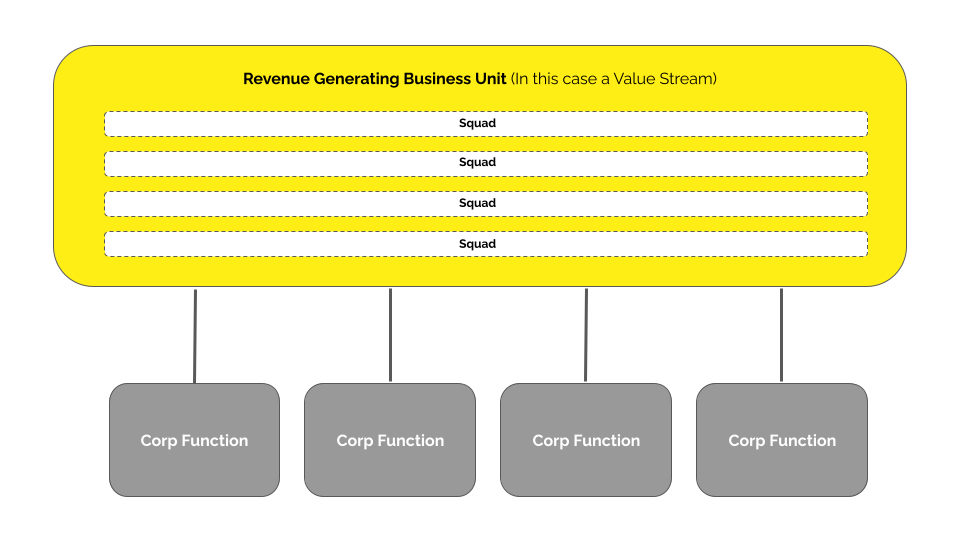
This article shares how we have approached this. We will refer to two different types of business units:
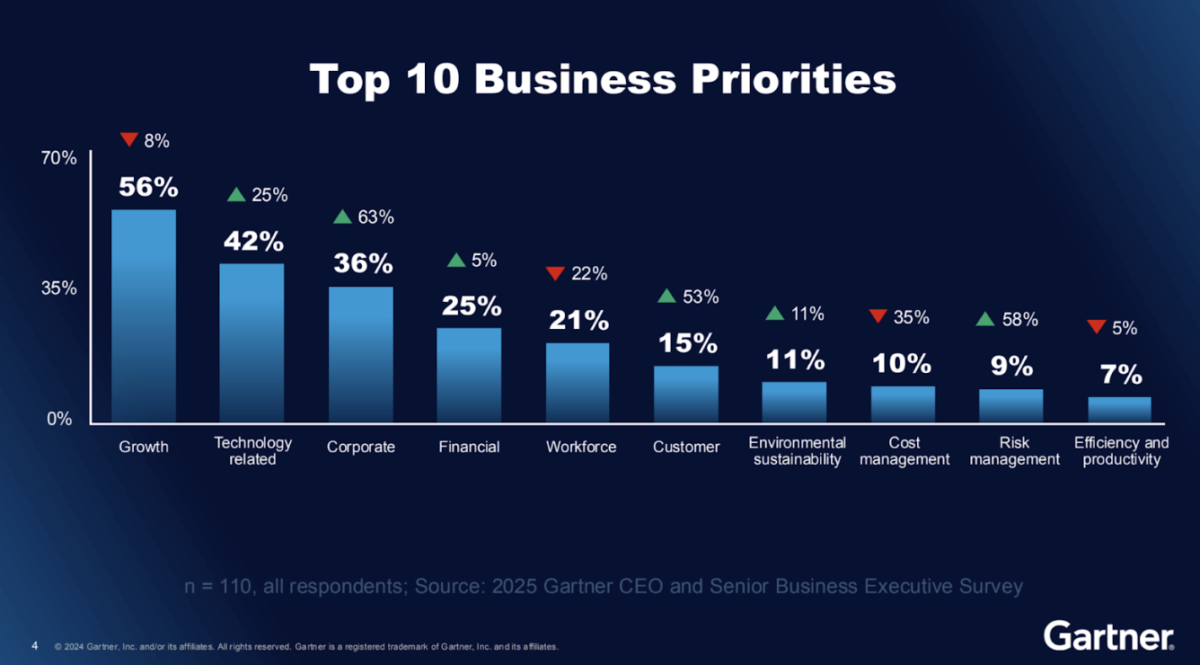
CEOs are looking to obtain better value from their corporate functions. According to Gartner, more value from corporate functions is one of the top three concerns of CEOs, jumping 63% among survey respondents.
There are three key reasons for this:
In their attempt to achieve this, many corporate functions have flipped back and forth between centralised and decentralised models, often the result of incoming new leadership or on the advice of a consulting firm. Over time, they’ve become bloated, expensive, slow, and confused. In reaction to this, revenue-generating business units are left with little other option than to “opt-out” by creating shadow functions.
Finally, patchwork fixes are frequently applied to solve specific problems without the proper buy-in and change management or a greater understanding of the organisational context. As a result, over time there is diminished clarity and coherence of how everything works together, low ownership to maintain and champion the change, and often an unintended increase in complexity.
Through our work with executives and business leaders, we see recognition of the above, with increased focus on ensuring that corporate functions are set up to support organisational growth better. As a result, leaders are investing in increasing delivery speed within corporate functions.
Corporate functions are often in a constant battle to balance their strategic priorities while also meeting the needs of the revenue-generating business units they serve. Tensions arise when these become imbalanced.

Knowing how to enable the right balance is essential but hard. The struggle to find this balance lies in three key pain points:

A reconfigured corporate function operating model is a holistic and systemic way to solve these challenges.
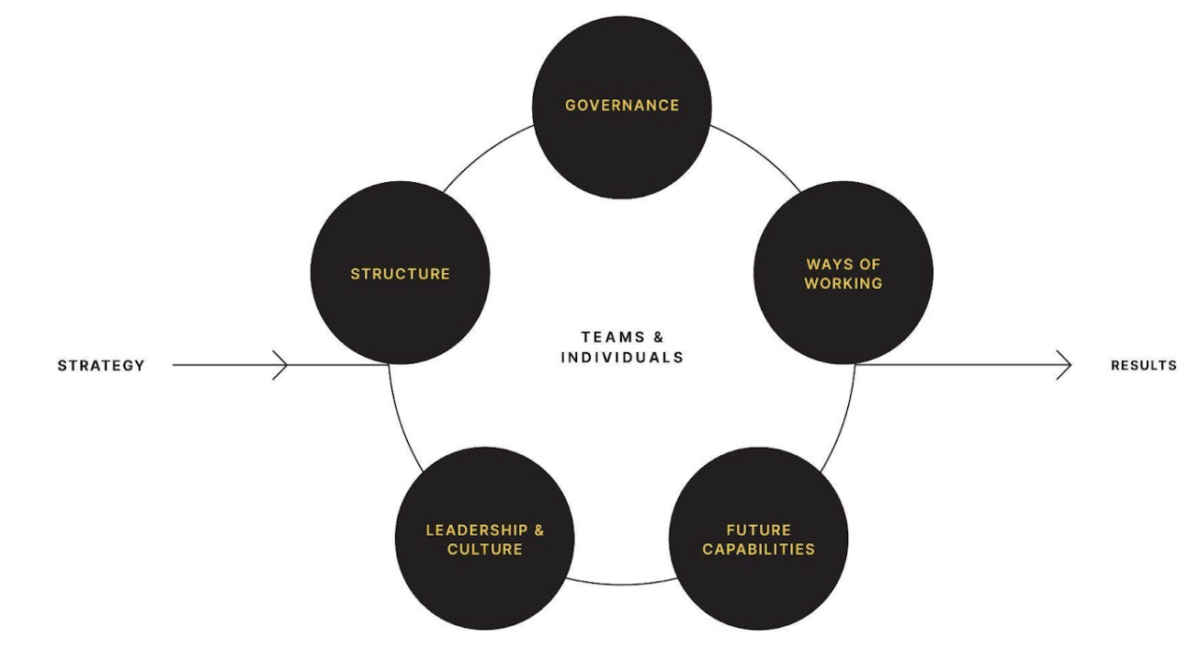
Simply put, an operating model helps teams and individuals turn strategy into results.
It is a framework that operationalises strategic plans by translating and managing the big-picture thinking into coordinated day-to-day actions needed to achieve tangible outcomes. An organisation’s operating model defines how their capabilities are managed to achieve their strategic goals, and the success of an organisation depends on the interconnectedness of five core elements.
Structure brings all the elements together, and because it is also the most visible and tangible part of the operating model, it’s often easier to start with that, then integrate the other elements. However, Ways of Working are highly interconnected with Structure, so these must be front of mind during the design process.
An operating model starts with the strategy so this needs to be right before moving into design, and Radically often helps clients relook at their strategy as a first step. With a corporate function, because its core purpose is to enable the Business Units to achieve the organisational strategy, a highly differentiated or clearly expressed strategy doesn’t need to be a prerequisite. Instead, it can be helpful to articulate clear shifts they want to target. Below is an example.

Conventional hierarchical structures make it challenging to visualise how teams and their roles align with how they engage with their internal consumers. Often, our roles are made more complex and slow due to a lack of clarity on decision rights.
The Radically Teaming Model ensures consistency in how we discuss team structures and whether they enable or hinder our ability to get work done. By introducing distinct team and interaction types, we create clarity and focus on the organisational structures.
Teaming models refer to organisations’ frameworks or structures to form, manage, and optimise teams to achieve specific goals. These models provide guidelines on:
Different teaming models are suited to different types of work and organisational needs. Teaming models help organisations maximise efficiency through:
There are three key reasons why you should use a teaming model:

There are two components to the Radically Teaming Model:
For Corporate Functions, the Radically Teaming Model has four different team types.


The Radically Teaming Model has four interaction types, which define how the four teams above interact.

We take a co-creation approach to design, leveraging the Radically Teaming Model. We believe you know your business better than anyone, and by collaborating with our highly experienced team of experts, we can co-create a model that works for your specific situation.
Clarity on the strategy is always the starting point as an operating model brings strategy to life. Given the enabling nature of corporate functions, this can be as simple as defining how it will support the organisational strategy to achieve its goals.
While structure is often the most visible part of the operating model, its harmonisation with governance, ways of working, future capabilities, and leadership and culture determines how well the organisation’s strategy is translated into results.
Embedding the new operating model requires focus, tenacity, and patience. With guidance, teams will mature as they build a rhythm in the new processes, gain confidence in decision-making, and feel ownership of their work. This will ultimately increase the speed of delivery and build an adaptive culture.

Contact [email protected]

Many leaders I meet tell me the same story: “We’ve tried agile. More than once. It never worked the way we were promised.” These conversations often lead to the bigger question of why agile fails at scale—why the same methods that work well for small teams often break down when applied across an entire organisation.
On the surface, the problem appears to be an execution issue. Teams adopt agile practices, but the benefits don’t translate into business outcomes. Dig deeper, and the issue is systemic. Governance, planning, and prioritisation — the core management controls of the enterprise — are still wired for a different era. They’re optimised for certainty and prediction, not adaptability.
Until those controls are reframed, agile remains stuck in pockets of the organisation, never fully connected to strategy or outcomes.
At Radically, we’ve seen this pattern across organisations of every size. The ones that finally crack it aren’t those that double down on ceremonies or tooling. They’re the ones that reimagine governance as a bridge between the executive table and delivery teams.
Research confirms this as one of the key reasons why agile fails at scale. In a BCG study, 86% of “truly agile” companies made significant changes in governance, compared to only 38% of those that stalled in “illusory agility.” In other words, structure and process changes aren’t enough — governance is the differentiator.
Why Agile Fails at the Enterprise Level
Agile almost always starts at the delivery layer. Teams adopt new ways of working, leaders run pilot projects, and early wins are celebrated. However, when it’s time to scale, friction sets in.
Executives still expect certainty in annual plans. Governance forums still reward compliance over outcomes. Prioritisation occurs through negotiation and politics, rather than through strategic clarity. The result is misalignment: delivery runs fast, but it isn’t connected to where the organisation is really trying to go.
We saw this at a large New Zealand bank. Six years after implementing a new agile operating model, they were struggling to execute their strategy effectively. Half of the bank worked on agile projects, while the other half worked on traditional projects. Governance evolved into a patchwork of fixes to address immediate problems, resulting in unnecessary complexity and friction. The core issue wasn’t whether agile worked — it was that the system of governance couldn’t translate strategy into coordinated action.
Reframing Agile as Strategy, Not Delivery
Enterprise Agile isn’t a methodology – it is an operating model.
That shift in perspective is crucial. When leaders see agile as “just delivery,” it gets siloed at the bottom of the organisation. But when it’s treated as a way to operationalise strategy, it becomes the connective tissue between intent and outcomes.
This is how Mercury approached their integration with Trustpower. Instead of layering agile on top of existing structures, we redesigned the operating model itself. That meant aligning governance forums, planning cadences, and leadership behaviours so that strategy could flow seamlessly into delivery. The result? The programme was judged NZ Business Transformation of the Year, with one judge calling it “a masterclass in laying the right foundations for success”.
The Missing Middle: Where Scaling Models Go Wrong
Here’s why agile fails at scale: scaling frameworks try to standardise the enterprise to fit the model. Business units are redesigned to map neatly against value streams, or governance is rebuilt around a predefined cadence. It looks neat on paper, but rarely sticks in practice.
Why? Because organisations resist being forced into someone else’s structure. People know when controls have been imported rather than designed for context. The “missing middle” — the layer between executive intent and team delivery — becomes a battleground of resistance.
Recent research comparing SAFe, LeSS, and other scaling models found little difference in outcomes once team maturity and organisational size were controlled. In other words, no model guarantees success. What matters is how governance and organisational design are tailored to the context.
What works instead is using organisational design and governance as the careful stitching that connects strategy to execution. Fit-for-purpose controls respect context: they flex with the nature of the business, the regulatory environment, and the culture. Instead of forcing delivery teams to bend to the model, they create connective tissue that allows executives and teams to operate as one system.
Fit-for-Purpose Controls: Governance, Planning, Prioritisation
For agile to work at scale, management controls must evolve.
Governance
Traditional governance is designed to eliminate variance. It locks in plans, tracks deviations, and escalates exceptions. In adaptive organisations, governance shifts to alignment. The question isn’t “are we on plan?” but “are we on strategy?”
This means governance forums that focus on outcomes, not outputs. It means a regular cadence of alignment where executives and teams can course-correct based on new information, not just report against last year’s assumptions. Without clarity in governance channels, strategy fulfilment suffers.
Planning
Annual planning cycles are too blunt an instrument for today’s pace of change. By the time budgets are locked, the context has shifted. We help organisations move to rolling, adaptive planning. This enables executives to establish strategic intent and empowers teams to adapt delivery as conditions change.
At Origin Energy, this shift was transformative. By redesigning governance and planning, they reduced internal friction, increased cross-team alignment, and built the ability to respond faster than competitors.
Prioritisation
Most organisations don’t have a prioritisation problem; they have a clarity problem. Without a clear definition of value, decisions default to politics, personalities, or pet projects.
Modern operating models solve this by linking prioritisation directly to strategy. Work is continuously assessed against outcomes, not effort.
At a large bank we are working with, one breakthrough moment occurred when we simplified their model, allowing 95% of work to be prioritised within defined value streams. This created both speed and confidence in decision-making.
Together, governance, planning, and prioritisation form the real backbone of agility. They are the management controls that keep organisations both adaptive and accountable.

The Leadership Reframe
Agile fails when leaders see governance as control. It succeeds when leaders see governance as clarity.
The real challenge isn’t getting teams to run sprints or adopt stand-ups. It’s creating a system where executives, managers, and teams are aligned around outcomes, with the freedom and discipline to adjust course.
That takes courage. It means letting go of old rituals of certainty and replacing them with practices that feel less familiar, but far more effective. It means designing governance not to protect the past, but to accelerate the future.
The organisations that have done this — Mercury, Origin, ASB — are now delivering strategy faster, with lower cost, and higher engagement. They’re proof that agile does work at scale, but only when leaders are willing to reframe the controls that shape how work gets done.
Ready to Reframe?
If you’re a manager responsible for your organisation’s system of work, the opportunity is clear. Reframing governance, planning, and prioritisation isn’t just about fixing delivery. It’s about building a modern operating model that finally connects strategy with outcomes.
You don’t need to do this alone. Through the Adaptive Leadership Collective (ALC), we bring together NZ business leaders who are solving these very challenges. It’s where the conversation about performance and transformation is happening.
Join us — and start reframing agile where it really matters at the strategic level.

We see this pattern all the time: a large organisation embarks on a major transformation, and the first instinct is to redesign the structure. Boxes and lines shift, new competencies are defined, and frameworks are rolled out. On paper, it looks solid. But on the ground, frustration builds, trust erodes, and the transformation loses steam.
The truth is simple but often overlooked: competency follows culture. Without the right leadership behaviours and cultural environment, competencies don’t take root. Leaders who underestimate this reality risk building models that look right on paper but never take hold in practice.
When a CEO or executive team hits “go” on a transformation, structure feels like the most tangible lever. It’s visible, easy to communicate, and quick to draw. The assumption is: if we design the right operating model, the rest will fall into place. But structure alone doesn’t change how people show up to work. It rarely addresses whether people feel safe to challenge decisions, whether they take ownership, or whether unhelpful norms get flushed out.
We’ve seen this play out. At Origin Energy, a new operating model unlocked speed and alignment, but it was leadership’s decision to lean into cultural shifts that made it real. Executives deliberately modelled cross-team collaboration and ownership. That behaviour set the tone, ensuring the redesign translated into faster delivery, stronger engagement, and renewed trust.
Origin’s story reflects a wider pattern we see across clients: structure is necessary, but never sufficient. Radically’s operating model framework highlights five interconnected elements: governance, ways of working, future capabilities, leadership and culture, and structure itself. Focusing on structure without addressing leadership and culture is like rehearsing the script but never coaching the cast.
Here’s the crux: transformation lives or dies by how leaders behave. They are the cultural architects. Every meeting, every decision, every reaction to failure either reinforces or undermines the desired culture.
Competency is downstream of culture. When leaders role model openness, curiosity, and accountability, those behaviours cascade into teams. When they default to control, defensiveness, or ambiguity, no amount of training will embed the competencies written in the playbook.
During the Mercury–Trustpower integration, success hinged less on the mechanics of merging two businesses and more on leaders embodying the new culture. A large-scale leadership uplift program gave executives the skills and presence to be visible role models. Their consistency reduced ambiguity and built trust at a time when uncertainty could easily have fractured the organisation.
In our experience, the leaders who make the biggest difference are not just decision-makers, but also translators. They help their teams make sense of what’s happening, reduce ambiguity, and connect the change to something meaningful. That clarity and consistency are what build the foundation for growth capability.
As one client put it: “You can’t automate clarity. You have to earn it: in how you lead, how you engage, and how you listen.”
Another common trap is treating transformation as if it has a finish line. “Once the new structure is live, we’re done.” But transformation isn’t a program to deliver. It’s an invitation to lead differently, to embed new habits and mindsets that endure. And just like fitness or any other personal change, this takes sustained effort. That’s where Radically Sustain comes in: a service designed to help leaders and teams build the discipline, rhythm, and reinforcement needed to keep new behaviours alive long after the program ends.
That shift in perspective is critical. Real change sticks when it feels like growth, not an exam. People adopt new ways of working when leaders consistently embody them, not when they’re broadcast from a stage.
We often say: resonance beats rollout. You can roll out processes at speed, but unless people see, feel, and believe the change, adoption won’t last. Leaders create resonance through stories, presence, and consistency; not just metrics.
If you’re pouring energy into structure and competency frameworks while underplaying culture and leadership, you’re building on sand.
The transformations that last are those where leaders consistently demonstrate clarity, conviction, and connection.
Because in the end, transformation isn’t about structure. It’s about people seeing leaders walk the talk – and choosing to follow.
If your transformation feels heavy on structure but light on culture, it may be time to rebalance. Let’s talk about how to anchor leadership and culture at the centre of your operating model.
Please feel free to connect with me via my email [email protected] or connect with me via LinkedIn.

When people talk about transformation, there’s often a hidden assumption: that it ends. That there’s a finish line. But in our recent webinar Beyond Transformation: The Missing Piece for Sustainable Change That Lasts, hosted alongside with our guest speaker, Elise Keen, Program Manager at Origin Energy, the central idea was this:
“Transformation isn’t the destination. It’s the invitation.”
It is an invitation to lead differently. To engage differently. To think differently about what change really means in your organisation. This is why it’s crucial to understand the nuances of why so many change efforts lose momentum – even when they tick all the boxes on paper.
Spoiler: it’s not the tools or frameworks that are missing. It’s resonance. The webinar dives deeper into these common pitfalls, offering actionable strategies to overcome them.
If I had to sum up real transformation in one line, it would be:
“Real transformation is something you embody, not something you roll out.”
When people are included early – not just informed late – you create ownership. When they get to participate in the design of the change and have a voice, they feel heard. When you connect change to something meaningful, you create momentum. And when you invest in capability up front, you reduce the fear and friction that so often derail change.
Elise nailed it when she said:
“You can’t automate clarity. You have to earn it – in how you lead, how you engage, and how you listen.”
Even with the best intentions, transformation can stall. Three clear patterns came up in our discussion:
The fix? Shift the focus from speed to meaning. From broadcast to co-creation, from surface-level updates to deep capability-building. These shifts are challenging but essential for lasting change, and the webinar explores how to navigate them effectively.
There were three key takeaways from the webinar:
Utilities are a great case study in complex, long-haul transformation. You’ve got legacy infrastructure, high public scrutiny, and essential services that can’t skip a beat.
So, how are leaders in this space making it work?
Another great quote from Elise summed this up well:
“We’re not just modernising systems. We’re stewarding trust in how we operate.”
During the webinar, I said:
“People don’t resist change. They resist ambiguity.”
Transformation doesn’t need more noise. It needs leaders who consistently demonstrate clarity, conviction, and consistency. The webinar provides practical insights on how leaders can become effective translators, reducing ambiguity and fostering genuine engagement.
When leaders become translators, not just decision-makers, they help teams make sense of what’s happening and why it matters. And when people see their role in the story, they stay connected emotionally, operationally, and culturally.
Whether you’re starting a transformation or reigniting one, here’s the thing to remember:
Change that lasts isn’t about delivering a project. It’s about building a culture.
And that takes leadership with presence, purpose, and patience. Because when we lead with intention and keep it human, long-lasting real transformation is possible.
Ready to unlock the missing piece for lasting change in your organisation? Watch the full webinar replay now to gain actionable strategies.
If you’re navigating similar challenges, I’d love to connect and explore how our insights can help. Please feel free to connect with me via my email ([email protected]) or connect with me via LinkedIn.

Leaders often wonder why their employees seem disengaged and cynical about new initiatives. We hear the same phrases again and again: “We’re tired of change.” “I don’t see how this change is any different to the others.” “Another restructure? I’ll just wait this one out.”
But here’s the truth: it’s not that employees don’t care. It’s that organisations often make it hard for them to care. At Radically, we believe the intersection of high performance and humanity is where real transformation happens. If you want people to lean in, contribute, and bring their best, you need to create the conditions that make caring possible.
Here are three of the biggest reasons employees switch off, and what you can do differently.
Change fatigue isn’t caused by change itself; it’s caused by poor change. Too often, organisations roll out initiative after initiative without giving people the chance to truly understand why it matters. Even worse, they move on before the change has had time to show value.
Employees end up feeling like passengers, not participants. The result? Exhaustion, mistrust, and a slow drift into disengagement.
The fix: slow down to speed up. Involve your people early in the journey. Explain the “why” behind the change. And most importantly, stick with it long enough for the change to embed.
Too often, we see organisations pull focus and funding the moment a change is “delivered,” racing off to the next shiny thing. But designing a new operating model or introducing new ways of working is only the beginning. Change only becomes transformation when it’s embedded; that’s when culture and performance endure.
Most employees want to do meaningful work, but many struggle to see how their daily tasks connect to the bigger picture. When strategy feels abstract or disconnected, people understandably disengage.
When employees understand how their work ladders up to strategy, motivation unlocks. Suddenly, they’re not just ticking boxes; they’re part of something larger and more purposeful.
The fix: Make strategy visible and tangible. Use storytelling to connect people to purpose. Start with a simple, human story, then layer in the data. Reinforce it with practices like Quarterly Planning and OKRs, which create transparency, clarity, and shared purpose.
And while events like QPD (Quarterly Planning Day) can feel like a big investment, the return is real. They create a surge of energy; a pulse of productivity that reconnects people to the work, to each other, and to the strategy itself.
Employees won’t care if they feel like spectators on the sidelines. Autonomy is a powerful driver of engagement, yet it’s often undermined by heavy approval processes and top-down control.
When people have a genuine voice in shaping the work, their sense of ownership skyrockets. They care because it’s their journey too.
The fix: Build teams with real end-to-end ownership. Strip back unnecessary approvals and trust people with meaningful decisions. Autonomy flows from ownership, but only when people have the right context. Give teams the guardrails they need to make smart calls. The result is more flow, speed, and genuine engagement.
Your employees do care deeply. But if they seem disengaged, it’s a signal that something in the environment is getting in the way.
Stop exhausting them with shallow change. Help them see the bigger picture. Give them real ownership of the journey.
Do these three things, and you’ll unlock the kind of care that powers lasting transformation.
If this blog resonated – if you’re ready to stop exhausting your people with shallow change and start building a culture where ownership, purpose, and performance thrive – then don’t miss this.
On 17th November in Auckland, join Holly Ransom, CEO of Emergent Global, at the AdaptiveNZ Conference for her keynote:
“The Mattering Effect: People-Powered Change That Sticks.”
Holly will share a modern blueprint for transformation rooted in behavioural science and real-world impact. Her Three Pillars of High-Precision Change will help you:
This is more than a talk – it’s a wake-up call for leaders who want to activate the one resource most organisations overlook: people who believe they matter.
Secure your spot at AdaptiveNZ and be part of the movement to lead with purpose, build adaptive organisations, and shape what’s next.
Register now here.
If you’re navigating similar challenges, I’d love to connect and explore how our insights can help. Please feel free to connect with me via my email or connect with me via LinkedIn.
Image source: Johnny Cohen – Unsplash

In pursuit of efficiency and improved customer outcomes, many firms are implementing a Product Operating Model (POM). Books such as Transformed by Marty Cagan have created a cult-like wave of POM hype and associated tools, products, and services. Like many hype waves, the POM wave is sweeping through the business landscape. But is a Product Operating Model the right model for your business?
A Product Operating Model (POM) is a style of operating model that organises a company’s teams, processes, and technology around a product, aligning everyone to deliver customer value continuously and efficiently, moving from project-based work to a product-centric, lifecycle approach with empowered, cross-functional teams focused on outcomes. It bridges strategy and daily operations, ensuring alignment on customer needs, fostering innovation, and improving agility through iterative feedback-based iteration, unlike traditional structures focused on functional silos.
In the right situation, implemented well, it can
The key here is in the right situation, implemented well.

I have been involved in the Agile movement since 2002. I saw agile emerge as something with the potential to truly deliver better products, better business outcomes, and better workplaces. Then I saw it mature and quickly become commoditised, hyped, and sold. Agile became a buzzword, and all of a sudden, Deloitte was Australia’s preeminent agile transformation firm, and McKinsey could reduce your organisations cost base by 30% with Agile.
Every executive suddenly wanted agile, and the word got generously sprinkled in strategies, mission statements, job descriptions, and executive updates. Everything was agile, and agile was needed for everything.
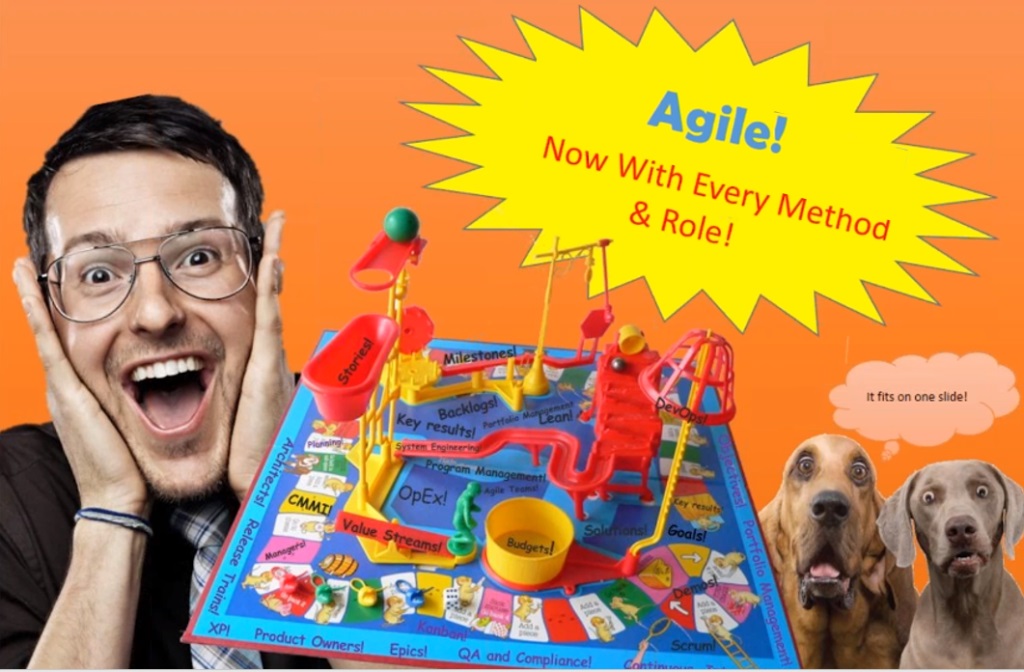
Now that everyone was “going agile”, the problem of scaling agile arose. Agile was based on small teams so now enterprises needed to know how to scale it.
And with perfect timing, along came SAFe, beautifully packaged, thoroughly detailed, one-size-fits-all solution. All you had to do was install SAFe, and you would be agile! The agile community was appalled.
Around the same time, Henrik Kniberg & Anders Ivarsson open-sourced a whitepaper, sharing how Spotify, a music streaming business they were working at, had approached agile organisational design. It quickly became known as The Spotify Model, and people started implementing it in their businesses, ignoring the explicit warning from the authors not to copy it, as it was designed for their particular businesses at a specific point in its journey.
SAFe and The Spotify Model were exactly what the large, latecomer, consulting firms wanted – a productised version of agile that could be sold to all those executives wanting a quick and easy shortcut to “go agile”. Even better, as a productised package, it could be delivered by cheap, inexperienced graduates. It didn’t matter that Spotify was the model for a streaming music startup. It didn’t matter that SAFe ignored what the business currently already had in place. Suddenly, agile could be everywhere and everyone could be an Agile Coach.
Agile was finally compatible with the Big Consulting model.
And now the same is happening with the Product Operating Model. In a similar frenzy, we are seeing organisations rush to implement a Product Operating Model without adequate consideration.
There is a certain attractiveness in copying what someone else has done. It feels less risky, because someone else has already done it, right?
Wrong. This is the trap. And every day we talk to organisations that have been burnt by this, costing millions in failed transformations, disrupted teams, and abandoned initiatives
The mistake is treating operating models as one-size-fits-all solutions. They aren’t. Many organisations implementing a Product Operating Model haven’t stopped to ask whether it’s the right model for them.
We recently worked with a company that made this exact mistake. Over a century, they’d built a remarkable business, based on a deep, trust-based relationship with their customers. Some staff knew customers personally. Claims adjusters had the authority to make exceptions because they understood the context. Their competitive advantage wasn’t product or innovation—it was intimate customer knowledge and the ability to customise solutions.
So what did they do? They implemented a Product Operating Model because that’s where the industry was moving. They broke their services into “products” and around these. The structure looked right. It was what everyone else was doing.
When we asked them, “What has made you successful?” the answer wasn’t “our products”. It was “understanding our customers” and “going the extra distance to serve them.” They were not a product-centric company. They were a customer-centric company. A customer-focused operating model would have been far more powerful than a product-centric one.
There are many different types of operating models, with the Product Operating Model (POM) as one of them, but before you choose which operating model, you need to understand what you’re trying to win at. Two simple tools that can help with this are the Playing to Win model, and the Value Disciplines model.
Playing to Win frames strategy as a small set of deliberate choices about where to play and how to win. Those choices only matter if the organisation is designed to support them—through appropriate capabilities, decision rights, funding, and governance. In that sense, the operating model is what turns strategy from intent into repeatable execution.

The mistake many organisations make is to stop at these choices and assume alignment will follow. In reality, strategy only becomes real when it is embedded into how work is structured, funded, governed, and led every day. Your operating model is therefore not a downstream design exercise — it is the mechanism that makes your where to play and how to win choices visible in the behaviour of teams and leaders.
Treacy and Wiersema identified three fundamental value disciplines on which organisations compete, and in working with organisations across industries, we’ve seen that understanding these disciplines is critical to choosing the right structure.
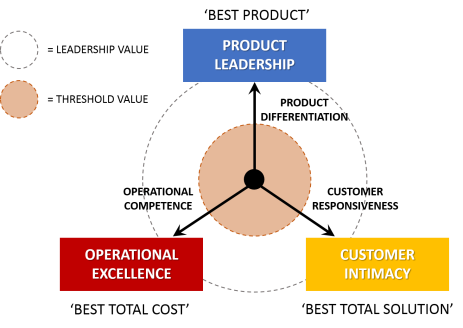
The key point is that you cannot excel at all three.
The resources, processes, incentives, and cultures that make you brilliant at one actively work against excellence in the others. You have to choose. And once you’ve chosen, your operating model must be designed specifically to support it.
The critical insight of the Value Disciplines model is not the labels themselves, but the trade-offs they force. Each discipline demands fundamentally different structures, decision rights, incentives, and leadership behaviours — which means trying to pursue all three inevitably creates tension, confusion, and mediocrity. Clarity about how you win is, therefore, a prerequisite for designing an operating model that actually works.
We work with organisations that recognise the importance of designing an operating model that fits their business and will optimise their ability to deliver their strategy.
This isn’t about implementing a predefined model. It’s about undertaking the complex heavy lifting of deeply understanding the organisation—the history, market, people, and capabilities—making strategic choices and then co-creating an operating model that flows from that understanding.
This involves a holistic redesign of the
We recently worked with a large Australian energy company on exactly this challenge. They needed to accelerate delivery and respond faster than competitors in an intensely competitive market. But the real work wasn’t picking a framework. It was understanding their business design: where they play, what makes them unique, and how they actually win.
The result? A custom operating model built around value streams, explicitly designed for their context and strategy. Not a template. Not something copied from a tech company. Something that worked for *them*.
The outcome speaks for itself: $6M in cost savings, dramatically accelerated delivery, reduced silos, and—crucially—people who actually understood why the structure existed and how their work mattered.
That’s what happens when operating model design starts with strategy, not with structure.
Getting your operating model right is utterly transformative. When your operating model reinforces your competitive advantage, something shifts. Strategy reaches teams. Execution becomes efficient. And your organisation moves with clarity and speed, not confusion and drift.
We’ve seen organisations transform when they finally align structure with strategy. Mercury and TrustPower merged two organisations with distinct cultures. Instead of imposing a template, we worked with their leadership to understand what unified success would look like—then designed an operating model to enable it. The judges called it “a masterclass in laying the right foundations for success.” It won NZ Business Transformation of the Year. The judges called it “a masterclass in laying the right foundations for success.” It won NZ Business Transformation of the Year.
Origin Zero faced a familiar challenge: it had a clear strategy to accelerate customer-centric energy solutions and support the transition to cleaner energy, but its existing operations — built around entrenched processes and functional silos — were slowing decision-making and limiting responsiveness to customer needs. Radically worked with Origin Zero to redesign their operating model, shifting teams into cross-functional Value Streams that reduced hand-offs, empowered teams to make faster decisions, and brought end-to-end accountability closer to the customer journey. The results were tangible: the organisation became more responsive to market changes, internal alignment improved, Value Streams became self-managing, and customer satisfaction increased as the teams were able to deliver clearer, faster, and more tailored solutions to evolving customer demands.
The Product Operating Model isn’t bad. It is one of the possible operating model options to consider, once you’ve done the preparatory work.
Before you implement a model, ask: What has made us successful? What are we uniquely good at? Which value discipline is our edge?
Answer those questions first, then choose your operating model. Everything else will be faster, cheaper, and actually work.
Because the organisations that win aren’t the ones that copied the best structure. They’re the ones who designed a structure that reflects who they are and how they actually compete.

I’ve recently been asked by a few of our clients on how to improve psychological safety. One of the most insightful things on this topic is to realise that psychological safety is often not a binary question. There are many factors influencing psychological safety, however the first step is to understand the different levels of psychological safety, so that as leaders we can create experiments to provide intervention to foster more safety for our people and teams.
Psychological safety isn’t a one-size-fits-all concept. It actually comes in different levels, and understanding them is key to creating a truly supportive workplace. Let’s explore these levels:
This is the starting point. At this level, team members feel safe enough to do their job without fearing punishment or humiliation. They know they won’t be reprimanded for making honest mistakes. It’s like a safety net that catches you when you slip.
Practical Tip: Encourage open dialogue about challenges and share your own mistakes to set the tone.
Moving up the ladder, this level is about people feeling comfortable sharing their ideas without feeling judged or dismissed. They’re willing to put their thoughts out there, even if they’re unconventional or untested. It’s like opening the door to innovation.
Practical Tip: Praise and acknowledge creative thinking, even if an idea doesn’t pan out.
At this level, your team members feel confident enough to take calculated risks without worrying about blame. They’re not afraid to venture into uncharted territory, knowing they have your support. It’s like the fuel for growth.
Practical Tip: Encourage calculated risk-taking and celebrate lessons learned, not just successes.
At the highest level, your team feels free to give and receive honest feedback. They trust that their input will be used constructively, not as a weapon. This is where you see constant improvement and genuine collaboration.
Practical Tip: Foster a culture of feedback, and lead by example by actively seeking and welcoming input.
In a nutshell, psychological safety isn’t just a yes-or-no thing; it’s a spectrum. The higher you can climb on this ladder, the more your workplace will thrive. So, take these simple steps, start adding more psychological safety in your workplace. Want to improve psychological safety for your workplace? Join us on our 1 day workshop on Psychological safety here.
Product Ownership for Enterprise Complexity, Not Just Backlogs
Training for senior leaders who need to connect strategy to execution inside complex organisational constraints.
Overview
Product Owner Course
Most Product Owner training teaches backlog management that works perfectly in startups and falls apart in enterprise politics. This course is built for modern leaders who must navigate complex stakeholder landscapes, legacy systems, andcorporate strategy while delivering customer value.
We focus on connecting strategy to execution, driving business impact, and leading adaptive teams inside Australasia’s largest enterprises. You will learn from senior practitioners who have led product ownership inside complex organisations, not trainers who have only managed small teams. Over two intensive days, you will master the thinking, tools, and techniques needed to lead as an effective Product Owner, Delivery Lead, or Value Stream Owner.
In this course, you’ll learn how to:
Participants receive a Radically Certificate of Completion.
This course is ideal for anyone involved in determining the direction of agile teams, including:
Day 1: Foundations
Day 2: Practical Application
Dive into a case study to practice essential tools and techniques:
By the end of this course, you’ll master the thinking, tools, and techniques needed to lead adaptive teams as an effective Product Owner.
This intensive two-day course covers the critical skills for enterprise product leadership:
$1,595 + GST per person standard rate.
$1,395 + GST per person early bird
(booked and paid for one month prior to the programme).
We can also run this course in-house. Please contact us for details.
Click here for terms and conditions
Ready to lead product ownership in the enterprise?
What People Say About Us


“The reason we chose Radically was their willingness to adapt to a set of circumstances. There wasn’t a prescribed formula that was rigidly followed”.
James Magill
Executive General Manager, Origin Energy


“The transformation that we’ve gone through has really put us on a different path where we’re very buoyant around our growth potential. ”
Jason Chan
Managing Director - Bankwest


“They bring good capability to the table, good thought leaders, people who genuinely make a difference and add value and people who aren't afraid to roll up their sleeves when things get challenging. ”
Paul Bacon
Head of Telecommunications - Mercury
Professional Scrum Master Training for Enterprise Complexity
Accredited Scrum.org course that builds internal capability and transforms how teams deliver in complex organisational contexts.

Overview
Professional Scrum Master Accredited Course
Most Scrum Master training teaches theory that works perfectly in a classroom and falls apart in enterprise politics. This course is taught by Edwin Dando, New Zealand’s longest standing Scrum.org trainer, personally mentored by Scrum co creators Jeff Sutherland and Ken Schwaber.
Over two intensive days you will build a deep understanding of Scrum’s core principles and the mindset behind enterprise agile success. You will learn what it takes to support high performing teams and apply Scrum with purpose, not just by the book. This is active, hands-on learning grounded in real world practice inside complex enterprises. You will explore the Scrum Master role as servant leader, coach, and change agent, developing skills to influence without authority, remove organisational impediments, and guide stakeholders toward better ways of working.
Participants gain the opportunity to sit the globally recognised Professional Scrum Master certification exam (PSM I), validating their ability to apply Scrum in enterprise contexts. This course is delivered in person because experiential learning requires collaboration that online delivery cannot replicate.
Unlock True Agility: go beyond simply “running Scrum events.” Learn how to help teams and organisations embrace the mindset, principles, and behaviours that create real business agility.
Elevate Your Impact as a Leader: develop the skills to influence without authority, coach teams to self-organise, and guide stakeholders toward better ways of working.
Lead Organisational Change: Gain tools to identify impediments, influence stakeholders, and shift mindsets—helping your organisation truly embrace agility.
This course includes the PSM1 Assessment (the base-level certification for Scrum Masters), as part of the fee. The assessment is done after the course, in your own time. All details are supplied as part of the course, including tips and tricks for preparing for the assessment.
This Scrum Master course uses experiential learning techniques and is best learned in person, not online. While we have taught it online during lockdown, experience has taught us that people learn much more when collaborating in person. We therefore only offer this two-day course in person.
This intensive two day course covers the critical skills for enterprise Scrum mastery:
$1,800 + GST per person standard rate.
$1,600 + GST per person early bird
(booked and paid for one month prior to the programme).
Click here for terms and conditions
Ready to build certified Scrum capability?
What People Say About Us
“The reason we chose Radically was their willingness to adapt to a set of circumstances. There wasn’t a prescribed formula that was rigidly followed”.
James Magill
Executive General Manager, Origin Energy
“The transformation that we’ve gone through has really put us on a different path where we’re very buoyant around our growth potential. ”
Jason Chan
Managing Director - Bankwest
“They bring good capability to the table, good thought leaders, people who genuinely make a difference and add value and people who aren't afraid to roll up their sleeves when things get challenging. ”
Paul Bacon
Head of Telecommunications - Mercury
Align Your Enterprise in One Day,
Not One Month
A practical workshop for senior leaders who need to bring large, complex groups together and leave with executable plans.

Overview
Big Room Planning Workshop
Most enterprise planning takes months, involves endless politics, and still leaves teams misaligned. Big Room Planning is the cornerstone of adaptive delivery, bringing together 50 to 500 people in a dynamic, collaborative environment where alignment happens in real time. This workshop is built from our hands-on experience facilitating Big Room Planning sessions inside complex enterprises where stakeholders are political, dependencies are messy, and outcomes are critical.
In this immersive one-day workshop you will learn the principles, practices, and real-world application of Big Room Planning. We cover facilitation techniques, preparation requirements, and strategies for overcoming common obstacles like remote participation and managing large groups. You will gain actionable insights from our experience helping clients achieve outstanding results. This is not a theoretical course. It is for senior leaders who need to lead planning sessions that deliver executable outcomes, not just pretty plans.
Join us for an immersive one-day workshop designed to set you up for success. This intensive session is tailored for teams, leaders, and anyone involved in collaborative planning and execution, interested in harnessing the collective wisdom of their teams to drive alignment, efficiency, and success in their projects.
This workshop is ideal for anyone involved in large-scale agile or adaptive delivery, seeking to enhance their skills and understanding of Big Room Planning, including those new, through to those with experience looking to take to the skills to the next step.
This intensive one-day workshop covers the critical skills for enterprise-scale planning:
This is not a public training course. Workshops are private, senior only sessions for your leadership team. Delivered at your location or offsite, designed around your specific organisational context.
What People Say About Us
“The reason we chose Radically was their willingness to adapt to a set of circumstances. There wasn’t a prescribed formula that was rigidly followed”.
James Magill
Executive General Manager, Origin Energy
“The transformation that we’ve gone through has really put us on a different path where we’re very buoyant around our growth potential. ”
Jason Chan
Managing Director - Bankwest
“They bring good capability to the table, good thought leaders, people who genuinely make a difference and add value and people who aren't afraid to roll up their sleeves when things get challenging. ”
Paul Bacon
Head of Telecommunications - Mercury